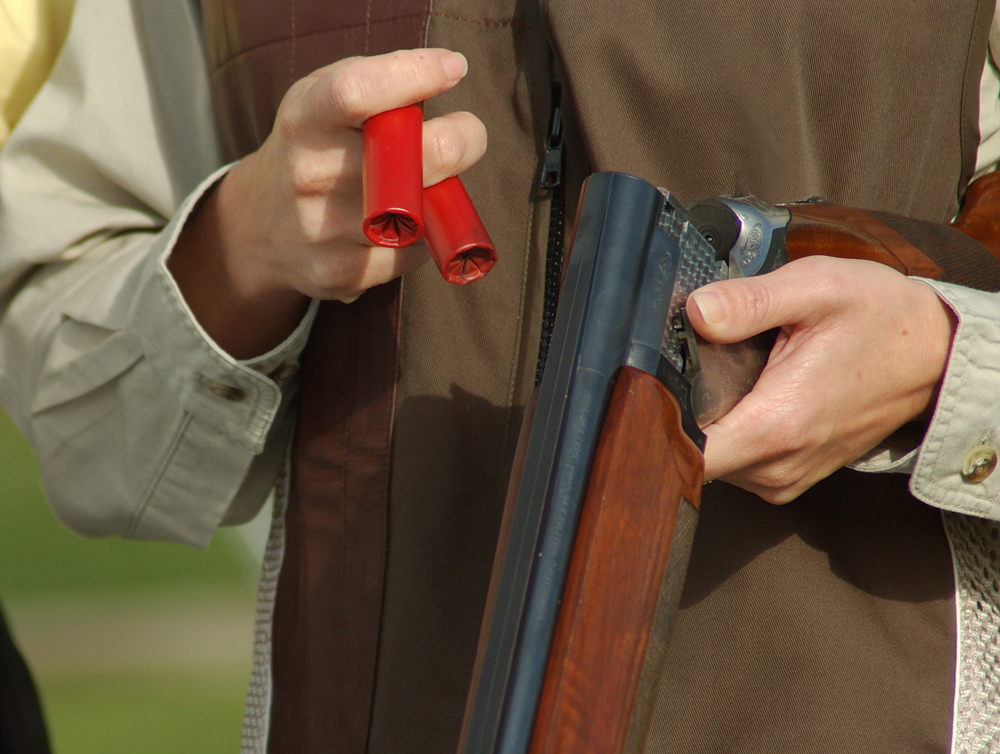
The kids today, well they seem to be doing all right. At least the ones who have hitched their stars to the fast-growing extracurricular activity of sport shooting.
Yes, breaking clays and nailing bull’s eyes have gained traction among American teens and young adults. Not long ago, we pointed out a feature the Washington Post did on the uptick of competitive college shooters.
Now, of all places, Bloomberg News notes the growth of high school athletes crowding the firing line.
As shocking as it might be, the namesake media outlet of one of America’s most notorious anti-gunners (Michael Bloomberg) does a fairly decent job documenting this trend.
One of the article’s main focuses is the Minnesota State High School Clay Target League Championship. And this one competition in and of itself shows exactly how fast high schoolers’ interest in shooting sports has blossomed:
In 2009, the contest’s first year, it drew 30 shooters. In June there were 5,134, more than 20,000 spectators and sponsors including Benelli Armi SpA and SKB Shotguns. Trap shooting is the fastest-growing sport in Minnesota high schools, and was recently introduced in neighboring Wisconsin and North Dakota.
An article in the Minneapolis Star Tribune from a year ago also noted traps growing popularity with teens, as well. In fact, it points out, shooting sports have more prep participants now than hockey in the Gopher State!:
…[S]o many kids are involved that about 1,800 were turned away this year, because of a capacity shortage at ranges. A recently approved $2 million legislative grant program is intended to help alleviate the deficiency.
In both articles, Jim Sable is pointed to as a catalyst to the resurgence of youth shooting sports. After retiring as an advertising executive in 2001, the Minnesota resident founded what has become the USA State High School Clay Target League.
His motivation in creating what has become one of the prime movers in competitive youth shooting was breathing life back into what he feared to be a dying sport. Sable’s work appears to be paying off since the Great North Woods isn’t the only place where a renewed interest in shooting sports is taking root.
According to the Bloomberg article, schools in Arizona, South Dakota, Illinois and Kansas are all set to field teams next year. No matter how you cut it, this is incredible news for anyone who loves shooting — competitive and otherwise.
These young men and women are the voices and guardians of our Second Amendment Rights in the not too distant future. It is heartening to hear their ranks are swelling.
More importantly, this emerging trend is wonderful for these young athletes. There are the obvious benefits of learning sportsmanship, discipline and competitiveness. But also, these youths are picking up an activity, more aptly a passion, that lasts a lifetime.
There are few things, particularly from high school, that can make that claim.
Ensure your ears are protected from the deafening sound of gun shots with SoundGear, the 100% digital hearing protection product from Starkey Hearing Technologies. SoundGear hearing protection products also provide 100% digital noise enhancement, so conversations are easy to maintain, and you won’t miss a rustle, release or command. Get Yours Now
Optics companies haven’t held back this year with a slew of new and improved options ready to deck out rifles, pistols and shotguns. To boot, the companies appear to have an option for nearly every budget — no matter how big or small. Check out these 11 new firearm optics and see what’s worth setting your crosshairs on.
The Leatherwood ART M1000 scope makes long-distance shooting simple. Simply place the reticle on the target. Use the brackets on the reticle to frame an 18-inch or 1 meter target (i.e. the 18″ height of a buck’s chest cavity) by zooming in to an area of known size. Aim and shoot. The scope automatically ranges the target and compensates for bullet trajectory for distances of 250 to 1,000 meters. This means no holdover or guesswork. Take Aim On Accuracy
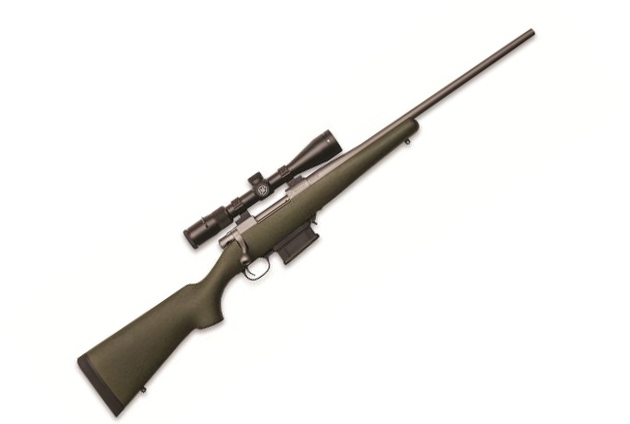
Howa has gone 6.5 Creedmoor, offering the better part of its rifle collection in the accurate cartridge.
6.5 Creedmoor for Life
Dynamite on everything from small to medium sized game, the 6.5 Creedmoor has plenty of versatility. But, in all actuality, the cartridge is a specialist.
When it comes to tapping tacks a zip code away, few rounds match the consistency and accuracy of the Creedmoor. The flat-shooting round’s bullets offer some of the highest ballistic coefficients around and they are backed by plenty of cartridge space to really get them moving.
Howa 6.5 Creedmoor Rifles
Apparently, these desirable attributes have not been missed by Howa Rifles, because the Japanese company has gone in big on the cartridge. Howa recently announced it is now offering a good share of its rifles in 6.5 Creedmoor.
The new chambering is available in the following Howa 6.5 Creedmoor models and packages: the Alpine Mountain Rifle, Kryptek Highlander/Cerakote finish, Black or OD Green Hogue stocks (blued or Cerakote Gray finish on metal parts), the Howa/Hogue/Nikko Stirling Gameking Package, Howa/Hogue Youth 2•N•1 Package with youth and adult stocks as well as Ranchland Compact Packages.
The Alpine Mountain Rifle in Creedmoor could make an interesting package, in particular.
The rifle is feather light (5.7 pounds), designed for hunters who push deep into the backcountry. The Creedmoor’s superior ballistics could be just the ticket for those who tramp along ridgelines and sometimes have to pull the trigger on a long shot. As a bonus, the 6.5’s light recoil has the potential to lessen the rifle’s punishment.
Depending on the model, Howa is offering the 6.5 Creedmoor with a 22-inch standard barrel and 24-inch heavy barrel. In the future, the company plans to offer a lightweight 20-inch barrel version.
When it comes to defining magnum cartridges, it’s not as straightforward as you might think.
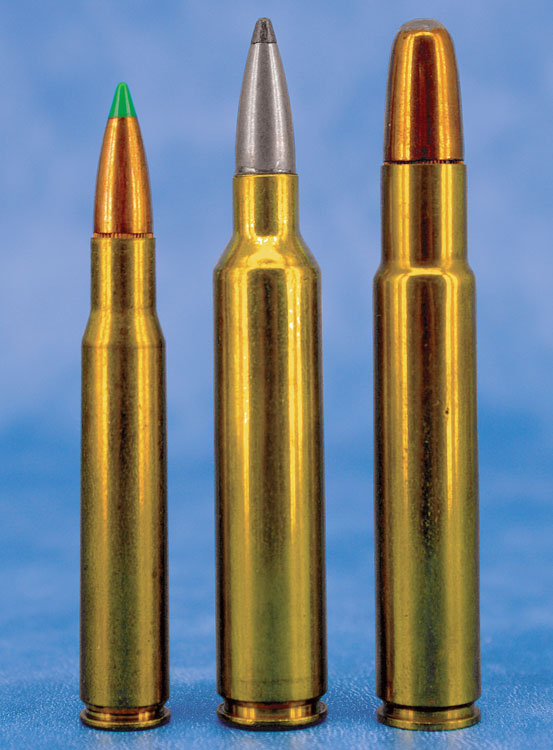
Despite lacking the “magnum” designation, the 7.82 Lazzeroni Warbird (center) and the .460 Dakota qualify in spades. Shown for comparison sake is the .30-06 at left.
There was a time when the term “magnum” was fairly well defined. I’m talking back in the 1960s and 70s when the word pretty much meant a cartridge more powerful than “normal” and was usually based on the belted Holland & Holland case. In fact, in the eyes of many, if it didn’t have a belt, it couldn’t be a magnum—that’s how synonymous the two words became. As always, though, there were many exceptions to the rule. Back in its early days as a wildcat, for example, the .25-06 certainly provided magnum performance if the standard for the caliber was the .257 Roberts. Yet it was never called a magnum.
At the other end of the .25-caliber spectrum was the .256 Win. Mag., a bastard of a cartridge if ever there was one. Originally designed as a pistol cartridge, what limited popularity it achieved was in the Marlin Model 62 Levermatic rifle.
Based on the .357 Mag. pistol case necked down to .25 caliber, as a rifle cartridge it was pitiful, sending a 60-grain bullet of low sectional density and ballistic coefficient at 2,760 fps. If we again cite the .257 Roberts as representing the performance standard for the caliber, it would have qualified as a super magnum compared to the .256. Incidentally, I actually owned one of those Marlin Levermatics, and the .256 Win. Mag. was the cartridge with which I started my handloading career.
Anyway, another and even better example of confusing nomenclature is the .220 Swift. When it was introduced in 1932, it absolutely blew the doors off any other .22 centerfire cartridge, yet like the .25-06, it never received the magnum imprimatur. Even when the .222 Rem. Mag. was introduced in 1958, the Swift pushed the same weight bullets about 500 fps faster, yet it was…well, just a Swift, not a magnum.
Like I said, there are many exceptions to the rule, but for the most part there was some thread of consistency throughout cartridge nomenclature. I guess when you get right down to it, a cartridge is regarded as a “magnum” if its performance—usually based on velocity, but not always, as in the case of shotshells—is higher than the nominal standard. Today we have many true magnums that have no belt, plus we have short magnums, ultra magnums and “enhanced performance” cartridges, so determining what those standards are is a lot more confusing than it used to be.
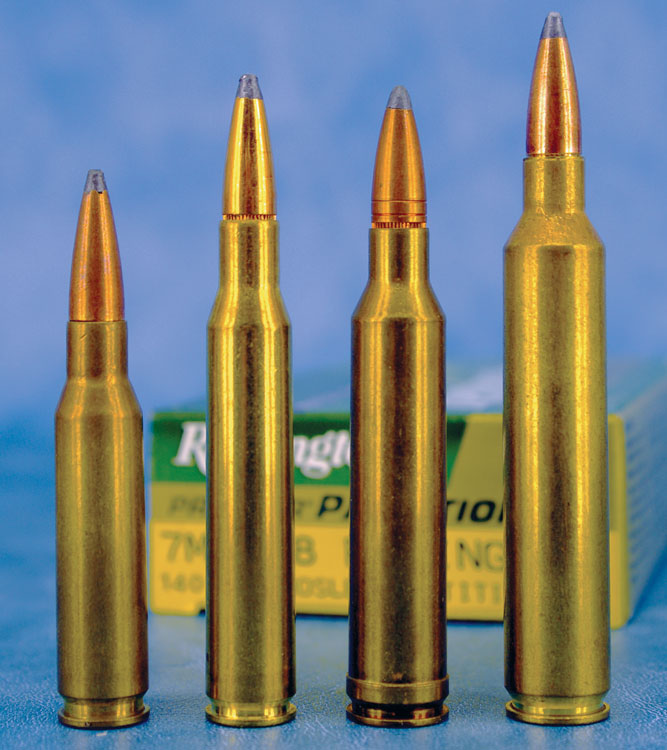
The .30-06-based .280 Rem. (second from left) represents standard velocity for the 7mm caliber. Like the .30 family, the smaller .308 Win. based 7mm-08 next to it comes close to matching the .280, while the belted 7mm Rem. and 7mm Ultra Mag provide one and two levels of performance above it.
I do think, however, we would all agree that the performance “standard” for our two most popular hunting calibers, the 7mm and .30, are represented by the .280 Rem. and the .30-06. In other words, a muzzle velocity of around 2,800-2,850 fps for a 150-grain 7mm bullet, and 2,750 or thereabouts for a 180-grain bullet in a .30-06, represent “standard” cartridge performance for those respective calibers.
Any cartridge that increases those nominal velocities by 150-200 fps would qualify as a magnum, whether they’re called that or not. Continuing that thread, the 7mm Rem. and .300 Win. best exemplify what most of us mean by “magnum” in those respective calibers. Of course we now have the 7mm and .300 WSM, which duplicate the aforementioned rounds, but with a shorter, squatter case, and without that once almost-mandatory appendage known as a belt.
Then we have in those same two calibers the 7mm and .300 Remington Ultra Magnum, both of which deserve that superlative moniker because they do indeed provide another significant step up in performance over “standard magnums,” if you will, which has to qualify as an oxymoron if ever there was one.
Boosting Velocities
What in recent years has further blurred the lines between standard, magnum and ultra magnum performance is best characterized by Hornady’s original Light Magnum line of enhanced performance ammunition.
By using proprietary loading procedures and propellants specifically formulated for them, Hornady was able to boost velocities in non-magnum cartridges by as much as 140 fps over the nominal standards, with no increase in pressures. After a couple of years, Hornady applied that same technology to magnum calibers, but it felt it had to somehow distinguish it from non-magnum calibers, so it was called Heavy Magnum, even though the velocity gains averaged about the same.
Though bearing the “magnum” suffix and wearing belts, the 6.5 and .350 Rem. Magnums were really not magnums because they didn’t surpass the performance of their .30-06-based equivalents, the 6.5-06 or .35 Whelen
For example, the Light Magnum 165-grain .308 Win. load clocked 2,840 fps compared to 2,700 for the standard loading. In .300 Win. Mag. the Heavy Magnum load exited at 3,120 fps, or 170 fps over the standard load. Thankfully, the folks at Hornady realized the potential for confusion and have since chosen to change the name to Superformance, and it applies to all such enhanced loadings, whether magnums or not.
Further blurring the lines between standard and magnum performance is that Hornady has applied this same technology in its development of proprietary cartridge lines for Ruger, Thompson/Center and Marlin. The Ruger Compact Magnums, the .300 and .338 T/C, and the .300 and .338 Marlin Express, are all examples of cartridges that provide significantly more velocity than they could otherwise given their case capacities.
Even more dramatic, though, is the performance gains achieved when these same loading techniques are applied to classic lever-action cartridges like the .30-30, .35 Rem., .444 Marlin and .450 Marlin in conjunction with Hornady’s development of FlexTip bullets. The overall performance of these old guns have been elevated to where they would qualify as “magnums” when compared to the standard loadings and the flat- or round-nosed bullets these guns were traditionally saddled with.
No sir, the term “magnum” doesn’t have quite the same connotations it once did. There are cartridges today that produce magnum and even super-magnum performance, yet are not so designated—the 7.82 Lazzeroni Warbird and .460 Dakota are consummate examples. Then there are those that wear a belt and don’t qualify, such as the 6.5 and .350 Rem. Mag.; they only duplicate, if that, the performance of the 6.5-06 wildcat and the .35 Whelen, respectively.
This article appeared in the Summer 2015 Ammo Issue of Gun Digest the Magazine.
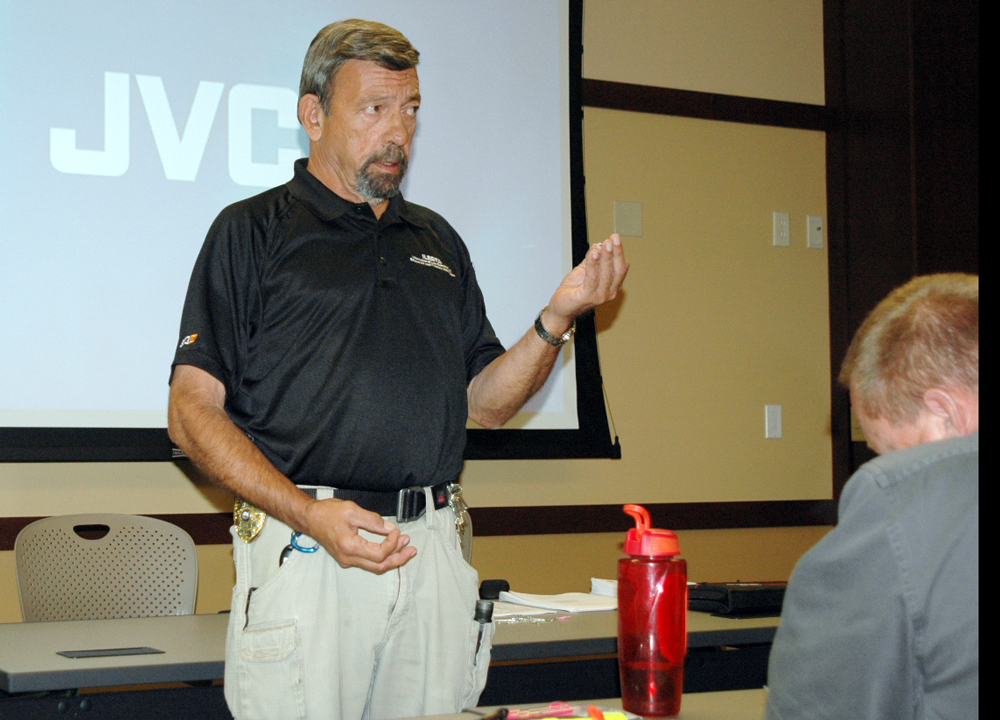
Massad Ayoob teaches his popular concealed carry courses around the country. This training class was held in Southeastern Wisconsin.
No one doubts the value of good concealed carry training for the armed citizen. But can the fact that you got such training actually be used against you in court?
Because it is likely that all your training will be inspected, dissected and re-arranged by the prosecution to make you look like a cold-hearted killer, you need to take a hard look at the type of training you’ve received.
Gun Digest editor Corrina Peterson (right) with author and self-defense trainer Massad Ayoob.
In Larry Hickey’s trial, which I mentioned in Part I, Pima County Deputy Prosecutor Daniel Nicolini played heavily on that theme. Nicolini highlighted spetsnaz sniper and advanced combat skills training the defendant had taken as an indication that he was a trained gun-nut with a combat mindset.
Nicolini alleged that Hickey’s mindset was such that, “he is being attacked by people who are out to kill him … He has been shown this Constable Lunsford video, where a cop confronting criminals with drugs is overwhelmed, and extrapolates that to a conclusion where he is arguing with his neighbors and saying that his response is reasonable.
“He has been taught to be decisive, aggressive, ruthless, and to use surprise when he is in a confrontational situation. He has been taught to carry a gun, and he has been taught in these courses, be polite, be professional, but have a plan to kill everyone that you meet. So is it any wonder on the evening of November 17th, when he was confronted in an argument with his neighbors, which turned into a physical confrontation, that his response from this mindset of his, fighting mindset that he has been taught, is pull a gun and shoot those neighbors?” Nicolini said.
Countering the Attack
To counter Nicolini’s theories, the defense brought in two of the defendant’s instructors and both testified in court. One was Brian Kowalski, a sergeant with the Tucson Police Department, the very same police department that had investigated the incident.
He was the instructor who taught the defendant’s concealed pistol certification course, in which he discussed the use of force. The fact that a sergeant with the Tucson Police Department testified on the defendant’s behalf went a long way to mitigate Prosecutor Nicolini’s theory that he was a gun nut.
If you take advanced handgun training, make sure your instructors are willing to testify in court on your behalf, to explain what they taught and why they taught you what they did. This concern is not an excuse to skip training! It is, rather, a full disclosure of the importance of legitimate, serious self-defense preparation undertaken prior to needing to act in self-defense.
Professionals Train. You Should, Too!
Consider any profession that is held in high regard by the general public: medicine, the law, accounting and even law enforcement. All demand that in order to work in these professions, people undergo both initial training and continuing education. While armed citizens carrying guns in public for self defense are not required to participate in yearly training, if you have done so anyway, it certainly is a strong argument in court to prove that by committing your own time and spending your own money to continue to train, you take your responsibilities to society as seriously as other professionals.
Couple live-fire training with decision-making training through force-on-force exercises, and you will be able to make a very good argument in court if the necessity arises, that your level of training is similar to the local cops who protect the same community from which the members of the jury hail.
It’s also a good reason to participate in IPSC and IDPA competitive shooting as a way to keep your skills sharp. The better the shooter, the less likely that shooter is going to endanger innocent bystanders.
Click here to read Part I. In Part III, Marty Hayes delves into the risks and rewards of marksmanship training in concealed carry and the necessity of the armed citizen to join an organization like the Armed Citizens Legal Defense Network.
Get help following a self-defense incident when it’s needed most. Unlike insurance, the Armed Citizens’ Legal Defense Network, Inc. pays the legal expenses as they emerge, rather than requiring the need to raise the money to get to “Not Guilty,” then apply for reimbursement. Join here and get a FREE download
Robert House — Classic Firearms/Echoes Of Glory Auctions, Virginia Beach, Va.
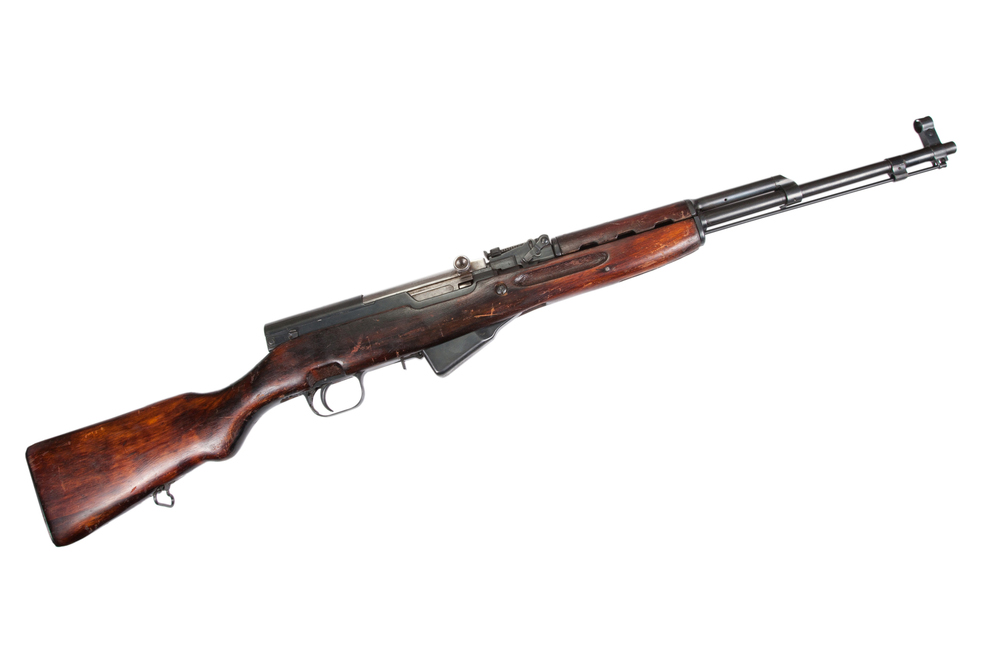
An auction house that specializes in military firearms and memorabilia, Classic Firearms/Echoes Of Glory Auctions has seen a steep increase in prices paid over the last year for three rifle types in particular: SKS rifles, from pretty much any country and manufacturer; British Enfields; and, the venerable M1 carbine.
“A year ago, SKS rifles were going for $225 to $250 apiece,” owner of Classic Firearms Robert House said. “Now, we’re seeing them at shows and auctions bringing $350 to $400. British Enfield rifles are the same—a year ago, they averaged $200-$225, and now they are $300 to $350. Japanese Arisaka and Italian Carcanos are going up, too.”
Meanwhile, prices for M1 Carbines have jumped 25 percent recently.
Any captured Communist Bloc weapons from the Korean and Vietnam Wars are fetching good prices, especially those with authentic “Capture Papers,” official military documents that gave soldiers permission to take home captured enemy firearms.
“[A] recent import Soviet M44 Nagant might sell from $225 to $275. But with the capture paperwork? They’ll bring $400-450,” House said.
As for U.S. weapons from the Vietnam Era, early Colt AR-15 rifles that closely mimic the Vietnam era M16 (such as the Colt SP-1 semi-automatic) bring a premium.
“Guys are looking to pick up a Vietnam War legal M16 style rifle, which is quite different from later ARs, notably the stocks, the sights, the flashiders and the lack of a forward assist. I’ve seen them routinely sell for $1,300-$1,400 or more, versus a used later AR-15 that’ll go for half that.”
Ah those little cloverleaf groups off the bench or from prone. They’re what bring smiles to shooters’ faces. Of course, such shooting can be a hothouse flower that quickly wilts when exposed to the variables of the real world.
In most field shooting situations, prone can be unworkable and a bench is typically miles away, collecting dust in a garage. In turn, throwing a bullet accurately down range requires much more nimble and practical solutions.
The National Shooting Sports Foundation gives a spectacular run down of some of these in the above video. In a few short minutes the clip covers the basics of shooting while kneeling, sitting and standing — mixing speed and accuracy. For anyone aiming to do more than punch holes in paper, these shooting positions should be mastered.
In particular, the sling work demonstrated in the video is an important skill, one that seems to be slipping away. More and more often shooters leave their slings flaccid, swinging impotently beneath their rifle, as useful as boobs on a boar. Sigh.
Watch the entire video, because you’re certain to find something that will enhance your field accuracy. And also heed its advice and get off the bench or your belly and practice them.
Sako delivered 125 modified Tikka T3 Compact Tactical rifles to be tested as the Canadian Rangers’ new rifle.
The Canadian Rangers have once again turned their collective eyes across the Atlantic for a rifle. However, this time around the volunteer force has gazed a tick north of the British Isles.
Sako, Finnish subsidiary of Beretta Holdings, recently delivered 125 prototype Tikka T3 Compact Tactical rifles to the Rangers. The bolt-action rifles will go through evaluations now until the end of 2015. Then, it is expected, that some 6,500 of the .308 Winchesters will be produced and phased into use by the surveillance/scouting force between 2016 and 2018.
The new Sakos replace a true icon of 20th Century battle rifles, the Lee Enfield No. 4 Mk. 1. The Canadian Rangers procured the rugged, battled-tested arms shortly after the force was formed in 1947 as military surplus from World War II.
The original lot of the rifles, chambered .303 British, served up to this point, but dwindling stocks and replacement parts forced the search for a replacement. What is certain to make many collectors break into tears is it has been reported the old Lee Enfields are set for destruction by the Canadian government.
The Tikka T3 Compact Tactical rifle snuggled in its Pelican hardcase.
While the design for the new Canadian Rangers’ rifle comes from Finland, it will be produced on this side of the pond. T3s will be made under license by Colt Canada, which is set to add up to 30 new employees for the project.
The Tikka rifle has a number of Canadian modifications to help it in the harsh arctic conditions in which it will operate. These include: larger bolt handle and trigger guard to accommodate gloved hands, protected front and rear sights, laminated stock, a two-stage trigger, and a three position safety.
The rifles will come with a number of ancillary supplies, including: a Pelican hard transport case; cleaning kit, sling and soft transport case from Rampart International; and a trigger lock from The Old Co-Op.
Just because you can make a long-range shot on a game animal, doesn’t mean you necessarily should. How far is too far when it comes to long-range shooting?
What I’m about to say at this point in the ranging story will not fly well with some, but it needs to be addressed.
I have a problem with big game hunters over-extending range in order to bag a trophy deer, elk, or whatever. I do believe the big game sport hunter needs to curb their range limits, so as not to wound game in the process.
While 600-, 800-, and 1,000-yard shots are very spectacular, I believe they need to be reserved for varmints and paper targets. Long-range shots on game are very workable, but long-range in this case should not exceed the dead-on killing limit of the cartridge and the shooter. In other words, give the animal you’re hunting a break by working toward a clean, humane kill.
At 400 to 1,000 yards, you know as well as I do that anything can happen to that bullet en route to the target, and the game animal will pay the price for a less than well-thought-out move on the hunter’s part.
Some time ago, I watched a television program in which hunters were shooting elk from one mountain across to another. That, my friends, is no longer hunting, but an exercise in the use of advanced ranging equipment, rifles, and big cartridges. At best, it is simply shooting and little more. Be responsible when using these new and, yes, very effective tools.
As we move steadily through the 21st century, we see new developments all the time in both guns and loads for long-range work. Word has it that some folks are in the process of building an ultra long-range sniper rifle off a Russian anti-tank gun system that will drive a bullet of about 37 millimeters to a target in the next county.
There is also word that a 40mm sniper rifle is under development by still another group of experimenters. The point is to never say never, but always remember that nothing, regardless its size or design, takes the place of woodsmanship, shooting skill, basic know-how and, most of all, ethics, by the hunter in the field.
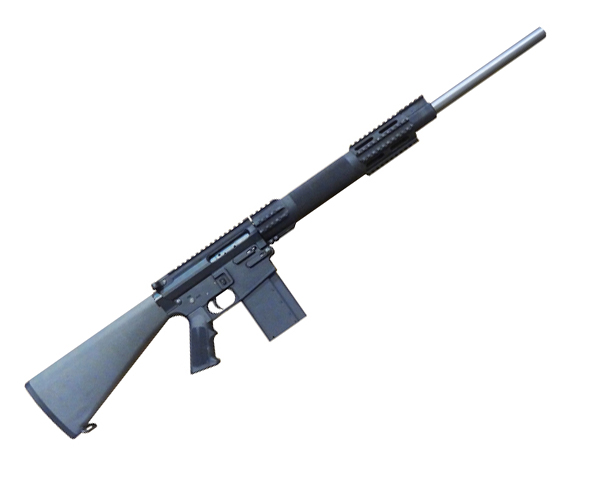
Searching for one gun that can do it all? Olympic Arms might have just whipped it up with its new convertible MPR 308/5.56.
The Olympic Arms MPR 308/5.56 seamlessly jumps between AR-10 and AR-15, giving shooters a ton of caliber choices. Leap from tactical carbine to heavy deer gun in an instant.
It’s safe to say Olympic Arms has a knack for innovation.
The Washington-based gun maker cooked up some of the first pistol-caliber ARs. It introduced the flat-top upper receiver. And it has generally pulled the black-rifle market into the future. And the company isn’t done yet.
Olympic Arms is endeavoring into the realm of AR-10 rifles, but in typical fashion is offering much more than just a larger-caliber semi-automatic. In fact, the company’s new MPR 308/5.56 Rifle gives shooters a veritable cornucopia of calibers on one platform.
Olympic Arms has designed the rifle system to switch between its AR-10 upper receiver to any Mil-Spec AR-15 upper — regardless of caliber. Perhaps best of all, the system does not require any retrofitting to accomplish its conversion; out of the box it is ready to rock and roll in nearly any configuration a shooter can cook up.
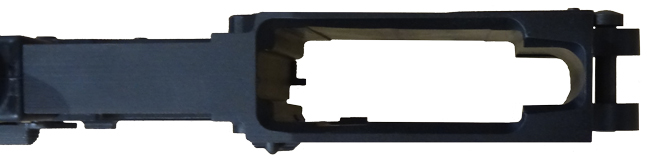
The company has achieved this flexibility through some elegant engineering. This is particularly evident on the MPR 308/5.56’s lower receiver.
The quick conversions are facilitated by two pivot pin locations milled on the lower. The longer local affixes Oly’s AR-10 upper, the shorter one pops on any Mil-Spec AR-15. The lower also has a slick mag well, milled to accept both AR-10 and -15 magazines. Of course, when it comes to the larger-caliber the magazines are proprietary; the smaller caliber, once again if it’s Mil-Spec it will work.
Finally, the company has redesigned the buffer system so it does not need to be switched for conversions. The bolt carrier in Olympic Arms’ AR-10 makes contact on the rim of the buffer, while the AR-15 makes contact on the center of it.
Olympic Arms MPR 308/5.56 mag well is designed to accept both the company’s proprietary AR-10 magazine and all Mil-Spec AR-15.
The convertibility of the MPR 308/5.56 gives it access to all of the standard AR-15 chamberings — 5.56 NATO, .300 Blackout, 6.5 Grendel, etc. But shooters will get to enjoy more than just .308 Winchester when shooting the rifle in an AR-10 configuration. Olympic Arms has a slew of calibers slated for the rifle in the future, including .243 Winchester, .260 Remington, 7mm-08, .300 WSM and .270 WSM.
The MPR 308/5.56 comes configured as a .308 AR-10 and is available with 16-, 18- and 24-inch stainless steal bull barrels. The MSRP for the rifle runs from $1,267 to $1,688 depending on barrel length.
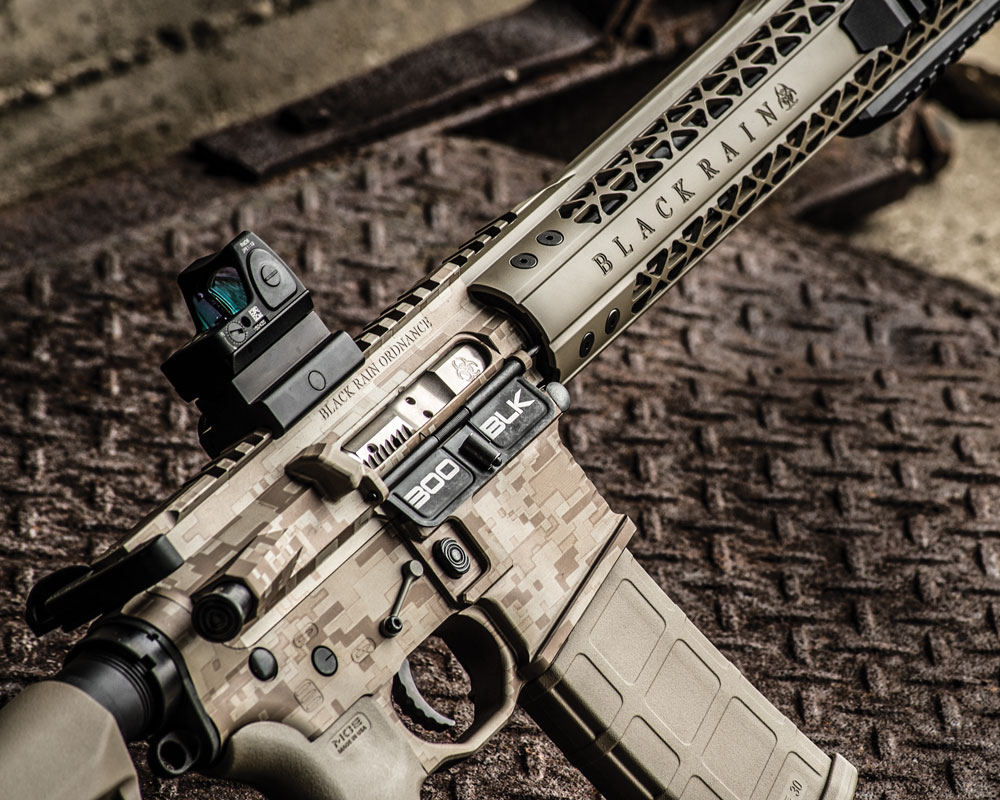
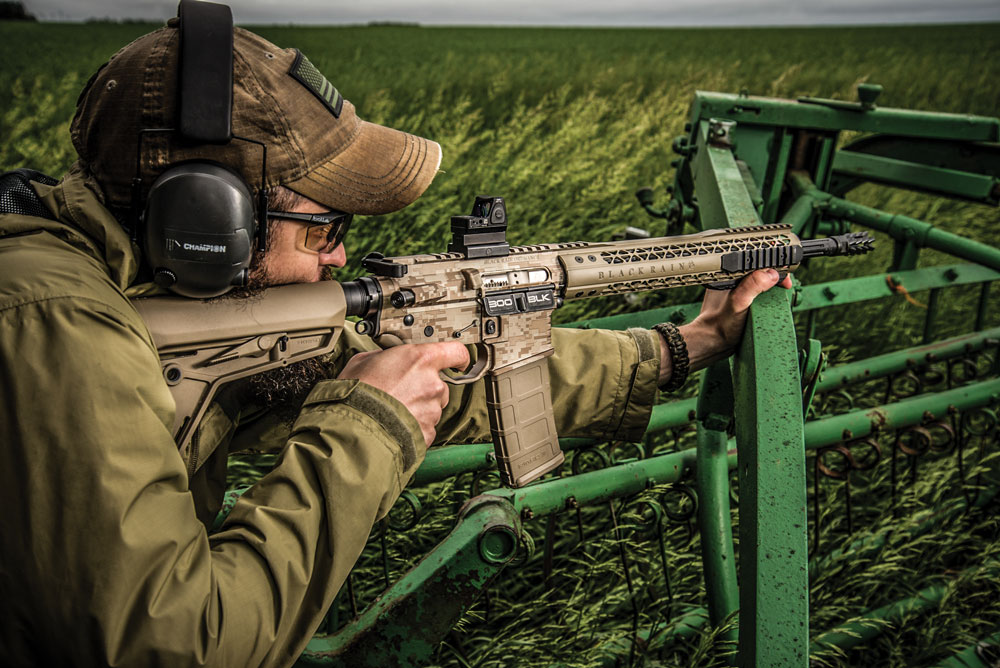
Form and function: Black Rain’s .300 BLK features a nickel-boron bolt carrier and group and 12-inch mod rail. Jeff Jones
The new Black Rain Ordnance .300 Blackout in digital tan is a range-ready workhorse that’s as good looking as it is dependable.
B.R.O.’s new .300 BLK features billet receivers and a 12-inch modular rail. Accuracy testing with Steiner’s M5Xi 3-15x50mm Military optic.
Black Rain’s newest introduction is an AR chambered in .300 Blackout (BLK) and based on the BRO-PG2, an earlier model available in 5.56 NATO with a digital tan anodized finish. The new .300 BLK shares the same look as its predecessor but utilizes a pistol-length gas system to improve reliability with the alternate chambering. While it’s yet to receive an official name, the new .300 is every bit as sexy and tough as you’d expect from the folks at Black Rain, and it fulfills the company’s commitment to producing guns that’ll last multiple lifetimes.
Based out of Neosho, Missouri, Black Rain was co-founded in 2009 by CEO Justin Harvel, a 10-year veteran firefighter who grew up in the gun store business and returned to it after his days as a fireman and EMT. His grandfather and uncles were all gun dealers and still carry on the tradition today. Harvel grew up in his dad’s gun shop, learned the industry, saw how business was conducted and eventually started two of his own gun stores.
It was during those years as a shop owner that Harvel developed a vision for crafting AR-type rifles that would strike a balance between form and function, giving his clientele a custom gun at a reasonable price. He envisioned a rifle that was built like a tank but looked and performed like a Lamborghini.
“Quality was our mission from day one,” Harvel said. “We knew we’d never be about producing the kind of quantity as some manufacturers, but that was never our goal. Let other people do that. Our niche is to build the best rifle in your arsenal, the one you’ll be proud to pass on to your kids. They’re dependable, sexy, incredibly accurate—the total package.”
When it comes to the AR-type rifles and parts it makes, Black Rain’s philosophy is simple: Only produce what you would personally own or operate. The new .300 BLK is no exception to that rule.
Make it Rain
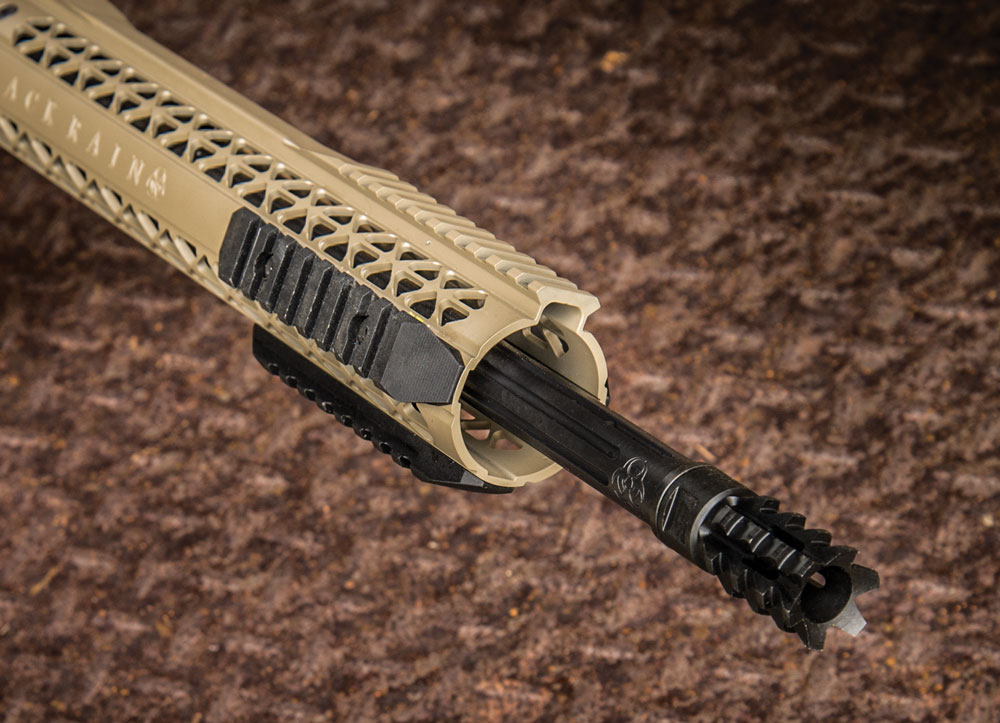
Black Rain’s .300 BLK comes with an MFS flash hider and is suppressor ready. Jeff Jones
While it features several unique design elements, the new .300 BLK is still built around the same core elements inherent in Black Rain’s DNA—an exclusive, single-stage trigger, nickel boron bolt carrier and billet aluminum receivers. The BRO-DIT (drop in trigger) is manufactured in house and allows the company to offer a high-end trigger at reduced cost in all production AR-type rifles. The trigger can also be purchased separately for $199 and is comparable to what you’d find in aftermarket triggers that can run anywhere from $250-300. Not only is the 3.5-pound trigger remarkably crisp, it has a positive, audible reset for fast and accurate follow up shots.
“Once we got our trigger into production, we decided it should go in every gun,” Black Rain general manager Jared Moser said. “We feel like it’s worth it to the customer. The obvious thing is we built it with a clean break, which is really about the surface condition of the materials we use, but even more important we felt was the reset, audible but not super long. It’s really more about a release of pressure rather than a ton of movement.”
The second foundational component on the .300 BLK is the nickel boron BCG (bolt and carrier group). The BCG is made in house from Carpenter 158 steel and nickel boron coated for longer life, ease of cleaning and added durability under heavy stress. The carrier group is rated for full-auto and can be buffed back to a shiny finish even after it gets darkened by gases and oils. It’s a bit overbuilt, as Moser pointed out, but it adds strength to the part and, perhaps equally as important, it just looks cool.
Finally, the .300 BLK features Black Rain’s milled billet aluminum receivers with a digital tan anodized finish (a black finish will also be available). Generally speaking, billet aluminum is CNC machined from bar stock, while forged aluminum receivers are hammered into forging dies, subjected to repeated force and then finished by CNC machining. Forged receivers are considered to be the strongest, while billet allows manufacturers like Black Rain to craft artistic lines into the receivers for the ultimate in aesthetic appeal. The lines on the .300 upper and lower are incredibly smooth and reveal the passion for craftsmanship envisioned by the company’s founders.
Seven Pounds of Sleek
The Trijicon RMR is an ideal close-range optic. Eric Conn & Jeff Jones
The rifle weighs just over 7 pounds and features a 16-inch, 416R stainless steel barrel for added heat and corrosion resistance. It comes with a 1:7-inch twist, eight-flute design and a pistol length gas system. The .300 BLK comes standard with a Syrac Ordnance adjustable gas block, which can be accessed by taking off the handguard. Also included is a sharp-toothed BRO-MFS flash suppressor that would do a fair bit of damage in lieu of a bayonet.
Different handguard options are available, but the model reviewed for the magazine included the 12-inch Modular Rail FDE, which features top-mounted Picatinny rail sections at the front and rear with a sloped, smooth section in the middle. Removable rail sections are also located at the 3, 6 and 9 o’clock positions on the front of the handguard for whatever combination of lights and sights you might prefer. A crisply etched “Black Rain” with company logo ride along both sides of the rail and add to the sex appeal. An equally sleek and silver “300 BLK” is displayed on the dust cover when open.
Multiple Magpul furniture options are available, but the .300 reviewed had a MOE SL (Slim Line) carbine buttstock and pistol grip, both in tan. The buttstock features dual side release latches and angled rubber buttpad to help with shoulder transitions with body armor or modular gear. The rifle comes without sights but has an optic-ready top-rail upper. Also included is a BRO charging handle and forward assist.
Range Tested
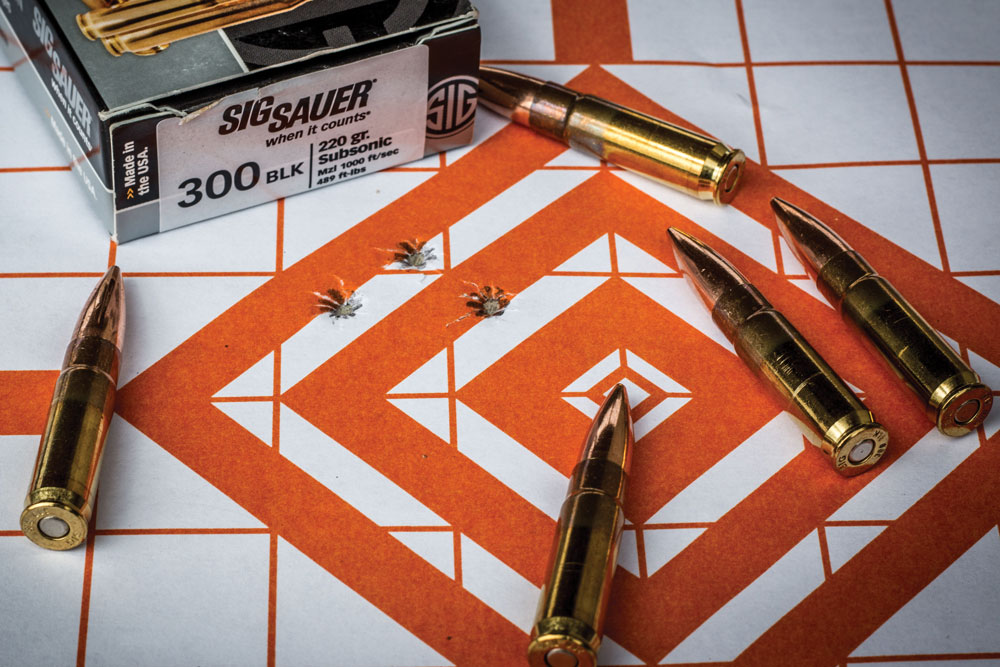
The rifle was tested using five different loads. Accuracy testing was conducted at 100 yards from a bench and measured on five different three-shot groups for each load. Velocity was measured using a Competition Electronics ProChrono chronograph from Brownells. Short-range target work was performed with Trijicon’s small but mighty RMR, while the accuracy portion utilized Steiner’s M5Xi 3-15x50mm Military optic.
Of the five loads tested, the SIG Sauer 220-grain Elite Performance Subsonic posted the best accuracy results, with an average group of .92 inches and a best group of .74 inches. Average velocity was 1,108 fps with a standard deviation of 7 fps and an extreme spread of 15 fps. Nosler’s 110-grain Varmageddon had the fastest average velocity of the group at 2,284 fps.
Parting Shots
The B.R.O. .300 BLK isn’t the cheapest AR you’ll buy ($2,439), but it is extremely well built and offers a lot of value for your dollar. A nickel boron bolt carrier and group, match-grade drop-in trigger, Magpul furniture, adjustable gas block and billet receivers mean you don’t need to spend on upgrades if you don’t want to, and in return you get a high-performance, sleek-looking, turn-key AR that’s ready to make it rain brass. It’s also reasonably accurate for caliber and comes suppressor ready, which is a main draw for the .300 BLK.
The venerable Ruger Redhawk is no stranger to sixgun lovers, but the company’s newest ‘hawk boasts a classy round butt grip, 4.2 inch barrel and is chambered in .45 Colt, with the option of shooting .45 ACP in moonclips to boot.
In the video above, Jeff Quinn of GunBlast.com demonstrates the wheelgun using both .45 ACP defensive rounds, and some heavy-hitting .45 Colt. Writes Quinn:
The newest Redhawk shown here combines the features of that round-butt sixgun with the longer barrel of the 4.2 inch version, and added the ability to fire 45 ACP ammunition using moon clips. As I stated at the beginning of this piece, the Redhawk just keeps getting better!
The newest Redhawk wears a round-butt grip frame that is fitted with good-looking wood grips which are partially checkered for a secure grip. The round butt frame fits my hand well, but for good control and comfort, I prefer the rubber Hogue grip as supplied with the 4.2 inch square-butt Redhawk when shooting the heaviest loads. The sights consist of the familiar fully-adjustable Ruger rear mated with an interchangeable front. The front sight supplied is black with a red insert. Click here for Jeff Quinn’s full review and more photos
The 250/3000 Savage was the first American cartridge to go 3,000 feet per second. Now it’s considered one of many discontinued cartridges.
There are plenty of excellent cartridges that didn’t catch on. Their lack of overall popularity doesn’t mean discontinued cartridges need to be relegated to the ash heap of history.
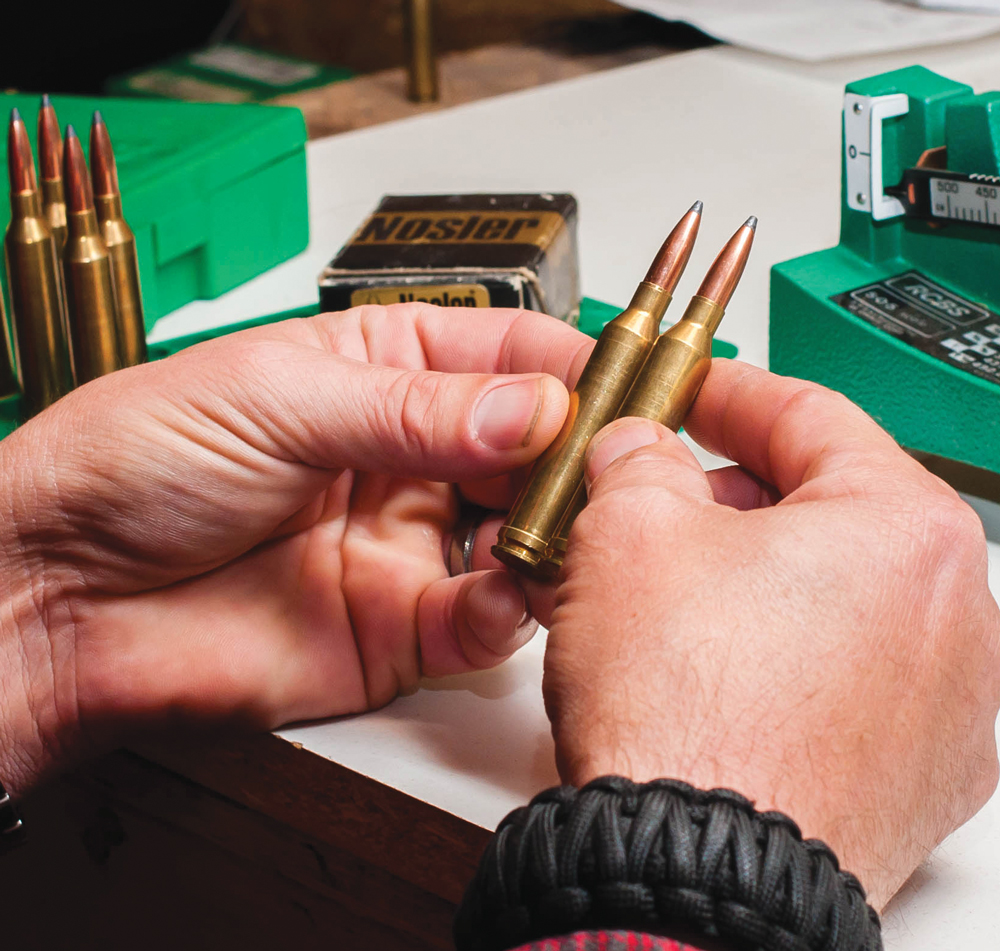
“What am I going to do now? Do I try to buy up any and all ammunition, and only rarely use the rifle I like so much? Do I buy something more common?” Handloading is the solution. A competent handloader can revive discontinued cartridges from the brink of extinction. As long as the bullets and brass can still be purchased or made, the rifle will continue to have a long, healthy and happy life. The following are three examples of cartridges that can be easily returned to duty.
The 250/3000 Savage
Developed by renowned ballistician Charles Newton for the Savage Arms Co. in 1915, it was a speed demon for its day, achieving a then unheard of 3,000 fps with the 87-grain bullet. This benchmark influenced the very name of the cartridge, though it is also commonly known as the .250 Savage. It was a readily available chambering for the handy Savage 99 lever action, and was (and is) fully capable of pulling double duty on both varmints and deer-size game.
The handloader can easily bring these discontinued cartridges back around. Great .257-inch-diameter bullets, weighing from 87 grains to 120 grains, are available from almost all manufacturers, and Remington still produces component brass. Loaded with a medium burn rate powder such as IMR4064, Hodgdon’s Varget or Alliant Reloder 15, very good ammunition can be made to feed your .250 and provide a lifetime of hunting and shooting memories. It’s a lot of fun to head into the deer woods with an old Savage 99 just as our forefathers did.
Even when ammo manufacturers quit mass producing a particular load, such as the .264 Winchester Magnum, components can still be found for reloading discontinued cartridges. Massaro Media Group and JD Fielding Photography
The .264 Winchester Magnum
The late 1950s saw Winchester release a trio of belted magnum cartridges, all based on the .375 Holland & Holland case, but shortened to fit in a .30-06 length receiver. The .458 Winchester Magnum filled the African niche created by the demise of Kynoch ammunition, and the .338 Winchester Magnum was destined to be America’s elk medicine, but the .264 was immediately a bit of a threat. It was irreverent enough to tread upon the hallowed ground ruled by the .270 Winchester.
The long, lean 6.5mm bullets, when pushed through Winchester’s Westerner rifle that sported a 26-inch barrel, produced impressive velocities that could make hitting distant targets easier. The 100-grain bullets could be pushed in excess of 3,500 fps, and the 140-grain slugs hit the 3,200 fps mark. The bullets bucked the wind very well, but these speeds gave the cartridge a reputation as a barrel burner. Not long after its introduction, Winchester made the decision to shorten the barrels of the .264 rifles, and a correlative velocity reduction was the result. Often, the .264 was at or less than the velocity of the venerable .270 Winchester. By 1962, Remington released the 7mm Remington Magnum and the .264 was doomed. The shooting public loved the 7mm Magnum and turned a blind eye to the .264 Winchester. Factory ammunition is still available, in limited quantities, but few production rifles were chambered for the big 6.5mm.
I like to see a 26-inch barrel on a .264 to maximize the powder capacity of this case, and I like to see it fueled by the slower burning powders available today, like Reloder 22 or 25, H4831SC and IMR4350 or IMR7828. Stick a magnum rifle primer in there and you should have a recipe for success. As far as the barrel burner moniker, if you don’t heat that barrel to the point where you can light your cigar off the muzzle, it should give you a lifetime of service.
Big Discontinued Cartridges: 8mm Remington Magnum
The recoil of the 8mm Rem. Mag. can be stout for some shooters, but is more than capable on large, dangerous game. Massaro Media Group and JD Fielding Photography
In 1979, Remington went out on a limb and revealed a metric designation as the new big game round in their lineup. We Americans have generally shied away from metric designations; perhaps we like the bastardized decimal portions of an inch measurement. The 8mm Magnum sounded strange, and though the name was perhaps a gamble on the popularity of the 7mm Remington Magnum, it was not very well received. Available in the Model 700 rifle, the 8mm Magnum was a powerhouse, pushing a 220-grain bullet to almost 3,000 fps. This is a big game rifle, but alas, the .338 Winchester had enough time to spread roots, and trying to upset that apple cart would not be easy.
However, those who used the 8mm Remington had great success, and its followers are fervent over this cartridge. I’ve spoken with some very big names in the shooting and hunting world that have come to love this metric oddball. Using a bullet of 180, 200 or 220 grains, this cartridge makes a great choice for elk, moose, bear or bison in North America and really shines on the African game fields. Top it with a premium bonded-core bullet and you’ll avoid premature bullet break up, and get the deep penetration and energy transfer we are all after. It is a bit on the heavy side for deer, but has put its fair share of venison in the freezer.
Like the previously mentioned .264, it comes into its own with slow burning powders and magnum primers. Barnes, Nosler, Swift, Hornady, Remington and Sierra make wonderful projectiles in 8mm, and cases are still produced by Remington and Nosler Custom. In our test rifle, a 220-grain Sierra Game King and a healthy dose of Reloder 25 in a Nosler Custom case gave very accurate results, with three-shot groups hanging around ¾ inch. For those who enjoy the full magnum length receiver, this cartridge, when paired with a .375 H&H or .416 Remington, would make a great set of rifles for the traveling adventurer. Give me an accurate 8mm with a 220-grain Sierra Game King or Swift AFrame, and I’d be comfortable hunting 90 percent of the world’s game.
Parting Shot
All three of these discontinued cartridges have a common denominator: rarity. Save your brass for reloading and find an accurate load that works well. With a decent stockpile of projectiles, you can keep that near-obsolete rifle in the field for a lifetime.
This article originally appeared in the August 28, 2014 issue of Gun Digest the Magazine.
Red dot and laser sights for handguns are big sellers right now at Nexus Shooting, and most of these purchases are from concealed carry practitioners. Owner Bernard Hsiao credited his computerized shooting range for many of these sales.
“Our customers are finding that the ease and speed of target acquisition is unparalleled with red dots and lasers, especially when they are shooting on the Nexus Lanes, our live fire computerized targets,” Hsiao explained. “Being able to shoot moving targets like asteroids, simulated steel and zombies on the video screen of the Nexus Lanes really helps our guests understand how difficult it can be to line up sights in a fast-paced, stressful scenario—like the one they might find themselves in during a real-life confrontation.”
Nexus also sells scores of holsters weekly. The top-selling line here is from Pitbull Tactical, a smaller, Florida-based manufacturer that makes a modular all-Kydex holster system that converts from outside the waistband to inside the waistband in a matter of seconds. The store has also been selling a lot of very comfortable “no clip” holsters from Remora, as well as Crossbreed hybrid leather and Kydex holsters.
“Pistol cases and carry-style handbags are also strong sellers,” Hsiao said. “We carry Gun Tote’n Mama concealed carry purses and they have done well for us, especially because we cater very heavily towards female customers; we have multiple women’s only shooting groups and classes that meet here.”
Editor’s Note: This brief originally appeared in the June 2015 issue of Gun Digest the Magazine.
If you’ve never carried a concealed weapon before, and are considering it as an option for self-defense, you probably have a myriad of questions on your mind. Get answers to your questions about concealed carry, and learn the basics of carrying a concealed handgun with the Gun Digest’s Shooter’s Guide to Concealed Carry by Jorge Amselle. Using easy-to-understand language, helpful images and illustrations, and other advice, this concealed carry guide covers various methods of concealed carry, new handguns, holsters, ammunition, and equipment, concealed carry laws, do-it-yourself at-home training, and tips and tactics for keeping your gun concealed and ready. Learn More
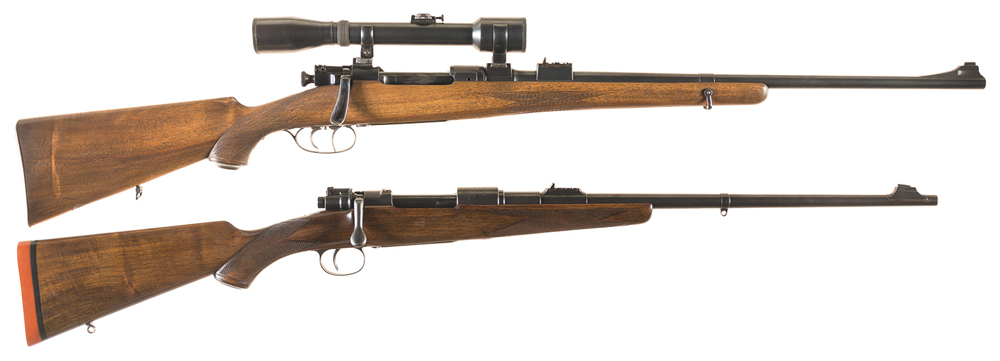
A sporterized Springfield M1903 and Mauser Model 98 were among some of the top items at Rock Island Auction Company’s June Regional Auction. Photo RIAC
Rock Island Auction Company’s latest event had no trouble getting collector to break out their cash. In all, the Illinois company had $4.5 million in sales at its June Regional Auction.
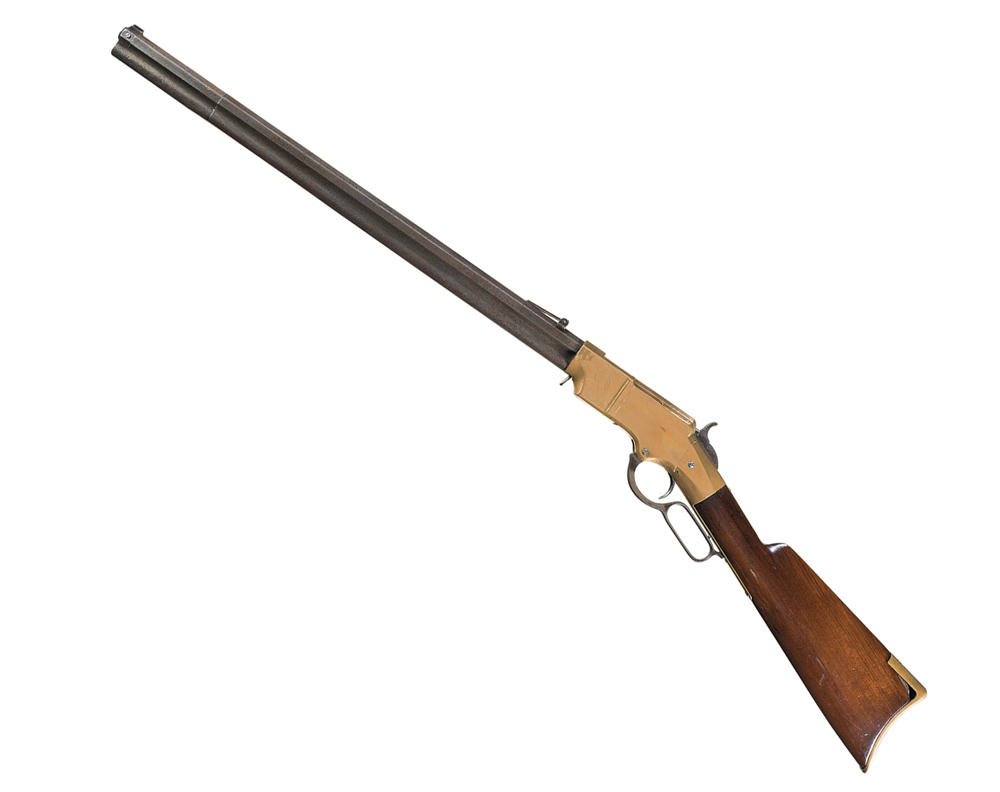
As would be expected, a Civil War era Henry rifle drew top dollar at the event. Photo RIAC.
The numbers the world’s largest firearms auction house generated were of little surprise. The firearms that tallied up the numbers, however, did raise some eyebrows.
Classic blue chip rifles, shotguns and handguns had bidders reaching for their wallets at the June 26-28 event. But there was a fair share of more contemporary guns that had collectors attempting to best each other.
For the most part, these newer firearms all had one thing in common — military service. Along these lines, one of the top draws were actually two of the 20th Century’s most heralded battle rifles that had been modified for sporting purposes.
A lot containing a customized Springfield Armory M1903 and a Mauser Model 98 was sold for a whopping $5,462. This far exceeded what RIAC expected the .30-06 and 7x57mm to draw with the company estimating they would move for a humble $1,100.
A multi-gun collection of AK- and SKS-style rifles also vastly outperformed expectations. The five guns had been anticipated to move for a mere $1,300, but went out the door for $4,312 instead. This particular lot was so sought after there was activity from 26 bidders before the auction even began.
Appearing in The Outlaw Jose Wales made this replica Colt 1851 revolver’s price skyrocket into five figures. Photo RIAC
While some younger upstarts muscled into the spotlight of the auction, old standbys still drew top dollar.
As would be expected, a Civil War era Henry rifle recorded one of the highest prices of the auction. The rifle drew a winning bid of $20,700; adding to its desirability were markings indicating it was government inspected, thus had potentially seen action in the conflict.
The auction not only moved guns of national historic significance, but also those that had made a mark in entertainment.
A Pietta reproduction of a Colt 1851 Navy drew a winning bid of $17,250, given it was used in the Clint Eastwood film The Outlaw Josie Wales. The unique item came with a framed certificate of authenticity.
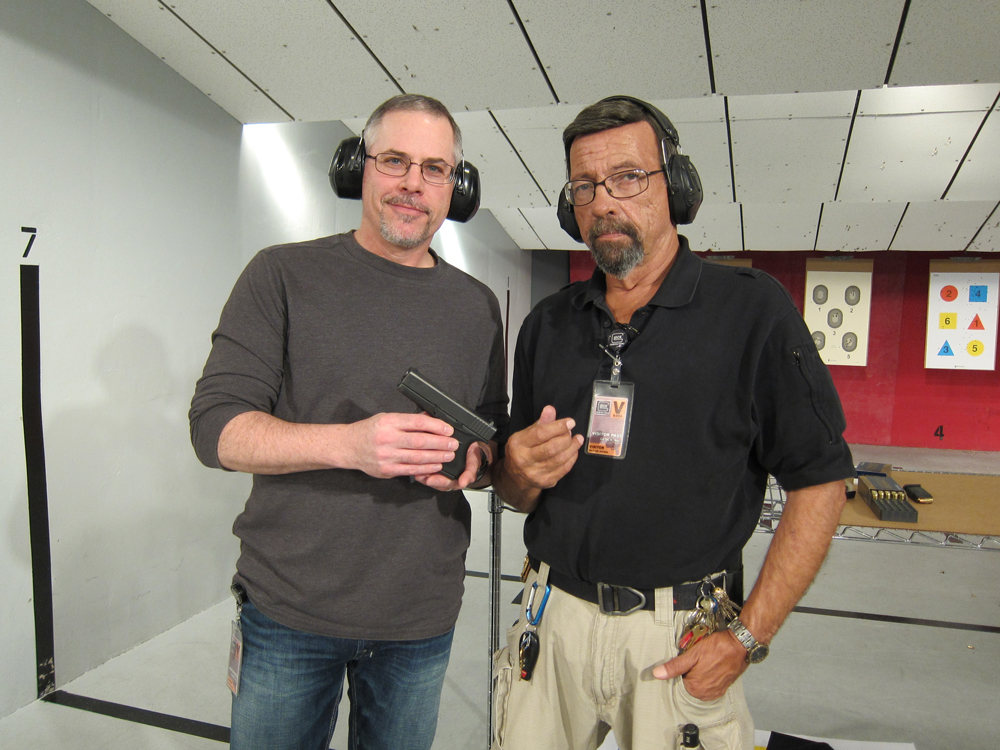
The author, Gun Digest Publisher Jim Schlender, left, joined author Massad Ayoob for a firsthand look at the new Glock 43 at the Glock range in Smyrna, GA. Ayoob serves on the board of the Armed Citizens Legal Defense Network.
Every day, sure as the sun rises, I receive a series of emails from Stephen Wenger with the latest news about guns. Much of what makes headlines is about the use of firearms for self-defense. Wenger’s site, Defensive Use of Firearms, is a treasure-trove of information on the topic, and I suggest you go there to sign up for his daily updates.
These incidents show that if, God forbid, you have to use a gun for self-defense, the trauma from that life-changing event is just the beginning. You’ll interact with witnesses, police and attorneys, and where the whole thing goes from there is only a guess. In a perfect world, the good guy is recognized as such.
But this isn’t a perfect world. Recognizing that fact, Marty Hayes, his wife (and Gun Digest book author) Gila Hayes, and J. Vincent Schuck, started the Armed Citizens’ Legal Defense Network (ACLDN).
The ACLDN is a for-profit membership organization that provides support following a self-defense incident. Its advisory board reads like a who’s-who of self-defense experts. The Network’s legal support means someone has your back when you need it most. A few of its services include up to $10,000 deposit against attorney fees to ensure you have legal counsel during questioning, to interact with the media, and to handle other initial defense needs. The ACLDN helps find you a competent attorney, provides case review and trial strategy assistance, and funds expert witnesses to explain your self-defense actions to a jury.
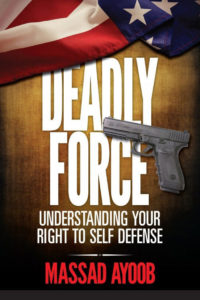
The member education package, which includes eight lectures on DVD plus a copy of Massad Ayoob’s excellent book, “Deadly Force,” alone is worth the $125 annual membership fee.
Gun Digest is proud to announce our partnership with ACLDN. You can now purchase a membership here at the Gun Digest store. When you sign up through Gun Digest, you’ll also get a free copy of a fantastic e-book, “Gun Digest Book of Concealed Carry Holsters,” authored by our online editor, Corey Graff.
I hope you don’t ever have to be in the headlines for defending yourself, but if you do, joining the ACLDN could turn out to be the best decision you’ve ever made.
Looking to go armed, but are stuck in the weeds as to what to arm yourself with? Here are 20 of the best concealed carry gun options that will keep you on the defensive.