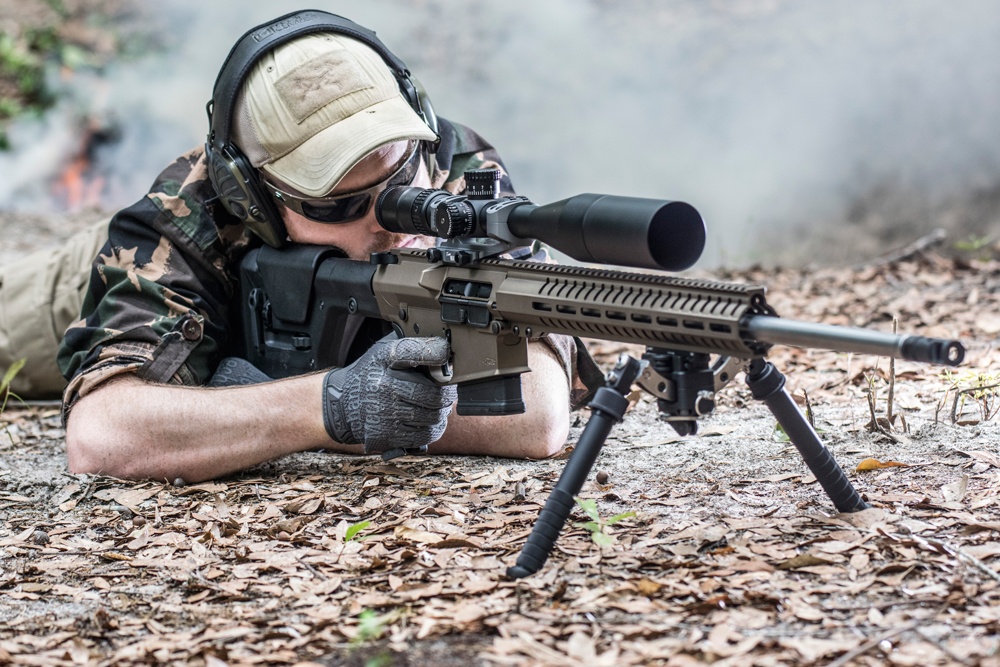
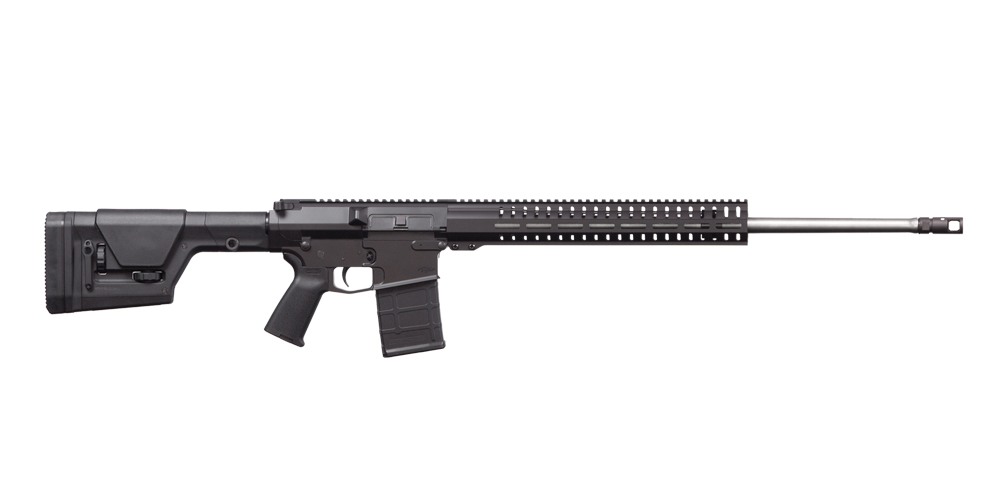
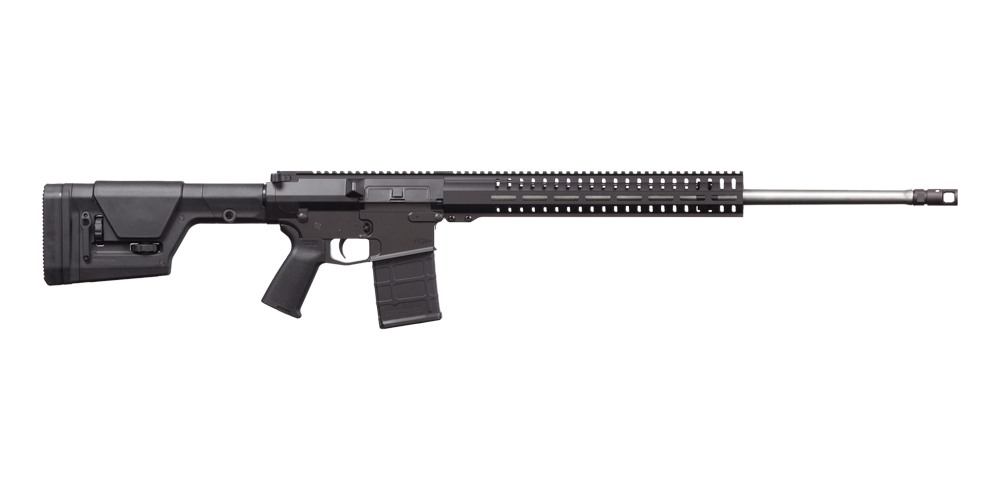
CMMG has added four new models to its classic and reliable Mk3 AR-10 rifle line — all chambered for the flat-shooting 6.5 Creedmoor.
Hot on the heels of its recent introduction of the MkG-45 Guard carbine in .45 ACP, CMMG has another big new release for fans of the AR. Earlier this week, CMMG revealed four new additions to its established Mk3 rifle line — all chambered in the increasingly popular 6.5 Creedmoor.
“With the new 6.5 Creedmoor models, we set out to deliver our most accurate line of rifles to date,” said Chris Reinkemeyer, CEO of CMMG. “We’re extremely excited about this up-and-coming caliber and are pleased to offer it to our customers in our proven Mk3 line.”
For those who don’t know, the 6.5 Creedmoor, introduced by Hornady back in 2007, is one of the hottest new cartridges of the past few years. Originally designed for target shooting, particularly at some longer ranges, the 6.5 Creedmoor is a flat-shooting cartridge that uses high-ballistic-coefficient (BC) .264-caliber bullets. It chambers in short-action bolt guns, as well as AR-10 rifles, and in addition to its target-shooting applications, it’s also started seeing more and more use as a hunting cartridge, especially on thinner-skinned game such as deer and pronghorn.
Like its recent and popular Mk47 Mutant, the new Mk3 rifles chambered in 6.5 Creedmoor utilize a receiver set manufactured from billet 7075-T6 aluminum. As with earlier Mk3s, these new models also use a rifle-length direct-impingement gas system to get the most out of the 6.5 Creedmoor.
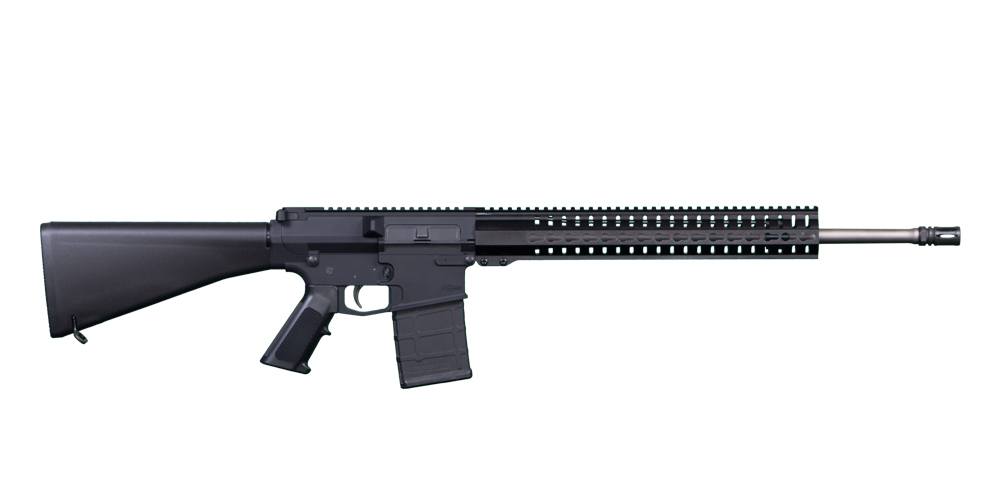
With the four different 6.5 Creedmoor Mk3 models, CMMG is offering varying levels of performance features at a range of prices. The base model, the Mk3, features a 20-inch medium-taper barrel rounded out with an A2 compensator. This model also incorporates a CMMG single-stage trigger, an A2-style grip and buttstock and CMMG’s RKM15 KeyMod handguard. Priced at $1,799.95, it weighs 9 pounds total.
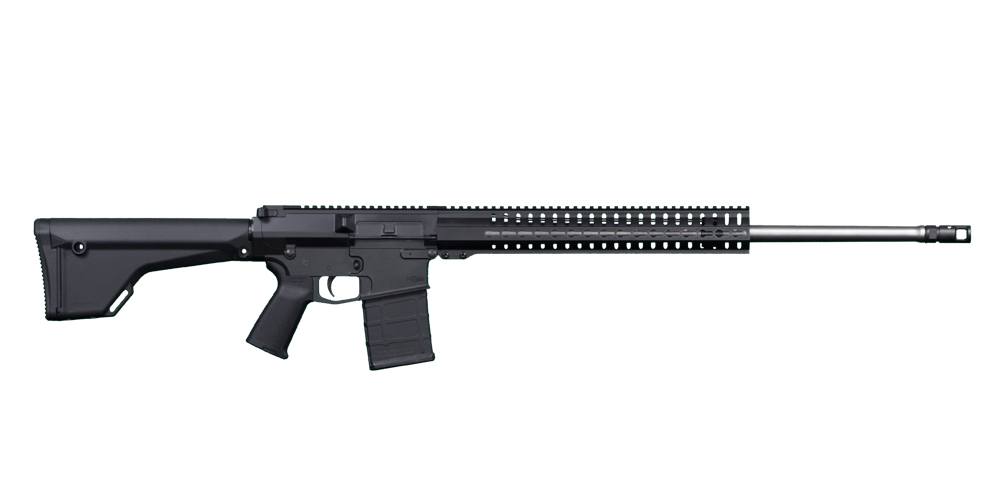
The next step up is the Mk3 P, which adds a 24-inch heavy-taper barrel, a CMMG SV brake, a Magpul MOE pistol grip and an MOE stock. It weighs slightly more at 10.4 pounds and comes in at about $100 more than the base model. Other features that appear on the base model, such as the CMMG single-stage trigger and RKM15 KeyMod handguard, also show up on the Mk3 P.
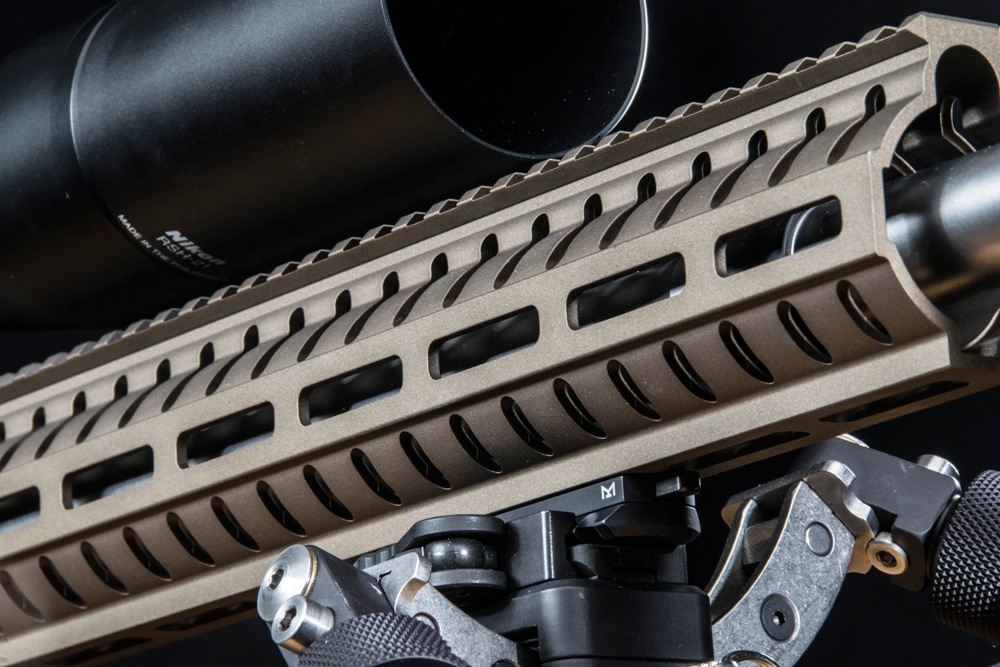
Close-up shot of CMMG’s new RML15 M-LOK handguard, found on the DTR models.
The Mk3 DTR model swaps the RKM15 handguard for CMMG’s new RML15 M-LOK handguard. It also incorporates the excellent PRS fully adjustable stock. Like the Mk3 P, it utilizes a 24-inch heavy-taper barrel, the same SV brake and single-stage trigger and the Magpul MOE grip. The final weight on the Mk3 DTR is 11.3 pounds, and its price is slated at $2,099.95.
Last but not least is the Mk3 DTR2, the top-end model. It shares most of the same features as the Mk 3 DTR but adds Geissele’s renowned SSA two-stage trigger for even more precise shooting. It also weighs 11.3 pounds and is priced at $2,274.95.
For more information on these new CMMG Mk3 6.5 Creedmoor rifles, visit the CMMG website, or check out the full specifications for each model below. Also, be sure to keep an eye out for a full review of the new CMMG Mk3 in an upcoming issue of Gun Digest the Magazine.
Specifications:
CMMG Mk3 Type: Semi-auto, direct-impingement gas Caliber: 6.5 Creedmoor Gas System: Rifle length Barrel: 20 in., 1:8 twist, medium taper 416 stainless steel Overall Length: 41 in. Weight: 9 lbs. (unloaded) Muzzle Device: A2 compensator, threaded 5/8-24 barrel Handguard: CMMG RKM15 KeyMod Receivers: Billet 7075-T6 Trigger: CMMG single stage Mil-Spec type Grip: A2-style Stock: A2-style MSRP: $1,799.95 Manufacturer: CMMG
CMMG Mk3 P Type: Semi-auto, direct-impingement gas Caliber: 6.5 Creedmoor Gas System: Rifle Length Barrel: 24 in., 1:8 twist, heavy taper 416 stainless steel Overall Length: 45 in. Weight: 10.4 lbs. (unloaded) Muzzle Device: CMMG SV brake, threaded 5/8-24 barrel Handguard: CMMG RKM15 KeyMod Receivers: Billet 7075-T6 Trigger: CMMG single stage Mil-Spec type Grip: Magpul MOE Stock: Magpul MOE MSRP: $1,899.95 Manufacturer: CMMG
With lighter, faster projectiles, .17-caliber rimfires such as the .17 WSM and .17 HMR offer some advantages over more established rimfires like the .22 Long Rifle.
Undoubtedly, the majority of our hunting careers were sparked by an experience with the .22 Long Rifle cartridge; it has become a ubiquitous icon in the youth of any shooting upbringing. The simple rimfire design, coupled with a complete lack of recoil, has been used to teach generations of marksmen how to properly hit a bullseye and to put meat on the table, no matter how small the portions might have been.
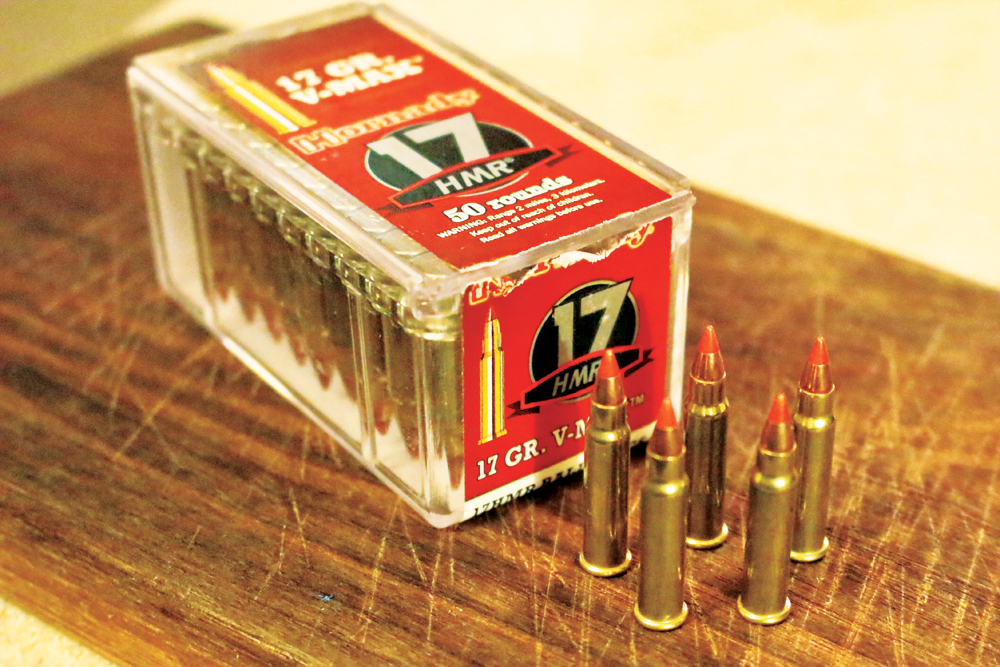
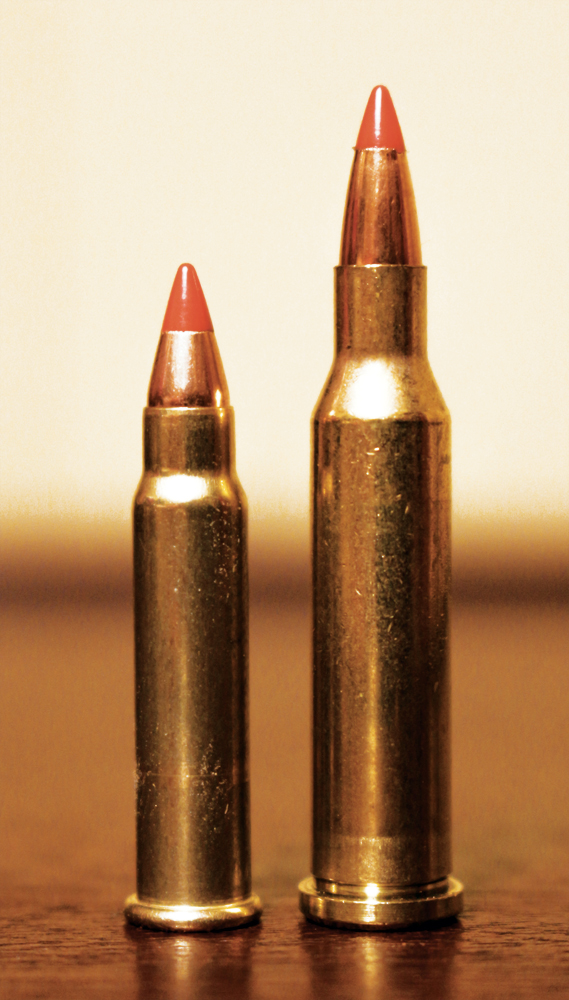
However, just as the .22 LR was an evolution of the .22 Short and .22 Long that preceded the legendary design, the .22 Winchester Rimfire Magnum became an upgrade of the .22 LR, giving greater velocities and more striking energy. In 2002, ballisticians at Hornady decided it was high time to shake things up and neck the .22 Magnum down to .17 caliber; the .17 Hornady Magnum Rimfire (HMR) arrived with much fanfare. It would utilize a 17-grain spitzer bullet, driven to 2,550 feet per second (fps) for a flat trajectory, flatter than any rimfire that had come before.
The .17 HMR has less long-range capability than the WSM, but more to offer by way of bullet selection.
The new, hyper-velocity cartridge was an instant success, and even though the tiny bullet was extremely sensitive to wind drift, many hunters flocked to the gun shops for a new cartridge to play with. The .17 HMR is a very accurate cartridge, fully capable of taking headshots on squirrels and other small targets, as well as extending the effective range of the rimfire rifle on distant woodchucks, coyotes and foxes. It was followed, two years later, by the .17 Hornady Mach II, based on the CCI Stinger variant of the .22 LR cartridge.
Fast-forward a decade and you’d see the great firm of Winchester as busy as a beehive, hard at work releasing the .17 Winchester Super Magnum (WSM). Having seen the success of Hornady cartridges, Winchester created a cartridge based on, of all things, the .27-caliber nail gun blank — used for driving nails in concrete and other hard surfaces. For three years, the wizards at Winchester secretly toiled away in their towers — with some help from the sages at Savage — crafting a rimfire cartridge that would achieve unprecedented velocities, and upon release to the shooting public, lived up to its goals. The .17 WSM drives a 20-grain bullet to an even 3,000 fps and a 26-grain bullet to 2,600 fps.
Hornady’s .17 HMR, left, and WSM, right.
How do the two compare and contrast? And for what hunting/shooting situations are they best suited? Well, let’s get this statement out of the way: They aren’t as economical or available as the good ol’ .22 LR, and while both of the cartridges have a velocity and trajectory advantage over the reigning rimfire cartridge, it’s going to be very difficult to become a threat to the crown.
Being rimfire, and therefore virtually un-reloadable, the cartridges are a one-and-done proposition. But, for the hunter who wants a rifle that can reach out for the occasional 150-yard shot, without the report of the smaller centerfires — like the .17 Hornet and .17 Remington — the .17-caliber rimfires have an appeal. While the .17 Hornet — one of the slower centerfires of this caliber — bests the velocity of the .17 WSM by 650 fps, the rimfire .17s fill a needed void.
Those tiny .172-inch diameter pills will certainly get the job done on the smaller game animals such as squirrels and rabbits, as well as the furbearing mammals like foxes, bobcats and even coyotes, at closer ranges. For the fur hunter, these little bullets with their high velocity and light sectional density figures will help minimize pelt damage.
They both make a bit of noise; being supersonic, they probably aren’t the best choice for shooting garden pests while trying to go unnoticed. But in a situation where you don’t want a high velocity bullet sailing out of control, the .17 HMR and .17 WSM provide a relatively flat trajectory, yet with a highly frangible bullet that significantly reduces the risk of an errant bullet causing harm.
Let’s take a look at the differences between the .17 HMR and the .17 WSM in some real-world situations. Hornady makes ammunition for both cartridges, so to keep things even, I’ll use their stuff for the basis of the comparison.
Both of these cartridges are fully capable of maintaining a 100-yard zero, without the mid-range trajectory becoming ridiculous. Using a 20-grain bullet loaded in both cartridges you’ll find the .17 WSM with a V-Max bullet hits 4.10 inches low at 200 yards, while the .17 HMR loaded with a 20-grain XTP hollowpoint hits just under 10 inches low at the same distance. Now, while the WSM needs just a touch of holdover at two-hundy, the HMR needs some careful attention out past 125 yards. Not that the shot is impossible, but the holdover becomes crucial, especially on the smaller targets.
Whether HMR or WSM, both .17s are great for small game excursions.
Wind can be an absolute nemesis to any .17-caliber cartridge, be it centerfire or rimfire. The bullets simply lack the weight to defy the effects of crosswind, and learning how to dope the wind with any of these rifles will test the mettle of any rifleman. That being said, it’s a matter of simple physics to explain that all bullets of equal shape and weight will drop at the same rate.
With that in mind, the faster a bullet travels, the more ground it will cover before that drop occurs, hence the trajectory advantage of the WSM cartridge. If you are looking for a rimfire cartridge that has the capability to reach-out-and-touch-someone, I feel that the .17 WSM has the advantage. If you like a cartridge with more choices in the bullet weight department, perhaps the .17 HMR is your baby. Hornady loads the 15.5-grain NTX, 17-grain V-Max and the 20-grain hollowpoint XTP.
In either case, the faster .17 rimfires will provide a definitive advantage over the .22 LR, and in certain circumstances even over the .22 Mag. Even though the .17s are a specialty case, requiring their own special cleaning rods and patches, they are a ton of fun to shoot and very effective in the field.
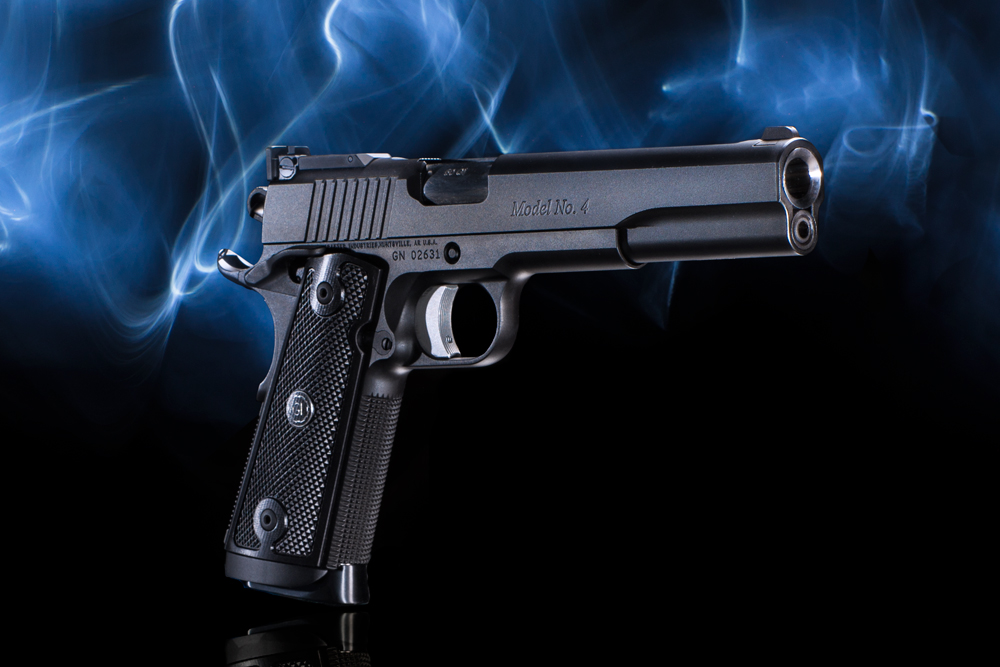
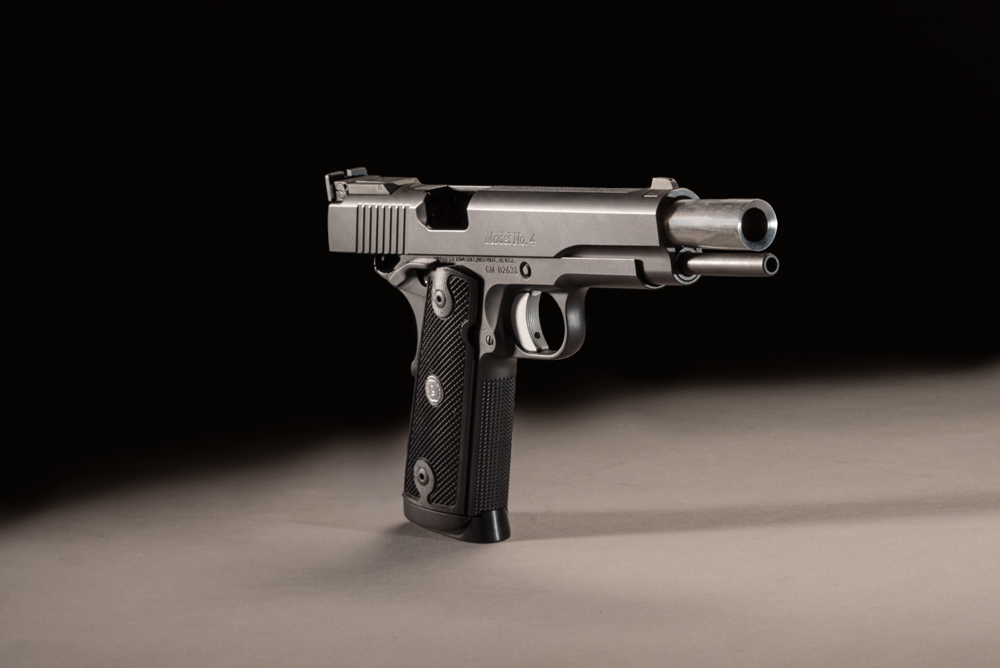
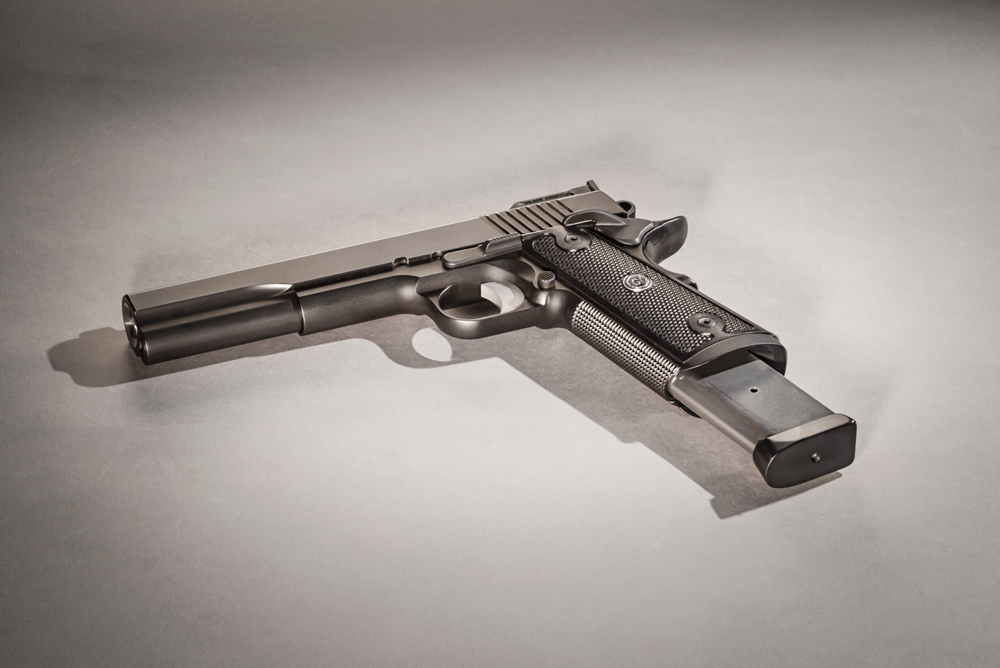
The Guncrafter Model 4 in the potent .50 GI is a high-class 1911 that’s big on performance.
I’ve heard the statement a thousand times, “I carry a .45 because they don’t make a .50.” I like .45s, but that statement is getting a bit old. Now I have a great response: “Sorry, but they do make a .50.” In fact, Guncrafter Industries has been making the .50 GI now for a dozen years. Just slightly shorter than the .45 ACP, the .50 GI case measures .530 inches in diameter. It has a rebated rim, so it would use the same shell holder. A .45 ACP round sits nicely inside an empty .50 GI case. Yes, it’s an imposing round to see, in case you were wondering.
I’ve tested two other Guncrafter guns in the past, both chambered for the clasic .45 ACP round. The CCO and Frag models I tested were as close to perfect as pistols get, with match-level triggers, super slick actions, and ragged-hole accuracy. They didn’t sport high-tech features like full-length guide rods or bull barrels, but they functioned perfectly and shot tiny groups with any ammunition.
The .50 GI Model 4 has the same perfect fit and finish. You’d think guns with a price past the $3,000 mark would all be perfect, but that’s not always the case. Not long ago, a friend purchased a prestigious race doublestack 1911. He felt the trigger wasn’t up to par, and when he disassembled the gun, he found upgraded parts he’d paid for weren’t even on the gun. I reviewed another company’s 9mm race gun—a $3,400 gun—and found the trigger was gritty and the magazine wouldn’t drop free, big problems. This hasn’t been the case with the Guncrafters guns I’ve tested. So far, with three guns tested, I’ve found not a single flaw.
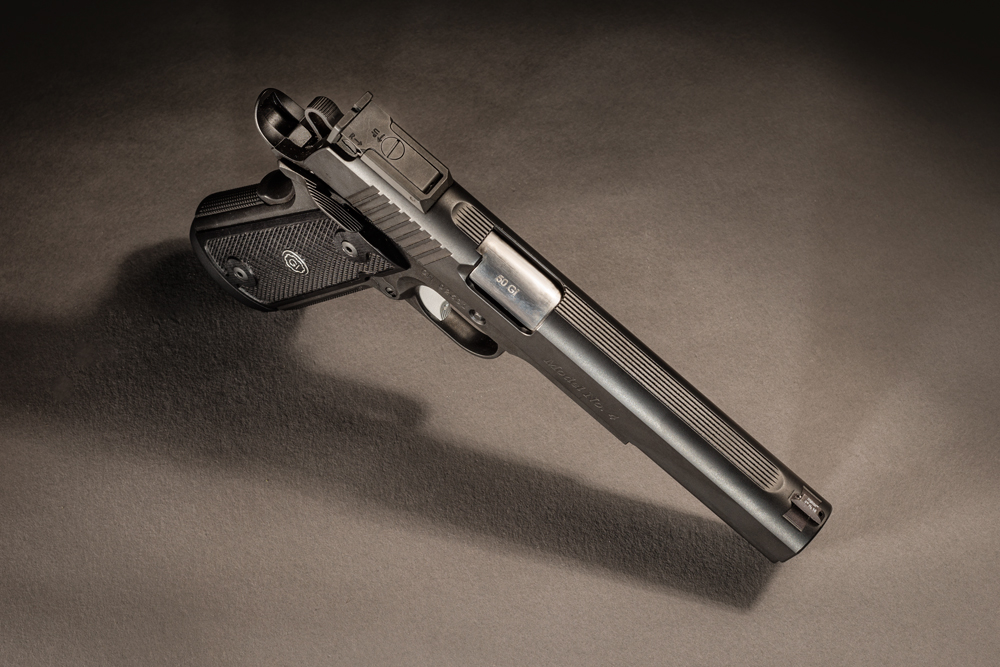
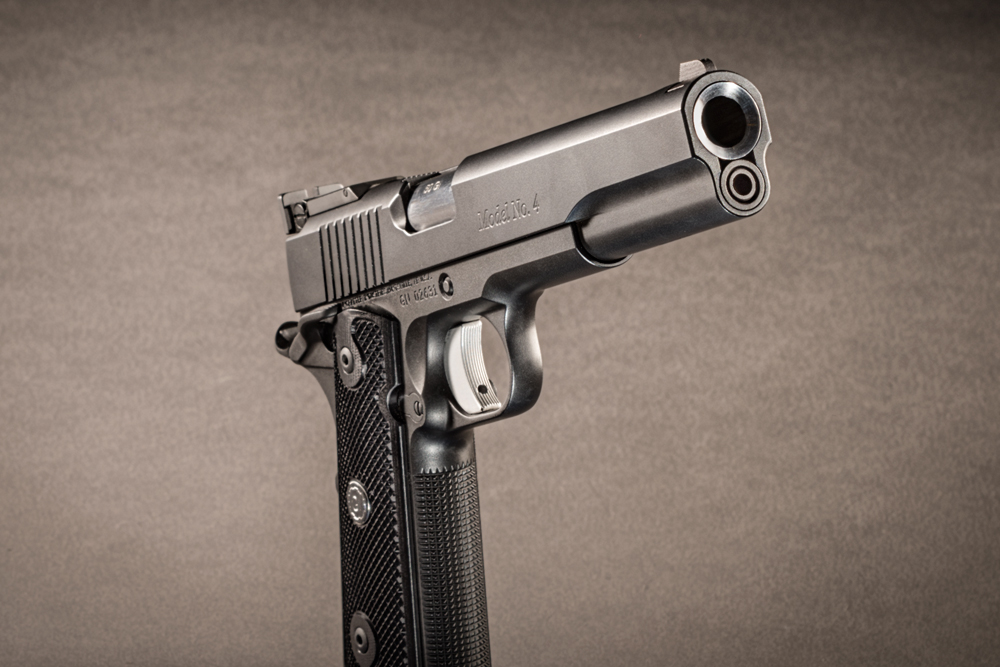
My test gun was the Model 4 Long Slide model with a 6-inch bull barrel. It’s a big gun, weighing just less than 45 ounces, empty. It features a Wilson Combat adjustable rear and a Trijicon Tritium front sight. The safety is ambidextrous, and there’s a blended magazine well and a flush-cut, deep-crowned bull barrel. The front strap and flat mainspring housing are checkered, as is the contact surface of the magazine release. The solid trigger has a backlash adjustment screw, but needed no adjustment. There was no discernible creep in the trigger. It broke crisp and clean at just over 4 pounds, but felt lighter due to the clean break.
The finish is a pleasant and functional matte black Melonite. It provides a classy look and lowers the coefficient of friction while hardening the surface of the parts. It’s also extremely rust resistant. Every Guncrafter gun I’ve tested has been more than the sum of its parts. Choosing the right components is important, but fit and finish are at least as critical, especially with 1911s, where exacting fit produces both accuracy and reliability.
The relationship between the metal parts is impeccable. The slide is smooth and has no lateral or vertical movement, a perfect mating of slide to frame rails. The thumb safety, grip safety and mainspring housing are a perfect fit and are gently melted to remove any sharp edges that contact the hand.
Loading the oversized magazines is easy because the big rounds provide a lot of area to push against. Magazine capacity is seven rounds, and there’s a witness hole on the side to indicate a full magazine. Since the .50 GI round has a rebated rim, the rear of the magazine lip is slightly crimped in to keep the round positioned correctly. Magazine insertion is simple with the extended magazine well, and magazines seat easily, even when fully loaded with the slide down. Magazines drop free of the magazine well, as they should. The Model 4 comes with two stainless magazines with polymer bases. It also comes with a takedown wrench for the one-piece guide rod, a ballistic nylon carrying case, and an embroidered Guncrafter towel.
Shooting the .50 GI isn’t much different from shooting hot defensive loads in a compact 1911. The extra weight helps with the added power. Fully loaded with 230-grain copper hollow points, the Model 4 Longslide weighs 54 ounces. The gun’s weight and carefully matched recoil spring with full-length recoil spring guide helps keep recoil smooth. You won’t forget the factory loads (purchased from Guncrafter) have about 30 percent more energy than a defensive .45 ACP load, but you won’t be uncomfortable. Recoil is a strong push—no feeling of slamming or peaks.
Accuracy was exceptional. Bench rested at 25 yards, five-shot groups ran a bit above one inch, with my best group measuring just .551 inches. I’m sure there was a bit of luck in that one, but suffice it to say the Model 4 is accurate. The sights are both easy to see and easy to adjust. The Model 4 feels like a regular 1911 in the hand despite the larger frame and magazines. My friend Mike and I tried running the Texas star on his range with the Model 4, but neither of us managed to clean it. We both came close, but it just didn’t happen.
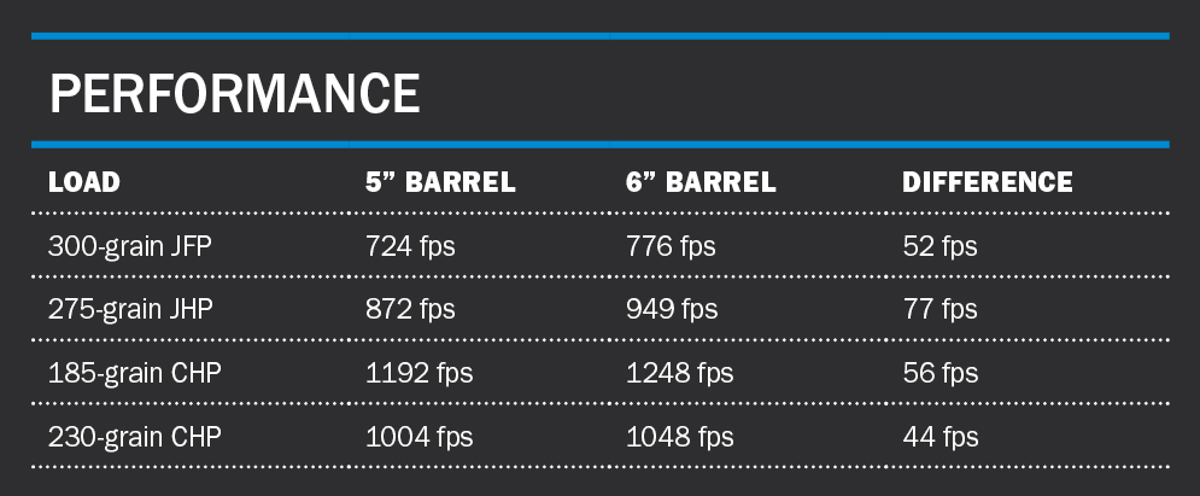
While the .50 GI is certainly capable as a defensive round, I imagine the extreme penetration of most of the available loads might be a liability. Should one choose to use it for defense, the 185-grain copper hollow point would be the right call. With a muzzle velocity of almost 1,250 feet per second (fps), the solid copper hollow point expands into a perfect four-pointed star when fired into ballistic gel.
Another reasonable use for it would be as a trail gun in bear country. The 275-grain jacketed hollow point at about 950 fps approaches .44 Remington Magnum energy, with a power factor of over 260. With eight rounds in a semi-auto, it’s an impressive package indeed. There is some extra weight in the Long Slide version, but there’s also a measurable increase in performance, and that weight also results in more manageable recoil and faster follow-up shots.
Accurate, powerful, reliable, beautiful, OK, where’s the down side? Well, there are a few. First is the availability and price of ammunition. Currently, .50 GI is available from Guncrafter Industries. Pricing runs from about $30 for a box of 20 300-grain FMJ loads, to about $50 for a box of 20 copper hollow points. While this seems a lot for the FMJ loads, the price of the hollow points is only about 40 percent more than quality .45 ACP defensive ammunition. I suspect most of the .50 GI guns won’t see daily use as high-volume shooters, so maybe this isn’t a big factor.
Another downside is the initial purchase price, and again, for what you’re getting, it isn’t unreasonable. The days when guns that cost $3,000 were unusual are long past. As mentioned above, I’ve tested several $3,000 pistols, and some have been unsatisfactory. This certainly isn’t the case with the Model 4. It’s as perfectly executed as any 1911 I’ve ever tested, and several of them have run north of $3,000.
This isn’t a pistol for everyone, and I suspect that’s part of the appeal. It’s a quality piece of equipment, unique in many ways, and it performs as designed. Guncrafter Industries isn’t trying to build guns for everyone; they build guns for a certain demographic, and from what I see of the Model 4, they’ve come pretty close to the center of the target.
Specifications:
Guncrafter Industries Model 4 Type: Semi-auto, single action Caliber: .50 GI Barrel: 6 in., match-grade, bull Weight: 45 oz. (empty) Trigger: 4 lbs. Sights: Wilson Combat adjustable rear, Trijicon Tritium front Finish: Matte black Melonite Magazine Capacity: 7 rounds MSRP: $4,125 Manufacturer: Guncrafter Industries
This article is an excerpt from the September 2016 issue of Gun Digest the Magazine.
The right muzzle device — whether it’s a flash hider, compensator or muzzle brake — is an often-overlooked feature when shopping for an AR. But it shouldn’t be, as each enhances the rifle in its own way. Understanding and selecting the right option for your black gun can go a long way in making a more effective firearm.
A flash suppressor or flash hider reduce the muzzle flash caused by still-burning powder exiting the barrel behind the bullet. Some powders have flash retardants in them, so a smaller signature will be seen. Others are naturally bright, and using ammo with these powders will create quite the bloom when fired. Furthermore, rifles with muzzle brakes attached tend to flash brightly, but in a more directional manner.
Here’s an example. I once conducted an experiment to see how effective a couple of these were. Now this wasn’t a truly scientific experiment, but it still was pretty definitive. I shot my 16-inch carbine nekkid muzzle, with a standard A2 flash suppressor, and with a Yankee Hill Machine Phantom 5C2 flash suppressor. I did this around 8 p.m. in the autumn, dark enough that there was little ambient light. The ammo used was Winchester 5.56 (Q3131A for a part number if you care), made in Israel for Olin Industries (owns Winchester name for ammo), known for producing a bright flash.
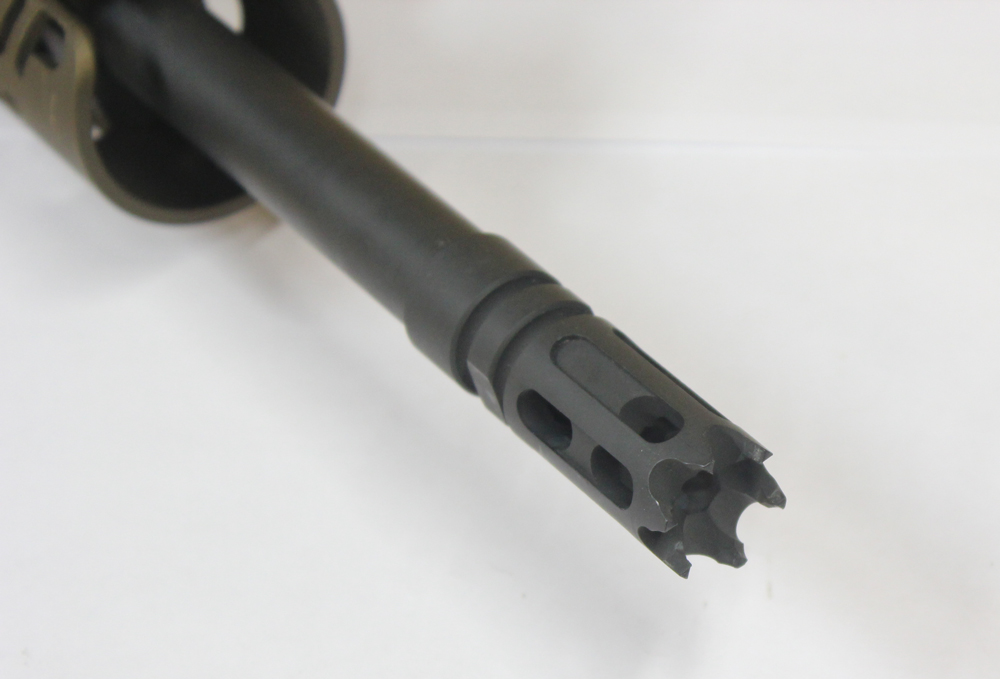
The Smith Enterprises Vortex flash suppressor is arguably the most effective model on the market and has been copied repeatedly. The long tines vibrate as the bullet passes through, breaking up the burning powder. You will be lucky to see a spark come out of this one.
The first shot with the nekkid muzzle produced an orange basketball-sized globular flash. It was bright and did in fact disrupt the night vision I had at the time. I followed this up with the Mil-Spec A2 flash suppressor on the muzzle.
The result when fired was a small orange flash about the size of the average Clementine orange. Then I fired with the Phantom and I was duly impressed. There was no flash visible to me or the observers (my extended family), but there was a single spark that traveled a few feet from the muzzle before extinguishing. A. Spark.
Anyone within several hundred meters would have seen the nekkid muzzle flash, and within at least a hundred meters would have seen the A2 flash. I doubt anyone within as little as 20 feet would have seen the spark and they would have had to have been looking directly at me to even catch a glimpse of it.
The Phantom, at least that model, is a superb flash suppressor and it is even pretty affordable. You can get one for under thirty bucks, and there are several models that have closed bottoms so you don’t kick up dust when firing prone. They work just as well as the standard models. They are similar to the A2 flash suppressor, which also has five open ports on the top and sides, but has a closed bottom. They have the added minor benefit that they combat muzzle rise slightly like dedicated muzzle compensators.
Back when I tried this, the only options were the Mil-Spec A1 (six evenly spaced ports), A2, the Phantom and the Vortex (Smith Industries) and the copies thereof. Now, you’ll get a headache trying to figure something out and you will ultimately probably decide based purely on the aesthetics of the device.
Get More Suppressor Info:
The Suppressor: How Is It Made, It Works And How To Buy One
There are a number of well-functioning flash suppressor on the market now, though the best seem to be variants of the Phantom or the Vortex. The Vortex has long tines similar to the Phantom, but the tines are not connected at the end. This allows the tines to vibrate like a tuning fork when the gun is fired, and this is the mechanism to disperse the flash. These types of flash hiders are arguably the most effective designs, but also tend to approach $50 in cost. You also have to watch where your muzzle goes (you already do anyway, right) or you might get stuff stuck in between the tines.
Compensators
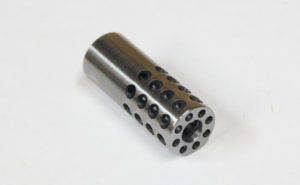
The Vais compensator can sometimes be found on ARs but it is usually seen on traditional hunting rifles. The large series of holes vent gas 90 degrees to the bore axis, all the way around. This particular brake requires non-standard threads. Be aware of things such as thread pitches when you order your muzzle devices from retailers.
The term compensator is almost always ascribed to a muzzle device that is designed to reduce muzzle rise, not necessarily recoil. Indeed, if the device pushes the muzzle down, more recoil force is often transmitted straight back, enhancing felt recoil while keeping the muzzle movement minimal. It is true, however, that compensators and muzzle brakes can be combined effectively in the same unit, and we’ll talk about those in the following section on muzzle brakes.
The vast majority of compensators are designed with a common element of holes or slots on the top. These slots may extend somewhat to the side but then they become more like brakes. When the bullet exits the barrel and passes through the compensator, the expanding gas behind the bullet exits through these holes before exiting the “muzzle” of the comp. This produces a jet of gas that is going straight up or up and to the rear, acting as a counterforce to the rise of the muzzle. The higher the pressure of the gas behind the bullet the more effective the comp.
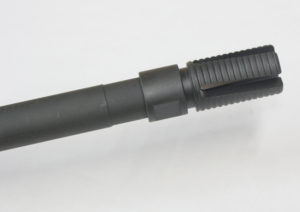
The A2 flash suppressor also acts as a compensator, where the older A1 flash suppressor did not. Many companies, in particular YHM, make compensator or brake versions of their flash suppressors that look virtually identical.
Muzzle Brake
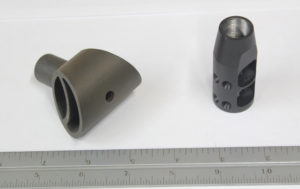
One of the originals. The JP Recoil Eliminator is huge and works extremely well. However, it often looks out of place on barrels because of its large profile. The tactical models on the right are more common.
Brakes are designed a bit differently and are typified by the inclusion of baffles in the design. They work by using the expanding gas, as the compensator does, but in a different manner. These are designed to reduce felt recoil, not necessarily muzzle rise.
To do this, they have what amounts to virtual expansion chambers formed by the baffles. When the expanding gas following the bullet hits the rear face of the baffles, the gas literally pushes the baffles, the brake and the rifle it is attached to, forward. The gas then vents out the large holes on the side of the brake.
Most brakes also incorporate a few holes on the top to vent some of the gas up, giving them very good muzzle compensation in addition to the braking. You will see these in variations of two basic designs. The first is simply a hollow cylinder, bored out with dozens of holes all the way around the outside of the comp. These are reasonably effective as long as there is a front face to deflect some of the gas out, and are typified by the Williams muzzle brakes.
The second type is much larger and will have the large flat baffles and large side vent ports and most of these work incredibly well. The JP Enterprises, Dreadnought Industries and other similar models are very popular in the varminting and sporting realms because of the ease of follow-up shooting.
A very important note must be made. Compensators and muzzle brakes are so loud that you must have hearing protection. Do not shoot these guns indoors if you can help it. The concussion on these can be quite powerful and much of it is directed to the side or rear. Do not teach new shooters, especially women (who seem to be particularly sensitive to concussive effects) to shoot with centerfire rifles equipped with these muzzle devices.
On the other hand, if you are at the range and you have a couple stupid couch commando tough guys next to you (you know the type, too tough to wear sissy hearing protection, and smells like he hasn’t showered in an week), you can get rid of him quickly by getting out your compensated rifle and ripping off five or six shots one right after the other. He will quickly want to be elsewhere.
The presence of more than one assailant is common in criminal assaults. Swarms of assailants are more likely than they were a few years ago, and it is a good self-defense strategy to avoid pockets of able-bodied young men who appear capable of delivering harm.
The classic criminal assault with a second assailant, though, is usually a pincer movement conducted from the blind spot. To put this in perspective let’s re-address the encroachment problem. More than likely there’s a verbal component from the predator and the objective is to get the citizen engaged in dialogue. While engaged in dialogue, the likely approach is from behind by the second adversary. This is a difficult problem to manage and requires a significant adaptation to how one normally reacts to forward encroachment.
Even if one is aware of the potential that a second party may be coming from behind, the cost of looking may very well be the window that the initial adversary uses to throw a punch or draw a gun. So how do we maintain awareness and vigilance to a known potential problem and scan the area behind us for the most likely avenue of approach for a second adversary without making the job of the initial encroacher easier?
The key element here is movement, and the natural reaction to wanting distance and space – which is moving backwards – must change and adapt. Backwards movement is expected by any bad guy and it’s quite easy to “steer” the uninitiated pretty much anywhere, once this basic reaction is understood.
One recommendation is to “arc” around the adversary and not move backwards. A good way of visualizing this is if one were to place themselves on the face of a clock with the predator standing at twelve o’clock and the citizen standing at 6 o’clock, the objective would be to try to cut a perfect arc up to either the 9 o’clock or the 3 o’clock position.
This is not a natural or instinctive thing to do. In fact, it’s quite counter-intuitive, as are many of the best practices in self-defense. It’s also not intuitive to look at the tiny metal post at the end of the reciprocating slide in an exchange of fire, but it is most assuredly the best practice to guarantee that the bullet goes where desired.
A key in dealing with more than one assailant is moving in unanticipated ways, thus throwing them off their plans.
Arcing up to the three o’clock and nine o’clock positions provides two significant advantages in managing unseen space to the rear. First, by following the arc, we can literally maintain our primary field of vision with the known problem in front of us while simultaneously pulling what was behind us into our peripheral vision. This is significant because now we don’t lose the primary problem by “checking our six.”
The second advantage of this movement tactic is that, if indeed there is a second adversary, then what the good guy has done is remove him/her self from a 180-degree pincer problem and significantly narrowed the field of threat. Much has been written about dealing with multiple assailants, and one of the few successful tactics is lining them up as much as possible. The arcing movement does this not perfectly, but it does remove us from the unmanageable 180-degree problem and begin this process of “stacking” multiple assailants.
One more real benefit of the arcing movement goes well towards de-selecting us from a criminal selection process. The arcing movement is so out of pattern from average that, often, the reports back from those who have actually used this tactic are that the encroaching party gives the good guy an odd look and walks off mumbling. So, movement is a key element in managing a second adversary, which is common within the criminal assault paradigm.
With a full selection of riflescopes and binoculars priced for any budget, the Bushnell Engage optics line is focusing on the entire firearms market.
Shopping for optics can be a humbling experience. Few things can make that take-home pay seem more inadequate.
Easily, scopes have become the most expensive part of the setup, in many cases equaling if not exceeding the sticker price of the firearms on which they’ll be mounted. But for those with thick billfolds, the results are worth it once that bit of high-tech glass is dialed in and doing its job at the range or in the field.
Thankfully, in recent years, manufacturers have turned an eye to the rest of us, producing quality optics that don’t automatically draw a bead on your bank account. One of the latest optics manufacturers to offer both performance and affordability in a new line is Bushnell, who introduced its Engage precision optics at the 2017 NRA Annual Meetings and Exhibits.
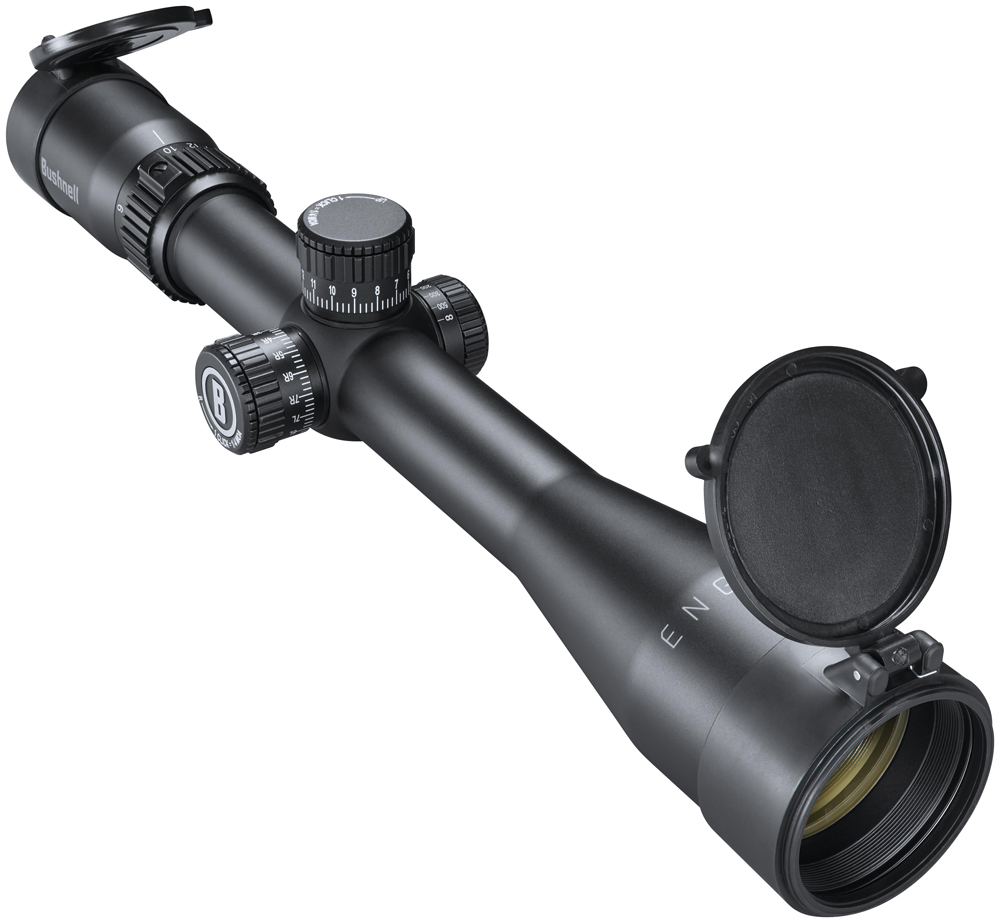
The nine scope models in configurations ranging from 2-7x36mm up to 6-24x50mm (also four models of binoculars) boast MSRPs from $149.99 to $449.99, putting the Kansas company’s new line within reach of nearly any shooter.
“The Engage line is built to outperform all other comparable scopes and binoculars and completely dominate the elements,” said Curtis Smith, global product director for Bushnell. “The only sure thing about any environment is that it will change, but Engage optics were built from the inside out to deliver world-class performance every time, in every condition.”
To that end, Bushnell is fully coating all of its optics with its EXO Barrier, which should go a long way in ensuring top performance in any environment. In addition to sharpening images and enhancing the scopes’ light gathering abilities, the barrier also plays a role in keeping the lenses clean. Filling the microscopic pores of the glass, EXO creates a slick surface that repels oil, water debris and dust, thus helping it maintain a crystal clear sight picture.
The variable-powered scopes also feature Bushnell’s Deploy MOA Reticle that provides shooters with 1-MOA windage and elevation marks. Though, because these are second focal plane scopes, the reticle’s subtension is constantly changing with magnification. In turn, to put the marks to the best use, a shooter will have to be set to a specific magnification.
Four of the Engage Precision Riflescopes also come with Tool-less ZERO Reset Locking Turrets that offer ¼ MOA per click adjustments and quick and easy adjustment.
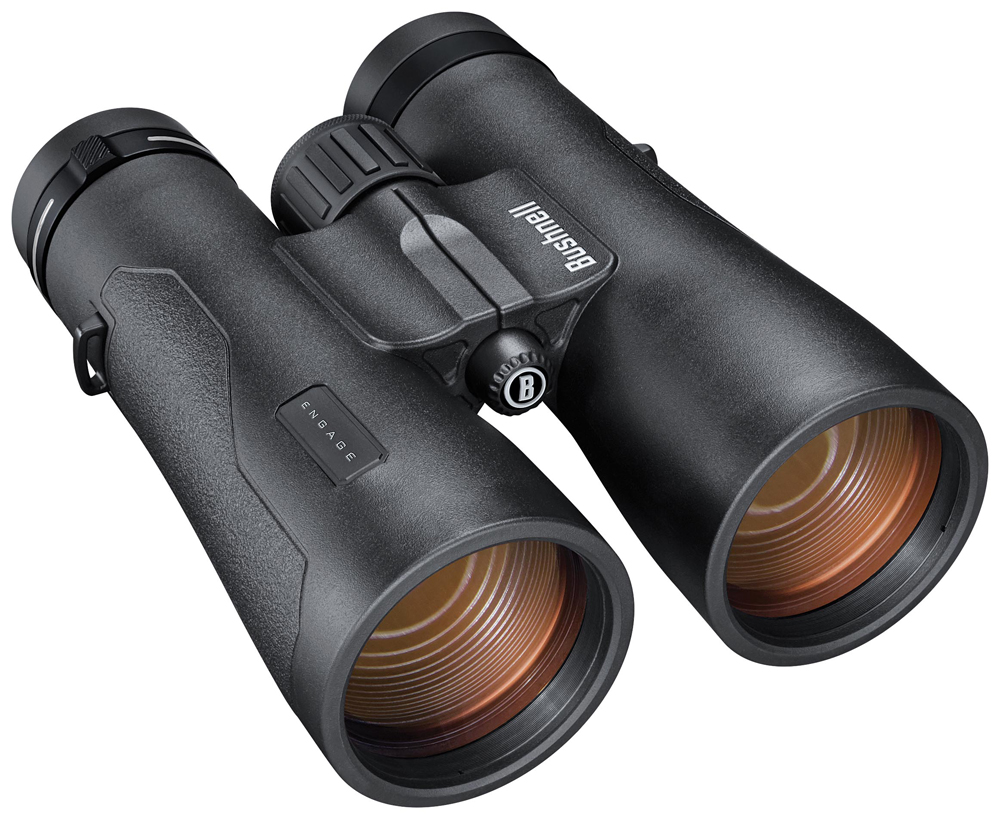
Bushnell’s new Engage Binoculars include similar features as the riflescopes, including rugged construction, fully coated optics (PC-3 Phase Coating) and multiple configurations (8x42mm to 12x50mm). They also come outfitted with ED Prime Glass, cutting down on chromatic aberration and delivering razor-sharp images. The MSRP on the Engage Binoculars runs from $349.99 to $409.99.
For more information on the Bushnell Engage optics line, visit Bushnell’s website.
Hornady has introduced its first .300 WSM rounds, giving shooters what appear to be two more solid choices when heading afield.
If there is a cartridge that has the cards highly stacked against its widespread adoption, it’s the .300 WSM. Strange legal doings and eventual royalties due for chamber and case production made many gun and ammo makers shy away from this hot-rod midget. Yet through these troubles it’s persevered, a favorite with shooters addicted to the magnum power and abbreviated cycle rates.
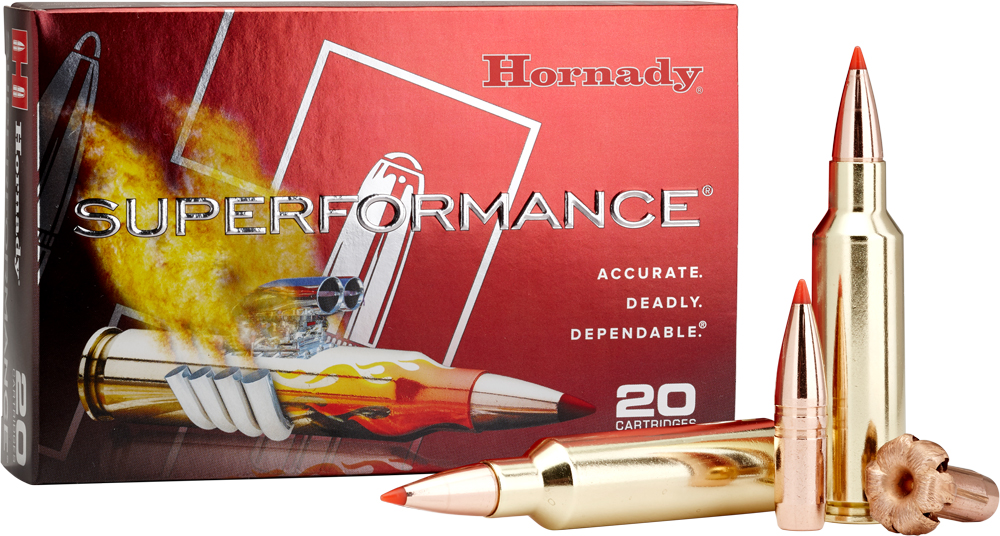
There is good news for this hearty and patient facet of the gun world, as yet another brand is taking up the banner of this .30-caliber short magnum. Hornady recently announced it is now shipping two cartridge options for the .300 WSM, a 165-grain GMX Superformance cartridge and a 200-grain ELD-X Precision Hunter round. The options give shooters two solid hunting rounds, which should cover plenty of bases afield.
The GMX offering gives shooters a monometal option (copper alloy) fueled by Hornady’s “ultra-progressive” Superformance powder. The bullet is designed to deliver controlled expansion upon hitting its target and produce devastating wound channels, with the projectile routinely retaining 95 percent or more of its original weight. The .300 WSM round moves at a good clip, leaving the muzzle at 3,220 fps and losing just a little over 30 percent of this velocity at 500 meters.
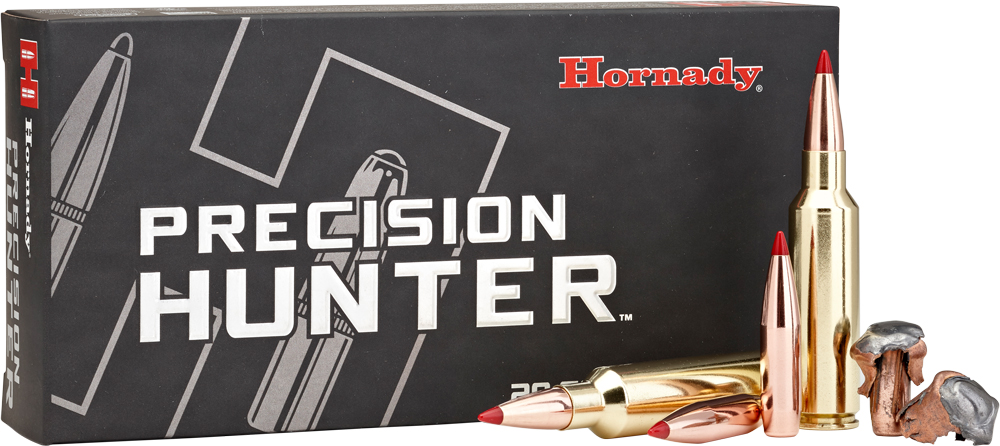
The heavier round is from Hornady’s new Precision Hunter line, which attempts to replicate match performance in a field round. Aiding it to this end is the company’s ELD-X (Extremely Low Drag-Expanding) bullet, outfitted with what Hornady heralds as one of its biggest recent breakthroughs. The projectile’s Heat Shield polymer tip is engineered to resist thermal warping, thus retaining the bullet’s high ballistic coefficient over the entirety of its flight. Hornady reports the velocity of the new .300 WSM round at 2,820 fps at the muzzle and 2,106 at 500 yards out.
Presently, the GMX round is retailing at $62.53 for a box of 20 and the ELD-X for $58.11, also in a box of 20.
Vanguard has been busy in 2017, expanding its Endeavor RS riflescope line to offer shooters an ample selection of optics for any occasion and budget.
Vanguard has long been a part of the hunting and outdoors world, producing a wide spectrum of gear and accessories. But for 2017, the company has squarely set its sights on one particular facet — riflescopes.
Vanguard has released 13 new Endeavor RS scope models this year, giving shooters aiming solutions for nearly any occasion. Gun Digest editor Luke Hartle was on hand at the 2017 NRA Annual Meetings and Exhibits to get a first-hand gander at this budget-friendly, hunting-oriented glass. And as he discovered, Vanguard is offering shooters a lot of perks with the expansion of its Endeavor RS line for just a little bit of coin.
Perhaps one of the more intriguing aspects of the scopes, Vanguard’s Bob Kaleta points out, is the company’s use of ED, or extra-low dispersion, glass across all of its models. Opting for ED glass means shooters have a sharper, more precise sight picture, with the lens material vastly reducing the fuzziness of chromatic aberration common to ordinary lenses.
Another exciting point touched upon is the low-light potential of the scopes — particularly Vanguard’s most powerful new addition: the RS-7. Outfitted with an industry-leading 44mm objective lens, the 7x magnification scope is engineered to gobble up light and thrive at dawn and dusk — when game species are most active.
With access to some of the most advanced ammo manufacturing capabilities on the globe, PRIME Ammunition is fast becoming a favorite among serious shooters.
PRIME Ammunition (www.primeammo.com) is a relatively new player in the shooting world. The company has been going strong for around a year and a half offering shooters top-notch rifle, pistol and shotgun ammo. But as is common in the global marketplace of ammunition, there is more than meets the eye when it comes to the Nevada-based company.
PRIME Ammunition is partnered with RUAG Ammotec, which actually handles the manufacturing end of the process. As PRIME CEO Jim O’Shaughnessy points out in the above video, the Swiss-owned (literally, by the nation) company has some of the world’s most advanced ammunition manufacturing capabilities available today. To boot, RUAG has more than 150 years of experience turning out high-precision ammo and is a top supplier of various militaries around the world.
In the video, O’Shaughnessy also goes into how PRIME Ammunition is doing its part to promote recreational and competitive shooting stateside. The company has made it a point to heavily support youth and female shooters, which includes helping launch the Precision Rifle Series PRS Kids event in conjunction with C&H Precision Weapons.
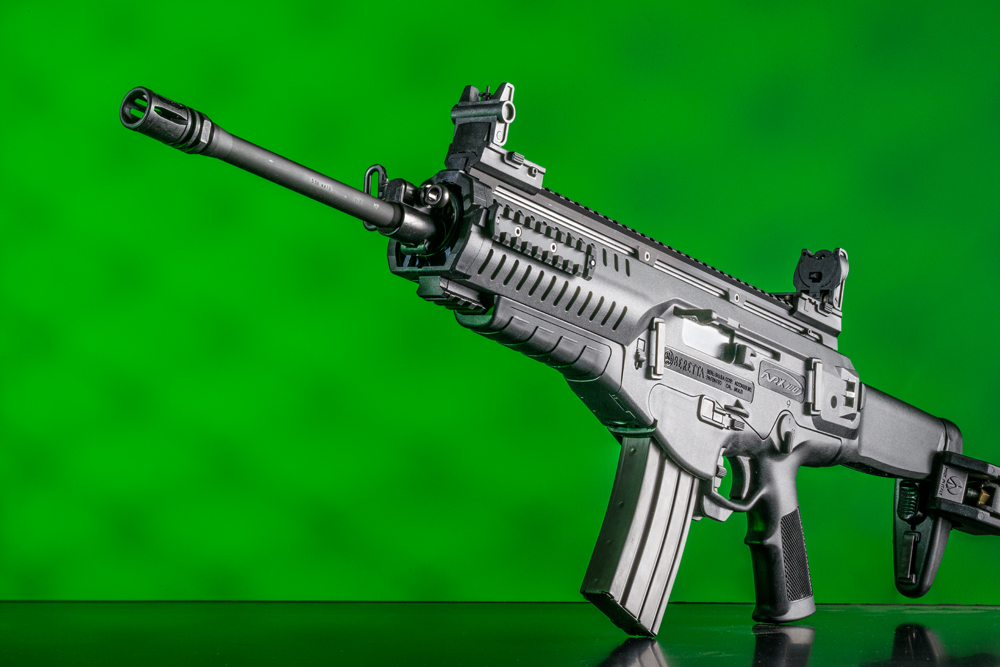
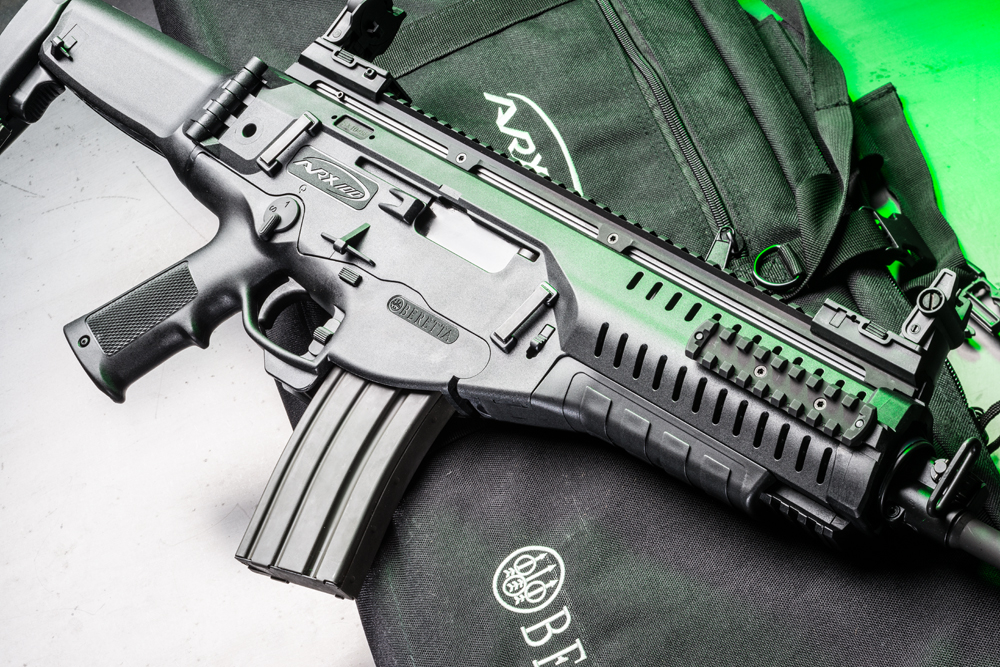
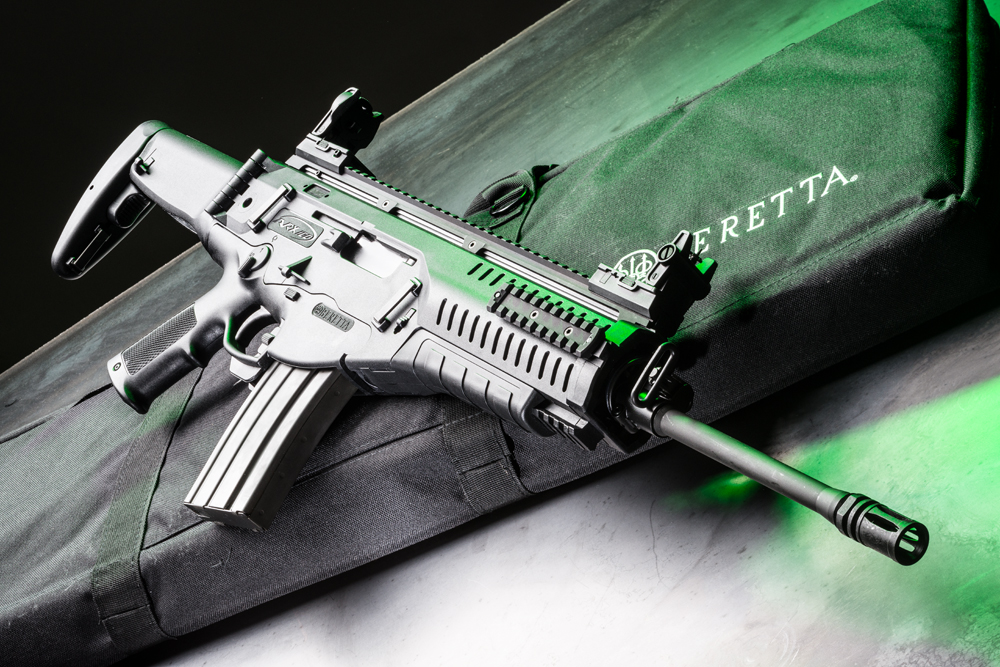
The Beretta ARX 100 is a futuristic rifle that’s both versatile and a smooth shooter.
I have always been a Beretta fan. It started when I was a teenager growing up in the ‘80s, long before I even got my hands on one. I was hooked on an action-adventure series of novels where the main protagonist carried a Beretta AR-70. Therefore, I liked the Beretta AR-70.
I grew up and forgot about those books, but I never forgot about that Beretta. My appreciation for Beretta only grew during my 11 years in the U.S. Marine Corps; my M9 never failed me, and the fit and finish is superior to just about anything else I’ve fired.
When given the opportunity to test the ARX 100, I jumped. The ARX 100 is the civilian-legal, semi-automatic brother to the select-fire ARX 160, which is only available to military and law enforcement.
The ARX 100 is a modular system that’s built to be reliable. It uses a rotary locking bolt and a fixed-piston, moving-cylinder gas system. It was also designed to be simple to operate and require low maintenance. It has a two-position adjustable gas valve to regulate the bolt speed, marked “S” for standard ammunition and “N” for non-standard, low-power ammunition. To use, always start with the Standard setting, and if it’s not cycling properly, move it to non-standard.
It is chambered in 5.56mm NATO (as tested), with more chamberings on the way. It has a 16-inch, chrome-lined, light-profile barrel with a twist rate of 1:7 and dual feed ramps. It’s capped with a standard-issue A2 birdcage compensator threaded 1/2×28 RH. The barrel heats up really fast, and with extended fire there could be some concern with the thin-profile, though this is mitigated at least a little by how easy it is to swap out barrels.
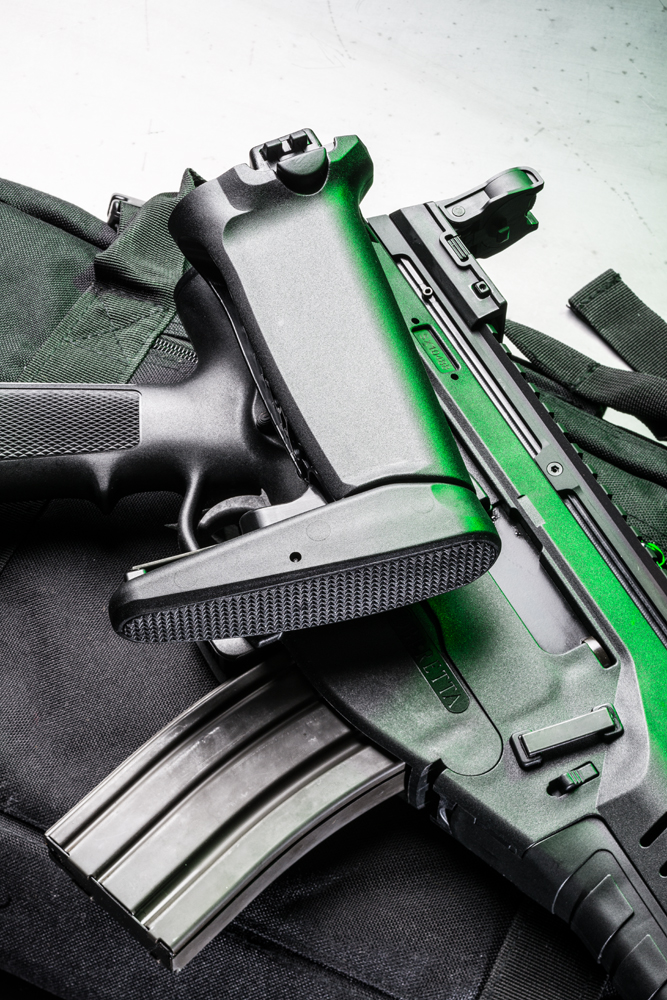
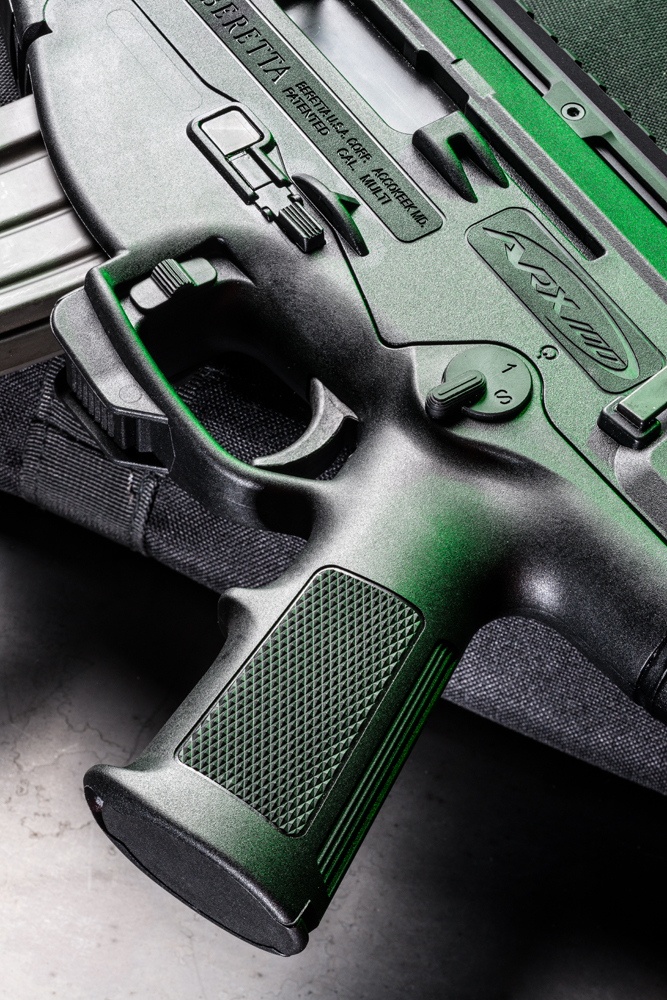
The ARX 100 weighs 6.8 pounds, is 35.5 inches long with stock extended (26.5 inches with folded stock), and 8.5 inches in height. The four-position stock folds to the right; the rifle can be fired with it folded. The pistol grip has the feel of a military-issue AR grip, but it is one piece with the lower and has a storage compartment.
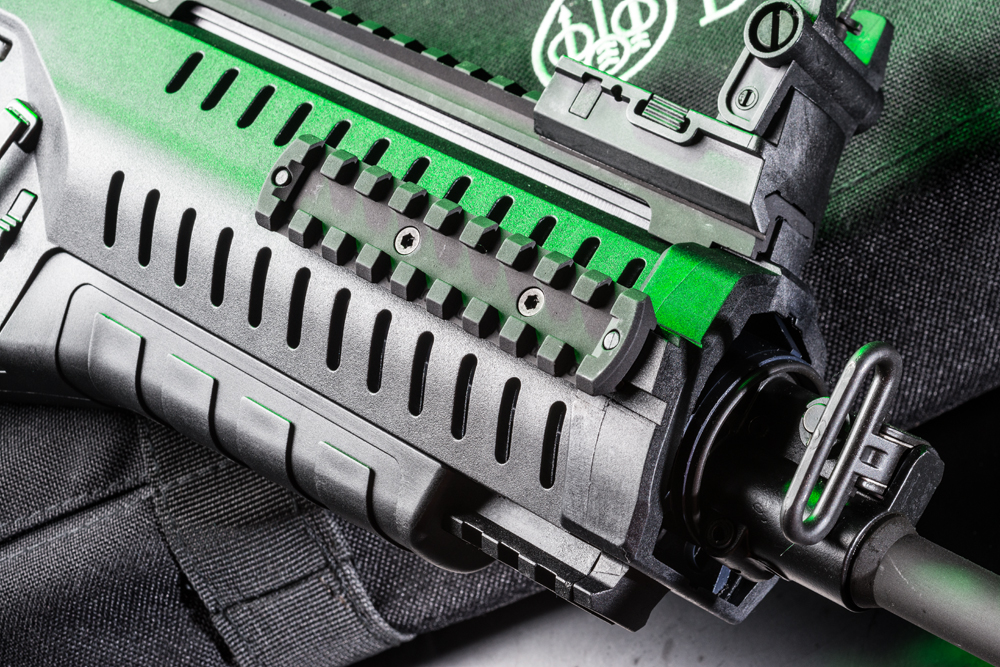
The gun has a monolithic top rail, two short rails at the three and nine o’clock positions, and a two-part lower rail. The lower rail comes with a slide-off cover, which serves as a forward grip. The front exposed portion of the rail is a standard picatinny rail, and the part under the cover is for Beretta-specific accessories for the Italian army, such as grenade launchers. It comes with six sling attachment points, so however you like it, you’ll be good-to-go.
The best thing about the ARX 100 is reliability. Out of the box I put 210 rounds of American Eagle XM855 through it without so much as a glitch. Then, without cleaning it, I returned to the range and put another 90 through it, suppressed, with no problems. This was a far cry from a thousand-round endurance test, yet generally, if I don’t get a malfunction during the break-in period, I like my chances.
The ARX 100 has an ambidextrous safety, bolt catch and magazine release. The magazine release is located in the same position as on an AR, just press with your index finger. A third magazine release button is located under the trigger guard. The bolt catch is located forward of the trigger guard, on the sides. The safety is similar in form to an AR, and it also doubles as the disassembly lever; press it up past “safe” to disassemble.
One of the coolest features on the ARX 100 is the selective right or left-side ejection. Just in front of the folding stock hinge is a shrouded port containing ejection selector. Push it to the left for right side ejection, and press it to the right for left side ejection. That’s outstanding.
It’s interesting how it works: The bolt face has two opposing ejectors, one at the three o’clock and nine o’clock positions. Long ejector pins and springs project from the back of the bolt. As the bolt travels rearward, the ejector pin contacts the ejection selector on the side you have selected as the side you don’t want the brass to come out of, and the selector disengages that ejector by moving it out of the way so it doesn’t make contact with the case rim. The downside to this is that the bolt must move all the way to the rear, so if the bolt short strokes the case won’t eject.
There’s a lot to like about the ARX 100, but there are some things that Beretta can do better. Some of these things might be my personal preference, but some things will be pretty much universally disapproved. None of the issues are deal-breakers. I sent an email to John Tamborino, Beretta’s Tactical Products Manager asking about these issues, and his response was that Beretta is aware of all of these quirks and is already working to fix them.
I know Beretta, and I believe these things will be addressed, and soon. Fixing these issues would make a top contender for this market, especially at the price point, which is less than the FN SCAR.
First, the Beretta ARX 100 is missing an adjustable cheek piece. It has a really high line of sight, and it has a severe comb drop that makes it difficult to get a good cheek weld for that line of sight. With the flip-up sights I had to raise my cheek off the rifle slightly; the same even when I mounted a Meopta M-RAD, which is really small. I mounted a Trijicon RX30 on it and it sat so high that instead of resting my cheek on the stock, I found myself resting my bottom jaw on it.
To give some perspective, the line of sight using optics or the flip-up sights is roughly the same height as mounting an optic on the carry handle of an M16A2. That’s really high, and is the reason the flattop receiver was invented. I know the stock was designed the way it was, low and without a cheek piece, so that it could be fired with the stock folded. But this comes at the expense of shooting with the stock not folded, which is how it is usually fired. A good fix would be a removable cheek piece like the SIG 556xi.
Second, the trigger is very heavy; mine averaged 10.4 pounds. It’s heavy enough that about 25 rounds into a magazine dump, my finger started to fatigue and my rate of fire slowed. I have never had that happen before. Yet it’s consistent and pretty smooth, so I was still able to get decent accuracy. A lighter trigger would better realize the accuracy potential of the rifle.
Next, deployment of the flip-up sights is awkward, and closing them is worse. To open the front sight you have to reach over the top of the rifle with your off-hand, and press the release button (it moves right to left). Repeat for the rear sight. It’s not quick, but clumsy. Closure is even worse: Press the front sight closed, then while holding it closed, press the button on the left side to move it to the right.
Aside from deployment and closing, the sights do their job. The front sight post is first zeroed for elevation. The rear sight is a disk that is marked one through six; one being 100 meters, six being 600. Simply spin for the distance of the target. I’m good with this so far.
But windage adjustments are done on the front sight, and require a tool, either the included tool or a screwdriver, coin, etc. If ever the windage needs to be changed while shooting, the shooter will have to pause, reach into their pocket, and hope they have a tool. If one is planning on mounting an optic, these sights will provide a serviceable backup, and they do co-witness.
The final thing is the bolt handle. It’s thin, and if the user is wearing gloves, it’s fine, but if barehanded, it’s unnecessarily uncomfortable. It’s like carrying a heavy bucket with a broken handle; after awhile the wire handle digs into your hand. It needs to be thin so that it can be rotated to the other side, but more surface area can be added for grasping, and it would still be able to rotate.
Disassembly is tool-free with no pins, another plus, and since about 90 percent of what I disassemble are ARs, it’s kind of fun to take apart something else. First, take the magazine out and make clear. Fold the stock to the right, thus exposing the retaining plate located at the back of the receiver. Grab the grip with your left hand, and use your thumb to press up on the safety so that it goes past Safe. At the same time, with your right hand, press in on the retaining plate. With your left hand, pull down on the grip and the lower receiver will pull out. It can be a little tricky to coordinate this all at once, and I found it best to do it with the muzzle resting on the floor.
Now, pull the bolt handle back so it aligns with the notch; pull the bolt handle out until it snaps, then rotate it so that it is pointing forward. Pull the bolt carrier out from the receiver.
The barrel is simple to remove, which is a great feature, and it can be done without the rest of the rifle fully disassembled. The bolt needs to be out of the way, but it can’t just be locked to the rear; when the barrel comes out of its seat, the bolt will slam forward, potentially damaging the receiver. Instead, the manual says that you must disassemble it to the point in which the lower receiver is removed, then the bolt can be rotated forward, which prevents the bolt from slamming forward. Once the bolt arm is pointing forward, you can remove the barrel; simply pull down on both sides of the take down lever, like a Glock, and pull the barrel out. If your intent is to fully disassemble the rifle for cleaning, this method works fine.
To conduct a rapid barrel swap and get back to shooting, I found a better way that involves no other disassembly at all. Insert an empty magazine, which prevents the bolt from slamming forward. Then lock the bolt to the rear and take the barrel out. Now you can remove the magazine; once you do, ease the bolt forward. To re-insert the barrel, lock the bolt to the rear (you don’t need to insert an empty mag) and insert the barrel, piston up. Once it’s almost seated you’ll feel resistance; press it in, and the takedown lever will snap. Give it a good tug to make sure it’s seated.
It’s simple and with a minimal amount of practice a barrel could be swapped out in less than 10 seconds. This makes it a cinch to clean the rifle, but more importantly it allows barrels to quickly be changed during live shoots.
The ARX uses AR-15 STANAG magazines and comes with one heavy-duty metal magazine. It works with most magazines made for the AR-15, but not all. I used Magpul Gen1 magazines and HK clear polymer magazines, and both worked perfectly. I tried to use a TangoDown magazine, but I couldn’t get it to seat properly. Magazines that have a rib to prevent over-seating will mostly be a no-go. It’s a huge benefit to everyone that Beretta chose to use the AR-15 magazine. The AR is the most popular gun in America amongst civilian shooters, and anyone who’s owned one for a while has a lot of magazines for it. It’s great to not have to buy different magazines. It also allows for the use of all the same mag pouches and kit that you already own.
One firearm that’s stirred up a lot of scuttlebutt this year is the Mossberg 590 Shockwave. On pure intimidation factor alone, the abbreviated pump-action is worth jawing about. But there’s more to this little black demon than just its devilish good looks.
As Mossberg‘s Linda Powell explains in the above video, there is plenty of innovation that has gone into the Mossberg 590 Shockwave. First and foremost is its overall configuration, which allows the scattergun to escape NFA regulation. The 590 Shockwave’s technical classification with the ATF is as a firearm — not a short-barreled shotgun — given its overall length and the fact it never had a buttstock, instead boasting a factory-installed pistol grip. By ATF definition, a shotgun is “designed or redesigned, made or remade, and intended to be fired from the shoulder…” These details have allowed Mossberg to save shooters the headaches of paperwork, wait times and taxes.
The Connecticut gunmaker has also produced a relatively comfortable firearm to shoot in the process, despite the Shockwave’s wrist-snapping appearance. This is due to the gun’s most prominent feature — the bird’s head grip, which more readily dissipates recoil compared to a traditional pistol grip.
To discover all the features of the Mossberg 590 Shockwave and to see why its flying off shelves, watch Gun Digest Digital Editor Luke Hartle’s conversation with Powell above. And get more great gun reviews and top-notch shooting tips by checking out Gun Digest’s YouTube channel.
The subject of buffers has been one of confusion for some years now. The use of buffers in rifles, particularly ARs with A1 or A2 stock assemblies, is simple. It’s Hobson’s choice — use the originals, because they haven’t changed and don’t need to be. The rifle buffer is the longer, two-flanged one. The rifle spring is the one with 41 to 43 coils. (Yes, you can and should count them, just so you know for sure and know what they look like.)
When it comes to AR-15 rifle buffer and springs, more is not better. You do not want a heavier buffer, and you do not need a longer or stronger spring. Regular readers of mine know the record: a rifle we encountered in a class had an “extra strong” spring that was so strong the rifle would not work. The spring had no less than 50 coils!
Carbine buffers have one rim, are shorter in length, with recoil springs sporting 37 to 39 coils. Despite the buffer being lighter and the spring being shorter, they are correct for use in telestock tubes. Actually, they work pretty well … when they work. When they don’t work, you need to tend to them. Carbines, unlike rifles, can benefit from some buffer improvements.
The rifle buffer weight is longer, with two flanges, and won’t fit in the carbine tube nor allow the action to cycle.
The buffer in both rifles and carbines is built as a dead-blow hammer. The weights inside are meant to rattle back and forth. When the bolt-carrier assembly closes, the carrier strikes the rear of the barrel extension. Steel-on-steel is a near-perfect elastic collision, and the result is a bouncing carrier. In semi-auto fire this does not matter as it is done several eons before your finger can press the trigger again. However, in full-auto fire, the autosear can release the hammer, bouncing the carrier as the hammer falls. If the hammer happens to come forward when the carrier has bounced, and is far enough back (it doesn’t take much), the bottom edge of the carrier prevents the hammer from contacting the firing pin. The result is the hammer resting on the firing pin with a loaded round in the chamber.
I had this happen in a class a few years ago. A Deputy from a nearby county arrived in our class (he wasn’t a student) with a malfunctioning select-fire SBR carbine. He had driven over from two counties away because his issued duty carbine was malfunctioning. After a brief description of the problem, I had him load and fire into the backstop. Sure enough, his rifle stopped. We opened it up, and yes, the hammer was forward and there was a live round in the chamber. I pulled out the buffer weight (standard carbine) and replaced it with an H3 marked buffer. He then did three full-mag dumps in full auto. Relieved, and with a grin on his face, he thanked me effusively.
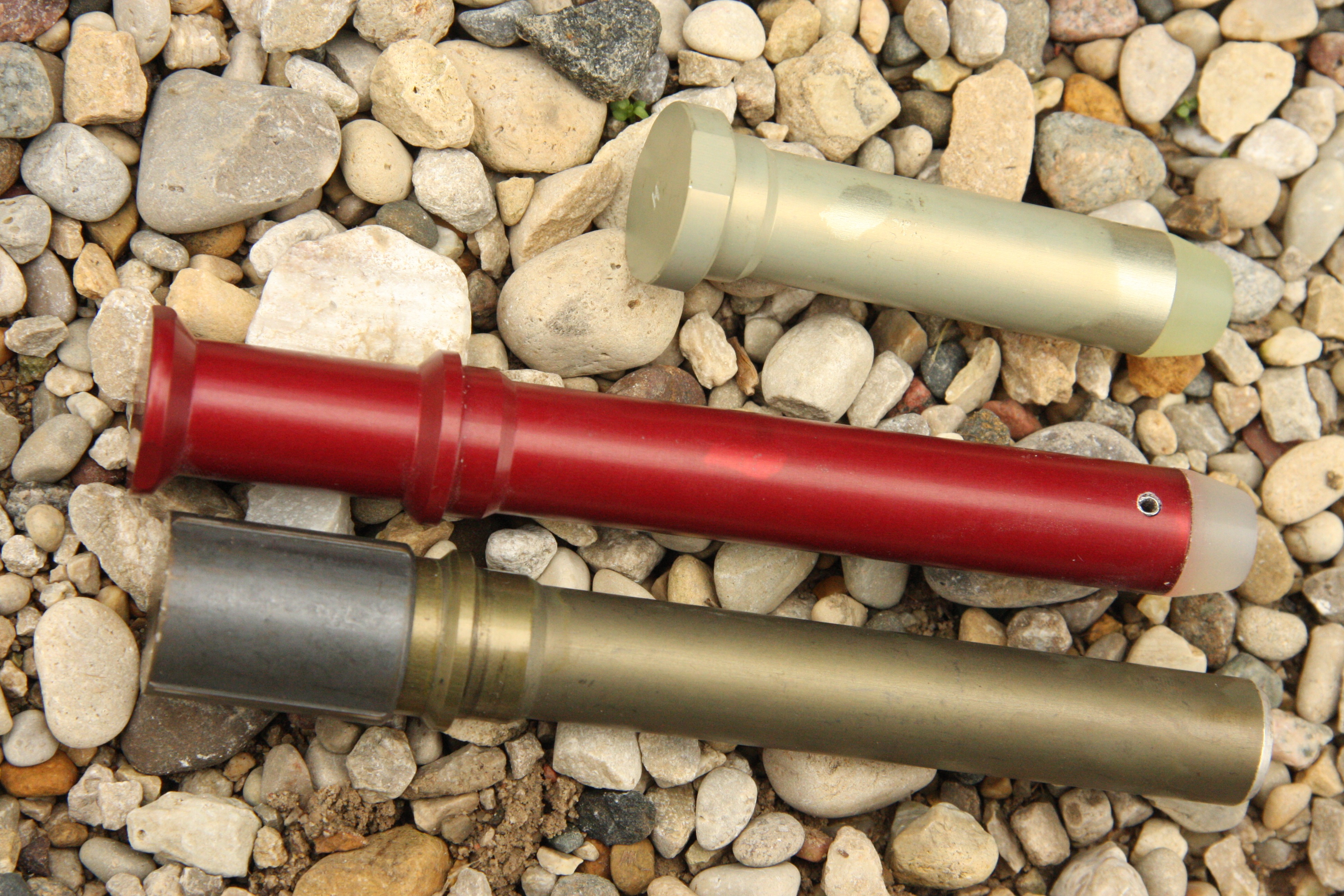
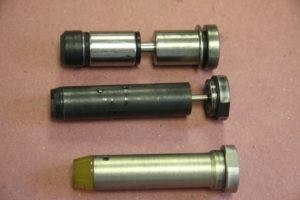
Top, a standard carbine buffer.Middle, a JP Enterprises competition lightweight buffer.Bottom, the original Armalite buffer, less than two ounces.
The weights inside are held to the rear of the carrier by inertia as the carrier goes forward, and then when the carrier stops, the weights move forward inside of the buffer an extra fraction of an inch and hit the inside front face of the carrier just as the carrier would be bouncing.
Again, for semi-auto work, this doesn’t matter. What does matter is that the weights are steel. When the carbine is a regular (more-or-less) 16-inch or so barreled upper, the steel weights work okay. However, if you shorten the barrel, install a suppressor, or do both, you have problems. Not bounce problems, but mass and inertia problems.
The shorter barrels need larger ports in order to deliver enough gas to the system in much shorter dwell time. This changes the timing and force of the gas arrival; many SBRs benefit from a heavier buffer. Buffers are made heavier at the manufacturer by substituting one or more of the steel weights with identically sized ones made of tungsten. One swapped weight is an “H” buffer, two swapped an H2 and all three an H3.
Inspect your buffer. This one gave up the ghost in the rifle and had to be wrestled out.
Generally speaking, if you have buffers to try, use the heaviest in your carbine, with the following limits: Use the lightest-power ammo you typically use, and keep your AR dirty and dry. Use the heaviest buffer that will still lock open in those conditions, when the magazine is empty. The brass will be less abused and you will feel less recoil. A quick aside, the Army, as they are wont to do, re-invented the wheel by upgrading buffers and congratulated themselves for being so clever. They added a new buffer to inventory, with instructions on where, when and in what rifle or carbine to install it. They call it the H6 buffer. It’s comprised of six weights, each half the size and thickness of the regular weights and fits inside of the buffer assembly. I have been told they are packed in there so that they do not move and do not act as a dead-blow hammer. Time will tell if that particular aspect induces malfunctions. If you have an H3, you have a buffer that weighs the same as the H6, but has the dead-blow attribute — so don’t go changing unless higher command orders you. The H3 is better than the H6.
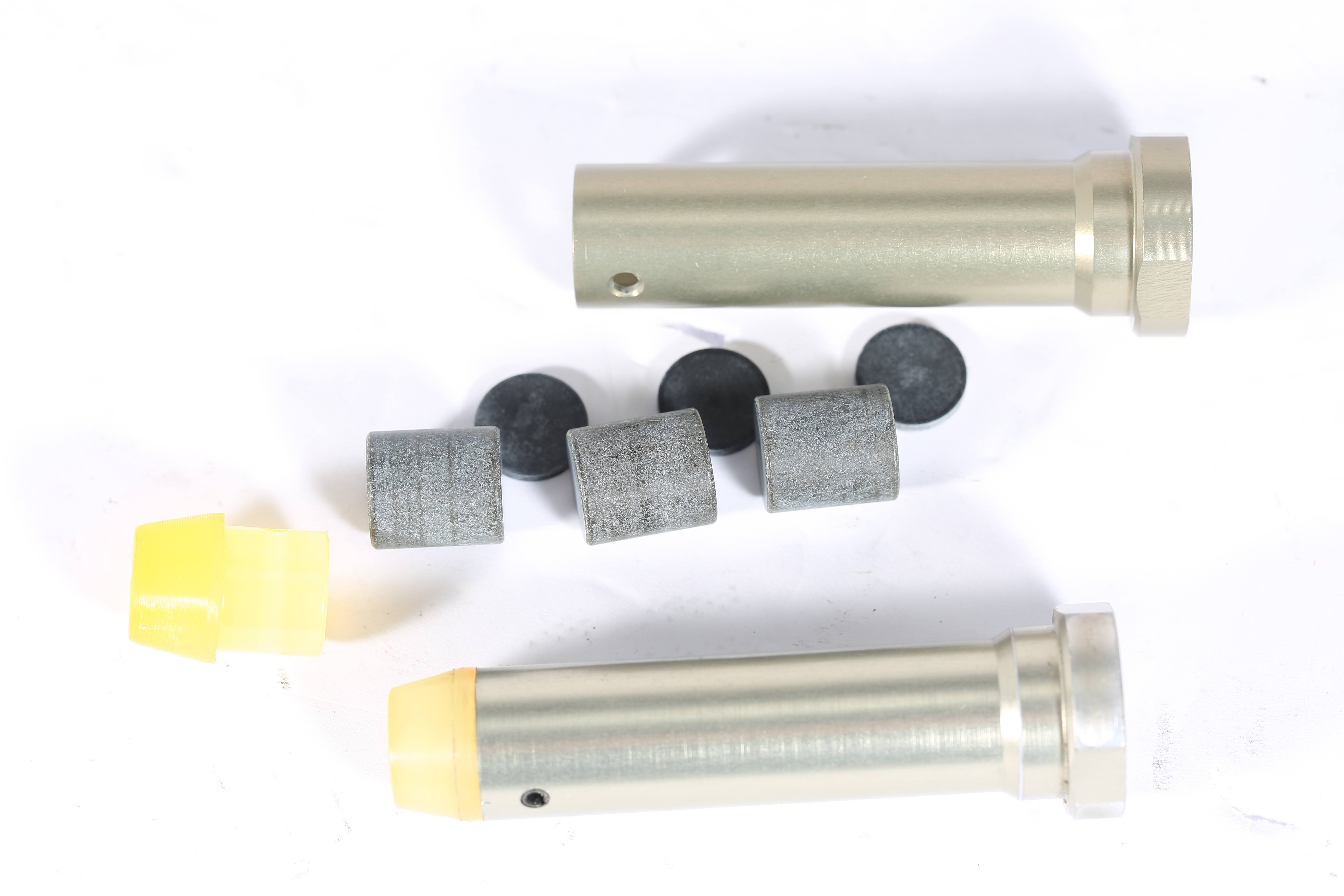
Here is a carbine buffer, disassembled next to an intact one. You can see the three weights and their fiber-synthetic pads.
A special case is the pistol-caliber conversion, particularly the 9mm. Colt only ever made the AR in 9mm (no .40 or .45) so if you have a .40 or .45 you have something really off the beaten path. The Colt 9mm buffer is a special one, with extra weight added by means of a steel sleeve over the buffer body. The 9mm carbines and sub machine guns, or SMGs are not gas-operated, they are straight blowback, and need the extra mass to control timing and force of recoil. In a 9mm, the heavier the buffer, the better.
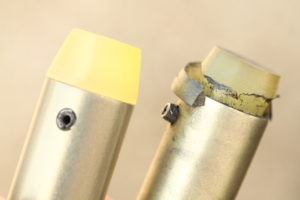
Buffers are made simply by lathe-turning rods of 6061 aluminum, anodizing, installing the weights and end cap. The synthetic cap keeps the buffer and tube from being hammered as the buffer weight bottoms out in the recoil stroke. The soft synthetic end cap is held in by means of a roll pin, and we have seen some of those pins work loose as of late. Check on your buffer occasionally just to make sure it isn’t one magazine away from disintegrating. (Trust me. That would be bad.)
While the relatively soft synthetic cap provides a bit of recoil relief, that didn’t keep people from improving it. The improvement comes in the form of a buffer, modified to have an internal or external spring on a shaft, which acts as a spring-loaded plunger. When the buffer bottoms out, the plunger soaks up more recoil while allowing the buffer mass to continue moving. This spreads the recoil impulse out over a longer period (measured in hundredths of a second, but still enough to notice) making the system seem softer in recoil. The total is the same, but the time is increased. Think of it as credit in monthly payments. The total cost is the same, but you get more time to deal with it.
So, what are the drawbacks? For one, such buffers tend to be lighter than the heaviest ones available. They provide a decreased recoil impulse when the system bottoms out, but do so with more velocity than they would have had with a heavier buffer. If the rod bends, or the spring wears or breaks, the advantage is lost. And they cost more than the standard and heavy buffers. Still, they do work. If you can feel the difference and are willing to pay the price, then go for it.
Bouncing springs
The buffer spring is full-diameter — it fills the aluminum tube in which it rests. Attached to it is a hard plastic stock. When the gun is fired, the cycling spring rubs against the tube, transmitting noise directly to your jawbone. One of the mechanisms of hearing is bone conduction. You hear things in part because your bones, being hard mineral structures, conduct sound relatively well. That’s why ear plugs do not offer as much protection as over-the-ear muffs do. The muffs cover some of the bone that would be conducting noise.
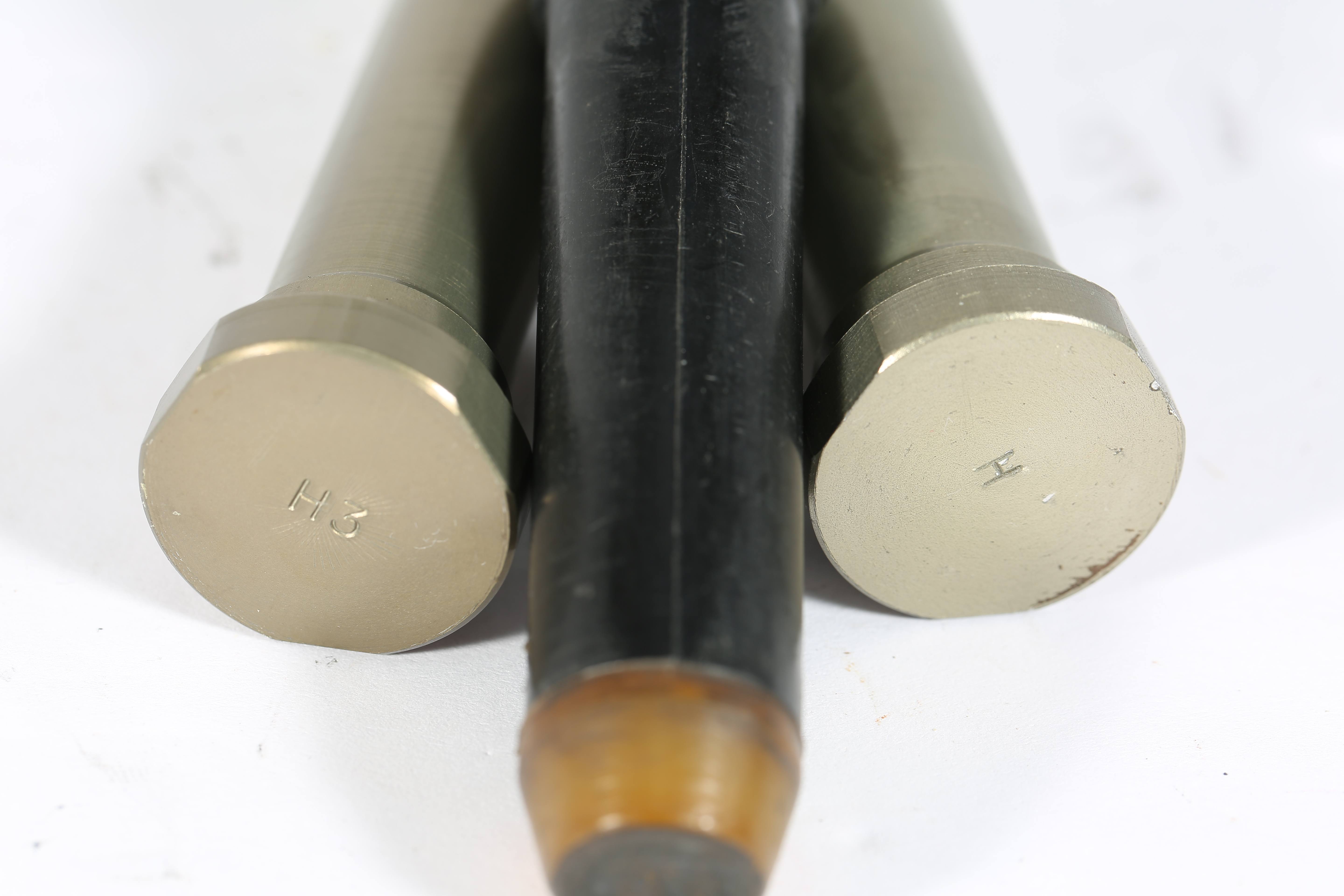
The H is on the right, the H3 on the left, and in-between is one of the really bad plastic ones with lead shot. Avoid that one like the plague.
Well, the buffer tube conducts the noise directly to your jaw, and then to your ear. Some find the noise noticeable, even annoying. Others don’t notice it or their face offers enough dampening to keep bone conduction to a minimum. Yes, having a fat face can protect your hearing.
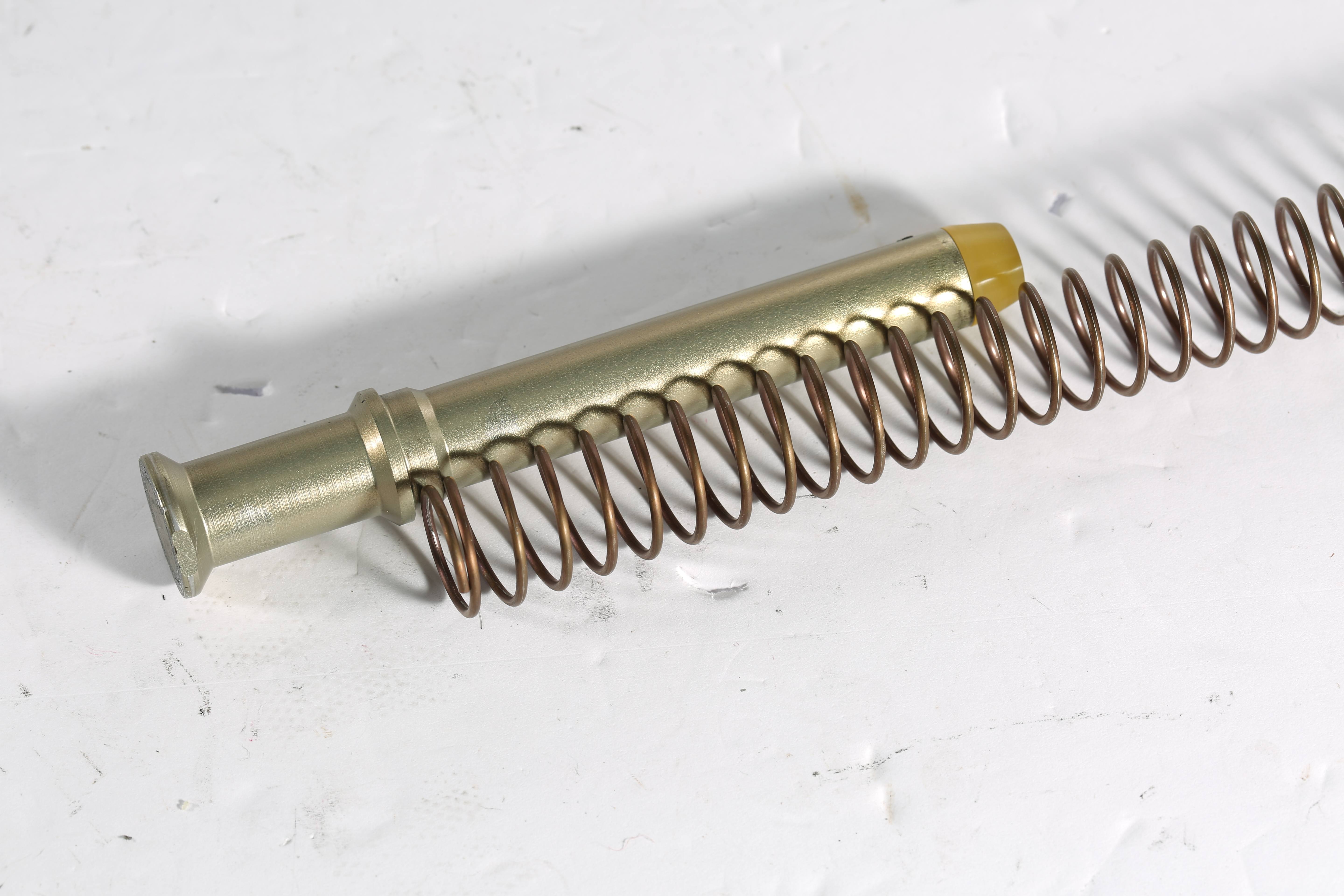
John Paul of JP Enterprises solved that problem by building a recoil spring along the lines of the spring-loaded buffer, but more. The entire recoil spring assembly is a captured system with weights and spring on a central rod. You do not need a buffer with this design as it has its own buffer mass built in.
Installation is easy. Open the upper and lower. Pull out the standard buffer and spring. Install the JP system with the weights to the front. Close, reload and continue. Paul, not being one to leave things alone, improved it to the v.2.0 system, offering a .308 version.
The big advantage is no spring boing. The spring rides on its own central rod, thus it cannot contact the buffer tube — nor rub against it.
The H is on the right, the H3 on the left, and in-between is one of the really bad plastic ones with lead shot. Avoid that one like the plague.
Buffer problems
Buffers may be durable but they do not last as long as carriers. The biggest problems are cheaply made or counterfeit buffers. I’ve seen them with mangled plastic backs made out of a cheap substitute polymer. (How can you get cheaper than plastic? They manage somehow.) For a while back in the 1980s and 1990s, we saw plastic molded buffers that were filled with lead shot. Those were awful. If you have one in a Colt (Colt even made and used them for a while, but not on military rifles), replace it and do not regret changing a factory-original setup. On this score Colt did wrong, and you should not suffer as a result.
One really egregious buffer I saw a while ago was made from lathe-turned heads (the nailhead-looking part) married to tubing. It probably would have worked fine except that the maker was even cheaper than cheap and didn’t use seamless tubing. The tube split on the seam, driving the plastic part into the buffer body until the weights inside stopped it. We had to wrestle that one out of the stock because it was binding on the spring.
Then there are those that are lathe-turned but not anodized. The faces that rest against the carrier on these get chewed to pieces in short order.
And who can forget the particularly craptasticbuffers that had a single steel weight inside. Yes, it clacked back and forth when you shook it, and caused the most spectacular malfunctions.
Quick check
To see if your rifle has the proper parts, unload, open it up, and pull the buffer and spring out.
Shake the buffer. Do you hear the weights clacking back and forth? Good. If you hear shot rustling around in there, replace the buffer. Count the coils. There should be 37 to 39 for carbines, 41 to 43 for rifles.
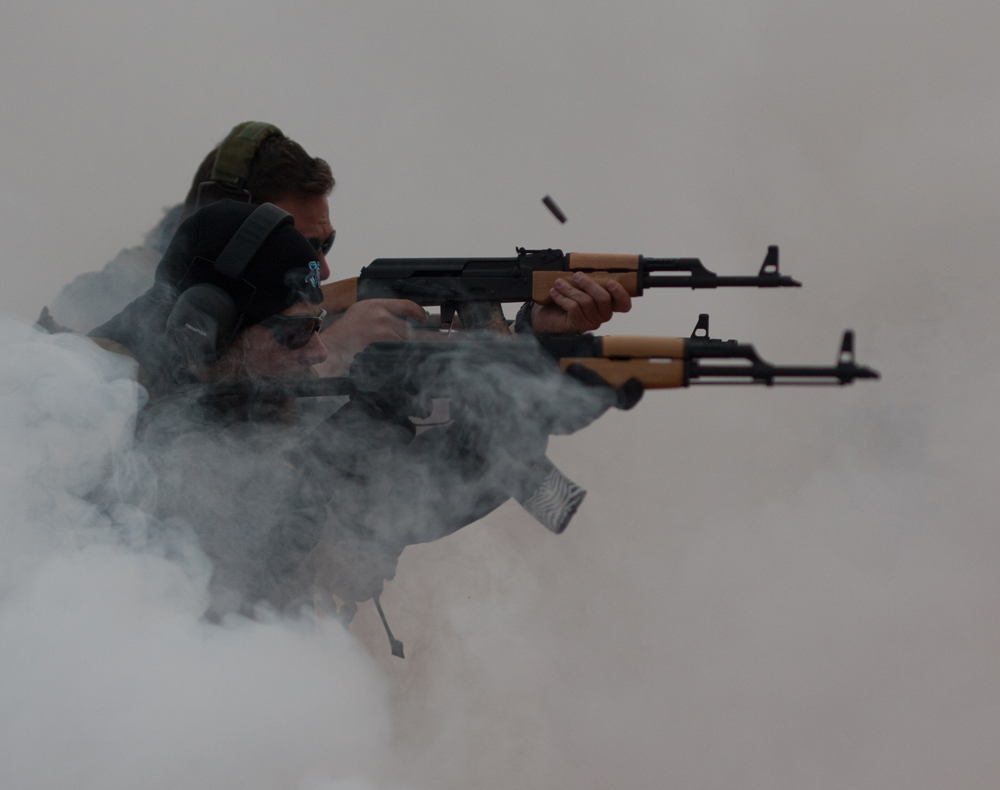
Don’t let anyone tell you an AK can’t shoot or is just a bullet hose. Here, I’ve shot a perfect score on the qualification course, using a borrowed AK-74.
Over the years, the Kalashnikov has been pegged as an inaccurate firearm. But is it a fair assessment of the rifle? What can marksmen truly expect when it comes to AK accuracy?
Just how accurate can an AK be?
Before we can answer that question, we have to ask a few others. First, how accurate is the ammunition itself? And how do we go about measuring accuracy?
The common gunwriter method is to shoot a group, slap a scale across the widest spread holes, subtract the bullet diameter and voilà! There’s your group size and accuracy. But is this really a valid measurement method? Not exactly. The more informative method is to shoot more than one group, and more than the three-shot norm for hunters, and those who write for hunters. Hunters have reasonable (you’ll notice I did not say “good,” just reasonable) reasons for three-shot groups.
Once measured, this is translated from the ruler to a theoretical dispersion called “minute of angle,” or MOA. Angles are measured in degrees. Each degree is subdivided into minutes. A 1/60th of a degree is one minute of angle, and is pretty close to 1 inch at 100 yards. So, a “1 MOA rifle” will theoretically shoot a 1-inch group at 100 yards, a 2-inch group at 200 and so on.
A hunter is not going to take more than three, four shots at any given game animal. If you need more than that, it isn’t a hunt, it is a fight, or a culling operation, and you do not need to worry about minute-of-angle accuracy for the follow-up shots in a fight. Plus, most hunters take a “cold bore” shot. The rifle and ammunition are both at ambient temperature. They aren’t heated up from a long string of fire, so how accurate the rifle is or isn’t, when it is heated up, is immaterial.
A target shooter cares about accuracy from a hot barrel. If you are competing in High Power, you’ll be firing 10 shots in a minute, or 70 seconds. That barrel will get hot. If it changes point of impact or group size while it heats up, you’re pretty much non-competitive regardless of your skill level.
Military rifles are expected to work regardless of the climate, temperature, lack of cleaning, etc. And a hot barrel, well, when you’re in a fight, there’s no such thing as a timeout for barrel cooling. Keep that in mind when you read about the acceptable accuracy level of service rifles.
There’s a reason AKs have been with us for three-quarters of a century and will likely be with us for that long into the future.
So, hunters, competitive shooters and the military all look at accuracy from different perspectives. Each perspective weighs the variables differently and measures results with a different yardstick.
The use-a-ruler method lacks a certain statistical precision. If the groups are wide side to side, or up and down, or are composed of a knot of holes with one flier always present, simply measuring the widest holes doesn’t tell you much. Then there is the tendency to improve our skills by culling. “Well, I slapped the trigger on one shot. That has to have been the one out of the group, so we’ll call it good with the rest.” Uh-huh. Good luck with that, Bucky. A “called flier” is just that. If you saw the front sight go high-left on the break, and the wide shot is indeed high and left, then you can call that shot out of the group on account of your trigger control. (Or lack thereof.) But if you have no idea where it went when you slapped the trigger, you can’t just toss the bad one. For all you know, that one you slapped went into the center of the group, and the flier was a clean trigger press.
But enough soapboxing.
The military uses several processes, one called the Mean Radius, the other Radial Standard Deviation. Basically, the process is simple, if not arduous. (You can read pages and pages of analysis on the mathematics involved; they are not hard to find.) The ammo to be tested is fired through a machine rest, a universal receiver into which is screwed a precision barrel. The location of each and every shot is measured. Then the center of the group is plotted or calculated. Next, each shot is measured for its individual distance from the calculated/measured group center. The average of the distances is the Mean Radius. The distances can be mathematically massaged by calculating the standard deviation for the distances of the holes in the group, where the standard deviation is a value of the dispersion of the plotted locations.
The more accurate the ammunition being tested, the lower the Mean Radius will be, and the lower the Standard Deviation. They do not necessarily tell you the same thing, and they will not be the same numerical values. Also, there is no “conversion factor” for MOA to MR or RSD. MOA is a simple measurement, and the other two are statistical calculations that also come with a percentage of confidence. As in “the Radial Standard Deviation of production load #123 is 1.59 inches, with a 95 percent confidence level.” When you read that (as an example) the “accepted accuracy” of a given lot of ammunition is within the 3 inches at 100 meters the Army feels is useful, they are not buying inaccurate ammunition. Or, when you read that “An average M16A2, with M855 ammunition, typically shoots 3.5 MOA” the Army is not buying crap. The military standard is measured with 10-shot groups. They do not “throw out fliers” because in a machine rest, there aren’t any. Every shot hits where it hits because that is what the ammunition does, not because the quarter-ton universal rest, barrel and stand, flinched. When they test rifles, they use known samples that are relevant examples of the type to be tested. They are fired from fixed rests, with no human interference. Only after all that does a person get involved, and the results, with good record keeping, can be plotted over time and be very predictable.
Sure, it’s no match rifle, but the AK is accurate enough.
And remember, the Army rightly expects a rifle to go bang every time, and to deliver its bullet pretty close to the intended spot on the target. In any climate, situation, or location.
Think of it this way. A rifle that “only” shoots a 3.5 MOA group will deliver a bullet within a 10.5-inch circle at 300 yards. Hold a ruler up, across your chest. Then tell me that “3.5 MOA isn’t accurate enough.”
But, how do we tell accuracy in an AK? First, we need something more accurate than an AK, to test the ammo and parse out its contribution to the system. That’s where CZ comes in. Lacking a machine rest or a universal receiver, a bolt-action rifle with a good scope on top, fired from a solid bench and a rifle rest is the best way to determine ammunition accuracy. The lists of bolt-action rifles are not exactly replete with models chambered in 7.62×39. There was the Ruger Hawkeye Compact, from 2009-2012; the Mini Mauser Mark X, imported by Interarms — the Mini has been available off and on in .223 since the late 1980s, but the 7.62×39 version was only sporadically available; and the Savage 10FCM Scout, which was available for a while, and Savage rifles have very good barrels. But we are really left with one choice.
The only bolt-action factory rifle chambered in 7.62×39 (with a bonus: a detachable magazine) that I’m aware of is the CZ 527 carbine, one of which I happen to possess. Based on a shortened Brno action, it has a single-feed, single-stack five-round magazine, and since it was designed and made in Europe, they have a clue about 7.62×39. The chamber is dimensioned to CIP specs, and the bore is made for .311-inch diameter bullets. Being a euro rifle, it does not have the receiver drilled and tapped for scope mounts, instead using a dovetail system, thus CZ-specific rings and bases. Since CZ USA also has the rings, that isn’t an issue.
The AK’s accuracy is plenty good enough to get the job done.
This does, however, pose something of a problem. If we have a barrel made for .311-inch bullets, and we use ammunition that is loaded with .308-inch bullets, accuracy may not be all it could be. But then, we’re using the ammo elsewhere in rifles (AKs) that have bores dimensioned for .311-inch bullets, so the accuracy results should translate well. The twist rate of the CZ 527 is listed as 1:9, which is a bit faster than the spec rate for the AK, with a twist of 1:9.45. A small thing when punching paper from the bench.
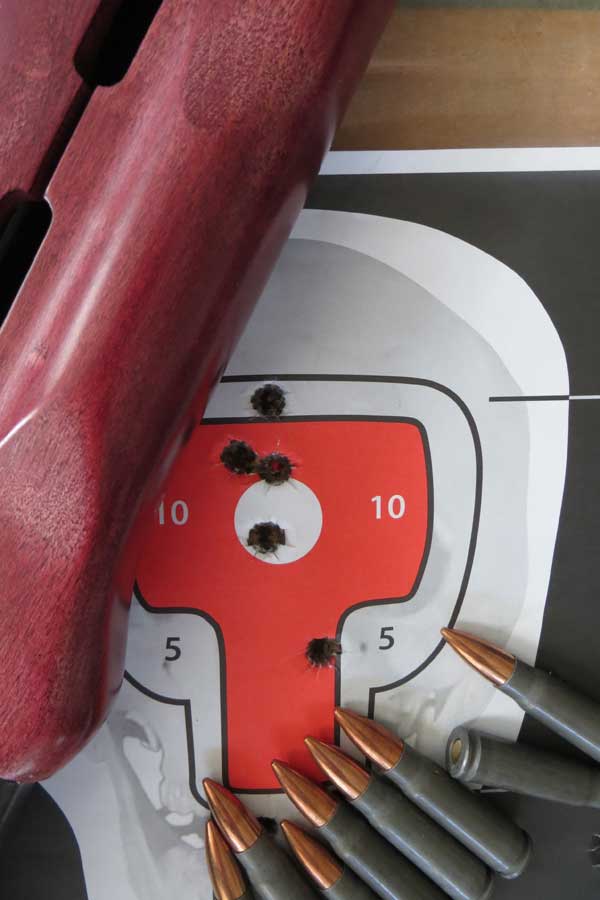
The Testing Process I took the rifle to the range and shot groups with it. I fired four, five-shot groups with each type of ammo available, at 100 yards, and measured all the hits.
The results were as expected. A good batch of ammo, from the bench, with a scope, from a bolt-action rifle, shot to about 2 MOA. The less-premium ammunition ran in the 3-4 MOA range. Which isn’t too bad, really. Oh, I know, as I pointed out earlier, that we Americans are all superb shots. And it is our birthright as Americans to own (and expect every rifle to be) a sub-MOA rifle. Yeah, but we aren’t, and they aren’t. And a lightweight, handy little carbine like the 527, especially with no extra effort put into bedding it, isn’t going to be sub-MOA.
But as a cross-check for AK accuracy, it is a solid performer.
So, when you mount a scope on your AK, and you find you are still “only” shooting 3 MOA from the bench, keep this in mind — you’re doing good, running pretty much at the limits of the system.
This article is from the Gun Digest Book of the AK & SKS, Volume 2.
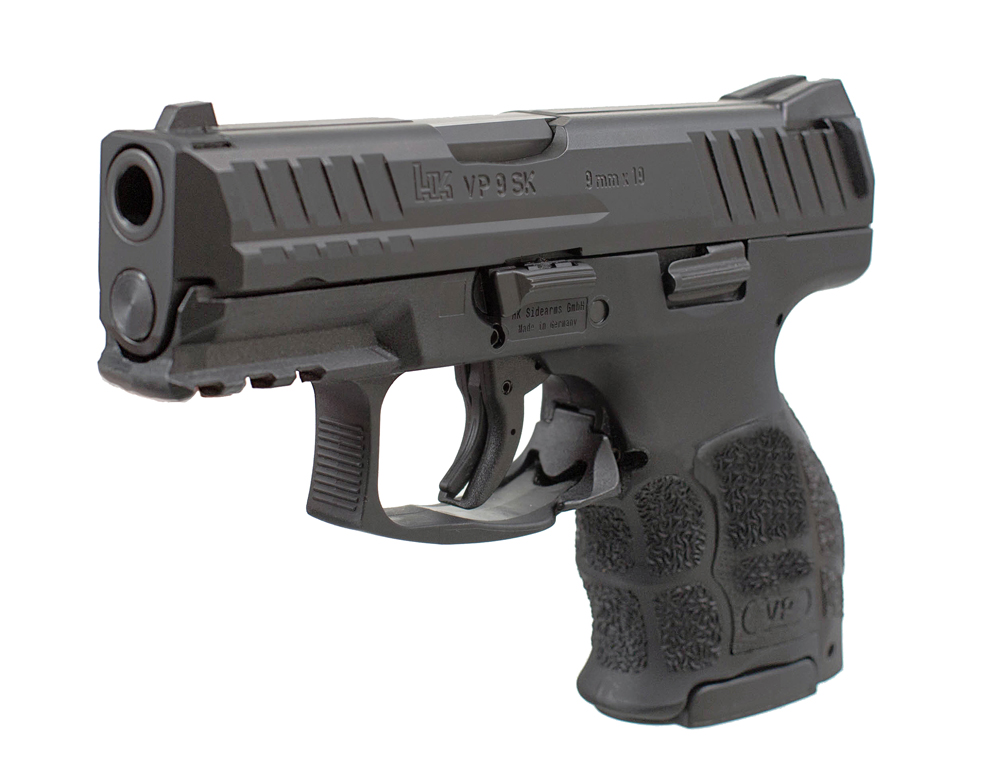
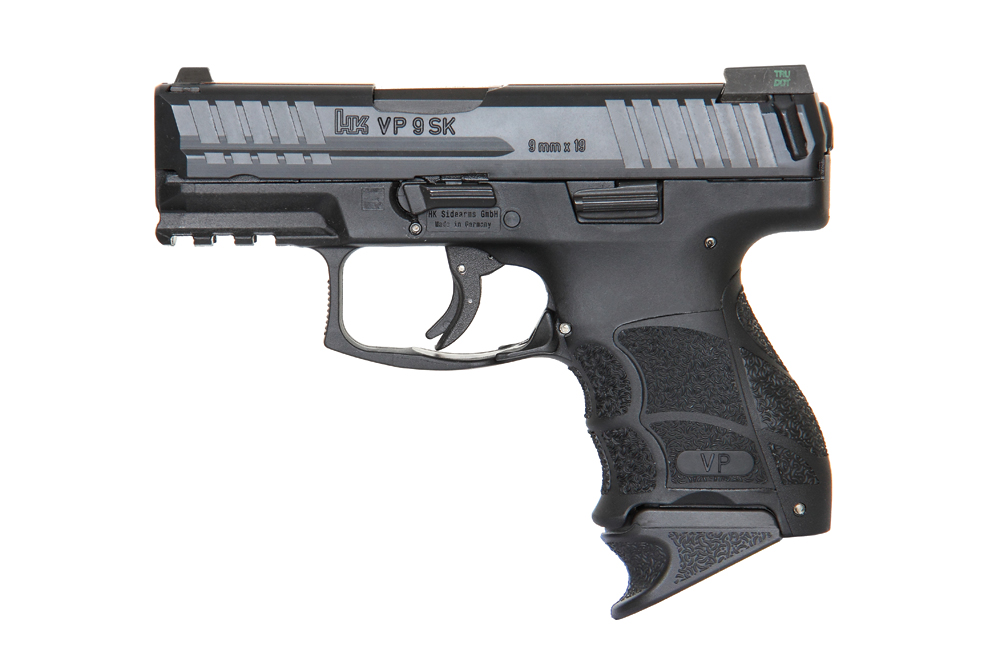
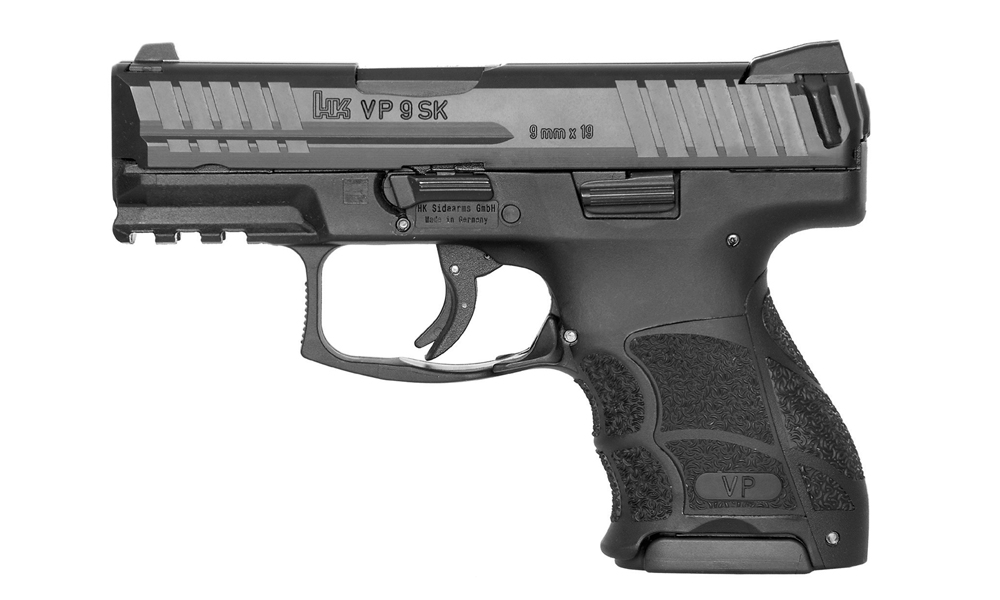
Heckler & Koch has brought out its new VP9SK, a subcompact version of its highly popular and incredibly reliable VP9 full-size pistol in 9mm.
A few years back when Heckler & Koch unveiled its VP9 9mm striker-fired pistol, it made a pretty substantial splash in the gun industry. In the time since, the VP (which stands for Volkspistole, or “people’s pistol”) line has only continued to grow. Within the past two years, HK has added a .40 S&W variant in the VP40 and tactical models and different finish options for both calibers. Now, the company is at it again with a new subcompact model in the VP9SK.
Announced just ahead of the recent NRA Annual Meetings & Exhibits in Atlanta, the new HK VP9SK is the first subcompact offering in the VP family of pistols. As such, it offers added concealabilty while retaining the great features of its larger brethren. This includes HK’s VP precision strike trigger, which has a pretty high reputation courtesy of its crisp, single-action break and quick reset.
“The VP9SK is the right combination of compact size and firepower for a subcompact — and it’s loaded with unique HK features like our adjustable ergonomic grip, the only grip in the industry that can be customized to fit any shooter,” said Michael Holley, HK-USA Vice President for Commercial Sales and Marketing. “The VP9SK possesses the accuracy and durability that shooters know they can expect from a Heckler & Koch pistol.”
The adjustable ergonomic grip, a major highlight of earlier VP models, has obviously been scaled down with the VP9SK. However, its functionality and flexibility remain the same. The grip adjusts to fit any user via the interchangeable backstraps and lateral grip panels, and there are also finger grooves on the front of the grip instinctively placed for shooters.
As an added bonus in the ergonomics department, the VP9SK’s controls are also completely ambidextrous. There are slide releases on both sides of the frame, and the gun’s paddle-style magazine release favors both right- and left-handed shooters. And, the new VP9SK also carries over HK’s patented charging supports found on earlier full-size models — polymer inserts mounted on each side of the rear of the slide that offer improved leverage for manipulation.
New HK VP9SK pistol equipped with optional night sights and hooked floorplate.
Of course, the most important difference is the change in dimensions, which takes the VP9 from a full-size duty pistol to a subcompact perfect for concealed carry. The VP9SK shaves .73 inch off the overall length of the VP9, .84 inch off the height and 2.49 ounces off the weight. Some of those figures might not sound that impressive, but it’s just enough to make the VP9SK a serious contender as a carry gun.
The new VP9SK incorporates an abbreviated Picatinny rail up front, an addition not all carry guns feature but one that’s beneficial for those using a laser sight or a weapon-mounted light. The gun is compatible with a variety of HK magazines, including compact double-stack 10-rounders with flat or hooked ergonomic floorplates. According to HK, later in the year there will also be 13- and 15-round magazines with sleeves that mimic the grip profile of the manufacturer’s full-size VP models.
The brand new VP9SK is available at a fairly reasonable $719, which, incidentally, is exactly the same as for HK’s full-size VP9 and VP40. Like other HK guns, the VP9SK comes with the manufacturer’s Lifetime Warranty.
For more information, check out the specifications below, or visit the HK-USA website.
Specifications:
HK VP9SK Type: Semi-auto, striker fired Caliber: 9mm Barrel: 3.39 in., cold hammer forged, polygonal Overall Length: 6.61 in. Height: 4.57 in. Width: 1.31 in. Weight: 23.07 (with empty magazine) Grip: Polymer, adjustable ergonomic with interchangeable backstraps and grip panels Sights: White three dot, (night sights also available) Trigger: HK VP precision strike single action Capacity: 10 rounds (13 and 15 rounds in the future) Price: $719 Manufacturer: Heckler & Koch
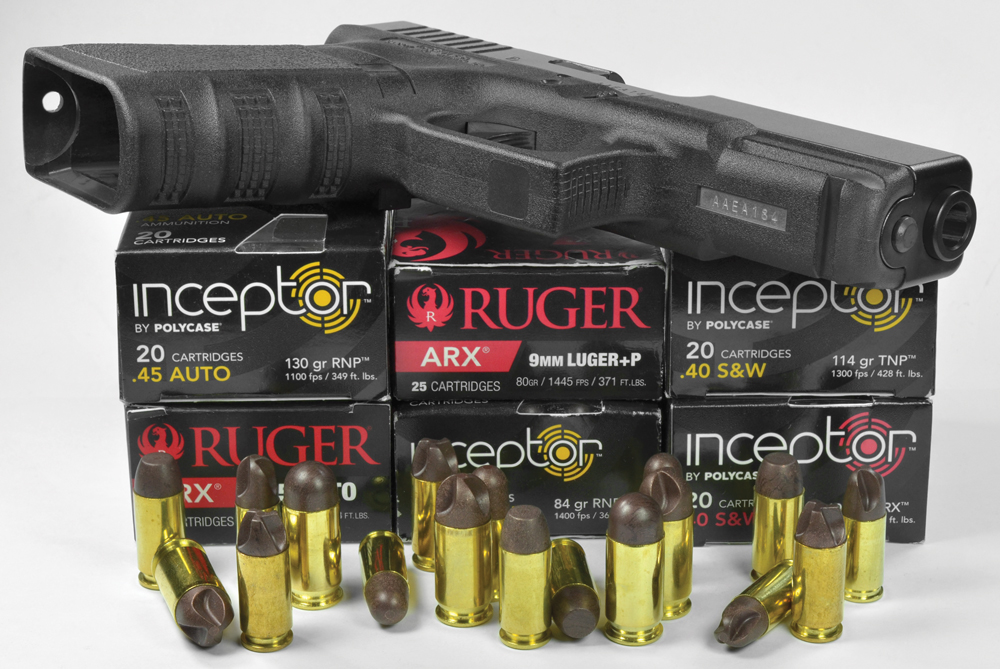
Innovative people in the shooting industry are always coming up with something new to explore. New guns, new cartridges, new bullets. One of the more interesting new developments is the polymer composite bullet offered by Polycase Inceptor and Ruger ammunition.
Polymer is making its way into all aspects of the shooting sport, from polymer frames to polymer coatings on bullets. Now polymer is a major component of the bullet itself. Polycase bullets are made from a mixture of powdered copper and polymer and are produced via injection molding.
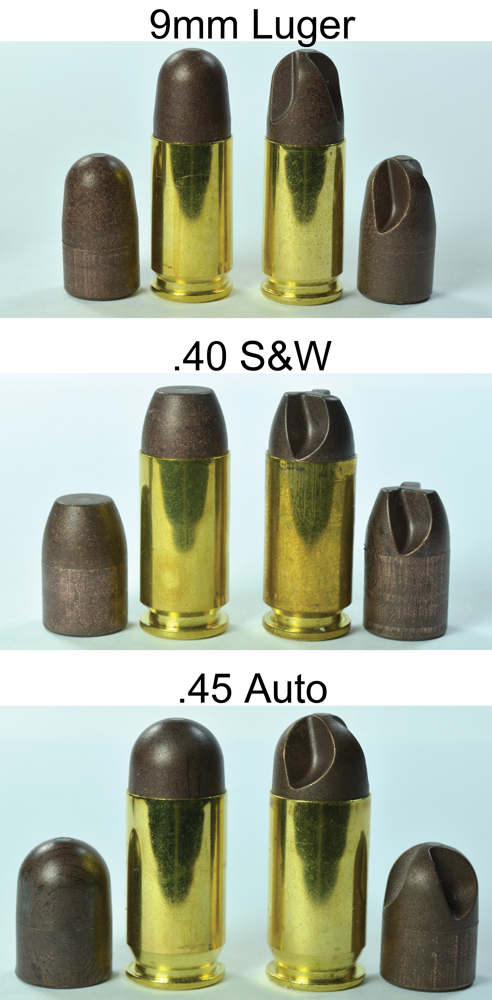
The bullets come in two flavors, solid or fluted. The solid bullets are either a round nose RNP (Round Nose Precision) or flat nose TNP (Truncated Nose Precision) configuration. The unique ARX (Advanced Rotational Extreme) bullet has three flutes in the nose that redirect hydraulic forces laterally.
As of this writing, Polycase bullets are available in .380 Auto, 9mm Luger, .38 Spl, .357 Magnum, .40 S&W, .45 Auto and .45 Colt ammunition for handguns. Loads for .458 SOCOM are made by SBR Ammunition, and .50 Beowulf is made by Alexander Arms. Polycase loads both the round nose and ARX bullets for its handgun calibers, and the ARX is used for the rifle rounds. Ruger only loads the ARX bullets.
The solids have the same profile as conventional bullets with a round or flat nose and are suitable for practice and training. The ARX bullet’s uniquely shaped fluted nose is designed to harness hydraulic force in a fluid medium to transfer kinetic energy to the target, and it is ideal for self-defense.
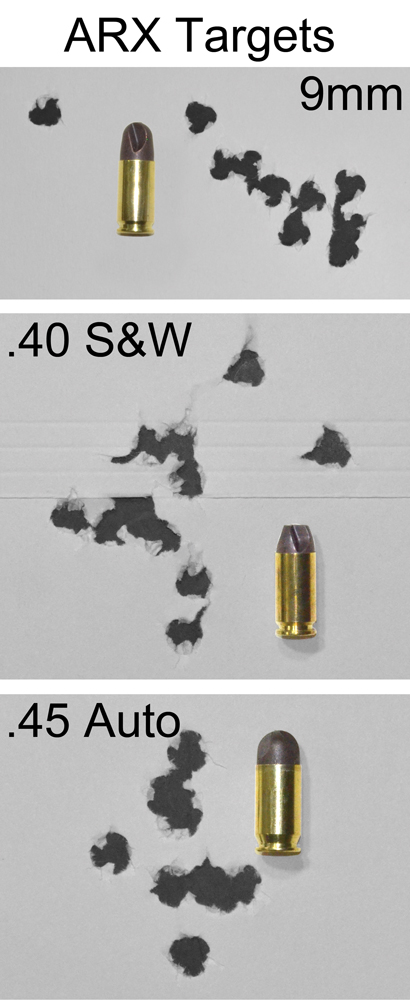
The ARX bullets do not expand. They rely on the flutes, combined with the bullet’s rotation, to produce hydrostatic shock to create a large temporary wound cavity during penetration. This differs from conventional hollowpoint bullets that rely on expansion. The manufacturer claims that ARX bullets create “temporary (wound) cavities that match or exceed any bullet in the same caliber.” The ARX bullets have significant penetration in gelatin but generally stop by 16 inches, thereby reducing the chance of over-penetration.
The polymer bullets weigh roughly 70 percent of that of conventional lead bullets. This means they can be driven to higher velocities, which aids in producing the hydrostatic effects. Additional benefits of the polymer bullets include less recoil, less bullet drop and reduced ricochet from steel targets.
The unconventional nature of these bullets raises questions about how well they shoot. They are, after all, very different from anything we usually put down our bore. Do they shoot straight? Accuracy was tested with 9mm, .40 S&W and .45 Auto ammunition fired from guns mounted in a Ransom Rest.
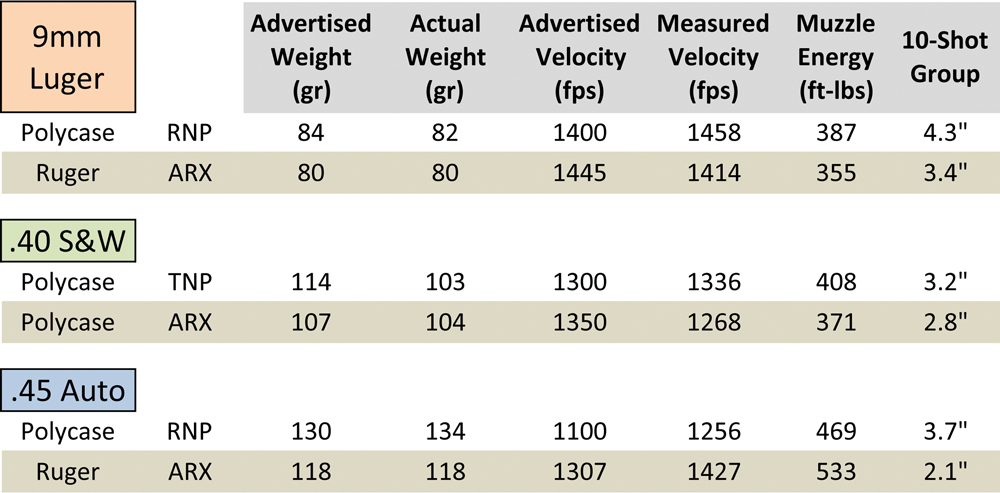
The 9mm ammunition was Inceptor 84-grain RNP and Ruger +P 80-grain ARX. The .40 S&W ammunition was Inceptor 114-grain TNP and 107-grain ARX. The .45 Auto ammunition was Inceptor 130-grain RNP and Ruger 118-grain ARX.
I’ve seen different bullet weights for some of these calibers. For example, I’ve found three different advertised weights for the .40 S&W ARX bullets. Polycase shows an 88-grain bullet on their website, while my Polycase ammunition has a 107-grain bullet. Cheaper Than Dirt lists both 97- and 107-grain bullets in Polycase Inceptor ammo. The Ruger website shows a 97-grain bullet, but the Cheaper Than Dirt website shows Ruger ammunition with a 107-grain bullet.
One bullet of each type was pulled and weighed. Most were close to the advertised weight. The oddball was the .40 S&W TNP bullet that was 11 grains light.
Accuracy was tested at 25 yards. Ten shots were fired into a single group. Velocity was recorded with a Shooting Chrony chronograph at about 10 feet. The test guns were a Glock G19, a Para Ordnance .40 Smith & Wesson pistol with a 5-inch Ed Brown barrel and a Caspian 1911 .45 Automatic pistol with a 5-inch Kart barrel.
Accuracy of 10-shot groups ranged from around 2 inches to a little over 4 inches. My experience with these guns is that these are typical group sizes that I see with factory ammunition. Some ammo shoots worse than what I found with these copper/polymer bullets, and some shoots better. That’s good news. Just because they’re different it doesn’t mean that they don’t behave like our customary fare.
The ARX rounds produced smaller groups than the RNP/TNP bullets in all three guns. I wouldn’t exactly call the ARX round match-grade ammunition, but it is more than sufficient for self-defense purposes. It does show that injection-molded bullets can shoot as accurately as traditional jacketed or lead bullets.
I noticed a distinct smell when these rounds were fired. It was a stronger smell than what I’ve experienced with polymer-coated lead bullets, which have their own distinct odor. This is not really a downside to these bullets, just something to keep in mind when you fire them for the first time.
The price of the ARX ammunition is in the same range as most hollowpoint ammunition, and is less than some brands, so you won’t have to sell the farm to give it a try. And I noticed that one retailer has 50-round boxes of 9mm RNP ammunition for just $12.98. That’s the same price as regular jacketed ammunition.
The fluted ARX bullet is similar to the star-nosed Lehigh Defense Xtreme Penetrator and Xtreme Defense bullets. All of these bullet designs offer something different than conventional expanding hollowpoint bullets. They produce large wound channels through hydraulic force without expansion. This means they won’t fail to perform as designed from being plugged up like a hollowpoint can.
If you want to try something different, this new copper/polymer ammunition should be high on your list.
Editor’s Note: This article originally appeared in the December 2016 issue of Gun Digest the Magazine.
CZ’s new Scorpion EVO 3 S1 Carbine is a slick, user-friendly firearm that’s well suited as a serious home defender or as a fun plinker at the range.
Many readers have heard of the Skorpion vz.61. A small, easily carried machine pistol with a wire buttstock and chambered in 7.65mm Browning (.32 ACP), the gun has a mystique about it that fascinates many. After development was completed in 1961, the gun was first adopted by the Czechoslovak State Police and then the Czech Army.
The original blowback-action Skorpion was fed from a detachable box magazine that was located in front of the trigger, and the gun fired from a closed bolt, permitting more accurate single-round fire. After the fall of the iron curtain, production of the Skorpion continued off and on by Ceska Zbrojovka (CZ) until the last unit was produced in 1994.
Early on in the life of the Skorpion, it was recognized that a major flaw was the low-powered .32 ACP chambering, so development began on new chamberings like 9mm Makarov, .380 ACP and 9mm Luger. Various commercial versions were offered, but all failed in the marketplace.
The Same, Only Different
The name and basic concept of the Skorpion lived on at CZ, and in 2005, the company produced a prototype submachine gun called the XCZ 868. While there were a few subtle similarities to the original vz.61 Skorpion, the new prototype design had little in common with it. Nevertheless, the new prototype led to the 2009 introduction of the Scorpion EVO 3 A1, a select-fire submachine gun chambered in 9mm Luger.
The new gun caught on, perhaps partially because of its namesake, but more probably because of its features and usefulness. While it is a blowback-operated, magazine-fed submachine gun, it is chambered in the much more reasonably powered 9mm Luger instead of the .32 ACP. It also has a collapsible buttstock that can be folded to the side and a handguard to which a vertical foregrip can be attached.
With the success of the Scorpion EVO 3 A1, CZ decided to make a semi-automatic commercial version, and designated it the Scorpion EVO 3 S1. Originally introduced in the US as a pistol with no buttstock, CZ now has made available a carbine version that is the subject of this review.
Features
Chambered in 9mm Luger, the Scorpion EVO 3 S1 Carbine is supplied with two 20-round polymer magazines. Thirty-round magazines are also available. The magazine well is beveled to encourage fast reloads, and the ambidextrous magazine latch is a lever located on the front of the trigger guard that can be activated by pushing it forward with the trigger finger or with the thumb of the offhand while removing the magazine. Magazines did not always drop free on the test gun.
The trigger guard is generously sized to accommodate a gloved finger, and the single-stage trigger on the sample broke at about 9 pounds after some creep. The pistol grip can be moved fore or aft to adjust the distance the trigger finger must reach.
The handguard and upper and lower receivers are polymer. And running from the rear of the upper receiver to the front of the handguard is a polymer Picatinny-style rail to which can be attached an optic. The gun comes with an elevation-adjustable post front sight and a windage-adjustable aperture rear sight. CZ even supplies a tool for sight adjustments. There are actually four apertures, each of a different size so the shooter can choose between fast target acquisition and a more precise sight picture. Just rotating the aperture toward the front or rear brings the next aperture into alignment.
The handguard features Magpul M-LOK attachment points along the bottom and on both sides for the addition of accessories such as lights, lasers or vertical foregrips. And since the handguard is polymer, it did a good job of insulating the hand from barrel heat. The barrel measures 16.2 inches in length, has a black finish and 1/2×28 threads at the business end. A brake is installed at the muzzle and was effective in reducing muzzle rise.
A collapsible polymer buttstock can be folded to the right for transport and storage. Grasping the butt from the rear and squeezing a large lever just forward of the buttpad releases the lock to allow a change in length. By pushing a large button on the left side of the gun at the junction of the receiver and buttstock, the buttstock can be folded to the right. In an emergency, the gun can be fired with the buttstock folded.
There are two eyelets for the attachment of a sling, one at the front and one at the rear, on both sides of the upper receiver. Also, at the rear of the upper receiver on the left side is a slot through which a sling can be threaded.
Take Down
Disassembly for cleaning is straightforward. After double checking to make sure the gun is not loaded, the charging handle is retracted and pushed up to lock it to the rear. Then disengage the pin that secures the lower receiver to the upper. Pull the lower receiver to the rear and down to separate it from the upper. Next, with the thumb, grasp the bolt from the bottom and pull it to the rear and away from the upper. The recoil spring assembly is captured by the bolt. No further disassembly is recommended. Assembly, as they say, is in reverse order.
Running the gun is simple. The charging handle located on the left side of the gun forward of the receiver, can be switched to the right side if desired. It is non-reciprocating, but can be locked to the rear by retracting it and pushing upward, catching it in a slot. Releasing it to go forward requires merely slapping it down.
After the last round is fired, the bolt is held to the rear. Once a fresh magazine is inserted, the charging handle can be pulled all the way to the rear and released, or the bolt release, located on the left side of the receiver just above and forward of the trigger, can be pressed down. Either allows the bolt to go forward into battery, feeding a round into the chamber.
Safety
The ambidextrous safety selector has two positions, safe and fire, denoted by a red and white icon. The safety on the sample gun was stiff, but not unusable, and may become easier to manipulate over time. However, it was difficult for some shooters to reach with the thumb of the firing hand when holding the pistol grip.
Additionally, the first knuckle of the trigger finger of some shooters was bumped by the lever during recoil. Fortunately, Apex Tactical makes an aftermarket safety selector that solves the problem. It is easy to install and requires no modifications to the gun.
The Scorpion carbine was pleasant to shoot, and no malfunctions whatsoever were experienced with the sample gun. At 50 yards, a reasonable range for a pistol-caliber carbine accuracy test, the gun consistently printed groups just over an inch. That’s respectable.
CZ may have a winner with the Scorpion EVO 3 S1 Carbine. For more information, contact CZ-USA, 800- 955-4486, CZ-USA.com.
Specifications:
CZ Scorpion EVO 3 S1 Carbine Type: Semi-auto, blowback Caliber: 9mm Luger Barrel Length: 16.2 in. Overall Length: 36 in. Weight: 6.06 lbs. Stock: Synthetic collapsible and folding Sights: Windage- and elevation-adjustable rear aperture and front post Finish: Black Capacity: 20 or 30 rounds MSRP: $999
Editor’s Note: This article is an excerpt from the July 2016 issue of Gun Digest the Magazine.
Looking to go armed, but are stuck in the weeds as to what to arm yourself with? Here are 20 of the best concealed carry gun options that will keep you on the defensive.

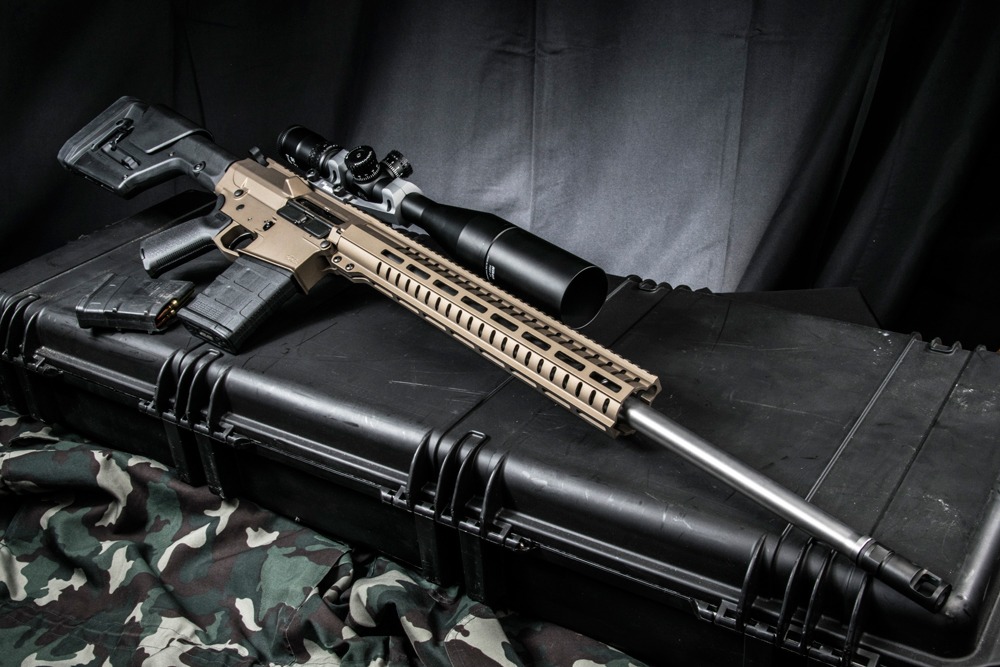 CMMG has added four new models to its classic and reliable Mk3 AR-10 rifle line — all chambered for the flat-shooting 6.5 Creedmoor.
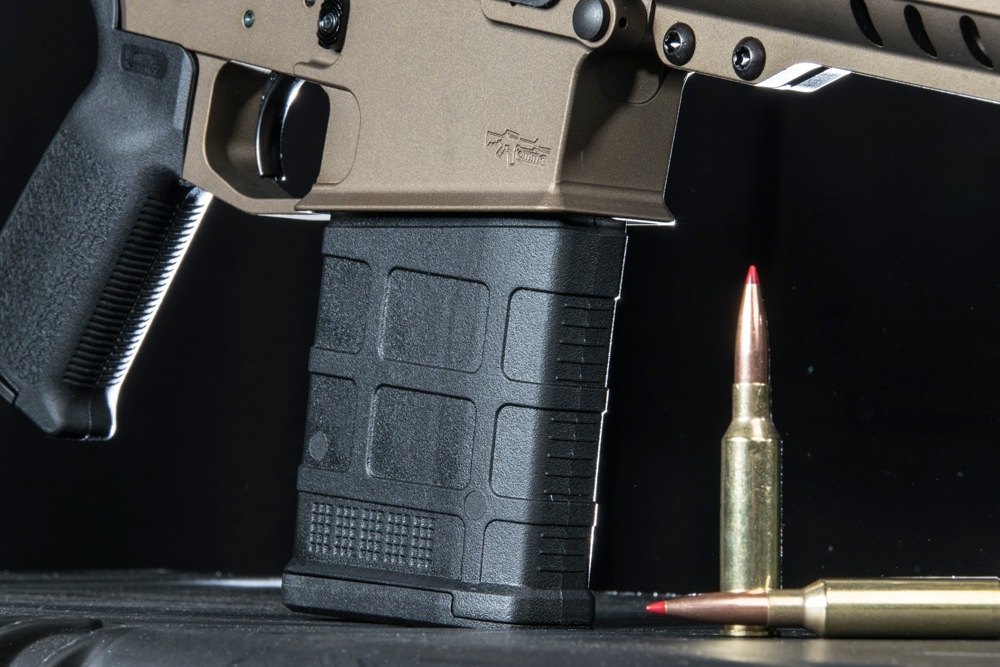 For those who don’t know, the 6.5 Creedmoor, introduced by Hornady back in 2007, is one of the hottest new cartridges of the past few years. Originally designed for target shooting, particularly at some longer ranges, the 6.5 Creedmoor is a flat-shooting cartridge that uses high-ballistic-coefficient (BC) .264-caliber bullets. It chambers in short-action bolt guns, as well as AR-10 rifles, and in addition to its target-shooting applications, it’s also started seeing more and more use as a hunting cartridge, especially on thinner-skinned game such as deer and pronghorn.