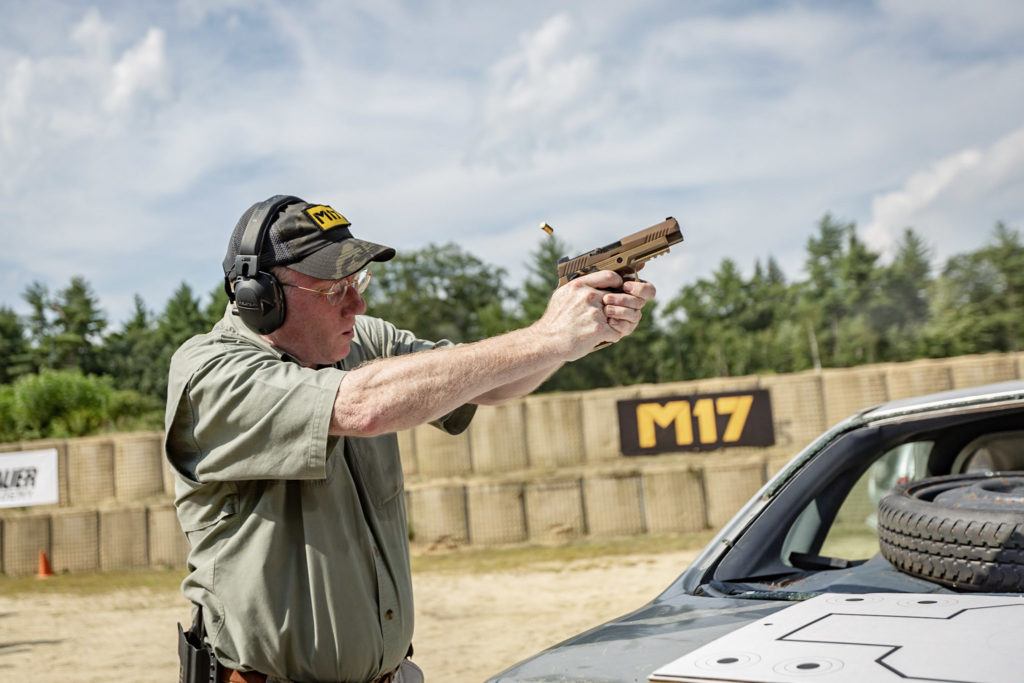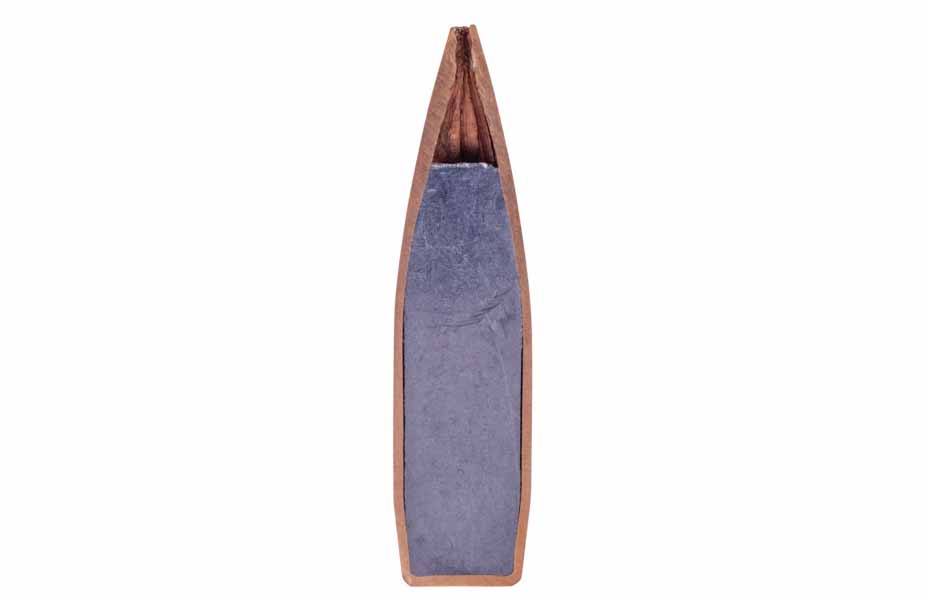
Knowing when to transition focus from target to sights will allow you to fire an accurate shot faster.
When should you start seeing your sights:
More of a question of when you transition from target to sights.
When it reaches your peripheral vision move focus to front sight.
Look sight onto the spot you want to hit.
When you hit full extension, you should complete the press and fire.
The sooner you get on sight, the sooner you can fire.
In the last “Defensive Handgunning” column, we shared some advice from Gunsite Academy instructor Cory Trapp, with regard to when you should put your finger on the trigger. Another common question he gets: When you should first see your sights?
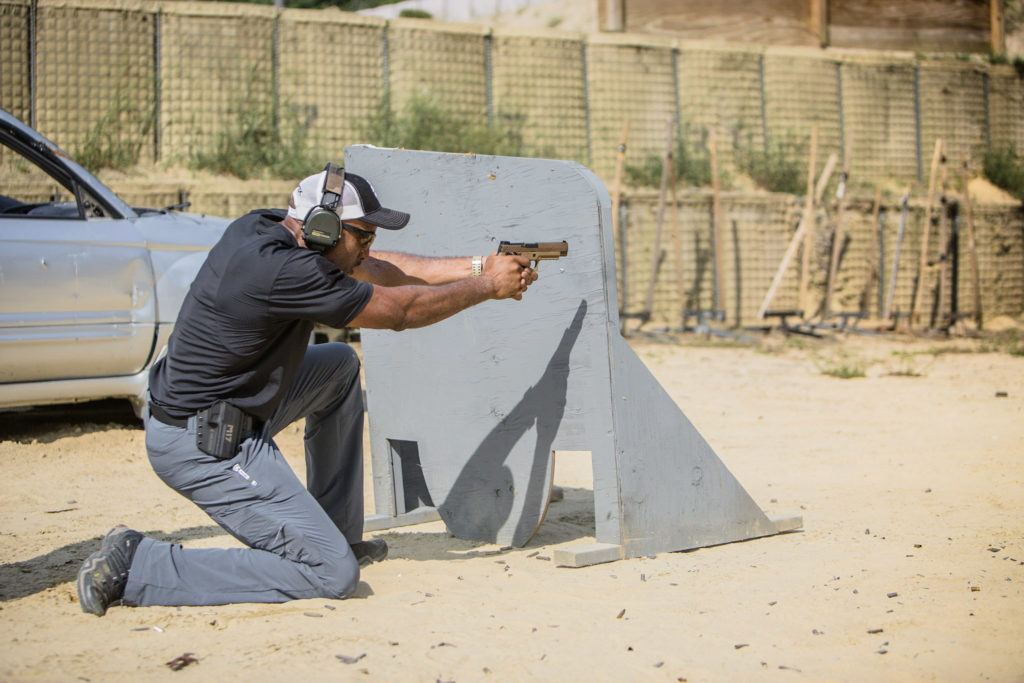
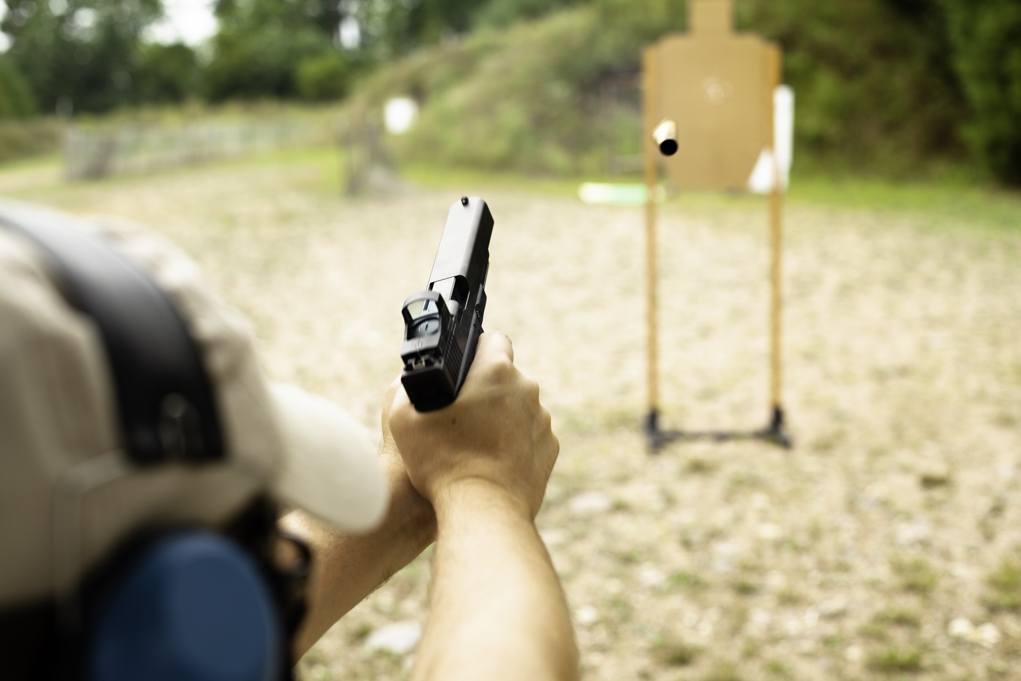
During the draw stroke, as your handgun enters your peripheral vision, you should pick up the front sight, and then look it on to the target.
“If you have enough room between you and your adversary to fully extend your arms, you should be looking at your sights,” says Trapp. “The question then is, when do you transition from looking at the target to the sights? As the hands come together and the pistol begins to extend, the top of the pistol will appear in your peripheral vision. As soon as it does, move your focus to the front sight. You want to look the sight onto the spot you want to hit. The moment you hit full extension and the pistol stops, you should complete the press and it should fire. The sooner you get on the sight, the sooner you’ll be able to fire.”
This is exceptional advice and it’s never wrong. But as we discussed last column, a sharp focus on the front sight is not always necessary. As you become more proficient with your handgun, you’ll find you can get good hits, quickly, without a front-sight focus. Keep in mind: You’re still picking up the front sight in your peripheral vision at the same point, and you’re still looking the sight onto the target — you just don’t shift the focus from the target to the sight. This is called “target focus shooting,” and most experienced shooters will find it can work for them out to 3, 5 and maybe even 7 yards. But, like everything else involved when it comes to pulling a trigger, it takes practice.
A vibrant addition to Dickinson's side-by-side line, the color-case harden Plantation SXR is a head turner.
What the new Plantation SXR offers:
Available in 12, 16, 20, 28 gauge and .410 bore, combo 20/28 and 28/.410.
New Hi-Rib model available.
24”, 26” 28’, 30” barrel lengths.
Automatic ejectors.
English, Prince of Wales or pistol grip stock.
24-lines-per-inch hand checkering on stock and fore-end.
Beavertail or standard fore-end.
Length, Length of Pull, Drop at Heel and Pull optional.
If you happen to have a yen for a shotgun with a classical bent, Dickinson Arms has news for you. The importer of Turkish smoothbores has expanded its side-by-side Plantation line to include a rather colorful option – a color-case hardened SXR model.
AKUS, who manufactured the gun, didn’t skimp with the new gun, using the old-school bone charcoal method to achieve the unique finish. Furthermore, the English scrollwork on the receiver and 24-line-per-inch checkering on the stock is done completely by hand. A nice touch. Another feature, at least among those who like a bit of a throwback in their side-by-sides, it comes with an option of a double trigger.
Now comes the clutch your wallet part. As expected of SBS shotgun, the color-case hardened Plantation SXR doesn’t come in cheap, Dickinson Arm’s MSRP on the gun is $3,195. But given the look and the hand craftsmanship, it’s not an overwhelming price tag.
Dickinson Arms has introduced a new model to its distinctive and refined Plantation Series of shotguns. The new side-by-side Plantation SXR gives serious shooting enthusiasts, collectors and hunters what they have come to expect from Dickinson — a rare combination of beauty, engineering and performance. And with
12 GA., 16 GA., 20 GA. 28 GA. and .410 bore models to choose from, there is a quality Plantation SXR to suit the needs of every shooter.
At the heart of the Plantation SXR is a precision trigger plate mechanism with cosmetic side plates and receiver hand engraved with beautiful English scroll. This gun is hand built in Turkey by expert craftsmen who use only the finest materials and components and take great pride in their work. The receiver is finished with true bone-charcoal case hardening that makes each gun an individual and highly functional work of art. The luxurious look and feel of the Plantation SXR is further complimented by Dickinson’s use of premier grade Turkish walnut, featuring fine 24-lines-per-inch hand checkering and a hand-rubbed oil or gloss finish. The ability to select an English, Price of Wales or Pistol Grip stock further enhances the individuality of this gun. Special order upgrades to Grade 3/4/5 walnut stock are also available.
The Plantation SXR offers a Single/Double trigger, automatic ejectors and can accommodate 2-3/4” or 3” shells. Availability of 24”, 26”, 28” and 30” barrel lengths ensures that shooters of all types and sizes can find the ideal Plantation SXR. This shotgun can accommodate fixed or thin wall chokes for different shooting applications.
In addition to this and other Plantation Series models, Dickinson’s line of premium side-by-side shotguns also includes Standard and Custom Made Prestige and Estate Series, for the most discriminating shooters, collectors and hunters.
For more information on the color-case hardened Plantation SXR, please visit: www.dickinsonarms.com.
Creating brass for rare and obsolete cartridges is easier than you think. Here's what you need to know to create your own at home.
What You Need To Know About Making Brass:
Opens door to obscure and rare calibers.
The Handloader’s Manual of Cartridge Conversions is an indispensable tool.
Can be as complex as removing a belt from a magnum.
Can be as simple as resizing a cartridge's neck.
There are times when certain cartridge cases are just unavailable, if not simply unaffordable. I ran into just this situation while I was looking for ammunition for a new rifle I’m having built. I’ve had a desire to own and hunt with a .318 Westley Richards since I first began to read the classic African stories of W.D.M. ‘Karamoja’ Bell and John ‘Pondoro’ Taylor (there’s something cool about earning an African nickname, eh?) as they recounted their tales and experiences with the classic cartridges.
In all honesty, there’s really nothing revolutionary about the classic .318 Westley Richards; it shoots a .330-inch diameter bullet, with the choices being between 180-, 200- and 250-grains, depending on the manufacturer, the classic load being a 250-grain round nose at 2,400 fps muzzle velocity. The .318 WR is the older cousin to the .338-06, with the latter having a much wider selection of bullets, but the former making you want to lift your pinky in the air when you sit down to afternoon tea. At any rate, I think it’s a cool cartridge, and I am an aficionado of the classics. My rifle is still in the construction phase, going through its metamorphosis at Hillbilly Custom Rifles, and I needed some dummy ammunition to test the magazine length and the new chamber. This posed a bit of a problem: There are very few sources for .318 Westley Richards brass. The dies were no problem—RCBS makes a great set of full-length dies—and there are some good bullets on the market. I’ve chosen the Woodleigh 250-grain round nose Weldcore as an all-purpose bullet, as well as a nice 200-grain round nose from Hawk Bullets in New Jersey, which would work perfectly for deer and lighter game. But the brass…
There are a couple boutique brass producers that will make a run of properly headstamped .318 WR brass, but those runs are few and far between, not to mention expensive. There is a British company still making loaded ammunition, but at almost $10 per cartridge, that wasn’t exactly the route I wanted to take either. So, I dug out my well-thumbed-through copy of John J. Donnelly’s The Handloader’s Manual Of Cartridge Conversions a fantastic reference book that every handloader should own, and read about the process of making .318 Westley Richards brass out of good ole plentiful .30-06 Springfield brass. It wasn’t difficult at all.
First, let me explain the differences between the two. The .30-06 shares a case head diameter with the 7×57 and 8×57 Mauser (0.473 inches), while the .318 WR uses a slightly smaller rim dimension of 0.464 inches, though in the past the Mauser-sized rim has worked fine in a .318 rifle’s bolt face. Since my new rifle is using the action from a 1916 Hamburg Arsenal 98 Mauser originally chambered in 8×57 Mauser, using the larger rim diameter will not pose an issue at all. The ’06 is definitely a longer case at 2.494 inches, so it would eventually need to be trimmed down to the WR’s length of 2.400 inches. I grabbed a bunch of RP .30-06 cases, used the RCBS Universal Case Prep Station to trim the brass down 0.094 inches—the micrometer adjustment worked perfectly for this—and gave the case mouths a good chamfer and deburring. Other than that, the dies would do the bulk of the work.
My RCBS resizing die has a tapered expander ball, which will work the smaller diameter neck of the ’06 brass slowly, for a smooth and consistent expansion. I used Imperial powdered neck lubricant and ran them through the RCBS .318 WR resizing die to open the necks to proper diameter, and to move the shoulder to the proper positioning. Viola! Though the headstamp read RP .30-06 Sprg., I had in my hands the first of the .318 Westley Richards cartridges that I plan to take on many adventures.
A must-have for any making your own brass, John J. Donnelly’s The Handloader’s Manual Of Cartridge Conversions.
I compared them to the two example .318 WR cases I had from Quality Cartridge, and they showed to be dimensionally identical. I loaded some bullets into unprimed and uncharged cases, and sent them off to Hillbilly Rifles to make sure everything was going well with the new barreled action, and they worked just perfect.
Making brass for rare or obsolete calibers certainly isn’t something new; handloaders have been doing this for decades, and it can turn a wall-hanger rifle into a field champion once again. Sometimes the conversion is easy and only requires a single pass through a resizing die. The .318 WR above is an example, but just as easy would be making .257 Roberts brass from a 7×57 Mauser or a 6mm Remington case, or .338-06 and .35 Whelen from .30-06 brass. I’ve made ammunition for an older .30/.338 Magnum by obtaining a good set of dies with a tapered expander ball and using 7mm Remington Magnum brass. Other times a set of forming dies, which will reduce or expand the brass in smaller steps, will be required to best achieve the goal. Cases for the old .33 Winchester can be made from .45-70 Government brass, but in several steps, as the reduction from .458-inch diameter to .338-inch diameter is too radical to be accomplished in a single pass.
Some of the more advanced and radical transformations may require some advanced tools, as there are instances where a rim may need to be turned down to a different diameter, or a belt taken off in order to make something that will work. A good dial or digital caliper is a must, and like any handloading setup, the better your trimmer is, the more uniform your product will turn out. One last note: When you make brass for one cartridge from another, with a different headstamp, please be sure and keep that new ammo in a clearly marked box, with detailed notes. While I don’t think my .318 WR ammo would chamber in a .30-06 rifle, if it did and were fired, the results would be tragic, if not fatal.
I strongly suggest you grab a copy of Mr. Donnelly’s book, as it contains the formulae for making all sorts of wildcats in addition to the SAAMI accepted cartridges, as well as many of the older black powder cartridges. You never know when you may find a treasure in the form of a rare rifle in the dusty corner of your favorite gun shop, and you’ll be happy to have the ability to make your own brass.
Editor's Note: This article originally appeared in the July 2016 issue of Gun Digest the Magazine.
Want to bag more birds? Take the time to square up before you take your shot.
Simultaneously, wingshooting is among the most heart-pounding and frustrating type of hunting you can undertake. The cardiac palpitating aspect is fairly self-explanatory, given there's no other game that flushes as quick and close as chukars, pheasants, quail and what have you. Frustration, that’s equally as obvious, since you have precious few seconds to make certain everything is perfect so you come home with something in the bag. At times, the task is humbling.
Generally speaking, dads and uncles through the years passed down the same sage, yet vague wisdom of “lead ‘em more.” Typically as a rooster was still hightailing to the horizon. Certainly, a lead is key, but it plays second fiddle to a more imperative fundamental — body position. Without it, leading a bird isn’t even an option (sorry dad).
Despite the urgency of making the shot, the key to proper body position is taking your time. Sounds counterintuitive, but it works. Taking a breath’s worth of time to pick your bird, square up to the direction it's flying and get ahead of it does wonders. Plus, you’re not cheating yourself, because that's what you're doing without getting in the right position.
Say you’re a right-hander, and a bird flushes and breaks left. Without taking a step to open your body in that direction, you’ve cut your swing around 50-percent, at least. Furthermore, you’re more likely to rush the shot as you feel your range run out. Neither is optimal.
Part of the rush of bird hunting is its fast action, but that’s not worth squat when you come home empty-handed. You'll still get the rush of flushing birds, but by taking your time to get into position you'll also have something to show for it.
For more information on CZ USA's Sharp-Tail, please visit: www.cz-usa.com/.
For more information Aguila Ammunition, please visit www.aguilaammo.com.
Minimal and sturdy, Strike Industries' AR Pistol Stabilizer gives a solid support for the petite guns.
How the AR Pistol Stabilizer enhances a gun:
Fits buffer tubes up to 1.25 inches in diameter.
Tapered set screw ensures it says in position.
All snag points blunted and leveled.
Fiberglass reinforced.
5.3-ounce weight.
6.5-inch length.
Minimal as they may at first seem, there’s plenty to AR pistol braces and stabilizers. Find the right one, you’ll enhance your shot-to-shot accuracy and the overall shootability of the compact rifle-caliber firearms. Install the wrong one, your gun will probably hop like a toad on a hot plate.
Strike Industries appears to have hit the right notes with its sleek new tailfin. The AR Pistol Stabilizer not only steadies the short and wicked guns, but also eases the process of getting one into action. Fitting buffer tubes up to 1.25-inches in diameter, the unit uses a large tapered set screw to ensure it stays in place, no matter where it’s positioned. Furthermore, Strike Industries has blunted and leveled any potential snag points, all but guaranteeing a pistol is fast into the action. Not to mention, it won’t cheese grate your cheek.
Other notables of the AR-Pistol Stabilizer include built-in ambidextrous QD cups, fiberglass reinforcement, light 5.3-ounce weight and 6.5-inch length. The stabilizer's price is also reasonable, as far as AR upgrades go, with an MSRP of $39.95.
When it comes to pest control, particularly the venomous kind, few handgun loads beat CCI Shotshells.
How CCI Shotshells eliminate pests:
Shot held in rigid plastic capsules.
Flexible base wad prevents gas blow-by.
Uses CCI primers.
Available in 10 calibers, from .22 Short up to .45 Colt.
Depending on caliber, loaded with No. 12, No. 9 and No. 4 shot.
Personal protection with a handgun is not just about fending off muggers, homicidal maniacs and vampires. There are other bad things is this world. I grew up in the Allegheny Mountains where copperheads and timber rattlers were the price we paid for the serenity the hills provided, and I developed an intense dislike for both. The only thing that can ruin a fishing trip or a picnic faster than a politician is a poisonous snake.
CCI shotshells are great handgun ammunition for snakes. Typically, the larger the caliber the better they work, simply because they contain more shot.
When Grandpa wanted us kids to enthusiastically tackle some chore, he often told us to get at it like we were “killing snakes.” I never really understood what that meant until I fought a 4-foot-long copperhead while armed with a shovel. You can kill serpents with hand tools, but if I ever do it again it’ll be because I’m out of ammunition.
The only thing to brag about after my first gun battle with a snake was that the timber rattler I eventually killed was almost as long as me. After a magazine full of hardball from a 1911, the snake coiled up under a laurel bush. I then fetched a .22 rifle and finished the job. Lesson learned: It’s hard to hit a moving target the size of a water hose when you’re afraid it’s going to give you a fanged surprise.
If you sometimes encounter venomous snakes in your wanderings and don’t exercise the live and let live philosophy, a shotgun would seem the obvious choice. But shotguns are hard to carry in your pocket. Continually out and about in the underbrush, I’ve found CCI Shotshells are an ideal solution. A snake can strike about one-half to two-thirds its body length. In North America, a 6-foot-long venomous snake is on the large side, so a safe engagement distance should be on the other side of 4 feet. Sure, you can get closer, but like my 10-year-old says 350 times a day, “Why?”
CCI now offers two versions of their handgun shotshells. The standard version is loaded with No. 12 shot (9mm Luger) or No. 9 shot (.38 Special/.357 Magnum, .40 S&W, .44 Special/Magnum, .45 Auto and .45 Colt.) The newer Big 4 loads are loaded with No. 4 shot. For snakes, the smaller shot is the way to go; the patterns are denser and the shell delivers a more pulverizing effect.
You should test these loads in your own handgun for pattern size at distance. Just be advised that few semi-automatic handguns will reliably cycle shotshells, so you might have to manually rack the slide after the shot.
Designed for resiliency and performance, MFT's Extreme Duty AR-15 Magazine helps keep your rifle running.
How the Extreme Duty AR-15 Magazine is built tough:
Made from long glass-fiber polymer for shock resistance.
Larger lower half to retain internal geometry's integrity.
Flared floorplate to protect from drops.
Oversized bolt catch.
Tool-free disassembly.
Compatibility with traditional mag pouches.
Weak points, no matter how robust a system’s design it will have them. In the case of the AR-15 and similar semi-automatic rifles, generally, the common tender spot is also one that needs to function flawlessly if the gun is going to do what it’s supposed to — go bang with every trigger pull. No matter how you cut it, magazines are a temperamental linchpin. But is it any wonder why?
Of all the parts of a rifle, it is generally the most abused. Simple as its components are, they are the most exposed to the grit, grim and slop of the environment at large. Not to mention, dropping them like empty beer cans is standard operating procedure. Honestly, it’s a testament accessory manufacturers that magazine don’t go haywire more often.
Mission First Tactical gets this and was motivated to come up with a little something designed to all but eliminate magazine malfunctions hastened by rough use. The Extreme Duty AR-15 Magazine might appear little more than your run-of-the-mill polymer rig on the outside, but it’s designed with the extra backbone to weather rented-mule level abuse.
The magazine’s secret sauce, a reinforcement that kicks up its toughness by nearly a magnitude compared to its competition. A specially engineered long glass-fiber polymer provides up to three times the impact resistance and increases its overall strength by 50-percent compared to standard glass-filled nylon mags. In short, you can inadvertently bang these babies off cinder blocks, pavement, rocky surfaces, whathaveyou and not worry about them cracking or the spring getting damaged.
Furthermore, the lower half of the magazine is thicker, enhancing its rigidity and stabilizing its internal shape. Given this, the four-way, anti-tilt follower and stainless-steel mag spring always function flawlessly, with an unhindered path. Topping it all off, a flared floorplate adds more resiliency to the system protecting the magazine from drops at excessive heights.
Other notables on the Extreme Duty AR-15 Magazine include oversized bolt catch, tool-free disassembly and compatibility with traditional mag pouches. Optimized for use in Colt-spec AR lower receivers, it is also compatible with a number of other makes and models, including Heckler & Koch, FN America, FN SCAR16 and SA-180 bullpup. And it comes in with a very affordable price tag, with an MSRP of $12.99.
The right combination of a gun light and a handheld flashlight could save your life.
What to look for in a gun light:
Reliable: Rugged enough to not only handle combat conditions, but also gun's recoil.
Beam: Provides necessary output and shape to locate and identify threats.
Compact: Should be small enough not to interfere with operation of gun.
Switch: Intuitively places for simple operation.
For defensive use, a light on your AR is mandatory. Yes, there are techniques for using a hand-held light — and you should know them — but there’s no reason not to have a flashlight on your AR. A proper light setup has no disadvantages, and it greatly simplifies working in the dark.
Using The Light
The majority of confrontations occur in low-light conditions, and if it’s too dark to identify the possible danger, you’ll have to use a light.
There are techniques for using a handheld light with the AR or any other long gun, but having a weapon-mounted light is going to make things a lot easier. The key is having good equipment and learning how to use it.
Let’s say you’ve identified a threat — you’re legally and morally justified in shooting — you’re going to need light to shoot accurately, especially when the threat is moving. And when the immediate threat is down or gone, you use the light to scan other areas of concern, ensuring there’s no other danger.
The light is also used to communicate. You see a possible threat or area of concern and need to point out the area to your partner — use the light to mark the area (you can do the same thing with a laser). The light is used to navigate unfamiliar terrain, and when engaging the threat, you’re putting blinding light in their eyes, which is a definite plus. That light comes in handy for a lot of different reasons.
Use the light as little as possible — or as much as necessary. There might be enough ambient light for you to move or search without artificial light. Then, you locate a possible problem and light it up to determine what your response should be. Or, it might be so dark you can’t see, which means using the light during movement to ensure you don’t expose yourself to unseen danger. Regardless of what you’re doing or how much light you’re using, if someone starts shooting at your light you must turn it off and move.
Low-Light Equipment
In the “old” days, attaching a light to your long gun required a lot of creativity. It usually involved some combination of wooden blocks, elastic inner tubes, duct tape and hose clamps. Today, there are a variety of options for mounting a light, regardless of what handguard type your AR has.
It might be necessary to transition to the handgun, but you can still use the light mounted on your AR. The key to this technique is knowing how to shoot and manipulate your handgun using only one hand.
I prefer to mount the light at an 11 o’clock position as a right-handed shooter, and I operate the light with the thumb of my support hand. This positions the light in the right location for working to the left or right of cover, or clearing right- or left-turn corners, or working over the top of an object — and it doesn’t block my sights.
To attach the light, you can use a removable mount, which allows you to swap the light from one weapon to another or take it off to use as a hand-held light. Or, it can be a permanent type mount, which clamps on, requiring tools to install or remove.
As for a gun light itself, I’m a big fan of simplicity. Fighting in the dark is complicated enough without complicated equipment. I use lights with a tail-cap-activated button. You press it for momentary activation, or click it for constant light. Lights with high/low/strobe modes that are determined by the button sequence are too complicated.
Training And Practice
So, your light setup is good to go — but you still need a good handheld light standing by, and the skills to use it with the long gun or pistol. If the light the AR light fails, you pull out the handheld and keep working. If you lose the AR or have to transition to the handgun due to a stoppage, it’s again time to use the handheld. The unexpected constantly occurs in fight, so be ready.
For a right-handed shooter, mounting the light in an 11 o’clock position works well. The support hand thumb is used to operate the light.
Once you get everything set up, it’s time to hit the range. Training is necessary to get an introduction to the proper techniques. There’s a lot more to working in the dark than most people think: There are specific principles and techniques you need to become familiar with. After receiving training you need to practice. Practice — repetition — is when the real learning occurs. You become comfortable with working in the dark, learning how to “paint” with the light or move and shift shadows around to see what they might contain.
Even though you have a light on the AR, it’s still necessary to know how to work with a hand-held light — again with training and then through practice. In the past, all the bulbs used were incandescent, and the two times I need the light on the AR were the two times the bulb blew out. That’s less a problem today with LEDs, but luckily I had a handheld light to flow to and was able to stay plugged in.
The weapon-mounted light makes things simple, and a handheld light offers more versatility. You can have the AR pointing in once direction while using the light to scan in another area.
Another concern is transitions: say you have a light on the AR, but it experiences a stoppage, so you must transition to the pistol. There are techniques to keep using the light on the AR while working with the pistol. When working with two weapons, things become exponentially more complex — but it’s nothing that practice can’t solve.
Final Thoughts
A lot of people have a fear of having to fight in the dark. If you have the proper equipment and skills, there’s nothing to be afraid of. For those who “own the night,” working in the dark can be an advantage — just make sure your gear and skills are up to the challenge.
Editor's Note: This article originally appeared in the August 2018 issue of Gun Digest the Magazine.
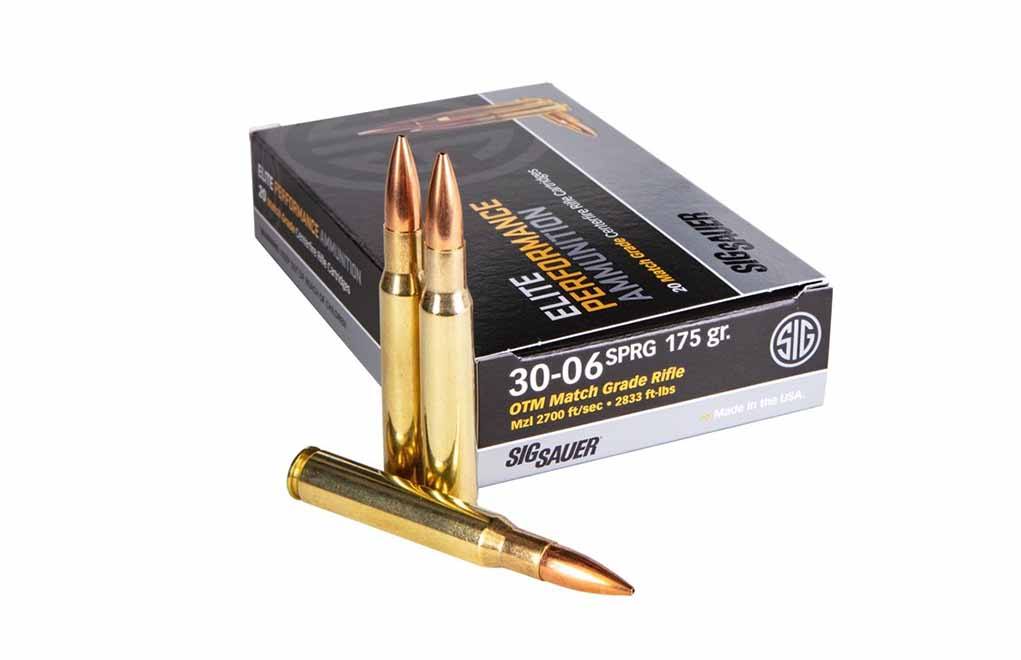
Powerful, versatile and easy to shoot, the .327 Federal Magnum offers big performance in a little package.
Why the .327 Federal Magnum Excels:
A 115-grain bullet can move up to 1,335 fps from the muzzle of a 3-inch barrel.
Mild recoil compared to other magnums.
.327 Fed Mag guns can also shoot .32 H&r Mag, .32 Long, .32 Short and .32 ACP.
Useful for plinking, self-defense and hunting.
In 1983 — the year I graduated high school — Federal shocked the shooting world with the .32 H&R Magnum. It was nothing more than a .32 Long with a longer case, loaded to a higher pressure — 21,000 psi as compared to 12,000 psi. This resulted in velocity increase of about 300 fps. Just as appealing was that this new cartridge could be housed in Ruger’s Single Six, single-action revolver. But, most importantly, that revolver could also fire .32 ACP, .32 Short and .32 Long cartridges. I bought the first Single Six in .32 H&R I ever laid eyes on.
The Single Six in .32 H&R developed a cult-like following, but due to limited factory ammunition options, for the next quarter-century it mostly languished in near obsolescence. A few cowboy action shooters toyed with it, and it was thought to be suitable for self-defense — if you couldn’t handle a 38 Special. Still, I remained a faithful devotee: There’s always been a .32 H&R — if not on my hip — in my safe.
That all changed in 2008 … well, kinda.
.327 Federal Magnum: A New Magnum
In that year, Federal again shocked shooters with the .327 Federal Magnum. They lengthened the .32 H&R Magnum case and upped the pressure just like they’d done with the .32 Long in 1983. But this time, instead of increasing it by 6,000 psi, they more than doubled it to a staggering 45,000. Just to establish some perspective, the .44 Magnum is only loaded to a maximum average pressure of 36,000 psi. You could say the .327 Federal Magnum is one of the most powerful handgun cartridges of all time.
One revolver that can fire all five of these cartridges, covering a wide power range, is extremely versatile. (Left to right: .32 Short, .32 ACP, .32 Long, .32 H&R Magnum and .327 Federal Magnum.)
High pressure means high velocity, and that’s where the .327 Federal Magnum stands out. From a 3-inch barreled revolver, you can expect muzzle velocities as high as 1,335 fps for a 115-grain bullet and 1,450 fps for 100-grain bullets. Longer barrels mean even higher velocities. With a 5.5-inch barrel, you’re looking at about 1,550 and 1,725 fps, respectively. These blistering velocities required Federal and their sister company, Speer, to develop special bullets to handle all that speed.
From a 3-inch barrel, Speer’s 100-grain Gold Dot bullet will penetrate 17.5 inches in 10 percent ordnance gelatin, and expand to 0.45-inch, while retaining 85 percent of its weight. Federal’s 100-grain JSP bullet will penetrate 16 inches, expand to 0.51-inch and retain 97 percent of its weight.
Maybe more impressive are the hardcast loads available from Doubletap and Buffalo Bore for the .327 and .32 H&R. Even at modest velocities, they will penetrate more than 3 feet, and even though they’ll not expand, they’re deadly. I’ve taken several deer with both.
Pistol-Caliber Rifles: Does The .357 Magnum Reign Supreme?
Because .327 Federal Magnum revolvers retain the ability to fire .32 H&R Magnum, .32 Long, .32 Short and .32 ACP ammunition, you have a very versatile handgun that can fire five cartridges. (See Table 1 for a comparison of these cartridges in various barrel lengths.) Not only is this cartridge compatibility unmatched, what’s often overlooked is the versatility it provides. If you want to go plinking with a low-recoil load, fill the cylinder with .32 Shorts. If you want to hunt small game, use .32 H&R Magnums. If you want to hunt deer or defend your person, go with the .327 Federal Magnum.
.327 Federal Magnum's Slow Start?
So, you’re probably wondering why 327 Federal Magnum revolvers — if so versatile and practical — are not more popular. This is partly the fault of Federal. Initially, the cartridge was offered as a lower-recoiling defensive revolver alternative to the .357 Magnum. The .327 Federal does recoil less, and for all practical purposes it’s just as effective, but it simply could not compete with the well-established .357/.38 Special revolver options on the market. Early on, only compact double-action revolvers were offered for the .327 Federal, and shooters mostly yawned.
It really wasn’t until 2015 when Lipsey’s — a firearms distributor out of Louisiana — partnered with Ruger to offer the .327 in their Single Six, single-action revolver. (Remember, the .32 H&R was originally offered in this same revolver.) Lipsey’s rolled out 4.6-, 5.5- and 7.5-inch barreled versions, with an un-fluted cylinder that held seven — as opposed to six — cartridges. The Single Seven was born, and it breathed new life into the .327 Federal Magnum, not necessarily for defensive, but for general-purpose use.
Many are shocked to learn about the effectiveness and versatility of the .327 Federal Magnum.
The cartridge was a great idea all along — the problem was gun makers were putting it in the wrong handguns. Now the word is getting out, and Lipsey’s has trouble keeping Single Sevens in stock. Whether you’re looking for a revolver to wear around the farm, take on a camping trip or hike, to supplement your rifle or shotgun while hunting, or to just take to the range for fun, one chambered for the .327 Federal Magnum is a wonderful option. And, it’s even a better option since you can now have a lever-action rifle chambered for it too.
I’ve had a .32 H&R Magnum of some sort for 35 years — I always will. Now it’s just called a .327 Federal Magnum, and I got no plans of getting rid of it. Hell, I might even buy another one.
Henry Big Boy Steel .327 Federal Magnum Carbine
The allure of the lever action is rooted in the American West, and so is the concept of a revolver and lever gun sharing the same ammunition. Henry’s Big Boy Steel has traditional lever-action lines but retains the signature Henry tube-loading. Though the mechanics of this system precludes the load-as-you-go concept, it makes the rifle infinitely easier and safer to unload.
Currently, Henry is the only company offering a rifle chambered for the .327 Federal Magnum. It will also cycle and fire .32 H&R Magnum and .32 Long ammunition.
The magazine holds 10, 9 and 8 rounds of .32 Long, .32 H&R Magnum and .327 Federal Magnum respectively, and the rifle will reliably cycle, chamber and fire all three. The factory sights are the traditional brass bead front and semi-buckhorn, ladder rear, but my eyes need a little help. Fortunately, the XS Sights’ aperture and white post front sights for a Marlin 336 fit the Big Boy, which is also drilled and tapped for scope mounting.
Metal surfaces are finished in matte blue, and the big loop lever allows for comfortable one-hand carry at the wrist. The stock is American walnut with wrap-around checkering, and at 3.5 pounds, the trigger was very nice. There’s no manual safety, but there’s a transfer bar safety, which means the trigger must be pulled for the rifle to fire. It also means you can carry the rifle loaded, with the hammer down — safely.
The rifle shoots exceptionally well. At 50 yards it averaged 1.76 inches, and that’s with seven different .32 Long, .32 H&R Magnum and .327 Federal Magnum loads, all fired with open sights. And with an MSRP of $893, the Henry Big Boy 327 Federal Magnum Carbine makes an ideal companion to any of Ruger’s Single Sevens.
Single Seven Bisley .327 Fed Mag
Originally known as S&S Wholesale Sporting Goods, Louisiana based Lipsey’s has been distributing hunting and fishing products for 65 years. They’ve distinguished themselves by working with manufacturers to offer exclusive firearms, such as the Ruger Single Seven. Their latest Single Seven is a Bisley version and it’s exceptional.
Lipsey’s Ruger Single Seven Bisley is an ideal general-purpose revolver, chambered for what might be the best general-purpose revolver cartridge.
This blued steel revolver has a 5.5-inch barrel, an un-fluted cylinder and walnut grips that fit the astoundingly comfortable Bisley frame, which was inspired by the Colt Bisley revolver. Many find it and the target style hammer much more comfortable than the traditional gunfighter grip common to most single-actions. The Bisley grip positions the hand to perfectly manipulate the trigger, without disturbing the sights. I managed seven out of seven hits on an 8-inch steel plate, while shooting off-hand — from 50 yards! I’ve never done that with any other handgun.
As far as packing pistols go, a 5.5-inch barrel stretches carry comfort, but, that extra bit of barrel and longer sight radius not only offers tremendous assistance when it comes to hitting what you’re aiming at. On average, you can expect a velocity gain of 150 fps or more over a 4.6-inch barreled Single Seven. MSRP is $709.
.327 Federal Magnum Compatible Cartridge Velocity by Barrel Length Comparison
Streamlined to keep extra ammunition at hand, the WalkAbout 2.0 Revolver Holster offers a more manageable system to carry a wheelgun.
How the WalkAbout streamlines revolver carry:
Premium Center Cut Steerhide
Metal-reinforced mouth for easy holstering
Attached speedloader carrier
Ambidextrous
Two different belt clips
Adjustable for cant
The good ol’ revolver still has a place in modern-day defensive arms. It just takes a bit more forethought to make it practical and comfortable for everyday carry.
The holster geniuses at Galco have made great strides in this direction with the introduction of the WalkAbout 2.0 tailored to wheelguns. Those unfamiliar with these members of the Concealed Carry Lite line, they are marvels at keeping a gun under wraps, while consolidating equipment. How it achieves the latter, an ingenious inline speedloader carrier at the front of the holster. Keeping the extra rounds at hand, it virtually eliminates the unwieldiness of the device.
Furthermore, the holster includes interchangeable clips, the ambidextrous IBW holster also offers two levels of concealment. Cant adjustable, the steerhide WalkAbout 2.0 is adaptable to strongside, crossdraw and appendix carry positions, and is comfortable in each. Streamlining the revolver system, the holster might give more than a few reasons to consider carry a wheelgun. Not badly priced, either.
From the company:
Part of Galco's Concealed Carry Lite line of holsters, the WalkAbout 2.0offers all the benefits of the Tuck-n-Go 2.0 – with the addition of an attached speedloader carrier! It’s an exceptional combination of high performance, comfort and affordability.
The WalkAbout 2.0’s open top allows a very fast draw, while the reinforced mouth allows a smooth and easy return of the gun to the holster. The WalkAbout 2.0’s belt clips are adjustable for cant, making it suitable for the strongside, crossdraw, or appendix carry positions.
The ambidextrous WalkAbout 2.0 is supplied with two types of interchangeable tuckable clips. The first is the UniClip™, designed to go over the belt, but which also works well without a belt. The second is the Ultimate Stealth™ clip with hook, which fits on the trouser waistband, under or behind a belt with just the clip showing, for the ultimate in stealthy concealment!
Made for compact revolvers, the WalkAbout 2.0 is available in black and priced at a very affordable $53!
No wonder all the shotguns are blazing. You can see thousands of doves in the air. Your shotgun’s muzzles are doing a mini dance back and forth as you decide which winged target to zero in on. You know your gunning partners are experiencing the same excitement. This is only your first afternoon of shooting, but you are already realizing that the billing and extreme shotgunning about this trip have not been exaggerated. In fact, the shooting is already even better than expected.
In the few seconds you’ve been thinking this, you realize your gun is empty. As you break that over/under open, the spent shells go flying, but before they hit the ground your shooting assistant (they used to call them bird boys) is already inserting new shells. Time to pick out another dove target!
I was first introduced to this type of shooting in 1972. That’s when I realized I was “born” for such shooting, so I’ve made it a point to return and return, and my next trip will be number 56 — and this does not include many trips to shoot in Mexico. Consequently, I’ve learned a lot about where to go, and, because I almost always take my own guns, I have found out a lot about the ones that “work.” Further, these days most outfitters rent shotguns for this shooting — so what can you expect from those shotguns?
I don’t bang away as frequently on these trips as I once did, but I do know it’s common for most shooters to fire 500 to 1,000 shells each half-day of shooting. If you round that off to 750 shells times eight hunts (afternoon hunt on day of arrival, two hunts a day for the next three days and a final hunt the day of departure), that’s 6,000 rounds. Any gun you take must be up to that degree of punishment. Further, on some of these hunts, daytime temps are in the 80s, sometimes higher — such hot weather will also take a toll on the gun(s) you take.
In 1972, outfitters had no rental guns. Traveling shooters took their own. These days, probably more than 80 percent of the thousands and thousands who flock to the likes of Nicaragua, Argentina, Uruguay, Paraguay and Bolivia rent guns from the outfitter. Since you’re reading this, I’m betting you’re a shotgun guy, so you’d like to take your own shotgun(s) on such a trip. I will return to the rental-gun aspects after some suggestions for taking your own.
Guns That Make The Cut
The bottom line on this: Take the best, most reliable shotguns you have — not the least expensive. Feeling edgy about traveling with your best guns internationally? In all my previous 55 trips, I’ve never lost a gun in transit or while away. I did have a fine over/under experience a trigger problem once, but the outfitter jury-rigged it so it worked, and I had it properly repaired when I got back home. I’ve never heard of anyone losing a gun on these trips. One or two shooters, due to negligence of attention, had their guns kept in foreign customs. All were eventually returned.
Why such an excellent record of not losing guns? First off, working through your outfitter or their agent, proper gun paperwork must take place well in advance of your trip. When you arrive at your departure airport, you will have copies of that paperwork for the ticketing agent. When you arrive at your country of destination, authorities will be waiting with those paperwork originals.
Upon departure from your hunt, you must check those guns out of the country — this is to assure no guns are left behind. Upon arrival in the U.S., you need a signed U.S. Customs form #4457 to get your guns back into our country. The form will have your gun’s make, model and serial number. This form is good for life — so have that form plasticized.
Suggestions For Taking Your Own
Remington 3200
Photo: Guns International
One of the first shotguns I took to Colombia was a Remington 3200 over/under with 26-inch barrels. This 12 gauge was relatively heavy — which dampened recoil a bit due to its 9-pound weight. That O/U made many trips to Colombia, and it held up perfectly. The 3200 has not been made for many years, but it’s a good one — and readily available on the used market. The lockup is solid and, despite the weight, the 3200 swings well and is in balance.
Beretta 682 O/U
Photo: Guns International
A second gun that made many a trip was a Beretta 682 O/U. These guns are still made — though maybe with a slightly different cosmetic look compared to my original. The 680 series Berettas have an exceptional record of holding up well to thousands of competition rounds, so it’s no wonder that they work so well to, say, 6,000 rounds on a typical hunt to Argentina.
The 680 series is made with no under-locking lugs — thus, a receiver with less depth results. Theoretically, such guns are easier to shoot because the hands are in closer relationship with the barrels. Barrels pivot on trunnions. Two conically shaped bolts move forward from near midway in the receiver — to engage matching milled cutouts adjacent to the top barrel. The 680 series’ final lockup is the “shoulders.” Several different Beretta semi-autos are popular as rental guns in these countries, and I’ll talk more about those in the rental-gun section.
Krieghoff Model 32 Or K-80
Krieghoff K-80
During my years of competition skeet shooting, my two-man team partner often remarked — if I had a gun problem — “Someday, you’ll get a Krieghoff.” Eventually, I bought five of them, and I still have two.
One of the latter has made many, many trips to South America. This one is not a K-80 — the Krieghoff in production today — but the K80’s predecessor: the model 32. Though not currently made, they are offered regularly on the used market — and at prices that are very low compared to the K-80.
Essentially, the two are the same gun — at least in design and lockup. K-80s have great triggers, but if one ever wants a K-80 trigger, they are made to fit the model 32 as well. Further, the K-80 has a casehardened receiver; the model 32 does not. There are other differences between the two models, but not that many. Both models lock up with the sliding top lock — a system that was originated with the Remington Model 32. There are no under-locking lugs, so this is another receiver with no additional depth, and the barrels pivot on trunnions.
Krieghoffs are well-known for their total reliability no matter how many thousands of rounds are put through them — thus, another perfect choice for high-volume South American shooting. The one I take with me wears 28-inch barrels and a recoil-absorbing JS Air Cushion stock.
Caesar Guerini Summit Sporting
Caesar Guerini hasn’t been in business for decades, but since their introduction in 2003, this company has gobbled up a huge share of the over/under shotgun market. In that first year, I bought the manufacturer’s Summit Sporting model in a 28 gauge with 32-inch barrels. That gun made more than one trip to both Argentina and Uruguay, but I eventually had that gun fit with a set of 20-gauge 32-inch barrels. This 20 bore has made many trips to Bolivia, Uruguay and Argentina.
The Summit Sporting is one of Guerini’s least expensive over/unders, but they’re all built with the same locking system; barrels pivot on trunnions, a receiver-wide bolt in the bottom of the receiver moves forward upon closing — where that bolt engages lugs milled into the bottom of the monobloc — plus, there are dual recoil lugs milled into the bottom of the monobloc that nestle into matching recesses in the bottom of the receiver.
Also, the checkering is very well done and at an unprecedented 26-lines to the inch. The 32-inch barrels are not for everybody, but this Guerini weighs 7 pounds, 5 ounces. If it were an 8.5-pound 12 gauge, I don’t think I’d like those long barrels, but I shoot this one well. It’s an elegant-looking gun, too. Further, this Summit Sporting has been shot thousands and thousands of times — with never a hiccup.
Perazzi MX8
This brings me to Perazzi, a favorite of many smoothbore aficionados, and a particular favorite of mine. Perazzi makes several models. Mine is the MX8. Lockup is similar to the Boss from England made decades and decades ago. Barrels pivot on trunnions, and two locking bolts move forward upon closing — to engage two milled-out matching recesses in the monobloc. The MX8 and other Perazzi models have an unparalleled reputation for reliability, especially in trap circles. This one carries 28.5-inch barrels.
Beretta A400
Photo: Guns America
Bill Straub and Debbie Meade have accompanied me on my last three trips to both Jorge Molina’s lodges in Bolivia. They bought and take along the Beretta A400 semi-auto in 28 gauge. Both these guns also have the Kick-Off recoil reduction system in the stock — for virtually no recoil — especially in their 28 gauges. Most all Beretta semi-auto shotguns are well-known for their reliability, as various Beretta semis are depended upon by some of today’s top sporting clays shooters. These guys and gals shoot 12-gauge Beretta semis in competition — but most all of them opt for the Kick-Off. Reliable Rental Guns
Beretta 390 and 391
Photo: Guns America
What about rental guns in these countries? As you might guess, Berettas are very popular. I don’t see many A400s yet, as that model is relatively new, but I do see plenty of Beretta semi-auto models — 390s and 391s. If you’re accustomed to shooting one of these in the U.S., check with your outfitter before departure to see if you can reserve one for yourself. Gas-operated, these Berettas suck up recoil; plus, they handle extremely well.
Benelli M2 Field
Two years ago, Bolivian outfitter Jorge Molina purchased 50 Benelli M2 semi-autos. He knew from previous experience that Benellis certainly held up. The idea in buying 50 of all the same model was that it would be easier for his gun staff to work on; plus, they’d be able to buy the same typical spare parts that break and have them on hand. This philosophy has worked well for both his lodges, and most of his clients rent — and they like the M2 despite these guns not being gas-operated.
Ammo-wise, he carries both Rio and RC (made in Italy) shells — the 12 gauges at 7/8 ounce (24 gram) and 1,350 fps, and he also has 20- and 28-gauge shells at the same 24 grams and same high velocity. Maybe the added velocity ensures reliable working of the semi-autos.
Molina still has his Beretta semis from previous years, though not a lot of them. They have been functional for maybe a decade. Do the math. Say these guns are fired 10,000 rounds a week from April through October. That’s seven months at say 28 weeks times 10,000 rounds. That means roughly 280,000 rounds every season. For 10 years! Which would you rather be shooting — one of the rentals or your own?
This article originally appeared in the November 2017 issue of Gun Digest the Magazine.
There was a time when one rifle had to do it all for many shooters. The rifle that had to serve all purposes might have been a .30-06 Springfield, .30-30 Winchester or some other classic cartridge, but with it someone hunted many types of game that ranged from groundhogs to grizzly bears. The resident of a remote area might have wanted to do sustenance hunting and still have some meat after the bullet did its job. Asking one caliber to do it all was a tall order.
Along the way, many small cartridges, such as the .22 Hornet, .222, .223 Rem., .22-250 Remington and .243 Winchester, were introduced for use on varmints and predators. Cartridges such as the .300 Winchester, 7mm Remington and .338 Winchester magnums were developed for use on really big game. Options are good, but you don’t necessarily have to buy another rifle to have those options.
Factory loads for centerfire rifles have become much more numerous over the years, and today’s offerings are even more effective than a half-century ago. In those days, the Winchester SilverTip and Remington Core-Lokt were two of the standbys. Today, we have bonded bullets, partitions such as those from Nosler and Swift, and many other types. Various bullet types are one way to diversify the offerings of a single rifle.
But what about ammunition for use on smaller species and pests? What about using that big-game rifle to teach a youngster how to handle such ordnance to get ready for that first hunt? Full-power loads are overkill for such uses, but there’s an answer: reduced loads.
By careful loading, the .223 Remington can duplicate the performance of the .22 Hornet, .22 WMR or .22 LR.
Several manufacturers have introduced loads of lower power and recoil in such cartridges as .30-30 Win., .30-06, .270 Win., .308 Win., 7mm Magnum and others, but they are still of sufficient power that they are suitable for hunting species as large as deer. The focus here is on light loads as distinguished from those that still generate about half to two-thirds the power of full-power versions.
The Science Of ‘Smaller’
Making reduced loads is not as simple as just using a smaller quantity of the same powder used in making full-power loads. That situation is reported to sometimes result in a phenomenon known as “detonation,” which can lead to at least destruction of the firearm — or worse. Detonation is considered to be a possibility when smaller than normal charges of relatively slow-burning powders are used in cases that have large volumes for the bore diameter. So, one should never try to produce reduced loads by simply using a small quantity of a usual propellant employed for full-power loads — and that means a different strategy is called for.
More Ammunition Articles:
If You Had To Pick Just One Cartridge, What Would It Be?
If you consult loading manuals from the first half of the 20th century, you will see that most of them list loading data for developing loads that give bullet velocities about half those of full-power loads. The general pattern was to pair a bullet that’s relatively light for the caliber and a rather small charge of a powder having a relatively fast burning rate.
The undisputed classic reference is that by Philip B. Sharpe, The Complete Guide To Handloading, 3rd Ed. (Funk & Wagnalls Company, New York, 1953). The subtitle to that classic is, “A Treatise on Handloading for Pleasure, Economy, and Utility” — and to that could be added “versatility.” In that book, Sharpe described his use of a .30-06 Springfield rifle with a bullet intended for use in a .32-20 loaded to a velocity of approximately 1,800-2,000 fps as an effective varmint load.
Two powders that are widely used for reduced loads are IMR 4759 and Alliant 2400.
Assembling reduced loads can cause disaster for the careless reloader. The powder charges are small enough that it’s possible to get two or even three charges in the large case of a centerfire rifle cartridge. The powders used normally have burning rates that make them suitable for use in handgun ammunition — perhaps that’s the reason most modern loading manuals list few or no reduced loads.
Searching the internet will bring up a lot of correspondence that generate a lot of heat … but little light. There are those who claim that they have witnessed such loads blowing up rifles with regularity, but during the past century or more, an enormous number of such loads have been fired without incident. After all, in many cases such loads duplicate those that make use of cast bullets, and shooting such loads has been a noble passion for a very long time. I suspect that in instances where something unwanted happens, the loader became careless.
Proceed With Caution
Preparing reduced loads demands a high level of prudence and caution. I use the same procedure as that employed in preparing full-power loads. I start with the empty cases inverted in the loading block. After the powder charge is weighed, it’s placed in the case and immediately I place a bullet in the mouth of the case. Following that procedure for every cartridge makes getting two charges in a case impossible. I never engage in the folly of having a bunch of cases containing powder charges with the mouths open in a loading block.
Perhaps the most versatile propellant for preparing reduced loads is Accurate 5744, which was designed for that purpose.
Space here does not permit giving details of results obtained with reduced loads in numerous cartridges, so I will deal with only some experiments with .30-06 Springfield, .308 Winchester, .30-30 Winchester and .223 Remington.
Although Alliant (formerly Hercules) 2400 has long been a favorite powder for preparing reduced loads, probably the best choice today is Accurate 5744, which is a low-density propellant that occupies a larger volume in the case. IMR 4227 and 4759 are also favorites, and in recent years Hodgdon’s Trail Boss has also become popular. Although intended for normal loads in small cases, such as the .222 Remington, IMR 4198 is a versatile powder for producing reduced loads in larger cases.
.30-06 Springfield
One of my early experiments was to try to duplicate the .30-06 load described in Sharpe’s book on p. 262: “Years ago, when the author was a ‘one-gun’ handloader, his favorite chuck and crow load in the .30/06 was a Winchester .32/20 soft-point 115-grain bullet loaded to about 1700 f/s.” For that load, Sharpe used a powder that’s long been out of production. Searching the tables in Sharpe’s book showed that a charge of approximately 20-22 grains of Alliant 2400 should be appropriate when used with the 110-grain Speer flat hollow-point bullet. When fired across my chronograph placed 10 feet from the muzzle, the indicated velocity was 2,108 fps, and at 50 yards a five-shot group measuring 0.96-inch was obtained.
Excellent bullets for use in 30-caliber reduced loads are (left to right): 90-grain Hornady XTP, 100-grain Hornady short jacket, 110-grain Speer FPHP, 110-grain Hornady spritzer and 110-grain Speer round-nose.
Using the same powder charge with the 110-grain Speer round-nose bullet gave a velocity of 2,154 fps, a value that differs only 6 fps from that listed in Sharpe’s book published about 65 years ago. Sharpe used a rifle having a 24-inch barrel, whereas my Remington 700 has a 22-inch barrel, and different components were used. Would such loads work well on called in coyotes? Absolutely.
My next load for the .30-06 consisted of the 110-grain Speer round-nose bullet propelled by a charge of 24.0 grains of IMR SR 4759 using the same cases and primers as before. This load gave an average velocity of 2,121 fps with a standard deviation of 21 fps. Five of those bullets resulted in a five-shot group at 50 yards measured 0.71-inch, which is sufficiently accurate for a varmint load to be used at ranges up to 100-125 yards or so.
.308 Winchester
In the .308 Winchester, I’ve had excellent results using a 110-grain Speer round-nose bullet and a charge of 17.5 grains of Alliant 2400. From my Winchester Model 70 Featherweight, the average velocity is 1,739 fps and groups average an inch or less at 50 yards. I can live with that.
Reduced loads using all of the lightweight bullets performed well in the .308 Winchester.
.30-30 Winchester
The .30-30 Winchester has been popular for use with reduced loads for over a century. The case has moderate capacity, and the case being rimmed prevents it from being forced forward into the chamber, which can result in cases being shortened when firing loads that do not develop high pressure. My most extensive experience with reduced loads has been with the .30-30 for several reasons, one of which is that it’s usually used at short to moderate ranges — and reduced loads perform well in that setting.
Both Hornady and Speer produce 100-grain bullets in .308-inch diameter that feature short jackets and a lot of exposed lead. These bullets are appropriate for use in reduced loads, and I’ve shot a lot of them through my .30-30 rifles. In one test, I used such a bullet with 16.0 grains of Alliant 2400, which produced a measured velocity of 1,861 fps with a five-shot group measuring less than 1 inch at 50 yards.
Measuring under an inch, the group was produced by the author’s .308 Winchester Model 70 and indicates that the combination would be effective on varmints.
.223 Remington
Although I have used many reduced loads in the .223 Remington, my favorite consists of the 40-grain Hornady V-Max propelled by a charge of 16.0 grains of IMR 4198. That load gives a velocity of 2,363 fps in my Savage Axis and has produced groups as small as 0.58-inch at 100 yards.
If you have a favorite centerfire rifle but don’t have many opportunities to use it — or if you would simply like to experiment — reduced loads may be the answer. The subtitle, “A Treatise on Handloading for Pleasure, Economy, and Utility,” to Phil Sharpe’s book gives you all the reason you need to engage in this fascinating hobby.
Editor's Note: This article originally appeared in the July 2018 issue of Gun Digest the Magazine.
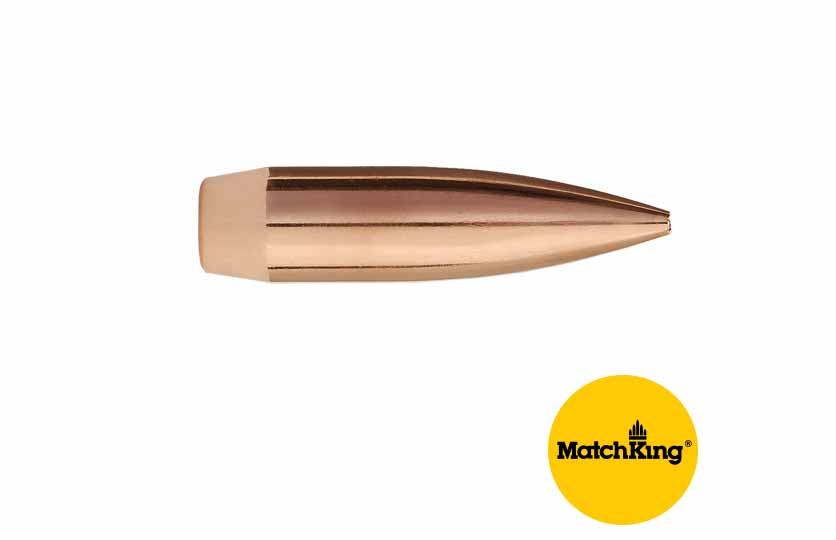
Mossberg 500 Retrograde additions have plenty of old-school intimidation.
What The Mossberg 500 Retrograde Models offer:
Walnut stock
Cylinder bore
12 gauge, 3-inch chamber
590A1 has 20-inch barrel
18.5 has 18.5-inch barrel
14.5 length of pull
Introduced in 1960, the Mossberg 500 has become one of the most prolific firearms ever produced. At this point, more than 12 million have rolled off the assembly line and there's little reason why another 12 million won’t follow suit in the impending decades. With that in mind, it’s no wonder Mossberg picked the line to spotlighted the company’s upcoming 100th Anniversary.
Featuring the same battle-tough design as the rest of the series with a throwback look, the recently introduced the 500 Persuader Retrograde and 590A1 Retrograde are eye-catchers. Essentially the tactical models of the shotguns, the guns have traded up their synthetic stocks for sticks of walnut with some solid results. The guns definitely have an air of old-school intimidation about them that any smoothbore fan is sure to love.
More from the company:
NORTH HAVEN, CT – O.F. Mossberg & Sons, Inc., a leading American firearms manufacturer, is announcing the introduction of the Retrograde Series of pump-action shotguns; the 500 Persuader Retrograde and 590A1 Retrograde. Designed to commemorate Mossberg’s 100th anniversary in 2019, the Retrograde Series features the two most iconic police and military pump-action shotguns, built to today’s standards, but with the retro look and feel of a walnut stock and matching corncob forend.
After over 50 years in production, over 12 million sold and the only pump-action shotgun to pass the U.S. military’s MIL-SPEC tests, the Mossberg 500 platform has proven to be one of the most versatile and reliable shotgun designs available. Both the 500 Persuader Retrograde and 590A1 Retrograde are designed for smooth, dependable operation with the combination of non-binding twin action bars; dual extractors; a positive steel-to-steel lock-up; anti-jam elevator; anodized aluminum receiver for added durability; and universally-recognized, ambidextrous top-mounted safety.
Mossberg 500 Persuader Retrograde (50429) – Available with an 18.5-inch (6-Shot) cylinder bore barrel; topped with single front brass bead sight; blued metal finish; and full-length walnut stock and corncob forend. MSRP: $504
Mossberg 590A1 Retrograde (51665) – Built to MIL-SPEC standards, this 9-Shot 590A1 has a 20-inch heavy-walled, cylinder bore barrel complete with a heat shield, bayonet lug and Ghost Ring sights. This retro model also has a Parkerized finish; metal trigger assembly; metal safety button; and wears a full-length walnut stock and corncob forend. MSRP: $902
For more information on the 500 Retrograde models, please visit: www.mossberg.com.
Want to master the hand cannon? You've got to dial in your grip.
A fledgling skill, a proper and solid grip is among the most important fundamental skills in handgun shooting. Ignore it and you’re likely to find your overall accuracy subpar and follow-up shots next to impossible. Key as it is with the most common handgun calibers — 9mm, .40 S&W, .45 ACP — its significance increases a couple magnitudes when you step up to big-bore revolvers. Makes sense, they’re beasts.
The Elegant Power Of The Ruger Blackhawk Bisley .45 Colt
Redhawk vs. Super Redhawk: Which Is Ruger’s Best .44 Magnum?
Recoil is the most obvious aspect a proper grip helps negate when shooting these excessively powerful handguns, but it’s not the only thing it manages. Inherently heavy, due to the extra material in the frame and cylinder, there is also a matter of keeping the revolvers on target. Given this class of handgun is generally utilized for hunting, up to and including dangerous game, making sure those massive bullets impact where they’re supposed to is imperative. A good grip ensures you'll keep it hitting the bullseye one trigger pull to the next.
From Max Prasac’s experience with nearly every hand cannon conceived, he’s found grip tension — plenty of it — does a pretty solid job at putting a round where it needs to go again and again. For the big-bore guru, it’s a matter of consistency, with a stout grip maintaining a dependable point of impact, no matter if he’s shooting off a bench or offhand. Though, as he freely admits, his is far from the only way to skin a cat with some shooters allowing their guns to ride and fly.
Prasac, however, does opt for a somewhat unorthodox overall grip, locking the thumb of his support hand behind his strong hand. Funny as it may appear, this is an insurance policy. Locking in his grip, he doesn’t have to worry about recoil putting the gun somewhere it shouldn’t be — such as his kisser.
The first commercially successful semi-automatic pistol, the Borchardt C93 helped shape the modern handgun world.
Commonplace now, it’s easy to take for granted the performance we get out of semi-automatic pistols. High rate of fire, inherent accuracy and fast reloads, it doesn’t matter the make and model, we expect these advantages nowadays. But how did these assets come about? What was their origin? For the most part, semi-autos — no matter their caliber or operation — trace their root to a rather odd gun that today is somewhat forgotten outside collectors circles — the Borchardt C93.
More Gun Digest Videos:
The Cane Gun And Clandestine Self-Defense Firearms
Designed by German Hugo Borchardt in 1893, the C93 is considered the first successful commercial semi-automatic pistol. Though the term ‘successful' is somewhat relative. The Borchardt had a modest production run, with only around 3,000 built from 1893 to 1902. Not overly impressive. On the other hand, what it brought to the table, particularly for its time and compared to its predecessors was extraordinary. The short-recoil operated toggle-lock pistol actually worked shot in and out, more than could be said of the blowback and delayed blowback military prototypes that predated it.
The pistol fired 7.65x25mm Borchardt, which has the distinction of being among the first successful rimless cartridges. While the ammunition is a relic now, what it went into is commonplace among all modern pistols and perhaps is the greatest contribution of Borchardt's design. The gun utilized an 8-round box magazine that fit into the grip. As anyone who's pulled the trigger on a pistol knows, this is a nearly universal configuration now and a darn handy one to boot.
It's toggle-lock acton lived on for a while, long enough to spur one of the most historic guns of the 20th Century — the Luger P08. The famous gun was actually Georg Luger's improvement on Borchardt's design, removing the main flaw of the older gun — the bulbous extension on its rear. This rather unwieldy protrusion housed the mainspring and was generally frowned upon by the militaries that tested the C93. However, it did feature a lug, which a stock could be attached making it a carbine.
By today’s standards, the Borchardt C93 seems antiquated to the point of a flintlock. But the innovations the pistol ushered in are still with us in even the most modern cutting-edge pistols.
Designed by the legendary P.O. Ackley, the wildcat .280 Ackley Improved has been a mainstay for handloaders for more than half a century.
Where the .280 Ackley Improved differs from the .280 Rem.:
Wildcat created by the legendary P.O. Ackley.
Shoulder is set at 40-degrees.
All things equal, improves on the .280 Rem. by 100 fps.
Originally cases were fire-formed by shooing a .280 Rem. out of an Ackley chamber.
Factory loaded, starting with Nosler, in 2007.
In addition to being a famous gunsmith, barrel maker and college professor, P.O. Ackley absolutely ruled the roost when it came to creating wildcat and improved cartridges. One of his earliest was the 7mm-06 Improved, which was formed by necking down the .30-06 case and fire-forming it to less body taper and a 40-degree shoulder angle. Years later, and not long after the .280 Remington was introduced, reloading equipment maker Fred Huntington reformed its case to the Improved configuration with minimum body taper and a 35-degree shoulder angle and called it the .280 RCBS.
Since cases for Huntington’s cartridge could be formed by firing .280 Remington ammo in a rifle chambered for it, Ackley abandoned his 7mm-06 Improved and started chambering rifles for the .280 RCBS. But rather than staying with its 35-degree shoulder angle, he changed it to 40 degrees. And so was born a cartridge we know today as the .280 Ackley Improved.
After close to a half-century of being something only handloaders could love, the .280 Ackley Improved became a factory number, when Nosler registered it with SAAMI, started loading the ammunition and began chambering rifles for it in 2007. The Ackley version is a fine old cartridge and, when loaded with the right bullet, is big enough medicine for game up to elk and moose.
Even so, the .280 Ackley Improved is not as fast as the 7mm Remington Magnum, as a few of that cartridge’s avid supporters would have us believe. All things, including barrel length and the chamber pressure to which the two are loaded being equal, the .280 Ackley Improved is about 100 fps faster with all bullet weights than the standard .280 Remington. Cases are easily formed by firing .280 Remington factory ammo in a rifle properly chambered for the .280 Ackley Improved.
Editor's Note: This article originally appeared in the 2018 Shooter's Guide issue of Gun Digest the Magazine.
Looking to go armed, but are stuck in the weeds as to what to arm yourself with? Here are 20 excellent concealed carry gun options that will keep you on the defensive.