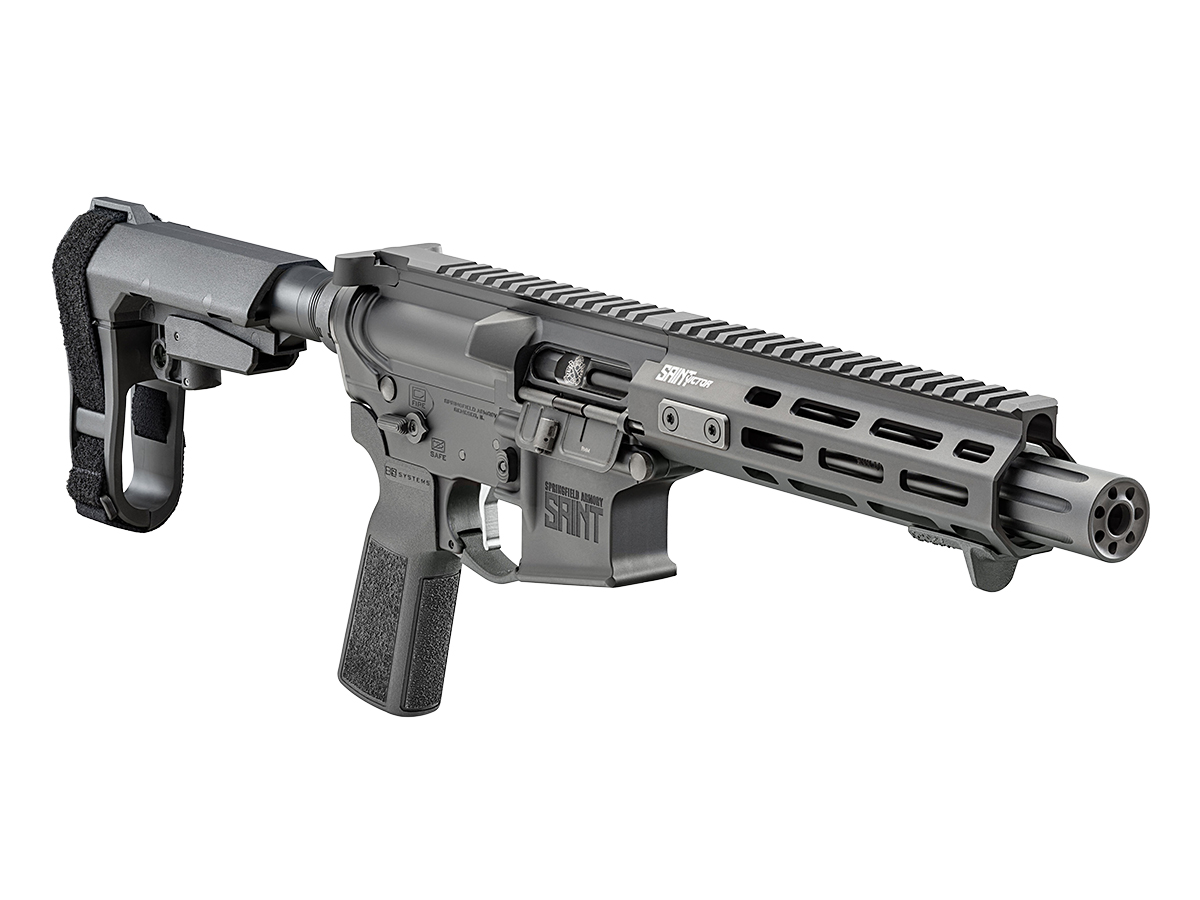
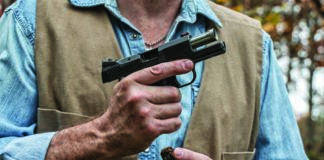
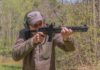
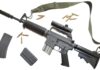
I show how to build a Hollywood-quiet AR that takes full advantage of the .338 ARC cartridge.
Hornady has been on a roll the past few years with its line of ARC cartridges. The 6mm ARC, .22 ARC and now .338 ARC are all impressive new cartridges that don’t disappoint. But there’s a burning question most of us have: Do they work as advertised?
The .338 ARC intrigues me, and I want to know a lot more about it. What can it do? What can it not do? Why does it matter?
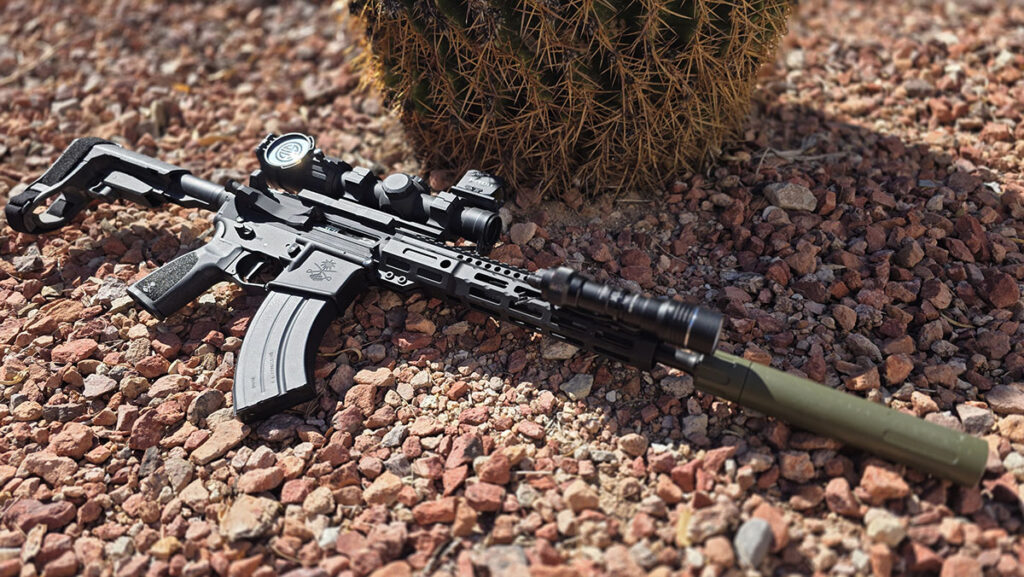
For that to happen, I built what I’m calling “The Tester.” This “pistol” isn’t optimized for anything special, but rather it’s a jack-of-all-trades I’ll use to play around with .338 ARC to find its limits.
.338 ARC AR Build
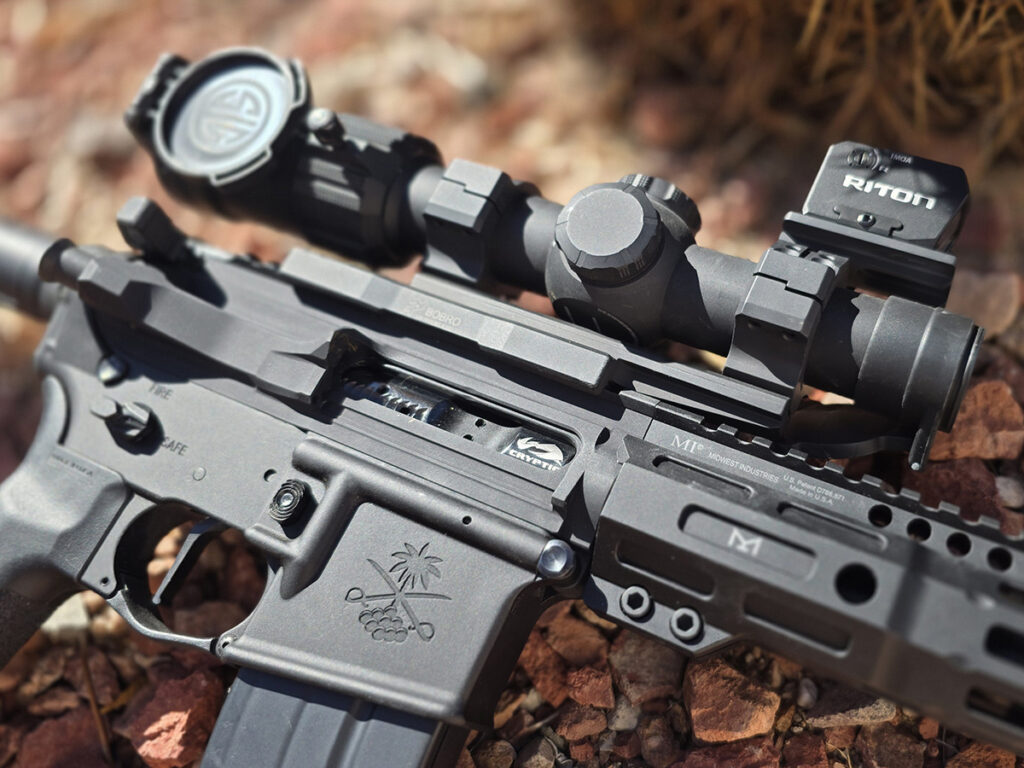
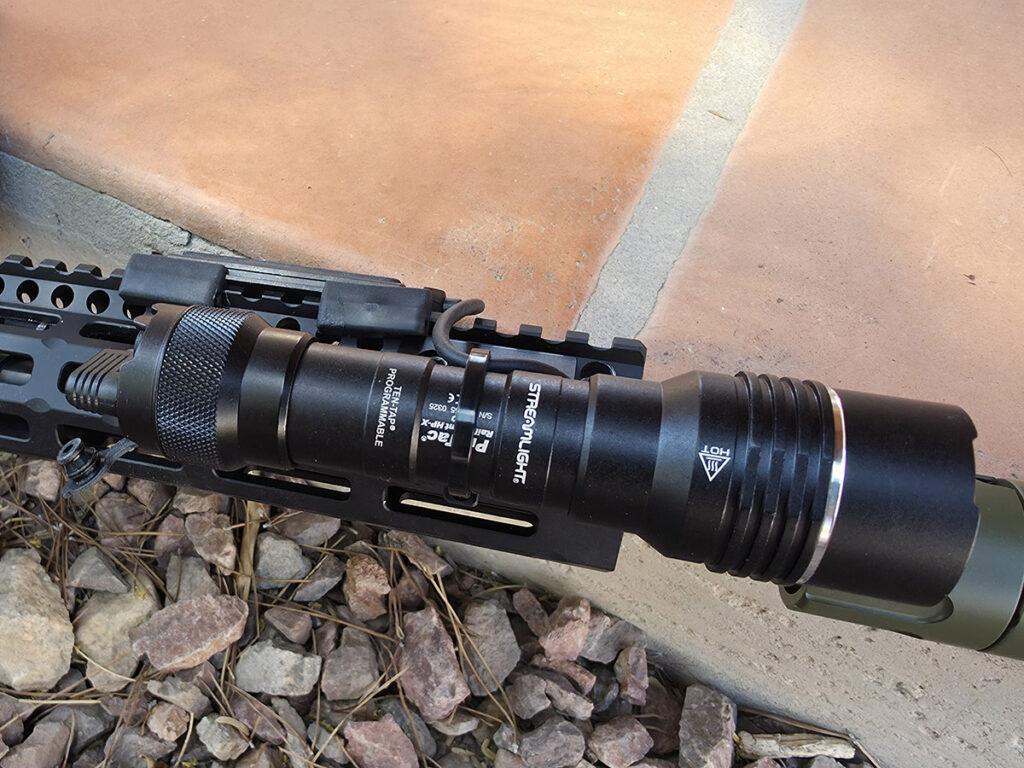
Faxon Firearms .338 ARC 12.5-inch “Gunner” Profile Barrel Midwest Industries Night Fighter 10.5-inch handguard TiON Dragoon 8.6 Suppressor Cryptic Coating .338 ARC / 6 ARC / 6.5 Grendel BCG Faxon Firearms adjustable gas block Bobro 30mm LPVO mount Sig Sauer MSR 1-6x LPVO Riton 3 Tactix EED Radian Weapons safety and charging handle Palmetto State Armory SABRE lower UTG Pro upper receiver SBA3 Brace
.338 ARC vs. .300 BLK vs. 8.6 BLK
Before we get in deep, it might help to clear up exactly what the .338 ARC is. Some people think it’s an 8.6 Blackout replacement, while others claim it will be a .300 Blackout killer.
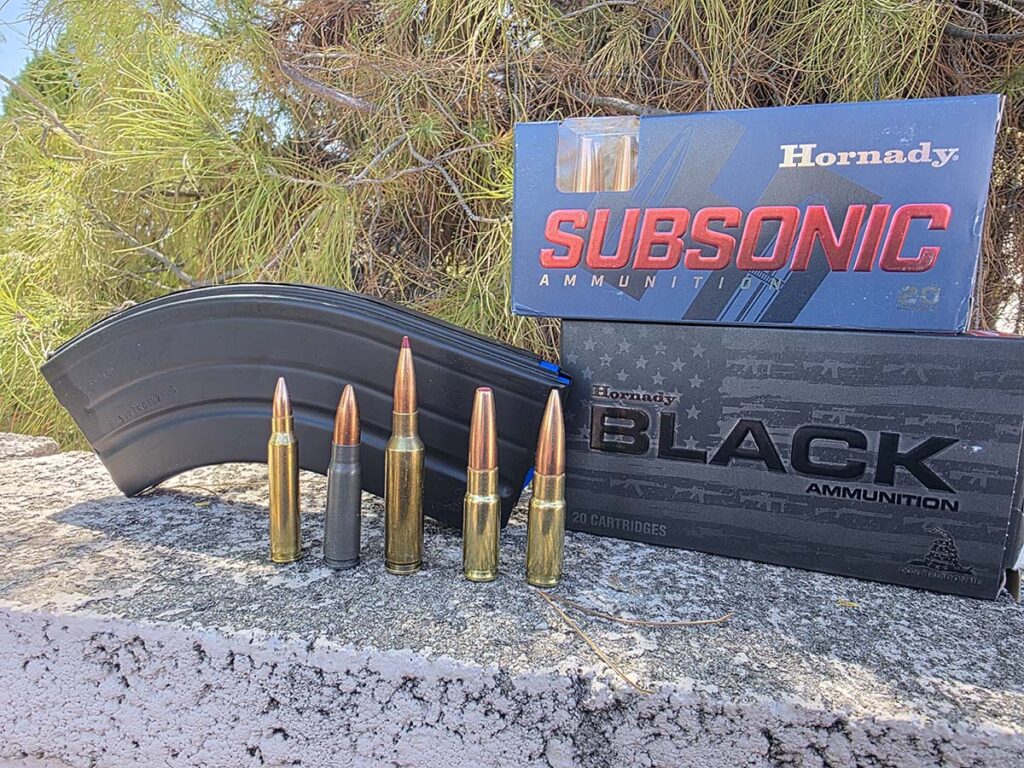
The .338 ARC takes many of the strengths from .300 BLK and 8.6 BLK and rolls them into a single cartridge that’s arguably better than either Blackout.
Energy Extras
If you’re looking at subsonic loads, everything has a max muzzle velocity of about 1,050 feet per second (fps); the .338 ARC has a lot more energy than .300 BLK due to the larger, heavier bullets. Most .300 BLK subs are normally loaded with 200-grain bullets, while .338 ARC are around 300 grains. This translates to .338 ARC having about 200 foot-pounds (ft-lb) more energy at the muzzle and around 110 ft-lb at 300 yards while having effectively the same bullet drop. That equates to 35 percent more energy, which is significant.
Typical 8.6 BLK subs generally boast 300- or 342-grain bullets, putting them on par—or slightly more powerful—than .338 ARC subs, but with some major downsides.
First, 8.6 BLK requires an AR-10 size rifle, making it larger and heavier right out of the gate. Second, ammo selection is more limited due to the 8.6 BLK’s extremely high twist rate.
When it comes to shooting supersonic, the trend remains the same: The 8.6 BLK is more powerful than the .338 ARC, and the .338 ARC is more powerful than the .300 BLK.
But with supersonic ammo, the gap widens even more. You can massage the numbers in either direction depending on ammo choice, but looking at .300 BLK 110-grain Hornady vs. .338 ARC 175-grain Hornady vs. 8.6 BLK 185-grain Phantom Defense, .300 BLK falls to about half the energy of 8.6 BLK.
These really aren’t plinking calibers, but if you want to shoot more, .300 BLK is the winner. As I write this, you can find .300 BLK subs for 42 cents per round. That’s not a bad deal … all things considered.
The .338 ARC is less expensive than you might think, but it’s far from cheap. The lowest priced .338 ARC ammo at the time of writing was $1.44 per round.
And there’s no easy way to say this: The 8.6 BLK can be painful on your wallet, depending on where you get your ammo. Most of the brands supporting this chambering are the smaller, lesser-known ammo manufacturers, so there isn’t a lot of economy of scale helping shooters. The lowest price at the time of this writing was $1.90 per round.
Safety First
Something worth talking about is the fact that .300 BLK has, in my opinion, a design flaw. Because of how the shape and size of .300 BLK and 5.56 NATO cartridges, .300 BLK can chamber and fire in 5.56 NATO rifles. Doing so almost always results in a KABOOM! that may or may not harm the shooter. Either way, it will destroy the rifle.
Search the web and you’ll find dozens of stories about it happening. Having personally seen it happen at a training class, it’s not something I recommend doing.
The .338 ARC and 8.6 BLK don’t suffer from this problem.
On The Range
New guns and new cartridges are always fun, but when you’re sending 307-grain pills that are Hollywood quiet, it’s really, really fun.
Function for the Tester was perfect once the gas was dialed in with the Faxon Firearms adjustable gas block. It’s easy to use, easy to tune and works just right. Faxon’s Gunner profile has always been a winner in my book, and this barrel is no different. The perfect blend of weight and rigidity for suppressed use—it feels great in this configuration.
One downside of .338 ARC is the need for a larger bore suppressor than what most people might already have at home. While some 9mm suppressors are rated for the pressure, not all of them are, and most of the ones that could handle the cartridge haven’t been officially tested yet.
The upside is that a new suppressor is always another layer of fun. Tion makes a wide range of great suppressors, and I’ve gotten to test many of them at various CANCON events. But I acquired my first personal can from them for this build.
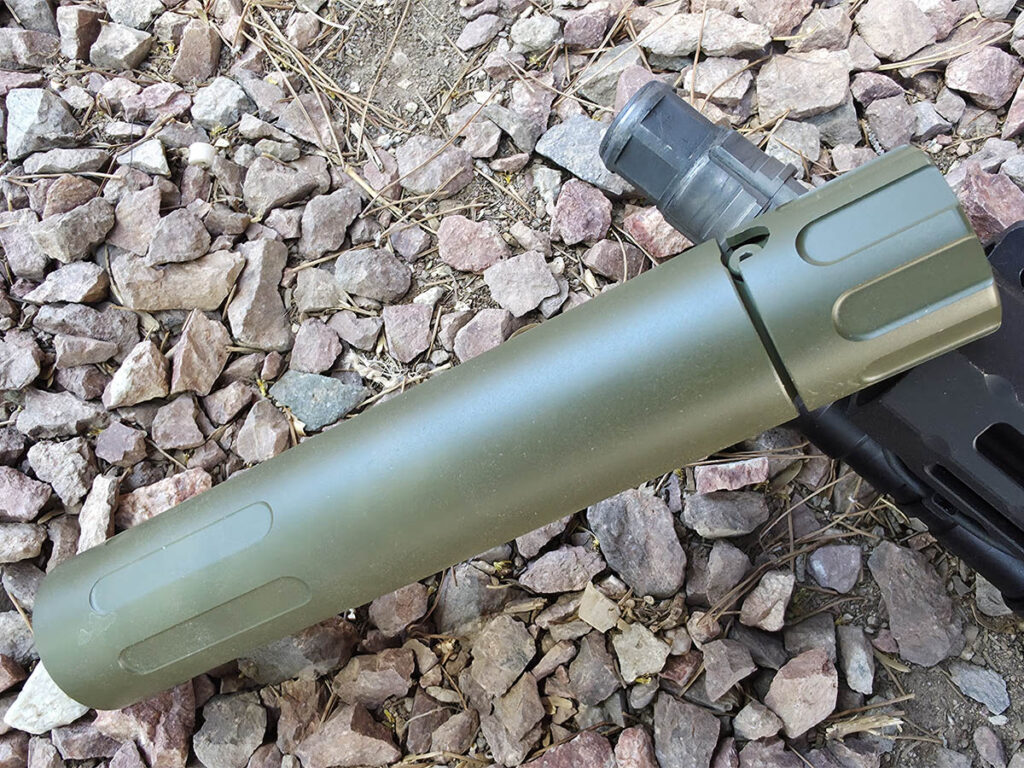
The Tion 8.6 QD is stunningly lightweight due to the all-titanium construction. At 7.5 inches long, it offers a lot of volume but only weighs 11 ounces, helping the Tester to not feel front heavy. The proprietary QD system is one of the best on the market with a hand-tight, ultra-secure lockup.
Green Cerakote was done by Tion … and it looks amazing. It’s taken some hits from being used but still looks great, and it’s doing a solid job protecting the metal under it.
“Tone” is a big deal with suppressors—often more important than the actual dB rating for what makes one suppressor sound better than another. Higher tones generally sound worse, or more offensive, to most people. Something I love about Tion is that their cans always have deeper tones. Instead of a cymbal being struck, firing .338 ARC with the Dragoon sounds more like dirt being slapped.
Recoil with .338 ARC is more than 5.56 NATO and slightly more than .300 BLK, but that’s expected. Even subsonic, these are some beefy bullets getting yeeted. Feed and function have been 100 percent using Duramag 6 ARC magazines and Duramag 450 Legend magazines. Hornady recommends the 6 ARC magazine, but some brands have testing showing the .450 Legend mags working better. In my testing, it didn’t make a difference.
While this specific build is designed for subs, and I don’t have much interest in running supers with it, the Tester handled supers exactly as well as it did subs. More recoil, more noise … but perfect function.
With the Hornady 307-grain SubX ammo, this gun with the Tion Dragoon is about as quiet as you can get an AR-15.
Loose Rounds
My first foray into the world of .338 ARC has been a success. The firearm works, the ammo runs, nothing went KABOOM! and it’s ready for some real-world use.
What comes next? I’m thinking drywall testing and maybe a meat target.
Editor’s Note: This article originally appeared in the November 2025 issue of Gun Digest the Magazine.
We take a quick look at the LTT IMPACT, a new long-range rifle developed in collaboration with Tikka.
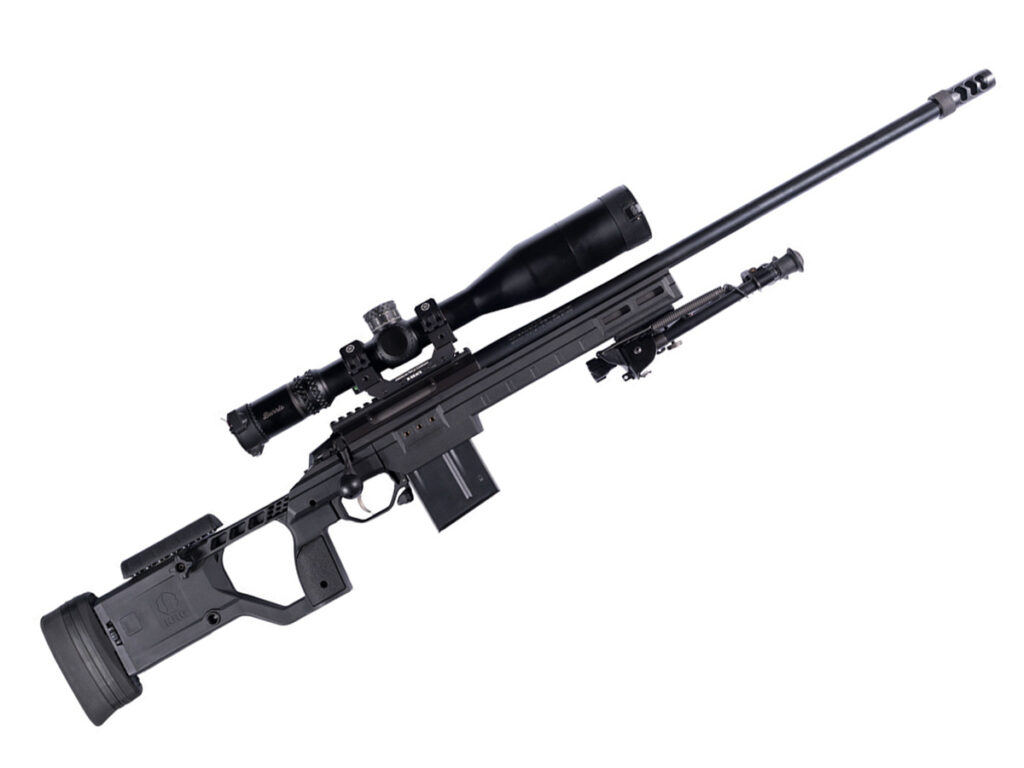
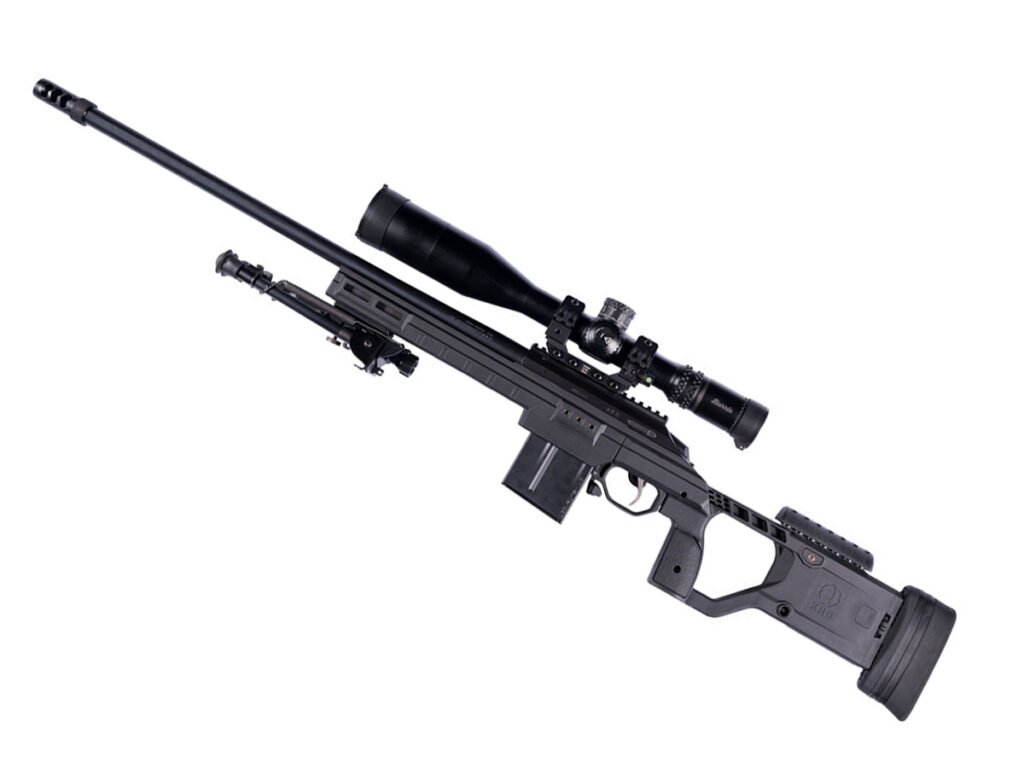
Langdon Tactical Technology and Tikka have just joined forces to create the LTT IMPACT. More than just a long-range rifle, it’s a complete precision system that comes ready to reach out and touch things straight from the box (especially if you opt to have LTT zero it for an additional $350).
Chambered for 6.5 Creedmoor, the LTT IMPACT features a Tikka T3x action, a 24-inch cold-hammer-forged Super Varmint Profile Tikka barrel, a KRG X-Ray chassis and a tuned, adjustable Tikka two-stage trigger. It’s compatible with AICS-pattern magazines (two 10-round mags included), and each rifle ships with a Burris XTR III 5.5-30x56mm scope mounted using an ARC M-BRACE and a Mountain Tactical One-Piece 20 MOA rail. Other features include an Area 419 self-timing Hellfire muzzle brake and a Harris adjustable bipod.
Ernest Langdon, CEO of Langdon Tactical Technology, said this about the new rifle:
Our goal with the IMPACT was simple: deliver a rifle that gives beginner shooters confidence with a premium long-range rifle … Everything is tuned, tested, and complete so you can focus on shooting and not building. It’s also built to grow with you. As your skills evolve, the IMPACT gives you the perfect foundation to customize and make it truly your own. I’m proud of what our team accomplished and confident in what this rifle will deliver.
The LTT IMPACT has an MSRP of $5,000 and is available now.
Col. Townsend Whelen’s reflections on 60 years of experience with his single-shot rifles.
The dean of firearms writers and editors, Colonel Whelen, is the author of many valuable books, notably, The Hunting Rifle and Small Arms Ballistics and Design. His latest volume, Why Not Load Your Own?, is the least expensive and most practical book on handloading available. In this article, he shares with Gun Digest readers his longtime affection for single-shot rifles.
Editor’s note: This article appeared in the 1953 7th Edition of Gun Digest, and, keenly aware that we tread on sacred ground, we have only lightly edited it.
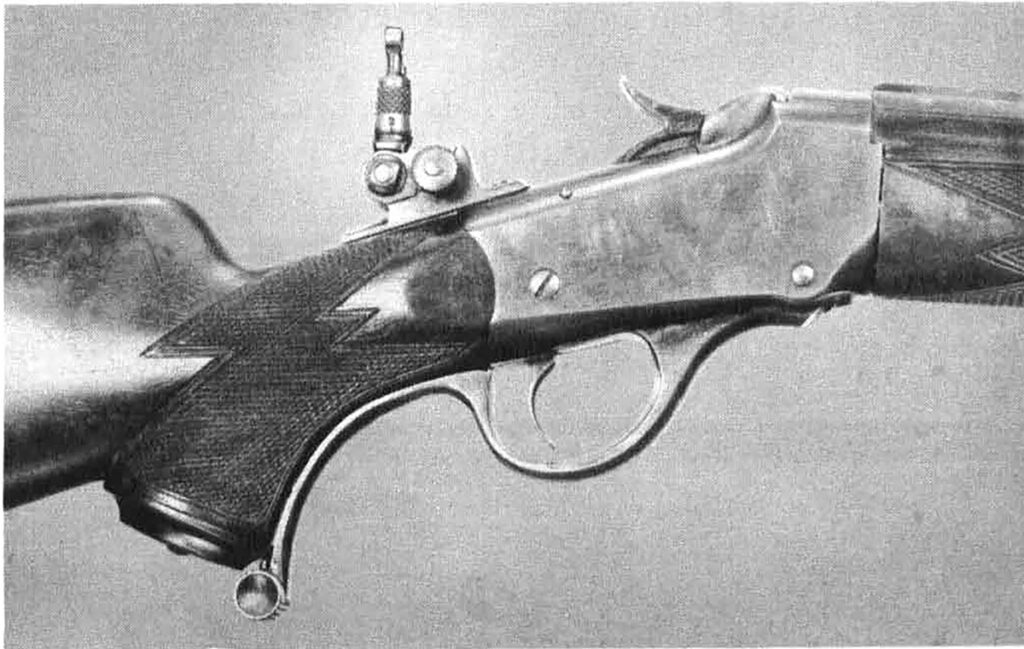
When I was just a little shaver, there was a Winchester single-shot rifle on exhibit in a gun store in my hometown. It was for the 40–82 cartridge, had a 30-inch, half-octagon No. 3 barrel, pistol grip stock of fancy walnut, checkered, Swiss buttplate, target sights, and was nicely engraved. It was my ideal of a fine rifle, and every day after school, while it remained on view, I tramped the 2 miles downtown to admire it. In some such manner are our tastes formed, and they are likely to remain with us always.
When I was 13, my father gave me my first rifle, a Remington rolling block for the .22 rimfire cartridge. Several months later I saw an advertisement of Lyman sights, and I fitted this rifle with a set. I think I have to thank these sights for my becoming a real rifleman, for with them on this little rifle, I soon became quite a good shot, much better than any of my boy friends, and my interest was maintained and matured, as I do not believe it would have been if I had retained the open rear sight on this rifle.
All through my boyhood years I had a lot of fun and sport with this little rifle, and I shot a lot of stuff with it—English sparrows, squirrels, chipmunks, grouse, and one woodchuck. In 1892, I was lucky enough to win a “Fourth of July” rifle match with it in the Adirondack Mountains, and that year I also shot my first buck with it.
When I was 18, I enlisted in the Pennsylvania National Guard and had no trouble in qualifying as Sharpshooter with the old 45–70 Springfield single-shot rifle, a very sterling, accurate, and reliable arm. The following year I was shooting on my company rifle team, and I also carried this rifle through the first few months of the Spanish-American War until I won my commission. Following that war I “discovered” the magazine Shooting and Fishing, and became much interested in the work of Reuben Harwood with 25-caliber rifles. So I purchased a Stevens No. 44 Ideal single-shot rifle for the 25-20 S.S. cartridge, but it did not seem to shoot nearly as accurately as I was sure I held and aimed it. I know now this was due to the blackpowder factory ammunition which in small calibers never was worth a hoot for accuracy. Anyhow, still following Harwood’s writings, I obtained a Winchester single-shot rifle (low sidewall) for the 25-20 cartridge, with 26-inch, No. 2 half-octagon barrel, pistol grip and shotgun butt, and I placed a gunsling on it. I had John Sidle bush and rechamber this rifle for the 25-21 Stevens cartridge, which was Harwood’s favorite. Sidle also fitted it with his 5-power Snap-Shot scope, which was unique in its day, as it had a much larger field of view than any other scope and was a fine hunting scope for varmints. With this outfit I got much better results but it never entirely satisfied me in accuracy until I had Harry Pope make me a mould for his 80-grain broad base-band bullet, and furnish me with one of his lubricating pumps. Then, with King’s Semi-Smokeless powder the rifle shot as well as I could hold it. I had a lot of fine varmint shooting with this rifle in the hills on either side of the Shenandoah Valley, and when I was ordered to California for station, it proved just the medicine for the Western ground squirrels. For Eastern shooters I will say that these are slightly larger than the gray squirrel, with a shorter and less bushy tail. They live in colonies like prairie dogs and are a great plague to farmers. I disposed of hundreds of them with this little 25-21 rifle. Then, one day, I expressed it to a gunsmith to have some work done on it, and it was lost in transit. I have ever since mourned it.
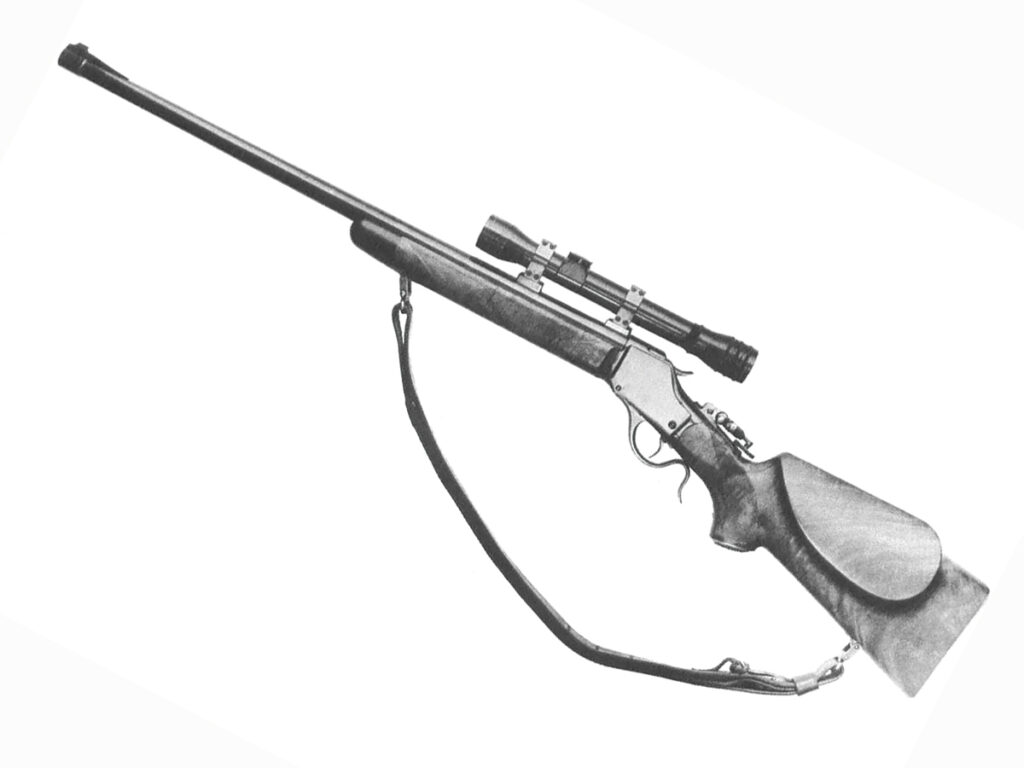
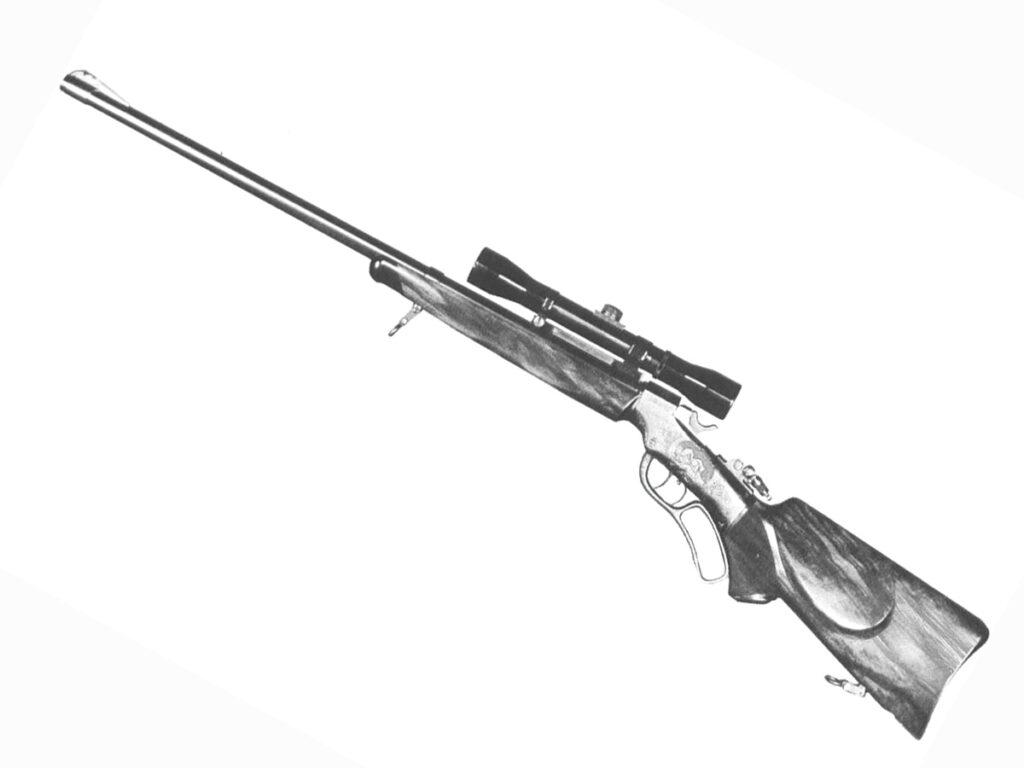
Winchester single-shot rifle for the 25-20 W.C.F. cartridge, with stainless steel barrel. Stock and lock work by Clyde Baker. The first attempt to solve the corrosion problem resulting from chlorate primers.
In the meantime one season I had a chance to go deer shooting in the North Woods and I got a Winchester single-shot rifle for the 38–55 cartridge and had it fitted with a Sidle scope. Sidle was by far our best scope maker in those days. This gun was poorly balanced and too heavy for a handy hunting rifle, but the scope did save me the embarrassment of shooting a cow in mistake for a deer. About this time I also had a Western hunt in view and I got a similar rifle for the 45–70 cartridge, fitted only with Lyman sights. But despite carefully handloaded ammunition it was not as accurate as the old 45–70 Springfield, and I soon disposed of both these rifles.
Then, in 1900, Horace Kephart published in Shooting and Fishing his celebrated article on the use of lead bullets in high-power rifles. He had used a Winchester single-shot rifle for the 30–40 Krag cartridge, and the accuracy he obtained with both jacketed and lead alloy bullets was better than anything I had been able to achieve to that date. So an order went in to Winchester for one of these rifles with a 30-inch Number 3 nickel-steel barrel with .308-inch groove diameter, pistol grip, shotgun butt, and sling. This rifle started a long series of experiments with various loads, methods of resting the rifle, effect of rests on accuracy and location of center of impact, temperature, cleaning, etc., the results of which I gave to riflemen from time to time in the magazine Arms and the Man. A little ignition difficulty was experienced, so I had Niedner fit a Mann-Niedner firing pin, .075 inch in diameter, round headed, with an .055-inch protrusion, and this trouble ceased. This is an absolutely necessary alteration with all our single-shot actions, which were designed in blackpowder days. By this time I had been shooting for several years on the Army Infantry Rifle Team, and I felt quite sure that my results were fairly free from errors of aim and hold. By this time I had also discovered the bench rest.
In 1906, I got a 2 months leave and went on a hunt in British Columbia, taking this 30–40 along as my only rifle. It performed there as well as on the range, and I got mule deer, sheep, and goat with it. One very cold day, in a foot of snow, I came on a band of sheep close to timberline. They evidently caught a glimpse of me for they banded together, and started off, but soon slowed down and resumed feeding. I thought I had spotted a ram in the band, and I monkeyed around them for an hour, by which time I was nearly frozen and had to quit. As I left them, it occurred to me to see if I could unload and load my rifle with my hands badly numbed with cold. I was utterly unable to do so in any reasonable time. To my mind this is the only disadvantage of a single-shot rifle as compared with a repeater. Certainly, the experience of our older sportsmen the world over with good single-shot rifles has been that they can be fired with all the necessary rapidity under normal conditions. However, I must add one other requirement—the single-shot rifle must extract its fired cases easily. Some don’t, due usually to poor chambering or excessive loads.
On a hunt a few days later I came on an enormous rock buttress with two peaks standing up like the ears of a great horned owl. The Chilcotin Indians call this rock “Salina,” which is their name for this owl. On a ledge on the face of the cliff was a big goat. I guess the range was about 500 yards, and I could see no way to get closer, so I lay down and took the shot, holding 2 feet above the goat’s back. Of course I missed that, and two other shots I pulled, and the goat leisurely climbed up and disappeared between the two pinnacles. After a lot of climbing and scrambling, I found my way to the back of this rock mass where it was equally precipitous, and while working around at the base of the cliff I heard something above me, and looking upward I saw the goat or one just like it. At the shot it loosened all holds and, in a shower of small rocks, landed close to me. Then and there I named this rifle “Salina.” I continued to use it as a testing piece for many years, and I also hunted a lot with it in Panama from 1915 to 1917. In 1911, I fitted it with a Winchester 5A scope, and thereafter all my dope was recorded in minutes of angle, from which it was easy to determine elevations, trajectory, and bullet drop.
“Salina,” 1901, after rejuvenation in 1951. Douglas barrel chambered by Culver for the 25 Culver-Krag cartridge. Stock by Humphrey. 4X Bear Cub scope.
About this time the NRA was developing interest in outdoor shooting with the smallbore rifle at 50, 100 and 200 yards. Before this scarcely anyone had shot the 22 at longer distances than 25 yards and little was known of the capabilities of the .22 Long Rifle cartridge at longer distances. So I got another Winchester single-shot for this cartridge, with 26-inch No. 3 barrel, set triggers, and sling. I fitted it with my 5A scope and proceeded to give it a good trial at all distances up to 200 yards. I soon found that various makes of ammunition have quite different results in accuracy. With the makes that proved best it would just about group in 2½ inches at 100 yards. This has proved to be about the best that can be expected of this rifle with this cartridge, and this limitation was what finally caused Winchester to develop their celebrated Model 52 rifle for smallbore match shooting. Generally speaking, the old Ballard is the only American single-shot action that has given fine accuracy with the .22 Long Rifle cartridge. However, with this Winchester, I did determine the angles of elevation for all distances, which had not been known or at least never published before I published my table. Also, before I did this shooting, it was not known that there was so much difference in the accuracy of various makes of cartridges in a certain individual rifle.
Following the loss of my old 25-21 rifle by the express company, I had to have another varmint rifle, so I procured still another Winchester single-shot for the 25-20 S. S. cartridge, and proceeded to develop smokeless powder loads for it. I finally found that the best was the 86-grain, soft-point, jacketed bullet with a charge of du Pont Schuetzen powder that filled the case to the base of the bullet. This load shot like nobody’s business, and it gave the finest accuracy up to 200 yards that I had obtained up to that time or heard of anyone else obtaining except with Pope muzzle-breechloading rifles. But my elation was short-lived, for the barrel began to pit, and in less than 500 rounds it was ruined.
About this time we had been devoting much study to the cleaning of rifles. It seemed to us that stronger ammonia was the only satisfactory cleaning solution, so I had a new barrel fitted to this rifle and cleaned it immediately after firing with this ammonia. This did not do a particle of good, and again the barrel was ruined in 500 rounds. The same thing occurred with a Winchester Model 92 rifle for the 25-20 W.C.F. smokeless cartridge of Winchester make. When I wrote them a letter of complaint, they stated that I should not blame the rifle for what was evidently the fault of the powder (which they used)! However, I excuse them for no one knew much about such things in those days. Of course we now know that the old potassium chlorate primer was the devil in the woodshed. With that primer, in small bores like .25 caliber the relatively small charge of powder did not dilute the primer fouling as it did in larger bores like the .30 caliber, and the primer got in its hellish work at once and fast.
For a while there seemed to be no solution for this problem of smokeless powder in small bores. Then, Winchester came out with stainless steel barrels made to order, so I had them build me still another rifle with this barrel, and modeled almost exactly like the fine old 25-21 that I had lost, only it was chambered for the 25-20 W.C.F. repeater cartridge, because I had an idea that the single-shot cartridge would soon be obsolete, which it was. Clyde Baker stocked this rifle, and fitted it with a finger lever that hugged the pistol grip. But before I had time to do much with it, the Kleanbore primer was developed, and this solved all our cleaning and rusting problems. Also at this time the development of the .22 Hornet cartridge shifted our work from the older cartridges to the modern high-intensity types. Later, however, I found that I could obtain splendid results with my 25-20 W.C.F. rifle with a load consisting of the 87-grain, soft point, spitzer bullet made for the 250–3000 Savage cartridge, bullet seated far enough out of the case to touch the lands, and a charge of 11 grains of du Pont No. 4227 powder. The trajectory seems to indicate that the velocity is about 2,000 fps.; evidently, a fine wild turkey load. Of course, the overall length of the load is too great for 25-20 repeater rifles.
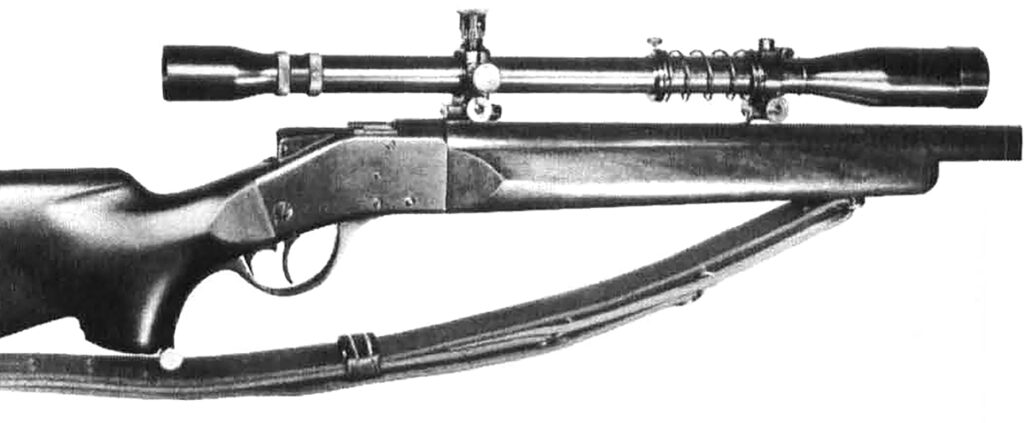
Rifle for the 22–3000 Lovell R2 cartridge, with Sharps-Borchardt action. Action and barrel work by Frank Hyde. Stock by William T. Humphrey. Unertl 10X Varmint scope.
Up to this time you will note that I had been using Winchester actions exclusively on all my single shots, both because of their strength and durability, and because they were the only new actions that could be procured at that time. After working for some years with the .22 Hornet cartridge in bolt-action rifles, a friend gave me a good Sharps-Borchardt action, so I had Frank Hyde obtain a 22-caliber Remington high-pressure steel barrel with a 15-inch twist, and fit it to this action and chamber it for the 22–3000 Lovell R2 cartridge. Frank also worked over the firing pin, and made the pin retract with the first down movement of the lever, two very necessary alterations with this action. This rifle, fitted with a 10X Unertl Varmint scope, is a fine, accurate varmint rifle. With good 50-grain bullets and 15.5 grains of 4227 powder it will group reliably, day after day, in about a minute of angle, which is the best that can be expected from this cartridge and a single-shot action.
Occasionally, a five-shot group as small as half an inch turns up at 100 yards, but such is a lucky group. This rifle, however, has one peculiarity. Almost invariably the first shot fired from a clean, cold bore strikes from half an inch to an inch above the succeeding group at 100 yards. I think this is because the groove diameter of the barrel is 0.2235 inch, while all the bullets I have used so far have measured .224. This is no drawback because, knowing it I can allow for it, or can fire a fouling shot before starting on the day’s hunt.
It has quite generally been proven that with equal barrels and loads, a single-shot action will not give as fine accuracy as a modern bolt action. There are apparently only two exceptions, the Ballard action for the .22 Long Rifle cartridge, and the Hauck single-shot action, which is a horse of a different color with its better bedding, ignition, and breeching up. I do not mean to imply that there have not been any single-shot rifles that would give gilt-edge accuracy. There have been quite a few, but I would think that any custom riflemaker who guaranteed to produce a single-shot rifle that would average groups under a minute would soon go broke. So far as we have been able to determine, the difficulties with the single-shot action seem to be in the two-piece stock, the breeching up and the ignition. The single-shot rifle also seems to have a greater jump and barrel vibration than the bolt action. The difference in elevation required between full charges and reduced loads is much greater with it. In this connection it has long been my experience that to get the best accuracy from a single-shot rifle the forearm should not touch the receiver. It should be possible to pass a thin sheet of paper between the two.
The most accurate single-shot rifle that I have owned is one for the 219 Improved Zipper cartridge. I traded Bill Humphrey out of a fine Winchester rifle with 26-inch, No. 3 Diller barrel, .224-inch groove diameter and 16-inch twist, double set triggers, and a fine stock made by him. I had this chambered for the Improved Zipper cartridge with a very perfect reamer made by Red Elliott. This cartridge is simply the 219 Winchester Zipper case fireformed to a 30-degree shoulder angle. You simply fire the factory cartridge in the rifle and it comes out improved. The best load I have found for this rifle has been 32 grains of du Pont No. 3031 powder with the 50-grain Sierra bullet. M.V. is probably around 3,900 fps. After working up this load and sighting in, it gave three five-shot groups at 100 yards measuring .65, .80 and .80 inch. For 3 years, I have used this rifle almost exclusively for all my chuck shooting. Its accuracy and very flat trajectory have given a high percentage of hits at long ranges. With it I made the longest first-shot hit I have ever pulled off on a chuck; difficult to pace because it was up and down hill over rough ground, but it was certainly considerably in excess of 300 yards.
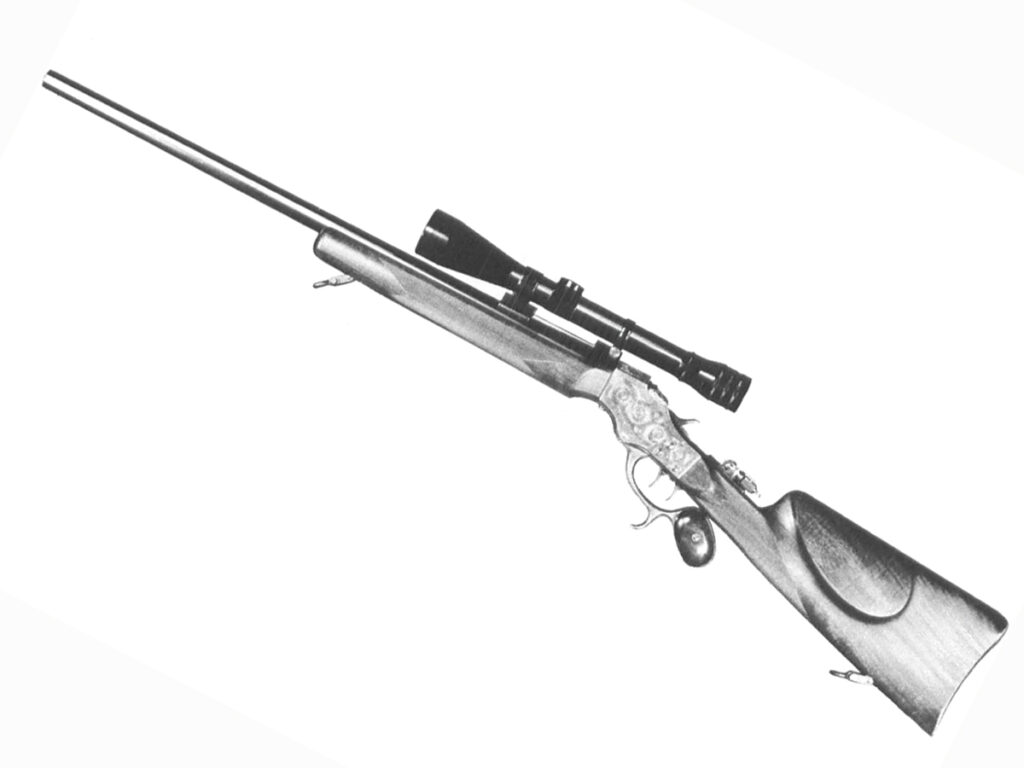
Rifle for the 22–3000 tovell R2 cartridge, with Stevens No. 44½ action, owned by James P. Garland. Diller barrel, stock by Humphrey, 6X Bear Cub scope. This rifle has accounted for hundreds of woodchucks and hawks.
The Stevens No. 44½ action is another on which a most excellent and accurate rifle can be built, particularly for cartridges not to exceed the 219 Donaldson in power. My old friend Jim Garland, who has been my companion on many chuck hunts over the past fifteen years, has a glorious piece built on this action. The Diller barrel was chambered and fitted for the R2 Lovell cartridge, and the lock work done by C. C. Johnson. Bill Humphrey made the stock and the scope is a superb 6X Bear Cub Double. With each lot of cartridges that Jim loads for it, usually with 15.5 grains of 4227 powder, he tests it on the bench, and it has never failed to average under an inch, and with some lots of bullets it gives around ¾ inch. He regards it as his best varmint rifle, and its bag numbers in excess of 300 chucks and hawks. I remember one afternoon 2 years ago when we were separated by a range of hills. Every 2 or 3 minutes I would hear Jim shoot, and toward sundown I wandered over to see what in thunder he had been shooting at. He had a stand on a hill above a creek bottom that was honeycombed with holes, and toward dusk the chucks began to come out. When we went down, we picked up 36 of them shot at distances from 150 to 250 yards. Both Jim and I are rather of the opinion that a first-rate riflemaker will turn out a larger proportion of gilt-edge shooting rifles when he uses the Stevens 44½ action than with any other.
Jim also has a superb engraved Ballard for the 25 Rimfire cartridge, the work of Niedner, Shelhammer and Kornbrath. With Remington or Peters cartridges, it groups the first 10 shots at 50 yards in about ¾ inch, and the second 10 when it is warmed up a little, in about half an inch, and is his favorite squirrel rifle.
Squirrel rifle for the .25 Rimfire cartridge. Ballard action, gunsmithing by Niedner, Shelhammer, and Kornbrath. Lyman Challenger scope. Owned by James P. Garland.
My latest venture in the realm of single shots has been one of the most interesting. Three years ago I took Salina, my old 30–40 Winchester Single Shot, out of the box where it had been in store for several years, well covered in and out with Rig [Editor’s note: Rig is wonderfully effective gun grease, which I have used since childhood], with the intention of trying some new bullets in it. To my consternation, when I put a patch through the bore it came out with red rust and many bodies of big, black ants. Ants had nested in the bore and their acid had ruined it. One day last year, looking at the old piece that had served me so well for half a century, I decided it was entitled to have something done to rejuvenate it. I had on hand a fine 25-caliber Douglas barrel, .257-inch groove diameter and 13-inch twist. So I had H. L. Culver, my metal gunsmith, fit this barrel to the action, and I asked him to chamber it for the Krag case necked down to .25 caliber with a 30-degree shoulder angle. As it turned out, this case is very similar in shape and capacity to the 25 Donaldson Ace. We called it the 25 Culver-Krag. Then, Bill Humphrey made a beautiful new stock and forearm to my exact dimensions, and Mark Stith fitted one of his 4X Bear Cub Double scopes, and I had just about the finest appearing, best balanced and fitting, and steadiest holding rifle I have ever had in my hands. The intention had been to produce an all-around hunting rifle rather than one for varmint or target shooting, and it has turned out to be just that. I have only worked up one load for it so far—the 100-grain Sierra soft point spitzer bullet and 40 grains of 4350 powder. After sighting in I fired five, five-shot groups with it at 100 yards, measuring 1.75, 1.12, .88, 1.85 and 1.98 inches. Before you criticize these groups, consider that they were fired with a rather light-barreled single-shot rifle aimed with a low-power scope having a flat top post reticle, and that the charge was quite a powerful one. It is much more difficult to get a fine grouping with a heavy load than with a light one. Last summer and fall I carried Salina in her new garb for probably a total of 350 miles afoot in my wanderings over the mountains adjacent to my summer home, occasionally gathering in a chuck, crow, hawk or porcupine, and always hoping for a bear or bobcat which never materialized. I have never carried a rifle that seemed as friendly.
All this pernicious activity with single-shot rifles, covering a period of 60 years, started with that rifle in the gun store window when I was a little boy, and that is the way with most of our preference for single shots. It is not their superiority that causes us to select and work with them, but rather some romantic or historic association. An urge to acquire and experiment, not always wise, but usually one that gives deep satisfaction. It seems to many of us that the highly efficient bolt action is but a remodeled musket in a way, that the lever action is a product of America’s unrivaled quantity-production industry, but that the single shot constructed on fine and beautiful lines by a master riflemaker is a gentleman’s piece.
Editor’s note: This article appeared in the 1953 7th Edition of Gun Digest, and, keenly aware that we tread on sacred ground, we have only lightly edited it.
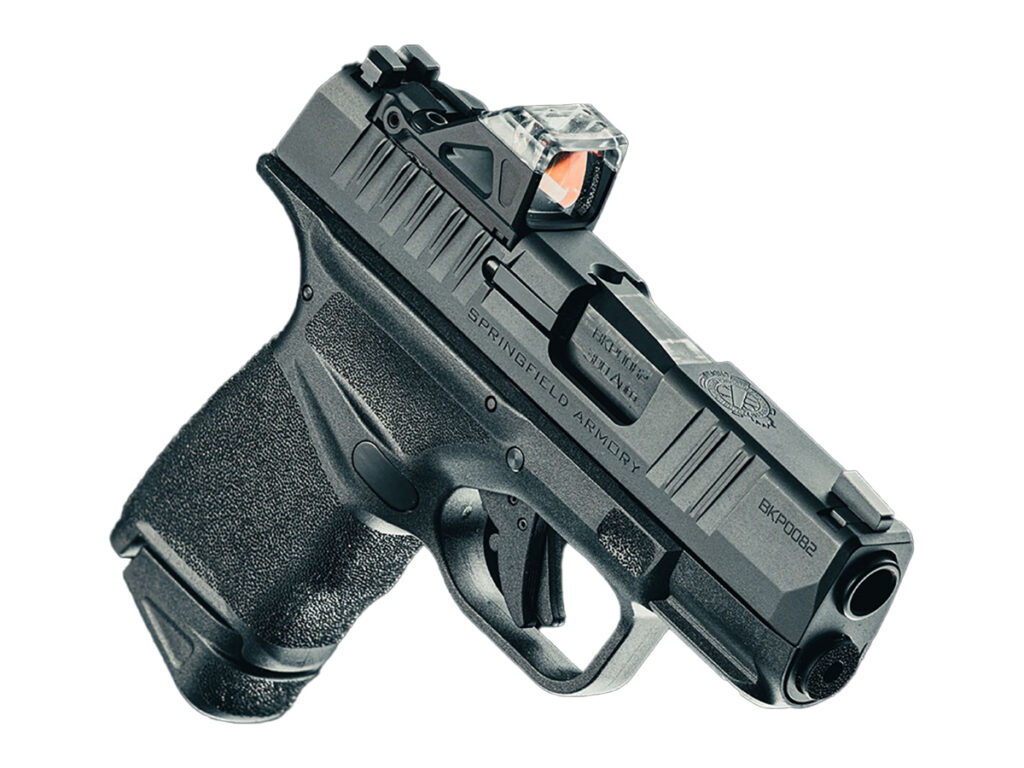
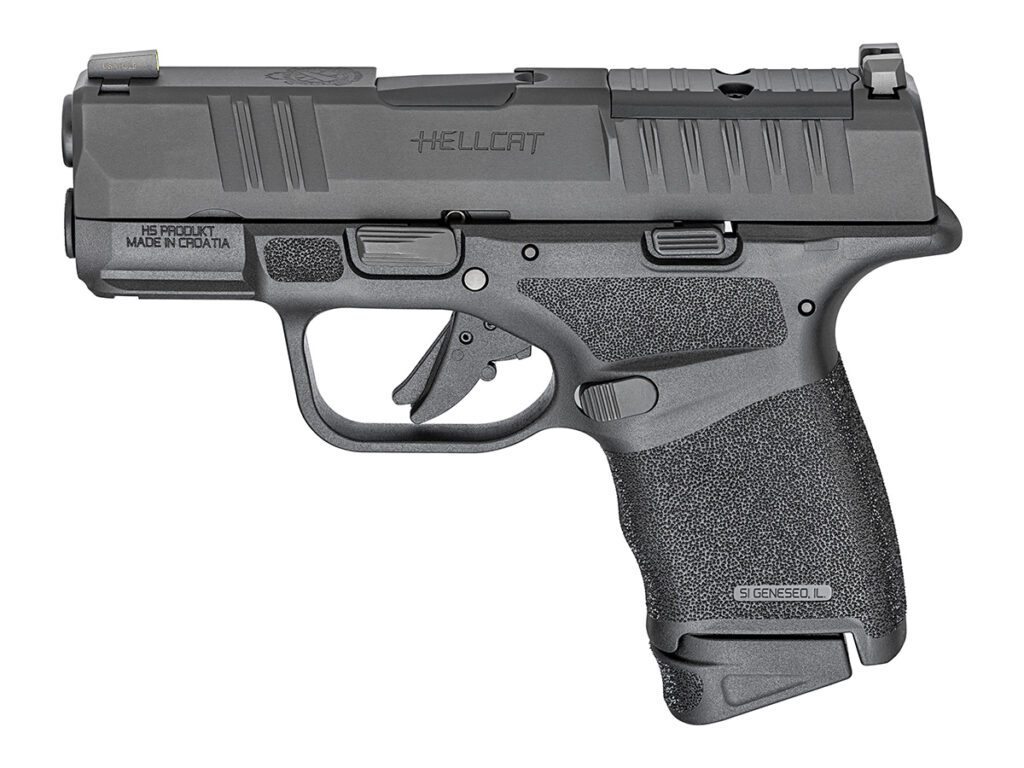
Springfield Armory has just launched a new optics-ready Hellcat variant in .380 ACP.
The original Springfield Armory Hellcat quickly became one of the most popular micro-compact concealed carry pistols after it was first released, but there are plenty of individuals out there who simply can’t handle the recoil of 9mm in a handgun that small. In response, Springfield has just launched the Hellcat OSP .380.
The .380 Hellcat was designed to offer the same features and concealable size as the 9mm version, but in a more shootable, easier-to-control package. Like its bigger brother, the .380 ACP Hellcat has a 3-inch barrel, a slide cut for direct-mount Shield RMSc/SMSc-pattern optics and a capacity of 11+1 rounds with a flush-fit mag and 13+1 rounds with an extended mag. One of each magazine type is included and it ships with a soft pistol case as well. As for irons, the new Hellcat comes standard with a tritium front sight and Tactical Rack U-Notch rear sight.
Steve Kramer, Vice President of Marketing for Springfield Armory, said this about the new pistol:
The 9mm Hellcat quickly established itself as the standard when it came to impressive micro-sized 9mm pistol performance and capability … With the addition of this new Hellcat to the family, shooters have an optics-ready .380 featuring class-leading capacity that is ideal for their EDC needs.
The Springfield Armory Hellcat OSP .380 has an MSRP of $653 and it’s available now.
I hit the range to test out Lipsey’s exclusive S&W Model 686 Plus Mountain Gun.
Revolvers do not get a lot of interest these days. We could argue the reasons for this, but I think it’s apparent that modern shooters are more interested in compact 9mm handguns, which are lighter, easier to shoot and hold more ammunition.
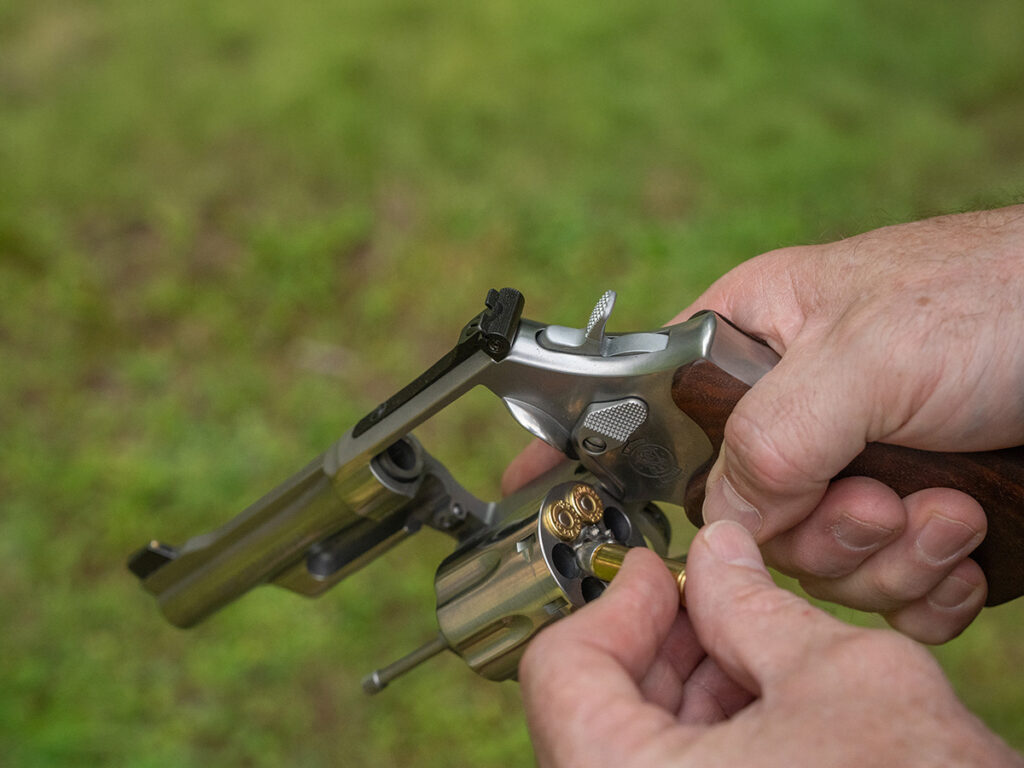
But this world has not changed that much, and a good revolver is just as viable of a tool as it was back during Prohibition when my grandfather was packing a Smith & Wesson Model 10. A new revolver that caught my eye is the S&W Model 686 Plus Mountain Gun from Lipsey’s.
Smith & Wesson Model 686 Plus Mountain Gun Specs:
Manufacturer: Smith & Wesson Model: Model 686 Plus Mountain Gun Frame: Medium ; L-Frame Caliber: .357 Magnum Weight Unloaded: 35 Ounces Capacity: 7 Overall Height: 5.68 Inches Barrel Length: 4.13 Inches Overall Length: 9.75 Inches MSRP: $1,200
Pros
Perfectly reliable
Good accuracy
7-shot capacity
Nice single-action trigger
Cons
Double-action pull had some drag at the end
Expensive
Called to Duty
When I became a police officer in 1992, I was issued a Smith & Wesson Model 686 with a 4-inch barrel. Oddly, everyone else in my department was armed with a Glock Model 22, because the department had just transitioned from the 686 to the Glock. The problem was they did not have enough Glocks to go around.
So, I got the revolver and, in fact, it was the handgun I used when I was attending the West Virginia State Police Academy. I was the only officer in my Academy class using a revolver, but it didn’t hinder me. On qualification day I had the top score, so as you might imagine, I have a bit of an attachment to the 686 and ended up carrying it on duty for almost a year.
The Smith & Wesson Model 686 was one of the most popular of all the service revolvers used by police agencies across America. It had a stellar reputation for reliability and accuracy, and over the years it has saved the lives of a lot of lawmen. It has also been reasonably popular with those looking for a powerful self-defense revolver or hunting or trail gun.
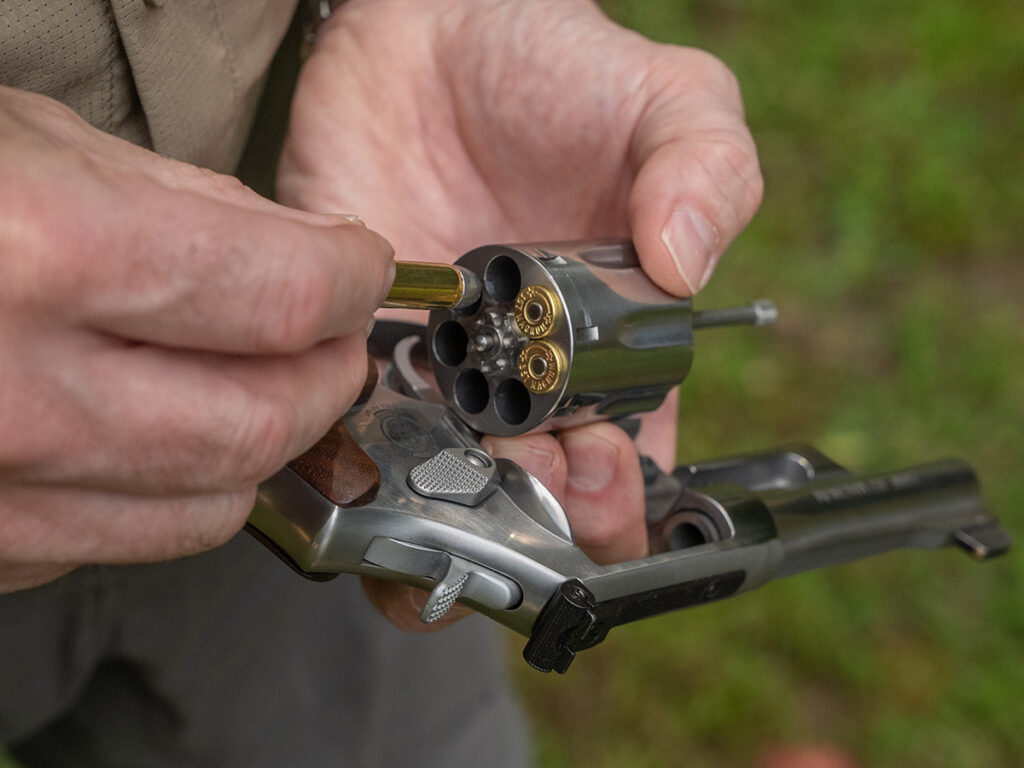
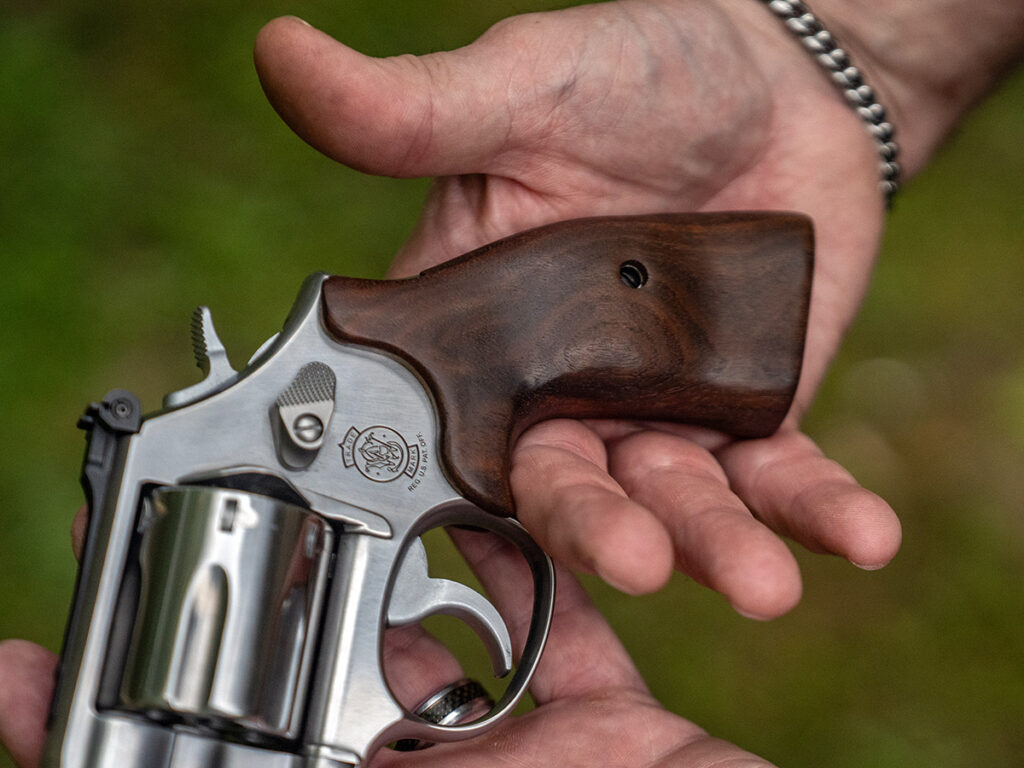
The main difference between the 4-inch 686’s carried by so many police officers and the new 686 Plus Mountain Gun from Lipsey’s is that the Mountain gun does not have a full underlug on the barrel. It has a smooth set of TGW Bear Hug Walnut Grips, a seven-shot capacity, and the front sight has a gold bead instead of the common red insert, ramped sight.
The 686 Plus Mountain Gun from Lipsey’s holds seven, as opposed to six, rounds of .38 Special or .357 Magnum ammo.
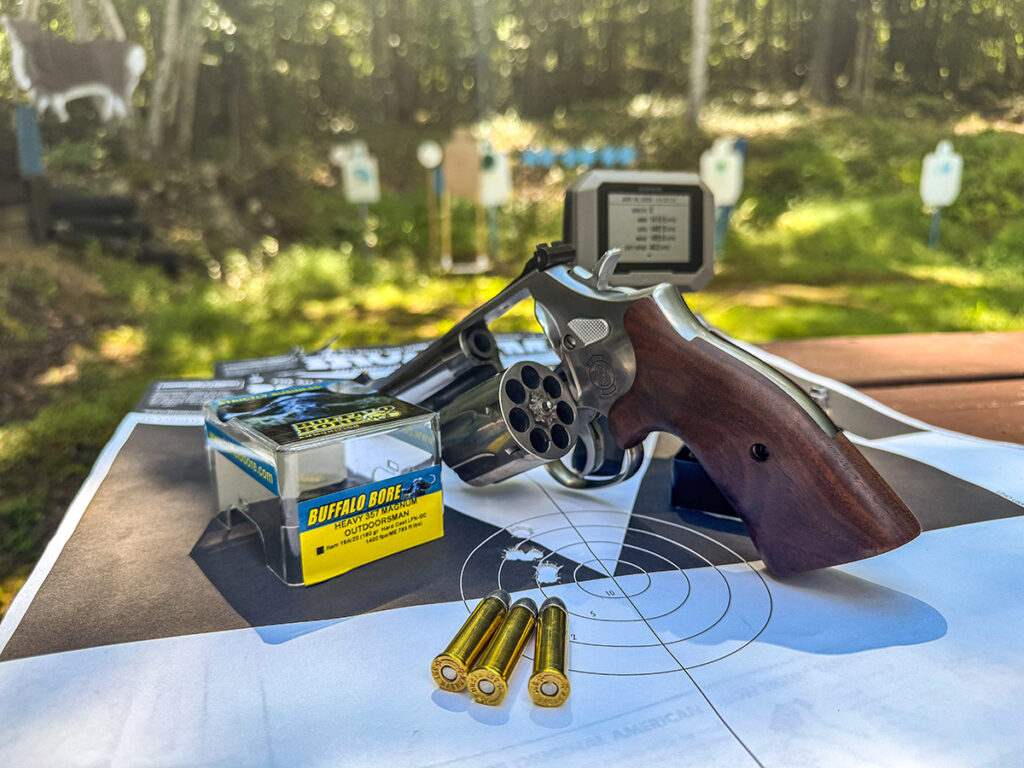
I’ve spent a good bit of time with the 686 Plus Mountain Gun, enough to know it offers the same reliability and precision the 686 is famous for. I tested two .38 Special, and two .357 Magnum loads out of this revolver, and the average precision for a bunch of five-shot groups at 10 yards from a sandbag rest was right at an inch.
Shooting Results
LOAD
VEL (fps)
SD (fps)
ENG (ft-lb)
PRECISION (inches)
Barnes 357 Magnum 125-grain TAC-XPD
1,378.7
25.1
527.7
0.75
Buffalo Bore (Heavy) .38 Special 125-grain Barnes
1,216.7
16.0
410.9
0.83
Federal 130-grain Hydra-Shock Deep
869.3
14.2
218.1
1.39
Buffalo Bore (Heavy) 357 Magnum Outdoorsman
1,442.8
14.4
832.0
1.25
AVERAGE: 1.05
There were no functional issues of any kind, and the single-action trigger pull was quite impressively crisp at only 4 pounds. The double-action pull was surprisingly light at about 8 pounds, but it did have a little drag right at the end. A talented revolver smith should be able to easily smooth this action to perfection.
Many will consider a 4-inch L-frame revolver a bit heavy for concealed carry, but the 686-Plus Mountain Gun only weighs 35 ounces, unloaded. That’s less than a full-size, steel-framed 1911. However, even though it might be lighter than a 1911, it is bulkier and a bit more difficult to conceal. As for a gun you might want to use for big game hunting, you might find the distance between the front and rear sight a bit short for making accurate shots at longer ranges, but I had no problem routinely hitting an 8-inch plate offhand at 25 yards.
If you like powerful revolvers, the 830 ft-lb of kinetic energy the 686 Plus can deliver with the Buffalo Bore Outdoorsman load will get your attention—and the attention of anything it hits.
Where the 686 Mountain Gun shines the brightest is in the role of a trail gun that might need to be used for defense against four- or two-leg predators. The extra round—seven as opposed to six—is nice, and with a load like the .357 Magnum 180-grain Buffalo Bore Outdoorsman, this revolver—if you can stand the wrist-wrenching recoil—can stop any critter in North America.
Same But Different
Lipsey’s also offers a six-shot, .44 Magnum and 10mm Auto version of the Mountain Gun. Unlike the Model 686, the Model 629 in .44 Magnum and the Model 610 in 10mm Auto are built on the larger N-frame as opposed to the L-frame used by the Model 686.
Interestingly, Lipsey’s also offers a Model 617 version of the Mountain Gun chambered for the .22 Long Rifle. It’s built on the smaller K-frame, has a 10-shot capacity, and looks just like the other three. In fact, all four of these revolvers are all stainless-steel, have 4-inch barrels and are outfitted with the smooth walnut Bear Hug grips and gold bead front sight. They all also have a retail price of $1,199.
The smooth Bear Hug grips on the S&W Model 686 Plus Mountain Gun from Lipsey’s were very comfortable.
If I was looking for a trail/mountain gun for predator defense or for occasional hunting, I’d go with the 686 Plus version in .357 Magnum. It’s 4 and 5 ounces lighter—respectively—than the .44 Mangum or 10mm Auto versions, and it holds one extra round. It can also shoot the much lighter recoiling .38 Special cartridge, and between the .38 Special and .357 Magnum there is a lot of ammo to choose from.
I’d also consider the Model 617 from Lipsey’s because it would make a great sub-caliber trainer companion to the 686 Plus Mountain Gun.
S&W Model 686 Plus Mountain Gun Deals
Midway USA
$1,300
Guns.com
$1,238
Range Notes: V-Type Targets
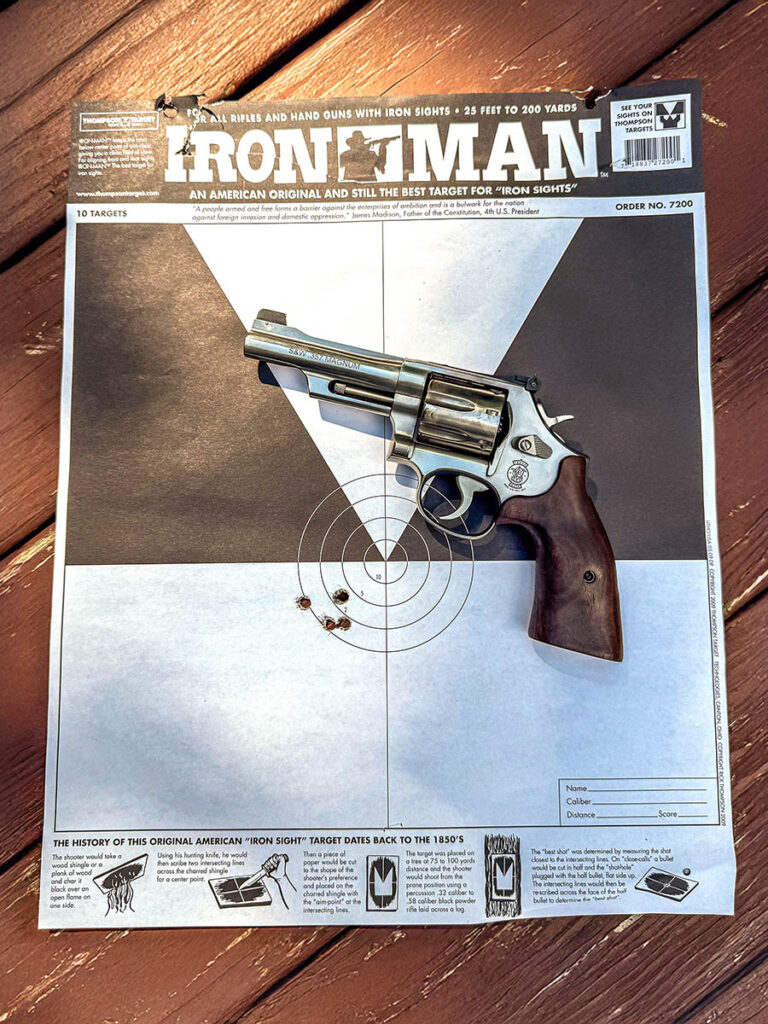
I’ve been conducting accuracy testing with rifles and handguns for a long time, long enough to learn the target—especially when shooting with open sights—matters. Standard bull’s-eye targets are not the best option because trying to hold center is too imprecise without an optic. The big, black and white V on the Thompson Target Iron Man target provides a perfect sight picture and allows for very precise sight alignment with conventional open sights.
A V-type target like this Iron Man target from Thompson Targets can help you shoot better groups with an open-sighted handgun.
Unfortunately, it’s no longer available, but the red and white Dead Center target is. Thompson Targets offers two versions of the Dead Center. The 19×25-inch version with a 1-inch grid is best for longer ranges ($6.99 for five, #R-4700-5), or the 9×12-inch grid-less version is great for about 15 yards and in ($4.99 for 12, #R-4501-12). Alternatively, you can make your own V-type targets, and I bet if you use them, you’ll shoot better with your open sights.
Editor’s Note: This article originally appeared in the November 2025 issue of Gun Digest the Magazine.
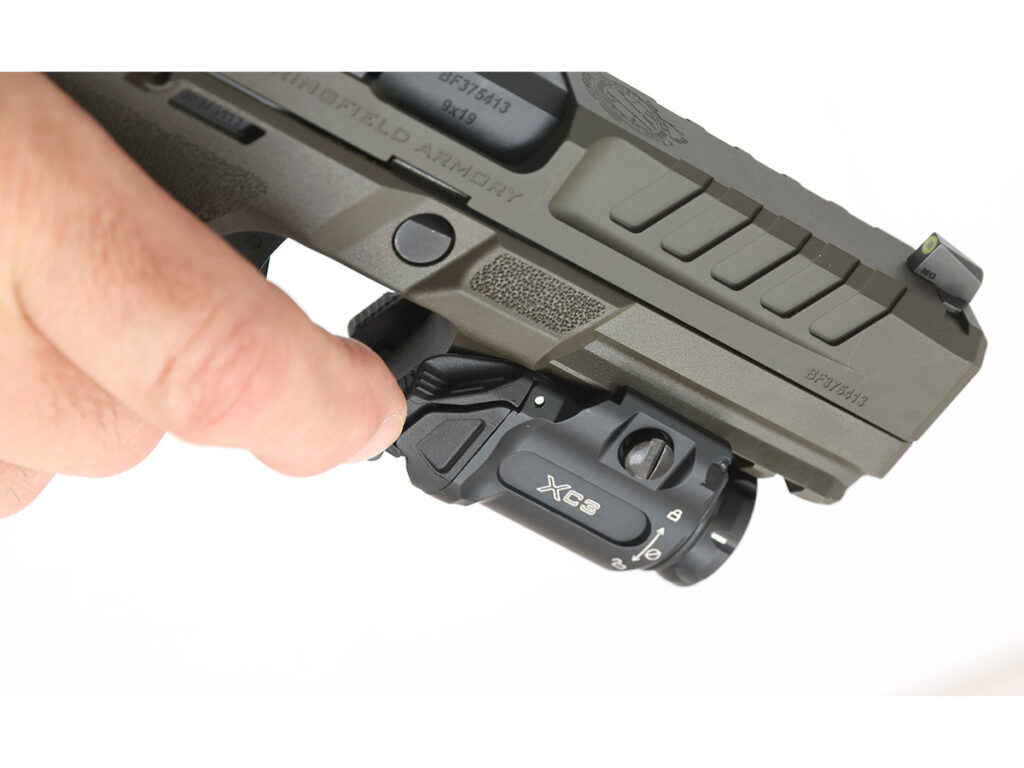
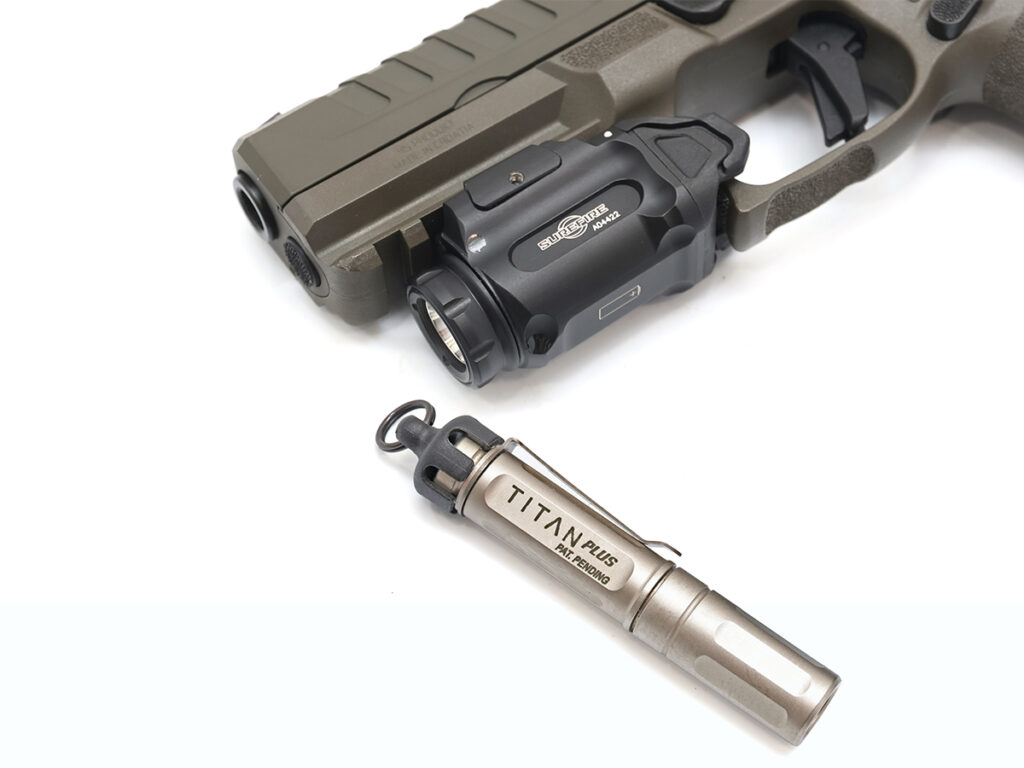
You need light, and the SureFire XC3 marks the spot.
It’s in the nature of how our eyes work that you need light. While some of us can see better in “the dark” than others, even then there is some light.
So, more light is better.
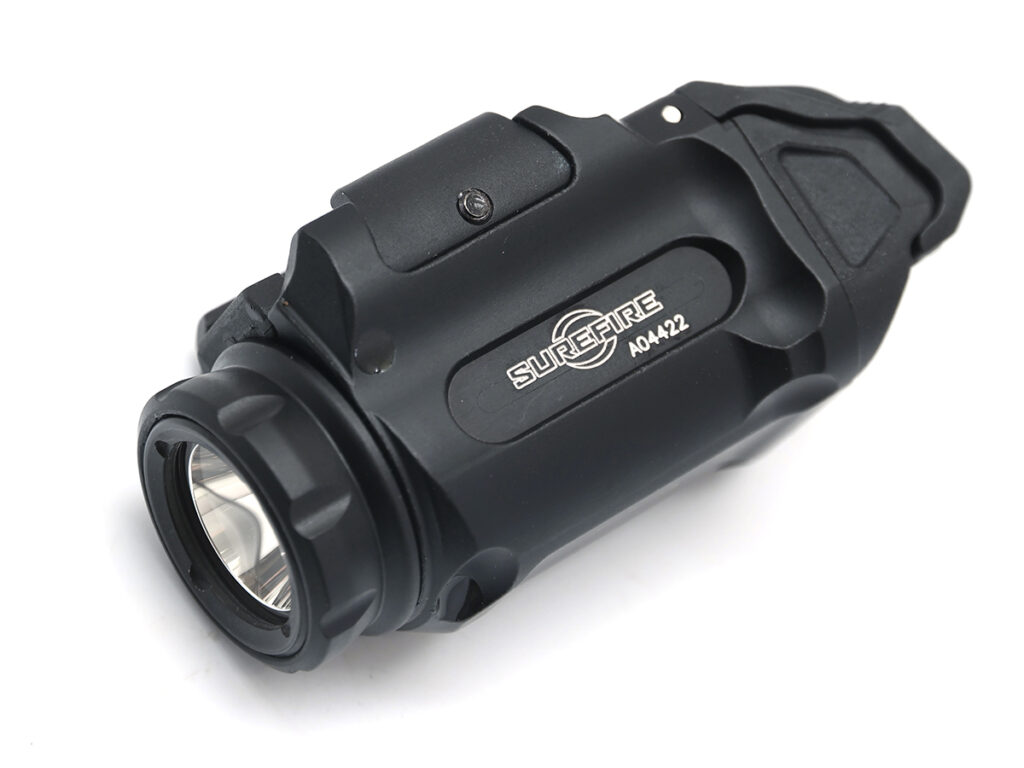
But some lights are better than others, and the SureFire XC3 is one such light.
Starting out, it offers 550 lumens for a runtime of 1.75 hours. It has a center beam of 7,500 candelas. Lumens is total output. Candelas is how much the center actually puts on target. You get a bright center, but with enough “spill” that you can see outside the center, which is useful.
The body is made of aluminum and given the expected SureFire Type III hard anodizing. SureFire makes lights and other products not to meet some idea of a warranty, but to keep working even after you haven’t. Not to be gloomy, but a SureFire light will still work after experiencing conditions you can’t survive, so it won’t let you down.
The SureFire XC3 is compact, sure, but it’s loaded with superb details.
It can be mounted to almost any rail, be it a universal or Picatinny, with the included adapter lug. It’s compact, lightweight and easy to use. At 2.65 ounces, you won’t notice its weight. Oh, you’ll have to get a holster to accommodate it, but that’s the new normal.
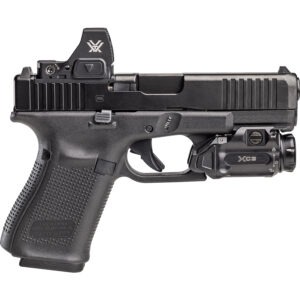
It’s small enough to fit underneath the slide/frame of most pistols, not protruding past the muzzle. This protects it from impacts and from some of the muzzle blast and powder residue.
It has an ambidextrous toggle as well, so you can control it with either hand or thumb. So far, I’ve described a bunch of weapon-mounted lights, so what makes the SureFire XC3 such a big thing?
The power and battery swapping.
The XC3 runs on a single CR123 battery. Yep, 550 lumens, 1.75 hours runtime—on a single battery. And the best part? You can change batteries without taking the light off the frame.
The front cap, which is the LED light and reflector, comes off to remove the battery forward out of the housing. (Do this after you have unloaded and shown clear, please.)
No more fussing with screwdrivers and removing the light to swap out the tired or dead batteries. Now you can do it in a minute with no tools … and just the one battery.
Unfortunately, this coolness does not come cheap.
SureFire’s usual customer base goes to dangerous places and puts paid to the careers of dangerous people. They build the gear to stand up to the rigors of that work. If your job starts with a HALO jump, followed by room-clearing, lots of ammo and more than a few explosions, you do not want your pistol light to be DOA when you need it. (After all, if you need a pistol a lot of things have already gone wrong.)
The price? A listed $299, which means you can probably walk out the door, tax included for less than three Benjamins. At that, it’s likely to be half the price of the pistol you are mounting it on.
But until the battery dies, it won’t fail you. And when the battery dies, it’s a minutes or less to change that—no tools needed.
SureFire … gotta love it.
Editor’s Note: This article originally appeared in the November 2025 issue of Gun Digest the Magazine.
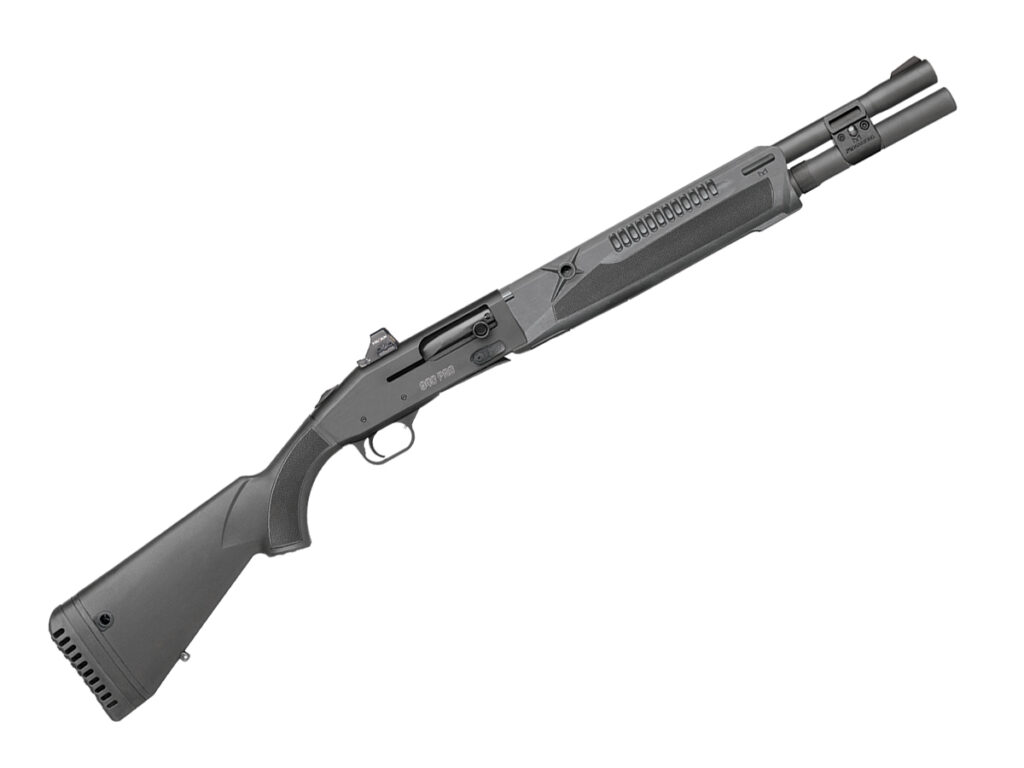
Mossberg engineered a near perfect tactical semi-auto scatter gun with the 940 Pro Tactical SPX.
From never-fail striker-fired pistols to potent AR platforms, suppressible and manageable at the shoulder, home defense options are legion. Even with these choices, the 12-gauge shotgun still has a certain daunting mystique when manning the ramparts of your property line and addressing bumps in the night.
Nothing quite says, “Get off my lawn!” more convincingly. And few companies have perfected the defensive scattergun like Mossberg.
Like a dark and avenging spirit, the company’s 500 and 590 series pump guns strike fear into the black hearts of the felonious. However, there’s a fair case to be made that Mossberg’s newest semi-auto smoothbore has the chops to hold its own versus the company’s legends. Smooth shooting, easy to manipulate and fast as AC down copper wire, the newly minted 940 Pro Tactical SPX is built for defense.
Requires a short break-in period before it’s perfectly reliable
Not budget-priced
Birth of the 940
If you’re not familiar with the Mossberg 940 line of shotguns, it’s essentially a redemption story. The company’s preceding gas-operated shotgun—the 930—had all the trappings of greatness. However, it proved to require plenty of attention in the maintenance department, lest it throw in the towel and quit due to a malfunction. Bad news in field models, catastrophic in tactical variations.
The 940 action set out to remedy this issue by re-engineering several key components, with rock-solid reliability the target. As far as the ones I’ve shot since its release in 2020, Mossberg has scored a bull’s eye. The gas-gun runs like rain down a gutter and eats practically anything it’s fed.
Much of this success, not to mention dependability, of the gun has been its piston. Placed on the outside of the tubular magazine, venting gas forward and out of the way of moving parts, it runs much cleaner. Furthermore, a separate spring-loaded valve in the gas block only allows through enough gas as needed to cycle the bolt, again keeping fouling to a minimum.
Does it really cycle through upward of 1,500 shells between cleanings, per Mossberg’s marketing hype? I haven’t reached that mark personally on a single gun. But the Pro Tactical SPX and the field-grade 940 Pros I’ve shot haven’t hiccuped once through hundreds of shells.
It’s worth slipping, the piston system also makes the 940 damned versatile. From No. 8 bird to 300-grain slugs, the 940 chew through them without a hitch. This is no small feat, given that the pressure curves between those loads are worlds away from each other.
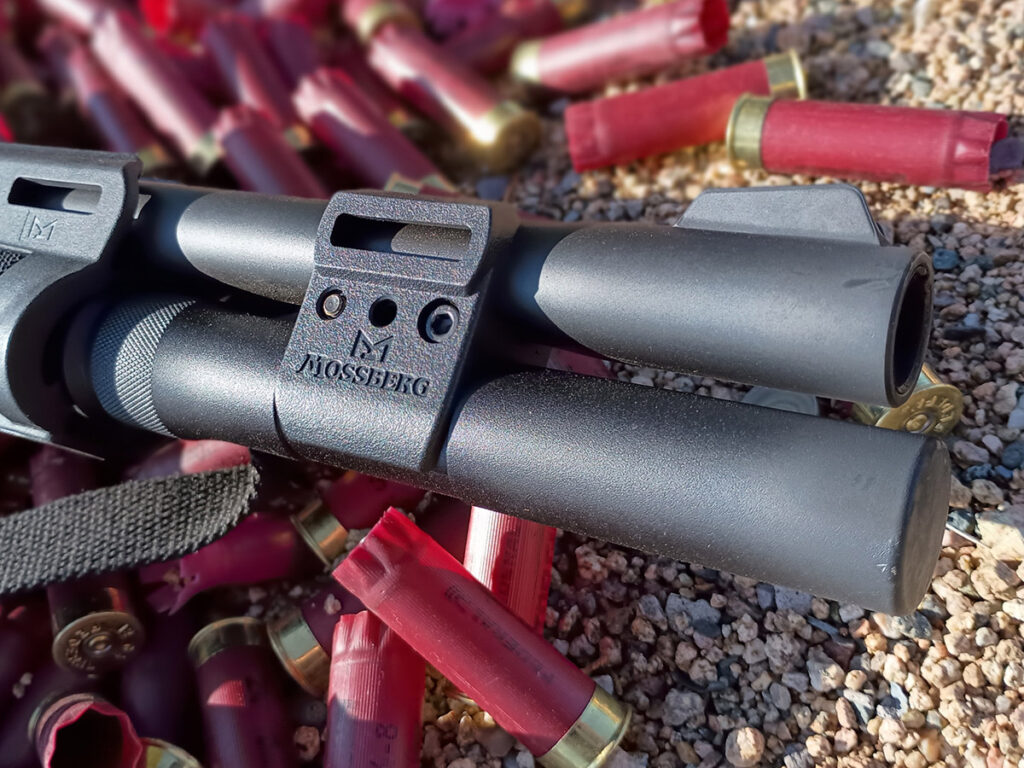
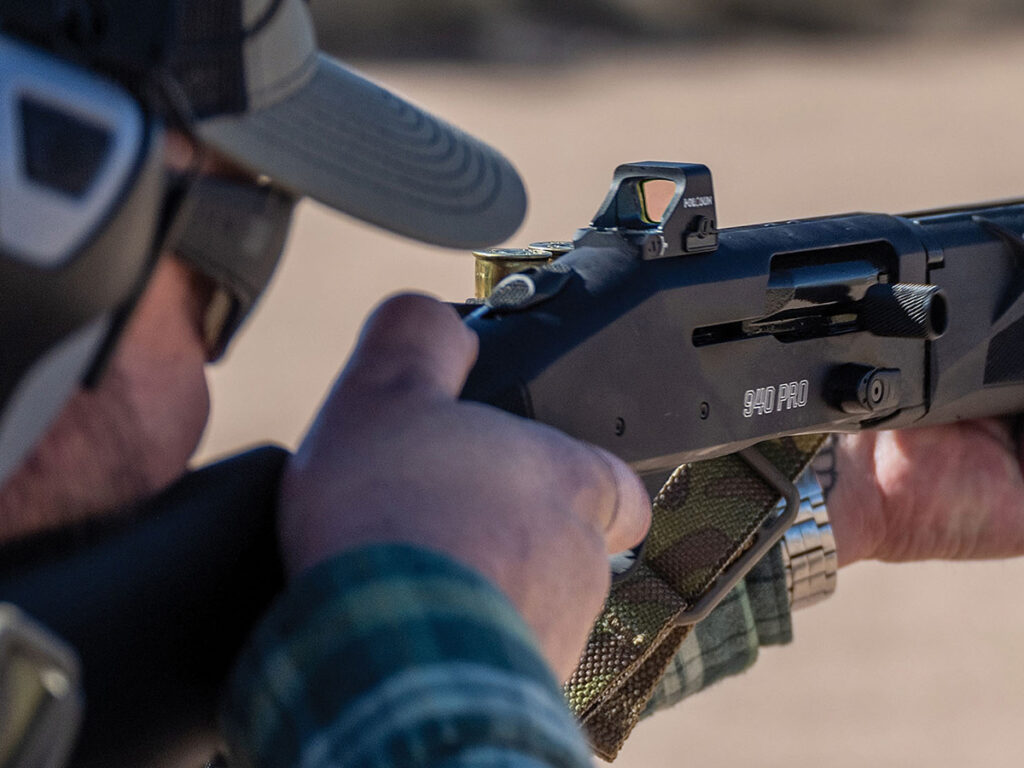
In addition to QD points, the SPX also has a length of M-Lok on its barrel separator—a must-have feature to attach a light or other accessory.
The Pro Tactical SPX gives the action plenty to munch on, as the 18.5-inch barreled shotgun has an impressive payload. Chambering 3-inch and 2 3/4-inch shells, the gun has a 6+1 and 7+1 capacity, respectively, thanks to an elongated tubular magazine. If that isn’t enough, Mossberg levels it up by including a Vang Comp 6-Shotshell Carrier Card standard, giving you a lucky 13 rounds loaded and at hand if you’re running 3-inch ammo.
Eye of the Beholder
Tactical in many circumstances simply means the gun is dressed in black and brings little practical to the table. Not the Pro Tactical SPX. Mossberg has incorporated several useful design points into the 12-gauge, making it excel at its intended defensive purpose. None more significant than its optics cut.
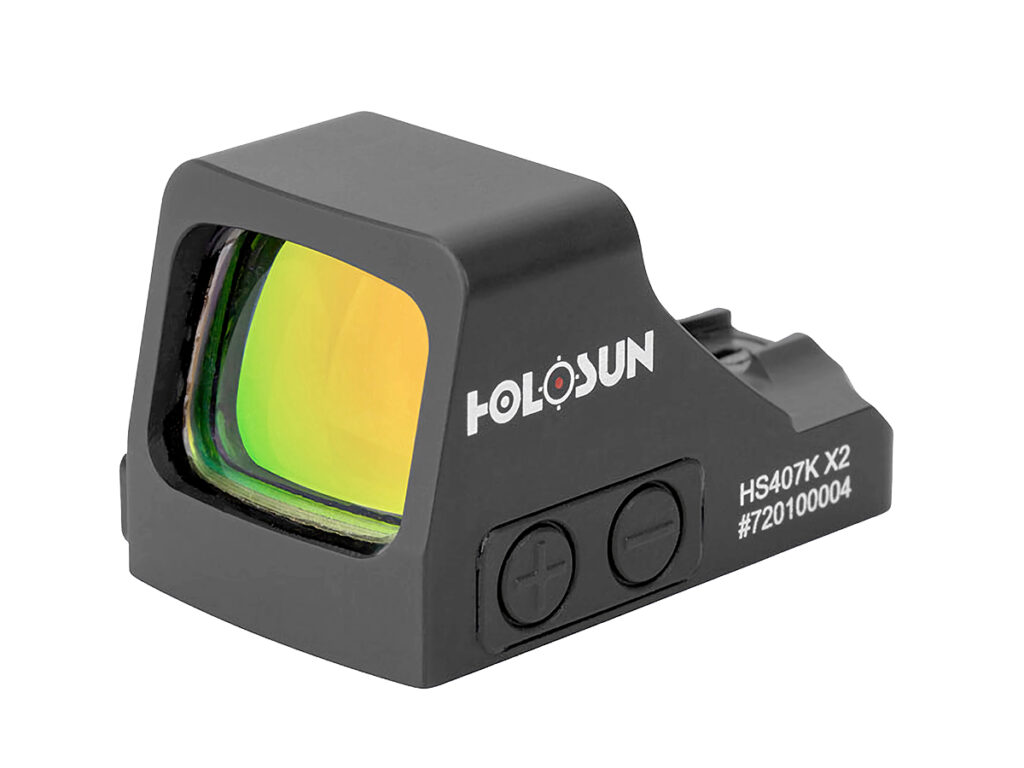
The model I ran was the fully stock version available with all the bells and whistles, which included a Holosun HS407K micro red dot. If you’re interested in defensive shotguns, chances are you have a streak of late adopter in you, particularly with battery-operated optics. You need to get over this because a red dot takes a defensive shotgun to an entirely different level of effectiveness.
Taking the SPX up a notch is the Holosun HS407K, which makes target acquisition much faster and accurate. Incidentally, the shotgun has an optics cut, making adding a red dot simple and painless.
While small, the HS407K is ideal on the SPX. Unlike on a pistol, the optic is close to the eye, thus the dot is fast and easy to acquire when shouldering the shotgun. And what it will do for your target acquisition will spin your head. Why wouldn’t you want an unfair advantage like that?
Don’t cotton to Holosun? Never fear, the Pro Tactical SPX is compatible with RMSc footprints, and it can adapt to nearly any optic thanks to its adapter plate system.
Dressed For Success
While the overall furniture on the Pro Tactical SPX is rather what you’d expect—glass-filled nylon—it has some minutiae making the gun much more user-friendly. Perhaps my favorite aspect is the fore, which Mossberg has wrapped around the top of the barrel to create a heat shield. Running the gun hard gets its barrel smoking, but this elegant feature allows you to be bold in how you handle and manipulate the gun.
Well laid out, the SPX proves a capable rendition of a modern fighting semi-auto shotgun.
Speaking of operating the SPX, Mossberg has made it simple with an oversized and knurled charging handle and bolt release. It is further enhanced with a beveled loading port and an elevator designed not to bite the thumb that feeds it. A nice touch, a brazen metallic-orange follower that leaves no doubt when the mag is empty. And the safety is in the right spot—tang—and has very aggressive texturing, making it easy to flip.
Overall, this adds up to a shotgun you evaluate and manipulate quickly and run hard.
High-Desert Showdown
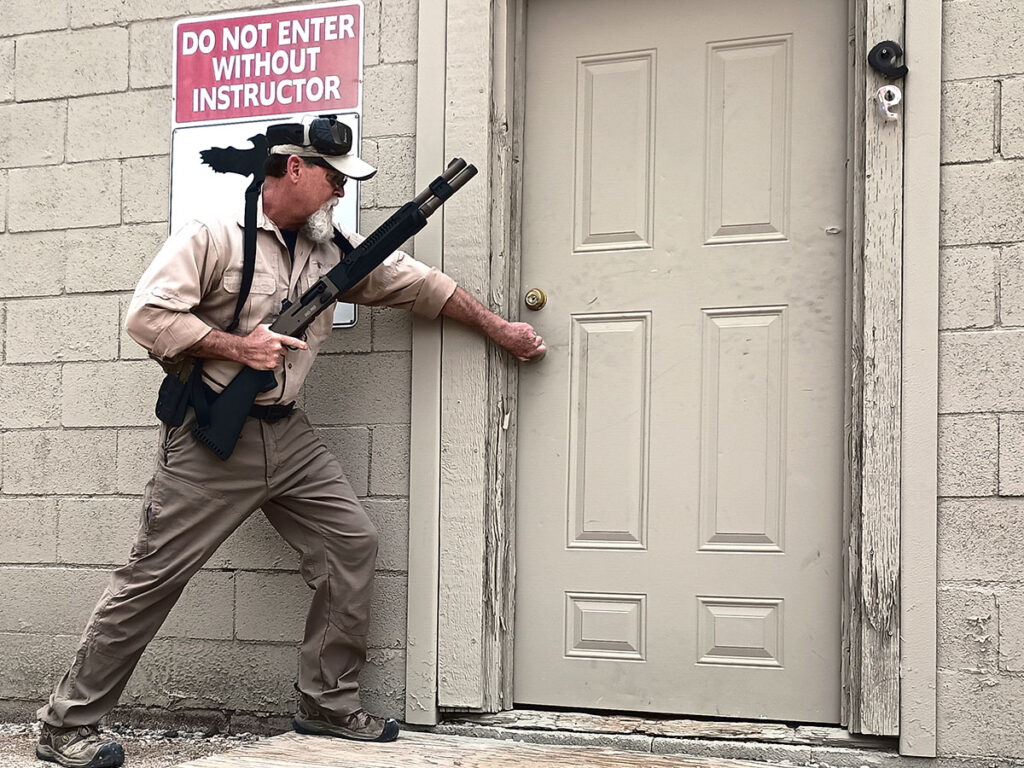
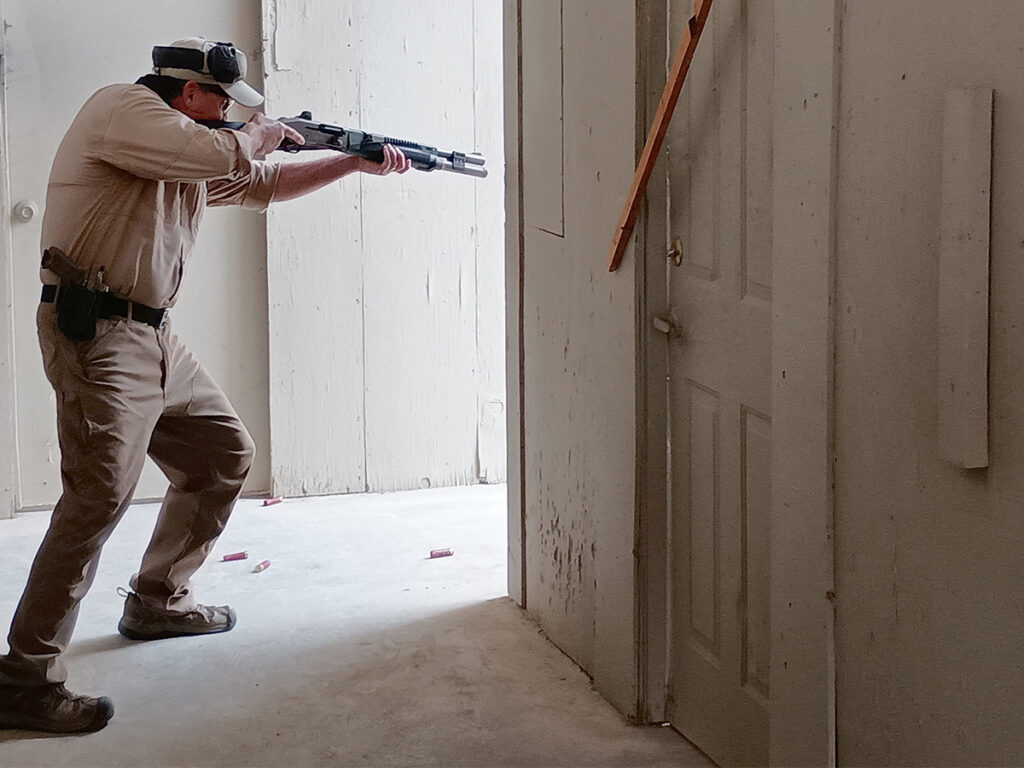
A handful of other gun writers and I had the opportunity to run the 940 Pro Tactical SPX in the most fitting setting—Gunsite Academy’s defensive shotgun course. Under the tutelage of former Glendale, California, Deputy Sheriff Mario Marchman and U.S. Marine Chris Currie, we put the gun through its paces in situational training, urban tactical courses, house-clearing drill, plain-ol’ speed and accuracy tests and manipulation drills.
Chris Currie was a breacher in Iraq during his service with the Marine Corps. He shows the proper way to gain entry to a room, without immediately putting himself in harm’s way and his Pro Tactical SPX at the ready
In three days, I did north of 500 shells worth of shooting. Adding a layer of pressure to the participants and the gas-operated Mossberg was the environment. Dry, dusty and hot, June in Arizona isn’t exactly inviting … except, perhaps, to basal cells.
The SPX performed spectacularly, particularly with the Holosun red dot. I particularly appreciated the 940’s trigger, which in tandem made double taps and target transitions lightning fast. And the gun’s rock-solid reliability shone through.
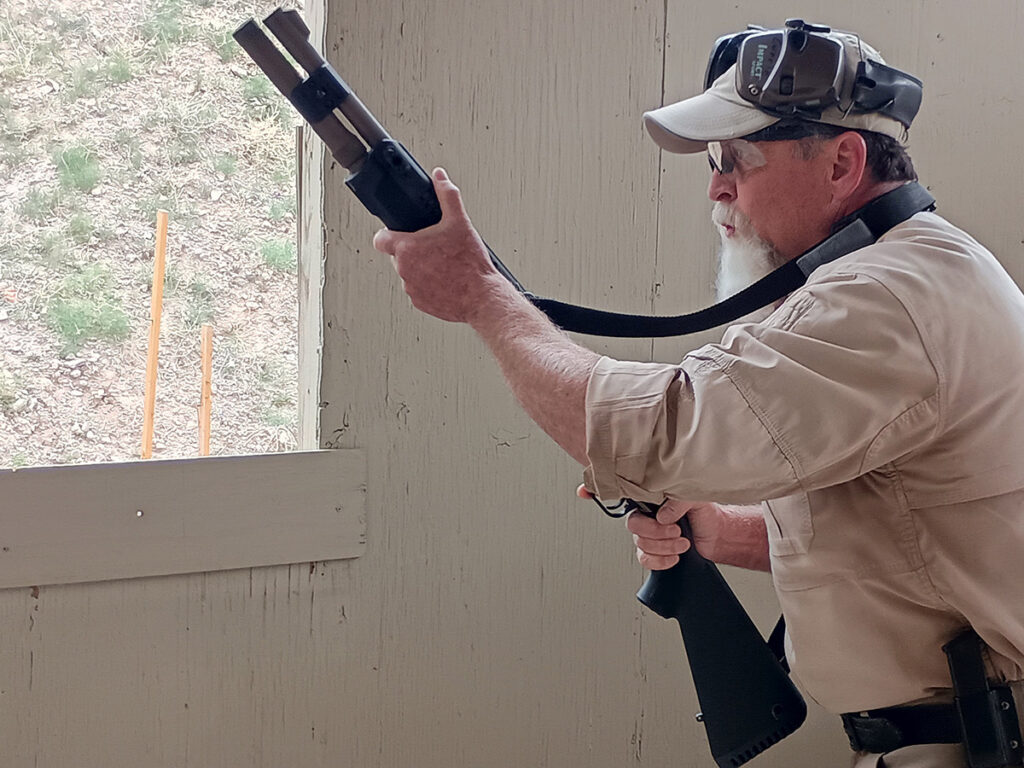
Currie works a room clear with his Pro Tactical SPX at the high ready.
None of us did any maintenance on the guns through the course and with four shooters behind 940s, there were zero malfunctions. And this included getting the gun in the desert’s talcum-powder dust in drills meant to emulate shooting from under a vehicle.
This alone was enough to leave me impressed. However, the cherry on top was the accuracy potential—with the right load—of the SPX. This was proofed at the end of Gunsite’s infamous Urban Scrambler, a course meant to emulate an urban shooting situation and concealment. The passing shot in the course was flipping the paddle on a hostage target without maiming the hostage at 15 yards.
Three of us ran the course twice, and each person slapped the paddle and didn’t touch the hostage. We pitched Federal Power-Shok 9-pellet 00 buckshot, showing how surgical the gun could be with the right ammo.
Currie pies a corner with his Pro Tactical SPX on his shoulder. The key here is not to hug the wall or overextend your lateral movement.
One final point on the SPX after pitching plenty of lead, I valued the gun’s buttpad. Designed with hollow cells that collapse on recoil, it went a long way in sparing me the abuse the gun could potentially dish out.
Some Bugs
While the SPX did not malfunction on me in terms of a failure to extract, feed or the like, there were some gremlins. In particular, early on the first day of the class, the magazine occasionally prematurely released a shell onto the elevator. This did not affect how the gun cycled but did hinder topping off the magazine—a key aspect in running a defensive shotgun.
The stop was likely sticky on the fresh-from-the-box shotgun to start but seemed to work itself out through the course of 30 or so shells. From then on, the issue ceased.
Parting Shot
Protecting your property and all those who reside in it is a serious job. The 940 Pro Tactical SPX is a serious tool to accomplish this task. The 12-gauge can put hate on target, is quick to manipulate and, above all, is reliable.
Certainly, in this day and age, the smoothbore isn’t the first tool some reach for to guard against the ills of this world. But the SPX should make those folks reconsider. Mossberg hasn’t simply designed a shotgun; it’s engineered a defensive star.
Mossberg 940 Pro Tactical SPX Deals
Sportsman’s Warehouse
$900
Palmetto State Armory
$1,168
Gear Notes: Holosun HS407K
Holosun has been in the red dot game for a spell now and more than understands the needs of shooters. Hence, the HS407K sight. The small and unassuming addition to a pistol—in my case, a shotgun—vastly enhances your ability not only to acquire targets, but also to hit them.
Down to basics, the HS407K is a micro-red dot primarily designed for pistols, in particular one aimed at concealed carry. Coming in at 0.95 inch in height and 1 ounce in weight, even on this demure class of handguns, the optic doesn’t take up much room. Even better, it is small enough that it won’t throw the balance of a gun off either.
Given its size, the red dot’s window is on the small side; however, crystal-clear glass and a very visible red dot still make it quick onto the target. The dot itself is 6 MOA and has 12 brightness settings, 10 of which are night vision compatible. Plus, it has 30 MOA of windage and elevation.
Additionally, the HS407K features shake-and-wake technology, a battery-saving feature I value. Quite simply, when not in use, the unit turns off, but it comes alive the moment you draw your gun or move it. Just so you know, the unit is powered off of a 1632 battery, which is side-mounted, so when you swap in a fresh cell, you don’t lose your zero.
Overall, I walked away impressed with what Holosun brought to the table with the HS407K running it on the Mossberg Pro Tactical SPX. While small, the rear mounting of the unit on the shotgun filled the eye and picked up the pace of my hits.
The red dot is available as part of a package with the fully loaded shotgun. But, from what I saw when running the SPX, I wouldn’t hesitate to stick one on a defensive pistol. MSRP: $259
Editor’s Note: This article originally appeared in the November 2025 issue of Gun Digest the Magazine.
Taurus has just announced the GX4 Strike Bravo, a variant of the 9mm pistol featuring a folding brace.
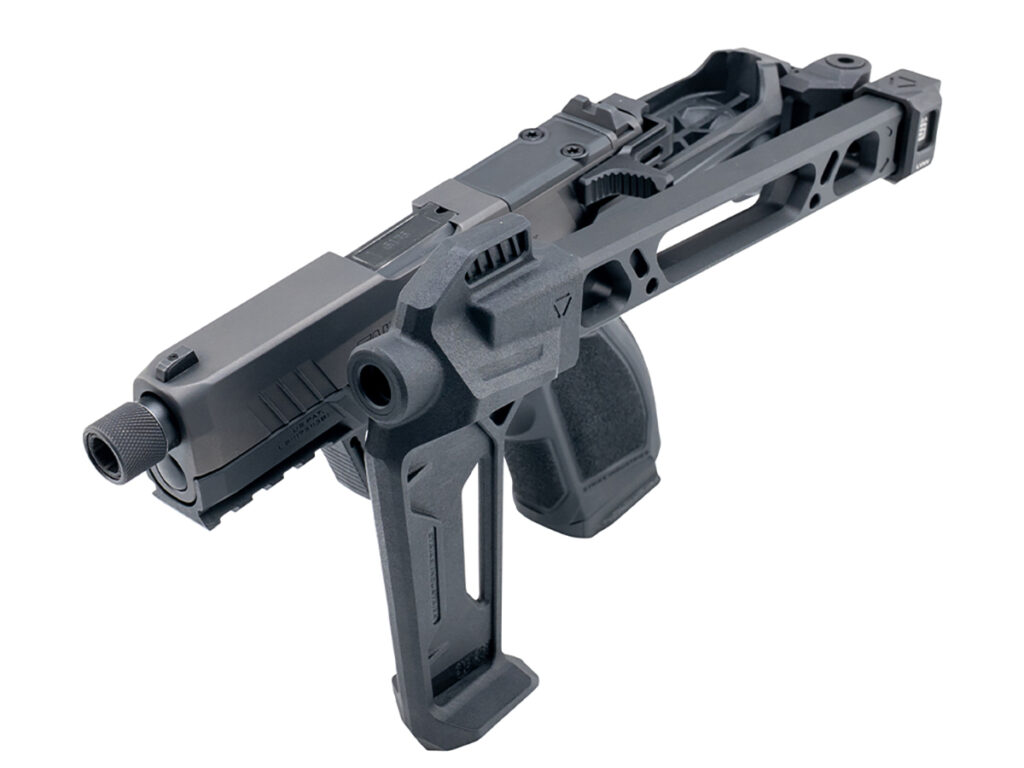
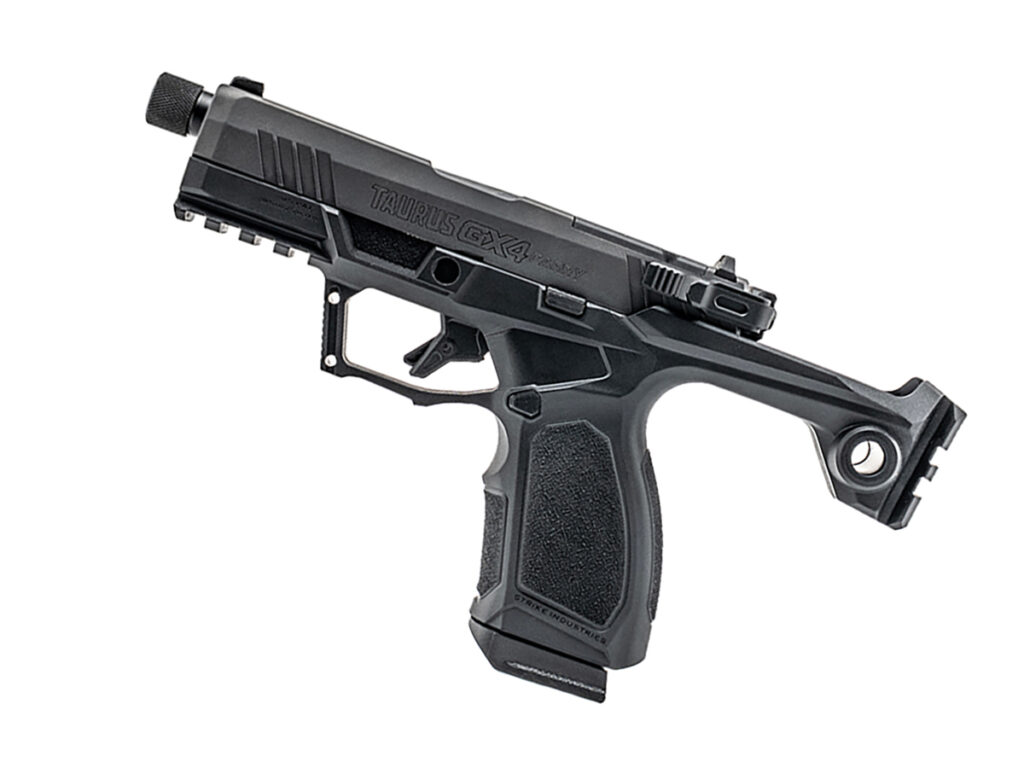
Taurus and Strike Industries have partnered to create the GX4 Strike Bravo, an interesting new braced iteration of Taurus’ GX4 9mm pistol. If you’re in the market for a compact defensive handgun that can reach out and accurately engage targets at longer ranges than a traditional pistol, the GX4 Strike Bravo is worth a look.
The heart of the new GX4 model is the chassis and modular grip system co-developed with Strike Industries. This chassis system is designed to use Strike Industries’ FSA Single Stabilizer folding pistol brace, but Taurus sells the GX4 Strike Bravo both with and without the FSA brace included. The back of the chassis features a segment of Picatinny rail, so you can use other brace models if desired. Both versions of the GX4 Strike Bravo are also available with either a standard 15-round capacity or a reduced 10-round capacity. Other features include an optics-ready slide, a 1/2×28 threaded muzzle, a reversible charging handle and an accessory rail. The pistol is naturally also compatible with existing GX4 parts and accessories.
Laura Prieto, Marketing Manager at Taurus, said this about the new braced pistol:
The GX4 Strike Bravo is Taurus stepping in a bold new direction … By teaming up with Strike Industries, we didn’t just add a brace — we co-engineered a dedicated chassis and modular grip system to support it. That collaboration created an affordable, compact pistol that offers shooters extra stability, control, and versatility — expanding what they can expect from the GX4 family!
MSRP for the Taurus GX4 Strike Bravo with the brace included is $796 and MSRP for the version with no brace is $607.
Unpacking the truth, data and real self-defense uses of so-called assault weapons.
Few topics in American politics generate as much heat, and as little light, as the debate over so-called “assault weapons.” For decades, politicians and media outlets have leaned heavily on the term to conjure images of battlefield carnage and mass destruction, often painting civilian ownership of rifles like the AR-15 as both unnecessary and dangerous.
But what if the narrative surrounding these firearms is more rhetoric than reality? What if the “assault weapon” label is little more than a political invention designed to confuse the public and restrict lawful gun ownership?
That’s the question at the heart of the “assault weapon” debate, and it’s one worth answering with facts, history and a sober look at self-defense in the real world.
What’s in a Name?
The phrase “assault weapon” is, at its core, a political creation. It first gained traction in the late 1980s and 1990s as lawmakers sought to capitalize on public unease about semi-automatic rifles like the AR-15. Unlike the military term “assault rifle,” which refers specifically to select-fire, intermediate-caliber rifles such as the German Sturmgewehr 44, the civilian rifles at the center of controversy are not automatic weapons at all.
Modern, commercially available AR-15s, for example, are semi-automatic firearms. They fire a single round with each pull of the trigger, just like most handguns and hunting rifles owned by millions of Americans. Semi-auto AR-15s have never been a standard-issue rifle for the U.S. Military. Yet they have been demonized through cosmetic features like pistol grips, collapsible stocks and flash hiders that have no effect on how the action of the rifle operates.
Federal Judge Roger Benitez summed up this absurdity in his ruling striking down California’s assault weapons ban: Rifles banned under the law are functionally identical to many others that remain perfectly legal. The distinction is purely cosmetic. In other words, these bans punish firearms for how they look, not for what they do.
The Data Doesn’t Lie
Gun control advocates frequently claim that “assault weapons” are the firearm of choice for mass shooters. But when we look at the actual numbers, the picture changes dramatically.
Research from Dr. John Lott Jr.’s Crime Prevention Research Center, covering mass shootings from 1998 through 2023, found that the most common firearm used in such crimes is not a rifle at all, but a handgun, responsible for over half of all incidents. Rifles of any type, including AR-15s, were used as the sole firearm in fewer than 17 percent of cases.
And here’s a striking fact: Even if every single homicide committed with a rifle were attributed to an AR-15, those crimes would account for less than 0.000018 percent of the total number of AR-15s in civilian hands. Put differently, more than 99.999985 percent of AR-15s are never used in crime.
The data also undercuts claims that the 1994 federal assault weapons ban saved lives. A Department of Justice study commissioned after the ban expired in 2004 concluded it had no measurable effect on reducing gun violence. Subsequent research by economists Mark Guis and Carlisle Moody reached the same conclusion: Neither the federal ban nor various state-level bans reduced firearm homicide rates.
Despite political talking points to the contrary, the hard evidence shows that targeting “assault weapons” does nothing to prevent violence.
The Second Amendment and the Role of Rifles in Defense
Beyond data and definitions, there is the matter of principle. The Second Amendment, as the Supreme Court has affirmed, protects the right of law-abiding citizens to own and use firearms for self-defense. That right is not confined to muskets, nor is it contingent on whether a firearm has a pistol grip or a flash suppressor.
Modern rifles like the AR-15 play a vital role in personal and home defense, especially in situations where defenders might face multiple attackers. Judge Benitez cited several cases in his ruling:
A pregnant woman in Florida used an AR-15 to defend her family against two armed intruders.
A 61-year-old disabled man in rural America relied on his AR-15 when three men tried to break into his home.
Another homeowner successfully repelled seven armed and masked attackers with his AR-15.
In each case, ordinary citizens faced extraordinary threats. Without the firepower and capacity of a modern rifle, these individuals might well have become mere statistics. Instead, they protected themselves and their loved ones, a constitutionally protected right exercised in its truest sense.
Why Killers Choose “Gun-Free Zones”
If rifles are not the main driver of mass shootings, what is? The uncomfortable truth is that mass killers don’t primarily choose their weapons. They choose their victims, and they overwhelmingly prefer places where their targets are least able to fight back.
Empirical evidence suggests that over 90 percent of mass public shootings occur in so-called “gun-free zones.” The Aurora theater shooter bypassed several closer theaters to attack the one that banned firearms. The Nashville Covenant School shooter specifically avoided another potential target because of its heavy security presence. The Orlando nightclub shooter initially planned to attack Disney World but abandoned the plan after seeing extensive armed security.
The pattern is clear: Killers prefer soft targets. The label on the gun doesn’t matter nearly as much as whether the intended victims can defend themselves.
Active Shooter Response: Why Seconds Count
So how can tragedies be prevented or at least mitigated? The answer lies not in waiting for police, nor in relying solely on passive measures like lockdown drills or cameras. As firearms instructor Ed Monk emphasizes, “time and math” dictate outcomes. Every second an attacker remains unopposed increases the body count. To keep casualties in the single digits, a shooter must be confronted within 30 seconds.
Law enforcement, even when fast, usually takes three to eight minutes to arrive—far too long. The only people positioned to act quickly enough are those already on the scene: the intended victims.
That is why armed citizens play such a critical role. From Jack Wilson’s decisive action in a Texas church to Eli Dicken’s intervention in an Indiana mall, everyday Americans have stopped mass shooters with precision and courage … and often with higher accuracy rates than trained police.
For armed citizens, however, responsibility is paramount. Rule Four of firearm safety, “Be sure of your target and what is beyond it,” must always guide defensive action. Training is essential to ensure 100 percent accuracy within one’s abilities, minimizing risks of stray rounds.
Conclusion: Shifting the Focus
The debate over “assault weapons” has never really been about function or effectiveness. It has been about appearances and politics. Cosmetic bans don’t save lives, and statistics show rifles like the AR-15 are rarely used in crimes. Meanwhile, they remain among the most valuable tools available for lawful self-defense.
As Lysander Spooner wisely observed: “To ban guns because criminals use them is to tell the law-abiding that their rights and liberties depend not on their own conduct, but on the conduct of the guilty and the lawless.” That principle is as true today as it was in Spooner’s time.
The focus should not be on restricting rifles that millions of responsible Americans own and use safely. Instead, it should be on empowering individuals with training, preparation, and the mindset necessary to stop violent attackers before they can inflict widespread harm.
Freedom and security are not opposites. They go hand-in-hand, and in a free society, the ultimate responsibility for defense will always rest with the people, not with the government.
Editor’s Note: This article originally appeared in the November 2025 issue of Gun Digest the Magazine.
A quick look at the new Vortex Triumph HD 3-9×40 Riflescope and Triumph HD 850 Laser Rangefinder.
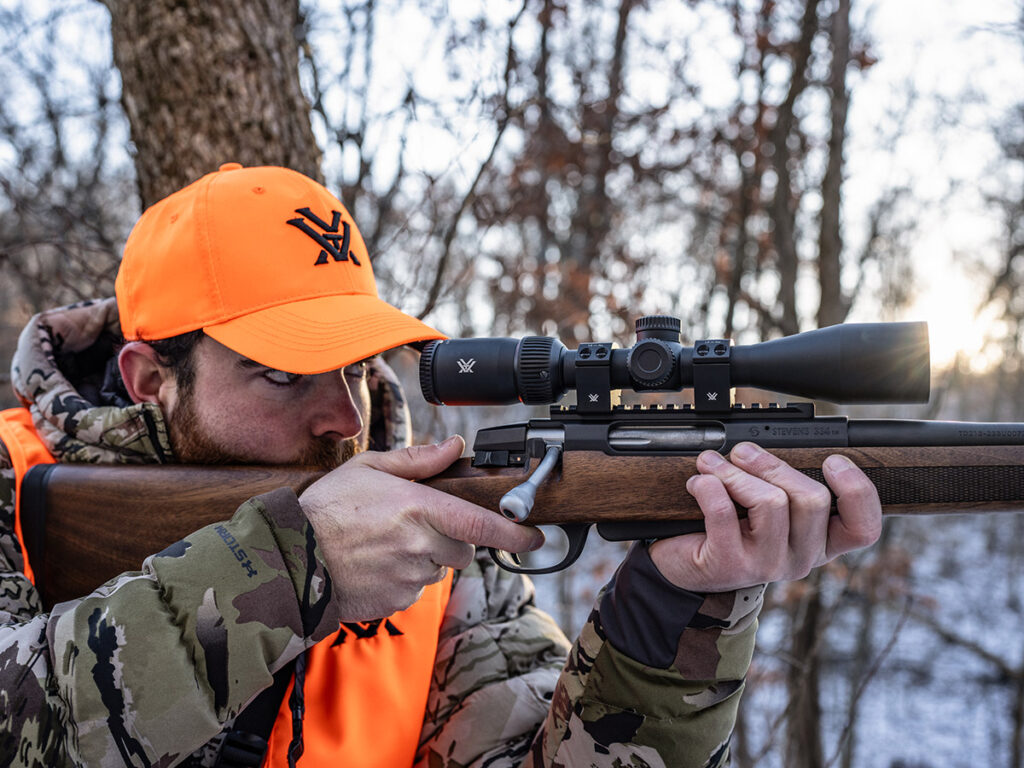
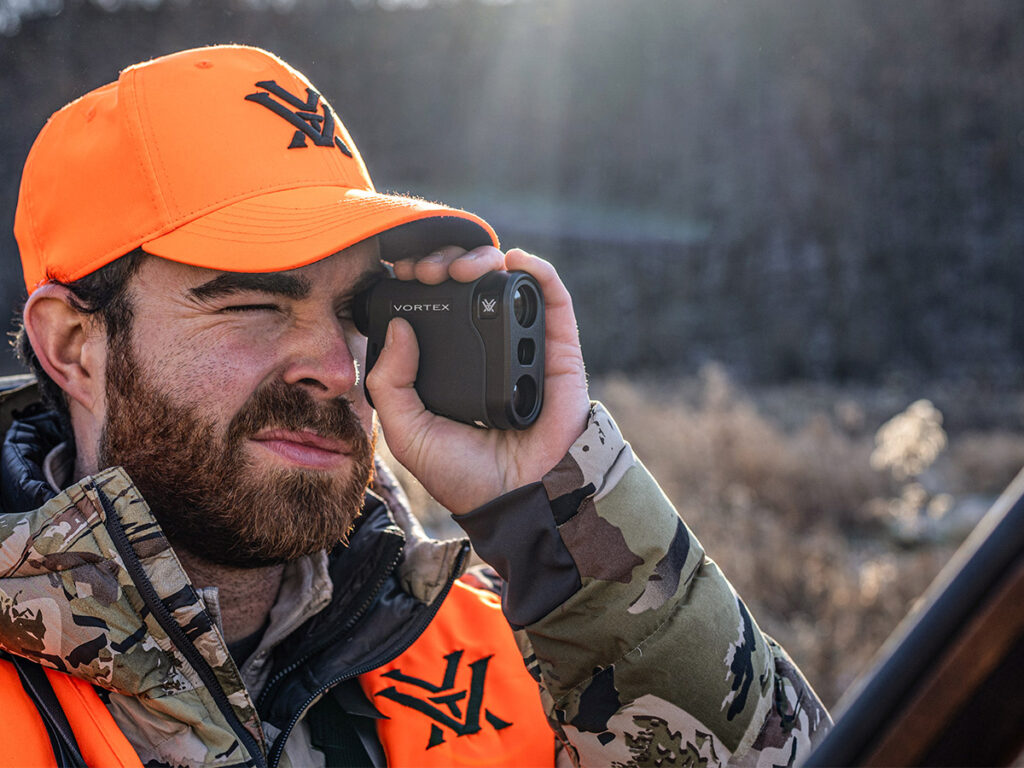
Who says that hunting optics have to break the bank? There are plenty of affordable options that are more than good enough to help you fill your freezer this deer season, and Vortex has just added two more to choose from with the Triumph HD 3-9×40 Riflescope and the Triumph HD 850 Laser Rangefinder.
The Triumph HD 3-9×40 scope features Vortex’s HD Optical System, designed to provide excellent resolution, color fidelity, edge-to-edge sharpness and light transmission while reducing chromatic aberration. The lenses are also fully multi-coated, and Vortex says the scope is built tough to withstand water, fog and shock. As for its reticle, the Triumph HD 3-9×40 sports a Second Focal Plane (SFP) Dead-Hold BDC (MOA) reticle, and each scope ships with a set of Vortex 1-inch Hunter rings in addition to a neoprene lens cover, lens cloth, Torx T-25 wrench and a custom turret tool. It has an MSRP of just $150.
The Triumph HD Laser Rangefinder features a durable waterproof and shockproof housing, an HCD (Horizontal Component Distance) Corrected Shoot-To Range reticle and the same great glass quality as the scope thanks to the HD Optical System. It also features 5x magnification, three ranging modes, three targeting modes, and a maximum reflective range of 850 yards. Each range finder ships with a carry case, a wrist lanyard, a lens cloth and one CR2 battery, and it has an MSRP of $150 as well.
I take Q’s The Fix rifle in 8.6 Blackout to the range to test the best ways to maximize its subsonic and supersonic capabilities.
Up until the introduction of the 8.6 Blackout cartridge I never had much interest in subsonic centerfire rifle cartridges. This was mostly because of the lackluster supersonic capabilities of the .300 Blackout and even the much newer .338 ARC. Once either cartridge is combined with a compact short-barreled-rifle (SBR) all you really have is a subsonic platform with limited application. The 8.6 Blackout is different, mostly because of its incredibly fast twist rate of 1 turn in 3 inches. From a terminal performance perspective this radically fast rotational velocity not only lets it outperform all other subsonic cartridges, but it also substantially increases its supersonic capabilities. That high performance dual use intrigues me.
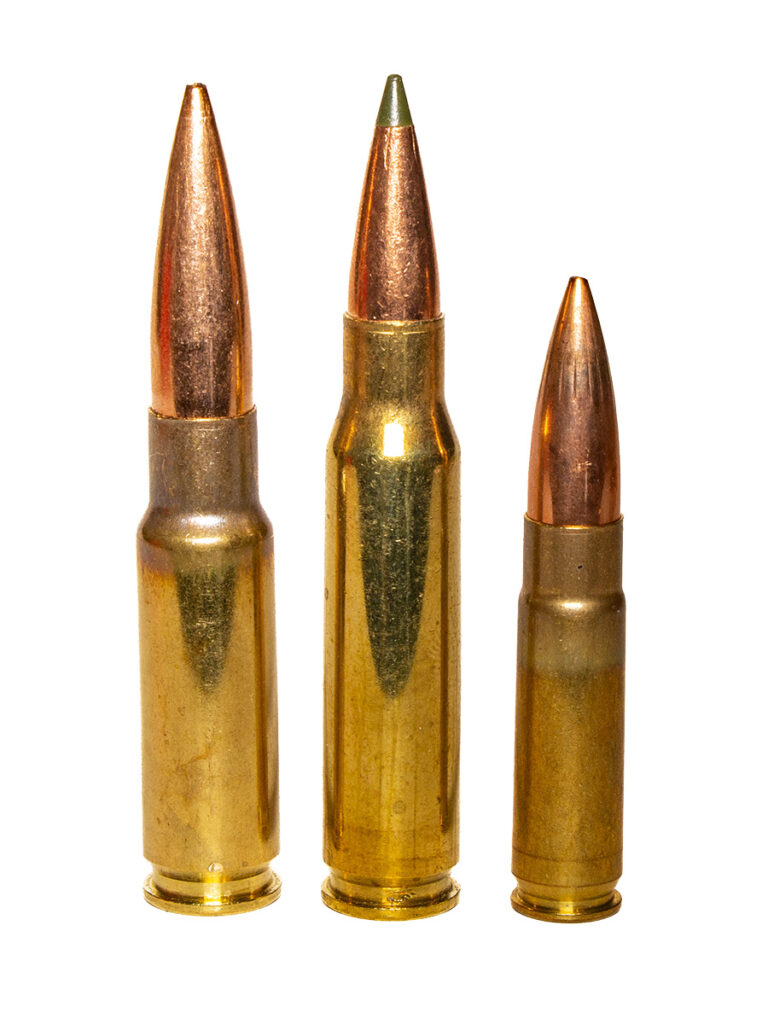
This comparison shows the difference in the 8.6 Blackout (left), .308 Winchester (center) and .300 Blackout (right).
The 8.6 Blackout is a brainchild of Q, a firearms company in New Hampshire that’s probably best known for their Honey Badger SBR. I don’t know where the company came up with their odd name, but I do remember that Q was where James Bond got all his cool tools. At any rate, the founder of Q was also the founder of AAC (Advanced Armament Corporation) and the creator of the .300 Blackout. As you might guess, Q also makes the best rifle for the 8.6 Blackout cartridge. It’s called the Fix.
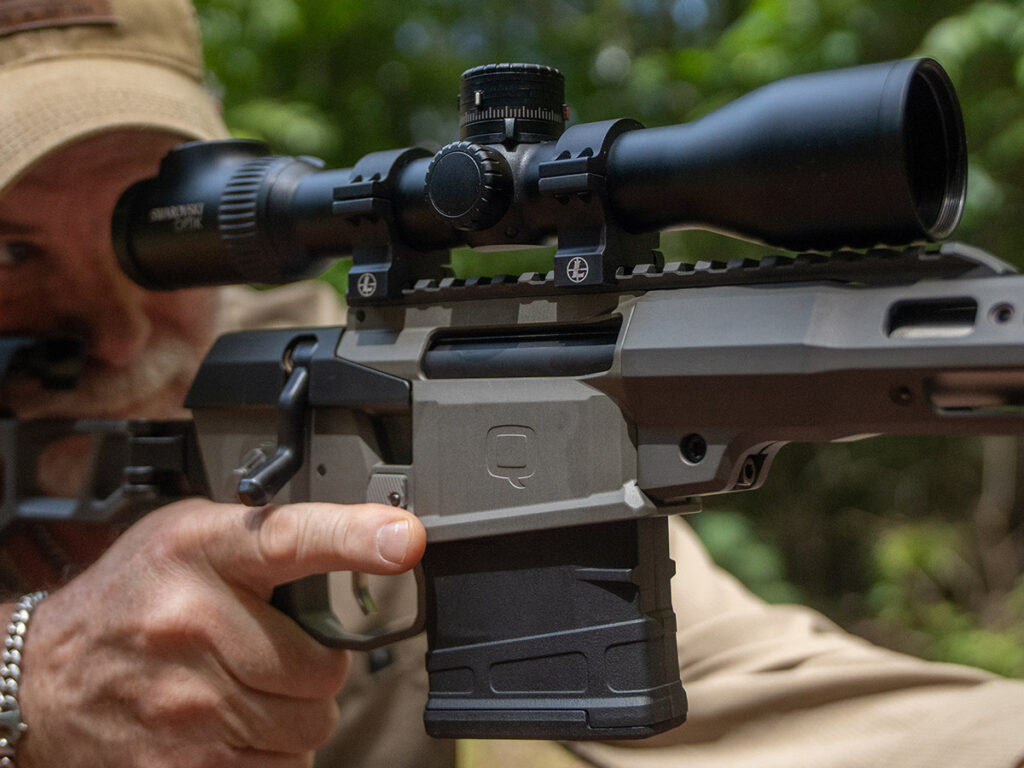
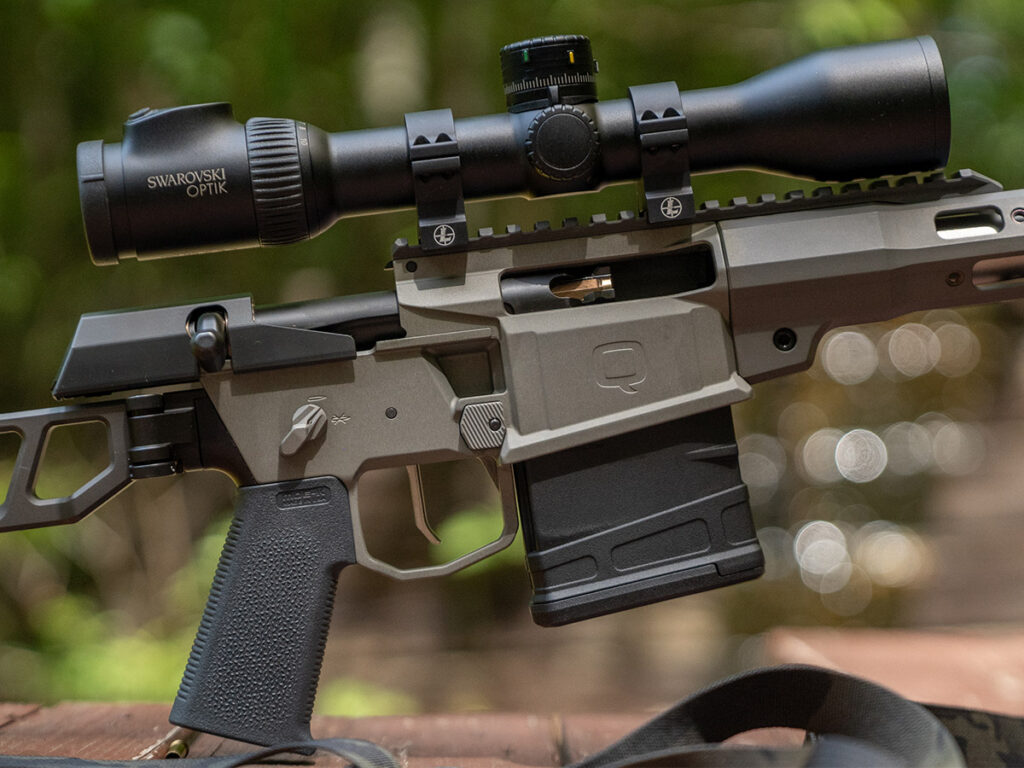
The Fix is very unique and unlike any other bolt-action rifle you’ve seen. It is built around an aluminum receiver, but, except for the trigger, all operational components are housed in the striker-fired bolt. It also has a folding stock that’s adjustable for length of pull and comb height, and the barrel system is modular, so the end user can swap barrels on their own. A Q Fix SBR in 8.6 Blackout with a 12-inch barrel only weighs 5.18 pounds, so even with a suppressor and a riflescope it’s still reasonably light for a rifle that powerful.
Gorilla Ammunition offers the widest range of factory loaded 8.6 Blackout ammunition with supersonic and subsonic loads.
I’ve been working with one for about a year and wanted to maximize its usefulness by selecting a sight system that would allow me to go between subsonic and supersonic ammo without drastic sight alterations. In other words—ideally—I wanted to be able to shoot accurately, from the muzzle to 200 yards, and let the riflescope do my trajectory correction work for me. The first thing I needed to do to start down this road was establish the DOPE for super and subsonic loads so I could select a riflescope that would best pair with both, and the current best source for 8.6 Blackout ammo is Gorilla Ammunition.
Getting the DOPE
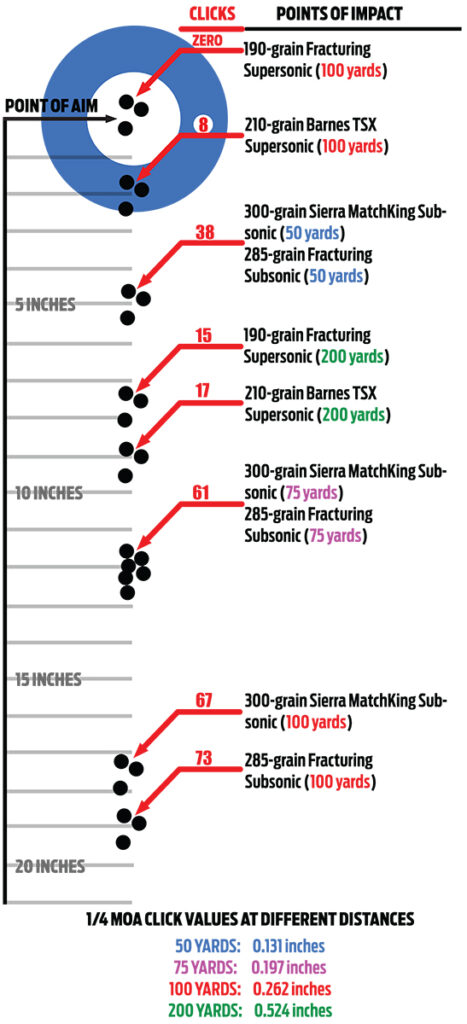
This is where things get a bit tricky because you’re dealing with trajectory correction at various distances, and this makes the click value of the riflescope change. For example, at 100 yards most riflescopes have a click value of ¼ MOA. This equates to about a quarter inch, but to be precise it equals 0.262 inch. At 50 yards, the riflescope has a click value of 0.131-inch (1/8th MOA) per click, at 75 yards the ¼ MOA click value equals 0.197 inch, and at 200 yards it’s 0.524 inch per click. It is also a bit complicated because you’re correcting for loads that shoot reasonably flat and for other loads with a rainbow trajectory.
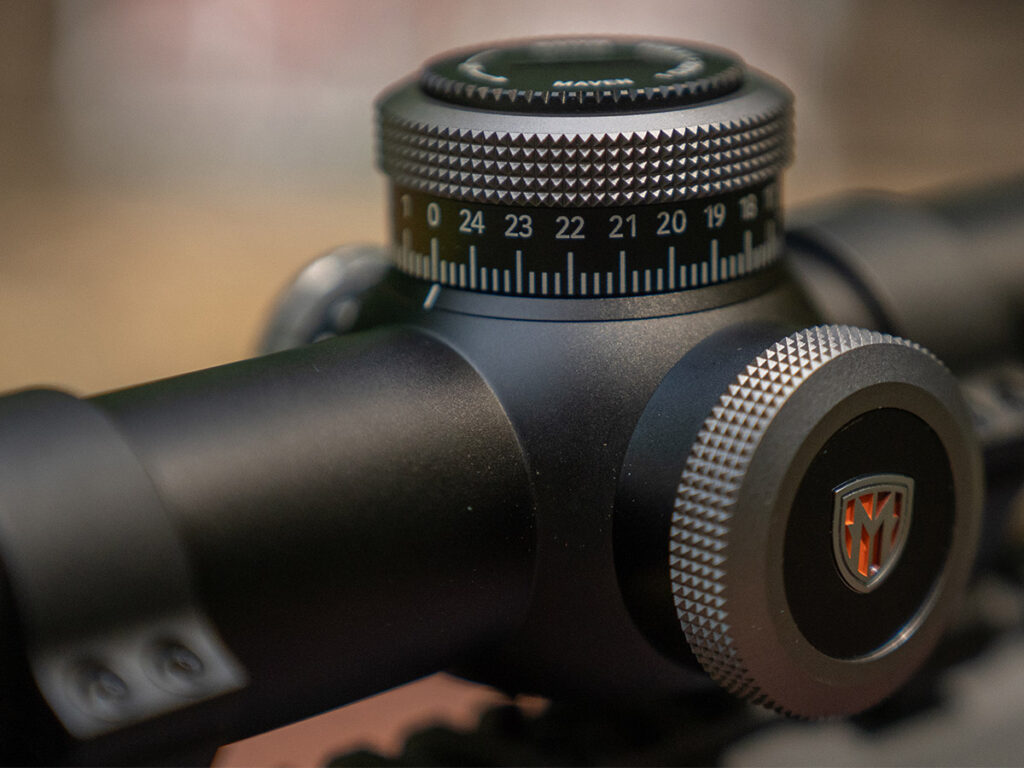
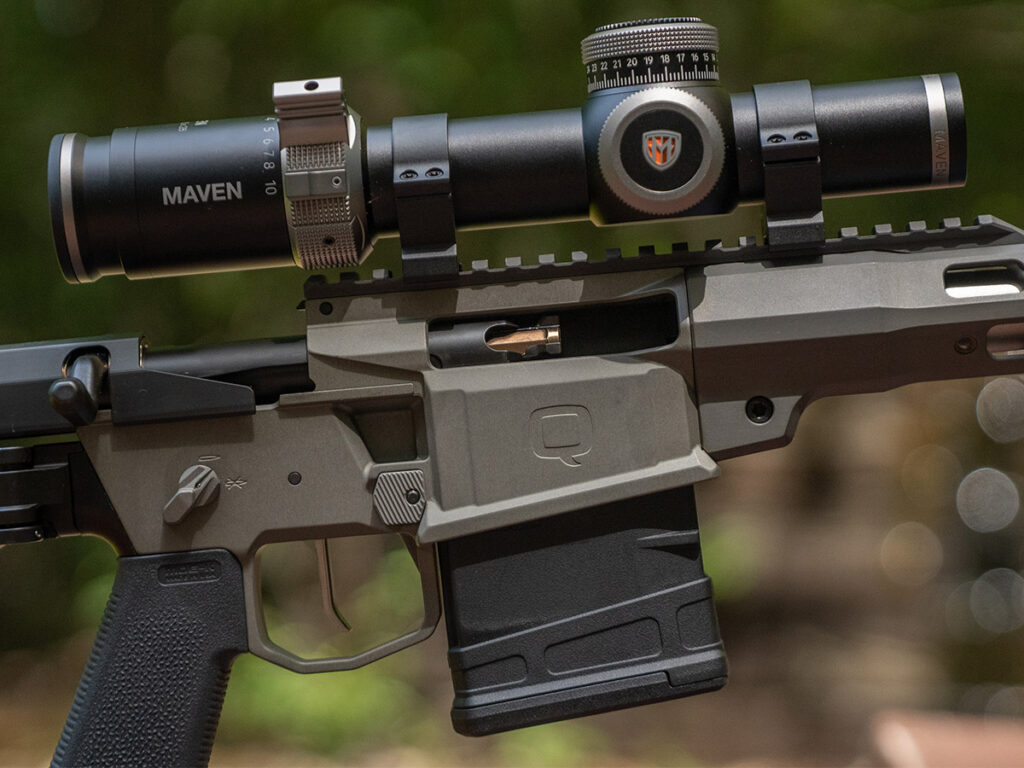
The Maven’s RS.6 1-10x28mm riflescope offers two rotations of 25 MOA of correction and has a zero stop.
For my purposes, I decided on the 190-grain Fracturing supersonic load, which is what I zeroed the rifle for at 100 yards. Next, I wanted to know how much that load would drop at 200 yards. Shots on target confirmed this at about 7.5 inches. Since each elevation click equals 0.524-inch at 200 yards, I needed 14.31(15) clicks.
While I was at it, I also checked the drop of the 210-grain Barnes TSX load at 100 yards. With the rifle zeroed for the 190-grain Fracturing supersonic load, the 210-grain TSX load was 2 inches low at 100, and 9.0 inches low at 200. But I really wanted to be able to shoot accurately out to 100 yards with the 285-grain Fracturing subsonic load.
I started at 50 yards using the 100 yard zero for the 190-grain Fracturing supersonic load. At that distance the 285-grain Fracturing subsonic load impacted 5 inches low. The ¼ MOA click value of the scope at 50 yards is 0.131 inch, and to correct for 5 inches I needed 38 clicks. As it turned out, this was the same elevation correction I needed for the Gorilla subsonic 300-grain Sierra MatchKing load.
Next, I shot a target at 75 yards, and both the 285-grain Fracturing and 300-grain Sierra MatchKing subsonic loads struck the target right at about 12 inches low. The ¼ MOA click value at 75 yards equals 0.197 inch, which meant I needed to divide 12 inches by 0.197 to determine the number of clicks of correction needed. The math worked out to 60.91 or 61 clicks.
Finally, I was shooting the subsonic loads at 100 yards where I was also dealing with the common ¼ MOA (0.262-inch) per click correction. At that distance, the 300-grain Sierra MatchKing subsonic load was 17.5 inches low, so it required 67 clicks, and the 285-grain Fracturing subsonic load at 19 inches required 73 clicks.
This chart shows the impact of the tested loads at different distances. The click adjustments can be confusing because ¼ MOA equals different corrections at different distances.
Any long-range shooter is familiar with an exercise like this; it’s called getting your DOPE (Data from Previous Engagement). The difference is that most long-range shooters are only working with a single load, and they’re also not trying to use a single zero for two different loads.
Another thing to consider is that the drop of your subsonic loads might not impact the target directly below their impact at close range or the impact of the supersonic load at its zero range. This can be a trait of the ammunition, but it’s more than likely an indicator your riflescope/reticle is not level, and when you’re applying click corrections, you’re minutely moving the reticle to the left or right.
DOPE Chart
LOAD
DISTANCE (YARDS)
DROP (INCHES)
1/4 MOA (INCHES)
CLICKS
190-grain supersonic
100 yards
-0-
0.262
0 (0)
210-grain supersonic
100 yards
-2.0
0.262
7.63 (8)
190-grain supersonic
200 yards
-7.5
0.524
14.31 (15)
210-grain supersonic
200 yards
-9.0
0.524
17.17 (17)
285-grain subsonic
50 yards
-5.0
0.131
38.17 (38)
285-grain subsonic
75 yards
-12.0
0.197
60.91 (61)
285-grain subsonic
100 yards
-19.0
0.262
72.52 (73)
300-grain subsonic
50 yards
-5.0
0.131
38.17 (38)
300-grain subsonic
75 yards
-12.0
0.197
60.91 (61)
300-grain subsonic
100 yards
-17.5
0.262
66.79 (67)
Finding a Scope
Once I had my DOPE, I then knew the maximum amount of elevation correction I needed. Since I wanted to shoot to 200 yards with supersonic loads and out to 100 yards with subsonic loads, I needed at least 18.5, or better yet, 19 MOA of correction. Most rifle scopes offer this much elevation adjustment in a single rotation, and some of the more modern riflescopes offer two rotations with almost double that amount. If you wanted to take the subsonic loads beyond 100 yards the additional—second rotation—adjustment would be necessary with the 8.6 Blackout.
If you want to dial in corrections for super and subsonic 8.6 Blackout loads, the Swarovski’s Z5i + L BT riflescope is the simplest solution.
Swarovski’s Z5i + L BT
I first tried one of the new Swarovski Z5i + L BT riflescopes ($1,949) that comes with their self-customizing elevation correction turret that uses multiple small rings. After setting the zero for the 190-grain Fracturing supersonic load, I set a ring at 15 clicks for the 190-grain Fracturing supersonic load at 200 yards, and rings at 38, 61 and 73 clicks for the 285-grain subsonic load at 50, 75 and 100 yards, respectively. This riflescope was equipped with the illuminated plex-style reticle, so trajectory correction was only possible by clicking in a solution.
The Q Fix with the 17-ounce Swarovski’s Z5i + L BT riflescope installed.
Maven’s RS.6 1-10x28mm
I switched to the new Maven RS.6 1-10x28mm riflescope ($1,600) that comes with the unique MOA3-LPI reticle. This is an MOA Christmas tree style reticle with elevation and windage correction, but it also very uniquely provides red or green illumination. This reticle offers 50 MOA of elevation and 20 MOA of windage correction, in 1 MOA increments, so it would be easy to correct for distance with either load. Of course, with 50 MOA of elevation correction in the turret, I could click-in corrections too.
The Q Fix with the Maven’s RS.6 1-10x28mm riflescope installed.
EOTech’s 3-9X32mm SFP
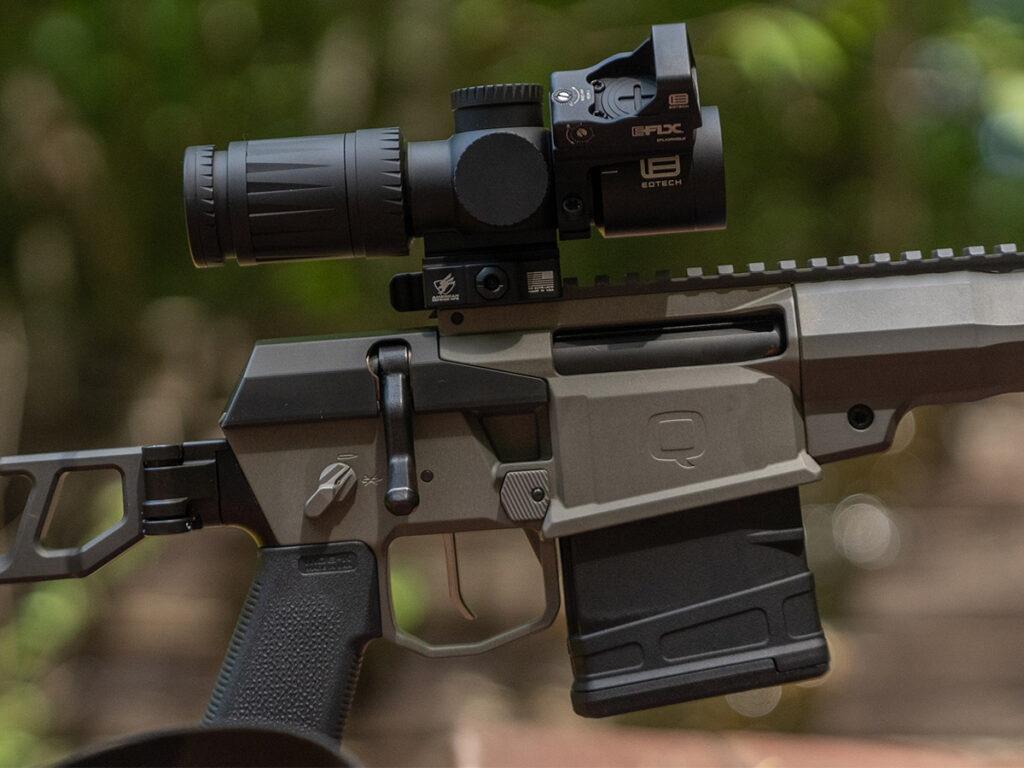
Then, I tried the new EOTech 3-9X32mm SFP riflescope which retails for $1,059. This is an unusual scope because it does not mount via rings. Instead, it uses a rail that interfaces with various height mini-ACOG mounts. The windage and elevation turrets are capped with this scope, but given its size and weight, it was the scope I really hoped worked with this rifle and cartridge. The reticle for the EOTech 3-9X32mm SFP is also an MOA reticle that’s illuminated, and it offers 30 MOA of elevation correction and 16 MOA of left and right windage correction.
The Q fix with the compact, lightweight and rail mounted EOTech 3-9x32mm SFP riflescope mounted. Note: A EOTech mini reflex sight is mounted to the 3-9X scope.
The EOTech has capped turrets, so dialing DOPE was not really an option. But the SFP’s reticle worked just fine for trajectory correction with both loads at the designated distances. However, without any numbering on the MOA hash marks I had to do some counting to select the correct one. Looking at the DOPE chart this seems complicated, but remember, based on my goals, I only wanted four trajectory corrections: 200 yards for the supersonic load, and 50, 75 and 100 yards for the subsonic load. This scope can also be had with a mount for an EOTech EFLX mini reflex sight and ring mount for an additional $370 extra. With the addition of this sight, I can make accurate shots at extremely close quarters just by slightly rotating the rifle and raising my head to look through the reflex sight.
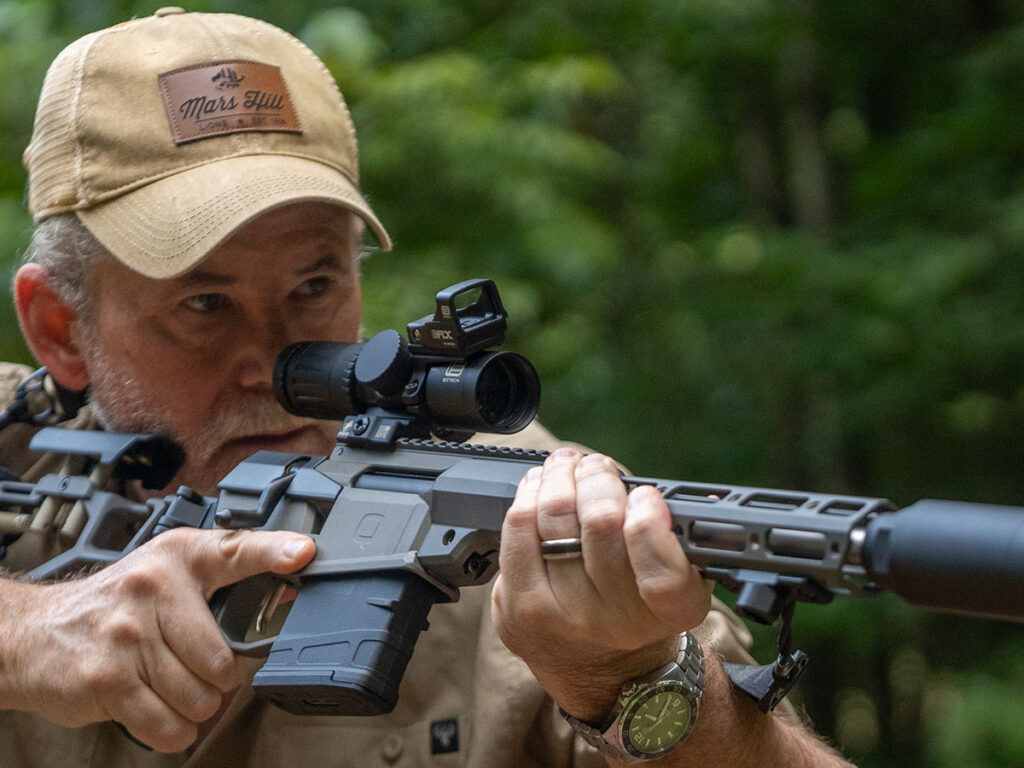
With the EOTech mini-reflex sight installed on the EOTech 3-9x32mm SFP riflescope, you can make accurate close-quarters shots just by raising your head and slightly rotating the rifle.
A Symbiotic Super/Sub System
With its fantastic varied applications, the Q Fix and the 8.6 Blackout cartridge can be used for hunting, recreation, and personal protection, and all this DOPE illustrates how you can maximize the system by using various optical sights. With the modern optics we have today, options seem endless. I really liked all three riflescopes I tried, and it may take some time for me to settle on which one I like best. No matter which way I go I’ll have a very symbiotic system that will allow me to accurately place slow and silent or fast and quiet bullets right where I need them out to 200 yards and beyond.
Shooting Results
LOAD
VEL (fps)
ST DEV (fps)
ENG (ft-lbs)
PRECISION (Inches)
Gorilla 190-grain Fracturing
2,013.2
10.7
1,709.7
1.69
Gorilla 210-grain Barnes TSX
1,927.8
8.5
1,732.6
1.12
Gorilla 285-grain Fracturing
881.6
30.9
492.4
1.64
Gorilla 300-grain Sierra MatchKing
917.3
30.9
561.1
2.88
AVERAGE:
1.83
NOTES: Average muzzle velocity, standard velocity deviation and muzzle energy were obtained with a Garmin Xero C1 chronograph. Average precision is the result of three, five-shot groups fired at 100 yards.
Editor’s Note: This article originally appeared in the November 2025 issue of Gun Digest the Magazine.
A quick look at .219 Zipper, a cartridge that’s gone the way of the dinosaur.
The .219 Zipper was brought out in 1937 by Winchester for its Model 64 lever-action rifle, which was a modernization of the Model 94. This combination (as with the .218 Bee in the Model 65) did not prove sufficiently accurate for long-range shooting on small targets and, in addition, did not allow the proper mounting of telescopic sights. Winchester discontinued the Model 64 after World War II.
The last commercial rifle chambered for the cartridge was Marlin’s Model 336 lever action, discontinued in this chambering in 1961. A number of custom-made single-shot and Krag-Jorgensen rifles have been made for the .219 Zipper. It’s not and never has been very popular, and it’s based on the necked-down .25-35 WCF case.
Winchester dropped the .219 Zipper in 1962, and Remington followed shortly thereafter.
General Comments
In a good, solid-frame single-shot or bolt-action rifle, the .219 Zipper is just as accurate as any other high-velocity .22 in its class. Since it was designed for tubular magazines, all factory-loaded ammunition is furnished with flat- or round-nosed bullets, and this causes rapid velocity loss.
Although overshadowed by the .222 Remington, it’s still an entirely satisfactory small game, varmint or target cartridge. Given carefully prepared ammunition in a properly functioning lever action, performance of this cartridge and rifle combination is limited more by the necessary use of blunt bullets than by intrinsic accuracy constraints. Such a combination is certainly capable of 200-yard shots on vermin, which is stretching what most shooters can do with iron sights anyway; beyond that range, velocity drops off so fast that trajectory limits usefulness, even given a telescopic sight.
This is one of the few American cartridges that functions well through the British Lee-Enfield action. Some of these rifles have been rebarreled and altered to handle the Zipper. Anecdotal information from several serious shooters who have bothered to wring out the cartridge’s accuracy in the Model 64 suggests that Winchester should have spent more effort on ammunition quality.
In 2022, the Zipper was loaded as complete ammunition by a few custom shops. Hendershot’s Extreme Custom Ammunition listed 45- and 55-grain bullet weights with properly headstamped brass. Reed’s Ammunition & Research listed loads for 40-, 50-, 55- and 60-grain V-Max bullets and 46-grain flat-nose soft points suitable for use in lever actions, as well as Zipper brass. Buffalo Arms Co. also loaded the 46-grain ammunition. MidwayUSA.com also listed .219 Zipper brass.
Looking for a new iron or piece of kit to enhance the one you already own? Check out these 7 new bits of guns and gear to grow your firearms wish list.
Springfield’s latest Saint Victor offering packs full-size AR performance into a compact 9mm package. The Saint Victor 8.5-inch 9mm Pistol runs a direct-blowback system inside dedicated 9mm forged receivers, with a Melonite-treated 8.5-inch barrel that hits the sweet spot for compact maneuverability and ballistic punch. It features an M-Lok handguard with a handstop, QD mount and the recessed SA Muzzle Drum tucked underneath. Out back is an SB Tactical SBA3 brace, while controls include a short-throw ambi safety and B5 Systems furniture. Feeding from a 32-round Colt-pattern mag, this 9mm blaster is ready for anything. MSRP: $1,099
Laser Ammo’s CQB in a Box
Laser Ammo’s CQB in a Box is a portable, wireless training system built for real-world readiness. Designed for law enforcement, military and security pros, it includes three full-size reactive targets with adjustable hit zones for the head, torso and pelvis. Shooters can run simple drills or complex simulations with light-coded shoot/no-shoot scenarios—no range required. The system syncs with a Windows PC for drill analytics and remote control, and it’s compatible with Laser Ammo’s red and IR laser systems. It all packs neatly into a rugged case for training anywhere. MSRP: $2,400 full kit, $899 single target
Federal 7mm Backcountry Terminal Ascent
Federal’s new 7mm Backcountry is rewriting the rules for long-action hunting cartridges. With its innovative Peak Alloy case design, it delivers magnum-level speed—up to 3,300 fps with a 155-grain Terminal Ascent bullet—while still running on a standard bolt face. Built for deep penetration and long-range performance, the bonded Terminal Ascent projectile features a high BC (.586), Slipstream tip for reliable expansion and AccuChannel grooves to cut drag and boost accuracy. It’s available in 155- and 170-grain loads, both delivering flat trajectories and hard-hitting results. MSRP: Starting at $79
C&H ERD-2 Red Dot Optic
C&H Precision’s new ERD-2 brings tough, enclosed-emitter performance to shotguns, rifles and PCCs. This 22mm red-dot runs a 3 MOA reticle with 10 brightness settings (including two for NV), and its front-facing sensor auto-adjusts to changing light on the fly. Housed in 7075 aluminum and fully submersible for 30 minutes, the ERD-2 is built to take abuse and keep zero. A 50,000-hour battery life and included Picatinny pedestal mount round out a feature-rich optic that punches above its price. MSRP: $280
Hawke Optics Frontier Reflex Sight
Hawke’s new Frontier Reflex sight brings rugged versatility and a crystal-clear view to pistols, rifles and everything in between. Built with a tough aluminum body and steel shroud, it runs a crisp 3-MOA red dot with 10 brightness levels—including two night-vision settings—and auto-adjusts via onboard sensor. Mounting options are nearly endless, with RMSc, Docter, DeltaPoint Pro, and Weaver/Picatinny compatibility all in one package. Motion-sensing standby conserves battery life, while a side tray makes swaps fast without re-zeroing. At just 0.8 ounce, it’s compact, tough and ready for carry, competition or duty. MSRP: Starting at $319
Primary Arms SLx RS-10R Reflex Sight
Primary Arms just made its popular RS-10 red-dot even more versatile with the new SLx RS-10R. Built around the widely used RMR footprint, it’s ready to drop onto a broader range of optics-ready slides and mounts. At just 1.1 ounces, this 7075 aluminum sight is featherweight but rugged, with a 23x19mm multi-coated lens, side-loading battery tray and AutoLive tech that preserves its 40,000-hour battery life. Setting up for duty use or everyday carry, the sight is rock-solid at a fair price. MSRP: $210
Leupold Mark 5HD 2-10X FDE Scope
Leupold has added a fresh twist to its elite Mark 5HD line with a 2-10x30mm variant dressed in flat dark earth and outfitted with the illuminated CMR reticle. Built on a 35mm main tube and using Leupold’s M5C3 zero-lock turret system, this scope offers 34.9 mils of elevation in 0.1-mil increments—ideal for precision with semi-auto carbines or compact bolt guns. It’s first focal plane, loaded with MST motion-sensing tech and backed by the Pro Grade Optical System for clarity across the zoom range. MSRP: $2,699
Editor’s Note: This article originally appeared in the October 2025 issue of Gun Digest the Magazine.
I go over 8 must-consider factors when choosing a tactical light, whether it be for a pistol, a rifle or just everyday carry.
Until we learn to use sonar, or genetic manipulation gives us the means of thermal ID, we need light. But because this is America and there are lots of options … well, that doesn’t mean they are all correct.
You have to choose—and you have to choose wisely. Here are a few things to keep in mind.
1. Enough But Not Too Much
The idea of a megawatt light source makes some of us a bit giddy. I mean, who doesn’t want to be wielding 2,500 lumens of tactical light or even more?
Well, try doing anything indoors with that light.
Room-clearing would be an awful experience, yes, but just plain searching for the blasted blankety-blank thing you need when the power is out would be a chore. In truth, 2,500 lumens will blind you when it hits those developer-approved Navajo White walls you are fond of.
Show some restraint when buying a light. We were all agog when SureFire came out with its first handheld tactical light. “Sixty lumens? Oh my.” That was considered blinding back then.
So, if you need a pocket light, consider one with selectable lumen outputs. And if it’s to be mounted on a pistol, keep a hand on your impulses and “settle” for a “mere” 500 lumens—max.
2. More Than One
I know what you’re thinking: Oh, right, the two becomes one, one becomes none adage, right?
Well, yes and no. If you’re going to depend on lights, you need backups. But, you also often need more than one tool. Two examples come to mind: dogs and dropped items.
Each night, when I take the dogs out for their last walk of the day, I’ve got three lights on me. One is a 2,000-lumen blaster. If there’s something moving out there in the dark, I want to do more than just see it. If it might be a hazard, I want its little retinas to fairly sizzle when I light them up.
Having a light on your pistol is good, but not enough. You need a non-gun light source to avoid embarrassment … or worse.
But when it comes time to pick up dog poop (I’m a responsible dog owner, and the city requires it even if I wasn’t), I don’t need 2,500 lumens. So, I have an adjustable-lumen light clipped to my pocket programmed to start on “Low.”
No dogs?
OK, how about this: You’ve walked to your car, and at the car you fumbled and dropped something. Are you going to pull out your concealed handgun, turn on your weapon-mounted light and search for it? If you are, I will disclaim any knowledge of your existence. “Bob Smith, the light-on-his-gun-in-the-parking-lot guy? Nope, never met him.”
Such things are at the very least going to get you talked about. And if anything at all goes awry, you could find yourself in some serious trouble. Have a regular light so you can see dropped things, find the keyhole on the lock, etc.
3. Know Your Beam
Lights come with reflectors, and they determine the shape of the slight spread. If you’re going to be putting a light on a rifle in the country to deal with varmints and hogs, yes, you want power. But you also want a “hot” center, lots of throw with a lot of those lumens in the center of the beam. The measure of that is the candela power, and for reach you need a hot center.
But, if you’re going to be working indoors, you want a wide spread so you can see things not in the center. Oh, you’ll want a hot center also, but you need spread as well.
So, do your research and buy accordingly. That wide beam doesn’t help when trying to hit that coyote at 100 yards, and the high-intensity hot beam is a big fail indoors.
4. Control the Controls
Light only helps if you can call on it when needed. Learn the controls of your light, and practice until you can do them by “I need this” and it happens.
On handguns, that means learning the controls so you can do momentary or continuous. You can select strobe if you want, and you can turn it off easily. In the dark, under stress, is no time to be learning the controls or trying to remember what you read in the owner’s manual, once. On rifles and shotguns that also means training yourself to where the controls are.
Once you have mounted a light onto your rifle or shotgun … learn to run it as efficiently as you’ve learned to run your firearm.
Well, first you have to mount them where you can reach them. Then you learn to reach and control them. So, mount the light and its switch (if that is cabled to be remote) and then practice. If the practice just isn’t working, try a different location. “But that’s where the SEAL team guy who taught us mounted his.”
Practice to see if you can reach the switch. If not, move it until you can, regardless of “how the SEALs do it.”
His light was mounted where it was for a reason. That reason might have been good, or it might have simply been required. His reasons and requirements may or may not be the same as yours.
Mount yours where it works for you.
5. Backup Your Batteries
“Backup” means backup lights and back up batteries for all of them. Your light might come with a battery or batteries. Great. But your practice (and need I remind you to practice?) will use up some of that juice. Buy more now before you need them.
And here’s a hint: Buy in bulk. Why? OK, a common battery for lights is the CR123A. I did a quick search and found six-packs for $13 or so. Hmm. That’s $2.16 per battery before we even get to shipping? That seems like a lot.
The last time I bought CR123As, I bought a tray of 100 of them. With shipping, it was around $120. So, $1.20 per. Yes, that’s a lot of batteries, but they do not go bad sitting on the shelf. I have a multi-year supply, and if prices go up (they never go down), my deal gets better and better.
Store yours in a warm, dry place that won’t get stuff spilled on it. Label the box. Keep an eye on it if you have friends or relatives who might dip into your supply. You’re set.
6. Know the Law
Actually, pay attention to the law, because in this regard the law is pretty much the same everywhere. Pointing a loaded weapon at someone is an assault, and doing so could bring consequences.
We’re back to that search in the parking lot situation. So, there you are, scrambling in the parking lot or the parking structure, using your one-and-only source of illumination, your pistol light, to find what you dropped, and someone asks “Need some help there?” Reflexively, you turn the source of light to see who is talking, and you have just committed an assault.
Will they notice? Will they care? Will they scream for help? Call 911? The responding authorities are not necessarily going to be understanding.
You might get a warning; you might get more. It would not be unusual in some jurisdictions for you—at the very least—to lose your CPL and not get it back. Or, you might get it back after much legal hassle. So, know when you can use it, and if you do need to, have already worked out the details and processes with your attorney.
7. Know the Company
If you break your light, can it be fixed? Will the company stand behind their warranty? Do tire tracks and hammer marks void the warranty?
Oh, let’s stop beating around the bush. Why are you buying a tactical light made out of chinesium? If this is important, it is important. So, buy good gear. The adage “buy once, cry once” comes to mind. Cry over the high price and the performance it brings, not over the failure because the cheap, crappy light failed you when you dropped it, once.
Buy quality and you won’t regret it. This light has been dropped (even gun writers can be clumsy), and it still works just fine.
I expect a light, when dropped, to show the marks but still keep working. If I drop a light (hey, we all get clumsy, tired, have our hands full), and the light doesn’t work … hmm. The maker gets one chance to fix it. If they can’t, won’t or it fails again, I don’t use it. And I won’t show it in an article. (No, I won’t send you a list.)
8. Learn the Lingo
Last on this list, but first in your efforts: Learn the lingo. Learn the difference between lumens and candela. Learn the difference between flood and throw. Get a sense of the performance parameters to be had out there. If a new company offers a light that has just as many lumens as the big guys, but promises twice the runtime, be suspicious.
Know what things mean before you are standing at the counter of your local gun shop, perusing tactical lights.
It’s your money, after all.
But then again, it’s your safety, after all, too.
Editor’s Note: This article originally appeared in the November 2025 issue of Gun Digest the Magazine.
Premier Body Armor has just introduced a new 10×15 special threat rifle-rated backpack insert.
Armor panel backpack inserts are a simple but great way to add some defense to your day-to-day life, and Premier Body Armor has just launched a new 10×15-inch special threat rifle-rated backpack insert designed specifically for the most common 5.56x45mm and 7.62x39mm rifle threats.
With a weight of 3.6 pounds and a thickness of just 16mm, the new special threat backpack insert is thinner and lighter than Premier Body Armor’s previous version. It’s designed to fit in most backpack laptop compartments and provides discrete, quiet, all-day protection to anyone who regularly carries a backpack.
While the special threat backpack insert isn’t NIJ-certified, it is optimized to defeat the most common rifle rounds used in crime—5.56x45mm and 7.62x39mm. By ignoring the NIJ RF1 certification requirement for the rarely-seen-in-crime 7.62x51mm round, Premier Body Armor can make a thinner, lighter armor insert that focuses on the two much more common rifle threats. The full test report is available on the product page. The backpack inserts are also multi-hit capable, feature a durable UHMWPE composite construction with a waterproof polyurea coating and they come with a 7-year limited warranty.
Alex Stewart, President of Premier Body Armor, said this about the special-threat backpack insert:
The best armor is the armor you’ll actually carry … By focusing this plate on the most common rifle threats, the AR-type 5.56×45 M193 and the AK-type 7.62×39 MSC, we cut thickness and weight while protecting where it matters most. For people who carry a backpack every day, that tradeoff makes protection a realistic, daily habit.
The Premier Body Armor 10×15 special threat rifle-rated backpack insert has an MSRP of $290 and it’s available now.
Looking to go armed, but are stuck in the weeds as to what to arm yourself with? Here are 20 of the best concealed carry gun options that will keep you on the defensive.