
Home Blog Page 253

Reloading Ammo: Handload Accuracy, a Tale of the Finicky and Sensitive

0
A test session recently reiterated to the author exactly how much the devil is in the detail when it comes to handload accuracy.

The author relays a recent incident that drives home the need for consistency when it comes to producing top-shelf handload accuracy.

I had an accidental lesson in handload accuracy shown to me today, in the form of the effects of different brass cases.

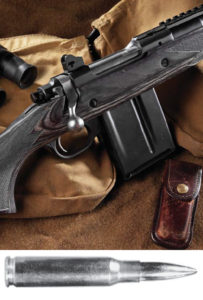
I was doing an evaluation of a Legendary Arms Works rifle this weekend, using many different types of ammunition; both factory stuff and some of my handloads. The rifle was LAW’s The Professional, a sweet bolt-action in .308 Winchester, with a good Cerakoted barrel and action, set in a Bansner synthetic stock.

I had four different types of factory loads that I knew had shot well in other .308s. I was recording velocities and group size, and when it came time for the handload portion, I stumbled upon my old supply of .308 hunting ammo.

When I had loaded this ammo, the .308 Winchester was my main hunting rifle, and I used the fantastic Sierra 165-grain Game King hollowpoint boat tail bullet. The load consists of 44.9 grains of IMR4064, ignited by a CCI200 Large Rifle primer. This load has given me MOA accuracy from my old standby Ruger Model 77, with a sporter weight barrel and a terrible factory trigger, topped with an old school Leupold Vari-X IIc 3-9; a decent hunting combination for a young hunter of modest means, and a gift to me from my father.

Back in those days, I scavenged every single piece of .308 brass I could get my hands on, and used them until they cracked. I’m glad times have changed, but I remember how precious the components were to me when I had no money.

Within this plastic box of hunting handloads were about 80 rounds, all carefully handloaded (to the best of my abilities in those days) to the same specifications, except for the fact that they were loaded into different brands of brass. R-P, WW Super, FC (two variations), Super Speed and Win headstamps were all present within my melting pot of ammunition. All the brass was carefully trimmed to the same length, as well as the bullets seated to a uniform dimension.

This LAW rifle is a shooter, showing sub-MOA accuracy with three of the factory rounds. Grabbing the box of handloads and heading to the range, it wasn’t until I had the Oehler Chronograph fail to give me a reading that I realized that this was the hodge-podge collection that I have described.

Looking through the box, I separated them into lots of the same headstamp, and started observing the difference, allowing the barrel to cool properly between groups. The velocities all hung pretty close to 2,650 fps, within 30 fps or so, but the accuracy changed quite radically.

My notes indicated that I developed the load with R-P cases, and they showed the best accuracy from the Legendary rifle, but the accuracy told a different tale. The R-P stuff printed ¾” groups at the 100-yard mark, but the FC headstamp brass opened up to over 2”. I thought it was me; I just wasn’t shooting well today or something.

Something as minute as a brand's cartridge capacity for the same caliber can make a huge difference in handload accuracy.

I gave three of the same FC headstamp cases to another shooter, and the bullets printed the same size group. I grabbed three more R-P cases, and shot a group measuring 7/8”, while the WW Super stuff shot 1 ½”. A pattern was developing here. The Super Speed cases gave exactly one MOA, and a third attempt with the FC cases showed that at least The Professional rifle didn’t like them.

What’s the lesson here? Sometimes the slight variations in case capacity between brands, or even lots of the same brand, can cause a pretty radical change in accuracy.

Don’t get me wrong, any of those loads would have sufficed for the normal deer hunting shots here in the Northeast, but change that scenario to a Pronghorn antelope hunt or other long range affair and the shooter may start to doubt things.

This lot of ammo represents what I had to do in a pinch, when premium brass was unaffordable and I needed to make do with what was on hand. But when hair-splitting accuracy is required, consistency matters.

Video: Everything You Wanted to Know About Arisaka Anti-Aircraft Sights

0

There were many odd and ambitious projects during World War II, but none more so than the Arisaka anti-aircraft sights as found on early Arisaka Type 99 rifles.

When talking about early Arisaka Type 99 rifles, you’re talking about high expectations.

What made the main battle rifle of the Japanese Empire during World War II such an ambitious project early on was one feature in particular, the sights. In short, the crazy-winged contraption was meant to tackle the impossible — engaging aircraft.

The idea of knocking an American F6F Hellcat or a B-29 Superfortress out of the sky with a bolt-action seems downright crazy. Of course, when thinking along these lines we’re reflecting on the venerable 7.7x58mm rifle in perfect modern hindsight.

As the above video by You Tube channel C&Rsenal shows — with awesome sound effects, mind you — the Japanese weren’t completely off their rocker with this idea. More than anything, the Empire was guilty of fighting the last war when it conceived the Arisaka anti-aircraft sights.

Even with this in mind, it’s hard to argue the Japanese truly had some soaring aspirations for their riflemen.

Carry Law: What Is A Righteous Shooting? Part I

2

Carry Law and Self-Defense.

What is the likelihood of a so-called righteous shooting—one in which self-defense appears warranted by all known reasonable standards—still ending up in trial? It’s a great question and one that every armed citizen should consider.

Let’s say you are involved in a self-defense shooting where there is no chance of retreat and the case meets the ‘reasonable man’ standard—that is, you could articulate fear of death or serious bodily harm. Furthermore, you are a citizen in good standing and the incident meets the standards of Ability, Opportunity and Jeopardy. Plus, you give the appropriate information to responding police and then contact your attorney. In other words, you think you did everything right.

What are the chances that the District Attorney (DA) will charge you with a crime even though it appears to be a clear-cut case of self-defense? Can your attorney, who knows something about you and your training, interact with the DA at this point and suggest there is little chance of a successful prosecution and argue for dismissal?

The answer depends where you happen to live: in a grand jury state, or one in which the prosecutor makes the decision to charge. If, in your jurisdiction, all shootings automatically go in front of a grand jury, then it is up to a them to decide if you will be charged.

Depending on the local court rules and customs, you may or may not get to testify for the grand jury, and you likely will not have an attorney by your side if you do testify.

If you do testify, you decide how much you want to tell the grand jury. Others will testify and then the grand jury will decide if there is a preponderance of evidence to believe that you committed a crime or acted in genuine self-defense. On the other hand, if it is up to only the prosecutor, then what you say, coupled with your attorney’s efforts, certainly can affect whether or not you are charged.

The problem lies in who decides whether or not the shooting was righteous. Sure, you know all the facts, and you know what you perceived, and you know how you felt. But, assuming you live in a state where the prosecutor makes the charging decisions, how can he or she come to understand what you knew, felt and perceived?

In a perfect world, smart, sober and uninvolved witnesses will tell the police detectives that you were reacting to a deadly threat and that you had no other choice but to shoot.  Unfortunately, our world is anything but perfect, a fact we will explore in Part II as we take a look at two very revealing case studies. And we’ll show why it’s a very good idea to activate your membership in the Armed Citizens Legal Defense Network right away if you haven’t done so already.

Click here for Part II

CTK Precision Helps Make AR Stocks Even More Versatile

0
CTK’s AR Buttstock Rail adapts LUTH-AR stocks for a monopod or other accessories.

LUTH-AR managed a pretty impressive feat. It made one of the world’s most versatile firearms even more so.

The company’s line of fully adjustable buttstocks give shooters the ability to tweak their ARs to fit every nook and cranny of their physiques. As fate would have it, another company has made the extremely flexible stock even more adaptable.

CTK Precision‘s AR Buttstock Rail allows LUTH-AR’s MBA-1 and MBA-2 stocks to be outfitted with CTK’s monopod. This appears to be a solid move, given the design of the buttstocks.

Both the MBA-1 and 2 are popular accessories for those shooting to turn an AR-15 or AR-10 into a precision platform. In part, this is due to the accessory's adjustable cheek rest and the ability to modify a rifle’s length of pull.

CTK’s AR Buttstock Rail and Ultimate Rail-Pod give LUTH-AR stocks an extra element of stability.

The addition of CTK Precision’s Ultimate Rail-Pod adds another dimension to the system. The accessory gives shooters an added element stability and allows for long holds on a target without strain.

The 2.5-inch AR Buttstock Rail quickly attaches to the LUTH-AR stocks and does little to increase the overall bulk of a firearm. And the .7 once 6061 aluminum Picatinny rail is manufacture to Mil-Spec, increasing its handiness by making it compatible with other accessories. As an added bonus, it also includes sling swivel mount points.

CTK’s AR Buttstock rail presently has an MSRP of $35. The Wisconsin company’s Ultimate Rail-Pod is listed at $160 and is compatible with any Picatinny rail system.


We Proudly Sell CTK Precision Products

CTK Precision P3 Ultimate Shooting Rest

CTK Precision P3 Ultimate Shooting Rest

CTK Precision Universal Brass Catcher

CTK Precision P3 Ultimate Target Stand

Brief Discussion on the Extreme Range of .22 Ammunition

0
What's the reach of .22 ammunition?

The .22 rimfire reigns supreme when it comes to American shooters. But just exactly what are these nifty little rounds capable of at the extreme end of their range? You'd be surprised.

The extreme range of the .22 LR from a rifle is listed by SAAMI as 1,800 yards. This is achieved at an angle of departure of about 30 degrees. Army Ordnance publications cited in Julian Hatcher’s writings give a figure of 1,500 yards with the standard-velocity ammunition at a velocity of 1,145 f.s.

This raises the question of the difference between a standard velocity vs. a high-velocity LR at 1335 fps. States Hatcher regarding the HV LR:

Ballistic tables show us that its muzzle velocity is reduced to 1,145 f.s. after 65 yards flight, so obviously if the higher-velocity bullet were fired from 65 yards behind the firing line of the standard velocity .22 Long Rifle bullet, it would pass that firing point with the same velocity and would go to the same spot, so that we may merely add 65 yards to the figure for the standard velocity cartridge.

While serving as a U.S. Army Ordnance officer, during and after the First World War, Hatcher established a “Ballistic Station” in Florida, which used beach areas to study bullet behavior, utilizing shallow water and sand beaches to recover fired bullets.

One of Hatcher’s assistants was E.C. Crossman who, like Hatcher, later became a firearms writer. Crossman cites a 1,400 yard figure, and in his small-bore rifle book offers a photograph of a Long Rifle bullet beside the crater it made in the sand at a measured 1,325 yards.

This is the nearest I have come to any empirical evidence of such testing.

While the range statements from SAAMI of 1,800 yards for the LR., 1,950 for the .22 WMR, 2,225 for the .17HMR and 1,900 for the .17 Mach2, don’t jibe with empirical testing, they are worthy of consideration in terms of caution.

A mile is 1,760 yards, so those range-warnings on the boxes of 1 to 1 1/2 miles are in the ballpark.

Beretta Celebrates Pistol Milestone with 92 Centennial

1
Beretta has been in the semi-automatic pistol game for 100 years now and it’s celebrating with the 92 Centennial.

It was 100 years ago this year that one of the world’s most renowned firearms makers began manufacturing what would become one of its best known products.

The Beretta Model 1915 marked the world’s oldest gun maker’s entry into the semi-auto pistol market. And the Italian manufacturer isn’t allowing this milestone to pass without a little bit fanfare.

Beretta has issued a commemorative handgun to mark the occasion, however, it is not a replica of the historic blowback pistol that kicked it all off. Instead, the company has decked out a model better known to contemporary shooters — particularly those with a military background.

The Beretta 92 Centennial is a collector’s edition of well-known 9mm pistol, a variation of which has served as the U.S. Military's sidearm since 1985. And for enthusiasts of the company, the firearm should have plenty of collecting potential.

Perhaps the handgun’s greatest asset in this regard is its scarcity, Beretta has only produced 500 Centennials. But the special-edition 92 has other qualities almost certain to catch some eyes.

The pistol has a high brush steel frame safety and a single-action only configuration. The years 1915 and 2015 are engraved in Roman numerals on either side of the Brigadier-style slide. The same numerals appear on a medallion logo placed in the center of premium-grade wood grip panels.

As a neat twist, Beretta is packaging the 92 Centennial in a custom ammo box.

The 92 Centennial comes with a certificate of authenticity and is presented in an ammunition can bearing the pistol’s logo. There was no price available for the collector-edition pistol, though given it is a limited edition it’s a safe bet it will cost a pretty penny.

While the pistol of which the company is commemorating was the inspiration for the Centennial, it was quite a different animal than the rather largish modern military arm.

The Italian Army adopted the Model 1915 shortly after its entry into World War I, due to a lack of sidearms. By today’s standards, the pistol would have been consider very underpowered especially for military service, chambered in both .32 ACP and 9mm Glisenti Short.

The Model 1915 was a single-action pistol with an 8+1 capacity. While the Italian army used the handgun during the war, the military force still relied on an older military sidearm — the Bodeo Model 1889 revolver.

92 Centennial Specs
Action: Single
Barrel Length: 4.9 inches
Caliber: 9mm
Capacity: 15+1
Height: 5.4 inches
Length: 8.5 inches
Width: 1.5 inches
Weight (unloaded): 42.3 ounces

The Streamlight TLR-6 Sheds Light on Glock Single Stacks

0
Streamlight’s new TLR-6 light/laser combo sheds some light on the Glock 42 and 43.
The new Streamlight TLR-6 light/laser combo sheds some light on the Glock 42 and 43.

As would be expected, Glock’s recent venture into single-stack pistols has spurred a ton of new accessories.

From holsters to night sights, nearly every conceivable doodad has hit the shelves to outfit the G42 (.380 ACP) and G43 (9mm). And recently, Streamlight has gotten into the action with a device certain to shed some light on the petite pistols.

The Pennsylvania company added a combination weapons light/laser sight tailored for Glock’s new single-stack handguns. The Streamlight TLR-6 appears to offer shooters a solid light source and aiming solution in a package that shouldn’t weight down the compact platforms.

To that end, the light/laser only adds 1.27 ounces to the relatively light pistols and measures in at 2.3 inches long and .85 inches in width. The size is made all the more manageable, given the device attaches to the trigger guard, thus maintaining the pistols’ balance and trimness.

While small, the TLR-6 packs plenty of power.

The device’s C4 LED illuminator kicks out 100 lumens of light and has a beam distance of 292 feet. Streamlight boasts the TLR-6’s parabolic reflector shoots a trim and intense beam of light, while allowing for some peripheral illumination. As far as the device's sight, it has a 640-660nm red laser, which should prove to be versatile and fit most shooters’ needs.

The TLR-6 can operate its weapons light and laser independently or in unison and is controlled by a button located on either side. The ambidextrous control should allow for ease of use, naturally positioned for an indexed finger.

The Steramlight TLR-6 gives shooter plenty of power and accuracy in a compact package.

The device operates off two CR1/3N lithium batteries, which provide enough juice to power the LED or LED/laser combo for one hour or the laser only for 11. Streamlight has also included a number of other features that make the power source even handier.

The TLR-6 has an automatic shutoff, that powers down the device after 10 minutes. And its batteries can be changed without removing the device. This is especially nice, given this allows a swap without having to resight afterwards.

The sight itself is fully adjustable, with its windage and elevation screws mounted in brass bushing to help maintain the device’s zero. The TLR-6 also boasts a impact-resistant polymer housing, which is rated IPX4 water resistant.

Perhaps the biggest selling point of the TLR-6, however, is its price tag. The American-assemble device won’t break the bank with an MSRP of $175 and comes with Streamlight’s limited lifetime warranty.

Snubbies and Handgun Accessories Prove Popular

0
Taurus Model 85, 38 special revolver.

Snubbies and handgun accessories are hot commodities in gun shops around the country.

This recent winter, Roger Howe, owner of L&R Arms Exchange, has been selling a large number of handguns for concealed carry customers. But whereas the in-demand handguns in 2014 were .380 semi-autos, now his customers are much more interested in buying “snubbies,” or snub-nosed revolvers. Leading the pack here are Taurus Model 85’s in .38 Special and various Rossi revolvers in .38 Special, as well as .357 Mag.

“Each of those revolvers sells in the mid-$300 to the upper-$300 range,” Howe noted. “That’s $100 to $150 less than most of the Rugers and the Smith & Wessons, and that lower price point seems to be driving sales towards these models.”

Handgun Accessories Moving Briskly

The Real Avid Gun Boss Handgun Cleaning Kit is one of the more popular handgun accessories with Gun Digest readers. Click here to check it out.

With a customer base extremely interested in self-defense and concealed carry, it is no wonder that Center Target Sports in Post Falls, Idaho, sells a steady stream of handgun accessories. Owner Edward Santos says mini red-dot optics for pistols are increasingly popular with his customers, especially the Trijicon RMR at $349.99 and the Burris Fast Fire priced a little less at $269.99.
His top aftermarket handgun sights are models made by AmeriGlo and TruGlo. For laser sights, “Crimson Trace models are still number one in this store,” Santos said. “We do carry other makes. But they are no competition to Crimson Trace.”

Center Target could not keep the 9mm Beretta Nano in stock when the small carry pistol first came out.

“But those sales have dropped way off,” Santos said. “They pretty much had that market at first, but today I think there’s just too much competition in this style and size of gun for the Nano to dominate.”

Now, the demand in this segment of the concealed carry market has shifted to the Glock 42 and Sig P238, while Smith & Wesson J-Frame revolvers are doing very well here, too.

This article appeared in the May 2015 issue of Gun Digest the Magazine. Click here to download the issue.

Test Driving the Glock 43 Single-Stack 9mm

0

When it comes to 1 pound carry pistols, it doesn't get much sweeter than the Glock 43.

Why the single-stack Glock 43 was necessary:

  • Provides a slimmer concealed carry option.
  • Large enough to remain highly manageable.
  • Enough grip to engage entire hand.
  • Offers caliber upgrade on the single-stack Glock 42.
  • Strong law enforcement appeal as a backup gun.

Back in 2015, we broke the news about Glock’s long-awaited single-stack 9mm, the G43. At the time, those observations were limited to my experiences and those of a handful of writers who got to preview the gun at Glock’s Smyrna, Ga., training facility. Now that we’ve had a bit more time to learn about the Glock 43, it’s time to round out the story.

Glock G43 Review.

The first and most obvious question from a practical standpoint is why a single-stack 9mm from Glock is even necessary. After all, one major draw for Glock fans is the double-stack magazine with its higher ammo capacity. Doesn’t the Glock 43 (6+1 capacity) run counter to the very thing Glock is known for? Not surprisingly, Josh Dorsey, vice president at Glock, Inc., thinks not, and offered a compelling defense for the Glock 43.

“With the G43, I believe we’ve hit the ‘sweet spot,’” Dorsey said. “It’s small, but not so small that you can’t handle it. Its design means not a lot of recoil is transferred to the shooter. We’ve replicated the trigger pull of the larger Glock models, and it’s got that familiar Glock balance that so many shooters favor.”

Glock Reviews You Need To Read

Expanding on Dorsey’s “sweet spot” analogy, the G43 fits right in between the Glock 26 and the Glock 42. Compared to the G26, it’s .2 inches narrower at the grip and 6 ounces lighter. The G43 specifications are more in line with the Glock 42: the Glock 43 is just a couple of ounces heavier and a fraction of an inch wider. The big difference, of course, is that the sweet-shooting G42 is chambered in .380. For consumers and law enforcement professionals who rely on the 9mm as their go-to caliber and main carry gun, the G43 is great news indeed.

The new Glock G43, left, shown with the Glock G42 in .380, released a year ago. Both models are slender as can be.

“The bulk of our G42 sales have been commercial sales in the U.S., with some sales to law enforcement as a backup gun,” Dorsey went on to explain. “The G43 will have strong crossover to the L.E. market as a backup gun because it replicates their duty round, and we anticipate a larger demand from L.E. because of that.”

The advantages of replication don’t stop with the L.E. market. Anyone who carries a 9mm and wants a trustworthy yet compact backup will find the G43 worth consideration. In true Glock fashion, the G43 I tested digested a variety of ammo without a hiccup.

In addition to the random range ammo I fired in a prototype G43 in early March, I’ve since pounded through nearly 300 rounds of Winchester “white box” 124-grain FMJs, followed by a couple mags each of self-defense ammo: Hornady Critical Defense 115-grain Flex Tip; Hornady Critical Duty 135-grain FlexLock; Hornady Custom 147-grain XTP JHP; and both the T (FMJ) and D (JHP) versions of Winchester’s 147-grain Train & Defend loads. So far the Glock G43 has functioned without fail during two different outings and with no cleanings.

The G43 is extremely manageable with all of the loads mentioned above. I purposely didn’t run any +P through it because I was more interested in seeing if it was enjoyable enough to shoot during extended, meaningful range sessions—the kind of practice that really counts. Shooting the Glock 43 isn’t as drastically different from shooting the G26 as I thought it would be. Yes, there’s less surface area to wrap the paws around, but I liked the familiarity of the high grip, the similar distance to the trigger and the distinct Glock trigger pull to which I’m accustomed.

The Glock 43 has more snap to it than the Glock 26, but with less weight to suck up the recoil, that’s not surprising. Nevertheless, you shouldn’t have any issues crushing off 100 or more rounds in a practice session, and that’s a compliment I haven’t bestowed on any other sub-1-pound carry gun.

Glock 43 Specs

Caliber: 9mm
Barrel Length: 3.41 inch
Weight: 20.64 ounces (loaded)
Magazine Capacity: 6
Overall Length: 6.26 inch
Slide Length: 6.06 inch
Overall Width: 1.06 inch
Slide Width: .87
Height Including Mag.: 4.25 inch
Sight Radius: 5.24 inch (Polymer), 5.20 inch (Steel), 5.16 inch (GNS)
Trigger Distance: 2.56 inch

This article appeared in the May 2015 issue of Gun Digest the Magazine.


Learn More About Glock Options

Market Trends: World War II Firearms Hot at German Auction House

0

K98 Mauser Roland Gleixner — Hermann Historica oHG, Munich, Germany

The German auction house Hermann Historica has seen steadily increasing demand for Walther and Mauser pistols made between 1930 and 1945, noted the establishment’s firearm expert, Roland Gleixner.

Top bids are going for any of these World War II firearms made for the German Wehrmacht, “and other state institutions with the corresponding military, police, navy, air force, NSDAP and protection squad markings,” said Gleixner.

At a recent auction, for example, a Walther PPK ZM in 7.65mm, of the type given to political leaders, complete with the original holster and produced in 1937, sold for 9,600 Euros, far above the minimum estimated pre-auction price of 5,500 Euros (1 Euro equals $1.13 U.S.).

Even more impressive, a Walther PP ZM owned by Col. Walter Oesau of the German Luftwaffe, and manufactured in 1940, sold for 32,000 Euros. Oesau, Head of Fighter Command Bretagne, was awarded the Knight's Cross with Oak Leaves and Swords, flew 300 missions and was killed during his last mission in April 1944.

For 20th-century military rifles, Gleixner notes the K98 Mauser carbine is in greatest demand at his auctions, with top prices paid to those examples with German military and other German state institution markings. German military semi-automatic rifles of all kinds also sell very well, including the G 41(M), G 41(W), G 43 and K 43.

There’s also a strong market for deactivated World War II machine guns. Offered recently were an MG 42 on field carriage, chambered in 8x57mm and produced in 1943, and an original MG 42 with original bipod, also in 8x57mm. Each of these non-functioning relics of the war years brought in 5,800 Euros.

This brief originally appeared in the May 2015 issue of Gun Digest the Magazine.

Hardware Issues and Concealed Carry – Part III

0
Author has done multiple “cocked revolver/hair trigger” cases, in some of which the allegation was false. He recommends defensive revolvers be rendered double action only.

Massad Ayoob on why to avoid the so-called “hair trigger” in concealed carry.

The Glock New York trigger costs just $2 and installs in just minutes. It increases trigger pull weight and changes the pull force orientation to give a double action revolver feel.

In three and a half decades as an expert witness in weapons and shooting cases, I’ve run across three arguments from the other side which, even though sometimes bogus, are so tough to defeat that it’s better not to have to fight them at all. This goes down hard with the naïve folks who believe “a good shoot is a good shoot,” which is somewhat akin to the belief that every Christmas a fat guy in a red suit is going to come down a chimney and give them presents, too.

First and foremost among these is what a layman would call a “hair trigger,” that is, a trigger pull lighter than what the gun’s manufacturer recommends for a defensive firearm.

It is within the common knowledge that good people forced to fight criminals with guns are likely to be nervous and shaky. We’ve known for well over a century that in the grip of “fight or flight response,” blood flow is directed away from the extremities and into major muscle groups and internal viscera, to “fuel the furnace” for the strenuous effort primal brain believes is about to take place. It’s called vasoconstriction. It’s the reason why frightened Caucasians turn visibly pale, and it’s one reason we all become extremely clumsy under stress. Mixing that with a “hair trigger” is like mixing fire with gasoline.

What, exactly, is a “hair trigger”? It depends on the gun design, just as the question “what is a safe adjustment of brakes” depends on the specific vehicle. The manufacturer’s specification for trigger pull weight on that particular firearm, and the “common custom and practice” for adjusting such guns, constitute the standards.

The Glock NY-1 trigger increases trigger pull to around 5.5 pounds when used with the 3.5# connector. Despite the heavier pull, accuracy was still excellent at 7 paces.
Despite the heavy trigger pull on this Glock, accuracy was still excellent at 7 paces.

In the timelessly popular 1911 pistol, the Colt company, which has manufactured more of those guns than any other company, tells its armorers that 4.0 pounds is the red-line bottom limit of pull weight for a duty gun used for police, military, or civilian defense purposes. The National Rifle Association requires a 4.0 pound minimum trigger pull on 1911s used in their Distinguished matches, and enforces it with referees equipped with trigger pull weight measurement devices. Do we see a pattern here?

The most popular pistol in the USA today is the Glock. Since its introduction in this country in the early 1980s, this pistol – issued or approved by over 60% of America’s police at this writing – had a 5.5 pound standard trigger pull. Some departments have gone heavier: Miami and some others went with an 8.0-pound trigger connector.

The New York State Police demanded what is now known as the NY-1 trigger, which gives firm resistance from the beginning of the trigger press and brings total pull weight up to around 8 pounds. NYPD demanded more: first called the New York Plus and now known as the NY-2 module, the trigger system in their Glocks approaches 12 pounds, which for this writer passes the point of diminishing returns. The reason, in all cases, was safety against accidental discharges; with thousands of cops using guns under stress, the firearms instructors on those departments wanted a greater safety buffer.

In the late 1980s, Glock came out with a target model sporting a 3.5-pound connector; weighed from the bottom tip of the trigger, that was the pull weight, and leverage being what it is, it ran about 4.5 pounds from the center of the pivoting trigger; they later renamed the exact same part the 4.5-pound connector. However, from the beginning of all that, it was adamant Glock policy that this trigger pull weight not be used in a duty or defense gun.

Highly recommended: Mas Ayoob serves on the board of the Armed Citizens Legal Defense Network. Click Here to find out why you should join!
Tip: Join the Armed Citizens Legal Defense Network and get a FREE download. Click Here to see the benefits!

Their models with this light trigger, then and now, are listed in their catalogs and websites under “sport,” not “duty” or “self-defense” pistols. Target models ordered by police departments are, by policy, shipped with 5.5-pound or heavier trigger pulls.

Would installing a lighter trigger in a duty Glock be a problem? Look up the case of Santibanes v. Tomball, TX and see for yourself. The short answer is, “Yes.”

Before the Glock, revolvers were standard in American law enforcement. Cocked revolvers with light single-action pulls proved conducive to unintended discharges. Decades ago, LAPD set the trend of converting the guns to double action only. Could, say, a cocked Colt Detective Special with 4.5-pound pull be seen as “reckless and negligent” for taking a criminal at gunpoint? Look up the Appellate Court decision in New York v. Frank Magliato, and find out for yourself that the answer is yes.

Why would 4.5 pounds be seen as negligent in a cocked revolver or a Glock, but OK for a 1911? Partly because the 1911 has a passive grip safety and an active manual thumb safety the other two guns don’t have, and partly because their own factory literature, court-discoverable, said so.
My own practical advice would be to stay above 4 pounds in a 1911 and 5.5 pounds in a Glock, and render a defensive revolver double action only, an easy gunsmith job.

Why is it an issue at all in an intentional self-defense shooting? Because the hair trigger gives opposing counsel a hook upon which to hang a false allegation, whether criminal or civil. In the criminal case, it’s easier to sell a jury on a theory that the gun went off by accident due to a negligently too-light trigger pull, sustaining a manslaughter charge, than to convince them that a good person turned into Mr. Hyde and became a murdering monster. In a civil lawsuit, the motivation is different: plaintiff’s counsel is looking for deep pockets.

Few defendants have a million liquid, unprotected dollars that the plaintiff can seize to satisfy the judgment if the jury decides in the civil case that you deliberately, maliciously killed the deceased.

But most people HAVE a million dollar homeowner liability insurance policy if a burglar was shot, or the same for automobile liability if a carjacker was shot, and the insurance company has the money! However, the vast majority of insurance policies won’t pay off on an intentional tort, a deliberate act that harmed the plaintiff. But they will pay off for a negligent accident. Voila, the theory of “he shot my client by accident when he negligently pointed a hair-trigger gun at him” is born.

CMMG Now Offering Flat Dark Earth Finish

0
CMMG is now offering the Mk4 (pictured above) and Mk3 rifles with a flat dark earth finish.

Two of CMMG’s most popular black rifles are getting a heck of a lot less, well, black. The Missouri manufacturer recently announced it is now offering the Mk4 RCE and Mk3 CBR in a Flat Dark Earth finish.

The move follows a bit of an emerging trend in AR-style rifles, with more and more manufacturers offering different finishes to existing models. And CMMG’s move to FDE on two of its carbines does have some practical potential.

Depending on the area of operation, the finish could help a shooter blend into their surroundings better. This could be a particular perk for individuals, such as western coyote hunters. But, as one of CMMG’s co-owner's points out, the new finish also continues the ethos of the AR being a rifle that can be tailored to any situation or liking.

“Flat Dark Earth finish gives our rifles a new look and allows customers to further customize the rifle to their liking,” Jeff Overstreet said. “For us, it's a great opportunity to provide something different and further enhance our rifle line-up.”

The Mk4 RCE in FDE is available in 5.56x45mm NATO or .300 Blackout and the Mk3 CBR is chambered in .308 Winchester.

Both are outfitted with 16.1-inch medium taper barrels. In both cases, the barrel has a salt-bath nitride finish (black), which is corrosion resistant. They are also outfitted with SV muzzle breaks, which should aid in reducing recoil.

The Mk4 and Mk3 each boast Geisseler SSA 2-stage triggers, which should provide a much cleaner, less gritty trigger pull over standard MIL-SPEC. Both rifles also feature Magpul MOE Pistol Grips.

The Mk4 and Mk3 both have KeyMod handguards, made from milled 6061 T6 aluminum. And each rifle features a full-length Picatinny rail along its 12 o’clock. Both rifles are also outfitted with Magpul adjustable stocks.

The Mk4 ships with a 30-round PMAG, while the MK3 comes with a 20-round PMAG. The Mk4 has an MSRP of $1,499 and the Mk3 a price of $2,149.


Outstanding AR Resources and Gear

Real Avid AR-15 Tool

Real Avid AR-15 Tool

Gun Digest Book of the AR-15 Digital Collection

CTK Precision Universal Brass Catcher

Reloading Ammo: Handloading for Long Range Accuracy

1
The author on the business end of a .338 Lapua ready to demonstrate his long range shooting skills at a 1,000-yard range.

Of all the factors that come into play in achieving long range accuracy, ammunition is among the most controllable. This offers handloaders unparalleled opportunity.

We shooters have long been enamored with hitting distant targets.

The tales of military snipers, making impossible shots at equally impossible distances. Hunting stories in which the intended target was far enough away to measure the distance in city blocks. And the current trend in the hunting shows that game being taken at ranges in excess of 500 yards. All these can imply that it is simple to hit these distant targets.

Allow me to testify that it isn’t.

Long range accuracy requires precision equipment that is well tuned and proven, in addition to a skill set that takes quite a bit of time to acquire. Most certainly you must have a rifle capable of delivering the goods — it needs to be accurate — and optics that not only will give you the clarity and magnification necessary to connect, but that will stand up to the rigors of field conditions. But the ammunition, this is where the deal can be made or broken.

Factory ammunition (especially the match grade stuff) is better than it has ever been, and I’ve seen rifles that will shoot factory ammunition much better than any handload. But, the majority of my experiences indicate that a long-range rifle will shoot best with a well-tuned handload.

That said, a certain amount of care must be taken to achieve the hair-splitting level of accuracy required to hit a bullseye or cleanly take a game animal at longer ranges.

Ethics are a personal thing, and I have my own individual limits regarding how far I will take a shot at unwounded game. Under good conditions, meaning little wind or mirage, I try to keep my hunting shots to within 400 yards. There is unseen wind, energy levels that can fall off rather quickly, and other factors that can affect the bullet’s flight.

Paper is a different story, as the worst outcome from an errant shot is my wounded pride, but it can be a fantastic educator. You can easily get a feel for the level of accuracy required when shooting paper at 300, 400 or 500 yards.

If you’d like to try your hand at the long distance game, think about the game in reverse. Just as tiny variations in trigger squeeze and follow through can send a shot awry, tiny variations in ammunition get magnified at long distances.

Bullet weights should be checked on a balance beam scale, and the projectile separated into lots, using those that weigh the same within 0.1 or 0.2 grains. Cases should be of the best quality, consistently resized — whether full-length or neck sized is your decision — and trimmed to a uniform length.

Quality components are a must for long range accuracy. Norma case, for instance, make for a good starting point.

Primers should also be the best you can get; I like the consistency of Federal Gold Medal Match primers in both Large Rifle and Large Rifle Magnum, but I would suggest some experimentation with different primers. I’ve seen a rifle or two, using identical components and powder charges, become a much better performer when a different primer was used. In the cases I recall a Remington primer was the answer, when a Winchester and CCI didn’t get the job done. Primers can be finicky creatures.

All of your powder charges should definitely be weighed. I know that there are many benchrest shooters that shoot tiny groups when loading by volume, but I feel the best accuracy comes from a powder charge of uniform weight.

Projectiles should have a good Ballistic Coefficient, so as to deliver the flattest trajectory and best defy the effects of wind drift. The long range game is the place where the compound radius ogive and severe boat tail will show their worth.

The chronograph will help you better predict the trajectory of your load. While the reloading manuals are a very valuable guide to predicting the long-range trajectory of your loads, a chrono will give you exact velocities.

I’d also recommend some really good reloading dies, like the Redding Competition Dies. These can give the most repeatable results when it comes to bullet seating, keeping the Cartridge Overall Length to a uniform dimension and minimizing bullet deformation. Measure all of your long range cartridges with a caliper, and set any that don’t quite measure up aside for practice, leaving only the best rounds for distant shooting.

I’ll warn you: the long range game can be addicting, and so can reloading for it!

STI Introduces Two New Competition Pistols

0
STI’s DVC Open (pictured above) and Limited have all the extras to make them champions.
STI’s DVC Open (pictured above) and Limited have all the extras to make them champions among competition pistols.

STI's 2011 line of competition pistols have a couple new additions with all the bells and whistles to put a shooter at the top of the podium.

STI has cut a wide swath with its 2011 line of competition pistols.

From defending hearth and home to gunning down top honors at a match, the unique 1911 pistols have been tailored for every situation. But there is little doubt the newest additions of the series were definitely engineered for one thing.

The DVC Limited and DVC Open were both built for speed. And the Texas-based STI has provided plenty of extras to make sure these pistols help shooters to the top of the podium.

Perhaps the most helpful aspect in doing this is a feature common to the entire 2011 line — capacity. In a unique twist, STI has made the august John M. Browning design a double-stack, a feature that is certain to help shave seconds by cutting down on reloads.

Both the DVC Limited and Open feature all new sear designs that look to give shooters an edge. The triggers have a snappy 2- to 2.5-pound trigger pull, which should make it simple to quickly break shots, while keeping the pistols on target.

The competition pistols are outfitted with hand-textured grips that have been reduced and undercut by Extreme Shooters of Arizona. This should give shooters a greater purchase on the pistols, thus helping the handguns' controllability, and reducing recoil and muzzle flip.

The two new models utilize Dawson Precision tool-less guide rods, an addition that STI said is a first among factory guns. Like its name implies, the guide rod does not require a tool or a wire to capture the recoil spring, making it possible to field strip the gun anywhere and anytime.

The DVC Limited and Open have 5-inch bull barrel, coated with titanium nitride. The thickness of the barrels should help it dissipate heat more quickly, while the coating increases the hardness, lubricity and longevity of the barrel.

Milled slide, tool-less guide rod and bull barrel are a few of the outstanding features STI is offering competitors with their DVC Limited and Open models.

The pistols each have material removed from their slides to give them more desirable tendencies. The cuts increase the firearms' cycle rate and keep them balanced, while reducing forward recoil.

Both of the competition pistols have hard-chrome finishes and come with two 140mm magazines. Concerning the magazines, this equates to 20 rounds of 9mm or .38 Super or 17 rounds of 40 S&W.

The DVC Open has a couple of extras to make it perfect for the wild west of Open Division competition. These include a Trubor style integrated compensator (another recoil reducer), a reversible dual detent slide racker and a C-More 6 MOA Dot Sight.

The DVC Limited is available in 9mm and .40 S&W, while the Open comes chambered in .38 Super and 9mm. Presently the MSRP on the Limited is $2,799, while the Open is listed at $3,699.

Father’s Day Gift Guide

0

When it comes to gifts for gun owners on Father's Day, we've got you covered with 10 exceptional hand-picked choices … all under $100 and sure to please.

[slideshow_deploy id='214943′]

Shooting: Mastering the Kneeling Position

1
Get away from the bench and practice the kneeling position. During hunting season you'll be glad you did.

The kneeling position in shooting is fast and stable when done properly. Once mastered it will pay big dividends in the hunting fields.

While much of the preseason tuning up we do as hunters happens at the range from a bench, likely at 100 yards on a paper target, it’s important that our big game training matches what we’ll face in the field.

Especially when hunting in the wide-open spaces of the West, it’s imperative to come ready to shoot from a variety of field positions at various ranges out to 200 or 300 yards. You can’t really know your maximum effective range from each position until you’ve practiced shooting from each of them, so training is obviously paramount.

One of the most effective is the kneeling position. It’s relatively quick and easy to get into, requires fairly minimal flexibility and allows the hunter to keep the rifle in a ready position while standing up. In turn, this provides for quick follow-up shots without taking your eyes off the animal.

To get into the kneeling position, start with your feet shoulder width apart, facing your target. Place your left foot in front of your body, toes toward the target, and drop to your right knee. Lower your torso into a rigid posture as you sit against your rear leg (your legs should now be perpendicular to each other).

Place the back of your left arm against the front of your left knee, avoiding the unstable bone-on-bone contact that happens if you perch your elbow atop your knee. To get out of the kneeling position, simply rise up with the rifle in the ready position, muzzle at eye level, giving yourself the chance to make a quick follow-up shot as necessary.

These shooting tips appeared in the Summer 2015 issue of Gun Digest the Magazine.

MUST READ ARTICLES