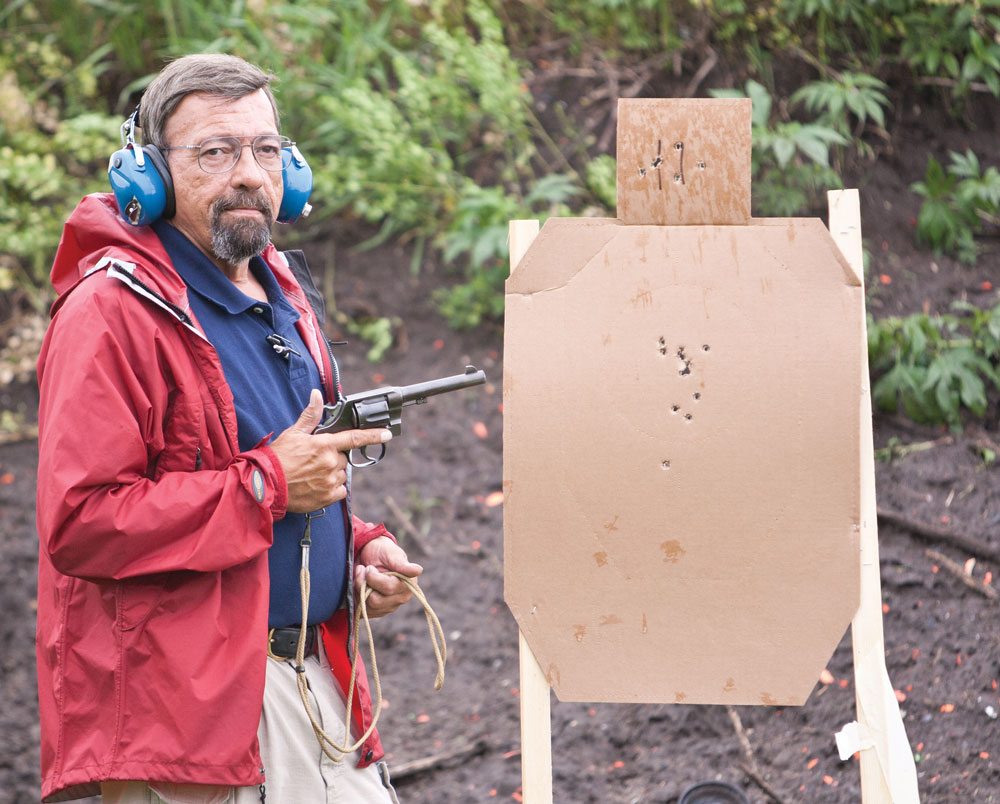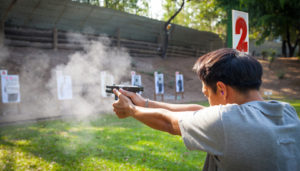

Gunsite instructor Il Ling New uses a remote-controlled deer target to teach shooters the fundamentals of making a shot on a moving target in Paulden, Arizona.
Gunsite Academy in Paulden, Arizona, is offering the ideal training for hunters, whether you’re an old pro tuning up for another adventure or a first-timer.
If you’re serious about your chances for success, gearing up for big game hunting season takes more than a few shots at the 100-yard range from a bench just a week or two before opening day.
The Gunsite Hunter Prep course can be tailored to individual and group needs and hunts, including dangerous game in Africa or elk in the Rocky Mountains.
Expert instructors Mario Marchman and Il Ling New, also a professional guide in the U.S., equip you with necessary skills like mastering field positions, shooting with sticks and slings, marksmanship training, proper trigger control and executing shots on moving or charging targets.
You’ll also have the opportunity to do plenty of shooting and live-fire drills at the range, including the walking simulator with one of the instructors as they guide you through different field scenarios. Replica game targets are placed in various locations along the course and have steel plates in the vital zones to help confirm hits.
Not only does the course force you to utilize shooting skills in a real world scenario, it also makes for an incredibly good time with friends. As for lodgings, the Little Thumb Butte Bed & Breakfast provides amazing views, close proximity to Gunsite and the best home-style food you’ll find in the area.
On the Internet since 1997, AntiqueGuns.com is owned and operated by Rob Robles, and strictly deals in firearms made prior to 1898.
AntiqueGuns.com auctions run almost continually because Robles’ turnaround time from receiving a gun to offering it for sale is usually one week, two weeks at the very most.
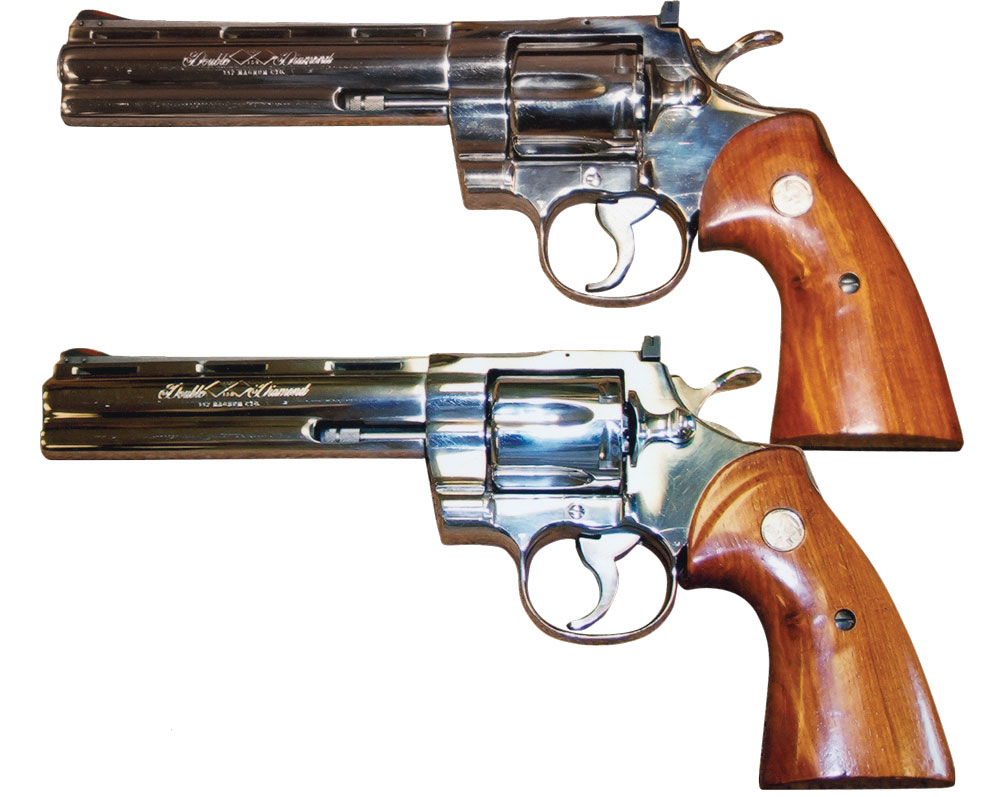
“If there’s one gun I’d say I am always on the lookout for, and never have any problem finding buyers for, it’s the Colt Single Action revolver, especially the larger bores, the .44 and .45 caliber models,” Robles said.
He credits much of the enduring interest in the Colt SA to Hollywood movies and television shows portraying the Colt SA as being carried by nearly everyone in the Old West.
“That’s not exactly true,” he added. “There were actually many models used in the Old West, many different manufacturers. But the Colt SA was popular, and it’s a durable handgun with a simple, dependable action. Buyers today still love it.”
Interest in Civil War-era firearms is mixed—strong among his American customers, soft with his European buyers.
“A lot of people don’t realize it, but European collectors are a huge part of the market for Civil War-era firearms,” Robles noted. “But Europe’s been in a recession and it has definitely hurt sales here. Over the last six months, I’d say my shipments of firearms sold to Europe have dropped by 80 percent.”
Big-bore rifles need not be fed on dangerous game loads alone. With the right components, cartridges can be tailored to chase after a variety of game.
When you have decided that a big-bore rifle is for you, and you’ve ironed out your dangerous game loads for hunting purposes, there’s still more fun to be had.
We are all aware of the fantastic reputation of the .375 with 300-grain bullets, the .416s and .404 with 400-grain bullets, and the various .458s with their 480 and 500-grain bullets. But there are ways to extend the versatility of those big guns, so you can spend more time afield with them.
We hunters, generally speaking, don’t get as much time as we’d like to use a true big bore rifle. And, as much as I love the rifles chambered to 6mm through .30 caliber (they definitely get the lion’s share of the time afield), I have a love of big guns, from .375 and up.
As handloaders, we can extend the versatility of the big guns, so we can hunt with them more often. There are many specialty bullets on the market that can do just that.
Cutting Edge Bullets from Pennsylvania comes quickly to mind. Their Safari Raptor bullets are constructed of brass, lathe turned and feature a deep hollowpoint. Like other monometal bullets, they are easily produced in light-for-caliber weights, and can offer an increase in velocity and a reduction on recoil. This is a great combination for lighter game, especially if you want to use your big bore for elk, moose or bears.
On a recent safari with deMoulpied & Son Outdoor Adventures, Dave deMoulpied asked me to cook him up a load for plains game in his .416 Rigby. Dave was after zebra and wildebeest, both tough animals, but they don’t necessarily require the tough 400-grain softs and solids that buffalo and elephant do.
Monometal bullets can expand the usefulness of big-bore rifles.
We picked out the 325-grain Safari Raptor from Cutting Edge, and seating it over an even 100.0 grains of Alliant Reloder-22, we obtained MOA accuracy and a velocity of 2,550 fps. Dave had a great safari, taking impala, wildebeest and his zebra, with the shot on the zebra being almost 200 yards. The additional velocity flattened out the trajectory a bit, yet there was still plenty of bullet to take the tougher plains game.
The same can be said for what I consider to be the most useful cartridge ever made: the .375 H&H Magnum. The heavy bullets are certainly available, like the 300-grain slug that made the .375’s reputation and even the newer 350 grainers that will give a bunch of confidence, but the 235-grain Barnes TSX and Cutting Edge Safari Raptor can turn your .375 into a long range rifle. With handloads, you can push those lighter bullets to around 2,900 fps, giving a very flat trajectory for longer shots, yet comfortably taking smaller game.
Even the .458s can be loaded with 350- or 400-grain bullets, to approximate the performance of the .45-70 Government. Take a look at lighter bullets for the big bores, and have fun making some new ammunition so you can use your big gun more often. Don’t be embarrassed to take your big gun into the whitetail or black bear woods.
The use of hollow point bullets by armed citizens is defensible, argues Massad Ayoob. And here's how a prosecutor might try to trip you up.
Why use hollow point bullets, which in my experience opposing counsel will make a point of more times than not in an armed citizen shooting?
Not because the police do – that would open us up to the “wanna-be cop” tar-and-feathering – but for the same reasons police do. Those reasons are:
The “mushroom” shape of the hollow point that opposing counsel loves to mention, perhaps hoping to invoke visions of a nuclear cloud over Hiroshima, is also a “parachute” shape intended to slow the bullet down and keep it inside the body of the offender, so it won’t pass through and strike an unseen innocent bystander.
Highly recommended: Mas Ayoob serves on the board of the Armed Citizens Legal Defense Network. Click Here to find out why you should join!
The cookie-cutter shape of the hollow point tends to bite into hard surfaces and bury itself there, if the bullet misses, instead of ricocheting and going on to endanger innocent bystanders as would the supposedly “humane” bullets the uninformed critics say we should use.
Every single department that issues hollow points will tell you that since the transition from older ammo, these bullets have been more effective and stopped fights faster. Stopping the criminal immediately from stabbing or shooting or otherwise mauling the innocent is the whole reason there is such a thing as “justifiable homicide” in the first place. The sooner he’s stopped, the fewer innocents he can harm.
Finally, we can make a good argument that since this ammunition stops him faster, the Bad Guy will sustain fewer gunshot wounds and may actually be more likely to survive the encounter.
If the above arguments had been effectively put before the jury, the verdict in Arizona v. Fish might have been different.
Editor's Note: In the next part of this series, Ayoob looks at arguments that should be avoided while defending an armed shooting in self-defense.Click here to read Part I.
Really, there is no shooting accessory that swims in more intricacies than scopes. Even the simplest examples of indispensible devices have a number of concepts that must be grasped to get the most out of them. More and more, a facet that has confronted shooters is choosing between a first and second focal plane scope. Mechanically speaking, the difference is purely where the reticle is located in the erector lens assembly. If it’s in front of the assembly, toward the objective lens, then the reticle is on the first focal plane; if it’s at the rear, toward the eyepiece then it’s on second focal plane. It’s a pretty simple concept, but as the above video from Vortex Optics shows it has a huge impact on how variable-power scopes operate. And if you are in the market for an optic, it is most definitely an aspect of which you’ll want a firm grasp. Each has its pros and cons, of which shooters should carefully weigh before dropping hard-earned cash on an accessory that can cost a small fortune.
Colt and U.S. Armaments Corp. are releasing a limited run of the classic Model 1903 Hammerless.
When you’re a firearms enthusiasts it doesn’t matter what direction your fancy wonders off, sooner or later you'll run into John M. Browning.
Many of the rifles, shotguns and pistols the prolific gun designer came up with a century ago are still with us today. Heck, just think of the profusion of the iconic 1911 pistol or venerable over-under shotgun today just to get a grasp of his impact.
Some of Browning’s other designs, however, have fallen to the wayside for one reason or another over the years. One, however, is making a comeback, albeit on a limited scale.
Colt is has teamed up with U.S. Armament Corp. to produce a limited run of the Model 1903 Hammerless pistol. It was a project that came out of the woodwork at the 2015 SHOT Show and looks to be coming to fruition soon (test pistols are being sent out to the media as this is being written).
This is the second such project the companies have partnered up to tackle. Colt and U.S. Armament’s made a Gatling gun a few years back.
For obvious reasons, the 1903 should have much wider appeal that that venture, especially for fans of authenticity. The new pocket pistols are designed to be spitting images of the originals.
The bad news is there won’t be many of the .32 ACPs available with a run of around 3,500 initially planned. Of that run, 500 of the pistols will be commemorations of the General Officers issue pistol.
These pistols will have the same markings, finish and grips as the original. And they will also have a special run of serial numbers coinciding with originals pistols that were issued to Generals such as Eisenhower and Patton.
The new Colt Model 1903 is dang near a spitting image of the original.
Adding a little bang for the buck, the guns will come with a historical fact sheet discussing the General of which the particular serial number was issued.
The 1903s will be Type 2, which means they come without a magazine disconnect and have separate barrel bushing. The majority will be Parkerized, but there will that will come with a blued or nickel finish.
The base model MSRP is said to be $1,395. Latter on, additional magazines and barrels will be available. There is also talk the companies might release a Model 1908 (a .380 version of the 1903) some time in the next couple of years, as well.
Gamo's new Mach 1 Pigman Edition has enough pop to handle most varmints.
Air rifles have come a long way. No longer are they just backyard plinkers; instead many can deliver accurate and potent fire.
One of the companies at the forefront in developing what has become known as adult air rifles is Gamo. And recently, the Spanish company introduced the latest addition to its catalog of high-powered air rifles.
Like many of the Gamo’s offerings, the Mach 1 Pigman Edition Air Rifle has the capability of pushing pellets to impressive velocities. But, overall, that’s not the most eye-catching aspect of the new rifle.
The new Mach 1’s power plant is the big upgrade on the rifle with Gamo jumping from a more traditional spring on the line to an inert gas cylinder. The IGT Mach 1 technology was unveiled a few years ago and offers some advantages over more traditional rams.
Perhaps the biggest pluses are, gas cylinders last longer, are lighter and produce more power. On that final point, Gamo lists some pretty impressive specs for its new Mach 1 Pigman Edition.
For the .177 caliber version, the rifle pushes Gamo’s PBA Platinum ammo 1,420 fps. In the .22 caliber model, it shoots the same ammo 1,020 fps. This should provide plenty of hitting power, giving the new gun potential as a varmint rifle.
More so than other air guns, gas-cylinder systems produce quite a bit of recoil. But Gamo has tackled this issue with its Recoil Reducing Rail system that dissipates the shock of the ram’s stroke.
According to the company, this piece of technology does more than make the rifle a more pleasant shooters. It helps maintain an optics' zero (the gun comes outfitted with a 3-9×40 scope) and protects the gun’s components, extending its life.
The Mach 1 is set up to be a quiet shooter, featuring Gamo's Whisper Fusion noise reduction system. And it comes with an number of other features that should prove popular with air-gun shooters, including: recoil pad, rubberized grips, adjustable two-stage trigger and polymer stock.
The rifle’s size and weight specifications were not available. Presently, the Mach 1 Pigman Edition, in both calibers, is retailing at Gamo for $369.
Options abound for quick-retrieval systems for self-defense handguns when you’re out and about. Around the house or office, well, that can be a bit of a different story.
There certainly are storage systems that are designed for use around your home turf. But, they typically have some drawbacks. One of the most obvious is many of them don’t exactly put a firearm at your finger tips. This can be a major problem, especially when seconds count.
This issue, however, appears to be one Benchmaster has addressed with one of its newest products. The subsidiary of Michigan-based Altus Brands has recently introduced a storage system that should keep a self-defense handgun stowed and within reach.
The Slider Gun Rack is a simple system, a hard-case exterior, with cushioned interior to snugly hold a handgun. The clever aspect is how it is mounted — a twin magnet system.
With the ability to attach to any metal surface, the slider gives shooters a fair amount of flexibility. When a handgun needs to be kept under lock and key, it conveniently fastens to the interior of a gun safe. When it needs to be within reach, it can be kept much closer at hand.
The system is designed to work with nearly any handgun, with its soft interior molding to fit itself around the firearm. While Benchmaster does not specify what the material is, it does point out that it will not corrode firearms and is resistant to rot, mold and mildew.
At time of writing, no price was given for the new Slider Gun Rack. However, most of Benchmaster’s other WeaponsRac storage systems run $29 to $49.
Curious how a majority of semi-automatic rifles go about their business? These animations will give you a solid idea about how a gas-operated rifle cycles.
For some, how a gas-operated rifle cycles can be a mystery. But no matter if it's direct impingement or piston driven, the principal is the same. Basically, some of the expanding gas from a fired round is diverted from the barrel and used to thrust the bolt assembly rearward, ejecting the spent cartridge and stripping a fresh round off the magazine into the chamber on the return.
Whether that energy goes straight to the bolt assembly or is transmitted to it via a piston all depends on what sort of system you happen to be running.
The below animations, while a bit basic, and missing a few parts of the operation, give a pretty solid idea of how direct impingement, short-stroke and long-stroke gas-operations go about their business.
Direct Impingement
The dominant operating system of AR-style rifles.
Short-Stroke Piston
The operating system found on the M1 Carbine and SCAR 17, also popular option on AR-style rifles.
Long-Stroke Piston
Best known as the operating system of two of the 20th Century's most venerated battle rifles – the M1 Garand and AK-47.
Been hankering for something unwieldy, impractical and awesome, then Jerry Miculek has the pistol for you – the Arsenal AF2011 Dueller. Quite simply put, the handgun is a double-barreled 1911 or a Miculek dubs it in the above video, “The original doublestack.” The gun world is blessed the Italian company created the Dueller, if for no other reason than to watch two .45 ACP bullets race each other in slow motion, as in the video. The pistol (also available in .38 Super Auto) appears to be well manufactured and has some interesting aspects to it. One pointed out in the video is its triggers; the Dueller has two triggers – each capable of firing the pistol. As for it purpose, well it seem to throw a lot of lead down range – in Miculek's case, 20 rounds in less than two seconds. That's got to count for something, right? As for inside the waistband carry, well the jury is still out.
The 1911 Ultimate Collection gathers some of our best resources on one of the greatest pistols ever made. This six-resource treasury explores every angle of John Browning's masterpiece, from history to shooting to maintenance and customization. You'll turn back to wealth of information provided in these truly great books again and again. No serious fan of the pistol should be without the 1911 Ultimate Collection. Get Yours Now
Choosing a riflescope today has never been easier … or more difficult with so many options.
Scopes like this Weaver 2.5-10×50 are about 35 percent stronger than a 1-inch tube and have greater adjustment latitude, but are no “brighter” than a 1-inch scope of comparable quality.
In some ways today, matching a scope to a rifle is a no-brainer. I mean, all you need is a variable; you simply dial up an appropriate magnification for the job at hand. Simple.
And it’s even easier today because the zoom ratios on the newest generation of variable scopes can be as high as 1:6, meaning they can span magnification ranges of 1-6x, 2-12x, 3-18x and so on.
How can any hunting situation from varmints to big and even dangerous game not fall somewhere within those wide parameters?
But then again, choosing the best match of scope to gun can be more frustrating than ever because there are so many features being offered today that didn’t exist a generation ago. We can now choose between 1-inch and 30mm body tubes; magnifying, non-magnifying and illuminated reticles; red dot sights; and ballistic compensating reticles calibrated to specific factory ammo or custom handload trajectories. There are even laser rangefinding scopes that compute distance to target and trajectory of the load being used, and then illuminate a spot on the bottom reticle arm indicating the proper hold point.
Rimfire Factors
The Vortex Crossfire 2–7×32 Riflescope is an excellent rimfire choice, with ideal magnification range and affordable price point.
That said, let’s start with the .22 LR. For a cartridge that’s running out of steam at 75 yards, what kind of a scope do you need? At that range a little fixed 4x scope will bring your 75-yard target to where it’s essentially 19 yards away.
With the more potent rimfires like the .22 WMR, .17 HMR and the new .17 Win. Super Mag, which can reach out to 150 yards or so, a 6x magnification is adequate for virtually any suitable rimfire target.
With the .22 centerfires, it’s a whole different story. If you’re primarily a predator hunter calling in fox, coyotes, bobcats, etc., you definitely need a mid-range variable. Depending on the calling set-up, you might have a shot at a critter coming in from a long ways off. On the other hand, if you’re well concealed and surrounded by cover, meaning close-in shooting, you’ll want a scope that can be cranked down to 1.5-2x.
For a rifle that will be used exclusively for long-range varminting—woodchucks, prairie rats, marmots, etc.—a fixed 12x or a variable that can match that magnification is a good place to start. For eastern woodchucks and western marmots I’ve always found 12x to be a good choice, certainly enough for these fairly large varmints that can weight up to 12 pounds.
For prairie rats I prefer a little more magnification, but 15-16x is about all I want. Some experienced shooters may disagree, saying that 20, 24 even 30x is perfectly usable, but I find the advantages of such high magnification come at too high a cost in other areas. Remember, as the power goes up, the size of the exit pupil, field of view and depth of focus all goes down. This applies to all scopes.
With prairie rats, for example, your targets are initially spotted with a binocular, then you must find them in the scope. The smaller the exit pupil and field of view, the harder it is to find in the scope what you were just looking at with the bino. Also, the smaller the field of view, the less likely it is to see where errant shots went. A .22-250 doesn’t recoil much—and a .223 less so—but they recoil enough that you usually can’t see where your misses are going. With a 25x scope, for example, your field of view is only 3.9 feet at 100 yards, 11.7 feet at 300 yards. A rifle doesn’t have to move much to momentarily put the target out of the field of view at recoil. And because the exit pupil is only 1.6mm, reacquiring that little shaft of light with your eye takes time. The larger the field of view—like the 13.1 feet at 100 yards you get with a 12x scope—the more likely you are to see your misses.
Big Game Optic Considerations
Burris’ Eliminators represent the cutting edge of technology. They compute range and trajectory, then illuminate the point-of-impact out to 550 yards.
Choosing a scope for a game rifle is another matter entirely because there’s a lot more at stake. The more expensive and remote the hunt, the more critical overall quality and durability become in the type of optic you will use. For all-around nondangerous game, a typical mid-range variable can’t be beat. By “mid-range” I mean a scope that will go down to 2.5 or 3x, and up to 10 or 12x. Again, there will be those who disagree, but the way I see it, if a deer-size or larger animal isn’t big enough in a 12x scope, it’s too far away to be shooting!
If there is any distinction to be drawn concerning game riflescopes, it applies to dangerous game. For a rifle that will be used to hunt critters that bite back, the smallest, most compact low-range variables are the best choice. I’m talking short scopes with no objective bell. Most such scopes have a magnification range of 1.5-4.5x. Small, short, low-mounted scopes like these have little overhang beyond the support rings and are far less prone to being whacked out of zero by the careless handling that often occurs on safari when your guns are constantly being moved in and out of vehicles by trackers, skinners and camp staff. Keep in mind that 30mm body tubes are about 35 percent stronger than 1-inch tubes, but are not “brighter,” all other things being equal.
The fact that these scopes have a small objective lens doesn’t matter because when set at, say, 2x, the exit pupil diameter is a very large 10mm, which means that finding that shaft of light with your eye, upon shouldering the rifle, is instantaneous. And with a 10mm exit pupil, the scope is delivering all the light your eye can use, so you needn’t worry about less than optimum performance in low light. The same holds true even when set at 3x.
The popular Leatherwood ART M1000 scope features an ingenious “auto-ranging” feature that is tied to the power magnification ring.
As far as reticles, are concerned, it’s pretty much a matter of choice. Experienced hunters usually rely on simple “Kentuck windage,” and guess at the amount of hold-over or hold-into needed on long shots. Younger generation hunters who have grown up with ballistic compensating reticles and are actually more likely to make such shots tend to rely on those features. In other words, they do work, but old timers like me find it hard to make the transition.
Illuminated reticles are becoming increasingly popular and well worth considering. I can recall an incident in Alaska a few years ago when an illuminated reticle made a shot on a bear possible. It was so dark that without it I would have never attempted the shot; it was just so dark that a conventional reticle would not have been visible.
Advances in optics continue at a feverish pace, and I can only wonder what the future holds. The one thing I am sure of, though, is that with optics, you get nuthin’ for nuthin’. To gain performance in one area, you give up something in another. That’s always been the case, and that’s the way it will always be.
This article appeared in Modern Shooter Spring 2015.
Kimber and Zeiss appear to be offering shooters plenty with their new scope-rifle package.
Kimber and Zeiss are aiming to get shooters on target quickly with their new partnership. The companies are offering package deals of Kimber rifles and Zeiss optics.
Buying a top-notch rifle is typically only half the task. Matching it up with an equally outstanding optic is usually a must to tackle most shooting situations.
A recent partnership, however, has made mating firearm and scope a bit easier. Carl Zeiss Sports Optics and Kimber Manufacturing are teaming up to provide shooters a fairly solid shooting system — particularly for hunters.
Zeiss has outfitted two models of its Conquest HD5 scopes to match up with the Optifade camouflage patterns found on Kimber’s popular Mountain Ascent and Adirondack rifles. The rifle-optic combination appears to be ideal for those who push deep into the backcountry, given the scopes’ power and the rifles’ lightweights.
Zeiss’ Conquest HD5 scopes are available in two powers, 2-10×42 and 3-15×42. The variable-power optics should provide more than enough magnification for nearly any conceivable shot a hunter is likely to make.
Aiding in keeping the system under wraps, the scopes come in two camouflage patterns specific to the rifles it will operate atop. The Mountain Ascent has the rocky light colored Open Country pattern, while the Adirondack comes in the darker and shadowy Elevated Forest configuration.
The rifles themselves are variations of Kimber’s 84 line and come decked out with a number of extras. Both the Mountain Ascent and Adirondack have match-grade chambers, stainless-steel barrels and adjustable triggers.
The most notable aspect, in both rifles’ cases, is the stock. The Mountain Ascent and Adirondack are each outfitted with Kevlar/carbon-fiber stocks, which is the key in each rifle’s featherweight. The rifles run from 4 pounds 13 ounces to 5 pounds 5 ounces, depending if it’s a medium or long action.
The Conquest HD5 scopes are available exclusively through Kimber’s store and can be purchased as a standalone item. Presently, the 2-10×42 runs $979.99, while the 3-15×42 is priced $1,199.99. At the time of writing, pricing was unavailable for rifle-scope packages.
When it comes to AR builds and customization of the rifle there can be some parts that fly under the radar, but that doesn’t mean they are any less important. One such accessory that can be an afterthought to some is the handguard. This can be a mistake, given the style chosen can play an important role in how you operate and further accessorize your carbine. Armalite has expanded its line of high-end AR handguards this year, offering models that cover nearly every type of shooting of which both the AR-15 and AR-10 is called upon.
3-Gun Handguard As its name suggests, the 3-Gun Handguard is designed with competitive shooters in mind. The ultra-light model has a slim profile to facilitate a strong forward grip favored by many shooters. The free-floating handguard includes a 2-inch MIL-STD 1913 rail at the forward 12 o’clock position, perfect for mounting backup front sights and other accessories. The KeyMod system allows for the quick and solid addition of other accessories nearly anywhere on the guard’s 3, 6 or 9 o’clock positions. The system also doubles as flush cup sling attachment points. The handguard comes with a barrel nut and mounting hardware. The accessory is available in 12- and 15-inch models. MSRP: AR-15 $189; AR-10 $199.
Tactical Handguard If versatility is what you’re after on your AR, then the Tactical Handguard should be right down your alley. The guard features a full length MIL-STD 1913 rail on its 12 o’clock position and a KeyMod system on its 3, 6 and 9 o’clocks. This should provide almost infinite arrangement possibilities. At the same time, the inclusion of the KeyMod system gives the handguard a low profile and keeps it snag free in the field. The system also acts as attachment points for flush cup slings. The handguard comes with a barrel nut and mounting hardware. The AR-10 version is only available in 12-inch model, while the AR-15 version is available in both 12- and 15-inch lengths. MSRP: AR-15 $189; AR-10 199.
Versatile Sporting Rifle Handguard Each year the AR platform works its way deeper and deeper into the hunting side of firearms. Armalite gives shooters looking to bag their next prized what appears to be an excellent accessory to do so in the Versatile Sporting Rifle Handguard. The solid center of the handguard helps facilitate a solid rest no matter the shooting position. The guard features a MIL-STD 1913 rail at the forward and rear 12 o’clock, perfect for the addition of sights or scope. The handguard also has a KeyMod system at the forward 3, 6 and 9 o’clock positions so other accessories can quickly be tacked on. As a bonus, the low-profile system escapes snags so common to the field. The handguard is available in a 15-inch model and comes with a barrel nut and mounting tools. MSRP: AR-15 $189; AR-10 $199.
Side note: Armalite points out its AR-15 handguards are interchangeable with almost all other manufacturers. But its AR-10 versions are specifically designed for the company’s AR-10s. In turn, they these models may not fit other manufacturers firearms.
In the Death Wish 3 movie, actor Charles Bronson (as Paul Kersey) uses a Wildey .475 Mag. to defend his friend who is under assault by neighborhood punks. That's the movies. In real life, using a powerful handgun such as this could be exploited by an anti-gun attorney to portray you in a negative light in court.
If a plaintiff’s lawyer was suing you because your dog bit his client, don’t you think he’d play up the fact that your pet was a pit bull instead of a miniature poodle? Why would anyone think it would be any different in a case involving the use of a gun?
The attacks on your choice of gun and ammo aren’t based on black letter law; there are no statutes or codes that say you can’t carry a gun whose manufacturer named it the Killer Kommando Special, or one with a very light trigger pull. Interestingly, the City of San Francisco, California, at this writing has an ordnance which bans hollow point bullets, and a State of New Jersey law prohibits the handful of concealed carry permit holders there from carrying hollow points, though they can have them at home and police are exempt.
The attacks come from trial tactics, not taught in law school or available on .gov websites. They’ll come from unscrupulous — or sometimes clueless — attorneys who are strongly motivated to paint you as bloodthirsty or negligent or both to a jury of lay people expressly selected by those lawyers during the voir dire process for their lack of knowledge about weapons and self-defense. Some of those attacks are easy for the knowledgeable defense team and defendant to defeat with logical explanations for the choice. And some are hard to win, making them battles best avoided by choosing different equipment beforehand.
Arguments We Can Win
“He chose an especially powerful gun and loaded it with extra-deadly hollow nosed dum-dum bullets, ladies and gentlemen of the jury. Bullets designed to rend and tear and cause cruel and unusual pain and suffering. And oh, how many bullets he had, enough to slaughter a dozen and a half people! What but murderous malice could have motivated him?”
That’s the kind of argument you can expect. A computer search will get you to the case of Arizona v. Harold Fish, in which a retired schoolteacher shot and killed a paranoid schizophrenic who violently attacked him in the desert. Look for the Dateline TV episode on the trial, in which some of the jurors who convicted him explain how they bought the prosecution’s argument that his use of a 10mm pistol and hollow point ammunition was indicia of malice. His conviction was later overturned on appeal over another issue. When Harold Fish died, he still owed half a million dollars in legal fees to the defense attorney who failed to defeat that argument.
Powerful firearms are defensible. I often carry .357s and .45s on my own time. When I had time to hunt, I used a .44 Magnum Smith & Wesson with 4-inch barrel, which doubled as a defense gun during deer season. I’ve carried a .45 more than anything else when on duty as a police officer. If asked why I carried “such a powerful gun” – and, yes, I’ve seen that argument come up with all those calibers – my answer would be that more powerful calibers have historically stopped gunfights faster, and the sooner a gunfight stops the fewer innocent people get hurt or killed.
The research of Dr. Glenn Meyer, a psychologist and professor from Texas who works a lot with mock juries to determine how various issues impact jurors, has done studies which determine that deadlier-seeming “assault guns” make jurors more hostile toward defendants who use them.
No surprise: the jury pool is the general public, and the general public for generations now has been bombarded with “assault weapon” propaganda by media and politicians. Does this mean that you should not use an AR15 for home defense? No, it means that you should be able to articulate that you used that light, easy-to-shoot rifle with its telescoping stock because your petite wife and your grandmother could handle it far more easily and confidently than almost anything else if they needed to shoot to save their lives and the lives of their family. It would be worth your time to explain that it’s the most popular sporting rifle in America right now, advertised in every hunting periodical on the magazine rack.
When in states where there are magazine capacity limits, I stay within the limit and simply carry more magazines. I often carry a 20-shot Springfield XD(m) 9mm, with a spare magazine. If asked why I chose to carry that many rounds, I would explain (as I already have in Federal court) that the latest study from NYPD showed that 3% of the time their officers needed more than 16 rounds, and the one from LAPD showed 5%.
Citizens arm themselves for protection from the same criminals the cops face. 3% and 5% don’t sound like a lot, until you ask yourself, “Would I want to be in a situation where there was a 3% or 5% chance that I need this thing to save my life, and NOT have it?” And of course, many more situations go beyond 10 rounds, or six.
The history of fighting armed criminals is that many of them can absorb multiple solid hits before ceasing hostility, sometimes from state of rage, sometimes because drugs or alcohol have anesthetized them against pain, and sometimes because they’re moving fast in the dark and taking effective cover while they shoot at innocent people. We have more bad guys wearing body armor than in the time of John Dillinger, and that can soak up a lot of ammo before the good guy shooting back realizes it’s time to change point of aim.
In the next part of this series, Ayoob defends the use of hollow point bullets and explains some of the common tactics and arguments used against them. Click here for Part II
For 2015, optics makers have rolled out a bevy of new and even higher-tech riflescopes, as well as reticle and adjustment options to their existing lines. Price points range from extremely affordable to the equivalent of multiple mortgage payments. Check out the 10 new firearm optics that are certain to get you on target.
Smaller, concealed carry handguns are in big demand at Portland Gun Store, according to manager Don Hanna.
“I sell more Sig P238’s than anything else,” he said. “SIG has come out with some awesome finishes, like gold and high polish colors that appeal to the ladies and the collectors, both of which continue to be a growing market.”
A newcomer in the small handgun market is also making the cash register sing: the Kimber Micro 380.
“We’re finally starting to get all the different Micro models in stock,” Hanna added. “The black and stainless models sell for $649. The CDP and others with night sights are $879. Consumers seem to be appreciating the higher quality models and willing to pay for them.”
Handguns Sales Making For a Profitable Bottom Line
The big seller recently at Blade, Barrel and Reel Outdoors, said owner Wade Adams, has been handguns from SCCY Industries of Daytona Beach, Florida, manufacturer of the CPX1 and CPX2 9mm semi-automatic pistols designed for concealed carry.
“We’ve sold just a ton of them,” he said. “Part of that is the price—they only have just the two models and we sell them for $310 and $325. Despite that lower price point, they are a really good-quality handgun and have an amazing lifetime warranty.”
Another popular handgun line here is the small bore Rough Rider, from Heritage Manufacturing, a series of revolvers with that Old West look and feel to them. Chambered in .22 LR and .22 Mag., the revolvers start at $175.
This article appeared in the Summer 2015 issue of Gun Digest the Magazine.
Looking to go armed, but are stuck in the weeds as to what to arm yourself with? Here are 20 excellent concealed carry gun options that will keep you on the defensive.