Home Blog Page 240

“Baby Glock”: Is The Glock 26 The Best Carry Double-Stack?

1

One of the Glock’s first subcompact pistols, the Glock 26 set the standard for concealable double-stack 9mms.

How the subcompact Glock 26 excels as a carry pistol:

  • Shorter frame makes it less likely to print.
  • Its heft makes the 9mm more manageable to shoot.
  • Still, at 26 ounces unloaded it’s not overburdening for everyday carry.
  • Standard 10+1 capacity provides excellent firepower.
  • Accepts Glock 19 magazines to enhance capacity.

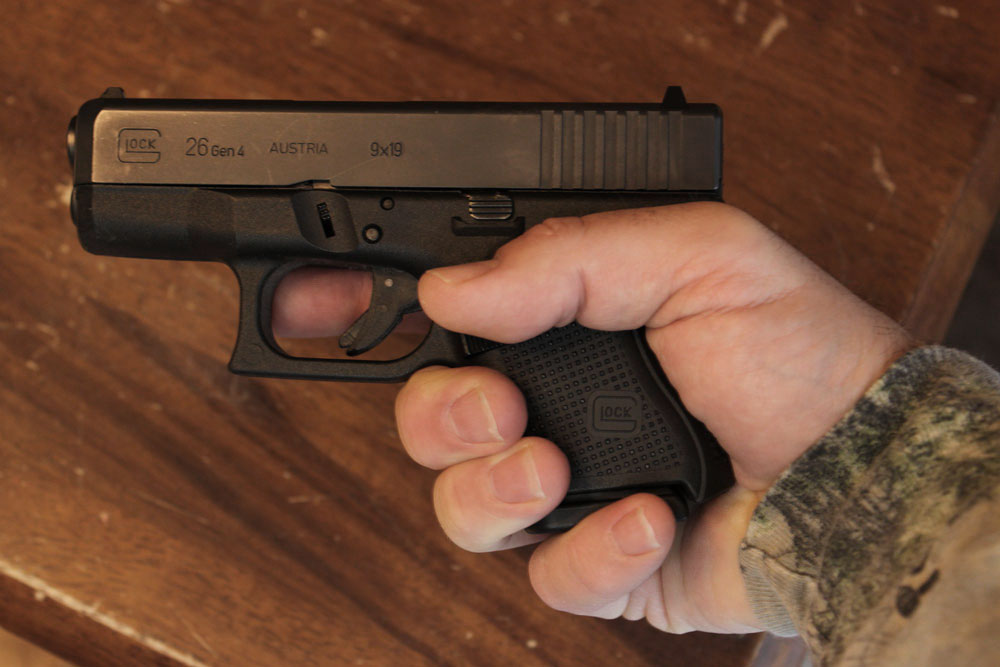
The Glock 26 and Glock 27 were introduced at the same time in July, 1995. They were the first of the subcompact Glocks, often affectionately called “Baby Glocks.” The Glock 26 is chambered in 9×19 and the G27 is chambered in .40 S&W. It was only natural to go with these two calibers for the first of the subcompacts, for two reasons. First, these are the two most popular calibers in total Glock sales. Second, these are the two most popular issue calibers for police departments.
Glock-9mm-5bc

As with all standard-frame Glocks, the beauty is in the universal controls. It doesn’t matter if you’re handling the long slide G34, the G17 or G19, the G26 or G27, the .45 GAP pistols, .357 pistols, or any other standard-frame pistols, the controls are in the same location. The only Glocks that are different are the large-frame Glocks (like the G20), and the slimline Glocks (like the G42). Even those have the controls located in the same relative place on the frame, the only difference being that the differing thicknesses of the respective frame changes how your thumb interacts with those controls.

Glock Talk: Discover More Tips & Reviews

Carrying The Glock 26

The Glock 26 is my current everyday carry (EDC) pistol. Wisconsin is pretty new to concealed carry, and being a writer I’ve had the luxury of testing out many different concealed carry pistols. I started with wanting the smallest pistol I could find, which ended up being a little .380. Then I wanted something with more horsepower, which landed me a compact .45. Except that it wasn’t that compact, and I tired of trying to prevent it from printing. That’s about the time all the micro-nines hit the market, and I’ve tried most of them.
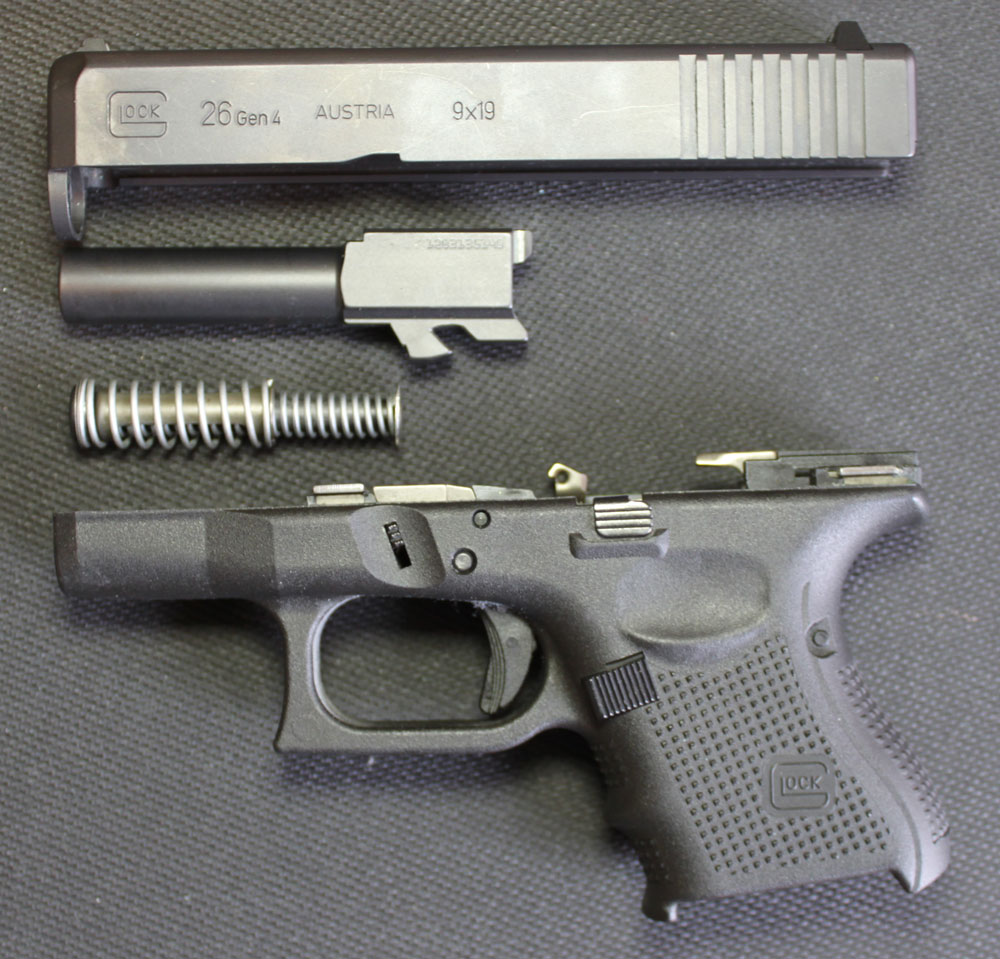
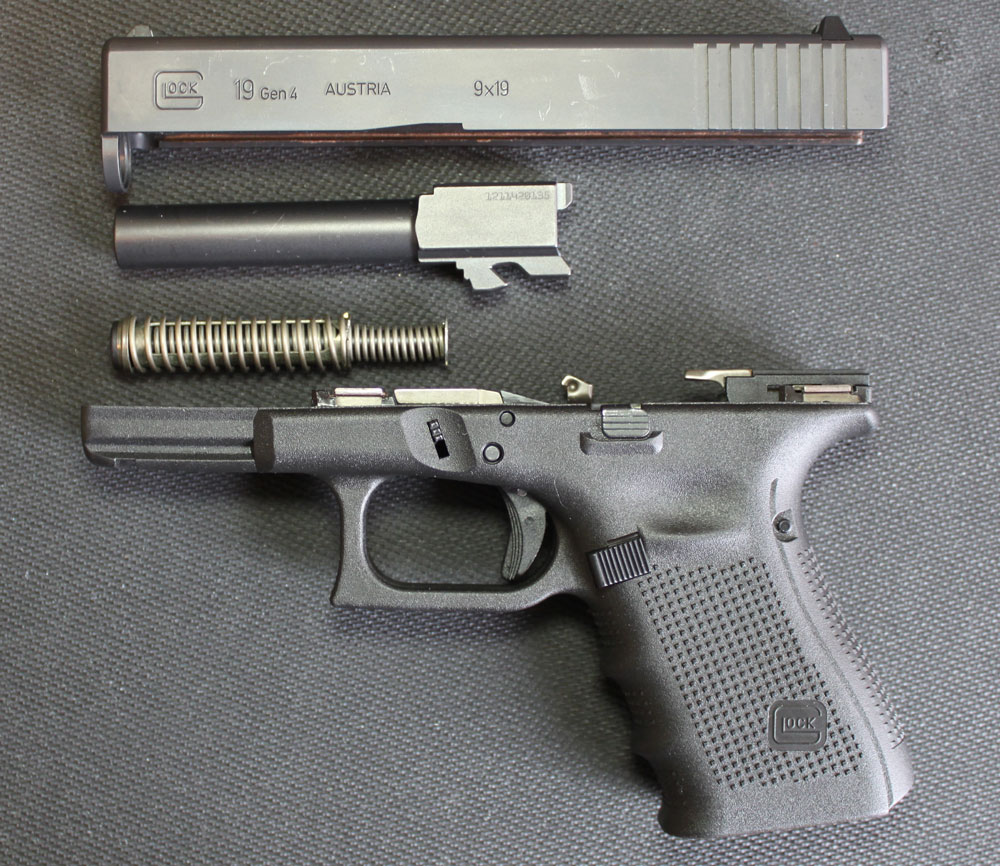
The G26 field stripped.
The Glock 26 Gen 4 field stripped.

My initial carry 9mm was a nice little pistol, and reliable. But some of the parts on it seemed to wear out fast. The second one I tried is one of the fanciest on the market, but is the least reliable pistol I’ve ever owned. One failure per magazine is terrible, and this wasn’t just mine, but a widespread problem. I tried a couple of other micro-nines, and found one that is really great, except I don’t care for the trigger.

Glock Reviews You Need To Read

About that time rumors were swirling about the new Glock G42 coming out, which everyone thought would be a single-stack 9mm. If it was, it would be exactly what I was looking for. If you know one Glock, you pretty much know them all, and I like what I know about Glock pistols. But when it was released, it wasn’t a 9mm. So I turned to the Glock 26, and I love it. I can’t picture carrying anything else for my EDC. It’s not quite as thin as I would like, but in exchange, it holds ten rounds in a standard mag, with the ability to use full-size G17 magazines (and will also work with G19 magazines). So I carry the 10-round magazine loaded, with a 17-round magazine on my belt.
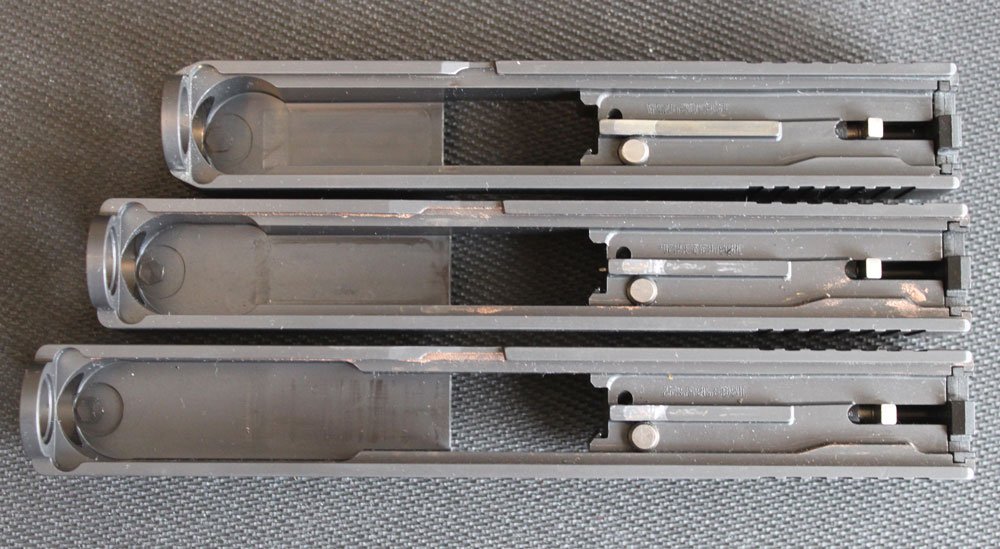
(Top to bottom): G26, G19 and G17 slides. Notice where the wall thickness reduction starts on each model.

How The G26 Measures Up

The Glock 26 is 6.41 inches in length, and 4.17 inches in height. That puts it at 0.9 inches shorter than the G19, and about 1.5 inches shorter than the G17. In height it’s about 0.8 inches shorter than the G19 and almost 1.3 inches shorter than the G17. At 21.17 ounces, it’s approximately two ounces lighter than the G19, and almost 3.5 ounces lighter than the G17. Given the difference in size, that’s not a lot of weight difference.

For the most part, though, there’s not going to be a lot of weight difference, and there shouldn’t be. There are three parts to the Glock that are reduced to make for the compact and sub-compact models: the frame (the bottom of the mag well and the front of the dust cover), the slide, and the barrel. The only part that can be shortened with impunity is the frame, but that’s only half an inch of polymer shell in two different places. The weight difference between the three frames is 3/8 of an ounce each.
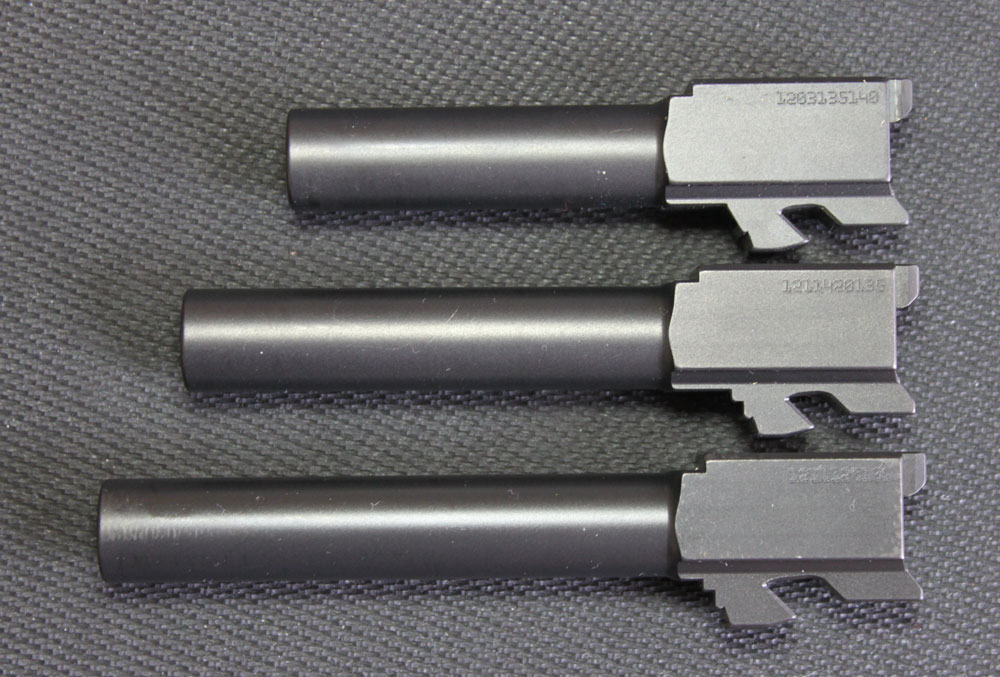
(Top to bottom): G26, G19, and G17. The difference in barrel length is a reduction in the hollow barrel, which is once again, not a lot of weight reduction.
(Top to bottom): Glock 26, Glock 19, and Glock 17. The difference in barrel length is a reduction in the hollow barrel, which is once again, not a lot of weight reduction.

Glock 26 And Recoil

The thing is, the 9mm cartridge creates basically the same recoil when fired, whether it’s from a G26, G19 or G17, which means you still need the same force to counter the force of recoil. The barrel and the frame comprise one of the two ways to counter the force of recoil, the other being the slide spring. You can’t have a significant reduction of weight in the slide and barrel, because you still need that counterweight.

Each model has a specific slide weight that it needs to cycle properly, and to achieve that, a portion of the slide wall is reduced so that it is thinner. The G17 reduces the slide wall about three-fourths of an inch from the front of the ejection port. The G19 doesn’t reduce it until after an inch and a half. The Glock G26 doesn’t reduce it until as far forward as possible, which actually ends up being at the same place as the G19. To make up for the extra mass it needs, it uses the slide spring.
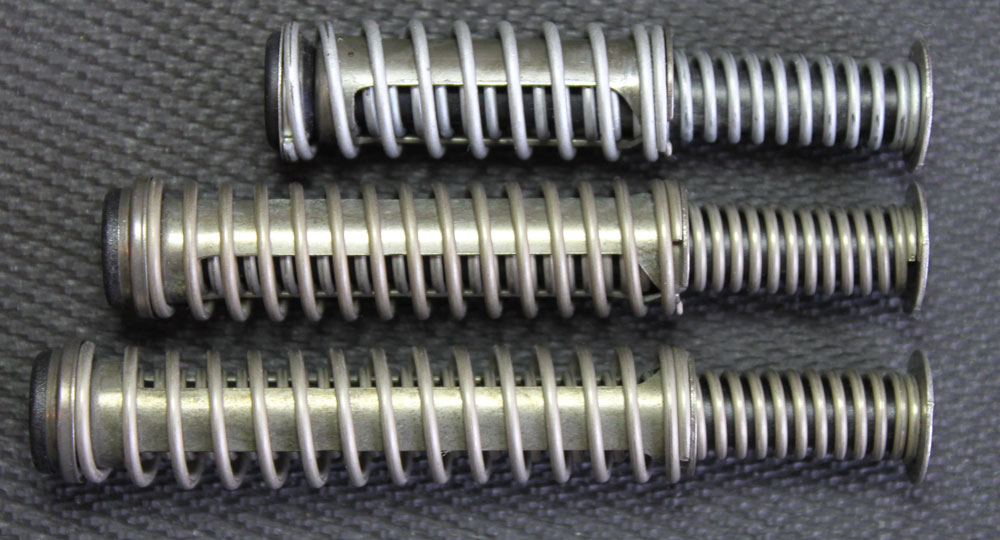
(Top to bottom): G26, G19, and G17. The difference in weight of the three different slide springs isn’t a lot, either.

Unlike the compact and standard-frame Glock models, the G26 and other sub-compact models do not have an accessory rail on the dustcover. This means that you won’t be able to mount a flashlight on it, and if you’re looking to add a laser it will have to be mounted in a different manor, such as on the grip or the slide spring. The front of the slide is also beveled, which I think makes it look nice, and not so boxy. The lack of a rail (and thus accessories) and the beveled slide front make for a really smooth, easy slide into a carry holster.

Glock 26 Specs

Caliber: 9mm
Barrel Length: 3.43 inch
Weight Unloaded: 25.75 ounces
Capacity: 10+1
Length: 6.50 inch
Slide Length: 6.26 inch
Overall Width: 1.26 inch
Slide Width: 1.0 inch
Height Including Magazine: 4.17 inch
Sight Radius: 5.39 inch (polymer); 5.35 inch (steel); 5.31 (GNS)
Trigger Distance: 2.83 inch (Gen 3); 2.76 (Gen 4 & Gen 5)

For more information on the Glock G26, please visit www.glock.com.

Editor’s Note: This excerpt is from Glock Reference Guide.


Learn More About Glock Options

Gun Digest Reloading Video Series Episode 01: Basics of Reloading

0

Gun Digest’s resident reloading expert Philip Massaro introduces the new Gun Digest Reloading Series of videos, and covers the four basic handloading steps — resizing and removing the primer, inserting a new primer, adding powder and seating a new bullet. Massaro talks about why he reloads and the benefits plus the common question on how safe reloading really is.


Learn The Basics Of Reloading Ammo:


Gun Digest Reloading Video Series Brought to You By:

Hodgdon Powder CompanyRedding ReloadingNosler Ammunition
 RCBS Reloading  

Glock 40 MOS Review

1

Glock’s G40 Gen4 MOS proves that adding a reflex sight to a high-capacity, high-power handgun doesn’t have to be a costly, cumbersome ordeal.

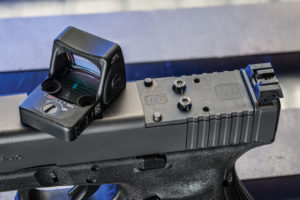
Glock 40 MOS Review. Cats typically get all the credit for their quick reflexes, but lately it’s been Glock that’s shown a snappy response to the ever-burgeoning demands of the consumer. The big splash this summer was the release of the long-awaited G43, a single-stack 9mm that’s been flying off gun store shelves. The other main introduction was the Modular Optic System (MOS), which demonstrates how quick and easy it is to get a reflex sight on a handgun.

The MOS, which is currently available on the Gen4 versions of the G34, G35, G40 and G41, is an adaptable plate system that comes factory-built into the slide and allows shooters to mount popular reflex sights to their handgun without aftermarket machining or a custom slide. In addition to the preinstalled cover plate, each MOS variant handgun comes with four plates to match common configurations: EoTech/Docter/Insight/Meopta; Trijicon RMR; C-More; and Leupold Delta Point. The G40 Gen4 (10mm Auto) featured in this review is the slight exception and comes with wider adapter plates to accommodate the increased width of the G40 slide.

Glock Reviews You Need To Read

The beauty of the MOS configuration is a combination of simplicity and monetary savings. The G40 Gen 4 MOS retails for $840, which compared to the cost of an aftermarket slide or custom gunsmithing is relatively inexpensive. The other advantage of the MOS is that it comes optic-ready right out of the box, and the process of installing the correct plate is accomplished in minutes.

A More Perfect Union

Glock 40 MOS Review. The wedding between the G40 Gen4 in 10mm Auto and the MOS is ideal because it unites a powerful semi-auto made for hunting with a reflex-ready configuration, thus extending the range and effective accuracy of the gun. While many product introductions in the firearms industry represent solutions to problems that never existed, this one makes perfect sense.

Unlike traditional iron sights, which require shooters to focus on the front sight while aligning it with the rear sight and an out-of-focus target, a reflex sight allows you to focus on the target and a single red dot of varying size or brightness on the same focal plane. This simplifies and speeds up target acquisition and allows shooters to stay focused on the target the whole time. It also permits the shooter to keep both eyes open even when shooting at distance—a huge advantage in defensive and hunting situations because it allows the shooter to process and respond to everything that’s happening in the field of view.

Practically speaking, the G40 Gen4 is more readily applicable to hunting than to self defense, simply because of its size. Sure, it’d fit in a shoulder holster under a jacket or next to the bed, but realistically, a 40.14-ounce (loaded) handgun that’s 9.49 inches long is probably not going to be the first defensive handgun choice for most shooters. For hunting, however, the 10mm Auto with reflex sight is an extremely formidable option.

The 10mm Auto was developed largely by Col. Jeff Cooper, of Gunsite fame, who sought to make the ideal combat weapon and cartridge. The 10mm Auto was introduced in 1983 in the Bren Ten semi-auto pistol, which was based on the CZ-75 (see page 50). A Norma factory-loaded 170-grain JHP (jacketed hollow point) travels at 1,340 fps with 680 ft.-lbs. of energy at the muzzle, which in turn translates to rather fierce recoil.

The FBI adopted the 10mm in reduced loads for a time in the 1980s, but initial problems with gun design and ammunition price ended its run. Today, the 10mm Auto remains in production with about 100 fps less than original loads, putting it ballistically on par with .45 Auto +P loads. Especially with new loads from Hornady, HPR and Federal, the 10mm Auto has more than enough stopping power to be effective on small- to deer-size game.

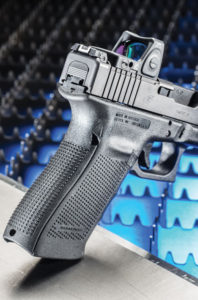
Paired with a quality reflex sight, the Glock-standard, 5.5-pound trigger makes for reasonably good accuracy, as does the 6.02-inch barrel. Fifteen-round Glock magazines provide extra durability and reliability, as well as plenty of follow-up shots for thick-skinned hogs or charging bears. Four interchangeable backstraps provide increased comfort and ergonomics.

Perfectly Plated

Glock 40 MOS Review. The G40 Gen4 MOS comes with a cover plate installed, as well as a package containing four brand-specific adapter plates and a hex wrench. Installation instructions are helpful and to the point, perfect for guys like me who barely read them anyway. I installed a Trijicon RMR for review, which took about two minutes total.

The only issue I had was that the RMR, which had previously been set atop an AR-type mount, came with screws that were too long for the Glock adapter plate. I could have purchased the right screws, but chose instead the MacGyver route by taking a hacksaw to the oversized screws. Crude, but it worked like a charm.

Performance

Accuracy testing was conducted from a rest at 25 yards atop Champion sand bags. Measurements were taken from five-shot groups using Hornady 155- and 180-grain XTP (eXtreme Terminal Performance) loads, as well as HPR 165-grain HBFP (hollow bottom flat point) and 180-grain JHP (jacketed hollow point) loads. Velocity was measured with a Competition Electronics ProChrono chronograph from Brownells.

Hornady’s 180-grain XTP produced a best group of 2.4 inches, while HPR’s 180-grain JHP produced a best group of a nearly identical 2.42 inches. Hornady’s 155-grain XTP posted a best group of 2.97 inches, while HPR’s 165-grain HBFP produced a best group of 2.56 inches and an average of 2.69 inches. Overall, the loads were very consistent across brands, lighter bullets performing slightly less well in the accuracy department than the heavier 180-grain loads but still very respectable. Velocity was also very consistent, with standard deviations of 8 and 9 fps for Hornady 180- and 155-grain, respectively, and a standard deviation of 4 and 8 for HPR 180- and 165-grain loads, respectively.

Parting Shots

The Urban Dictionary may one day have an entry for “Glock-like Reflexes,” thanks to the company’s ability to adapt and respond to the needs of the market, on the one hand, and the ease with which reflex sights can now be added to select MOS-model handguns, on the other. The MOS is as good as advertised and makes simple, cost-effective work of adding a reflex sight to the G40 Gen4. Paired with the mighty 10mm, and in this case the Trijicon RMR, it makes for a rugged and accurate hunting handgun.

Glock 40 MOS Review. Glock saw a real need and addressed it with the MOS, which is another gem in the company’s playbook. Like the polymer, striker-fired design that changed handguns forever, the MOS will likely be the wave of the future. The G40 is ideal for hunting, optic-ready, and would make a solid defensive weapon in a pinch.

GLOCK G40 GEN4 MOS
Caliber:    10mm Auto
Type:    Semi-Auto
Barrel:    6.02 in.
Overall Length:    9.49 in.
Frame:    Polymer
Weight:    28.15 (unloaded); 40.14 (loaded)
Trigger:    5.5 pounds
Sights:    Glock factory
Magazine:    2, 15-rds.
MSRP:    $840
Manufacturer:    Us.Glock.com

This Glock review appeared in the September 2015 issue of Gun Digest the Magazine

Related Video: Glock 40 MOS 10mm Review & Torture


Learn More About Glock Options

Video: Pumpkin Carving with a .22 Rifle

0

Those who have seen her before know Kirsten Joy Weiss is spooky good with a .22 rifle. Of course, that’s to be expected from a college and world champion small-bore shooter. But don’t get scared away by those credentials because Ms. Weiss’ most recent video involves a shot that marksmen of all levels can pull off. The treat of this trick shot is carving everyone’s favorite Halloween gourd with a .22 rifle. While not overly challenging, Kirsten Joy Weiss definitely shows there are some tactics to getting the best jack-o-lantern from your rimfire.


Customize the Ruger 10/22

Customize the Ruger 10/22 guides readers through the endless array of aftermarket parts for the Ruger 10/22. With installation instructions, performance evaluations and expert advice, this comprehensive guide leads you step-by-step through the process to modify and customize your Ruger 10/22. Complete coverage of new versions of the rifle and accessories make this most complete and up-to-date resource available to guide owners through the endless array of aftermarket parts for the Ruger 10/22. Get Your Copy Now

Bucking the Trend—AR’s Are the Top Selling Long Gun for Jayhawk Retailer

0

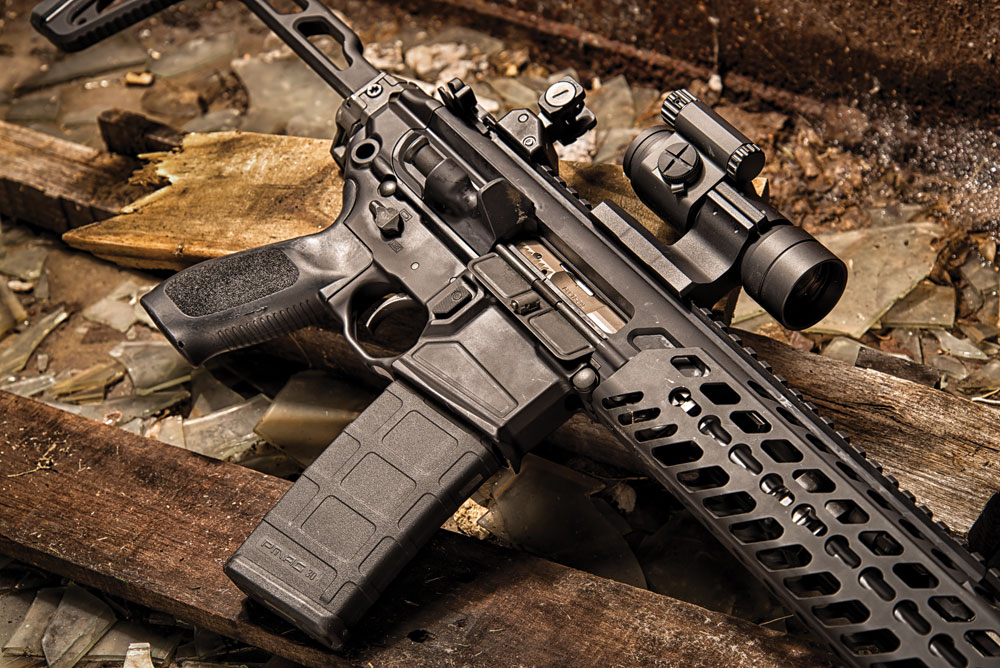
 SIG Sauer MCXBlake BomhoffMeriden Gun Shop, Meriden Kan.

One national trend that “Market Trends” has spent the last year documenting is the general lack of sales for AR-style rifles. Most FFL retailers have told this column that it takes a pretty substantial sale and good sale prices to get even a few ARs off the rifle racks.

And then there is Meriden Gun Shop, in Meriden, Kansas, located northeast of Topeka.

“Our top selling long guns are still the AR15s,” Meriden owner Blake Bomhoff said. “At the lower price point, it’s the Smith and Wesson M&P15 Sport at $675.00. At the higher end, our customers like the SIG Sauer MCX at $1,600, a gas-piston operating AR.”

Concealable pistols are selling briskly, with the Smith and Wesson Shield in 9mm leading the pack at $400 to $420. A close second is the Rossi revolver Model 462 in .357 Magnum going for $350.

Bomhoff’s customers are purchasing a good number of rifle scopes—mostly in preparation for fall hunting—especially Redfield and Nikon models in the $200 to $300 price range. Top ammo brand? “It would definitely be Hornady,” says Bomhoff, “for both handguns and rifles.”

Editor’s Note: This brief originally appeared in the October 2015 issue of Gun Digest the Magazine.


AR-15 Collection

The Ultimate AR-15 Collection

You’ll love this AR-15 Guide if:

  • You must own the most up-to-date AR-15 parts and accessories
  • You want to learn how to customize your AR-15
  • You want to take your AR-15 shooting skills to the next level

Gallery: James D. Julia’s October Gun Auction Thrills

0

[imagebrowser id=454]
Pine trees and lobsters typically come to mind when talking about the state of Maine. But, really, firearms shouldn’t be too far behind—particularly the collectable kind.

That is because just up the road a spell from the state’s rocky coastline is one of the nation’s premier firearms auction houses. And recently, this nearly 60-year-old company continued to prove it is among the top places to move highly sought after handguns, rifles and shotguns.

James D. Julia reported raking in approximately $15 million in its Oct. 5-7 gun auction with an impressive volume of guns moving across the block at some jaw-dropping prices. The auction house reported 412 lots moving for $10,000 or more, 175 for $20,000 or more and 7 for $100,000 or more. But the auction company was not the only show in town.

In the preceding three days to the Julia auction, Poulin Auction Company—located directly next to Julia—recorded some $4 million in firearms sales. This means that in six days, Fairfield played host to around $19 million in gun sales. And after a quick gander at what James D. Julia was moving, it doesn’t take a seasoned collector to know why pocketbooks were broken out.

As the above gallery proves, the auction house moved some truly beautiful and historic guns. Take a look. Just be careful not to drool on the merchandise, please.


Arm Yourself With Knowledge

standard-catalog-2015

2015 Standard Catalog of Firearms

Standard Catalog of Military Firearms

The Official Gun Digest Book of Guns & Prices

Ruger ARX Self-Defense Ammo First Viable Polymer Bullet for Lethal Force?

3

Ruger ARX Self-Defense Ammo.

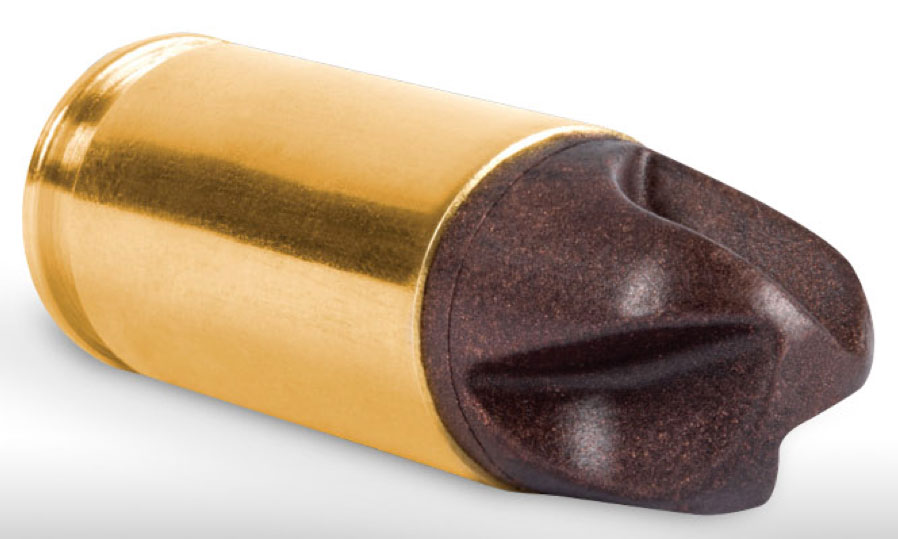
A new polymer-copper blended bullet made by PolyCase Ammunition and licensed by Ruger promises to deliver ultra-high velocity and superior terminal ballistics for personal protection.

Ruger-PolyCase ARX Ammo in .380 Auto. Plastic bullets aren’t new, they’ve been used since the early 1970s as non-lethal projectiles and training aids. However, a new polymer-blended-with-copper job from Ruger and PolyCase Ammunition aims to take copper-impregnated plastic onto the mean streets and is billed as a “force multiplier” for lethal force applications.

According to Ruger, the distinctive bullet profile transfers maximum energy to the target by fluid dynamic effect. The non-expanding Ruger ARX exploits the bullet’s velocity to redirect energy laterally via flutes in the bullet ogive. This effect results in stopping power and terminal performance that rivals that of many expanding handgun bullets, they report.

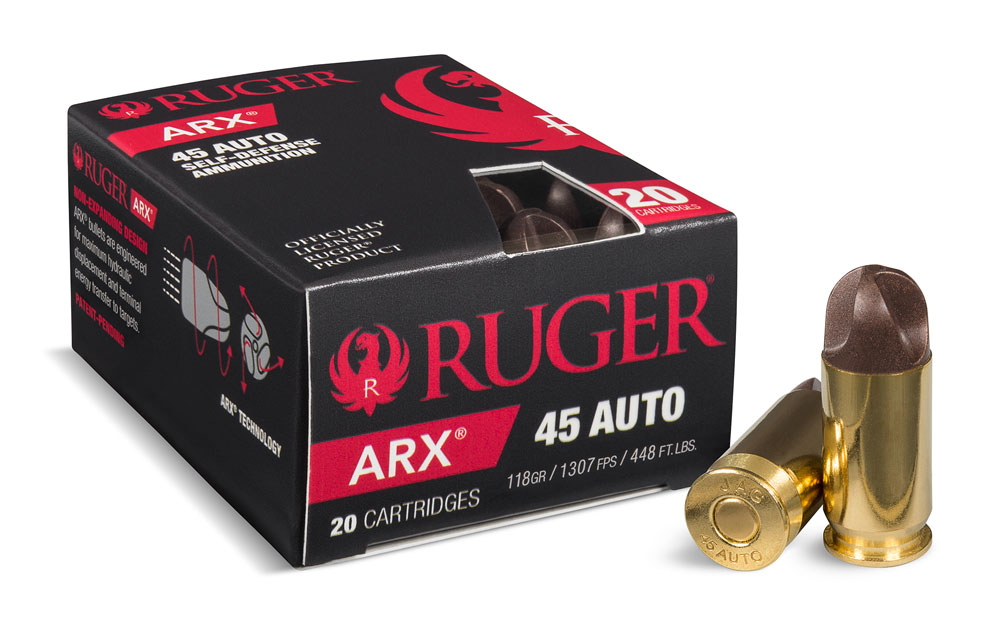
Ruger-PolyCase ARX Ammo in .45 ACP.

ARX Self-Defense Ammo

The design of the Ruger ARX allows it to feed like a round nose yet still transfer energy to targets effectively over a wide range of bullet velocities. The ARX penetrates many barriers without deformation and penetrates through clothing without clogging and degrading terminal performance.

The Ruger ARX ammunition utilizes injection-molded copper/polymer matrix projectiles. Unlike traditional bullets, this unique material can be molded into complex shapes like the ARX bullet configuration. These lightweight bullets are launched at high velocities and achieve very high energy levels, but at nominal or even reduced recoil levels—while reducing the loaded weight of firearms and spare magazines. The copper/polymer bullets fragment upon striking solid backstops, Ruger said.

Currently, the ammo is available in .380 Auto and .45 ACP. The .380 is said to be clocking 1,315 feet per second (fps) with a 56-grain bullet—putting about 215 foot-pounds (ft.-lbs.) on target. The .45 ACP does about double that, with its 118-grain bullet at 1,307 fps for 448 ft.-lbs of energy.

According to Ruger’s website here, 9mm and .40 S&W will be available soon.

Browning Expands X-Bolt Line with Varmint Stalker Rifle

0
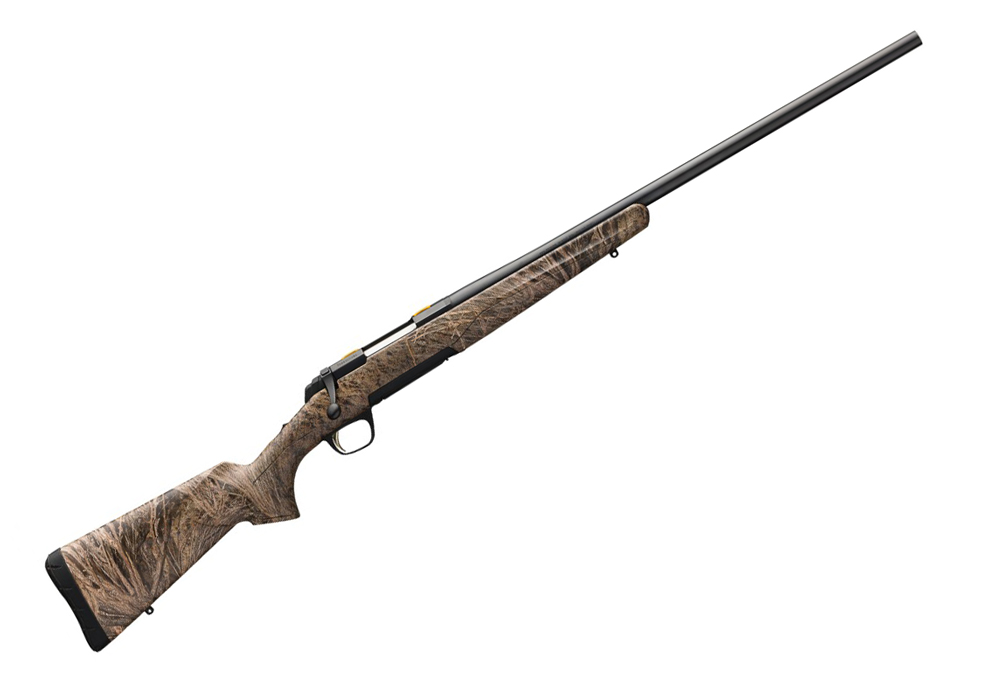
Browning’s new X-Bolt Varmint Stalker is tailored to tackle everything from hogs to prairie dogs.

Browning’s new X-Bolt Varmint Stalker is tailored to tackle everything from hogs to prairie dogs.

There are many factors that drive the popularity of game species. Perhaps the chief among these are accessibility to hunting grounds and success once there.

With these factors in mind, it’s no wonder the ranks of varmint hunters have swelled in recent years. There are coyotes coast to coast. Hogs abound from the Deep South to America’s Heartland. And nearly everywhere there are more woodchucks, prairie dogs and other rodents than you can shake a stick at.

The interest in taking these less-than-desirable beasts has had its effects on the shooting industry. More and more gun makers are producing firearms chocked full of features that help ensure a round lands on the critter it’s aimed at. Browning is among them.

The Utah-based company recently expanded one of its most extensive rifle collections to include a model tailored for taking sly little beasties. And, at first blush, the X-Bolt Varmint Stalker appears to have the bells and whistles that would make it a dandy, whether calling ‘yotes or assaulting prairie dog towns.

What should catch the attention of varmint hunters right off the bat is the new X-Bolt’s barrel. It is outfitted with a heavy sporter barrel, which should aid in the gun’s accuracy by providing more rigidity and better harmonics. And for those who eye a Varmint Stalker as a range gun, the heavier barrel also has the added benefit of being more resistant to heat flex from shooting long stints.

The barrel measures in at 24 inches on four of the rifle’s calibers — .204 Ruger, .223 Remington, .243 Winchester and .308 Winchester. However, the .22-250 has a 26-inch barrel. Each caliber has a different twist rate, tuned to take advantage of lighter bullets and higher velocities.

Even with more weight invested into the barrel, the overall platform is light. Browning has achieved this by outfitting the gun with a composite stock, which has the Varmint Stalker tipping the scales at a whisker under 7 pounds. As a bonus, the stock is finished with Mossy Oak’s Brush camouflage pattern, allowing it to blend into a wide variety of cover.

The Varmint Stalker has a number of features common to all X-Bolt rifles. Of these, among the most notable is the Feather Trigger, which has a pull weight that can be adjusted from 3 to 5 pounds. Other common features include: an X-Lock scope mounting system, bolt unlock button, Inflex Recoil Pad and detachable rotary magazine.

Presently, Browning lists the Varmint Stalker’s MSRP at $939.99.

Hornady ELD-X Redefines Hunting Bullet Design

0

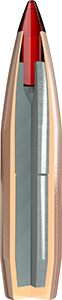
Hornady ELD-X.Hornady engineers, using Doppler radar to study bullet flight, have discovered that polymer tips melt as they slice through the air, resulting in a varied ballistic coefficient (BC) from the time the projectile leaves the muzzle until impact.

This revelation lead to the development of the Hornady® ELD-X™ with Heat Shield™ Tip, which promises improved match-grade accuracy with the terminal performance of the company’s top-performing hunting bullets. 

The new Hornady ELD-X™ (Extremely Low Drag – eXpanding) is really exciting news for long-range hunters and match shooters taking pokes beyond 400 yards. That’s because, while the accuracy of the super-tip pill is said to be sub-MOA — something accuracy hounds will appreciate at any distance — the new revelations about changing BC from tip meltdown will really prove beneficial in predicting long-range shots.

“While I have never had the opportunity to witness a melted polymer tip on any of the bullets I’ve ever used – all that I’ve recovered have been deformed from impact – this principle unveiled by Hornady certainly makes sense,” said Gun Digest contributor Philip Massaro, author of Understanding Ballistics. “The correction of this heretofore unknown issue will certainly aid in long-distance accuracy by keeping the bullet conformation constant and maintaining the highest Ballistic Coeffiient possible. I look forward to testing Hornady’s new bullet.”

The new heat-proof pills are available as component bullets for reloaders or in factory-loaded ELD-X Precision Hunter ammunition. ELD-X bullets are “heavy caliber” — the 7mm offerings are 162- and 175-grain right now — and are designed for maximum ballistic coefficients, highest levels of accuracy, consistency and extreme lethality at all practical hunting distances, according to Hornady.

ELD-X expansion.ELD-X™     EXTREMELY LOW DRAG – EXPANDING

  • Best-in-class BCs
    Verified by Doppler radar, the Heat Shield™ tip defies the effects of aerodynamic heating and retains its shape to maintain the highest-in-class BC over its entire trajectory.
  • Match-accurate hunting bullet
    Streamlined secant ogive with optimum boattail design + highly concentric AMP® bullet jackets + patent pending Heat Shield™ tip combine for radically superior aerodynamic efficiency.
  • Devastating conventional range performance
    With high velocity, 0-400 yard impact, the bullet continually expands throughout its penetration path. The thick shank of the jacket and high InterLock® ring keep the core and jacket together providing 50-60 percent weight retention.
  • Best extended range terminal available
    Upon low velocity, 400+ yard impacts, Heat Shield™ tip drives backward into bullet to initiate expansion. Exhibiting expansion with a large and 85-90 percent retained weight provides deep penetration and large cavities. Available as component bullets or in factory-loaded Precision Hunter™ ammunition.
Caliber6.5mm7mm7mm.308.308.308.308
Weight143 gr.162 gr.175 gr.178 gr.200 gr.212 gr.220 gr.
G1 BC.620.613.660.535.626.673.650
G2 BC.311.308.330.271.315.336.325

Also Check Out:
ballistic-cover

Understanding Ballistics
Tailor your ammunition choice to the task at hand and ensure you’re choosing the right bullet every time with Understanding Ballistics by Philip P. Massaro. Narrow down the vast array of ammunition options with detailed information and expert reviews of available bullets, and come to a better understanding of bullet technology and performance. Plus, learn about the physics of the bullet and its effects once it hits the intended target. Get Your Copy Now

Gun Parts Flying Off Virtual Shelves for Online Retailer

0

One online gun store is enjoying a late summer sales surge of gun parts.

gunpartsGeno ValentiMidwest Gun Works

Internet retailer Midwest Gun Works (MGW) does a steady business in selling gun parts, both for repairs/replacements and upgrades.

“This time of year [late summer] with trap shooting in full swing and the hunting season upon us, shotgun parts, parts kits and performance upgrades are in high demand,” MGW’s customer service manager Geno Valenti said. “Many MGW customers order OEM [original equipment manufacturer] parts for quick repair while others will be stocking up on parts as spares, should a problem occur in the field. High performance Shotgun parts upgrades are always big sellers. Sure Cycle systems for the entire line of Benelli shotguns always remains a top seller.”

For handguns, trigger upgrade kits and aftermarket grips are selling well. However, Valenti points out, “The most popular upgrade for pistols that we sell has to be new sights. Between adjustable rears and night sight sets, we regularly have customers sending in the slides for their guns for us to install the sights for them.”

Mini red dot sights, by Insight, are strong sellers here, starting at $459, while Tritium night sights by AmeriGlo are always popular.

For AR shooters, top replacement parts include spring, pin and bolt component kits. A very big seller in this line is the DPMS Field Repair Kit for just over $22.00.

Editor’s Note: This brief originally appeared in the October 2015 issue of Gun Digest the Magazine.

Video: In-Depth Look at the Great Basin Winchester 1873

0

Perhaps the oldest gun to make headlines in 2015 was also the one that captured the most imaginations. That’s to be expected with a firearm that presents as much mystery as the Winchester 1873 found at Nevada’s Great Basin National Park.

Theories abound as to exactly how the iconic lever-action found its way under one of the park’s many pine trees. And for the most part, the rifle’s roots will most likely remain a head scratcher.

Or at least that’s Ashley Hlebinsky’s contention in the above video by the National Shooting Sports Foundation. The curator of the Cody Firearms Museum in Cody, Wyo., fully admits there can only be some ballpark estimates made about the rifle’s origins. But she adds that’s most likely the reason why the Winchester has become such a sensation.

The entire video is worth a watch with Hlebinsky going into some of the conservation efforts being made on the historic rifle. She also touches upon some interesting discoveries made once the rifle reached the museum.


Your Best Firearms Resource

In the Standard Catalog of Firearms you’ll find:

  • Completely updated firearms values gathered from the industry’s leading experts
  • Up to 6 condition grades and valuations, 110,000+ listed prices, 7,500+ photos, and extensive descriptions
  • A guide to Firearms Trade Names covering more than 150 years of gun history
  • 16-page color section showcasing photos of finely crafted, custom firearms from some of the most skilled gunmakers in the world

Charter Arms and Lew Horton Team Up for the Backpacker Revolver

3
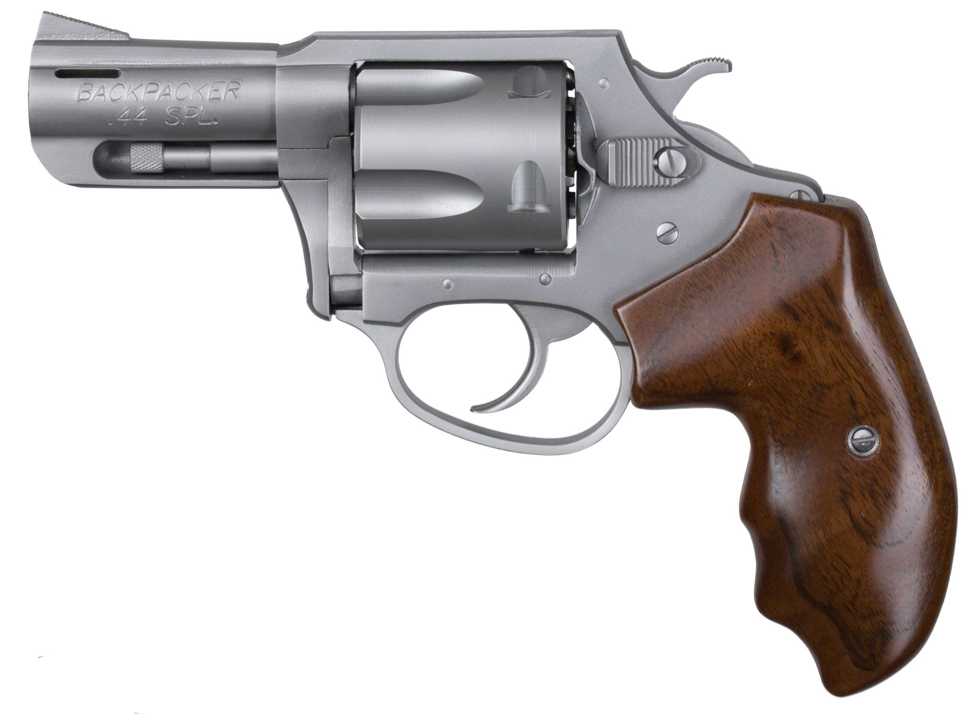
Lew Horton is offering a classy looking Charter Arms .44 Special — the Backpacker Revolver.

There have been plenty of companies that have bored revolvers for the venerable .44 Special. But in the modern era, there is one manufacturer whose name has become particularly intertwined with the big-bore round.

Charter Arms founder Doug McClenahan introduced his .44 Special revolver — the Bulldog — in 1973. It was a move that flew in the face of conventional wisdom at the time. Many believed at that point the .44 Magnum had relegated the older round to the ash bin of history. But McClenahan’s intuitions about the .44 Special proved to be accurate.

The Bulldog earned its place in firearms history, becoming one of the top selling revolvers of the 1970s and 1980s. All that time, the sturdy, compact and safe Bulldog never lost it blue-collar looks or reliability. But recently, the Connecticut manufacturer’s easy-to-carry .44 Special has received a bit of a makeover.

Well, to be more exact, Charter Arms is offering a dolled up limited edition version of its Bulldog through Lew Horton Distributing — the Backpacker Revolver.

Perhaps the most eye-catching aspect of the special edition revolver is its grips. The five-round handgun has been fitted with an elegant set of walnut grips, designed not only to enhance form, but also function. The round-butt naturally conforms to the hand, and the grips are further enhanced with three finger holds to ensure a firm purchase on the firearm.

The revolver also has its special edition name — Backpacker — etched on the left side of its 2.5-inch barrel. While perhaps not the biggest selling point to some, it nonetheless adds appeal to the gun given its extremely limited run. Only 50 Backpackers have been produced.

The .44 Special has fixed front sights and a sight groove in place of a rear sight. It also has all the features fans of Charter Arms have become familiar with over the years. Of these, the most notable are its one-piece frame, three-point cylinder lock, short hammer throw and hammer block transfer bar safety. This final feature ensures the revolver does not fire unless the trigger is at its full rear position.

Suppressors for Home Defense

0

Suppressors for home defense guns.

There are many good reasons to add a suppressor to a home defense gun, and not too many arguments against.

The muzzle blast from a 16-inch-barreled AR-15 is noticeable; out of a 10-inch barrel like the one found in the SIG P516 AR-style pistol, the blast is even closer to the user.

I imagine in the confines of a small room the sound and force must sound and feel like fury unleashed.

Some shooters have an aversion to the .223 round not so much for the recoil but for the muzzle blast a 60-grain bullet leaving a barrel at 2,700 fps is going to create.

One of the jobs a suppressor can do is reduce muzzle blast. Buying a can adds weight and length to an AR pistol, plus there is the required paperwork and $200 tax stamp, but that might be the trade-off.

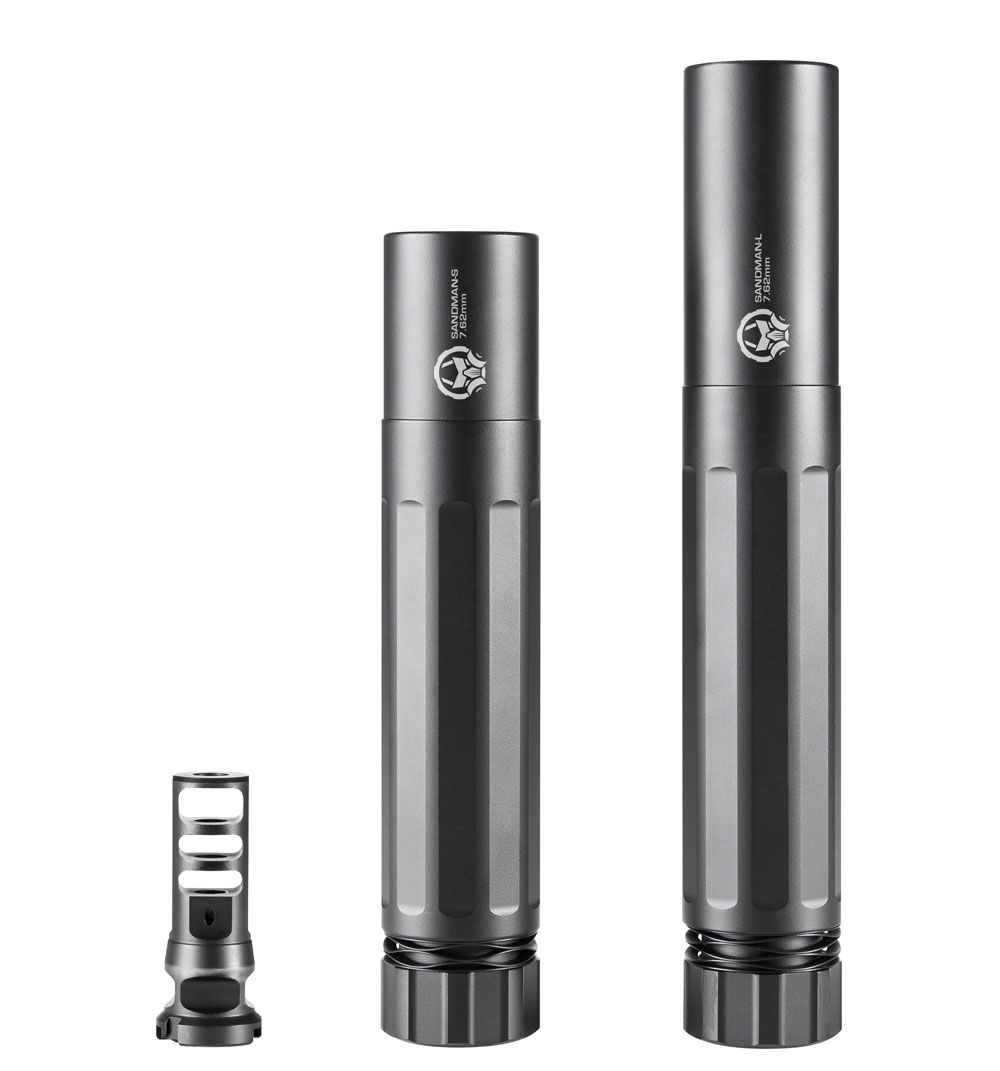
The SIG SRD556-QD offers reduction in sound and muzzle blast, so a sensitive or experienced shooter is less affected by the blast and can better concentrate on shot placement. The SRD556-QD offers a quick-detach interface and is available in steel or titanium construction.

The Dead-Air 7.62 Sandman-S (the “S” stands for Short) offers easy attachment and detachment and is constructed using heat-treated stainless steel. The Delta P Design BREVIS II is a lightweight suppressor that offers reduced sound and visual signature in a stubby can that is only 3.7 inches in length.

This article appeared in the Fall 2015 issue of Gun Digest the Magazine

.223 Home Defense Ammo

0

Home defense ammo ideas.

Over-penetration is a concern with home defense ammo no matter what the caliber. Here are some loads up to the task.

When using the .223 for home defense, leave the FMJs for range work. These bullets are designed to punch holes in flesh, steel, wood or nearly any material that is in its trajectory.

Bullet technology has evolved in recent years. Now there are bullets that break apart when they strike drywall or wood, and when they hit flesh, they do no over-penetrate, instead transferring most of the energy into the home invader.

HPR Ammunition’s Black Ops OTF is designed for law enforcement and home defense. Using a 62-grain Open Tip Frangible bullet, it is designed to create massive force trauma in soft targets, while breaking on impact on hard targets.

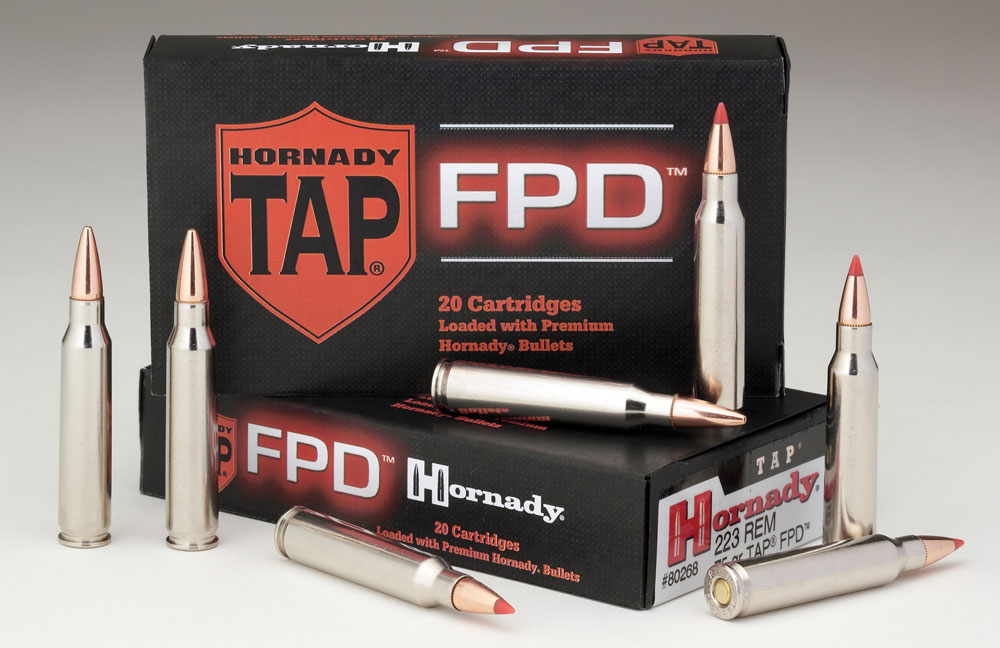
Other loads suitable for home defense include Hornady TAP FDP Personal Defense Ammunition and Winchester PDX1 Defender Self Defense ammo. The Hornady TAP FDP is deigned to cause dramatic wound cavities while reducing the risk of over penetration. The cases are also nickel plated for optimal reliability.

The Winchester PDX1 60-grain bullet uses Split Core Technology (SCT) that features a quick-expanding front lead core and deep-driving bonded rear lead core.

Video: World Famous .416 Rigby Dangerous Game Rifle is Back

0

The bolt-action hunting rifle that inspired a million copies is back in production and better than ever. Check out Rigby’s Magnum Mauser in .416 Rigby.

Considered the perfect repeating bolt-action dangerous game rifle, Rigby’s Magnum Mauser in .416 Rigby delivers 5,100 foot-pounds of energy and 52 foot-pounds of recoil.

Also see: Video: .416 Rigby Safari Rifle Explodes onto the Little Screen

Source: Ron Spomer Outdoors

Glock 19: The Perfect Compromise 9mm Double-Stack

0

An excellent compromise between full-sized and sub-compact, the Glock 19 remains a top choice in double-stack 9mm pistols.

Why you should consider the Glock 19 for concealed carry:

  • Outstanding middle ground between full-sized and sub-compact pistols.
  • Handles and shoots much like a full-sized pistol.
  • Magazines are and will always be plentiful.
  • Variety of magazine capacities available.
  • Very trim compared to other 15+1 capacity pistols.
  • Relatively easy to conceal.
  • Widely used in law enforcement.
  • Glock 19 Gen 4 and Glock 19 Gen 5 offer removable backstrap systems.

The Glock 19 was the second Glock pistol released to the civilian market, with production beginning in March,1988 (It beat the G17L by one month). The Glock 19 is one of the two pistols that have been around for all five generations, though first-generation G19 Glocks were only prototype, so they are extremely rare. After all these years the Glock 19 is still the second most popular Glock model, after the Glock 17.

Glock 19 Vs Glock 17

This compact 9mm Glock is just a G17 that has been made 0.67 inches shorter in length and 0.56 inches shorter in the grip. It’s about 1.4 ounces lighter. It is an excellent compromise between the full size and the sub-compact. The definition of a “compact” pistol can sometimes get a little murky because if you look at the Glock 19, it looks like a full-size handgun. The designation is relative and differs from company to company. What one company calls a full-size, another calls a compact. This is especially true for companies like Glock, which manufactures combat/duty pistols that are often larger than other pistols.

A field stripped G19.

The Glock pistol sizes can be summarized by how they are used within police departments—the full-size pistols (Glock 17, Glock 22, etc.) are generally issued to uniformed police officers who open carry. The compact pistols (Glock 19, Glock 23, etc.) are generally issued to plainclothes officers, where concealment is not necessary, but being discreet is.

Glock Reviews You Need To Read

The sub-compact pistols (Glock 26, Glock 27, etc.) are generally issued to undercover officers, where concealment is needed. Of course, this is a generalization and not always the case; some departments just issue the compact pistol to everyone.

If I could only own one handgun, which is thankfully not the case—God bless America—it would be this one. It’s big enough that it handles and shoots much like a full-size handgun, yet compact enough that it can be concealed with a jacket, vest, or even a properly designed shirt. It’s roughly the size of a 1911 Commander, though a little bit smaller and lighter. It makes for an excellent “go to” handgun.

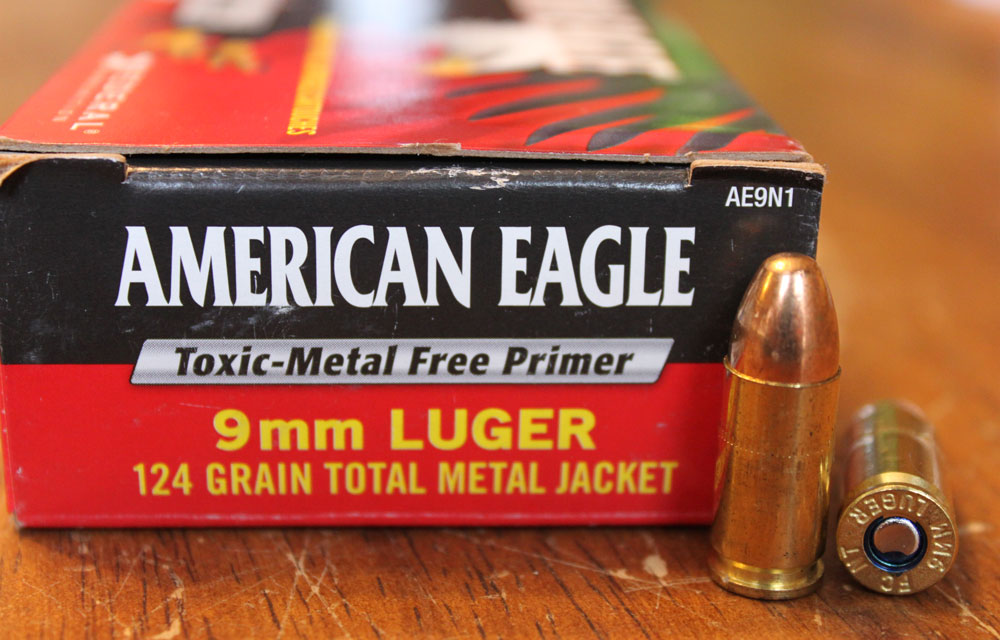
The 9×19 cartridge is the most common cartridge in America, and aside from the popularity among civilians, it is the US military standard cartridge, the NATO standard cartridge, and the choice of many police departments. Plus, since it also uses Glock 17 magazines, with the sheer number of G19s and G17s in America, magazines will always be plentiful.

Glock 19 Capacity

Whether real or perceived—and I’m going to refrain from entering into politics here—the threat to “high capacity” magazines (or what we in the gun community call standard capacity) has led to a boom in sales of these magazines, with boom being an understatement. So there are a lot of them out there.

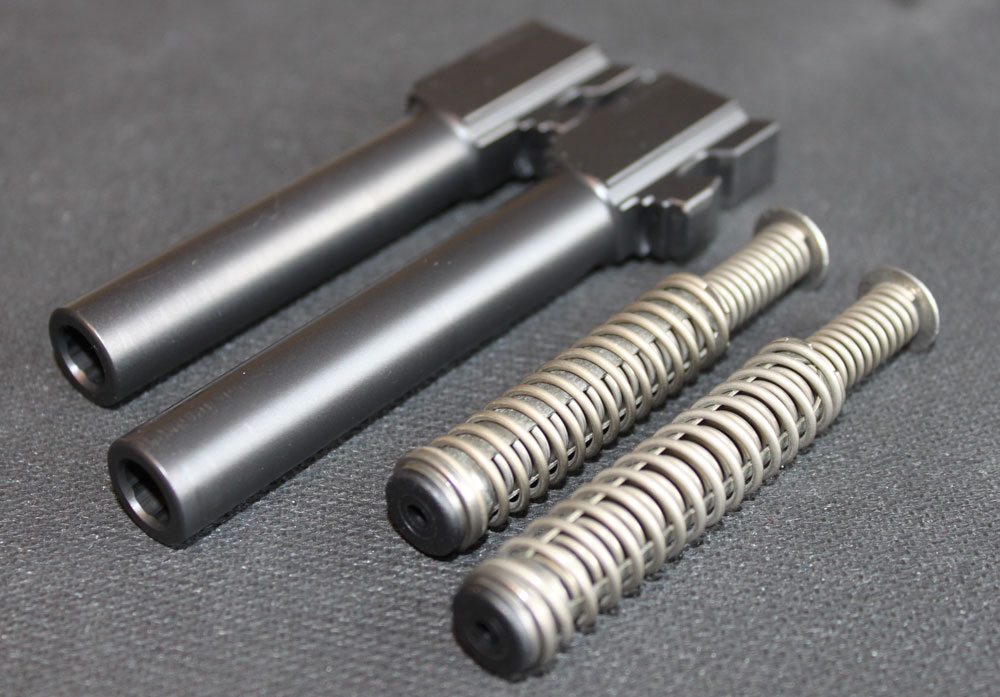
A G19 barrel and spring (the top barrel and the top spring) compared to a G17 barrel and spring.
A Glock 19 barrel and spring (the top barrel and the top spring) compared to a Glock 17 barrel and spring.

Glock engineers have always been excellent at stuffing the maximum number of rounds into their magazines. Evidence of this is found when you compare the same-class offerings of other manufacturers. Compare the Ruger SR9c, Smith & Wesson M&P9c, and Springfield Armory XD(M) 3.8 Compact. To compare magazine capacity, one must consider height, which is determined primarily by grip height, and this, along with grip width, is one of the biggest determinants of magazine capacity.

Load Up On 9mm Ammo Knowledge:

Glock 19 Size

Of the compact models, the Glock 19 has a 15-round capacity, with a 4.9-inch height and 1.18-inch width. It has a slightly longer grip than the other three, but that extra grip gives you the highest magazine round count at 15. The XD(M) 3.8 Compact is 4.75 inches in height with a magazine capacity of 13 rounds, so it’s only .15 inches shorter than the Glock 19, but loses two rounds. The Smith & Wesson is 4.3 inches in height with a 12-round capacity. It’s 0.6 inches shorter than the Glock 19, and it loses three rounds. It’s not a terrible trade-off, three rounds for just over half an inch—better than losing two rounds for only a .15-inch shorter grip.

The Ruger falls somewhere in the middle, with a 4.61-inch grip height, but loses out in capacity with a 10-round magazine—five rounds less than the Glock 19. That’s only two-thirds the capacity. I’m a fan of Ruger, but in this case it looks like they chose lawyers and economics over consumer desire for higher magazine capacity.

The popularity of the 9mm is at an all-time high in the US. So when advancements are made in handgun cartridge design, it’s going to hit the 9mm first.

Everyone has to make a 10-round magazine for states like California, but Ruger chose to make all of its SR9c magazines 10-round capacity. I guess that saves money because they only have to have one type of magazine made for them, and only half the models in inventory  (other companies have two of each model, one regular-capacity model, and one 10-round magazine model for states that have magazine maximum capacity laws—effectively making two models for what would only be one model).

I don’t like it when lawyers drive design, and I also don’t like it when companies go strictly off the bottom line. I realize that a company needs to be profitable, and it’s their choice to only offer a 10-round magazine, but I think in the long run it hurts their market share.

Glock 19 Specs:

Caliber: 9mm
Capacity: 15+1
Weight (unloaded): 21.16 ounces (Gen 3 & 4); 21.52 ounces (Gen 5)
Barrel Length: 4.02 inch
Overall Length: 7.36 inch
Slide Length: 6.85 inch
Overall Width: 1.26 inch
Slide Width: 1.0 inch
Height (including mag): 5.04 inch
Sight Radius: 6.02 inch (polymer); 5.98 inch (steel), 5.94 inch (GNS)
Trigger Distance: 2.80 inch (Gen 3); 2.76 inch (Gen 4 & 5)


Learn More About Glock Options

MUST READ ARTICLES