Modern Shooter T.V. is filled with more high-caliber episodes in its second season on the Sportsman Channel. Whether it’s an in-depth look at Navy SEAL marksmanship training or tangling with the world’s most dangerous game, the program explores some of the most unique, intriguing and heart-pounding corners of the shooting world.
On the next episode, Modern Shooter squares off with one of the most fearsome creatures from the Dark Continent — the Cape Buffalo. The show delves into the “dos” and “don’ts” to successfully pursue the 1,300-pound beasts, giving the audience a taste of an actual safari.
In addition to the tactics for harvesting what is known as “Black Death,” Modern Shooter also takes a look at the firearms used to pursue Cape Buffalo. The stunning and distinctive firearms showcased in the episode are not only some of the most sought after guns in the world. They also are among the most powerful a shooter might shoulder. Really, “big bore” is an understatement when it comes to these monsters.
New episodes of Modern Shooter air 8 p.m. ET Monday nights on Sportsman Channel, with an encore showing at 11 p.m. The shows then replay 12 p.m. on Thursday and 5 a.m. on Sunday.
Modern Shooter is produced for the shooters who look for the best in firearms programming and is sponsored by the top names in the firearms industry. Those sponsors include: Colt, FNHUSA, Aguila and H&H Precision.
About Gun Digest Gun Digest is the world’s foremost authority on guns in print and online. In addition to Gun Digest the Magazine, the brand’s portfolio includes the Gun Digest Books line, Standard Catalog of Firearms, the GunDigest.com online community, and ecommerce specialty store, www.gundigeststore.com. For more information, visit gundigest.com, the Gun Digest Facebook page, www.facebook.com/gundigest, or follow on Twitter @gundigest. Gun Digest is an imprint of Gun Digest Media.
Also Check Out:
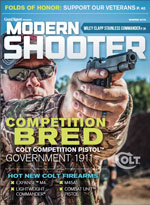
Modern Shooter Winter 2016 Modern Shooter is your source for the modern firearms giving you the inside edge on tactics and accessories for the newest ARs, shotguns and handguns. In the Winter 2016 edition we focus on Colt! Instant download
Daniel Shaw of Funker Tactical speaks with Mark Gurney, Ruger Director of Product Management about the new Ruger American Pistol at SHOT Show 2016.
Inspired by the military’s Modular Handgun System specification, the Ruger American Pistol is built to withstand government scrutiny and take a beating.
“You have to envision this being run over by a Hum-Vee and survive it, and come back up fighting,” says Gurney in the video.
Initial offerings are in 9mm and .45 ACP. The handgun — designed with a low bore axis for greater control — comes with three interchangeable grips that allow you to customize backstrap, palm swell and trigger reach.
Speaking of trigger, early reports indicate shooters are impressed with the trigger on the pistol. Gurney explains how Ruger engineers tackled the problem anew in this striker-fired gun to improve the trigger over conventional designs.
As Gun Digestreported here, “The trigger, more specifically its pull, is another feature Ruger touts on its new pistol. With ¼-inch travel to break a shot and positive reset, the handgun should have a light, clean and fast pull. This is in part due to the pistol’s ignition system, which fully cocks the striker upon chambering a round. This means the only work the trigger pull does is to release the sear.”
Click here to learn more about the Ruger American Pistol.
IWI’s new Tavor X95 offers a slew of refinements on the original Tavor platform.
With a slew of releases this past year, Israel Military Industries has been a flurry of activity. And the manufacturer shows no signs of slowing down this coming year.
IWI continued to expand its civilian firearms catalog at the 2016 SHOT Show, releasing the highly anticipated Tavor X95 at the Las Vegas convention. And while at first blush, the rifle appears similar to the models released a year ago, the firearm is filled with refinements.
The above video does a pretty good job of showcasing the new facets of the X95. And two of them have a real potential to make some bullpup converts, as they address some of the main hang-ups shooters may have moving to the unique platform.
First off, IWI has outfitted the new Tavor with a much snappier trigger, which breaks at around 5 to 6 pounds. The trigger creep and a heavier-than-usual pull of most bullpups have historically been turnoffs to many shooters.
The other aspect IWI refined was the magazine release, which on earlier models was located near the buttstock, where the magazine well is located. Now the ambidextrous release is situated just above and to the front of the trigger guard — similar to where it’s found on an AR-style rifle.
The Tavor X95 is sold chambered for 5.56x45mm NATO, but there are 9x19mm and .300 Blackout conversion kits available. The MSRP on the X95 is the same as the other Tavors, $1,999. The 9x19mm conversion kit is $899, while the .300 BLK has a $499 price tag.
Few bits of technology have changed everyday life more in the past half century than mobile devices. From shopping to scheduling to media consumption, there are few corners these omnipresent gadgets haven’t touched.
As surprising as it might sound, marksmanship is another facet of the world upon which mobile devices have exerted their influence, definitely for the better. Ballistic Advanced Edition app by Momentum Labs is one such example.
The incredibly powerful ballistic calculator for iOS devices has revolutionized dialing in the shot. Utilizing the potent JBM Ballistics engine the application is just what most need to get on target — no matter the distance.
Ballistic AE has been such a boon for shooters, Gun Digest has partnered up with them. And recently, the indispensable bit of software became all the more powerful with another shooting industry collaboration. Teaming up with Kestrel, Ballistic’s ability to account for environmental conditions has become unparalleled.
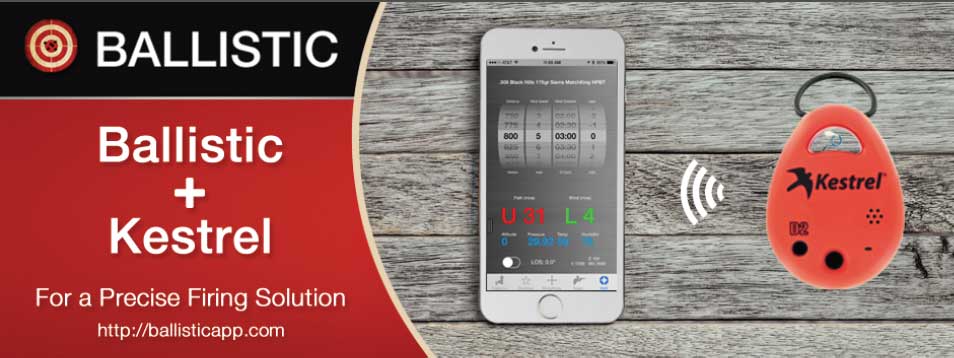
The application has launched Bluetooth integration for Kestral’s 5 Series and DROP products, allowing real-time delivery of atmospheric conditions to Ballistic App. Pretty much what this means is the app and the meter can handle anything Mother Nature dishes out, right at that moment.
The wind shifts, the barometric pressure drops, the temperature spikes — all these could be make-or-break variables to producing coveted cloverleaf groupings. And in the past, these required some educated guess work on the part of the marksman.
“With accurate on-site wind speed and air density measurements sent wirelessly (from a Kestrel Meter) to the user’s iOS device, the Ballistics app can now calculated far more precise firing solutions,” said Alix James, CEO of Kestrel’s parent company Nielsen-Kellerman.
Taking advantage of Ballistic and Kestrel’s integration is extremely simple, to boot. All that is required — aside from an iOS device and one of the compatible meters — is a $19.99 upgrade to the app. The purchase is made in the application itself and is completely functional upon download.
From there, it’s just a matter of shooters making good use of the data Ballistic and Kestrel provide… that and a smooth trigger pull.
Mobil devices have certainly been a disruptive technology, streamlining and simplifying everyday life. Now is definitely the time to let these tools do the same for marksmanship.
Interested in Ballistic Advanced Edition and its upgrades? Then check out what the No. 1 ballistic calculator for iOS devices has to offer HERE!
You know ballistics matter, but how can you put that information to good use? The answer is the new Understanding Ballistics Collection — it offers updated versions of four proven ballistics resources you can put to practical use at the range. Learn how to select the ammunition that is right for you based on detailed comparisons from the major manufacturers. This collection offers everything you want to know on the subject of ballistics. Get Your Collection Now
New for SHOT Show 2016 is the just released Glock 17 MOS and Glock 19 MOS (Modular Optic System), reviewed here by popular Youtuber Hank Strange.
Glock’s MOS, which was unveiled at last year’s 2015 SHOT Show, was initially offered for Gen 4 models G34, G35, and G41 — and a long-slide 10mm Glock, the G40.
This year, the global empire has released the optics-ready system for its popular G17 and G19 models, which have dominated the concealed carry market for years.
Already, companies like Galco are releasing new holster models such as the Blakguard, designed to accept handguns outfitted with reflex-style optics.
As explained in the video, the MOS versions are standard Gen 4 Glock, with the addition of the removeable plates — four are included in the box, comprising the Glock MOS Adapter Set — giving you the option of adding a red dot sight of your choice from various manufacturers.
Strange runs a Vortex Razor with 3 MOA dot. Interestingly, this optic is not listed in Glock’s literature, but does fit the pistol with no issues as he shows (he did have to order shorter screws via Fastenal from Mr. Glock Nut as he notes in the comments).
Is a red dot for you, particularly on a concealed carry gun? It’s a question only you can answer but, as Strange points out, it’s hard to argue with the fast target acquisition afforded by a reflex optic.
Naturally, gun owners will need to assess the cost-benefit for themselves, but for $50-$75 extra cost for the MOS models, it’s likely to beat custom gunsmithing costs to get the same outcome. And that’s not saying anything about the extra flexibility in sight options afforded by the MOS system, should you wish to switch optics brands later.
Philip Massaro wraps up the Gun Digest Reloading Series with handloading tips to ensure safe reloading, how to keep your reloading bench organized and stay focused. Massaro advocates keeping a reloading journal and how a detailed load sheet comes in handy as you work on further load development. Speaking of accurate loads, Massaro talks about how individual guns of the same make and model can vary radically with respect to loads, depending upon barrel harmonics and other variables.
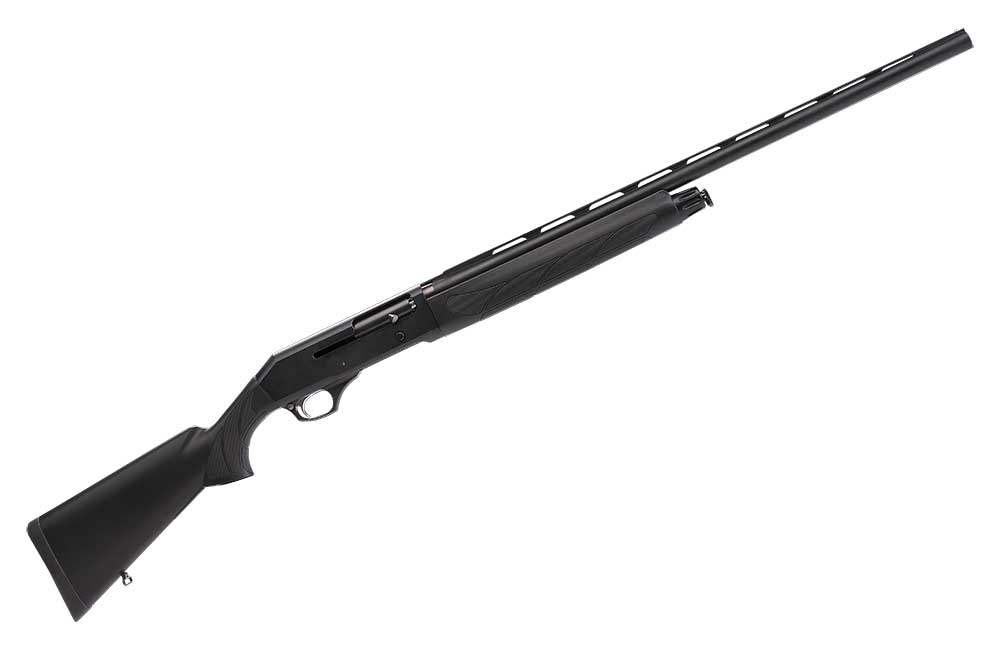
The Stevens S1200 gives shooter an entry-level option in inertia-driven shotguns.
Steven’s first semiautomatic shotgun offers an inertia-driven action priced for entry-level shooters.
Given its long history manufacturing shotguns, Stevens has produced nearly every conceivable shape and size of smoothbore. But the subsidiary of Savage Arms has surprisingly broken new ground this year.
The Massachusetts gun maker has introduced its first semiautomatic shotgun at 2016 SHOT Show, the Stevens S1200. And it appears to be quite an inaugural project for the company, with Stevens outfitting the shotgun with a style of action growing in popularity. The S1200 boasts an inertia-driven action, a system that utilized the recoil of the gun to cycle shells.
Going this route allowed Stevens to build a slender and light field gun that shouldn’t be a burden humping over corn or wheat stubble. At 6.6 pounds, the S1200 certainly appears to be that, but its lightweight doesn’t look to be its only selling point.
The 12-gauge also slender in price with Stevens slapping a $573 MSRP on the base model (black synthetic stock). This could prove to be a bit of a coup by the company, given its new scattergun’s price tag is near the basement of inertia-driven guns.
The S1200 is outfitted with a 3-inch chamber, is available with a 26- or 28-inch barrel and has a 14.25-inch length of pull. It is compatible with Beretta’s Mobilchokes and has a 5+1 capacity.
The shotgun is available with a black synthetic finish in both its 26- and 28-inch barrels. The gun is also available with a walnut or Mossy Oak camouflage stock, but only with the 28-inch barrel. The camo finish has an MSRP of $629 and the walnut stock $685.
The SHOT Show always has some surprises in store for the shooting world at large. This year, it’s Kimber who has pulled one of the big shockers out of the bag at the Jan. 19-22 exposition in Las Vegas.
The New York gun maker has taken a marked break from its bread-and-butter 1911 pistol and bolt-action rifle lines to introduce its first revolver. But, as would be expected from Kimber, the K6s isn’t r carbon-copy of all the other .357 Magnums on the market.
The company has designed the handgun for concealed carry, obvious, given it is a 2-inch barreled snubby. In doing so, it has endowed the 6-shot revolver with plenty of head-turning features not to mention aesthetics.
Most of the Kimber K6s’ desirable aspects are documented in the above video by The Firearms Blog, but there are some that are worth dwelling upon. Perhaps the features that jumps out the most is the hammerless revolver’s trigger pull and weight.
Between 9.5 and 10.5 pounds, it’s scant when compared to other double-action only handguns. This should be a boon for first-time wheelgun shooters and those who are looking for a snappier pull weight on a carry revolver. And tipping the scales at 23 ounces, the K6s is among the lightest carry wheelguns available.
Concerning looks, the Kimber K6s’ design is eye catching, boasting smooth lines, a full lug and flat-sided cylinder. Much of the revolver’s streamlining is meant to avoid snags upon drawing. But, they also give the gun unique and appealing look, which is too bad, given it will most likely be under wraps most of the time.
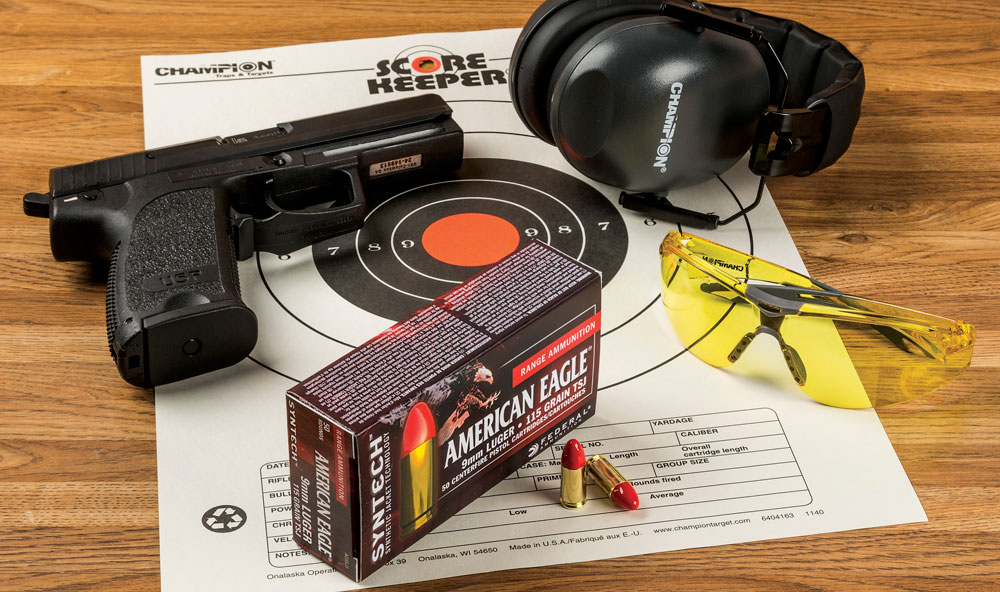
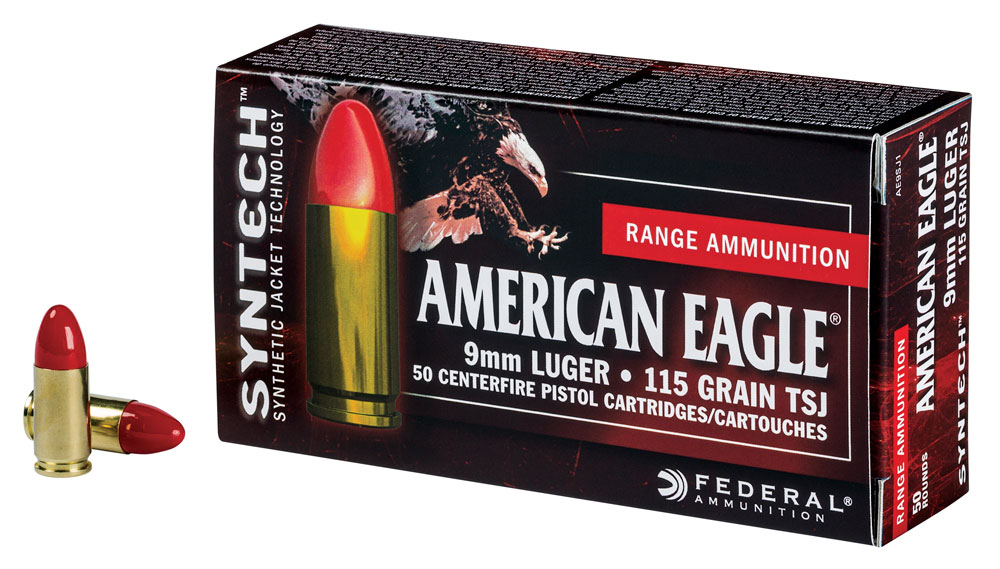
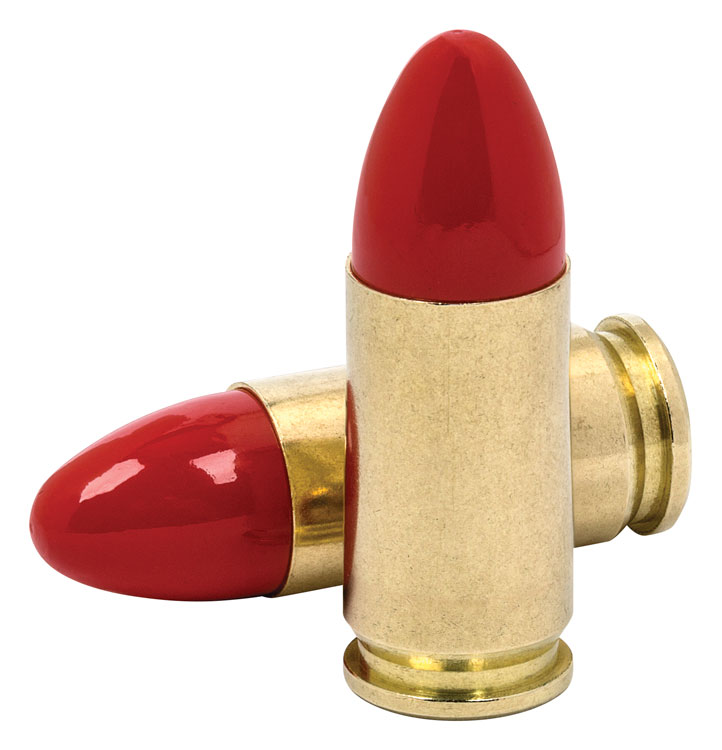
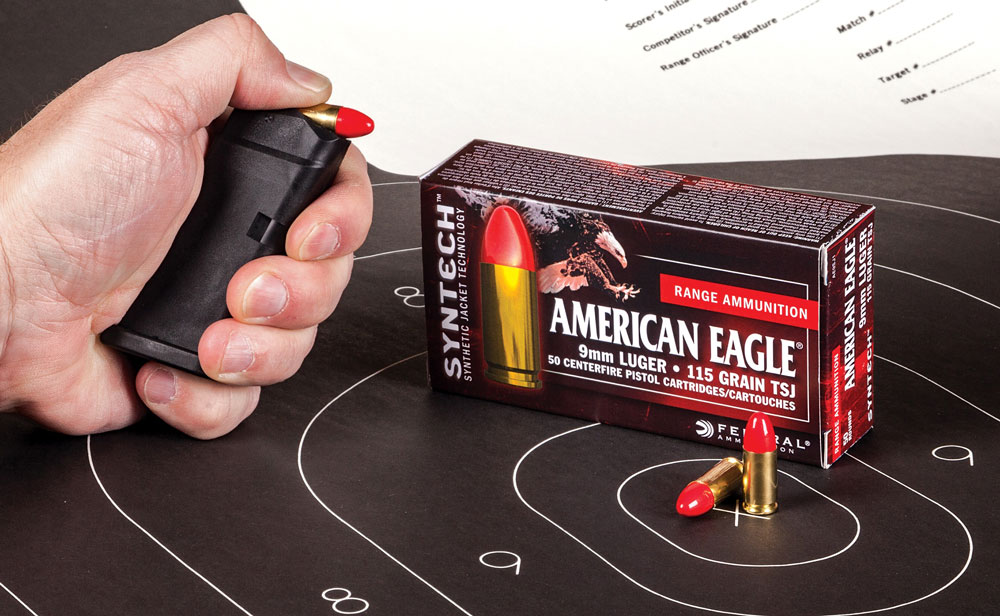
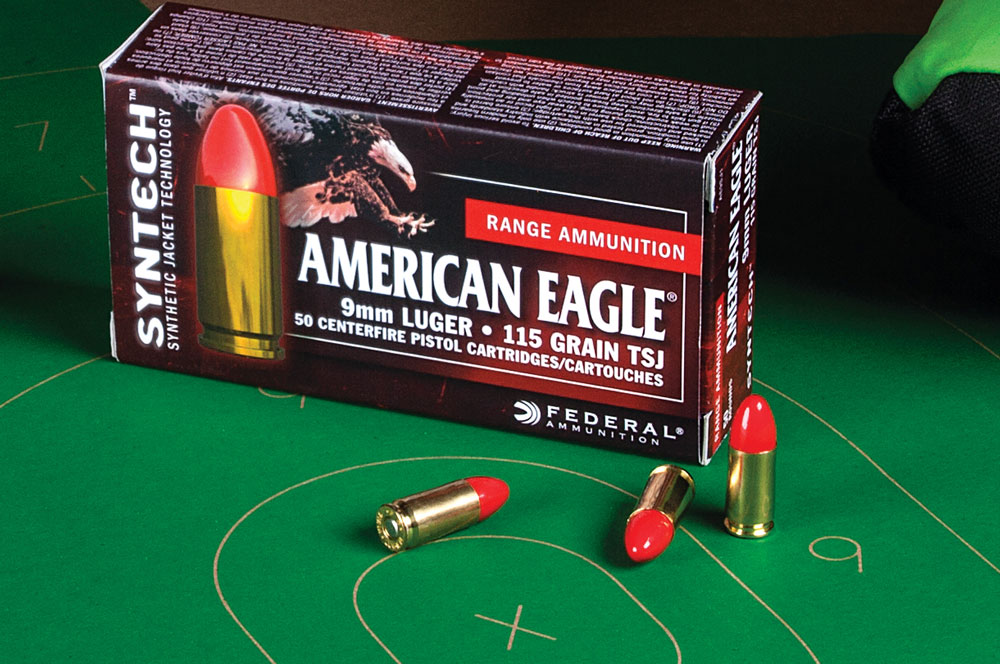
American Eagle Syntech TSJ takes target ammunition to new heights and changes the landscape on target ammunition. Here’s how synthetic-tip ammo works.
It’s one of the biggest ironies in shooting. We generally put the least amount of thought and consideration into the handgun ammunition we shoot the most: Target rounds. Shooters might research and test several different loads for personal defense, hunting or competition, but when it comes to a day at the range, most are content to shoot whatever’s available and affordable.
Consciously or not, we rationalize that we’re “only” shooting at paper or steel from relatively close range, and that the practical differences between full metal jacket target rounds have traditionally been subtle at most.
But that’s all changed. New American Eagle Syntech™ shows what target ammunition can really be. Smooth. Consistent. Clean. Easier on your gun. And more fun to shoot.
New Tech, New Shooters
Senior Product Line Manager Mike Holm said Syntech, a product that’s been years in the making, was created for two important reasons.
“We’re proud of the consistency and performance our target loads have always offered, but we didn’t just want to follow the industry, hit a certain plateau, and stop striving for something more. So we stepped up and asked ourselves what we could do to make the shooting experience better.”
The changing demographic of today’s shooter was another important motivator.
“We know that someone who started shooting a handgun in the past few years generally has different wants and needs than established shooters,” Holm said. “In a lot of ways, they’re more critical and do more research. They ask questions that push us to do more too, especially for those who might not be quite as comfortable with guns or do most of their shooting at indoor ranges.”
Engineers tackled these varied challenges head-on while developing Syntech, and in the process created something extraordinary—not only the ammunition itself but also the technologies that define it.
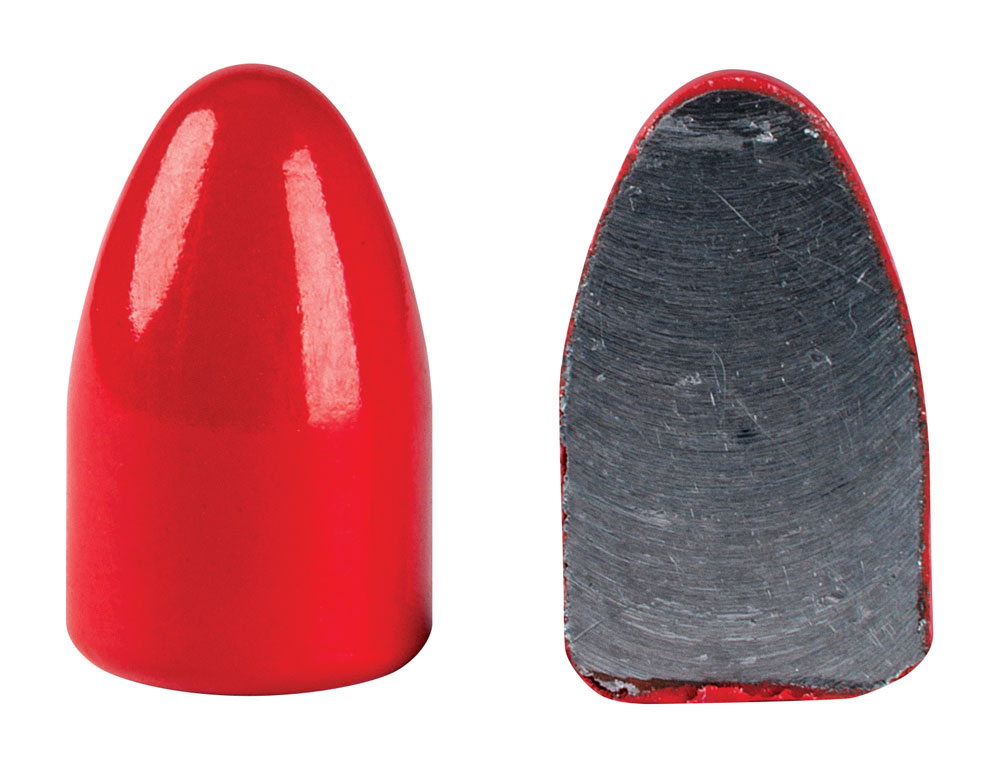
It all centers on the exclusive Syntech Total Synthetic Jacket, a complete polymer coating that takes the place of the copper jacket in conventional FMJ target ammunition. The technology rewrites the book on what shooters should expect and demand from range ammunition.
Smooth And Cool
Syntech is cool—literally. Unlike conventional lead or copper-jacketed rounds, the slick, red polymer coating eliminates metal-on-metal contact in the barrel. The result is not only softer, smoother shooting you can feel, but less friction, heat and barrel wear. Shooters—especially those who burn through a lot of rounds at the range—will get more longevity out of their hard-earned handgun investment.
In fact, the Syntech coating produced an average of 12 percent less friction in the barrel than a standard copper jacket, when tested by Federal Premium engineers using standard testing methods and American Eagle pistol ammunition (AE45A, 45 Auto, 230-grain FMJ). Another Syntech test revealed an average of 14 percent less heat. The heat test was conducted using American Eagle pistol ammunition (AE9DP, 9mm Luger, 115-grain FMJ) and a common, conventional, full-size handgun.
Shoot Clean, Shoot Better
The next thing a shooter will likely notice after putting a few magazines of Syntech through their gun is actually what they’re not seeing—copper or lead fouling.
“We don’t like to admit it, but nobody likes to clean their gun, and Syntech eliminates a big part of what makes a firearm dirty in the first place,” said Senior Product Development Engineer John Swenson. “Not only does the Syntech jacket encapsulate the lead core, but that coating maintains its integrity at ignition, down the barrel and in flight.”
With no exposed lead or copper, there’s no contact between these materials and the barrel, so there’s no metal fouling. Period. You’ll have to service your gun less frequently and you’ll shoot better in the meantime.
The need to clean is further reduced by the loads’ special clean-burning propellant paired with all-new lead-free Catalyst™ primer technology.
“The new primer is hot, consistent, and provides extremely reliable ignition,” said Chief Chemist Joel Sandstrom. This results in a more complete and efficient burn of the propellant, which significantly reduces residue with each shot.
Safety Matters
Range shooters often take for granted the physics involved in shooting a jacketed bullet into a hard target mere paces away. The reality is that pieces of the copper jacket and larger fragments of the lead core travel far from a target on impact—sometimes more than 15 yards. But with no hard copper jacket and a soft lead core, Syntech produces less of this splash back, and what it does produce travels shorter distances when fired into steel targets. Testing done by Federal Premium engineers proves this point.
“We set up a test where a shooter fired 100 rounds each of common, commercial, 115-grain FMJ, TMJ and Syntech from a distance of 23 feet into a steel target,” Swenson said. For the test, Swenson and his team covered a 15-plus-yard radius in front of the target with a giant tarp, on which they’d marked 5-, 10- and 15-yard circles. After shooting each type of ammunition, they collected bullet fragments in the 10- and 15-yard marked areas, and weighed and analyzed what was there.
“What we found says it all,” he said. “Not only did Syntech put out less overall weight in recoverable fragments than typical FMJs, but most of those fragments were smaller and traveled shorter distances after hitting the steel.”
The test data was clear. Syntech produced 51 percent less total recoverable fragment weight than FMJs between 5 and 15 yards of the target. It also resulted in 91 percent less weight in fragments traveling more than 15 yards from the target, and at least 77 percent less in fragments weighing more than 10 grains.
Experience The Difference
There will always be practical applications for conventional copper jacketed target rounds like those you’ll find from American Eagle. This ammunition remains an affordable choice for accurate, reliable practice and training. But with range time so precious to us, it only makes sense to choose ammunition that makes that time more fun and more productive, with less hassle and cleanup afterward.
“It’s all about having a better shooting experience,” said Holm. “With Syntech, you have it—more of what all shooters want, and less of what you don’t.”
American Eagle Syntech TSJ Q&A
To help serious shooters fully appreciate everything Syntech brings to the table, we fired the following questions at Mike Holm, Senior Product Line Manager for Federal® American Eagle Ammunition.
Q: What is Syntech ammunition? A: American Eagle Syntech features an all-new Total Synthetic Jacket (TSJ) wrapped around a soft lead bullet, plus the high-performance, lead-free Catalyst™ primer and specialized clean-burning powder packed in a reloadable brass case. The combination reduces heat, friction and fouling to keep your gun cleaner, longer while providing the smoothest, most enjoyable shooting experience possible.
Q: How does it keep your gun cleaner? A: Unlike conventional jacketed ammunition that causes metal-on-metal contact between the bullet and bore—decreasing barrel life while producing hard-to-clean fouling—Syntech’s polymer coating lets the bullet glide through the barrel. As a result, barrel life is extended, while lead and copper fouling are a thing of the past.
Q: Metal residue is gone, but what about polymer fouling in the barrel and rifling? A: After firing many thousands of evaluation rounds during exhaustive testing, we’ve noticed no substantial residue from the polymer coating.
Q: Do you need special cleaning products when shooting Syntech? A: No. We’ve fired thousands of Syntech rounds during testing, and no specialized cleaning products have been necessary. Thanks to Syntech’s TSJ jacket, traditional cleaning products such as a brass brush and standard powder solvents should be all that is required to clean your barrel/firearm.
Q: How does the Syntech coating differ from the red moly used decades ago? A: The red molybdenum grease other companies coated their bullets with is completely different than Syntech’s strong and durable polymer, which is neither liquid nor grease.
Q: With less friction and heat, how does the Syntech coating affect bullet velocities versus standard full metal jacket ammunition? A: We designed Syntech to perform at velocities similar to current conventional range loads. However, because the coating reduces barrel friction, we are able to achieve this velocity with a slightly lower powder charge.
Q: Will the coating degrade when my barrel heats up from high-volume shooting? A: We did not experience that issue while firing thousands of rounds during development.
Q: Will there be any Syntech personal defense or rifle rounds available in the future? A: Although Syntech was initially designed as high-performance range ammunition, we will look to create, evaluate and test other products in years to come.
Q: How long has Syntech been in the works? A: It took approximately four years to release this product, including two years of just developing the sophisticated machinery required to reliably mass produce such high-quality bullets. However, Federal Premium® has decades of experience with coated bullets, and we relied on this expertise to develop Syntech and deliver its high-tech features and benefits at an affordable price point.
Q: What exactly is the polymer formula used in Syntech and how is it applied? A: Sorry, we can’t answer this question. It’s a trade secret. However, we can say sophisticated machinery precisely applies the Syntech polymer to meet our rigid specifications—after which the coated bullets undergo an extensive series of quality assurance checks.
Q: What is the cost difference compared to standard FMJ range ammunition? A: While Syntech is competitively priced for the range ammunition market, you might find it retails a bit higher than standard target rounds. However, the benefits Syntech delivers more than offset the slightly increased cost.
Q: How does the Catalyst primer give this new ammunition an edge? A: The all-new, lead-free Catalyst primer used in Syntech rounds is hot, consistent, and provides extremely reliable ignition followed by efficient burning of the propellant. We believe Catalyst is the most state-of-art primer technology available.
Q: How does Syntech ammo appeal to new shooters? A: We know that someone who started shooting a handgun in the past few years generally has different wants and needs than established shooters. New shooters are typically more intimidated when it comes to cleaning their handgun or shooting at indoor ranges. They might also worry about protecting the barrel on their new investment, or be more concerned about safety issues such as splashback when shooting close-up steel targets.
Q: Explain how Syntech reduces splashback. A: Since Syntech lacks a conventional copper jacket and has a soft lead core, it produces significantly less splashback than standard full metal jacket ammunition when fired into steel targets. Testing by Federal Premium engineers revealed Syntech produced much less total recoverable fragment weight than FMJ rounds between 5 and 15 yards of the steel target. And significantly less beyond 15 yards.
Q: Is Federal’s Nyclad bullet similar to the new Syntech product? A: Polymer-based Syntech target ammunition is a totally different product than our nylon-based Nyclad, which was developed primarily for law enforcement purposes. That being said, engineers working on the Syntech project certainly benefited from the years of experience in coated-bullet technology we’ve gained while producing millions of rounds of proven Nyclad ammunition in the past.
Entering its second season on the Sportsman Channel, Modern Shooter has more high-caliber action than ever. From shooting like a Navy Seal to staring down some of the planet’s most dangerous game, the program explores unique and intriguing corners of the shooting world.
On the next episode, Modern Shooter is front and center as Colt unveils its new 2016 firearms lineup. Get a first, in-depth look at the new Colt Competition Pistol. The versatile handgun is loaded with features that make it a winner in competition and on the street.
But there is a more weighty aspect to the show, as it goes behind the scenes of the legendary gun maker’s effort to aid military families.
Colt has teamed up with Folds of Honor, an organization dedicated to providing children of injured or fallen servicemen money for school and college. Modern Shooter documents the manufacturer’s program to raise funds for the organization, donating a portion of each firearms sale to Folds of Honor. It will also look at how that money helps and has helped the loved ones of those who have given so much to their country.
New episodes of Modern Shooter air 8 p.m. ET Monday nights on Sportsman Channel, with an encore showing at 11 p.m. Replays can be viewed 12 p.m. on Thursday and 5 a.m. on Sunday. Clips of Modern Shooter are also available at Gun Digest’s You Tube channel.
Modern Shooter is produced for gun enthusiasts who look for the best in firearms programming and is sponsored by the top names in the firearms industry. Those sponsors include: Colt Manufacturing, FNH USA, Aguila Ammunition and H&H Precision Manufacturing.
About Gun Digest
Gun Digest is the world’s foremost authority on guns in print and online. In addition to Gun Digest the Magazine, the brand’s portfolio includes the Gun Digest Books line, Standard Catalog of Firearms, the GunDigest.com online community, and ecommerce specialty store, www.gundigeststore.com. For more information, visit gundigest.com, the Gun Digest Facebook page or follow on Twitter @gundigest. Gun Digest is an imprint Gun Digest Media.
Also Check Out:
Modern Shooter Winter 2016 Modern Shooter is your source for the modern firearms giving you the inside edge on tactics and accessories for the newest ARs, shotguns and handguns. In the Winter 2016 edition we focus on Colt! Instant download
As SIG Sauer fans well know, the scope of the company far exceeds just churning out firearms. From suppressors to firearms training to ammunition, it’s fairly safe to say the European-American company is much more than a gun maker at this point.
SIG’s ammunition line, in particular, has seemed to resonate with shooters and much of the gun world. Even Gun Digest has been impressed with the company’s wares, naming SIG’s Elite Performance Ammunition the best of 2015
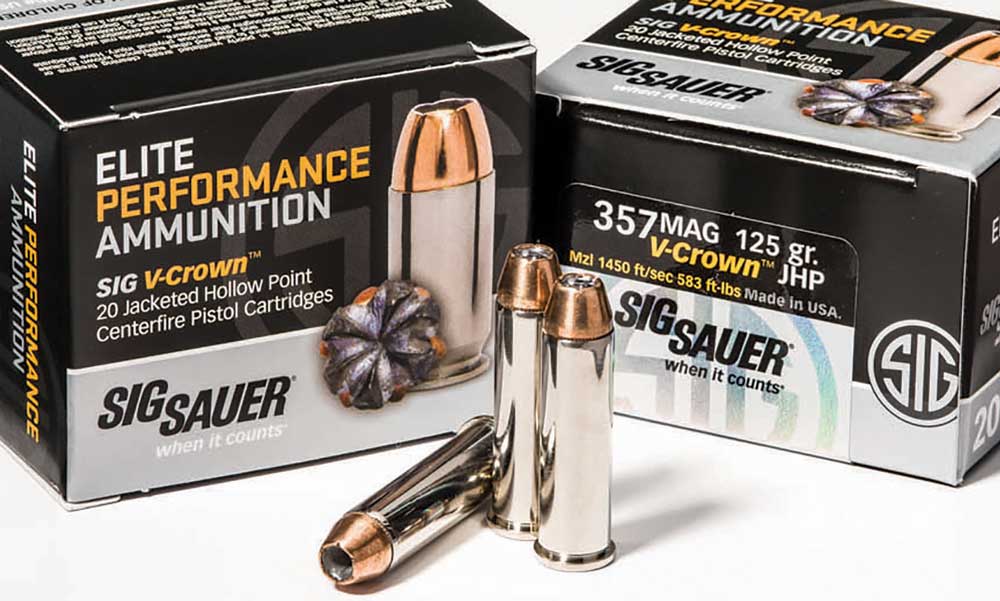
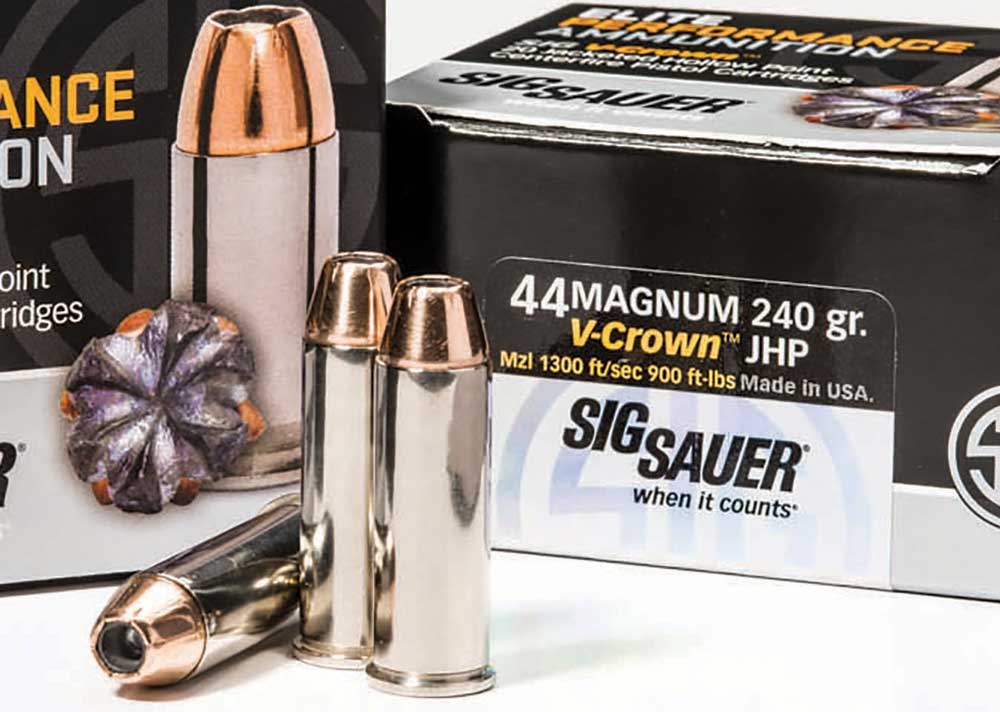
The company’s cartridges have proven so popular it has even had SIG moving past what is generally considered its wheelhouse. The manufacturer best known for its semi-automatic pistols and AR-style rifles is again shooting at revolver shooters this year with its ammo expansion. Joining the .38 Special in the company’s wheelgun offerings are the .357 Magnum and .44 Rem Magnum.
While much of the Elite Performance Ammunition line is focused on self-defense and match shooting, SIG is not selling its new additions that way. The company pegs its .357 and .44 V-Crown hollow points as hunting cartridges, giving handgun hunters and lever-action aficionados what appear to be solid options. And with a 125-grain round for the .357 Magnum and 240 grains for the .44, SIG should have a wide spectrum of big- and medium-sized game covered. “The 357 Magnum and 44 Rem Mag calibers are quite popular with handgun hunters,” said Dan Powers, president of the SIG SAUER Ammunition Division in a press release. “These are accurate and powerful loads for hunting mid-sized animals such as hogs and deer, and they are also a top choice among hunters who carry a pistol for backup protection in the field.”
For fans of the .357 Magnum, there is also a full metal jacket option, which could help pinch pennies. The less expensive round is engineered to duplicate its hollow point compatriot’s ballistics. And according to SIG’s numbers, the two rounds appear extremely consistent, with only .2 inches difference in drop at 100 yards.
It’s the time of year that firearms enthusiasts’ collective hearts get a thumping. That is because the SHOT Show is just around the corner.
The Jan. 19-23 convention gathers the better part of the firearms industry together to show off their wares. It is an absolute playground to those who love guns, ammo and accessories. In particular, because much of what is showcased are the new pistols, rifles and shotguns that will line the walls and display cases of gun stores around the country the coming year.
Fans of one of the nation’s oldest gun manufacturers have a reason to keep their eyes peeled on the 2016 SHOT Show, with Colt releasing three new firearms just before the event. The Connecticut manufacturer has expanded its catalog to include two new 1911 pistols and an M4 rifle. Each is purpose built and check a number of boxes for certain shooters.
Colt Competition Pistol
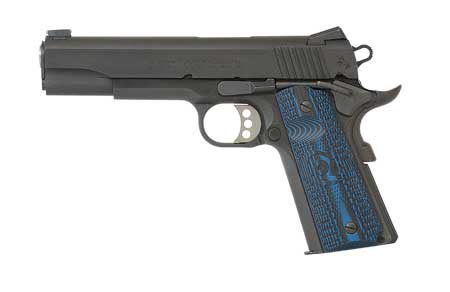
Shooters aiming to add a race-ready pistol to their safe might not have to look any further than the Colt Competition Pistol. Loaded with a number of performance enhancing features, the 1911 has the potential to have competitors banging steel and silhouettes in record times.
One of the more notable aspects of the semi-automatic, available in .45 ACP or 9mm, is Colt’s Dual Spring Recoil System. Originally developed for the M45A1 — the 1911 used by U.S. Marine Corps Special Operations Command — the system dampens the pistol’s recoil. This aids in the overall accuracy of the Competition Pistol, reducing muzzle flip and keeping it on target.
The pistol’s other features include a 5-inch National Match Barrel, Novak adjustable rear sight and fiber optic front, undercut trigger guard and upswept beavertail grip safety for improved ergonomics and blue Colt logo G10 grips.
The pistol’s price tag also has the potential to get shooters racing for it with its present MSRP $899.
Lightweight Commander
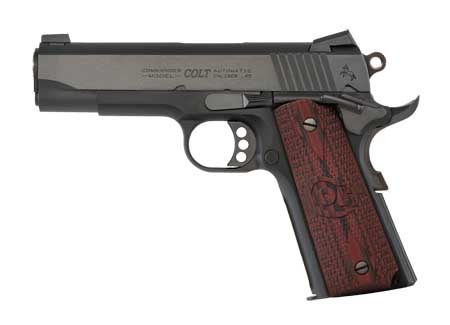
The Lightweight Commander has dotted the pages of Colt’s catalog before and is now back in production. The 4.25-inch barreled semi-automatic is available in .45 ACP and 9mm, and offers a number of refinements that should make it a choice concealed carry option.
Chief among these is the steel-framed pistol’s weight — 29.4 ounces. Relatively speaking, the pistol is at the heavy end of the scale of carry guns, especially compared to polymer options. But, it is more than a manageable heft for a 1911 destined to hang from a belt.
Like the Competition Pistol, the Lightweight Commander is outfitted with Colt’s Dual Spring Recoil System, to aid in accuracy and shootablity. The handgun’s other features include adjustable Novak rear sights, undercut trigger guard, upswept beavertail grip safety and black cherry Colt Logo G10 Grips.
Presently the company has placed the pistol’s MSRP at $949.
The Expanse M4
Penny pinchers will be pleased to learn Colt has expanded its offering of economical AR-15 style rifles with the Expanse M4. With an MSRP of $699, it’s a good bet this rifle will be difficult for retailers to keep in stock.
The company has released precious few specs on this 5.56X45 NATO/.223 Rem. rifle, so it’s difficult to say exactly how — aside from price — it differs from other M4s. But the rifle has some obvious features, easily discernible from a quick perusal, such as: railed flattop reciver, GI-Style flash hider and adjustable buttstock.
The Expanse M4 has a16-inch barrel with a 1:7-inch twist rate, which should allow it to digest a heavier bullet selection. One aspect of the rifle, which could be a point of contention with some is its lack of a chrome lining in the barrel.
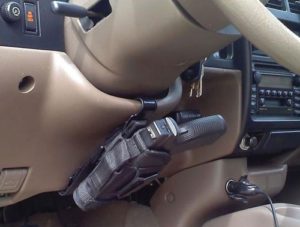
Simplify the process of storing a handgun in your car with Gum Creek’s Vehicle Handgun Mount – an innovative design that fits snugly under your steering wheel column while also providing quick and easy access to your handgun. The convenience of this mount allows you to avoid placing your handgun between or underneath seats, in a door or console, or any other location that is uncomfortable, unsafe, or non-secure. Learn More
Youth hunters and shooters are a growing part of the business done at Herb Bauer Sporting Goods, and the store itself facilitates much of that youth “traffic” by offering the state-mandated hunter education course on site.
“Our shop prides ourselves in educating many, many youths every year in our hunter education program,” says Gun Department Manager John Lewis. “Our hunter safety teacher is a second generation female instructor who has a real passion for recruiting more kids to hunt in our state! She works closely with the California Department of Fish and Wildlife, and coordinates many special youth hunts each year, including dove, quail and pheasant hunts.”
With these many young people coming through the store—with parents in tow—sales are very good on a number of youth model shotguns, especially single-shots made by Rossi and NEF. Top youth pump guns include Remington, Mossberg, Browning and Benelli Novas, and these young shooters prefer their new scatterguns in .20 gauge and .410.
For young rifleshooters, the Savage Rascal, a single-shot bolt-action with Savage’s AccuTrigger, is tops here.
“Air guns are popular, too, especially as we get into the holiday season where we will sell over 50 Daisy Red Ryders—after customers watch their holiday favorite video!” says Lewis. That movie, of course, is 1983’s A Christmas Story where young lead character Ralphie Parker pines for “an official” Red Ryder BB Gun for Christmas. The Red Ryder sells for just under $50.
Herb Bauer’s also sells a good selection of Crosman youth rifles, popular as they can shoot both BB’s and lead pellets.
Editor’s Note: This brief originally appeared in the Winter 2015 issue of Gun Digest the Magazine.
The 1911 is among the most recognizable pistol designs in the world, but the semiautomatic was not born overnight. In fact, the iconic firearm was a long, though worthwhile, effort to come up with a top-notch military sidearm.
Back in 1899 everyone sang Aud Lang Syne- and so the song goes. At the same time, the Mauser broomhandle pistol was gaining acceptance as a reliable and effective self-loading pistol. John Moses Browning developed the Colt 1900 .38 ACP pistol, and adventurers such as the up-and-coming T. E. Lawrence and western lawmen relied upon the single-action revolver. The United States Army was disappointed with the Colt .38 revolver and was actively looking to replace the Colt 1892 with a self-loading pistol. The Colt 1900 pistol was studied, and the German Luger was tested as well. John Browning and Colt were gaining much experience, as Browning designed small-caliber pistols and Colt manufactured them. The inertial firing pin, grip safety, enclosed slide, and tilting-link barrel were developed in these handguns. Browning also experimented with both internal and external extractors. Various hammerless designs were marketed, and while they were actually concealed-hammer pistols, the smooth slide design was popular.
Browning pioneered the locked-breech action as other makers struggled with adapting self-loading handguns to powerful cartridges. The Mauser 1896 used an oscillating wedge that worked well enough. This system was later used in the Walther P38 and today is in use with the Beretta 92 pistol. The Luger borrowed the Henry rifle’s toggle lock, or perhaps Hugo Borchardt was impressed by Maxim’s adaptation of the toggle for machine guns. Browning used the locked-breech operating principle. This design features a barrel and slide that remain locked as the pistol recoils. The barrel tilts at a certain point in its travel, and upon firing, the slide and the barrel recoil together. As the bullet exits the barrel and pressure abates, the slide and barrel separate, and the slide rushes forward to strip another round from the magazine and into the chamber. Practically every modern handgun now uses the Browning locked-breech design.
The Beginning When the Army wanted a .45-caliber pistol, Browning took a hard look at his 1900 design, which was already refined into the 1903. The .45 ACP cartridge was designed to be the same length as the .38 ACP, with a .900-inch-long cartridge case, which simplified some of the development. He eliminated the 1900’s dual links and used only one swinging link in the 1911, but the 1905 and 1907 Colt pistols still used not only dual links, but also the locking slot for the barrel used with the 1900. Just the same, the barrel bushing and trigger action later used in the 1911 were beginning to appear in the 1907 version of the Colt .45 automatic. In the style of the day, the Colt 1907 was offered with a shoulder stock slot (gangsters later modified the 1911 to shoulder stock status, along with extended magazines and even a full auto selector switch). The hammer style, lanyard loop, and ejection port received considerable attention. The somewhat square original grip angle was retained from the 1900 pistol.
The pistol was a good effort but Army testing found this Colt lacking. Safety was one concern, as the lack of a positive manual safety was a drawback for mounted use. The grip angle was rated uncomfortable. My research indicates that cavalry tests included carrying the Colt cocked and unlocked and ready to fire in the holster. Racking a slide was unacceptable for one-hand operation in a headlong battle from horseback and carrying the pistol loaded with the hammer down seemed unacceptable.
The pistol was further developed following a poor rating by the Army. Work on the Colt .45 automatic continued through the 1909 and 1910 models. The most noticeable change was the grip design. The dual links were finally eliminated. Seminal work on safety features included the addition of a grip safety, but the slide lock or thumb safety was last in development. The various mechanical improvements are important, but the improvements in the grip angle and handling are equally important. The proof of the 1911 Colt was an intensive firing test. The 1911 .45 was fired until too hot to handle, quenched in water for cooling, then fired until 6,000 rounds were exhausted without a malfunction. There were a couple of things the Army wanted they did not get, so a compromise was made. These wants included a loaded chamber indicator and a round counter. The brass round counter of the Savage 99 rifle may have made an impression upon the military but the practical application wasn’t, well, practical. The 1911 magazine has witness holes for counting rounds. Modern 1911s have slots in the barrel for checking the loaded state but the press check is the most foolproof method of checking for a round in the chamber.
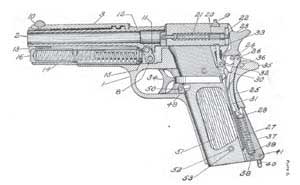
Schematic of the 1911 pistol.
First Combat Action And The Rare “Black Army” Model The 1911 acquitted itself well in the Philippines action. Rushed to the war zone immediately after adoption, hard-pressed soldiers put the 1911 to task. The 1911 went with Pershing to Mexico and then to Europe during World War One. It was during World War One that a now uncommon variation was introduced. Colt was used to producing a few thousand guns a year, but now the Army needed 300,000. As a result, Colt cut corners in some production demands, and one of the cut corners resulted in less polish and a darker finish. This became known as the “Black Army” finish. These handguns became rare after the war for two reasons: First, Colt’s contract was canceled after the war ended. Second, most of the Black Army guns were refinished after World War One, and many were refinished in the new Parkerizing used during World War Two. The Army .45 did the business like no other, but as often happens at the end of a war, there was a list of complaints concerning the 1911. After World War one, Colt was asked to instigate a number of detail changes in the 1911 handgun. The 1911 was ushered off the stage, and the 1911A1 was developed.
This article is an excerpt of Gun Digest Shooter’s Guide to the 1911, 2nd Edition by Robert K. Campbell.
In this installment, Philip Massaro completes cartridge assembly by demonstrating how to seat the bullet. He covers how to use a micrometer seating die for reloading, as well as various ways to crimp handgun bullets. Massaro demonstrates seating bullets for the .30-06, .458 Win. Mag, .357 mag. and .45 ACP cartridges, each of which presents its own idiosyncracies. Learn how to seat bullets with cannelure using a roll-crimp to hold the bullet in place, in addition to a taper crimp on the .45 ACP.
At just $899, the Colt Competition Pistol™ is perfect for those looking to get into competition without breaking the bank.
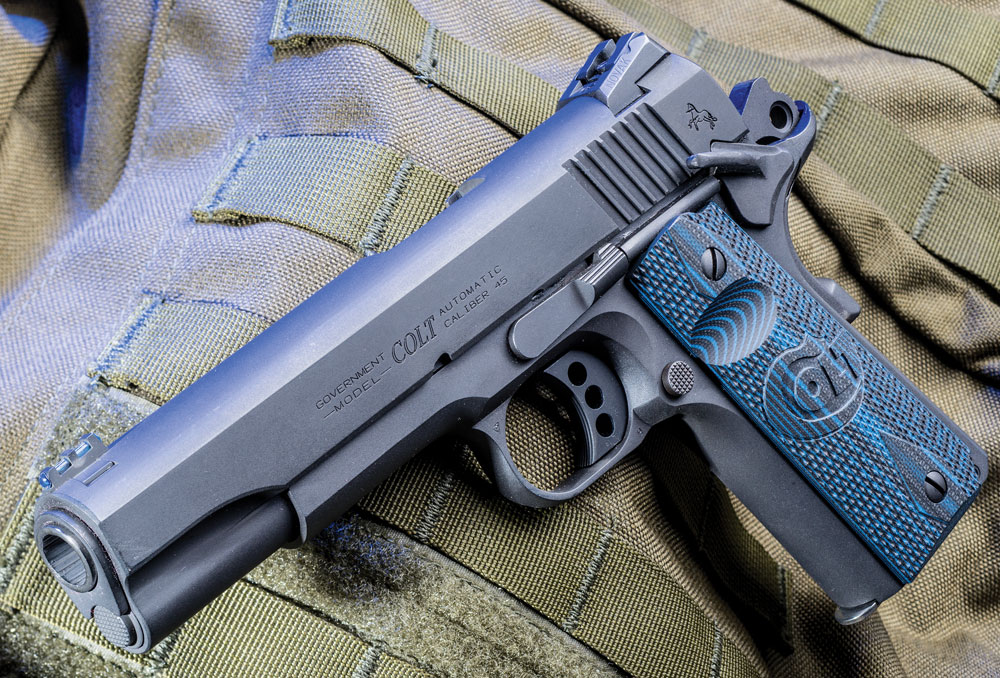
The new Colt Competition Pistol is a true, out-of-the-box 1911 for the competitor.
COMPETITIVE SHOOTING HAS BECOME A LARGE AREA of growth in the firearms industry in recent years, with more and more shooters taking part in various competitions. Plenty of these shooters prefer the venerable 1911, or at least modern renditions of it, to some of the other competition pistols on the market.
Ever since Colt introduced its first Gold Cup pistol in the late 1950s, it has served competitive shooters admirably with features designed to glean the most performance from the 1911 platform. Unfortunately, the price accompanying some of these features, and those found on high-end, competition-style 1911s made by other manufacturers, can push away some buyers with less disposable income.
One of newest Colt 1911s, set to be introduced at the 2016 SHOT Show in Las Vegas, aims to offer a solution. Dubbed the Colt Competition Pistol, the new pistol takes the 1911 Government model to another level with accuracy—and other performance enhancing features, and does so at a price that doesn’t break the bank for those with a limited budget or those new to competitive shooting.
With a National Match barrel, the new Colt Competition Pistol™ is available in .45 ACP and 9mm.
Available in .45 ACP or 9mm, depending on the shooter’s preference, the Colt Competition Pistol incorporates Colt’s renowned National Match Barrel and a 4.5- to 6-pound three-hole, aluminum single-action trigger. The pull is smooth and has a clean break, and the match barrel offers excellent accuracy. The 5-inch,1:16 LH twist barrel is made from stainless steel and has a polished finish.
As with many of Colt’s new pistols for 2016, the Colt Competition Pistol utilizes the Colt Dual Spring Recoil System™ found on the M45A1 Colt developed for the Marine Corps. What this system does is reduce recoil for faster follow-up shots and extend recoil spring life, translating into longer effective use.
The reduction of recoil and muzzle flip is noticeable with the Colt Dual Spring Recoil System™, especially in the 9mm model, which after a bit of shooting seems to almost instinctively set back on target after each shot. Another unique element on the new Colt Competition Pistol is its sights.
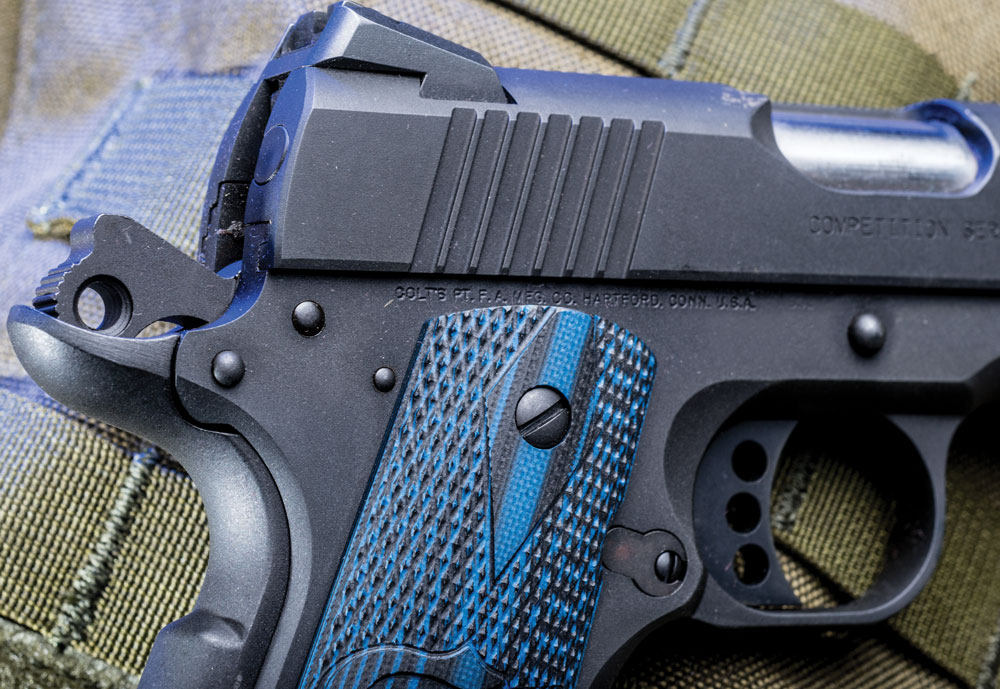
The pistol features a Novak adjustable rear sight that Colt says is a patent-pending design, and up front is a Novak Blue Fiber Optic sight. Blue initially sounds like a strange choice, given all the pistols with red or orange sights, but the blue actually stands out quite well, offering a clear reference point.
To match the blue fiber optic sight, the Colt Competition Pistol also comes fitted with a set of stylish blue checkered G10 grips. The grips are scalloped and offer secure purchase without becoming abrasive during extending shooting.
The pistol sports a carbon steel frame and slide with blued finishes. It also features an upswept beavertail grip safety and an undercut trigger guard to keep the pistol seated low in the hand for improved control. Redesigned wide rear slide serrations are also incorporated for the shooter’s competitive and defensive needs.
An easy-to-access, extended thumb safety rests on the left side of the frame, and the pistol also includes a Series 80 firing pin safety.
The new Colt Competition Pistol weighs 36 ounces empty. It has an overall length of 8.5 inches, an overall width of 1.25 inches and an overall height of 5.5 inches. These specifications are the same for both calibers.
What is not the same is magazine capacity. The .45 ACP model holds 8+1 rounds, while the 9mm version has a capacity of 9+1 rounds.
Each pistol comes with two magazines, a cable lock and an instruction manual. The Colt Competition Pistol in either model will be available for $899, a remarkable price given its features and performance capabilities. It is priced to be a truly more affordable option for newer or first-time competitive shooters as well as those who are more advanced.
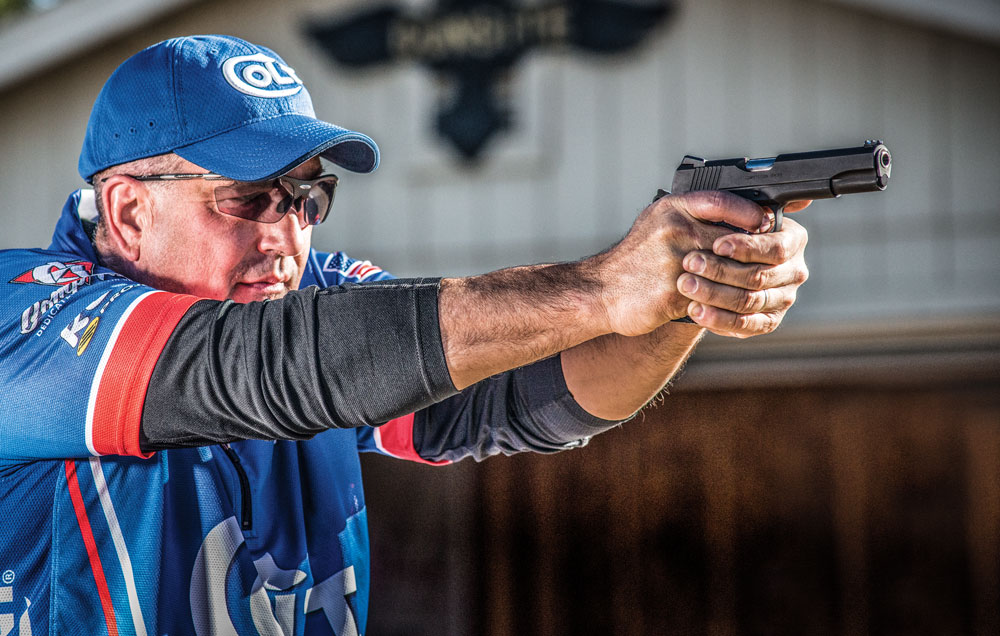
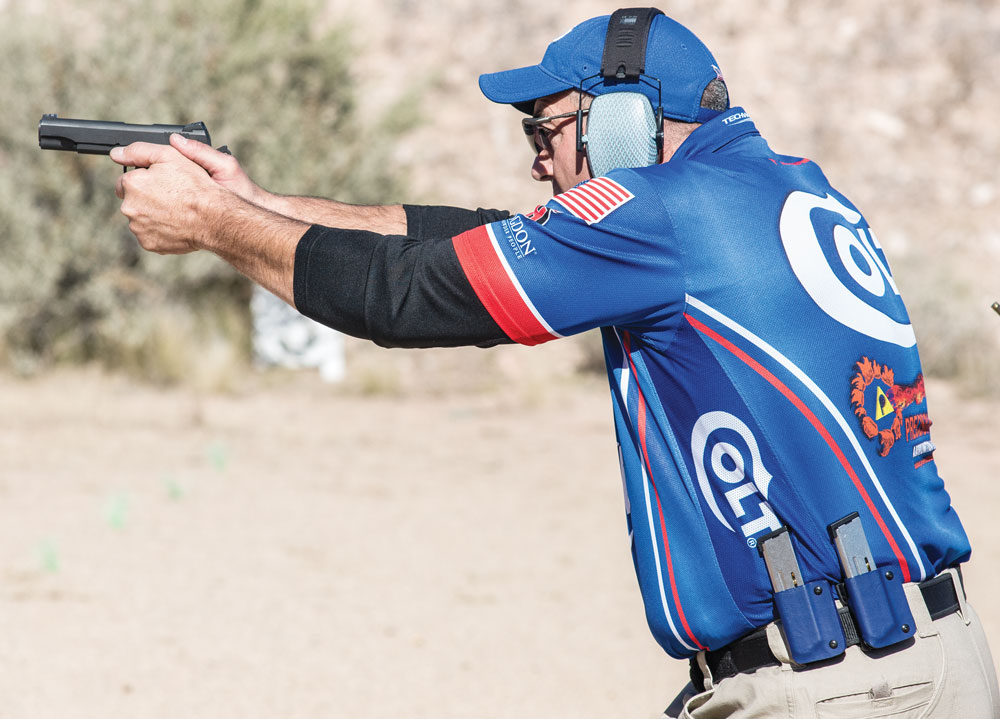
After a day at Gunsite Academy in Arizona, the Colt Competition Pistol lives up to its billing.
COLT COMPETITION PISTOL™ Type Semi-auto Caliber .45 ACP or 9mm Barrel 5-in., stainless steel, National Match grade Overall Length 8.5 in. Overall Height 5.5 in. Overall Width 1.25 in. Slide Carbon Steel Frame Carbon Steel Weight 36 oz. (unloaded) Trigger 3-hole aluminum, 4.5 to 6 pounds Sights Novak Blue Fiber Optic front, Novak adjustable rear Finish Blued Magazine Capacity 8+1 (.45 ACP), 9+1 (9mm) MSRP $899 Manufacturer Colt.com
Looking to go armed, but are stuck in the weeds as to what to arm yourself with? Here are 20 of the best concealed carry gun options that will keep you on the defensive.