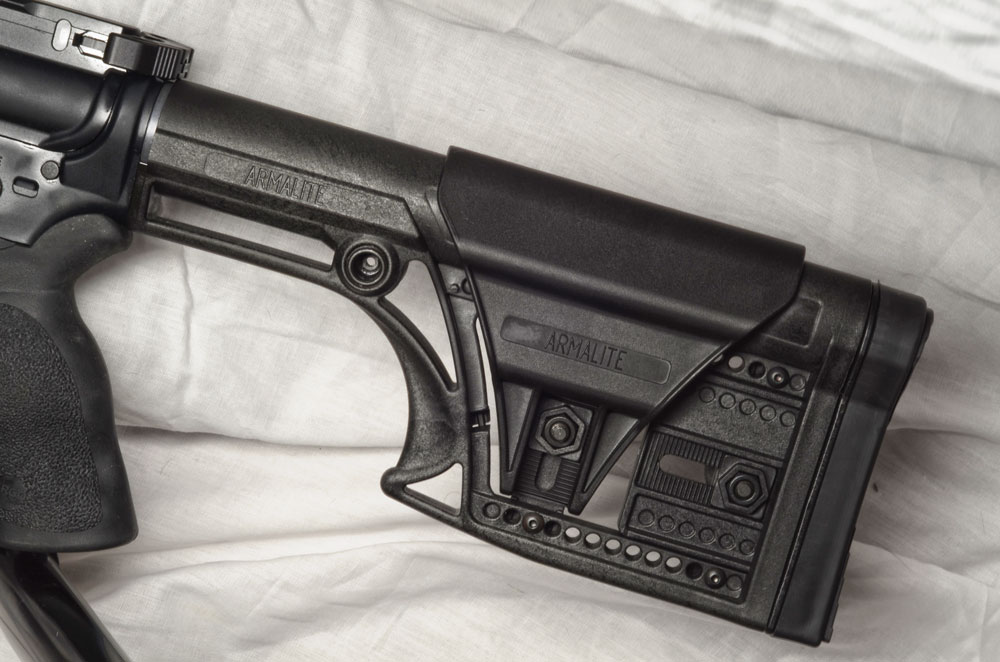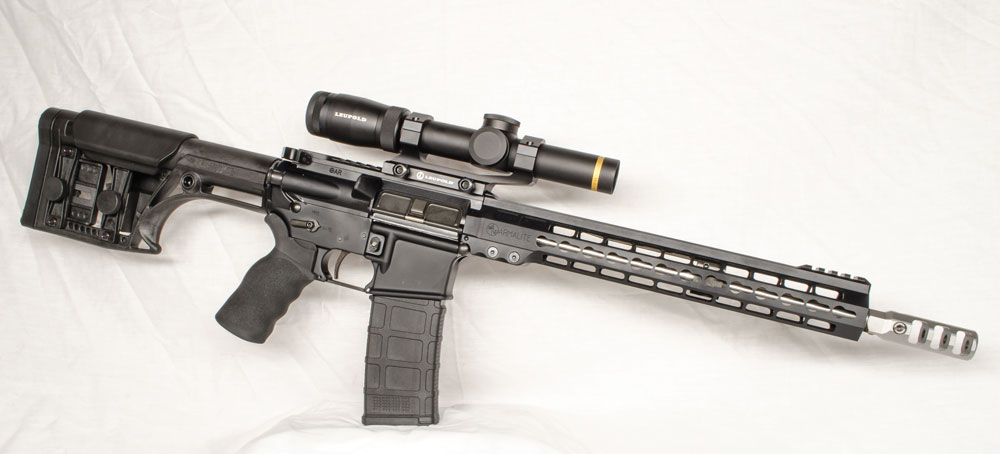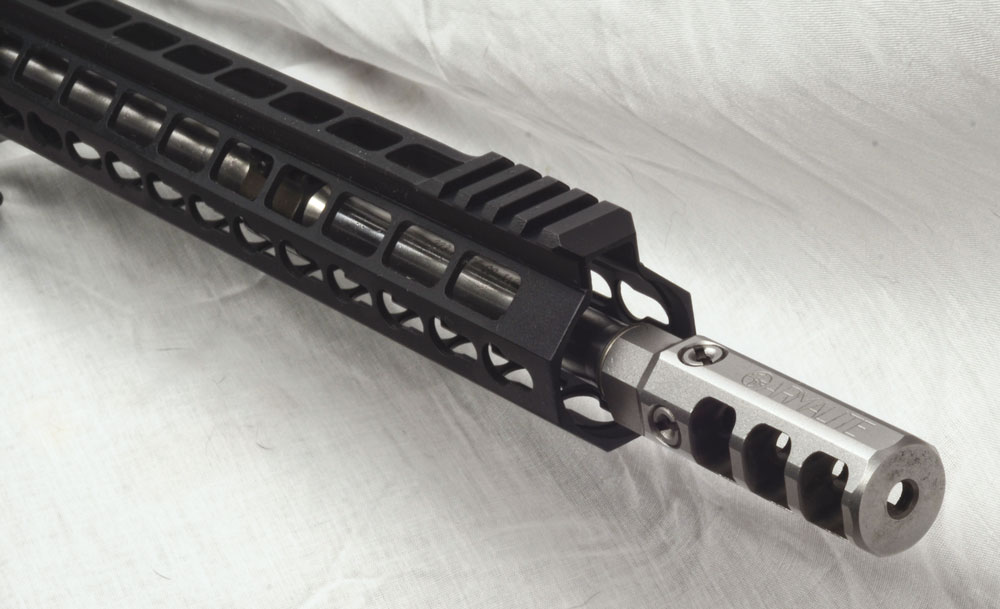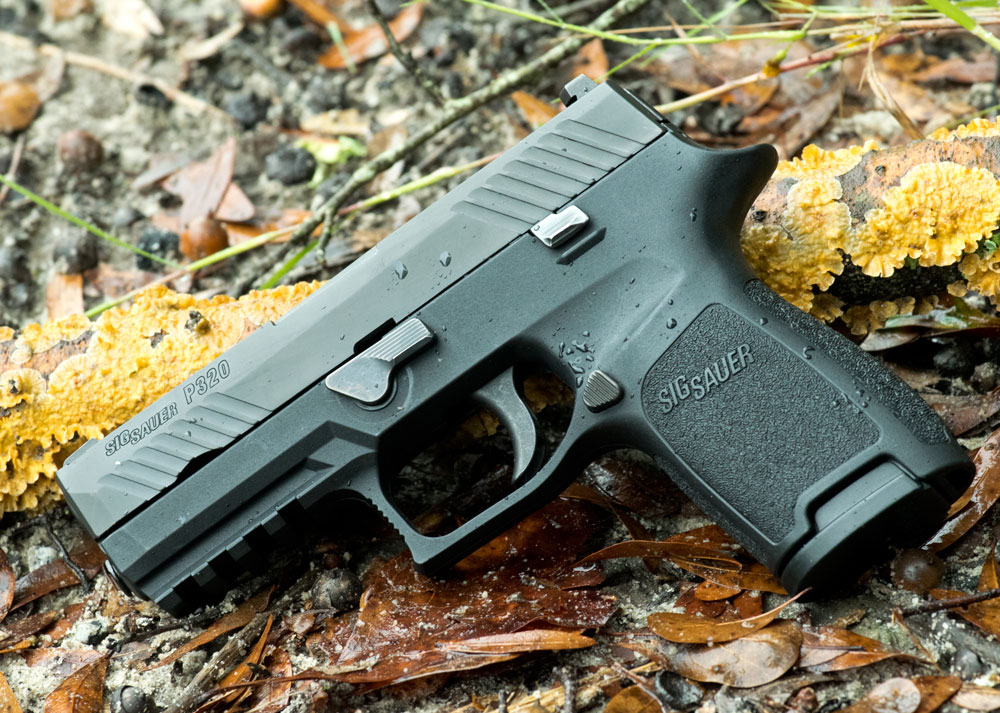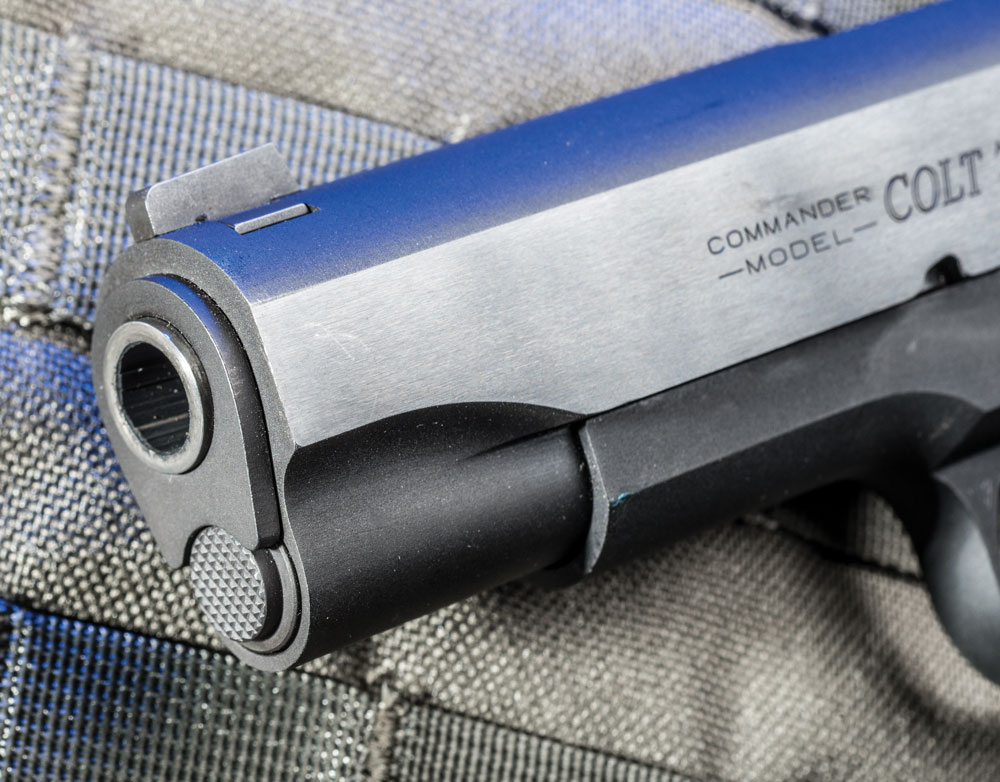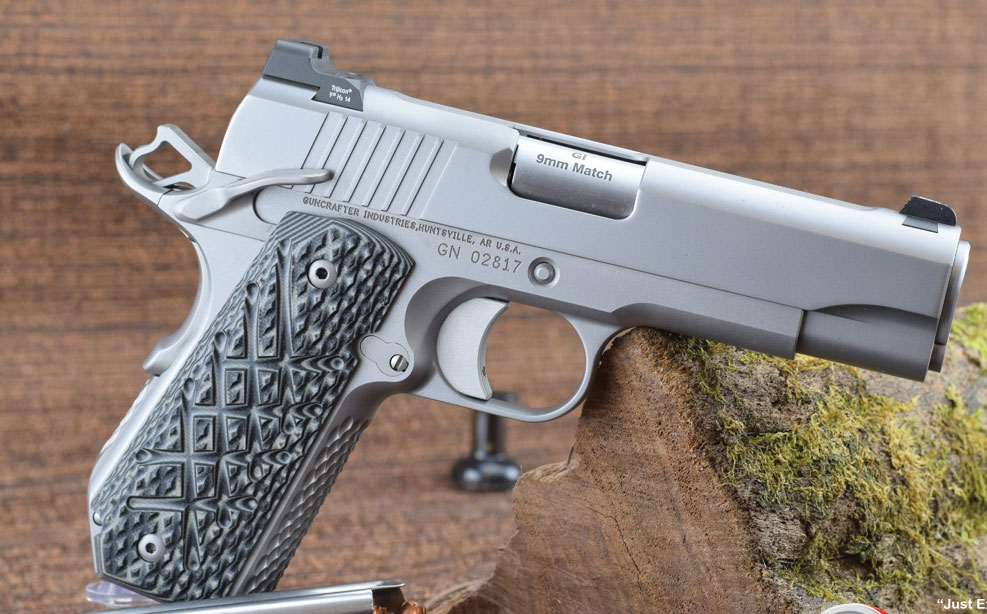
Turnbull appears to be offering shooters a classy new sidearm with its announcement of the 1911 Commander Heritage. Photo Turnbull Manufacturing
For a good part of its history, Turnbull was perhaps best known for its restoration work.
The Upstate New York company had a knack for returning classic rifles, shotguns and pistols to their former glory. But in more recent years, Turnbull’s name has become synonymous with another facet of the firearms industry — manufacturing.
The company has breathed new life into some age-old designs, offering shooters near custom-made quality along the way. And these Yankees aren’t finished showing off their ingenuity with the recent announcement of a new creation.
Turnbull has given a sneak peak at the newest handgun to grace its catalog — the 1911 Commander Heritage. And for those who follow the gunmaker’s work, the .45 ACP is unmistakably Turnbull from muzzle to beavertail.
In particular, what jumps out along these lines is the color-case hardening found on the Commander Heritage’s frame.
As can be seen, the 1911 Commander Heritage boasts the trademark Turnbull color case hardening. Photo Turnbull Manufacturing
The vivid colors created from Turnbull’s traditional method of finishing have become a bit of a trademark. For the shooter, it makes for a unique and handsome sidearm — particularly offset by the richly blued slide.
The 1911 features a 4.25-inch barrel and measures in at 8 inches in overall length. The pistol tips the scales at 34.5 ounces unloaded and boasts a 7+1 capacity. It is outfitted with double diamond checkered walnut grips and Novak 3-dot sights.
The only problem concerning the pistol appears to be when it will be available. Turnbull is acting the tease with its new creation, with the 1911 Commander Heritage’s official debut set for the Jan. 19-22 SHOT Show. But that should give interested parties time to save up their nickels and dimes given the pistol’s MSRP of $2,850.
When it comes to concealed carry, remaining completely silent following a defensive gun use may not be the wisest option.
It is common advice among lawyers and judges that when first confronted by the police after a self-defense shooting, you should say nothing. That’s because anything you say “can and will be used against you” in a court of law. That is true, of course. But the fact of the matter is, if you are tried for an alleged criminal act associated with your use of deadly force in self-defense, you are likely going to have to testify in court anyway.
I know, you don’t have a legal requirement to testify, and most if not all criminal defense attorneys would advise against a criminal defendant testifying. But here is the rub: The vast majority of criminal defendants are guilty of a crime, and if they testify, it simply gives the prosecution the opportunity to elicit more information about their criminal act.
In addition, if the attorney reasonably suspects that the defendant did in fact commit the crime, he must not put the defendant on the stand and solicit lies. It is called suborning perjury and that is a crime in itself. So, in the typical criminal case, the defendant remains silent (as is his right) and the prosecution must prove that he is guilty beyond a reasonable doubt. It is the defense attorney’s job to poke holes in the prosecution’s case until the jury has too many doubts to convict. But the roles are reversed in a self-defense case. Let me explain.
Whenever one person shoots another, they have fulfilled the elements of the crime of either murder or assault, depending on whether the person lives or dies. When the police show up, they have “Criminal Law 101” which they learned in the police academy running through their heads. They look at the dead body with holes in it and they look at you holding a gun. They add up these factors and “murder” flashes up on the mental screen. I once asked a police academy instructor what they are teaching recruits about the armed citizen and self-defense law, and he said, “Nothing!”
At this time, there is only one way you may avoid going to jail. That way is to convince the police that there are extenuating circumstances that negate their conclusion of “murder.” But if they don’t know about those extenuating circumstances, you will be arrested. And once arrested, you will remain in jail until you can make bail, or a kind and friendly judge decides to release you. In many jurisdictions, you will be arrested anyway because you fulfilled the legal elements of the crime of murder or attempted murder, regardless of any mitigating circumstances.
The crime of murder encompasses the intentional killing of another human being. Only a defense to that crime will allow the shooter to walk free. If the cops have no information that you acted in legitimate self-defense, you are sure to be arrested.
And, if that isn’t bad enough, in court, when you are on trial for murder and your defense is that you acted in self-defense, you have to admit to the elements of the crime in order to invoke self-defense. In opening arguments, your attorney will tell the jury that you killed that man. All the prosecution has to prove is that you did not kill him in self-defense. If you don’t put on a legitimate case, the jury doesn’t have any choice but to convict you of murder. The burden has shifted to you to prove your act was a legitimate self-defense. How do you do this?
First, don’t act like a guilty man or woman. When the first words out of your mouth are, “I want my lawyer,” you have done a surprisingly good imitation of a street-wise criminal who has some experience in these situations. What is any self-respecting cop supposed to think? Dead body + gun + “I want my lawyer” = murder.
If, on the other hand, the officer hears, “My life was threatened, I had to shoot,” he forms a slightly different conclusion. In addition, if he first learned of the incident through a call you made to 9-1-1, in which you indicated that you were the victim of a robbery (or whatever crime caused you to believe your life was in danger) then he forms a different picture of the call before he even gets there.
If, instead, all he hears is: “Shooting occurred, suspect is still on the scene and armed,” called in by a witness, then you will be perceived immediately as a dangerous, nasty character needing to be dealt with aggressively.
You need to be the reporting party, if it is possible for you to do that safely. Win the race to the phone. Most criminal prosecutions start by playing a 9-1-1 dispatch tape, to set the mood for the jury. In your case, if you report the crime first, the jury gets to hear you telling dispatch, in your own words, that you were just attacked and had to defend yourself.
There is another flaw in the advice to never speak to the police. After you are in a self-defense situation, who is going to call the police? Sure, an onlooker who heard the shots or saw the action, may call 9-1-1, but you can’t count on that. No, to best protect yourself, you are going to have to be the one to call the police. Your call is necessary if you want any hope that the legal system will view your act of shooting or killing another person as justified. If you believe you cannot effectively tell the responding officer that you felt your life was in danger, how on earth can you expect to call 9-1-1 and effectively report the same situation?
I can see it now.
Dispatcher: “9-1-1, what is your emergency?”
You: “Ahh, I would rather not say, but I really need the police.”
Dispatcher: “Sir, we are rather busy here at the moment, unless you are reporting a crime in progress, or some other emergency, I am going to hang up.”
You: “Wait. Don’t hang up. Someone has been sho.. er, injured.”
Dispatcher: “What is the nature of the injury?”
You: “He has a hole in his chest, and he is bleeding a lot.”
Dispatcher: “Okay, sir, how did he get the hole in his chest?”
You: “I would rather not say. In fact, could you do me a favor and call my attorney for me?”
Laughable? Sure, but you get the idea. Here is the deal: Society, made up of the very same folks who will be on your jury, expects other members of society to tell the truth to the police, to be good witnesses to crimes in progress, and to help out other members of society when possible. Your actions will be judged against those expectations, and to the standard of a reasonable and prudent person, knowing what you knew, and standing in your shoes. If you don’t believe me, ask any attorney.
Do you think the members of the jury will find it a little odd that instead of telling the police that you shot the guy who was attacking you, you whip out your 5th Amendment Rights “sure to go to jail” wallet card and hand it to the first police officer who asks, “What happened here?” Do you think that the members of the jury would have done the same thing under the same circumstances, or do you think perhaps they might simply tell the police that they were attacked and that man on the ground attacked them?
In Part 2 the author tackles 5th Amendment Rights wallet cards and several other factors to consider when giving a brief statement after a defensive shooting.
IMR Legendary Powders is officially announcing a product safety warning and recall notice for IMR 4007SSC on the six lot numbers listed below. IMR has received reports that this particular powder in 1lb and 8lb containers may have become unstable due to possible rapid deterioration. Use of this product from these lot numbers shown on the enclosed label may result in spontaneous combustion, fire damage or possible serious injury.
Lot Numbers 10130139 10131139 10429139 10430139 80425139 80426139
What to do: 1. Stop using this product immediately! Fill the powder container with water which will render the product inert and safe for disposal.
2. Mail, email or fax a copy of the powder label showing the lot number to the contact information below to include your name, address, phone and email.
3. Replacement choice of any other IMR smokeless powder product will be shipped to you for no charge.
4. If you have loaded the powder into a cartridge subject to this recall we recommend that you pull the bullets, remove the powder and wet the powder with water for safe disposal.
IMR deeply regrets any inconvenience this may cause, but we believe in safety first.
Contact information: IMR Powder Company, 6430 Vista Drive, Shawnee, KS 66218, email [email protected], imrpowder.com, call 1-800-622-4366 or 913-362-9455 and fax 913-362-1307
Missouri-based gun maker CMMG has come up with one of the most interesting and innovative firearms of the past couple years — the Mk47 Mutant. The carbine is part AR-15, part AK-47 and pure fury. The gun has some intriguing tweaks to it, making the 7.62x39mm function off a modified AR platform. The above video by Mr. GunsnGear does a pretty slick job showcasing many of these modifications. In particular, pay attention to the massive carrier group. It is basically a modified AR-10 group, which does require a proprietary buffer to function properly on the platform. The other aspect worth noting is the Mutant’s accuracy, a perk of shooting the intermediate round out of what is essentially a free-floating barrel.
SIG’s recently released MCX demonstrates the true meaning of versatility and modularity.
SIG Sauer has long been an innovator in the firearms industry, but in the past couple of years the company has pushed the limits of innovation with some of its new products. One of these groundbreaking new additions for 2015 is the MCX, which represents a major development in terms of firearm modularity.
Built around SIG’s reliable, gas-operated, short-stroke piston system, the SIG Sauer MCX comes with several features designed to make it as mission-adaptable as possible. The first of these is an auto-regulating gas system that allows shooters to switch between supersonic and subsonic loads, or unsuppressed and suppressed operation, without manually adjusting the gas settings. There is no change in reliability when transitioning between these loads or operations.
In addition, the MCX’s modular design easily configures to chamber and fire three different calibers: .300 BLK, 5.56 NATO and 7.62x39mm. The MCX’s aluminum KeyMod handguard is easily removed, and the firearm comes with a quick-change barrel system for swapping between .300 BLK and 5.56 NATO barrels. Converting to 7.62x39mm simply requires an additional bolt face change. While the MCX is optimized for suppressed use with .300 BLK, it performs with any of these cartridges.
The MCX comes equipped with a lightweight KeyMod handguard .
SIG Sauer MCX Review
The MCX utilizes a unique upper that is compatible with all Mil-Spec AR lowers, so shooters can also upgrade their standard system by pairing it with the MCX upper and a SIG MCX Stock Kit. An interesting feature of the MCX is the groundbreaking recoil assembly that does not require the use of a buffer tube, which allows for folding and other unique stocks.
The MCX is not only flexible in terms of load selection and caliber, it also serves both right- and left-handed shooters with ambidextrous AR-style controls. These include an ambidextrous safety, magazine release and charging handle. The magazine release itself is oversized for quicker manipulation in a high-stress scenario.
Other features available on the MCX include a unique, fully locked and closed rotating bolt system, which features a nickel-coated bolt and carrier; a MIL-STD 1913 Picatinny top rail that spans 17¾ inches from the receiver to the front of the handguard; SIG Sauer’s proprietary pistol grip; and SIG Sauer flip-up iron sights.
A skeletonized folding stock is available on rifle and SBR variants, and all versions come with SIG’s flip-up iron sights. Photos by Jeff Jones.
Initially, there are three variants of the SIG Sauer MCX available to civilian shooters: a semi-automatic carbine rifle version with a 16-inch barrel, a short-barreled rifle (SBR) version with a 9-inch barrel, and a pistol version with a 9-inch barrel. The rifle and SBR variants will be available with four different stock options, including a low-profile skeletonized stock that folds to the side. The pistol version comes with SIG’s new side-folding SBX Pistol-Stabilizing Brace.
The SIG MCX Carbine is available for $1,866, while the SBR variant and SIG Sauer MCX Pistol with SBX Pistol-Stabilizing Brace are available for $2,058 and $2,132, respectively.
Related Video:
This article appeared in the August 2015 issue of Gun Digest the Magazine.
One shot with an iron-sighted Marlin in .32 Special (Hornady ammo) killed this elk at 130 yards.
From the .30-30 to the .375, myths abound. Here Wayne van Zwoll shares some observations and experiences about what makes the best elk cartridges.
The century-old .30-06 still ranks as a favorite among elk hunters. Modern loads make it deadlier.
Many moons ago, in a tight Oregon meadow blackened by lodgepole shadow at dusk, he slipped silently through bleached grass and stood to watch the motionless lump at forest’s hem. Dead air kept its scent from him, short yards away. Then the lump shifted…
I had sat out the day’s end glassing a distant elk. It had ghosted into the conifers without showing me antlers. Time was up. I shifted slightly for a last-minute glance about…
When our eyes met, mine got wide. The bull, seemingly close enough to touch, stared back, antler tips ivory arcs against the inky forest. Slowly, rifle bobbing to my pulse, I cheeked the stock and peered through the scope. Dusk had stolen the dot.
He didn’t move.
After a frantic search for the dot against the elk’s dark shoulder, I dropped the scope field to the grass. The dot appeared faintly in my peripheral vision. It vanished as I jerked the re-barreled Mauser up onto the elk and pressed the trigger.
A 180-grain Speer handload dropped the bull.
Forty-two years later, the .300 Holland & Holland still ranks among my favorite elk rounds. But I’ve used 36, if memory serves, and carried on elkless hunts rifles chambered to other cartridges. They’ve all helped shape my views on elk loads. Constrained by the one-bull-per-year-per-state limit imposed on elk hunters everywhere, I’ve used no cartridge exhaustively. So these notes are hardly authoritative.
Even if by sunny good fortune you were directed to test one cartridge on elk and permitted to take several bulls in a season, you’d have a hard time drawing unassailable conclusions. Each shot is unique. A bullet’s effect has less to do with the effectiveness of the best elk cartridges in design, or even the bullet itself, than with range and shot angle, animal size and the missile’s track inside. Besides, myriad loads are possible for any one cartridge. The .30-06 appears in about 80 types of factory ammo. Many times that number of handloads can be fashioned, with bullets and powders that continue to proliferate.
Is the .30-06 a good or even among the best elk cartridges? Land sakes, yes! It’s been felling elk for more than a century under a wide range of conditions. Surveys I’ve taken of thousands of elk hunters put it neck-and-neck with the 7mm Remington Magnum in popularity.
A huge success since its 1962 debut, the 7mm Rem. Mag. turns up in elk camps as often as the .30-06.
A better choice for elk hunting than Remington’s big 7mm is tough to find. Introduced in 1962 with the Model 700 rifle, it featured 150- and 175-grain factory loads. Neither seemed to me ideal for elk, though Wyoming outfitter Les Bowman and the Remington company promoted the round masterfully. Its flat arc and relatively light recoil appealed to hunters. Still, many considered 150 grains on the light side for elk. The 175’s weight throttled its muzzle velocity; a nose profile better suited to alder thickets sapped speed and energy downrange. Ballistically, the heavy 7mm load delivered no more reach or punch than a 180-grain spitzer stoked to redline in a .30-06. I asked a Remington troll why Big Green had chosen the 175 over a sleek 160-grain bullet that could be driven much faster but held significant in-flight advantage over a 150 Core-Lokt. “We had a lot of 175s available,” was the reply.
Since then, a raft of racy, controlled-expansion 160-grain 7mm bullets have appeared in factory loads and as components. They (and a broader selection of 140s and 150s) have given Remington’s iconic magnum more reach, ferocity and versatility.
Some years ago, I followed the echoes of a bull elk into an Oregon canyon. He climbed out ahead but paused on a rim trail. I flopped prone and fired my Model 70. At the crack of that 7mm Magnum he collapsed, spine severed between the shoulders. I’d held a tad high, thinking 300 yards of gravity would tug my bullet into the lungs. Not so. That slippery 160-grain Swift Scirocco lost only a hand’s width.
The author killed this last-day Colorado elk at 250 yards with a Ruger rifle in .300 Win. Mag.
The .300 Winchester appeared a year after Remington’s 7mm. Oddly enough, given expectations of the rabble, it was not the .338 Winchester necked down. Its 2.62-inch case and short neck gave it more capacity than other (2.50-inch) short belted magnums of the day. It hurled a 180-grain bullet as fast as the 7mm Remington could a 160. Arcs are nearly identical for the same bullet style, but of course the heavier .30 hits harder. A 160-grain 7mm Core-Lokt Ultra in a current load brings 1,580 foot-pounds to 400 yards – plenty to kill elk, but well shy of the 1,750 delivered by the .300’s 180. One of several .300 Winchester Magnum rifles I’ve owned was a 1963 Model 70 with tiger-tail walnut – a rare find in those days of fence-post wood before the 70’s 1964 overhaul. Accurate and slick-cycling, that Winchester was my go-to elk rifle before I sold it in a fit of insanity. Another pre-'64 .300 went the same way. I’d trade my pickup to get them back.
Just as fetching was the Winchester Model 70 Alaskan with a 25-inch barrel in .338 Winchester Magnum. A fellow rimfire competitor used one for elk. I managed to snare a fine example at a gun show and hunted with it. After one singularly unproductive day in the hills, I bounced a herd of elk in a ‘pole patch. Racing after the thunder, desperate for a wink of antler and a shot alley, I heard a branch snap behind me. I spun to see a bull slipping off to the side. My .338 staggered him; a second shot put him down; I fired a third to finish him. He’d taken more than 7,000 foot-pounds from the first hits, both in the chest. A departing elk can be hard to anchor! The .338 with 225- or 250-grain pointed bullets (Nosler’s 210 Partition too) can bring a ton of energy out to 400 yards. In recoil, the .338 reminds you of its horsepower.
The 7mm, .30 and .33 magnums beg the use of stoutly constructed bullets to ensure penetration through thick bone and muscle up close. Once, in Montana’s Bob Marshall Wilderness, I chose a 200-grain Winchester Power-Point over stronger missiles because it drilled tighter groups. One dreary afternoon while descending a mountain on horseback, we spied a bull elk across a cut. He was moving by the time I’d swung off Paint and jerked my rifle free. I triggered the Model 70 as he galloped toward cover. The bullet caught him mid-rib, ranged through the heart and balled up, perfectly mushroomed in the far shoulder.
With a 180-grain bullet at 3,100 fps, the popular .300 Win. Mag. shoots very flat and drives bullets deep.
The .338 is a fine pick for quartering shots. Also, its 225-grain bullet flies flatter than a 180 from a .30-06, so it stretches far. Better still by ballistic measure: Weatherby’s .340, its 1962 debut buried in the tickertape strewn for the 7mm Remington and .300 Winchester. The .340 is a blown-out, necked-up .300 H&H, left full length. It blasts a 250-grain bullet downrange faster than an ‘06 can throw a 150! At 500 steps the .340 hits like a .338 at 400. Shintangle Montana timber in knee-deep snow yielded an elk to my long-limbed Weatherby Mark V in .340. That 250-grain Nosler packed far more foot-pounds than needed.
In truth, many elk hunters are over equipped. To kill an elk you need not land enough energy to rock an armored personnel carrier. But that misconception is common. After years of reading about and dreaming of record-book bulls, we labor up the mountain with visions of cudgel-thick antlers that, upside down on a tall mule, furrow the earth. Said elk will appear at great distance, quartering steeply into a fir jungle, a heartbeat from gone.
While you may get this shot, a powerful cartridge hardly guarantees a kill. Once, when topping a hill, I refused to fire at a magnificent bull, statue-still, facing me at about 300 yards. My rifle: a Lazzeroni bored for the short, stout 8.59 Galaxy, a ballistic match to the .340 Weatherby. Alas, though the air was still and the bull patient, a landform hid the bull when I eased to a sit. In vain, I tried to calm the crosswire offhand. Rather than risk a crippling shot, I let the elk walk.
On another morning my Galaxy took a lesser bull. He absorbed the heavy .33 bullet with a slight shudder then moved on into the forest – where he died in seconds. I’d seen the same reaction in a bull shot with my .375 H&H. The 300-grain softpoint destroyed both lungs at close range. The elk galloped off, nosing into the duff a short distance off. These and other encounters have convinced me that no hunting bullet knocks elk down. Elk fall when they die – when vital organs no longer function – or when bullets strike nerve centers or break supporting bone. One of two bulls I’ve taken with a .30-30 collapsed when the softnose smashed vertebrae behind his skull. Instant kill. (By the way, that’s a shot I take only when very close. A hit in surrounding tissue can doom the animal to a slow death.) Lung-shot elk succumb most quickly when struck by bullets that do the most damage.
Left to right: Winchester’s .270 is gentle in recoil but lethal. The .270 Weatherby and .270 WSM add punch.
Occasionally elk have died more quickly than I expected. One, lung-shot by a client with a .270, reared as might a horse then fell backward, planting its long beams in the ground. No further movement. Another bull, struck mid-rib by a 140-grain .280 bullet, simply crumpled. I can’t explain those kills. More often elk hit well will leave as if untouched. Given an accurate shot with an appropriate bullet, the trail should be short. But you’ll do well to keep firing as long as the elk is upright. One bull trotted off after I drove a .270 bullet into its forward ribs. A second shot to the spine between the shoulders dropped the beast. My first missile had blown a big entrance hole but damaged only the near lung – evidence that bullet was too fragile for elk. Had I not fired again, the animal would doubtless have escaped to die later.
Bullet design in elk cartridges can matter more than bullet energy. Shot placement trumps both. Dashing at last light after a bull crippled in the front legs by another hunter, I fired when the elk paused, killing it with a 100-grain softnose from my .250 Savage. While such a bullet is hardly ideal, it’s adequate if you take care with each shot. A rancher I know has killed dozens of bulls with his .250. Another friend has used a .25-06 to take 20 elk, without losing one.
Once, a fellow bringing his young son on his first elk hunt asked if he should loan the boy his .30-06. “He has his own 6mm Remington, but isn’t that a bit light?” I allowed that it was, but added that the recoil of an ’06 might cause flinching. “Accurate shots kill elk.” Next morning we climbed into the Utah hills where the boy laced a 6mm Nosler Partition through an elk’s heart. The animal died right away.
Sometimes power is comforting. On a stormy morning in the northern Rockies, I climbed a ridge across from a herd of elk I’d spied at dawn. Unable to approach the bull on the herd’s far flank, I paralleled the animals until the bull moved apart in a logging slash 300 yards out, just shy of timber. When the Swift A-Frame from my .358 Norma Magnum struck, the elk crashed as if the earth had been jerked from under it. Essentially a .338 Magnum with a bigger mouth, the .358 Norma can push 250-grain bullets faster. It put an exclamation point on that lung shot.
The main problem with such potent cartridges is that they kick hard in rifles light enough to carry all day in steep places. So, I’ve hunted elk with less ambitious rounds. On a particular Wyoming hunt, a pair of bulls piled off a timbered ridge ahead of me and split. I crashed headlong after the left-hand animal hoping for a shot as he lunged down the steep face through the lodgepoles. Suddenly, a sliver of rib came clear. Rifle braced against a tree, I sent a bullet from the 6.5×55 and heard it hit. The bull labored – as did I – through more deadfall. Another glimpse, another 140-grain softpoint, and the elk collapsed.
A year later, a 7mm-08 got me an elk in that same canyon. I managed to find one more bull there when the .270 WSM came to market. I believe this was the first elk taken with it. Another stubby powerhouse, the .300 Remington Short Action Ultra Mag, also came my way before I’d heard of it dropping an elk. Again, I was fortunate to bring back a bull.
More recently, with a Montana rifle bored for the largely unsung .280 Remington (circa 1957), I climbed under a bleak, black sky toward timberline. Still-hunting through stunted pines at dawn, I caught the bobbing of an antler tine through the cover. Unaware but alert, the five-point eased up-slope. I angled toward him getting an offhand shot at 60 yards. Two more 140-grain TSX bullets sailed after him as he crashed then rolled into a very steep canyon. Even when you know a hit is fatal, follow-ups make sense – if for nothing more than to limit the climb packing out!
Dating to 1873, the .45-70 can be loaded stiff in modern rifles. It’s a deadly elk round in close cover.
Many elk have fallen to traditional lever-action Winchester and Marlin carbines bored for the likes of the .30-30 and .32 Special. Commonly considered marginal, they’re deadly at iron-sight ranges. You must simply decline long shots and quartering pokes – as bullets for such rifles were designed for deer hunting – not to drive the length of a bull elk. Hornady LEVERevolution ammunition, with pointed bullet tips of resilient polymer, offer higher starting velocities and flatter trajectory than flat and roundnose loads. Still, one of my biggest bulls fell to a blunt .30-30 bullet.
A young guide and I had hunted most of the day in sleet, through obnoxious shintangle. Wet and cold, we led the ponies onto a ridge and bellow into the hills at last light. The long, quavering note brought a reply, faint and far off. “We’ll hunt there tomorrow,” he said, and bugled again. To our astonishment a reply came instantly and louder. “He’s coming!”
I scrambled uphill under the pines as the bull brayed again. Short minutes later he crashed into view, charging down toward us. At 55 yards, the 170-grain softpoint drove into his chest. He spun and stopped behind a screen of brush as I cycled the Marlin. Silence. I waited, then lizard-slow, crawled to the side. A slot opened to his rib. I fired. He lunged. I fired again. He fell.
On another elk expedition I’d have been lost had the bull appeared at 200 yards. But a well-placed .32 Special bullet – a pointed Hornady – took a Wyoming elk handily for me at 130 steps. I’d muffed a chance earlier in the day, hiked far, then sat to rest near a trail juncture. Glassing the slopes around, in a burn I spied a branch that curved up. Odd. Other limbs on those fir skeletons drooped.
Then I saw the ear and backline of the bull. He was staring at me. I centered the bead in the aperture and aimed tight to the tree. At my shot, the elk rocketed off. Apprehensive, I climbed to the trail. A scarlet spray on the snow confirmed a lung hit. The six-point lay dead just 50 yards away.
Hunting with such rifles and elk cartridges adds challenge – and thrill – to any hunt. I recall sneaking into a bedded bunch of elk through yellow Colorado aspens. Tension mounted at each step as I skirted cows almost near enough to touch. When my scent detonated the herd, I missed with the Marlin 1895 before the departing bull’s hide winked one last time in a sun-dappled alley. That .45-70 bullet connected.
Having killed a handful of elk at very close range (one with an arrow at seven yards), I remember well the day I carried a Mark V rifle in 7mm Weatherby Magnum. It had been a frustrating hunt, mostly in rain, in tough country. On the last afternoon my companion spied an elk slipping into hilltop cover far away. We closed on foot to a patch of cedars 340 yards across a brushy valley from the spot. Glassing, I saw brief movement. The elk had bedded, risen, bedded again. With no time left to wait, I marked as best I could its location, then stalked in. When cover I had marked vanished from valley-bottom view, I groped uphill through cedars thicker than they’d appeared. Careful steps put me at the hem of the target thicket. Then – a spot of color! The tip of a tine. Seconds passed. Soon my scent would reach the elk, sending it out the back door. I eased sideways, my movement glacial. A patch of hair in a grapefruit-size gap told me the elk’s body position. At a mere 14 yards my TSX zipped through the shoulder.
While a 7mm spitzer at 3,250 fps was hardly necessary there, it was no handicap. In most elk country you can’t count on close shots. A .270 Weatherby proved just right for a bull years earlier in the Bob Marshall Wilderness on a snowy slope with lots of elk and no stalking cover inside 250 yards.
The time I hunted with Middle Fork Outfitters in Idaho’s Frank Church Wilderness, I chose a Model 71 Winchester chambered for the wildcat .450 Alaskan. This old lever action had a receiver sight and was ideal for the close cover in which I almost got a shot. Alas, a cow winded me and took the herd to another drainage. Some days later at timberline, we spied a scattering of elk on a ridge far below. The bull looked big. “Take the Ruger,” insisted my pal Ken Nagel, handing me a No. 1 barreled to 7mm WSM. As time was short, I relented, then raced down toward the elk. But the herd beat me to a pass and lined out toward thick forest below. I scurried to a bush on all fours, snugged the sling and searched frantically for antlers as the elk bunched to negotiate deadfalls. I found a slot. The bull paused, but a cow stood behind. I waited. The cow moved. I pressed the trigger, dropped the lever and shoved another round home as the thud of a hit floated back 330 yards. The bull allowed another hit, then fell. There would have been no shot at all with the iron-sighted 71.
This elk fell to another 6.5, the 6.5 Creedmoor, at very long range. That's a Magnum Research rifle and a GreyBull Scope.
While I’ve guided hunters to record-book bulls, most of my hunting has happened where any six-point elk is a prize. My two best bulls, both still-hunted, dropped to a Remington CS Model Seven in .308 and a lightweight re-stocked Springfield in .30-06 Improved. Each animal traveled a short distance after a lethal first round. Each required a finisher.
Favorite elk cartridge? I’ll confess to several. In a hammerlock, I’d probably howl “.308 Norma!”
It’s no better than the .35 Whelen Improved that floored a Washington bull in cover, or the 7mm Dakota that tumbled an Arizona six-point atop a desert plateau, or the mild-mannered 6.5 Creedmoor that killed a New Mexico elk farther than I’ve shot any other. But if versatility is the gauge, Norma’s .308 Magnum with 180-grain spitzers at 3,000 fps is hard to beat. In mid-weight rifles its recoil is brisk but not obnoxious. Bullets fly flat as a .270’s, but hit much harder. Controlled-upset missiles like Federal’s Trophy Bonded, Swift’s A-Frame, Norma’s Oryx, the Barnes TSX and Nosler’s Partition and Accubond drive to the off-shoulder of quartering elk bounced in thickets. Why not the .300 Winchester? A ballistic twin, it’s much more popular. But I prefer the slightly shorter case and longer neck of Norma’s round.
Truthfully, such distinctions are meaningless.
Naming runners-up is just as hard. How about the 7mm and .270 Weatherby Magnums, the .300 Holland & Holland, the .300 Ruger Compact Magnum or .300 SAUM? The .30-06? If Remington’s 7mm Magnum or some WSM hikes your pulse, or you’re enamored of the .280 Improved or a wildcat like the .30 Gibbs, you’ll get no quarrel from me. The best elk load for your rifle is what’s chambered when a bull appears in your sight!
Historically, U.S. and German firearms from World Wars I and II have topped the list of the most sought-after guns for military collectors from John Farkas' experience. That reality, the owner and lead auctioneer of Rush2Arms.com auction service said has also steadily driven up the prices of these firearms.
World War Two Japanese firearms? Usually a distant third—and often even farther back in the line. But that’s been changing the last couple years, noted Farkas, with a noticeable shift in collector interest, as well as increasing prices being paid.
“10 years ago a Japanese Nambu pistol could be had for $100,” he said. “Today, a Poppa Nambu in good condition will bring in $700. A Baby Nambu with the original holster and other accessories? $7,500. And I have seen them go as high as $10,000 at recent auctions!”
Farkas thought that the higher prices of U.S. and German military arms has collectors, especially new ones, going for the more affordable Japanese options.
Meanwhile, prices for vintage accessories have been rising, too. Leading the pack: original holsters.
“I’m amazed at the prices we are getting for original holsters from both wars. Right now, holsters are huge. Collectors are buying up vintage military rifle scopes, too, especially any that were made for sniper rifles.”
Editor's Note: This brief originally appeared in the Fall 2015 issue of Gun Digest the Magazine.
A gun will only defend you and your family if you can get to it the moment it is needed. Thanks to a host of fast-access gun safes, you can rest assured your favorite home-defense firearm is just a finger swipe or a quick numeric code away. Whether you prefer a revolver, semi-automatic handgun, shotgun or even your trusty AR, there’s a wall, rifle or handgun safe available that allows you to have peace of mind. You can keep your favorite firearm away from curious kids, snooping guests and criminals alike while gaining nearly instant access in case of emergency.
Here's our list of what we think are the top options available today for getting to your piece quickly in a moment of need.
Browning PV1000
In addition to resilient construction, Browning’s ProSteel Pistol Vaults features other handy aspects, such as spring-loaded lids and LED lighting.
One of the most trusted names in firearms offers one of the most trusted products in gun safes. Browning‘s PV-1000 isn't just tough-it's packed with features. It has enough room for a couple of handguns and a stack of other valuables and comes with a programmable four-button touch pad. It comes with internal LED lighting and even has an external 9 volt battery contact in case the internal batteries fail or you lose your emergency key. The PV-1000 weighs 25 pounds. MSRP: $219
V-Line Slide Away
If the idea of relying on an electronic lock makes you nervous, consider V-Line’s Slide Away safe. It uses a non-electronic, five-button Simplex access system that is fast, reliable and easy to operate. Pre-drilled mounting holes allow you to store up to two 1911s anywhere you want to place them. The box, face and anti-pry brackets are made from tough, 12-gauge steel, and the oversized spring-assisted pullout drawer uses ball bearings for smooth operation. It weighs 21 pounds and has optional full and half trays. MSRP: $299
Secure-it Hawk Under Bed Safe
If a long gun is your preferred home defense firearm, look no further than Secure-it’s Hawk. At 47 inches long and 13 inches deep, it’s big enough to hold your favorite tactical shotgun or a selection of handguns. The four-button touch pad electronic lock allows for instant access when you need it most. The Hawk is made with 14- and 16-gauge all-welded steel and comes with a full-length piano-hinge door and three hardened lock bolts for durability and safety. It weighs 50 pounds and can be mounted horizontally. MSRP: $239
Hornady RapId Safe
Hornady Security's RAPiD Safe is one of the first handgun safes to offer radio frequency identification entry.
You don’t need a code, and you don’t even need to touch HornadyM’s RAPiD safe to access your firearm in an instant. Simply use an included RFID bracelet, card or key fob to get fast access. Once opened, your handgun pops up at an accessible angle in its own foam sleeve. The safe weighs more than 15 pounds and is made from heavy 16-gauge steel. It also comes with a 39-inch, 1,500-pound-rated cable, so you can secure it anywhere. It runs off standard 110 volt power or batteries. MSRP: $275
GunVault SpeedVault Biometric
Store your handgun where you need it with GunVault's single-gun SpeedVault. The biometric locking system allows you instant access with the swipe of a finger, thanks to the biometric fingerprint scanner and activation button. It holds up to 120 unique fingerprints. The SpeedVault comes with mounting hardware that allows you to bolt it anywhere-this could be under your desk, to a wall or anywhere else you might need instant security. It also comes with an interior courtesy light. It's made from 18-gauge steel and includes a backup override key. MSRP: $345
Barska Quick Access Rifle Safe
Silence is golden when you might be dealing with an intruder. Thankfully, Barska’s Quick Access Rifle Safe’s new silent access feature won’t give away your location. A simple fingerprint scan allows near-instant access to up to four long guns. The lock is programmable for up to 120 fingerprints, and it comes with mounting hardware, a three-point deadbolt locking system and a set of emergency backup keys. The Quick Access safe runs on four AA batteries (included) and weighs 66 pounds. MSRP: $299
Bulldog Biometric Pistol Vault
Bulldog’s pistol safe has features aplenty. You not only get quick access when you need it, thanks to the one-swipe biometric lock, but you’ll be able to see the contents of your safe thanks to a 20-second interior LED light. The finger pad is programmable for more than 25 fingerprints. There is a low voltage alarm, a spring-loaded access door, a hidden security key override for emergency entry and an external backup battery box. The safe is built with a recessed, pry-proof door and two ¾-inch steel locking bolts. Mounting holes are pre-drilled and mounting hardware is included. MSRP: $247
The GunBox
Thieves might look right past The GunBox if they make it into your home when you aren’t there. If they do see it, don’t fret. The Premier version comes with a built-in GPS tracking device and available 24/7 monitoring to help you recover what belongs to you. It also comes with an internal motion sensor and audible alarm. Access is through a 360-degree biometric fingerprint scanner (with multiple fingerprint programmability) or an RFID wristband or available RFID ring. Mounting holes allow for unlimited mounting orientation. The GunBox Premier also has two USB ports. MSRP: $499
Barska Biometric Wall Safe
Is there a better way to hide things than by keeping them in a safe? Barksa’s wall safe not only allows you to hide your belongings, it also allows you to hide your safe. Designed to mount between wall studs, this handy safe can be hidden behind your Velvet Elvis poster or a piece of furniture. The biometric lock can be programmed for 120 fingerprints and opens with a quick swipe of a fingertip, giving you quick access to your favorite home defense handgun. The safe comes with pre-drilled mounting holes, a set of emergency keys, two removable shelves and a padded floor to protect your most valuable assets. MSRP: $199
Stack-On Biometric Super-Size Safe
Sometimes, bigger is better. Stack-On’s Super-Size biometric safe has more than enough room for a couple of handguns and your most important documents. It’s about 20 inches tall, 12 inches deep and 14 inches wide and includes two removable padded steel shelves. The biometric finger-touch pad is lighted to help you find the mark without fumbling in the dark. The solid steel door has concealed hinges and two pry-resistant locking bolts. The touch pad is programmable for up to 32 fingerprints, and it comes with a back-up key, pre-drilled mounting holes and mounting hardware. MSRP: $199
Revolvers and semi-automatics are very different beasts, though both are capable personal protection arms. The key to solving the semi-automatic vs. revolver debacle is knowing the differences and choosing what best fits your environment and needs.
With practice, a revolver can be reloaded quickly via the use of a Speedloader.
Semi-automatic handguns are typically the better choice for suburban and in-home use and, when cared for and kept clean, are the flavor of the day in what I’ll term combat zones—whether an Afghanistan outpost, a disaster area overrun by consequence-free crime, or an apocalyptic end-of-days scenario.
Revolvers, on the other hand, are the better option when sand, dust, and involuntary neglect add up to an environment that may challenge a semi-auto’s reliability. They are just more reliable in very dirty conditions. Also, revolvers tend to be chambered for more powerful cartridges—sometimes much more powerful—than semi-autos. While this is an advantage in the backcountry or around livestock and heavy predators, it’s a disadvantage in an urban neighborhood composed of thin walls and sleeping children.
Can the two vastly different handgun types cross over in usefulness? Absolutely. However, each has its strengths and weaknesses.
Revolvers
Since revolvers don’t depend on harnessing the energy of a cartridge to function, like semi-autos do, there’s just one less thing to go wrong. Squib loads, dud primers, a tight cartridge too stubborn to chamber easily—none of these affect revolvers. Additionally, since human muscle works a revolver’s action, bits of sand, lint, dust, or fouling that would choke a semi-auto can be overcome by, well, a little more muscle. Just ear that hammer back and let fly.
As mentioned earlier, the magnum cartridges frequently chambered in revolvers can offer quite an advantage for rural use, too. They provide more downrange reach, more downrange energy, and typically a great deal more penetration—important when scraping an enterprising black bear out of the bacon griddle next to your tent, or trying to kill a wigged-out saddle horse that’s running like a banshee while you bounce along the cactus-covered ground with your boot stuck in the stirrup.
Revolvers are slower to reload. With practice and a good speedloader (a device that holds the bases of a cylinder-worth of cartridges, and drops them into the open cylinder of a double-action revolver at the twist of a knob) or moon clip (a spring steel device that holds a cylinder-full of cartridges, and goes into and out of the gun with them), a good revolver man can get back into action pretty quickly. But, speedloaders and moon clips are awkward to carry, and it takes good training to achieve speed and surety. Single-action revolvers are even slower. Much slower.
On the plus side, your revolver will never turn into a one-shooter because you misplace your magazines. And if you’ve got a little survivalist in your nature, you’ll appreciate the fact that empty cartridge brass is easy to collect—just dump it into your pocket after ejecting it. With care, you’ll never loose a piece, and you never have to hunt for little sparkly brass bits flung indiscriminately away by your greedy semi-auto.
Some revolvers are cut for moon clips such as those shown here. With practice a good shooter can reload as quickly as a semi-auto shooter. But moon clips are awkward to carry.
Revolvers have the appealing virtue of simplicity. Neophyte shooters intuitively grasp how they function, and the lack of slides, slide stops, magazine releases, decockers, and safeties of various flavors is attractive. Many women opt to carry a compact revolver for that winsome simplicity, frequently compounded by the fact that petite women sometimes struggle to pull back a semi-auto pistol’s slide in order to chamber a cartridge.
As I see it, the revolver has only a few drawbacks as a prime personal protection sidearm. They have limited capacity, they are slow to reload, and the cartridges for which they are chambered are often overpowered for city and in-home use.
The first two drawbacks are what they are, and shooters opting for a revolver should plan on spending time practicing reloading in order to even the odds a bit. The over-power issue, on the other hand, can be turned to the owner’s benefit by choosing ammunition with hollow-point projectiles designed for dramatic expansion, in a light-for-caliber weight. The effect is two-fold: With less mass, projectiles will penetrate less, and the large, on-impact expansion will slow bullets down, dumping more energy into the bad guy and reducing the chance of a pass-through that could potentially endanger family members or neighbors.
It boils down to this: With the correct ammunition and some quality practice-time manipulating the gun, a revolver will do anything you’ll ever need it to.
Semi-automatics
Semi-autos are often the best choice for personal and home protection. Just be sure you get one you can operate comfortably—many shooters with low hand strength struggle to function the slide of a big semi-auto, especially under stress.
As far and away the most popular type of sidearm for personal protection, the semi-auto’s primary attractions are high capacity and excellent rapid-fire capability. With correct maintenance and quality ammunition, good semi-autos are very reliable, too.
I grew up carrying a revolver while working cattle in Southwestern desert country. None of the guys I knew owned a semi-auto because prevailing opinion was that they couldn’t cut the mustard in the country and conditions in which we worked. I’ve since learned differently—a good semi-auto can take an awful lot of abuse and still function reliably.
When I first started carrying a semi-auto (a Colt Gold Cup 1911 in .45 ACP) it wasn’t for high capacity, it was for the rapid-fire characteristic. The Colt didn’t really offer much in the way of additional round count—my surplus G.I. magazines were seven-rounders. Heck, my single-action .44-40s held six. But I couldn’t shoot a single-action as quickly as a semi-auto, and though I could hose rounds downrange pretty quickly out of a double-action, I couldn’t shoot it fast nearly as accurately as my 1911.
Speed is one of the most important advantages that a semi-auto offers the average person. Sure, there are revolver shooters who can shoot faster and more accurately than 99 percent of the semi-auto shooters out there, but the reality is that, for most folks, semi-autos are a little easier to shoot fast than revolvers.
Throw in high capacity, and you’ve got a very supportable argument that the semi-auto makes a better personal protection gun than does a revolver. Truth is, most of today’s popular designs hold more cartridges than a wheelgun—usually a lot more. Even a modern magazine in a .45-caliber 1911 holds eight rounds, plus one in the chamber. That’s a total of nine, for a 50-percent increase on the capacity of most revolvers. Throw in high-capacity guns, such as Glock’s G17, Smith & Wesson’s M&P9, and Springfield’s XD(m), all of which contain 17+1 to 19+1 rounds in the magazine, and you’ve got three times the capacity of a revolver. Three times! Add a couple of easy-to-carry magazines in innocent-looking belt sheaths, and you can comfortably carry over 50 rounds on your person.
You can argue that, in most of today’s typical defensive encounters, you shouldn’t need even a tenth that number. You’d be right. However, what about that non-typical encounter? Or—admit it, we all think about it—an end-of-days scenario? There are a lot of situations in which it would be mighty comforting to have 50-plus rounds available.
Semi-autos do have some drawbacks. They are clean freaks. They are also picky about subpar ammo. Whereas a revolver will accept anything that fits properly into a cylinder chamber and will dutifully fire it downrange, a semi-auto must have cartridges with the correct bullet nose geometry for reliable feeding, enough propellant to fully function the slide but not so much that it batters the internal mechanics, correct case length for proper headspacing… all this within spec so that it flows into the chamber and out again without hanging up in a gun powered purely by energy harnessed from the explosion of the cartridge itself. Looked at from an informed, objective position, that’s a lot to ask. It’s a marvel than so many semi-autos are the reliability champs that they are.
Most semi-autos are clean freaks. Treat them with care, and they will always take care of you.
The very magazines that provide high-capacity firepower can—if lost or damaged—cripple a semi-auto and, in essence, turn it into a single-shot. Or worse, incapacitate it completely if it’s one of the models with a magazine disconnect safety that prevents it from firing unless a magazine is inserted. These days, we take magazines pretty lightly, as most of us have a spare or several. But in the early days of semi-autos, folks considered the potential more gravely. Many early models—especially those of European design—didn’t allow magazines to fall freely when released; this influence extended up through the first-generation Glocks.
Limited energy and penetration are another characteristic of shots fired from most semi-auto handguns. In many scenarios, limited penetration is an advantage. A 9mm hollow-point projectile is much less likely to penetrate through walls than a classic soft-point .357 Magnum projectile. But it does limit a semi-auto’s suitability for certain tasks. I know of two Alaskan bear guides who carry semi-auto .45 ACP pistols for backup. What tomfoolery. Even the more powerful revolver calibers (until you get to the obscenely powerful .500 S&W Magnum) are unsuitable for stopping a bear with uncivilized intentions, let alone a semi-auto with very limited penetration and (in bear terms) not nearly enough energy on impact.
However, we’re discussing personal protection firearms here, and none of the above semi-auto drawbacks really apply. Shoot quality ammunition, and purchase plenty of magazines and keep track of them diligently. As long as you attend to those two details, a good semi-auto makes more sense than a revolver most of the time.
The Sphinx 9mm pistol is well made of the finest materials and exhibits first-class performance.
The 9mm Sphinx SDP is a product of a desire to produce a world-class handgun, a goal that has been achieved.
Three supplied grip inserts allow the shooter to find a comfortable, custom fit.
The handgun covered in this report is arguably among the finest finished and fitted handguns in the world. It is manufactured by Sphinx Systems Ltd. of Switzerland, a firm that is enjoying more than 140 years as a tool and precision manufacturing company.
The present pistol is the result of long experience in producing quality handguns, including the original Sphinx and a number of CZ 75-inspired clone guns. These handguns have proven accurate and reliable. However, for many reasons, including currency trades, the pistols are often very expensive. Quality handguns are not inexpensive, but as the price reaches $2,000 or more, buyers are few. Sphinx set out to develop a handgun with excellent performance but which might be sold for a price in the middle range—in this case about $1,350. Sphinx developed the SDP series to fill this role. The handguns are well-finished by any standard and offer excellent performance. They are not inexpensive, but they are affordable.
There is much that is familiar with the Sphinx pistol. It uses the proven short recoil system and a locked breech design that began with the Browning patents. The pistol’s construction is interesting. While the slide, barrel and critical parts are of steel, the upper portion of the frame is aluminum. The lower receiver is of a modern polymer. This is an unusual construction. While polymer is lighter than steel and less expensive, this mix of materials isn’t easily mastered.
The Sphinx 9mm features a front rail to allow the use of a modern combat light such as the Viridian.
The appearance of the slide is a clue to the pride with which this handgun was produced. In a day when many gunmakers are attempting to cut corners and limit machine work, the Sphinx slide requires extensive machine work. The bevels are very well done. The slide features forward cocking serrations, and the ejection port machine work is artfully accomplished.
Another feature is that the slide rides inside of the frame. This gives the practiced eye a clue to the lineage of the Sphinx handgun. It is based upon the durable and well-respected CZ 75 handgun. The slide’s position inside of the frame limits muzzle flip, as the bore axis remains low. This is a difficult feat to achieve with a double-action handgun. The contact between the slide and frame is tight, resulting in high accuracy potential.
As for the sights, the rear sight is dovetailed in place. The front sight is not a common dovetail but is firmly attached in a trough that runs from the forward section of the slide to the rear of the front sight. This is an excellent setup that anchors the sights well. The rear sight may be drifted to adjust the point of impact for windage. The sights provide a good sight picture.
The action is contained in the aluminum section of the receiver. The double-action first-shot trigger is similar to that of the CZ 75, with a recurved trigger offering good leverage. The double-action trigger pull is tight, long and heavy, as these often are, breaking the sear at about 14 pounds. The single-action trigger is clean at 5.5 pounds with the modest backlash common to the CZ 75 and its variants.
The only controls are the slide lock and the de-cocking lever. There is no manual safety.
Controls include a slide lock, a frame-mounted de-cocker and a magazine release. The hammer is bobbed with no hammer spur. The de-cocker is ambidextrous. There is no manual safety and no provision for carrying the pistol cocked and locked. The frame is bobbed to prevent snagging on covering garments. The frame features a light rail for mounting laser aiming devices or a combat light.
Unlike most CZ 75-based handguns, the Sphinx can be adjusted for hand fit. This is due to the inclusion of the polymer grip frame component. Additional grip inserts are included in the hard plastic box supplied with the Sphinx.
The polymer grip frame feels good in the hand, with the heft consistent with a quality CZ 75 handgun. When you look at the de-cocker and the magazine release, it is obvious that a lot of care goes into producing high-grade checkering on each of these parts. The grip frame offers plenty of abrasion as the result of a serrated finish. There is a removable backstrap that allows for good hand-to-gun fit. There is a total of three straps. The front strap features slight finger grooves. Three steel magazines that hold 15 rounds of 9mm Luger ammunition are provided.
The Sphinx in every detail is an impressive piece of Swiss workmanship. No corners have been cut. It exhibits high precision in the detail work and excellent slide-to-frame fit. This is a tight handgun. The slide rides in the frame with excellent lockup. Lateral play is practically non-existent. The frame feels good, and the pistol is well balanced. The slide is short, giving the pistol a squat appearance. The 3.7-inch barrel is well fitted into the slide and locks up by butting the barrel hood into the slide.
The Sphinx is supplied with a total of three magazines and three grip inserts along with other accessories.
The heft and balance of the handgun is good, coming in at 28 ounces unloaded. When beginning the firing sessions, I loaded the magazines with Black Hills 115-grain Blue Box re-manufactured loads. These loads are an excellent resource for training and practice. I fired at man-size targets at five, seven and 10 yards. I started the drills in the double-action mode. After the first shot, I fired the subsequent single-action shots as quickly as I could reacquire the sight picture, and the Sphinx gave excellent results. The sights are good combat sights that are quickly picked up by the eye.
The grip frame is comfortable while firing. I am not a fan of finger grooves in the front strap, but I have to admit, in this case, the modest grooves seem to be an aid in control. The pistol proved to be more than combat accurate.
During one session, firing at seven yards, I put a magazine of 15 rounds into the same ragged hole. Double taps were easily delivered and the pistol is easily the most capable double-action/first-shot handgun I have fired in some time. During the initial firing tests there were no failures to feed, chamber, fire or eject. Felt recoil was light.
Moving to personal defense loads, a number of popular JHP loads were fired in the Sphinx with good function. Among these was the Black Hills Ammunition 115-grain EXP. This load isn’t loaded to +P pressure but instead for the greatest velocity possible, hence the term, Extra Power.
At well over 1,200 fps this load gave good function and control, virtually the same as the 115-grain practice load. I also fired a quantity of the Black Hills Ammunition 124-grain +P service load. If I were back in uniform, this would be my favored 9mm service load. The slight difference in recoil was noticeable, but the Sphinx remained controllable.
In single-action mode, the trigger pull is short and crisp.
A good test for any handgun and shooter is firing at small targets at known and unknown ranges. The Sphinx proved accurate at long range, connecting on the Innovative Targets steel gong at a long 50 yards. This target is an excellent training resource that I use often. (InnovativeTargets.net) Moving to bench rest firing, I collected a number of loads that have proven accurate in the past.
Taking a careful rest, with attention to every detail, I fired two 5-shot groups with four different loads. These loads were from four manufacturers and in four different bullet weights, so the results were excellent by any standard. The single most accurate load, the Fiocchi 124-grain Extrema, produced a 5-shot group of 1.9 inches. That is target-grade accuracy. The Black Hills 124-grain +P is about 100 fps faster and posted a group of 2.25 inches.
The Sphinx is indeed an accurate handgun. Remember, this is a compact handgun designed for concealed carry or all-day uniformed carry. The Sphinx isn’t inexpensive, but it is clearly worth its price.
The author found the Sphinx lively in the hand.
SPHINX SDP SPECIFICATIONS Manufacturer: Sphinx Arms Distributor: Kriss USA Model: SDP Compact Alpha Action: Double-Action/Single-Action Caliber: 9mm Slide: Steel, Matte Black Upper Frame: Anodized Aluminum Grip Frame: Black Polymer Grips: Polymer/Synthetic Inserts Sights: White Dot Front, Drift Adjustable Rear External Safety: None, De-cocking Lever Barrel Length: 3.7 inches Overall Length: 7.4 inches Height: 5.35 inches Width: 1.06 inches Weight: 28 ounces Capacity: 15 rounds Accessories: Pistol is provided with three magazines, magazine loader, cleaning kit, hard case, lock, owner’s manual and grip inserts.
Savage Arms has issued a recall notice on B.MAG rifle bolts (17 WSM) after discovering that the bolt on some B.MAG rifles may inadvertently catch the safety button and slide it forward into the “fire” position.
This condition is primarily present if downward pressure is applied to the bolt too early while pushing it forward. While Savage has received no reports of accidents due to this condition, we have decided to offer free retrofits of all B.MAG rifle bolts out of an abundance of caution and in our ongoing commitment to quality and safety.
To avoid possible unintentional discharge or injury, do not use your B.MAG rifle until your bolt has been retrofitted with a new bolt handle and cap. For instructions on receiving your free bolt retrofit, visit www.savagearms.com/recall/bmagbolt/. For other questions related to this bolt recall, call us at 844-784-3301 Monday through Friday 8am to 10pm EST. This retrofit only applies to Savage B.MAG rifle bolts.
The bolt retrofit includes the replacement of the existing bolt handle and bolt cap with a revised bolt handle and bolt cap.
The correct, revised parts are easily identified:
Existing tapered bolt capRevised bolt handle with detent mark on arm — replaces existing bolt handle Revised (blunt) bolt cap – replaces tapered cap
To avoid serious injury or death with any rifle, observe these precautions:
Always visually confirm that the safety is on after closing the bolt.
Never put your finger on the trigger until you are ready to fire.
Never point a firearm—either loaded or empty—at anything you do not intend to shoot.
Savage Arms is the leader in accuracy, quality and value, and we stand behind our products. We sincerely apologize for any inconvenience this may cause you.
Following a defensive gun use, your ability to prove what training you’ve had could make the difference should you find yourself in the crosshairs of the law.
If you ever wind up in front of a judge or jury in the unenviable position of having to justify an act of self-defense, you will need to prove that your actions were reasonable under the circumstances. Informing the triers of fact about the training you’ve had is the key.
Under the rules of evidence, you have the right to introduce evidence that will help court officials understand your mindset leading to your decision to shoot in self-defense. This evidence may include an instructor explaining what he or she trained you to do under those circumstances.
You can explain the nature and extent of your training and knowledge to the judge or jury, but only if you can document that you possessed that knowledge before the self-defense incident occurred.
For example, let’s say that you shot an individual who was threatening to cut your throat while that person was five steps away from you. If you’d had the right training, you knew before this ever happened that a person five steps away possesses both the ability and the opportunity to use that knife against you. The jury should understand your prior knowledge, so they can decide if a reasonable person would have pulled the trigger when you did, knowing that someone threatening with a knife is a deadly danger to you, even five steps away.
Your ability to introduce properly documented training will greatly aid the court in understanding that your actions were indeed reasonable—and hence justifiable.
You need to document classes you’ve attended, books you’ve read and DVD lectures you’ve viewed so there is no question of what you knew ahead of time. This documentation can be done in several ways. At the Armed Citizens’ Legal Defense Network, Inc. we provide members with eight lectures on DVD. On the DVD labels, we print lines for members to initial and date each time they view one of the lectures. You can and should do the same with educational and training DVDs.
Each time you watch an educational DVD, document the viewing with an indelible marker on the disk label and take notes on the material taught. Once you’ve developed a good set of notes, mail the notes to yourself by U.S. Mail, return receipt requested. When the notes come back to you, file the unopened, postmarked envelope in a safe deposit box.
If you ever get a judge who doesn’t believe you knew what the lectures taught, introducing a signed, sealed and delivered copy of notes made while watching the lectures on DVD should do the trick. The same strategy will work for professionally taught classes and books.
Another tactic is to give your notes to an attorney other than your defense attorney and have them filed with your records at the law firm’s office. There may be a small fee for this, but it is worth it. Again, do not secure the notes with your defense attorney, but with someone else so the lawyer holding your notes can testify as an officer of the court that you gave them the documents, something the attorney defending you cannot do. Next, you testify about how you took these notes. Let’s say that perhaps you watched the video three times as your notes would show.
Another way to document material learned by lectures on DVD would be to view training DVDs in a group setting, for example at your gun club. Make a list of all who were present and also saw the video, and then you could call one or more of these people as eye witnesses to having viewed the video.
Get good training, read books by knowledgeable authors and use DVD lectures to increase your understanding of self-defense issues, but do not fool yourself into thinking that is enough. Take good notes and preserve the integrity of those notes with the understanding that they may be the factor that ultimately proves the reasonableness of your self-defense actions.
Get help following a self-defense incident when it's needed most. Unlike insurance, the Armed Citizens’ Legal Defense Network, Inc. pays the legal expenses as they emerge, rather than requiring the need to raise the money to get to “Not Guilty,” then apply for reimbursement. Join here and get a FREE download
The unthinkable has happened, you’ve had to draw your handgun and use it in self-defense.
Everything was justified — the assailant was armed, your life was threatened, the situation demanded lethal force. It was a traumatic few moments that will live with you forever. Unfortunately, those handful of seconds potentially only marked the beginning of your tribulations.
There is a chance you'll be whisked away to your local police station, perhaps in handcuffs, for questioning and possibly more. One imprecise answer, one sloppy turn of phrase and you could be in a world of trouble.
The likelihood is also there for the local media to pick up on the story, splashing your face and name across every one of your neighbors' T.V. screens. And there could be further ramifications, perhaps with your job, leaving you in financial dire straits.
You may have saved your life with the use of deadly force, but for all intents and purposes it could be over. A criminal conviction, financially crippling civil lawsuit, community ostracization, employment trouble all could be in your future.
Knowing all of this you're rattled, but not panicked. You have the peace of mind that you'll get the support you need through this trying time. It's precisely why you planned wisely when you took on the responsibility of your own self defense by joining the Armed Citizens’ Legal Defense Network.
Even if the worst happens — the district attorney executes a full-court-press and you don't have one thin dime in your bank account — you have the comfort of knowing you'll get the legal and expert support you'll need when you're dropped in this crucible.
These extraordinary circumstance are exactly what Marty Hayes designed the ACLDN to handle. And his revolutionary concept of how legal support should work after a self-defense incident goes above and beyond anything currently on the market.
The organization not only allows its members to choose their own attorney, it gives guaranteed financial support for legal fees and other professional services they may need for their defense. There are few — if any — other organizations or companies that offer this depth and breadth of post-incident support.
Perhaps one of the most comforting aspects to the ACLDN is its action plan for a self-defense incident. This is the most grueling time, but also the most important, and the organization has it covered.
The group will forward up to $10,000 to hire the attorney of your choice immediately. This is crucial, given it is inadvisable — no matter how clear-cut an incident — to go into a police interrogation without legal representation. If you do not happen to have a lawyer, the ACLDN will dispatch a representative to your location to help you find one suited to your needs.
If your incident of lawful self-defense is prosecuted, the ACLDN will, upon request, tap into its' legal defense fund of over a half of a million dollars, to provide for your legal defense. This includes paying up front for attorneys, investigators and experts, if necessary, to provide the member with a complete legal defense.
While comforting, the legal support is only one dimension of what ACLDN offers its members. The organization also has some of the most recognized and respected self-defense experts at their beckon call.
In addition to renowned firearms instructor and expert witness Massad Ayoob, ACLDN's advisory board is made up a roster of well respected firearms instructors and professionals from around the nation. These include John Farnam, Jim Fleming, Tom Givens, Emanuel Kapelsohn and Dennis Tueller.
These authorities are not only there to advise during a worst-case scenario, but also to help in providing educational support to the organization's members. This aspect of the Armed Citizens' Legal Defense Network is perhaps one of its most marked breaks from other legal support entities.
The organization takes the time to tutor its members in the legal aspects of being armed in today's society. In addition to eight educational DVDs and a 235-page book, the members also receive a monthly journal that explores every angle of self-defense and the laws that surround the responsibility.
Maybe the best part is the affordability of the Armed Citizens' Legal Defense Network. It is basically equivalent to a couple trips to the burger joint each month. However, those couple of bucks could be the difference between saving the life you know and watching it circle the drain.
You taken the time to become a responsibly armed citizen, now take the time to defend your right to self-defense.
If you love the iconic family of Kalashnikov rifles, you’re certain to dig this great slow-motion footage of the AK-74 in action.
After more than half a century of duty, Kalashnikov has become Russian for resilience. Mud, neglect, un-mechanized peasants—there is little that slows down the iconic battle rifles and even less that stops them.
There is no free lunch, however. And the rock-solid reliability of this family of rifles comes at a cost. In the Kalashnikov’s case, it’s the firearm's tolerances. To put it mildly, they’re loose.
This is more than notable in this beautifully shot video by Vickers Tactical. It’s hard not to notice the flex in the Arsenal AK-74 after each round Larry Vickers throws down range. It almost seems like each time the rifle is fired it is ready to vibrate into a pile of stamped metal and wood.
Of course, it never does. The long-stroke piston system just keeps chewing through the ammo and asking for more.
Another interesting point brought out through the slow-motion footage at the :25 and 1:06 marks is the 5.45x39mm round’s ballistics. If you happen to be a precision shooter, the yaw and tumble is enough to give you a case of the vapors. This is especially true of the first instance in which the bullet can be seen tumbling less than a foot away from the muzzle.
This is a trait that was intentionally engineered into the round with the expectation of greater tissue damage. And it is the main reason why the 5.45x39mm became known as the “Poison Bullet” during the Soviet’s Afghan War.
Rock Island Auction Company is gearing up for its Sept. 11-13 Regional Firearms Auction. And for collectors, the event should provide an incredible opportunity to bid on some truly historic firearms. In addition to having firearm designs spanning the past five centuries, the sale will also include a number of guns from notable collections and owners. Here is a brief look at some of the more impressive items of the 3,000 or so that will be crossing the block.
Looking to go armed, but are stuck in the weeds as to what to arm yourself with? Here are 20 excellent concealed carry gun options that will keep you on the defensive.