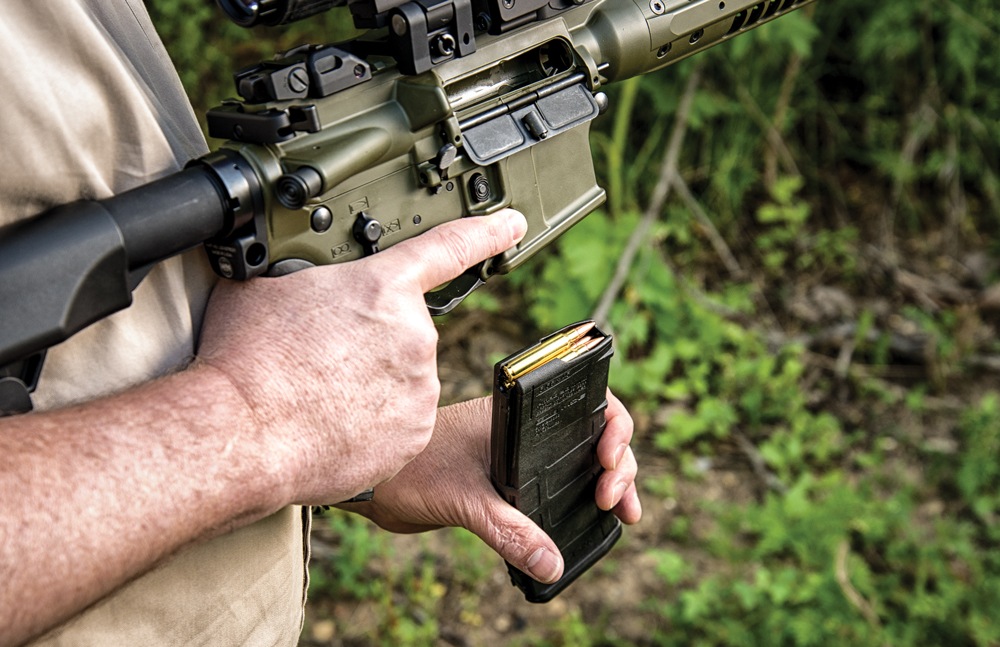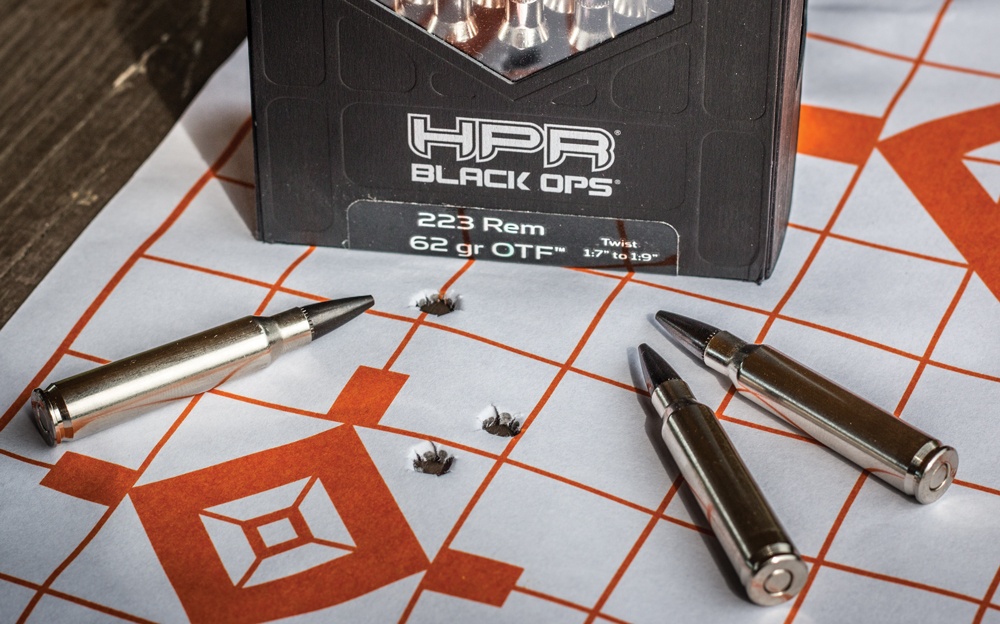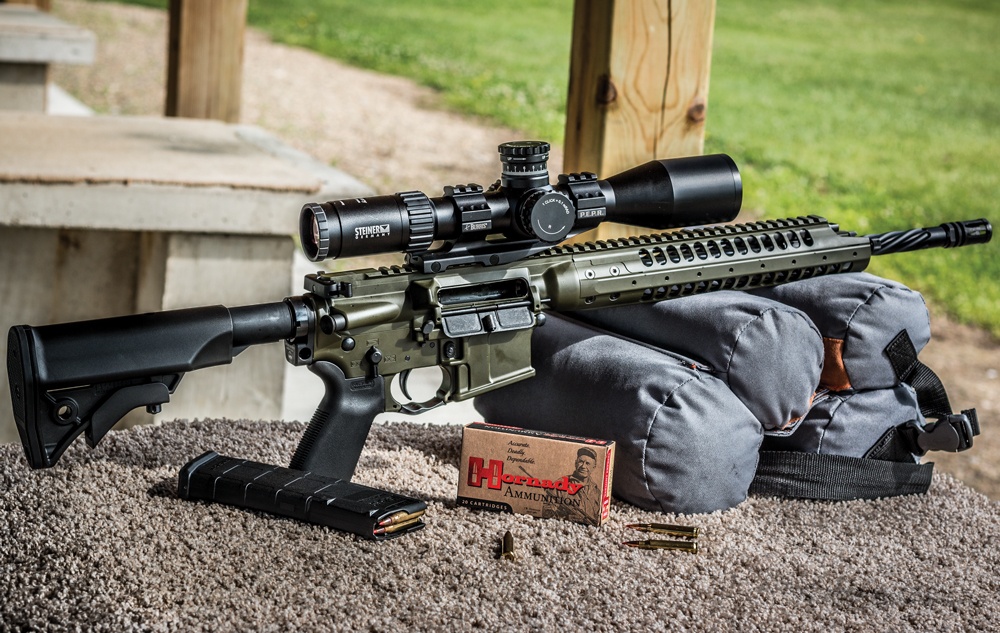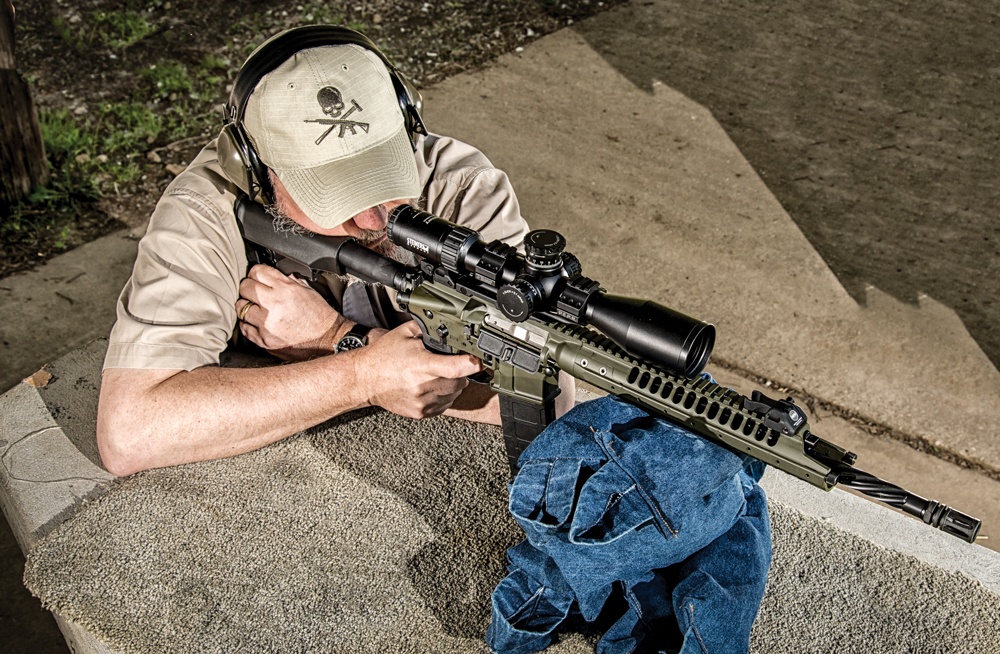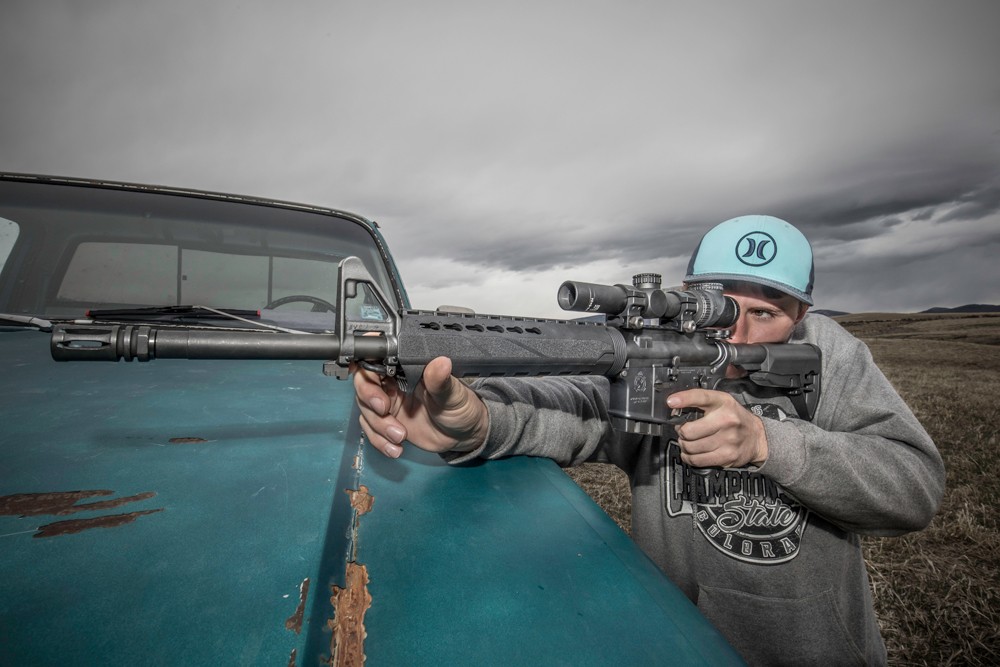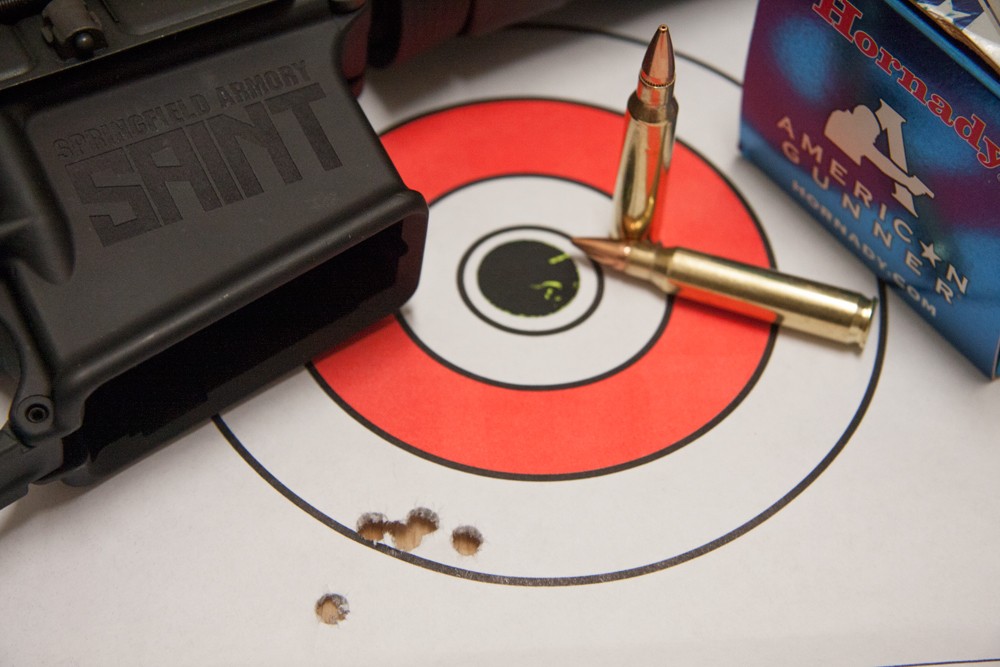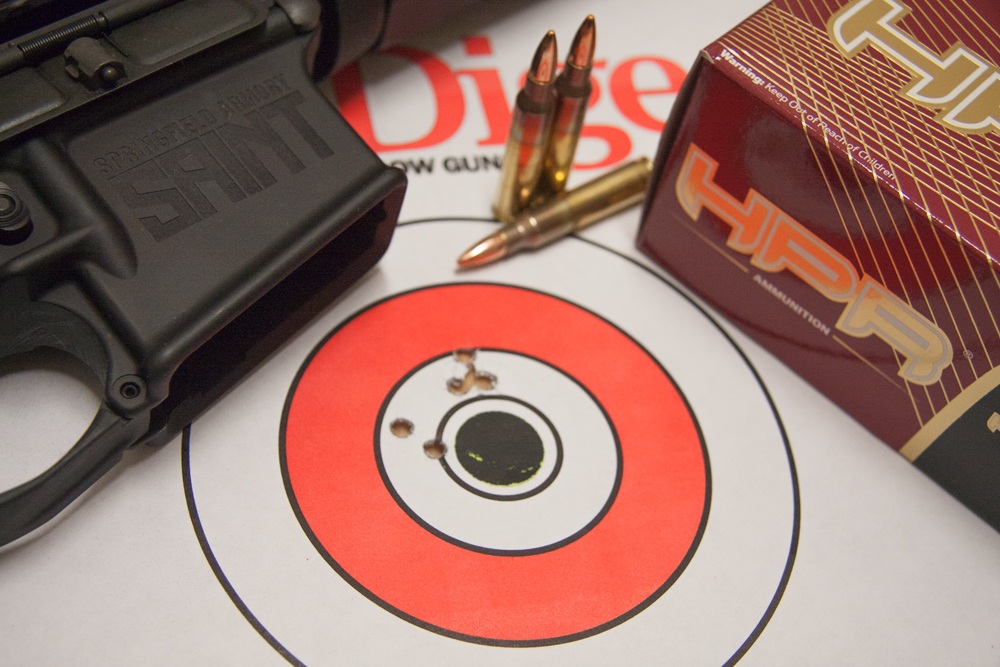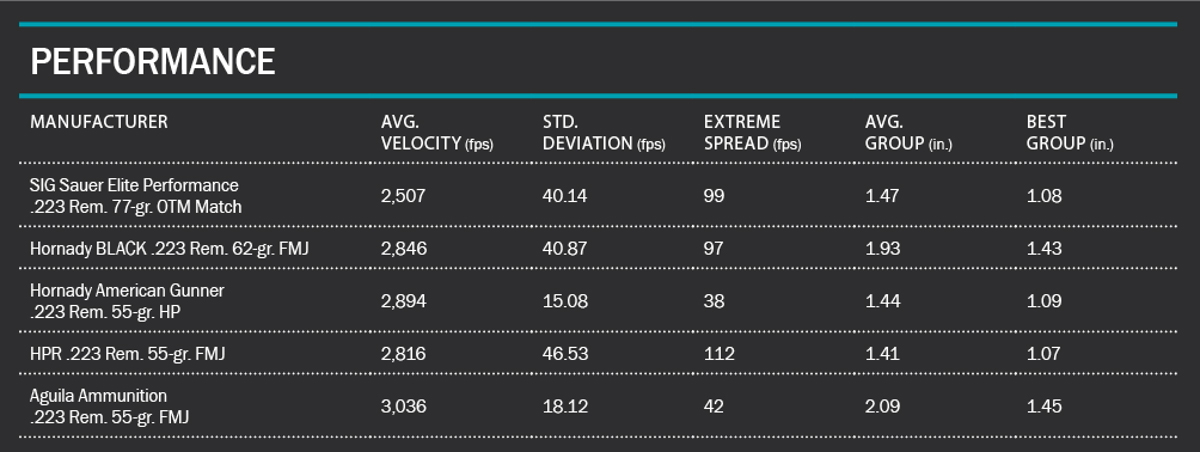
Working on the basics of rifle marksmanship is the key to improving your precision shooting.
Precise and consistent performance when behind the trigger isn’t rocket science. It’s mastering the basics of shooting — position, breath control, trigger discipline, clear sight picture. Then it’s drilling these fundamentals to a razor’s edge, so if the occasion arises, a shooter can cut right through a target. Firearms instructor and member of Colt’s Combat Unit Daryl Holland goes over how these fundamentals come together to make a perfect shot in the above video. It’s a great introduction for those who are new to the way of the gun and an excellent review for grizzled marksmen looking to enhance their precision shooting abilities. Perhaps as important as Holland covering the elements of making an accurate shot is his advice for shooters to challenge themselves at the range. Real life — be it a self-defense situation or a golden opportunity afield — rarely has a rock-solid rest at the shooter's beck and call. In turn, shooters should look to put themselves in true-to-life positions and attempt to break off shots as accurately as if they were at a bench.
Fred Zeglin at work in his shop.Zeglin's new book P.O. Ackley: America's Gunsmith explores this intriguing man and his impact on the firearms world.
We talk with gunsmith and author Fred Zeglin on P.O. Ackley's incredible influence on the modern firearms world.
When it comes to P.O. Ackley, Fred Zeglin knows of what he speaks. The master gunsmith, gunsmithing instructor and author has spent the better part of his career studying the life and works of the firearms icon in one way or another. Whether tinkering on a rifle in his workshop, developing a new wildcat cartridge or expounding on the finer points of barrel reamers, Ackley has always been close at hand for Zeglin. In a way, Zeglin was able to repay the patron saint of firearms with his most recent book: P.O. Ackley: America’s Gunsmith. The riveting work not only looks at the many contributions Ackley made to the firearms world, but also the humble and unique man himself. We were lucky enough to catch up with Zeglin and talk a little Ackley with him. And after our interview, there is little doubt that few men have had the impact on the world of firearms like Ackley.
From John M. Browning to Charles Newton to Eugene Stoner, the firearms world is filled with characters that advanced the industry. What in particular drew you to P.O. Ackley as your subject?
First, I would argue that Ackley is equal in stature and contribution to all of those men. He did as much for cartridge development as Browning did for guns. Newton may have had equally good ideas, but it took a couple of generations for his ideas to catch on with the shooting public. Ackley was far more prolific in his work than Stoner. Ackley produced well over 100 cartridges. Beyond that, he designed and built machines for barrel making; gunsmithed; taught; made barrels, reloading dies; designed bullets; and finally, was a well-respected writer.
As a gunsmith turned writer myself, I felt a natural pull toward Ackley’s work. I started looking around and since his death in 1989, there have been a few small articles written about some of Ackley’s work. However, nobody had taken on the job of researching his entire career and reporting on it. It didn't take long till I was hooked on the story and just kept digging. Starting the process, I had no idea the time and effort I would spend to gather the information in this book, but I am proud of the end product.
P.O. Ackley's work with cartridges is perhaps what he is best known for, but there is much more to his career.
Your previous writing has dealt with Ackley. Was there anything new you learned about the man or his work in researching this book?
Quite a bit of what I found along the way is new and unreported prior to this book. The story of Ackley’s work at Ogden Arsenal during the war and who he worked with provides a web of contacts that shaped much of his later career. How the school in Trinidad (Trinidad State Junior College gunsmithing school) actually got its start was different than previously reported. The sale of P.O. Ackley Inc. and subsequent move to Salt Lake City tells a lot about Ackley as a business man. Like most subjects, the devil is in the details.
Much of what I learned was small facts that have been misreported in articles over the years. Even so, there are some pretty big stories that came to light. Not many people know about Ackley’s involvement with EMDEKO Inc. building production rifles. The development of the Ackley ACE Bullet design is one of those things that was almost lost to history. I collected more cartridge designs attributed to Ackley than have ever been reported and added as much pressure tested load data as I could lay my hands on. In short, absolutely there is new information in this book.
Ackley’s impact on firearms was vast — cartridge development, barrel making, custom rifles, writing. Having delved so deeply into his life and works, where do you feel he made his biggest impact?
Ackley’s biggest impact is without a doubt something that most people would never consider; he worked with and trained a huge number of gunsmiths and barrel makers. I would be willing to bet you could find Ackley's influence in most barrel companies in the U.S. But that’s not how the shooting public will remember him.
Ackley will always be remembered for Ackley Improved cartridges – mainly because shooters generally want a little more out of every gun they shoot. The concept of Improved cartridges as perfected and marketed by Ackley offers at least some benefit in nearly all cartridges, even if it’s only longer lasting brass. But for most shooters, it’s a little more velocity that they care about.
P.O. Ackley came along at just the right time. Powders were improving, case designs were becoming more modern in shape with less taper and sharper shoulder as Newton had envisioned decades earlier. He was brilliant in his design choices that allowed the average shooter to experiment with wildcatting. Improved cartridges allow the shooter to use factory ammo to fireform cases, so the need to understand headspace, or buy expensive forming dies is removed from the equation. You just have to learn to reload, and you’re ready to play with “Improved” cartridges.
Given your background as a gunsmith and working with wildcat cartridges, not to mention writing on Ackley, I have to suppose you’ve had extensive experience with his cartridges — improved or otherwise. Is there any particular one that stands out for you and why?
Wow, it’s really tough to narrow it down to just one. I would say that the best ones are the Improved cartridges that gain the most case capacity in fireforming. Cases like the .25-35 WCF, the Winchester .30-30, 7×57 Mauser and .257 Roberts would be at the top of my list. Over the years, I have built guns in most of Ackley’s Improved designs; none have ever disappointed.
Interestingly, many of the concepts of Ackley Improved have been adopted by the firearms industry as a whole. When new cartridges come to the market from any of the big gun making companies, they now sport minimum body taper and sharp shoulders right from the factory, proving P.O. had it right long before the rest of the gun industry.
P.O. Ackley studies a rifle.
Personally, how has Ackley influenced your work in the gun industry — aside from giving you fodder for writing?
Well, I might never have taken up teaching about firearms and gunsmithing if it were not for Ackley. You might say his career path has turned into a challenge to me to try to keep up. Naturally, with my interest in wildcats, Ackley was an early source of information. He demonstrated the value of being scientific and analytical when experimenting. His writings gave me the desire to understand things, not just work with a monkey-see-monkey-do attitude.
As a result of researching this book, I have spoken to a number of guys who worked with or for P.O. Ackley at some time in his career. In the time since I started the research, many of these men have passed on. So the biggest influence that Ackley has had on me is the desire not to waste time, and to work at what I love.
One of Ackley’s contemporaries said, “He (Ackley) just did what he thought was interesting, and it turned out a lot of other folks thought it was interesting too.” Unwittingly, I have always followed that path as well and have been lucky enough to have clients who were interested in what I was doing.
Utilizing a similar design scheme, Ritter & Stark has produced a slightly scaled down model of its flagship SX-1, meant to handle lighter loads.
Ritter & Stark is a relatively new player in the firearms market, hitting the stage around a year ago. But in that short time, the Austrian gunmaker has firmly laid its crosshairs on one particular firearms niche — precision bolt actions.
The company has been fast to follow up on the release of its flagship SX-1 Modular Tactical Rifle that made a splash at the 2016 SHOT Show. Utilizing the same design scheme, Ritter & Stark has produced a rifle identical in features and purpose, but slightly scaled down and meant to handle lighter loads.
The short-action SLX series was introduced at the IWA Outdoor Classic 2017 in Nuremberg, Germany with the SLX-308 MTR taking center stage. As can be guessed, the rifle is chambered for .308 Win./7.62×51 NATO, but Ritter & Stark plans to follow up with .260 Rem. and 6.5 Creedmoor models at a later date.
The gun comes in right around 2 pounds lighter and nearly 11 inches shorter than the .300 Win. Mag. and .338 Lupua Mag. versions of the SX-1. The new .308 Win., is available with a 20-, 22- or 24-inch barrel, whereas the SX-1 starts out with a 24.5-inch barrel for its smallest caliber. Note, there is a .308 SX-1 that plays a bit of a Mama Bear role in the two series, though is still heftier than the SLX model of the same caliber.
With a fully adjustable buttstock, the SLX series is ready to fix any shooter.
Given the more utilized calibers and lighter overall platform, the company appears to be shooting at a more mainstream audience — hunters and target shooters— with the rifle.
It's no surprise that the new SLX is being offered in multiple calibers, as the previous SX-1 modular design facilitates lightning fast caliber changes, taking only minutes to switch out barrels. The same is true for the SLX.
The system is well thought out, especially for those who can afford to maximize either platform to their full potential. In particular, a barrel-mounted MIL-STD 1913 Picatinny rail gives shooters the advantage of swapping calibers without losing their zero — if, that is, a scope dedicated to each barrel is within budget.
A few of the other notable features of the SLX line include a fully adjustable folding buttstock, Picatinny rails and M-Lok mounting systems, detachable AR-15 pistol grip and adjustable two-stage Remington 700 standard compatible trigger. Also, Ritter & Stark guarantees .5 MOA from its barrels, with match ammo, up to 5,000 rounds. At time of writing, there was no MSRP available.
SLX-308 MTR Specs: Caliber: .308 Win. Barrel length: 508 mm (20″)/558 mm (22″)/ 609 mm (24″) Overall length: 1000 mm (39.4″) Length with folded stock: 760 mm (30″) Overall width: 81 mm (3.2″) Width with folded stock: 103 mm (4″) Rifling – # of grooves: 6 Twist Rate: 280 mm (1:11″) right Total weight: 3.73…5.18 kg (8.2…11.4 lbs.) Magazine capacity: 10 rounds Min. barrel life: 5000 rounds (compliance to NATO AC-225 D.14) Stock length adjustment: 60mm (2.4″) Cheek piece height adjustment: 27mm (1.1″) Butt plate height adjustment: ±23mm (±0.9″) Trigger adjustability: slack, preliminary pull, pull, drag Trigger weight: Adjustable between 600 g…1500 g (1.3lbs….3.3lbs.) Safety system: 3-position safety: F…fire, S…safe (firing pin locked), L…lock (locks the bolt for transport) Optical interface: MIL-STD-1913 Picatinny Rail with 12, 20 or 40 MOA forward inclination. Accessory interface: M-LOK Allows the installation of MIL-STD-1913 Picatinny Rails via M-LOK or M5-Screws. The octagonal cross section enables the handguard to accept accessories in 45° steps.
The second generation Smith & Wesson M&P M2.0 takes the classic S&W pistol to the next level with ergonomic and performance upgrades.
There are two ways you can look at the new S&W M&P M2.0. One way is the philosophy of “Why fix what isn’t broken?” The M&P9 M1.0 worked fine; so, leave it alone, right? The second way is, “Test them like you use them.” Forward-thinking manufacturers know life is not static, nor does it occur in a vacuum. Needs evolve and change, and S&W delivers on change. S&W chooses to learn, listen, test, adapt and evolve, and that is what it did with the M&P9 M2.0.
I like the M&P series and found that these pistols perform. I’ve witnessed M&P pistols endure excessive round counts. As fast as magazines were loaded, the pistols constantly chattered, churning up the dirt backstop so much that the pistols became hot to the touch. The high round count did not faze the M&P, and it did not cave under the torture. In reality, no one will ever shoot 1,000+ rounds as fast as possible through their pistols, unless you happen to be like me and try to find a gun’s weak spot. I couldn’t break the old M&P9 M1.0.
There are other things I like about the old M&P, which I hoped S&W would leave well enough alone, and that was the grip. The 18-degree grip angle of the M&P is similar to a 1911 and comfortable to shoot. A Glock in comparison is about 22 degrees. S&W wisely chose to keep the angle at 18 degrees.
The trigger on older models was good, but the trigger is always the thing that can be improved. Forget about the ease of use and fieldstripping. The M&P is simple and safe and, yes, a thumb safety is available on older M&P models if that feature is a requirement. The new M2.0 I tested came with the optional ambidextrous thumb safety. I tried the thumb safety on the test sample just to tick that off the checklist. It is easily manipulated with the thumb of the shooting hand. If I owned this gun, I would probably never use it because the built-in safeties of the M&P keep it drop safe. Having the safety redundancy in the thumb safety is a good feature, nonetheless.
The slide release is the same as on the M1.0 except on the M2.0 it is ambidextrous. Also the magazine release is reversible, and the button is made of steel.
Some of the M2.0 design changes are obvious. Others are not so obvious. The first thing that I noticed when I pulled the M&P9 M2.0 out of the case was the aggressively textured grips. It reminded me of medium grit sandpaper but with none of the abrasion. Think the Glock RTF2 texture but not as spiny. The M2.0 texture offers good adhesion without feeling like my palm is being worn down one layer of skin at a time. The M2.0 comes with four grip inserts for petite to large hands. The palm swell grip inserts are actually sized small, medium, medium-large and large.
What I like about the M&P grips are the palm swells, which enable the pistol to stick to more of your hand with less gaps like pistols with flat grip sides. Another plus with the new M&P is the front grip strap is void of finger grooves. Sometime finger grooves fit, sometimes they don’t. Some finger groove grip straps feel like they were made especially for me, others feel like my big brother’s hand-me-down clothes, except I’ll never grow into them.
The next features that caught my eye were the new muzzle-end slide serrations in the trademark S&W scallops. When I compared it to my personal M&P9 C.O.R.E. Pro Series pistol, I could see the stainless steel slide was profiled a bit different. Relieved of metal to make it lighter.
What was odd and new were cutouts in the polymer frame. These cutouts reveal one of the major renovations to the M&P series, an extended stainless-steel chassis embedded in the polymer receiver. The chassis makes the pistol more rigid to reduce flex and torque when firing. I fired my M&P9 Pro Series next to the full-size M2.0 and felt the difference in recoil. The M2.0 had less felt recoil.
There are the changes that you can see, but there are also changes that can be heard and felt. The M2.0 uses a new trigger. The new trigger is crisper and has a tactile and audible reset. It is the same trigger in the Performance Series M&P pistols. This trigger really separates the M&P M2.0 from all the other striker-fired polymer frame pistols. The trigger is wide, and I feel I have more control with it compared to triggers with a safety lever built into the trigger face. I also feel it is more consistent.
My test sample was equipped with a 5-inch stainless steel barrel, but it is also available in a 4.25-inch model. Previous 5-inch M&Ps were only available from the Performance Center. The finish was a nicely executed Cerakote FDE.
The high grip on the M&P means the barrel-to-bore axis is close, which translates into the pistol being more comfortable to shoot with faster aim recovery since the muzzle flips less in your grip. But the truth is in the shooting. I loaded up both 15-round magazines—the M2.0 comes with two steel magazines—with some hot handloads and 115-grain hollow point bullets. A piece of broken clay pigeon on the dirt bank at 25 yards worked as a target. I covered the piece of pigeon with the front sight and squeezed off the first. Dead bird. It’s not a target pistol by any means, but the M2.0 will gladly do your bidding. I ran the remainder of that magazine and the other to get a feel for the rhythm of the pistol’s cycle.
Hornady American Gunner with 115-grain XP bullets, Aguila 124-grain FMJs and Liberty Ammunition Civil Defense 50-grain HPs rounded out the ammunition—a wide assortment of bullet weights and different bullet types. The M2.0 chewed through all the test ammo, which is what I expected from an M&P. I used my backpack as a rest to collect accuracy data, and the Hornady American Gunner ammo gave me 1.5-inch groups at 25 yards. The Aguila and Liberty were both under 2 inches at 25 yards. Shooting for speed—the best part of a test in my opinion—revealed that the new M2.0 had less felt recoil. The enhanced trigger allowed me to get on target fast and fire fast.
The other attractive feature of the M2.0 is a price point of $599. The S&W M&P M2.0 has evolved an already excellent pistol platform into a pistol that is easier and more comfortable to shoot. Expect .40 S&W and .45 ACP variants, too. There is a lot to like about the M2.0. Change is good.
Specifications:
Smith & Wesson M&P9 M2.0 Caliber: 9mm Action: Striker-fired, locked breech, tilting barrel Barrel: 5 in. Overall Length: 8.3 in. Grip: Textured polymer, modular, four inserts Weight: 26.9 oz. Finish: Cerakote FDE (Flat Dark Earth) Capacity: 17+1 Price: $599
Howa has expanded its MiniAction rifle line to incorporate a shooter favorite — the classic and widely available 7.62x39mm.
Going small isn’t always a bad thing, particularly if it means shooting zippy or cost-effective centerfire rifle rounds. Howa hit on this winning concept a couple of years back when it introduced a shortened down version of its 1500 action, which it fittingly dubbed the MiniAction.
The rifle series featured the most concise bolt throw in Howa’s catalog, giving shooters a lightning-fast bolt-action to send light-to-intermediate rounds down range. It was a target shooter and varmint hunter’s dream, one that has only gotten more pleasant with the company’s newest addition to the line.
Following last year’s introduction of the 6.5 Grendel to the MiniAction family, Howa has now released a rifle chambered for the 7.62x39mm. This is an interesting move and one that allots the rifle a measure of exclusivity, given there are few bolt-actions presently available that feed on the Russian-born fodder. For certain, the new Howa MiniAction should be an option for shooters who tend to keep a close eye on their wallets. For the most part, 7.62x39mm ammo is as ubiquitous as references to Russia on cable news and relatively cheap, particularly the steel-cased variety. But, along with the Grendel, it gives the platform a heftier round than its original MiniAction calibers: .204 Ruger, .222 Remington and .223 Remington.
Throwing the 7.62x39mm round around, the new MiniAction would make quick work of anything from deer to feral hogs to whistle pigs. It might be a perfect example of the ever-rarer breed of truck gun, perfect to tote along while working on a fence and ready for that overly curious coyote.
Shooters have the choice of 20- and 22-inch barrels in lightweight, standard and heavy configurations. And similar to almost all Howa rifles, the MiniAction is available as a stand-alone gun or topped off with a Nikko Stirling scope. In this case, it’s the 3-9×40 Panamax Riflescope and includes base and rings.
Like the rest of the MiniAction line, the new rifle is outfitted with Howa’s proprietary two-stage H.A.C.T. trigger, pillar bedding and synthetic stock. The rifle has a 5+1 capacity and feeds from a detachable magazine. The 7.62x39mm Howa MiniAction is fairly easy on the pocketbook, with an MSRP range of $652 to $840 — depending on stock color.
MiniAction 7.62x39mm Specs Caliber: 7.62x39mm Action: MiniAction Barrel Length: 20 and 22 inches Twist Rate: 1:9.45″ Overall Length: 39.5 or 41.5 inches (depending on barrel length) Weight: 5.7 or 6 pounds MSRP: $652 to $840 (depending on stock choice)
There are a host of options for shooters when it comes to predator hunting. But which is truly the ultimate predator rifle setup to get the job done?
I've used a broad range of different predator rifle setups over the years, including many bolt guns in ever-popular chamberings like .22-250 and .204 Ruger. I've also been a fan of the AR platform, champion of the 5.56 NATO/.223 Rem. and available in a vastly increasing variety of coyote- and predator-friendly calibers.
The main characteristics of a go-to predator rifle setup are that it be flat shooting, fast reloading and fiercely accurate. This also means having a crystal clear scope with plenty of magnification and, especially for coyote country, some sort of shooting implement to stabilize your shot in any terrain.
On a recent coyote hunting excursion to the Sandhills of Nebraska, I brought along what might be the ultimate predator rifle setup: A SIG Sauer M400 Predator rifle chambered in 5.56 NATO/.223 Rem., topped with a 3-9×40 Whiskey 3 scope, Swagger Bipod and SIG SRD556 suppressor. What makes this setup so ideal? Let's take a look.
The Rifle The foundation of any predator rifle setup, naturally, is the rifle itself. The M400 Predator is one of the most complete out-of-the-box packages you'll find without adding custom upgrades or a custom price, and it can be had in various configurations (including California compatible and .300 BLK) for right around or under $1,500. It's incredibly lightweight, accurate and offers fast follow-up shots for sets when multiple dogs come in at once.
It's a direct-gas-impingement AR-type rifle with an extremely lightweight ALG aluminum free-float handguard and six-position Magpul buttstock. The M400 Predator features an 18-inch stainless steel barrel and a rubber overmolded pistol grip. Controls are all ambidextrous, while the forend features M-Lok attachment points. For this hunt I also employed the VTAC two-point sling, perhaps my favorite of all time because of its versatility in the field.
For starters, the rifle comes standard with a Geissele two-stage match trigger that's incredibly clean and crisp, breaking right at the 4-pound mark. Besides the accuracy of the barrel—which is phenomenal on the M400—the trigger is one of the single greatest factors for repeatable long-range accuracy, something every predator or coyote hunter depends on. This really is one of the better two-stage triggers I've shot in the AR platform, and it accounts for much of the rifle's accuracy.
When we arrived at camp, I made my way to the bench for a quick check of zero on the rifle. At 50 yards on paper, those 40-grain pills just kept expanding the same hole. I then moved out to a steel coyote target at 180 yards. Playing a couple inches of Kentucky windage, the air-gun-like report of the suppressed rifle was quickly answered by the slap of steel. Dead on. I squeezed off five quick rounds, all of which had the exact same effect.
The Bipod When it comes to coyote or predator hunting, I wouldn't even think of heading afield without some sort of shooting implement, whether that's a good set of sticks or a bipod. My favorite new bipod, and the one I used in Nebraska's Sandhills, is the Swagger Bipod. I've used it elsewhere on a Ruger American in .22-250 and here on the M400, and it works fundamentally the same way: It attaches either to the existing sling swivel stud or to the forend of an AR via an M-Lok adapter.
Once attached, the Crazy Legs tuck down into the forend attachment for easy carry, secured by a string retention system. When you're ready to setup in the field, simply deploy the legs, set your height, and you're ready to rock. The real beauty of the Swagger Bipod is the Crazy Leg technology, which features heavy duty springs at the base of the legs and, when deployed, allows you to easily pivot and/or match whatever terrain you're trying to conquer without making a lot of adjustment to the bipod.
While to some people the bipod looks heavy, it's actually quite lightweight and nimble. It provides an incredibly stable shooting platform for the real world where terrain is anything but flat. Swagger makes two models, the longer legged Field Model and the shorter Treestand variant, each of which I reviewed in the Sandhills. Since the legs are fully telescopic and adjustable, the Field Model seems like the solid choice for most on-the-ground situations.
The Can A few years ago I had my first experience hunting with suppressors in Texas, and since then I've been hooked. While a lot of traditional bolt-gun hunters don't see the advantage, I've come to appreciate a good suppressor for its ability to protect my hearing—and the hearing of my hunting companions.
My other favorite feature, which came into play during this hunt, is that a suppressor allows for multiple follow-up shots on game that may not be possible otherwise because of the roar of a rifle's concussion. Likewise, without all that noise pollution, you can clearly hear when a bullet makes impact with the target because of the unmistakable thump.
On this trip I employed SIG's SRD556 suppressor, which weighs around 11 ounces and is roughly 6.5 inches long. A direct thread suppressor, the SRD556 makes the loud bark of the .223 Rem. sound like the report of a nail gun, thus saving your ears. A Taper-Lok design ensures proper alignment and secure attachment.
On the second morning of our hunt, my guide, Justin, called in two dogs with the challenge bark of an electronic call. A big male crested the hill first, and at 150 yards I stopped him in his tracks with the first shot. Rather than tucking tail and heading for the next county, the smaller female with him continued her perch atop the nearest hill, which is when I pulled off an anchoring shot. Make that my first double in one set, plenty to put a smile on my face that morning.
While it's still going to come down to fast target acquisition and fast shooting, the suppressor makes a huge difference in this scenario. Not only that, but my guide's ears were protected from the harmful concussion, and he didn't have to wear additional hearing protection. As a guide, I'm sure he appreciates the effort to save his hearing.
The Glass No predator rifle setup would be complete without the right scope. Fortunately, SIG's 3-9×40 Whiskey 3 riflescope was perfect for conquering the challenges of coyote country. The magnification range seemed about perfect for our terrain—while you may take serious long-range shots, it's incredibly common to have dogs running in at you barely 30 yards out. This means you need an optic that offers fast target acquisition at a relatively low magnification level for close-range shots, but ample magnification when you need to stretch your shots.
The Whiskey 3 is a second focal plane optic with multiple reticle options, including the HellFire illuminated reticle that I used on my rifle. Every other turn of the left turret increases illumination, while the stops in between cut off power to the red dot. Low dispersion glass provides clarity in any situation, making the Whiskey 3 a great low-light optic. Waterproof and fogproof, the Whiskey 3 retails for a remarkable $360 in the configuration I used.
Collecting pressure and velocity data at the range.
Since the post-WWII years, if not before, there has been an ongoing argument concerning whether breech thrust (bolt thrust) is reduced by the improved case design. P.O. Ackley has certainly influenced the argument. The definition of an improved case is pretty simple. The case body is blown out to minimum body taper, which is described by Ackley as 0.0075 per inch taper. Shoulder angles between 28 and 45 degrees are normally considered to be improved, although it could be argued that any shoulder sharper than the original parent case is improved. Finally, an improved design allows the firing of a factory cartridge in order to fireform the brass for the new design.
Shoulder angles between 35 and 40 degrees seem to provide the advantage of minimizing brass flow without negative effect. When the shoulder angle is greater than 40 degrees, brass is unnecessarily hard to form and chamber reamers do not last as long. Headspacing becomes much more critical with a sharper shoulder because there is less taper, making it harder to hit the correct measurement. Also, sharp shoulder angles do not feed as smoothly as more tapered ones. When the shoulder angle is less than 35 degrees, brass flow becomes more of an issue. There are some cartridges, like the .220 Swift Improved, which do not receive any real improvement in velocity, but are popular because they improve brass life by arresting stretch, thereby increasing brass life.
It is not unheard of to measure breech thrust, however the cost of tooling for such testing made it impossible for the purpose of writing this book. However, a method of recording breech trust was necessary in order to go beyond the somewhat subjective experiments that P.O. Ackley wrote about in Handbook for Shooters and Reloaders Vol. I. There Ackley used a Model 94 Winchester because, as he stated, “We often hear that the Winchester Model 1894 action was designed for low pressures and is an action which could be described as ‘weak.’” The purpose of his experiment with the ‘94 was to prove that the improved case design minimized bolt thrust; that the brass will support and contain some pressure; that oily chambers increase bolt thrust; and finally, the notion that actions are designed for specific pressure ranges is a fallacy.
Firing mechanism, adjustable for headspace and firing pin length.
Our Test The Pressure Trace (a product of Recreational Software, Inc.), was used to measure the chamber pressure for all ammo tested in this chapter. The goal of this test was to repeat Ackley’s experiments with the .30-30 Ackley Improved, but to increase the value of the data collected by taking measurements of the thrust against the bolt face. This experiment is repeatable. The author designed and built a custom jig to hold a .30 caliber barrel with a universal breech plug to allow for adjustable headspace, and to accommodate the strain gauge utilized by the Pressure Trace. The firing pin had to be designed to allow for headspace adjustment, too.
The initial tests were done with factory loaded ammunition in .30-30 Winchester to provide a baseline comparison. The second wave of tests was performed after the barrel was rechambered to .30-30 Ackley Improved. The breech of the barrel was turned to 1.050 inches so that wall thickness would be thin enough to provide good data with the relatively low-pressure factory .30-30 Winchester loads. We also left the wall thickness in the area of threads as large as possible so that it would be less likely that the breech would expand, allowing the breech mechanism to move rearward and partially nullifying our test results.
The bolt thrust test had the following goals:
Determine empirically if the cartridge case does indeed contain some pressure at factory levels.
Determine difference in bolt thrust between factory and improved designs, if any.
Determine if chamber pressure can be increased over factory with the same bolt thrust regardless of pressure.
For the .30-30 AI, run pressure up to the point where the brass separates, and compare results to mathematical predictions.
Oil cases to see if bolt thrust is increased with the same load as Ackley stated.
Extend the experiment to other cartridges.
Prescale film in place, note the hole in the film for the firing pin.
.30-30 Test In this first stage of testing with factory ammunition, we fired 60 rounds to work out technical issues, and insure that the test rig would work for the designed purpose. While firing these early test rounds we also checked to see if we could fire rounds with excessive headspace as this was part of Ackley’s earlier tests. We first fired a batch with .010-inch headspace. The cartridges were pushed forward so that the rim was in contact with the breech of the barrel. When fired, the primer backed out .010-inch to take up the headspace, the case stayed fully forward and did not measurably stretch.
We then experimented and found that the maximum amount of excessive headspace we could generate without the primer failing was .046 inches. When we exceeded this amount the primer ruptured and left us with lots of pieces and carbon in the breech gap.
Thus, before we even started the test in earnest, we had proven that the cartridge case of the .30-30 Winchester can contain all of the pressure of a standard factory load without stretching and that the primer is actually the weakest part of the cartridge. That bit about the primer is no real surprise to you reloaders.
Ammunition used to provide this reference sample, Federal Power-Shock.Ammunition used to provide this reference sample, Federal Power-Shock.
The reason the neck and shoulder are dimpled in the photo this chapter is simple. Gasses slipped back around the neck. It is likely that the pressures were higher in the barrel than in the case once the primer failed — venting gases into the breech gap. So the higher pressure gas in the barrel was seeking an outlet around the case neck.
Once we were confident in our results, we then recorded the data listed in the table below by firing 10 rounds of each load. Average readings are used to help keep all comparisons apples to apples. The factory ammo did produce some pressures over 40,000 psi, which means it is loaded close to the safe limit set by SAAMI.
A product called Fujifilm Prescale offered by Sensor Products, Inc., of Madison, New Jersey, was used to record bolt thrust. Prescale is a Mylar-based film that contains a layer of tiny microcapsules. When pressure is applied to the film the microcapsules are ruptured, producing an instant and permanent high resolution image of the pressure variations across the contact area. The film we used was .004-inch thick and comes in varying pressure sensitivity. By placing the film between the case head and the bolt face we are able to take a reading of the exact and true bolt thrust in real time. The film can also be sent to the company for computer analysis, which will reveal the exact pressure exerted, including detail of where the pressure was applied and where it was less intense.
Note how easy it is to spot headspace from the primer protrusion on a .30-30. Case on the left has zero headspace.
Seating depth in all the loads listed for the .30-30 Ackley Improved here was 2.535 inches, seated to the canelure of the bullet. Note that the last load in the table above, 35.5 grains of IMR 3031, is a compressed load, and there is no room for any more powder. This is approximately 140 fps faster than published data for this powder and bullet weight in the standard .30-30 WCF, and there is clearly not enough room with this powder to get into pressure problems.
The 35.5 grains of H322 was used as it produced factory level pressures in the .30-30 AI chamber. Excessive headspace of .010-inch was set. When fired, the case did not move back, the primer backed out and marked the Prescale film. Edges of the film show color only because the film was cut to fit the case head. The color or light readings around the primer pocket are “noise” from the vibration of the bolt during the firing of the mechanism. This was proven by dry-firing the mechanism, during which similar marks appeared in the film.
When you study the table following here, it will be obvious that we have exceeded the SAAMI pressure limit of 42,000 psi with H322. This powder allowed us to get more powder in the case because of its smaller granules. 35 grains would be the safe maximum in our test barrel if you were staying with the SAAMI pressure limit, and at 2,600 fps we are nearly 400 fps past the published data for the same powder and bullet weight in the .30-30 WCF. Of course, this is only true in our test barrel, it would be necessary to use normal load development for any individual firearm, as we were able to generate far more pressure than is advisable in a .30-30 AI under normal conditions.
Those loads that exceeded the 42,000 psi limit were tested for two purposes: To see how much pressure could be generated in the .30-30 AI case, using powders that are appropriate in burning rate for said case. And to determine at what point the brass will yield and stretch with excessive headspace.
The above two tables show that the .30-30 Ackley Improved delivered an additional 180 to 200 fps with these powders in our test barrel. The pressure curve on the H4895 loads had an undesirable form in the .30-30 AI: instead of the pressure curve rising early and tapering off, we found that it had a second pressure spike much higher than the first just before the bullet exited the barrel. For this reason alone I would avoid this powder in a .30-30 class cartridge. *Exceeds SAAMI Maximum.
We started with 0.000-inch headspace as before. The oil on the cases did not allow them to adhere properly to the chamber walls under pressure. Consequently they moved to the rear and applied full pressure or bolt thrust to the bolt face.
This is a stark comparison to the earlier test where the dry case was able to adhere to the camber wall and only the primer backed out against the bolt face.
The brass from our hottest loads shown here, were intentionally shot with excessive headspace. Expansion of the brass to full chamber diameter is normal and can be seen on the fired case. The expansion line on the bottom case is where you would expect to see case stretch if it were present. Looking across at the sectioned case, there is no sign of stretching of the case wall, i.e. no thinning of the case wall.
So, was Ackley right about his findings? Yes, but he may have missed a point or two.
Since .30-30 brass is thick and pressures are low relative to brass strength and case capacity, with most appropriate powders pressure is not a big problem. To be fair, we did find some powders that will develop pressure far beyond SAAMI levels for the .30-30 AI case. Because the brass is so thick, it actually cannot stretch and cause head separations due to excess headspace. In that respect the .30-30 is not a good choice for Ackley to prove that improved designs handle pressure better.
However, Ackley used the .30-30 because the ‘94 Winchester action had been labeled weak. In this respect, Ackley did prove that the ‘94 can handle anything the .30-30 or .30-30 AI can dish out, without any question.
The respected Ruger Mark IV semi-automatic .22 LR pistol line is expanding, bringing out new Competition and 22/45 Tactical models.
Ruger rimfire pistols have come a long way since Bill Ruger’s tinkerings in his garage.
In more than half a century, the company has refined and upgraded the original Ruger Standard model to help it reach the near pinnacle of plinking perfection. At the same tick, the New Hampshire gunmaker has retained the features that made the pistol a winner from the start — including some of the sleekest lines in the handgun world.
Ruger isn’t done yet. The company recently announced two new additions to the heir apparent of the Standard — the Ruger Mark IV. And shooters in a couple specific niches are certain to be excited with what Ruger has cooked up for its ever-evolving line of rimfire semi-automatics.
Ruger Mark IV 22/45 Tactical
To hang the moniker “tactical” on a firearm nowadays, there typically have to be two elements present: a threaded barrel and rails. This Mark IV has both in spades. The 4.4-inch barrel has a 1/2”-28 thread pattern, making it suppressor or flash suppressor ready out of the box. It is outfitted with Picatinny rails situated over the receiver and below the barrel, giving shooters the ultimate in configuration options. While it is ready to accept anything from a reflex to a laser sight or other tactical accessory, the 22/45 Tactical is also equipped to place precision shots without an upgrade using the pinned front and fully adjustable rear sights. Ruger modeled the rimfire’s polymer-framed grip feel and angle off its centerfire SR1911, giving shooters an intuitive purchase on the handgun that fills the entire palm. And while they can be swapped out for another option, the rubberized grip panels are meant to facilitate a positive grip on the gun no matter the elements. The 10+1 capacity pistol also has all the design points that made the Mark IV series a big leap forward. Chief among these is the one-button takedown system, allowing the upper receiver to tilt forward and be removed to disassemble the gun from one simple control. Presently, the MSRP of the Mark IV 22/45 Tactical is $529.
Ruger Mark IV Competition
Ruger’s rimfires have always been popular competition pistols, with the company's designs being conducive to precision. The manufacturer has gone all out with its newest bullseye model, offering shooters the rigidity and heft they need to hit the 10 ring again and again. Of these, the Competition’s receiver and grip frame are perhaps the most important. Each is machined from solid pieces of stainless steel, ensuring the pistol has little to no flex when fired, thus increasing its accuracy potential. The 6.88-inch slab-sided bull barrel also produces more rigidity in the platform and helps up the gun's weight to a stable 45.8 ounces. It also put more of that weight forward, where it should be, making it easier to draw a bead longer and reducing muzzle flip. The Competition is decked out with attractive hardwood laminate grips, but they’re not just for looks. The grips have a competition thumb rest milled into them, giving shooters a more intuitive grip and more control over the pistol. The 10+1 capacity rimfire has a fully adjustable rear sight and, given it does not have a moving slide, offers a fixed sight-to-barrel alignment. The MSRP on the Mark IV competition is $749.
Chambered for some of the largest pistol calibers available, the Desert Eagle has always packed plenty of punch. Now, Magnum Research is packing twice the wallop into its legendary hand-howitzer, in a manner of speaking.
The Minnesota-based gunmaker has introduced a combo caliber package for its popular semi-automatic pistol, allowing it to jump between two potent rounds. The Desert Eagle Mark XIX comes complete with everything shooters need to throw both .44 Magnum and .50 AE rounds downrange at their leisure.
This has been a popular conversion for many shooters of the Israeli-made handgun, but one that required multiple purchases. But through the package now being offered, only one separate acquisition needs to be made to get the pistol ready to handle either large-bore round — a .50 AE magazine.
The three-piece package comes with two 6-inch barrels, one chambered for .44 Magnum and one for .50 AE, and a .44 Magnum magazine. The caliber conversion takes only seconds to accomplish, giving shooters plenty of bang for their buck.
Like the rest of the Desert Eagle line, the pistol boasts a hefty steel frame and rather large proportions. In all, the gun measures 10.75-inches in overall length and 6.25-inches in height. It also tips the scales at nearly 3 pounds.
The combo package pistol has a black oxide finish and of course utilizes the line’s unique gas operating system. The suggested retail price for the Desert Eagle package is $1,949.
Like well-worn saddle leather or a perfectly molded Stetson, there’s just something about guns of the Old West. For many shooters, the click of a bygone repeater’s hammer going on full cock or its report as it sends hot lead downrange still has a hero’s twang.
Perhaps nobody understood this better than Aldo Uberti. A world away from the dusty streets of Tombstone and Deadwood, the gunmaker created a little empire faithfully reproducing some of the 19th Century’s most famous firearms.
More than half-a-century later, the Italian manufacturer is still going strong. Imported exclusively through Uberti USA, the gun company is still churning out top-end classics, true to the originals and as trustworthy as an old paint horse. And for 2017, Uberti USA has a trio of firearms that any true Old West fan should be excited about.
Winchester 1886
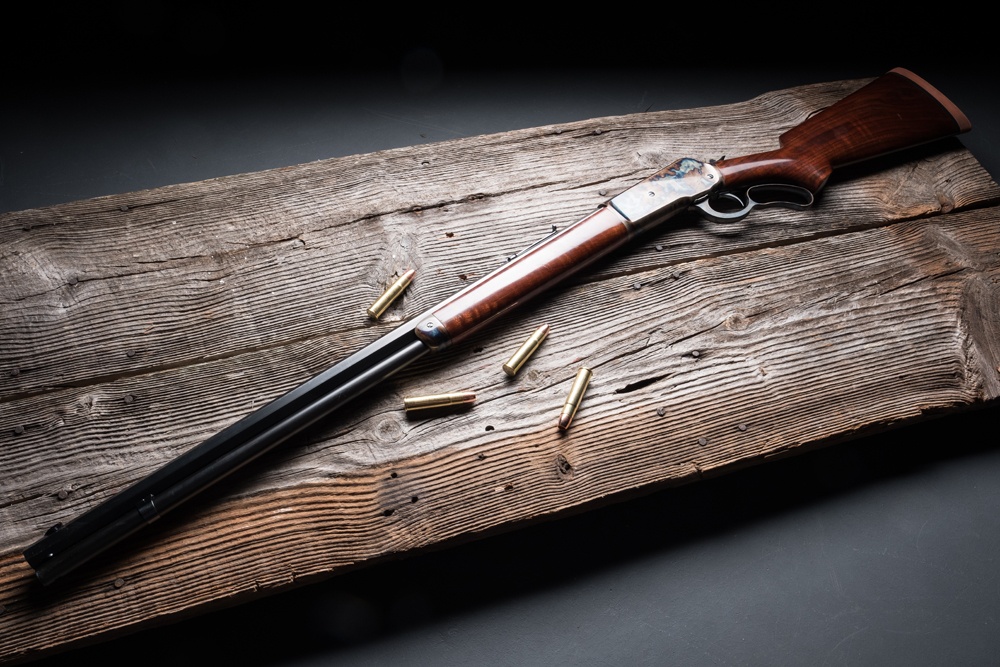
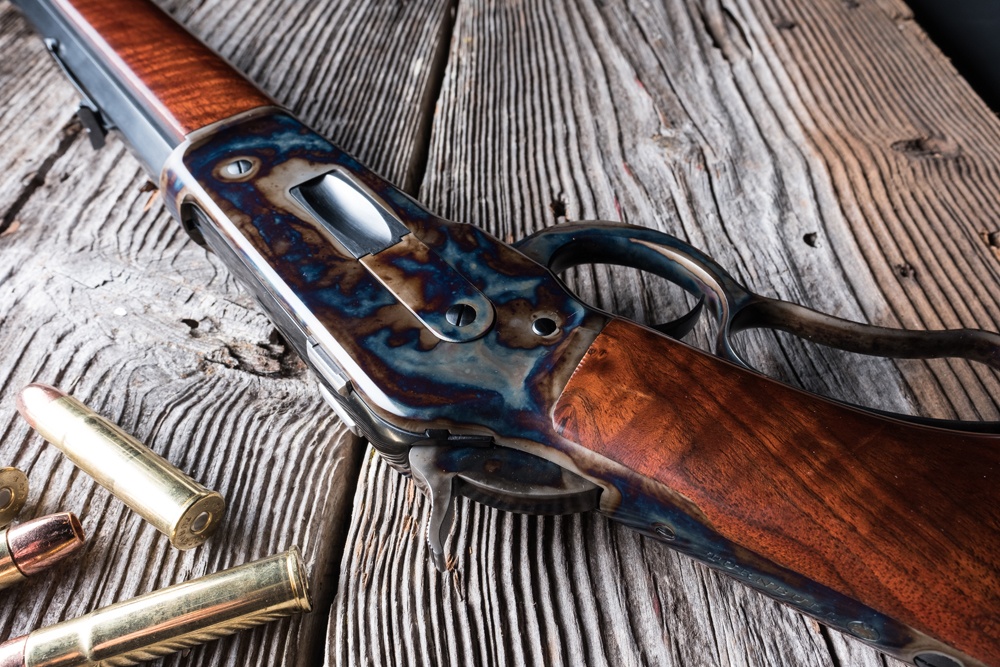
Winchester 1886 Uberti USA is introducing two versions of this iconic John M. Browning designed rifle. Hunters have the choice of a full-sized Winchester 1886 Sporting Rifle or the compact 1886 Hunter Lite Rifle. Both are absolute beauties, decked out in a stick of A-Grade walnut and featuring deep, rich, color-case finishes. However, there are a few differences between the variants. The Lite model has a shaved down round barrel — 22 inches — compared to the 26-inch octagon barrel of the 1886 Sporting. And it has a shorter 3+1 capacity magazine, compared to the full-size’s 8+1. With a weight similar to a modern semi-automatic shotgun, the Lite model should be a trustworthy companion on hunts that push deep into the backwoods or sage brush. Like the original 1886, Uberti USA’s versions are big-bore rifles, chambered for the hard-hitting .45-70 Govt. The venerable round makes the rifle an all-around North American game getter, capable of handling everything from bear to whitetails. And the rifles are designed to handle Level 2 .45-70 Govt. loads (29,000 CUP/PSI max) and are rated for both smokeless and black powder. The guns’ receivers are drilled and tapped for Lyman peep sights, like the original 1886. And the repeaters come with Uberti USA’s exclusive 5-year warranty. The MSRP of the Sporting Rifle is $1,959 and the Hunter Lite is $1,899.
Nickel Finished Short Stroke SASS Pro
Nickel Finished Short Stroke SASS Pro Uberti USA has expanded its cowboy-action shooting collection with a pistol designed to gun down top spots and look good along the way. The mirrored nickel finish and simulation ivory handles means the new Short Stroke SASS Pro is ready to play to the gallery with plenty of flash out of the holster. And it still has all the features that make the line a thoroughbred in cowboy shooting competitions. Chief among these is the short-stroke hammer, which reduces travel time 20 percent, making the revolver lightning fast. Furthermore, the spur is wider than most similar SASSs and features aggressive hand grooves, making the pistol a snap to cock in the heat of competition. An additional benefit of the low hammer is that it never obscures the sight picture even when fully down, ensuring fast and accurate target acquisition. The nickel-finished model is available in two calibers: the venerable .45 Colt and versatile .357 Magnum. And it comes with the choice of 4 ¾- and 5 ½-inch barrels. The six-shooter weighs in at a respectable 2.3 pounds and boasts a custom-grade mainspring. The MSRP on the revolver is $869.
Commemorative 1858 Buffalo Bill Limited Edition Revolver
Commemorative 1858 Buffalo Bill Limited Edition Revolver Perhaps no one man did more to spread the lore of the Wild West than William Frederick “Buffalo Bill” Cody. The former Pony Express rider, scout and buffalo hunter’s Wild West show celebrated the American Frontier and its personalities, making them legends worldwide. Uberti USA hasn’t forgotten the icon's legacy, celebrating it with a limited edition of the revolver Cody himself carried — the Remington Model 1858. The run of no more than 500 revolvers commemorates the 100-year anniversary of Cody’s passing and is decked out to get any collector drooling. The lavishly engraved cap-and-ball pistol features scrollwork on its frame, cylinder and barrel by the studio of master engraver Cesare Giovanelli. The 8-inch octagon barrel also has Buffalo Bill’s name on one side and his birth and death dates on the other. Chambered for the original .44 caliber, the revolver mimics Cody’s sidearm, boasting ivory handles — Uberti, however, uses simulated ivory. It has a number of other accoutrements certain to capture enthusiasts' eyes: rich deep blue finish, color-case hammer and brass trigger guard. The pistol has an MSRP of $1,049. Given the original is priceless, that’s a steal.
Reliability is an important aspect, or should be, with regard to pretty much any firearm. You want it to work when you need it to, regardless of which category of the shooting sports you fall into – whether that's big-game hunting, plinking at the range or busting clays for competition. It's certainly true of firearms intended for 3-Gun Competition use.
In the video above, renowned competitive shooter and Colt Competition Team member Maggie Reese discusses the importance of having equipment that is utterly reliable in 3-Gun Competition. Watch the video to learn more.
We trace the lineage of today’s top pistols and revolvers to determine which firearms helped shape our modern conception of what a handgun should be.
There are a wide variety of different handguns on the market today, everything from ultra-compact mini-revolvers to sophisticated semi-auto race guns. But if you look at the DNA of most modern guns, you’ll see that the vast majority trace their lineage back to some common ancestors. Sure, all have different features and specifications, but the history of these great guns is visible in virtually every modern handgun offered for sale today.
Still, it’s hard to pick just 10 firearms that helped shaped our understanding of what a handgun should be. You can trace the history of firearms back for centuries to a time when primitive powder ignited a flash of flame and an idea that would change the history of humankind and the trajectory of the world as we know it. But for our intents and purposes, we’ll stick to guns of the modern smokeless powder era, those from the mid-nineteenth century and forward.
That’s still not a short list, and picking guns that deserve a spot isn’t easy. It’s sometimes hard to judge the influence a gun has on other models; sometimes, it’s a matter of mechanical design, sometimes aesthetics, and sometimes it’s caliber, capacity or some nuance that could easily go unnoticed. So, above are our picks for the 10 most influential handguns of the modern era.
The Remington RP9 is the American manufacturer’s first full-size striker-fired handgun, and it’s got a lot to offer in a price-friendly package.
It’s no secret these days that more and more shooters are moving away from traditional metal-framed single- and double-action handguns and toward polymer-framed striker-fired pistols. Long gone are the days when insults and skepticism were hurled derisively at so-called “plastic” guns. Over the years, they have proven their reliability and their performance capabilities, turning skeptics into converts along the way.
Now, instead of just the few original manufacturers, it seems like there are a countless number of companies, both foreign and domestic, producing these guns. This past fall, one of the biggest names in the U.S. gun industry decided to make its own move into the full-size, striker-fired game. I’m speaking of course of Remington and its new RP pistol.
Some writers within the industry, and certainly more than a few potential buyers, were quick to point out the lateness of the move. A host of other manufacturers had already jumped on the polymer, striker-fired train and had been on it for a while. So, with a sea of other similar guns to choose from, many wanted (and still want) to know what made the RP special?
While there are of course differences, much that is nice about the new RP is also what makes it very similar. The new RP is a classic tilt barrel, locked breech, striker-fired pistol with a polymer frame. Its appearance, and more importantly, its controls and operation should be very familiar to anyone who’s used other striker-fired guns. The reversible magazine release, slide stop and takedown lever are all in the typical positions.
The gun has a standard trigger safety, which is its only manual safety mechanism. However, it also features passive safety features in the form of a disconnector, the inertial striker system, striker safety and of course the trigger guard.
Disassembly is fairly similar to many other polymer-framed guns, being both quick and easy. After ensuring the gun is empty, the user simply locks the slide to the rear, rotates the takedown lever down 90 degrees, releases the slide stop and allows the slide to come forward, pulls the trigger and, while keeping the trigger pulled, removes the slide from the frame. And then of course from there, all that’s left is removing the recoil spring/guide rod assembly and the barrel. The entire process probably takes longer to read than it does to accomplish.
Like many striker-fired guns, the trigger on the new RP is pretty good. With an advertised pull weight ranging from 5.5 to 7 pounds, the break itself is light and crisp. It also has a short, tactile reset that is quite nice.
The RP’s slide comes with a loaded chamber indicator as well as front and rear slide serrations. The frame also incorporates a standard picatinny rail up front for accessories such as a weapon-mounted light or a laser sight.
Sights are drift adjustable, and the rear sight incorporates a “fighting surface” that allows for one-handed slide operation if necessary. The gun uses a precision 4.5-inch stainless steel barrel. Both the slide and barrel receive a PVD finish for increased durability.
Of course many, if not most, of these features are what we as shooters have come to expect on full-size striker-fired guns. The fact that Remington was able to hit on a lot of these is a very good start. But let’s return to the differences mentioned earlier.
Comfort is King
In the polymer-framed, striker-fired pistol arena, what often separates two guns from each other is how they feel in the hand. The beautiful thing about gun owners is that we are all different, and even in a market as crowded as the polymer-framed handgun, there will still be personal preferences that can influence the buying decision.
It is in this spirit of inclusivity that the engineers at Remington have developed the grip on the new RP9. The pistol features a very slim grip circumference that, according to Remington, fits virtually 95 percent of all shooters. And for that other 5 percent of shooters, the company has also included interchangeable back-straps to fit small-, medium- and large-sized hands.
One of the most surprising things about this slimmer grip is that Remington was still able to use a double stack magazine capable of holding 18+1 rounds in 9mm and 15+1 rounds in .45 ACP. That’s a lot of boom in one handgun, especially one with such a lean grip. Given this large round count and comfortable grip, I think a lot of people might (and should) give the RP a look as a home defense handgun.
In terms of shootability, the gun also has several features designed to improve performance and comfort. The gun has an ergonomic, optimized grip angle to reduce felt recoil, as well as an undercut trigger guard for higher hand placement and improved control. In addition, the slide is weight balanced for a more controlled muzzle rise.
While shooting during the course of this review, and during a Remington event back in September where the company first introduced the gun to the media, it did seem very controllable, and I think the grip design plays a real part in that. I had little difficulty firing and getting the sights back on target.
With an overall length of 7.91 inches, a height of 5.56 inches, and a weight of 26.4 ounces, there’s no mistaking the RP for anything other than a full-size gun. The gun’s slide also has an enlarged profile, which Remington has done to ensure secure slide manipulation, even if the shooter is wearing gloves.
All in all, the RP9s (9mm) I used, both in testing and at the event, felt very good in the hand. This was true during extended firing as well as in a more general sense.
At the Range
Everything above is great, but what most shooters are concerned with, especially for polymer-framed, striker-fired guns, is reliability and performance. Thankfully, in my time with the Remington RP9, it did not disappoint.
In the course of testing the RP9 I received, I put close to 250 rounds through the test gun. During the Remington event, I fired probably around 100 rounds through one of the test guns, and that doesn’t include the number of rounds fired by many of the other writers and members of the media in attendance before that. In both cases, I experienced no real mechanical failures, with the exception of the slide failing to lock back on an empty mag a couple times during my accuracy test.
For my independent testing I used four loads: Winchester’s 115-grain FMJ, Blazer Ammo’s Brass 115-grain FMJ, Aguila Ammo’s 124-grain FMJ, and SIG Sauer’s Elite Performance 124-grain V-Crown JHP. I measured velocities through a Competition Electronics ProChrono Chronograph from Brownells placed approximately 10 feet from the muzzle. Accuracy was measured using three, five-shot groups at both 25 and 15 yards using a Caldwell Matrix rest, also from Brownells.
Average velocities were in the low to high 1,100 fps range, with the exception of the Aguila load, which was a little slower at 1,043 fps. Groups were also plenty adequate with the average at 25 yards hovering around 3 inches (a better handgun shooter probably could’ve improved that figure quite a bit). Predictably, at 15 yards, groups were tighter, with the average around 2 inches or less. The best overall group at 15 yards went to the 115-grain Winchester FMJ load at 1.07 inches.
Parting Shots
While it’s true that many feel Remington is a little late to the game with its new striker-fired gun, that shouldn’t take away from what the manufacturer has achieved with the RP. Remington’s first full-size, polymer-framed, striker-fired pistol has what it takes to compete with any of the other similar guns on the market. At its excellent, sub-$500 MSRP ($489), it’s likely to be a very popular alternative, and it should be. It feels great in the hand, performs reliably and comes with everything you’d expect from a good polymer-framed, striker-fired handgun.
It’s certainly true that there are a lot of similar handguns vying for buyers’ dollars right now, but because preferences are always subjective and varied, Remington’s new RP definitely has a chance to find success. With people currently gobbling up strike-fired pistols the way they are, there’s plenty of elbowroom for another contender in the ring.
Specifications:
Remington RP9 Type: Semi-auto, striker fired Caliber: 9mm Barrel: 4.5-in., stainless Overall Length: 7.91 in. Height: 5.56 in. Width: 1.27 in. Weight: 26.4 oz. Frame: Polymer Slide: Steel, PVD finish Trigger: 5.5-7 lbs. MSRP: $489 Manufacturer: Remington; Remington.com
This article is an excerpt from the January 2017 issue of Gun Digest the Magazine.
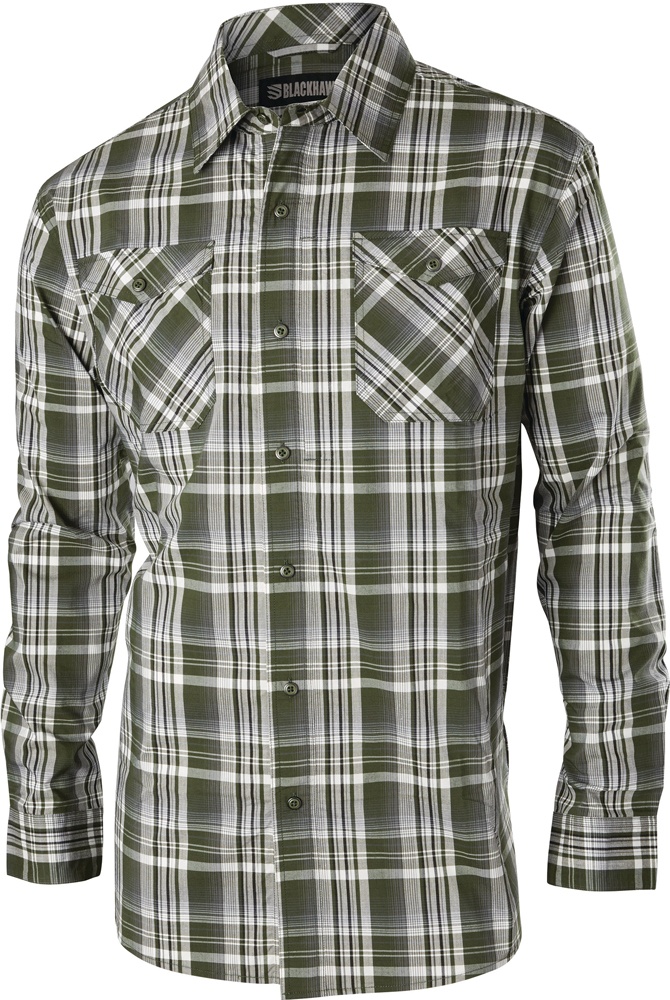
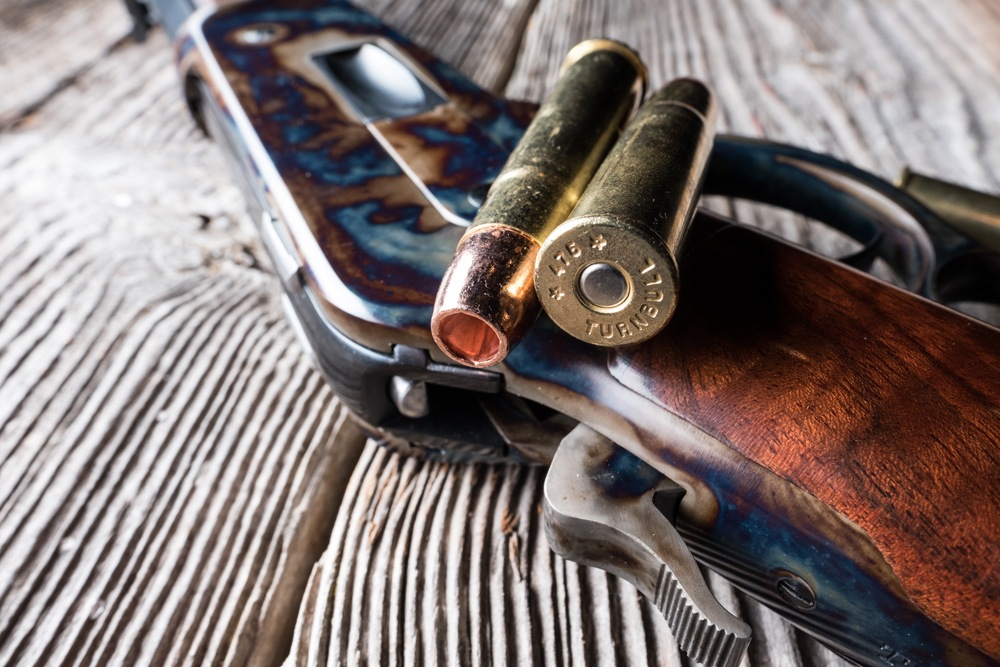
There are three notable cartridges in the .475-inch diameter category — the .480 Ruger, .475 Linebaugh and the .475 Maximum or Linebaugh Long. The progenitor of all three of these cartridges is the .475 Linebaugh, which spawned both the shorter .480 Ruger and the longer .475 Maximum. John Linebaugh is responsible for bringing his namesake .475 into this world by cutting the .45-70 Government down to 1.4 inches and necking the case to .476 inches. This caliber category is serious big-game medicine and represents a significant step up in terminal effectiveness from the various .45-calibers.
.480 Ruger The .480 Ruger is, essentially, a shortened .475 Linebaugh. The first loads offered to the public did not show the true potential of the cartridge, featuring relatively light-for-caliber bullets at moderate velocities. It was also overshadowed by the aggressive marketing of the .500 S&W Magnum and later the .460 S&W Magnum. To that end, it never really stood a chance, as it could not boast being the biggest or the fastest. What Sturm, Ruger & Company did create, though, is a relatively mild recoiling and effective round that, in my opinion, is one of the better all-around choices for the big-game handgun hunter.
Released in conjunction with the Super Redhawk chambered in this caliber, the revolver was a good platform from which to debut the new round bearing the Ruger name on its head stamp. Recoil, while expectedly stout, still pales next to the .454 Casull loaded to spec, even though the .480 boasts a larger diameter. The .480 can be loaded close to the levels of the .475 Linebaugh but cannot achieve the higher velocities. Don’t let that fool you into thinking the .480 Ruger isn’t a serious cartridge. There is no game animal walking this planet that the .480 Ruger cannot comfortably take when loaded appropriately for the task at hand. Loaded to SAAMI specification pressure of just under 48,000 psi, only 2,000 psi separates the .480 Ruger from the .475 Linebaugh.
The .480 Ruger took down this water buffalo in Argentina.
I like this round. Even when loaded with heavy bullets — 400 grains and beyond — the impulse is mild and creates more of a push than a sharp jab. Start pushing similarly weighted bullets up over 1,300 fps, though, and this is where the party starts. Plus, all factory revolver offerings in .480 Ruger are of sufficient bulk to tame even the hottest .480 loads. As a milder version of the .475 Linebaugh, what’s not to like? This is a great choice if you want big-bore knockdown power without debilitating recoil, all in a very controllable package.
I have a long relationship and history with the .480 Ruger that began in 2001 with the release of the new cartridge in the Ruger Super Redhawk. I was intrigued with the new chambering in the big, gray revolver and had to have it when I first laid eyes on it. With factory loads, that revolver proved very accurate. I took a number of Florida wild hogs with it and, thinking I needed more horsepower, eventually had it fitted with a five-shot cylinder in .475 Linebaugh. In that configuration I took a lot of big game. I tested a couple more .480 Super Redhawks over the years and was among the first to test the new Super Blackhawk in .480 Ruger, putting nearly 5,000 rounds downrange in testing. Long live the .480 Ruger!
.475 Linebaugh A personal favorite of mine, the .475 Linebaugh was unleashed on an unsuspecting handgun world in 1988 by John Linebaugh. The original parent case of the then-wildcat was the .45-70 Government cut down to 1.4 inches with a .476-caliber bullet. This cartridge is truly serious and has taken the largest and most dangerous game that Africa and the rest of the world has to offer, cementing its position in the realm of big-game hunting cartridges.
In its first iteration, it pushed a 400- to 420-grain bullet to speeds up to 1,400 fps. The recoil is stout by anyone’s standards. This is not a cartridge for the uninitiated, as it kicks on both ends.
Ross Seyfried first wrote about the .475 Linebaugh in the pages of the May 1988 issue of Guns & Ammo magazine. The article was appropriately dubbed, “.475 Monster Magnum … The ‘Outer-Limit’ Handgun.” If that article hadn’t gotten your blood pumping, he followed it up with an essay called “.475 Revolver Down Under” in the December 1989 issue of the same publication. In this article, Seyfried succinctly stated, “The .475 revolver cartridge was designed to be the ultimate big-game round for use in handguns. It represents a monumental step up from the .44s and a considerable increase in horsepower over any of the .45-caliber cartridges. This combination of long, heavy bullets and moderately high velocity makes even the highly touted .454 Casull seem small and ineffective.”
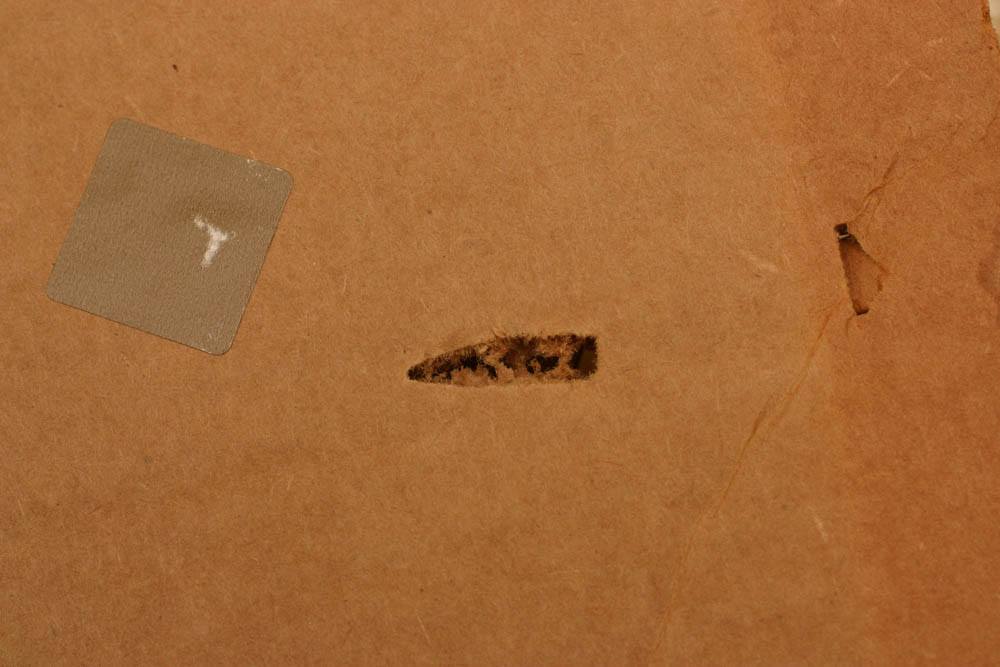
A .475 Linebaugh dropped this bruin in Alaska.
Seyfried then proceeded to knock down all kinds of big game in Australia with a John Linebaugh-built Ruger Bisley .475, including feral goats, pigs, donkeys, wild cattle and even an Indian water buffalo. Seyfried’s first shot on the water buffalo resulted in two broken front shoulders. The effectiveness of the cartridge on big game cannot be argued. The .475 Linebaugh represents a standard by which all big-game revolver hunting cartridges are measured.
Brass is readily available for handloading from two sources, Hornady and Starline. Loaded ammunition is available from a number of sources, including Hornady, Buffalo Bore and Grizzly Cartridge Company.
.475 Maximum or Linebaugh Long The January 1991 issue of Guns & Ammo magazine introduced big-bore handgun nuts to the .475 Maximum, and its bigger brother, the .500 Maximum. Ross Seyfried was once again responsible for the exposure, having thoroughly tested the cartridge in a John Linebaugh-built revolver. Also known as the .475 Linebaugh Long, this round is merely a .475 Linebaugh lengthened 0.2 inches to 1.6 inches. The extra length ensured the new round was able to achieve velocities somewhere around 150 fps more than its shorter counterpart while maintaining similar pressures.
The .475 Maximum never really caught on, as the discomfort it created when shooting never outweighed the performance gains that could be realized. Seyfried’s penetration testing revealed that little more is gained by running higher velocities, and that those higher velocities may actually compromise the bullet’s integrity. That said, if loaded to .475 Linebaugh (the 1.4-inch case) velocity levels, the resulting lower pressures make for a more reliable cartridge in extreme heat — a definite plus when hunting Africa or other hot climes.
Despite all of the above, another .357 Maximum I procured a couple of years ago is being converted to .475 Maximum as this book goes to print. Is the extra horsepower a necessity? Nope, but when does need ever play into custom revolver builds?
A note for reloaders. Brass at one time was produced by Hornady for the .475 Maximum, but this is a used market item now. This is a custom revolver proposition only that requires a longer frame like that of Ruger’s only limited-edition .357 Maximum of the early 1980s.
If price is no object, you can’t do much better than these large-caliber dream guns for dangerous game hunting.
I was raised in a household where money was tight; we never did without, nor were we unhappy, but there was little money for frivolity. My mother had, and still has, the ability to stroll into a nearly new shop and come out with head held high, looking like one of the classiest ladies I’ve ever seen. As it translated into the hunting facet of our lives, firearms were meat-getters; my father – Ol’ Grumpy Pants – had a meager assortment of guns, each with their designated purpose, and he views a gun in the same manner today. “They’re bullet launchers,” he quips, in that stern voice that commands attention in any room, “you take any one of those ‘fancy-wood’ rifles and I’ll put it up against my Mossberg 100A .308 Winchester. I’ll kill anything they will.” He’s not wrong, and I still wouldn’t want to be within 500 yards of the old man with that rifle in hand.
However, I’d secretly peruse whatever hunting magazines we had around, wide eyed and soaking it all in like a dry sponge. I remember the advertisement, where an investor would part with a sum of money and receive a Weatherby Mark V, all shiny with the white-line spacers, and I’d stare in wonder at the possibilities of holding such a firearm in my hands one day. I was a sucker for the Remington catalog, spending my time investigating the different model numbers and available calibers, slowly piecing the puzzle together regarding the various available calibers and their applications. That curiosity, coupled with a half-million questions hurled at GP, was the germination of a lifelong love of firearms and cartridges – and adulthood focused on hunting abroad.
As a younger man, I’d save for years sometimes to buy a rifle, and they became very dear to me, though GP insisted I was foolish for having “all those damned different calibers, when all you need is a good .308.” Sorry Pop, I’m hooked and no hay remedio.
Now, I’m by no means independently wealthy, nor am I a rifle snob – those guns I saved so long for still have a place in my heart and get used often – but as a gunwriter, I have had the opportunity to be exposed to some of the finest firearms available to mortal men. I’ve been blessed enough to become friends with some of the biggest hitters in the firearms industry; and I’m lucky enough to call guys like Chris Sells from HeymUSA, as well as Marc Newton and Simon Barr from John Rigby & Co., my friends as well as business associates.
I’m happy to report that my daydream fuel has become more refined since I was that young man staring at a Weatherby advert; and I’ll also confess having whetted my appetite for fine rifles. So, I thought it’d be fun to do a piece on those big-bore guns that fuel daydreams.
This is in no way disrespectful to the common firearms we all use, but as a fun piece – eye candy, if you will. I've had the privilege of shooting, and even hunting with some of these guns; others remain an enigma, and a personal goal for me. Let’s begin the tour of some dream guns.
Bolt-Action Rifles While some insist that the magazine rifle lacks the pedigree and luster of the double rifle, there’s no denying that they are much more affordable and accessible than a double. Yes, it’s true that there’s no faster second shot than a double rifle, but there’s no faster third shot than a turnbolt. And while the modern trends of weatherproof coatings and synthetic stocks hold a firm grip in today’s market, holding a finely crafted bolt gun, stocked in fine walnut and blued to a warm hue is a lovely experience. Generally speaking, the bolt-action rifles are considerably cheaper in comparison to the doubles, but they can still command a high price and raise the eyebrows of any connoisseur of firearms.
9. The Heym Express by Martini I love bolt guns. Bolt guns of all shape and size, color and pedigree, caliber and configuration. Of all the big-bore bolt guns I’ve ever owned, shot or handled, this one is far and away my favorite. The Express uses a proprietary action and magazine individually designed for each particular cartridge, combined with a hammer-forged Krupp steel barrel for an utterly reliable package. The stock is another wonder by Ralf Martini – I’d say he truly knows his way around a piece of walnut – and has the styling of the classic British rifles; open pistol grip, slender, tapering forend, geometry perfect for keeping the rifle weight between the hands. A bold front bead nestles quickly and easily in the wide safari ‘V’ sight, which is regulated for 50 yards, with a complimentary flip-up 100-yard rear sight. My own Express is chambered in .404 Jeffery, and feeds and extracts like a dream. This rifle has taken elephant and buffalo, in addition to several plains game species at a variety of ranges. The Express bolt is one of the toughest available, being larger in diameter than the Mauser or even the Brevex, having a diameter of 0.780 inch. Like the Model 89B double gun, the German engineering and British styling are mated in such a manner as to make an instant classic. Appointments like a straight bolt handle; oversized trigger guard; and proper red recoil pad, combined with a three-position safety make this a high-end, very use-able rifle that will make the owner proud for a lifetime. If I had to choose one rifle from my collection, to spend the rest of my days with, it’d be the Express .404; it fits me like a damned glove. The Express starts at just under $10,000.00 and the price goes upward, depending on which level of color case hardening and engraving you choose.
8. The Rigby Big Game Rifle If you enjoy big-bore rifles, I’m certain you’re familiar with the reputation of the .416 Rigby, made famous in what may be the best safari book ever written: Robert Ruark’s “Horn of the Hunter.” During the original run of Rigby’s .416 rifles – from 1912 to the Second World War – less than 200 were produced, but Ruark’s book and the writing of John “Pondoro” Taylor made the cartridge’s reputation. Upon Rigby’s recent return to London, they proudly announced the return of the Rigby .416 in its Rigby Big Game rifle. Returning to the classic configuration of a Mauser Magnum barreled action, finely stocked and available in either single square bridge or double square bridge configuration, the Rigby Big Game rifle is a throwback to the classic Rigby rifles of the early 20th century. Rather than the flag safety of the elder Mauser actions, the Rigby Big Game is fitted with a horizontal, three-position safety in the fashion of the Winchester 70. While even the base models are an attractive looking affair, the higher-end Rigby Big Game is available with appointments that will stun. Color-case hardening, gold inlay, pristine engraving and gorgeous furniture are all available, driving the base model price of around $14,000.00 up to a hefty sum of $36,000.00. I’ve had the pleasure of shooting the Rigby Big Game – you can check the John Rigby & Co. Facebook page for a video of Simon Barr and Yours Truly at the SHOT Show – and I can report that it’s both accurate and pleasant to shoot. Holding a rifle of this pedigree is an awesome opportunity, and I now understand why Harry Selby swore by his Rigby for so many decades.
7. The Westley Richards Bolt-Action Westley Richards offers a fully bespoke rifle experience, where you may choose your options in a fine British turnbolt. If you haven’t had the chance to take a look at the bolt guns that Westley is producing, you really need to hop on over to the website for some serious drool fuel. Of course, I’d want mine in a .318 Westley Richards takedown, which is only second to choosing the .425 Westley Richards – a big game gem in its own right – with the extended trigger tang and, of course, a gold oval with my initials in it. I’d need an island sight with one fixed, wide ‘V’, and a flip-up sight for further distances, and removable scope rings, and of course the WR patented flip-up, engraved, hooded front sight. All told, my theoretical bill totaled just under $45,000.00 – not bad for a daydream budget.
6. The Rigby London’s Best Rifle Here Rigby offers a similar bespoke experience, allowing the customer to pick and choose from a variety of options, including caliber, stock length and wood grade, gold inlays, scroll pattern, choice of engraved animal, custom oak/leather/canvas case, and even the possibility of a takedown configuration is possible. Since we’re playing daydream here – alright, perhaps I’m a wee bit serious about it – I put my own dream rifle together on the Rigby website. I chose a classic .416 Rigby for the caliber – it seemed sacrilegious not to – and a decent grade of wood, and a few of the gold inlays, some color case hardening on the rings, receiver and floor plate, and of course a classy case. I tossed in the peep sight on the cocking piece, and tallied up the total figure; it was just north of $55,000.00. Hey, if you’re going to dream, dream big, right?
Double Rifles Nothing screams “adventure” to me as much as a finely crafted double rifle. Images of early 20th century explorers and ivory-hunters, with big-bore double over their shoulders, were some of the most inspiring to me. They're not cheap, and they have little opportunity to be used to the fullest extent here in the States, but they sure are cool!
5. The Heym Model 89B Perhaps the youngest of the classic gun makers, Heym – founded in 1865 – has made quite a splash among the Professional Hunters with its Model 88B. It’s a sound design, and as it was offered in a very plain configuration, it became very appealing to those on a budget. The 88B is a good rifle, though perhaps a bit blocky in the hand. Taking comments in stride from many users, Heym took a look at many of the classic double rifles of the early 20th century, and incorporated those details into the Model 89B. Using the talents of stockmaker Ralf Martini to redesign the 88B’s stock – opening the pistol grip and generally trimming down the overall shape – the 89B is a rounded action boxlock, with a solid crossbolt, and lighter barrel contour, for near perfect balance. This is one double rifle I can attest to having spent a good amount of time with; I was lucky enough to be the first hunter to take the gun to Africa. Chambered in the classic .450/400 3” NE, the 89B cleanly took an old Cape buffalo bull in Mozambique’s Coutada 11, on a classic hunt in the forest/savannah, and carried and shot like a dream. Heym is offering the 89B in three different grades of engraving, with the option of color case hardening. Though I have handled double rifles with much more expensive price tags, the Heym 89B gives the features and feel of the classic British guns of a century ago, with the benefit of modern steel and impeccable German engineering. Prices start at $23,000.00
4. The Westley Richards Droplock The writings of Ernest Hemingway and Captain Jimmy Sutherland evoke images of wild Africa and a Westley Richards double. Both of these gentlemen carried .577 NE doubles, and while I’ve seen but not held Papa’s gun, I don’t know what became of Sutherland’s. Westley Richards is still going strong, and if you’re well heeled enough, you can order a brand new droplock, stocked to fit your frame. Mind you, Westley Richards is not just a name – though the pedigree is impeccable – the shop is a true, bespoke rifle factory. Over 600 hours of work is poured into each rifle, so I feel comfortable saying that they are a custom affair. With a hand detachable sidelock, spare front beads and strikers, a Westley Richards double should be at the top of anyone’s just-won-the-lottery list. It’s available with engraving that would make Michelangelo blush. Prices start at about $85,000.00.
3. The Holland & Holland Royal The simple mention of the words Holland & Holland evokes images of the heyday of the British Empire, with Dukes and Princes visiting their colonies as sportsmen, with fine steel and walnut in hand. Though famous today for the development of such gems as the .375 Holland & Holland Belted Magnum – the very staple of African shooting – and the Super .30, or .300 H&H, the guns of Holland & Holland, dating back to 1835, were and are nothing shy of spectacular. The Holland & Holland Royal double rifle is the flagship of the fleet, giving a sportsman both rock solid reliability and a level of elegance that ranks among the finest ever produced. While many famous hunters have embraced the H&H Royal, among the most famous is the .500/450 3¼” presented to former U.S. President Theodore Roosevelt for his 1909-1910 safari chronicled in African Game Trails. Chief among the presenters was a Mr. E.N. Buxton, and among those who were part of the gift were none other than elephant hunter F.C. Selous and Lt.-Col. John Henry Patterson, famous for killing the Man Eaters of Tsavo. The Royal is still in production today, and one can have a rifle made to order. I’ll quote Teddy: “I do not believe there is any better weapon for heavy game.” The price of an H&H Royal is into six-figures, with used models selling for as much as $90,000.00. Owning a Holland & Holland Royal is owning a piece of history, and hunting with one is a dream come true.
2. The Purdey Double Among the fine British rifle makers, the name of Purdey ranks high, and with good reason: A Purdey double rifle is among the prettiest you’ll ever see. Founded in 1814, the Purdey name accompanied many of the British sportsmen into the wilds of Africa and India during the heyday of safari and shikar. Beside the fact that James Purdey the Younger coined the phrase “Express Rifle” – in deference to the power and speed of an express train – Purdey is still up and running, making excellent rifles. They come with all the proper appointments: choice of splinter or beaver-tail forend, pistol grip cap with trap-door compartment, fine rose and scroll engraving, extended bottom and top strap, et cetera. Available in .375, .470 NE, .500 NE and the behemoth .600 NE – each on an appropriate action size – the Purdey double is definitely a once-in-a-lifetime firearm. Equally famous for their high-end shotguns, if a Purdey double rifle doesn’t speak volumes to you, you may need to check your pulse.
1. The Rigby Rising Bite Double Rifle John Rigby & Co. has a long and triumphant history, and though it’s gone through a number of recent ownership changes since opening in 1775 – including a trip to America and back across the pond – it’s back in London, where it belongs. With the return to London, came the return of some of the classic rifles, like the famous Rising Bite double. Technically speaking, a rising bite action is difficult and costly to produce, and Rigby ceased standard production in 1910, offering the rifle as a custom shop option until 1932. Upon Rigby’s return to London, a pristine 1902 model – previously presented to an Indian Maharana – was obtained and used as the model to develop the new version. Rigby’s re-release of the Rising Bite is a good thing, as it resurrects a piece of firearms history, and if you are looking for a truly collectable rifle, this may be your baby. The original was produced in .470 NE, but the Rising Bite is now also available in .416 Rigby, .450 NE, .500 NE, .577 NE and .600 NE. Engraving for the color-case hardened Rising Bite is masterfully done by Roland Baptiste of Belgium, giving the perfect amount of class to the already classic configuration. Prices begin at $118,000.00, according to the latest exchange rate.
Now, I realize that not everyone is rushing out to order a rifle that costs well into the five, or in the lower six figures, but it sure is fun to daydream about walking off into the African savannah with just such a finely crafted firearm over your shoulder, isn’t it? Perhaps I’ll see you in the line for the MegaMillions tickets…
There is one sure-fire way to get plinkers' eyes to light up — tell them there’s .22 ammo available.
Drought-like conditions in the rimfire end of the market in recent years have left many .22 aficionados at the razor’s edge. Thankfully, slowly but surely, this dearth of the world’s favorite rifle round has eased up in many parts of the country lately. On top of that, a good number of companies have expanded their .22 offerings, giving all varieties of rimfire shooters more options in their quest to poke holes through everything from soda cans to squirrels.
Federal Premium Ammunition recently expanded its extensive rimfire catalog with what appears to be a real firecracker. The Hunter Match .22 LR ammunition has the velocity and projectile to make it a lethal field round.
Specially designed to take small game and varmints, the round launches its 40-grain bullet at 1,200 fps and offers 128 ft-lbs. of energy at the muzzle. This is enough velocity and energy to ensure the hollow point Match bullet achieves maximum penetration and expansion out to 100 yards. To boot, the high-velocity .22’s case is nickel-plated, which should give shooters the peace of mind that it will extract reliably and resist corrosion.
The Federal Hunter Match will be available in 500-count and 50-count packages. No MSRP was available for the larger batches at writing, but the price on the 50-count packages is $7.95.
Looking to go armed, but are stuck in the weeds as to what to arm yourself with? Here are 20 excellent concealed carry gun options that will keep you on the defensive.