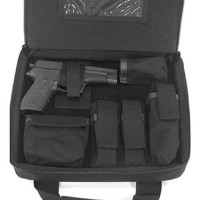
Looking for a tough, discrete tactical pistol case that will hold everything you need? Blackhawk’s SOCOM tactical pistol case looks like any other soft-sided briefcase, but is built to contain everything you need for your concealed carry or duty pistol. It works perfectly as a range bag, a duty bag or even an emergency “go-bag.” Just load this tactical gun case up and keep it handy.
Made to the same high standards as other Blackhawk products, the interior pouches include: universal holster and barrel pouch, silencer pouch, adjustable double mag pouch, and a universal tactical light pouch.
TalonFlex plastic inserts on top and bottom for case stiffness
All Pouches are fully modular for custom configuration
Full wrap around heavy-duty handles
.375″ closed cell foam for weapon potection
Heavy-duty #9 YKK zippers and dual slides
Click here to order the SOCOM pistol case for 20% off retail from GunDigestStore.com.
Gun Digest is the source for firearms news, pricing and guns for sale. With a subscription to Gun Digest, readers benefit from in-depth editorial expert advice, show reviews, how-to instructions and Second Amendment issues.
I’m a firm believer there is nothing fun about being outside in really oppressive heat. Over the Independence Day holiday I spent several fun-filled hours with sweat running down the inside of my body armor and my duty belt digging into my hips…but I digress. As far as concealed carry goes, hot weather is a pretty big challenge. Still, you have some options. First and foremost, you might want to switch to a smaller gun. I know, I’ve told people time and time again: Same gun, same place, every time. But maybe you could adopt a summer uniform. While I typically carry a Glock 22, my summer pistol is a Kel-tec P-11. That little pistol is just easier to hide and some of the newer IWB holsters make concealed carry (with any sized pistol really) so much easier.
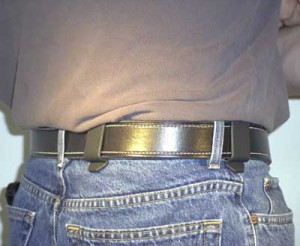
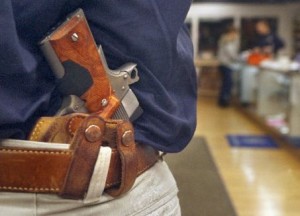
An IWB holster is perfect for summer concealment.
Here are a couple things to remember about concealed carry in the heat. Go untucked if you can. A Hawaiian shirt of appropriate length is a great cover garment for a concealed pistol in an IWB holster. If you must tuck in a shirt, get a tuckable
When the IWB is tucked properly, the pistol disappears.
IWB holster and move in front of a mirror to make sure you have good coverage. One more hint is to put something between the grip and your body. Wear an undershirt or get a holster with a panel that keeps the gun away from your skin. I learned that the hard way with my little Kel-tec after I stippled the polymer frame. That great gripping surface I created suddenly felt like sandpaper against my skin. And the reality is I will be carrying that gun more often than I will be shooting it, so it needs to be comfortable to carry. I “adjusted” the stippling and got a holster I like… things are much better now.
Another think to think about with IWB carry is the size of your waistband. Remember, even a slim gun tucked inside the waistband will add some inches. So, if you usually wear a 36-inch waist, buy 38s to make sure you are comfortable carrying your .38. And, as always, wear a good belt. A regular dress belt will not support your pistol and a simple woven cotton summer belt is even worse. Look for a reinforced belt to keep your pistol in place.
So, before you go armed this summer, think ahead and get your kit in order.
Other great books for those who carry concealed handguns:
In the 10 Steps for a Disaster Plan You Can Make Right Now article, the final tip advised to consider people with special needs. Many may think of people with mobility impairments, but that’s not always true. Here are five kinds of people who need extra considerations in a home disaster plan and survival kit, as written by Pat McHugh.
Home disaster plans and survival kits should take extra considerations for these five kinds of people.
1) Hearing impaired may need to make special arrangements to receive a warning.
2) Households with a single working parent may need help from others both in planning for disasters and during an emergency.
3) Non-English speaking people may need assistance planning for and responding to emergencies. Community and cultural groups may be able to help keep these populations informed.
4) People without vehicles may need to make arrangements for transportation.
5) People with special dietary needs should have an adequate emergency food supply.
Check out Build the Perfect Survival Kit. It offer tips for customizing survival kits to individual situations. Because there’s no such thing as a one-size-fits-all survival kit.
As this video from MyFoxDC.com shows, disasters inflict an emotional toll on those who survive them. It’s one thing to experience a power outage after a devastating storm. It’s another to wait through extreme heat for electricity to be restored. Nerves will be fried.
It’s not a surprise that the Washington, D.C.-area man in this video vented frustrations onto the news crew. The stress of the situation got to him.
Preppers spend time and money accumulating materials for survival situations. What about emotional preparedness? How will preppers and their families manage stress?
It’s a consideration that isn’t as easy as saying, “Buy product XYZ.” As with concealed carry, another topic Gun Digest covers, no amount of gear can prepare one for the actual emotionally charged event.
What may help is getting in touch with the spiritual side of things. Some may find comfort in a Bible, Torah or Koran tucked into a survival kit. Others could reach out to neighbors beforehand to curb stress post-disaster. Building a feeling of community can pay off when people need to come together. For adults, stress management may even mean a flask of the good stuff next to those MREs.
However one chooses to do it, stress management is as important as anything in a bug-out bag or survival kit. People under stress tend to eat more or less than usual, causing any number of effects on food supplies. Their vitals, such as blood pressure, may also be affected. This can cause havoc on those with strict medical orders.
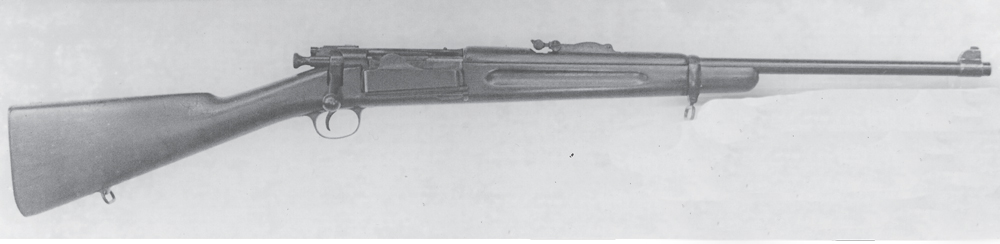
The last Krag variant - the NRA-DCM 22-inch barreled carbine, which turned out to be an ideal size for hunters.
The Krag-Jorgensen .30-40 is a historically significant rifle in that it transitioned the U.S. military from black powder to smokeless. It started looking at it in 1878, a scant two years after the defeat of General George Custer at Little Bighorn. By 1892, the Krag had officially been adopted by modern militaries and put into production.
In The Last Krag, a feature article appearing in the 2013 edition of Gun Digest, John Malloy looks at the final variant of this important military gun, the NRA-DCM 22-inch barreled carbine.
But if you’re not familiar with the Krag-Jorgensen, here are 5 interesting facts that make it a no-brainer for the military gun collector.
The First High-Velocity Small-Bore
As Malloy points out, “The Krag-Jorgensen rifle, often simply called the ‘Krag,’ had an interesting place in our nation’s history,” he writes.
“It was the first U.S. high-velocity smallbore rifle … The cartridge was an American design. The rimmed, bottleneck cartridge case was a bit over 2¼ inches long. It used a .30-caliber 220-grain round-nose jacketed bullet in its ½-inch-long case neck. Forty grains of a new smokeless powder pushed the bullet to a velocity of about 2,000 fps. It was known variously as the .30 Government, .30 Army, .30 USA, or, more commonly later, as the .30-40 Krag. It was a good cartridge, one that would stand the test of time. It proved effective in military use and became a favorite of American big-game hunters.”
The First Smokeless U.S. Military Rifle
“[The Krag] was also the first American smokeless powder military magazine rifle,” he notes. “European countries had been rapidly converting from blackpowder big-bores to smallbore smokeless powder military rifles, since 1886. In that year, the introduction of the 8mm French Lebel was shaking the military world.”
Since the U.S. was still hung up on the blackpowder .45-70 single-shot Trapdoor Springfield — while the French, Germans and Russians were developing high-velocity repeaters — “U.S. military planners realized they must modernize the issued rifle of the soldier, and so they did, adopting a new, high-velocity .30-caliber cartridge and a fast-operating repeating rifle.”
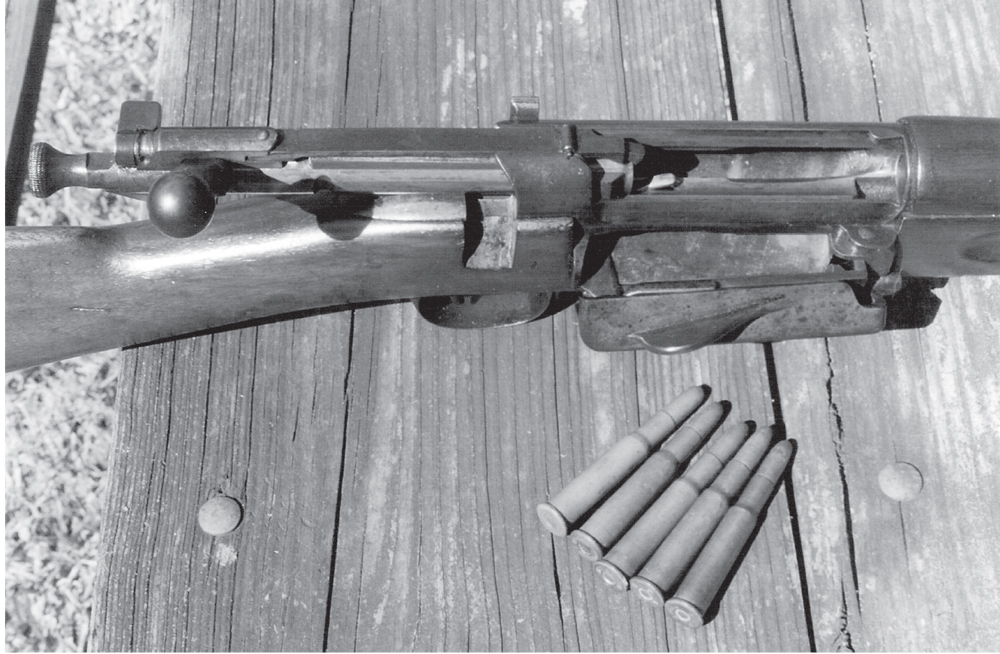
The unique Krag magazine, shown here with the right-side cover open, held five cartridges. The American Krag used the .30-40 Krag cartridge, and five original military cartridges are shown near the rifle. The Krag magazine could be loaded with the bolt either open or closed.
A Most Unique Mag Arrangement
The Krag’s mag was really something to write home about:
“This new bolt-action rifle had a unique magazine. The cartridges were fed in from the right, passed horizontally in a passageway under the bolt, and came up on the left side of the receiver. At that point, the bolt could push a cartridge forward into the chamber. To insert the cartridges into the magazine, a special hinged mechanism on the right side was opened, and cartridges could be dropped into the cavity of the magazine. When the mechanism was closed, a spring-loaded follower arrangement pushed the cartridges into line and fed them across to the left, then up into the path of the bolt.”
A Silky-Smooth Action
“The design of the bolt and its locking system, while not the strongest, made the Krag one of the smoothest bolt-action rifles ever produced — some would say the smoothest,” wrote Malloy. “The Krag bolt has only one actual locking lug, but it has a long guide bar on the bolt that contributes to its glass-smooth operation.”
Used By Roosevelt’s Rough Riders
“[T]he Spanish-American War was a war waged over Cuba. Cuba meant San Juan Hill, and San Juan Hill meant the Rough Riders and their Krags; of course, it was not that simple, but the Krags, both the carbines in the hands of Roosevelt’s Rough Riders and the long rifles in the hands of the regular Army, performed well.”
Gun Digest the Magazine, Gun Digest Books, GunDigest.com, GunDigestStore.com, Modern Shooter magazine and Modern Shooter TV (coming soon!) are all built upon the 70+ years the Gun Digest brand has delivered the best firearms resources and products. Now you can harness that same legacy by becoming a Gun Digest Affiliate.
Editor’s note: Ohio-based author Scott Wagner recently experienced a power outage from the powerful storms that have swept across America in recent days. Here is his journal during the blackout.
I am writing this post on laptop battery power by the light of a propane lamp. This past Friday, as many of you also personally experienced, the eastern states were hit by a sudden and powerful group of thunderstorms propelled by straight-line winds (known as a derecho). Straight-line winds are akin to a tornado without the rotation, and the main difference in a straight-line wind event is that large and small debris isn’t sucked up into a vortex and deposited elsewhere as in a tornado and the swath of destruction is much larger. The straight-line winds in this storm were clocked at 90 mph leaving power lines down everywhere.
There are hundreds of thousands of people without power in day three and 22 dead across multiple states. There is not a generator to be found as far as I can search on the Internet, which I did at my in-laws home, since they had power. Today is July 1st. In my area, we may not have power back on in until July 8th.
I was prepared for something like this, but not prepared enough. My weapons status was fine. An AR-15 or M1A1 Paratrooper carbine was in the car; depending on which one I drove, as was an ample ammo supply. I upgraded my “on-the-body gun” from my Smith and Wesson 642 .38 to my Beretta 92 9mm in a fanny pack, just in case since the basic necessities such as gasoline, ice and in some locales, food, were getting hard to come by.
I had my lighting needs taken care of. I have three rechargeable heavy-duty flashlights, a Streamlight SL20, a Streamlight LED Polystinger, and a 5.11 Light for Life light that contains a capacitor instead of a battery and recharges fully in 90 seconds. When they get low, I just pop them on a car charger.
In addition, I have a new Maglite 3-cell LED flashlight that is rated at 131 lumens and runs on common D batteries (although in my area, those aren’t so common now), with an Intelligent Energy Source Management run time of an incredible 79 hours with progressively descending brightness. There is something to be said for good old-fashioned D-cell alkaline batteries combined with modern technology.
In addition I have an assortment of tactical lights, oil lamps, and a double-mantle propane lamp. There is also an emergency supply of food on hand for up to a week for both my wife and I, and a propane camp stove for other cooking needs.
As the event unfolded, I realized I had a large gap in my basic plans (this blog is about weapons for defending oneself in these times, not the entire preparation gamut, so I am not ashamed to admit where I made mistakes on the rest of the plan) that I needed to address.
We have a well at our house with three pressure tanks, to allow the water to keep flowing in outages. I stored 30 gallons of treated water in the basement for general use including flushing toilets. The faucets and toilets worked from Friday night until Sunday. In years past it was no big deal. But, I will be 55 in August. When the faucets stopped, I reached and exceeded my fun threshold. I am getting a generator once they become available again. I put it off since we are trying to sell our house. Big mistake.
Further, while my wife is more of a tomboy than anything else, she doesn’t like this new “no running water” aspect of country living. A portable LP generator is in our future and the wife is all for it now.
Fortunately, this dress rehearsal came without civil disorder. Use any dress rehearsal to sharpen your game and make ready. Be honest with yourself. Find the chinks in your armor and fix them. Long-term disaster preparation is new to most folks. The last time people prepared at anywhere near this level was in the days of the Cuban missile crisis. This storm was a minor event. Once the electricity comes back on, things will be back to normal. Learn from minor events, because a major event won’t be so forgiving.
Martin Young, a 67-year-old antique gun collector in England, is battling Oxford city council to have his 350 guns returned and his gun license renewed. He has 30 days to arrange for the guns to be moved or the police will auction them off. Mr. Young believes that his collection might be one of the biggest in the country. Some of the guns date back to the 18th century. To make matters worse, the police have devalued the guns and believe they are worth around £65,000 ($101,116) but Mr. Young says they are worth £350,000 ($544,740). Quite a difference.
Martin Young from the Oxford Times
“We are not talking peanuts. It’s a life’s work,” said Mr. Young to the Oxford Times.
Mr. Young’s gun license was revoked in 2008 when he made an inappropriate comment over the phone to a council member: “I am armed, blood will be spilt.”
Not a nice thing to say to a public official but not all that threatening, either. Read the full article to understand the context in which the statement was made.
He is also fighting with city council to appeal their decision to block him from developing his real estate property.
Could the seizure of the gun collection be a petty retaliation by the Oxford city council?
As it turns out, Mr. Young is the reason why the Oxford city council has an embarrassing criminal record. They are responsible for illegally crushing Mr. Young’s car that was legally parked on private land in 2007. It was the first time the council was convicted of a criminal offense. Mr. Young won the case and was reimbursed for his troubles.
“The money I have received will be to pay my lawyers’ fees, none of it benefits me. I wanted to make this point essentially for the public benefit – as well as giving the council a dose of what it had given me – and to disabuse the council officers of their general attitude that they are always right and we ‘peasants’ must do as we are told, and without complaint,” he said.
With an American attitude like that, it’s no surprise Mr. Young has problems with British authorities.
Hopefully the guns that took him a lifetime to collect are returned to him and not unfairly sold at a fraction of their value.
If you ever end up in a serious dispute about gun values like Mr. Young, you better have some literature to prove their value. Gun Digest’s Standard Catalog of Firearms is the authoritative source for figuring out how much your guns may be worth.
At the recent 2012 Roger Maris Celebrity Golf Tournament in Fargo, North Dakota, Anthony Imperato, president of Henry Repeating Arms, presented a $61,000 donation to the Roger Maris Cancer Center.
“Because of the proximity to Yankee Stadium [to the Henry facility] many of the Henry Repeating Arms staff are great fans of the accomplishments of Roger Maris,” said Imperato. “We are proud to produce this special tribute to honor his achievement and to recognize him as the great gentleman and sportsman that he was. We are also delighted that this special edition Golden Boy will support the Roger Maris Cancer Center.”
An active participant in the tournament auction since 2006, Henry Repeating Arms auctioned 50 limited edition rifles last year in honor of the 50th anniversary of Maris breaking Babe Ruth’s record with 61 home runs in 1961. The special auction raised $43,000, and the company contributed an additional $18,000 for a $61,000 gift.
“Henry Repeating Arms has been a great supporter of the Roger Maris Tournament for the past number of years,” said Jerry Rostad, auction chairman. “Their beautiful rifles have consistently been the marquee items at the auction and they always bring top dollar to the tournament’s charities.”
In 1985, Roger Maris died of Hodgkin’s lymphoma, a cancer of the lymph tissue.
Gun Digest is the source for firearms news, pricing and guns for sale. With a subscription to Gun Digest, readers benefit from in-depth editorial expert advice, show reviews, how-to instructions and Second Amendment issues.
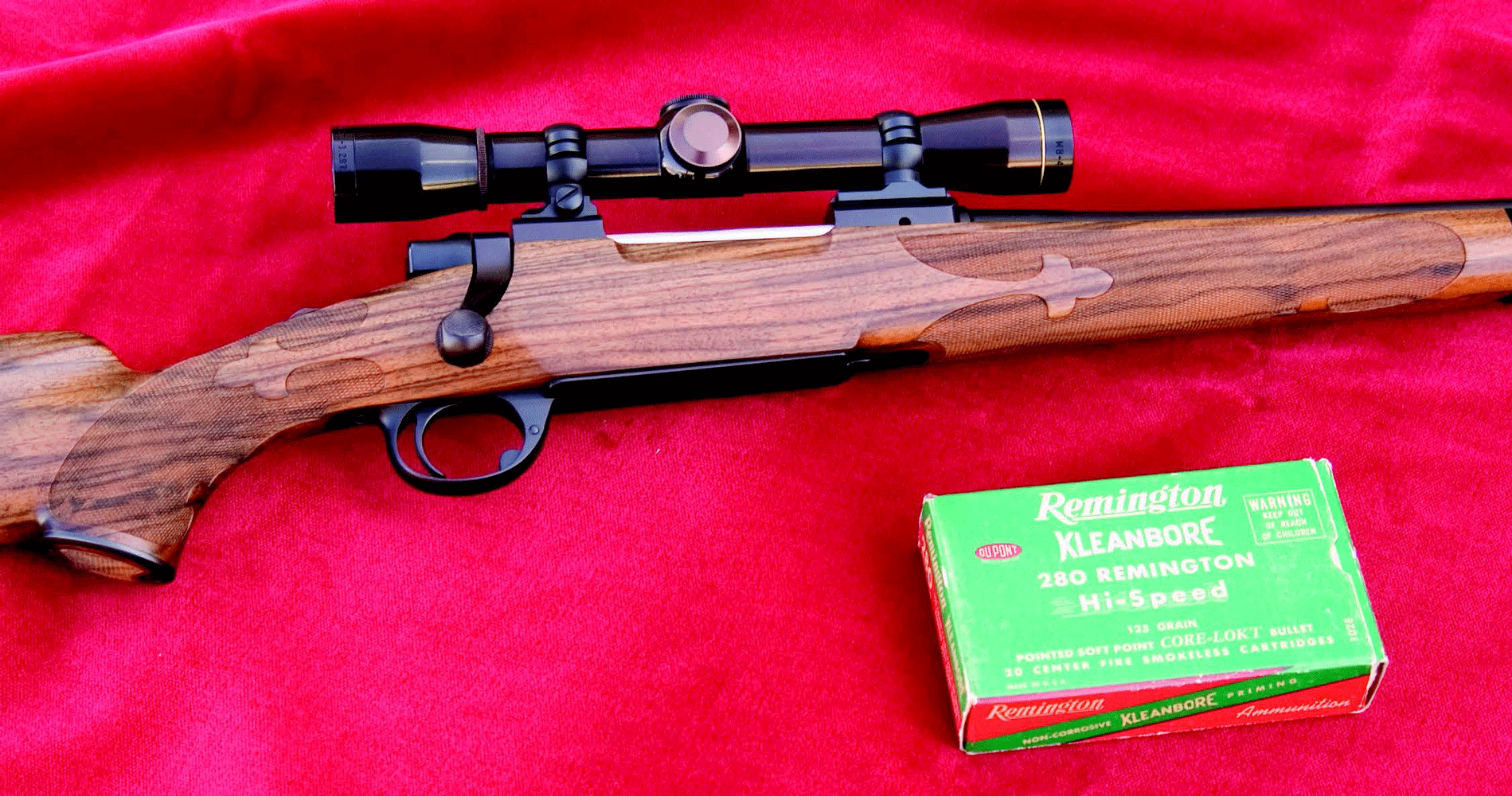
Jack O’Connor’s Custom Ruger M77 in .280 Remington.
I love to find old hook-and-bullet magazines, the older the better, and read the old-school gun writers. I like the grainy black-and-white photos shot in the field. I like the horn-rimmed glasses, canvas shooting jackets and the Jones hats they wear. Some of these writers have penned stories for Gun Digest over the years. Terry Weiland, shooting editor at Gray’s Sporting Journal, curated some these writings for Classic Sporting Rifles, a collection that is a “who’s who” of gun writers from the twentieth century. And such a collection would be incomplete without something by Jack O’Connor. His 1958 article that is included in the book, “The Sheep Rifle,” makes an argument about what kind of shots are actually taken while pursuing sheep (shorter than you think) and what rifles are suited for the job.
O’Connor writes in the opening paragraph, “Lads who have never hunted mountain sheep but who would like to do so almost always imagine themselves shooting at rams far across great empty basins above timberline or lying down, taking deliberate aim from one peak and knocking a bighorn off another.”
He continues, “This sheep-and-hunter picture, by the way, is, along with the leaping marlin and the charging African lion, one of the favorite cliches among cover paintings for outdoor magazines.”
O’Connor is known for being a strong advocate for the .270 Winchester but the last custom rifle he owned was a .280 Remington Ruger M77.
In the soon-to-be released 67th edition of the 2013 Gun Digest annual, Tom Turpin, author of Custom Rifles: Mastery of Wood and Metal, delves into how the writings of Jack O’Connor influenced his life and love for custom rifles:
“As a youngster, I devoured every copy of Outdoor Life magazine I could find. In my old hometown in rural Kentucky, copies of Outdoor Life were hard to come by, but I managed to find one now and again. While I did read an occasional yarn by other writers, it was the prose of Jack O’Connor I lusted for. I don’t think his writing influenced me to become the avid hunter that I am—that basic instinct was apparently already embedded in my genes. He did, however, influence my preferences in rifles and their stock designs. Through his writings, O’Connor also motivated me to try the .270 Winchester cartridge, which became my favorite hunting round. Even today, so many years later, it still is—and for good reason.”
Through networking and some historical research, Turpin comes across a letter from the Al Biesen, the rifle maker, noting what work was done on the .280 custom rifle:
“Stock French walnut in a nice grained contrasty piece not so elaborate with Deluxe Fleur-de-lis checkering, ebony forend tip, skeleton grip cap and skeleton butt plate. Old Win. Style swivel studs. Metal work Barrel was recontoured to light weight dimensions. Trigger guard hand made Blackburn style one piece model etc. Bolt handle knob hand checkered in four panel design, trimmed for style and shape. Trigger reworked and tightened with a nice let off. Action trued and hand polished, hand finished inside and polished for smooth working etc. Bolt jeweled. Special scope rings and mounts hand made to lighten them. Leupold 4 power scope. All metal parts blued with a Black Velvet non glare finish. Front swivel stud on barrel. Safety reworked and a Silver letter “S” ahead of safety showing safe position. Al Biesen Gunmaker Spokane Wn And Rem. 280 in Silver on the barrel.” [Sic]
It’s an interesting story of a gun writer and his relationship with a gunsmith and the masterpiece rifles they envisioned and created.
O’Connor passed away before he could see the finished firearm and Turpin ends with this anecdote: “Biesen related to me that, at the funeral, he intended to drop a couple of .270 cartridges in O’Connor’s casket so that, whichever direction he went, he’d have some ammunition. Thankfully, shortly before he did so, he learned that O’Connor was to be cremated! ‘Not wanting to send the old boy out with a bang, I didn’t follow through,’ Biesen told me.”
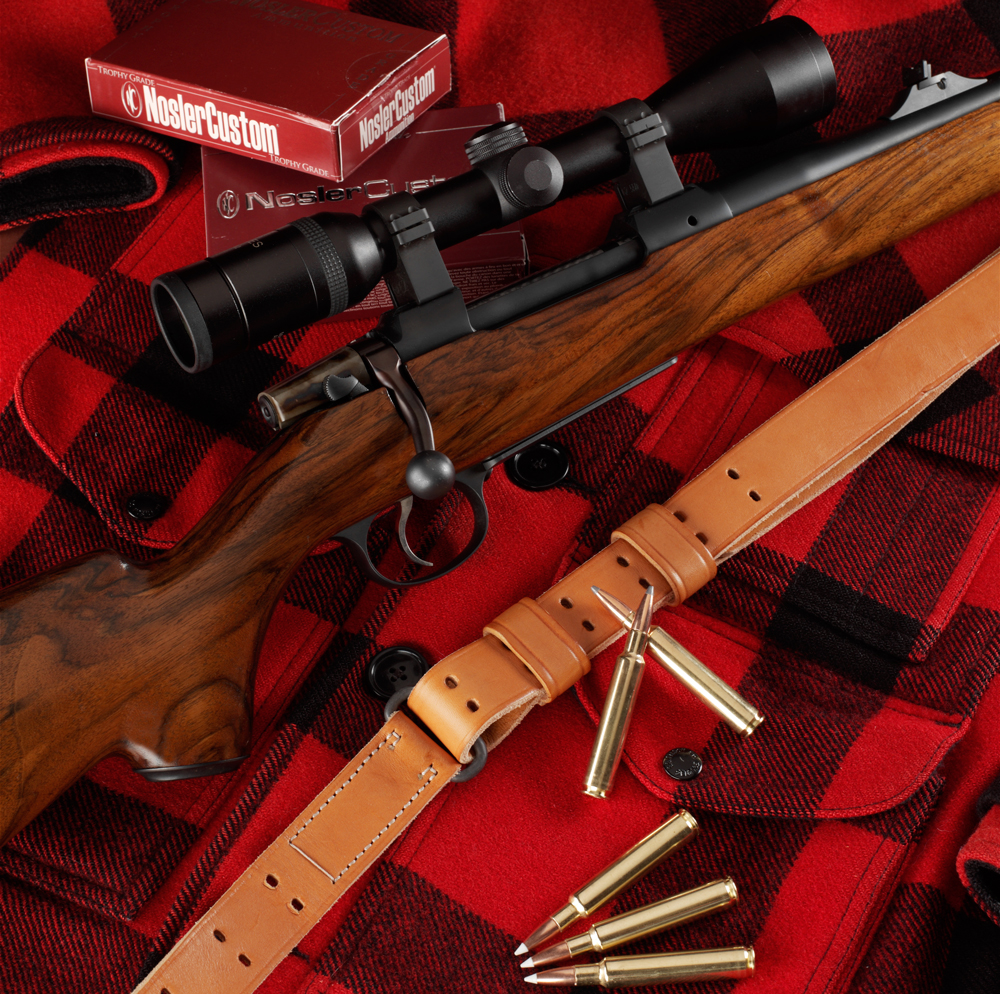
The author’s custom-made .280 Ackley Improved was built on the CZ-550 action, fitted with a Montana Rifleman barrel and decked out with a nice, heavy piece of English walnut. The barrel band swivel was intended to give it a European “safari-style” flair.
As far as deer cartridges go, the .280 Ackley Improved (AI) is not as well known as the time-honored .30-06, but perhaps it should be. It gives the 7mm Remington Magnum a run for its money, yet burns less powder, recoils less, yields theoretically longer barrel and case life and is generally much nicer to shoot.
The .280 Ackley — named after noted gun writer, gunsmith and wildcatter Parker Otto Ackley (1903-1989) — could be described as a mild-mannered deer cartridge with surprisingly hot performance. In the 1996 edition of Gun Digest, author Rob Lucas compared it to one of the hottest 7mm wildcats of the day, the 7mm STW.
“Ask yourself if 3500 fps (sometimes) with a 140-grain bullet in a necked-down 8mm Remington belted case is all that much better than 3300 fps from the ’06-sized 280 Remington Improved,’” he wrote.
Improved Cartridges Explained
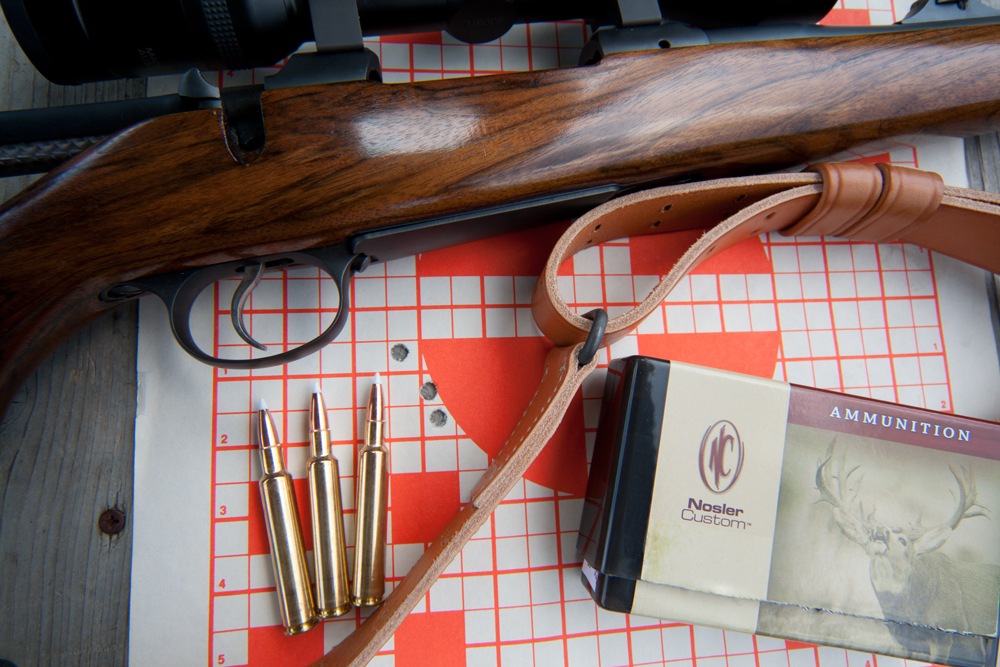
One of the better groups shot from the author’s custom .280 AI. The Nosler Custom 140 gr. AccuBond outshot reloads in the accuracy department.
Improved cartridges are commonly associated with the wildcat family. They start off as standard numbers — in this case the .280 Remington — and are shot in an improved gun. Pressure fireforms the case to the shape and dimensions of the improved chamber.
P.O. Ackley himself noted that the 280 Remington factory cartridge was a very good round. It was essentially a .30-06 necked down to .284, or 7mm. Based on the 7mm-06 wildcat, some have even argued it to be more versatile than the .270 Winchester.
An improved cartridge gives you a few advantages: You can load the cartridge hotter than its pre-fireformed state for increased velocity.
It minimizes body taper, creating a sharper 40-degree shoulder angle and pushing case capacity closer to its efficient limit.
The increase in case volume allows you to load more propellant for a faster, flatter shooting round, but in some cases with significantly less (5-10%) powder than in a comparable magnum. Thus, there is less recoil.
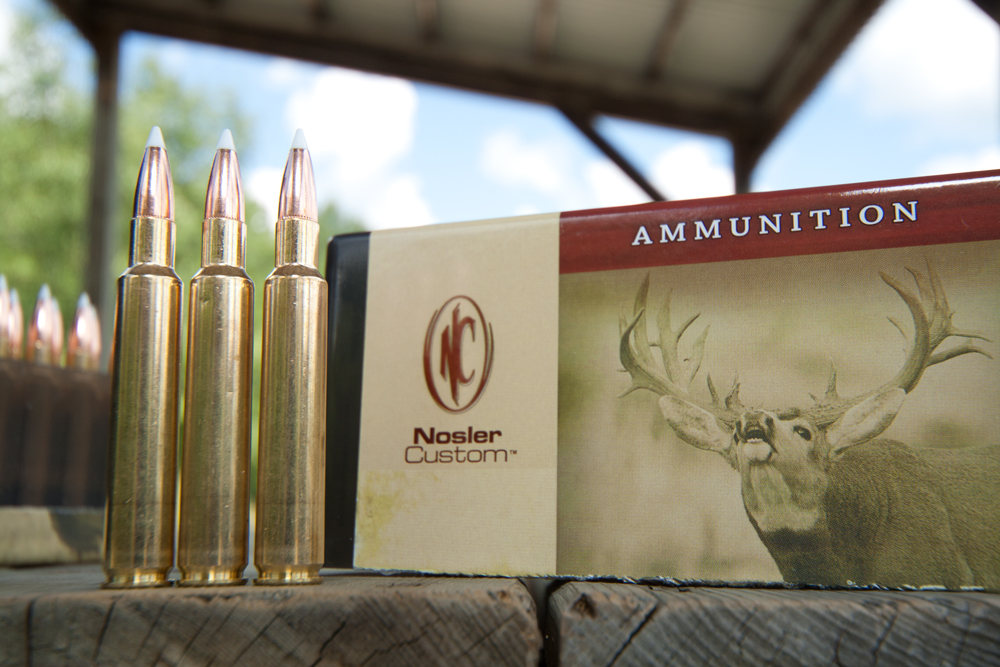
Nosler is one company factory producing .280 Ackley Ammo. The 140-gr. AccuBond ammunition from Nosler Custom is a superb performer.
Ackley did not take kindly to magnums. He viewed them as an exercise in the law of diminishing returns. He understood extra powder in a given bore capacity relative to case capacity negatively impacted case and barrel life. It didn’t really help cartridge efficiency.
By contrast, my .280 Ackley is downright pleasant to shoot. Pushing a 140 gr. Spitzer at around 3100 fps, it sends a projectile as flat as you could want in a 7mm deer rifle.
For whitetails, I feed her with Nosler’s excellent 140 gr. Accubond, one of the few factory-loaded choices out there in .280 Ackley Improved.
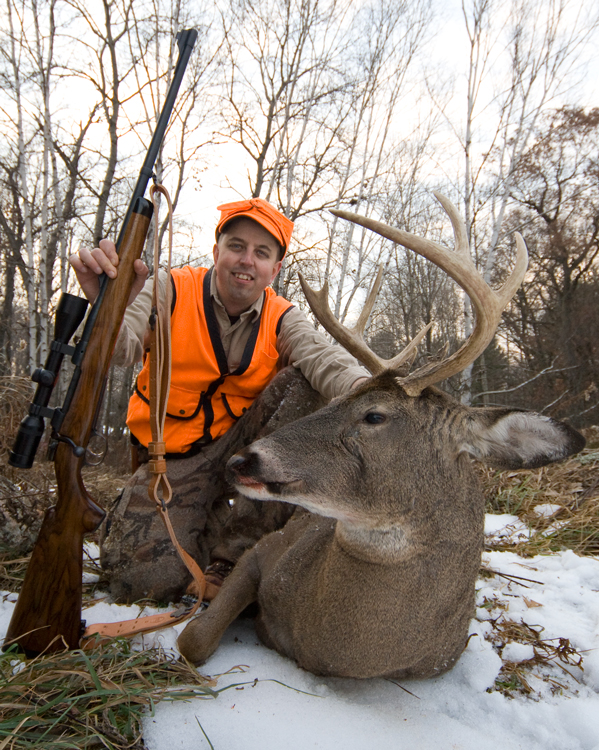
I used it to put down my best rifle-killed buck ever at 175 yards — a rather long poke by central Wisconsin woodland standards.
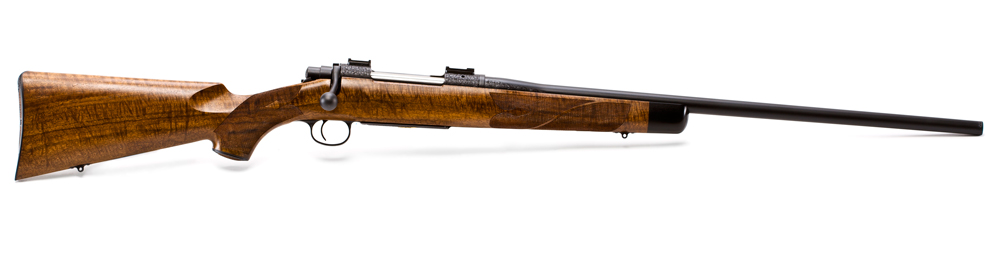
The Cooper Model 52C Custom Classic is available in .280 Ackley Improved.
The .280 Ackley Goes Mainstream
Nosler is factory producing two offerings in their Custom Line of ammunition. One is the aforementioned 140 grain AccuBond and the other a 150 grain E-Tip. In testing the Accubond, it was among the most accurate ammunition I have ever shot in my custom rifle — better than reloads. Nosler also factory produces both a 140 gr. and 160 gr. cartridge in .280 AI from their Trophy Grade line, using the Accubond and Partition bullets respectively.
The author took this Wisconsin whitetail using his .280 AI custom rifle, shooting Nosler Custom ammunition, the 140 gr. Accubond .280 Ackley factory-loaded ammunition.
For handloaders, Hornady, Lee Precision, Redding and RCBS all offer dies for the cartridge. L.E. Wilson, makers of case trimmers, offer a case holder and neck trimming die specifically designed to accommodate the .280 Ackley’s 40-degree shoulder.
You can even get 40-degree shoulder brass from Norma in .280 AI, eliminating the need for initial fireforming. There are no shortages of recipes, either, with both Sierra and Nosler publishing reloading data in their current manuals.
The cartridge is featured in the 12th Edition of Cartridges of the World.
In 2007, Nosler showed up with the Nosler Custom Rifle chambered in .280 Ackley Improved. And for the more budget-minded, Kimber’s Model 84L Classic Select Grade and Montana are both available in .280 AI and are excellent guns.
Conclusion
The .280 Ackley is an improvement over a standard 280 Remington, and that’s not easy to do. It’s a hot cartridge — as good as any hard-kicking over-bore capacity magnum in similar calibers — but without the harsh recoil.
When it’s time to head to the deer stand, I could grab a .30-06 or .243. But why? The .280 Ackley Improved was in Ackley’s day, and remains today, a better choice. Next deer season give it a try, and see if you don’t agree.
Editor’s note, this article originally appeared in the Gun Digest 2013 annual book.
Video: Ham radio operator Matt, K0MOS activates a portable, emergency communications ham radio station atop Mount McConnell in Colorado. He demonstrates the ease with which amateur radio contacts are made with stations as far away as Wisconsin and Arkansas.
A 5:15 a.m. phone call Sunday asked amateur radio operator Randy Long to find more volunteers to aid communication in the High Park fire zone — and warned him to evacuate his home.
Long, an Amateur Radio Emergency Service coordinator for Larimer and Weld counties, fled his house southeast of Buckhorn Mountain and started rallying more licensed ham operators to work the fire.
Since Saturday, he has been managing operators staffing eight-hour shifts around the clock. They’re doing such things as setting up portable radio repeaters and relaying messages between the fire lines and command posts. About 40 operators have volunteered.
To assist in the Colorado wildfire, the volunteer radio operators reportedly set up over 50 portable repeater stations in the mountainous regions and surrounding population areas to keep communications going.
An amateur radio repeater is a self-sufficient, automated station which receives transmissions on one frequency and retransmits them on another frequency at higher power. It allows “weak signal” stations to be heard over large areas, making them ideal for emergency communications.
The amateur radio operators are assisting agencies like the Red Cross, FEMA and local and state law enforcement by passing logistical traffic such as supplies needed, ground reports, and other critical data for emergency responders over the wildfire area.
As we approach the Independence Day holiday it my be more important than ever to exercise your CCW rights.
Most often this space is used to present information about new products, training tips and other important “tangible” CCW issues. I try to avoid political grandstanding. But I’m taking this time to remind you that there remain large and powerful groups of people out there who would happily take our guns. We need to stand up to them.
Carry your concealed handgun anywhere you legally can. Protect your rights by exercising them.
One of the best ways to do this is to be an ambassador for good conduct with a firearm. Yes, I know the news media only reports that bad news, but your friends and neighbors have lots of influence, too. If you show the world that you are a rational, reasonable, gun-owning citizen, you become the person they think of when they hear about CCW issues on the news.
Become an advocate for gun ownership and concealed carry. Talk about it. Talk about it rationally. Let people know that you believe in the right of law-abiding citizens to be able to protect themselves anywhere they go. We never know when a criminal will strike. If we could accurately predict crime, there would be none. You don’t have to tell people when you are carrying, that gives away your tactical advantage. Just let them know you approve of concealed carry laws. Stay calm during the discussion. That really gets liberals cranked up. They typically want a passionate argument based on emotion, not a calm discussion based on the facts. If you remain calm, you prove that you can keep your head.
Finally, during this holiday celebration carry your firearm anywhere you are legally allowed. Check your local laws, then strap up and step out. It is your right. Many people have died defending your rights. Don’t let those rights be eroded.
We’re all in this together.
This is your day. Use your rights or lose them.
Other great books for those who carry concealed handguns:
The Waldo Canyon fires ravaging Colorado will go down as one of the worst in the state’s history. In Colorado Springs alone, an estimated 350 homes have been destroyed by the flames, according to USA Today. Dangerous conditions forced thousands to flee the area.
It’s a dire survival situation. Unlike floods, which tend to follow predictable geographic routes, fires can quickly change course with the wind. Thick smoke can travel miles in minutes, affecting air quality of areas not close to the blaze.
Faced with a total loss of property, a short-term bug-out bag isn’t going to cut it in this situation. Now is the time to follow the full-fledged disaster plan preppers should have already created. This should include the five home survival kit items listed here that most people forget.
Fires like the one in Colorado do afford more time to evacuate, unlike flash floods. But don’t count on taking your sweet time. Develop that disaster plan now.
If you need help, click here for home survival kit ideas from Build the Perfect Survival Kit.
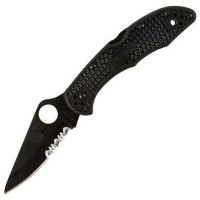
It’s the knife you can’t have in New York! That’s reason enough to own it right there. The Spyderco Delica4 is the latest in an evolutionary trail that dates back to 1990 when Spyderco released the very first Delica.™
The Delica4, like its predecessors, is a lightweight, easy-to-open pocket knife that is big on performance and easy on the budget. The Delica design is one of Spyderco’s top two sellers and the minor tweaks in things like blade steels and ergonomics helped to create a term within Spyderco called simply CQI: constant quality improvement.
The Delica4 had tough nylon grip plates with aggressive texturing. Stainless steel liners serve as a lightweight but super-tough backbone and the blades are ground from VG-10 steel with a design that offers a stronger tip and great cutting ability.
And for those of you who feel the need to keep everything sparkling inside and out, the Delica4 is assembled with screws, making cleaning and adjusting a snap. Of course, the four-way pocket clip allows you carry the knife anyway you like.
All this sharp-edged goodness for less than $65 – you can’t beat it. But if you buy one, you have to move out of New York.
Looking to go armed, but are stuck in the weeds as to what to arm yourself with? Here are 20 of the best concealed carry gun options that will keep you on the defensive.

 Looking for a tough, discrete tactical pistol case that will hold everything you need? Blackhawk’s SOCOM tactical pistol case looks like any other soft-sided briefcase, but is built to contain everything you need for your concealed carry or duty pistol. It works perfectly as a range bag, a duty bag or even an emergency “go-bag.” Just load this tactical gun case up and keep it handy.