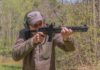
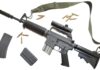
A compact, extended range long gun is the best choice for survival guns on vacation.
For the past 32 years as a cop, I have never traveled on vacation without an off-duty gun. Whether driving or flying to my destination, I always had an off-duty gun with me. In years past, that gun was usually something small and concealable—a Smith and Wesson .38, a Colt Mustang Pocketlite in .380, or a Mini-Glock. About three years ago, in addition to carrying the small gun, I began packing a full-size duty pistol on driving vacations. If I had to fly, I packed just the full-size gun.
I have watched our beloved nation decay at an alarming rate. Recently in Miami, a naked man attacked another man and gnawed off part of his face. Officers shot him. I have reconsidered whether I have enough firepower with me to protect my family and fight my way through throngs of angry, desperate citizens bent on harming me and mine.
I came to three decisions involving vacation travel for my family and myself:
1. I won’t fly anywhere unless it is absolutely necessary for a variety of reasons. While you can check firearms into the baggage compartment, you are limited as to the amount of ammunition you can transport.
2. Taking a long gun on vacation is now required.
3. Additional survival gear is essential. That means food and water, flashlights, first aid kit, and a heavy fixed-blade knife or prying tool. My long gun choices for vacation are different than daily travel guns. Even as a cop, I don’t wish to call a lot of attention to the fact that I may be heavily armed, alarming citizens and having the local authorities called on me. This means instead of taking along a full-size rifle, I need a compact firearm that can be carried in a small, discreet case or in a suitcase, yet be effective from 100-200 yards or more.
An emergency survival kit, like this one, is just as important as a survival gun.
Emergency food and water supplies are also taken along. The very best travel supply is the Food Insurance Essentials kit. Priced at $199.95, this rugged backpack contains three meals per day for two weeks for one person. The pack includes a stove, matches, fuel, water bottle and water filtration kit. The food is very high quality, and Food Insurance has many long-range food plans available for home preparation.
While there are many viable choices for a compact extended range gun, I have selected a few examples that meet the requirements of compactness, reliability, effectiveness and reasonable cost. They are, in no particular order:
1. The FN-P90S. This short PDW is shorter than a collapsed M4 carbine due to its bullpup design. Totally ambidextrous and with a 50-round capacity of 5.7×28 ammo, it is a nearly ideal vacation gun, and can be wielded from inside a vehicle and still deal with threats out to 200 yards. Retail is around $1,600.
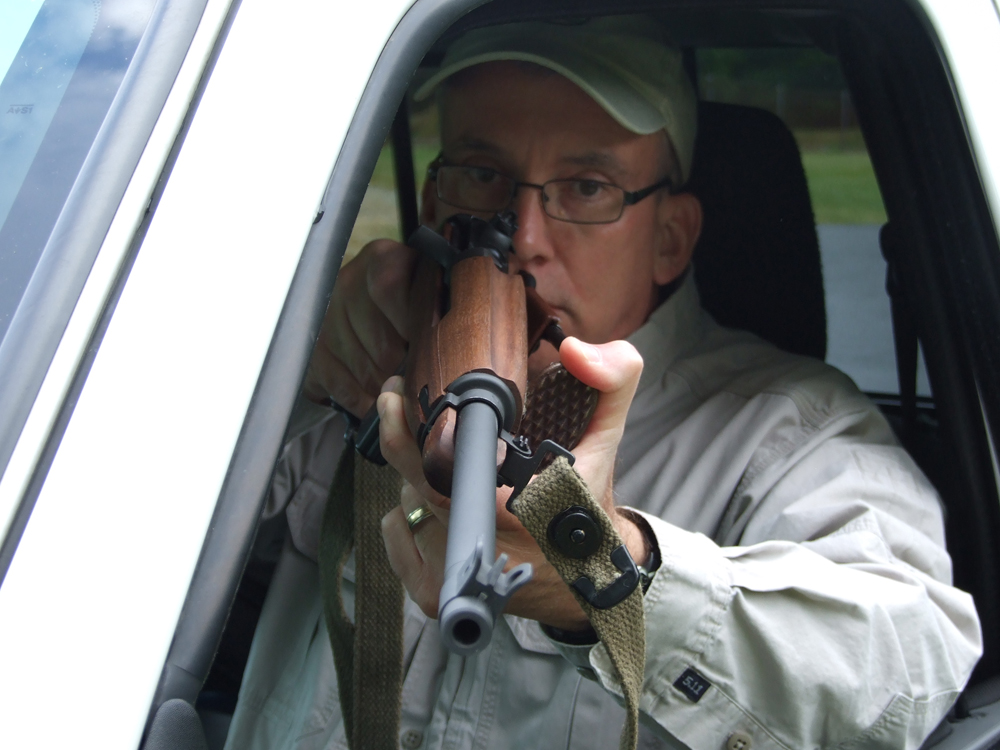
2. Auto-Ordnance .30 caliber M-1A1 Paratrooper Carbine. This great firearm and its full stocked sibling are too often viewed as nostalgia pieces rather than effective combat weapons. The “wire” stock folds easily out of the way, yet still allows the carbine to fire when folded. The low recoil generated by the intermediate power .30 carbine round allows comfortable firing with the stock extended, which is not always the case for folding stock firearms. Our soldiers fought with M1 and M1A1 carbines as primary weapons across Europe and the Pacific theatres in WWII, and again in the Korean War and into Vietnam, with the M2 full auto-version being added to the mix. American law enforcement fielded surplus M1s in years past. The M1A1 can be fired from inside a vehicle with the stock folded, and is effective to 200 yards or better. They are available for around $900.
3. Century Arms International UC-9-A. It is a 16-inch barreled semi-automatic version of the famed UZI submachine gun built from UZI and U.S. manufactured parts. Capable of handling 9mm ball or hollow-point ammo, the UC-9 is as compact as the M1A1 carbine, and comes with four steel 30-round magazines. With the stock extended, hits at 100 yards or greater are easy and recoil is non-existent. Best of all, the UC-9 is reliable and is available for around $837.00
Any of these weapons can be transported in luggage or cases that don’t scream “gun,” and will not draw undue attention when being taken from your vehicle to a hotel room or vice versa. They are military grade and designed for combat use, as opposed to guns that are tricked up to mimic combat weapons.
Just remember to know and follow all gun laws within the jurisdiction you are traveling in (which may mean there are some places in the U.S. that you may want to give up visiting if you are concerned about your safety), and that your traveling companions know how to operate the travel weapon of choice in case you are disabled or otherwise occupied.
Which direction, and how far, are clues. Track them with a new rifle, and if they ever change, you know something is up.
Learn AR-15 disassembly – how to field-strip and completely disassemble your AR and get it all back together again – for routine and advanced cleaning, maintenance and repair.
The basic AR-15 disassembly is field-stripping, where you take the rifle apart well enough to clean it. Cleaning is important. Have you seen the movie Major League? Charlie Sheen (who pitched in college, by the way) is a rocket launcher-armed pitcher who can’t hit the strike zone. He can’t see. He gets glasses, very ugly glasses. The coach remarks “It’s important to see.” One of the other players counters with “It ain’t that important.”
Stripping to clean is that important.
Field Stripping
In order to safety-check and to clean or begin armorers work, you must be able to field-strip the AR. Place the safety on “SAFE.” If there is a magazine present, remove it. Pull the charging handle to the rear and lock the bolt open. The bolt hold-open is the lever on the left side of the upper receiver. Keep the charging handle pulled to the rear.
Either pull the wider, serrated paddle part of the bolt hold-open out from the receiver, or press the smaller, lower portion of the bolt hold-open into the receiver body. Ease the bolt forward. Once it stops, you can release pressure on the bolt hold-open. (If you did not pull the charging handle back far enough, the bolt may appear held open, but will snap forward with any slight vibration. Be careful until you have looked at the bolt.)
Press the charging handle forward until it locks in place. Look into the chamber. Use a light if you need to, as an oxidized brass case, or a steel case, may be so dark that you’ll overlook it except in bright light. If your finger fits, reach in and check the chamber. (The ejection port is small, and not many people have fingers small enough to reach. The only method most can use is to reach up from the magazine well.)
With the chamber verified empty, close the bolt. It is best to build correct habits even while doing administrative tasks on the rifle, so close the bolt by pressing or slapping the hold-open lever. The bolt will crash closed. Stop cringing, that is the way it operates when you fire it, so closing the bolt that way is not abuse.
Press the rear takedown pin from the left to the right. Pull it until it stops at its full movement. The upper will hinge away from the lower. (Be careful to control the upper so it doesn’t swing up and strike you in the face.)
Pull the charging handle halfway back. Then grasp the carrier and pull it back, down and out of the rifle. Place it on the table. Pull the charging handle back until it stops, then pull it down and out. Press the front pivot pin from the left to the right until it stops.
The upper and lower receivers can now be separated.
In the field, or in a range class, this is all you need to do to gain access to the working parts for a quick cleaning. From here, aerosol cleaners and lubricant can clean what needs to be cleaned, lubed and reassembled.
But, since you have it apart right now, let’s do a quick inspection and functions check. After all, if you own an AR, or plan to be doing any work on them, these are things you’ll be doing on a regular basis. Best to learn how right away.
Operational Checklist
An operational checklist is a process whereby you inspect a rifle for proper fit and mechanical function, without firing it. Any fault you covered in an operational check should be corrected before that rifle can be used in a match, practice or for defense. Right now I’m not going to cover the causes and corrections of the faults found, only the process.
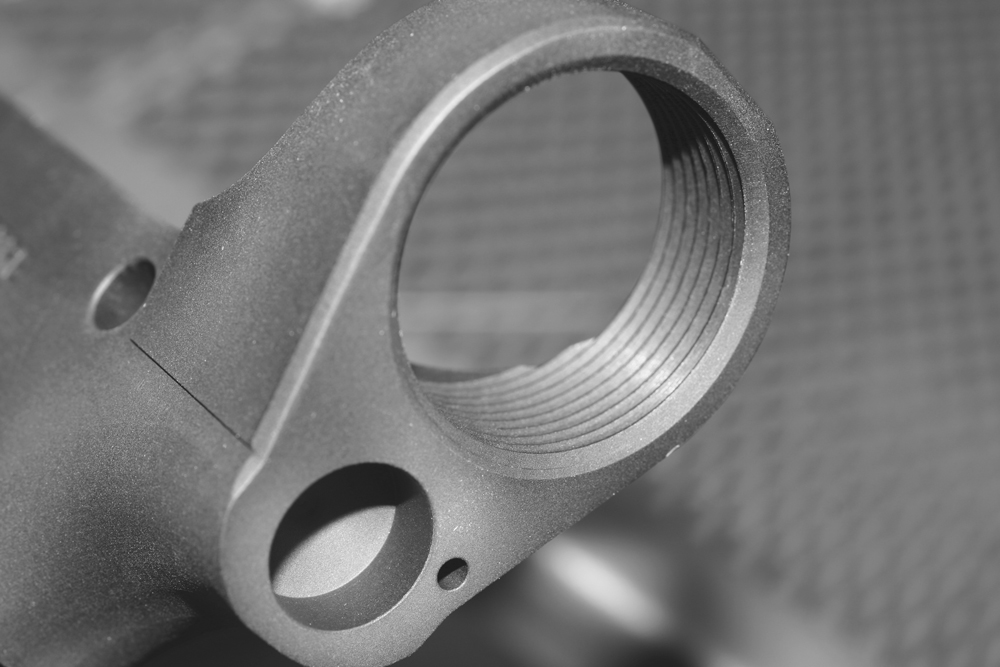
The rear hole is the one where the rear takedown pins plunger and spring go.
Faults uncovered are divided into two groups: those that require immediate correction (or at least correction before use) and faults that can be overlooked in an emergency, where the fault would not impair function sufficient to prevent use as emergency equipment. An example of a fault in the first group would be a rifle lacking sights.
There are very few faults that fall into the latter category, as a rifle as emergency equipment is not like a fire extinguisher that only has 87% of its charge. A fault in the second category would be a stock that is present, but loose. Usually, most faults on firearms are an “all or nothing” situation, especially defensive firearms.
Properly done, an Internals/Selector check takes two minutes, and you should get into the habit of doing this check every time you pick up your AR, or any other firearm, for that matter. I know, I know, you did it last week, and the week before, why do it again? Because since the last time you may have been doing some work on your AR, got interrupted, and left it as-is. Having now forgotten, if you don’t do a check, you may be depending on an inoperative rifle.
Internals Check
We’re already at the field-stripped stage, right? If not, move back up, read and field-strip your rifle.
Inspect the lower.
Make sure the hammer springs are on either side of the trigger pivot, and above the trigger pivot spring. Check to make sure they are intact, and one or both legs are not broken. Look at the hammer and trigger pivot pins, and make sure they are flush to the outside of the lower, and not protruding. A pin that sticks out indicates it is not secured, meaning some spring in there is out of place. Move the selector back and forth from “Safe” to “Fire” (and on to “Auto” or “Burst” if the rifle/carbine in question is a select-fire weapon) and visually inspect the lower to ensure there are no debris, dust, lint, threads from cleaning patches or loose primers present.
Inspect the carrier. Grasp the carrier in one hand and the carrier key in your other hand. Try to move the key. Any movement at all means the rifle must be pulled from service until the key can removed, reinstalled and locked in place.
Inspect the bolt. Are the locking lugs clean and oiled? Any visible chips or cracks in the lugs require the rifle to be pulled from service until the bolt can be replaced. Does the ejector move in and out of the bolt when pressed with a small rod? (It won’t move under finger pressure.) Does the extractor flex when pushed? Too much or too little movement requires service on those parts.
Finally, pull the bolt forward in the carrier, and stand the bolt on its head. If the weight of the carrier causes the bolt to collapse towards the tabletop, the gas rings are worn and must be replaced.
Install the bolt back into the rifle and close the action. Close the upper to the lower and press the takedown pins back in place.
Selector Check, SEMI
Lock the bolt back. Inspect the chamber. Once clearly unloaded, press the bolt hold-open lever and allow the bolt to close under its own power. Move the safety to all positions. If it does not move, the problem must be found and corrected.
On the range, it is more important to figure out why your rifle has just malfunctioned than it is to immediately leap into your field drills. “Why’s this happen?” should be your focus in testing.
Press the selector to SAFE. Press the trigger with 10 to 12 pounds of force. The hammer should not fall. If it does, the trigger mechanism is defective, broken or improperly assembled, and the fault must be found and corrected. Release the trigger.
Press the selector to FIRE. If the hammer falls when the selector is moved, but before you press the trigger again, again the mechanism is either defective or improperly assembled and must be corrected. The selector function when on SAFE acts by blocking movement of the trigger. If the hammer falls, the selector did not prevent trigger movement, and when it was moved to FIRE the trigger completed that movement, allowing the hammer to fall.
With the selector on FIRE, press the trigger. The hammer should fall. If it does not, it is obviously not ready for issue, use in a match or for defense and must be corrected. If it does, now hold the trigger back. Grasp the charging handle with your other hand and cycle the bolt. Gently release the trigger.
You should feel it “click” as the hammer resets off the disconnector hook and onto the sear nose of the trigger. If there is no click, open the upper receiver. If the hammer is forward, or still caught on the disconnector, the mechanism is either improperly assembled or the parts mis-timed. Find out why, and correct it.
If the rifle passes the SAFE and FIRE checks, you must then check for disconnector retention during cycling. Cycle the charging handle to cock the hammer. Press the trigger and allow the hammer to fall. Hold the trigger back. Briskly pull back and release the charging handle, allowing the bolt to close under the full power of the buffer spring. Gently and slowly release the trigger.
The hammer should “click” from the disconnector to the trigger sear. If it does not, it must be adjusted. Then leave your finger off the trigger and briskly cycle the charging handle and allow the bolt to crash home at full power. Then dry-fire again. If the hammer has followed the bolt forward, the disconnector is (again) either improperly installed or mis-timed and must be corrected.
All those faults are covered in their own chapters, so read on.
Visual Inspection/Tightness
Inspect the fit of the upper to the lower. While a certain amount of looseness is often customary, and does not hinder proper function, an excessively wobbly fit indicates either serious wear or a dimensional mis-match. Excessively loose upper-to-lower fits can be solved by exchanging uppers until the uppers and lowers you own all fit properly.
I have this discussion often in the law enforcement classes: While “mix-and-match” rifles will almost always function properly, remember that the accuracy of a rifle goes with the upper, not the lower, but the felt trigger pull goes with the lower. A matched upper and lower used in a precision marksmanship role must not have the upper and lower swapped with patrol car issue rifles, or the accuracy and/or trigger pull of the precision marksmanship rifle will be lost.
Inspect the stock for tightness. Solid stocks (A1 and A2) should be immovable. Tele-slider stocks will usually have some wobble in the sliding portion, but the buffer tube itself must be tight. Loose A1/A2 stocks or loose tubes in either rifles or carbines must be corrected.
Inspect the barrel for tightness in the upper receiver. An upper with a loose barrel cannot be accurate, and the cause must be found and corrected.
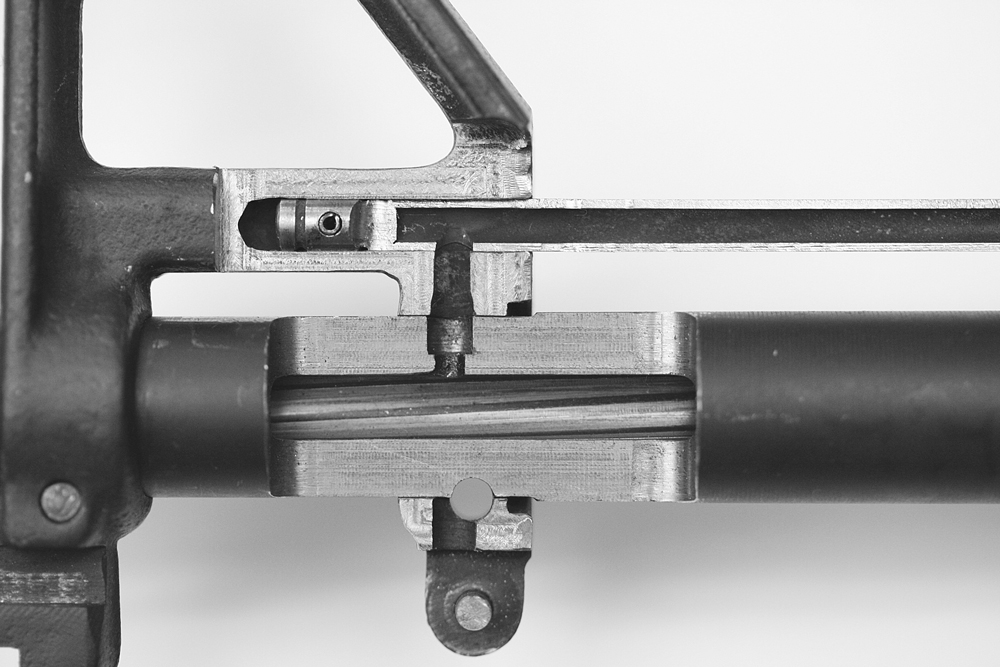
The origins of the gas flow. The gas gets vented out of the barrel, through the front sight housing, and down the tube towards the carrier key.
Inspect the front sight for tightness to the barrel.
Inspect the sights to be sure all parts are present and that any paint markings to indicate zero settings have not been disturbed.
Visually inspect the rifle to see if there are any obvious signs of having been dropped, abused, altered or parts exchanged. Also, check the serial number to ensure it is the weapon being issued and signed for.
Range Analysis
Range analysis differs from the bench checks you’ve done, in that you are firing the rifle.
A range checklist is done to ensure that a particular rifle functions perfectly, is zeroed and that all accessories on it are working within accepted limits. A range test-fire session is performed to ensure that corrections, alterations or repairs have been correctly performed. As an example, a rifle with a worn barrel that does not shoot accurately enough will require a new barrel.
Once installed, the new barrel must be test-fired to ensure that not only does it shoot accurately enough, but also that the sights are zeroed and that the rifle performs with sufficient reliability. (The only acceptable standard is 100%.) A new barrel is not like changing the oil in a car. The replacement must be tested.
Function-testing a rifle on the range is not the same as getting a recalcitrant rifle working in a shooting incident. On the street, getting the rifle working quickly, or safely disposing of it and using another weapon, is paramount. At the range, uncovering the origins of the fault is the prime consideration. (That, and safety.) When a rifle malfunctions on the range in a testing session, your immediate response should be to stop all activity. Inspect the rifle and note the condition of all parts, the locations of all controls, and the position and status of the bolt and carrier.
As an aside, as I was writing this chapter I happened to have a link to a video on the internet sent to me. I watched as some poor guy was firing an AR. He had a problem, yanked the charging handle and pulled the trigger. Nothing happened. So he hammered the forward assist. Nothing happened, so he swapped mags, worked the charging handle and hammered on the forward assist some more.
I thought to myself: “This cannot end well.” Then he pulled the trigger and the rifle disassembled itself. Typically with these events, he was not harmed. But the rifle was trashed.
Even if the zombies were pouring over the wall, his problem-solving process was flawed. If you are in a tough situation you may have to get a rifle working again quickly, but on a target range, any problem means you stop shooting and study the situation.
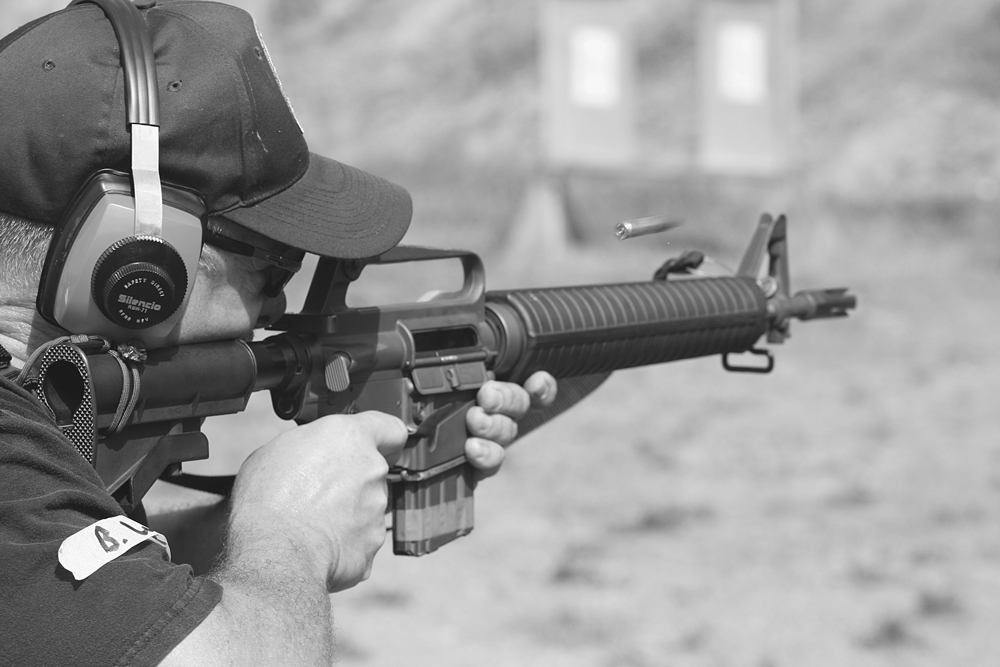
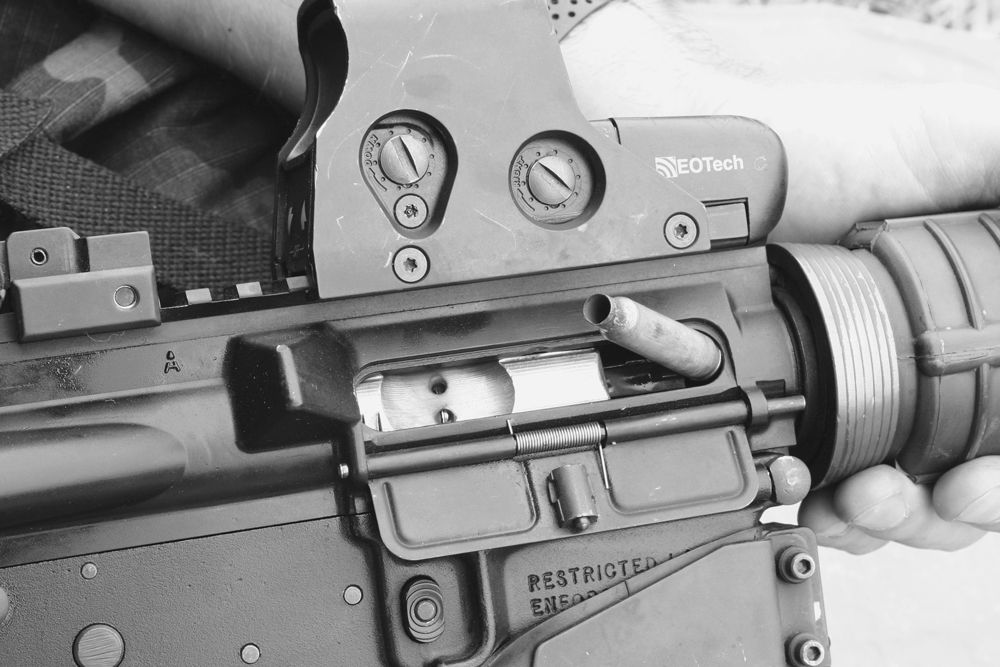
When firing you should note the direction and distance of the empty brass when ejected, as this is important information that can aid the diagnosis.
Officers: In a law enforcement setting, any weapon being “debugged” and serviced should have extensive notes taken on it during the process: ammunition used, to include lot number, firer, magazine type and number if the department gives it one.
Direction and distance of empty brass ejection, location and size of group fired, etc. An attitude that is well-known in the law enforcement and other communities is: “If it wasn’t written down, it didn’t happen.” All testing, changes and procedures used must be documented. For you, the non-sworn reader, that isn’t a career requirement, but the information gained can be very useful.
Cleaned and Reassembled.
Another note: a big-name High Power shooter once wrote that he was checking his shooting log when he realized that his basic zero for long-range shooting on his rifle was now two minutes higher than it had been the season before. While his rifle was still shooting “X” ring accuracy, it clearly had a worn throat. (How is this obvious? When the bullet moves forward, it slows at the impact with the rifling.
That increases pressure, and velocity. His bullets were traveling further forward, getting less of a spike, and thus shorted on velocity. Less velocity meant more clicks up to hit the target at distance.) There was no way of telling how much useful life was left in the barrel, when the barrel would quit and stop shooting accurately. Accurate record-keeping allowed him to change the barrel before accuracy went away.
Most problems can be solved by one of the four problem areas discussed later, and rarely will a rifle need more than attention to the “Big Four”:
Weak extractor spring Lack of lubricant Loose carrier key Faulty magazines
AR-15 Reassembly
The charging handle and carrier-bolt assembly can be installed in the upper before or after you connect the upper and lower receivers with the front take-down pin. If you install them before, insert the charging handle into the upper receiver.
Then press it upwards until it stops against the inside. Move it forward and back in the top track until the retention flanges on the charging handle drop into the access slot cut in the track. Then press the charging handle forward halfway. (If it drops, or tries to drop out, you missed the access slot. Try again.)
Take the carrier-bolt assembly. Make sure the bolt is fully forward by snapping your hand forward while holding tightly onto the carrier. The bolt, if not all the way forward, will slap forward to full extension. Insert the gas key into the charging handle recess and press the carrier forward.
Once it reaches the charging handle, the carrier will push the charging handle ahead of it. Press the carrier and charging handle fully forward, until the charging handle latch catches on the receiver. (There is a slot machined on the receiver for it to latch onto.)
Close the dust cover door. The charging handle latch, and the dust cover door, have enough retention to keep the carrier in the upper against gravity. However, if you have the rear of the upper receiver pointed down and something jars the upper, the catches may not hold. So while you have the upper off the lower, keep the muzzle level or pointed muzzle-down to keep the parts in.
Place the front takedown lug of the upper in between the flanges of the lower, and press the takedown pin from right to left to secure the upper. Then hinge the lower down until it is closed and press the rear pin across.
As one of the most innovative revolvers to be marketed to the American shooter, the Chiappa Rhino revolver fires from the bottom chamber to reduce reset time and recoil.
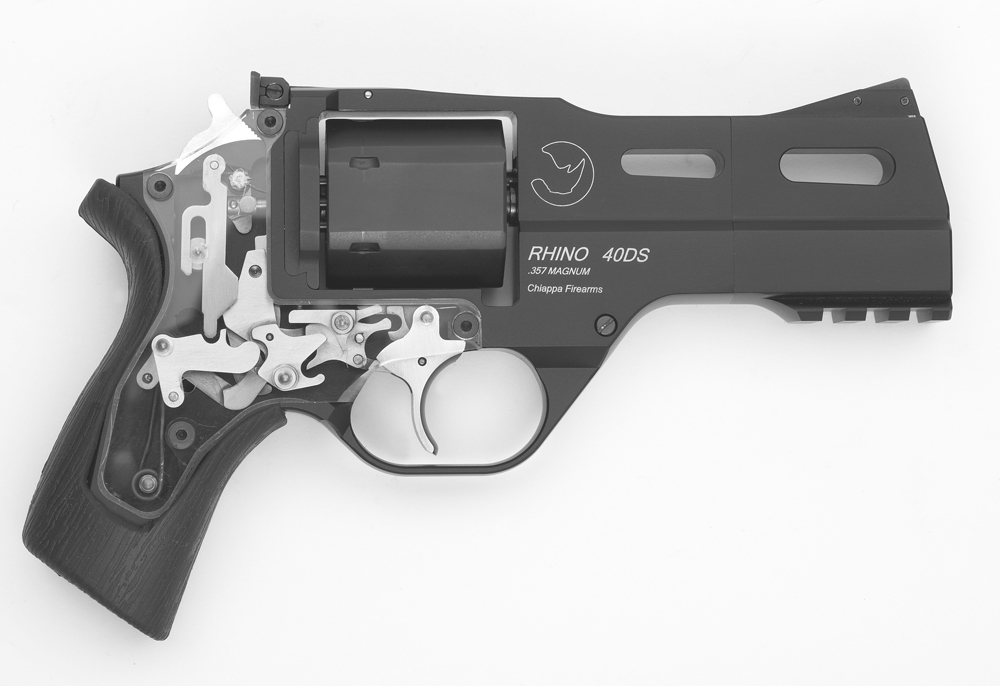
The Chiappa Rhino is the most innovative revolver to be marketed to the American shooter in more than a hundred years. It fires from the bottom chamber of the cylinder instead of the top for a more straight-line recoil that reduces muzzle jump and perceived recoil. Its innovative lockwork gives a 50 percent shorter trigger pull and a faster reset.
It is a major improvement in revolver design. This extends to the layout of the gun as well; the hand rides much higher on this gun than on conventional revolvers. Cowboy Action shooters will appreciate that, because one of the secrets of shooting the Colt Single Action Army was to hold it as high in the grip as possible; only then did it live up to its reputation as a natural pointer.
This also aids in putting the recoil more in line with the arm, instead of having the axis of the recoil above the hand as in a conventional revolver. Thus you don’t have the muzzle flipping up like that of a conventional revolver. The layout of the revolver results in its being 1 1/2 inches shorter in overall length than conventional revolvers with the same barrel length. Its imprint under clothes or in a pocket for the 2-inch barrel model is not as easily recognizable as a handgun as a conventional revolver is.
The Rhino is available in both fixed and adjustable sight versions and in barrel lengths of 2, 4, 5 and 6 inches, so there is something for everyone. Rifling is 6 grooves with a 1:18 3/4 inch twist. Working parts are steel and the frame is made of a high strength aluminum alloy called Ergal.
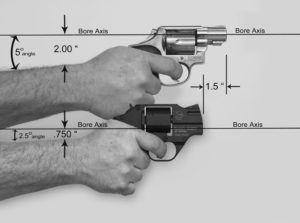
The Rhino’s low bore axis (bottom) results in more controllable recoil than that of a conventional revolver (top).
The mechanism is far different from that of conventional revolvers, as you would expect. Pulling the trigger moves an interlink lever by means of a connecting rod. This lever in turn moves both the hammer and the cylinder rotation pin, compressing a spiral spring through two levers. The interlink lever drives these two levers to push on the two spring ends which then propel the hammer and return the trigger and the rest of the mechanism to rest.
The Rhino’s double action is operated through a mobile hammer sear that cocks the hammer until it is released upon reaching the preset position, similar to the operation of a traditional revolver. The single action requires a different method due to the low position of the hammer. It was necessary to use an external hammer actuator that uses a lever to push the hammer down until it engages the counter-hammer, blocking it in the armed position.
When the trigger is pulled, the hammer is released by the interlink lever which pushes up the counter-hammer and allows the action to fire. If you wish to uncock the gun it is necessary to push down the counter-hammer, pulling the trigger to the end and gently releasing the hammer actuator as you would with a standard revolver.
The Rhino’s cylinder is released by a lever on the left side of the revolver. When pushed down, this lever engages the locking pin in the center of the rotation shaft. A spring makes the locking pin recoil and at the same time pushes back the pin in the breech shield, thus releasing the cylinder. Once the cylinder is released, it can be pushed to the left to allow the loading and unloading of the weapon.
A closer look at the Rhino’s inner workings.
You will encounter a slight resistance when pushing the cylinder to the left as you have to overcome the spring pressure of the second locking system of the cylinder. This consists of a spring loaded detent pin placed in the frame of the gun on the opposite side of the breech shield, which is wedged into a specific seat in the rotation arm of the cylinder. The arm of the cylinder is wedged in a special joint which allows ample space for opening of the cylinder for quick reloading.
Safety is a big part of this revolver’s design. The gun cannot fire without the cylinder being locked in place because if the small piston placed in the center of the rotation shaft of the cylinder is not perfectly seated into its notch in the breech shield, the cylinder opening lever will be in the low position, blocking rotation of the cylinder and stopping the whole mechanism.
The revolver cannot fire if the cylinder chamber in the six o’clock position is not aligned with the barrel. A pin placed on the trigger interferes with the plug blocking the cylinder and prevents the trigger from being fully pulled if the plug has not gone into its corresponding notch in the cylinder.
The internal hammer makes the Rhino extremely safe from accidental firing caused by falls and shocks. Nevertheless a special safety prevents the accidental release of the hammer when the revolver is cocked in single action. An accidental release of the hammer could happen only if the gun fell from a great height or as a result of abnormal wear of internal parts.
The Rhino’s light-gathering front sight.
In this case the hammer cannot hit the firing pin as a solid plug on the left side of the frame would interfere with the interlink lever preventing the gun firing. This safety can only be disconnected by pulling the trigger fully through.
Advanced design means breaking with tradition and this makes the Rhino a real attention getter. When my 6-inch barrel sample gun arrived at Tucker Guns, it created quite a stir among the employees and customers. There were two standard reactions: “What in the Hell is that?” followed by “That’s weird!” Then the comments start to become complimentary: “Nicely machined!” “Points good!” “Has a good trigger pull,” etc. Everyone had to see it and play with it and all came away liking it.
I was the first gun writer to get one of the 6-inch barrel guns. Up to then everyone had gotten the 2-inch barrel snubnose. That’s fine for it’s purpose but I wanted to get all the accuracy and hunting potential out of the .357 Magnum. I am one of a long line of hunters who condemn the use of the .22LR for game shooting because of the high number of wounded animals that escape to die a lingering death after being imperfectly hit with the diminutive .22LR.Like many older hunters, I say the .32-20 is the best small and medium game cartridge, but it’s a bit hard to find today. Cost trumps humanity and sportsmanship for many folks so the .22 gets used and a lot of game dies a lingering death.
However, the .357 Magnum can be considered a larger-bored .32-20 with a little more killing power – not enough for deer but a far more sure and humane killer of small and medium game than the lowly .22LR. No, the .357 won’t spoil a lot of meat or be too powerful, and anyone with enough hunting ethics to want to kill their game cleanly without suffering will feel a lot better about using it than the .22LR.
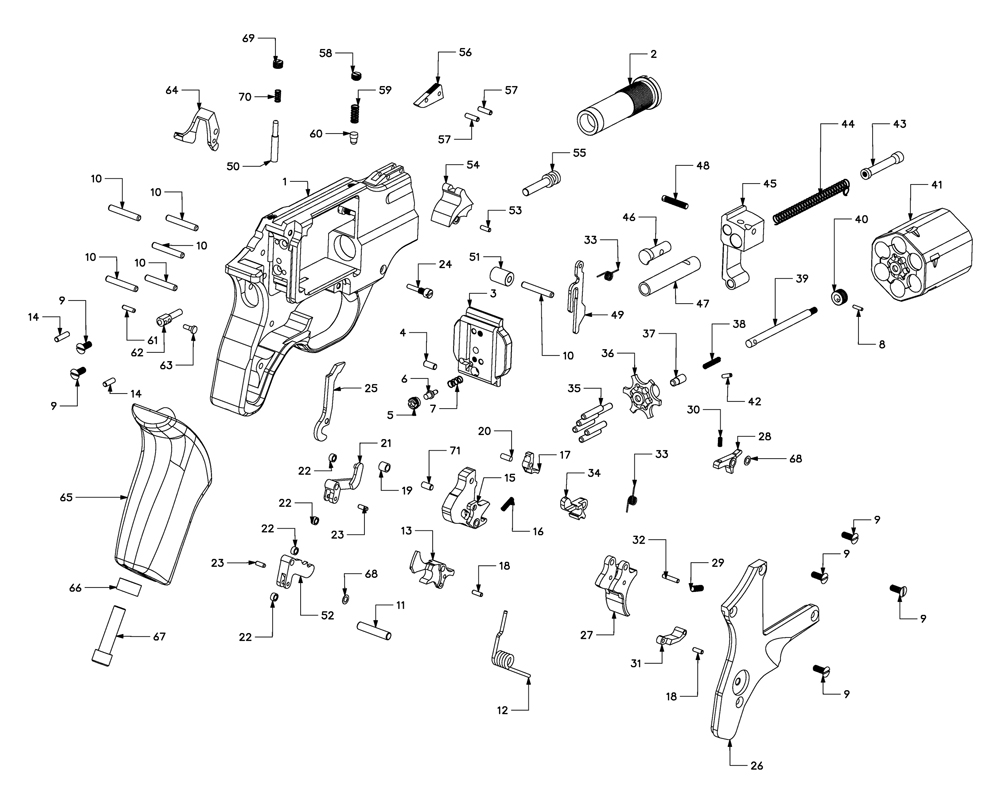
Exploded view of the Rhino.
The Rhino is produced by Chiappa Group in Azzano Mella in Northern Italy from all milled parts made on site. This is a very high-tech, modern facility dedicated to turning out a quality product. Its American subsidiary is Chiappa Firearms Ltd. This group is headed up by Ron Norton and their job is the development and marketing of Chiappa products in North America.
I test fired the Rhino extensively. I had 770 rounds of .38 Special and 500 rounds of .357 Magnum for a total of 1270 rounds. The breakdown was: .38 Special 100 rounds Georgia Arms 148-grain wadcutter 100 rounds of CorBon 147-grain FMJ 150 rounds of Winchester 130-grain FMJ 100 rounds of BVAC 158-grain lead HP 100 rounds of Remington 158-grain lead RN 100 rounds of Federeal American Eagle 158-grain lead RN 120 rounds Winchester 130-grain JHP Bonded PDXI 150 rounds of NWCP 110-grain Manstopper .357 Magnum 300 rounds Winchester 125-grain JHP 100 rounds Remington 125-grain JSP 100 rounds of North West Custom Projectile 110-grain Manstopper
I find the FMJ loads very useful. They offer increased penetration on bear or attackers in heavy clothing or behind cover. Sometimes more penetration is better, and not enough can get you killed. The military doesn’t use FMJ ammo for nothing. If the advantages of FMJ over expanding bullets in combat weren’t clear, no nation would have signed the treaties banning expanding bullets in combat. Creating a casualty behind cover is more important than stopping power in most military situations.
Anytime you fire a lot of .38 Special and .357 Magnum lead bullets you will have a lot of leading in the bore to clean out, and that is a feature that is no respecter of brand names. It is important to clean the residue at the front of the .357 cylinder out thoroughly if shooting .38 Specials as fouling can quickly build up on any revolver and interfere with chambering the longer .357 Magnum cartridges.
Firing the Rhino was a lot different from firing a conventional revolver. The grip rides much higher in the hand and what appears to be the hammer is a cocking lever that goes back down after the totally hidden internal hammer is cocked. A bright red cocking indicator pops up at the rear of the receiver to let you know it is cocked if the rearward single action position of the trigger wasn’t enough.
The cylinder is opened by that strange looking lever on the upper rear left side. Once moved back, this lever permits the flat-sided hexagonal (for concealability) cylinder to swing out for loading or unloading. The rear sight is framed by two green dots and the front sight has a red dot.
These are formed by plastic rods with exposed surfaces to catch the light in front of the sight blades, so you always have a bright group of dots even in poor light. Trigger pull was 4 pounds single action and 11 pounds double action as measured by the Lyman trigger pull gauge from Brownell’s gunsmithing supplies. This is quite acceptable, although I would prefer both to be lighter.
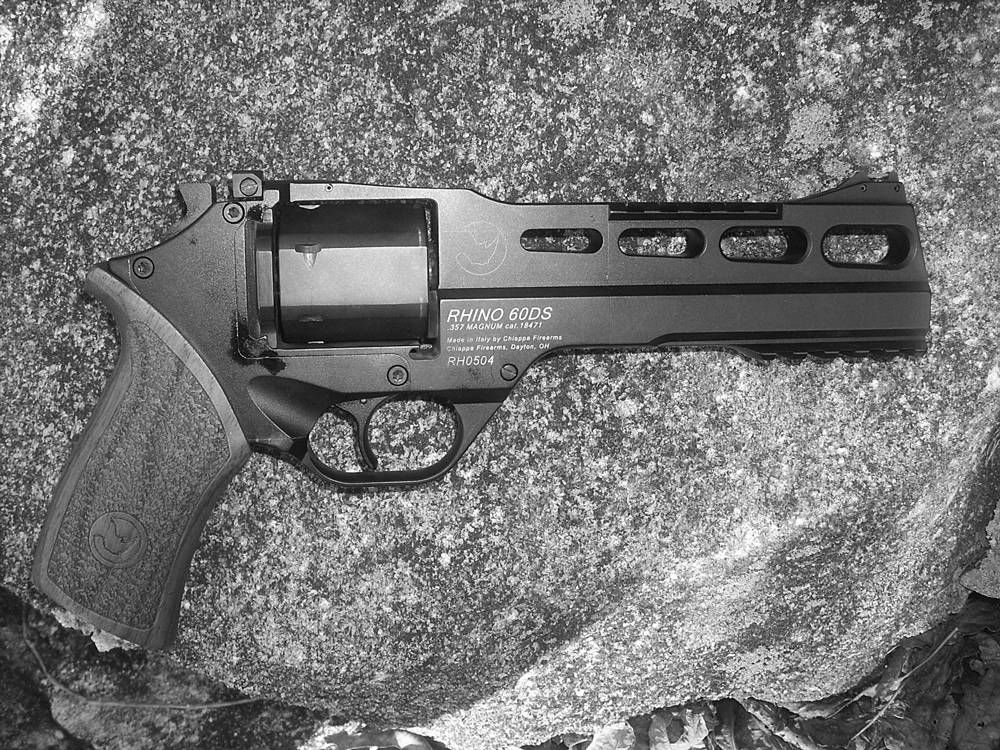
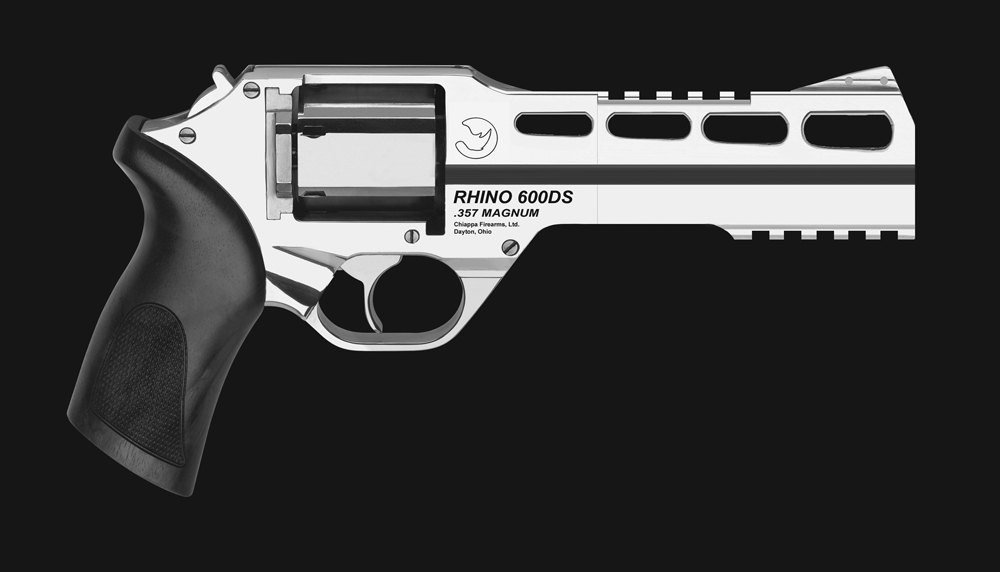
The Rhino stainless is quite an eyeful.
The Rhino’s barrel lies much lower than on other pistols and you can appreciate that and the short trigger travel on double action rapidfire. It is very fast and controllable. I just wish Bill Jordon was alive to see this because I think he would like it. Accuracy is all you need for hunting.
At 25 yards I was shooting and hitting 1 1/2- and 2-inch chips easily and centering a gratifying number of them with all ammo fired. I am not worried about missing any game fired at with this gun. I can think of a lot of rifles I would have less confidence in. The pistol points well for instinct shooting and is easy to hit with.
Aside from hunting, there are those who use the .357 Magnum revolver for police work. These users should try out the Rhino and see if its qualities make it the best choice for them. There is a lot of personal preference involved in choosing a revolver but many of those using the .357 Magnum revolver will be glad that they tried out the Rhino.
There are many factors one considers when selecting a revolver, some real and some imagined. The realities of the advantages the Rhino offers should more than offset its unconventional looks. Remember, the first revolvers looked pretty funny to everyone in 1836 but they sure did displace the single shot pistol. The moral? Don’t be afraid to try something new. You might like it.
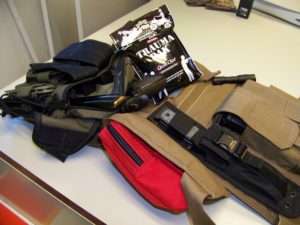
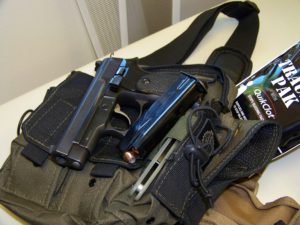
Two different kits for two different needs. On the right is a U.S. Palm plate carrier with Level III ballistic protection an entry tool from Tops and Blackhawk mag pouches for the AR-15. On the left, a basic emergency kit for any sort of violent encounter: Pistol, ammo, trauma kit, light, multi-tool.
The hot topic these days is the bugout bag. You know, a bag of important stuff you think you will need when the excrement hits the oscillating blades. What do you need really depends on what you expect. I have one kit made just in case I have an active shooter situation in my jurisdiction. It is a Level III plate carrier with extra soft armor, four magazines for the AR-15, a Tops Pry Knife to help open doors and a trauma kit on the back. I can put the plate carrier right over my uniform, thus giving me added ballistic protection and the tools I need to stop the threat and render aid.
I also have various other kits in various locations that will provide me things like extra ammo for my duty sidearm, a multi-tool, first-aid gear, flex cuffs. There is another kit in which I keep a spare sidearm, ammo, a trauma pack (are you noticing a trend on the trauma kit theme here?) flashlight, knife, multi-tool and more. And I have one of the Mossberg JIC shotguns in a tube, loaded up with extra ammo, first-aid gear, a knife or three, a water filter and sheet of heavy plastic for a basic tent. I think I’m ready.
A good handgun and a stout knife are very important tools. Keep them both handy with your other must-have items in the bug-out bag.
For me, the bug-out kit requires some sort of firearm or spare ammo. When things are very bad, people might want to fight. They might want to take what is yours. The only thing that stops a bad guy with a gun is a good guy with a gun. So… Rule #1: Have a gun. Be trained in its use. Be familiar with its operation. Know its capabilities and, perhaps most importantly, be mentally ready to use it.
Rule #2: Have a trauma kit. An exchange of gunfire usually means someone is going to need medical help. If that someone is someone you want to save you will likely need, at the bare minimum a tourniquet, a compress dressing, first aid tape or wrap, bandage material or surgical sponges and gloves.
* A chance for your bug-out bag plan to be included in an upcoming Gun Digest publication about survival and preparedness. Everyone with a published submission will receive a free copy.
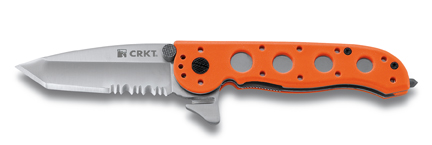
* Published submissions will be entered into a drawing to win a Columbia River Knife & Tool M16-12ZE Tanto Knife.
* After we close entries, EVERYONE who submitted will receive a promo code for a great discount at GunDigestStore.com or ShopBlade.com.
Remember: The more detail and pictures you provide, the more likely we’ll accept it for publication.
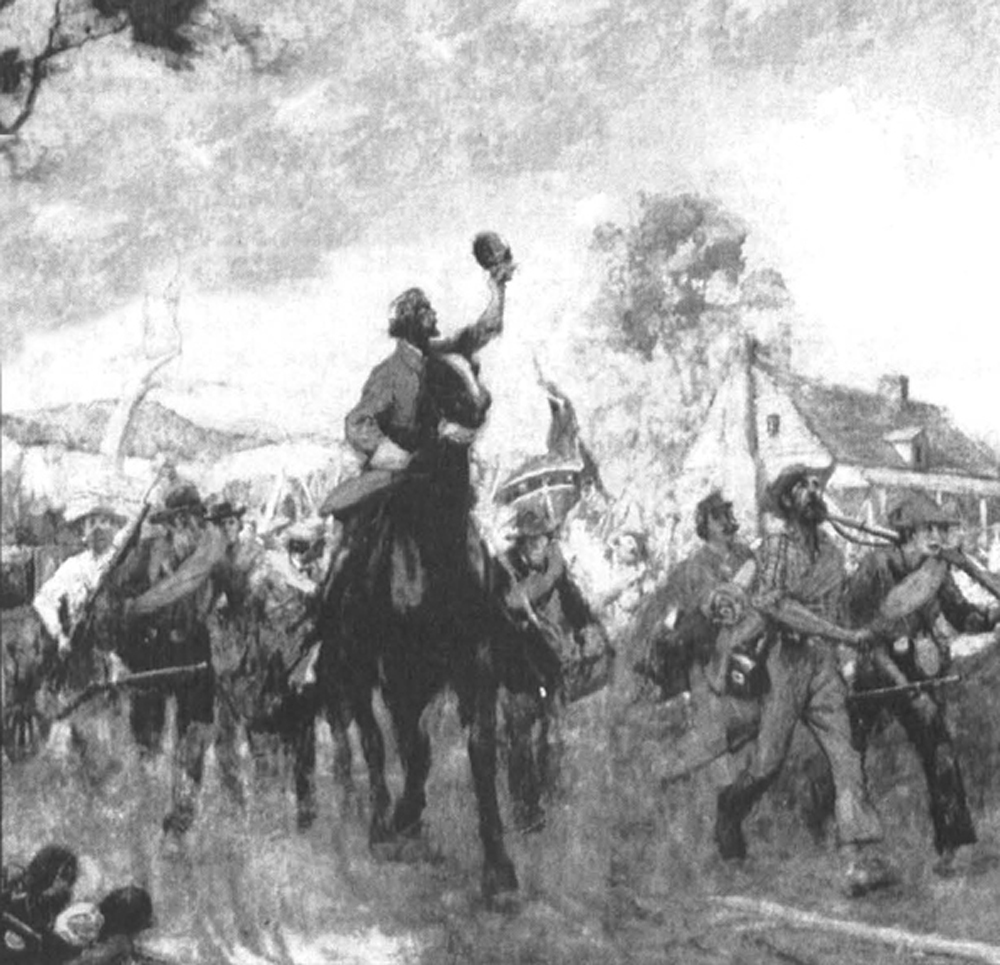
Stonewall Jackson reviews his troops during his famous Valley Campaign of 1862. So much enemy equipment was captured that the Confederates found themselves well-armed when the fighting ended. This mural is in the gallery with the Southern gun collection. (Richard Cheek photo.)
NO JOHNNY REB manning the Confederate line at Mayre’s Heights could be unimpressed at the spectacle before him. On an open plain between this high ground and the nearby town of Fredericksburg, Virginia, thousands of Federal troops were massing for an attack.
William M. Owen, a Confederate artillery officer, watched on December 13, 1862, as the enemy soldiers ran toward him behind unfurled battle-flags, chanting a deep-throated refrain — Hi! Hi! Hi! “How beautifully they came on,” he wrote years later. “Their bright bayonets glistening in the sunlight made the line look like a huge serpent of blue and steel.”
Union Major General Ambrose E. Burnside was hurling his Army of the Potomac against the Southern defenses. He wanted to rout General Robert E. Lee and his Army of Northern Virginia, and then march into Richmond about 50 miles south and end the war. Burnside had massed 27,000 men for the attack on Mayre’s Heights; Lee had only 6000 defending it. Although Federal assaults earlier that day had failed elsewhere along Lee’s line, Burnside hoped this attack would work.
The Union attack, however, was doomed to fail. Lee held a superb defensive position. Mayre’s Heights commanded nearby terrain and was studded with artillery. At its base, a breast-high stone wall provided shelter for the Georgia infantrymen of Cobb’s Brigade. Also, many of Lee’s men had rifled muskets, the war’s most common infantry weapon. A properly trained soldier could hit tar gets at 300 yards, firing three rounds a minute.
That so many of these weapons would be in Southern hands was a miracle. When the various states that comprised the Confederacy left the Union in 1860 and 1861, they had few modern military rifles. U.S. arsenals seized by the South held older, less-desirable guns.
Plus, the South had virtually no rifle-making facilities. Perceptive Southern leaders knew that a Union naval blockade eventually could slow, and probably halt, imports. All these factors produced an ill-armed military.
“At the commencement of the war, the Southern army was as poorly armed as any body of men ever had been,” wrote John H. Worsham of the 21st Virginia Infantry Regiment. “Using my own regiment as an example, one company of infantry had Springfield muskets, one had Enfields, one had Mississippi rifles, and the remainder had the old smoothbore flintlock musket that had been altered to a percussion gun.
The cavalry was so badly equipped that hardly a company was uniform. Some men had sabers and nothing more, some had double-barreled guns. Some had nothing but lances, and others had something of all. One man would have a saber, another a pistol, another a musket, and another a shotgun. Not half a dozen men in the company were armed alike.”
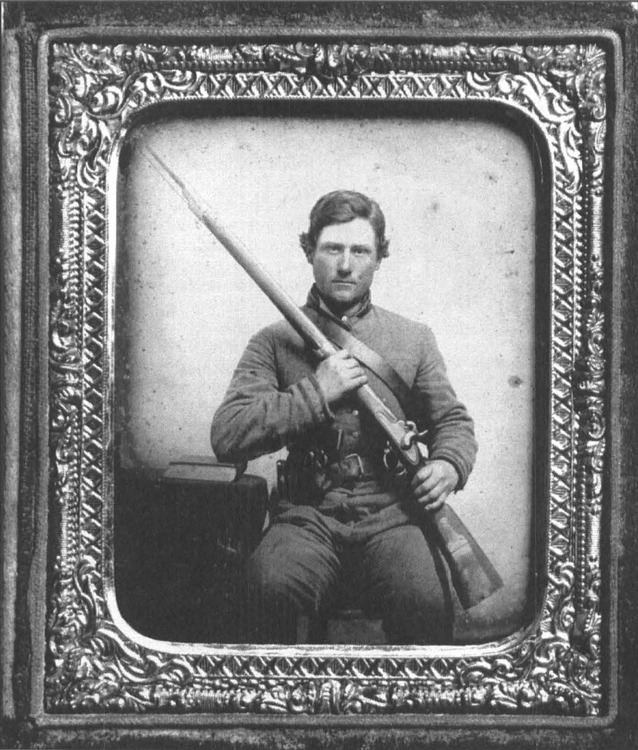
Anthony Sydnor Barksdale (1841–1923) of Charlotte County posed with his rifle for this ambrotype (ambrotypes are reversed photos), taken in 1861 when Barksdale was twenty. He served as a private in the 14th Virginia Infantry Regiment and later transferred to Edward R. Young’s battery in Mosely’s Battalion. Captured in Petersburg in 1865, he was a prisoner of war at Point Lookout for several months. (Virginia Historical Society photo.)
That situation had changed dramatically by late 1862, as Burnside and his men learned at Fredericksburg.
Federal commanders initiated the attack around noon. Their men had to cross about 600 yards of open ground to reach the Confederate position. Union troops began taking casualties as soon as the advance started.
When they were within 125 yards of the stone wall, Cobb’s infantrymen shouldered their muskets.
“A few more paces onward and the Georgians in the road below us rose up, and, glancing an instant along their rifle barrels, let loose a storm of lead into the faces of the advanced brigade,” Owen wrote.
“This was too much; the column hesitated, and then, turning, took refuge behind the (nearby earthen) bank.”
Burnside repeatedly sent assault waves against the enemy lines all day. Only the arrival of night ended the fighting. No Billy Yank came closer than fifty yards to the stone wall. Federal losses were 8000 compared to 1600 for the South.
Fredericksburg was a testament to the Army of the Potomac’s courage. It also showed that the rifled musket was ending the sweeping, grand Napoleonic charge. This weapon represented a significant technological gain in warfare.
It was powerful enough, accurate enough and had enough range to pound apart the most determined attack a foe could mount. The industrialized North could supply hundreds of thousands of these arms to its soldiers with comparative ease.
The agrarian South, however, faced staggering supply problems. Against all odds, the Confederacy did get sufficient modern arms to its troops. That required hard work, organization, improvisation and the talents of a remarkable man — Josiah Gorgas. Nobody in the Confederacy would do more to get rifles for Johnny Reb.
A Pennsylvanian, West Pointer and pre-war professional soldier, Gorgas became chief of Confederate ordnance early in the war. Before it ended, he would run thousands of guns through the Yankee blockade and build a Southern weapons industry from scratch.
Southerners in 1861 might have gone to war with fowling pieces and old smoothbores, but by mid-1863, thanks to Gorgas, they generally had equipment that matched their Federal foes’. One Southern leader succinctly and accurately described his wartime achievements: “He created the ordnance department out of nothing.”
Gorgas knew early on that the rifled musket would play a key role in the conflict, and the Confederacy would need large quantities of them. He also understood its capabilities. Compared to today’s military rifles, the typical Civil War musket was heavy, big, cumbersome and fired a huge bullet, often more than half-an-inch in diameter. Such muskets required twenty steps to load. A soldier typically did this standing upright and holding his weapon in front of him with its butt on the ground.
Ammunition came in paper cartridges that contained a bullet and a standard charge of blackpowder. Johnny Reb would bite off a cartridge end, pour the powder down the barrel, discard the paper, place the bullet in the muzzle and ram it to the breech using a ramrod carried in a channel beneath the barrel.
The Civil War musket’s ignition system relied on the percussion cap, a metal cap filled with fulminate of mercury. The system was reliable and could function in all weather conditions.
The same could not be said of the previous generation of military shoulder arms. The flintlock muzzleloader depended on a piece of flint striking a piece of metal to create a spark. Much could go wrong with this process, and damp powder doomed it. Knowing the flintlock’s limitations, both Civil War armies eagerly embraced the percussion system.
Average Johnny Rebs and Billy Yanks in the infantry used the same weapons and used them the same way, both as individuals and as members of military units.
For much of the conflict, officers in blue and gray deployed troops in large, concentrated units that shot in volleys. This allowed commanders to mass fire and to control fire rates. The only way to move men into these combat formations was through standardized maneuvers, which explains why the 19th century American soldier spent much time drilling.
Although presented with a powerful, comparatively long-range weapon in the rifled musket, generals stuck with those formations and tactics appropriate to the short ranges and inaccuracy of the smoothbore era. Surprisingly enough, leading commanders on both sides failed to immediately grasp the rifle’s destructive power.
Not only did Burnside embrace the frontal assault at Fredericksburg, but so did Lee at Gettysburg, Ulysses S. Grant at Cold Harbor, and Confederate Lt. Gen. John B. Hood at Franklin, Tennessee. At all these places, the results were disastrous.
As the war progressed, however, the average soldier realized the value of entrenching. Southern infantrymen became adept at creating trenches and rifle pits whenever they stopped, using tin cups and plates as well as shovels to put a few inches of dirt between them and the enemy. The 1864–65 Petersburg campaign, in fact, was largely a fight between entrenched armies that knew a direct attack against such works was tantamount to suicide.
For the average Confederate soldier, combat was a terrifying experience. It also was hard work. To begin, loading the rifle was difficult. Even veteran soldiers could easily forget what they were doing in the heat of battle.
Sometimes they loaded a bullet first, powder second, or jammed load after load down the barrel without capping the nipple. Blackpowder also quickly clogged musket barrels and wrapped the battlefield in clouds of dense smoke that made seeing targets difficult, if not impossible.
Johnny Reb also endured his rifle’s hefty recoil. Sam Watkins, a Southern soldier, reported firing 120 rounds during the Battle of Kenesaw Mountain. Afterwards, his arm was battered and bruised. “My gun became so hot that frequently the powder would flash before I could ram home the ball,” he wrote, “and I had frequently to exchange my gun for that of a dead colleague.”
How good a shot was Johnny Reb? We’ll probably never know. While the rifled musket could perform outstandingly, and many Southerners lived in a society that prized good guns and marksmanship, battle imposed great demands on the best of shots.
The danger, excitement, loading process and smoke-covered battlefields made accurate shooting extraordinarily difficult. One historian has estimated that for every casualty produced, 200 rounds were fired. Others believe the figure to be much higher.
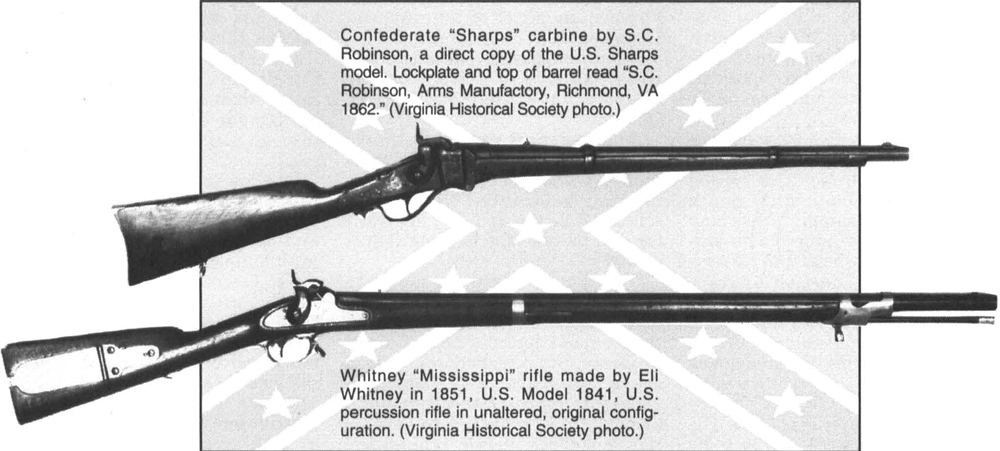
Whether marked “U.S.,” like this Whitney Mississippi Rifle (Top) or “RICHMOND, VA,” as it says on the Robinson Sharpe (Bottom), the Reb’s used them all. (Virginia Historical Society photos)
If the tactical implications of the rifled musket were sometimes imperfectly understood, its value as an improved shoulder arm was easily grasped.
So Confederate officials knew that getting these weapons into Johnny Reb’s hands was vital, and Confederate ordnance chief Gorgas energetically set to work on the problem from the war’s start. He knew only three sources of supply existed: capture, import and Southern manufacture.
The Confederacy turned to capture first. As each Southern state left the Union, it seized any Federal arms held at arsenals or armories within its borders. The pickings were lean.
These establishments did not have many modern arms. They mainly held older government models of little value. Among these was the U.S. Model 1822 musket, a 69-caliber smoothbore.
Many were converted from flintlock to percussion, but the improved ignition system did not compensate for their unrifled barrels. Their range and accuracy was limited. Hitting a specific target more than 100 yards away relied on luck as much as skill.
Once the fighting began in earnest, the Confederacy wasted little time in seizing modern Union weapons whenever they became available. Federal prisoners, battlefield gleanings and captured warehouses yielded first-class arms for the Cause.
As veteran Southern infantryman Worsham noted: “When Jackson’s troops marched from the Valley (of Virginia) for Richmond (in 1862) to join Lee in his attack on McClellan, they had captured enough arms from the enemy to replace all that was inferior; and after the battles around Richmond, all departments of Lee’s army were as well armed.”
Probably the most preferred capture from the Yankees was the 58-caliber Springfield, which came in several models. This rifled musket was superior and typical of its type. The weapon weighed roughly 9 pounds, was 58 inches long, and saw more service with the U.S. Army than any other rifle. Government and private armories produced hundreds of thousands during the war.
Also especially desired by Johnny Reb was the U.S. Model 1841. It was first issued in 54-caliber, but many were altered to 58-caliber, and a fair number came into Confederate hands through Federal arsenals in Southern states. This weapon was commonly known as the “Mississippi rifle,” from its Mexican War service with Mississippi volunteers commanded by Jefferson Davis.
Confederates also were delighted to get their hands on Federal breechloaders like the Sharps and Spencer. Both represented significant gains in rates of fire and ease of loading.
To load the Sharps, a 52-caliber breechloader, the soldier pulled down the trigger guard. This caused the breechblock to drop and opened the chamber into which was inserted a linen or paper cartridge filled with powder and a bullet. The Sharp’s rate of fire was three times that of a musket.
The Spencer fired metallic cartridges. Its tubular magazine in the buttstock held seven rounds.
A skilled operator could fire twenty-one rounds per minute. Unfortunately for the South, captured Spencers suffered from an ammunition shortage as the Confederate industry frequently was incapable of meeting cartridge needs created by the weapon’s firepower abilities.
Though infantrymen seldom carried revolvers, the Confederate cavalry loved them, especially captured Colts. These were Northern-made, but saw widespread use in both armies. Six-shooters in 36- and 44-calibers, their cylinders could be loaded with paper, foil or sheepskin cartridges, or loose powder and ball. Ignition required a percussion cap on each nipple at each chamber.
Imports were another vital source of armaments. Europe eagerly provided guns to both sides. Southern weapons had to come through the Federal blockade, and a surprisingly large volume made the trip.
Europe offered some superlative weapons and some junk. Particularly despised by Johnny Reb were rifles made in Austria and Belgium. Unwieldy, inaccurate and unreliable, they were dead last on his wish list.
The most desired import was the 577-caliber Enfield. A British-made musket, the Enfield was rugged and accurate. The Enfields came in several styles, including a carbine. Southern cavalry was particularly attached to the latter, even though as a muzzleloader it lacked the rapid-fire quality of Union repeaters. Another popular and well-crafted British import was the 44-caliber Kerr revolver.
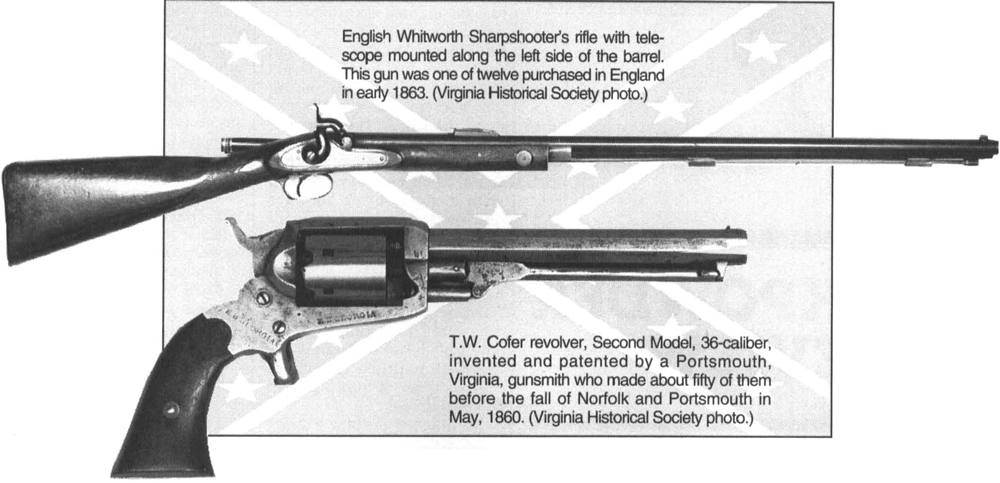
Great Britain also supplied some of the war’s best sharpshooter rifles: the 44-caliber Kerr and 45-caliber Whitworth. Southern marksmen treasured these guns, which enabled them to hit targets at 1000 yards. The most famous long-range shooting incident of the war occurred on May 9, 1864, during the Battle of Spotsylvania.
Several Southern marksmen are given credit for what happened, but it is impossible to know who did the shooting. One version of the incident comes from Captain William C. Dunlop who commanded the sharpshooters of McGowan’s Brigade.
This Confederate unit was ordered to move ahead of the main body of Southern troops to scout for Federals that day. Dunlop concealed his men in position along a ridge where they could see the Union VI Corps deploying on a distant hill. Immediately, Dunlop’s men began firing with telling effect.
Among Dunlop’s troops was a Private Benjamin Powell of South Carolina, who carried a Whitworth that day and was looking for important targets. One soon presented itself. Powell could see a Yank officer moving along the enemy firing line, giving commands and viewing the field through binoculars. His behavior and the staff trailing behind him suggested this was an important man.
Powell decided to shoot him. The round traveled 800 yards and struck General John Sedgwick, the corp commander, in the left cheek, killing him. Only moments earlier, the general had tried to calm his troops who were agitated by the sniper fire. They “couldn’t hit an elephant at this distance,” he said seconds before he died.
One of the most intriguing weapons that made it through the Union’s naval blockade was the Le Mat revolver, which could fire nine 41-caliber rounds from its main barrel plus buckshot from a shorter one. (Oddly enough, its main barrel’s caliber is variously reported as ranging from 40- to 42-caliber.)
The idea for this monster came from Jean Alexander Francois Le Mat, a New Orleans doctor. Once the Confederacy accepted his pistol, the doctor headed for France where it was produced. A carbine model also was developed.
The last source of weapons was from within the Confederacy. Given the virtually non-existent manufacturing base there, Gorgas achieved astonishing results, creating government armories as well as inspiring various private firms to enter the armaments field.
The best Southern-made weapons came from government operations in Richmond and Fayetteville, North Carolina. Early in the war, the Confederacy captured Federal gun-making equipment at Harper’s Ferry. This was used at both Confederate plants to produce 58-caliber muskets, known as Richmond and Fayetteville rifles.
These two factories were not the only source of “home-grown” weapons. Other production facilities sprang up in Georgia, Louisiana, South Carolina, Mississippi, Texas and Alabama. Quality and volume varied greatly from factory to factory, as the case of the Confederate “Sharps” proved. These were versions of the Sharps carbine Model 1855, made by the Richmond firm of S.C. Robinson Arms Manufacturing Company.
Forty were sent for field-testing to the 4th Virginia Cavalry Regiment in the spring of 1863. The gun was not a success. Reportedly seven of nine burst during firing. Furious, an officer of the regiment, Lieutenant N.D. Morris, fired off a letter to a newspaper, The Richmond Whig, which ran a story on the weapons under the headline “An Outrage.”
“The lieutenant suggests,” ran the article, “that the manufacturers of these arms be sent to the field where they can be furnished with Yankee sabres, while the iron they are wasting can be used for farming implements!”
Ordnance officials rushed to defend the producers and the carbines, suggesting the soldiers using the weapons had not been trained properly, but the bad reputation stuck. Captain W.S. Downer, superintendent of the Richmond armory, also reported to Gorgas that somebody should remind the letter-writing lieutenant about army procedures.
“I would also suggest that Lieut. N.D. Morris, of Capt. McKinney’s Co., 4th Va. Cavalry, be notified to communicate with the Department through his proper officers, rather than through the columns of a newspaper.”
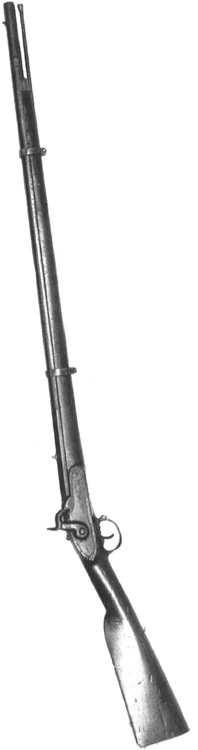
This unmarked Confederate rifle in the Springfield pattern is proof the South had an ordnance system. Virgina Historical Society photo
Besides government plants, private firms got involved in weapons production. For example, Davis and Bozeman of Coosa County, Alabama, made 58-caliber rifles. J.&F. Garrett Co. of Greensboro, North Carolina, produced the 52-caliber Tarpley carbine, the only breech-loading gun patented, manufactured and offered for general sale in the Confederacy.
Private industry made its biggest contribution to weapons production by making pistols. When the war began, the Confederacy had no revolver manufacturers within its borders. But wartime entrepreneurs appeared like Spiller and Burr, Griswold and Gunnison, and Leech & Rigdon.
Many entrepreneurs found that making weapons for the South was a difficult business indeed. Consider the story of Charles Rigdon, for example, a Southern sympathizer who lived in St. Louis. He moved to Memphis when the war started and formed a partnership with Thomas Leech to make swords.
Advancing Union armies forced the pair to move to Columbus, Mississippi, and then to Greensboro, Georgia, where they made 36-caliber revolvers, which were copies of Colt’s pistols.
The partnership eventually collapsed. Leech kept making revolvers in Greensboro. Rigdon opened a new pistol firm in Augusta, Georgia — Rigdon, Ansley & Co. — that operated until the war’s end. Interestingly enough, Samuel Colt sued the company for illegal use of his revolver patents.
One non-issue weapon that came from private manufacturers was the shotgun. Often brought from home, shotguns were popular among certain Confederate cavalry units, particularly in the Western Theater.
Shotguns had limited range, limited tactical value and took a long time to load. But at close quarters they were devastating. The 8th Texas Cavalry, better known as Terry’s Texas Rangers, were particularly fond of scatterguns.
During the Southern retreat from the Battle of Shiloh, this unit used these weapons effectively. Ordered to charge Union infantry pursuing the Southern army, the Texans swept forward, halted about twenty steps from the Federal line and fired their shotguns.
Each barrel was loaded with fifteen to twenty buckshot. The Federal pursuit fell apart and a retreat ensued. The Texans then put their shotguns aside and pursued the enemy on horseback, firing their revolvers.
Much of the success of Southern weapon production came from the use of slave labor. African-Americans worked in armories and played a key role in the armament industry’s labor force. For instance, the Georgia pistol firm of Columbus Fire Arms Manufacturing Co. hired forty-three blacks in 1862 and aggressively tried to find more during the rest of the war.
For blacks, working in weapons production was a mixed bag. It often meant separation from loved ones, hard work, long hours and daily rations of bacon and cornmeal. However, the work gave them valuable skills and provided an unprecedented degree of freedom.
Although the Confederacy ultimately lost the war, it did not do so due to a lack of weapons and ammunition. Granted, the Southern ordnance system had flaws. Armies in the East tended to be better supplied than those in the West.
Units in either theater, even late in the war, might carry a hodgepodge of weapons, mostly rifled muskets but sometimes smoothbores, and this variety made ammunition re-supply a headache. Some of the Southern-made rifles and pistols did not meet the standards of Northern or British factories, but on balance Gorgas did a remarkable job.
One anecdote makes the point. When Lee surrendered at Appomattox in 1865, his army was small, sick, ill-clad and poorly fed. However, most men were armed and, on average, each carried seventy-five rounds of ammunition.
Today, Confederate guns are scarce and costly. But the interested student of Civil War firearms can see one of the world’s best collections of Southern weapons at the Virginia Historical Society in Richmond.
The society owns an extraordinary collection of rifles, pistols, swords, belt-plates and buttons given to it in 1948 by Richard D. Steuart, a Baltimore newspaperman who had two grandfathers and nine uncles who served the Confederate cause. For many years, the collection was displayed to feature the weapons themselves as artifacts and objects of interest.
In 1993, the Virginia Historical Society decided to display its collection in an innovative way. The weapons were moved into a gallery decorated with life-sized murals of Civil War battle scenes. The new display uses the guns to tell the story of how the South armed itself. For the neophyte or life-long scholar of the conflict, the new display is entertaining and informative — you can see Johnny Reb and his guns.
This article is an excerpt from the Gun Digest Book of Classic Combat Rifles.
Thanks to TV shows like 3-Gun Nation, the hot new speed-shooting sport known as 3-Gun is quickly becoming the top game in town. In fact, watch this video to learn more about the sport and why even the U.S. Military is getting involved in 3-Gun. Also check out Photo Gallery: Smoking Hot 3-Gun Competition.
It’s being called the “Duluth Deluge.” The worst flooding in more than a century hit the Lake Superior port city in northern Minnesota on Wednesday, June 20, as well as surrounding towns.
The rain came fast and hard, dumping 10 inches in a matter of hours. The flood ripped apart paved roads, washed away vehicles and even hoisted animals over their Lake Superior Zoo compounds.
The geography of Duluth compounded the flash flooding. Much of the city is built on a hill leading into Lake Superior. This natural waterway focused drainage through city streets. It trapped many residents who couldn’t get out in time.
This is why a bug-out bag is so important. Having something portable to grab during an emergency allows for a quick exit. This also helps first responders. Their resources can be focused on the elderly, injured or disabled.
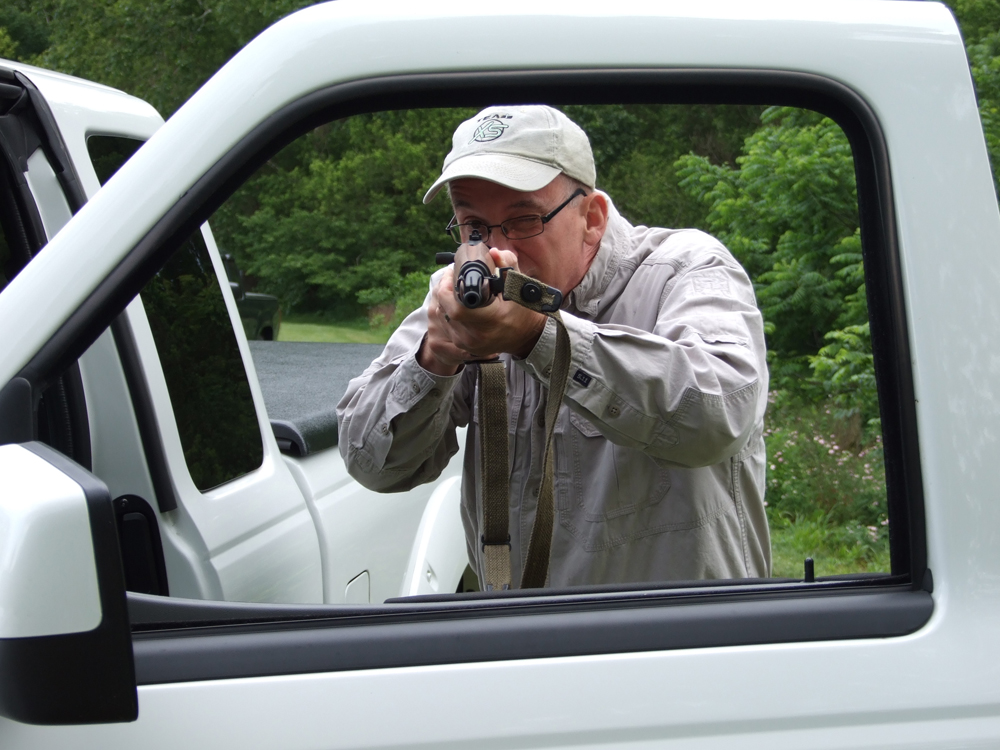
Instead of a handgun, the author suggests keeping a long gun as your designated in-vehicle survival weapon.
When sudden disaster strikes, where will you be? No one can be sure. Add the additional variables such as whether the disaster will be more or less localized in nature (fire, flood, tornado, hurricane, unknown localized disorder) or one that is national (economic collapse) and you realize daily preparedness is crucial.
There is a very strong likelihood that you and your family won’t be at home near your stored provisions and SHIP (Shelter In Place) protection when it happens. I spend more than 80 percent of my waking hours at least an hour away from home on any given day. Getting back home from work in the event of sudden disaster requires forethought and preparedness than just packing an off-duty or concealed carry handgun. The locale and habits of the population you will need to travel through to get home will dictate just how much gear you will need in your vehicle with you daily.
For 32 years there hasn’t been a day I left home without an off-duty handgun. Until I joined our SWAT team at the Union County sheriff’s office, a handgun, a reload or two, a cutting tool, a less-lethal weapon and a small flashlight was all I felt I needed.
Ten years ago I was right, but not today. While on the team I carried my M4 carbine, sniper rifle and call-out gear in my car on a daily basis, and haven’t been without a rifle in my vehicle since. I still keep a similar response kit in my car as I am on 24-hour call status with the Baltimore PD. Law enforcement everywhere now views a long gun as our primary off-duty gun, with the handgun as backup.
Prepared cops and law-abiding civilians taking the same view must ensure that when they carry long guns in their vehicles they are in compliance with the local, state or federal laws applicable to their jurisdiction.
In addition to legal compliance, consider the following tips for transporting survival guns:
1. Unless you keep your vehicle VERY close at hand, you should have the long gun securely locked in the trunk, with an additional locking mechanism that can actually be bolted to the body of the car or truck-such as those available from Santa Cruz Gunlocks.
2. Don’t display any firearms-related decals on your car. It’s like sticking a “Help Yourself to My Guns” sign on it.
3. How quickly can the weapon you selected safely be brought into action from a loaded or unloaded condition? This must be practiced.
4. If the gun is kept in your vehicle long term, what are the maintenance requirements?
5. Any electronic device on the weapon can fail or pose other risks. A nearby agency lost a SWAT vehicle and gear when a weapon’s light was bumped into the “on” position in the case, causing the vehicle to catch fire. Save electronic devices for home-based SHIP guns.
6. Don’t use an expensive or irreplaceable long gun as your travel gun. It shouldn’t break your bank or heart if stolen. At the low end of expense and magazine capacity but at the high end of reliability and intimidation are pump shotguns. A fine example is the 12-gauge Mossberg 590A1 with a collapsible buttstock. The collapsed stock takes up less room than a standard stock model, and its Mil-Spec reliability is legendary.
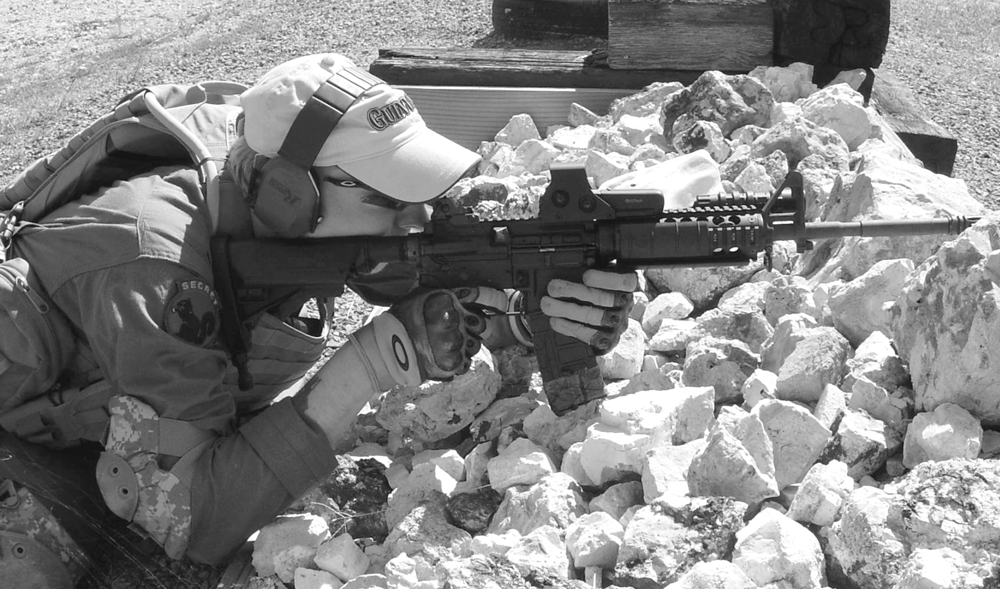
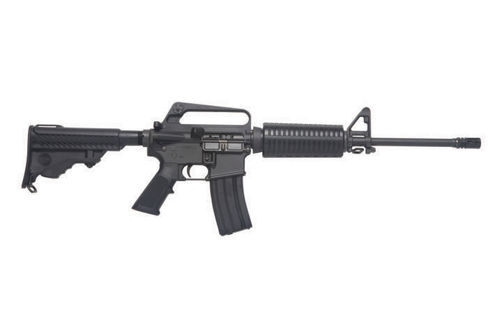
The author recommends this DPMS Panther Lite M4-style carbine as one of the best survival guns to keep in your vehicle.
Prefer a higher round capacity? A direct impingement AR-15 with military-style iron sights and a carry sling is hard to beat.
Two good examples are the value priced Del-ton Alpha 220H, 20-inch, full-size AR-15 A2-style rifle, and the 16-inch Panther Lite M4-style carbine by DPMS. Quality is high on both and neither will monopolize your funds. Both can mount a bayonet.
Keep these rifles clear of add-ons so they can be brought into action without turning anything on, adjusting anything else, and focusing on something other than your threat. The full size Del-ton rifle allows the 55-grain 5.56mm round to work to its full ballistic potential.
The Sporter Rifle from IO firearms is an AK variant that is value priced, reliable in the extreme and very smooth handling if you favor the Kalishnikov pattern.
If you live in an area that forbids semi-autos rifles, you could consider a lever-action gun such as the Marlin Model 1894 in .357 Magnum/.38 Special. Lever guns were the first assault rifles, and the 1894 is powerful with low recoil and holds ten rounds in the magazine tube.
Depending on where you live and work, you may or may not want or need to incorporate a long gun into your daily travel plans. That is up to you. If you do, make sure you stay focused on the issues of legality, safety, weapon security and practice.
What are the Best Survival Guns?
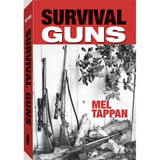
What are the best survival guns? Find out in Mel Tappen's Survival Guns book.
When Mel Tappen wrote Survival Guns in 1979, he set out to answer that very question. Since then, the book has reached classic status. Whether you’re looking for an urban survival gun or something for the wilderness, Survival Guns is required reading.
This is the last of our three-part series covering shooting fundamentals for the CCW holder. These elements come directly from Tactical Pistol Shooting, by Erik Lawrence. The book is available at the Gun Digest Storeand offers incredible insight and tips for better shooting.
Drawing a pistol is a four-part operation, but keep in mind that if you need to can start firing from Position Two. The proper draw is broken down into these four steps. Take a look. Position One
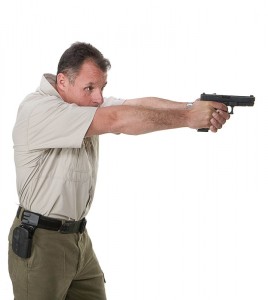
A threat is perceived and you decide you are going to draw and shoot, so you orient your stance towards the threat and begin your draw sequence. Quickly, your firing hand moves to form its grip on the pistol grip; this is the only chance to get a proper grip. Index with the web of the firing hand high on the backstrap (set your firing hand as high as you can on the backstrap), extend the trigger finger straight and then grip the pistol with the three lower fingers. Refer to Figure 6-1.
Fig. 6-1. The grip as seen from the side. Notice the trigger finger is indexed outside the holster.
The thumb disengages the thumb break on the holster and then finishes forming the grip as you begin to pull the pistol from the holster. The non-firing hand is drawn to the body’s centerline and is open to receive the pistol with fingers extended and joined, oriented 45 degrees down. Move only what you must to accomplish these steps of the draw. Economy of effort and economy of motion allow you to do this quickly. Once you are comfortable with the correct step one, this step can be done as fast as possible as it is not a fine-motor function. This step is conducted at the fastest speed you can correctly do it.
Position Two Your firing hand has its proper grip on the pistol and you draw the pistol from the holster. As soon as the pistol is clear from the holster, it is immediately pointed in the direction of the threat while moving to the centerline of the body to meet the non-firing hand. Refer to Figures 6-2. The trigger finger can begin to take up slack in the trigger if you need to fire from the position of retention or an advancing
Fig. 6-2 Once the weapon clears the holster immediately point it at the threat and begin moving the pistol to the center of your body to meet the support hand.
threat at close ranges. As soon as you are pointing the muzzle at the threat, you can take the pistol off safe. As you move to position three you may orient the pistol under your dominant eye to assist in picking up the front sight faster. Refer to Figure 6-3A. The speed of this step is also as fast as possible once properly learned.
Position Three Your non-firing hand begins to complete the two-handed grip and the muzzle is directed toward your threat. In this position, the finger is still off the trigger unless you intend to begin shooting. If the threat is closing or taking offensive actions and is within in your ability range, you may begin to engage from this position as you complete your presentation. This is the preferred ready position, with your finger off the trigger. The upper body must be semi-relaxed; watch tensing your trapezoids. Refer to Figure 6-3. Also, do not hunch your head forward; keep it naturally erect to a slight bit forward (keep it comfortable).
Fig. 6-3 Establish the two-handed grip. You may fire from here if you must, but keep your finger off the trigger until you are ready to fire.
NOTE: From position three to four, the slack and tension are taken out of the double-action pistols. At full presentation is the point when the shot should break and fire to attain great accuracy and speed. NOTE: The pressing of the hands and pistol forward from position three to position four is at a medium speed (allowing you time to press your trigger and acquire the sight picture desired). Smoothness must be emphasized to time the shot correctly at full extension—the trigger press, movement, sight alignment and sight picture all come together at full extension with a properly placed shot.
Position Four
This position is considered full presentation, and your most accurate shooting will be done from this position. Refer to Figures 6-4. If you have time, review your shooting fundamentals before the shot. Do not maintain this position for long unless the situation requires it. Optimum time is no more than six to eight seconds after your engagement. Once the engagement is complete, remove your finger from the trigger (only if the problem has been dealt with; remember to reset the trigger in your
Fig. 6-4 Full engagement. Arms extended and sights on target.
follow-through if the engagement is not complete) and take a breath in and exhale. Then scan and assess the situation; you should lower your muzzle one to two inches and look with three eyes (your two and your muzzle) by turning your head left and then right and then back to center. Actually see and analyze what is happening—you must turn your head (to the left, to the right, or wherever you need to look) as you look so you break the tunnel vision that is common in high-stress situations. When you bring the weapon back to position three, check the condition of your weapon (ensure it is in battery), decock and/engage the safety on your pistol, and then look over your shoulders to check behind you; this puts you in a good position if you must turn and engage or fight. To rest, go to the low-ready position or back to position three of the draw. Tactical Pistol Shootingprovides real-world insight for anyone who carries a concealed pistol for self-defense. Build your foundation on solid fundamentals and follow the tips in the book to improve your training.
Don’t Conceal Your Curiosity: Dive Into CCW Insights
On the fourth weekend in June, amateur (ham) radio operators from around the country and world converge on the air for Field Day, a tactical and emergency exercise designed to demonstrate the long-range communications capabilities of amateur (ham) radio.
It’s a chance to show the public that two-way radio communications are anything but antiquated in a world reliant upon commercial telecommunications networks — systems that indeed afford many modern conveniences (when they work), but are also the first to go down during natural or man-made disasters (when you need them most).
Today, amateur radio remains the backbone for Emergency Communications (EMCOMM) work across the world. That’s because it allows FCC-licensed operators to set up independent two-way radio stations — networked locally, nationally and globally — to create built-in system redundancy.
“When All Else Fails” is the motto of ham radio, and Field Day is a time when these stations prove that out,setting up in the field and on mountain tops to practice for the real thing. For twenty-four hours, operation is powered by either commercial or back-up emergency power (such as solar, battery, wind, etc.). Wire antennas are hung from trees or mounted on make-shift poles. At no other time of the year is duct tape so in demand.
While the underlying point of Field Day is serious business — EMCOMM operation by ham radio is a formally-organized arm under the Federal Emergency Management Agency and Department of Homeland Security and works with agencies and organizations such as the National Weather Service, Red Cross, Salvation Army, and all branches of law enforcement and the military — the format is akin to a contest to make things fun. Points are logged in specialized software, and groups trying to work as many stations on as many frequencies and modes as possible fill the air waves, bouncing signals off the upper layers of the earth’s Ionosphere into receivers in distant lands. Contacts spanning over one thousand miles are common.
For its first foray into Field Day, I joined a ham radio group in central Wisconsin. The plan was to erect some antennas and put the W9WAP club station on the air. To keep things simple, two antennas were deployed — a small dipole for the 6-meter band (VHF) at 35-feet, and a long-wire dipole for the 10-80 meter frequency bands for High Frequency (HF) work attached to the top of a 104-foot lookout tower.
From our two modest stations, we logged over 300 contacts using the phone and CW (morse code) modes from the east coast to the west, and even a couple foreign countries to boot. I was able to make about a dozen contacts on 6-meters with stations all over the U.S., while running 100 watts.
For many people, tactical gear and preparedness center on things like guns, ammo, food, lights and so on. As important as these things are, in real emergency situations the first thing to go down — the first thing you’ll notice that tends to set off panic — is commercial power and communications, leaving you no way to call for help or get information. While ham radio has always filled a back-up communications role to address this, it is now much more: integrated with emerging digital technologies and the Internet, making it the only sure fire way to stay informed and in contact with an outside support system when an event unfolds.
Don’t wait for the power to go down or telephone networks to fail to start thinking about the tactical gear and training needed for emergency communications. Get on the air now, while you still can. Field Day is one way to practice your skills and upgrade your equipment.
Click here to learn more about Field Day. Click here to learn more about amateur radio EMCOMM.
Portable Radio Harness
If you prefer your emergency communication to be portable, stuff your walkie-talkie into this high-quality radio harness. It also has room for a GPS, knife, magazine and other hardware.
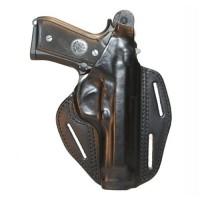
I like pancakes; the kind you eat and the kind you hang on your belt to hold your pistol. The pancake concealed carry holster design is neither new nor is it revolutionary. It just has a long track record of being a holster that does its job without a lot of fanfare.
A good, leather pancake concealed carry holster keeps the pistol close to your body, which makes things much more comfortable during a long day. I also like the fact that the trigger guard is covered and a top snap provides a bit of extra retention.
Blackhawk’s Pancake holster incorporates all those design elements with the legendary quality for which Blackhawk! has become famous. This molded three-slot concealed carry holster comfortably contours to your body, providing exceptional concealment for your weapon.
Its two-piece, wet-molded, double contour-stitched construction contributes to the concealed carry holster’s incredible durability. The three-slots allow for a variety of carry options, including cross-draw for those who spend a lot of time behind the wheel.
With a concealed carry holster this solid, all you need now is a great belt. The Blackhawk! Pancake holster is available for just about every popular pistol on the market and comes in right- or left-hand draw in black or brown. Something for everyone.
Looking to go armed, but are stuck in the weeds as to what to arm yourself with? Here are 20 of the best concealed carry gun options that will keep you on the defensive.