Gun Digest is the source for firearms news, pricing and guns for sale. Readers benefit from in-depth editorial expert advice, show reviews and practical how-to instructions. Subscriptions are the First Amendment way to stand up for your Second Amendment rights. Click here to begin your subscription to Gun Digest.
Inside This Issue:
• In a business where gear often drives sales, Bob Hausman writes, makers show off their wares at the National Association of Sporting Goods Wholesalers event. See what’s new for 2008!
• You can make a Remington 870 even better with a few handy gadgets.
• There’s plenty of great new gear for shooters and hunters.
• A sniper needs good glass, not only on top of the rifle, but in the form of binoculars and spotting scopes, too.
• When is getting shot not the worst part of a hunting trip? Bryce Towsley shares his insight.
Gun cases are essential protection for transportation of firearms. Over the years I’ve stuffed rifles into home-made moosehide gun sleeves and $400 state-of-the-art polycarbonate shipping containers. I find that many shooters fail to realize how important cases are, so they buy an el cheapo and wonder why their rifles get rusted, dinged or even destroyed.
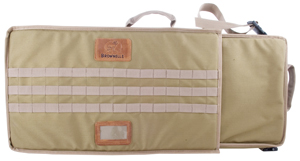
There are three kinds of gun cases. First is the soft case used in the field. Second is the hard case necessary for shipping and airline travel. The third is the gun vault for long-term storage. Most hunters have at least one of these styles; if you have several firearms, you probably own all three. I use a variety of cases for my long guns and have learned a bit about what works and what does not. Let’s start with soft cases. There are definite considerations when selecting a soft gun case.
My first concern is the shape of the case, as well as ensuring it is long enough to handle my rifles. For some stupid reason some manufacturers insist on designing their cases upside-down to my logic. I want my scope under the carrying handle of the case. Some designs require inserting the rifle scope-down; when you set the case down, the rifle rests on the scope turrets. I know it’s inside a case, but that isn’t a good idea. I also like the design to be roomy enough to handle rifles with Harris bipods attached.
Second consideration is the zipper. Cheap cases have cheap plastic zippers that have short lives. Nothing is more frustrating than having a zipper pop open or jam. Metal zippers or the heaviest plastic designs are essential.
Next I consider the material. Is it waterproof or will it hold moisture? The latest materials have a special impregnation that protects from rust and corrosion. Padding is obviously a consideration — the more the better. to a degree. Padding is not as essential as having a tough outer shell in my opinion.
I bit the bullet many years ago and bought a pair of Filson gun cases that provide superb service. The money was well spent because those cases are as good as new despite a lot of rugged use. There are other good cases but I doubt any are better than the heavy canvas Filsons.
Hard cases are interesting because I’ve seen so many failures. I cannot understand why so many shooters are content to place $2,000 worth of rifle and scope into a $29 dollar plastic shell. One drop and the barrel is sticking through the end of the case. Good cases have good hinges, lockable hasps, adequate padding, and strong carrying handles.
I’ve learned there is also “good” polycarbonate and “not so good.” Not so good cracks and chips when dropped, particularly in cold weather. Good stuff dents and takes virtually any abuse. How do you know which is which? Usually spending good money will ensure top materials.
My favorite case doesn’t look like a gun case. I travel with a Tuffpack. The basic design is a five-sided shipping tube. Most people assume it contains golf clubs. The rifle is first put into a soft Filson case, then dropped into the Tuffpack and surrounded with clothes and other gear. This case locks securely and has wheels and a carrying handle. From Alaska to Africa, this case has done a perfect job of protecting my rifles and gear.
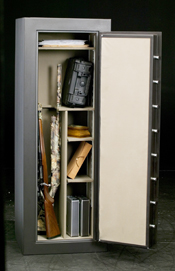
Anyone with a reasonable number of firearms and valuables should consider the purchase of a gun vault. I use my vault for much more than firearm storage, since it’s large enough (and hopefully fireproof enough) to protect valuable documents, cameras, and other goodies.
Again, there are considerations. Cost is a big one, as are size and design. Any vault or safe is better than none, but you usually get what we pay, for so consider the best quality you can afford. Don’t go with the bare minimum; you’ll appreciate size when you start putting rifles inside. Remember that scoped rifles take up more room — I figure about 1 ½ times what an un-scoped model requires. Gun vaults range in weight from relatively light metal cabinets to 1,000-pound fireproof pieces of “furniture.”
There are essentially two types of locks: digital electronic keypads and traditional spindle wheels. Obviously hinges are important; some models have concealed hinges, others have exposed designs. Another key consideration is the number of locking bolts and how they operate and are protected.
Some brands advertise virtual imperviousness to break-in, others cannot make that claim. Same goes for the fireproof rating. Fireproofing greatly increases the weight of the safe, but it’s worth having. Gun cases are essential accessories. So take your time to research them to find the ones that best suit your needs.
— Sadly, Ian McMurchy passed away recently. His final “Trigger Time” columns will appear in every other issue of Gun Digest the Magazine. GDTM
Gun Digest is the source for firearms news, pricing and guns for sale. Readers benefit from in-depth editorial expert advice, show reviews and practical how-to instructions. Subscriptions are the First Amendment way to stand up for your Second Amendment rights. Click here to begin your subscription to Gun Digest.
Inside this Issue:
• In the world of combination guns, Dan Shideler writes, the Staggs-Bilt 20-.30-30 falls squarely into the “that’s odd” category.
• Doublestar makes two fine patrol carbines that will stand up to anything an officer can throw at them, says Kevin Michalowski.
• The NRA awards $10,000 in scholarships.
• Three great books talk about what soldiers carry today and in years past.
• Bryce Towsley shares his insight on the quality of aftermarket stocks. There is something better than wood for your rifle.
• There’s plenty of great new gear for shooters and hunters.
• Dave Workman loves the Diamondback. This is a snake everyone should own.
• When it comes to the AK vs. the AR, Charlie Cutshaw opts for the AK. Find out why.
Ending nine years of litigation, the U.S. Supreme Court refused to hear New York City’s request to continue a lawsuit that tried to hold firearms manufacturers responsible for the criminal misuse of firearms. Among the gun makers in the suit were Beretta USA Corp., Smith & Wesson Holding Corp., Colt’s Manufacturing Co. LLC, Sturm, Ruger & Co. and Glock GmbH.
A key issue here was a federal law, the Protection of the Lawful Commerce in Arms Act, which banned most lawsuits against firearm manufacturers.
According to the National Shooting Sports Foundation (NSSF), “The city’s lawsuit was originally filed in 2000 by Mayor Rudolph Giuliani and was continued by Mayor Michael Bloomberg. After the Protection of Lawful Commerce in Arms Act was passed by Congress in 2005, a federal judge threw out the New York lawsuit. Then in April of 2008, the 2nd U.S. Circuit Court of Appeals upheld that decision, saying the new law was constitutional. New York’s final recourse was to appeal to the U.S. Supreme Court,” and that has failed.
“We are very pleased by today’s ruling by the U.S. Supreme Court to not review lower appellate court rulings that dismissed cases based on the Protection of Lawful Commerce in Arms Act,” said Steve Sanetti, NSSF president. “These baseless lawsuits against responsible, law-abiding companies are the type that Congress intended to prevent by passing the Protection of Lawful Commerce in Arms Act.”
A lot of people with hopeful intentions argued that Barack Hussein Obama will be too busy with the economy to worry about gun issues. Well, that’s been put to rest. It’s not even March and he announced through his anti-gun Attorney General Eric “You Are All Cowards” Holder that he is going to pursue a new “assault weapons ban.” The reason? There are too many fully automatic rifles in Mexico.
Somehow it’s all our fault. Well, it’s the fault of that pesky Second Amendment. The Obomination crowd isn’t going to tell Mexico to handle its own problems or even try to control our borders. Instead, the fix is to take away the guns you and I own. Which apparently are not even the guns that the Mexicans are using.
The ABC news report on Feb. 25 that broke B. Hussein’s intentions included this: “Some recent Mexican army and police confrontations with drug cartels have resembled small-unit combat, with cartels employing automatic weapons and grenades.” Of course, an informed person would know that the Mexicans are not getting automatic weapons or grenades legally from the United States. But logic and truth are little impediment to the Obama steam roller to totalitarianism. Sure, it may pause at socialism for a brief time, but that’s the true destination. Anybody who has been watching the news and is aware of his tactics could see they were positioning for this with the escalation of reports coming out of the Mexican border areas of too many guns. One ABC news report from Brian Ross and Richard Esposito carried the headline: “U.S. Guns Arming Mexican Drug Gangs; Second Amendment to Blame?” In the minds of fools like Brian Ross, our Constitution and our freedom are the reason that Mexico has a drug dealer shoot-em-up problem? Maybe, but it’s more likely that they are simply useful idiots for the anti-gun forces rallying behind “The One.”
The guns in question are illegal in Mexico, proving that gun bans do not work. The logical approach would be to tell Mexico to enforce its own laws, and maybe give them a little help with that. Also, if the U.S. truly is the source, the guns are being smuggled, illegally, across the border. Wouldn’t you think that perhaps some control on our borders might be the answer? After all, they’re shipping drugs, illegal immigrants, and probably terrorists into the U.S., so logic would show that tightening up on the border might make sense. No, in the minds of our leaders, the problem clearly is our Constitution.
The reason? Our Constitution, including the First and Second amendments (both under attack right now by this administration and its minions) is in the way of their goals. They must find a way to whittle away at them until they are gone. “We simply cannot tolerate dissenting opinions or armed citizens.”
Holder went on to say that Obama also wants to ban “cop killer bullets,” an issue put to bed decades ago. What he really means is they want all your ammo. Any deer rifle will penetrate a ballistic vest and can be called a “Cop Killer.” Holder says that they want to close the mythical “gun show loophole,” but it’s how they plan to ban all private sales of firearms.
This is just the beginning. They hide behind the shield of “reasonable gun control” and point out Obama is only interested in a “few small gun issues.” Like ending all private ownership of guns and ammo. Why all the fuss? Why can’t you NRA guys be reasonable? (Why can’t he provide a birth certificate?)
For those gun owners who voted for this train wreck all I can say is, you should be ashamed.
At the rate he and Congress are spending money, we are probably headed for a total economic meltdown anyway. Also, he is all but ignoring the terrorist threat, which will result in more domestic terrorism. What role owning guns will play after all that is something to think about.
Speaking of Obama, the spell checker in my computer doesn’t recognize his name and wants to change it to Osama. Do you think it is trying to tell me something?
Barnes Bullets
Barnes has a new line of bullets called RRLP, which stands for Reduced Ricochet, Limited Penetration. They’re designed for law enforcement, but those of us who enjoy shooting at steel targets with our rifles will like them as well.
They’re basically the same bullets as Barnes Multi-Purpose Green bullets. While they work well in any firearm, they’re designed specifically for AR type rifles. They have a cannelure to crimp to and stand up well to the rigors of a semi-auto rifle.
The Barnes Reduced Ricochet, Limited Penetration (RRLP) bullet is designed to dump its energy into the target, making it ideal for a self-defensive round.
The bullets feature a frangible, powdered-metal, copper-tin core inside a gilding metal jacket. That means they’re lead-free, which is important for some ranges. They are also frangible, so the risk of a ricochet is greatly reduced and they’re less damaging to steel targets. Of course, the key to any bullet on a steel target is velocity, but if you keep the velocity to a safe level, these bullets are kinder and gentler on the steel.
They include a 55-grain .224, 140-grain .308 and a 108-grain .310 for 7.62x39mm rifles. On that last one, note that some rifles use a .308 bore for the 7.62×39 chambering, including a lot of current manufacture sporting rifles. But most of the military surplus rifles will have a .311-inch bore. For those, this Barnes bullet is a good choice.
I have not personally tried the bullets on anything except targets, so all I can comment on is accuracy, which is excellent in my rifles.
Reports from people I trust say they are deadly on coyotes and other vermin. I am told that the 140-grain .308 bullet is a sight to behold when it hits a coyote. With no exit, it’s dumping a lot of metal and energy in a short time.
Those same terminal characteristics make these a good choice for home defense. The lack of deep penetration and the total dumping of all energy and bullet material in the target not only gets the job done fast, but also helps eliminate the danger to family and neighbors from a pass-through.
The bullets are a little pricy because lead-free components are expensive. But they do bring a premium in performance and safety.
One other good point: They are available. Most bullets for these cartridges are in short supply right now due to the “Obama Guns and Ammo Sales Recovery Program,” but Barnes is filling 99 percent of its orders.
Bryce Towsley is one of the country’s best-known firearms writers. Check out his website at www.brycetowsley.com
Editor’s note: The following is from Gun Digest in 1959.
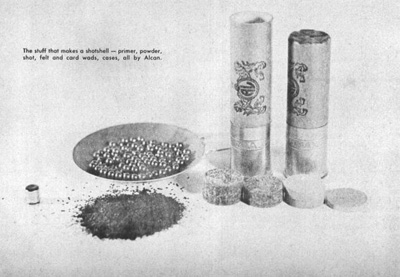
The army of shotshell reloaders grows daily – it’s easy, simple, and you can save folding money!
A lone pintail drake beat in toward my decoys against a stiff southwester, cupped his wings and began to spiral down behind the seaward dunes. Then a shot flatted out against the gray December sky, from a blind to my right, and he flared. I took him at a full fifty yards for a clean kill, watched as he winged over in a slow roll to drop, breast up, on the red, swamp-stained waters behind the sand dunes at Floras Lake, southwestern Oregon.
That shot was literally in the making for several weeks before I put out my few decoys and hunkered down behind my white, storm weathered driftwood hide. It was a hand-load carefully matched to the neat little 20-gauge double I carried. It was the end product of methodical testing and experimenting to find just the right combination of powder and shot for this particular gun.
The loading I used that day on those coastal dunes was 260 pellets of number 6 shot. My powder was Alcan’s AL8. The ultimate pattern showed an extremely full choked barrel throwing 80% of the load in a 30-inch circle at 40 yards. The modified barrel delivered a uniform 68% pattern – and all this in a gun which, with factory loads, never produced more than 65% in the full choked barrel, and only slightly more than 50% in the modified barrel. But here, with handloads, I was getting 12 gauge performance from a 20 gauge.
But I shouldn’t have been surprised. I have seen 12 bores step right up into the Magnum 10 class by careful handloading. Quite often in matching handloaded shells to a particular shotgun, pattern percentages can be improved as much as 10 to 15% over ordinary run-of-the-mill factory loads. And these percentages can be achieved with safety.
Gunners considering handloading usually approach the problem with several questions in mind. The foremost, generally, is the one of economy. What savings can be made by handloading shotshells? How big an investment in tools is required to turn out acceptable shotshells? Are the mechanics of reloading hard to learn?
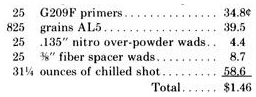
The Alcan Company of Alton, Illinois, gives this breakdown of cost for a box of 12-gauge shells, using a 3-dram, 1-ounce hunting load in Western Trap tubes:
This is a saving of about 57% over the retail price of 12-gauge factory loads. You can save up to 70% in reloading for Magnum 10, 5-dram 2-ounce loads, using Western once fired tubes. My 20-gauge loads cost me about $1.00 a box.
Once fired cases, which can often be found around a Skeet or trap field, may be reloaded two, often three times, depending on the make. The best domestic brand for reloading is Western-Winchester; their tubes will stand repeated reloadings. With light, upland loads, I have used them as many as four times with perfect results. The Remington high base, low brass tubes are also excellent, and will stand up under numerous handloads. The Remington low base, high brass cases, however, will take no more than one reloading, their bases tending to separate from the paper after two or three loadings. When this happens the next shell pushes the paper tube remaining in the barrel up into the forcing cone, not a nice complication.
Best, of course, is to start your reloading operation with new cases. These can be obtained from any supplier of reloading components. Those designed for magnum loads will permit four to five reloadings. They cost around $6.00 a hundred for 12 gauge, about $9.00 for the 10-gauge Magnum. Tubes for 16 and 20 gauge cost about $5.00 a hundred. All these prices are for empty, primed cases. Over the life of the tubes they are very inexpensive. Cheaper tubes, about $3.00 a hundred, can be used for lighter loads.
The most economical reloads, however, can be obtained by using brass cases. These can be used almost indefinitely. They are excellent for normal upland and field loads. But, being only 2 inches in length, they give somewhat more open patterns in guns chambered for 2-inch cases. Use brass cases, preferably, with loads requiring small wad pressure, for the reason that brass cases can’t be crimped without subtracting from their life – and it’s crimping that maintains heavy wad pressure.
Good, practical shotshell reloading tools can be had, with all the dies necessary to reload for one gauge, for less than $30.00. More expensive tools are available, but as in reloading rifle ammunition, the degree of perfection one obtains is more a matter of technique than of tools. A poor craftsman will turn out mediocre ammunition with the most costly tools; a careful, painstaking handloader will work up excellent shotshell reloads with any of the inexpensive tools available.
The Thalson shotshell reloading tool is an excellent example of the comparatively low priced reloading tools available. Both tool and dies for one gauge can be obtained for less than $30.00. Dies for another gauge, using the same tool, cost only $13.50. Where one is reloading for two or three gauges, such as a long range Magnum 12 for wild-fowling, and perhaps a 20-gauge for upland shooting, this tool is a very wise choice.
The old standby, the Lyman shotshell reloading tool, is another very good, inexpensive tool. So is the Echo shot-shell reloading tool. The difference in these tools, when compared with the more expensive reloading presses, is largely one of speed of operation.
The Acme reloading tool is a very wise choice, if you are going in for a more extensive reloading setup, for this tool loads lots of cases in a hurry, some 150-200 an hour. Another excellent choice is the C-H reloading press.
You need a good accurate powder scale, generally a powder measure as well, for your reloading operations. My setup, which I have found to serve admirably, consists of an electric powder measure manufactured by The Shooters Accessory Supply Company, and a Pacific powder scale. The electric measure pours the charge directly onto the scale pan to a predetermined amount. It automatically shuts off when this charge is on the scale.
This enables me to weigh each charge without trouble to one-tenth of a grain. (Some tools, such as the Acme, come with powder and shot measures with fixed-charge cavities for a certain load. With these, you simply change to a different “measure bar” when going to another load.)
There are several of these excellent measures on the market, some quite expensive. The electric powder measure I use, however, carries a modest price tag of less than $15.
How about the mechanics of shotshell handloading? Other than a good grade of common sense, there are no specific requirements. Essentially, it is a matter of keeping your various shotgun powders separate, of knowing the burning characteristics of them, and loading balanced loads.
Powders break down into three classifications: ultra progressive such as Alcan’s AL8, and AL7; progressive, such as AL5 and Herco; faster burning powders, such as Super M, AL-101, and Red Dot. The progressive powders are used for heavier shot charges and high velocity. The faster burning powders, such as Red Dot and Super M, are for trap loads.
As one drops down in gauge, more progressive powders should be used, even for the light hunting loads. In the 20 bore, using -ounce of shot, I find AL5 an excellent powder. This same AL5, however, is used in a 10 gauge, behind 1 ounce of shot. Probably the best all-round powder for 12 gauge light field and trap loads is the new Alcan powder AL-101. This powder is a perfect companion for their new primer, number 241. In many ways it is like Super M Bal-listite, though you get better, more uniform ignition with AL-101 powder and 241 primers.
Homer Clark, Jr., president of the Alcan Company, once told me that “not over 1% of all the handloaded shotshells sent to their ballistics laboratory for testing were rated as unsatisfactory. Of the loads rated unsatisfactory, a great majority of the trouble was equally divided between: (1) Improper selection of powder-primer combination as compared to the weight of the shot charge used. (2) Using an unsatisfactory wad column.” Just a few inexperienced reloaders fail to realize the importance of a proper wad column in shotshells. If the wad column isn’t right, you won’t get good patterns or velocity in your handloads.
The most critical point in wad seating is pressure. Over- powder wad pressure must complement the type of powder used. Burning characteristics of shotgun powders vary, and so does the pressure needed for proper combustion. This will range from as little as 20 pounds for some of the fast burning powders used in light trap and hunting loads, to as much as 95 pounds pressure for some of the progressive powders.
Improper wad pressure, as well as improperly balanced loads, often are indicated by a loud, sharp, rifle-like report when fired. Such reports in a shotgun indicate that powder is tunneling down the barrel, unburned, and is burning* in the air at the muzzle of the gun.
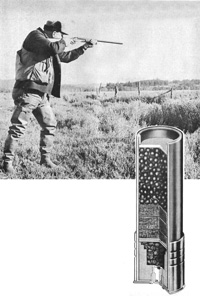
Basically, a wad column should contain at least one over-powder wad .125-inch thick, and at least one half-inch spacer wad. These are minimum requirements. Better, more uniform results are obtained when at least two over-powder wads are used, a .125 and a .70 being a good combination. And as the loads permit, at least two felt or fiber spacer wads should be used.
Well made spacer wads, as well as nitro wads, can be bought at a quite modest price. In spite of this, some shot-shell handloaders make their own. A breakdown of some of these reloaded shells submitted for testing has turned up everything in the way of wadding from corn meal to newspaper. None of these efforts is conducive to best ballistic performance, as you may well imagine.
A wad column must do five things for best gunning results. (1) It must seal the powder gases away from the shot column. (2) It must lubricate the barrel properly to prevent leading. (3) It must put the right pressure on the powder for proper combustion. (4) It must cushion the shock of the initial explosion to prevent shot distortion. (5) It must space the entire load for proper crimping. These cannot be obtained without the use of proper nitro over-powder wads, and well constructed felt or fiber spacer wads.
Fortunately, only a small fraction of 1% of the loads tested by Alcan were actually dangerous. Shotshell handloads which are dangerous come about when some ambitious gunner decides to make a super-super magnum load for his shooting iron. The mistake is rather progressive. First he develops a mere super magnum load. This is usually a fair overload, but modern shotguns being superbly constructed, he gets by with it. His next step gets him in trouble. He adds a bit more powder, a bit more shot and he has a “blue pill” indeed. But, again fortunately, he has enough doubt in his mind about his effort to send in a few for testing, and they are caught before they do any harm.
Shotshell reloaders must remember that there is no absolutely sure way of detecting dangerous pressures in a shotgun except in a ballistic laboratory equipped to take both pressures and velocities.
Don’t forget this, despite some of the homespun specialists who look knowingly at a shotshell primer and decide what pressures they’re getting. Expansion of a shot-shell primer shows nothing, even under a magnifying glass, which lends itself to a correct interpretation of pressures. Indeed a barrel could conceivably be blown up without excessive breech pressures.
Just about any shotgun breech,from the old Damascus types on up through all those mild steels formerly used, will stand any normal modern shotshell load – if the barrels would hold. They are first to give way when using modern progressive powders. The blowup usually comes about a foot or so in front of the breech. What causes this type of bursting is the sustained pressure curve of modern progressive powders. Pressures are carried farther toward the muzzle, and the gun is under pressure for a longer time. That means heavier barrels for modern loads. Examine a Model 12 Winchester 12 gauge designed for 3-inch Magnum loads and you’ll find the same breech action that is used on the regular 12 gauge, Model 12, 2-inch chambered gun. The only difference is in the heavier barrel of the Magnum 12.
There is a terrific safety margin built into all domestic shotguns, and most of the present day imports. With reasonable, common sense care, handloading for a shotgun is absolutely safe. Shotguns, however, do fall into certain classifications – light field-guns for upland gunning or snipe shooting, long range heavy wildfowl guns designed for maximum loads, others in between. No amount of hand-loading can alter these facts. You cannot safely stuff a super-super magnum load into a shell designed for those ultra light, five-pound upland doubles, nor should you try. It is much more important to try for a successful matching of gun and load for the type of shooting you do.
This entails careful search and testing for just the right size shot for your particular gun. In doing this you must get away from any preconceived notion about the best shot for any specific game bird.
Recently I read a very learned article in which each gauge had its assigned shot size. This authority recommended nothing larger than number 7 shot for a 20 gauge. Nice informative article but – I have one 20 bore in my gun rack which will, with careful handloads, put 85 percent of its shot in a. 30-inch circle at 40 yards, when loaded with 1 ounce of number 5 shot. I have seen 16 gauges come to their best pattern with an ounce of number 6 shot. I have patterned 12 gauges which handled number 7 shot to the exclusion of all other sizes.
The point is, if you have a 12 which doesn’t pattern size 4 shot properly, try number 5. If you find number 5 shaping up on the pattern board, try different recommended handloads. Perhaps you have geese in mind. A close pattern of number 5 shot, nipping around 80%, is a better goose load than an erratic pattern of either 4s or 2s! This is the gist of your handloading – finding just the right combinations for your gunning.
You want long range, close shooting loads for your wild-fowling. You also want light loads for your upland shooting. If you are a one gun man, as many handloaders are, it is entirely possible to find both these requirements filled by proper handloads.
You get about what you put into your reloading effort. Careful attention to detail will give you loads fitted to your individual gun no factory shell can duplicate. You shouldn’t settle for less.
From Gun Digest 2008 comes this handy guide to some shotshell reloading presses you should consider. Shotshell reloading is a great way to save money and shoot more.
DILLON SL 900
Press Type: Progressive
Avg. Rounds Per Hour:700-900
Weight: 51 lbs.
Features:12-ga. only; factory adjusted to load AA hulls; extra large 25- pound capacity shot hopper; fully-adjustable case-activated shot system; hardened steel starter crimp die; dual-action final crimp and taper die; tilt-out wad guide; auto prime; auto index; strong mount machine stand. From Dillon Precision Products.
Price:$914.90
Hollywood Automatic Shotshell Press
Press Type: Progressive
Avg. Rounds Per Hour: 1,800
Weight: 100 lbs.
Features: Ductile iron frame; fully automated press with shell pickup and ejector; comes completely set up for one gauge; one starter crimp; one finish crimp; wad guide for plastic wads; decap and powder dispenser unit; one wrench for inside die lock screw; one medium and one large spanner wrench for spanner nuts; one shellholder; powder and shot measures. Available for 10, 12, 20, 28 or 410. From Hollywood Engineering.
Price:$5,000.00
Hollywood Senior Turret Press
Press Type: Turret
Avg. Rounds Per Hour: 200
Weight: 50 lbs.
Features: Multi-stage press constructed of ductile iron comes completely equipped to reload one gauge; one starter crimp; one finish crimp; wad guide for plastic wads; decap and powder dispenser unit; one wrench for inside die lock screw; one medium and one large spanner wrench for spanner nuts; one shellholder; powder and shot measures. Available for 10, 12, 16, 20, 28 or 410. From Hollywood Engineering.
Price: Press only $1,000.00
Price: Dies $200.00
Hornady 366 Auto
Press Type: Progressive
Avg. Rounds Per Hour: NA
Weight: 25 lbs.
Features: Heavy-duty die cast and machined steel body and components; auto primer feed system; large capacity shot and powder tubes; adjustable for right- or left-hand use; automatic charge bar with shutoff; swing-out wad guide; primer catcher at base of press; interchangeable shot and powder bushings; life-time warranty. Available for 12, 20, 28 2 3/4 and 410 2-1/2. From Hornady Mfg. Co.
Price:$575.05
Price: Die set, 12, 20, 28 $202.77
Price: Magnum conversion dies, 12, 20 $43.25
Lee Load-All
Press Type: Single stage
Avg. Rounds Per Hour: 100
Weight: 3 lbs. 3 oz.
Features: Loads steel or lead shot; built-in primer catcher at base with door in front for emptying; recesses at each station for shell positioning; optional primer feed. Comes with safety charge bar with 24 shot and powder bushings. Available for 12-, 16-or 20-gauge. From Lee Precision, Inc.
Price:$52.98
MEC 600 Jr. Mark V
Press Type: Single stage
Avg. Rounds Per Hour: 150
Weight: 16 lbs.
Features: Spindex crimp starter for shell alignment during crimping; a cam-action crimp die; Pro-Check to keep charge bar properly positioned; adjustable for three shells. Available in 10, 12, 16, 20, 28 gauges and 410 bore. Die set not included. From Mayville Engineering Company, Inc.
Price:$120.32
Price: Die set $67.27
MEC 650
MEC 9000GN
MEC 8567N Grabber
MEC Steelmaster
MEC 650
MEC 650N
Press Type: Progressive
Avg. Rounds Per Hour: 400
Weight: 19 lbs.
Features: Six-station press; does not resize except as separate operation; auto primer feed standard; three crimping stations for starting, closing and tapering crimp. Die sets not available. Available in 12, 16, 20, 28 and 410. From Mayville Engineering Company, Inc.
Price:$240.00
MEC 8567N Grabber
Press Type: Progressive
Avg. Rounds Per Hour: 400
Weight: 22 lbs.
Features: Six-station press; auto primer feed; auto-cycle charging; three-stage crimp; power ring resizer returns base to factory specs; resizes high and low base shells; optional kits to reload three shells and steel shot. Available in 12, 16, 20, 28 gauge and 410 bore. From Mayville Engineering Company, Inc.
Price:$338.00
Price: 3 kit, 12-ga$79.32
Price: 3 kit, 20-ga$45.32
Price: Steel shot kit $39.65
MEC 9000GN
Press Type: Progressive
Avg. Rounds Per Hour: 400
Weight: 27 lbs.
Features: All same features as the MEC Grabber but with auto-indexing and auto-eject. Finished shells automatically ejected from shell carrier to drop chute for boxing. Available in 12, 16, 20, 28 and 410. From Mayville Engineering Company, Inc.
Price:$407.00
MEC 9000HN
Press Type: Progressive
Avg. Rounds Per Hour: 400
Weight: 31 lbs.
Features:Same features as 9000GN with addition of foot pedal-operated hydraulic system for complete automation. Operates on standard 110V household current. Comes with bushing-type charge bar and three bushings. Available in 12, 16, 20, 28 gauge and 410 bore. From Mayville Engineering Company, Inc.
Price:$958.00
MEC 8120 Sizemaster
Press Type: Single stage
Avg. Rounds Per Hour: 150
Weight: 20 lbs.
Features: Power ring eight-fingered collet resizer returns base to factory specs; handles brass or steel, high or low base heads; auto primer feed; adjustable for three shells. Available in 10, 12, 16, 20, 28 gauges and 410 bore. From Mayville Engineering Company, Inc.
Price:$182.18
Price: Die set, 12, 16, 20, 28, 410 $100.47
Price: Die set, 10-ga$117.92
MEC Steelmaster
Press Type: Single stage
Avg. Rounds Per Hour: 150
Weight: 20 lbs.
Features: Same features as Sizemaster except can load steel shot. Press is available for 3-1/2 10-ga. and 12-ga. 2-3/4, 3 or 3-1/2. For loading lead shot, die sets available in 10, 12, 16, 20, 28 and 410. From Mayville Engineering Company, Inc.
Price:$196.79
Price: 12 ga. 3-1/2 $220.41
Ponsness/Warren Du-O-Matic 375C
Press Type: Progressive
Avg. Rounds Per Hour: NA
Weight: 31 lbs.
Features: Steel or lead shot reloader; large shot and powder reservoirs; bushing access plug for dropping in shot buffer or buckshot; positive lock charging ring to prevent accidental flow of powder; double-post construction for greater leverage; removable spent primer box; spring-loaded ball check for centering size die at each station; tip-out wad guide; two-gauge capacity tool head. Available in 10 (extra charge), 12, 16, 20, 28 and 410 with case lengths of 2-1/2, 2-3/4, 3 and 3-1/2. From Ponsness/ Warren.
Price: 12-, 20-, and 28-ga., 2-3/4 and 410, 2-1/2 $289.00
Price: 12-ga. 3-1/2; 3 12, 20, 410 $305.00
Price: 12, 20 2-3/4 $383.95
Price: 10-ga. press $315.00
PONSNESS/WARREN Hydro-Multispeed
Hydraulic system developed for Ponsness/Warren L/S-1000. Usable for the 950, 900 and 800 series presses. Three reloading speed settings operated with variable foot pedal control. Features stop/reverse at any station; automatic shutdown with pedal control release; fully adjustable hydraulic cylinder rod to prevent racking or bending of machine; quick disconnect hoses for ease of installation. Preassembled with step-by-step instructions. From Ponsness/Warren.
Price:$879.00
Price: Cylinder kit $399.95
PONSNESS/WARREN L/S-1000
Frame: Die cast aluminum
Avg. Rounds Per Hour: NA
Weight: 55 lbs.
Features: Fully progressive press to reload steel, bismuth or lead shot. Equipped with new Uni-Drop shot measuring and dispensing system which allows the use of all makes of shot in any size. Shells automatically resized and deprimed with new Auto-Size and De-Primer system. Loaded rounds drop out of shellholders when completed. Each shell pre-crimped and final crimped with Tru-Crimp system. Available in 10-gauge 3-1/2 or 12-gauge 2-3/4 and 3. 12-gauge 3-1/2 conversion kit also available. 20-gauge 2-3/4 and 3 special order only. From Ponsness/Warren.
Price: 12 ga$849.00
Price: 10 ga$895.00
Price: Conversion kit $199.00
Ponsness/Warren Size-O-Matic 900 Elite
Press Type: Progressive
Avg. Rounds Per Hour: 500-800
Weight: 49 lbs.
Features: Progressive eight-station press; frame of die-cast aluminum; center post design index system ensures positive indexing; timing factory set, drilled and pinned. Automatic features include index, deprime, reprime, powder and shot drop, crimp start, tapered final crimp, finished shell ejection. Available in 12, 20, 28 and 410. 16-ga. special order. Kit includes new shellholders, seating port, resize/primer knockout assembly, new crimp assembly. From Ponsness/Warren.
Features:Progressive eight-station press, similar to 900 and 950 except has die removal system that allows removal of any die component during reloading cycle. Comes standard with 25-lb. shot tube, 19? powder tube, brass adjustable priming feed allows adjustment of primer seating depth. From Ponsness/Warren.
Price:$889.00
RCBS The Grand
Press Type: Progressive
Avg. Rounds Per Hour: NA
Weight: NA
Features: Constructed from a high-grade aluminum casting, allows complete resizing of high and low base hulls. Available for 12 and 20 gauge.
Price:$812.95
RCBS Mini-Grand
Press Type: Progressive
Avg. Rounds Per Hour: 200
Weight: NA
Features: 7-station single-stage press, lead or steel reloading (with steel accessories). 12-gauge version loads 2-3/4 to 3-1/2 shells; 20-gauge product load 2-3/4 to 3 shotshells.
Learn how to do shotshell reloading in an easy step-by-step guide from Gun Digest 2008. Shotshell reloading is a great way to fine-tune your shotgun loads and save money.
The first step in shotshell reloading is to inspect your hulls for flaws. A modern hull has a certain lifespan and, barring some specific injury – being stepped on, for instance – it should last a dozen shots or perhaps more.
The natural tendency with reloaders is to push a hull’s lifespan. It is better for performance however, and for your own peace of mind to discard a hull at its first sign of wear or irregularity. If the crimp looks like it is developing a crack, or the plastic seems to be separating from the brass base, or there is anything out-of-the-ordinary about the hull that causes you to look twice at it, discard it.
RESIZING
A press resizes a hull in two ways. It can use a steel-fingered sleeve to slide up on the brass and squeeze it or neck it down to proper size as a single step in the reloading process.
A second method is to force the entire hull into a full-length resizing die at station number one. This die can then hold the shell tightly through the entire process of reloading and crimping.
DE-PRIMING
The next step, called “de-priming,” involves removing the spent primer. Unless you are using a hydraulically-operated progressive press, which accomplishes these steps automatically with the tap of a toe, you must physically push the old primer out the bottom of the hull with a pull of the lever. This step is gauge-specific, so be sure you have the correct de-priming pin in place.
De-priming must not crush the hull’s base wad as this can cause a drop in pressure for your next load.
Never de-prime live primers from hulls, either! Pressing a live primer out could cause it to detonate! RE-PRIMING
Any time that you handle primers, it is best to wear safety glasses and, in fact, this safety precaution is urged throughout the reloading process.
Modern shotshell primers have been standardized to the #209 size. If the primer does not fit easily into the empty pocket, do NOT force it, as a detonating primer will hurt you. Stop and look for the problem.
Primers are built with different levels of energy and each load calls for a specific primer in order to function properly. Use only the primer recommended in your load recipe. If you do not have that particular primer, get some.
It is easy to seat a primer correctly and the only correctly seated primer is one that is flush with the bottom of the base. Primers extending out beyond the level of the base have in rare cases been known to explode prematurely during action cycling before the gun is properly locked. This will cause your shell to literally, “go ballistic.”
DROPPING POWDER
Powder is measured in grains. One ounce equals 437.5 grains, and 16 ounces, or one pound, are 7,000 grains. Remember this measure.
Every loader requires bushing adjustment for different loads. Most presses have independent, replaceable bushings, but some modern presses have measuring and dropping systems for powder and shot that eliminate physically replacing bushing components.
Using traditional single or progressive presses, the proper bushing for each specific load must be used for controlled measurement of a powder charge. Charts, provided by the manufacturer of your reloader, will specify which bushing to use for a specific type and amount of powder.
INSERTING THE WAD
Your next adventurous reloading step is placing the proper wad into the shell. Modern wads are available with specific heights and thickness. One wad does not fit all.
Wads need to be seated correctly on top of the powder and there is always a certain amount of flex needed for proper crimping. To seat a wad, press it firmly into the base of the hull. Do not apply so much force that you might tear or distort the plastic. Crushing a wad causes it to cant or lean inside the hull. This effectively destroys the midsection and ruptures the gas seal.
A workable method of wad seating is to observe the top of the wad as it relates to the hull’s crimp folds. The top of the wad petals should sit just below the crimping line. If for any reason, the wad protrudes from the top of the hull, or it drops completely out of sight inside the hull, something is wrong.
If your press uses wad guide fingers, get used to the fact that they occasionally must be replaced. Wad guide fingers sit directly above the hull at the wad placement station. These thin, usually plastic, fingers extend into the mouth of the hull, easing passage of the gas seal.
Hunting loads often require that a filler wad be placed inside the wad/shotcup at this point. A filler wad can be felt, cardboard or cork. These wads are shaped like a disk and come in varying thickness. Should your load require a filler wad (or two), place it into the wad guide, just as you would like it to sit inside the wad column.
DROPPING SHOT
Loose shot fills a cavity, an empty cylinder inside the bushing, which is cut to the specific diameter required to accommodate a certain payload. Although it seems a little primitive in the digital age, this method works quite well, especially with lead pellets #4 and smaller. For common trap, skeet and sporting clays loads, you simply drop in the proper bar or bushing and proceed, because #7-1/2, #8, #8-1/2 and #9 shot flow like water and measure almost perfectly.
Larger pellets occupy space, just like smaller pellets, but those larger pellets need more “elbow room.” You will also notice a slight weight reduction for every shot size increase. So when using any particular bushing, always verify the shot weight by pulling a sample or two after first settling the shot in the reservoir.
CRIMPING: CLOSING THE SHELL
Developing the crimp and starting and finishing the seal are normally a multi-station process. For different payloads, powders and other ingredients, you will need to carefully check and perhaps adjust the crimp stations of your press.
Crimping is “not a static setup, once achieved, never altered.” In other words, like driving in traffic, reloading is not something you can do effectively while you are watching an exciting ball game on television or preparing the family dinner.
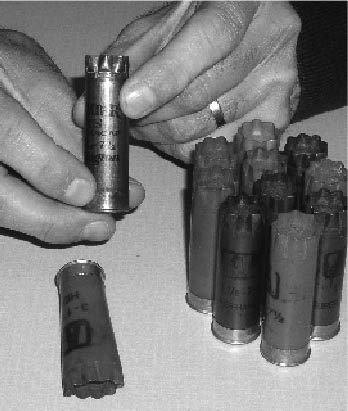
To determine which crimp-starter to use in your press, simply count the folds in the top of the hells you are reloading. You can do the same with the crimp-starter itself if the six-pointer and the eight-pointer look alike on the outside, and they often do. It is important to use the proper crimp-starter, because folding a six-point hull with an eight-point crimp starter for example is going to make a mess of your hull.
Do not agonize over the six-point or eight-point crimp decision. Go with what works for you and your machine. Adjust the crimp starter until you can see that folds have been introduced to the hull. Closing your shell is often a multi-stage process and starting the crimp is only step number one. If you overdo it with this adjustment, the crimp may smash together in the center during the final stage.
In applying crimps, we often refer to a hull’s “memory.” This means that once plastic “takes a set” or is creased, it will usually return to this shape the next time you bend it. New, unfired hulls may have to have folds introduced to the plastic by slowly working the hull into the crimp starter station a couple of times before moving on to the final crimp station.
The final crimp station closes the hull, leaving what should be a flat, level surface across the top. You want the center hole to be as small as possible, without being crushed together completely, and to form a spiral swirl. In general, the folded crimp will provide you with a positive closure that is about 1/16- to 1/10-inch deep.
MARK YOUR SHELLS
Since reloaded shells may have nothing to do with the original markings or the original boxes, you are faced with needing to mark your loads. Short range, long range, rabbits, spreader loads, different size shot … write it all down on the shell or on a card inside the box and you will be less inclined to forget or make a mistake.
By a vote of 98 to 1, the Arkansas State House passed House Bill 1623 last week, proposed legislation to protect the identities of concealed carry holders. That bill was authored by Representative Randy Stewart (D-23), a former Olympic shooter and a concealed-carry course instructor.
According to the National Rifle Association, “This legislation was drafted in response to the invasion of Right to Carry permit holders’ privacy when a list of permittees was published online, and it will make private the personal information of all Right to Cary permit holders. HB 1623 allows for the list to be accessed only by law enforcement agencies for the purpose of assisting with a criminal investigation or prosecution, or for determining the validity of, or eligibility for, a license.”
The website for the Arkansas Times published the list.
“We’re not trying to pit the Second Amendment against the First Amendment, but I think in this time they’re kind of converging,” Stewart told the Associated Press. “And we need to do some protection for the people, the law-abiding citizens, who have gone to the trouble to (take) the class, the background check, pay $144.25 for the license. We need to protect their rights also.”
The bill moved onto the Arkansas Senate for consideration.
Upcoming auctions feature classic Colts, Winchesters, Civil War firearms
Several high-profile auctions in March and April will set the bar for high-quality collectible firearms.
Sales by Rock Island Auction Co., James D. Julia Co., J.C. Devine Co., Bryan Imes & Sons Co., and Coys of Great Britain each will feature high-profile rifles, handguns, and/or Civil War memorabilia from private collections.
Rock Island lists Colts, Winchesters, and More
Dates: April 25, 26 and 27, 2009
Location: Moline, Illinois
Contact: Visit www.rockislandauction.com for more information.
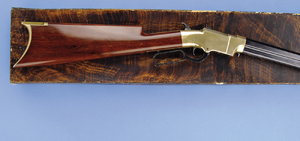
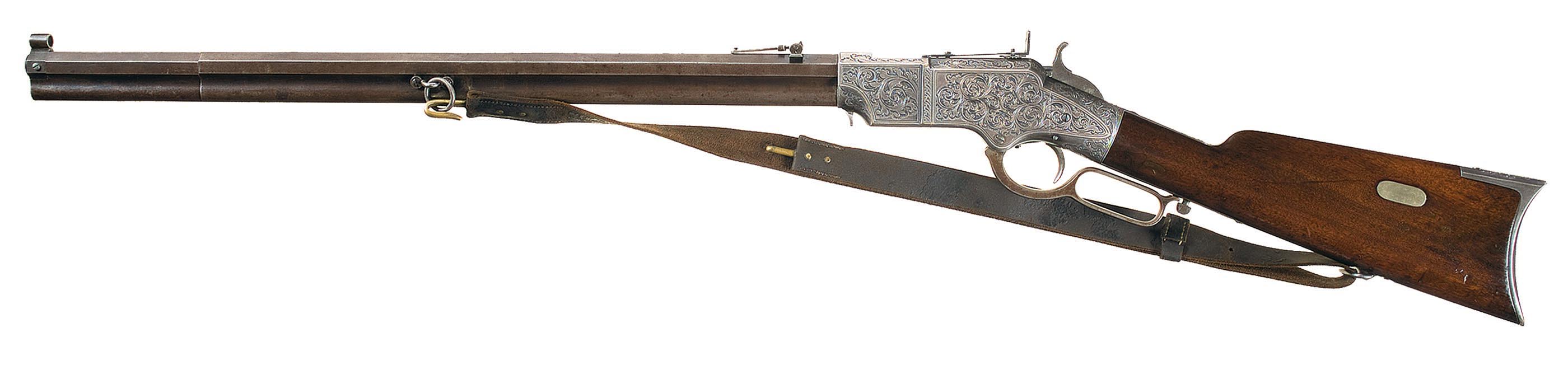
The Rock Island April auction will include a New Haven Arms Co. Volcanic Lever-Action Navy Pistol with detachable stock, estimated at $75,000 to $100,000.
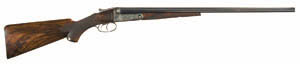
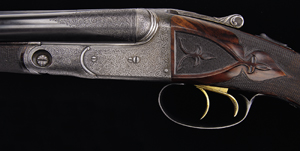
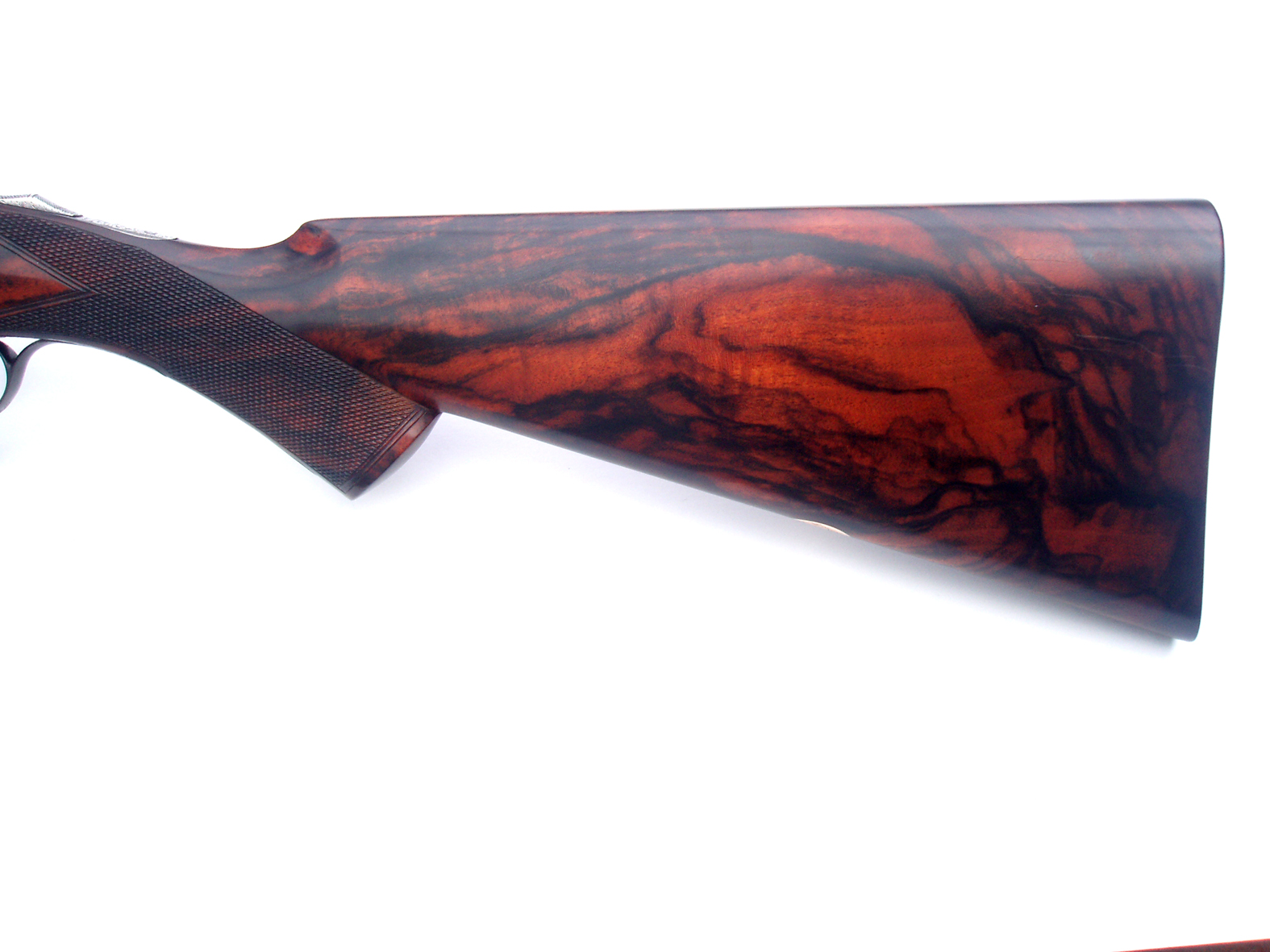
An engraved Parker Bros. Model AH Double Barrel Boxlock Shotgun in 28 Gauge is estimated at $45,000 to $70,000 in the Rock Island April auction.
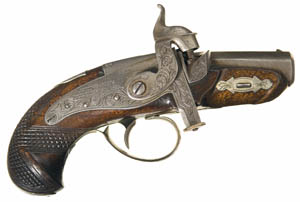
An engraved Butterfield self-priming Deringer pistol in the Rock Island April auction carries an estimate of $50,000 to $75,000.
Colts, Winchester, European military, and other firearms will be featured in Rock Island’s Spring Premiere Auction April 25-27.
The sale will feature the second part of the Will Hoffeld estate and firearms collection and the final installment of the Frank Sellers collection. (Sellers is the author of Sharps Rifles and more than 20 other books.)
Also listed are military firearms from the collection of Scott Meadows, author of U.S. Military Automatic Pistols. The collection includes a large group of Philadelphia Deringers, Henry Deringers, and a rare Butterfield Deringer. Other firearms include 19th century Smith & Wessons, Colts, Remingtons, and Custer battlefield relics.
Another highlight will include a large grouping of small-bore shotguns — more than 100 .410-bore, 100 20-gauge, 50 28-gauge and 30 16-gauge — and pre-64 Winchester Model 70s in rare calibers.
James Julia Auction to Showcase Dr. Joseph A. Murphy Colt Collection
Dates: March 16 and 17, 2009
Location: Fairfield, Maine Contact: For details, call 207-453-7125 or visit www.jamesdjulia.com.
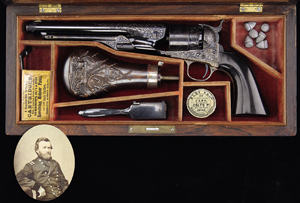
General U.S. Grant’s Factry Engraved Colt 1860 Army (Serial No. 151718E), inscribed “Union & Liberty,” carries an estimate of $350,000-$650,000. This piece is part of the James D. Julia “Doc” Murphy collection to be auctioned March 16-17.
A Volcanic Carbine in its original box will be featured in the James Julia March 16-17 auction.
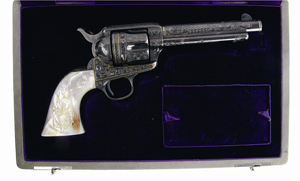
This gold and engraved Colt 1878 DA with pearl grips was presented to Captain Jack Crawford by the Colt Patent Firearms Co. It will be offered in the James Julia March auction and has an estimate of $175,000-$225,000.
A cased Parker A-1 Special 20-gauge with 32 inch barrels (serial number 207xxx) carries an estimate of $120,000-$150,000 in the Julia auction.
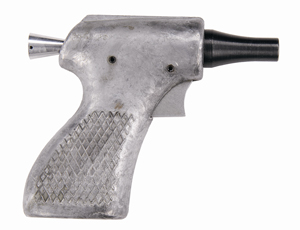
A rare CIA Deer Gun Clandestine Single Shot Pistol from the Tom Clinton Collection will be available in the Julia auction. It was manufactured around 1964 as an updated version of the Liberator pistol which was dropped behind enemy lines in WWII; the “Deer” gun was designed to be dropped in Southeast Asia during the Vietnam war, but the guns never made it to Vietnam and the CIA denies their existence. It is rumored that the guns were destroyed and only a handful survived. The frame is one piece cast aluminum with raised checkering on the grip area which was hollow to house a few extra rounds of ammunition. A groove runs down a ramp on top for sighting. The barrel unscrews for loading and removing the empty casing. A cocking knob was pulled until cocked. The aluminum trigger featured no trigger guard. Included with the pistol are a set of original engineering drawings which may be original blueprints. Copies of the original instructions are also included, which show how to use the gun against enemy with a hammer and sickle on his sleeve. It has an estimate of $10,000-$15,000.
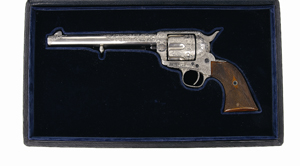
This engraved Colt single action army revolver is the earliest known factory engraved single action. The 1876 Centennial Exhibition colt is part of the Doc Murphy collection to be auctioned in March by James Julia Co.
An engraved and gold inlaid Colt single action army revolver, the Sears & Roebuck “Cowboy” Special from the Doc Murphy collection.
A rare cased engraved inventor presentation Colt Charter Oak 1855 Root Model 2 percussion revolver from the Doc Murphy collection.
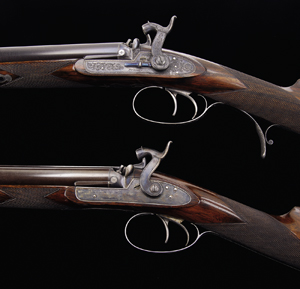
A pristine (possibly unfired) cased Purdey 16-bore rifle and shotgun offered in the March James Julia auction carries an estimate of $60,000-$90,000.
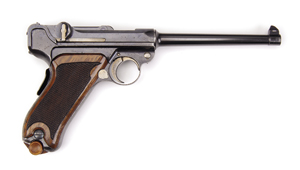
A Model 1898 Dutch test/acceptance pre-production prototype Borchardt- Luger semi-auto pistol with serial number 35 could go for $90,000-$130,000 in the James Julia March auction.
The first of three James D. Julia auctions featuring the Dr. Joseph “Doc” Murphy Colt collection will be held March 16-17, the company announced. The second segment will be held in October, and the third will take place in spring 2010. Murphy’s extensive Colt collection includes more than 100 pieces and is valued at around $26 million.
Among the Colt offerings are: A cased engraved Patterson belt model with eight silver bands in nearly new condition; it carries a presale estimate of $275,000 to $500,000. A Colt single-action Sears & Roebuck (gold inlaid, engraved and cased) SAA has an estimate of $450,000 to $800,000. A cased first-model Colt dragoon that was once presented to Franklin Pierce is estimated at $250,000 to $450,000. A deluxe factory-engraved Colt 1860 Army revolver with ebony grips inscribed “Union and Liberty” that was acquired from a descendent of Ulysses S. Grant will be presented autographed CDV of Grant; the package has an estimate of $350,000 to $650,000. A pair of cased 1861 Colt Navy revolvers presented to General Robert Anderson by Colt will be offered with Anderson’s sword and other Anderson memorabilia. The lot carries an estimate of $1,250,000 to $2,250,000.
Other items in the Julia action will cover shotguns and sporting rifles, including: A cased Parker A-1 Special 20-gauge with 32 inch barrels, SN 207xxx for $120,000 to $150,000; a Parker AAHE 20-gauge with 28-inch barrels and factory letter for $50,000 to $70,000; a Dossa Bertuzzi engraved side lock 16-gauge two-barrel set for $60,000 to $90,000; and a vintage pair of H&H 12-gauge game guns for $30,000 to $50,000.
The sporting rifles arena includes a J. Rigby Rising Bite .450NE with a presale estimate of $70,000 to $100,000 and a R.G. Owen, Kornbrath engraved bolt rifle for $27,500 to $37,500.
A high-quality Colt single-action revolver marketed by the Hart Gun Shop of Tombstone (next to the O.K. Corral), together with a Tombstone marked holster and other Tombstone artifacts, is estimated at $100,000 to $125,000. An engraved Colt 1878 DA with pearl grips presented to Capt. Jack Crawford (longtime friend of Buffalo Bill) carries an estimate of $175,000 to $225,000. A cased silver mount presentation Bowie with sheath for Colonel Thomas Stevenson made sometime during the Civil War has a presale estimate of $80,000 to $120,000. A 16-1/2 inch volcanic carbine and its rare cardboard box is estimated at at $18,000 to $22,000.
Civil War items include a gold standing Liberty figure hilt presentation sword presented to G.W. Harrison of the New Jersey Volunteers; it is estimated at $25,000 to $35,000. A Confederate Arkadelphia musket — one of two known to exist — carries a presale estimate of $50,000 to $85,000. A Tiffany sword presented to Medal of Honor winner Brig. Gen. R. Saxton by recently freed slaves in South Carolina in 1864 will be offered with an estimate of $85,000 to $125,000.
Among the Winchesters, a Civil War period engraved Henry with patriotic motifs carries a presale estimate of $40,000 to $60,000. Three rare Winchester cartridge boards, including an 1884 WRAC Bullet Board from a private collection, has a presale estimate of $15,000-$20,000.
A Luger .30-caliber pistol tested by the Dutch for its military with serial number 35 has an estimated for $90,000 to $130,000.
Civil War swords in J.C. Devine sale
Date: April 19, 2009
Location: Milford, New Hampshire
Contact: For more information on other items in the sale, call 877-454-4867 or visit www.jcdevine.com.
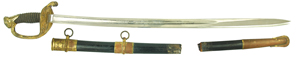
A Civil War Model 1850 Foot Officer’s Sword offered by J.C. Devine.
A Civil War Ames Model 1850 sword.
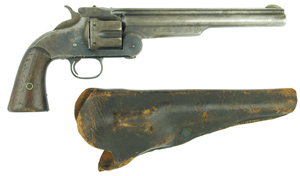
A S&W .44 with 8” barrel single action revolver used in the Civil War and offered by J.C. Devine Co.
Two swords and a revolver used in the Civil War are among the highlights of an April 19 auction by J.C. Devine. All three items are from the Hodges collection of personal artifacts used during the war
One sword is an 1850 Foot Officer’s pattern model with a 30 3/4” blade. The sword has the trademark knight logo of W./ CLAUBERG SOLINGEN.” The other is a standard pattern Ames Co. U.S. Model 1850 Foot Officer’s sword with a 30” blade.
The Hodges collection also includes a .44 American caliber S&W 8″ barrel (serial number 1032) model single action revolver bearing the inscription “F.S. Hodges of the A & P Railroad.”
Dave Florance collection part of Imes & Sons auction
Dates: March 20, 2009
Location: Port Royal, Pennsylvania
Contact: For details, visit www.bdiauctions.com or call 717-527-2449
The collection of big game hunter, Dave Florance (Mossy Oak Hunting the Country, American Hunter) will be offered in the March 20 auction by Bryan Imes & Sons Co. The sale will feature pre-1964 Winchesters, including Model 70s, Model 88s, Model 94s, Model 1894s, Ted Williams guns made by Winchester, ammo boxes, reloading tools, and scopes. Remingtons, Brownings, Ithacas, Mausers, Mossbergs, Rugers, and other collectible firearms will also be included.
U.K. Gun Auction Held by Coys
Dates: April 25 to 27, 2009
Location: Moline, Illinois
Contact: For more information, visit www.rockislandauction.com.
A rare over & under, round action (circa 1994) from Scottish gunmaker David Mackay-Brown features a walnut stock with a semi pistol grip and a gold oval engraved with a mythical tiger. This gun will be offered in the Coys March auction.
Patrick Keen will hold a Sporting Gun Auction with Coys Classic Cars on March 12 at the Royal Horticultural Halls, London.
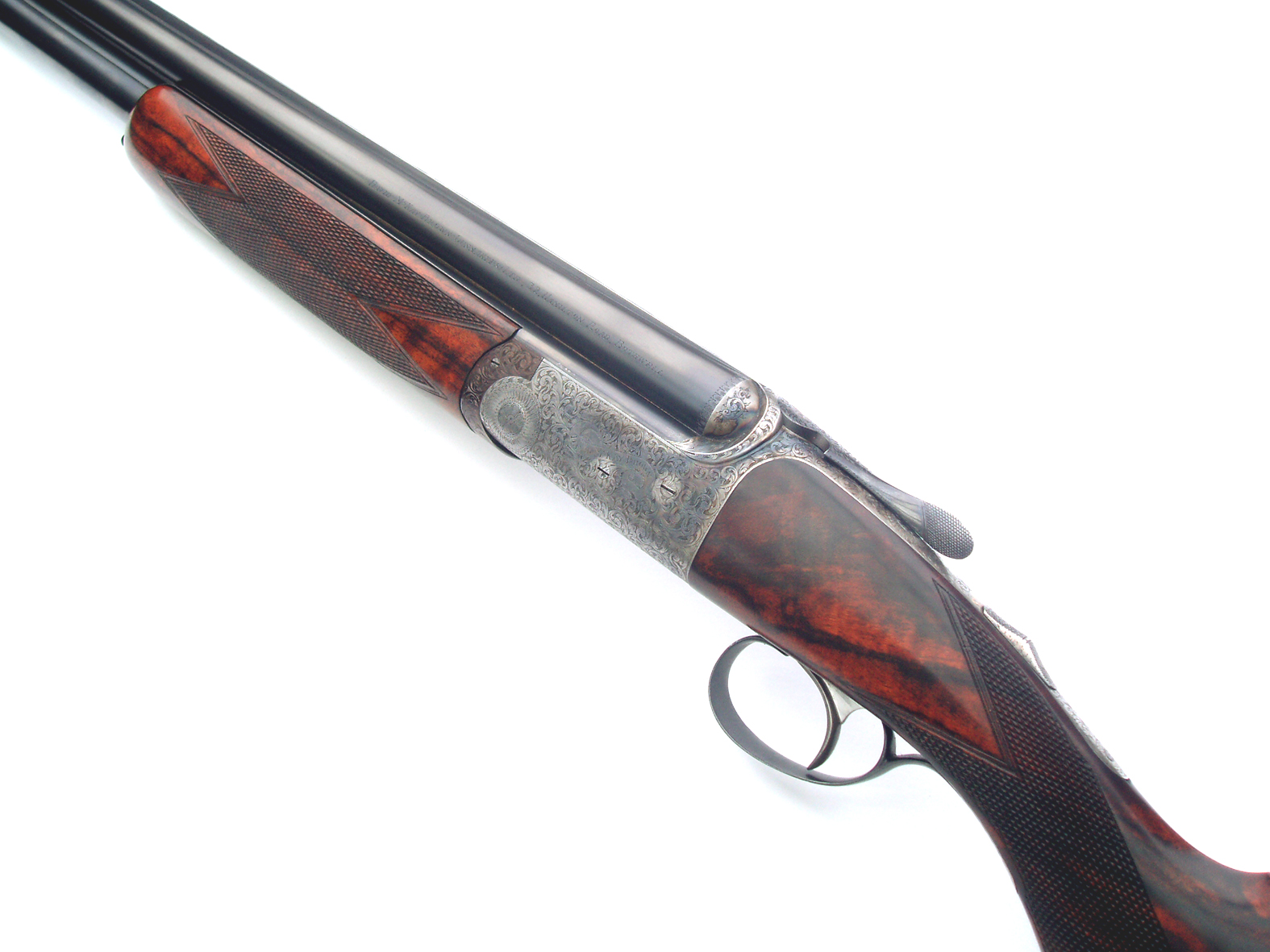
Among the guns offered is a David Mackay-Brown over & under 12-bore in its leather case (estimate £22,000 to £26,000), a Boss over & under, a Holland & Holland Royal, a John Dickson 12-bore round action, a Purdey 12-bore sidelock, and a pair of 12-bore Beesley sidelocks in their original case.
For more information, visit www.patrickkeenguns.co.uk or www.coys.co.uk.
To report auction news, e-mail editor Don Butler at [email protected].
Rock Island post auction records
The top seller of the Rpock Island December auction was a rare Colt Texas Paterson revolver with seven German silver bands and ivory grips — one of the eight Patersons offered at no reserve. It sold for $103,500.
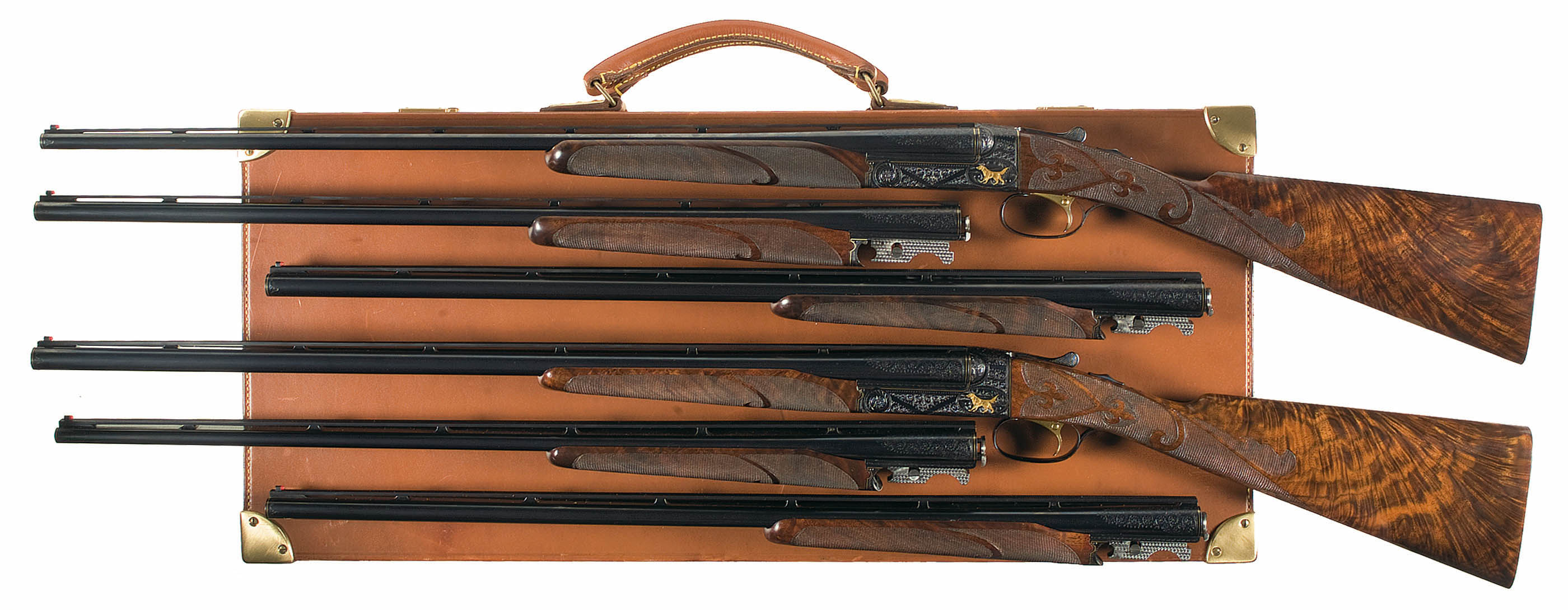
A cased pair of consecutively serial numbered Winchester-built Model 21 three barrel set shotguns brought $80,500, within estimate price.
An engraved Henry lever-action rifle realized $74,750.
The December Rock Island Auction Co. (RIAC) auction realized strong and record-setting results, the company announced. The Dec. 6-8 auction had more than 2,700 lots featuring firearms, edged weapons, and military artifacts.
Key items include a selection of rare and high-end Colts from the Will Hoffeld estate (proceeds from the sale will benefit the NRA foundation, to which RIAC announced a matching pledge).
A rare Hotchkiss revolving naval cannon with carriage mount and accessories brought $92,000.
RIAC offered over 300 Winchesters in the December sale. The high seller was a Winchester factory presentation 1866 lever action rifle that had an Ulrich pattern engraving with nickel finish; it sold for $23,000. An engraved Winchester model 1873 lever action rifle with patriotic motif rose above the estimate to realize $13,800.
Sporting arms collectors bid more than $819,000 on shotguns and more than $405,000 on rifles and pistols. A set of three Browning Renaissance semi-automatic pistols in a wood case sold for $7,475. The top seller for sporting rifles was a master-engraved B. Ludwig Merkel model K2 Vintagers series single shot stalking rifle with scope ($12,650). An exceptional quality engraved and gold inlaid Hoffman Arms English proofed side by side box lock shotgun with ejectors brought an above-estimate price of $23,000. An engraved L. Ernst gold inlaid Belgium Browning P2Q water fowl edition superposed shotgun (with box) doubled its high estimate and sold at $20,700.
A price of $97,750 was brought for a double-cased set of presentation inscribed Civil War Colt Model 1851 navy revolvers with ivory grips. Over 80 Brevetes were offered, including a N. Gilon Liege engraved Brevete Colt Walker model revolver that sold for $34,500. A cased Smith & Wesson Model 320 Revolving Rifle with Stock sold above estimate ($11,000 – 18,000) at $25,875.
This auction’s rich history was seen in both the Civil War and WWII firearms and items. A rare Confederate Rigdon, Ansley & Co., percussion revolver sold for $31,625. A model 1860 Cavalry Officer’s Saber with post Civil War militia presentation inscription brought a price of $6,325. Bidding interest could also bee seen in WWII firearms, an exceptional WWII J.P. Sauer Luftwaffe M30 Survival Drilling realizing a price of $31,625.
Here’s a list of some of the top sellers (estimates in paretheses):
Colt Texas Paterson Revolver with Seven Silver Bands and Ivory Grip, $103,500 ($125,000-$225,000)
Double Cased Set of Presentation Inscribed Civil War Colt Model 1851 Navy Revolvers with Ivory Grips and Colt Model 1851 Navy Revolver, $97,750 ($100,000-$125,000)
Hotchkiss Revolving Naval Cannon with Carriage Mount and Accessories, $92,000 ($50,000-$75,000)
Cased Pair of Consecutively Serial Numbered Winchester Built Model 21 Three Barrel Set Shotguns and Engraved Gold Inlay Winchester Model 21 Three Barrel Set Shotgun, $80,500 ($65,000-$85,000)
Deluxe Engraved Silver-Plated Henry Lever-Action Rifle, $74,750 ($75,000-$125,000)
Civil War Production Henry Lever Action Rifle, $69,000 ($65,000-$90,000)
Colt A Company No. 182 Walker Model Revolver, $63,250 ($75,000-$150,000)
Colt Paterson No. 3 Belt Model Revolver with Flared Grip, $48,875 ($40,000-$60,000)
U.S. Contract New Haven Arms Company Henry Rifle, $37,375 ($35,000-$45,000)
N. Gilon Liege Engraved Brevete Colt Walker Model Revolver, $34,500 ($15,000-$30,000)
Original Cased Luftwaffe Model 30 Drilling with Case and Accessories, $31,625 ($22,500-$37,500)
Colt 3rd Model Dragoon Revolver with Four-Screw Frame, $31,625 ($32,500-$40,000) Colt Paterson Pocket Model Revolver No. 1 (Fourth Model Ehlers), $31,625 ($30,000-$50,000)
WWII J.P. Sauer Luftwaffe M30 Survival Drilling with the Aluminum Storage Case and Accessories, $31,625 ($25,000-$35,000)
Confederate Rigdon, Ansley & Co., Percussion Revolver, $31,625 ($25,000-$50,000) Cased Deluxe Presentation Savage Revolving Fire-Arms Co. Navy Model Revolver, $31,625 ($35,000-$55,000)
Rock Island February Regional Sale Surpasses $2.2 Million
After setting a company record for annual sales in 2008, Rock Island Auction started 2009 year its Feb. 6-7 Regional Sale reaching $2.2 million, doubling any other previous regional sale.
More than 2,100 lots were offered that contained 4,300 firearms from the Will Hoffeld Estate. More than 14,000 sealed bids were received for the sale, and some lots had up to 25 pre-auction bids. After the auction, only two lots didn’t sell.
The top sellers include a frame of bullet molds from the Hoffeld estate that sold for $3,450, more than four times the high estimate. M1 Grands and M1 Carbines were in high demand from the bidders — an excellent late production Winchester M1 carbine brought $4,025. Nearly all Smith and Wessons sold at or above the low estimate including a Smith & Wesson number three second model American revolver which realized $2,300. Other notable items are two German hunting swords with sheaths that reached $5,462 and a lot of two lever action carbines (a Colt burgess lever action saddle ring carbine and a Whitney-Kennedy lever action saddle ring carbine) brought $7,475.
It came as no surprise to gun owners when a key official in the Obama Administration admitted that gun control was on the new president’s radar.
During a February 25 press conference, ABC News reported, Attorney General Eric Holder said, “As President Obama indicated during the campaign, there are just a few gun-related changes that we would like to make, and among them would be to reinstitute the ban on the sale of assault weapons.”
Holder did not offer a time frame for actual legislation. Of note, during his Senate confirmation hearing, Holder said, “I think closing the gun show loophole, the banning of cop-killer bullets and I also think that making the assault weapons ban permanent, would be something that would be permitted under Heller.”
Heller, of course, referred to last year’s Supreme Court ruling which confirmed that the Second Amendment was an individual right.
Wayne LaPierre, vice president of the National Rifle Association, told ABC News, “A semi-automatic is a quintessential self-defense firearm owned by American citizens in this country. I think it is clearly covered under Heller and it’s clearly, I think, protected by the Constitution.”
A custom AR-15 for $1,690 that blows bullets and minds
It seems a simple enough mission: buy a quality, custom AR-15 at an affordable price. A quick, painless trip to the firearm store should complete the task, right?
Wrong.
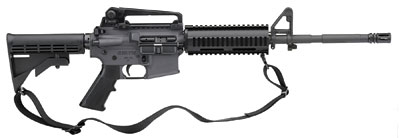
Unless it is a Les Baer “Police Special” Custom 16-inch AR .223, you better not lose your receipt. Unlike other “affordable” AR-15s, the “Police Special” does not skimp on quality.
Features include:
– LBC forged and machined upper and lower receiver – Removable carry handle with rear sight – Picatinny flattop rail on upper – Standard style carrier – Precision bolt and extractor – 16″ precision button rifled steel barrel with 1X8 twist – 5-position collapsible stock – Special 4-way Picatinny handguard free floated – Lockable sling swivel mounted on stud on 4-way handguard – 1″ nylon sling – A2 style flash hider – Hard coat anodized upper and lower – Phosphate finish on steel parts – Steel front sight base – Timney Match trigger group – (2) 30-round magazines
The bottom line: get to know this gun. Click Here to introduce yourself.
Is this the ultimate concealed carry compact revolver?
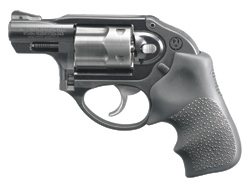
You’ll see its unique components. You’ll feel its light weight (only 13.5 oz.). You’ll try its smooth trigger.
And then you’ll wonder – is this a Revolution or an Evolution?
Think features (high-tech polymer fire control housing, aerospace aluminum frame with synergistic hard coat, friction reducing cam) meets functionality (reliable, durable, easy-to-use).
Put it in your hand, fire the five rounds of .38 Special+P, and realize that it is pure genius. Realize it is one of the most significant new revolver designs in over a century.
Watch video of the Ruger LCR in action.Click Here.
Two LCR models are available – the Standard LCR with a perceived recoil-reducing Hogue® Tamer™ Grip or a Crimson Trace® Lasergrip® variation.
To learn all about the New Ruger LCR (Lightweight Compact Revolver), including features, specifications, holster compatibility, imagery and video, visit www.ruger.com/LCR.
March will feature a quartet of interesting new releases for collectors and for people interested in personal protection.
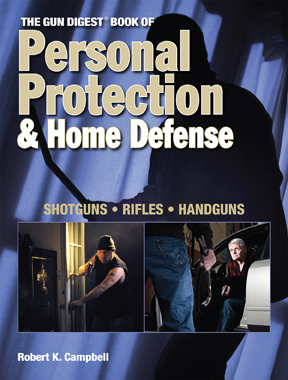
Here’s an excerpt from the upcoming book The Gun Digest Guide to Personal Protection & Home Defense:
There are skills we must have or no advanced practice will be beneficial. The basic skills are defined below. Study and understand each and implement them in your practice regimen. If you are aware of the demands of these skills, you will be way ahead in choosing a combat handgun.
The Firing Grip
The hand should grasp the handgun firmly. The ideal grip is found when you squeeze the handle until your hand trembles then back off a bit. The grip should be firm but relaxed to allow proper motor movement. The fit of the handgun should allow the trigger finger to comfortably reach the trigger face and to properly control the trigger. A too-large handgun will be difficult to control. Few of us can manage a Glock Model 21 .45 well and quite a few shooters have problems with the Beretta 92. Large-frame .44 and .45 caliber revolvers are beyond most of us to quickly present from a holster and deploy effectively. If the pistol does not fit your hand well, it will not improve in fit with firing! Your hand will not conform.
The two-hand grip I have come to use depends on more force from the support hand, making for greater flexibility in the strong hand. I practice the competitor’s grip, with about 60 percent of the muscle force used in controlling the pistol coming from my non-dominant hand. It works for me; for others, it is at least worth an experiment. But in order to make use of these grip styles, the handgun’s handle must be comfortable in your hand. Consider the size and angle of the handgun grip first.
Trigger Press
This is the single most difficult element of marksmanship for most shooters to master. The trigger must be pressed firmly to the rear without any deviation from the path. To mash the trigger to one side or the other will cause a missed shot.
If the trigger feels heavy and rough in the gun shop, you will have a difficult time mastering the handgun. The trigger press must be rhythmic. You must have a certain cadence with the trigger – fire, reset, fire – with equal intervals between firing and the reset. You may be off a little on sight alignment at close range and make a hit, but if you jerk the trigger you will miss. If the trigger action of the handgun is hard, rough or inconsistent your practice time will be wasted. Dry fire practice is essential and must be done in a safe and controlled manner.
Sight Alignment
This is the alignment of the sights in perfect relation to the target. The front post should be squared in the rear notch with equal amounts of light on each side and the front post even with the top of the rear sight wings. If the sights are too small for rapid acquisition of the sight picture or your eyesight does not allow proper focus on the sights, then the particular handgun is not for you. Know what sight alignment is first, then choose a handgun with good sights.
Sight Picture
This is the superimposition of the sights on the target. The sights can be sighted to strike to the point of aim with care and adjustment. The dead-on hold means the bullet will strike the area the front post covers. The six o’clock hold means the bullet will strike just above the front post. Most of us prefer a front post that is small enough to allow a 2-1-2 sight picture. This simply means a good sight picture in which the post is smaller than the sides of the rear sight. A 2-2-2 sight picture as found on the blocky Glock sight is not the best for good shooting past conversational distance. Consider the sights on your chosen handgun.
Follow-Through
Follow-through means holding the weapon firmly after the shot is fired. Since the handgun recoils while the bullet is still in the barrel, follow-through is an important part of the overall picture. Grasp the handgun firmly at all times, keeping the sight picture steady as possible as the weapon recoils. Follow-through is very important and allows rapid controlled fire, regardless of the type of handgun.
Much is said concerning a handgun’s controllability. What sets the cadence of fire? It’s not how quickly you canpress the trigger. I am pretty certain a monkey could be trained to press the trigger quickly. Cadence of fire is determined by how quickly you are able to bring the sights back into line with the target and press the trigger. That is control. If you fire before the front sight is back in the rear notch you will get a high hit or a complete miss. How quickly you can fire accurately is what is important.
With these basic skills in mind, you are ready to choose a handgun. You have not yet mastered these skills but you know a little about the skills you need and the requirements the handgun must meet. I recommend you fire a few handguns before choosing one. A well-stocked range with rental handguns is ideal for this purpose. There you will find handguns with poor sights and others with excellent sights.
There are other considerations, too. Some handguns have grip frames that are not suited to your hand size and finger length. Others force a long reach on the trigger finger. The goal is to find a handgun that fits you hand perfectly from the start. Of course it’s possible to adjust your grip to fit nearly any handgun, but why bother? Why not choose a handgun that fits you? Choose well from the beginning or your practice may be wasted.
Once you have learned to operate the handgun safely and have begun producing hits with it, you will progress to combat shooting or speed shooting. The beginning drills build proficiency. Some of the drills discussed in this book may save your life.
Written by a seasoned law-enforcement professional, The Gun Digest Guide to Personal Protection & Home Defense provides authoritative advice about personal protection – both inside and outside the home – using commonly available handguns, rifles and shotguns. From an explanation of the legal issues involved with personal protection to the selection of personal defense firearms and skill-building drills and exercises, the book tells exactly how to keep a firearm safely and use it with confidence when the need arises.
The 256-page book has more than 300 photos and illustrations. It’s priced at $24.99 and is available through bookstores, gun shops, or at www.gundigestbooks.com.
For the beginner as well as the experienced gun owner, The Gun Digest Guide to Personal Protection & Home Defense includes:
• Explanation of the basics of personal protection • Advice on choosing firearms and ammunition • Specific instruction on rifles, pistols and shotguns • Skill-building drills and exercises
Author Robert Campbell served for more than 23 years as a law enforcement officer and holds a degree in criminal justice. Today he serves as a professional in the private security sector and writes in the firearms, police and outdoor fields with over 600 articles to his credit. In addition, his credentials include 40 years of handgun/personal protection research.
Other books available in March
Standard Catalog of Civil War Firearms by John F. Graf (Krause/Gun Digest Books, 256 pages, 500+ photos, $27.99). This book focuses on firearms only — including rifles, muskets, carbines and revolvers of the Federal and Confederate forces, both Regular and Volunteer — and includes instructions on how to identify a particular model and what its approximate current value is. In addition, each firearm is given a “1 to 5 rarity index” rating that can guide your buying decision.
Standard Catalog of Browning Firearms (Krause/Gun Digest Books, 288 pages, 400+ photos, $29.99). Noted Browning collector and professional appraiser Joseph Cornell has brought together rare photographs, detailed descriptions, and accurate values in one informative volume, from the ornately-engraved and rarely-seen “Magnificent Twenty” collection of High Power rifles to today’s cutting-edge Cynergy shotgun.
The Official Gun Digest Book of Guns & Prices 2009 by Dan Shideler (Krause/Gun Digest Books, 1,200 pages, $21.99). The new updated edition contains everything you need to identify and price thousands of commercial cartridge firearms from around the world, based on data collected from internet auctions, gaveled auctions, and retail gun shops from around the country. The edition includes more than prices for rifles, pistols and shotguns. Other features include:
• An easy to use resource for internet auctions, gun shows and retail shops • More than 10,000 firearms listings arranged by manufacturer, from A to Z • More than 50,000 firearms values ranked by condition
Under a proposed law currently being debated in the Montana Legislature, “firearms, weapons components and ammunition made in Montana and kept in Montana would be exempt from federal regulation, potentially releasing some Montanans from national gun registration and licensing laws,” The Missoulian reported. “The legislation could also free gun purchasers in the state from background checks.”
“Firearms are inextricably linked to the history and culture of Montana, and I’d like to support that,” said Republican Rep. Joel Boniek, the bill’s sponsor. “But I want to point out that the issue here is not about firearms. It’s about state rights.”
Those rights could very well be reviewed in a federal court of law, as the “Made in Montana” bill was “intentionally drafted to draw the feds into court,” over the issues of mandatory gun background checks and various licensing requirements. At the same time, argued the bill’s proponents, the measure could jump-start a thriving firearms industry in the Big Sky State.
The Montana House has passed the bill, and the Senate is expected to do likewise.
As we master the art of guiding a bullet consistently along its trajectory, we discover that shooting at steep uphill or downhill angles can cause a variance in point of impact.
My first entanglement with shooting at steep angles came when I was deer hunting in Nevada and hadn’t seen a thing in a week of hunting. As I worked along a trail on a steep side hill, I noticed I was being observed from below and could make out the black triangular patch and a nice set of antlers looking up the hill at me. It was a fair piece down the hill and I would say it was about a 55-degree angle. The jist of the story is I knew the rifle would shoot ½ minute groups and I was confident I could make the head shot. The problem is that was on level ground.
I shot and the critter seemed to fall, but I only found a piece of antler when I arrived to the spot. My bullet went high and I decided to calculate inclination into my shooting from that day on.
Shooting at an inclination will always make the bullet impact higher than the point of aim (POA). This is because the time that the bullet is in flight and affected by gravity is shorter than the actual line of sight (LOS). The distance the target is to the shooter on an inclined shot would be the true ballistic range (TBR).
This is easily explained through trigonometry and the formulas of the right triangle. The cosine of the angle between the LOS and the TBR is related to them. By doing some math we find that the TBR is shorter than the LOS. This formula is for both the uphill and downhill shot. The beauty of this formula is it is consistent and repeatable just like the trajectory of the bullet. It can be calculated and adjusted for consistently and precisely.
Once I have worked up a load that gives the ½ or better group I am looking for, it is time to figure the trajectory on level ground. I usually start with chronograph. I have found that the information in loading charts is close but not exact as far as velocities. Also, I like to make up trajectory cards for different temperatures. Temperature will affect the MV (muzzle velocity) enough that groups shot in the summer will have much different point of impact than those fired in the dead of winter. I then look up the trajectory on one of the many charts out there. Using the ballistic coefficient (BC), bullet weight, and velocity a trajectory can be calculated that will keep me on the paper as I increase shooting distances. I dial it in shooting at the various distances, but the charts are a starting point.
One of the better starting points is Holland’s Shooting Supply’s Ultimate Data Card. This program works off of Sierra’s Infinity Ballistic Software and prints out a card that can be laminated or taped to the rifle stock for easy reference. One thing the program also prints on the card is compensation for different degrees of inclination. When the information is being fed in to configure the card, angles can be programmed in and changed to suit the shooter’s needs. The info can be programmed in to be read in MILS, MOA, or inches in drop whichever adjustment you prefer to work with.
Holland’s also produces a variety of products to help the long-range marksman. His ART (Advanced Reticle Technology) can be installed in Leupold Mark 4 riflescopes. This reticle can be easily aimed using the correct hold over cross mark. By looking on the card that has been made at the yardage estimated the shooter can pick the correction and use that crosshair in the ART reticle. If there is a 20-degree incline (up or down), the shooter simply uses the correction in that column and the incline will be figured in. It is really a simple and fast system.
The calculation of inclined shooting is dependent on estimating the correct angle the rifle is pointed at. At shorter ranges and bigger targets, most shooters know the approximate hold to correct for the inclined shot. This estimation gets more accurate with experience, much like judging range.
If you are using the MilDot calculator/slide rule to calculate your distances, it has an angle estimator that is really precise. By attaching a string and a small lead sinker and aiming down the edge of the rule, the hanging string will indicate the angle. The cosine of this angle multiplied by the line of sight is the true ballistic range. The cosine is just a fancy name for the decimal equivalent of the angle.
Fortunately, we don’t have to figure out the cosine in our heads; it can be done with a calculator or looked up on a chart. Most shooting data books have the conversions in them. The table below will show some of the angle/cosine equivalents.
SLOPE ANGLE MULTIPLY BY UP or DOWN RANGE 05 Degrees .99 10 .98 20 .94 30 .87 40 .77 50 .64 60 .50 70 .34 80 .17 90 .00
So if the LOS is 300 yards and the angle of the shot is 30 degrees, you would multiply 300 x .87 and the TBR of the shot is 261 yards. The yardage correction is a substantial 39 yards. A sniper taking a shot from a roof top on a bad guy holding a hostage could be a disaster. The average police sniper shot is still 77 yards, but in a skyscraper environment, the LOS will be longer and the angles can be steep.
A handy little tool from SniperTool Designs is the cosine indicator. This tool is carried by Brownells and gives the angle the rifle is pointed at in the cosine decimal. The tactician has a quick visual of the angle the rifle is pointed in the cosine equivalent. It can be used to figure the angle compensation or as last minute confirmation of the shot. The optional mount makes it an easy install on the picatinney rail of the rifle. It is a precise little tool and the only complaint I had with it is it needs another type mount for operators that do not have a picatinney mount on the rifle, such as a conventional bolt gun mount.
The picatinney rail has revolutionized mounting things to guns. One fix to the above problem is to mount the scope on the bolt gun with a picatinney rail mount from Holland’s Shooter’s Supply. These mounts are rock-solid mount and the picatinney rail has reputation for holding zero when the scope is removed and replaced on flat-top uppers. They allow for optically center mounting of the crosshairs without using up windage and elevation. This saves optimum travel for shooting correction up and down. This is an important factor when mounting a scope. I have always used mounts that allow for mechanical adjustment and shim the scope as closely to center as possible to save the turret adjustments for fine tuning only. Scopes perform much better when mounted correctly to optical center.
Like all other math calculations in our lives the inclined shooting problem has been made easier with technology. Rangefinder manufacturers realize the importance of the correct TBR and came up with an “everything in the box” solution.
One such product is the RX-IV digital Rangefinder from Leupold. Any tactician knows that all the forces of nature affect the shot: inclination, correct yardage, temperature, and wind (to name a few). The more correctly we measure these forces, the more precise the shot will be. Leupold has everything but wind calculation in its rangefinder. In this easy-to-use one button box is temperature, TBR, LOS, MOA and inches in holdover and the user can select from 13 reticles to range through. It also tells the user what angle the shot is ranged at.
The RX-IV takes all the brainwork out of some of the important calculations for a precise shot. I live in an area that doesn’t have a formal shooting range close by and most of my long-range practice is out in the sagebrush. I constantly depend on a rangefinder just to set up my targets. Sometimes I wish I had a shooting range, but shooting in the natural environment is what we will try to aspire to when we leave the range. In my less-than-perfect shooting condition (really, it is perfect) the Leupold RX-IV helps me keep all the imperfections compensated correctly.
I never was a math type in school but I am glad that I listened enough to have it benefit my shooting. All the teachers had to do was tell me this would improve my shooting and I would have been a better student. Whether you figure out the calculations in your head, let the computer make you a data card, or just take the easy way out and get a laser rangefinder, figuring in the angle of inclination will definitely add some precision to your shooting.
Dave Morelli is a retired policeman, having served as a patrolman, trainer, SWAT operator, and a SAR tracker/trainer. He currently lives in Idaho and writes about various topics, including firearms, hunting, tactical gear, and training.
Looking to go armed, but are stuck in the weeds as to what to arm yourself with? Here are 20 of the best concealed carry gun options that will keep you on the defensive.

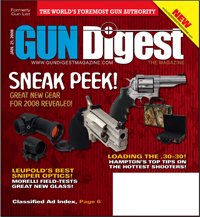 Gun Digest is the source for firearms news, pricing and guns for sale. Readers benefit from in-depth editorial expert advice, show reviews and practical how-to instructions. Subscriptions are the First Amendment way to stand up for your Second Amendment rights. Click here to begin your subscription to Gun Digest.