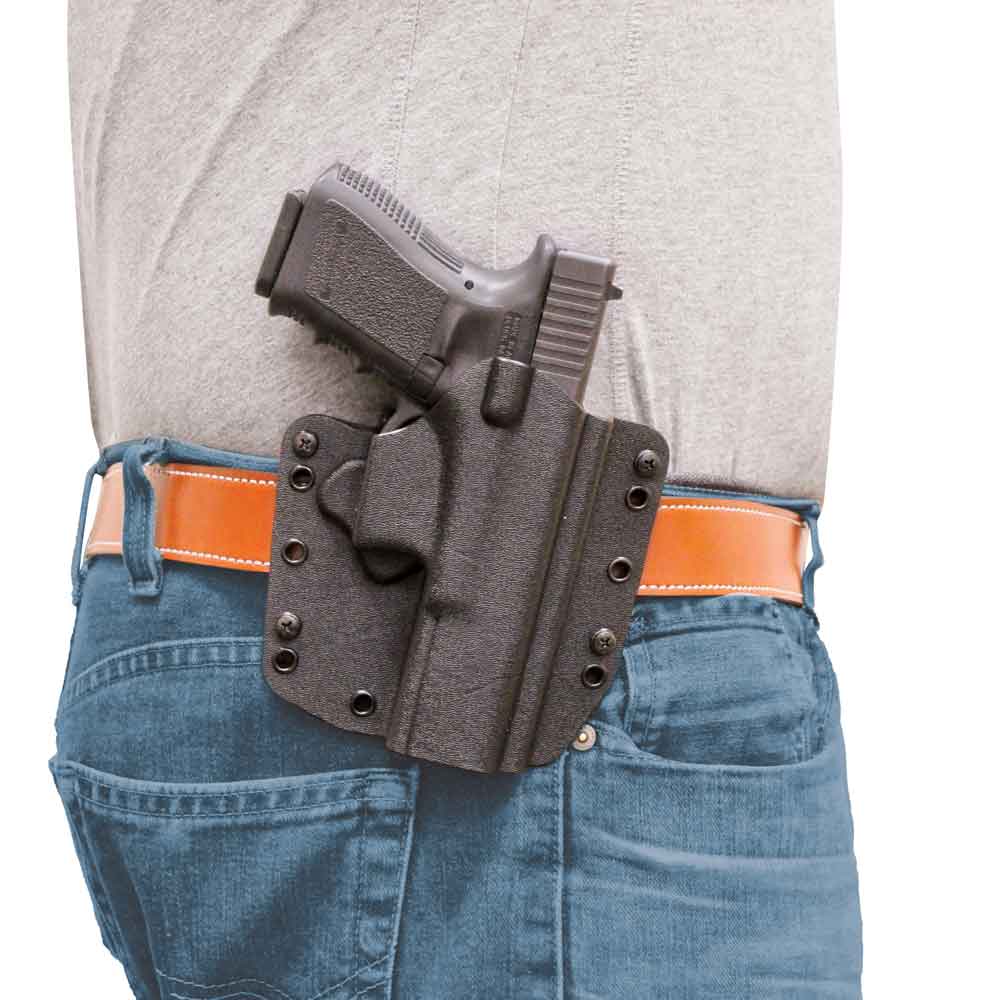
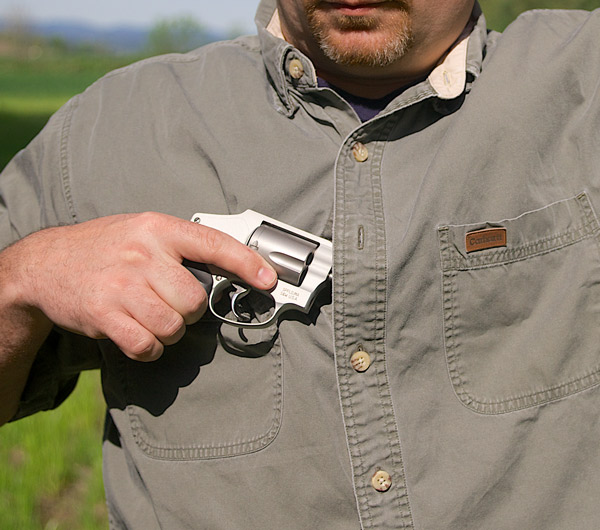
Concealed vs. Open Carry: Do we have a right to alarm innocent people?
Is open carry a wise self-defense choice?
We have the right, but is it wise to carry in a way that may alarm other citizens?
With open carry you can become a target of thieves, bullies and show-offs.
It opens us to false accusations of negligent gun use — the firearm can clearly be seen.
The author feels concealed carry offers surprise and thwarts potential “gun-grabs.”
The concealed handgun can’t be used to protect yourself and others if it is not readily accessible. If it is not discreetly concealed, well…it is no longer concealed.
Open carry is a hot-button issue in both the gun culture and the eye of the public. In some weather, this can add comfort to the carrier, since cover garments can be unduly hot. There is also an intimidation effect on potential criminals, and there is documented evidence of that.
However, that which intimidates bad guys will inevitably intimidate good guys, too. We live in a society where, for generations, media and politicians have relentlessly demonized guns and people who own them. Because people unidentifiable as law enforcement carrying guns in public are an aberration of the norm, it follows that some bystanders will perceive “aberrant person with power to kill me and others.”
Do we have a right to cause that alarm to others? We do not know if one of those passers-by, or fellow diners in the restaurant where we are open carrying, may in the past have been victimized by a criminal armed with a gun. We should be able to understand how we strangers with visible guns in their presence may alarm them.
It puts us in the position of a smoker in the presence of someone who has a severe allergy to tobacco smoke. Yes, we have a right to smoke, but not a right to trigger someone’s allergy. Yes, we have a right to bear arms, but do we have a right to alarm innocent people needlessly when we know, or should know, that might happen?
There are other concerns with open carry. One is that the exposed handgun becomes an inviting target for thieves, bullies, and show-offs. More than one good person innocently carrying a holstered gun has been disarmed by someone who had no right to touch them, sometimes with tragic results.
Finally, any experienced cop can tell you that, sometimes, bad people make false complaints to the police about good people. If that person has spotted your small, gray semi-automatic pistol in your exposed holster, he can maliciously and falsely call police and tell the officers that you threatened him and pointed your gun at him, an act of felony aggravated assault which can bring many years of incarceration. Because he will be able to correctly describe your gun due to your openly carrying it, his false accusation gains credibility. That could all have been avoided by simply carrying concealed.
This is why most in the gun culture recommend discreet, concealed carry. The concealed carrier has the element of surprise against the bad guys, and is much less likely to suffer an attempted “gun-grab.”
And the concealed carrier will not offend, alienate and antagonize innocent people.
The Glock pistol made its debut in 1982. Since that time, it has become one of the most popular handguns in the world. Some people love ‘em, and some people hate ’em, but either way, the pistol has some very good features that make it an effective handgun for self-defense, offensive tactical operations, and competition.
I purchased my Glock in the late 1980s, and I’ve had quite a bit of fun with it in USPSA, IDPA, and many informal practical matches. Since that time, I’ve added a few items to it to enhance the pistol and make it more personal and “shootable,” a word which means different things to different people.
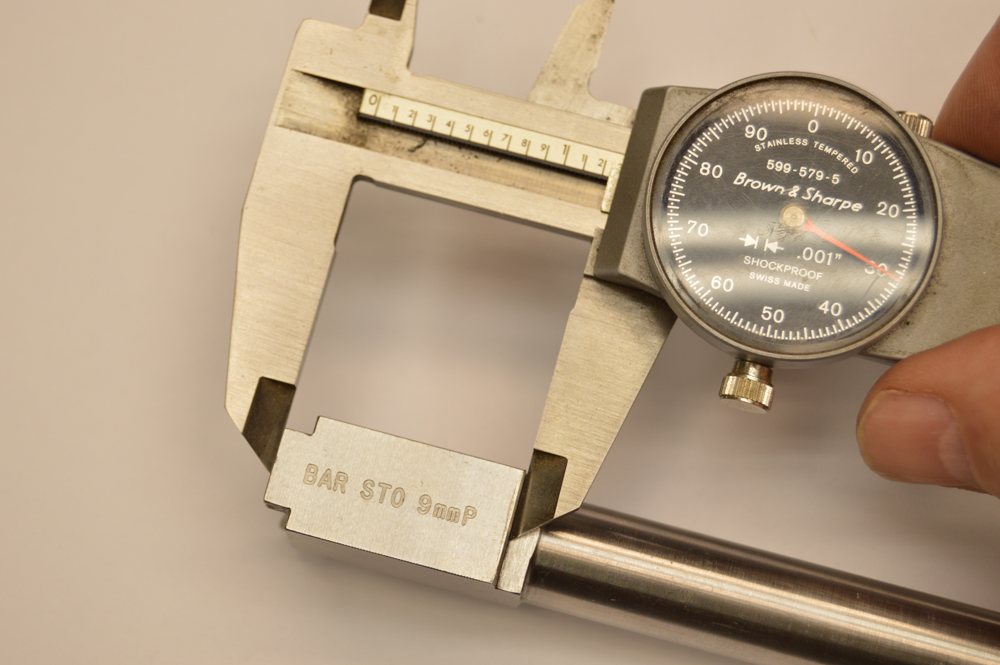
In my case, one of the first items I added was the superb Bar-Sto stainless match-grade barrel. Being an old Bullseye competitor with the Army Marksmanship Unit, I view accuracy as the Holy Grail, and the match barrel from Bar-Sto is the best there is.
I opted for the oversized barrel, although the drop-in version will give excellent accuracy as well.
Being a gunsmith has a few benefits, not the least of which is that I know my way around a #2 Swiss pattern file and an India stone, but even someone with basic gunsmithing skills can easily install a match barrel in the Glock, since there are only three fitting points, and the amount of material that needs to be removed is not much.
As long as you go slow and check your work, fitting the barrel is very straightforward and the benefits are huge.
I also installed a set of Trijicon white outline night sights, and a Brooks Tactical Grip System.
The Trijicon sights are excellent and glow very bright, but typical night sights only last about ten years and these were much older than that, so the nighttime effectiveness was severely diminished.
Lastly, the Brooks Tactical grips give excellent results and actually work better when wet, but they had worn smooth and didn’t provide the same gripping surface as they did when initially installed.
So, this section will go through the refurbishment of a Glock, with the addition of a 3.5-lb. trigger connector.
Note that the addition of a light trigger and a match barrel may change which IDPA classifications you’ll be allowed to compete, so check the rules.
Also, if the gun is to be used for self-defense, be careful about installing aftermarket parts that affect the feeding, firing, extraction and ejection of the gun. Any time such parts are added, always test the gun with a large quantity of ammunition before entrusting it with your life.
The bottom flat needs to be fit to the locking block in the frame. Go slow and check often for fit.
Add A Custom Glock Barrel
Not that we have that out of the way, let’s get started. Installing the Bar-Sto barrel, as I mentioned, is really straightforward.
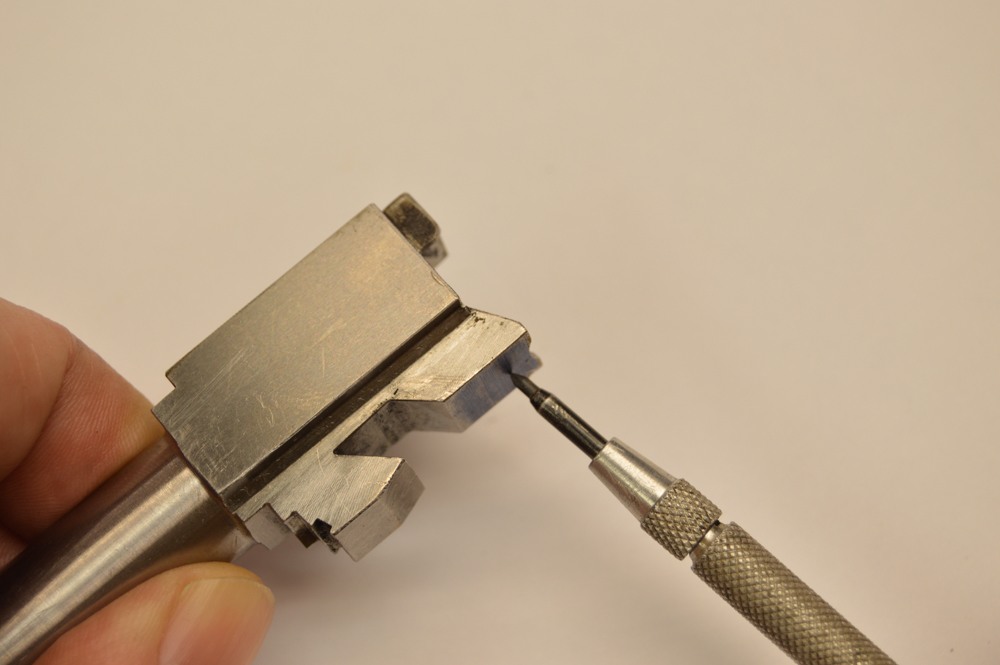
There are two main fitting points — the front of the barrel hood, and the bottom flat of the barrel that sits on the Glock barrel block.
First, start by making sure the gun is unloaded (you knew that) and remove the slide from the frame. Remove the recoil spring and guide, and finally, take out the old barrel. The pistol is now field stripped, and you can begin fitting the barrel.
Measure the width and length of the hood of the Bar-Sto replacement, and measure the ejection port opening of the Glock. Subtract the length of the Glock port, from the length of the barrel hood: this is the difference you need to remove from the front edge of the Bar-Sto barrel.
Use a #4 Swiss pillar file to take down the edge. Do this by taking a stroke or two on the sides of the barrel hood, then try fitting the barrel into the slide. Press hard to make the barrel go into lockup, and use a soft nylon hammer to tap it into place.
Use a blue Magic Marker to check, making sure you are filing the surface square, taking off only the high spots. If you are a little unsure of yourself with a file, use a soft India stone to accomplish the same thing, it will just take longer.
With the stone, you don’t have a safe (non-cutting) edge as on the pillar file, so be careful not to take off material from two surfaces of the barrel at the same time. Once the sides of the barrel are fitted, fit the front of the barrel. Only the material from the front edge of the barrel hood should be removed.
Fit the barrel to the point to where you can push it up into battery and it stays locked, but will also drop out of battery with slight downward pressure of a fingertip on the hood. This is the ideal fit.
Once the barrel is fitted to the slide, remove material on the bottom flat of the barrel where the flat sits on the barrel block. Again, use Magic Marker to show the high spots where you need to remove material.
You are finished with the barrel/slide assembly when the assembly will install on the frame. If it won’t go onto the frame there is still material to be removed from the barrel flat.
Once these two fitting points are taken down so the barrel locks up fully into the slide, and the slide assembly will install onto the frame, you are done. Install the slide onto the frame and cycle the gun a few times.
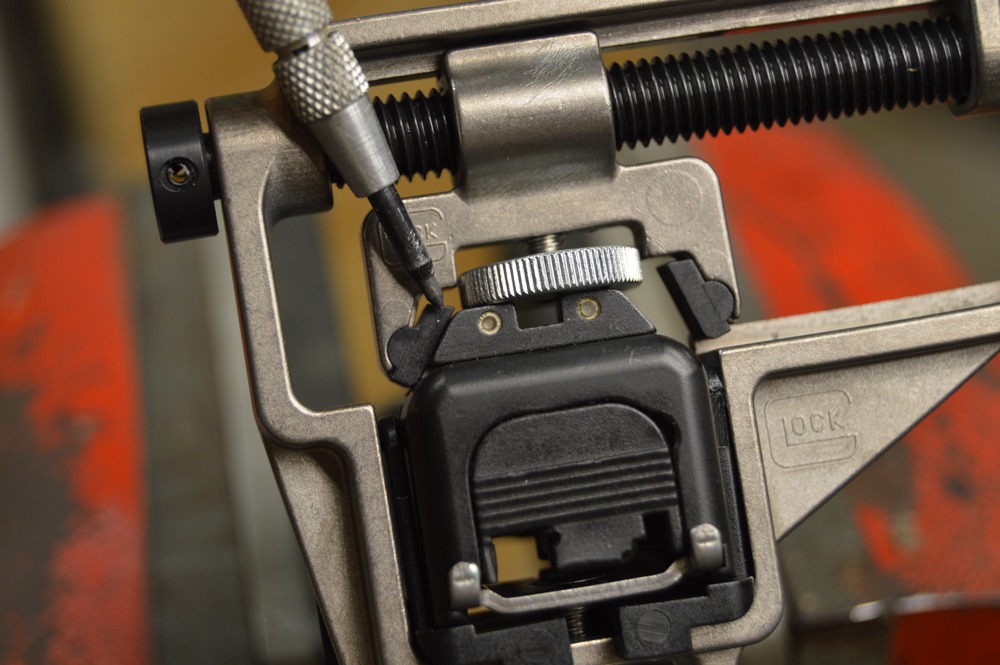
The Glock rear sight pusher works on factory and aftermarket sights equally well.
Glock Sight Ideas
When talking Glock upgrades, the next place to look would be the sights. Again, Trijicon are excellent when they are new, but after 20-some odd years, the Tritium can dim.
In my case, it was time to go with something brighter that would give me day/night capability, ergo, the newer fiber optic sights. These sights absolutely are like a huge neon beacon.
Since I still want the nighttime visibility afforded by Tritium sights, but also the bright glow of the fiber optic for daytime use, I went with Tru-Glo sights. This sight combines the best of both worlds — Tritium and fiber-optic inserts — providing 24-hour visibility.
Removing the old front sight is straightforward. Just remove the 3/16th-inch nut that holds the front sight in place. It takes a special nut driver to get in there, but once it’s out, you can install the new sight.
Degrease the threads of the new sight screw and, with a toothpick, place a tiny drop of blue Loctite onto the screw threads. Place the sight into the slide, and secure it with the screw. Do not overtighten it or you will strip the threads. Just run it up snug; with the thread locker in place that sight isn’t going anywhere. This is how I installed my original Trijicon sight and it’s been securely fastened, and has had over 40,000 rounds through it without any issues.
The rear sight is different. It is mounted in a dovetail, and as such, there are certain “best practices” to use when installing into a cross dovetail. The main point is that the part, any part, is always installed from right to left into the dovetail, as looking from the rear of the gun. If you install a part from left to right, then the next time you go left to right or vice versa the dovetail slot will be opened up and the part will never be able to be installed tightly.
Dovetails are always very slightly tapered from larger to smaller, from the right side to the left of the dovetail. So, the part gets installed from right to left, and removed from left to right, always!
Use the Glock sight tool, because Glock rear sights require downward as well as sideways pressure for removal.
The Tru-Glo rear sight was a perfect fit going into the Glock M17 dovetail, and all it took was a few good raps with a nylon drift punch and a brass hammer in order to set it in the center with a light-driven, almost press fit.
I ran the sight set screw up snug, but didn’t use any threadlocker since I’ll do that once the gun has been zeroed.
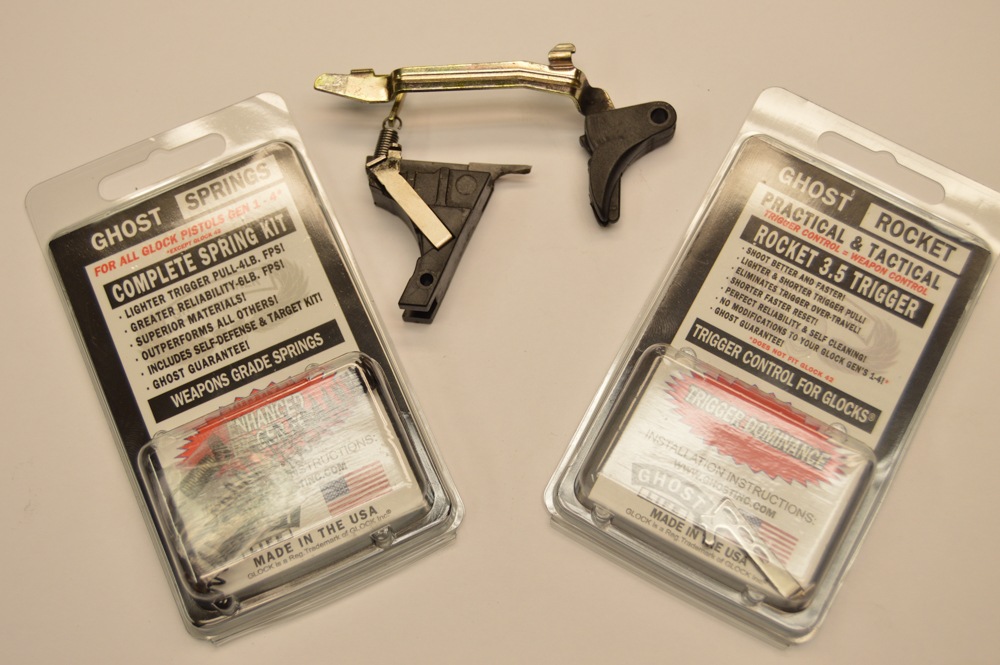
The Ghost Systems Glock aftermarket trigger is one of many available for the polymer pistol. It gives a great 3.5-lb. trigger pull and is adjustable for overtravel.
Solving Glock Trigger Woes
Now that you have the barrel and sight installed, the next of your Glock upgrades is to install the 3.5-lb. trigger connector. This will provide you a nice, light trigger, but again, if you are using the gun for purely defensive work, I would leave the original factory trigger connector and springs installed.
The Glock is a great service pistol, but it has a service pistol-grade trigger, which is fine for most uses: For example, law enforcement, personal defense and military applications, and even competition and informal plinking if you don’t mind the heavy trigger.
But if you want to use the gun strictly to compete in the various types of practical pistol competitions, then the service grade trigger is not ideal, and that’s where the 3.5-lb. trigger connector comes in.
There are a number of lightweight Glock trigger connectors available, and I chose the Ghost trigger from Ghost Industries. It comes with a 3.5-lb. trigger connector, and a variety of springs to set its weight.
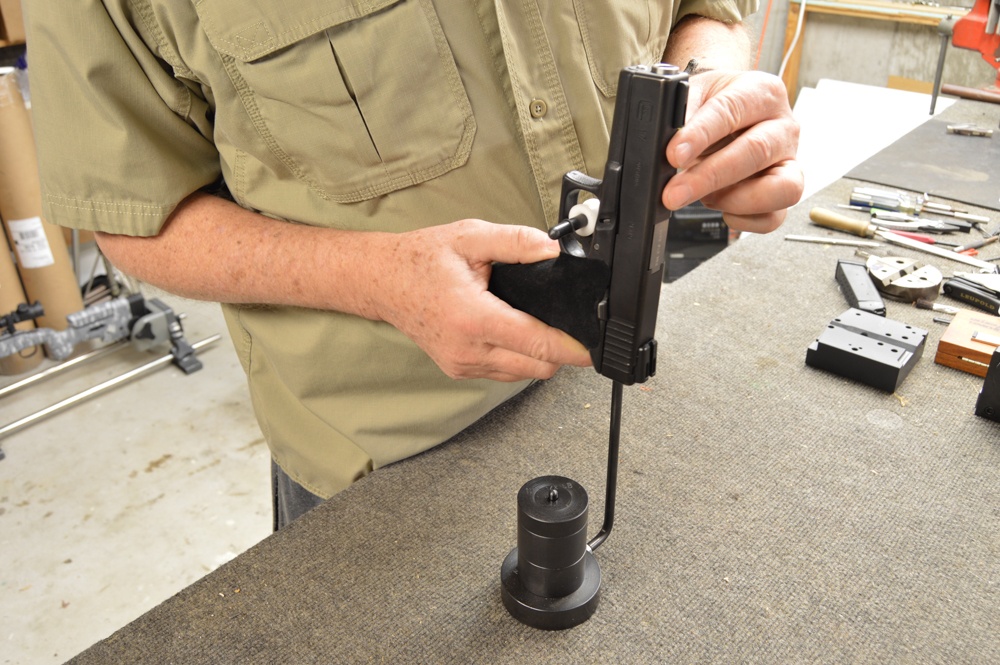
The Glock is tested after all work is complete with the NRA trigger-weight system. This is the best way to test for precise trigger pull as the weights never go out of calibration. They are what the NRA uses to check for correct trigger pull at all NRA sanctioned matches. Get some!
I installed the 3.5 connector, but opted for the heavier 6-lb. trigger and firing pin springs that will yield a little heavier trigger pull in case I do want to carry the gun out and about. The result is a trigger that breaks a little over 4.5 lbs.
The trigger connector is a direct replacement, and removing the old connector allows for replacement of the new, Ghost Industries part.
The Ghost trigger connector comes with a small tab on the connector, which requires minor fitting. This tab acts as a trigger stop — a nice feature to have on a competition gun.
The kit also comes with a clear slide backplate in order to view the sear and firing pin engagement when fitting the trigger connector.
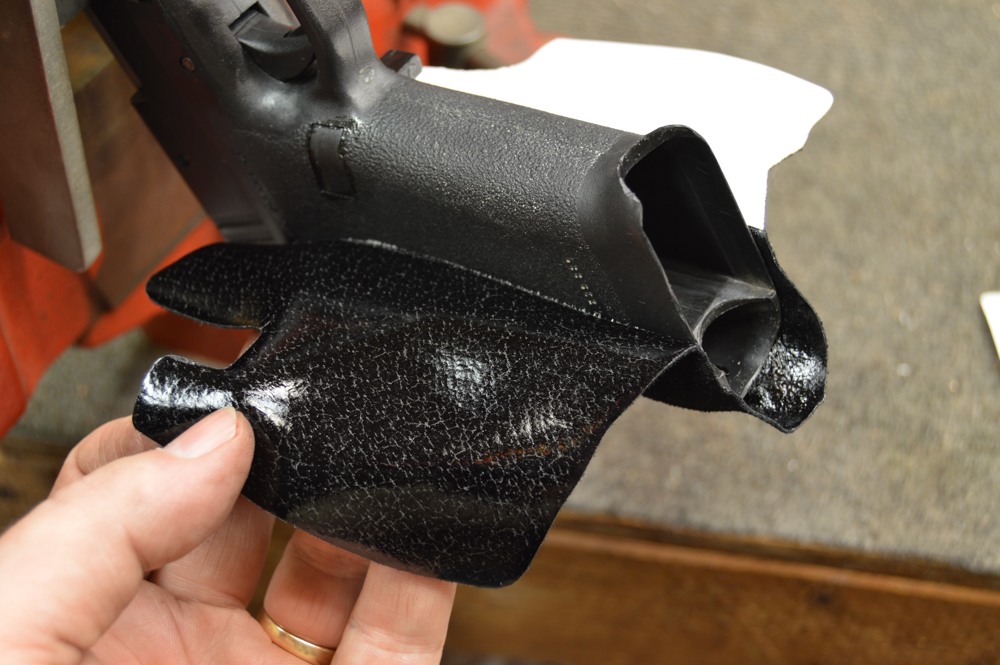
The Brooks Tactical is a textured wrap-around grip that is easy to apply, works well even with wet or sweaty hands, and is inexpensive.
A Better Glock Grip Made Simple
The last step is to remove the old Brooks Tactical Grip, and install the new one from the same company. This is the exact same grip that I originally installed over twenty years ago, but the old one had worn with age. Installation is simple.
Once the old one is peeled off, degrease the grip area with brake cleaner, and wipe it down with the alcohol pad supplied with the new grip.
Since the grip covers the magazine button on both sides, the instructions demonstrate that the area around the mag button on both sides needs to have a tiny amount of oil applied so the grip doesn’t adhere to the mag release.
Again, I’ve had the old Brooks Tactical grip installed on my Glock forever and have never had an issue with the magazine release not functioning properly.
Wrap the new grip onto the pistol’s frame per the instructions. If it isn’t applied exactly correct, you can lift it and move it, but try not to do that too many times. (The grip overwraps itself, so if you wrap it together, it’s difficult to remove it.)
Once the grip is installed, the entire pistol gets reassembled, and function checks are done, along with functioning using dummy rounds. Checking the trigger pull with the NRA weights, mine came in at just over 4 ¾ lbs. That’s not too light or too heavy, and has minimal overtravel.
So there you have it — these Glock upgrades result in a pistol that is extremely accurate with the Bar-Sto barrel, has excellent sights with 24/7 visibility, a light, crisp trigger, and excellent textured grips that work in all environments — even better with wet or sweaty hands. Now I just need to take it out to the next IDPA match and run it through its paces.
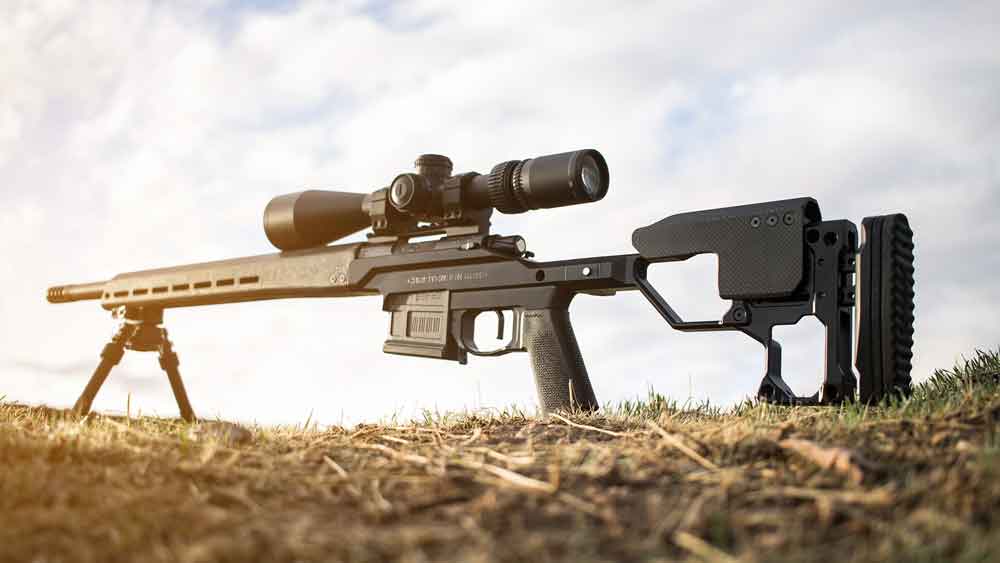
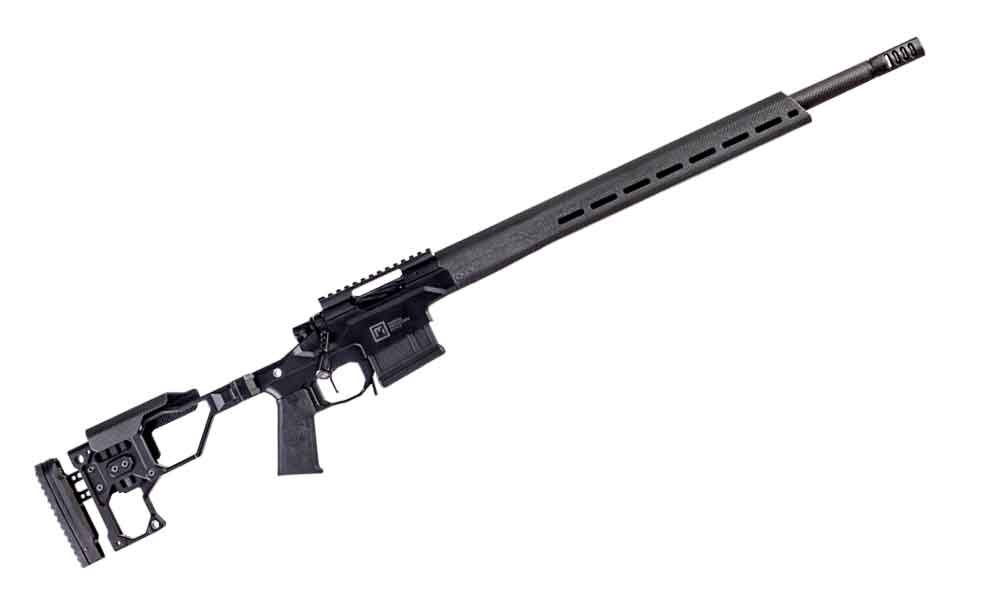
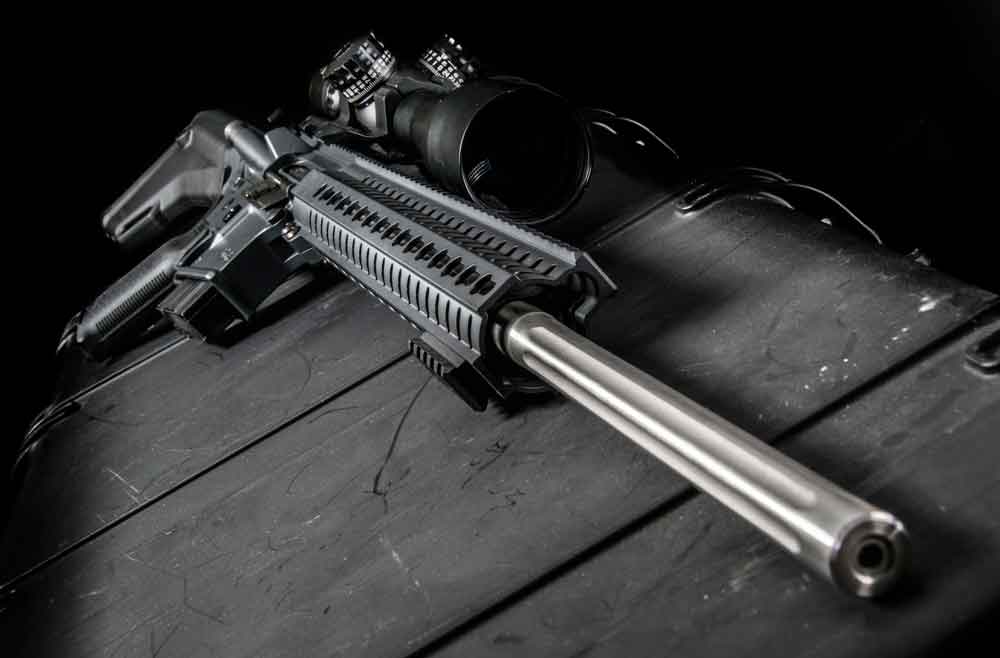
Christensen Arms has introduced its Modern Precision Rifle, a chassis system designed to get off the bench and into the field.
What the Modern Precision Rifle brings to the table:
The Modern Precision Rifle has a lightweight carbon fiber-wrapped stainless steel barrel.
The rifle’s slender, proprietary billet aluminum chassis boasts V-bedding.
It also features a carbon fiber handguard, which further reduces weight.
Due to its construction, the 16-inch barrel .308 Win., is among the lightest chassis rifles.
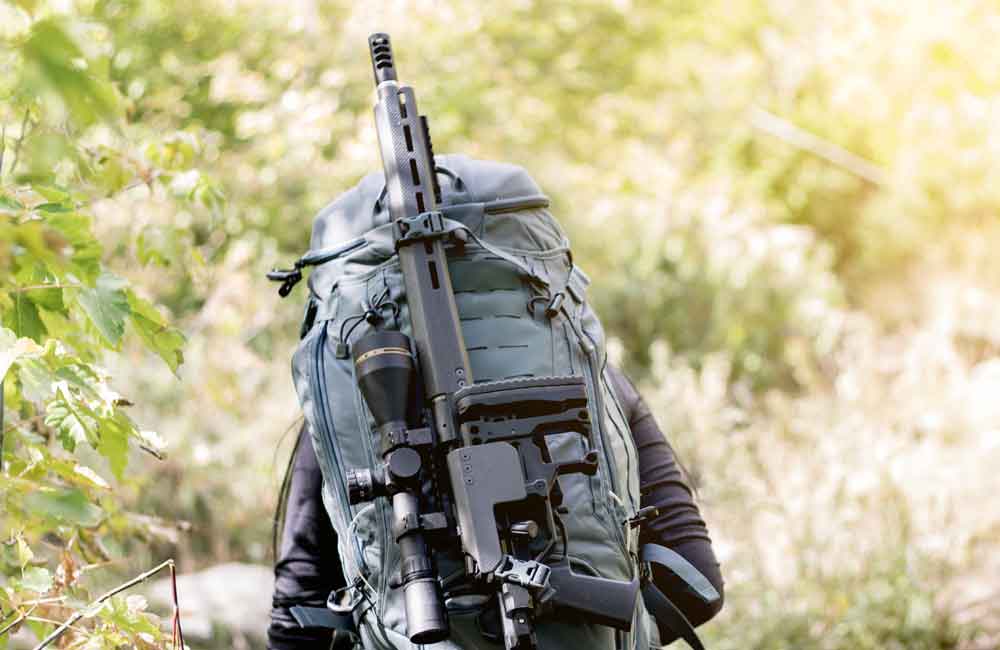
The rifle comes with a folding stock, allowing it to shrink down to backpack size.
Next to its use of advanced materials, Christensen Arms has built its reputation off highly accurate rifles. The lightweight gems that roll out of Utah have been just the ticket for making precision shots off the bench or tagging out on distant bucks during hunting season.
With this in mind, it is little surprise Christensen Arms would turn its attention to one of the most popular precision platforms sweeping the gun world presently — the chassis rifle. It also comes as little shock that the company would put its own unique twists on what it’s dubbed the Modern Precision Rifle. Perhaps chief among them being the rifle’s price.
Certainly, the $2,295 MSRP Christensen Arms has hung on the Modern Precision Rifle isn’t a drop in the bucket. Admittedly, when compared to the rest of the rifle world, precision or otherwise, it’s downright spendy. That’s the breaks in the long-range shooting game. But side-by-side with other chassis systems presently available, the price falls right in line. And measured against the rest of Christensen Arms’ catalog, particularly its other precision platforms, the Modern Precision Rifle is affordable.
Perhaps the most heartening aspect of Christensen Arms’ recent offering is the company appears not to have skimped in creating a chassis rifle. The Modern Precision Rifle boasts all the extras Christensen Arms specializes in and shooters want when they spend money with the company.
One of the most notable, along these lines, is the MPR’s carbon fiber-wrapped 416R stainless steel barrel. The target profile barrels on the 6.5 Creedmoor and .308 Win., offer nearly the same stiffness found on all metal bulls, but at a fraction of the weight. In fact, the 16-inch barreled (there are options up to 26 inches, depending on caliber) .308 version is among the lightest chassis setups out there — less than 7 pounds.
Christensen Arms also controlled for weight by going in-house for the chassis design of its new sniper rifle. The 7075 billet aluminum chassis is extremely svelte and nimble, with V-bedding ensuring the stainless steel action has a solid foundation and the overall platform has the rigidity to milk the most out of the match-grade trigger. But through its trademark use of carbon fiber for the Modern Precision Rifle’s handguard, Christensen Arms still gives the system plenty of space for a bipod and what have you.
Its slender dimensions and light weight make the MPR a practical rifle away from the range. But those are not the only assets Christensen Arms has endowed the rifle with to get it and shooters off the bench. The Modern Precision Rifle is also outfitted with a folding stock, making it ideal to pack away, say in a backpack (or at least that’s what the pictures show) for a trip into the backcountry. At the same tick, the company kept the important features anyone would want on a chassis stock — adjustable length of pull and cheek riser.
Christensen Arms has also thrown in some trimmings, common to many of their rifles, that really give the Modern Precision Rifle a custom appearance. Oversized fluted bolt knob, skeletonized bolt handle, spiral fluted twin-lug bolt and 5/8×24 pattern muzzle thread — outfitted at the factory with an adjustable side baffle break — all add a dimension of useful uniqueness to the rifle. And it goes without saying, the company has manufactured the rifle with the same attention to detail with which it tackles all firearms: match chamber, hand-lapped barrel, button rifling.
Once again, this level of gunmaking costs money, especially compared to the glut of economy bolt-action rifles that have flooded the market. But for shooters looking to get into more than an entry-level chassis, and one designed to excel away from the range and at distance, Christensen Arms certainly appears to offer a value with its Modern Precision Rifle.
Which is superior in the 7mm vs .30 caliber argument? One veteran gunwriter weighs in on the subject.
In the 7mm vs 30 caliber debate, which reigns supreme?
Any .30-caliber cartridge delivers more energy than a comparable 7mm cartridge.
However, this increase in energy comes with an increase in recoil.
The increase in recoil can be as much as 30 percent, according to the author.
The author also feels there are more bullet weights offered with the 7mm than the .30.
Both will get the job done in appropriate applications and with good shot placement.
There was a time when there was little argument among America’s hunters about calibers. For deer hunters it was the .30-30, and for larger game it was the .30-06. Oh there were other calibers to be sure—like the .270 Winchester that emerged in 1925 — but there’s no question that the .30 caliber dominated from the turn of the last century to the mid-1960s.
Today the .30 can still be called “America’s caliber,” but it is being seriously challenged by that upstart metric, the 7mm. It all started in 1957 when Remington introduced the .280, a cartridge they hoped would sway those prospective buyers contemplating either the .270 or .30-06.
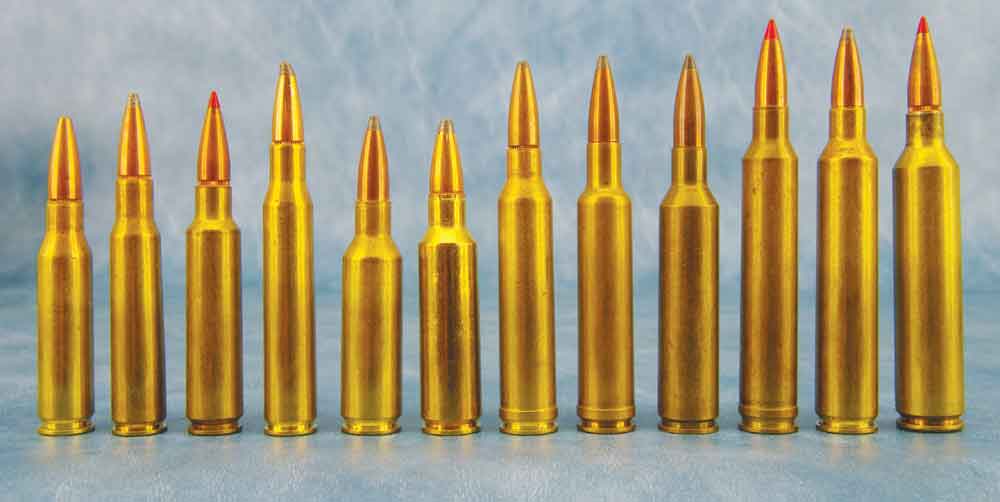
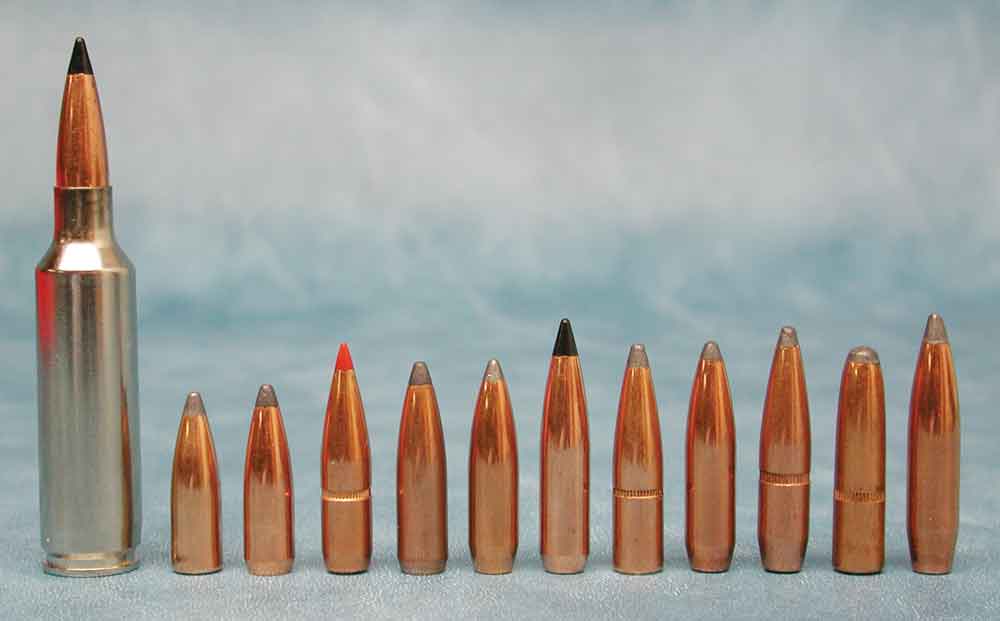
The .28 caliber is as diverse as the .30 as far as performance levels are concerned. Here’s how they stack up (left to right): 7mm-08, 7×57, .284 Win., .280 Rem., 7mm Rem., 7mm Wea., 7mm Rem. SA Ultra Mag, 7mm WSM, 7mm Dakota, 7mm STW, 7mm Ultra Mag and 7.21 Lazzeroni Firebird.
It wasn’t that the .284 bore was unheard of on these shores at the time. The 7×57 had been around since 1892 and had been adopted as the martial cartridge by nine foreign countries. And it had been chambered for sporadically here in America, most notably by Winchester in its iconic Model 70.
But by and large the 7mm was still considered a “foreign” caliber. While the .280 could in no way be considered a commercial success even today, it did pave the way for the 7mm Remington Magnum that was to emerge five years later in 1962. Since then there have been more 7mm commercial and proprietary cartridges introduced than any other caliber.
I acquired my first 7mm in 1965, and over the half-century since, it’s been my caliber of choice for everything but Cape buffalo, lion and elephant. I’ve taken game on five continents using just about every commercial 7mm, from the 7×57 to Remington’s Ultra Mag., as well as several proprietary and wildcat cartridges, so I can speak with some authority on the subject.
It’s not that I haven’t had experience using other calibers. I have. I’ve been on many industry hunts, both here and abroad where I didn’t have the option to bring my own rifle or choose a specific cartridge. On most of those occasions I was handed a .30-06 or a .300 magnum, and every time it performed just as well as any 7mm I could have used.
If you compare 7mm and .30 cal. cartridges of similar capacity, driving bullets of comparable sectional densities and ballistic coefficients, it requires about 30 percent more recoil to match the trajectory of a 7mm with a .30. Shown here are pairings of 7mm-08 Rem. and .308 Win.; .280 Rem. and .30-06; 7mm STW and .300 Weatherby; and 7mm Ultra Mag and .300 Ultra Mag.
And why wouldn’t it? It’s indisputable that a .30 caliber delivers more energy than a comparable 7mm. I’m talking 7mm-08 vs. .308; .280 Rem. vs. .30-06; 7mm STW vs. .300 Wby.; 7mm Ultra Mag. vs. .300 Ultra Mag. That’s not the point, or at least it shouldn’t be whenever one hears the 7mm vs 30 caliber argument. The only logical reason for choosing a .28 caliber over a .30 has to do with the question of how much ballistic performance you need to get the job done, and what you are willing to pay for it in terms of recoil.
Again, from a purely ballistic standpoint, everything the 7mm can do the .30 can do better. By “better” I mean a bigger hole and more energy delivered, all other things equal.
If you push a .308 bullet of comparable sectional density and ballistic coefficient over the same trajectory as a .284, it will arrive with about 15 percent more energy. But doing so generates almost 30 percent more recoil, assuming rifles of equal weight.
Now there are many who feel that an extra 15 percent is worth it. I don’t. With a magnum 7mm of one variety or another I’ve shot from every conceivable field position, many times from prone, with the toe of the butt on the ground and with just the bony top of my shoulder backing the gun up. In such a position there’s a tendency to crawl up on the scope, yet in 50 years I’ve never suffered a magnum eyebrow. I can’t say the same for several .300 magnum guys I’ve shared camps with or witnessed shooting.
An experienced hunter who shoots often and year round won’t have an issue with shooting a .300 magnum, even off the bench where 27 to 28 ft.-lbs. of recoil can be … well, less than fun. But for the average hunter, that’s a lot of recoil — enough to affect one’s ability to shoot the gun up to its accuracy potential.
To back up that statement, all one has to do is look at competition shooting. Regardless of the specific discipline, whether it’s benchrest at 100 yards or F-Class at 1,000 yards, every shooter will be using the heaviest rifle the rules allow with a cartridge that gets the job done with the least amount of recoil.
There are those who contend that a .30 caliber simply provides more margin of error in case of a poor shot. If we’re talking strictly in terms of the theoretical, one might make a case for the .30, but in the real world that’s pure bull-pucky. A bad shot with a .30 is no better than a bad shot with a 7mm. Period.
Another thing I particularly like is the fact that, for the handloader, there are more bullet weights offered in 7mm than in .30. Consider: among the various manufacturers, handloaders can choose 7mm bullets of 100, 110, 115, 120, 125, 130, 139, 140, 145, 150, 154, 160, 162, 168, 170 and 175 grains. If you’ve got a particularly finicky rifle with regard to its shooting a specific bullet weight better than others, you’ve a better chance of finding it if you’ve got a .284-inch hole in the barrel.
I guess what I’m trying to say is that, based on my experiences over the half century I’ve been hunting, I’ve never been disappointed or felt the need for anything larger than a 7mm. Regardless of where I’ve hunted — from Alaska to Zambia, South Africa to Siberia, the South Pacific to the Arctic Ocean — there’s been a 7mm in my hands. And I’m talking about hunting the world’s largest non-dangerous game: eland, zebra, gemsbok, kudu, roan, sable, elk, red deer … you name it. And whenever I feel I need something more potent than a 7mm, I want something a lot more potent, like a .375 or a .416.
Editor’s Note: This article is an excerpt from the May 2015 issue of Gun Digest the Magazine.
Although gravity and wind are the main influences on a bullet’s path, there are certainly some other factors to consider as well. One of these is the initial bullet speed.
How does initial bullet speed play into external ballistics?
Bullet speed does not lessen or increase gravity’s effects.
It merely gives more or less time for the force to act on the projectile.
Three things determine speed: a bullet’s initial speed, its efficiency and environmental variables.
A longer barrel permits a faster bullet, but this doesn’t equate to more accuracy.
Temperature also can affect velocity.
Hopefully, we dispelled the myth that a fast bullet somehow resists gravity. Instead, a fast bullet merely gets to the target faster and therefore has less time to fall. Also, the longer it takes for a bullet to reach a target, the more exponentially it falls.
In an example we used, a bullet from my .308 Winchester only falls 4 inches between the 100- and 200-yard berms, but it falls almost 100 inches between the 900- and 1,000-yard berms. The bullet falls more when it’s farther away because it is traveling slower (it takes longer to cover the 100 yards between berms), and it is also falling faster.
When we discuss wind in a future article, you’ll see that the amount of time a bullet is exposed to wind (how long it takes to get to the target) also has a direct effect on how much a bullet is blown off of its original path.
Gravity And Wind
At a basic level, the two main things that will affect your bullet’s path are gravity and wind. All of the other variables you hear about — air pressure, temperature, altitude and humidity — don’t affect the bullet’s path. Instead, those variables only change how much gravity and wind can affect the bullet.
Of course, there are other things that will affect your bullet’s path. For example, the spin of the earth and the spin of your bullet can both change a bullet’s path. However, let’s save those for a future discussion once you understand the basics first.
There are three variables that determine a bullet’s speed on its way to the target:
The initial bullet speed
The efficiency of the bullet
External/environmental variables
In this piece, we’ll explore initial velocity. The other variables will be discussed in future columns.
Don’t fall into the trap of thinking that faster is always better. There are many shooters who chase the newest fad cartridge to get whatever velocity increase they can. Yes, a faster bullet has less time to fall and be affected by the wind, but just because it is faster doesn’t mean it’s necessarily better overall.
Sometimes a slower bullet can be more accurate, lighter recoil from a smaller cartridge can be easier to manage, or a heavier, slower bullet might perform better when hunting (e.g. .17 HMR vs. .30-06 Springfield while elk hunting).
Initial Bullet Speed
A bullet is never faster than when it first leaves your barrel. Just as it starts to immediately fall due to gravity, it also starts to slow down due to air resistance.
The cartridge largely dictates a bullet’s initial velocity range. The same bullet can be shot faster with more pressure up to the safe limit for a particular cartridge. Once you reach the pressure limit, you’ll need to upgrade to a cartridge that can handle more pressure.
Another way to increase initial bullet speed is to shoot a lighter bullet. Within the same cartridge, a lighter bullet can be shot faster. However, that lighter bullet will slow down faster due to air resistance, and it will be affected by wind more than a heavier bullet going the same speed.
Barrel Length
Generally, a longer barrel allows for faster bullet speed. As I mentioned above, however, this isn’t necessarily better.
For example, a shorter rifle barrel can make for a lighter rifle that is easier to carry in the field while hunting, and it can make a rifle more maneuverable in a tactical situation. Do you know what else a shorter barrel can do? It can make a rifle more accurate. Yes, you read that right. A longer barrel does not provide more accuracy; it only provides more velocity.
Consistency is the key to accuracy. A longer barrel of a certain diameter can flex and “whip” more than a shorter barrel of the same diameter. The shorter barrel is relatively “stiffer.” Imagine two sticks of the same diameter but different lengths — the longer one is easier to flex and break.
Temperature
A bullet’s initial velocity isn’t constant. Even with the same cartridge shooting the same bullet with the same powder charge, higher temperatures will result in faster velocities.
Higher temperatures can be experienced either because of the temperature of your environment (it’s a hot day) and/or the temperature of your chamber (it’s a cold day but you’ve been shooting a lot).
Powder manufacturers continue to make gunpowder that is more temperature stable (less affected by temperature). Although great advances are being made, no powder is completely immune to temperature changes. You should shoot in different temperatures and record what happens to your bullet.
This article originally appeared in the July 17 issue of Gun Digest the Magazine.
Coonan .357 Magnum 1911s in Classic and Compact are powerful defensive handguns that can be surprisingly concealable.
How Coonan brought the .357 Magnum to the 1911 platform:
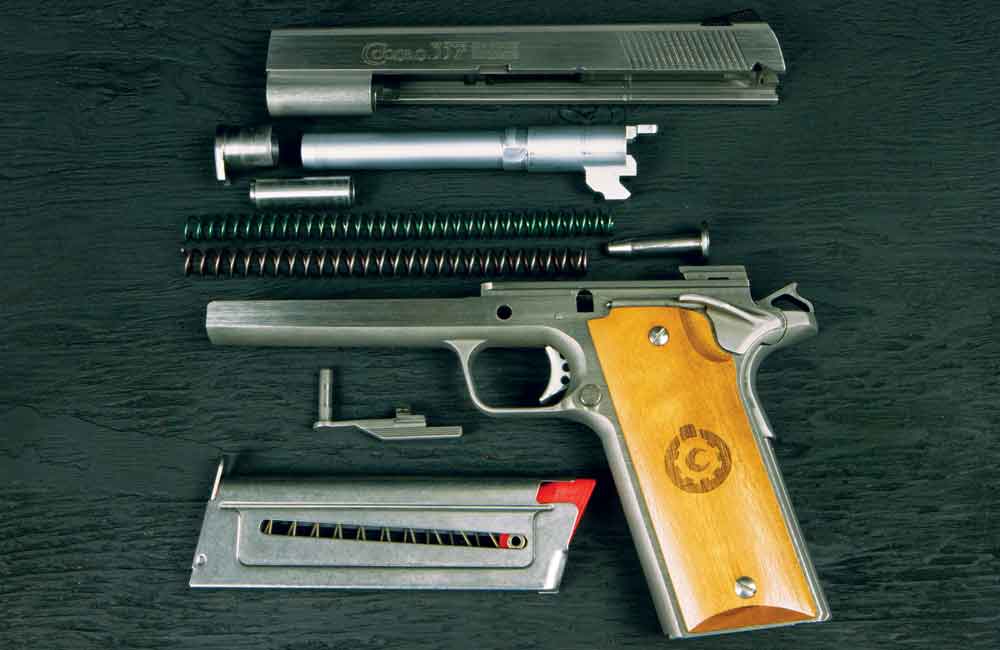
Coonan tweaked the classic 1911 design to accept the rimmed .357 Magnum.
Being semi-autos, Coonan’s 1911s tend to be softer shooting than .357 Mag. revolvers.
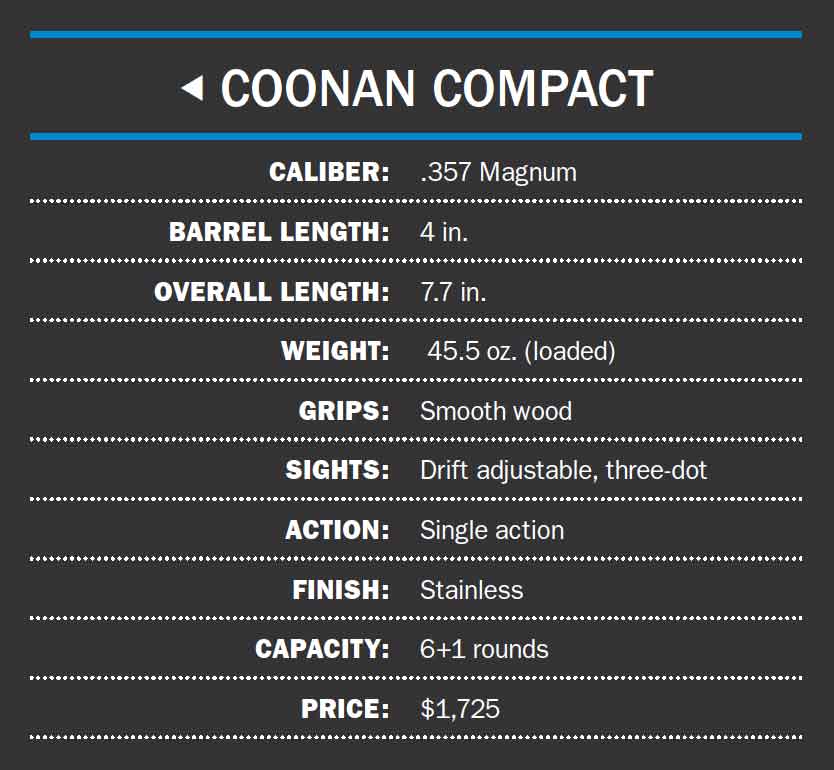
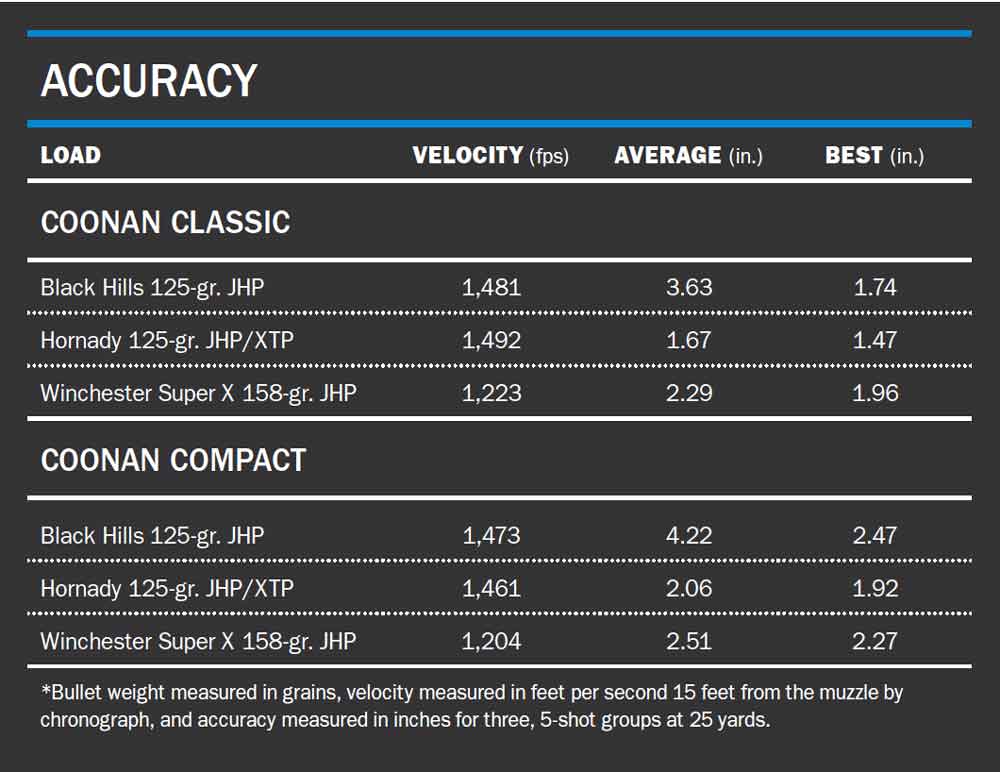
The 5-inch barrel Classic and 4-inch barrel Compact were tested.
Both models proved accurate off the bench at 25 yards.
The author felt the Coonans were pleasant to shoot and viable for self-defense, hunting and target shooting guns.
While not everyone agrees, a lot of experienced shooters say that John Browning’s 1911 pistol is the greatest fighting handgun ever designed. Many major gun manufacturers offer them, and several smaller manufacturers exist primarily because they specialize in building them. An example is Coonan, Inc. — but there’s a twist.
Whereas most 1911s are chambered in .45 ACP or 9mm — yes, there are other chamberings — Coonan wanted more power and decided a 1911 chambered in .357 Magnum was needed. Adopted by many law enforcement agencies since its creation in 1935 and able to cleanly take some game, it developed a great reputation. However, the .357 Magnum is a rimmed cartridge and is longer than the cartridges usually used in 1911s.
That meant a redesign…
Coonan set out to get it done, and they did, although the gun still uses many of the same parts found on a standard 1911. And the controls are about the same, too, so an experienced 1911 shooter will be comfortable with a Coonan. Sure, the gun is a little larger to accommodate the longer cartridge, and therefore the grip circumference is greater, but the end result is surprisingly close to the original.
It’s so close that, despite the .357 Magnum chambering, it’s feasible to carry the gun discreetly for self-defense. Sure, it’s a bit on the larger side, but not so much that the gun is too big for someone comfortable with carrying a 1911. And as a bonus, the Coonan website lists many holster manufacturers that currently make discreet carry holsters to fit.
Packing The Power
So why would anyone want a 1911 chambered in .357 Magnum? The most obvious answer is power. A typical 230-grain .45 ACP delivers about 370 foot-pounds of muzzle energy, but the 158-grain .357 Magnum tops it with about 505 foot-pounds. And generally speaking, the more energy delivered to the target, the better chance of stopping a dangerous, felonious assault or bringing down a prized game animal.
More muzzle energy, of course, means more recoil. It’s physics. But the Coonan is surprisingly comfortable to shoot, especially when compared to the typical .357 Magnum revolver. With a revolver, recoil energy is instantaneously transmitted through the solid frame and grip to the shooter, so the impulse is sharp and heavy. But with a semi-automatic handgun, the slide and barrel move under recoil relative to the frame, and that slows delivery of the recoil impulse to the shooter. The result is softer felt recoil. Incidentally, the Coonan Classic will also shoot .38 Special rounds, which deliver even less recoil.
Pick Your Poison
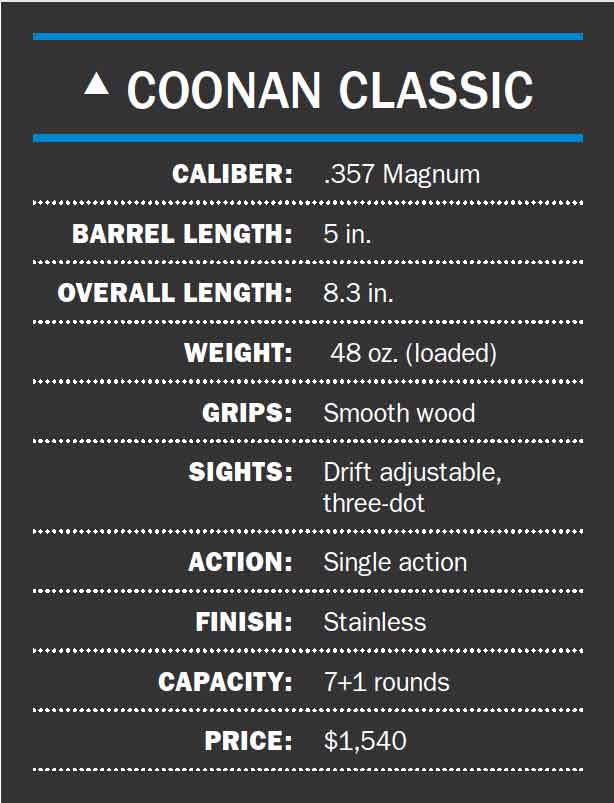
Coonan makes several models, all variants of the original Coonan Classic. A Classic — the full size — and a Compact were received for testing. Both were rendered in stainless steel, although different grips and finishes are available.
The Classic and Compact share most of the same features, but even with the shorter grip, the Compact offers enough room for most to grip it with the small finger. Grips on both models are smooth, light-colored wood. The front straps and mainspring housings are also smooth, although textured mainspring housings and grips can be ordered.
The grip safety has an extended beavertail to protect against hammer bite, but it’s not upswept like those often seen on 1911s. Still, it’s functional; though, the grip safety doesn’t have the common palm hump to ensure activation.
Magazines are stainless with visible slots on each side to see remaining rounds. The magwell is also beveled for fast reloads. The checkered mag release is located in the usual position.
The thumb safety on each has a wide shelf and worked properly, with a distinct click. The slide stop is extended rearward for easier right-handed thumb activation. Many will still have to shift their grip, though, to reach it. But most top-tier schools teach students to rack the slide if it’s locked back rather than press the slide stop. While pulling the slide to the rear and releasing it worked on the Classic, it didn’t on the Compact. The slide stop had to be manually pressed.
Instead of a trigger that moves fore and aft in a straight line as on a traditional 1911, Coonan’s trigger pivots from the top. It worked well, with both guns exhibiting a bit of take-up and a clean break. The Classic’s trigger had a small bit of creep and no overtravel, while the Compact’s had no creep and a bit of overtravel. Neither proved to hinder good shooting.
The slides are slab-sided with a rounded top, just like Browning’s design. At the rear are serrations that permit a solid grip when racking the slide. Up top, Coonan has used black three-dot sights that are drift adjustable for windage and equipped with set-screws to hold them in place. They afford an efficient sight picture.
With a 4-inch barrel on the Compact model, as compared to a 5-inch barrel on the Classic, some changes needed to be made in the recoil spring assembly. While the Classic’s recoil spring guide rod, spring, retention plug and bushing resemble those of standard 1911s, the Compact uses a full-length guide rod and no bushing. So, to disassemble the Compact, a bent paper clip or similar piece of wire must be inserted into a small hole in the guide rod to retain the spring during disassembly. After the recoil spring assembly is removed, the spring bushing, guide rod and spring can be carefully disassembled for cleaning.
The Bottom Line
Both guns proved accurate off the bench at 25 yards, with the Classic besting the Compact by a small bit.
Of equal importance, no malfunctions occurred in testing. These were used guns, so it’s possible deficiencies were uncovered in prior use and corrected before being sent for review. That said, there’s no point in trying to find a problem where there isn’t one.
The Coonan Classic and Compact 1911s chambered in .357 Magnum are pleasant-shooting guns despite the magnum chambering, and each could serve a number of roles, including self defense, hunting and just having fun at the range. And in diminished light, they will certainly attract attention with the fireball emitted from the muzzle.
This article originally appeared in the Concealed Carry 2017 issue of Gun Digest the Magazine.
A proven resource in creating a marksman is the use of inexpensive .22-caliber ammunition and firearms. The rimfire offers little or no recoil, minimal report and good accuracy.
If you own a full-caliber defensive revolver, having a .22 counterpart to it makes a fantastic understudy for training.
It is recognized as a foundational training aid for pure marksmanship, that is, trigger control and learning sight alignment and sight picture.
In today’s tight economy, we see both .22-caliber conversions and dedicated firearms of the diminutive caliber pressed into service in training. With the high and increasing costs of training, .22 conversion units and purpose-built rimfire guns are a good buy.
Any way you slice it, the difference in price between rimfire and centerfire ammunition allows you to fire many more rounds of rimfire than is possible in a single service cartridge of centerfire. The .22 can be used in ranges that would not be safe with high-powered firearms.
My first .22 revolver was an Arminius swing-out cylinder double-action from Germany. It was a great revolver, with high-visibility fixed sights and a relatively smooth trigger action. It featured a nine-shot cylinder and six-inch barrel, as well as hand-fitting grips.
I shot over 2,000 cartridges in it the first summer I owned it. A lot of hard work earned the revolver and those cartridges, even though they were less than a dollar a box and I think eight or nine dollars per five-hundred round brick. I fired it until the vent rib fell off! (The Arminius was an affordable brand not to be confused with the junk-grade RG.)
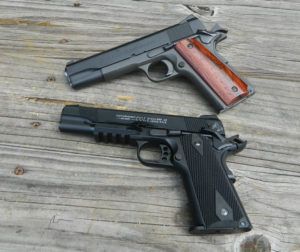
It isn’t a bad idea to have a rimfire doppelganger for the centerfire handgun. A 1911 .45 and a 1911 .22 are a classic combination.
I graduated to a Smith and Wesson Kit Gun, which I did not use very well, trained at college in the Criminal Justice program with a first-quality Smith and Wesson Combat Masterpiece, and later a Ruger Single Six. I shot these .22s every chance I had.
They were simple to use well, accurate, affordable to shoot and friendly for extensive handgun training. By friendly, I mean no sharp edges and a decent trigger pull combined with low recoil and good, practical accuracy.
I simply enjoyed shooting but, as time went by, I became a better shot. Quite a few shooters purchasing more powerful handguns such as the .357 Magnum for their first revolver had unprofitable experiences.
They learned how flinch destroys accuracy and the economic reality of attempting to become a good shot with expensive factory ammunition. Some folks develop bad shooting habits and become doubtful of their own ability.
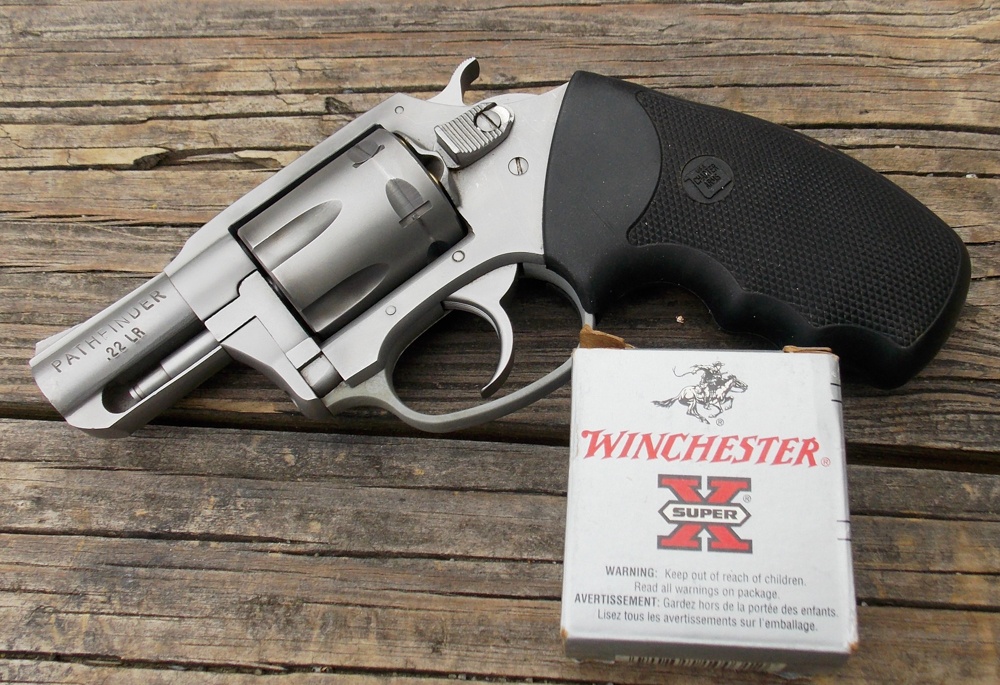
The Charter Arms Pathfinder is a neat little revolver for field or tackle box use. It isn’t the most accurate revolver but it is light and handy.
When you choose your personal .22, the field is broad and there are a number of choices that give good results. The Walther P22 and the similar Ruger SR22 are lightweight handguns, but provide respectable results in training. They are not as accurate as the Ruger Standard Model but are usually reliable and useful for training.
Your first .22 should not be too small. A 2-inch barrel revolver is too light for most shooters to deal with as a first gun — its short sight radius will play against you.
Ruger’s new Mark IV .22 is a great addition to the Ruger line. It’s a very accurate handgun.
A reasonably light handgun, such as a 4-inch barrel revolver is a better choice, or even the Walther P22 I mentioned earlier. If you are going to use the handgun and carry it consistently in the field and on the range, then light weight and comfort are important. If the handgun is too heavy it will be at home instead of on the hip in your handgun training.
Accuracy should not be compromised. And the baseline for what you wish to accomplish must be considered.
An all-around field gun should be accurate enough to take a squirrel in a tall tree, behead a dangerous snake at a few paces, and provide meaningful practice.
Accuracy and weight must be balanced. While the ultra-lights are not accurate enough for some uses, the Ruger MK III with 4-inch barrel is light enough and offers a combination of good hand fit and excellent accuracy. The Ruger is the standard by which all others are judged, and most typically come up short.
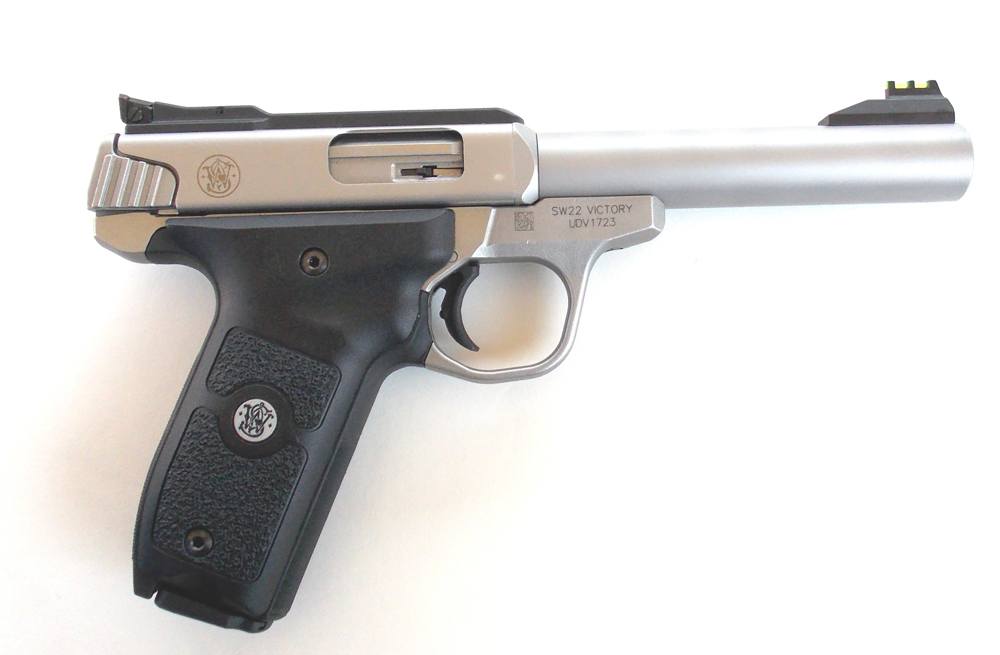
Smith and Wesson’s Victory .22 is a great shooter and one of the bright stars introduced recently.
Smith & Wesson Victory .22
The new Smith and Wesson Victory .22 is a solid choice that performs exceptionally well. The Victory just may become the new baseline in .22 pistols. Let’s take a hard look at it and then you can judge the others based on the performance of this handgun.
The Victory has garnered a lot of interest since its introduction. It is intended to compete with similar .22s such as the Browning Buckmark and Ruger Standard Model.
As such, it has good features, is reliable, and has acceptable accuracy. The price point is also important. Smith and Wesson’s previous .22 self-loaders were not in the same class as this pistol and, as such, high hopes have been pinned on the Victory, not without justification.
The Victory is a modern .22 with tons of useful features and excellent performance. Known as the “SW22,” it’s a winner and a fun gun as well. Smith and Wesson calls the SW22 Victory a “modern, classic target pistol.” Indeed, it fits the bill in that sense — a handgun intended for informal target practice, marksmanship training and small game hunting. It isn’t a Smith and Wesson Model 41, but then what is?
The U.S. has had a love of the .45-caliber cartridge for many years. Nowhere is this more apparent than in the enduring popularity of the .45 ACP, and its earlier predecessor, the .45 Colt.
How did the .45 Auto, or .45 ACP, cartridge come into being?
The U.S. adopted the .45 Colt in 1873, pairing it with Colt’s Single Action Army revolver.
It served for almost two decades before replacement by the .38 Long Colt.
Complaints were made during the Phillipine Insurrection about the .38’s stopping power.
The .45 Colt was reissued, and it remained in service until the .45 ACP’s adoption.
The .45 ACP was adopted in Browning’s M1911.
However, it first saw action in World War I in a double-action revolver.
To celebrate the .45-caliber handgun cartridge, a group of writers recently met at Gunsite Academy to experience shooting semi-automatics, and single-action and double-action revolvers all chambered in .45.
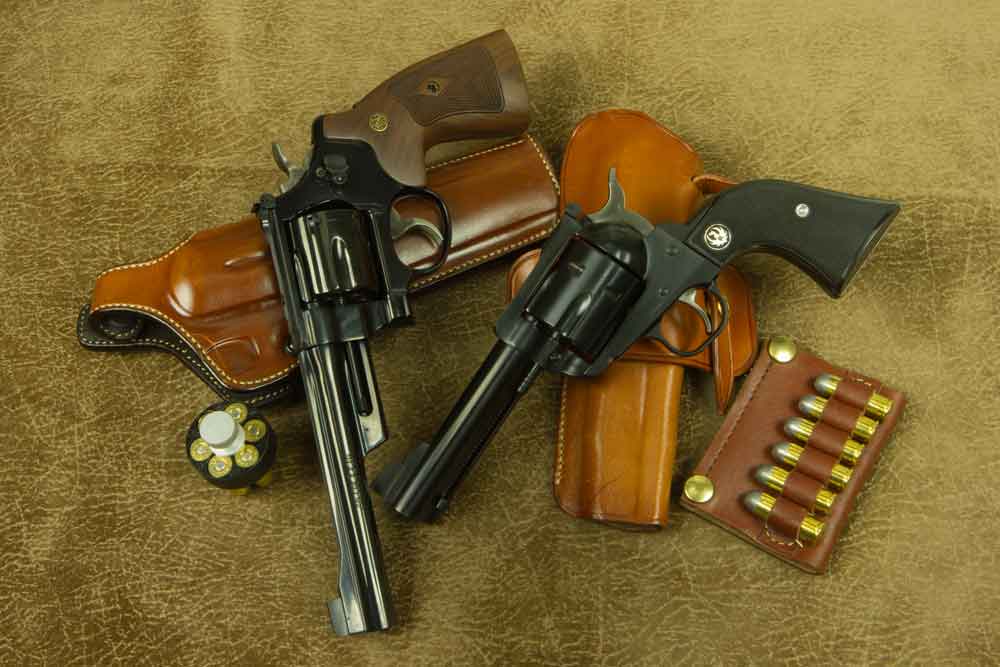
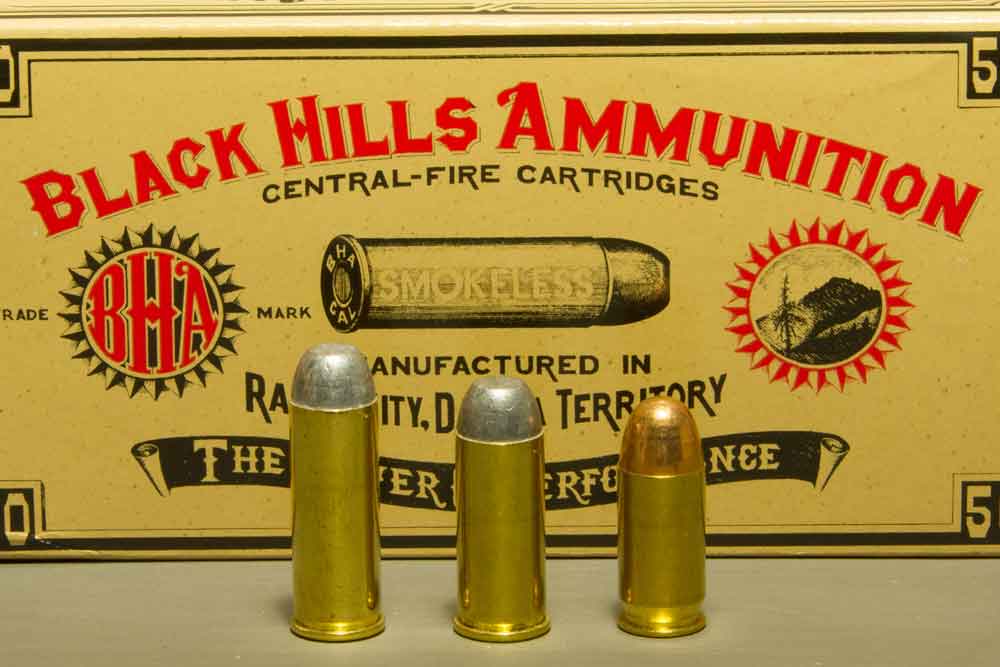
Contact range to long-range shooting and training was conducted using a Ruger New Blackhawk single-action revolver, a Smith & Wesson Model 25 Classic double-action revolver with Pachmayr Decelerator Grips — both in .45 Colt — and a Nighthawk Custom 1911 chambered in .45 ACP. Black Hills supplied ammunition, and Galco provided holsters. Everything worked flawlessly, with each gun representing a step in the evolution of the .45.
In 1873 the U.S. Government adopted the .45 Colt cartridge for its new standard sidearm, the Single Action Army revolver. It fired a 250-grain lead bullet that left the muzzle at about 900 feet per second (fps), making it a powerful handgun round that soon gained a good reputation for protection.
For nearly two decades, the Single Action Army in its .45-caliber chambering remained the official government sidearm, but about 1890 it was replaced with a revolver chambered in .38 Long Colt. The new cartridge proved to be inadequate though for stopping Moro fighters during the Philippine Insurrection, so the 1873 Single Action Army revolver chambered in .45 Colt was quickly reissued. The .45 Colt cartridge remained in government use then until John Browning’s M1911 that chambered the .45 ACP was adopted in 1911.
Even though the government had adopted the semi-auto 1911, a double-action revolver chambered in .45 ACP was pressed into use during World War I. At Gunsite, the M25 Classic represented this class of guns, although it was not one that was used during WWI.
The .45 Colt and the .45 ACP have about the same ballistics, so the .45 could be called “America’s handgun caliber.” It has served our military, police and law-abiding citizens well for more than a century, and, to some people, challenging its supremacy is heresy.
Editor’s Note: This article is an excerpt from the September 2017 issue of Gun Digest the Magazine.
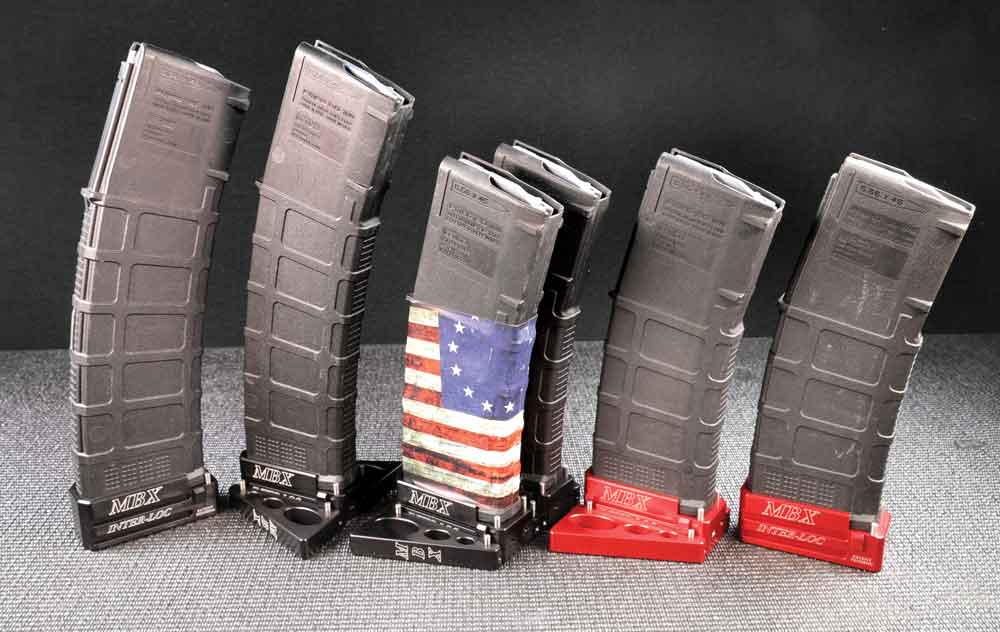
The Basepad Extension and Inter-Loc System from MBX Extreme offer speed and stability for all genres of shooting.
What advantages do the MBX Extreme Extension and Inter-Loc System offer?
The MBX Extreme Inter-Loc System is a clever way of coupling magazines.
It also increases their capacity.
The attachment of wings to the Inter-Loc System doubles as a shooting rest.
This keeps shooters from having to compete in the open class of 3-Gun.
Best of all, it can be modified without tools, allowing for adjustment on the fly.
Extreme sports tend to lead to unique innovations that might not otherwise occur. Consider drag racing for example. Nearly 100 years ago, drivers raced each other on a straight quarter-mile raceway. The desire to win led to improvements in engines, tires and transmissions — anything that could make a car go faster. Early advances in drag racing even led to better aircraft engines that helped the United States in World War II.
Shooting sports has its share of people who invent things to help with speed and accuracy. Many shooting disciplines, such as 3-gun, employ what’s known as “time-plus” scoring. That is, the winner is the fastest shooter after adding in any penalties for missing targets. A shooter’s need for speed leads tinkerers down the innovation path. Adrian Cobb is one of these firearms innovators.
Cobb’s story begins in California by way of the United Kingdom. Originally from England, he moved to the Golden State at the age of 21 after marrying an American citizen. There he got involved in racing Triumph motorcycles and eventually car racing. A self-taught engineer, he modified engines and cars as he strived to go ever faster.
“I basically learned engineering skills from the ground up,” said Cobb. As time went on, I started to do competitive shooting. The two sports are similar in that there is a timer and you try to go faster and faster.”
Cobb started modifying magazines and guns for people, eventually starting a business called Mag Blueprinting. When he finally got his FFL, Cobb had to come up with a new company name, and he started with “MB” from Mag Blueprinting.
“I noticed every company had a three-letter acronym. I put an X on there and, well, Extreme sounded good, too,” he quipped. MBX Extreme was born.
“Originally, I started with tuning magazines,” Cobb added. “After a while, I couldn’t get magazines because they weren’t available. I could see there were some design issues with what was out there. I sat down and set out to design a magazine that people would want.”
Over a couple of years in his shop, Cobb designed, tested and failed, until one day he made a magazine that worked. His company still makes high-quality pistol magazines for the following styles: STI, Caspian/Tangfolio and Para/Armscor.
Playing The Field
In the same way that drag racing has classes such as top-fuel dragsters, funny cars or pro stock, 3-gun and other timed shooting sports have classes based on gear. Magazine lengths are regulated as a way to level the playing field in a given class. Working within the constraint of length, Cobb designed magazines that would hold more rounds.
“I try to design things that people have overlooked,” said Cobb. “I used to tune magazines to hold 29 rounds or 21 rounds or whatever, and in the competitive shooting world, having an extra round can be a big advantage.”
A few extra rounds might not seem like much of an advantage at first. However, when a match might be decided by tenths of a second, an unnecessary magazine change can prevent a trip to the podium.
The Birth Of The Inter-Loc System
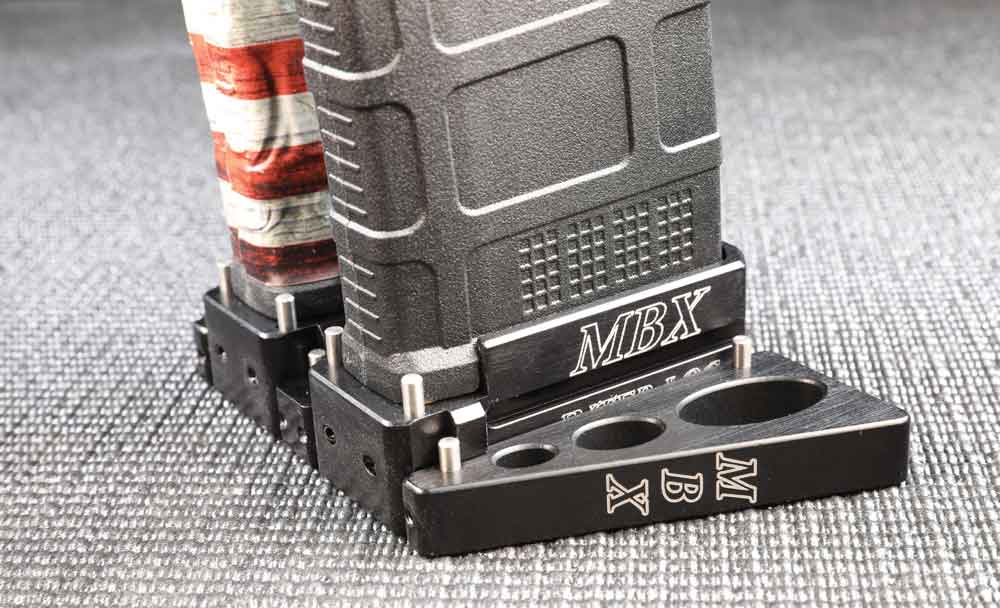
One of Cobb’s latest developments is the Inter-Loc System for magazines. This patent-pending gear is a magazine extension system for black rifles that allows the shooter to couple and decouple two magazines without the use of tools. The base pads are machined from aluminum and come in a variety of colors, and they attach to Magpul Gen 3 magazines. The system also has “wings” that may be attached to the sides of the base plates to provide a stable rest for the shooter, and this too may be done without tools.
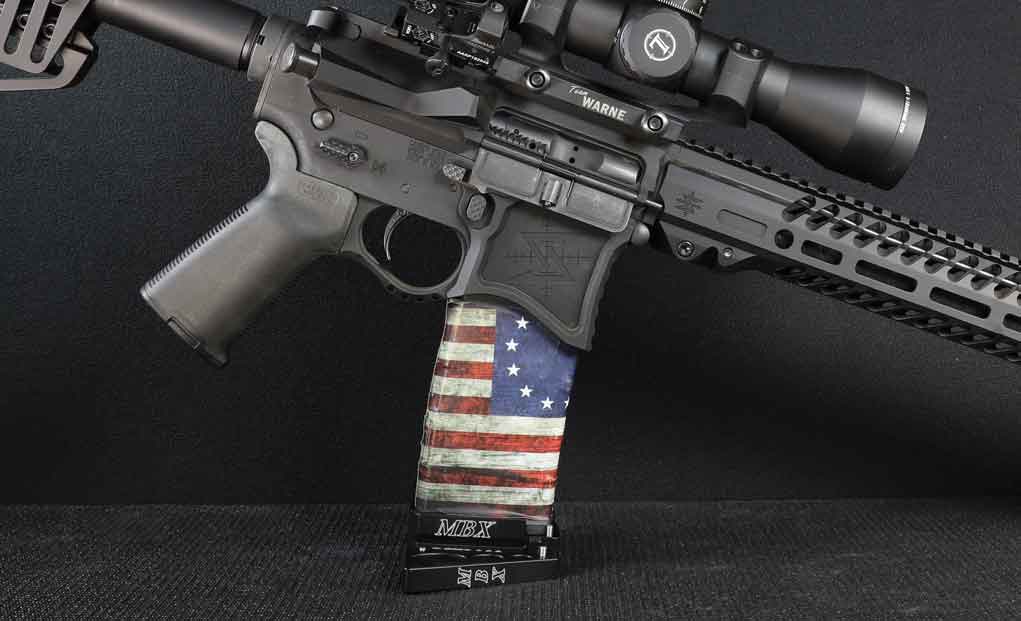
In most competitions, shooters who use a bipod on their rifle are pushed into the “open” or unlimited class where there are few, if any, gear restrictions — resting one’s rifle on coupled magazines is usually permitted without having to go to the open class, however. This is one place where the Inter-Loc System shines. The platform the system creates is extremely solid and not much different than shooting from a bipod.
In addition to providing a stable shooting platform, the advantages of the Inter-Loc System include capacity (adding 4-5 rounds on a 40-round magazine), weight (helps with dropping an empty magazine clear of the rifle) and versatility. The latter is due to the ability to change configurations without tools. Magazines may be coupled, decoupled, have wings added or removed with no tools. This is a great advantage for competition shooters who often optimize their gear from stage to stage.
Suppose for example a shooter used coupled mags with wings on a 3-gun stage that required precision prone shooting. The next stage might not have that requirement, so the shooter may quickly decouple the mags, remove the wings, and simply use the higher capacity magazines. These adjustments can be done in seconds. Versatility is also provided in the form of different colors. Colored pads may seem like a fashion statement or novelty at first, but shooters often use different (expensive) ammunition for long-range steel rifle targets as compared to close-range paper targets. Color-coded magazine bases help keep things organized, and they are easy to identify under pressure.
Cobb has been surprised at how people have used the MBX Extreme Inter-Loc System more than anything else.
“It was originally designed to have the wings at the back and to be used as a platform,” said Cobb. “People have used them to stage a gun or use the wing to keep the grip up off the deck so they can grab the gun more easily. Some people have liked putting one wing one way and one wing the other way because they like the support it gives.”
In spite of his success with a variety of MBX Extreme products, Adrian Cobb is probably just getting started. When he first arrived in the United States, he found the opportunities here captivating and unlimited.
“I was like a kid in a candy store,” remarked Cobb. “I think you tend to appreciate the opportunities if you come from a different country where there aren’t as many. Many people I’ve met don’t really recognize how lucky they are with all you can do here and the freedom you have. I think this gives me a certain drive because I didn’t have these opportunities [in England] and, suddenly, I did.”
It was clear from the conversation that Cobb not only saw the opportunities here in the United States, he pursued them aggressively. True to his racing roots, he gave no indication of slowing down anytime soon.
Editor’s Note: This “Modern Gunnery” column is an excerpt from the September 2017 issue of Gun Digest the Magazine.
The CMMG Mk4 is the latest platform tailored to embrace the scorching 22 Nosler, with four models now being chambered for the cartridge.
CMMG has introduced four Mk4 models configured for the 22 Nosler.
The four models come with 18-, 22- or 24-inch barrels.
Each rifle’s barrel utilizes optimized 1:8 twist rates.
CMMG also released complete uppers and barrels in 22 Nosler.
In recent years, Nosler’s ballisticians have appeared to do their darndest to tear the copper jacket off the company’s bullets. The ammo maker’s proprietary cartridges are by far among the hottest available for their respective calibers. And the gun-manufacturing end of the industry has been quick to embrace this blistering ammunition.
CMMG recently jumped on the Nosler bandwagon, embracing a cartridge the Oregon ammo company cooked up especially for the AR-15 platform. The Missouri gunmaker now offers its CMMG Mk4 rifle chambered for the fast and flat-shooting 22 Nosler, which was just released at the 2017 SHOT Show. For varmint hunters or competitors searching for a way to reach out a bit farther or hit harder, this should prove a solid match between cartridge and rifle.
CMMG hasn’t held back in embracing the Nosler creation, serving up four Mk4 models in the line, all well-tailored for practical applications of the 22 Nosler. On the roster are the Mk4 RCE, Mk4 S, Mk4 P and Mk4 V2.
Depending on the model, nearly all the rifles come with an 18- or 22-inch medium taper barrel, all outfitted with rifle-length gas systems and a muzzle brake or compensator. The exception to this is the Mk4 V2, which has a medium tapered stainless steel fluted barrel and is cut with a target crown.
The new line of Mk4s also all boast CMMG’s RKM14 handguard, which free-float the barrel and utilize the KeyMod system at 3, 6 and 9 o’clock positions for the addition of accessories. Additionally, the handguard has a full-length Picatinny rail that runs directly into the upper receiver, giving ample real estate to attach an optic.
Shooters also have the option for upgraded triggers on two of the 22 Nosler models, with the CMMG Mk4 RCE and Mk4 V2 outfitted with Geissele Automatics SSA Two-Stage triggers. The Mk P and S each come with single-stage Mil-Spec-style triggers.
The cartridge itself is proving to live up to its billing as the most powerful .22 caliber on the market. The 22 Nosler can push a 55-grain bullet upward of 3,500 fps out of a 24-inch barrel and shows little to no drop out to 200 yards. Nosler achieved these impressive results by super-sizing the 22 Nosler’s case, a 25-percent increase in case capacity over the .223 Rem. These larger-diameter cases, however, forced Nosler to turn to 6.8 SPC magazines to ensure proper feeding (CMMG includes one 10-round mag with all its rifles).
CMMG is ahead of the curve when it comes to rifles chambered in 22 Nosler. While there are examples on the market, they have not become ubiquitous. And the company, in its typical fashion, has also turned its eye to those who wish to build or configure an existing AR to shoot 22 Nosler, offering both barrels and complete uppers. Presently, the CMMG Mk4 22 Nosler models run from $1,099.95 to $1,449.95 for a complete rifle. Barrels run from $209.95 to $349.95, and complete uppers from $799.95 to $899.95.
Specifications:
CMMG Mk4 in 22 Nosler
Mk4 S Barrel: 18 in., 1:8 Twist, 22 Nosler, Medium Taper 416SS Barrel Muzzle: A2 comp., threaded 1/2-28 Handguard: CMMG RKM14 KeyMod handguard Furniture: A2 pistol grip, M4 butt stock with 6-pos Mil-Spec receiver extension Receivers: Forged 7075-T6 AL M4 type upper, AR15 type lower Trigger: Single stage mil-spec style trigger Weight: 6.5 lbs. (UNLOADED) Length: 34.5 in. (STOCK COLLAPSED) MSRP: $1,099.95
To gain the full tactical advantage a shotgun offers in a self-defense situation, it takes a strategic game plan. Here are four tips to boost your tactical shotgun skills.
Four considerations for improving your tactical shotgun skills:
Shotguns have a long and successful history. The first use of the term shotgun dates back to the late 1700s. The military has used shotguns extensively. They were popular with cavalry on both sides during the War Between the States, Germany filed an official complaint against the U.S. during WWI for the use of “trench guns,” and both French and U.S. forces used shotguns in the jungles of Vietnam. Almost every law enforcement agency issues “riot guns,” although AR’s seem to be steadily replacing them. Ask homeowners what weapon they have for home protection and the answer was and usually is a shotgun. It is truly a versatile weapon, especially considering the wide variety of ammo available today. The key to shotguns is setting one up for proper home defense and having mastery of basic tactical shotgun skills to be able to use it well.
Choose Your Action
Shotguns come in all types, from single-shot and double-barrel break tops, lever, bolt and pump actions to semi- and even full-auto. The most versatile shotguns are pump actions. A lot of the semi-auto guns are ammo sensitive; a pump gun works with reduced recoil rounds, “dragon-breath” flame-throwing rounds, non-lethal rounds and, of course, standard tactical and home defense loads. Single and double barrels will also work with the various rounds; you’ll just have to learn to reload more efficiently.
Rig It For Defense
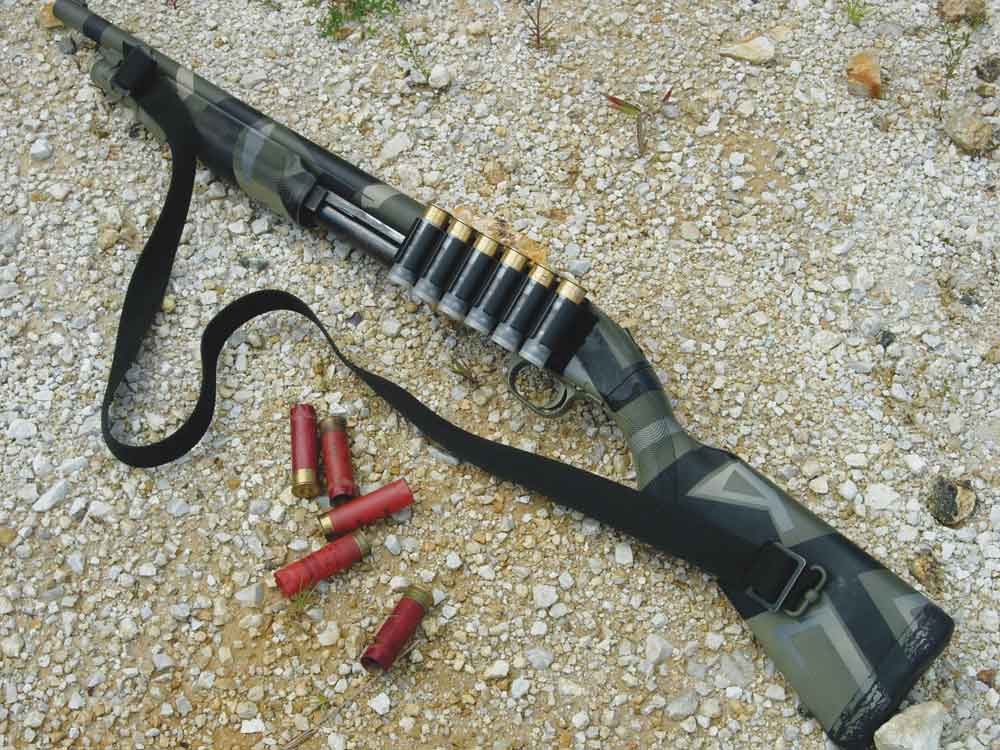
When it comes to setting up your home defense shotgun, a sling is mandatory. The sling for the shotgun is like the holster for your pistol. I prefer a simple two-point sling, which can be looped around my neck for a hands-free mode. “Tactical” slings, the term I use for anything that loops around the body, have their place, just keep in mind in the middle of the night when you’re grabbing the gun there may not be time to loop it up. Practice some without having the sling looped around your body.
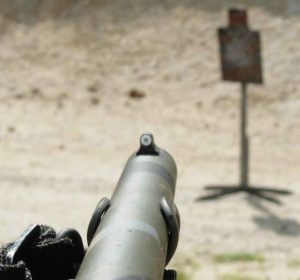
The standard front sight is a round bead. For fighting we need a sight that’s quick to pick up in the daylight as well as when it’s dark. Again, there are a lot of options. My favorite is the XS brand sights. They offer replacement front sights, and sets with front and rear sights. Adjustable sights are good, especially if you’re shooting slugs for accuracy. Another option is the red-dot sight, which works as well on shotguns as they do on carbines.
Equipping the shotgun with a light is a good idea. You can run a handheld light with a pistol or carbine, but operating a pump shotgun with a handheld light never works out very well. Just keep in mind that the recoil of a shotgun places a lot more stress on the light system, so do plenty of research to find out what your best option is.
It’s also a good idea to carry extra ammo. I use either a butt-cuff, strapped around the stock, a side-saddle, which holds extra rounds on the side of the receiver, or both. There are a lot of other accessories for shotguns, but not everyone needs all of them. I prefer to lean toward simplicity and light weight. As you train and begin to improve your tactical shotgun skills, don’t be afraid to experiment with different parts and accessories until discovering the right combination for you.
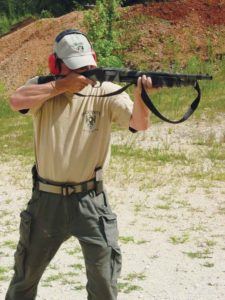
To use a shotgun properly requires training and practice. Training is an introduction to the shotgun skills you need; practice is the repetition necessary to actually learn these skills. You start with loading, which is more complicated than most people actually think, particularly in a high-stress situation.
After that, you learn unloading without cycling the action back and forth and dumping your rounds on the ground. You’ll also learn how and why to cycle the pump action aggressively, using the elbow instead of the shoulder joint.
Racking the action correctly prevents the action bars from binding, or locking up, and “short-stroking,” which is a major cause of most shotgun malfunctions. You need to know how to clear malfunctions and most importantly how to reload.
Feed The Machine
There are a variety of reloading techniques for the shotgun. The main thing to keep in mind is that you have to feed the machine. Shotguns have a limited round count, and while you shouldn’t need a lot of ammo, you never know what may be required to win the fight.
What I call a “tactical” reload, keeping the gun topped off, is a good shotgun skill to have and is easily performed. You fire two rounds, and then you feed two more fresh rounds into the magazine tube. By learning to consciously perform this task, you will ensure you never empty your shotgun.
There are a lot of names for the empty reload. The shotgun is empty, but you still need to be shooting. Basically, on a pump gun, it comes down to opening the action, shoving a shell into the port, closing the action, firing and repeating the process as necessary. This should be practiced while moving from a variety of different firing positions, and especially in the dark. The shotgun also allows you to load a different type of round during the confrontation, say switching from the buckshot in the mag tube by feeding in a slug and cycling the action to chamber it.
Choosing the right ammo is critical with the shotgun. One of the big concerns for home defense is over-penetration. Buckshot can travel through a lot of sheetrock and material until it comes to rest. Slugs can go through your house, out of it and into the neighbor’s home. Birdshot is often a much better choice. At the distances you’ll find inside your home, a healthy dose of birdshot in a tight pattern is very effective.
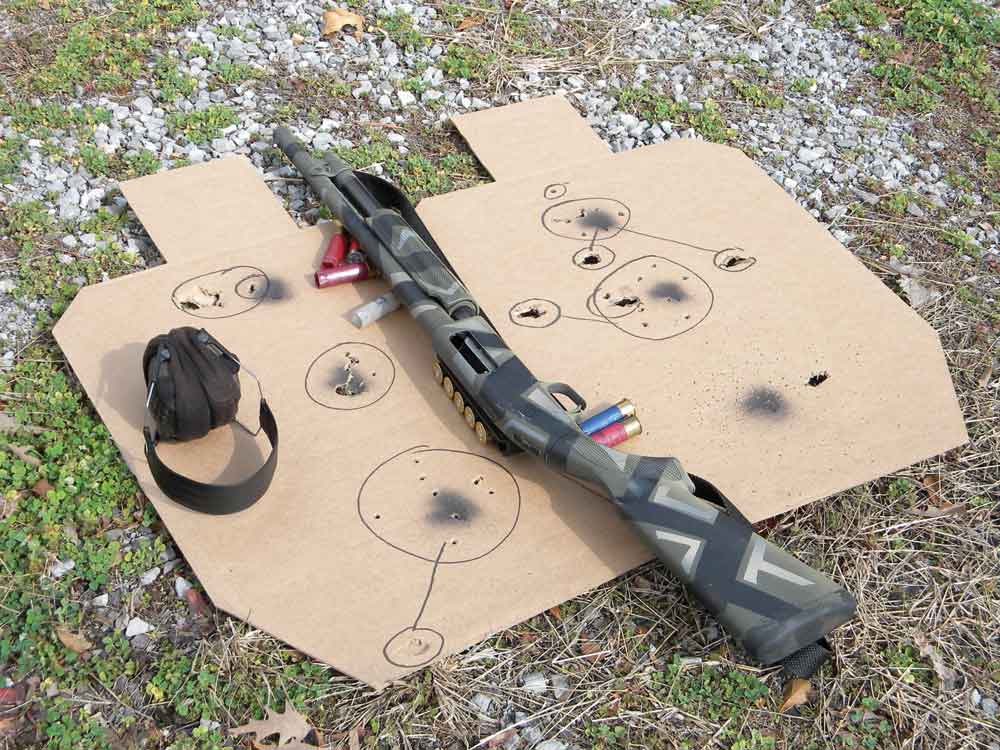
Once you determine the type of round you need, it’s off to the range to test and pattern. Patterning your ammo allows you to determine what brand/type of ammo works best in your gun and exactly how the round will perform at various distances. One of the common myths of a shotgun is that you just need to point it and blast away. Most beginners are amazed at how little the pattern spreads. This is especially true with modern defensive ammo that produces consistent and tight patterns. So, yes, you still have to aim the shotgun.
Pattern The Shotgun
Patterning the shotgun also provides you with data on your point of aim versus the point of impact of the shot or slugs. Should you find yourself in a unique situation and being forced to defend yourself from a threat at a great distance, it’s good to know in advance that you need to aim a little to the left to hit your target dead center.
Another point you need to consider is the shotgun’s “ready” mode. Again there are a lot of terms used, but one mode would be with it fully loaded, with a full mag tube and a round in the chamber. It’s ready for use, but one factor to consider is that a lot of shotguns have a free-floating firing pin.
Every time you load the shotgun there is a possibility of a “slam-fire,” or firing a round as the bolt chambers it. This also means that, with a round in the chamber, a sharp, sudden thump, like a car rear-ending your vehicle or hitting a large hole or speed bump can possibly cause a round to discharge from the shotgun.
Another ready mode would be having the magazine tube loaded, but with no round in the chamber. To make it ready to fire, you have to chamber a round. This takes time and must be a habit, so if this is your mode, then part of retrieving the shotgun includes chambering a round. Another factor is the noise of racking a round into the chamber.
One school of thought is that this will scare away an intruder. The other side of that coin is that it alerts the threat that you are armed, and they may choose to start firing first.
Using any firearm well is an art. The same applies to the shotgun, and maybe more so than other weapons. In some ways shotguns are simple, but then there are other aspects, such as keeping it loaded and firing under duress, that can be more complicated. These are shotgun skills that need to be mastered. Shotguns are versatile weapons, but they won’t do everything. However, with the right equipment, and plenty of training and practice, you can become a shotgun artist — a skill that will serve you well.
Does Your Shotgun Fit?
One of the first steps in selecting or outfitting a shotgun is making it fit correctly by choosing or modifying the weapon so it matches your body size.
Start with the stock. To shoot and manipulate it efficiently you need the proper LOP — length of pull — which is the distance between trigger and the back of the stock. Most shotguns come with a long LOP. Most people need a short length LOP. Manufacturers offer youth models, which are about the proper size for most adults, or you can install a youth stock on a shotgun. Just watching someone firing a shotgun that doesn’t fit is a painful experience. With a long stock, you can’t seat it into the actual pocket of the shoulder. Most people end up holding it outside the pocket and on the deltoid muscle, producing pain every time they press the trigger. This leads to a big flinch with each shot and creates ugly, and unnecessary, bruising.
The proper LOP assists the shooter in becoming more accurate, in recovering from the recoil and in manipulating the weapon properly. There’s a lot of information on determining the proper LOP on the Internet, but ultimately it should be determined by what feels and works best for you.
Editor’s Note: This article is an excerpt from the March 2015 issue of Gun Digest the Magazine.
Whether it’s because of preference or state restrictions on optics, many hunters rely on iron sights for muzzleloaders when heading afield. While most muzzleloader manufacturers offer the choice of fiber optic sights, they often don’t optimize longer-range shots. Instead, the fiber optic bead, which is usually pretty large, covers the target and makes long-range accuracy a difficult proposition.
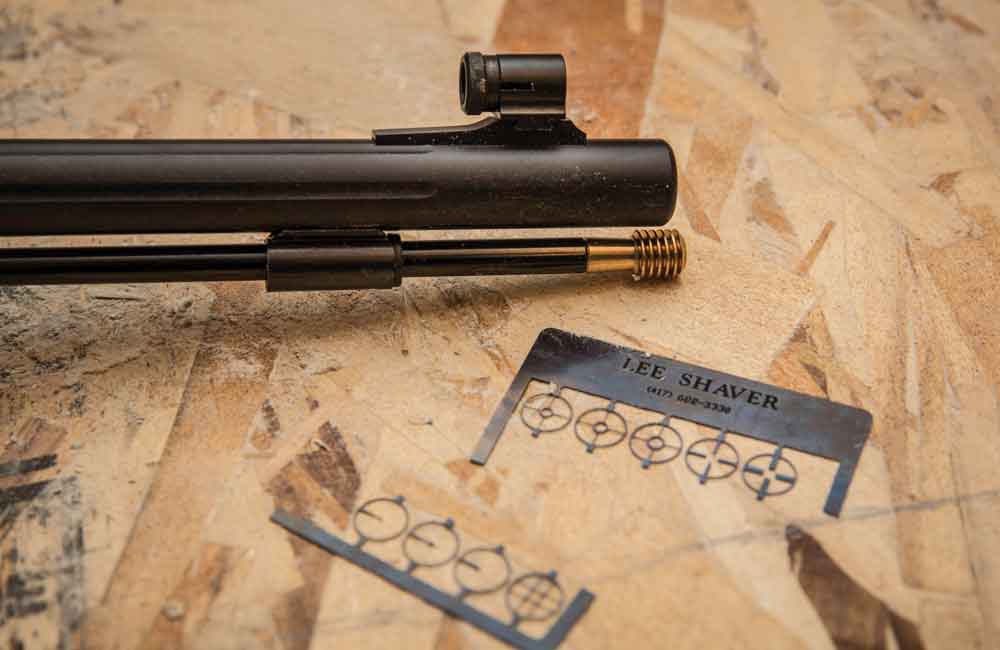
There is an alternative way to extend your accuracy with an open-sighted muzzleloader, however, and it’s both quick and easy. With only a few parts ordered from Brownells, the right sight setup is right around $100 and a few minutes of installation away from becoming part of your future. The only tools required are a screwdriver and a tube of Loctite, and the whole process takes just minutes (minus the time spent sighting in your smoke pole). For the purpose of this article, I upgraded the sights on a CVA Accura V2, which comes pre-drilled and tapped for either iron sights or optics.
Brownells Parts & Components
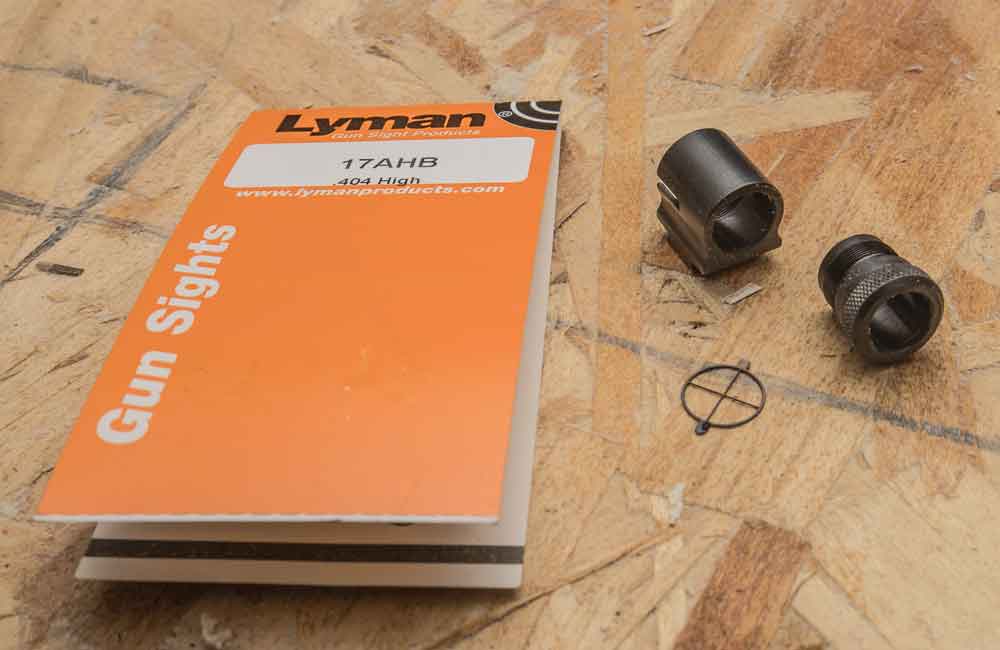
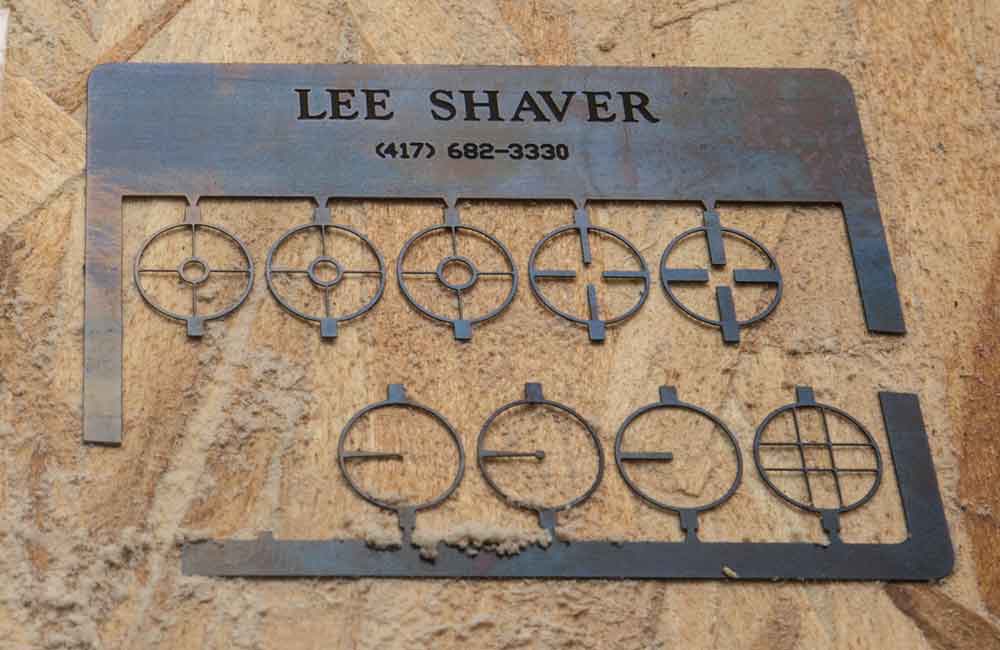
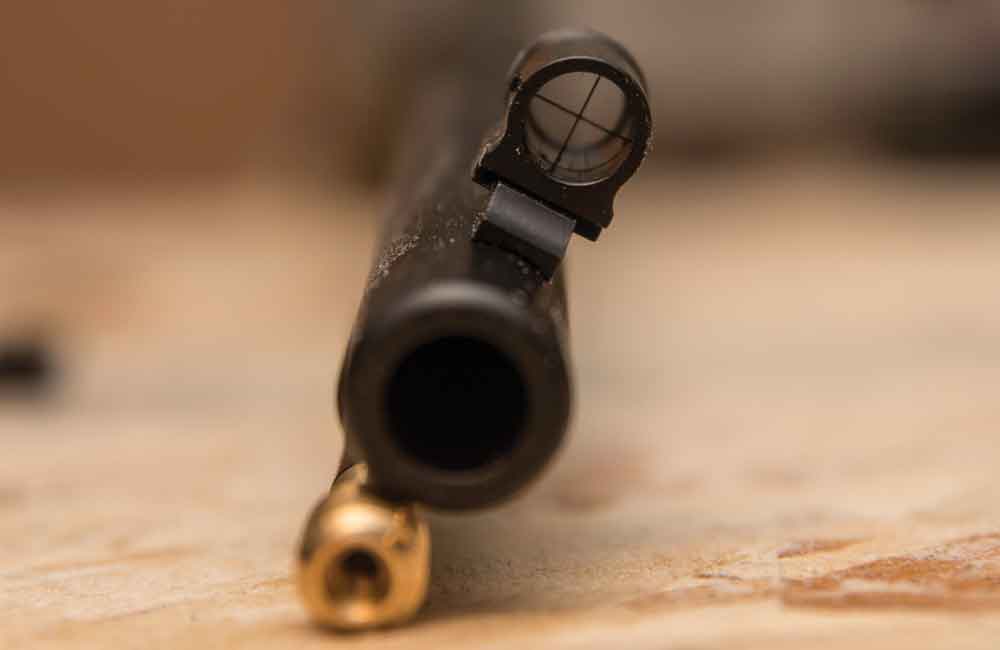
First, you’ll need a Lyman globe sight, which will attach to the front of the barrel, and a Marble Arms dovetail front ramp to mount it on. The front ramp attaches with a single screw, and the Lyman globe sight (with dovetail base) slides into place. While the Lyman globe sight comes with several inserts, I find them to be too large for my preference. To get smaller cut crosshair lines, I went with Lee Shaver’s globe sight inserts (10 total options for you to choose from). Finally, you’ll need a rear sight; I went with the Williams Gun Sight, which also attaches with a single or double screw setup (whichever your muzzleloader is drilled and tapped to fit). The Williams sight runs $35, the Lyman globe sight $40, Lee Shaver inserts $22, and the Marble Arms front ramp $12. If my high school math serves me right, that’s $109, before tax. Not bad, especially when you consider how much time and money you’ve likely invested in preference points and statewide draws to get that coveted muzzleloader tag.
Attaching The Front Ramp
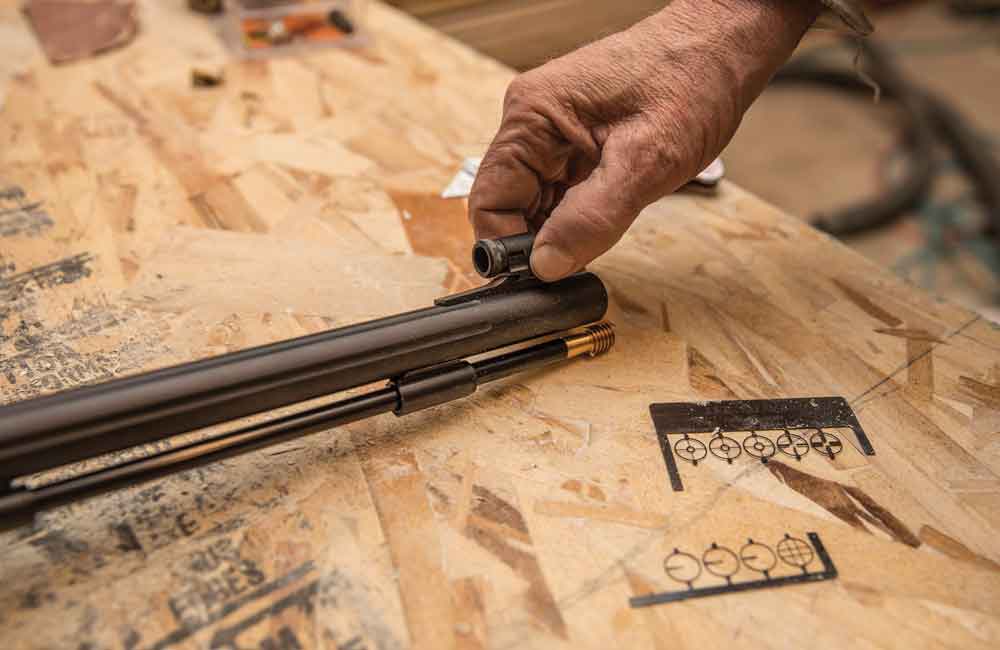
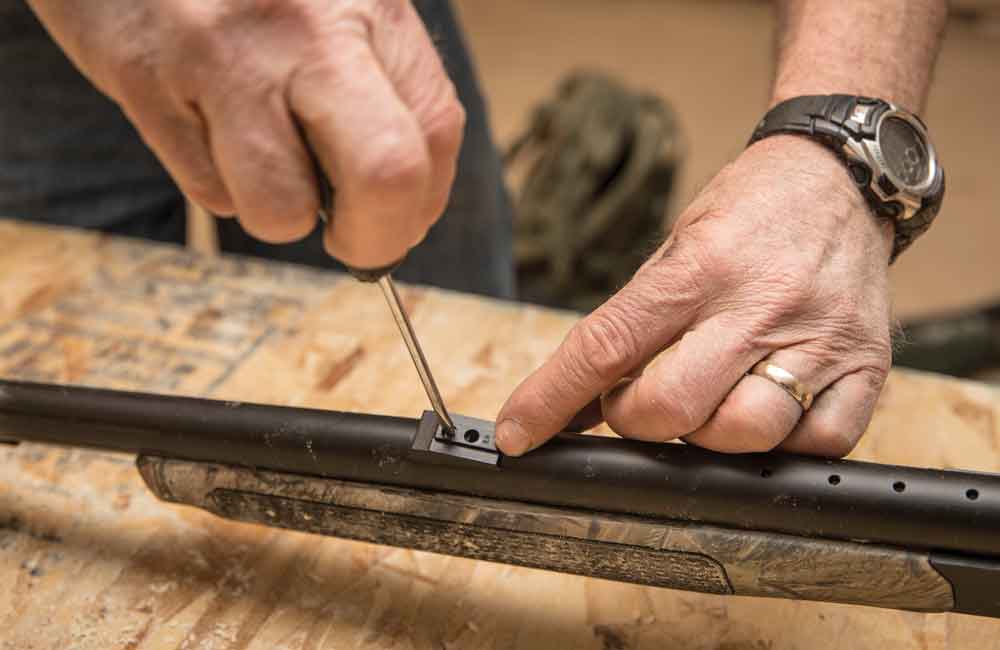
First, you’ll want to start by attaching the Marble Arms front ramp to the barrel of the muzzleloader. Here’s where I’d recommend Loctite or a similar thread locker to prevent screws coming loose.
Placing The Sight Insert
You can now turn to the Lyman globe sight. Unscrew the front of the sight, and then remove the insert that it came with. Take a pair of wire cutters or tin snips and remove the Lee Shaver insert you’d like to use on your muzzleloader. For this review, I used the classic cross-shaped crosshair — it’s simple and effective, and the fine lines won’t cover your target even at considerable ranges. Once the insert is in place, simply screw the cap back on the globe sight.
Attaching The Globe Sight
Once your insert is secured in the globe sight, you’ll want to attach the sight to the front ramp via the dovetail base. Here’s where things got interesting for me. When I went to slide the globe sight into the base, it was too loose to lock securely in place. What to do? Call the Brownells Gun Tech hotline, that’s what. After a minute or so on hold, I spoke with a friendly gentleman who informed me that Lyman had stopped making front ramps years ago, which means that some of the bases (produced by Marble Arms) don’t have an exact fit. But there’s an easy enough solution that I employed — a piece of duct tape and super glue. With tape in place the fit becomes incredibly tight, and the glue holds everything in place. This probably fits the definition of redneck engineering, but it hasn’t failed me yet (at least in this instance).
Attaching The Rear Sight
Once you’ve got your front globe sight mounted on the front ramp, it’s time to focus your attention on the rear sight from Williams. First, remove the side screw that allows the aperture to move up and down the base of the sight. Simply slide the aperture until it comes off. This reveals a setscrew, which you can now secure to the barrel of the muzzleloader. If your barrel doesn’t have adequate screw holes, a gunsmith can hook you up in no time. Loctite, secure the base, and then reattach the top portion of the sight. This slides up and down to make elevation adjustments at the range.
That’s it. Now that you’ve got your sights in place, it’s time to head to the range and see what the ol’ smoke pole can do. I think you’ll find, as I did, that it’s well worth the $100 and 15 minutes spent installing sights. I’ve successfully extended my range with iron sights well past the 100-yard range, something I was apprehensive to do with fiber optics. That means when the preference points add up and I’ve got a trophy bull or buck in my sights, I won’t have to question my ability — or that of the CVA Accura V2, which is a tack driver in its own right.
Editor’s Note: This article originally appeared in the May 2017 issue of Gun Digest the Magazine.
One of the more overlooked components of the AR-15, properly functioning AR springs are vital to the platform’s performance.
Springs in the buffer assembly, bolt group and trigger group are important to maintain.
Proper care and ensuring functionality of those go a long way in ensuring reliability.
The “buffer” or action spring has a large surface area which needs lubrication.
Extractor and ejector springs in the bolt group need to be maintained.
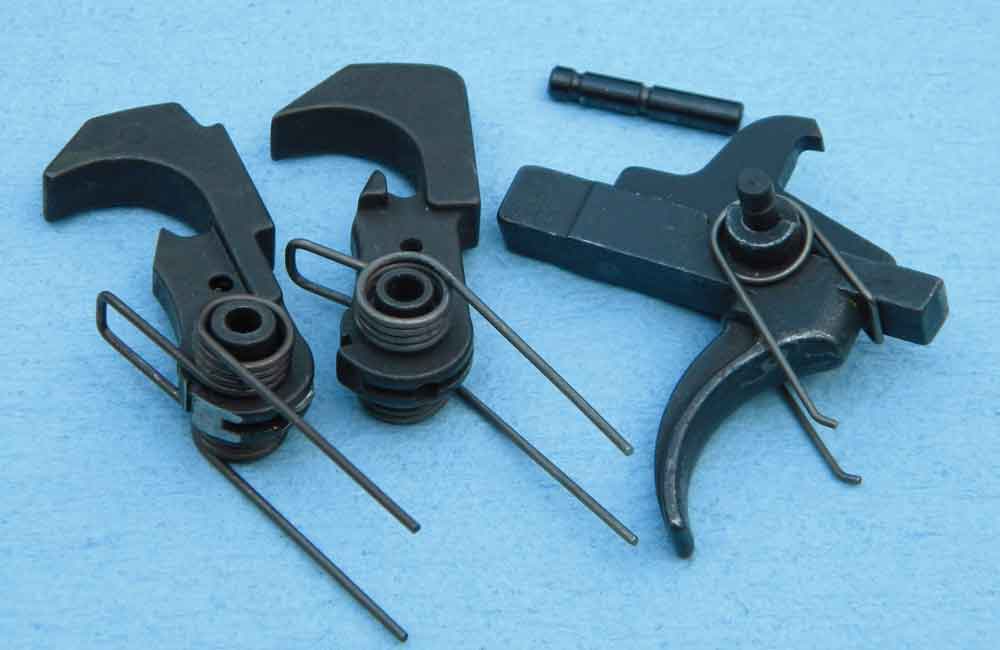
Three springs in the trigger group — trigger, hammer and disconnector — require care.
Springs are important, but often overlooked, parts for the AR. There are a lot of options out there, and not all springs are created equally. Choosing the right springs ensures reliability for your AR rifle or carbine. For this discussion, we’re going to focus on the springs related to three important areas: the buffer assembly, the bolt and the trigger group.
Buffer Springs
There are two basic “buffer” or action springs. The spring for fixed stocks is around 12½ inches in length. The carbine spring, for ARs with adjustable stocks, is shorter, at about 11 ¼ inches long. (Buffer springs can vary up to about a half-inch in length.) For a “fighting” AR — self-defense, law enforcement or field use — I prefer standard Mil-Spec springs, which are made from round wire. There are other options out there, such as “universal” springs that use one length spring for fixed and adjustable stocks. These springs often increase the spring pressure, making it difficult to cycle the action efficiently. I also don’t like springs made from flat wire. They create a lot of friction and wear in the extension tube. Unless you’re fine-tuning an AR for a specific application and ammo, Mil-Spec is the way to go.
The buffer spring is a large friction surface and needs to be lubed. Cycle the charging handle. If you hear/feel a gritty action from the buffer spring, it needs lubing. Remove the spring by pressing the buffer detent — at the front of the extension tube on the bottom — down and pulling the buffer and spring forward. Clean the spring and inside of the tube, then lube the spring. I use SLIP 2000 EWL. Reinstall the buffer and spring, cycle the charging handle a few times, and you should hear and feel a difference.
Bolt Springs
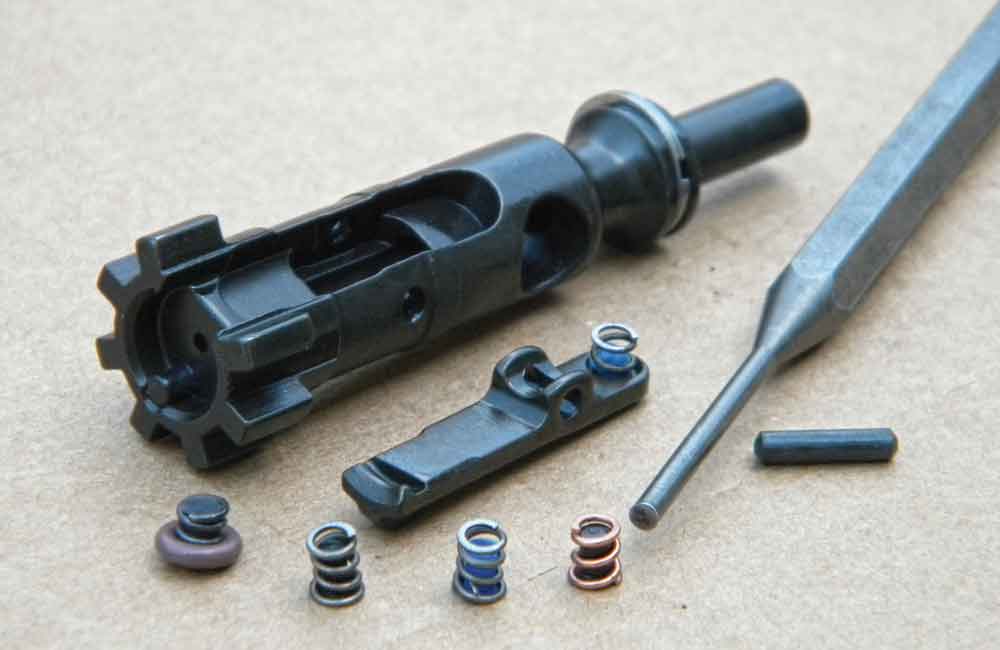
The bolt contains two springs — the extractor and ejector spring. During firing, the extractor pulls the empty case from the chamber, or, when unloading, it extracts a loaded round, and the ejector kicks it out.
The extractor spring provides the tension necessary for the extractor to hold the cartridge case. Too little pressure and the extractor slips off the empty brass as it tries to pull it from the chamber. However, an extractor spring with too much pressure will cause feeding problems. The round will have trouble slipping under the extractor, or the extractor will damage the rim on the brass as it’s chambered. (Note: Steel-cased ammo will cause accelerated wear with your AR.) I feel safe saying this is the most important spring in the AR.
It took Colt more than 35 years to work out the proper spring weight on the extractor for the carbine. During this time, there were lots of different aftermarket extractor springs developed in order to correct this problem. There were also other “fixes,” like O-rings and wedges, to strengthen the existing extractor springs. None of these work well.
Today we have Colt Gold extractor springs. Colt spent a lot of time and money researching and developing this spring. The Gold spring, which actually has a copper color finish, will ensure proper function and longevity.
The ejector, with its spring, kicks out empty cases. Again, this spring can be too heavy or light. An ejector spring that’s too strong causes feeding problems, making it difficult for fresh rounds to slide in behind the extractor when chambering a round. If the ejector spring is weak, you’ll experience failures to eject empty cases.
To test the ejector spring, use your fingernail and moderate pressure to press it into the bolt. During live fire, empty cases should eject a few feet and back at about 4 o’clock. If it’s ejecting in front of you — 2 to 3 o’clock — it’s time to replace the ejector spring. A spring that’s too strong will kick cases 10 or 12 feet out. With both the extractor and ejector spring, you’re looking for “just right.” I use Colt springs from Brownells. I know these are high-quality parts that are truly Mil-Spec.
One reason the extractor and ejector springs fail is due to heat. After extended firing, lock the bolt open. This prevents heat from transferring from the barrel extension, the rear of the barrel where the lugs are, to the spring of the bolt and will extend their life.
Trigger Springs
The AR trigger group has three springs — trigger, hammer and disconnector. The design is simple and reliable, unless you start messing with spring weights or install them incorrectly. There is a big trend today for shooters to install lightweight springs in order to improve the trigger action. This can lead to trouble in several ways.
Remember, under stress — lives depend on your actions — your fingers lose dexterity and feeling. A 3-pound trigger will “feel” like 3 ounces. In defensive or combative applications, a match, competition or lightweight trigger will lead to negligent discharges. This is unacceptable.
Light hammer springs cause light primer strikes. This will be trouble with Mil-Spec or imported ammo, which usually have harder primers. On the range or during a match, a light primer strike is embarrassing. In a fight, it could be tragic.
I would also avoid lightweight disconnector springs. A disconnector spring that’s too light leads to the AR “double tapping,” firing off rounds as the bolt seats into battery and the hammer jumps forward. Sometimes it will cause your AR to go full auto. (Colt modified the AR’s bolt and hammer, creating an “interrupter” to prevent this from occurring.) When it comes to the trigger group, stick with Mil-Spec springs.
The proper positioning of the hammer spring seems simple, but I see a lot of problems with them installed improperly, especially with home-built ARs. The legs of the hammer spring provide the force necessary to ignite the primer. If the hammer spring is positioned on the hammer improperly, you’ll have light primer strikes.
The hammer spring’s legs also hold the trigger pin in place. If the spring is weak, had one leg shortened/cut or it’s installed improperly, it allows the trigger pin to walk out of the receiver. This can cause negligent shots and full-auto fire. If the pin walks out of the receiver, it can also allow the hammer to fall when the AR is set down, bumped or anything else that jars the internals enough for the hammer to slip. There have been people killed by ARs because of this. If you’re not sure about what you’re doing, get a qualified gunsmith to do your AR work. This is not something you should be experimenting with.
The AR is a great firearm. This platform has been in service with our military since the mid 1960s, with no retirement in sight. With the right parts installed correctly, it will provide you with years of reliable service and be something you can pass on to future generations.
This “AR Essentials” column is an excerpt from the Fall 2017 issue of Gun Digest the Magazine.
The MCX Virtus is the new upgraded version of SIG Sauer’s innovative modular firearm, offering shooters a more robust and flexible platform, ready to tackle any situation.
The MCX Virtus features beefier barrels and SIG’s Matchlite Duo Trigger.
It also has an improved bolt lug and increased handguard selection.
Modularity is still the firearm’s main attribute.
The handguard, barrels and buttstock are all easily swapped with minimal tools.
The MCX Virtus maintains familiar AR controls, making it extremely intuitive to use.
Like a wildfire, the concept of modular firearms has swept through the gun world the past few years. The idea is a solid one, allowing shooters to quickly reconfigure — often without tools — a pistol or rifle to different sizes and calibers to meet the situation at hand. And when it comes to these highly versatile weapons systems, SIG Sauer has been at the forefront.
One of the New Hampshire-based gunmaker’s most heralded introductions into this emerging end of the market is the MCX, a piston-driven AR system (really a hybrid) that can go from rifle to pistol as quickly as it can peel off rounds.
Introduced just before the 2015 SHOT Show, SIG Sauer has been quick to improve the already impressive system, recently releasing the MCX Virtus. Boasting more robust barrels, SIG’s Matchlite Duo Trigger, an improved bolt lug and increased handguard selection, the AR system is wicked as ever. But as Gun Digest Editor Luke Hartle notes in his up-close-and-personal with the MCX Virtus in the above video, the firearm’s modularity is still its main attraction.
The handguard can be removed without tools, simply by releasing a captured pivot pin. Swapping out barrels takes seconds through a unique retention system that utilizes two T27 screws and requires absolutely no head spacing checks. And the buttstock is quickly plucked and replaced with the same screwdriver, also held into place by T27 screws. What makes much of this modularity possible is the innovative short-stroke piston system and unique recoil assembly placed above the bolt carrier group.
While under the hood is a world apart from most ARs and their hybrids, the controls are as familiar as an old pair of shoes, with the mag release, safety and charging handle configured the same as any other AR. This is by design, allowing shooters to harness the technical advantage of the MCX Virtus without learning a new manual of arms.
Find out more about what SIG Sauer is offering in this improved weapons system in the above video, and see why it really is the firearm capable of 500 different configurations.
Is the relatively new .300 Norma Magnum a true heavyweight contender, and what can handloaders do with it?
The .300 Norma Magnum is based on the earlier .338 Norma Magnum.
At the range, the .300 Norma Magnum held sub-MOA with several bullets designs.
One group shot at 500 meters measured 1.45 inches.
Bullet choice for reloaders depends on the intended application — many options exist.
With a 230-grain bullet, the .300 Norma Magnum remains supersonic to 1,500 yards.
Amotfors, Sweden was not quite the town I expected. It lies just east of the Norwegian border and is rather quaint with its White Moose Hotel, a surprisingly decent pizza joint and an American sports bar. It has a large railway station, and the waterfront in town will actually bring you out to the North Sea. However, its claim to fame is that it is where Norma Precision AB calls home. I was invited to visit the factory — where the magic happens — and meet the key players involved in the development of Norma’s fantastic ammunition and components; it was certainly an eye opener.
The plant employs over 200 people, including some who have enough shooting medals to sink a battleship. First, as a reloader, let me report that the processes involved with making their brass cartridge cases were correlative to the quality of that brass; I now understand why I like it so much. But among all the wonderful folks I met, and all of the sneak peeks behind the curtain, the thing that intrigued me the most was Norma’s new .300 Magnum.
Now, Norma is no stranger to cartridge development, with its .308 Norma Magnum predating the .300 Winchester Magnum and its 6.5-284 Norma firmly established as a benchrest cartridge, not to mention the .358 Norma Magnum. However, the .300 Norma, and its big brother, the .338 Norma Magnum are two very solid developments, each capable of excellent accuracy as well as high velocity.
Introduction To The .300 Norma Magnum
My first date with the pair was at the RWS factory in Nuremburg, Germany, when, at a shooting competition among gun writers, I took second by printing a 1.69-inch three-shot group on the 500-meter range. Yes, that’s right. I was beat by a group measuring 1.45 inches; this cartridge is a shooter.
I got the skinny on the younger brother — the .300 Norma — while having a sit down in the Norma Headquarters and immediately recognized the handloading potential of an already excellent factory cartridge. The pair of cartridges is based on the .338 Lapua — in turn based on the .416 Rigby case — shortened to 2.492 inches, yet maintaining a maximum C.O.L. of 3.600 inches — the same as the .375 H&H Magnum. This allows the longest and sleekest bullets to be seated out plenty far enough to maximize the case capacity.
With a case head diameter of 0.588 inch and a steep 20-degree shoulder, the .300 Norma Magnum has a large powder column, but it resembles the profile of the short magnums more than the long, thin belted magnums of the 1960s. The design was a joint effort between Jimmy Sloan and Norma, and it has proved to be more efficient than the longer Lapua offering.
Powder & Primer Considerations
At the range, the .300 Norma Magnum proved to be a very accurate cartridge, holding sub-MOA accuracy with several different bullets. Factory stuff aside, in the handloading realm, I was curious to find out what makes the .300 Norma tick, so we can find an easy starting point for our handloads. What I’ve found makes perfect sense and might cause you to experiment with some different powders that might be foreign to you. Norma Precision — rather obviously — uses Norma powder for its ammunition. Here in the United States, Norma powder is imported and distributed by Western Powder (WesternPowders.com) and is a vastly overlooked source of excellent handloads. I’ve used Norma 200 to fuel several safaris, as it makes a wonderful choice in the .375 H&H Magnum and will deliver serious accuracy with the 235- and 250-grain bullets.
Norma recommends two powders for use in the .300 Norma Magnum: the proven MRP and Norma 217. To translate into terms we all know, the MRP has a burn rate in the vicinity of Alliant Reloder 22 or IMR 7828, while Norma 217 is one of the slowest burning powders, hanging out with Alliant Reloder 25. So, even if you don’t choose to follow in Norma’s powder choice, this should give you an idea where to start; powders with a burn rate equal to or slower than RL-22 should give positive results. I’m certain that the Enduron IMR7977 and Hodgdon’s RETUMBO would also make worthy candidates. The .300 Norma case has a capacity of 103.0 grains of water, so powder charges will approach 90 grains or more, depending on the bullet weight.
Regarding primer choice for the .300 Norma Magnum, you’ll most definitely want a good large rifle magnum primer to ignite that powder column, especially since powder charges can exceed 90 grains. Experimenting with different primer types (please start load development from the bottom of the load data, as pressures can spike quickly in a cartridge this large) might show a significant difference in accuracy results, and once you find that combination of powder/primer/bullet in your rifle, get it tattooed on you forearm, so it’s never lost.
The Right Bullet For The Job
A good set of dies, like Redding’s deluxe die set with neck sizer, is paramount.
Bullet choice for the .300 Norma Magnum is going to depend on the application. If you’re into the truly long-range game, the .300 Norma Magnum might be a dream come true, as it was designed around the 230-grain Berger OTM Hybrid bullet. This bullet uses an optimum blend of secant and tangent ogive curves to best engage the rifling and yet maximize downrange performance. I like any bullet of 180-grains on upward, with the best ballistic coefficient (BC) I can obtain.
For the target game, think the Sierra 220-grain MatchKing, the Hornady 225-grain ELD-Match (with a G1 BC of 0.777, woof!), those great Berger offerings and the like. For a hunting scenario — and I feel the .300 Norma Magnum could make a great elk, moose and bear rifle — bullets like the 180-grain Swift Scirocco II, the 220-grain ELD-X and the Nosler AccuBond Long Range at 190 and 210 grains will all provide excellent terminal ballistics, in addition to good wind deflection characteristics.
And the beauty of the .300 Norma Magnum is that all of these long-for-caliber bullets can be seated out far enough to keep the shank of the bullet — before the ogive — at the case mouth. I’ve had issues with the .300 Win. Mag. when trying to use long-ogive bullets and maintain the SAAMI-specified C.O.L. measurement.
What about the velocity? Well, with a case like the .300 Norma, the velocity is certainly there. The 220-grain slugs can be driven to just over 3,000 fps, and the 230-grain bullets just 50 fps slower. A good 180-grain hunting bullet can easily reach 3,250 fps, putting the .300 Norma in between the .300 Weatherby/30 Nosler and .300 Remington Ultra Magnum/.30-378 Weatherby on the velocity scale. In my experience, the recoil of the .300 Norma is manageable, about on par with the .300 Winchester, maybe a bit more, but nothing horrendous.
Parting Shots
So, do we need another .30-caliber magnum? I mean, with the plethora of cartridges launching a .30-caliber bullet, couldn’t we make do with what we have already? The .300 Winchester Magnum is a fantastic cartridge, and the .300 Weatherby and .300 Holland & Holland each have their following, not to mention the .300 Remington Ultra Magnum crowd, as well as those who’ve taken to the .300 Winchester Short Magnum.
Well, the U.S. military seems to believe the answer to that first question is a definite affirmative. SOCOM has adopted the .300 Norma Magnum for its Advanced Sniper Rifle, more than likely due to the fact that the .300 Norma will remain supersonic — with the 230-grain bullet — as far as the .338 Lapua will with its 300-grain pill; both go transonic somewhere around 1,500 yards. Based on my experiences with the factory loads for the .300 Norma Magnum, I am eagerly awaiting my test rifle so I can begin tweaking the handloads. Keep your eye on this cartridge; I feel Norma has got something very special here.
Editor’s Note: This “Reloading Bench” column is an excerpt from the August 2017 issue of Gun Digest the Magazine.
The Remington Model 8, and later the Model 81 Woodsmaster, was a classic John Browning designed semi-auto, and one of the earliest to see real success.
The Remington Model 8 was patented in 1900.
The Models 8 and, later, 81 were produced from 1906 to 1950.
The Model 8/81 Woodsmaster were both offered in high-grade models.
High-capacity magazine police models and models in .25 Remington are more valuable.
The Remington Model 8 semi-automatic rifle was one of the many firearms designed by John M. Browning. Its history goes back to the turn of the 20th Century when Browning was granted a patent for the rifle on October 16, 1900. Production didn’t begin until 1906, and for 5 years it was known simply as the “Remington Autoloading Rifle.” The designation became the Remington Model 8 in 1911, and its production run lasted until 1936, at which time a few design changes were made and the Model 81 was introduced.
Browning made an agreement with Fabrique Nationale (FN) in Belgium to manufacturer the Model 8 as the FN Model 1900 with sales limited to areas outside the United States. The FN model was in production from 1910 until 1929 and was not a big success. Only 4,913 were made and these were sold mainly in Western Europe and Canada.
The Remington Model 8 was essentially a rifle version of the Browning Auto-5 shotgun. The 22-inch barrel was covered by a full-length tube enclosing the recoil spring. The rifle operated on the same type of long recoil action as the Auto-5, in which the barrel and bolt move to the rear of the receiver when fired. They then unlock to eject the fired round and move forward to chamber another one.
Leading The Pack As one of the first successful semi-autos, the Remington Model 8 became quite popular. More than 160,000 Model 8s and 81s were sold from 1906 until 1950, when the 81 went out of production. Here’s a breakdown of production figures:
Remington Autoloading Rifle (1906-1911) 26,000 Model 8 (1911-1936) 80,600 Model 81 (1936-1950) 55,581 Total production 162,181
The Remington Model 8 gave birth to several new cartridges: .25 Remington, .30 Remington, .32 Remington and .35 Remington. The .35 Remington was the most popular and still is today. These are all rimless cartridges and were designed to reliably operate from the Model 8’s five-round fixed magazine. The most sought-after chambering for the Model 8 is the .25 Remington. Buyers should be expected to pay a premium of 30 to 35 percent for this caliber.
The Model 81 was introduced in 1936, and the .25 Remington was dropped a year later. The .300 Savage was added in 1940 and the .32 Remington was not made after WWII. Since very few .25 Remington Model 81s were made, a premium of 30 to 35 percent would also apply for this model.
The Models 8 and 81 were both offered in high-grade models with engraving and better walnut stocks. These were known as the A, C, D, E and F grades, sometimes referred to as Standard, Special, Peerless, Expert and Premier grades.
Another special series was the Police Model. These models featured higher capacity magazines holding 10, 15 or 20 rounds, some with larger fore-ends and some featuring engraving for individual police departments. The Peace Officer’s Equipment (POE) of St. Joseph, Missouri, was the major source for these customized police rifles, and another was Hawkeye Protective Appliance Co. of Des Moines, Iowa.
Remington recognized an opportunity to extend its market for the Model 81 and, in 1938, began plans to create Special Police models, in some cases working with the POE company. Limited numbers of these Model 81 Police Models were manufactured, but no source apparently has info on how many. Buyers should expect to pay a substantial premium for one of these.
A Semi-Auto Celebrity The most famous Model 8 is the Bonnie and Clyde rifle. This is the rifle carried by former Texas Ranger Frank Hamer, who came out of retirement in 1934 to go after the infamous depression-era bank robbers Bonnie Parker and Clyde Barrow. Hamer bought his Model 8 in .35 Remington at Petmeckey’s Sporting Goods Store in Austin and had it fitted with a 20-round magazine by the POE company. He trailed Bonnie and Clyde for several weeks before leading the assault — really more of an ambush — on May 23rd, 1934, on Louisiana Highway 154 in Bienville Parish that abruptly ended the couple’s career in the banking business.
The posse included six police officers, four from Texas (including Hamer) and two from Louisiana. Each one had a shotgun, handgun and a semi-auto rifle. At least one of the rifles was a Browning BAR, and it’s likely that, in addition to Hamer’s, some of the others were Model 8s. News reports at the time said more than 130 rounds were fired into Bonnie and Clyde’s Ford V-8, killing them instantly. There were subsequent reports that Frank Hamer’s rifle was a Model 81, obviously incorrect since the 81 was not introduced until 1936. His Model 8 is on display at the Texas Ranger Museum in Waco.
The Model 81 remained in production through 1950, and it was 5 years before Remington replaced it with the Model 740, a gas-operated semi-auto that picked up the Woodsmaster nickname from the earlier Models 8 and 81. The 740 evolved into the 742, 7400 and 750 through the years, with the 750 being discontinued at the end of 2016, leaving the R-15/R-25 AR-types as the only centerfire semi-auto rifles in the Remington line.
Here are some estimated values of the Model 8 and Model 81 series, courtesy of Standard Catalog of Firearms 2017 Edition:
Looking to go armed, but are stuck in the weeds as to what to arm yourself with? Here are 20 of the best concealed carry gun options that will keep you on the defensive.