Home Blog Page 261

5 Game-Changing Glocks

0

Most popular Glock models.

The development of the first Glock forever changed the handgun market as we know it. Here are five of the company’s most iconic models.

In the early 1980s the Glock Model 17 was introduced and it forever changed the world of service pistols. The Glock 17 wasn’t the first striker-fired pistol, but it was the first to be a commercial success.

By combining internal safety features and a long stroke, two-stage trigger pull with a center blade safety in the trigger, the Glock provided police departments with a large magazine capacity, lightweight gun with a high degree of safety and ease of operation. Currently available in 9mm, .40 S&W, .45 GAP and .45 ACP, the various Glock models have set the standard for striker-fired guns and proved the system to be both reliable and easy to use. The Glock line has proved to be one of the most successful designs of semi-auto pistols in history, and they continue to be among the most successful, recognized brands in the firearms industry.

Glock probably has the most loyal following of any handgun currently manufactured. The company considers its design as a safety action and those safety features are just what propelled the Glock to the forefront of the striker-fired revolution.

In fact, those features could be said to have almost single-handedly created the popularity of striker-fired pistols. The Glock is affordable, reliable and safe, and these are characteristics that make a good service pistol. Here are five Glock models that have changed the way we view semi-auto handguns or at the very least, have defined Glock’s sense of innovation and quality.

Glock 17. Glock 17

Designed to become the adopted service pistol of Austria in 1982, the Glock 17 continues to garner sales and positive comments from the shooting fraternity after 32 years of production. The Glock 17 was so named because it was the 17th set of technical drawings in the company’s quest in the Austrian Army’s procurement process. Being the original pistol in the line, there have been revisions. Currently, the latest version is the Generation 4. Other than the recoil spring and extractor designs, the changes in the Glock generations mostly are concerned with ergonomics.

At 25 ounces unloaded and with a barrel length of 4½ inches and a width of less than 11⁄8 inches, the Glock 17 is a compact service pistol. Boxy in shape, they were designed for function. Chambered in 9mm and with a standard 17-round magazine, the Glock 17 is a great balance of function, power and ergonomics. Its striker-fired design has proven to allow easy training and safe operation.

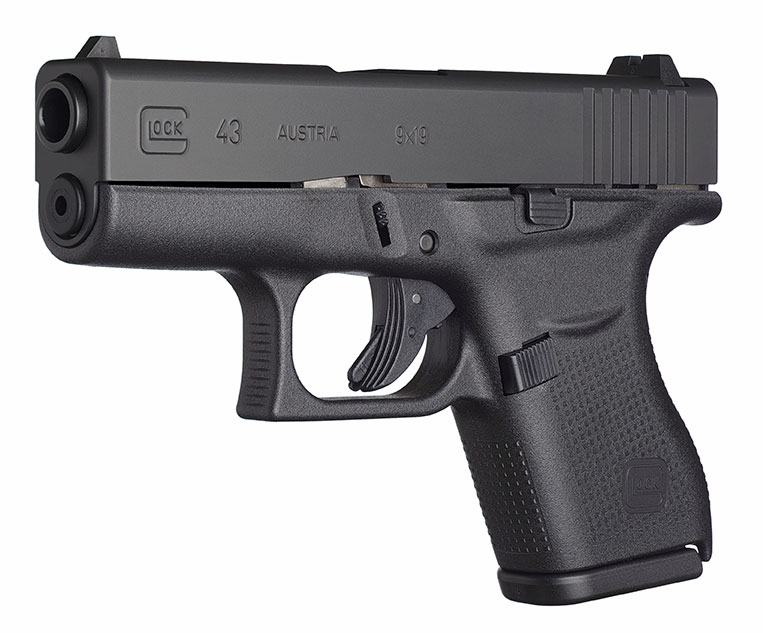
Glock 42. Glock 42

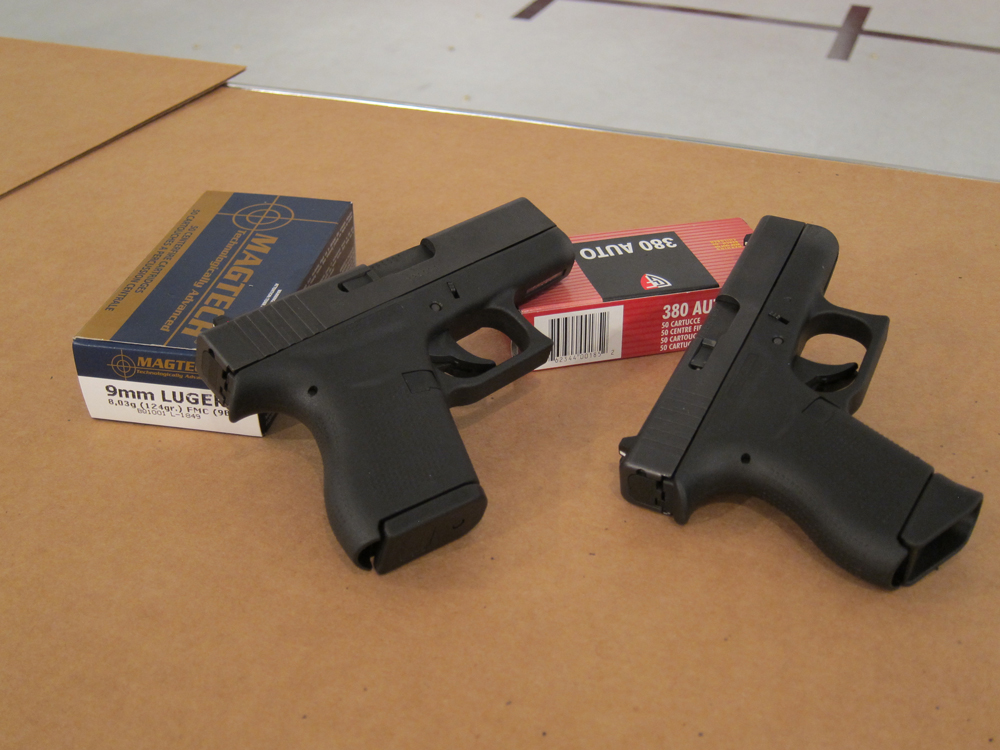
The Glock 42 is a bit larger than most of the current run of .380s on the market. For ultimate concealment, this might be a minor drawback, but for many who find the tiny guns a bit intimidating, it’s an answer to a prayer. With a standard Glock trigger pull, all the safety features of the Glock Safety Action and quality full-size sights, the 42 is still quite compact, light and thin. With the advent of quality .380 defensive ammunition the baby Glock might not be considered a one shot stopper, but it’s certainly no wimp. Many feel it’s just the right size for a carry pistol, not too big, not too small, just right. Maybe we should dub it the Goldilocks Glock.

The smallest true striker-fired gun, the Glock 42, is a new .380 compact, a downsized carry gun with all the features of the full-size models. It’s a slim, sub-compact pistol, a little larger than most .380s, but weighing just over 13 ounces with a 3¼-inch barrel. Like other models, it comes with two six-round magazines and has the familiar white dot front and white U outline sights.

Glock 34.Glock 34

While the Glock reputation was built on service pistols, it’s inevitable that competition with Glock pistols would happen. In fact, the company has its own shooters organization, the Glock Shooting Sports Foundation (GSSF). The Glock 34 is specifically designed for competition with a longer 5.3-inch barrel and a correspondingly long sight radius. Designed for USPSA, IDPA, IPSC and GSSF competition, it’s a 9mm gun that departs from the standard drift adjustable sights with click adjustable sights, allowing for a higher degree of pinpoint accuracy.

Glock 22. Glock 22

The Glock 22 is externally identical to the Glock 17 but chambered in .40 S&W. It’s arguably the most issued pistol in modern police history, with departments all over the United States adopting it as the standard issue sidearm. While there are those who feel the 9mm isn’t a reliable man stopper, there are few who hold that position on the .40 S&W. The .40 has similar energy to the iconic .45 ACP round, but magazine capacity is more like the 9mm Glock 17. In fact, the Glock 22 in .40 caliber only gives up two rounds over the Glock 17. The end result is an easy-to-operate and reliable, powerful high-capacity pistol that offers what many departments believe to be the best compromise of capacity and power.

Glock 20.Glock 20

In America, we value horsepower, and the top of the Glock line—the G20—certainly has horsepower. The 10mm round produces a massive 550 foot-pounds of power, and the magazine capacity of 15 rounds produces a handgun with a high power-to-weight ratio. With an empty weight of just over 30 ounces and a fully loaded weight of 39 ounces, the G20 provides stopping power and firepower that have the potential to handle almost any situation, including being a much more effective version of bear spray. It’s even a great option for those big game handgun hunters who prefer a modern semi-auto design pistol to a standard revolver platform.

This article appeared in the Winter 2015 issue of Modern Shooter magazine, presented by Gun Digest.

Video: A Look at the Ruger Scout Rifle in 5.56

0

When it comes to versatility in application, the Scout rifle system is hard to beat. The concept is meant to be as at home hunting game, as it is in tactical situations. Ruger put a new twist on the rifle the past year, one originally conceived by famed firearms instructor Col. Jeff Cooper. The company released its Gunsite Scout Rifle in 5.56x45mm NATO/.223 Remington. It is certainly a different take on a rifle Ruger initially released in .308 Winchester, but according to the video above is no less a striking a firearm. Jeff Quinn of GunBlast.com found the new iteration of the rifle right on target and a dandy option, especially for someone who maybe searching for a Scout in a more affordable caliber to shoot.

Remington Defense Now Selling to Civilian Market

0
Remington Defense has a number of products hitting the consumer market soon, including it's long-distance Modular Sniper Rifle pictured above.

Remington Defense has always been a tease. Most shooters have gotten no closer than a shiny photo on a website to the majority of its innovations.

It wasn’t a matter of the division of Big Green producing products average, everyday shooters found difficult to own due to Federal regulations. Instead, the company never released its firearms to the civilian market, making their procurement rather troublesome.

Adding some of these guns to a safe, however, is about to become a lot easier – though maybe not cheap. The company recently announced it is making select items of its catalog available to the commercial market.

The New York/Alabama-based company has not specified when these firearms will find their way to shooters’ local gun stores. But it has released its initial roster of civilian-market products, which includes two carbines and two bolt-action sniper rifles.

The R4 RGP (Remington Gas Piston) Carbine and R4 Enhanced Carbine are certain to pique the interest of a number of shooters. But the MSR and M2010 might have the potential to be a bit more impactful.

Both rifle systems have been adopted by the U.S. Military and each has the design and calibers to send long-distance shooters’ hearts racing.

The MSR or Modular Precision Rifle is a multi-caliber platform introduced in 2009. Called the Mk21 Precision Sniper Rifle in military service, the rifle won out in the United Special Operation Command’s Precision Sniper Rifle program and was awarded the military's contract in 2013.

The M2010 (in service called the XM2010) is the U.S. Army’s replacement for the venerable M24 sniper rifle, and began service in 2011. But it differs from the older platform in one major way – caliber. The newer bolt-action rifle has added reach on the 7.62x51mm NATO/.308 Winchester chambered M24, instead shooting .300 Winchester Magnum.

MSRPs on these firearms were not available at time of writing.

Remington Defense's initial offering to the civilian market (top to bottom): R4GP Carbine, R4 Carbine, M2010, PSR/MSR.

Remington Defense Firearms Key Features

R4 RGP (Remington Gas Piston)
Caliber: 5.56x45mm NATO/.223 Remington
Upper: Remington Monolithic RGP
Lower: Remington R4, ambidextrous controls, QD Mounts
Stock: Magpul ACS
Flash Hider: 51T AAC

R4 Enhanced Carbine
Caliber: 5.56x45mm NATO/.223 Remington
Lower: Billet, ambidextrous controls, QD Cups
Trigger: Geissele Match

M2010
Caliber: .300 Winchester Magnum
Barrel: 24-inches
Stock: Remington Arms Chassis System (Adjustable cheek/length/height), folding buttstock
Trigger: M24 SWS
Includes: Leupold MK4 Scope, AAC Titan QD Silencer, Hardigg Case.

MSR/PSR
Calibers: .308 Winchester/.300 Winchester Magnum/.338 Lapua Magnum
Stock: Modular, folding system (Adjustable cheek/length/height)
Trigger: M24 SWS
Includes: Leupold MK4 Scope, AAC Titan QD Silencer, Hardigg Case, tool kit, soft deployment bag.

Christensen Arms 1911 Review

1

Christensen Arms 1911 Review.

The Christensen Arms 1911 in all-steel is an excellent pistol at a much lower price than the company’s titanium models.

Christensen Arms is known for its carbon fiber barrels, stocks and complete rifles and having recently tested the company’s rifles, I discovered they are definitely high quality, accurate, lightweight and expertly built. What many don’t know is they bring that same level of expertise to their 1911 pistols.

Touring their facility recently provided a chance to look at their 1911s built using titanium and even Damascus steel. Much of what they do revolves around using the lightest and strongest materials. Most of their pistols start with a titanium frame and stainless steel slide with Titanium or Damascus slides available.

But, both are difficult to machine, adding significantly to the cost. For most shooters, steel remains the most popular 1911 base material and Christensen Arms is now offering all stainless steel pistols.

Christensen Arms 1911 Pistols

Buyers can choose whatever sighting system they prefer on their Christensen Arms 1911. The author opted for Trijicon’s new HD sights with Novak dovetails. Author Photo

Each 1911 is made using state of the art materials and machinery by expert gunsmiths. While you can still order titanium, you can also choose a stainless steel frame. Available in Officer, Commander and Government models, there are numerous configurations. All are built completely in house with the best possible components, many of them machined right there on premises.

Standard features include front strap checkering, G-10 grips, stainless slides and tritium sights. On the series 70-style pistols, the triggers are crisp and predictable with 4.5 pounds of pressure being the standard. The aerospace-aluminum, checkered mainspring housing comes standard, and optional features include a bobtail, tactical rail, carbon fiber grips and ambidextrous safeties.

You can even order a threaded barrel if you would like. While base models can be ordered by dealers, you can also place custom orders, getting exactly what you would like. Completed pistols are Cerakoted to the customer’s specifications.

My Test Pistol

Christensen Arms 1911 review.Since this was going to be one of the first all-stainless models, I decided to build one most would carry daily. Carrying a Government model is not an issue for me, as I’ve been doing it for decades, but it’s certainly not the norm. Officer’s models are popular for many, but Commanders remain the most popular 1911 for carry due to its more compact size.

Starting with a stainless steel slide and frame, the gun was fit with a Christensen Arms match-grade 4.29-inch barrel with a matching bushing. Fish scale style serrations are placed at the front and rear, providing a solid middle ground well suited for gloves or adverse conditions. At my request, Trijicon’s new HD sights with Novak dovetails were also installed.

The front has a large orange outer ring surrounding a tritium insert, providing fast sighting in daylight and allowing for low light use. Using a strong ledge, the rear sight includes tritium with no outer ring. A pronounced ledge makes field expedient reloads and malfunction clearances possible.

Christensen Arms used a single piece guide rod that was still possible to remove without tools.

The front strap is checkered 30 LPI (Lines Per Inch) with a matching aluminum mainspring housing. High cut, the frame facilitates a high grip and solid hold. An extended grip safety ensures consistent release when gripped using gloves or in less than perfect conditions. Lightly beveling the magazine well ensures solid magazine changes.

At my request, an ambidextrous safety was installed. The safety is slim, meaning no interference when carrying concealed, and the entire pistol has been smoothed without excessive “melting.” Shipped in a true hard case that is waterproof, airtight and lockable, it allows for complete protection.

Carrying the CA 1911

The author carried the Christensen Arms all-steel 1911 in the excellent Milt Sparks leather scabbard.

Carrying a full-size Colt Delta Elite before obtaining the CA 1911 made the transition seamless. Nestled in my Milt Sparks Nexus IWB holster, this all-steel pistol carries with ease and comfort. Holding the pistol tight to my body, it conceals perfectly, keeps the weight on the belt and melts into my side.

The magnetic loops on the holster are the best thing to hit an IWB model. Using IWB holsters for decades, these snaps are incredibly easy to use. No messing with one-way snaps, they practically lock into place on their own. The Christensen Arms Commander slipped in nicely and carried just as well.

Running my hands over the pistol, it is nicely rounded. Sharp edges are removed without making the pistol look like it was melted in a forge. Inserting and removing it from the holster was smooth and efficient with no excess printing.

My only concern was the rear sight. Trijicon uses a fairly pronounced ledge, a bit larger than my usual preference. It sits higher than typical carry sights and the rear slants backwards. Practicing numerous draws, it never snagged on my shirt or sweatshirt, so that proved to be a nonissue. After several days of carry, it never inadvertently printed or snagged during dry- or live-fire practice.

On the Range

The author’s Christensen Arms 1911 chewed through a variety of ammo effortlessly resulting in not a single jam. Author Photo

I practiced at the range wearing street clothes. Draws were smooth in street wear, with the Milt Sparks Nexus providing a solid platform for carry and deployment. Donning Survival Armor soft body armor, it did not interfere with the draw or presentation.

Given that the body armor is bulky, my concern that the rear sight might snag never came to fruition. Reholstering remained intuitive, with blind (not looking at the holster) insertions consistent and smooth.

Standard empty reloads for me involved the use of the slide stop/release. Depending on which expert you talk to, this is either as designed or evil. Using a 1911 since 1983, empty or slide lock reloads have always been completed using the slide release, generally with my off-hand thumb.

This pistol uses a slightly extended release, making it fast and easy. It was easy to reach with either hand, yet did not interfere with my grip. Moving to the “slingshot” method, it worked fine, but that rear sight is just a bit sharp. Long days performing these reloads using this sight may require a glove. It never cut my hands but was noticeable.

I moved to unconventional reloads and it was outstanding. Returning to battery using my belt, boot and even a wall or two, it was superb. All in all, it turned out to be an excellent sight. Since I want to bring a working gun to a fight, malfunctions should be rare, and if needed, this sight is just fine.
Reliability with several types of duty ammunition was excellent. It chewed up tons of FMJ, preferring the 230-grain loads. It even fed and ran my rather anemic IPSC loads using lead 200-grain bullets.

Ejection patterns were regular and properly placed with the exception of some hotter loads. Not uncommon with standard extractors, loads moving into the 1,100 fps range and beyond can get a bit overpowered.

There was never a failure to extract or eject, but I did happen to get whacked on the top of the head on occasion. Sticking to typical loads it was excellent. Decisions to carry really hot loads might require retuning the extractor, but that is the joy of using a 1911 pistol, especially as the slide length shortens.

Accuracy was excellent as one might expect. My best group was accomplished using Federal HST Tactical measuring just a tad over an inch. Everything was less than 1.5 inches. Shooting off hand at 10 yards or so cut one even larger hole in the target. My experience was pretty much what one might expect from a custom 1911, about as good as it gets, at least as good as it gets with me behind the trigger.

Final Thoughts

The author's best group.

There is very little to criticize here. The Christensen Arms 1911 is an excellent example of a quality 1911 pistol. A bit more attention to exact mating of the grip safety and frame would be nice in a pistol this costly, but that is being rather picky. The extractor was nicely mated to the slide, and everything else matched up nicely.

Trijicon’s HD front sight remains my favorite and the rear is growing on me; regardless, the sights were added at my request. You can certainly use whichever ones you prefer.

The Christensen Arms all-steel 1911 is an excellent pistol at a much lower cost compared to their titanium models. It’s accurate, reliable and easy to carry, and I look forward to getting quite a bit more time using it. If you are looking for a high-quality 1911, make sure you add Christensen Arms to your list.

Christensen Arms 1911
Caliber:     .45 ACP
Capacity:    8+1 (accepts standard 1911 .45 ACP magazines)
Barrel:    4.25 in.
Sights:    Trijicon HD
Finish:    Black Cerakote
Overall Length:    7.85 in.
Width:    1.4 in.
Weight:     34.7 oz.
Grips:    VZ G-10
SRP:    $3,000
website:   christensenarms.com

This article appeared in the Spring 2015 Concealed Carry issue of Gun Digest the Magazine.
Redding Releases a Number of New Precision Reloading Die Sets

0

redding-lead

Redding is synonymous with precision reloading and has introduced a number of new precision reloading die sets that are sure to keep shooters on target.

When it comes to ammunition reloading the name Redding has resonance. For going on 75 years the New York manufacturer has produced some of the most trusted instruments for loading precision ammunition. From their iconic T-7 Turret Press to carbide dies, Redding has done its part to keep shooters on target.

And the company isn't taking 2015 off in aiding reloaders in holding their ammunition to the tightest possible tolerances. The company has released a number of new and refined products that, by all rights, should have shooters knocking out the X ring more often.

Premium Series Reloading Die SetsPremium Series Reloading Die Sets

Once Redding released a bullet-seating micrometer for its standard dies, reloaders demanded it be part of a set. So was born the Premium Series Set. The two- and three-die sets include the precision adjustment device, but isn’t the only upgrade. The sizing die has also been tweaked, boasting the company’s carbide sizing button. The free-floating button self centers, allowing for more uniform neck sizing. The sets are presently available for 19 different rifle cartridges. Two-die sets include only a full-length sizing die, while the three-die sets also include a neck-sizing die. MSRP: two-die set $144, three-die set $186.

Master Hunter Series Reloading Die SetMaster Hunter Series Reloading Die Set

Shooting for a deer round as accurate as one you’ll find on a competitive firing line? Then the Master Hunter Series might have place on your reloading bench. The die set is an outgrowth of Redding’s popular National Match Series, but is slightly abbreviated. The Master Hunter sets come with Redding’s standard full-length sizing die and competition seating die, but is sans the National Match Series taper crimp die. The seating die is particularly impressive, topped with a micrometer that allows for seating in .001” increments. Available in 18 rifle cartridges, including Nosler two proprietary cartridges – the 26 and 28 Nosler. MSRP: $206.

Dual Ring Carbide Sizing Reloading SetsDual Ring Carbide Sizing Reloading Sets

Redding shot for longer brass life for straight-walled cases with the introduction of its dual carbide ring system. Now it’s offering the innovative die as part of a complete set. The concept behind the dual-ring system is simple, the upper ring sizes the bullet retention portion of the case, while the lower ring puts the body of the brass in line. The sets are available for seven different pistol cartridges. Note, only the standard set comes with an expansion die. The Pro and Competition series dies are designed to work in a progressive press and do not come with an expanding die as most of these systems initiate this function at the powder-drop station. MSRP: Dual Ring Carbide Die Set $194, Dual Ring Pro-Series Die Set $213, Dual Ring Competition Pro-Series Die Set $301.

Micrometer Adjustable Crimping DiesMicrometer Adjustable Crimping Dies

Seating a bullet to its proper depth isn’t the only part of the reloading process that requires minute adjustment. Adding a proper crimp at the proper spot on the bullet’s shank is also a matter of precise orientation. Redding looks to take the guess work out of this important step with this new die. As its name suggests, it is outfitted with a micrometer, adjustable in .001” increments, making what was a time-consuming and inaccurate process a snap. The die is available for seven different pistol cartridges. MSRP: $95.30.

Miscellaneous

Redding has introduced 26 and 28 Nosler dies to its lineup, prices vary depending on model of die. The company has expanded its Nation Match Die Sets to include carbide size buttons and six new cartridges: .204 Ruger, .243 Winchester, .260 Remington, 7mm-08 Remington, 6.5 Creedmoor and 6.5 Grendel (MSRP: $269-299). The company is now offering a Drop Tube Extension (MSRP: $19.80) and non-petroleum case lube, Imperial Bio-Green (MSRP: $10.20)

SIG P220 Review

4

SIG P220 Review.

Massad Ayoob confesses that the SIG P220 is his very favorite SIG pistol, and indeed, one of his all-time favorite handguns. Extraordinarily accurate, very reliable, and easy to handle and shoot, one of the P220’s cardinal attributes is the cartridge for which it is chambered: the .45 ACP.

SIG P220 Review.The P220 always fit most hands well. It always had good sights compared to most of its competition. And, of course, there was the reliability factor. The gun was and is extremely reliable.

But the gun had other advantages, too. High among these was the double-action first shot mechanism. Police chiefs had been leery about carrying cocked and locked guns.

The long, heavy double-action pull required to initially unleash the firepower of the P220 was much like that of the revolvers that were so much a part of their institutional history. Cops in general and police chiefs in particular were and still are much more comfortable with a double-action like the 220.

Raise Your Sig Sauer IQ

Most 1911 pistols of the period were not “throated” by their manufacturers to feed wide-mouth hollow-point bullets, the choice of most police and gun-wise private citizens. Engineered with a nearly straight-line feed, the P220 was reliable with almost every hollow-point bullet.

There was also the accuracy factor. The SIG-Sauer pistols are famous for accuracy across the board, but the P220 may be the most accurate of them all. I have twice put five rounds from a P220 into one inch at 25 yards. Both times, the ammunition was Federal 185-grain JHP, which the manufacturer used to mark on the box as “Match Hollow Point.”

SIG P220 Review.It was certainly truth in advertising. One of those guns was a well-worn P220 European, the other, a brand new P220 American. I later hit the 1-inch mark at 25 yards with a 5-inch SAO P220 and inexpensive MagTech 230 grain FMJ.

Almost every credentialed tester has noted the P220’s extraordinary accuracy. In his book The 100 Greatest Combat Pistols, defensive firearms expert Timothy J. Mullin had this to say about the P220. “All SIG pistols and products are fine weapons, but this one is particularly impressive.

My groups were so remarkable that I tested again at 25 and at 50 yards – and the results were just as superb. I placed five shots into a little more than 2 inches, and I pulled one of those shots. Four shots went into roughly 1-1/4 inches.” (1) A fan of SIG’s compact single-stack 9mm, Mullin added, “Although the P220 is not as good as a P225, I would rate it the top weapon that I tested in .45 ACP.” (Mullin’s emphasis.)

My friend Chuck Taylor is one of the leading authorities on combat handguns and the author of a great many articles and multiple books on the topic. When he wrote the fourth edition of The Gun Digest Book of Combat Handgunnery he had the following to say about the P220 .45.

SIG P220 Review.“First appearing almost two decades ago as the Browning BDA, the P220 in its current American version is regarded by many as being the state-of-the-art .45 auto. Indeed, its popularity is exceeded only by that of the Colt M1911 Government Model, whose king-of-the-hill status the P220 is now seriously challenging, especially in law enforcement circles.” Chuck continued, “The P220 is a simple design, perhaps as simple as a handgun can be and still work.

Its human engineering is excellent because, like its baby 9mm brothers, the P225 and P226, its controls are placed where they can be readily operated, something exceptional for a DA auto. Furthermore, its mechanical performance leaves nothing to be desired. It is probably the best DA self-loader around…In summary, the P220 is an excellent example of how good a DA auto can be. As such, it is well worth its not-inconsequential price and clearly a handgun upon which one could with confidence bet his life.”

Many double-action semiautomatics had a DA trigger pull that was heavy, rough, or downright lousy. The SIG’s double action pull was excellent, probably “best of breed.” It was the standard by which the competition was judged.

Once the first shot had been fired, it went to single-action, where the trigger press was a clean, easy 4 to 6pounds or so. The distance the trigger had to move forward to re-set the sear was just enough to give a buffer against unintentional discharges under stress, but not so great that it appreciably slowed down the shooter’s rate of fire.

With a 4.41-inch barrel, the SIG was a little longer in that dimension than the 4.25-inch Colt Commander, but more than half an inch shorter than the 5-inch Government Model. The Commander, originally introduced in lightweight format in 1949, weighed 26.5 ounces unloaded and held the same number of .45, .38 Super, or 9mm rounds as the P220. Later offered as the steel-framed Combat Commander, the Colt put on an additional 10 ounces in that format.

SIG_P220_Review-5The lightweight Commander was dubbed by one of its greatest advocates, Col. Jeff Cooper, as “a gun designed to be carried much and shot seldom.” Most who had fired it considered it much more unpleasant to shoot than its big brother, the full-sized, all-steel Government Model.

Thus it was that the cops and the shooting public were delighted to discover that the SIG P220, which like the lightweight Commander had an aluminum frame, wasn’t anywhere near as difficult to shoot as the alloy-framed Colt.

A major reason for the perception of the Commander’s vicious recoil was that, until the 1990s, its manufacturer furnished it with a short, stubby-tanged grip safety that bit painfully into the web of the hand whenever the gun was fired.

By contrast, the P220 was much rounder and more friendly to the hand. Nothing bit the shooter. In the P220, the low-pressure .45 cartridge simply drives the slide back with a gentle bump. Even though the slide of a 1911 pistol sits lower to the hand and should jump less since it has more leverage, anything that causes pain to the hand will magnify the shooter’s sense of recoil, and increase his likelihood of flinching and blowing each shot.

The P220 weighs a tad less than a lightweight Commander, 25.7 ounces unloaded. Yet most officers found it at least as pleasant to shoot as the full size 1911A1 in the all-steel configuration, which weighed some 39.5 ounces.

Only when a custom gunsmith (or, beginning in the 1990s, the manufacturers) put a beavertail grip safety on the lightweight 1911 did it become as comfortable to shoot as a P220, and allow the shooter to take advantage of the reduced muzzle jump potential afforded by its lower bore axis. However, none of this changes the other SIG attributes that made the P220 a favorite.

SIG P220 Review.A lightweight service pistol is especially important in law enforcement. The duty belt carries a great deal of equipment. The author has seen duty belts weighing in the 15- to 20-pound range once festooned with multiple handcuffs, a full-sized baton, heavy flashlight, portable radio, and ammunition.

The pistol is a significant part of the load, and any reduction in weight is appreciated. The weight of the duty belt is one reason why back problems in general and lower back problems in particular seem to be an occupational hazard of the street cop.

The pistol in its uniform holster rides near the edge of the hip, and on some individuals with some uniform designs, can directly contact the ileac crest of the hip. The potential for fatigue and discomfort is obvious.

Reducing the weight of the duty .45 from 39.5 ounces to 25.7 (the same round-count of the same ammunition adds the same weight to either) results in a 13.8-ounce weight saving – almost a pound – at a critical point.

Now, let’s look at plainclothes wear, whether in a detective assignment or off duty. The dress type belt, even a dress gunbelt, does not support the weight of the holstered gun as efficiently as the big, 2-1/4-inch-wide Sam Browne style uniform belt. A heavy gun becomes all the more noticeable. For generations, officers carried little 2-inch .38 caliber revolvers as off-duty guns, simply for their light weight and convenience.

However, they paid the price of a caliber that offered minimum acceptable power, especially when the ammunition was fired from a short barrel. They paid the price of a reduced in-gun cartridge capacity, only five to six rounds. They paid the price of a gun that kicked hard despite that minimum acceptable power level, and a gun that was difficult to shoot fast and straight, particularly at small targets or at longer range.

SIG P220 Review.Now, the P220 .45 gives the plainclothes officer a much more attractive option. While not so small overall as a snubby .38, it is very flat. It fires the much more powerful .45 ACP cartridge, but despite its greater power it kicks less and is more pleasant to shoot than most snubbies.

It is about the same weight as the six-shot Smith & Wesson Model 10 or Model 64 Military & Police revolver with a 2-inch barrel. And, of course, it is much faster to reload, and its flat magazines are much more discreet and comfortable to carry than speedloaders for a revolver when concealment is the order of the day.

With an inside-the-waistband holster and proper clothing, the P220 virtually disappears into concealment. With a well-designed scabbard riding on the outside of the belt, it is almost as easy to hide. The fact that a single pistol with which the officer is intensively trained could be used on or off duty, in uniform or in plainclothes, is another big factor in the P220’s favor when police departments look at purchasing new sidearms.

Related Video:


Raise Your Sig Sauer IQ:

Photo Gallery: 14 Amazing Engraved Guns of Gun Digest 2015

0

Our annual review of the finest examples of beauty and artistry in the world of custom and engraved guns.

[imagebrowser id=446]

This Photo Gallery is Excerpted from the Gun Digest 2015 Annual Book:

Minnesota Aiming to Shoot Down Suppressor Ban

1

Things might be getting a bit quieter in Minnesota if one of piece of legislation makes it into law. Rep. Mark Anderson (R) introduced a bill Wednesday that would repeal the Gopher State’s long-standing suppressor ban.

Similar to most states that have repealed bans on the device in recent years, the motivation has been noise control. As pointed out by Anderson in the above video from Minnesota's KARE 11, suppressors don’t mute firearms, but do deaden their report. This virtue has won favor of frequent shooting range patrons and some hunters, particularly those who stalk more wary game.

The bill has the potential to bring Minnesota into lockstep with the majority of the nation. Presently, according to information on SilencerCo’s website, there are 39 states that allow civilian ownership of suppressors, though it is a NFA device and requires registration with the BATF and a tax stamp.

If Anderson’s bill passes the only remaining states that will have suppressor bans on the books are: California, Iowa, Illinois, Hawaii, New York, New Jersey, Vermont, Massachusetts, Rhode Island and Vermont. The District of Columbia also has a ban on the device.


custom-ar

Gun Digest Guide to Customizing Your AR-15

You’ll appreciate this AR-15 book if:

  • You want to learn how to customize an AR-15
  • You need help sorting through the nearly endless array of AR accessories
  • You’re looking for inspiration for your own AR-15 customization

Photo Gallery: 4 New Eye-Catching Guns from Legacy Sports

0

Legacy Sports always seems to have something cooking with its brands. And 2015 appears to be no different for the Nevada-based importer. Nearly every one of the company’s shotgun, rifle and pistol lines have expanded in one way or another. Here are four firearms that jumped out at us. There is a little of everything for nearly every stripe of shooter, from tools for breaking blue rock to setup for chasing high-country game.

[imagebrowser id=445]


Hawke ScopeHawke Optics Sport HD IR Rimfire SR
Put Your Crosshairs on Hawke

Reloading Ammo: Groovy Bullet Groove Trends

1

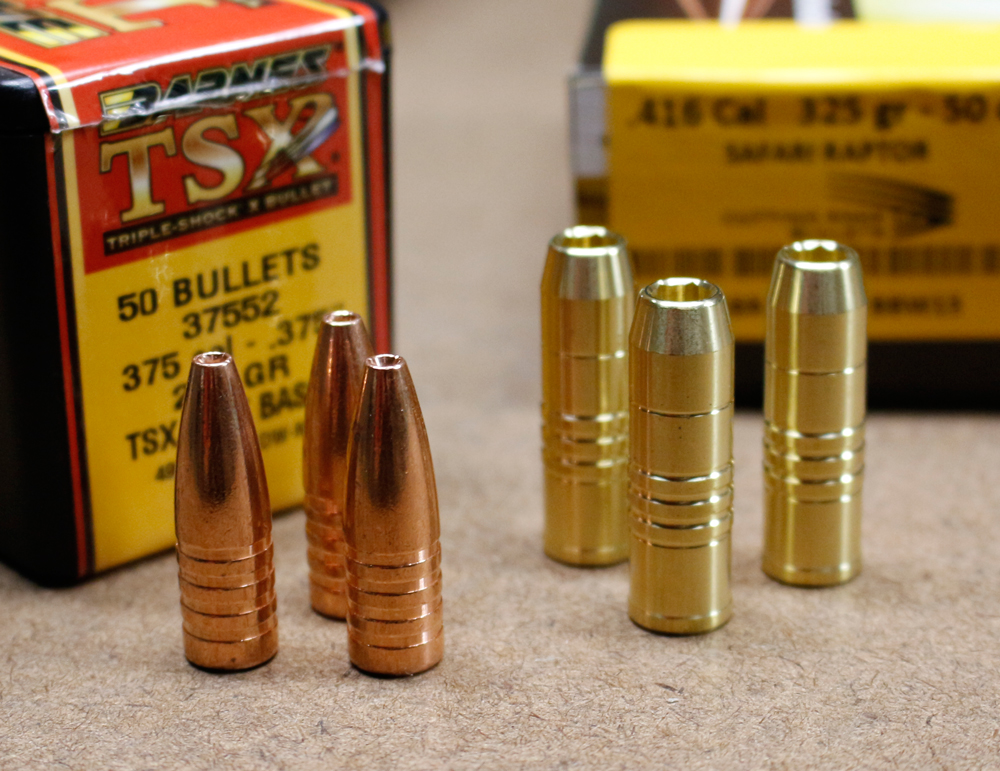
Projectiles with a bullet groove can enhance accuracy. There have been a number of advancements in bullet design in the modern day. One of the most elegant and effective has been the advent of the bullet groove.

The bullet is changing. It is happening slowly, but it is happening. Take for instance the bullet groove.

The last twenty or so years have seen a couple of trends: firstly, the perfection of the monometal bullet, and secondly the adoption of the bonded core. Let’s talk monometals first.

Initially, I loved the concept. You have a projectile that is built of solid copper, much harder than lead, which simply won’t come apart. The problems associated with jacket separation were a thing of the past.

The only problem with these early monometals was the fact that they didn’t shoot well at all. The problem was solved by cutting grooves into the shank of the bullet, to reduce the bearing surface, and thereby reducing pressures and coincidentally increasing accuracy. The hollowpoint opens reliably, and it gives us hunters something to ponder.

The acceptable minimums, set forth by the shooting experts of 50 or more years ago, need to be reestablished. In other words, the rifles and cartridges, and even bullet weights for that matter, that were considered marginal in years past, are no longer marginal.

A good example is the .270 Winchester as an elk cartridge, which in the past has been considered too light. The monometal bullet has changed that idea; a good 140- or 150-grain monometal bullet will neatly dispatch any elk God ever put on earth. Another way of looking at it is from the bullet weight perspective. The performance of a .308 caliber, 150- or 165-grain monometal will be on par with a 180-grain cup-and-core. That changes things.

Now, about those bonded core bullets. By chemically bonding the core to the jacket, you get a bullet that will expand reliably, but the bonding process prevents any separation.

The shank with a bullet groove shows its face again in the bonded core realm in the guise of the North Fork bullet. There are many little grooves along the shanks of these bullets, again reducing pressure and showing fantastic accuracy. My 6.5-284 Norma has put five 140-grain North Fork hollowpoints into ½ MOA routinely.

The dangerous-game solids also have this bullet groove feature, with the Woodleigh Hydrostatically Stabilized Solid coming quickly to mind. You’re starting to see a trend here.

How does this affect us handloaders? Well, in a couple of different ways.

When loading for these bullets you’ll see that the lower pressures they deliver can lead to a change in required powder loads. North Fork recommends lowering the powder charge by 4 percent or so to arrive at the same ballistics associated with bullets that have a smooth shank, while Woodleigh recommends using identical load data will give good results.

If you take a glance at the Barnes Reloading Manual, you’ll notice quite a few of the loads are compressed. This is mainly due to the fact that the copper bullets are longer than the cup-and-core bullets, and eat up a bit more of the case capacity. However, the manner in which the TSX and TTSX build pressures allow you to achieve the same velocities with less powder.

Bullet groove projectiles for ammo reloading.

I have found the best accuracy with Barnes bullets while using the faster-burning powders. When it comes to grooved North Fork bullets, they are a bit of a different animal. They keep their weight forward, allowing for more case capacity, rather than less, and the tiny grooves will actually help to keep your barrel cleaner, longer.

As a matter of interest, the folks at North Fork have told me stories of bench rest shooters using the North Fork bullets as a ‘cleaning round’ to keep the bore clean in between round of match grade bullets. The North Fork company does not produce a reloading manual, so you’ll have to use other data and start from the bottom end of the spectrum until you find your accuracy level and speed you’re after.

These newer designs are here to stay, and I’m glad, because they have proven to be both very accurate, and to perform well on game animals. They just need to be handled with a bit of a different mind set.

BATF Pulls Proposed Ban of Green Tip Ammo

0

Green Tip Ammo

AR rifle shooters can heave a sigh of relief, at least for the moment. On Tuesday the BATF pulled back from one of its most controversial proposals in a spell — the ban of M855 ammunition.

As was reported in The Hill, the Federal agency retreated from its effort to shelf the surplus military ammo due to a resounding grassroots and political outcry:

The Bureau of Alcohol, Tobacco, Firearms, and Explosives (ATF) said it will not seek to issue a final framework for the rule “at this time” after receiving more than 80,000 comments on the proposal, the “vast majority” of which were negative.

“You spoke, we listened,” the ATF tweeted.

The National Rifle Association (NRA) and other gun-rights groups assailed the proposal, and were joined by Republicans in demanding that it be withdrawn.

However, the BATF's entire tweet announcing the pull back should do little to soothe gun owners' hearts. It insinuates the 5.56x45mm NATO ammunition is still very much on the agency's radar:

The Federal agency predicated the proposed ban of the ammunition on Law Enforcement Officers Protection Act of 1986. The legislation defined and banned the use and manufacturer of armor piercing ammunition.

The BATF’s claim was the M855 round met the act's definition of armor piercing, due to its steel perpetrator and the fact it could be fired out of a pistol. As was pointed out by many commentators, the agency’s interpretation of this definition was wildly off the mark.

In addition to gun-right activists and politicians, the proposed ban of what is also known as green tip ammo also drew the ire of law enforcement. On March 3, a representative of the Fraternal Order of Police stated to the Washington Examiner there was no history of the round being used against police, undermining one of the BATF’s main arguments why the ban was needed:

“Any ammunition is of concern to police in the wrong hands, but this specific round has historically not posed a law enforcement problem,” said James Pasco, executive director of the Washington office of the Fraternal Order of Police, the world's largest organization of sworn law enforcement officers, with more than 325,000 members.


gd_rifletargetstand-500

Get On Target

Video: Review of the Versatile Colt LE 901 16S

0

The concept of modular firearms is gaining a toehold in the shooting world. For some, the idea of having multiple calibers based off one platform has plenty of tactical and practical allure.

Colt is among the companies that have embraced the notion with its M.A.R.C. 901 series. The Connecticut manufacturer's three models of Modular AR Carbines are sold as AR-10-style rifles, which shoot the hard-hitting 7.62x51mm NATO/.308 Win. round. But they can be switched over, lickity-split, to any AR-15 caliber.

In addition to thumbing off rounds in the above video, Hickok45 also demonstrates exactly how simple the caliber conversion process is on one of the M.A.R.C. Models. In this case it's a Colt LE 901 16S. While it’s not a procedure that can be done on the fly, it’s a simple one, requiring little material and absolutely no tools — save a bullet to push out the retention pins.

The M.A.R.C. 901 is an intriguing series of rifles and it’s a fairly safe bet shooters will see the modular concept continues to be applied as the years go on.


gd_rifletargetstand-500

Get On Target

Glock: Understanding the Striker-Fired Semi-Automatic Pistol

2

Glock: What is a striker-fired semi-automatic pistol?

One of the most innovative designs in the history of handguns is the striker-fired semi-automatic pistol. But what does that mean?

Having said this, the term used to describe these guns isn’t quite correct, or perhaps it isn’t quite complete.

With the modern guns we now designate as striker-fired pistols, the energy for the striker is stored when the slide comes forward and the striker hooks on the sear, much like the tail-hook of an aircraft landing on a carrier. When the trigger is pulled, the sear lowers and allows the striker to spring forward and fire the gun.

In some guns, like the Glock, the sear moves both to the rear and then down, the slight extra rearward motion completing the cocking process and then firing the gun as it moves down.

The first commercial success in this type of pistol was the Glock 17. But the Glock wasn’t the first striker-fired pistol, or even the first polymer and striker-fired pistol. H&K produced a pistol that was polymer framed and striker fired in 1970 but it saw little commercial success.

Whether you like striker-fired guns or not, the system is here to stay, and as an enduring fan of the 1911, I’ve come to realize that striker-fired guns are much more suitable than other systems for military, law enforcement and civilians for almost every application.

Rock Island Auction Kicks Off Year in Style

0
John Ulrich engraved Winchester 1866. Photo: Rock Island Auction

RIA's first four-day auction in its history had a slew of intriguing firearms cross the block. But the one to steal the show was a Winchester rifle, engraved by one of the 19th-century masters.

In the realm of 19th Century firearms engraving, few name carry the weight of the Ulrich brothers. This was a point driven further home recently at the Rock Island Auction Company.

One of the top drawing items of the Illinois auction house’s first event of the 2015 staged Feb. 19-22, was a beautiful specimen of John Ulrich’s work. The silver-plated Winchester Model 1866 rifle, complete with a factory letter of authentication, drew one of the top bids of the historic event.

The lever-action featuring magnificent scroll work surrounding an elk on the left side panel crossed the block for $28,875. But it was not the only classic American firearm to demand top dollar at RIA’s first ever four-day event.

When everything was said and done, the company had moved $5.6 million in firearms, firearms accessories and military collectables.

Civil War Henry Rifle. Photo: Rock Island Auction

Early in the auction, a Civil War Henry Rifle drew a winning bid of $25,875. Manufactured in 1864, the .44 caliber rimfire was manufactured by the New Haven Arms Company and was of a vintage to have perhaps seen action in the American Civil War.

As a sidenote on Henry rifles, while the U.S. Army did buy a number of them, few were ever issued. The soldiers themselves privately purchased most, many with money from reenlistment bounties, according to some sources.

While not commanding as high a price as the lever-actions, another American icon did catch plenty of eyes. A gold-finished Thompson 1927A1, or Tommy Gun, initiated a fierce bidding war before finally being captured for $5,175. The rather flamboyant firearm came with all the accouterments, including 50-round drum magazine and violin carrying case.

Gold-finished Thompson 1927A1. Photo: Rock Island Auction

Of the pistols RIA moved at the auction, a pair of Colt Diamondback revolvers far exceeded their estimated price. The double-action handguns, chambered in .22 Long Rifle, found a new home for the princely sum of $4,025.

It was a Borchardt C-93, however that turned out to be the bell of the ball for handguns. The Ludwig Loewe semi-automatic pistol commanded a $10,925 sale price, nearly $3,500 more than expected.

The C-93 was a particularly desirable example given the toggle-lock pistol's (chambered 7.63x25mm Borchardt) serial number. With just three digits, the pistol was certainly one of the early one to roll off the Ludwig Loewe line.

Smith & Wesson Model 320 Revolving Rifle. Photo: Rock Island Auction

RIA also moved some obscure – at least by modern standards – firearms. In this category, a Smith & Wesson Model 320 Revolving Rifle took the cake, exiting the door for $12,650. The company also moved a U.S. Ordnance semi-auto replica Vickers Machine gun with tripod and accessories for $7,475.

There were also a number of knives and artifacts that came across the block, including: Nazi-style daggers ($8,625), German dagger and sword accouterments ($8,625) and a flintlock pistol axe combination ($5,462).

Market Trends: Smaller Handguns Making the Bottom Line in Oregon

0

best-concealed-handgun-new-pistols-guideGet Your FREE Download to Find the Best Handgun for Concealed Carry!
This 54-page download covers all the newest and most advanced semi-auto pistols for concealed carry that are available on the market today, as reviewed in the Gun Digest annual book. It also includes a 44-page autoloader pistol catalog featuring concealed carry handguns from all the major manufacturers with photos, specs and MSRPs. [form id=”199473″]


Ruger LCP a popular make and model of small handgun at Rich's Gun Shop

Lee RichesonRich’s Gun Shop, Donald, Ore.

Concealed carry courses are offered at Rich’s Gun Shop and are well attended.

So, it’s no surprise that smaller handguns are the number one items here. Owner Lee Richeson says the Smith & Wesson Shield continues to be his top-selling handgun, in 9mm and .40 S&W, at just a shade over $400.

Smaller .380 ACP’s move well, too, including the Ruger LCP at $460, and the Diamondback DB .380 at a price-point-friendly $290.

For optics, rifle shooters here favor Nikons and Leupolds. A standard Nikon Pro Staff 3-9x40mm can be had for $170, while the Leupold VX-3 sells well at $591, and the Leupold FX-1 rimfire scope is steadily gaining adherents.

“It’s still a struggle getting all the centerfire rifle ammunition we would like to have on hand,” Richeson notes. “Especially 7mm Magnum and .308 Winchester. It’s out there—don’t get me wrong. But where you used to be able to put in an order with a distributor and get eight or 10 different varieties of the same caliber, in different bullet weights and types, now you pretty much have to grab whatever they have on hand.”

Rich’s also does a steady business in collectible firearms and estate collection guns.

Colt Diamondback and Python revolvers are hot right now, he notes. A Python in decent condition, he notes, commands $1,200, while a higher quality specimen can push up against the $3,000 mark.

Editor's Note: This brief originally appeared in the January 1, 2015 edition of Gun Digest the Magazine.

self defense laws

Understanding Self-Defense Laws Collection

One of the most important components of an armed encounter is what happens after the actual event. Maintaining an awareness of self-defense laws – not just in your home state but others as well – is crucial in order to avoid possible arrest, trial, and even conviction or sentencing via the justice system. Ensure a well-rounded understanding of your right to self-defense with this exclusive collection. Get Educated!

The Gun Price Guide that Should Be Your Constant Companion

0
Sure you can trust this guy and that AR he’s selling you is totally worth $5K.

It might be a New Ithaca Double or a pre-1964 Winchester Model 70 or even a first-generation Glock 17. Whatever the firearm is that’s grabbed your attention at the gun show, shop or swap it’s priced to move.

Or is it?

Sure seems like it, at least from what you remember the last time you thumbed through a price guide. Of course the gentleman with the snap-button western shirt and pomade in his hair looking to hock this potential deal of the century is no help.

In fact, the more the convention center’s fluorescent lights glisten off his hair, the more you wonder if he’s getting the better end of this bargain. Then again, you think to yourself, maybe you’re just being paranoid.

Question is do you roll the dice? Either way there is a good chance you’ll come up snake eyes. Don’t buy and miss a cherry deal on a hot number; or go home and find out you’ve sunk your hard-earned cash into a real clunker.

It doesn’t have to be this way, you know. There is an easier way to make certain you’re getting what you pay for when hunting out new and classic guns.

Discerning and penny wise gun buyers and collectors make The Official Gun Digest Book of Guns & Prices their constant companion. That’s because the authoritative reference has a nose for deals and is always ready to help you sniff them out.

Official Gun Digest Book of Guns & Prices
This little gem should be your full-time gun-buying buddy.

What makes this gun price guide the ideal buddy to drag to the next show or shop isn’t just the more than 15,000 firearm values listed in its pages. Though, admittedly, that does earn it points.

It’s The Official Gun Digest Book of Guns & Prices streamlined size that gives it an edge as a shopping companion. At around 5″x8”, the book is no more trouble to throw in a backpack or tuck under your wing than a pistol in a hard case.

And you’ll be glad you did, because the wealth of information between its covers will have merchants quaking in their Tony Lamas. With prices for six condition grades (NIB, Excellent, Very Good, Good, Fair and Poor) for each of the firearms listed its ready to negotiate the best deal for you.

If you've been keeping up and doing a little back-of-the envelope math, the number of firearms and grades adds up to around 46,000 condition-based values. That covers a whole arsenal and more worth of pistols, rifles and shotguns.

Don’t miss out on making the deal-of-the-century or at least knock that smug smile off the gun show guy’s face. Make The Official Gun Digest Book of Guns & Prices your constant companion whenever you hunt for a new gun.


GD-OfficialBookGunsPrices-670x250

The Official Gun Digest Book of Guns & Prices has a nose for deals and is always ready to help you sniff them out. Save Big

MUST READ ARTICLES