Home Blog Page 23

Night Vision & Thermal Optics: How To Shoot In The Dark

0

Want to learn how to see and shoot in the dark? Here we discuss night vision and thermal optics, their history and how to pick the best option for your needs.

The ability to see in the dark is an advantage that men have sought for centuries. The veil of darkness has always been a powerful reminder of the limits we have, and the loss of our sight in the dying of the light amounted to the end of the hunt … and gave way to the fears we still have of monsters and the unknown.

Seeing in the dark is something we can do today thanks to technology, but there are some very large misconceptions and lots of myths about just what these optics can do—and where they are useful.

What follows may surprise you.

scar 20s night vision build
The author’s SCAR 20S custom build. There are about too many small parts to list, but the optical package is a Leupold MK5 HD 5-25 and Armasight NVD clip on. This rifle is hard on optics, so only the strongest are used on it.

History of Night Vision and Thermal Optics

Night vision has been around for quite a while—in a broad sense going back to World War II—but it has only been miniaturized enough to be truly useful somewhat recently. Some of the first attempts at this technology were large and required a great deal of battery power to use, such as the case with the USMC M3 carbine (a type of M1 carbine that was specialized for use with optics) variant, which used an early infrared scope and illuminator … but also required a backpack loaded with batteries.

Today, many of the best night-vision optics are powered with simple CR123 batteries, and sometimes are even rechargeable with a USB cable. For a long time, civilian night vision technology was a ways off, and it wasn’t until the past 20 years that the technology became available—and reliable enough—on a larger scale that hunters took notice. The War on Terror era generated more interest in this tech on the civilian side, and during the 20 years that war was fought, night vision became widely available for civilian use.

Today, seeing night vision in the wild is somewhat common, and it can be bought at most sporting goods retailers. Later generations of night vision still operate on much of the same technology as early versions, but the quality of the image intensifier tubes keeps getting better as opposed to older models.

thermal optics scope 1
Thermal optics can be used in all conditions, but care should be taken to ensure that the lenses remain covered in transit. The sensor should always be clean.

Thermal imaging technology, or at least a very abstract derivative of it, goes as far back as 1800—but don’t get the idea that we were slapping FLIRs on our flintlocks. Sir William Herschel was the first to suggest that certain wavelengths of light registered at different temperatures when he made the discovery using a special prism to separate light waves and then record the temperatures. This discovery is largely the basis for thermal imaging technology, and Herschel was right in that invisible radiation could be detected as heat.

Fast-forward to the post-WWI era, and there were a few thermal detecting devices, but they saw very limited use in WWII. Even during the Vietnam War, the technology was still very large … and costly. Thermal imaging wasn’t widespread outside of military uses until it began to become somewhat cheaper and smaller. It saw its first civilian uses in construction and medical applications, but the miniaturization of the devices was still quite far away. In the early 2000s this changed, and with the explosion of the digital age, thermal imaging became quite common. In fact, it’s maturing rapidly, and more companies are adding this technology to their product lineups. I suspect that in a few short years many of the high-end “day” scopes will also have thermal imaging capabilities in one package.

Legality is something that many people have issues with when it comes to buying this type of technology. In use, it’s incredible, but the applications are limited. Thermal imaging optics are really for hunting and identifying game; you can’t really target shoot with them unless you’re able to somehow create heated targets. I use Hot Hands hand warmers stapled to a target board to zero my thermal optics.

There are lots of liability issues with shooting in the dark, but certain ranges do allow it under special circumstances. Regulations for hunting typically allow the use of thermal or night vision for hunting wild pigs or varmints such as coyotes, but not for large game like deer and elk. There are, of course, legal shooting hours for these animals, and hunters are discouraged by both the law and light limits against using thermal or night vision.

thermal optics scope 2
Short-throw actions like the Aero Solus have no problem clearing the thermal optics.

In some areas, possessing this type of gear is also prohibited when hunting, but at the rate technology is being developed, it’s hard to control. Today, you can have thermal imaging on your cell phone.

Hollywood: Missing the Target

Most people have received their introduction to the wide world of thermal and night vision tech thanks to Hollywood. However, the same place that made it cool also got a large deal of it wrong, and those myths have carried over to reality in some not-so-great ways.

The main “myth” portrayed is that thermal and night vision technology is clumsy. In reality, these systems are quite easy to use and far more effective than you might imagine. For instance, it’s not uncommon to be able to see individual hairs with thermal optics; the technology has progressed to the point where it’s very, very high definition.

Contrast this with the thermal vision we all know from the classic Arnold Schwarzenegger film Predator, which is so ingrained in the night-vision world that most thermal optics have a filter to replicate this relatively outdated visual representation of heat. In the movie, an alien big-game hunter comes to Earth to hunt soldiers and other armed men using high-contrast colored thermal vision, a key plot element. Most people typically shoot with “white hot” filters for high contrast on game. Sadly, the “predator” color filter isn’t very effective for hunting, but I do enjoy that it’s available.

fx7 coyote build night vision 2
You will need to pay attention to the mounting height of your optics if you want them to function together, even if they appear to be mounted a bit high.

The Predator’s thermal vision was stunning for the time, and most people had never seen something like it when the film came out. Interestingly enough, the definition of the thermal vision used by the alien hunter wasn’t so much better than what was around Earth at the time. In fact, we’ve advanced so far now that even our midrange thermals can achieve high definition and provide clarity to hundreds of yards. Not only that, but detection ranges are getting better, meaning that you can easily detect thermal signatures past 1,000 yards with many of today’s commercial options.

While Schwarzenegger managed to defeat the alien by covering himself in mud to conceal his body heat, we can only assume that this was due to some unforeseen circumstances with the Predator’s own technology. In real life, you’d have no problem seeing a person with mud on them. Perhaps the Predator was afraid the interstellar DNR would fine him and revoke his license if he used better optics. I can only wonder if there is the alien equivalent to straight-wall case restrictions and capacity limits.

Night vision is a bit different in that it has some far more stratified generations as opposed to thermal optics, which are decidedly getting smaller and becoming less expensive. Night vision again is largely misrepresented in film as much, if not more, than thermal imaging. Common night vision is quite good and is a major advantage, but it has some handicaps that thermal does not.

night vision scope cover

Chief among these is that night vision optics are relatively delicate and can be damaged, or even destroyed, by bright light. Non-digital night vision must not be used in the daylight, except in some very limited circumstances. While the movies have tried to do night vision justice, it’s typically not a feature for the hero because the action needs to happen in enough light for the audience to enjoy it.

Arguably, the most famous night-vision scene in history takes place in Silence of the Lambs, where the villain uses a night vision headset to toy with the protagonist. Night vision, otherwise, is such an advantage that pop culture has largely not been able to grapple with it due to how lopsided it could make the story … to the point that it simply isn’t included to increase tension. Real night vision goggles aren’t the grainy, dim-green color pallet we see and, no, the goggles themselves don’t glow.

Understanding Thermal Optics and NVDs

Thermal imaging and NVDs (night-vision devices) are used in a similar way by shooters, but they are quite different in terms of how they work … and what they’re capable of. Night vision, contrary to what you see in the movies, does require some light to work. Thermal imaging doesn’t require ambient light to function, nor will it be damaged by daytime use.

Night vision, in most generations, works by what’s called image intensification. The scopes collect light from exterior sources, including the moon and stars, and the optic turns them into an image we can perceive. If you were in a totally pitch-black basement with absolutely no light, your night vision wouldn’t do anything. As a result of this, infrared beams are often used with night vision devices—but be aware that these are essentially flashlights we can’t see, and other users of night vision systems can actually see your beam emanating from your optic. That’s not good if you want to remain as hidden as possible, but not really an issue if you’re a hunter … assuming you’re hunting legally.

fx7 coyote build night vision
The setting up for coyote at night is this special build. The barreled action is a Faxon FX7 in 6.5 Creedmoor with a Q Jumbo Shrimp suppressor. It has a Timney trigger and resides in a dyed Magpul Pro chassis. The optics are a Leupold MK4 2.5-20 and AGM Rattler thermal clip-on. The other accessories are by SAP, tripod by Two Vets.

Thermal imaging devices work by detecting radiation. There’s a bit more to it, but for the sake of keeping this concise, thermal optics are sensors that can display minor differences in radiation with hotter objects generating more radiation. The images we see in the optic are a type of thermogram, and thanks to the advances in both computing technology and cameras, we can make devices that not only record video, but also broadcast with Wi-Fi or Bluetooth.

Thermal optics today are what could be described as radiation-detecting smart cameras. The display on the optic is a feat of engineering, as you’re not seeing through it at all, even with clip-on thermals. You’re looking at a little screen that, in many cases, isn’t different from that on your camera or cell phone. The fact that we can mount these on guns and also zero them as you would a traditional scope is downright impressive.

Of note is that with thermal clip-on optics, your day scope is literally not looking at anything; the image you see through the glass is a tiny screen that’s meant to be looked at with magnification. You’re not “seeing” the target in a straightforward sense.

Pros and Cons

While I don’t usually play favorites when it comes to these topics, from a hunting point of view, thermal optics are vastly superior to night vision due to their ability to detect prey and positively identify it at distance.

thermal optics hunting
The author hunting very hard in rural Georgia with the Armasight Contractor, FN SCAR 20S and SilencerCo Hybrid 36M.

Night vision is very good today, but in my opinion, it doesn’t give you an advantage over a day scope. You can see at night with them, but the effectiveness is limited by ambient lighting conditions. It’s the same as a day scope in this sense: You can be looking right at an animal and not see it because it’s partially concealed behind a tree or bush. With thermal, you’d easily be able to detect the same animal. Thermal has the ability to detect through atmospheric conditions and even can see little bits through cover. So, even during the day, that bush you can’t see through with the naked eye might be only a minor issue to thermal.

Night vision for hunting is very functional, and it’s pretty straightforward to use. Night vision clip-ons are much more desirable than straight-up night vision scopes because they can be used to extend the use of the gun rather than limit it to just night. I like the clip-on NVD I’ve been using for some time from Armasight. It’s extremely clear and jives well with any day scope I’ve used. There’s no fuss to using it, and on a moonlit night, it’s so bright and clear that it’s truly like a cloudy day: You can see everything just as if it was noon.

night vision clip on optic

The damage that can occur to night vision devices in the daylight has to do with how they collect light. Again, there’s a much longer scientific explanation of how these work, but basically think of it as being able to gather so much light that it can be ruined. The intensifier tubes that these optics are designed around are so good at utilizing light that they can fry with too much. You need to keep light away from it to keep it safe, but it still needs some light to work, just not too much. Each generation of night vision improves, and the situation is getting better with intensifier tubes being able to be used in a wider range of light conditions. But, overall, their utility lies in the dark, whereas thermal can be used in all light conditions equally.

Thermal optics for hunting have few downsides. In fact, they are such an advantage that you really do need to see it to believe it. The major issue with all thermal and night vision is the cost. The good versions of these devices are very costly, typically around $2,000 and up, with flagship thermals going for around $4,000 to $8,000 depending on where you’re looking.

Of note is that night vision is relatively stagnant in terms of development, and pricing on high-quality night vision has remained relatively high, even with more makers. Thermals on the other hand keep getting better, and the cost has dropped significantly over time. The sensors have become quite compact, to the point that thermal units can be small while not sacrificing utility.

Thermals have passed generational upgrades down, and what was once a high-end unit is today’s budget option. In 10 years, who knows how much function you’ll be able to get from a middle-cost model if the technology keeps becoming more common and affordable.

thermal optics rifle build
A specially built rifle dedicated to thermal, using the author’s time in the field as inspiration. An incredible Armasight Contractor 640 sits on the scope rail. The KRG stock has a rear weight and Wiebad cheek rest. Comfort and balance are important when spending long periods of time staring at a small screen. The stock has a full-length Alpha handguard with integrated Arca rail to facilitate, making it able to be used easily with tripods or inside a blind. The action is an Aero Solus, notable for its smooth operation and ruggedness. The trigger is obviously a Timney, a brand the author trusts on all bolt guns. The barrel was specially made by Preferred Barrel Blanks in .308 Winchester and cut to 16 inches. The Rearden brake allows Q-style suppressor adapters to be used, in this case a JK 155 with Armageddon Gear thermal cover. Ammunition favored by the author for wild pigs is Remington 150-grain Tipped Core-Lokt. Note the two-round SAP cartridge holder, a little add-on that really helps in a pinch.

Editor's Note: This article originally appeared in the November 2024 issue of Gun Digest the Magazine.


More On Night Vision & Thermal Optics:

Best Concealed Carry Handguns For Women

10

The best concealed carry handguns for women as chosen by women.

Editor's Note: This page contains both the original Concealed Carry Handguns For Women article as well as its follow-up piece from the 2022 CCW special issue of Gun Digest the Magazine. Please click HERE to jump to the original article or read on to see the most up-to-date list.


The Best Concealed Carry Handguns For Women

How The Handguns For Women Ranked:

  1. Springfield Hellcat RDP
  2. Smith & Wesson Shield EZ .380
  3. Ruger Max .380
  4. SIG P365XL
  5. Smith & Wesson Shield Plus
  6. Ruger MAX-9

 
The guy drove a big diesel pickup, jacked up with huge tires, and walked into the gun shop with a swagger, dressed like he was headed for a rodeo.

“I want to buy a couple of guns for my wife and her girlfriend,” he said. “I want to get them something really special.” He then walked to a display case filled with 1911s and started looking at .45s. Eventually, he chose two identical full-sized 1911s in .45 ACP. He talked to the gunsmith and asked if they could be Cerakoted in pink, and he chose two sets of fake ivory grips.

Over the years, I’ve learned that telling a guy he’s making a bad choice rarely ends well, so I stood by and watched as he paid for the guns and made arrangements to pick them up after the work was done. I smiled, wishing I could see how his choice worked out.

Sometime later, two women showed up for a concealed carry certification class with those two ungodly .45s. Neither of them could operate the slide, and they used my loaner guns for the qualification.

Somewhere out there are two pink 1911s with fake ivory grips, very likely unfired.

CCW-Handguns-For-Women-Feature

Girls Just Wanna Have Guns (That Work For Them)


Women often have different needs in a concealed carry handgun. While men’s clothes fit and wear in the same different pattern, whether it’s for work, casual or more formal attire, women wear a wide variety of styles from form-fitting stretch pants to loose tunics or dresses. Many have relatively low hand strength and are sensitive to recoil. I’m glad to admit there are women who can outshoot me with any gun I have.

A few years ago, I wrote an article for Gun Digest pointing out some of the best guns for women. As the result of the shooting industry keeping an ear out for what people really need, things have changed for the better. Only two of the original guns in that article are in this test, and they were the first and second place entries. The development of defensive concealed pistols is in a period of unprecedented growth and development, and the result is that what was the best gun is still a great gun, but new models are always pushing the envelope.

Becky
The Hellcat’s SMSc red-dot sight made it the accuracy winner. Every shooter gave it a top score in the sights category.

Women need guns that are light, small, easy to operate and easy to shoot well. All the guns chosen are capable of concealed carry use, and all weigh in at about 20 ounces or less. All (but one) have a magazine capacity of 10 or more and have good, usable sights. The guns were tested by 10 women of various ages—from college to retirement—and skill levels. None were sport shooters, and their need was for concealed carry. All were women who have taken instruction in my classes, all related to defensive shooting skills.

The Guns were rated on a scale of one to five, with five being great and one being a no-starter. Criteria included size, weight, grip, operation, sights, trigger, recoil, accuracy and looks. Several women said looks weren’t important in a defensive pistol, and I tend to agree. No ones were scored, but there were a lot of fives. One shooter in the group gave the Hellcat RDP fives in all but two categories.

1. Springfield Armory Hellcat RDP


Hellcat RDP
The Springfield Hellcat RDP was the most expensive gun in the group, and it was the hands-down winner with 410 points of a possible 450. It scored well in recoil, possibly because of the self-indexing compensator and a little more weight. Almost everyone loved the SMSc red dot.

In the sights category, the RDP scored a five by all the testers. There were a couple of complaints about the flat-faced trigger being uncomfortable, and it got low scores in size and weight, but otherwise it was a clear winner. It was the top pick of six of the 10 shooters.

MSRP: Starts At $778 ; springfield-armory.com

2. S&W Shield EZ .380


SWMPEZ
The Smith & Wesson Shield EZ took second three years ago and for good reason. It’s the easiest to shoot and operate centerfire pistol in existence. It has good sights, a decent trigger and it’s easy to shoot well. It’s the largest gun in the group and weighs the most, but anyone can operate the slide and load the magazine without a loading tool.

While some might argue I should’ve chosen the 9mm version, I felt it was getting a bit heavy for what women preferred. There were a lot of compliments on magazine loading, ease of racking the slide and light recoil. Issues were that a really high thumbs-forward grip sometimes left the grip safety engaged, and the final round from a magazine sometimes popped up vertical causing a mis-feed. The EZ scored lowest in the size and looks categories.

The Shield EZ garnered 366 of a possible 450 points, putting it in a respectable second place once again.

MSRP: Starts At $454 ; smith-wesson.com

3. Ruger Max .380


Ruger LCP MAX
I almost missed this one, and I’m glad someone told me I must include it in the group. I don’t think there was enough fanfare about the Ruger Max .380. I included the Shield EZ in the group because it’s a favorite with women with low hand strength. In the previous article, I included the Ruger LCP II because it was so light and compact, but the downsides of low magazine capacity and a tiny grip area kept it low in the rankings.

The LCP Max overcomes these obstacles with a few bonuses. With a magazine capacity of 10 or 12 rounds, it certainly has capacity. The sights on the Max are dovetailed into the slide and feature a cocking surface on the rear and a Tritium white outline front that’s really visible.

It’s scandalously light at under 11 ounces, less than an inch wide and super concealable. There’s also a raised wing at the rear of the slide that allows better grip for pinch and pull cycling of the slide. The slightly larger grip makes it easy to shoot well with little compromise in concealability. It scored high marks with the test group, putting it solidly in third place. There was mention that it was difficult to load the last few rounds in the magazine and that clearing the chamber required a definite snap to get a loaded round to clear the ejection port. Testers loved the size, weight and the slight tee shape at the rear of the slide.

MSRP: Starts At $479 ; ruger.com

4. Sig P365 XL


SIG P365XL
The Sig P365 was the winner last time out and still held its own, narrowly missing third place. If we count purchase numbers, the 365 certainly does well with it being the most purchased gun model in the U.S. While it certainly isn’t dated, it’s been around longer than any other gun in the test. Whereas there wasn’t a single remark against it, no one chose it as their favorite.

I chose the 365 XL because it’s newest in the line. I probably should’ve stayed with the original gun because the extra weight and size worked against it in this group. Size matters; smaller lighter guns allow more flexibility in the way women dress. My personal carry gun is the 365 and I was surprised it didn’t fare better as a larger gun. The P365 XL scored 339 points.

MSRP: Not Published, Average Street Price Is $599.99 ; sigsauer.com

5. S&W Shield Plus


SW Shield Plus
At one time, the Smith & Wesson Shield boasted a 20 percent share of the entire concealed carry market. Introduced in 2003, it was probably the best choice for a concealed carry handgun. The Shield 2.0 was a solid improvement with a better trigger and grip surface but facing a surge of 10-plus capacity competitors, S&W introduced the Shield Plus. With a flat-faced trigger, a slightly less aggressive grip texture and 10- and 13-round magazines, the upgrade is substantial. In short, the Shield Plus is a great gun.

As far as ratings go, the Shield Plus finished fifth. It’s a great gun and would’ve been at the top of a similar test in 2015, but while all the other guns in this test were from the ground-up designs, the Shield Plus is an upgrade of a 2003 design. The Shield Plus is a very good gun. It’s a bit larger than most of the other contenders and carries a little more weight, but it’s accurate, easy to shoot well and reliable as a rock.

MSRP: Starts At $499 ; smith-wesson.com

6. Ruger Max-9


Ruger Max9
My first impressions of the Max-9 were completely positive. I like the sights and trigger and the combination of small size, low weight and good magazine capacity make it an excellent choice. While there were zero complaints about the Max-9, no one scored it at the top, and it finished with the lowest number of points. I suspect a red-dot sight would’ve placed it much higher, because the RDPs optic brought a lot of raves.

MSRP: Starts At $599 ; ruger.com

Conclusion


Over the years, I’ve seen so many times when women came to me for training equipped with a pistol that was a poor match to their needs. The guy described at the beginning of this article had good intentions, but a poor judgment of what would really work for his wife and her friend. In fairness to him, at the time of his poor choice, none of the guns in this comparison existed.

Handguns For Women Test Results
In retrospect, the Hellcat had an unfair
advantage being equipped with a refl ex sight. It
received a perfect score in the sights category.

The firearms industry has made great strides in supplying concealed carry citizens with guns well matched to the task. Every gun in this comparison is an exceptional instrument for the purpose it was designed for and there’s not an unsuitable gun in the group.


More Info For The Armed Woman:


Best Concealed Carry Handguns For Women

Originally published 2019.

How The Subcompact Handguns For Women Ranked:

  1. Sig P365
  2. Smith & Wesson Shield EZ
  3. Glock G43x
  4. Mossberg MC1-sc
  5. Ruger LCP II
  6. Smith & Wesson 340 PD
  7. Smith & Wesson Shield

When it comes to selecting a handgun, especially when selecting a concealed-carry handgun, women have needs that are often quite different from those of men. Women—from teenagers to well into their 80s—have taken my classes, and their needs and wants vary drastically in regard to handgun preference.

One of the fastest-growing segments of the firearms market is women, and the largest segment of women’s firearms purchases are related to personal defense. For individual instruction and teaching toward the North Carolina Concealed Carry Certification, over half my clients are women.

Women also struggle with daily concealed carry in the wide variety of clothing they wear. For men, it’s fairly simple: We wear the same basic configuration of clothing, and it’s fairly easy to conceal a firearm in the type of clothes we wear. Women’s clothing is often much more fitted and varies with the occasion. As a result, most women prefer a smaller gun that works with all their wardrobe choices. For this reason, I’ve restricted this rundown to subcompact guns.

These factors create three issues that combine to make options in concealable handguns for women more difficult.

  1. A small gun is preferred because it’s easier to conceal, but small guns are more difficult to operate than full-sized guns because of the smaller grip and more perceived recoil resulting from lightweight.
  2. The recoil is intimidating and creates issues with flinch or recoil anticipation.
  3. The short sight radius compounds the problem and makes them harder to shoot well.

Because many Gun Digest readers are often asked about the right defensive handgun choice for the women in their lives, I wanted to cover the best and most likely choices and let women voice their likes and dislikes. In preparation for this, I assembled these choices based on lightweight, concealability and ease of operation—and all this information is derived directly from working with the women in my defensive pistol classes.

The guns in the “test” represent the best of what’s currently offered in a field of truly excellent guns. At no time in history have shooters had as many good guns to choose from. It’s harder today to find a poor choice than a good one, but because of the specific needs and broad range of capability of female concealed-carry citizens, preferences will vary.

Handguns For Women As Chosen By Women

For this article, I had 32 female defensive handgun clients rank seven guns.

Two guns dominated the results: The Sig P365 was a clear winner for women with good hand strength, and the Smith & Wesson Shield EZ was the clear choice of female shooters who had issues with strength or recoil.

The ease of operation of the EZ was apparent. When it came time to shoot it, the women were surprised at how easy it was to operate. The 365 was rated below the EZ in operation, but it was also rated high in ease of operation. Its magazine capacity, power and compact size helped seal the deal for the P365.

The Glock 43X garnered third place, and Mossberg’s new MC1 came in close behind. Fifth place went to the diminutive Ruger LCP II, mostly based on its size and lightweight.

The 340 PD came in sixth, based on safety and simplicity.

The most popular concealed-carry pistol of the last 10 years—the Smith & Wesson Shield—garnered last place. It ranked low in ease of operation and recoil.

The top four guns were all introduced within the past two years; the two other guns are the oldest designs. I believe this is an indication of just how fast firearms development is moving in our modern world.

Like many other segments of the concealed carry market, women gave the Sig P365 top marks. This compact gem is the overall favorite choice in handguns for women.

No pistol in recent memory has shaken up the concealed-carry world like the Sig P365. It seems Sig Sauer did everything right—and all at one time. The standard magazine was a 10-rounder, and a 12-round magazine was available. Now, there’s a 15-round magazine. It’s a bit heavier than the Glock but considerably more compact. It comes standard with night sights and is available with or without a manual safety. With a takedown lever, it’s easier to field-strip than the Glock or S&W. The fire control system is easily removable and therefore easier to maintain. The trigger is good, the reset is short and positive, and the sights are large enough to work well without being intrusive. In profile, it’s only marginally larger than the LCP II, although it’s considerably heavier and blockier. Still, it’s the most compact of the guns in this group (other than the Ruger). Beside the 43x, it looks tiny. I can honestly find nothing bad to say about the P365.

MSRP: Not Published, Average Street Price Is $500 ; sigsauer.com

2. Lowest Recoil, Ease Of Use: Smith & Wesson Shield EZ

Handguns For Women EZ
Of all tested handguns for women, the Smith & Wesson Shield EZ was the easiest to shoot and manipulate.

The first time I put my hands on the Smith & Wesson Shield EZ, I knew it was a winner. Based on the excellent M&P .22 Compact, the EZ is as easy to operate as the .22 version. Like the Ruger LCP II, it’s chambered for the .380 ACP but carries more weight (18.5 ounces), making for remarkably low recoil—a big plus for timid shooters. The trigger is light enough, and the grip safety makes it safer than any other gun in this review except the revolver. Capacity is better than most (8+1), and the magazine is clearly the easiest to load, even employing a button to depress the magazine spring. While its size makes it more difficult to conceal, it makes the EZ extremely easy to shoot well. The three-dot sights, good trigger and low recoil make it the winner for ease of operation.

MSRP: Starts At $454 ; smith-wesson.com

3. Glock G43x

Glock's ability to put together a light and reliable pistol wasn't lost on the women who tested it.
Glock's ability to put together a light and a reliable pistol wasn't lost on the women who tested it. While down the list, the G43x still ranks as a top handguns for women.

If you ask 10 people which company makes the best semi-auto pistols, at least four will say Glock—and no one can question the reliability and service Glock pistols provide. The Glock G43x is recent, and with a magazine capacity of 10+1, it’s a real improvement over the standard G4, which can hold four more rounds than the G43. Sure, it’s not as concealable, but it’s easier to shoot well because of the longer grip (and no one in their right mind will argue that the magazine capacity isn’t a bonus). Its weight comes in at 16.4 ounces—lighter than the S&W Shield and with at least two more available rounds. The slide is easier to operate, the trigger is good, the sights are easy to see and, well … it’s a Glock.

MSRP: Not Published, Average Street Price Is $500 ; glock.com

4. Mossberg MC1-sc

Re-entering the handgun market recently, Mossberg has produced a more than capable pistol in the MC1.

When I saw that Mossberg was introducing a concealed-carry pistol, I was skeptical. However, I remembered that Chris Cerino had recently been to the introduction of something new at Mossberg, so I called him. Chris and I are close, both in friendship and in our opinions about personal defense; and, sure enough, it was the Mossberg MC1 he’d been to Gunsite to see. Chris doesn’t sugar-coat his opinions, and I was amazed that he had nothing bad to say about the MC1. I ordered one for a test—and I agree. At 19 ounces, it’s a bit heavier than the Glock G43, but otherwise, it’s about the same size. It has a flat-faced bladed trigger with nice three-dot sights and comfortable, but grippy, grip surfaces. It’s accurate and reliable and uses a simple—but innovative—takedown system. My initial impression of the see-through magazines was negative. Even so, they’ve proven really tough, and if you don’t like them, this pistol runs just fine with Glock 43 magazines. The slide has front and rear serrations, and it’s reasonably easy to cycle. The MSRP for the base model is $425. However, I found it on line for under $350, making it a real value.

MSRP: $425 ; mossberg.com
Editor's Note: Mossberg has discontinued the MC1 series and replaced it with the MC2 series.

5. Ruger LCP II

Handguns For Women LCP II

Ruger’s LCP II was a big improvement over the original LCP and has proven popular with people who need the smallest and lightest, yet still effective, concealed-carry pistol. While the .380 ACP chambering is considered the minimum as a defensive ammunition, recent advances in defensive ammunition have brought the little .380 up to being superior to the standard .38 Special load that law enforcement used for years.

At fewer than 11 ounces, and with a diminutive size, the LCP II certainly fills the bill for concealability and is the lightest and smallest gun in the group. It still has an internal hammer, but the bladed trigger of the LCP II is light and precise. It feels like a striker-fired trigger and is a big improvement over the original LCP. Magazine capacity is a reasonable 6+1, and the magazine is easy to load. The slide requires only a moderate effort and is smooth in movement. Sights are adequate and unobtrusive.

MSRP: $439 ; ruger.com
Editor's Note: Ruger now only offers the LCP II in .22 LR, but the LCP, LCP 380 and LCP MAX are still available in .380 ACP.

6. Smith & Wesson 340 PD

Of all the handguns for women, the 340 PD got the highest marks for safety and simplicity.

In my youth, the Airweight Model 37 was the undisputed king of lightweight concealed-carry revolvers. Today, it’s been superseded by the even lighter 340 and 360 PDs. With a lightweight scandium frame and titanium cylinder, it tips the scales at fewer than 12 ounces—a remarkable feat, considering that it’s chambered for the powerful .357 Magnum. While it’s handicapped by low capacity and molasses-slow reloads, it’s light and powerful and is the safest and most reliable handgun in this review. The 340 PD in the test is safe because the long-stroke, 10-pounds-plus trigger pull is almost impossible to accidentally pull. At 8 years old, my athletic grandson couldn’t activate the trigger, even using both index fingers. It’s also the easiest gun in the group to load and unload (and the most expensive). The reliability comes without explanation. There’s no need for training how to manage malfunctions; simply pull the trigger again in the unlikely event of a dud round. It’s more difficult to shoot well than the semi-autos, but for some people, the extreme level of safety and simplicity are viable trade-offs.

MSRP: $1,139 ; smith-wesson.com

7. Smith & Wesson Shield

Although it's among the most prolific defensive pistols in recent years, the Shield end up in last place in the testing.

No discussion of concealed-carry handguns—handguns for women or otherwise—should overlook the Smith & Wesson Shield. The last I heard, the Shield accounted for fully 20 percent of the concealed-carry handgun market. That’s a remarkable record! For this rundown, I chose a Performance Center Ported Shield with Hi-Vis sights. While it’s an improvement over the standard model, the Shield seems a bit dated because of all the recent additions to the market. The trigger is better on the Performance Center version, and I suppose the porting helps. Nevertheless, the Shield was still the snappiest of the seven guns tested—with the possible exception of the J-frame revolver.

It was also the most difficult to cycle the slide and load the magazine. At 18.2 ounces, it weighs in a bit below the Shield EZ and is slightly more compact—but it’s much more difficult to operate.

MSRP: $536 ; smith-wesson.com

Expand Your Knowledge on Concealed Carry

Steyr AUG Review: History Of The Green Meanie

1

We take a deep dive into the Steyr AUG, possibly the most iconic bullpup military rifle ever built.

You probably remember the first time you laid eyes on a Steyr AUG. When most people do, they either love it or hate it. With its bullpup layout, green polymer stock and integrated optic, it still looks as futuristic today as when it was first released in the late 70s. The AUG wasn’t the first bullpup rifle, but it’s one of the most successful versions ever to be fielded and almost certainly the most famous and recognizable of the bunch. So, here we’ll discuss the history, design, function and legacy of the Steyr AUG.

Steyr AUG A1 Specs

Cartridge: 5.56x45mm NATO
Action: Gas-operated rotating bolt short-stroke piston
Capacity: 30- or 42-round proprietary magazines
Barrel Length: 20 inches
Weight: 7.9 pounds
Overall Length: 31.1 inches
Sights: Swarovski Optik 1.5x scope ; backup illuminated 3-dot iron sights

Pros

  • Good ballistics in compact package
  • Reliable, rugged, proven design
  • Newer models are readily available
  • Quick-change barrel for stowage or modularity

Cons

  • Different manual of arms than a traditional rifle, will need to learn new reloading methods etc.
  • Proprietary magazines unless model in question is a “NATO” version
  • Can't adjust length of pull
  • Relatively expensive

Origins Of The AUG 

Designed in the 1960s with production beginning in 1977, the Steyr Armee-Universal-Gewehr (Army Universal Rifle) or AUG, pronounced “A-U-G” (some incorrectly pronounce it as “awg”), featured a polymer stock body that housed the action and magazine well rear of the trigger, a radical departure from traditional rifle designs. Another detail that made the AUG stand out among its contemporaries like the AK and the M16 was the fact that it featured an integrated optic. Introduced at a time when iron sights were still the norm on military rifles, this was a very forward-thinking concept.

The Austrian Army adopted the AUG as the Sturmgewehr 77 or StG77 in the late 1970s to replace its aging FN FAL rifles chambered for 7.62 NATO. Transitioning from a full-power cartridge to the AUG’s intermediate 5.56x45mm was a big step toward modernization on its own, but it was the rifle’s other features that set it apart on the world stage.

steyr AUG RIAC
Photo: Rock Island Auction Company.

It didn’t stand up there alone, however, as the world was experiencing a bit of a bullpup craze in this period. The French adopted the FAMAS at about the same time as the Austrians did the AUG, and the British were working on developing the SA80 that would enter service a few years later in 1985. However, the AUG distinguished itself with its extensive use of polymer and its integrated optic.

For these reasons, combined with Steyr’s reputation for excellent quality, the AUG was easily the most successful of these three prolific Cold War bullpup designs. While the French and British rifles saw some limited international use, mostly with ex-colonial possessions, both pale in comparison to the number of military and law enforcement groups that have adopted the AUG over the years.

Outside of its home country of Austria, New Zealand, Australia, Ireland, Argentina and several other nations have all adopted the AUG as their primary service rifle, and many more special forces and law enforcement agencies around the globe have procured them as well. A further testament to the design’s success is that it has been produced under license in Australia, Malaysia, South Korea and India for official military use as well as in the U.S. by Steyr Arms USA for the American civilian market.

argentine soldiers steyr
Argentinian soldiers with Steyr AUG rifles. Photo: Wikipedia.

Steyr AUG Function And Features

The Steyr AUG is innovative for many reasons. First is it use of polymers, which are incorporated extensively throughout the design from the stock housing to the trigger group to the oversized trigger guard that protects the user’s entire hand.

Internally, the AUG features a rotating bolt with dual recoil guide rods like the AR-18. As a closed-bolt, gas-operated short-stroke piston system with a non-reciprocating charging handle, its action may be pretty conventional, but its bullpup layout meant that it could have a standard barrel length of 20 inches with an overall length of just 31.1 inches. That’s a lot of barrel length tucked into a small package. By comparison, an M4 has a 14.5-inch barrel and an overall length of 33 inches with the stock fully extended.  

The rifle’s overall length could be reduced even further thanks to its unique quick barrel change system. Remember the long-haired bad guy in the first Die Hard movie? He assembled his AUG almost as fast as Bruce Willis loaded and racked his Beretta 92. A quick-change barrel can be useful for several reasons, but one advantage is modularity as Steyr offers various barrel lengths for the system. Whether you need a shorter barrel for breaching a building or a longer, heavier barrel with a bipod to lay down some lead, the AUG can be switched to any given configuration by just twisting the barrel by the vertical grip, pulling it out and reversing the process to install a new barrel.

AUG die hard IMFDB
Actor Alexander Godunov assembling his character's AUG in Die Hard (1988). Photo: IMFDB.org.

The original AUG used a proprietary magazine made of a translucent polymer with a waffle texture which came in either a 30- or 42-round capacity. However, newer variants typically use stocks designed to accept STANAG AR-15-pattern magazines. These more modern AUG models also feature a bolt release, whereas the original models required the user to release the bolt via the charging handle.

As for the AUG’s controls, they are few and simple. The magazine release is located behind the magazine. The safety is located on the side of the rifle behind the trigger and is operated by pushing it through the stock body. It, too, is made of polymer. There is no select-fire lever like on an AR-15, as the AUG features a progressive trigger instead. This means that a short pull will result in a single shot and a full trigger pull will result in automatic fire.

AUG scope
The view through the Steyr AUG's original 1.5x Swarovski Optik scope. Notice the rear backup iron sight notch built into its top.

The final, but perhaps most impressive feature of the original AUG was its integrated optic. It was manufactured by Swarovski Optik and featured a 1.5x magnification with a black donut-style reticle. While it was very durable, no optic is indestructible, so backup iron sights were added to the top of the scope body as well. Of course, modern AUG variants come with Picatinny rail instead so the user can add an optic model of their choice. That said, for the infantrymen of the era, being given a rifle with a 1.5x power optic and a relatively modern-style reticle was a big advantage.

Major AUG Variants 

ModelCaliberBarrel LengthOverall LengthOptic SystemNotes
Steyr AUG A15.56x45mm NATO16.4 inches28.5 inches1.5x scopeScope is integral.
Steyr AUG A25.56x45mm NATO16.4 inches28.5 inchesPicatinny railFolding grip can be replaced with Pic. rail for bipod.
Steyr AUG A35.56x45mm NATO16.4 inches28.5 inchesPicatinny railMore Pic. rail space than A2. New bolt release feature added.
Steyr AUG HBAR5.56x45mm NATO24.4 inches35.4 inches1.5x scopeBarrel has integrated bipod. Fires from an open bolt.
Steyr AUG 9mm9x19mm Parabellum16.5 inches26.2 inches1.5x scopeBlowback-operated, closed-bolt. Uses Steyr MPi 69 magazines.

Between all the different countries and militaries to produce and use the AUG, there are a lot of minor variants in existence. Here, we’re only going to briefly cover the major updates and versions from Steyr itself.

The AUG has received a few minor tweaks since 1977, but besides some modernization features the rifle has remained mostly unchanged. The most major change between the original A1 and the A2 version, which debuted in 1997, was the addition of a detachable optic that can be swapped for a Picatinny rail allowing the user to mount a wider variety of optics.

The A3 model integrated the Picatinny rail with the top of the receiver along with some other modernization features like the addition of an external bolt release.

steyr AUG A3 M1
The Steyr AUG M3 A1. Photo: Steyr Arms.

Outside of rifle configurations, Steyr also made LMG and SMG versions of the AUG.

For the LMG option, the AUG HBAR (Heavy Barreled Automatic Rifle) was given a heavier and longer 24.4-inch barrel with an integrated bipod. Another unique feature of this variant is that it fires from an open bolt to help with sustained fire.

steyr AUG HBAR RIAC
An AUG with its standard barrel installed next to an HBAR barrel with an integrated bipod. Photo: Rock Island Auction Company.

For the SMG variant, Steyr made the AUG 9mm, both as a factory option and as a conversion kit for standard 5.56 rifles. Either way, 9mm AUGs feature shorter barrels that replace the traditional gas system with a simple blowback action. These have been adopted by a handful of police units around the world, but they’re nowhere near as popular as the 5.56 rifle.

AUG 9mm
The 9mm AUG. Photo: Steyr Arms.

Owning An AUG

Everyone knows that bullpups have both pros and cons, and whether you like them or not really boils down to personal preference. If you’re a bullpup fan, the AUG is thankfully readily available today on the civilian market.

Is it the best bullpup available? Many believe that to be the case. While there are plenty of newer bullpup rifles on the market today, like the IWI Tavor and the Springfield Hellion, it’s hard to argue with the tried-and-true reputation of the AUG.

If you’re a military rifle collector looking for an original pre-ban A1 model with an integrated optic, you’re going to have a harder time finding one and it will cost you a pretty penny. However, if you just want a shooter and are looking for one of the newer models there’s never been a better time to buy one. This is because Steyr began manufacturing the AUG in the U.S. a few years ago and it’s resulted in prices dropping across the board. Models like the A3 M1 have been available for as low as $1,500 when on sale, and while that’s still relatively expensive, they’ve never been this affordable in the U.S. before. As a bonus, Steyr recently started offering .300 BLK variants as well.

The AUG Legacy 

The Steyr AUG may not have been the first bullpup, nor the first one with a polymer housing, nor the first combat rifle with a standard integrated optic, but it blended several good ideas of its time to create a very forward-thinking, advanced combat rifle. Despite this, after the bullpup craze died down after the 1980s, it never overshadowed the global popularity of traditional rifle designs. As far as bullpups go, however, the AUG was extremely successful.

Not only was it a commercial success with its large number of international sales and use by various military and law enforcement groups, but it was a cultural success as well. This is despite the fact that, while it has seen action, the AUG never became closely associated with any conflict it took part in. Today, even non-gun people who don’t know what “bullpup” means will likely recognize its unique form, and they might even be able to name some movies they’ve seen one in like Die Hard or the countless sci-fi films that used them as generic futuristic-looking firearms.

While the AUG will never be as prolific as some other military rifles, it’s earned its place as a historically significant design and the nations that use them aren’t likely to replace them any time soon.

Steyr AUG Deals

Guns.com$1,851PngItem_4588935
Gunprime$1,539PngItem_4588935
Classic Firearms$1,770Gun Price Check

Steyr AUG FAQ

Is the AUG better than the M4?

Both the AUG and the M4 are “better” than the other by certain metrics and in certain roles, but one is not inherently better than the other in every possible way. The AUG excels in being compact while maintaining good ballistics and some tests have shown them to be even more resilient to adverse conditions than the M4. That said, the M4 is lighter, has a traditional manual of arms and is many times more popular with operators around the globe than the AUG. At the end of the day, it comes down to what it will be used for and personal preference.

Does the AUG take AR mags?

The standard variants of the AUG do not take AR mags and use proprietary magazines instead. However, most of the contemporary models are offered in a “NATO” configuration as well, and these versions do accept standard AR-15 magazines.

What does AUG stand for?

AUG is a German initialism that stands for “Armee-Universal-Gewehr” meaning “Army Universal Rifle” in English.

Do any militaries use the AUG?

Yes, many militaries, special units and police groups around the globe currently do or previously used the Steyr AUG. The most notable world militaries that currently use the AUG as a standard issue service rifle include Austria, Australia, Ireland and Luxembourg.


More Classic Military Guns:

Lightweight Riflescopes: Top Options & Their Future

0

Rifles keep getting lighter, so why haven’t scopes kept up? Here we discuss the future of lightweight riflescopes and look at the top models currently available.

It all that long ago, there were a lot of lightweight riflescopes to choose from. This was back before hunters and most shooters thought 18x magnification was necessary to hit anything, and it was also before target turrets and parallax adjustments on riflescopes became standard features. When I first started writing for gun magazines about 25 years ago, the fixed power Leupold 4×33 riflescope was very popular. Leupold has since discontinued that riflescope, and lightweight riflescopes in general are now on the endangered species list.

Arguably, this transition from light to heavy riflescopes began in 2014 with the release of the movie American Sniper. The martial and marksmanship abilities of the rifleman have always impressed us, and that combined with Chris Kyle’s patriotism, devotion to duty and untimely and terrible death, made for a fabulous story. The movie was also an anthem to every American who has worn the uniform. Most importantly, then as now, American’s needed a hero.

Much like Clint Eastwood’s Dirty Harry film of 1971 launched the .44 Magnum revolver to stardom, American Sniper was the inspiration shooters needed to spark an indulgence in long-range rifle craft. Not only did this create a demand for heavy long-range riflescopes, but it also elevated the 6.5 Creedmoor—which had been languishing with only so-so interest since 2008—to one of the most popular rifle cartridges of all time.

As happens with all shooting disciplines, a bubble of interest developed, like with cowboy action shooting and three-gun competitions. Today, we’re at the height of long-range shooting popularity, and the rifles and riflescopes being manufactured reflect the demands of the consumer.

Interestingly, our hunting rifles are getting lighter. Just look at the six-pound Redline from Springfield Armory, the lighter than 6- and even 5-pound NULA rifles from Wilson Combat, as well as a host of lightweight hunting rifles from other manufacturers. Oddly enough, some hunters are using these lightweight rifles as an excuse to go with a heavy riflescope.

lightweight riflescope leupold

An acquaintance recently purchased one of the Wilson Combat NULAs that weighed less than 6 pounds and then paired it with a Nightforce riflescope that weighted nearly 2 pounds. While his overall field-ready weight is less than it would have been with a heavy rifle, the heavy scope destroyed the lithe and nimble handling qualities of the expensive featherweight rifle he chose.

The beauty of the lightweight riflescope is that it pairs perfectly with a lightweight rifle. And, as the great gun writer Townsend Whelen once so astutely observed, “A man will travel farther, hunt over more country, have a better chance of coming on game, and be in better condition when he does if his weapon is light.”

For hunters looking to keep weight down in the field, or even for shooters who do not want to overburden themselves or maybe youngsters with an overly heavy rifle, there’s still a valid and practical —though seemingly much overlooked—need for lightweight riflescopes.

Modern Lightweight Riflescopes

I spent a full day crawling the internet looking for lightweight riflescopes that are still in production. I found six options that weigh 12 ounces or less and that I thought practical for general-purpose use and common hunting applications. Here’s a rundown of the best of the current less than 12-ounce lightweight riflescopes available. The good news is I’ve used them all and can recommend them.

Burris

Burris makes great riflescopes that are dependable. Over the years I used several of them and their now discontinued 2-7x35mm Fullfield II was one of my favorites. Currently, Burris doesn’t catalog a traditional riflescope weighing 12 ounces or less. However, what Burris does have is what’s arguably the best and most traditional scout scope offered by any manufacturer. Their fixed power 2.75x20mm Scout scope weighs only 7 ounces and features a heavy plex reticle and Burris’ Forever warranty. A variable power scope might be more appealing and more versatile, but you won’t find one this light. It retails for $348.

Burris 2 75x20mm Scout scope
Burris 2.75x20mm Scout scope.

Leupold

Leupold has been and continues to be the leader when it comes to lightweight riflescopes. Even if you’re comparing heavy riflescopes, it’s more than likely the Leupold will weigh the least. Even though Leupold has discontinued some of their best lightweight riflescopes like their fixed power 4x33mm and 2.5x20mm, they still catalog five excellent lightweights that should serve most any practical need.

An excellent choice for lever-action rifles, muzzleloaders and other short to moderate range rifles is Leupold’s VX-3HD 1.5-5x20mm riflescope. I’ve used several of these over the years and now it even comes with Leupold’s excellent CDS trajectory compensating dial system. This riflescope weighs only 10.1 ounces, but it also costs $500. In today’s economy, some of us don’t have $500 to spend on anything but groceries and gasoline.

Leupold VX-3HD 1 5-5x20mm
Leupold VX-3HD 1.5-5x20mm riflescope.

Leupold’s VX Freedom line replaced their VX-I and VX-II riflescope line; they’re American made and recoil rated to withstand the energy of a .458 Lott. They have click adjustments, Leupold’s proprietary Twilight Light Management System, and they all have 1-inch scope tubes. If you’d really like the VX-3HD 1.5-5x20mm but just cannot afford it, Leupold’s VX Freedom 1.5-4x20mm is a great option, and it’s available with the unique MOA Ring or the Pig Plex reticle. It weighs 9.6 ounces and retails for only $299.99.

Leupold VX Freedom lightweight riflescope
The Leupold VX Freedom 1.5-4x28mm IER scope will work on scout rifles but must be mounted further back than a traditional scout scope.

If you want a lightweight scope but need a bit more magnification, I think the Leupold VX-3HD 2.5-8X36mm is one of the best riflescopes money can buy. I’ve had one on my dedicated whitetail rifle, which is a 5-pound New Ultra Light Arms Model 20S chambered for the 30 Remington AR for almost a decade now. This riflescope is less than a foot long and weighs 11.9 ounces. Like the VX-3HD 1.5-5X20mm Leupold, it also comes with the CDS dial system and has a suggested retail price of $499.99.

A lesser expensive but similar option is the Leupold VX Freedom 2-7x33mm. The first riflescope I ever purchased for a centerfire rifle was a 2-7X, and I used it to take a lot of groundhogs, a lot of deer and to even win my first off-hand silhouette match. This less expensive lightweight Leupold weighs 11.1 ounces and has a suggested price of only $299.99.

The is another lightweight Leupold that comes in at only 9.6 ounces, and it’s the Leupold VX Freedom 1.5-4x28mm IER Scout scope. This riflescope is a great companion to any scout rifle but must be mounted a bit further back due to its 6.0- to 6.9-inch eye relief. However, this amount of eye relief is almost perfect for some of the modern lever guns outfitted with a rail and an aperture sight like Marlin’s new SBL and Dark series rifles.

Swarovski

Swarovski makes some of the finest optical instruments hunters and shooters can look through. Their $5,100 dS riflescope will range the target and instantly provide you with an aiming point that reflects the shooting solution. Their less expensive Z8i line ($3,299 to $4,049) contains some of the most optically brilliant riflescopes money can buy, but they’re also heavy. The dS riflescope weighs 39 ounces and Swarovski’s lightest Z8i weighs 21 ounces.

swarovski lightweight riflescope
Swarovski Z3 3-9x36mm riflescope.

Because of the steep prices, weight and size of Swarovski’s best riflescopes, shooters often overlook them when it comes to a compact and lightweight option. However, Swarovski’s excellent Z3 3-9x36mm is one of the best general-purpose riflescope made. My wife used it on her 243 during her first African safari, and I’ve used the same scope on several hunts and to frequently evaluate lightweight rifles. The Z3 3-9x36mm retails for $799 and weighs in at 12 ounces on the nose.

Swarovski Z3 3-9x36mm africa hunt
The author’s wife used the Swarovski Z3 3-9x36mm riflescope with great success in Africa and West Virginia.

SWFA

SWFA Outdoors is a family owned and operated business located in Waxahachie, Texas. SWFA used to retail a wide range of riflescopes but today they only offer their own line, which has a long story behind it. In 1993, Tasco provided a 10X sniper scope to the U.S. Navy. Now a lot of shooters don’t have a high opinion of Tasco riflescopes, but Tasco outsources their manufacturing, and the Navy’s scope was built very well and to government contract specs.

SWFA lightweight riflescope

Ultimately, Bushnell acquired Tasco and SWFA worked with the factory Tasco was using to build the Navy’s excellent riflescope to develop their own comprehensive line, which is now known as SS riflescopes. The SWFA 2.5-10x32mm SS Ultralight riflescope is one of three similar lightweight riflescopes offered by SWFA. One has a BDC-style reticle, another has a 50-yard parallax for rimfire application, and the third has the conventional Plex-style reticle. At 9.5 ounces, these just might be the lightest 2.5-10X riflescopes in the world. The lenses are fully multi-coated, and the scope is waterproof, fogproof and shockproof. It retails for $349.95.

SWFA 2 5-10x32mm SS Ultralight riflescope
SWFA 2.5-10x32mm SS Ultralight riflescope.

The Future

The interests in various shooting disciplines have a half-life. They rise in popularity and then slowly fade away. Oddly enough, in 2024, at the height of the popularity of long-range marksmanship we saw the introduction of a wide assortment of lever-action rifles. Some were traditional and others were radically modified lever guns that some refer to as “tactical” renditions of what is truly an iconic American firearm. The lever gun is the antithesis of the long-range sniper rifle and as its popularity ignites, I expect we’ll see more compact and lightweight riflescopes better suited to this weapon system.

Leupold VX-3HD 2 5-8x36mm riflescope
The Leupold VX-3HD 2.5-8x36mm riflescope is one of the author’s favorite hunting scopes, especially on lightweight rifles.

Hopefully, with the influx of modern lightweight rifles, manufacturers will also begin to offer re-engineered and even lighter lightweight riflescopes suited to more general-purpose applications. Fortunately, I’ve still got several and until the times change, I’d suggest that you pick up one or two when the opportunity presents itself. Who knows what shooting trend will drive the market next or when we will see a return to more practical and lighter weight riflescopes?

Editor's Note: This article originally appeared in the November 2024 issue of Gun Digest the Magazine.


More Riflescopes:

First Look: Kimber CDS9

0

Kimber has just expanded its line of KDS9c handguns with the CDS9, a new high-capacity micro-compact carry pistol.

Last year we reviewed the Kimber KDS9c, a pistol that the author described as a modernized 1911, and it left us very impressed. Since then, Kimber has released a couple more variants of the design featuring accessory rails and threaded barrels, but all were “commander-sized” with roughly 4-inch barrels. Now, the company is adding a micro-compact version to the lineup with the CDS9.

Kimber CDS9

Like the KDS9c, the CDS9 is a single-action-only, hammer-fired 9mm pistol with a robust metal frame. Unlike the KDS9c, its barrel is only 3.18 inches. Each pistol will ship with one 13- and one 15-round magazine, but flush-fit 10-round mags will be available as well. The CDS9 also comes standard with an ambidextrous safety and slide release alongside a reversible magazine release button. Other features of the pistol worth mentioning include their optics-ready slides (RMSc footprint), accessory rails, G10 VZ grips, flat-faced triggers and TAG Precision iron sights with fiber optic front sights.

Mountie Mizer, Vice President of Sales at Kimber, said this about the new concealed carry pistol:

This product is a spectacular example of how Kimber continues to build consumer focused products with the attributes they are looking for. The CDS9 is just an awesome handgun for individuals looking for the most capacity with the greatest concealability.

Kimber CDS9 TFS
Kimber CDS9 TFS.

The Kimber CDS9 is available now and has an MSRP of $1,075, as well as a TFS variant with a threaded barrel that has an MSRP of $1,095.

For more information, visit kimberamerica.com.


More Micro-9mm Carry Pistols:

Ammo Brief: .22 PPC-USA

0

Here we take a quick look at the short, stubby and screaming fast .22 PPC-USA cartridge.

The .22 PPC-USA was developed in 1974 by Dr. Louis Palmisano and Ferris Pindell, primarily for use as a benchrest cartridge. Although originally a wildcat, Sako of Finland introduced commercial rifles and ammunition late in 1987. Norma followed suit in 1993 with loaded ammunition.

Cartridges-of-the-World-16th-edition-550×725 (2)
This is an excerpt from Cartridge's Of The World, available now at GunDigestStore.com.

Because the .22 PPC-USA is an American development, it’s listed here as a current American rifle cartridge, with the “-USA” appended, rather than as a European cartridge. The cartridge is based on the .220 Russian case, which is a necked-down version of the 7.62x39mm Soviet military cartridge.

The Wichita Engineering and Supply Co. made the first rifles for both the .22 and 6mm PPC cartridges. Many custom rifles have been built around this cartridge. In 1993, Ruger announced its No. 1V and M77 varmint rifles in this cartridge as well.

General Comments

The originators altered the .220 Russian case by giving it a 10-degree body taper and 30-degree shoulder angle, as well as expanding the neck to accept the standard .224-inch diameter bullet used in the United States. The cartridge cases are made in Finland by Sako, or in Sweden by Norma, and use small-rifle primers.

Although the .22 PPC-USA is a short, rather stubby case only 1.51 inches long, it nevertheless develops ballistics superior to some larger, longer cartridges such as the .222 and .223 Remington. The 52-grain bullet can be pushed out of the muzzle at more than 3,500 fps, and this definitely places the .22 PPC-USA in the varmint and small-game class. A 1:14 twist has become standard for these rifles, although a 1:12 twist can sometimes be found.

.22 PPC-USA Loading Data and Factory Ballistics

BULLET (GRAINS/TYPE)POWDERGRAINSVELOCITYENERGYSOURCE
40 Nos BTVarget29.53,5601,125Hodgdon
52 HPBL-C228.33,4001,335Speer
52 HPW74828.03,3001,258Speer, Nosler, Hornady
55 SPH33527.03,2001,251Speer, Nosler
55 SPW74828.03,2001,251Hornady, Nosler, Speer
52 Sierra MK HPBTFL9.13,3401,288HSM 22PPC-1-N

Editor's Note: This article is an excerpt of Gun Digest's Cartridge's Of The World.


Raise Your Ammo IQ:

Beyond The 6.5 Creedmoor: The Other 6.5 Cartridges
The Lonesome Story Of The Long-Lost 8mm
Why The .300 H&H Magnum Still Endures
.350 Legend Vs .450 Bushmaster: Does One Win Out For Hunting?

Franchi Momentum Review: Hands-On With The All-Terrain Elite

0

We hit the range with the Franchi Momentum All-Terrain Elite to see if the rifle proves all-season ready.

Imagine if a new, camo’d-out and fully loaded Ford F-150 arrived in your driveway, and all you had to do was punch start and go right-pedal-down to your next adventure.  Maybe Ford isn’t your brand, but you get the picture. Such is the feeling of unboxing Franchi’s Momentum All Terrain Elite (MATE) rifle.

The MATE is a shorter but feature-rich variant of Franchi’s Momentum Elite hunting rifle released in 2022. Designed as a bolt-action, box magazine-fed, everyday-use constant companion rifle, the MATE has a well-chosen set of features on a foundation of quality components at a price that reflects its broad utility.

Franchi Momentum All-Terrain Elite Specs:

Cartridge: .308 Winchester (tested)
Type: Bolt action
Capacity: 10+1
Overall Length: 40 inches (with factory brake)
Weight: 7 pounds, 9 ounces
Barrel: 18 inches ; 1:11-inch twist Midnight Bronze Cerakote
Stock: Polymer, injection molded; integrated QD and M-Lok attachments
Trigger: Franchi RELIA trigger, 3 pounds (tested), adjustable 2 to 4 pounds
Sights: Folding ; 3 dot (folded), or aperture and post (unfolded)
MSRP: $1,449

Red Meat, No Salad

The first impressionist crowd might snap-label the MATE as just another scout rifle or truck gun.  You could certainly set it up as either or both, but its rugged and utilitarian design reflects an aspiration for a flexible rifle that can guard the yard or fill the freezer and take some punishment in the process.

Franchi Momentum All-Terrain Elite
Packed with functional features, the Franchi Momentum All-Terrain Elite (MATE) is a fun utility player for the field, range or vehicle.

For example, the MATE’s 18-inch barrel gives it a compact overall length of 40 inches and an empty weight of 7.5 pounds. It doesn’t have Euro-inspired lines or sport rainforest hardwoods. Instead, its rust-proof and impact-friendly molded polymer stock is covered in a True Timber Strata camouflage that dares you to strap it to something knobby tires and sling mud on it.

However, beyond the rugged exterior are design features that make this rifle customizable for a variety of applications and preferences. 

The MATE is a rifle made to be stowed and carried. The stock features three quick-detachment (QD) points on both sides and the bottom of the butt, with the same number at the forend. This allows the shooter to quickly configure (or reconfigure) the sling attachments for centerline, one-sided or single-loop-dangle-from-a-treestand options. For African stalks with frequent crouches, I appreciated a one-sided sling orientation that kept the bolt handle facing out and the optic flat, whether I carried the rifle on my shoulder or diagonally across my back.

All-Terrain Elite stock
The MATE’s design is a nice blend between form and function: There are creature comforts worked into the stock in various places … none of which detract from the overall look of the rifle.

Forward of each of the forend’s three QD points are two metal Magpul M-Lok Modular Locking System attachment slots. This allows the shooter to go AR-crazy with attachments like bipods, lights or vertical grips. The M-Lok system slots sit flush and inside the polymer stock, adding rigidity and eliminating the cheese grater feel of Picatinny rails on handguards—though you can always attach them.

All-Terrain Elite front
The MATE features a flat forend designed to fit flush on horizontal field rests such as packs and fence rails. Like both its sides, the bottom of the forend features an M-Lok slot that can be utilized for a sling mount or, as pictured here, a bipod.

The forend has stippled sides and a flat bottom that provides a stable surface for field rests, but it’s not so wide that it feels unnatural in your support hand. Franchi’s final stock touches are grippy, rubberized surfaces on the palm swell, low and high interchangeable modular check pieces, and TSA recoil pads that come in three sizes to customize to the shooter’s preferred length-of-pull.

At first touch, Franchi’s investment in ergonomics on the MATE pays immediate returns—your hands just know where to go and what to do when they get there.

The function of the MATE follows its design. The 60-degree throw, three-lug bolt is spiral-fluted, chromed, and fitted with an oversized bolt knob. In addition to being cool to remove and look at, I found the narrower throw range quicker and an easy handling adjustment compared to traditional bolts. You won’t be finger-cycling the action like an Olympic bi-athlete, but neither will you feel like a short-armed hydraulic press operator. 

Franchi Momentum All-Terrain Elite bolt
The Franchi features a three-lug bolt face. This design increases the engagement area over the traditional two-lug design and adds a third angle of radial stability.

The MATE’s controls are similarly well-designed. The trigger is Franchi’s curved and rounded Relia Trigger, adjustable between 2 and 4 pounds. Out of the box, mine broke consistently at 3 pounds. An ambidextrous magazine release extends to and is slightly recessed into the leading edge of the trigger guard and the trailing edge of the polymer M5-style box magazine well. With normal-to-large-sized hands, I could comfortably reach the safety, trigger and magazine release controls by extending my fingers from a natural, fixed position on the curved grip.

The rifle comes with a 10-round polymer Magpul AICS magazine. The close tolerances of the polymer-to-polymer mating surfaces inside the magwell took a few reloads to smooth out, but after a few cycles, even empty magazines fell free with a moderate index finger touch on the release lever.

Franchi Momentum All-Terrain Elite mag trigger
The modular stock comb allows shooters to adjust the rifle to their eyes and head. Franchi supplies two heights with each rifle. Plus, the box mag release lever is accessible yet tucked away to avoid an accidental extraction.

The MATE’s 1:11 twist, 18-inch Midnight Bronze Cerakoted barrel shortens the rifle’s overall profile, begging you to throw it in the truck like a loyal hound dog. The muzzle is threaded 5/8×24 and comes with a flared radial muzzle brake that adds 1¼ inches to its overall length but transitions smoothly from the barrel line without gaping zig-zag cuts or creating a speargun profile. Though Franchi includes a matching thread protector, unless you’re a length-minimalist, the muzzle brake and rubber TSA buttpad combination softens recoil considerably.

Utilitarian functionality also rides proudly atop the barrel. The MATE features folding front and rear sights that work as three-dot pistol-style sights in the down position and adjustable peep sights in the up position. The rear sight’s base is anchored in a cast pocket at the rear of the Pic rail, protecting its hinge. It’s a clever design element … except for the 8.5 inches of Pic rail notches that sing a siren’s song to attach optical accessories and block the iron sights. 

Whatever your choice, there are two backups to a glass optic instead of one. Again, the MATE is what you make it, and doesn’t leave many excuses not to like it.

On The Range With The Franchi Momentum

Offered in .308 Winchester and .223 Remington, I tested the larger, more plains game-appropriate chambering. Initial range time returned a smooth-functioning action with no failures to feed or extract, using five different loads from 150 to 178 grains. I added a bit of lubricant to the action before I began, but not much. Franchi’s choice to chrome the bolt and the tighter cycling radius made for an easy experience.

I also switched out the muzzle brake for a SilencerCo Omega suppressor. This extended the overall length to 44.75 inches, which is still shorter than some of Franchi’s Momentum Elite series rifles.

All-Terrain Elite scope mount
The MATE comes with a healthy one-piece 10-inch rail mount that includes 8.5 inches of Picatinny rail and a three-dot or pop-up peep sight built into the rear of the rail.

I ran my practice time and load testing with the same setup I took to Africa. I added a Steiner H6Xi 2-12×42 scope with Vortex rings, a Magpul adjustable sling mounted on the left-side QD attachments and a short, ramped section of Pic rail in the M-Lok slot on the bottom of the forend to attach a bipod. At the range, and especially for re-zeroing in Africa, I like to have an easy and consistent way to stabilize the rifle, so the bipod made both trips. Without the suppressor, the recoil was moderate. With the can, it was minimal. For a medium-length rifle, the MATE manages recoil well.

The best three-shot groups stayed well within Franchi’s 1-MOA guarantee with premium factory ammunition. The smaller and faster Hornady 150-grain SST had the tightest at group 0.38 inch. The laws of physics being as immutable as a dripping sink, the shorter barrel traded off its length and slow twist rate for the ability to control larger bullets. But the rifle handled loads across a 38-grain spectrum with consistent accuracy.

CARTRIDGEVELOCITY (FPS)BEST 3-SHOT GROUP (INCHES)BEST 5-SHOT GROUP (INCHES)
Federal 165 Grain Bonded SD2,5500.481.74
Hornady 150-grain SST2,9490.380.71
Black Hills 175-grain BTHP2,5090.321.06
Hornady 178-grain ELD-X2,5470.832.12
Hornady 165-grain AW InterLock2,6580.570.84
Tested at 5,100 feet ASL; 52 degrees F; bench rest, bipod and rear bag; 2-12x42mm Steiner optic, SilencerCo Omega suppressor. Results reflect the best of three, 3-shot and 5-shot groups. Velocity data: Garmin Xero C1 Pro chronograph.

World Traveler

The MATE survived the trip from Utah to the Eastern Cape region of South Africa, approximately 100 miles north of the coastal city of Port Elizabeth on the Indian Ocean. Despite a drop off the airline conveyor belt I witnessed helplessly from inside the plane and stops in Johannesburg and Port Elizabeth, the rifle required no windage adjustments and only a moderate elevation adjustment. Our African hunting area was 40 degrees warmer and 2,000-foot in elevation lower than my home range, so a 3-MOA adjustment wasn’t a surprise.

With a box magazine full of Hornady 178-grain ELD X ammunition, my Professional Hunter (PH) Chris Jonker and Tracker Mike Moukiwa set out in a traditional Land Cruiser “bucky” to glass for blue wildebeest—the poor man’s Cape buffalo. A slow crawl through the acacias produced a herd of Cape Buffalo and a family of giraffes before we found a high-sided canyon wall with a herd of wildebeests mixed in with Cape Zebra and springboks. Our stalk didn’t meet with success before the sun fell, but we had a spot to restart our search.
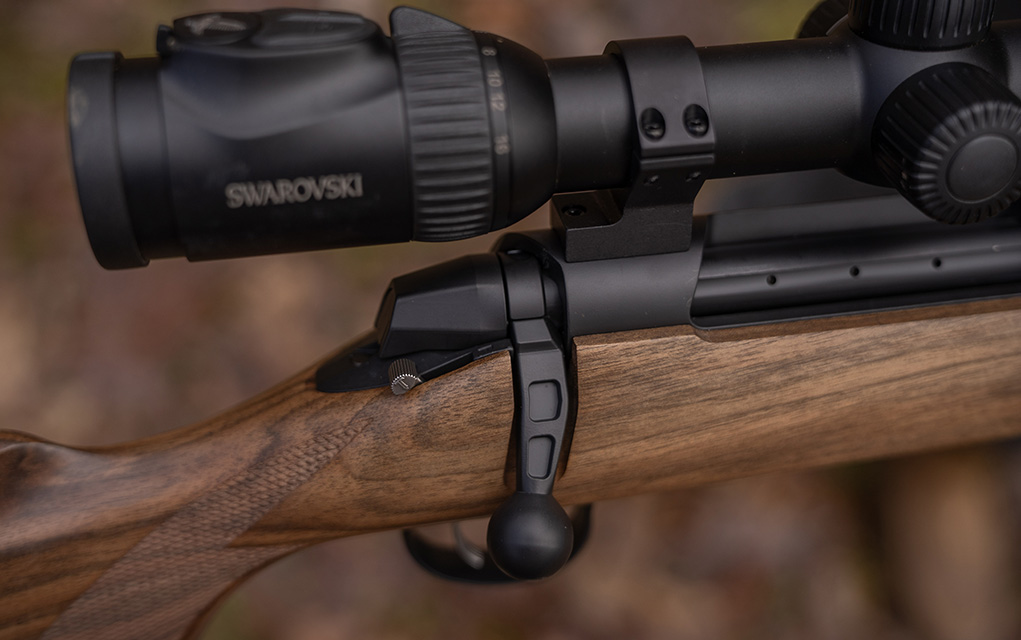
We relocated the herd the next as the morning sunlight burned thick white coastal clouds off the hillsides. Chris and Mike communicated with nods and hand signals to guide us quietly over and around a cliff where we hoped to ambush the herd on the back side.

For my part, I carried the rifle and watched the masters anticipate where the game might move and position me for a shot. After several climbs and descents along a ridgeline, we moved down and across grass and acacia-covered slopes strewn with football-sized rocks. Fortunately, we had the wind in our faces, dampening our steps and keeping our scent out of the herd’s noses.

Chris located a very big bull at the edge of the group, moving through cover just over 200 yards to our front.  We crouched and maneuvered slowly closer, slightly to the bull’s left. Standing and braced on shooting sticks, I broke the shot. The bullet took him in the high shoulder, and he fell where he stood—in the shade of an acacia tree. From the looks of his “nubby” teeth, ground nearly flat with age, we chose an old bull beyond the end of his prime.

Franchi Momentum All-Terrain Elite hunt
The .308 Franchi MATE and the Hornady 178-grain ELD-X .308 cartridge brought down this old blue wildebeest bull quickly and cleanly in the shade of an acacia tree.

Final Rounds

Though not from a traditionally snobbish line of African safari rifles, the MATE was a fun and effective partner in the field. Its short length (even with a suppressor) made loading vehicles and crouching stalks under low trees easier. The .308 cartridge and Steiner H6Xi 2-12x42mm optic were more than sufficient for typical plains game ranges.

I experienced no failures or issues of any kind. As a working tool, the MATE became more familiar, faster, than any rifle I have taken to the field. It seemed to want to stay in Africa to keep hunting and managing the environment for the next generation—or maybe that was just me.

Franchi Momentum All-Terrain Elite Deals

Franchi$1,449PngItem_4588935
EuroOptic$1,299.99Gun Price Check

Editor's Note: This article originally appeared in the November 2024 issue of Gun Digest the Magazine.


More On Hunting Rifles:

New Guns And Gear October 2024

0

Looking for a new iron or piece of kit to enhance the one you already own? Check out these 7 new bits of guns and gear to grow your firearms wish list.

The New Guns And Gear:

Wilson Combat EDC X9 2.0

Wilson Combat EDC X9 2
Welcome to the Future of Everyday Carry: the EDC X9 2.0. Launched in 2016, the EDC X9 rapidly rose to popularity, merging the timeless design of 1911 with the cutting-edge features modern shooters demand. The 2.0 builds upon this with upgrades that deliver superior performance and reliability. Of note, the new iteration has a solid-frame construction using a durable, high-capacity compact aluminum X-Frame. And the 9mm’s grips are fully adjustable, fine-tuning the gun to your hand. And it’s set up to feel great in hand, striking the perfect balance between comfort and concealability. The pistol was a knockout to begin with, and now is more so with Wilson dolling it up.
MSRP: $3,307


Freedom Munitions 44 Magnum 240-Grain X-Def Ammo

Freedom Munitions 44 Magnum
Freedom Munitions has expanded its X-DEF defense line with a powerful .44 Magnum cartridge. This self-defense round features a brass case loaded with a 240-grain X-DEF hollow-point expanding bullet from X-Treme Bullets and premium low-flash powder. Tested extensively in their ballistics lab, the 240-grain projectile achieves a velocity of 1,350 fps from a 6-inch barrel and penetrates 15 to 18 inches in ballistic gelatin, delivering 971 ft-lb of kinetic energy. This combination makes it an effective choice for protection. Over the past year, Freedom Munitions has also added several new calibers to the X-DEF line, including .38 Special, .357 Mag, .10MM and .357 Sig.
MSRP: $44, box of 50


Ed Brown Kobra Carry Dual Caliber

Ed Brown Kobra Carry Dual Caliber
Few have escaped the .45 ACP-9mm debate at some point in their lives. However, it seems Ed Brown may have come up with an answer of which is the better carry caliber—both. This is precisely what the gunmaker’s Kobra delivers with a system that slips seamlessly between the German wonder caliber and the American standard bearer. Shipping with dedicated slides, barrels and components for each cartridge, the 1911 gives you the perfect one-two punch. Ed Brown angles the .45 setup as a bit more of a range tool, with the upper outfitted with fixed sights, while the 9mm is meant for carry with the EVO upper coming outfitted with a Vortex Venom red dot. It’s quite a package all wrapped up in one gun.
MSRP: $4,700


Smith & Wesson Bodyguard 2.0

Smith & Wesson Bodyguard 2
For more than a decade, armed citizens have trusted their lives to the Bodyguard. Now, Smith & Wesson looks to protect another generation of shooters with a revamped version of the handy little .380 Auto. The prolific gun manufacturer hasn’t attempted to reinvent the wheel with the 2.0. Much of what made the pistol popular in the first place remains—namely its petite size. However, it has freshened up the design with what should prove welcome upgrades. Chief among these are higher 10-round flush fit and 12-round extended capacity magazines. Additionally, S&W has outfitted the gun with more aggressive cocking serrations, a snappy flat-faced trigger and very comfortable ergonomics. Overall, the .380 looks to have a lot of muscle for a micro pistol.
MSRP: $450


Brownells Gunsmithing Vise

Brownells Gunsmithing Vise
Get beyond basic firearms cleaning and you quickly find out a bench vise is a dang handy addition to your workbench. Nowadays, getting one worth the money is a challenge. Enter Brownells and its newly minted Gunsmithing Vise. The German-made tool is compact, yet sturdy—an extra hand designed to last a lifetime. Some of the vise’s highlights include forged-steel construction, reversible (one side smooth the other checkered) and replaceable jaws and rolled trapezoidal spindle thread for distribution clamping force. Not to mention, it’s a looker too.
MSRP: $400


Sig Sauer Romeo-X Enclosed

Sig Sauer Romeo-X Enclosed
Like guns, optics go through the trend cycle. Peaking presently are enclosed red dots. Sig is the latest to leverage these rugged aiming systems with a new addition to its legendary Romeo line of optics. In addition to the inherent assets of an enclosed red dot—namely, less chance of fowling the emitter—the device has a lot more going for it. What most will like are that the dimensions are tailored to a micro-compact pistol, the dot comes in both 3, 6 MOA and circled-dot reticles and crystal-clear glass. Furthermore, the Romeo-X Enclosed offers up to 15 brightness settings, including night vision settings.
MSRP: $630


Walther WMP SD .22 WMR

Walther WMP SD
Undoubtedly, one of the grand aspects of rimfire guns is their supreme suppressibility. This even goes for the brusque cartridges, such as the .22 Magnum. In turn, Walther adding a threaded-barrel option to its WMP line of rimfire pistols should prove music—quiet music—to plinker’s ears. In addition to boasting a 4.9-inch barrel with a 1/2×28 thread on the muzzle making it ready for most rimfire suppressors, the pistol has several other assets shooters should appreciate. It comes with a slide cut making it red-dot ready out of the box, a Picatinny accessories rail making adding a light or laser a snap, and 10- and 15-round magazines keep plenty of firepower on tap.
MSRP: $600

Editor's Note: This article originally appeared in the October 2024 issue of Gun Digest the Magazine.


Get More Guns And Gear:

First Look: Taurus 22TUC

0

We take a quick look at the new Taurus 22TUC, a .22 LR pocket pistol with a tip-up barrel.

.22 LR may not be an ideal self-defense cartridge, but it’s better than nothing and may be the best choice for certain individuals based on their circumstances. For those who fall into that camp, or anyone looking for a small, lightweight backup gun, Taurus has just announced the 22TUC.

22tuc taurus tip-up barrel

The 22TUC is a .22 LR pocket pistol that features a tip-up barrel, a 9-round magazine capacity and a double-action-only trigger. The tip-up barrel means that the pistol can be loaded without having to manually cycle the slide, a good feature for anyone with hand strength issues, and it also makes it easier to stick an extra round in the chamber when loading to bring the capacity up to 10 rounds. Taurus also says that the double-action-only trigger helps to ensure reliable ignition of rimfire ammo.

taurus 22tuc

Featuring a polymer frame and a stainless steel slide and barrel, the 22TUC weighs in at only 10 ounces unloaded. Combined with its overall length of 5 inches, overall height of 4.35 inches and width of 1 inch, the 22TUC makes for one very compact and lightweight package. This makes it ideal for pocket carry or as a backup gun in an ankle holster. It also features a manual safety, a fixed rear sight and a fixed orange dot front sight.

The 22TUC is available with either a stainless or black finish on its metal parts and each gun will ship with one magazine. The black version has an MSRP of $333.99 and the stainless version has an MSRP of $348.99

For more information, visit taurususa.com.


More On Pocket Pistols:

S&W Model 432 Review: A .32 H&R Magnum Snubbie

1

Here we test out the S&W Model 432 in .32 H&R Magnum, an ideal concealed carry revolver setup.

If you’re a frequent reader of this magazine and column, you know I have an affinity for the .32 H&R Magnum and .327 Federal Magnum revolver cartridges. And, in contrast, I’m often perplexed as to why so many shooters cannot seem to grasp the appeal of either cartridge.

The combination does a fantastic job of bridging the gap between the .22 Long Rifle/.22 Magnum and the .38 Special/.357 Magnum. They’re substantially more powerful than the first pair, more comfortable to shoot and offer a higher capacity than the second. So, anytime there’s a new .32 H&R Magnum or .327 revolver, I’m fast to give it a look, which is why as soon as I learned about Lipsey’s Exclusive S&W Model 432 in .32 H&R Magnum I requested one for review.

S&W Model 432 Specs:

Caliber: .32 H&R Magnum
Capacity: 6
Action: Double Action Only
Barrel Length: 1.88 inches
Overall Length: 6.31 inches
Overall Height: 4.3 inches
Overall Width: 1.3 inches
Weight: 16.3 ounces
Sights: Night Sights
MSRP: $759

Pros

  • Compact and lightweight
  • 6-round capacity
  • Easy to shoot
  • No Hilary hole

Cons

  • Not as powerful as a .357 Mag. or .327 Federal Mag.
  • Lipsey's Exclusive, limited supplies

The Cartridge

The .32 H&R Magnum cartridge is essentially a .32 S&W long cartridge lengthened by 0.155 inch. Additionally, the .32 H&R Magnum is loaded to a maximum average pressure (MAP) of 23,000 psi, as opposed to 15,000 psi. That’s a pressure increase of 53 percent. The result is that the .32 H&R Magnum has an instrumental velocity of 1,020 fps with a 95-grain bullet as opposed to the .32 S&W Long’s 750 fps with a 98-grain bullet.

Another neat feature of the .32 H&R Magnum is that the cartridges are only 0.337 inch in diameter as opposed to 0.379 for the .38 Special. This means that, in most compact revolvers, the cylinder will hold six .32 H&R Magnum cartridges … as opposed to five .38 Specials. Also, a largely unknown fact about .32 H&R Magnum revolvers is that they can chamber and fire .32 Short, .32 Long and even .32 ACP ammunition.

sw 432 shooting
The little S&W Model 432 in .32 H&R Magnum from Lipsey’s is compact and comfortable to shoot, and the notched rear and XS front sight makes it easier to aim than most snub-nose revolvers.

The Revolver

The Smith & Wesson J-frame revolver has been a trusted companion for those wanting a concealable revolver for personal protection for almost 75 years. Recently, S&W announced a partnership with Lipsey’s to offer a Model 432 J-frame with an aluminum frame and chambered for the .32 H&R Magnum. This revolver is only 6.32 inches long and weighs a scant 16.3 ounces. This is a concealed hammer design, so it’s double-action only, but the revolver has some features not commonly seen on factory new J-frame revolvers.

S&W fitted this revolver with XS Sights’ Minimalist Revolver front sight, which features a Tritium vial surrounded with a photoluminescent green ring. This is a highly visible sight in any light, and S&W smartly paired it with a dovetailed U-notch rear sight that has a Novak-like profile. One of the weaknesses of the J-frame has always been the sights, and this fixes that problem.

Also, S&W worked with Lipsey’s and designed a special set of VZ “High Horn” G10 UC “boot” grips that are slim—but also very comfortable. The revolver comes in two finish options: matte black and matte stainless. The barrel is 1.8 inches long, the front edge of the cylinder is beveled, and the charge holes are chamfered. It also has an enhanced trigger and uses titanium pins. The other good news is that this revolver doesn’t have what has become to be known as the “Hillary Hole,” which is an external keyed lock. It retails for $759 … while supplies last.

The Holster

I’m not a fan of pocket carry—not because I think it’s a bad idea, but because it just doesn’t fit my wardrobe and carry/training style. I like a handgun on my strong side just behind my hip bone. That’s how I train with all the handguns I carry concealed, so that’s where I like to wear them, no matter the make or model. When I received the revolver for review, I ordered a Galco Gunleather Concealable Belt Holster ($169) for OWB carry and one of their Royal Guard 2.0 holsters ($212) for IWB carry. Both are very comfortable, easy to draw from and re-holster into, and they make this compact revolver seemingly disappear on my side.

sw 432 holster
With Galco’s Concealable Belt Holster, the little .32 H&R Magnum from Smith & Wesson can easily and comfortably be carried outside the waistband. It’s so compact and light you’ll hardly know it’s there.

The Load

Though this little revolver will chamber and fire four different cartridges, there’s not a lot of .32 H&R Magnum ammo options to choose from; a major online retailer lists only six loads. So, in the interest of providing potential customers with a complete defensive handgun package, Jason Cloessner of Lipsey’s worked with gun writer Jeff Hoover and Buffalo Bore Ammunition owner Tim Sundles to develop a load specifically for this mini gun.

The problem with low-power, small-caliber handguns is that they tend to not deliver great terminal performance with hollow-point bullets. This is because they lack the velocity and energy to push an upset hollow-point bullet very deep. The answer to this problem is a hardcast bullet with a flat nose, like a wadcutter or semi-wadcutter. These non-deforming, flat-nose, hardcast bullets cut a caliber-size hole in anything they hit, they penetrate extremely deep, and they don’t need to be loaded to extreme pressures or velocities to deliver this kind of performance. There are the same type loads outdoorsmen often choose for bear defense with larger handgun cartridges.

The Load Buffalo Bore ($38.32, per box of 20) created for this revolver uses a 100-grain, hardcast, wadcutter bullet that’s loaded to a standard pressure, and it’s advertised as offering a muzzle velocity of about 900 fps out of the revolver Buffalo Bore designed it for. My testing showed these velocities to be spot-on, and when I fired these loads into blocks of Clear Ballistics, they penetrated more than 2 feet. No, this isn’t the same level of performance you can expect out of a .357 Magnum or even a .327 Federal Magnum, but it will for sure deliver enough penetration—no matter how big and fat your attacker might be—and this is from a little gun that’s easy to carry and that doesn’t have a lot of recoil.

The Package

If you like the idea of a compact, lightweight revolver for concealed carry, and if you want a complete setup that includes the gun, and an IWB and OWB holster, and a good self-defense load, the exclusive S&W 432 in .32 H&R, two Galco holsters and the Buffalo Bore load makes for a complete package.

Wouldn’t it be cool if Lipsey’s would just bundle all those items together in a single box? I doubt that will ever happen, and even though they know my affinity for .32s, and I helped them with their limited edition .327 Single Seven, nobody asked my opinion. So, I’m giving it to you—if you buy the revolver, get at least one of the holsters and the ammo to go with it.

S&W 432 Deals

Smith & Wesson$759PngItem_4588935
Guns.com$778.99Gun Price Check

Editor's Note: This article originally appeared in the November 2024 issue of Gun Digest the Magazine.


More On Revolvers:

How To Choose A Self-Defense Attorney

4

It’s smart to have a good lawyer lined up before the trouble starts. Here we discuss how to choose the right self-defense attorney.

When faced with the prospect of needing legal defense after a self-defense incident, the importance of selecting the right attorney cannot be overstated. This critical decision can mean the difference between safeguarding your rights and facing serious legal consequences—even when you are completely innocent.

Following are the essential considerations and questions to ask when seeking an attorney for self-defense cases.

It can be a daunting task to find legal counsel who you are comfortable with, and who can provide you with the defense you want … and need. People often encounter dismissive or unhelpful attorneys when seeking legal advice.

The legal profession, like any other, includes both highly skilled and less competent individuals. The key to finding the right legal counsel is not just identifying a knowledgeable professional, but finding one who can build a relationship of trust and confidence with you. Mounting a successful legal defense after acting in self-defense demands an attorney well-versed in criminal defense and, more particularly, self-defense cases. There are many criminal defense attorneys but very few who are well-versed in the nuances of a self-defense claim.

Finding a Self-Defense Attorney

First and foremost, it’s crucial to engage an attorney who is engaged in criminal defense and has experience with self-defense cases. This specialization ensures that the attorney understands the nuances of defending individuals who have used force to protect themselves or others. You don’t want someone showing up to a self-defense case who primarily handles divorces or bankruptcies, but you also don’t want someone who only represents criminals. There are nuances and important considerations when defending a case of justifiable self-defense versus other sorts of alleged crimes.

Verify the attorney’s legitimacy by checking their standing with the state bar association. This simple online check ensures they have no disciplinary history that might compromise their ability to represent you effectively. Understanding the attorney’s track record in handling similar cases, including their experience with trials and negotiations, is essential.

Aligning Philosophies on Self-Defense

Equally important is assessing the attorney’s philosophy on self-defense, and their understanding of the Second Amendment. This alignment ensures that they approach your case with a perspective that resonates with your beliefs and values regarding the right to self-defense and firearm ownership. Most people want an attorney who sees self-defense from my perspective—not just as a legal concept or theoretical framework—but as a fundamental, natural right.

Interviewing Multiple Attorneys

Interviewing multiple attorneys is recommended to find the best fit for your case. While this process may involve paying consultation fees, it’s a worthwhile investment in ensuring you have the right advocate by your side. It’s a lot like finding the right doctor before a medical emergency: You want someone you trust and who has the expertise to handle your specific needs. You want someone you feel comfortable working with. This is not a choice to make after the emergency arrives.

For proactive legal preparedness, joining a legal protection program like the Armed Citizen’s Legal Defense Network offers distinct advantages. These programs provide access to a network of attorneys who defend gun owners and provide a good place to start in your search for a self-defense attorney.

Practical Steps in Choosing an Attorney

During your initial consultations, ask prospective attorneys about their experience with self-defense cases, including their trial experience and success in negotiating favorable outcomes. Understand their fee structure and ensure transparency regarding costs. While referrals and testimonials can provide insights, recognize that personal fit and professional compatibility are paramount. Google reviews are great, but they’re not an adequate substitute for personal consultations.

Conclusion

Choosing the right attorney for self-defense cases requires careful consideration and thorough research. It’s not merely about legal expertise but also about shared values and a commitment to protecting your rights. By engaging a competent attorney early and potentially joining a legal protection program, you can enhance your preparedness and mitigate the uncertainties associated with legal challenges after a self-defense incident.

Proactive legal planning is crucial. The time to find an attorney is before you need one. By doing your homework now, you can ensure that, if the worst happens, you’re prepared with the right legal support. Remember, your choice of attorney can profoundly impact the outcome of your case and your future.

The legal journey after a self-defense incident is daunting and emotionally taxing. It demands that your attorney bring their “A” game from the start and maintain it until the end. The stress of knowing that an innocent person is relying on you is immense. Your attorney must have the ability to stand strong, face the sleepless nights and still be able to competently defend you. Keep searching until you find someone who can.

Editor's Note: This article originally appeared in the November 2024 issue of Gun Digest the Magazine.


More Knowledge For The Armed Citizen:

First Look: Walther PPK/S SD

1

Walther Arms has just announced the PPK/S SD, a .32 ACP PPK/S variant with a threaded barrel.

Walther recently reintroduced the famous PPK and PPK/S in .32 ACP, and now the company has announced a suppressor-ready version called the PPK/S SD as well. If you’ve ever wanted to LARP as a secret agent, things just got a whole lot easier.

Walther PPKS SD black

Chambered for .32 ACP, the Walther PPK/S SD is the same as the standard PPK/S besides its new threaded barrel. Walther has not specified the thread pitch, but it’s presumably the standard 1/2×28. However, the threaded barrel extension was designed to ensure proper alignment when using a suppressor. Each gun will ship with two 7-round magazines and a thread protector.

Walther PPKS SD

Rob McCanna, President and CEO of Walther Arms, said this about the new pistol:

The PPK/S SD .32 ACP is a celebration of Walther’s legacy of precision engineering and innovation … By integrating modern features like the threaded barrel into such an iconic design, we've created a firearm that bridges the gap between timeless style and contemporary performance. We're excited to offer our customers a PPK/S that not only meets but exceeds the expectations of modern shooters.

The Walther PPK/S SD is available now with either a black or a stainless steel finish and the MSRP is $1,099 for both versions.

For more information, visit waltherarms.com.


More Handguns:

Reloading: Crimping & Rifle Accuracy

0

Here we discuss crimping techniques that can take your rifle’s accuracy to the next level.

Crimping a bullet in place might be the last phase of the reloading process, but it certainly isn’t the least important. In a number of instances, it’s absolutely necessary; other times, it’s optional and, sometimes, it should be avoided altogether. Knowing which type of crimp to use is important … and knowing whether to use a crimp at all can be a complete game changer.

Basic reloading techniques dictate that a straight-walled cartridge requires a roll crimp—which curls the case mouth into the bullet—to keep the projectile from moving deeper into the case under recoil or, in the case of a revolver, moving out of the case and locking up the cylinder.

However, the use of a roll crimp requires a bullet with a cannelure, or a crimping groove, or else you run the risk of bulging the case, deforming the bullet … or both. If your chosen projectile doesn’t have a cannelure, a taper crimp—one which squeezes the case wall radially inward against the shank of the bullet—is the only way to prevent damage to your case or projectile.

crimping handgun bullets
The .45 Colt definitely requires a good crimp; in a modern revolver, the recoil will pull those bullets out of the case. Photo: Massaro Media Group.

The handgun cartridges I shoot most—.38 Special, .45 ACP and .45 Colt—are all crimped in some fashion, I don’t crimp bottlenecked rifle cases unless absolutely necessary. The lever gun cartridges—at least those that use a tubular magazine—get a good roll crimp in order to hold things in place, but I rarely use a roll crimp on my .308 Winchester, .300 Winchester Magnum, .470 Nitro Express or .22-250 Remington; the neck and its tension does the work for me.

crimping rifle bullets
The .500 Jeffery has a recoil level that tests the mettle of the short neck; a heavy roll crimp is a good idea. Photo: Massaro Media Group.

Ramp up the recoil to the hard-kicking Weatherby cartridges, or the .500 Jeffery and .505 Gibbs, and those cartridges in the magazine can have their bullets driven deeper into the case from the aggressive recoil.

Solution: Proper Crimp

In fact, it was a problem-solving conversation with my buddy, Bob Rose—who has a newly built .505 Gibbs—and is having all sorts of trouble keeping his bullets at the depth he seated them. He’s used several different bullets, with cannelures of varying depth, having applied roll crimps from what would be considered light, to “this time you’re not going anywhere,” only to see the same results: Those cartridges in the magazine had their bullets sunk deep into the case.

We covered a number of scenarios, as I’ve loaded rather extensively for both the .500 Jeffery and .505 Gibbs—both have hellacious recoil—and have solved a good number of problems with both. Looking at Bob’s reloading technique, I saw no flaws in the process or the logic; instead, it was an examination of the magazine boxes of the respective rifles we were loading for that I feel is to blame here.

crimping rifle accuracy
The author doesn’t crimp the .505 Gibbs, as there’s plenty of neck tension to keep the bullets in place—if the magazine doesn’t allow the cases to move during recoil. Photo: Massaro Media Group.

You see, I loaded the vast majority of the .505 Gibbs and .500 Jeffery ammunition for rifles that had a magazine box of specific geometry—that is, the side walls of the magazine box have a correlative “shoulder” to the cartridge in order to prevent the cartridge from slamming forward under recoil. In Bob’s case, it seems there’s a bit more room for play, and he’s seeing the nasty effects of the high level of recoil. He’s got a Lee Factory Crimp Die on order and hopefully that'll help solve his ordeal without having to change the magazine box of his rifle.

Some folks use a crimp as a means of evening out velocity. Since I was a kid, I remember reading about how the Weatherby magnum’s cartridges were best served by using a roll crimp to achieve both consistent velocities and optimize accuracy. The theory is that the additional pressures built during the ignition phase—required to move the bullet out of the roll crimp—will help to generate a repeatable pressure curve, resulting in improved accuracy. Considering that so many factory loads are roll crimped—and not just Weatherby ammo—there might be some credence to this concept.

I’ve pulled apart several factory loads over the years and have found that some timeless component bullets, such as the Nosler Partition that have been offered as components since the 1940s without a cannelure, are offered to the OEM ammo manufacturers with a cannelure. This is presumably to meet a requirement for crimping the factory ammunition, though I have often wondered why that would be, as the match-grade ammo featuring Sierra MatchKings, Berger Match or Hornady ELD Match bullets had no such cannelure.

I started experimenting with what I’ll call “unnecessary crimping,” and I did find that, in some instances, it has helped to even out velocities. Though by my own admission, the situation depends more on the rifle and its chamber than it does some universal law regarding crimping.

So, what is the rule regarding a crimp on bottlenecked rifle cartridges? Providing there’s enough neck tension to properly hold the bullet in place—and by that I’ll say that the .300 Winchester Magnum, with a neck length of 0.264 inch is enough—I feel comfortable saying there’s no rule. If you feel that you’re seeing your bullets move as a result of recoil, try a firm roll crimp, or grab one of those undervalued Lee Factory Crimp Dies and see if that tool will even things out for you.

Trial And Error

Experimentation can be the key to success when it comes to reloading; the goal is to achieve repeatable results by any means necessary. Each rifle can present a different set of challenges, and I like to have a diverse set of tools when trying to get my ammo and rifle combination to perform the way I want.

Quite a bit of emphasis is put on varying seating depth, changing primer brands, minuscule changes in powder charge weight or even powder type, but if adding a crimp into the mix gives me one more tool in the box to get that rifle where I need it, I’m good with that. For a hunting rifle, the level of accuracy might not be the same as that of a long-range target shooter, but when you want the best, it’s smart to consider all options.

Try your pet load with and without a roll crimp, and see if you find any difference, for better or for worse. You might find an unexpected solution, making a good load even better. Use your chronograph to best observe the differences between crimped and un-crimped, and I’d wager that the one with the more consistent velocity figures will also be the most accurate.

Editor's Note: This article originally appeared in the December 2022 issue of Gun Digest the Magazine.


More On Reloading:

First Look: Aero Precision Tephra-22 Suppressor

0

We take a quick look at the Tephra-22, the latest suppressor from Aero Precision.

Aero Precision is a relative newcomer in the suppressor game, having only released its first can in 2022 with the Lahar-30 line. Since then, all three sizes of the Lahar-30 have received good reviews and have gained a general reputation of having very good performance in relation to both their size and price, so it’s exciting to see Aero continue to expand its suppressor lineup. The company recently announced its newest can in the form of the Tephra-22.

Aero Precision Tephra-22 black

Weighing in at 7.2 ounces and shipping with 1/2×28 mounts, the Tephra-22 is rated for .22 LR to 5.7×28 and is compatible with both rifles and pistols. It features seven 17-4 stainless steel baffles as well as a stainless steel serialized housing and mounting hardware, and outside it features an aluminum tube and end cap. The stainless steel components receive a black nitride finish and the aluminum parts feature an anodized finish in either black or brown. Additionally, the Tephra-22 is user-serviceable and can be disassembled and cleaned without any specialized tools.

Aero Precision Tephra-22

Both colors of Tephra-22 suppressors are available for pre-order now and are expected to begin shipping at the end of November. MSRP is $375 for both models.

For more information, visit aeroprecisionusa.com.


More On Suppressors:

Gunmag Warehouse Wares: Savior Specialist Range Bag

0
Sponsored Content

We check out the Savior Specialist Range Bag, one of the many excellent range gear options available at Gunmag Warehouse.

Far too many shooters are guilty of using a subpar range bag. Sure, that old duffel may “work”, but why not make life easier with something specifically designed for the task? GunMag Warehouse has plenty of excellent range bags to choose from, one of which is the Savior Equipment Specialist Range Bag 2.0.

Savior Specialist Range Bag Storage

How many times have you gone to the range and been forced to waste several minutes digging through your stuff just to find that one tool or box of ammo? The problem with most range bags is they’re just bags. Featuring one large compartment and maybe a couple of smaller ones, they can fill up quickly and without any semblance of organization. This is where range bags like the Savior Specialist come in.

The primary draw of using a range bag like the Savior Specialist is its organizational features. Its main compartment is 13 inches long, 8.5 inches wide and 9 inches deep, providing a total internal volume of 994.5 cubic inches. That’s big enough to fit two whole ammo cans if you desire, but there are more efficient ways to utilize the space. This is aided by some of the accessories included with the bag.

Savior Specialist Range Bag ammo cans

One of those is a divider for the main compartment which is both adjustable and removable. When installed, it bisects the large space to help keep your kit logically separated. On one side, there’s enough space to store loose earmuffs, eye protection, ammo boxes or any similar shooting equipment, all while retaining enough room on the other side to store three handguns.

Range Bag main compartment

That leads us to the next organizational aid—three handgun pouches. These measure 12 inches across and 8 inches tall, so they’re big enough to fit some pretty large irons, and most average-sized pistols will leave enough room for extra magazines. That said, the bag’s front compartment features a better way to store spare pistol mags, as it has six elastic pouches that should fit most double-stack pistol magazines. Each pouch can also easily fit two single-stack mags.

The spare pistol mag panel is also removable for when you’re having a dedicated rifle day and just want additional space in the front pocket. Once removed, the pocket easily fits six AR-15 mags instead.

Savior Specialist Range Bag pistol mag pouch

Many ranges charge by the hour, keeping you acutely aware that time is money. If that’s how your go-to range operates, it means that every second saved from rummaging through your bag means more time can be spent shooting. Being able to draw spare, loaded mags from a central location will certainly help with that.

It’s also worth mentioning the smaller compartments found throughout the bag because they can still fit quite a bit of kit. The front compartment where the spare magazine pouches are located also features zippered internal and external pockets, and the same is true for the two side compartments as well. One of the side compartments also has internal organizational pockets for pens, notebooks and other small tools, and both side compartments feature netting pouches on the outside for additional storage.

Range Bag admin pouch

Finally, we’re just left with the top panel that covers the main compartment when zipped. This panel has two additional means of storage, including another zippered internal pocket as well as a MOLLE panel made of hook-and-loop material. That last detail means you can attach additional MOLLE pouches, such as an IFAK, to the bag’s top or attach a hook-and-loop accessory like the included spare pistol mag panel.

Savior Specialist Range Bag molle
An IFAK pouch (not included) attached to the bag's MOLLE panel.

These features combine to make the Savior Specialist one very modular and versatile range bag. Regardless of what you plan on taking to the range on a given day, you can easily and quickly rearrange the various components to make a dedicated handgunner bag, rifleman bag or a mix of both.

For those who enjoy being extra organized, the bag also comes with six hook-and-loop label panels for the three handgun pouches if you want to mark what each one is specifically holding.

Other Savior Specialist Features

Better organization isn’t the only thing the Savior Specialist has going for it, as good range bags also protect your guns and other expensive gear like binoculars or range finders. Thankfully, this bag offers that in spades as well.

Firstly, the pistol sleeves and external side pouches feature much more padding than what’s found on typical range bags. They’re not bulletproof, but they’re certainly thick enough to keep what’s inside from getting too banged up.

range bag pistol pouches

More important is the durability of the main bag itself. While the external shell is made from the typical 600D polyester, what sets the Savior apart is its internal polymer frame. This keeps the bag rigid and offers multiple advantages over most soft-range bags.

Most obviously, that includes protection. It would take serious effort to damage the bag badly enough to compromise the polymer frame, and until that happens, whatever you put inside of it will stay perfectly safe from impacts. Speaking of safety, for protection against theft, all of the bag’s zippered pockets can also be locked with a small padlock.

The bag’s rigidity also means that it’s easier to load and unload, as it won’t be flopping over itself when empty like soft bags do. Additionally, the bag can conveniently double as a shooting rest. While it won’t be as ideal as a dedicated rest, the Specialist is both tall and rigid enough to easily serve as a gun rest.

Savior Specialist Range Bag rifle rest

As for carrying the bag, it’s about what you’d expect. It has a set of straps on the top for carrying with one hand as well as a removable strap for slinging it over your shoulder. That said, the shoulder strap is very generously padded, so it’s still comfortable to carry even when loaded with a lot of guns and ammo.

The final point to mention is fashion, as you do have several colors to choose from including black, green, gray, red and FDE. The range bag has an MSRP of $109.99, but GunMag Warehouse currently has the Savior Specialist available for $89.99. For the features this bag has, you’ll be wondering why you didn’t pick one up sooner.


More Gun Cases And Range Bags:

Rifling Evolution: Cutting Through The Spin On Twists

0

Here we examine the twists and turns of early rifling development.

In the 1500s, spiral grooves cut into gun bores were used to spin-stabilize bullets fired through them. While the method of creating these grooves has changed, this system has remained the same and is considered “best” by nearly all barrel makers.

gun digest 2023
This article is an excerpt of Gun Digest 2023, 77th Edition.

Attempts to improve land-and-groove rifling included choke boring, free boring, gain twist, deep and shallow grooves, few and many grooves, and odd and even numbers. No one system demonstrated significant superiority over another. About 1850, the first alternatives to land and groove (L&G) rifling made their appearance.

Charles Lancaster was considered the first to produce a rifled barrel using a spiral bore in England. Referred to as oval or elliptical boring, the oval interior was turned as though a straight oval tube was twisted, causing a bullet fired through it to be swaged into a slightly oval shape and spun as it traveled down the bore. The idea (in part) was to create a barrel that would perform equally well with a solid bullet or a charge of shot, but that goal did not succeed if experiments firing shot loads through rifled shotgun barrels are any indication. Nevertheless, the system worked with solid bullets. The success was tempered, for blackpowder fouling presented a more significant problem than a deep-groove rifled barrel.

The Civil War saw the Greene Oval Bore Rifle, an early bolt action wherein two bullets were loaded, with the second bullet with its powder charge acting as a gas check behind the charge of the first load. When the action fouled, the rifle had to be used as a muzzleloader. They were made in America with machinery bought from Lancaster. Recovered bullets from Antietam indicate some use.

Joseph Whitworth
Sir Joseph Whitworth (December 21, 1803–January 22, 1887) was an English engineer, entrepreneur, inventor and philanthropist. He devised the Whitworth rifle, often called the “sharpshooter” because of its accuracy, considered one of the earliest examples of a sniper rifle.

A similar spiral-bore effort used polygonal rifling. While it is unknown who produced the first such barrel, the best-known effort was by Sir Joseph Whitworth in England in 1853. While the hexagonal-bore Whitworth could be fired with a cylindrical bullet, it was soon found that the best accuracy was obtained only with a six-sided bullet contoured to a mechanical fit.

Whitworth bullet
The 560-grain Civil War-era Whitworth bullet measures .450 inch across the flats. The design may have inspired the .45-70-500 gr. “long-range” bullet developed for the M-1884 and M-1888 Springfield rifles.

Semi-military Whitworth rifles, equipped with telescopic sights, were used by Confederate sharpshooters to pick off several Union officers. Major General John Sedgwick was the most famous who was killed by a single bullet at more than 500 yards. The system was also successfully used in artillery pieces, two of which were employed by Confederates at Gettysburg. 

Pedersoli Whitworth
The Pedersoli Whitworth reproduction allows you to try a unique hexagonal-rifled gun like those used during the Civil War, which equipped the sharpshooters of the Confederate Army, hence the name “Whitworth sharpshooters.”

The last rifling innovation of the 19th century came in 1871, the work of William E. Metford, a British engineer. Metford’s system utilized shallow rifling with rounded lands, which reduced the bullet’s drag and deformation. Accuracy was excellent, and the design was used in the British military rifle designed by James Paris Lee in 1888.

Screenshot
William Ellis Metford (October 4, 1824–October 14, 1899) was a British engineer best known for designing the Metford rifling in .303 caliber Lee-Metford and Martini-Metford service rifles in the late 19th century.

Unfortunately, highly erosive smokeless powders and corrosive primers soon degraded the accuracy of the soft-steel barrels of the day. A similar system was used in Japanese Arisaka rifles, which benefited from better steel and maintained accuracy better than conventional L&G barrels. Barrels made in America by Charles Newton also used this system, utilizing five rounded lands and grooves.

Lee-Metford Mk II
The bolt-action Lee–Metford was a British army service rifle that used James Paris Lee’s rear-locking bolt system, detachable magazine, and an innovative seven-groove rifled barrel designed by William Ellis Metford.

In 1901, the first head-to-head tests of an oval-boring system versus conventional rifling began at the Springfield Armory. The details are fully documented in the Annual Reports of the War Department for the Fiscal year ended June 30, 1902, Volume VII, Reports of the Chief of Ordnance and Board of Ordnance and Fortification, Appendix XII.

The project began July 16, 1901, with the following letter to the Chief of Ordnance:

“Dear Sir: I have invented a gun with an elliptical bore of .30 caliber, suitable to take the ordinary fixed ammunition of this caliber. I desire to have a thorough Government test, such as will demonstrate the quality of the gun for service. I desire to have the test made at the earliest convenience in order that I may be present.

Very Respectfully, W.F. Cole M.D.”

The Chief of Ordnance was Brigadier-General A.R. Buffington, inventor of the Buffington “wind gauge” sight—the most sophisticated military type of its day—used on the M-1884 and M-1888 Springfield rifles and carbines. General Buffington ordered, “test without delay the gun presented by Dr. Cole” and invited Cole to attend the tests.

Springfield Armory experimental shop Bldg 28
The Springfield Armory’s experimental shop (Building 28), circa 1923.

Two days later, Dr. Cole met with the Board to test his rifle, which had the same 30-inch barrel as the Krag and used the same ammunition. “The cross-section of the bore is an ellipse the short diameter being .30 inches, the long diameter .31 inches, and having a twist of one turn in 7.29 inches.”

Springfield Model 1896 Krag
The U.S. Springfield Model 1896 Krag-Jorgensen bolt-action in .30-40 Krag.

The rifle was tested against the Krag at 1,000 yards. Three five-shot groups for each rifle averaged 25.11 inches for the Krag and 13.72 inches for the Cole rifle (extreme spread). The next day, a 300-yard test was conducted with a different Krag with better results. Velocity tests for the Krag (at 53 feet) were 1,991.55 fps, and for the Cole, 2,058.66 fps. On July 23 and 26, three five-shot groups were fired at 1,000 yards. Results were 18.96 inches (Krag) and 17.46 inches (Cole.) The test on the 26th had the Krag set up with a different stock and fittings.

Results: 15.71 inches (Krag), 17.68 inches (Cole). On October 1, firings were done at 1,200 and 1,500 yards. At 1,200: 28.6 inches (Krag), 23.5 inches (Cole) and 23.1 inches (new model Springfield rifle 2,300 fps velocity). At 1,500 yards, the results were 40.3 inches (Krag), 37.0 inches (Cole) and 26.9 inches (Springfield).

At this point, the Board in charge of testing sought to conduct further tests to determine the effects of different twist rates and the type of rifling with “an exhaustive series of firings with a barrel rifled according to Dr. Cole’s plan.”

On June 14, 1902, the Board met to consider test results comparing a new Cole barrel with an 8-inch twist to the new Springfield barrel with 8-, 9- and 10-inch twists.

Through March and April, 80 five-shot groups were fired in the above three twist rates at 500 yards with a group average of 4.4 inches for the four-groove Springfield barrel. The same number was fired through a Cole barrel rifled with an 8-inch twist for a group average of 3.9 inches. 80 groups were shot through the Springfield at 500 yards from May through June using 8- and 9-inch twists for a group average of 4.07 inches. Through the same period, 72 groups were fired through the Cole, and the group average was 3.8 inches. From February through June, 46 groups were fired at 1,000 yards through the Springfield for a group average of 11.33 inches. Simultaneously, 38 groups were fired through the Cole for group averages of 10.33 inches. Pressure measurements for the Cole and Springfield rifles were virtually the same.

The Board recommended that Cole system barrels be made for the first 500 Springfield magazine rifles produced for field and armory testing.

By this time, Buffington, who had served as interim Chief of Ordnance, had been replaced by William Crozier. Crozier raised the issue that the superiority of Cole’s system may have resulted from gas escape in the four-groove barrel and recommended cupping the base of the bullet. Frankford Arsenal produced 3,000 rounds of this ammunition.

Beginning July 26, 1902, 20 barrels of each type were produced for further testing with a 1:10-inch twist. The results for 500-yard tests (one five-shot group per barrel) yielded an average of 5.6 inches for the Cole and 5.9 for the Springfield. At 1,000 yards, the results were 15.6 for the Cole and 22.3 for the Springfield. Considering the terrible results of the Springfield 1:10 twist, two additional barrels with a 1:8-inch twist were produced of each type. At 500 yards, the Cole averaged 4.6 inches and the Springfield 5.4 inches for five groups, and at 1,000 yards, the results were Cole 7.5 inches, Springfield, 10.0. In terms of velocity, at 1,000 yards, the Cole had an advantage.

At the request of Captain Lissak, the above two rifles were sent to the Seagirt, New Jersey range, where the National matches were being held. There, opportunities were offered to various and sundry to try them out. The reported results for 200, 600 and 1,000 yards rated both rifles equally accurate, with opinions favoring the Springfield rifling.

In its September 23, 1902, report, the Board recommended two other rifles be produced with the 1:8 twist, one with each type of rifling for analysis of accuracy plus endurance. To this end, the production of 10,000 cartridges was requested for a 5,000-round test for each rifle. The Board’s report garnered the following reply:

“OFFICE OF THE CHIEF OF ORDNANCE

Washington, September 29, 1902

Respectfully returned to the commanding officer, Springfield Armory. The experiments with the elliptical-groove system (Cole’s) should be discontinued. Dr. Cole has been informed that the Department does not consider that it possesses sufficient advantages over present system to warrant further experiments.

William Crozier

Brigadier-General, Chief of Ordnance”

The Annual Report offers no further comments from Board members or any expert shooters at the Springfield Armory, including Freeman Bull and Richard Hare! 

In the January 13, 1910 Arms and the Man (which predated American Rifleman), gun-designer Charles Newton excoriated the Crozier decision. “In conclusion we have failed to find any point in which the land and groove system is proven or even claimed to be superior to the oval bore in a smokeless-powder rifle and the latter is conclusively shown by the Ordnance Department’s experiments above cited to be more accurate and it will hardly be questioned that it is more durable, more easily cleaned and delivers its bullets in more perfect condition than the land-and-groove type.”

To this day, barrels of every U.S. military small arm have been rifled with the land and groove system.

rifling systems chart
Rifling systems: While this chart doesn’t cover everything, it hits the high points. The main issue in the 1850s was the odd-versus-even land and groove numbers, the theory being that with an even number, the pressure of two opposed lands created more bullet distortion than when each land was opposed by a groove. What became the standard Springfield rifle resulted from extensive testing at Springfield and Harper’s Ferry, published by the authority of the Secretary of War in 1856. After 1855, rifles and carbines from the Springfield Armory (until the Krag was adopted) featured three grooves of approximately equal width. The Krag had four. The idea of gain-twist rifling never demonstrated any improvement over a fixed system.

The next phase in alternative rifling came in the late 1930s with the German application of hammer forging to barrel making. This method was first applied to the MG42 machine gun, where the barrel was hammered into shape over a mandrel placed in the bore of a barrel blank, shaping, rifling and chambering in one step. Hammer forging requires expensive machinery. 

In the Post-War era, this technique is mainly used to produce what is now termed “polygonal rifling.” For clarity’s sake, the only actual polygonal rifling was that in Whitworth-pattern barrels with flat sides and angled corners. Current “polygonal” bores have sloping sides and rounded corners. This term also encompasses Metford rifling and oval boring.

In the 1960s, Heckler & Koch (HK) began marketing a line of rifles and handguns with polygonal rifling. While the details of HK’s testing are proprietary, its conclusion is as follows: “Compared to conventional land-and-groove profile barrels, bullets fired through polygonal barrels have a higher muzzle velocity, as there is little gas leakage. This increases the amount of energy acting on the base of the bullet. There is no chance of the propellant gases “overtaking” the bullet and adversely affecting its flight properties and directional stability.

A polygonal profiled barrel does not have any sharp internal edges. This virtually eliminates the deposit of residues. A polygonal barrel is easily cleaned, reflects heat more efficiently and has a high resistance to erosion. With no sharp edges as with land and groove barrels, the notching effect on bullets is also avoided. The net effect is increased barrel service life plus no need to finish machine the barrel or chrome plate it. Manufactured with HK’s famous cold hammer-forged barrel process, these polygonal barrels are made of HK proprietary cannon grade steel.”

polygonal vs conventional rifling
The Heckler & Koch rifling system features rounded corners and sloping sides.

Given the advantages of longer barrel life, virtually all current polygonal barrels are used on semi-automatic and automatic guns (both rifles and handguns), which see far more shooting than other actions.

Additional advantages of polygonal bores: they can be produced through buttoning and cutting. There is controversy over the use of lead-alloy bullets, particularly in semi-auto handguns where lead buildup just forward of the chamber can cause excessive pressures. Careful inspection and cleaning are the rule and heeding warnings issued by the manufacturer.

Currently, polygonal rifling is used by HK, CZ, Kahr, Glock, Magnum Research and Tanfoglio. The only American company to enter this market is La Rue Tactical, which produces high-end uppers for M-16 platform rifles and its own competition/sniper models.

Will polygonal rifling become the new standard? Significant changes may soon follow with the U.S. Army’s adoption of the HK M110A1 Squad Designated Marksman Rifle, Cal 7.62×51 (.308). A modified version, the G28 Compact Semi-Automatic Sniper System (CSASS), is the latest. 

The reader may well wonder at the abrupt and apparently nonsensical decision to abandon oval boring on the part of William Crozier. The politics within the American military bureaucracy gives new meaning to the word “byzantine.” This dynamic is documented in the 1994 book Misfire: The History of How America’s Small Arms Have Failed Our Military by William H. Hallahan. Though this work has been criticized for specific technical errors, in terms of analyzing the personality quirks of those in charge of small arms development, it appears dead on. 

A.R. Buffington was required to retire at age 64. Crozier (then a captain) was a popular and highly respected inventor in the Ordnance Department. His work on an improved Krag had little resemblance to the 96 Krag. Crozier was on good terms with Teddy Roosevelt and his Secretary of War, Elihu Root. When Root appointed Crozier Chief, the latter jumped over thirty officers his senior and rank to brigadier general. The old guard fought the appointment in Congress, but Root won in his shake-up of the military. Roosevelt and Root pressured Crozier to deliver a rifle equivalent to the Mausers Roosevelt had faced in Cuba. 

Model 1896 Krag
The Model 1896 Krag figured prominently in early U.S. military rifling tests.

It would seem understandable that Crozier had little interest in any modifications that might delay the delivery of the new rifle. The M-1903 Springfield was indeed an equivalent to the 98 Mauser. In fact, it bore enough similarities that the government paid Mauser $200,000 to avoid a patent-infringement lawsuit. Crozier later tangled with Isaac Newton Lewis over his machine gun. After a Senate investigation, Crozier was fired.

Editor's Note: This article is an excerpt of Gun Digest 2023, 77th Edition.


Raise Your Firearms IQ:

MUST READ ARTICLES