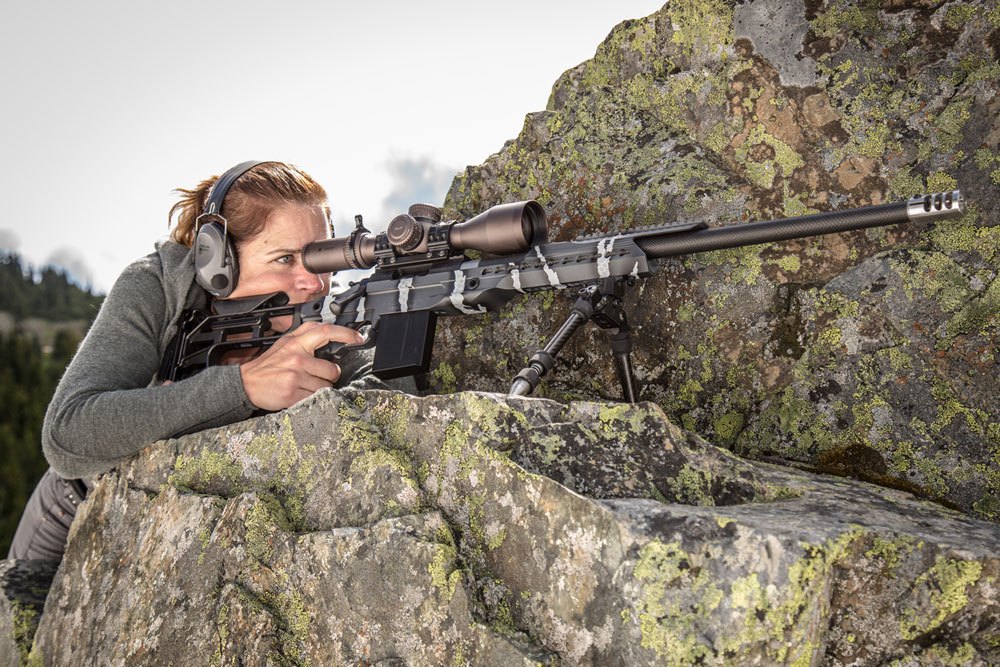
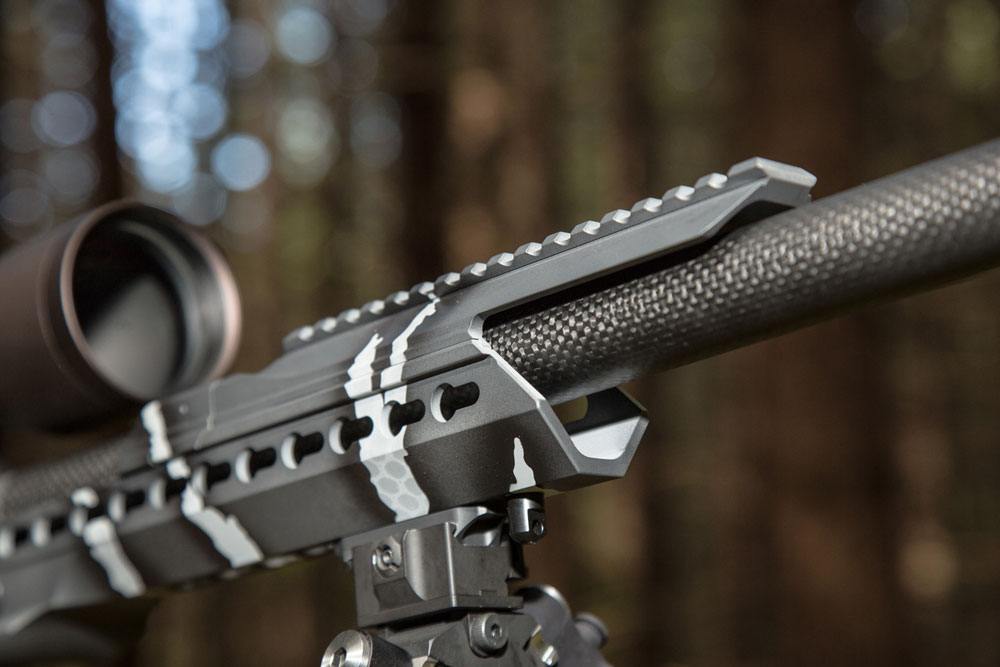
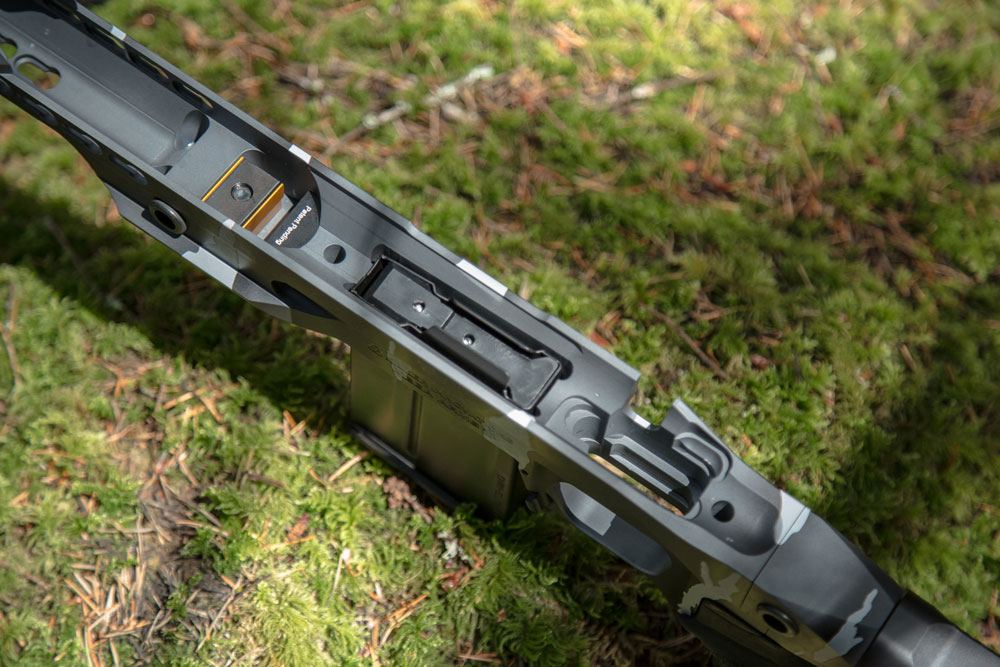
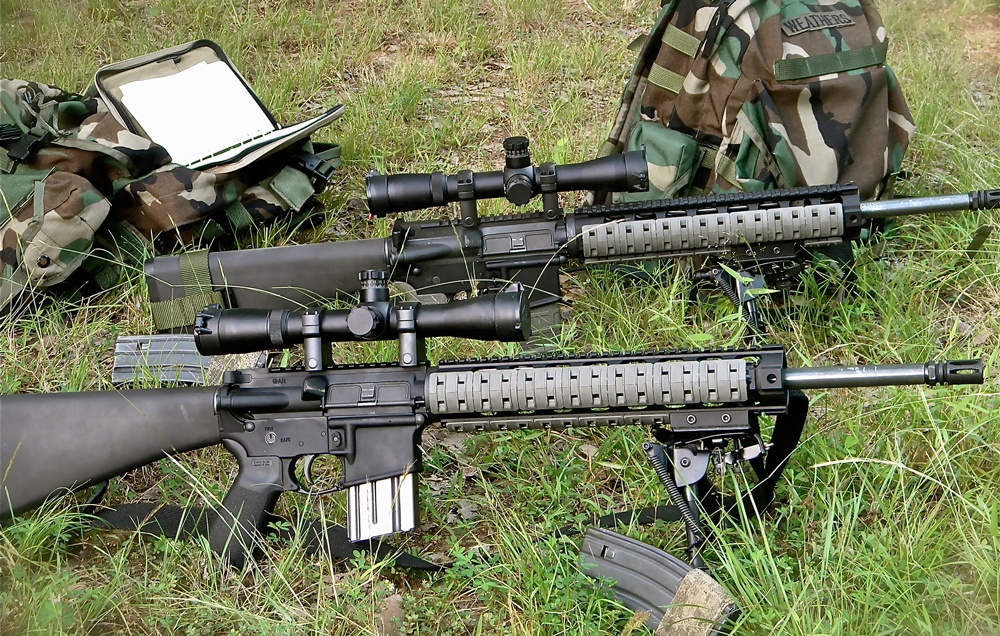
Get the most out of your black rifle with these excellent new AR optics, many purposefully built for America’s favorite rifle.
Sure, you can shoot your AR with iron sights. You might even hit your target. But why take chances? Why not top your favorite black rifle with a scope, a red dot sight or even a night vision sight — AR optics designed to do exactly what you want them to do?
The good news is that you’ve got lots of great choices. Whether you want a close-quarters sight that allows instant target acquisition or something that offers tack-driving precision at long ranges, there’s something out there just for you.
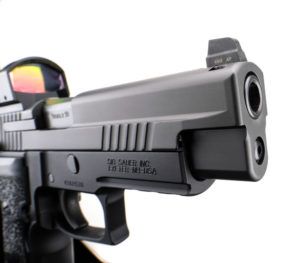
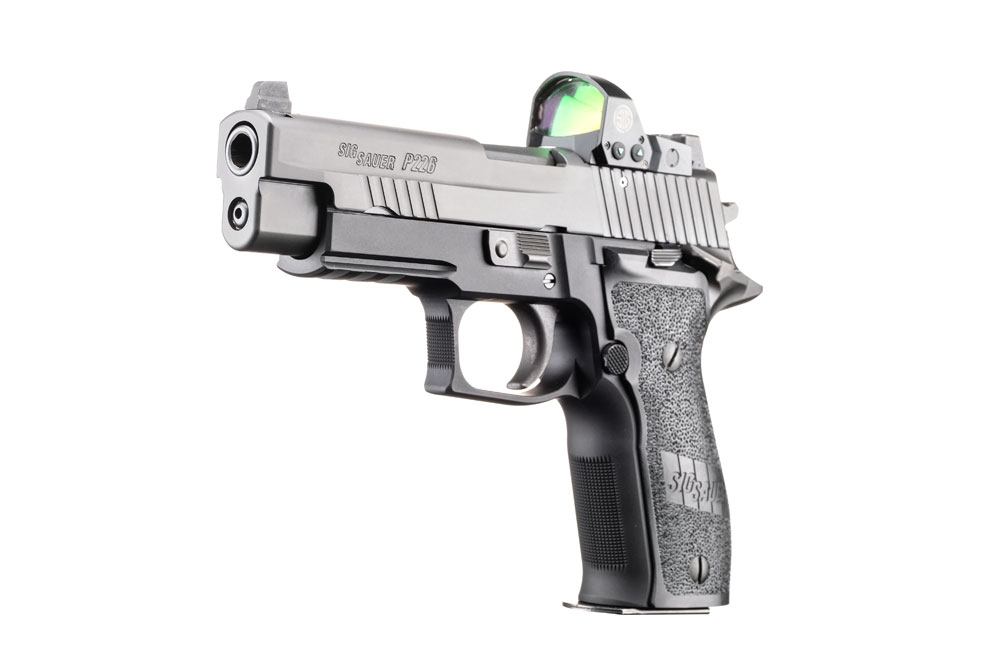
The SIG Sauer P226 RX mates the excellent Romeo 1 red dot to the manufacturer’s classic defensive handgun.
In my Gun Digest book, Handgun Training for Personal Protection, published in 2013, I included a chapter on red dot sights. The first line of that chapter read, “Breath deep and you can smell the future.”
From there I went on to describe what a red dot sight was and gave a lot of credit to former XS Sights pointman Dave Biggers for pushing the concept of red dot sights on defensive handguns. I concluded the chapter with, “The future is coming. When it gets here, we will all shoot better and faster.”
Sometimes it seems like the future is a long way off. In this case, it’s already here.
Yes, I know, for some time various firearms manufacturers have offered handguns that are reflex sight-ready. However, with SIG Sauer stepping into the optics world with both feet, the manufacturer became optimally positioned to address the issue.
For 2017, the company is offering a number of its defensive handguns either reflex sight-ready or equipped with a miniature red dot right out of the box.
What’s a Red Dot?
Before delving into the future SIG has brought us, we first need to understand what a red dot sight is. “Red dot” has morphed into a term to describe any compact, zero- to low-magnification optical sight with an illuminated aiming point. Kind of like how the word “Coke” is often used to describe any cola.
True red dot sights are reflex sights. The dot is an LED (Light-emitting diode) projected onto a lens. There are essentially two styles of reflex sights. One is very compact and L shaped; the other is tube shaped, similar to a conventional riflescope.
With the L-shaped sights, the beam from the diode is exposed to the elements, and this means dirt and such could obstruct it. With the tube designs – which are much larger – everything is contained.
Red dot/reflex sights are not to be confused with holographic sights. A holographic sight has a photograph of a reticle sandwiched between layers of glass. The reticle is illuminated by a laser beam projected into the glass.
SIG Sauer offers two reflex sights and several red dot sights. The company’s “tube” models are what they call red dots.
SIG’s smallest reflex sight is the Romeo 1. It is 1.8 inches long and weighs less than an ounce. It also has a 3 MOA red dot, five brightness settings and is powered by a CR1632 battery. The Romeo 1 has motion-activated technology that powers it up when it senses motion and powers the unit down when it does not. Given its minuscule size, it’s the perfect optical sight for SIG Sauer to match to some of its pistols.
The RX Line
SIG Sauer’s aptly named RX line – RX is defined as: A remedy, cure or solution for a disorder or problem – will soon encapsulate most of the SIG Sauer Classic Series pistols, including the 220, 226, 228, 229 and even the 320.
These pistols will ship with the Romeo 1 sight installed. If the owner wants to remove the sight at some point, SIG Sauer will offer a plate to fill the gap left in the slide. (The slides on these pistols will be machined to accept the lowest possible mounting of the Romeo 1 sight.)
The Romeo 1 is parallax free. This means you don’t have to have your head directly behind the sight, and the dot does not have to be in the center of the sight window, for you to hit what the dot is on.
You just put the dot on the spot you want to shoot and pull the trigger. Until you have actually fired a handgun with a red dot sight, don’t knock it. You simply have to experience it to believe how fast it can be and how much it can improve your shooting.
You see, like with a laser, the red dot sight allows you to maintain a target focus and keep both eyes open; you won’t have to line up a rear sight with a front sight, and then line both up with the target. (This is the problem SIG Sauer’s RX pistols cure.) Yes, there is a learning curve, but hands down, when it comes to speed and accuracy, the reflex sight is the most intuitive sight system available for a handgun.
The problems with the reflex sight are threefold. It makes the handgun larger, and holster selection becomes problematic (this should be rapidly changing).
Secondly, to be suitable for personal protection, the handgun’s sights must remain useable while the sight is in place. It may become broken or covered in debris and unusable (SIG Sauer uses higher than normal sights on its RX pistols to allow them to be used with the reflex sight in place).
And finally, reflection from dust on the lens can become an issue in harsh lighting. So, with holster makers solving the first issue, and SIG Sauer addressing the second, in time I suspect technology will take care of the third.
The P226 RX
The SIG Sauer P226 was designed for the military, is used by elite forces, and has proven to be a first-class combat pistol. SIG Sauer currently offers nine different versions, including one chambered for the .22 LR, priced from $630 to $1,413.
The P226 RX is chambered for the 9mm Luger, and it features an alloy frame, stainless slide with a Nitron finish and an accessory rail.
The RX identifier means this pistol comes with a SIG Sauer Electro-Optics Romeo 1 reflex sight. The top of the slide has been machined to position this sight as low as possible, and taller than normal three-dot Tritium suppressor-like sights are fitted to the slide to allow for their use in case the shooter prefers, or in case the optic might fail.
The P226 RX SIG Sauer sent for review was the SAO version. It comes with an ambidextrous safety and has a very good single-action trigger, with a pull weight of 4.5 pounds.
Of course, the SIG P226 is nothing new; the pistol has been around since 1980, and the SAO version since 2013. What I wanted to see was how well this pistol would shoot, and how much better, if any, I could shoot it with the reflex sight as compared to the fixed sights.
The first thing I did was test five different loads from a sandbag bench rest at 20 yards, firing three, 10-shot groups. The results can be seen in the accompanying chart, but two things are notable.
First, the pistol shot very well with the reflex sight, averaging 1.56 inches for all 15 of the 10-shot groups. Secondly, by shooting several more 10-shot groups using the fixed sights, I found that the use of the reflex sight reduced group size by 25 percent.
Several groups were also fired at 50 yards using both the reflex and fixed sights. At that distance, the reflex sight performed 39 percent better than the fixed sights!
I also subjected the pistol to my favorite defensive handgun drill, which I call the 45 Drill. In this drill, the object is to get five hits inside a 5-inch circle, at 5 yards, in less than 5 seconds, starting with the pistol holstered and concealed.
Using the reflex sight, my average time for this drill was 3.88 seconds. With the fixed sights, my average time was 3.92 seconds. Now, this might not seem like much of an advantage, but like I mentioned, there is a learning curve with reflex-sighted handguns, and I am at the low end of that loop.
For some it might seem a large leap to commit to a reflex sight on a defensive handgun, and that’s understood. Plastic pistols like the Glock and electronic sighting systems like lasers were once considered a leap of faith, too.
Both have since proven their worth, and I think the reflex sight on a defensive handgun will ultimately do the same. Oh, by the way, I fired almost 500 rounds through the P226 RX using five different munitions, and there was not a single stoppage.
Back to the Future
Largely, civilian defensive handgun trends are driven by law enforcement. Law enforcement’s resistance to change is just the nature of the beast.
Those in charge are generally long-term officers who learned to do things a certain way, with certain types of gear. Until they’re convinced otherwise, or until they’re replaced with the next generation, change will be slow. Compound this with the fact that money matters, and it’s hard to get a government agency to spend the kind of money needed for reflex-sighted pistols.
For us average folk, cost will always be an issue, too. SIG Sauer’s RX line of pistols should retail for around a thousand bucks depending on the model. And, that includes the Romeo 1 sight, which has a suggested price of $359.99.
The future is coming. Some of it is already here. Prepare to shoot better and faster.
Specifications:
SIG Sauer P226 RX Caliber: 9mm Luger Barrel: 4.4 in. Length: 7.7 in. Weight: 34.4 oz. Height: 6.4 in. Sights: Three-dot tritium, high profile fixed sights, Romeo 1 reflex sight. Finish: Hard coat anodized (frame) Nitron (slide) MSRP: $1,359 Manufacturer: SIG Sauer; SIGSauer.com
Practice makes perfect, unless it’s the wrong kind of practice. And from the standpoint of prepping for defensive handgun use, dry reload practice might be more of a hindrance than help.
It’s tempting to practice your reloads to make them faster. Many in the business will prescribe such things as weighted dummy practice magazines, or real magazines loaded with Snap-Caps or weighted dummy rounds, to practice with.
My experience doing this in a competition environment was not altogether successful: While I got really fast at the manipulation part, that didn’t help everything else that went along with the need to reload my gun.
What I see with most students is that the recognition of slide lock – the indication to perform the learned skill of reloading the gun – is usually (and usually by far) the most inefficient part of the process.
That brief period of time while they stop to analyze what happened and then decide to initiate that reload almost always exceeds the time they shaved on the manipulation portion by doing endless dry repetitions of the reload. It was certainly the case with me.
Dry practice omits that stimulus of achieving slide lock in a string of fire. In dry practice, the slide is pre-locked to the rear; there is no stimulus of the slide dynamically locking itself to the rear, no change in recoil pattern because of the difference in weight distribution and no sensation of the slide failing to return to battery.
All of those things, taken together, are what tell you that your gun is out of ammunition and needs to be recharged. Without that, you have to spend time analyzing why the gun isn’t running and then decide to initiate the reload. With that stimulus, you can use the brain’s ability for recognition and recall to make that decision (and execute that decision) far more efficiently.
I’ll recommend some dry practice simply to get used to the mechanics of the reload, particularly if the student is having trouble in that area, but beyond that I believe it’s far more important to practice that skill in context, in the manner that you’ll actually need to use it.
That means shooting to experience slide lock and developing the ability to perform the reload in direct response to that stimulus, without cognitive thought. The only way to do that is to use live ammunition on a real range.
In Defensive Pistol Fundamentals, Grant Cunningham discusses the concepts, skills, and equipment you’ll need to overcome this worst-case scenario. While the concepts and skills discussed can certainly be utilized while using a variety of different firearms, this guide specifically covers the use of a semiautomatic pistol. Get Your Copy Now
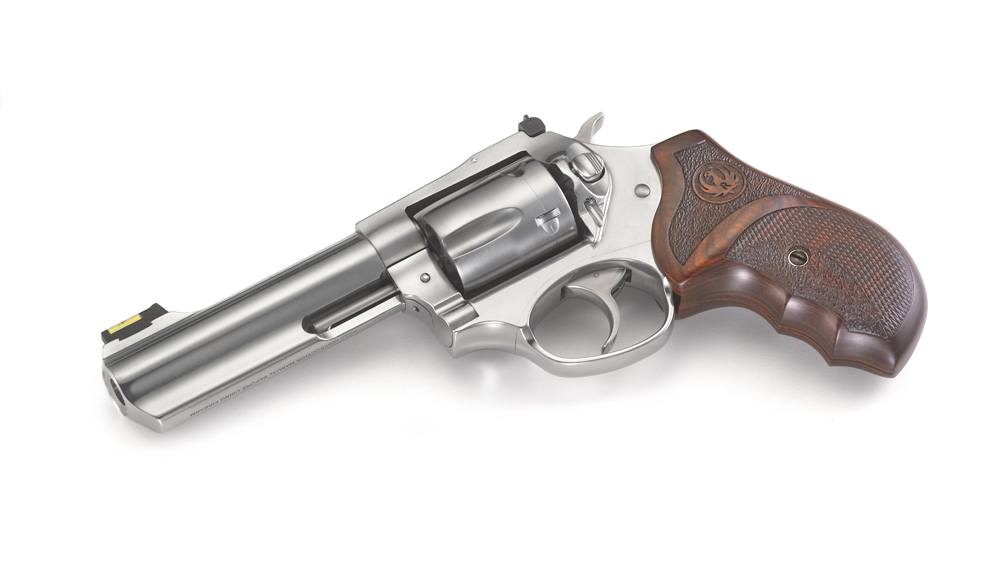
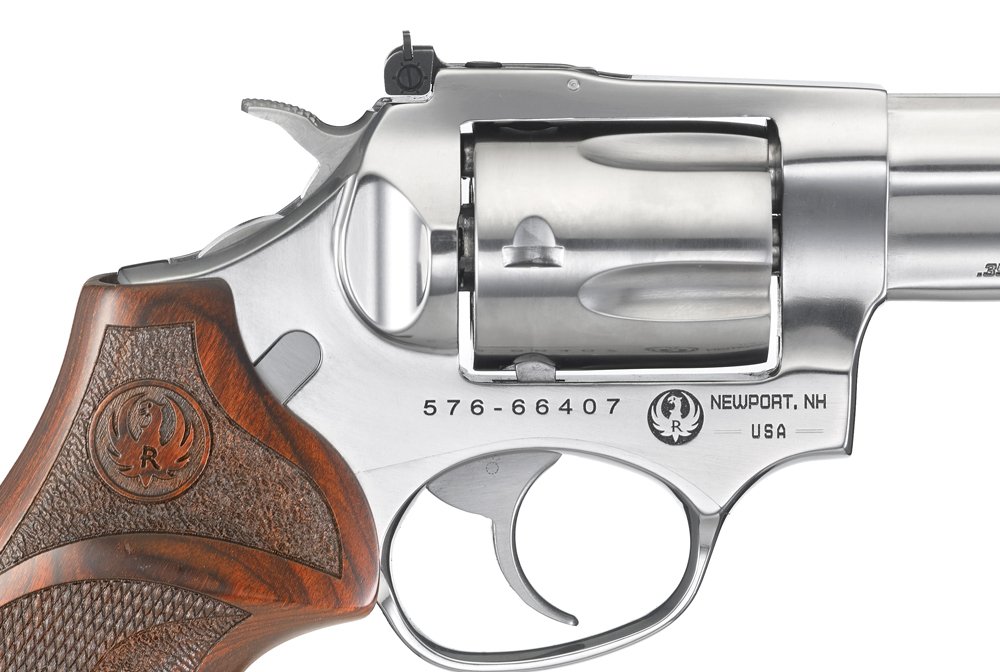
Optimized and race ready, Ruger’s new SP101 Match Champion should hit the target with competitive wheelgun shooters.
Ruger has built great renown with its revolver lines. Single or double action, they’re known to be tough-as-nails and dependable as daybreak. Only thing was, until recently, if you were looking to race them, well you’d better break out your wallet.
That is because, for the most part, they required a bit of tinkering to make them competition ready. This changed in a big way a few years back with the New Hampshire gunmaker’s release of its purpose-built competition revolver — the 9mm GP100 Match Champion. And Ruger has followed up recently with a new model, which has plenty of potential for grabbing competitive shooters’ attention – if for no other reason than its caliber.
The newly released SP101 Match Champion is chambered for one of the most popular competitive revolver rounds, the .357 Magnum. This gives competitors an option that will make the major power factor each and every match. But Ruger has provided a litany of other reasons to give this shining thoroughbred a serious look aside from its chambering.
While the lively handling 4.2-inch full-lug barrel is what might catch most shooters’ eyes, it’s what can’t be seen that really separates this revolver from the rest of the SP101 line. Ruger has given the handgun’s internals the works, polishing and optimizing the springs and hammer strut. Combined with trigger and hammer shims, the SP101 Match delivers a smooth double-action trigger pull complete with a consistent let off.
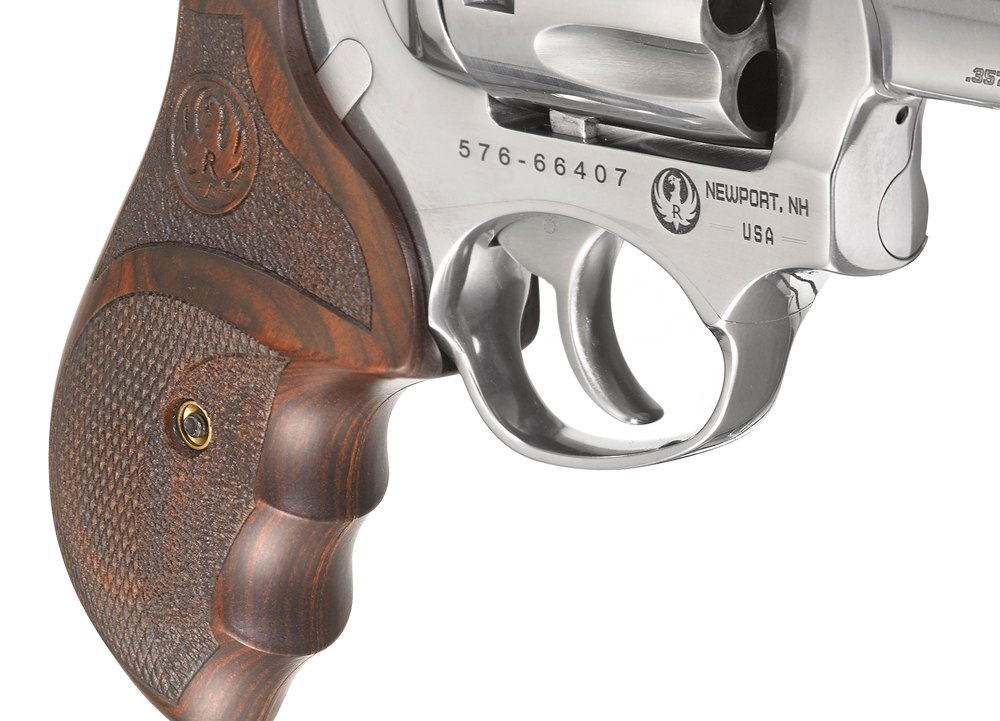
The revolver’s triple-locking cylinder has also been enhanced, chamfered to make reloads that much speedier. The barrel has been cut with an 11-degree target crown to ensure competition accuracy. And the gun comes outfitted with attractive Altamont hardwood grips that feature fairly aggressive stippling and checkered sides to facilitate a solid, positive grip no matter the conditions. Finally, the SP101 Match boasts a fully adjustable rear sight and a fiber optic front, which should give shooters a clear target picture, even on the fly.
Like the rest of the .357 Magnums in the SP101 line, the Match Champion variation holds only five rounds. This could put off some competitors, as it means they will be fighting the clock more with reloads than those wielding six shooters.
Given the extra work Ruger has poured into the SP101 Match Champion, it costs a hair more than the average revolver from the line. But with an $859 MSRP, the handgun is still a fairly affordable option for those looking for a revolver ready to race out of the box.
Specifications:
Ruger SP101 Match Champion Grips: Altamont Stippled/Checkered Hardwood Front Sight: Fiber Optic Barrel Length: 4.20 in. Material: Stainless Steel Capacity: 5 Rear Sight: Adjustable Twist: 1:16 in. RH Finish: Gloss Stainless Overall Length: 9.12 in. Weight: 30 oz. Grooves: 5 MSRP: $859.00
A relatively new ammunition maker, HPR has shaken up the shooting world producing affordable, high-quality ammo to send down range.
While packing up after an extended range session, I turned to my friend and said, “It looks like I’ll be spending the week reloading; I’m getting low.” Not my favorite activity but a necessary evil for the high-volume shooter.
Over a decade ago, I turned to handloading because, first, I needed clean, accurate ammo, and second, I couldn’t afford the ammo that complimented my ability. Ten years ago, these were my only options. Today, however, we have better options — we have HPR.
With the manufacturer’s first rounds rolling off the line in 2010, HPR has shaken up the industry with quality, affordable ammo. We set out to evaluate the company’s entire line, which has grown vastly since its initial offerings of ball ammo in 9mm, .40 S&W and .45 ACP.
To understand HPR, one needs to understand their roots. In 2008, after the market crashed, the Antich family set out for a new business venture, and, lucky for us, they decided on ammo. After acquiring a small production plant in Payson, Arizona, the High Precision Range (HPR) ammo brand was born.
Utilizing the decades of experience that aeronautical engineer Jeff Antich acquired through his work with Lockheed Martin on projects such as the F22 Raptor, precision and repeatability are built into every round.
There are three cornerstones of the HPR brand: It’s all-American, load-specific and performance driven.
All American HPR ammo is made from the best American components and is inspected by U.S. citizens. Right down to the packaging, this ammo doesn’t have to travel very far to hit your shelves. Not only is HPR’s quality control paramount, the company is committed to American-made quality.
Load Specific Each offering is made for its target application. HPR didn’t buy into the one-size-fits-all theory of making factory ammo. Rather than just splitting the difference, HPR has optimized each and every powder charge.
Let’s start with a look at its basic JHP line. The .380 ACP JHP round is developed to produce reliable expansion at a low velocity to allow fast follow-up shots on the tiny pocket pistols that dominate that market. The .357 Magnum is designed to be among the hottest loads on the market, ensuring ethical harvests on game.
For our friends concerned with their hearing, the Emcon line was created specifically for suppressor use. Rather than poke and pray, HPR created this line with not only their own ballisticians but the engineers at SilencerCo as well. Each load is developed for a purpose.
Performance Driven The manufacturer’s newest line, Black Ops, highlights this final aspect of the HPR business model. The Black Ops line consists of the company’s proprietary OTF bullet. The OTF, or open-tipped frangible bullet, is loaded into a nickel-plated case and charged with the correct power charge to reduce muzzle flash and flip.
All components ensure that you come out ahead in low-light situations. The nickel plating makes nighttime chamber checks a breeze, while the powder produces little flash that would damage night vision or cause temporary blindness. However, nothing can steal the show from the projectile that is designed to separate on impact and transfer 100 percent of its energy into the target, while minimizing the chance of overpenetration.
Range Day Having worked with OTF rounds, we requested some of HPR’s new .300 BLK ammo, ball 9mm and .45 ACP JHP. After opening the UPS box and looking down at some of the most elaborate packaging that I have ever seen ammo in, range day wasn’t far behind.
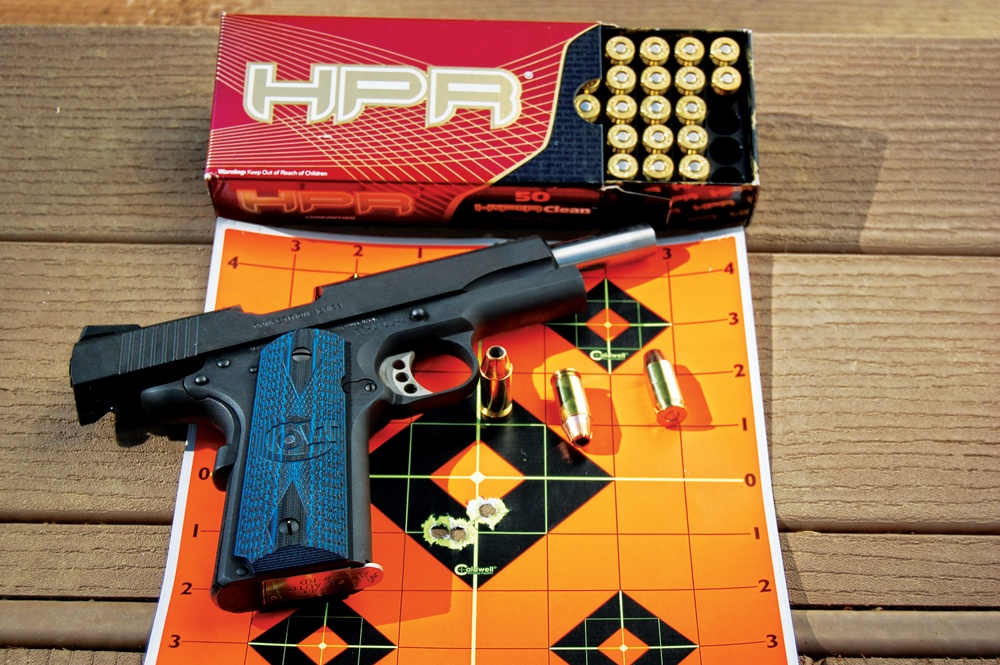
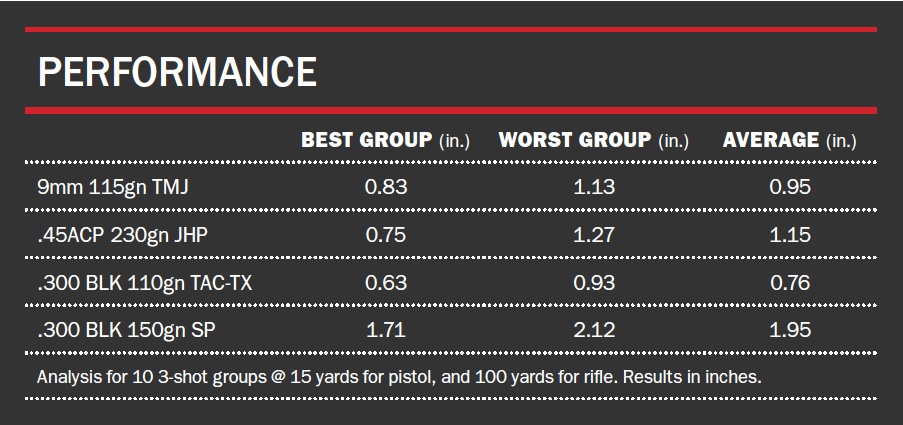
The first round tested was the 230-grain JHP in .45 ACP. The chosen test gun was Colt’s new Competition pistol (Colt.com, $899). The ammo functioned flawlessly with the absence of the common failure to feed issue that this combination of pistol and ammo is commonly plagued with. Accuracy was impressive, with the best 15-yard group coming in at just .75 inches.
After the success of the .45 ACP test, we turned over to the 115-grain TMJ in 9mm. Satisfied with the performance from a match-grade pistol, we utilized a Canik TP9 (Canik55.com, $399). The Canik has a well-earned reputation as the best value in poly striker-fired pistols, and this test only further proved that testament, as our first group downrange measured .83 inches. This wasn’t far off from every other group sent downrange that day.
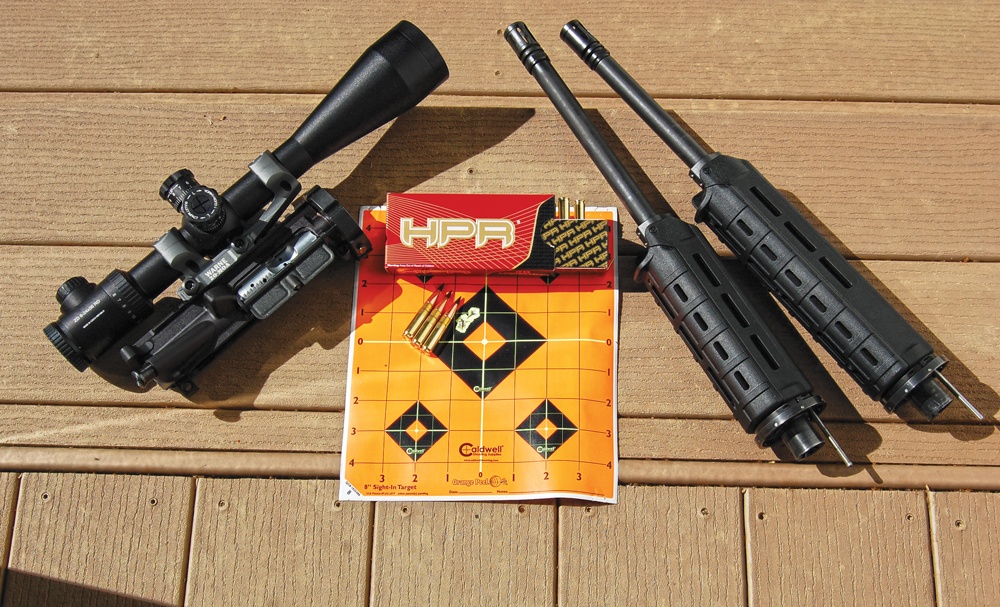
On the same day, we tested the .300 BLK rounds. For the rifle, we utilized the revolutionary WAR LOCK system from Frontier Tactical (FrontierTactical.com, $1,200). This new modular design allows you to simply swap barrels without changing the entire upper. This system saves you money on optics, bolt carrier groups, charging handles and anything else that you might have to buy two of when changing the entire upper.
Using the company’s 18-inch .300 BLK barrel, we topped our test rifle with a Meopta ZD 6-24×56 tactical scope (MeoptaSportsOptics.com, $2,070) set into a Warne LRSKEL30TG one piece mount (WarneScopeMounts.com, $140). The 24x optic ensures perfect sight picture, while the mount ensures position repeatability. At 100 yards our rifle rested in “The Rock” shooting rest, courtesy of Caldwell (BTIBrands.com, $110).
The first rounds downrange were the 110-grain TAC-TX loading. Flawless cycling and astonishing accuracy were the byproduct of these carefully selected and blended components. These rounds rivaled my best handloads with groups as small as .63 inches on the 100-yard target. There was no questioning that the 110-grain bullet is a perfect match for the 1:8.5-in. twist barrel.
Our final test round was the 150-grain soft point. The group on these opened up a bit but was still a respectable 1.71 inches. The intended purpose of this round is deer and hog hunting, which makes that minute of accuracy trade-off for a faster follow-up shot a no brainer.
Final Analysis The HPR rounds fired and functioned very well in many different firearms and platforms. At just a few dollars more a box, it isn’t a substantial price difference for match-grade ammo. It is very clean burning, making life easier when you get home and dig in for cleaning and maintenance.
Be sure to pick up a box or case next time you hit the range. On the range and on the cleaning bench, HPR simply provides a better shooting experience.
Getting a grasp on where an assailant must be shot to neutralize a threat and the power needed from a concealed carry handgun to do so goes a long way in making informed choices when going armed.
The object of carrying a firearm as a matter of daily routine is based on the conviction that you have the right to defend your life or the life of someone else. While it’s certainly true that the presence of a firearm can prevent violence from happening by discouraging a would-be assailant, the mere presence of the firearm isn’t always enough, and sometimes deadly force must be used.
When this decision has to be made, the object is to stop the aggressor quickly before he can harm you or someone else. Until technology develops Star Trek-style “phasers” that can be set to “stun,” this means imparting enough damage to the perpetrator to cause him to cease aggressive activity.
Some individuals cease aggression when confronted with a firearm. Some give up when shot, no matter how serious or trivial the wound.
Unfortunately, some aggressors don’t stop until they’re physically unable to continue. When I was growing up, I got the impression that any time someone was shot, they simply froze and fell down, incapacitated. On television, Matt Dillon almost always shot the bad guy in the stomach and the bad guy would grasp the wound, look stunned and fall dead.
Sometimes the person who was shot would survive, but they almost always fell to the ground and became immobile. In later TV shows and movies, the gunshot victim would be thrown across the room or spin around as if hit by a baseball bat and fall. Apparently the modern prop guns are much more powerful than the ones Matt Dillon and The Rifleman, Lucas McCain, had access to.
A shot to the brain stem will cause instant incapacitation because it interrupts the ability to breathe and control voluntary movement. A shot that severs the spinal cord above the base of the neck will prevent voluntary movement of the arms and legs.
While a shot fired to any other part of the body other than the central nervous system can cause the assailant to cease aggression, there’s no certainty that it will.
Loss of blood will also incapacitate an assailant, but the result will not be instant. The body contains about five liters of blood, and a person must lose about two liters before losing consciousness.
Severing the aorta will cause the assailant to bleed out in the shortest possible time, but will still allow voluntary action for at least five seconds. Any deer hunter can tell you a heart-shot deer can run a hundred yards.
An aggressor with his heart shot out can still have time to kill you and others in your family. Wounds to major arteries can cause death, but it won’t be instant.
Having said this, a high percentage of humans cease aggression after receiving a single gunshot, even if it’s not a fatal wound. The cessation of aggression isn’t because the body is incapable, but because the mental and physical shock of the gunshot effectively takes the fight out of the aggressor.
Individuals with their systems pumped full of adrenalin or drugs are much less likely to give up when dealt a lethal blow. The problem is you can’t count on the cessation of aggressive behavior after one shot.
The old argument was that high-velocity handgun rounds could produce hydrostatic shock that would affect neural function, effectively stopping the assailant instantly. The first mention of pressure waves and the human body that I could find in the scientific literature was presented by E. Harvey Newton and his research group at Princeton University in 1947.
Under the theory of hydrostatic shock, a high velocity bullet created hydraulic shock waves in the body, and these shock waves did collateral damage to organs not directly contacted by the wound channel.
While the concept of hydrostatic shock is generally accepted, there are detractors. My personal opinion, based on multiple post-mortems of whitetail deer and feral pigs, supports hydrostatic shock as a factor, but the example of the deer who runs off after his heart has been turned to jelly illustrates that hydrostatic shock isn’t something that will always provide the stoppage of a drug-crazed assailant.
Compounding the problem for the concealed carry citizen is the fact that few handguns suitable for daily carry produce enough velocity to produce the level of hydrostatic shock the experts agree will sufficiently and consistently cause enough neural disruption to produce hydrostatic shock, much less instantly stop an assailant.
Studies show some evidence that hydrostatic shock does produce results, but not consistently enough to count on. With sufficient penetration, there can be neural effects from gunshot wounds from handguns, but there’s no certainty of instant stoppage, and instant stoppage is the desired effect.
The upshot of all this is there’s simply no way to instantly stop an assailant other than hitting the brain stem or spinal column. Even a shot to the lobes of the brain doesn’t always produce an instant or even fatal result.
Having said this, it would require skills very few possess to accurately place such a shot, much less do it under the stressful conditions of self-defense.
Faced with these facts, it becomes obvious that there’s no magic formula for instant incapacitation other than a feat of almost superhuman marksmanship. The brain stem or that tiny section of spinal cord is simply too small a target to be considered a good choice.
The military and law enforcement choose to put their emphasis on a less difficult target area, from the base of the neck across the chest down to the base of the sternum. Within this area are the heart and lungs as well as the spinal column.
Any shot from an adequately-powered firearm delivered in this area is likely to be lethal and also likely to deliver enough punch to take the fight out of all but the most determined attacker. About the same size as the A zone on most competitive shooting targets, this area is well within the capabilities of a practiced shooter at the distances where most civilian defense situations occur.
While most vulnerable organs are centrally located in an area large enough for an accurate shot to find them, they’re fairly well protected by the skeletal system. For a straight-on shot, the sternum protects the spinal column and much of the heart, which also happens to be the best target.
Like much of creation, the human body is well-designed to protect the most vital areas. Certainly, there are many handgun calibers capable of penetrating the sternum, but the sternum is capable of protecting vital organs against smaller, less effective calibers.
According to military studies, the third-most-likely target to disable an assailant is the pelvic girdle or the hips. Breaking a hip will certainly prevent your enemy from walking, but it won’t stop him from using a firearm. For that reason and because the likelihood the shot won’t actually stop the bad guy by breaking his hip, it’s suggested that targeting the pelvic area isn’t a good idea.
Almost anyone can manage a level of proficiency that will allow hitting the targeted chest area from normal defensive distances. In teaching the North Carolina Concealed Carry Certification, I’ve learned almost everyone can keep 90 percent of their shots in an 8-inch area at 7 yards.
Of course, this is shooting in good light conditions, with plenty of time, and under no stress other than the normal stress beginning shooters have when shooting for record for the first time in their lives.
In order to perform reasonably well under difficult conditions, most people need to be able to perform very well under optimum conditions. It’s not at all unusual for a police/criminal gunfight to involve several shots fired with no one getting hit, and police generally spend more time in training than civilians.
The best preparation for the armed citizen is to train enough to be confident and comfortable with their carry gun and choose a gun with reasonable stopping power while being small and light enough that it’ll be comfortable to carry every day.
To review all this, we know the only area that’s certain to instantly stop an assailant is too small to target under almost any imaginable set of circumstances. We also know the second choice is large enough for a person of average expertise to hit, but that area is fairly well protected by bone structure.
Based on this information, the well-prepared armed citizen should focus on carry and gun handling skills, marksmanship and carrying a firearm with enough power to penetrate the sternum. Under these circumstances, it’s reasonable to say the concealed carry citizen is properly prepared.
Are you interested in carrying a handgun for self defense, but don’t know where to start? Perhaps you’re already an armed citizen and are looking for a new carry choice? Let the Gun Digest Guide to Concealed Carry Firearms be your complete guide to the fast-growing world of concealed carry handguns. With practical, real-world advice and insight from an author with decades of experience, this guide can help you make the best possible choice for a concealed carry handgun. Get Your Copy Now
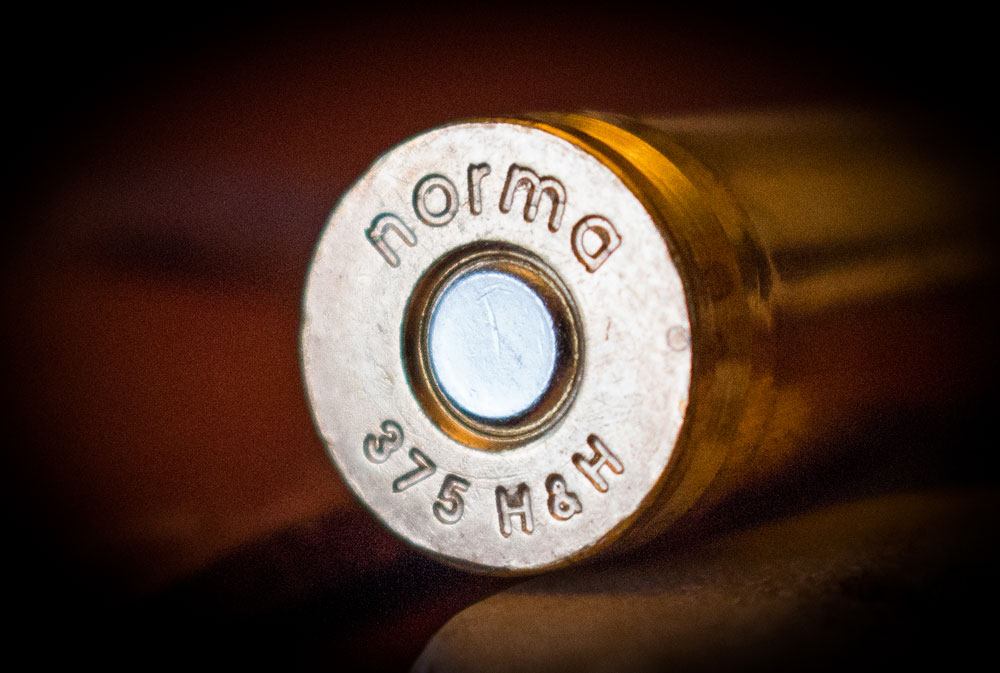
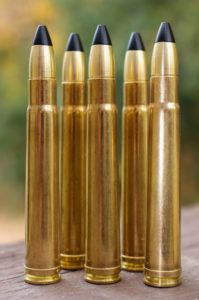
An eminently flexible cartridge, the .375 H&H Magnum is suitable for a wide array of species.
All-around cartridge.” Three simple words, yet the fuel for campfire arguments heard ‘round the world. It’s a subjective phrase; and the answer truly lies in what your shooting or hunting situation dictates.
To some, it may be the .270 Winchester or the .30-06 Springfield, maybe a .300 Winchester Magnum. But if you enjoy hunting the largest creatures on earth, you may need a little more, in terms of both bullet weight and bore diameter; even in the large-bore circles, the same argument will rage.
Undeniably, the .375 H&H Magnum will certainly pop into that conversation, as it represents two things: first, a cartridge that can take any game animal that walks, and second, the recoil produced by this cartridge can be at the top end of a shooter’s tolerance.
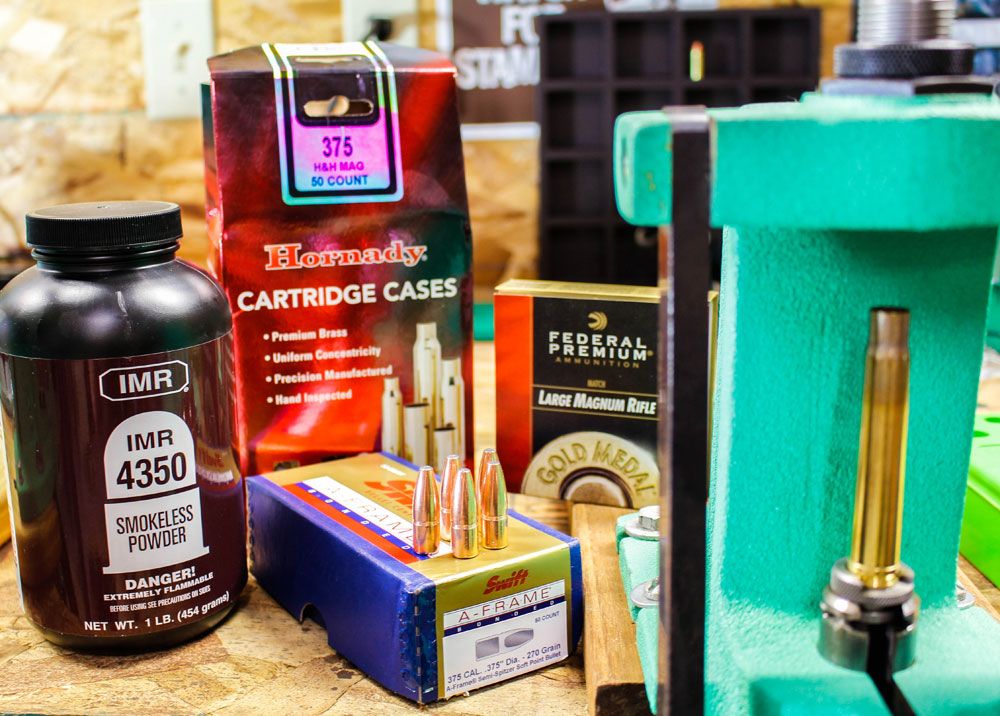
I’ll be the first to admit that the .375 H&H has some wonderful factory ammunition choices — I absolutely love the Federal Premium Trophy Bonded Bear Claw load, as well as the Norma Oryx 300-grain load — but it truly comes to life when handloaded. It is very flexible as a caliber; there are bullets available weighing from 235 grains up to 350 grains, and they are all very useful in the hunting fields.
One of the beauties of the .375 H&H Magnum is this flexibility: It can be used on deer and deer-sized game, it makes an excellent bear gun — irrespective of species — and handles all African game, including elephant. Common bullets weigh 235, 250, 260, 270, 300 and 350 grains, and all have their place in the hunting world.
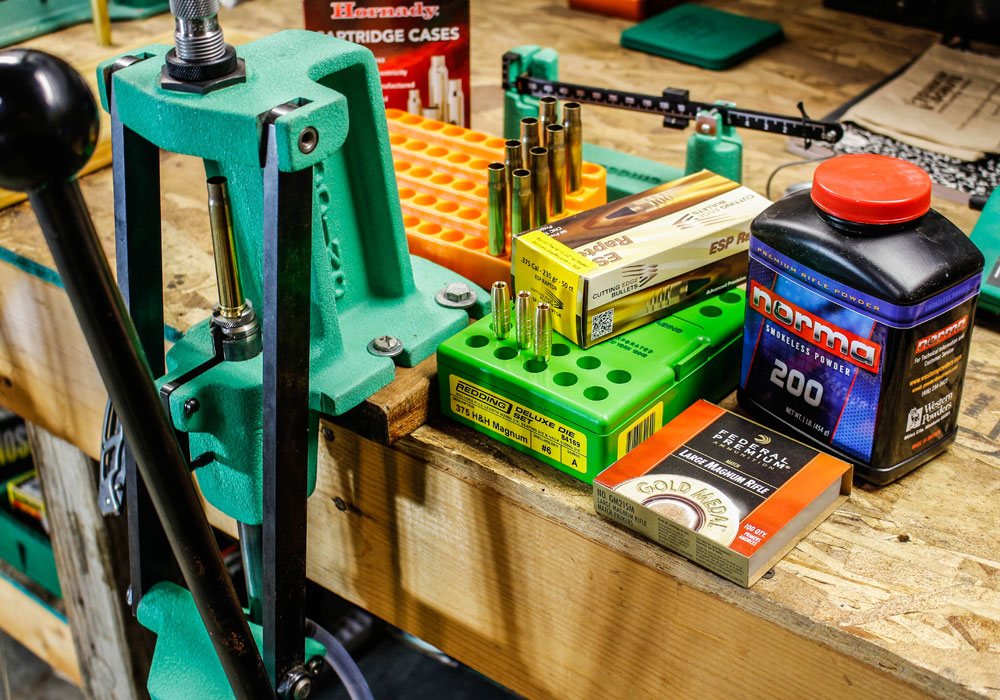
I’ll illustrate some examples of my favorite loads and loading techniques, from lightest to heaviest. All my .375 H&H Magnum loads are sparked by a large rifle magnum primer, and I use the Federal Gold Medal Match GM215M almost exclusively for this cartridge.
NOTE: Make sure before trying any of the loads I’ve listed, that you consult your reloading manual and work your way up from the minimum, checking for pressure signs along the way and stopping should you find dangerous pressures before I did.
Among the 235-grain bullets, I like a couple specifically.
The 235-grain Speer HotCor is an affordable and effective practice tool, especially for someone who wants to become familiar with the H&H without all the recoil. It’s been tried in the field and has shown to be extremely frangible, even on deer.
The 235-grain Cutting Edge ER Raptor is an extremely effective hunting bullet, and when seated over a load of 61.0 grains of Norma 200 powder, will yield a muzzle velocity of 2,800 fps in a surprisingly easy-to-shoot combination. This load has been used for numerous plains game species — kudu, sable, warthog, zebra, wildebeest and more — as well as whitetail deer. It’s flat shooting and makes a perfect companion to the 300-grain loads.
The 250- and 260-grain bullets also make a good choice for lighter and medium game.
I’ve used a 250-grain Sierra Game King, over 67.0 grains of Hodgdon’s Varget, for an accurate and effective African plains game load, neatly taking gemsbok, hartebeest, reedbuck and steenbok; I’ve even used it for caribou, far up into Quebec.
The Nosler 260-grain AccuBond is in the same class — though it may fly a little flatter than the Sierra — and has also proved its worth and would make a great choice for elk and moose, or for distant eland and kudu. Seat that bullet over 71.0 grains of Alliant’s Reloder 15, and I’ll show you how much my Winchester 70 likes this load, putting three shots into ¾ inch, at a muzzle velocity of 2,680 fps.
I like the Hornady 270-grain InterLock, as I like many of the InterLock bullets, and I think it makes an excellent choice as a black bear load. Spire point, flat base, cannelure for crimping if you so choose, and enough structural integrity to hold together at moderate velocities, the 270-grain InterLock is an accurate and affordable bullet. My rifle likes the same load I use for the 260-grain AccuBond — 71.0 grains of Reloder 15.
This brings us to the 300-grain slugs, which are possibly my favorite among the lot. One of the beauties of the .375 H&H Magnum case is its ability to put different bullets to the same point of impact, within reason.
My .375s, especially the Legendary Arms Works Big Five, likes just about any 300-grain bullet over a load of 77.0 grains of IMR4350, and I mean nearly any bullet of this weight.
Though the load is within one grain of the listed maximum, it doesn’t seem to matter about bearing surface or lead core versus monometal; the gun just shoots this load. Soft points, solids, it doesn’t seem to matter — I’d pick a new bullet and work the load up from the bottom, and lo and behold, there would be the accuracy. Some of the longer monometal bullets may pose an issue with load compression, but I’ve been able to make it work with all but the longest designs.
If you’re not comfortable with the compressed load, my second choice for the 300-grain bullets would be IMR4064, but IMR4350 is my favorite. Depending on the bullet, that accuracy would run from ¾-inch three-shot groups to 1¼-inch groups; more than enough for a hunting rifle, and especially for a .375 H&H.
My favorites among the 300-grain bullets are the Swift A-Frame, Peregrine BushMaster, and North Fork semi-spitzer. Any one of the three would make an excellent choice for a Cape buffalo.
Switch to a well-constructed solid, and you’ve got good elephant medicine, and a good choice for hippo. Most of my 300-grain loads run at or about 2,525 fps.
If you choose to go heavy, say the 350-grain Barnes TSX or the 350-grain Woodleigh Weldcore, look to use a powder that takes up a bit less room. I like Hodgdon’s H4350, and I’ve had good results between 68.5 and 70.0 grains, reaching muzzle velocities of 2,250 to 2,275 fps, depending on which bullet you choose.
Case preparation is an important part of the process with the belted case; make sure you keep a good eye on the area just north of the belt, as this is where the most stretching occurs. I keep my cases trimmed to an even 2.850 inches, to match any and all new cases.
I’ve also found that the .375 H&H Magnum has enough neck tension that crimping is not necessary. It’s quite fine to crimp if that makes you comfortable, and a good seating die will give a good roll crimp — I like the Redding seater die’s crimping — but I really don’t crimp my .375 H&H loads often.
The firm of Holland & Holland gave us what I consider to be one of the few cartridges that are truly universal. I’ve used it all over Africa and North America and wouldn’t hesitate to take it on any hunt, anywhere.
The potency and flexibility of the cartridge is undeniable. It will run a diverse selection of powders, and with our modern bullets, it becomes even more versatile.
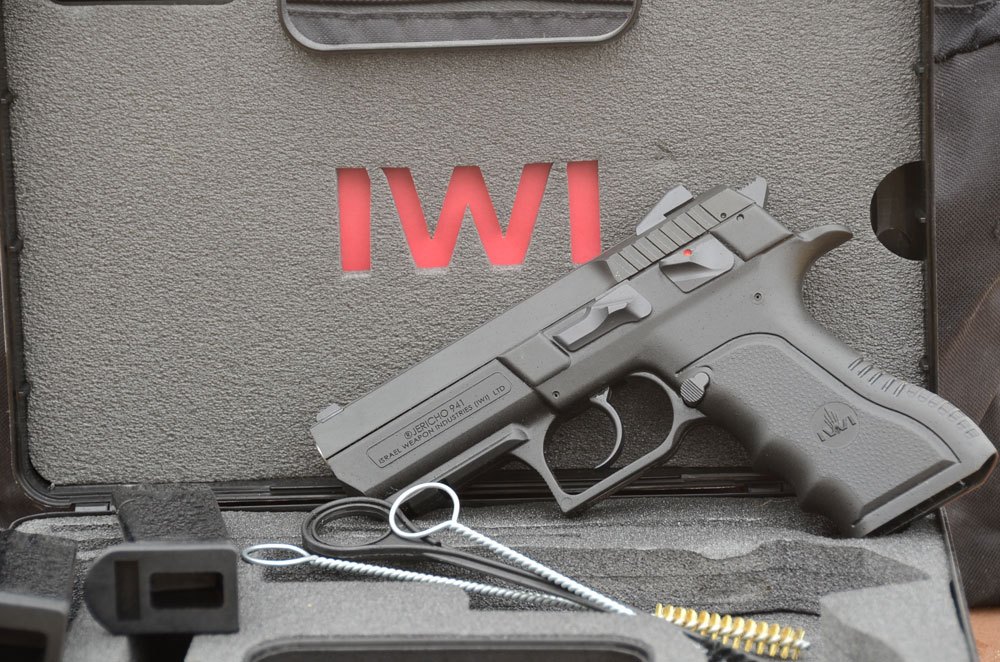
The 3.8-inch barreled IWI US Jericho 941 is a rugged little pistol that’s perfect for tactical and concealed carry applications.
IWI has a long-standing history of firearms manufacturing and development, dating back to 1933 when it was first known solely as Israel Military Industries (IMI). Working closely with the Israel Defense Forces, it created legendary weapons such as the Uzi and Galil, and more recently the Tavor, and of course the Jericho 941.
The firearms it turned out were designed to withstand the type of rough urban combat that the Israelis were constantly encountering. In 2005, the firearms side of the company was sold and renamed Israel Weapons Industries, or simply IWI, and began commercial sales of these classic firearms. Later in 2012, the Harrisburg, Pennsylvania based IWI US brought out the first civilian versions of the Tavor, and of course the modern Jericho 941 that we bring you today.
A Rocky Start
Originally released in 1990, the Jericho 941 had a rough start. The pistol gets its numerical designation from the two calibers that it could readily fire.
The end user had the choice of using standard 9mm, or the then-new .41 Action Express (AE) with a simple field conversion. Of course, with the commercial success and acceptance of .40 S&W, the .41 AE went the way of the dodo.
Ammo and conversion barrels for .41 AE eventually became next to impossible to find. With half the reason to buy this pistol being more than an arm’s length away, most believe this lead to its unpopularity.
Classic Roots
The pistol itself was a masterpiece. The Jericho’s design was based off the venerable CZ-75.
This gave way to perfect function and ergonomics. Aesthetics were certainly slick, with the gun having a resemblance to a scaled down Desert Eagle.
This eventually earned it the nickname “Baby Eagle,” even though they had nothing to do with each other. The all-steel design was also very pleasing to purists who have had to endure the rapid emergence of the polymer-framed pistol market.
Today’s Jericho 941
Today, IWI US brings us its most updated series of the Jericho pistols. The pistol is available in both its original steel-framed version as well as a modernized polymer frame.
Abandoning the now obsolete .41 AE, each version is available in either 9mm or .40 S&W. The mid-sized steel pistol also gives an option of .45 ACP for a little extra kick from the waistband.
Both the steel and the polymer-framed pistols are available in either a full-sized version sporting a 4.4-inch barrel or a mid-sized version with a reduced barrel length of 3.8 inches. For testing, we were loaned a polymer mid-sized gun in 9mm ($559 MSRP).
The Jericho still retains the original double-action/single-action configuration it was introduced with. Along the slide, you will find a cross block safety in lieu of a de-cocking lever.
I found this desirable, as it gives you the option of carrying it locked and cocked or hammer down. Without getting into the debate over the two, I thought it was nice to see both schools of thought taken care of on the same platform.
Trigger squeeze broke in single action at 5 pounds, 2 ounces, while in double action, it required 11 pounds, 6 ounces of force to make it go bang. This is no doubt to reduce the chance of accidental discharge should you have a threat at gunpoint. The NYPD actually uses a trigger of nearly the same weight on their officers’ Glocks for the same reason.
A Lyman digital trigger pull scale (LymanProducts.com; $74.99) was used to determine these values. Although the double-action trigger was stiff, it’s fair to point out that there’s almost no reason to ever have to take a double-action shot as long as you are carrying with the hammer cocked and the safety on. If you are of the hammer down school of thought, all it takes is practice to get accurate.
The grip of the pistol is also very different from anything else on the market. The 941 has a very sharp grip angle that will appeal to Glock shooters.
However, it has a palm swell that is very low to meet the heel of your hand, making it very comfortable to shoot. The finger grooves also are a nice addition as long as your hand fills them correctly.
Range Day
The much anticipated range day brought us mist and periodic showers…weather that is never desirable for a plinking session but always makes for good data when testing. We weren’t gentle on the Jericho 941; we left it in the downpours to really test the durability of the Israeli pistol and see how a little moisture affected our grip. In other words, we wanted to see what it was made of!
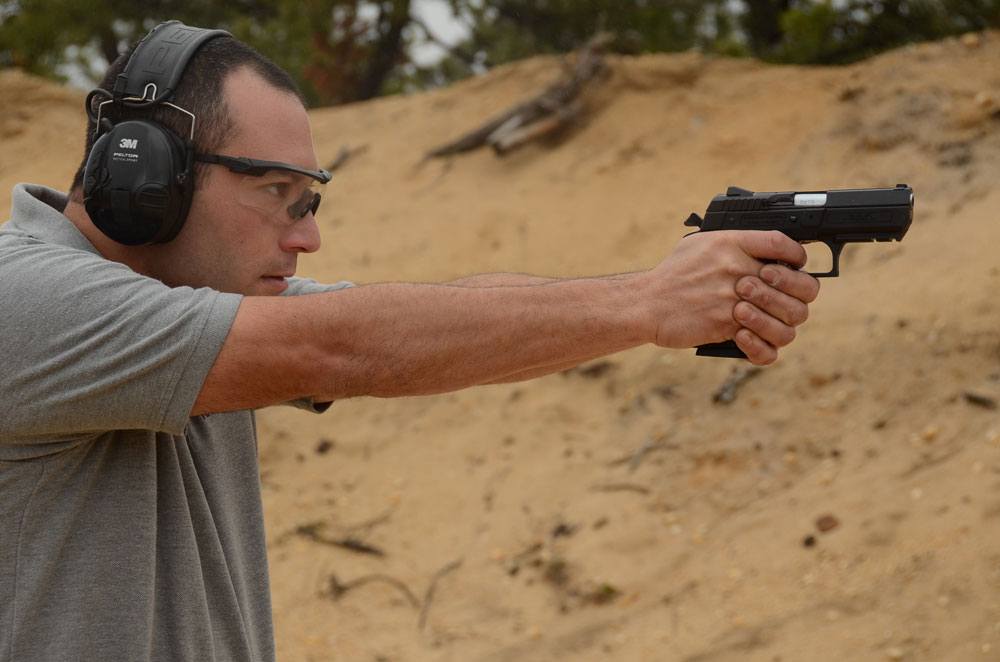
Shooting the Jericho was very effortless. Even damp, it was easy to keep a firm grip during recoil and place controlled pairs on our Shootsteel.com full-sized IPSC target (ShootSteel.com; $207).
Although it has a high bore axis, the 941 comes back on target relatively fast with little effort. All rounds cycled perfectly without a single hang up all day, no matter how bad the elements were to it.
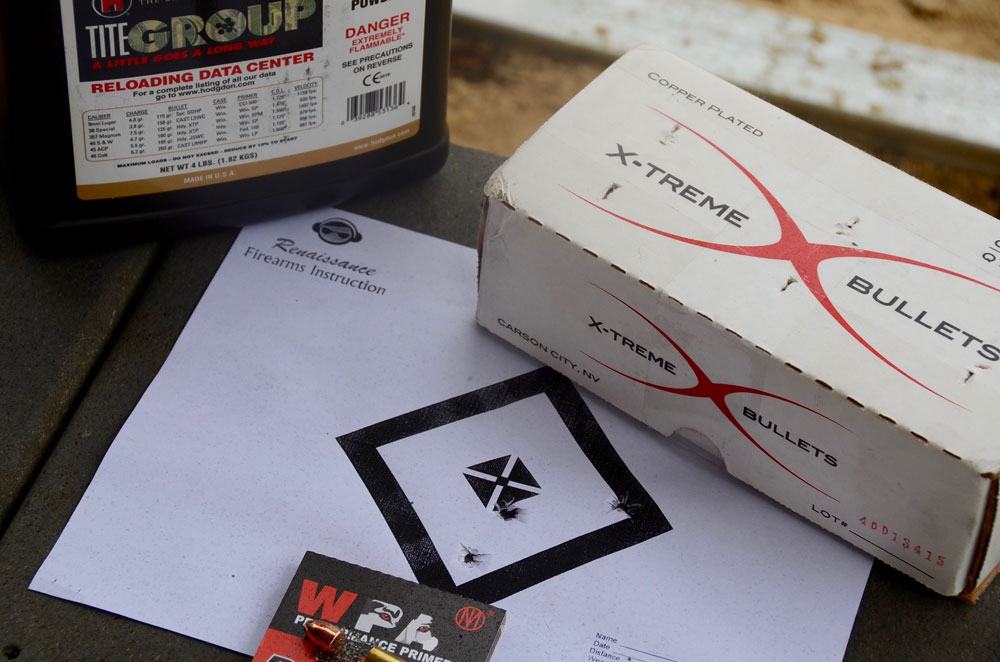
We collected data using a defensive load, a practice load and a competition load. We chose HPR’s new Black Ops OTF 85-grain round as our defensive test load, Freedom Munitions’ new 115-grain RN American Steel Round, and built our competition loads up with Hodgdon Titegroup Powder, X-Treme 124-grain RN bullets and Wolf WPA Small Pistol Primers.
The HPR OTF rounds (Open Tipped Frangible) are designed to shatter, yet remain straight through soft barriers such as glass and dry wall. This round gave us groups hovering right around 3.5 inches at 15 yards.
Freedom Munitions American Steel ammo provides the shooter economical steel-cased rounds that forgo the polymer coating. To solve the functioning issues that sometimes arise with steel ammo, the cases have been brass plated.
This round brought in consistent groups right around the 4-inch mark at the same distance. Our handload was made from competitors’ go-to components, providing a light round that brought in accuracy in the 3-inch neighborhood at that same 15 yards.
The pistol provided serviceable accuracy with all loads. At 15 yards, we didn’t have any groups break the 5-inch mark. This level of accuracy will be sufficient for most defensive carry situations.
Back on the Bench
Getting the pistol back to the bench, we took it down for a thorough cleaning. It had a rough day in the rain, so it certainly was called for.
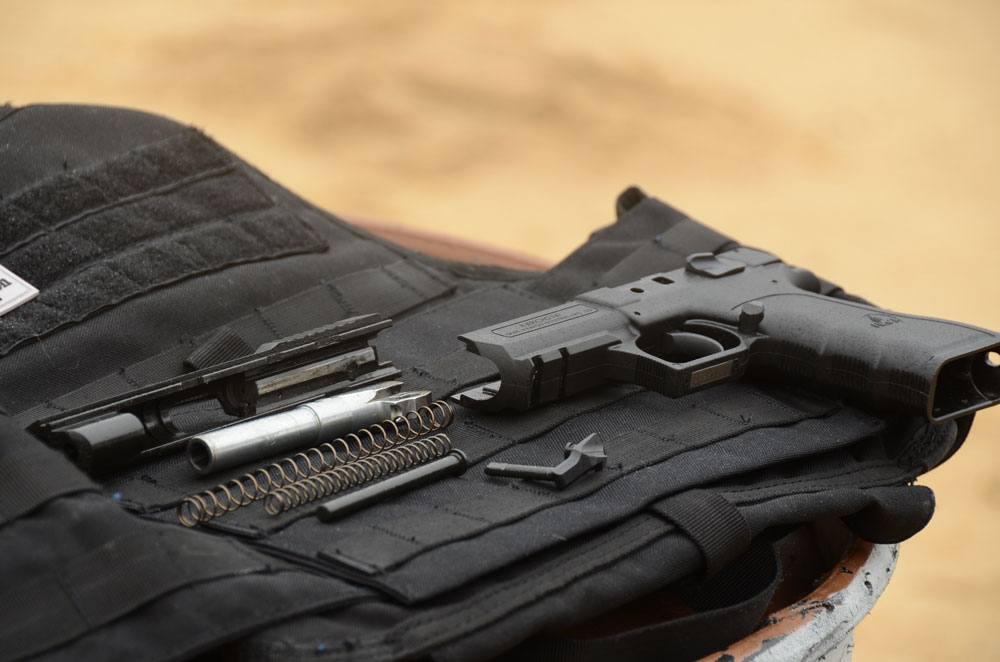
To accomplish fieldstripping, simply align the mark on the slide with the mark on the frame, and then remove the takedown lever. Once the lever is removed, the slide will ride the rails straight off of the frame.
After they are separated, the recoil spring guide slips off of the barrel and the spring off of that. The barrel can now be lifted out of the slide with no effort.
In other words, pretty standard takedown. It was noted that the recoil spring system consisted of two springs, attenuating the recoil pulse and giving us that fast repeatability in our controlled pair drills.
We cleaned the pistol with Hoppe’s new foaming bore cleaner (Hoppes.com), then wiped it dry and lubricated it. It really was that simple.
Final Analysis
The new polymer 3.8-inch Jericho 941 provided lightweight, controllable firepower with a variety of carry options. This gun would be most at home in the defensive and tactical market, as it digests all types of ammo in even less-than-perfect weather conditions.
Accuracy is less than match grade, so you may want to stick to the 4.4-inch barreled version if you plan on running it in USPSA or IDPA, although the accuracy with the little guy will certainly have you competitive in steel challenge. Overall, I like the new lightweight version of the classic IWI service pistol.
For more information be sure to check out www.iwi.us.
Specifications:
IWI US Jericho 941 Type: Short Recoil Semi-Auto Caliber: 9mm or .40 S&W Composition: Polymer frame, Steel Slide Capacity: 17rd 9mm / 13rd .40 S&W Barrel: 3.8 in. Cold Hammer Forged Overall length: 7.6 in. Weight: 1.6 lbs. Sights: Adjustable – Black w/ White dot Safety: Cross Block / non decocking MSRP: $559 Manufacturer: IWI USA, (717) 695-2081, www.iwi.us
This article is an excerpt from the Fall 2016 issue of Gun Digest the Magazine.
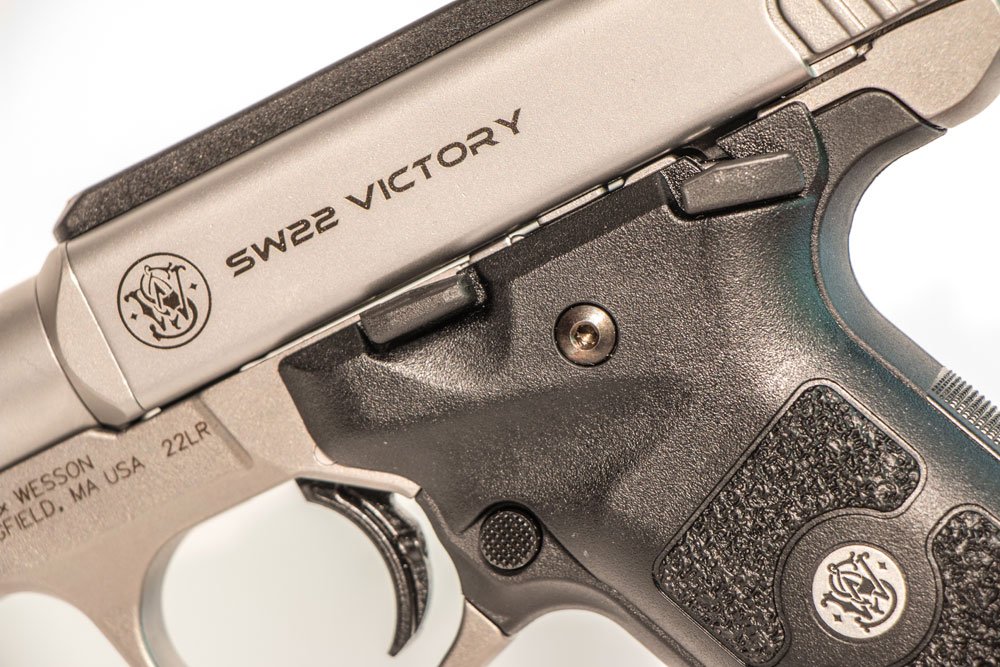
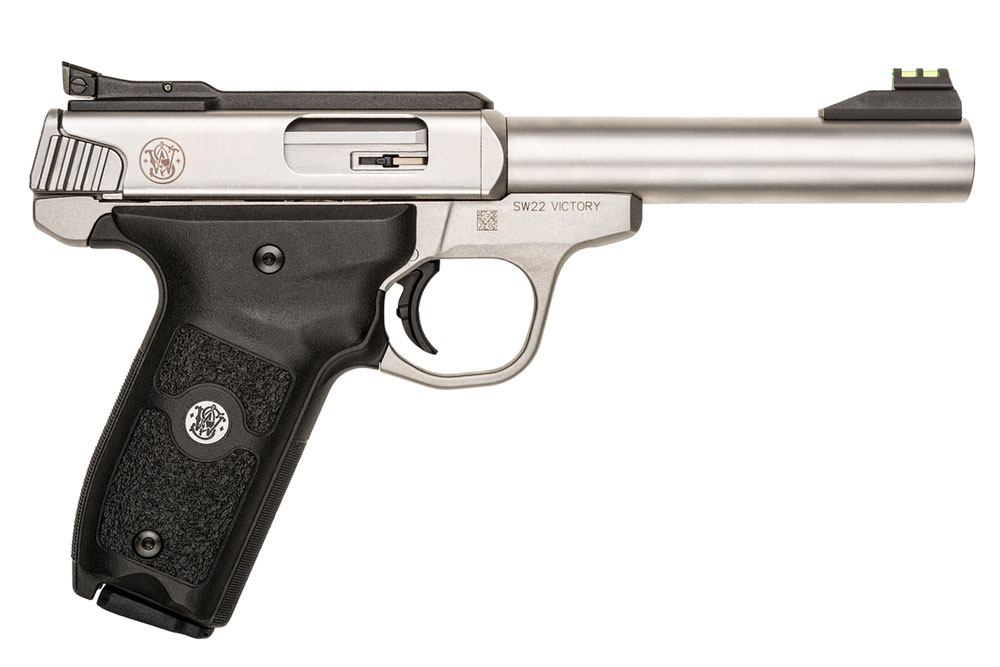
Everyone wins with the groundbreaking rimfire pistol, the Smith & Wesson SW22 Victory.
Few things are as alluring as a .22 handgun. Back in the day, my best friend had a Ruger Single Six; I coveted it like nothing else, but my father was not a handgun fan, so I was 18 before I had my own.
Of late, we don’t see much rimfire handgun innovation because of the current infatuation with defensive handguns and modern sporting rifles. We also too often forget that sometimes shooting just needs to be fun.
It started a trend, and Smith & Wesson’s new SW22 Victory pistol might do the same thing. It is affordable, accurate, modular, and it’s appearing at a time when a lot of new shooters really need a good .22 pistol.
S&W started from scratch with the SW22 Victory, which is a full-size – man-size – pistol. That’s not to say women or young shooters cannot handle it; it just means this is not a compact, flimsy, polymer, lightweight handgun.
Out of the box, the Victory weighs 36 ounces. By comparison, a Glock model 19 weighs about 24 ounces. The Victory’s heft comes from its all stainless steel construction and its robust 0.865-inch diameter bull barrel.
Disassembly Outwardly, the Victory is reminiscent of the coveted and long discontinued Colt Woodsman, which is an exquisite .22 pistol. But that’s where the similarities end.
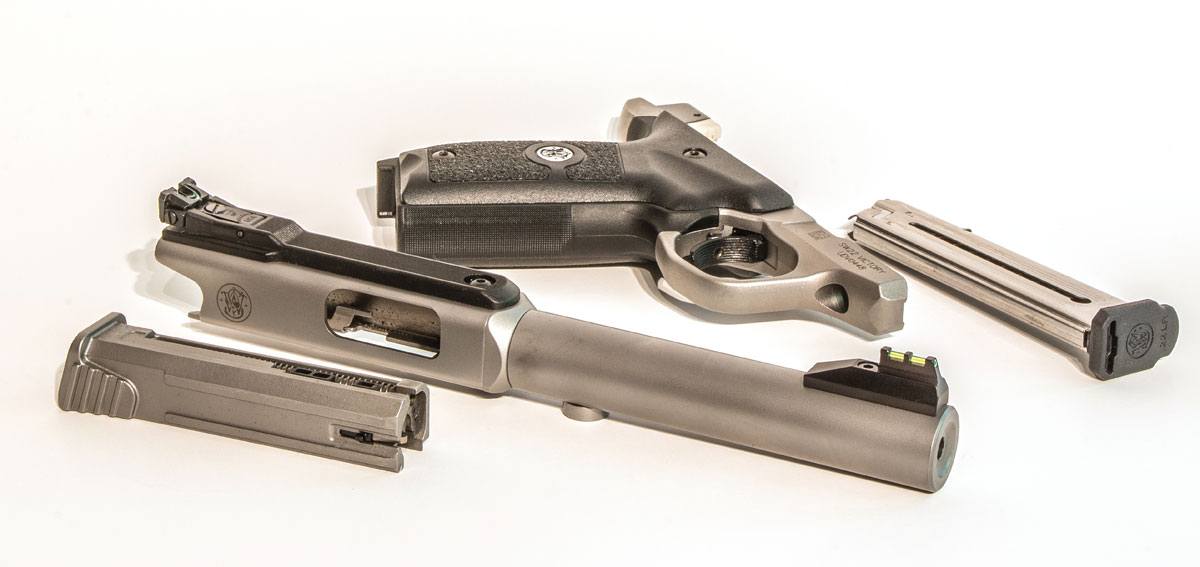
The Victory can be easily disassembled by removing a single screw located just forward of the trigger guard. Similar to an AR-15, with the screw removed, the upper assembly can be detached and the bolt simply slides out.
At this point, the pistol’s barrel can be taken out by removing another screw, permitting the easy installation of aftermarket barrels. Assembly is the same procedure in reverse order.
Controls and Operation
Control wise, the SW22 has an easy-to-operate thumb safety on the left side of the frame. Forward of that, in the customary position, is the slide lock. The magazine release is also located on the left side, just to the rear of the trigger guard.
Even though this pistol has no exposed hammer, it’s a single action and there’s an adjustable trigger stop, but a disconnect prevents it from firing unless the magazine is inserted. This is generally not conducive to a good trigger action. But, according to my Timney pull gauge, the SW22’s trigger broke at a consistent 3 pounds, with an almost unperceivable amount of creep.
The sights employ the ever more common fiber optics. The ramped front sight has a single green fiber optic insert, and the rear has two, providing the three-dot sight configuration now so popular.
The fully adjustable rear sight is fitted into an unusually long base, but there’s a reason for this. S&W engineers creatively contrived the base to attach at the front with a single screw, and in the rear by a slot an extension in the upper receiver hooks into. This allows you to easily remove the rear sight and install a Picatinny rail.
The rail has 11 slots and an integral, fixed rear sight. With it in place, you can install any number of optical sights to include extended eye relief pistol scopes or compact, mini-red dots.
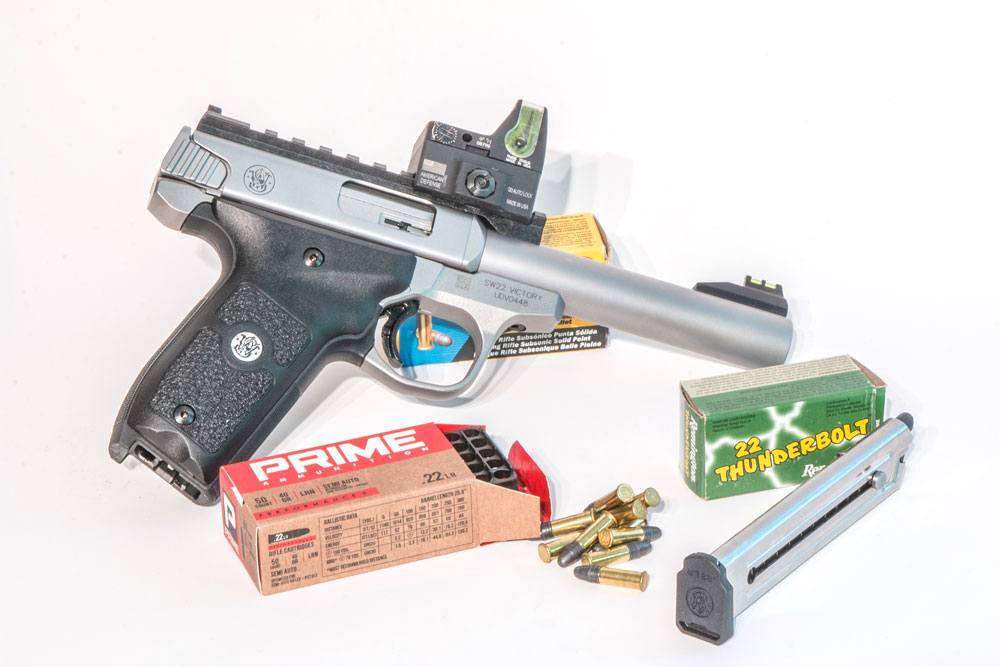
I opted for a Trijicon RMR using a quick release American Defense mount. Almost all the shooting, including the accuracy testing, was conducted with this sight. The versatility here cannot be overstated; with one screw you can switch back and forth between optics and sights, without loss of zero.
Ergonomically, the pistol is well configured and rides the hand comfortably. The polymer grip panels are textured, and the front and back straps exhibit a molded-in, finely checkered pattern. Everyone who handled the SW22 Victory thought the grip comfortable and stable.
The only complaint was that the bolt was a tad stiff to cycle when cocking the pistol due to the blowback action. The bolt is contoured with deep grasping grooves but the grip surface is relatively small, considering the amount of force needed to retract it. For an adult male, it should be of no consequence. Those with limited hand strength might struggle a bit.
A True Winner
Where this pistol shined was on the range. A few of the 10-shot, 25-yard groups were made up of nine shots clustering inside an inch; a single flyer ruined several of them, and I’ll take the blame for those.
Trust me, this pistol will shoot! In fact, I was able to obtain 10 out of 10 hits, shooting an 8-inch steel plate, at 50 yards, from the offhand position. Three times in a row! This is impressive because the truth is I really cannot shoot that well.
I can see no way to classify the SW22 Victory other than as a winner. It’s supremely accurate, providing plenty of precision for plinking, small-game hunting, and competition.
Its modularity with regard to aftermarket barrels and sight options sets it apart. And, maybe more importantly, it is affordable.
Smith & Wesson lists the suggested retail price at $409, but with a little shopping you should be able to round one up for less than $380.
Currently, there are three versions of the SW22. They include the standard model, a threaded barrel version for $429, and one in Highlander Kryptek camo for $ 459.
Gun writers say this all the time, but I will buy this pistol. It’s way more versatile and accurate than my childhood friend’s Single Six, and I don’t need Dad’s permission anymore.
By the way, after I grew up, Dad finally warmed to handguns. It might have happened sooner if he’d ever seen a pistol like the SW22. I think Smith & Wesson has certainly achieved a victory here!
Specifications:
Smith & Wesson SW22 Victory Type: Single action, blowback semi-automatic Chambering: .22 LR Capacity: 10 + 1 Weight: 36 ounces Length: 9.2 inches Height: 5.6 inches Barrel: 5.5 inches, stainless steel Frame: Stainless steel Bolt: Stainless steel Finish: Satin Sights: Green fiber optic front, fully adjustable fiber optic rear Grip: Polymer Accessories: Optics rail, takedown wrench Price: $409 for standard version, $429 with threaded muzzle, $459 with Kryptek Highlander camo finish Manufacturer: Smith & Wesson, Smith-Wesson.com
Editor’s Note: This article is an excerpt from the Concealed Carry 2016 issue of Gun Digest the Magazine.
There comes a time in every gun writer’s career when he must consider the end of the world as we know it and the apocalypse guns required to survive.
It’s not a bad exercise for anyone to undertake, given the security and safety of modern life is deceptive and fragile. There are the obvious culprits that could turn the lights out — war, plague, natural disaster. But the mundane — lack of power or hyperinflation for instance — could equally prove to be the cracks that break the façade of our comfort and security.
God forbid these end days are ever visited on us and those we love. But it’s better to tackle the scenario head on and be prepared, than to whistle past the graveyard. With that in mind, here are three must-have apocalypse guns to see you through these dark times.
While self-defense was a consideration in putting together the list, it was not the sole criteria. The apocalypse would be the ultimate survival situation, and that’s what these firearms are meant to do — help you survive. In turn, the guns chosen were also: versatile, reliable, fed with common ammunition and wide-spread enough to scrounge replacement parts, if need be.
Let us know if these apocalypse guns will see us through until we boot-strap society from the rubble or if we’re goners in the comments below.
Remington 870 or Mossberg 500
Remington Model 870 MCS
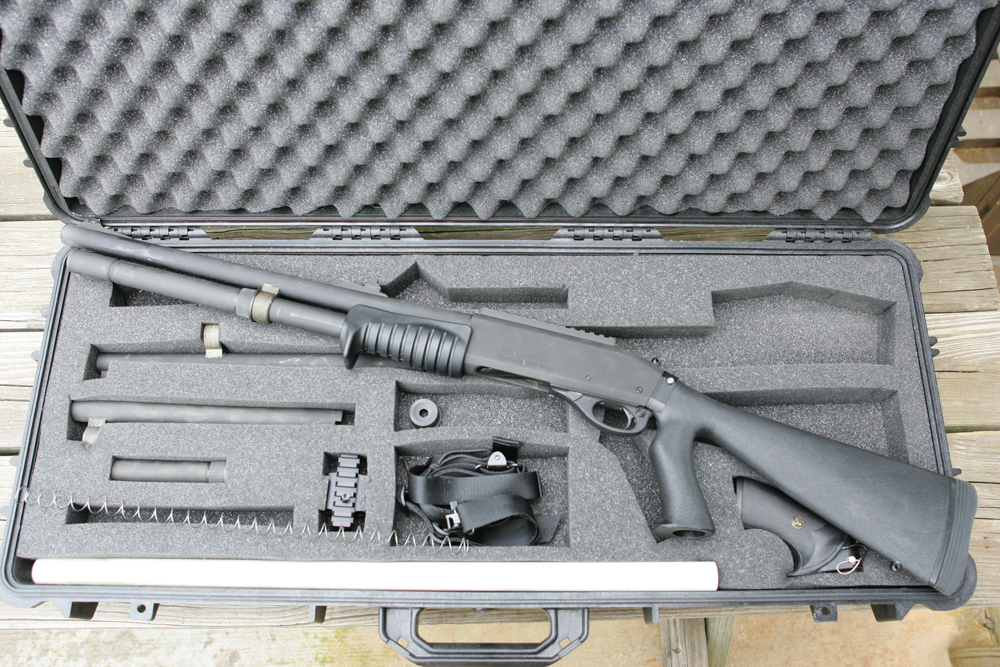
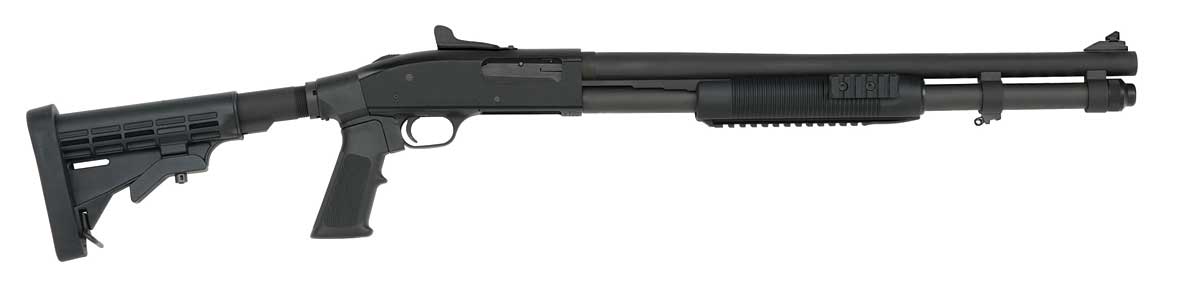
While there are diehard fans of both pump-action shotguns, each is rugged and versatile enough to handle the apocalypse. On top of that, given their sheer ubiquity, it’s plausible replacement parts could be scrounged up with minimal effort. Heck nearly every gun store and Walmart carry the dang things, and between the two more than 20 million have been produced.
Both are available with 3-inch chambers; in turn they can digest the majority of 12-gauge shells produced. With the right load, they are ideal for collecting almost any game in North America, but they would also be superlative weapons for most post-apocalyptic defense applications. Given the size of the pattern is larger than any single bullet, the margin of error is cut down in placing an effective shot. And considering most defensive encounters are at close range, a shotgun is a practical choice. On top of that, with a simple manual of arms, those who are perhaps not gun savvy can quickly learn to proficiently wield both the Remington 870 and Mossberg 500.
Mossberg Tactical 500
The admitted drawback to the pump-actions is their capacity. Off the shelf and unmodified, the top capacity 870 model holds seven shells, the 500 eight. But once again, this is survival, not small-unit tactical maneuvers. If competently handled, both smootbores should provide the firepower required for all but the direst circumstances.
A telescoping stock would be a wise upgrade, as would ghost ring sights (if not stock on the model you chose), just in case you do attempt a more distant shot at range.
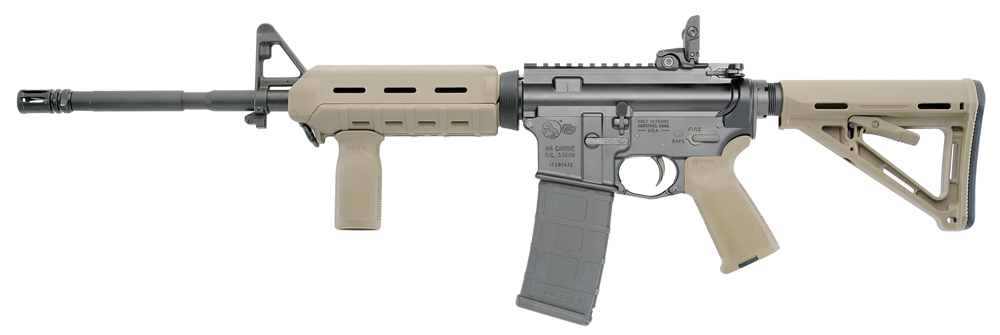
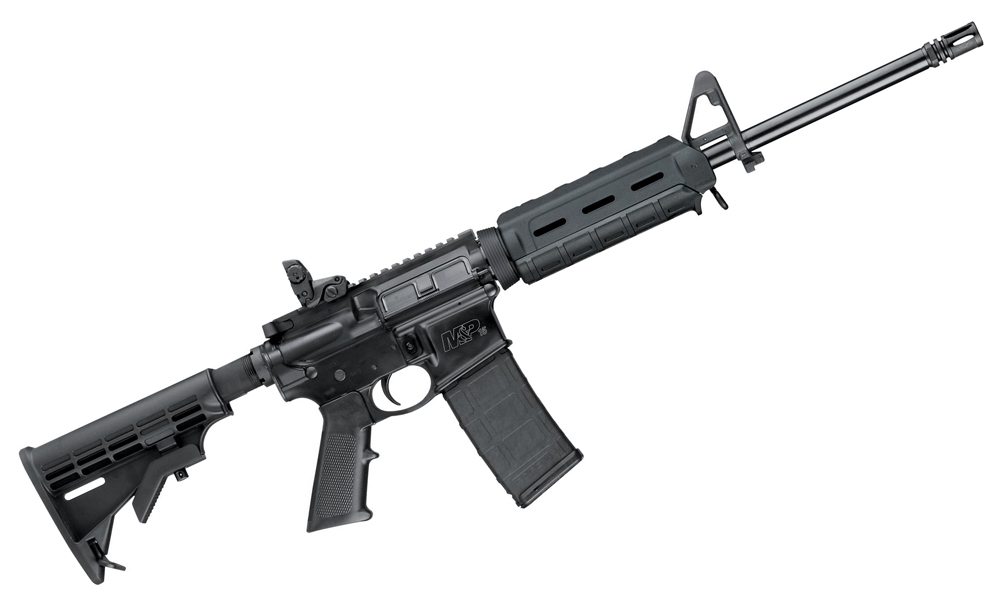
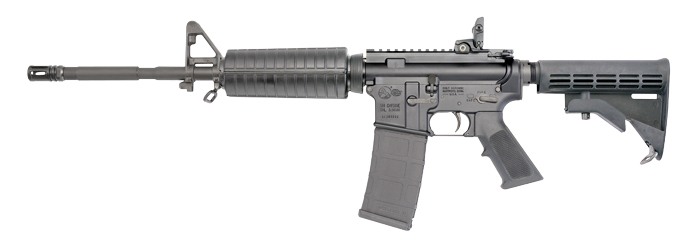
AR-15 (M&P15 Sport II or Colt LE6920)
Smith & Wesson M&P15 Sport II
The AR-15 wins out in this category because it provides its individual users ample firepower in a relatively simple platform and the potential of versatility. The ubiquitous black rifle could be the difference-maker if you found yourself outmanned in the ashes of society. In a world of unknowns, a couple of fully loaded 30-round magazines would provide serious peace of mind.
The dominant chambering for the rifle — 5.56 NATO/.223 Remington — should make scavenging for ammo simpler than other rifles, given its military use. That is, if it isn’t all shot up in the first week of civilization’s downfall in assaults on and in defense of grocery stores. But the AR-15 does hold an ace up its sleeve in this respect. It is not beyond consideration the components for a caliber conversion could be squirreled away or scraped up, thus giving users multiple rifles in one platform.
Colt LE6920
The AR-15 does have an Achilles’ heel, however. The rifle can be maintenance intensive, particularly ensuring the small-caliber rounds chamber properly, the direct gas impingement operating system remains functional and all components are properly lubricated. This takes time and supplies — both of which can be in short supply when cannibals are on your trail.
It’s a jungle when it comes to the AR-15 market, with a dizzying blur of makes and models. But it can be simplified by going with rifles that have been fairly well time-tested, such as the Smith & Wesson M&P15 Sport II or Colt LE6920 series. Whatever brand is chosen, it’s advisable they have a dust cover, forward assist and iron sites.
Glock 41
Glock 41
Glock built its name on reliability, so it makes it a shoo-in for a survivalist’s sidearm. But out of its extensive family, which to choose? Once again, versatility is one of the names of the game here, which would make the Glock 41 the most logical choice.
The hefty .45 ACP round is not only a top choice to save your skin if Lord Humungus and his mutant warriors attack, it’s also a viable hunting round. If there are hogs in your neck of the woods, you’ll be dinning on post-apocalyptic pork chops during the end days with the 41 on your hip. The gun also has the capacity to keep it relevant in a defensive situation. You’ve got big problems if a couple of its standard 13-round magazines can’t extricate you out of a bad situation.
As a full-sized pistol, a striker-fired on top of that, the Glock 41 is configured such that new shooters can become quickly acclimated to it. The weightier gun helps manage the recoil, while the snappy trigger break aids in its accuracy. The handgun’s longer sight radius doesn’t hurt in keeping it on target either.
There are few chinks in the pistol’s armor, but there are a couple issues worth mentioning. While not rocket science, semi-automatics do require know-how to operate proficiently, particularly addressing common malfunctions. And there is something to be said about the virtues of hammer guns, whether it is the second-strike capabilities of a semi-auto or the simplicity of a revolver.
The gun would be a solid performer out of the box. The one upgrade worth considering might be a set of tritium night sights, just in case the bad guys come in the dark.
There are some solid benefits to converting the AR-15 to piston-driven operation, but it can be a bit of an undertaking. Here’s what you need to know.
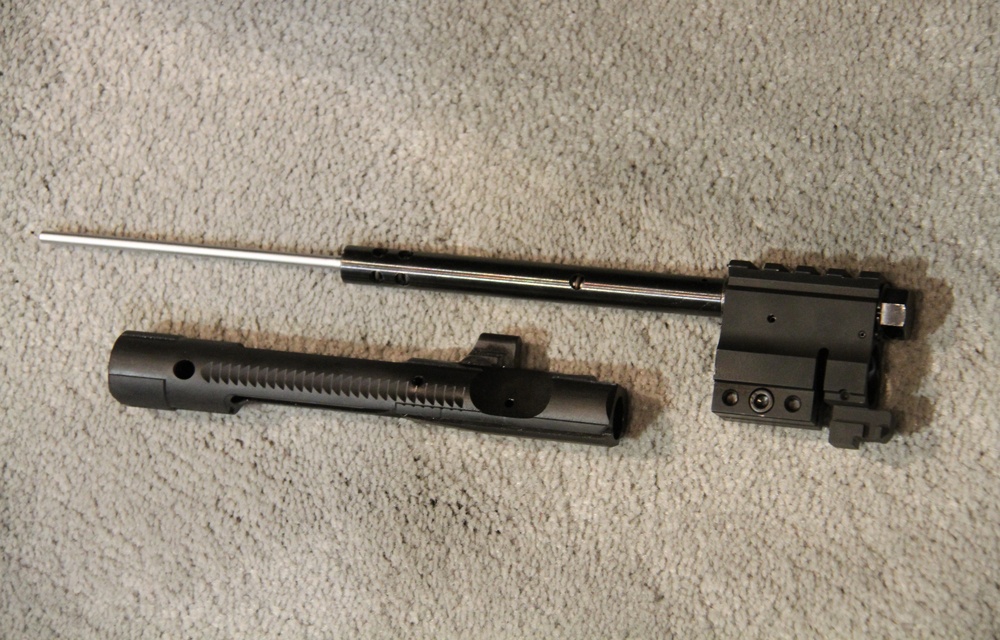
Regardless of which conversion system you use, there is some preliminary work. Strip the rifle’s upper receiver bare, forward of the upper receiver. That is, remove the flash hider/muzzle device, front sight assembly or gas block, gas tube and handguards.
Only remove the delta ring assembly and barrel nut if you are changing to new handguards. The gas block or front sight assembly has to come off as the piston system replaces it.
The flash hider has to come off because that’s the only way you can get the gas block or sight off. The handguards have to come off because you need the elbow room to position and fit the piston system.
Often, when changing to a piston system, shooters also change to a new, free-float handguard, requiring removal of the delta ring assembly.
Here’s a pro tip. Given the amount of work involved, consider building a new, replacement upper receiver from parts. That way, you’d have two uppers, one DI, and one piston, and you could compare the two at the range. And since you have to strip the old receiver down, we will be looking at the installation of a piston conversion from the stripped-down point, as if you were building it up new anyway, because that gives us a common starting point.
If you are going to change to a free-float handguard, and that handguard uses a barrel nut that isn’t the standard one, you’ll have to remove the old and replace it with the new. At that point, you truly are building up the receiver from scratch.
Not all free-float handguards will clear the hardware for all piston systems. It may take some research and testing on your part to find a combination that agree. I’d offer a chart, but the handguard and the piston system makers are in a constant state of flux and the chart would be out of date before this got to the printers.
Instead, contact the handguard and piston makers. Ask if they have handguards that clear their piston systems, and which ones. Contact the piston maker and ask if they have a list of handguards that clear their piston.
Before You Start
Almost all piston systems require the removal of the entire gas system, including front sight or gas block, handguards and flash hider. I will assume for the purposes of this chapter that you have gotten to this point by means of one of two paths. You have taken your existing DI-system AR and have stripped off everything forward of the delta ring assembly and removed the bolt and carrier assembly out of the interior. Or, you have built the upper receiver and barrel from parts, and are proceeding from there with the piston system.
H&H Precision pairs with the Orias Chassis. The result: A rifle boasting a ¼-MOA guarantee and exceptional diversity.
What does it take to elevate a rifle’s capabilities to an exceptional level of accuracy? High-quality materials fed into top-precision machines operated by heavily experienced technicians? Maybe. But I’d argue that every single firearm brought to market should have all those qualifications.
I’m not talking about “minute-of-whitetail” accuracy or a gun capable of ringing a 10-inch steel plate at 600 yards. I’m talking about a level of accuracy that was all but inaccessible — barely even fathomable — to civilian shooters a few years ago.
There are a few trends abuzz right now in the shooting world wildly unparalleled in both form and function.
On one hand, you’ve got long-standing, well-respected firearms manufacturers that are kicking out sub-$400 rifles capable of producing consistent sub-MOA groups even when operated by riflemen of moderate skillsets. Think Ruger’s American rifles, the Savage Axis, Mossberg’s Patriot and Remington’s Model 783. And there are others.
For shooters whose version of success is measured in punched big-game tags as much as tightly perforated paper, these guns — and this entire trending category — is a dream come true both in regard to performance and price.
And then there are “the freaks” — a growing fraternity of those who, by definition, create a “very unusual and unexpected event or situation.”
These are the gunsmiths, engineers, machinists and shooters who demand — and are willing to pay for — perfection that’s measured by thousandths of an inch in the shop and by fractions of MOA on the line.
Imagine a precision rifle that can produce ¼-MOA groups. Every shot. From every gun that rolls out of that shop. Yeah, that’s freaky.
Defining Precision Ken Hagen’s passion for the shooting sports bloomed at very young age and took roots with a family that was heavily involved in outdoor activities. From age 2 and beyond, Hagen was never left behind when his family headed afield.
“I can remember standing in the front seat of an old ’60s Chevy pickup and watching my grandmother shoot antelope and deer,” said Hagen. “She stretched across the hood in true redneck fashion, wearing hair curlers and a cigarette hanging out of her mouth. Much like a Labrador retriever with a strong desire to chase and retrieve, I found myself consumed with the passion to hunt and shoot, too.”
Admittedly, Hagen didn’t do well in grade school because of his daydreams about hunting and shooting while in class. Nothing was more important to him than hunting and shooting, and it wasn’t until he lost his hunting privileges due to poor grades that he found the motivation to start paying a bit more attention in class.
“My grandfather had me on a sliding scale when it came to school grades,” added Hagen. “An ‘A’ got me in on elk, deer, antelope and small-game hunts. ‘Bs’ got me in on deer and antelope. A ‘C’ got me in on small game. If I came home with a ‘D,’ I lost my rifle and my hunting privileges. And an ‘F’ … well, I didn’t dare go there.”
Hagen’s grandfather was also a builder, and at age 8, the pair built Hagen’s first high-power rifle together in his shop — a sporterized Springfield .30-06. The stock was honed from an old block of walnut, which was hand-carved and with jade inlays. And that’s the proverbial spark that lit the passion of rifle building for Hagen.
From Passion To Profession “Shooting and building rifles have always been my passion,” said Hagen, “but my drive is fueled even further when I can become part of peoples’ experience. It’s not just about building rifles — it’s about being part of something people are proud to own. It’s a privileged honor when people select my products and services.”
Every H&H Precision rifle is built one at a time, from start to finish. Hagen’s attention to detail and devotion to build the best rifle for that customer is solely set aside for that customer, and it’s his one-at-a-time devotion that allows him to do it. With each rifle, Hagen promises himself to build to his best ability and never cut any corners, regardless of timelines and production schedules.
“There are hundreds of custom rifle manufacturers on the market producing exceptional rifles,” added Hagen. “So when a customer picks H&H Precision over the others, I owe it to them to do my best work. I build for special operations groups who’re called to duty when lives are at stake and failure is not an option. I’m not a first-responder or a soldier on the battlefield, but I help serve to protect and defend in other ways.”
Every H&H Precision rifle is tested under video to prove ¼-MOA accuracy with a Target Cam System and two cameras. Each customer gets a video of their rifle shooting the groups.
Not only is that unparalleled proof of Ken’s commitment to perfection, it’s almost as if the customer is standing next to Hagen when he’s testing their rife — every shot and every bullet hole develops on the screen and is captured by that video.
“My philosophy is simple: If a manufacturer never proved a rifle can shoot ¼-MOA, then how can they guarantee it?” said Hagen. “I hear stories of manufacturers who say it but never prove it — and we all know talk is cheap. The H&H Precision slogan is as simple as my business philosophy: ‘We don’t just say it — we prove it!’
“Customer satisfaction is priority No. 1,” added Hagen. “If, for any reason, a customer doesn’t like one of my rifles within a reasonable timeline, I will refund or replace the rifle. I will never stick a customer with a rifle they’re not satisfied with. H&H Precision is the safest bet in town when investing in a high-end rifle.”
Even in the current, highly competitive landscape of precision rifle shooters and builders, Ken Hagen’s intuition and gunsmithing experience is largely unparalleled. He’s also equipped with the latest technologies and machine shop equipment and is backed by years of experience to provide a full service operation.
The circle of people who know Hagen’s top-secret processes of precision gunsmithing is incredibly tiny, but Hagen accredits much of his success — and his ability to guarantee ¼-MOA — on the Orias Chassis.
Orias Chassis The Orias Chassis system, developed and built by Killer Innovations and Mega Arms, has quickly evolved into one of the most advanced chassis systems available.
Developed around the patent-pending self-adjusting recoil lug alignment system, the Orias Chassis has a free-floating half-round on the backside of the recoil lug that’s held in place by two small magnets. The half-round is free to rotate to perfectly match the angularity of the recoil lug on the receiver as the wedge clamp in the front of the recoil lug forces back into the half-round.
This proprietary system eliminates any minute angularity differences between the receiver’s recoil lug and the Orias chassis, which can cause serious accuracy problems at long ranges. The configuration of this system also allows for the removal and re-installation of the receiver with a zero point-of-impact shift when torqued to the proper sequence.
The Orias Chassis is cut from a solid block of 7075-T651 aluminum. Although 7075 is nearly twice the cost of 6061 aluminum, it’s roughly 40 percent stronger and notably lighter, creating an incredibly strong yet lightweight platform for precision rifle shooters who appreciate and demand the attention to detail that can set a rifle apart from the crowd.
Weighing 2.1 pounds and topped off in a Mil-Spec Type 3 hard-anodized finish, each Orias Chassis is equipped with a removable rear trunnion that accepts an AR-style buttstock. To complete the customizing attributes of the Orias, a quick-detach accessory rail, located over the barrel, is available as an optional accessory.
The Bottom Line “The Orias Chassis gives H&H Precision rifles an incredibly unique, maneuverable, light and highly functioning feel,” said Hagen. “The palm swell provides the feel of a competition rifle, while the forend creates the feel of a lightweight, quick-handling hunting rifle. A rifle is only as good as its weakest link, and nothing else on the market comes close to performing like the Orias Chassis.”
Essentially, with decades of gunsmithing experience from Hagen and hundreds of hours of machining work to perfect the Orias Chassis, comes perfection through time. Hunters, competitive shooters, long-range marksmen, military personnel or law enforcement snipers — there’s a bit of each of these shooting disciplines crafted into each H&H Precision rifle.
Rare is the rifle capable of delivering such incredible accuracy while still offering so much diversity. You might even call it freaky.
Think the AR platform is only good for target shooting, defense and predator and varmint hunting? Think again. Check out these five great big-bore ARs and cartridges geared toward bigger tasks and larger game.
This likely won’t shock you, but the sales of AR rifles and accessories have skyrocketed in the past five years. In the early 2000s, there were only a handful of companies that built and sold ARs, but this year there were more than a hundred companies displaying new AR rifles, parts and accessories at the annual SHOT Show in Las Vegas.
This comes despite the anti-gun media’s seek-and-destroy mission aimed at vilifying all things AR. These guns have survived the onslaught of attacks because the AR platform itself is so versatile, so functional and so much fun to shoot.
Besides being a great gun for casual shooting, competitive shooting and defensive applications, the AR makes a fantastic hunting rifle. ARs are the fastest-growing subset of hunting rifles, and many companies are now building ARs designed specifically for the game field. These rifles are accurate, customizable and allow for very fast-follow-up shots, but until recently, their use has been largely limited to predators and varmints.
That, too, is changing. More and more deer hunters are carrying AR rifles, and the platform has become one of the top choices for hog hunters.
But what about larger stuff? What about pursuing creatures that can turn the tables and can – in an instant – turn the hunter into the hunted? Is there a place in the realm of dangerous game hunting for big-bore ARs?
One of the most common charges levied against AR rifles by the sensational anti-gun media is that these rifles shoot flatter and hit harder than traditional hunting designs like bolt actions, the mythic higher-powered, high-power rifle.
In truth, the most common AR chambering, the 5.56/.223, is somewhat anemic compared to popular hunting calibers like the .30-06 and .300 Winchester Magnum, and it is a far less potent cartridge than the old elephant slayers like the .458 Winchester Magnum, .416 Rigby, and the like.
The anti-gun media never lets ballistics get in the way of a good story, but hunters and shooters obsess over energy and trajectory charts. You don’t have to spend much time researching to realize that the standard 5.56/.223 isn’t considered much of a deer round (although there are some hunters who swear by its effectiveness and have seen a lot of deer harvested with that cartridge), and it isn’t even legal in many states.
But the AR-10 platform chambered in .308/7.62×51 offers considerably more knockdown power, and other cartridges like the 6.8 SPC and .260 Remington are versatile hunting rounds that can be chambered in AR rifles.
But again, what about even larger game such as bears, bison and other large, heavy, potentially dangerous animals? Is there an AR suitable for that class of game?
In truth, there are many. There are several options for hunters looking to pursue the largest game with their AR and plenty of effective cartridges.
The good news is that many of these cartridges are sufficient on a wide variety of game, so whether you’re tackling big hogs or brown bears, one rifle will do it all. Versatility is, after all, one of the hallmarks of the AR platform.
Here’s a selection of five of the best big-bore ARs and cartridges for hunting the largest, toughest and potentially dangerous animals.
Rock River Arms LAR-458 Beast in .458 SOCOM The Beast is chambered in .458 SOCOM, a cartridge that was designed in the early 2000s to provide more energy and more lethality for Special Forces teams using AR rifles. Capable of firing bullets weighing up to 600 grains, the more popular weights for hunting are in the 250- to 325-grain range because they shoot flatter and carry higher energy along their trajectory curve.
Additionally, the .458 SOCOM ammunition fits in standard metal GI 5.56 magazines because the two cartridges are the same length. They are not, however, the same diameter.
You can fit seven .458 SOCOM cartridges in a 20-round GI magazine, 10 in a 30 round magazine. That’s a lot of firepower available in a hurry. Most hunting loads generate energy levels north of 2,200 foot-pounds, making this an excellent choice for bear defense.
The Beast is aptly named, with its heavy 14.5-inch barrel crowned with an aggressive Beast Brake. It comes with an RRA Delta CAR adjustable stock that can be customized to fit the shooter and the situation, and the full-length RRA TRO-STD handguard offers plenty of real estate for a sufficient hold on the rifle.
The flat-top receiver is great for mounting optics (a red dot like the new Trijicon MRO would be the perfect choice), and the rifle comes with two short and one standard-length accessory rails. The Beast weighs just 7.6 pounds, fairly light for a dangerous game rifle, but recoil is manageable considering the knockdown power of this rifle.
One note: All .458 SOCOM ammunition should be loaded from the magazine and not directly into the chamber for safety reasons. ($1,540; RockRiverArms.com)
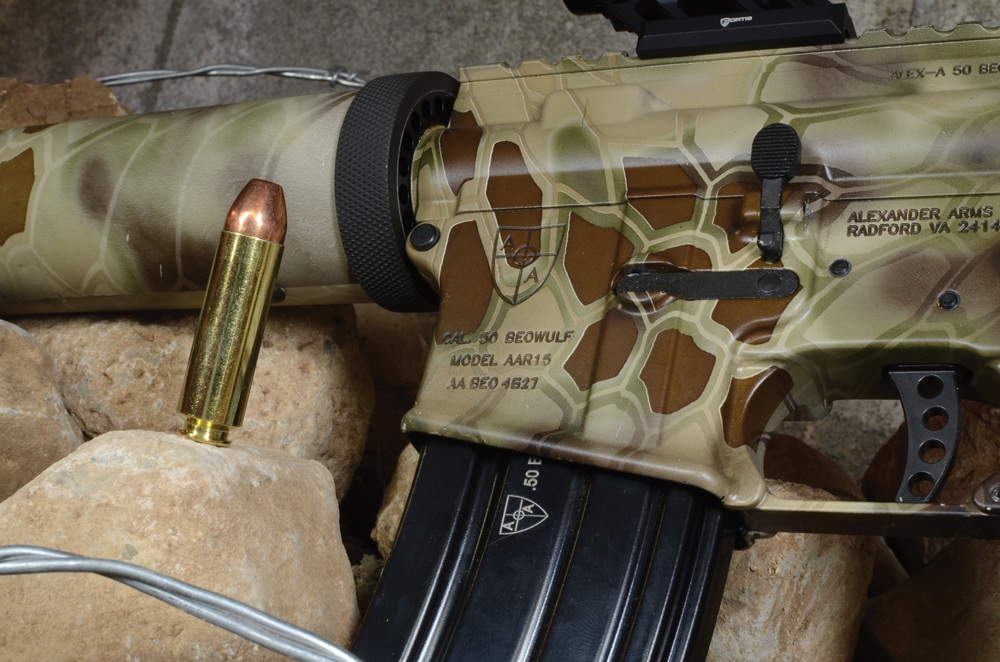
Alexander Arms Hunter in .50 Beowulf The .50 Beowulf is Alexander Arms’ own design. Based on the .50 Action Express and modified to function in AR rifles, the Beowulf ups the AR ante when it comes to power.
Like the SOCOM, it began life as a cartridge designed to offer a horsepower upgrade over the standard 5.56×45 cartridge, and it does so stunningly. The cartridge found favor with military and law enforcement agencies because it wouldn’t bounce off window glass in vehicles, but it certainly has applications for hunting large, dangerous game as well.
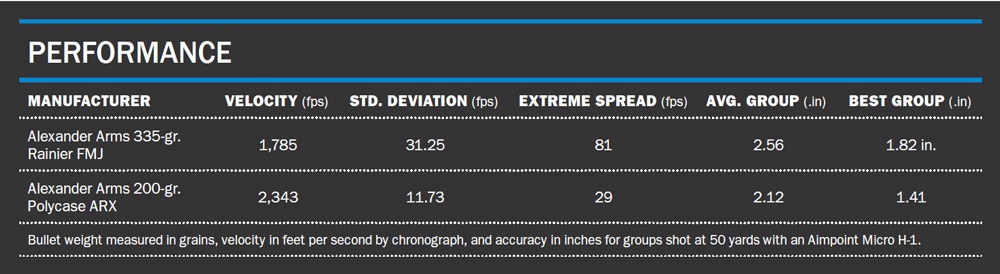
For starters, the cartridge generates between 2,200 and 2,800 foot-pounds of energy and places a half-inch hole in whatever it strikes. Alexander Arms offers a variety of loads for the Beowulf, including 350-grain brass spitzer and XTP loads that will work for hunters. The cartridge has plenty of power for short- to moderate-range hunting of species like bear, elk, moose, large feral hogs and even bison, and it serves as a functional backup gun in bear country.
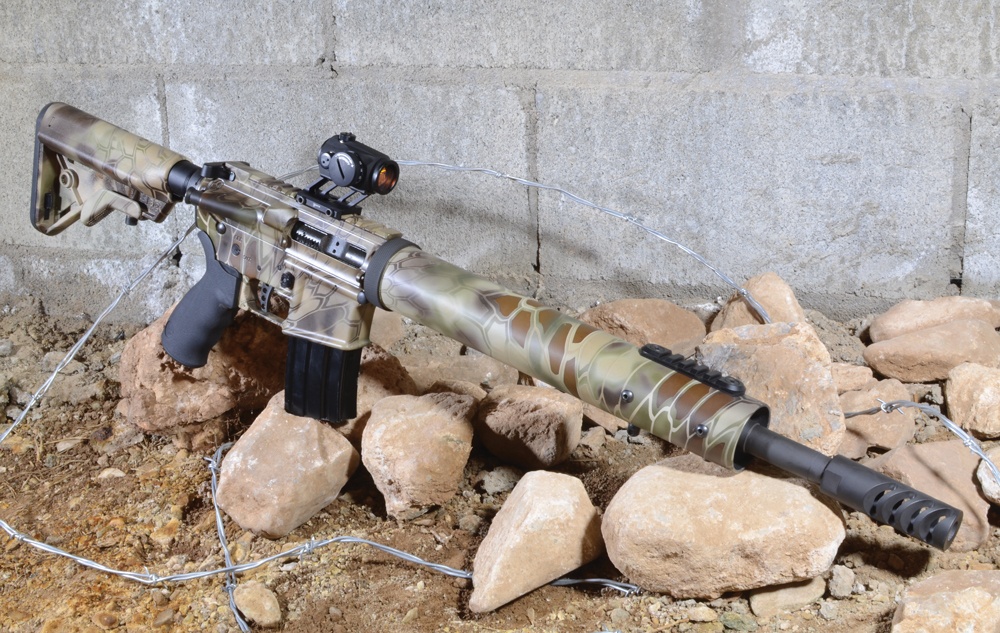
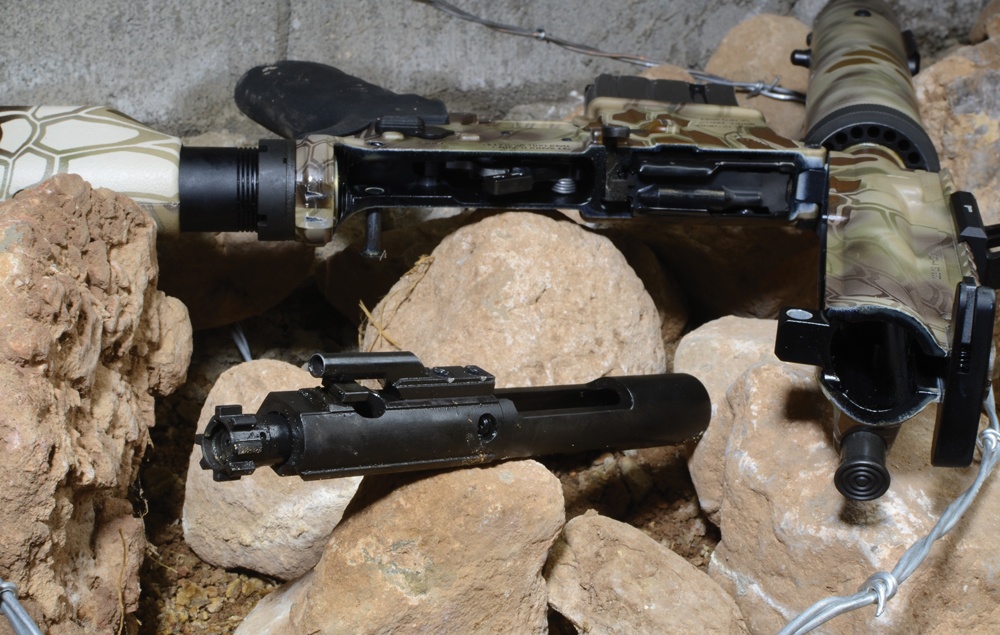
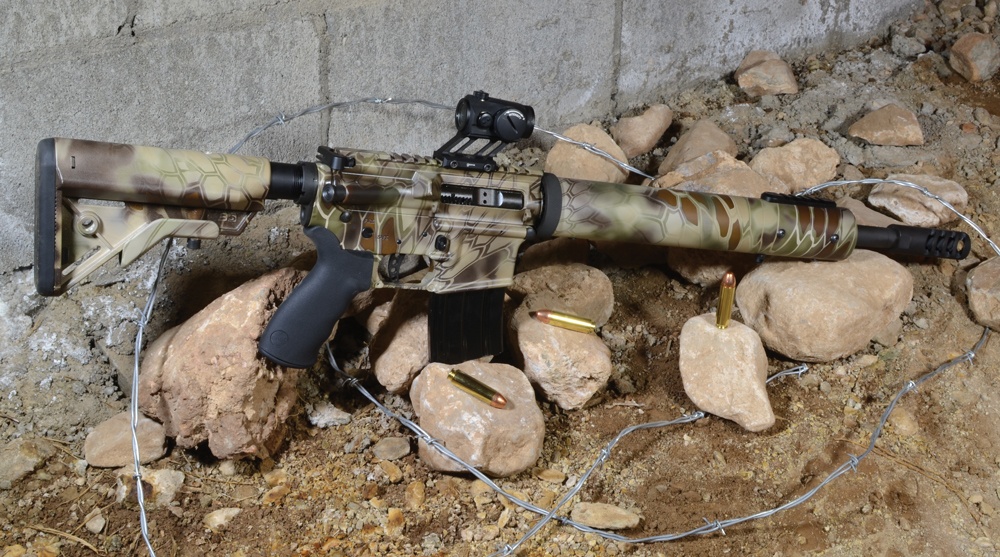
Alexander Arms offers a selection of uppers and lowers, but the company also sells complete Beowulf rifles. The Hunter Complete Rifle is the variant designed specifically for sport hunting, and it comes with a rifle-length, composite, free-floating handguard; flat-top receiver; a 16.5-inch button-rifled chrome moly barrel; 49/64-20 barrel thread; and Kryptek Highlander camo.
Like the Beast, the Alexander Arms’ flattop design makes it easy for mounting optics, and the rounded handguard is comfortable and offers a stable grip. The stock is a B5 Systems SOPMOD Bravo, which is collapsible, and the gun comes with the company’s Tactical Blade Trigger. It’s a serious dangerous game AR designed for the largest, heaviest game. ($1,750; AlexanderArms.com)
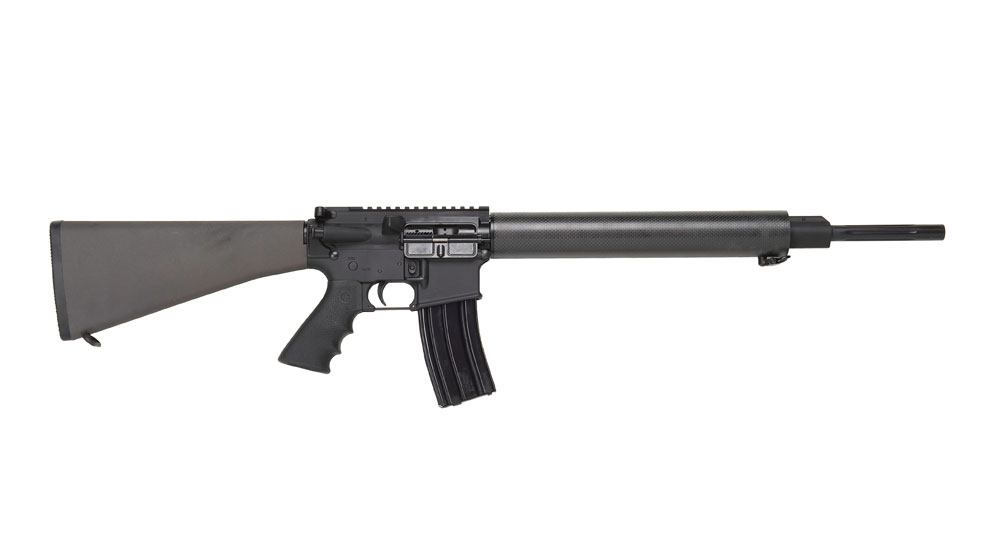
DPMS Lite Hunter in .338 Federal The sleek Lite Hunter from DPMS is a featherweight by AR standards, weighing in at less than 8 pounds. This reduced weight is achieved with the help of a lightweight barrel profile as well as a carbon fiber free-float handguard.
The Lite Hunter is devoid of all unneeded features and comes with an A2 stock, a flat-top extruded 7029 T6 upper and a two-stage match trigger. It’s a sleek, impressive design that works very well in the field.
The Lite Hunter is chambered in a number of standard AR-10 class cartridges: .243 Winchester, .260 Remington and .308. But it’s also available in the often overlooked and extremely versatile .338 Federal, which is based on a standard .308 Winchester cartridge necked up to use available .338-inch bullets.
The caliber is capable of producing better than 3,000 foot-pounds of energy and, since it is based on the .308, brass is widely available. The .338 Federal is an effective and efficient deer and hog cartridge and a very good elk and moose cartridge.
It provides plenty of power for defense against large bears, and it has a trajectory curve that is relatively flat. It’s certainly one of the most versatile cartridges on this list.
Plus, if you switch between a bolt gun and an AR, it’s a great choice because Savage and other companies make bolt-action rifles in the same caliber. It’s a cartridge that’s capable of taking anything on the American continent. ($1,499; DPMSInc.com)
NEMO Arms Watchman & Omen in .338 Winchester Magnum NEMO has challenged the notion of conventional AR designs and caliber offerings with the introduction of powerful new rifles chambered in .300 Winchester Magnum and, recently, the .338 Winchester Magnum. These cartridges are better than five decades old, but they have proven themselves as two of the best all-around cartridges for large, dangerous game like bears. Both the .300 and .338 are capable of delivering more than 4,000 foot-pounds of energy, and both have earned enviable reputations for long-range work.
Just how widely accepted are they? In a survey I did of Alaskan brown bear guides, the .338 Winchester Magnum was recommended more than any other cartridge, and there are actually more animals in the Boone & Crockett record book that have been harvested with the .300 Winchester Magnum than the .30-06. Ammo is widely available, and there’s a huge selection of tough hunting bullets for both cartridges.
The NEMO line has expanded greatly over the last few years. Some of its most popular offerings are the OMEN ASP, a lightweight MSR that is chambered in .300 Win. Mag.
It has a hard-anodized finish 7075 billet receiver, a 16-inch barrel, nickel boron bolt release, enhanced magnum buffer, Geissele two-stage trigger and much more. Best of all, it weighs just 9.4 pounds and is extremely accurate.
The larger Watchman 2.0 features a long 24-inch barrel for maximum velocity and flat trajectory. If you’re serious about hunting big game like elk and moose at extended range with a precision built AR, the offerings from NEMO are a good place to start looking. ($5,000- ; NEMOArms.com)
Bushmaster 450 in .450 Bushmaster What if you could simply swap your AR upper to go from a varmint/predator/target rifle to a serious big-bore, bear-stopping defensive round? That’s the beauty of the .450 Bushmaster – like the .458 SOCOM, you can buy an extra upper for your AR rifle and you’ve got a big bore in tow.
The .450 Bushmaster cartridge is capable of attaining 2,200 feet per second from a 20-inch barrel and generating almost 2,700 foot-pounds of energy, a substantial blow from an AR-15-based rifle. That’s on par with the .308 Winchester, and the Bushmaster delivers a much larger diameter bullet.
The .450, when sighted in 2.5 inches high at 100 yards with a Hornady 250-grain FTX, is 3.4 inches low at 200 yards, a respectable trajectory curve. The big .452-inch bullets are capable of delivering serious big-game stopping power at close range, and there’s no doubt that this rifle would work well on the largest deer.
But if you have an AR-15 and are looking for bear medicine, then the .450 might be just the ticket. It’s relatively light (especially with a 16-inch upper), and so long as Hornady is supplying ammo, it won’t be hard to get your hands on factory loads.
Of course, you can buy complete rifles from Bushmaster, but the company’s prime seller has been the upper, which is far cheaper for the current AR owner than buying a brand-new gun.
This is certainly a great caliber for backup in bear country, and you could pack your 5.56 upper in your gear bag on a western hunt so you could chase elk or bears and, when you are tagged out, swap uppers and spend a few days shooting rock chucks. ($600- ; Bushmaster.com)
Editor’s Note: This article is an excerpt from the April 2016 issue of Gun Digest the Magazine.
Rugged, precise and with brute power to spare, the Alexander Arms .50 Beowulf Hunter is ready to tangle with the nastiest game North America can throw at you.
“This rifle makes me feel like Thomas Jefferson,” exclaimed my friend Cody, ret. U.S. Marine Corp., after he blasted seven rapid-fire rounds of .50 Beowulf into the Arizona dirt. “I might as well have a bald eagle perched on my shoulder right now; there’s a whole lot of freedom going on here,” said Cody as he gazed into the vast desert of the Prescott National Forest with the Alexander Arms .50 Beowulf Hunter.
Cody was not alone in his charismatic reactions from shooting the Alexander Arms .50 Beowulf rifle for the first time. The brute power of the Beowulf cartridge results in a dramatic report that seems to make shooters howl like a werewolf after every trigger pull.
The rifle produces a distinct thumping muzzle blast that literally makes shooters feel the hair on their head move. Surprisingly, although the .50-caliber cartridge produces a whopping 2,400 foot-pounds of muzzle energy, its felt recoil is comparable to a 12-gauge shotgun with 2-3/4-inch bird shot.
Howl at the Moon Exotic as it may be, the Alexander Arms .50 Beowulf Hunter AR-15 still oozes practicality. Chambered for .50 Beowulf, the beastly cartridge undoubtedly has the ability to harvest every big game animal in North America. According to Alexander Arms, “The heavy bullets from the Beowulf are quite capable of breaking both shoulders of a moose.”
Retaining the familiar dimensions and ergonomics of a standard AR-15 carbine, this rifle’s big bore is one of the only components that distinguishes it from typical ARs. In fact, the .50 Beowulf is compatible with standard AR-15 upper and lower receivers, handguards, buffer systems and small parts.
The only major differences between the Alexander Arms .50 Beowulf Hunter and a standard AR-15 are its barrel, bolt, gas block and magazine. In fact, it is entirely possible to slap a complete .50 Beowulf upper receiver onto a standard AR-15 lower receiver and maintain total functionality.
A standard AR-15 buffer and buffer spring do not even need to be replaced to effectively handle the .50 Beowulf’s increased recoil, as the Beowulf cartridge was designed to work specifically with standard lower receiver components.
While the .50 Beowulf cartridge adds an extraordinary “wow” factor, the rifle comes packed with more mouth-watering features right out of the box.
Most notably, its stylish and functional Kryptek Highlander Camo finish makes this rifle a true hunting tool. Hunters will also enjoy the lightweight G10 composite mid-length free-floating handguard that includes a built-in sling swivel stud and rail attachment points at 3-, 6-, 9-, and 12-o’clock positions.
Under the handguard, a 16.5-inch chrome-moly button-rifled barrel with a 1-in-20-inch twist rate launches massive 335-grain projectiles at 1,800 feet-per-second.
Threaded to the barrel for recoil reduction and muzzle rise mitigation is an Alexander Arms Millenium Compensator, which disperses energy through an oversized four-port design that billows visible flames in daylight conditions. At the rear of the rifle, a B5 Systems SOPMOD adjustable buttstock provides counterbalance to the rifle and offers ample comfort for the shooter, despite the Beowulf’s significant recoil.
Interestingly, Alexander Arms purposely omits an ejection port cover from the upper receiver, even though it maintains hinge points where an ejection port cover traditionally attaches.
According to Alexander Arms, “the hinge points are left on the receiver because the upper receiver would cost more to manufacture by removing them from the design. They are not left specifically so that port doors can be retrofitted to the upper, and we do not encourage this retrofitting.”
Given the enlarged size of the ejection port compared to a normal AR-15 to account for the Beowulf’s larger brass, a standard dust cover would not fit, nor is it really needed.
Inside the hand-fitted receivers, a specialized bolt face and extractor cycles .50 Beowulf rounds from proprietary magazines each time the shooter pulls Alexander Arms’ Tactical Trigger. The standard AR-15 fire control system includes a lightweight hammer and a single-stage, blade-style trigger that consistently measures just less than 4 pounds of pull weight.
Overall, it’s quite clear Alexander Arms has gone to great lengths to ensure the proprietary components of the .50 Beowulf Hunter rifle coordinate perfectly with its standard AR-15 parts. Premium components and custom refinement make this firearm a truly unique rifle that combines exotic details with unmatched utility.
Performance Unrivaled endurance gives wolves the evolutionary advantage to take down game much larger or faster than the wolf itself. Throughout testing of the Beowulf Hunter rifle, the gun showed no signs of slowing down after several hundred rounds, and had zero malfunctions.
Although the .50 Beowulf cartridge operates at relatively low pressures given its muzzle energy, its brute power provides plenty of thrust to push the bolt carrier group out of battery and rearward to initiate reliable cycling. The 37 grains of powder that propelled the 335-grain FMJ load during testing provided plenty of power to keep things moving consistently.
While the Alexander Arms .50 Beowulf Hunter is capable of anchoring big game at distances of 200 yards, the cartridge really shines inside 100 yards. It’s for that reason we decided to use a zero magnification Aimpoint Micro H-1 optic for testing.
Although the rifle is certainly capable of greater accuracy with a magnified optic, the configuration used for testing would be highly effective for objectives such as close-range feral hog control or even home defense applications.
One might think this rifle is much too beastly for home defense; however, when loaded with 200-grain Polycase Inceptor ARX ammunition, the typical risks of over penetration are greatly mitigated compared to FMJ ammo.
By their nature, the terminal ballistics of Inceptor ARX bullets includes extreme fragmentation in soft targets. In exchange for deep penetration, the bullet rapidly dumps its energy into the target, creating dramatic tissue damage and massive wound channels.
Given its ability to excel at a variety of objectives from hunting to home defense, it’s quite clear the Alexander Arms .50 Beowulf Hunter would make for a great truck gun. While there’s no real definition of “truck gun,” this rifle is a solid example of a reliable all-purpose tool that can go anywhere and do anything.
If you live among wolves, you have to act like a wolf. The .50 Beowulf Hunter rifle from Alexander Arms is truly the alpha dog of the pack, making typical AR-15s look like toy poodles in comparison. With its custom touches and big-bore barrel, Alexander Arms sets the standard for the level of craftsmanship and reliability that should be expected from an AR-15.
Literally the only thing the author doesn’t like about this rifle is the cost and availability of .50 Beowulf ammunition. The author has fired nearly every AR-15 on the market today, and the Alexander Arms .50 Beowulf Hunter ranks in his Top 5 overall favorite production ARs to date.
Specifications:
Alexander Arms .50 Beowulf Hunter Caliber: .50 Beowulf Action: Direct Impingement Gas, Semi-Automatic Finish: Kyptek Highlander Camouflage Capacity: 7+1 Length: 37.25 in. extended; 43.125 in. collapsed Trigger: Alexander Arms Tactical Trigger (3 lbs., 15 oz. pull weight) Stock: B5 System SOPMOD Bravo Collapsible Barrel: 16.5 in., chrome moly, 1:20 twist Muzzle: Millenium Compensator, 49/64-20 RH thread MSRP: $1,750
Editor’s Note: The article is an excerpt from the April 2017 issue of Gun Digest the Magazine.
Serious shooters keep a DOPE or data book on particular weapons for a good reason. When called into duty, no matter the situation, they have a solid idea about how the firearm will perform.
Everyone who owns a precision rifle keeps a DOPE or data book on that weapon – at least they do if they are serious shooters. Typical information includes details on cold bore shots.
Normally the point of impact on the first shot fired from a clean, cold barrel will be slightly different from shots fired after that. You record each cold shot, building up enough data to know exactly where that first shot is heading.
By gathering and recording data, you know the difference between a shot fired when the air temp is a chilly 15 degrees and the humidity is low vs. a hot day of 95 degrees with humidity to match. You have a record of the changes that will occur if you switch from a 55-grain bullet to one weighing 75 grains. I recommend doing the same thing for every firearm you own.
Most of the people I know who get into firearms, no matter the reason, eventually end up with a small collection of weapons. After all, you need a few pistols for carry, a variety of rifles and carbines, and of course probably a dose of shotguns.
At some point it becomes difficult to keep track of everything, especially like when you changed out a buffer spring, how many rounds have been fired through a specific barrel, or what make bolt group is in a particular AR. The solution is to develop a log or data book for each firearm you own.
In my spec sheets I include detailed information about what parts were used to assemble that weapon. There is a record of when it’s been cleaned, how many rounds it’s fired, or when the recoil spring was last changed.
I keep track of when the battery was changed in the red-dot sight. When a part breaks, I know what brand it was, how long it lasted and what to replace it with. There are targets in the file so I know what group to expect from that particular weapon with specific type or brand ammo.
Keeping targets gives me a reference to look back at. If all the sudden AR #3 is shooting 3-inch groups at 100 yards instead of 1-inch groups, I know there’s a problem I need to look at.
Keeping this information is also good if you need to take your AR to a gunsmith for repairs or modifications. This way they don’t have to try guess about anything; it’s all written down and recorded for reference.
I’m an old school guy and keep written records. Plus, if I have a clean sheet of paper, I can draw out illustrations for documenting a certain point, or attach pictures to the file.
Yes, you could keep your notes on a computer, but remember that the act of writing something down helps implant it in the mind. Typing or entering data on a computer spreadsheet provides you with a record, but it doesn’t make the same mental connections.
For the average AR, you probably don’t need to record every shot or the weather conditions and the amount of info you would with a precision rifle. Unless of course your precision rifle is an AR, a Special Purpose Rifle, or SPR. But you do need to keep a record of all the different modifications made, bullet trajectory for different distances – including wind shifts – and other major details of that weapon.
Owning and using a firearm is serious business, especially if we’re talking about possibly using it for self-defense. Approach all the different aspects of this accordingly. Document everything about your weapons, just as you do with your training and practice.
There’s no better way to celebrate Independence Day than by enjoying your Second Amendment rights. Here are 10 fun guns sure to put a smile on your face on July Fourth.
The Second Amendment rights afforded to us in this country represent one of the defining aspects of American culture. And as the Fourth of July holiday approaches, it’s important to keep those rights in mind, and to celebrate those rights along with our independence.
One of the best ways to do that, of course, is to get out and shoot over the holiday.
Above is a list of 10 fun guns to consider for your trip to the range, private land or your own backyard for the Fourth. The list covers a mix of guns that are fun, and in some cases both fun and relevant to our country’s history. It is designed to be relatively broad and inclusive, but does get slightly more specific in some cases.
This list is in no way definitive, nor is it prescriptive. It’s just good fun.
There are lots of fun guns out there. That’s why many of us have large gun safes and more than a few firearms. Some are on this list, and some are not.
Check out the list above to see which guns made the cut, and if you feel something’s been overlooked, let us know in the comments section. All opinions are valid, and these types of debates are always fun.
Looking to go armed, but are stuck in the weeds as to what to arm yourself with? Here are 20 of the best concealed carry gun options that will keep you on the defensive.

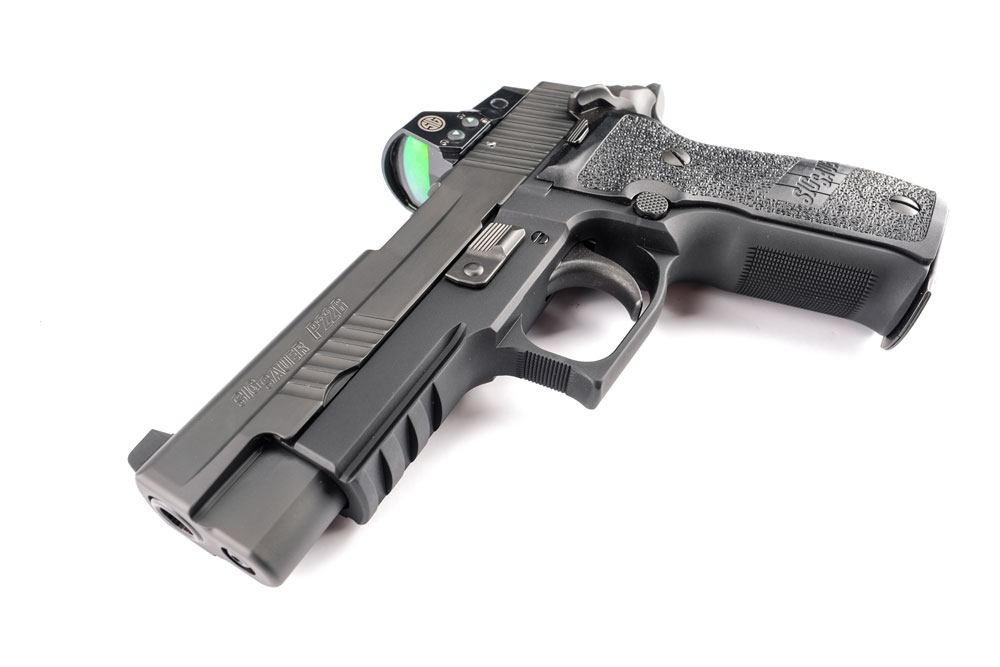 The SIG Sauer P226 RX mates the excellent Romeo 1 red dot to the manufacturer’s classic defensive handgun.
 What’s a Red Dot?