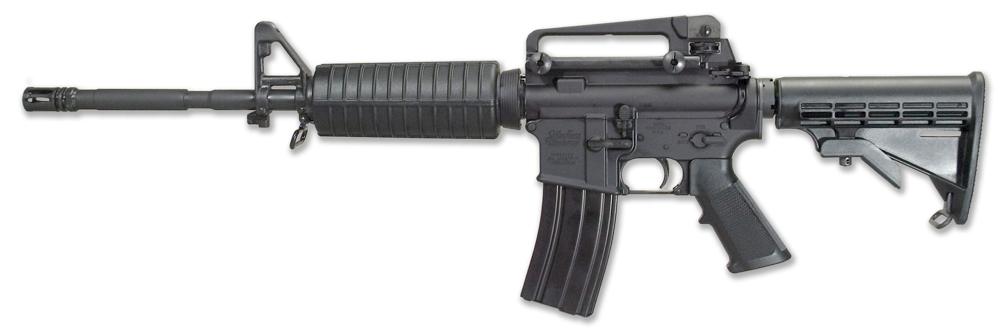
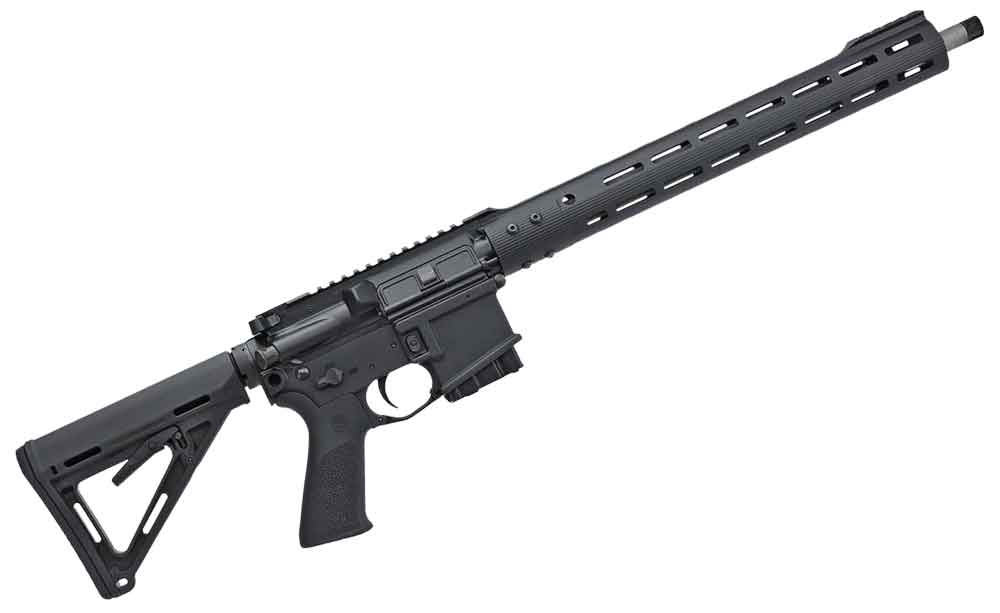
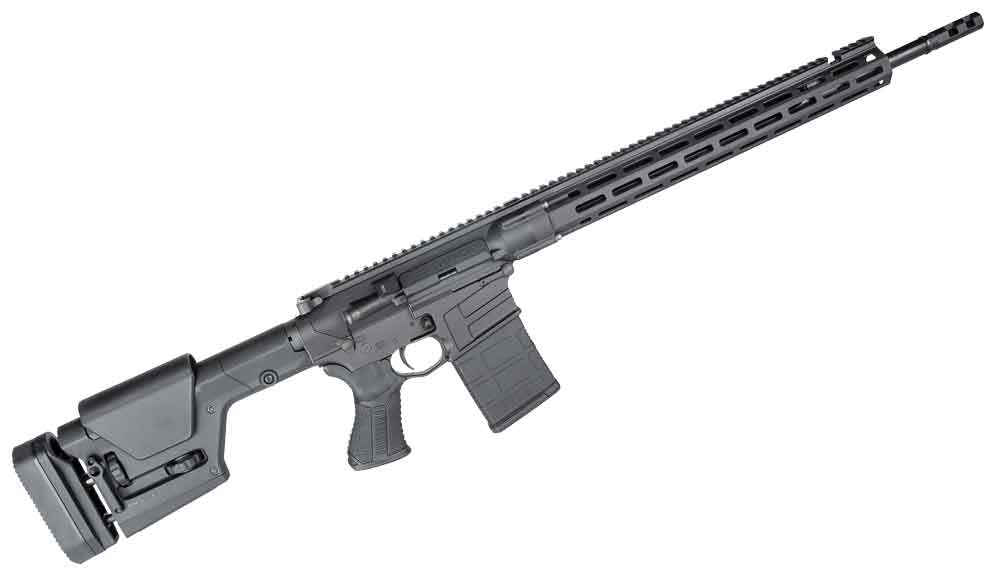
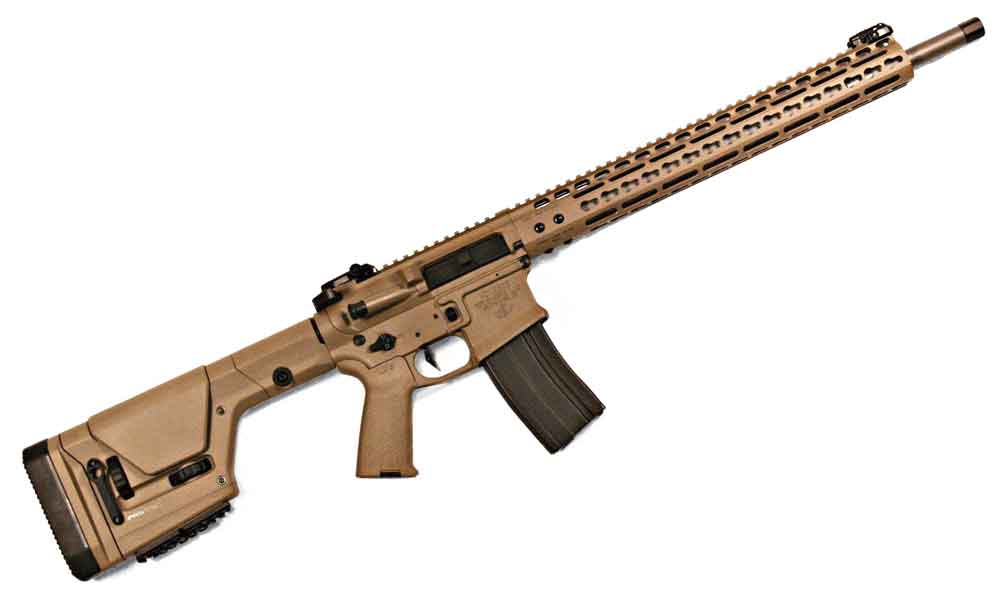
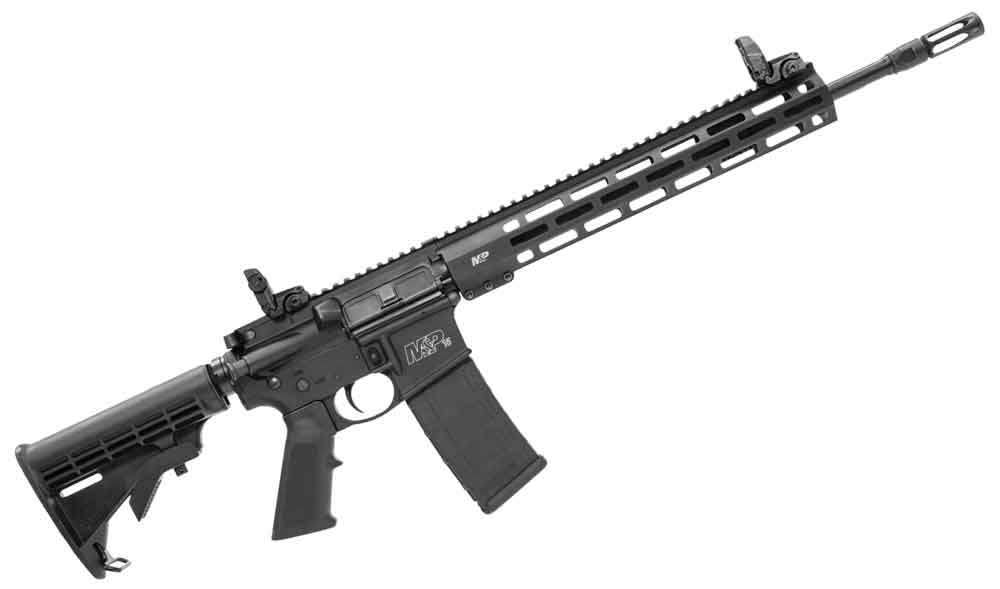
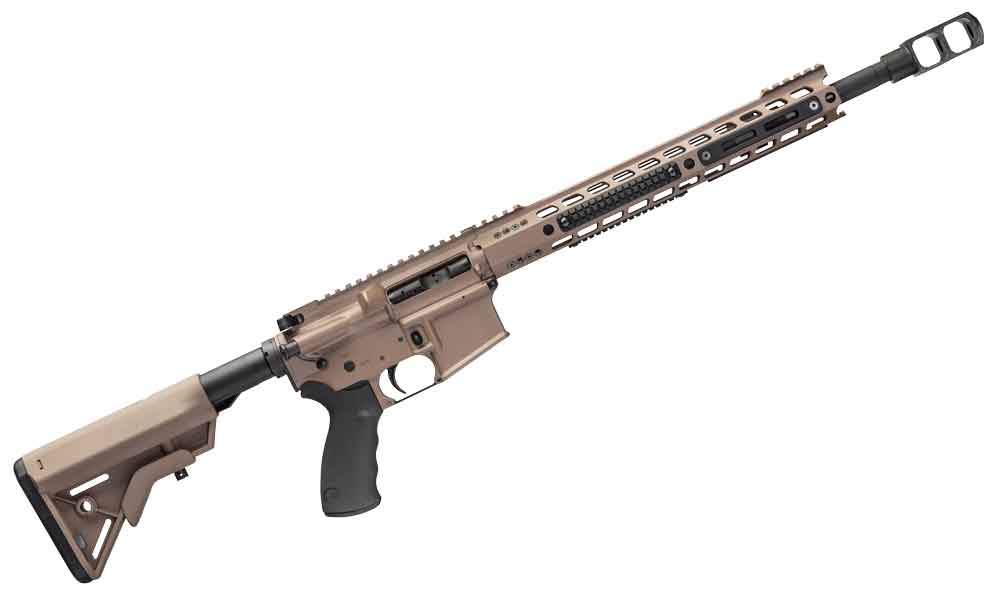
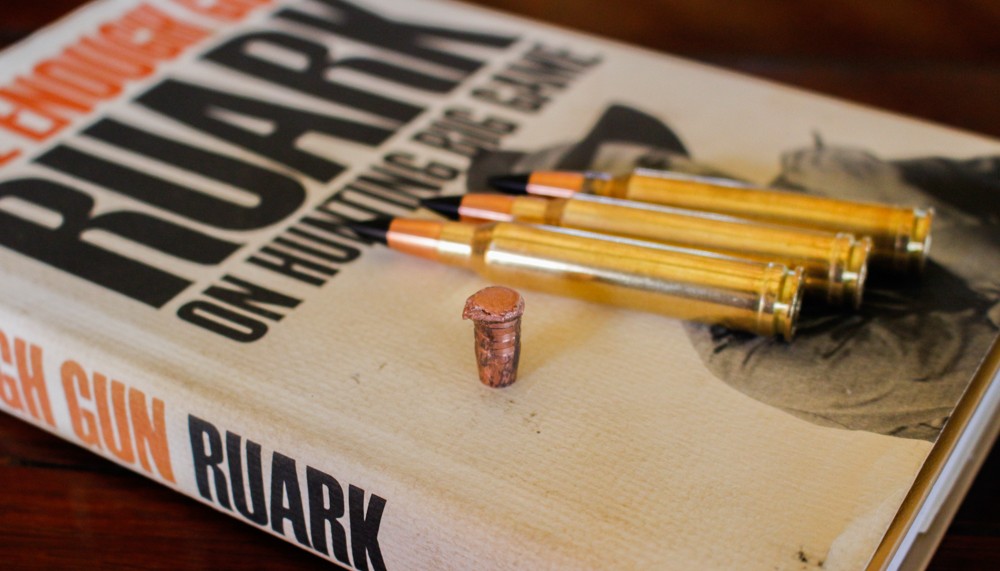
Set to ring the gong from a country mile, Savage’s MSR 15 Valkyrie embraces the ballistic talents of Federal’s new cartridge.
What does the new Savage MSR 15 Valkyrie bring to the table?
The MSR 15 Valkyrie is chambered for Federal’s red-hot new cartridge the .224 Valkyrie.
The Valkyrie offers greater capacity than other .22 calibers and heavy-for-caliber bullets.
The projectile maintains supersonic velocity beyond 1,300 yards.
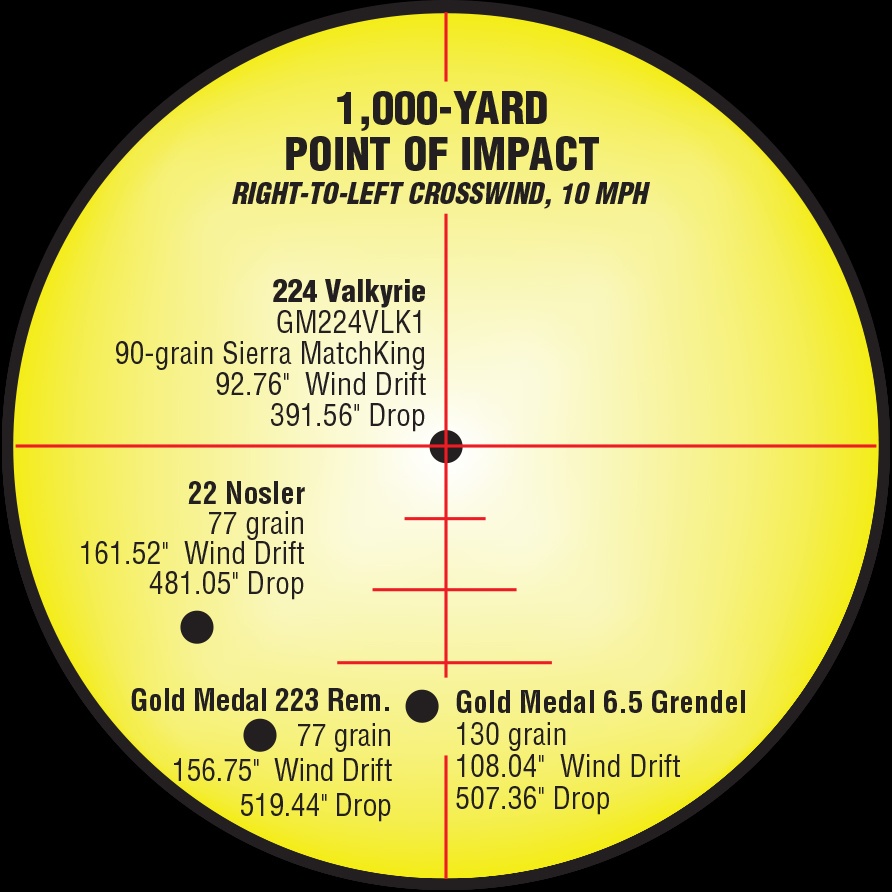
According to Federal, it outperforms all other AR-15 cartridges in terms of drop and drift.
The MSR 15 Valkyrie has a faster 1:7 twist and 18-inch barrel for improved ballistics.
Only gravity has been more constant than Savage Arms. Since the sunset of the Model 99, another release from the Massachusetts gunmaker meant one thing and one thing only — the market was growing by another bolt-action.
This isn’t to say the Massachusetts manufacturer hasn’t turned out tip-top rifles at more than fair prices — they have. But, for the most part, the company’s catalog is chalked full of riffs off its tried and true Model 10 and Model 110 bolt actions and not much else.
Things, however, have changed in recent years. Venerable Savage’s slow-and-steady ethos has begun to pick up pace and, a surprise to many, the company has begun churning out AR-15 and AR-10 rifles.
Now the company is going even further out on a limb with its newest rifle release. The MSR 15 Valkyrie embraces a brand new cartridge and is among the first rifles chambered for the small-bore wonder. Then again, the .224 Valkyrie might not be a big gamble at all.
If it pans out the way Savage’s sister brand Federal Premium promises and the new MSR helps it deliver, it has a real chance at putting an entirely new spin on the long-range shooting game.
Flight Of The .224 Valkyrie
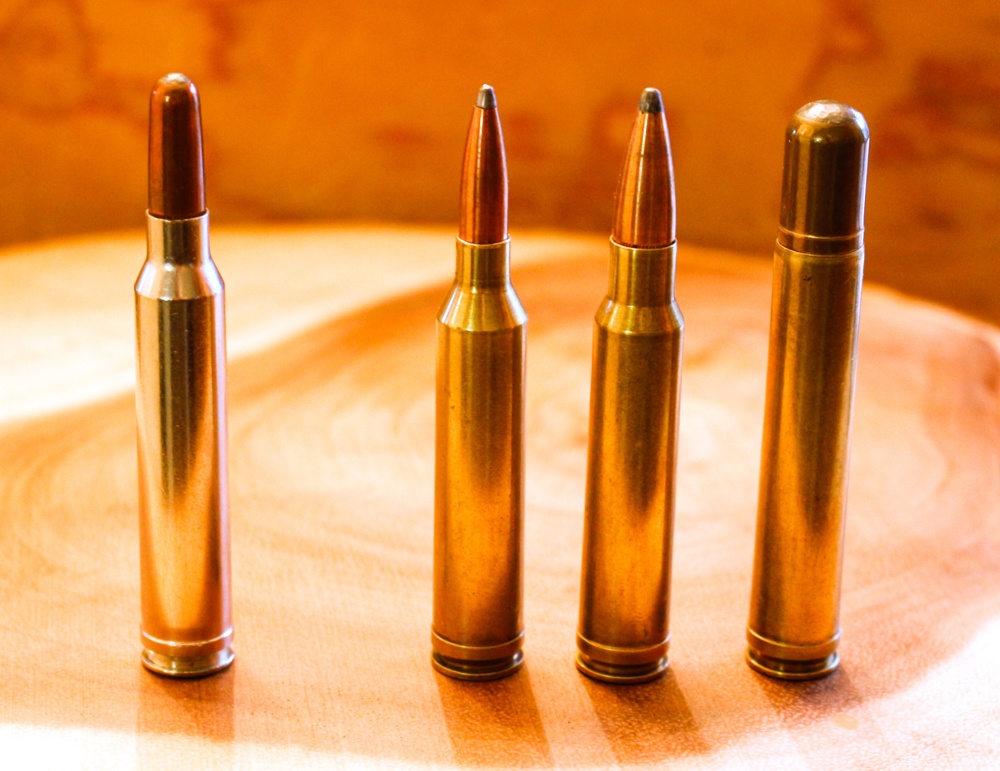
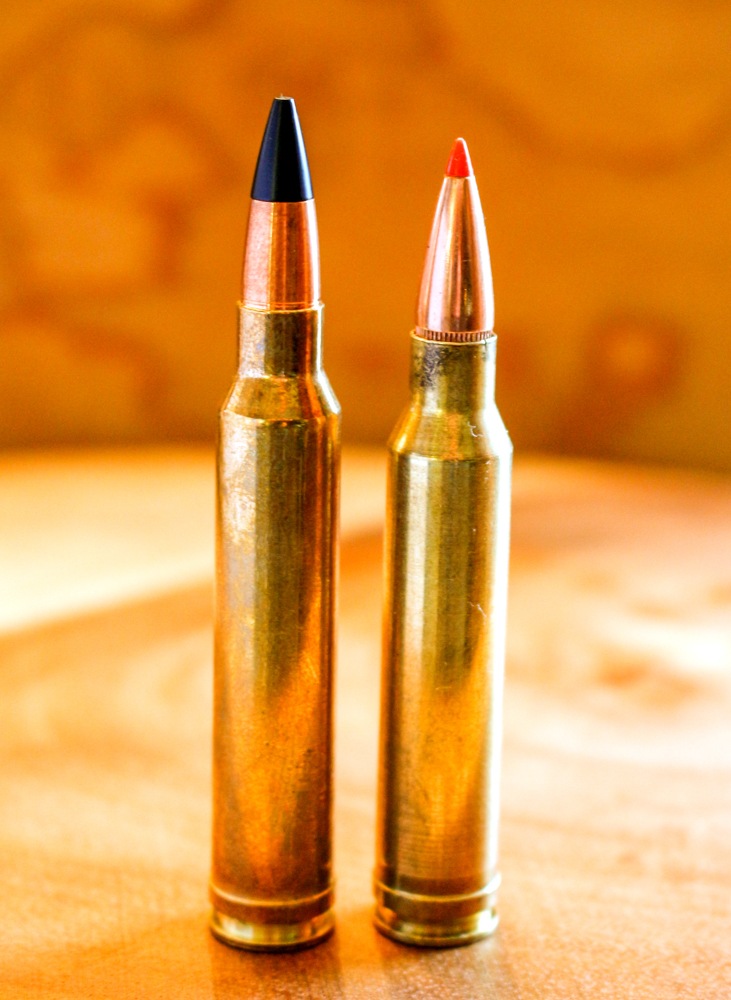
Hot loads are nothing new in the world of centerfire .22 cartridges. But Federal has gone a step beyond just capacity with the newly minted .224 Valkyrie. It also has given it space for a projectile that can harness it.
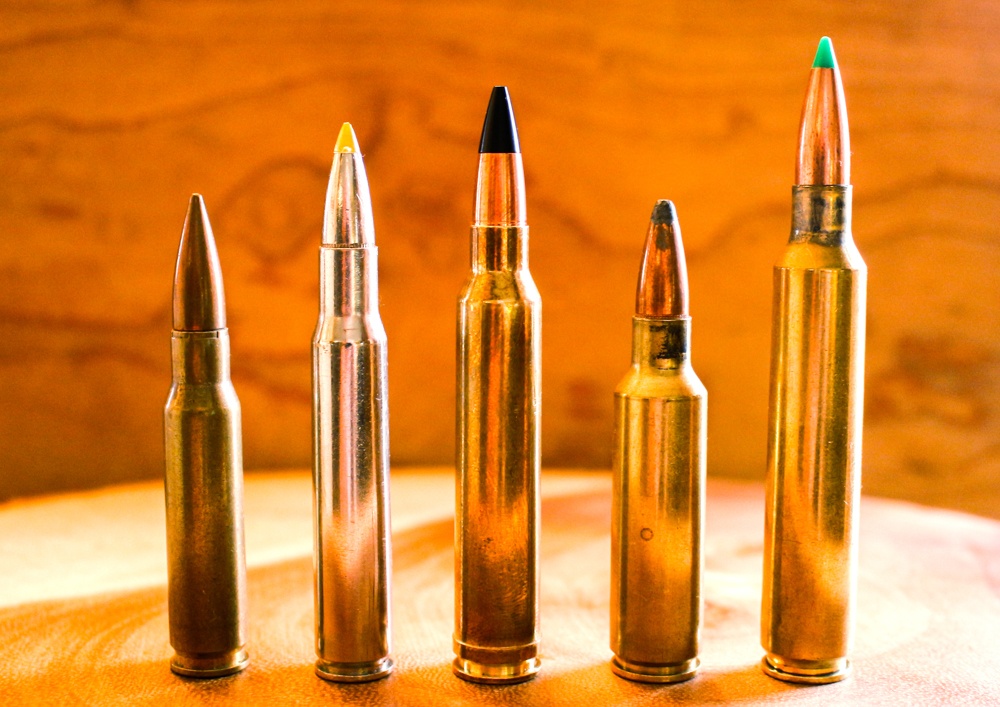
In addition to room for more propellant, the 30 Rem./6.8 SPC case also has the space for longer projectiles with their trim ogives. Not only does this mean the Valkyrie launches bullets with sexier ballistic coefficients, but also greater sectional density. And as every shooter learns sooner or later, these factors are key in defeating drag, and in turn gravity, as well as wind drift.
And from what Federal has released so far on the Valkyrie, they appear to have a winning recipe.
The company claims the round maintains supersonic velocities out to 1,300 yards, outperforming nearly everything in its class — 22 Nosler, .223 Rem., and 6.5 Grendel. Just so they didn’t leave any sacred cows un-tipped, the ammo company also said the Valkyrie produces less recoil than the 6.5 Creedmoor, while nipping at its heels in performance. To top it all off, aside from bolt and barrel, the round works in a standard AR-15. Federal pitches the Valkyrie as a cartridge for all shooting situations, from small to medium game hunting to competition and plinking. And it has released a full suite of ammunition to meet all occasions: 90-grain Gold Medal Sierra MatchKing, 60-grain Nosler Ballistic Tip Varmint, 100-grain Fusion MSR and 75-grain American Eagle TMJ.
The American Eagle offering (rumored to run $14 per box of 40) brings up another potential advantage of the Valkyrie: affordability. That’s something not often associated to the long-range game.
At present, there is little hard data and specs available on the Valkyrie, aside from company-supplied ballistics (which are scant) and some backstage reviews by shooting’s mucky-mucks. In turn, time will tell if it lives up to Federal’s boasts.
Everyday shooters’ chances to give the .224 Valkyrie its day in court will come early next year, once approved by the Sporting Arms and Ammunition Manufacturers’ Institute in January 2018. Reloading specs on the Valkyrie will then soon follow.
MSR 15 Valkyrie
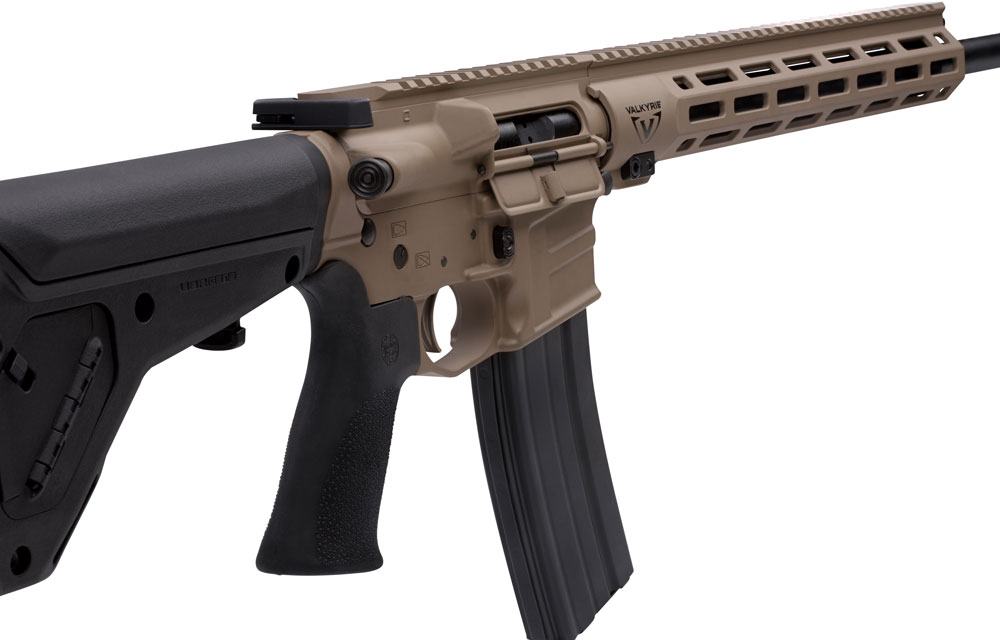
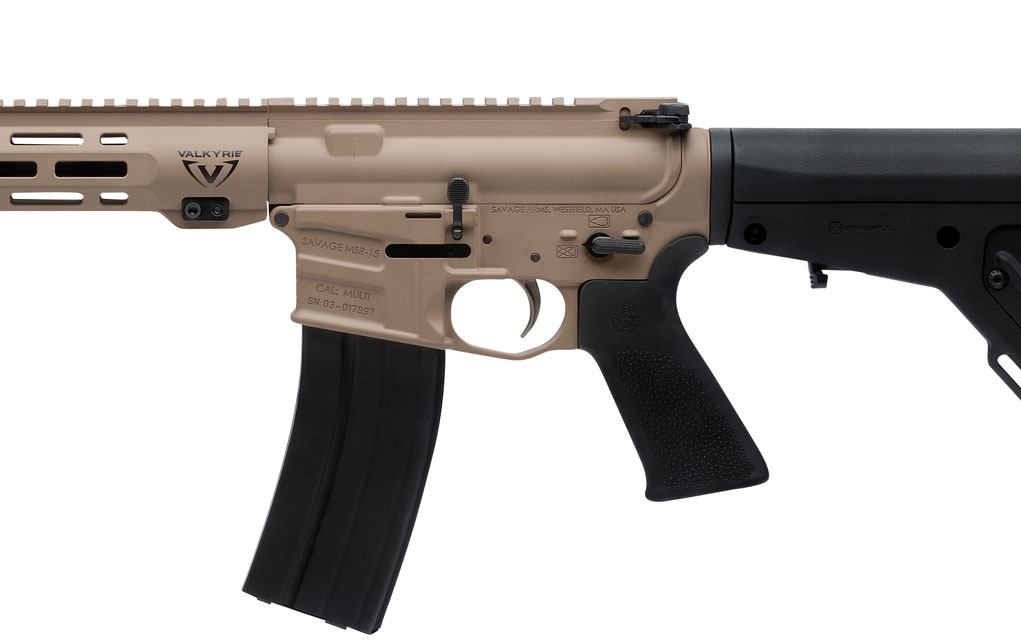
Savage knows bolt-actions and, with the release of the MRS 15 Valkyrie, is proving it also knows ARs. The gunmaker has put together what appears a pretty solid package to set the .224 Valkyrie to flight.
Savage bills the MSR 15 Valkyrie as “competition ready.” At just under 8 pounds and 35.5-39 inches in overall length, it has the potential to hold down other duties. Given the range expectations of the .224 Valkyrie, this news should get coyotes shaking in their boots. As would be expected, the rifle is optimized for the round, this is particularly seen in the barrel. While Savage didn’t go for a full 20-inch barrel on the MSR 15 Valkyrie, it got darn close at 18. This should provide plenty of bore to milk the round for all of its ballistic potential. On top of that, it boasts a faster 1:7 twist rate, logical given the .224’s heavier bullets. Following present black rifle trends, the rifling is 5R — a beveled land, meant to minimize bullet deformation and make the bore easier to clean.
The Savage has a mid-length gas system, which is becoming all the more common, even on shorter-barreled ARs. But there is solid reasoning for opting for mid over carbine length. In addition to dampening the recoil, the mid-length gas system’s extra 2 inches also keeps the higher capacity cartridge from battering the heck out of the bolt-carrier group and buffer. And there is little worry for shooters who plan to run every conceivable round through the rifle, as the MSR 15 Valkyrie boasts an adjustable gas block.
The rifle is set for precision work out of the box with an adjustable two-stage trigger, which is tunable between 2.5 and 6 pounds. It has a free-floating M-LOK handguard, with ample slot real estate around the circumference and is Cerakoted (same goes for the receivers) in FDE with the Valkyrie logo on the side. It has a full-length Picatinny rail, a UBR Gen 2 buttstock and Hogue pistol grip. And the MSR 15 Valkyrie is topped off with a with a muzzle brake similar to the one found on the 10/110 Stealth, attached with a 1/2×28 thread pattern. While Savage has allowed word to slip about the MSR 15 Valkyrie now, interested shooters will have to show patience. The rifle’s official release isn’t until SHOT Show 2018, but the price has already been set, with the MSRP at $1,499.
Until then, long-range freaks and collectors of the latest-and-greatest AR will just have to ponder the rifle and cartridge and whether they will find shooting Valhalla with these Valkyries.
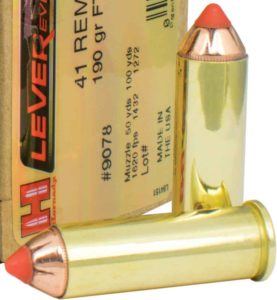
While it has yet to achieve widespread acceptance, the .41 Remington Magnum is a sharp all-around hunting cartridge that is more manageable than the .44 Magnum.
The .41 Remington Magnum is a true .410-inch diameter cartridge.
This is as opposed to the .401-inch diameter of the .41 Long Colt.
The round is a more practical hunting cartridge than the .44 Magnum.
And it’s more potent than the .357 Magnum.
The .41 Magnum has substantial recoil and muzzle blast, but less than the .44 Mag.
The .41 Remington Magnum revolver cartridge was introduced in June 1964 along with the S&W Model 57 revolver. Bore diameter of the .41 Magnum is a true .410-inch, rather than the .401-inch of the .41 Long Colt.
The new round was a more practical all-round hunting cartridge than was the .44 Magnum. The .357 is not entirely adequate for big game, except in the hands of an experienced handgun hunter. The .44 Magnum is overpowered for anything but big game, and most people do not shoot well with it. The .41 Magnum covers the small-game, medium-game, and varmint-through-deer classes quite adequately. Its effectiveness on anything heavier than deer would depend upon who was using it and under what conditions.
Recoil and muzzle blast of the .41 Remington Magnum are slightly less than the .44 Magnum, but still heavy. For the average shooter, mastering either will require about the same amount of training and practice. The .41 Remington Magnum is not quite as powerful as the .44 Magnum, but it is all the gun the average handgun hunter needs. All major domestic commercial ammunition makers have offered this cartridge, but, as of this writing, it has yet to find truly widespread popularity.
AR-style rifles aren’t only relegated to the range or competitive shooting. Here’s a list of new hunting ARs that could make your next season one for the hunting journal.
What are 9 great new hunting ARs to bring home game?
Call them black rifles, ARs or modern sporting rifles. Call them anything you want, but don’t call the latest round of AR platform guns unsuitable for hunting. Thanks to a growing demand for accurate, reliable, high-quality and diverse semi-auto rifles, gun manufacturers are producing some of the finest hunting ARs available today.
Whether you prefer to pop prairie dogs at long ranges, thin out hogs on the Back 40 or hunt deer, bears or even elk, there are plenty of hunting ARs to choose from. Some are stripped down and affordable for everyone. Others are customized with the highest quality components. The good news is that with all these options available, you can readily find one that’s almost built custom for your needs.
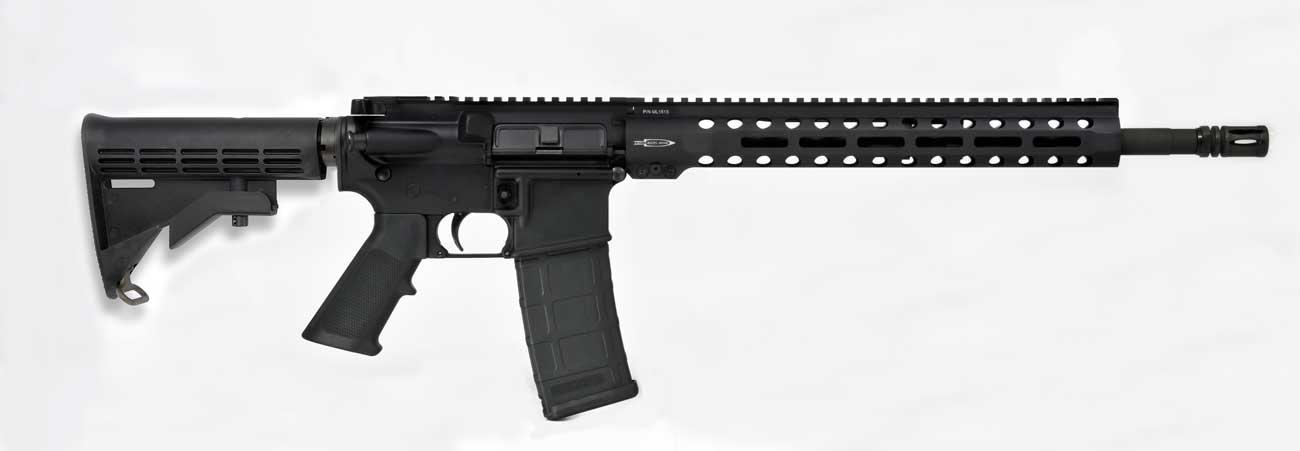
Colt Trooper Patrol Carbine It might not be wrapped in camouflage, but Colt’s Trooper M4 Carbine is everything you could want when it comes to basic hunting ARs. Chambered in 5.56 NATO, it’s fully customizable yet fully capable just as it is — and it’s an ideal starter gun for hunting everything from coyotes to prairie dogs. The Trooper is built with a direct gas impingement system. It comes with an M-LOK handguard and a flat-top upper that’s ready for lights, optics and other accessories to help you hunt more effectively. At just 32 inches and 6.5 pounds, the Trooper is the ideal gun to keep in your truck’s gun rack as you ride the ranch. Coyotes, hogs and other varmints don’t stand a chance. $1,049
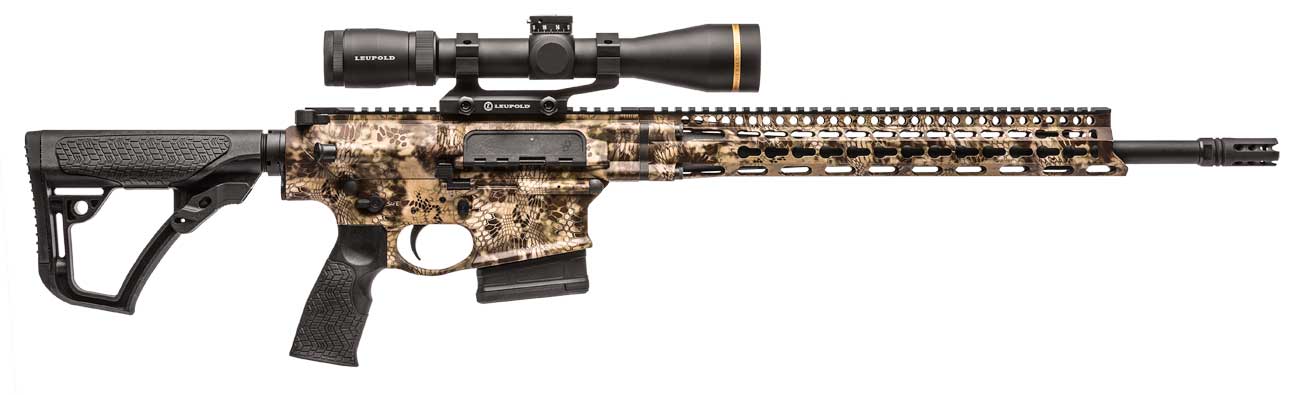
Daniel Defense Ambush 308 Deer, hogs and just about any other big game animal in North America be warned: Daniel Defense’s new rifle is coming for you. Chambered in .308 Win. and built with the highest quality parts, this rifle isn’t just a workhorse — it’s accurate, thanks to a free-floating, cold hammer-forged, 18-inch barrel connected directly to the upper. It also comes with a KeyMod handguard with a four-bolt connecting system. All controls are ambidextrous, including the charging handle, and magazine and bolt release. The safety can also be converted. The Ambush comes with a two-stage Geissele SSA trigger and is available in Kryptek Highlander camo. $3,096
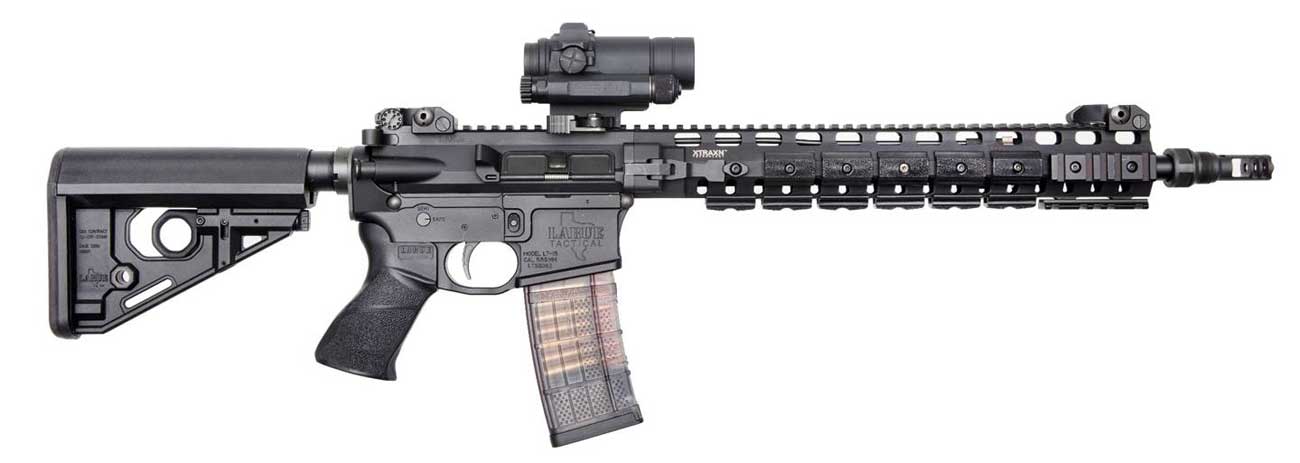
LaRue Tactical PredatOBR 556 It’s not just a great hunting rifle: The PredatOBR 556 is a great rifle that’s built to the highest standards. It’s also user-friendly and can be broken down in a matter of minutes, allowing for safe storage and transport. A locking stainless QD lever makes handguard removal a snap. The gun is available with a 14.5-, 16.1-, 18- or 20-inch barrel, so you can choose the perfect model for your hunting needs. It uses a direct impingement gas system, which is built with LaRue’s PST port selector. The PredatOBR comes with LaRue’s own MBT trigger, two 30-round magazines and three, 3-inch rail sections. Each rifle also shoots a sub-MOA group before leaving the factory. $2,245
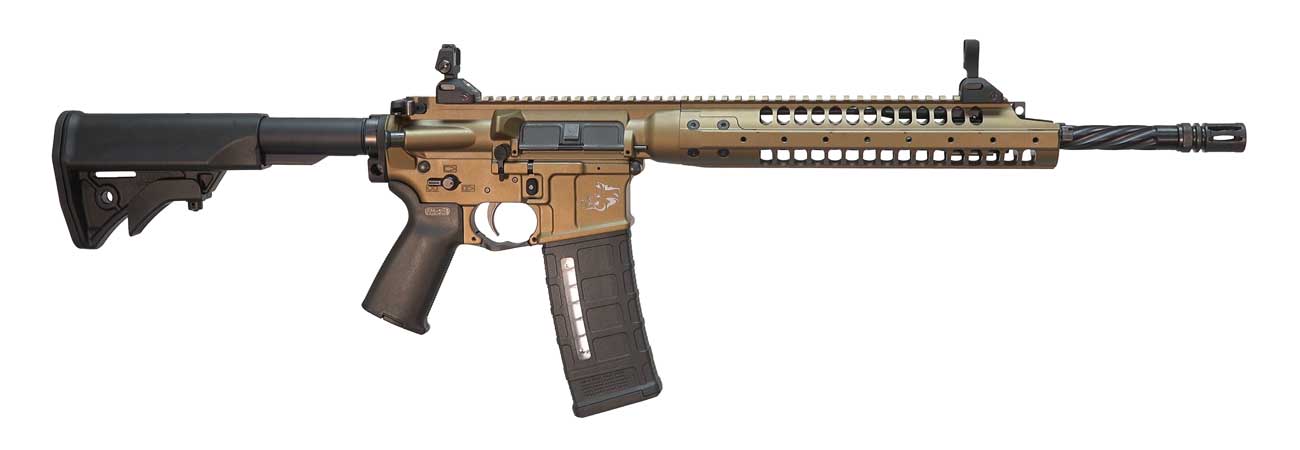
LWRCI Razorback II It might not be the most popular AR maker, but LWRC International sure knows how to make a high-quality gun. The company’s new Razorback isn’t just a good-looking rifle; it’s solid, reliable and accurate. It’s chambered in 6.8 SPC II, a proven and very capable big-game cartridge, making it one of the most capable hunting ARs on this list. The Razorback is also packed with features: All lower controls, including the magazine release, charging handle, bolt catch and release, and the selector are ambidextrous. It’s built with a Magpul MOE grip and PMAG magazine and a LWRCI Advanced trigger guard. The barrel measures 16.1 inches and the gun weighs 6.7 pounds. The rail is 12 inches long and is scallop-cut for weight reduction and versatility. $2,804
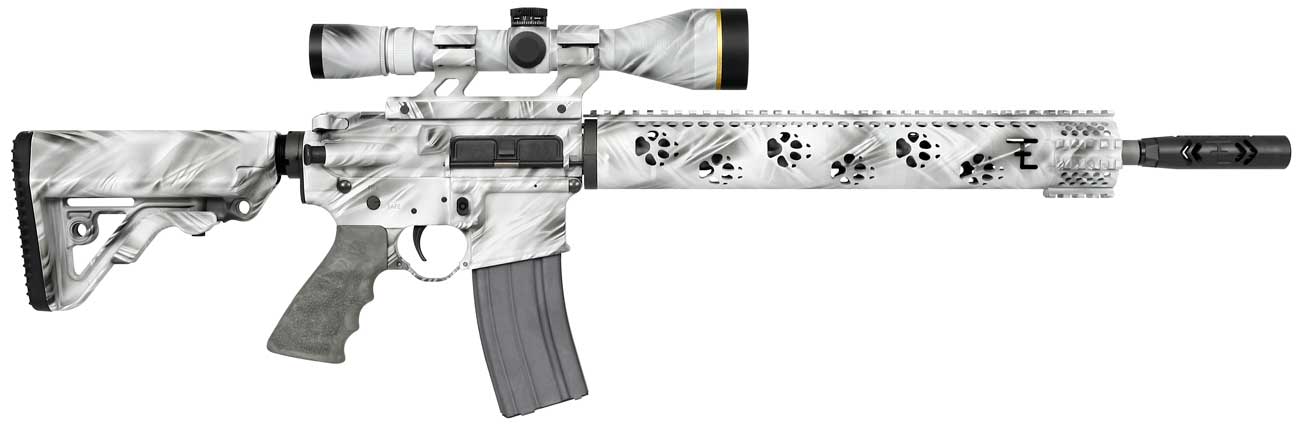
Rock River Arms LAR-15 Fred Eichler Series If the Rock River name isn’t enough to convince you to buy this gun, then the Fred Eichler name ought to push you over the edge. Not only does RRA make some of the finest AR rifles available, Eichler is one of the most demanding hunters. If it’s good enough for Fred, then it’s most certainly good enough for you. Why not? The LAR-15 is ready to hunt out of the box, thanks in part to the Ghost Camo surface. It’s chambered in .223 Wylde, making it the perfect predator rifle. The 16-inch stainless-steel barrel is fluted, and the trigger is a two-stage match trigger. The free-floating handguard has a full-length rail and a 2.5-inch rail on the bottom. The LAR-15 measures 33.5 inches and weighs 7.6 pounds. $2,250
Rock River Arms Predator LAR-8M HP 243 Can’t decide on the perfect caliber for the perfect hunting AR? Rock River just made your life a little easier with its new Predator HP chambered in .243 Win. It’s a big enough caliber for deer-sized game and light, flat and fast enough for a variety of varmints and predators. Like all RRA guns, this one is loaded with features that help you shoot better and easier. It’s fitted with a 20-inch, fluted stainless-steel barrel, a low-profile gas block, a RRA two-stage match trigger and a RRA Operator A2 stock. The handguard is RRA’s own DLX with a free-float rail and three accessory rails. The Predator HP weighs 9.2 pounds and measures 42.25 inches in length. This is one of the most versatile hunting ARs listed here. $1,950
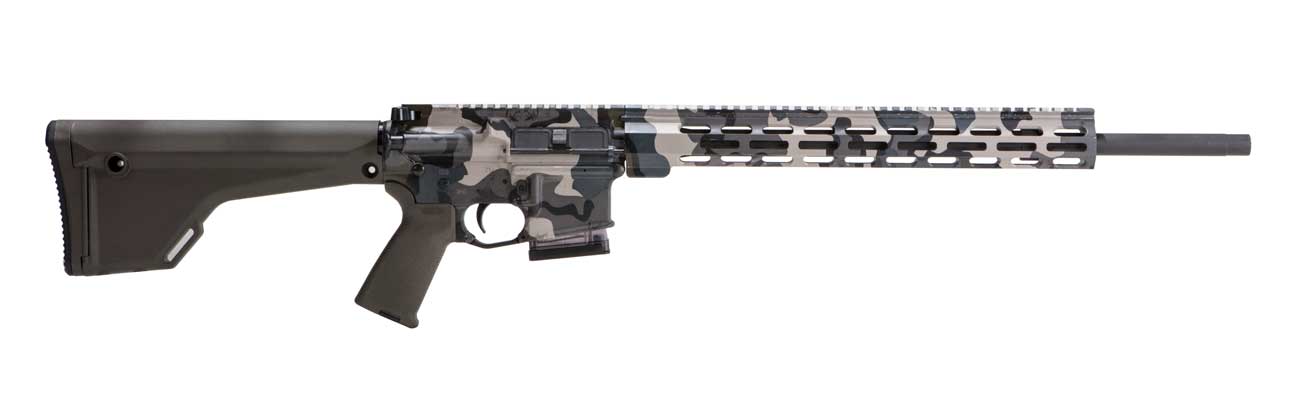
SIG Sauer M400 Vanish SIG’s newest gun is a spin-off on the company’s popular, reliable and field-proven M400. The Vanish, however, is designed specifically for hunting and long-range accuracy, thanks in part to the 20-inch heavy-contour precision barrel, Matchlite Duo trigger and Kuiu Vias camo finish. It’s built with a Magpul MOE fixed stock and grip and comes with a Magpul 5-round magazine. Chambered in .223 Rem., it weighs 7 pounds, 4 ounces and is 38 inches in length. $1,336
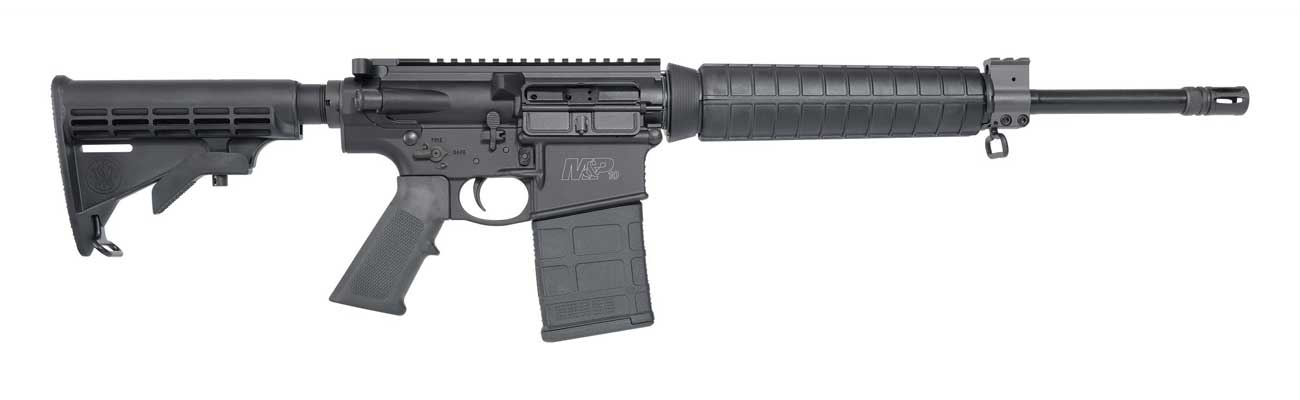
Smith & Wesson M&P 10 Sport No camouflage? No worries. The critters you hunt won’t have time to notice. Thanks to Smith & Wesson’s high standards and demand for accuracy, the M&P 10 Sport shoots fast and flat. Chambered in .308 Win., it’s the perfect hunting gun for a variety of game. The M&P 10 Sport includes a built-in sling swivel, ambidextrous features, an Armornite finish for reduced glare and added durability, and a flash suppressor for stealthy hunting. The stock is adjustable, and the receiver is optics-ready for your favorite scope. Overall length is 34 inches, and the rifle weighs 8 pounds. It’s also backed by S&W’s lifetime service policy. $1,049
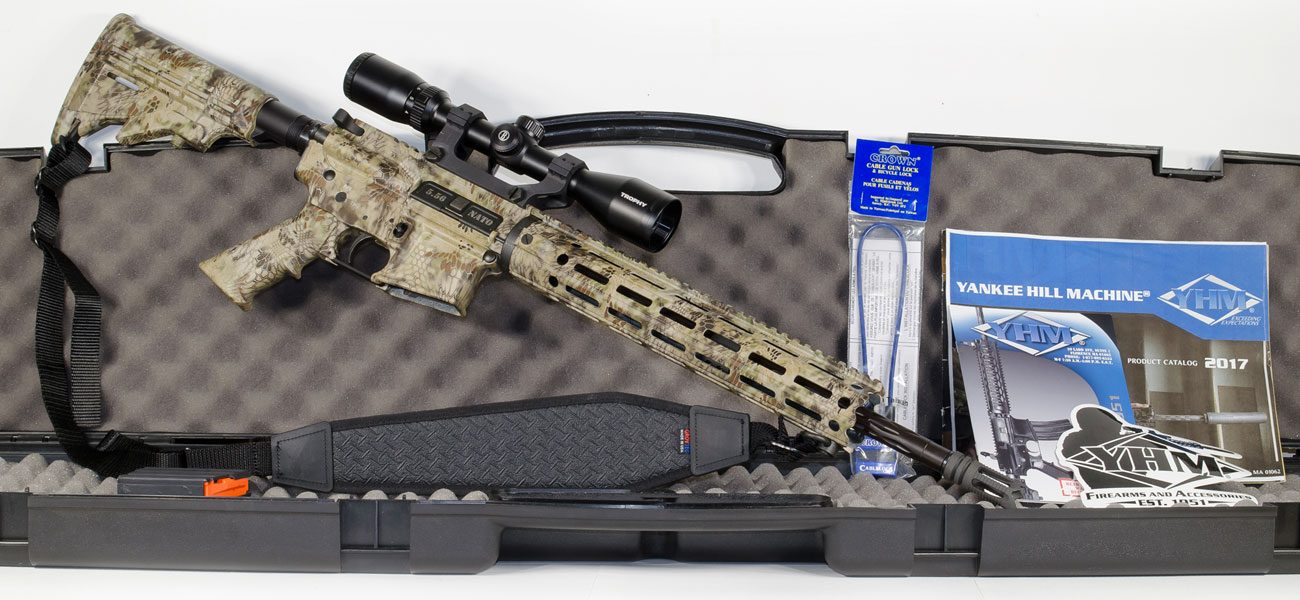
YHM Hunt-Ready Carbine Just in time for hunting season, Yankee Hill Machinery introduces a gun that’s ready to go, straight out of the box. All you have to do is buy some ammo. The gun comes with a sling and a Bushnell Trophy 3-9x40mm scope and is already zeroed at 100 yards. (Of course, it’s always a good idea to shoot a few rounds at some paper just to make sure.) It’s available in 5.56 NATO, 300 BLK and 6.8 SPC, giving you the option of the perfect caliber for a variety of large and small game. It’s built with a free-floating, fluted 16-inch barrel; an aluminum YHM upper and lower receiver; a rifle-length handguard; and a telescoping butt stock. It also comes with a forward assist and a flash hider. Even better, it’s covered in Kryptek Highlander camo, and it comes with a sling. $1,579
Editor’s Note: This article is an excerpt from the October 2017 issue of Gun Digest the Magazine.
Tacticool instruction might be fun, but it won’t make you a more prepared armed citizen. Handgun training should focus on the skills with practical tools that will save your skin.
What should handgun training focus on?
State of Mind
Functional Handgun
Handgun Presentation
Keeping Your Gun Running
Solid Hits
Unfortunately, much of what passes for defensive handgun training these days is “edutainment,” a word coined by famous trainer Pat Rogers. It’s a combination of education and entertainment, and unfortunately, the entertainment side is often more heavily weighted.
If you want to go to man camp and spend five days crawling on the ground, shooting thousands of rounds through your AR or AK, that’s fine. It’s great fun. Chalk that up to your vacation budget, NOT your handgun training budget.
When you’re at your office or at the mall, you won’t have a chest rig and a rifle. You’ll have a concealed handgun and a spare magazine (unless you want to be another “forfeit”). The only gear you will get to defend yourself and your loved ones with will be that gear which is on your person when the incident occurs.
So, our handgun training program should be geared toward excellence in the following areas:
1) Develop an alert, aware state of mind, accepting the fact that violence can occur anytime, anywhere. Do not be surprised or astonished that someone is unlawfully attacking you. Instead of “I can’t believe this is happening!,” your mental response should be, “My day at bat.”
2) Acquire a reliable, functional handgun you can shoot well, a good carry system (belt, holster and ammunition carrier), and wear it on a routine, daily basis. You do not get to pick which day you will need your gun. Someone else makes that decision for you, and you will typically be informed at the very last minute!
3) Work on a safe, efficient, fast presentation of the handgun from its concealed mode of carry. Practice in the clothes you will wear daily. If you ever need that gun to save a life, you will need it quickly. You will have a very finite amount of time once the flag flies. The faster you can access your equipment, the more time you have to make life-altering decisions, and if necessary, get good hits.
4) Learn to keep your gun running. If it runs empty, reload it. If it malfunctions, fix it.
5) Do the bulk of your practice on getting solid hits in the 3- to 7-yard range, quickly and reliably. Do some handgun training at 15-20 yards, but not much.
In short, concentrate your handgun training on the skills we are most likely to need.
Does the small and speedy .223 Remington have what it takes to put meat on the table? With the right bullet, you bet.
With the proper bullet the .223 Remington is more than adequate for deer.
The bullets used must be tough, as they move at such high velocities.
Contrary to popular belief, the .223 is a legal big-game cartridge in most states.
Some hunters think the .223 Remington is too small of a caliber, without enough bullet weight, for deer. I’d classify those folks as fools. Some hunters think the .223 Remington is only legal for deer hunting in a few states. Those folks are just wrong. Dozens of deer I’ve taken or seen cleanly killed with a .223 Remington stand as evidence of its capabilities, and the hunting regulations of all 50 states prove its lawfulness.
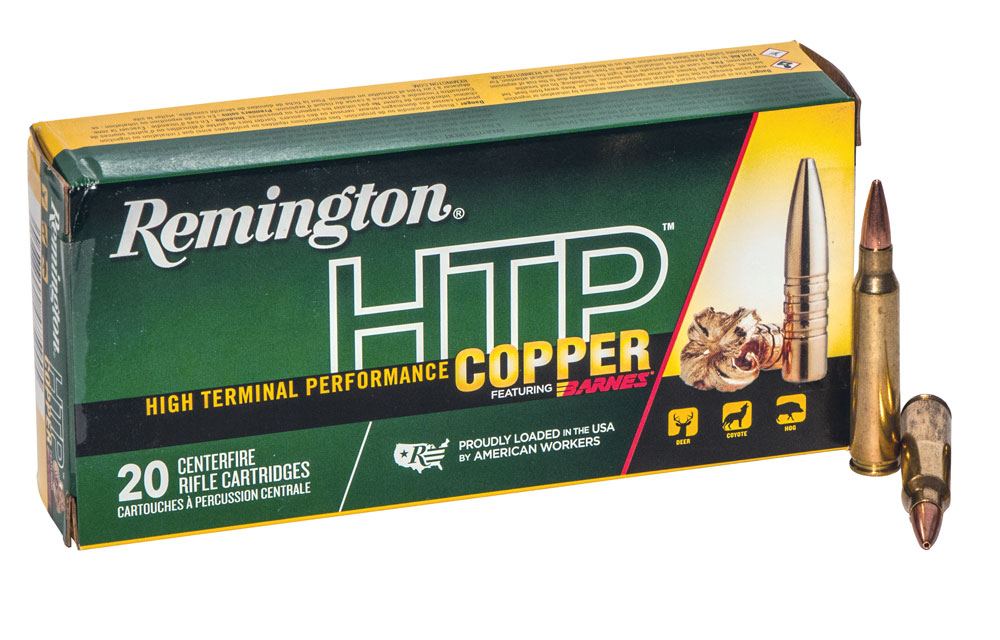
Remington’s new HTP Copper load for the .223 Remington should prove to be ideal for smallish big game because of its velocity. Mono-metal bullets like the Triple Shock are very lethal and effective when pushed fast.
When proper bullets are used, the .223 Remington is more than adequate for any whitetail or mule deer out to the other side of 100 yards. What type bullets are we talking about? With the .223 Remington, the tough bullets come into their own because the cartridge pushes them fast. Remington’s new HTP Copper load for the .223 Remington pushes a 62-grain Barnes Triple Shock bullet to 3,100 fps. Similarly, the Barnes VOR-TX 52-grain load can leave the muzzle 100 fps faster.
Mono-metal bullets such as the Triple Shock work very well at high speeds like this because their energy dump is increased. The downside to the .223 Remington is that these bullets have low ballistic coefficients, so they slow down quickly, limiting the effective range of the cartridge.
As far as legality, a few years back I took the time to research the hunting regulations for all 50 states in order to determine the minimum caliber allowed for big-game hunting. I found 35 states that permitted its use. That’s 70 percent, which qualifies as most in my book.
Editor’s Note: This article originally appeared in the October 2017 issue of Gun Digest the Magazine.
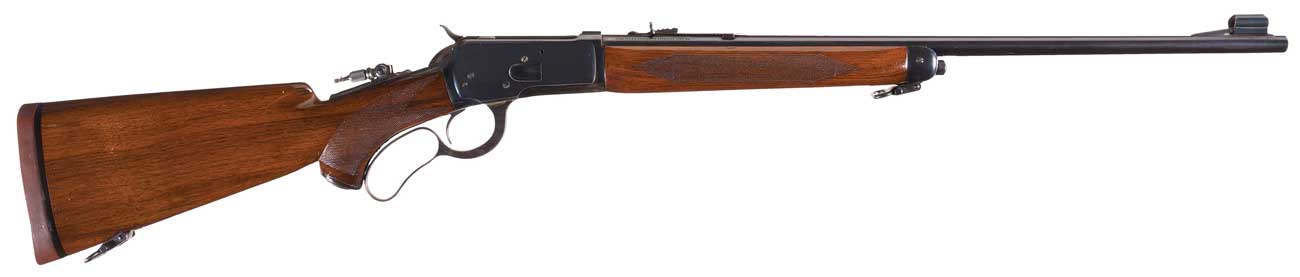
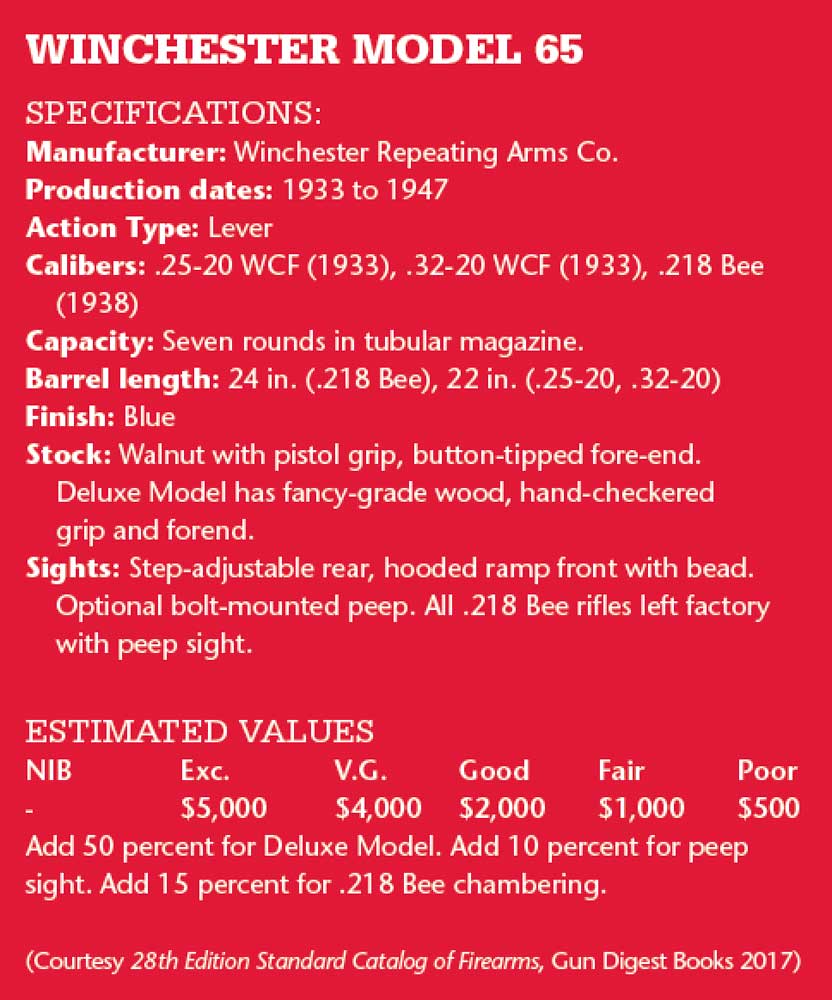
Winchester’s Model 65 was produced for a relatively short time, but it was a big hit with lever-action fans.
The Model 65 had a relatively short run in the time-span of Winchester lever-action rifles. Manufactured from 1933 to 1947, the Model 65 could be described as a successor to the Model 53, which itself was an improvement on the design of the famous Model 1892. The Model 65 was the rarest of the 1892 family. Only about 5,700 were manufactured, compared to 25,000 for the Model 53 and approximately a million for the 1892.
These three models were built on short actions that were scaled-down versions of the Model 1886 and were chambered for several popular small-game cartridges of the day. The 1892 was offered in .25-20, .32-20, .38-40 and .44-40. The same stood for the Model 53 except for the .38-40, and the Model 65 originally in just the .25-20 and .32-20.
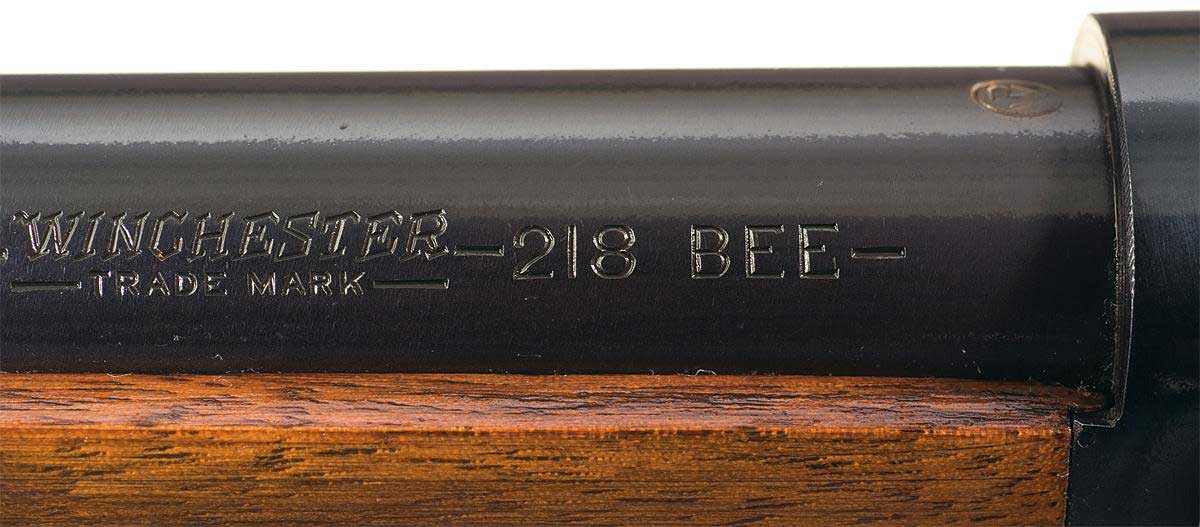
However, in 1938, Winchester introduced a new cartridge in the Model 65 that gave the rifle a special place in hunting circles, the .218 Bee. It had a rimmed, bottle-necked case based on the .25-20 Winchester necked down for a .224 bullet. The .218 Bee was named for the bore diameter of the barrel rather than the more common practice of using the bullet diameter for the name of the cartridge.
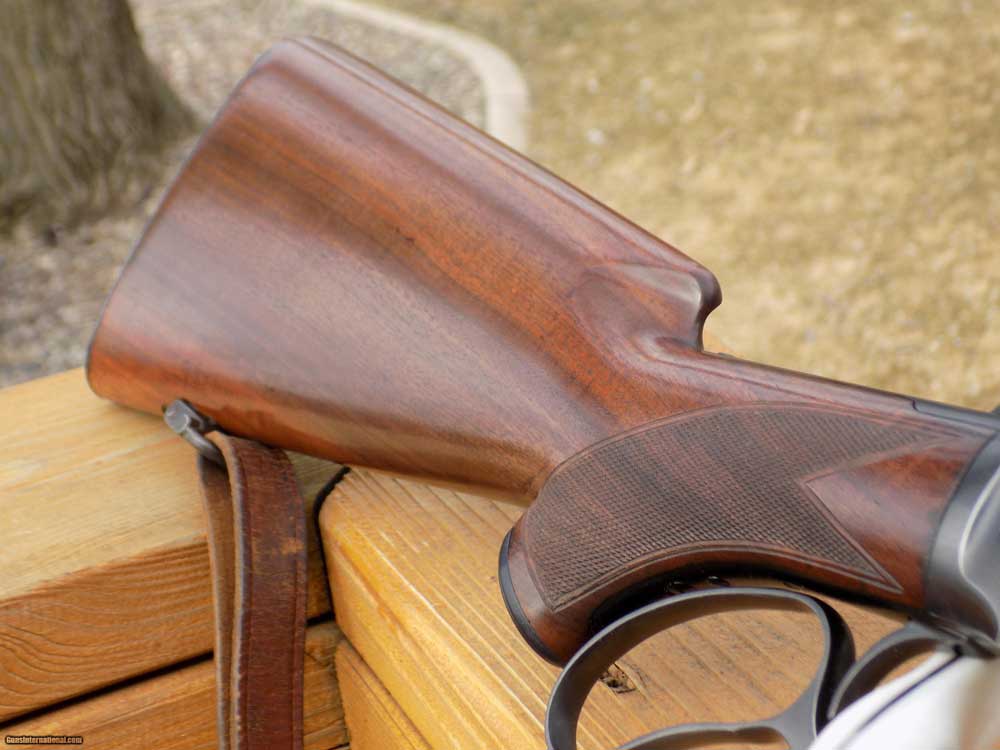
Fancy wood stock on a Deluxe Model 65.
The Bee was the first competition for the .22 Hornet in the category of varmint cartridges. The Hornet had come to life in the late 1920s, and by the early ‘30s it was available in various bolt-action and single-shot rifles. While the Hornet had become very popular, the Model 65 had its own niche — a lever-action varmint rifle. To those with a fondness for lever guns and small game/varmint hunting, it quickly became an “I want one, too” item.
It should be remembered that the .218 Bee came along in the late 1930s at the end of the Great Depression, before World War II, and more than a decade before the introduction of the excellent .222 Remington. During this period, the Bee and the Hornet were pioneers: The only cartridges that were designed for those varmint and small-game shooters who wanted a flat-shooting round with higher velocity than the .25-20 and .32-20.
As can be seen in the comparison chart, the .218 Bee has a slight edge in velocity, but it was apparently not enough to beat the Hornet in the marketplace. There were many rifles chambered for the .22 Hornet, all either single-shots or bolt-actions. The Bee was only available in the lever-action Model 65 until Winchester introduced the bolt-action Model 43 in 1949, which was offered in .218 Bee, .22 Hornet, .25-20 Win., and .32-20 Winchester.
Model 65s were chambered in .218 Bee, .25-20 WCF and .32-20 WCF. Most collector interest seems to be in the Bee.
Failure To Launch Why did the .218 Bee never catch up with the Hornet in popularity? Some say the reason was because the bolt-action .22 Hornet models generally had a slight edge in accuracy over the lever-action Model 65. That might have been true, but for the avid lever-gun fan, the Model 65 was the preferred rifle. The limited number of Model 65s manufactured (5,700 compared to 62,000 for the Model 43) created somewhat of a “cult” of followers. Even though the .25-20 was the rarest caliber, there seems to be more interest in the .218 Bee.
In 1989, Browning marketed an excellent replica of the Model 65, made by Miroku in Japan. A faithful reproduction, 3,500 were made in Grade 1 and 1,500 in High Grade — all in .218 Bee. The High Grade came with silver-inlayed scrolling, gold-plated game animals and a checkered stock and forend. These models can be found on the used gun market at a fraction of the estimated values shown for the original Winchester rifles.
Editor’s Note: This “Collector’s Corner” column is an excerpt from the Winter 2017 issue of Gun Digest the Magazine.
The Windham Weaponry MPC 16 doesn’t have a lot of extra bells and whistles — making it a top pick for a survival gun.
How the MPC 16 thrives as a survival gun:
Windham Weaponry ARs have a lineage of quality going back to the Bushmaster days.
For survival, a simple, rugged AR-15 might be all you need; Windham’s MPC 16 delivers.
Completely Mil-Spec throughout, this 16-inch-barreled carbine runs reliably.
It can also be handled by a variety of shooters based on skill level and experience.
The Windham Weaponry MPC 16 is simple, which makes it easy to maintain and use. During the stress of a survival situation, you don’t want things overly complicated. Photo: Windham Weaponry
Windham Weaponry, named after the town of Windham, Maine where the guns are made, may be an unfamiliar name, but it is far from a new manufacturer. The factory, machinery, owner, and most all the employees were formerly under the Bushmaster name. Now, that same experience and attention to detail are being devoted wholeheartedly to this endeavor.
I was quite eager to see how the new Windham Weaponry MPC 16 would look and perform, and I was not disappointed. The rifle is an M4-style carbine with a direct gas impingement system chambered for 5.56 NATO. The rifle’s solid, proven design and features — without a lot of extra bells and whistles — lend themselves ideally for use as a survival rifle.
Both the upper and lower receiver of the MPC 16 are manufactured from forged 7075 T6 aluminum and have a hardcoat black anodized finish. The upper receiver has a flattop design with a removable carry handle and A4 dual aperture sights that are elevation and windage adjustable.
There are no indexing marks on the top Picatinny rail; so, you would need to take care when removing and replacing optics to maintain proper zero.
The 16-inch chrome-lined barrel of the MPC 16 has an M4 profile and is made from Mil-Spec 4150 chrome-moly vanadium steel. Chrome-moly results in increased carbon content in the steel and adds significant strength and durability, both very desirable features in a duty rifle.
The 16-inch chrome-lined barrel on the Windham AR has an M4 profile and is made from Mil-Spec 4150 chrome-moly vanadium steel. Photo: Windham Weaponry
The barrel has a standard 1 in 9-inch twist rate, which does a good job of stabilizing a wide range of bullet weights, including very low-weight projectiles.
Another Mil-Spec feature is the addition of M4 feed ramps at the back of the chamber. The standard threaded muzzle is topped off with a removable A2 flash hider, and the front sight base is elevation adjustable.
Standard Mil-Spec AR
Some folks are sticklers for properly F-marked bases on carbines; the Windham Weaponry AR is not so marked, but this is a distinction with very little real-world application.
Because of the difference in sight radius of a carbine over a rifle, an F-marked sight base is infinitesimally lower than a standard base. This is only an issue when using iron sights at distances past 200 yards, and it can easily be corrected by installing a taller front sight post.
The CAR black plastic handguards have double aluminum heat shields and were extremely effective at protecting the carbine-length gas tube (as well as my hand) from a hot barrel during a full day of range testing. The bolt and bolt carrier are phosphate finished and chrome-lined.
The MPC 16’s bolt carrier has a Mil-Spec M16 contour (as opposed to a cheaper commercial bolt), which is stronger and heavier to ensure longer and more reliable operation — and it’s paired off with a standard carbine buffer. It should be noted that Mil-Spec M-16 bolt carriers are legal to install in semi-auto rifles.
The controls on both upper and lower receivers, dust cover, forward assist, bolt release, magazine release, charging handle, and safety selector are all located in the familiar places with nothing ambidextrous. The trigger guard is the fold down aluminum type for use with gloves.
The M4-type collapsible buttstock has six positions for length of pull to adjust for shooters of varying stature or with use while wearing body armor, and it features the Windham Weaponry logo.
The stock of the MPC 16 was well installed and exhibited excellent fit with very little play. Also, the fit between the upper and lower receiver was excellent with only the slightest amount of play between the two. The lower receiver comes with a standard military-type plastic pistol grip with finger grooves and a slightly flared magazine well.
During his range sessions, the author did not experience a single malfunction of any sort from the Windham, and it performed admirably, certainly capable of 1 MOA accuracy.
The trigger is of the standard, single-stage AR variety with the typical utilitarian feel I have come to expect. Unfortunately, that means it’s not great, and the trigger exhibited a fair amount of noticeable creep that felt quite gritty, but mercifully avoided any stacking or over-travel.
It did break consistently at 7.5 lbs., and it should be noted that this was not developed as a sniper-grade rifle but rather as a utility survival gun. And in that regard, it should serve well.
Survival Gun Simplicity
At 6.9 pounds, this isn’t the lightest AR carbine one can purchase, but it is lighter than some of the feature-laden alternatives out there, and its short overall length and excellent balance make it easy to handle and pleasant to shoot. During my entire range session, I never experienced a single malfunction of any sort, and the rifle performed admirably.
Accuracy from a bench rest at 100 yards was about what one should expect from a Mil-Spec rifle, with groups measuring from the best of the day at 1 MOA to the worst at 4 MOA and averaging in between. With the right ammunition and a better trigger, this rifle is certainly capable of pinpoint accuracy.
Windham Weaponry ships their rifles in a black hard plastic case with one 30-round magazine, a sling, and a well-illustrated operators’ manual. Currently, the company’s offerings include state-compliant models.
Specifications:
Windham Weaponry MPC 16 Caliber: 5.56mm/.223 Rem. Barrel: 16-inch chrome-lined 1:9 twist Overall Length: 36.25 in. stock extended, 32.5 in. collapsed Weight: 6.9 lbs. empty Stock: M4 double heat shield handguards/6-position telescoping buttstock Sights: Removable A4 adjustable rear sight and A2 standard base front Action: Semi-auto Finish: Black hardcoat anodized Capacity: 30-round magazine MSRP: $1,086 Contact: 855-808-1888; www.windhamweaponry.com
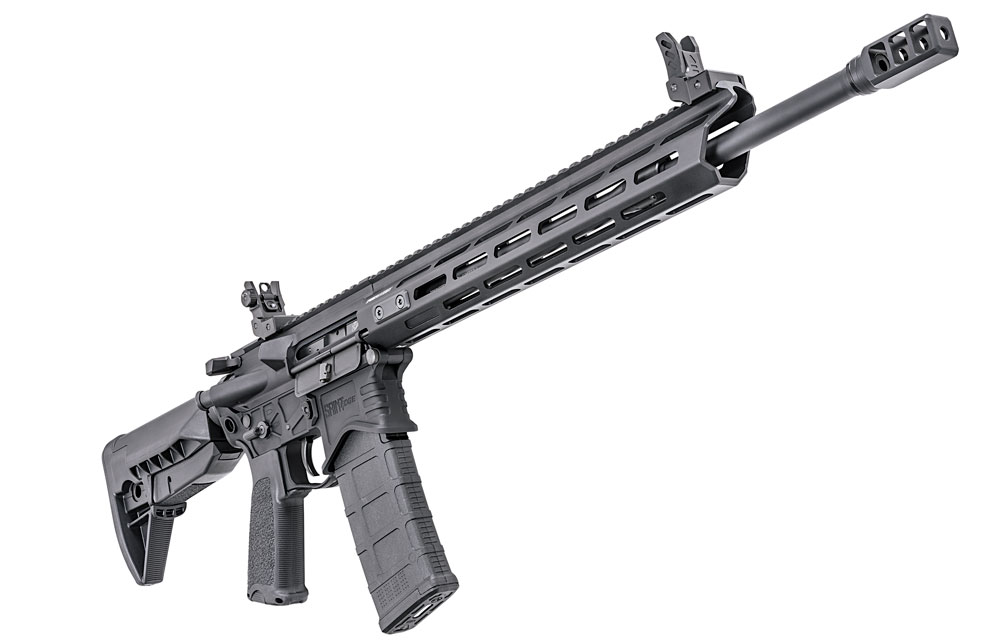
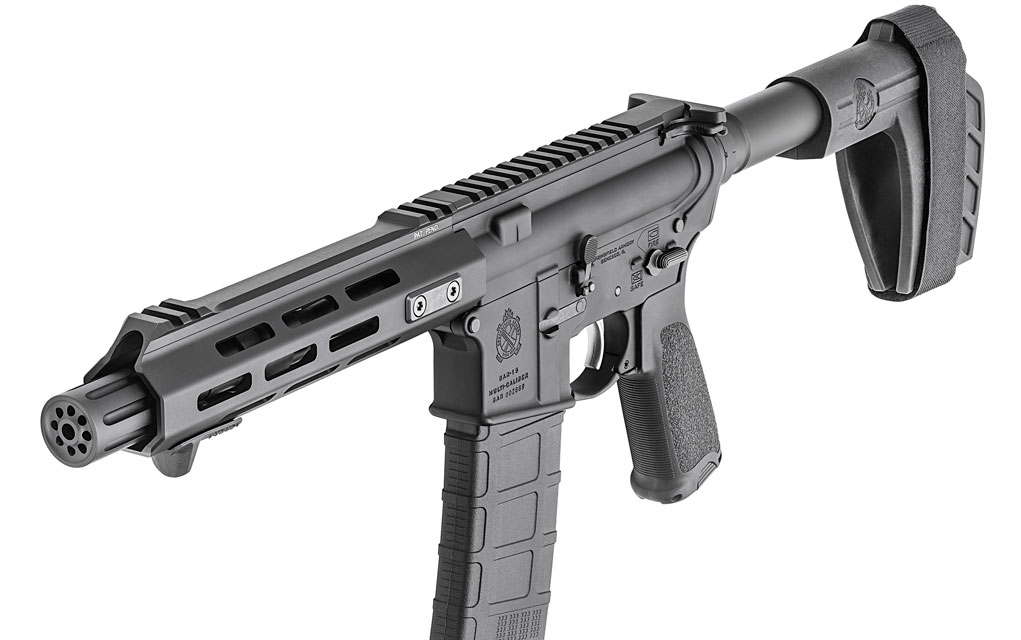
Lighter and smaller, Springfield Armory gives AR-15 fans something to consider with the additions of the SAINT Edge and SAINT Pistol to its lineup.
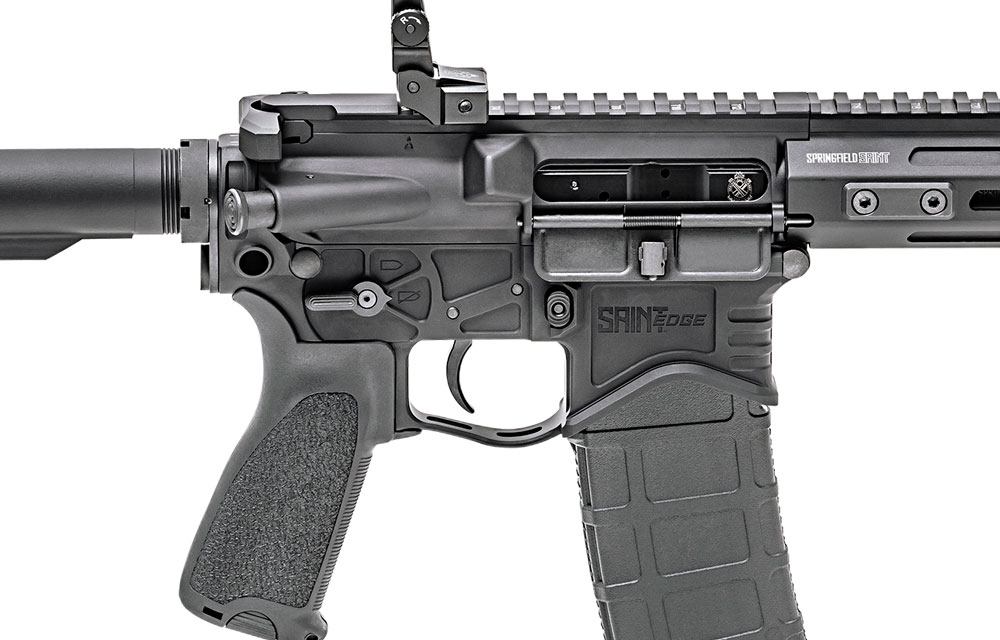
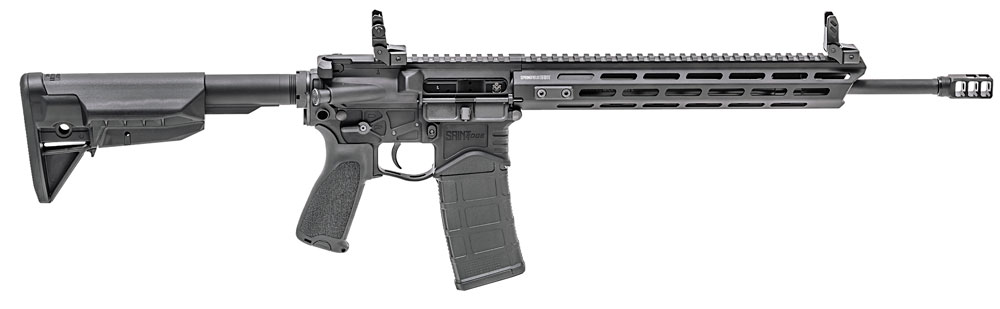
Material around the Edge’s mag well has been removed — it’s the lightest SAINT model.
The carbine boasts a match-grade single-stage trigger.
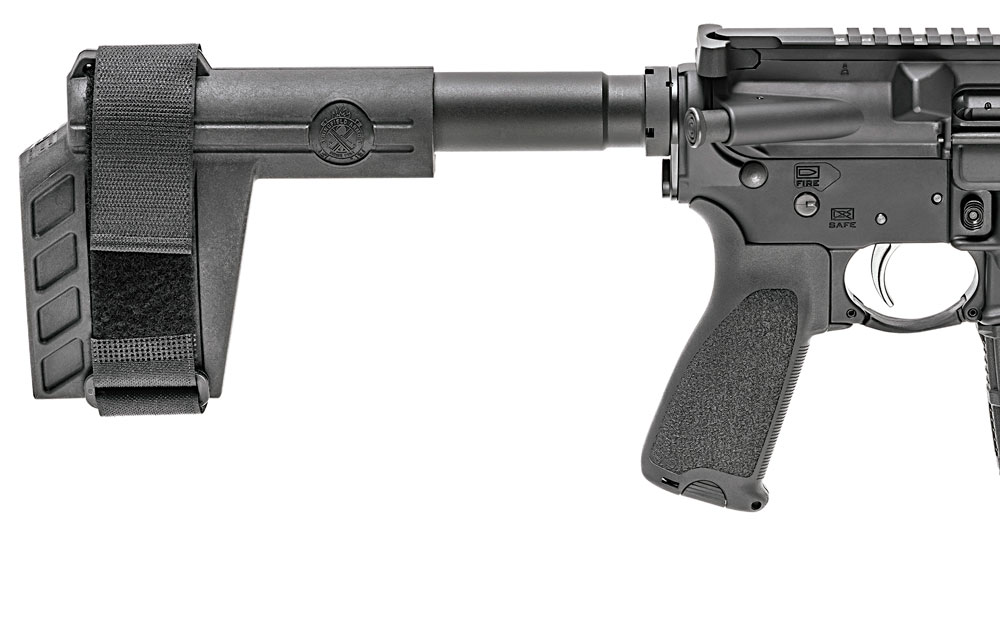
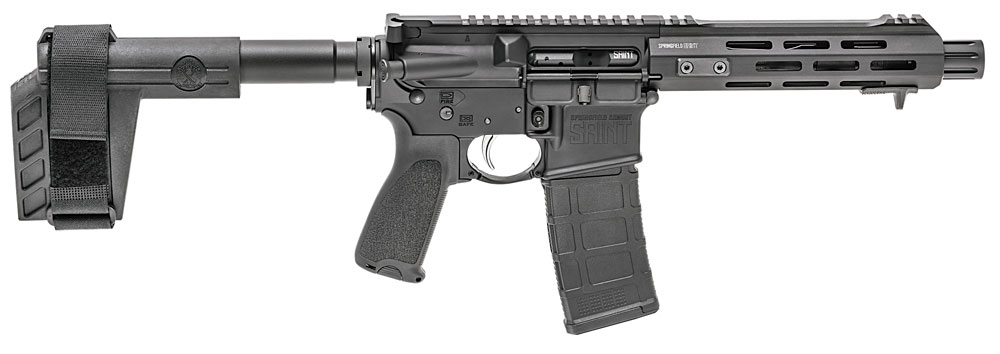
The SAINT pistol is outfitted with an SB Tactical forearm brace.
It also comes with a proprietary blast diverter.
Both new models have heavy “H” tungsten buffers to help with felt recoil.
Saturated with every conceivable breed of AR-15, Springfield Armory set out to do the impossible a year ago — launch a new black rifle. But at this point, the gamble on well priced and built SAINT AR-15 appears to have paid off.
A little more than 365 days into its history, the carbine has won its share of accolades not to mention a solid place in the overall market. Nowadays, when it comes to black guns, neither is simple to do, if for any other reason than the rifle is seemingly more common than highway mile markers in America (no small feat).
And now Springfield Armory is shooting to parlay the SAINT’s strong start with a pair of releases this past month that take the line in some new and appealing directions.
Saint Edge
As a rule, a carbine should be light. After all, it’s meant for fast handling, excelling when quarters are close and proving less burdensome when humped in and out of an operating area.
The SAINT Edge seems nearly the dictionary definition of this. At 6 pounds, 3 ounces, the carbine should provide the handling attributes that will make it lightning quick on target transitions and easy to carry, no matter the situation.
Springfield trimmed back the Edge’s weight through a unique lower-receiver design, removing material around the mag well to make it feather light. And given the company has retained the mid-length gas-system, and heavier “H” tungsten buffer system, the carbine’s recoil is noticeably tamed, despite its lack of heft. An added bit of insurance against kick, the .223 Rem./5.56 NATO comes standard with Springfield’s proprietary SA Lite muzzle brake, which dampens recoil to next to nothing.
Aside from shootability, the new SAINT has another ace in the hole with an upgraded fire control. While Springfield won points by including an upgraded GI-style trigger in the original iteration — nickel-boron coated — it has left nothing to chance with the Edge. The company’s single-stage modular match trigger is Melonite treated, ensuring it has a crisp and clean brake each and every squeeze. And it should prove fast shot to shot, with a noticeably short reset.
Like the original, the 7075 T6 aluminum upper and lower receivers mate with the Accu-Tite tension system, a nylon-tipped tension set screw that tightens the fit to remove any play. Being outfitted with a 16-inch lightweight profile barrel — Melonite finished — with a 1:8 twist allows the carbine to digest a wide spectrum of ammunition. And it comes with Bravo Company furniture, including the Mod 0 SOPMOD adjustable buttstock, with QD swivel mounting points.
The SAINT Edge has the same proprietary full-length aluminum handguard as the SAINT Free Floating model. This is a nice carry-over, giving ample M-LOK slots at seven points around the handguard. The carbine is a flattop, with full-length Picatinny rail, but comes with Springfield’s low-profile flip-up sights.
The SAINT Edge is, presently, the top end AR of the line and has the price to prove it, with an MSRP of $1,299.
Saint Pistol
Often times, it seems gun companies don’t invest a ton of thought when they move their AR lines into pistols. Shorten the barrel and gas system, jettison the buttstock of an existing AR and, voilà, pistol.
This is not the case with Springfield. The execution of the SAINT Pistol shows a bit more forethought, as it is well configured to offer more than just a scaled-down carbine. And it appears ready to excel at any small job thrown at it.
The .223 Rem./5.56 NATO variant comes in at a scant 26.5 inches in overall length and light at 5 pounds, 8 ounces. These are expected in a gun boasting a 7.5-inch barrel. But where the design succeeds is in the accessories it’s outfitted with — particularly at the butt and muzzle.
Giving the pistol greater overall control, the small SAINT comes equipped with a SB Tactical SBX-K forearm brace. The shorter version of the original SBX offers a lower profile, ensuring a clear line of sight. But, while trim, it still provides the same amount of support as the older brace, giving the platform greater controllability.
At the other end of the gun, the blast diverter should make the pistol a heck of a lot more pleasant to shoot, as well as increase its accuracy potential. Routed forward and away from the shooters, once again enhancing the line of sight, the muzzle blast is less distracting and the pistol is easier to keep on target shot to shot.
Additionally, the diverter just peeks out from the handguard, giving it a fairly sleek look. Yet, it adds enough length to the barrel that it should nearly be impossible for a thumb to inadvertently slip over the muzzle, always a concern on AR pistols. Aiding in the overall safety, Springfield has made a hand stop standard on the pistol, once again protecting shooters from over extending their grip into dangerous territory.
The handguard itself is a modified variation of the company’s free floated model, featuring SA locking tabs and M-LOK slots. Intelligently, Springfield has done away with the greater part of the handguard’s upper Picatinny rail, typically unused on AR pistols and obtrusive on the grip. It has, however, left enough for the installation of a front post or flip-up sight — just in case.
Like the rest of the SAINTs, the pistol’s barrel is Melonite finished, as is the carrier group. It features the Accu-Tite Tension System, which takes away the play between the upper and lower receivers. And it comes outfitted with Springfield’s nickel-boron-coated GI-style trigger that breaks cleaner than most stock AR triggers. Importantly, the company has also retained the line’s heavy “H” tungsten buffer, a nice point that should do plenty to tame the pistol’s recoil.
The SAINT Pistol is competitive with much of the AR pistol market, with an MSRP of $989.
Specifications:
SAINT Edge
Caliber: 5.56x45mm NATO (.223REM) Length: 35.75 in. Fully Extended / 32.5 in. Collapsed Weight: 6 lbs., 3 oz. Upper Receiver: Forged Type III Hard Coat Anodized Aircraft Grade 7075 T6 Aluminum Flat Top w/ Forward Assist & M4 Feed Ramps Lower Receiver: SA Proprietary Machined Aircraft Grade 7075 T6 Billet w/ Accu-Tite™ Tension System & QD Swivel Mounting Points Barrel: 16 in., 1:8 Twist, LT WT Profile, CMV Melonite® Finish Internally & Externally – Unique SA Multiport Muzzle Brake Gas System: Mid-Length, Low-Profile Multi/Mode Adjustable Gas Block Trigger: Springfield Armory® Proprietary, Modular Match Short Reset Single Stage Sights: Springfield Armory® Low Profile Flip-Up Rear, Dual Aperture Sights, 1/2 MOA Windage Adj. & Flip-Up Front, 1/2 MOA Elevation Adj. Trigger Guard: Integral to Receiver Pistol Grip: Bravo Company Mod 3 Handguard: Unique SA Proprietary Patent-Pending, Full Length Aluminum Free Floating w/ SA Locking Tabs, M-Lok Butt Stock: Bravo Company Mod 0 SOPMOD Buffer Assembly: Carbine “H” Heavy Tungsten Buffer Receiver Extension: Mil-Spec Dimension Carbine Receiver Extension Manufactured from 7075 T6 Type III Hard Anodized Aluminum Charging Handle: SA Proprietary Mid SIze Bolt Carrier Group: Enhanced M16 Melonite® Finish, MPT, 9310 Steel Bolt MAGAZINE: 1 – 30-round Magpul PMag Gen M3 MSRP: $1,299
Specifications:
SAINT AR-15 Pistol
Caliber: 5.56x45mm NATO (.223REM) Length: 26.5 in. Weight: 5 lb., 8 oz. Upper Receiver: Forged Type III Hard Coat Anodized, 7075 T6 Aluminum Lower Receiver: Forged Type III Hard Coat Anodized, 7075 T6 Aluminum w/ Accutite™ Tension System Barrel: 7.5 in., 416R Stainless Steel, 1:7 Twist, Melonite® Gas System: Direct Impingement Pistol-Length Gas Port w/ Low Profile Pinned Gas Block Trigger: Springfield Armory® Proprietary, Nickel Boron Coated GI Sights: Not Included Trigger Guard: Bravo Company Pistol Grip: Bravo Company Mod 3 Handguard: M-LOK Aluminum SA Patent Pending Free Float w/ SA Locking Tabs & Forward Hand Stop Butt Stock: SB Tactical – SBX-K Forearm Brace Buffer Assembly: Carbine “H” Heavy Tungsten Buffer Receiver Extension: SA w/ QD Swivel Mount Charging Handle: GI Style Bolt Carrier Group: Enhanced M16, Magnetic Particle Tested, Melonite® Magazine: 1 – 30-round Magpul PMag Gen 3 Case: Soft AR-15 Pistol Case MSRP: $989
The AR has come a long way since it rolled off Eugene Stoner’s drawing board. Find out what’s the best of the best when it comes to black rifles from 2017.
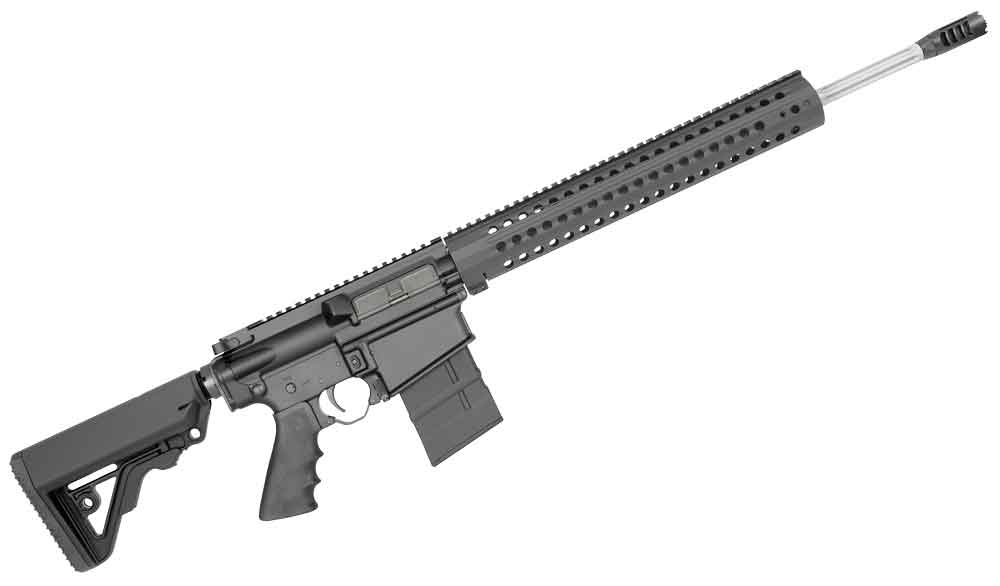
SIG Sauer has been expanding its reach into optics and suppressors the past couple of years, but it’s never lost sight of its ability to craft some of the best firearms on the planet. The M400 Predator is a case in point. Chambered in 5.56 NATO, the M400 Predator AR is equipped with an 18-inch barrel with 1:8-inch twist, two-stage match trigger and has an overall weight of 7 pounds. An M-LOK accessory rail makes attachments for predator hunting a walk in the park, while ½-28-threading makes for quick, easy attachment of a suppressor. On a coyote hunt in the Sandhills of Nebraska, the M400 proved exceptionally reliable in the cold and highly accurate even with fast follow-up shots. For a high-quality build with a great trigger, the M400 comes in at a relative bargain. MSRP: $1,582
Savage MSR 10 6.5 Creedmoor
Savage has built a solid reputation in the bolt-gun world with its highly affordable, highly innovative designs that the company is now rolling over to its new MSR line. Built explicitly for hunters and long-range enthusiasts, Savage’s MSR 10 Long Range is available in .308 Win. and 6.5 Creedmoor. The Creedmoor variant features a 1:8-inch twist in a 22-inch, fluted heavy barrel with QPQ finish, Magpul PRS Gen3 buttstock and free-float M-LOK handguard. The rifle also utilizes a non-reciprocating side-charging handle and Blackhawk’s two-stage target trigger, which makes for one highly accurate rifle. MSRP: $2,284
Noveske/Nosler Varmageddon in Nosler 22
If there’s one manufacturer that stands out in the world of cartridge development during the last couple of years, it’s Nosler. Pioneering new commercial loads such as the 26, 28 and 30 Nosler, the company is working hard to perfect the high octane, hot rod cartridge. The newest addition is the 22 Nosler, which is available in a Noveske-built Varmageddon AR and offers an incredible 300 fps increase in velocity over the .223 Rem. The rifle features an 18-inch barrel with 1:8-inch twist, MOE pistol grip and Super Badass charging handle. An NSR-15 FDE handguard features Key-Mod attachment points and matches the FDE finish on the rest of the rifle. Perfect for extending the range on predators, the Varmageddon AR in 22 Nosler is a tack-driving machine. MSRP: $2,869
S&W M&P 15 Tactical M-LOK
Smith & Wesson’s line of M&P AR-15s has long been a benchmark in the AR world, and the newest iteration, the M&P15T, certainly lives up to that reputation. The M&P15T features a 16-inch barrel with a 1:8-inch twist and 13-inch M&P slim, free-float modular rail system with M-LOK attachment points for maximum accessorizing. At just 6 pounds, the M&P15T is ideally suited for home defense and doubles as a fantastic truck and coyote rifle. Highly accurate, reliable and incorporating a lightweight, contoured barrel for maximum maneuverability, the M&P15T is also incredibly affordable. MSRP: $1,189
Alexander Arms .50 Beowulf Tactical
Let’s face facts: a .50-caliber AR with a name like the Beowulf immediately garners attention. And rightfully so. Bill Alexander has been a frontrunner in new AR designs and concepts, and the new .50 Beowulf Tactical is no exception. Featuring a Bravo Company B5 Systems SOPMOD stock, Geissele SSA or Alexander Arms Tactical trigger and Manticore Arms Transformer Rail handguard, the .50 Beowulf Tactical is no doubt one of the heaviest hitters ever built on the AR platform. The rifle comes in FDE, OD green or black, and features a flat-top receiver and 16.5-inch barrel with 1:20 twist rate. MSRP: $1,750
Rock River Arms Predator HP in 6.5 Creedmoor
I had the chance to shoot Rock River Arms’ newest AR, the Predator HP in 6.5 Creedmoor, during a long-range shooting class at The Site in Illinois, and I have to say I was thoroughly impressed. Featuring a forged LAR-8M lower receiver and A4 upper with Rock River’s crisp two-stage match trigger, the Predator HP performed exceptionally well on steel at 400 yards and was dead-on when we switched to shooting moving targets. The trigger is excellent, the operation is flawless and the barrel produced pin-point accuracy all day long. The rifle features a 20-inch fluted, stainless-steel barrel with 1:8-inch twist, low-profile gas block and RRA Operator Brake, as well as a Hogue rubber grip. Paired with Copper Creek loads in the 6.5 Creedmoor, the Predator HP proved to be a dependable, highly accurate rifle even at extended range. MSRP: $2,000
Editor’s Note: This article originally appeared in the Winter 2017 issue of Gun Digest the Magazine.
Bullet lethality is defined by how much damage it does and how much energy it dumps once it reaches a target. How do new bullets measure up in these departments?
In hunting, how much damage a bullet does is more important than its toughness.
A bullet that sheds weight and deforms chaotically causes more damage.
Conventional mono-metal bullets dump about 50% of their energy in the first 8 inches.
Traditional cup-and-core and lead core dump about 80%.
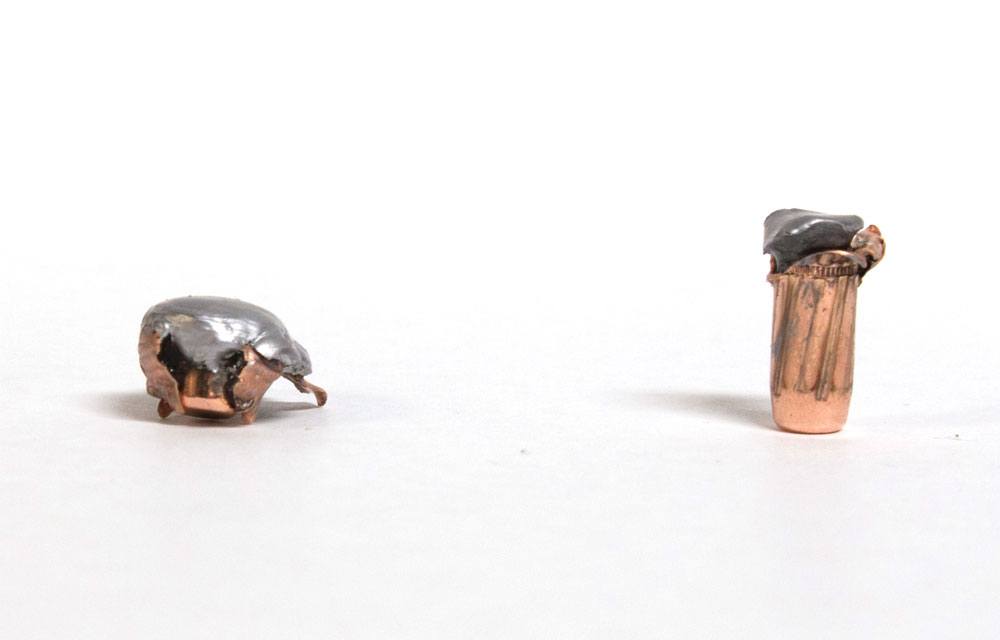
Somewhere along the way, the notion that you can decipher a bullet’s lethality by weighing, measuring and looking at it after you pull it from a dead animal became common practice. Pragmatically speaking, there’s no logic to support this conclusion. In fact, trying to equate the lethality of a bullet to its recovered shape and weight is about as precise as looking at a turd and trying to divine what someone had for dinner.
Bullets matter, but what matters most is the damage they do, not their ultimate shape.
Hunters and gun writers often get too caught up in the advertising hype of manufacturers. And then too, by exercising what might seem to be a reasonable deduction, we assume a bullet that is tough — one that holds together and sheds no weight — will kill better. Admittedly, a tough bullet sounds like a great idea; after all, we’re shoving it into an animal at velocities sometimes as high as 3,000 fps. It should be tough, right? The truth is we want the bullet to damage as much tissue as possible. That damage, not the recovered bullet, is the true measure of lethality.
Defining Lethality
The Barnes Tipped Triple Shock bullet is robust and tough. It will retain all of its weight and penetrate deeper than most. However, because of its limited energy deposit, it will not damage as much tissue as what might be called “weaker” bullets.
The point of all this is that hunters should evaluate bullets on how well they kill, not what they look like when we recover them or if they shoot through the animal. For example, I participated in a whitetail cull hunt in Texas. We were using .308 Winchester rifles loaded with 168-grain Barnes Triple Shock bullets. At the end of the first day, we’d killed 20 deer, but the hunters were complaining because none of the deer were falling down when hit. Granted, you generally expect a deer to run a short distance after the shot, but we should have had at least one “bang-flop” out of 20. What we were getting were 100-yard dashes into the pucker brush.
One hunter had a case of Hornady Zombie Max ammo for range play. The next day several shooters switched to that load. (Zombie Max ammo is loaded with Hornady SST bullets.) We immediately started seeing bang-flops, like you would expect with high heart shots when using a .308 Winchester on whitetail deer.
The question is, “Why were the SST bullets putting deer down faster than the Barnes Triple Shocks?” After all, the Triple Shock is a much tougher bullet and almost always deforms into a beautiful mushroom.
The answer is really very simple and two fold. First of all, the lethality of a bullet is tied to the damage it causes, not its toughness. Because SST bullets shed weight and chaotically deform, they create a more violent wound cavity than the Triple Shock, which essentially just expands and pushes a hole through the animal. This violent wound cavity creates more hemorrhaging, faster.
The other reason is a bit more scientific and one I tested and confirmed at the Barnes Bullets laboratory in Mona, Utah. We chronographed various bullets after they’d passed through 8 inches of ordnance gelatin. We found that a Barnes Triple Shock and similar mono-metal bullets only dump about 50 percent of their energy during the first 8 inches of penetration. A cup-and-core or more conventional lead-core bullet like the SST, Core-Lokt or Ballistic Tip will dump as much as 80 percent of its energy through the same distance. This energy dump results in massive tissue destruction and a serious shock to the animal’s system, often causing instant collapse.
Hornady’s SST bullet is nowhere near as tough as a Barnes Triple Shock bullet. However, while it will not penetrate as deep, it is every bit as lethal.
Notice I said collapse, not death. Death is a result of the brain running out of oxygen. However, when an animal goes down after a lethal hit, it’s much less likely to get up and run off before it dies.
None of this is to suggest a Hornady SST bullet will kill better than a Barnes Triple Shock. All of the deer hit correctly with Triple Shocks ended up on the meat pole; they just managed to run a ways before realizing it was pointless. The Triple Shock is a very good bullet, but to deliver the bang-flop so many hunters like to see, Triple Shocks need to be pushed faster so they can dump more energy. On the other hand, sometimes hunters need that ultra-deep penetration the Triple Shock is so renowned for.
Controlled Chaos
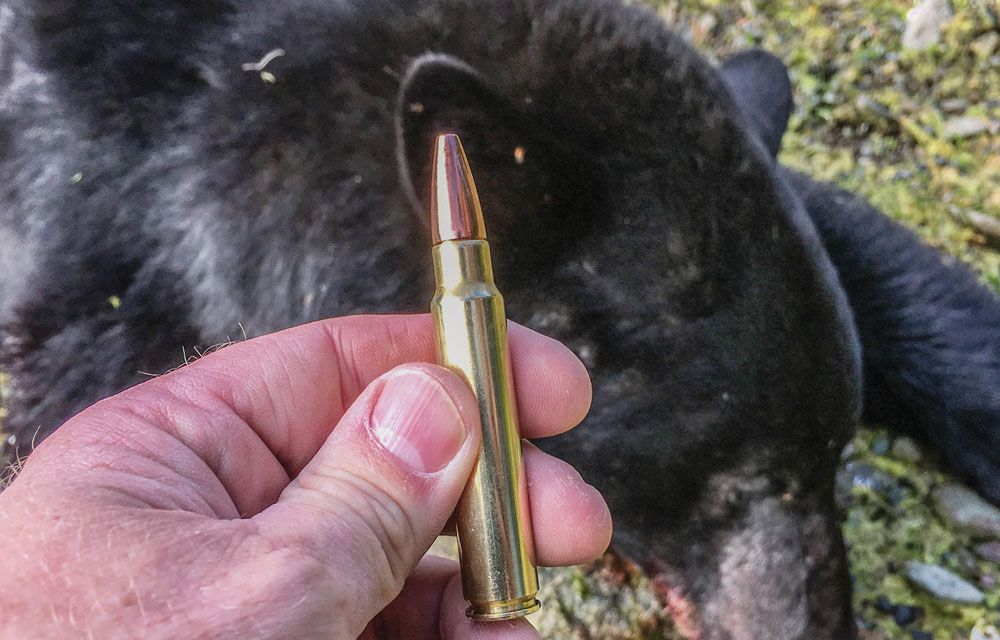
A radical new mono-metal bullet designed by Lehigh Defense dropped this mature Vancouver Island black bear quickly, even at a moderate impact velocity.
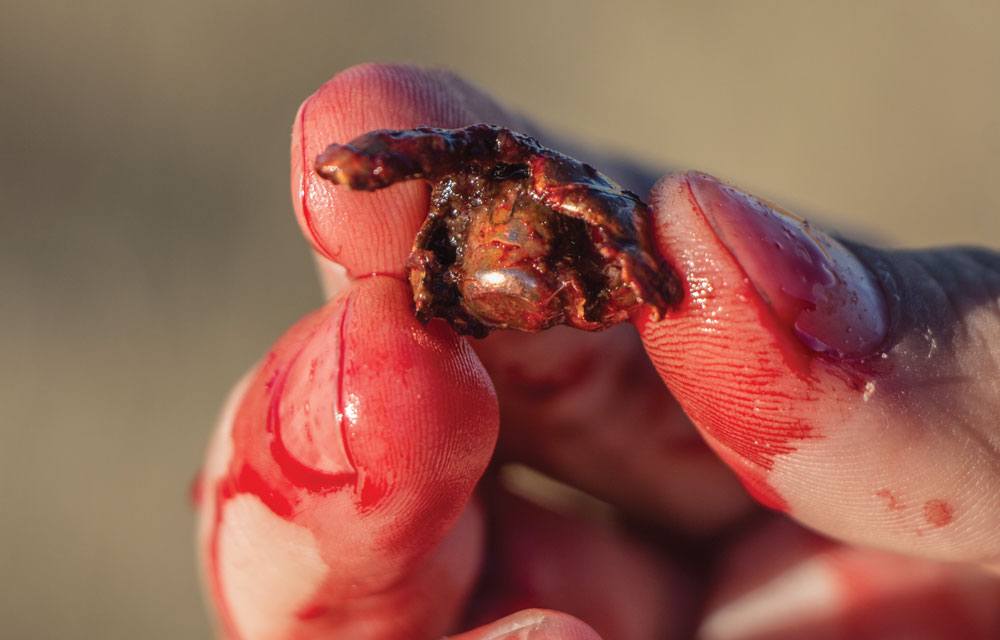
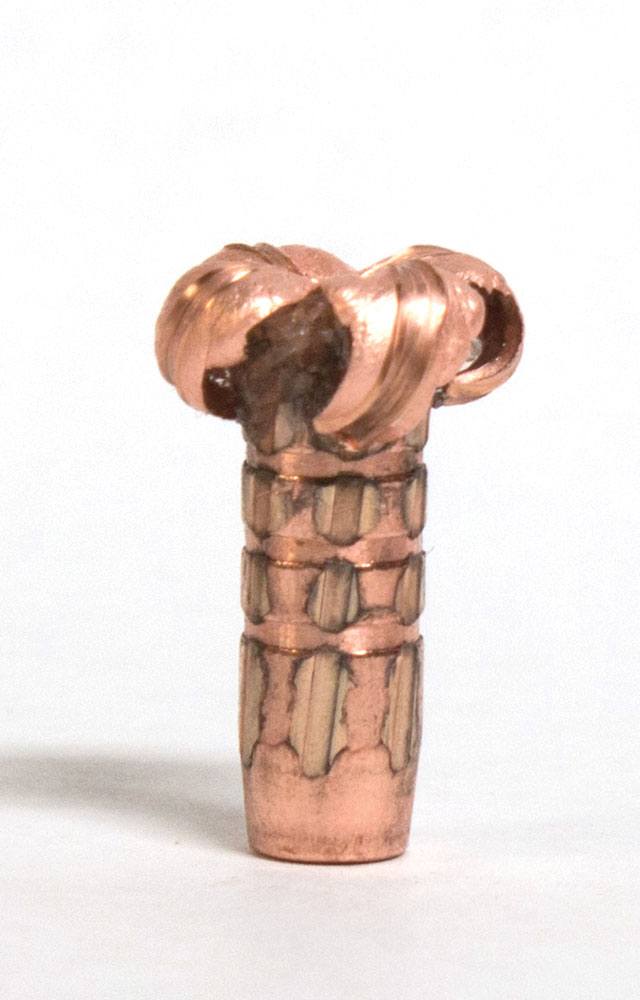
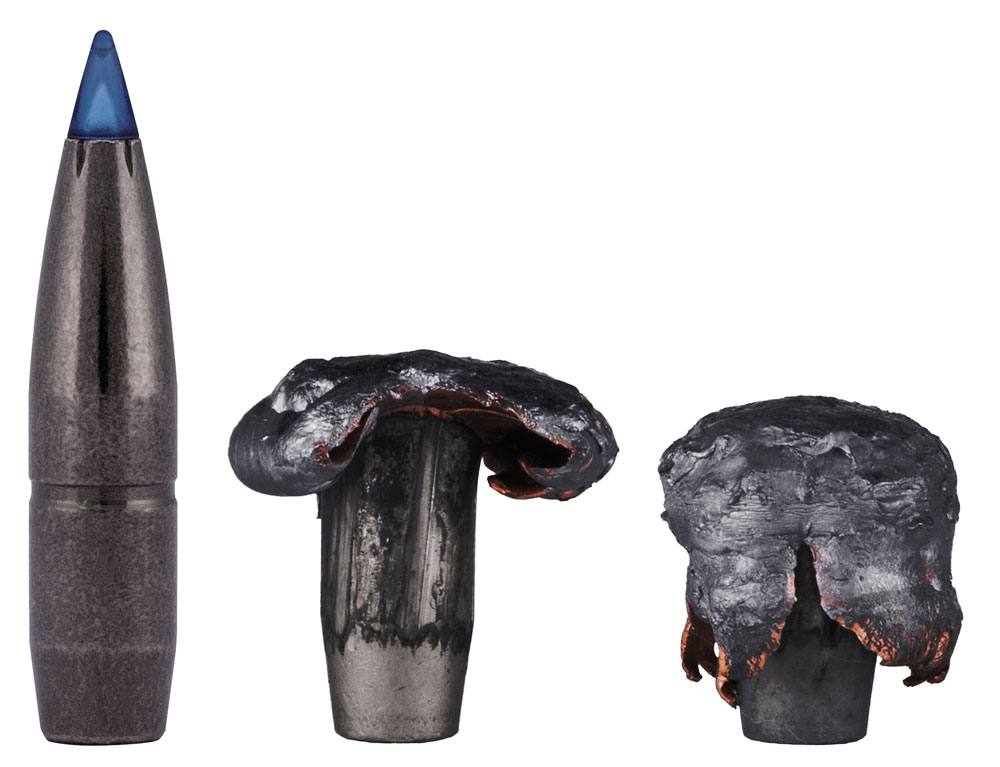
Lehigh Defense realized that mono-metal bullets could be more effective at moderate impact velocities if they shed some material and weight. This shedding helps the bullets dump energy and create wicked wound cavities. The Lehigh Defense Controlled Chaos bullet is a solid copper bullet, but it’s engineered to fracture and throw shrapnel as it penetrates. When the bullet impacts, the front section breaks apart, with particles being thrown from the bullet. However, the rear section — or shank — of the bullet continues to penetrate. This offers a good balance of lethality. It’s kind of a modern interpretation of the very lethal Nosler Partition.
How do they work? I used a 185-grain Controlled Chaos bullet out of a .375 Ruger on a big Vancouver Island black bear. But this was a reduced load, launched at a modest muzzle velocity of only 2,600 fps. The bear ran only about 45 feet and dropped stone dead. My son used a 270-grain version of this bullet out of the same rifle, and loaded to the same velocity, on an African buffalo. That huge beast went to the ground in less than 45 feet. These bullets offer near conventional mono-metal-like penetration, with wound cavities similar to what you would expect from a cup-and-core bullet. And, they’re accurate, too.
ELD-X
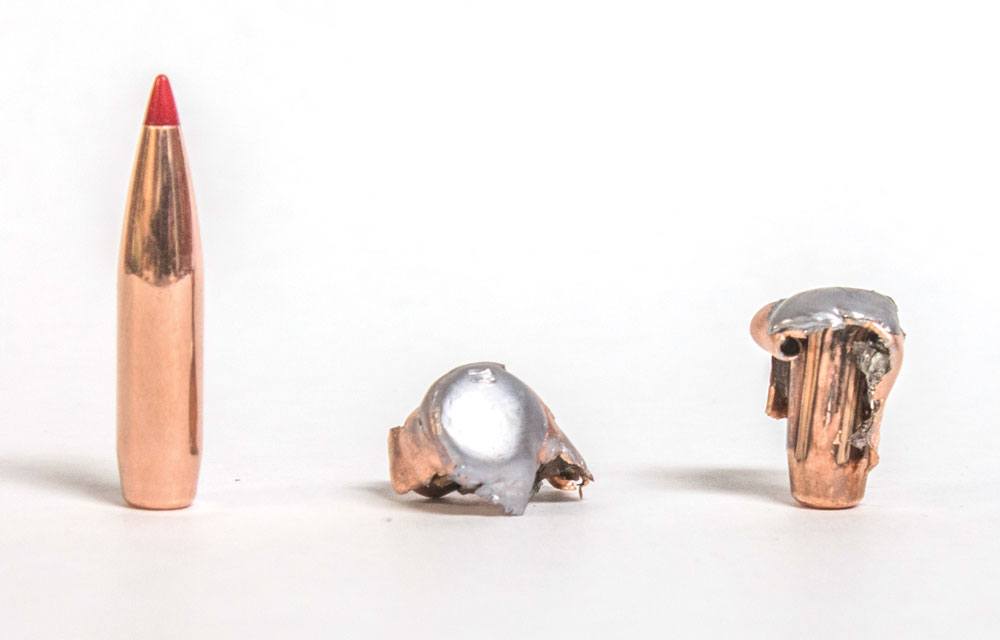
Not the prettiest mushroom in the woods, but it’s a deadly one. Hornady’s ELD-X bullet is lethal at 100 yards (left) and out to 700 yards (right).
With its ELD-X line of bullets, Hornady took a different approach to lethality. And, like with the Controlled Chaos bullet, it has nothing to do with the recovered weight, shape or prettiness of the bullet. Hornady wanted to devise a bullet that was just as lethal at long range as close. The company’s answer was a conventional cup-and-core design with a lead core. The key to its performance is a heavily tapered jacket that will peel way back at close range, but not so much at long range. However, in either instance, you get a nasty wound cavity inspired by deformation and core erosion that creates extensive hemorrhaging.
I’ve seen this bullet work just as well on big-game animals at 100 yards as at 600 yards — even though the core might occasionally work lose during penetration. (Contrary to popular belief, this is not necessarily a bad thing.) Not only does the ELD-X shed lots of energy when impacting at either distance, it shoots very flat and resists wind very well due to its high ballistic coefficient. During the recent Scout Rifle Safari I organized in Africa, more than 50 head of African game were taken with the 178-grain .308 Winchester Precision Hunter ELD-X load. I saw enough animals go down and enough guts and gore during that safari to trust the ELD-X.
Edge TLR
Federal’s new Edge TLR bullet is a mixture of a variety of design principles, in an effort to provide lethality at close and distant ranges. The tissue it damages will illustrate the true effectiveness of this bullet, not how uniform it deforms, or what it weighs after penetration.
Another new bullet/ammunition from Federal is the Edge TLR. It’s another take on finding the best balance of lethality up close and at distance. By incorporating a deep hollow point cavity, capped with an aerodynamic tip, surrounded by a skived jacket that’s bonded to a lead alloy core, this bullet is presented by Federal as an ideal any-range big-game bullet.
Unlike the Controlled Chaos and ELD-X bullets of Lehigh Defense and Hornady, the Edge TLR will likely deform into that perfect mushroom-like shape we’ve been convinced all recovered big-game bullets should exhibit. Because it’s bonded, it should also retain most of its weight. I’ve yet to shoot, hold or even see one of these bullets. Will it kill? I’m positive it will, but one thing’s for sure: My evaluation will not be based on whether it shoots through the animal or how pretty the recovered bullet looks or weighs. It will focus on the internal damage the bullet caused because that’s what really matters.
Recovered bullets are not supposed to be pretty —they’re supposed to make animals go down quick, die fast and be easy to find.
Editor’s Note: This article originally appeared in the October 2017 issue of Gun Digest the Magazine.
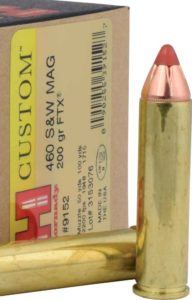
Known for its blistering velocities and long-range accuracy, the .460 S&W Magnum is the very definition of a red-hot revolver cartridge.
The .460 S&W Magnum reaches velocities around 2,200 fps with a 200-grain bullet.
This makes the .460 S&W Magnum one of the fastest revolver cartridges ever produced.
The .454 Casull is the parent case, lengthened 1.8 inches.
The .460 S&W Magnum is the first commercial revolver cartridge to utilize tipped bullets.
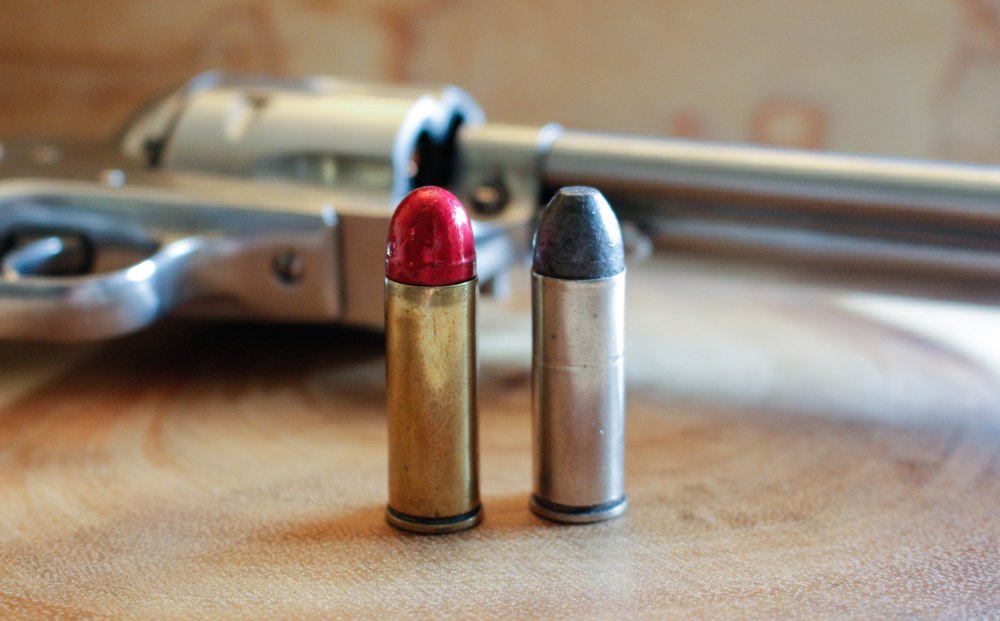
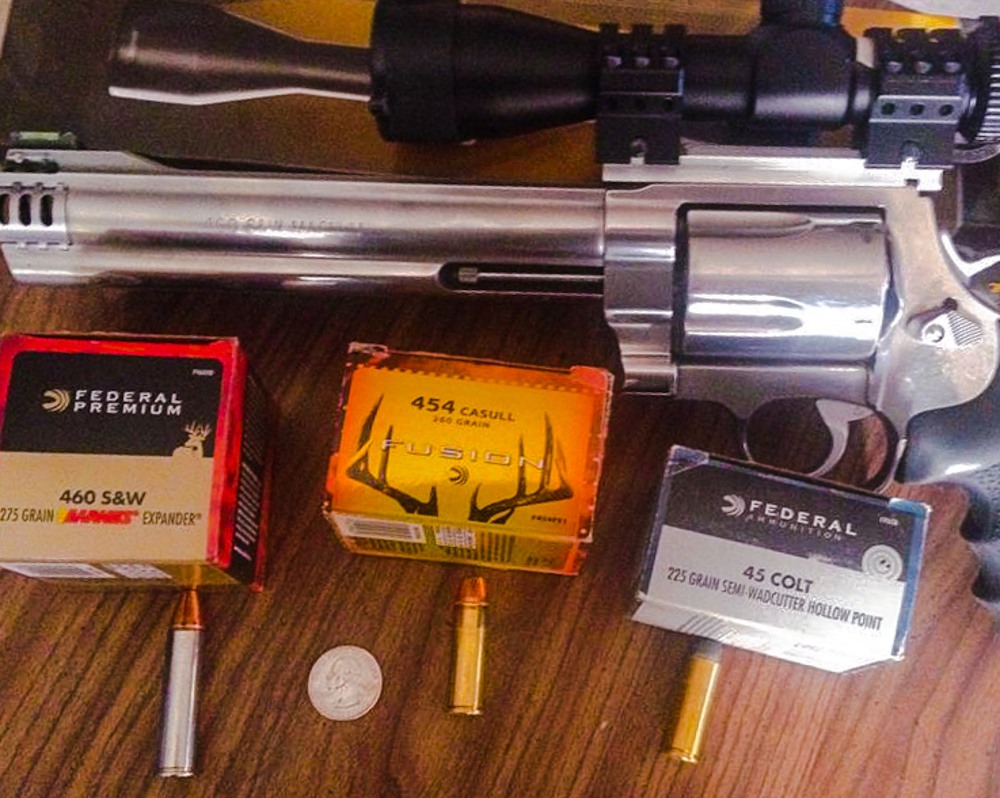
Announced in 2005 as a joint Hornady-Smith & Wesson development, the .460 Smith and Wesson (S&W) is the fastest revolver cartridge ever produced, reaching velocities of about 2,200 fps with 200-grain bullets. It is chambered in the S&W M460 Extreme Velocity Revolver for long-range handgun hunting. Used by a skilled pistol shooter, the .460 S&W Magnum cartridge can achieve MOA accuracy at 100 yards.
The .460 S&W uses the .454 Casull case lengthened to 1.8 inches as its parent case. It is the first commercial revolver cartridge to use tipped bullets. Hornady and CorBon offer loaded ammunition for the .460 S&W. Hornady and Starline supply reloading components and data for this cartridge. It is well suited for use in whitetail deer hunting at 150 yard-plus ranges.
Over the years Patrick Sweeney has learned a few unique ways to attach a sling to an AR. Here are some tips and tricks to make any sling work on your AR-15.
Visit your local hardward store and, for as little as $10, you can get enough material to make as many of these loops as you need to sling up all your ARs.
I’m a Neanderthal when it comes to slings. Sure, I learned the classic leather target sling. You know, where the thing is so tight you can see your heartbeat in the scope and your fingertips turn blue as you aim. But I never had any use for it, since the competitions I shot in never called for it. Those contests even made the device difficult to use. So, for me a sling is simply a means of carrying a rifle, and to keep it off the ground while you use both hands for something else.
To that end, I have settled on a pretty simple sling system. The stock end is the easiest to describe, since it doesn’t involve any hardware.
Rear Sling Attachment
Want a top-mount sling on your fixed stock? This works and is cheap.
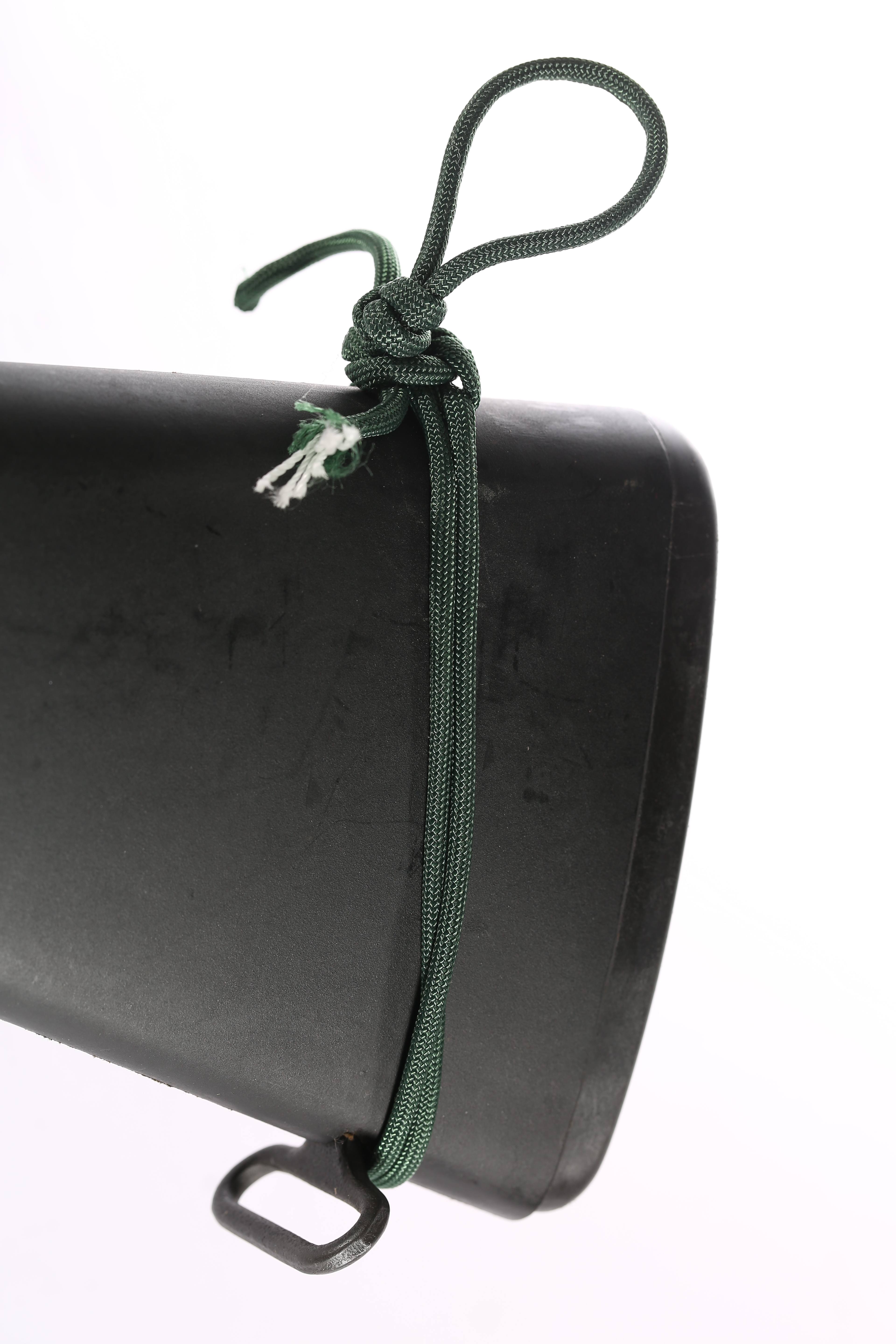
Take a length of 550 cord, 2 feet is a start for fixed stocks, 18 inches for telestock. Loop it over four fingers and tie a knot. Hold the loop at the top of the stock, while you run the tail ends over the other side and back up to the top.
On the fixed stock, loop the ends so they are behind the bottom sling swivel. This way it can’t slide forward. Tie the ends in a knot behind the loop on top. Melt or glue the cord ends so they can’t come loose. The knot behind the loop keeps it from sliding off the back of the stock when you use it. Pull the knots as tight as humanly possible.
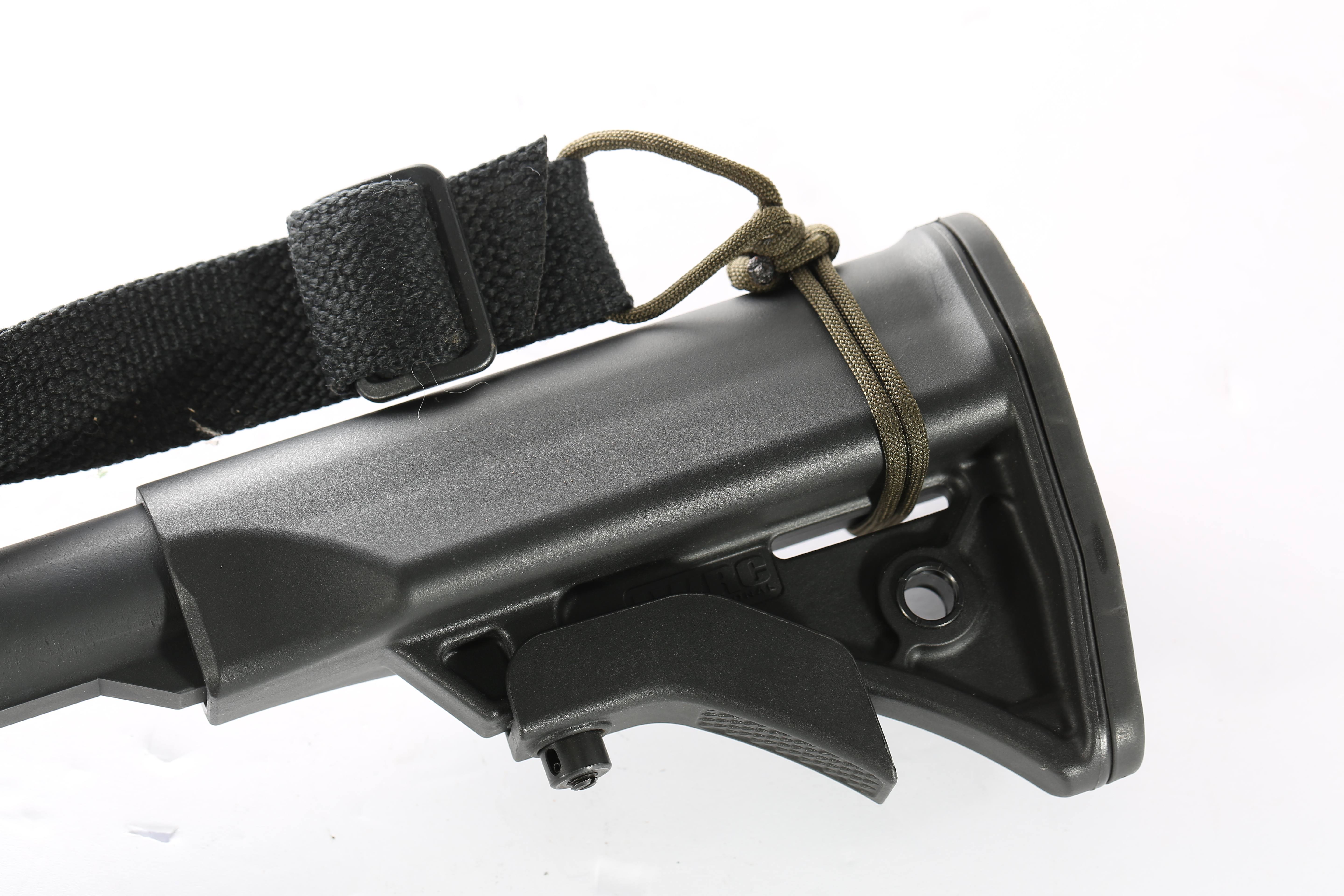
On the telestock, loop the ends down and through whatever slots, gaps or opening the maker of the stock provided, and back up to tie off just as you would with the fixed stock.
This is your rear sling swivel. With this approach, the sling comes off the top of the rifle , not the side or bottom. It is light, inexpensive and quiet. I can install it on any rifle in a matter of minutes, and take it off even faster. I can put it on a rifle for a class and take it off when I’m done, without any permanent modifications to the rifle.
A loop of 550 cord, properly tied and sealed, makes a lightweight and compact sling attachment system.
Three Approaches To Front Sling Attachment
On the front, I take one of three approaches.
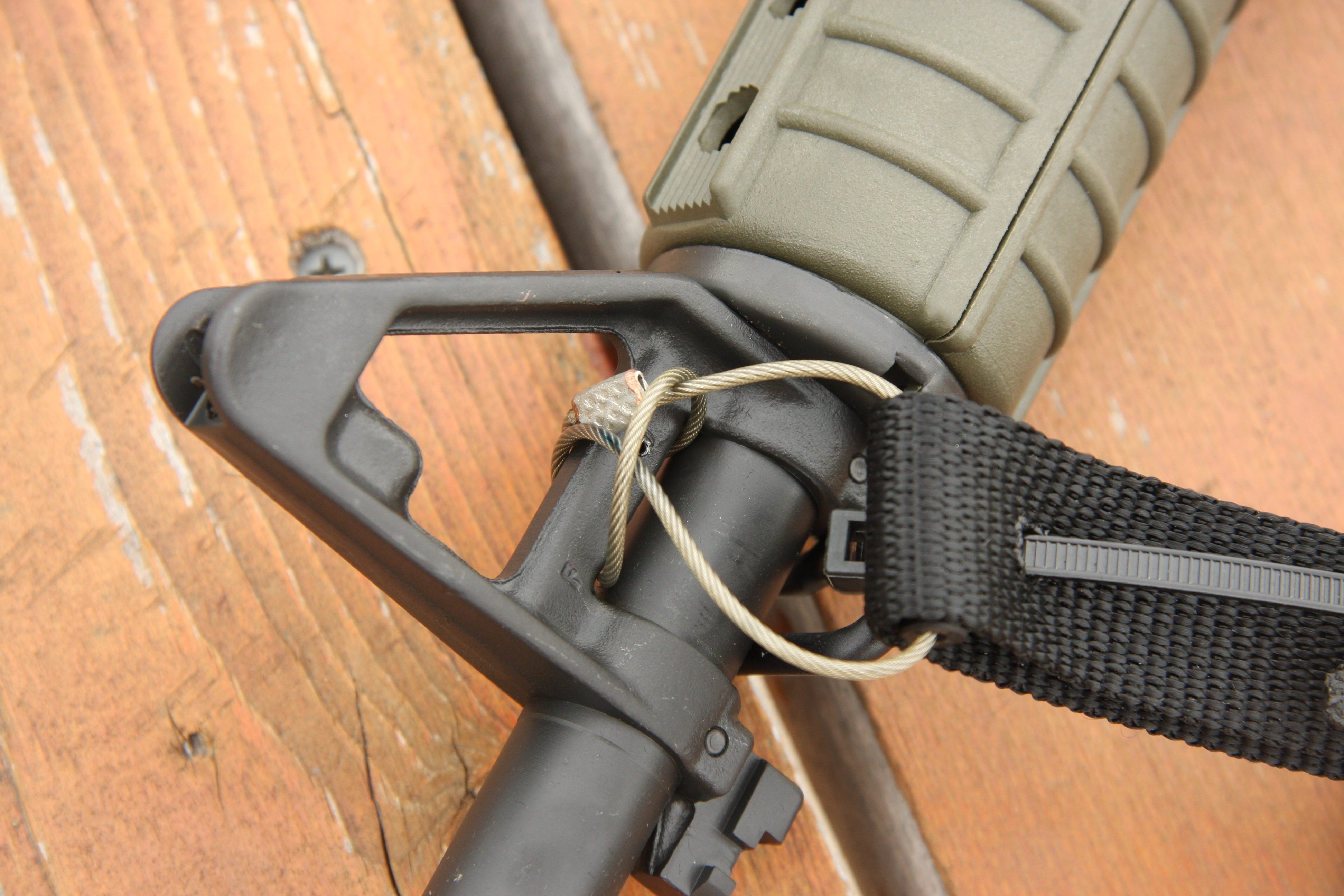
A front sling swivel can be as simple as a loop of braided stainless cable.
1st Approach The first is a loop of braided stainless steel wire/cable, secured in a circle with a cable pinch. I loop the wire though the front sight housing, and then back through itself so the loop is locked to the rifle, extended for the sling. A refinement of this is to add a length of cable cover, to reduce the wear on the sling.
The advantage of this approach is that you can put a side-mounted sling on a bone-stock rifle or carbine, and then remove it when you’re done. If you arrive at a class where they’ll be using issued rifles, and you don’t want to screw around with a classic sling, this is the answer. You can have this loop in your gear, install it in a minute, and get to the class with something resembling modern equipment.
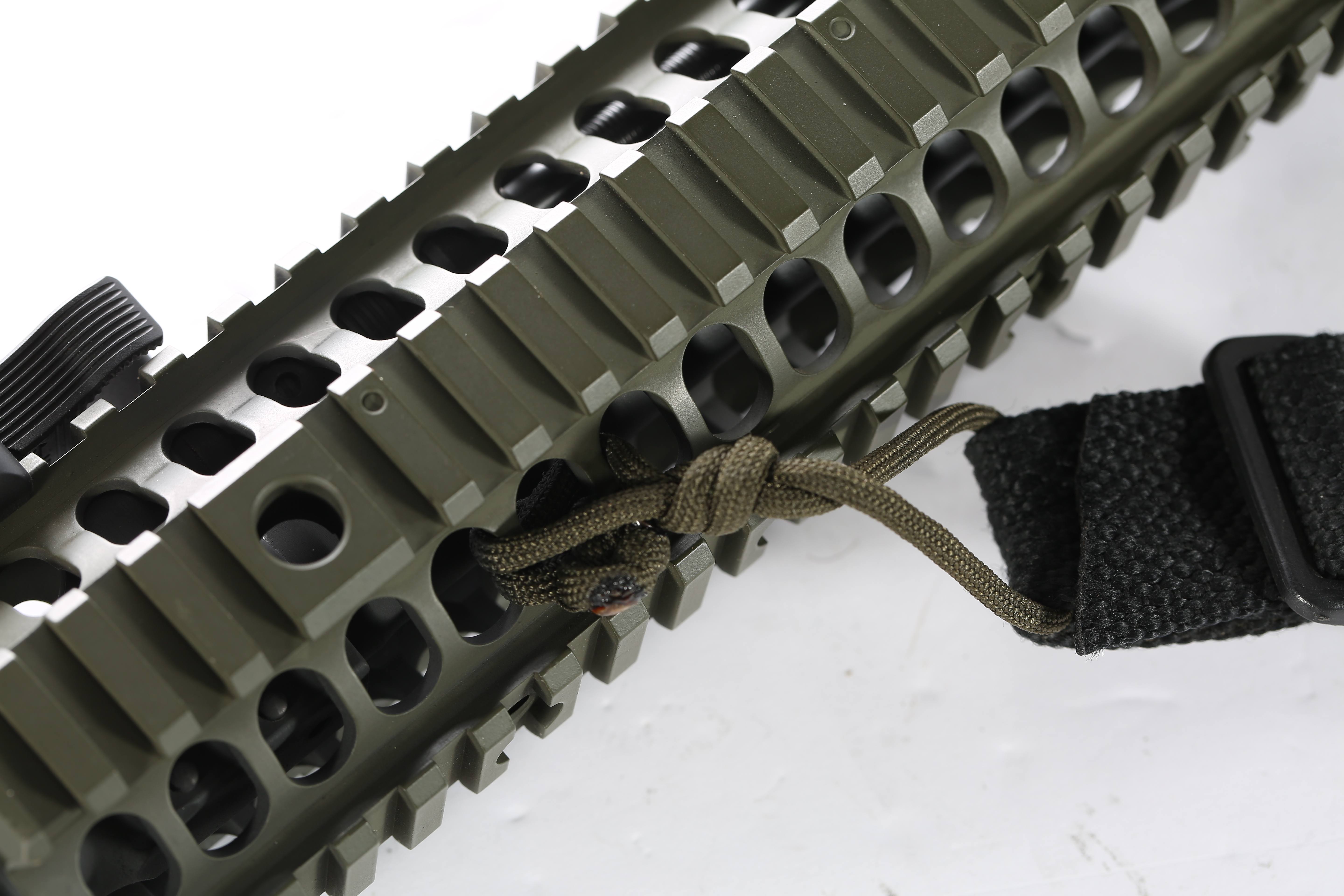
You can simply tie 550 cord to your free-float handguard.
2nd Approach The second is to tie a short section of 550 cord to the railed handguard and use that as the front sling loop. The advantage of this is that it is cheap and you can install it on a rifle you’ll be using for only a short while.
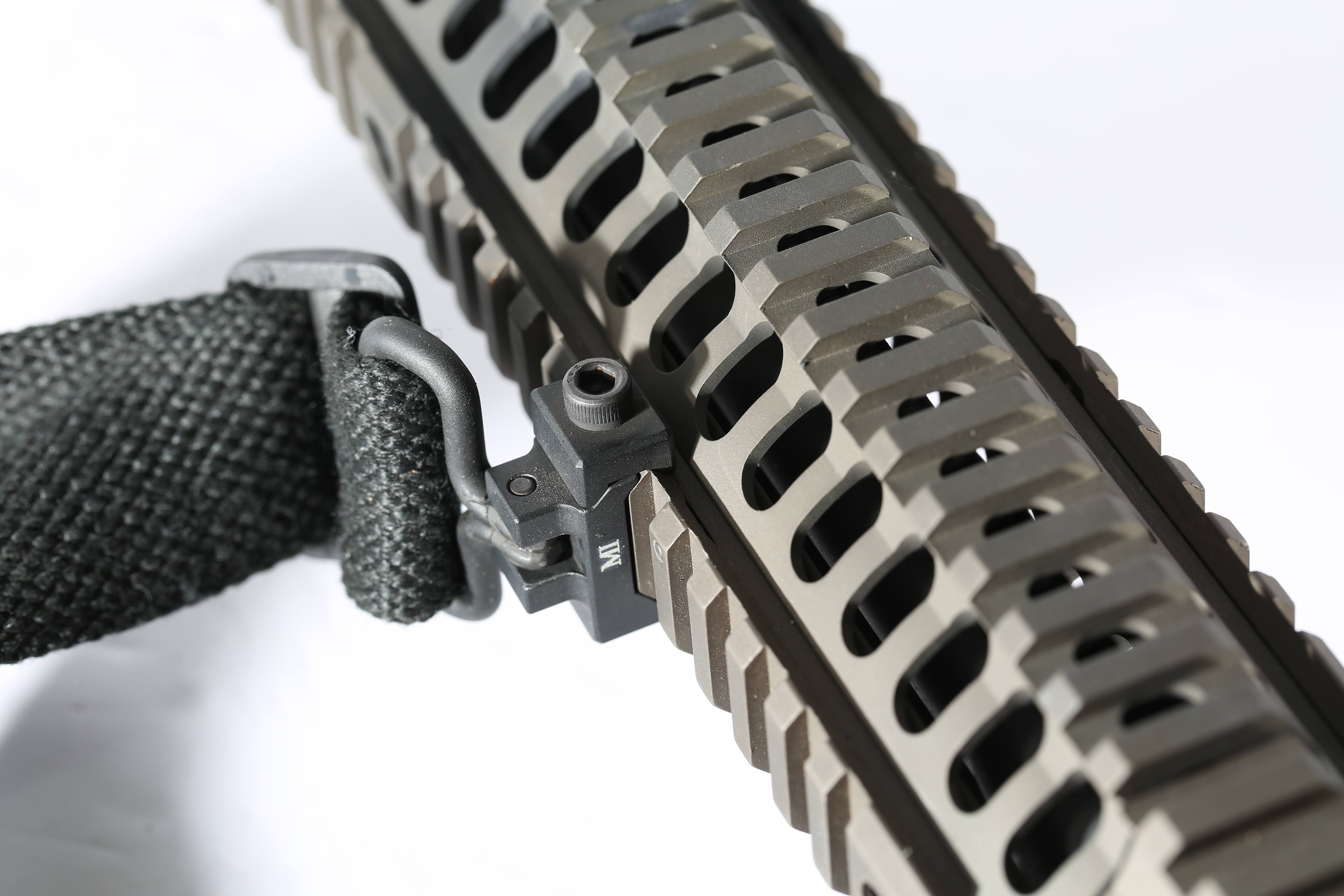
Midwest Industries, among others, makes a bolt-on sling swivel that also works as a hand-stop.
3rd Approach The third method is to use a clamp-on sling swivel on a railed handguard. This can be a quick-detach (QD) style. It’s easy to attach (requires a railed handguard) and you can place it right where you want a hand stop.
Make sure you keep your sling under control. Too much can be too much
The Sling Strap
The sling itself is a simple nylon strap to get the rifle hanging where you need it. The strap allows you to sling the rifle behind, but not so loose that it dangles down around your waist or knees. Too much sling can be a problem. Not only can it let the rifle hang too low or swing around too much, but it can get tangled up in the darndest things.
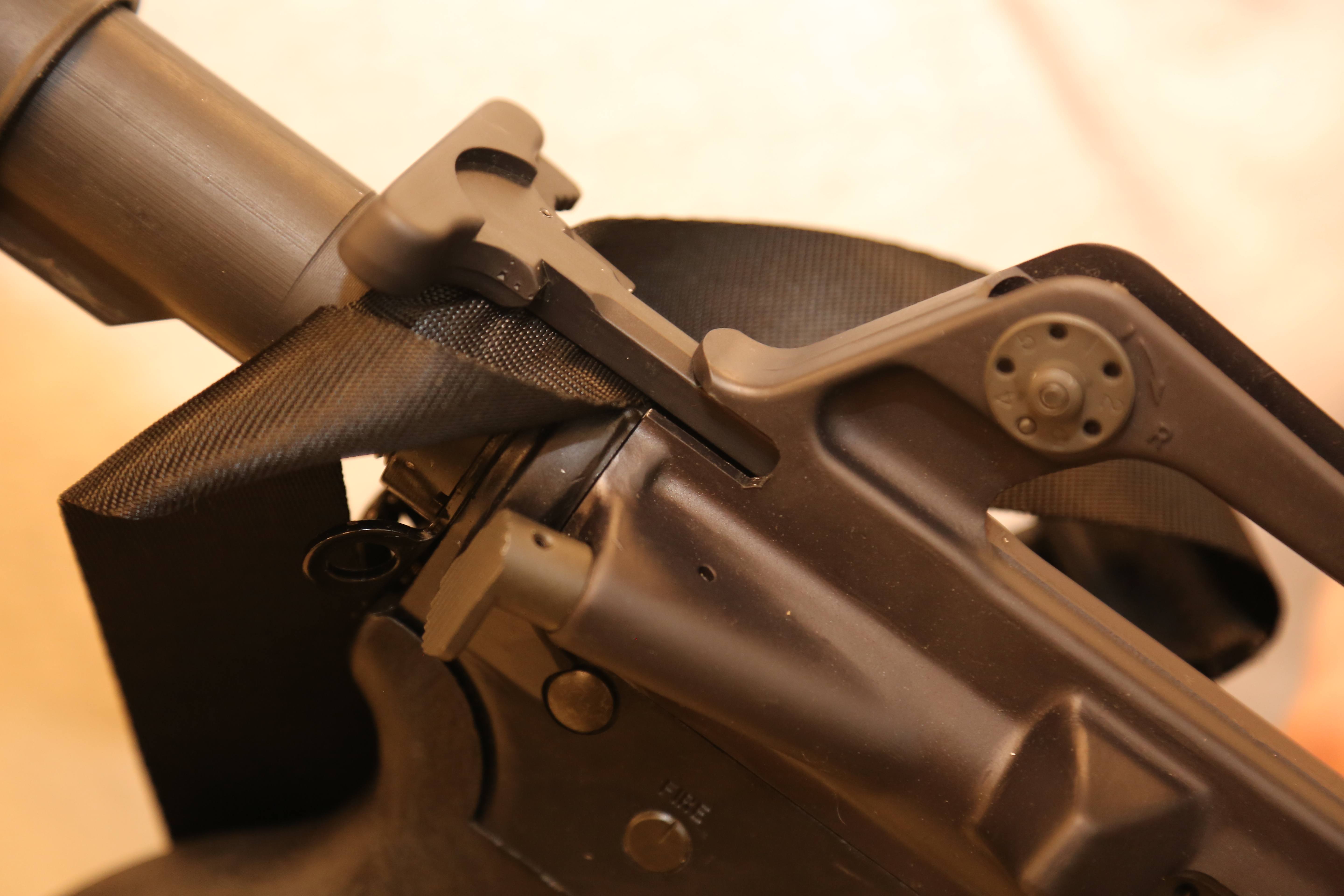
Those little circular holes in many stocks and forearm designs are the sockets for the QD sling system.
Single-Point Slings
I am not a fan of single-point slings, and avoid them if I can.
Now, if you do not want to experiment with 550 cord, then modern free-float handguards quite often incorporate QD sling sockets in the design. Modern stocks do this as well. It is easy enough to simply pick up a set of QD swivels, attach your sling, and plug them into the sockets. My recommendation for slings is this: the simpler the better.
No matter if that special marksman in your life lives to break blue rock, bang the gong from a country mile or is deadly serious about concealed carry, we’ve picked a little something they’ll love. On top of that, we’ve tried to hit every reasonable price point without going crazy and suggesting a fully decked out chassis rifle. You’re on your own with that one bub.
So kick back and take a gander at 10 great Christmas gift ideas any shooter would love. We’re certain you’ll hit the bullseye with these Yuletide goodies.
What’s better than one gun? How about 365! The Gun Digest Great Guns 2018 Daily Calendar delivers just that in full color. From the newest tactical rifles to the hottest handguns to the sleekest shotguns, your favorite shooter will be left dreaming and drooling over them day after day. It’s the perfect addition to any office desk, reloading bench or gunroom. Price: $14.99
Ammo Cans
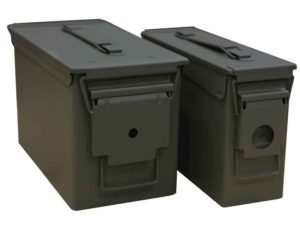
Honestly can you have enough of them? For a shooter — any shooter — ammo cans are about the most useful small storage system you can find. And, really, they’re pretty dang cool looking too. The .50-caliber size tends to be the handiest for stowing an assortment of small accessories. But the .30-caliber ones still fill a role, especially if space is at a premium. The best part: Ammo cans are found nearly anywhere. But these gifts provide a great opportunity to shop local and support your neighborhood military surplus store. Price: Varies, but cheap
UtilClip’s locking belt loop has been around for a while and is a slick system. But the company has improved on a great idea with the XL, not only providing rock-solid and covert carry retention, but also a little extra. Integrated into the spring-steel clip is a multi-tool, complete with a screwdrivers and multi-stage wrench — perfect for fixing or fine tuning a malfunctioning holster on the go. Similar to the older iterations of the UtilClip, the XL delivers the same versatility to a carry system, facilitating inside and outside the waistband carry, with or without a belt. Price: $14.99
This book is every bit as important as your shooter’s bug-out bag. Jorge Amselle presents more than 600 pages on the guns, gear and practical know-how to survive almost any eventuality. The most comprehensive book on the subject in the past quarter century, Modern Survival Guns covers every aspect of living ready, including: firearms, optics, ammo, emergency supplies, knives, tactics and much more. You aren’t just giving someone a book with Modern Survival Guns this Christmas, you’re giving them a future. Price: $29.99
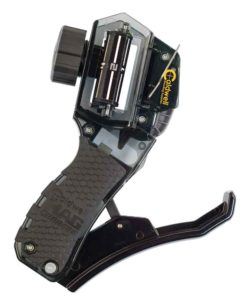
Juicing magazines isn’t how your favorite shooter wants to burn a day at the range. Thanks to Caldwell’s Mag Charger, they’ll spend more time throwing rounds down their lane, not reloading. Compatible with 9mm, 10mm, .40, .45 and most .380 magazines — both single and double stack — the charger is versatile and easy to use. Simply feed rounds into the groove, squeeze the operating lever and it loads the ammo into the magazine. Honestly, what could be a better gift than more actual trigger time? Price: $47.99
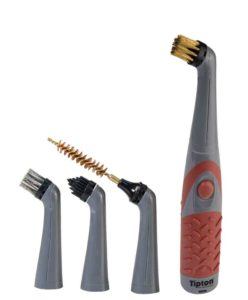
It’s time for your shooter to put away that nasty old toothbrush he uses to scrub away his gun’s grime and join the 21st century. Tipton’s Electric Cleaning Brush makes routine gun care a snap, arming your shooters with a rotating head that knocks away grunge and fouling at 3,600 oscillations per minute. The tool comes with interchangeable plastic, nylon and stainless steel cleaning brushes and reaches areas of a gun other cleaning implements can’t even get close to touching.Price: $47.99
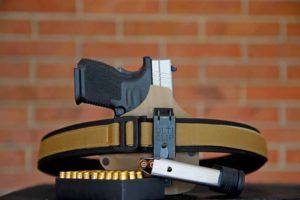
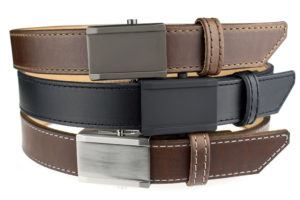
The foundation of any carry rig is a solid gun belt. With this in mind, the concealed carrier on your gift list will go over the moon unwrapping the Crossbreed Crossover Belt. The 1.5-inch wide belt offers extra support with a slide buckle, which allows the user to cinch it snugly each and every time. Additionally, hand-beveled, burnished, edge dyed and stitched, the Crossover Belt is a stylish accessory, tough enough for the woods, but good-looking enough for a night out. Price: $89.95
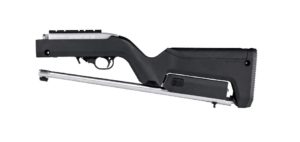
A confession: I hope Santa leaves this under my tree this Christmas. Compatible with the Ruger 10/22 Takedown, the X-22 Backpacker Stock is an ingenious way to take the rimfire anywhere your shooter goes. Once taken down, the barrel stores conveniently in the toe of the stock, making the rifle compact enough for nearly any rucksack. If that were not enough, Magpul has made the stock an entire survival system, with a watertight compartment in the grip and another watertight compartment in comb, designed to stow three 10-round 10/22 magazines. Really, for any shooter who loves the 10/22 and has a takedown version, there isn’t any better gift. Price: $109.95
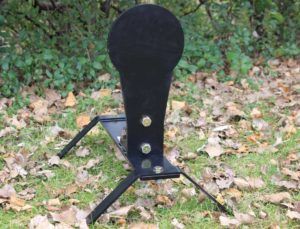
As we all learned from It’s a Wonderful Life, every time copper-jacketed lead bangs steel, an angle gets its precision long-range rifle. Help these celestial beings on their way this Christmas with the Magnum Spring Popper. Designed to take punishment from some of the most powerful calibers in the rifle world (up to .338 Lupua Mag. at 200-plus yards), this gem provides hours of shooting fun. The best part? Your shooter won’t spend any time resetting targets. Utilizing heavy-duty stainless steel springs, the popper sets itself up immediately after you knock it down. What more could you ask for? Price: $199
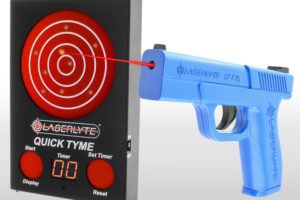
What could be a more fitting gift for the gun nut in your life than giving them the opportunity to shoot when they want? You can with LaserLyte’s slick laser training kit. Complete with laser training pistol and reactive target, the QuickTyme kit comes with everything they’ll need to start shooting out of the box. Additionally, the kit is more than just a mere plinking system, it’s a top-notch training tool. The stopwatch function aids in honing a fast draw, and instant feedback on the target let’s the shooter know if they’re hitting what they’re aiming at. Price: $279
The first .20-caliber produced in a large scale, the .204 Ruger arms shooters with a red-hot varminting round.
The .204 Ruger was the first .20-caliber cartridge produced on a large commercial scale.
Accurate, with a mild recoil, the .204 Ruger also offers excellent barrel life.
The parent case of the .204 is a .222 Remington Magnum.
It is necked down and given a 30-degree shoulder angle.
The .204 performs best when shot out of a 26-inch barrel with a 1:12 twist.
Introduced in 2004 as a joint Hornady-Ruger project for varmint and target shooting, the .204 Ruger became the first .20-caliber cartridge to be produced on a large commercial scale. Remarkably, it also offers excellent barrel life. After shooting approximately 500 prairie dogs with the Ruger and Dakota rifles chambered for the .204 Ruger, a former contributing editor to this book found it to be an accurate, low-recoil round, superbly suited for long-range varminting. The .204 Ruger received the Academy of Excellence 2004 Cartridge of the Year Award.
The .300 Win. Mag. is well-suited for hunting 95 percent of the world’s game. Phil Massaro explains why.
The .300 Win. Mag is based on the .375 H&H case, as are the .458, .338 and .264.
The cartridge is designed to fit a long action and is ballistically close to the .300 H&H.
Eminently versatile, the .300 Winchester Magnum is a true long-range cartridge that hits hard, yet is still manageable in the recoil department.
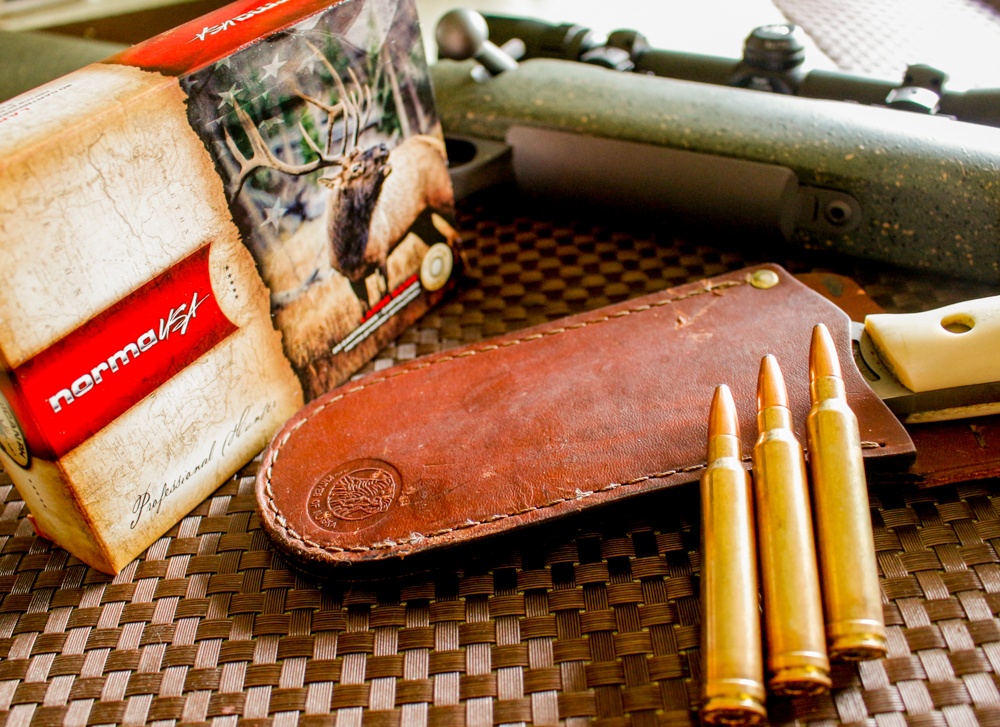
Norma’s .300 Win. Mag. 180-grain Oryx load.
Brought to us in 1963, the .300 Win. Mag. was the fourth cartridge in a series of belted magnums designed to fit in a standard long (.30-’06 length) action. The .458, .338 and .264 were based on the same case — the .375 H&H Mag. — and shared the same shortened case length — 2.500 inch — to maintain a cartridge overall length of 3.340 inch. When Winchester announced the .300 Win. Mag., almost everyone expected the cartridge to be the .338 necked down to hold .308-inch bullets; essentially the .30-338 or very close to the .308 Norma Mag.
The author’s Winchester Model 70 Classic Stainless sports a 26-inch barrel and a Leupold VX-6 2-12×44 with the 30mm tube. There is something inherently accurate about the design of the round. The .300 Winnie just shoots.
What they saw was a different design. The COL of 3.340 inch was held, but the case was elongated to 2.620 inch, and the neck length shortened to 0.264 inch. The result was a belted cartridge that fits in a long-action rifle and is the ballistic equivalent of the venerable .300 H&H, which requires the longer, magnum-length receiver.
It was less, in length and velocity, than the .300 Weatherby Mag., yet it was enough. The initial loading bettered the velocities of the cornerstone American cartridge, the .30-’06 Springfield, by 250 fps or so, giving a decided advantage in kinetic energy values as well.
The many fantastic choices among the already existing and field-proven .30-caliber bullets made for a versatile cartridge. Winchester used the same 25-degree shoulder for the .300 Win. that it used for the .338 and .264, but the added case capacity gave the Winchester cartridge an advantage over the Norma and the .30/338 wildcat. The resulting case holds 81 to 85 grains of water, depending on brand, when filled to the base of the neck.
Detractors immediately criticized the short neck, as it’s generally preferable to have a bottleneck cartridge use a neck dimension of at least one caliber in length. It had no negative effect. I have found there’s plenty of neck tension to keep things in place, even with the longest bullets, and among the myriad rifle cartridges I’ve loaded, the .300 Win. Mag., is among the most accurate.
Not unlike the .222 Rem. and .308 Win., there is something inherently accurate about the design of the .300 Win. — something lovers of ballistics cannot explain scientifically. To use the vernacular, the .300 Winnie just shoots.
Unlike the .308 Win., which will perform just fine in a rifle sporting a 20-inch barrel, the .300 Win. works best with a barrel of at least 24 inches to fully use the powder capacity of the case. I have two .300s. My Legendary Arms Works Professional has a 24-inch barrel, and my Winchester Model 70 Classic Stainless sports a 26-inch pipe. Neither rifle has ever been a handicap to me while hunting, regardless of how close the shots were or how thick the flora.
As they’re hunting rifles I use across the world, I’ve tried to set them up with riflescopes that can handle a variety of situations, from the prairie of Wyoming, to the tioga of Quebec to black bear in the inky hemlock and spruce thickets of the Catskill and Adirondack mountains of New York.
The Model 70 wears a Leupold VX-6 2-12×44 with a 30mm tube, which can focus up close to shoot a bear trying to dine on your lower extremities to caribou or elk at the edge of my self-imposed hunting limits. The Professional wears a Bushnell Elite 4500 2.5-10×40, a trim, bright piece of glass that’s lighter than most and matches the rifle well. Both of these riflescopes are reminiscent of the .300 Win.; capable of getting the job done no matter the range.
Much like the iconic .30-’06 Springfield, the .300 Win. is well-suited for hunting 95 percent of the world’s game. This is, in fact, partly because of the fabulous selection of .30-caliber bullets we have today. Although the recoil is rather severe to make it a good choice for varmint work, I’ve loaded some 125-grain Nosler Ballistic Tips that have printed rather impressive groups, cruising along at a muzzle velocity of 3,400 fps. Let’s just say the varmints didn’t stand a chance.
As a big-game round, however, the .300 Win. shines. From deer and hogs, to distant pronghorn antelope, to moose and elk, and the ungulates of Africa, I really like the .300 Win. as an all-around choice. The bullet choices for big game, with a handful of exceptions, run from 150 to 220 grains, and man, there are some wonderful choices.
I have used many of them in various applications. For most of my hunting with a .300 Winnie, I have found the 180-grain slugs give the best balance of trajectory, energy and accuracy. The lighter bullet choices will work, if of stout construction and if velocities are allowed to slow down a bit.
Whitetails hit with a standard cup-and-core 150-grain bullet at less than 100 yards from full-house .300 Win. ammunition have an exorbitant amount of blood-shot meat, and penetration can be poor because of violent expansion, brought on by impact velocities greater than 3,200 fps.
The standard 165-grain bullets are a bit better and are a perfect choice if you use a premium bullet. Heavyweight projectiles — 200- and 220-grain bullets — are good choices for the largest deer and antelope you would hunt with a .30-caliber, as well as for the bears and other game that can even the score in a hurry.
Most ammunition companies offer a few hunting loads in .300 Win. Mag., and many are very well constructed. The Federal Premium load featuring the 180-grain Trophy Copper Tipped bullet has provided more than satisfactory results from my rifles, and the solid copper construction ensures that premature bullet break-up is no issue.
The .300 Winchester Magnum is a joy for reloaders: There are tons of components available.
ABM ammo makes a great long-range .300 Win. load built around the Berger 185-grain, which leaves the barrel at 3,080 fps and still delivers 2,365 foot-pounds of energy at 400 yards. The .300 Win. has attained the status most rifle calibers dream of: You can find ammunition, of one variety or another, in most back-country gun shops and almost all the box stores that sell ammunition and hunting supplies. It has become that universal.
But, in my opinion, handloading lets you see the true genius of the .300 Win. Mag. design as a hunting cartridge. I’ve received many comments and questions to this effect: “Why would I choose to use the magnum cartridge when there are so many fantastic rifles available in .308 Win. and .30-’06? What is the advantage, when so many of hunting shots are inside 200 yards?” My answer is: First, I shoot my .300 Wins. very well.
They are good rifles; accurate and well-fitted, and that’s very important. Second, I can, via handloading, create ammunition for my .300 Win. that will mimic the performance of the .308 Win. and/or .30-’06, but I can’t get my .308s and ‘06s to give me .300 Win. performance. When I’m on a hunt in unfamiliar territory, where I have the possibility of multiple species and/or distant shots, I’m much happier carrying a .300 and taking a close shot rather than one of the slower cartridges.
Through the years, I’ve developed a collection of pet loads that have given me reliable field performance on two continents and in many hunting situations. The .300 Win. Mag. is best served by a large rifle magnum primer. For most of my loads, I prefer Federal’s Gold Medal Match GM215M. The hotter spark gives a more uniform result, and the deviation of velocities tends to be very low.
The 300 Win. Mag., left, was the fourth cartridge in a series of belted magnums designed to fit in a standard long action. The other Winchester magnums are, from left to right, the .264, .338 and .458, all based on the .375 H&H Mag. case.
The .300 Win. can be fueled by powders that range from the medium burning IMR4064 and Hodgdon’s VARGET to the slowest burning powders, such as IMR7828 and 7977 to Alliant’s Reloder 25. I like Norma brass and Federal GM215M primers to spark the large powder charges. For an all-around big-game load, I like two bullets: the 180-grain Sierra Game King for a standard bullet and the 180-grain Swift Scirocco II for a bonded-core choice. Both are boat-tail spitzer bullets, the Sierra being a standard cup-and-core, and the Swift a thick jacket, bonded-core polymer-tip design.
The Sierra accounted for my first caribou, taken across a frozen lake in Quebec at minus 15, and the Scirocco accounted for my best pronghorn, taken in Wyoming at the end of September, when the country there is as pretty as any place I’ve seen. Both loads have accompanied me on many local deer hunts in my native New York, and they have worked just fine.
These bullets like the same powder charges. I go back and forth between 68.5 grains of IMR453 and 73.0 grains of Alliant’s Reloder-19, as both have given me three-shot groups of less than ½ MOA, and both produce a velocity of about 2,960 fps, depending on the rifle and temperature. Although these bullets are rather long, there’s no problem seating them in the .300 Win. case and maintaining the SAAMI specified COL.
For my first African safari, I packed a .300 Win. as my light rifle, nicely complementing my .375 H&H Mag. Because kudu and eland were on the shopping list, I wanted a bullet that would not only deliver a decent trajectory but be strong enough to deliver the bone-smashing power that an antelope weighing almost a ton can demand.
I chose the 200-grain Swift A-Frame for this hunt, fueled by 75.0 grains of the slow-burning Reloder-25, for a muzzle velocity of 2,710 fps. This load, which printed 1-inch groups at 100 yards, accounted for my first head of African game: a heavy-horned gemsbok bull that holds a place of honor among my hunting trophies.
That combination, with that strong A-Frame bullet, which retains more than 90 percent of its weight, would easily handle interior grizzly bear and just about any creature shy of cape buffalo and elephant.
New York has a healthy population of black bears, which, although not particularly tough in comparison to grizzlies, can attain weights of 600 pounds or more. When an animal has claws and teeth that can rearrange your anatomy, I prefer to carry a rifle that ends an argument quickly.
I was reading some classic hunting literature in which the author waxed poetically about the virtues of the .30-’06 Springfield and the classic 220-grain round-nose load at 2,400 fps. I figured I could get the .300, with a bit of creative handloading, to perform the same.
Here are the .300 Win. Mag, right, and the .30-338, the latter being a .338 Win. Mag case necked down to hold .308-inch bullets, something very close to the .308 Norma Mag.
It didn’t take long to obtain a box of good Hornady Interlocks and some old data from an aged reloading manual. I used 53.0 grains of IMR 4064 to achieve a muzzle velocity of 2,425 fps; perfect for whitetail and black bears. That load prints at 1 MOA, and has accounted for a New York black bear and my best local whitetail: an 11-point buck that proudly resides on the wall of my dining room.
The kudu bull I mentioned earlier was taken with a special load, built around the 150-grain Cutting Edge Bullets Copper Raptor bullet. The Raptor is a monometal hollow-point with a polymer tip. Upon impact, the skived walls of the hollow-point section break off into small blades for serious impact trauma, and the rear portion of the bullet remains at caliber dimension for deep penetration.
I know, a 150-grain seems awfully light for an animal the size of a kudu, which are often comparable to elk, but my previous experiences with these bullets engendered a bunch of confidence, and my theory that they would handle kudu and the like was proven correct. That bull dropped in his tracks.
That load also accounted for a big waterbuck bull at 215 yards a couple of days later. I used the new Enduron line of powder — IMR 4451 — to arrive at ¾ MOA accuracy and a muzzle velocity of 3,340 fps. According to Chris Hodgdon, president of the Hodgdon Powder Co., which now produces the IMR line, that marked the first use of IMR4451 in Africa. The only bullet base I recovered was from the kudu bull. All the other shots passed through, at ranges from 70 to 215 yards. All in all, it proved to be a thoroughly dependable load with very little recoil.
Among the hunting rounds, there are more powerful .30s on the market. The .300 Weatherby Mag., .300 Rem. Ultra Mag. and the behemoth .30-378 Weatherby will produce higher muzzle velocities and flatter trajectories than the .300 Win., yet that comes at the price of a considerable increase in recoil and barrel wear.
As an example, my dad’s favorite .30-caliber magnum is the .300 RUM, which will drive a 180-grain slug at faster than 3,350 fps but requires just shy of 100 grains of slow-burning powder to do so. My .300 Win. will push the same bullet at 3,050 fps but with fewer than 80 grains of powder, with much more comfortable and manageable recoil. Let’s also compare the trajectory of the two.
Using a 200-yard zero and the same 180-grain projectile, the .300 Win. will be 6 inches low at 300 yards and 18 inches low at 400 yards. The .300 RUM will be just less than 4 inches low at 300 yards and 12 inches low at 400. Although the RUM has an appreciable difference in long-range trajectory, the added case length, longer receiver and significant increase in recoil of the .300 RUM give the edge to the .300 Win., in my opinion.
This puts the 300 Win. Mag. in perspective with some other well-known cartridges. Left to right are the 308 Win., 30-’06 Springfield, 300 Win. Mag., 300 WSM and 300 RUM.
Based on my shooting experiences, off the bench doing load development and in real-world hunting situations, I feel comfortable saying the .300 Win. has a power level the average shooter can accurately shoot without beginning to think about a muzzle brake. Everyone has a different level of recoil tolerance, but I know many shooters who insist on using a .300 Weatherby or bigger caliber and develop a nasty flinch, resulting in poor targets and wounded game.
No matter how big the case is, a .30-caliber bullet placed improperly will not kill game. I believe that among the choices for magnum cartridges, the .300 Win. Mag. (and its ballistic twin, the .300 H&H Mag.) makes the most logical and practical choice for sportsmen.
The .300 Win. is not only a hunting cartridge, though. It’s comfortable on the bench-rest circuit and has been adopted by the U.S. Marine Corps in sniper rifles. Paper-punchers can find many wonderful match-grade bullets that will print tiny cloverleaf groups.
With a 1:10-inch twist rate, the .300 Win. has the horsepower to push the heaviest target bullets, such as the 230-grain Berger Match Hybrid Target, at muzzle velocity of faster than 2,800 fps. With a G1 ballistic coefficient of 0.717, this combination offers the long-range target shooter all sorts of wind resistance — perfect for the 1,000-yard range.
The 168 and 180-grain Sierra Match Kings will also make fantastic choices for accurate target work. Although the recoil of a .300 Win. can be a bit much for extended shooting sessions, in a rifle with sufficient weight, it can be more than tolerable.
When it comes to the actual construction of the case, the belt is unnecessary. Unlike the .375 H&H, .300 H&H and .458 Win., the .300 headspaces off that well-pronounced shoulder. Those other cartridges can exhibit long-term case stretching just in front of the belt, but this effect seems to be minimized in the .300 Win.
The case feeds just fine, unlike some of the feeding issues associated with the Winchester Short Magnum series, and because it shares the same action length as the .30-’06, it’s quite easy to convert a rifle of .30-’06 length action to the .300 Win. Mag. Among the .30-caliber magnums, the .300 H&H owns the nostalgia category, and the .300 RUM wears the horsepower crown among commonly produced rifles, but you can take my word for it: The .300 Win. will hold its title of King Versatile for generations.
Author Phil Massaro used a .300 Win. Mag. to take this big kudu bull. The .300 Win. Mag. splits the difference between the .30-’06 Springfield and .300 Weatherby Mag. It works best in a rifle with a barrel at least 24 inches long. The author used a handloaded 150-grain Cutting Edge Bullets Copper Raptor bullet, a monumental hollow-point with a polymer tip. The new Enduron line of powder, IMR 4451, pushed the Raptor to a muzzle velocity of 3,340 fps.
How does a .300 Win. compare to other calibers with a similar case capacity? Is it anemic when compared to the .338 Win. Mag.? Does the 7mm Rem. Mag. make a mockery of the .300 in the trajectory department? The answer to both questions is an emphatic no. The difference between the 7mm Rem. Mag. and the .300 is so slight that I believe the larger frontal diameter of the .300 — as well as the better selection of bullet weights — gives a definite edge to the .300 Win.
Although the .338 has an even larger diameter, the recoil begins to ramp up significantly. Even though the .338 can use bullets weighing 165 to 250 grains, the .300 can use bullets from 100 to 250 grains. Yes, that’s right; a 250-grain .30-caliber bullet. The 250-grain Barnes Original, which looks about as long as a golf pencil, will attain velocities of 2,500 fps — only 150 fps behind the .338 with the same bullet weight — and group rather accurately. Grab some Cutting Edge Bullets 100-grain Raptors for your .300 Win., and you’ve got as fine a coyote-killing machine as was ever invented.
There have been several cartridges that tried to usurp the .30-caliber magnum crown — such as the .300 Win. Short Mag. — but the .300 Win. still reigns supreme. The blend of flat trajectory, striking power and manageable recoil will ensure its position at the top of the heap.
Will it ever replace the king of all cartridges, the .30-’06 Springfield? Probably not. But although I’ve had some great hunting and shooting experiences with the ought-six, to me the .300 Win. represents a cartridge that delivers just a bit more, and although some folks reading this might deem that velocity advantage unnecessary, for me it engenders confidence in the rifle. I firmly believe that confidence is a huge part of good marksmanship.
Everyone loves the classic .45 Colt cartridge, and it’s still relevant after almost 150 years.
The .45 Colt can be loaded down to soft-shooting cowboy loads, or pushed to the limit for heavy hunting applications.
There are a wide range of bullet styles and weights available for the cartridge, it’s a delight for any reloader.
An accurate cartridge, the .45 Colt loaded with good 250-grain bullets is no slouch on big game.
Left is the Falcon 230-grain FalCoated hardcast bullet next to a 255-grain cast-lead load. Though the .45 Colt has been criticized for having a thin case wall, the author has never had a problem working with the .45 Colt. He tries not to excessively flare the case mouth.
Still Valid After All These Years
The .45 Colt has hung on for years for several reasons. The cartridge has a sound design: a semi-rimmed configuration — that small rim has been criticized through the decades but has never posed a problem in my gun — that has enough case capacity to drive the .452-inch-diameter bullets to respectable velocities in older Single Action Army revolvers and even higher velocities in modern SAA clones, such as the Ruger Blackhawk I love so much.
The .45 Colt can be an excellent cartridge for sending paper banditos to Boot Hill (in cowboy action shooting) and neatly dispatching big game at sensible ranges. In a modern handgun, the .45 Colt can also be very accurate.
My pistol, a Ruger New Model Blackhawk, has adjustable sights that give me an accuracy edge compared to the fixed sights of the SAA clones. I can keep a full cylinder of shots within a 3-inch group at 45 yards, which is more than acceptable to me with my mid-40s eyes.
Left to right are three stout wheelgun cartridges: The .460 S&W, .454 Casull and venerable .45 Colt. The .45 Colt is sometimes called the .45 Long Colt, indicating the difference between it and the shorter Smith & Wesson Schofield case. The addition of the word Long irritates some shooters, but ammo companies use both names interchangeably. The .45 Colt is the basis for the .454 Casull, the latter being an elongated version of the Colt cartridge loaded to a much higher pressure. The .460 S&W takes the same rim and body diameter yet uses an even longer case — 1.800 inch for the .460 versus 1.285 for the Colt.
The Blackhawk has a 7½-inch barrel, generating a bit more velocity, but more important to me, giving me a longer sighting radius. My gun performs better with heavier bullets, and I’m fine with that. Anything heavier than 250 grains provides at least acceptable accuracy, with a few heavy slugs being exceptional.
The variation of bullet weights is another desirable feature of the .45 Colt. It can be loaded to purr like a kitten, and those mild loads are excellent for training a new shooter or for fun plinking days. Yet in my Blackhawk, it can launch slugs weighing up to 360 grains for serious big-game work.
Most ammunition manufacturers still offer the original load of a round-nose or flat-point lead bullet of 250 to 255 grains, with a muzzle velocity of about 800 fps, and that formula works as well as it did in 1873.
Yet folks who hunt big game with the old cartridge can find plenty of factory ammunition options, provided you have a pistol or rifle designed to handle the higher pressures. CorBon offers a 335-grain hardcast lead flat-point in the +P designation, which leaves the muzzle at 1,025 fps and produces 820 foot-pounds of energy.
If that’s not heavy enough for you, DoubleTap ammunition produces a 360-grain hard-cast wide flat-point, which produces 1,200 fps from the muzzle for 1,150 foot-pounds.
In a 16-inch-barreled rifle, that will leave the muzzle at just slower than 1,500 fps for more than 1,700 foot-pounds. That load, in a carbine, is approaching the performance of some lighter .45-70 Gov. loads and would handle about all North American game at close ranges.
There have been many modern upgrades to ammunition for the older wheelguns and lever-action rifles in the past decade, and the .45 Colt is no exception. The most popular is the Hornady LEVERevolution line, which includes the company’s proprietary FTX, or Flex Tip eXpanding, bullet, which uses a flexible polymer tip to allow the use of spitzer bullets in a tubular magazine of a lever-action rifle.
At 225 grains, the Hornady LEVERevolution load will leave the rifle’s muzzle at 900 fps, and provides a much flatter trajectory than the round-nose and flat-point bullets. That configuration adds quite a bit of versatility to traditional lever guns and makes a perfect choice for folks who hunt deer and bear in the thickly forested Northeast, as I do.
The .45 Colt, center, can use bullets made for the .45 ACP, left. As with any straight-wall cartridge for a revolver, it requires a good roll crimp on the finished cartridge to keep the bullet in place. The same goes for the .454 Casull, right.
On the Defensive
The .45 Colt is not just a hunting tool, though. Although the rifles and pistols are not the traditional choice of a defensive weapon — especially with today’s plethora of Model 1911 and AR-15 style firearms — they will save your bacon just as well now as they did in 1873.
Many newer handgun bullets designed for autoloaders will function well in the .45 Colt revolvers. My gun loves the Hornady XTP in 250 and 300 grains, as well as the Speer Gold Dot 300-grain slug. Both of those have an impeccable reputation as a defensive bullet (they also make fantastic big-game bullets, but that’s not the point), and they shoot very well from most .45 Colts I’ve shot.
On the other end of the spectrum, Cutting Edge Bullets makes a 150-grain Handgun Raptor bullet that can achieve very high velocities (upward of 1,600 fps) in the .45 Colt case. These modern projectiles have mono-metal construction and use a deep hollow-point for rapid expansion. The wall of the hollow-point breaks into small blades for initial impact trauma, and the base of the copper bullet remains at caliber dimension for deep penetration. The bullets make a good choice for home defense — at least for me.
There was a reason I chose that Ruger New Model Blackhawk as my first handgun: Although the pistol was always securely stored, the transfer-bar design of the Ruger revolver seemed to present the most accident-resistant package I could find. In the hands of an educated shooter, the pistol would operate fine, but if the hammer was cocked and the pistol accidentally dropped, the transfer bar would prevent accidental discharge.
The same goes for trigger pull: The trigger must remain depressed throughout the firing sequence for the gun to fire. Any light touch on the trigger would result in a click rather than a fired cartridge. I also appreciated the nostalgia of the .45 Colt over more modern cartridges — namely the .44 Rem. Mag. — so that combination of traditional appearance and modern safety features made for a package I couldn’t resist.
My good buddy Donnie Thorne, better known as Col. Le Frogg, has a brace of Ruger Vaqueros in .45 Colt, with the classic 5½-inch barrels, that are nickel plated and have the actions slicked up. They are possibly the most accurate .45s I’ve shot, and those pistols have a special affinity for my 255-grain lead-bullet handloads, sitting over a mild charge of Alliant’s Unique powder.
Most ammunition manufacturers still offer an original load of a round-nose or flat-point lead bullet of 250 to 255 grains, at a muzzle velocity about 800 fps, and that formula works as well as it did in 1873. Today’s single-action revolver hunter might want more oomph behind a modern bullet design, such as these 300-grain Sierra hollowpoints.
The Vaquero is set up with the same transfer bar as my Blackhawk, so you can carry it confidently with a full cylinder. However, I was trained to always carry a single-action revolver on an empty chamber, and old habits die hard. Le Frogg and I thought long and hard about the cartridge choice for our revolvers, and though we bounced back and forth between classics — .44-40, .44 Mag. and .45 Colt — you know what we ultimately chose.
Compare and Contrast
Let’s address the classic comparison between the .44 Mag. and .45 Colt. On paper, you’d think the .44 Mag. would be the hands-down choice in a hunting revolver. I mean, the .44 Mag. was developed by Elmer Keith (please pause for a moment of silence) and made famous by detective Harry Callahan, so it had the cool factor.
But the .45 Colt has appeared in countless Western movies and was carried across Europe by some dude with a bunch of stars on his uniform named Patton. Famed lawman Bat Masterson ordered a Colt .45 directly from Samuel Colt.
The great controversy around Wyatt Earp’s Buntline Special will continue to rage, but if it existed, it was chambered in .45 Colt (tongue planted firmly in cheek). Needless to say, the .45 Colt’s cool factor rivaled that of the .44 Mag. The fact that Keith (cue angelic music) sang the praises of the .45 Colt, relating tales of mad cows being neatly dispatched and mean broncs having to be put down quickly as they tried to stomp him into the ground, sealed the deal for me.
The .44 Mag. is a fantastic hunting round, fully capable for big game. It can push bullets of similar weight, albeit at a higher pressure and with a bit more recoil. The better sectional density of the .429-inch bullets might penetrate a bit farther, when of the same weight, but a couple of features of the .45 Colt really appealed to me.
First, the .45 Colt can use the many component bullets for the uber-popular .45 ACP, and that’s good. The vast amount of .45-caliber FMJ projectiles manufactured each year make the .45 Colt a wise decision from an economic standpoint as well as availability.
The stout hunting bullets in .452-inch caliber also let the Colt shine as a hunting round. Second, although the .44 Mag. and .45 Colt can produce performance so similar that no animal could tell the difference, the Colt can do so at a much lower pressure.
The .45 Colt is a semi-rimmed configuration that has enough case capacity to drive .452-inch-diameter bullets to safe velocities in older Single Action Army revolvers and to higher velocities in the Ruger Blackhawk. The variation of bullet weights is another desirable feature of the .45 Colt. The .45 Colt runs on a standard large pistol primer, and the primers need to be seated flush with the case head or slightly recessed.
That translates into easier case extraction, longer case life and less recoil, all of which are important to me. So, being a handloader who appreciates the points of the cartridge, I couldn’t wait to start the loading process and find those sweet combinations that make a cartridge shine.
At the Reloading Bench
The .45 Colt isn’t a difficult cartridge to load. You’ll need a good set of reloading dies, with the best roll crimp you can get. As with any straight-wall cartridge for a revolver, you’ll need a good roll crimp on your finished cartridge to keep the bullet in place and prevent it from extending out of the case during recoil.
Especially in the hard-kicking cartridges — such as the full-house .45 Colt loads, as well as the .454 Casull and .44 Mag. — this is very important, as the bullet can pull out of the case and prevent the cylinder from rotating, as well as pose a dangerous situation if the bullet isn’t properly aligned to the bore, which could result in catastrophe or death. I like the Redding Profile Crimp die, as it has produced the most uniform roll crimp I’ve experienced.
I also like the Redding Dual Carbide Sizing dies, as they give the exact dimension I want for proper bullet tension yet don’t overwork the body of the case, extending case life. Carbide dies don’t require lubrication during resizing and won’t allow the case to stick in the die, which is a nice feature when you consider the smaller rim of the Colt case.
The .45 Colt runs on a standard large pistol primer, and I prefer the Federal GM150M for its consistency and reliability. Be sure your primers are seated exactly flush with the case head or slightly recessed to prevent malfunctions and to let the cylinder rotate properly.
Although the .45 Colt has been criticized for having a thin case wall, especially in comparison to the younger magnum pistol cartridges such as the .44 Mag. and .454 Casull, I’ve never had a problem working with the .45 Colt. I try not to excessively flare the case mouth, giving just enough to allow the bullet to seat properly yet not overworking the brass.
In respect to load data, the .45 Colt is really three cartridges in one, and if you intend to reload it, you must be aware of the differences. Look at it this way: There is one set of data for the Colt Single Action Army revolver and its clones, held to a lower velocity and pressure limit. Then, there’s the data for the stronger revolvers and single-shot pistols, which allow the pressures to climb much higher while still performing safely.
Last, there’s the data developed for the lever guns — an entirely different animal.
The author’s Blackhawk likes a Hornady 300-grain XTP-Mag bullet seated over 16.5 grains of Accurate Arms No. 9 powder. The recoil is considerably more than what cowboy loads produce, but it’s manageable in the 7½-inch-barreled revolver.
For SAA-class loads, I invariably prefer Alliant’s Unique powder. It burns a bit dirty but has given me fantastic accuracy with many types of cast lead bullets. My favorite combination in this class is the Falcon Bullets Co.’s 230-grain round-nose FalCoated lead bullet over 8.0 grains of Unique. It’s an affordable bullet and plenty accurate for plinking and smaller game.
For my Blackhawk, as a hunting/defense load, I like the Hornady 300-grain XTP-Mag bullet seated over 16.5 grains of Accurate Arms No. 9 powder, at 1,120 fps. This is my favorite load for early-season black bears, because that Hornady bullet will provide consistent expansion and penetration.
The recoil is considerably more than the cowboy loads described earlier, but it’s more than manageable in the 7½-inch-barreled revolver and has proven to be the most accurate of the hunting loads I’ve developed. I limit my distances to 35 to 40 yards, and although Mr. Bruin and I haven’t met when I’ve carried the Blackhawk, I’m confident the venerable cartridge will get the job done.
For lever guns, I like the Hornady FTX bullet. It requires some special treatment from a reloader’s point of view, because the tapered ogive of the FTX bullet demands that the brass case of the .45 Colt be trimmed from 1.285 inch to 1.215 inch so the case mouth aligns with the shank of the projectile rather than sitting upon the ogive. Load that shorter case with 11½ grains of Alliant’s Blue Dot powder, and you’ll have an even 1,100 fps out of your rifle.
Conclusion
The face of cartridge development is ever changing. There’s no denying that. Projectiles continue to be made stronger, cases are modified to produce faster velocities and powders are developed to provide the most uniform results possible.
Many hunters and shooters will flock to embrace the newest technologies, yet others are content with their grandfathers’ cartridges, embracing the nostalgia and romance of yesteryear. I tend to float between the worlds, enjoying the classic combinations that have wonderful reputations but not afraid to put a modern spin on a classic. The .45 Colt epitomizes that idea for me, and I’m happy to have carried one for more than a decade.
Looking to go armed, but are stuck in the weeds as to what to arm yourself with? Here are 20 of the best concealed carry gun options that will keep you on the defensive.

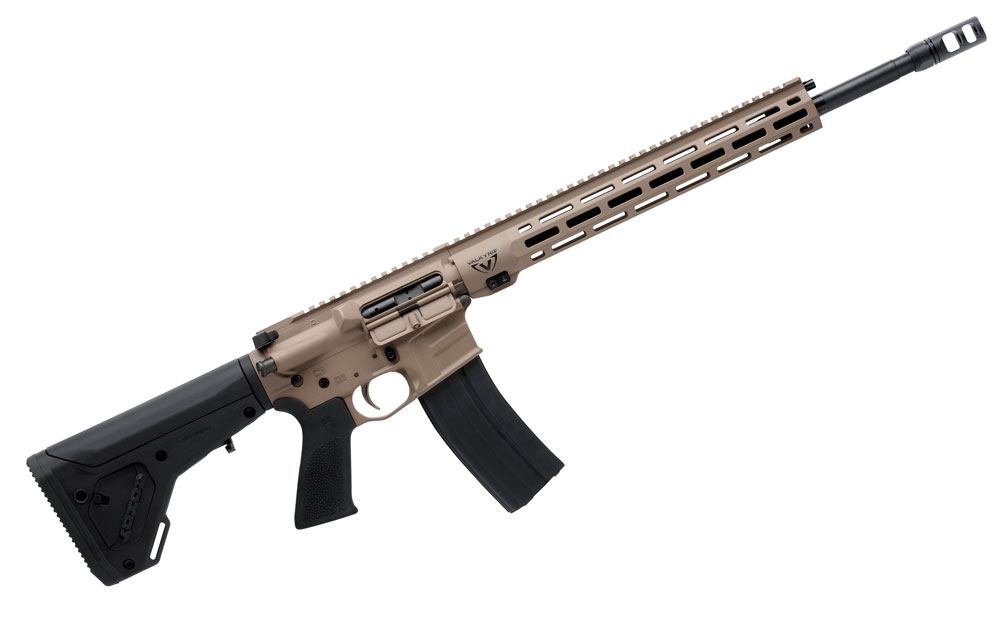
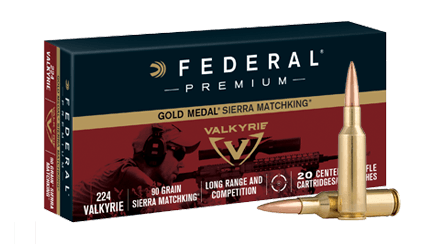 Hot loads are nothing new in the world of centerfire .22 cartridges. But Federal has gone a step beyond just capacity with the newly minted .224 Valkyrie. It also has given it space for a projectile that can harness it.