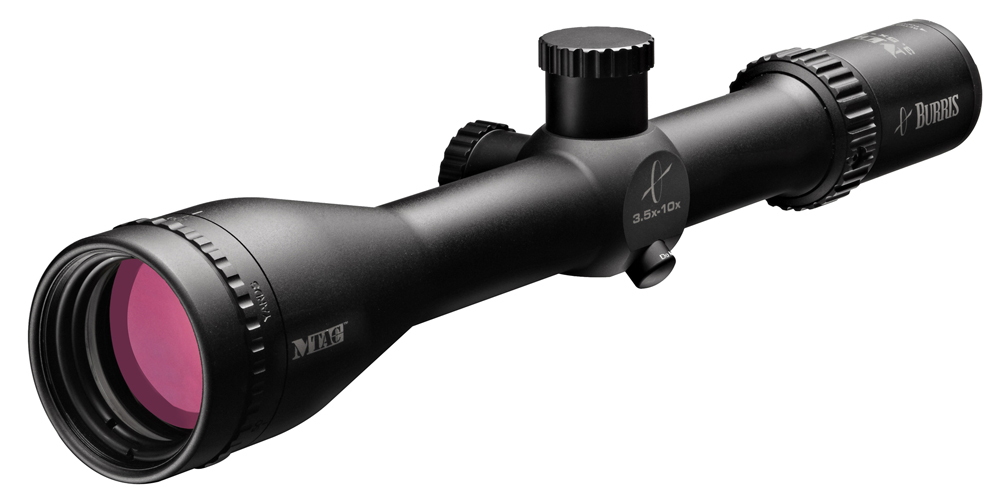
Designed for 3-Gun competition shooting, Burris has introduced its new MTAC line, with five new scopes that are designed for the tactical shooter.
The new MTAC series consists of a 1x-4x 24mm, 1.5x-6x 40mm, 3.5x-10x 42mm, 4.5x-14x 42mm and a 6.5x-20x 50mm. The MTAC 1x-4x 24mm, with its wide field-of-view and illuminated Ballistic CQ 5.56/7.62 reticle is the perfect companion for any AR-style firearm.
This scope allows you to quickly and easily engage close targets or take precise aim to 600 yards. For those that want more versatility and confidence for the short-range fast shots, it is also available as a package with the popular FastFire red-dot reflex sight. Like the 1x-4x scope, the 1.5x-6x 40mm offers an illuminated reticle, but is more suited when longer-range shots are more common.
For the long-range tactical shooter, the MTAC offers three scopes, 3.5x-10x 42mm, 4.5x-14x 42mm and a 6.5x-20x 50mm, all of which have adjustable parallax. All three scopes feature the popular G2B Mil-Dot reticle for precise aiming, distance measurement, holdover and hold off. Additionally these scopes sport the new MTAC Mil-Rad knobs with finger-adjustable/resettable dials for windage and elevation.
The five new riflescopes in the Burris MTAC line offer a generous four inches of eye relief, rubber-coated eyepiece and are made with rugged 30mm tubes. All lenses are precision ground optics that are index matched, multi-coated with the Burris proprietary HiLumeä coating for unsurpassed clear, sharp, high-resolution images.
The new MTAC scope line will be available at retailers in the first quarter of 2012. Suggested retail pricing is: 1x-4x 24mm, $399; 1x-4x 24mm with FastFire, $599; 1.5x-6x 40mm, $399; 3.5x-10x 42mm, $449; 4.5x-14x 42mm, $549; and 6.5x-20x 50mm, $699.
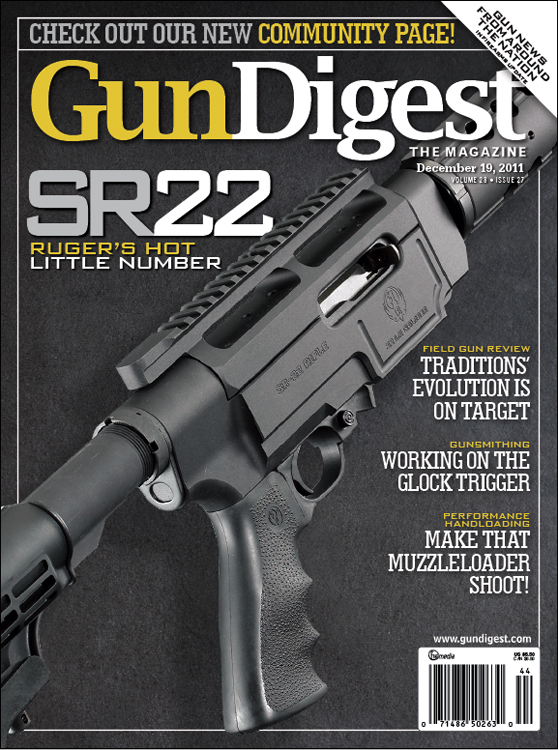
Gun Digest is the source for firearms news, pricing and guns for sale. Readers benefit from in-depth editorial expert advice, show reviews and practical how-to instructions. With your Subscription, you’ll also learn about threats to your Second Amendment rights. Click here to begin your subscription to Gun Digest.
Inside this issue:
Ruger SR22
Traditions Evolution
Glock Triggers
Muzzleloading
Gun shows, auctions, classifieds and more!
Not a subscriber? Make sure you don’t miss another issue! Subscribe now
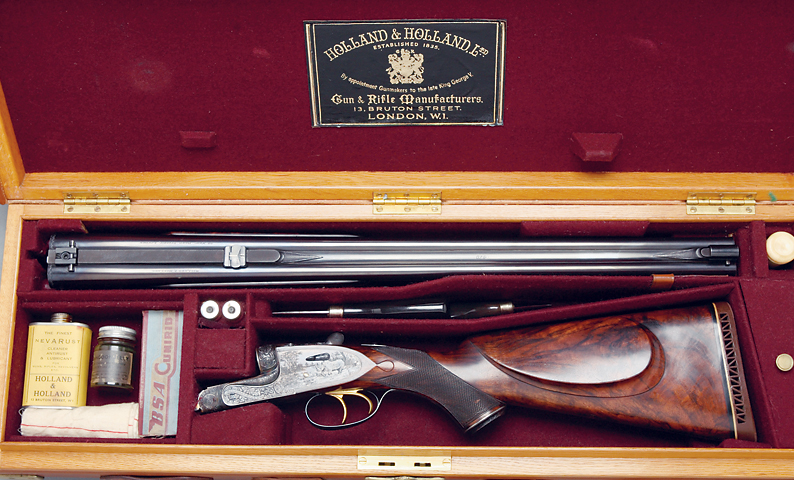
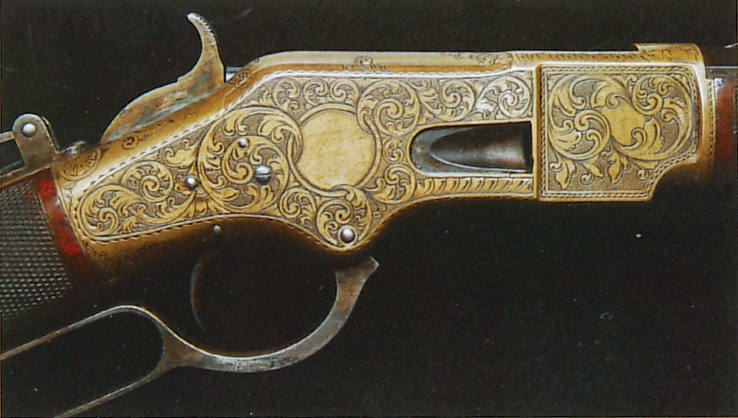
From the factory-engraved Model 59 duck gun, to the elaborate artwork on the highest-grade custom guns, here are 20 engraved guns from Gun Digest 2011!
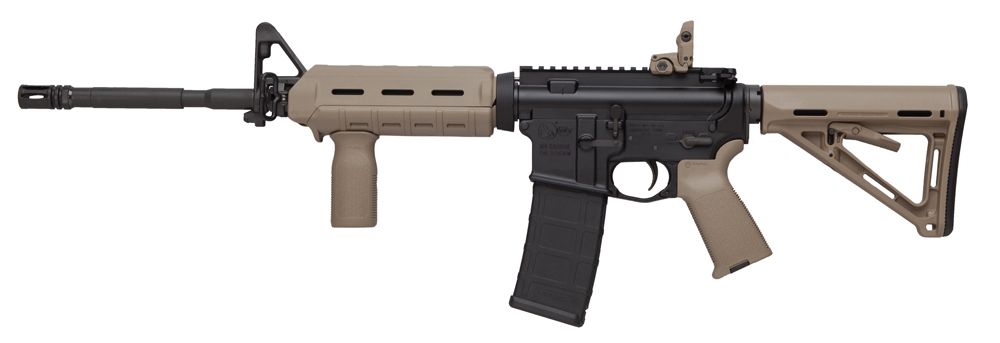
Colt Defense will bring to market the LE6920MP, a rifle standard equipped with many of Magpul’s most popular firearm accessories.
Available this month, this version of Colt’s top selling LE6920 will be available in a variety of color combinations complete with multiple Magpul accessories.
This rifle is the first product Colt Defense and Magpul have developed together. “By combining Colt’s quality firearm with Magpul’s popular accessories and offering them together in one standard product we are giving customers an option to save time and money,” said David Ridley, Vice President, Colt Defense LLC. “Magpul has earned its reputation for developing and manufacturing some of the most innovative firearm accessories available, and by making those accessories available as standard equipment on the new Colt LE6920MP we feel confident this firearm will be one of the highest quality products available.”
At the base of this new AR platform rifle is Colt’s popular 6920 Law Enforcement Carbine, proven to be effectively mobile during tactical deployment and traditional patrol. With a fully retracted buttstock, the carbine measures only 30.5 inches and weighs in at only 6.8 pounds. Tried and true, this carbine boasts proven advantages like a safe, semi-automatic rate of fire for potent firepower capability and speed of target acquisition.
Magpul accessories on the new Colt LE6920MP platform include the MOE Vertical Grip (MVG), MOE Hand Guard, Generation 2 Rear Back-Up Sight (MBUS), MOE-K Hand Grip, MOE Trigger Guard, MOE Carbine Stock and two durable 30-round Magpul Polymer Magazines (PMAG).
The Magpul MOE Vertical Grip (MVG), which is attached to the mid-length MOE Hand Guard and features an ergonomic design, is optimized for use with the thumb break shooting method. The LE6920MP is the only rifle on the market that offers the MVG as standard equipment.
The Generation 2 Magpul Rear Back-Up Sight (MBUS) is a spring-loaded flip-up sight that stows to just .51 inches above the rail and can be folded with either aperture in position. The MOE-K Hand Grip, with a compact design and a steeper, more vertical grip angle allows for improved comfort and control. Paired with the MOE-K grip is the polymer MOE Trigger Guard that has rounded edges and features a shallow “V” shape, beneficial for shooters wearing gloves in tactical or cold weather operations.
Also issued on the rifle is the MOE Carbine Stock, which has a streamlined A-frame profile. An extra-power lock mechanism with premium chrome-silicon springs helps to prevent auto-collapse failure and resists spring relaxation to deter auto-collapse failure. The rubber butt-pad offers prevention from shoulder slippage, even while wearing modular gear or body armor.
All models also come with two durable 30-round Magpul Polymer Magazines (PMAG).
In addition to the black model, LE6920MP-B, other models being offered are the LE6920MP-FDE rifle, which features Magpul parts in flat dark earth; the LE6920MP-O including Magpul parts in olive drab; and the LE6920MPG-B with green anodized receivers and Magpul parts in black. Excluding the LE6920MPG-B, these rifles are also available with a bullet button for California compliance.
If you are a collector looking for that unique piece or a shooter seeking a deal on a gun that has not been made in 50 years, the Internet auction is replacing the gun show as the place to satisfy your desire.
As a dealer, I sell most of my collectible and used firearms via Internet auction. I use both GunBroker and AuctionArms. Both are fine sites that advertise here in the Gun Digest.
I did not list eBay here because they do not allow complete firearms of any kind. Some gun parts are allowed but I don’t recommend using eBay for any firearm related stuff because they do not want our firearm business. Why put money in the pockets of an anti-gun business?
I have found after a decade of selling firearms on Internet auctions that I can usually sell them quicker and for a better price than locally or at a gun show. There are some risks involved that I will try to address in this column.
Is Internet buying for you? The answer can depend on what you are looking for and how much risk are you willing to accept in pursuit or your goal. A bit of money helps, too.
Why buy on the ‘net when I have a great gun shop locally? The answer to this depends on the item you are interested in purchasing.
If it is a current production firearm then a local, well-stocked shop is probably your best bet. However, retail shops do not stock every product. Some are even reluctant to order an unfamiliar product instead of selling you something they carry in stock.
If you are a collector or just want a specific item, few retail shops will have a large selection of used guns. They just get what comes in the door. So if you want a used .30-06 hunting rifle but live in a shotgun only state, few rifles will get traded in. Some shops might not even want to take used firearms in trade at all.
They don’t want to stand behind an item they cannot get serviced or replaced easily. Many retailers of new merchandise are afraid to take in collectible guns like an old Winchester or Colt Single Action because they are not well informed of the collectible market, and they fear getting stuck with an expensive gun that is hard to sell locally. I can’t fault them for their caution in buying high priced collectibles.
I have bought collectible guns thinking I was getting a good deal only to find out that it had the wrong barrel length, non original rear sight, replaced stock, was reblued, or any of a dozen other problems that reduced its value and collectibility. It pays to know what you are buying.
How do I find an item I want? First, you should log on to one of the auction sites and select the search option. Enter the make, model and caliber of an item you are looking for. Such as: “winchester 1873 .45”, “1898 mauser 7mm”, or “colt 1903 .32” No need to use caps or punctuation, as the search does not use them. This will show you current listings matching your selection. Hopefully, there are several listings to view. It will also be helpful to do another search of closed auctions to see prices that were actually realized on your item.
Do a closed auction search going back as far as the site will allow. This can be up to 90 days. If you are looking for a collectible firearm then you also need to do your own research first, to be sure if the item you are viewing is correct. This can be done on any of the hundreds of sites devoted to specific manufacturers, models or countries of origin. Don’t hesitate to email a seller questions about his stuff. If he is a regular seller of collectibles, he should know the important details and address them in his auction description. Some sellers, like pawn shops or small retailers, don’t know what they are selling so you might need to ask detailed questions. Sellers who fail to respond to questions or are vague with answers should be avoided.
I want to hold and feel an item I’m about to spend hundreds or thousands of dollars on. This point is hard to talk someone out of. The fact is that your local dealer or gun show may never have the item you want. Would you rather never have it or take the chance and buy one only viewed in digital pictures?
A good seller will invest in a quality digital camera and learn how to take detailed pictures with it. I show close ups of markings and other important details. I always show rust spotting, small cracks or dents in the wood or other blemishes on the firearm. I have seen sellers whose listings show lousy pictures that are dark or fuzzy and lack up close views of important markings.
Here is where the feedback on an Internet seller will be helpful. Most Internet auction sites have a system where buyers can publicly post their satisfaction with the seller and the merchandise they bought from them. A well established seller can have thousands of feedback reports.
Positive feedback will usually mention that the seller uses accurate descriptions, gives excellent service and ships quickly. Negative feedback can come from poor descriptions or pictures of an item, refusal to accept returns, or outright fraud. If a seller gets too many negatives, the site will kick them off completely. If a few negatives appear on an otherwise impressive total, read them with the understanding that it is impossible to make everyone happy. Some buyers are hesitant to buy from new sellers or those with few feedbacks. That would have to be your judgment call. Some of the best deals will be from new, inexperienced sellers.
OK, I found my dream gun, is it time to bid? Not yet. Before you get ready to bid, you should line up an FFL dealer to receive the firearm for you. A non-licensed individual cannot receive a firearm in interstate shipment. However, if the gun you want is in your home state, you can arrange to see it in person or buy it directly from the seller. You will need to be prepared to go to the seller’s place of business if they are a retail dealer. Or, if they are not an FFL dealer you can buy the gun directly, if person-to-person transfers are legal in you your state.
GunBroker and Auction Arms both have lists of FFL holders who will handle out of state transfers. Just enter your zip code and they provide a list of nearby dealers. Some large shops refuse to handle transfers because they believe it cuts into their business. As though they think you might be ready to buy their new Glock when you are looking for a WWII issue Luger that they don’t have and would never buy. Too bad, as this alienates potential customers that might return to buy something out of their stock.
How much will the transfer cost? This varies a lot by region. $10 – $25 in most areas will get you a transfer. But in places like California and New Jersey you might pay $50 – $100. There just are not many FFLs left in these anti-gun utopias. You also need to ask if they collect sales tax on a transfer. Some states expect the FFL to collect the tax as though he sold the item, even if he is acting only as a receiving agent and you paid the seller directly.
You also will want to ask if they will receive a firearm from a non-FFL seller. It is not illegal under federal law or in most states for a non-FFL individual to ship a firearm to another state as long as it is shipped to an FFL. A photocopy of the seller’s ID is usually enough to establish identity. Some transfer dealers do not want to receive a gun from a non-licensed individual. You might need to ask the seller if he is a dealer before you bid on his item. It is also wise to ask about the seller’s return policy if this is not stated in the auction.
Once you have a transfer FFL lined up, it is time to join the game. It can be frustrating, just like a live auction. There are many strategies involved in when to bid. Some will wait until the last minutes of an auction so as to not draw attention to the item they want. I say just decide what you are willing to pay and place your bid. If someone is going to bid more it really does not matter when it happens. There are deals to be had. It just takes time and patience.
What are reserve auctions and what is proxy bidding? A reserve auction is when the seller sets a hidden price for the item that must be met before the item will sell. This is different from the starting price of the auction. The starting price is shown on the auction listing. It can be $1 and up. If a reserve auction receives bids it will not be a sale until the reserve is met. I have never listed or placed a bid on a reserve auction. It seems that the reserve price is seldom reached. I think a lot of sellers that use reserves are fishing for how much buyers are willing to pay for an item without having to sell the item.
A smart seller will just list his minimum selling price as the starting bid and not waste a buyer’s time with reserves.
Proxy bidding is the way that the auction sites raise the bids between competing bidders without requiring a bidder to pay his full bid if he is not bidding against another. For example, Bidder 1 bids $500 for a Colt revolver with a minimum opening bid of $400. There is no reserve, so the seller is willing to sell his gun for $400. If no one else places a bid before the auction closes Bidder 1 will win the Colt for $400. If Bidder 2 jumps in and places a bid of $450 then the proxy bidding program will up Bidder 1’s bid to $460 or enough to outbid Bidder 2’s bid.
The bids are raised in increments based on the starting price of the item. Usually five dollars or so. If Bidder 2 decides he really wants that Colt then he can go back and raise his bid to $600. Now Bidder 1 receives an email informing him that he has been out bid. He has the choice of raising his bid but it must be for more than $600 to win the Colt.
I won an auction. Now what? The winning bidder in an auction will receive an email from the auction site informing them that they have won. The seller will also send an email with the total and the address to send payment. The shipping charge should have been listed in the seller’s description or included in the selling price. Beware of a seller that fails to mention shipping in the auction then tries to add $50 to the price. Ask before you bid. Most long guns can be shipped for around $20 – $25 via UPS ground or U.S. mail depending on the insurance coverage. Anyone can ship a long gun via either method.
Handguns can be sent US Mail only if the seller is an FFL holder. That will run $10 – $20. UPS requires handguns be sent next day air and that will cost $35 – $50 so if you are buying a pistol from a non-FFL keep that in mind. The details of how and where to ship firearms were discussed in a previous column.
The best form of payment is a U.S. Postal Service money order. They can be bought at any post office. The USPS money order is better than a private bank money order in case of a problem with non-delivery of merchandise. The USPS will go after fraud cases involving mail-order sales.
Many retail sellers will be able to take a credit card. I do not like online payment services such as Paypal because they have problems of their own with recovering payments when there is a problem with a transaction. You now will mail your payment and FFL copy to the seller. Some transfer FFLs will want to mail their FFL copy directly to the seller. Either way is fine. As long as both get there safely.
When your new treasure arrives at the FFL dealer you go in and fill out the paperwork the same way as in any firearm transaction. Be sure to inspect the gun to be sure it matches the seller’s description. It would be easier to make a return before you do the paperwork and take the gun home.
In Lawrence, Kansas, Police Chief Tarik Khatib has asked his city commission to create a new program allowing patrol officers to purchase their own rifles for on-duty use. City commissioners delayed action on that proposal, saying they wanted to gather public feedback first.
“But Khatib said the program is needed,” the Lawrence Journal-World (LJW) reported. “He said college communities aren’t immune to violent crime, and that more-advanced weaponry may be needed by police to protect the communities from criminals who could be heavily armed.”
Lawrence is home to the University of Kansas.
“We have just as great a likelihood for a major incident to happen here as it would anywhere else,” Khatib said. “We hope that it never happens, but if it does we want to make sure that we have the tools and training to deal with the situation.”
Lawrence officers have been able to have patrol rifles since 2003, “if the officer purchases a rifle that meets department regulations,” LJW explained. “But Khatib is seeking a program that would allow police officers to purchase patrol rifles through the city. The lease-purchase program would allow the city to buy the rifle, and then the officer would repay the city through 26 automatic payroll deductions. The city has a similar program in place that allows officers to purchase their patrol pistols.”
Said Khatib about the need for his officers to have patrol rifles, “Everything is good until it is not. In this line of work, you do not want to be caught unprepared.”
“If we’re going to reverse President Obama’s Million Rifle Ban, gun owners have to turn the heat up on Congress now before it’s too late,” writes Sen. Rand Paul, R-Ky., in a campaign launched by National Association for Gun Rights.
“Please sign your Firearms Freedom Survey and put yourself squarely against President Obama’s Million Rifle Ban.”
The effort urges taxpayers to commit to voting against any senator who “votes to maintain Barack Obama’s M1 Garand Rifle Ban.”
The weapons, however, suddenly were classified by the Bureau of Alcohol, Tobacco and Firearms as a “threat to the public safety in the U.S.” The State Department then canceled plans by the Republic of Korea to return the weapons, totaling a little short of a million.
At the time, David Codrea, who writes as the Gun Rights Examiner, said, “If I read this right, what they’re saying is, every gun poses a threat to public safety in the U.S. This is the same rationale used in model-specific ‘assault weapons’ bans – the type of gun is somehow deemed relevant, even though untold numbers of such firearms are already peaceably owned in this country, and even though no supporting evidence for this conclusion exists beyond agenda-promoting speculation.” Read more
What do you get when you mix family, firearms and millions of dollars of business?
READY AIM SOLD.
The father son team of Pat and Kevin Hogan show the world what it takes to turn a passion for history and collecting into an industry leading company based right out of the QCA. This November 29th, Pat, Kevin and Rock Island Auction Company will be the feature of a new pilot episode on Discovery Channel about everything that goes into firearms auctioning.
Each year Rock Island Auction Company auctions off more than 20,000 firearms, each of which has its own history. Whether it was presented to the Sultan of Turkey, the first gun off the Colt assembly line, or grandpa’s sidearm from WWII, each gun has its story, and its price.
Collectors from around the world make their way to the Quad Cities five times a year for their chance to take home their own piece of history, some paying close to a half million dollars for a single gun. And that’s only half the story.
The show sheds light to what happens before each auction. The challenges of finding firearms to bring to auction, researching their history, and meeting the collectors, their stories, and what drives them to bid are brought to the public’s eye. All while mixing in a bit of education on what makes a firearm that has been sitting in a closet for 30 years worth $125,000 or rifle thought to be $300,000 less than $40,000.
Premieres Tuesday, November 29 at 10PM e/p on Discovery Channel
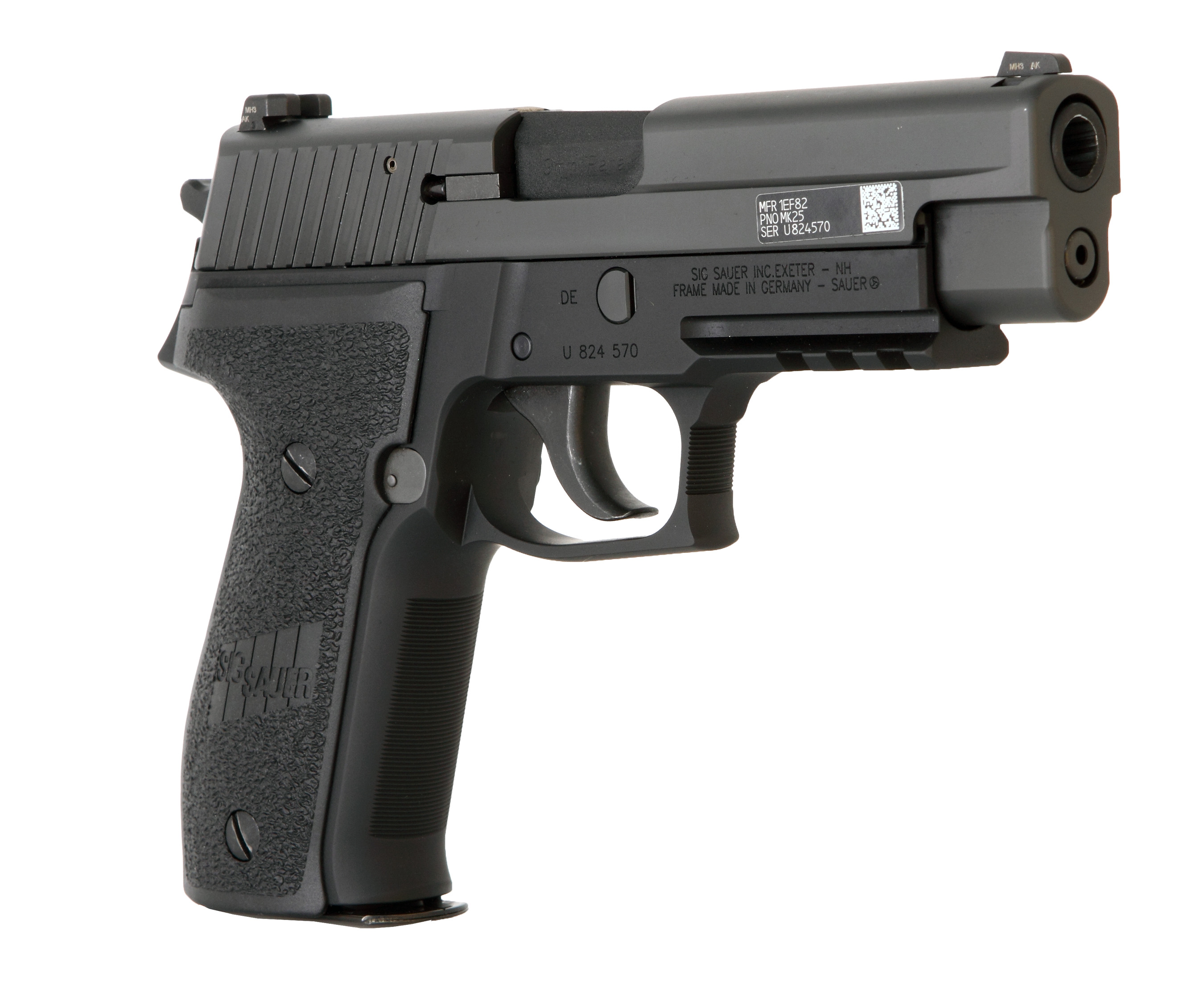
For more than 20 years, the SIG SAUER P226 has been the sidearm of choice for the world’s elite military forces. Now, the United States Navy has granted SIG SAUER permission to sell the new contract pistol, designated the MK25, to the general public.
The commercially available MK25 is identical to the firearm SIG SAUER delivers under contract to the Naval Surface Warfare Center (NSWC). Built to the Navy’s demanding standards, the MK25 comes chambered in 9mm, with a phosphate finish applied to all internal components, providing corrosion resistance in even the harshest of saltwater environments.
The engraved gold anchor on the pistol’s slide hints at its military origin, while the UID code on the right side serves as a genuine badge of authenticity. The true mil-spec 1913 rail is machined into the hardcoat anodized alloy frame, providing a solid mounting point for lights, lasers and accessories.
A reliable double-action/single-action trigger and two-piece polymer grips are included in the NSWC-specification package. SIGLITE night sights, three magazines, and a card certifying authenticity come standard in the case.
The only other way to obtain an authentic MK25 pistol would require a Naval enlistment and training with elite forces. Learn more, visit www.sigsauer.com
MK25 P226 Specs
Caliber 9mm Magazine Capacity 15 Trigger Pull DA: 10.0 lb / SA: 4.4 lb Overall Length 7.7″ Overall Height 5.5″ Overall Width 1.5″ Barrel Length 4.4″ Sight Radius 6.3″ Sights SIGLITE Night Sights Weight w/ Magazine 34.4 oz Frame Material Aluminum Frame Finish Hardcoat anodized Slide Material Stainless Slide Finish Nitron Grips Black polymer MSRP $1,142
Weights and dimensions are approximate. Specifications subject to change without notice.
Gun Digest is the source for firearms news, pricing and guns for sale. Readers benefit from in-depth editorial expert advice, show reviews and practical how-to instructions. With your Subscription, you’ll also learn about threats to your Second Amendment rights. Click here to begin your subscription to Gun Digest.
Inside this issue:
Wilson Combat Recon 6.8 SPC
Hampton’s Duck Guns
Browning A-Bolt Slugger
Collecting the 32.20
Gun shows, auctions, classifieds and more!
Not a subscriber? Make sure you don’t miss another issue! Subscribe now
A bombshell ATF email from 2010 that surfaced this morning shows that when it came to the murder of Border Patrol Agent Brian Terry, all of the top officials of the ATF and the DOJ were fully aware of serious ramifications of the fallout. One of the guns found at the scene came from the agency’s illegal ‘Fast and Furious’ program.
This means that all of the top officials of the ATF and DOJ knew about the gunwalker scheme and that a murder had been committed as a result.
National Gun Rights Examiner David Codrea states that the email shows that the Deputy Chief of the Special Prosecutions Unit of the Criminal Division of the Department of Justice had fully documented awareness of the connection between Terry’s murder and Fast and Furious within a few days of the crime. So concerned was the Deputy Chief of the potential explosive nature of that connection that he recommended that the Phoenix Field Division of the ATF hire a media consultant to deal with the fallout.
Sources tell me that in any dispute between DOJ AUSAs, there is a “deconfliction process” that is “written in stone.” “All such disputes automatically get kicked upstairs,” said one source, and “certainly would be known immediately to the head of the Criminal Division.” Meaning, of course, Lanny Breuer. “Also, Holder would have been briefed about it,” said the source. Read more
Gander Mountain recently debuted, “Gun World by Gander Mountain,” a new 30,000 square-foot retail outlet featuring upwards of 5,000 guns of all kinds, and firearms specialists on duty. Located in Germantown, Wisconsin, Gun World celebrated its grand opening Saturday and Sunday, November 12-13.
According to a Gander Mountain press release, “Gun World features the largest and most impressive selection of firearms found anywhere, from shotguns, handguns and rifles to the most advanced sporting tactical firearms. The store has all levels of products to fit the needs and interests from beginners to the true firearms enthusiast, and offers rare and hard-to-find guns and ammunition. In addition, the store features a huge selection of used guns, and top-level expertise from associates who will walk customers all the way through the selection, purchase and registration process. Gun World also offers a wide selection of hunting clothing and gear designed with outdoor enthusiasts in mind.”
“Gander Mountain is already the major retailer of firearms in the country, but with Gun World by Gander Mountain we are taking the experience of shopping for firearms to an entirely new level of selection and service,” said David Pratt, CEO of Gander Mountain, “We are excited to bring this new retail experience and opportunity to the people of Wisconsin and we’re confident that our unmatched selection and the expertise of our specialists will make Gun World a premiere destination for those with an interest in firearms.”
Gun World was the second major new retail debut from Gander Mountain in 2011. The company has also opened six new Gander Mountain Academy locations throughout the country, offering the most advanced firearms technology and training available. For more information on the first Gun World store, visit the Gander Mountain web site, at www.gandermountain.com.
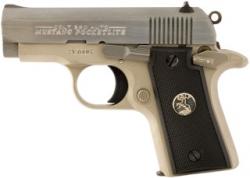
Colt’s Manufacturing Company said it will introduce a new and improved version of the classic Colt Mustang. The new Colt .380 Mustang Pocketlite is small, lightweight and boasts enhanced durability, reliability and accuracy, making it an ideal handgun for personal protection.
The precise machining process, use of high quality materials and improvements in design make Colt’s new .380 Mustang Pocketlite an excellent choice as a small backup gun.
The aluminum alloy receiver, stainless steel slide and barrel are CNC machined from solid bar stock for precise tolerances. “Machining solid stock is certainly a more involved manufacturing process,” said Joyce Rubino, Vice President of Marketing, Colt’s Manufacturing Company, “But it is that process, combined with our engineering specifications, expertise and demand for perfection that allows Colt to deliver one of the highest quality products available to today’s marketplace.”
With a loaded magazine, this handgun weighs less than one pound. It measures 5.5 inches long and has a 2.75-inch barrel. The minimal weight and length of the gun, combined with the short single action trigger, grip design, frame design and firing pin safety block, make this firearm ideal for personal protection.
The magazine holds six rounds. Improvements in powder and bullet design have increased the velocity and terminal performance of .380 caliber ammunition, adding to the viability of the Colt .380 Mustang Pocketlite for personal defense.
“Accuracy and reliability was a top priority as we looked at what improvements could be made to make this classic backup even better,” said Rubino, “Though the changes may seem subtle to the untrained eye, every Colt employee takes great pride in knowing that their dedication has helped bring a vastly improved and enhanced firearm to market.”
The new Colt .380 Mustang Pocketlite descends from a famed line of pistols, including Colt’s Government Model, and improves upon the best that each had to offer.
For more information on Colt’s Manufacturing Company visit www.coltsmfg.com.
How to hand stipple the stocks of your polymer-framed pistol for a better grip.
Gun owners usually fall into two camps: those who keep their weapons just as they come from the factory and those who do not. Those who desire to keep a firearm in its original factory condition do so for purposes including faithfulness to the original intent of the firearm’s designers or protecting the factory warranty.
Those who customize their weapons probably desire to improve it in some way — to increase its functionality or even to personalize it. One camp asks: Why would you permanently change a perfectly good factory gun? The other side asks: Why wouldn’t you? In the interest of full disclosure, I’m in the first camp.
For years, handgun owners have modified their steel revolvers and pistols — shortening barrels, porting chambers, changing stocks, and more. With the advent of the polymer-framed pistol, the opportunity to make changes has only increased. One of the most popular modifications to polymer-framed pistols is to add to or change the stocks to improve purchase (the firmness or quality of one’s grip of the stocks). Some handgun owners add a rubber grip sleeve such as a Hogue Hand-All.
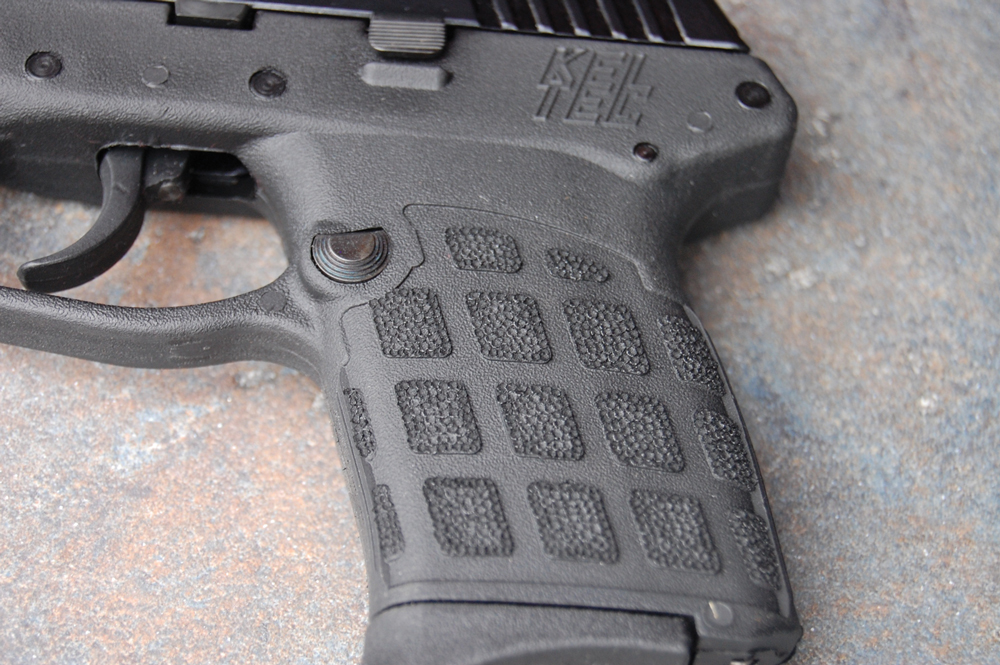
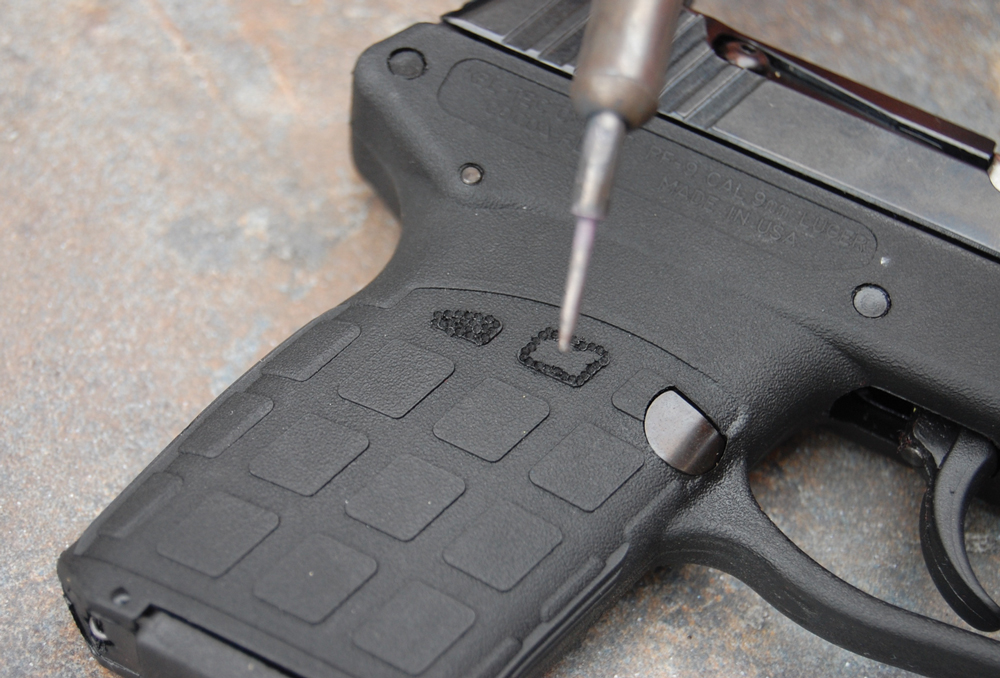
The Kel-Tec PF-9 is a thin, lightweight, single-stack 9mm pistol offering excellent purchase right out of the box. Stippling the tops of each square made it even better.
Others apply a sandpaper-like skateboard tape. Of course, grip sleeves and skateboard tape don’t require physically altering the weapon; those add-ons are easily removed. Other gun owners, however, resort to more drastic measures, including stippling—broadly defined as “drawing, engraving, or painting in dots or short strokes.” In this context, “engraving” seems to fit best as it involves melting the polymer and re-shaping it to improve purchase.
While companies such as Robar offer custom stippling for polymer-framed pistols — at a cost, but with many advantages — many handgun owners have attempted to hand-stipple a polymer-framed pistol at home. In fact, the Internet abounds with stories, images, and videos of successful hand-stippling jobs as well as those that are, shall we say, less than successful.
After reviewing several positive hand-stippling reports, fanciful notions of “I can do that” started to run through my head. Moreover, I thought I could do a decent stippling job on a new Kel-Tec PF-9, a polymer-framed 9mm pistol, with just a hot soldering iron. Would I get a better grip on a pistol or did I need to get a grip on reality?
Since this was my first and possibly last hand-stippling job, I decided to start small in two ways: First, I chose a small, inexpensive weapon. The Kel-Tec PF-9 measures 4.3 inches tall, 5.85 inches long, and .88 inches wide and in a blued finish retails for $333. It would be an expensive lesson if I somehow managed to destroy it but not as expensive as some other polymer-framed pistols. This provided only a modest comfort to me.
Second, the Kel-Tec’s polymer frame offers stocks with a raised, checkerboard pattern (which, for the record, provide excellent purchase as is). Rather than attempt to stipple the entire grip area, I would only stipple the raised squares, borrowing from a design I had seen in an Internet gun forum. I figured the raised squares offered a little more depth of plastic and therefore greater margin for error.
A very short push into the polymer with a hot soldering iron yielded consistent craters measuring about one millimeter across.”
At this point, I need to insert all appropriate disclaimers: What I’m about to do might be unwise, if not downright stupid, and probably voids the pistol’s warranty. Regardless, don’t try this at home. In fact, don’t try this anywhere or at any time. Proceed at your own risk. Neither Gun Digest the Magazine nor Kel-Tec is responsible for your foolishness. Consuming raw or undercooked meat, seafood or egg products can increase your risk of foodborne illness. And so on.
Working in my professional stippling shop — in my driveway with an upside-down five-gallon bucket (the gun bench) and a broken piece of 12×12 ceramic tile (a safe surface to work with hot tools and melting plastic) — I plugged in the soldering iron and set up the camera. Either I would capture pictures of a successful hand stippling job or provide some emergency room doctor with images of my burnt flesh. This was the point of no return. As soon as that hot soldering iron tip touched the plastic, I was committed.
Questions raced through my mind: How would the plastic react to the hot soldering iron? How long would I need to hold the soldering iron against the plastic to melt it? Should I melt grooves into the plastic or just push in some round craters? Questions raced through the minds of the neighbors, as well: Who’s the idiot sitting in the middle of his driveway in front of a five-gallon bucket when it’s 32 degrees out?
A very short push into the polymer with a hot soldering iron yielded consistent craters measuring about one millimeter across.”
To test the effects of the hot soldering iron on Kel-Tec polymer, I swapped out the standard magazine floorplate for the extended magazine floorplate that was included with the pistol. Briefly touching the soldering iron to the side of the standard magazine floorplate as a test, the plastic melted instantly, leaving a small crater. I touched the soldering iron to it a few more times and was able to create a fairly consistent pattern of craters that measured about one millimeter in diameter. It took well under half a second for the soldering iron to create one crater in the plastic. Testing complete, it was time to stipple.
With the Kel-Tec lying on its side, I rested the heel of my hand on the tile while holding the soldering iron like a pen. I gently and briefly pressed the tip down into one of the squares. Just like the test, the soldering iron produced a neat little crater. I did it again, creating a crater right next to the first, and so on.
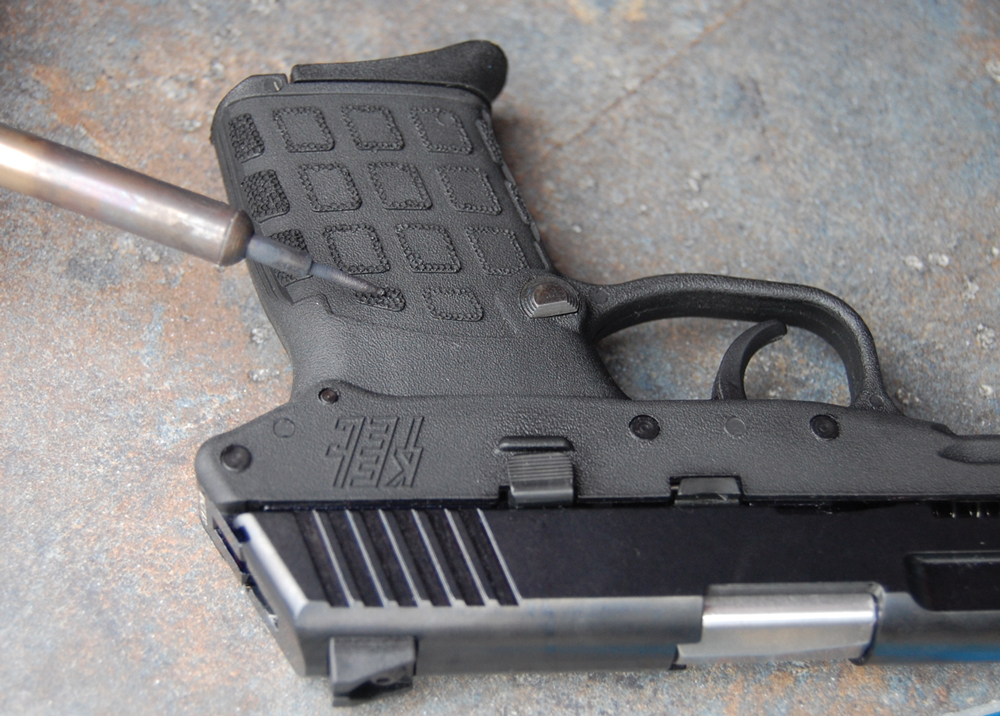
Following a pattern of creating rows of craters, I became proficient enough to complete an entire square in less than a minute. Once I completed one side of the gun, I continued to the other, this time stippling the outline of each square first and then filling in the middle. Stippling the stocks proved easier than I thought so I stippled a portion of the front strap as well. Total stippling time: 45 minutes.
While I would stop stippling every so often and pick up the pistol to see if I was creating any sharp or otherwise uncomfortable edges, I didn’t notice a major improvement in purchase until I completed the work. Using the magazine with the extended floorplate, the hand stippling job significantly increased purchase on the Kel-Tec PF-9. It felt great — rock solid, like no person or hot ammo was going to easily remove that gun from my hand.
Even though I consider the stippling job a wonderful success, I’m not going to be starting my own pistol customizing business. I’m just happy to have not ruined an excellent pistol, stippled my fingers, nor burnt down my house.
All in all, it was a good exercise, one that I hope is helpful to readers of Gun Digest the Magazine. After showing off the stippled Kel-Tec PF-9, a few friends have asked me why I would make permanent changes to a perfectly functional handgun. My response: “Why wouldn’t I?”
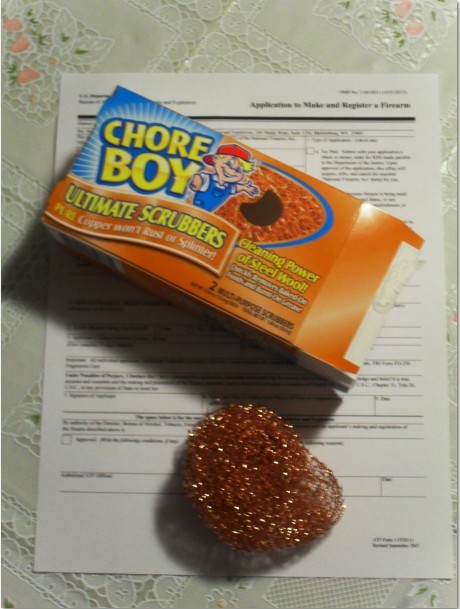
David Codrea's unregistered stockpile - for sale "off the books" to the highest cartel bidder. Chore Boy: the most trusted name in unregistered NFA firearms. Photo by David Codrea
The Bureau of Alcohol, Tobacco, Firearms and Explosives Firearms Technology Branch has deemed “Chore Boy copper cleaning pads, along with fiberglass insulation,” a firearm, subject to registration and a $200 transfer tax, an official letter obtained recently by Gun Rights Examiner reveals. The response to an attorney inquiry by John R. Spencer, Chief, Firearms Technology Branch, offers one of the more creatively restrictive assessments since ATF declared a shoestring to be a machinegun.
The rationale Spencer uses:
A silencer is a firearm per U.S. Code, subject to National Firearms Act registration and transfer tax requirements.
“[S]ound/gas absorbing materials manufactured from Chore Boy copper cleaning pads, along with fiberglass insulation, constitute a silencer…”
Therefore, it is illegal for an individual to replace deteriorated material within an already- registered suppressor without an approved ATF Form 1, ‘Application to Make and Register a Firearm,’” along with a “$200.00 making tax” and “a ‘no-marking’ variance…since there is no viable area in which to apply a serial number to the sound-absorbing material.” Read more
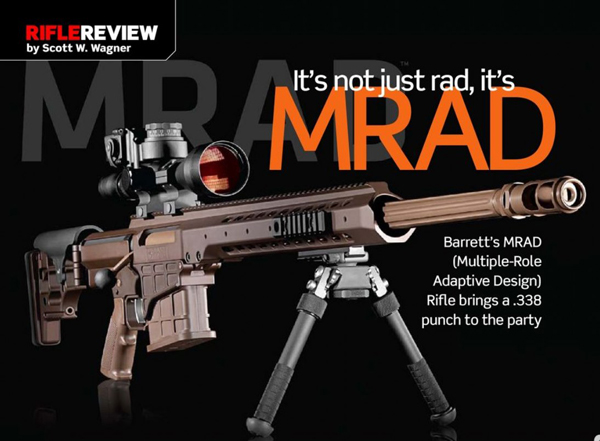
The Barrett MRAD .338 lapua (Multi-Role Adaptive Design) rifle brings big .338 punch to the party.
We’ve all heard the saying “it’s time to bring in the big guns”. Well the Barrett MRAD in .338 Lapua Magnum is one of those big guns, and the .338 Lapua Magnum cartridge seems to be an ideal round for those times in American civilian law enforcement when the .308 Winchester may not be enough (heavy barriers or reinforced homes or vehicles) and a .50 BMG weapon is way too much.
With 4352 ft/lbs of energy at 100 yards using a 285-grain Hornady BTHP Match Bullet, the .338 Lapua Magnum sits nicely at the lower end of the scale between the .308 Winchester — which has 2355 ft/lbs of energy using a 168-grain Hornady TAP bullet — and the .50 BMG which has an almost unbelievable 12,388 ft/lbs of energy using the Hornady 750-grain A-MAX bullet.
If you, my fellow law enforcement snipers, really stop and think about it, for urban or suburban police snipers whose shots average a distance of about 64 yards, the 50 BMG has way too much power for even the toughest law enforcement situations.
In fact, I bet that most agencies that have purchased the big .50 have found that it is rarely, if ever, actually deployed.
You can bet that the 5.56 SDMR, 6.8 SPC, .308 Winchester and even the .300 Win Mag do the yeoman’s share of work in stateside situations.
Speaking of the .300 Winchester Magnum it too is eclipsed by the .338 Lapua by more than 1000 ft/lbs at 100 yards even when loaded with a .30 caliber heavyweight bullet like the 180-grain. And yet, it is still about 1/3 as powerful as the .50 BMG, giving it a much higher level of general utility than that blockbuster round.
Looking to go armed, but are stuck in the weeds as to what to arm yourself with? Here are 20 of the best concealed carry gun options that will keep you on the defensive.