Smith & Wesson Corporation recently received contracts from the Massachusetts State Police and the Vermont State Police for new duty firearms from the M&P Pistol Series.
The Massachusetts State Police has selected the M&P45 pistol, while the Vermont State Police adopted the M&P40 pistol. Both of the statewide law enforcement agencies have initiated the transition process and their Troopers are currently using the M&P pistol in the field.
The Massachusetts State Police ordered 2,500 M&P pistols chambered in .45ACP. During the agency’s independent testing and evaluation process, the M&P45 was selected due to its ergonomic design, accuracy, reliability, and the pistol’s ability to be customized to meet individual preferences. Smith & Wesson will support the firearm contract with a full range of services including armorer’s training.
The Massachusetts State Police previously adopted the M&P15 tactical rifle as the State issued patrol rifle.
“Today, over 800 law enforcement agencies have adopted or approved for duty use our M&P products,” said Mario Pasantes, Smith & Wesson’s Senior Vice President of Marketing and Global Professional Sales. “We are especially honored to serve the Massachusetts State Police, our home state force.”
Additionally, the Vermont State Police has ordered 390 M&P40 pistols. During its open evaluation process, the M&P40 pistol received high marks by the Vermont troopers for its low perceived recoil, reliability during testing, and consistent performance. The new side arms are being supported with a full range of services from Smith & Wesson, including armorer’s training and advanced firearms training courses.
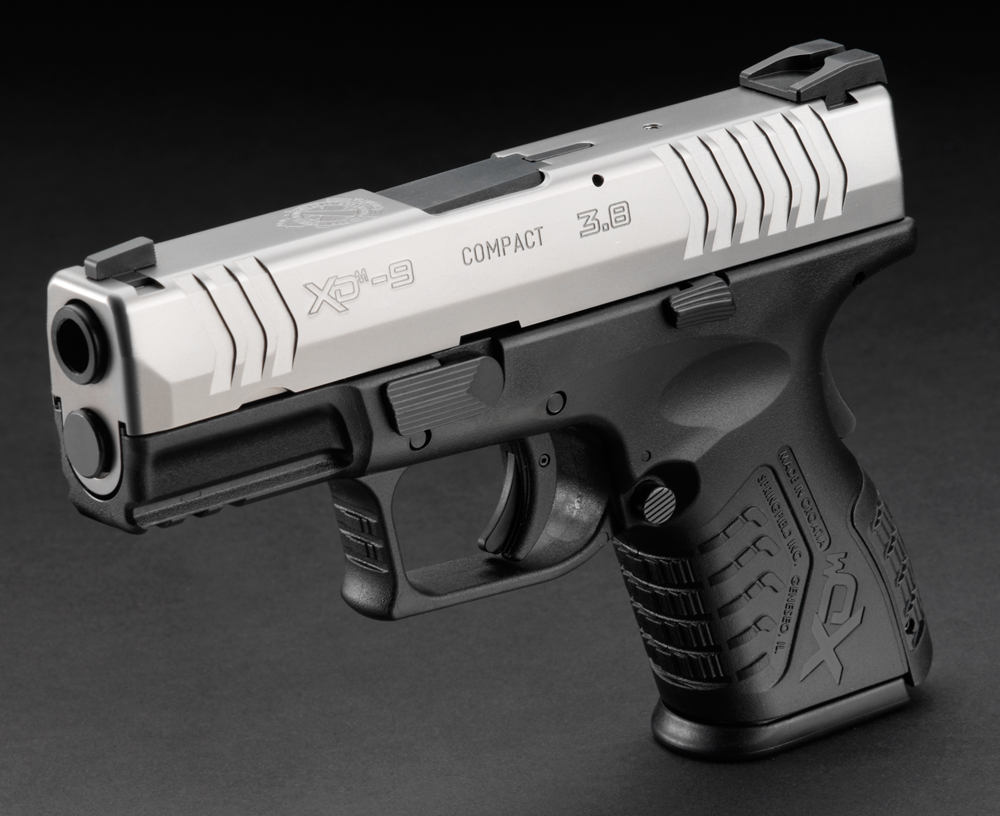
The versatile Springfield XD(m) handgun provides in one package a duty pistol, a backup or concealed carry pistol and, if you so choose, a fine tool for use in IDPA or other practical shooting competitions.
“Beware of the man with only one gun. He probably knows how to use it.”
This old proverb was given new meaning with the creation of the Springfield Armory XD(M) 3.8 pistol. This versatile handgun provides in one package a duty pistol, a back-up or concealed carry pistol and, if you so choose, a fine tool for use in IDPA or other practical shooting competitions.
The internal changes that give the new XD(M) what Springfield Armory calls the M-factor are all well and good, but they are for the most part subtle changes that make the pistol feel and function better.
What is not subtle, what jumps right out and grabs you, is the grip. Well, I guess you grab the grip, but the point is, the design of the grip and the magazine make this pistol a versatile self-defense tool capable of filling a number of roles, while at the same time allowing the shooter to maintain that level of familiarity required for consistently accurate shooting.
The key element here is amazing in it simplicity. It is one of those, “Someone should have thought of this sooner,” elements that comes when designers stop and think about people’s needs. Springfield Armory built a subcompact pistol; one that is perfect for concealed carry, then added a full-sized magazine equipped with a sleeve that matches the profile of the grip frame.
With the shorter magazine in the pistol you get a solid subcompact pistol that virtually disappears under even the lightest cover garment. Carry the longer magazine as your spare and you are ready to stay in the fight until you win it. Yes, statistically speaking, the typical gunfight lasts three seconds, during which you might expend three or four rounds. But we are not worried about what is probable. We are worried about what is possible. Is it possible that you will need more ammo? Has anyone in a gunfight wished he’d had less ammo? I’ve never heard anyone say, “If only I had fewer rounds in that magazine, I could have reloaded more often during the fight.”
With the Springfield Armory XD(M) 3.8 you carry lots of ammo in a small package and lots more in your spare magazine. You can go from 11 rounds of .40 S&W in the compact version to a whopping 16 rounds in a hand-filling, comfortable grip just by changing the magazine. You get 13 rounds in the compact 9mm version and 19 rounds in the full-size standard magazine.
So, if there is one element on the Springfield Armory XD(M) 3.8 that provides you the versatility to be “…the man with one gun” my vote is for the interchangeability of the magazines. You get two different grip sizes just by changing the magazine. Top that off with interchangeable backstraps to insure the pistol will fit virtually any hand and now you are carrying what amounts to a custom gun at a production gun price.
On the range, the pistol functions flawlessly with either magazine, and accuracy at typical combat distances is not negatively affected by switching from one magazine to the other. There is a bit of a difference in your grip when shooting with the smaller magazine inserted, but it is nothing you can’t overcome with a bit of practice.
Get to a local gun shop and fill your hand with the XD(M) 3.8. See if your first impression isn’t the same as mine. This is one pistol that will serve all your needs.
Gun owners and users appeared to be more safety conscious than ever, considering that data recently released by the National Center for Health Statistics revealed that fatal accidents involving firearms dropped to a record low in 2008.
According to a press release by the National Rifle Association, “in 2008, the number and per capita rate of firearm accident deaths fell to an all-time low. There were 592 firearm accident deaths (0.19 such accidents per 100,000 population) in 2008, as compared to 613 accidents (.20 per 100,000) in 2007. In 2008, the chance of a child dying in a firearm accident was roughly one in a million.”
Firearm accidents represented just 0.5% of all accidental deaths, “well below the percentages accounted for by motor vehicle accidents, falls, fires, poisonings, and several other more common types of mishaps.”
In related news, “Firearm homicides (including self-defense, but excluding lawful shootings by police) declined in 2008. More recent data reported by the FBI, shows that criminal homicides declined in 2008, again in 2009, and again in 2010, to a 47-year low.”
Gun Digest is the source for firearms news, pricing and guns for sale. Readers benefit from in-depth editorial expert advice, show reviews and practical how-to instructions. With your Subscription, you’ll also learn about threats to your Second Amendment rights. Click here to begin your subscription to Gun Digest.
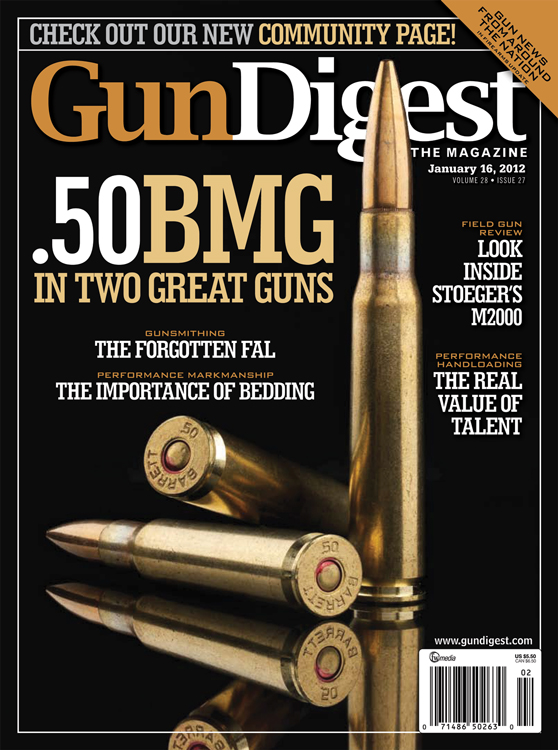
Inside this issue:
Two .50 BMGs Reviewed
The Forgotten FAL
Rifle Bedding
Stoeger S2000
Gun shows, auctions, classifieds and more!
Not a subscriber? Make sure you don’t miss another issue! Subscribe now
On November 17, 2007, an Indiana Woman protects herself during a home invasion when police could not get to her in time. After breaking through a window and entering her home, and then forcing himself into her locked bedroom, the intruder is shot but still tries to strangle the woman. At 5:43, you can faintly hear the final shot, which is suppressed due to the weapon being pressed against the attacker when fired. The woman then experiences overwhelming shock, as the struggle with the attacker is over.
This classic field gun still serves many. But these days specific models can be difficult to find. The iconic Remington Model 1100 is still one of the best.
CHRISTMAS, 1979, and my Old Man was at it again with his traditional – “Well, Jake,” he’d say with as mischievous a smile as my Old Man ever mustered. “You’d better look under the couch. There just might be something there for you.”
Or maybe it was another of his favorites, the box of ammunition with the handwritten note inside; the note, like his one-liner, directing me to peer into the darkness that was the underside of the davenport. Either way, the Old Man got his point across – there was something under the sofa, and I best be looking for it.
I was 15 that Christmas, and a veteran, or so I thought, of some seven hunting seasons. I had graduated from school to school in terms of field firearms, many of which you folks have read about here – a single-shot H&R .410, a Stevens M107B 20-gauge, and a Winchester M24 16-gauge double, to name but a handful of my diplomas.
But this year – 1979 – Boy Howdy, I’d hit the big time, for there was something underneath the sofa. A long green cardboard box bearing the white script REMINGTON across the top. Inside, the most beautiful thing I’d ever seen, including any icky ‘ole girl I’d encountered throughout the whole of my middle school career.
Laying there, encased in flaking white styrofoam, was THE shotgun – Big Green’s Model 1100 semi-automatic. Mine was identical to the Old Man’s never-without field piece, only instead of his 12-bore, mine was of a gauge to which I’d grown most accustomed – the 16. Here was my version of Ralphie “A Christmas Story” Parker’s Red Ryder BB gun, minus, of course, the compass in the stock. From his perch in his faux leather reclining chair, the Old Man watched, just a hint of a grin on his lips. Christmas, that year, was a success on several different fronts.
That was – Holy Cats! – 32 years ago, and since being first assembled later that same Christmas morning, the M1100 16-gauge has accounted for multitudinous species of North American game and fowl, including several whitetails.
It’s interesting to note that upon my receipt of the shotgun in ‘79, dedicated slug barrels, smoothbore or otherwise, weren’t available. Fortunately, my Uncle Jim owned a sporting goods store, and was able, I know not how, to obtain a shortened, no-rib tube for the 16 to which he had brazed a set of adjustable iron sights.
At least half a dozen Ohio whitetails fell to that combo over the years, including my first buck. Prairie chickens, sharp tails, ruffed grouse, doves, pigeons, snipe, rails, woodcock, teal, Canada geese; the only fowl not on the list for the M1100 is a wild turkey. But, should you be interested, I’ll keep you posted on that matter following this Spring season here in Iowa.
Technically Speaking
The first thing my Old Man did upon getting my new prize down into his corner of the basement was to, step by step, demonstrate the disassembly/assembly process. Having owned an M1100 since 1970, Pop was quite familiar with the mechanical workings of the autoloader. Today, in fact, he has enough spare parts – highly organized, mind you – to build a complete new shotgun, if, that is, he’d so wish.
Secondly, the Old Man’s rule on shotgun maintenance was, and still is, quite simple – if you take a gun into the field, it gets wiped down afterwards; if you shoot that gun, it gets broken down, cleaned, and reassembled. But I digress.
Though there have been some slight internal modifications to the M1100 over the past three decades, the gas-operated semi-automatic appears, both inside and out, much as it did back in The Day.
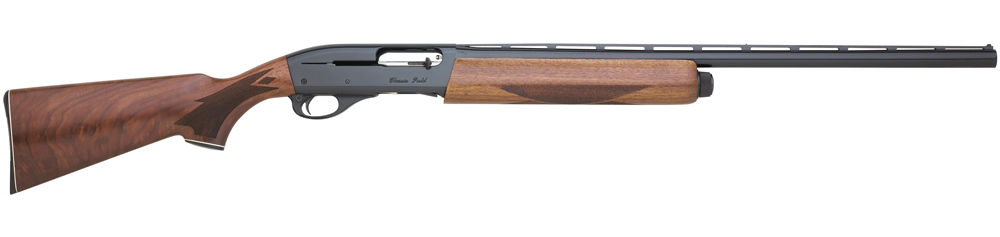
Outwardly, the M1100 – we’ll use my 16-gauge here as an exhibition item – falls, at least to me, somewhere between Moderately Ornate and Plain Jane. The American walnut stock and fore-end are finished in a high-gloss epoxy coating, with both the pistol grip and the underside of the fore-end being handsomely, albeit simply, checkered.
Present is the hard black plastic grip cap inlaid with Remington’s traditional, though now sadly absent, elongated white diamond. Both the receiver and barrel are blued; the left and right sides of the receiver sport tasteful engraved scrollwork, as does the chrome bolt.
The barrel, in this case a 28-inch tube, is topped with a wide ¼-inch pillared rib, and culminates in a fixed modified choke. Newer guns, not surprisingly, feature Big Green’s interchangeable Rem-Choke system. A single 3mm silver bead sits atop the muzzle. The M1100’s cross-bolt safety sits where it should – behind the trigger guard. The bolt/carrier release button is located underneath the receiver as an integral part of the carrier/elevator.
To disassemble the Old School M1100 is to understand its inner workings. Inside the fore-end and riding the magazine tube, two gas pistons – or, technically, a gas piston and a gas piston seal – assist in the gas-metering process.
Usable pressure enters the mechanism via two ports located underneath the barrel in the upper portion of the gas cylinder; the gas cylinder slides over the magazine tube as the firearm is reassembled. Upon firing, gas pressure forces the action bar assembly — it too riding the magazine tube — and bolt rearward. A metal link or rod connecting the bolt and bolt plate slides back, compressing the recoil spring in the stock.
The kinetic energy created assists in returning the bolt, bolt plate, and action bar assembly forward and into a firing position. In the midst of this instantaneous process, a fresh shotshell is released from the magazine, and elevated into an active loading position via a carrier.
The Remington Model 1100 Classic Field.
My Personal Report Card
I’ll admit it; I’m biased and not entirely unsentimental when it comes to Remington’s Old School M1100, especially should that piece, like mine, come in a 16-gauge format. I mean really, what’s not to like about a gun that looks good, cleans up easily, and works each and every time you pull the trigger?
True, I’ve heard that the newer generation autoloaders from Big Green have had their issues; we won’t even broach the subject of the ill-fated Model Cti105. Still, I believe it says something about a firearm, and here I’m speaking specifically of my M1100, when I say that after 32 years and tens of thousands of rounds, this particular autoloader still sports her original rubber O-Ring – as fragile a part as was ever put on this field piece.
Honestly, I can’t recall one mechanical misfortune where this shotgun is concerned, and I believe if you ask him, my Pop would say the same about his M1100. Perhaps it’s true; they – whoever they are – just don’t make ‘em like they used to.
Now for the bad news. If you’ve read this and are thinking – “Boy, howdy! I’d love to get my hands on one of those Old School M1100’s in a 16-gauge!” – well, you probably have your work cut out for you.
There are guns out there. However, many you find on the Internet are Remington’s reintroduction of the M1100 16-gauge, this one built on a 12-gauge frame, and thus not a “true” 16 to my way of thinking. That said, I did run across one of these 12/16-gauge pieces, new in the box, with a 26-inch barrel and three choke tubes at gunsamerica.com for $650. Other new/old examples averaged from $200 to $400.
This article appeared in the May 9, 2011 issue of Gun Digest the Magazine.
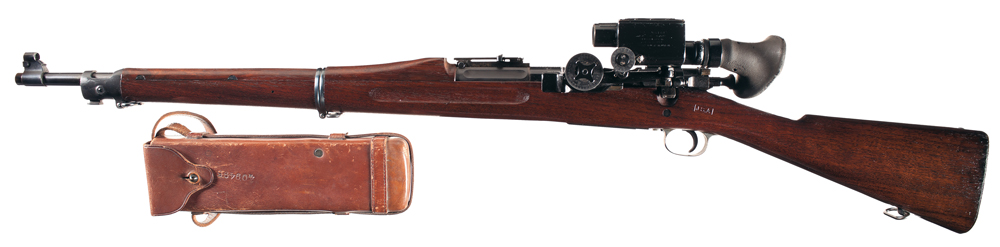
The Finest Condition U.S. Model 1903 Springfield Model 1913 Warner & Swasey Sniper Rifle. Price realized: $46,000.
Fresh off the heals of the television debut of Discovery Channel’s Ready Aim Sold, Rock Island Auction Company’s December Premiere Firearms Auction realized a stunning $10 Million dollars in sales. The seven digit figure is more impressive considering the pre-auction estimate was $8.2 Million! The success of the December sale puts Rock Island Auction at 31 million dollars in sales for 2011 and almost tied the previous record which they also hold from 2010 which stands at 32 million. Over the course of three days hundreds of bidders from coast to coast made their way to Rock Island, IL to preview and bid. Phone bidders called in from across the globe, and over 13,000 bids were placed before the first drop of the hammer.
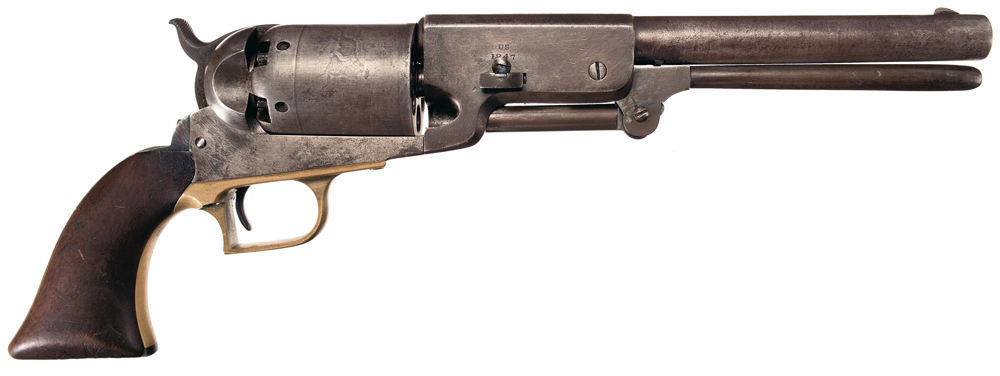
The Finest B Company Marked U.S. Walker Model 1847 Colt Revolver Known. Price realized: $345,000.
Colts took four of the top five lots of the auction commanding nearly one million dollars. The top lots include: The finest ‘B’ Company marked U.S. Walker Model 1847 Colt Revolver known ($345,000). The most anticipated firearm of the sale was the Gold Inlaid Factory Presentation, to standing President Theodore Roosevelt’s Colt 1902 ideal stocked semi-automatic pistol ($207,000), factory engraved documented Colt 1871-72 Open Top Revolver from the 1876 Centennial celebration in New York City ($184,000), and an Ainsworth Inspected, Company K, 4th Cavalry Marked, Colt Single Action Cavalry Revolver ($115,000).
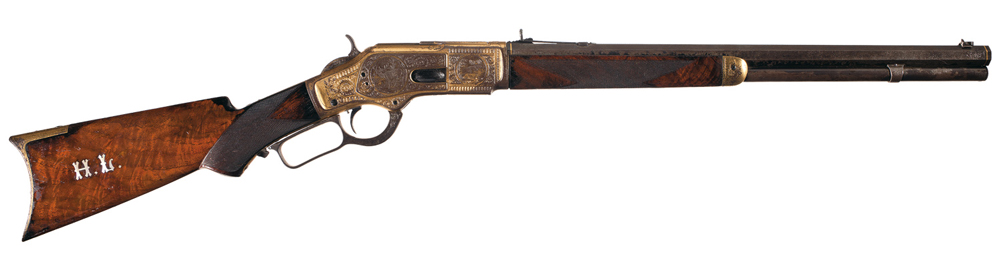
Winchester Firearms were also in high demand. A John Ulrich engraved gold plated Winchester Model 1873 short rifle brought an impressive $74,750. Another John Ulrich signed masterpiece from the Winchester display at the Paris Exposition of 1889, a gold and nickel plated, factory engraved Winchester Model 1873 Carbine sold for $57,500. Lever action rifles and pistols which predate Winchester also had a strong showing. Of the 10 Henry Rifles in the sale, a martially inspected first contract rifle took top honors at $46,000. And a Large Frame Smith & Wesson Lever Action Magazine pistol realized $48,000!
Fine New Haven Arms Co., Henry Lever Action Rifle. Price Realized: $43,125.
The December auction marked the final chance to own a piece from renowned Putnam Green Collection of rare, high condition, and historical U.S. and German Military items. An extraordinarily rare Walther, prototype “Armee-Pistole” with original walnut shoulder stock/holster sold for $74,750. A 1902 DWM Luger Carbine Rig with matching shoulder stock, ammunition, and “VL&A” Chicago marked leather case went well above its pre-auction estimate selling for $51,750.
U.S. Military arms continue to surge in value. The finest conditioned U.S. Model 1903 Springfield 1913 Warner & Swasey sniper rifle saw some of the most heated bidding of the entire auction and set a new World Record at $46,000. A martially inspected Colt Super 38 pistol reached a record price of $31,625. Civil War arms from both the North and South made up a large section of the sale. A rare Greene breech loading carbine realized $25,875 and an original advertising flyer for a Henry Rifle brought $6,325 well over the pre-auction estimate of $800-1,000.
Other notable sales from the auction include a London agency pair of Theur derringers with ivory grips for $69,000, a Colt 1921/28 Thompson submachine gun for $48,875, and a historic Sharps John Brown model 1853 carbine for $34,500.
For more information on selling at auction or consigning with Rock Island Auction Company call 800-238-8022 or visit rockislandauction.com.
The acquisition complements the Company’s current Firearms, Knives, and Outdoors Communities, adding actively engaged enthusiasts who connect through Knifeforums.com highly trafficked web forums to its industry leading brands, including Blade magazine, it’s e-commerce store and annual trade show.
With this acquisition, F+W Media announces Jim Nowka, founder of Knifeforums.com, will join the company as associate publisher focused on developing content, engaging conversation, and building audience in the area of survival and disaster preparedness. Online forums, education, e-books and print books, as well as co-located seminars at the Blade Show, the world’s largest knife and cutlery show, are in development now led by Nowka together with the F+W Media team.
“Knifeforums.com has been a leading online resource for everyone who makes and appreciates great knives for nearly 15 years. It’s exciting to invite our Blade Magazine customers to their communities, and vice versa,” said David Blansfield, President, F+W Media. “And having Jim Nowka on the F+W team is a “win-win” for everyone, for us and our customers. We’re excited to be working together to offer up new and improved products and services to people who are keenly interested in not just knives and firearms but disaster readiness as well.”
“Partnering Knifeforums with Blade magazine will benefit both parties,” said Nowka. “Knifeforums will now have access to the editorial resources of the Blade and Gun Digest brands, while the editors can engage directly with our forums’ communities. This coming-together will help us provide the information resources current and future customers need. Expanding our interests further into survival and disaster preparedness will be a big-plus too.” Nowka is formerly an advisor to the Combined Forces Special Operations Component Command (CFSOCC-A) and is recognized as an expert in scenario planning and disaster readiness.
The Firearms, Knives, and Outdoors Communities at F+W includes: Blade magazine; the Blade Show & International Cutlery Fair, held every June in Atlanta, GA; Gun Digest magazine; Tactical Gear Magazine; Gun Digest Books; and ecommerce stores GunDigestStore.com and ShopBlade.com. Knifeforums.com brings a broad range of topics to the community – outdoor cooking, kitchen cutlery, survival and disaster preparedness. For more than 35 years, Deer & Deer Hunting Magazine has provided serious whitetail hunters with practical and comprehensive information about deer and deer behavior to make them better hunters. The popularity of the magazine led to the launch of two television programs – Deer & Deer Hunting TV (now in its 7th season on Versus) and the newest release Land of Whitetail (appearing on The Pursuit Network).
Oregon State Senator Ted Ferrioli (R-Dist. 30) was upset over a survey distributed to state workers by managed care organization Kaiser Permanente.
“The questionnaire asked the workers to volunteer lifestyle information that would be used to assist medical professionals in tailoring wellness plans,” Blue Mountain Eagle reported. “One part asks about gun ownership and how securely guns are kept. Ferrioli took issue with lumping gun ownership in with statements about risky behaviors.”
“The question ridiculously equated gun ownership to drunkenness, reckless driving, and other criminal behavior,” he said. “The assumption insults people who exercise a constitutional right to keep and bear arms. These issues have no bearing on an individual’s wellness plan.”
Kaiser Permanente agreed to delete the question from the forms. Ferrioli has also asked that the company to purge any gun ownership data that was already collected.
GLOCK will introduce the G21 (.45 Auto), G32 (.357) and G34 (9X19) Gen4 models at the 2012 SHOT Show in Las Vegas.
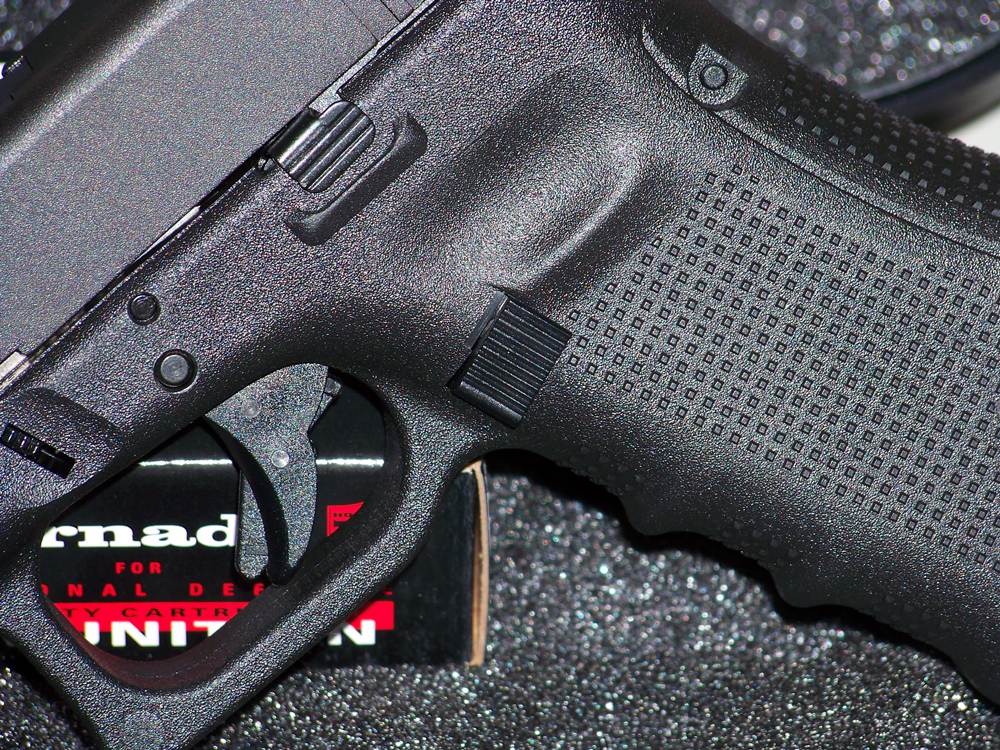
The ergonomics of the Gen4 pistol have been refined by adding a Multiple Back Strap (MBS) system to the grip of the pistol. Each Gen4 comes with three difference grip options: a short, medium and large size, enabling the pistol to adapt to each individual shooter’s hand size with the removal and insertion of a single pin. In addition, the grip has also been given a new Rough Textured Frame (RTF) to increase grip traction.
The Gen4 magazine release catch has been enlarged and is reversible for the ambidextrous shooter. To utilize the interchangeable magazine release feature, the Gen4 magazines have two notches cut on each side of the magazine body, allowing users to switch access of the catch to the left or right side of the pistol with no additional parts.
Previous magazines will continue to work in the Gen4 pistols as long as the magazine release catch is left in its original position.
Internally, the original recoil spring has been replaced with a dual recoil spring assembly, which noticeably reduces felt recoil while simultaneously increasing the life cycle of the pistol.
“GLOCK’s dedication to perfection has made it the chosen firearm for approximately 65% of law enforcement agencies in the United States.” said GLOCK, Inc. Vice President, Gary Fletcher. “The Gen4 models are another step in that commitment to producing the best firearm for law enforcement, military and law-abiding citizens around the world.”
The Gen4, like all GLOCK pistols, has the same tested SAFE ACTION® system, durable exterior finish, cold hammer forged barrel, durability, reliability and light weight that have made GLOCK firearms famous.
Gun Digest is the source for firearms news, pricing and guns for sale. Readers benefit from in-depth editorial expert advice, show reviews and practical how-to instructions. With your Subscription, you’ll also learn about threats to your Second Amendment rights. Click here to begin your subscription to Gun Digest.
Inside this issue:
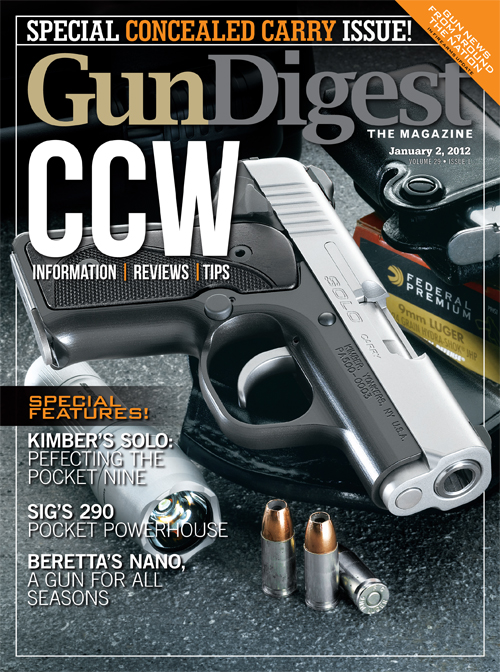
Special Concealed Carry Section
The Kimber Solo
SIG 290
Beretta Nano
Gun shows, auctions, classifieds and more!
Not a subscriber? Make sure you don’t miss another issue! Subscribe now
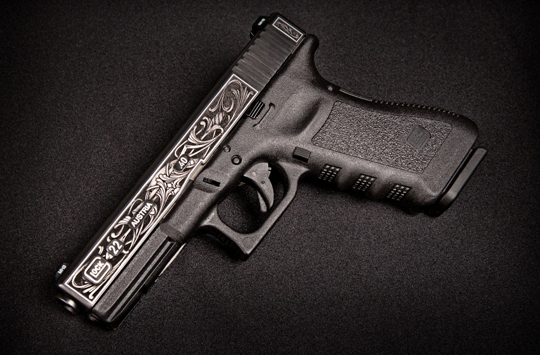
This engraved Statue of Liberty Glock 22 is up for auction at gunbroker.com and will be on display at SHOT Show 2012.
The Glock — like the AR-15 — has gotten a bad rap. Some people think it’s an ugly gun. Now, while I wouldn’t stick one in a frame and hang it on the wall, I don’t think describing it as ugly is an entirely fair assessment, either. It’s not an SKS.
I’m sure someone thought the same thing when they first laid eyes on the Walther PPK — before it became 007’s sidekick and worthy to be carried by the world’s most famous spy.
The Glock isn’t thought of as a show piece. In fact, it has its own maxim: “Show your friends your 1911, but show your enemies your Glock.”
But it does possess a certain Eastern European post-industrial charm, the sort of warm and fuzzy feeling you get driving through Chicago in gridlock. It’s built like a tank, and looks like one. And works like one, too. The Glock is all business. It’s a meat-and-potatoes sort of pistol, owing its ruggedness and reliability to its origin as a military gun. Its ergonomics were, after all, inspired by the Luger. And like the Luger, viewed at the correct angle, the Glock is one of the best-looking handguns in the opinion of many, including me.
But an engraved Glock?
I’ll be the first to admit that when the press release rolled in touting a “one-of-a-kind, hand-engraved GLOCK 22,” one depicting the “Statue of Liberty,” I rolled my eyes at what seemed like a PR stunt. But if it was a stunt, it worked. Because for some reason I clicked on the link. And I’m glad I did.
It took me to a gunbroker.com auction. Apparently the gun belonged to founder Gaston Glock.
The exclusive GLOCK, known within the company as the “GLOCK Statue of Liberty Gun,” features an intricate, hand-engraved tribute to the United States and the Statue of Liberty. This theme was selected to recognize GLOCK’s 25th Anniversary in the United States, which coincides with the 125th Anniversary of the Statue of Liberty.
“Often times, the misconception is that the limited edition pistols from GLOCK, such as the ‘Statue of Liberty Gun’ are hidden away in company vaults,” stated GLOCK Vice President, Gary Fletcher. “With the company celebrating 25 years in the United States, Mr. Glock wanted to give those who helped the company achieve that milestone of success an opportunity to own this one-of-a-kind piece.”
The firearm will be on display at SHOT Show 2012 and I’ll try to shoot some more photos (if I can manage to sneak past R. Lee Ermey a.k.a “The Gunny” without getting yelled at).
I have a soft-spot for engraved guns. And so I have to admit: This engraved Glock looks good — so good I’d gladly show my friends. Even if my friend’s name happened to be Bond. James Bond.
Months of debate. Thousands of dollars in fundraising expended in lobbying. Direct mail. Phone calls. E-mails. Faxes. Petitions.
Heartache and heartbreak. Nastygrams.
Indigestion.
Politics.
It was 1999, and lefties ensconced in the California legislature were out to push our buttons. They were on a roll, too, with a brand-spankin’ new gun ban. In the end, gun owners lost that battle, but today Colt has come back swinging — thanks to a nifty little button. And five new ARs.
Hope for California.
California Carbines
Recently, Colt announced the development and release of five AR-style rifles with California-compliant bullet buttons. What’s a bullet button, you ask? It’s a way to beat the inane, bureaucratic bumbling of Left Coast legislators with a little engineering ingenuity. Back to the drawing board, Sen. Perata.
Back in 1999, five years after passage of the Federal Assault Weapons Ban, California gun-banners felt so inspired they rammed SB-23 into law, which outlawed additional configurations on guns. Because it was a state law, the Federal Assault Weapons Ban expiration in 2004 didn’t provide much relief for Californians living under that state’s more stringent “Baby Assault Weapons” law.
Close-up of the "Cali-Button" as found on the new California-Compliant Colt ARs.
The state-level gun ban swept up firearms with “detachable magazines.” But the commonly-accepted definition of a detachable magazine is one that can be removed without any tools. So a company called Prince Industries put out a device called the Bullet Button, which allowed you to detach the mag using a tool. Like the tip of a bullet on your cartridges, sort of tool.
A little awkward, and not as fast, but it works.
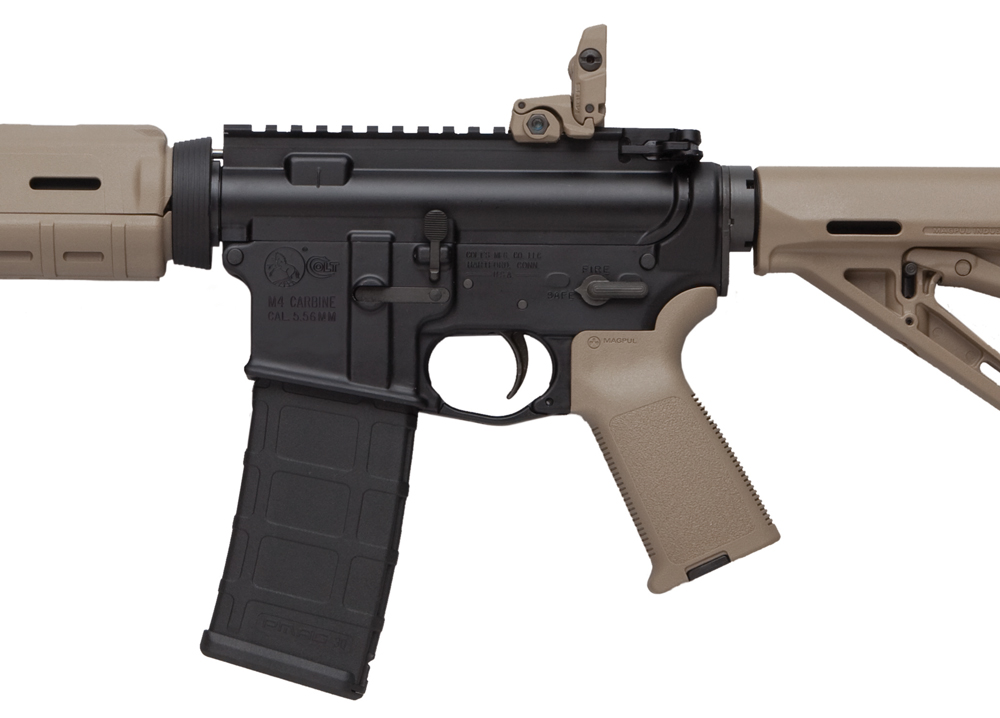
Colt’s LE6920CA, three of Colt’s Magpul-accessorized 6920s (the LE6920CMP-B, LE6920CMP-FDE and the LE6920CMP-O) and the LE6940CA will all be made available in California for 2012. There are no plans for cocktail parties celebrating this fact at the state capital.
With its lightweight design and potent firepower capability, the Colt 6920 Law Enforcement carbine is a popular choice for tactical deployment and traditional patrol. Weighing 6.95 pounds and measuring 35.5 inches with the stock extended, the 6920 is effectively mobile. The LE6920CA has a 16-inch barrel with a safe-semi rate of fire and an effective range distance of 600 meters.
The difference on this one: It has the button.
The Colt LE6940CA is another popular option for tactical operators. This M4 rifle weighs slightly less than the 6920 and offers a one-piece monolithic rail that extends from the rear of the upper receiver to the front sight. Other features of the LE6940CA include the A2 pistol grip, DCH rear sight, Colt flash suppressor and a nine-round magazine.
And the button.
Colt’s LE6920CMP-B, LE6920CMP-FDE and LE6920CMP-O are the bullet button versions of Colt’s newest rifle offering, the LE6920MP. Complimenting the black 6920 Colt M4 carbine are some of Magpul’s most popular firearm accessories in either black, flat dark earth or olive drab. Magpul parts that come standard on these rifles include the MOE Vertical Grip (MVG), MOE Hand Guard, Generation 2 Rear Back-Up Sight (MBUS), MOE-K Hand Grip, MOE Trigger Guard, MOE Carbine Stock.
And … the button (available in black only).
One little button. One big step for Californians. And so much heartburn for gun-hating politicians. That’s a return-on-investment that’s hard to beat.
Until gun owners in that sorry state manage to reverse a 12-year-long injustice through political channels, there are California Carbines to be had by all, including five new Colts. And there is hope on the Left Coast.
The online issue — available free when you sign-up and log in at tacticalgearmag.com — also looks at tactical apparel; how to build a STI 2011 pistol (video); the Defensive Edge AR-15 Armorer Course; a review of Wilson Combat’s Standard Model shotgun; and a look at new tactical gear.
A fully-interactive iPad version of the publication is also available on iTunes. iPad Users Check it Out
To read Tactical Gear Digital Issue #6 Join or Sign In to TacticalGearMag.com and Click on the Members Only tab.
Attorney General Eric Holder suggested Thursday that weapons lost during the course of the failed “Fast and Furious” gunrunning operation will continue to show up at crime scenes in the U.S. and Mexico “for years to come.”
Holder, in testimony on Capitol Hill that comes as the congressional investigation into the program expands, decried the “gun-walking” tactic used in the operation as “inexcusable” and “wholly unacceptable.” But a day after an influential senator called for the resignation of one of Holder’s top deputies over the scandal, Holder denied department leaders played any role in the crafting of “Fast and Furious.”
He continued to assert that top Justice officials were not told about the “inappropriate tactics” until they were made public.
Still, the top law enforcement official in the country conceded that, as a result of “Fast and Furious,” guns lost by the Bureau of Alcohol, Tobacco, Firearms and Explosives remain in the hands of criminals.
“Although the department has taken steps to ensure that such tactics are never used again, it is an unfortunate reality that we will continue to feel the effects of this flawed operation for years to come,” he said. “Guns lost during this operation will continue to show up at crime scenes on both sides of the border.”
“This project was failed and flawed from the beginning,” said Rep. Darrell Issa, R-Calif., questioning why Holder has not terminated the “many people involved” with the program.
“Mr. Attorney General, the blame must go to your desk,” Issa said. Read more
Looking to go armed, but are stuck in the weeds as to what to arm yourself with? Here are 20 of the best concealed carry gun options that will keep you on the defensive.

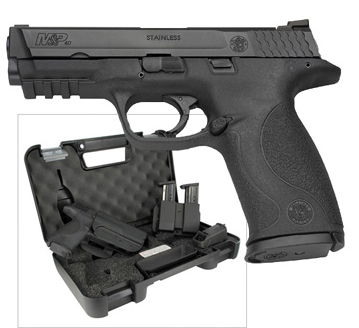 Smith & Wesson Corporation recently received contracts from the Massachusetts State Police and the Vermont State Police for new duty firearms from the M&P Pistol Series.