Home Blog Page 334

NSSF Statistics: America’s Interest in Firearms Keeps Growing

0

Does this sound familiar? The March 2012 National Shooting Sports Foundation's (NSSF) adjusted National Instant Criminal Background Check System (NICS) figure of 1,189,152 was an increase of 20.0 percent over the NSSF-adjusted NICS figure of 990,840 in March 2011.

You should have heard or read something similar before, considering that this newest NICS update represented the 22nd straight month that NSSF-adjusted NICS figures have increased, as compared to the same period the previous year.

As NSSF explained, “For comparison, the unadjusted March 2012 NICS figure of 1,715,125 reflects a 19.3 percent increase from the unadjusted NICS figure of 1,437,709 in March 2011. The adjusted NICS data were derived by subtracting out NICS purpose code permit checks used by several states such as Kentucky, Iowa and Michigan for CCW permit application checks as well as checks on active CCW permit databases.”

While not a one-to-one correlation to firearms sales, the NSSF-adjusted NICS statistics provided a more accurate picture of current market conditions. In addition to other purposes, NICS is used to check transactions of firearms sales and transfers on new and used handguns and long guns.

Click here for a FREE Download: Essentials in Firearms Training

Source

Gun Digest the Magazine, May 7, 2012

1

Gun Digest is the source for firearms news, pricing and guns for sale. Readers benefit from in-depth editorial expert advice, show reviews and practical how-to instructions. With your subscription, you’ll also learn about threats to your Second Amendment rights.

Click here to download this issue as a PDF from GunDigestStore.com.

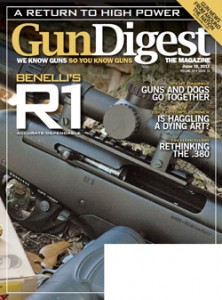
Gun Digest the Magazine, May 7, 2012Inside This Issue

* It's the special NRA Show double issue!
* Ithaca's 1911 is fit for duty – and the cover
* Tips and Tricks for Changing Barrels
* The Forgotten Fal, Pt. 2
* Review: Rossi Wizard
* Loading up the .35 Remington

Click here to subscribe to Gun Digest the Magazine.

Massad Ayoob: The Dangers of Over-Penetrating Bullets

5

One critical rule of firearms safety is that the bullet must stay in its intended backstop. No responsible shooter would go to one of the older indoor shooting ranges that have a warning poster saying “LEAD BULLETS ONLY, JACKETED BULLETS CAN PIERCE BACKSTOP” and then proceed to pump hard-jacketed bullets into that frail backing.

On the street, the only safe backstop for the defensive handgun’s bullets is the body of the offender. Therefore, it is not exactly responsible to be firing bullets that are likely to shoot through the assailant.

This is one of the main reasons law enforcement in its virtual entirety has gone to expanding bullet handgun ammunition in this country.

It was a lesson written in blood.

Hollow Points are No Dummies

In 1999, New York City became almost the last major police department to adopt hollow point ammunition. They did so in the face of huge, long-term opposition based on political correctness and the erroneous perception of hollowpoints as wicked “dum-dum bullets.”

9 mm full metal jacket
Full metal jacket 9mm ammo like this has been known to be an impotent man-stopper for a century. It also horrendously over-penetrates living tissue. After many innocent over-penetration casualties, the New York Police Department dropped this ammo in favor of hollow points.

One reason they were able to pass it was that the city fathers had been made to realize how much danger the supposedly “humane, Geneva Convention-approved” ammunition previously used presented to innocent bystanders and police officers when the duty weapons were fired in self-defense or defense of others by the officers.

From the early ’90s adoption of 16-shot 9mm pistols (Glock 19, SIG-SAUER P226 DAO, and Smith & Wesson Model 5946) through 1999, NYPD issued a full metal jacket “hardball” round, comprising a round-nose 115 grain bullet in the mid-1100 fps velocity range.

The New York Times exposed the following facts in its startling report on the matter:

“According to statistics released by the department, 15 innocent bystanders were struck by police officers using full metal jacket bullets during 1995 and 1996, the police said. Eight were hit directly, five were hit by bullets that had passed through other people and two were hit by bullets that had passed through objects,” stated the Times.

In other words, in rough numbers, 53 percent of these tragic occurrences were apparently missed shots, while 33 percent were “shoot-throughs” of violent felony suspects.

Counting bullets that went through objects to hit presumably unseen innocent victims (13 percent), that tells us that roughly 46 percent of these innocent bystanders were shot by over-penetrating bullets that “pierced their backstops.”

The Times continued, “In that same period, 44 police officers were struck by gunfire using the old ammunition: 21 were hit directly, 2 were struck by bullets that ricocheted and 17 were struck by bullets that passed through other people.”

In round numbers, 52 percent of those “friendly fire” casualties were hit by bullets that apparently missed their intended targets. Forty-two percent passed through the bodies of the intended targets after the bullets struck the people they were aimed at.

A look at over-penetrating bullets
Even the U.S. military is looking at switching from ball ammo to expanding bullets. This is Federal’s “Limited Penetration FMJ,” which uses Expanding Full Metal Jacket technology developed by Tom Burczynski to deliver a more effective wound channel in ballistic wax by Ballistic Technologies’ Bullet Test Tube and causing bullet to expand to 50-caliber or better.

Deconstructing Shootthrough Fatalities

Why would officers hit more of their own brethren than “civilian” bystanders in this fashion? For the simple reason that while victims and potential innocent bystanders tend to flee danger scenes, the cops are conditioned to “ride to the sound of the guns.”

In a close-quarters situation where a violent criminal is attempting to harm or even murder another officer, cops try to grab him or stop him or even maneuver into a position from which to shoot him.

All these actions can put them in the line of fire of brother officers.

Ball ammo is for practice
Ball ammo, like the excellent American Eagle at left, should be used strictly for practice in author’s opinion. The 147-grain JHP Subsonic as pioneered by Winchester (right) was better, but still erratic and unpredictable in its performance. Today, there are much better ammo choices than either of these antique rounds for “street” use.

Tunnel vision occurs in a majority of life-threatening encounters. This is the perceptual phenomenon of being able to see only the threat and being unable to cognitively recognize other people or objects that might be in the line of fire.

Moreover, the body of the offender may simply block the shooter’s view of the brother officer who is trying to apprehend or restrain the attacker from behind. In these situations, a “shootthrough” is highly likely to kill or cripple one of the Good Guys and Gals.

What does this have to do with private citizens’ use of CCW handguns? Only this: Where the cops jump in to protect their brother and sister officers, brave citizens may step in to protect their actual brothers and sisters, husbands and wives, sons and daughters, or fathers and mothers. Now it is your loved ones who are behind the offender – unseen by you – when you discharge your CCW weapon.

Those 115-grain jacketed ball 9mm rounds will pierce more than two feet of muscle tissue-simulating ballistic gelatin. So will 230-grain full metal jacket 45 hardball.

By contrast, the depth of the average adult male thorax is probably no more than 10 inches, from front of chest to back. Nor is it solid muscle: the
spongy tissue and large air volume of the human lung offer little resistance to a bullet.

A Real-World Example

Many years ago in Los Angeles, an Aryan Brotherhood thug took several people hostage in an office. He demanded an escape vehicle and threatened to start
shooting hostages if he didn’t get one.

A vehicle was provided, and he got into the car with the victims. At this point, the LAPD SWAT team launched smoke, and two members of the team whom I happened to know moved forward through the gray cloud, their issue Colt 45 automatics up and ready.

When the perpetrator reached for his pistol, the cops opened fire, using department-issue 230-grain hardball. They fired four shots between them, and killed the offender before he could launch a single bullet of his own.

Autopsy showed any of the four hits would have been quickly fatal. However, only one of those bullets stayed in the offender’s body. One of the three exiting slugs struck one of the hostages. Fortunately, the wound was not
in a life-threatening location.

LAPD quickly switched to hollowpoints, which is what they use today. Lesson learned.

Editor's Note: This article is excerpted from The Gun Digest Book of Concealed Carry.

Filmmakers Document Alleged Deer Poaching, Illegal Firearm Use

1
 by Daniel E. Schmidt, Deer & Deer Hunting editor

* Used in full here on GunDigest.com with permission

First Winter
Actors in the movie First Winter might have unknowingly included documenting footage of a deer poaching spree in upstate New York. A trailer of the film can be viewed at www.tribecafilm.com.

UPDATE: Actor charged with poaching. Click here.

Do you think your state game agency would look the other way if you decided not to buy a deer license  (much less take the required hunter’s education course) then grabbed someone else’s gun (in February) and shot two deer,  butchered them, ate them … and made a movie about it?

Yes, I think your obvious reply would be, “Of course not! They’d lock me up and fine me thousands of dollars!”

Well, that is exactly what many law-abiding deer hunters are hoping happens to a group of self-proclaimed hipsters who allegedly poached two deer while producing an independent film “First Winter” in 2011.

According to an article posted by www.dnainfo.com, the filmmaker is pleading guilt by way of ignorance.

“We are idiots. We didn’t know how to do this [hunting] stuff,” Ben Dickson told DNAinfo reporter Serena Solomon.  The film is set to premiere at the Tribeca Film festival on April 19.

“There were so many deer weak from the winter and getting eaten by local dogs we didn’t even think about it,” Dickson was also quoted as saying.

The article further states that the film crew was practicing yoga inside an upstate New York house one day when someone spotted several white-tailed deer in a neighboring field. They allegedly  “grabbed a rifle and camera and ran outside.”

Actor Paul Manza allegedly pulled the trigger. It was unclear who owned the rifle or whether it was registered. The bullet allegedly killed one deer and wounded a second one standing behind it. The crew allegedly chased the second deer into the woods and shot it again, killing it.

According to the DNAinfo.com report, the crew then skinned one of the carcasses, cut it up, and cooked it over an open fire — all in front of the camera. Manza was quoted as saying it, “was amazing to eat that meat and really feel the spirit of the animal,” and that the experience gave him a different relationship to eating animals and animal products.

Although we at Deer & Deer Hunting are glad to hear that actors and filmmakers found new respect for venison, we must also admit our utter disbelief at the group’s ignorance of wildlife conservation and modern hunting regulations. And we aren’t alone. The New York Department of Environmental Conservation isn’t amused, either.

“I’m kind of at loss for words,” DEC spokesman Wendy Rosenbach told me earlier this afternoon.

Rosenbach, who said she had not heard of the incident until I phoned the department, said the head of the Albany region’s law enforcement division was also unaware of it.

“This isn’t to say that it isn’t being investigated by one of the other regional offices. I will need to gather more information and get back to you with an update,” she said.

If the allegations are true, Dickson, Manza and others could possibly face a laundry list of violations.

“If this indeed happened in the state of New York in February, you could be looking at illegal hunting and shooting a deer out of season, among other things,” Rosenbach said. She added that other potential violations could include discharging a firearm from or near a dwelling; illegal use of a firearm (depending upon what caliber was used); and hunting without a license. Even if the incident occurred during a regular hunting season, New York requires all hunters to complete hunter education course.

The website shows photos of the actors preparing and eating what appears to be venison. If they did, they can only hope they didn’t take any of the meat home with them, especially if they do not live in New York. Otherwise, the alleged poachers could be facing serious Federal Lacey Act violations.

We will continue to follow this story and provide updates here on deeranddeerhunting.com.

What are your thoughts? Should the filmmakers be given a break for being oblivious to big-game hunting regulations, or should they be held every bit as accountable as any law-abiding hunter?

To read the entire DNAinfo report, click here.

Wayne van Zwoll: Get the Right Scope for the Right Rifle

0
The 2 3/4x Redfield on this M70 is Wayne’s idea of a fine all-around big game sight. Note low mount.

Wayne van Zwoll explains differences between rifle scopes. Matching the scope to the rifle is important.

A lever-action carbine is as lithe under a scope as a sports car under a roof rack. On a double rifle, optics make no sense at all. While my aging eyes need glass for sharp aim, not all rifles need glass to be useful. Many animals are shot very close to the muzzle.

In Africa, firing at dangerous game farther than you can toss a stone is bad form. In typical whitetail cover, and probing the lodgepoles in elk country, you shouldn’t need a scope.

Still, a low-power scope properly mounted is as fast as irons. Actually, it’s faster, because reticle and target appear in the same focal plane.

A 2-8x, this Zeiss Duralyt has great versatility. Its 42mm objective admits all the light you can use.

Your eye sees both in sharp detail. And modest magnification helps when you must thread a bullet between branches. Up to 3x or even 4x, magnification won’t slow a practiced shooter. Field of view shrinks as you boost power – but a rifle sight is not a picture window.

The first scopes for big game were tidy, though steel tubes made them relatively heavy. Hunting rifles in those days weighed 7 ½ to 8 ½ pounds without a scope, so the extra heft (12 to 18 ounces for a 4x or 6x steel sight) remained a modest proportion of finished weight.

Also, objective diameters of less than 40mm kept bulk to a minimum while permitting use of low rings.

Surely, there were big scopes back then, from Lyman’s limousine-length Super TargetSpot to the enormous Unertl, with a recoil spring the diameter of a rolling pin. But these fine and costly sights made sense only on heavy-barreled rifles with thick walnut stocks – rifles for dusting distant woodchucks with the likes of the 2R Lovell and .219 Donaldson Wasp.

Besides jacking a rifle’s center of gravity up from between your hands, a heavy, bulky scope in high rings pulls your cheek from the stock. Losing comb contact, you compromise rifle support and leave your head bobbing about in space.

The problem is especially acute when you affix a big scope to a rifle designed for iron-sight use. This arrangement turns the comb into a baton that swats your chops on recoil.

Stocks on early rifles fitted with iron sights suited scopes like the popular 2 1/2x Lyman Alaskan and 4x Noske, whose 7/8-inch tubes and straight front ends permitted very low mounting.

Such slender tubes have now gone the way of bias-ply tires, but 1-inch scopes with tube-diameter objectives have hung on. Some of these are fixed-power models, like the Weaver K2.5. Many are variables, commonly 1-4x or 1.5-5x, like the Leupold VX3 on my Montana .375. All have much better optics than their steel forebears.

Weaver 6x38
The Weaver 6×38 on Wayne’s Ruger No. 1is bright and lightweight, with plenty of field – and power.

Many shooters think compact sights can’t offer bright images. Wrong. Image quality – sharpness as well as brightness – depends mainly on the lenses and their coatings. In normal light, your eye’s pupil contracts.

If a scope’s exit pupil (objective diameter / magnification) is larger than your eye’s pupil, you can’t use all the light coming through the sight. Only in dim conditions does big front glass help at all.

For most big game hunting I favor 4x magnification. The 32- to 40mm objectives common to the 4x provide 8 to 10mm of exit pupil – more than your eye can use even in total darkness. A 6×36 scope delivers a shaft of light big enough for any shooting conditions.

Want more power? Well, probably you don’t, at least for deer and elk. If you’re shooting small animals at distance, you may benefit from higher magnification. But you needn’t endure scopes with maws the size of motorcycle mufflers. A 3mm exit pupil suffices for Dogtown – as in a 14x scope with a 42mm objective.

For big game, the long-popular 3-9×40 is still a top choice. And as competition in this slot is brisk indeed, you’ll find bargains at every price point. My latest rifle, a .25-06 by talented gunmaker Patrick Holehan, wears a 3-10×42 Swarovski, about as big a scope as seems appropriate. I’d have been as pleased with a 3-9×36, or Leupold’s 2.5-8×36.

No glass needed. This Webley & Scott in .500 NE is for fast shooting up close on dangerous game.

Another concern when choosing a scope is free tube – space available for rings. In days of yore this was no issue at all, because scopes were of fixed magnification and had tubes as long as a swimsuit model’s legs.

Now scopes are short-coupled, with big turrets and power-selector rings that take up lots of tube. You’re wise to consider where the scope must sit on the rifle to give you proper eye relief.

Some scopes now are AR-specific, following the market to rifles with a mean look and no soul. The high line of sight mandated by the high comb of ARs, and the full-length Picatinny rail standard on models intended for scope use give you more options that do bolt- or lever-action rifles. Rails give even short-coupled scopes plenty of latitude fore and aft.

Leupold catalogs several sights specifically for the AR, from the CQ/T 1-3×14 scope to a 1×14 Prismatic sight to the new DeltaPoint reflex red-dot sight with magnesium housing. I have a Mark AR 3-9×40 on an AR in 6.8 SPC.

No, I’m not categorically opposed to big scopes. Or to liberal politicians or people who drive 55 in the left-hand lane. But sights should not over-burden rifles. And if your rifle’s sight accounts for more than 15 percent of its overall weight, you might ask yourself: Do I really need all that glass?

Firearm Auction News: The Guns of Ted Williams

0

Ted Williams, also known as “The Kid”, “The Thumper” and, “The Greatest Hitter Who Ever Lived,” is marked down in history for his performance on the ballfield. He's one of the greatest baseball players of all time. He was also a great outdoorsman. He was a world-class fly angler and is mostly remembered for chasing tarpon in the Florida Keys. He was inducted into the International Game Fish Association Hall of Fame in 2000.

On April 28th, Hunt Auctions will host an auction for Mr. Williams personal items, including his sporting gear and his private firearms collection.

There are 24 firearms ranging from a Bernardelli side-by-side to a Daisy air rifle. Williams had good taste in the classics: a Colt Woodsman .22 pistol, a Winchester pre-64 Model 70, a humpback Browning A-5,  a Charles Daly over-and-under, a W.W. Greener side-by-side and others.

Williams' initials and uniform number are stamped in gold on the underside of the butt stock.

One stand out is an AYA side-by-side 12-gauge. From the catalog description: “Features fully engraved side plates and the receiver is finished in a stunning mellow case hardened fashion that brings out the fine hand engraving. This finish appears to be almost as new as the day it was made. The deluxe walnut stock features beautiful hand checkering which includes the checkered butt plate area which is actually part of the stock rather than an add on piece. The 26″ blued barrels also retain almost all of their original factory blued finish. It is chocked in both improved and cylinder bore which makes this an ideal upland game gun such as pheasants or dove. In addition, Williams' initials and uniform number are stamped in gold on the underside of the butt stock. Very strong example is among the finest within the Williams collection. Estimated Price Range: ($1,000-$2,000).”

View the guns in lots 450 to 473 at https://www.huntauctions.com.

Nikon M-223 Scope: A Match Made in Heaven?

0
Nikon M-223 Scope Mount

Nikon is jumping into the AR market with both feet. The new M-223 scope line offers classic Nikon quality, built into scopes (six models in all) specifically designed for the trajectory of the .223 Rem/5.56 NATO round with a 55-grain polymer-tipped bullet, the new BDC 600 reticle offers shooters unique open-circle aiming points and hash marks from 100 to 600 yards.

But the really cool thing is the matching scope mount. The M-223 mount is a lightweight, aluminum mount that clamps to a flattop receiver and is custom engineered to provide optimum height and eye relief for the Nikon M-223 series of scopes. Of course it can also be used with a variety of other optics with 1-inch O.D. tubes.

Nice features include a cantilever that extends 2 inches forward of the receiver to accommodate long eye relief scopes and three steel crossbolts on the full-length clamping bar to secure the mount to any MIL-STD 1913 Picatinny receiver rail. The mount also has built-in 20 MOA elevation to aid in accurate, long-range shooting past 600 yards without exceeding your scope’s elevation adjustment.

This looks like the perfect package for AR shooters who love to run scopes.


Choose Your Tactical Gear Wisely

Gun Digest Book of the Tactical RifleGun Digest Book of the Tactical Rifle

Retail: $26.99
Your price: $18.53
You save: $8.46 (31%)

In Gun Digest® Book of the Tactical Rifle, expert Patrick Sweeney today’s hottest tactical rifles through their paces. It’s a fun and fact-filled exploration of high-volume shooting at its finest.

From AKs to M14s, from AUGs to SCARS, Pat gives practical, real-world advice on tactical rifles from around the world. It’s a great go-to book for shooters, collectors and hobbyists ­in fact, for anyone with an interest in tactical rifles and their uses.

It pays to try before you buy! So let Pat Sweeney try them out for you ­ in Gun Digest® Book of the Tactical Rifle!

Click here to order the Gun Digest® Book of the Tactical Rifle.

New Concealed Carry Holster Stays Sweet

0
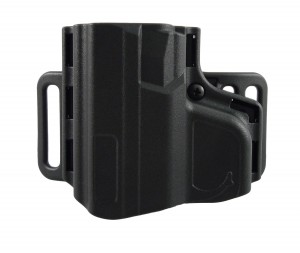
Here is a look at both the front and back of the new Bianchi Suppression.

You know that toting a concealed carry handgun, especially one in a concealed carry holster that rides close to your body, in the heat of the summer can become a sweaty proposition.

The new Model  135 Suppression holster from Bianchi features an inside-the-waistband design that is all about concealibility and comfort.

Concealibility is obtained by the holster sitting low enough that the thickest part of the weapon lies directly underneath the belt, helping to obscure its shape.

Meanwhile, two shirt-tuckable C-clips grasp the belt and, taking as little real estate as possible, give the appearance of an empty belt. The gun cant is optimized to put the grip into the kidney area of the back, minimizing any visible printing. Comfort is enhanced with a body-facing holster liner composed of soft foam covered with an anti-microbial mesh coating to reduce bacteria growth and odor.

The 135 Suppression is part of the new Allusion line of holsters from Bianchi. All of them are designed to fit 1.5 inch belts and are available inn full-grain leather, plain finish, tan or black.

And the Suppression sells for about $75. For that money you get a good looking, properly fitted holster that will stand up to tons of abuse AND won't get all stinky during the summer months. Who could ask for more?

Click here for a good, basic how-to article on concealed carry holsters


Gun Digest Buyer's Guide to Concealed Carry Pistols

The Gun Digest Book of Concealed Carry

The Gun Digest Book of Combat Handgunnery

Effective Handgun Defense, A Comprehensive Guide to Concealed Carry

Find more resources at gundigeststore.com/tactical


Range Report: Glock New York Trigger

2
The Glock NY-1 trigger increases trigger pull to around 5.5 pounds when used with the 3.5# connector. Despite the heavier pull, accuracy was still excellent at 7 paces.

This $2 dollar upgrade to a Glock New York Trigger can improve safety with no discernible change in accuracy. It's an upgrade many law enforcement agencies have adopted, and you can too.

You might be a New Yorker if … your dog whizzes on the Johnny Pump and your deli man calls you “Boss.”

Actually, aside from these well-worn colloquialisms, The Big Apple has produced two things I genuinely do like: New York Vanilla … and the New York-1 (NY-1) Glock trigger.

A stock Glock comes from the factory with a 5-pound trigger pull. And being a rifle guy, I tend to think about accuracy in terms of lighter trigger weights. That’s correct for precision rifle doctrine, but heresy for combat handgunning.

Massad Ayoob, in the Gun Digest Book of Concealed Carry, advocates the New York trigger for the Glock. It increases the trigger pull from 5 to 8 pounds. In fact, the New York-2 (NY-2) trigger gives you an even heftier 11-pound pull. The part costs about $2 and installs in minutes.

Just for the record, if I had my way, Glock parts would be for sale at the local convenience store, right next to the fresh doughnuts, warm burritos … hot dog roller and Nightcrawlers. But for the time being you can pick them up from Brownell's and Midway USA.

Note that if you use the 3.5# connector — and hone that connector to smooth out surface inconsistencies — you can get the trigger pull back down to around 5.5 pounds. This is the route I went.

Ayoob gives two reasons to install the heavier New York trigger in your Glock: One is to lessen the chance of an accidental discharge under stress; the other is to demonstrate to a jury or prosecutor following a defensive gun use that yours is not a gun with a “hair trigger.” The idea is, don’t give an anti-gun prosecutor the “frail hook on which to hang the flimsy case.”

The Glock New York trigger costs just $2 and installs in just minutes. It increases trigger pull weight and changes the pull force orientation to give a double action revolver feel.

“Accidental discharges, sometimes with tragic and fatal results, have been clearly and convincingly related to very light trigger pulls over the years by countless police departments,” writes Ayoob. “NYPD now mandates a nearly twelve-pound (NY-2 or ‘New York Plus’) trigger module in all Glock pistols carried by members of their service.”

For the same reasons the New York State Police use the NY-1, yielding a 7.75-8 pound pull, he notes.

Yet, while my Gen3 Glock 22 is a real tack-driver with a light trigger, I fretted night and day over whether I could hit the broad side of a barn with the NY-1 on board. Could I?

Think of Your Glock as a Revolver

One thing the New York trigger group gives you, in addition to a heavier pull, is a double action revolver feel. It transfers the resistance into a vertical orientation as opposed to a horizontal one. For this reason it’s often installed to help revolver shooters transition to the Glock. To me, it feels like my Smith & Wesson Model 629, with a long “roll through” — almost as if a cylinder is rotating.

“Anyone who tells you it’s impossible to shoot well with these guns, doesn’t know how to shoot,” Ayoob states. “I’ve won IDPA matches with Glock and XD pistols in the above pull weights, and for three years running won the NH Police Association annual state shoot with a Glock 22 that had a New York trigger, shooting against some who had put 3.5 pound pulls in their guns before the match.”

Should you install a New York trigger in your Glock?

While initially apprehensive, today’s range session made a believer out of me. It took about 7 shots to get used to the new trigger feel. After that we were chuggin’ right along. And the gun was just as fast and just as accurate as the old, ultra-light trigger.

My conclusion? No more hair trigger for me. By focusing on the fundamentals of good defensive pistol shooting technique (solid stance, high grip, crush grip, sight picture and trigger pull) one can be just as accurate with a stout trigger as with a light one.

Firearm Auction News: The Benefit Gun

0

Besides firearms auctions that cater to private gun collectors and vintage gun aficionados, there are other firearms auctions happening regularly around the country. They are sponsored by sportsmen conservation groups  and guns are sometimes auctioned off as a fund raising tool. There is a new twist on that and it's the concept of the “benefit gun.” In an article in the La Crosse Tribune, reporter Chris Hubbach tells the story of a a bolt-action Remington 721 that has raised $40,00. It works like this: get the winning bid on the gun and then later donate back to another auction when someone is in need. Since 2005, the gun has been auctioned numerous times, twelve plaques accompany the gun and the temporary owners record their history of acquiring the rifle. It's a positive story about firearms and this auction fund raising model could be used to support any good cause. Read the complete story here.

The 721 was introduced in 1948 and discontinued in 1962 with approximately 118,000 manufactured. It was offered in the following calibers: .264, .270, .280, .30-06 and 300 H&H. According to the Standard Catalog of Firearms, the 721 is valued at $450 for one in excellent condition and $125 for one in poor condition.

Merle (Mike) Walker, the designer of the Remington 721

In the 1982 edition of the Gun Digest annual, author Stuart Otteson reviews the pros and cons of the gun in “Remington's 721–722: THE STORY OF A SUCCESS.”

It seems like the gun was a hit in its day and was the forerunner to the great Model 700:

“An opportune juxtaposition of a good rifle, low retail price, and booming post-war demand for high power hunting rifles brought an acceptance and sales volume that took even Remington by surprise. Favorable articles and evaluations began pouring in so fast that the Marketing Department compiled a 23-page booklet entitled “What The Experts Say About the New Remington Models 721 & 722 Big Game Rifles.” It contained twenty write-ups, which appeared in print during the first four months of 1948, ranging all the way from a brief announcement in the New York Times, to an exhaustive dual evaluation in The American Rifleman by the esteemed team of Julian Hatcher and Al Barr.”

“The first full year's production (1949) was approximately 42,000 rifles, and that was more a manufacturing limitation than anything else, because for the first couple years the factory was working day and night and Remington was selling everything they could ship from Ilion. Sales in 1950 topped 50,000.

But the rifle's engineering virtues could sustain this level of sales only so long. Very plain and unexciting lines limited its ultimate sales potential.

While it certainly wasn't ugly, neither could anyone ever accuse it of winning any beauty contests against the Model 70, or even the many custom-built Mausers, Springfields, and Enfields, for that matter. In 1951 sales began to cool off, thereafter settling down into the 30,000 range, although there were one or two more 50,000-rifle years.

In 1962 the Remington Model 700 came into being, superseding the 721 and 722. At the same time sales began to take off, climbing back into the 50,000 to 60,000 category in the first year of production. They have been on the rise ever since, eventually surpassing 100,000 per year and making the Model 700 (which is really still just a prettied up 721/722) easily the best bolt-action seller in the world, today pursued seriously only by Ruger's Model 77.”

Wayne van Zwoll: What You Didn’t Know About the .22

7
Among svelte .22 rimfire rifles is Browning’s T-Bolt, here in .22 WMR. A 40-grain bullet at 2,000 fps.

Gun Digest contributor Wayne van Zwoll explains why the .22 rifle deserves its place in gun history.

Far from the most powerful, the .22 Long Rifle is arguably the most useful cartridge of all time.

It dates to 1857, when Horace Smith and Daniel Wesson came up with a rimfire round while working on a lever-action rifle. That primitive Volcanic rifle would evolve into the Henry, the foundation of Winchester’s 19th century dynasty.

Meanwhile, Smith and Wesson would turn to another firearms venture. Their rimfire cartridge endured 30 years of development. Its progeny, the .22 Long Rifle, arrived in 1887, courtesy the J. Stevens Arms & Tool Company. A black-powder cartridge with 5 grains driving a 40-grain bullet, it evolved later to take smokeless powder in a case with a crimp clutching the heeled bullet.

Wayne fired this 10-shot 100-yard knot in competition with a Remington 37, Ely .22 LR Match ammo.

Remington claimed the first modern high-speed load in l930. Current .22 ammo includes friskier offerings, but they’re all sinfully pleasant to shoot. Feeding a .22 costs so much less than stoking a centerfire; you can almost keep Junior in college with the difference.

My love affair with .22 started on a fence rail, where I shot barn rats with a Remington 121 and .22 Shorts. Squinting into that J4 Weaver was like looking through dishwater.

I trained with iron sights on a Remington 40X .22 match rifle, then sold my soul for an Anschutz 1413 to join a University smallbore team. Eley Match ammunition nipped one hole at 50 meters. I won a state prone title, and then foolishly sold that rifle.

The scope, a Redfield 3200, sat next on a McMillan-barreled Remington 37. It snared a second state title. By the time targets got too fuzzy in iron-sight stages, hunting-weight .22s had filled a gun rack in my office.

Cooper, Kimber and Weatherby bolt guns joined the Marlin 39s, an autoloading T/C and a Remington 121 that’s as fetching as the rat rifle of my youth. A Ruger and a Savage in .22WMR, and a Cooper in .17 HMR offer more reach. The Cooper is obscenely accurate.

I should have kept the Browning BLR and Winchester 9422 that left for more responsible owners – and the 52 Winchester with 10x Fecker my wife used to thin ground squirrels near an Oregon farmstead.

I’m obliged to keep the Winchester 75 Sporter, an inheritance on Alice’s side. “It’s mine,” she says.

It’s fashionable in some circles to scoff at the .22 Long Rifle, as if it were OK for kids but not for real riflemen. Well, some real accomplished shooters have used .22s.

From left: .22 Long Rifle, .22 WMR, .17 HMR, .17 Mach 2. The popular .22 Long Rifle dates to 1887.

Phoebe Ann Moses was one. Born in a log cabin in Darke County, Ohio, she showed early talent with rifles when she started killing quail on the wing with a .22.

At a local turkey shoot she beat not just the local boys, but visiting sharpshooter Frank Butler. She was 15. Frank married her within the year.

She joined his traveling show under the stage name Annie Oakley, shooting tossed glass balls. Petite at 100 pounds, Annie had the endurance to hit 943 of 1,000. She’d cut one ragged hole in a playing card with 25 shots from a .22 rifle – in 25 seconds.

Rimfire drills help you hit with deer rifles. Here Wayne pesters sodpoodles with Browning’s BL-22.

Once she shot a cigarette from the lips of a German crown prince. After he became Kaiser Wilhelm II and Europe entered the Great War, Annie allowed that with a flinch she might have altered world history.

Not long thereafter, a lanky Texan named Ad Topperwein began entertaining. He left audiences agape by shooting aerial targets as small as a steel washer. When the washer showed no reaction to a shot, Ad would turn to the crowd and deadpan that the bullet went through the hole.

Hecklers jeered – until Ad stuck a postage stamp over the washer, tossed it again and perforated the stamp with a .22 bullet. In 1894 he shattered 955 of 1,000 air-borne 2 ¼-inch disks.

Dissatisfied, he repeated, busting 987 and 989. It was said Ad could hit the bullet of a tossed .32-20 cartridge without tearing the case. In 1907 at San Antonio’s fairgrounds, he uncrated 10 Winchester 1903 self-loading .22s, tens of thousands of rounds of ammo and as many wooden blocks.

He endured 120 hours of firing before calling a halt. He’d fired at 72,500 blocks and missed nine. His longest run of hits: 14,500 straight!

The .22 Short once common at booths on the “midways” of state fairs is about gone. Winchester’s 1890 pump rifle, then a staple in shooting galleries, has become collectible. The mild BB and CB (Bullet Breech and Conical Bullet) Cap cartridges peddled as pest ammo in those days have faded away, too.

The .22 Long, with a 29-grain Short bullet in a Long Rifle case, never caught on. But the Long Rifle steams ahead, as popular as ever. The best target loads can deliver half-minute accuracy. High-velocity hunting bullets give you 90-yard point-blank range with a 75-yard zero. Bullets strike about an inch high at 50 and 3 inches low at 100.

I once shot a crow at a paced 145 yards. It must have been the bird’s day to die, as I was shooting a lightweight lever rifle with iron sights.

Sometimes a .22 is just shy of magic.

Video: Positive PR for Long-Range Rifle Shoot

0


Rifles Only Bushnell Brawl

Kleberg County, Texas — Could you hit a moving target while perched in a hovering helicopter from several hundred yards away? That's the question some of the nation's top precision marksmen came to answer recently in the Rifles Only Bushnell Brawl, which took place April 5-7, 2012.

Held for three days at the Rifles Only range near Ricardo, the competition was action-packed and involved both rifle and pistol disciplines. Shot scenarios spanned the gamut from point-blank muzzle to 1,000 yards. “It goes way beyond High Power and takes it into the action realm,” said Chris Cerino of  reality T.V. fame who was on hand to shoot the event.


My Recommended Tactical Rifle Resources
Gun Digest Book of the Tactical RifleGun Digest Book of The Tactical Rifle

Gun Digest Buyer's Guide to Tactical Rifles

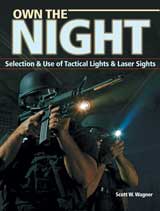
Own the Night: Selection and Use of Tactical Lights and Laser Sights

Colt LE6940P: A Cleaner-Burning AR-15

0
The Colt Piston AR LE6940P.

The Colt LE6940P is a modular carbine featuring an articulating link piston (ALP) operating system. It offers shooters a highly accurate, lightweight and easy-to-clean AR-platform rifle with an extended lifespan.

Colt Defense has modified its one-piece monolithic upper receiver into the LE6940P — a piston operated AR. This modular carbine has an articulating link piston (ALP) operating system and offers shooters a highly accurate, lightweight and easy-to-clean AR-platform rifle with an extended lifespan.

“The new LE6940P puts to use a new, improved version of a piston system that Colt originally pioneered for the US Army,” said David Ridley, Vice President of Colt Defense LLC, “Now, any civilian shooter or law enforcement professional has the opportunity to shoot using this superior piston-operated AR.”

The advanced piston carbine (APC) is a lightweight, highly accurate alternative to the traditional direct gas impingement system found in most ARs. The LE6940P's piston system is said to reduce inherent stress in the piston stroke by allowing for deflection and thermal expansion. As a result, accuracy improves and the weapon’s lifespan is extended, says Colt.

Measuring 35 inches with the stock extended and weighing just over six and a half pounds, the LE6940P was designed to be lightweight — a handy feature sure to help reduce shooter fatigue. A one-piece monolithic upper receiver gives ease in assembling parts, disassembling and cleaning. The 5.56mm, magazine-fed carbine has a semi-automatic rate of fire with 700 to 950 rounds per minute. Chambered in .223 Rem (5.56 x 45 NATO), this rifle has an effective range distance of 600 meters.

A continuous rail from the rear of the upper receiver to the front sight provides repeatability for mounting optical systems, not found with most aftermarket rail systems. In order to enhance the shooters’ versatility in both close quarters and long range, Colt has also incorporated a back up iron sight (BUIS) and a folding front sight.

Learn more at colt.com

How do you win a gunfight?

1

As promised, here is my take on winning a gunfight.

Use any cover you can find. Get to cover and stay there unless you need and can find better cover.

The primary goal, for you as an honest citizen carrying a concealed handgun, is to not get shot. Getting shot greatly reduces your ability to stop the threat. Yes it is true that some people can keep fighting through a hit with a pistol round. There is an old saying out there: What does a guy do after getting shot with a pistol? The same thing he was doing before he got shot with a pistol.

Use that wisdom to remind yourself to keep shooting the bad guy until the threat is neutralized… but no more. Now back to the main goal.

Focus on conflict avoidance if at all possible. I'm not telling you to run away or vacate places you have a right to be, but think about the horrific aftermath of even a justifiable shooting. If you can avoid the conflict, do so. In some cases it might be better that you move to a position of safety and become a good witness. If you can't do that, well, movement is your friend.  The sequence should be clear in your head and drilled into your training regimen: Move! Draw. Engage. If the rules at your range do not let you train this way, find a new range. Too many people, and you see this all the time with officer-involved shootings, fight their way to the 7-yard line and die there. Get to cover. Do not break cover unless you are going directly to better cover. If you are responsible for the safety of others, like your children or a spouse, direct them to cover (forcefully if need be) and order them to stay behind the cover. Then fight from cover.

The reality is most gunfights don't last long enough for you to get to cover. Remember, three shots, three seconds, three yards? Well, then movement toward cover is the next best thing. Get off the line. Get out of the way. Move first! Make yourself a more difficult target in order to engage from a position of tactical advantage. If you stand still, there is much greater chance that you will have holes poked in places that don't really need holes.

So… I really only care about your concealed carry holster if you can get to it while you are moving. I really only care about your concealed carry handgun if you can draw and ACCURATELY fire while you move to cover. If you can't do so, well, wait until you get to cover to shoot because you are responsible for every round you fire.

So there you have it. As far as I'm concerned, the primary goal is to stay alive. You do that by first insuring you don't get shot.


Recommended gun books for those who carry concealed handguns:

The Gun Digest Book of Concealed Carry

The Gun Digest Book of Combat Handgunnery

Effective Handgun Defense, A Comprehensive Guide to Concealed Carry

Find more resources at
gundigeststore.com/tactical


Gun Digest the Magazine, April 23, 2012

0
Gun Digest the Magazine April 23, 2012

Gun Digest is the source for firearms news, pricing and guns for sale. Readers benefit from in-depth editorial expert advice, show reviews and practical how-to instructions. With your subscription, you’ll also learn about threats to your Second Amendment rights.

Click here to download this issue as a PDF from GunDigestStore.com.

Inside this Issue

New turkey guns

Ruger's SR22

Collector's Corner: H&R Sportsman

Field Gun Review: Settle in behind your escort

Fox Sports dodges gun owners

Click here to start your subscription to Gun Digest the Magazine.


Unique 3-Gun Night Match This July in Oregon

0

Midnight 3-Gun CompetitionCrimson Trace will co-sponsor an unusual shooting event, July 16 to 18 of this year, a fast-paced 3-gun match shot entirely at night, near Bend, Oregon. Organizers will provide full-auto firearms, thermal imaging equipment and state of the art night vision gear to all the competitors on several of the eight challenging stages.

Many of the country's top 3-gun competitors have already signed up for the match, citing the additional challenge of competing in darkness as a big factor.

“All the top guys have years of experience running and gunning in daytime conditions, but there are very few who've competed at this kind of level at night,” said Iain Harrison, media relations manager for Crimson Trace, and 3-gunner himself. “It's going to be fascinating to see who comes out on top, and with what equipment.”

Sponsors include Nike, Leatherman, Danner, PWS, Blade-Tech and Warne, in addition to Crimson Trace. Crimson Trace will also offer a $3,000 check to the eventual winner—and will double that amount if their products are used on all three of the competitor's guns.

Source


Learn How to Shoot in Competitions

Combat Shooting with Massad AyoobRetail: $24.99
Your price: $16.15
You save: $8.84 (35%)

In Combat Shooting with Massad Ayoob, author Massad Ayoob shares his perspective on the importance of competition as training, as well as the concept of “stress fire.”

Click here to order Combat Shooting with Massad Ayoob for 35% off retail.

MUST READ ARTICLES