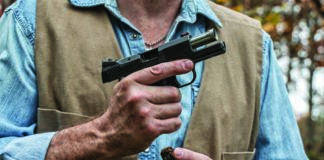
When using an IWB CCW holster, you need a larger pair of concealed carry pants.
When using an IWB concealed carry holster, you will need bigger pants.
A great concealed carry handgun is useless if you don't carry it. A concealed carry holster gives you no advantage if it appears as a bulging protrusion under you clothing. That may be why the popularity of Inside-the-Waistband (IWB) holsters continues to grow. But, there is something you should take notice of when considering an IWB holster: your pants.
Tucking a concealed carry pistol inside your pants will make the waistband, or belt, a bit tighter. In some cases your pants will need to be an entire size larger. For me, I need to go from a 36-inch waist to a 38 when I carry with an IWB holster. That sometimes means using a different belt, but I do have some pants my kids are fond of calling “fat guy” pants that work well, too. My fat-guy pants have elastic in the waistband that allows for enough stretch to insert the holstered pistol comfortably.
This is a great reason to get a couple different types of holsters, or one holster, like the Galco Doubletime, that you can convert from IWB to standard belt holster riding outside the waistband. The goal of course is to keep the same gun in the same location every time you carry. If you reach to your right hip, that gun is there and ready for action.
IWB holsters offer many advantages. They provide better concealment. They keep the pistol closer to your body. They can be worn without a jacket for vest as a concealment garment. But they have their disadvantages, too. I prefer to wear an undershirt when I carry IWB just to keep the gun off my skin. Gaining access to a pistol tucked in an IWB can be a bit slower than other holsters and there is the aforementioned pants and belt size issue. Do you have enough closet space and room in your budget to buy pants that are holster-specific? This is just another little thing to think of when you carry a fighting handgun.
Weighing just 17 ounces and with a barrel length of only 2.7 inches, the new Kimber Solo Carry puts the power of a 9mm cartridge in a micro-compact size usually reserved for smaller calibers. This pistol is easy to carry and conceal.
A manual ambidextrous thumb safety, checkered slide release and ambidextrous magazine release button promote safe and intuitive operation. The smooth single-action striker-fired trigger sets a new standard for small pistols. The slides and barrels are cut from stainless steel, making Solo pistols built to last. Their frames are machined from the finest aluminum and wear KimPro® II, a premium finish that is self-lubricating and resistant to salt and moisture. No other small pistol can begin to compare.
The Solo trigger is a single action striker-fired design with an even and smooth pull that breaks clean at 7 pounds. Frame and slide edges are rounded and blended so they do not snag on clothing or holsters. Slide serrations are deep for a secure grip and the magazine well is beveled for quick and positive loading. Solo sights are steel and securely mounted in dovetails machined into the slide for additional durability.
The Kimber legacy of offering the finest production firearms available continues with the new Solo Carry. What sets the Solo apart is quality, dependability and 1911 ergonomics that ensure comfortable shooting regardless of hand size. In every respect, Solo pistols are in a class by themselves.
Solo pistols establish a new, higher standard of small pistol dependability and performance. Their suggested retail price is just $747.
BEFORE: A Glock 19 shows holster wear on the slide and tired night sights.
Here's how to customize a Glock, and keep the tab under the magic $200 mark, with a few tips anyone can do at home.
In 2010, the Glock 19 was Glock’s best selling gun, commercially. Now in its fourth generation and still widely regarded for its reliability and durability the midsize 19 remains a very popular choice for concealed carry, target shooting at the range, and home defense. The differences between the four generations of Glock 19s include grip patterns, finger grooves in the stock, the addition of a tactical rail, and for 2011, interchangeable backstraps for a “perfect” fit. Beyond that, not much has changed over the years.
Glocks, like any other gun, can show wear and tear over time, especially with heavy use. Tenifer slides show holster wear and night sites grow dim. In fact, that’s exactly what was happening with a friend’s Gen2 Glock 19. The pistol was starting to look a bit tired. Rather than shelling out $500 or more for a new gun or going through the hassle of selling it, I convinced my friend to see what we could do to upgrade the Glock, spending around $200 to turn it into a custom carry pistol.
This particular Glock 19 rides every day in a Fobus paddle holster as my friend makes deliveries and runs errands for a local firm. Because he has little kids, my friend doesn’t chamber a round until he leaves for work each morning and he unloads the 19 each night when he returns home. So the gun is in and out of the holster at least a couple times every day. As such, the slide shows signs typical signs of wear. At around 15 years old, the factory night sites have lost much of their usable glow.
With a $200 limit, here’s what we had done to the Gen 2 Glock 19:
AFTER: The Glock 19’s slide and barrel sport a titanium-colored DiamondKote refinish by M&R Arms Specialties in Mt. Clemens, Mich. Note the bright green Truglo TFO Brite Site.
The first upgrade — refinishing the slide in DiamondKote — would be purely cosmetic. At the recommendation of a local gunsmith, I sent the Glock’s slide and barrel to Mike Boglarsky at M&R Arms Specialties (www.mrarms.com) in Mt. Clemens, Mich. M&R offers a multitude of color options, from matte black to gold to purple. Being somewhat traditional but wanting to jazz up the Glock a bit, I was leaning toward the silver until Mike told me that he could also do a titanium color. Relying solely on Mike’s advice, I gave him the go-ahead.
Mike says he can apply color treatments to the Glock’s polymer frame as well, which I respectfully declined. In a couple days, Mike called to let me know the slide and barrel were ready for pickup. It looks great and the subtle but classy titanium color is a great match for the Glock’s dark polymer frame. Cost: $57 + shipping from M&R Arms
The second upgrade — replacing the old night sights — would be a much more functional change and a must-have on a carry or defense gun. I selected Truglo’s Brite Site TFO, a combination Tritium and fiber optic sight that offers a bright green dot for a front sight and slightly less bright (although very visible) yellow dots for the rear sight. Never having sighted a gun through bi-colored night sites, I worried that the green and yellow dots would be gimmicky or confusing. Thankfully, neither is true. The Truglo sights are easily seen in bright daylight or in darkness. The brighter green front sight is easy to acquire and the yellow dots in the rear sight are easy to align. Cost: $97 from CheaperThanDirt.com
The third upgrade — adding a Clipdraw — would also enhance the functionality of the gun, at least in how my friend will use it on a daily basis. Since his daily routine requires a lot of driving and errands in Michigan’s four seasons, he decided to try carrying inside the waistband with a Clipdraw installed—a setup that would allow easy “holstering” and removal of the Glock as needed. A simple but well-designed piece of black powder-coated metal, the Clipdraw attaches to the Glock securely and holds it inside the waistband securely, keeping it steady but allowing some movement to accommodate sitting and standing with a concealed weapon. Moreover the Clipdraw keeps the Glock at just the right height, allowing the user to get fingers around the stock when drawing.
Cost: $25.95 from Clipdraw.com
AFTER: The Glock 19 receiver with a Lone Wolf Carry Package Trigger Kit installed.
The fourth upgrade—adding a Lone Wolf Carry Package Trigger Kit—would provide a heavier, revolver-like feel to the trigger, smoothing out the overall stroke and providing an additional measure of safety to protect against an accidental discharge. Lone Wolf’s Carry Package Trigger Kit is simply the combination of an 8-pound trigger spring (the “New York 1” or NY1) coupled with a 3.5-pound connector. Cost: $17.50 from Lone Wolf Distributors
With a total of $197.45 in upgrades (not counting tax or shipping), a working but very tired looking Gen2 Glock 19 became a good-looking custom carry gun that looks practically new and provides even greater functionality. My friend is happy with the changes—he even said they’re “perfect.”
Beyond the $200 Threshold: DC Holster
AFTER: Now a “custom carry gun” the Glock 19 rides comfortably in a DC Holster. Note the installed Clipdraw.
For those who prefer to holster their weapon in an actual holster that covers the trigger, consider a holster made by Greg Purcell of DC Holsters. A locksmith by trade who carries a concealed pistol, Greg found that the constant bending and moving that his work required made carrying pistol downright uncomfortable and unworkable. As such, Greg decided to design his own tuckable holster out of Kydex and leather. Word spread and a secondary business was born.
I tried the DC holster using my friend’s Glock 19 and found it to be one of the most comfortable I’ve ever worn. The best spot for it on me was at the four o’clock position. The Glock slid in easily and snapped in securely, the molded Kydex taking a firm hold on the Glock’s triggerguard. The leather helped distribute the weight across an area greater than just the point at which the belt clip attaches to my belt, adding to the comfort. Regardless of the temperature or setting, the leather never felt hot, never caused me to sweat, and generally held the Glock 19 in place very well. I could even carry the Glock 19 with the Clipdraw installed.
I did have to warm up and reform the Kydex that was directly over the front sight as it was rubbing against the sight when unholstering the Glock. This procedure took about 30 seconds with an automatic lighter and a metal rod to re-form the heated Kydex. Other than that minor fix and breaking the $200 threshold, the DC Holster was a perfect match for the Glock 19.
Unique Strength Competition Debuts in May and Showcases the Muscle of American Law Enforcement, While Raising Money for Special Olympics
America’s Strongest Cop, a national competition testing the physical strength and cardio abilities of full-time law enforcement officers, will debut in May of this year with a series of regional competitions, culminating in a finals event to crown America’s strongest law enforcement professionals. America’s Strongest Cop has designated the Law Enforcement Torch Run for Special Olympics (LETR), the largest grassroots fundraiser for Special Olympics, as the charitable beneficiary of the competition, and will donate $10 from each participant’s entrance fee to Special Olympics. Additional fundraising events for Special Olympics may occur at certain regional competitions.
For some, the competition provides a platform to compete and win the title of America’s Strongest Cop. For others, America’s Strongest Cop serves not only as a fun and motivating platform for law enforcement professionals to compete, represent their departments and stake their claim to this unique national title, but also to champion the indelible spirit of our first responders and the daily sacrifices they make while cloaked in anonymity. For all, the competition serves as a motivating platform to get healthy and fit by following the successful diet, exercise and time-management principles developed by official spokesman and America’s most decorated competitive strongman, Derek Poundstone.
Poundstone has been America’s most decorated Strongman over the past four decades. But what is most impressive is that he’s done so while maintaining his full-time position as a working Patrolman for the Naugatuck, Conn. Police Department. Poundstone personifies the sacrifice and commitment that American law enforcement and America’s Strongest Cop are all about. In addition to his dual role as full time patrolman and strongman, Poundstone hosts “Poundstone Power Radio,” an internationally syndicated program on Sirius XM satellite radio. In February 2011, he was appointed as a Global Ambassador for the Law Enforcement Torch Run (LETR) for Special Olympics. Poundstone is also heralded as an expert in the time management and fitness arenas and has served as a columnist for Muscle & Fitness magazine.
“I consider it a great honor to be a part of a program that celebrates our first responders’ dedication to protecting and serving our local communities,” stated Poundstone. “I’m thrilled that we’ve created a platform to provide a fun and competitive challenge for my law enforcement brothers and sisters who put their lives on the line every day, while also supporting my colleagues who participate in LETR and their amazing fundraising efforts on behalf of Special Olympics.”
America’s Strongest Cop will feature multiple fitness events, including three individual lifts and a police-themed obstacle course that will test cardio ability and endurance. Participants can train for all events at any local gym and no special equipment is required. Competitors will be grouped by weight class, age and gender, and must be full-time sworn officers for a local, state or federal agency. Individuals can compete alone, or join an 8-person team. Teams will perform a tug-of-war, truck pull and a farmer carry. The competition, which kicks off in May, will host events through August in the following cities:
Date
Location
Venue
May 18-20
Cleveland, Ohio
IxCenter
June 1-3
Baltimore, Md.
Baltimore Convention Center
June 15-17
Edison, NJ
NJ Expo Center
June 29-July 1
Orlando, FL
Marriott World Center
July 6-8
Charlotte, N.C.
Charlotte Convention Center
July 13-15July 27-29
Dallas, TXLos Angeles, Calif.
Gaylord CenterLA Live
Aug. 10-12
Chicago, Ill.
Navy Pier
Participants can register now at www.AmericasStrongestCop.com. The entrance fee includes commemorative event apparel, an instructional training video hosted by Poundstone and a reserved slot in the regional competition of choice for the first 7,500 registrants. In addition, Special Olympics will receive $10 for each entrance fee paid.
America’s Strongest Cop has designated the Law Enforcement Torch Run for Special Olympics as its official charity. The LETR, which is now in its 31st year, has raised more than $410 million for Special Olympics. The LETR was founded by Chief Richard LaMunyon in Wichita, KS in 1981, and now boasts an impressive 85,000 active law enforcement volunteers, who collectively raised $42.6 million for Special Olympics in 2011.
“Special Olympics is proud to be the official charity of the America’s Strongest Cop competition. The commitment and dedication that law enforcement has for Special Olympics is incredible. Through participation in ASC, officers will be showcasing their abilities as well as supporting Special Olympics in a unique and fun way,” said Michael Teem, Executive Director of the LETR for Special Olympics. “We are excited to have such a compelling platform to activate the energies of law enforcement officers in our ongoing fund-raising efforts.”
Israel Weapon Industries (IWI) is set to launch its new Light Machine Gun (LMG), the NEGEV NG7, at DefExpo India 2012 later this month. The NEGEV NG7 is the only 7.62mm caliber LMG in service today with semi-automatic mode.
The NEGEV NG7 is also the only 7.62 with single bullet firing capability. In automatic mode, its rate of fire is over 700 bullets per minute. Weighing less than 8 kg, it can be fired from a variety of mounts, including special mounts on helicopters, land vehicles and naval vessels.
Features include a gas regulator for additional power in harsh conditions, tritium night sights, picattiny rails for optical and other devices, and four safety mechanisms to minimize unwanted fire. The NEGEV NG7 is drum or belt-chain fed, and fires from an open bolt position.
More Combat Firearms Information
Gun Digest Classic Combat Firearms Value Pack
Retail: $49.98 Your price: $34.99 You save: $14.99 (30%)
Find two great books in this value pack:
* In Classic Combat Handguns you'll find a unique collection of Gun Digest articles that showcase and celebrate some of the most popular combat pistols of all time. You'll enjoy articles written by leading firearms writers, talking about the Model 1911, Luger P08, Snubnosed Revolvers, Sig-Sauer Autos, and Glock 17, among others.
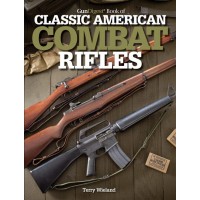
* In the same way American Classic Combat Rifles takes you inside the history, design and performance of popular rifles including M-14, Springfield rifle, AR-15 and others, told through the entertaining and informative writing style of some of today's most prolific firearms writers.
In a recent column, Gun Digest the Magazine contributor Walt Hampton wrote, “A gun with proper care can last several lifetimes and during those years as it is passed between family members or friends and is touched or used by various people it becomes woven into the fabric of our lives. This is the one reason I encourage every ‘gun person’ I know to jot down their recollections so they may be passed on to other hunters that may follow them, that may one day use that gun for their own pleasure.”
Matthew Hranek is a professional photographer that shoots for numerous glossy magazines and he spends his time on a farm in upstate New York. He’s a hunter, angler and cook and has good taste in vintage goods. He recently posted some photos of a High Standard Field King .22 pistol. Mixed in with his father’s things was a handwritten note on shooting advice that ended with three underlined words: Practice Practice Practice.
I have some affection for old High Standard .22 pistols. It was the first handgun I ever fired, and it was the first handgun I ever used to take a game animal (a wounded raccoon fighting off a pair of black and tan coonhounds). It was my father’s gun and I remember holding it with great fascination and awe. He traded it off somewhere for something and now it’s only a memory.
Author Gil Hebard evaluates, analyzes and tests High Standard .22 match pistols in the 1966 edition of Gun Digest.
Here are a few outtakes from the article:
“Parlay a good trigger and sight with an accurate barrel and functional reliability and you have the requisites for a good target gun. Add the refinements found in the Supermatic and it becomes crystal clear why this model has enjoyed such widespread popularity among target shooters.”
“The Military model I have been testing has over 4000 rounds through it (Remington ammo) and malfunction #1 has yet to make its appearance. High Standard claims to have one with over 10,000 rounds and no malfunctions! Now I don't want to leave the impression that if you purchase a Hi-Standard Military, you can expect complete alibi-free shooting. Dirty guns, broken parts, damaged magazines, and faulty ammunition can, among other things, cause malfunctions. Also, no autoloader by any manufacturer can be considered to be so perfectly designed and manufactured that it will perform its basic function of feeding, firing, and ejecting 100% of the time. But High Standard comes close to this optimum and their target pistols have been (and are) impressive by their functional reliability.”
“The accuracy of the various Hi-Standard models hardly needs confirmation. They have proven themselves over the years with little if any change in interior barrel design.”
“In my opinion this accuracy is excellent, perhaps even phenomenal, considering that these barrels are mass produced.”The section on High Standard semi-auto pistols in the 2012 Standard Catalog of Firearms categorizes the various by models by letter names (like Model C), lever name models (like the Supermatic), the 100, 101, 102, 103, 104, 106, 107 series models; and the SH series which was the final design produced by High Standard.
Prices for a High Standard range from $250 to $1,000, all depending on the exact model and the condition of the pistol. The Model S is a non-production model made from 1939 to 1940. Only 14 are registered with the BATF and one of those could fetch around $5,200 to $3,900.
Two notes:
–You will sometimes see High Standard spelled as Hi-Standard. The company name is spelled as High Standard but on some models, Hi-Standard is engraved on the slide.
–There are two companies. There is the old High Standard company that was based in Connecticut and closed its doors in 1984. The new High Standard Manufacturing Company opened in Houston in 1993 and acquired the assets and trademarks of the old company. They continue to make fine .22 pistols among other firearms.
The handwritten note that Hranek found is what Hampton was getting at in his column. “Write down your memories of your guns,” he wrote. “Somewhere along the line someone will thank you for it.”
Recently I’ve had my eye on a certain .22 semi-auto pistol. When I get around to purchasing it I will be also purchasing a pocket-sized bound notebook and wherever the gun goes, the journal will go. It’s the thoughts that count, but they don’t count if they are not noted and passed along.
To shoot from the ground you have to be able to get your concealed carry handgun out of the holster.
Do you have a training scar? Watch some videos of officer-involved shootings and you will see police officers fight their way to the 7-yard-line, square up to the target and, sadly, in some cases, die there.
The reality is that gunfights are dynamic. Can you access your concealed carry handgun from a compromised position? Does your concealed carry holster work well enough to keep your firearm in place, but accessible if you are NOT standing still, on level ground, shooting at a stationary target? You will fight like you train. And you should never fight standing still, directly in front of your opponent. When faced with a threat you must: Move, Draw, Engage.
Get to cover. Stay at your cover. Only break cover if you are moving to better cover. Don't stand still and trade shots. When you are training, set up drills that require you to move to cover before you fire. Shoot from many different positions. Draw from the holster, don't engage from the low ready position. You will need to use all your skills in a fight. So use them all in training.
If you are not training to use cover, you might forget to do so in a real fight. That could be a deadly mistake.
Marksmanship is only part of the equation. Tactics, mindset and physical ability are also key element in surviving a deadly force incident. Work to hone them all.
Gun Digest is the source for firearms news, pricing and guns for sale. Readers benefit from in-depth editorial expert advice, show reviews and practical how-to instructions. With your subscription, you’ll also learn about threats to your Second Amendment rights.
For an inanimate object, a gun can be one hell of a storehouse of memories.
Guns can take you back in history like few others.
A gun with proper care can last several lifetimes and during those years as it is passed between family members or friends and is touched or used by various people it becomes woven into the fabric of our lives. This is the one reason I encourage every “gun person” I know to jot down their recollections so they may be passed on to other hunters that may follow them, that may one day use that gun for their own pleasure.
I guess this is the reason I like old guns so much; I can't help it, but every time I pick up a well-worn and hard-used rifle or shotgun I get the feeling that someone is looking over my shoulder, trying to tell me about the times that they and this piece of wood and steel spent together. I bought some junky old rifles and shotguns because of this; seeing more than the dollar value in their worn stocks and faded bluing.
There is a pitted, scratched, dented, and loose double-barrel Colt 12 bore in my safe and I see it riding on the wagon seat through a sea of tall-grass prairie. Its worn walnut stock is bloodied from the prairie chickens that blotted out the sun when they rose. Its graceful and blueless hammers worn blisters on a father's thumbs as he used it to feed and protect his children. The wrist of the stock is wrapped with leather now. It is brittle with age and the head of a hand-made nail shows in the center of the old repair.
It is too precious to replace with another gun or the only one its owner could afford. The gun speaks of a time when things bought were expected to last.
Next to it is the 1893 Marlin, built in a time when farm kids couldn't name the president but knew the names of Marlin, Winchester and Remington. It was a time when guns and hunting were an accepted, normal part of the world. It came in a trade from up north. Did someone once see a bull moose in Maine or a heavy Adirondack buck over its graceful octagon barrel? Did it wear a leather scabbard as it rode secure between a lathered horse and its owner's leg? Did it cross the Ausable and hear the howl of wolves?
There are two single-shot shotguns, still tight at the breech but that's the best part of them. Their stocks are cracked and gouged, their bluing gone gray, there are dents and dings in the brown barrels, and the beads are missing. They are 16 gauges; the Cherokee with its 30-inch tube and the Champion with its 28, both choked full. I touch them and can hear the hounds pushing the deer through the myrtle and honeysuckle and see the squirrels on limbs draped with Spanish moss. The hammer spur on the Ivor Johnson is broken off short and I can see a 10-year-old headed to the woodshed for that. I see paper shells and gun oil and the smell of the swamp at sunrise.
There is the 1897 16 gauge, unfinished with bare wood and metal. The grooves in the forend are worn slick from three brothers and thousands of pumps as New River ducks smacked the ice and the flushing grouse of Buck Mountain ended in clouds of feathers. It brings memories of sweet yellow hickory leaves and countless Appalachian Mountain sunrises and sunsets. The wrist of the stock is soaked black with gun oil and a faded canvas coat cushioned the receiver on the shoulder.
The Springfield '06, still green and brown, brought back from war and shifted from man killer to deer killer when the radio was the newest technology and electric lines were looked upon in awe. Still glass-slick and fine-sighted, the bolt knob is polished with palm sweat and the wood will still turn back the snow. It made a trip to Alaska and back and still has Teton dirt under the butt plate.
Then there are my family guns: my father traded his 1911 war pistol for a Remington .22. The barrel was shot smooth as I was taught the sight picture and to love the fall.
The Stevens .410 was bought at Matthews Hardware in Galax, Virginia for $25 and included a brown paper bag with ten red Winchester shells in it. It was carried by the proudest 10-year old in the world and it taught my sons to hunt as it taught me.
There is the beat-up, cut-down, five-times refinished Remington .308 that killed three first deer and hundreds more. There is the Stevens double-barrel 20 that dropped the only bird old Roy ever retrieved. The Arisaka was picked up in Saipan and reminded a mountain boy how good home really was. The crown jewel was the homemade 20-gauge percussion gun with a hardware store lock, gas-pipe barrel and hand-carved poplar stock dad and his brothers made and used in the '20s to shoot muskrats.
Write down your memories of your guns. They are Americana at its finest, the tools that separate us from the rest of the entire human world. Somewhere along the line someone will thank you for it. Now, thank you and God bless you, Sgt. Alex D., who today is headed to Afghanistan with his Special Forces team. We love you and pray for you and your brothers; whatever it takes, come home to us. Buck Mountain, and a few good guns, are waiting for you.
Ultimate Collectible Firearms Value Pack
Retail: $140.96 Your price: $84.99 You save: $55.97 (40%)
If you're serious about making the most of every opportunity you have to buy or sell a collectible firearm, then the Ultimate Collectible Firearms Value Pack is for you. In this single package you get four of the most popular firearms references, each providing valuable details, pricing, and photographs of collectible firearms.
From the comprehensive descriptions and listings of the Standard Catalogs, to the meticulous production information in Flayderman's, this bundle is the perfect go-to reference library.
Taurus recently announced that Pro Shooter Jessie Harrison-Duff was its new Shooting Team Captain.
Harrison-Duff (formerly Jessie Abbate) has earned 22 National and 19 World Champion shooting titles, in 5 different shooting disciplines, including the prestigious Bianchi Cup and the World Speed Shooting Championships. She also ranked in numerous regional and state champion matches as well.
Said Mark Kresser, president and CEO of Taurus International Manufacturing, Inc., “She is a dynamic young lady with excellent shooting skills. As Taurus moves forward into 2012, we intend on promoting youth, women and competition shooting. We are anxiously awaiting this year's competitions with Jessie shooting her new Taurus.”
“I was drawn to the Taurus brand after learning of their new commitment to their customer and their quest in promoting new shooters to the industry,” said Harrison-Duff. “My livelihood depends on the performance of this gun, and I'm anxious to start my new relationship with Taurus.”
A photo gallery of Kimber 1911 tactical pistols. These handguns are ideal for concealed carry, law enforcement and personal defense.
Kimber Tactical handguns have all the performance-enhancing features demanded by law enforcement professionals and cover every application, from concealed carry to tactical response. Frames wear KimPro II, a premium finish that is self-lubricating and extremely resistant to moisture. All are chamber in .45 ACP. The Tactical Pro II is also available in 9mm.
Checking zero after installing the Surgeon magazine well. The addition functioned perfectly, picking up fresh rounds and throwing empties. The magazines also dropped freely and were easily replaced.
A removable magazine on a sniper rifle provides one more level of versatility in the field. A magazine-fed sniper rifle allows for faster reloads and for the quick selection of different rounds as the mission dictates.
These are good options to have and you are starting to see them appear on rifles like the Ruger Scout and McMillan’s Tac 30, which is supplied with a five-round box. All the semi-auto sniper systems carry a removable box.
So, what if, after weighing all the pros and cons, you decide you need a magazine-fed sniper rifle, but already have a Remington 700 BDL? And further, there is no money in the budget for a new rifle and all the brownie points with the sheriff or the chief have been used up. You can build your own, or show this article to a competent gunsmith and have him do it. It starts by opening the Brownell’s catalog. Brownell’s carries a variety of systems to change a BDL over to a magazine-fed gun. I like the unit made by Surgeon Rifles. It is a well-made lower end that replaces the bottom trigger guard and floorplate of the BDL to accept a magazine of either five- or 10 rounds. This particular unit accepts magazines made by Accuracy International and I found these to be well-made, of high quality with a composite follower in a steel body.
The magazine release is on the front of the trigger guard and is accessible from the right or left side. Although I prefer steel bottom end metal on a professional rifle the aluminum trigger guard and frame of the Surgeon product is thick and robust. It is finished in flat black.
The old BDL door (top) the new well and the five- and 10-round magazines.
Before you start, realize that the stock needs some modification to accept the system. Be sure this is what you want because once you start cutting, you can’t go back. But one bonus is that you also get a set of aluminum pillars to pillar bed the action if you need to.
Here’s how I did it. After making the rifle safe I took the action out of the stock and removed the factory floorplate. I secured the stock in a vise on the bench with the bottom up so I could take the Surgeon trigger guard and center it over the existing hole to mark out the material that needed to be removed. It looked like I would need to take off around .100 or so off each side and front and back. The curved areas needed to be enlarged, the front and rear tang notch would need to be widened and the front would need to be lengthened quite a bit.
I dropped the screws into the trigger guard so they could line up with the holes through the stock. The kit comes with a set of pillars if you are putting it into a wooden stock and want to pillar bed it first or on the off chance the holes don’t line up in the stock you are using they can be drilled out and centered with the pillars glued in. The stock that I was going to modify was an HS Precision which has an aluminum block molded into the composite and machined to fit the barreled action. As it turned out the holes lined up when I was finished milling out the magazine well and I didn’t need the pillars.
I marked the stock on the bottom so I put it in the vise with the bottom up and was planning on milling it out by hand. The cut must go all the way through the stock to the area under the channel where the round part of the action rests. This will take an end mill at least 1 ½ inches long and a 2-inch cutting surface is better. I cut mine on one side and then flipped the stock over in the vise and cut the other side because the longest mill I had was just 1 inch. It worked, but I would recommend getting the longer mill and doing it in one cut. The mill diameter I used was .5 inch and it made the round sections fit perfectly to the part.
I removed small amounts of material at a time and check the part regularly. This will bring the hole size up slowly for a precise fit. Should you get a little wild and make a gap between the metal and the stock it is easily filled in with some Acra Glas from Brownells. The stock is composite and after the crack is filled and the paint is touched up there will be nothing to notice. Keep diligent and go slow and the cut will come out perfect.
The fitted magazine well.
Once the cut is complete and the part fits snugly, put the action back in the stock and put in the action bolts. If you deepened the tang slots to flush up the trigger guard to the bottom of the stock the screws may be a tad long and interfere with the action of the bolt. They will need to be shortened up either with a saw, a grinder, or both. A dab of cold blue on the end of the screws will keep them protected from corrosion.
Put the action and stock together and check the workings of the bolt. Make sure it picks up a fresh round from the magazine and throws out the empties. Also make sure the magazines fit freely into the well and that they drop out easily with gravity when you hit the release. The only thing left to do is take it to the range and check the zero.
Adding a detachable magazine system to the bolt gun can be a great way to increase firepower or provide the versatility of changing rounds to meet the needs of the mission. All it takes is a little skill in the shop, or gunsmith you trust and you can upgrade your rifle without breaking the budget.
Body language is the most effective way to spot a terrorist. Learn how in this book.
In this age of terrorism, society wrestles with how to combat the threat. As a result, the public is poked, prodded, sniffed and X-rayed as they move about the country and abroad. The average citizen often feels confused, helpless, and not part of his or her own defense effort. Public service announcements suggest to the public that if they “see something,” they should “say something.”
But what exactly should the public should be looking for?
On why the book needed to be published, Dr. Lillian Glass said, “The keen eye and ears of our own citizens can be even more effective than all the security machinery usually deployed to detect terrorist activity. Body language is virtually impossible to suppress. It's always there, to be spotted by those who know what to look for.”
Those with permits can now bring their concealed carry handguns on campus in Colorado.
This notice recently went out to all students and the Colorado School of Mines announcing that those with permits may carry concealed handguns on campus. This shows the right to self-defense does not stop at the campus boundaries. It also shows the extent to which Regents at the University of Colorado went to stop students from defending themselves. A legal concealed carry handgun in the hands of a law-abiding student is the most effective first response to a deadly threat on campus. You will not see a Virginia Tech style rampage on campuses in Colorado.
Dear Campus Community:
Earlier this week, the Colorado Supreme Court issued its ruling in the Regents of the University of Colorado v. Students for Concealed Carry on Campus case, affirming the right of individuals who have appropriate permits to carry concealed handguns on CU’s campuses. The court held that the General Assembly intended, through the Concealed Carry Act, to divest the Board of Regents of its authority to regulate concealed handgun possession on campus.
As a result of this ruling, Colorado School of Mines has modified its Firearms, Explosives and other Weapons policy. Individuals who possess valid concealed carry permits may lawfully carry their concealed
Students at CSU were recently notified that concealed carry handguns are now legal on Colorado campuses.
handguns on the Colorado School of Mines campus, subject to the conditions and requirements outlined in state law, C.R.S. 18-12-201, et seq.
Please note that the Colorado Supreme Court’s ruling and Mines’ policy amendment apply only to concealed carry permit holders carrying concealed handguns on campus. The remainder of Mines’ firearms policy, which governs the possession and storage of other firearms, explosives, certain knives and other dangerous weapons, remains in effect. Further, only persons 21 years of age and older are eligible to receive a concealed carry permit in Colorado. Any person who does not possess a valid permit may not carry a handgun on the Colorado School of Mines property. The Department of Public Safety will continue to enforce these requirements.
Colorado School of Mines is committed to providing a safe educational environment, and will continue to assess the best ways to promote campus safety within the requirements of Colorado law. Colorado School of Mines public safety officers are in the best position to respond to any emergency situation on campus. If you believe that your safety is at risk for any reason, please contact the Mines Department of Public Safety immediately by calling 303-384-8045 or 911 from any campus or cell phone.
We will continue to update you on our efforts and appreciate your patience as we respond to this court ruling.
I had to look up the definition of “Deguello” before I started reading Scott Zastrow’s book of the same name. The first reference I found was the name of an old ZZ Top album. That’s not what I was looking for. The word means “a fight to the death, without quarter or mercy.”
"The Deguello" chronicles, through fiction, U.S. combat operations that helped bring down the rule of the Taliban in Afghanistan.
This particular fight without mercy took place in Afghanistan not long after terrorists struck the United States on Sept. 11, 2001. The fight started in the mountains. It crossed Bagram Air Base and culminated in the ouster of the Taliban from Kabul by a coalition of Afghans called the Northern Alliance. And Scott Zastrow was there, up to his ass in all of it.
The fighters of the Northern Alliance were led and assisted (to say the Afghans were trained might be a bit of a stretch) by a group of 10 members of the U.S. Army Special Forces. The Green Berets of the 555th ODA (Operational Detachment Alpha), affectionately called “The Triple Nickel,” took the fight to the enemy at a time when most Americans were still staring in disbelief at the charred ruins in New York, Washington, D.C. and Pennsylvania. Zastrow and the rest of the team weres there, providing the payback every patriot wanted to dole out.
His new book, The Deguello, takes an inside look at the dedicated men who charged forward while the rest of the world sat wondering what to do. Their mission was to destroy the Taliban any way they could. So they moved in close, worked with indigenous personnel, and brought the full force of U.S. air power down on the heads of the enemy.
But this book is not all blood and guts, tech speak and tactics. In fact, there is very little of that. What you get is a look at a group of men thrust into an isolated and hostile environment carrying the weight of a nation in their rucksacks. So, they did what any group of young Americans far from home would do: they quoted movie lines and joked with their buddies.
They made the best of bad situations. And they used their skill, daring and bravery to unleash holy hell on their enemy every chance they got. From laser-guided close air support to a B-52 strike that shook the very ground and opened the door to Kabul.
Though it is a fictionalized account (the names have been changed to protect the men who served), Zastrow was there, and as you turn the pages you feel like you come to know the men of the Triple Nickel. Any historian can tell you about the war. It takes a veteran to tell you about the men who served. That’s what Scott Zastrow does. This book is well worth your time. Find it on Amazon and think about all you owe these 10 men.
Author Biography
Scott Zastrow was born in Wisconsin and grew up in the Milwaukee area; he is an Army Veteran with more than 23 years of service. Most of his career was spent in Special Forces with an incredible operational tempo which has taken him to more than 25 countries around the World. He has numerous combat depolyments as well as both humanitarian and non-combat missions. After leaving Special Forces in 2007, he went on to finish his Masters Degree as a Physician Assistant at the University of Nebraska Medical Center and now works as a PA full time in the Nashville area. His book, “The Deguello” has been touted as one of the most personable first-hand accounts of the inital response to the attacks of 9/11. The book was self-published through Lulu.com and is being considered for several indie book awards in both the fiction and military categories.
Gun Digest reviews two breaching tools used for entry.
The goal in any active shooter situation is to get in and stop the shooter as quickly as possible to end the killing. Once the shooter is stopped your team can safely clear the building and bring in medical. But the top priority is to get inside and get in the fight. If you cannot breach a door to get to an active shooter then your team's firepower and training are neutralized and the active shooter has time to kill more people.
Often it takes SWAT teams time to assemble and respond. Very few SWAT teams in the country and even fewer patrol officers use explosive breaching. So while you are waiting for a way to get in, the shooter is killing more people. Shotgun breaching without training and the correct shotgun ammunition can lead to wounds from ricocheting bullets or the deaths of civilians on the other side of the door if they are hit by penetrating buckshot. A round from an AR-15 can also ricochet off the lock, seriously injuring the breacher or members on their team.
What this all boils down to is that patrol officers will be the first on scene and should have a means to breach a do if the need arises. The decision to enter and engage an active shooter is personal and based on department policy. But if you know you want to be inside attempting to stop the shooter, you need a means of entry. You need a breaching tool you can carry on your emergency vest or in your patrol car.
1) Paratech Buster Tool
The Paratech Buster Tool in action.
Carrying an effective personal breaching tool provides the ability to breach outer steel doors to get into a building and continue to breach doors inside the building while clearing rooms. The Paratech Buster tool is small at 15.5 inches long and light enough at 5.7 pounds to carry in a tactical holster on the back of a water carrier while operational for 24 hours. The axe handle chops through drywall. The pike creates a hole in sheet metal and claw end cuts sheet metal.
Unlock the buster and you can “slam and ram” the claw into a door jam without a sledgehammer. This saves the weight of carrying a 5-pound sledgehammer. The tool extends to 21.5 inches which increases its leverage. The claw tool can be removed and inserted into a keyway in the axe head for twisting leverage in confined spaces. This will help break locks, hasps and even some chains.
This tool alone is not a guarantee you will breach an outer steel door. You have to train in order to know where to insert the claw in the door jam to defeat the locking mechanisms on different types of doors. Having a longer prying tool and a heavy sledge hammer to force the claw deeper into the door jam would be better, but the weight is just too much to carry with an 80-pound tactical load in a situation that can take hours to clear a building or a 24-hour tactical operation, as experienced during the Mumbai terrorist attacks in India.
2) Double-Tap X Breaching Tool
The Paratech Buster tool is an effective breaching solution for its weight but the ideal breaching tool to carry is significantly heavier. The “Double-Tap X Breaching Tool” at 14 lbs can breach some exterior and most interior doors, locks, windows, chains, cables, and bars. It is a higher strength multi-purpose breaching tool that is more powerful in hammering and prying ability than the Paratech Buster.
The Double-Tap X Breaching tool.
The Double-Tap X Breaching tool is 32 inches folded and 43 inches extended, with a 303 Stainless Steel shaft. One side is a hammer. The opposite side of the hammer is designed to cut cable, rebar, fence, or steel bar 3/8 inchs or smaller by twisting. It is not a perfect a cable cutter but it works most of the time. The top of the tool has a spike designed to concentrate the force of the slide hammer in a small point to poke out a lock. The groves cut into the handle help hold the tool when you are swinging it into the door. It's a hammer design that is easer to use and requires less training.
The Double-Tap X Breaching tool also comes with a laminated instruction sheet with example pictures as a quick reference guide for the operator. It is crucial to use a beaching tool of this strength that can hold up to the stresses of high-impact strikes. It is not uncommon for breaching tools to break because metal outer doors at schools and businesses are extremely well built and take a significant amount of force to breach. Brian Clement of Arc-Pro Welding who has significant real-world combat and breaching experience created the Double-Tap X. Operators all over the world use his tools.
Looking to go armed, but are stuck in the weeds as to what to arm yourself with? Here are 20 excellent concealed carry gun options that will keep you on the defensive.