Of all the different factors influencing an accurate shot, none is perhaps more important than the trigger pull.
But the mechanics of depressing the trigger can vary, depending on the situation. In the above video, Gun Digest author and firearms instructor Rob Pincus draws a bead on trigger control for defensive firearms. And really, the name of the game is consistency, making sure that each pull is as smooth as the one before it.
One of the great things about focusing on trigger pull, in addition to better groupings, is how easy and affordable it is to master. Through dry fire, the finer aspects of a defensive firearms’ pull can be honed with out spending money on ammo or even having to leave your home.
Getting Defensive
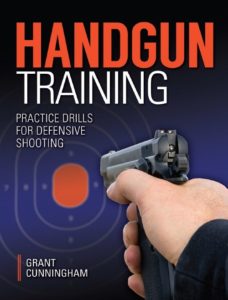
Whether you are shooting to brush up on your defensive handgun skills or are working to formulate a comprehensive self-defense plan, Grant Cunningham and Rob Pincus have you covered. Cunningham’s new book Handgun Training gives you all the ins and outs of mastering pistol and revolver marksmanship. While Pincus’ classic Defend Yourself delves into tactics of staying safe when at or away from home.
While incredibly popular in Europe, straight-pull rifles have never caught on in the states. Here’s an inside look at the straight-pull action and several modern straight-pull rifles currently available.
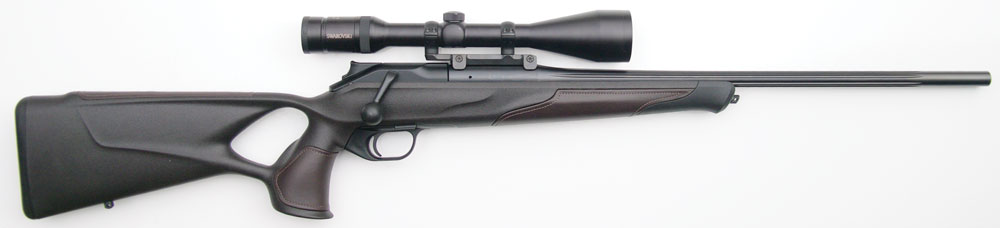
The Blaser R8 is the most popular hunting rifle in Europe. Shown here is the Professional Success model with its highly stylistic thumbhole stock.
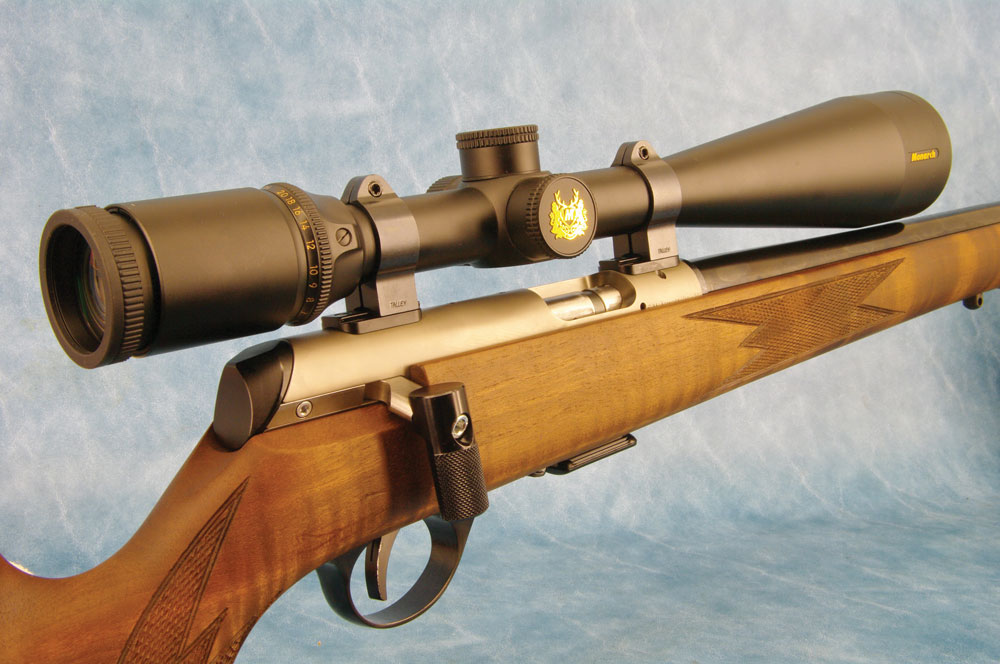
Why is it that the newest rifles coming out of Europe are straight pulls, yet not a single American manufacturer offers such a gun? In centerfire rifles, I’m talking the Blaser R-8 and R-93, the Heym SR-30, and the Merkel RX Helix; and in rimfire, the Anschutz 1727 and Browning T-Bolt. All are of foreign manufacture and differ greatly in mechanical details, but all share the basic characteristic of having a simple pull/push bolt cycle.
The straight-pull concept is not a new idea. There was the Austro-Hungarian Steyr-Mannlicher M95, the Swiss Schmidt-Rubin, the Canadian Ross and our own Lee-Navy—all straight-pull military rifles—and all came on the scene during a 20-year period spanning the onset of the 20th century. Reducing the four movements required to cycle a conventional bolt action to just a simple pull/push motion is simply intuitive.
The uplift of the handle on a conventional bolt action when shouldered is not only awkward, but the muscles involved are rarely used. If a fired case is even slightly sticky on the upstroke of the handle, it can range from difficult to impossible. That’s why so many hunters lower the gun to the port arms position to reload; it’s the only way they can get enough leverage to initiate primary extraction.
The best known and established of the current straight pulls is the Blaser R8 with its radial locking system. Lock-up is achieved via a steel tube, the front portion of which is comprised of 13 splines. Each of these splines, or fingers, has a small bulge at the forward end, which together form a radial locking lug that engages an annular groove within the barrel extension to provide a 360-degree lock-up. Instead of the barrel threading into the receiver, it simply lays in a V-block of aluminum that’s embedded in the stock and held there with two threaded studs that extend downward from the barrel and are engaged by two Allen-headed nuts held captive within the stock.
The barrel’s only connection with the bolt is when the bolt head enters the barrel extension and locks up with it. The bolt itself does not rotate at all; it simply reciprocates back and forth. In fact, the bolt handle is not even attached to the bolt, but rather to a bolt carrier. The handle rotates rearward in a short 5/8-inch arc before the bolt actually starts moving. It is this initial rearward rocking motion of the bolt handle that contracts the circular locking lug, unlocking the action. Conversely, the last 5/8 inches of the bolt handle’s forward movement expands the lug into battery.
The Blaser is the most unconventional and complex of the straight pulls.
The bolt locking up directly with the barrel makes possible two important features: First, the receiver becomes a non-stressed component allowing it to be made of aluminum, and second, it allows barrel/caliber interchangeability. On the Blaser the bolt can be removed from the carrier in about five seconds without tools and replaced with another of a different head to accommodate caliber changes across cartridge families. Bottom line is that you can go from, say, a .204 Ruger to a .338 Winchester Magnum in about two minutes.
Related Video:
The newest straight-pull on the scene is Merkel’s superb RX Helix. Like the Blaser, the Merkel’s bolt head locks up with the barrel rather than the receiver, so barrel/caliber interchangeability is one of its features. But unlike the Blaser, there is no rocking of the handle. In fact, the handle does not pivot at all; it simply moves back and forth, and in so doing rotates a multi-lug bolt head in and out of battery. Not only that, the bolt carrier and the handle are connected by a rack and pinion arrangement whereby there is almost a 1:2 ratio of handle-to-bolt movement. While the handle moves only 2½ inches, the bolt moves 4¼ inches! You can’t believe how fast this action can be cycled from the shoulder. Switching barrels/bolt heads/magazines on this gun can be done in about 30 seconds without tools. Reassembly is just as fast.
A feature the RX shares with the Blaser is that it must be manually cocked, but only for the first shot. By forcibly pushing a deeply serrated cocking lever up an incline at the rear of the receiver, the action is cocked. Depressing a small button embedded in the thumbpiece allows it to be eased back down to de-cock. This system allows the gun to be safely carried with a live round in the chamber—a great safety feature.
The least-known straight-pull rifle is the Heym SR-30 produced by a German company situated in the tiny village of Gleichamberg in Thuringia. Heym is best known for its superb double rifles, but this small company also makes a diverse array of other gun types, including box and sidelock drillings, O/U shotguns and rifles and three bolt-action rifles.
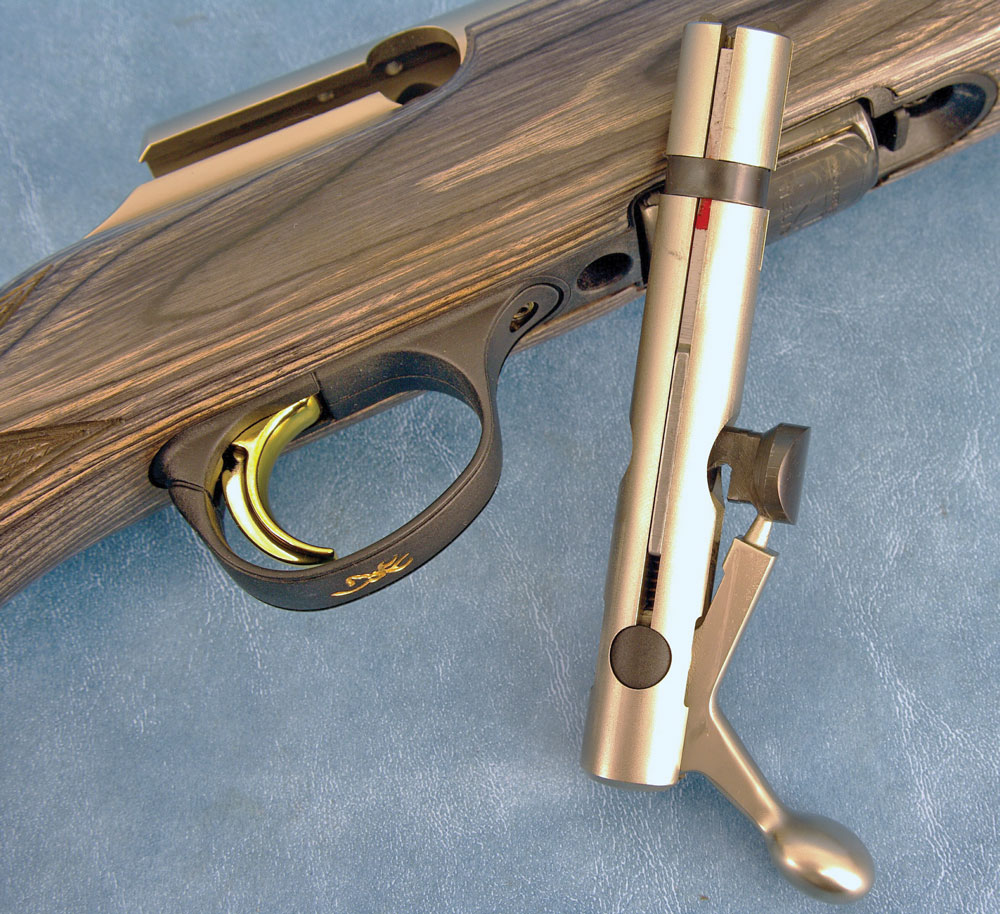
The Browning T-Bolt employs a unique locking system. Two holes at either side of the receiver serve as abutments for the circular locking lugs.
The two most distinguishing features of this gun is that the bolt handle pivots on a horizontal plane aligned with and parallel to the barrel bore, as opposed to the Blaser’s vertical pivoting movement. The other is that the locking “lugs,” for want of a better term, consist of six floating ball bearings oriented on 60-degree centers around the bolt head that engage an annular groove inside the receiver. With the closing of the bolt, these ball bearings are supported from beneath by a steel tube within the bolt body. As the bolt closes, this inner tube cams the ball bearings outward to engage the annular groove inside the receiver. It’s a slick and highly innovative design.
The basic mechanics as to how the handle moves and activates the locking system on the Heym SR-30 is similar to that of the Browning T-Bolt rimfire rifle. The specifics as to the locking system itself, however, couldn’t be more different. Essentially, the locking lugs consist of two circular “ears” on either side of the bolt body which, when in battery, fit into corresponding holes at either side of the receiver. The bolt handle is of a shallow L-shape and pivots on a vertical pin at its apex. The initial rearward movement of the bolt handle pivots the forward tip of the L outwards, pulling the circular locking lugs out of their recesses. It’s difficult to put into words, but a photo of the open action is the next best thing.
The Anschutz 1727 is a sporting rifle version of the company’s Biathalon rifle.
Lastly, we come to the Anschutz 1727, which was originally designed as a Biathalon rifle but is now offered as a sporter. Because reloading speed is essential to that Olympic sport, the Anschutz folks felt a straight-pull action would be just the ticket. And because the bolt travel needed to cycle the .22 LR was so short, they also concluded the action could be operated with just two fingers. Toward that end, they designed a bolt handle in the shape of an inverted “L” that extends downward along the right side of the stock to where the forefinger alone can open the action—and the thumb close it—without disturbing one’s grip on the rifle. Seeing videos of Olympic competitors using this rifle in competition is absolutely amazing; they get off shots about every two seconds!
One of the downsides to the straight-pull rifle, regardless of the design, is that none of them can offer the powerful camming force of a manual turnbolt to chamber and/or extract a recalcitrant cartridge or case. For that, nothing can match the conventional bolt action. But in all honesty, that’s mostly a problem with handloads rather than factory ammo.
Another is that all the aforementioned centerfires are much more complex than a conventional turnbolt and thus expensive to manufacturer. With the exception of the Browning T-Bolt, which goes for $749, all the others start at around $3,000.
Other than that, it’s hard to fault the straight-pull concept. The operational movements are more ergonomic and natural; the motions required are cut in half, as is the time needed to complete them. Sooner or later we’re going to see an American straight-pull rifle; I just hope it’s the former rather than the latter.
This gun review appeared in the October 2015 issue of Gun Digest the Magazine.
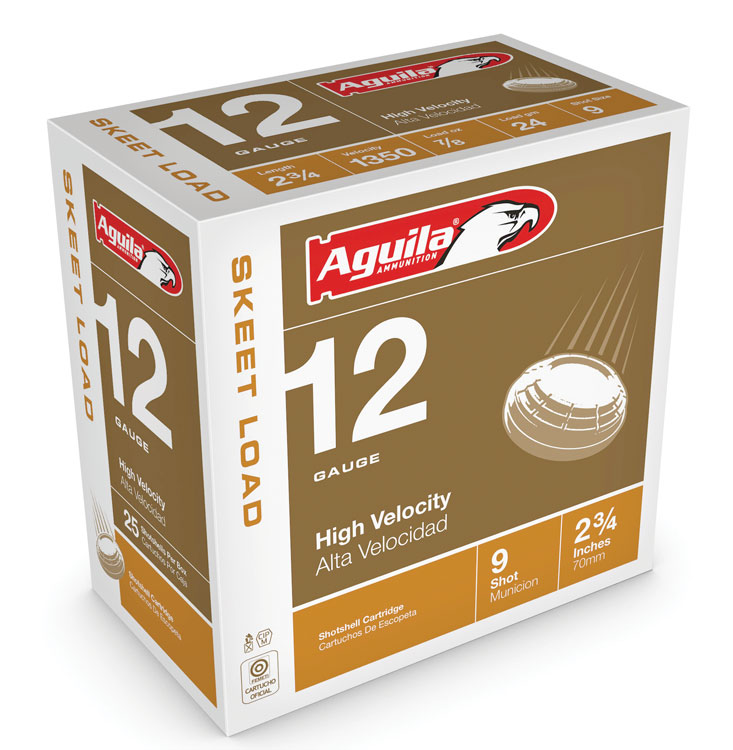
The powerhouse ammo maker from Latin America, Aguila Ammunition, will now be bringing its extensive shotshell product line to the U.S. market, Gun Digest has learned.
The 54-year old company has re-branded its shotshell offering for hunters, sport shooters, home defense and law enforcement.
Aguila will offer a competition line for skeet, trap and sporting clays as well as an exclusive pigeon load. The line includes both 7.5, 8 and 9 shot in standard and high velocities. The company’s traditional shotshell lineup includes 12-gauge, 16-gauge, 20-gauge and .410 in standard, high velocity and buckshot loads.
The manufacturer will also make available the unique Minishell, which provides good velocities in a 1 ¾” shell that allows for higher magazine capacities. The Minishell is perfect for over/under shotguns and is an excellent low recoil choice. It’s available in 7 ½ shot, slug and buckshot.
“Aguila’s shotshell line has something for everyone, whether the application is hunting, competition, clays or home defense,” says Rod Taylor, Director of Manufacturing for Aguila Ammunition. “Hunters and competitive shooters across Latin America have relied on the affordable performance of Aguila for over five decades. We’re excited to show the U.S. market the Aguila advantage.”
Recommended:
Shotgun Games Bundle Learn about the history of wingshooting with Shooter’s Guide to Shotgun Games by Nick Sisley, and get an in-depth look at various competitions. Also includes Gun Digest Shooter’s Guide to Shotguns by Terry Wieland and Gun Digest Guide to Modern Shotgunning by L.P. Brezny. Learn the ins and outs of various types of shotguns, providing tips for shotshell types and reloading, load selection for different purposes, and more. Get details here
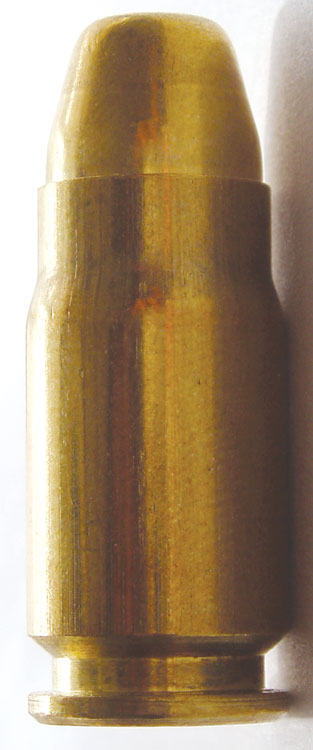
This cartridge is based upon the .40 S&W case, simply necked down with a short neck and a sharp shoulder. The design purpose was to achieve .357 Magnum revolver ballistics from typical semi-automatic pistols. This cartridge design offers several potential advantages.
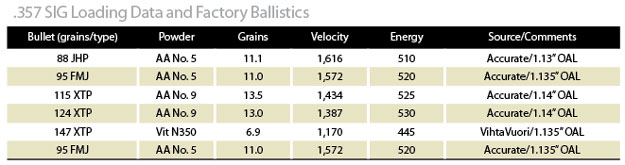
First, its compact nature allows use of a smaller (shorter) grip frame in pistols so chambered. Second, compared to the parent cartridge, the .357 SIG can effectively launch lighter bullets at greater velocity to achieve similar muzzle energy with less recoil. The .357 SIG is loaded to a comparatively high pressure level—the same as top factory .357 Magnum loads and 14 percent higher than the .40 S&W or the 9mm Luger.
The combination of high pressure, reasonable case capacity, and no barrel venting (as seen in .357 Magnum revolvers) allows this petite cartridge to generate significant ballistics—fully the equal of the .40 S&W in terms of muzzle energy. However, in the typical short pistol barrels used, there is a price to pay for this level of performance—muzzle blast is significant.
Expand Your Knowledge on the Legendary .357 Magnum
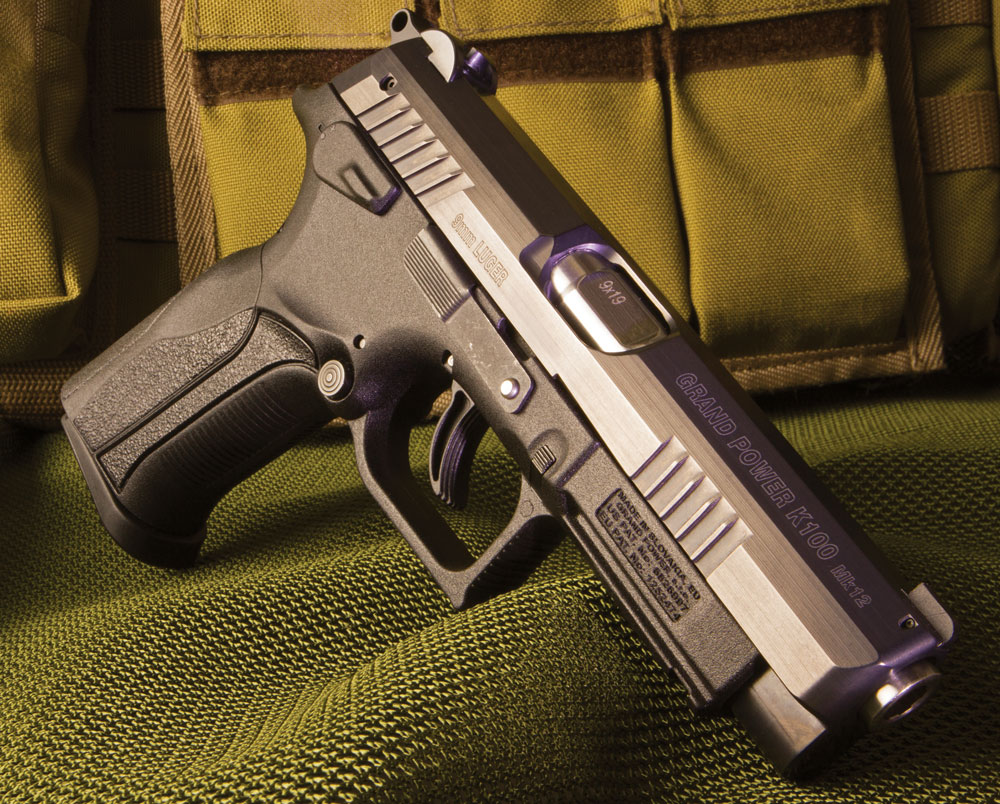
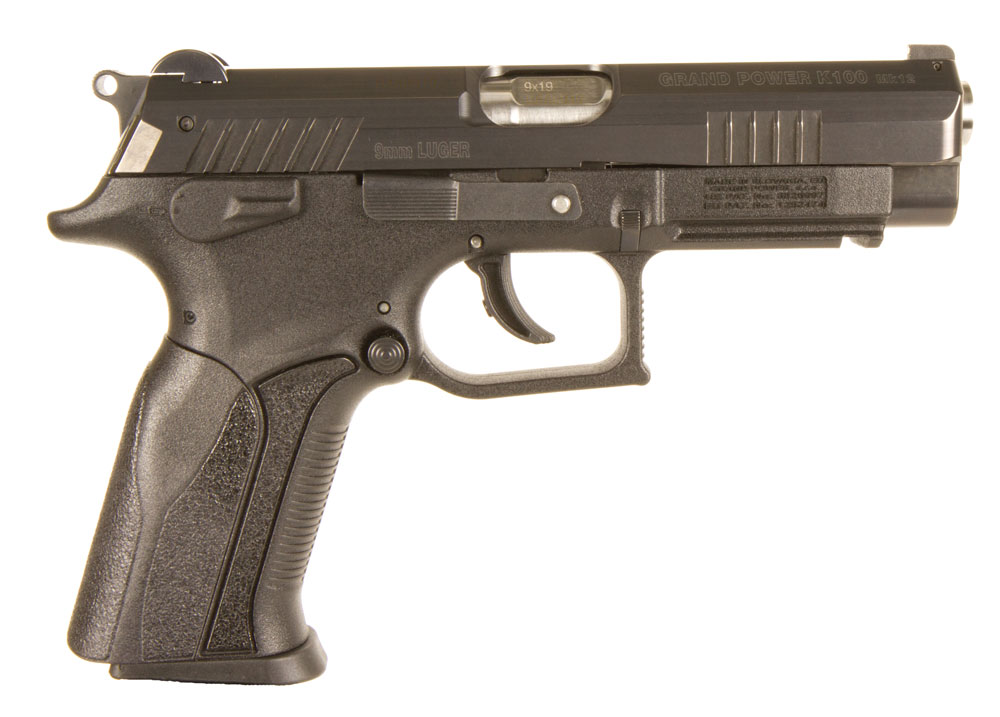
Manufactured in Slovakia, the Grand Power K100 Mk12 is a high-quality polymer pistol import with an innovative design offering tons of performance for the money.
If you think a handgun made in Eastern Europe is going to be of low quality and have a rough finish, you haven’t seen the Grand Power K100 Mk12 imported by Eagle Imports. The pistol’s interesting design and action, while not revolutionary, have some serious benefits not found on many other higher priced guns. While currently used by some foreign government agencies, the K100 and its siblings are also catching on here in the U.S. among competitors and people interested in self defense.
Although this polymer-framed gun has a steel slide and barrel that are common today, the action is not. Instead of a tilt-barrel, modified Browning design, it uses a rotating barrel, which helps make shooting the gun easier. While recoil is perceived differently by shooters, I found it to be quite a bit less compared to other guns in the same chambering and of similar size and weight boasting of reduced felt recoil. The test gun also proved to be quite a bit more accurate than many other guns of similar size I have tested.
Unlike many currently produced pistols, this one does not have a barrel with a link that swivels on a pin, or an under-lug that rides on a caming surface to tilt the rear of the barrel down to unlock it from the slide. Instead, unlocking occurs when, under recoil, the barrel rotates, which disengages a lug on the barrel from a channel in the slide. The bore axis remains in the same orientation to the slide and frame, which allows the barrel to be set slightly lower in the frame, putting it closer to the shooter’s hand. This in turn reduces the recoil’s leverage on the shooter’s wrist and makes it easier to control muzzle flip. As a result, the sights get back on target faster and recoil feels less.
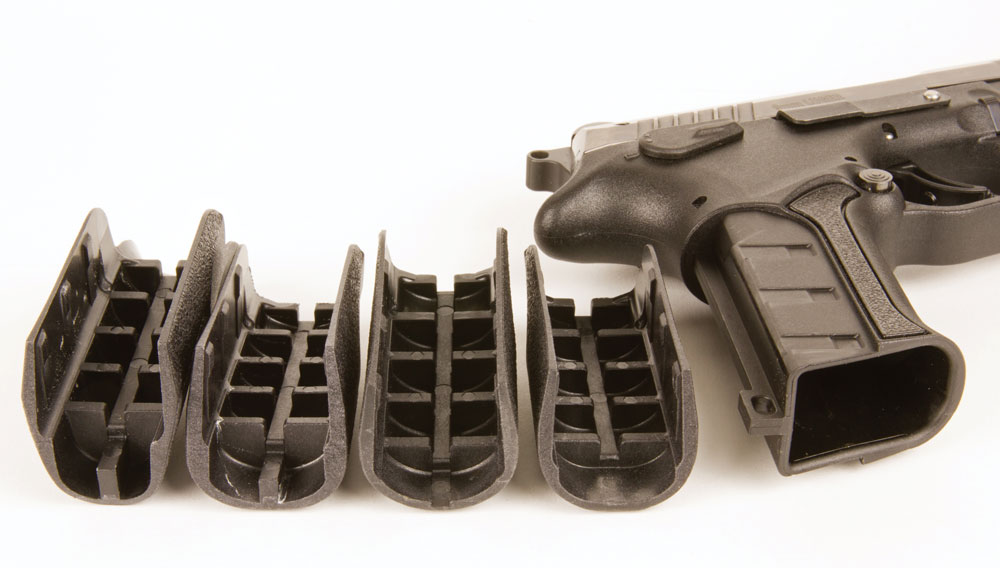
The comfort factor is important but is highly subjective, and what may be comfortable to one may not be for others. However, with four interchangeable backstraps of different sizes, it is likely the K100’s grip size can be adjusted to suit most anyone. And it is easy to do. Just pry the backstrap off and snap on a replacement.
Another notable feature of the K100 Mk12 is that controls really are ambidextrous. An identical but reversed thumb safety, slide catch and magazine release are located on both sides of the gun. The only thing that isn’t ambidextrous is the ejection port, but on a handgun, that is generally of no consequence.
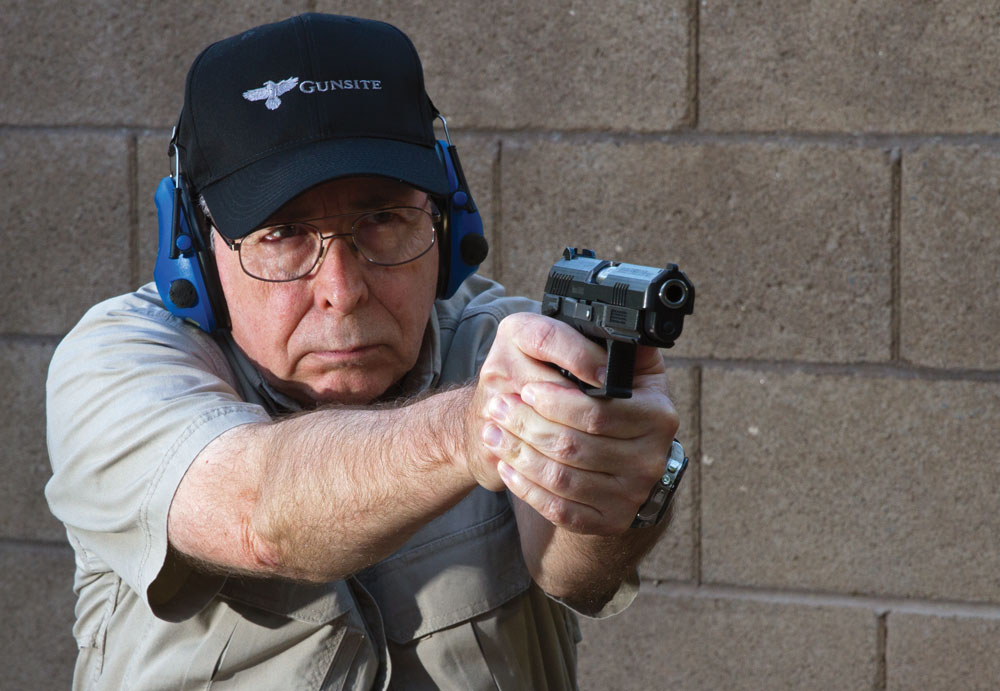
The K100 Mk12 proved to be quick back on target due to low muzzle flip and felt recoil. It was also very accurate when test fired off a bench at 25 yards. (Doug Larson photo)
Although two different trigger pulls must be mastered with the K100, the test gun’s trigger had a very smooth, consistent pull of about 10 pounds in the double-action mode, and when in single-action mode, it broke cleanly without any creep at about 5 pounds after a small amount of take-up. There was no perceived overtravel, and reset was distinct. The trigger has a grooved surface to reduce slippage and was comfortable over long periods of shooting.
The K100 is equipped with a firing pin block drop safety. Not until the trigger is pulled does the firing pin block disengage and allow the firing pin to be driven forward by the hammer and strike the primer. The purpose of the design, according to many, is to keep the firing pin from being driven forward if the gun is dropped on the muzzle or the hammer, which has caused unintentional discharges on some pistols without the feature.
The thumb safety is large enough I was able to manipulate it with the thumb of the firing hand without modifying my shooting grip. The slide catch was also easy to engage, and the ambidextrous magazine release could be activated with either the thumb or trigger finger. When pressed, the magazine dropped freely away from the gun.
Sights on the K100 Mk12 consist of a drift adjustable rear sight with two white dots and a pinned front sight with one white dot. The gun is sighted at the factory, and Grand Power thoughtfully provided two extra front sights of different heights with the test gun in case the sight elevation needed adjustment. That’s a nice feature not many manufacturers include.
The slide, instead of having the uninspired square, blocky appearance so common today, has seven sides giving it an almost curved profile when viewed from the rear. It is made of 34CrNiMo6 steel, is very nicely machined, polished and finished in a black nitride salt bath that leaves a very hard and corrosion resistant surface. All edges are nicely beveled; the ejection port is large, and there are deep serrations at the front and rear of the slide that offer a solid grip for cycling by hand. The barrel and the frame insert on which the slide rides are made of steel, and while the insert is nitrided with a black finish, the barrel is left in the white and is highly polished. Traditional land and groove rifling is used.
The frame has a Picatinny-style rail on the dust cover that allows for attachment of a light or laser, and the front of the trigger guard is squared and serrated for those who still like to grasp it with the fingers of the support hand. The front strap is grooved, and most of the rest of the grip has a light stippled texture. There is a slight flare to the magazine well to encourage fast reloads.
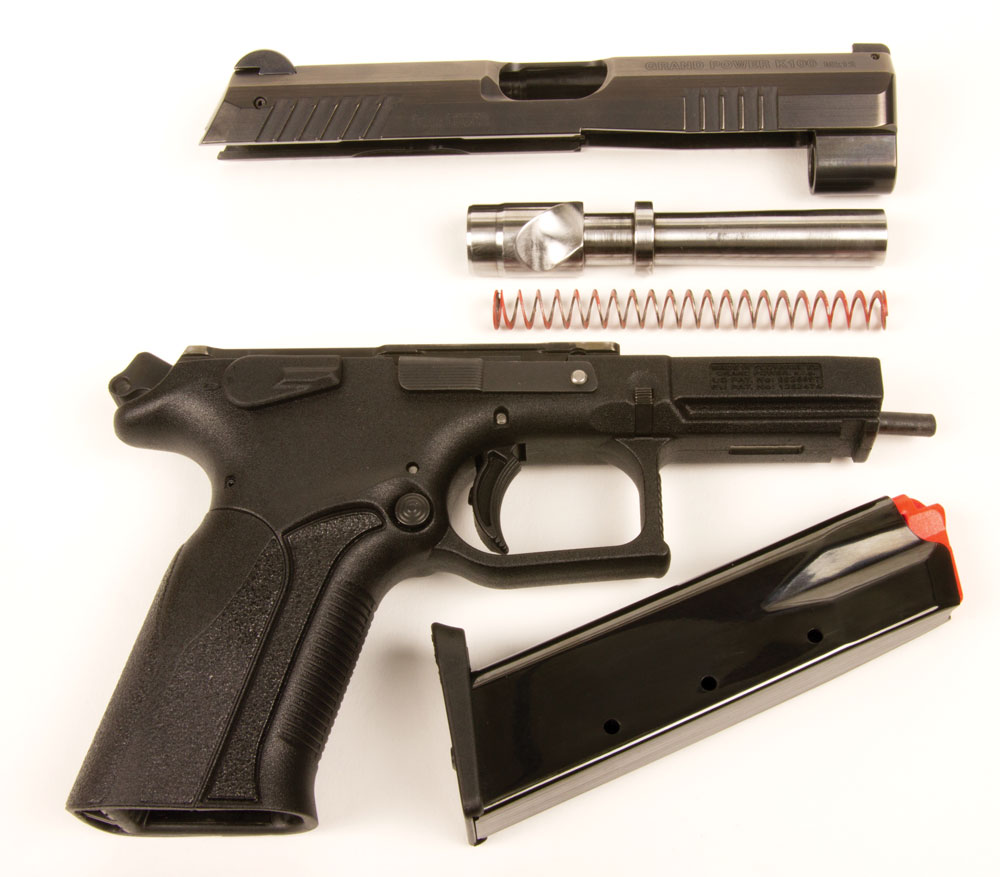
Field stripping for cleaning is straightforward. After making absolutely sure the gun is unloaded, the disassembly latch—referred to in the manual as the dismantling segment—located just above the front of the trigger guard is pulled down while at the same time the slide is pulled all the way back. At the end of the travel, the rear of the slide is lifted off the frame and then the slide is carefully moved toward the muzzle where it is then separated from the frame. This must be done carefully so the slide does not slip from the hand and get launched under spring pressure. Then the barrel can be separated from the slide and the recoil spring removed from the spring guide, which remains attached to the frame.
Now, assembly, as is commonly said, is in reverse order. But, read the manual first because the barrel must be oriented correctly or the parts won’t fit. Also, some people may have difficulty at this point because pulling the slide to the rear against the force of the recoil spring while simultaneously holding onto the frame and pulling the dismantling segment down can be a challenge.
The gun is supplied in a hard carrying case with two 15-round magazines, a bore cleaning brush and the four backstraps mentioned earlier. The extra front sights of different heights as referred to above are also available. Real world retail prices are significantly less than the manufacturer’s suggested price, so there is a lot of gun here for the money. For more information, contact Eagle Imports. EagleImportsInc.com.
GRAND POWER K100 MK12 Caliber 9mm Type Semi-auto Barrel length 4.25 in. Overall length 7.97 in. Weight 1.81 lbs. with empty magazine Grips Polymer Sights 3-dot Action Recoil-operated, rotating barrel, double-action Finish Tennifer Capacity 15 + 1 MSRP $629 Manufacturer GrandPower.eu
This article appeared in the November 2015 issue of Gun Digest the Magazine.
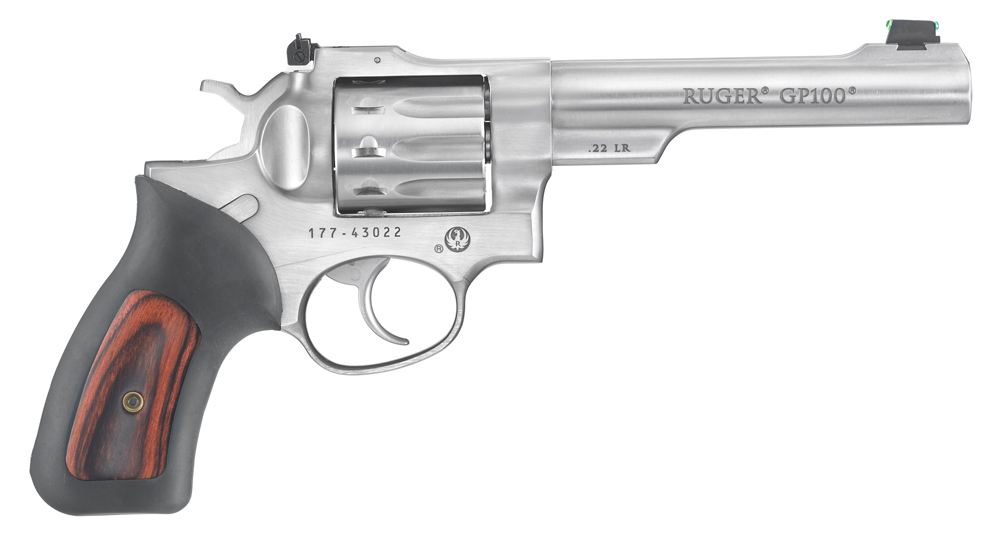
Ruger’s GP100 line of revolvers has gone to the plinkers in its latest iteration.
Ruger’s GP100 line of revolvers has gone to the plinkers in its latest iteration.
Of the many styles of firearms in its catalog, Ruger’s revolvers have built a dedicated following.
The New Hampshire/Arizona manufacturer’s wheelguns have won it throngs of fans, in part, due to their reputation as being both accurate and tough as nails. But the handguns’ performance and durability aren’t their only selling points. There is also the little matter of the company’s large and varied catalog.
If revolvers are your thing, it’s a fair bet Ruger most likely has one with the features you’re looking to find. And the gun maker is far from done offering new options to shooters.
The company’s latest addition to its revolver roster is a GP100 chambered in .22 LR. The model and caliber marriage Ruger has arranged is intriguing and has the potential to go over big with a wide swath. In particular, because the revolver should be a really solid shooter in .22, given its dimensions.
Along these lines, Ruger’s medium frame, double-action revolver’s heft is one of its main assets. At 42 ounces, it might be a bit heavy in a hip holster, but it should provide a stable platform to drill bull’s eyes. On top of that, its weight should all but erase the .22 LR’s light recoil, making long plinking sessions all the more enjoyable.
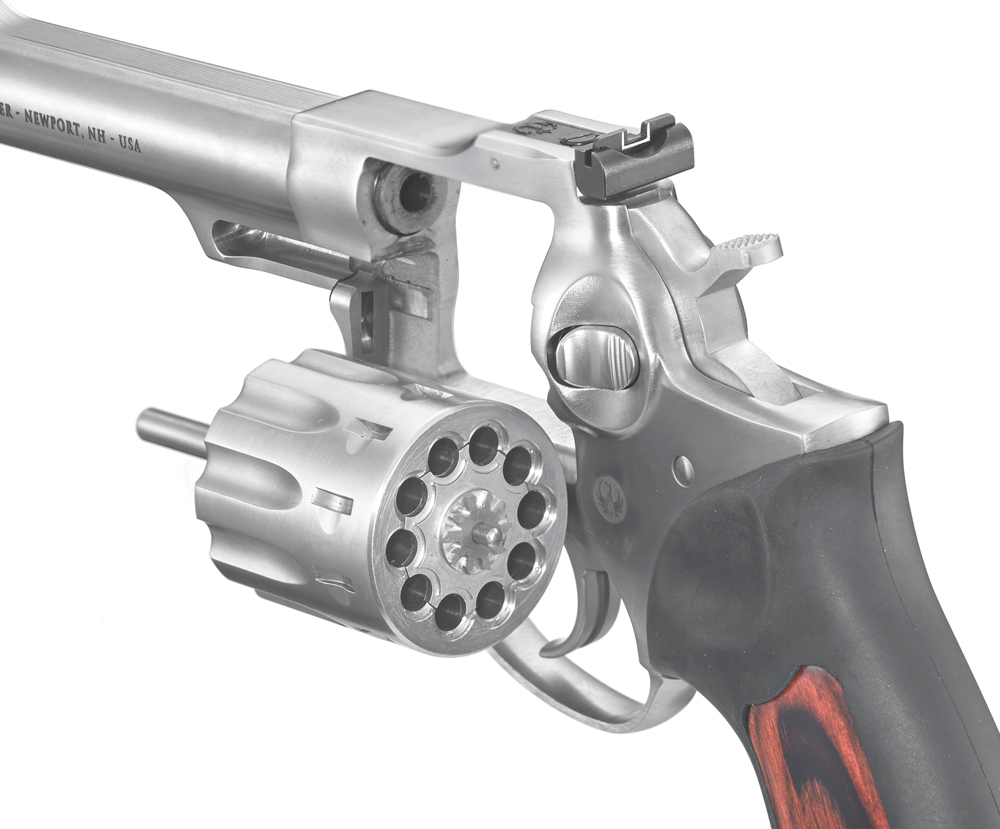
Able to hold 10 rounds, Ruger’s new GP100 .22 LR promises long shooting sessions.
Adding to the 5.5-inch barreled revolver’s shootability is its grips, which feature wrap around cushioned rubber. But Ruger has added a touch of aesthetics with hardwood inserts on the sides of the grips
The stainless steel handgun has a satin finish and boasts all the features of the GP100 line. Of the more notable, the .22 has a triple-locking cylinder for more positive alignment and Ruger’s transfer bar safety to guard against a negligent discharge. It also is outfitted with a fully adjustable rear sight, a real plus on a firearm destined for plenty of target shooting.
The GP100 .22 LR is sold with a hard plastic case and presently has an MSRP of $829.
If the latest Rock Island Auction Company event is any indication, the market is on fire for collectable firearms. The Illinois auction house’s December Premiere Firearms auction netted a whooping $14.7 million in sales. This topped off what has been a very profitable year for the company, which has moved more than $51 million worth of merchandise in 2015. RIAC’s latest auction featured lots from seven renowned collections and 3,000 total firearms. But it wasn’t a gun that led the sales at the Dec. 4-6 event, but an ancient piece of armor, which drew a staggering bid of $2.3 million. Check out it and the other drool-worthy lots that moved at the auction in the photo gallery below.
Tired of loading up plain old magazines on your tactical plinker? Lakeside Guns has the answer for you — a belt fed .22 LR. Yup, the subsidiary of Arkansas’ Lakeside Machine has a nifty conversion for AR-15 style rifles, called the Razorback. Quite simply, this modified upper receiver allows shooters to chew through rimfire ammo via a belt. Perhaps best of all, it requires no modification to the lower receiver to slap one on. The aspect of the Razorback that caught my eye was the ejection of the spent cartridge through the mag well, which is pretty nifty. Overall, the Razorback appears to be mainly a novelty. But what the heck, it would be the talk of any gun range it showed up at.
Summit Gun Broker specializes in buying up used law enforcement firearms and reselling them to individuals and gun shops.
The current top seller here, says owner Mark Kitterman, is the .40-caliber Glock 22, a Gen III, semi-automatic handgun. A recent sale on the Summit website had the Glock 22’s going for $309.
“I think a lot of agencies are looking at 9mm’s once again, and when they make the shift, we see a lot of these .40-cal Glock 22’s getting sold,” says Kitterman. “Actually, there’s so many used agency Glocks and similar polymer pistols out there, prices have gone down. I’ve seen Glocks drop about $50 over the last year.”
These Glocks tend to be in very good condition, he adds, as most agencies with a good inventory of the pistols have an employee who is also a certified Glock armorer. “They fix anything that goes wrong as it happens, and they are pretty good about doing regular maintenance on the pistols.”
The other used agency handguns Kitterman is seeing in good numbers are the SIG P226 and P229’s.
Recently, Summit bought up 1,000 shotguns—all Remingtons—from a very large agency making the switch from scatterguns to duty rifles. They sold out surprisingly fast, Kitterman notes, with the Wingmasters going for $165 each, the Police Magnums at $300.
Learn how to troubleshoot the reloading process, getting stuck cases out of dies and tips for spotting case head separation and other signs your brass is getting long in the tooth, with Gun Digest’s resident handloading expert Philip Massaro. Also covered are collet bullet pullers and inertia hammers for getting bullets out of cases during those times when you seat too deeply or forget to charge the case with powder.
With tons of great options on the market, there’s a steady rest for every hunter’s needs. These shooting sticks are sure to improve your field shooting skills.
It was a hunting experience more than 25 years ago that made me realize I needed a tall shooting rest or shooting sticks. I stalked a mule deer buck over some very rugged terrain and was carefully scanning the mountainside below when I discovered the buck was watching me from above. Standing, I tried to take aim but couldn’t steady the rifle. I tried kneeling but had no luck, and when I went prone I couldn’t see over the brush and grass. Fortunately for me, the buck stood and watched until I could get my breathing under enough control to take the shot. Before the next trip, I fabricated a shooting rest for myself to deal with similar conditions since there was nothing commercially available at the time.
Most shooting rest designs (bipods) on the market are focused on the military or police markets and are designed for low-to-the-ground shooting positions. Hunters typically shoot from higher positions, however, and need a taller rest. For review, I collected rests ranging from the extremely lightweight to those built for heavy duty use. Each design has advantages and disadvantages; selection of the right rest depends on the application and personal preferences. Some manufacturers offer add-ons that increase versatility. I have my own favorites driven by my needs, but they may not meet yours. As you do your research, you might find you need more than one—I certainly do.
Bipod Shooting Sticks | Shooting Bipod
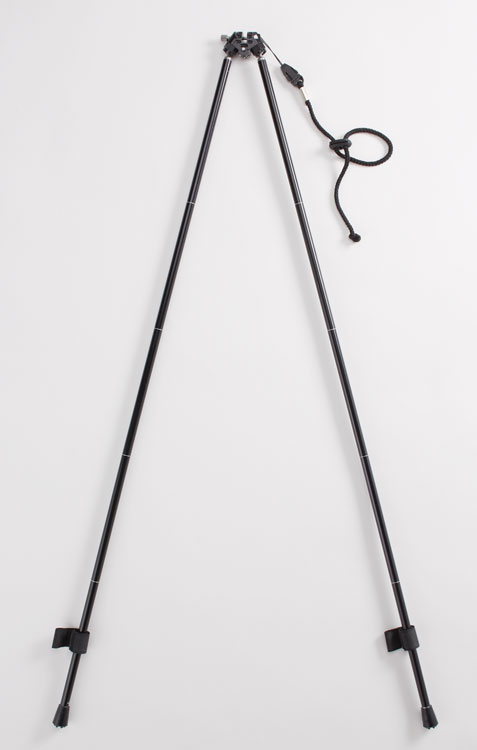
The Bipod Shooting Sticks bipod is made of fiberglass rods with steel connectors that use shock-cords to hold them together. A rubber tubing loop serves to mount the bipod to the rifle, thus keeping it in the same location shot after shot. The bipod comes with a neoprene “sock” that serves as both a storage case and holster. When mounted on a waist belt, the holster supports the ends of the bipod for both off-hand and sitting positions, creating a surprisingly steady rest. The legs can also be spread on the ground in the same manner as a conventional bipod with a range of heights from 10.5 to 33.5 inches. ($39.95; bipodshootingsticks.com)
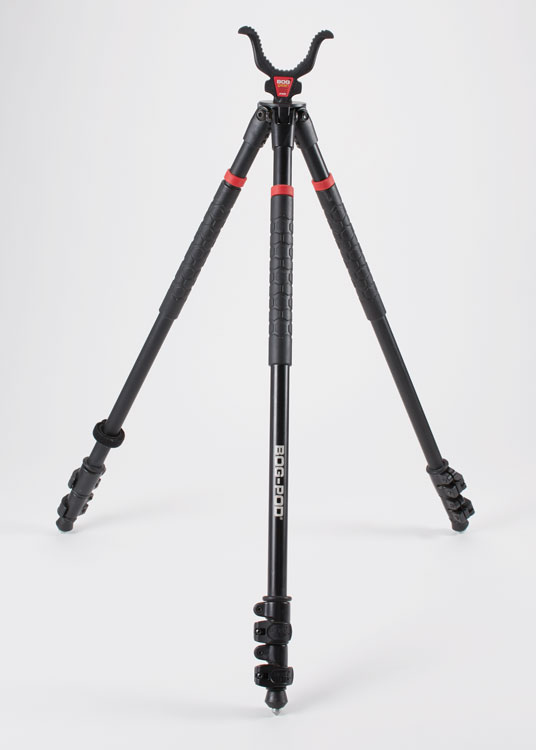
Bog Pod | CLD-3s
The Bog Pod Camo Legged Devil (CLD-3s) tripod weighs approximately 32 ounces. It is primarily composed of aluminum with three, three-section, high-strength, lightweight aluminum legs. Leg adjustments are secured with rapid-adjust lever locks, while the middle leg sections of each leg feature inch markings that help to quickly adjust each to the same height. The CLD-3s has a range of adjustment from 5.5 inches up to 42.5 inches. A carry bag with an Allen wrench for adjusting leg tension is included with the rest. ($159.99, boggear.com)
Bog Pod | HD-3
The HD-3 weighs approximately 56 ounces. Like the CLD-3s, it is primarily made of aluminum with three beefed-up, lightweight aluminum legs. The legs have 5mm larger tubes than standard Bog Pod shooting platforms. Having a range of adjustment from 20-65 inches as measured at the bottom of the “U” form rest, the HD-3 can be used for sitting, kneeling or standing shooting positions. Bog Pod also offers a selection of accessory mounts that will accommodate binoculars, spotting scope, cameras, etc. A carry bag with an Allen wrench for making leg tension adjustments is included with the HD-3. ($179.99, boggear.com)
Cabela’s | 3-in-1 Shooting Rest
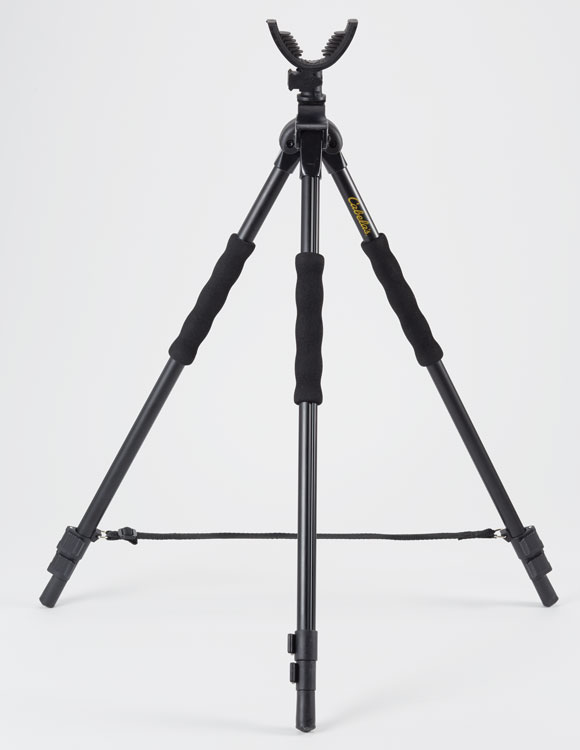
Cabela’s 3-in-1 shooting rest can be used as a monopod, a bipod or a tripod. It is made of aluminum and polymer and features a “U” shaped rest. The rest is rubber coated and has rubber “blades” similar to a windshield wiper that help to steady the firearm. The lowest position possible is when used as a bipod, which puts the bottom of the rest at 25.5 inches. At full leg extension the rest is 58 inches in height as either a bipod or a tripod. When used as a monopod, the range of adjustment is from 28.5-63 inches. The rest weights 35.2 ounces ($74.99; cabelas.com)
Cabela’s | Shooting Bi-Pod
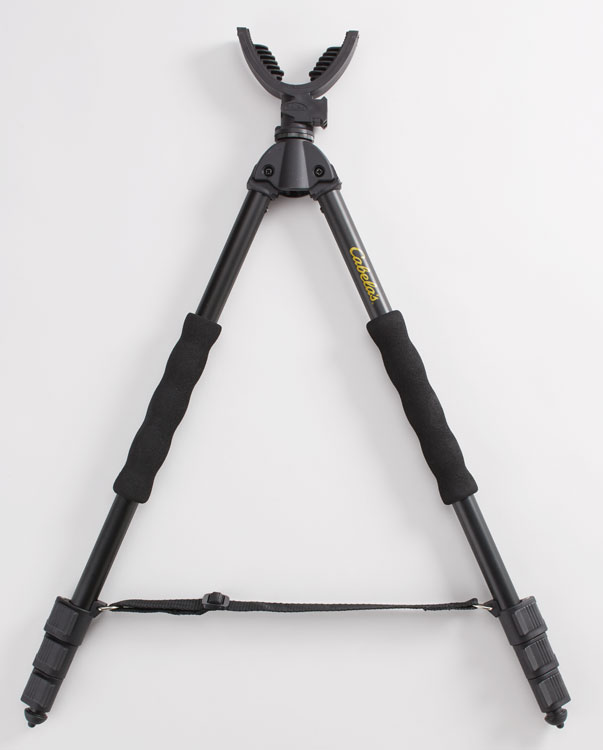
Cabela’s Bi-Pod Shooting Sticks can be used as not only a bipod but as a monopod as well. The sticks are made of aluminum and polymer with a matte black finish and have a rubber padded “U”-shaped firearm support. What is unique to Cabela’s Bi-Pod is the addition of an adjustable strap connecting one leg to the other. The connecting strap prevents the legs from sliding apart when the bipod is used on hard surfaces where the feet cannot get a grip. The Bi-Pod has a range of adjustment from 20-61 inches and weighs 17.5 ounces. ($38.99, cabelas.com)
Kramer Designs Corporation | SnipePod V2
Kramer’s SnipePod V2 is meant for extreme hunting situations where gear weight is of the utmost concern. The V2 is a highly advanced version of the original model with a range of adjustment from 7.5-27 inches and weighs an incredibly light 5 ounces. Each leg is mounted in a ball joint and allows almost unlimited three-axis movement. A small aluminum mount is attached to the firearm utilizing a standard QD sling swivel stud. The bipod is quickly attached and removed without the use of tools. Kramer offers an accessory third leg that turns the bipod into a tripod for use with a spotting scope. ($125.00; kramerdesignscorp.com)
Primos | Jim Shockey Edition Trigger Stick Tripod
Primos’ Jim Shockey Edition Trigger Stick tripod is easily adjusted with one hand by pulling the trigger. The grip is held at the desired height while gravity causes the legs to extend to the ground. The tripod weighs 46 ounces and can be used as both a gun rest and an optical gear mount. The rest has a range of height from 28-62 inches as measured from the bottom of the “V” rest. As an optics support, the “V” rest can be removed to expose threaded fixtures for mounting optical gear such as cameras, spotting scopes, binoculars and laser range finders. ($195.95; primos.com)
Primos | Steady Stix Magnum
The Steady Stix Magnum has a rubber padded “V” form rest and is designed for quick setup and use. Although the Magnum has increased the tube diameters of the Magnum to .515-inch versus .340-inch for my old Steady Stix, it is still a very light rest (8 ounces). The leg sections are connected with a pressure-fit ferrule and extreme-duty shock cords. Packed, the overall length is 15 inches, and when the three-section legs are fully extended the rest is 45 inches long. It features usable shooting heights ranging from 26-34 inches. ($44.95; primos.com)
Primos | Pole Cat Monopod
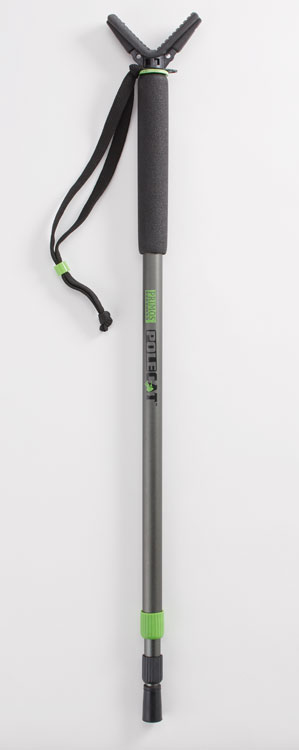
The Pole Cat Monopod from Primos is made of three sections of seamless tempered aluminum and utilizes patented Posi-Lock adjustments. Weighing 10.9 ounces, the monopod is easy to transport and can be adjusted from 25-62 inches. Not only is the monopod a shooting rest, it can also double as a hiking aid. Primos has fitted the monopod with a very usable hand strap in the style of a ski pole strap that helps reduce hand fatigue on long treks. For non-hunting use, the shooting rest can be easily removed and replaced with a nicely finished wooden knob available as an accessory. ($44.95; primos.com)
Once upon a time, hunters did just fine with standard bullets. Find out how bullet designs have changed over the years and whether you need premium ammo for your next hunt.
When on a hunt of a lifetime, one can’t afford to use anything but the best bullet/ammo for the job.
There was a time—a very long time in fact—when the making of a hunting bullet was a fairly simple operation. Disks or planchets were punched from copper alloy sheet or strip stock then drawn in dies in successive steps to form a deep cup. Then a slug of lead wire is placed in the cup, swaged to tightly fill the cavity, then forced into forming and sizing dies, leaving some of the lead core exposed at the very tip to initiate expansion. This process, referred to as cup-and-draw, was (and still is) the most common method of bullet production. Heated debates about bullet design and construction are a relatively recent thing because back then a bullet was a bullet, and there wasn’t a lot to argue about other than, say, round nose versus spitzer.
Today, however, there are several different methods being used to make bullets, to say nothing of the dozens of different bullet types, construction and composition. Any departure from the cup and draw process just described usually results in bullets that are more expensive, whether as reloading components, and as used in factory ammunition.
Some of the pioneers in the design and manufacture of what we have come to refer to as “premium” bullets were John Nosler, who began production of his Partition in 1948, and Lee Reed, founder of the Swift Bullet Co. and designer of the A-Frame, to name just two. Both bullets are actually quite similar in that they are what are known as H-mantle bullets consisting of a jacket that has two separate lead cavities separated by a partition—like the letter H. Both are designed with nose sections that reliably expand at a wide range of impact velocities, but the mushrooming stops at the partition, so that the bullet retains a high percentage of its original weight, which of course provides deep penetration. Jack Carter’s Trophy Bonded bullets have a solid base with just the nose section filled with lead that’s bonded to the jacket.
Nosler started the poly-tipped bullet thing, which has since been copied by everyone else.
Initially, these and similar premium bullets were available only as components, so only reloaders could take advantage of them. However, the real impetus for technologically advanced bullets and ammunition was the introduction in 1977 of Federal Cartridge’s Premium ammo. It was a real gamble by Federal to think that hunters would be willing to pay as much as 50 percent more for ammunition manufactured to tighter tolerances, more stringent accuracy requirements and higher quality control standards.
But the biggest difference was that the company’s Premium line was initially loaded with Nosler and Sierra bullets, which up to that time were only available as reloading components. Currently, Federal Premium uses bullets from just about every established bullet maker. Essentially, it’s a tacit admission by a major ammunition manufacturer that a company other than itself could possibly make a better (or different) bullet than they themselves did.
The Nosler Partition was the first premium bullet to be loaded by a major ammo manufacturer. Now everybody does.
That was almost 40 years ago, and yes, America’s hunters and shooters have since proven that they are indeed willing to pay extra for ammo that offers better accuracy, ballistics, terminal performance or combinations thereof. Today, every major ammo company—Remington, Winchester, Federal, Norma, Black Hills—all offer loaded ammunition featuring Barnes, Hornady, Sierra, Swift, Nosler, Woodleigh and Speer bullets. In addition, Hornady, Nosler and Barnes—once companies that made only bullets—now manufacture their own SuperFormance, Trophy Grade and VOR-TX ammo, respectively, loaded with their own bullets.
There’s such an emphasis on premium ammo these days, that to hear some pundits tell it, if you’re not hunting with top shelf ammo or handloading some premium bullet, you might as well stay home. This kind of makes you wonder how the plain old cup and draw jacketed lead bullet accounted for so much game for so long! I know I’ve certainly taken my share of critters using them.
So just how important is it to hunt with a premium bullet? Well, like any honest answer, it depends…on the game, the terrain and the tactics. Does the eastern Whitetail hunter who typically takes his deer at distances under 100 yards, need anything more exotic than, say, a Remington Core Lokt or a Winchester Power Point, both of which are excellent bullets? The answer is no, of course not. Even if we extend the range to 150 yards, you simply do not need benchrest accuracy, a super flat trajectory, high weight retention or deep penetration. In fact, the latter two are of arguable value. Personally, for deer hunting I prefer to use a bullet that’s designed to expand quickly and expend most or all of its energy inside the animal, i.e., no exit hole.
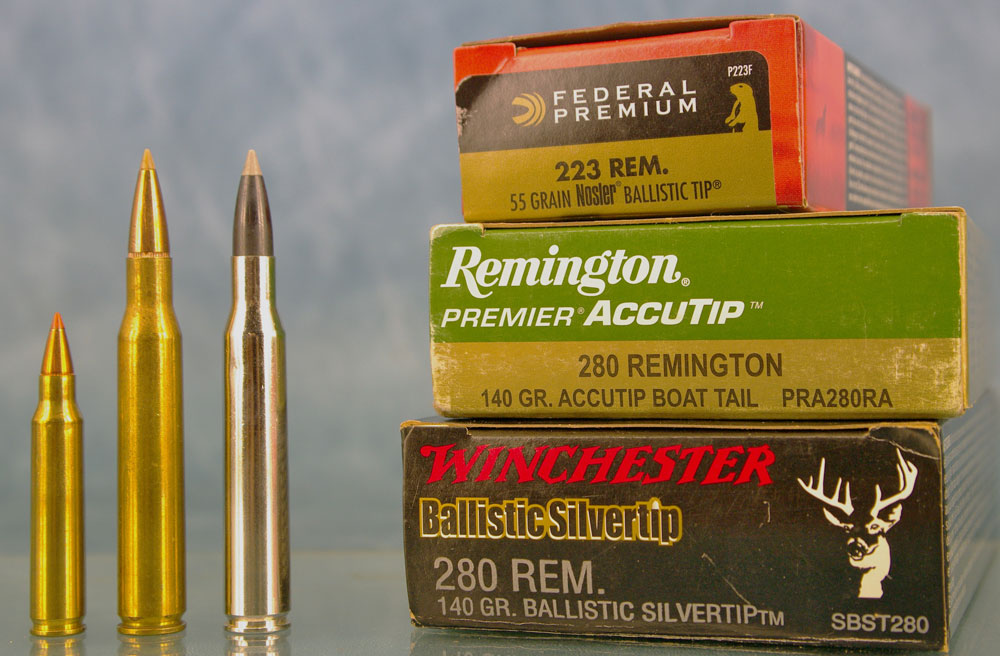
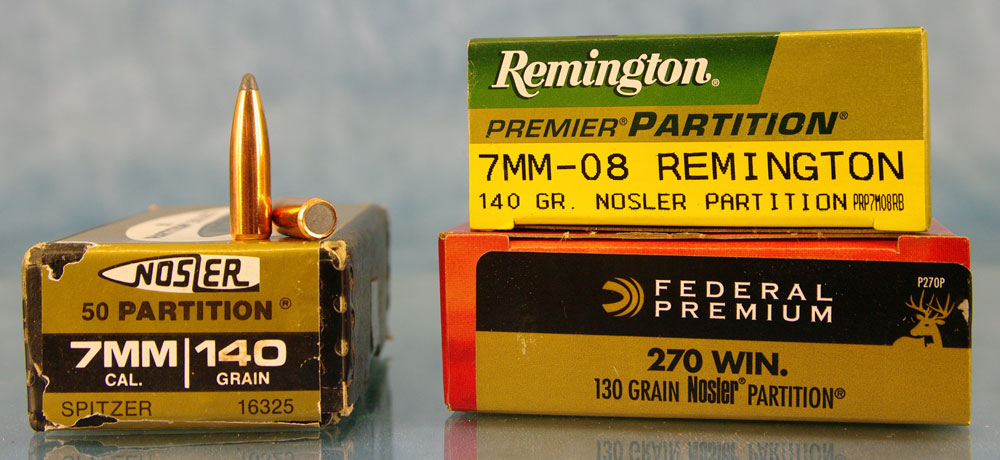
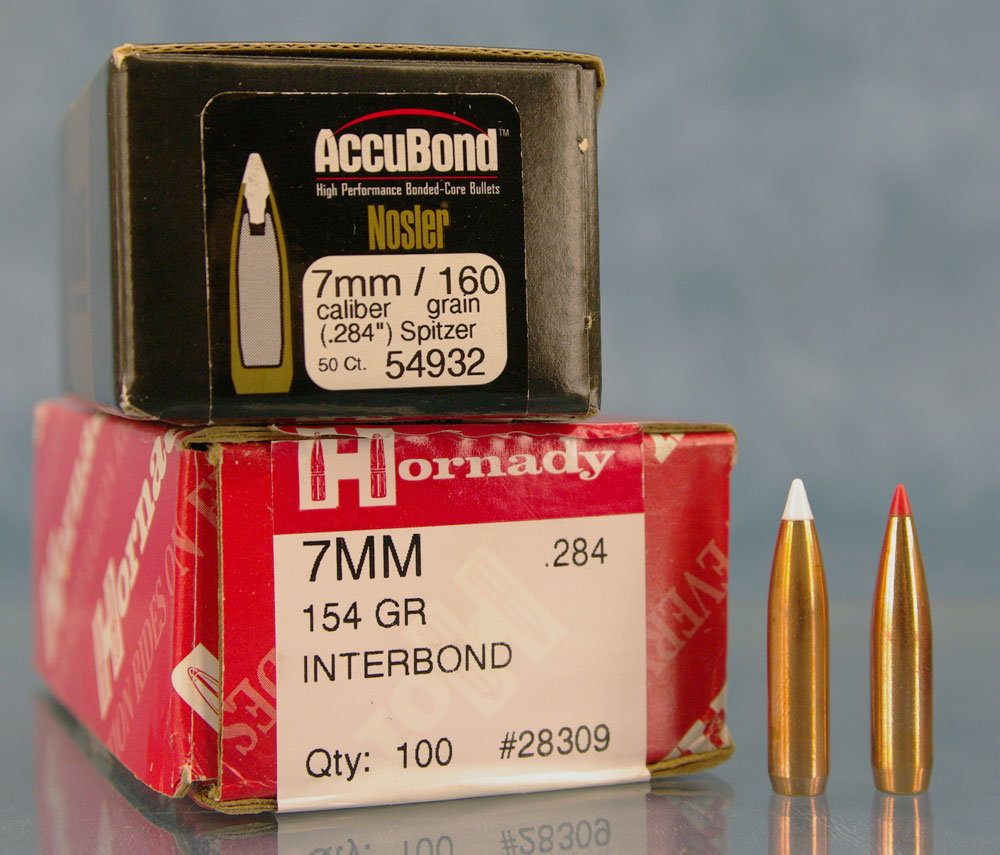
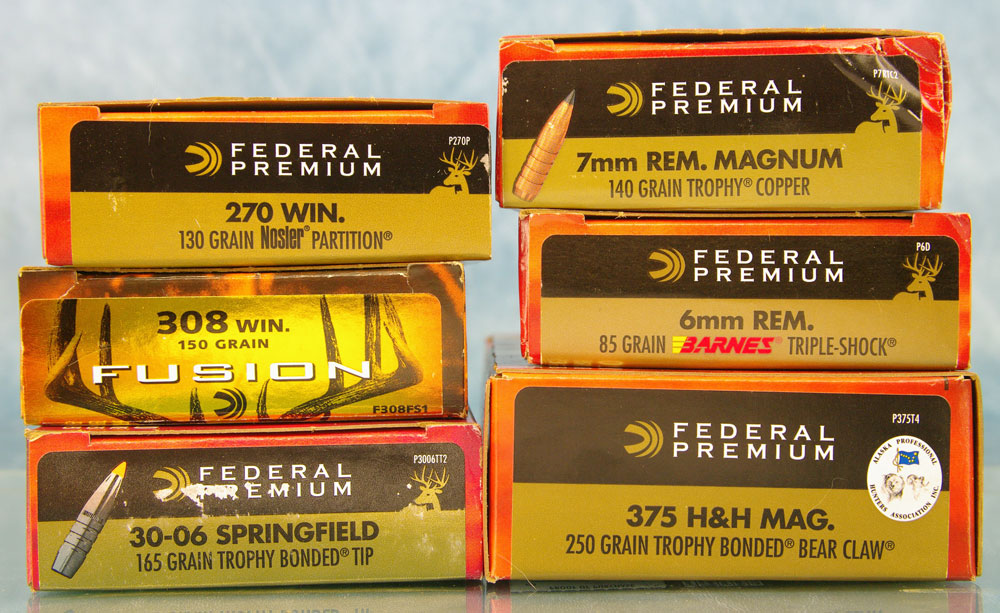
Nosler’s AccuBond and Hornady’s Interbond are just two examples of taking the polycarbonate-tipped bullet to another level by bonding core and jacket together.Federal started loading other peoples’ bullets in 1977 and today offers more custom bullet loadings than anyone else. These are just a few.
Now I know there’s a very credible school of thought that believes there should always be an exit hole, which guarantees a second and much better blood trail in case of a wounded animal. But I have to say I’ve experienced and witnessed more lightning-like kills on deer (and deer-size animals), with bullets like the Nosler Ballistic Tip (the one that started it all), Hornady SST, Winchester Ballistic Silvertip and similar poly-tipped bullets. Though only marginally more expensive than promotional and standard-line ammo, these bullets provide string-flat trajectories as well as quick and reliable expansion at a wide range of impact velocities.
The tipped bullet concept is nothing new. Remington’s Bronze Point and Winchester’s Silvertip go back decades before Nosler’s Ballistic Tip. The idea was the same: A nose tip or meplat of a hardened material protected the tips from deformation in the magazine, and also acted like a wedge to initiate expansion. The only thing different today is that bullet tips are of polycarbonate, which is lighter, and moves the bullet’s center of mass more towards the base, which helps accuracy.
The Swift A-Frame and Scirocco bullets are among the very best game bullets extant and are offered in loaded ammo by several manufacturers.
The tipped bullet has since metastasized to where it is now seen in virtually every bullet type—bonded core, dual core, varmint, match and monolithic. If the Nosler folks were instrumental in popularizing the polycarbonate-tipped bullet, Barnes is responsible for the monolithic solid copper bullet. Their TSX and TSX-Tipped bullets have since been copied by every one of their major competitors. Terminal performance-wise, this type bullet provides reliable, double diameter expansion, deep penetration and virtual 100-percent weight retention. They also provide superior ballistics in that they all have very high ballistic coefficients, which means they are about as flat shooting as you’ll find in a game bullet. And they’re accurate.
Bottom line: Do you need premium-bullet handloads or premium ammo using premium bullets for anything but extreme range shooting and dangerous game? Not really. But for what little extra cost is involved on a per shot basis, why not tip the scale as much as possible in our favor? There is simply no downside to a better mousetrap.
In this Savage A17 review, Jon R. Sundra explains how the first delayed blowback semi-auto action chambered in .17 HMR rimfire operates and performs at the bench.
Why The Savage A17 Is A Different Kind Of Rimfire:
First successful .17 HMR semi-auto rifle
Delayed blowback action makes it possible for the AR17 to relyable cycle
Feeds from a 10-round rotary magazine
Extremely accurate shot to shot
Suitable as a target rifle or a hunter
When the .17 Winchester Super Magnum (WSM) rimfire cartridge debuted two years ago, it did so not in a Winchester, but in the Savage B-Mag, a rifle designed from scratch around this hottest of rimfires. This year Savage pulled a similar move by working with CCI to come up with the first affordable semi-auto rifle chambered for the .17 Hornady Magnum Rimfire (HMR).
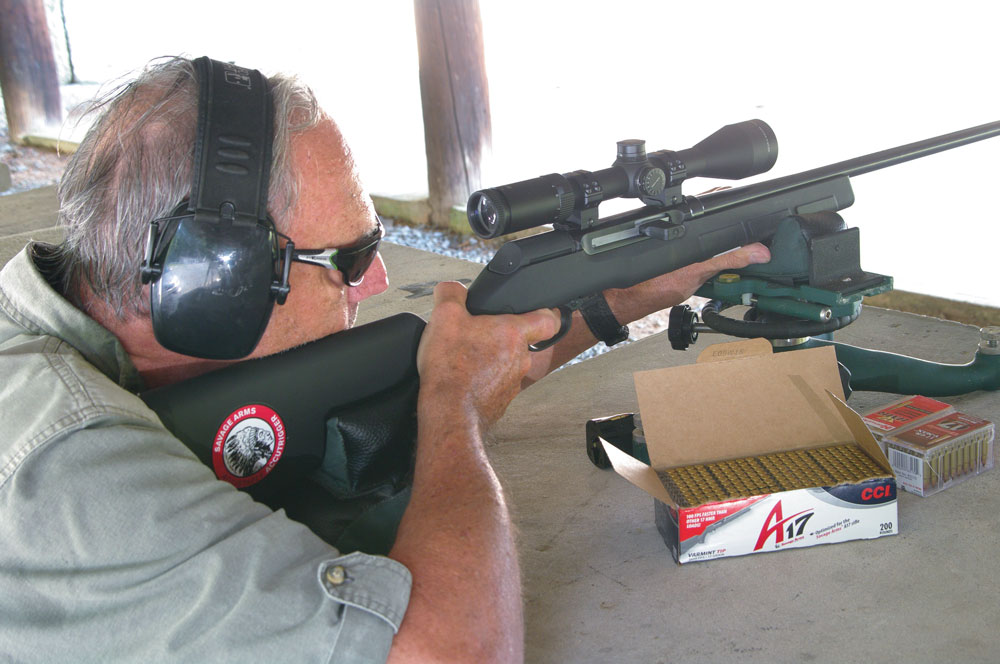
Savage and CCI, as you may know, are among the dozens of firearms-related companies now under the Vista Outdoor family. For this cooperative project, the CCI people developed a special load, A17 Varmint Tip, which boasts a 2,650 fps muzzle velocity for its 17-grain polymer tipped bullet—that’s 100 fps faster than all other similar loads offered by Hornady, Winchester, Remington, PMC and even CCI.
The .17 HMR was introduced back in 2002, so why did it take 13 years for someone to come up with a self-loader for this highly popular cartridge? Good question. The answer lies in the fact that no existing semi-auto rimfire rifle of sporting configuration could handle it. Even though the cartridge had a maximum average breech pressure (MABP) only 2,000 psi more than the .22 LR and .22 Magnum (WMR), and the fact that a few existing semi-autos were successfully adapted to the latter, the .17 HMR posed special challenges.
All existing semi-auto rimfire rifles employ straight blowback actions, which are not capable of handling high-intensity centerfire pistol and rifle calibers. With a blowback there is no locking mechanism per se, and only the spring(s) that power the bolt keep the action closed. Upon ignition, the equal and opposite reaction of launching a bullet forward has the cartridge case pushing backwards.
The mass of the bolt itself and its spring provide enough resistance to keep the action closed the few microseconds it takes for the bullet to exit the muzzle and the pressure to drop.
With the .17 HMR, however, things become more complicated because we’re talking about a bullet weight range of 15.5 to 20 grains—that’s half the weight (and half the resistance) of the 40-grain payload of the .22 LR or .22 Magnum. As a result, the higher pressures, higher bullet velocity and greater bolt thrust were different enough that existing actions were not safely adaptable. To do it right required a new action, and apparently no major American arms manufacturer thought the demand for a semi-auto .17 HMR was enough to warrant the investment…at least not for 13 years, anyway.
Enter the A17, which is based on a delayed blowback action. There are many ways to keep the action closed a few microseconds longer, but all delayed blowbacks employ the same principle: The bolt performs some other operation before it can overcome the inertia of the bolt and spring and begins its rearward movement.
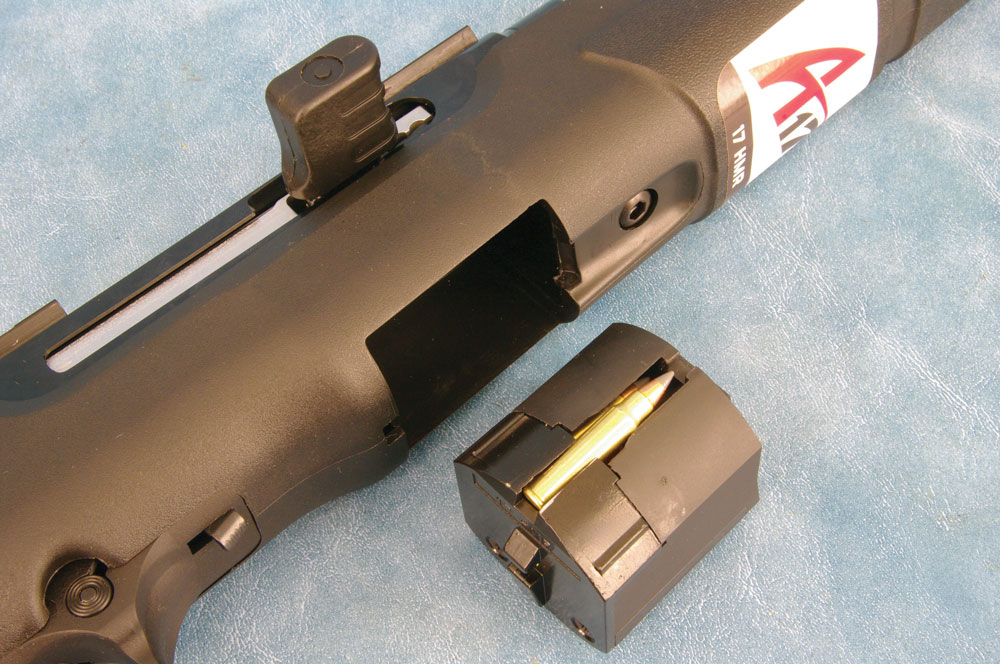
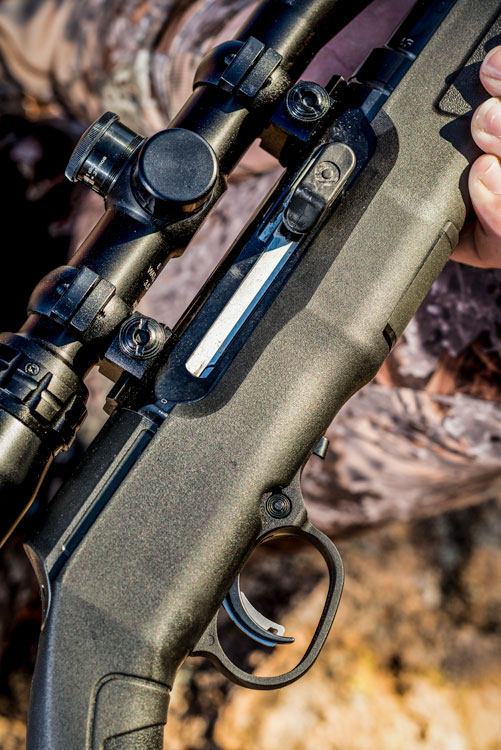
With the A17 there’s a collapsible lug housed in the top surface of the bolt that engages a slot in the ceiling of the receiver. The rear surfaces of the lug and the recess it bears against are angled to form a cam surface, which acts like an ordinary door latch. The rearward force exerted on the bolt forces the lug to collapse, allowing the bolt to open and move to the rear. It’s really quite a complicated mix of mass, resistance and timing—enough that it took the folks at Savage 2½ years of R&D to get it right.
The A17 sent to us for review weighed 5.4 pounds and measured 42 inches in length. It feeds from a 10-round rotary magazine that fits flush with the belly of the stock. The free-floated, 22-inch barrel is button-rifled with a 1:9-inch twist and tapers to .610 at the muzzle, making it fairly stout for a .17 caliber. The safety is of the cross bolt type, housed in the forward portion of the trigger guard bow and therefore similar to those found on most pump and semi-auto shotguns. The injection-molded polymer stock is of the straight comb classic style with just a slight ¼-inch drop from the point of the comb to the rubber butt-padded heel. Pre-installed Weaver-type scope ring bases are standard, as is Savage’s AccuTrigger, which is user-adjustable down to 2.5 lbs.
Another member of the Vista Outdoor Group is Weaver, so it was not coincidental that along with the A17 we received a KASPA (an Indian word meaning “clear vision”) 3-9x40mm rimfire scope and Weaver rings. This particular scope comes with three elevation dials calibrated to the 40-grain trajectories of the .22 LR and .22 Mag., and for the 17-grain polycarbonate-tipped bullets of the .17 HMR. Zeroed-in dead on at 100 yards, the 17-grain bullets will impact about 2 inches low at 150, and 6½ inches low at 200, which is really about the practical limit of this little cartridge. Of course with the HMR turret installed, you simply dial those respective distances and hold dead on. With the slightly flatter trajectory of the A17 Varmint Tip load, we found those respective points of impact to be about ½ inch higher at 150 and 1 inch higher at 200—not enough to worry about for general pest-shooting purposes. It should be noted that all existing .17 HMR loads, which range from 15.5 to 20 grains, are safe to fire in this gun.
All told we put nearly 200 rounds through the test gun, which, if not a pre-production example, was of the first production run. As such, we had three failures to feed. Two magazines were provided, and if there is a trick to charging them, I failed to discover it. I consider myself rather dexterous, but I found stuffing 10 rounds into these magazines rather challenging.
Also, on several occasions, firing the first shot had the magazine drop out of the rifle. This is in spite of the fact that, after the first such occurrence, I really slapped it home and got an audible click doing so. Again, this was early production for both rifle and ammo, so I fully expect such teething glitches to be addressed. Accuracy was more than acceptable, though the two standard loads proved slightly more accurate than the A17 ammo. The best group (.75 inches) came with Hornady’s 17-grain V-Max load.
Savage A17 Type: Delayed blowback, semi-automatic Caliber: .17 HMR Barrel: 22 in., 1:9-in. twist, button-rifled Overall Length: 42 in. Weight: 5.4 lbs. Stock: Injection-molded polymer, black matte finish Sights: Drilled and tapped for optics Trigger: Savage AccuTrigger, adjustable to 2.5 lbs. Capacity: 10 rounds MSRP: $465 Manufacturer: SavageArms.com
This gun review appeared in the October 2015 issue of Gun Digest the Magazine.
The GAP Grind 2015, a long-range tactical shooting event, took shooters’ skill and equipment to a whole new level.
This year’s GAP Grind match took place 16-18 October at the K&M Shooting Complex in Finger, Tennessee.
The match drew shooters from across the nation with law enforcement, military and civilian backgrounds. Held in association with the Precision Rifle Series (PRS) and GA Precision, the fast-paced shooting format featured a Pro/Am arrangement pairing professional and amateur competitors.
GAP Grind: Fast Action, Long-Range
The GAP Grind presents a notoriously challenging opportunity to engage targets—paper, steel, moving and reactive—at distances of up to 1,200 yards, with minimal down-time between stages.
The 2015 course was comprised of 20+ stages, in which competitors each fired 200+ shots at long-distance targets, which varied in size and difficulty based on distance and time allotted. Most stages included “stressors” such as time limits or required movements.
Cory West, of Texas, took top honors at the event with a score of 165.00.
Just watch the GAP Grind 2015 video above and try to imagine the level of performance needed to bring long-distance computations together with equipment and an ever-changing target environment to make hits at these ranges.
Some truly top-notch long-range rifles, optics and gear are on display here, but it goes to show how intimate knowledge of equipment and long hours of practice under field conditions pay off when the chips are down.
Get the most recent advances in guns and gear to extend your range for hunting, informal target shooting, and formal competition. Discover new tools for long-range shooters both in the field and on the firing range, with coverage of new developments from advances in military applied combat theory. Learn more
Need more brass for reloading? Don’t overlook specialty cases and surplus brass! In this episode, Philip Massaro explains the differences in sporting brass vs. military surplus brass; plus an explanation of neck sizing for improved accuracy in bolt-action rifles.
When it comes to concealed carry, vehicles can provide a challenge.
Of course there are the physical demands of carrying in a car or truck. The second nature of a clean draw stroke is quickly complicated, with the shooter having to dodge a seat belt, console and steering wheel. But there is another, less-thought-of aspect that is important to consider when armed in a vehicle – interaction with law enforcement.
Even the most conscientious drivers can miss the occasional turn signal. In turn, no matter how pristine your driving record is, if you carry, it is a solid idea to be prepared to interact with a police officer, sheriff or state patrol.
Much of his advice boils down to being courteous, forthright and smart. But he also touches on some important nuances in being pulled over while carrying, particularly those little things a driver might believe are helpful, but could set the situation on edge. Painchaud has a good perspective on these, given his law-enforcement background.
His most important advice, however, is perhaps his most obvious and simple – study and understand the laws of your state as they pertain to carrying in a vehicle. After all, even if you are a fantastic driver with a clean driving record, you never know when you might need to draw upon this knowledge.
Looking to go armed, but are stuck in the weeds as to what to arm yourself with? Here are 20 of the best concealed carry gun options that will keep you on the defensive.