Reliability is an important aspect, or should be, with regard to pretty much any firearm. You want it to work when you need it to, regardless of which category of the shooting sports you fall into – whether that’s big-game hunting, plinking at the range or busting clays for competition. It’s certainly true of firearms intended for 3-Gun Competition use.
In the video above, renowned competitive shooter and Colt Competition Team member Maggie Reese discusses the importance of having equipment that is utterly reliable in 3-Gun Competition. Watch the video to learn more.
We trace the lineage of today’s top pistols and revolvers to determine which firearms helped shape our modern conception of what a handgun should be.
There are a wide variety of different handguns on the market today, everything from ultra-compact mini-revolvers to sophisticated semi-auto race guns. But if you look at the DNA of most modern guns, you’ll see that the vast majority trace their lineage back to some common ancestors. Sure, all have different features and specifications, but the history of these great guns is visible in virtually every modern handgun offered for sale today.
Still, it’s hard to pick just 10 firearms that helped shaped our understanding of what a handgun should be. You can trace the history of firearms back for centuries to a time when primitive powder ignited a flash of flame and an idea that would change the history of humankind and the trajectory of the world as we know it. But for our intents and purposes, we’ll stick to guns of the modern smokeless powder era, those from the mid-nineteenth century and forward.
That’s still not a short list, and picking guns that deserve a spot isn’t easy. It’s sometimes hard to judge the influence a gun has on other models; sometimes, it’s a matter of mechanical design, sometimes aesthetics, and sometimes it’s caliber, capacity or some nuance that could easily go unnoticed. So, above are our picks for the 10 most influential handguns of the modern era.
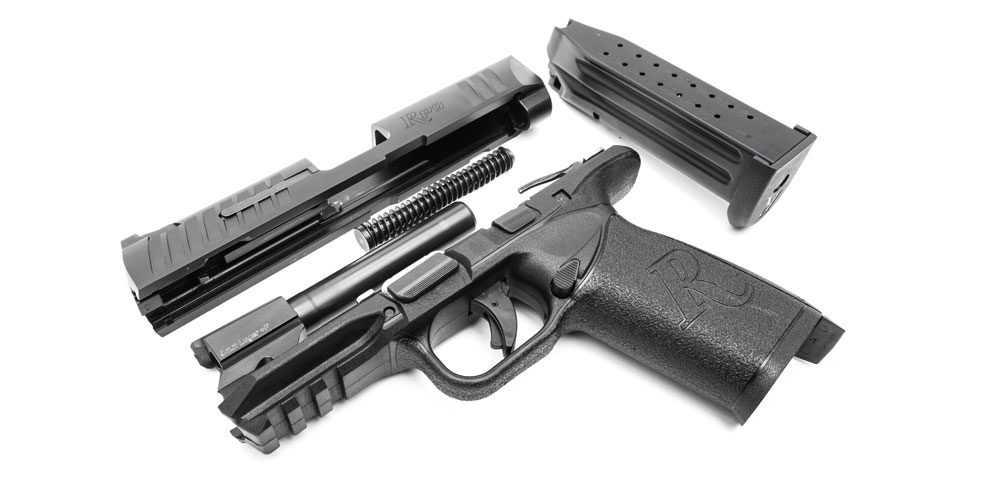
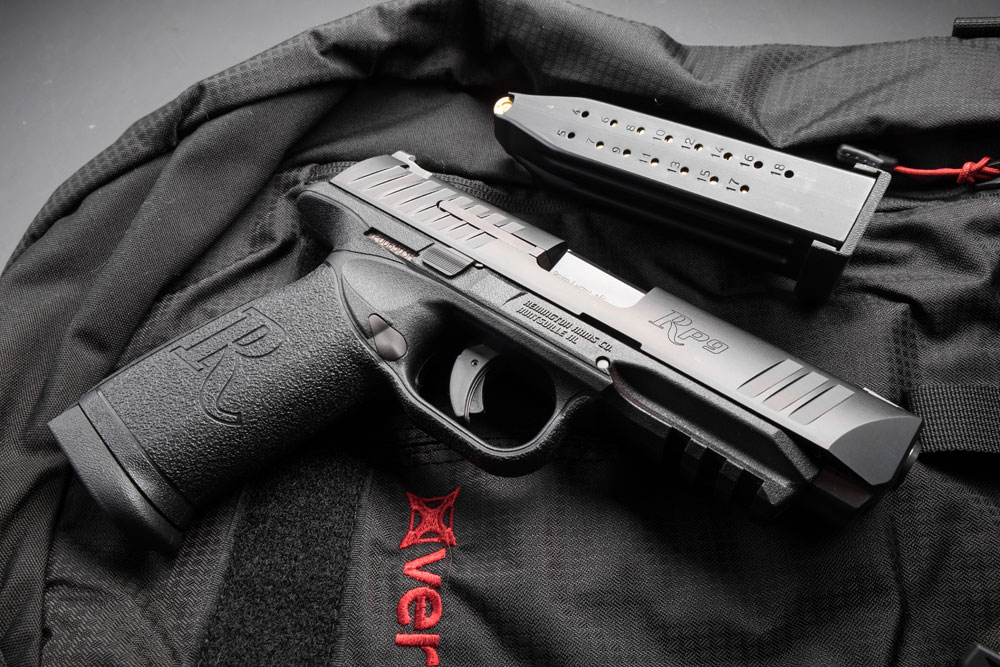
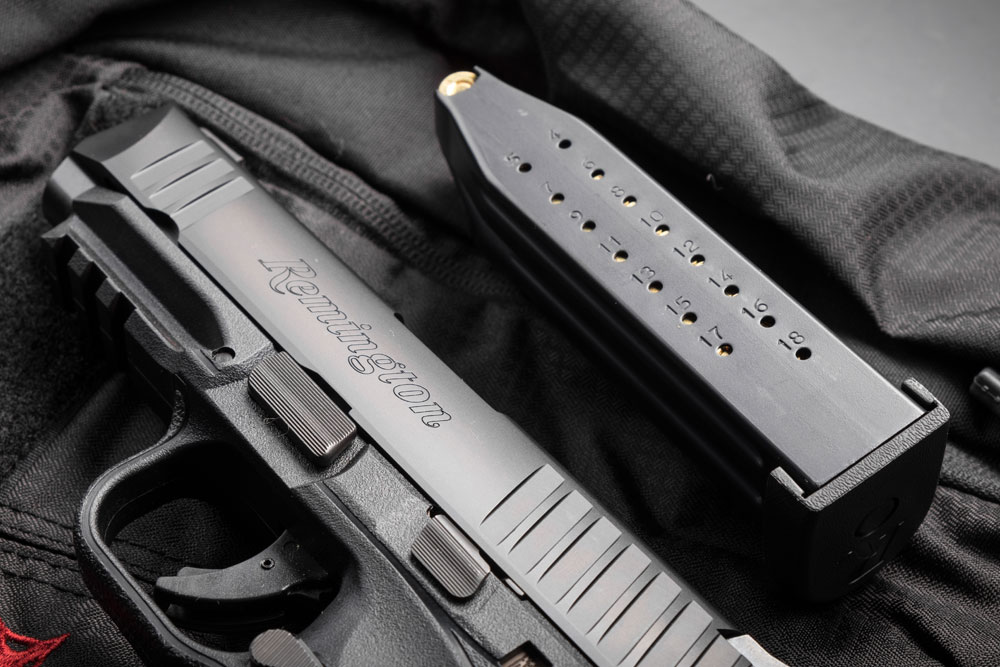
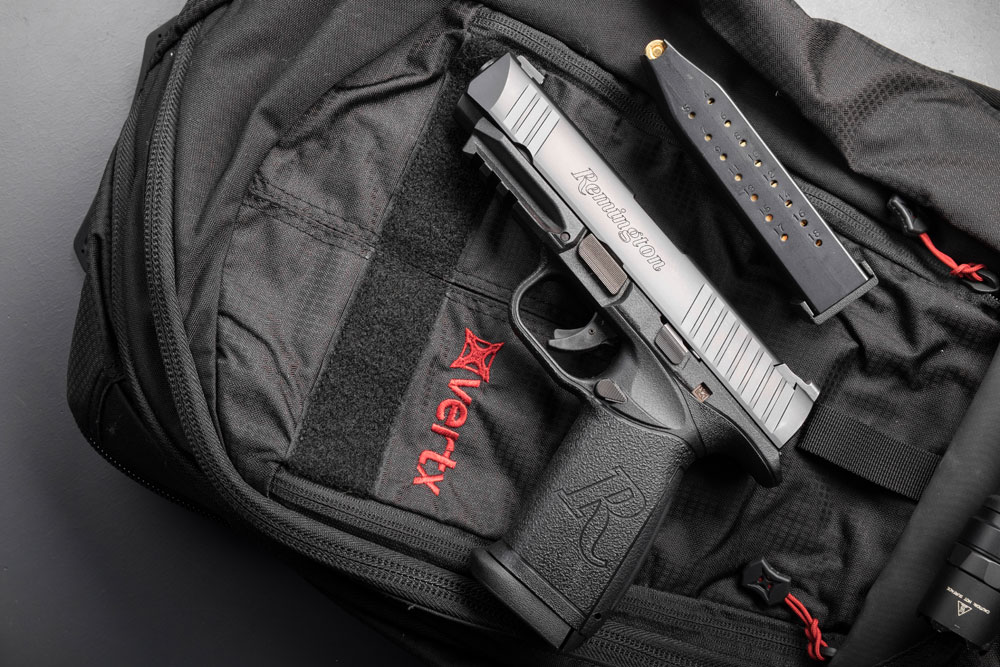
The Remington RP9 is the American manufacturer’s first full-size striker-fired handgun, and it’s got a lot to offer in a price-friendly package.
It’s no secret these days that more and more shooters are moving away from traditional metal-framed single- and double-action handguns and toward polymer-framed striker-fired pistols. Long gone are the days when insults and skepticism were hurled derisively at so-called “plastic” guns. Over the years, they have proven their reliability and their performance capabilities, turning skeptics into converts along the way.
Now, instead of just the few original manufacturers, it seems like there are a countless number of companies, both foreign and domestic, producing these guns. This past fall, one of the biggest names in the U.S. gun industry decided to make its own move into the full-size, striker-fired game. I’m speaking of course of Remington and its new RP pistol.
Some writers within the industry, and certainly more than a few potential buyers, were quick to point out the lateness of the move. A host of other manufacturers had already jumped on the polymer, striker-fired train and had been on it for a while. So, with a sea of other similar guns to choose from, many wanted (and still want) to know what made the RP special?
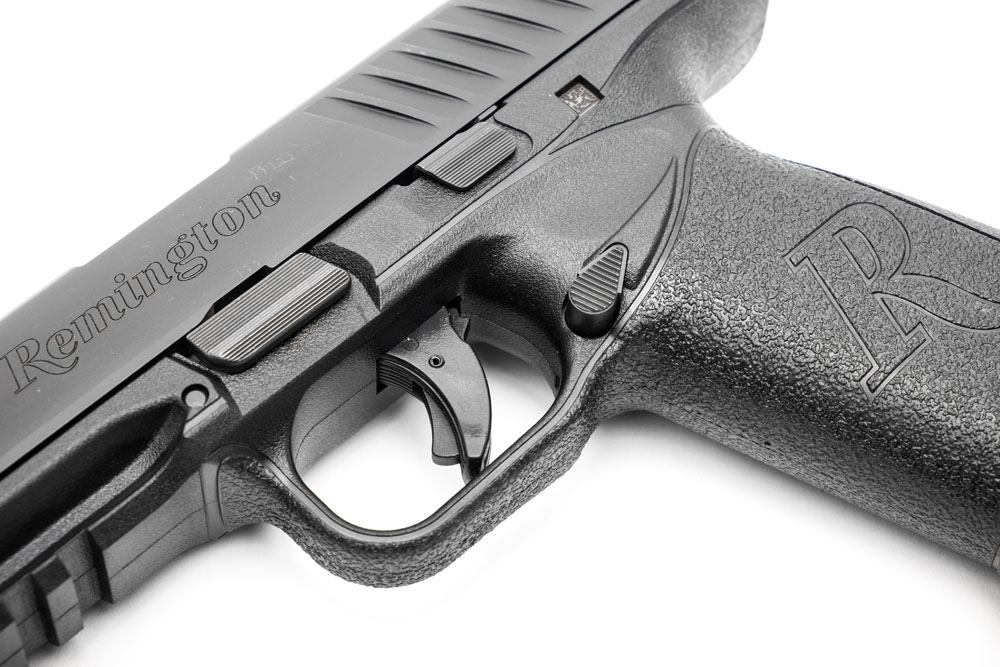
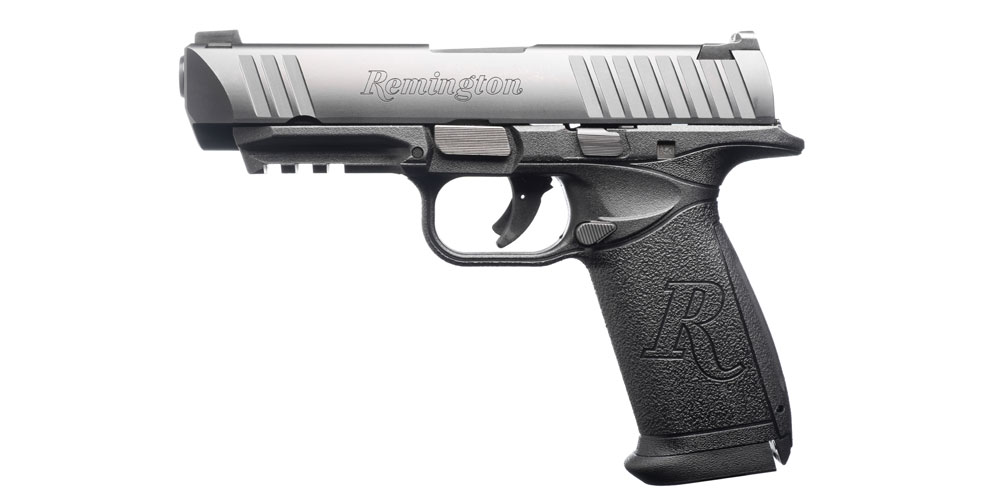
While there are of course differences, much that is nice about the new RP is also what makes it very similar. The new RP is a classic tilt barrel, locked breech, striker-fired pistol with a polymer frame. Its appearance, and more importantly, its controls and operation should be very familiar to anyone who’s used other striker-fired guns. The reversible magazine release, slide stop and takedown lever are all in the typical positions.
The gun has a standard trigger safety, which is its only manual safety mechanism. However, it also features passive safety features in the form of a disconnector, the inertial striker system, striker safety and of course the trigger guard.
Disassembly is fairly similar to many other polymer-framed guns, being both quick and easy. After ensuring the gun is empty, the user simply locks the slide to the rear, rotates the takedown lever down 90 degrees, releases the slide stop and allows the slide to come forward, pulls the trigger and, while keeping the trigger pulled, removes the slide from the frame. And then of course from there, all that’s left is removing the recoil spring/guide rod assembly and the barrel. The entire process probably takes longer to read than it does to accomplish.
Like many striker-fired guns, the trigger on the new RP is pretty good. With an advertised pull weight ranging from 5.5 to 7 pounds, the break itself is light and crisp. It also has a short, tactile reset that is quite nice.
The RP’s slide comes with a loaded chamber indicator as well as front and rear slide serrations. The frame also incorporates a standard picatinny rail up front for accessories such as a weapon-mounted light or a laser sight.
Sights are drift adjustable, and the rear sight incorporates a “fighting surface” that allows for one-handed slide operation if necessary. The gun uses a precision 4.5-inch stainless steel barrel. Both the slide and barrel receive a PVD finish for increased durability.
Of course many, if not most, of these features are what we as shooters have come to expect on full-size striker-fired guns. The fact that Remington was able to hit on a lot of these is a very good start. But let’s return to the differences mentioned earlier.
Comfort is King
In the polymer-framed, striker-fired pistol arena, what often separates two guns from each other is how they feel in the hand. The beautiful thing about gun owners is that we are all different, and even in a market as crowded as the polymer-framed handgun, there will still be personal preferences that can influence the buying decision.
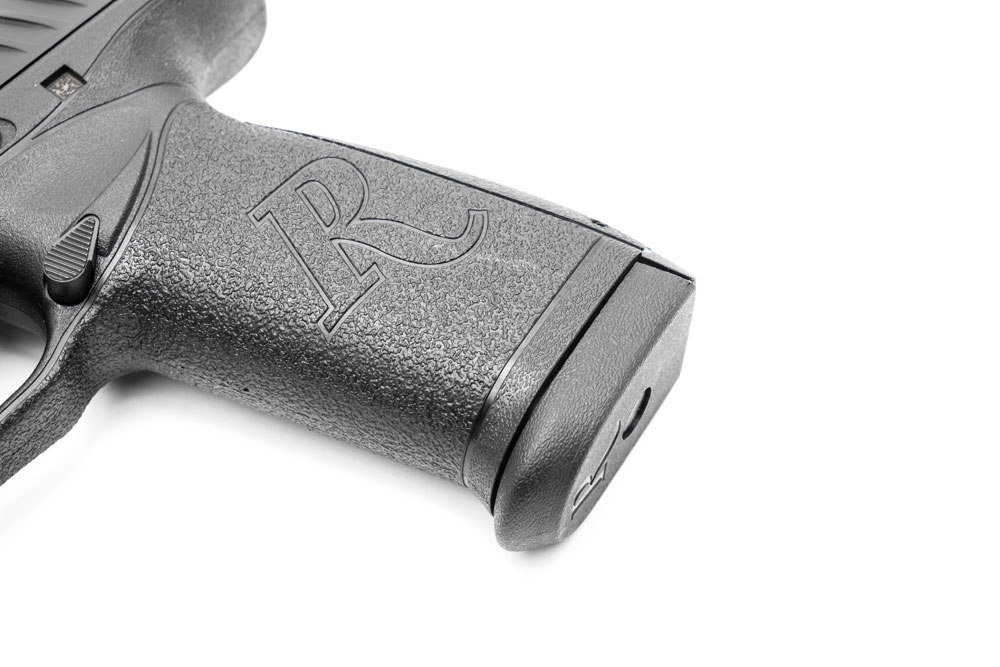
It is in this spirit of inclusivity that the engineers at Remington have developed the grip on the new RP9. The pistol features a very slim grip circumference that, according to Remington, fits virtually 95 percent of all shooters. And for that other 5 percent of shooters, the company has also included interchangeable back-straps to fit small-, medium- and large-sized hands.
One of the most surprising things about this slimmer grip is that Remington was still able to use a double stack magazine capable of holding 18+1 rounds in 9mm and 15+1 rounds in .45 ACP. That’s a lot of boom in one handgun, especially one with such a lean grip. Given this large round count and comfortable grip, I think a lot of people might (and should) give the RP a look as a home defense handgun.
In terms of shootability, the gun also has several features designed to improve performance and comfort. The gun has an ergonomic, optimized grip angle to reduce felt recoil, as well as an undercut trigger guard for higher hand placement and improved control. In addition, the slide is weight balanced for a more controlled muzzle rise.
While shooting during the course of this review, and during a Remington event back in September where the company first introduced the gun to the media, it did seem very controllable, and I think the grip design plays a real part in that. I had little difficulty firing and getting the sights back on target.
With an overall length of 7.91 inches, a height of 5.56 inches, and a weight of 26.4 ounces, there’s no mistaking the RP for anything other than a full-size gun. The gun’s slide also has an enlarged profile, which Remington has done to ensure secure slide manipulation, even if the shooter is wearing gloves.
All in all, the RP9s (9mm) I used, both in testing and at the event, felt very good in the hand. This was true during extended firing as well as in a more general sense.
At the Range
Everything above is great, but what most shooters are concerned with, especially for polymer-framed, striker-fired guns, is reliability and performance. Thankfully, in my time with the Remington RP9, it did not disappoint.
In the course of testing the RP9 I received, I put close to 250 rounds through the test gun. During the Remington event, I fired probably around 100 rounds through one of the test guns, and that doesn’t include the number of rounds fired by many of the other writers and members of the media in attendance before that. In both cases, I experienced no real mechanical failures, with the exception of the slide failing to lock back on an empty mag a couple times during my accuracy test.
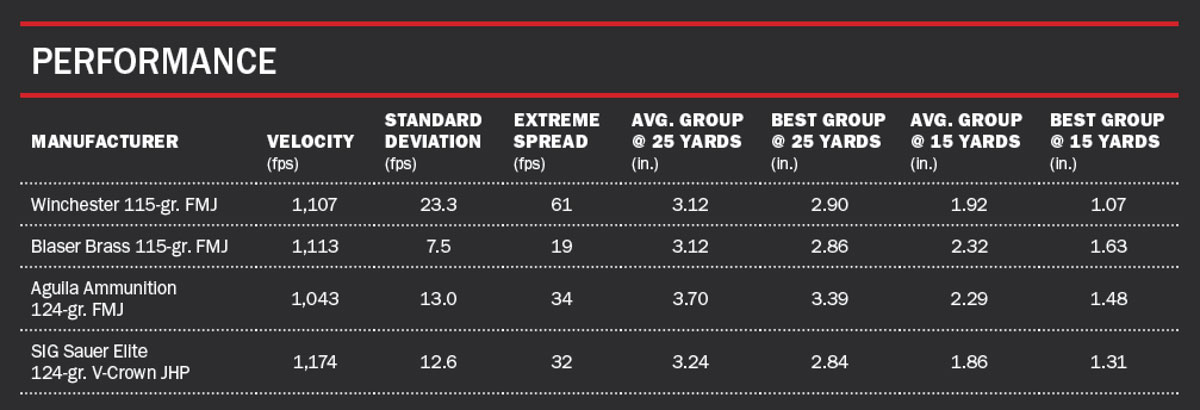
For my independent testing I used four loads: Winchester’s 115-grain FMJ, Blazer Ammo’s Brass 115-grain FMJ, Aguila Ammo’s 124-grain FMJ, and SIG Sauer’s Elite Performance 124-grain V-Crown JHP. I measured velocities through a Competition Electronics ProChrono Chronograph from Brownells placed approximately 10 feet from the muzzle. Accuracy was measured using three, five-shot groups at both 25 and 15 yards using a Caldwell Matrix rest, also from Brownells.
Average velocities were in the low to high 1,100 fps range, with the exception of the Aguila load, which was a little slower at 1,043 fps. Groups were also plenty adequate with the average at 25 yards hovering around 3 inches (a better handgun shooter probably could’ve improved that figure quite a bit). Predictably, at 15 yards, groups were tighter, with the average around 2 inches or less. The best overall group at 15 yards went to the 115-grain Winchester FMJ load at 1.07 inches.
Parting Shots
While it’s true that many feel Remington is a little late to the game with its new striker-fired gun, that shouldn’t take away from what the manufacturer has achieved with the RP. Remington’s first full-size, polymer-framed, striker-fired pistol has what it takes to compete with any of the other similar guns on the market. At its excellent, sub-$500 MSRP ($489), it’s likely to be a very popular alternative, and it should be. It feels great in the hand, performs reliably and comes with everything you’d expect from a good polymer-framed, striker-fired handgun.
It’s certainly true that there are a lot of similar handguns vying for buyers’ dollars right now, but because preferences are always subjective and varied, Remington’s new RP definitely has a chance to find success. With people currently gobbling up strike-fired pistols the way they are, there’s plenty of elbowroom for another contender in the ring.
Specifications:
Remington RP9 Type: Semi-auto, striker fired Caliber: 9mm Barrel: 4.5-in., stainless Overall Length: 7.91 in. Height: 5.56 in. Width: 1.27 in. Weight: 26.4 oz. Frame: Polymer Slide: Steel, PVD finish Trigger: 5.5-7 lbs. MSRP: $489 Manufacturer: Remington; Remington.com
This article is an excerpt from the January 2017 issue of Gun Digest the Magazine.
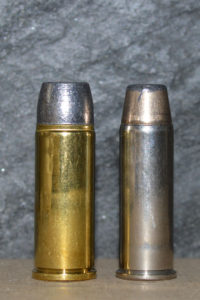
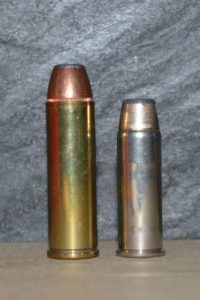
There are three notable cartridges in the .475-inch diameter category — the .480 Ruger, .475 Linebaugh and the .475 Maximum or Linebaugh Long. The progenitor of all three of these cartridges is the .475 Linebaugh, which spawned both the shorter .480 Ruger and the longer .475 Maximum. John Linebaugh is responsible for bringing his namesake .475 into this world by cutting the .45-70 Government down to 1.4 inches and necking the case to .476 inches. This caliber category is serious big-game medicine and represents a significant step up in terminal effectiveness from the various .45-calibers.
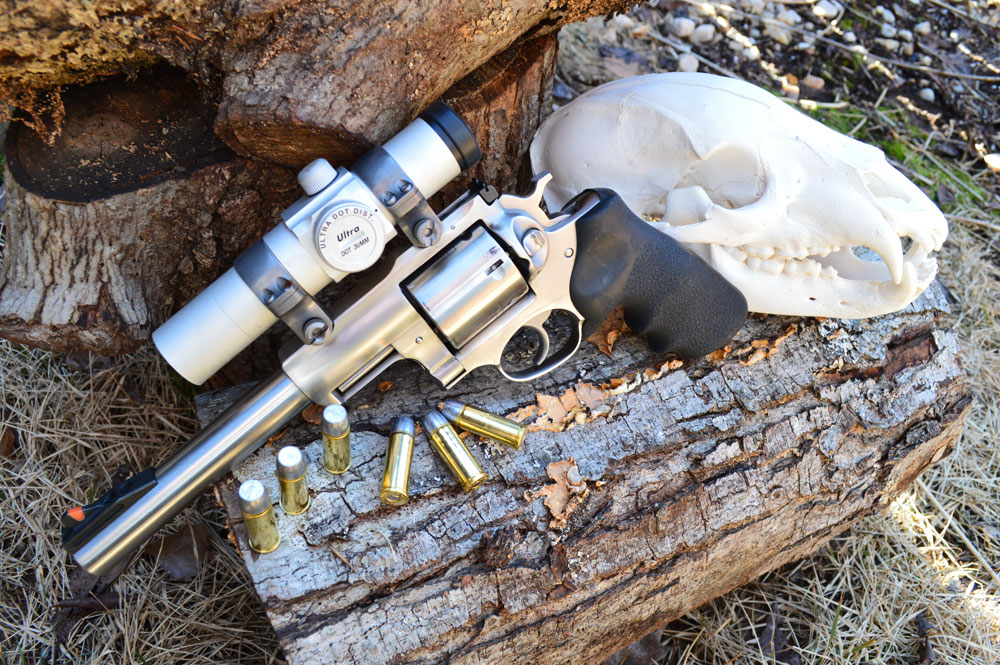
.480 Ruger The .480 Ruger is, essentially, a shortened .475 Linebaugh. The first loads offered to the public did not show the true potential of the cartridge, featuring relatively light-for-caliber bullets at moderate velocities. It was also overshadowed by the aggressive marketing of the .500 S&W Magnum and later the .460 S&W Magnum. To that end, it never really stood a chance, as it could not boast being the biggest or the fastest. What Sturm, Ruger & Company did create, though, is a relatively mild recoiling and effective round that, in my opinion, is one of the better all-around choices for the big-game handgun hunter.
Released in conjunction with the Super Redhawk chambered in this caliber, the revolver was a good platform from which to debut the new round bearing the Ruger name on its head stamp. Recoil, while expectedly stout, still pales next to the .454 Casull loaded to spec, even though the .480 boasts a larger diameter. The .480 can be loaded close to the levels of the .475 Linebaugh but cannot achieve the higher velocities. Don’t let that fool you into thinking the .480 Ruger isn’t a serious cartridge. There is no game animal walking this planet that the .480 Ruger cannot comfortably take when loaded appropriately for the task at hand. Loaded to SAAMI specification pressure of just under 48,000 psi, only 2,000 psi separates the .480 Ruger from the .475 Linebaugh.
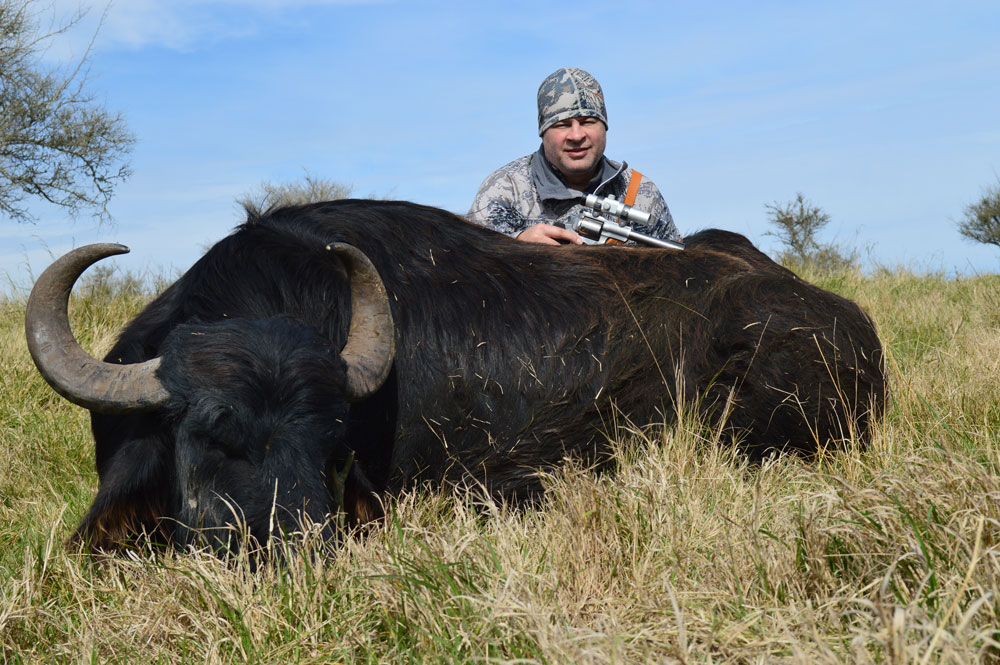
The .480 Ruger took down this water buffalo in Argentina.
I like this round. Even when loaded with heavy bullets — 400 grains and beyond — the impulse is mild and creates more of a push than a sharp jab. Start pushing similarly weighted bullets up over 1,300 fps, though, and this is where the party starts. Plus, all factory revolver offerings in .480 Ruger are of sufficient bulk to tame even the hottest .480 loads. As a milder version of the .475 Linebaugh, what’s not to like? This is a great choice if you want big-bore knockdown power without debilitating recoil, all in a very controllable package.
I have a long relationship and history with the .480 Ruger that began in 2001 with the release of the new cartridge in the Ruger Super Redhawk. I was intrigued with the new chambering in the big, gray revolver and had to have it when I first laid eyes on it. With factory loads, that revolver proved very accurate. I took a number of Florida wild hogs with it and, thinking I needed more horsepower, eventually had it fitted with a five-shot cylinder in .475 Linebaugh. In that configuration I took a lot of big game. I tested a couple more .480 Super Redhawks over the years and was among the first to test the new Super Blackhawk in .480 Ruger, putting nearly 5,000 rounds downrange in testing. Long live the .480 Ruger!
.475 Linebaugh A personal favorite of mine, the .475 Linebaugh was unleashed on an unsuspecting handgun world in 1988 by John Linebaugh. The original parent case of the then-wildcat was the .45-70 Government cut down to 1.4 inches with a .476-caliber bullet. This cartridge is truly serious and has taken the largest and most dangerous game that Africa and the rest of the world has to offer, cementing its position in the realm of big-game hunting cartridges.
In its first iteration, it pushed a 400- to 420-grain bullet to speeds up to 1,400 fps. The recoil is stout by anyone’s standards. This is not a cartridge for the uninitiated, as it kicks on both ends.
Ross Seyfried first wrote about the .475 Linebaugh in the pages of the May 1988 issue of Guns & Ammo magazine. The article was appropriately dubbed, “.475 Monster Magnum … The ‘Outer-Limit’ Handgun.” If that article hadn’t gotten your blood pumping, he followed it up with an essay called “.475 Revolver Down Under” in the December 1989 issue of the same publication. In this article, Seyfried succinctly stated, “The .475 revolver cartridge was designed to be the ultimate big-game round for use in handguns. It represents a monumental step up from the .44s and a considerable increase in horsepower over any of the .45-caliber cartridges. This combination of long, heavy bullets and moderately high velocity makes even the highly touted .454 Casull seem small and ineffective.”
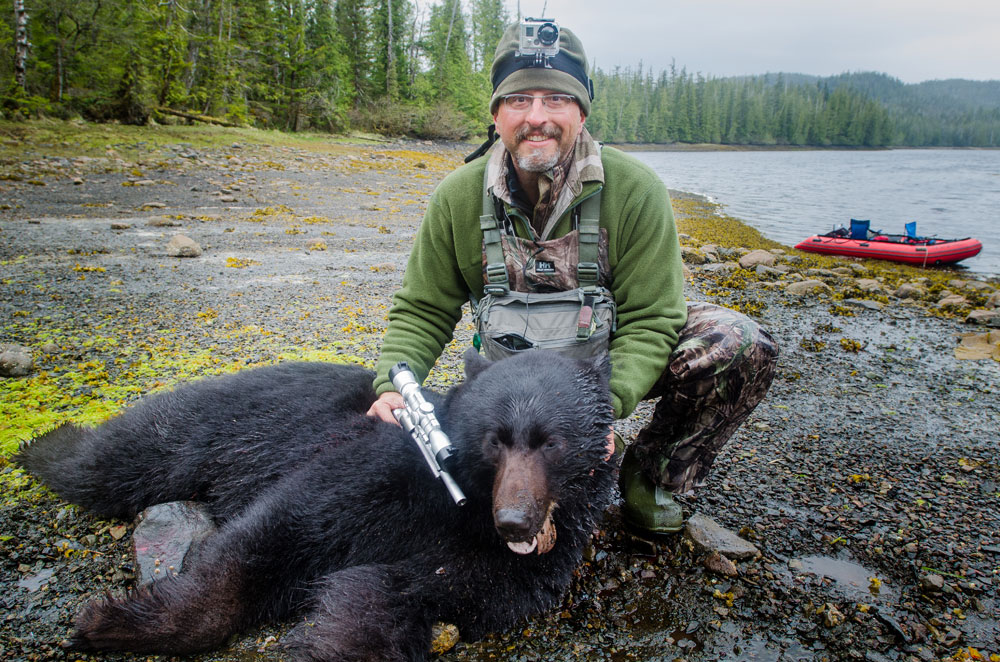
A .475 Linebaugh dropped this bruin in Alaska.
Seyfried then proceeded to knock down all kinds of big game in Australia with a John Linebaugh-built Ruger Bisley .475, including feral goats, pigs, donkeys, wild cattle and even an Indian water buffalo. Seyfried’s first shot on the water buffalo resulted in two broken front shoulders. The effectiveness of the cartridge on big game cannot be argued. The .475 Linebaugh represents a standard by which all big-game revolver hunting cartridges are measured.
Brass is readily available for handloading from two sources, Hornady and Starline. Loaded ammunition is available from a number of sources, including Hornady, Buffalo Bore and Grizzly Cartridge Company.
.475 Maximum or Linebaugh Long The January 1991 issue of Guns & Ammo magazine introduced big-bore handgun nuts to the .475 Maximum, and its bigger brother, the .500 Maximum. Ross Seyfried was once again responsible for the exposure, having thoroughly tested the cartridge in a John Linebaugh-built revolver. Also known as the .475 Linebaugh Long, this round is merely a .475 Linebaugh lengthened 0.2 inches to 1.6 inches. The extra length ensured the new round was able to achieve velocities somewhere around 150 fps more than its shorter counterpart while maintaining similar pressures.
The .475 Maximum never really caught on, as the discomfort it created when shooting never outweighed the performance gains that could be realized. Seyfried’s penetration testing revealed that little more is gained by running higher velocities, and that those higher velocities may actually compromise the bullet’s integrity. That said, if loaded to .475 Linebaugh (the 1.4-inch case) velocity levels, the resulting lower pressures make for a more reliable cartridge in extreme heat — a definite plus when hunting Africa or other hot climes.
Despite all of the above, another .357 Maximum I procured a couple of years ago is being converted to .475 Maximum as this book goes to print. Is the extra horsepower a necessity? Nope, but when does need ever play into custom revolver builds?
A note for reloaders. Brass at one time was produced by Hornady for the .475 Maximum, but this is a used market item now. This is a custom revolver proposition only that requires a longer frame like that of Ruger’s only limited-edition .357 Maximum of the early 1980s.
If price is no object, you can’t do much better than these large-caliber dream guns for dangerous game hunting.
I was raised in a household where money was tight; we never did without, nor were we unhappy, but there was little money for frivolity. My mother had, and still has, the ability to stroll into a nearly new shop and come out with head held high, looking like one of the classiest ladies I’ve ever seen. As it translated into the hunting facet of our lives, firearms were meat-getters; my father – Ol’ Grumpy Pants – had a meager assortment of guns, each with their designated purpose, and he views a gun in the same manner today. “They’re bullet launchers,” he quips, in that stern voice that commands attention in any room, “you take any one of those ‘fancy-wood’ rifles and I’ll put it up against my Mossberg 100A .308 Winchester. I’ll kill anything they will.” He’s not wrong, and I still wouldn’t want to be within 500 yards of the old man with that rifle in hand.
However, I’d secretly peruse whatever hunting magazines we had around, wide eyed and soaking it all in like a dry sponge. I remember the advertisement, where an investor would part with a sum of money and receive a Weatherby Mark V, all shiny with the white-line spacers, and I’d stare in wonder at the possibilities of holding such a firearm in my hands one day. I was a sucker for the Remington catalog, spending my time investigating the different model numbers and available calibers, slowly piecing the puzzle together regarding the various available calibers and their applications. That curiosity, coupled with a half-million questions hurled at GP, was the germination of a lifelong love of firearms and cartridges – and adulthood focused on hunting abroad.
As a younger man, I’d save for years sometimes to buy a rifle, and they became very dear to me, though GP insisted I was foolish for having “all those damned different calibers, when all you need is a good .308.” Sorry Pop, I’m hooked and no hay remedio.
Now, I’m by no means independently wealthy, nor am I a rifle snob – those guns I saved so long for still have a place in my heart and get used often – but as a gunwriter, I have had the opportunity to be exposed to some of the finest firearms available to mortal men. I’ve been blessed enough to become friends with some of the biggest hitters in the firearms industry; and I’m lucky enough to call guys like Chris Sells from HeymUSA, as well as Marc Newton and Simon Barr from John Rigby & Co., my friends as well as business associates.
I’m happy to report that my daydream fuel has become more refined since I was that young man staring at a Weatherby advert; and I’ll also confess having whetted my appetite for fine rifles. So, I thought it’d be fun to do a piece on those big-bore guns that fuel daydreams.
This is in no way disrespectful to the common firearms we all use, but as a fun piece – eye candy, if you will. I’ve had the privilege of shooting, and even hunting with some of these guns; others remain an enigma, and a personal goal for me. Let’s begin the tour of some dream guns.
Bolt-Action Rifles While some insist that the magazine rifle lacks the pedigree and luster of the double rifle, there’s no denying that they are much more affordable and accessible than a double. Yes, it’s true that there’s no faster second shot than a double rifle, but there’s no faster third shot than a turnbolt. And while the modern trends of weatherproof coatings and synthetic stocks hold a firm grip in today’s market, holding a finely crafted bolt gun, stocked in fine walnut and blued to a warm hue is a lovely experience. Generally speaking, the bolt-action rifles are considerably cheaper in comparison to the doubles, but they can still command a high price and raise the eyebrows of any connoisseur of firearms.
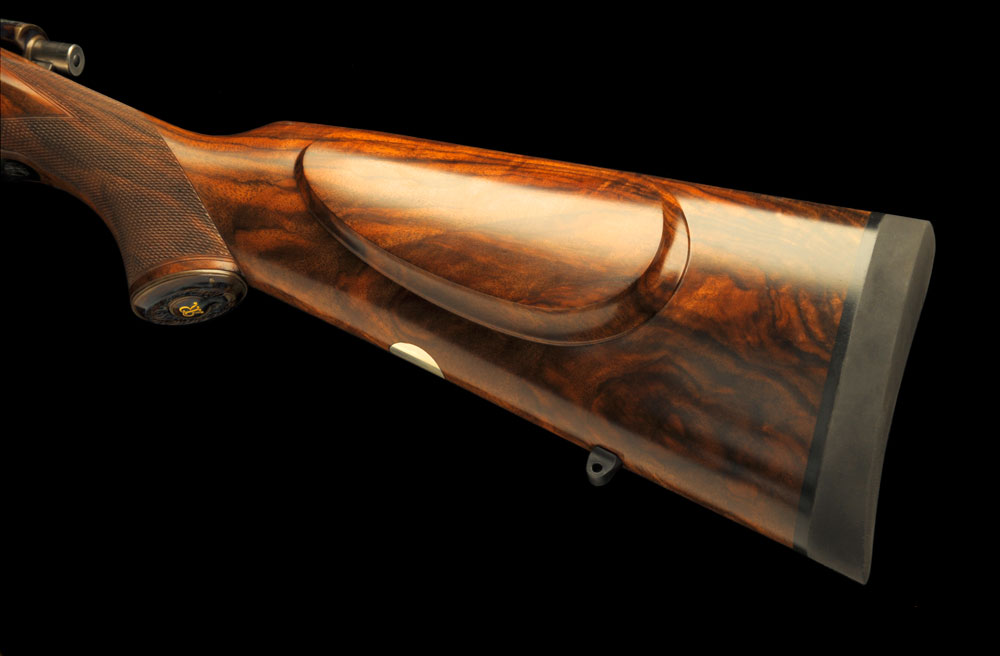
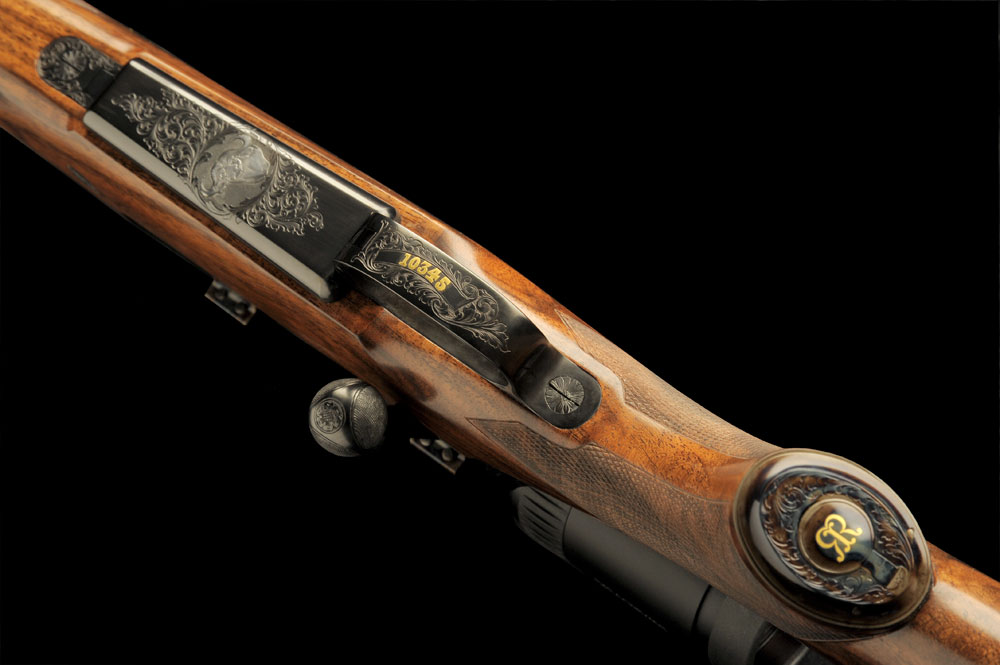
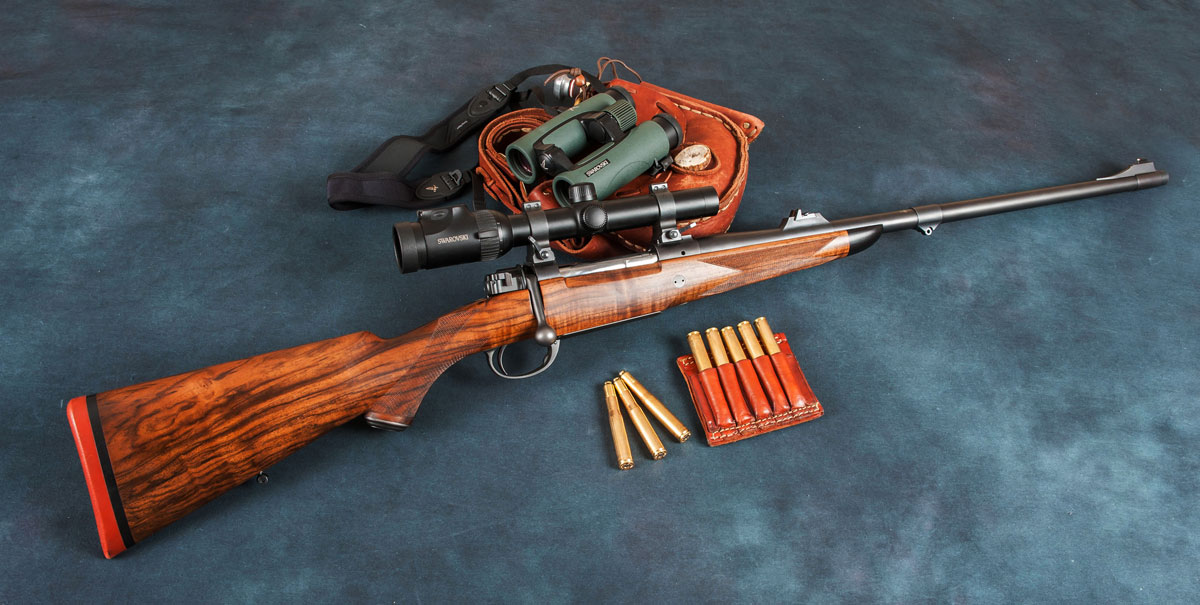
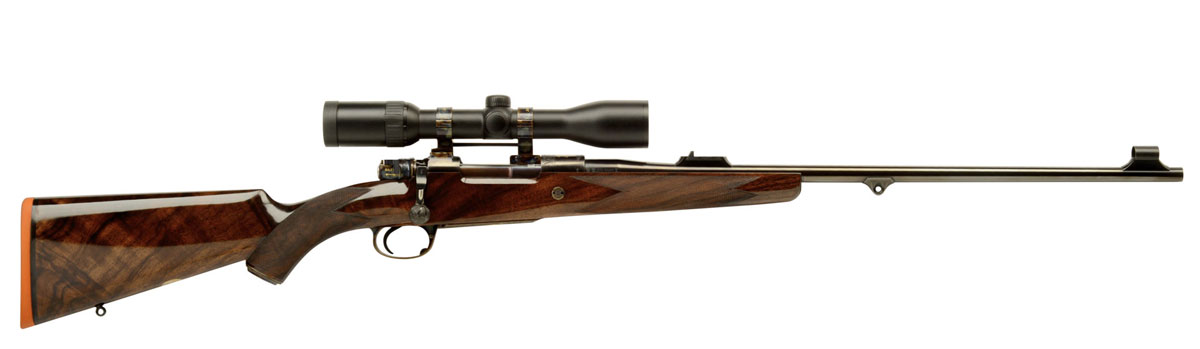
9. The Heym Express by Martini I love bolt guns. Bolt guns of all shape and size, color and pedigree, caliber and configuration. Of all the big-bore bolt guns I’ve ever owned, shot or handled, this one is far and away my favorite. The Express uses a proprietary action and magazine individually designed for each particular cartridge, combined with a hammer-forged Krupp steel barrel for an utterly reliable package. The stock is another wonder by Ralf Martini – I’d say he truly knows his way around a piece of walnut – and has the styling of the classic British rifles; open pistol grip, slender, tapering forend, geometry perfect for keeping the rifle weight between the hands. A bold front bead nestles quickly and easily in the wide safari ‘V’ sight, which is regulated for 50 yards, with a complimentary flip-up 100-yard rear sight. My own Express is chambered in .404 Jeffery, and feeds and extracts like a dream. This rifle has taken elephant and buffalo, in addition to several plains game species at a variety of ranges. The Express bolt is one of the toughest available, being larger in diameter than the Mauser or even the Brevex, having a diameter of 0.780 inch. Like the Model 89B double gun, the German engineering and British styling are mated in such a manner as to make an instant classic. Appointments like a straight bolt handle; oversized trigger guard; and proper red recoil pad, combined with a three-position safety make this a high-end, very use-able rifle that will make the owner proud for a lifetime. If I had to choose one rifle from my collection, to spend the rest of my days with, it’d be the Express .404; it fits me like a damned glove. The Express starts at just under $10,000.00 and the price goes upward, depending on which level of color case hardening and engraving you choose.
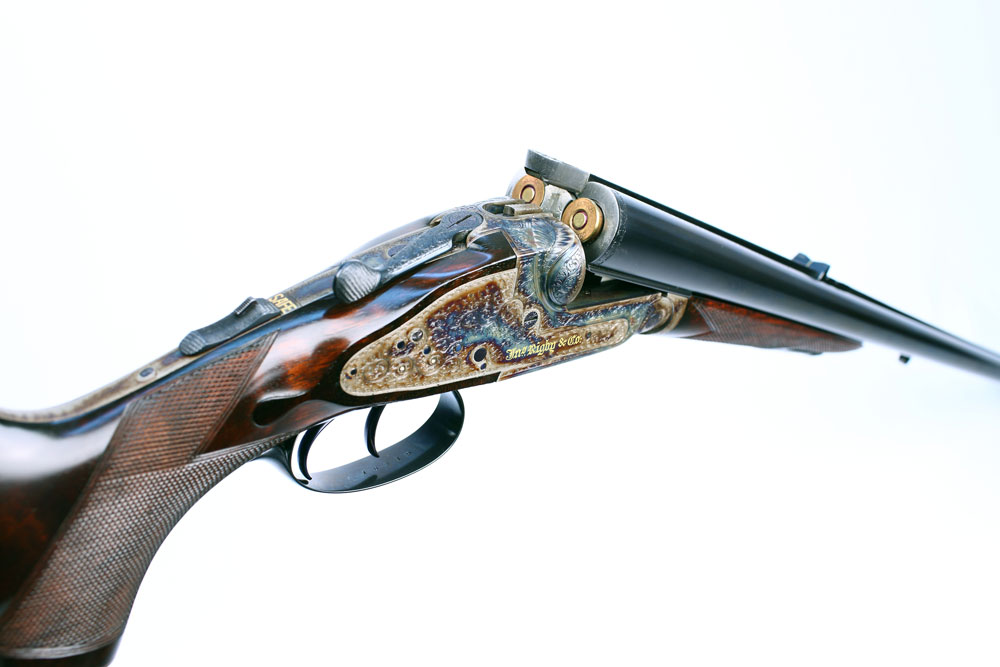
8. The Rigby Big Game Rifle If you enjoy big-bore rifles, I’m certain you’re familiar with the reputation of the .416 Rigby, made famous in what may be the best safari book ever written: Robert Ruark’s “Horn of the Hunter.” During the original run of Rigby’s .416 rifles – from 1912 to the Second World War – less than 200 were produced, but Ruark’s book and the writing of John “Pondoro” Taylor made the cartridge’s reputation. Upon Rigby’s recent return to London, they proudly announced the return of the Rigby .416 in its Rigby Big Game rifle. Returning to the classic configuration of a Mauser Magnum barreled action, finely stocked and available in either single square bridge or double square bridge configuration, the Rigby Big Game rifle is a throwback to the classic Rigby rifles of the early 20th century. Rather than the flag safety of the elder Mauser actions, the Rigby Big Game is fitted with a horizontal, three-position safety in the fashion of the Winchester 70. While even the base models are an attractive looking affair, the higher-end Rigby Big Game is available with appointments that will stun. Color-case hardening, gold inlay, pristine engraving and gorgeous furniture are all available, driving the base model price of around $14,000.00 up to a hefty sum of $36,000.00. I’ve had the pleasure of shooting the Rigby Big Game – you can check the John Rigby & Co. Facebook page for a video of Simon Barr and Yours Truly at the SHOT Show – and I can report that it’s both accurate and pleasant to shoot. Holding a rifle of this pedigree is an awesome opportunity, and I now understand why Harry Selby swore by his Rigby for so many decades.
7. The Westley Richards Bolt-Action Westley Richards offers a fully bespoke rifle experience, where you may choose your options in a fine British turnbolt. If you haven’t had the chance to take a look at the bolt guns that Westley is producing, you really need to hop on over to the website for some serious drool fuel. Of course, I’d want mine in a .318 Westley Richards takedown, which is only second to choosing the .425 Westley Richards – a big game gem in its own right – with the extended trigger tang and, of course, a gold oval with my initials in it. I’d need an island sight with one fixed, wide ‘V’, and a flip-up sight for further distances, and removable scope rings, and of course the WR patented flip-up, engraved, hooded front sight. All told, my theoretical bill totaled just under $45,000.00 – not bad for a daydream budget.
6. The Rigby London’s Best Rifle Here Rigby offers a similar bespoke experience, allowing the customer to pick and choose from a variety of options, including caliber, stock length and wood grade, gold inlays, scroll pattern, choice of engraved animal, custom oak/leather/canvas case, and even the possibility of a takedown configuration is possible. Since we’re playing daydream here – alright, perhaps I’m a wee bit serious about it – I put my own dream rifle together on the Rigby website. I chose a classic .416 Rigby for the caliber – it seemed sacrilegious not to – and a decent grade of wood, and a few of the gold inlays, some color case hardening on the rings, receiver and floor plate, and of course a classy case. I tossed in the peep sight on the cocking piece, and tallied up the total figure; it was just north of $55,000.00. Hey, if you’re going to dream, dream big, right?
Double Rifles Nothing screams “adventure” to me as much as a finely crafted double rifle. Images of early 20th century explorers and ivory-hunters, with big-bore double over their shoulders, were some of the most inspiring to me. They’re not cheap, and they have little opportunity to be used to the fullest extent here in the States, but they sure are cool!
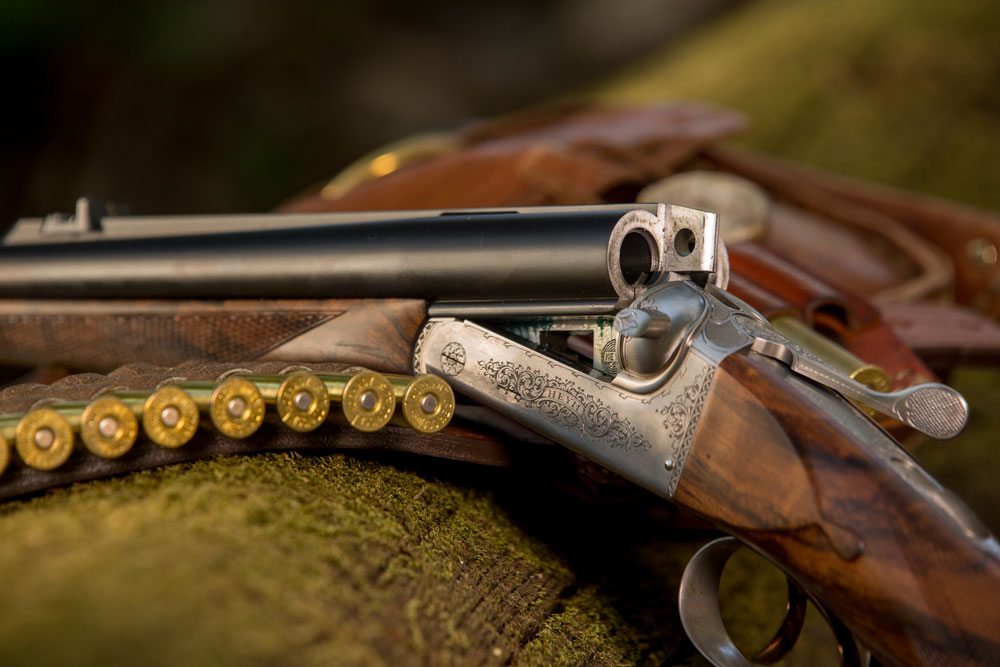
5. The Heym Model 89B Perhaps the youngest of the classic gun makers, Heym – founded in 1865 – has made quite a splash among the Professional Hunters with its Model 88B. It’s a sound design, and as it was offered in a very plain configuration, it became very appealing to those on a budget. The 88B is a good rifle, though perhaps a bit blocky in the hand. Taking comments in stride from many users, Heym took a look at many of the classic double rifles of the early 20th century, and incorporated those details into the Model 89B. Using the talents of stockmaker Ralf Martini to redesign the 88B’s stock – opening the pistol grip and generally trimming down the overall shape – the 89B is a rounded action boxlock, with a solid crossbolt, and lighter barrel contour, for near perfect balance. This is one double rifle I can attest to having spent a good amount of time with; I was lucky enough to be the first hunter to take the gun to Africa. Chambered in the classic .450/400 3” NE, the 89B cleanly took an old Cape buffalo bull in Mozambique’s Coutada 11, on a classic hunt in the forest/savannah, and carried and shot like a dream. Heym is offering the 89B in three different grades of engraving, with the option of color case hardening. Though I have handled double rifles with much more expensive price tags, the Heym 89B gives the features and feel of the classic British guns of a century ago, with the benefit of modern steel and impeccable German engineering. Prices start at $23,000.00
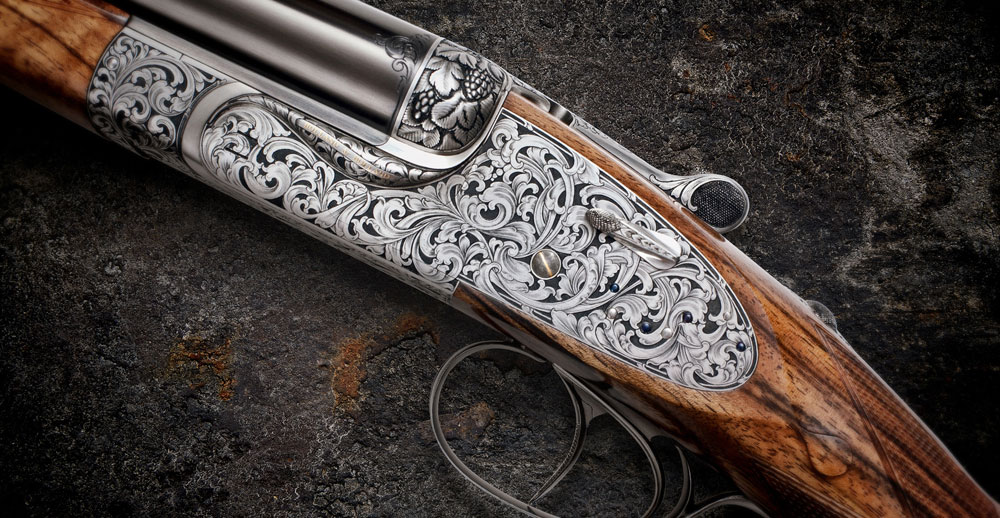
4. The Westley Richards Droplock The writings of Ernest Hemingway and Captain Jimmy Sutherland evoke images of wild Africa and a Westley Richards double. Both of these gentlemen carried .577 NE doubles, and while I’ve seen but not held Papa’s gun, I don’t know what became of Sutherland’s. Westley Richards is still going strong, and if you’re well heeled enough, you can order a brand new droplock, stocked to fit your frame. Mind you, Westley Richards is not just a name – though the pedigree is impeccable – the shop is a true, bespoke rifle factory. Over 600 hours of work is poured into each rifle, so I feel comfortable saying that they are a custom affair. With a hand detachable sidelock, spare front beads and strikers, a Westley Richards double should be at the top of anyone’s just-won-the-lottery list. It’s available with engraving that would make Michelangelo blush. Prices start at about $85,000.00.
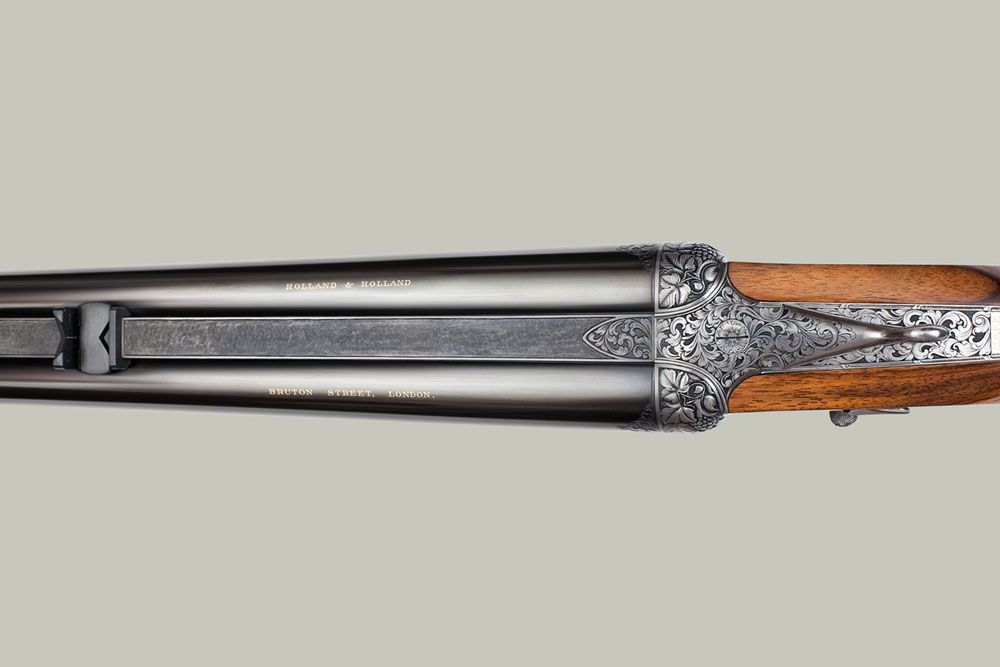
3. The Holland & Holland Royal The simple mention of the words Holland & Holland evokes images of the heyday of the British Empire, with Dukes and Princes visiting their colonies as sportsmen, with fine steel and walnut in hand. Though famous today for the development of such gems as the .375 Holland & Holland Belted Magnum – the very staple of African shooting – and the Super .30, or .300 H&H, the guns of Holland & Holland, dating back to 1835, were and are nothing shy of spectacular. The Holland & Holland Royal double rifle is the flagship of the fleet, giving a sportsman both rock solid reliability and a level of elegance that ranks among the finest ever produced. While many famous hunters have embraced the H&H Royal, among the most famous is the .500/450 3¼” presented to former U.S. President Theodore Roosevelt for his 1909-1910 safari chronicled in African Game Trails. Chief among the presenters was a Mr. E.N. Buxton, and among those who were part of the gift were none other than elephant hunter F.C. Selous and Lt.-Col. John Henry Patterson, famous for killing the Man Eaters of Tsavo. The Royal is still in production today, and one can have a rifle made to order. I’ll quote Teddy: “I do not believe there is any better weapon for heavy game.” The price of an H&H Royal is into six-figures, with used models selling for as much as $90,000.00. Owning a Holland & Holland Royal is owning a piece of history, and hunting with one is a dream come true.
2. The Purdey Double Among the fine British rifle makers, the name of Purdey ranks high, and with good reason: A Purdey double rifle is among the prettiest you’ll ever see. Founded in 1814, the Purdey name accompanied many of the British sportsmen into the wilds of Africa and India during the heyday of safari and shikar. Beside the fact that James Purdey the Younger coined the phrase “Express Rifle” – in deference to the power and speed of an express train – Purdey is still up and running, making excellent rifles. They come with all the proper appointments: choice of splinter or beaver-tail forend, pistol grip cap with trap-door compartment, fine rose and scroll engraving, extended bottom and top strap, et cetera. Available in .375, .470 NE, .500 NE and the behemoth .600 NE – each on an appropriate action size – the Purdey double is definitely a once-in-a-lifetime firearm. Equally famous for their high-end shotguns, if a Purdey double rifle doesn’t speak volumes to you, you may need to check your pulse.
1. The Rigby Rising Bite Double Rifle John Rigby & Co. has a long and triumphant history, and though it’s gone through a number of recent ownership changes since opening in 1775 – including a trip to America and back across the pond – it’s back in London, where it belongs. With the return to London, came the return of some of the classic rifles, like the famous Rising Bite double. Technically speaking, a rising bite action is difficult and costly to produce, and Rigby ceased standard production in 1910, offering the rifle as a custom shop option until 1932. Upon Rigby’s return to London, a pristine 1902 model – previously presented to an Indian Maharana – was obtained and used as the model to develop the new version. Rigby’s re-release of the Rising Bite is a good thing, as it resurrects a piece of firearms history, and if you are looking for a truly collectable rifle, this may be your baby. The original was produced in .470 NE, but the Rising Bite is now also available in .416 Rigby, .450 NE, .500 NE, .577 NE and .600 NE. Engraving for the color-case hardened Rising Bite is masterfully done by Roland Baptiste of Belgium, giving the perfect amount of class to the already classic configuration. Prices begin at $118,000.00, according to the latest exchange rate.
Now, I realize that not everyone is rushing out to order a rifle that costs well into the five, or in the lower six figures, but it sure is fun to daydream about walking off into the African savannah with just such a finely crafted firearm over your shoulder, isn’t it? Perhaps I’ll see you in the line for the MegaMillions tickets…
There is one sure-fire way to get plinkers’ eyes to light up — tell them there’s .22 ammo available.
Drought-like conditions in the rimfire end of the market in recent years have left many .22 aficionados at the razor’s edge. Thankfully, slowly but surely, this dearth of the world’s favorite rifle round has eased up in many parts of the country lately. On top of that, a good number of companies have expanded their .22 offerings, giving all varieties of rimfire shooters more options in their quest to poke holes through everything from soda cans to squirrels.
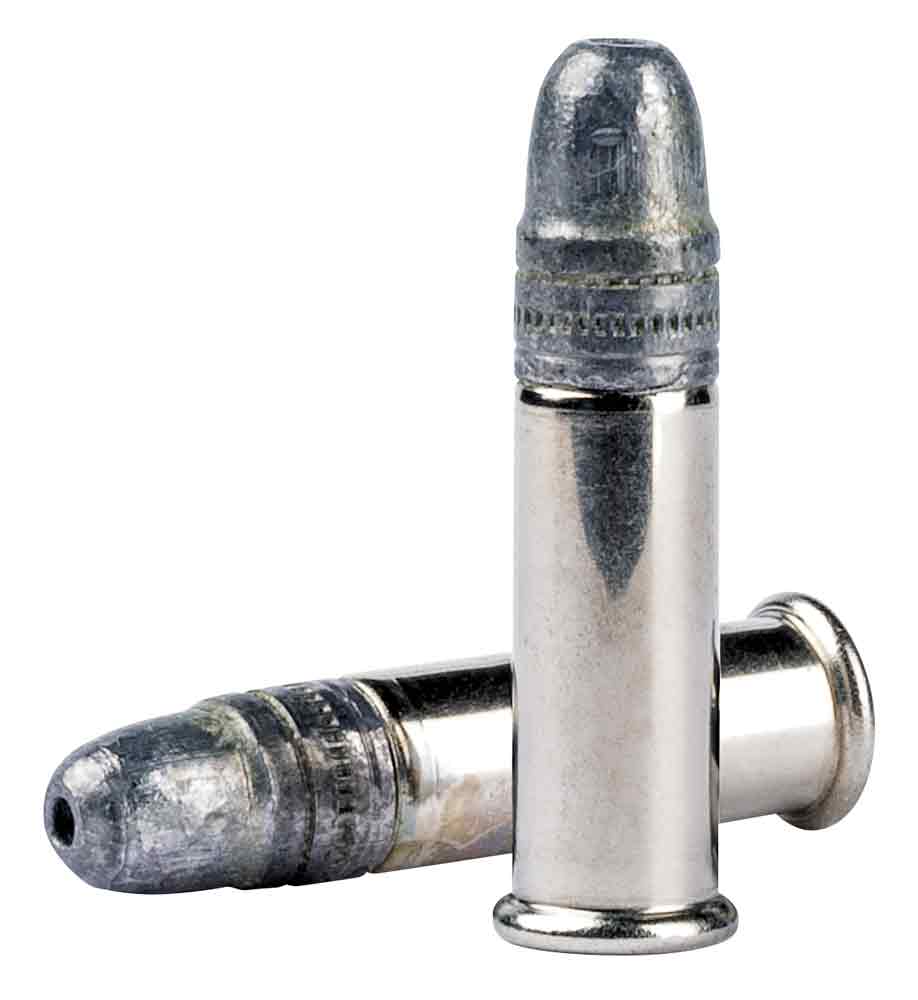
Federal Premium Ammunition recently expanded its extensive rimfire catalog with what appears to be a real firecracker. The Hunter Match .22 LR ammunition has the velocity and projectile to make it a lethal field round.
Specially designed to take small game and varmints, the round launches its 40-grain bullet at 1,200 fps and offers 128 ft-lbs. of energy at the muzzle. This is enough velocity and energy to ensure the hollow point Match bullet achieves maximum penetration and expansion out to 100 yards. To boot, the high-velocity .22’s case is nickel-plated, which should give shooters the peace of mind that it will extract reliably and resist corrosion.
The Federal Hunter Match will be available in 500-count and 50-count packages. No MSRP was available for the larger batches at writing, but the price on the 50-count packages is $7.95.
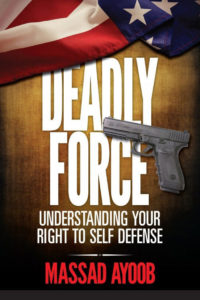
The world’s most authoritative expert on all aspects of self-defense, Massad Ayoob’s Deadly Force is a must for anyone who carries concealed.
Never forget that when you shoot someone, however necessarily and justifiably, you look an awful lot like a killer and he looks an awful lot like a victim. The stereotype can take hold quickly if you don’t act to let the authorities – from the first responding officer to the designated lead investigator – know what happened. The old saying “You only get one chance to make a first impression” is absolutely true here.
Decades ago, I developed a five-point checklist of things I feel the righteous shooter needs to establish as soon as possible in the aftermath. It has been widely adopted, sometimes with attribution and sometimes without, and is now recommended by entities ranging from the Armed Citizens Legal Defense Network to the US Concealed Carry Association. I’m rather proud of that. Five-Point Checklist
Establish the active dynamic. That is, let the authorities know immediately what happened here. If you have harmed someone in self-defense, always remember that the active dynamic is not what you did to him, it’s what he was trying to do to you or another victim. The active dynamic is his action that forced your lawful response. It’s not, “I shot him.” It’s, “This man tried to kill me.” Or, “This man attacked my wife.” Whatever it was that led to your use of force.This makes it clear that the guy on the ground doing a convincing imitation of a victim is in fact the criminal perpetrator. It makes it clear that you, the person with the smoking gun who just shot someone, are in fact the intended victim. If one or more of your attackers has left the scene, explain that now, and give their description. It’s going to be hard for people to see you as the innocent party if you failed to let police know that a violent criminal was at large.
Advise the police that you will sign the complaint. There are two roles open in this particular play: victim and perpetrator. As noted, appearances can create mistaken role reversal if things aren’t immediately clarified. By making a statement to the police to the effect of “I will sign the complaint,” you reinforce the fact that you are the victim-complainant, the good guy or gal, and the person you’re signing the complaint on is the bad guy who forced you to harm him in legitimate defense of self or others. (Note: I would not advise using the phrase “I will press charges.” The reason is that legal terminology varies slightly jurisdiction to jurisdiction. While in many jurisdictions it is indeed the complainant who presses charges, there are some places where the local terminology is such that the prosecutor “presses charges.” If you inadvertently find yourself in one of those places and say “I will press charges,” it sounds to the police as if you have delusions of being the elected chief prosecutor, and you won’t be off to a good start. “I will sign the complaint” is neutral and universal.)
Point out the evidence. The scene will be chaotic. Witnesses will be trampling the scene. So will paramedics and police officers. I’ve seen cases of the bad guy’s gun being picked up by his accomplice or by a well-meaning neighbor who didn’t want to leave it where a child could find it. I’ve seen spent casings kicked away from their original resting place, or picked up in the treads of emergency personnel’s boots or the wheels of an ambulance gurney, thus altering the dimensions of the shooting scene and making it look like something it wasn’t. The sooner you point out the evidence to the first responding officers, the more likely it is to be secured. When you’ve done the right thing, evidence helps you.
Point out the witnesses. Witnesses worry about having to lose time from work to testify in court, or being the target for vengeance by criminals. A lot of them “don’t want to get involved.” Once they leave the scene unidentified, their testimony that would have helped to prove your innocence leaves with them. Point out the witnesses to the police at the first opportunity. (Some have asked, “What if the witness is a friend of the attacker and lies about what happened?” The fact is, he was going to do that anyway, so you haven’t lost anything. However, your having pointed him out to the police can be seen as an indication that you believed in your own innocence, or you wouldn’t have steered the police to him, and that can’t hurt.)
Politely decline further questioning until you have consulted an attorney. Studies show that, in the immediate aftermath of a life-threatening encounter, we may forget some things or get some details wrong. The questions to you will come at random as they occur to the officer, and you will answer them in the same order; in reviewing the cop’s notes and his recollection of the discussion later, this can create the false illusion that you were giving a narrative of events in the order in which they occurred, which of course is not the case. But later, when you do narrate events in the sequence of their occurrence, it creates a false perception that you have changed your story. Often, very frightening things that happened are blocked in short term memory by a subconscious that doesn’t want to recall them; when you mention something later that you didn’t mention at the scene, it sounds made up. You don’t want to answer detailed questions as to exact words spoken, distances, or time frames. None of us are human tape recorders. The tunnel vision that afflicts well over half of people caught up in something like a gunfight creates the literal optical illusion that things and people appear closer and larger than they are. If your memory tells you your attacker was six feet away when you shot him but he turns out to have been six yards away, you sound like a liar. Tachypsychia is likewise very common, the sense of things going into slow motion. It seemed to you as if the fight took a whole minute, and you say so, but a security camera shows it was actually only ten seconds, and now you look like a liar. The involved victim who had to fight for his or her very survival is the worst possible witness for measuring things in feet or inches, or counting how many shots were fired.
Experts recommend 24 to 48 hours between one of these “critical incidents,” as they are now euphemistically called in the emergency services, and when the participant is subjected to a detailed debriefing. The Force Science Institute recommends “one full sleep cycle.”
This is why my recommendation – practical advice, not legal advice – is to establish the active dynamic, indicate that you’ll sign the complaint, point out evidence and witnesses known to you…and then stop. Be polite. Do not raise your voice. I for one would answer subsequent questions with, “Officer, you’ll have my full cooperation after I’ve spoken with counsel.”
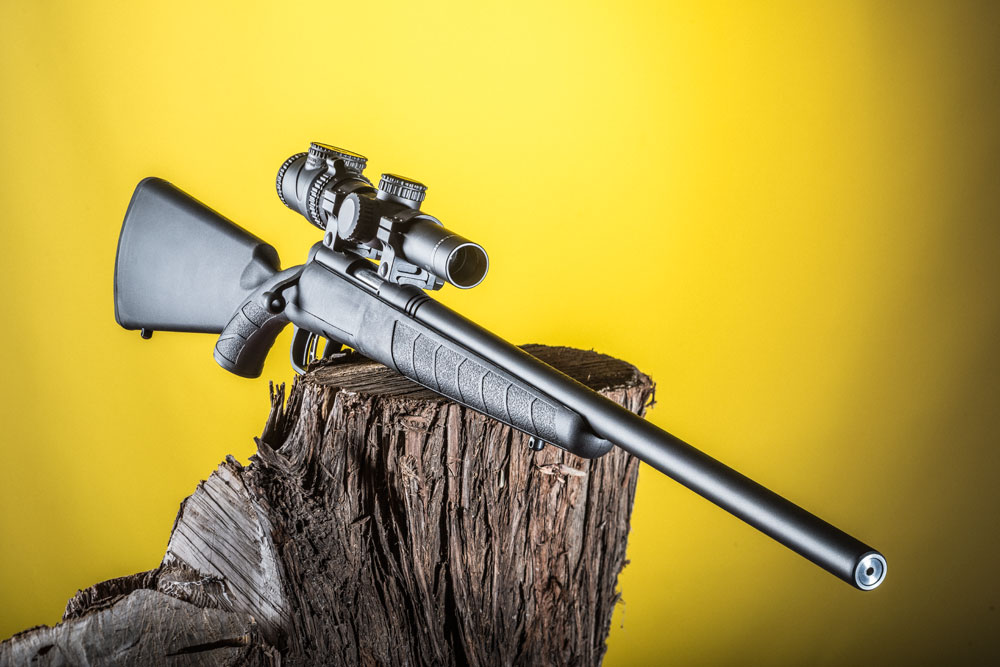
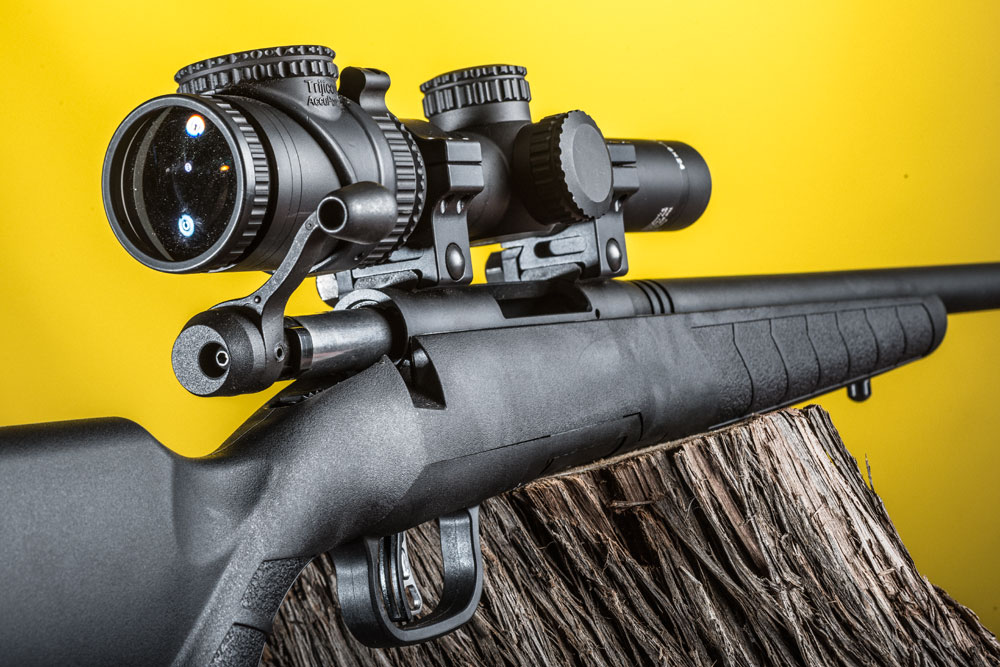
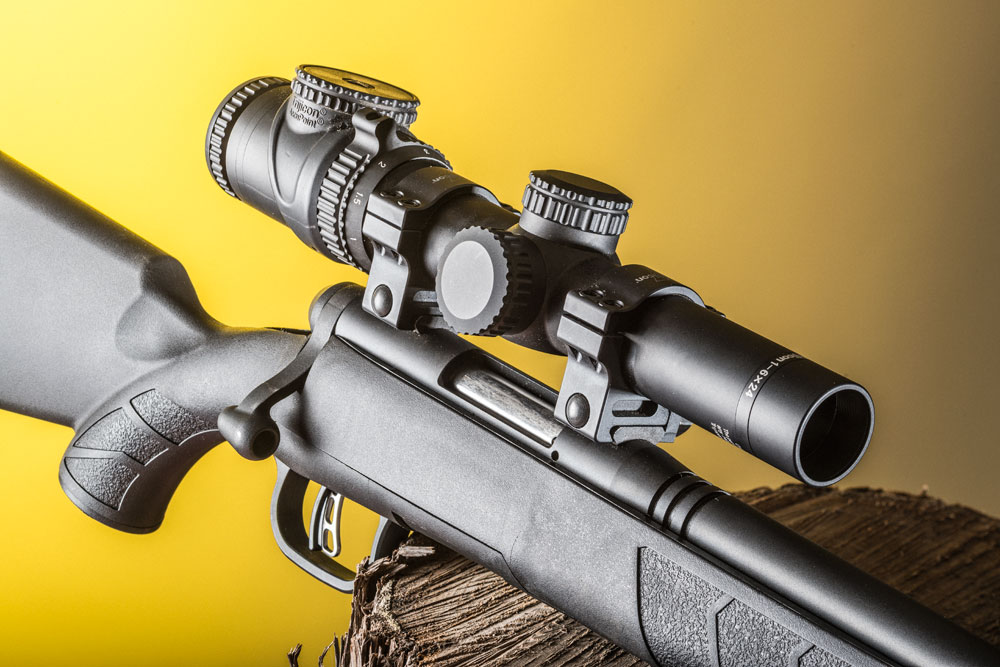
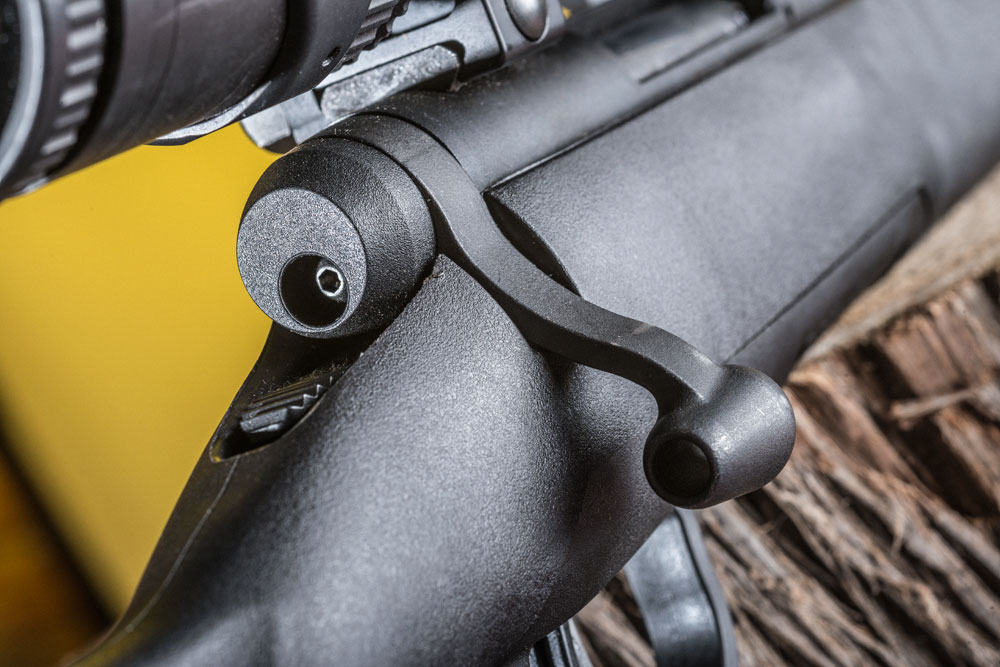
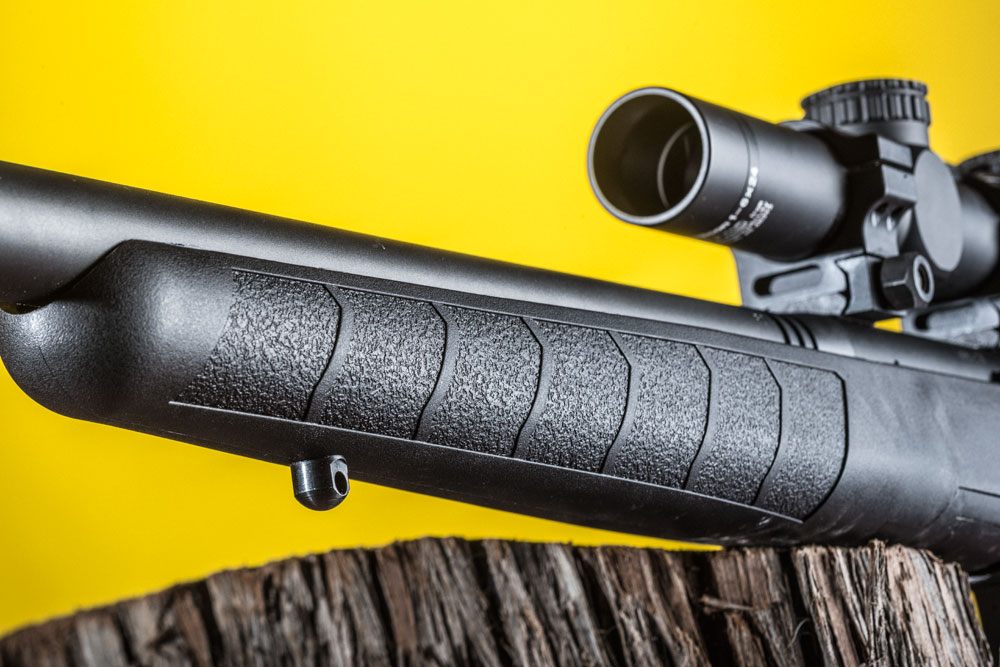
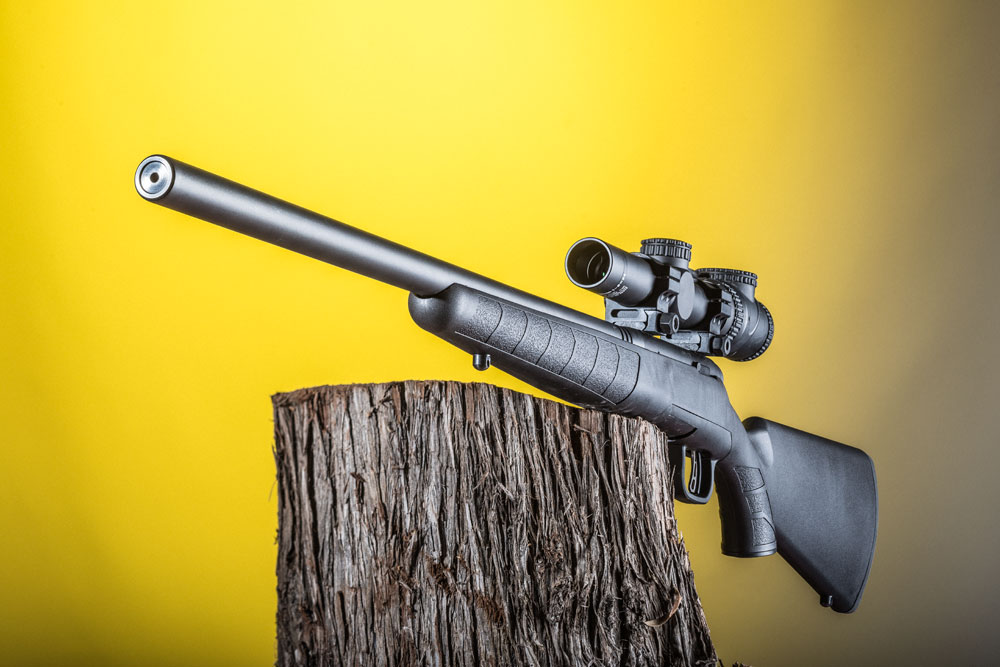
The Savage B.Mag chambered in the screaming .17 WSM is a handy little rifle that’s perfect for serious varmint slaying or plinking at the range.
There we sat, a group of gun writers perched on a rolling South Dakota hill on the Rosebud Indian Reservation, blasting away at prairie dogs with a host of new Savage rifles. The summer sun baked down on us and the barrels ran hot, but none of it was enough to deter us from slinging round after round at the hundreds of dogs scattered before us. We drank from giant, frozen jugs of ice melted in the sunlight, quenching our thirst but not our appetite for more shooting.
It was on that trip that I inherited a fondness for Savage’s new B.Mag, a bolt-action rifle chambered in .17 Winchester Super Magnum (WSM). At first glance it’s just another black, synthetic-stocked rifle, but upon closer inspection, there are plenty of features to fall in love with. Over the course of a few days spent in South Dakota, I had ample time behind the rifle, most of which was marked by the kind of hearty laughter and cackling that every experienced prairie dog shooter knows all too well.
Speed Kills
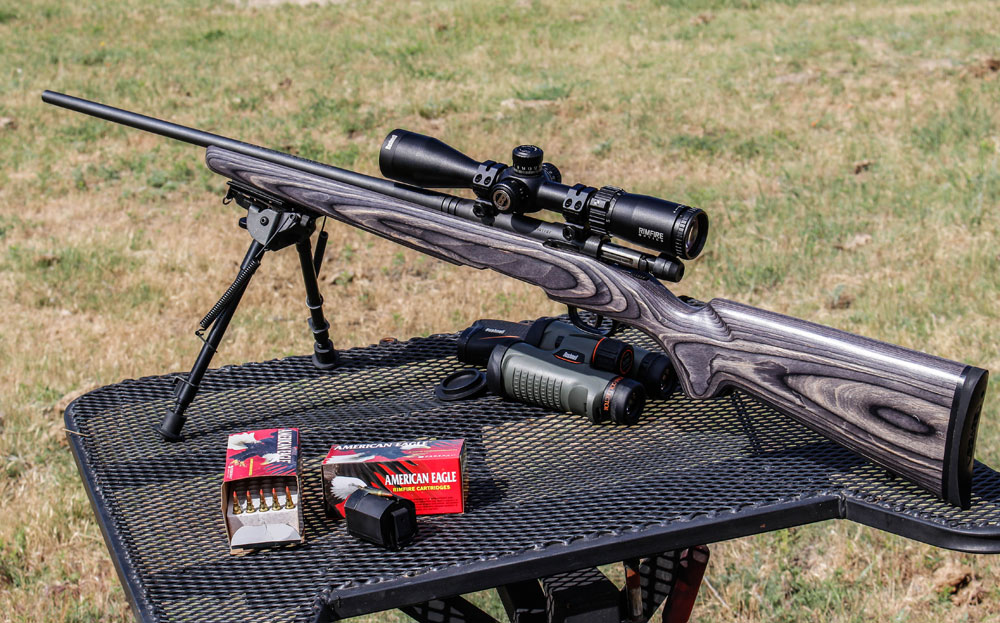
The .17 WSM, which was released in conjunction with Savage at the 2013 SHOT Show in Las Vegas, launches a 20-grain projectile at roughly 3,000 fps, an impressive feat for such a pint-sized cartridge. During the trip we shot Federal Premium’s American Eagle loads with 20-grain tipped bullets. The load performed admirably and is a good choice for a full day of blasting away, with a box of 50 rounds running about $16 at your local sporting goods store. The rifle and ammunition, not to mention the 2.5-pound AccuTrigger, made for an incredibly accurate combination.
Interestingly enough, the .17 WSM was developed from a .27-caliber nail gun blank, which was then necked down for a .17-caliber bullet. Maximum internal pressure is around 33,000 psi and roughly 7,000 psi more than the .17 HMR. The 3,000 fps velocity is about 630 fps faster than the HMR, giving you about 7.5 inches of movement in a 10 mph crosswind at 200 yards versus the HMR’s 16.5 inches. Less wind drift and bullet drop mean better accuracy at considerable range. The .17 WSM doesn’t create the kind of carnage and high-flying gymnastic moves on prairie dogs that are so common with cartridges like the .22-250 or .204 Ruger, but it’s got plenty of pop out to at least 150 yards and is still more accurate at longer ranges than the .17 HMR or .22 Magnum, both close range killers in their own right.
It also lacks the wallop of another of my favorites, the .17 Hornet, but is affordable to shoot and produces virtually no recoil. While Winchester boasts of “devastating performance” at “ranges well past 200 yards,” I found the cartridge consistently accurate and lethal out to 150 yards, especially given South Dakota’s notoriously obnoxious winds. If you’re coyote or bobcat hunting, the .17 WSM is effective out to moderate ranges and helps limit pelt damage, something everyone who’s spent evenings sowing fur can appreciate.
17 Series
The B.Mag rifle fits neatly into Savage’s 17 Series and weighs about 4.5 pounds without a scope, making it an ideal walk-around or maneuverable truck gun. With scope you’re still at less than 7 pounds, which is ideal for field carry but more susceptible to movement with the wind. To help alleviate that issue, I employed sandbags in the front and rear of the rifle atop a sturdy steel tripod-style shooting bench.
One of the most interesting features on the B.Mag is the bolt, which is a completely new design for this rifle. Savage’s engineers tailored the bolt specifically for the .17 WSM; it features dual, opposed, rear-locking lugs and it cocks on closing. The rationale is that this gives the shooter better cocking leverage against a stout firing pin spring, which is also required for reliable ignition on the rimfire. Practically, this means it’s easy to short stroke the bolt, and many times you think you’ve closed it but haven’t. The solution, which requires a bit of practice and reformed muscle memory, is to firmly push all the way forward and then close the bolt. A bit unusual and not altogether smooth, but it’s a workable design once you figure out the mechanics of it.
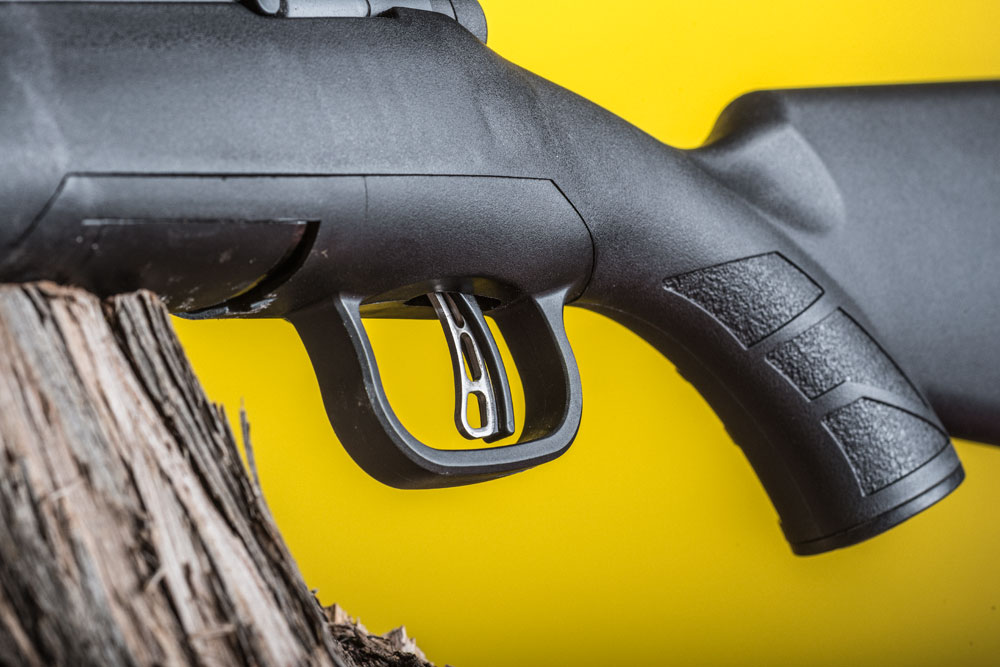
The other staple of the rifle is of course the AccuTrigger, a revolutionary design that incorporates an adjustable, finely tuned trigger into an affordable package. Out of the box, the trigger on my rifle was under 3 pounds and crisp as always.
The 22-inch barrel is button rifled and features a light contour, sporter-type barrel. A heavier barrel contour makes sense for hardcore varmint applications, an option Savage now offers in several other B.Mag packages, including blued heavy barrel, stainless heavy barrel, sporter and target models. Prices range from $379 for the standard rifle to $578 for the target model.
Field Comparisons
One of the biggest benefits of our South Dakota adventure was that we got to shoot multiple different calibers and rifles in the same conditions, everything from .17 HMR to .22-250. So how do the mighty .17s stack up? Personally, I’d rank them in this order: .17 Hornet, .17 WSM, .17 HMR. It’s not really a fair comparison, two being rimfires and the Hornet a centerfire, but it’s always fun to stir the pot.
The .17 Hornet is, in my opinion, one of the finest of the varmint cartridges around, sending a 20-grain V-Max bullet downrange at a whopping 3,650 fps. I shot the Savage rifle in .17 Hornet one afternoon until, ammo supplies starting to run low, they had to pry that rifle out of my hands. Not only is the round insanely accurate, it remains steady in the wind and relatively flat shooting out to 300 yards. Impact on prairie dogs is more similar to what you’d see from the .204 and .22-250 and again, there’s very little recoil. On the downside, Hornet ammo is about double the price of WSM, depending on which load you select.
Next, I’d rank the .17 WSM. It carries more velocity and is accurate to greater distances than the HMR, and prices on ammunition are fairly similar (depending on load). Both are effective rounds for varmint and coyote, so long as you don’t go trying to pull off a 300-yard shot in 30 mph winds. Especially inside 100 yards, the HMR is extremely effective. The main thing, as always, is knowing your own capability as a shooter, combined with your load, optic, rest and rifle pairing.
Parting Shots
For a budget-friendly rifle that’s built to last, incredibly accurate and enjoyable to shoot, Savage’s B.Mag does the trick. The .17 WSM is a highly accurate, lethal round out to 200 yards, great for varmint and coyote applications and assuredly pelt-friendly. The rifle is light (4.5 pounds) and thus great for carry afield or for shooters of smaller stature. While the bolt design takes some getting used to, it makes for a reliable platform. For well under $400 on the street, the B.Mag in .17 WSM is one of the best varmint rifles available today.
Editor’s Note: This article is an excerpt from the Spring 2017 issue of Gun Digest the Magazine.
There’s ammo, there’s good ammo, and then there’s great ammo. They all work, but some clearly work better than others. Thanks to high-quality components, carefully engineered loads and hours of testing, ammo makers have created yet another batch of high-quality ammo for hunting, plinking, precision target shooting and personal defense. Yep, there’s some great ammo for just about everyone who owns a gun and who likes to use it. After countless hours at the range and in the field, our editors and writers built this list of the best new loads this year. Whether you prefer handguns, shotguns, rimfires, ARs, bolt-action rifles or all of the above, you’ll find at least one more reason to head to your favorite gun store here.
Editor’s Note: This article originally appeared in the Winter 2016 issue of Gun Digest the Magazine.
Whether you’re a reloader, cartridge collector, or a serious firearms enthusiast, you’ll master the universe of ammunition with Cartridges of the World, 15th Edition. The most widely read reference on the topic, the book has been the go-to resource for serious firearms owners and ballisticians for years. Order Your Copy Now
Given all the shimmer, shine and performance of Kimber’s pistol catalog, it’s easy to be blinded to the company’s foundation. It’s built on a much different style of firearm.
Way back when it was “Kimber of Oregon,” the company’s focus was rifles — high-quality, sturdy-built bolt-actions. Luckily for shooters, market demands and numerous reorganizations forced the company to diversify its firearms roster, thus thrusting them to the top of the handgun market, particularly the 1911 market.
While the scrollwork, mirror finishes and downright flashy grips of Kimber’s pistols steal much of the spotlight nowadays, the company has never strayed from its original aim. Top-notch rifles still roll off the company’s assembly lines in New York and New Jersey, outfitting discerning hunters of every stripe. Kimber turned plenty of attention to this corner of its manufacturing concern this year, releasing two new rifle models and expanding the options for two of its existing classics.
Subalpine
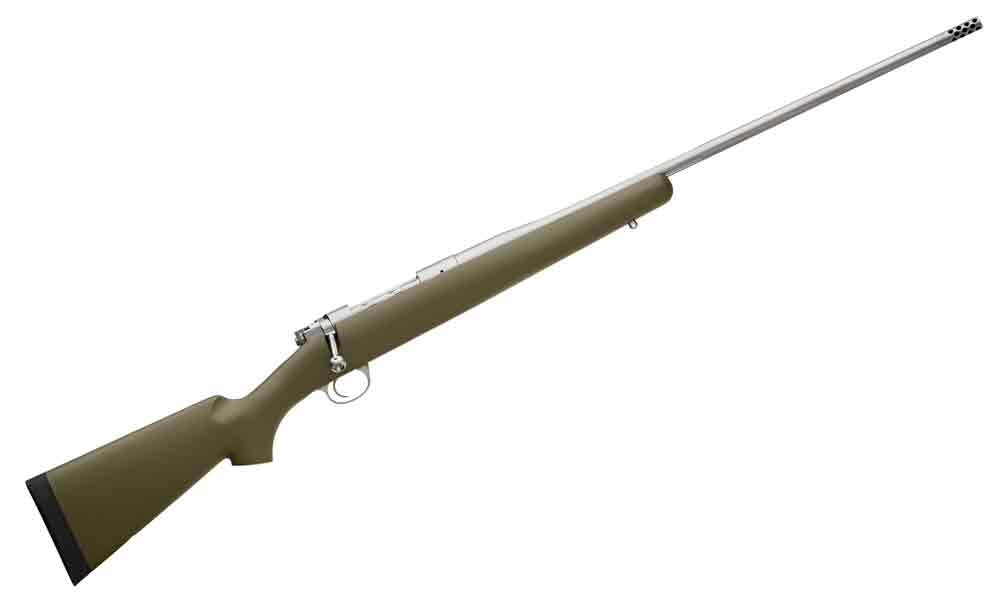
Subalpine Kimber’s Mountain Rifles had the most attention paid to them this year, but it’s the new Subalpine that has the greatest potential to turn hunters’ heads in this family. The ultra-light bolt-action fills the gap between the company’s Mountain Ascent and Montana rifles, offering mule deer and elk hunters a right-sized option. Built on a reinforced carbon fiber stock — decked out in Gore Optifade Subalpine camo — the Subalpine tips the scales at an inconspicuous 4 pounds 13 ounces. While the platform shaves off precious weight for humping into the hills, the laws of physics suggest this attribute could make it a thumper in the recoil department given some of the caliber choices. Kimber is initially offering the Subalpine in .308 Win., .280 Ack. Imp., .30-06 Spring., .300 WSM and .300 Win. Mag. Like all Kimber rifles, the Subalpine should be a favorite with traditionalists given its controlled feed Mauser-style extractor. And it appears to be ready to be put to the test with an all-weather fluted stainless steel barrel. Also, the muzzle is threaded, so it is suppressor-ready out of the box, and it comes outfitted with a match-grade adjustable trigger.
Open Country (threaded barrel not pictured).
Open Country Varmint Kimber’s Open Country rifle lives in the Varmint family, but it definitely appears to have the chops to handle more than just prairie dogs. Chambered in the highly accurate 6.5 Creedmoor, the new rifle certainly wouldn’t object to drawing a bead on the occasional pronghorn and such — especially at distance. It’s certainly configured to hike deep into the vast expanses of America’s interior, only adding a total of 6 pounds 15 ounces to a hunter’s kit. This is facilitated by the rifle’s reinforced carbon fiber stock, wearing a versatile Gore Optifade pattern forend to buttstock. The Open Country is outfitted with a 24-inch heavy stainless steel barrel, fluted to keep it light and finished with KimPro II to keep it impervious to the elements. It features pillar bedding in the stock, free floating the barrel to ensure it lives up to Kimber’s sub-MOA accuracy standard. For a modern touch, the rifle has a threaded barrel (5/8-24”), so a suppressor is no big deal to slap on. Also adding to it, like nearly all Kimbers, the Open Country comes with rifleman favorites such as a match-grade adjustable trigger and Mauser-style extractor.
Montana Rifle with new Moss Green stock.
Stocking Up Two of Kimber’s tried-and-true Mountain Rifles have expanded stock options this coming year. The Mountain Ascent and Montana rifles each are now being offered with a Moss Green reinforced carbon fiber stock. With their free-floating stainless steel barrels, the rich tones of the new stock give the rifles a striking appearance. To boot, it does not do anything to modify the already desirable specs of the long guns — both are as light as ever. For hunters looking for a more clandestine treatment to their stock, the Mountain Ascent still comes in Gore Optifade Open Country.
Expanding technology has allowed changes in optics that could only have been dreamed about just a few years ago, and the options and features continue to expand. New coatings, resistant to scratches and abrasions, make optics more durable. Better science in lens coatings continues to increase light transmission levels, and features like zero stop prevent the long-range shooter from losing the short-range zero of his riflescope.
Imagine a spotting scope that allows comfortable high resolution far past the time when earlier scopes were unusable, or a riflescope that allows a wide field of view for fast moving targets, but at the twist of a lever, transforms into a scope suitable for precision long-range shooting. There’s no longer a need to wish for such features—they’re here.
Editor’s Note: This article originally appeared in the Winter 2016 edition of Gun Digest the Magazine.
Get the most recent advances in guns and gear to extend your range for hunting, informal target shooting, and formal competition. Discover new tools for long-range shooters both in the field and on the firing range, with coverage of new developments from advances in military applied combat theory. Learn more
It was a warm October afternoon, and my Dad was sitting maybe 10 or 12 yards away, on a smooth oak stump, looking up. The subtle, furtive motion of his index finger directed me to look up into the big oak we were watching, and I could see the flicking tail of the gray squirrel. Within seconds, a fuzzy head appeared, replete with yellowing chompers, and twitching whiskers.
The younger me slowly raised the rifle, aligning the iron sights just as Ol’ Grumpy Pants had so often instructed, and squeezed, not jerked, the trigger. The resulting report and the sound of something landing in the freshly fallen leaves were music to my ears, for something monumental had just happened: I became a hunter.
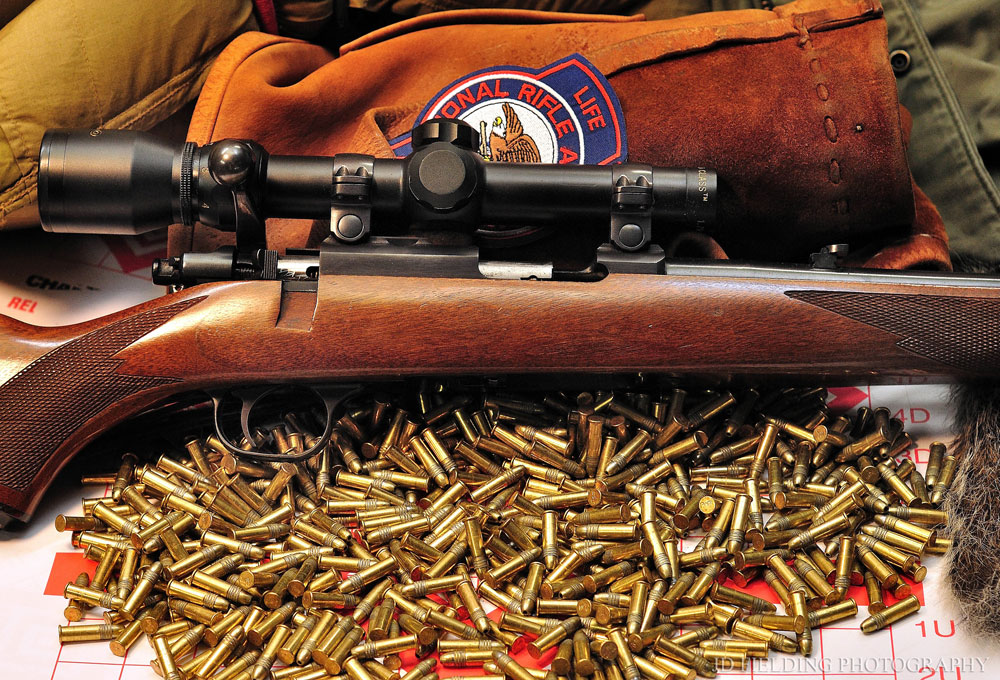
I still have that .22 LR; it is a 1985-vintage Ruger Model 77/22, and I use it often, as both a training tool and a hunting rifle. There’s no denying the validity of the .22 Long Rifle cartridge, but it isn’t the only rimfire cartridge out there. As matter of fact, there are many rimfire catrirdges, and it may warrant owning several. Let’s take a look at some of the best—and not so obvious—rimfires ever made.
The .22-caliber Rimfires
The .22 Long Rifle is, invariably, the most popular of the rimfire cartridges, for good reasons we’ll get into momentarily. However, it wasn’t the first, and it isn’t alone. It has many siblings, like the BB cap and CB cap, but among the most popular are a couple of older brothers, and a younger brother.
The .22 Short
Being the smallest of the bunch, the .22 Short has been with us for 160 years. Originally a black powder cartridge, the .22 Short has survived the transition to smokeless powder and is still a fun cartridge to shoot. Using a 29-grain bullet at just over 710 fps, the Short is an effective tool for small game like squirrels and rabbits at close ranges, say within 50 yards or so. Many “parlor” guns were chambered for the .22 Short, and while it’s become a bit of a novelty, if you want to hunt at close ranges, the .22 Short will present a fun challenge.
The .22 Long
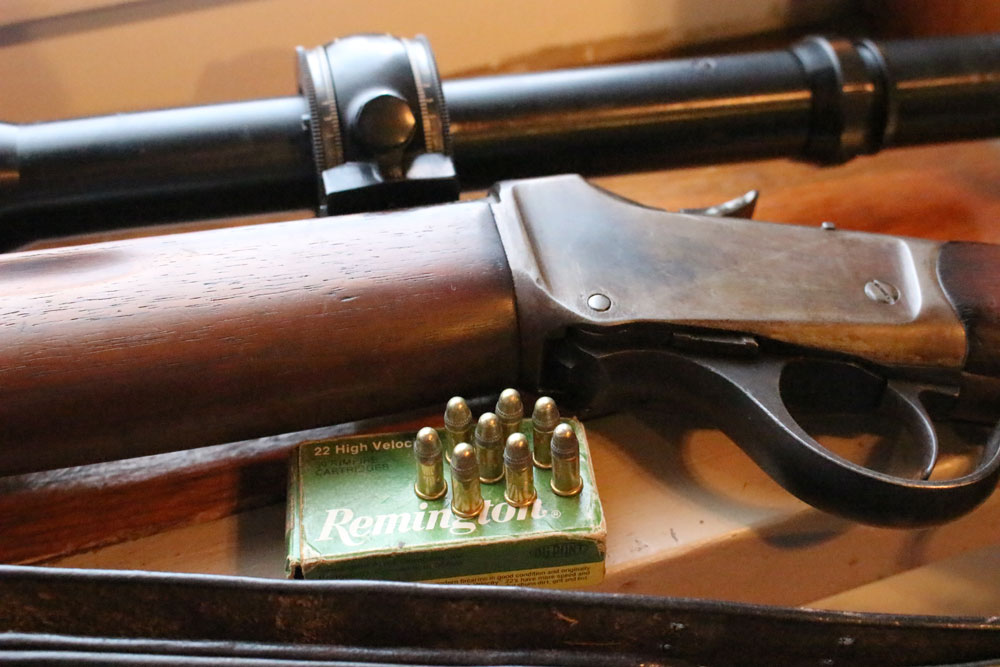
A bit longer and just a bit younger, the .22 Long was an improvement over the .22 Short, using 20 percent more powder and a 45-grain bullet. CCI still offers ammunition, using a 29-grain bullet at a muzzle velocity of 1,215 fps. Like the .22 Short, it has become a rarity, but it’s still a fun cartridge to shoot. You’ll see many older rimfire rifles marked as being capable of handling .22 Short, .22 Long and .22 Long Rifle. If you have one and want to give the .22 Long a whirl, it’ll work, but I think you’ll find the search for ammo more trouble than it’s worth, considering the performance of the .22 Long Rifle.
The .22 Long Rifle
Few cartridges can claim the success that the .22 Long Rifle has achieved. I don’t know any hunter that doesn’t have at least one .22 LR in their cabinet; it is that popular. It dates back to 1887—like the others, it started off fueled by black powder—and has been offered in a multitude of action styles, including single-shots, pumps, bolt guns and autoloaders. The standard loading is a 40-grain bullet at a muzzle velocity of 1,240 fps or so, depending on the manufacturer. There are many hyper-velocity loads, some using lighter bullets, some a hotter charge, which will extend the range of your .22 Long Rifle.
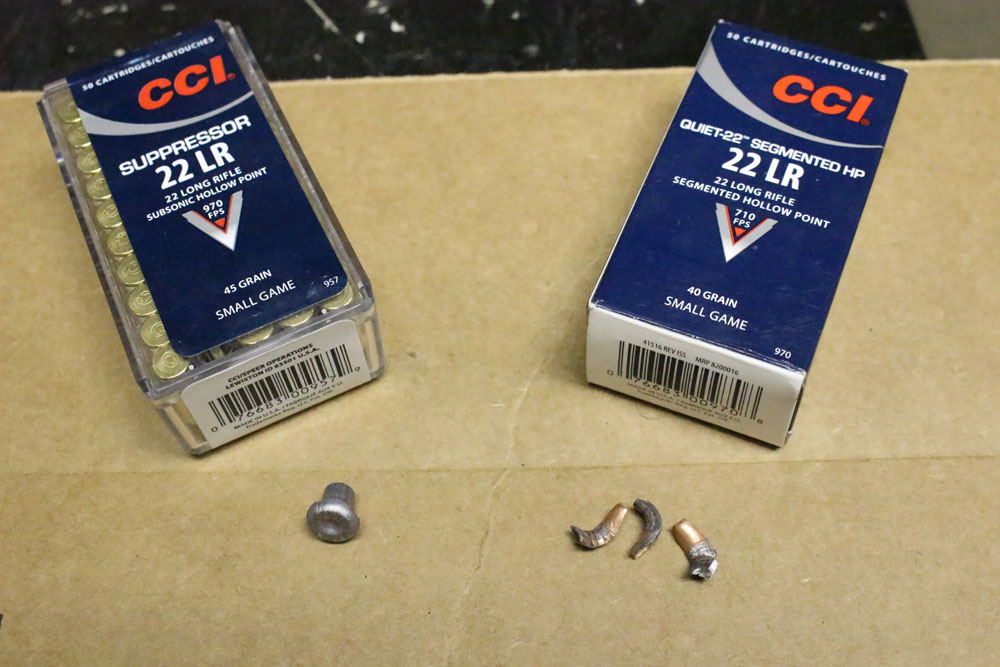
The CCI Stinger, using a light bullet and a slightly elongated case, was among the first, and remains a solid choice. The Remington Yellow Jacket and Viper, and Browning BPR ammo will also give higher-than-normal velocities. On the other end of the spectrum, there are many good subsonic loads for those who like to keep things as quiet as possible. Norma Sub-Sonic .22 and CCI’s Quiet-22 are good choices for quieter loads for hunting or for training a new shooter. Please be aware that many of the autoloading rifles and pistols require a certain muzzle velocity, or more specifically, an energy level, to cycle the action.
There are all kinds of projectiles available for the “twenty-two,” as it’s known here, or the “two-two,” as it’s known across the pond, from waxed lead bullets to plated hollowpoints to shotshells to fragmenting bullets. If you think about it, the .22 Long Rifle might just be the most versatile cartridge ever invented.
The .22 Winchester Magnum Rimfire
Developed in 1959, the “.22 Mag.” is definitely a different sort of rimfire cartridge, delivering a 40-grain bullet at 1,900 fps or more. This combination makes for a 150-yard gun, without problem, and it is fully capable of taking coyotes and foxes. Like the .22 LR, there are many projectile types available, from the full metal-jacketed slugs, to frangible hollowpoints to polymer tipped bullets—as used in the CCI .22 Mag. V-Max load, built around the 30-grain Hornady bullet. If you want a .22 rimfire with a bit more reach than the LR, look no further than the .22 WMR. It can be a bit harsh on squirrels and rabbits, but it’s a better choice for larger furbearers and distant varmints.
The .17-caliber Rimfires
The .17 HMR
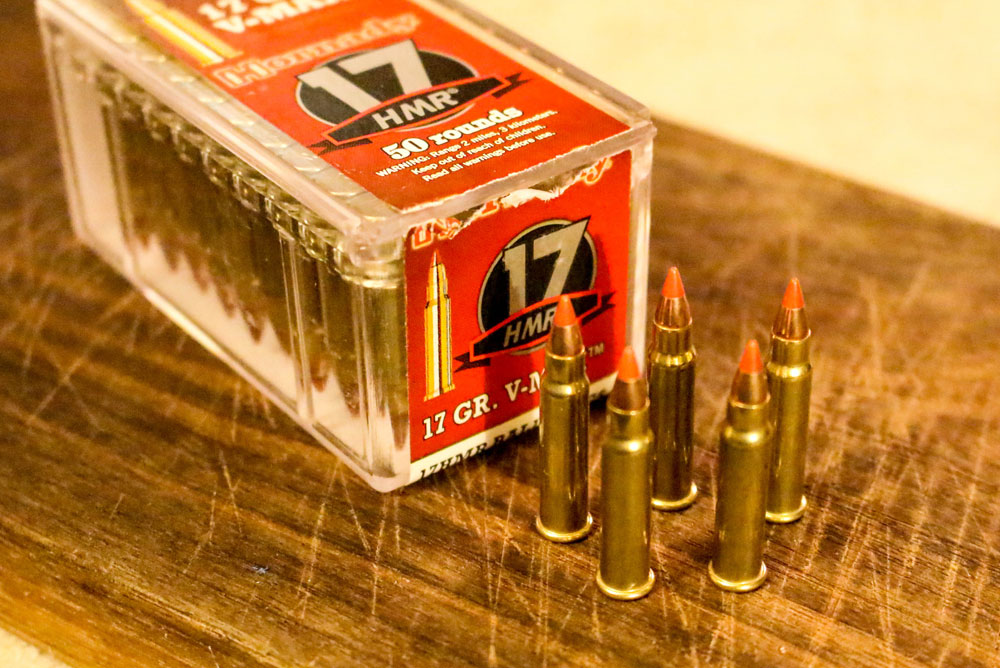
Shortly after the turn of the 21st century, Hornady announced the first new rimfire cartridge since the .22 WMR: the .17 Hornady Magnum Rimfire (HMR). Using the .22 WMR case necked down to hold .172-inch bullets, the new cartridge would push a 17-grain bullet at 2,550 fps, resulting in a flat-shooting small game rimfire cartridge. While it is susceptible to wind drift, under good conditions this cartridge can make solid hits out to 200 yards, and sometimes more. The light-for-caliber frangible bullet does less damage to furbearers, yet will create the “red mist” when used on prairie dogs and woodchucks. Recoil is virtually non-existent, and the .17 HMR can be very accurate. It has caught on, and it makes a good choice for those who prefer rimfire cartridges to the bigger cases of the .17 centerfires.
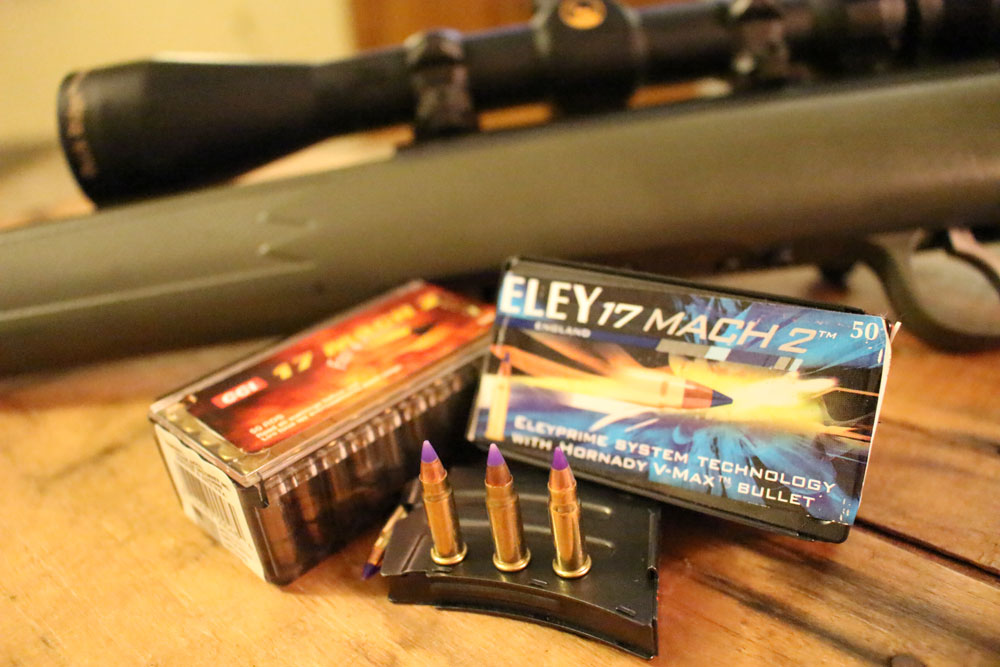
The .17 Mach 2
Two years later, Hornady struck again, using the CCI Stinger case (just slightly longer than the standard .22 LR case) necked down to hold the same bullets as the .17 HMR. There are two bullet weights offered: a 15.5-grain bullet and the same 17-grain bullet the HMR uses. While it is a fun gun to shoot, the Mach 2 is declining in popularity. Velocities for the 15.5-grain bullet run at 2,050 fps, while the 17-grain pill is moving at 2,100 fps.
The .17 Winchester Super Magnum
This may be the sleeper of the bunch, and I like this cartridge quite a lot. Winchester used a .27-caliber nail gun blank as the parent case for this little gem, and it will drive a 20-grain bullet to an even 3,000 fps. I’ve used this cartridge in the windy plains of South Dakota to effectively kill prairie dogs out to 300 yards, and sometimes more. Were I looking for a true, long-range rimfire rifle, I’d look no further than the .17 WSM; it’s hot on the heels of the .17 Hornet, and one helluva lot of fun to shoot.
The Others
There are other rimfire cartridges that have either fallen to the hands of time or a lack of following. The 5mm Remington had a brief moment in the sun, but never caught on. There are some classics, like the .44 Henry Rimfire—think Kevin Costner in “Dances With Wolves”—and a whole slew of larger caliber rimfires that were designed for both rifle and pistol. They were early developments, and while the odd firearm may pop up once in a while, the ammunition is very difficult to come by. In our age, the rimfire cartridges are relegated to .22 or .17 caliber, but what we have is very useful. Long live the rimfires!
Editor’s Note: This article is an excerpt from the Spring 2017 issue of Gun Digest the Magazine.
Japan can often be an afterthought when talking about modern firearms manufacturing. Perhaps it’s the nation’s Draconian gun laws or the fact that the sector, in the scheme of the greater gun world, is rather narrow. Whatever the case, the Land of the Rising Sun typically doesn’t make it into gun banter.
Maybe it should, however, given the quiet role it plays in the American gun market. Howa Machinery Company in particular has become a major player in the U.S. over the years, producing components for a number of well-known and popular American gunmakers. The manufacturer has especially built a name for its precision machining and quality barrels, drawing on more than a century of Japanese industrial know-how. The company has also carved a comfortable niche for itself in the consumer market this side of the Pacific with the help of importer Legacy Sports International.
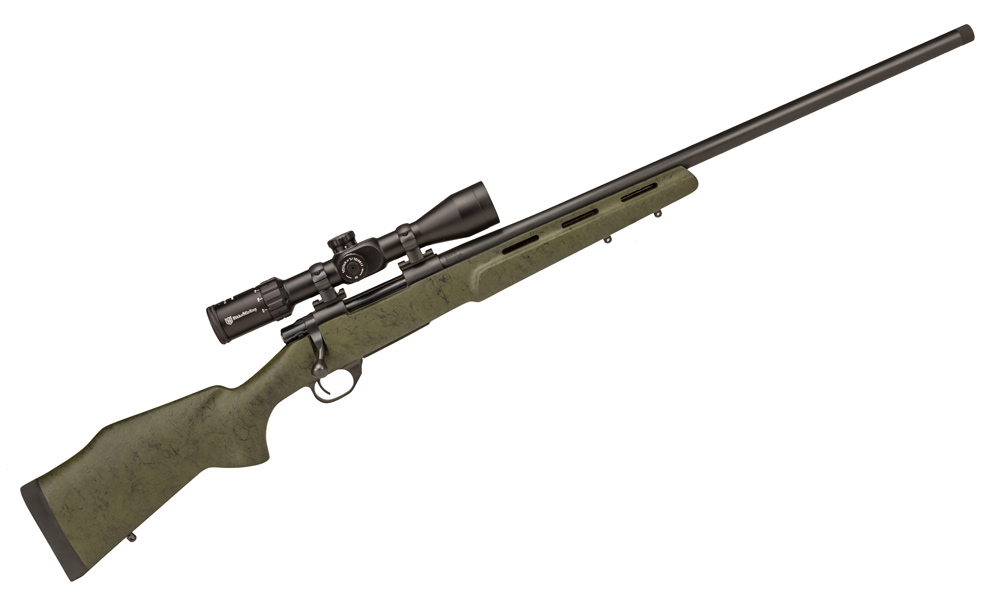
For four decades, the Model 1500 has been a popular choice in many hunting and target-shooting circles. And Howa’s tried-and-true design has been tweaked this year and configured to satiate the growing throngs of shooters aiming a country mile. The Long-Range Rifle (HLR) — available in 6.5 Creedmoor and .308 Win. — integrates much of the company’s proven designs into a platform meant to hit the mark no matter the distance.
Of Howa’s time-tested technology is the 1500 bolt action that features a two-lug bolt and M16-style extractor. It is topped off with a 26-inch heavy bull barrel (#6 contour) and the company’s two-stage HACT trigger that has a pull-weight range of 2.8-3.8 pounds (factory set for 3 pounds).
With a Bell and Carlson tactical stock, the new Howa Long Range Rifle is ready to go the distance.
Where Howa has tweaked the rifle to go the distance is dressing it up with a Bell and Carlson tactical stock. The rigid composite stock should provide the steadiness to make precision shots, no matter the difference.
It features a raised cheek piece to more intuitively shoulder the rifle and has a wide-based forend, meant to better facilitate a solid reset or incorporate a bipod. It also has been outfitted with ports beneath the barrel, to help it cool on longer shot strings, comes with with a Pachmayr Decelerator Recoil Pad and is available in green/black or tan/black color choice.
Unsurprisingly for any rifle even remotely sold as tactical at the present time, the HLR comes with a threaded barrel, giving users the opportunity to add a suppressor right out of the box.
Similar to past rifles, Howa’s new long-range model can be purchased as a stand-alone gun or scoped. With the scope package, the HLR comes topped off with Nikko Stirling’s new Diamond First Focal Plan 4-16x44mm scope, which should give shooters enough power to hit the bull’s eye right off the bat.
The MSRP on the stand-alone rifle is $1,015, while the scope package runs $1,299. Given the price and the accouterments, Howa could get shooters talking Japanese guns when it come to long-range options.
There are a variety of methods or formulas for zeroing the AR, but this might be one of the simplest and most precise systems out there.
Zeroing the AR means adjusting the sights so your point of impact — where the bullet strikes the target — is the same as your point of aim — where you are holding the sights. There is a variety of methods or formulas for zeroing the AR. Instead of trying to use different size targets at various distances and flipping back and forth between one aperture and the other on the rear sight — as required by some methods — I prefer to use the simple technique described below.
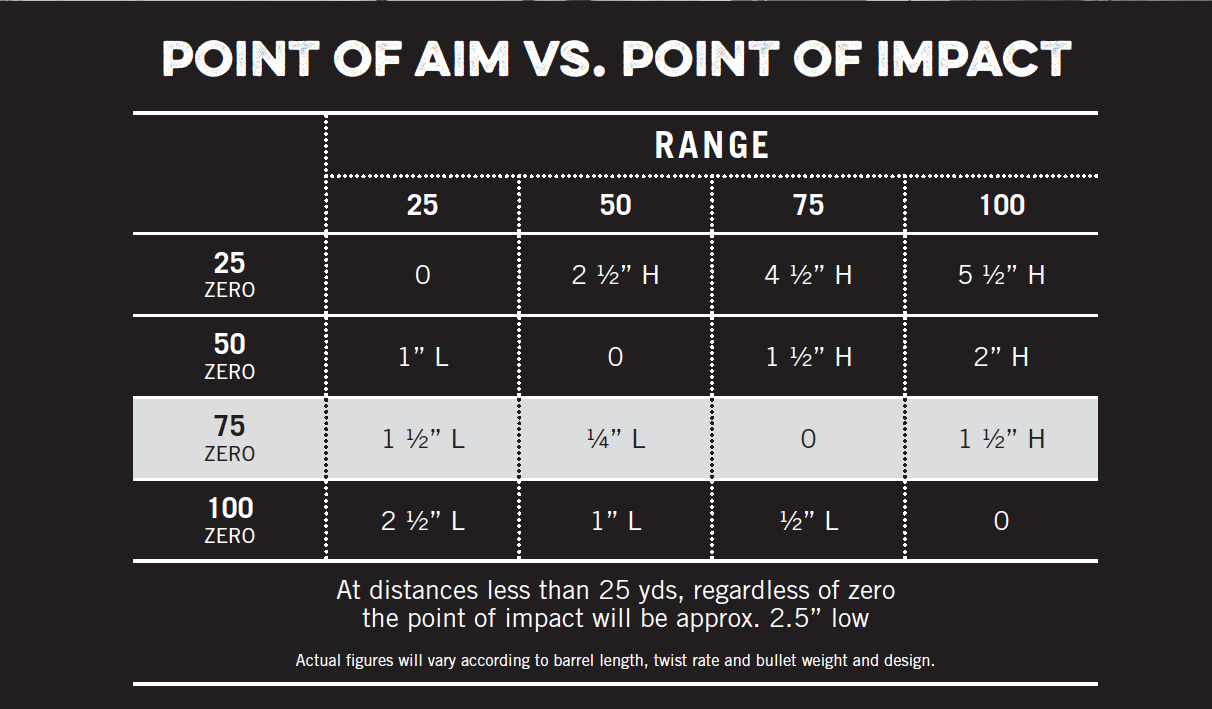
In my opinion, to get a “hard” zero with the AR you have to actually shoot it at the distance you’ve chosen for your zero, rather than simulate distance by using smaller targets. Once you’ve zeroed the AR, it’s time to fire it various distances to discover what the difference will be between your point of aim (POA) and the point of impact (POI).
When it comes to choosing the distance for your zero there are several factors to consider. First is the offset between the sights and the barrel; the sights are higher than the barrel. This offset comes into play especially at close distances, where the POI will be lower than the POA. You have to aim or hold high for your round to hit where you need it to go. You also have to consider the trajectory of the round. For example, with a 55-grain bullet firing with a one hundred yard zero the POI will be approximately two inches low at 200 yards.
Before beginning the zero process you need to pick the distance for your zero. I use a 100-yard zero. The sights are adjusted so that at 100 yards the bullet strikes the exact point the sights are holding. A 75-yard zero gives you the least deviation between your POA and POI between 25 and 100 yards. At 25 yards the POI will be roughly one and one half inches lower than your POA. The POI at 100 yards will be and one half inches higher than your POA, which will give you a POI of about an inch or so low at 200 yards.
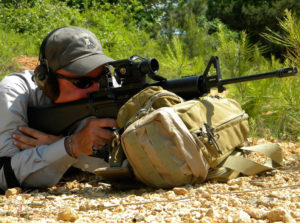
Take your time during the zeroing process. This isn’t something you can do quickly. For the best results, work from a bench, with rests or bags for support. Make sure the handguard is supported, as opposed to the actual barrel touching or resting on the bags. If the barrel is making contact with your rest, it will throw the shots off. For example, when the bottom of the barrel is touching the rest it will throw the shots high. Your goal is to create a solid, stable position – consistency – and apply the fundamentals of marksmanship for every shot.
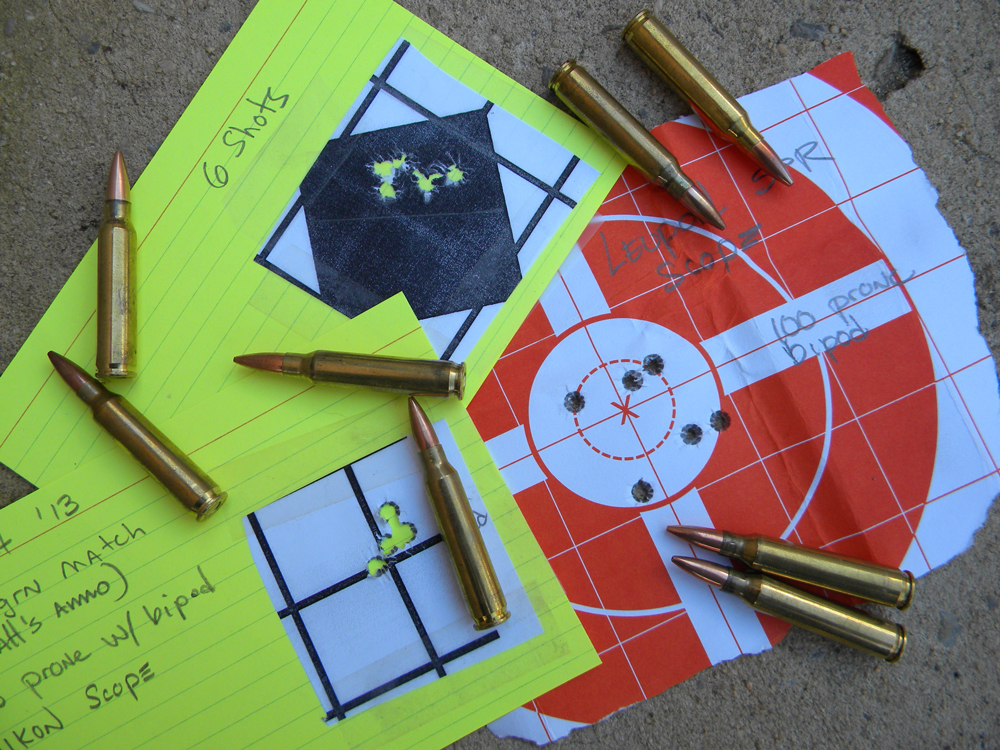
Start the zeroing process at 25 yards. Make sure you have a steady position, using a rest in order to take out as much of the human element as possible. Normally I’ll fire five or six shots, enough to satisfy myself that I’ve got a good group established. By firing several rounds, even if you have one or two shots that weren’t good, you’re still going to have a solid group to work with.
After establishing a good group you’re ready to adjust the sights — elevation and windage — but first unload the AR. Do not get into the habit of adjusting or doing any work on your firearm while it’s loaded. Unload, check and check again to confirm it’s clear, and then remember the safety rules are still in effect. After making adjustments you load and start again. The additional benefit of all this is that you’re getting in practice on your manipulations.
When zeroing, work in the most stable position you can, using rests or support to create stability.
As mentioned earlier, at 25 yards your bullets should be hitting lower than where you are aiming. This low POI is necessary because of the offset between the sights and barrel. (Don’t get too worried about exact measurements here; you’re just looking to get it close, and will fine tune the sights as you move back, creating more distance.)
Once you have a rough zero at 25, again with the bullets striking about two inches below your point of aim, move back to 50 yards. Fire a good group, and adjust as necessary. At this distance your point of impact will be closer to the center of the target where you’re aiming. As you increase the distance the POI will move upward towards your POA. For example, if you’ve decided to work with a 100-yard zero, at 50 yards the bullets should be hitting about an inch below where you are aiming.
Fire a good group, and then adjust the sights as needed. Normally I will only adjust one direction at a time. For example, I’ll adjust the elevation with the front sight until getting that right, then adjust windage to get it in the right spot. Trying to adjust both the elevation and windage at the same time can sometimes get a little complicated, for example as you adjust the windage it can change the elevation slightly. You may find that after adjusting the front sight and then the rear sight for windage that you have to go back to the front sight for final adjustments.
After getting close at 50 yards, move back to 75 and repeat the process. If you want a 75-yard zero your bullets should be hitting where you’re aiming. Point of aim and point of impact are the same. For a 100-yard zero you’ll need to move back to that distance and repeat the process one last time, adjusting until your POI is spot on for where you are aiming.
New versions of the AR have rear sights with elevation adjustments. When zeroing, make sure to start with the drum on it’s lowest setting, 6/3 or 8/3.The rear sight on early versions of the AR requires a sight tool or bullet tip to adjust. The newer versions have a drum that can be adjusted by hand.
You’ll also need to shoot it at distances closer than your zero, again to find out the difference between your point of aim and the point of impact. Remember, the sights are offset, higher than the barrel, so as you move closer than your zero the point of impact will begin to drop. At distances closer than 25 yards you’ll be aiming about two and one half inches high to compensate for this offset. (XS Sights have a modified rear sight that has a notch on top of the peep sight that you use for aiming at close distances that compensates for the offset.)
For zeroing a red-dot sight or a more traditional optic with magnification I use the same process. I start at 25, get a rough zero with the point of impact two to two and one half inches lower than the point of aim. Don’t’ worry about an exact measurement, you’ll have to be making more adjustments as you increase the distance.
Daniel Defense is offering two new finish options to its lightweight .308 platform, giving shooters the ability to give their rifles a custom look.
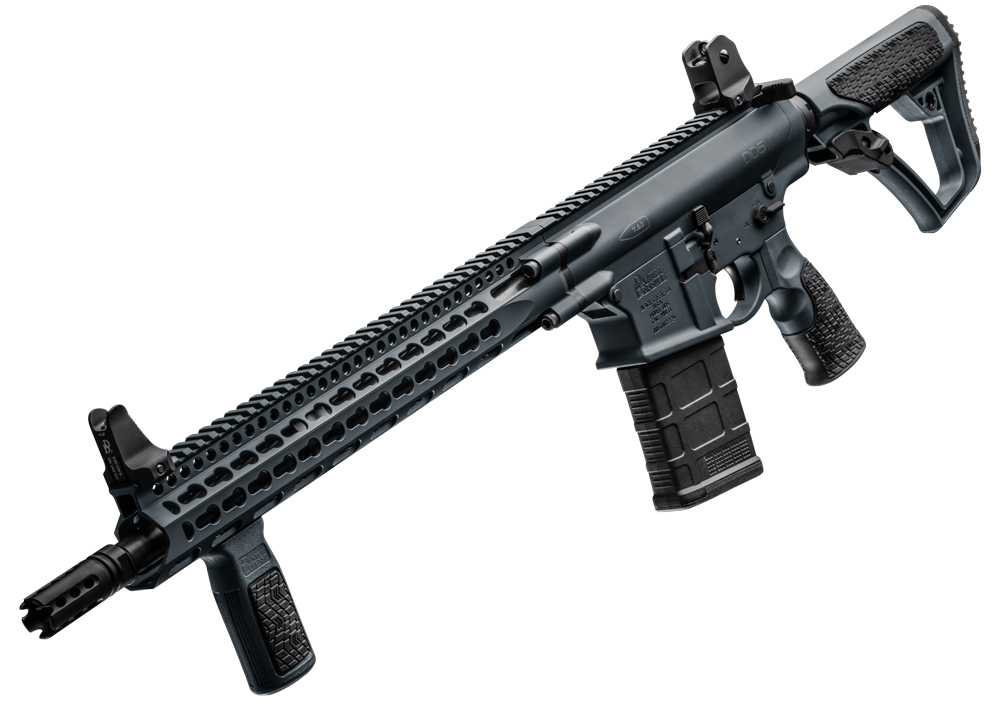
Daniel Defense took its first foray into .308 Win. not long ago with relatively good success. The DD5V1 proved to be a light, maneuverable semi-auto, executed with all the deftness of the rest of the Georgia gunmaker’s catalog. And now the manufacturer is adding a splash of color to the high-performance rifle.
Daniel Defense has added two new finish options to the basic black with the grayish Daniel Defense Tornado and the tan Mil Spec +. In both cases, colors options are thin-filmed polymer-ceramic Cerakote finishes, which shouldn’t only add to the shooter’s ability to customize their firearms, but also extend their lifespan.
Cerakote protects the exterior metal from impact, corrosion, wear and chemical exposure, as well as provides a certain level of additional hardness. In short, the finish does a pretty solid job of adding an extra layer of protection, giving shooters the piece of mind that their rifle will withstand the harshest environments.
Mil Spec + finish.
The Mil Spec + is a bit flashier than the typical Flat Dark Earth, having a slightly metallic tone to it, while the Tornado is a bit flatter in finish, but equally eye-catching in color. Whatever the case, the somewhat unusual color choices certainly give the rifle a sleek appearance that could turn heads at the range — if that’s the shooter’s aim.
The new finishes protect the same top-of-the-line features and design points of Danial Defense’s original DD5V1. Some of the features include a unique four-bolt connection system securing the barrel and handguard to the upper receiver, oversized cam pin and dual ejectors on the bolt and Key-Mod handguard.
The new finishes tack on about $100 to the DD5V1’s base price, with the MSRP on the rifle with the color options being $3,198.
Any carry gun is a good one when you need it, but some just outshine the competition. They feel a little better, they shoot straighter and they do exactly what they are supposed to do every time you pull the trigger. That’s why Gun Digest is highlighting a handful of firearms in this Gear of the Year issue. Of course, a concealed carry gun needs to be carried and concealed. We’ve also included some of the best holsters on the market. They not only give you a place to put your favorite CC gun, they allow you to carry in comfort and style.
Editor’s Note: This article originally appeared in the Winter 2016 edition of Gun Digest the Magazine.
Looking to go armed, but are stuck in the weeds as to what to arm yourself with? Here are 20 of the best concealed carry gun options that will keep you on the defensive.

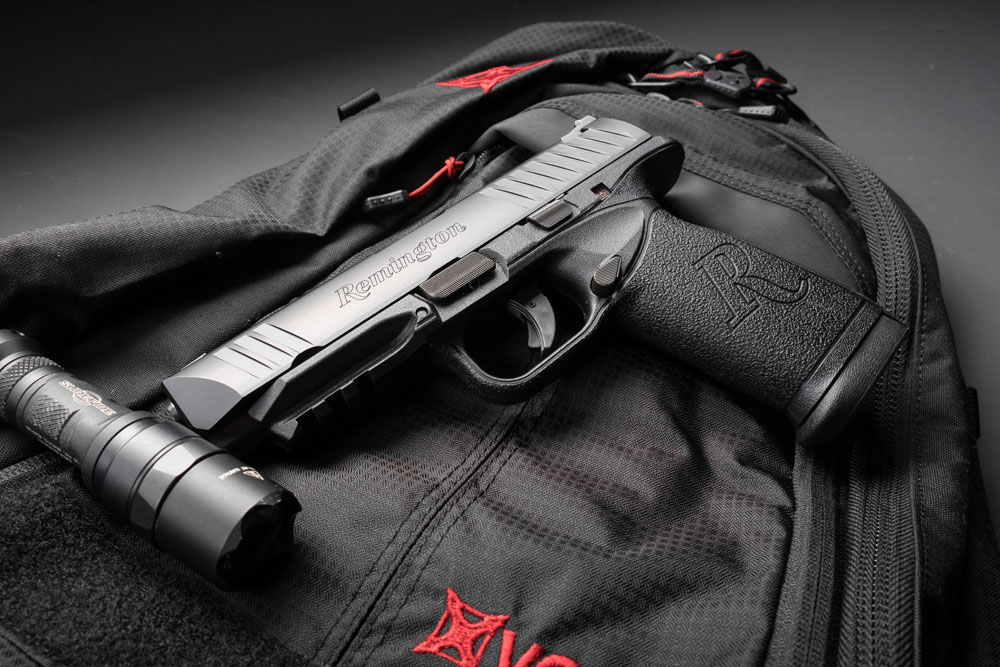 The Remington RP9 is the American manufacturer’s first full-size striker-fired handgun, and it’s got a lot to offer in a price-friendly package.
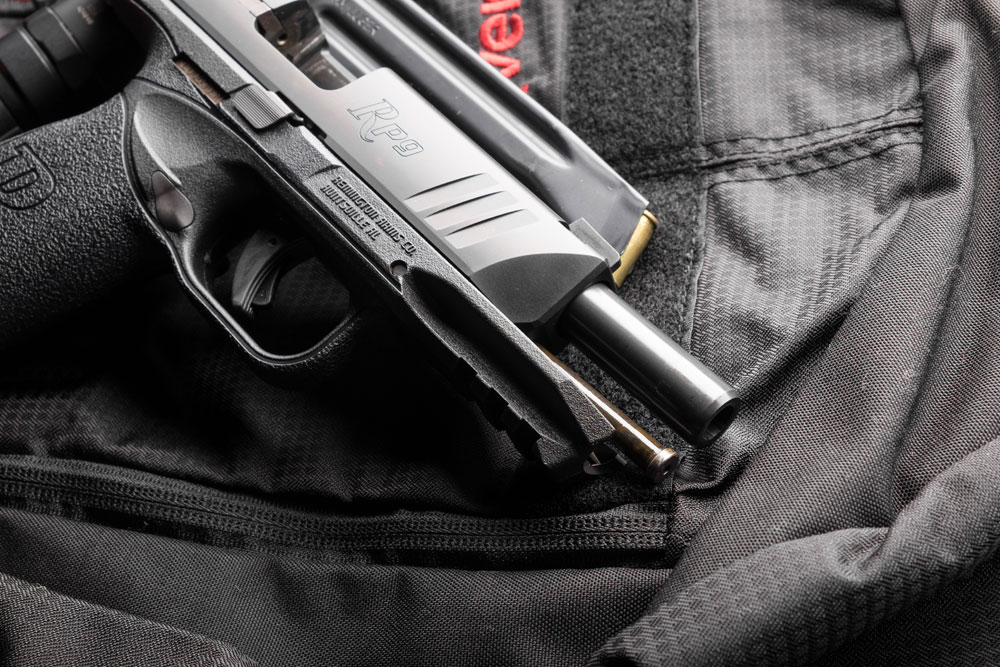 While there are of course differences, much that is nice about the new RP is also what makes it very similar. The new RP is a classic tilt barrel, locked breech, striker-fired pistol with a polymer frame. Its appearance, and more importantly, its controls and operation should be very familiar to anyone who’s used other striker-fired guns. The reversible magazine release, slide stop and takedown lever are all in the typical positions.