Home Blog Page 425

Is That a Colt in Your Pocket?

1

I like snubnose revolvers. I mean I really like snubnose revolvers.

To my admittedly antiquated way of thinking, the snubbie is the perfect self-defense gun. Semiautos get all the press nowadays, but I keep coming back to the fact that in three decades of shooting all types of guns, I’ve never had a snubbie jam, lock up or otherwise put me in a pickle. How I wish I could say the same of semiautos!

But I try not to be dogmatic about such things. If you’re carrying a semiauto right now, you doubtless have good reasons for doing so, and I would be the last person to argue with you. Really, I was only kidding, anyway — sir.

But insofar as I’ve expressed my opinion on snubbies, I might as well go whole-hog and admit that I believe the Smith & Wesson Model 36 Chiefs Special is the greatest self-defense gun of all time. It’s tiny. It’s reasonably powerful. It’s controllable. It’s utterly reliable and totally foolproof. A Model 36 in the pocket beats a 1911 left in the nightstand any day of the week.

Yet the Model 36 isn’t my favorite snubbie. That distinction would have to go to the old Colt Pocket Positive, manufactured from 1905 to 1940. The Pocket Positive has the one critical attribute that characterizes so many Colt revolvers: style. And if you can forgive me for using such a word, I might even say that the Pocket Positive is cute. Not merely cute, mind you, but cute as Brittany Spears’ … nose.

A Different Bird

The Pocket Positive was an outgrowth of Colt’s New Pocket Revolver, introduced in 1893. In addition to being Colt’s first swingout cylinder pocket revolver, this was a handy little gun, the name of which distinguished it from the “old” Colt Open Top Pocket Model manufactured from 1871 to 1877.
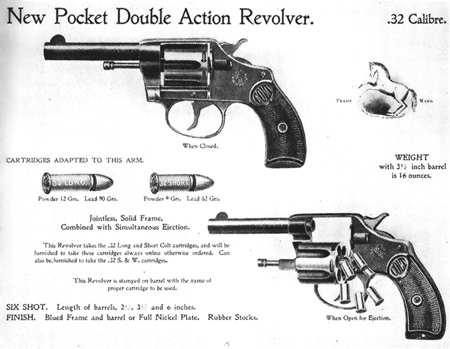
The Open-Top Pocket Model was a different bird from the New Pocket Revolver: a tiny little spur-trigger, single-action .22 that didn’t even have a topstrap. In comparison, the New Pocket Revolver of 1893 really was new, and with its “modern” solid-frame, double-action design, it made arch-rival Smith & Wesson’s top-break revolvers look like yesterday’s news.

The New Pocket Revolver came in blued or nickel finish with hard rubber stocks and a 2 1/2-, 3 1/2-, 5- or 6-inch barrel. It was Colt’s smallest revolver but not its only concealable snubbie, if you wanted to stretch the term a bit.

The Colt Model 1877 in .38 and .41 Colt (the so-called Lightning and Thunderer, respectively) was available in a “Storekeeper’s” version with 2 1/2-inch barrel and no ejector rod assembly until 1909.

The Model 1877 Storekeeper could conceivably be called a snubnose pocket revolver if you had pockets big enough to conceal its sizeable frame. But however you sliced it, the New Pocket outclassed every other deep-cover revolver of its day.

The original Colt New Pocket .32 had a compact, round-butt grip frame that made it especially well-suited for concealed carry. In 1896, Colt developed a variation of the New Pocket with a square-butt grip frame and released it as the New Police.

That year, the New Police was adopted as the issue sidearm of the New York City Police Department, the nation’s largest metropolitan law-enforcement agency, by virtue of the recommendation of the police commissioner, an energetic up-and-comer named Theodore Roosevelt. Roosevelt’s endorsement went a long way toward establishing the credibility of Colt’s new line of .32s.

Yet neat as the New Pocket and New Police were, they shared two flaws: They had no provision for a passive safety and were chambered for a truly rotten little cartridge.

Unique Features

Like all of Colt’s double-action revolvers of the day, the New Pocket and New Police had no safety; neither active (manually-operated) nor passive (automatic). Thus, if you dropped a loaded New Pocket or New Police .32 — cocked or not — in such a way that it landed on its hammer, the chances were fairly good that you’d go home that night with an extra bellybutton.

Then there was the guns’ chambering: .32 Short and Long Colt. These cartridges were scaled-down versions of Colt’s proprietary .38 and .41 Long Colt loads, and they shared a common shortcoming: an outside-lubricated, heel-based bullet similar to today’s .22 Long Rifle round.

The .32 Colt cartridges provided poor accuracy because they didn’t fit the bore especially well, and their exposed lube rubbed off rather easily and collected all manner of dirt and grit. (On special order, Colt would chamber the New Pocket and New Police in the much-superior, inside-lubricated .32 S&W Long cartridge, but it wasn’t eager to recognize a S&W product or stamp the hated “S&W” on its guns.)

Despite its lack of a safety and the limitations of the .32 Colt rounds, the New Pocket wasn’t a bad little gun. It was extremely small and was a much better design than its closest competitor, the Smith & Wesson First Model .32 Hand Ejector of 1896.

For one thing, you could open its cylinder with one hand, a feat that was almost impossible with the Hand Ejector. For another, you could order it with a 2 1/2-inch barrel vs. the Hand Ejector’s shortest barrel length of 3 1/2 inches.

Colt also made hay of the fact that the New Pocket’s cylinder rotated toward the frame, but those of “other” double-action revolvers (nudge, nudge) rotated away from the frame. The implication was that the other revolvers (nudge, nudge) wouldn’t stay as tight as a Colt. True? Perhaps not, but it made for a good talking point.

The New Pocket was America’s first truly modern, solid-frame snubbie. All it needed was a few tweaks, which were to come in 1905.

In that year Colt improved the New Pocket — and the New Police, too — by giving it an internal, passive-hammer block safety that prevented the hammer-mounted firing pin from falling on a live cartridge unless the trigger was held all the way back. This safety was held to be utterly foolproof or, in other words, “positive.” Thus were born the Pocket Positive and the Police Positive.

The revolvers’ chambering received an upgrade, too. Colt had realized that inside-lubricated cartridges were the wave of the future, so — no doubt holding its corporate nose — it relented and chambered the Pocket Positive and Police Positive in .32 S&W Long. But not without a fight, by gum! There was no way in heaven or earth that Colt was going to put “S&W” anywhere on its guns, so it did the next best thing: It invented a .32 S&W Long cartridge of its own.

The resulting cartridge, the .32 Colt New Police, was identical to and interchangeable with the .32 S&W Long — except for one thing. The S&W cartridge had a round-nose lead bullet, but the Colt number had a bullet with a minuscule flat on its nose. That was the entire difference.

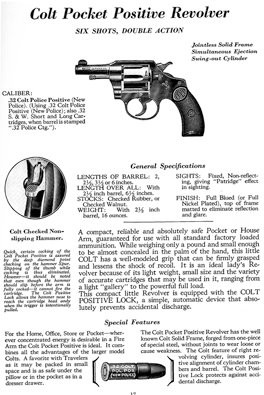
In retrospect, it’s amusing to see how Colt avoided using the phrase “.32 S&W” in its advertising of the day. A Colt catalog from the 1920s danced around the issue on a page describing the Pocket Positive’s chambering:

“Caliber: .32 Colt Police Positive (New Police). (Using .32 Colt Police Positive (New Police); also .32 S&W Short and Long Cartridges, when the barrel is stamped ‘.32 Police Ctg.’).”

I’ve read that paragraph five times, and I’m still confused.

A Little Beauty
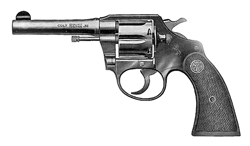
The Pocket Positive is simply a beautiful little revolver. Its main frame, grip frame and barrel harmonize in perfect proportions. Its barrel and extractor rod are unencumbered by a shroud, which has always seemed to me to give a snubbie an off-balance, muzzle-heavy appearance.

Finally, there’s the wonderfully sculpted cylinder latch. This latch, introduced in the 1920s, forms part of the recoil shield and was a big improvement from the angular, stamped latch that characterized Colt’s earlier double actions.

Every Pocket Positive I’ve fired has had a slick, smooth double-action trigger pull. That smoothness comes at a cost, however. The Colt’s lockwork gives great leverage but puts a lot of pressure on your hand, which sooner or later results in that characteristic last-second cylinder hitch that afflicts most heavily-used Colt double actions. Though not quite as slick as the Colt’s, the S&W Hand Ejector lockwork is much more durable.

The Pocket Positive disappeared from the Colt lineup in 1940, and its place was taken by the Detective Special and Police Positive Special. I doubt we’ll ever see the likes of the Pocket Positive again. In this day of magnumitis, the .32 S&W Long and .32 Colt New Police seem laughably underpowered. Still, whether I choose to carry one — and sometimes I do — the Colt Pocket Positive has my vote as the classiest snubbie of them all.
Hands On! Wiley X Gives Eyes Fashion, Function

0

Glasses and shooting go together like Pamela Anderson and a video camera. You just need something covering your eyeballs. And when you reach for good glasses, you should get your hands on a pair from Wiley X.

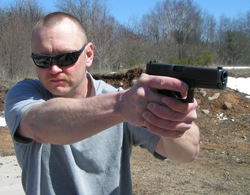
The Climate Control Series from Wiley X Eyewear takes state-of-the-art eye protection to new extremes. The glasses include a foam “gasket,” for lack of a better term, that blocks dust and even stray light from the edges of the frame. It felt odd at first, but I quickly learned to ignore the foam and enjoy the fact there was no dust in my eyes. And as you can see from the photo, the glasses looked good, too.

The series includes six lightweight frames that trace their high-function, high-fashion styling to Wiley X’s heritage of providing advanced vision protection for the world’s most challenging environments. The JP-2, AirRage, Blink, Ink, Top Jimmie and Brick ANSI-certified frames accommodate various face shapes and sizes for the best combination of looks and protective performance.

Each model accepts prescription lenses and features an exclusive durable, removable foam gasket that’s symmetrically vented and locks into the ANSI-certified frame. The unique design stops the stuff that always seems to get through traditional sunglasses, particularly in windy or dusty outdoor conditions.

Climate Control Series frames are offered in several stylish finishes, including Matte Black, Metallic Black, Gloss Black, Aluminum Gloss, Crystal Metallic and Crystal Bronze. Each pair comes with a durable case and microfiber cleaning cloth.

Check out www.wileyx.com.

Gun Digest is the national bi-weekly source for firearms news, pricing and guns for sale. Our in-depth editorial, exclusive price guide and new product features, brings valuable information to our high profile subscribers. Subscribe Now!


Gun Review: FN PS90 Carbine

2

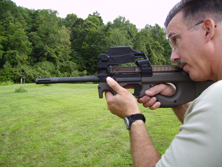
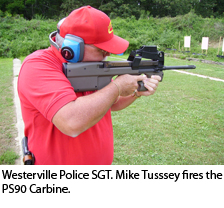
Let's look at a new weapons system from Fabrique Nationale: The PS90 carbine.

American shooters and law enforcement officers have a history of being a very conventional, traditional, and at times, stodgy lot.  History is replete with examples.

How History Bucks Innovation

Famous gunfighter and lawman Wild Bill Hickock continued to use a brace of .36 caliber Colt Navy cap-and-ball revolvers as his primary armament until his untimely death in 1883, long after cartridge revolvers were in widespread use.

Colt introduced the double-action revolver, in a form that has remained nearly unchanged, in 1892.  Yet lawmen in Western states still continued the use of single-action Colt revolvers until WWII, and probably, even today, you can find a local lawman somewhere in a remote corner of the west (or Alaska) still packing a single-action revolver as primary armament.

And speaking of double-action revolvers, the NYPD, the largest police agency in the world, didn’t drop its double-action .38 revolvers as the primary duty weapon until the 1990s. The 1911 single-action pistol has been around since well, 1911.

Yet it is only in the last 15 years or so, and particularly in the last five that we have seen a veritable explosion in its popularity and the number of manufacturers making and modifying and providing accessories for this previously “specialist only” pistol-putting this pistol in the hand of seemingly every serious/semi-serious pistol shooter. But it took almost 100 years to get to this point!

Another example is stainless steel and synthetic stocks.  These have been available since the 1960s for hunting rifles, but they had been ignored in favor of traditional walnut and blued steel for 30 years or so until the majority of shooters figured out the advantages of these materials in bad weather situations.

Lets give some credit where credit is due.  We aren’t always THIS stodgy.  For example the Glock pistol took off like a rocket after initial (and fraudulent) media reports provoked concerns about its polymer construction slowed its acceptance.

After the truth came out, the rise to prominence was nearly meteoric and Glock now holds the majority share of the law enforcement market– a remarkable and unparalleled achievement.

In doing my review of the FiveseveN pistol and the PS90 carbine, I wanted to keep this history in mind.  As this duo is still relatively new to the civilian shooter (or privately purchased LE market) I felt that the guns should be viewed in terms of three factors, or portions of these factors, in order to determine shooter acceptability.

These factors all directly affect the end user, the shooter.  Are these guns, or parts of them innovative, unconventional or odd?  Why?  If the guns are innovative, they will be accepted in rather short order. Glock’s design is innovative.

The polymer frames, high reliability and user-friendly simplicity made them a market success.  If guns are unconventional, there will be some acceptance issues.  While an entire weapon may be innovative overall, parts of it may be unconventional.  Glock’s Safe-Action™ trigger system, was at the time of introduction, unconventional there was no other manual safety on the weapon that had to be engaged or disengaged for use.  There wasn’t even a de-cocker.

While today this system is mostly viewed as innovative (and actually normal), there are still a number of police administrators that view Glocks as unsafe and unconventional and will not permit their issue or use.

Finally, if a gun or parts of it are viewed as odd, then we have a serious acceptance problem.  There are two examples that come to mind, both developed in the 1960s, of odd guns that never made it.  The first was the Gyrojet pistol.  This odd weapon fired rocket-powered cartridges in both pistol and rifle form.  It was neither accurate nor particularly powerful.

Its rocket projectiles could be stopped by the human hand at the end of the barrel without damage since they hadn’t gained sufficient velocity.  It took several feet of travel to gain appropriate speed. The second was the Dardick pistol, a very strange pistol that was a combination of revolver and semi-automatic pistol that fired a .38 caliber plastic cased “tround” cartridge that contained bullet and powder.  Both guns looked toy-like and are now collector’s items.

So with these parameters in mind let’s look at a pair of new weapons systems, and the cartridge they fire.  From Fabrique Nationale come the FiveseveN pistol and the PS90 carbine. First lets examine the PS90 carbine.

Fabrique Nationale PS90 Carbine

The PS90 is the civilian-legal version of the original P90, which was designed as a “personal defense weapon” for specialized military personnel whose main duties do not revolve around the military rifle. These troops are normally issued a pistol as a personal defense weapon. For U.S. forces that pistol is the Beretta M-9.  These soldiers include tank or artillery crews, pilots and air crewmen, and troops operating to the rear of forward areas.

However, it has long been felt that the pistol, in the hands of the average soldier is not up to the task.  I have to agree to a large extent.  If our military pistol shooters had trained up to a reasonable level in IPSC or IDPA-style shooting for example, I might feel differently.  But such is not the case and military training with the pistol for non-spec ops personnel is very basic.

Further, not everyone has the same abilities. What those in the research areas felt was needed to compensate for lack of proficiency with a pistol was a handy, shoulder-fired weapon of high magazine capacity and adequate power. The goal was to have a firearm that could be carried conveniently for extended periods of time in place of the pistol, and that would allow hits out to 100 yards or so.

The PS90 Carbine As a Defensive Weapon

This new weapon design was not to be an assault (taking the initiative) weapon, but rather a defensive (holding the position or covering the retreat) weapon.

Does the M-1 Carbine of WWII fame come to mind here?  Same problem, different time.  In fact, wasn’t switching to an easier-shooting 9mm from the .45 supposed to solve most of these “problems”?  Guess it didn’t.

However, one new wrinkle to the M-1 Carbine twist was that the weapon needed to penetrate the body armor worn by Soviet (Russian) or Chi-com/North Korean forces.

Like the original M-1, the new PD weapon needed to be light-recoiling and easy to fire.  Unlike the M-1, it was to be full-auto capable with a large magazine capacity and as a part of FN’s design plan, totally ambidextrous in operation.

What FN ended up with was, well, a very cool weapon, futuristic in appearance and totally unique, the P90.  While the P90 is already in use by a number of agencies such as the Secret Service, and is also the signature weapon of the science fiction television show Stargate, it has not been adopted, at least by the U.S., in its intended military role.

The civilian-legal counterpart, the PS90, retains most of the characteristics of the original P90 plus all of the overwhelming “cool factor”.

Lightweight, Compact Close-Quarter

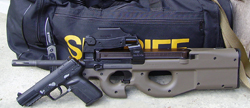
According to the manual the PS90 is a blowback-operated bullpup carbine firing from a closed breach.  It weighs 6.61 lbs. (which is really deceiving, since it seems much lighter, undoubtedly due to its small size), has a maximum width of 2.3 inches and an overall length of only 26.3 inches and has a fixed optical sight.

It is truly ambidextrous in operation, with the disk-shaped safety capable of being operated by the trigger finger of either hand, pulling it toward you to fire if you are right-handed, and pushing it away from you if you are left handed.

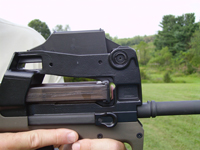
Cartridges are fed through a translucent amber-colored polymer magazine that sits flush on top of the stock, but underneath the sighting module, parallel with the bore and chamber. Release the magazine by operating either of the two magazine releases on either side of the magazine at the chamber.

Ejection is downward through the large ejection port, located aft of pistol grip portion of the weapon. No empty casings will hit your face, no matter which way you hold the weapon on while firing.

The weapon is charged by grasping one of the ambidextrous cocking handles located on either side of the barrel assembly, and pulling directly backwards.  The trigger, which has been complained about by some, is to me, ok.

I originally agreed with the opinions of the trigger, but I went back to the original concept that this is an emergency defensive weapon, and that the trigger is the essentially set up the same as the full-auto version, to allow for controlled fire bursts, not long-range sniping.

What's Different from the P90?

With that being said, there are only three things that differentiate it from the P90.  The first is the civilian legal 16-inch barrel (which still puts the OAL about the same as the excellent M-16 Clinic Viper™ with its 7.25 inch barrel) and gives improved ballistic performance to the 5.7 x 28 cartridge over the much shorter P90 barrel.

The second is that the PS90 fires in semi-automatic mode only.

The third is that it is shipped with a single 30-round magazine that is marked as a 50-rounder. The magazine spring is modified to allow for loading of only 30 rounds. Fifty-round magazines are available from internet suppliers.

The overall assembly is modular in format, and breaks down easily for cleaning.  There is a single sling attachment slot in the toe of the buttstock.   Up to this point, everything I have described falls under the classification of being innovative.

First Impressions: Cool, But…

Now lets look at the PS90 in subjective detail.  When I first got my sample of the PS90, I kind of shook my head.

Ok, it appeared, like I said, cool, but there were a number of things that bothered me about it.  First was the price. Innovation comes with a price.  The retail price is $1,500.

I imagine that the price will come down somewhat as more of PS90’s become available, but heck, I could have a really sweet AR for that kind of money, and the PS90 didn’t even come with a sling (really, for $1,500 can we get a sling shipped with it, please?).

Also, I was troubled at first by the fixed Optical Ring Sights™ sighting system.  They are not adjustable; at least there is no adjustment method described in the manual or visible on the sight. There are only two mounting screws.  Chalk that up as odd.

I liked the small ring within the large ring for the reticle concept, but the field of view is very small, and under poor lighting the ghostly white (apparently a black ring is also available) reticle disappears until a parallel and perpendicular set of tritium bars that intersect the center circle appear to enhance the sight picture.

When I got home and tried the sights in a darkened room, I could see the tritium appear, but it is not what you would expect from tritium sighting.  It is vaguely orange and not bright.  That seemed unconventional, and borderline odd. It was not what I was used to.

But, I thought again, the PS90 is derived directly from an emergency combat weapon and is supposed to be durable and require no maintenance, and should be as idiot-proof as possible.

Innovative Sighting Solution

I guess the sights work, so they moved up to the unconventional level as I figured that what I would really like on the PS90 was a good red dot sight of some sort.  But after working with it some more during live fire, and making another discovery about the sighting system, I moved the Ring Sight™ all the way up to innovative.

What was the discovery?  Not mentioned in the manual is that the PS90 as well as the P90 have a set of AMBIDEXTROUS backup open iron sights built right into the barrel support and optical sight group assembly.

I only discovered this after dropping (sorry FN) the PS90 onto the carpeted floor (unloaded) and checking the optical sight.  Suddenly there they were, one set on either side of the optical sight.

They were part of the construction, regulated on either side to the point of aim of the optical sight, in the same black coating that the rest of the assembly is covered in.  If the Ring Sight™ is damaged in a mishap, you have the open sights to use in their place!

I have never seen anything like this before. They work just as well for the right- or left-handed shooter!  This really ought to get a mention in the manual.  Chalk up another one for being innovative.

Another issue for me that I was aware of from reading other reviews was that the PS90 had no last shot bolt hold-open feature.  My disgruntlement was quickly dismissed during loading and firing.

Once the weapon has been shot empty, and you get the empty trigger “click,” you cannot easily see the chamber anyway with the magazine in place.

You have to check through the bottom ejection port to see the chamber with the magazine in place.  In order to check and clear if you don’t want to remove the visibly empty magazine, you turn the weapon over and pull back on the charging handle and check.  In the big scheme of things how big a problem is this really?  Not having the hold-open also eliminates the need for an additional ambidextrous control built into the weapon, which reduces consumer cost.

As you can see, one must not be too quick to judge an entirely new design right away.  It really takes time to develop an opinion, good or bad, when faced with evaluating a product with this much innovation, and this many unconventional features.

PS90: Ultra-Reliable, No Recoil

As I continued to work with the PS90, my opinion began to change even more.  After several sessions at the Union County Sheriff’s Office range in Marysville, Ohio during both department M-16 qualifications and Columbus State Community College Police Academy firearms training, I not only changed my opinion on the points of contention outlined above (except the lack of a sling, and for that matter a spare magazine) I have grown to really love this little weapon.

Firing really drove home three positive (and innovative) aspects, even though I already knew of two.  The first was that the system is totally, and I mean totally, reliable.  The second is that there is no recoil, and very little muzzle blast, which was mitigated to some degree by the integral flash hider.  The third, be careful when firing the PS90 either from a kneeling or sitting position.  You start to accumulate a pile of warm empty casings on your leg since the ejection is straight down, right over the thigh.

Also be forewarned that if you are equipped with body armor by “second helping” rather than by Second Chance™, you will find your shirt streaked with small black casing sized marks from the downward ejection against your protuberance.

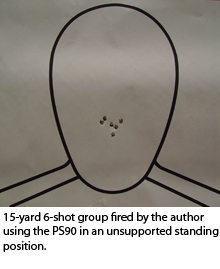
The gun and cartridge make for easy “minute of felon” hits at 100 yards, and some very nice groups at 25 yards and in, the range really intended for this gun.  I know you are asking about cartridge performance, and I will get to that in future articles, but suffice it to say for now that this thing is loads of fun to shoot, and anyone that handled it had a big smile on before, during and after firing.

That was followed by the exclamation, “I have got to have one of these!”  And those words from shooters who due to their, shall we say, lifetime of experience, have become a bit jaded.

For more information, www.fnhusa.com

The Great Remington Rolling Block Buffalo Gun Project, Part 1

1

Inspired by the great Remington Rolling Block design, the author decided to build a buffalo gun for hunting and shooting cowboy single-shot long-range events.

Founded in 1816 by Eliphalet Remington, Remington Arms Co. is the oldest arms manufacturing company in America. Before that, most arms were produced by small gunmaking operations.Remington might have marked the beginning of the industrial revolution in the gun business, I guess. It’s interesting that one of the company’s most popular products pulled it from almost certain ruin near the end of the Civil War.

Leonard Geiger brought the idea of the rolling block rifle to Remington Arms Co., which agreed to manufacture it. First, the idea had to be developed into the production stage by Remington designer Joseph Rider.

The initial gun was a split-breech carbine that saw little duty toward the end of the war. The design needed improvements, and it was eventually turned into the rolling-block action we know and love today.

The design came along at the right time, as arms manufacturers typically experience tough times when wars end. The rolling block was acknowledged as the best arm of its time, and its acceptance overseas brought Remington back into the black. Even today, the action is a popular single-shot for hunters and target shooters.

In its 70 years of production, the rolling block had so many versions it would take a book to decipher them. (For a great text, check out “The Military Remington Rolling Block Rifle” by George Layman.)

Although many sporting versions were produced, the rolling block was primarily a military weapon. Sustained fire with the rolling block was full auto compared to other options of the time, and the action was sturdy and reliable for military use.

Modern Applications

Inspired by the great design, I decided to build a buffalo gun with a rolling-block action for shooting cowboy single-shot long-range events.

Layman’s book helped me distinguish what type of action I started with. I had shot many Sharps-type rifles but wanted a different gun of the time. Plus, it seemed pretty cool to start with an action that was 100 years old.
The actions are still available at pawn shops and estate sales. www.gunbroker.com usually has a good selection of rolling-block actions, rifles and miscellaneous parts on auction. That’s where I got my last one. Gun Digest Classifieds also features these rifles.

The first actions were built of steel in the late 1860s. They were used with black-powder cartridges, most of which are obsolete. These actions were called No. 1s. The sporting rolling-block rifles were produced in .50-70 caliber.

Some were involved in skirmishes with American Indians, in which men held off attackers that outnumbered them five to one. As rifles were produced for overseas markets, they were chambered in calibers such as .43 Spanish, 43 Egyptian and metric calibers from Danish contracts in 11.7 x 51. Rifles usually have markings to identify where they saw service.

In the late 1890s and early 1900s, when smokeless powder started to rule ammunition, better steels were developed and used to produce these actions.

They were stronger and withstood the pressures developed by new propellants and cartridges. The rifles were chambered for 7 mm Mauser, .303, .30-40 and other cartridges produced for new-fangled repeating rifles.

These were No. 5 actions, and although the rifles differed in many details — such as the type of sights or length — the action was essentially the same as the No. 1, except it was made with the stronger “smokeless” steel. The parts are interchangeable.

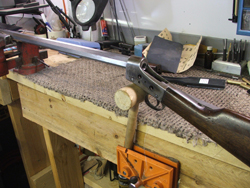
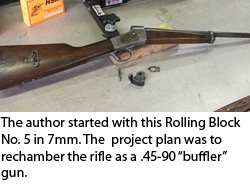
The rolling block came in various other models, but the one I found for my project was a No. 5 in 7 mm. It was a carbine and made circa 1902 to 1905. The rifle was functional, but as I disassembled it to start the project, my desire to shoot it waned. The action was in excellent shape, however, and would be an great base for my project. I began the search for the parts I’d need to rechamber it into a .45-90 “buffler” gun.

The question of caliber was my first decision. I wanted to build a sporting-type rifle, so the .50-70 might have been a period-correct caliber. It was a No. 5 action made of stronger steel, so I could shoot smokeless or black powder.

However, I wanted it in a more common buffalo caliber. I also wanted something for which it was easy to find loading components for making cartridges.

The .45-70 fit that description and is certainly a period-correct caliber. I went with the .45 Sharps, which is more commonly known today as the .45-90. My spaghetti Sharps is a .45-90, and I figured I could easily get parts right at my loading bench.

I have found most of the time it’s better to shoot the .45-90 instead of the .45-70 when you’re using black powder. The extra black powder that fits in the .45-90 case will increase the velocity a bit.

The most accurate smokeless loads in either rifle travel at about the same speed. Some of the new big-case powders will make the pill travel faster, but slowing them from 1,600 to 1,300 feet per second yields better results.

The .45-70 can be loaded faster, but that’s only recommended in the Ruger No. 1 action. I’ve never used that rifle and don’t have information about accuracy when pushing the .45-70 that far. The .45-90 will stay in the safe pressure zone at higher velocities, but accuracy suffers.

Getting Down to Business

After I decided on the caliber, I could start rounding up stuff. I needed a barrel, sights, a stock, a forearm and a .45-90 chambering reamer.

I went to the Brownell’s catalog and found about everything I needed. It carries Green Mountain black-powder cartridge barrel blanks in an octagonal stock. The barrel would have to be sized, threaded, chambered and crowned to the desired length.

It was plenty oversized enough for anything I wanted to do. I could have made it half-octagonal, half-round, or swamped it down to reduce the weight. I liked the full octagonal barrel but ended up tapering it down from breech to muzzle to decrease the weight. I also ended up shortening it to 30 inches before crowning it. The Green Mountain barrel blank was a .458 bore with a 1-in-18 twist.

When I pulled the 7 mm barrel off of the No.5, I saw something new. The barrel threads were square. I knew such threads existed, but I’ve never had to cut them. I had to grind a tool to cut square threads, which turned out to be an easy project. I counted how many threads were inside an inch: 12 tpi.

Next, I measured between and across the threads, and they were around .041 inch. I say “around” because they varied a bit, but only by a few thousandths. I then ground a square tool to those dimensions out of high-speed steel. I gave it a trial run on a piece of aluminum and made a plug that had a Class 3 fit to the receiver. A Class 3 fit has very little wobble.

The machining to fit a barrel blank requires access to a lathe. I have seen barrels on the Internet that were already machined and chambered. If you keep an eye open, you might find barrel that suits your needs.

Some companies offer barreling and chambering with their products, or most local gunsmiths can do that. If you have machining skills but need coaching, Brownell’s tech support guys are always there to help. I’ve found them to be extremely knowledgeable and will point do-it-yourself folks in the right direction.

I turned the barrel stub down to the right diameter and found that the round stub was a bit short for the rolling-block action.

It wasn’t a problem to use the lathe and lengthen the stub and round out some of the octagonal barrel. I like putting my own shoulder on the barrel so everything in the chambering and threading process is on the same plane. I used the old barrel to get it close enough for a hand fit.

When I was ready for threading, I kept the stripped receiver nearby, as the threads were getting close. This is the only way to get a precise fit, and it takes some time to try the threads, take off a few more thousandths and try again until it screws down tight. After the fit is good, you can adjust the receiver to the right position by taking off a few thousandths at the shoulder until it stops level. The breech face will also have to be trimmed to be flush with the back of the receiver to headspace correctly.

After the receiver fit to the barrel, it needed to be chambered. Brownell’s carries a good selection of Dave Manson reamers, which I like. When picking out a reamer for the .45-90, you can choose between lead bullets and copper jackets.

I knew I was going to shoot buffalo matches in cowboy games and would have to use lead bullets. I also planned on doing some elk hunting with the finished rifle and have been happy with the performance of lead bullets in such situations. Those big, slow bullets do not destroy meat from velocity shock; you can eat right up to the hole.

The .458 bore was big enough that I didn’t have to drill out the hole before starting the reamer. You could use a roughing reamer to get closer and then finalize things with a finish reamer.

You won’t finish this part of the job in a few minutes. The process is slow, and you have to remove the reamer often to clear off chips. You’ll also need lots of good-quality cutting oil. I kept the blank in the lathe, lined up the reamer with the tail stock and turned it by hand with a wrench. That kept the reamer lined up precisely with the bore, which is paramount for accuracy.

I was careful not to turn the reamer backward or counter-clockwise, because the chips binding against the cutting edges will dull the reamer.

After the chamber was reamed to the desired length, I fired up the lathe and slightly chamfered the edges to knock off the sharpness and keep bullets from snagging when loading. Then, I polished the chamber to a high finish with 600-grit emery and steel wool. I wrapped the abrasive on a properly sized wooden dowel and inserted it into the chamber when spinning it in the lathe. You can also polish it in a vise, spinning the abrasive with a drill motor.

With the barrel chambered, I had to form the breech face to fit the rolling block part of the action and cut the extractor slot. The First No. 1 actions had a straight-eject extractor on the bottom of the chamber.

Later, however, they were redesigned with a rotary extractor. My No. 5 was fitted with the rotary, and I only had to duplicate the position using the old barrel as a guide. I bought a new extractor and it was easy to fit to the rim of the .45-90. Having the old barrel made positioning the cut easy.

While doing the metal work, I tried to decide how to stock the gun and what type of sights I would use.

I wanted to duplicate a sporting rifle and really didn’t want verneer sights because I also planned to hunt with the gun. Montana Vintage Arms makes a period-correct Rough and Ready rear sight that combines an open sight and flip-up peep for distance shooting. For the front sight, I chose the company’s Beech-type combination, which has a blade for open sighting and a flip-up hooded pin for the peep rear sight.

I figured the gunstock would depend on my needs. I would shoot cowboy long-range events and hunt with the gun.

If I just shot competitions with it, the gun would remain in pristine condition. However, hunting would nick a custom-finished stock.

Brownell’s carries a Treebark Carving plain walnut stock for the rolling block action. It is 90 percent fitted and would be correct and practical for the rifle. It has a flat butt and can be fitted with a recoil pad or inletted to a period buttplate. Treebark Carving also offers various woods to fit any level of look.

What’s Next?

After the receiver is barreled and chambered, I usually proof-test guns before I proceed. In the second part of this article, I’ll do that, and shape the barrel, fit the stock and sights, and decide on a final finish. Click Here for Part 2 of this article to see the results of the great rolling block project.

Gun Digest Classic: Is This the Greatest .38 Ever?

1
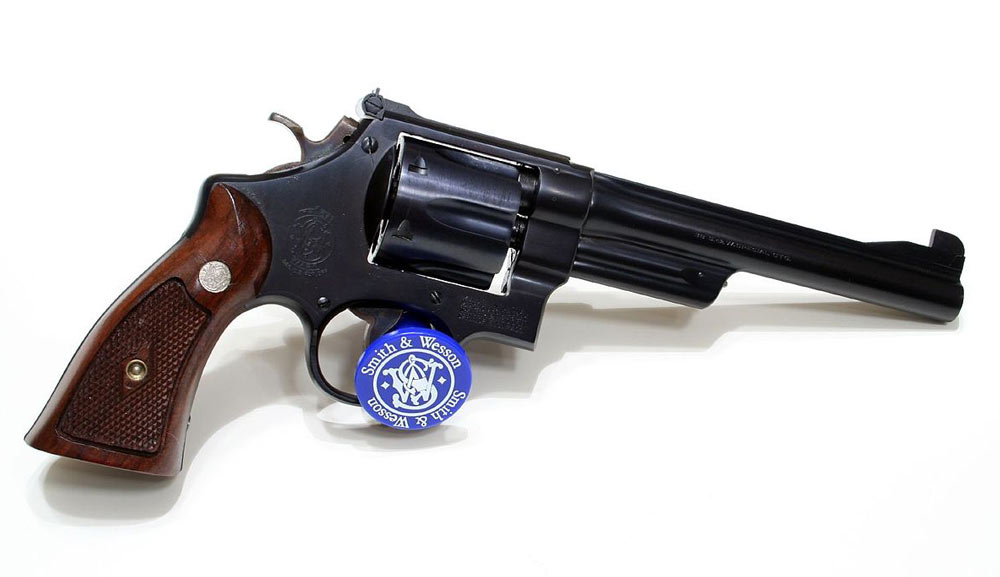
The Smith & Wesson .38/44 Outdoorsman had plenty to offer shooters, including a polite recoil.
The Smith & Wesson .38/44 Outdoorsman had plenty to offer shooters, including a polite recoil. Photo: Steven Z

Don’t get me wrong. I love Colt revolvers. A 1923 Police Positive is doing duty at this moment in my bedside nightstand. I sometimes carry a Detective Special. I think the Python is the most stylish revolver ever made.So please don’t throw things at me when I say that in my opinion, the finest revolver of all time, all things considered, is the Smith & Wesson Hand Ejector. And of all the Hand Ejectors, the finest are the N-frames. And of the N-frames, the finest was the .38 Outdoorsman.

It was the most well-mannered .38 ever made.

A Bitter Year

It was 1930, one of the bitterest of the Great Depression and the dawning of the Age of the Gangster. John Dillinger was honing his skills at a prison in Michigan City, Ind., while the likes of Ma Barker, Bonnie Parker, Clyde Barrow and Baby Face Nelson were tearing up the Midwest.

These public enemies, as they came to be known, weren’t fooling around.

Dillinger would later use a Colt Monitor, the civilian version of the Browning BAR, when he wasn’t carrying a 1928 Thompson he swiped from an Indiana police station.

Machine Gun Kelly earned his nickname the hard way. And unlike the bandits of the Old West, this new breed of criminals was likely to speed away from the scene of their crimes in a Ford V-8, a Studebaker sedan or an Essex Terraplane.

Against this rising tide of lawlessness stood America’s Thin Blue Line of local police and sheriffs, most of whom could rarely muster anything more powerful in the way of armament than a Colt Official Police or a Smith & Wesson Military & Police in .38 Special. And that just wasn’t cutting it.

Colt had responded to the call for greater police firepower in 1929 with its .38 Super Government Model semiauto, which sent a 130-grain metal-jacketed bullet rocketing out its 5-inch barrel at 1,300 feet per second — fast enough to penetrate most bulletproof vests and car bodies. The FBI promptly glommed onto the .38 Super, although some agents complained that its accuracy left something to be desired.

sw-logoA Better Idea

Smith & Wesson approached the problem from a different direction. It already had the perfect platform for a new police gun: the large Hand Ejector frame introduced in 1908 as the New Century or Triple-Lock .44 Special.

Having lost its third, and superfluous, cylinder lock in 1915, this enormous double-action frame (later designated the N-frame) served well in World War I as the basis of S&W’s .45 ACP Model 1917 revolver. (Almost a century later, the large Hand Ejector N-frame would remain in production — a record exceeded only by S&W’s own K-frame and Colt’s Model P Single Action Army.)

In 1930, as reported by Elmer Keith in Sixguns, S&W’s Major Doug Wesson introduced an all-new, 5-inch-barreled, fixed-sighted .38 Special built on the massive N-frame. The gun was formally named the .38/44 Heavy Duty, and was also known colloquially as the .38/44 Super Police for its intended application.

Even today the “.38/44” designation causes some confusion. It simply means a .38 built on the large .44 Hand Ejector frame. Muddying the waters a bit is the fact that there had been another, entirely different S&W “.38-44” several years before: a top-break target revolver chambered for a unique .38-caliber cartridge, in which the bullet was completely enclosed within the case, which itself stretched nearly to the end of the cylinder. This revolver was built on the large S&W No. 3 .44 Russian frame (hence the “-44”). The No. 3 .38-44 was a different animal from the .38-44 Heavy Duty double-action.

S&W’s new Heavy Duty could handle much hotter .38 Special loads than were generally available. That’s why, in 1931 Remington-UMC, Winchester and Western stepped up to the plate and rolled out a new breed of high-velocity, high-pressure .38 Special.

Whereas the traditional .38 Special load generated about 16,000 copper units of pressure, or CUP, to produce velocities of about 800 fps with a 158-grain lead bullet, the new load developed 20,000 CUP to produce a velocity of about 1,100 fps with a 158-grain metal-tipped bullet. (This was the first appearance of what we would today call the .38 Special +P.) The new load reportedly developed 425 foot-pounds of energy at the muzzle, which was — and remains — impressive.

Here, at last, was a gun that would punch through just about anything that stood between Dillinger and a police officer.

A Positive Reception

The new .38/44 was an immediate hit. In the November 1931 American Rifleman, Phil Sharpe praised it to the skies: “The thickness of metal in this gun gives the writer confidence to fire standard factory proof cartridges from the hand, something no other gun has ever inspired.” (A proof cartridge usually generates twice the pressure of a standard load and is used by gunmakers to test the strength of, or “proof,” their finished products.)

Comments like Sharpe’s were bound to get the attention of Keith, who was no slouch at blowing up revolvers with hot handloads. Using a .38/44 Heavy Duty, Keith found he could simply not induce the big gun to come unglued, even with his home-brewed .38 Special loads that generated a ferocious 42,000 CUP.

I won’t give Keith’s recipe for this load here, and actually I don’t even like to think about it. Suffice to say, it takes the .38 Special about as far as it can possibly go — maybe farther.

While still a .38 Speicaly, the Outdoorsman had more punch, given it could handle hotter loads.

As reported by C.E. Harris in the December 1980 American Rifleman, Sharpe’s glowing report on the .38/44 Heavy Duty had contained just a hint of disappointment: “There are no target sights for this model, [which] would be highly desirable.”

The Outdoorsman Arrives

S&W had already reached the same conclusion, and in 1931 the company introduced the .38/44 Outdoorsman, a sophisticated version of the Heavy Duty with target sights and a 6 1/2-inch barrel. The name of the new gun suggested it was marketed toward the woods bum who wanted something with a lot more “oomph” than a standard .38 Special.

Weighing in at a hefty 41 3/4 ounces unloaded, the Outdoorsman was, in the opinion of W. D. Frazer, “a target revolver in every sense of the word.” Frazer reported in a 1932 issue of American Rifleman that he had made 17 hits out of 20 shots with the Outdoorsman at 200 yards on a standard police silhouette target.

The Outdoorsman was so good, in fact, that it inspired the revolver that would make it obsolete: S&W’s .357 Magnum of 1935. The .357 Magnum was the Outdoorsman on steroids, and the FBI wasted no time in adopting it in 3 1/2-inch barrel form as its official sidearm.

You might have expected the Outdoorsman to wither away and die immediately, but it refused. Although made obsolete by the .357 Magnum, the huge .38 sold modestly until 1966, when it was discontinued.

The Outdoorsman was never a best-seller. Only 4,761 “long-action” Outdoorsmans were sold before World War II, and another 8,365 from 1946 to 1966. Postwar models featured a new-style hammer block, a micrometer sight and a new barrel rib. A short-throw hammer was introduced in 1950, at which time the Outdoorsman’s name was officially changed to the .38/44 Outdoorsman of 1950. Postwar guns can be identified by the “S” preceding the serial number.

When S&W adopted its new model numbering system in 1957, the Outdoorsman became the Model 23.

A Delight to Shoot

Shooting an Outdoorsman of any vintage is a pleasure. With 148-grain target loads, the big gun’s recoil is barely noticeable. It hangs on target with admirable inertia. Its trigger pull in single action is crisp, and in double-action, it’s wonderfully controllable. Owing to the revolver’s tight fit and long barrel, muzzle blast is negligible, even with +P loads. And in my opinion, S&W’s Hand Ejector lockwork is simply superior to that of anything else.

Some shooters will criticize the Outdoorsman, saying it is pointless. The .38 Special, they will say, is an old woman — as if only the most powerful handgun cartridges have any reason for existing.

I don’t agree. In fact, I believe the preoccupation with bigger handgun cartridges has grown comically absurd.

Hand cannons have their place, but so do target revolvers. I enjoy shooting a .38 Special with enough mass to dampen tremors. I might not be able to brag about how macho I am after shooting an Outdoorsman, but that’s a price I’m willing to pay.

I’ve been fortunate to have shot just about every basic model of American .38 Special revolver ever made. For my money, the Outdoorsman is the best — and certainly the classiest — of them all.

Hands On! Spyderench Does it All

0
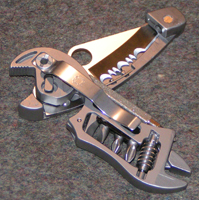
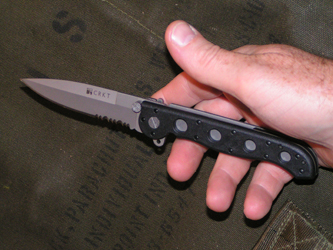
I'm not one for reading instructions, but it was nice to see a full-color brochure included with the new Spyderco Spyderench. This is a multi-tool to be reckoned with.

We've all seen the flimsy little stamped-metal multi-tools with weak pliers and lame configurations. Well, when you get your hands on a Spyderench, you will look down your nose at those lesser tools.

First, the Spyderench is stout. The pliers are slip-joint versions, with jaws that look a lot like channel locks and open to a full 9/16-inch span.

At the other end of the unit is a nice little adjustable wrench and a slot to hold screwdriver tips. Coolest of all is the fact that you can open the knife blade one-handed without opening the tool.

If you wish to get more torque when using the adjustable wrench, you can extend the handle to the fully open and locked position. The halves can be taken apart and used independently, with the knife and screwdrivers on one side and the adjustable wrench on the other.

The Spyderench comes with a belt clip, but is also shipped with a stout nylon belt pouch. This would be a great tool to toss in a glove box or a backpack. It's not like having a full set of Snap-On tools, but it's a darn sight better than most of the other multi-tools out there.

To get your hands on a Spyderench, check out www.spyderco.com

Gun Digest is the national bi-weekly source for firearms news, pricing and guns for sale. Our in-depth editorial, exclusive price guide and new product features, brings valuable information to our high profile subscribers. Subscribe Now!


Awesome Optics

0
Putting substandard glass on a good gun is a recipe for mediocrity. But with all the offerings in the optics market, where does a shooter start?

With optics, you really get what you pay for. You'll notice the differences between value-priced scopes and top-of-the-line models during extreme conditions. When lighting conditions are bad, betters scopes really shine.


Reaching Way Out With Nikon
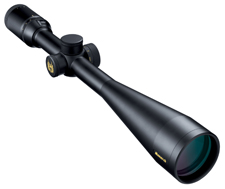
Nikon's Monarch riflescopes bring the idea of good glass to the forefront with the 8-32X50ED SF. This is the first riflescope to incorporate Nikon's exclusive ED glass, which delivers superior sharpness and color correction for unmatched detail resolution. The Monarch 8-32X50ED SF is designed for long-range hunting and target shooting.

Monarch long-range riflescopes come standard with a locking side-focus parallax adjustment. The easy-to-reach dials let you quickly focus while in shooting position. In addition to enhanced ring spacing, the new riflescope includes the Monarch Eye Box, with its impressive 4-time zoom range and 4 inches of eye relief, which remains constant throughout the power range without sacrificing field of view.

The Monarch's massive ocular lens also delivers a large high-resolution sight picture and the maximum field of view corresponding to each power setting.

Monarch riflescopes use Nikon's precise, repeatable, hand-turn reticle adjustments and feature the Interchangeable Turret Technology system, which lets you switch out turret knobs and caps for convenience and versatility.

The BDC reticle goes in every Monarch riflescope to let you hold dead on at ranges farther than those previously thought possible. Nikon's Nikoplex reticle is also available.

The scopes retain the popular 1-inch diameter main body tube. Nikon also uses lead-and-arsenic-free Eco-Glass lenses and Ultra ClearCoat anti-reflective multicoatings. Nikon Sport Optics:

Leupold's Gold Ring

Leupold's new Golden Ring UltimateSlam scopes feature a new reticle system to enhance accuracy for muzzleloader and shotgun hunters.

UltimateSlam's Sabot Ballistics Reticle has precise hold points in 50-yard increments to help you make accurate shots up to 300 yards. Precalculated markings on the magnification selector lets the reticle remain accurate for two- and three-pellet muzzleloader loads, as well as most popular 12- and 20-gauge sabot slug loads. The reticle has a range-estimation feature that instantly tells you if a deer is within 200 yards.

The scopes are available in 2-7×33 and 3-9×40 models. They have 1-inch main tubes and come in matte black or silver finish. Filled with bone-dry nitrogen, the UltimateSlam scopes have 1/4-minute-of-angle finger-click adjustments and are fog-, shock- and waterproof. They also feature Leupold's multicoat lens system for superior low-light performance. Leupold: (800) 538-7653

Sightron Goes Big, Small at Same Time
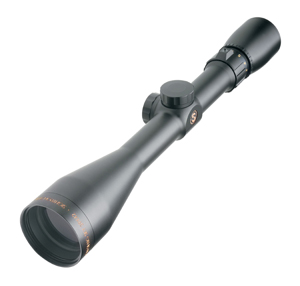
If you want incredible magnification and a clear view, Sightron Inc. has introduced a new model in its SII Big Sky line designed for bench-rest or precision-target shooting.

The new SII Big Sky 36×42 fixed-power scope has a fine cross-hair reticle that measures only .015 inch at 100 yards to give shooters an unobstructed view of their targets.

SII Big Sky scopes are built from a rugged one-piece aircraft-quality aluminum tube. They feature Sightron's unique Exactrack system for precise no-drift windage and elevation adjustments. The fully coated precision-ground lenses use Sightron's ZACT-7 Revcoat seven-layer multicoating throughout to provide high light transmission.

Sightron Scopes are waterproof, nitrogen-filled and provide a lifetime of internal fog protection. SII Big Sky models have climate-control coatings on the exterior lens surfaces to provide additional protection in bad weather. Sightron Inc

Burris Takes on Tactical
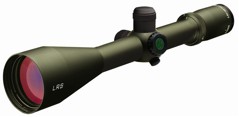
The TAC 30 3.5-10×50 is new for 2008. It has a 30 mm tube with olive anodizing, and comes with an illuminated Ballistic Plex reticle for low light.
Steel-on-steel click adjustment on the tactical knobs enhance repeatability and make sight changes easy. Burris

Vortex Won't Break the Bank
No longer must hunters settle for mediocre optics built with shortcuts to meet popular price points.

The new Vortex Crossfire packs much of the quality and performance of premium optics into a rugged, affordable riflescope. The Crossfire has fully multicoated optics that deliver 90 percent light transmission and a solid one-piece tube turned from aircraft-grade aluminum alloy. It's fog- and waterproof, has a choice of four reticles and is dry-nitrogen purged to prevent fogging and corrosion.

The Crossfire comes in 10 variable-zoom models, from 1.5-4×32 for brush hunting to a high-powered 6-24×50 AO for long-rage varmint and target shooting.

There's also a compact 2×20 mm model for handguns. Reticle styles include V-Plex (on most models), V-Brite (on select models), Fine Cross-hair (on the target model) and mil-dot (on long-range target and varmint models). Vortex

Binoculars
Binoculars are important tools. Typically, you get what you pay for. But sometimes, you can find great values.

Alpen Expands Pro Series
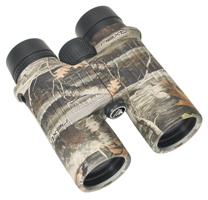
Alpen offers a 10×42 camouflage binocular in its popular Pro series. These binoculars provide great technology and features at an exceptional price.

The Pro model has a sleek ergonomic grip for slip-free comfort in wet conditions. It also offers superb optical clarity, color fidelity and brightness in a camouflage body.

The Pro provides great optical performance, with fully multicoated optics, BAK 4 high-refractive phase correction-coated prisms and a long eye-relief eyepiece for comfort while wearing glasses.
Alpen

Big Eyes From Vortex
Vortex has three new Viper binoculars with a 50 mm objective lens: 8.5×50 mm, 10×50 mm and 15×50 mm. They deliver premium performance at an affordable price.

With fog-, shock- and waterproof construction, the Vipers feature nonslip rubber armor, multi-position tapered eyecups and an easy-to-adjust diopter ring. Every Viper binocular is built with Vortex's advanced X-Factor Vision system, a combination of XD (extra-low dispersion) glass ‹ fully multicoated with Vortex's XR scratch-resistant coatings ‹ and premium, phase-corrected BaK4 roof prisms for brightness, image detail and high resolution. The Vortexes are built on a rugged, lightweight chassis. Vortex

Burris
Tough and ready for work, Burris' new Signature Select Binoculars 8×56 offer large 56 mm objective lenses to pull in light. These binoculars are crisp, clear and bright.

Fully multicoated lenses capture and transmit light for maximum clarity, and silver-coated internal prisms further maximize optical performance.

Twist-up eyecups are a convenience to eyeglass wearers, and Signature Series binoculars are waterproof, impact-resistant and designed with excellent ergonomics.
Burris

Tactical Gear
Missing a shot at a trophy is one thing. Missing a life-and-death shot in a tactical situation is different.

Optics and sighing systems on a fighting rifle require the kind of quality you can bet your life on. A couple of announcements for 2008 will make professionals happy and bring tactical benefits to the hunting community.

ACOG Goes Public
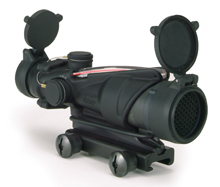
Trijicon Inc. is bringing the 4×32 ACOG (TA31RCO-M150CP) to consumers. The ACOG is the official rifle combat optic of the U.S. Marine Corps, and the Trijicon 4×32 ACOG is standard-issue for special operations forces. The 4×32 ACOG is the official optic of the U.S. Army.

The Trijicon 4×32 ACOG uses the Bindon Aiming Concept, a both-eyes-open aiming method that provides instinctive target acquisition and increased hit potential. The reticle features a red chevron aiming point and has a bullet-drop compensator, which offers additional aiming points to 800 meters. Weighing 16.2 ounces and measuring 7.3 inches long, 2.1 inches wide and 2.5 inches high, the Trijicon 4×32 ACOG is lightweight, versatile and mounts to any MIL-STD-1913 rail. A spacer system is also provided.

The ACOG features forged, 7075-T6 aluminum alloy housing, providing durability. A hard anodized coating protects against corrosion and chemicals.

Fully multilayer lens coating, per MIL-C-14806A, provides maximum optical performance in any light. Also, the 4×32 ACOG offers improved engineering of the external adjustment system (two clicks per inch at 100 yards). The system provides faster adjustment in the field and a waterproof design even when the caps are removed. The scope is nitrogen-filled to eliminate fogging.
Trijicon Inc.: (800) 388-0563

Schmidt & Bender ŒMarine' Scope
The riflescope chosen by the U.S. Marine Corps as standard scout sniper day scopes should be tough enough for hunting or tactical use. Only minor modifications to Schmidt & Bender's 3-12×50 PM II Military scope differentiates it from the USMC model.

The 3-12×50 PM II Military includes a specially designed double-turn counter-clockwise elevation knob with more tactile clicks every 10 cm. It has a ring-style indicator on the elevation turret that rises after the first full rotation of the elevation knob. There's a total of 220 cm 22 mils, or 79.2 inches of elevation adjustment.

The Gen 2 Mil-Dot reticle, developed and patented by Premier Reticles Ltd., is standard. It offers more accurate range-finding capabilities on more target sizes than ordinary mil-dot reticles. The Gen 2 is offered in an illuminated version for low light. Eleven precise click stops in a separate turret give you full control. Parallax adjustment, from 50 meters to infinity, is also in a separate turret.

The 3-12×50 PM II Military features the same extraordinary light transmission capabilities that distinguish Schmidt & Bender scopes.
Schmidt & Bender

ATN Cuts Darkness

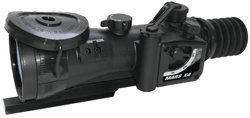
Hunters don't need to sight in the dark, but some shooters do. American Technologies Network Corp. has them covered with the ATN MARS series of night-vision weapon sights: the MARS 4X-3P and MARS 6X-3P, featuring a new ATN feature two-color manual brightness of the aiming reticle. That lets you choose red or amber for the projected reticle, depending on preference and light.

The sights use third-generation ITT Pinnacle Image Intensifier tubes, which provide superior performance in high light or light-polluted areas while minimizing halo effects.

MARS night-vision riflescopes are CNC milled from a solid aluminum billet and fitted with titanium inserts. Their one-piece construction makes them compact, light and rugged.

Using top quality multicoated glass optics with a mil-dot reticle, the MARS 4X-3P and MARS 6X-3P provide powerful 4X and 6X magnification, respectively.

The sights are nitrogen-purged for internal fogging resistance and feature an automatic brightness control. Windage and elevation can be easily adjusted.

MARS sights feature a tactical rail that lets you mount an IR illuminator or IR laser, and includes a mount for a Picatinny, Weaver-style rail or AK-style weapon. ATN

Something Really Cool
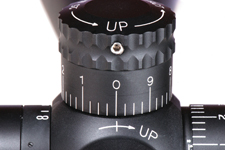
Have you had trouble finding your zero after moving the elevation knob? New ZeroStop technology from Nightforce lets you instantly return to the zero setting on your Nightforce riflescope, regardless of how much you've adjusted the elevation. It eliminates the need to count rotations and the possibility of being one rotation off.

After sighting in the rifle, you can set the ZeroStop to any of the 400 elevation clicks on a Nightforce scope (clicks are 1/4 MOA or 1/10 mm).

Return to zero is quick and positive, with no need for visual reference.
The ZeroStop is offered on all Nightforce 1-4×24, 2.5-10×24, 3.5-15×50, 3.5-15×56, 5.5-22×50 and 5.5-22×56 NXS scopes. Nightforce riflescopes in those configurations can be retrofitted to accommodate the ZeroStop turret.

ZeroStop technology was previously available only on Nightforce military and law-enforcement models. Nightforce USA Inc.:

Conclusion
More companies are producing great optics at affordable prices to help you put rounds where you want them.

Kevin Michalowski is the associate editor of Gun Digest the Magazine.

Editor's note: Want more information on optics? Check out Dave Morellis feature, Optics Necessities.

Optics Necessities

0

Good optics are important no matter what shooting discipline you’re involved with. After all, you have to see something before you can shoot it, and binoculars, scopes and spotting scopes make that possible.

Now that my eyes have aged, I don’t know where I’d be without modern optics. Thankfully, there’s a large assortment of glass available for specific needs.

Binocular Basics
I usually carry some sort of binocular, because you never know when you might need to see something at a distance.

The binocular is the most useful tool for hunting, nature watching or the work of a professional operator. The variety of this tool makes it easy — or difficult — to pick one for your purpose.

I have three pairs, which differ mostly in size: a pair of Nikon minis, which I like for pocket glass. They are 10x40s, but are clear and get the job done without the weight of larger models. During shorter jaunts, I carry Shepherd 12x50s. Sometimes, I’ll carry them regardless because their clarity is much better. My midsize Leupold Wind River binos have been taken over by my wife, Lu.

Swarovski and Steiner also produce great products. A friend has a pair of Swarovski’s 8×30 compacts, which provide great clarity for a compact bino.

Binoculars are categorized by their magnification and size of the objective lens. The objective lens is the farthest from the user, and it facilitates focus and light transmission. The rear lens provides magnification.

So, 10×50 binoculars have 10X magnification and a 50 mm objective lens. Unless I’m looking for something compact enough to carry in my pocket, I like to have at least a 50 mm objective. The bigger the lens, the better and more light transmission.

The ability to gather light makes optics so useful at dawn and dusk. That's why the other important factor in optics quality is the glass and how precisely it’s ground and shaped in the optical piece. That’s what determines cost. High-quality glass demands a higher price. Recently, competition and technology have made good-quality glass available to about everybody. You can purchase a pretty good piece for a reasonable price.

The focus-free or one-knob focus is one of the best technological advancements. The Leupold 10x50s I carry are of this type. That makes them easier to refocus after loaning them out. The only thing you must adjust is the interpupillary distance, which is the setting on the hinge that aligns the lens with the pupil. I usually mark this on my binoculars so it’s easier to return them to my setting.

A steady hold greatly improves the use of an optic afield. Lightly pressing the eyepieces to the bottom of your eyelid helps when viewing an object. I wear glasses, so steadying my upper body against something — a tree or vehicle — helps.

Some companies, such as Shepherd, make an attachment that lets you place binos on a tripod, like a spotting scope.

You can improve clarity by using your fingers to block light around the eyepieces when holding binoculars to your face.

Remember, the objective lens will reveal your presence to critters or an enemy when the sun reflects off it. Anti-reflective shields can help, and these are necessities for military and police personnel. >>>More Binoculars

Spotters
For long-distance observation, spotting scopes pick up where binoculars leave off. They are the most powerful device for scouts, hunters or snipers, and help detect and observe a quarry from great distances.

They have a very narrow field of view, so you often use them in tandem with binos, looking through the latter to detect something and then observing it more carefully with the spotter.

One big discrepancy with spotting scopes is the differences between zoom and fixed power.

I started with a 25X fixed-power spotter years ago and really like it. However, I had to have a 25-60X zoom by Bausch and Laumb a few years ago. It’s a great scope, with a 60 mm objective that gathers more light in 60X mode.

If you need that kind of magnification, get the biggest objective you can. I’ve seen high-magnification spotters with objectives that were insufficient for transmitting light — unless you were looking at the sun.

Usually, I use 30X and like the compact size and weight of a fixed-power scope.

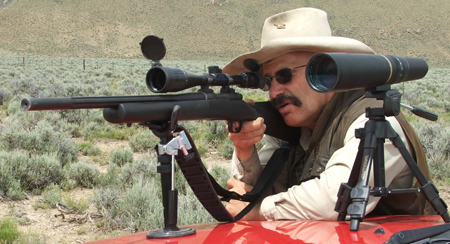
With a spotting scope, a steady rest is paramount. It’s very difficult — if not impossible — to use a spotter without a tripod. Good tripods are inexpensive and come in various forms. Shepherd makes a magnetic base that can be used on a shooting table or bench or the hood of a truck. It’s a versatile tool that can be used at the range or for spotting critters from the pickup. I like it because it’s compact enough to keep in the truck yet sufficiently handy for long-distance observation from a good rest. It also has a rifle-rest attachment, which comes in handy when sighting off the hood or resting a squirrel rifle. I also use it to steady my Shepherd 12×50 binos.

I also use another steadying device that attaches to a partially rolled-down window. It has all the adjustments of a tripod head and features clamp-type attachment that holds on the glass.

It’s compact and can be applied quickly without getting out of the truck and setting up a conventional tripod. I keep a small tripod in my pack for other conditions. It folds to less than a foot long but can be opened to work from a prone position or set on a rock for a sitting position.

I’ve been looking at Leupold’s 30x60X fixed-power spotter. It’s a light, sleek scope with straight-through view, not a prism type. I don’t have anything against prisms, but they usually are heavier. Prism models are shorter and might fit into a pack better.

Most spotting-scope manufacturers provide an additional feature: armor. This ribbed rubber coating makes the scope more resistant to shock.

Riflescopes
Hunters, shooters or professional operators must have quality scopes on their rifles. A scope allows a more precise look at a long-distance target, and nowadays, they can help you estimate range and compensate for bullet drop.

Years ago, when rifles were first produced to shoot targets at longer ranges, guiding a bullet to its mark was a problem. The most famous example was the mighty Sharps rifle, which was advertised as “The Rifle You Shoot Today and Kills Tomorrow.”

Before glass, these guns were fitted with sights that were extremely precise despite not having magnifying qualities. Later, these rifles were fitted with scopes.

Smokeless powder and new bullet designs flattened trajectory, and inventors kept up with optics to complement them.

Today, shooters have about everything we could want in rifle optics. That technology is great for professionals, provided they remember optics do not replace proper training. Sport shooters and hunters can use the same criteria.

Most modern scopes have variable magnification or power. Unless you have a specific purpose for a scope, that’s usually a good option.

Fixed-power scopes are usually a bit more rugged than variable models because of the design of the zooming apparatus. Also, they have fewer parts, so they experience fewer failures.

Still, most variable scopes are sufficiently rugged for hard hunting situations and most law-enforcement uses. Maybe the need for varied magnifications outweighs the need for more reliability.

The first scope I ever put on a rifle was a used fixed 6X Weaver I bought from a gunsmith. I mounted it on a .308 and shot many critters with it.

Being barely 16 years old, that’s what I could afford. Later, when I could buy a variable, I found I didn’t have time to change the power in close situations and had a blurry sight picture, anyway.

Now that my eyes are tuckered by age, everything is blurry. Even so, I like a variable scope. When I was a SWAT sniper, we had 3-9X variable Leupolds on our rifles, which were adequate for police situations.

Today, I rely on quality variable scopes. Many advancements help, the biggest of which are quality glass, range estimation and drop compensation.

Although a coyote is a medium-sized target, its kill area is about 4 inches. When calling, I can usually get a coyote close enough so nothing matters except a lower magnification from the variable scope to keeps the dog in focus.

However, when I have a long shot, I need the extra magnification and a quick way to estimate range and where the bullet will pass. Nobody is as good at estimating range past 300 yards as we think. Leica proved that to me.

Range-estimation and drop-compensation reticles are a great improvement. I learned mil-dot years ago, and it served me well. It’s still a great nonbattery system, but you must practice it to master it.

In hunting situations, there are better options, such as the Shepherd System. This reticle uses circle-size comparison to a target of known size to simultaneously range and compensate for drop. It also has scales that can estimate range and windage adjustments after you estimate wind speed.

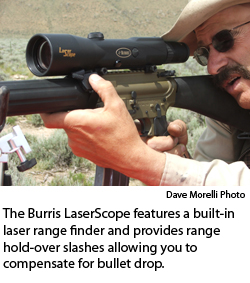
All reticle range estimations depend on you to know the size of the target or something at the same range. Burris’ LaserScope has a laser range-finder that instantly provides range of an object and has range-holdover slashes on the cross-hairs to compensate for drop, as estimated by a table of varying calibers and bullet weights.

I have used the LaserScope on coyotes and long-distance squirrels, and the instant range feature helps place longer shots more precisely and, just as important, quickly. As with other Burris products, the glass is great quality.

Conclusion
Despite all the wonderful technology available, shooters must practice and shoot to perfect their accuracy. While doing so, you might realize that technology helps you make longer shots and can also advise you when a shot is too long.

— Dave Morelli is a retired policeman, having served as a patrolman, trainer, SWAT operator and a SAR tracker/trainer. He currently lives in Idaho and writes about various topics, including firearms, hunting, tactical gear and training.

To read more about the latest optics, read Awesome Optics, by Kevin Michalowski, for a review of the latest 2008 offerings.

Gun Digest is the national bi-weekly source for firearms news, pricing and guns for sale. Our in-depth editorial, exclusive price guide and new product features, brings valuable information to our high profile subscribers. Subscribe Now!


Hands On! Gold Line Holsters Hold Tight

0
A classic handgun deserves a great holster. And sometimes, you just need something that looks sharp; something black-leather cool, like Samuel L. Jackson had in Shaft.
Bring on the Gould & Goodrich B800-194 Gold Line holster. This open-top two-slot holster is the epitome of form and function. Classic styling and top-notch construction make this a holster that does any gun proud. I got my hands on a B-800-194 built to cradle a Colt Commander (or other similar cut-down 1911-style pistol), and the combination is nothing short of nirvana.
Cut from top-quality leather and stitched to perfection, my .45 nestles into the holster like it was made for it. That's because, of course, it was. The B800 series will fit belts up to 1¾ inches and rides high enough to keep the pistol out of the way yet comfortable until you need it. 

If you want to carry with class, get your hands on a Gould & Goodrich holster. The company has a model to fit your gun. Check it out at www.gouldusa.com.


Gun Digest is the national bi-weekly source for firearms news, pricing and guns for sale. Our in-depth editorial, exclusive price guide and new product features, brings valuable information to our high profile subscribers. Subscribe Now!


An Attorney’s Perspective on Heller

0

On June 16, 2008, the United States Supreme Court issued its final ruling what is certainly the most important gun-rights case, and arguably the most important individual rights case, in recent memory, District of Columbia v. Heller.

What the Heller Case Was About

Until the Heller decision, Washington D.C.’s gun laws had been among the strictest in the nation for many years.

The Heller case was brought as a challenge to two things those laws did as administered by the D.C. government. First, they prohibited anyone in Washington D.C. from having a handgun in the home for self defense. Second, they required that shotguns and rifles, possession of which was allowed in the home, be kept in such condition that they would be unavailable as a practical matter for self defense.

In Heller, the United States Supreme Court struck down the D.C. gun laws on the ground that they violated the right to keep and bear arms protected by 2nd Amendment to the United States Constitution. Here's the link to the Supreme Court’s opinion: https://www.supremecourtus.gov/opinions/07pdf/07-290.pdf

The critical issue resolved in the case was whether the right protected by the 2nd Amendment is an “individual” right, or a “collective” right. The 2nd Amendment is part of our Bill of Rights, and any explanation of the difference between individual and collective rights requires an understanding of what the Bill of Rights, including the 2nd Amendment, actually does, and what it does not do. If you’d like to read the Bill of Rights, you can do so here: https://www.archives.gov/exhibits/charters/bill_of_rights_transcript.html.

Individual Rights versus Collective Rights

The amendments that make up the Bill of Rights set out specific, or “enumerated,” rights including freedom of religion, freedom of speech, freedom of the press, and in the case of the 2nd Amendment, the right to keep and bear arms.

Almost all of the freedoms protected by the Bill of Rights have been fairly universally understood to be inherent “individual” rights, meaning that each of us has these rights simply by virtue of being a free person.

Accordingly, the amendments in the Bill of Rights do not “give” these rights to us (and, in fact, they couldn’t since we already have them), but instead guarantee that the government can never blanketly take those rights away from us.

Until Heller, though, the nature of one such right, the right to keep and bear arms enumerated in the 2nd Amendment, had been the source of heated debate for about a century.

The D.C. government argued in Heller that the right to keep and bear arms is not an individual right, but a “collective” right of the citizenry of the United States as a whole to keep and bear arms as part of a state militia. Had the court agreed, it could have meant that the government has the authority to completely disarm every citizen of the United States who is not a member of the National Guard, do so any time it wants, and without reason.

If you want an example of how unconscionable the “collective-rights” theory is, consider that it would make perfectly legal the very sort of mass confiscations of guns from law-abiding citizens we saw in Louisiana during the aftermath of Hurricane Katrina!

Thankfully, the court clearly stated in Heller that the right to keep and bear arms is an inherent individual right guaranteed by the 2nd Amendment. As such, the court held, the D.C. gun laws as administered by the D.C. government violated the 2nd Amendment because, in effect, they prohibited all D.C. residents from legally having any kind of firearm readily accessible in the home for self-defense, a lawful purpose that the court noted was at the very core of the right to keep and bear arms.

This clear statement that the 2nd Amendment guarantees an individual right is potentially one of extremely broad implication. It’s also the only logical inference one can draw as to what our Founding Fathers intended the 2nd Amendment to do.

They crafted the Bill of Rights in 1789, which was right after the Revolutionary War — a war prompted in large measure by England’s attempt to subjugate the people living in her American colonies by disarming them.

With the Revolutionary War still fresh in their minds, the Founding Fathers took great care when creating the new American government to ensure that it could never prohibit the people it was created to serve from keeping and bearing arms for self defense in the home, for hunting and, if necessary, to prevent tyranny.

In fact, that’s the very reason for the entire Bill of Rights, including the 2nd Amendment — to prevent the government we set up to serve us from taking more power than the people choose to give it.

Heller’s Short-Term Future Effect

Obviously, the Heller decision will bring a huge sigh of relief to law-abiding residents of Washington D.C.

Thankfully, folks like the NRA are also already moving forward to have other unconstitutional gun laws in other parts of the country overturned based on Heller, and that is truly great news for Americans who live in other places where the government may have overreached its authority.

How far the NRA will be able to go in helping us remove other unconstitutional restrictions on our freedoms remains to be seen. They certainly deserve all the support we can give them.

As for the rest of us law-abiding gun owners, the Heller decision may not change our lives much as a practical matter, at least in the short term. The Heller court made a special effort to point out that other freedoms guaranteed in the Bill of Rights are subject to reasonable regulation, and that the right to keep and bear arms is no exception.

For example, even though the Bill of Rights guarantees the right to free speech, that doesn’t mean we’re allowed to yell “Fire!” in a crowded theater when there’s no fire, or that we can slander someone without consequence.

Likewise, the court said that most current forms of regulation of the right to keep and bear arms are okay. That means unless and until such existing forms of regulation are overturned, we still must comply with carry-permit requirements and prohibitions against carrying guns in sensitive places such as schools and government buildings.

The opinion also doesn’t roll back any prohibitions of weapons not currently in common use in our society, such as machine guns. What the Heller opinion does change, though, for gun owners and non-gun owners alike, is that all Americans are finally assured that the most basic protection of individual liberty is intact, at least for now.

Those who wish to have a firearm for lawful purposes such as self defense in the home and for hunting cannot be disarmed by the government at its whim, and that the government we created to serve us cannot take more power than it is allowed by the will of the people.

At least, that’s the case for the near future. As wonderful as this news is, no court ruling is written in stone forever, and the Heller decision is no exception.

Even with this victory, there’s nothing to prevent the court from holding completely the other way later on, and if the wrong kind of justices are appointed to replace those who will likely retire from the Supreme Court soon, there is a very distinct possibility that this entire victory could be completely wiped out.

The only way we can continue to protect our fundamental liberties is to diligently pursue three things, perhaps harder now than ever before.

Three Things We Must Do!

First, we must elect a president who will only appoint non-activist judges to the U.S. Supreme Court. Justices are appointed to the United States Supreme Court for life by the President of the United States. As many as three of the current activist justices who voted against the Heller majority may retire during the next few years.

We absolutely must elect a president who will replace them with justices who, like Scalia, Roberts, Thomas and Alito, understand and will exercise judicial restraint (who will apply the law instead of trying to re-write it).

It would be hard to overstate how critical this is at this particular moment in time. Realize that even though the correct decision in Heller was incredibly clear even before the case started, the ruling was still a 5-to-4 split decision!

The last few justices appointed to the Supreme Court voted the right way in Heller, and only one vote made the difference. Consider what the ruling would have been had even one of the most recent appointees to the Supreme Court ruled the other way — had even one been like dissenting justices in the case, who tried to re-write the 2nd Amendment rather than properly applying it.

And that is exactly what would’ve happened had John Kerry been elected president in 2004! In fact, all five of the justices in Heller who ruled that the 2nd Amendment guarantees an individual right to keep and bear arms were appointed by Republican presidents.

And, in my own case, the fact that non-activist justices will make it to the Supreme Court only when the president is a Republican is enough for me to cast my vote for the Republican presidential candidate.

That’s because the nature of our right to keep and bear arms is the most important liberty we have, since without it, none of the other freedoms mentioned in the Bill of Rights are guaranteed.

Instead, they would be only privileges allowed by the government. The right to keep and bear arms is a guarantee that the government we created will serve us as citizens.

Without that right, we serve the government as its subjects, and I believe that all thinking Americans who truly understand what America is cannot avoid the same conclusion. Consider, for example, the following quotation from Democrat Vice President, Hubert H. Humphrey in 1959: “Certainly one of the chief guarantees of freedom under any government, no matter how popular and respected, is the right of citizens to keep and bear arms … The right of citizens to bear arms is just one guarantee against arbitrary government, one more safeguard, against the tyranny which now appears remote in America but which historically has proven to be always possible.”

Second, we must elect United States Senators who will confirm appointments to the Supreme Court, and do so without unreasonable delay.

The president cannot place new justices to the Supreme Court on his own. Instead, his appointments must be confirmed by the United States Senate.

This process has become increasingly politicized over the last few decades, with Senators in the non-nominating party using the confirmation process for political leverage. The process has also become especially vicious over the past few decades, as any who watched the Senate confirmation hearings for Robert Bork and Clarence Thomas will remember.

Accordingly, we must not only elect a president who will appoint non-activist justices, but also elect U.S. Senators who will also confirm those appointments in a reasonable and timely manner.

Third, we must diligently devote our time and resources to organizations such as the National Rifle Association. The NRA was instrumental in winning the Heller case, and it is already moving ahead aggressively in its quest to have other unconstitutional gun laws overturned.

Other than voting, contributing to the NRA is the single most important thing we can do to keep the ball rolling.

Jon Cooner is the Director of Special Projects for The Whitetail Institute of North America.

Gun Digest is the national bi-weekly source for firearms news, pricing and guns for sale. Our in-depth editorial, exclusive price guide and new product features, brings valuable information to our high profile subscribers. Subscribe Now!


Range Wars: Protect Your Range from the Anti’s

0
The Pioneer Gun Club Brickyard Range had served the Kansas City area for as long as anyone could remember.

The contour of the hill had been changed by the impact of rifle bullets, and trees had grown tall on the berms, shading members when they repaired target frames. Sons and grandsons of members shot trap and competed in small-bore and high-power rifle matches. An indoor pistol range improved the facility, and an archery range was planned. Members were not concerned about a developer building houses above their valley and a golf course over the hill behind their berm. They had been there first. “First in time is first in right” was the slogan, and it seemed like a pretty good principle.

But that’s not how things work.

The Brickyard Range operated under a nonconforming use permit from the local zoning commission. Further, the range was not agricultural, commercial or residential. When the permit expired, the developer objected to its renewal. Never before confronted with opposition, the club went to the biggest law firm in town, told them how much money they had raised for a defense fund and asked what a defense would cost. Coincidentally, it cost exactly what the members had raised. The club was fortunate to preserve shooting on the indoor pistol range and retain the right to put in an outdoor archery and air-rifle range. The club fathers were honorable men who thought other folks would act honorably and that justice would be done.

But again, that’s not how things work.

Disputes continued between the club and developer. In the early 1990s, circular holes were noticed in low-lying areas of the club’s property. Soil samples had been taken with the intent of proving lead contamination. Such contamination would force the club or any subsequent owner to undertake expensive clean-up efforts. But perhaps the results convinced the developer to leave the club valley as a quiet country view for his expensive houses rather than try to take over lead-tainted property. That’s how things work.

Despite that lucky stigma, the Pioneer Gun Club was forced to move most of its activities farther into the country and away from its members. It had to spend lots of money and time to set out new ranges and facilities.

Feeling the Crunch

That scenario is becoming increasingly familiar. Other ranges are under attack by people who moved within earshot long after the range was built. The owners of new adjoining homes even closed down the long-established Clay County, Mo., sheriff’s range because they were upset by the sound of officers practicing to defend them.

We have learned more about range protection and attacks on ranges since the Pioneer lost most of the use of its Brickyard Range. However, that knowledge has been expensive and hard won. It’s less expensive to prevent problems. The battle to establish a Kansas City-area range illustrates the difficulties of keeping a range.

The area north of Kansas City had needed a range for years and had been promised one for almost as long. When the Parma Woods Range was proposed for southern Platte County, Mo., the plan faced a hearing before the county commissioners.

Learning of organized opposition, the Western Missouri Shooters Alliance and National Rifle Association filled the hearing room with advocates. Opponents included folks opposed to change — especially if the activity made someone happy — and people who simply hated guns and gun owners. None lived next to the proposed range, but some complained of being within hearing distance. Opponents warned that increased traffic could run over children, and that shooting would ruin property values, annoy people and terrify animals. One opponent claimed that a range would “taint” the property. The site had been a sanitary landfill and was about as tainted as it could get. Tests had proven that local trains made more noise than the range would. However, opponents complained that the type of noise was critical and the “short, sharp crack” of gunfire wasn’t as loud but was more annoying and terrifying, and would traumatize humans and animals.

Advocates stressed that if people couldn’t practice shooting on a professionally designed range, they would do so where their grandfathers had. Population increases in the area made traditional shooting spots dangerous, and a safe range was required. The deciding factor was that range visitors would patronize local businesses and paying local sales tax.

The range was approved and is now a jewel of the Missouri Department of Conservation system.

The Four Objections

Foes of the Parma Woods Range had many important-sounding excuses, but they were only excuses. Even if there had been no noise or bullets, these folks would have opposed the range because they hate gun owners.

People protecting existing ranges across the country will meet the same objections. These break into four categories: zoning, lead, safety and noise.

Zoning sets forth accepted uses of property. Even in rural areas, zoning limits land use — usually to agricultural purposes. Therefore, ranges typically require a nonconforming use permit. These permits are limited in time and renewals must be planned ahead. It might be possible to obtain a special-use permit, which provides greater security. Either way, a range must post signs proclaiming its existence. That limits claims of subsequent surrounding landowners that they were ignorant of the range.

Rural landowners often have private ranges, which they use to conduct private shooting classes. Some apply to their county government for a license to use the range for private or commercial purposes. Because there is no such license, the landowners receive a letter saying their request cannot be granted. That gives them a piece of government stationary proving they were using the range at a specific date, which provides some standing to maintain the range against later challenges.

Lead is acceptable in the ground where God put it, but when it’s dug out, molded into bullets and fired back into the ground, it’s considered toxic and cancer-causing. This complaint is often leveled against ranges. It’s even worse when lead is fired in, over or near federal wetlands. However, “wetlands” are very broadly defined, and a dry field might be deemed a wetland if beaver dams or poor drainage floods the area.

An expert in cleaning toxic waste recently explained that lead is not a danger unless it gets into the water table. Lead in the ground is not a threat unless someone eats nearby dirt for eight hours per day for a year. Even then, it’s only a threat. (Incidentally, that expert’s services are expensive but necessary to counter predictions of cancer, pronounced in the tone medieval scholars used to warn of witches and heretics.)

Safety is the No. 1 purpose of any range. Of course, that will not prevent gun haters from claiming safety violations. Ranges are blamed for every gunshot in the area. Every range has received complaints of bullets escaping the range and striking property at impossible distances.

During a recent hearing, a Massachusetts range was confronted by opponents who dumped piles of bullets they reportedly picked up on their property. However, the bullets were still loaded into cartridge cases — complete with gunpowder and primers. Other opponents are more sophisticated. The only protection is professionally designed ranges with overhead cover at firing points to prevent guns from being fired at angles that overcome the berm.

Noise was defeated years ago by the invention of silencers. However, the 1934 National Firearms Act ended that, and modern ranges must be silenced. Tree belts around the perimeter of a range and baffles at firing points minimize noise. However, only placing the range in a cave suppresses it entirely. Ranges have been placed in old mines, but that’s not a practical alternative for trap and skeet. The Parma Woods Range had to sacrifice trap and skeet to satisfy speculative noise complaints.

Build a Range-Protection Committee

Anti-gun organizations devote Web sites to teaching people how to sue ranges. Ranges must make an equal effort to survive.

Every facility must have a range-protection committee, or at least an officer. Ideally, such a committee should include someone familiar with real-estate law and their state’s range-protection statute. It should also have a relationship with an attorney. For a minor fee, lawyers will often act as the registered agent for an organization, and that saves introductions when a problem arises. It also prevents the opposition from hiring him. The lawyer does not have to be a gun guy. He just needs to know zoning and real-estate laws, and must be conversant about lead as a toxic substance. You might go to the largest law firm in your area, but such firms usually don’t represent individuals, and range members will want to be seen as people. Solo practitioners, and moderate to small firms, are usually more responsive. Larger firms have more lawyers with various strengths in different fields of law. Interview a defender before they are needed.

A defense lawyer must have trial experience. Many lawyers do great work yet never see a courtroom; partly because they do great work and partly because they don’t know how to try a case. Trying a case requires knowledge of trial rules and human nature.

In a recent case, the neighbor of a range claimed that shotgun pellets from 600 yards away passed over her home and that the ground shook when the shotguns fired. People often ask, “How can they say that?” It’s simple: They lie. Worse, they often believe their own nonsense and appear to be sincere. Trial lawyers are familiar in dealing with liars.

Trial lawyers are also experienced with juries. In one trial, the range attorney asked prospective jurors if any were hunters and was glad to see some seated. But later in the jury room, two of the “hunters” joined a vehemently anti-gun block that pushed through a verdict for the complaining neighbor. The clique convinced most of the jurors that the other neighbors — who testified they were not bothered by the range — were beholden to the range, but the plaintiff’s relatives were independent witnesses.

People, plaintiffs, witnesses and prospective jurors lie. When a prospective juror claims shooting experience, it’s necessary to follow with questions only a real shooter could answer. Also, range cases typically require expert witnesses. A good trial lawyer can translate the expert’s technical evidence into language a jury can understand.

Trial lawyers are necessary because range cases go to trial. The alternative is to give lots of money to the plaintiffs, restrict operation of the range — or both. Trials cost money, but defeat costs the use of the range.

A club’s range-protection committee must plan for the preservation of the facility. It must keep track of the expiration dates of zoning permits and protect the range from encroachment by unfriendly neighbors. That can be accomplished by covenants running with the land. For a fee, a neighbor gives up any future objection to the range. Any heir or buyer obtains the property subject to that covenant. Purchasing a future estate in neighboring property might also be useful. A future estate means the range purchases neighboring property for less than the value of the land. The seller keeps the land for his lifetime, and it reverts to the range on his death. A real-estate lawyer must write such documents so they will withstand inevitable challenges a generation later.

The committee must also maintain good relations with neighbors. It is difficult to hate someone you know and easier to do business with them. The range should have a presence at local community events — not just gun shows. Neighbors should be invited to club picnics, as should the lawyer. He needs to know the people for whom he’s fighting.

Pioneer Gun Club has created local good will by opening its range to nonmembers to sight in their rifles for deer season. Providing facilities for police training is helpful, as is providing facilities for youth groups. These activities will be useful when a court is asked to balance the usefulness of the range with shotgun blasts.

The committee must have contact with the NRA’s Range Development office and National Association of Shooting Ranges (www.rangeinfo.org). Keeping track of trends in range management and defense is invaluable. The committee must be able to call out members and friendly local folks — neighbors, Boy Scouts or the owner of a nearby gas station — to hearings that threaten the range.

The survival of shooting depends on having safe places to practice. Gun-haters know this and are coming for our ranges. Be ready.

— K.L. Jamison is an attorney from the Kansas City, Mo., area.

Gun Digest is the national bi-weekly source for firearms news, pricing and guns for sale. Our in-depth editorial, exclusive price guide and new product features, brings valuable information to our high profile subscribers. Subscribe Now!

Hands On! M16 is a Dandy Duty Knife

0

Ask a dozen people what makes a great knife and you'll get a dozen answers. No knife can handle every job. That just isn't happening.

However, if you list the attributes of what you'd like in an everyday-carry tactical folder, you might find that the M16-13LE from Columbia River Knife and Tool has much of what you want.

Weighing just 3.2 ounces, the M16-13LE carries a 3.5-inch spear-point blade (other blade styles are available) that opens quickly and smoothly with one hand. It features a two-stage lock that, according to the makers, turns the folder into a fixed-blade knife just that quick. I don't know if I would call it a fixed-blade folder, but it sure locks open solidly.

The movement of two locking mechanisms to close the knife takes some practice. I wouldn't call it a pain in the butt — just a learning curve.

The best word to describe this knife is sleek. When closed, it’s just 1 inch wide and slightly more than ½-inch thick. Yet when open, the knife looks like it’s all business. Kit Carson has designed the M16 for function. Handle one, and you will immediately know what that means.

Notice the wide blade design for difficult tasks and the sure-grip contoured handle of 6061T6 hard anodized aluminum, which allows a comfortable grip with or without work gloves. The blades are made of AUS-8 stainless at 56-58 Rc. and completed with a nonreflective bead-blasted finish. The M16 is a full-size utility knife that features the Carson Flipper extension to the blade to speed opening and act as an additional blade guard.

To get your hands on a CRKT M16, check out www.crkt.com.


Gun Digest is the national bi-weekly source for firearms news, pricing and guns for sale. Our in-depth editorial, exclusive price guide and new product features, brings valuable information to our high profile subscribers. Subscribe Now!


Hands On! Laserlyte Makes Rails for Your Shotgun

0
If you want to add a light to your shotgun, you can get all crazy with huge, bulky rails, or you can get the Tri-Mounting system from Laserlyte for about $25.
This little unit will let you set your tactical or home-defense shotgun for maximum versatility and low-light performance.
 

Lightweight and durable, this system positions three Picatinny rails at the front end of the shotgun, where flashlights or lasers are best located.


Easily mounted on the magazine tube of most popular 12-gauge pump shotguns, the Tri-Rail takes up less than 1.5 inches ahead of the forearm.
Made of tough aircraft-grade aluminum with a matte-black anodized finish, the Tri-Rail attaches in minutes with two machine screws and provides a rock-solid attachment point for many accessories.
 

Best, the unit practically disappears when you remove the accessories. The rails don't get in your way when you don't need them.


To get your hands on a Laserlyte Tri-Mounting system, check out www.laserlyte.com.
 

To read more Hands On! gear reviews, click here


Gun Digest is the national bi-weekly source for firearms news, pricing and guns for sale. Our in-depth editorial, exclusive price guide and new product features, brings valuable information to our high profile subscribers. Subscribe Now!


Hands On! Safariland RLS Lights Up the Night

0

It seems everyone has a weapon-mounted light on the market these days.

However, Safariland has come up with something really innovative. The Rapid Light System is a locking light mount that’s quick and easy to attach and detach to any firearm with an accessory rail. It even lets you use any other brand of hand-held light, provided the body diameter is .970 to 1.06 inches.

For a suggested retail price of about $90, you get a professional-quality hand-held light and gun-mounted light in one.

You can clip it to your belt, hold it in your hand or quickly mount it to your gun for an instant tactical advantage. There’s no need to buy an expensive holster.

The unit is also ambidextrous and comes with a super-bright LED that puts out 65 lumens. Three AAA batteries provide power for more than 50 hours of use, and the light comes with an integral clip for easy attachment to a belt or garment, eliminating the need for a dedicated light-mount holster.

Finally, the RLS quickly transitions from service as a standard flashlight or weapon-mounted light, meaning there’s no need to search an area with a “loaded flashlight” unless the situation dictates it. To learn more about the Safariland RLS, check out www.safariland.com.

Gun Digest is the national bi-weekly source for firearms news, pricing and guns for sale. Our in-depth editorial, exclusive price guide and new product features, brings valuable information to our high profile subscribers. Subscribe Now!


Gun Review: North American Arms Guardian 380

0
If you want a small gun with a big punch, get your hands on a North American Arms Guardian 380.
 

This stout little gun tosses the .380 round, which will certainly get the attention of any aggressor.


This all-steel gun weighs just less than 19 ounces; heavy enough to absorb some recoil, but still light enough to stow in a pocket, purse or deep-concealment holster.
 

This is not a shoot-all-day target pistol. You will want to practice with it monthly and carry it every day.


The recoil is not abusive but is noticeable. With every shot, the front of the trigger guard banged into my trigger finger.


However, that's a minor complaint for a gun that disappears until you need it and delivers enough punch to drop a bad guy.


On the range, it took me one magazine to learn I was shooting the little gun a bit low. After figuring that out, 5- to 10-yard accuracy was perfect for self-defense needs, even during rapid fire. I had one malfunction, but that was because I hadn't seated the magazine fully.
The Guardian is rugged, durable and ready for action. To get your hands on a North American Arms Guardian, check out www.naaminis.com.
Specifications
Caliber: .380 ACP
Magazine capacity: 6 plus 1
Operation: double-action only
Material: 17-4 pH stainless steel
Barrel length: 2.49 inches
Height: 3.53 inches
Overall length: 4.75 inches
Width: 0.930 inch
Weight: 18.72 ounces unloaded
Trigger pull: 10.0 LBS.
Suggested retail price: $449
 

Gun Digest is the national bi-weekly source for firearms news, pricing and guns for sale. Our in-depth editorial, exclusive price guide and new product features, brings valuable information to our high profile subscribers. Subscribe Now!


Hands On! BlackHawk! HawkHook Can Break in and Save a Life

0
Sometimes, you need to break a window, which means having the right tool at the right time.

You could use a baton, hammer or the muzzle of your pistol, but those have a strong downside — not the least of which is availability.

BlackHawk’s new HawkHook is a versatile rescue tool because it’s extremely compact.

The HawkHook features a folding blade that includes a glass breaker, wire stripper, bottle opener, flat screwdriver/pry tip, straight serrated cutting edge and recessed cutting edge to safely cut webbing, seat belts and parachute cord.

It’s easy to open with one hand and locks firmly with a stout frame-lock mechanism in the handle.

The glass-breaker on the tool can be used with a hammer-like motion to keep your hands away from sharp glass during window breaching. Further, it pops tempered-glass car windows like balloons. Best, the retail price is about $40.
To get your hands on a BlackHawk! Hawkhook, check out www.blackhawk.com.
Specifications:
• Blade length: 2.25 inches
• Overall length: 3.25 inches
• Blade material: AUS8A stainless steel
• Blade finish: Matte bead-blast finish
• Edge type: combination plain/partially serrated
• Handle material: 420J stainless steel with textured plastic scale
• Pocket clip: Right side, tip-down carry

Gun Digest is the national bi-weekly source for firearms news, pricing and guns for sale. Our in-depth editorial, exclusive price guide and new product features, brings valuable information to our high profile subscribers. Subscribe Now!

MUST READ ARTICLES