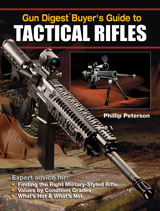
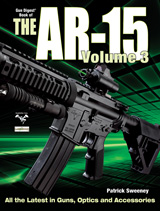
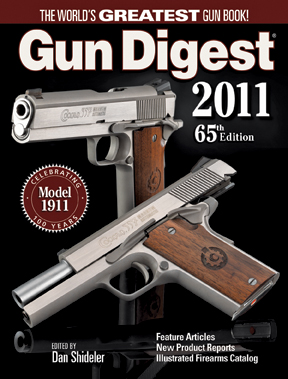
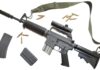
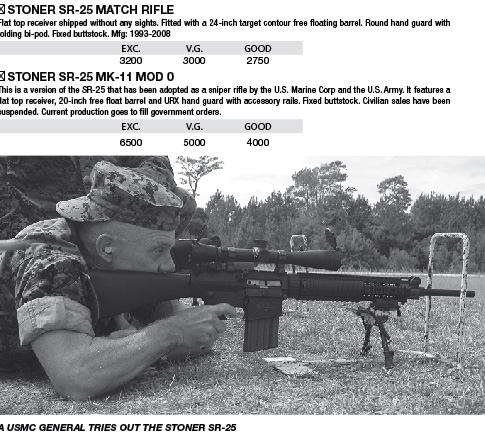
Simply titled the Gun Digest Buyer’s Guide to Tactical Rifles, this new soft cover book offers values, specifications, photos and histories of the more common — and many lesser-known — tactical rifles on the market. The grading scale lists prices in MSRP or NIB (New In Box) and EXC. (Excellent), V.G. (Very Good), and GOOD (Good).
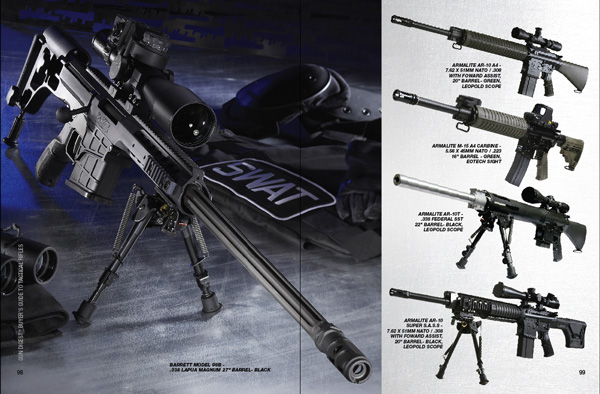
One of the things you immediately notice about the Buyer’s Guide that sets it apart from other pricing or value books on the market is the high quality photography, including a nice full color middle section called the Gallery of Tactical Rifles.
Can you imagine a book about tactical firearms without photos? Let’s face it, while a book of this type is virtually mandatory for anyone seriously looking to buy or sell tactical guns, one containing only pages and pages of listings and numbers wouldn’t be any fun to look at (in fact, it’d be downright painful on the eyes).
Not so with this book. Each page takes you on a delightful little adventure down the yellow brick road (via alphabetical listing by manufacture) of guns from Russia, Europe and America.
The Gun Digest Buyer's Guide to Tactical Rifles features specifications, current values, hundreds of illustrations, histories and more.
Peterson gives tips on how to get the most use out of the Buyer’s Guide with a detailed explanation of condition ratings. He also explains that, by “tactical rifles,” he means:
For the purposes of this book it is a semi-automatic rifle or pistol that accepts detachable magazines that hold over 20 rounds of ammunition. A few, such as the Barrett M-82 .50 Cal. rifle and the SVD Draganov Sniper rifle, which have 10-round magazines, are included as they certainly need to be in such a guide.
Given how the term “tactical” is slapped onto just about anything these days — including pens and wristwatches — Peterson explains the decision to limit the book’s scope to mostly semi-automatics.
There are some things that carry a tactical label that are not covered in this work. That would include shotguns, bolt action rifles and conventional handguns with rails for attaching lasers or optical sights. Such firearms are certainly “tactical” in nature, but since even some revolvers now have tactical rails built into them, we just had to draw the line somewhere.
But I’m glad to see the editors didn’t hold too rigidly to that doctrine, because in the Gallery of Guns you can lay your eyes on a nice full color image of Armalite’s .50A1, which is indeed a bolt action single shot.
Finally, the book’s intro includes a very concise and useful history on these fascinating arms, with Peterson discussing The Classics, Ban Era Guns, The New Boom, Heavy Iron and Home Gunsmithing.
There’s a lot to consider when buying a tactical rifle. This book will be your guide. Buy it now
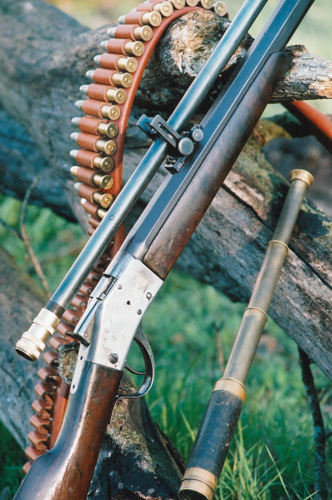
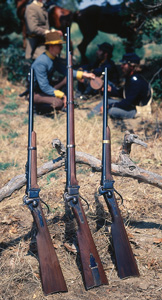
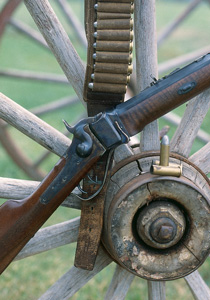
Many Sharps collectors believe that the tooling for the Model 1875 was modified for the later production of the hammerless Model 1878 Sharps Borchardt rifle. Original shown here with a new-made Leatherwood Hi-Lux Optics “Wm. Malcolm” telescopic rifle sight.
Of the half-million or so “breech-loading” rifles and carbines purchased from twenty different arms makers by the U.S. Ordnance Board during the Civil War, nearly 20 percent were produced by the Sharps Rifle Manufacturing Company, of Hartford, Conn. The only other breech-loaded firearms to see greater use were produced by the Spencer Repeating Rifle Company, of Boston, Mass.
Official records of ordnance purchased by the United States government from January 1, 1861 to June 30, 1866 show that a total of 80,512 carbines and 9,141 rifles of Sharps manufacture were delivered. During that same period, Spencer produced a total of 94,196 carbines and 12,471 rifles for the war.
Mounted cavalry troops tended to prefer the 7-shot repeating Spencer lever-action carbines and easier loading self-contained cartridges over the slower loading single-shot percussion breech-loaded Sharps with combustible paper or linen cartridges. On the other hand, the rugged construction and longer-range accuracy of the Sharps made it revered among foot soldiers. And it was the outstanding reliability of Sharps-built rifles or carbines during this period that earned them their well-deserved “Old Reliable” reputation.
Oddly enough, the man whose name became known around the world, thanks to the quality and accuracy associated with Sharps rifles, had very little to do with the company during this period. And he had no involvement with the production of the later big-bore cartridge rifles that were even better known for their long-range large game taking performance.
Christian Sharps learned the gun-making trade during the 1830s while working with the production of the Hall breech-loading Model 1819 flintlock rifle produced at Harpers Ferry Arsenal.
While Hall later developed a percussion version, Sharps had conceived a still better “drop block” design and received his first patent in September of 1848. Only about 200 each of his percussion Model 1849 and Model 1850 drop-block action rifles were produced by Pennsylvania based manufacturer A.S. Nippes. Both were 44-caliber rifles, built with automatic priming systems.
Production of the 52-caliber Model 1851 and Model 1852 rifles was moved to the Robbins & Lawrence plant in Windsor, Vt. The rifles were built for the newly formed Sharps Rifle Manufacturing Company, headquartered in Hartford, Conn. During the production of the Model 1853 and Model 1855 rifles, both the Robbins & Lawrence and Sharps firms suffered significant losses. The Sharps Rifle Manufacturing Company then moved all manufacturing to Hartford.
The Sharps Rifle Manufacturing Company had been established in 1851 by a group of investors. And Christian Sharps’ role in the operation had been relegated to “Technical Advisor.” His only real tie to the company was that the rifles were being produced under his patents, and Sharps received a $1 royalty for every rifle built. In 1853, Sharps left the company that bore his name, moved to Philadelphia, and opened a new arms-making firm known as C. Sharps & Company, specializing in small pocket pistols and derringers.
Other than a small-bore 31- and 38-caliber percussion drop-block rifle built in the late 1850s, the only other “long guns” actually produced by Christian Sharps were the Sharps & Hankins 52 rimfire single-shot carbines and rifles produced from 1861 to 1867. Sharps died March 12, 1874 at age 64.
All of the Sharps rifles produced up through the Model 1855 were of the original “slant breech” design. Shooters of the time who had the opportunity to use the Sharps breechloaders acknowledged that they were the best firearms available. Christian Sharps’ original design was a definite improvement over other early breech-loading single-shot rifle designs, but did experience considerable gas leakage between the rear of the barrel and face of the breechblock.
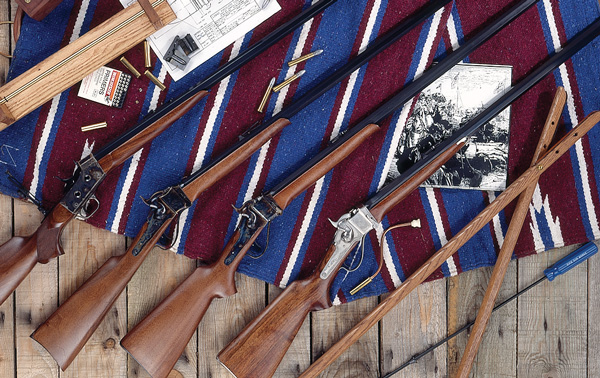
Dixie Gun Work’s line-up of Model 1874 Sharps rifles, by Pedersoli, include (from right) an engraved Silhouette Rifle, a standard version of that rifle, and the Lightweight Target-Hunter rifle. The rifle at far left is a Pedersoli “John Bodine” Remington rolling block rifle.
The “straight breech” block design that first appeared on the New Model 1859 did help alleviate some of the gas leakage. The rifles and carbines built on through the Civil War with New Model 1863 and New Model 1865 markings generally reflect improvements to further reduce the escape of gases from a burning powder charge. Basically, these Sharps guns were all the same design, based on the New Model 1859.
The 115,000 rifles and carbines produced from 1859 to 1866 represented approximately 65 percent of the total number of Sharps breechloaders ever manufactured. No other official military arm of the Civil War went on to remain as popular with civilian shooters and hunters, not even the Remington rolling block rifles. While the latter went on to be produced in far greater numbers, the true rolling block action was not perfected until about 1866.
The Sharps dropping-block action lent itself well to making the transition from percussion ignition to handling the newly developed cartridges that evolved quickly following the end of the war. In fact, in 1867 the U.S. Government decided to convert or have converted a number of percussion military arms into metallic cartridge breechloaders. And the Sharps was one of the designs selected for conversion.
In all, the Sharps Rifle Manufacturing Company converted 31,098 carbines and 1,086 rifles to accept one or the other of the experimental 52-70 rimfire, 52-70 centerfire or 50-70 centerfire cartridges. All were fitted with new breechblocks with firing pins and an extractor. Those converted to the 50-70 cartridge also required soldering a new 50-caliber barrel liner in place. In 1870, Springfield Armory additionally converted about 1,300 more Sharps rifles and carbines to the newly designated 50-70 Government cartridge.
From 1869 to 1871, the Sharps Rifle Manufacturing Company produced their first entirely “new made” cartridge model – the Sharps New Model 1869. What really set this model apart from the converted percussion military models was the much cleaner looking lockplate, which had been trimmed of the pellet priming system that gave the Civil War-era percussion models a “high hump” contour. The lines of the new lockplate were a lot cleaner.
In all, only about 1,000 New Model 1869 carbines and rifles were produced, chambered for early cartridges like the 44-77 Sharps and 50-70 Government. That production also included about 200 sporting rifles that would set the stage for the famous Model 1874 Rifle, which became the favored gun of the professional buffalo hunter.
The rifle that shooters today most recognize as the “Sharps” thanks to recent movies like Quigley Down Under, is the Model 1874, which actually saw its earliest production in 1871. The feature that probably best helps identify an early Model 1874 from the New Model 1869 is the thickness of the lockplate.
The plates of earlier percussion models, built with the pellet priming system, were 3/8-inch thick, as was the plate of the New Model 1869. The thickness of the lockplate found on the newest cartridge model had been thinned to half that thickness. The “Model 1874” markings were not used on the rifle until after several years production. Sharps’ famous “Old Reliable” trademark began to show up on the barrels in 1876, after the company, then known as just Sharps Rifle Company, had moved to Bridgeport, Conn.
The Model 1874 was chambered for a variety of cartridges during the ten years that it was in production, from “small-bore” 40-caliber centerfires to “big-bore” 50-caliber centerfires. Two favorites of the buffalo hunter were the 50-90 Sharps and 45-100 Sharps. The special order 45-120 Sharps and 50-140 Sharps cartridges were basically introduced too late to have been used extensively during the decimation of the American bison, which by 1880 were so scarce that it was no longer feasible to market-hunt the big animals.
Most Sharps collectors and historians tend to recognize the Model 1877 as the most refined and graceful of the side-hammer single-shot rifles. Only about 100 of the rifles were produced, in 45 caliber, in 1877 and 1878. These were built to comply with the “Creedmoor” match competition rules that required a single trigger and a rifle weighing 10 pounds or less. To get the weight down, Sharps Rifle Company built the Model 1877 with a slim and trim back-action lock and much lighter receiver.
The rifle was built with a nicely checkered pistol grip buttstock and Schnable forend. (The company also produced a few Model 1874 Creedmoor rifles chambered for the 44-90 Sharps Bottleneck cartridge.)
The last model ever produced by the Sharps Rifle Company was the Model 1878 Sharps-Borchardt. This was a very modernistic “hammerless” rifle that has only been somewhat duplicated by more recent single-shot designs like the Ruger No. 1. Lighter than the Model 1874, which was still in production, the Borchardt model was most commonly chambered for the easily available 45-70 Government cartridge, as well as other smaller calibers like the 40-50 Sharps.
The vast majority of the different variations available weighed in at less than 10 pounds. Other than the hammerless drop-block action, the one other feature that set this model apart from other Sharps rifles was a sliding safety. The company produced about 8,700 of the rifles before ceasing the manufacture of all Sharps rifles.
Along with the demise of the great buffalo herds of the West also came the demise of Sharps rifle production. Shooters and hunters no longer had a need for a rifle that consumed powder and lead in such great quantities. And Sharps Rifle Company found it increasingly difficult to compete with the new repeating lever-action rifle models produced by Winchester. Thus, manufacturing at the Sharps plant in Bridgeport, Conn. ceased in 1880, with the last assembled rifles shipped in 1881. During the 32 years of Sharps rifle production, only about 160,000 rifles were ever built. However, those rifles solidly established a legacy that few other rifles have ever come close to matching.
The Modern Sharps Reproduction
It may or may not be entirely correct to claim that more rifles of Sharps’ design have been built in the past 32 years than during the entire 32-year run of original Sharps rifle production – but the modern total wouldn’t miss it by much!
In the summer of 1974, two entirely different companies, separated by an ocean, independently set out to make a somewhat faithful modern-manufactured copy of the original Civil War-era percussion Sharps breechloaders. One was a relatively new U.S. firm known as Shiloh Products, Inc., the other a well-established Italian manufacturer of high quality double shotguns known as IAB Arms. And both were successful.
A draftsman and technical illustrator by trade and blackpowder shooter by heart, Len Mule’ was the real mastermind behind what would become known as the Shiloh Sharps. Before making the decision to completely manufacture a “reproduction” of the famous breech-loaded rifles and carbines, he was manufacturing extremely high quality bullet moulds for blackpowder shooters. The four-cavity design of Mule’s moulds earned them a solid reputation for producing a lot of round balls or Minie’ bullets quickly – up to 400 per hour. They were sold as the “Shiloh IV” moulds. The company also offered quality lead furnaces as well, along with a few other bullet casting products.
Through 1973 the 1974, Len Mule’ devoted much of his life to researching Sharps breech-loading rifles and carbines. Not only did he read everything he could find in print, he also visited major museums, including the West Point Museum and the Smithsonian, consulted with leading Sharps experts and collectors in this country, and spent hundreds of hours looking over hundreds of original rifles. One of those experts was Frank M. Sellers, the author of the acclaimed book, Sharps Firearms.
In late summer 1974, Mule’ and his partner, Wolfgang Droege, visited Dixie Gun Works, in Union City, Tennessee. (At that time, the author was working there as an antique arms buyer and Dixie’s catalog editor.) When they left, with them they took a huge selection of original Sharps parts to use for making new tooling. And when these two entrepreneurs showed up at the National Sporting Goods Association Show (predecessor to the SHOT Show) in January 1975, they displayed for the very first time a pair of newly assembled percussion ignition Sharps breechloaders – a “New Model 1863 Rifle” and a “New Model 1863 Carbine.” In that short period of time, this pair had worked with Pinetree Casting (a division of Ruger) to develop the tooling needed to turn out completely modern manufactured duplicates of the original percussion Sharps breechloaders.
The availability of original parts from Dixie Gun Works’ stockpile of Civil War salvage contributed greatly to the authenticity of the early Shiloh reproductions, allowing Shiloh Products Inc. to actually develop tooling based on the dimensions of original parts. Arms authorities immediately praised the percussion rifles and carbines that, at first, slowly trickled out of the Farmingdale, New York plant in early 1976, for their true to the original detail and quality. The only real variation from the originals they copied was that Shiloh elected to make the Lawrence priming system non-functional.
Len Mule’ realized that while the percussion models were being well-received by Civil War re-enactors and Sharps buffs in general, it would be the later cartridge models that would be most appealing to shooters in general. And in mid-1976, he purchased an original Model 1874 Hartford-made Sharps sporting rifle, then began researching and working on the blueprints of the cartridge models Shiloh would put into production. Again, he called upon the expertise of author Frank Sellers, plus turned to well-known gun writer Elmer Keith for input on the Model 1874 metallic cartridge rifle models that went into production in late 1977. The company, then widely known as “The Shiloh Rifle Co.”, became fully engaged in making both the most widely-used and the best known of the original Sharps rifles, and manufactured the early C. Sharps Arms rifles as well.
Ironically, the start of Sharps reproduction manufacturing in Italy actually began with the destruction of two fine original Model 1874 Sharps rifles. In the spring of 1974, SILE Industries had shipped a variety of original sample rifles to IAB Arms, located in Brescia. These were being sent to the respected manufacturer of high-quality double shotguns for the purpose of making the tooling to build both percussion and cartridge model Sharps breechloaders. Two of the rifles happened to be chambered for the 45-70 Government, and at that time Italy imposed a ban on the importation of any arms chambered for military cartridges. Before those two rifles could be delivered to IAB Arms, custom officials had cut the barrels – right through the chambers!
IAB’s first reproduction Sharps rifles and carbines arrived in the U.S. in late 1975, sold by SILE Distributors. Since then, the company has produced nearly 80,000 Sharps reproductions, which have been sold under a variety of “brand” names, including Dixie Gun Works, Taylor’s & Company, Tristar Sporting Arms, Armisport, and E.M.F. & Co. Easily the most authentic copy of the “New Model 1863” percussion Sharps carbine ever shot by the author was imported by a company known as Garrett Arms during the mid-1980s. Built in Italy by IAB Arms, even the Lawrence pellet priming system was functional on this Sharps copy.
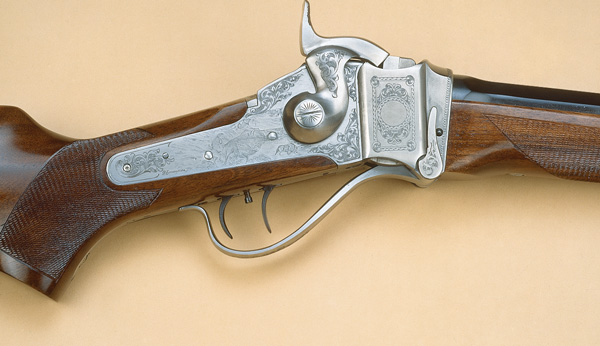
This early custom Shiloh Model 1874 Sharps, in 50-70 Government, was known as the company’s “Gemmer Sharps.”
Working in collaboration with Navy Arms, in 1970 the firm of Davide Pedersoli & Co., also of Brescia, Italy, began producing most of a modern Remington Rolling Block copy. Actually, at that time the Italian manufacturer reproduced everything but the barrel, and the parts were all shipped to Navy Arms’ facility in New Jersey, where the actions were fitted with a 45-70 barrel.
Then, in 1983, Pedersoli began to build complete modern copies of the widely used single-shot rolling block-action blackpowder cartridge rifles dating from the late 1800s.
Today, Pedersoli is also recognized as one of the more prolific manufacturers of Sharps rifles and carbines. The company produced its first Sharps, a “Sporting Rifle” model in 45-70 Government, back in January, 1993. Today, the company catalogs the most complete selection of Sharps rifle and carbine models available from a single manufacturer. Many of the rifles offered as other “brands” in this country are actually produced in Italy by Davide Pedersoli & Co.
Armi Chiappa, better known in the U.S. as Armi Sport, is another Italian manufacturer of Sharps rifles and carbines. Altogether, the company offers more than a dozen different models or variations, ranging from a percussion New Model 1859 Rifle and Carbine to an elaborately engraved deluxe copy of a Model 1874 Hartford-built Sporting Rifle.
Again, like IAB Arms and the Pedersoli company, Armi Sport’s Sharps reproductions are offered by a number of importers in the U.S., primarily Cimarron F.A. Co. and Taylor’s & Co.
In the U.S., the heart of Sharps rifle manufacturing today is located in Big Timber, MT. Shiloh Rifle Company, now known as Shiloh Rifle Manufacturing Company, moved from their original manufacturing facility located on Long Island, New York to the C. Sharps Arms facility in the small south-central Montana town in 1983.
C. Sharps Arms was already operating its custom shop and distribution center there, and the move brought these two companies together under one roof, which was a primary reason for Shiloh’s relocation. That relationship ended in 1986, when both companies set out to establish their own Sharps lines. The manufacturing facilities of two companies are still within a block of each other.
When it comes to production Sharps copies, many blackpowder cartridge rifle shooters today continue to consider the rifles produced by Shiloh Rifle Manufacturing Company to be the cream of the crop. The fit and finish of the Model 1863 percussion rifle and carbine, along with the many versions of the Model 1874 metallic cartridge rifles produced by this maker, is superb and in no way second to the quality of any other maker.
Shiloh manufactured the Sharps rifle that Americans are now most familiar with, thanks to the movie featuring actor Tom Selleck – Quigley Down Under. And much like the rifles produced at the original Sharps plants in Hartford and Bridgeport, Connecticut, it’s often hard to recognize one of the Shiloh rifles as one particular version or another due to all of the optional custom features available.
C. Sharps Arms was founded in 1975 by John Schoffstall, and brought its first Sharps New Model 1863 Rifle and Carbine reproductions to market in 1976. At that time, the company relied heavily on the early Shiloh operation in Farmingdale, New York to do their manufacturing. John played an instrumental role in getting Shiloh to make the move to Montana in 1983, where the company continued to produce both Shiloh and C. Sharps Arms rifles. Today, C. Sharps Arms has full manufacturing capability and is noted for the extremely high quality versions of the Model 1874 Hartford- and Bridgeport-produced Sharps originals.
The company also offers a beautiful rendition of the Model 1877 Sharps, also known as “The English Model,” but if this slim and trim back-action lock Sharps reproduction catches your eye, be ready to hang on to your pocket book. With a few optional upgrades, this great-handling beauty could set you back more than $10,000!
The Sharps manufacturers just covered are the primary makers of today’s modern Sharps breech-loading rifles and carbines. Prior to the early reproductions that were successfully brought to market in 1975 by Shiloh Products, Inc., there were several other attempts during the late 1960s and early 1970s, but they simply failed to get off the ground. Those makers featured here are the companies that have worked hard to build and market quality copies of the big and famous drop-block single shots that are so often simply referred to as “Old Reliable.”
This article is an excerpt from the Gun Digest 2009 annual book.
When the Bureau of Alcohol, Tobacco, Firearms and Explosives (BATFE) recently announced it wanted to require federally licensed firearms retailers along the Southwest border to report multiple sales of modern sporting rifles, the mainstream media reported this action as response to drug cartel-related violence in Mexico.
Numerous stories repeated the notion that the firearms being used by these narco criminals came from the United States—with the clear implication they originated from U.S. gun shops.
Not so, said Lawrence Keane, vice president and legal counsel for the National Shooting Sports Foundation (NSSF).
As Keane noted on a recent NSSF website posting, even BATFE statics on the matter revealed that, “the average age of recovered firearms in Mexico is more than 14 years past the original date of purchase, a clear indicator that these firearms have not been recently purchased in the United States. Furthermore, it has been well-documented (Washington Post, July 17, 2010) that drug cartels are illegally smuggling fully-automatic firearms, grenades and other weapons into Mexico from South and Central America.”
Also receiving little media attention: that over 150,000 Mexican Army troops have essentially “defected” to the drug cartels. When they did so, these troops took their American-made service rifles with them.
Last, Keane added, “In response to concerns over the violence in Mexico, BATFE has conducted nearly 2,000 inspections of firearms dealers along the border. The result? Not a single dealer was charged with committing any crime and only two (or 0.01%) had their licenses revoked for unknown reasons that could have nothing to do with the cartels illegally obtaining firearms from retailers in the United States.”
Gun Digest is the source for firearms news, pricing and guns for sale. Readers benefit from in-depth editorial expert advice, show reviews and practical how-to instructions. With your Subscription, you’ll also learn about threats to your Second Amendment rights. Click here to begin your subscription to Gun Digest.
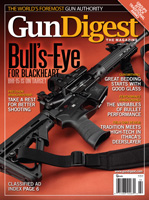
Inside this issue:
Blackheart BHI-15
Gunsmithing: Good Glass in Bedding
Bullet Performance Variables
Ithaca’s Deerslayer
Gun shows, auctions and classifieds
Not a subscriber? Make sure you don’t miss another issue! Subscribe now
Last Thursday the National Association for Gun Rights’ New Jersey Ground Team delivered over 25,000 petitions to Governor Christie’s office, demanding the release and full pardon of Brian Aitken.
If you remember, Mr. Aitken was convicted and sentenced to seven years in prison in New Jersey for never actually committing a crime.
After moving from Colorado, Aitken had followed all of the absurd laws of New Jersey to a tee, only to be imprisoned for those same laws after a judge — intent on not making the case a “referendum on the Second Amendment” — threw out most of the evidence proving Aitken’s innocence.
Despite strong reservations, the jury was left with little choice but to convict.
I asked you to sign a petition demanding Governor Christie grant the full pardon and release of Mr. Aitken.
In response, you and other National Association for Gun Rights members unleashed an avalanche of real political pressure on Governor Christie to stand up for the Second Amendment.
I am proud to say that all the petitions — more than 25,000 of them — were successfully delivered to Governor Christie’s office.
It’s tough for any politician not to notice that many signatures. Read more
The truncated version of the Florida School Board Shooting video claims to show how fast things happen. Not so fast there, Hoss.
Here is the entire incident, minus the gunman shooting himself.
The incident lasts six minutes. Look at the video and see if you can count the opportunities to take the fight to the gunman. Only one person, an elderly woman, was brave enough to go back in there and confront the man. She wasted her opportunity by using a soft object to strike at the man’s gun hand. Get a brick, board, bottle or baton and hit him HARD in the head! Repeatedly! She needed training and a weapon capable of creating dysfunction.
When that chance was gone the gunman approached at least two members of the board face to face with his gun down. Someone should have been carrying OC or a knife. Action defeats reaction! You have six men in the room. When the shooter is on the same side of the desk as the board it was time to attack. When the woman with the purse was in the room, the shooter turned his back to the board with his hands at his waist. Pin the gun to the waist and give him the bums’s rush. Use your knife to slash the gun arm until it doesn’t work. Fight back!
Later the shooter approached the desk with the gun down low…face to face with a board member. Again time for a blast of OC or a slash to the throat or face. Then get moving. Look for an escape route.
Granted, it is easy for me to talk from here at my desk. But the idea that we should not fight back, or that things unfold too quickly for us to react is fallacy. The board president begged while the gun was pointed at him. He had time enough to duck and crawl for the door! One armed school board member could have saved them all before the nutjob started shooting. One armed security guard did save them. But is was a gun free school zone, wasn’t it. A lot of good those signs did. Get a weapon and carry it, concealed, everywhere!
In Florida, Levy County Sheriff’s Lt. Scott Finnen raises money for charity in a really unique way: by teaching concealed carry classes. “Finnen had raised more than $20,000 for families in need, his church and other causes by conducting classes needed to earn a state concealed weapons permit,” the Gainesville Sun reported.
“As a training officer at the Sheriff’s Office, I have to teach first aid, I have to teach CPR. But you don’t have to pay me to work on the range,” Finnen said. “The classes are growing. Every time I do one, people call me and want to help.”
Finnen first taught a carry class to help others in October 2009, when a mother of five, who was a member of his church, was accidently killed while jogging. The class raised $5,000 for the woman’s family.
“With the success of the first class, Finnen held another when his friend, Dixie County Sheriff’s Capt. Chad Reed, was shot and killed in January by a man who was fleeing Hernando County after allegedly shooting several people there. Pickett Weaponry of Newberry contributed by donating profits from a gun sale, he added.”
“We did one of the largest pistol classes around, and we raised over $8,000,” Finnen explained. “When I put the word out for Chad, lots of people wanted to help. The money went to his children’s funds for college and other needs.”
WASHINGTON – The federal agency that monitors gun sales wants weapons dealers near the Mexican border to start reporting multiple sales of high-powered rifles, according to a notice published in the Federal Register.
The Bureau of Alcohol, Tobacco, Firearms and Explosives has asked the White House budget office to approve an emergency request requiring border-area gun dealers to report the sales of two or more rifles to the same customer within a five-day period.
The emergency request, published Friday in the Federal Register, is likely to face stiff opposition from gun rights advocates, including the National Rifle Association. ATF wants the Office of Budget Management to approve the request by Jan. 5.
NRA officials did not immediately return a telephone message for comment Monday. Last week the group’s chief lobbyist, Chris Cox, told the Washington Post that the “NRA supports legitimate efforts to stop criminal activity, but we will not stand idle while our Second Amendment is sacrificed for politics.” The Post first reported the proposal. Read more
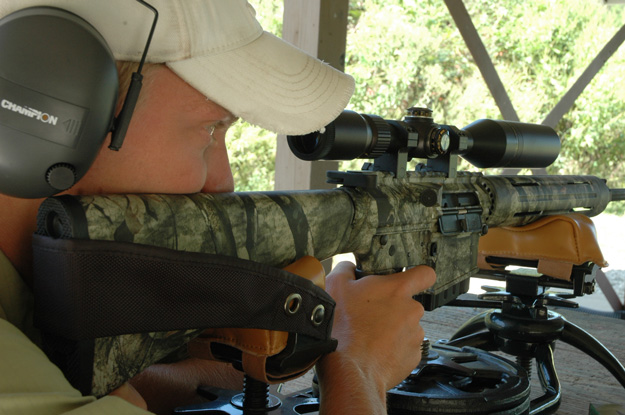
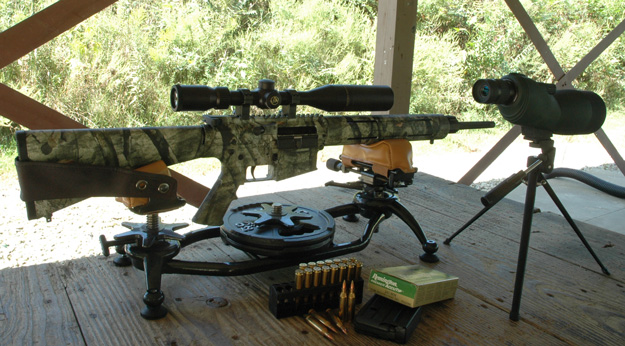
Built on an AR action, the Remington R-25 is the definition of the ‘Modern Sporting Rifle.’ In an attractive camo finish, it’s an ideal varminter or target rifle.
When I was just a kid I remember my Uncle Jim – Dad’s younger brother – having a Class 3 firearms permit. He owned both a Colt M16A1 and an MP40 “Schmeisser” machine pistol. While the MP was interesting, especially to a 12-year-old, it was the M16 that attracted and held the lion’s share of my attention.
The fact he also owned a .22 rimfire upper receiver for the piece certainly helped; not only with the enjoyment factor, but more notably from a financial standpoint. It was a fun gun – nothing more, nothing less.
That was 35 years ago, and in the time between the Then and Now I haven’t so much as slipped a magazine into an AR-type rifle. This status changed recently, however, when I received Remington’s latest introduction – the Model R-25. Futuristic in appearance, the mottled green thing lay there in its hard case, ugly as a 1980 Chevrolet Citation.
I didn’t know whether to pick it up and fondle it, or poke it with a stick and hope for the best. Fortunately, and after the initial shock wore off, I resisted the urge to simply close the lid and wander away – and I’m glad I did, as I found what Big Green refers to as a “masterpiece of game-dropping performance that will load any camp’s meat pole with unrivaled efficiency” to be quite the shooter. Even if I do phrase it a little less dramatically.
Technically Speaking
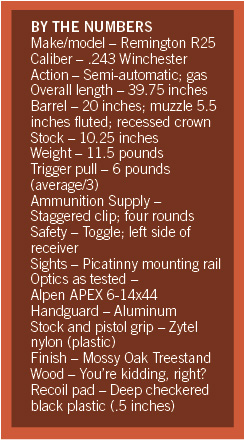
Available in .243 Winchester, 7mm-08 Remington, and .308 Winchester, Remington’s latest centerfire, the R-25, is a gas-operated AR-style semi-automatic rifle. All but the barrel and dust cover are cloaked in Mossy Oak’s ‘Treestand’ camouflage pattern.
In true AR Style, the R-25 consists of an upper receiver, which includes the bolt assembly and barrel, and the lower, comprised of the trigger group, magazine, safety, and bolt latch. Both upper and lower are milled from aluminum; the tubular hand guard is also aluminum, all of which help keep weight to a minimum.
The 20-inch barrel, with recessed crown, is fluted, and is wrapped at 5.5 inches back from the muzzle in a gas block cut with a 1.5-inch Picatinny rail, and secured by twin set screws underneath. The stock is made of a rugged Zytel plastic, with a .5-inch hard black plastic pad, and aluminum-doored cleaning gear compartment measuring 1 x 2 x 8.25 inches.
The pistol grip is cut from Zytel. The R-25 arrives sans sights; however, and in addition to the forward Picatinny rail, the upper includes a 6.75-inch Picatinny for scope or tactical optic mounting. Cartridges are fed via a supplied four-round magazine; however, the company website does state that any DPMS (dpmsinc.com), a sister company to Remington, .308 Winchester-style magazine is compatible.
My Personal Report Card
Mind you, my meeting with the R-25 is, for all intents and purposes, my first introduction to firearms of this nature during my adult life. As you might have picked up on via my scribblings here in Field Gun Review, I’m somewhat of a traditionalist when it comes to weaponry, especially in terms of aesthetics. That is, I want the gun to look as good as it functions. And while this may be subjective, I’m just not used to this new style of rifle.
This said, don’t hate me when I refer to the R-25 as homely. I think she would look much better draped in her original black finish; however, I’m sure it was Remington’s intent to take the Black Rifle label. To some extent, they’ve succeeded in creating an Old School camouflaged autoloader wearing radically new clothes. It’s a case of semantics, or at least it is to me. Regardless, I don’t find the R-25 aesthetically pleasing; some might, I don’t. Still, good looks don’t consistently kill whitetails or hogs or coyotes or antelope or what have you. Accuracy and reliability do, and in this arena, the R-25 is stunning.
Filled with Remington’s 75-grain Accutip-V Boattails, and topped with an Alpen APEX 6-14x44SF cranked up to 10x, the .243 version I tested printed an amazing .625-inch group at 50 yards. Not three shots or five shots, but 10 rounds split evenly between two shooters into a ragged cloverleaf just barely 5/8-inch from center to center. Groups did open up a touch at 100 yards; still, all of our three- to five-shot clusters measured between 1.25 and 1.5 inches. I wouldn’t hesitate to pull the R-25 from the cabinet and carry it afield for anything from whitetails to coyotes.
While we’re on the topic of carrying things, the R-25, at 11.5 pounds, 19 ounces of which is scope, isn’t meant to be toted for very long, or at least I don’t want to pack it around the hills of western Washington in search of blacktails, black bears, or for that matter, blackberries. Plainly put, it’s heavy.
That said, if you’re of a mind to sit in a box blind, ground blind, or treestand, then it doesn’t matter. On a positive note, the R-25 is exceptionally easy to break down for routine maintenance, as are all the members of the AR family. As is often the case upon receiving a new anything, my initial move is to take it apart and then, hopefully, put it back together. Doing so with the R-25 is amazingly simple. Push two pins, and the upper and lower receivers separate. From this point, it’s a truly simple matter to reduce the weapon’s innards to individual parts, clean thoroughly, and reassemble.
Running anywhere from $1,350 to $1,500 retail – and that’s before you begin the addictive process of buying and attaching aftermarket gadgets and gizmos – the R-25 makes, in my humble opinion, for a rather spendy deer rifle. However, the weapon doesn’t falter in the field accuracy department, nor in terms of reliability. And as far as getting noticed when you pull it out of the case at this year’s Upper Midwest deer camp – well, there should be no shortage of “interesting” comments.
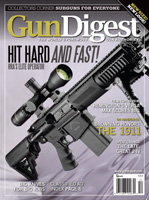
This article appeared in the December 6, 2010 issue of Gun Digest the Magazine.
Gun Digest is the source for firearms news, pricing and guns for sale. Readers benefit from in-depth editorial expert advice, show reviews and practical how-to instructions. With your Subscription, you’ll also learn about threats to your Second Amendment rights. Click here to begin your subscription to Gun Digest.
Inside this issue:
Rock River Arms Elite .308
Knives: Choppers and Whackers
Browning’s .22 cal. 1911
Gun Review: Remington Versa Max
Collecting Semi-Auto Subguns
Not a subscriber? Make sure you don’t miss another issue! Subscribe now
Orland Park police released dramatic video footage showing the attempted holdup and shooting that left the 48-year-old Amaya dead.
Customer Jason McDaniel rushed Amaya and grabbed the silver pistol he was holding, the video shows. After McDanielseizes the weapon, the video shows him apparently firing at Amaya. The new information was disclosed as police continued investigating Amaya, a resident of Downstate Rankin who already is a suspect in an Oct. 5 shooting spree in rural Will County and Lake County, Indiana.
Ballistic tests showed the pistol Amaya used in the Orland Park attempted holdup is the same weapon that killed construction worker Rolando Alonso and wounded two others in the bi-state shootings last fall, law enforcement sources said earlier this week. Read more
EASTBROOK, Maine — A local homeowner told Maine State Police Monday that he shot and killed a man who assaulted him after the resident was lured out of his home by a woman claiming to have been involved in a motor vehicle crash nearby.
Police did not release the homeowner’s name but identified the dead man as Nicholas Richards, 23, of Machias. After an autopsy was conducted Monday morning, the State Medical Examiner’s Office classified the death as a homicide as a result of a gunshot wound to the chest.
The shooting occurred early Monday morning at a mobile home located at 24 Roaring Brook Road, off the Sugar Hill Road, according to Maine State Police spokesman Stephen McCausland.
Troopers responded to two separate 911 calls, one of which came from the homeowner, at about 2 a.m. Monday. Investigators are not disclosing the name of the second caller.
McCausland said the homeowner reported that two people assaulted him after he was lured outside his residence by a woman who claimed to have been involved in an accident nearby.
McCausland did not elaborate on what might have spurred the attack on the homeowner. Read more
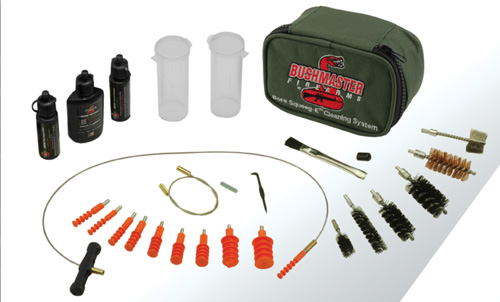
Bushmaster just sent us a note about their new Bushmaster Bore Squeeg-E Cleaning System, and they say it completely eliminates the need for cleaning patches.
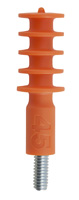
The Bore Squeeg-E Cleaning System offers the best and most effective system to clean the chamber/bore of any firearm. It enables the user to quickly clean a firearm faster than any other system. The system eliminates the use of ineffective patches and reduces the need for metal bore brushes. The Bore Squeeg-E Cleaning System features a pull through system and includes the revolutionary new Bore Squeeg-E. The Bore Squeeg-E is made from a proprietary polymer that is not affected by cleaning chemicals. It is designed to scrape the lands and grooves of the bore to a mirror clean condition and keep the abrasive carbon fouling from harming the bore. The Bore Squeeg-E is attached to a free rotating cleaning cable, preventing the tools from loosening while being pulled through the helical rifling. With proper use, the Bore Squeeg-E will last many years eliminating the expensive and wasteful practice of continually buying and throwing away cloth patches.
The system comes standard with a complete line of “Master” cleaning chemicals: Bore Cleaner & Polish, Bore Rinse, and Lubricant & Protectant. It’s all Made in the USA. Bushmaster® Universal Bore Squeeg-E™ Cleaning System – Key Features:
RIFLE LENGTH CABLE ASSEMBLY (18″)
PISTOL LENGTH CABLE ASSEMBLY (12.0″)
THREADED ROD, #8-32 X 3/4″ ZINC PLATED STEEL
.22 / .223 / 5.56mm SQUEEG-E
.243 / .25 SQUEEG-E
7MM / .270 SQUEEG-E
.308 / .30 / 7.62 SQUEEG-E
357 / 380 / .38 / 9MM SQUEEG-E
10mm / .40 SQUEEG-E
.44 / .45 SQUEEG-E
.50/.410 SQUEEG-E
12 GA / 16 GA SQUEEG-E
20GA / 28GA SQUEEG-E
PULL HANDLE 8-32
2 SIDED PICK
.45 RIFLE NYLON BRUSH 8-32
.45 PISTOL NYLON BRUSH 8-32
10 / 12 GA SHOTGUN NYLON BRUSH 8-32
20 / 28 GA SHOTGUN NYLON BRUSH 8-32
.22 PISTOL BRONZE BRUSH HANDHELD (sleeve)
10 / 12GA SHOTGUN BRONZE BRUSH 8-32
BUTTERFLY BRUSH, SS 1″ 8-32
FLUX BRUSH, #3 X 5/8″, BLK BRISTLE (CUT TO LENGTH 4.5″) & CAP
2 – SNAP LID VIAL 1.5″ OD X 3.7″, CLEAR POLYPRO
#1 MASTER™ Bore Cleaner & Polish – 1/2oz.
#2 MASTER™ Bore Rinse – 1oz. Squeeze bottle
#3 MASTER™ Premium Lubricant – 1/2oz.
It’s so new that McMillan does not yet have the kit on its website. But for more information on Bushmaster stuff click here.
One of the common threads running through nearly all of the armed defense stories I post in this blog is how quickly attacks unfold. “I can’t believe how fast it happened,” say many victims of violent crimes.
Watch this video of Clay Duke, a 56-year-old gunman who opened fire on school board members to protest his wife being fired and his unemployment benefits running out.
Note the first reaction of school board members who slide their chairs back, but then freeze. Even then note how Duke raises his handgun at the school board member and we hear the intended victim say, “No, please don’t do that” right before the trigger is pulled.
Fortunately, the shooter missed, but this serves as a graphic reminder that time is not a luxury when confronting someone intent on violence. There is no time to think about getting a handgun to carry, or to contemplate holsters and ammo.You either have the gear and the mindset to go along with it or you don’t.
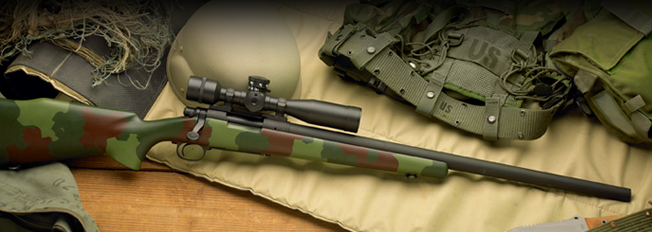
McMillan USA is producing 20 exact replica, limited-edition M40A1 sniper rifles honoring the legacy of one of the military’s most transformative long-range rifles.
Considering the significance of the M40 Marine Corps sniper rifle in campaigns throughout the world, and its many variants — the M40A1 introduced in 1966 and subsequent models like the M40A3, and M40A5 now in use today — relatively few companies have produced replicas of the original M40 rifle.
Most M40s were built on the Remington 700 action, but some have a Winchester Model 70 lineage. But it was Remington that came the closest to mass-producing a M40 replica when it produced its M40 Model 700 Commemorative Rifle a few years ago, which you can still find here and there on the used market albeit at much elevated prices. Reports on Internet forums suggest excellent accuracy and satisfaction from owners of these rifles. Indeed, any time you shoot a Remington Model 700, you’re holding the M40 legacy in your hands to some extent. But, still, the original just seems to have had its act together on every detail — it was a dandy wood-stocked tactical rifle that bridged the gap between easy-pointing sporting rifles and those needed for military use.
The original had a tasty walnut stock sans any checkering and it was of a Monte Carlo style; they were not fitted with a bipod or other gadgets, something which seems to negatively plague modern incarnations in my opinion. They used a good leather GI sling, and those who shot them in this fashion sure managed to wreak all sorts of havoc on enemy forces.
As it turns out, Gale McMillan of McMillan USA was involved in the development of the original M40s produced for the Corps, and the company has now rolled out a limited 20-gun run of an exact replica.
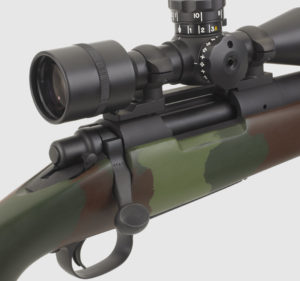
Each element of the rifle is historically correct down to the Wichita sling swivels and brown Pachmyer recoil pad. The stock is molded from the same contract mold and is built to the same specs as those delivered by McMillan to the Marines Corps. The action, barrel, bottom metal, and trigger are all hand crafted in the same fashion as the original with correct serial number and proof stampings. To top off the rifle is the last of the available US Optics MST-100 10X scopes, mounted in the historically correct clip-slotted base and rings.
While the rifle sports a period-accurate new woodland camo stock, to accent the collectible angle of the package, McMillan is throwing in one of the original painted stocks that saw active duty.
These stocks are as received from the Marine Corps and are as unique in appearance as the men who used them. They come complete with what ever swivels and bottom metal they were received with, some matching some simply attached, but all original. As with the optics, these returned stocks are the last of their kind and when they are gone, they’re gone for ever.
The McMillan M40A1 Commemorative features an US Optics MST-100 scope replicating the original Unertl.
Here’s an overview of the specs:
24″ Schneider free-floated barrel 1-in-12 twist with crown cut to match original service rifles.
Remington 700 short action: surface ground recoil lug, lapped lugs, and marked “U.S.” above the serial number to match the original issue M40A1.
McMillan plain HTG stock with molded forest camo
Correct Wichita 1 1/4” sling swivels, attached to the stock per the original contract specs
1/2” brown Pachmayr basket weave recoil pad
Accurate serial number stampage
US Optics MST-100 scopes (acquired from Unertl)
Period correct U.S.O. scope bases hand-fitted to receiver
If you’ve got $8,541 burning a hole in your pocket and want to add a genuine M40A1 sniper rifle to your collection, give McMillan a call at 623.582.9674.
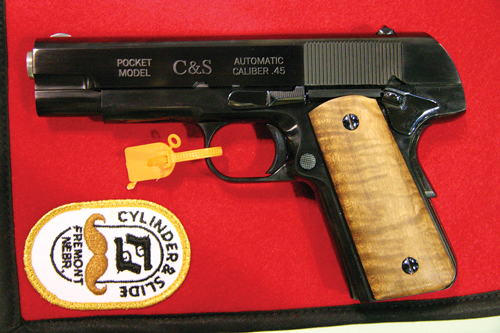
Bill Laughridge is Cylinder & Slide, and he’s been in the custom 1911 business for a long time – for good reason! A Bill Laughridge 1911 custom pistol is a piece of art.
Bill Laughridge is Cylinder & Slide, and he’s been in business for a long time. I first met him at the 1984 Second Chance shoot, where he had his traveling trailer of gunsmithing goodness. Bill was relatively new at the time, having opened C&S in 1978.
He has all the tools and parts needed in the trailer to do the hand-work of gunsmithing. No lathe or mill; that’s just too much weight to haul. But he can do all the rest. Imagine my surprise when I was at the 2007 Bianchi Cup, and I turned a corner to see Bill and his trailer. Or at least, the newest iteration of the trailer.
Bill does 1911 work, he does Browning Hi-Power work, and he’s one of the few guys left who still does Colt “V” spring revolver work. (That’s the Official Police, Python, Detective Special guns.) Bill teaches a 1911 armorers course that is to die for. You arrive at his class with a box o’ parts, and you leave the class with a gun you built.
Located in Fremont, Nebraska, Bill is convenient to all the delivery services, but not handy to drive to. Unless, of course, you’re driving to someplace across the country. He also offers upgrade parts, hammers and sears, which often find their way into the custom builds of other gunsmiths. After all, if you can get a perfect trigger pull by dropping in a C&S hammer and sear set, why not? Bill does more than just 1911s; he works on a whole raft of guns, but he has made a national name for himself doing 1911 work.
At the 2007 SHOT show, Bill stunned us all with his bravura gunsmithing when he took a base gun (Caspian slide and frame) and turned it into a 1908 pocket model in .45 ACP. Not a 1908 interim test gun, but basically a scaled-up 1908 .380 Auto, chambered in .45 ACP. The idea was to make something new and different. In order to make the slide a hammer-enclosing slide, he had to fit and silver-solder a cap on the end of it. Unless Bill told you, you would not see the joint, that’s how precise it was. Well, things got out of hand, and Bill had people actually chasing him, checkbook in hand, to make one for them. Despite quoting a staggering sum, he had buyers for identical guns.
So, if a custom 1911 or BHP isn’t enough for you, you can have Bill make a 1908 pocket model in .45. Me, I think I’d hold out for a 1905 Government-sized model. And, if a “pocket” .45 ACP is a bit much for you, find a clean M1903 in .32 or 1908 in .380, and Bill can make it into a pocket 1911 clone, with magazine release in the right spot, low-profile sights, and a thumb safety you can actually work.
A clever fellow, and yes, he’s had the handlebar mustache for as long as anyone remembers.
This article is an excerpt from the new Patrick Sweeney book, 1911: The First 100 Years.
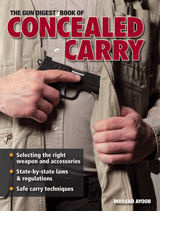
Looking to go armed, but are stuck in the weeds as to what to arm yourself with? Here are 20 of the best concealed carry gun options that will keep you on the defensive.

 Simply titled the Gun Digest Buyer’s Guide to Tactical Rifles, this new soft cover book offers values, specifications, photos and histories of the more common — and many lesser-known — tactical rifles on the market. The grading scale lists prices in MSRP or NIB (New In Box) and EXC. (Excellent), V.G. (Very Good), and GOOD (Good).