When the Bureau of Alcohol, Tobacco, Firearms and Explosives (BATFE) recently announced it wanted to require federally licensed firearms retailers along the Southwest border to report multiple sales of modern sporting rifles, the mainstream media reported this action as response to drug cartel-related violence in Mexico.
Numerous stories repeated the notion that the firearms being used by these narco criminals came from the United States—with the clear implication they originated from U.S. gun shops.
Not so, said Lawrence Keane, vice president and legal counsel for the National Shooting Sports Foundation (NSSF).
As Keane noted on a recent NSSF website posting, even BATFE statics on the matter revealed that, “the average age of recovered firearms in Mexico is more than 14 years past the original date of purchase, a clear indicator that these firearms have not been recently purchased in the United States. Furthermore, it has been well-documented (Washington Post, July 17, 2010) that drug cartels are illegally smuggling fully-automatic firearms, grenades and other weapons into Mexico from South and Central America.”
Also receiving little media attention: that over 150,000 Mexican Army troops have essentially “defected” to the drug cartels. When they did so, these troops took their American-made service rifles with them.
Last, Keane added, “In response to concerns over the violence in Mexico, BATFE has conducted nearly 2,000 inspections of firearms dealers along the border. The result? Not a single dealer was charged with committing any crime and only two (or 0.01%) had their licenses revoked for unknown reasons that could have nothing to do with the cartels illegally obtaining firearms from retailers in the United States.”
Gun Digest is the source for firearms news, pricing and guns for sale. Readers benefit from in-depth editorial expert advice, show reviews and practical how-to instructions. With your Subscription, you’ll also learn about threats to your Second Amendment rights. Click here to begin your subscription to Gun Digest.
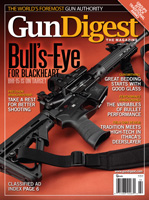
Inside this issue:
Blackheart BHI-15
Gunsmithing: Good Glass in Bedding
Bullet Performance Variables
Ithaca’s Deerslayer
Gun shows, auctions and classifieds
Not a subscriber? Make sure you don’t miss another issue! Subscribe now
Last Thursday the National Association for Gun Rights’ New Jersey Ground Team delivered over 25,000 petitions to Governor Christie’s office, demanding the release and full pardon of Brian Aitken.
If you remember, Mr. Aitken was convicted and sentenced to seven years in prison in New Jersey for never actually committing a crime.
After moving from Colorado, Aitken had followed all of the absurd laws of New Jersey to a tee, only to be imprisoned for those same laws after a judge — intent on not making the case a “referendum on the Second Amendment” — threw out most of the evidence proving Aitken’s innocence.
Despite strong reservations, the jury was left with little choice but to convict.
I asked you to sign a petition demanding Governor Christie grant the full pardon and release of Mr. Aitken.
In response, you and other National Association for Gun Rights members unleashed an avalanche of real political pressure on Governor Christie to stand up for the Second Amendment.
I am proud to say that all the petitions — more than 25,000 of them — were successfully delivered to Governor Christie’s office.
It’s tough for any politician not to notice that many signatures. Read more
The truncated version of the Florida School Board Shooting video claims to show how fast things happen. Not so fast there, Hoss.
Here is the entire incident, minus the gunman shooting himself.
The incident lasts six minutes. Look at the video and see if you can count the opportunities to take the fight to the gunman. Only one person, an elderly woman, was brave enough to go back in there and confront the man. She wasted her opportunity by using a soft object to strike at the man’s gun hand. Get a brick, board, bottle or baton and hit him HARD in the head! Repeatedly! She needed training and a weapon capable of creating dysfunction.
When that chance was gone the gunman approached at least two members of the board face to face with his gun down. Someone should have been carrying OC or a knife. Action defeats reaction! You have six men in the room. When the shooter is on the same side of the desk as the board it was time to attack. When the woman with the purse was in the room, the shooter turned his back to the board with his hands at his waist. Pin the gun to the waist and give him the bums’s rush. Use your knife to slash the gun arm until it doesn’t work. Fight back!
Later the shooter approached the desk with the gun down low…face to face with a board member. Again time for a blast of OC or a slash to the throat or face. Then get moving. Look for an escape route.
Granted, it is easy for me to talk from here at my desk. But the idea that we should not fight back, or that things unfold too quickly for us to react is fallacy. The board president begged while the gun was pointed at him. He had time enough to duck and crawl for the door! One armed school board member could have saved them all before the nutjob started shooting. One armed security guard did save them. But is was a gun free school zone, wasn’t it. A lot of good those signs did. Get a weapon and carry it, concealed, everywhere!
In Florida, Levy County Sheriff’s Lt. Scott Finnen raises money for charity in a really unique way: by teaching concealed carry classes. “Finnen had raised more than $20,000 for families in need, his church and other causes by conducting classes needed to earn a state concealed weapons permit,” the Gainesville Sun reported.
“As a training officer at the Sheriff’s Office, I have to teach first aid, I have to teach CPR. But you don’t have to pay me to work on the range,” Finnen said. “The classes are growing. Every time I do one, people call me and want to help.”
Finnen first taught a carry class to help others in October 2009, when a mother of five, who was a member of his church, was accidently killed while jogging. The class raised $5,000 for the woman’s family.
“With the success of the first class, Finnen held another when his friend, Dixie County Sheriff’s Capt. Chad Reed, was shot and killed in January by a man who was fleeing Hernando County after allegedly shooting several people there. Pickett Weaponry of Newberry contributed by donating profits from a gun sale, he added.”
“We did one of the largest pistol classes around, and we raised over $8,000,” Finnen explained. “When I put the word out for Chad, lots of people wanted to help. The money went to his children’s funds for college and other needs.”
WASHINGTON – The federal agency that monitors gun sales wants weapons dealers near the Mexican border to start reporting multiple sales of high-powered rifles, according to a notice published in the Federal Register.
The Bureau of Alcohol, Tobacco, Firearms and Explosives has asked the White House budget office to approve an emergency request requiring border-area gun dealers to report the sales of two or more rifles to the same customer within a five-day period.
The emergency request, published Friday in the Federal Register, is likely to face stiff opposition from gun rights advocates, including the National Rifle Association. ATF wants the Office of Budget Management to approve the request by Jan. 5.
NRA officials did not immediately return a telephone message for comment Monday. Last week the group’s chief lobbyist, Chris Cox, told the Washington Post that the “NRA supports legitimate efforts to stop criminal activity, but we will not stand idle while our Second Amendment is sacrificed for politics.” The Post first reported the proposal. Read more
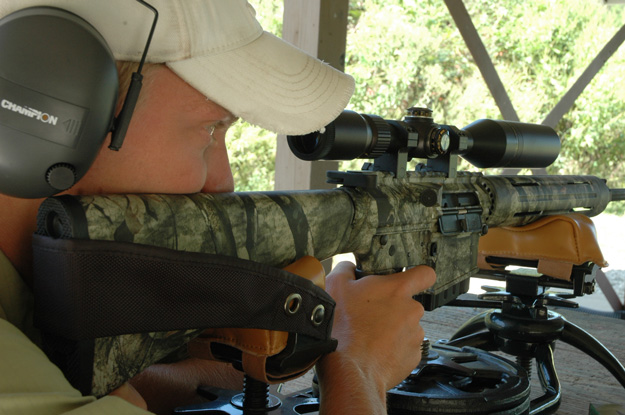
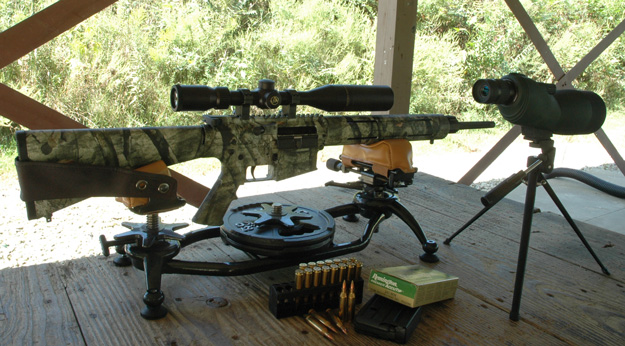
Built on an AR action, the Remington R-25 is the definition of the ‘Modern Sporting Rifle.’ In an attractive camo finish, it’s an ideal varminter or target rifle.
When I was just a kid I remember my Uncle Jim – Dad’s younger brother – having a Class 3 firearms permit. He owned both a Colt M16A1 and an MP40 “Schmeisser” machine pistol. While the MP was interesting, especially to a 12-year-old, it was the M16 that attracted and held the lion’s share of my attention.
The fact he also owned a .22 rimfire upper receiver for the piece certainly helped; not only with the enjoyment factor, but more notably from a financial standpoint. It was a fun gun – nothing more, nothing less.
That was 35 years ago, and in the time between the Then and Now I haven’t so much as slipped a magazine into an AR-type rifle. This status changed recently, however, when I received Remington’s latest introduction – the Model R-25. Futuristic in appearance, the mottled green thing lay there in its hard case, ugly as a 1980 Chevrolet Citation.
I didn’t know whether to pick it up and fondle it, or poke it with a stick and hope for the best. Fortunately, and after the initial shock wore off, I resisted the urge to simply close the lid and wander away – and I’m glad I did, as I found what Big Green refers to as a “masterpiece of game-dropping performance that will load any camp’s meat pole with unrivaled efficiency” to be quite the shooter. Even if I do phrase it a little less dramatically.
Technically Speaking
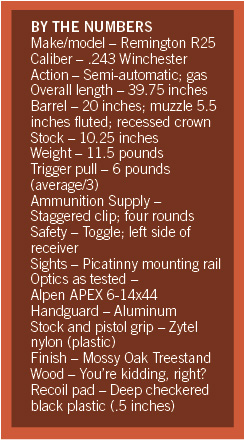
Available in .243 Winchester, 7mm-08 Remington, and .308 Winchester, Remington’s latest centerfire, the R-25, is a gas-operated AR-style semi-automatic rifle. All but the barrel and dust cover are cloaked in Mossy Oak’s ‘Treestand’ camouflage pattern.
In true AR Style, the R-25 consists of an upper receiver, which includes the bolt assembly and barrel, and the lower, comprised of the trigger group, magazine, safety, and bolt latch. Both upper and lower are milled from aluminum; the tubular hand guard is also aluminum, all of which help keep weight to a minimum.
The 20-inch barrel, with recessed crown, is fluted, and is wrapped at 5.5 inches back from the muzzle in a gas block cut with a 1.5-inch Picatinny rail, and secured by twin set screws underneath. The stock is made of a rugged Zytel plastic, with a .5-inch hard black plastic pad, and aluminum-doored cleaning gear compartment measuring 1 x 2 x 8.25 inches.
The pistol grip is cut from Zytel. The R-25 arrives sans sights; however, and in addition to the forward Picatinny rail, the upper includes a 6.75-inch Picatinny for scope or tactical optic mounting. Cartridges are fed via a supplied four-round magazine; however, the company website does state that any DPMS (dpmsinc.com), a sister company to Remington, .308 Winchester-style magazine is compatible.
My Personal Report Card
Mind you, my meeting with the R-25 is, for all intents and purposes, my first introduction to firearms of this nature during my adult life. As you might have picked up on via my scribblings here in Field Gun Review, I’m somewhat of a traditionalist when it comes to weaponry, especially in terms of aesthetics. That is, I want the gun to look as good as it functions. And while this may be subjective, I’m just not used to this new style of rifle.
This said, don’t hate me when I refer to the R-25 as homely. I think she would look much better draped in her original black finish; however, I’m sure it was Remington’s intent to take the Black Rifle label. To some extent, they’ve succeeded in creating an Old School camouflaged autoloader wearing radically new clothes. It’s a case of semantics, or at least it is to me. Regardless, I don’t find the R-25 aesthetically pleasing; some might, I don’t. Still, good looks don’t consistently kill whitetails or hogs or coyotes or antelope or what have you. Accuracy and reliability do, and in this arena, the R-25 is stunning.
Filled with Remington’s 75-grain Accutip-V Boattails, and topped with an Alpen APEX 6-14x44SF cranked up to 10x, the .243 version I tested printed an amazing .625-inch group at 50 yards. Not three shots or five shots, but 10 rounds split evenly between two shooters into a ragged cloverleaf just barely 5/8-inch from center to center. Groups did open up a touch at 100 yards; still, all of our three- to five-shot clusters measured between 1.25 and 1.5 inches. I wouldn’t hesitate to pull the R-25 from the cabinet and carry it afield for anything from whitetails to coyotes.
While we’re on the topic of carrying things, the R-25, at 11.5 pounds, 19 ounces of which is scope, isn’t meant to be toted for very long, or at least I don’t want to pack it around the hills of western Washington in search of blacktails, black bears, or for that matter, blackberries. Plainly put, it’s heavy.
That said, if you’re of a mind to sit in a box blind, ground blind, or treestand, then it doesn’t matter. On a positive note, the R-25 is exceptionally easy to break down for routine maintenance, as are all the members of the AR family. As is often the case upon receiving a new anything, my initial move is to take it apart and then, hopefully, put it back together. Doing so with the R-25 is amazingly simple. Push two pins, and the upper and lower receivers separate. From this point, it’s a truly simple matter to reduce the weapon’s innards to individual parts, clean thoroughly, and reassemble.
Running anywhere from $1,350 to $1,500 retail – and that’s before you begin the addictive process of buying and attaching aftermarket gadgets and gizmos – the R-25 makes, in my humble opinion, for a rather spendy deer rifle. However, the weapon doesn’t falter in the field accuracy department, nor in terms of reliability. And as far as getting noticed when you pull it out of the case at this year’s Upper Midwest deer camp – well, there should be no shortage of “interesting” comments.
This article appeared in the December 6, 2010 issue of Gun Digest the Magazine.
Gun Digest is the source for firearms news, pricing and guns for sale. Readers benefit from in-depth editorial expert advice, show reviews and practical how-to instructions. With your Subscription, you’ll also learn about threats to your Second Amendment rights. Click here to begin your subscription to Gun Digest.
Inside this issue:
Rock River Arms Elite .308
Knives: Choppers and Whackers
Browning’s .22 cal. 1911
Gun Review: Remington Versa Max
Collecting Semi-Auto Subguns
Not a subscriber? Make sure you don’t miss another issue! Subscribe now
Orland Park police released dramatic video footage showing the attempted holdup and shooting that left the 48-year-old Amaya dead.
Customer Jason McDaniel rushed Amaya and grabbed the silver pistol he was holding, the video shows. After McDanielseizes the weapon, the video shows him apparently firing at Amaya. The new information was disclosed as police continued investigating Amaya, a resident of Downstate Rankin who already is a suspect in an Oct. 5 shooting spree in rural Will County and Lake County, Indiana.
Ballistic tests showed the pistol Amaya used in the Orland Park attempted holdup is the same weapon that killed construction worker Rolando Alonso and wounded two others in the bi-state shootings last fall, law enforcement sources said earlier this week. Read more
EASTBROOK, Maine — A local homeowner told Maine State Police Monday that he shot and killed a man who assaulted him after the resident was lured out of his home by a woman claiming to have been involved in a motor vehicle crash nearby.
Police did not release the homeowner’s name but identified the dead man as Nicholas Richards, 23, of Machias. After an autopsy was conducted Monday morning, the State Medical Examiner’s Office classified the death as a homicide as a result of a gunshot wound to the chest.
The shooting occurred early Monday morning at a mobile home located at 24 Roaring Brook Road, off the Sugar Hill Road, according to Maine State Police spokesman Stephen McCausland.
Troopers responded to two separate 911 calls, one of which came from the homeowner, at about 2 a.m. Monday. Investigators are not disclosing the name of the second caller.
McCausland said the homeowner reported that two people assaulted him after he was lured outside his residence by a woman who claimed to have been involved in an accident nearby.
McCausland did not elaborate on what might have spurred the attack on the homeowner. Read more
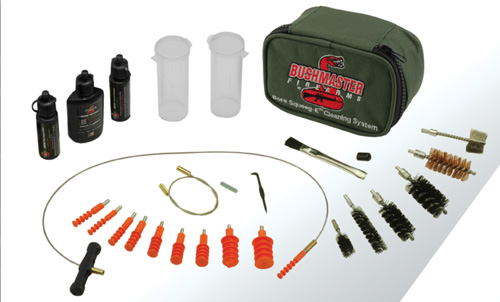
Bushmaster just sent us a note about their new Bushmaster Bore Squeeg-E Cleaning System, and they say it completely eliminates the need for cleaning patches.
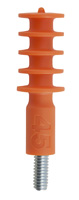
The Bore Squeeg-E Cleaning System offers the best and most effective system to clean the chamber/bore of any firearm. It enables the user to quickly clean a firearm faster than any other system. The system eliminates the use of ineffective patches and reduces the need for metal bore brushes. The Bore Squeeg-E Cleaning System features a pull through system and includes the revolutionary new Bore Squeeg-E. The Bore Squeeg-E is made from a proprietary polymer that is not affected by cleaning chemicals. It is designed to scrape the lands and grooves of the bore to a mirror clean condition and keep the abrasive carbon fouling from harming the bore. The Bore Squeeg-E is attached to a free rotating cleaning cable, preventing the tools from loosening while being pulled through the helical rifling. With proper use, the Bore Squeeg-E will last many years eliminating the expensive and wasteful practice of continually buying and throwing away cloth patches.
The system comes standard with a complete line of “Master” cleaning chemicals: Bore Cleaner & Polish, Bore Rinse, and Lubricant & Protectant. It’s all Made in the USA. Bushmaster® Universal Bore Squeeg-E™ Cleaning System – Key Features:
RIFLE LENGTH CABLE ASSEMBLY (18″)
PISTOL LENGTH CABLE ASSEMBLY (12.0″)
THREADED ROD, #8-32 X 3/4″ ZINC PLATED STEEL
.22 / .223 / 5.56mm SQUEEG-E
.243 / .25 SQUEEG-E
7MM / .270 SQUEEG-E
.308 / .30 / 7.62 SQUEEG-E
357 / 380 / .38 / 9MM SQUEEG-E
10mm / .40 SQUEEG-E
.44 / .45 SQUEEG-E
.50/.410 SQUEEG-E
12 GA / 16 GA SQUEEG-E
20GA / 28GA SQUEEG-E
PULL HANDLE 8-32
2 SIDED PICK
.45 RIFLE NYLON BRUSH 8-32
.45 PISTOL NYLON BRUSH 8-32
10 / 12 GA SHOTGUN NYLON BRUSH 8-32
20 / 28 GA SHOTGUN NYLON BRUSH 8-32
.22 PISTOL BRONZE BRUSH HANDHELD (sleeve)
10 / 12GA SHOTGUN BRONZE BRUSH 8-32
BUTTERFLY BRUSH, SS 1″ 8-32
FLUX BRUSH, #3 X 5/8″, BLK BRISTLE (CUT TO LENGTH 4.5″) & CAP
2 – SNAP LID VIAL 1.5″ OD X 3.7″, CLEAR POLYPRO
#1 MASTER™ Bore Cleaner & Polish – 1/2oz.
#2 MASTER™ Bore Rinse – 1oz. Squeeze bottle
#3 MASTER™ Premium Lubricant – 1/2oz.
It’s so new that McMillan does not yet have the kit on its website. But for more information on Bushmaster stuff click here.
One of the common threads running through nearly all of the armed defense stories I post in this blog is how quickly attacks unfold. “I can’t believe how fast it happened,” say many victims of violent crimes.
Watch this video of Clay Duke, a 56-year-old gunman who opened fire on school board members to protest his wife being fired and his unemployment benefits running out.
Note the first reaction of school board members who slide their chairs back, but then freeze. Even then note how Duke raises his handgun at the school board member and we hear the intended victim say, “No, please don’t do that” right before the trigger is pulled.
Fortunately, the shooter missed, but this serves as a graphic reminder that time is not a luxury when confronting someone intent on violence. There is no time to think about getting a handgun to carry, or to contemplate holsters and ammo.You either have the gear and the mindset to go along with it or you don’t.
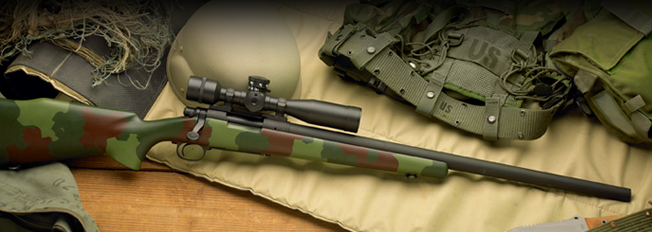
McMillan USA is producing 20 exact replica, limited-edition M40A1 sniper rifles honoring the legacy of one of the military’s most transformative long-range rifles.
Considering the significance of the M40 Marine Corps sniper rifle in campaigns throughout the world, and its many variants — the M40A1 introduced in 1966 and subsequent models like the M40A3, and M40A5 now in use today — relatively few companies have produced replicas of the original M40 rifle.
Most M40s were built on the Remington 700 action, but some have a Winchester Model 70 lineage. But it was Remington that came the closest to mass-producing a M40 replica when it produced its M40 Model 700 Commemorative Rifle a few years ago, which you can still find here and there on the used market albeit at much elevated prices. Reports on Internet forums suggest excellent accuracy and satisfaction from owners of these rifles. Indeed, any time you shoot a Remington Model 700, you’re holding the M40 legacy in your hands to some extent. But, still, the original just seems to have had its act together on every detail — it was a dandy wood-stocked tactical rifle that bridged the gap between easy-pointing sporting rifles and those needed for military use.
The original had a tasty walnut stock sans any checkering and it was of a Monte Carlo style; they were not fitted with a bipod or other gadgets, something which seems to negatively plague modern incarnations in my opinion. They used a good leather GI sling, and those who shot them in this fashion sure managed to wreak all sorts of havoc on enemy forces.
As it turns out, Gale McMillan of McMillan USA was involved in the development of the original M40s produced for the Corps, and the company has now rolled out a limited 20-gun run of an exact replica.
Each element of the rifle is historically correct down to the Wichita sling swivels and brown Pachmyer recoil pad. The stock is molded from the same contract mold and is built to the same specs as those delivered by McMillan to the Marines Corps. The action, barrel, bottom metal, and trigger are all hand crafted in the same fashion as the original with correct serial number and proof stampings. To top off the rifle is the last of the available US Optics MST-100 10X scopes, mounted in the historically correct clip-slotted base and rings.
While the rifle sports a period-accurate new woodland camo stock, to accent the collectible angle of the package, McMillan is throwing in one of the original painted stocks that saw active duty.
These stocks are as received from the Marine Corps and are as unique in appearance as the men who used them. They come complete with what ever swivels and bottom metal they were received with, some matching some simply attached, but all original. As with the optics, these returned stocks are the last of their kind and when they are gone, they’re gone for ever.
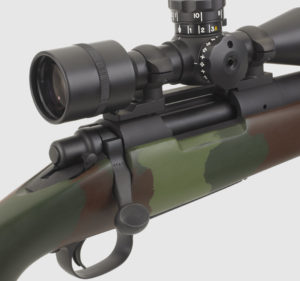
The McMillan M40A1 Commemorative features an US Optics MST-100 scope replicating the original Unertl.
Here’s an overview of the specs:
24″ Schneider free-floated barrel 1-in-12 twist with crown cut to match original service rifles.
Remington 700 short action: surface ground recoil lug, lapped lugs, and marked “U.S.” above the serial number to match the original issue M40A1.
McMillan plain HTG stock with molded forest camo
Correct Wichita 1 1/4” sling swivels, attached to the stock per the original contract specs
1/2” brown Pachmayr basket weave recoil pad
Accurate serial number stampage
US Optics MST-100 scopes (acquired from Unertl)
Period correct U.S.O. scope bases hand-fitted to receiver
If you’ve got $8,541 burning a hole in your pocket and want to add a genuine M40A1 sniper rifle to your collection, give McMillan a call at 623.582.9674.
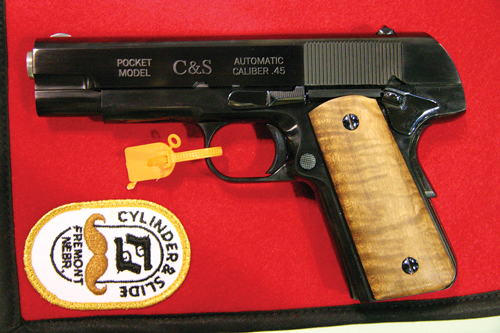
Bill Laughridge is Cylinder & Slide, and he’s been in the custom 1911 business for a long time – for good reason! A Bill Laughridge 1911 custom pistol is a piece of art.
Bill Laughridge is Cylinder & Slide, and he’s been in business for a long time. I first met him at the 1984 Second Chance shoot, where he had his traveling trailer of gunsmithing goodness. Bill was relatively new at the time, having opened C&S in 1978.
He has all the tools and parts needed in the trailer to do the hand-work of gunsmithing. No lathe or mill; that’s just too much weight to haul. But he can do all the rest. Imagine my surprise when I was at the 2007 Bianchi Cup, and I turned a corner to see Bill and his trailer. Or at least, the newest iteration of the trailer.
Bill does 1911 work, he does Browning Hi-Power work, and he’s one of the few guys left who still does Colt “V” spring revolver work. (That’s the Official Police, Python, Detective Special guns.) Bill teaches a 1911 armorers course that is to die for. You arrive at his class with a box o’ parts, and you leave the class with a gun you built.
Located in Fremont, Nebraska, Bill is convenient to all the delivery services, but not handy to drive to. Unless, of course, you’re driving to someplace across the country. He also offers upgrade parts, hammers and sears, which often find their way into the custom builds of other gunsmiths. After all, if you can get a perfect trigger pull by dropping in a C&S hammer and sear set, why not? Bill does more than just 1911s; he works on a whole raft of guns, but he has made a national name for himself doing 1911 work.
At the 2007 SHOT show, Bill stunned us all with his bravura gunsmithing when he took a base gun (Caspian slide and frame) and turned it into a 1908 pocket model in .45 ACP. Not a 1908 interim test gun, but basically a scaled-up 1908 .380 Auto, chambered in .45 ACP. The idea was to make something new and different. In order to make the slide a hammer-enclosing slide, he had to fit and silver-solder a cap on the end of it. Unless Bill told you, you would not see the joint, that’s how precise it was. Well, things got out of hand, and Bill had people actually chasing him, checkbook in hand, to make one for them. Despite quoting a staggering sum, he had buyers for identical guns.
So, if a custom 1911 or BHP isn’t enough for you, you can have Bill make a 1908 pocket model in .45. Me, I think I’d hold out for a 1905 Government-sized model. And, if a “pocket” .45 ACP is a bit much for you, find a clean M1903 in .32 or 1908 in .380, and Bill can make it into a pocket 1911 clone, with magazine release in the right spot, low-profile sights, and a thumb safety you can actually work.
A clever fellow, and yes, he’s had the handlebar mustache for as long as anyone remembers.
This article is an excerpt from the new Patrick Sweeney book, 1911: The First 100 Years.
Shooting clubs can benefit from participating in the NSSF's First Shots program.
Created by the National Shooting Sports Foundation, First Shots has helped introduce thousands of newcomers to the shooting sports, at ranges nationwide, and has proven itself a valuable tool for attracting newcomers to the shooting sports.
“Keystone Sporting Arms believes in firearms safety and getting youth started with the right equipment to ensure the best experience,” said Bill McNeal, Keystone’s owner.
So, a set of five Crickett and Chipmunk rifles will be distributed to the first 200 ranges that commit to presenting two First Shots seminars in 2011; at least one of these seminars must be specifically for parents and youths.
Any shooting ranges that have already been presenting First Shots seminars should schedule their 2011 events now. Ranges yet to try First Shots? In addition to the generous cooperative advertising reimbursement to which First Shots host ranges are always entitled, an additional coop advertising program has been built into this special Keystone promotion.
There comes a time in every collector’s life when he has to sell a gun or guns, or just try his hand at turning a profit. No matter how great the protestation everybody meets the situation face to face at one time or another.
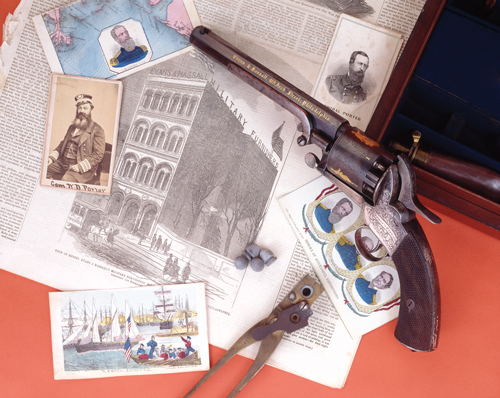
British-made Webley, “Long-Spur” single-action percussion revolver made for the American trade; imported, embellished and inscribed by noted American arms dealers during the Civil War on the order of U.S. Navy Admiral David G. Farragut for presentation to an equally famous Civil War Navy officer Admiral David D. Porter. 44-caliber percussion. Gold inlaid on right side of barrel “CAPT’N D. D. PORTER, FROM CAPT’N D. G. FARRAGUT 1862”; left side similarly gold inlaid in old English style letters: “EVANS & HASSALL. 418 ARCH STREET, PHILADELPHIA” well-known military goods dealers from whom the set was acquired and commissioned to ornately embellish. The cylinder is similarly gold inlaid with figures of Union Army and Navy officers in combat positions. The custom wooden case also bears a silver plaque inscribed with the monogram initials of both officers. The outfit is believed presented to commemorate the Union’s capture of New Orleans in March of 1862. (As illustrated in Steel Canvas; The Art of American Arms, with permission of the author)
There comes a time in every collector’s life when he has to sell a gun or guns, or just try his hand at turning a profit. No matter how great the protestation, “… I never sell a gun … I will never sell a gun … I never sold a gun,” everybody meets the situation face to face at one time or another. It is difficult to understand why a certain few collectors make a fetish of the claim that they never sold a piece, as if to do so were beneath one’s dignity.
You will meet these types often, but only rarely are their protestations credible. Some collectors are really more dealers than collectors; at least their buying, selling and trading activities run at a fever pitch, and they never seem to settle into any collecting pattern. A great majority of collector sales are due to a wide range of reasons, e.g., up-grading of specimens, disposing of items that no longer hold an interest, or a pressing and immediate need for cash. A number of for-sale methods are available depending on the time and effort one wishes to take. First to note is that the “book” or advertised or listed price for a specific piece is not always the one that can be realized for it.
In some cases there may be no takers for the piece at any price. At this point the collector may acquire a quick education — and a most lasting impression — of one more detail of the fine art of gun trading!
Setting forth a listing in this book and neatly assigning a value to each piece tends very much to be misleading, especially to the neophyte or only casually interested owner of a gun or two. This is not unique to antique arms, but holds true for any collecting field. The mere fact that a gun is listed with a price in no way precludes that the owner must achieve that figure or even a predetermined percentage thereof. No central market place or bourse exists where all gun dealers and collectors conduct their transactions as on the stock or commodity exchanges; the arrangement is much looser with a great many variables; hit-or miss is a more apt description.
To avoid disappointment it is well to understand and be aware of the peculiarities and complexities involved in evaluating collectors’ firearms. Owning a rare gun with a healthy dollar value and realizing that value is at times analogous to “… being a horse of another color!” The collector should be aware that one gun is not as easily sold as another and that the demand factor greatly influences price and marketability.
True, a great many very rare American guns are worth in the many hundreds or thousands of dollars; many will be seen listed in this work. Those pieces quite definitely fetch those prices when sold to a retail customer. The number of collectors for some of those particular type guns, however, may be extremely limited; as such, it is possible to occasionally experience not only sales resistance to a gun, but considerable lethargy as well. Possibly the only way that that particular piece might be sold would be to lower the price to a figure so attractive that it would be tantamount to forcing a sale.
The same can hold true of a quite rare and valuable gun that is in great demand, but is in a very low grade of condition. On the assumption that the collector has bought wisely and ably, he might well find that a dealer will pay him as high a price or more than any collector in the area. The dealer’s own specialized clientele and access to a national market allows him to know exactly where to place that gun quickly, and in such instances he is usually willing to pay a premium price. The dealer normally pays cash on the spot for the item, whereas in many cases of private sales, the collector has to accept trade items in lieu of money.
There is no general guide as to what gun dealers pay for their merchandise. To flatly state that they pay 50 percent of market value or to assign any fixed percentage would be absolutely erroneous. The only accurate statement is — a dealer expects to make a profit! With very fine conditioned pieces, numerous rare models and certain types for which he has a special demand (and for any number of other reasons), the dealer is often in the position to pay the highest price for a piece and work on an extremely small profit margin to get it. This has been especially true in recent years. The dealer might even pay the so-called “book” value for a piece as he has been commissioned by a client to specifically acquire that model for a premium price. On the other hand, if that dealer has no demand or clientele for certain types of arms, then regardless of price, he might not want to invest money at all as it would represent completely dead merchandise for him.
Many dealers are specialists themselves and handle only certain types for which they have an immediate following and will completely pass by pieces that are not of interest to them regardless of price. There are no generalizations that will apply to the subject of all arms dealers. A quite interesting observation is the fact that a tremendous amount of business is generated between dealers themselves, since most have their own followings and customers. If the dealer operates on a large scale and in mail order or makes all the major gun shows throughout the country, thus having access to a national market, it is obvious that he will have a wider range of interest and broader coverage of antique arms than the dealer who is conducting his business strictly on a local basis. In the latter case, the dealer will normally pay highest prices only for those pieces for which he has a walk-in local trade, whereas other items would be attractive to him only if they could be acquired well under “book” value allowing for wholesaling to other dealers.
As a general statement, the larger the dealer and the broader his scope and sales coverage, the higher the prices he is willing to pay for merchandise. If the collector does not realize the price he expected from a dealer or fellow collector, five other options are open to him for selling that arm at the greatest possible figure. Each requires time and effort on his part, but the results may prove worthwhile. The easiest method is to take space at a regularly scheduled gun show and display the arms to be sold as attractively as possible.
A good opportunity is afforded to sell or trade there providing the price is realistic. Through actual show experience, where feverish trading often occurs, the collector will come across and very likely take for his own use much of the banter heard about the floor. Eavesdrop on any large gun show and chances are one will hear a chorus or two of the following elucidations during the course of the day, “… That’s less than I paid for it! … I don’t care if I sell it or not! … That’s less than I got in it! … I got more than that in it! … If it doesn’t move, you can bring it back!”
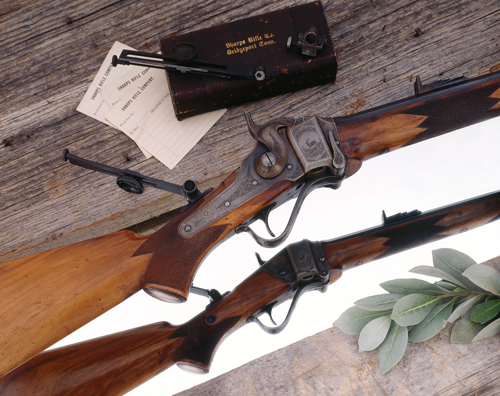
Model 1874 Long Range Target Rifle No. 1 made by Sharps Rifle Company, Hartford, Connecticut with special order ornamentation by the noted arms engraver L. D. Nimschke. Factory shipping records (still in existence) indicate this was a special order rifle that had been tested for perfection by the factory superintendent himself. The rifle was given as a shooting prize to W. L. Ellison of Kansas City, Missouri in February of 1879. Shown here with close-up detail with its long-range Vernier tang rear sight yet intact.
Putting Firearms On Consignment
Consignment is another method that can be utilized to realize a higher value from a collector’s gun. Many dealers will accept certain select pieces from their clientele to sell on this basis. Consignment allows the dealer to add to his stock, permitting a broader selection of merchandise, without having to invest capital. Because of this, the dealer is willing to realize more for the collector than he would be willing to pay cash on the spot. The collector agrees to leave his gun with the dealer for sale at an agreed upon retail price. Details should be clearly understood, and the agreement made in writing.
The collector further agrees to allow the dealer a flat percentage fee (normally about 20 percent) of the retail price if the item is sold. Should the item not be sold after a specified time, the collector has the right to take it back and to dispose of it at his own discretion. Normally, no charges are made to the collector if the piece is not sold, unless previously agreed upon. All these factors, especially the matter of the commission fee, should be definitely committed to writing at the time the consignment is made.
A great many fine firearms are sold by this method. Advantages are obvious for both owner and seller. However, to utilize this method successfully one must choose wisely the dealer who is to handle the item. Most dealers are not interested in taking insignificant, low value items on consignment; e.g., pieces worth $100 or less; nor questionable objects requiring guarantees to their clientele while the consignee is relieved of all responsibility.
Important in the choice of a consignment dealer is one that is not only reputable, but is financially reliable. In many instances the dealer sells his items on a time payment method (that is, the money comes in in dribs and drabs), or a trade may be necessary to realize the best transaction.
In such instances it is important that the dealer pays the consignee the full agreed upon price the moment disposal is made, regardless of how he was paid for it or whether a trade was involved. Regrettably in many instances, consignment has proven an unpleasant experience for the collector as it was found that the dealer selling on a time payment method could not come up with all the money by the time the final payment came in.
A trade situation also can prove to be a similar problem. It may be necessary where trading is involved that the consignee must sweat it out until each of the pieces taken in trade are themselves sold; sometimes an almost endless process. Thus, choose wisely and be sure to commit the agreement to writing.
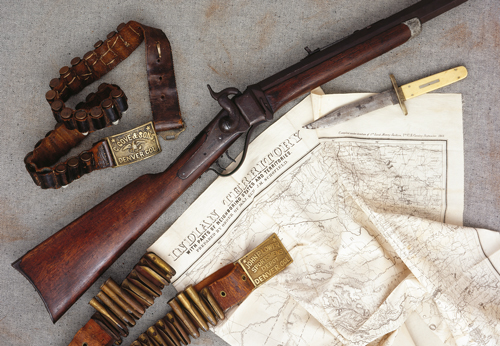
Converted by a gunsmith in Montana Territory c. 1870s. Standard Sharps Civil War cavalry issue carbine altered to a classic style “Buffalo Rifle” by A. B. Charpie of Helena, Montana Territory, whose name and markings appear on the heavyweight 24-inch octagon barrel; caliber 50 centerfire; overall weight 11-1/2 lbs. Illustrated here with a Sheffield, England-made Bowie knife of the same era made for and bearing the markings of the well-known Denver, Colorado gunsmith and arms merchant John P. Lower & Son; also leather cartridge belts bearing brass buckles sold by Lower and the equally noted Denver gunsmiths and arms dealers Carlos Gove & Sons. (As illustrated in The Peacemakers; Arms and Adventure in the American West, with author’s permission)
Advertising in Gun Publications
The sales option requiring the greatest amount of time, but reaching the widest possible audience, is advertising the gun in one or more of the collecting periodicals. These are widely circulated throughout the United States and abroad, and present the collector with the very best chance of finding the ultimate specialized buyer most actively seeking that particular piece. Bear in mind that a considerable time lapse exists in mail order selling, from placing the advertisement to the date of publication and circulation; normally a minimum of two months. The collector must be prepared to service and answer all inquiries as well as to give full cash refund should the piece be returned by the buyer if not found up to specifications.
Not a few wellknown dealers active today started off by dabbling in part-time mail order. A cautionary note must be made with regard to buying and selling firearms of all types — especially through the mail: One must be familiar with the text of the Federal Firearms Act of 1968, which regulates interstate trade in firearms, and to be equally familiar with local and state firearms ordinances — decidedly a mixed bag! In the most general terms, guns made prior to December, 1898 are free of regulations under the Federal Act, but they do not conflict with or cancel any existing state or local laws in effect in one’s area.
The laws are readily available and their finer points can be checked with local gun clubs and organizations conversant with firearms regulations.
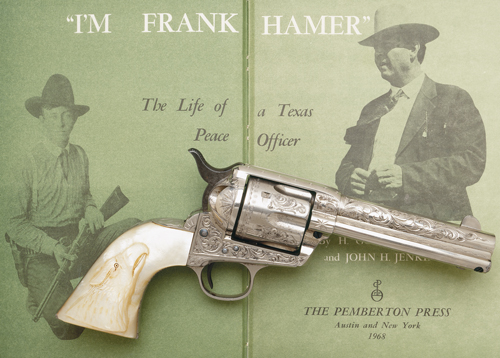
Owned and carried by the legendary Texas Ranger who tracked down and terminated the careers of the notorious “Bonnie and Clyde.” Factory engraved Colt single-action revolver (serial #180260) with 4 3/4-inch barrel and handsome pearl grips with high-relief carving of an eagle’s head. The revolver was originally owned and used by William H. Ford in a fatal shooting in Texas and subsequently acquired by Frank Hamer whose Texas Ranger career had begun in 1906 at age 22. The historic Colt revolver was accompanied by documents written personally by Hamer stating: “this weapon has been carried by me for a number of years while in the services as a peace officer.” Illustrated here with a popular biography of Hamer’s distinguished career. (As illustrated in The Peacemakers; Arms and Adventure in the American West, with author’s permission)
Trading a Gun
Trading as a final option. If all else fails, there’s always gun swapping! Probably no other collecting hobby affords as many opportunities to trade as does antique firearms. This time honored method is also a means of sharpening one’s wits. With not a few collectors their major interest in the hobby is the action and satisfaction derived from the pure trading aspects.
Depending on technique, it is very possible to amass quite an impressive collection with a minimum expenditure of cash and a little ingenuity and Yankee horse-trading. Likely superfluous would be a caution about trading values, but inasmuch as “… some never get the word” (to summarize an old story), only the reminder will be issued here that highly unrealistic prices are often encountered in the area where trading rather than sales is anticipated.
The reason for this might possibly be the psychological advantage thought in allowing someone more for his gun in trade than could be attained for it in cash. The whole thing is based on both a not-too-cute or clever and often selfdeceiving principle and brings to mind the classic story of the two $500 alley cats traded for the $1,000 mongrel dog!
Looking to go armed, but are stuck in the weeds as to what to arm yourself with? Here are 20 of the best concealed carry gun options that will keep you on the defensive.


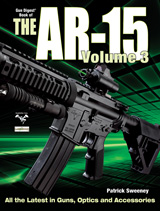 New! The Gun Digest Book of the AR-15 Vol. III