At the beginning of his State of the Union address, President Obama tipped his hat to Rep. Gabrielle Giffords, who’s now recuperating in a Houston medical facility. But throughout the hourlong speech, he never addressed the issue at the core of the Giffords tragedy—gun control—and what lawmakers would, or should, do to reform American firearm-access laws.
That was intentional, according to the White House. An administration official says Obama didn’t mention guns in his speech because of the omnipresent controversy surrounding the Second Amendment and gun control. Tuesday’s speech was designed to be more about the economy and how, as Obama repeated nine times, the U.S. could “win the future.”
But in the next two weeks, the White House will unveil a new gun-control effort in which it will urge Congress to strengthen current laws, which now allow some mentally unstable people, such as alleged Arizona shooter Jared Loughner, to obtain certain assault weapons, in some cases without even a background check. Read more
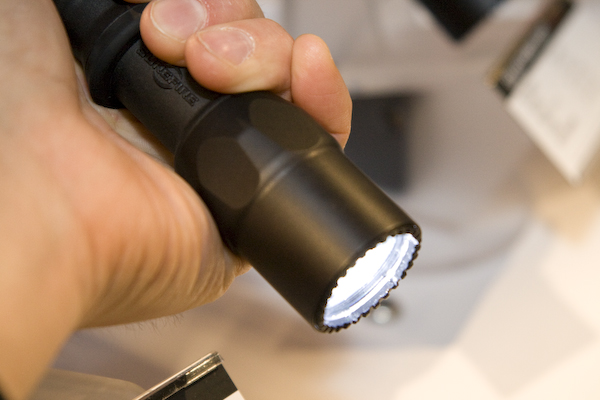
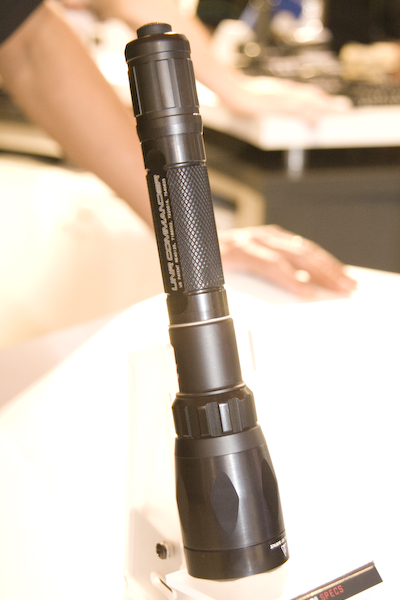
Surefire’s new rechargeable tactical lights feature improved user controls and duel-fuel options. Photos by Corey Graff
At 500 Lumens (20,000 Candela) the Surefire UNR Commander produces a “blinding extended-reach beam.” That’s what the company literature says. After waving its beam around the SHOT Show floor, I’m pretty sure you could fry eyebrows with this thing. There’s got to be a tactical advantage in that.
Tactical lights just keep getting more powerful. But what I really liked about Surefire’s newest lights were the 4-position tailcap switch. It’s like a joystick: Push it down carefully and you activate pre-set effects, like strobing. Move it forward and you get other pre-set outputs. Or literally “push the panic button” all the way down and you get the full beam no matter what.
The 4-position joystick is available on the UBR Invictus (800 Lumens); UNR Commander (500 Lumens); and the UAR Aviator (500 Lumens).
In the event you need something really powerful, check out the UDR Dominator, which throws 4,000 Lumens.
These lights feature “Duel Fuel” — Surefire’s way of saying they will accept two rechargeable battery types, namely lithium-ion or A123.
A good light can allow you to identify the nature of a threat, or to distract/disorient an attacker. Think about how fast things can go bad and don’t let your adversary use darkness to his advantage. Consider adding a tactical light to your self-defense tool kit.
Courtesy of Glenn Beck’s “The Blaze” (www.theblaze.com):
SALT LAKE CITY (AP) — State lawmakers are debating whether to designate a semiautomatic pistol as the official gun of Utah, despite protests from people who believe it’s inappropriate because of recent mass shootings.
The bill to make the Browning M1911 the official gun breezed through a committee hearing this week and is scheduled to be debated by the full House as early as Wednesday.
Republican Rep. Carl Wimmer said the state should have the gun as one of its state symbols to honor John Browning, a Utah native who invented it in 1911.
“He invented a firearm that has defended American values and the traditions of this country for 100 years,” Wimmer told the House Political Subdivisions Committee.
Utah has 24 state symbols recognizing the history, geography and culture of the state. They include a state cooking pot, a state tree, a state hymn and a state folk dance.
The committee approved the bill to add a state gun on a 9-2 vote.
Wimmer said the Browning M1911 is widely used by the military, police officers and private citizens, which is why he chose the pistol instead of another Browning gun.
Gun Violence Prevention Center board member Steve Gunn told The Associated Press honoring the M1911 is wrong because the people who opened fire in most recent U.S. mass shootings used semiautomatic pistols. That includes the Jan. 8 Arizona shooting in which six people were killed and 13 — including Rep. Gabrielle Giffords — were wounded with a Glock pistol.
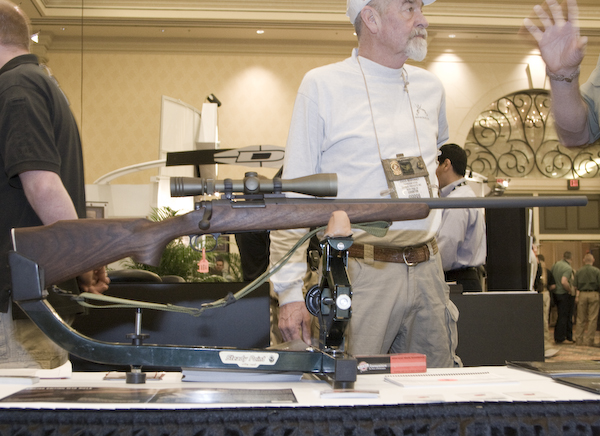
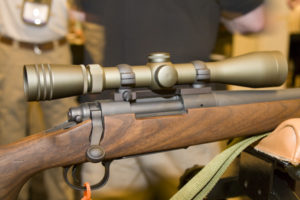
Chuck Mawhinney reproduction M40 Sniper Rifle at Shot Show 2011. Photos by Corey Graff
Chuck Mawhinney is a USMC Scout-Sniper (ret) credited with 103 confirmed kills in Vietnam. Now, he’s teamed up with the USMC Scout Sniper Association, Remington, Leupold and Riflecraft Ltd. to produce 103 of these historically-accurate rifles.
Now there’s a sight for sore eyes, I thought, as I waded through a sea of black guns in the Law Enforcement section of SHOT Show 2011 to get to the little bolt action.
Sitting there, in a quiet corner of the Daniel Defense booth, was a single wood-stocked rifle. The green-webbed sling and heavy barrel gave it away from a distance. Yes indeed, someone was making a reproduction M40 Sniper rifle.
Now, you might remember how back in 2004 Remington produced 1,500 special M40 commemorative rifles.
Problem was, however, there was not a historically accurate scope available at the time to compliment that run. The Chuck Mawhinney project kicked off two years later, in 2006, when Leupold & Stevens acquired Redfield. Armed with an annodized-green 3-9 X 40 Redfield-marked optic, the rifle could now be brought back to life with a scope that was very close to the original.
There is much attention to detail in the rifle, including correct scope mounts modeled after those originally produced by Badger Ordnance. Working with Andrew Evans-Hendrick of the UK-based Riflecraft Ltd., Mawhinney teamed up with former Special Forces sniper Mike Haugen, who now works for Remington.
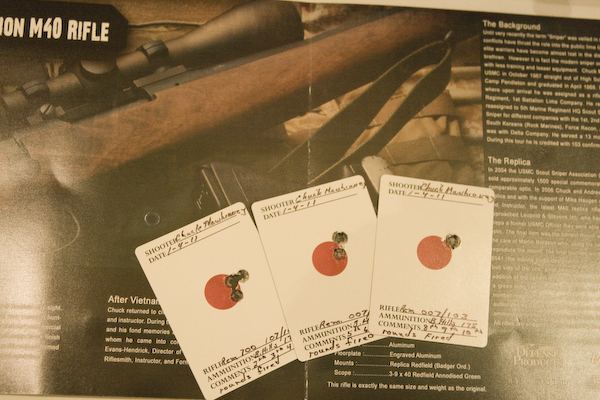
Each gun is shot by Mawhinney, who ensures it shoots a neat little cluster using 175-grainers. Those proof cards are included with the gun. The rest is history.
Each rifle is shot by Mawhinney to ensure the highest accuracy standard.
The rifle’s crown is not recessed, which matches the originals. The stock is not checkered, either; also correct.
The bolt-side of the receiver is etched with Chuck’s initials and the number 8541, which is the marine designation number for scout-snipers.
Specs
Remington Model 700 Caliber: .308 Winchester (7.62 Nato round) Barrel Length: 24″ Black Matte, Pillar bedded, free floating barrell and correct length TG screws (G.A. Precision) Stock: Walnut Butt Plate: Aluminum Floor Plate: Engraved aluminum (w/ Chuck’s signature) and numbered 1 – 103 Scope: 3-9 x 40 Redfield Annodized Green (Leupold) Mounts: Replica Redfield (Badger Ordnance) Sling: Green
LAS VEGAS — Back in 1979 before the first SHOT Show, organizers worried that industry professionals might not show up for the fledgling event, a story recounted in the just-released National Shooting Sports Foundation 50th Anniversary history publication. Organizers needn’t have worried then, or now, about the vitality of the SHOT Show.
The 2011 Shooting, Hunting and Outdoor Trade (SHOT) Show soared above expectations by setting records for buyer attendance at 31,769 and media attendance at 2,074.
Overall attendance of 57,390, comprising buyers, exhibitors, media and guests, ranked the show as the third largest ever behind the 2008 and 2010 events. In this sluggish economy, the SHOT Show demonstrates the resilience of one of America’s oldest industries and the popularity of its products.
“The importance of the SHOT Show to the firearms industry cannot be overestimated,” said Steve Sanetti, president and CEO of NSSF, which owns the trade show. “The SHOT Show is simply the must-attend business event for all segments of our industry. Based on what we’re hearing, industry has every reason to think that 2011 shows promise of being another strong year.”
Filling the Sands Expo and Convention Center to capacity with 1,600 exhibiting companies covering 630,000 net square feet with their booths, SHOT Show brings together all facets of the $4 billion industry. Many companies use SHOT Show, the largest trade show of its kind in the world, to announce new products and services. Buyers and media members are able to handle and discuss products that include firearms, ammunition, outdoor and tactical clothing, optics, knives, related accessories and law enforcement equipment. Read more
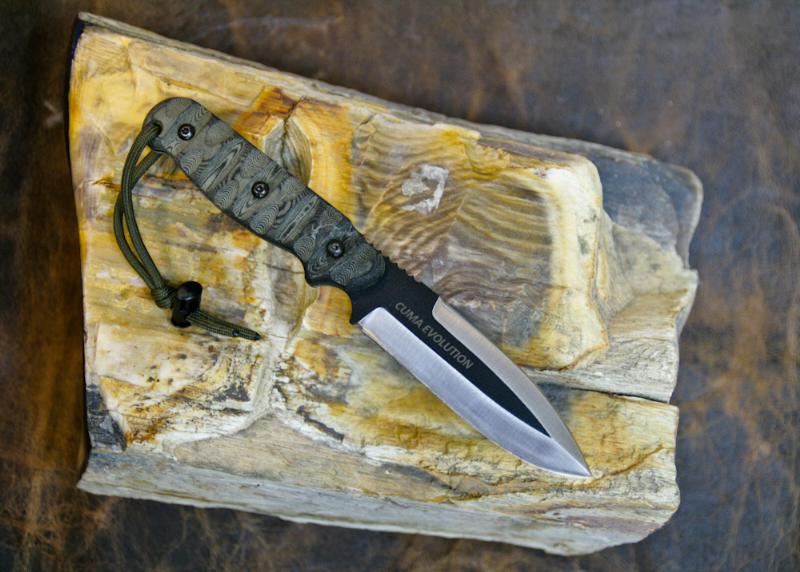
Waysun “Johnny” Tsai shows off his new Cuma Evolution knife at SHOT Show 2011. Photo by Corey Graff.
I’m not sure which aspect of the annual SHOT Show is more entertaining: the people or the new products.
Two interesting characters who ambled into the Gun Digest/Tactical Gear booth putting that dilemma to the test were Waysun Johnny Tsai of the Cuma Ram self-defense facility, and Mr. Snake Blocker of the Blocker Academy.
Both masters in the martial arts, they were armed with new signature tactical knives from Tops.
Cuma Evolution
Waysun Johnny Tsai describes his fighting style as “Chinese Kung Fu” and CUMA stands for Combined Universal Martial Applications.
C.U.M.A. is a “Hybrid Fighting System” designed to develop a practitioner’s skills in the art of PRACTICAL martial art applications. It focuses on all ranges of practical armed and unarmed combat.
Tsai incorporated his many years of “tactical to practical” philosophy of teaching and fighting into the Tops Cuma Evolution Knife.
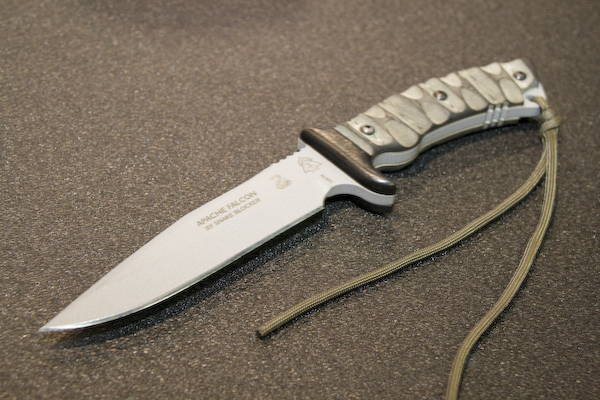
The Apache Falcon, designed by Snake Blocker, made by Tops Knives. Photo by Corey Graff.
Snake Blocker — yep, that’s his real name — is a Lipan Apache Expert Knife Fighter and Knife Combatives Instructor for members of the Special Forces.
Like Tsai, he’s the wrong guy to mess with.
His new Tops Apache Falcon is a beast of a knife at 12 inches, but its excellent balance and sleek Micarta handle fit so well it doesn’t feel unwieldy. This is, of course, by design. Blocker designed the knife for real-world fighting.
Specs:
O/A Length: 12″ Blade Length: 6 1/4″ Cutting Edge: 5 3/8″ Thickness: 1/4″ Blade Color: Tactical Gray Steel: 1095 High Carbon Alloy RC-58 Handle: Black Linen Micarta w/ Rocky Mountain Tread® Sheath: Combat Ballistic Nylon MFG IN THE ROCKY MOUNTAINS USA
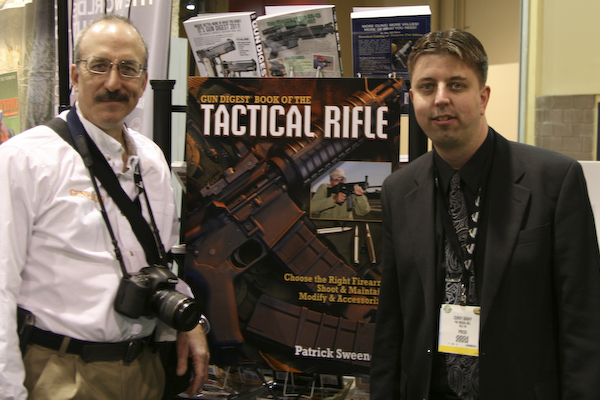
Gun Digest Author Patrick Sweeney and Online Editor Corey Graff at SHOT Show 2011.
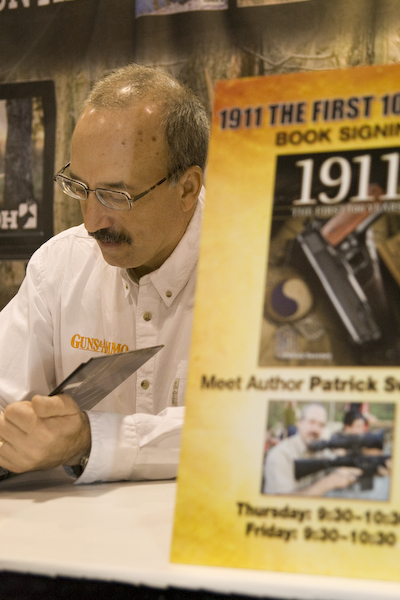
I recently had the opportunity to meet Gun Digest author Patrick Sweeney at the 2011 Shooting, Hunting and Outdoor Trade (SHOT) Show. Sweeney was at the Gun Digest booth to sign copies of his new book,1911: The First 100 Years.
Patrick Sweeney Signs Copies of 1911: The First 100 Years at SHOT Show 2011
One of the things that strikes you about the man, despite his impressive list of credentials and publishing credits, is what a genuinely nice guy he is — truly down-to-earth. It’s a refreshing thing to meet someone who is confident enough in his knowledge that he doesn’t feel the need to machine gun you into the ground with an over-zealous ego. In fact, I can say without any reservation whatsoever, that while I met lots of interesting folks at the show, meeting Sweeney was a personal high point.
As I wrote not long ago in the Tactical and Military Arms Blog, Sweeney’s new book on the 1911 invoked thoughts about my own dad and the 1911 he carried in WWII. Well, both our fathers carried 1911s in the war. And at the show, I got to speak with Sweeney more about the role his dad played in the war — a real treat!
The book signing — as part of Gun Digest’s salute to the 100 year anniversary of the Model 1911 pistol — took place on Thursday (1/20) and Friday (1/21) from 9:30-10:30 am at the Gun Digest SHOT Show booth #11720.
A limited quantity of copies of 1911: The First 100 Years were available at the Gun Digest booth for the signing. To read an excerpt from the book, click here
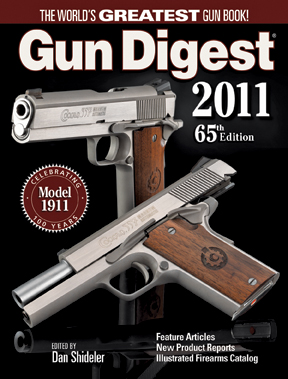
In the year 1911, the history of firearms changed forever with the adoption of the greatest pistol ever designed, the Automatic Pistol, Caliber .45, M1911 — known today simply as the 1911. Now, in one fascinating, fully-illustrated hard cover volume, authority Patrick Sweeney celebrates the 100th anniversary of the greatest fighting handgun ever designed, John M. Brownings legendary 1911 .45.
Lavishly illustrated with photographs collected from around the world, 1911: The First 100 Years is a fitting centennial tribute to a pistol that is today more popular than ever.
In California, “A Fresno County Superior Court judge has blocked a pending state law that would have required Californians to provide a thumbprint and photo identification when buying handgun ammunition,” the San Diego Union-Tribune reported.
According to Judge Jeffrey Hamilton, the law, which was scheduled to go into effect February 1, was “unconstitutionally vague.”
“Gun-rights groups had argued that some types of ammunition can be used in both handguns and rifles, making enforcement and compliance a challenge. One of those making that case is Marc Halcon, owner of the American Shooting Center in San Diego.”
“When legislation is passed that doesn’t give clear guidance, you are making it much more difficult to make heads or tails of it,” said Halcon, who was also president of the California Association of Firearms.
That law would have, “imposed the strictest handgun ammunition purchase regulations of all states,” the Union-Tribune noted. “It also would have required Californians buying handgun ammunition over the Internet or by mail order to have it shipped to a licensed vendor. There, buyers would still have to provide the thumbprint, ID and other information.
Dealers would have had to keep those records on who buys the ammunition, how much and which type for five years.”
Yet, as with so many things legal, Judge Hamilton’s ruling may only be a first step. An appeal by the state’s attorney general appeared very likely.
The Virginia Supreme Court has ruled that state colleges and universities can ban firearms, even those carried by people with concealed carry permits, from campus buildings and campus events.
As reported by the Roanoke Times, “The court affirmed a lower court ruling against Rudolph DiGiacinto, who sued the rector and board of visitors of George Mason University in Fairfax, arguing that the university’s ban on firearms in campus facilities and at events violated his constitutional rights.”
“But a lower court found, and the state’s highest court agreed, that under both the state and federal constitutions college facilities are considered ‘sensitive places’ where the right to bear arms may be curtailed.”
Of note, campuses like George Mason and Virginia Tech University do not have total bans on firearms. “Weapons are disallowed in university facilities and at events such as football games,” the Roanoke Times noted. “But students living on campus who wish to bring firearms to school may register them with the Tech police and store them at the police department.”
The Corps of Cadets represented another exception to the firearms policy. “According to the student handbook ‘organizational weapons of the Virginia Tech Corps of Cadets, approved by the commandant, are not prohibited by this policy.’”
It’s hard to imagine that Armalite could possibly make its Special Purpose Rifle (SPR) any more versatile, but that’s what they’ve done with the M-15 SPR Mod 1.
The SPR Mod 1 is a forged one piece upper receiver/rail system with interchangeable sides and bottoms. Actually, the bottom and two side rails are completely detachable. You can leave them off, or use one of four other types of rails that come with the system.
The 1913 rail is designed with a quick detachable swing swivel hole. There is a low insert for those times you want to keep a low profile, and a plain insert. Or try the half smooth, half picatinny rails.
The important thing to realize about this rail system is how sleek it is – when you pick it up the integral rail is not bulky at all. You can grip it and get full control.
The M-15 SPR Mod 1 is one-piece construction, giving you what Armalite calls a “continuous optics platform.” That one-piece design also gives the whole gun a good deal of added rigidity, which is like icing on the cake.
Scenario one: The balloon goes up. Society crumbles. Chaos ensues. Zombies everywhere.
Scenario two: You’re a scout in a sniper team and need a medium-range weapon that won’t fail.
Scenario three. You need a gun that will do everything else not mentioned in scenarios one and two.
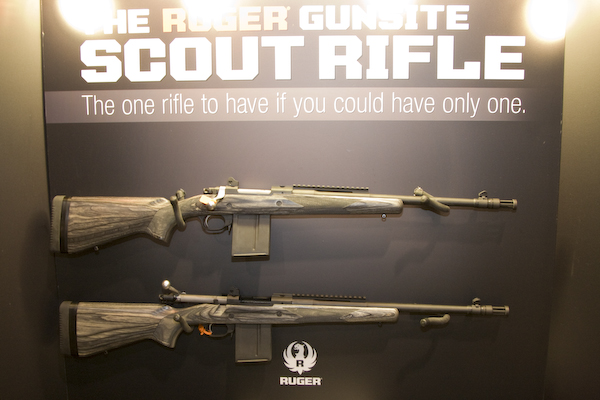
That’s the thinking behind the Ruger Gunsite Scout Rifle, a new offering by Ruger featured at the Shooting, Hunting, and Outdoor Trade (SHOT) Show in Las Vegas, Nevada this week.
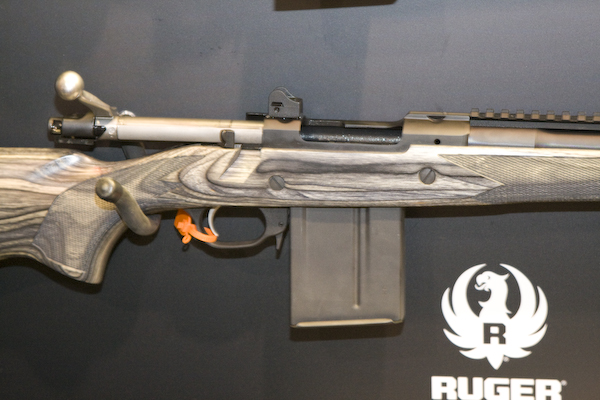
The bolt-action rifle is a collaboration between Sturm Ruger and Gunsite. Chambered in .308, the rifle sports a 16.50″ barrel, has an overall length of 38.00-39.50 inches and comes with a 10-round magazine. The stock is black laminate and the overall weight without mag is about 7.00 pounds.
And it’s a Sherman tank. The rifle is designed for a high eye-relief forward mounted optic, and utilizes a forward-mounted picatinny rail. There is a flash suppressor and blade protected front sight – and a nifty Gunsite logo engraved grip cap.
I spoke with Mark Gurney, Ruger’s Product Manager, who told me the rifle is designed with simplicity and affordability in mind. The bolt action design provides both, and while the gun is designed as a medium range scout-sniper weapon, it’s accurate enough to keep bullets on steel at 1000 yards if the need should arise.
Here are a few more bullet points about this rifle:
Flash suppressor reduces muzzle flash and can be removed for the fitting of most standard .30 caliber muzzle accessories.
The forward mounted picatinny rail allows for the mounting of modern optics, like an intermediate eye relief scope for “both eyes open” sighting and fast target acquisition.
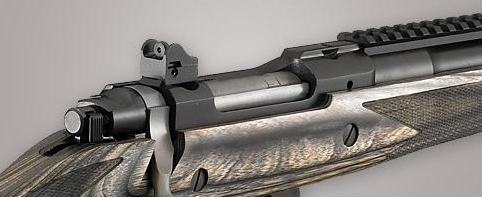
Built-in sighting system with ghost ring adjustable rear aperture sight and protected non-glare post front sight.
10-round box magazine with push-forward, Mini-14 style magazine release just forward of the trigger guard (10- and 5-round mags are available directly from Ruger).
Patented integral scope mounts machined directly onto the solid steel receiver.
Soft rubber recoil pad with buttpad spacers allow the rifle to be properly sized for different shooters or varying levels of outerwear or defensive gear.
The new Leupold High Accuracy Multi-Range HAMR scope at SHOT Show 2011. Photo by Corey Graff
New from Leupold’s Tactical Optics Division, the Mark 4 High Accuracy Multi-Range (HAMR) riflescope is a fixed power 4x24mm sight.
It’s built for precise mid-range marksmanship and fast target acquisition, the company says, and it offers a variety of features that work to the advantage of military warfighters, law enforcement personnel, and other tactical or competitive shooters.
These features include the ballistically matched illuminated CM-R2 reticle, a fast-focus eyepiece and Leupold’s advanced Xtended Twilight Lens System. In addition, Leupold’s DeltaPoint reflex sight can be attached to the HAMR, providing instant target acquisition capability at close quarters. (DeltaPoint and HAMR are available as a package.)
“Our new Mark 4 HAMR is versatile, tough, compact and combat-ready,” said Kevin Trepa, vice president of tactical sales and marketing for Leupold & Stevens, Inc. “Simple to use, it can be employed with any AR-15 variant to engage targets with exceptional speed and precision.”
The CM-R2 reticle is designed for the most popular tactical rounds and weapons systems. An etched glass reticle, it is clearly visible with the illumination activated or in the “off” mode.
By combining the ranging ability of Leupold’s Special Purpose Reticle (SPR) with the quick acquisition of the Leupold Circle Dot reticle, the CM-R2 provides the flexibility necessary on the modern battlefield or 3-gun course. The CM-R2 preserves the instinctive fire capabilities of the Circle Dot for the short-range, low-magnification needs of the CQB warfighter and competitive multi-gun shooters.
The CM-R2 is designed to allow the shooter to focus more attention on the target and less attention on the reticle. A boldly illuminated 0.5 MOA dot surrounded by a 5.0 MOA semi-circle enhance the shooter’s focus and combine precision with speed when the target is up close and personal. Hash marks on the horizontal stadia are calibrated for leading moving targets at 5, 10 and 15 mph, respectively. Vertical tic marks allow users to estimate ranges based on 18” wide targets at increasing ranges, while also providing precise holdover points for targets between 300 and 900 meters.
With a quick 1.5 revolutions “lock to lock,” the rapid adjustment speed of the HAMR’s eyepiece helps get the shooter in focus and on target in short order. The addition of a DeltaPoint allows the user to quickly shift from the reflex sight to the HAMR, transitioning from close quarters to longer ranges with speed and ease.
Leupold’s Xtended Twilight Lens System provides superior light transmission for the best low-light performance, particularly in the blue/violet light of dawn and dusk. The system produces an extremely bright, sharp image across the HAMR’s visual field. Combined with a constant 2.71 inches of eye relief, the optical system is much more forgiving and effective than first-generation optical sights.
A flat-top Picatinny mounting system is included with each HAMR. It is compatible with any rail mounting system. Other features include 0.10 mil click adjustments for windage and elevation, and a F88 5.56mm Bullet Drop Compensation (BDC) dial.
The Mark 4 HAMR comes in a matte black finish, weighs 17.2 ounces and is 5.6 inches long. The scope is waterproof, fog proof and shock proof.
For warranty information on specific products, call 1-800-LEUPOLD or 503-526-1400. For additional product information, go to www.leupold.com.
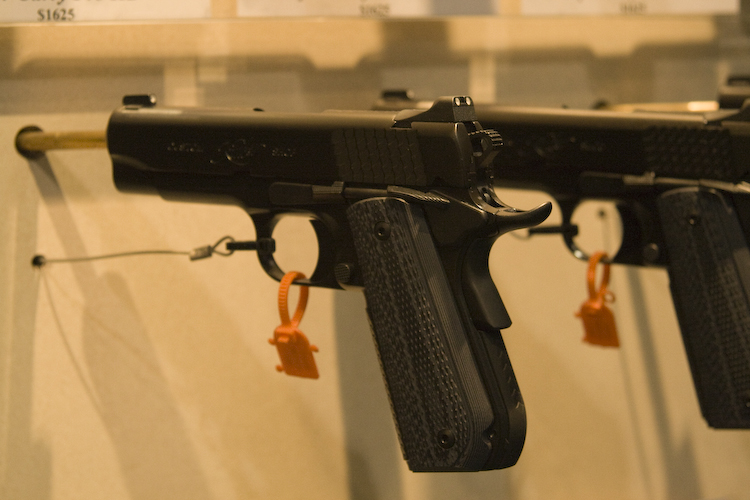
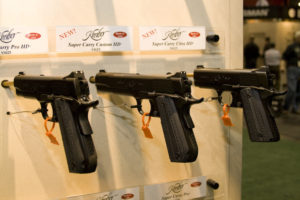
Kimber rolled out a new Super Carry HD ("Heavy Duty") 1911 at SHOT Show 2011. It's a hefty stainless version for concealed carry. Photo by Corey Graff
On opening day of the 2011 Shooting, Hunting and Outdoor Trade (SHOT) Show, the Kimber booth was bustling with activity around the company’s new 1911s. The only thing missing were party hats for the 100-year anniversary celebration of the Model 1911, but nobody noticed that, probably because of the guns themselves that were on display. So here they are.
Kimber Super Carry Pro HD
The Kimber 1911 Super Carry HDs feature the same rounded heel as the standard lightweight Super Carry models. The improved ergonomics gives you better comfort when carrying and arguably better control. Photo by Corey Graff
For concealed carry and tactical applications, the Kimber Super Carry Pro HD is new to the Kimber “Super Carry” line and it is one hefty little bugger. It’s made of stainless steel and features a dark KimberPro II finish. The HD part stands for “Heavy Duty.”
When you pick it up, you immediately notice how solid it is, yet the rounded heel allows it to nest comfortably in your hand for a good grip.
Call me old-fashioned, but I like my guns heavy. It makes them more pleasant to shoot, and in my opinion gives you a more stable sight picture.
The HD model 1911 represents the “second version” of the Super Carry line, as opposed to the standard Super Carry models, which feature a light weight aluminum frame.
As already mentioned, both the standard and new HD Super Carry guns have a nice rounded heel frame that makes the pistol more comfortable to carry and fire.
In true Kimber-speak, the HD Super Carry pistols are available as Super Carry Custom HD (5-inch), Super Carry Pro (4-inch) and the Super Carry Ultra (3-inch).
My personal choice for concealed carry would be the 4-inch model, but whatever your personal philosophy is with respect to pistol size, Kimber has something to help you stop the threat.
The MSRP on the Super Carry HD models is $1625.
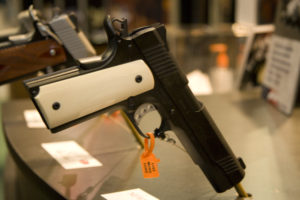
Kimber Royal II
The Kimber Royal II is a new and very classy full-sized 1911 with a deep charcoal bluing and attractive bone grips. Photo by Corey Graff
The other new Kimber 1911 that caught my eye was a classy ivory-gripped model called the Royal II. This gun is only available in a full-size 1911 frame.
It features a charcoal blued finish on slide and frame with solid bone grips. One rep described this gun to me as “not a concealed carry pistol.”
With an MSRP of just shy of $2000, you might be tempted to store the thing as a collectible. Dare I suggest it is too pretty to shoot?
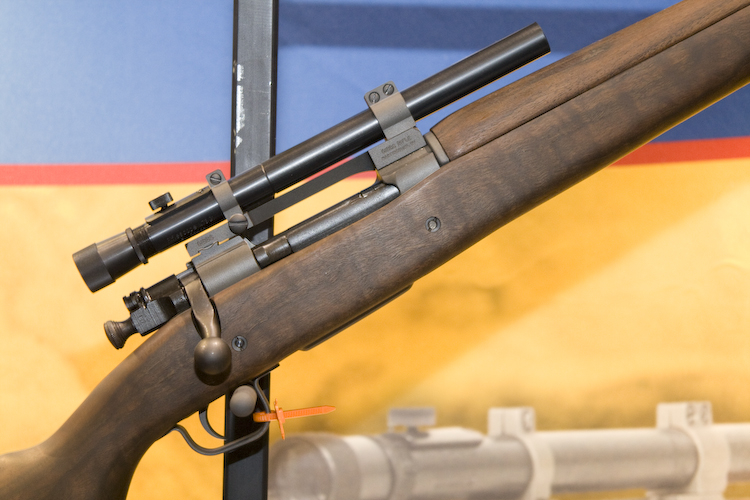
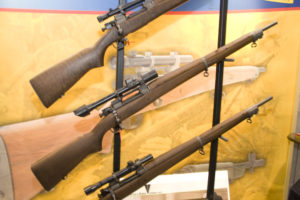
The Gibbs Reproduction 1903A4 Springfield Sniper rifle featured at SHOT Show 2011.
The Gibbs Rifle Company is giving shooters and collectors a reproduction of two WWII marksmanship rifles in an affordable package. And they can shoot, too!
If you like tactical rifles and gear, then wandering around the SHOT Show is like being a child lost in a candy store. But when I moseyed by the Gibbs Rifle Company booth, what stopped me dead in my tracks was a rack full of Springfield 1903A4 sniper rifles. Next to them was a M1D Garand Sniper.
I’d discovered the reproduction WWII rifles of the Gibbs Rifle Company — hoo rah!
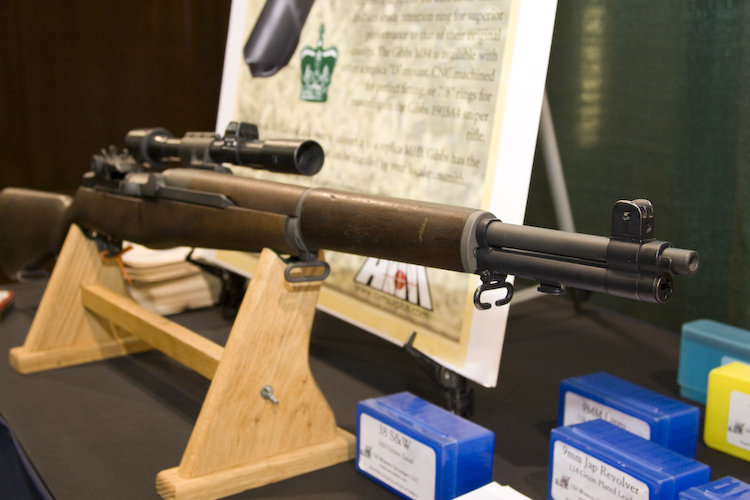
M1D Sniper Scopes
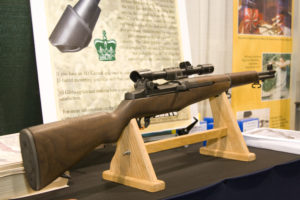
The Gibbs Model “84” replica scope can turn your Garand into a model D sniper version.
The Garand M1D sniper rifle is one that any WWII arms collector wants, but they aren’t cheap. Good samples of authentic scopes are hard to come by. Complete units — M1Cs and M1Ds — are selling online anywhere from $3000 on up.
The Gibbs M84 Garand Scope comes in two versions: One with D rings for the Garand; the other with 7/8″ rings for a springfield.
But now Gibbs is making a replica of the M84 scope and “D” mount, allowing you to transform your Garand into the sniper version and not break the bank.
However, one difference between the original and the Gibbs reproduction will be the use of modern coated glass, plus an improved design to the dust cover latches and sunshade retention rings.
The Gibbs 84 scope is available in two versions: a replica with “D” mount for the Garand, and one with 7/8″ rings so you can mount it on an M1903 Springfield.
M1903 A4 Springfield Sniper
The Gibbs 1903 A4 snipers come in two variations: a Standard 1903 A4 version with an early Weaver-style scope, the 1903 A4 “82” and “84” which both feature an improved replica U.S. Military M82 rifle scope and 7/8″ rings. In talking with Val Forgett III, President of Gibbs, the company is exploring other replica scopes from the period.
I put my two cents in to lobby for a replica of the Unertl sniper scope, which I believe to be among the most attractive optics of the period. I wouldn’t be too surprised to see the company offer this variation in the near future. And if (when?) they do, expect gun owners to line up with open wallets for one. With current models featuring an MSRP of $995, these guns are within reach.
The Gibbs Springfield reproductions feature original actions, with aftermarket furniture and modern replica optics.
But how do they shoot? According to Forgett, Camp Perry is adding a scoped rifle aspect to its competition based largely on the availability of the reproduction 1903 rifles.
Here are a few more details on the Gibbs M82 and M84 1903A4 reproductions from their website:
The Gibbs M1903-A4 is built using original Remington-made World War II M1903-A3 actions and turned-down bolts, which Gibbs obtained large quantities of when it purchase the rifle division of Parker-Hale in the 1990’s. Gibbs then utilizes new-made 4-groove barrels made identical to the originals. Each receiver is carefully drilled and tapped using replicas of the original “Redfield” rings and mounts and an exact copy of the M73B1 scope, used on the 1st model M1903-A4’s. Each barreled action has the original military parkerized finish with polished blue stock furniture, again, identical to the originals. The stocks are new-made “C” configuration with a linseed oil finish.
Each gun comes with a replica of the M1907 U.S. issued leather sling and OD Green canvas carrying case. The result is a firearm that comes out of the box in brand-new condition, ready for shooting, display, reenacting and field use. Not just exceptional in looks and finish, each gun is made to hold to the accuracy standards of the U.S. Government during World War II. “We want our customers to know that they can achieve the same accuracy as World War II snipers with these guns” stated Val Forgett, President of Forgett Militaria, LLC.
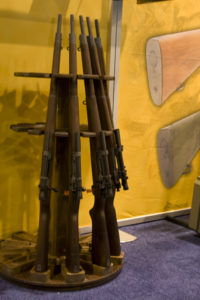
A rack full of 1903A4s! The Navy Arms/Gibbs Rifle booth at Shot Show wasn’t the most elaborate display, but these rifles were an eye-catcher.
Like all replicas and historic remakes, the Gibbs M1903-A4 has a number of features that intentionally distinguish it from originals, even by the casual observer. For instance, the barrels are marked with the modern dates of manufacture, unlike original barrels that would have had 1940’s manufacturing dates. Gibbs also does not remove the receiver markings, another telling feature to distinguish this historic remake. Finally, the scopes are marked with the Gibbs name and address, unlike the originals, which were marked with Weaver’s manufacturer’s marks.
Each gun comes packaged in a new hardside gun case with a replica M1907 U.S. issued leather sling and OD green canvas carrying case as seen below.
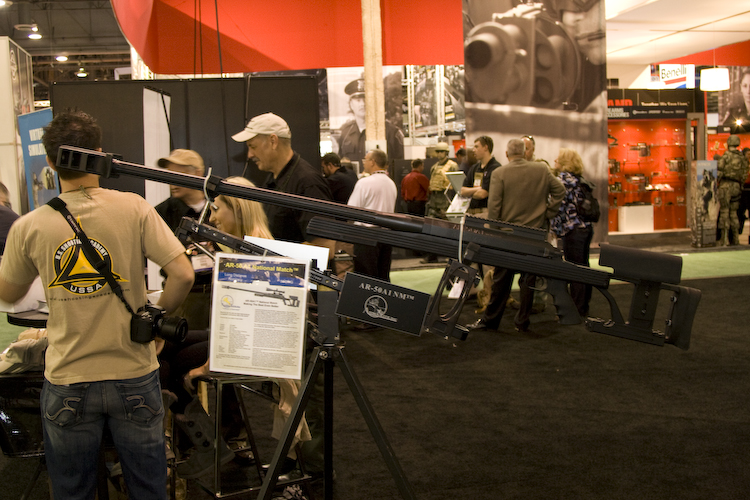
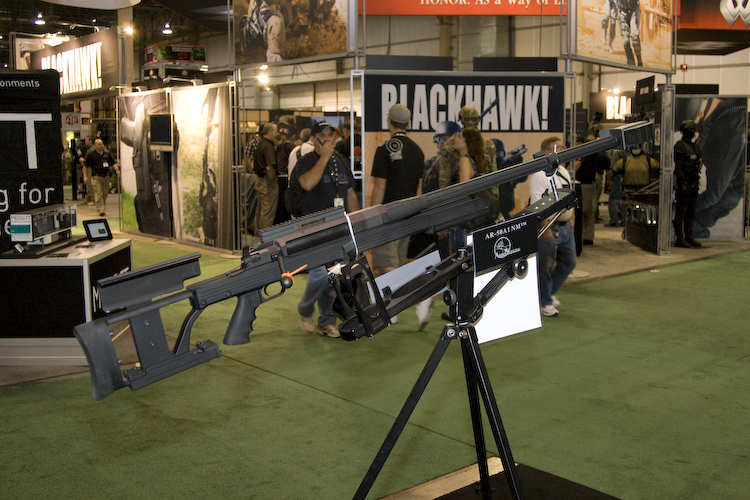
Armalite rolled out a new National Match version of its popular AR50 at SHOT Show 2011.
What do you do with what is arguably the most popular, affordable and accurate high-powered .50 caliber rifle in the world? If you’re Armalite, you make it even better.
And that’s what ArmaLite has done with its introduction of the AR-50A1 National Match, unveiled at the 2011 SHOT Show in Las Vegas, Nevada.
The AR-50A1 National Match is similar to the standard AR-50A1 with some very important differences. The AR-50A1 NM is produced from selected components: The National Match’s 33 inch barrel is three inches longer than the standard AR-50A1’s barrel. The barrel has eight flutes. The flutes help with cooling and reduce unnecessary weight while maintaining accuracy-enhancing stiffness. The barrel has a 50 BMG Match chamber instead of a standard military chamber.
The result: sub MOA accuracy.
ArmaLite has also developed a “Skid System” for the AR-50A1 National Match. It’s meant for serious match use and comes standard, not as an expensive add-on. The ArmaLite Skid System provides parallel rests on the rifle that are parallel with the bore of the rifle so when it recoils it will recoil straight back. This has been requested by match shooters, some of whom have made their own. The front skid attaches to the slot in the forestock similar to the way bipod rails are attached. The rear skid attaches to the buttstock. Armalite developed the Skid System without modification to the AR-50A1’s original parts so the system can be used by shooters who already own an AR-50A1 and want to use their original stock with no modifications.
Looking for more reasons the AR-50A1 NM achieves sub-MOA accuracy? Here they are:
The heart of the rifle is its metallic stock-to-action interface. The patented V-Lock™ Bedding Wedge and V-Block Stock assure absolute strength and repeatability for superb accuracy. The aluminum stock reinforces the receiver like a bench-rest sleeve. It’s not just the bedding that improves accuracy. Independent testing has proven the AR-50A1 muzzle brake to be the best in the industry for both recoil control and accuracy. It scrapes away turbulent muzzle gasses and lets the bullet break into clean air for amazing accuracy.
The only question we have is, when can we get our hands on this beast?
Here's one more photo of the Armalite AR50 from the floor of SHOT Show 2011. Enjoy! (And stop drooling).
Looking to go armed, but are stuck in the weeds as to what to arm yourself with? Here are 20 of the best concealed carry gun options that will keep you on the defensive.

 At the beginning of his State of the Union address, President Obama tipped his hat to Rep. Gabrielle Giffords, who’s now recuperating in a Houston medical facility. But throughout the hourlong speech, he never addressed the issue at the core of the Giffords tragedy—gun control—and what lawmakers would, or should, do to reform American firearm-access laws.
 The Gun Digest Book of Concealed Carry