Stevens has recently announced that it is expanding its popular new Stevens 555 over-under shotgun line with the addition of three compact models available as a 20-gauge, a 28-gauge and a .410 bore. Obviously, these three new compact models offer a shorter length of pull than the standard 555 to better fit smaller-stature shooters.
The new Stevens 555 Compact models are all priced less than $695, but come with a number of great features. Specifically, the new compact models differ from the standard gun in that they utilize a mid-length forearm and have a 13.25-inch length of pull.
Just as with the original 555, the new Stevens 555 Compact shotguns feature a lightweight aluminum receiver that has been scaled to gauge. For added durability on all the 555s, a steel insert is used to reinforce the breech. In doing this, engineers have minimized the overall weight while still maximizing strength.
Also like the standard model, the new compact guns wear a stylish Turkish walnut stock and forearm and come equipped with shell extractors for easily removing spent shells once the action is opened. Other standard features include a tang-mounted manual safety; a single, selective mechanical trigger; and a 24-inch chrome-lined barrel.
The new Stevens 555 Compact models are currently being shipped out to dealers and will be available at a price of $692. The guns ship with five interchangeable choke tubes to meet a wide variety of shooting needs.
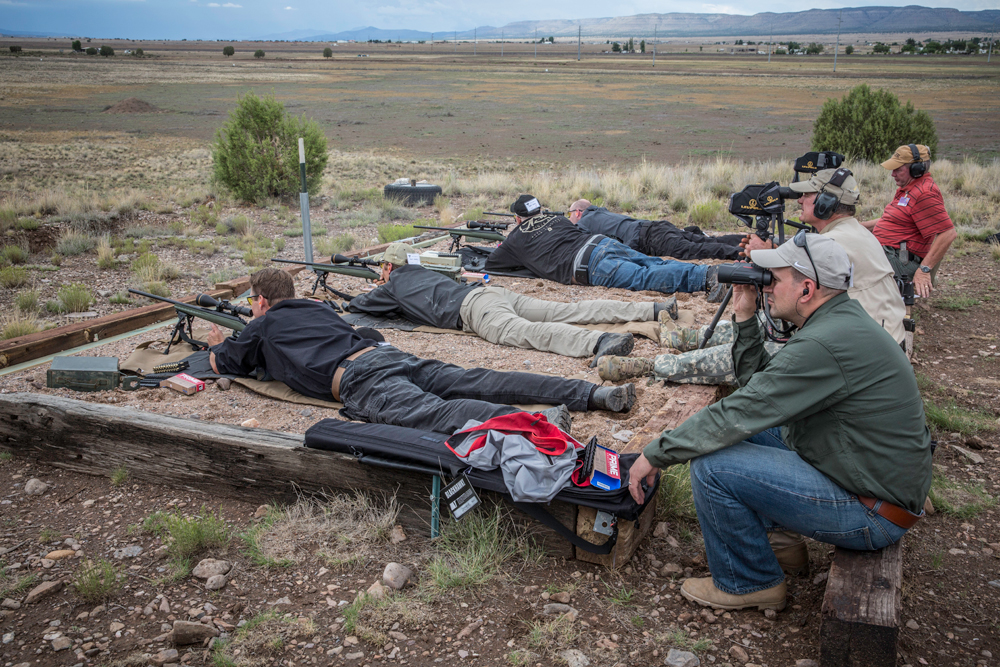
There’s nothing more American than guns and horsepower, both of which were on display at a recent event at Gunsite Academy in Arizona. Yamaha brought its 2017 Wolverine R-Spec Special Edition (SE) and Grizzly SE, while Ruger showcased its brand-spanking new American pistol in 9mm and Predator rifle in 6.5 Creedmoor. We’d be testing both rides and Rugers over three days at Col. Jeff Cooper’s old stomping grounds, a perfect recipe for one hell of a good time.
The Guns Ruger has been in the semi-auto pistol game for a long time, but this year it entered the striker-fired, polymer handgun race with the introduction of the American pistol. The original introduction was a full-size 9mm, which is what we tested at the range, though more introductions are soon to follow, including other popular calibers and compact models in the coming year.
The 9mm version we test drove on the Gunsite ranges was designed for duty, appealing to the law enforcement and personal defense markets. Over the course of three days, I had no malfunctions, and paired with Prime ammunition, the pistol was impressively accurate. I went into the event asking myself if it would stack up to other famous polymer pistols, and it certainly does; I’d even say I like the ergonomics much better than many other well-known makes.
The modular grip system allows you to swap out different modules to accommodate hand size, though the standard grip worked great for me and was incredibly comfortable. I’m also a fan of the moderate beaver tail design, which allows you to get a firm purchase on the handgun from the holster without worrying about slicing yourself on the slide. I shot several hundred rounds with no soreness and sustained accuracy.
The Novak LoMount Carry 3-dot sights also help in that regard, striking the perfect balance between effectiveness in rapid, defensive shooting and longer-range marksmanship. I’m still hearing the instructor’s words in my sleep: “Front sight! Trigger press!”
We cleared buildings and faced off in a friendly competition against steel targets with the American pistol, exposing weaknesses in our shooting mechanics but not the Ruger. With Galco holsters and belts it makes for a quick draw, and the trigger is consistent—not great, but exactly on par with what you’d find in a duty-grade pistol like a Glock or similar striker-fired model.
At the long range we tested the new Predator American rifle in 6.5 Creedmoor, one of the hottest chamberings to come around in a long time. Paired with Leupold’s new VX-3i scope, we were smacking steel out to 1,000 yards with relative ease. Although the American rifle isn’t new, the green predator model and Creedmoor pairing are. On the rifle you’ll find the same great features as prior models, including Ruger’s adjustable Marksman trigger, which can be set between 3-5 pounds. In tandem with Prime ammunition, the rifle delivered consistent, dead-on results on steel.
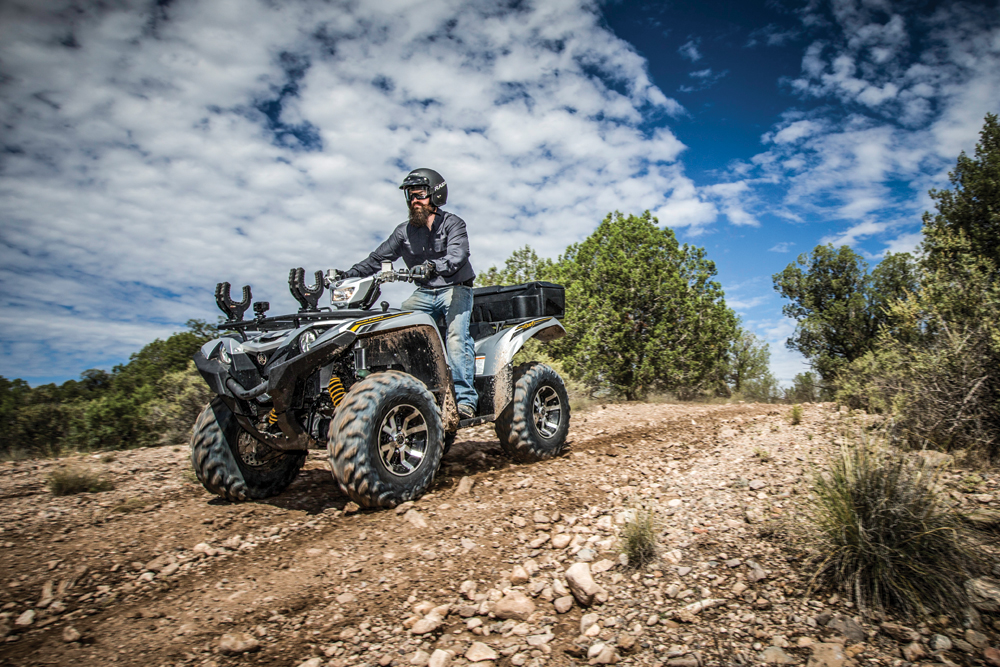
The Horsepower The only thing that makes a few days of shooting better is a sweet ride with lots of power. Yamaha delivered on two fronts, bringing along the Wolverine R-Spec side-by-side and Grizzly ATV, both 2017 Special Edition models. The machines feature the same motor, four-wheel-drive systems and Ultramatic V-belt transmission system. Unlike some belt-driven machines, there’s no need to worry about going too fast in low or too slow in high—Yamaha’s belt and 4WD system are built to take whatever pounding you can throw at them.
Both machines feature Yamaha’s 708cc, liquid-cooled four-stroke engine, which puts out roughly 70 horsepower. Combined with outstanding 4WD and high/low ranges, either machine can tackle virtually any terrain. As a Western hunter and shooter living in the Rocky Mountains, that’s music to my ears. Whether you’re lugging your gear out to the 1,000-yard range, hauling hay at the ranch or tracking down a monster bull in timber country, the Wolverine R-Spec and Grizzly can get the job done. We saw as much driving through the high desert country of Arizona, where both machines conquered the 5,000-foot terrain with ease.
During one of our rides we took the machines down into a wash, at which point the Wolverine got to shine. I didn’t see any way ahead of us by which we could climb out of the wash, but I was proven wrong when one of the riders climbed a 15-yard side hill, floored it and crawled easily up and over the muddy rim. Not only was it a moderately aggressive incline, it wasn’t a straight shot, so the suspension and balance of the machine were put to the ultimate test. In the real world it’s kind of a pass/fail deal, and the Wolverine passed with flying colors.
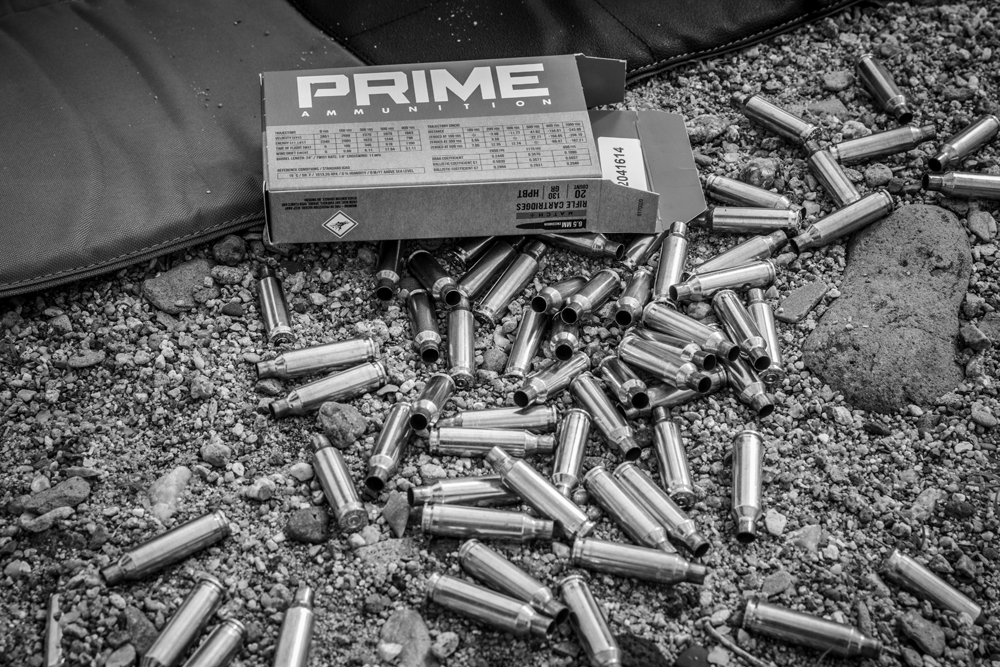
Prime Time Fairly new to the shooting scene is Prime Ammunition, which has been around for a while, though by a different name and primarily in Europe. We relied on the company’s ammo for rifle and pistol work all week, and it performed exceptionally well. Prime is the American branch of a Swiss company that manufacturers ammunition to the world’s highest standards, at unbeatable prices.
I first heard about the brand through a couple of long-range competition buddies, who swear by the stuff and have even used it in place of handloads—that’s how amazingly accurate (and affordable) it really is. After three days firing the ammo, I’m a believer. It’s well made, consistently accurate, and I had no ammunition issues in either rifle or handgun applications even after hundreds of rounds. It was the perfect addition to an already fantastic event.
Editor’s Note: This article is an excerpt from the September 2016 issue of Gun Digest the Magazine.
Get the most recent advances in guns and gear to extend your range for hunting, informal target shooting, and formal competition. Discover new tools for long-range shooters both in the field and on the firing range, with coverage of new developments from advances in military applied combat theory. Learn more
The story of the development of the modern day suppressor is an interesting, and very political one. Bone up on your suppressor history here.
The late 1800s and early 1900s were a period of unprecedented financial growth in the United States, a boom that rode squarely on the shoulder of the nation’s growing manufacturing sector. In the days prior to World War I, the United States was blessed with a combination of two factors—a large and growing work force with a strong work ethic and abundant natural resources—that made this nation primed to lead the global industrial revolution. But the growing economy brought with it some unexpected side effects. For one thing, the world got louder. Vehicles now moved freight and people, and trains ran endlessly to keep up with the demand for goods in the farthest reaches of the country. Busses moved lots of people to new jobs, trucks carried consumer goods to new department stores, and heavy equipment cleared the land. The money was flowing, but it was hard to hear yourself think.
Enter Hiram Percy Maxim. After graduating from MIT with a degree in engineering, Hiram began working in the automotive and firearms industries. To a large degree, guns were the family business—his father Hiram Stevens Maxim invented the Maxim Machine gun, and his uncle had a hand in the development of modern propellants used for ammunition production.
If you were picturing young Hiram Percy Maxim as some type of a firearms aficionado and primitive motorhead who loved to shoot and race cars, you’d only be half right. Sure, Maxim could shoot and drive, but he preferred working with radios (his true passion) and actually enjoyed the “perfection of fine horse carriages.” He found the noise of his busy new world distracting, and he planned to do something about that.
In 1908, Maxim developed a suppressor for firearms, a metal tube that was larger than the bore that allowed the bullet to pass through yet captured the escaping gases in chambers using internal metal baffles that allowed those gases to expand (relieve pressure) and cool. And since the bulk of the noise created by firearms is the result of those gases escaping at high speed from the muzzle, the sound of a shot was muffled. Hiram called this new invention the “Maxim Silencer,” and the name stuck. The bulk of people in modern American society only know a suppressor as a silencer, and that basic (though not quite accurate) understanding comes via Hollywood cinema, not the best source for factual information on firearms.
Suppressor internals. This Liberty can features a monolithic baffle stack.
Maxim engineered a similar (at least in general concept) suppressor for vehicles, and that became what we commonly refer to today as a muffler. And although the modern automobile muffler has become commonplace—and in many areas you’ll be ticketed if you don’t have one—his firearm suppressor design did not meet with such widespread appeal. The suppressor came to be viewed, at least in this country, as a weapon reserved for covert law enforcement operations and well-heeled criminal types, mostly mobsters who wanted to off someone without alerting the authorities. Those were never the primary objectives for Maxim, who billed his Silencer as a great tool for shooting around the house where you didn’t want to annoy neighbors while simultaneously marching yourself one step closer to total deafness with each successive shot. Other countries caught on to that, and in some areas where it’s a complicated matter for a private citizen to even own a gun, suppressors are quite common. In Europe, it’s gauche to hunt or shoot without a suppressor, and in southern Africa, where firearms laws can be quite stringent, hunting with suppressors is viewed as a courtesy in much the same way that it would be considered rude in this country to drive down main street with a car that didn’t have a muffler.
In 1934, the National Firearms Act (NFA) placed a tax on certain firearms and required owners to register the item and purchase a stamp, which cost $200. Suppressors were under the NFA umbrella, and it was suddenly far more difficult to purchase one than it had been previously. That didn’t mean it was impossible, and suppressors weren’t (and aren’t) “illegal” as some people believed.
In many states suppressors can be used for hunting. In certain countries they are viewed as a common courtesy.
The notion that suppressors were illegal and were tied to crime has served Hollywood well, and over the last 100 years the general public’s views on suppressors have largely been shaped by cinematic representation or, rather, misrepresentation of these firearms accessories. For starters, films and television have made most Americans believe that the sound created by a silencer is the all-to-familiar digitized water drop that is a product of Hollywood. In truth, the average centerfire rifle produces between 140 and 170 decibels without suppression. When suppressed, that number drops to (depending on the model) somewhere in the 120s or 130s. That’s quieter, yes, and the sound differs from the typical crack of a firearm, but it’s hardly the whisper of death that we see on the big screen (120 dBs is roughly equivalent to a rock concert). A suppressor still makes noise, but OSHA standards for maximum safe impulse noise levels is 140 decibels, and most suppressors will take you below that. That doesn’t promise that the noise produced by a suppressed firearm will never reach damaging levels, but the damage is far less than what you’ll experience with an unsuppressed gun.
With Hollywood’s hijacking of the suppressor’s reputation, it’s no wonder that it has taken so long for suppressors to become popular with mainstream shooters, but thankfully over the past decade more and more shooters are realizing they can own a suppressor and there are many benefits to doing so. And while the basic suppressor design hasn’t changed a great deal since Maxim’s day, modern machining and the use of better alloys has allowed the growing number of suppressor companies to produce superior products for a wide variety of guns. As a result, more firearm models are being added with threaded barrels so that suppressors can be easily installed.
The current rise in the popularity of suppressors really began in the mid-twentieth century. There were a handful of brands making cans, primarily for military applications, but the cost of processing, coupled with the need for NFA paperwork, didn’t make suppressors as appealing to the general public as they are today. That changed, however, with better machining techniques in the mid-to-late twentieth and early twenty-first century, when improved metal alloys and better machining practices made precision machining more affordable.
If the Hearing Protection Act passes, we might start seeing more cans like this SilencerCo Salvo shotgun suppressor in the field.
There was also a growing interest in suppressors driven in no small part by hunters who had used them in other parts of the world and who couldn’t understand why they weren’t widely available here. Military-minded suppressor companies began looking at the civilian market (Idaho-based Gemtech, founded in 1993, is an example; Gemtech’s parent company had been producing silencers since the 1970s). During the past two decades, a number of other companies have developed new suppressors for the civilian market, companies like Liberty, SilencerCo, AAC, Yankee Hill, Dead Air and Wilson Combat.
The most significant advancement in suppressors in recent memory might be the widely supported push to see that the Hearing Protection Act, which is supported by the NRA, NSSF and companies like SilencerCo, become law. In 2008 the Brady Campaign stated that, “a silencer is useful to assassins but clearly has no purpose for sportsmen. Silencers are also illegal.” Turns out that neither of those statements is true, and the biggest news in silencers in recent memory is that the rest of the world is learning that you can’t believe everything you hear.
This article is an excerpt from the November 2016 issue of Gun Digest the Magazine.
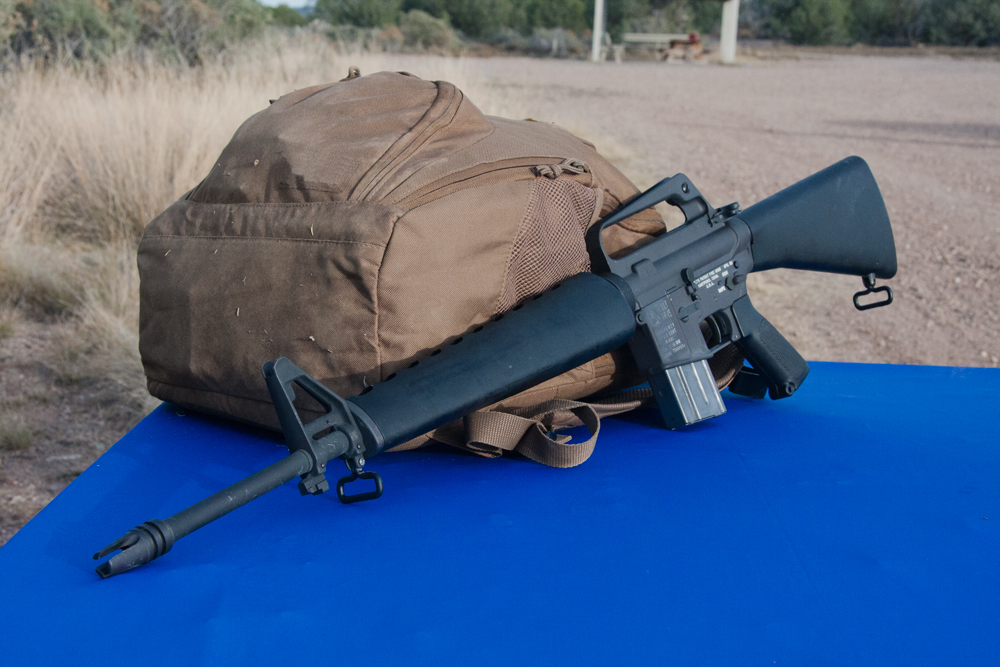
The classic M16A1 was the iconic rifle of the Vietnam War. It was issued to the vast majority of U.S. soldiers during the conflict, and it’s general success in combat led to its continued service in the U.S. armed forces in varied forms over the years. And of course it wasn’t too long before the M16’s popularity translated to the civilian market as well.
While there are a ton of AR-15 style rifles available today, faithful recreations of the original military-issue M16A1 are a little harder to find. This can be especially disappointing for collectors looking for a semi-auto replica of this classic and historical rifle.
Luckily, earlier this summer at the 2016 NRA Annual Meetings and Exhibits in Louisville, Kentucky, Colt teased the release of a reproduction, semi-auto-only M16A1 that faithfully replicates the look and features of the original, Vietnam-era rifle. The new rifle, which Colt has dubbed the M16A1 Reissue, is a virtual match to the classic design, featuring the same unique triangular handguard, 20-inch pencil-profile chrome-lined barrel with a 1:12-inch twist, and recognizable carrying handle.
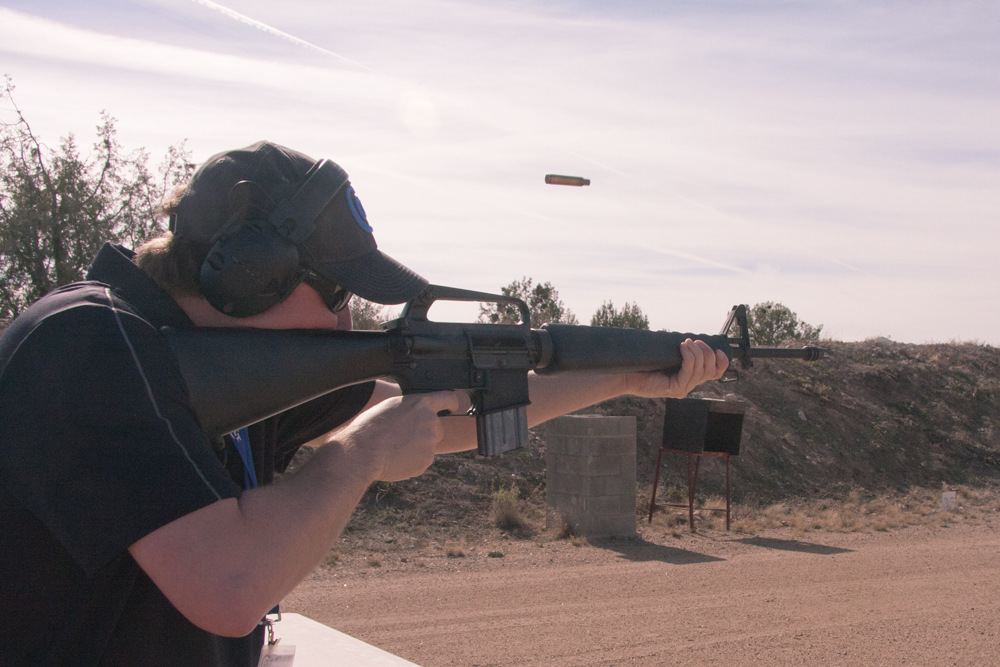
Although I wasn’t in attendance at the event in Louisville, I did get a chance to get some shooting time with the new Colt M16A1 Reissue at Colt’s recent Media Day event at the historic Gunsite Academy in Paulden, Arizona. It was a great opportunity to learn more about the M16A1 Reissue from the Colt team and to put some rounds through it at the range.
In addition to the traditional M16A1 features mentioned earlier, the new Colt M16A1 Reissue utilizes the same three-pronged flash hider built to the original specifications. It also comes equipped with the teardrop forward assist typically found on the M16A1. As with the original rifle, there is no brass deflector either.
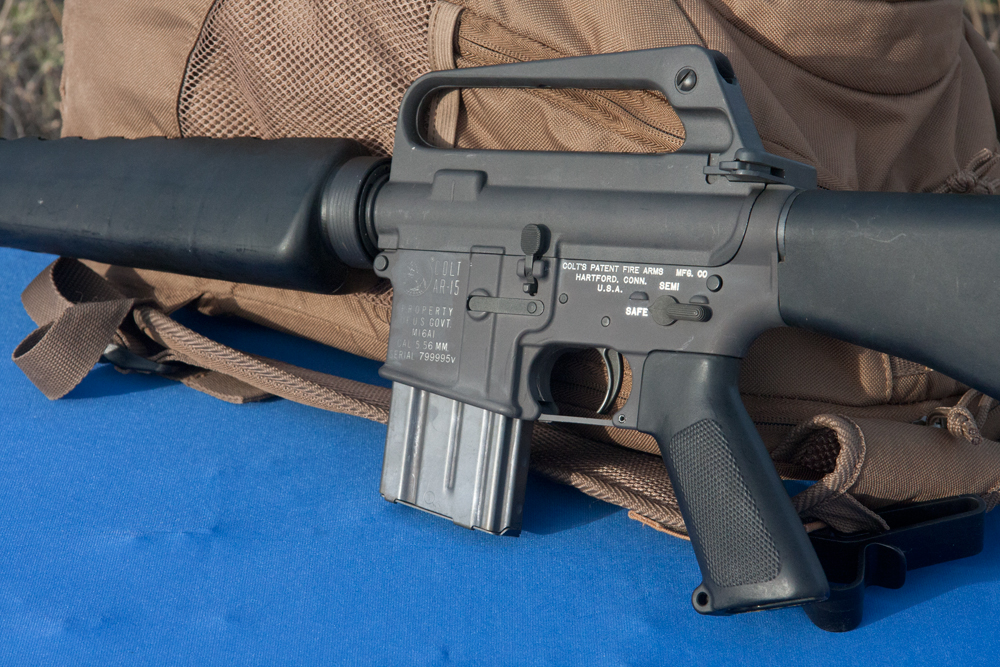
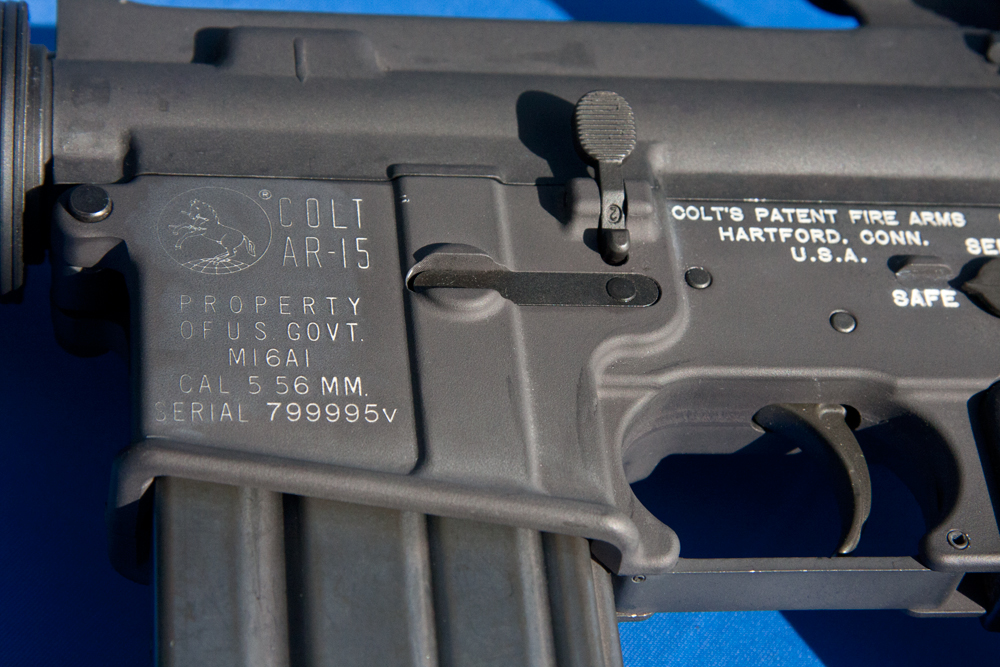
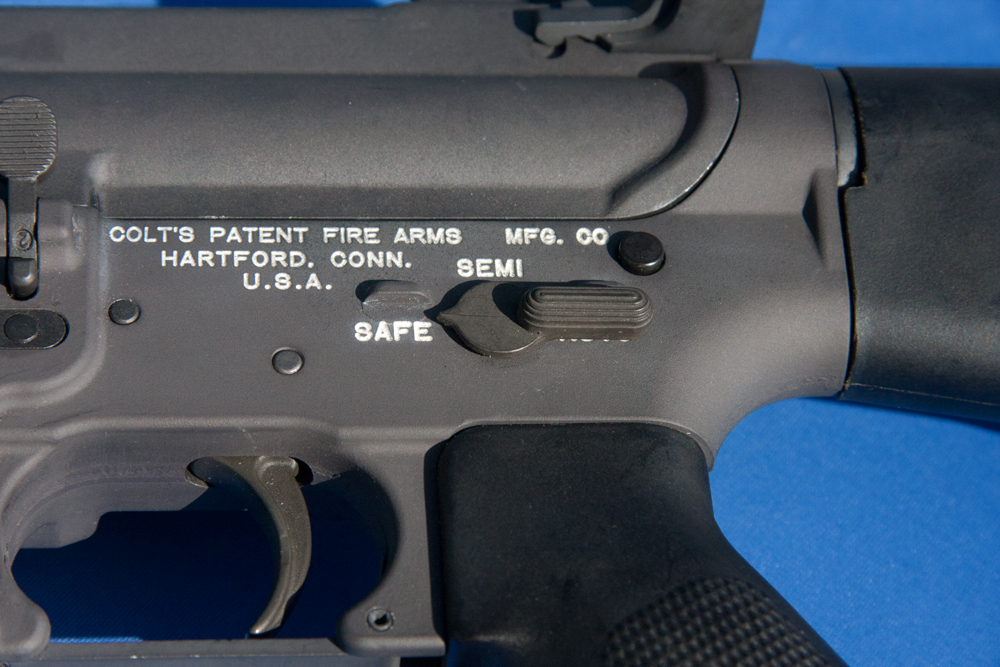
Going even further to ensure a historically accurate reproduction, Colt has also decided to place U.S. Government property markings on the gun identical to those found on the original. These can be clearly seen on the side of the receiver and should be something that serious collectors are sure to appreciate.
If that wasn’t enough, Colt also included an “Auto” marking on the safety selector. Unfortunately, this is there purely for show and historical accuracy, as this rifle is semi-auto only.
Receivers are standard 7075-T6 aluminum and are hardcoat anodized, and the rifle features the same A1-style buttstock and grip as the original issue rifle. And sights are the standard fixed A1 style.
The trigger is a standard single stage affair, which seemed to break plenty well when I engaged the steel targets Colt had set up at about 50 yards. The M16A1 Reissue’s light, 6.37-pound weight made it easy to shoot and transition between the different targets. And it was generally just kind of fun to feel like you were shooting a piece of history, even if it was more or less a brand new rifle.
The new Colt M16A1 Reissue will be a limited release item that should be available in the early part of 2017. The reproduction rifle will have a listed MSRP of $2,499. This might seem a little high to some, but it is a faithful reproduction and a limited release, collector’s item. The gun will ship with a traditional 20-round USGI magazine, as well as a manual and cable lock.
For more information on the new Colt M16A1 Reissue, visit the Colt website and check out rifle’s full specifications below.
Specifications:
Colt M16A1 Reissue Type: Semi-auto, direct gas impingement Caliber: 5.56x45mm NATO Barrel: 20-in., pencil-profile, 4150 CMV, chrome lined, 1:12-in. twist Barrel Finish: Manganese phosphate Overall Length: 38.8 in. Weight: 6.37 lbs. Receivers: 7075-T6 aluminum, hardcoat anodized Sights: Fixed A1-style front and rear Trigger: Single stage Grip: Government A1 style grip Stock: A1 style buttstock Capacity: 20+1 Price: $2,499 Manufacturer: Colt
In addition to offering an assortment of laser sighting systems for handguns and rifles, as well as bore-sighting tools, LaserLyte also produces a number of training tools to help shooters practice. One new training tool that the Arizona-based manufacturer has recently announced is the Quick Tyme Laser Trainer Kit.
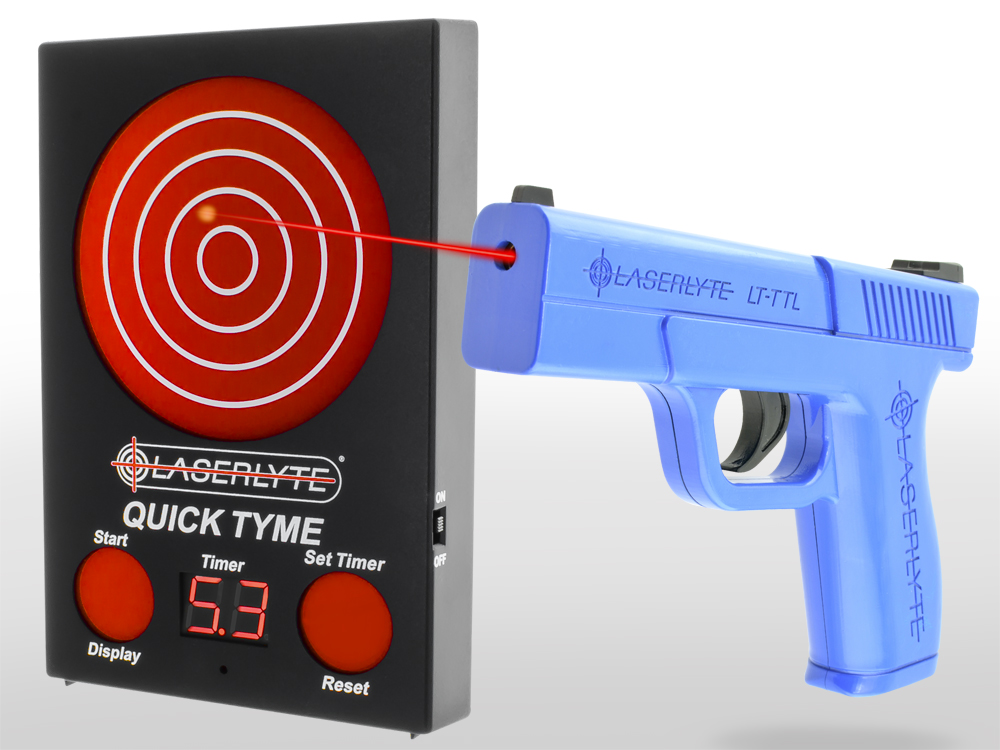
The new kit includes the new Quick Tyme Laser Trainer Target and a Trigger Tyme Full-Size Pistol. The Trainer Target comes with a built-in stopwatch for measuring time, and the Trigger Tyme Pistol simulates the size and feel of the classic Glock 19.
The LaserLyte Quick Tyme Laser Trainer Kit is a perfect option for anyone looking to simply practice their accuracy, or to improve drawing and firing from a concealed carry holster. The Quick Tyme Laser Trainer Target’s integrated stopwatch counts up from zero until the target is shot with the Trigger Tyme Pistol. The shooter is then able to see both the elapsed time and where the hit occurred on the LED target.
For shooters who prefer to train without the stopwatch feature, the target also offers a Tracer Laser Fire Mode, which simply displays the placement of each shot in the order they hit the target. This provides shooters with instant feedback on shot placement so they can correct the issue. Shooters can also use the target in combination with other LaserLyte targets to create a competitive course of fire, with the Quick Tyme Laser Trainer Target acting as a stopwatch for the entire course.
The entire kit is available at an MSRP of $279. Separately, the Quick Tyme Laser Trainer Target and Trigger Tyme Pistol go for $199.95 and $149.95, respectively.
For more complete information on the two products in the kit, check out the detailed specs below or visit the LaserLyte website.
Specifications:
LaserLyte Quick Tyme Laser Trainer Target: – Activation: All LaserLyte Laser Trainers – LED Timer records draw time, LED bullseye displays accuracy – Batteries: 3 x AA – Battery Life: 6,000 Shots – Material: High Impact ABS Polymer – Weight: 16.80 ounces – Depth: 1.25 inches – Height: 9.50 inches – Width: 6.50 inches
Self defense can be a matter of life and death for your family. Keeping your shooting skills sharp is important to using the best home defense weapon possible when the unexpected occurs. Turn your handgun into the best handgun for home defense with the drills outlined in Handgun Training – Practice Drills for Defensive Shooting. Nothing will give you more peace and security in your own home than the confidence you will hit your target. Learn More
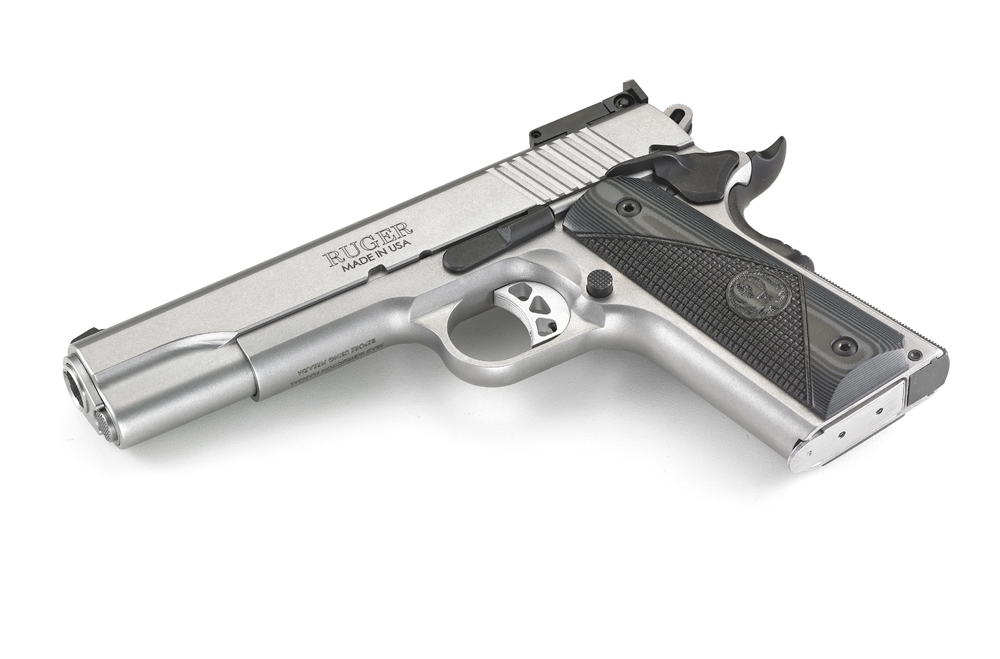
For the past several years, Ruger’s SR1911 pistol has offered fans of the 1911 an excellent option at an affordable price point. In fact, it’s been so successful that, since its introduction back in 2011, Ruger has continued to expand on the line, including Commander and Lightweight Commander models.
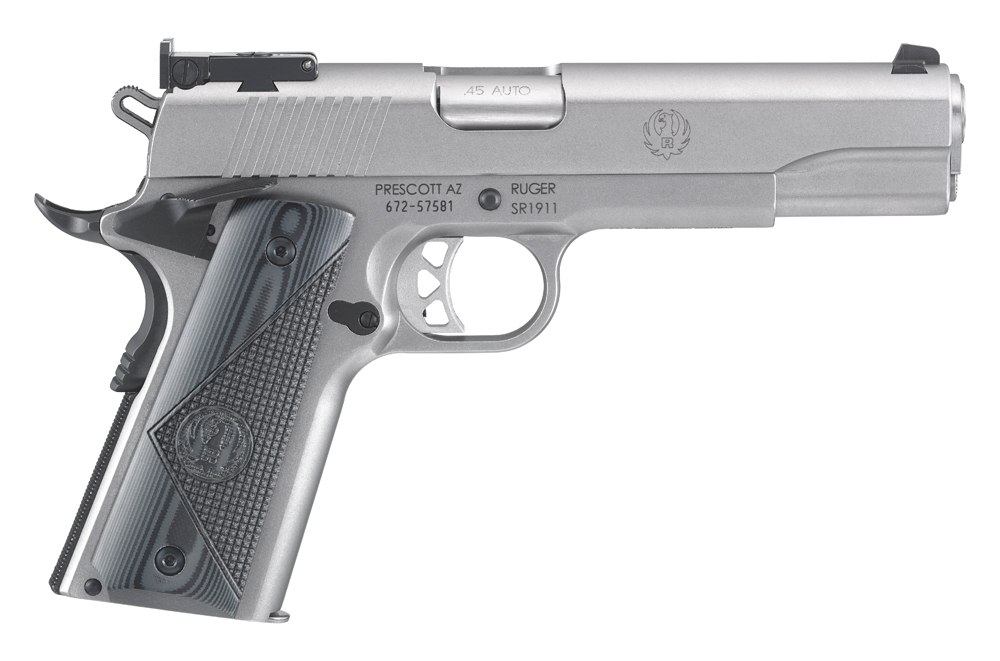
Now, Ruger has announced that it’s also bringing out a new Target Model of the SR1911. The new full size, stainless steel Ruger SR1911 Target Model is 100 percent American made and comes equipped with a host of great features.
The gun utilizes a Bomar style, fully adjustable rear sight as well as an extended, ambidextrous safety for comfortable use by both right- and left-handed shooters. Shooters also benefit from an oversized magazine release and a skeletonized hammer and skeletonized aluminum trigger for a smooth trigger press.
Like others in the line, the new SR1911 Target Model features Ruger’s same great series 70 slide, which incorporates a lowered and flared ejection port for easier ejection, a titanium firing pin and a precision barrel and bushing machined from the same piece of bar stock. The pistol wears a low-glare satin stainless finish paired nicely with blackened controls and a set of deluxe checkered G10 grips.
The SR1911 Target Model is equipped with a 5-inch stainless steel barrel with a 1:16-inch twist rate. Overall weight on the gun is listed at 39 ounces with an empty magazine. Some other features include a beavertail grip safety and an integral plunger tube.
The new SR1911 Target Model ships with one eight-round and one seven-round stainless steel magazine, a bushing wrench and a cable locking device. Its MSRP is currently listed at $1,019.
For more information, check out the specifications below, or visit the Ruger website.
Specifications:
Ruger SR1911 Target Type: Semi-auto, single action Caliber: .45 ACP Barrel: 5-in., stainless steel Overall Length: 8.67 in. Width: 1.34 in. Height: 5.45 in. Weight: 39 oz. (with empty magazine) Frame: Low-glare stainless steel Slide: Low-glare stainless steel Grips: Deluxe checkered G10 Capacity: 8+1 MSRP: $1,019 Manufacturer: Ruger
The new Compact Suppressor Ready (CSR) Rifle from Masterpiece Arms provides an ultra-compact rifle platform capable of sub 1/2 MOA accuracy.
Masterpiece Arms (MPA) has announced the introduction of a new, ultra-compact rifle system to its rifle line. The new MPA BA Compact Suppressor Ready (CSR) Rifle offers sub 1/2 MOA accuracy from a compact, suppressor-ready platform that can be reduced to an overall length of just 27 inches.
“Our new MPA BA CSR Rifle packs a lot of punch in a small, lightweight package. It’s extremely accurate and suppressor ready. Speaking of suppressor ready… we think our customers are really going to like the buttstock on this rifle. I don’t think there’s anything else quite like it,” said Phil Cashin, president of MasterPiece Arms.
The rifle’s unique folding buttstock is capable of storing a suppressor measuring up to 1.5 inches in diameter and 9.5 inches in length inside a compartment within the stock. When the suppressor is stored in the stock, the overall length can go from 48 inches with the suppressor attached down to the 27 inches previously mentioned. The video above illustrates how the folding stock operates.
The new MPA BA CSR is available in black, burnt bronze, Flat Dark Earth (FDE), gunmetal and tungsten. It’s also available in either right- or left-handed models, and when purchasing, customers will be able to choose their preferred caliber, barrel length, trigger type/pull weight and color. All chassis and barrels are Cerakoted in a multitude of colors and patterns, with solid colors included, and custom patterns available at a $150 up-charge.
Each rifle is hand built and takes around 6 to 10 weeks to be completed. MSRP on the new MPA BA Compact Suppressor Ready (CSR) rifle is currently listed as $2,999.00.
Increase accuracy by adjusting seating depth for precise loads.
If you reload your ammunition, you already appreciate how much control you have over the different parameters of the cartridge. Powder charge, case brand, primer brand, bullet type, etc.; having the ability to choose your poison is paramount. Seating depth is one of those parameters that can make or break accuracy results—a slight shift in seating depth can radically change the group size.
Every barrel has a particular set of harmonics, and when you find a load that agrees with those harmonics, you’ll see accuracy. As many of you know, a slight change in powder charge, say ½ grain or less, or the aforementioned seating depth difference will definitely change your accuracy. If you find a load that works well in your rifle, you can fine-tune it with different seating depths.
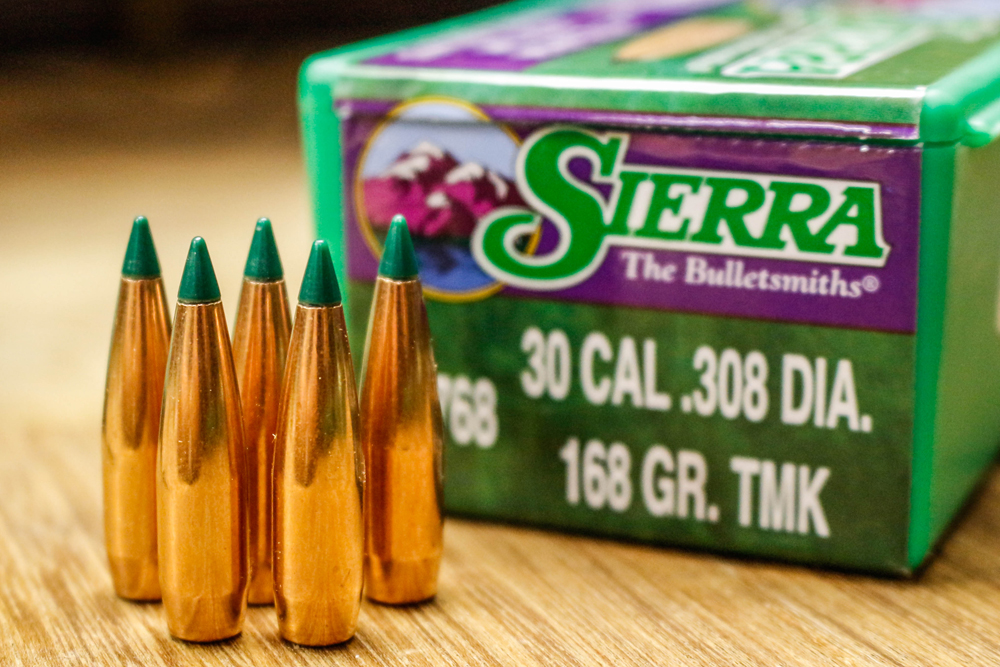
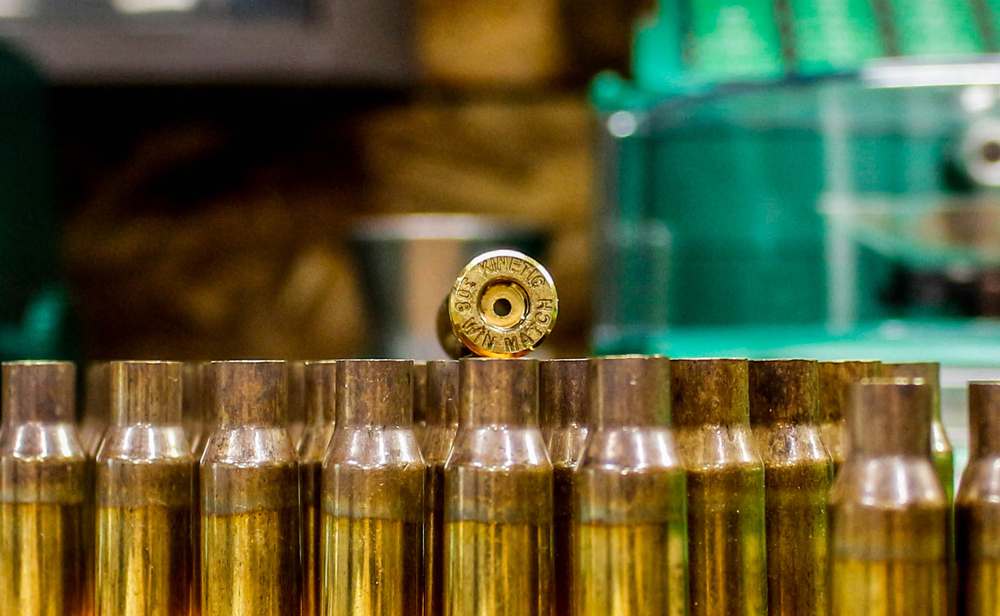
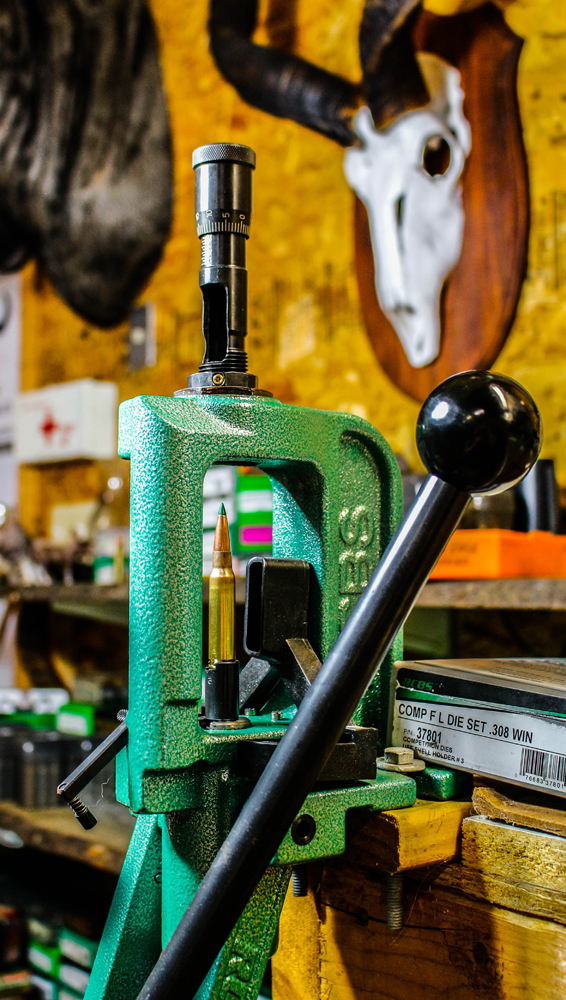
We did a little test to evaluate the effects of seating depth in a rifle that has demonstrated great accuracy at 100 yards. My pal Mark Nazi is the proud owner of a Remington 700 in .308 Winchester that loves a Sierra Tipped MatchKing over top of a particular load of Hodgdon’s Varget powder. Spark it with a Federal GM210M primer, and you’ve got a recipe for success. We used Kinetics Match Brass for uniformity. Using a good set of RCBS Competition Dies, and the 168-grain Sierra Tipped Match King set at the SAAMI length of 2.800 inches, we can count on sub-MOA accuracy, but what if we varied that seating depth?
Kinetics Match Brass.
I prepared a series of five-shot groups at seating depths that extended outward at 0.0005-inch increments to see the effects in this particular barrel while using the same powder charge for all the ammo. I first verified that our loads, which extended all the way out to a COL of 2.835 inches, didn’t come in contact with the lands and grooves, as that would create dangerous pressures. I also insisted we fired the groups from short to long, so we could stop at the first sign of dangerous pressure.
The RCBS Competition seating die will allow the loader to keep tight tolerances.
The results were eye opening. We set the target out to 300 yards to get a better feel for the group size and measured velocities on my Oehler 35P chronograph. I took notes and ran the spotting scope while my young friend Manny Vermilyea took trigger duty, and we proceeded to fire five-shot groups of each different seating depth, measuring the changes in velocity and group size. As I have found in the past, the cartridges with a longer COL gave increasingly higher velocities. However, the group size was what surprised us. At the SAAMI length of 2.800 inches, the 300-yard group size was just over 3 inches, or one MOA. At 2.805 inches, the group opened up to 5¼ inches, and at 2.810 inches things settled back down to just over 4 inches; not exactly what we knew this rifle was capable of. At 2.815 inches and 2.820 inches, things started to get better, giving group sizes of 3 inches and 2¾ inches, respectively, with velocities averaging just less than 2,660 feet per second (fps). It was when we launched the group that measured 2.825 inches we found what we were looking for. Group size was just under 2 inches, or 2/3 MOA, and velocities averaged 2,644 fps. Slight drop in velocity, but the accuracy was certainly there.
With the 2.830-inch length and the 2.835-inch ammunition, we had definitely found the sweet spot, giving our barrel the harmonics that work best for it.
I’ve seen the same kind of results in other rifles, where you make a minor adjustment in seating depth and find the accuracy changes. Each barrel can be different, having a different sweet spot.
Give it a try with your rifle, but please keep safety first.
This article is an excerpt from the October 2016 issue of Gun Digest the Magazine.
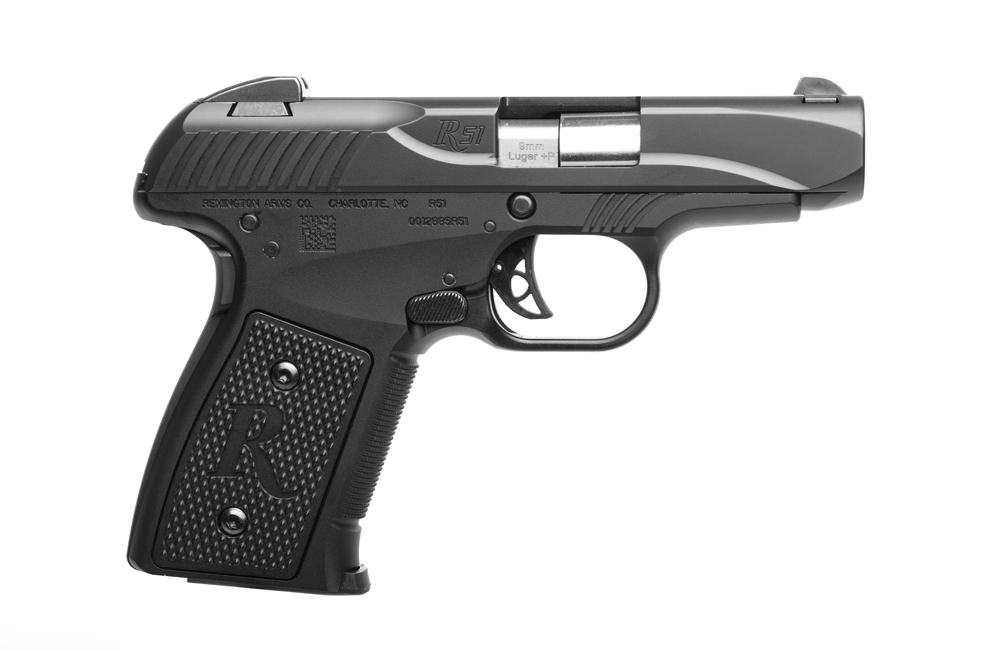
The second generation of the Remington R51 addresses the issues with the previous model and is an excellent choice for concealed carry.
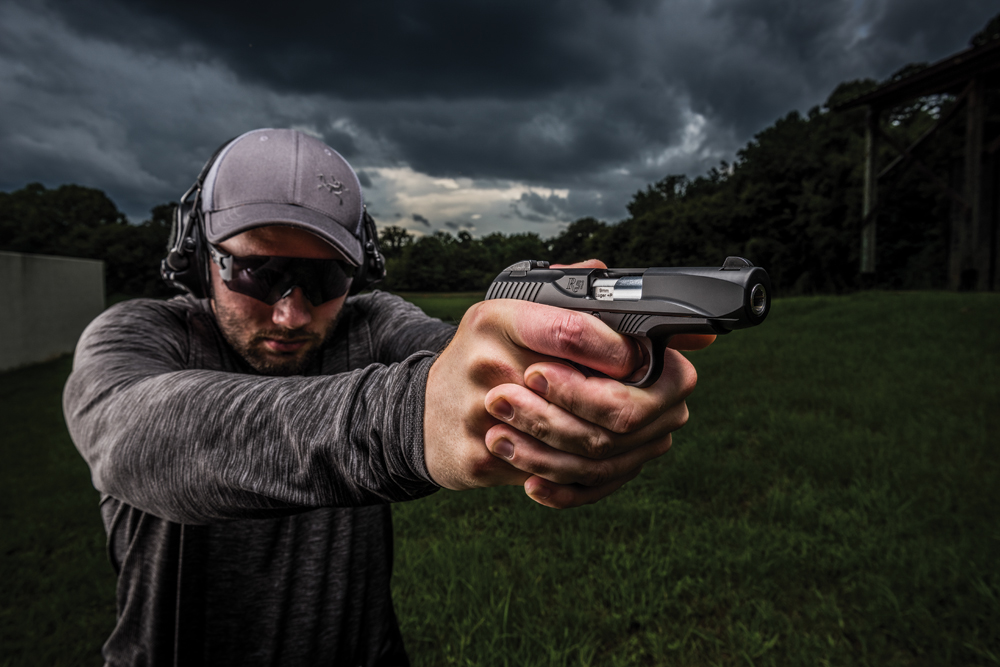
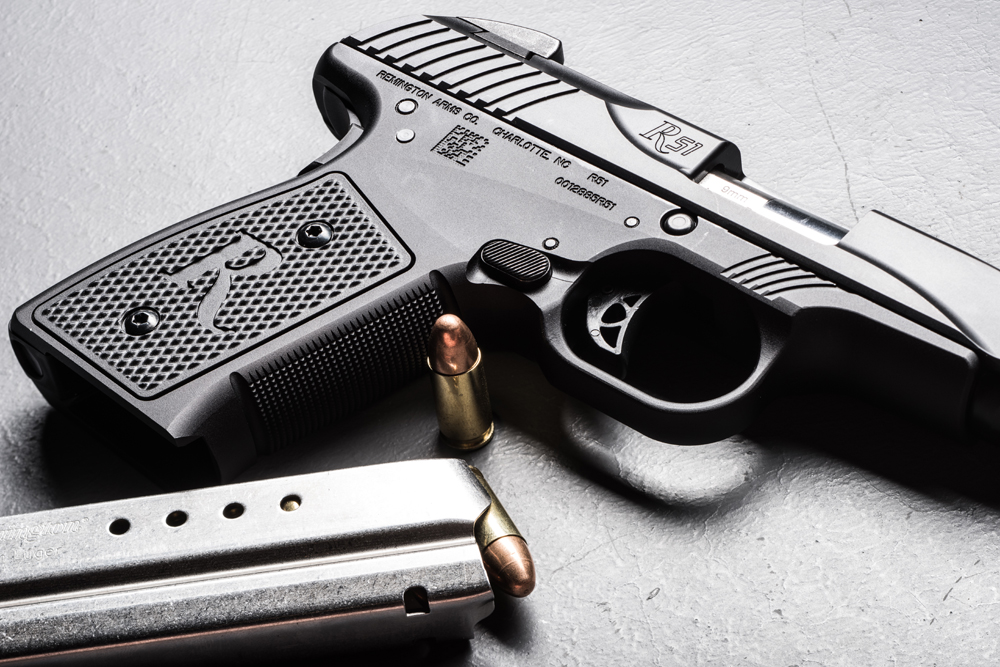
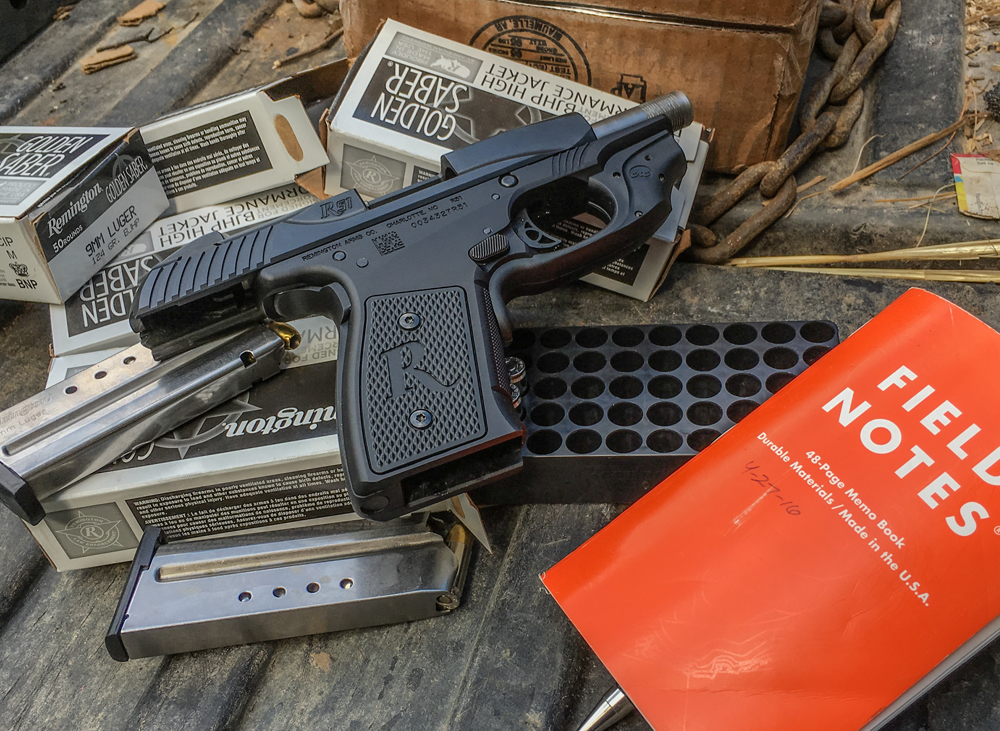
In July of 2016 Remington reintroduced one of the most controversial firearms ever manufactured. The R51, originally released in 2014, was first met with a lot of anticipation because it was a lightweight, compact, +P capable, single action, 9mm handgun, built on a metal frame, with a very low bore axis, and a contoured profile optimized for concealed carry.
Due to production problems, it didn’t take long for public opinion to turn. What initially looked like one of the most innovative new defensive handguns became the root of a deep controversy—one that tarnished Remington’s reputation and cast a shadow of uncertainty on the integrity of gun magazines and those who contribute to them.
The History
In December of 2013, the R51 made its début at Gunsite Academy and journalists in attendance communicated high praise. I wasn’t there but conducted the first independent field test of the R51. I was impressed and in my July 2014 article called it the “best new compact 9mm handgun on the market.” What I didn’t know was the pistol I’d received was a pre-mass production model. When the R51 began hitting shelves, bad reports surfaced. This wasn’t too unusual. Often journalists receive pre-production firearms and, just as often, initial mass-produced firearms have issues. Pre-Internet, these problems were fixed, and most never knew they existed.
What happened next was unusual. A blogger, who’d been passed over for employment by the publisher of the magazine my article appeared in, called my integrity into question. He even insinuated gun magazines lie to make manufacturers happy and earn advertising dollars. This led to an Internet firestorm. You would’ve thought Remington unleashed 10,000 pieces of junk and the gun magazines lied while knowing they didn’t work.
The Facts
First, let’s address Remington’s mistakes. It wasn’t prepared to mass-produce the R51 with its novel architecture. Its mechanics were unique enough to prevent standing quality control procedures to detect or limit production issues. This resulted in just over 3,000 potentially problematic R51s being shipped. The second mistake was not taking swift ownership of its bungle.
By not announcing a reliability recall immediately, Remington left consumers to speculate that trusted firearms journalists had deceived them. Several loyal readers contacted me wondering how I could endorse a pistol with so many problems. My only defense was that I could only report on the pistol I’d received. Incidentally, my R51 review occurred only a few weeks after my clairvoyant powers had left me. When I tested the R51, I had no way of knowing what was to come.
As for lying gun writers and gun magazines, which are allegedly bought and paid for by advertisers, this is patently false. As in any profession, I know charlatans exist in mine. Might some writers lie on occasion, or even more often? Without question. Your loved ones lie to you too; dishonesty is an unpleasant fact of life. However, given the editorial checks and balances in print publications, I’m sure lying occurs on the Internet at a higher frequency. I know this because I’ve worked in both venues for more than a decade. Something that occurs even more often are gun writers refusing to report on products that just plain suck.
The Fix
Remington finally acknowledged the problem. In July 2014, they voluntarily recalled the R51. Remington offered unsatisfied R51 consumers three options: First, they could accept the aforementioned return in exchange for a new R51, with two extra magazines, and a Pelican case.
Second, they could exchange their R51 for a 1911 R1 at no additional cost.
Third, they could return their R51 for a refund at the full-suggested retail price.
This was an unprecedented step. Had I been one of the unsatisfied, I’d have opted for the more expensive R1 and purchased another R51 when the bugs were worked out. But my R51 worked just fine; I didn’t want to send it back. I carried it often.
All this occurred while Remington shifted manufacturing from North Carolina to Alabama. Complicated with the implementation of some of the most stringent quality control processes ever instituted in the industry, this took time. I’m sure some felt Remington had abandoned the R51 and the replacement offer. In truth, they were just making sure they got it right. I’m certain Remington has spent so much money fixing the R51 they’ll never recoup their investment. When I asked Remington’s new CEO, Jim Marcotuli, why the company went to such great lengths, he said, “We are America’s oldest gun maker; it’s a matter of pride.”
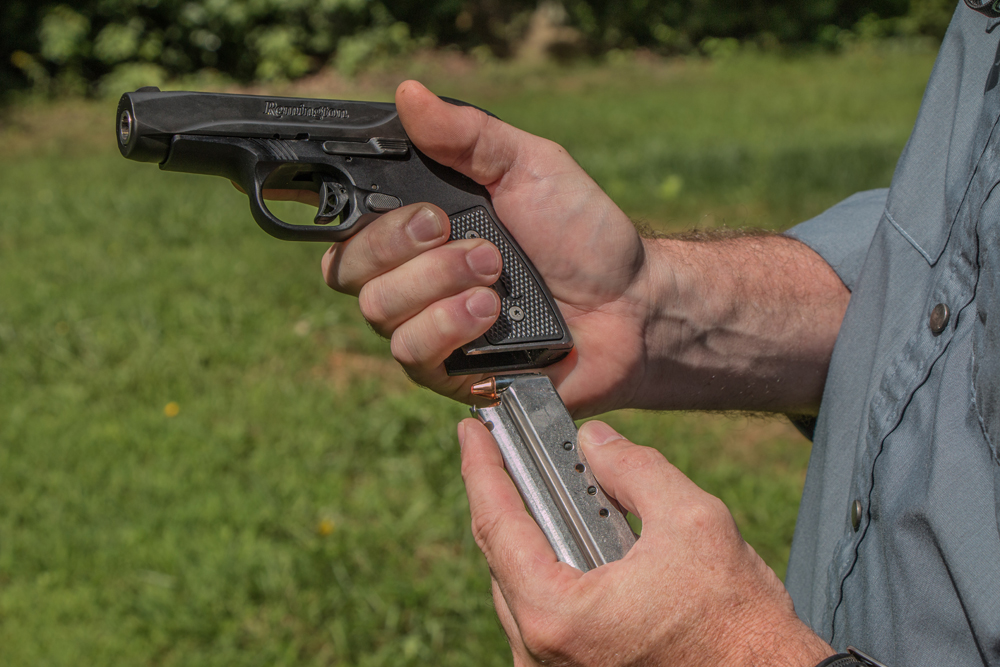
After touring the new Remington factory at Huntsville, Alabama, and watching the R51 being made, I spent some time on the range with one. It worked. While addressing quality control and mass production issues, Remington tweaked the design slightly. They engineered a new disconnect, installed set screws in the front and rear sights, hard chromed the action spring bushing and switched to a force-balanced recoil spring, designed a new extractor, and modified the magazines. It’s still the same pistol, operating on the same unique Pedersen design; it’s just better.
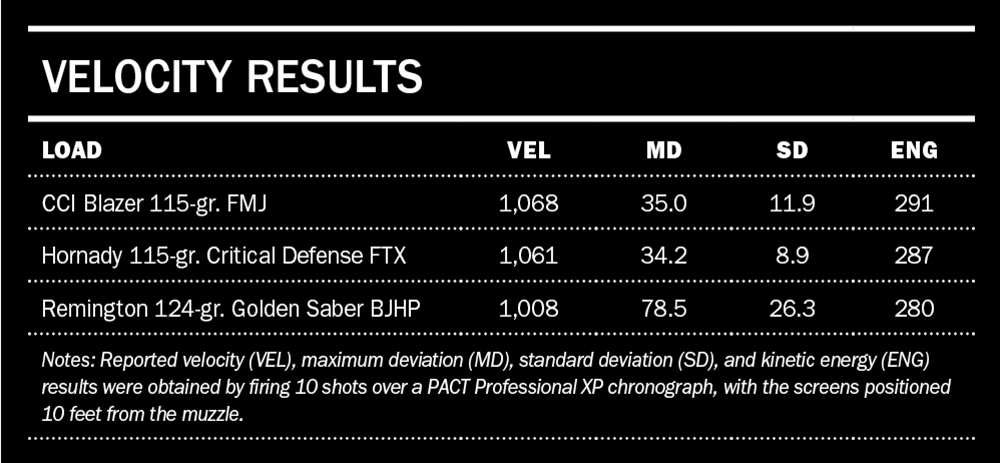
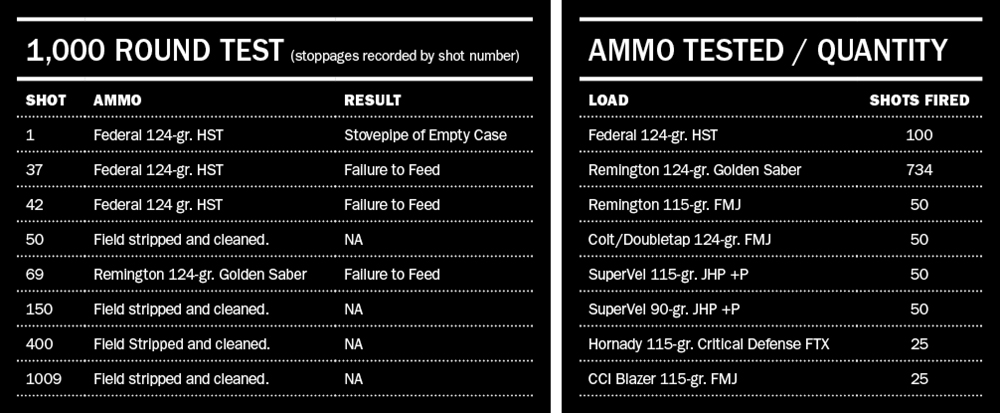
The Test Remington shipped me a promised production gun, a ton of magazines, and 1,000 rounds of ammo for an in-depth test. Results are found in Table 1, but I’ll summarize. The first 50 rounds were 124-grain Federal HSTs. The first shot stovepiped, and attempts 37 and 42 failed to feed (50 additional rounds of HST were fired between shots 484 and 630 with no issues). Attempt 69—Remington 124-grain Golden Saber—failed to feed. There were no stoppages in the next 1,015 rounds, which included nine different loads. Based on this, a 100-round break-in for the R51 seems advisable.
The new R51 exhibits all the features that made it so desirable initially. Its low bore axis keeps muzzle rise down. It also changes perceived recoil; the gun kicks just as hard, but recoil is directed straight back. The trigger was crisp and consistent at 4 pounds. Trigger reset was not audible but could be felt and was natural. I had no trouble firing seven shots into a 10-inch kill zone at 3 yards in just over a second.
I did not conduct bench rest accuracy testing for two reasons. One, it seems to be a ridiculous exercise for a defensive carry pistol. Secondly, after firing more than 1,000 rounds through almost every conceivable defensive handgun drill, I was confident the pistol was plenty capable of providing better than adequate precision.
I had one complaint: At 10 yards, the pistol shot about 1.5 inches low and to the right of my point of aim. The rear sight is adjustable for windage, but there’s no end-user solution for elevation. At 20 yards, this offset was double, but inside 10 yards, where most of the shooting was conducted, the offset was inconsequential. This didn’t negatively impact testing. A Crimson Trace Laser Guard can be purchased with the R51, and for most shooting this was the primary sight.
Parting Shots
Two years after the initial launch, the Remington R51 might not be the “best new compact 9mm handgun on the market,” but I think it’s certainly one of the top choices. This pistol has a suggested retail price of $448, but street prices are about $100 less. After a short break-in period, it proved perfectly reliable, and in the arena of affordable, concealed carry handguns, it has a lot to offer. I now have two R51s, and I trust them both.
Specifications:
Remington R51 Caliber: 9mm Luger +P Barrel: 3.4 in. Height: 4.63 in. Width: 1.08 in. Length: 6.68 in Weight: 21 oz. (without magazine) Finish: Satin Black Oxide Capacity: 7+1 Accessories: Two magazines, lock, and owner’s manual MSRP: $448 ($648 with Crimson Trace Laser Guard) Manufacturer: Remington
Editor’s Note: This article is an excerpt from the September 2016 issue of Gun Digest the Magazine.
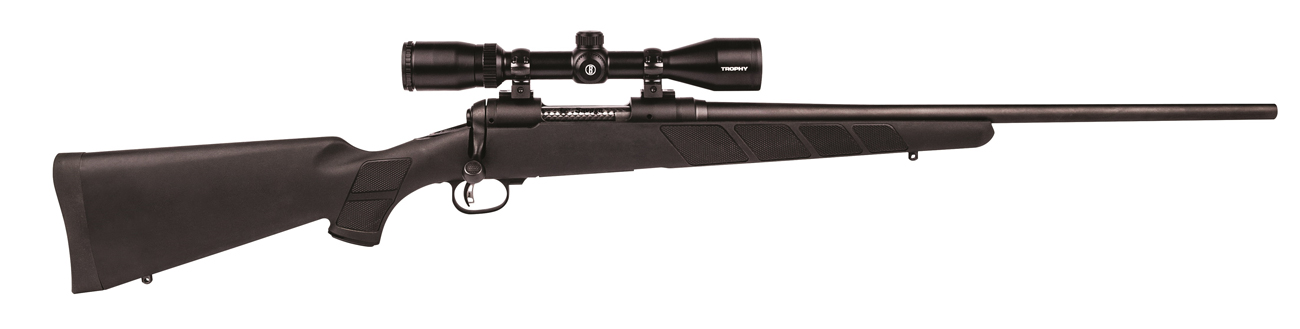
As the upcoming 2017 SHOT Show gets closer and closer, manufacturers are continuing to announce and tease more of their new guns and gear for next year. Savage Arms is one such manufacturer giving shooters a first glance at one of its upcoming new products: the 11/111 DOA Hunter.
This new package takes Savage’s excellent 11/111 rifle and pairs it with a factory-installed and bore-sighted Bushnell Trophy DOA 3-9×40 scope mounted with Weaver Grand Slam rings. Because of this, the rifle is ready to shoot right out of the box, making it a perfect choice for a newer hunter or anyone looking for a rifle that’s ready to go immediately.
The Savage 11/111 DOA Hunter utilizes the manufacturer’s famed adjustable AccuTrigger, which can be set anywhere from 2.5 to 6 pounds depending on the shooter’s preference. The AccuTrigger provides a crisp and clean pull and pairs nicely with the gun’s carbon-steel blued barrel.
The rifle features a rugged black synthetic stock with a matte finish, and both the barrel and receiver also wear a matte black finish. The 11/111 DOA Hunter also comes equipped with a detachable box magazine for simple and quick reloading.
Features on the Bushnell Trophy DOA 3-9×40 scope that comes factory mounted on the 11/111 DOA Hunter include a fast-focus eyepiece for quickly adjusting focus to ensure a clear sight picture and finger-touch adjustable windage and elevation controls. The scope also incorporates a shooter-visible power change ring.
The MSRP on the new Savage 11/111 DOA Hunter package is currently listed as ranging from $684 to $712. For more information, visit the Savage Arms website.
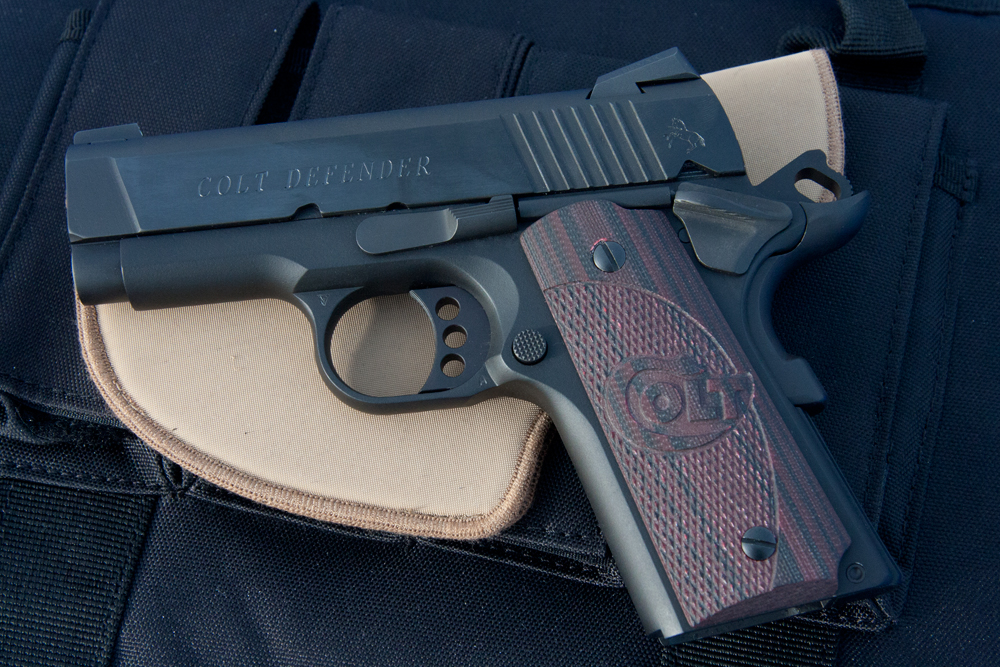
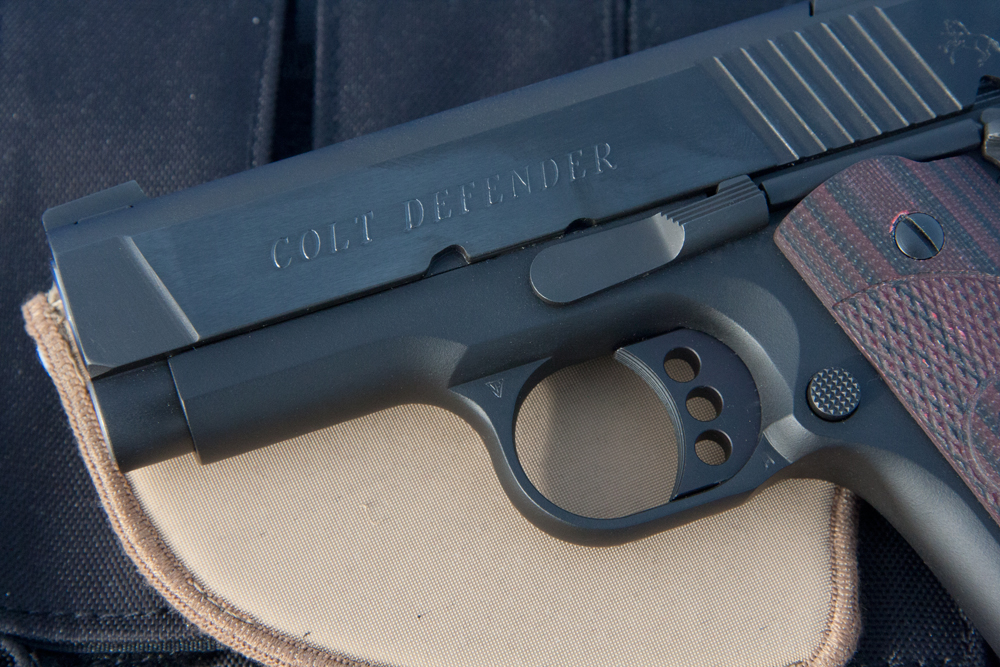
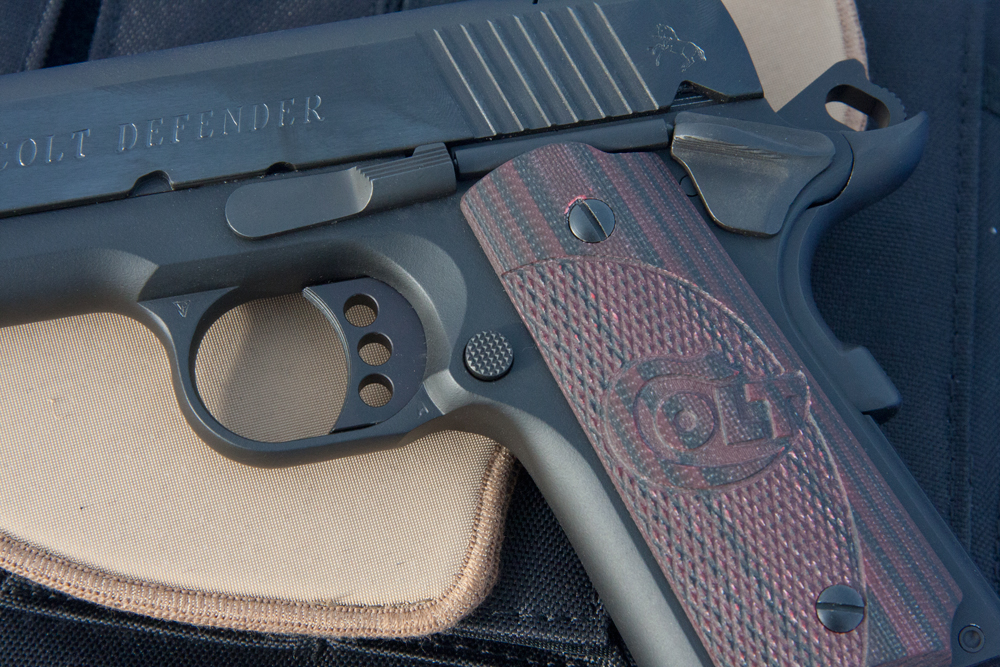
The Colt Defender pistol has been around for quite some time now, hitting the market back in 2000. This summer, Colt revamped the established Defender design to improve upon the areas that in the words of Paul Spitale, Senior VP at Colt, “kept it from being perfect for concealed carry.”
Colt introduced the new and improved Defender back in May during the NRA Annual Meetings and Exhibits in Louisville, Kentucky. Earlier this November while attending Colt’s annual Media Day event at the legendary Gunsite in Paulden, Arizona, I was able to finally get my hands on a new Defender for a little bit of trigger time.
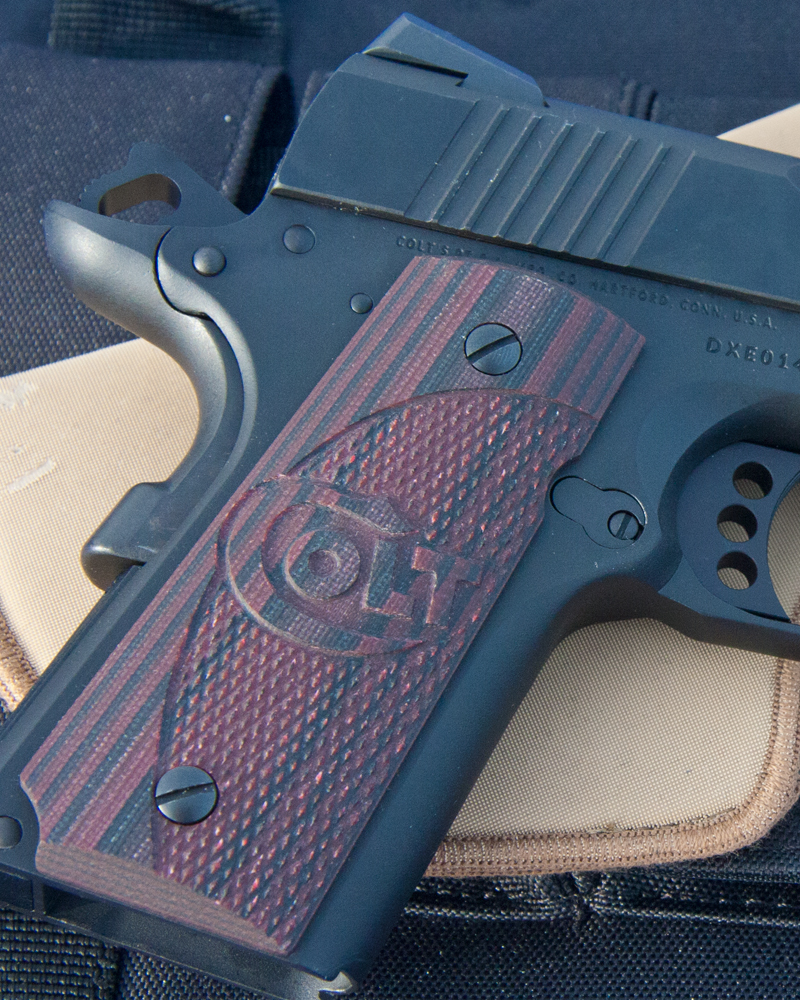
A couple of the most noticeable changes to the original design include the addition of custom Colt G10 black cherry grips and a carry cut on the front of the slide for easier concealment. The custom G10 grips used on some of Colt’s other 1911s have always felt very comfortable to me, and the grips featured on the new Defender were no exception. The texturing ensured a steady purchase during firing but wasn’t so rugged that it caused discomfort on the hands, as I’ve noticed with some highly textured grips in the past. The gun also featured an upswept beavertail grip safety, which further helped with control and comfort. And of course, the carry cut is a nice touch for a carry gun like the Defender.
Colt produces two versions of the new Defender: a stainless steel model available only in .45 ACP and a black and blued model chambered in either .45 ACP or 9mm. The stainless model features the same brushed stainless steel slide, stainless Cerakote coated aluminum receiver and three dot sights as the original Defender, but also has the new grips and carry cut. The new black and blued models, on the other hand, incorporate the two upgrades already mentioned, as well as some other changes. Both feature the Defender’s classic 3-inch stainless steel barrel and a 4.5- to 6-pound three hole aluminum trigger.
The black and blued Colt Defender is what the company had available to the media at the event in Arizona. In addition to the features it shares with the stainless model, this Defender also comes equipped with a blued carbon steel slide and a black Cerakote coated aluminum receiver and features a different sight setup.
Notice the carry cut at the front of the slide.
Instead of the usual three dot sights, the black and blued Defender sports a wide notch Novak Low Mount Carry rear sight and a Tritium night sight up front. Although it was the middle of the afternoon when I had the opportunity to shoot this gun, I found that I really liked the night sight front paired with the wide notch rear, and I had no issue hitting the steel targets set up about 15 to 20 yards away in rapid fire strings.
As with most of Colt’s newly produced guns, the new Defender also utilizes the manufacturer’s Dual Spring Recoil System. This results in slightly reduced recoil, and is intended to increase the spring life substantially, putting off the inevitable replacement date. I first experienced Colt’s Dual Spring Recoil System at the company’s 2015 Media Day, and I’m just as impressed with the system today as I was then.
The gun features an aluminum three-hole trigger with a pull weight between 4.5 to 6 pounds. Capacity is the standard 7+1 in .45 ACP and 8+1 in 9mm.
Just as the original Defender was, the updated version is very well suited for concealed carry. It weighs 24 ounces unloaded, has an overall length of 6.75 inches, a height of 5.125 inches and a width of 1.25 inches. Magazine capacity is 7+1 in the .45 ACP models and 8+1 in the 9mm variant.
The new and improved Colt Defender is available now with an MSRP of $899 for the stainless model and $949 for the two black and blued versions. Each gun ships with two magazines, a cable lock and an instruction manual.
For more information on the new Colt Defender, check out the specifications below and visit the Colt website.
Specifications:
Colt Defender Type: Semi-auto, single action Caliber: .45 ACP or 9mm Barrel: 3-in., stainless steel Overall Length: 6.75 in. Overall Height: 5.125 in. Overall Width: 1.25 in. Weight: 24 oz. (unloaded) Slide: Stainless steel, brushed stainless finish (stainless model); carbon steel, blued finish (blued model) Frame: Aluminum alloy, Cerakote matte stainless finish (stainless); aluminum alloy, Cerakote matte black finish (blued) Trigger: three-hole aluminum, 4.5 to 6 lbs. Grips: Custom G10, partial checkered, black cherry Capacity: 7+1 (.45 ACP), 8+1 (9mm) Price: $899 or $949 Manufacturer: Colt
The popularity of the 6.5 Creedmoor has grown tremendously in the past few years. It has gone from being a somewhat specialized cartridge used predominantly by long range shooters to something that shooters of all skill levels and disciplines can realistically consider. It’s even started to gain a pretty serious following among hunters as a medium-game cartridge.
Ammunition manufacturers have caught onto this and have begun producing high-quality target loads, as well as dedicated hunting loads, to feed the demand. Federal Premium is one such company, recently announcing the addition of a 6.5 Creedmoor load to its excellent Fusion line of deer hunting ammo.
Now, hunters who have come to appreciate the Fusion line’s impressive performance – largest expansion and highest weight retention in class – can experience these same qualities in a 6.5 Creedmoor option. As with prior cartridges in the line, the new 6.5 Creedmoor Fusion features a molecular-fused jacket and pressure-formed core for deep penetration and stopping power, hence the “Fusion” name.
The new 6.5 Creedmoor Fusion load is topped with a 140-grain boat-tail bullet with a skived tip for long-range expansion. These features combined with the Creedmoor’s natural long-range accuracy, flat trajectory, and mild recoil, make this load a perfect option for deer hunters, especially those facing longer than average shots.
The 6.5 Creedmoor Fusion from Federal Premium will be available for $32.95 for a box of 20 rounds. And for those not shooting a 6.5 Creedmoor rifle, the Fusion line includes 34 additional loads ranging from .223 Rem. to .45-70 Government. For more information on the new 6.5 Creedmoor Fusion or the Fusion line in general, visit Federal Premium’s website.
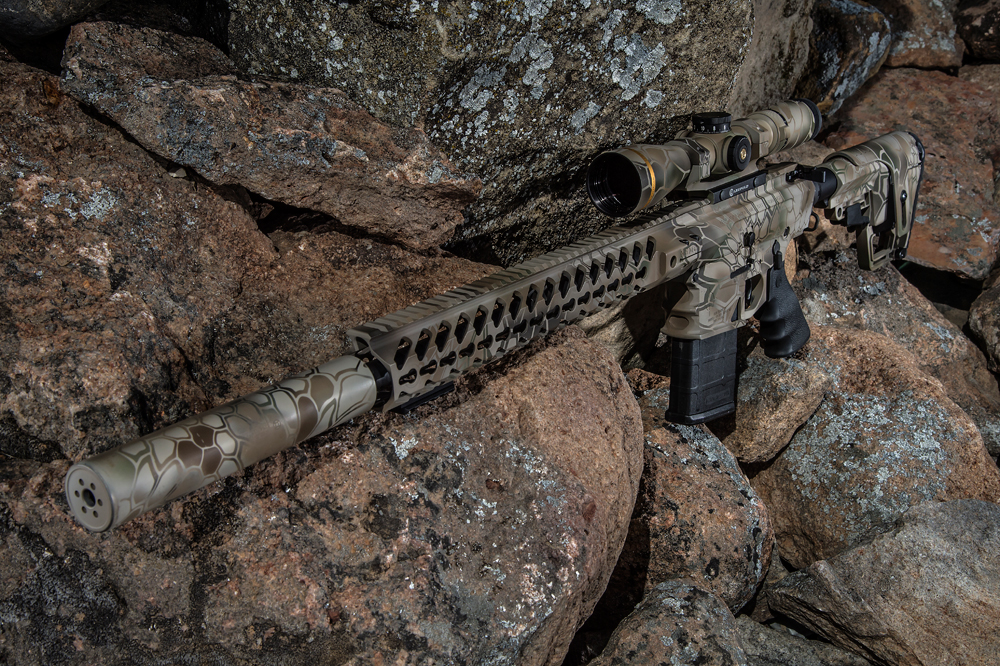
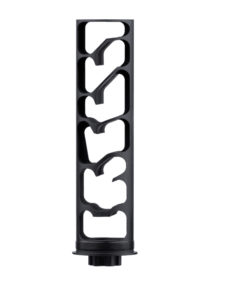
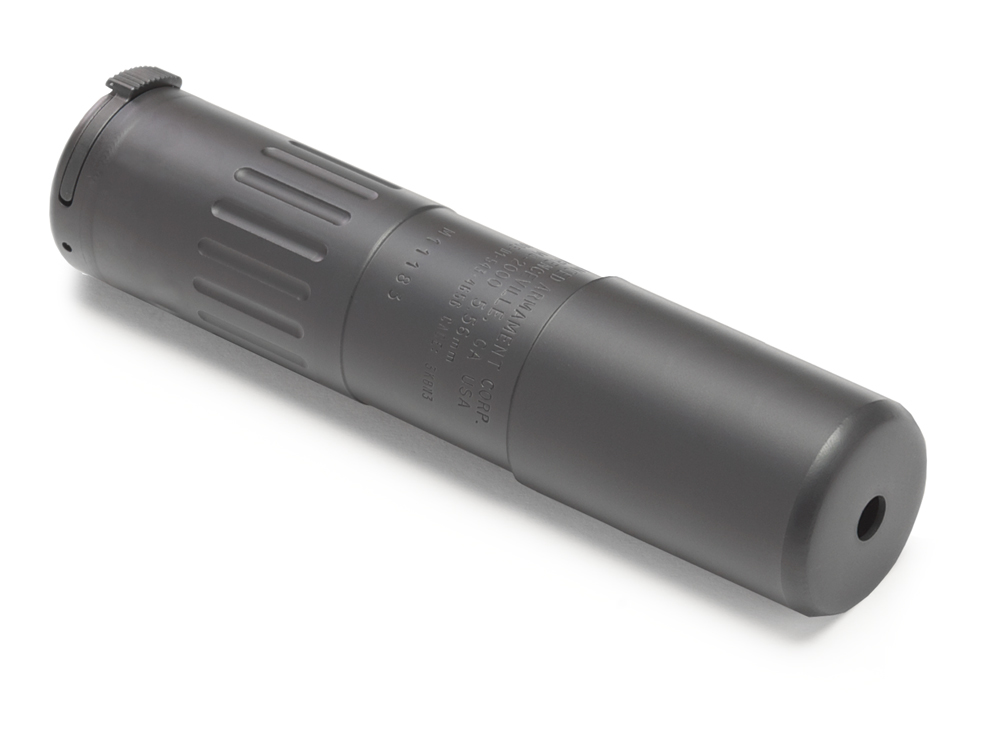
This year manufacturers brought out a number of excellent new suppressors that are sure to excite a lot of shooters looking to quiet things down.
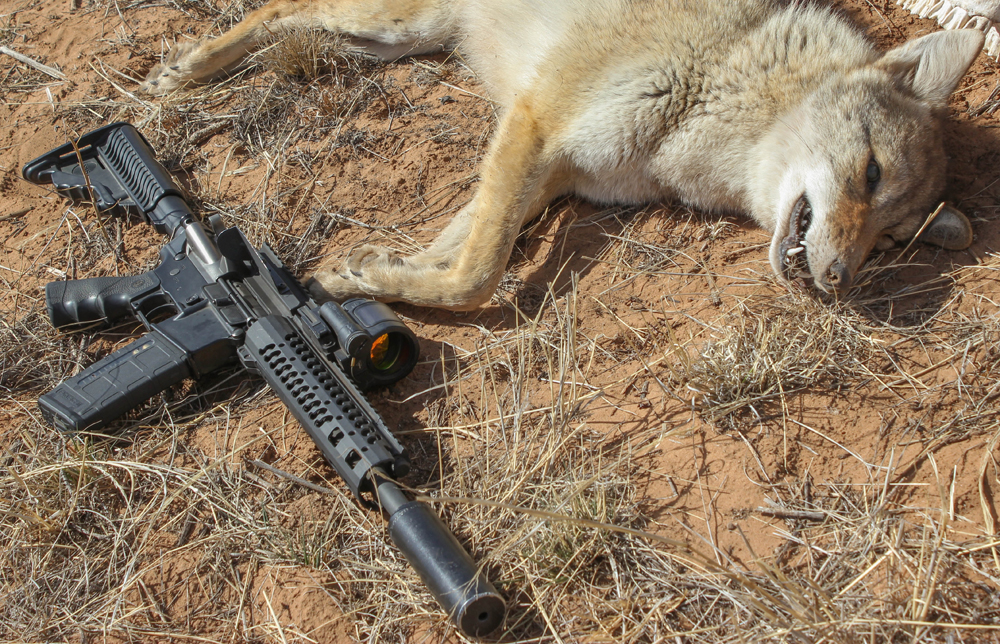
Did you hear that? Of course you didn’t. That was the sound of a gun equipped with a suppressor. Whether used for hunting, for plinking or simply for protecting your own ears, suppressors are rapidly gaining in popularity where legal. Try one, and you’ll see why. They not only reduce noise, they can also reduce recoil, making them a great tool for beginning shooters.
Thankfully, they are legal in 42 states. Most allow them for shooting and hunting, while a few restrict their use to the target range. Buying one is simple. It requires a few more steps than buying a gun, but if you can legally own a firearm, you can legally own a suppressor. Even better, there are more models available than ever.
Editor’s Note: This article is an excerpt from the November 2016 issue of Gun Digest the Magazine.
How you react and respond to an active shooter situation could mean the difference between life and death. Trainer Bob Whaley critiques the current practice of “Run, Hide, Fight” and offers an alternative.
Before we go any further, I want you to take a careful look at the title of this article. This is a different look at the all-too-common mantra, “Run, Hide, Fight,” that has been promoted as the definitive response to active killer incidents. I purposely selected this title because I am unwilling to embrace yet another strategy that has failed to stop a single active killer event. You’re probably thinking, “Whoa there, big boy! The experts say to ‘Run, Hide, Fight!’ Who are you to disagree?” Frankly, I’m the guy who wants to win in a fight for my life rather than leave me or my loved ones’ fates in the hands of a maniac.
So what’s wrong with “Run, Hide, Fight” as a response plan? Well, nothing short of reality. If I run away, I get shot in the back, which is exactly what happened at Columbine, Westgate Mall and so many other incidents chronicled on real-time closed circuit TV. How about hiding? The argument goes that if they can’t find you, they can’t kill you. That works until they find you. Then, as happened in so many real-world incidents, they kill you. So, Bob, you have to admit that fighting can only be your last resort? After all, the bad guys have guns!
Yes, they have guns. And in the future, likely, bombs. So when the party kicks off, your adversary’s force capability, metaphorically speaking, is on the 100th floor of the skyscraper, whereas your force options are in the parking garage, because you’re likely in a location with a “No Guns Zone,” which is really a “Criminal Safe Zone.” If you wait to fight until the last resort, you’ll never bridge the gap. It’s my goal to take a different look at the problem and see if there is something that makes better sense from a tactical standpoint.
First, where did the idea of “Run, Hide, Fight” come from? The “experts,” of course. You might ask, which experts? The ones at the FBI, Department of Homeland Security and other government agencies of the sort—more or less academics that study violence in the classroom. So upon what evidence/information did they base their decisions? Certainly not successful management of specific real-world incidents, because this strategy just gets people killed. No, their decisions, I believe, are based on political correctness. It’s not politically correct to tell people to fight back.
We hear all the usual arguments justifying a passive response: “Somebody might get hurt,” “Good guys fighting back will only make the situation worse,” “If you fight back/use violence, you’re no better than the terrorists,” and “Citizens fighting back will make it harder and more dangerous for the police coming to save us all.” So to satisfy a cowardly agenda and make everyone equally dependent no matter how many good people die, many have championed the failed strategy of “Run, Hide, Fight.”
Let’s start applying some critical thinking to the situation. First, somebody might get hurt. Too late! Somebody’s already getting hurt. Innocent men, women and children are getting killed. If all the good guys are running and hiding, ain’t no bad guys gonna get hurt, that’s for sure!
Training from reputable sources is the only way to build the skills and mentality needed.
Next, we have the ridiculous mantra that fighting back will only make things worse. My question is, For whom? We already have some maniac walking around indiscriminately shooting innocent people. If I, or a group of my buddies, smash this guy like a bug, for whom did we make it worse? Certainly not for all the innocent people this criminal can no longer kill. So again, when someone babbles on about only making it worse when you fight back, by extension, those “experts” seem to be placing more value on the life of the killer than the victims.
How about the “If you fight back, you’re no better than the terrorist?” Yes, I am. My application of violence is limited in scope and directed to a very narrow target set. The terrorist’s actions are unfocused and applied against anyone in his line of sight—man, woman, child, young, old. I will stop when I have accomplished my mission and the terrorist is stopped. He won’t stop until he runs out of victims, ammunition, has taken his own life or has been stopped by good guys willing to take him on. It’s a simple case of good versus evil, and I know which side I’m on.
And my favorite, as a trained law enforcement officer, is that if you fight back you’ll make it more dangerous for police officers responding to the call. Really? So, I and a bunch of like-minded citizens take the initiative and smash this bug before he can carry out his plan. No one will be shooting when the coppers show up. The good guys will have accomplished their mission, so there’s no need for them to fight anymore, especially with responding police. The good guys have disabled the bad guy so he’s not shooting anymore. Just how did citizens willing to counter attack the active killer make it more dangerous for the police? Do you really think the good guys are going to go over to the other side and turn on the police when they show up because they’re willing and able to fight?
“Well, if you have a gun in your hand when the police show up, they won’t know the good guys from the bad guys.” I was a cop for over 30 years. How will I know you, the good guy with a gun, are not a bad guy with a gun? For one, you’re not the guy with the gun people are running away from. You’re not the guy with the gun with a pile of bodies lying around you, and one of these individuals is likely shooting at the cop, whereas the other is shooting at the guy who is shooting at the officer. Not too hard to figure that one out. In law enforcement, we call that a clue! Shoot at the one who’s shooting at you and figure the other person shooting at him/her is on your side. If the situation changes, the officer’s response will change. It’s called common sense coupled with a cop’s experience.
As the off-duty police officer, plain-clothes officer or private citizen/CCW holder, it is incumbent on you to have a practiced plan in place to de-conflict the situation and establish a safe link-up with responding officers. Drive the conversation. For responding police, we need to understand the principles of target discrimination, especially as it applies to demeanor.
So, what about my comment that “Run, Hide, Fight” is based on cowardice? I’ll stand behind that all day. It takes guts to run to the sound of the gunfire. It takes guts to advocate your population to empower themselves to run toward the sound of the guns. But you know what you get when you advocate an active response versus a passive response? Someone no one wants to mess with.
Active killer events most often occur at soft targets. A soft target is a location where the victim pool isn’t likely to have the capacity or willingness to fight back. If your policy is to encourage violent resistance to evil, then evil will, in most cases, seek an easier target. That means the politicos have to be willing to give up control and admit they cannot protect everyone all the time and relinquish responsibility for personal safety to the individual.
A ballistic response is without question the most effective way to end an active shooter scenario.
A Better Way There is only one response that prevents a criminal/terrorist from killing innocent people once he has decided to launch his attack, and that is an overwhelming, decisive, focused, violent counter force sufficient to kill the attacker. Until the attacker has been rendered incapable of any viable action, he can kill innocent people. So how, exactly, do I advocate you, me and the rest of the willing populace respond?
First, understand the nature of the beast. History teaches us that the individuals willing to carry out an active killing are overwhelmingly poor at their trade. Their weapon handling skills and tactical capabilities are minimal. They have been successful against helpless victim populations. They attack with bullets and bombs. The longer they are viable, the more people they kill. They are not super men. In the majority of cases, when faced with even minimal counter force, the killers run, cower, kill themselves or are killed by those with the capability to do so. If you’re aggressive and act fast, your chances of success are good. Remember two U.S. service members and their childhood friend on a train in France?
Next, understand that these events happen. The odds of being caught in an active killer event, whether it’s a terrorist incident or the result of a psychotic episode, are small…that is, until they’re 100 percent. It just may be your unlucky day. So accept what is happening and don’t talk yourself out the obvious. Orient toward the threat, prepare mentally to fight and look for an opportunity to improve your tactical situation.
By orienting toward the threat I mean both physically and mentally, turn toward the source of the stimulus that has drawn your attention and begin moving toward cover so you can accurately assess the situation. Fighting is the only way you can be absolutely sure the attacker will be stopped, so start looking for opportunities to apply your fighting capability to the problem. Any moment an opportunity presents itself, strike. You might not get another chance. Mentally and physically, get ahead of your adversary in the decision-making race and stay there.
If the opportunity to strike is not immediately present, look to improve your tactical situation. That may mean bounding forward, moving from cover point to cover point until you can either ex-filtrate the area or engage and disable the attacker. If forward movement isn’t viable, break contact by moving away from the crisis point and going cover point to cover point until you can either ex-filtrate or engage the active killer. Keep this in mind: You always set to fight. That’s proactive. You have to stay ahead of your enemy’s attack capability. You’ll likely be behind the power curve when the action kicks off. You fight at any moment the opportunity presents itself because that indicates you’re within your fighting capability and by extension, the killer’s attack capability. If you don’t fight back at the first available moment, you’ll likely lose the initiative and become a casualty, and any dependents with you will be killed.
I use the terms “bounding” for moving forward and “breaking contact” for moving back. Those are military terms and reference battle drills. They’re fighting movements. You must keep your head in the game, and this game ends in life or death. Fight your way onto the target. Fight while on the target, and fight your way off the target. That’s an aggressive, proactive mindset that puts you ahead of your adversary.
Running away is passive and does nothing to negatively impact the killer’s ability to create victims. Review the video of the attack at LAX a couple years ago as an example. People ran blindly away from the sound of gunfire with no cover. Many, by habit, dragged their luggage and carried their expensive coffee as they followed the herd. They were completely dependent on the actions of others to protect them and keep the killer from pressing his advantage. Don’t be a herd animal.
If trapped in an area, don’t hide. Set an ambush. Establish the best tactical position possible, arm yourself and as soon as the killer enters your battle space, strike. If you allow him to enter your space and establish control, you and your dependents are dead. Be aggressive. Counter attack before the active killer can react. The Mumbai attacks are a perfect example to review for the result of a passive response from victims. As the terrorists penetrated multiple locations where victims were hiding, they were unopposed and killed without a single victim posing a credible counter threat.
Training is Paramount As I mentioned, the response concept I’m advancing here is based on an aggressive mindset that creates a proactive response, thereby putting you ahead of the criminal/terrorist response curve. But mindset alone isn’t enough. You have to have the mental, physical and equipment capability to carry out the response. One without the others will prevent you from presenting a truly viable response.
Bottom line, ballistic intervention is the best way to end an active killer event. In other words, good guys with guns end the threat posed by bad guys with guns. Avoid “criminal safe zones,” and make sure those locations know why you do not patronize their establishment. Vote for politicians who support your unalienable right to self-protection. Arm yourself with a modern pistol, get your carry permit and carry all the time. Fight attempts by the emotion-driven false narrative that further restrictions on guns prevent active killer attacks and crime in general, which are used to limit your access to modern firearms. Why should you, as a law-abiding citizen and a person willing to intercede on behalf of the weak and helpless, have to protect your life, the lives of your loved ones or the lives of your fellow law-abiding citizens with equipment less capable than your enemy because proponents of gun control are over-emotional twits incapable of facing reality? We need to stand strong against this rhetoric. Drastic gun laws did not stop the attacks in Paris, Brussels, Kenya, Australia, China or any other location. Murderers will find a way to acquire a gun, bomb, knife, car or other means to inflict damage on an unarmed, helpless populace.
Training from a reputable source is critical. Just talking about skills or reading about skills or watching YouTube videos won’t get it done. You have to put in the time necessary to create the mental overlays and physical/mental balance to get the job done. Active killer response programs for civilians from providers such as Gunsite Academy or Combat Shooting and Tactics are excellent. They are skill-specific and cover everything from basic shooting skills, medical and movement to de-conflicting/link-up with police. You don’t know what you don’t know until someone points it out. Get trained.
Training is your best ally when it comes to active shooter situations.
Just once, after yet another active killer scenario unfolds, I’d like to see an American leader, instead of merely crying for the victims, making excuses for the perpetrator, or worse yet, advocating a sit in for increased gun control, start to encourage Americans to defend themselves. Rather than fostering a mentality of passivity in the face of mounting terrorist and active killer threats, what we need is an emboldened stance against such reprehensible behavior.
Unfortunately, the world we live in is one in which disgruntled students walk into a school and start killing their fellow classmates, seeking to inflict as much loss of life as possible. And as the recent Orlando shooting demonstrated, there’s now terrorist-motivated agendas behind such events, too. It’s time we advocated a response to such events that put the populace in a better position to defend itself. At the end of the day, military and law enforcement training demonstrates how an overwhelming, decisive, focused, violent counter force sufficient to kill the attacker is the best possible way to put an end to such threats. As a long string of recent events illustrates, a passive response leads to greater casualties, which is the very reason active killers seek out soft targets like gun-free zones.
September 11, 2001, was a terrible day for America. A trio of hijacked airplanes were purposefully crashed into the World Trade Center buildings and the Pentagon, killing thousands of Americans. The damage could have been far worse, however, as United Flight 93 was likely bound for the White House. What prevented the fourth plane from accomplishing its horrific mission? A group of courageous Americans willing to fight back. Todd Beamer, among those who led a counter attack on the hijacked cockpit, and the rest on that flight lost their lives, but their active response to a terrorist threat saved untold lives. It was not passivity, but courage in the face of great fear and evil that put an end to the horrors of that day. What a lesson for us today.
Editor’s Note: This article is an excerpt from the Concealed Carry 2016 issue of Gun Digest the Magazine.
Self defense can be a matter of life and death for your family. Keeping your shooting skills sharp is important to using the best home defense weapon possible when the unexpected occurs. Turn your handgun into the best handgun for home defense with the drills outlined in Handgun Training – Practice Drills for Defensive Shooting. Nothing will give you more peace and security in your own home than the confidence you will hit your target. Learn More
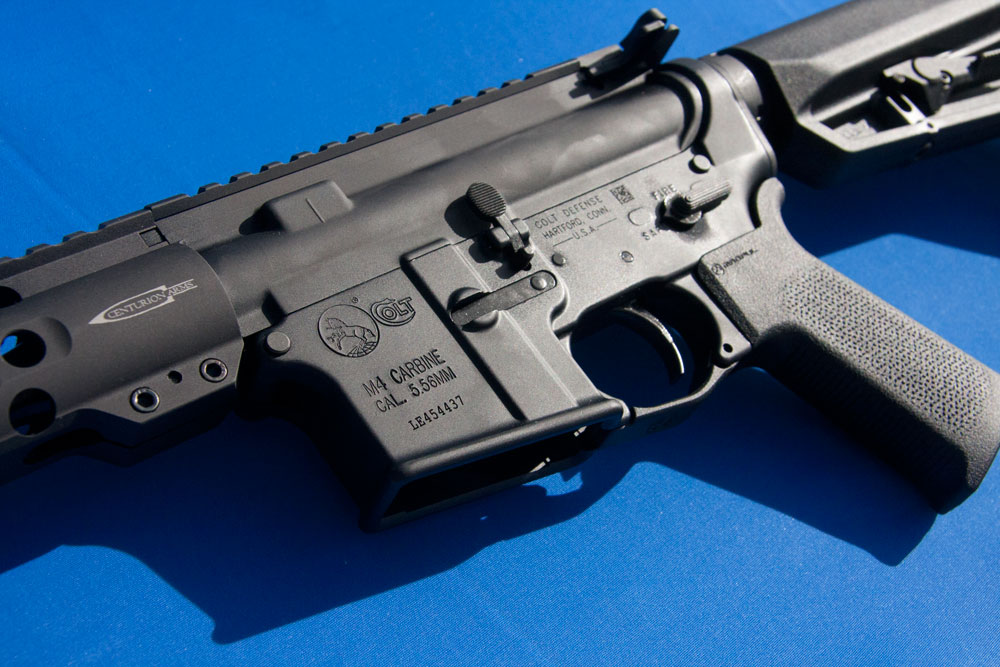
Earlier this fall, Colt announced the release of its new Colt Combat Unit Carbine, a direct-impingement gas AR featuring Colt’s first production mid-length gas system. The new rifle was an exciting offering from Colt on the heels of last year’s entry-level Expanse M4 and represented a definite step up for shooters looking for an upgrade.
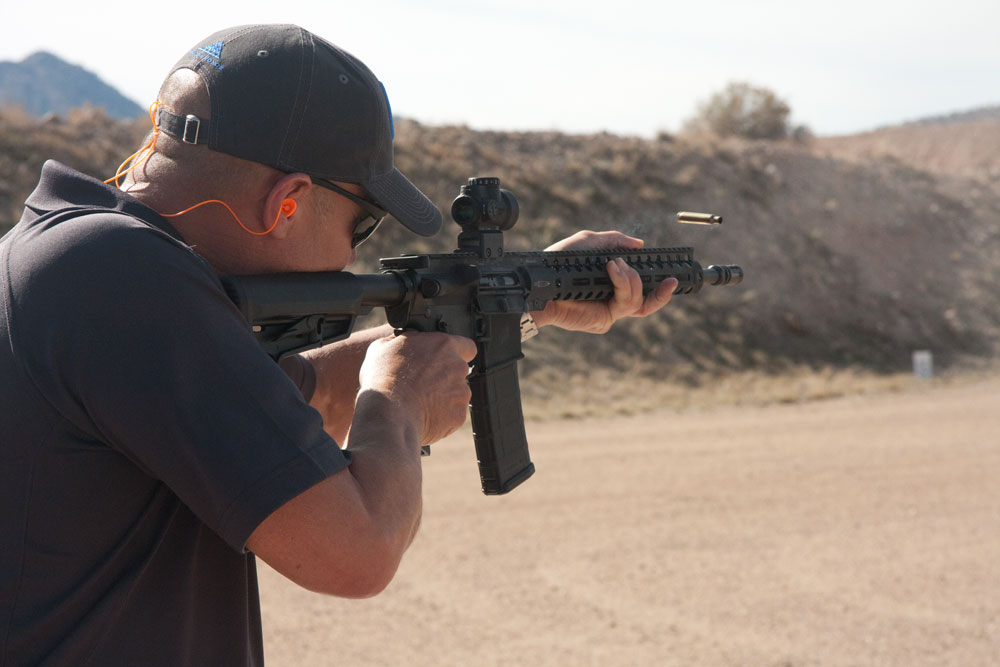
Recently, Colt conducted its annual Media Day event at Gunsite in Paulden, Arizona, where the company offers members of the media a sneak peak at upcoming new products for 2017. I was lucky enough to be in attendance, and while there are many new products I shot there that I can’t talk about just yet, the Combat Unit Carbine is one that I can discuss.
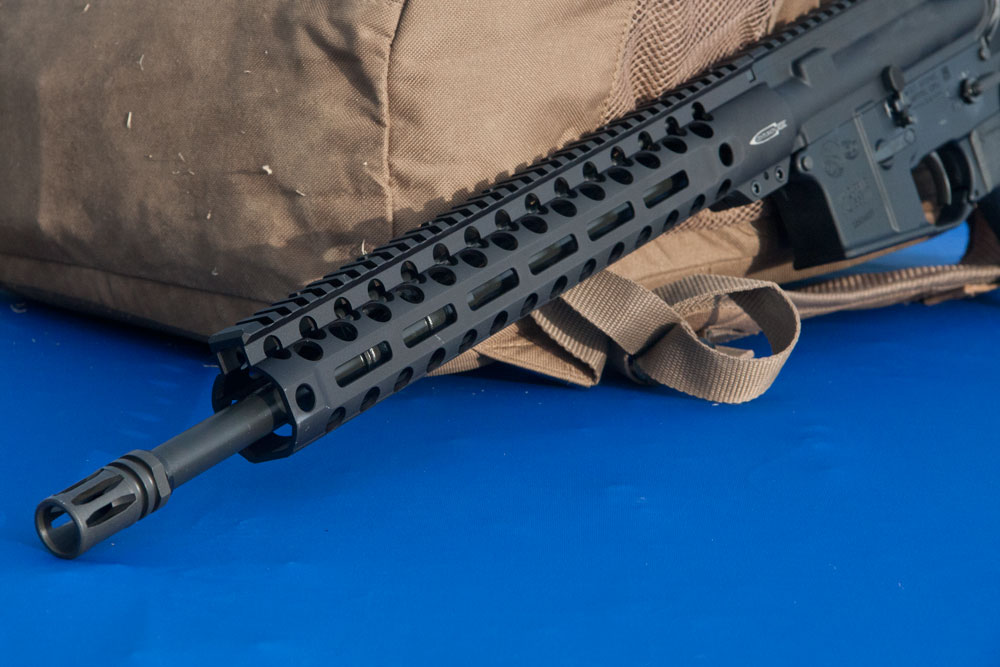
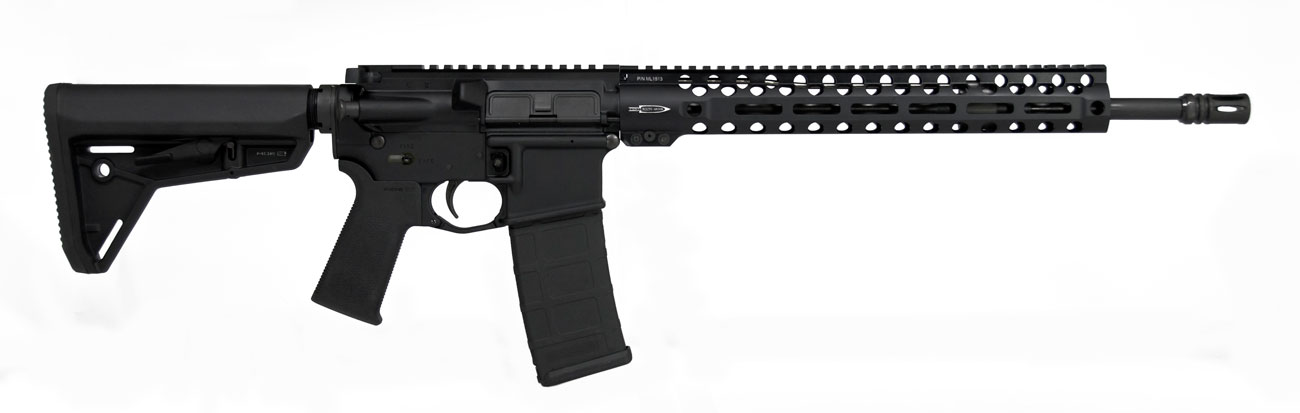
In addition to utilizing Colt’s first production mid-length gas system, the new Colt Combat Unit Carbine features a low-profile gas block, which permits the use of a slim and smooth Centurion CMR free-floated handguard with M-LOK attachment points. The gun also wears an assortment of Magpul furniture as opposed to standard GI accessories: a Magpul SL buttstock, a Magpul SL pistol grip, and a Magpul MOE trigger guard.
I’ve always preferred slimmer, extended forends such as the CMR, as there’s less bulk and they permit a more forward hold, which feels steadier to me. And the Magpul furniture is similarly comfortable to use. The MOE trigger guard also seemed roomier, which might help those who choose to wear gloves.
The Colt Combat Unit Carbine features a 16-inch 4150 CMV steel barrel, which is chrome-lined and sports a manganese phosphate finish. The lightweight profile barrel comes with a 1:7 twist rate. The carbine also has a classic single-stage trigger that’s perfectly adequate on its own, but can also be replaced for those looking to upgrade a bit.
Receivers are the standard 7075-T6 aluminum and are black hardcoat anodized. The upper is a flat top and comes optic-ready with no included iron sights. This seems like a good move on Colt’s part, as many either find irons unnecessary these days or have strong preferences on which type of iron sights they want to use.
The gun incorporates an ambidextrous safety, which should help any lefties in the crowd. However, the bolt release and charging handle are of standard design, and not ambidextrous. A fully ambi design might’ve been a nice touch, but there are still plenty of other great features on the rifle.
None of this is of course surprising given some of the names that worked to help bring this carbine to fruition. Colt’s Combat Unit, which had a great deal of input on the design of the gun, includes legendary firearms trainers Mike Pannone, Ken Hackathorn and Daryl Holland. Their influence and experience can be seen quite clearly in virtually every aspect of the gun, including the decision to go with a mid-length gas system and extended forend.
The man himself. Daryl Holland of the Colt Combat Unit runs the new Combat Unit Carbine, making short work of the steel plates.
Functionally, the Colt Combat Unit Carbine seemed to perform just fine during my limited time with it. Colt had set up several steel plates at 50 yards and had outfitted the rifle with Trijicon’s MRO red dot sight. The combo made easy work of the plates and was a joy to shoot. Transitioning between plates was simple due to the gun’s relatively low weight (6.47 pounds unloaded) combined with somewhat reduced recoil because of the slightly longer mid-length gas system. Overall, Colt and the folks in the Combat Unit have done an excellent job here.
The new Colt Combat Unit Carbine is available now at an MSRP of $1,299. It is available exclusively from TALO Distributors.
Specifications:
Colt Combat Unit Carbine Type: Semi-auto, direct impingement gas Caliber: 5.56 NATO Gas System: Mid-length Barrel: 16-in., chrome-lined, 1:7 twist Overall Length: 33-36.5 in. Weight: 6.47 lbs. (unloaded) Trigger: Single Stage Stock: Magpul MOE SL buttstock Sights: None, optic ready Grip: Magpul MOE SL Pistol Grip Receivers: 7075-T6 aluminum, black hardcoat anodized Capacity: 30+1 rounds MSRP: $1,299 Manufacturer: Colt
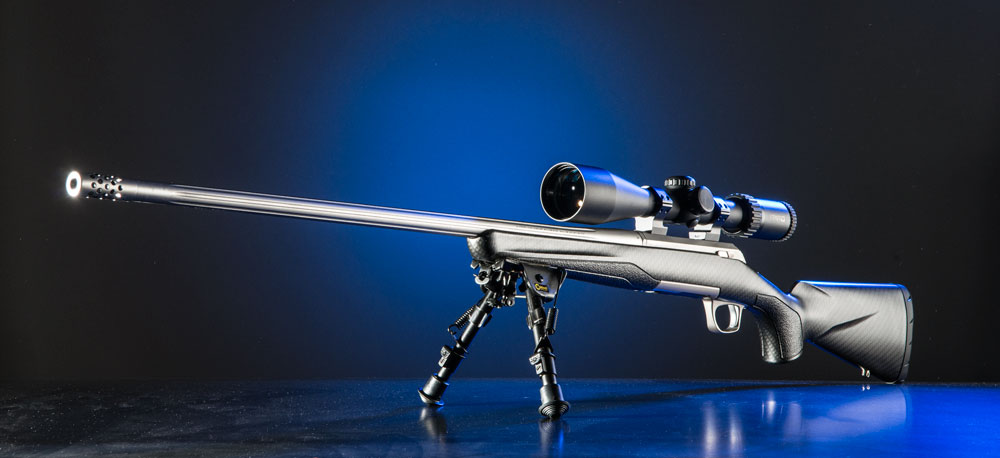
The new Browning X-Bolt Long Range Hunter pairs excellent accuracy with a stylish, born-to-hunt platform.
Every once in a while, you pick up a new rifle and find that you have difficulty putting it down. You examine it minutely and run your hands over it. You work the bolt repeatedly, shoulder the gun and maybe dry fire it a few times, and a little voice inside your head says, “This one’s a shooter.”
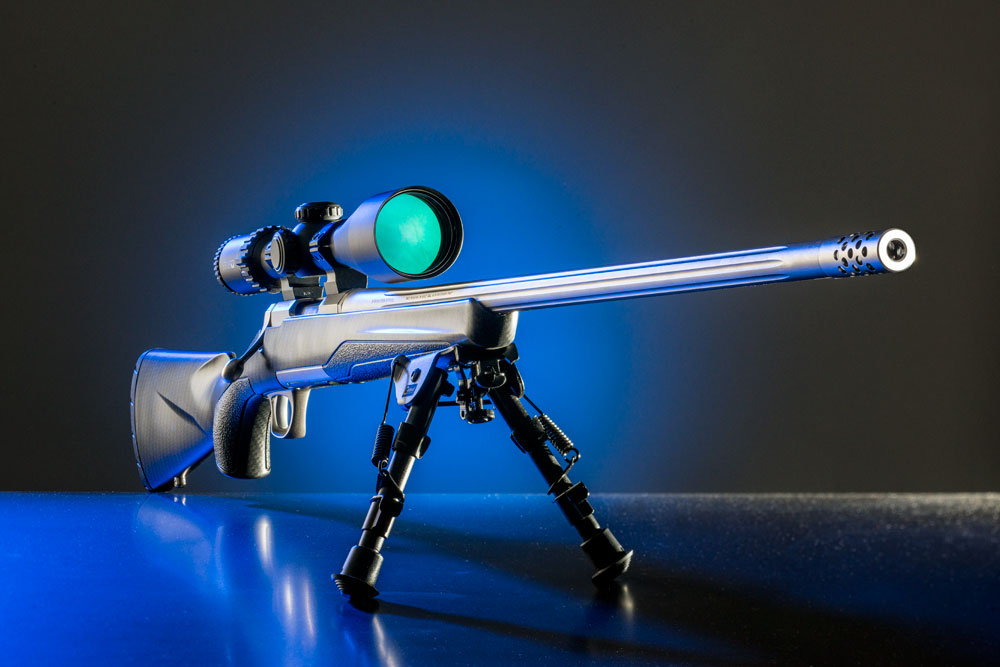
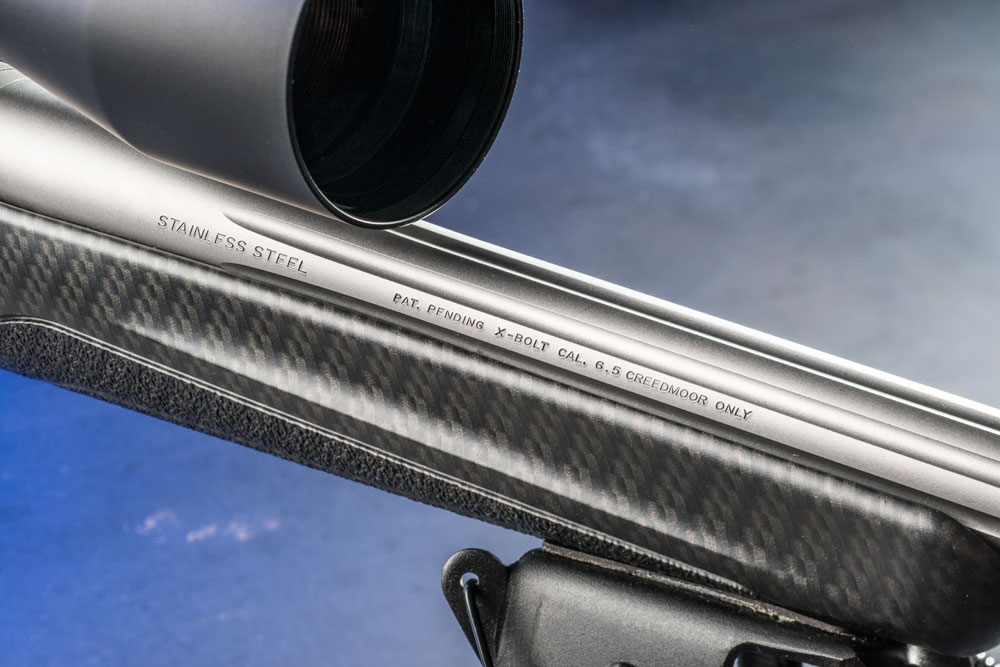
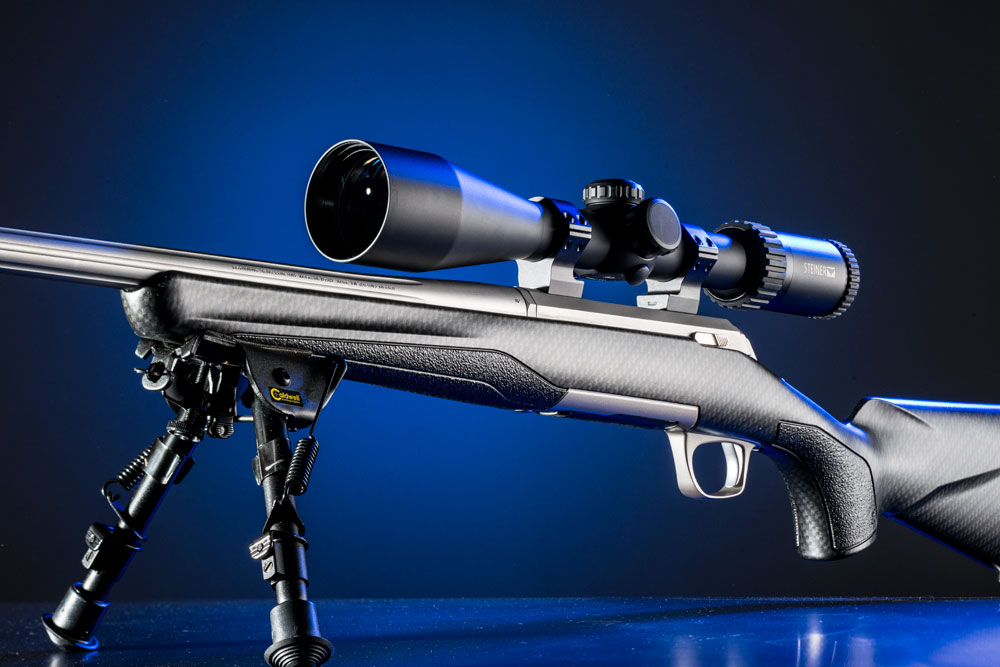
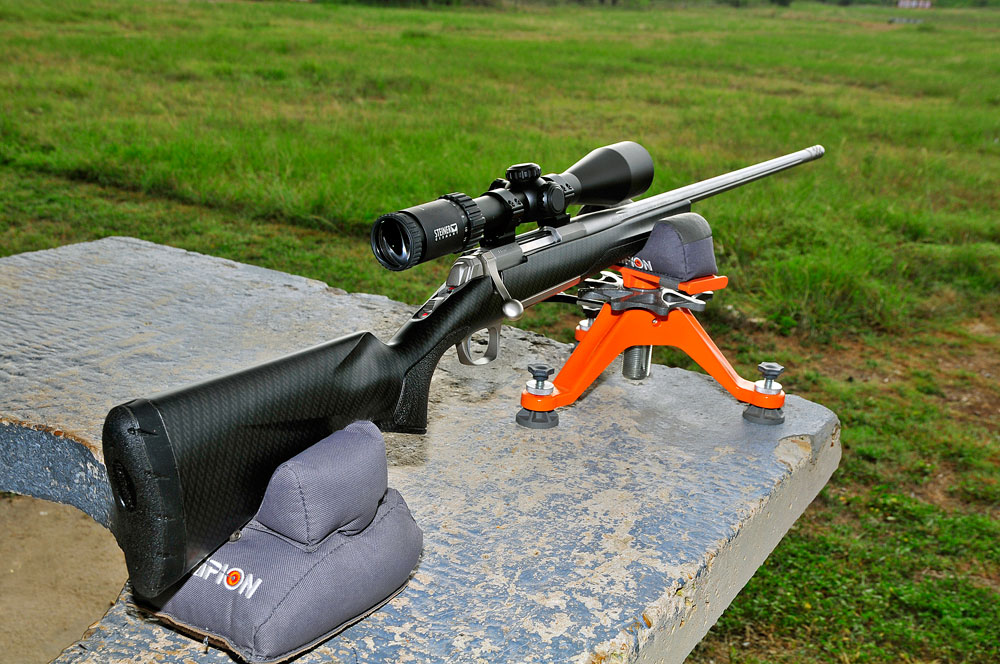
That was my first thought when I picked up Browning’s new X-Bolt Long Range Hunter Stainless rifle. This model was introduced earlier this year along with its somewhat better-known stablemate, the X-Bolt Hell’s Canyon Speed rifle, which has seemingly hogged the media spotlight since birth. I really don’t know what it was, but this new Long Range Hunter spoke to me, whispering sweet promises of tight bullet groupings down range. Maybe it was because I’ve been testing a string of entry-level rifles lately, and the Long Range Hunter exudes quality in ways that less-expensive rifles don’t. Maybe it was the rifle’s all-business, 26-inch stainless barrel. Maybe it was the carbon-fiber-finished stock, or the fact that the rifle sent for testing was chambered in 6.5 Creedmoor, an innately accurate cartridge.
Whatever it was, it didn’t take long to discover that the rifle lived up to its promising first impression, as you’ll soon see, by turning in a stellar performance at the range.
Grip and Grin In addition to 6.5 Creedmoor, the new Long Range Hunter Stainless rifle is chambered for some potent long-legged hunting cartridges, including 7mm Rem. Mag., .300 Win. Mag., .300 WSM, .270 WSM and 26 Nosler.
The rifle may have a ubiquitous black-and-stainless appearance, but it manages to stand out, upon even cursory inspection, like a thoroughbred among mustangs. That’s partly due to the rifle’s stout, fluted, 26-inch matte stainless barrel, which has what Browning calls a “heavy sporter” contour. It’s made to appear even more substantial with the addition of a muzzle brake (you can remove it and attach a suppressor, if you wish, using the muzzle’s 5/8×24 threads).
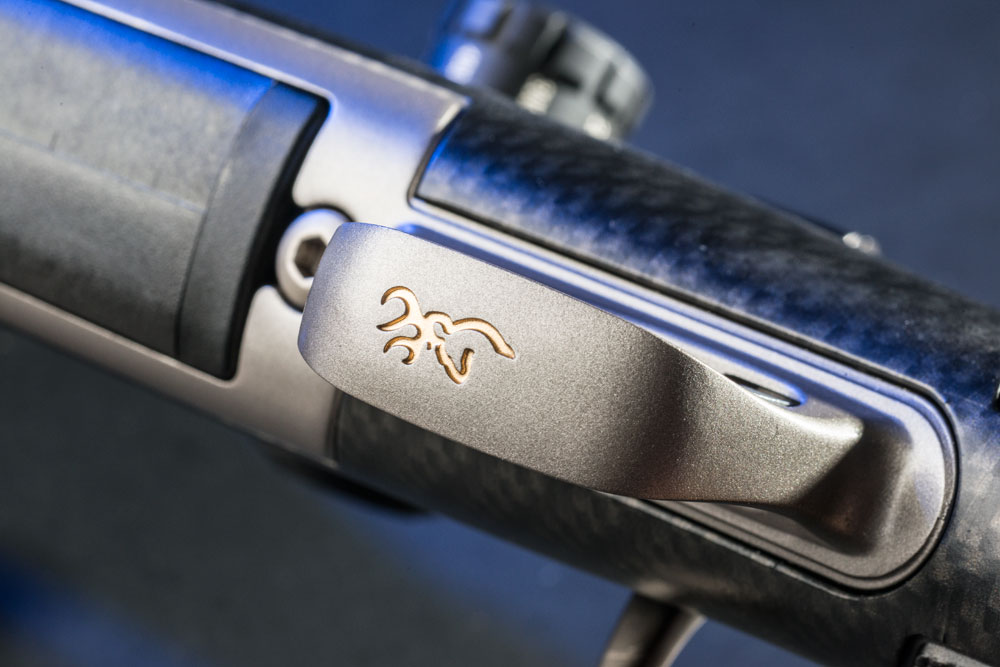
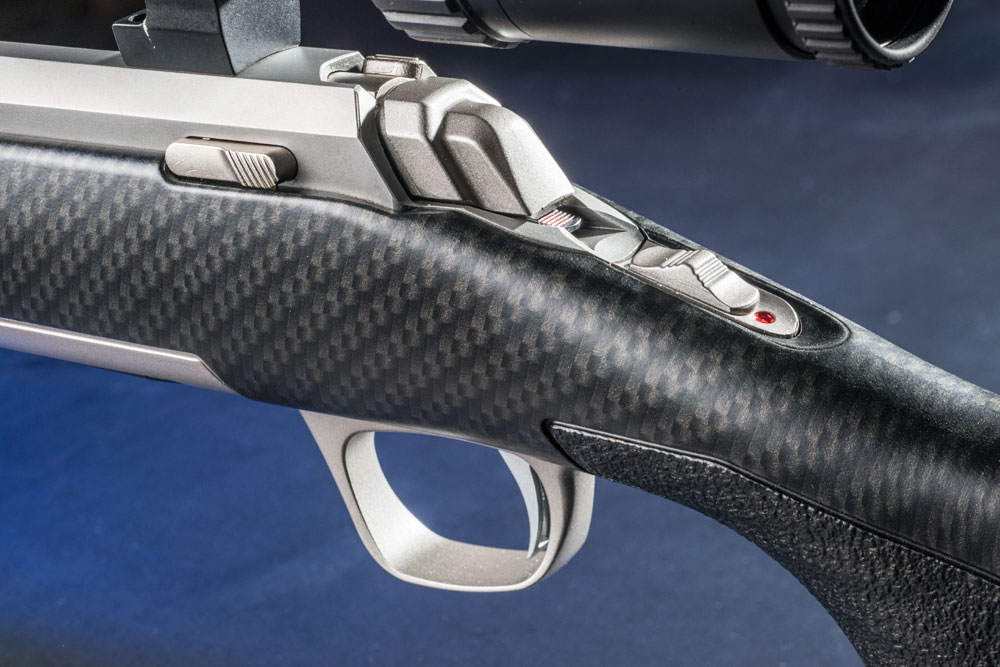
You’ll also quickly notice the rifle’s carbon-fiber-dipped composite stock, which I find attractive in a nouveau-tech sort of way. The trigger guard sports the distinctive Browning Buckmark logo, in gold, and the rifle is further dressed up with matte nickel-coated sling swivel studs.
Handling the rifle, you’ll find that it is, in a word, “grippy.” Dura-Touch armor coating on the stock has a slightly tacky feel to it that I like. The coating works in concert with the soft-touch stippling in the forearm and pistol grip to ensure a solid grip in wet weather. As Browning notes, the coating adds a layer of protection to the stock, but it is not indestructible—just avoid spilling harsh solvents on the stock or insect repellants containing DEET.
Given its light stock and long barrel, the rifle has a definite weight-forward feel to it, but I don’t see that as an issue since most rifles designed for long-range shooting are going to be shot off sticks, sand bags or some other rest. Having more weight out front can help steady things up, especially when shooting in wind.
The rifle, weighing in at 7 pounds, 3 ounces unloaded, is no lightweight compared to, say, newer lightweight mountain guns with barely-there stocks and pencil-thin barrels. It is, however, still light enough to tote anywhere you wish to tote it, and it’s considerably lighter than many guns marketed as long-range rifles.
The gun’s bottom metal and trigger guard are, happily, actually made of metal. This bucks the recent trend toward integral synthetic trigger guards, magazine wells and such. That’s a good thing, as far as I’m concerned, because you’ll never have to replace an entire stock simply because you broke a plastic trigger guard. Overall fit and finish are quite good with this rifle, which lives up to Browning’s usual high standards in this department.
This extends to the well-fitted Browning Inflex recoil pad, which Browning designed to work on the principle of “directional deflection.” The recoil pad has internal ribs that function, theoretically, to direct recoil energy downward, rather than straight to the rear, to lessen impact on your face and shoulder. For me, it seems to work as advertised. Between the rifle’s muzzle brake and recoil pad, recoil was hardly noticeable.
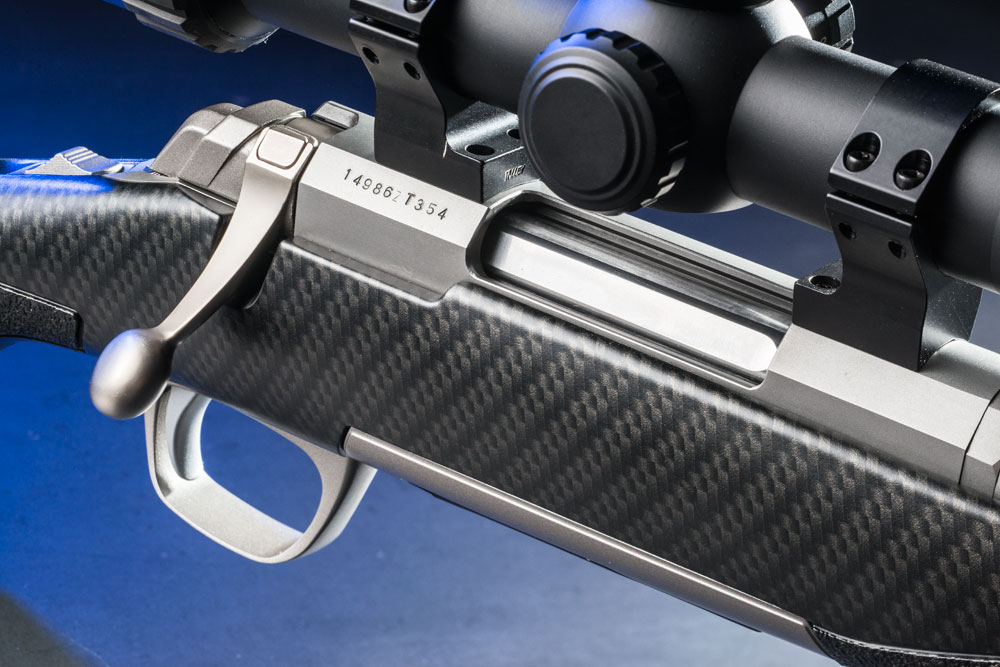
X-Bolt Extras The bolt has three substantial locking lugs and a short, fast, 60-degree lift, providing lots of clearance for mounting scopes. I found that the bolt cycles quite smoothly with a straight push to the front or pull to the rear of the action. However, it fits into the action with tight tolerances and can get a little sticky if you exert undue downward pressure on the bolt handle while cycling. Under normal conditions, and with a little muscle memory, it shouldn’t be an issue. One minor annoyance, for me, is that shiny, sun-reflecting bolt finish common to X-Bolt rifles. I’ve never understood why anyone would put a highly reflective surface on any part of a hunting rifle.
This is just nit-picking on my part, as the positives far outweigh any possible negatives with this rifle. Consider, for example, the Browning Feather Trigger. It’s a single-stage design utilizing polished and chrome-plated components inside an alloy housing. It has no creep, no take-up and minimal over-travel. Browning pre-sets the trigger pull weight on X-Bolt rifles at approximately 4 pounds. The trigger on our test gun broke at 3 pounds, 14 ounces, as measured with a Lyman trigger gauge. That’s a bit heavier than I prefer, but the trigger is adjustable down to 3 pounds. Because it broke so cleanly and crisply, I left it at the factory setting, which is perfectly acceptable for most hunting purposes.
The rifle’s two-position tang safety engages and disengages with an audible click, and the bolt is locked when the safety is engaged. A bolt unlock button atop the bolt handle allows you to cycle rounds through the action with the safety engaged. Three-position safeties do the same thing, but the Browning design doesn’t require you to manipulate the safety to unlock the bolt. There’s a cocking indicator at the rear of the bolt that you can both see and feel.
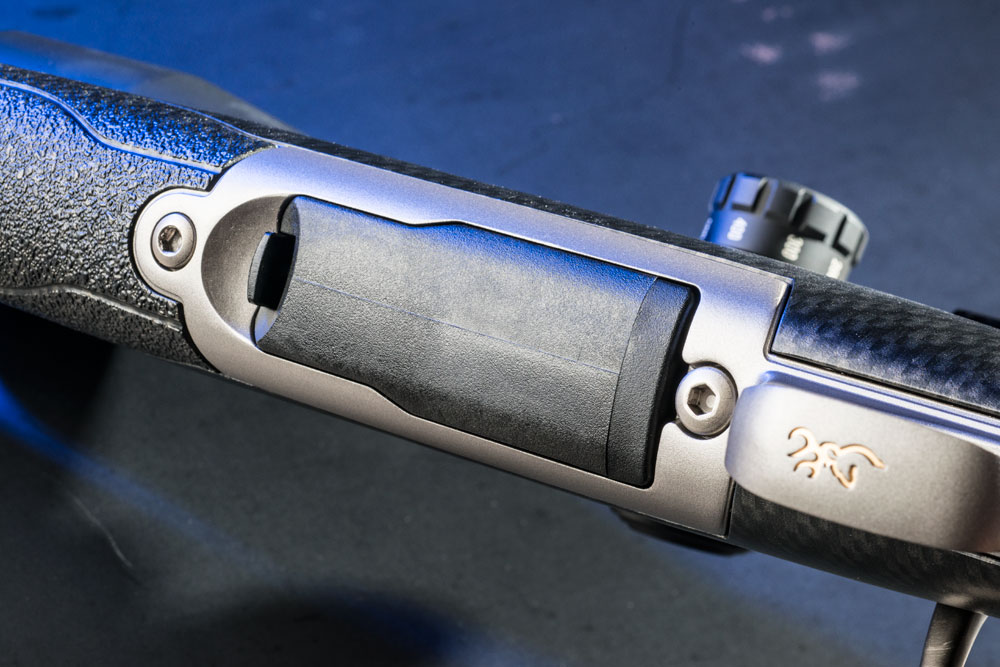
Another well-designed component of this rifle is its polymer rotary four-round magazine. I normally make a curmudgeonly frown when I hear the word “polymer” associated with any part of a rifle other than a stock, but this magazine evokes nothing but smiles. First and foremost, it is sturdily constructed. The release button is protected within a recess in the bottom of the stock to prevent accidental dumping of the magazine. The magazine inserts smoothly into the mag well and pops freely into your hand when you press the release button. It does not rattle in place, as some detachable magazines do. Rounds loaded smoothly and easily into the magazine, and they fed flawlessly through the action. There were no issues with extraction or ejection of fired cases.
One other feature of X-Bolt rifles that I’m somewhat enamored of is the X-Lock scope mounting system, which consists of four holes drilled into the top of the receiver bridge for each front and rear scope-mount base. The holes are placed outboard from center and angle in toward the bolt. This system effectively doubles the standard number of attachment points over conventional base-mounting systems, adding strength and robustness. The precise placement of the holes allows bases to be attached at all four corners, ensuring proper alignment of the scope atop the receiver. For testing, I used a set of Talley Lightweight 30mm rings designed for the X-Lock system, and the resulting setup was as solid as it gets short of welding rings onto a rifle.
Consistently Accurate In testing the rifle with five factory loads, with bullet weights ranging from 120 grain to 140 grains, I expected the 26-inch barrel to deliver good velocities, and I wasn’t disappointed with the numbers reported by my CED M2 chronograph. In most cases, velocities mildly exceeded factory-stated velocities. The biggest surprise was Nosler’s Match Grade 140-grain load, which beat the factory number by 205 feet per second (fps), making it slightly faster than the Federal American Eagle 140-grain load.
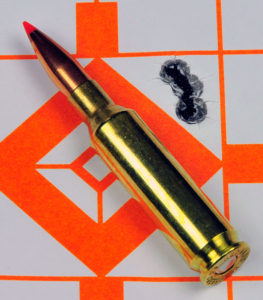
As good as those figures are, accuracy testing produced some real eye-popping numbers. For starters, every single load tested delivered sub-MOA best groups at 100 yards. All but one load served up average groups under an inch, and the only one that didn’t grouped into an average of 1.19 inches. The best of the bunch, in this rifle, was Hornady’s Match 120-grain A-MAX load, which shot a best group of 0.30 inches and average groups of 0.57 inches. Federal’s American Eagle 140-grain OTM load wasn’t far behind, with 0.70-inch average groups and a half-inch best group. As for loads using hunting versus match bullets, Hornady’s Full Boar 120-grain GMX load also averaged under an inch with a 0.54-inch best group.
It’s been quite some time since I tested a new factory rifle that shot this well, this consistently, with a range of bullet types and weights in factory ammunition. With a MSRP of $1,429.99, the new Long Range Hunter isn’t cheap, but based on what I’ve seen, it can go toe-to-toe with some custom long-range hunting rifles costing far more. Compared to many guns in this category, the price of entry suddenly seems a lot more affordable.
Specifications:
Browning X-Bolt Long Range Hunter Type: Bolt Action, Push-feed Caliber: 6.5 Creedmoor, as tested Barrel: 26-in. matte stainless steel Rate of Twist: 1:8 Weight: 7 lbs. 3 oz. Stock: Composite, carbon fiber finish Trigger: Adjustable Feather Trigger Magazine: Detachable four-round Muzzle Device: Removable muzzle brake MSRP: $1,429.99 Manufacturer: Browning; Browning.com
Editor’s Note: This article is an excerpt from the October 2016 issue of Gun Digest the Magazine.
Looking to go armed, but are stuck in the weeds as to what to arm yourself with? Here are 20 of the best concealed carry gun options that will keep you on the defensive.

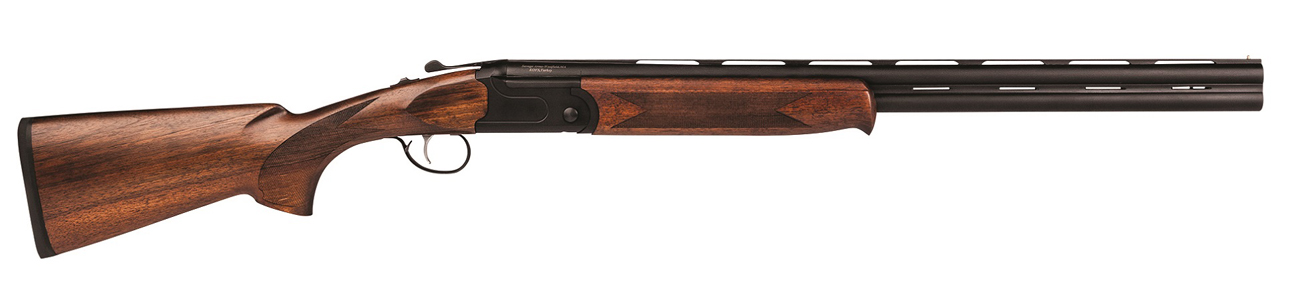 Stevens has recently announced that it is expanding its popular new Stevens 555 over-under shotgun line with the addition of three compact models available as a 20-gauge, a 28-gauge and a .410 bore. Obviously, these three new compact models offer a shorter length of pull than the standard 555 to better fit smaller-stature shooters.
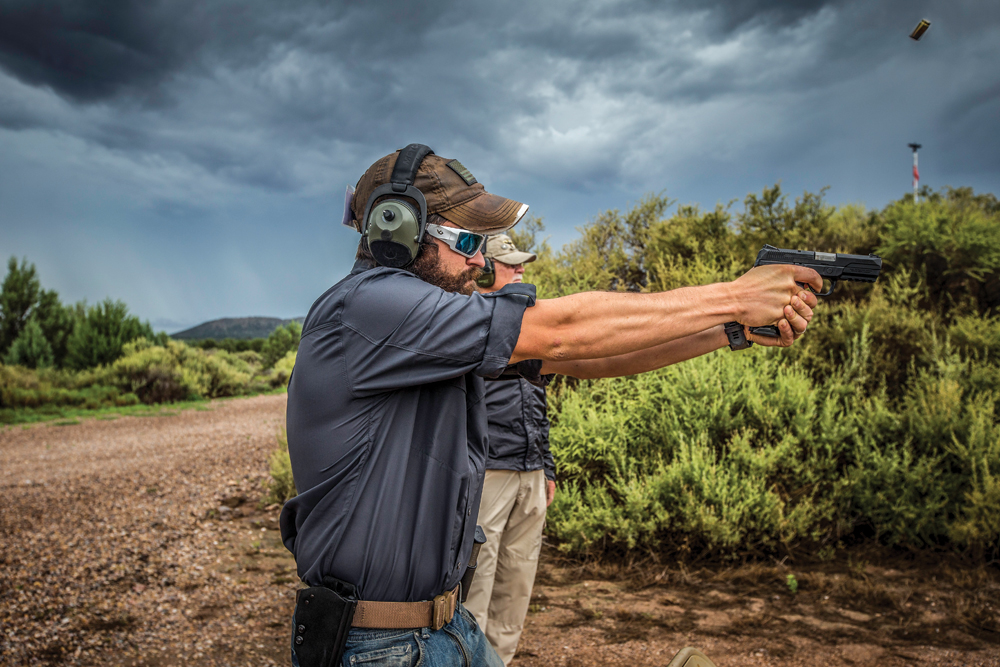 There’s nothing more American than guns and horsepower, both of which were on display at a recent event at Gunsite Academy in Arizona. Yamaha brought its 2017 Wolverine R-Spec Special Edition (SE) and Grizzly SE, while Ruger showcased its brand-spanking new American pistol in 9mm and Predator rifle in 6.5 Creedmoor. We’d be testing both rides and Rugers over three days at Col. Jeff Cooper’s old stomping grounds, a perfect recipe for one hell of a good time.