NEW CASTLE, Del. (AP) — New Castle County police say a woman shot and killed her ex-husband after he broke into her home and beat her.
Fifty-seven-year-old Gregory Thompson of New Castle was found dead at the unidentified woman’s home.
It happened Thursday about 11:30 p.m., when police received a 911call from the woman.
Police say Thompson, who was wanted for violating aprotective order his ex-wife had against him, used a ladder to get into the victim’s third-floor bedroom. Read more
KEARNS, Utah (ABC 4 News)- Police are investigating a deadly shooting in Kearns after they say a homeowner shot and killed a man who was attempting to break into his home.
Police say the shooting happened around 3:00 a.m. Monday morning in the 5900 block of Loder Drive.
Thatis where police say a homeowner caught a man trying to get into his house. The man fired in self defense, hitting the would-be intruder once in the chest. Read more
Percussion half-stock target rifle by one of New England’s finest gunmakers, John S. Dutton of Jaffrey New Hampshire c. 1850s. Made for George F. Ellsworth, whose name is engraved on an eagle inlay on the left side of the butt. 42-caliber with detachable false muzzle on the 31-inch octagon barrel. Illustrated here surrounded with a unique collection of original manuscript notebooks (dated 1858-78), all kept by that gunsmith John Dutton, with his personal notes and drawings on how to make and decorate rifles. The double patchbox of this rifle was a trademark of Dutton’s.
(As illustrated in Steel Canvas; The Art of American Arms, with permission of the author)
The proliferation of superbly assembled and printed, color illustrated auction catalogs, the likes of which have never been previously seen in this field represent a credit to the auction houses that issue them and to the antique arms community in general (and they certainly place generations of gun catalogs that preceded them in their shadow).
This great change of pace was ostensibly brought about by those few auction houses that had the foresight (and good fortune) to acquire from consignees significant outstanding specimens of antique arms and make them available on a reasonably steady basis. With proper promotion and marketing they frequently achieved startling values.
New England-made flintlock, half-stock rifle of exceptional quality; attributed to noted gunmaker Silas Allen of Shrewsbury, Massachusetts (1750-1834). Silver and brass mountings with silver wire inlays on the handsome curly maple stock. New England made rifles of this type were seldom embellished as elaborately.
(As illustrated in Steel Canvas; The Art of American Arms, with permission of the author)
Widely reported in both the general and the antiques press, those exceptional prices were ostensibly the stimulus for owners of similar material to take advantage of what was developing into a really hot market; there was no doubt that it truly was just that. In their aftermath, a veritable flood of great material, the very best of their respective types emerged on the auction scene and so it has remained.
It is important that the collector bears in mind that those record values were achieved by what are considered to have been the very top, the ne plus ultra, of their particular category of firearm and that those very same prices seldom transpose to even slightly lesser rarity, quality or condition levels of identical models. There is little doubt that the notoriety of those auction values has been favorable for the hobby.
They have certainly been responsible for a remarkable turnaround for a number of auction houses. In order that the neophyte collector as well as the veteran gun trader not be carried away by the excitement of those recordbreaking values, it bears repeating that they have seldom had relevance or influenced values on antique arms of the same types if anything less than the very best or the most rare.
A few words about auctions are in order here for the collector … and the dealer. Auctions will continue successful only if they do not revert to their former common practices of taking everyone’s “cats and dogs” with protected prices, while allowing the very owners of those pieces to bid them up during the auction. These abuses were so flagrant that they colored the entire American gun auction market, with but a handful of notable exceptions.
With reputations at stake, it has been observed that many houses have taken great precautions to keep their acts clean. When a legitimate collection has been offered at auction on a no-holds-barred basis, results have often been spectacular. Those results certainly attracted the attention of the collecting world and were equally noted by the auction houses themselves.
Many abuses to which auctions have been, and still are, subject will continue to be the major stumbling block to their success. An uncomfortable feeling exists when auction houses either own all the material themselves or have given healthy loans or advances towards the material they are about to auction. By the very nature of these actions there is an obvious conflict of interest.
This article is an excerpt from Flayderman's Guide to Antique American Firearms. Click here to learn more.
When handling collectible firearms, the first rule of thumb is that whatever you do will be questioned by half the people you tell. Even cleaning a collectible involves considerable anguish in some quarters.
David Arnold, the conservator at the Springfield Armory National Historic Site Museum in Springfield, Massachusetts says there are a few simple guidelines to help care for an antique gun – or a collection.
Avoid dramatic swings in relative humidity (RH). Try to keep the humidity stable and between 40 and 50 percent. Consistency is more important than precise maintenance of a specific RH reading, though RH control is critical because of an unusual physical property of wood called anisotropy. Wood cells expand or contract very differently in response to changes in relative humidity – depending on their specific grain orientation (axial, transverse or radial) in the log from which they came.
Large swings in RH can result in cracks caused by compression-set shrinkage. If the humidity remains fairly constant, changes in temperature make little difference to either metal or wood. A rapid rise in temperature, though, can pull the moisture out of the environment (including your artifact), causing a sudden drop in RH. Cell shrinkage and cracking or splitting can then occur.
Handling
Wear gloves when handling your collection. No protective coating can stand up for long against repeated barehanded handling. Best to always wear gloves and I recommend Nitrile examination gloves when cleaning and coating your collection. Once an item has been coated, wear plain cotton gloves.
Housekeeping
Keep your firearms dust-free. Dust can trap moisture increasing the likelihood of corrosion occurring.
Don’t use commercial dust cloths, though. They often leave an oil film behind which traps dust and dust traps water vapor from the air. When dusting, use either a vacumn with a soft brush or a soft cotton cloth very lightly dampened with water. Without moisture, dust merely gets shoved around and will not be picked up. Dry the gun immediately with a clean cloth.
Don’t use alcohol of any kind when dusting or cleaning a firearm stock. It can skin or strip an historic finish. Never use liquid or spray dusting products, either, because most of them leave mineral oil behind, which traps dust. Remember that dust traps and collects moisture.
Storage/Display
Narrow hooks or loops of wire should not be used to support collection pieces either in storage, transport or on display. The weight of most long arms on such devices is sufficient to cause indentations in their stock at the points of contact. Instead, use broad, padded supports.
We use thin sheets of a closed-cell polyethylene foam material to pad our display fixtures. To avoid mold and mildew during long-term storage, avoid at least two of the three conditions known to promote bloom outbreaks: elevated temperature, still air and elevated humidity.
Cleaning and Coating: Cleaning Wood Stocks
Classified as a percussion/flint conversion musket with a Confederate Civil War heritage, this old rifle showed an age to match its purported military provenance: rust, obvious signs of wear and a seriously weathered, beaten-up surface. If you owned it, would you clean it? Restore it? Or would you choose to preserve it “as is?”
First, separate the wooden parts from the metal parts. They are cleaned and coated differently. Unless it should become absolutely necessary, leave the unfinished interior wooden surfaces alone.
Clean the exterior of the stock by placing a few drops of a mild detergent in a gallon of warm distilled water. Apply with a slightly damp soft cloth and rinse with clean cloths dampened with distilled water. Dry with soft cloths immediately after rinsing.
Clean again with mineral spirits, using a soft cloth to apply. Be sure to work in fresh air or a well-ventilated area. Avoid using “oil soaps” as they can be caustic and may damage an historic oiled surface.
Cleaning Barrels and Other Metal Parts
[Please note: I believe that it is essential to practice any new technique on a sacrifi cial piece first, before applying it to something irreplaceable.]
Use nylon or animal-bristle bore brushes. Avoid using brass or steel brushes because such hard materials can scratch, but also might (under certain conditions) cause galvanic (bi-metallic) corrosion (specifically when using a copper-alloy brush on ferrous metals) by leaving a slight metallic smear behind. Use mineral spirits to soften accretions. Work in fresh air or a well ventilated area. (Are there other solvents that are stronger? Yes, but they are difficult to work with safely.) Swab clean with a cloth patch.
Use only extremely fine abrasives such as oil-free 0000 steel wool. Use only if absolutely necessary to remove stubborn rust or other accretions. Work slowly and watch constantly for any changes to the surface. There is always an element of risk in such work. If you are at all uncertain, hire a conservator or qualifi ed gunsmith before causing irreversible damage. When cleaning brass parts, never use products that contain ammonia.
Ammonia can damage old copper alloy materials by corroding them from the inside out. In addition, such products may include abrasives, which may prove too harsh. Elbow grease and mineral spirits should be tried first. If something slightly stronger is needed, try applying small amounts of wet tooth powder with a cotton swab and rinse with water. So – a general comment about commercial rust removers.
To date, I have not found a rust-removal product that is entirely safe to use on historic metal surfaces. The problem is that most rust removers can’t tell the difference between iron oxide and iron metal, and will leave an etched surface even where there is no rust. Some products do seem to come close, though. Often they require extremely close attention and precision – too much for most of us operating on a home workbench.
In short, there are no magic solutions that are risk-free and I advise against their use on anything you value. Most surface rust can be removed by first lubricating the area with a light penetrating oil and cleaving it off with a sharp scalpel held at a very low angle to the metal. It requires close attention, a steady hand, and some patience, but if you are careful, you will probably get most – if not all – of the surface rust off without leaving a scratch. When done, remove any remaining oil with mineral spirits.
Disassembly and Reassembly
If you are organized and systematic you should be able to safely disassemble and reassemble most firearms successfully. First, probe the floor of every external screw slot with a sharp point held at a very low angle. It’s amazing how much dirt can be packed into a clean-looking slot. All foreign matter must be removed for the screwdriver to do its best, safest work. A good selection of screwdrivers is a must.
Their tips must be matched perfectly to each slot in order to maximize the area of mechanical contact. Taking this precaution will minimize slippage and the scratching and scarring that can result. The internal shapes of screw slots have changed a lot since their invention and screwdriver tips often have to be ground or filed in order to get a good match. Keep this in mind when regrinding a screwdriver’s tip. There are many publications that offer exploded drawings and disassembly/reassembly tips.
There is also a brilliant web site that illustrates with moving images how various types of firearms work.
Coating Stocks
Available in most grocery stores, inexpensive latex gloves are fine for handling precious collectible firearms. However, the protein in latex causes irritation and an allergic reaction in a significant number of people. Nitrile gloves, used by your personal physician during examinations, are made of synthetic latex and contain no latex proteins. They are available inexpensively at medical supply stores or via Internet vendors.
Wood is neither thirsty nor hungry. It is usually covered by a finish that may have become corrupted in some way, thus making it look “dry.” The wood beneath the finish does not need to be “fed,” despite what wood-care product commercials may claim. So never put oil of any kind on an historic finish. There may well be unintended but permanently damaging consequences to ignoring this advice.
A cautionary word about linseed oil. Linseed oil takes forever to dry, will trap dust and will not stop water penetration, either. When linseed oil oxidizes, its molecules cross-link with one another, making it increasingly more difficult to remove as time passes. Oxidized linseed oil (linoleic acid) eventually becomes linoxin, better-known commercially as linoleum!
Repeated, or seasonal, applications eventually develop into a surface that can look like very dark brown alligator skin, and can become almost impossible to remove. Applying a modern finish over an equivalent historic finish can forever confuse the finish “history” of a stock by making it difficult, if not impossible, to tell what (if anything) is original, and what is a restoration material – even with an analytical microscope. Therefore, you would not want to touch up, say, a shellac finish with shellac.
Use paste waxes only. I prefer carnauba-based furniture waxes such as Kiwi Bois, Mohawk or Behlen, or Black Bison on wood stocks. I also recommend using pigmented paste waxes. “Clear” waxes can collect in pores and appear as white specks against a dark wood background. As much as we love bees and honey, avoid wax mixtures that include a high percentage of bee’s wax when preserving wooden firearm parts. These wax mixtures are not especially harmful, but they are relatively soft (fingerprint easily) and can be slightly acidic.
Coating Metals
(Note: this advice is strictly for guns which have been “retired” from use and will never be fired.)
Avoid using oils. Oil is not the best material for long-term protection of collection pieces because it traps dust and dirt, eventually breaks down and has to be periodically replaced. A high quality light oil is fine for maintaining a gun you still shoot. Use a microcrystalline wax, such as Renaissance Wax as a protective coating. Such a wax is practically inert, remaining stable for a very long time. Apply and buff out with a soft cloth or brush. I coat all parts this way, inside and out. Brass parts can also be coated with wax.
I prefer to use Incralac acrylic spray lacquer because it is easily removed with solvents but bonds especially well to copper-alloy metals, and will withstand more abuse and last longer than wax.
Minor Stock Repairs
If a split or detached piece of a stock must be repaired, use an adhesive that is both strong and reversible (i.e., can be safely removed at any time in the future). There is only one: traditional hide glue.
Do not proceed if there is evidence that the damaged site has been previously repaired. In this case, if the gun has any value at all, I recommend that you consult a conservator. Unless you work with hide glue every day, make it up fresh in small amounts as needed.
It doesn’t take long to prepare and it will do a better job than using old glue. Hot hide glue is preferable to liquid hide glue as it is less affected by humidity. Dampen the area to be glued with hot water. Blot the area and wait a few minutes. Then apply hot glue to both surfaces with a brush and clamp immediately. An appropriate clamp can be as simple as a few pieces of masking tape, rubber bands, bicycle tire strips or small padded weights.
Use the least force needed to do the job. Clamps can usually be removed in a few hours, but it takes at least 24 hours for the repair to fully harden. Excess glue can be removed with a lint-free cloth dampened with hot water. The best time to do this is usually right after removing clamps. If you still need help, seek the services of a professional conservator. Contact me or the American Institute for Conservation of Historic & Artistic Works for a referral.
Here is good news for those who like great duty gear.
Increased demand for the models 381 & 391 duty holsters gives uscause to celebrate. To secure ourcompetitive edge, we’re passing on a cost savings to you. Effective November 1, 2010, for alimited time, Gould & Goodrich is offering you the opportunity to stretchyour dollars.
The 381 holster price has been reduced to $149.00 for Plain Black, Black Weave and Hi-Gloss. The 381 in Kydex finish is now offered at a price of $116.00
The 391 holster price has been reduced to $155.00 for Plain Black, Black Weave and Hi-Gloss. The 391 in Kydex finish is now offeredat a price of $120.00.
These new prices represent up to a 25% reduction in price off of manufacture’s suggested retail price.Superior product at a super price!
Gould & Goodrich products are available nationwide through law enforcementdistributors, as well as through on-line and catalog retailers. To receive a free catalog of product inleather, nylon and synthetics, write to Gould & Goodrich, 709 E. McNeilStreet, Lillington, North Carolina, 27546, USA. CALL 910.893.2071 or1.800.277.0732. FAX 910.893.4742. E-Mail [email protected]. WEB www.gouldusa.com.
The new custom gun is a level of quality so far above previous guns, that the older ‘smiths would be green with envy if they knew. Photo courtesy Heirloom Precision and Hernandez Photography
Patrick Sweeney takes a look at the custom Precision Heirloom 1911, produced as both work of art and precision shooter. Sweeney spotlights the work of Ted Yost and Jason Burton at Precision Heirloom.
Precision Heirloom is Ted Yost and Jason Burton. To give you an idea of where they are coming from, consider this: Ted’s introduction to gunsmithing was to learn how to work on (and make) British double shotguns. If what you want is the latest, cutting-edge tacticool-fashion 1911, do not come to Heirloom. If, however, you seek to have a pistol built that will be appreciated by even the most discerning (and traditional) 1911-ista, Heirloom is for you.
Unconventional checkering patterns are not the vogue here. You will have your choice of lines per inch, and they will be done to perfection. Perfectly-polished slide flats, without rounded corners, dished areas or buffed-out markings, set off with frenched borders are the norm. Front sights are commonly done with a vertical gold line in the center, rather than obtrusive tritium cells inset into the blade.
When a top ‘smith does a retro gun, it looks like the older guns, but it is much, much better than the older guns. Here, Ted Yost has done his take on a “new-old” Delta Elite. Photo courtesy Heirloom Precision and Hernandez Photography
Now, if you want tritium, you can have them, but the preference at Heirloom is a gold line, or a gold bead in the front blade. The natural trend at Heirloom is to understatement, not flashy, of-the-moment cosmetic touches. Even when Heirloom does a “fighting gun” it will be understated, classic and flawless.
Grips will be highly-figured, checkered or smooth for most guns, or aggressively-textured for a fighting gun, but in all instances fitted to perfection. A gun built by them is just that: an heirloom, something you will be proud to pass down to succeeding generations, for as long as that option is available to us. And it will, of course, perform flawlessly. There wouldn’t be any other point to it, would there?
Now, Ted and Jason are not only full-house gun guys. If you have the need of some aspect of another build needing overhaul, or upgrade, they can do that. You can send them a gun built by a name ‘smith or maker, and ask them to change something, and they’d be happy to. Just be aware, as with so many custom gunsmiths, that they are doing things in the order they came in, and small one-detail jobs get done in-between the full-house guns. So, the schedule is the schedule.
And while Heirloom prefers to work on Colt, they can and will build on a good base gun, such as a Springfield, Wilson Combat, Caspian, Les Baer, etc.
Heirloom is one of the premier Browning Hi-Power places to go, just in case you want to expand your horizons beyond the 1911.
This is an excerpt from 1911: The First 100 Years.
FFLGunTrader.com has created a brand new marketplace to help federal firearm licensed (FFL) gun Distributors and dealers to buy and sell firearms and accessories online. Because the deals are completed among licensed and verified dealers, the transactions are easier to complete and require only the swapping of licenses.
“We wanted to create an online marketplace for licensed distributors and dealers that allows them to buy and sell firearms and accessoriesfrom all over the country,” said Scott Chatman with FFLGunTrader.com.
Buyers don’t have to pay for purchasing an item on FFLGunTrader.com. Sellers pay a very small three percent transaction fee from the sales price to list the item on the marketplace to a national audience.“It is a great deal for dealers looking to move excess inventory,” Chatman said. “Plus dealers have the peace of mind knowing that each buyer had to submit to a license check to complete the transaction.”
For more information about FFLGunTrader, please check out their online marketplace at www.fflguntrader.com.
Add to this mix “pro-gun” Democrats and Second Amendment-friendly leadership in both chambers (assuming Sen. Reid still feels he needs to be), and yesterday appears to have been a good day for gun owners.
At the federal and state levels.
How did races in your state and district go?
I linked to some resources on Monday so that we could see how candidates were rated by NRA and GOA, as well as some other online resources, and encouraged readers to independently assess their options. You can compare those to election results, courtesy of CSPAN. Click on tabs for U.S. Senate, U.S. House, Governors and Ballot Initiatives.
So doesn't this mean we're not going to see any more anti-gun legislation, at least at the federal level? After all, we've retained a Senate Majority Leader we're told will strangle anti-gun legislation in its crib. And it takes both the Senate and the House to send a bill up to the President for signature. How can anything attacking our gun rights get through?
Are we safe? Can we relax?
Does anyone think the anti-gunners are going to fold up their tent and go away?
Does anyone think politicians will now place commitment to principle over self-interest?
Does anyone think we're not one major “gun free zone” incident away from new opportunities for the citizen disarmament cabal to exploit? Read more
The RCBS Bullet Feeder set up on the RCBS progressive loading press. It feeds the bullets, base down, directly into the feeding tube, ready to be dropped into the case mouth.
Data
Reloaders need reliable reloading data. Thankfully, such data for factory, obsolete, and even wildcat cartridges is all over the place.
The hardbound volumes of data, such as those by Barnes, Hornady, Lee, Nosler, Speer, and others, or the large, softbound volumes of Lyman, Accurate Arms, etc., are enormously valuable. Their only downside is the lapse time between new editions. A recent trend is toward a smaller paperbound manual or magazine-size volume of data issued yearly, often by powder manufacturers or distributors. One of the most informative, the Hodgdon Annual, is issued by the Hodgdon Powder Company and published by Shooting Times.
The latest Hodgdon Annual features one less than a dozen excellent articles on reloading by well-known writers, plus the latest loading data for 135 rifle cartridges, from the .17 Ackley Hornet to the .50 BMG, and 72 handgun cartridges from the .22 Remington Jet to the .500 S&W Magnum. In addition there are a few other valuable features, including a table of Relative Burn Rates for powders, rated from the fastest (Norma R1) to the slowest (Vihtavouri 20N29); a table of Powder Usage for various pistol, rifle and shotgun powders; a description of many of the powders currently on the market; and a legend of the abbreviations used in the manual. (Data is provided for ten different 6.5mm cartridges, including two of the newest, the 6.5 Grendel and the 6.5 Creedmoor, but not for the older 6.5mm Remington Magnum.)
No loading data for shotshells is provided in this manual, but for each of the rifle or handgun cartridges, load data is provided as follows, for specified bullets (the bullet being listed by weight, brand name, bullet type, diameter and overall loaded cartridge length): powder, grains, velocity (instrumental) and pressure (CUP) for both starting loads and maximum loads. Other data provided for the loads for a specific cartridge include the case used (Federal, Hornady, Remington, Sierra, Winchester, etc.), trim length, primer brand (type and size), barrel length and rate of twist. It doesn't get much better or more complete than this.
Lyman Products will have a new Cast Bullet Handbook available by the time you read this. This is the fourth edition and the first new one in thirty years. The entire Lyman line of pistol and rifle bullet moulds will be chronicled, along with data for some moulds by other manufacturers whose bullet designs will be of interest to reloaders of cast bullets. A number of new cartridges since the third edition will be featured, such as the .327 Federal, along with some new black powder loads for a number of the popular older cartridges, especially those regaining status among Cowboy Action. A number of authoritative “how to” articles are also featured.
Hornady
The Hornady Auto Charge is a sophisticated digital powder measure. Note the drain plug on the right side.
In addition to having some new cartridge loads available, plus a couple of new cartridges for U. S. shooter, Hornady Manufacturing has several new components and a couple of great equipment items for handloaders. The Lock-n-Load Power Case Prep Center was introduced last year. Combining a power trimmer with primer pocket uniformer, cleaner, reamer, flash hole deburring tool, case mouth chamfer and deburring tools, etc. , the Case Prep Center takes up little space on the reloading bench.The two new Hornady tools include the Lock-n-Load Auto Charge and the Sonic Cleaner.
The Auto Charge has a scale capacity of 1,000 grains and will weigh accurately to within 0.1 grains. Finished in Hornady red with a clear plastic hopper, the machine features an easy-to-use keypad with backlit display, manual and automatic dispensing options, plus trickle function, overcharge protection, and several other unique features. A side-mounted clean-out spout or drain makes emptying the hopper a real breeze. An electric Hornady powder scale with a 1,000-grain capacity should be available about the time you read this.
Sonic parts cleaners have been available and in use by the automotive industry and others for a good many years. Now Hornady has a Lock-n-Load Sonic Case Cleaner. The new Cleaning unit can hold up to one hundred .308-size cases, or two hundred cases of .223 size. Coupled with a unique cleaning solution called One-Shot Sonic Cleaner, available in one-quart containers, this device, which features a digital timer, uses ultrasonic action to literally blast away carbon and dirt building up from the outside, inside, and even the primer pocket areas of the cases. (The cleaner can also be used on small parts.) No tumbling, no vibrating, just put in the One-Shot, place the dirty cartridge into the solution, set the digital timer, and the Sonic Cleaner will take care of the rest.
In addition to the the new Auto Charge and Sonic Cleaner for handloaders, Hornady will have unprimed brass available in 6.5 Grendel, .338 Marlin Express and 9.2 x62mm, with the same available as Lock-n-Load Modified “Series A ” cases for the O.A.L. Gauges. Custom Grade, Series I two-die sets are available for the 6.5 Grendel, and a number of new FTX seating stems are available for use in seating dies. These FTX stems are available in five calibers, from .30 to .50, and for bullet weights up to 300 grains.
One handy item to have on the loading bench is the Die Maintenance Kit. This Kit includes spare decap pins, zip spindles, retaining rings, Sure-Loc ring, a decap retainer, and an Allen wrench. Another handy new items is the Universal Shellholder Extenstion. It isn't needed often, but it's worth its weight in gold when it is.
For the really dedicated handloader who wants to form a large number of standard cases into an improved design, without having to fireform, Hornady has the answer: a Hydraulic Form Die Kit. It's available in two basic sizes: for cases under 2.60 inches or less in length and for cases 2.601 to 2.999 inches in length. Prices are under $200. Custom dies are also available (form, size, seat, trim, etc.) as a single die, or up to a four-die set, depending on the cartridge.
It's not new reloading equipment, but new to the Hornady line is the 5.45x39mm loaded with a 60-gr. V-MAX in the Varmint Express line. No loading dies, yet. Another item, not related to handloading per se, is the Hornady Cartridge Introduction Board. Featured in a shadow box display are 21 the of the SAMMI cartridges which the Hornady firm has introduced since 1988, from the rimfire to the big bores.
Lyman Products
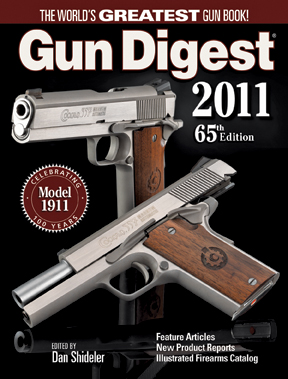
This article is an excerpt from Gun Digest 2011. Click here to get your copy.
Other new Lyman products for handloaders include a Big Dipper Casting Furnace, Big Dipper Casting Kit, Cast Iron Lead Pot, Magnum Inertia Bullet Puller, and a Universal Case Prep Accessory Kit. The Big Dipper Furnace has a 10-lb. capacity, features heavy-duty aluminum construction with a stable non-tipping design, and operates on 115 volts.
Heat-up time is rapid, with control to +/- 10 degrees. (The Casting Kit contains the BD furnace, a casting dipper, ingot mould, Super Moly Bullet Lube and the Lyman Reloading and Cast Bullet Guide – everything needed to get started in casting bullets, except for a bullet mould of the required size.) The Cast Iron Lead Pot has a 10-lb. lead capacity and is flat-bottomed to reduce tipping. A heat source, such as an electric hotplate, is needed to melt the lead and keep it hot. (With the older iron pot I used to use a tripod, similar to what plumbers used at one time, over a single gas flame; it worked.)
To salvage the components when you make a reloading flub, the new Magnum Inertia Bullet Puller will be handy. With a full size handle for comfort, the Puller features a head design capable of handling case sizes from the FN 5.7x28mm to the largest magnum. Insert cartridge, secure cap, strike puller on a solid sur face. (A 6×6-inch square, inch-thick plate of cold-rolled steel works very well as a surface on which to strike the Puller.)
Then unscrew the cap and remove the bullet, powder and case. Depending on the cartridge, bullet seating depth, and crimp tightness, two or more strikes may be necessary, but it will eventully remove the bullet.
The Universal Case Prep Accessory Kit features eight small tools to fine-tune trimmed cartridge cases prior to reloading. Packaged in a folding zippered storage pouch are a pair each of primer pocket reamers (small and large), primer pocket cleaners, primer pocket uniformers, and inside and outside deburring tools to eliminate the sharp edges on a trimmed case mouth. A new Carbide Cutter Head for the Lyman Case Trimmer and a new Universal Carbide Case Trimmer are available. (The Carbide head holds its sharp edge much longer than the regular steel trimmer head.)
The Sporting Arms and Ammunition Manufacturers' Institute (“SAAMI”) has adopted the 6.5 Grendel as an official SAAMI cartridge. As a result of the cartridge's official recognition, ALEXANDER ARMS® will relinquish the trademark “6.5 Grendel.”
Bill Alexander states: “One of the primary purposes of trademarking the name was to protect the integrity of the design. With the adoption of the 6.5 Grendel cartridge standard by SAAMI, the design is now protected and any confusion in the marketplace as to the specification of the cartridge has been eliminated.”
SAAMI's formal adoption of the design specifications for the cartridge has led ALEXANDER ARMS® to announce that it will relinquish its federally-registered trademark and that “6.5 Grendel” is to be the common commercial name for a cartridge that adheres to the specifications adopted by SAAMI.
About the 6.5 Grendal
With the addition of the 6.5 Grendel® to the product lineup at Alexander Arms, the history of no compromise design, engineering and innovation continues. The 6.5 Grendel® provides an extreme range capability for hunting, competition and tactical applications at ranges way beyond those previously achievable with this class of weapon. The 6.5 Grendel® has the flexibility to move from lightweight varmint bullets in the 90 grain class, which offer superb accuracy for competition and small game shooting, to mid weight 108/120 grain competition bullets and then on to 130 and 140 grain bullets, ideal for longer range, tactical shooting.
The 6.5 Grendel® is challenging the status quo in Military and Law Enforcement units around the world. First unveiled in May 2003 at the Blackwater Training facility in NC, the 6.5 Grendel® out-shot the 7.62 NATO at range with half the recoil. Still supersonic at 1200 yards, the 6.5 Grendel® delivered superior external ballistics to the 7.62 NATO. Utter reliability, superior external and terminal ballistics than the current state of the art, outstanding accuracy in a lightweight M16/AR-15 platform it is what appears to be the pinnacle for what may be achieved in the M16/AR-15 chassis. The 6.5 Grendel® is not a series of compromises, but rather the perfect marriage of mechanical function, internal, external and terminal ballistics all working in harmony.
SPARTANBURG, S.C. – A South Carolina sheriff is urging women to get concealed weapons permits and carry guns to protect themselves.
Spartanburg County Sheriff Chuck Wright made the suggestion Monday while discussing the arrest of a suspect in an attempted rape last weekend.
Walter Monroe Lance, 46, of Spartanburg, was charged Monday with kidnapping, first-degree criminal sexual conduct and grand larceny in a Sunday attack on a woman walking her dog in a park.
“This lady's life was threatened so many times during this act – it's almost too bad that somebody with a concealed weapons permit didn't walk by and hear the cries. That would have fixed this,” Wright said.
“If we don't do something in our society to change the way our justice system is not working, that's about what you're going to have start having. … People are sick and tired of doing the right thing, doing the right thing, doing the right thing, and then people popping right back out of jail on account of a technicality. Read more
The purpose of primers is to ignite the main powder charge. However, there are more considerations than mere caliber and type when looking at the ignition end of a cartridge.
Pistol primers should not be used in rifle cases since they will seat too deeply as in the case on the left. Center case shows proper seating depth while high primer on the right will give poor ignition and possible slam-fire in an autoloader.
Match locks, equipped with a slow-smoldering fuse made of chemically treated rope called a “match,” would burn out in damp weather and could be blown out by wind. Wind and damp were the enemies of flintlocks that could blow the priming charge out of the funnel-shaped pan or saturate it with moisture to the point where it would not catch fire. Rust and powder fouling in the tiny tube that connected the charge in the pan to the propelling charge in the barrel often prevented a successful firing with only the priming charge burning.
The expression “a flash in the pan” is still used to describe a person or enterprise that shows promise, but fails to get past a good beginning. Under the best of circumstances, the flintlock system gave only reasonable reliability. A small piece of cut flint held in the jaws of the hammer struck a steel cover on the pan called a frizzen, knocking it open and scraping the inner side to throw sparks into the powder charge in the pan.
In terms of speed it was slow. Anyone who has seen a flintlock fired is familiar with the puff-boom! sound of the report as the priming charge burns with a one-beat pause before the propelling charge fires. History is filled with untold numbers of targets, animal and human, who have ducked to safety during that beat, which was sometimes two beats if the day was damp and the tube to the barrel a bit clogged.
Berdan (left) and Boxer primer pockets show the differences in the systems. The ease of reloading made the Boxer primer standard in the U.S. (Photo courtesy CCI.)
Explosives such as fulminate of mercury and mixtures including potassium chlorate that detonated when crushed or struck, were discovered late in the 18th century. After attempts to use them as substitutes for gunpowder failed, they received little attention until the early 19th.
The breakthrough to improved ignition was made by a Scottish Presbyterian minister, hunter, shooter and gun buff — Reverend Alexander Forsythe — who was the first to come up with the idea of using these detonating explosives to ignite propelling charges in firearms. He received a patent in 1807 for a system that did away with the priming pan on the flintlock and filled the tube leading to the barrel with a percussion explosive made of sulphur, potassium chlorate and charcoal.
A metal pin was inserted on top of the explosive which caused it to detonate when struck by the gun's hammer. The ignition was far faster and more certain than the flintlock. Forsythe improved his design by attaching a small iron bottle containing a supply of percussion explosive to the side of the lock. The bottle could be tipped or turned to deposit a small pellet of explosive on a touch hole which would be struck by the hammer. The system worked effectively. However, it involved having a small iron bottle filled with explosive very close to the firing point and to the face of the shooter. I have never encountered a report of an accident with a Forsythe lock, but if one happened, it would almost certainly have been fatal.
The superiority of the Forsythe system was soon recognized and dozens of priming systems were introduced including percussion wafers, tubes and strips of paper caps, much like those used in toy cap pistols.
The most successful was the percussion cap invented in about 1814 by Joshua Shaw — a British subject who emigrated to America. Shaw's system featured a small steel cup, about the size of a modern large pistol or large rifle primer. The closed end contained the explosive held in place by a tinfoil cover then sealed with a drop of lacquer. This made it waterproof as well as damp proof. The cap was fitted on a short iron nipple, hollow in the center, screwed into the breech of the barrel.
This allowed the fire to enter the chamber of the gun. Shaw came to America in 1814 and began perfecting a lock to work with his invention. Shaw caps were on the market by 1821 and were soon adapted to sporting guns. Improvements were made by changing the cap metal to pewter and later copper. Similar caps were in use about the same time over most of Europe. The percussion cap was not adopted by the U.S. military until after the Mexican War. The military thinking at the time was that the percussion cap was yet another component the soldier had to carry and not reusable in the manner of a gun flint.
Percussion caps made the Colt revolver a practical reality, but the shortcomings of this system became apparent when repeating rifles were made using this system. A “flash over” from one chamber to the next would occasionally send a bullet coasting by the side of the gun. With a handgun this was of little consequence since it was a one-hand weapon. With the rifle or shotgun such an event often amputated the fingers or thumb of the hand supporting the fore-end of the weapon. Revolving rifles, not surprisingly, did not gain much popularity.
Breechloading arms, other than revolvers, using percussion ignition did not fare much better mainly because no one was able to come up with an effective means of engineering a gas-tight seal at the breech closure.
Not surprisingly the first really successful breechloaders and successful repeating arms, other than revolvers, required a self-contained, self-primed cartridge. The step to the rimfire cartridge from the percussion cap was a small but logical evolution. George Morse placed a percussion cap in the head of a metal cartridge using a hairpin-shaped anvil inside the case to fire it. Hiram Berdan shortened the hairpin to a tiny knob, while Edward Boxer placed a tiny anvil inside the cap.
Lee Hand Press Kit is a modern version of the old “tong tool.” This kit includes dies, case lube, powder dipper, etc., for a little over $65.
CENTER PRIMED Centerfire ammunition soon pushed all the other non-reloadable types out of the market because it was reloadable. Rimfires were gradually reduced to those types that were small and efficient in calibers that would not lend themselves to reloading.
The military had great influence in ammunition development stipulating that any ammunition developed for a military small arm had to be reloadable. Spent cases were collected and returned to a government arsenal for reloading during peacetime. Professional hunters in the American west needed cartridges they could reload themselves with simple tools. It was this type of equipment that first appeared in the 1870's.
Early priming mixtures used fulminate of mercury or potassium chlorate, eventually, a combination of both. These fulfilled most of the criteria for good ignition — speed, reliability, uniformity and cleanliness, with the possible exception of cleanliness. While the chlorate-based primers did not leave an appreciable residue, they did leave a highly corrosive deposit — potassium chloride — that would eat away a percussion nipple or the web of a cartridge unless neutralized by cleaning with water that removed the salt deposit. The mercury-based compounds were both clean and non-corrosive. Their drawback came when used in combination with brass or copper primer cups and brass or gilding-metal cartridge cases.
When fired, the mercury would amalgamate with the copper or brass, making it extremely brittle. The heavy fouling of blackpowder had a mitigating effect on mercury contamination, keeping it in the fouling allowing removal. With smokeless powder, reloading and firing such a contaminated cartridge case can lead to a case-head rupture. In a high pressure loading this can wreck a gun and possibly your face. Mercuric priming was gone from commercial ammunition by about 1945, but mercuric primers made prior to this time were used by commercial reloaders after that and some of them may still be on shelves somewhere.
Because fulminate of mercury contains free, liquid mercury, this mercury will actually migrate through the priming mixture and into the metal of the primer cup or cartridge head after a certain number of years. Ammunition primed with mercuric mixtures made in the early 1930's will probably not fire today while ammunition loaded with chlorate priming made during the Civil War is often still viable, so long as neither the powder or priming compound has been exposed to moisture. Thus a fifth criterion should be added to a successful ignition system — long life.
From 1928 through 1935 American manufacturers worked to perfect a priming mixture akin to the one developed in Germany that was non-corrosive and did not contain mercury. The basis of such priming is in compounds of lead, barium and antimony.
>Early non-corrosive, non-mercuric primers did not work very well, giving uneven ignition. Priming material often fell out of the rim in rimfire cartridges as the binding material — a vegetable-based glue — deteriorated.
THE MODERN PRIMER
The RCBS APS primer feeder uses plastic strips instead of the conventional stacking tube, reducing the hazard of sympathetic detonation. (Photo courtesy RCBS.)
Modern primers of the lead, barium and antimony type fulfill all the necessary criteria for good ignition. The binders are now stable and remain stable for long periods under normal “house” storage conditions where temperatures are under 125 degrees Fahrenheit and moisture is kept at a reasonable level. The newest are the “lead free” primers of tetracene. These, however, are not presently sold as reloading components since the production demand is for finished ammunition. The primary use of such primers is in handgun ammunition to be fired in indoor ranges where airborne lead could present a health hazard.
Because of the difficulty of reloading them, cartridges using Berdan primers and the Berdan primers themselves have virtually disappeared from the U.S. Foreign cartridges often still use this type of priming and can only be reloaded with Berdan primers.
Any attempt at “converting” Berdan cases to Boxer priming by drilling them in some manner will not work and such attempts are very dangerous since they will greatly enlarge the flash hole and may damage the web. At best such conversions give uneven ignition; at worst they can raise pressures to dangerous levels by causing too rapid a burn of the powder charge. The only current source for Berdan primers and Berdan decapping equipment is The Old Western Scrounger.
A modern Boxer primer differs little in structure from those made over a century ago. It is a brass cup containing the priming compound. A paper seal keeps the compound in the cup and is held in place by the metal anvil made of harder brass. A better understanding of metallurgy and chemistry has resulted in a more uniform primer as well as ones which are specifically tailored to a particular type of cartridge.
Primers for pistols and rifles come in two basic sizes: “small” (.175″ diameter) and “large” (.210″ diameter). There is a .317″ primer manufactured by CCI used only in the .50 Browning machine gun cartridge – loaded by a few shooters using extra heavy bench-rest rifles in this caliber.
Small pistol primers are used in such calibers as 25 and 32 caliber handgun ammunition while the large size are used in 41, 44 and 45 caliber handguns. Large pistol primers are also made in a “magnum” variant. These are for large capacity cases using slow-burning powders that are harder to ignite and require a longer-burning, hotter primer to draw the most uniform and complete burning from these powders.
Rifle primers are made in the same two diameters as pistol primers and are designated “small” and ”large” although they are slightly higher to fit the deeper pocket in the rifle cartridge case. For this reason pistol primers should not be seated in rifle cases since they will seat too deeply and will thus often give uneven ignition. Rifle primers contain more priming compound than pistol primers since they have to ignite more powder in larger capacity cases. If you are loading both handgun and rifle ammunition, care must be taken not to mix rifle and handgun primers.
If rifle primers are seated in pistol cases they will not fit properly. They can also raise pressures to the danger point. Pistol primers tend to burn cooler, and produce more of a flame type of explosion — good for igniting fast-burning pistol powders. Rifle primers burn longer and hotter. They often contain metallic elements such as aluminum which create burning sparks that are blown forward into a charge of slower-burning powder.
This separates, the grains thus setting the charge on fire in a number of places at once to achieve an even burning of the charge. This explosive quality is known as “brisance.” Magnum rifle primers have still more compound, burn longer and hotter and are used in very large-capacity cases such as the 458 Winchester Magnum. Companies such as CCI also market a “bench rest” rifle primer.
This is simply a standard rifle primer, but made to very strict tolerances assuring the reloader that each primer in a given lot will have a very precisely measured amount of compound and that the diameter and hardness of all components are within very strict tolerances. These premium-quality primers give very even ignition needed for the exacting demands of the expert, competition target shooter.
Shotshell primers have special characteristics needed to work properly in modern, plastic shotshells. Early shotshells were made of brass and were generally of a rifle-type of construction. They used rifle-style primers. Modern shells are of a composite construction with a metal head surrounding a paper, now primarily a plastic body. Inside is a base wad made of plastic or compressed paper.
Shotshells have unique ignition problems. As the mouth of the shell becomes worn and softened with repeated reloading the opening of the crimp becomes progressively easier. Modern shotgun powders require a certain amount of pressure and confinement to function properly. This decreases as the crimp softens. For proper ignition, the powder requires a very high temperature over a longer than usual burn time but without the brisant quality of the magnum rifle powder which would tend to blow the crimp open before much of the powder was ignited. A shotshell primer produces what is often referred to as a “soft ignition.”
Because of the design of modern shotshells, the primer is held in a large, longer than normal housing called a “battery cup” which extends well into the base wad so the flame issuing from the primer mouth will not be inhibited by any part of the wad and can direct its full blast into the powder charge.
Detroit — Video surveillance footage shows a 5-year-old girl's confusion as she watches her mother's boyfriend stumble around a gas station after he was shot fending off a would-be carjacker.
Police said a36-year-old man was pumping gas into a black Cadillac Escalade shortly after 7 p.m. at a Citgo gas station on Fenkell near Schaefer when he was attacked by a man who wanted to steal the luxury truck.
According to police, the carjacking victim returned fire and killed the man who tried to take his SUV. The victim's girlfriend was inside the gas station buying a pop while her daughter was inside the SUV, according to the video.
Thecarjacker shot the victim, who fell to the ground, pulled out his own handgun and opened fire as the suspect entered the Escalade, witnesses said. More than 20 shots were exchanged and the suspect waskilled, said Detroit Police Cmdr. Steve Dolunt.
The carjacking victimwas hit multiple times, including in the face and body, police said.
The carjacking victim had a valid permit to carry a concealed weapon, according to police. Read more Source: detnews.com
I read a lot about mindset and what it takes to be a (insert your favorite here cop, operator, warrior, etc.). Then I take a look at the people who are saying this stuff and I wonder: If you have the warrior mentality, why not use that to push yourself away from the dessert tray? You might think you can “Keep going and continue the fight no matter what” but if you can't even make time for 30-minutes of exercise three times a week… don't tell me how you are going to drive on when the going gets tough. There is not reason at all you can't get up out of bed each morning and do 30 push-ups. Unless you can't do 30 push-ups. And if you won't even try… well then, I'm not too worried about your gun or your knife or you mall ninja cred. If you don't take the smallest step to get yourself in shape, my guess is you don't really tie up a lot of time training you other skills.
Nike says, Just Do It. So? What's stopping you? Get out and do something… Walk for 30 minutes today… then alternate walking and running for 30 minutes tomorrow… pretty soon, you will be running for the entire 30 minutes. Now you have some goals. How about this? Max effort push-ups for two minutes. How many can you crank out … do it every other day for six weeks and watch the number grow.
I am no marathon runner and I don't have the arms and the abs of an Olympic gymnast, but I swim, run and lift at least three times a week.
Looking to go armed, but are stuck in the weeds as to what to arm yourself with? Here are 20 excellent concealed carry gun options that will keep you on the defensive.