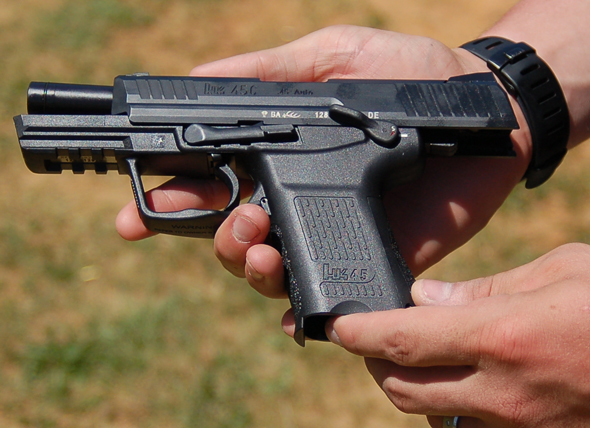
The HK-45 C was dunked in water, abused in heat and mud, and fired from difficult positions and came through without a hitch.
Take a new pistol out of its box and subject it to field conditions in the hands of some of the toughest, most dedicated men in the U.S. Army and it will either fail the test or pass on its own merits.
Otherwise nearly identical in features to the full-size HK45, Heckler & Koch has introduced the new HK45-C Compact with a slim-line grip profile. It could be just another pistol, but H&K has such faith in its performance and durability that it donated new guns to the Army for its 2011 Best Ranger Competition April 15-17 at Fort Benning, Georgia.
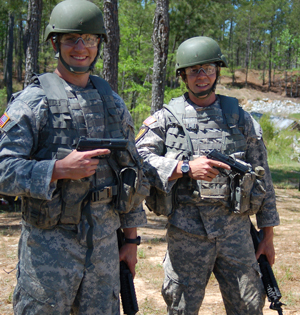
The competition consists of enough physical and mental tasks to make a fighter in the octagon beg for mercy. Over the three days the Army intentionally provides very little rest or nourishment. Historically 60 percent of the two-man teams drop out due to injury, dehydration or exhaustion.
This event tests both men and their gear.
Day two of the Best Ranger Competition features an endurance event that is billed simply as “Day Ranger Stakes.” Upon command a team begins a series of competitive challenges while fully outfitted including helmet and protective vest: firing the M4, hauling 200-pound skeds over obstacles and through culverts, firing combat shotguns off-hand and firing pistols from prone positions through a small ground-level slot. Is the pistol up to it?
The Pistol
The HK-45 Compact, chambered for .45ACP, has numerous features that will interest tactical operators, law enforcement officers and even competition shooters. Here’s how it stacks up compared to the HK45 from which it is derived:
Barrels for the Compact are made in a cold-hammer forging process giving rise to steel with improved strength which means it holds its straightness tolerances even under stressed conditions. The
HK45 series also uses a proprietary HK O-ring barrel for precise barrel-to-slide lockup and repeatable accuracy.
HK’s unique internal mechanical recoil reduction system reduces the force of recoil.
H&K spec sheets note that anticipated service life for the HK45-C is 20,000 rounds, which should be more than enough for any training, deployment or home-defense situation.
Both the HK45 Compact and full-size HK45 use an improved USP-style control lever, a combination safety and de-cocking lever. The lever is frame-mounted and is quickly accessible; it has a positive stop and returns to the “fire” position after de-cocking.
Back at the contest…
The HK-45C did all that was asked of it by competitors in the Best Ranger Contest. The pistol was dunked in the water, abused in the heat and mud, fired from various positions at typical combat pistol distances and came through without a hitch.
Officially, the Rangers were barred from evaluating any supplied products during or after the competition, but several competitors noted that they were enthusiastic about the comfortable feel and ease of target acquisition with new HK-45C.
Suggested retail price is $1,147 for the DA/SA model with control lever and $1,237 for the LEM enhanced DAO model without control lever. Heckler & Koch is currently building the HK45C at HK’s new American manufacturing facility in Newington, New Hampshire.
A decade ago, Michigan became a “shall issue” state for concealed carry permits, meaning officials had to award a permit to anyone meeting standard qualifications. That permitting change has been embraced by Michigan citizens.
As the Jackson Citizen-Patriot reported, “Statewide, one in 26 eligible-age adults has a license to carry. There are more than 270,000 permit holders, double the amount five years ago … Phil Sheridan Sr. of Sheridan Arms sees all walks of life applying for CCWs in his Saginaw Township gun shop and training center.”
“From young to old, male to female, single to married,” Sheridan said. “I’ve had people in wheelchairs that I’ve trained … after all, they still have the right to defend themselves.”
Many Michiganders cite crime as the main reason for their permit. “You’re out here in rough neighborhoods,” said Tishumbe Franklin, 37, who owns a private security company in Flint and recently had his carry permit approved.
But the most surprising reason for concealed carry here? Wildlife.
“About half that called me [for carry classes] are worried about wolves, wolves that will kill their dogs,” said Paul Ewing, who teaches a pistol safety course in the Upper Peninsula. “That’s the number one reason I hear. It’s not so much about crime.”
“In Keweenaw County, where nearly one in 10 adults has a concealed pistol license, most people carry their handguns for hunting, County Clerk Julie Carlson said.”
“It’s not for protection from people,” Carlson said. “It’s protection from animals.”
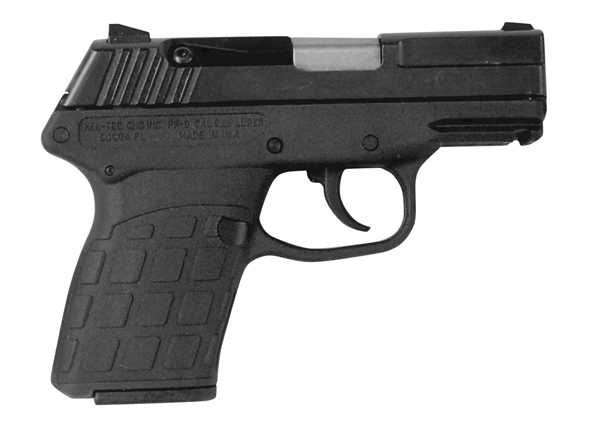
Imagine a 9mm Parabellum pistol that is lighter and as small or smaller than most .32 ACP pocket pistols. Want one? Well, you can have one – because that is just what the Kel-Tec PF-9 is.
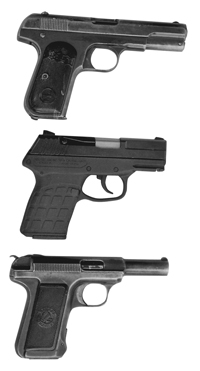
Imagine a 9mm Parabellum pistol that is lighter and as small or smaller than most .32 ACP pocket pistols. Want one? Well, you can have one – because that is just what the Kel-Tec PF-9 is. A 14.5 ounce powerhouse only .880 inches thick, 5-3/4 inches long and 4-1/4 inches tail. Compare that to the famous Colt Model M .32 ACP at 24 ounces and 6-1/2 inches long or the Savage 1907 .32 at 19 ounces and 6-1/2 inches long and you will begin to appreciate just what has been done with this 9mm pistol.
Designed to be the smallest possible 9mm, it still is a practical general purpose pistol: not an easy feat to accomplish when dealing with extremes of size and concealability. The Kel-Tec will comfortably perform most anything asked of the average pistol.
While some will point out correctly that a larger, heavier gun is more controllable in rapid fire and steadier to aim and fire, the fact remains that there is always a place for the smallest possible gun. In the first place, there are many people who will not carry a full-size pistol every day and so end up unarmed when their lives depend on having a weapon.
A .25 ACP Baby Browning in the hand is better than a Thompson submachinegun in the gunsafe when you are being attacked, and concealability is always easier in direct proportion to gun size and thickness. That’s why you don’t find people concealing Barrett .50 caliber rifles on their person, although the idea is not entirely without merit.
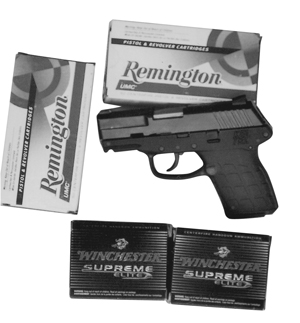
The PF-9 gobbled up 100 rounds of Remington and 40 rounds of Winchester Supreme hollowpoints without a hitch.
The more compact the pistol, the more options you have for different places and ways to conceal it. While we normally think of the .25 ACP when referring to vest pocket pistols, the fact remains that the 9mm PF-9 fits quite nicely in the modern vest pockets and it rides well concealed there. If it were any heavier, it would not.
When my old friend the late Geoffrey Boothroyd was asked by Ian Fleming what pistol his character James Bond should carry, Geoffrey said the Walther PPK. Ian repaid him by promoting the former private Boothroyd of WWII to Major Boothroyd, armorer to James Bond, in the James Bond series of books. Had the Kel-Tec been out then, I strongly suspect Geoffrey would have had James Bond carrying it instead of the Walther.
The PF-9 is a well-made, properly thought-out design that functioned with total reliability during my test firing. The gun is designed with places for dirt, fouling and miscellaneous debris to escape from the action so that it does not jam. There is a gap between the slide and part of the frame that will allow quite a bit of crud to get out at once – a desirable feature, because dirt always finds its way into guns but often is trapped there with no way to get out.
Get sand inside the lockwork of a revolver and you will find out just what I mean. It will lock up tighter than a bank vault until you disassemble it to get the sand out. Sadly, many automatics are even worse in this regard, but not the Kel-Tec.While you’re not likely to drop your PF-9 into a sand dune in the middle of the Sahara, it’s nice to know that it’s practically immune to pocket grit.
The PF-9 fits the hand weIl and does not recoil excessively. The recoil is a bit sharper than on a heavy full-size pistol but nothing that would bother women or children. That’s important because children need to grow up shooting and they don’t need a vicious kick or muzzle blast to discourage them while you are teaching them to enjoy shooting. The ergonomics of the grip and its texture combine to form a well-pointing gun that properly distributes the felt recoil across the hand comfortably.
The PF-9 has a double action trigger pull like a revolver instead of a safety. That is a very good way to go on a small hideout gun where you don’t need to waste time fumbling for a safety. The double action trigger pull is all the safety you need. The trigger requires the slide to be jacked to the rear to reset it so you won’t waste time repeatedly snapping on a misfire if you get a bad primer.
The PF-9’s trigger pull is light and can be held short just before the hammer falls when you are trying to shoot groups. I began my test session with 40 rounds of Winchester Supreme Elite 147-grain jacketed hollowpoints and 100 rounds of Remington 115-grain jacketed hollowpoints. These two loads are state-of-the-art, modern hollowpoints that give maximum explosive expansion with maximum weight retention.
They work very well on coyotes and other varmints, both four-legged and two-legged. I set up a target at 25 yards and began shooting from a sandbag rest. The gun was able to consistently make 2-inch groups, which of course is very good for this type of pistol and far better than most shooters are ever going to be capable of without a sandbagged rest.
After all, this is a defensive pistol designed for ease of carry and maximum concea!ability. Firing without the rest proved the gun was fast pointing and easily controllable in rapid fire. The sights are clear and weil defined without being so big that they get in the way.
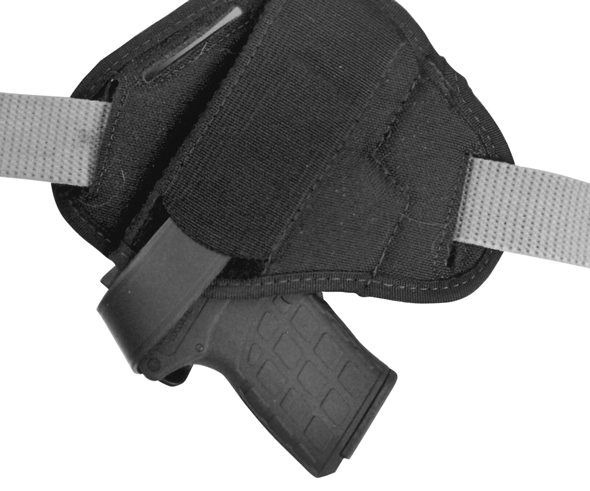
The PF-9 in a Blackhawk! size 4 nylon pancake holster. The pancake is the most comfortable and concealable holster style ever designed.
The rear sight can be adjusted for windage if necessary. The frame features a rail for a laser sight or a flashlight in the modern style. I don’t like either, especially on a subcompact pistol where they add bulk. Flashlights and lasers, like tracers, draw return fire. In my opinion, a laser’s not something to be wildly flashing about in the dark. Unlike many guns I have known, the PF-9 disassembles fast and efficiently.
Unload the pistol and pull the slide back, locking it open by pushing up the slide stop. With the rim of a cartridge, pull the assembly pin out of the gun. Holding the slide firmly, release the slide stop and allow the slide to move forward off the frame. Remove the recoil spring and the barrel and you are done. Do not loosen the extractor spring screw.
The Kel-Tec PF-9 shown between a Colt .32 and a Savage .32, two of the most popular pocket pistols of all time. The PF-9 is shorter and thinner than both – and it’s a 9mm.
To put the gun back together, put the barrel back into the slide, push the recoil spring guide with springs into their hole in the slide, and hook the base of the recoil spring onto its half-moon cutout in the barrel. Make certain that the barrel and recoil springs are well-centered when putting them back in the slide. Push the slide onto the frame until the back lines up with the grip. If the slide does not go on easily, make sure that the hammer is half cocked and the barrel and recoil spring guide are centered.
While pushing down on the top of the barrel, pull the slide back all the way, compressing the recoil springs, and push up the slide stop to hold the slide in place. Looking into the assembly pin hole, align that hole with its cut in the barrel and insert the assembly pin until it snaps onto the spring. Pull the slide back to release the slide stop and release the slide, working the slide a few times to check the action. Do not dry fire this pistol because you can damage the firing pin and extractor spring screw by dryfiring.
A modern polymer frame pistol, the PF-9 is also very reasonably priced, as are all Kel-Tec firearms. Suggested retail price is $333 for blued guns, $377 for parkerized, and $390 for chrome finished guns. I would recommend the parkerized finish for any pistol that will see hard service. Unlike most specialized pistols, this one can reasonably serve as a family’s only pistol, doing double duty as a carry gun and a bedside burgler gun in the same manner as the old topbreak S&W and Iver Johnson revolvers have done for over 100 years.
Since the PF-9 is a pocket pistol, and a very good one, some will choose to carry it directly inside a jacket or pants pocket. I prefer a holster, both because of the extra protection it offers and because it keeps the pistol oriented for immediate access. I have always found the pancake holster design to be the best for comfort, concealment, and gun security. I tried carrying the PF-9 in a Blackhawk! size 4 nylon pancake holster and was well pleased with the combination.
It fit well on both the gun and me. Made from a multi-layer nylon laminate with polymer hardware and stainless steel or brass snaps, the Blackhawk! is ideal for use in wet marine or humid environments. It features an adjustable safety strap system that lets it work on multiple guns within a certain size range. The two polymer safety straps have velcro fasteners on them that, with the aid of a special tool that comes with them, adhere to the velcro in the slots in which they’re inserted. They are then permanently in place unless the tool is used to seperate the velcro layers. The system actually works quite well.
Of course the Blackhawk holster works well in everyday concealed-carry service, too. It’s an interesting modern answer to age-old holster problems and offer a solution that will give good service in all conditions at a most reasonable price. It’s are available from Blackhawk Products Group, 6160 Commander Parkway, Norfolk, Virginia, 23502. You can also check it out at www.BLACKHAWK.com.
While the 9mm Parabellum lacks the authority of the .45 ACP as a manstopper, it holds its own quite nicely with the various .38s and even the .357 Magnum. It nicely eclipses the performance of the 9mm Makarov and the .380, .32, .25 and .22 LR and can be made in a thinner and lighter package than the .45 ACP.
Like the 1911-A1, the PF-9 holds seven cartridges in the magazine and one in the chamber for a total of eight rounds. Compare that to the five or six in a bulkier snubnosed .38 and the case for the PF-9 becomes clear. It’s available from Kel-Tec CNC Industries, Inc., 1475 Cox Road, Cocoa, Florida, 32926. They probably won’t mind if you visit their website at www.kel-tec.com.
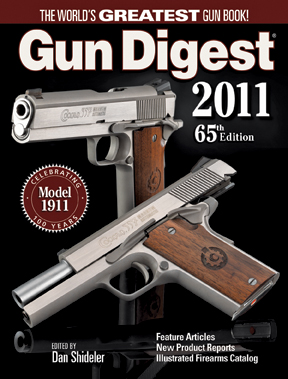
This article appeared in the 2011 65th Edition of the Gun Digest annual book.
Last year, the City of Chicago lost a lawsuit that was supposed to make it easier for citizens to own handguns. Chicago had had a complete ban on handgun ownership, but the U.S. Supreme Court struck that down in McDonald v. City of Chicago.
However, “In the year since the Supreme Court decision, the Chicago Police Department says it has received roughly 3,500 applications from Chicagoans who want to possess a handgun in their homes,” WLS Television reported.
“98 percent are approved.”
Yet, the Windy City is home to 100,000 people with the state’s firearm owner identification (FOID) card, the card necessary for an Illinois citizen to purchase a firearm. “There are 100,000 FOID owners in Chicago alone and there’s only 3,500 people who’ve applied for the handgun permit,” said gun owner Colleen Lawson. “Does that strike you as a bit of a discrepancy?”
“Colleen Lawson is one of the plaintiffs in the historic Supreme Court decision overturning Chicago’s handgun ban. She owns a gun, took the mandated training, and has her new Chicago firearm permit, all required by a new city code that Lawson and others contend is nothing more than a de facto handgun ban.”
“They came straight out and said in the meeting, ‘we want to make this as tough as possible,’ and they’ve done that,” said Lawson.
Among the hurdles to own a handgun here: “Chicagoans who want to own a handgun must go through a criminal background check, take a four-hour classroom course on firearms, and spend an hour on a shooting range. However, there are no shooting ranges in Chicago, because the city doesn’t allow it.
Applications and fingerprints require a personal appearance. There is only one place where that can be done: a city office on S. Kedzie, open only on weekdays.”
Late Monday, the Department of Justice announced that it will begin requiring gun dealers in four Southwest Border states to report multiple sales of semi-automatic rifles with detachable magazines.
This is a long-anticipated move by the Justice Department in the wake of the Operation Fast and Furious scandal. It was quickly branded as a political maneuver by Congressman Darrell Issa (R-CA), chairman of the House Committee on Oversight and Government Reform, who has been leading the investigation of the botched gun trafficking sting mounted by the Bureau of Alcohol, Tobacco, Firearms and Explosives. It also brought a quick reaction from Senator Charles Grassley (R-IA) who initially began digging into Fast and Furious in late January.
The new rule announcement reads:
STATEMENT OF DEPUTY ATTORNEY GENERAL JAMES COLE REGARDING INFORMATION REQUESTS FOR MULTIPLE SALES OF SEMI-AUTOMATIC RIFLES WITH DETACHABLE MAGAZINES
WASHINGTON – Deputy Attorney General James Cole issued the following statement today regarding information requests for multiple sales of semi-automatic rifles with detachable magazines in select states along the Southwest Border:
“The international expansion and increased violence of transnational criminal networks pose a significant threat to the United States. Federal, state and foreign law enforcement agencies have determined that certain types of semi-automatic rifles – greater than .22 caliber and with the ability to accept a detachable magazine – are highly sought after by dangerous drug trafficking organizations and frequently recovered at violent crime scenes near the Southwest Border. This new reporting measure — tailored to focus only on multiple sales of these types of rifles to the same person within a five-day period — will improve the ability of the Bureau of Alcohol, Tobacco, Firearms and Explosives to detect and disrupt the illegal weapons trafficking networks responsible for diverting firearms from lawful commerce to criminals and criminal organizations. These targeted information requests will occur in Arizona, California, New Mexico, and Texas to help confront the problem of illegal gun trafficking into Mexico and along the Southwest Border.”
SOME BACKGROUND FROM DOJ:
To address the problem of illegal gun trafficking into Mexico, ATF will send an information request to Federal Firearms Licensees (FFLs) in the four Southwest Border states: Texas, California, Arizona, and New Mexico. The point of this request is to provide a targeted approach to address the problem of illegal gun trafficking through sales to “straw purchasers,” people who claim to be the true buyers of firearms but in reality are purchasing firearms on behalf of others.
ATF will tailor the information request to address the specific threat. It applies only to firearms dealers in the four border states, and its prospective reporting requirements apply only if a firearms dealer sells within five business days to a single individual two or more long guns having all of the following characteristics:
o Semi-automatic action;
o A caliber greater than .22, including .223 caliber firearms; and
o The ability to accept a detachable magazine.
The issuance of ATF’s information request follows two periods of public notice and comment, as required by law. On December 17, 2010, ATF published a notice in the Federal Register requesting public comments on the information request for 60 days. After reviewing the comments submitted in response to this notice, ATF published a second notice in the Federal Register on April 29, 2011, requesting public comments for 30 days. OMB reviewed the last set of public comments before approving the information collection request.
Here is Issa’s blistering response:
“This political maneuver seems designed to protect the careers of political appointees at the Justice Department and not public safety. It’s disconcerting that Justice Department officials who may have known about or tried to cover-up gunwalking in Operation Fast and Furious are continuing attempts to distract attention from clear wrongdoing. In Operation Fast and Furious, gun dealers didn’t need this regulation as they voluntarily provided ATF agents with information about suspected straw purchasers. In return for this voluntary cooperation, the Justice Department betrayed them by offering false assurances that they would closely monitor sales of weapons that dealers otherwise did not want to make.” Read more
National Rifle Association (NRA) Executive Vice President Wayne LaPierre and the NRA`s Institute for Legislative Action Executive Director Chris W. Cox joined Governor Scott Walker as he signed the Wisconsin Personal Protection Act into law. This makes Wisconsin the 49th state to give law-abiding citizens an option to carry a concealed firearm for personal protection.
“For everyday crime victims, Right-to-Carry is the difference between no chance and a fighting chance. That is why the NRA`s commitment to freedom, the Second Amendment and the self-defense rights of good people everywhere never wavers,” said LaPierre. “Today`s signing ceremony is proof of the value of the hard work, dedication and perseverance of NRA members in Wisconsin.”
“This is an historic day for the Right-to-Carry effort not only in Wisconsin, but across the country,” said Cox. “The fundamental, individual, God-given right to self-defense must be respected. I’d like to thank Senators Galloway and Zipperer, Reps. Mursau and Suder and Gov. Walker for their dedication to freedom.”
“By signing concealed carry into law today, we are making Wisconsin safer for all responsible, law abiding citizens,” said Gov. Walker. Read more
ATF whistleblower says ATF Director Kenneth Melson 'horribly irresponsible.'
One of the original whistleblowers on Operation Fast and Furious — which allowed thousands of guns to cross the border into Mexico — said Acting Director of the Bureau of Alcohol, Tobacco, Firearms and Explosives (ATF) Ken Melson’s testimonybefore congressional investigators on July 4 was nothing but “smoke and mirrors.” ATF Special Agent Vince Cefalu continued:
At this point he’s doing what anyone would do, he’s saving his own ass.
According to a release from Issa’s office, Melson secretly talked to House and Senate investigators with his personal attorney present — former United States Attorney Richard Cullen — and did so without the knowledge of the ATF or the Department of Justice.
Cefalu said the operation was never about actually arresting cartel members for arms trafficking, it was about headlines for the ATF and its upper echelons, more budget, more gun control, and more media attention for ATF:
There’s no Mister Big in Mexico, there’s no … Iron Pipeline. It doesn’t exist.
When everybody is screaming terrorism and counterterrorism no one wants to talk to anyone but the FBI. If there’s gunrunning on the border and thousands of guns flowing into Mexico it’s more headlines for ATF.
It’s fame and glory and grabbing headlines. Read more
The English Lee-Enfield series of rifles is really a castoff design the Americans didn’t want. Back in the 1880s, American inventor James Paris Lee took a design that had failed to catch much attention in the U.S. over to Great Britain.
The British adopted the design and shortly were cranking out thousands of the rifles using Lee’s action modified to fire the .303 British cartridge and a 10-round magazine. The final design work was done at the Royal Small Arms Factory at Enfield, so the rifle has forever been linked with the name where it was engineered.
The history of the design and use of each model of the Enfield series would take up much more room than I have in this column. In this month’s Collector’s Corner I shall discuss one of the final variations of the Enfield series, the rifle No. 5 Mk. 1.
The Lee-Enfield Rifle No. 5 Mk. 1 is usually known as the “Jungle Carbine.” Although that was always a nickname for the model, it was never called a Jungle Carbine in official terminology. In late 1942 the British Infantry Weapons Development committee began research on a shorter and lighter version of the standard-issue rifle, the No. 4 Mk.1. It was intended for use mainly in the Far East where jungle fighting in difficult terrain had shown the full-sized SMLE and No.4 Mk.1 rifles to be too large and heavy.
Through much of 1943 various design features were submitted and the final result was the carbine we know today. During its design stage the rifle was referred to as a “No. 4 lightened rifle”.
On March 21, 1944 the finalized design of the new rifle was approved. On Sept 12, 1944 the name of this model was officially changed to Rifle, No. 5 Mk. 1. The features unique to the No. 5 Mk. 1 rifle are:
The action is the same as the No.4 but has been lightened by removing steel in some areas.
The 20.5 inch barrel includes a pinned-on flash eliminator.
The rear sight is graduated to 800 yards, instead of the 1300-yard sight found on No.4 rifles.
The butt stock has a rubber recoil pad
Production of the new rifle began at the Royal Ordnance Factories at Fazakerly and BSA Shirley. Although several thousand No. 5 rifles were made before WWII ended in August 1945, the design did not see a lot of combat use during the war.
Production of the No. 5 rifle continued after the war. The rifle was popular with troops because it was shorter and lighter than other models. There were however continuing complaints that the rifle could not shoot with consistent accuracy. The ordnance officials called this problem “wandering zero.” It seems rifles calibrated at the arsenal or in the field would shoot acceptably for a while then become increasingly inaccurate.
There were several attempts to determine if there was a design defect that caused this problem but they never settled on a single cause. A significant factor in the lack of accuracy is apparently the flash hider. In tests of rifles without it they held the accuracy for more shots. But that was one contributing factor, not the cause. Other things that might factor in are the length of the fore stock, lightning cuts on the receiver and barrel, and methods of holding the barreled action in the wood.
In the end they decided not to do anything to fix the problem, they declared the No. 5 rifle obsolete in July 1947. Production died down by late 1947 with the final rifles being assembled at Fazakerly in December. According to “The Lee-Enfield Story” there were approximately 250,000 No. 5 Mk. 1 Rifles produced. This figure is not certain as there are some overlap and discrepancies in factory serial number records.
As they were removed from British service some No. 5 rifles were given or sold to other nations. Throughout the 1950s many were sold on the surplus arms market and ended up here in the U.S. Most in the U.S. came in before 1968. Some were imported in un-issued condition. The 1947-dated No. 5 I used for this column shows no signs of use. The going price for one of these minty Jungle Carbines usually runs $400 to $700 if the rifle has matching numbers.
No. 5 rifles with WWII dates of 1944 or 45 will bring more than the 1946- or 1947-dated guns. There have been a few small lots of No. 5 Mk.1 rifles imported in the last decade. Many of these come out of Malaysia. They show signs of being used in a wet climate. Many will have rust and pitting on steel edges where the steel touches wood as well as water stains in the wood. Most will have rotted rubber recoil pad. These sell in the $200- $350 range.
Modern Copies
In the 1980s and 90s many thousand SMLE No. 1 Mk. III and No. 4 Mk.1 rifles were imported to the U.S. Because there is a limited market for the old battle rifles, the importers were left with more guns than they wanted. Navy Arms and other companies began converting their rifles into reproduction Jungle Carbines or similar models. The most common example is a Jungle Carbine made from a SMLE No. 1 Mk III. The seller shortened the barrel and installed a reproduction flash hider/front sight. Some have the recoil pad added. Others retain the original metal butt plate. These are available in .303 British or .308.
The easiest way to identify one of these modified rifles is to note the position of the rear sight. The SMLE rear sight is on top of the barrel. The rear sight on a No.5 Mk.1 is a peep sight on the top of the receiver, above the bolt handle. There were close copies of No. 5 made from No. 4 rifles that are hard to tell from original.
I can’t label these guns as “fake Jungle Carbines” as the firms that offer these rifles make no attempt to cover the nature of these guns. They are simply taking a slow-selling model and changing it to another variation to add to their product line. These non original carbines sell for $250-$350. I guess it shows the popularity and fame of the original Jungle Carbine that they can crank out copies that sell as well as the originals.
This article appeared in the June 20, 2011 issue of Gun Digest the Magazine.
Virginia O’Brien, Special Agent in Charge at the Bureau of Alcohol, Tobacco, Firearms and Explosives Tampa Field Division, ran a gun-running investigation that was walking guns to Honduras using the techniques and tactics identical to Fast and Furious, it was reported to these correspondents this evening via private correspondence from a proven credible source.
On 21 September, 2010, A. Brian Albritton, United States Attorney for the Middle District of Florida issued a press release on Operation Castaway:
United States Attorney A. Brian Albritton, Virginia O’Brien, Special Agent in Charge of central and northern Florida Bureau of Alcohol, Tobacco, Firearms and Explosives (ATF) operations, and Susan McCormick, Special Agent in Charge, U.S. Immigration and Customs Enforcement (ICE), Homeland Security Investigations, Tampa Field Office announce the initial results of Operation Castaway, an intensive and wideranging Organized Crime and Drug Enforcement Task Force (OCDETF) firearms trafficking investigation conducted by ATF, ICE, the Orange County Sheriff’s Office, the Osceola County Sheriff’s Office, the Brevard County Sheriff’s Office, and the Miami-Dade Police Department. ATF describes Operation Castaway as the most significant firearms trafficking investigation in Central Florida history.
According to court documents, a group of defendants connected to Hugh Crumpler, III, were involved in a major international gun trafficking operation. . . . Firearms like those involved in this investigation are often smuggled through Honduras and other Central and South American countries before being used in violent crimes in Mexico and other countries in the region. A number of the firearms trafficked by the defendants in Operation Castaway have been linked to violent crimes around the world.
The press release concluded, “This case is being prosecuted by Assistant United States Attorneys J. Bishop Ravenel and E. Jackson Boggs. Operation Castaway remains an ongoing investigation.” Read more
Noted gun writer Patrick Sweeney discusses tactical rifles and his latest book, “Gun Digest Book of the Tactical Rifle.” He gives an overview of non-AR rifles such as the FN SCAR, AK, and Steyr AUG. More importantly, he offers suggestions about choosing a sling, what to look for in an optic, how much to spend on gear, and whether to practice only with agency-issued ammunition.
NSSF’s Ryan Cleckner explains the measurement term “minute of angle” (MOA) and how to use MOA adjustments on your scope for sighting in and to compensate for bullet drop at varying distances. Click here to learn more about the NSSF
Gun Digest is the source for firearms news, pricing and guns for sale. Readers benefit from in-depth editorial expert advice, show reviews and practical how-to instructions. With your Subscription, you’ll also learn about threats to your Second Amendment rights. Click here to begin your subscription to Gun Digest.
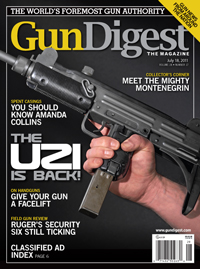
Inside this issue:
Century Arms Uzi
Improved Handgun Grips
Collecting Montenegrin Revolvers
Gun Review: Ruger Super Six
Gun shows, auctions, classifieds and more!
Not a subscriber? Make sure you don’t miss another issue! Subscribe now
During World War II Remington Arms Company built nearly 28,000 Model 1911 .45 automatic pistols as a contribution to the war effort. After that run in manufacturing the company dropped the hard-hitting from its line for some six decades. It’s back!
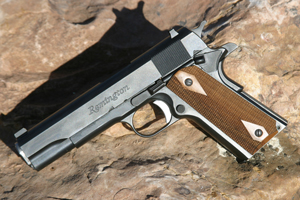
The new Remington 1911 R1 .45 Government has moved from a marketing idea to reality and it is slowly getting into the hands shooters. With a basic design taken right from the original 1911 playbook, Remington has stayed with the shallow main spring, military controls, and all-steel construction. Remington has also emblazoned the new R1 with the big “R” along the side of the ubiquitous 1911 slide.
It took lots of sweet talking and a strict promise to return the test gun as soon as possible, I was lucky enough to get Chris Ellis, and Todd Sigmund of the Remington promotions department to turn a sample loose for some proper field evaluation work. Don’t misunderstand me here. If I had my way that gun would never leave my gun vault, but thanks to the very limited production of the weapon at the time of the review, finished guns were going to buyers instead of gun writers. I got lucky.
The 1911 and I go back to just after the end of WW II. In those days the guns came back to U.S. arsenals as surplus products, and as such the DCM program though the NRA would allow members to pick these guns up for just a few dollars each. I have owned Colts, Singer Sewing Machine, and Remington Rand variants of the big handgun over the years and am still a fan of the pistol today. In that I am most assuredly not alone.
The Remington 1911 R1
The new Remington 1911 R1, is “old school” in terms of about 90 percent of the weapon; so much so that it fits the mold when SASS shooters turn to Wild Bunch shooting competition with the .45 Government versus a six gun. Save for the sights and a few bright metal areas at the muzzle and trigger, the gun is a dead ringer for that first Government Model 1911 Doughboys carried to World War I.
Save for the sights and a few bright metal areas at the muzzle and trigger, the R1 is a dead ringer for that first 1911 the Doughboys carried to WWI.
Just handling the gun was like coming home again for an old-time .45 shooter like me. I have not shot any pay targets, or dropped a bad guy with one as a police officer, but I have sent one pile of ammo at paper, snakes and even a few irate raccoons or coyotes on night hunts in the past. There was a short period of time, when I was a police officer, that I was lobbying for the gun as a duty weapon as street gangs were out gunning most of us any day of the week. My idea just didn’t fly because most police chiefs are great politicians and not really all that gun savvy.
Coated in a dull blue/black The R1 is not a showboat handgun. On the other hand, the gun is nicely appointed with a quality working finish, well-made controls, and a very smooth function from the slide to the hammer and trigger. With a slide and frame of solid steel the gun is the weight of the real 1911s of old, and when you’re out of ammo it can serve well as a club if necessary.
With correct walnut stocks of the time period John Browning introduced the gun to the world, the R1 only lacks the smaller front and rear sight found on the old Army, and Cavalry models; but no one misses those. The lanyard ring has also been eliminated from the frame. Save for those small details the Remington R1 is a great duplicate of the first guns the company produced way back when.
All controls of the gun are correct and what you would expect for a 1911. The grip safety is genuine, with a full cocked-and-locked lever. Nothing has been omitted on the gun in terms of the John Browning/Colt design. I like the fact that “Remington” is stamped on the magazines, slide and frame.
Test Shooting
Testing the new Remington R1 included shooting three different brands of 45 ACP ammo. I selected several because I wanted to be sure the loads that Remington shipped were not about to be the only thing the gun tended to digest.
First up on the sand bag static test bench was the CCI Blazer brass load with a 230-grain FMJ bullet . Seven rounds at 20 yards produced some solid accuracy with a 5 1/ 2-inch vertical string and under 3-inch across. Most rounds fell into the 3-inch cluster making for a very acceptable basic workhorse, stock and standard model 1911.
Moving to Remington’s own UMC brand also with a 230-grain FMJ bullet the group opened a bit, but on the other had I was not totally up to snuff either. In effect, I think much of the accuracy loss was the shooter in this case. With 14 rounds down range at 20 yards, five of them hit the dead center mark and almost fell atop one another, with the rest as flyers out to about the 6-inch ring. Again, everything I sent out of the gun was well within center mass in terms of a combat scenario.
Shooting was topped off with a run of Magtech 230-grain FMJ ammo and like the others these loads dropped inside the 6-inch ring and stacked well within the 4-inch circle. The three white dot sights being a partridge style allowed some better sighting control even in low light.
Turning back to the Remington fodder I proceeded to shoot Birchwood Casey tactical targets (blue men) in sets of two with a 10-yard spacing, and at a distance from the muzzle of 15 yards. Shooting seven-round strings with three double taps and a final single round down range the gun never failed once to produce two rounds in the dead sure vitals, with all others making target contact between the lower ribs, arms, or belt line extremities. In five runs over the blue men targets I never failed to make the stop in under seven seconds.
In terms of function the gun never failed to cycle save for single time with CCI cartridges. In this case the rim of a case got caught on the feed ramp and bent back a bit, hanging the whole round, and causing a jam. Using the tap rack method of clearing a malfunction I was up and running again in seconds. For a total of 147 test rounds, that was the only incident that could be regarding as a function problem.
Because this gun is just about hand-made and at a mass production price ($600) I believe a number of possible problems have been pushed aside with the final product. When being built the R1 is set out on a line of assembly workers each of have a single task as the individual gun moves along toward completion. When the gun is completely assembled it is reviewed by the last individual on the line then sent to the test tunnel for a function and accuracy review.
The gun is tested with live ammo and if it fails to meet specs it is returned to the line once again for further adjustment. On the negative side this is one reason why it takes so darn long to get one of these old school Remington Arms hand cannons into a guy’s gun safe.
Future?
While it seems a bit crazy to talk abut the future of the R1 when you currently can’t get one by hook or crook, the gun will catch up in production and as such be ready for an upgrade sooner or later. The 1911 45 Government, as we all know, is an open canvas for a gun-building artist.
Remington will add different configurations to this product line as time goes by. Race guns, combat specials, and related target models will be sure to surface along the road to future development. Everything new and advanced will be based on the basic Model 1911 R 1, but the guts of the grand master in auto-loading handguns will still be that hard-pounding John Browning-designed frame and slide doing all the real work.
What they have done is disguised reprisal and retaliation as something else to fire him…ATF has done everything within their power to break this agent. They have been proactive in the destruction of his reputation, killed his career, ruined his personal finances and have had emmense negative influence on his personal relationships and family members. Why? Because he didn’t go along to get along. He didn’t shut his mouth when ordered to. He didn’t sit back like a coward when he saw things being done wrong, unethically and illegally. Now they are proposing to take the last thing they still have control over but, have yet to act on, his job.
I will say this from personal experience; Vince will stand in the path of a bullet for any good person and do so knowing the personal consequence could be grave but, at the same time being true to his character which is to stand up for people who can’t or won’t stand up for themselves. I have seen him do it on more than one occasion. And, when I say “bullet” I mean a projectile, AND, all the other various means and methods of attack that could be characterized as a bullet.
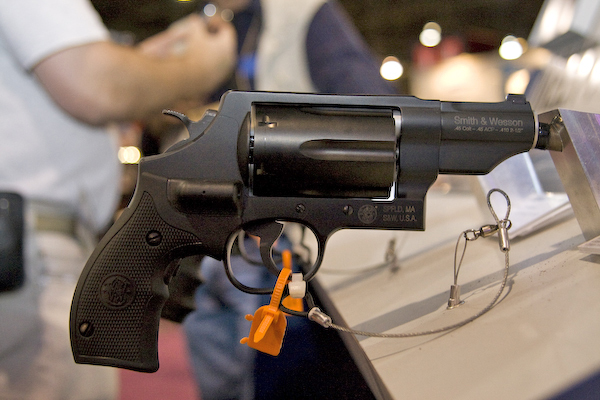
The Smith & Wesson Governor debuts at SHOT Show 2011.
Designed as a defensive handgun, the Smith & Wesson Governor is a handy little small game getter, too. You can load it with .410 shotshells or .45 Colt cartridges.
WE WILL BEGIN by admitting that the purist grouse and rabbit hunters are going to hate me for this, and somebody at Smith & Wesson may think I’ve lost whatever marbles I had left, but their new Governor revolver chambered for .410 shotshells and the .45 Colt cartridge may have a second life even before fulfilling its first one.
Enter the Governor, undoubtedly S&W’s answer to the incredibly popular Judge series of revolvers from Taurus. This new Smith holds six shots to the Judge’s five, it is pleasant to shoot, and when I tried it out during a writers’ shoot at the 2011 SHOT Show in Las Vegas a few months ago, I was impressed.
With a 2¾-inch barrel, fixed rear sight groove and dovetailed tritium front sight, synthetic or Crimson Trace Lasergrip and smooth double action, the Governor is one big popgun! The cylinder will handle 2½-inch .410-bore shotshells, .45 Colt and .45 ACP cartridges, the latter held in with half-moon clips. I tried this gun in both single- and double-action, and at 10 yards, managed to pattern a Birchwood Casey Shoot-N-C Bullseye target impressively.
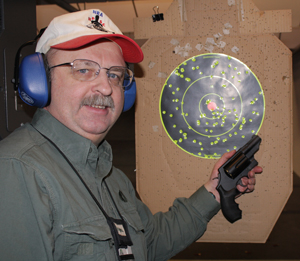
Workman was happy with the pattern from two rounds of No. 6. Is he grinning about this gun’s fight-stopping potential, or planning to go hunting?
Let’s be honest; this big-bore sixgun was designed for personal protection, at fairly close range when loaded with shotshells, and a little farther out when loaded with .45-caliber cartridges. Up close and personal, even if loaded with nothing more than No. 6 birdshot, you are definitely going to put the hurt on some two-legged varmint. Charge this handgun up with .45 ammunition and you have a handful of fight-stopping authority that seems to produce enough muzzle flash to charbroil a steak! At least, it sure looked like that on an indoor range. Even in the unlikely event that you should miss, the muzzle flash and blast alone is enough to scare the beejeezus out of people.
What will quickly appeal to weight-conscious handgunners is that the Governor has a rugged lightweight Scandium frame and stainless steel PVD cylinder, finished in matte black. Overall length is 8½ inches, and the gun is 5½ inches high. It weighs 29.6 ounces empty, and when you wrap your gun hand around that palm-filling grip, it feels comfortable and business-like, about the same as my N-frame Model 57 chambered in .41 Magnum when I had synthetic grips installed.
With the added ammo capacity, this is definitely not a handgun to be facing from the business end. Thanks to the development of .410 personal defense ammunition in the past 18 months, a shooter has the opportunity to mix and match loads, with alternate shotshells and .45-caliber cartridges. Recoil is impressive but manageable, and there are already holsters available for this revolver and no doubt more to come.
Most people think of personal defense against two-legged predators, but to be honest, the Governor seems a sensible choice for backpackers who might just run into something on the trail that wants to take a bite out of them. What about people who live in rural areas and want to take a walk around the neighborhood, and encounter a coyote or somebody’s abandoned feral dog? Where I live out in the Pacific Northwest, feral dogs can be a real problem, and aggressive dogs that are allowed to run loose by their idiot owners are just as dangerous under the right (or wrong) circumstances. Honestly, if such an animal ever confronted me, I would shoot it without hesitation. For someone less skilled with a handgun, the Governor would handle that chore quite nicely.
But on the subject of hiking, the Governor can fill another role, and one for which this revolver was probably not intended. Considering the patterns I produced on the target, this is a revolver that can be used to put meat in the pot for those spending their autumns on the trail.
In my part of the country, blue grouse are a common sight along the trail, and they can be dumber than dirt. I have walked right up to fool hens as they stood on a log or stump, or in the middle of the road (I saw one last fall trying to walk up the middle of Interstate 90 on Snoqualmie Pass in fairly heavy traffic!) before they decided it was probably not healthy to be in my proximity. Often, by the time they figured that out, I was stuffing them in the pouch.
Stoke the Governor with some No. 6s and there will not be a blue grouse, snowshoe hare or cottontail rabbit that is safe during the fall hunting season.
Yeah, sluicing a grouse on the ground sounds like blasphemy to the gentleman upland hunters. Well, sorry guys, but your sensitivities take a distant second place to my need to fill my empty stomach. This is the Pacific Northwest, and we do things differently here, especially off the pavement.
At the same time, one still has a potent defensive handgun in the event a bad-tempered bear or mountain lion should decide that you’re on the menu. A couple of years back, I wrote somewhere about black bear encounters and got one of the nastiest messages from some guy who evidently did more magazine reading than backwoods hunting or hiking, claiming that I couldn’t stop a bear with a .45 Colt or one of my favorite .41 Magnum sixguns.
Allow me to politely suggest that people who have never seen black bears in the woods, but only read about it or watched it on television, ought to refrain from sending e-mails to those of us who have. I’ve known more than one fellow who killed a black bear with a .45-caliber pistol or revolver, one guy did it with a .357 Magnum and a few years ago I did a story about a guy who killed a brown bear at the mouth of the Russian River on the Kenai Peninsula with a 9mm pistol.
The Governor loaded with .410 slugs or .45 Colt cartridges levels the playing field, and it is not so heavy or cumbersome that a hiker will feel loaded down packing it for a few miles on the trail. Long story short: This Governor gets my vote!
ATF Director Kenneth Melson, who was heavily involved in Operation Fast and Furious, doesn’t look like he’s willing to fall on his sword for Attorney General Eric Holder and President Obama just yet. In fact, Melson is ready to testify in front of the House Oversight Committee where Rep. Darrell Issa will ask him who above him ordered the operation within the Justice Department. Eric Holder should be very, very worried.
Rumors have been swirling around Washington all week that Melson would resign, yet it is now Friday and no resignation has been made.
The acting director of the federal Bureau of Alcohol, Tobacco, Firearms and Explosives is strongly resisting pressure to step down because of growing controversy over the agency’s surveillance program that allowed U.S. guns to flow unchecked into Mexico, according to several federal sources in Washington.
Kenneth E. Melson, who has run the bureau for two years, is reportedly eager to testify to Congress about the extent of his and other officials’ involvement in the operation, code-named Fast and Furious.
Melson does not want to be “the fall guy” for the program, under which ATF agents allowed straw purchasers to acquire more than 1,700 AK-47s and other high-powered rifles from Arizona gun dealers, the sources said. Read more
Looking to go armed, but are stuck in the weeds as to what to arm yourself with? Here are 20 of the best concealed carry gun options that will keep you on the defensive.

 The competition consists of enough physical and mental tasks to make a fighter in the octagon beg for mercy. Over the three days the Army intentionally provides very little rest or nourishment. Historically 60 percent of the two-man teams drop out due to injury, dehydration or exhaustion.