A Walgreens pharmacist was fired by the company after fending off two armed robbers with a gun.
In Benton Township, Michigan, two armed robbers wearing masks burst into a near-deserted Walgreens at 4:30 a.m. To pharmacist Jeremy Hoven, it was a prescription for trouble. So he filled it with hot lead.
A video, newly released by Hoven’s attorneys, shows how events unfolded.
Drawing his own gun, Hoven fired at the attackers and drove them off, saving not just himself but two Walgreens co-workers as well as the pharmacy’s valuable prescription drugs.
By way of saying thanks, Walgreens fired him.
Hoven, in an interview with the Benton Township Herald-Palladium, said he had acted out of fear. “The adrenaline was taking over,” he said. “You could have probably taken my pulse from my breath, because my heart was beating that much.” Only 42 seconds elapsed, start to finish. All the action was captured on surveillance video.
Before firing, Hoven first tried dialing 911. But before he could complete the call, the first of the two robbers had vaulted over a counter and was standing five feet away from him. That’s when the pharmacist went for his own gun and opened fire. Read more
Lumens measure light output at the source. Candelas measure the light that falls on a surface. As the surface area (where the light lands) increases, the number of candelas will decrease, while the number of lumens remains constant.
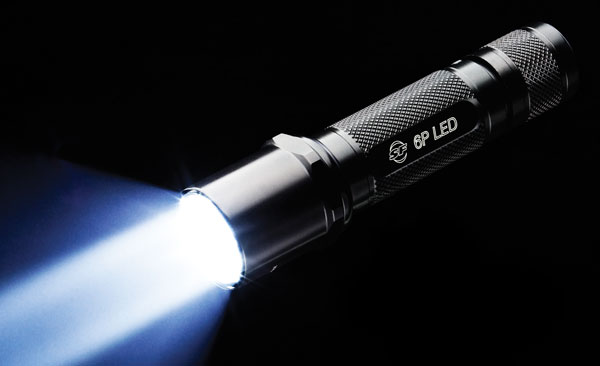
lluminate, Identify, Incapacitate. This is the defensive triad of any good tactical lighting system, whether it’s truly a “tactical light” (one developed with SWAT teams as the end users) or a patrol-type light for general use by officers on a daily beat. Let’s break down the concept a bit.
Illuminate
First, all flashlights are designed to illuminate. They help us clearly define an area in total darkness, allowing us to maneuver or navigate safely. Any light can do that to varying degrees, and that’s what most police patrol and civilian flashlights are designed to do at a minimum.
Identify
The next “I” of the triad is identify. Here the flashlight concept becomes more specialized because we’re talking about threat identification. Are we looking at friend or foe? It’s this area in which previous generations of incandescent lights with halogen or krypton bulbs fall flat. They simply don’t have enough lumens and candelas to do the job.
Lumens and candelas are the more modern terms used to define light output, as opposed to the older measurement of candlepower. Lumens measure light output at the source, while candelas measure the light that falls on a surface. As the area of the surface increases, the number of candelas will decrease even as the number of lumens remain constant.
The beams from the old tech lights can only identify a small centralized viewing area, allowing the user to see possibly only the face and hands of a person, and not necessarily both at the same time. Even with the best of those ancient generations of lights there was a lot of shifting of the beam from hands to face during any type of confrontation because you couldn’t see what you needed to see —the face and hands at the same time. With modern lighting systems, that technique is no longer necessary.
Incapacitate
The final “I” is incapacitate. The concept was pioneered by the Surefire Corporation in the early 1990s: Use the light as a part of the combat arsenal to incapacitate a suspect through disorientation. Using a light to disorient a suspect was first used with the Surefire incandescent xenon gas bulb 6P lithium battery-powered lights. The strategy is now applied to the latest generations of patrol lights.
The understanding of this concept is critical. In the old days, the best we could do was illuminate and identify our opponent. With today’s more powerful and flexible lights, we can use the light system to disorient and stun the opponent. If we don’t bring enough light (an update of the adage “bring enough gun”) to “stun” our opponents, they can use our illumination source as a target to shoot at.
Seeking ways to boost the local economy, officials in Crossville, Tennessee, decided to hold two events this summer at the local Cumberland County Community Complex: a music festival and a gun and knife show. The run-away winner was the gun and knife show.
“The place was packed all weekend,” Community Complex Manager Donnie Moody told district commissioners, the Crossville Chronicle reported. “We had a lot of vendors and customers that came from everywhere and we had the support of a lot of local businesses.”
The county made a profit of $13,700 on the gun and knife show; the music festival brought in approximately one-tenth of that. The gun and knife show also helped funnel people into other local businesses, further helping the economy. In addition, “Moody said that officials from the National Rifle Association (NRA) told him they were convinced that Cumberland County is the only county that sponsors a gun and knife show.”
Hearing all that good news, district commissioners unanimously approved another gun and knife show for the future.
A third gun linked to “Operation Fast and Furious” was found at the murder scene of Border Patrol Agent Brian Terry, new documents obtained exclusively by Fox News suggest, contradicting earlier assertions by federal agencies that police found only two weapons tied to the federal government’s now infamous gun interdiction scandal.
Sources say emails support their contention that the FBI concealed evidence to protect a confidential informant. Sources close to the Terry case say the FBI informant works inside a major Mexican cartel and provided the money to obtain the weapons used to kill Terry.
Unlike the two AK-style assault weapons found at the scene, the third weapon could more easily be linked to the informant. To prevent that from happening, sources say, the third gun “disappeared.”
In addition to the emails obtained by Fox News, an audio recording from a Bureau of Alcohol, Tobacco, Firearms and Explosives agent investigating the Terry case seems to confirm the existence of a third weapon. In that conversation, the agent refers to an “SKS assault rifle out of Texas” found at the Terry murder scene south of Tucson.
The FBI refused to answer a detailed set of questions submitted to officials by Fox News. Instead, agency spokesman Paul Bresson said, “The Brian Terry investigation is still ongoing so I cannot comment.” Bresson referred Fox News to court records that only identify the two possible murder weapons.
However, in the hours after Terry was killed on Dec. 14, 2010, several emails written to top ATF officials suggest otherwise.
In one, an intelligence analyst writes that by 7:45 p.m. — about 21 hours after the shooting — she had successfully traced two weapons at the scene, and is now “researching the trace status of firearms recovered earlier today by the FBI.” Read more
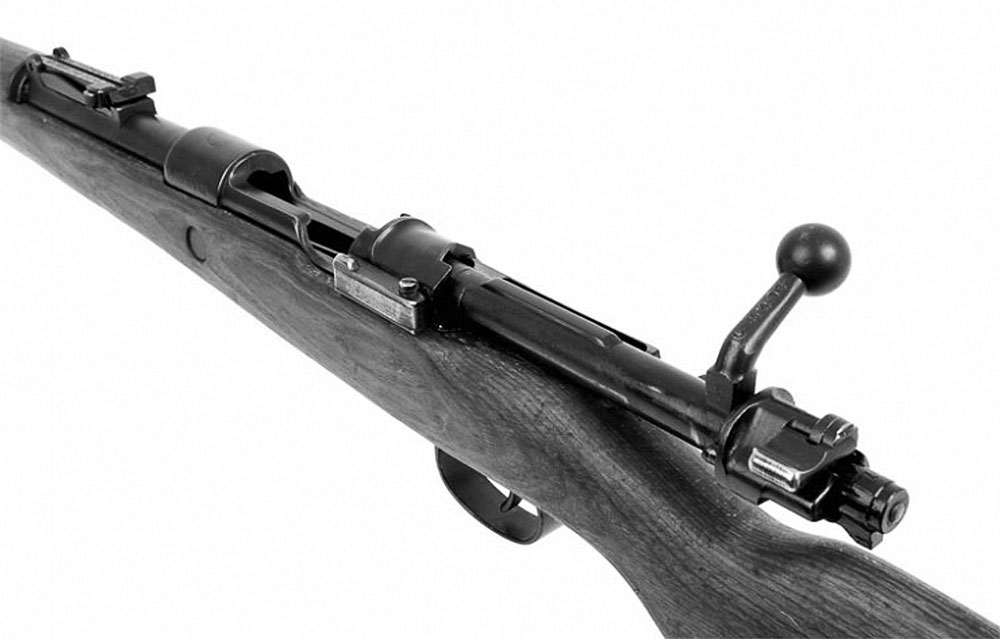
Greatness in firearms is a pretty subjective judgement. But when a gun is nearing its hundredth birthday, hasn’t been out of production for much longer than somebody’s coffeebreak, and is still a favorite of hunters and precision shooters everywhere, calling it great may be an understatement. About the closest estimate one can acquire of the quantities of the Mauser Model 98 produced thus far is somewhere between 91 million and 125 million. It’s hard to come up with a firmer figure, for the rifle was produced in twenty or more countries, most of which used it as a military rifle, and another large group of nations produced clones, copies and ripoffs of the original, often in quantities so vast they couldn’t give a production figure if they wanted, and they don’t want.
Only the Russian AK-47 design comes anywhere close to the production figures of the Model 98. It’s probably not that close, but no one knows for sure. The Chinese and Japanese produced Model 98 rifles and copies in vast quantities, both for themselves and for client states. The Belgians, Poles, Austrians, Czechs, Iranians, Yugoslavs, Turks, Spaniards, Argentines, Brazilians, Mexicans and others produced military M98s in quantity; others produced near-copies and “improvements” for military use like the U.S. M1903 and ‘03A3. (Yes, the Mauser firm was paid at least $400,000 in royalties until at least 1914.) There were also the U.S/British P17/P14 “Enfields” and the late French MAS derivatives in this category.
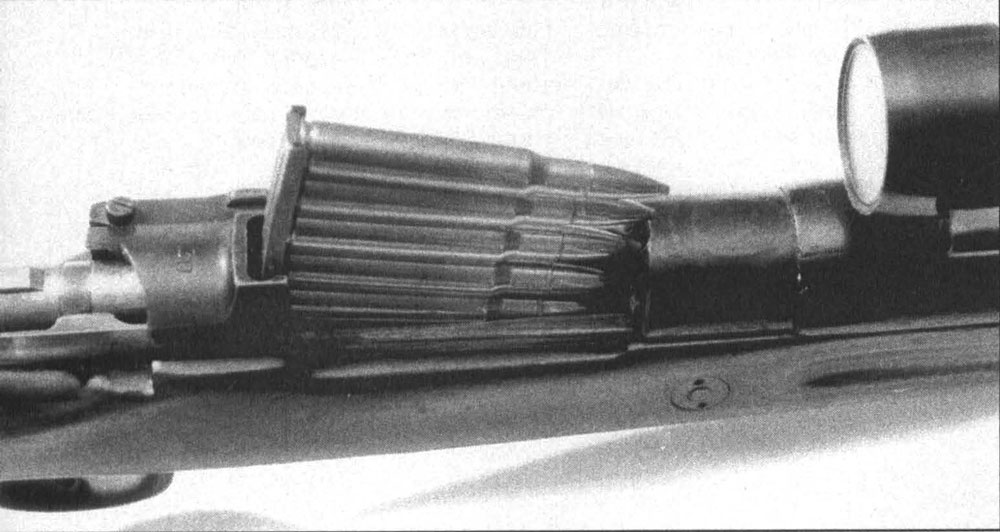
FN-built Peruvian M1946 short rifle accepting five rounds in a stripper clip of the 30-06 for which these post-WWII rifles were chambered.
And that’s just the military rifles. Handmade Model 98s in calibers up to 50 Browning are still being turned out by builders like Fred Wells of Prescott, Arizona. French, Dutch, British and Italian sporting rifles and actions have been made in standard, miniature and magnum lengths. The Finnish Sakos and the Swedish Carl Gustaf and Husqvarna are all 98-type actions. Many of the countries which used the 98 as a military rifle produced and most still produce the action as a hunting piece. The famous Swiss annual Waffen Digest recently (1992 edition) carried a couple of unusual announcements: One was descriptive of a “new” product called Mauser Jagdrepetierer Modell 98, a rather familiar model introduced by the mother firm, Mauser-Werke, Oberndorf-am-Neckar, absent from the thriving market for their most famous product for 46 years. Waffen Frankonia also introduced their new K98k military rifle, actually a reworked and specification updated military rifle with new parts and stocks, as and where necessary.
So why introduce — at fairly high prices, incidentally — technology almost a century old as a new product at a time of worldwide economic recession? Simply put: demand. The Mauser 98 is closer to a true basic product than nearly any other firearm, and though the analogy seems strained, it occupies a market position similar to eggs, flour or rice.
If one needs an accurate rifle for hunting, sniping, experimenting or target shooting, the ancient three-lug “safety” action is a fine place to start. Indeed, structurally, there’s little to choose between any M98 and the latest bolt guns from, say, Weatherby or Remington; there have been refinements, but the nuts and bolts have been very similar for a long time, and almost anything in the way of doo-dads one can imagine or concoct for a Model 70 Winchester can be acquired, built or purchased for the Mauser.
Of course, for civilians, even purchasing an old military action for very little money and doing the full custom job on it doesn’t save a penny over a top-of-the-line commercial product. The main difference is, when the consumer reworks his own Model 98, he gets exactly what he wants — no more, no less — and if he can do some or all of the work, he really can save a few bucks. What is unique about this time-honored process is that such rifles can be built up slowly, on a sort of self-regulating installment plan, adding a new trigger in January, scope or mount in March, stock in June or July, total refinish some other year. That you cannot do with a new rifle which comes in a fancy box.
But there’s more to the Mauser 98 saga. From 1898 to about 1962, military Mausers were built in considerable variety. All specifications called for minimum vise-secured accuracy level under two minutes of angle. Most performed better. Of course, given the limitations of a broad V rear sight and skinny front blade, or pyramidal “barleycorn” post, shooter-limited factors meant such a level of accuracy was seldom maintained in the field. There were no mystery alloys used in Model 98 Mausers, and if the odd stamped or roughly soldered or welded part found its way onto a wartime K98k, it was always someplace where it bore little stress. The 98s were made for so long that whole metallurgical techniques changed, but, surprisingly, this had almost no impact on the rifle’s quality or durability. Even the military finishes of the rifles generally exceeded the workaday qualities of most of today’s civilian firearms.
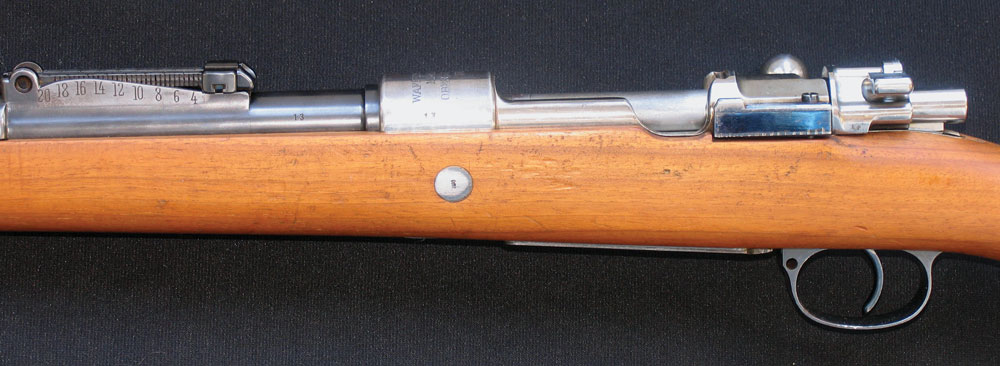
Mauser K98.
Most original specification rifles from about 1898 through World War II used what are today considered rather primitive ordnance steels, but carefully heat-treated so that while the core remained very soft, the surface was often as high as 62 on the Rockwell C scale. FN rifles and many from Eastern Europe used tighter dimensional tolerances overall, used far more sophisticated metallurgy, and show lower hardness figures. However, this latter group comprises generally superior actions, far more durable.
I am often compelled to repeat to shooters and collectors that hardness very decidedly is not strength; most materials in use today develop their strengths at hardness levels way below the vogue of forty years ago, and are, in fact, dangerous at high hardness levels. Hardness is relevant in any respect only to a given material in a given application and lately, more often than not, optimum strengths are obtained at levels far below what was popular thirty to forty years ago. When someone in a gun store begins to talk hardness level as some kind of quality determinant, your best response is to turn on your heel and leave. The very strongest bolt actions in the world, the Japanese Arisakas, are quite soft. Dimensions, design, venting and strength determine the overall safety and quality of a rifle action; hardness alone as a factor is bunk. Read Hatcher’s Notes to get a more specific idea of how these matters translate to reality.
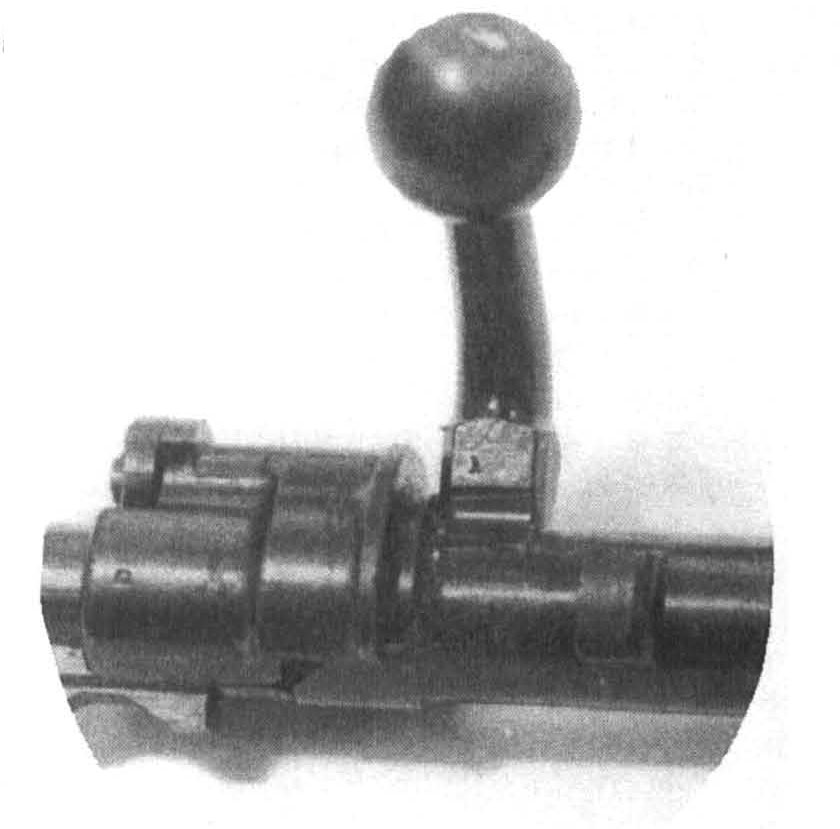
The third locking lug in the 98’s receiver bridge is not its sole distinguishing feature, but is usually held to be the most important single distinction between the M98 and its predecessors.
The engineering factors which made the M98 a landmark were simple progressions from the M1892–1896 designs, but they were significant enough that few countries could avoid discarding whatever they had been using to adopt the new system. Rifles just three to ten years old in military service became second-line materiel in most of the world. The third or “emergency” locking lug, the inside receiver ring collar, and the vastly improved, safer, more reliable firing mechanism with its lockout to prevent premature ignition with a broken firing pin, combined with a conglomerate of earlier Mauser evolutionary features and improved metallurgy to produce a rifle which looked and worked very much like its predecessors. In terms of safety under rough conditions and rapid-fire, though, the Model 98 stood alone.
It surprises many collectors and shooters that relatively few Mausers were actually built by the designing firm. “Few” is, of course, a relative term: The Oberndorf factory produced millions. But almost from the beginning, demand was so vast and deep that firms in Europe and elsewhere were licensed to produce the guns. Loewe, DWM, Steyr, Sauer and Son, Fabrique Nationale, the Czech works at BRNO, Radom in Poland, all the German government arsenals and all their subcontractors, and as many as a hundred small factories in Central Europe were producing actions and/or complete rifles by the mid-1920s.
If one wishes to analyze the impact Paul Mauser had on the world, he should dig through the cartridge specifications in one of the better reloading manuals and refer back to Paul Mauser’s 1880s and 1890s cartridges. He’ll find almost every currently popular medium-power rifle cartridge owes much to the compatible cartridges Mauser designed from their inception to be quickly and cheaply adapted to standard rifle actions. The Mauser originals — 7.92×57, 7×57, 7.65×53 (sometimes called 7.65×54) — and the Brenneke cartridges developed in direct consultation with the Mauser firm do not resemble the 308, 30/06, 270 and others by accident; from case heads to bottlenecks, modern cartridge configurations are virtually all derived from original Mauser ideas.
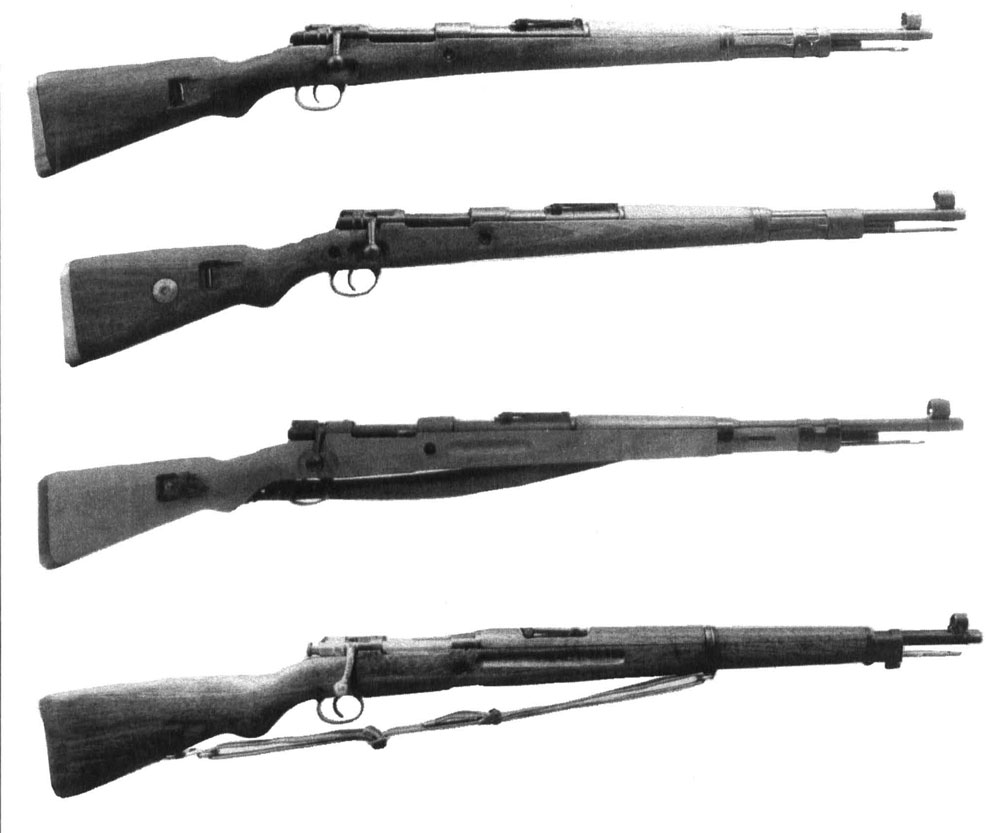
This assortment is only a part of the new cornucopia of Mauser 98 delight brought to us by the changing world picture. The author’s point is that any one of them in barely decent condition is a fine rifle for real rifle work.
Before World War I, the Turks, Argentines, Chileans, Mexicans, Brazilians and many others had adopted the military 98. By the mid-1920s, there were already so many Model 98 Mauser versions and variants that a complete listing would’ve been almost impossible. And by the late 1940s, another World War later, such a catalog was literally impossible. Many countries had ordered rifles in that period from several manufacturers and in several configurations and lengths. Rifles were also refurbished, of course, and calibers were sometimes changed.
Brazil, at one time or another, for example, ordered quantities of rifles from virtually all the major European manufacturers and in 1954 began to manufacture receivers at Itajuba Arsenal. So when one says “Brazilian Mauser,” he may be describing a Model 1908 29-inch long rifle, similar to the German Gew.98 or K98a revision built by DWM; a Czech 08/34, almost identical to the Nazi K98k but with a 22-inch barrel and in 7mm; the Oberndorf-built M1935 long rifle, essentially a later clone of the original Model 1908, the “2nd Variation” 08/34; various rifles shortened to 24 inches and barrels rebored to 30-06 and appropriately modified; the M1954, a 30-06 rifle receiver built as such, but completed with parts left over from all kinds of surplus rifles, including German 98ks; or as many as a dozen other fairly obscure variants ordered in small quantities for special purposes or from firms unwilling to advance normal credit to the Brazilian government and therefore delivered only on a cash in advance basis.
Late-issue German WWII K98k.
The most common general action configuration of the M98 Mauser is the so-called “large ring, standard length.” The receiver ring measures 1.410 inches. The “small ring” rifles measure 1.3 inches. There are also differences in overall configuration, but the ring size is readily discernible and is, therefore, the main identifier. The standard action is 8.75 inches long; the “short” action measures 8.5 inches in length and, at 43 ounces, is 2 ounces lighter than the standard length. There are also large ring, small thread actions which accept M93/95-style barrels, and these — especially those built by FN — are very handy to gunsmiths who wish to stock actions that can be delivered in a variety of configurations.
However, the differences in size are minimal; a person chooses one or the other usually based upon aesthetics or, more commonly, what’s available at a given time. The truly short or miniature actions and the magnum length units are either carefully modified and sectioned militaries or civilian actions. Virtually any Model 98 action that has been checked for cracks and has been rebarreled with correct headspace is quite safe for any standard cartridge which can be stuffed into it. Smiths have become adept at opening up magazines and adapting receivers even to the longer magnum rounds.
But I have always been fond of shooting military rifles, in general, and Mausers, in particular, in their original configurations. The performance is surprising, the variety amazing, and the original cartridges are at least as good as the 30-06 and 7.62×5lmm rounds to which many were later converted.
In the six years or so since GCA ‘68 was modified to allow curio and relic firearms to enter the country again, quite a variety of Mausers have entered. The pictures accompanying and the information with them will supply some specifics, but I’ll relate some general data here.
The first big batch of Mausers to enter the U.S. recently arrived from China, and encompassed virtually all eras and nearly all manufacturers. The Chinese ordered millions, made more millions, apparently bought used specimens of other country’s service rifles after both World Wars, and may have gotten some from the Soviets. So the variety was startling. I saw several hundred rifles, which ranged from truly oddball 16½- to 17-inch barreled 8mm carbines to standard German-issue Gewehr 98s from World War I, German Standard Modell rifles, K98ks in German-issue style and complete with World War II fits and codes, and just about everything else one can imagine finding its way to that part of the world. Since these rifles saw as much as sixty years of hard duty, most were pretty beat up, though some were far better than average.
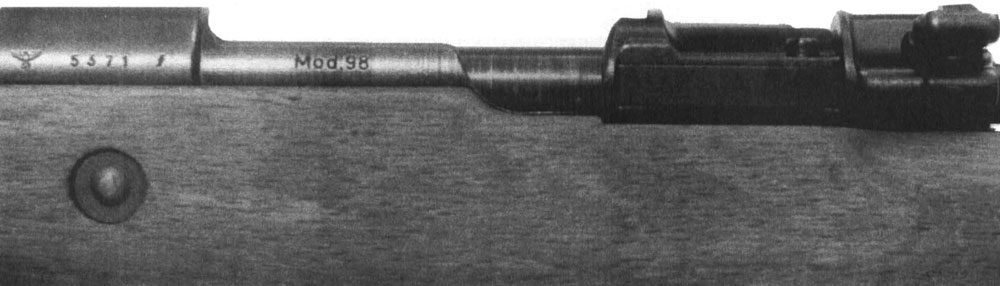
Marking on standard German K98k of WWII vintage, circa 1944.
Springfield Sporters (Penn Run, PA) brought in most of the Model 98 Mauser supply from Yugoslavia. These were mostly rebuilt in Yugoslavia, and to very high standards. There were several variants, including the enormous quantity of VZ.24/G.24t rifles captured from the Waffen SS; K98ks and refurbished G.98s from the same source; Yugoslavian-built pre- and post-World War II rifles; Czech contract rifles from the late ‘20s and the ‘30s; and oddments of other Central European Mausers captured by the Yugoslavians.
These rifles, in addition to being well-maintained and beautifully rebuilt, contain more of the “if this rifle could talk” history collectors appreciate than most other hardware on the market and genuinely deserve a place in any European Mauser collection, despite — maybe because of — the applied Yugoslavian markings.
They’re also good actions for conversion, although most bear mint-like 8mm barrels, and throwing them out would be foolish. Century International Arms supplied virtually all the Latin American Mausers pictured within this article. If the close-ups reveal anything, it’s that the “export” guns were often made to higher standards than those for German domestic consumption. And why not? Foreign contracts were open to competitive commercial bid and nothing was locked in automatically. Most were made to very high standards, like the best sporting rifles of the period. And since I had an opportunity to compare directly with German rifles of the same years, it was pretty obvious that finish quality was higher on the DWM, Steyr, and even Mauser/Oberndorf guns for Latin America. What was interesting was the shooting quality delivered down-range.
Before developing that data, however, let me note that every Mauser I shot that’s pictured here was in the very best available condition. This cost me extra; it’ll cost you extra, but it’s dollars well spent. It always pays off. Of course, this caution does not apply so much if you’re doing a full-house sporter conversion; Century sells actions in various conditions, already stripped of their barrels and wood; often, complete rifles in fair to good condition cost less than the actions. But if you mean to do any shooting as-is, get the best condition available. If you’re a collector, this is especially true. Pay the extra money, and it’ll always be reflected in the gun’s long-term value. It also always costs much more to restore a clunker than to purchase a better rifle in the first place.
It’s also wise to shoot the best ammo you can. Surprisingly, the quality of surplus ammo is now very high. The FN Belgian 7.65mm Argentine and the San Francisco (Argentina) 7.65 shot as well as any military ammo I’ve ever shot. Yugoslavian PrviPartizan and Yugoslavian surplus 8mm, also from Century, performed beautifully and very accurately, as did the Yugoslavian 7×57.
A composite “Kar.98b,” made in 8mm to approximate the interwar German specification, bearing parts from at least six countries, but primarily comprising a Greek-issue FN 24/30 action, German M1936 “Olympic” target barrel and Argentine stock, with fittings from Turkey, Austria and elsewhere. Shoots well.
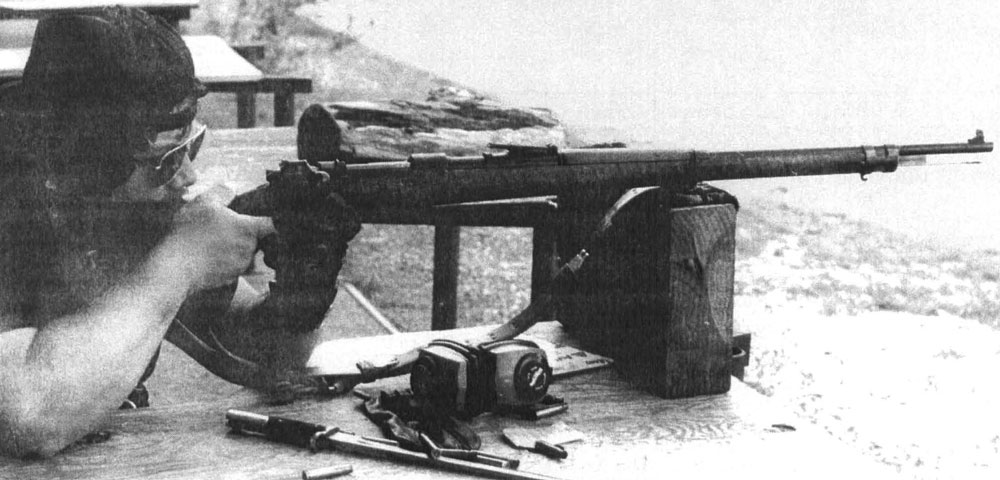
Several of the rifles shot very close to MOA, and the Peruvian M1935 7.65 — which looked quite rough but sported a superb bore — actually delivered a 7⁄8-inch group at just over 100 yards. The 7mm long rifles also performed exceptionally, especially the two M1935 Brazilian Mausers, one of which was the proverbial gnat’s eyelash below the Peruvian gun in on-target performance.
The Chilean Steyr M1912 was not far behind. Even the ugly M1954 Brazilian — as rough a rifle as I’ve ever seen and dared to fire, but sporting a pristine bore and perfect head-space even by commercial standards — performed right up to the standards of my National Match M1 in 30-06. The Yugoslavian PrviPartizan 7mm 175-grain loading shot to point of aim in the Brazilian M1935 at 300 yards, but with the sights set for 100 meters. The trajectory suggested high velocity and excellent power, but I determined — since there were no signs of high pressure — chronographing was unnecessary.
The little Argentine M1909 carbines — one an Argentine-built DGFM, the other a DWM from Germany — delivered 1½-inch groups at 100 yards. Those are five-shot groups. I fired three rounds of Norma’s excellent softpoints per gun and did a little better.
Again, as noted early on, these were best groups. No Model 98 sight is quite discriminatory enough to deliver this sort of accuracy anyway, except from a rest, and even then, eyesight limitations and the hard realities of real shooting don’t allow the shooter to do that consistently. But the potential is there. I’ve lately been recommending B-Square’s long eye relief scope setups because they don’t demand anything be drilled or ground up, and the military Mausers thus retain their collector’s value. Also, the stripper loading capability is maintained, and the bolt handles need not be modified.
I’d be remiss if I didn’t mention the tradeoff equation with high-powered rifles. That is, the little 6½- to 7½-pound carbines are light and handy, but the Mauser buttplate is downright abusive, and short barrels generate serious muzzleblast.
The 29-inch barreled long rifles are cumbersome, but sweet to shoot and easy to balance, even over long sessions. The 22- to 24-inch barreled guns, as one might expect, are about midway between the two. Military ammo in 7mm and 8mm is loaded stiffer and shoots better than most American commercial ammo; in fact, I recommend RWS or Norma factory loads in 7.92×57JS (8mm) or handloads. American 8mm is so underloaded that European publications list it as a whole different caliber.
Paul Mauser died in 1914. But you can bet on it: Come 2014, his last major rifle design will be alive, well, and living almost everywhere.
This article first appeared in the 1994 edition of the Gun Digest.
Gun Digest is the source for firearms news, pricing and guns for sale. Readers benefit from in-depth editorial expert advice, show reviews and practical how-to instructions. With your Subscription, you’ll also learn about threats to your Second Amendment rights. Click here to begin your subscription to Gun Digest.
Inside this issue:
Smith & Wesson Model 327 Performance Center
Performance Handloading for AR-Style Rifles
Your AR as a .50 BMG
Gun Review: Rossi Circuit Judge
Gun shows, auctions, classifieds and more!
Not a subscriber? Make sure you don’t miss another issue! Subscribe now
PHILADELPHIA – A Temple University student and a 15-year-old boy are both in the hospital after the two exchanged gunfire early Monday morning, police said.
Police said the shootings followed a botched robbery attempt by the teen in the 2300 block of North 12th Street, north of Dauphin Street and off-campus.
Police said the 15-year-old tried to rob Michael Eels in front of his house. But when Eels refused to give him money, the teen started shooting.
A gunman wielding an AK-47 opened fire on a table of uniformed National Guard members at an IHOP restaurant on Tuesday, killing four people, including three members of the National Guard. He died after shooting himself.
CARSON CITY, Nev. —
The burst of bullets came suddenly in Nevada’s capital.
Just before 9 a.m., the gunman stepped onto an IHOP parking lot from his blue minivan with a yellow “Support Our Troops” sticker on it. He opened fire, then continued into the restaurant and marched resolutely toward a table of uniformed National Guard members before shooting each one of them, and fatally wounding three of them, authorities said.
Eduardo Sencion would kill three people and wound eight others in all before shooting himself in the head in front of a bustling business complex in an unexplained display of violence Tuesday. One of the wounded, a woman and National Guard member, would later die at an area hospital.
“I wish I had shot at him when he was going in the IHOP,” said Swagler, who owns Locals BBQ & Grill. “But when he came at me, when somebody is pointing an automatic weapon at you – you can’t believe the firepower, the kind of rounds coming out of that weapon.”
The gunfire prompted Ralph Swagler, the owner of a nearby barbecue restaurant, to grab his weapon. But when Sencion started toward him, Swagler backed away. Read more
On a 4 to 1 vote, commissioners in Sedgwick County, Kansas have approved a resolution to allow concealed carry in most, though not all, county government buildings.
“The people have the right to keep and bear arms and we shouldn’t arbitrarily infringe upon that right,” Commissioner Richard Ranzau said during deliberations, as reported by KSN Television.
Some county officials, though, argued against the change, including District Attorney Nola Foulston.
“This is a public safety issue, and one that could cause tragedy,” Foulston said.
Ranzau disagreed.
“Any statement that alleges public safety will be jeopardized and an environment of fear will be created as a result of this resolution is not based on reality nor is it supported by the facts,” Ranzau said. Under the new regulations, “The buildings that will allow [concealed carry]…include 10 fire stations, the historic courthouse, and four county tag offices, but not the main courthouse.”
New York State Senator Patty Ritchie (R-Heuvelton) has sent a letter to officials at Wal Mart, asking why Wal Mart stores in New York apparently require customers to present a state pistol permit when buying handgun ammunition.
As a press release from Ritchie’s office explained, “While New York State and the federal government impose age requirements, neither requires customers to show their pistol permit [when purchasing ammunition]. Ritchie asked the company if it is collecting personal information from gun owners that could jeopardize their privacy and safety if it were to fall into the hands of unscrupulous individuals.”
In her letter, the senator wrote, “Please advise me whether this policy reflects the standard practice in the industry. I would also appreciate any suggestions you may have concerning possible legislation that I may propose to address this issue to ensure that gun owners’ rights are protected.”
Ritchie added, “We in the State Senate have rejected efforts to restrict the sale of ammunition to law abiding gun owners.”
Ritchie represents the 48th Senate District, which includes western St. Lawrence County, and all of Jefferson and Oswego counties.
Police in the Town of Oconomowoc continue to look into a fatal shooting of 39-year-old James Babe. One of their tasks is to determine whether it was a case of self defense or murder. The shooter said his attorney wouldn’t let him say much, but described the event as a matter of saving himself and his personal property.
The family of the man shot and killed is in shock. They admit he had past run-ins with the law, but cleaned up and was on the right path.
Police say they responded to a burglary call that turned into a fatal shooting. What prompted the gunfire is a question investigators are looking into. Police say Babe was shot and killed. Read more
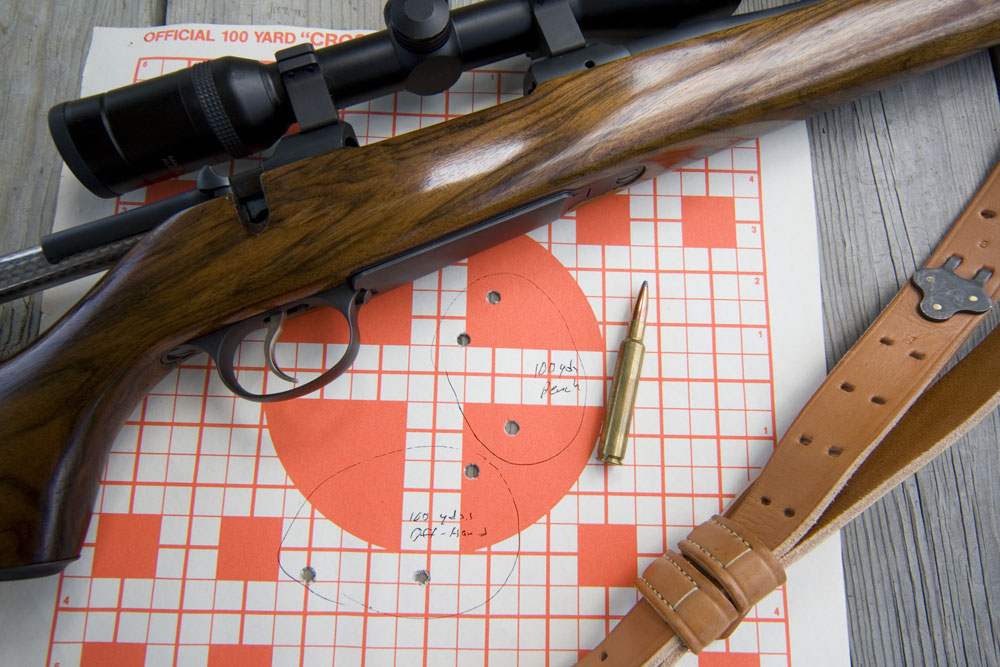
The top cluster was a 100-yard benchrest group, while the bottom group was shot off-hand using the leather sling and kneeling position. While the top group indicates this load is not very accurate, note that the off-hand group, other than point of impact being lower, was only slightly larger. The rifle is a custom-made .280 Ackley Improved. The sling is the National Match version from Turner Saddlery.
Hang around the Gun Digest offices long enough and eventually you begin to daydream about obscure topics that surely would strike most normal people as odd. Reading old issues of the Gun Digest only fuels the fire. As such, my thoughts have recently begun to drift toward — what else? — the military leather sling.
There are practical reasons for this, namely the realization that my shooting skills are not up to snuff. I officially blame today’s gear — bipods, custom rests, shooting sticks, “lead sleds” and other such things — designed to anchor your firearm in what amounts to a vice, so all you have to do is pull the trigger and watch as rounds pile into a nice, tiny little group. But convenience comes with a price. And while each of these shooting accessories have their place, I have only myself to blame for allowing them to become a crutch.
If you don’t believe me, grab your rifle while standing or kneeling and peer through the scope at a 100-yard target. Watch with horror as your crosshairs sway to and fro, on the target and off again. In my case, it’s as if they were being guided by a drunk sailor bumbling across the deck of a ship in rough seas. Actually, it’s amazing I’ve ever managed to fill any deer tag. When I recently tried this exercise, the phrase “Minute of Cardboard” (which was an improvement over “Minute of Dump Truck”) came to mind, aptly coined in what ended up being a transparent attempt to add some level of dignity to my gross ineptitude with a rifle.
The military, and the Civilian Marksmanship Program (CMP), both teach good old-fashioned marksmanship skills, and the leather sling is still a cornerstone in the technique. In the decade or so following World War II, there seems to have been more focus placed on practical rifle shooting skills and the use of the leather sling in particular than there is in today’s shooting press. For example, the 1950 4th Edition of the Gun Digest contains an article by C. M. Palmer, Jr. which well-represents this “old school” way of thinking. In How to Shoot a Target Rifle, Palmer writes:
The important function of the sling is that of making the shooter and his rifle an inseparable and unbeatable combination. It ties the two together literally, and holds them together rigidly in the proper shooting positions. Getting into the sling is simple though some people make a mess of it without half trying.
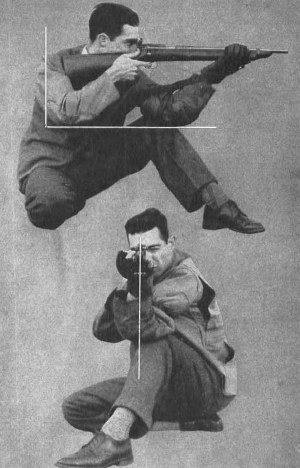
An article in the 1950 edition of Gun Digest illustrates how to use the military leather sling and body position to create a solid off-hand shooting platform.
I wasn’t half trying when I made a mess of it; no, I’d put all my heart into it (and a dandy mess it was). Try to imagine a dysfunctional ex-zoo monkey trying to solve a rubix cube dipped in grease from a deep-fryer. It was not pretty. You would think that a sling would be a simple thing to master. But the military leather variety, to the uninitiated, seems like a cruel trick. There are two sections, one loop, two keepers, two metal hooks (known as “frogs,” just to make things interesting), and dozens of sets of holes. To make matters worse, when the sling is new the leather is so stiff the frogs won’t “go” into the holes without considerable pushing, pulling and tugging — heaving with eye-popping force the likes of which elicits the most God-awful grunting noises you have ever heard coming from a gun room. If you have close neighbors, it is best to close the windows, and wear safety glasses, when doing this.
After my leather sling arrived from the folks at Turner Saddlery, staring at this wonder of modern engineering left me thinking, “How hard can this possibly be?” The question answered itself. With a little practice, though, some help from M/Sgt. James R. Owens USMC (Ret.) and his swell little pamphlet, The Leather Sling and Shooting Positions, advice from old issues of Gun Digest to stoke the dream and I was off to the range on a wing and a prayer. Even more comical than mastery of the sling itself is the act of getting into the thing and then into one of the four shooting positions — standing, kneeling, sitting and prone — which sounds easy enough but actually requires much practice and patience.
The key is to use the sling and the bone structure of the body, together. Palmer explains:
These positions have been studied carefully after many years of shooting experience. They are scientifically and mechanically correct to give the shooter the greatest possible support with the minimum of muscular effort. They aim to utilize the rigidity of the bones to hold the weapon rather than the uncertainty of the muscles. The best shooting position is that which transforms the shooter into a solid gun mount.
Most shooters spend their entire time shooting from a bench chasing after smaller and smaller groups. Your rifle’s actual accuracy (more properly described as precision) will always be better than your field-shooting accuracy, or off-hand ability. Thus, more time spent learning the military leather sling and off-hand shooting positions will reap big rewards in the game fields or tactical environments where fast shooting may be the only option.
So how did it work? At first I felt fortunate to get pie-plate sized groups at 100 yards off-hand. But by locking into the leather sling (technically I was using a variant position known as the “hasty” sling), my groups tigthened right down to around four inches — a marked improvement over shooting without the sling.
The bottom line is this: Rely too much on mechanical gun rests, rather than honing the shooting discipline, and your ability to place rounds on target in real-life scenarios will suffer. Like Clint Smith of Thunder Ranch says, You won’t shoot better under stress, you’ll shoot worse. So yank that rifle out of its vice, wrap arm in leather, and get to work.
The man who led the controversial Fast and Furious anti-gun-trafficking operation will step down as the interim head of Bureau of Alcohol, Tobacco, Firearms and Explosives, the Justice Department announced Tuesday as it named a new acting director for the agency.
Kenneth Melson, the bureau’s acting director, on Wednesday will move to the Office of Legal Policy, where he will be a senior adviser on forensic science, the department said without making reference to the failed gun-tracking operation that is alleged to have ultimately put guns into the hands of criminals. Dennis Burke, the U.S. Attorney in Arizona who oversaw prosecutions in that state related to the Fast and Furious operation, is also stepping down, the department said.
Ken brings decades of experience at the department and extensive knowledge in forensic science to his new role, and I know he will be a valuable contributor on these issues,” Attorney General Eric Holder said of Melson in a statement. “As he moves into this new role, I want to thank Ken for his dedication to the department over the last three decades.”
Melson’s replacement is B. Todd Jones, the U.S. Attorney for the District of Minnesota. Jones “is a demonstrated leader who brings a wealth of experience to this position,” Holder said. “I have great confidence that he will be a strong and steady influence guiding ATF in fulfilling its mission of combating violent crime by enforcing federal criminal laws and regulations in the firearms and explosives industries.”
Melson took the top spot at the ATF on an interim basis in 2009 and oversaw the execution of Fast and Furious, an effort that was aimed at rooting out gun smugglers selling weapons to Mexican cartels. Ultimately, the ATF lost track of as many as 2,000 guns that were sold during the operation, including two that were found near the scene of the killing of a Border Patrol agent. Read more
Pike County Illinois forced to consider Constitutional Carry.
In Pike County, Illinois, Dan Mefford, a chiropractor from Pittsfield, has begun a movement to get a constitutional carry referendum on the election ballot for March of 2012. If successful, such a ballot referendum, “could lead to the state being forced to recognize this right as well, and to expand it to include the rest of Illinois,” Gather, a community-based news website, has reported.
Illinois, of course, is the only state which prohibits any sort of carry, concealed or otherwise, by its citizens.
“What we’re doing is making a statement…we want to put it in front of the people and let people speak,” said Medford. “The time has come to stand up and be counted instead of imploring and begging and pleading with our Chicago Machine Rulers to pass a concealed carry law…”
Time and again, citizens and their representatives from many parts of Illinois have tried to make concealed carry legal in Illinois. Law enforcement has also supported it. All for naught. Whenever the issue has come up in the State Legislature, Democratic politicians from Chicago have invariably killed those efforts.
FORT MYERS — Guns and ammunition no longer would be considered a prohibited “weapon” at Southwest Florida International Airport, if Lee County officials approve a proposed change to a local law.
Lee commissioners are expected Tuesday to decide whether to set a Sept. 27 public hearing to make that change to the airport ordinance and to allow guns and ammunition on airport property.
Under an order Gov. Rick Scott signed in June of this year, Lee commissioners already removed language in local ordinances that had prohibited carrying guns in public parks.
Now, Lee County Attorney Michael Hunt said a change to the airport ordinance is necessary to comply with the new state law, which says no local government can control the carrying of firearms as of Oct. 1.
So although Lee commissioners are over the Lee County Port Authority, which operates Southwest Florida International Airport, they wouldn’t be able to control whether someone can enter the passenger terminal with a permitted firearm.
“After Oct. 1, the state will have to try to figure that out,” Hunt said.
Any official who tries to enact local gun control measures can receive a $5,000 fine and even be removed from office by the governor. Read more
Nevada passes background check exemption legislation, under review by ATF.
Thanks to a letter written by a concerned citizen, Nevada owners of a concealed weapons (CCW) permit may soon be able to purchase more firearms without further background checks and the associated $25 fee.
The Bureau of Alcohol, Tobacco, Firearms and Explosives (BATFE, also commonly referred to as ATF) is reviewing legislation passed this last session to determine if Nevada again qualifies for an exemption from the National Instant Criminal Background Check System (NICS) check. If the legislation meets BATFE requirements, the federal agency will issue an open letter to Nevada federal firearms licensees, or dealers, informing them a CCW permit will now suffice for firearm purchases.
For Nevada gun owners, that means they will forego additional background checks and the associated $25 fee charged by the state, as long as they can produce a valid CCW permit when purchasing a firearm.
A BATFE spokeswoman confirmed that the agency is reviewing the Nevada law, but could not say if or when the exemption would be granted.
“All we’re trying to do is talk to the ATF and make sure they have everything they need,” said Frank Adams, executive director of the Nevada Sheriffs and Chiefs Association (NSCA) in Mesquite. “We’re expecting an answer shortly. I don’t have a crystal ball.”
The NSCA initially said it would contact BATFE via a formal letter, but at its July meeting the group opted to delay action until its September meeting at the request of the sheriffs of Clark and Washoe counties, said Adams.
“They wanted to study the impact because they anticipate a huge influx of new applications,” he said. Read more
Looking to go armed, but are stuck in the weeds as to what to arm yourself with? Here are 20 of the best concealed carry gun options that will keep you on the defensive.


 New! Gun Digest Buyer’s Guide to Concealed Carry Pistols