One of the bigger trends lately in shooting has been the growth of long-range shooting and hunting. As experienced long-range shooters are well aware, taking shots at longer than normal distances requires a lot from a shooter’s gear. Along with the rifle and optic, ammunition is one of the most important considerations for those who shoot an extended ranges.
Understanding this, Hornady researched and developed a new bullet for use in its new Precision Hunter ammo line designed to be both accurate and hard hitting well beyond traditional ranges. Dubbed the ELD-X (Extremely Low Drag-eXpanding), this projectile offers best-in-class ballistic coefficients (BC) courtesy of Hornady’s innovative Heat Shield tip, which resists the effects of aerodynamic heating as distances stretch to retain its shape longer over its trajectory.
The bullet also features an AMP jacket and uses Hornady’s Interlock ring to keep the core and jacket together for increased weight retention. The result of all of this is a bullet that offers devastating performance on game within more traditional ranges of 400 yards or less while also providing some of the best extended-range terminal performance available at ranges past 400 yards.
Our friends at Deer & Deer Hunting caught up with Hornady’s Neal Emery to get the scoop on this great new option for hunters or shooters looking to be more effective at longer ranges. Watch the video above for more on the new Precision Hunter ammo line and the ELD-X bullet from Hornady.
The Precision Hunter ammo is available in the following calibers: 6.5 Creedmoor, 7mm Rem. Mag., .308 Win., .30-06 Springfield, .300 RCM, .300 Win. Mag., .300 RUM, .30-378 Weatherby Magnum. Currently, MSRPs on the new Precision Hunter ammunition range from $42.88 to $126.85, depending on caliber.
Over the years, the rifle has undergone significant changes as technology and our understanding of the physical processes at work within firearms have improved. We have come a long way, and today’s assortment of highly reliable, and highly accurate rifles prove this fact.
Certainly, every rifle produced advances the craft in some way, revealing what works and what doesn’t and introducing new designs to build off of in the future. But what are some of the most influential rifle designs ever devised, creations that helped to revolutionize the rifle platform — and whose influence we can still see in guns produced today?
When asked what I thought were the 10 most influential rifle designs, I figured I could come up with the answers fairly easily. However, after a good deal of rumination, it seemed an especially difficult undertaking, given all the phenomenal rifles out there that have influenced current development. But, following a fair amount of research and thought, here’s the list I’ve put together.
In 1983, Research Armament Co. in the U.S. began development of a new, long-range sniper cartridge capable of firing a 250-grain, .338-inch diameter bullet at 3,000 fps. After preliminary experiments, a .416 Rigby case necked down to .338-inch was selected. Brass Extrusion Labs Ltd. (then of Bensenville, Illinois), made the cases, Hornady produced bullets, and Research Armament built the gun under contract for the U.S. Navy. Subsequently, Lapua and Norma have put this cartridge into production. It is now a CIP standard chambering; since CIP and SAAMI have reciprocal agreements in place (at least in theory), that makes this a standard SAAMI chambering, as well. You have to burn a lot of powder to launch a 250-grain bullet at 3,000 fps. The .338 Lapua Magnum, as it is known commercially, or the 8.58x71mm, does just that. The full metal jacket, boat-tail military bullet is reportedly very effective at 1,500 meters. The commercial soft-point bullet is intended for hunting very heavy game. Cartridge cases are brass with Boxer primers. Guns for this cartridge are bolt-actions, but at least one gas-operated M-16-style rifle has been developed (RND Manufacturing, 14399 Mead Street, Longmont, CO 80504; (970) 535-4458).
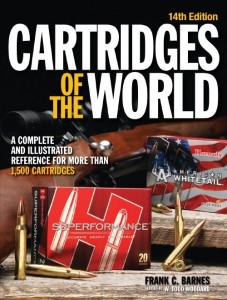
Whether you are a serious firearms enthusiast, cartridge collector, or handloader, you’re sure to find something of interest in Cartridges of the World, 14th Edition by W. Todd Woodard. As the most widely-read cartridge reference book available, this comprehensive guide is ideal for firearms owners, especially those with an interest in the hardware currently available from the firearms industry. Get Your Copy Now
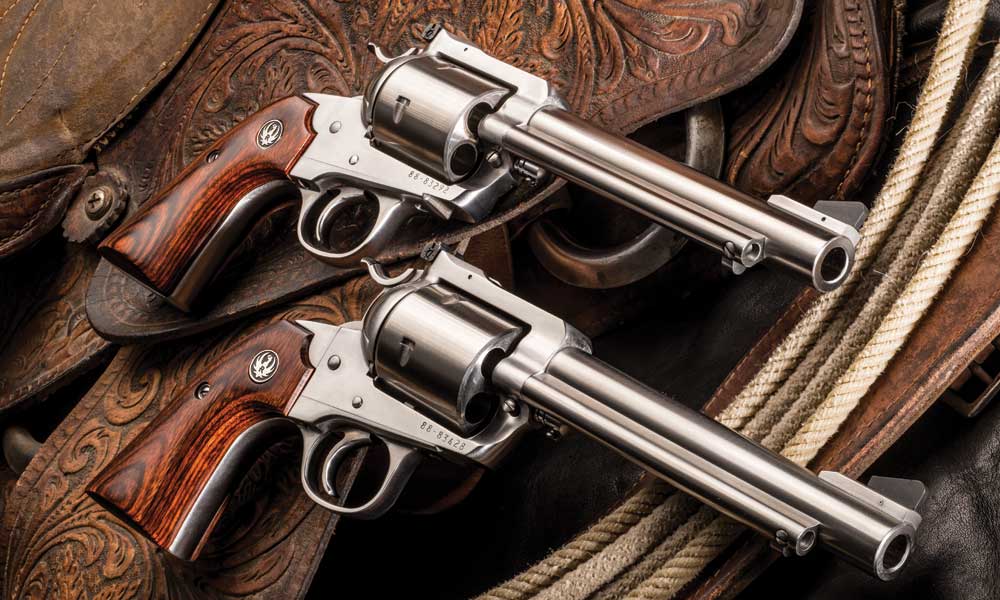
Ruger’s new Super Blackhawk revolvers in .480 Ruger and .454 Casull are excellent options for handgun hunters and fans of big-bore revolvers.
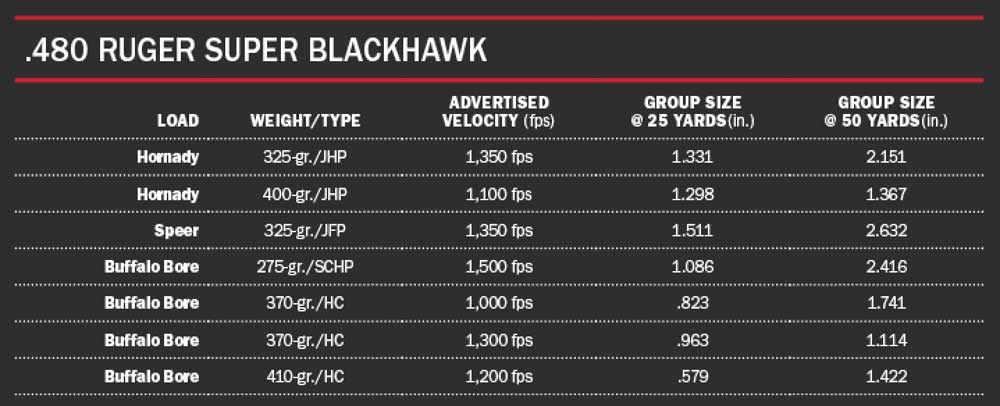
Early this year, Ruger asked me to perform some testing on both of its new Super Blackhawk models, all under the veil of secrecy of a strict embargo. I put nearly 1,000 rounds through the .454 Casull model and almost 5,000 rounds through the .480 Ruger model.
Fans of the single-action Super Blackhawk have long been waiting for one chambered in .480 Ruger.
Appropriately dubbed an “endurance test,” I wasn’t sure whose endurance we were testing, the gun’s or mine. I had no support crew or relief shooters. It was just the revolvers, the bench, piles of ammunition and me. I am happy to report that I survived, and my hands are still somewhat intact. I can’t figure out what’s wrong with me. I have an inability to say “no” when asked to test firearms I find irresistible—irrespective of the parameters of the test. When Ruger engineers first approached me, I was told I was on a short list to test the .454 Casull and .480 Ruger Super Blackhawk single-action revolvers. They said something about being recoil-proof and a glutton for punishment in explaining why I had been chosen for this honor. My wife neatly sums up these “qualities” with one word: numb.
“No problem,” I said, and “Thanks, I think. I love a challenge.”
In February, a call from my FFL indicated that the first installment had arrived along with a couple hundred rounds of .454 Casull of various brands and bullet weights. I tested that revolver to the tune of nearly 1,000 rounds in a short period of time.
Shortly thereafter, a .480 Ruger Super Blackhawk arrived, and this time, my FFL told me I should bring my truck to haul all of the ammo out of his entryway.
Ever since Sturm, Ruger & Company released the .480 Ruger in the love-it-or-hate-it Super Redhawk back in 2001, revolver aficionados have been browbeating Ruger to release this cartridge in their popular single-action revolver lineup. The combination of Super Blackhawk and .480 Ruger is debated incessantly on gun websites, yet Ruger’s reticence to actually make this happen has frustrated many handgun hunters who have long wanted to see this marriage come to fruition.
Basically a shortened .475 Linebaugh, the .480 Ruger is a serious big-game hunting round that, even when loaded to spec, isn’t too abusive to the one pulling the trigger. Ruger has finally relented by offering not only its .480 Ruger in the Super Blackhawk line, but also the raucous .454 Casull. Ruger has offered the Super Redhawk in .454 Casull since the late ’90s.
Handgun hunters everywhere now have reason to rejoice as two of their favorite calibers can be had in the revolver they love in an affordable package. Available as a Lipsey’s distributor exclusive, I cannot imagine supplies will last long.
The gun’s cylinder is carved from 465 Carpenter steel for durability.
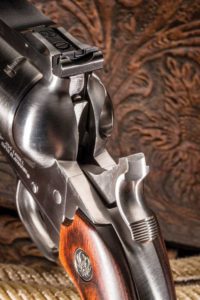
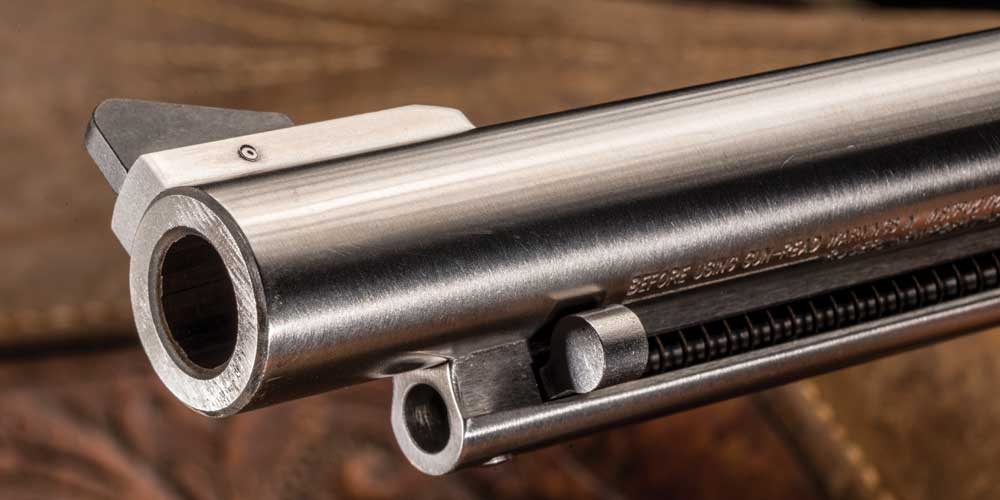
Here’s what you need to know. The new revolvers are based on the old revolvers. Ruger used the standard Super Blackhawk frame in stainless steel (415 stainless steel). The barrel is 6½ inches in both models (at least initially) and made from 15-5 stainless steel, with a 1:24 and 1:18 twist for the .454 Casull and .480 Ruger, respectively. The barrel is straight, without a taper and features a front sight base that is silver soldered on with a pinned in sight blade, and a standard Ruger adjustable sight is utilized in the rear.
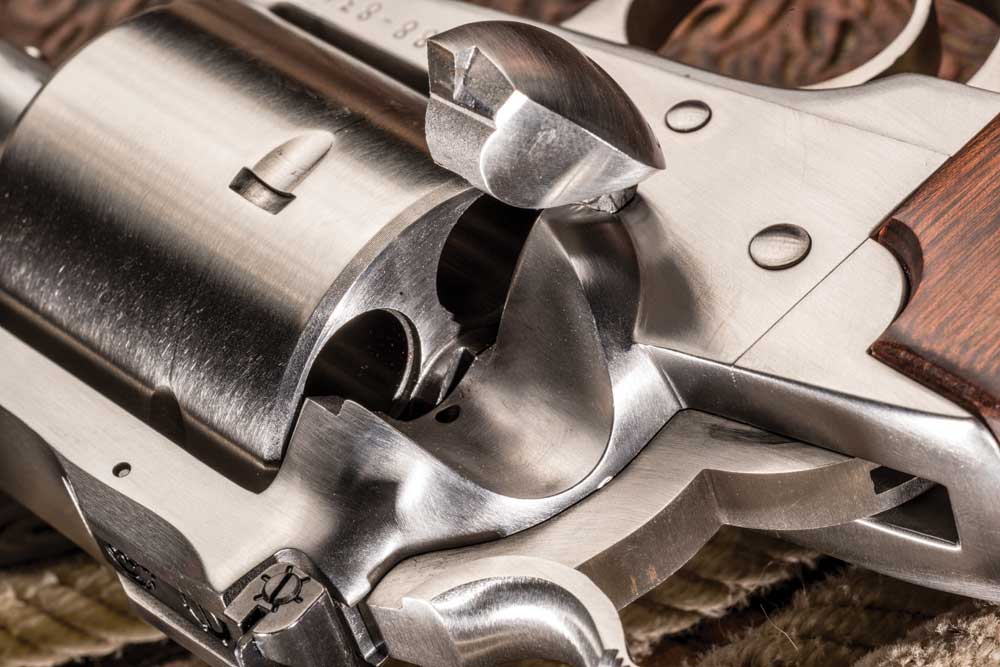
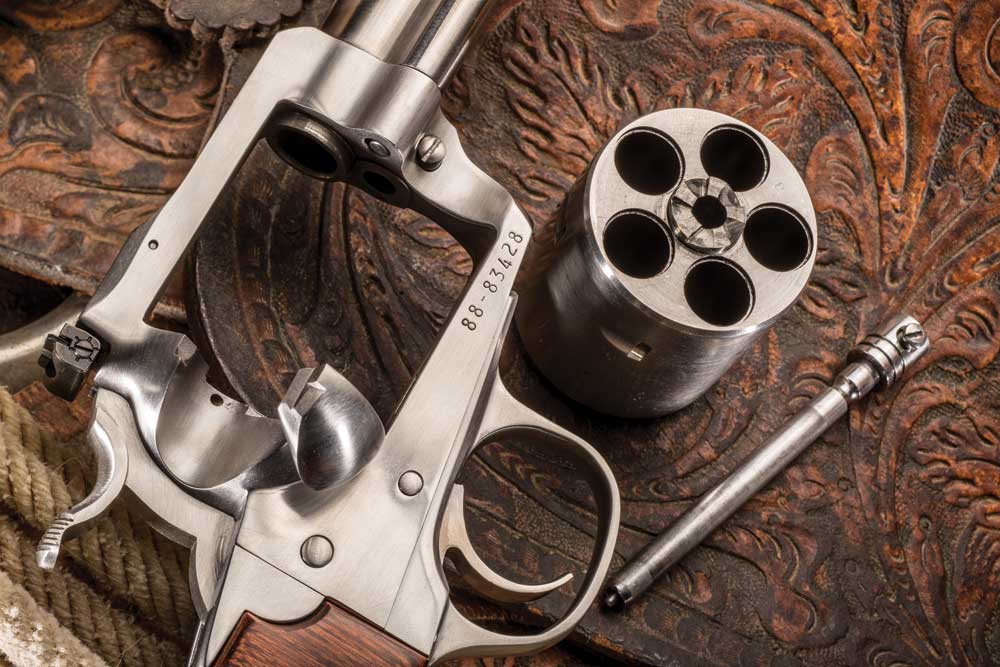
The cylinder is carved from 465 Carpenter steel, the super-strong, hard-to-machine material that first made an appearance in the late 90s in the .454 Casull Super Redhawk (and later in the .480 Ruger version). The cylinder is a five-shot configuration, with counter-boring to encapsulate the case heads. Dimensionally, the cylinder is like that of the .44 Magnum Super Blackhawk, save for a tiny bit more length to the rear to compensate for the recessed case heads.
The new Super Blackhawks feature a slightly longer, five-shot cylinder with counter-boring.
The new revolvers are fitted with an extra-long ejector rod housing that made its first appearance on the limited run of stretch frame .357 Maximum revolvers of the early 1980s. A Bisley grip frame is the only one offered and the only one Ruger deemed acceptable for these applications. A locking base pin guards against the base pin walking out under recoil, a nice touch.
I tested both models thoroughly with factory fodder. Both pre-production models suffered from teething pains that we have been assured have been sorted out, but are to be expected from test guns. Chronic screw loosening (grip frame in particular) plagued the .454, but a drop or two of thread lock fixed that issue. The ejector rod housings on both loosened regularly, and both launched their front sights, ironically on the 480th round out of the .480 model. The .480 also had its barrel unscrew itself, but Ruger promptly fixed it and had it back in my sore hands to resume testing.
These new revolvers are equipped with an extra-long ejector rod housing.
Recoil means something different to every shooter. While I am no stranger to recoil, these relatively lightweight powerhouses pack a wallop on both ends. Not the worst you may encounter, but a considerable step up from the venerable .44 Magnum. The .454 Casull Super Blackhawk kicks noticeably harder than its .480 Ruger counterpart. This is no doubt due to the higher pressure levels .454 Casull ammunition is loaded to, and while the .480 delivers a heavy push, the .454 has a snappy and much sharper recoil impulse.
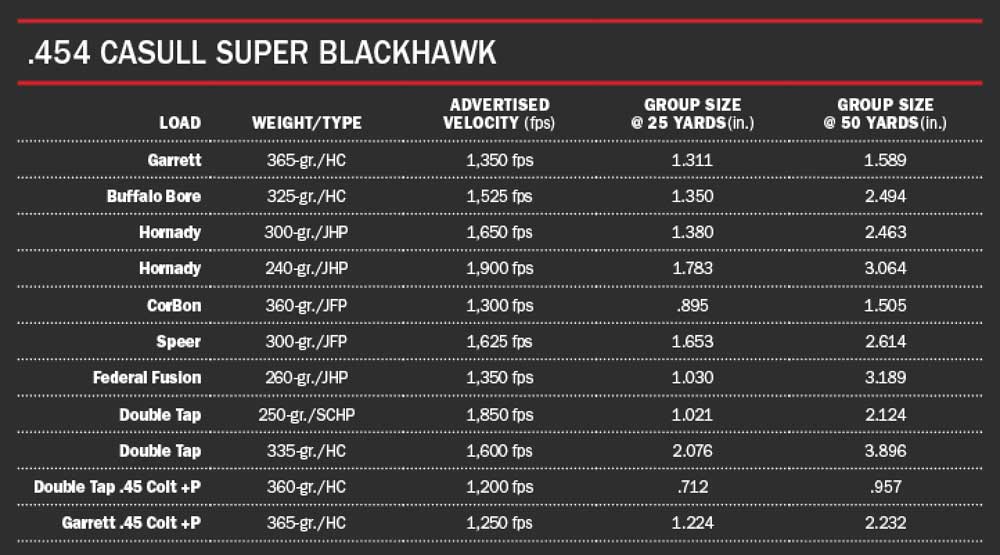
Both revolvers delivered outstanding accuracy, the only limits being my eyesight with open iron sights. To remedy this, I equipped both models with red dot-type sights of radically different designs. I own a number of more expensive revolvers that cannot compete with the accuracy these two new Rugers displayed.
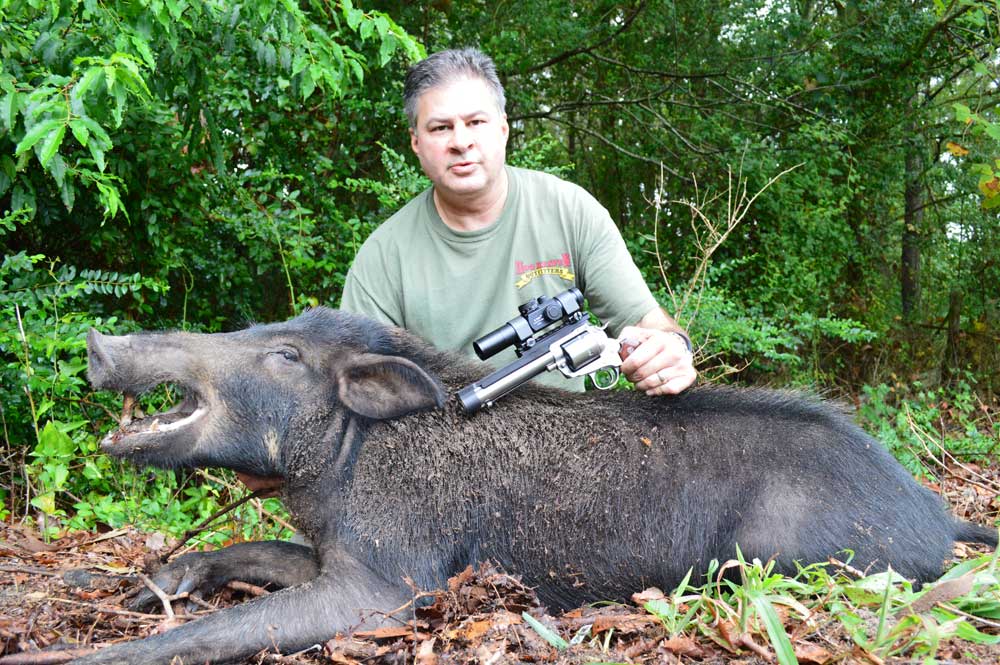
We got the opportunity to test the new .454 Bisley on porcine flesh at Hog Heaven Outfitters of Johnston County, North Carolina. I got lucky on the first morning when a 214-pound boar made the mistake of showing up. The shot was broadside at about 20 yards and required only one Garrett 365-grain .45 Colt +P Hammerhead to seal the deal. My testing was now complete.
In summary, Ruger and Lipsey’s have finally given us what we want. What was once a custom-only and cost-prohibitive proposition is now only a phone call—and also less than $1,000—away from being yours. We all have reason to rejoice. Evidently, Ruger is listening.
This article originally appeared in the April 2016 issue of Gun Digest the Magazine.
Reloading the 9mm Luger is an easy process, but there are a few useful techniques for getting the most out of your 9mm loads.
In the gun world, debates rage on for decades, and some are pushing a century. Undoubtedly, these debates aren’t going anywhere soon, but some get especially heated.
One of the most fervent is the debate over the .45 ACP vs. the 9mm Luger. Both sides have their staunch defenders, and both have valid points of view. I’ve personally leaned toward the .45 ACP camp, but that certainly doesn’t make the 9mm Luger a bad choice for a carry gun; in fact, I see some merit to the smaller frame and greater magazine capacity.
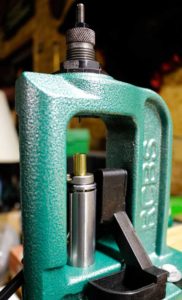
Resized 9mm case and flared case ready for loading.
Adding to the credibility of the 9mm Luger, please consider that the venerable .38 Special (my own choice for a daily carry gun) is looked upon as a worthy carry gun, yet the 9mm Luger is a more powerful cartridge across the board. The .38 has a bit of a heavier bullet at the top end (158 grains), but the 9mm can spit out 147-grain slugs, which is not too shabby.
Bred for military service in 1902, Georg Luger of Germany presented his 9x19mm cartridge to several countries, but it was his home country that adopted it as its sidearm. This is not the place to debate the comparisons to the fatter cartridges; let’s just take it for granted that the 9mm Luger works, because it does.
Reloading the 9mm is not a difficult proposition; it’s a relatively straightforward design. It is a straight-walled, slightly tapered case, which headspaces off of the case mouth. Therefore, you’ll want to be very careful about trimming the brass to proper length and leaving a good, square case mouth. The 9mm Luger has a case length of 0.754 inches, and it’s best to adhere to that length.
I use the RCBS Case Prep station to set the trim depth to the proper length, using the micrometer dial to get things just right. When I flare the case mouths, I don’t flare very deep; just enough to get the bullet seated properly, so as not to over-stress the case.
Once your bullet is seated, the only type of crimp you should use is a taper crimp. You see, the traditional roll crimp, which will roll the very edge of the case mouth into the cannelure of the bullet, will destroy the only means of proper headspacing and therefore must not be used. A taper crimp, which squeezes the case wall concentrically, will keep the bullet firmly in place, while maintaining the square case mouth for headspacing.
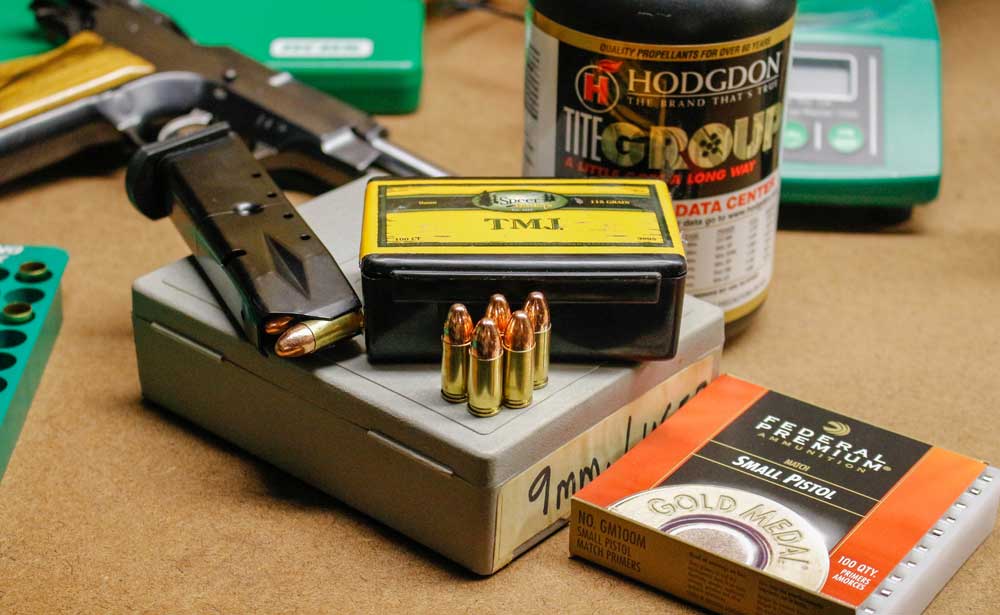
The 9mm Luger is sparked by a small pistol primer; my own loads have been based around the Federal Gold Medal Match primer, part number GM100M. The consistency of the Federal Gold Medal Match line has caused me to be a bit biased, but they’ve worked very well for me in many different applications. I’d like to share the three loads I use most in three common bullet weights.
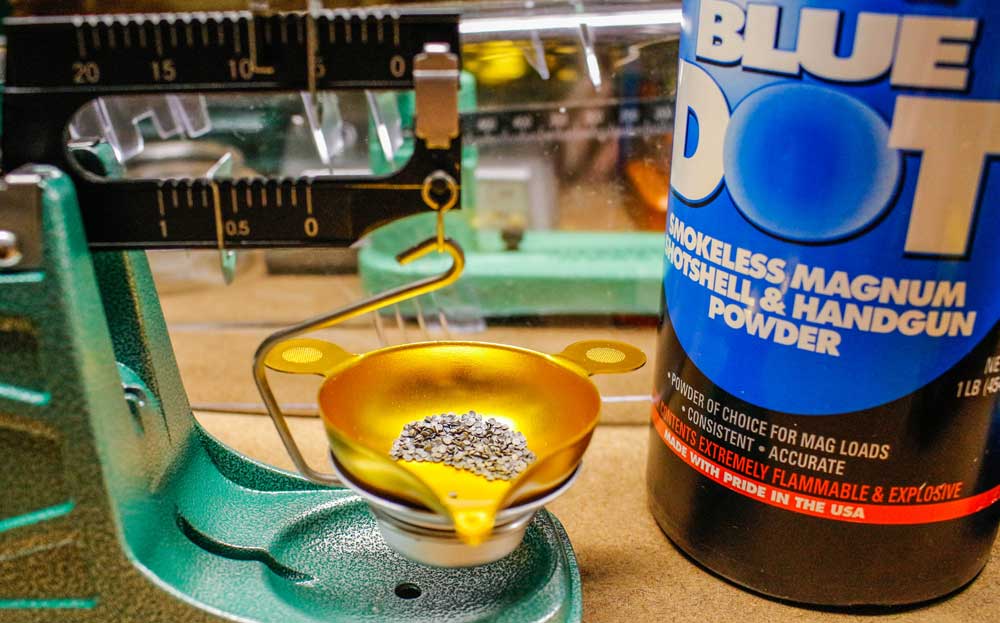
Alliant Blue Dot flake powder is good for heavier 9mm loads.
At the lightest is a 90-grain Sierra jacketed hollowpoint (JHP) with a skived jacket. This bullet is on the light side of the spectrum, and as a result it will attain the highest velocities. I was experimenting with Ramshot’s ZIP powder and stumbled upon a load that gave very satisfactory results.
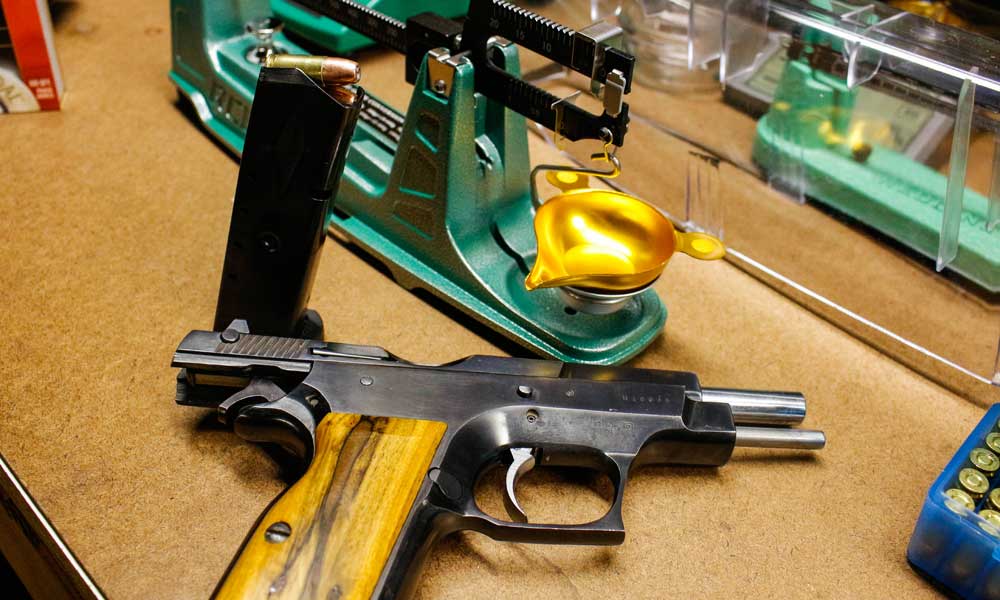
Out of a Tangfolio 4½-inch barreled-pistol, this bullet, when seated over a charge of 5.2 grains of ZIP, gave just over 1,300 fps, with very little velocity deviation and excellent accuracy. At 1.010 inches, the truncated cone profile fed very well, giving no issues whatsoever. Some 9mm pistols won’t feed the shorter bullets as well, so you’ll have to do some experimenting with your own gun.
If you do experience feeding issues, I’d make sure your feed ramp is well polished and if it still persists, I’d recommend switching to a slightly longer bullet. Now, the penetrative qualities of such a short bullet may not be as impressive as the heavier-for-caliber slugs, but that is often a quality that is appreciated in a home-defense load. Over-penetration is a rather undesirable quality when there are loved ones in adjoining rooms.
Resizing 9mm brass is an easy process.
For a good, affordable plinking load, I like the Speer TMJ 115-grain bullet. It has a classic, military-style nose profile, and because the lead core is completely encased in the copper plating it makes a great choice for use in the indoor pistol ranges, as they will leave no lead vapors in the air.
I load this bullet over 4.2 grains of Hodgdon’s Tite-Group for a muzzle velocity of just under 1,100 fps. This is a middle-of-the-road powder charge, which doesn’t recoil too harshly and is easy on the ears, yet cycles just fine in our test gun. I set the bullet for a cartridge overall length (COL) of 1.130 inches to ensure proper bullet tension in the case.
I have long been a fan of heavier bullet choices when loading for the medium-caliber handguns, like the 9mm Luger or .38 Special.
Although the velocities drop off considerably in comparison to the light-for-caliber bullets, the heavier slugs offer fantastic penetration, especially when that bullet is properly constructed. The Speer Gold Dot has a fantastic reputation as a self-defense bullet, even to the point where it is carried by law enforcement.
The 147-grain Gold Dot is a serious projectile in the 9mm Luger, leaving the muzzle at 950 fps, when set atop a charge of 5.6 grains of Alliant’s Blue Dot powder, at a COL of 1.130 inches. This combination will cause any would-be attacker to seriously reconsider their chosen course of action.
Even with the heavy bullet, and a stout load (though our pistol showed no signs of excessive pressure), one of the great features of the 9mm Luger is that just about any shooter can learn to handle the pistol effectively, and that includes this particular load. Recoil was very manageable and muzzle jump was moderate, so it was easy to get back on target.
Due to the small case capacity of the 9mm Luger, I sort my brass into lots, separated by headstamp. This way I get as close as possible to a uniform case capacity for each load I develop. As always, you should start at the lowest listed load for each particular bullet, and work your way up slowly.
However, in the 9mm Luger, there is not a wide differential between the starting load and the maximum, so I would suggest that you work up in 0.1-grain increments, watching for high-pressure signs.
The example loads given above are an illustration of the versatility of the 9mm Luger, but there are many more avenues to be pursued. The Luger will run very well on many other powders, like Alliant Unique and Herco, Accurate No. 7, and Hodgdon HS-6. Have fun experimenting with the variety of loads, and enjoy shooting Mr. Luger’s creation.
Editor’s Note: This article originally appeared in the Summer 2016 issue of Gun Digest the Magazine.
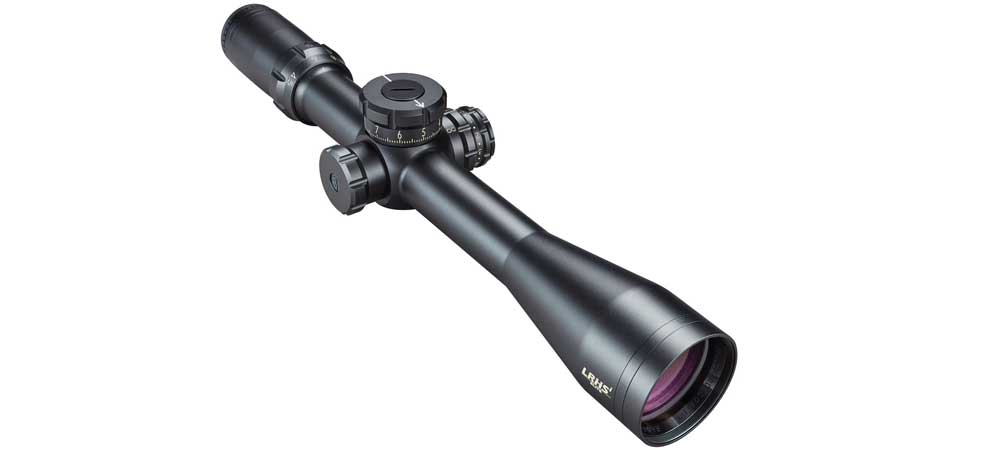
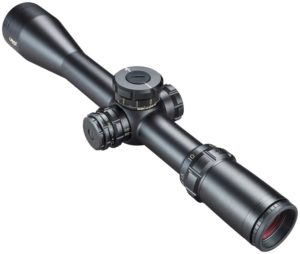
Bushnell adds to its long-range offerings with the new LRHSi 4.5-18×44 riflescope, which features an illuminated reticle for rapid targeting.
Bushnell has always been a big name in the hunting scene, and in the past few years, the company has really dedicated itself to offering more in the way of quality, long-range optics for hunters and shooters. One of the American manufacturer’s biggest releases in recent years was its Elite Long Range Hunting Scope (LRHS), a purpose-built riflescope with features designed to aid the long-range hunter.
Now, Bushnell is expanding its long-range offerings by adding another long-range riflescope with an illuminated reticle to help hunters more quickly place their aiming point on target in any light condition. Like the previous LRHS, the new Bushnell LRHSi 4.5-18x44mm riflescope provides excellent accuracy, especially as distances stretch, making it a powerful tool for long-range shooters and hunters.
The new LRHSi riflescope features a first focal plane G2H-i mil-based reticle with .1 mil clicks. This allows shooters to range targets at any magnification and make quick, easy and precise holdover adjustments in the field. The scope also incorporates a low-profile, target-style elevation turret equipped with a RevLimiter zero stop function that allows shooters to quickly return to zero without dialing past the zero.
Like many of Bushnell’s riflescopes, the new LRHSi 4.5-18x44mm comes equipped with Bushnell’s Rainguard HD that creates a permanent barrier that beads water to maintain a clear view regardless of the conditions, an excellent benefit to serious hunters who might not always experience ideal shooting conditions. Along these same lines, the LRHSi is Argon-purged for waterproofing.
This new long-range scope utilizes a fast-focus eyepiece and side-parallax adjustment to ensure a clear sight picture regardless of range, and it features fully multi-coated optics with Ultra Wide Band anti-reflection lens treatments.
The LRHSi has a durable 30mm tube construction, yet weighs in at just 26.5 ounces, providing a lightweight option perfect for the field. Overall length is 14.2 inches, and eye relief on the new optic is 3.94 inches.
The new Bushnell LRHSi 4.5-18×44 currently carries a minimum advertised price (MAP) of $2,039.95. For more information on the new LRHSi, visit Bushnell’s website.
The new Vortex Optics Razor HD AMG is purpose-built with the serious long-range shooter in mind and is full of great features.
Vortex Optics has increasingly become a major player in the optics industry, and one of the manufacturer’s newest offerings is dedicated to serious long-range shooters and hunters. Dubbed the Razor HD AMG, this new 28.8-ounce variable-power riflescope offers 6-24 magnification with a 50mm objective lens.
The new scope is perfect for an array of long-range tactical applications or for hunting in wide-open western landscapes. The Razor HD AMG is 100-percent manufactured in the U.S. from quality, durable materials and is waterproof, fog proof and shockproof. It is a first focal plane design with an illuminated glass-etched reticle, and the scope features premium HD low-dispersion glass that is fully multi-coated.
Our friends at Deer & Deer Hunting caught up with Mike Boardman of Vortex Optics to get an exclusive rundown on the new Razor HD AMG. Check out the video above to learn more about this great new long-range riflescope.
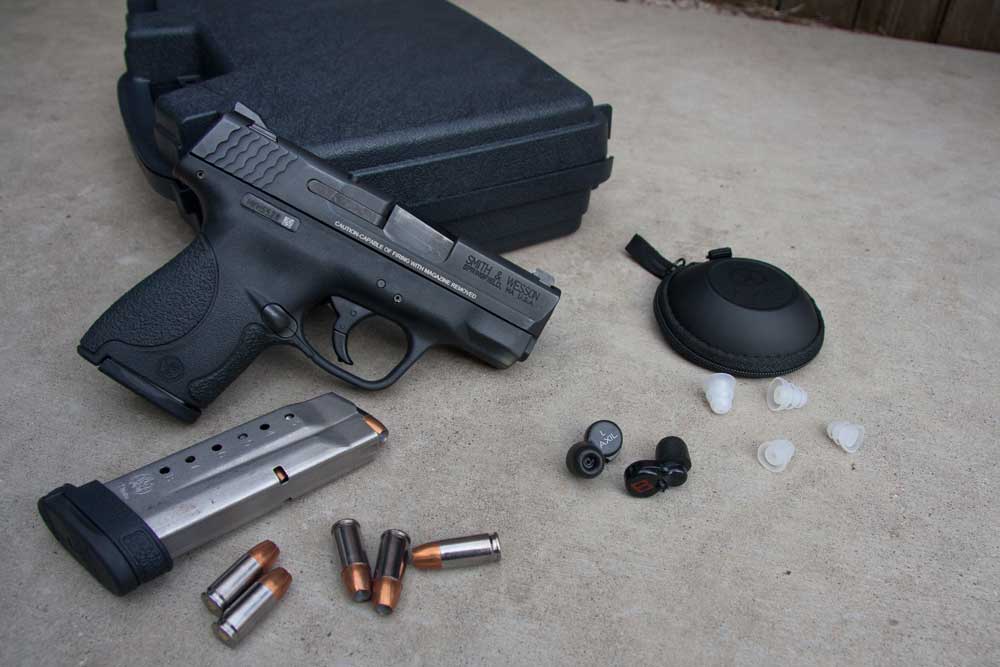
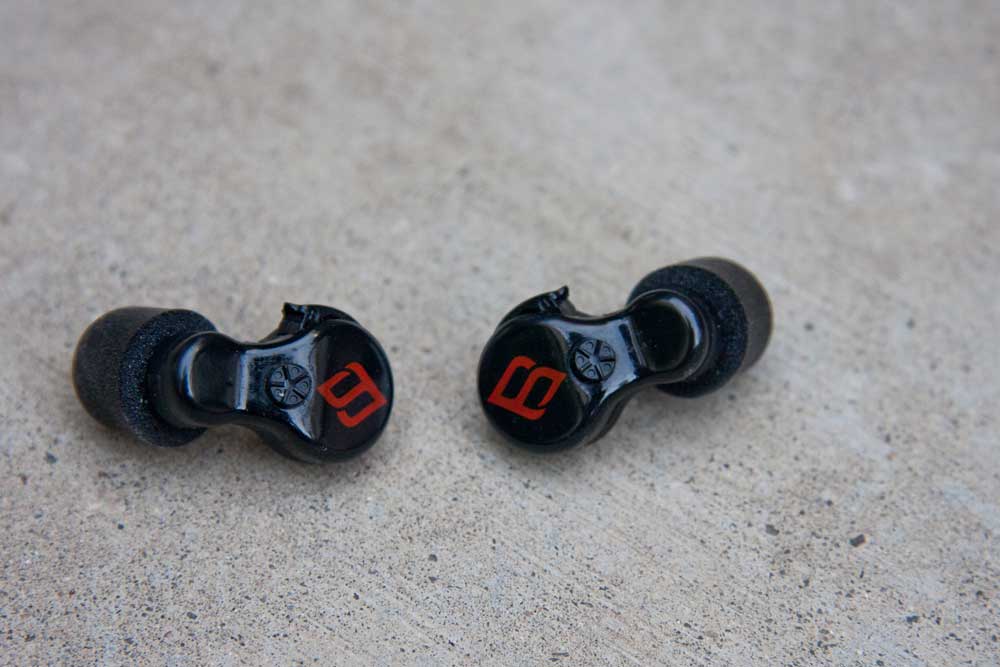
ProSounds’ new H2P earpieces offer unprecedented hearing enhancement, while also providing ample hearing protection from damaging muzzle blasts.
It’s a well-established fact that the loud noises associated with shooting can result in cumulative hearing loss over the years if nothing is done to protect against these damaging sounds. And unfortunately, that loss, once it occurs, is typically permanent. This is why many of today’s older shooters and hunters might have difficulty hearing; those years and years of shooting without the proper hearing protection have taken their toll.
These days, shooters have no excuse, as there are plenty of hearing protection options out there ranging from simple foam plugs on up to highly advanced (and often expensive) custom molded plastic plugs that electronically protect, and even enhance hearing. One of the newest products that offers a blend of protection and sound enhancement comes from ProSounds, which, along with SportEAR, is a member of the AXIL family of hearing protection brands.
This product, brand new for 2016, is called H2P and consists of two earpieces that provide sound amplification of up to six times higher than normal while also digitally compressing sounds higher than 85 decibels (dB) to prevent hearing damage. And, unlike many other electronic earplugs on the market, the H2P earpieces are priced relatively affordably, with an MSRP of $499. As an added bonus, ProSounds is currently running an Indiegogo campaign for the launch of the H2Ps until July 22, and during this time, the earpieces are available for the discounted price of $299.
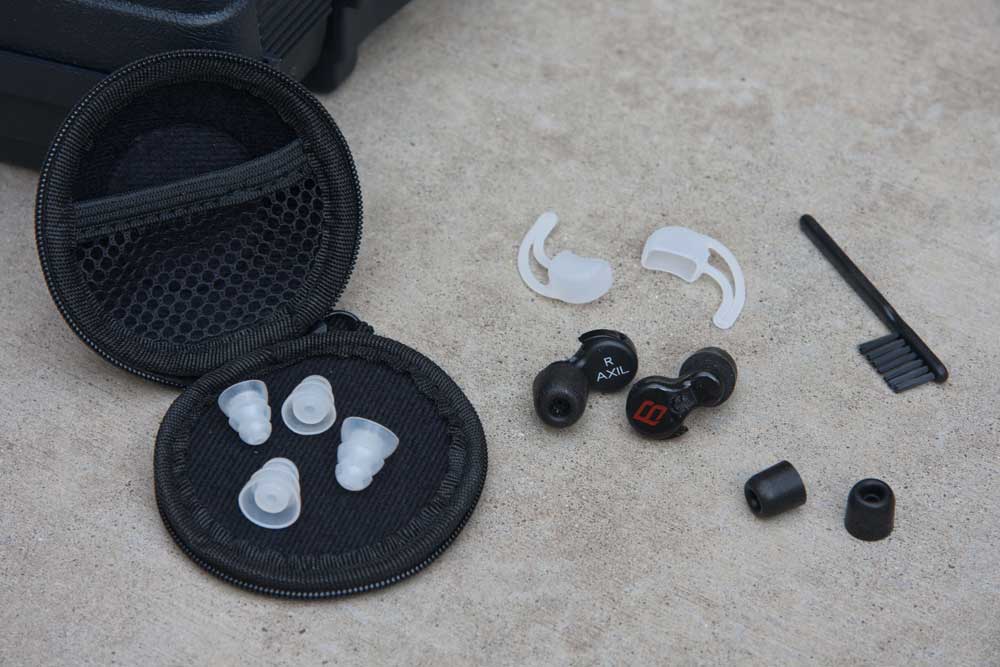
The H2P earpieces, which are powered by two 10a zinc batteries, are engineered with Lynx Digital Sound Clarity for optimal performance and are adjustable for volume control via a small rotating knob on the side of each earpiece. Included with the H2Ps are three different styles of tips, which are what actually go inside the ear canal: a foam tip that offers 30 dB of protection, a silicone tip that offers 34 dB of protection but increased comfort, and a tulip tip that allows both enhanced and natural sound to pass through the canal. SecurFit extenders, a cleaning brush, 10a zinc batteries, and a protective carrying case also come with the H2Ps.
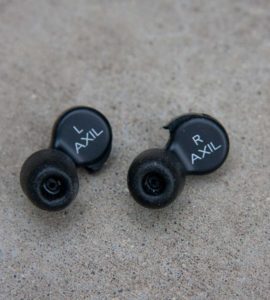
The H2Ps come with three different styles of tips, SecurFit extenders, a cleaning brush, 10a zinc batteries, and a protective carrying case.These low profile earpieces are also labeled for each ear.
Enhanced Hearing ProSounds provided me with a pair of its new H2Ps for the purposes of testing and reviewing them. Before I gathered up my gear and headed to the range, however, I wanted to familiarize myself with the H2Ps.
The first thing that struck me when I opened the box and pulled out the new H2P earpieces was their size and weight. They were remarkably low profile, and in terms of weight, I wouldn’t be surprised if they weighed less than a standard thumb tack. They were heavier than a set of standard foam plugs maybe, but I suspect lighter than many custom molded electronic plugs — and of course, drastically lighter and much less obtrusive than a set of earmuffs.
The included 10a zinc batteries, commonly used within hearing aids, went easily into the H2Ps via a loading gate built into each earpiece. Battery insertion and removal was remarkably easy, as the gate featured an edge for the user’s finger to open or close. In fact, when the H2Ps weren’t in use, I’d simply open the loading gate to ensure that the batteries weren’t being needlessly wasted.
Upon inserting the earpieces into my ears and dialing up the volume, I was introduced to sounds that I wasn’t hearing, or was barely hearing before. Distant cars sounded like they were on the next street over, birds that were casually chirping seemed like they were right on top of me, and the almost imperceptible sound of a TV running in another room of the house would suddenly become clear.
I was impressed. I was also wondering how something that amplified sound so well could also block it when it occurred at harmful levels.
A little skeptical, I did as the H2Ps user manual suggested and conducted a hearing protection check to make sure the earpieces had an effective seal by clapping my hands loudly next to my ear. Sure enough, the sound was no longer sharp and clear, indicating the H2Ps were doing their job. The next step in the process was a trip to the range.
The 10a zinc batteries load easily into each earpiece via a loading gate that swings open.
On the Range I wasn’t able to go to the outdoor range I typically use for my reviews, but I did manage to find an indoor range that I could use to test the H2Ps. Upon arrival, I immediately inserted the H2P earpieces and dialed up the volume.
The small volume adjustment knob on each of the earpieces was incredibly easy to use. Users can either use a single finger to push and twist the knob or a finger and a thumb to turn the knob. There is also a slight click when the volume is completely turned off, which is helpful.
Almost as soon as I inserted the earpieces, I could tell that the H2Ps were working. As I was getting my gear together to enter onto the firing line, I could hear the sounds of other shooters’ muzzle blasts being compressed and muffled by the H2P earpieces.
The volume adjustment knob is easy to locate and operate on each H2P earpiece.
This continued once I got onto the range. However, because I was shooting at an indoor range, the shots were considerably louder than they would normally be, which is why I ultimately decided to double up and put a pair of passive muffs on over the H2Ps. I would’ve probably been fine with just the H2P earpieces, but as general rule, I always tend to double up with plugs and muffs when shooting at an indoor range, so I did the same with the H2Ps.
This system worked perfectly, as I was getting sound enhancement from the H2Ps, as well as hearing protection from both. And if I wanted to step off the line to talk to somebody, all I had to do was remove the passive muffs and I was back to not only regular hearing but enhanced hearing up to six times the normal level.
All in all, I was very satisfied with the H2Ps. They offer incredible sound enhancement for those that need it and ample protection from damaging muzzle blasts. I could see these earpieces being an especially good option for hunters, as it would both improve their situational awareness and offer protection when a shot is taken, something many hunters choose to sacrifice for being able to hear approaching game.
With the new ProSounds H2P, there’s really no excuse for not protecting your hearing. The earpieces not only provide access to sounds you might not have heard otherwise, they also protect your ears so you can maintain your hearing for many years to come.
For more information on the ProSounds H2P, or to buy the H2P earpieces at the discounted price of $299, check out ProSounds Indiegogo campaign for the launch of the H2Ps, which lasts until July 22.
Morphy Auctions is setting up for its July 30-31 auction in Denver, Pa. And as usual, the gun seller looks to have an impressive stock set to cross the block. The company has around 300 modern and antique firearms ready to go on sale and has already enjoyed a robust year. At Morphy’s April fine firearms event, it moved some $1.8 million in collectable guns. The offerings at the upcoming sale also look to have the potential to get collectors and gun fans of every stripe to crack their wallets. Here’s a look at some of the fine shoot’n irons ready to go on sale.
The popularity of the 1911-style pistol has never been in dispute. Ever since its creation in the early 20th century, it has held a place of prominence in the shooting sports. The vast majority of these pistols have historically been chambered in the potent .45 ACP cartridge; however, in recent years, more and more manufacturers have been creating 1911s chambered in the smaller 9mm, which a larger portion of shooters can more comfortably handle.
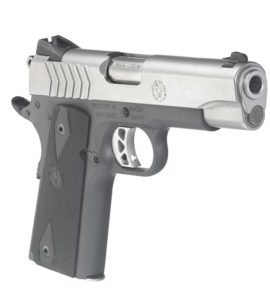
It is in this same vein that Ruger has announced the addition of the SR1911 Lightweight Commander in 9mm to its lineup of 1911-style pistols.
Similar to the .45 ACP SR1911 Lightweight Commander already in Ruger’s SR1911 line, the 9mm version features a commander-length slide and an aluminum frame. These changes reduce the overall weight to almost a half-pound less than the all-stainless steel Commander-Style configuration.
Unlike the previous SR1911 Lightweight Commander, the new 9mm model sports a slightly different look — black rubberized grip panels and a gray anodized frame — as well as a higher capacity of 9+1 given the smaller cartridge. And, as anyone who’s shot a 9mm 1911-style pistol can attest, there will be noticeably less recoil than with a standard 1911 chambered in .45 ACP.
Because of its lightweight aluminum frame, 4.25-inch barrel, Commander-length slide and 9mm chambering, the new SR1911 Lightweight Commander in 9mm is an excellent candidate for concealed carry. Adding to its utility in that role are genuine Novak LoMount Carry three-dot sights, a lowered and flared ejection port, an extended magazine release, an oversize thumb safety, a beaver-tail grip safety and a skeletonized hammer and skeletonized aluminum trigger for fast, accurate shooting. The gun also features improved cocking serrations on the slide and a ramped barrel for reliable feeding.
The new SR1911 Lightweight Commander in 9mm is CNC-machined in the U.S. and comes with Ruger’s classic series 70-type lockwork. It currently has a MSRP of $979 and ships with two nine-round magazines, a bushing wrench and a cable locking device. Specifications for the new 9mm Lightweight Commander can be found below.
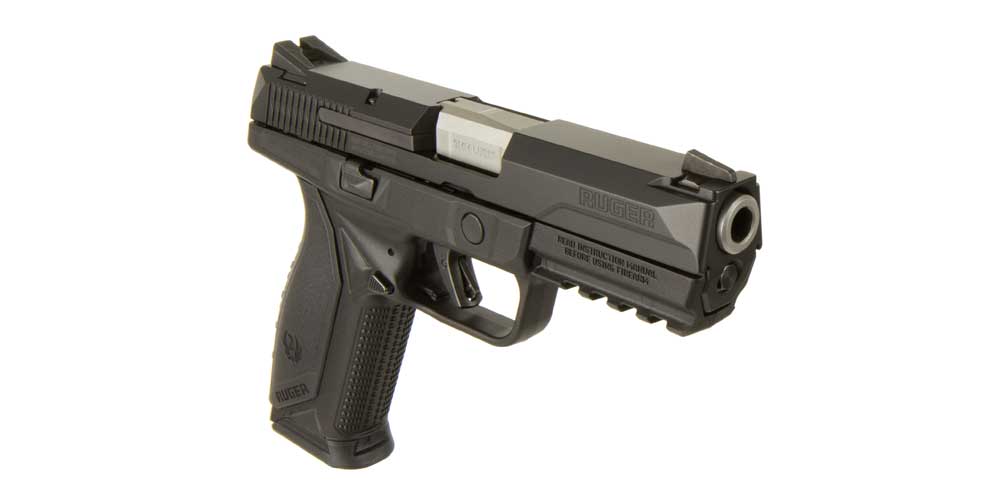
Ruger’s new full-size, striker-fired, polymer frame pistol is a rugged gun ready to serve in all capacities.
If you are a gun enthusiast or if you simply want a gun for sport or self-protection, you are living in probably the best time in history because the selection of guns is greater now than ever. And Ruger has just added another choice with the introduction of the Ruger American Pistol.
If you are one who doesn’t think another polymer handgun is necessary because there are enough to choose from already, consider that for every model on the market today, there are people who find it to be the best one for their needs. While the differences between brands and models are sometimes subtle, most people who grasp a particular handgun find that it either feels good in the hand, or that it doesn’t. And while some people like a particular feature on a gun, others despise it. So having a large selection of guns to choose from makes it more likely that each shooter will find a gun he likes.
To assure that the Ruger American Pistol suits as many shooters as possible, the engineers and designers at Ruger spent a great deal of time studying the likes and needs of shooters and requested input from law enforcement and military trainers from around the country.
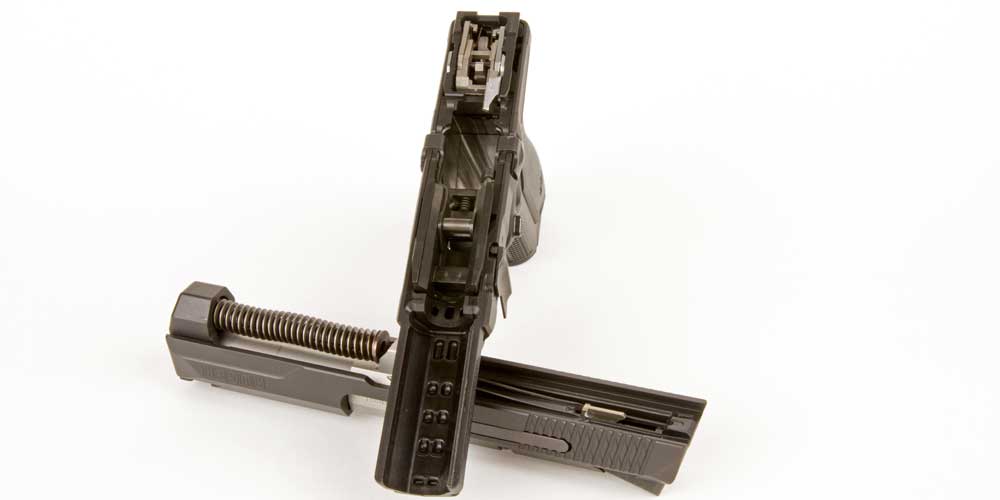
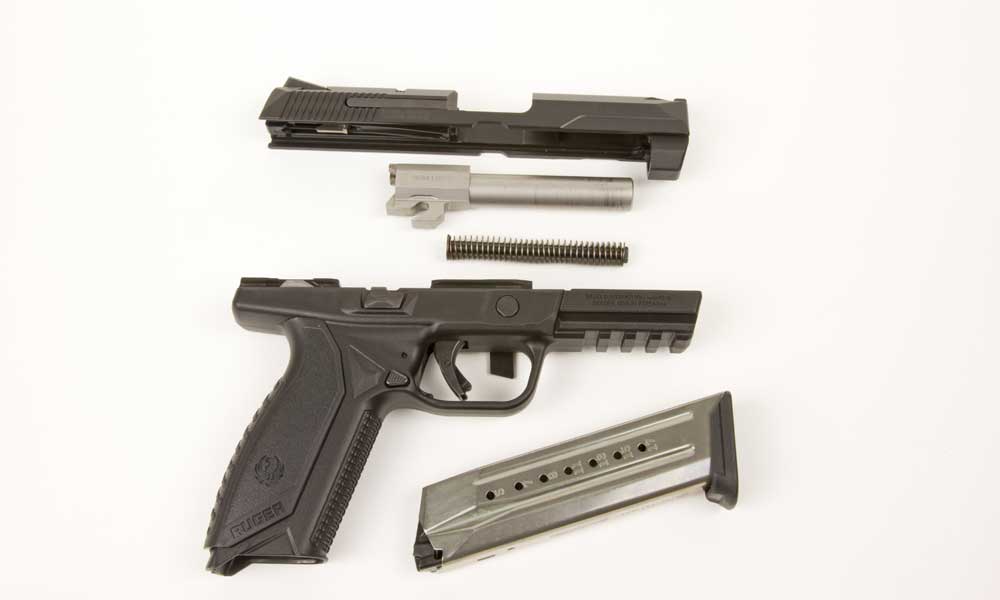
Features Although not obvious, it is not a typical polymer frame gun. Instead, the nylon-filled grip frame houses a modular chassis that contains the fire control group and has rails on which the slide reciprocates. The chassis is made of precision-machined steel with a black nitride finish that is extremely hard and corrosion resistant. And because it is the part that has the serial number on it, there is the potential to replace the grip frame and slide to modify the size and contours of the gun. Presumably, Ruger or another company will eventually offer such conversion kits, but that is speculation at this time.
The grip frame has different sized wrap around grips that are easily swapped out to fit many different hand sizes. The 9mm version has three sizes, and the .45 ACP version has two. These one-piece grips include not only backstraps, but also side panels so that with each one, trigger reach and size of the palm swell change. The front and back straps are heavily textured with diamond-shaped bumps, and the sides are stippled to help obtain a non-slip grip. Changing the grip requires only a quarter turn of a retention screw with the aid of a supplied wrench. And the gun is equipped with a lanyard attachment point at the heel, something that is seeing a comeback on pistols.
At the front of the grip frame where there is often nothing more than a dust cover to keep dirt out of the recoil spring assembly, Ruger put a Picatinny accessory rail for the attachment of a light or laser. For a gun that will be used for personal protection, those are good items to consider, since most deadly force confrontations occur in diminished light. And lasers are not gimmicks or toys—they serve a very useful purpose when employed properly after competent training.
Each American Pistol is supplied with two stainless steel nickel-Teflon plated magazines. The ones for the 9mm version hold 18 rounds, while the .45 ACP magazines hold 10. Diminished capacity 10-round 9mm magazines are available for those who live in jurisdictions where the right to use full capacity magazines has been restricted.
Controls are simple and will be familiar to anyone with experience shooting striker-fired, semi-automatic polymer frame pistols. However, Ruger has made an improvement not found on all other pistols in the class. The magazine release and slide stop are both ambidextrous so that both right- and left-handed shooters are on equal footing with the pistol’s controls.
While prominent and easy to activate, the slide stop is not obtrusive and does not interfere when the shooter racks the slide. The magazine release is located at the junction of the front strap and the trigger guard, the preferred location by most. It is a triangular button that is prominent enough to easily activate, but not enough so that it is prone to accidental activation during carry or shooting. Just to its rear is an irregular quadrilateral shaped bump to partially protect it from being accidentally pressed.
Since the striker is partially cocked after the slide is racked, Ruger was able to develop a short take-up trigger. The one on the test gun did have a relatively short take-up and broke cleanly at just less than 7 pounds with almost no creep and no discernible overtravel. A right-angle ledge built into the rear of the trigger guard stops overtravel. For those readers interested, reset was distinct.
Top End The slide is manufactured of stainless steel that has been finished in black Nitride because it creates a very hard surface and is extremely corrosion resistant. Instead of the square, blocky appearance of most semi-automatic pistol slides these days; this one has the square corners cut off so—while not rounded—it does have a more eye pleasing appearance. At the rear of the slide are serrations that do a good job of affording a solid purchase when racking the slide by hand. At the front of the slide is a slight bevel on each side near the muzzle that should help to guide the gun into the holster.
Atop the slide, Ruger installs Genuine Novak LoMount Carry sights with the familiar three-dot configuration. The sights are extremely rugged, used by many manufacturers as original equipment, installed by many as an aftermarket accessory, and because of their configuration, are less prone to snagging on clothing or slicing a finger when racking the slide under stress in an emergency.
On the Range Because of the different sized interchangeable backstraps, most shooters will probably find the gun comfortable to grasp. That is one of the first criteria most people use in selecting a handgun. Reliability though is the most important feature in a gun used for self-protection, and the gun ran without any malfunctions during testing for this article.
Ruger says that it has designed a special barrel cam for the American Pistol that reduces felt recoil by spreading unlocking of the slide, barrel and frame over a longer period of time. Without the same pistol built with a standard cam system to compare against though, there is no way to positively prove that felt recoil is reduced. However, in testing the gun, recoil was quite manageable. In the end, how comfortable a gun is to shoot is a subjective observation and is unique to each shooter.
The Ruger American Pistol is another new product by Ruger that is redefining the company compared to what it was in its early years. The gun is fairly affordably priced, and if it turns out to be as robust as so many of the company’s other guns, it will probably be well accepted. For more information call Ruger at 336-949-5200 or visit ruger.com.
Specifications:
Caliber: 9mm (reviewed), .45ACP
Barrel length: 4.20 inches, 1:10 RH twist
Overall length: 7.50 inches
Weight: 30 ounces
Grips: Glass-filled nylon
Sights: Novak LoMount three-dot
Action: Semi-automatic, striker-fired
Finish: Black nitride
Capacity: 17 + 1
Price: $579
Performance:
Load: Black Hills 124-gr. JHP Velocity: 1,136 fps Average Group: 2.80 in. Best Group: 2.15 in.
Load: Federal 147-gr. Hydra-Shok JHP Velocity: 981 fps Average Group: 3.25 in. Best Group: 2.53
Load: Winchester 147-gr. PDX-1 JHP Velocity: 993 fps Average Group: 3.32 in. Best Group: 3.03 in.
*Bullet weight measured in grains, velocity in feet per second 15’ from the muzzle by chronograph, and accuracy in inches for three five-shot groups at 25 yards.
Editor’s Note: This article originally appeared in the Summer 2016 issue of Gun Digest the Magazine.
H&H Precision Rifles proves that a long-range tactical rifle can pull double duty in the competition and hunting worlds.
When it comes to the shooting sports, perhaps no issue at present is more popular, controversial, and heated than long-range shooting. If you ever want to see your mailbox explode with inbound letters from animated readers on both sides of the aisle, just raise the question about what qualifies as an “ethical” shot on an animal at “long range.”
When you’re shooting at steel the ethical question is basically a non-issue, but add an animal to the equation and things get complicated. But despite the controversial aspect, long-range shooting is also wildly popular for a reason. And as a recent trip to the state of Washington proved, there’s a lot the competitive long-range shooting world can teach those in the hunting community.
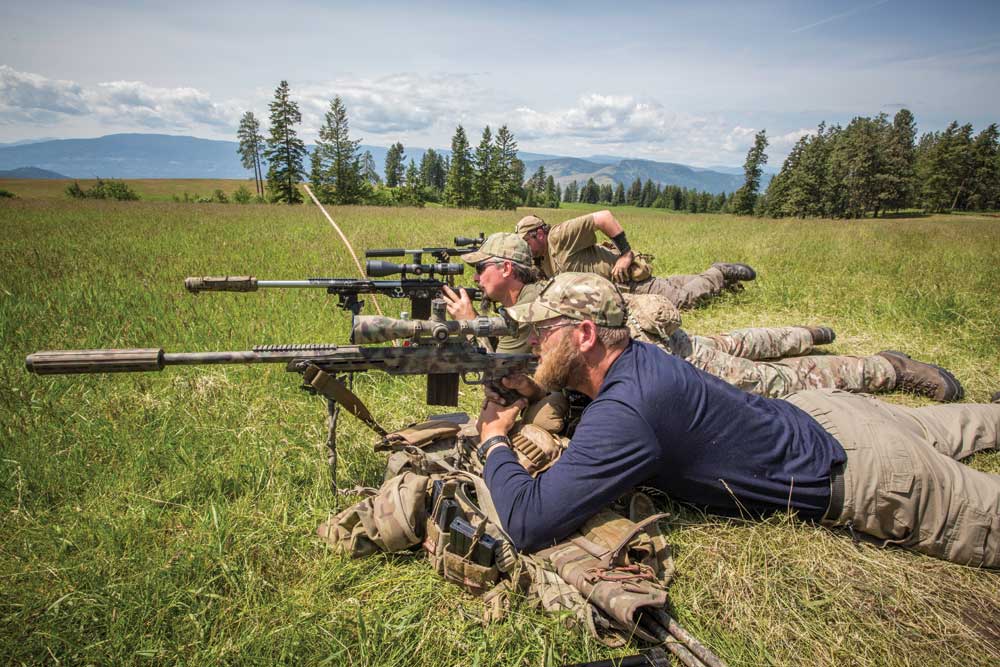
For the trip I joined Ken Hagen of H&H Precision Rifles to spend some time on the long-range course with his custom-grade rifles and to tag along as a few of his sponsored competitive shooters tried to track down a black bear in the timber country of Northeastern Washington. We’d also be filming an episode of Modern Shooter TV, hosted by yours truly and airing on The Sportsman Channel.
We had the expert tutelage of Brent Webley, owner at In-Motion Targets and shooter on the TV show “Long Range Reality,” and Justin Shovell, also a competition shooter sponsored by H&H, and the man who’d be pulling the trigger should our paths cross with a black bear.
Brent’s story is unique because he’s a hunter who turned to long-range competition as an outlet for honing his shooting skills, and then learned how to use those skills on game animals. He burns through tens of thousands of rounds each year, as well as several barrels. He’s a diehard hunter, reloader, and constant competition champion.
Somewhere along the way he put the mechanical background he gained working in a family-owned lumber mill to use by developing a moving steel target, which eventually became In-Motion Targets. In a way, he’s the quintessential picture of how competition skills like reading the wind, knowing ballistics and working up your dope can be applied successfully to a hunting scenario, and just how valuable the mastery of those skills are. If anything, that combination of skills makes you a more capable, ethical shooter. You know your “maximum effective range,” based on your skill, cartridge and rifle setup, and can use that formula to turn game into meat on the table.
H&H Precision Rifles
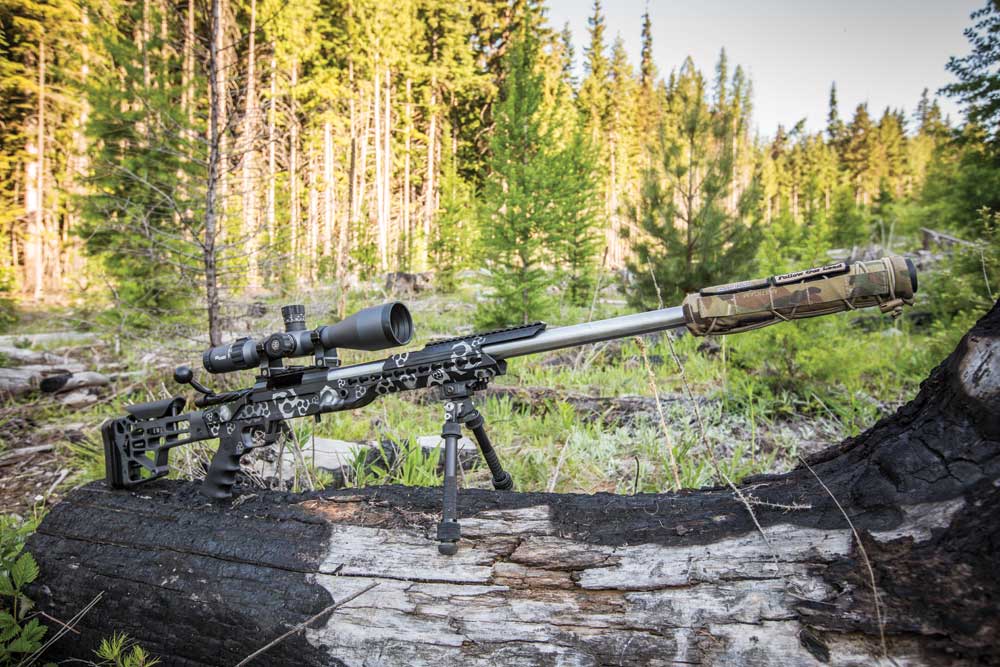
No matter how skilled you are, there’s no replacement for a finely crafted rifle that can handle the abuse guys like Brent throw at it. That’s where Ken Hagen and H&H Precision Rifles enter the picture. Ken builds custom-grade rifles with a pedigree of competitive victories to show for it; it only makes sense those same rifles would dominate with game in the scope. For our time on the range and in the field we’d be using Brent’s competition rifle, chambered in 6.5 Short Action Ultra Magnum (SAUM). As Brent put it, it’s like the 6.5 Creedmoor on steroids. Paired with one of Ken’s rifles, which carries a ¼ MOA guarantee, that amounts to one helluva long-range rifle.
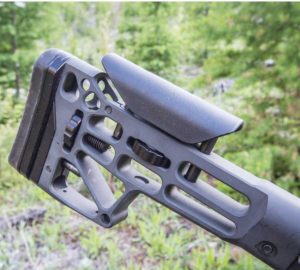
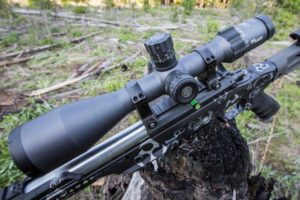
The rifle sports a stainless select, match-grade Benchmark barrel with an Orias chassis built by Killer Innovations and Mega Arms (MegaArms.com). The chassis is available in either M-Lok or Key-Mod, made with Billet aluminum, and is compatible with Accuracy International magazines. It also fits Remington 700 configurations in long or short action setups.
There is no bedding required thanks to Killer Innovations’ revolutionary self-adjusting recoil lug locking system (patent pending). The rifle features an XLR Tactical Buttstock, which is easily adjustable for cheek piece and length of pull. The heavy tactical receiver is built by Rainier Arms and is topped by a Picatinny rail for easy scope configuration. The heavy lug design is made for abuse, which is why it’s relied upon for competition use.
Ken will build you a rifle with a number of customizable options, including muzzle brake, but Brent’s rifle was setup for suppressed fire, perfect for noise reduction in the field. If you do go with a build from H&H, Ken will walk you through your options and encourages folks to fly out for the final test drive at the range. It’s hard to beat that level of hands-on customer service in today’s big-box marketplace.
At The Range
Before we hit the woods, we spent some time with Brent and his competition and business partner at In-Motion Targets, Carl Taylor. Not only does Carl know his way around a moving steel target, he’s a guru among long-range shooters.
He’s an unbelievable shooting instructor whose teams have dominated some of the military’s best-trained snipers in competition. Within minutes of watching me shoot he was correcting my sloppy trigger habits and helping get me lined up for a 500-yard shot on a steel coyote moving right to left at 3 mph. Brent called wind and elevation, I finally got the right hold, and the 6.5 SAUM was clanking steel every time. That’s enough to put a smile on your face.
Grin And Bear It
While many states offer the opportunity to bait your bears, it’s entirely a spot-and-stalk proposition in Washington. That meant we’d be driving into forested areas and hiking in to higher elevation vantage points that’d allow us to glass large portions of the mountainous landscape. Our hunt was a draw-only season in the spring, however, so most of the bears are actively feeding post-hibernation and trying to regain what weight they’ve lost in the winter. I didn’t draw a tag, which is why Justin would serve as the trigger man.
After about a half-day of glassing and trekking through timber country, we spotted a bear about 450 yards away. Brent threw up his SIG Sauer Kilo 2000 rangefinder while Justin got into the prone position.
It was a downhill shot across a small valley, so they cleared the tall grass away from the front of the rifle. Brent called the 4-5 mph wind immediately, helped dial in for distance, and spotted as Justin lined up the shot. You could see all the hours of training kicking in; no hesitation, no floundering in the moment of truth.
Justin pulled the trigger, sending the 6.5 SAUM off into the distance. Upon impact, the bear absolutely crumbled to the ground. When we finally cleaned the 300-pound bear, we discovered that the shot went straight through the heart—as good of a shot as you could ask for.
Parting Shots
While Justin managed to make a clean, ethical shot on a bear at 450 yards, I feel confident those boys could have stretched it much farther, if necessary. I’d seen them do as much on extended targets at the range, and in worse conditions. Brent said he’d have been comfortable out to 1,000 yards, no question.
As always, the ethical shot comes down to knowing your abilities, the competency of your rifle, understanding the conditions, and staying within your maximum effective range. It also comes down to having a rifle that’s capable of shooting ¼ MOA.
Not only are Ken’s H&H rifles exceptionally well made from the best components, he’ll also walk you through the build process. He asks his buyers to buy a plane ticket for when the rifle is completed so he can take them to the range and show them how to get the most out of the rifle.
He’ll give you load data, make sure you’re satisfied and send you on the way with one of the best rifles you’ve ever owned. It’s rare that you get that kind of service anymore. As Ken said, he’s just glad to help the next shooter’s dream come true with a custom rifle build of a lifetime.
There are a wide variety of defensive guns designed for personal protection, but which ones are the best? We chose 10 standout firearms that you’ll want in your corner when trouble arrives.
What are some of the best defensive guns currently available?
The concealed carry movement and the recent rise in the number of AR sales have created an ongoing dialogue in the gun universe about which defensive guns are best for personal protection and home defense. And with so many good options out there, it’s difficult to choose the top 50 defensive firearms, let alone the top 10. These guns had to be the very best of the bunch, personal protection firearms that could be relied upon to perform flawlessly when needed. A variety of guns made the list—ARs, shotguns, revolvers and semi-automatic pistols—all of which have the goods required to keep you alive during the worst of times.
There’s a good chance you won’t agree with all of these choices, or you may feel one gun or another has been slighted. That’s fine. The important thing is that we keep that defensive firearm dialogue going, because as more and more shooters exercise their Second Amendment rights of personal protection, the evolution of the personal protection firearm will continue, prompting manufacturers to improve upon existing designs and introduce brand-new guns to market. The competition to produce the best personal defense weapon is fierce, but it’s ultimately the American shooter who wins.
Here’s our selection of the 10 best defensive guns available today.
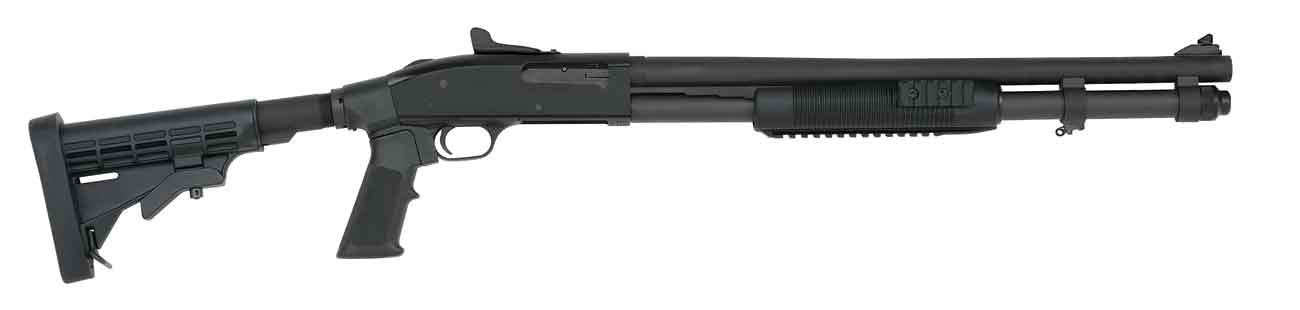
Mossberg 500 No list of the greatest defensive weapons could be complete without making mention of the Mossberg 500. Though it began life as a field shotgun, the 500 pump-action shotgun was adopted by law enforcement agencies quickly because it was affordable, reliable and offered plenty of stopping power at close range. The 500 has remained popular for decades, and today there are a seemingly endless variety of defensive-minded Mossbergs available, from standard 6-shot versions to higher capacity models, left-handed versions, a lightweight .410 model, and even the “Chainsaw” with a top grip that more closely resembles the front handle of a Stihl Farm Boss than anything you’ve ever seen on a firearm. The new FLEX system allows you to swap barrels, stocks and fore-ends, so your 500 can perform a wide variety of functions, and there’s a Just In Case (JIC) pistol grip model that comes in its own waterproof tube. New for 2016 is the 500 ATI Scorpion version, shown here, which comes loaded with ATI features like a 6-position stock, heat shield, side saddle and Scorpion recoil reducing grips and rear pads. ($463- ; Mossberg.com)
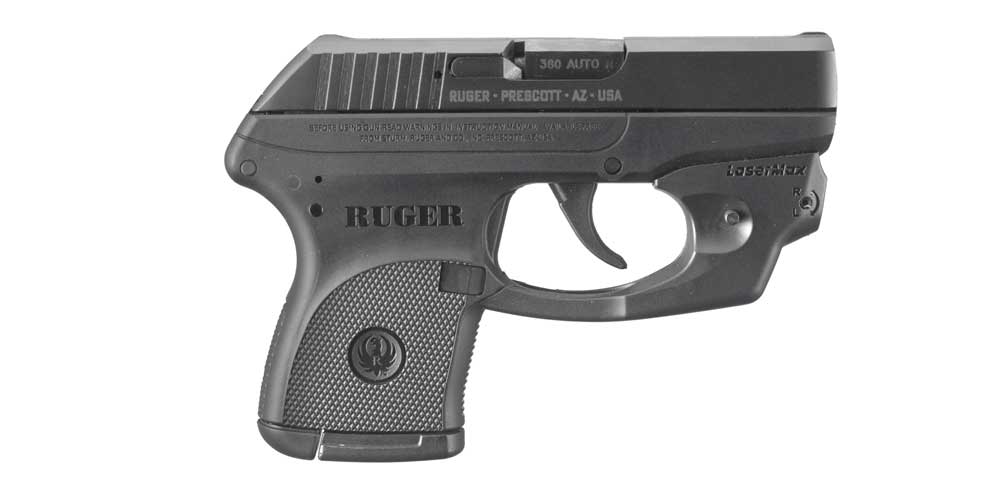
Ruger LCP The LCP, or Lightweight Compact Pistol, met the needs of a growing CCW crowd and has become an iconic carry gun. And what was it that made the Ruger so desirable? For starters, it was easy to conceal. The standard LCP weighs under 10 ounces and measures just 5.16 inches long. This is thanks to a sleek, minimized slide and lightweight glass-filled nylon grips. Ruger added other touches as well: a pair of rear sights that are machined directly into the through-hardened alloy steel or stainless slide, a finger grip extension for the magazine and a minimized, clean outline that is easy to hide under light clothing. It is chambered in .380 Auto, which until a few years ago was considered a borderline defense cartridge, but modern loads with better defensive bullets have turned the .380 into a far more formidable self-defense cartridge and the LCP into an even more appealing carry weapon. The best part? This gun has an MSRP of just $259. ($259; Ruger.com)
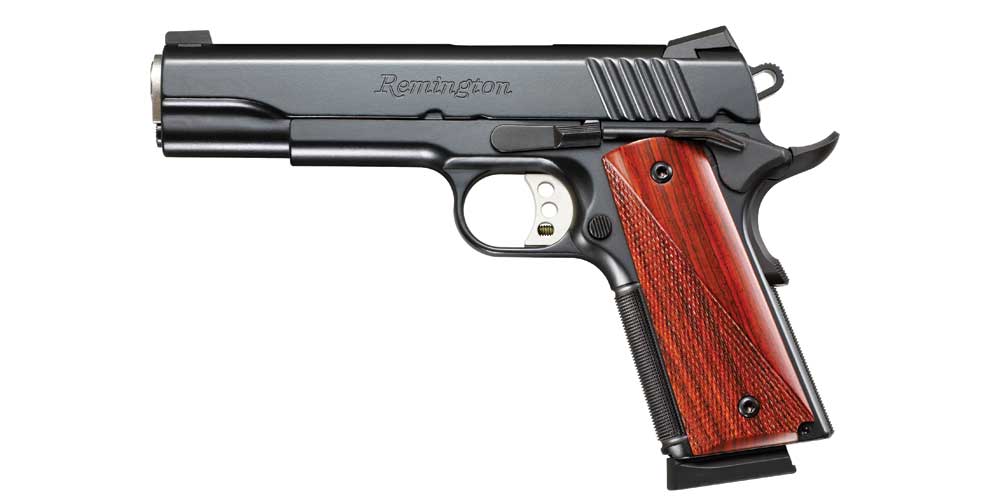
Colt 1911 If imitation is the sincerest form of flattery, then the Colt 1911 is the most complimented gun of all time. The original John Browning design, now over a century old, has served in armed conflicts since the days of Woodrow Wilson’s presidency, and it is still a popular choice with LE and military shooters. The Browning recoil-operated action proved to be robust and reliable, and the .45 ACP was/is an effective defensive cartridge. The 1911’s single-stack design was slim and sleek, and the grip angle was comfortable and easy to control. The combining of a grip safety and manual thumb safety means you can carry the gun cocked-and-locked and ready for immediate action, and although Glockophiles who are accustomed to having their guns apart in less than two seconds may feel like field stripping a 1911 is akin to disassembling a Boeing turbine engine, the reality is that the 1911 is relatively easy to maintain once you learn the steps. There are dozens of companies offering up 1911 clones including Remington, Colt, SIG Sauer, Springfield, Ruger and others. If you want a lighter 1911, check out Browning’s 1911-380, an 85-percent scale model of the original 1911 chambered in .380 ACP ($669.99; Browning.com). If you’re looking for a more exclusive collector’s gun that is hand-built just for you, then look to what Republic Forge of Perryton, Texas offers. (Price varies; RepublicForge.com)
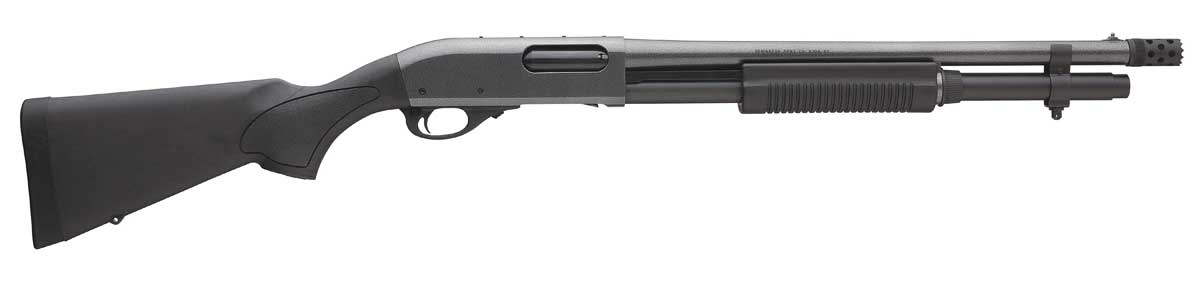
Remington 870 How popular is the 870? Remington has sold more than 11 million of these pumps since 1951. And while this versatile pump shotgun works on doves and quail, it is equally as adept as a defensive firearm. In many homes across America, a Remington 870 serves as guard dog, and it offers up a powerful bite. Although the 870 lineup isn’t as diverse as the Mossberg 500’s, there are still a bunch of great options that will do a marvelous job protecting you, your home and your family. The basic black or hardwood version with an 18.5-inch cylinder bore barrel and bead sight will set you back around $400 dollars or less, and you’re getting the same rugged reliability that has made the 870 popular for decades. Twin action bars offer a smooth, slick cycle, and the robust steel action seems near bulletproof. Additionally, if you want to purchase an extra barrel or two, your 870 will serve as a turkey, deer, duck or upland gun while not standing guard in the home. ($420- ; Remington.com)
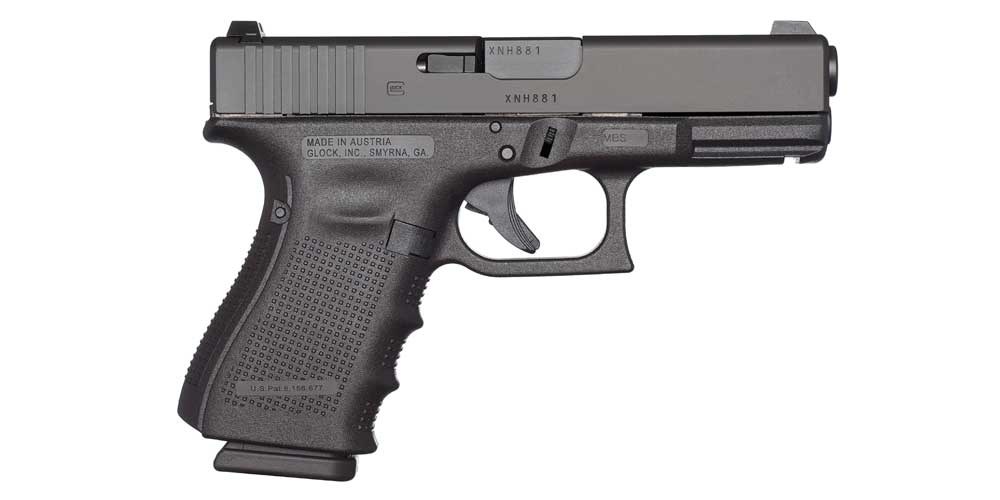
Glock G19 In the 1980’s, Glock introduced Americans to the notion of a polymer-frame, striker-fired semi-auto. Some saw the new Austrian pistol as the gun of the future, while others in the firearm world turned up their nose at this “plastic” gun. Turns out the folks at Glock knew what they had, and soon U.S. shooters would embrace this new design with open arms. Today Glock pistols are the most popular sidearms for law enforcement professionals, and there are now very few pistol companies that don’t offer their own polymer-frame striker-fired semi-auto for concealed carry. Perhaps the most classic and storied Glock for personal defense is the 19, now in its fourth generation. Weighing in at 23 ounces and measuring 1.18 inches wide, the Glock is no longer one of the most compact carry guns on the market, but it is still concealable and offers a 15+1 9mm capacity. There are a host of aftermarket parts and accessories, but the 19’s greatest draw is its robust design. The Glock is among the most reliable and simplest of all semi-autos to operate. ($599.99; US.Glock.com)
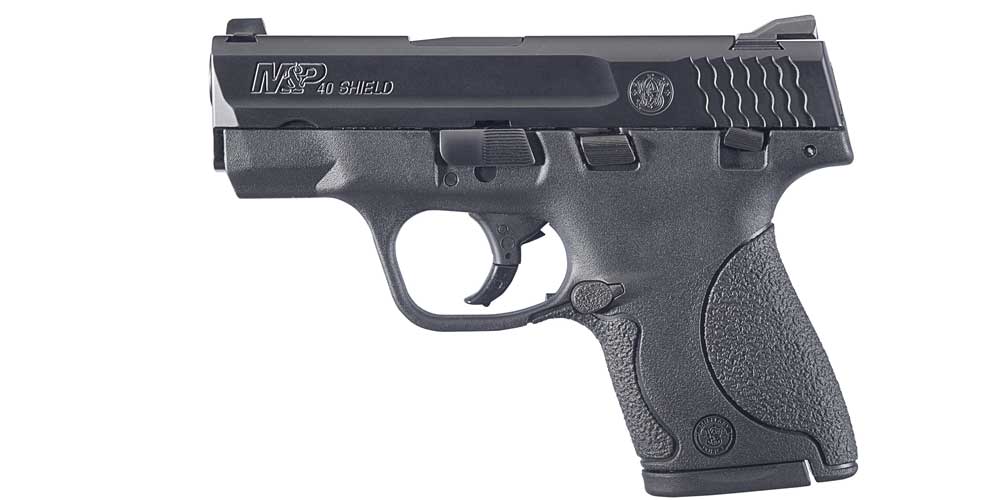
Smith & Wesson M&P Shield Smith & Wesson gets another nod for the best defensive guns with their venerable M&P Shield line of compact semi-auto pistols. Gun companies and gun writers can praise new models all they’d like, but it’s ultimately the consumer that makes any firearm a success or failure. Those consumers have spoken, and they love the Shield. But don’t assume that success is simply a byproduct of the Smith & Wesson name; with so many options for concealed carry, the competition is extremely tough. How did the Shield win such a large share of this crowded market? By offering a thin (.95 inches at the frame), lightweight (19 ounces unloaded) polymer striker-fired gun with a good trigger, a durable finish and functional sights that have a low-profile design and are dovetailed into the steel receiver. The grip angle is comfortable, and the Shield is easy to conceal and carry. It offers plenty of firepower (the 9mm version comes with 7 and 8 round mags, the .40 with 6 and 7s) and there are lots of accessories and holster options. S&W continues to build upon this iconic design by offering ported Performance Center models. It’s a defensive pistol in its most basic and functional form. ($449; Smith-Wesson.com)
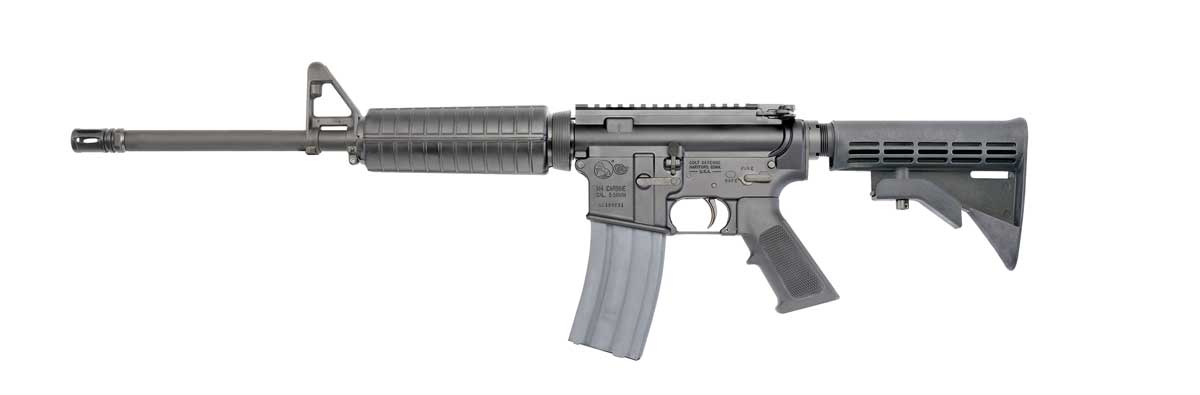
Colt Expanse M4 The original AR design, introduced to the world by Eugene Stoner, was a military design that became popular with civilian shooters, much like the Colt 1911, M1 Garand and others. Accurate and reliable, the AR could be counted upon to deliver accurate shots out to several hundred yards, and the design was robust and reliable. Today ARs are popular for a wide variety of different applications, from competition to hunting to target shooting and, yes, home defense. One of the great aspects of AR ownership is that these guns offer a level of modularity that is unmatched. With some basic tools you can swap out trigger, sights, furniture and more so that the gun is truly customized to your preferences. The recent surge in the popularity of ARs means that, like the 1911, there are lots of companies offering ARs in a wide array of configurations. One new AR to highlight for 2016 is Colt’s entry-level Expanse M4, which features a flat-top receiver, collapsible buttstock, GI-style flash hider and a lightweight contour barrel at a price many shooters can afford. ($699; Colt.com)
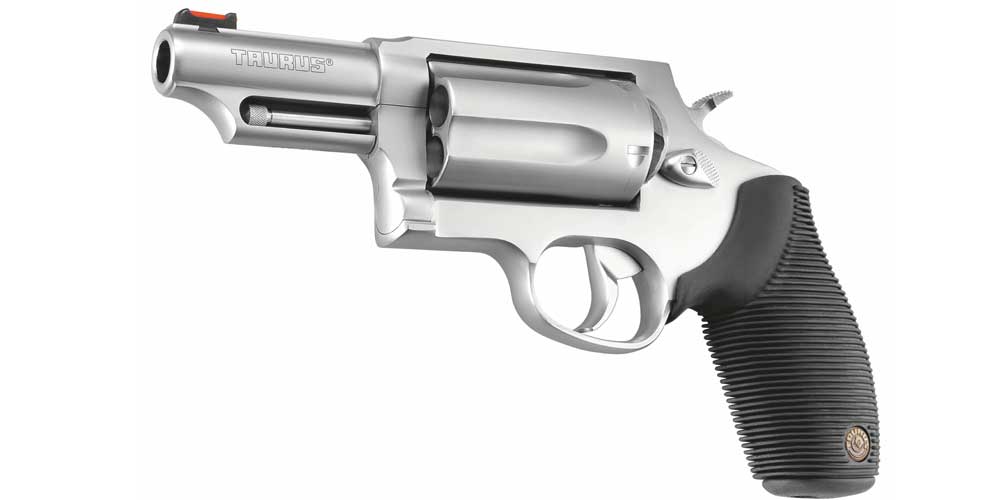
Taurus Judge In 2016, the Taurus Judge turns 10 years old, and it certainly deserves a spot on the list of the 10 best defensive guns. Emerging during an era when lightweight compact carry guns were becoming all the rage, the Judge made it look like Taurus hadn’t gotten the memo that smaller was better. This revolver had a beefy frame and an extra-long cylinder that could accommodate both .45 Colt ammo and .410 shotshells. It was like no wheelgun that came before, and Taurus was taking a gamble that American shooters would embrace the new design. And guess what? They have. Big time. Judge sales are still strong, and it’s still among the most commonly purchased firearms for home defense. So popular is the Judge design that ammo companies like Remington actually started offering special ammo packs with .45 and .410 defensive loads in a single box. Taurus now offers the venerable Judge in 13 different configurations, and it is available with both 2.5- and 3-inch .410 chamberings. Some models are also capable of firing .454 Casull loads. ($514.17- ; TaurusUSA.com)
Whether during a training course or just in casual conversations with others, most shooters have probably heard some version of the phrase: “Train like you’d fight.” Shooters who plan on carrying every day or defending themselves from threats at home should train for the situations they might encounter in the real world, and they should do so with the actual equipment they plan on using in those situations. A full-size 1911 is a great gun to shoot, but if you carry a compact, polymer framed pistol or a pocket .380, then you need to train and become proficient with that firearm.
The same principle applies to ammunition. If all you’ve ever shot through your firearm are target loads, the shock of firing a hotter defensive load during a stressful event might be enough to affect shot placement on the target or cause you to miss entirely.
Unfortunately, the cost of most defensive ammunition prevents many shooters from incorporating it into their training regimens. One solution that ammo manufacturers have come up with is offering FMJ training loads that are ballistically matched to a corresponding defensive load.
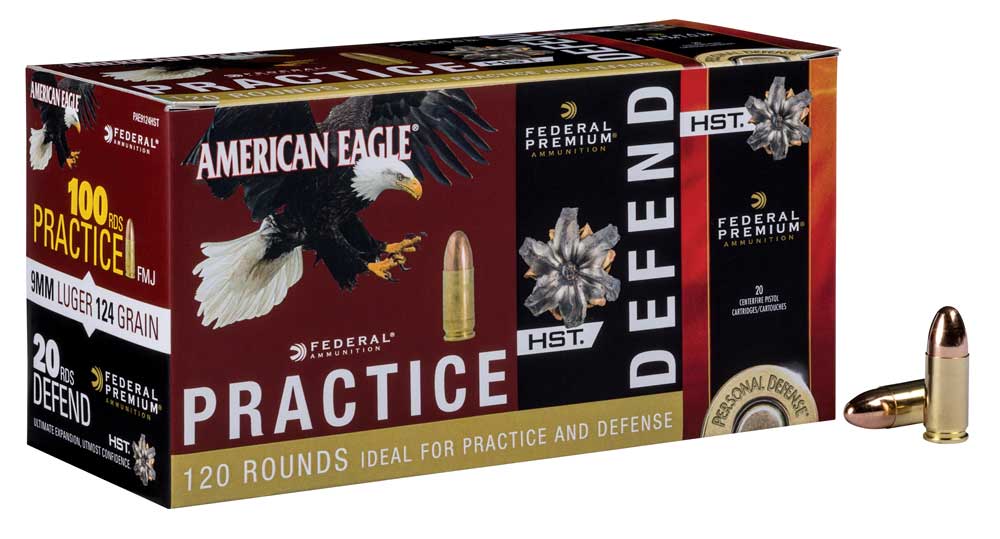
Federal Premium has recently introduced a new option for shooters looking for both quality defensive ammunition and matched training loads for realistic practice. The new HST Practice & Defend Combo Packs offer shooters one of the best defensive loads on the market in the company’s HST and pairs it with similarly weighted American Eagle training rounds.
These new combo packs are available in .380 Auto, 9mm Luger, .40 S&W and .45 Auto. In the 9mm Luger, .40 S&W and .45 Auto packs the weights of the defensive and training bullets are identical at 124, 180 and 230 grains, respectively. For the .380 Auto, the HST bullet weighs 99 grains, and the FMJ training bullet weighs 95 grains.
The new Federal Premium HST Practice & Defend Combo Packs come with 100 rounds of American Eagle target ammunition and 20 rounds of HST defensive ammo. Pricing on these combo packs is listed at $80.95 for the .380 Auto, $67.95 for the 9mm Luger, $84.95 for the .40 S&W and $96.45 for the .45 Auto.
Also Check Out:
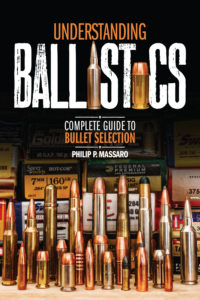
Understanding Ballistics Tailor your ammunition choice to the task at hand and ensure you’re choosing the right bullet every time with Understanding Ballisticsby Philip P. Massaro. Narrow down the vast array of ammunition options with detailed information and expert reviews of available bullets, and come to a better understanding of bullet technology and performance. Plus, learn about the physics of the bullet and its effects once it hits the intended target. Get Your Copy Now
This cartridge was introduced in the United States in 1908 with the Browning-designed Colt-manufactured .25 Vest Pocket Automatic pistol. It had been introduced in Europe a few years earlier in the FN Baby Browning, which is practically identical to the Colt. The design of these two pistols has been copied by manufacturers all over the world. Dozens of different pistols have used this cartridge. American Arms, Beretta, Iver Johnson, Jennings, Lorcin, Phoenix Arms, Sundance, Taurus, Ortgies, Astra, Star, Kelt-Tech, Rohrbaugh, and Walther have all made pistols in this chambering. The .25 Automatic offers surprising velocity for such a small cartridge. However, delivered energy is quite modest. This, combined with the full metal jacketed bullet of the conventional load, adds up to very poor stopping or killing power on anything. Lighter, expanding bullets lack adequate penetration or delivered energy to suggest any significant improvement. The .25 Auto is not powerful enough for hunting anything but pests, nor is it adequate for serious self-defense. However, .25 Automatic pistols are popular because of their small size and low cost. Their principal usefulness might be as a threat, because no sane person wants to be shot. Winchester and Hornady recently offered hollow-point loads in an effort to improve terminal ballistics.
Editor’s Note: This brief is an excerpt from Cartridges of the World 14th Edition.
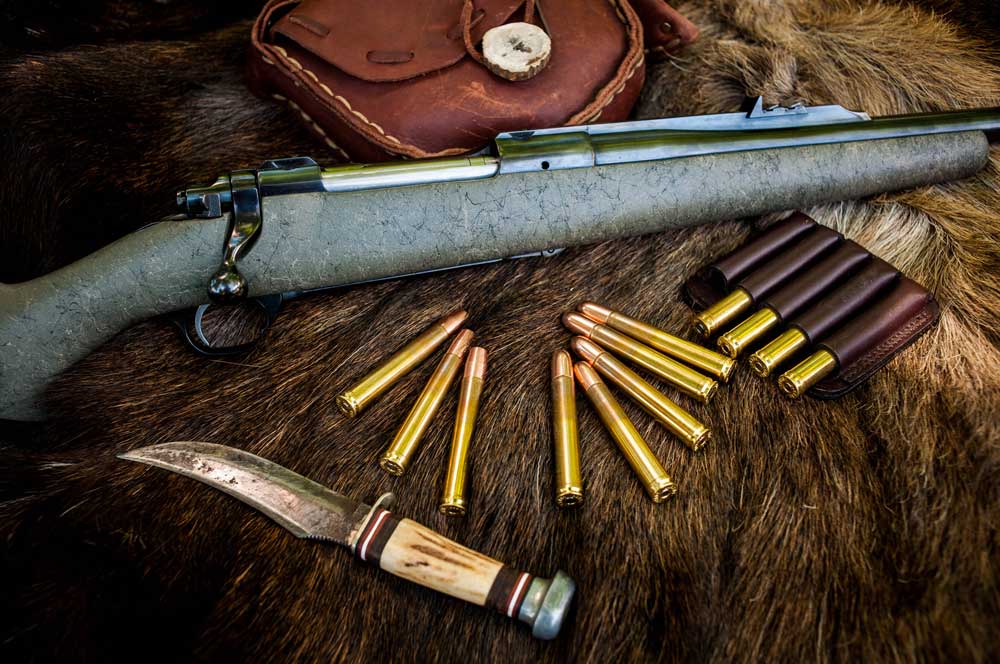
Dangerous game demands specialized cartridges with lots of stopping power and that are capable of penetrating thick hides. So which are the best dangerous game cartridges of all time?
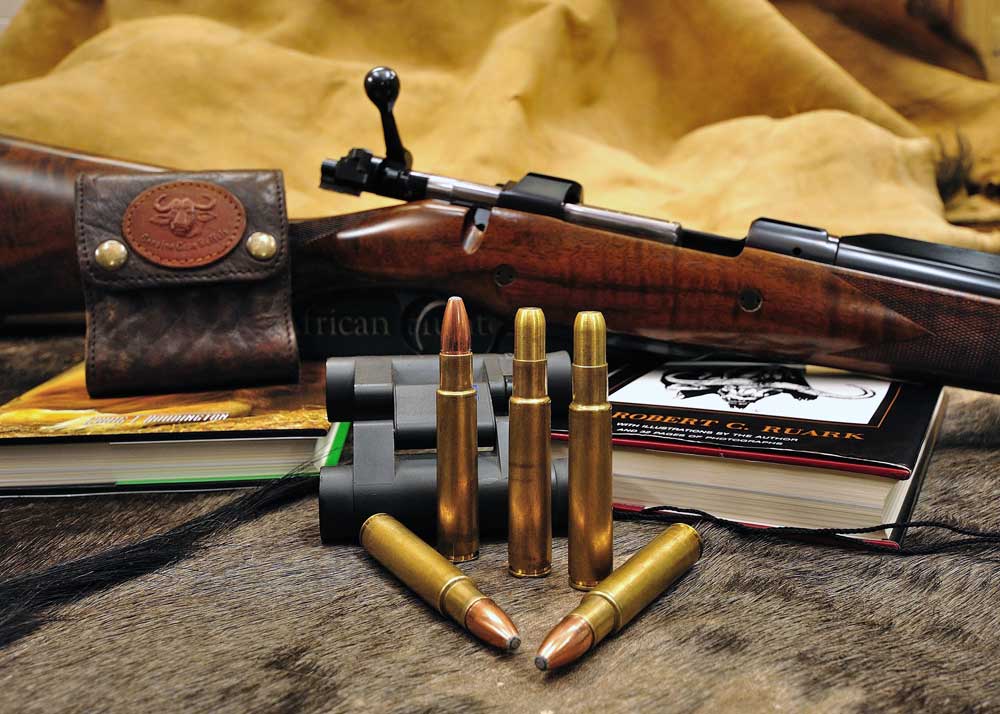
Dangerous game—those two words pique my curiosity like a kitten at the sight of a laser-pointer. Hunting dangerous game requires a rifle cartridge larger than most of us use regularly, one with the ability to save your bacon and to end a confrontation quickly and without anyone getting hurt. There have been many designs over the years. Some are more than a century old; some came about in my lifetime. When the game animal has enough weight, strength and tenacity to send your mortal remains home in a mayonnaise jar, you’ll need a cartridge that you can handle effectively yet will get the job done. Let’s take a look at some of those cartridges that fit the bill.
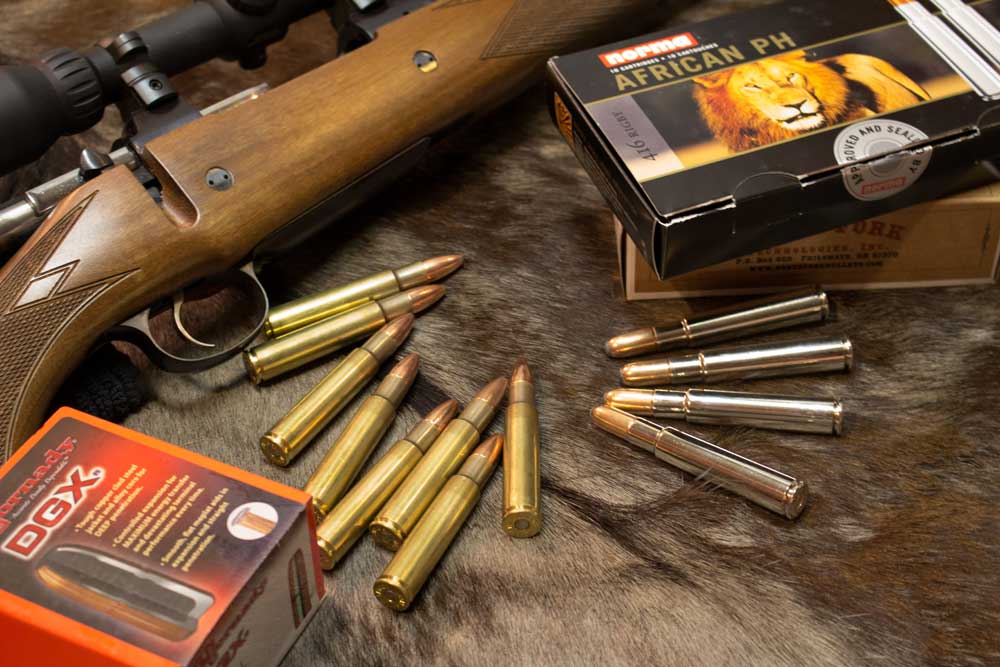
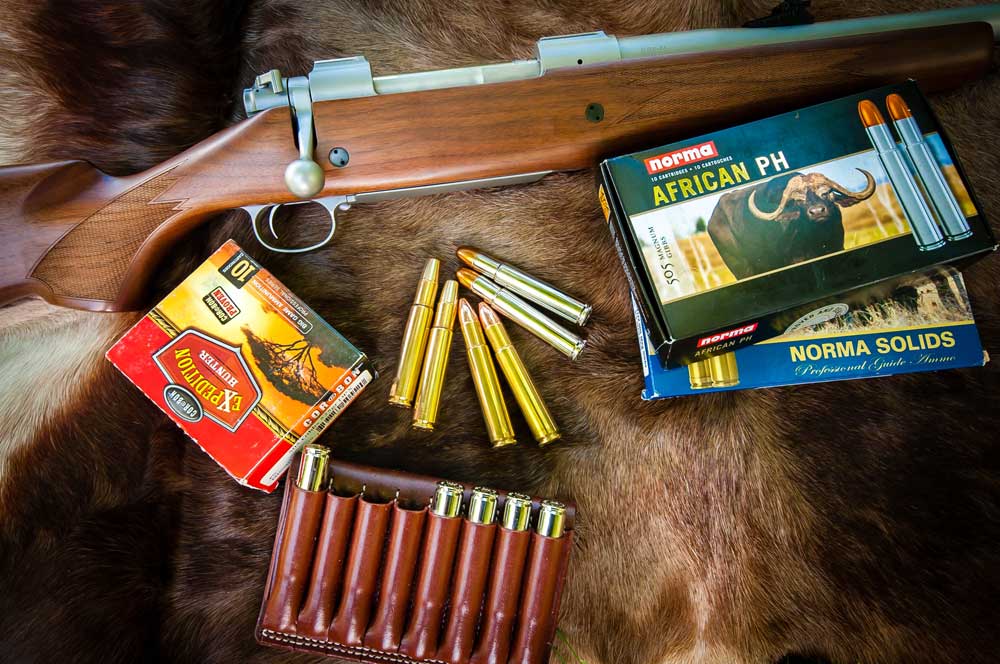
The .375 Holland & Holland Belted Magnum The Three-Seven-Five is undoubtedly the most popular choice for dangerous game, on any continent, for good reasons. It is a cartridge that can use bullets up to 350 grains, and the recoil of the .375 H&H is mild enough that just about anyone can shoot it with a bit of practice. The classic recipe is a 300-grain slug at 2,550 feet per second (fps), generating just over 4,000 ft.-lbs. of energy at the muzzle, but the main selling point of the .375 is the versatility. Want to use it on elk, moose or plains game? There are many good bullets in the 230- to 270-grain range that will make for a flat-shooting load. Want to pursue the heavyweights? The premium 300-grainers and the Woodleigh 350-grain bullets in the Norma African PH line of ammo will get the job done. For a sportsman who travels the world, the .375 H&H Magnum is a solid investment, one he or she can use for bears in America or buffalo in Southern Africa. My wife shoots one, in a Legendary Arms Works Big Five rifle, and she shoots it very well. When an African Professional Hunter tells you a .375 H&H is all you need, he means it; it’ll take any game animal on earth.
The .450/400 3-inch Nitro Express
This rimmed, bottle-necked cartridge was developed in the early 20th century by W. J. Jeffery, and was a redesign of the earlier 3¼-inch version. The beauty of the .450/400 NE is that it has the mildest recoil of all the valid dangerous game cartridges—many shooters find the .450/400 even easier to shoot than the .375 H&H. Driving a 400-grain bullet to 2,050 fps, the .411-inch diameter bullets will give excellent penetration, making it a perfectly viable cartridge, even for elephant. While it doesn’t feed very well in a bolt-action rifle, there are many double rifles available in this chambering, and Ruger chambers its fantastic No. 1 single-shot rifle for it. There are good, modern loads available from Hornady, using the DGX and DGS bullets, and plenty of good brass for the handloader.
The .416 Rigby
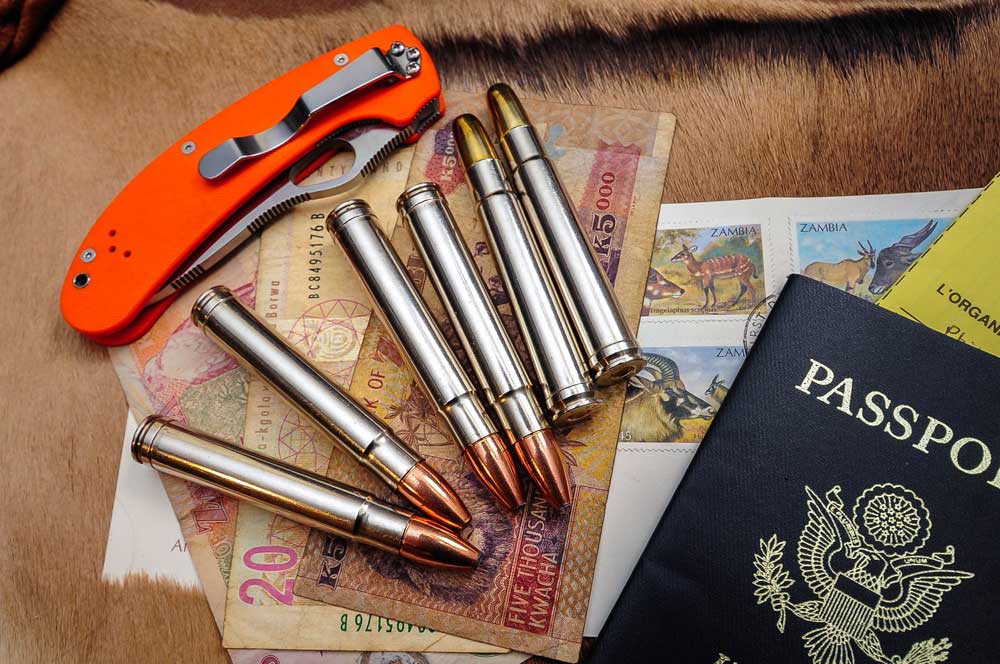
John Rigby & Co. released their proprietary big game cartridge in 1911, and it gained much favor among those who used it extensively. Certainly, it received a huge shot in the arm when Robert Ruark released “Horn of the Hunter” in 1953, immortalizing the cartridge in the hands of PH Harry Selby. The huge case was designed to give positive extraction to matter how hot the temperatures got (cordite, the common propellant in 1911, was extremely temperature sensitive), and the 400-grain soft points and solids, pushed at 2,400 fps, made for a great combination, and it still does today. While the Rigby does give a considerable increase in recoil, compared to the .375 H&H, it delivers another 1,000 ft.-lbs. of energy, with a larger frontal diameter. Because of the length of the cartridge—3.75 inches—it requires a magnum-length receiver. For those hunters who want to approach the energy figures of the .45-calibers, but who still want a trajectory that can make the longer shots, the Rigby is a good choice. Bullet weights range from 325 grains up to 450 grains, with the heavier weights being best for dangerous game work.
The .416 Remington Magnum
When the supply of ammunition for the British safari guns began to dry up in the late ‘50s and early ‘60s, wildcatters took matters into their own hands. An American Professional Hunter named George Hoffman mated the .416-inch bullets of the Rigby with the case of the .375 H&H; the result was the .416 Hoffman, and it was and still is a good cartridge. Remington changed the design slightly, using their 8mm Remington Magnum case as a basis, and in 1988 released the .416 Remington Magnum. It delivers Rigby ballistics in a smaller cartridge, albeit at a higher chamber pressure. While that higher pressure was initially an issue because of extraction issues in extreme heat (I lay the blame on the small extractor used on Remington’s rifles), any controlled round feed rifle will give no issues when chambered to .416 Remington. I have used a Winchester Model 70 in .416 Rem. all over Africa and North America, with stellar results. It is accurate, as hard-hitting as the Rigby, and the recoil is noticeably less than the Rigby case. It can be produced in an affordable rifle, and ammunition and component brass is much more affordable than the Rigby stuff. I’ve used this cartridge to take Cape buffalo, and wouldn’t hesitate to do so again.
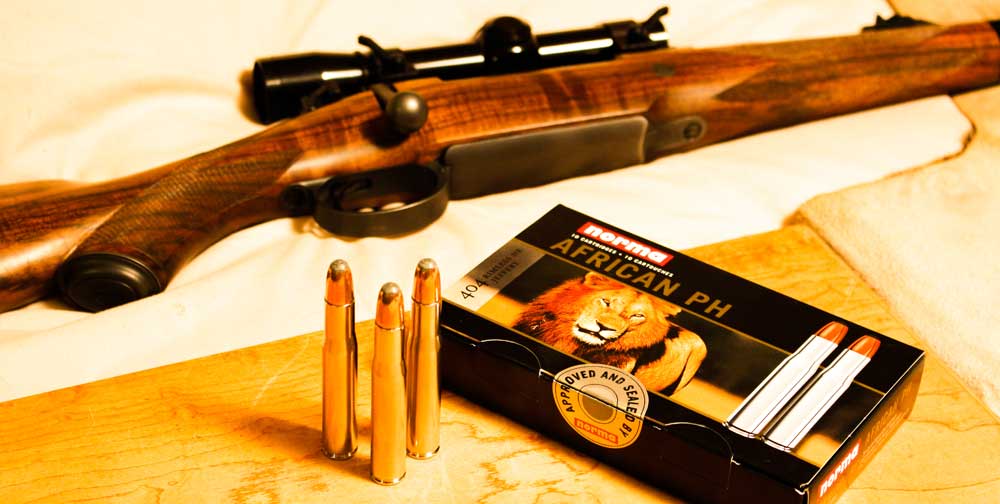
The .404 Jeffery While the .416 Rigby took the lion’s share of the popularity, the .404 Jeffery was quietly doing the majority of the dirty work. The game rangers of Tanzania, Kenya, and North and South Rhodesia were issued .404 Jeffery bolt-action rifles for game control work. The Jeffery design saw the light of day around 1909 (accounts vary), to mirror the ballistics of the earlier .450/400, but in a repeating rifle. The original “.404 Rimless Nitro Express” used a 400-grain .423-inch bullet at 2,150 fps and was not only effective on all game—including elephant and rhino—but was also very easy to shoot well. Modern steel has resulted in a more potent, modern load: a 400-grain bullet at 2,350 fps, putting today’s .404 Jeffery in the same league as the .416s. I absolutely love this cartridge; its sloping shoulder allows the cartridges to feed as smooth as silk, and the versatility of the loads will let it purr like a kitten or roar like a lion. As a handloader, I like the premium 400-grain bullets—like the Woodleigh Hydrostatically Stabilized solids—at around 2,275 fps. My Heym Express prints them into sub-MOA groups, and my, is it effective. I took a huge-bodied Zimbabwe bull elephant with my .404 Jeffery, giving complete penetration and exiting on two body shots. You really can’t ask for any more than that from a dangerous game cartridge.
The .450 3¼-inch Nitro Express This is one of the original success stories, coming at the end of the 19th century, setting the benchmark for the performance of dangerous game cartridges for decades to come. The John Rigby design from 1898 uses a 480-grain bullet at 2,150 fps for just under 5,000 ft.-lbs. of energy at the muzzle. In a good double rifle, the .450 Nitro makes a great choice for elephant, hippo and buffalo, effectively taking all three for well over a century. I’ve seen its effects first-hand, and it is a true stopping rifle. While the trajectory is less than desirable at ranges over 150 yards, consider that most dangerous game is taken well within the 100-yard mark, so there’s no real handicap if you choose the .450 NE when picking a dedicated dangerous game rifle. Being a rimmed case, it doesn’t translate well to a bolt-action gun, but in a single-shot or double it’s a true classic.
The .458 Winchester Magnum Remember I told you that supplies of ammunition for the British cartridges dried up in the ‘50s? The same fate befell the .450 Nitro; ammo became more rare than hen’s teeth. To solve the problem, and gobble up a huge share of the market, Winchester developed a cartridge that would mimic the ballistics of the .450 NE, but in a bolt-action rifle of American make, which would be both affordable and available. Winchester engineers opened up the .375 H&H belted case to hold .458-inch diameter bullets, in a straight walled configuration, and cut the case length down to 2.500 inches, so as to fit in a .30-’06-length action. The .458 Winchester was born, claiming to drive a 510-grain bullet at 2,150 fps from the muzzle of the Model 70. It looked good on paper, but there were immediate problems. The case—being cut down—didn’t have the capacity to get those big bullets moving at the advertised speed. That, combined with the fact that the ball powder Winchester used to fuel the .458 had a tendency to clump, resulting in squib loads, almost equaled disaster for the .458 Winchester Magnum. The load and bullet were revised, and things were set right; however, I feel that there are still flaws in the .458 Winchester. The first is the case capacity. Should you try and handload your safari ammunition, you’ll find that there are only a handful of powders that will give you good velocity without having to be heavily compressed. Secondly, most of the factory loads are using a 500-grain pill and are struggling to get the velocity without generating really high pressures. I think the .458 would be best served with a premium 465- or 480-grain bullet to give a bit of room in the case. Nonetheless, many visiting sportsmen and Professional Hunters use the .458 Winchester with good effect.
The .458 Lott
Jack Lott, a veteran African hunter, had experienced those issues I outlined regarding the .458 Winchester Magnum—I’ve heard the story of how he was nearly killed—and decided to fix the issue. He thought the full-length case of the .375 H&H (2.850 inches versus 2.500 inches for the .458 Winchester) would alleviate the case capacity problem and maybe even give a bit more velocity, and Mr. Lott was absolutely correct. The 0.350-inch difference in length changed the entire game, and the belted Lott case will push a 500-grain bullet to 2,300 fps, for over 5,900 ft.-lbs of energy. As a handloader, I can use the Lott in a couple of ways. First, and most obvious, I can load it to its full-house specs for an extremely potent dangerous game cartridge. Secondly, and because I’m all about flexibility, I can very easily load the Lott down to the original .458 Winchester ballistics. This keeps the pressures very low, and the century-plus history of the .450 Nitro should alleviate any concerns about that ballistic formula. The Lott also has another really cool feature: Because the .458 Lott is nothing more (and nothing less) than an elongated .458 Winchester case, any .458 Lott rifle can and will shoot factory .458 Winchester Magnum ammunition without issue. If I were to choose a bolt-action .45-caliber dangerous game rifle, it would undoubtedly be a .458 Lott.
The .470 Nitro Express
An insurgence in India resulted in the British Empire banning all .45-caliber ammunition in the early 1900s, so as a result, gun makers needed to replicate the ballistics of the dangerous-game-proven .450 Nitro Express, yet in a different bore diameter. Joseph Lang took the .500 Nitro—a beast of a cartridge—and necked it down to hold 0.475-inch bullets, and the .470 Nitro Express was born. Mind you, the recipe is a familiar one: 500-grain bullet at 2,150 fps, but with a bit more frontal diameter and yet enough sectional density to penetrate even the honeycombed bone of an elephant skull. Among the diverse selection of Nitro Express cartridges that came along to replace the .450 NE—the .475 NE, the .475 No. 2 Jeffery, the .500/465 NE, and the .476 NE were others—the .470 became the industry standard as a Professional Hunter’s stopping rifle. It remains a popular choice to this day, with factory ammunition readily available, and many great double rifles being produced annually in this caliber.
The .505 Gibbs Magnum
Let’s make this simple: Any cartridge over .50-caliber that will push 525-, 570- and 600-grain bullets over 2,000 fps will make a good stopping rifle. Some of them are reserved for the double guns—like the rimmed .500 Nitro Express—and others designed for the repeating rifles—like the .500 Jeffery—but my favorite among these is the .505 Gibbs Magnum. The big Gibbs case will need 130 to 145 grains of powder to push those huge bullets, and it pushes the big 570- and 600-grain slugs to 2,100 fps, for just under 5,900 ft.-lbs. at the muzzle. Couple that with the huge frontal diameter (.505-inch) and you’ve got an elephant stopper that isn’t all that terrible on the shoulder. While it’s rather obvious that the .505 isn’t a long-range rifle, it has what it takes when the distances are measured in feet, not in yards. CZ makes a fine rifle, and Montana Rifle Company makes their DGR with a nice big muzzle brake that actually makes it quite comfortable to shoot. The .505 Gibbs is a specialty cartridge that is designed for the heavyweights; it really doesn’t make a whole lot of sense to use it on lighter game, as there are much better tools for that job. But, if you want to put an exclamation point at the end of the hunting sentence, the .505 Gibbs will do just that.
Looking to go armed, but are stuck in the weeds as to what to arm yourself with? Here are 20 of the best concealed carry gun options that will keep you on the defensive.

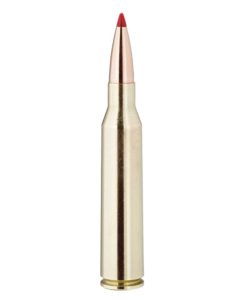 In 1983, Research Armament Co. in the U.S. began development of a new, long-range sniper cartridge capable of firing a 250-grain, .338-inch diameter bullet at 3,000 fps. After preliminary experiments, a .416 Rigby case necked down to .338-inch was selected. Brass Extrusion Labs Ltd. (then of Bensenville, Illinois), made the cases, Hornady produced bullets, and Research Armament built the gun under contract for the U.S. Navy. Subsequently, Lapua and Norma have put this cartridge into production. It is now a CIP standard chambering; since CIP and SAAMI have reciprocal agreements in place (at least in theory), that makes this a standard SAAMI chambering, as well. You have to burn a lot of powder to launch a 250-grain bullet at 3,000 fps. The .338 Lapua Magnum, as it is known commercially, or the 8.58x71mm, does just that. The full metal jacket, boat-tail military bullet is reportedly very effective at 1,500 meters. The commercial soft-point bullet is intended for hunting very heavy game. Cartridge cases are brass with Boxer primers. Guns for this cartridge are bolt-actions, but at least one gas-operated M-16-style rifle has been developed (RND Manufacturing, 14399 Mead Street, Longmont, CO 80504; (970) 535-4458).