
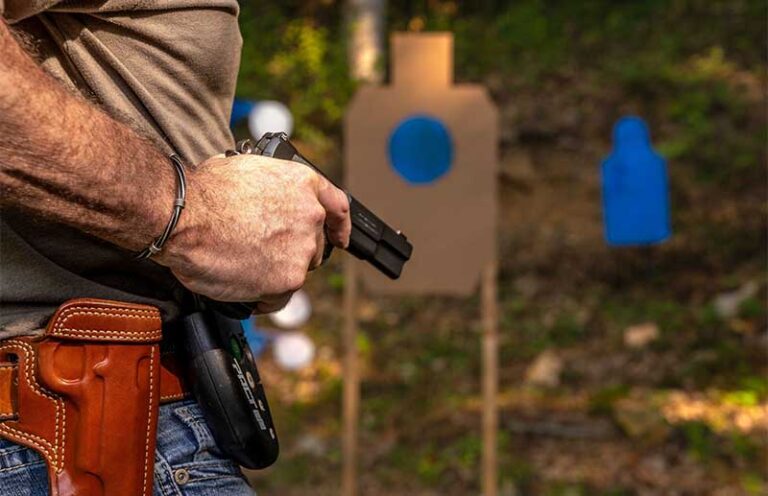
The author tests out fast draws, hip shooting and point shooting to demonstrate the value of using your defensive handgun’s sights.
Through Western lore and Hollywood, the quick draw has been promoted as the default approach to gunfighting. There’s no doubt being able to swiftly draw your handgun can be an asset if you have to shoot fast to save your life. But because your trigger finger sometimes decides to operate independently of your brain, and because humans have a propensity for doing stupid sh*t, attempting to draw and shoot a handgun as fast as absolutely possible can lead to a bullet hole in your ass cheek, thigh or foot. If you’re exercising appendix carry, a negligent early/discharge might best be described as a catastrophe.
So, this column comes with a warning: Trying to draw and fire a pistol as fast as possible can be dangerous.
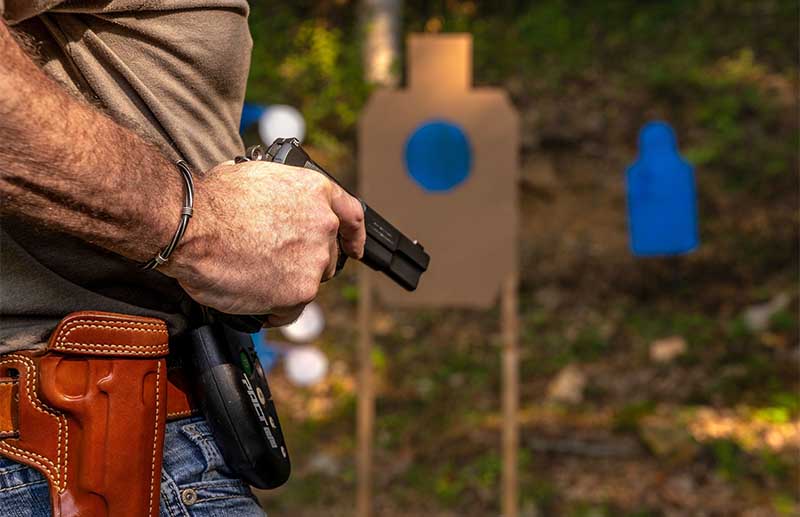
If you carry a concealed handgun, you should practice your draw stroke, and you should work toward making it smooth and speedy. Your goal is to get the handgun out of the holster and deliver an accurate shot on target—fast. There’s a lot of gibberish about fast draws, hip shooting, point shooting and the value of using sights, and I wanted to conduct a test to see how they actually compared to each other when I’m the one doing the shooting. Now keep in mind, I’m not Jerry Miculek, so my performance will not amaze or impress you.
Shooting With Sights
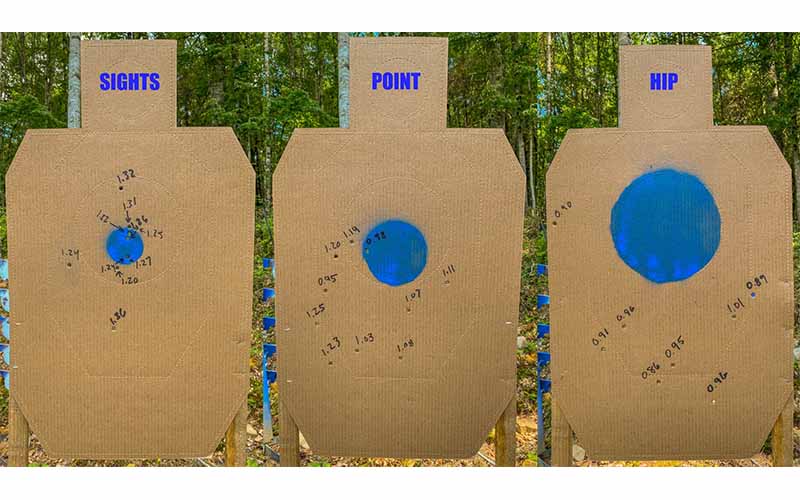
To start, I placed a silhouette target with a 2.5-inch kill zone at 5 yards. Using my PACT shot timer, on signal I drew the handgun, raised it up in front of my face, found the sights and pressed the trigger as fast as I could. My average time for the draw and a single shot was 1.27 seconds. I hit the silhouette 100 percent of the time, and my shots landed in the kill zone 40 percent of the time. The resulting 10-shot group measured 10.5 inches. Admittedly, I yanked the hell out of the trigger twice, and one shot got away from me a bit early.
Point Shooting
I don’t need sights to hit a silhouette target at 5 yards, so I ran this drill again using a 5-inch kill zone to see how much faster I was when point shooting, and to see how much my accuracy would suffer. Instead of finding the sights, I just brought the pistol up in front of my face, shoved it toward the target and pressed the trigger—I probably yanked the trigger about half the time. I hit the target 10 out of 10 times, but only hit the kill zone once, and my average time was 1.11 seconds—12 percent faster than when using the sights. Interestingly, the size of the 10-shot group was only ½-inch larger than the group created by the 10 shots fired with sighted fire.
Hip Shooting
Then, I went Western. I wanted to see how much faster it would be to draw and shoot from the hip like the TV cowboys and gangsters do. By not having to raise the pistol to eye level, I should’ve been able to cut some time off the engagement, and I did. My average time was 0.92 second—17 percent faster than point shooting and 27 percent faster than when using the sights. But this time I used an 8-inch kill zone and never hit it. In fact, I only hit the silhouette 8 out of 10 times.
So, what did I learn? Well, at 5 yards, if all I care about is hitting a silhouette, I can do it just as well by point shooting as I can if I use the sights. I also learned that, if I’m going to try to do any hip shooting, I need to dedicate some time to practicing that art.
Sending Multiple Rounds
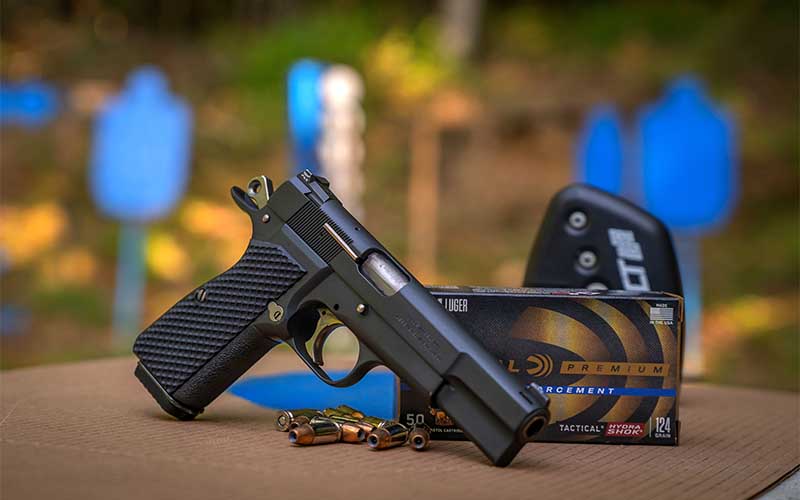
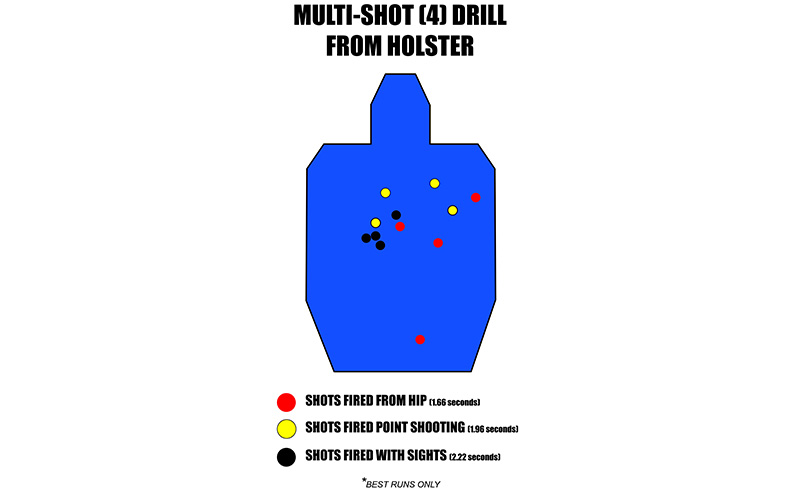
But all this shooting got me thinking what the difference might be if I was firing multiple shots. Handguns are notoriously poor at stopping a fight, which is why most defensive handgun firearms trainers teach you to engage a target with at least two rounds, or until it’s no longer a threat. Again, at 5 yards, I repeated the exercise … but this time I rapidly fired four shots instead of one using each technique.
My average time for four shots from the hip was 1.80 seconds, with a silhouette hit rate of 80 percent. My average time for point shooting four shots was 1.90 seconds, and for aimed fire it was 1.95 seconds, both with a hit rate of 100 percent. With multiple shots fired, hip shooting was only 5 percent faster than point shooting, and only 7 percent faster than shooting with the sights. I believe the reason for this is partly because, when point shooting and shooting with the sights, you have two hands to help you control recoil, and also partly because most of the shooting many of us do is either point or sighted fire.
Your skill may vary, but what this exercise mostly proves is the slight amount of time you gain by not using the sights or shooting from the hip demonstrably hinders your ability to place your shots accurately. You can believe whatever theory you want when it comes to stopping power, but the most accepted fact is that shot placement matters most—take enough time to aim your pistol and get a good hit.
Dictating Circumstances
Of course, there are times when point shooting or shooting from the hip might be a better option. If your assailant is nearly within arm’s reach, it’s probably not a good idea to fully extend your pistol, and hip shooting might be the best approach. Similarly, if your target is only about 3 yards distant, depending on your skill level, you might be able to reliably get good enough hits faster by point shooting. There’s only one way to discover any of this—you have to try it.
There’s no question that the quick-draw hip shot is faster, and maybe there were some Western gunslingers who employed it and even regularly practiced it. However, sights on handguns have been around as long as handguns have, and I doubt this was the case unless the action was at breath-smelling distance.
You simply shoot better when you use the sights, and it appears those who live by the gun have known that for a long time. When Bat Masterson ordered his pistols from Colt, he gave them very specific directions about the sights. He wouldn’t have done that if he was not planning on using them.
Editor’s Note: This article originally appeared in the 2023 EDC special issue of Gun Digest the Magazine.
More On Defensive Handgun Skills:
- Video: Target Transition Training With The Dot Drill
- The Shot Timer And Defensive Handgun Training
- Gun Digest’s 10 Best Shooting Drills And Firearms Training Posts
- MantisX: Simple And Effective Training
- Video: Is A Full-Sized Pistol The Best Training Option?
Next Step: Get your FREE Printable Target Pack
Enhance your shooting precision with our 62 MOA Targets, perfect for rifles and handguns. Crafted in collaboration with Storm Tactical for accuracy and versatility.
Subscribe to the Gun Digest email newsletter and get your downloadable target pack sent straight to your inbox. Stay updated with the latest firearms info in the industry.
I do not know nearly as much as you and have little of your experience, but I practice point shooting and hip shooting often. The key is rhythm -with practice you can feel when you are back at your initial point of aim. A couple days ago I did 3 strings one handed of 5 shots at 3y with a Kimber TLE/RL 1911 Chambered in 45 ACP. Group sizes ranged from 2 inches to just over 4 inches and total 5 shot times ranged from 1.1 seconds to 1.34 seconds. That fastest group was also the tightest and all hit or edged the bottom of the target’s left ventricle. Also had excellent results point shooting the same gun at 5 yards. Also had- same session- much faster speeds with a Glock 19 with a 22 practice slide and equally accurate though much slower speeds with a few hip shots from my 44 magnum. Hip draws as you noted are another matter and are less accurate but also with practice can be extremely effective at 3 yard and below, and I suspect I will get to a point where I can be reliably effective at 5 yards and below with hip draw…same session I also did approximately 20 fast draws from the hip using that Glock 19 with the 22 slide with times similar to yours, but at 3 yards not five. The hits were virtually all in the A zone. I find the undependable aspect is strictly one’s initial aim point. But at 5 yards and below, I have found it to almost always be in a vital spot – returning to that spot with effective speed is not hard once you work the rhythm. If you try to outrace it, the accuracy will fall apart. The rhythm is dictated by recoil and your fundamentals managing it. I’m a very good shooter, but not a great shooter – I suspect a great shooter could come out with results faster and more accurate than mine.
“I probably yanked the trigger about half the time”… well there is the problem right there.. no trigger control. Just practice not ‘yanking the trigger’. see no matter how you shoot trigger control is very important.
Yes hip shooting, and point shooting, requires practice just as sighted fire does. Should have practiced a day with hip shooting and point shooting before the test.
Index and trigger control.. the foundation of shooting accurately.
I’m sure a laser would have a marked improvement on your accuracy with hip-shots, while adding zero time. When I practice with a laser I can shoot from a low ready position, it’s very fast.