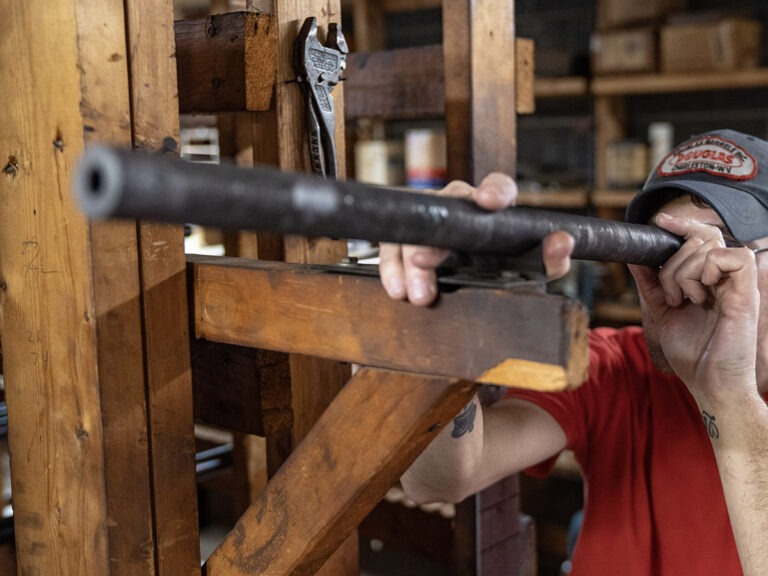
There are a lot of excellent precision rifle barrels available these days, but how do you pick the best one for your needs?
It’s all about the barrel in 2026. Actions are just a delivery device to your chosen barrel.
Modern precision rifle barrels are engineered for extreme accuracy, consistency, and longevity and are often used in competitive shooting, long-range hunting, and tactical applications. The rifling process—creating helical grooves inside the barrel to spin the bullet for stability—is a critical factor in performance. The three main methods discussed here are cut rifling, button rifling, and cold hammer forging (CHF). These differ in production technique, cost, stress on the metal, and resulting barrel characteristics. Precision barrels prioritize uniformity in bore dimensions, groove depth, and twist rate to minimize bullet deformation and maximize accuracy. Cut and button rifling are predominant in custom precision barrels due to their ability to produce tight tolerances, while CHF is more common in mass-produced or military-grade barrels for durability.
Key Differences in Rifling Methods
Here’s a comparison of the three methods based on production process, advantages, disadvantages, and typical applications:
| Aspect | Cut Rifling | Button Rifling | Cold Hammer Forging (CHF) |
| Process | Grooves are cut one at a time using a single-point carbide cutter or broach on a rifling machine. Multiple passes (hundreds per groove) remove material gradually. | A hardened carbide “button” with the rifling pattern in relief is pulled or pushed through an undersized bore, swaging (displacing) the metal to form grooves without removing material. | The barrel is forged around a mandrel with the rifling pattern using high-pressure hammers at room temperature (cold process), compressing and hardening the steel. |
| Production Speed and Cost | Slowest and most expensive; labor-intensive, ideal for custom work. | Faster and cheaper than cut; suitable for higher-volume custom production. | Fastest for mass production; lowest cost per unit but high initial equipment investment. |
| Stress on Barrel | Least stressful; no need for post-rifling stress relief as material is removed, not displaced. | Can induce internal stresses from metal displacement; often requires heat-based stress relief. | High compression hardens the bore but can cause twist-rate variances if not controlled. |
| Accuracy and Consistency | Excellent; precise twist rates with minimal variance. Often preferred for benchrest and extreme precision. | Very good; can match cut rifling in accuracy but may vary slightly due to button wear. Easier to tune loads for. | Good for general use but has less consistent twist; not ideal for sub-MOA precision without refinement. |
| Durability and Heat Resistance | Good; smooth bore reduces fouling but may wear faster under high heat. | Solid; stress relief helps longevity. | Best; hardened bore resists wear, erosion, and heat—ideal for high-round-count applications. |
| Typical Use in Precision Rifles | High-end custom barrels for competition (for example, benchrest, F-Class). | Custom precision barrels; balances cost and performance. | Rare in true precision uses; more for factory tactical/military makers such as FN, Steyr. |
In precision contexts, cut rifling is often seen as superior for ultimate accuracy due to its stress-free process and exact twists, though button rifling has closed the gap with modern techniques like vacuum stress relieving. Hammer forging excels in durability but is less common in boutique precision builds because of potential inconsistencies. Variations like 5R rifling (sloped lands to reduce bullet deformation) can be applied to any method but are popular in cut and button barrels.
Top Manufacturers and Their Rifling Methods
Based on industry leaders in precision rifle barrels (focusing on custom/match-grade), here’s a list of prominent names, their primary rifling methods, and key notes. These are drawn from competitive shooting data (such as PRS/NRL pros) and manufacturer specs. Many offer options like four-groove, 5R, or six-groove profiles, and some specialize in stainless-steel or carbon-wrapped designs for weight reduction.
- Bartlein Barrels: Single-point cut rifling. Known for extreme precision, uniform twists, and stress-free process; popular in PRS and benchrest. The company emphasizes 5R rifling for reduced bullet failure.
- Krieger Barrels: Single-point cut rifling. Renowned for world-record-setting accuracy; uses proprietary lapping and stress-relief methods for dense, smooth bores. Offers wide twist-rate options.
- Brux Barrels: Cut rifling (using a rifling head to shave grooves). High-precision tooling with carbide cutters; focuses on consistent land/groove configurations. Favored for custom builds.
- Hart Barrels: Button rifling. Pioneered efficient button methods; offers good accuracy at a lower cost. Common in varmint and hunting rifles.
- Lilja Barrels: Button rifling (with vacuum stress relieving). Excellent for benchrest; uses displacement method for smooth bores. Known for three-groove options.
- Shilen Barrels: Button rifling (including ratchet rifling profile). Affordable precision; ratchet design reduces fouling. Used in competitive ARs and bolt guns.
- Proof Research: Primarily cut rifling for steel liners, wrapped in carbon fiber for lightweight strength. Excels in heat dissipation; no specific groove count mandated, but offers match-grade accuracy with 5R options.
- Rock Creek Barrels: Button rifling (primarily), with some cut options. Versatile for ARs and bolt guns; offers 5R and multi-groove profiles. Known for value in PRS
Other Notable Mentions:
- Benchmark Barrels: Both cut and button; flexible for custom twists.
- Hawk Hill Custom: Cut rifling; ultra-precise for long-range.
- Criterion Barrels: Button rifling; affordable match-grade brand, often pre-fit.
In competitive circles like the Precision Rifle Series (PRS), cut-rifled brands like Bartlein and Krieger dominate (used by more than 50% of top shooters), while button-rifled options like Lilja and Shilen offer comparable performance at lower costs. Hammer-forged barrels are underrepresented in pure precision builds but shine in durable factory rifles from makers like Tikka or Ruger. Ultimately, the choice depends on your priorities: cut for maximum accuracy, button for value, and CHF for endurance.
Carbon-Fiber Barrels
I like carbon-fiber barrels, I have no issues with them, and I do not believe they walk, as people state online. I believe the walking they talk about is mirage in front of the scope from the heat sink, which is the barrel.
Carbon-Fiber Barrels Like Proof Research
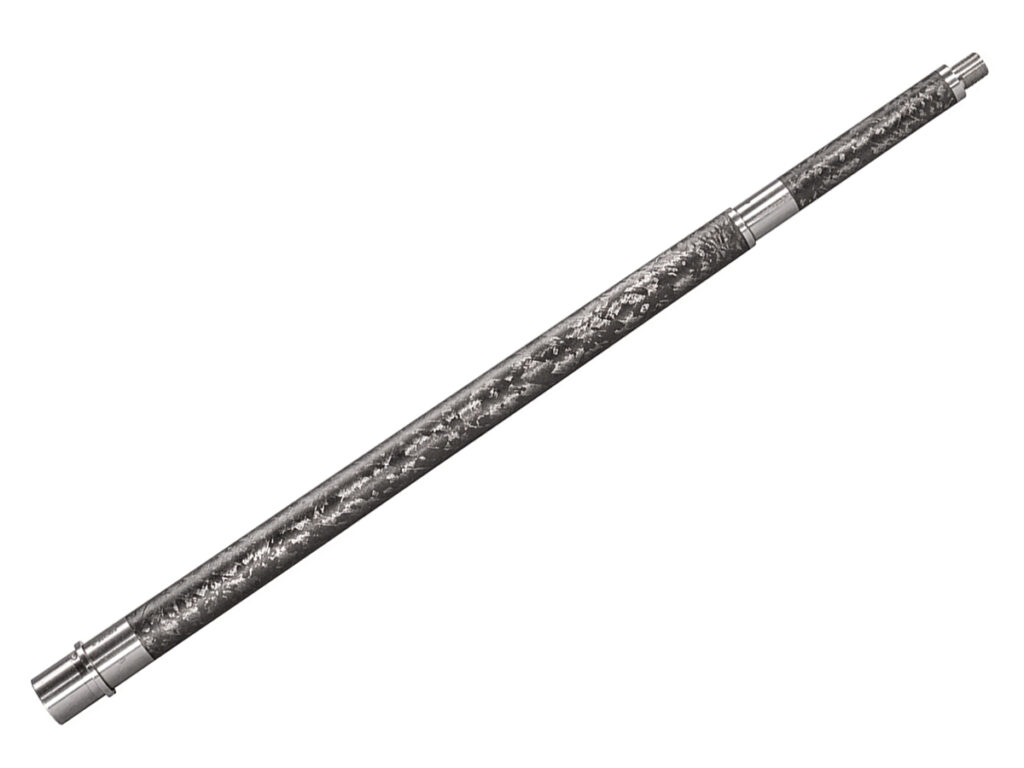
Carbon-fiber barrels, such as those produced by Proof Research, combine a stainless-steel inner liner with an outer wrap of high-strength aerospace-grade carbon fiber impregnated with proprietary resin. This hybrid design addresses limitations of traditional all-steel barrels, offering a balance of performance enhancements suited to modern firearms.
Key Features
- Lightweight Construction: Up to 64% lighter than comparable steel barrels, with weights typically ranging from 2 to 4 pounds depending on length and contour (for example, 16.5- to 26-inch lengths, Sendero or Bull contours). This reduces overall rifle weight by 2 pounds or more, improving portability and balance.
- Heat Management: Superior heat dissipation occurs along the barrel’s length to keep it cooler during sustained fire. The carbon composite has higher heat capacity, causing slower temperature rises and faster cooling (about 35% better than stainless steel). This minimizes warping and maintains consistent performance.
- Rigidity and Vibration Reduction: Exceptional stiffness reduces harmonic vibrations and barrel whip, enhancing shot-to-shot accuracy (often sub-MOA). The design counters thermal expansion differences between materials for stability.
- Durability: High resistance to corrosion, wear, and extreme temperatures, with comparable or extended barrel life due to better heat control. Tested and approved by the U.S. military for precision applications.
- Customization Options: Available in various calibers (such as 223 Remington, 6.5 Creedmoor, 308 Winchester, up to 300 Winchester Magnum), twist rates (1-in-7 to 1-in-12, and configurations for AR-type or bolt-action rifles. Priced around $999 for blanks, with full rifles starting at $1,649.
Uses and Applications
These barrels are versatile for both professional and recreational shooting:
- Hunting: Ideal for backcountry or rugged terrain due to reduced weight, minimizing fatigue on long hikes while preserving accuracy for ethical shots.
- Precision and Competitive Shooting: Used in long-range competitions (USPSA, F-Class) for sustained accuracy during high-volume fire, with features like vibration damping supporting sub-MOA groups.
- Tactical and Military: Approved for sniper rifles, suitable for dynamic scenarios requiring quick handling and reliability in harsh environments (humid, arid, or freezing conditions).
- Custom Builds: Barrel blanks for gunsmiths, compatible with platforms like Savage 110 Ultralite, Nosler Model 48, or APF Armory rifles, in calibers for varminting, big game, or tactical use.
Carbon-fiber barrels excel in delivering lightweight, heat-resistant, and accurate performance, making them a premium choice for shooters prioritizing mobility and precision over traditional steel options, though the barrels come at a higher cost.
Editor’s Note: This article is an excerpt from the Gun Digest Precision Rifle Handbook.
More On Barrels
- Rifle Barrels 101
- How does Barrel Length Affect Accuracy & Ballistics
- The Truth About Barrel Length and Velocity
- How To Calculate Barrel Twist Rate
- Barrel Break-In: Necessary With a Rimfire?
- Are Carbon-Fiber Barrels Worth It?
- Suppressors Vs. Barrel Length
Next Step: Get your FREE Printable Target Pack
Enhance your shooting precision with our 62 MOA Targets, perfect for rifles and handguns. Crafted in collaboration with Storm Tactical for accuracy and versatility.
Subscribe to the Gun Digest email newsletter and get your downloadable target pack sent straight to your inbox. Stay updated with the latest firearms info in the industry.