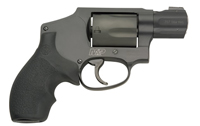
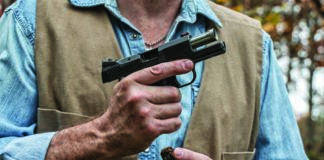
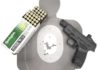
The display of Smith & Wessons, Glocks and Kel-Tec pistols among lattes and coffeecake was part of an organized rally to spread awareness about Wisconsin’s open carry law as well as the recent treatment of a Sussex gun carrier by local law enforcement. Participants later drove to the Wisconsin State Patrol District Headquarters in Waukesha and demonstrated on the front lawn.
The turnout – about 40 people from various parts of Wisconsin and Illinois – may indicate growing support for the expansion of gun rights in the state, and in particular, legislation that could make it possible for people to carry concealed weapons.
State law allows adults to openly carry guns, but not in businesses that ask them not to, places that serve alcohol, and not in school zones or public buildings. Last spring, Attorney General J.B. Van Hollen re-affirmed in a brief the right of Wisconsin’s residents to bear arms openly, saying that those who do so should not be subject to disorderly conduct tickets from local law enforcement.
New! Check out the Gun Digest Book of the .45 ACP. Click Here
“That was the floodgate,” said New Berlin resident Nik Clark, who organized the rally Sunday and is the president of Wisconsin Carry Inc., a new statewide organization pushing for expanded gun rights. “It verified what people already knew, but some people were still afraid to carry their guns openly until that opinion came out.”
Clark said Sunday’s gathering was prompted by what members perceived as improper law enforcement action against Sussex resident Joseph Schneider.
Earlier this month, a Wisconsin State Patrol officer approached Schneider at China Wok in Sussex and asked him to take his gun out of the business. Schneider, who said he has openly carried his gun many times at the China Wok in Sussex without a problem, videotaped the encounter and then left the restaurant. Read more
The bill, House Bill 113, passed 42-15. It now advances to the Senate, where it will be taken up as soon as the end of the week. But although the bill has Senate sponsors, Senate Majority Leader Jim Anderson, R-Glenrock, said the proposal will “probably be received with more scrutiny on the Senate side” than in the House.
Order the Gun Digest Book of Concealed Carry. Get prepared now. Click Here
Under the bill, anyone who meets the current requirements to obtain a concealed-weapons permit from the state would be allowed to carry a concealed weapon — except that proof of firearms training would no longer be required.
If the legislation passes, Wyoming would still issue concealed-weapons permits to residents, as such permits are needed for Wyoming residents to carry a concealed weapon in several other states.
State Rep. Lorraine Quarberg, the Thermopolis Republican who sponsored the bill, said the legislation asserts Wyoming residents’ Second Amendment right to bear arms.
“It’s sad when law-abiding citizens have to get permission — have to get permission, have to get the permit — from the government,” Quarberg said. “There’s just something inherently wrong with that whole philosophy of the role the government should play in our lives.” Read more
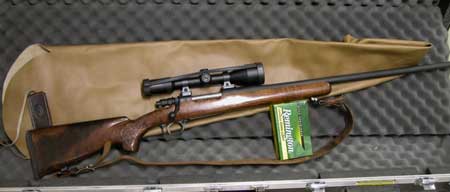
This rifle started with an inexpensive Mauser action, a Douglas barrel, a nice piece of eastern black walnut. The money the client saved on components allowed him to buy Talley mounts and a good Zeiss scope. It is a .30-06.
The Stock
The cheapest way to go, generally, is to use an aftermarket synthetic stock for you project and glass-bed your barreled action into it.
Prices range from as low as $100 for the discount-house stuff to several times that for a stock from the “name” makers. You can paint the stock to your preference or use it “as is”.
Gunsmithing CD with Patrick Sweeney: Pistols, Revolvers, Shotguns and Rifles. Order Now
For wood you can spend as much as you like; to many folks the stock “makes” the gun and I have to confess I am one of those people, I prefer wood, even though I do have a couple of synthetic stocked rifles.
You don’t need an exhibition piece of wood to make a beautiful stock and if you buy a turned, semi-finished stock you can fit and finish it yourself and save a lot of cash, not only on the work but also it might make a higher grade of wood available to you money-wise than buying a finished product.
Finishing kits are available from several makers like Birchwood Casey and with a “take your time” attitude you can get a wonderful end-product. Eye-candy wood is nice but layout is more important, making sure the stock is laid out to take advantage of the natural grain flow for strength.
Fancy wood usually has some type of flaw somewhere; crotch and feather figure, burl and fiddleback all come from stresses inflicted on the tree while it grows.
If you have chosen a hard-recoiling caliber get dry, dense, tight-grained wood that will withstand the pounding. An ultra-fancy stock isn’t much good if it’s cracked.
Purists notwithstanding, I recommend glass bedding wood gunstocks. Accessories like sling swivel studs, grip caps, forend tips and recoil pads can add a good bit to the bottom line but if you’re prudent and acquire the parts over time your custom gun project can be a rewarding and fun enterprise.
Having a rifle that is a product of your imagination and fits you is truly a wonderful thing.
Walt Hampton is a professional gunsmith and writer from Virginia. He and his son Wade operate Buck Mountain Rifle Works, manufacturing semi-finished gun stocks and building custom rifles on order. Visit his website at www.buckmountainrifleworks.com or write him at [email protected].
I had an interesting question from one of my readers. It was well thought out and it expressed a concerned about the thin profile barrels used on the Kalasnikov rifles.
My response is somewhat lengthy and at times technical but I think it captures the essence of what I was trying to communicate to the gentleman. I’d like to hear your thoughts.
Text:
A discussion of one of several, perceived, weaknesses in the Kalashnikov design – the “pencil” barrel – needs to take place because it’s paid a ton of lip service without any real substance or objective discussion. In designing barrel profiles, we need to consider a number of factors: pressure, temperature, length needed to stabilize the round, weight and sustained rate of fire. All of these contribute to the designers thought process. Other noteworthy considerations are heat conductivity and axial sheer, which is imparted to the barrel from the effects of rifling on the projectile as it moves along the bore. I’ll begin with heat conductivity because it is normally acknowledged that heat has a deleterious effect on performance. Heat is transferred from the bore to the outside of the barrel. The faster it conducts to the outer surface of the barrel, the cooler the bore temperature.
Cooler temperatures mean that bore imperfections and rifling will have less of an impact on the bullet as it travels through the barrel, and accuracy should benefit. It follows that faster heat transfer is desirable in order to keep the bore temperatures down.
q=(kA?T)/L
The equation above is derived from Fourier’s law of heat conduction and succinctly describes the elements involved in determining heat transfer rates. q = heat transfer rate L = wall thickness of the heat conductor – in this case the barrel. k = the heat conductivity constant of the material used (more on this lat*er in the article) A = the cross-sectional area of the conductor. ?T=The temperature gradient (difference between Temperature IN and Temperature Out) Without running elaborate measurements and calculations, simple evaluation of the equation tells us that a smaller L (wall thickness) gives us a higher q (heat transfer rate). Therefore, a thin barrel, all things being equal, will transfer heat faster. Heat transfer problems occur when we encounter conductivity barriers – for example steel to air heat transfers. On a rifle barrel, the problem occurs on the outside surface – going from steel to the surrounding atmosphere. Because carbon steel has a heat conductivity constant of 43 and air’s is .024, it takes a much longer time for heat to conduct to air, irrespective of barrel wall thickness. The end result is ?T becomes smaller and the barrel’s heat transfer rate slows. When ?T is zero, heat transfer bore to outside surface stops. This is a situation that must be prevented. Fluting or dimples reduce barrel wall thickness and increase exterior surface area acting like cooling fins. They’re a highly effective way of dealing with the heat transfer problem, especially in applications where a sustained high rate of fire is anticipated. To summarize, the take-away from this discussion is that thin barrels are not a bad thing – especially true if you are humping the Hindu Kush with 100+ pounds of other stuff. The other component of barrel profile that I want to touch on is structural, and has to do with axil sheers. A chambered round with a locked bolt is a closed system. When powder ignites, gases of sufficient magnitude and pressure are produced to push the bullet through the bore. The bullet forms a gas seal with the rifling so little or no gas leaks around the bullet’s circumference. Bore pressures will vary with caliber and ammunition but they are extremely high and range from 50,000+ psi to 20,000 psi. This sudden and forceful impulse acts along the length of the barrel. Furthermore, as the riffling applies a spin on the projectile, axial forces are exerted along the length of the barrel. Here, heavy barrel profiles can help to reduce, but not eliminate barrel harmonics that may or may not detract from accuracy. This is of concern with precision rifles, for example snipe platforms, not rifles or carbines intended for sustained high rates of fire – with some exceptions like a light machine gun (LMG) The last two pages are what writers refer to as support, but the idea I’m presenting is that the common barrel profiles found on the Kalashnikov rifles are not poor limiting designs, but rather a balance struck that takes a number of factors into consideration.
Some quick thoughts here as we continue to become unburied by this global warming induced snowfall in Ohio.Rechareable flashlights are a must around the house during severe weather. Streamlights Polystinger with the new C4 LED technology is a “shining” example of a great rechargeable. Use the lithium cell small tactical lights, like those from Blackhawk, Streamlight, Surefire and Insight technology for true tactical tasks. But keep a couple of rechargeables handy and at the ready around the house. These lights can also serve as your in house tactical lights, while the lithiums are great for daily carry and use on the street. More about that in my book “Own the Night”
By now most of the folks with the New Year’s resolutions are done and out of the gym and after about March 1 I won’t have to wait for machines any more. That’s a good thing.
I am constantly reminded that my duties as a reserve deputy put me in contact with lots of different people. Most of them are between 18 and 24 years old. As I am now officially “well past” 40, I find myself paying extra close attention to DAAT training and seem to have found a little extra motivation on the treadmill and at the weight rack. I run, workout on an elliptical trainer, swim, and lift weight. Recently I’ve discovered kettle bells and would like to learn more about working with them. So, I’m feeling like I have a pretty good mix of cardio and strength training… I’ll work in more flexibility and I should be in pretty good shape.
Lately, in an effort to built my grip strength I’ve been holding two 10-pound plates between my thumb and fingers. Starting with my hands at my sides, I then lift my arms until they are paralell to the floor and slowly lower them. I repeat the motion until I drop the weights (watch you toes) or can’t lift my arms any more. It helps the hands and the shoulders.
What are you doing to keep fit? If you are working in LE, you know doubt have a vested interest in this. If you are a civilian wondering about self-defense, can you keep up maximum effort for 30 seconds? You’d be amazed at how long 30 seconds is when you are fighting.
So let’s hear it. Any good tips that will help keep us all in fighting trim? Describe your workout. Doing so might help us all.
And remember, every issue of Tactical Gear Magazine includes “Fit To Fight” our look at phyical fitness for those who need it most.
M-Pro7 has introduced its newest cleaner-lubricant-protectant, M-Pro7 Gun Oil LPX. More than just a gun oil, M-Pro7 Gun Oil LPX provides the benefits of current lubricants while mitigating typical drawbacks such as evaporation, separation, gumming and toxic odor.
To achieve this, M-Pro7 blended synthetic oils, liquid molybdenum and polymers. The new LPX additive contains a component with the lowest known friction coefficient, which means it’s as slick as is physically possible.
M-Pro7 Gun Oil LPX also contains a non-solvent based cleaning agent. This new technology repels dust and dirt and can be used as a “cleaner” to remove surface carbon in the field.
M-Pro7 Gun Oil LPX is the only commercial product to pass the initial testing for the recently updated military weapons specification, including the 900-hour humidity cabinet corrosion and 100-hour salt spray corrosion testing.
Civilian consumers buying M-Pro7 Gun Oil LPX get the same formula sold to the military. M-Pro7 Gun Oil LPX provides outstanding protection against wear, humidity, moisture, (including salt water) and leaves a long-lasting film that repels dust and dirt. This film will not evaporate, making it excellent for long-term storage.
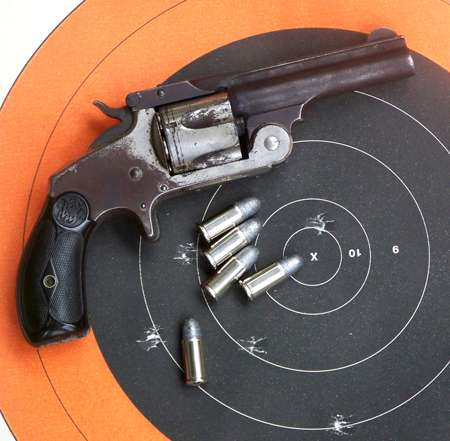
The author’s well-worn, 122-year old S&W .38 Single Action 2nd Model can still turn in a good performance at 7 yards with good, modern Remington 146-gr. ammo.
And you might even find a Smith & Wesson Single Action or two. The fact is, Smith & Wesson marketed a perfectly good line of self-defense revolvers as early as 1876 and produced nearly 160,000 of them before dropping the design in 1911.
Now, Colt produced 357,859 First Generation Single Action Army revolvers between 1873 and 1940. This means that Smith & Wesson sold nearly 45 percent as many Single Action .38s as Colt did its First Generation Single Action Army — and the Colt was in production for 32 years longer than the S&W. But who today remembers the S&W .38 Single Action? Durn few of us, that’s who.
The S&W .38 Single Action deserves to be remembered today, not just because it was a big seller in its time but because it was the first gun to chamber one of the best-natured revolver cartridges of all time: the .38 S&W. (Today, the .38 S&W bears the distinction of being the third-oldest continuously-produced American centerfire handgun cartridge, right after the .45 Colt and the .44-40 Winchester.)
The story of the S&W .38 Single Action begins way back in 1855, when Horace Smith and Daniel B. Wesson teamed up to form the Volcanic Repeating Arms Company to produce the Volcanic lever-action pistol.
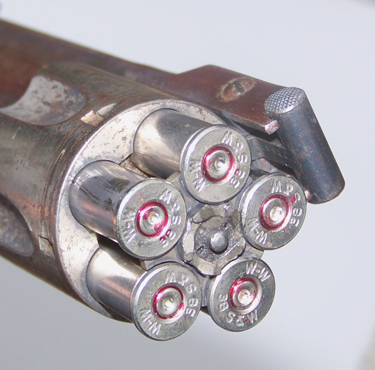
The old Smith’s automatic ejection is still quite positive.
This odd arm, originally designed by a Yankee mechanic named Walter Hunt, eventually morphed into the famed Henry rifle and then into the even more famous Winchester Model 1866. The Volcanic pistol, however, never succeeded in the marketplace, and by 1856 Horace and Daniel were forced to sell the company to majority stockholder Oliver Winchester. They bounced right back, however, and immediately formed the company we know today as Smith & Wesson.
Smith & Wesson’s first product, the Model 1 .22 revolver of 1857, was a ridiculously dinky thing to base a firearms empire on. Chambered in the .22 Short and hinged at the top of the frame rather than the bottom, it was designed with a bored-through cylinder, a patented feature that made it quite unique and kept Colt’s hands — and every other competitor’s, too — firmly tied until 1872. Though absurdly underpowered, the little Model 1 was a best-seller, with around 270,000 in all six types and three issues being sold by 1868.
Obviously, though, you couldn’t make a decent buck piddling around with .22 rimfires, so in 1870 Smith & Wesson introduced a massive .44 centerfire single-action, the Model 3 American. Chambered for a pleasingly stout cartridge called the .44 American, the Model 3 was a revolutionary departure for S&W, featuring a break-open frame with the hinge at the bottom and the latch at the top. The big .44 also featured automatic ejection of empty cases, quite a novelty in itself.
You’d think that a revolver like the Model 3 American would become a smash hit. In fact, S&W sold around 32,000 of them in two models in the four years between 1870 and 1874 and then pulled the plug on the American. Why? Ask Czar Alexander II.
In 1871, the Czar gave S&W an order for 20,000 of the big .44 revolvers which, with minor modifications, became known as the Model 3 Russian. Production of this huge revolver ceased in 1878 with around 168,000 in three major variations produced just for the Russians alone. This explains why large-frame S&W revolvers weren’t more common on the frontier: most of S&W’s production capacity was tied up with the Russian order for most of a decade.
In 1876, however, S&W put a new medium-sized revolver into production, one that shared so many of the Model 3 Russian’s features that it has been known ever since as the “Baby Russian.” Its actual designation was the .38 Single Action 1st Model.
Like its big brother the .44 Russian, the .38 Single Action was a hinged-frame, top-break revolver with automatic ejection. The resemblance pretty much stops there, however. Whereas the .44 was a six-shooter, the Baby Russian was a five-shooter. The .44 had a trigger guard; the .38 had a spur trigger. There were also numerous differences in the number and placement of sideplate and frame screws, in the grips, and in the angle of the grip frame.
But no matter: The “Baby Russian” it was called and the “Baby Russian” it would remain. To be entirely accurate, and with all due deference to serious S&W collectors, only the .38 Single Action 1st Model (1876 – 1877) is properly termed the Baby Russian; the 2nd Model (1877 – 1891) and 3rd Model (1891 – 1911) are called the plain old .38 Single Action, 2nd and 3rd Models. (The 3rd Model is the only one of the three to have a trigger guard.) Yet another variant, the rare Mexican Model, was basically a 3rd Model but had a spurred trigger guard and no half-cock notch.
In 1911, S&W finally bade goodbye to its single-action line. Various Lemon Squeezers and Hand Ejectors had finally rendered the .38 Single Action quite obsolete, and it would be 50 years before Smith & Wesson produced another single action, the special-order K-38 Target Masterpiece Single Action of 1961.
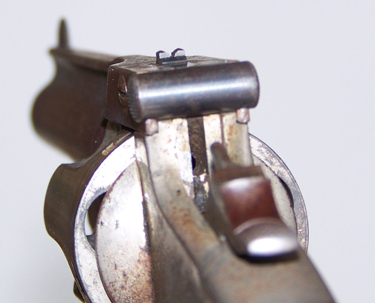
Those two tiny ears are the rear sight!
My S&W .38 Single Action is a well-worn 2nd Model that I got for a song (“You’re A Grand Old Flag” in the key of G) from Phillip Peterson. Mine has the 3.25-inch barrel, although the 2nd Model was also available with barrels of 4, 5, 6, 8 and 10 inches. Mine was originally 100 percent finished in nickel, as most 2nd Models were, but now it’s down to about 50 percent. Its grips are plain old hard rubber with the S&W logo molded into them.
Between 1877 and 1891, S&W made 108,225 .38 Single Action 2nd Models. Mine has a serial number of 72,000-and-something, which places it numerically at the tail end of the third quarter of the overall production run. We’ll take a SWAG and assign it a production date of 1886 or thereabouts.
So here we have a 122-year-old revolver, and it shoots like it just left the factory. I can find no evidence that the sideplate has ever been removed or that the gun has ever been monkeyed with. The springs are still admirably strong, the ignition absolutely certain and the lockup as tight as I could want. Cylinder endshake is zero. The trigger breaks cleanly at just over 3 lbs., which is a bit heavier than I’d like, but then again I shouldn’t be so critical. The gun was made during Grover Cleveland’s first term, for Pete’s sake.
With its spur trigger and minuscule rear sight notch, the 3.25-inch-barreled .38 Single Action was obviously intended as a pocket pistol, so I fired it offhand at a measured 7 yards at a paper target to see if it could still perform. With new-production Remington ammunition, my first group was just over 5 inches, which says something about old-time Smith & Wesson quality. I don’t think the .38 Single Action will replace my Kel-Tec as a carry gun, but it could do quite nicely in a pinch, I think.
Those who have a Smith & Wesson .38 Single Action would do well to have it checked out by a competent gunsmith before firing it. Ammunition loaded with the original 146-grain lead round-nose is still manufactured by Remington and Winchester. You might also find suitable older ammunition labeled .38 Colt New Police, which was a proprietary version loaded with a flat-pointed lead bullet. I would probably avoid the .38 S&W/.38 Colt Super Police load, a scarce item that packed a hemispherical 200-grain lead bullet. I’ve shot the Super Police load in a small top-break revolver before, and doing so struck me at the time as both unsafe and foolish. Its recoil was rich in testosterone.
Condition collectors will undoubtedly spit all over me for saying this, but I like my .38 Single Action 2nd Model despite its dilapidated finish. It loads, fires and ejects as well as it did back in 1886. I just hope I’m in as good a shape on my 122nd birthday!
This article appeared in the January 4, 2010 issue of Gun Digest the Magazine.
The University of Alabama is a gun-free zone, and accused Professor Amy Bishop reportedly had no carry permit for a handgun she allegedly used in the shooting deaths of three colleagues last Friday.
Maurice Clemmons was a convicted felon, ineligible to legally possess, much less own a firearm of any kind, yet he had two – including one that was stolen in Seattle about three years ago – when he walked into the Forza coffee shop in Parkland in November and murdered four Lakewood police officers.
What these completely unrelated cases demonstrate is the complete impotency of gun control laws that were passed at state and federal levels with a sales pitch that they would prevent such crimes as campus shootings and wanton murder by monsters like Clemmons.
We have laws against homicide, but that didn’t stop Clemmons and evidently did not stop Bishop, who now stands accused of murder and attempted murder.
Anti-gunners will use the Alabama shooting, and have already tried to capitalize on the Parkland massacre, to push for new gun laws.
Here’s another idea: Perhaps it is time to examine every existing gun control law, identify the ones that work, and repeal the rest. It is a debate worth having, even if it results in the repeal of virtually every gun control law on the books, because none of them appear to have prevented a single crime. Read more
On Wednesday, February 10, the Assembly Committee on Corrections and the Courts passed Assembly Bill 558 and Assembly Bill 559 — two bills that, if passed by the full assembly, would have severe effects on gun owners in the state of Wisconsin.
AB 558 would expand the definition of “misdemeanor crimes of domestic violence” well beyond the scope of current federal law in order to create a new class of people who would be stripped of Second Amendment rights in Wisconsin.
The second bill, AB 559, is a blatant violation of Americans’ Fifth Amendment right not to incriminate themselves. The bill would require an individual who is subject to a protective order to appear before a court and reveal all the firearms that he or she owns or possesses. It would also require people in this situation to turn the guns over either to a law enforcement agency or to a third party.
People in this situation would have no immunity from prosecution for the laws they might be forced to admit violating. Read more
Gun Digest is the source for firearms news, pricing and guns for sale. Readers benefit from in-depth editorial expert advice, show reviews and practical how-to instructions. Subscriptions are the First Amendment way to stand up for your Second Amendment rights. Click here to begin your subscription to Gun Digest.
Inside This Issue
• Editor Kevin Michalowski has some bits and pieces for you in his “Editor’s Shot” column. Click here to read it.
• Dan Shideler explains how fried chicken and a passion for wood and metal work helped one of the most talented gunsmiths in the country hone his craft.
Double feeds happen. Learn from NSSF’s Mark Thomas and Gunsite instructor Bob Whaley how to clear your AR-15 and get it ready for action when it happens to you. (NSSF Video)
Kenny Purdie and his wife, Linda, [of Virginia] who have owned and operated K&L Barbecue for 17 years, survived a harrowing robbery attempt and shootout with a gunman who accosted the couple in the garage of their home about 9 p.m.
After first confronting Linda Purdie, who yelled for her husband, the assailant jerked around and fired at Kenny Purdie, hitting him once in his left shoulder in a shot that broke his collarbone, said police and Steve Nugent, Kenny Purdie’s stepson.
Although wounded, Kenny Purdie — who holds a concealed-gun permit — grabbed a pistol from under the seat of his truck and returned fire, causing the intruder to flee, police and Nugent said.
“The one thing that I have learned from this incident is that Pop having that gun possibly saved the life of him and my mother,” Nugent said Monday. “If he wouldn’t have had that gun nearby, there’s no telling what would have happened after that.”
“Pop acted so fast,” Nugent added. “This all occurred probably within 20 or 30 seconds.” Read more
Gun Digest looks at the Charter Arms Pitbull – the world’s first rimless revolver, chambered in .40 S&W. It was one of the highlights of SHOT Show 2012 Media Day at the Range.
For years shooters have relied on the precision and accuracy of the Burris AR sight systems for military, tactical, home defense and hunting applications. Now there are two more optical options to choose from for the AR rifle platform with Burris’ introduction of the AR-132 and AR-536 sights.
“Our new AR sights are as rugged and versatile as the AR platforms they were designed to match,” stated Rob Siemers, general manager. “Our AR-332 sight is one of the most popular red dot sights on the market today, and with the addition of the AR-132 and AR-536 we’ve added more options and versatility for the professional and recreational shooter.”
Burris AR-132
For quick target acquisition or close-quarters shooting, the new 1X AR-132 is the ticket. Compact and lightweight with a choice of 4 MOA red or green dots, it is ideal for CQB situations. To make certain that the lighting is perfect for each situation, the AR-132 can be set to one of 10 levels of brightness. The AR-132’s low mounting system matches up perfectly with most AR configurations.
Bright, crisp images are essential in close-quarters-combat situations, therefore Burris has multi-coated all lenses with its proprietary lens coating. Add the integrated lens covers, three Picatinny rail segments, tethered windage and elevation caps, and you have the perfect close-quarter AR scope package.
Burris AR-536
The AR-536 is the new long-range sight for the AR platform, and it sets a new standard for performance of a tactical prism sight. With a 5X magnification, the AR-536 makes it easy to acquire targets at distances out to 600 yards, while the 36mm objective lens delivers bright, crisp images in most light conditions.
The new AR-536 features the unique Burris Ballistic/CQ illuminated reticle that can be adjusted to match the lighting condition day or night. For daylight operation, shooters can choose the black reticle for aiming out to 600 yards, or they can easily switch over to the red or green illumination, to match the ambient light and situation. The five different illuminations settings make it easy to match any and all light conditions.
Ruggedly built, the AR-536 is waterproof, fogproof and will standup to the punishing recoil and abuse of any AR user. The multi-coated lenses, adjustable diopter, integrated lens covers and three Picatinny rail segments make this the perfect companion to any AR. Also, by removing the bottom rail mount, this sight can be readily mounted to an AR carry handle. It is range-ready, straight out of the box.
Both the AR-132 and AR-536 come with a One-Year Warranty. They will be available at retailers in the second quarter of 2012 and will retail for $279 and $399, respectively.
Since my book “Own the Night” hit the bookstores in November of 09, (see featured bar to order on home page), I have observed continued improvement in lighting technology-which I predicted would continue unabated. One of those products is Streamlights TLR-2s weapon light. We call them weaponlights now because they aren’t just for pistols anymore! The same light that works well on your pistol will work well on your rifle, and take up a lot less room than most dedicated rifle lights. Streamlights TLR-2s is just such an example. The TLR specimens that I tested for the book (LED lights all) were very bright, at 135 lumens. The TLR-2s maintains this power output, but adds a red laser to the mix. Whats nice about this light is that the laser is added without a lot of complexity. First, the laser is located in a central position with the bore of the rifle or pistol (assuming you mount it that way on the rifle), which means you only have to worry about elevation and not windage. Second, the laser is operated off the same paddle switch. However under that ambidextrous paddle switch is a 3 position toggle switch that coordinates the light and laser. As you are looking at the rear of the light the postions are left for laser only, center for light only, and right for laser and light in combination. I will opt for laser and light both by the way. Again looking at the rear of the light, pushing up on the right side paddle gives you momentary on on either light/combination, and a double tap will give you a strobe. Push down and the light/laser locks on (no the laser doesn’t strobe. The setup for the left side paddle is directly opposite-lock on is up.
The TLR-2s, is going to get a workout on my duty Glock 31 (357 Sig) for tactical team use. I HIGHLY recommend any Streamlight Product.
Looking to go armed, but are stuck in the weeds as to what to arm yourself with? Here are 20 of the best concealed carry gun options that will keep you on the defensive.