A controversial operation in which U.S. agents were allegedly ordered not to intervene as American guns flowed to Mexican gangs may have been going on for many years, reports CBS News investigative correspondent Sharyl Attkisson.
A photograph obtained by CBS News shows an astonishing display of high-powered weapons put up for suspected Mexican drug cartel gun buyers. It’s a rare glimpse into ATF’s controversial undercover operations.
The Bureau of Alcohol, Tobacco, Firearms and Explosives allegedly let gun runners walk off with weapons – thousands of them – to see if they’d end up in the hands of the cartels. The Justice Department and ATF have denied it ever happened.
Special Agent John Dodson works in ATF’s Phoenix office and has blown the whistle on the controversial strategy, known as letting guns “walk.”
Dodson believes there are other ATF operations going on that have done the same thing.
Multiple sources now tell CBS News the questionable tactics were used in more than one operation, and date back as far as 2008 in the Tucson area. One case was called “Wide Receiver.”
Sources tell CBS News licensed gun dealers often wanted no part of selling to suspicious characters who could be supplying the cartels.
But, sources say, ATF enlisted the gun dealers as paid Confidential Informants and encouraged them to sell even more.
“ATF has asked me to assist in an official investigation,” reads one agreement. Read more
Left to right: Senator Kit Jennings, Governor Matt Mead, Rep. Lorraine Quarberg, Rep. Allen Jaggi, WyGO Director Anthony Bouchard, NAGR Director Dudley Brown
On Wednesday March 2nd 2011, Governor Mead signed Constitutional Carry into law while saying his office had been clogged with emails and phone calls from people demanding he sign the Jennings-Jaggi Constitutional Carry bill.
Even though so called “political experts” say your activism doesn’t matter, this event shows who has the real power in politics… You!
The anti-gun crowd fought this legislation every step of the way. The plain and simple truth is when push came to shove, it was your phone calls an emails that pushed this freedom-restoring bill through the legislature.
This legislation marks a fantastic first step toward restoring your right to self-defense in Wyoming. Now is the time for us to forge ahead and repeal the numerous criminal safe zones in Wyoming.
Even though the Jennings-Jaggi bill has made it possible to carry a firearm without going through a laborious permit process, we are still a long way from being done. Read more
WASHINGTON – Federal agent John Dodson says what he was asked to do was beyond belief.
He was intentionally letting guns go to Mexico?
“Yes ma’am,” Dodson told CBS News. “The agency was.”
An Alcohol, Tobacco and Firearms senior agent assigned to the Phoenix office in 2010, Dodson’s job is to stop gun trafficking across the border. Instead, he says he was ordered to sit by and watch it happen.
Investigators call the tactic letting guns “walk.” In this case, walking into the hands of criminals who would use them in Mexico and the United States.
Dodson’s bosses say that never happened. Now, he’s risking his job to go public.
“I’m boots on the ground in Phoenix, telling you we’ve been doing it every day since I’ve been here,” he said. “Here I am. Tell me I didn’t do the things that I did. Tell me you didn’t order me to do the things I did. Tell me it didn’t happen. Now you have a name on it. You have a face to put with it. Here I am. Someone now, tell me it didn’t happen.”
Agent Dodson and other sources say the gun walking strategy was approved all the way up to the Justice Department. The idea was to see where the guns ended up, build a big case and take down a cartel. And it was all kept secret from Mexico.
ATF named the case “Fast and Furious.”
Surveillance video obtained by CBS News shows suspected drug cartel suppliers carrying boxes of weapons to their cars at a Phoenix gun shop. The long boxes shown in the video being loaded in were AK-47-type assault rifles.
So it turns out ATF not only allowed it – they videotaped it. Read more
Mexico has questions for ATF in light of "Project Gun Runner."
“FLASH! The government of Mexico has formally asked the United States for details of the ATF operation ‘Fast and Furious’!” Mike Vanderboegh reported yesterday morning on the Sipsey Street Irregulars blog.
“The Project Gunwalker* Scandal just became an international incident,” he told readers, linking to a post on Mexico.vg that was reporting:
The government of Mexico asked the United States for details of the ATF under Project Gunrunner, Operation name “Fast and Furious“ implemented by the U.S. Department of Justice that allegedly allowed thousands of weapons into the Mexico.
“Mexico requests info from U.S. on gun-running,” Sharyl Attkisson of CBS News confirmed.
Now, according to the statement, posted online by Mexico’s Ministry of Foreign Affairs (in Spanish), the Mexican government has requested detailed information about the “Fast and Furious” operation being conducted by the U.S. Bureau of Alcohol, Tobacco, Firearms and Explosives (ATF), and the U.S. Department of Justice.
*Note to newcomers to this story: “Project Gunrunner” is the name ATF assigned to its Southwest Border Initiative to interdict gun smuggling to Mexico. “Project Gunwalker” is the name I assigned to the scandal after allegations by agents that monitored guns were allowed to fall into criminal hands on both sides of the border through a surveillance process termed “walking” surfaced.
Scandal along the U.S. – Mexico border continues to plague the federal Bureau of Alcohol, Tobacco, Firearms and Explosives (ATF), and is raising eyebrows on Capitol Hill.
When Border Patrol agent Brian Terry was shot and mortally wounded in a gun battle about 10 miles from the Mexico border in Arizona in December, 2010, it appeared to be yet another example of Mexico drug gang violence spilling over the border. But as more and more information from the crime scene leaked out, disturbing evidence also pointed to serious wrongdoing at the ATF.
Since 2005, the ATF has been involved in an initiative called “Project Gunrunner.”
Under this plan, ATF was to trace the flow of guns supposedly trafficked by straw purchasers in the U.S. to across the border into Mexico. When concerned firearms dealers, fearing the guns were being sent into Mexico, contacted ATF, they were instructed to proceed with the questionable and illegal sales to suspected straw buyers.
The mismanagement and botched oversight of “Gunrunner” has led to what has become known as the “Gunwalker” scandal.
Sign the GOA Petition to rein in the out-of-control BATFE. Click the image above.
According to current and former agents, perhaps as many as 3,000 firearms were allowed by ATF to “walk” across the border into Mexico. But the firearms—along with any hope of tracking them to higher level criminals—disappeared once the guns crossed the border. The ATF literally lost track of the weapons.
Two of these guns, however, turned up at the scene of Brian Terry’s murder. They were traced to an American gun store that had been cooperating with the Phoenix ATF office as part of Project Gunrunner.
The information about Agent Terry’s murder and the potential role played by Gunrunner came to the attention of Iowa Senator Charles Grassley, who sent a letter of inquiry to Acting ATF Director Ken Melson. In the letter, Sen. Grassley wrote that the Judiciary Committee, of which he is the ranking member, “received numerous allegations” that the ATF authorized the sale of hundreds of firearms to suspected illegal buyers, “who then allegedly transported these weapons throughout the southwestern border area and into Mexico….Two of the weapons were then allegedly used in a firefight…killing CPB Agent Brian Terry.”
Senator Grassley went on to quote from a scathing Department of Justice review of Project Gunrunner, which found that ATF focused on low level, individual straw buyers “instead of targeting higher-level traffickers and smugglers.” Read more
Sen. Charles Grassley (R-IA) has been spearheading the congressional investigation into the ATF scandal now known as Project Gunwalker.
The following is a summary and time line of articles appearing on the Sipsey Street Irregulars blog and Gun Rights Examiner, reflecting original reporting on the developing “Project Gunwalker” story by Mike Vanderboegh and myself. That’s the purposely ironic name I assigned it, a parody of the Bureau of Alcohol Tobacco, Firearms and Explosive’s “Project Gunrunner,” and it refers to allegations by whistleblowing ATF insiders that:
ATF management was allowing potentially hundreds of semiautomatic firearms to be walked across the Mexican border in order to pad statistics used to further budget and power objectives.
Mexican authorities were kept in the dark, and protests that they should be informed were overridden, first by the Phoenix ATF office, and ultimately by higher-ups in Washington, DC.
A gun used in this operation was involved in a December 2010 incident in which a Border Patrol agent was killed.
The original allegations were posted on CleanUpATF.org. Vanderboegh and I, who have a history going back years of documenting allegations posted there, and pressing for congressional hearings to investigate the claims, were both contacted independently by various ATF insiders claiming to have corroborating information and documentation. Mike vetted his sources and I used my contacts to help validate that my informant was who he represented himself to be. Mike and I did what we could throughout our separate and coordinated investigations to test and corroborate what was being told. We also had a small circle of behind-the-scenes consultants, including firearms designer Len Savage, and a few other knowledgeable advisors, all with contacts and informed insights of their own, and all of whom have earned our trust over the years.
Our primary goal was to help arrange for protection for our sources, and quickly, as retaliation was feared. Because the allegations involved higher ups within the Justice Department, the added protection afforded by separation of powers was sought. Through various contacts and machinations that are documented in the following timeline, the whistleblowers came under the protective umbrella of Sen. Charles Grassley, a senior member of the Committee of the Judiciary.
Illinois Attorney General Lisa Madigan to release names of gun owners from Firearm Owner Identicifation Card database.
Much to the consternation of the Illinois State Rifle Association (ISRA), Illinois Attorney General Lisa Madigan released a ruling on March 1 that directed the State Police to release the names and other personal information of the state’s 1.3 Million firearm owners.
The ruling came in response to a Freedom of Information Act (FOI) request filed by news organizations that wanted to list the names of firearm owners in newspapers and other publications.
As an ISRA press release explained, “Information subject to the FOI request is maintained in the Firearm Owners Identification card (FOID) database which tracks personal information belonging to persons who hold FOID cards. Since its inception in the mid-1960s, information in the FOID database has been considered confidential and not subject to release by the State Police. Today’s ruling by Attorney General Madigan is a dramatic departure from that tradition.”
“The ISRA strongly opposes release of the FOID database information because the association believes that release of such data puts FOID card holders and their families in grave danger.”
“Attorney General Madigan has to understand that the safety of real people is at stake here,” said ISRA Executive Director Richard Pearson. “Once this information is released, it will be distributed to street gangs and gun control groups who will use the data to target gun owners for crime and harassment.”
The state’s affiliate of the National Rifle Association, ISRA publicly asked Madigan to reconsider her directive, and to honor the long-standing tradition in Illinois of keeping this information confidential. So far, no response from Madigan’s office.
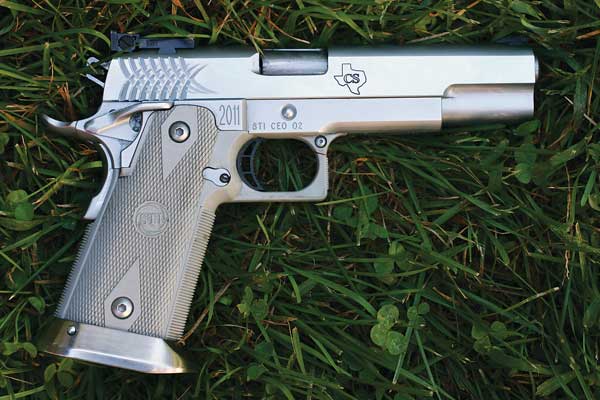
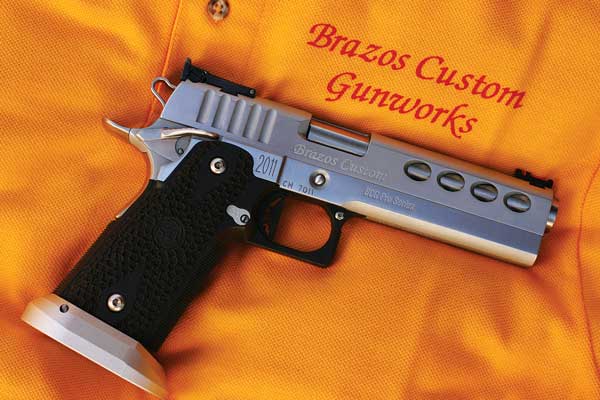
The basic STI (if there is such a thing) is a hi-cap gun devoted to competition
While also in the business of producing fine single stacks, STI makes a hybrid polymer-steel 1911 that takes hi-cap mags. There is no such thing as a “basic” STI.
STI is known for hi-caps and competition guns, However, that wasn’t always the case. A few years ago STI bought a local (Texas) company that was doing good work in making single-stack 1911s. And after that, STI went for the basic-gun market with another program. (More in just a bit.)
The basic STI hi-cap is the unchanged (except for even better quality) metal/polymer hybrid back in the early 1990s that we’ve already discussed. Dave Skinner and his wife have worked hard to promote the practical shooting sports and provide top-notch pistols for those competitors. Like other modern and savvy entrepreneurs, he is more than willing to take a chance on a particular model or set of features that looks promising. That, combined with the nearly genetically-based need to modify and experiment with gear, means that it can sometimes be difficult to find a “standard” STI at a match or on the range. Between Dave’s changes and the owner’s mods, what you’re looking at may be entirely different than the previous STI you just looked at.
The STI single stacks made here in the USA comprise most of the lineup. The Lawman, Sentry, Targetmaster and Rangemaster are just some of them, and they all feature forged steel frames, machined here in the USA (Texas, to be precise) and assembled with STI components. In addition to slides and frames, STI makes their own barrels, internals, grip safeties, etc. The basic gun by STI, the Spartan (and you have to figure, with Dave’s sense of humor, that the name is not an accident) is a no-nonsense gun at the lowest cost at which STI can deliver their quality.
It has a Philippines-made slide, frame and barrel that is assembled and fitted in the US by STI, using STI internals. You get a super-tough gun at a reasonable price, with STI quality. You do, however, give up some things: choices. You can have it the way it is, no extras, no options, no add-ons.
Unless, of course, you go to the STI custom shop, where they will build whatever you want, the way you want it, on an STI gun.
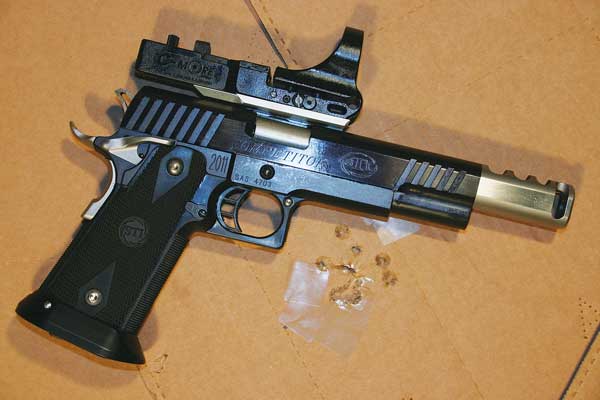
This custom-built STI by Bob Londrigan can be used for both Limited and Limited Ten competition
The moniker we all know for the modular frame is STI. (At least until we get to the famous “divorce.”) The Para and the STI had magazine tubes that were proportioned for .45 ACP cartridges. That meant a fatter frame, to hold the fatter magazine tube. The .38 Super magazines were the same tubes, but with ribs crimped into them to reduce the interior size, and allow for proper stacking of the smaller .38 Super. Caspian used magazines proportioned for 9mm/.38 Super that weren’t as wide as the magazines of Para or STI.
But as an all-steel frame, it was heavier than the STI. The STI weighed half what the Para and Caspian did, and so it saved the weight, which meant a red-dot sight and mount didn’t make your handgun into an anvil. It didn’t hurt that since the STI frames were CNC machined, and thus everything was straight and where it was supposed to be, it was a snap to drill and tap an STI frame for a scope mount. Later, the makers offered the drilling and tapping for you, as much to save them the hassle of dealing with mis-drilled holes and customer “fixes” of same as for any other reason.
The rocket-like interest in the .40 S&W cartridge also weighed in.
The membership of the USPSA at this time was like a dysfunctional family: everyone in their faction was in competition against everyone else and theirs. And everyone wanted things to fall out a certain way: their way. The Open shooters wanted Open guns in matches designed for their guns. The stock shooters wanted no comps or dots but beyond that couldn’t agree. There were those who wanted the “old days” of single stack 1911s, and everyone agreed that there had to be a place for the “wondernines” to shoot but couldn’t agree on how to accommodate them.
This was when there was some fracturing of competition. IDPA split off, the organizers being disgusted at how far from “reality” IPSC competition had gotten. The Single Stack Society formed, to give an outlet for the guns of yore to shoot. The IDPA quickly siphoned off a cadre of shooters. The Single Stack Classic, the match the Single Stack Society organized each year, was populated mostly by the shooters who had begun with the single stack 1911.
However, the USPSA took note. Soon, there were a host of Divisions in which you could shoot: Open, Limited, Production and Revolver (although that last one took longer). In Limited, which allowed almost everything except comps and dots, shooters soon figured there was no point in shooting a .45. You see, with a magazine limit of 140mm (Open allowed 170mm) the .40 offered greater capacity than .45 did. And since capacity was king in “hoser” stages, no-one wanted to be caught at a disadvantage. The change was swift and almost universal.
At first, the STI frames were bare frames, and you built what you wanted. Some built .45s, but most bought them to turn them into .38 Supers, such as this one.
Things were settling down when politics reared its ugly head. In 1994, Congress passed, and President Clinton signed, the Assault Weapons Ban. Actually, the law was titled “Violent Crime Control and Law Enforcement Act of 1994,” subtitled “Public Safety and Recreational Firearms Use Protection Act” and it did a whole bunch of pie-in-the-sky things. Among them was prohibiting the manufacture of magazines that held more than ten rounds. Existing magazines could be owned, used, sold, traded and repaired (more on that last part in a bit) but there could be no new ones, except those sold to law enforcement.
The reaction was swift: every magazine in the supply chain was bought, at dizzily-escalating prices. For a while, a hi-cap Glock 17 magazine could go for $150. The makers, knowing that screwing around would get them fined, imprisoned and/or ruined, made ten-shot magazines which were impossible to alter to hi-cap.
It quickly became apparent there would be a two-tier system if the USPSA didn’t do something: those with hi-caps and those without. So a new Division was formed: Limited Ten. For a while it looked like this would be the home of the single stack, but it proved not to be. So in due time (ten years later) the USPSA formed the Single Stack Division, giving the 1911 a place to play on a level field. There was also talk of an Open Ten, but it never materialized as an equipment Division.
The AWB/94 caused a whole lot of other changes. For one, it heightened interest in all the guns and gear that were “banned.” Also, it caused the Democratic Congress to be thrown out nearly en masse and turned the House of Representatives over to the Republicans. The law, thankfully, had a “sunset” provision in it: it would expire in ten years, unless it was voted to be renewed. It also allowed existing magazines to be repaired. To those in the know, this was a loophole big enough to drive an entire industry through.
You see, the law had no provision for marking “repaired” magazines, or tracking repairs, or anything. Other than saying they could be repaired, the law was silent. So, shooters quickly became adept at buying “repair” tubes from one source, and springs, followers and baseplates from another. Federal felony? Probably. Anyone prosecuted? Not a clue. Need to hide the fact now? Not in the least, unless it makes the anti-gun legislators wise up.
Trying to prosecute someone today (or even the day after the law sunset) for “manufacturing” hi-cap mags is like saying in 1934, after the Volstead Act has been eliminated, that you were going to be prosecuted as a bootlegger. As long as that was all you did, there was no longer a statute under which you could be charged. To charge someone now, for assembling magazines in, say, 2002, is as much a non-starter as charging your great-grand-dad for making bathtub gin.
However, Caspian did not wish to enter into the gray area of magazine repairs. They had a sale of their assembled tubes in the Fall of 1994 (I was there, at the USPSA Nationals. They had crates and cartons of mags and tubes on the tables; buy them while they lasted) and once the tubes were gone, Caspian focused on the components business of the single stack trade.
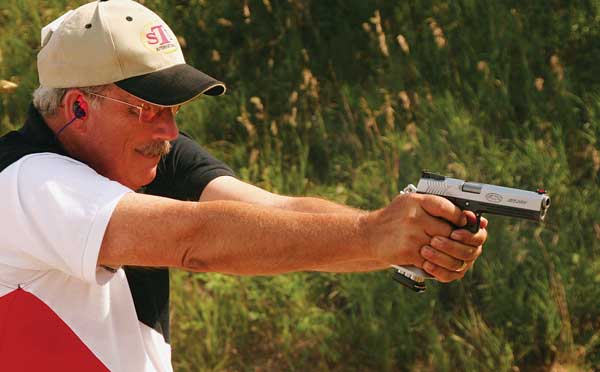
Dave Skinner, shooting in the Nationals. He makes them, sells them, and shoots them. And he sponsors the sport.
The single-stack makers, seeing that the limit was just beyond them, offered ten-shot single stack magazines. Then and now they are reliable, sturdy magazines.
With the hi-capacity Para and STI frames on the market, shooters had a choice: should they build a gun that hundreds of gunsmiths could work on, or go with the CZ clones, then imported by European American Armory, with a couple of dozen ‘smiths to work on them? The shooters voted with their wallets, and soon the ranges were filled with hi-cap guns made in the Western hemisphere.
However, many, if not most, were 1911 derivatives. The Open guns were Para or STI in .38 Super with comps and dots. The Limited guns were Para or STI in .40. Brian Enos and some others still carried the banner for EAA, Brian shooting a Limited EAA in .40 until he retired. But the guns were just outnumbered. Limited Ten became the Para and STI with ten-shot-magazines playground. Yes, you could shoot a single stack with ten-round magazines, but it wasn’t competitive.
And not for the reason you’d think. Leading to a minor controversy some years later. When someone noticed that some of the top shooters were using .40s at the Single Stack Classic, (recently the USPSA Single Stack Nationals) they cried foul. The top dogs were obviously taking advantage. As if.
I talked to the top shooters, and if I were to take all their reactions, throw them into a text cuisinart, and pour it out, it would be something like this: “Pat, I’ve been shooting .40 Limited for so long, it’s all I have. I’m not sure I can find any .45 ammo in my loading room.” For many top shooters, it was easier to simply buy/build a .40 single stack than to get back into loading .45 ACP or laying in a supply of ammo. The reason the Limited Ten Division became an STI/SVI/Para playground was equipment: if you were shooting a hi-cap Open gun a lot, and you want to shoot in Limited, you shoot the same gun in .40 If you wish to shoot Limited Ten, your easiest way (and less practice in transition) was to use your Limited gun, downloaded.
In Production Division, the USPSA rulesmakers desired avoiding an “equipment race.” That is, the exact sort of thing I just described: people chasing scores by buying equipment, even when the equipment didn’t matter, something shooters had been complaining about for fifteen years at that point. So, the scoring was made simple: everything was Minor. Once you exceeded the threshold, it didn’t matter what you used. Also, to avoid capacity problems, they made everyone shoot “ten round magazines.” Oh, your magazine might hold more, but don’t load more. This was not entirely due to the AWB/94. A Glock 17 holds 17+1 rounds. A Ruger or S&W of the time held 15+1. Clearly, based on past experience, shooters would move to the higher-capacity gun, if capacity were allowed to enter into things.
To preclude that, they set the limit (and kept it after the AWB/94 sunset) below the lowest capacity 9mm pistol, which for the 1911 didn’t matter, because to be a Production-kosher gun, it had to be double action. Or at least, not “cocked and locked.”
Enter Para ordnance with their LDA, the light double action, a 1911 frame with a double action trigger in it. As long as you didn’t load more than ten rounds, it was a Production-approved gun.
Partly as a result of the AWB/94, the 1911 started getting a lot more interest. You see, in the background, there was movement to change the “carry” laws across the country. Before the state of Florida changed, in the late 1980s, most states were what has become to be called “may issue.” That is, you go to the local police, or whomever, and ask for a license to carry a concealed pistol. If you meet whatever requirements there were (which in some locales, were pretty onerous) you were issued a license.
You had to prove you met the qualifications to be issued a permit. In a lot of places, “qualified” meant you’d contributed enough to the re-election campaign of a politician with enough “pull.” In other places, it simply wasn’t going to happen without a lot of legal expenses. And in still others, it didn’t matter what the law said, you weren’t going to get a permit no matter whom you knew, paid, or were related to.
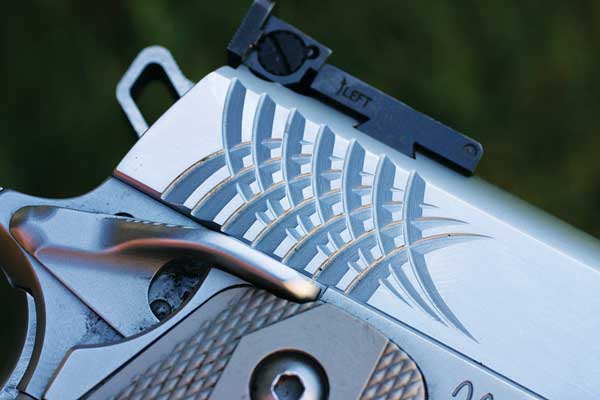
STI is not afraid to experiment. This is a cocking serration treatment they applied to pistols for a while. A little too racy for me, but a lot of shooters liked it.
Florida started it, and soon there was movement across the country to change that to a “shall issue” condition. That is, you applied, and unless the police could find some reason to disqualify you (and they didn’t have many options) you were issued a license. Now, they had to prove you were in the “disqualified” category, which many felt was a much more equitable arrangement. And one less prone to political abuse.
As a result, more people started carrying and buying guns to carry. While this was going on, the AWB/94 precluded large magazine capacity. People figured “If I can only have ten, I want the ten biggest I can get.” That is, .45 ACP, and this brought the 1911 back into the mix.
The situation with Chip McCormick, Sandy Strayer and Virgil Tripp ultimately fell apart. In 1994, Sandy Strayer left and formed Strayer-Voigt, later to be named Infinity. Dave and Shirley Skinner joined STI, and over time eventually bought the whole company; by 1997 it was Dave and Shirley. Virgil Tripp left once Dave Skinner bought the whole shebang and went back to custom gun building, chrome plating, and design. And things just kept getting better.
Dave Skinner at STI brought a volume attitude to production and marketing. He made semi-custom guns, semi-custom in that they were of a high quality, but you either ordered basic guns and had someone else trick them out or you got the “STI package” tricked-out gun. But do not make the mistake of thinking that STI guns were plain guns. Having a good number of CNC machining stations, STI could produce whatever they needed. And they could make them at the drop of a hat. So STI offered model after model. If it sold well, it stayed, if it didn’t, it became a collector’s item and got replaced by something with more promise.
Also, STI was willing to go out on a limb. For example, California is a strange state. As more than one wag has put it, “the country is tipped, and everything loose has rolled to the West Coast.” The California legislature is populated with firearms-ignorant do-gooders. One of the more inane laws they passed some years on handguns, to keep hitmen from using silencers. Being, as I said, ignorant of things firearm-ish, they didn’t write the law as “silencer threads” or “bare threads and a silencer” or anything like that. They wrote “no threads.” How do you attach a compensator to a barrel? Threads. How do you put a coned lockup on a barrel? Threads. So, your screwed-on-with-a-wrench, Loctite-ed, hand-fit compensator is verboten in California. Even if it is on so securely that you’ll need torches, a vise, wrenches and you end up destroying things in the process, you had an illegal firearm.
STI tried, with their Trubore barrel, to accommodate this inanity. The barrel and comp were manufactured as a single, integral unit. No threads. That wasn’t good enough. California decided they would be the arbiters of what was a “safe” firearm and so came up with a “test.”
The California test required a loaded (primed case, no bullet) handgun to be dropped on a steel plate, multiple times, while oriented in different directions. You’re probably asking “So what’s the big deal?” Simple: California didn’t foot the bill. You want the gun you manufacture approved, send them not one, not two, but three sample guns and a check to cover all the costs of testing. That’s right. You had to pay for the privilege of California destroying three of your finished product, and thus being approved.
It got even better. California is not so forgiving that if you make one basic gun, and a lot of derivatives, that getting the basic one approved includes the others. Nope. Change something and that “new” one needs approval, too. If you offer a dozen variants, that comes to 36 handguns, and a whopping big check to trash them all. Dave Skinner, bless his heart, finally just threw his hands up and said “[bleep] it.” He stopped selling guns in California, and told anyone who asked why.
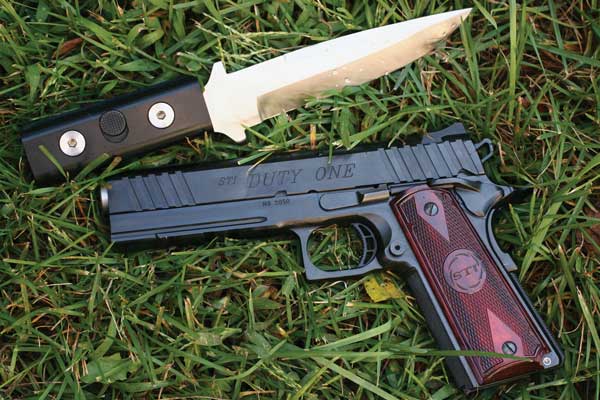
Dave Skinner has a quirky sense of humor. I mean, a bayonet adapted to fit on a light rail of your STI? Stand by to repel boarders!
For a while, Bar-Sto Precision, the barrel makers, manufactured a California-complaint STI. They could; they were based in Twenty-Nine Palms, California. The law only covered firearms being “imported” into California (as if California was its own country, with its own immigration, border patrol, customs and so on). However, the situation wouldn’t remain that way for long. The business climate in California became so onerous that like many other companies, Bar-Sto moved out. So there are a bunch of California owners who have collector’s items: Bar-Sto marked STI pistols.
After leaving, Sandy Strayer built the kind of company he wanted: a full-custom gun maker. Now run by his son Brandon, Infinity does not make standard items. Oh, they’ll show what they’ve done, and what other customers have had built, but you can’t order up “standard pistol number three” at Infinity. Instead, you use the web page, or fill out an order form, and you specify everything. Length, caliber, details like checkering pattern and spacing, grooves on top of the slide or not, frame color, size and type of safeties, etc. And it can get pretty wild, since the crew there is pretty imaginative.
If you want to have something that will be for a particular competition, be sure and let them know. They’ll tell you if the extras you’ve ordered will be USPSA, IPSC or IDPA-compliant, and in which Divisions.
This article is an excerpt from 1911: the First 100 Years.
You may have recently received or reported suspicious phone calls or offers in the mail to renew your subscription to Gun Digest.
Your uneasiness may be justified. While still rare, fraudulent mailings and phone calls are increasing. We have confirmed that unauthorized parties are attempting to represent themselves as Gun Digest, asking for a check or credit card number to renew your subscription.
They take your money but cannot deliver the subscription.
These simple guidelines can help you avoid becoming a victim:
Before renewing, check your mailing label. You’ll find your expiration date at the end of the line above your name. If your subscription is not close to expiring and you receive a phone call asking for your renewal, it is most likely fraudulent.
Look carefully at mail requests. We will never ask you to write a check to anyone other than Gun Digest, and our mailing address on the return envelope should be to P.O. Boxes in Palm Coast, Fla., with these specific zip codes: P.O. Box 421756, Zip 32142-9857; P.O. Box 421757, Zip 32142-9875; and P.O. Box 421759, Zip 32142-1759.
If you are uncertain about any offer you receive, simply phone us at 1-386-246-3417. Orders placed through this number are secure. Or you can go online and place your order at www.GunDigest.com and click on the secure link for “Subscription Help.” We sincerely appreciate having you as a faithful reader and we are eager to help make the experience of subscribing to Gun Digest pleasurable.
A bill that is working its way through the state legislature could eliminate concealed weapons permit requirements and cost the state millions of dollars in lost permit fees.
Many Anderson-area instructors said they are still following the bill and want to learn more, but they are worried that no longer having mandatory classes for concealed weapons permits could hurt or destroy their business.
Instructors also said they think that removing the requirements will result in more legal gun owners being arrested for unknowingly violating state laws by carrying weapons in places where even permitted carriers are not allowed to have guns.
There are currently 130,918 people with concealed weapon permits in South Carolina. Permits have to be renewed every four years for $50.
Over the four-year period, that amounts to more than $6.5 million in fees.
There are currently 699 certified concealed weapons instructors, who can renew their licenses for $100 every four years, according to the South Carolina Law Enforcement Division, which handles the permitting process. Read more
Anybody who likes the Government Model 1911 is going to love 2011, the 100th anniversary of the famed “.45 automatic,” because you’re undoubtedly going to see some dandy commemoratives, and spruced up “working guns” on the horizon.
But not all is 1911-oriented this year. Chiappa’s new Rhino revolver is finally approved for distribution, there’s a new AR-style pistol, the Titan .410/.45 derringer is being marketed by Cobra, and Glock’s Gen 4 pistols are definitely in the spotlight.
The Para CWX79R.
But let’s take an early look at just some of the new entries, beginning with a number of introductions from Para USA (10620 Southern Loop Blvd., Dept. GDTM, Pineville, NC 28134-7381/(704) 930-7600/www.para-usa.com).
There’s a Limited Anniversary Set, with a Para GI45 and a Hi-Cap. The GI45 has three-dot fixed sights, two 7-round magazines, the PK2 finish, 5-inch barrel, stainless steel frame and solid trigger. The Hi-Cap has a stainless frame with accessory rail, Trijicon three-dot tritium night sights, 25lpi front strap checkering, match trigger, a pair of 14-round magazines and the PK2 finish. They come in a wood display box.
Para’s LDA (Light Double-Action) pistol is now chambered in 9mm. It carries a 7-round magazine, features a 3-inch barrel, spurless flush hammer and rounded grip safety, alloy receiver and black resin double diamond grips. This pistol also wears the PK2 finish.
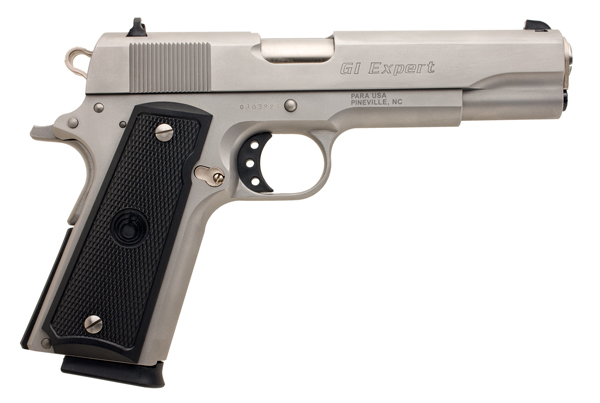
The GI45S is a stainless version of Para’s popular “basic” .45 auto pistol, the GI Expert. It has a stainless steel barrel and solid metal bushing, medium-length Expert trigger, three-dot fixed sights, skeletonized spur hammer and 8-round magazine. Stocks are checkered polymer.
The Cowboy Action crowd will warm up to the new SASS Wild Bunch 1911 pistol, alluding to the classic Sam Peckinpah western featuring William Holden and the famed Model 1911 in a final reel shootout that stands today as a benchmark of the genre. The pistol has a 5-inch stainless steel barrel, fixed three-dot sights, PK2 finish, solid long trigger, a pair of 7-round magazines, steel frame and weighs 39 ounces.
Gun Digest the Magazine and Tactical Gear Editor Kevin Michalowski talks with Mark Westrom of Armalite at SHOT Show 2011. Get a look at the AR50 National Match .50 Caliber, plus a look at the Armalite AR-10 A2, and the new M-15 22, a .22 LR caliber rifle that’s a lot of fun to shoot!
Gun Digest is the source for firearms news, pricing and guns for sale. Readers benefit from in-depth editorial expert advice, show reviews and practical how-to instructions. With your Subscription, you’ll also learn about threats to your Second Amendment rights. Click here to begin your subscription to Gun Digest.
Inside this issue:
Les Baer Ultimate .308
Bedding a Remington 700 Stock
Gun Review: Thompson Center’s Encore
Ballistic Programs for Long-Range Shooting
Gun shows, auctions, classifieds and more!
Not a subscriber? Make sure you don’t miss another issue! Subscribe now
The FAIR Trade Group has announced that it will sue the Bureau of Alcohol, Tobacco, Firearms and Explosives (BATFE) over the agency’s recent prohibition against the importation of numerous firearm barrels. FAIR Trade group is a 501(c)(6) organization that protects the interests of firearms and ammunition importers.
According to a FAIR Trade press release, “The BATFE [recently] reversed years of statutory interpretation of the Gun Control Act and is acting in conflict with published implementing regulations regarding the importability of certain firearms barrels. BATFE is enforcing the new interpretation of the law without any change to the regulations.”
The release continued, “FAIR Trade Group members, other firearm importers and the customers seeking to buy imported goods have been directly harmed by the actions of BATFE to prohibit the importation of barrels that can be assembled into sporting firearms or used as replacement barrels for legally owned firearms. Importers not only lost access to marketable goods but were also left with goods in transit and goods overseas that lost value.
Firearms owners, collectors and potential buyers were denied access to these goods which, in many cases, have no available replacement.”
FAIR Trade also argued that BATFE made this and other changes to firearms importation regulations without offering any underlying justifications, and in doing so did not provide appropriate and required notice and comment periods.
Federal law enforcement is conspiring against your rights.
It sounds like a plot-line from a bad action movie on late night cable.
Unfortunately, it’s also true.
David Codrea from The Examiner has put together an astonishing work of investigative journalism showing just how deep and tangled the web of lies is that the ATF has woven.
Originally, the ATF – using their “Project Gunrunner” – set out to show just how many firearms were being bought in the United States and smuggled into Mexico.
But the numbers didn’t add up quite the way the ATF wanted them to, so…
…they made up their own.
In an ongoing investigation he dubbed “Project Gunwalker,” Codrea has obtained evidence that the ATF not only made up some of the numbers, but they openly allowed several weapons to walk across the border in the hands of drug-runners so they could pad their stats and secure more funding.
I wish I were making this up, but sadly, it gets worse.
According to ATF agents, one of the firearms allowed to cross the border illegally was used in a December 2010 shooting…
…A shooting that cost the life of a U.S. Border Patrol Agent.
The articles on The Examiner go into much more detail, but for me, this was more than enough.
An over-funded, power-hungry and entirely unnecessary law enforcement agency enables criminals to do their worst simply so they can grab even more funding and power.
And a law enforcement agent loses his life in the process.
It has become so bad within the ATF that numerous agents have refused to step forward to tell their story due to their concerns regarding how high up in the Justice Department this scandal could go.
Larry Pratt tells why Obama’s nomination, Andrew Traver, to head up the ATF is a direct attack on gun ownership.
The Bureau of Alcohol, Tobacco, Firearms and Explosives is waging a war on innocent gun owners, and not surprisingly, the Obama administration has done nothing to keep them in check.
You are no doubt aware of how the agency has been going after honest gun dealers in recent years. Combine that with byzantine federal laws and regulations — subject to BATF interpretation — and it’s no wonder the number of FFL holders has decreased almost 80%.
Then there was former National Guardsman David Olofson. In 2008, Olofson’s loaned AR-15 malfunctioned at a range — firing a three-round burst with a single trigger pull. The ATF could only replicate the malfunction after experimenting with different types of ammunition behind closed doors. Having achieved the result they wanted, the ATF labeled Olofson’s gun a machine gun, and he was sentenced to three years in prison for an illegal “transfer.”
The agency also put millions of gun owners in its crosshairs when it reclassified shotguns that are equipped with pistol grips. By decreeing in 2009 that such firearms are not “shotguns,” the ATF acted as a de facto legislative-making body… quietly turning millions of gun owners into potential criminals overnight.
If the weapons are not “shotguns,” then what are they? The NFA Owners Association suggests the only logical alternative is that such firearms are now “destructive devices” — in the same category as grenade launchers, which require owners to register their weapons and pay a $200 tax.
Of course, failure to register such weapons and pay the required tax would result in the same treatment that David Olofson received.
One Senator on Capitol Hill is looking into the agency’s contemptible practices and asking pointed questions of ATF Acting Director Ken Melson.
In late January, Senator Charles Grassley (R-AL) questioned Melson about abuses stemming from Project Gunrunner, a program the ATF started in 2005 to stop US guns from getting into the hands of Mexican drug cartels. In order to track illegal gun running, the ATF engages in (and approves of) illegal gun purchases made at gun shows and stores throughout the southwest.
The word is starting to leak out that the ATF has its fingerprints on many of the strawman sales that are grabbing so many headlines. On January 30, newspaper headlines in El Paso, Texas, stated that: “US agency intentionally permits arms to be trafficked into Mexico.” Read more
Looking to go armed, but are stuck in the weeds as to what to arm yourself with? Here are 20 of the best concealed carry gun options that will keep you on the defensive.