Ithaca Gun Company has long been known for its classic Model 37, an innovative bottom-loading, bottom-ejecting pump-action shotgun produced since the late 1930s. Recently, however, the American manufacturer based in Sandusky, Ohio, has branched out by developing and releasing its very first rifle design.
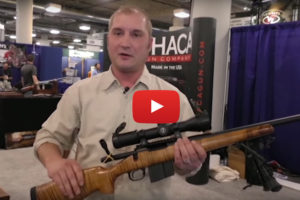
Dubbed the Ithaca Precision Rifle, the gun is built off of the classic Remington Model 700 design and has been tailor-made for long-range work. Each rifle features a 4340 chromoly steel billet receiver, a 4140 single piece billet non-welded bolt, and a competition-grade barrel and trigger.
Ithaca produces the new Precision Rifle’s action entirely in-house using high-quality CNC-machining equipment, and the bolt raceway is wire electrical discharge machined (EDM) for added precision. Each barrel is also paired to the action by experienced craftsmen and comes with 1/2 MOA guarantee.
Our friends at Deer & Deer Hunting got an exclusive first-hand look at the new Ithaca Precision Rifle with Zach Amert of Ithaca Gun Company to get the details about the new gun. Watch the video above to learn more about Ithaca’s first-ever rifle.
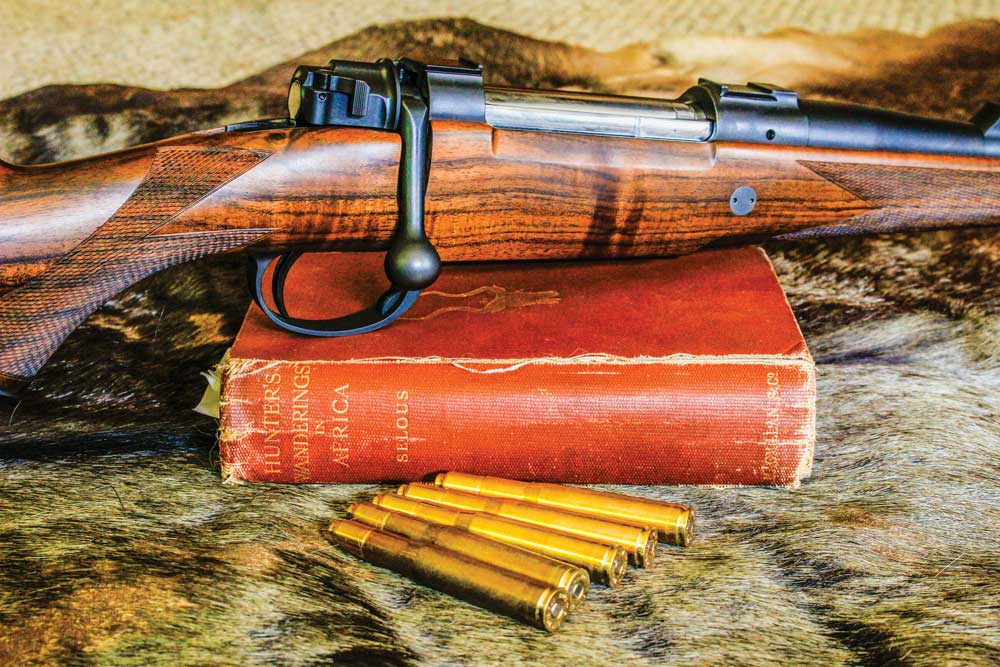
The actual year that the .404 Jeffery was released is a source of debate and even argument among those who study cartridge history, and particularly African hunting cartridges. Most research will indicate that 1909 was the official release date, yet Phil Shoemaker — the famous brown bear guide from Alaska — has a rifle that dates back to 1907, clearly original and clearly chambered for the .404 Jeffery.
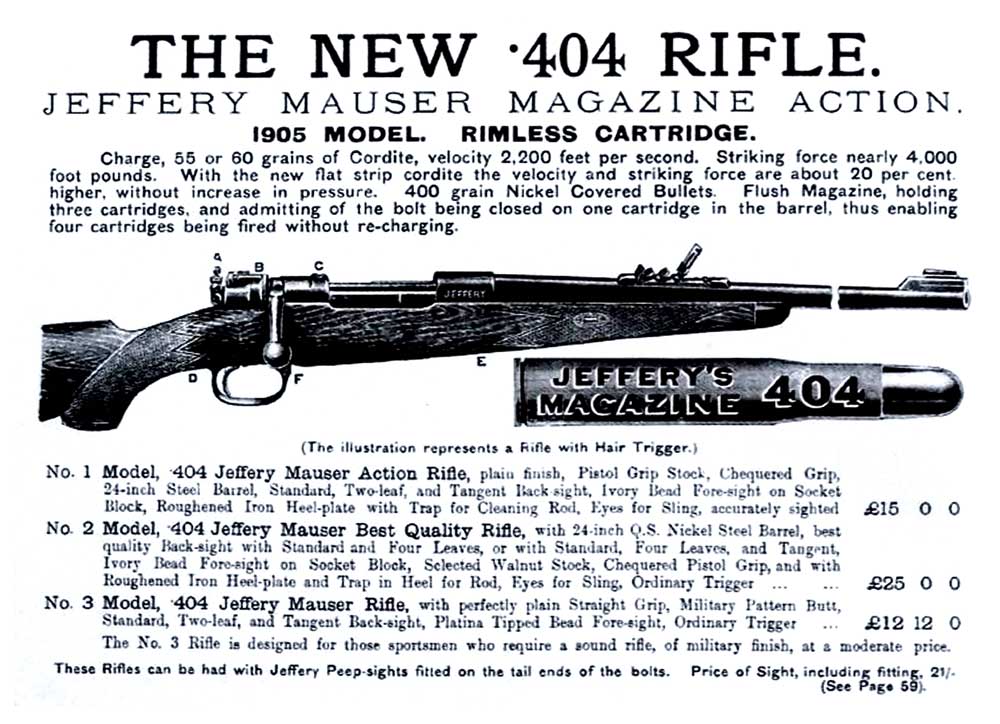
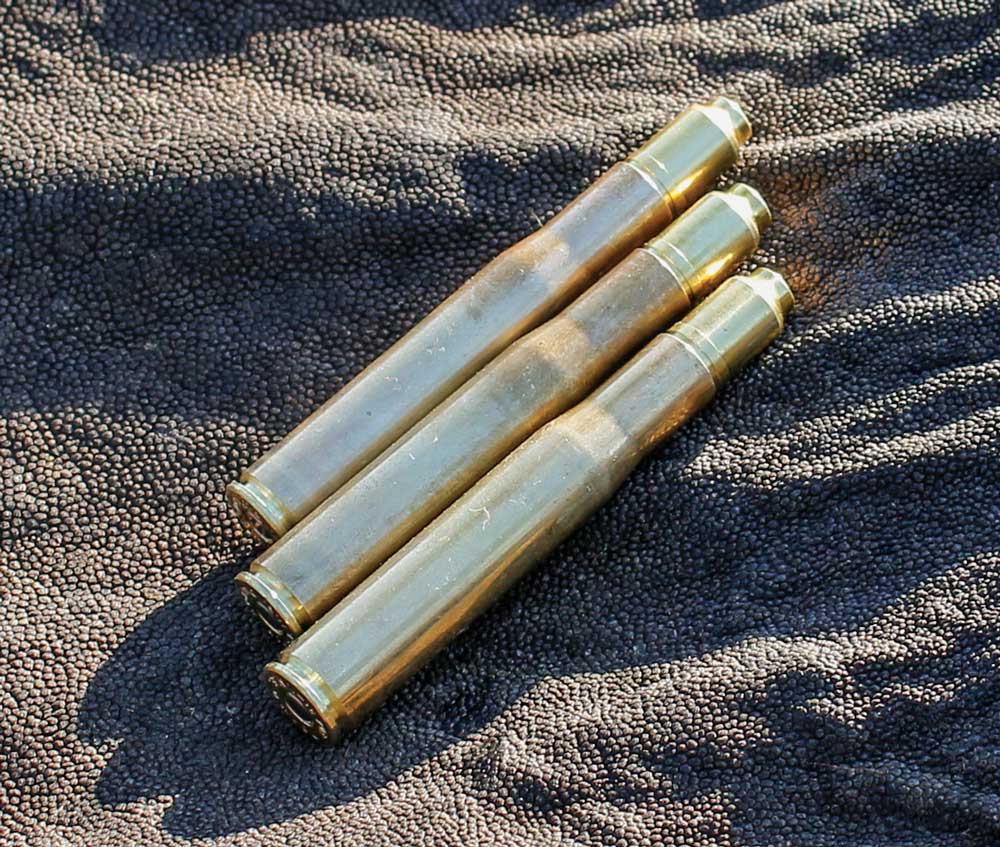
It doesn’t really matter; let’s agree that the latter portion of the first decade of the 20th century saw the .404 burst onto the scene. Its purpose was to replicate the ballistics of the steadfast .450/400 3-inch Nitro Express in a bolt-action rifle, and it worked. The bullet diameter was changed from .410” to .411” for the .450/400 to .423” for the .404 Jeffery — for reasons I can’t quite figure out — and the new case drove a 400-grain bullet at a muzzle velocity of 2,125 fps for 4,020 ft-lbs of energy, as well as a 300-grain copper pointed bullet at 2,625 fps, designed for long-range work. The .404 has an 8-degree shoulder; usually a cartridge that doesn’t feature a rim or a belt features a much more prominent shoulder in order to facilitate good headspacing. That said, I’ve never had a single problem with headspacing in the .404 Jeffery, and that slight shoulder allows the cartridge to feed like a dream — and that’s an important feature on any dangerous-game cartridge. While it became very popular among British rifle makers, it was also embraced by German rifle makers, designated as the 10.75x73mm.
That early muzzle velocity of 2,125 fps may seem sedate when compared to the .375 H&H Magnum or the .416 Rigby, which run at 2,550 fps with a 300-grain bullet and 2,410 fps with a 400-grain bullet, respectively. But it is enough to ensure reliable expansion and penetration with the standard cup-and-core softpoints and steel jacketed solids. All this in a cartridge that has, possibly, the mildest perceived recoil of any of the dangerous-game cartridges I’ve used. The combination of mild recoil and the ability to place those bullets where they need to be is tantamount to quickly dispatching game animals. It was so effective, in fact, that the game departments of both North and South Rhodesia (now Zambia and Zimbabwe), Tanzania and Kenya chose the Vickers bolt-action rifle chambered in .404 Jeffery as the standard-issue rifle. In my opinion, if it was good enough for those guys required to handle the problem animals, it is good enough for me. The .404 Jeffery has the distinction of taking what many consider to be the greatest North American trophy ever taken — the Chadwick ram — the world record stone sheep taken in British Columbia in 1936 by Dr. Chadwick.
The original .404 load quietly made a fantastic reputation among those who had the opportunity to use it on a daily basis — folks like John “Pondoro” Taylor, who in his classic book, African Rifles and Cartridges, would testify to the effectiveness of the Jeffery cartridge. But, that original load didn’t stick around for long. Kynoch bumped the muzzle velocity from 2,125 fps to 2,225 fps, also increasing the muzzle energy by almost 400 ft-lbs, recognizing the fact that the .404 Jeffery case was capable of more than what was being loaded. More about that in a minute…
The early part of the 20th century saw many great safari cartridges introduced; some would fade into obscurity and some would go on to become undeniable classics that few hunters would not insist on having in their collection. The .375 Holland & Holland Magnum certainly heads that list; it is perhaps the single most useful cartridge ever invented, and while it may not be perfect for everything, it will certainly get the job done on any game animal, anywhere. The writings of Robert Ruark brought the proprietary .416 Rigby into the spotlight, and I’d confidently say that without that book, the Rigby cartridge and the .416-inch bore diameter would’ve walked off into the sunset. The prestigious firm of Westley Richards answered the .404 Jeffery by releasing the .425 Westley Richards, using a .435” diameter bullet at 2,350 fps for just over 5,000 ft-lbs of energy. However, the severely rebated rim of the .425 didn’t give reliable extraction, so it didn’t gain a huge following, and is a rarity today.
The .450-400 3” NE was, and still is, a wonderful choice for a hunter, but the rimmed cartridge is usually reserved for the double rifles and single-shots; the former became very expensive to produce and the latter fell out of vogue until the advent of the Ruger No. 1 in the 1960s. By the middle of the 20th century, much of Africa had begun the plunge into political turmoil, and ammunition for many of the big double rifle calibers like the .450 NE and .470 NE became increasingly harder to find.
To fill the void, the .458 Winchester Magnum came on the scene in the 1950s in the affordable and reliable Winchester Model 70 bolt-action rifle, reproducing (at least in theory) the ballistics of the venerable .450 Nitro Express. For many years, a sportsman didn’t have much choice for a safari; you either grabbed a .375 or a .458. Still, there were those few who quietly hoarded .404 rifles and ammunition, using the vintage rifles with great effect on all shapes and sizes of game.
This article is an excerpt from Gun Digest 2017, 71st Edition.
Do you have your barrel and receiver set up to run flawlessly in your AR-style rifle? Most likely yes, but there are certain configurations that just won’t do.
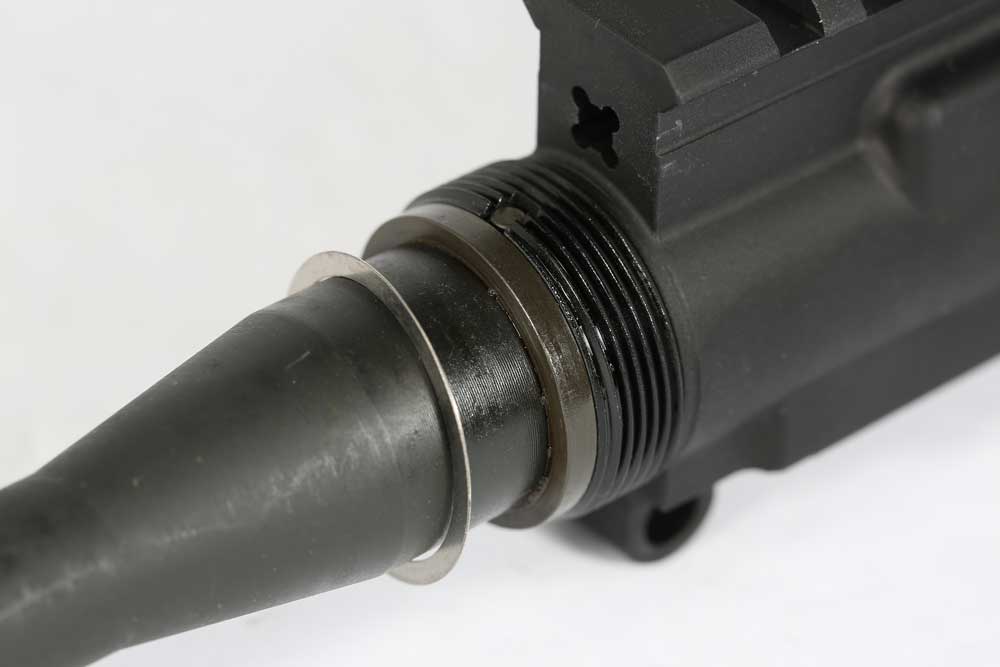
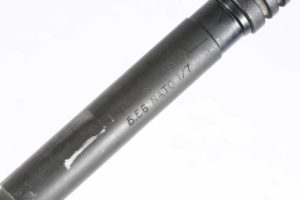
This takes a bit of explanation. The original design of feed ramps were cut in the barrel extension from the magazine to the barrel. The front face of the receiver is simply a flat wall. Each round, as it strips forward out of the magazine, cams up so the tip strikes the feed ramp, and not the receiver wall. In the semi-auto rifle, and in the early M16A1s, there was no problem. Everything worked as designed.
By the late 1980s, however, there was a problem. The government had switched from the M193 to the M885 round. Colt was developing the M4. What Colt found was, when using the M855 round in the M4 on full-auto fire, the feeding became less consistent, and sometimes the tip of a round would strike the receiver wall. That would bring things to a halt, and also stub the bullet back into its case.
So, Colt made the M4 receiver, so marked on the front, above the gas tube hole. The M4 receiver feed ramps are cut at a steeper angle and, as a result, extend down into the receiver wall. The barrels also had to be modified. This can lead to a rare but odd situation; barrel and receiver mismatch. For the purposes of this chapter, we’ll call the new one the M4, and the old one the AR. We have four combinations here:
AR barrel and AR receiver
M4 barrel and AR receiver
M4 barrel and M4 receiver
AR barrel and M4 receiver
The only one that is problematic is the last one, AR barrel with a M4 receiver. AR/AR is the original, and it works. M4/AR has the feed ramps steeper, but they do not overhang the receiver ramps (there aren’t any) and no problem. M4/M4 is clearly correct.
An AR barrel in a M4 receiver, however, has steeper feed ramps cut into the receiver wall, with less-steep ramps cut into the barrel extension. (We’ll overlook for the moment that the front sight is probably also a problem, but that’s a different chapter.) The result is that the ramps in the M4 receiver have an overhang from the barrel extension of the AR barrel. A bullet can catch in there and stop the cycle. No, this is not theoretical. I saw it in a recent class, and we had to correct it.
Before we proceed, you must be familiar with the front sight height considerations between AR carbine and M4 barrels. If your rifle is correctly zeroed, and the sight is not in the wrong place, then you can correct this problem back at the feed ramps.
If, however, you find you have a non-“F” marked front sight housing, and you can’t easily zero your rifle, the correct solution is to change barrels. Or re-cut the ramps and also replace the front sight assembly.
The process is, use a Dremel or similar tool with a narrow grinding tip or a carbide cutting tool. You can set it up in a mill if you are really, positively OCD and just have to. Or, you can do what every other gunsmith and armorer across the country does — hand-hold the Dremel, grinding the barrel extension to match the receiver ramps. That’s it; you cut the steel to match the aluminum.
You can pull the barrel out of the receiver to do this. But the rest of us simply do the cutting or grinding with the barrel in the receiver. Once done, thoroughly hose out the grit with an aerosol cleaner, scrub the chamber, punch the bore with a solvent patch and then a dry patch, just to make sure you got all the grit.
That said, Colt wasn’t entirely correct that it was just a problem with M4s and M855 ammo. The problem did happen in semi-auto rifles and carbines, and not just with M855. I had it happen to one of my Frankenguns, back when Colt was still working on the M4 details. That rifle would occasionally stub in feeding. I looked at it, figuring I’d just buy a new upper receiver if it came to that, and went to work. I had to cut complete ramps of the M4 type, in both the steel and aluminum (which is why I used a carbide cutter) and it worked just fine. It still does.
But, when you order parts for your rifle to replace, rebuild or build from scratch, you want to pay attention to M4 ramps.
The country’s hottest practical shooting competition continues to grow. If you are looking to get in on the fun, TRUGLO offers one-stop shopping for all your pistol, shotgun, and AR sighting needs.
If you do it, you already know. If you don’t, you’ll find out as soon as try it…3-gun competitions are a blast. Not only do 3-gun matches scratch that itch we all have to get out on the range, but participation in this popular and ever-growing sport has real-world benefits the likes of which you just can’t get from static range shooting. The practice of engaging multiple courses of fire with your three primary defensive weapons—pistol, shotgun, and semi-automatic rifle—allows you to hone your self-defense skills. What’s more, the trio of weapons you may use on a 3-gun course can be the same ones you employ for your daily personal and home defense.
Getting into 3-gun shooting is simple. All you need is a pistol in 9mm or larger chamber, a pump or semi-auto shotgun in .20- or 12-gauge, and, for most divisions, a .223 chamber semi-auto rifle, the most popular of which is the AR-15 platform. From there, it’s a matter of refining your weapons to suit your needs while staying within the rules for the division in which you want to participate. If you have questions, there are many resources to help you get started, including your local participating gun range or shooting club. The 3-gun fraternity is a friendly lot, and experienced shooters enjoy every opportunity to help new shooters get involved in the sport.
Although 3-gun equipment rules are in place, they are fairly simple—especially when compared to some competitive shooting associations. One area where the rules are fairly straightforward involves sights and optics; depending on the division in which you chose to participate, no magnified optics are allowed or one magnified optic is allowed in your 3-gun set.
For those of you who are ready to give 3-gun competition a try, these three products will get your gear ready for the buzzer.
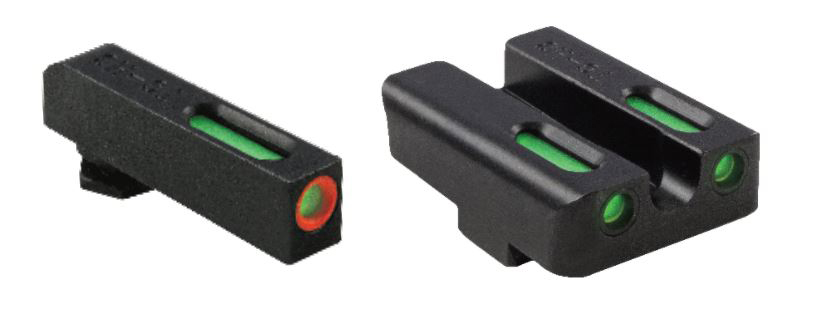
TFX™ Pro Pistol Sights If you’ve done any serious pistol shooting, you know that your original equipment front and rear sights do not provide an ideal sight picture in all lighting conditions. The TRUGLO TFX™ Pro tritium/fiber optic day/night sights, however, work in all lighting conditions, such as you will often find on a 3-gun course. The advantage the TFX™ Pro sights have over conventional open sights, fiber optic-only sights, or tritium-only sights is that they combine Swiss tritium and fiber optics with a contrasting color front sight ring. This combination provides optimal sight picture acquisition whether you’re shooting with a high-noon sun overhead or you are on a woodland course darkened by storm clouds. What’s more, the tritium/fiber optic elements are encased in almost indestructible, hermetically sealed capsules that won’t be compromised by oils and cleaning solvents. Another advantage these sights have for the 3-gun shooter is their radiused, snag-proof design, which allows you to draw and holster your pistol smoothly and quickly.
TRU•BEAD Turkey Universal Sights You’re probably thinking, “A turkey sight for a tactical shotgun?” Well, listen up. Three-gun courses are increasingly diversifying their courses of fire, and this includes the shotgun courses. In a shotgun course, you may encounter everything from close-quarter target “hosing” with #6s or 75-yard slug targets. As a result, you need an equally diverse sighting system. An ideal middle-ground sight is the TRUGLO TRU•BEAD™ Turkey Universal. You can use the orange fiber optic front sight to focus on your close-range targets. When it’s time to send a chunk of lead far downrange, the contrasting color rear sights will give you precise targeting. Of course, the rear sights are adjustable for elevation and windage, so you’ll know the steel is in trouble as soon as you hit the stage.
To Magnify or Not to Magnify That is the question you must answer before deciding in which division you want to shoot. The Limited division, which is popular for those just entering the 3-gun world, does not allow any magnified optics. If this is your chosen path, you’ll want to consider using a fast-acquisition red dot, such as the TRUGLO TRU•TEC™ 30mm Red Dot. This sight provides a wide field of view and unlimited eye relief for the fast-paced 3-gun environment while the 2 MOA reticle ensures precise targeting for those way-out-there shots.
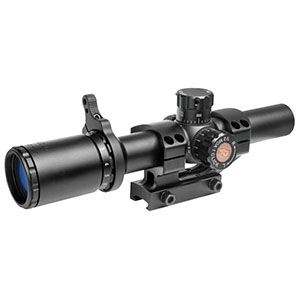
If you want to jump right into the highly competitive Tactical division, you will be allowed one magnifying optic in your arsenal. This, naturally, would be best served on your rifle. While some competitors combine canted open sights with a higher power scope to cover both short and long distance targets, fixed power or variable power scopes (1-4X and 1-6X) are commonly used for both. The scope is set at its low setting for engaging close targets, then the shooter cranks up the magnification to engage the 200- and 300-yard plus targets. For this, the TRUGLO TRU•BRITE™ 30 Series is your huckleberry. The TRU•BRITE™ 30 Series can be purchased with either 1-4X or 1-6X magnification and includes two pre-calibrated BDC turrets (one for .223 caliber/55-grain and one for .308 caliber/168-grain) so you can be confident of your shot placement. Another feature that makes this scope optimal for 3-gun shooting is the ergonomic magnification adjustment ring, which minimizes fumbling and grip slip when you need to quickly transition between magnification settings.
Try It Out! Three-gun competition is great fun, and it is a terrific opportunity for developing real-world defensive shooting skills. There are firearms clubs and associations around the country which host three-gun matches throughout the year. The National Shooting Sports Foundation maintains a listing of shooting ranges in the U.S., many of which host 3-gun competitions. Contact your local ranges for more info. You can also check out 3-Gun Nation for additional shooting opportunities in your area. In the meantime, check out the NSSF introductory video to 3-gun competition above.
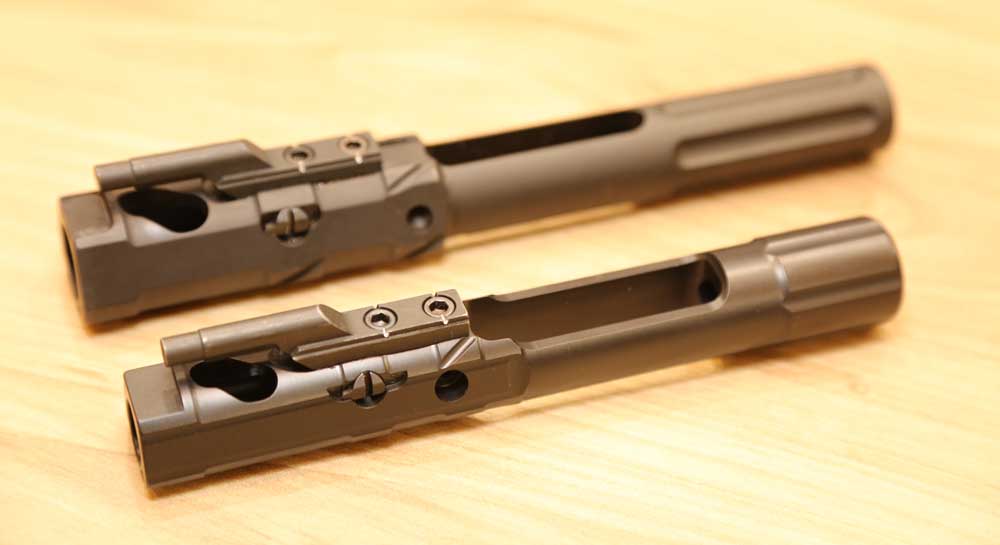
Given its operation in an AR-15, you might think the carrier sees a lot of wear and tear. But its longevity is quite impressive in the overall scheme of things.
Being the guy in the know, and with spies in all locations on the planet (or so some readers suppose), I get sent all sorts of interesting information. One of them concerns a recent incident with the U.S. Border Patrol. Apparently, someone from the higher echelons of management, sent armorers around to all the Border Patrol stations with orders to fully inspect all M4A1 carbines in use. In the course of inspecting, they apparently “deadlined” (that is, required removal from service) 65-70 percent of all rifles. This of course came as a surprise, and the powers-that-be had not planned to replace or repair that many rifles. So, the BP agents were reduced to one rifle per agent or less.
Now, in a city department, having one rifle for every other officer is not a problem. Backup is mere minutes away, and taking cover behind something substantial is an accepted practice when outgunned until the cavalry arrives.
However, Border Patrol agents are often miles and miles from anyone who might help. And they are in rifle country, with nothing solid to stay behind until help arrives. Not having rifles is a big problem. And there was a lot of consternation until the shortfall was corrected.
One of the tools the armorers used was a gauge I had never heard of called a Gauge, Gas Seal Hole, and is meant to be utilized at Depot-level maintenance. It measures the wear in the carrier bore hole, where the bolt tail seals. If the gauge goes all the way into the carrier, the carrier is worn out.
That such a tool exists does not surprise me. After all, the government has to have standards, measurements and inspection tools for everything.
What would surprise me is that any carrier, well, any properly-made carrier, would fail this gauge. Look, we have a hardened-steel part with wear surfaces that are hard-chrome plated. Rubbing against it is the tail of the bolt, but it isn’t really rubbing against it. The gas rings and the bolt body keep the bolt pretty well centered in the bore hole. The amount of actual rubbing has to be pretty minimal, and most of what is going on is carbon being created, ground off and pumped out of the gap. If there is gas leakage in that gap, I can see where the problem might be wear on the bolt from over-enthusiastic cleaning. But the carrier? I guess anything is possible.
Considering how grossly over-gassed even a properly gassed AR is, I’d bet that even if you had a carrier that failed this gauge, you could assemble it into a rifle and never notice the failure on the part of the carrier. Now, if you want to track down one of these gauges and use it, go ahead. But don’t think it is gaining you any advantage over your fellow shooters. And don’t think the gauge will be cheap, either.
If this was your original carrier, you’ve certainly gotten your money’s worth out of it if you have worn it out. Let’s just assume, for a ballpark figure, that the carrier in question has survived a decade of constant use. You’ve plugged four replacement barrels into the rifle, each with its own bolt. So, the original barrel and bolt, plus four more, at $75 each for the bolts and $150 each for the barrels. That’s $900 just in parts. Each of those bolt/barrel combos lasted you, what, 10,000 rounds? So that’s 50,000 rounds (don’t forget the original parts) and that, at the current price of ammo of roughly $300 per thousand, ran you $15,000. So, all told you have gotten the price of a new compact car of use out of that carrier. A new carrier to replace it costs you somewhere between $150 and $200.
Go ahead and splurge. Buy the replacement one with the super-high-tech plating on it to make it easier to clean. The extra $25-$50 is nothing in the scheme of things.
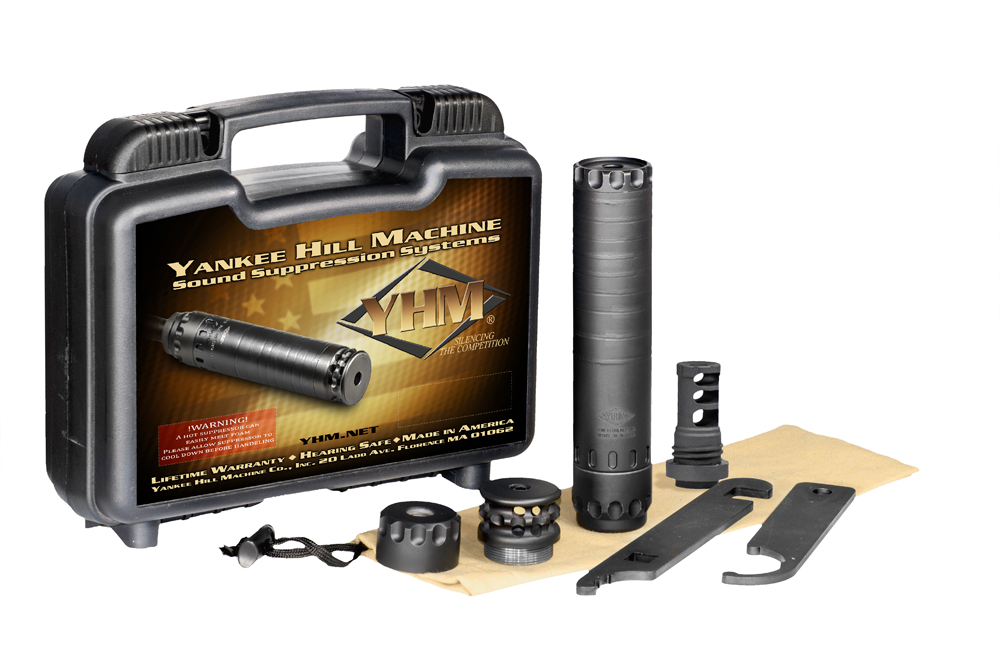
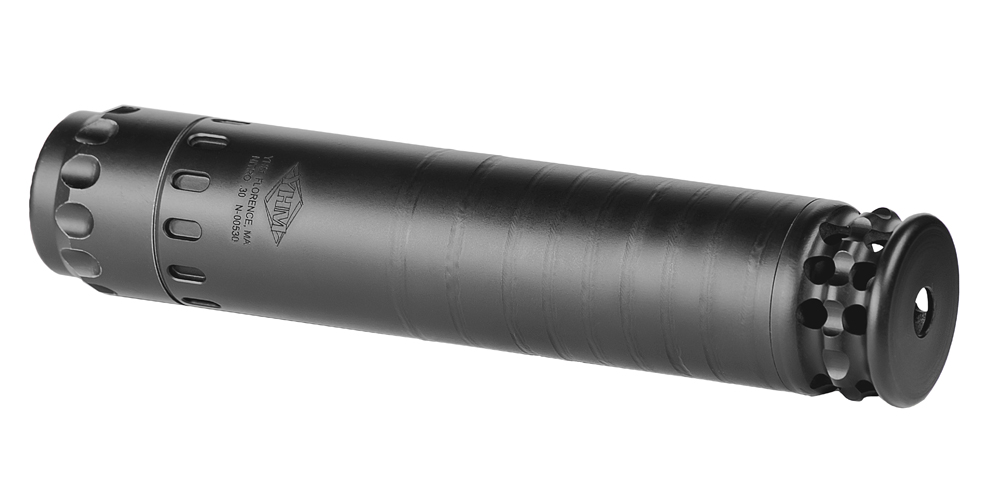
Yankee Hill Machine’s new Nitro 30 Suppressor is a versatile, multi-purpose suppressor perfect for any shooter.
Suppressors currently represent one of the fastest growing segments in the gun industry, and with the American Suppressor Association’s (ASA) efforts to expand legal suppressor ownership to additional states, more and more people are choosing to place suppressors, or cans, on their firearms. And while there are tons of caliber-specific cans on the market, some of the best selling suppressors are those that are compatible with multiple calibers and can be switched quickly and easily to different platforms. The benefit of these types of cans is that a shooter can purchase and complete the NFA paperwork on one can and use it on many of his or her firearms instead of buying and filling out paperwork on multiple suppressors specific to each caliber.
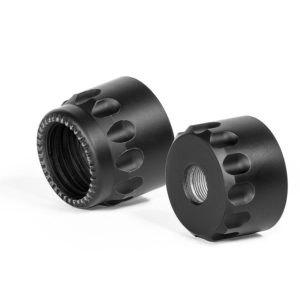
The two different rear caps for the Nitro 30 Suppressor: a QD cap and a direct-thread cap.
Recognizing the consumer demand for this level of versatility, Yankee Hill Machine (YHM) has recently brought out its new Nitro 30 Suppressor, a modular device that can be adapted to the shooter’s given purpose or task. The new Nitro 30 Suppressor system comes in a kit that includes two different muzzle caps and two different rear caps, which affords the user greater adaptability in terms of mounting options. The new can also is built to handle calibers ranging from .17 HMR on the small end to .300 Remington Ultra Magnum on the large end, making it incredibly versatile, especially for shooters looking to implement the suppressor on a variety of platforms.
The two muzzle caps include a flat cap, which is tailored to more tactical pursuits, and a muzzle brake cap, which is geared more toward target and recreational shooters. The two rear cap options are a Quick Disconnect (QD) rear cap and a direct-thread rear cap with 5/8-24 threads. The QD option provides a more flexible mounting system for use on multiple firearms, whereas the direct-thread cap offers a secure mounting choice for a more dedicated setup.
The Suppressor System Kit for the Nitro 30 Suppressor comes with the welded suppressor body, the two muzzle caps and two rear caps, two assembly wrenches, one muzzle brake with the user’s choice of thread pitches (5/8-24, 1/2-28, or 1/2-36), one Basofil heat resistant pouch, and a carrying case for all the parts. MSRP is currently listed at $890.
In addition, a flat muzzle cap and a direct-thread-on rear cap (1/2-28) are available separately for purchase, as is the YHM Adaptable Brake, which utilizes the same rear and muzzle caps as the Nitro 30 Suppressor. For more information on the Nitro 30 Suppressor or any of YHM’s excellent accessories, visit the YHM website.
Specifications: YHM Nitro 30 Suppressor Weight: 18.72 oz./19.84 oz. Diameter: 1.562 in. Length: 6.88 in./7.75 in. Construction: 17-4 Ph stainless steel Direct Thread: 5/8-24, 1/2-28 Decibel Rating: 135 dB
One of the bigger trends lately in shooting has been the growth of long-range shooting and hunting. As experienced long-range shooters are well aware, taking shots at longer than normal distances requires a lot from a shooter’s gear. Along with the rifle and optic, ammunition is one of the most important considerations for those who shoot an extended ranges.
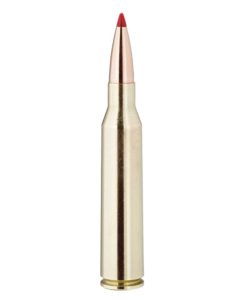
Understanding this, Hornady researched and developed a new bullet for use in its new Precision Hunter ammo line designed to be both accurate and hard hitting well beyond traditional ranges. Dubbed the ELD-X (Extremely Low Drag-eXpanding), this projectile offers best-in-class ballistic coefficients (BC) courtesy of Hornady’s innovative Heat Shield tip, which resists the effects of aerodynamic heating as distances stretch to retain its shape longer over its trajectory.
The bullet also features an AMP jacket and uses Hornady’s Interlock ring to keep the core and jacket together for increased weight retention. The result of all of this is a bullet that offers devastating performance on game within more traditional ranges of 400 yards or less while also providing some of the best extended-range terminal performance available at ranges past 400 yards.
Our friends at Deer & Deer Hunting caught up with Hornady’s Neal Emery to get the scoop on this great new option for hunters or shooters looking to be more effective at longer ranges. Watch the video above for more on the new Precision Hunter ammo line and the ELD-X bullet from Hornady.
The Precision Hunter ammo is available in the following calibers: 6.5 Creedmoor, 7mm Rem. Mag., .308 Win., .30-06 Springfield, .300 RCM, .300 Win. Mag., .300 RUM, .30-378 Weatherby Magnum. Currently, MSRPs on the new Precision Hunter ammunition range from $42.88 to $126.85, depending on caliber.
Over the years, the rifle has undergone significant changes as technology and our understanding of the physical processes at work within firearms have improved. We have come a long way, and today’s assortment of highly reliable, and highly accurate rifles prove this fact.
Certainly, every rifle produced advances the craft in some way, revealing what works and what doesn’t and introducing new designs to build off of in the future. But what are some of the most influential rifle designs ever devised, creations that helped to revolutionize the rifle platform — and whose influence we can still see in guns produced today?
When asked what I thought were the 10 most influential rifle designs, I figured I could come up with the answers fairly easily. However, after a good deal of rumination, it seemed an especially difficult undertaking, given all the phenomenal rifles out there that have influenced current development. But, following a fair amount of research and thought, here’s the list I’ve put together.
In 1983, Research Armament Co. in the U.S. began development of a new, long-range sniper cartridge capable of firing a 250-grain, .338-inch diameter bullet at 3,000 fps. After preliminary experiments, a .416 Rigby case necked down to .338-inch was selected. Brass Extrusion Labs Ltd. (then of Bensenville, Illinois), made the cases, Hornady produced bullets, and Research Armament built the gun under contract for the U.S. Navy. Subsequently, Lapua and Norma have put this cartridge into production. It is now a CIP standard chambering; since CIP and SAAMI have reciprocal agreements in place (at least in theory), that makes this a standard SAAMI chambering, as well. You have to burn a lot of powder to launch a 250-grain bullet at 3,000 fps. The .338 Lapua Magnum, as it is known commercially, or the 8.58x71mm, does just that. The full metal jacket, boat-tail military bullet is reportedly very effective at 1,500 meters. The commercial soft-point bullet is intended for hunting very heavy game. Cartridge cases are brass with Boxer primers. Guns for this cartridge are bolt-actions, but at least one gas-operated M-16-style rifle has been developed (RND Manufacturing, 14399 Mead Street, Longmont, CO 80504; (970) 535-4458).
Whether you are a serious firearms enthusiast, cartridge collector, or handloader, you’re sure to find something of interest in Cartridges of the World, 14th Edition by W. Todd Woodard. As the most widely-read cartridge reference book available, this comprehensive guide is ideal for firearms owners, especially those with an interest in the hardware currently available from the firearms industry. Get Your Copy Now
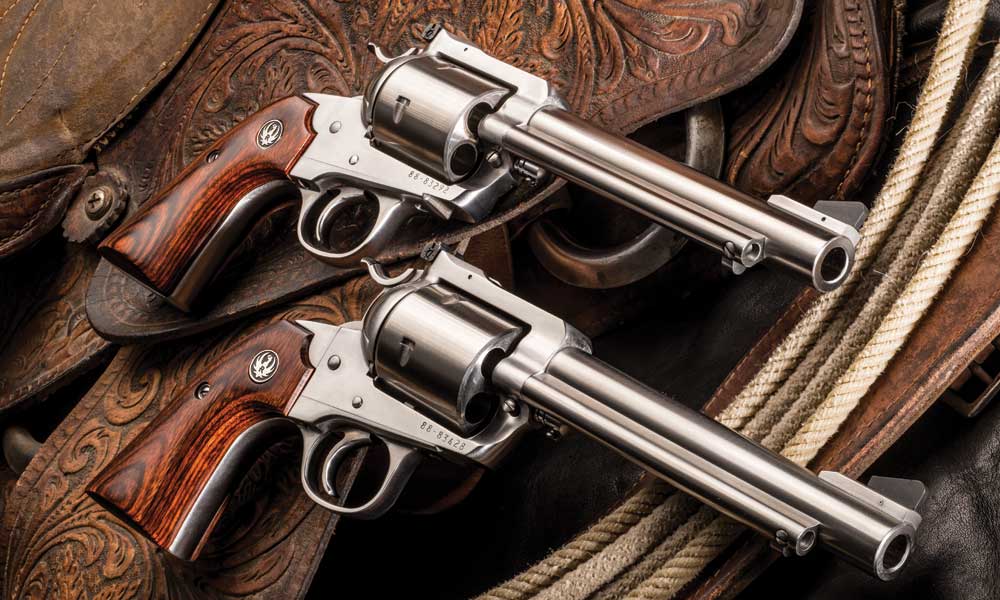
Ruger’s new Super Blackhawk revolvers in .480 Ruger and .454 Casull are excellent options for handgun hunters and fans of big-bore revolvers.
Early this year, Ruger asked me to perform some testing on both of its new Super Blackhawk models, all under the veil of secrecy of a strict embargo. I put nearly 1,000 rounds through the .454 Casull model and almost 5,000 rounds through the .480 Ruger model.
Fans of the single-action Super Blackhawk have long been waiting for one chambered in .480 Ruger.
Appropriately dubbed an “endurance test,” I wasn’t sure whose endurance we were testing, the gun’s or mine. I had no support crew or relief shooters. It was just the revolvers, the bench, piles of ammunition and me. I am happy to report that I survived, and my hands are still somewhat intact. I can’t figure out what’s wrong with me. I have an inability to say “no” when asked to test firearms I find irresistible—irrespective of the parameters of the test. When Ruger engineers first approached me, I was told I was on a short list to test the .454 Casull and .480 Ruger Super Blackhawk single-action revolvers. They said something about being recoil-proof and a glutton for punishment in explaining why I had been chosen for this honor. My wife neatly sums up these “qualities” with one word: numb.
“No problem,” I said, and “Thanks, I think. I love a challenge.”
In February, a call from my FFL indicated that the first installment had arrived along with a couple hundred rounds of .454 Casull of various brands and bullet weights. I tested that revolver to the tune of nearly 1,000 rounds in a short period of time.
Shortly thereafter, a .480 Ruger Super Blackhawk arrived, and this time, my FFL told me I should bring my truck to haul all of the ammo out of his entryway.
Ever since Sturm, Ruger & Company released the .480 Ruger in the love-it-or-hate-it Super Redhawk back in 2001, revolver aficionados have been browbeating Ruger to release this cartridge in their popular single-action revolver lineup. The combination of Super Blackhawk and .480 Ruger is debated incessantly on gun websites, yet Ruger’s reticence to actually make this happen has frustrated many handgun hunters who have long wanted to see this marriage come to fruition.
Basically a shortened .475 Linebaugh, the .480 Ruger is a serious big-game hunting round that, even when loaded to spec, isn’t too abusive to the one pulling the trigger. Ruger has finally relented by offering not only its .480 Ruger in the Super Blackhawk line, but also the raucous .454 Casull. Ruger has offered the Super Redhawk in .454 Casull since the late ’90s.
Handgun hunters everywhere now have reason to rejoice as two of their favorite calibers can be had in the revolver they love in an affordable package. Available as a Lipsey’s distributor exclusive, I cannot imagine supplies will last long.
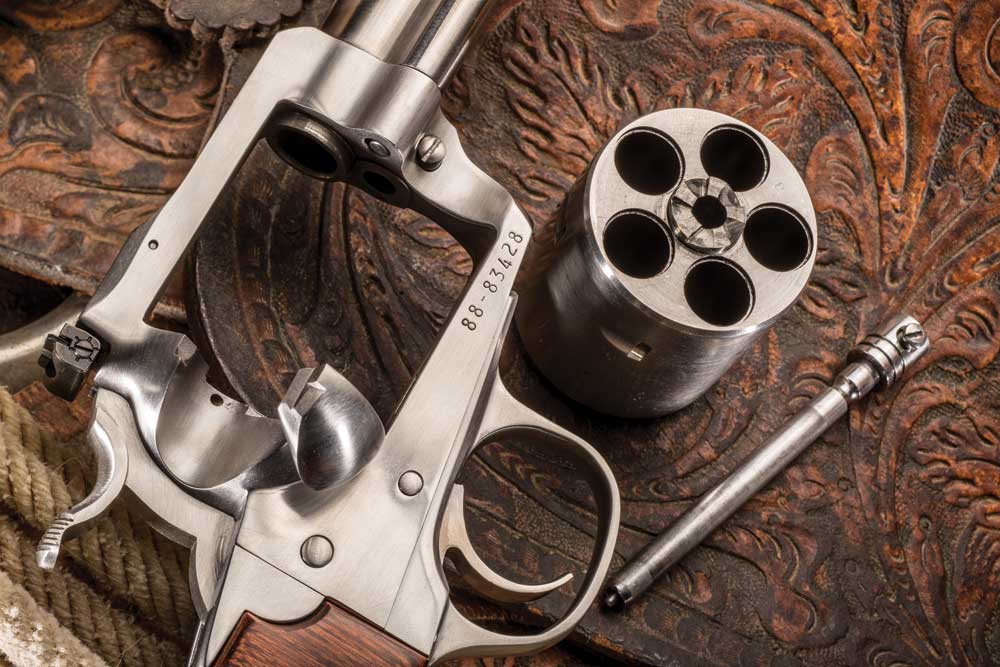
The gun’s cylinder is carved from 465 Carpenter steel for durability.
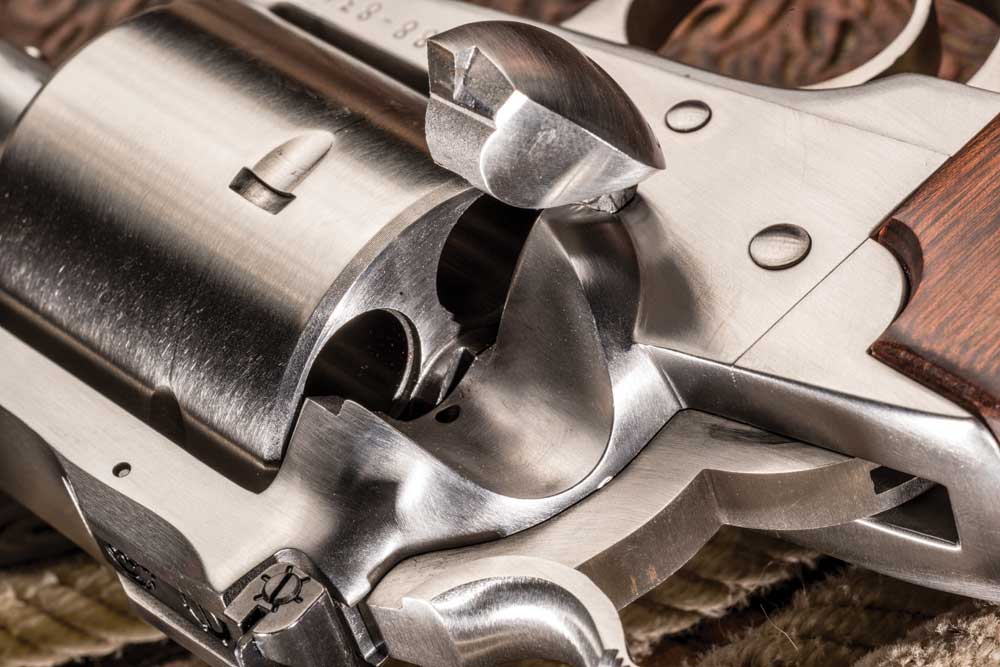
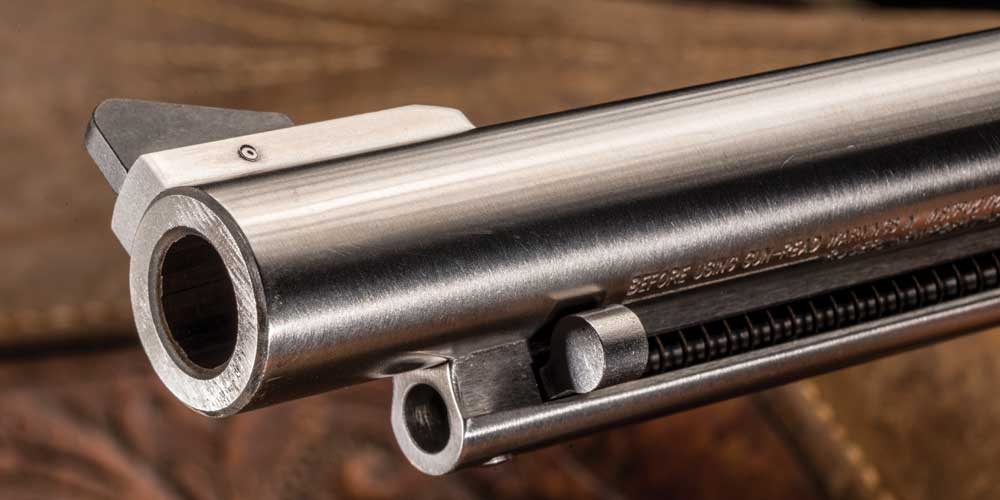
Here’s what you need to know. The new revolvers are based on the old revolvers. Ruger used the standard Super Blackhawk frame in stainless steel (415 stainless steel). The barrel is 6½ inches in both models (at least initially) and made from 15-5 stainless steel, with a 1:24 and 1:18 twist for the .454 Casull and .480 Ruger, respectively. The barrel is straight, without a taper and features a front sight base that is silver soldered on with a pinned in sight blade, and a standard Ruger adjustable sight is utilized in the rear.
The cylinder is carved from 465 Carpenter steel, the super-strong, hard-to-machine material that first made an appearance in the late 90s in the .454 Casull Super Redhawk (and later in the .480 Ruger version). The cylinder is a five-shot configuration, with counter-boring to encapsulate the case heads. Dimensionally, the cylinder is like that of the .44 Magnum Super Blackhawk, save for a tiny bit more length to the rear to compensate for the recessed case heads.
The new Super Blackhawks feature a slightly longer, five-shot cylinder with counter-boring.
The new revolvers are fitted with an extra-long ejector rod housing that made its first appearance on the limited run of stretch frame .357 Maximum revolvers of the early 1980s. A Bisley grip frame is the only one offered and the only one Ruger deemed acceptable for these applications. A locking base pin guards against the base pin walking out under recoil, a nice touch.
I tested both models thoroughly with factory fodder. Both pre-production models suffered from teething pains that we have been assured have been sorted out, but are to be expected from test guns. Chronic screw loosening (grip frame in particular) plagued the .454, but a drop or two of thread lock fixed that issue. The ejector rod housings on both loosened regularly, and both launched their front sights, ironically on the 480th round out of the .480 model. The .480 also had its barrel unscrew itself, but Ruger promptly fixed it and had it back in my sore hands to resume testing.
These new revolvers are equipped with an extra-long ejector rod housing.
Recoil means something different to every shooter. While I am no stranger to recoil, these relatively lightweight powerhouses pack a wallop on both ends. Not the worst you may encounter, but a considerable step up from the venerable .44 Magnum. The .454 Casull Super Blackhawk kicks noticeably harder than its .480 Ruger counterpart. This is no doubt due to the higher pressure levels .454 Casull ammunition is loaded to, and while the .480 delivers a heavy push, the .454 has a snappy and much sharper recoil impulse.
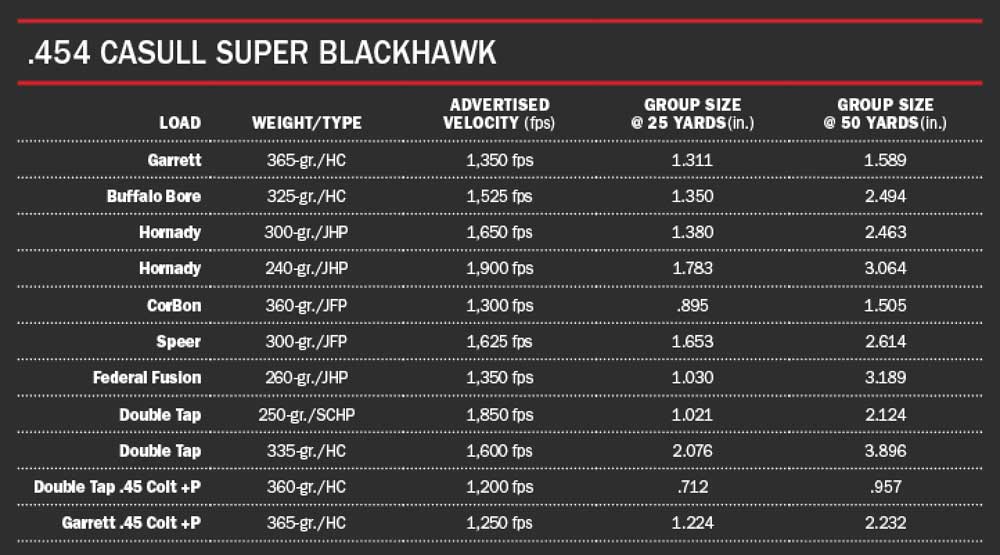
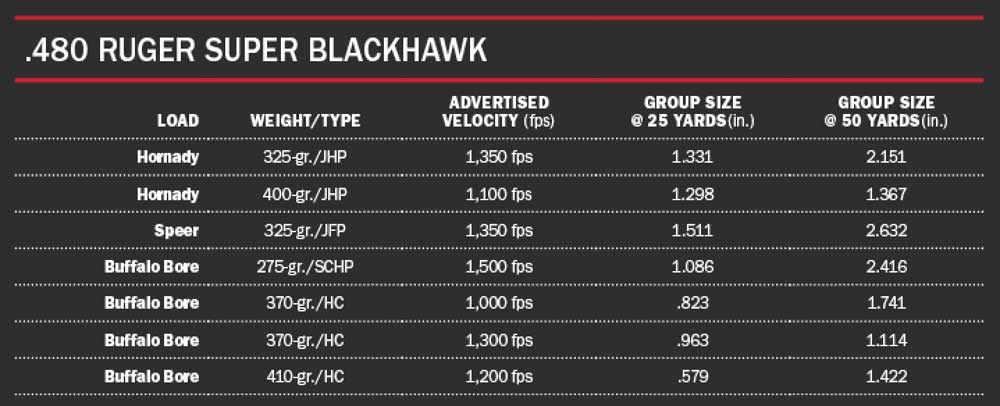
Both revolvers delivered outstanding accuracy, the only limits being my eyesight with open iron sights. To remedy this, I equipped both models with red dot-type sights of radically different designs. I own a number of more expensive revolvers that cannot compete with the accuracy these two new Rugers displayed.
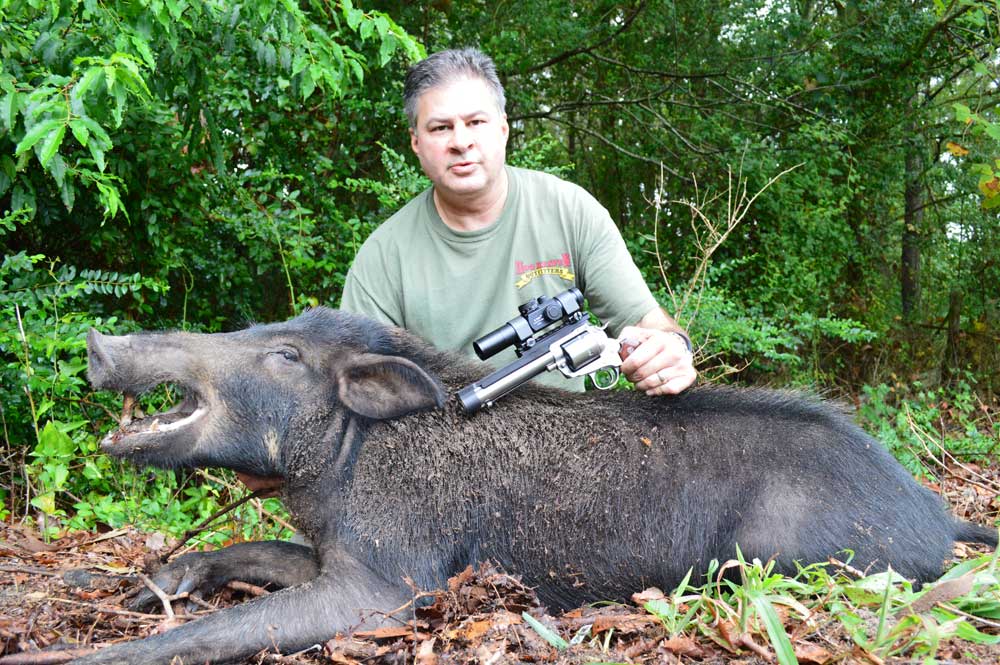
We got the opportunity to test the new .454 Bisley on porcine flesh at Hog Heaven Outfitters of Johnston County, North Carolina. I got lucky on the first morning when a 214-pound boar made the mistake of showing up. The shot was broadside at about 20 yards and required only one Garrett 365-grain .45 Colt +P Hammerhead to seal the deal. My testing was now complete.
In summary, Ruger and Lipsey’s have finally given us what we want. What was once a custom-only and cost-prohibitive proposition is now only a phone call—and also less than $1,000—away from being yours. We all have reason to rejoice. Evidently, Ruger is listening.
This article originally appeared in the April 2016 issue of Gun Digest the Magazine.
Reloading the 9mm Luger is an easy process, but there are a few useful techniques for getting the most out of your 9mm loads.
In the gun world, debates rage on for decades, and some are pushing a century. Undoubtedly, these debates aren’t going anywhere soon, but some get especially heated.
One of the most fervent is the debate over the .45 ACP vs. the 9mm Luger. Both sides have their staunch defenders, and both have valid points of view. I’ve personally leaned toward the .45 ACP camp, but that certainly doesn’t make the 9mm Luger a bad choice for a carry gun; in fact, I see some merit to the smaller frame and greater magazine capacity.
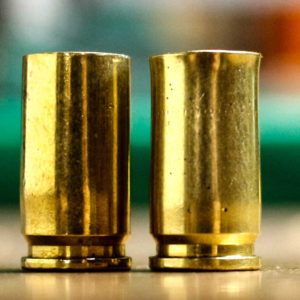
Resized 9mm case and flared case ready for loading.
Adding to the credibility of the 9mm Luger, please consider that the venerable .38 Special (my own choice for a daily carry gun) is looked upon as a worthy carry gun, yet the 9mm Luger is a more powerful cartridge across the board. The .38 has a bit of a heavier bullet at the top end (158 grains), but the 9mm can spit out 147-grain slugs, which is not too shabby.
Bred for military service in 1902, Georg Luger of Germany presented his 9x19mm cartridge to several countries, but it was his home country that adopted it as its sidearm. This is not the place to debate the comparisons to the fatter cartridges; let’s just take it for granted that the 9mm Luger works, because it does.
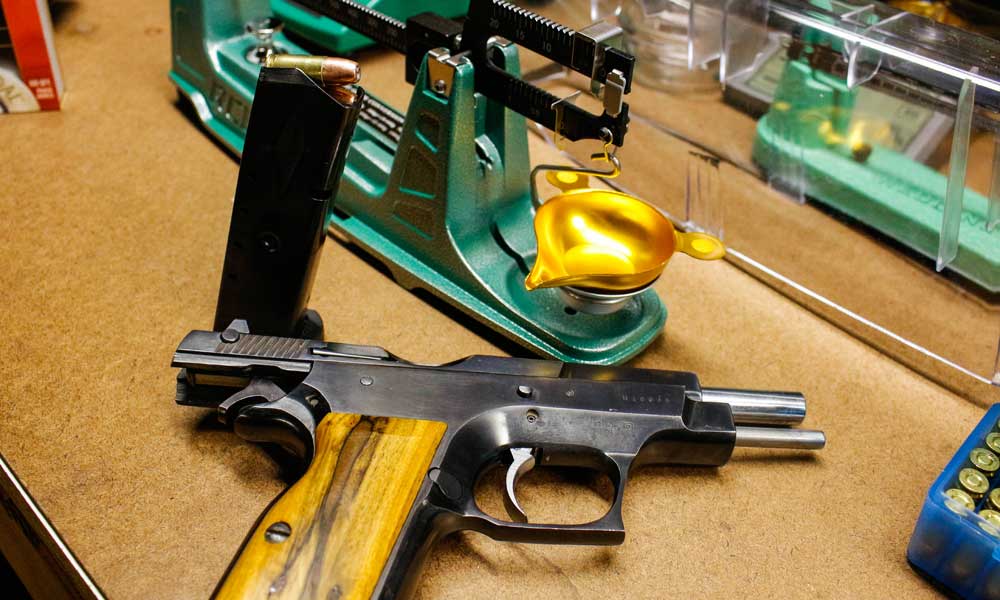
Reloading the 9mm is not a difficult proposition; it’s a relatively straightforward design. It is a straight-walled, slightly tapered case, which headspaces off of the case mouth. Therefore, you’ll want to be very careful about trimming the brass to proper length and leaving a good, square case mouth. The 9mm Luger has a case length of 0.754 inches, and it’s best to adhere to that length.
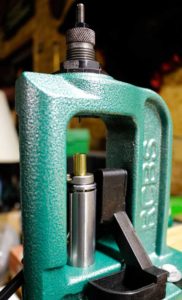
I use the RCBS Case Prep station to set the trim depth to the proper length, using the micrometer dial to get things just right. When I flare the case mouths, I don’t flare very deep; just enough to get the bullet seated properly, so as not to over-stress the case.
Once your bullet is seated, the only type of crimp you should use is a taper crimp. You see, the traditional roll crimp, which will roll the very edge of the case mouth into the cannelure of the bullet, will destroy the only means of proper headspacing and therefore must not be used. A taper crimp, which squeezes the case wall concentrically, will keep the bullet firmly in place, while maintaining the square case mouth for headspacing.
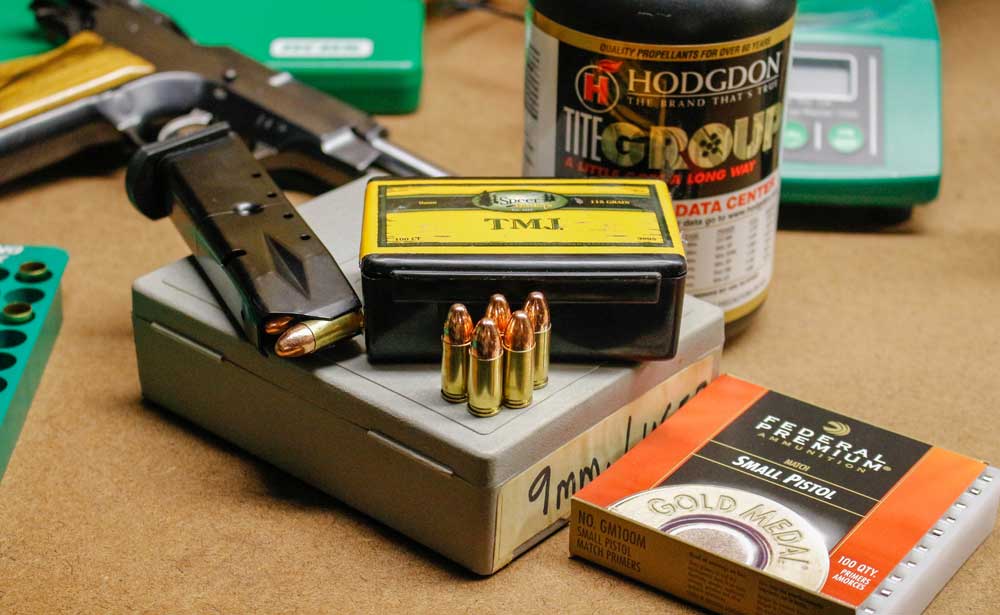
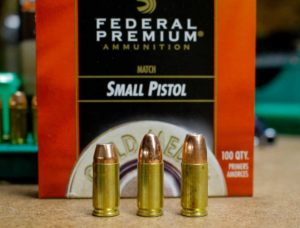
The 9mm Luger is sparked by a small pistol primer; my own loads have been based around the Federal Gold Medal Match primer, part number GM100M. The consistency of the Federal Gold Medal Match line has caused me to be a bit biased, but they’ve worked very well for me in many different applications. I’d like to share the three loads I use most in three common bullet weights.
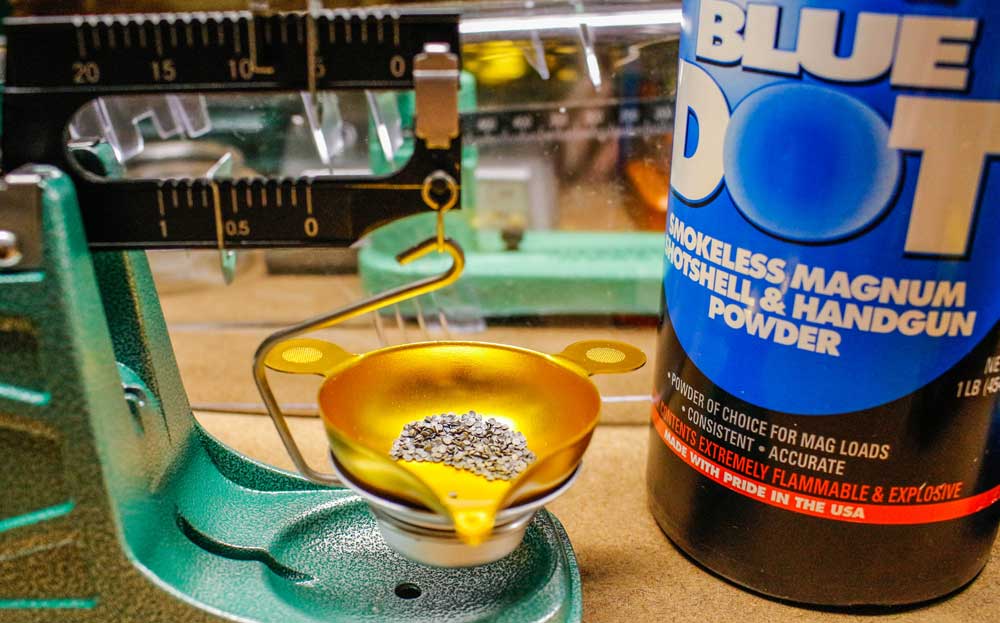
Alliant Blue Dot flake powder is good for heavier 9mm loads.
At the lightest is a 90-grain Sierra jacketed hollowpoint (JHP) with a skived jacket. This bullet is on the light side of the spectrum, and as a result it will attain the highest velocities. I was experimenting with Ramshot’s ZIP powder and stumbled upon a load that gave very satisfactory results.
Out of a Tangfolio 4½-inch barreled-pistol, this bullet, when seated over a charge of 5.2 grains of ZIP, gave just over 1,300 fps, with very little velocity deviation and excellent accuracy. At 1.010 inches, the truncated cone profile fed very well, giving no issues whatsoever. Some 9mm pistols won’t feed the shorter bullets as well, so you’ll have to do some experimenting with your own gun.
If you do experience feeding issues, I’d make sure your feed ramp is well polished and if it still persists, I’d recommend switching to a slightly longer bullet. Now, the penetrative qualities of such a short bullet may not be as impressive as the heavier-for-caliber slugs, but that is often a quality that is appreciated in a home-defense load. Over-penetration is a rather undesirable quality when there are loved ones in adjoining rooms.
Resizing 9mm brass is an easy process.
For a good, affordable plinking load, I like the Speer TMJ 115-grain bullet. It has a classic, military-style nose profile, and because the lead core is completely encased in the copper plating it makes a great choice for use in the indoor pistol ranges, as they will leave no lead vapors in the air.
I load this bullet over 4.2 grains of Hodgdon’s Tite-Group for a muzzle velocity of just under 1,100 fps. This is a middle-of-the-road powder charge, which doesn’t recoil too harshly and is easy on the ears, yet cycles just fine in our test gun. I set the bullet for a cartridge overall length (COL) of 1.130 inches to ensure proper bullet tension in the case.
I have long been a fan of heavier bullet choices when loading for the medium-caliber handguns, like the 9mm Luger or .38 Special.
Although the velocities drop off considerably in comparison to the light-for-caliber bullets, the heavier slugs offer fantastic penetration, especially when that bullet is properly constructed. The Speer Gold Dot has a fantastic reputation as a self-defense bullet, even to the point where it is carried by law enforcement.
The 147-grain Gold Dot is a serious projectile in the 9mm Luger, leaving the muzzle at 950 fps, when set atop a charge of 5.6 grains of Alliant’s Blue Dot powder, at a COL of 1.130 inches. This combination will cause any would-be attacker to seriously reconsider their chosen course of action.
Even with the heavy bullet, and a stout load (though our pistol showed no signs of excessive pressure), one of the great features of the 9mm Luger is that just about any shooter can learn to handle the pistol effectively, and that includes this particular load. Recoil was very manageable and muzzle jump was moderate, so it was easy to get back on target.
Due to the small case capacity of the 9mm Luger, I sort my brass into lots, separated by headstamp. This way I get as close as possible to a uniform case capacity for each load I develop. As always, you should start at the lowest listed load for each particular bullet, and work your way up slowly.
However, in the 9mm Luger, there is not a wide differential between the starting load and the maximum, so I would suggest that you work up in 0.1-grain increments, watching for high-pressure signs.
The example loads given above are an illustration of the versatility of the 9mm Luger, but there are many more avenues to be pursued. The Luger will run very well on many other powders, like Alliant Unique and Herco, Accurate No. 7, and Hodgdon HS-6. Have fun experimenting with the variety of loads, and enjoy shooting Mr. Luger’s creation.
Editor’s Note: This article originally appeared in the Summer 2016 issue of Gun Digest the Magazine.
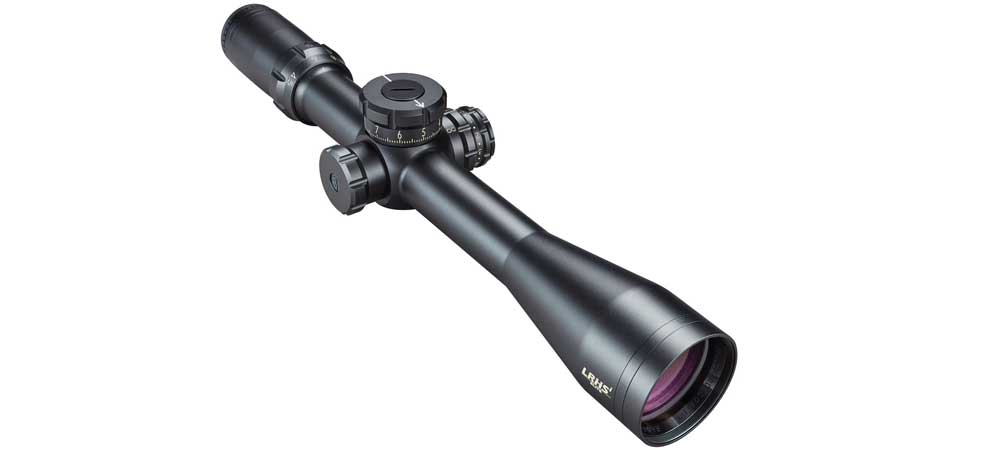
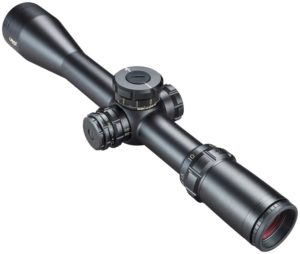
Bushnell adds to its long-range offerings with the new LRHSi 4.5-18×44 riflescope, which features an illuminated reticle for rapid targeting.
Bushnell has always been a big name in the hunting scene, and in the past few years, the company has really dedicated itself to offering more in the way of quality, long-range optics for hunters and shooters. One of the American manufacturer’s biggest releases in recent years was its Elite Long Range Hunting Scope (LRHS), a purpose-built riflescope with features designed to aid the long-range hunter.
Now, Bushnell is expanding its long-range offerings by adding another long-range riflescope with an illuminated reticle to help hunters more quickly place their aiming point on target in any light condition. Like the previous LRHS, the new Bushnell LRHSi 4.5-18x44mm riflescope provides excellent accuracy, especially as distances stretch, making it a powerful tool for long-range shooters and hunters.
The new LRHSi riflescope features a first focal plane G2H-i mil-based reticle with .1 mil clicks. This allows shooters to range targets at any magnification and make quick, easy and precise holdover adjustments in the field. The scope also incorporates a low-profile, target-style elevation turret equipped with a RevLimiter zero stop function that allows shooters to quickly return to zero without dialing past the zero.
Like many of Bushnell’s riflescopes, the new LRHSi 4.5-18x44mm comes equipped with Bushnell’s Rainguard HD that creates a permanent barrier that beads water to maintain a clear view regardless of the conditions, an excellent benefit to serious hunters who might not always experience ideal shooting conditions. Along these same lines, the LRHSi is Argon-purged for waterproofing.
This new long-range scope utilizes a fast-focus eyepiece and side-parallax adjustment to ensure a clear sight picture regardless of range, and it features fully multi-coated optics with Ultra Wide Band anti-reflection lens treatments.
The LRHSi has a durable 30mm tube construction, yet weighs in at just 26.5 ounces, providing a lightweight option perfect for the field. Overall length is 14.2 inches, and eye relief on the new optic is 3.94 inches.
The new Bushnell LRHSi 4.5-18×44 currently carries a minimum advertised price (MAP) of $2,039.95. For more information on the new LRHSi, visit Bushnell’s website.
The new Vortex Optics Razor HD AMG is purpose-built with the serious long-range shooter in mind and is full of great features.
Vortex Optics has increasingly become a major player in the optics industry, and one of the manufacturer’s newest offerings is dedicated to serious long-range shooters and hunters. Dubbed the Razor HD AMG, this new 28.8-ounce variable-power riflescope offers 6-24 magnification with a 50mm objective lens.
The new scope is perfect for an array of long-range tactical applications or for hunting in wide-open western landscapes. The Razor HD AMG is 100-percent manufactured in the U.S. from quality, durable materials and is waterproof, fog proof and shockproof. It is a first focal plane design with an illuminated glass-etched reticle, and the scope features premium HD low-dispersion glass that is fully multi-coated.
Our friends at Deer & Deer Hunting caught up with Mike Boardman of Vortex Optics to get an exclusive rundown on the new Razor HD AMG. Check out the video above to learn more about this great new long-range riflescope.
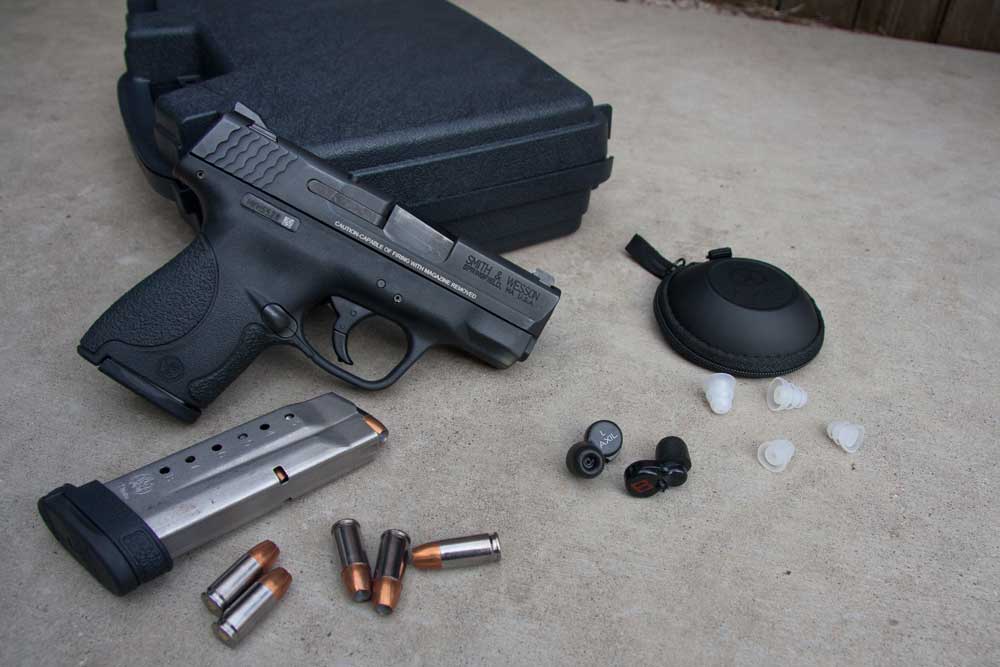
ProSounds’ new H2P earpieces offer unprecedented hearing enhancement, while also providing ample hearing protection from damaging muzzle blasts.
It’s a well-established fact that the loud noises associated with shooting can result in cumulative hearing loss over the years if nothing is done to protect against these damaging sounds. And unfortunately, that loss, once it occurs, is typically permanent. This is why many of today’s older shooters and hunters might have difficulty hearing; those years and years of shooting without the proper hearing protection have taken their toll.
These days, shooters have no excuse, as there are plenty of hearing protection options out there ranging from simple foam plugs on up to highly advanced (and often expensive) custom molded plastic plugs that electronically protect, and even enhance hearing. One of the newest products that offers a blend of protection and sound enhancement comes from ProSounds, which, along with SportEAR, is a member of the AXIL family of hearing protection brands.
This product, brand new for 2016, is called H2P and consists of two earpieces that provide sound amplification of up to six times higher than normal while also digitally compressing sounds higher than 85 decibels (dB) to prevent hearing damage. And, unlike many other electronic earplugs on the market, the H2P earpieces are priced relatively affordably, with an MSRP of $499. As an added bonus, ProSounds is currently running an Indiegogo campaign for the launch of the H2Ps until July 22, and during this time, the earpieces are available for the discounted price of $299.
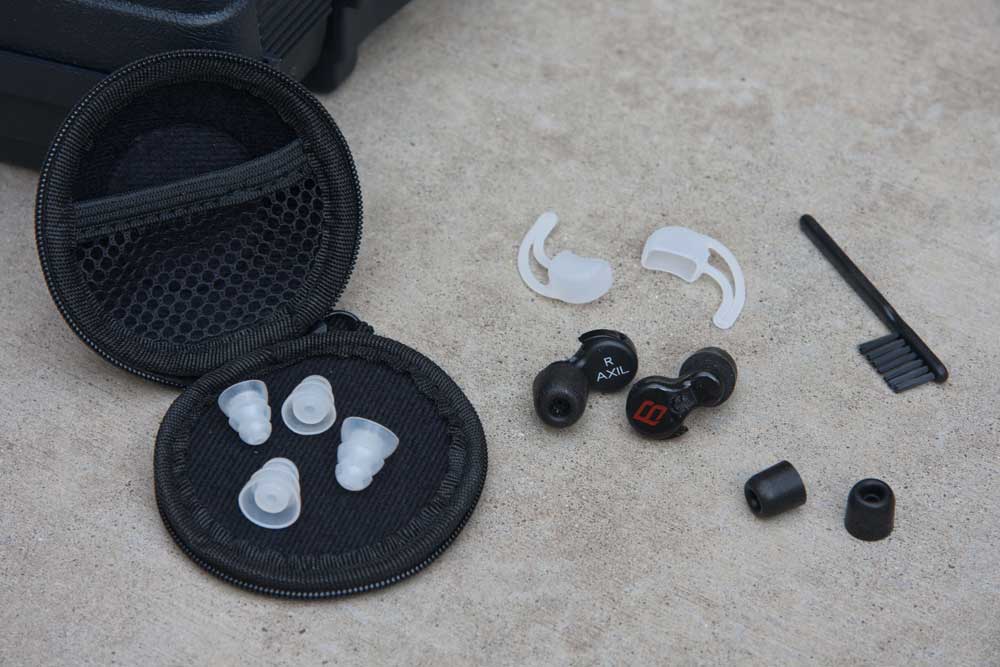
The H2P earpieces, which are powered by two 10a zinc batteries, are engineered with Lynx Digital Sound Clarity for optimal performance and are adjustable for volume control via a small rotating knob on the side of each earpiece. Included with the H2Ps are three different styles of tips, which are what actually go inside the ear canal: a foam tip that offers 30 dB of protection, a silicone tip that offers 34 dB of protection but increased comfort, and a tulip tip that allows both enhanced and natural sound to pass through the canal. SecurFit extenders, a cleaning brush, 10a zinc batteries, and a protective carrying case also come with the H2Ps.
The H2Ps come with three different styles of tips, SecurFit extenders, a cleaning brush, 10a zinc batteries, and a protective carrying case.These low profile earpieces are also labeled for each ear.
Enhanced Hearing ProSounds provided me with a pair of its new H2Ps for the purposes of testing and reviewing them. Before I gathered up my gear and headed to the range, however, I wanted to familiarize myself with the H2Ps.
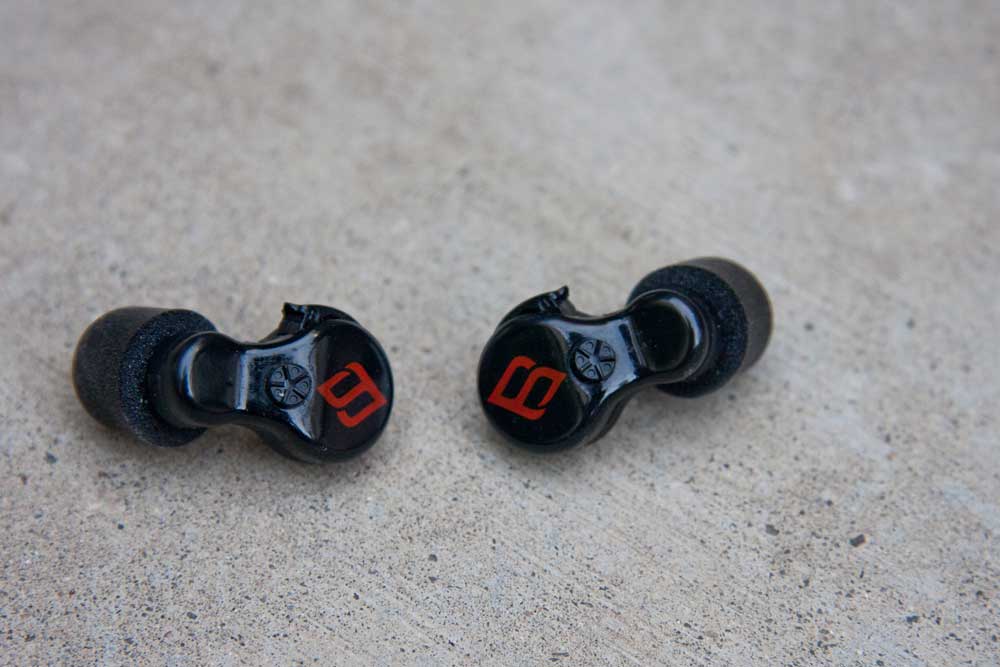
The first thing that struck me when I opened the box and pulled out the new H2P earpieces was their size and weight. They were remarkably low profile, and in terms of weight, I wouldn’t be surprised if they weighed less than a standard thumb tack. They were heavier than a set of standard foam plugs maybe, but I suspect lighter than many custom molded electronic plugs — and of course, drastically lighter and much less obtrusive than a set of earmuffs.
The included 10a zinc batteries, commonly used within hearing aids, went easily into the H2Ps via a loading gate built into each earpiece. Battery insertion and removal was remarkably easy, as the gate featured an edge for the user’s finger to open or close. In fact, when the H2Ps weren’t in use, I’d simply open the loading gate to ensure that the batteries weren’t being needlessly wasted.
Upon inserting the earpieces into my ears and dialing up the volume, I was introduced to sounds that I wasn’t hearing, or was barely hearing before. Distant cars sounded like they were on the next street over, birds that were casually chirping seemed like they were right on top of me, and the almost imperceptible sound of a TV running in another room of the house would suddenly become clear.
I was impressed. I was also wondering how something that amplified sound so well could also block it when it occurred at harmful levels.
A little skeptical, I did as the H2Ps user manual suggested and conducted a hearing protection check to make sure the earpieces had an effective seal by clapping my hands loudly next to my ear. Sure enough, the sound was no longer sharp and clear, indicating the H2Ps were doing their job. The next step in the process was a trip to the range.
The 10a zinc batteries load easily into each earpiece via a loading gate that swings open.
On the Range I wasn’t able to go to the outdoor range I typically use for my reviews, but I did manage to find an indoor range that I could use to test the H2Ps. Upon arrival, I immediately inserted the H2P earpieces and dialed up the volume.
The small volume adjustment knob on each of the earpieces was incredibly easy to use. Users can either use a single finger to push and twist the knob or a finger and a thumb to turn the knob. There is also a slight click when the volume is completely turned off, which is helpful.
Almost as soon as I inserted the earpieces, I could tell that the H2Ps were working. As I was getting my gear together to enter onto the firing line, I could hear the sounds of other shooters’ muzzle blasts being compressed and muffled by the H2P earpieces.
The volume adjustment knob is easy to locate and operate on each H2P earpiece.
This continued once I got onto the range. However, because I was shooting at an indoor range, the shots were considerably louder than they would normally be, which is why I ultimately decided to double up and put a pair of passive muffs on over the H2Ps. I would’ve probably been fine with just the H2P earpieces, but as general rule, I always tend to double up with plugs and muffs when shooting at an indoor range, so I did the same with the H2Ps.
This system worked perfectly, as I was getting sound enhancement from the H2Ps, as well as hearing protection from both. And if I wanted to step off the line to talk to somebody, all I had to do was remove the passive muffs and I was back to not only regular hearing but enhanced hearing up to six times the normal level.
All in all, I was very satisfied with the H2Ps. They offer incredible sound enhancement for those that need it and ample protection from damaging muzzle blasts. I could see these earpieces being an especially good option for hunters, as it would both improve their situational awareness and offer protection when a shot is taken, something many hunters choose to sacrifice for being able to hear approaching game.
With the new ProSounds H2P, there’s really no excuse for not protecting your hearing. The earpieces not only provide access to sounds you might not have heard otherwise, they also protect your ears so you can maintain your hearing for many years to come.
For more information on the ProSounds H2P, or to buy the H2P earpieces at the discounted price of $299, check out ProSounds Indiegogo campaign for the launch of the H2Ps, which lasts until July 22.
Morphy Auctions is setting up for its July 30-31 auction in Denver, Pa. And as usual, the gun seller looks to have an impressive stock set to cross the block. The company has around 300 modern and antique firearms ready to go on sale and has already enjoyed a robust year. At Morphy’s April fine firearms event, it moved some $1.8 million in collectable guns. The offerings at the upcoming sale also look to have the potential to get collectors and gun fans of every stripe to crack their wallets. Here’s a look at some of the fine shoot’n irons ready to go on sale.
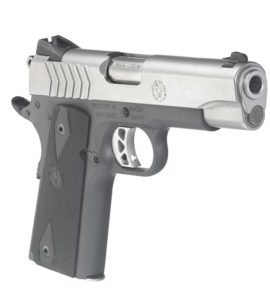
The popularity of the 1911-style pistol has never been in dispute. Ever since its creation in the early 20th century, it has held a place of prominence in the shooting sports. The vast majority of these pistols have historically been chambered in the potent .45 ACP cartridge; however, in recent years, more and more manufacturers have been creating 1911s chambered in the smaller 9mm, which a larger portion of shooters can more comfortably handle.
It is in this same vein that Ruger has announced the addition of the SR1911 Lightweight Commander in 9mm to its lineup of 1911-style pistols.
Similar to the .45 ACP SR1911 Lightweight Commander already in Ruger’s SR1911 line, the 9mm version features a commander-length slide and an aluminum frame. These changes reduce the overall weight to almost a half-pound less than the all-stainless steel Commander-Style configuration.
Unlike the previous SR1911 Lightweight Commander, the new 9mm model sports a slightly different look — black rubberized grip panels and a gray anodized frame — as well as a higher capacity of 9+1 given the smaller cartridge. And, as anyone who’s shot a 9mm 1911-style pistol can attest, there will be noticeably less recoil than with a standard 1911 chambered in .45 ACP.
Because of its lightweight aluminum frame, 4.25-inch barrel, Commander-length slide and 9mm chambering, the new SR1911 Lightweight Commander in 9mm is an excellent candidate for concealed carry. Adding to its utility in that role are genuine Novak LoMount Carry three-dot sights, a lowered and flared ejection port, an extended magazine release, an oversize thumb safety, a beaver-tail grip safety and a skeletonized hammer and skeletonized aluminum trigger for fast, accurate shooting. The gun also features improved cocking serrations on the slide and a ramped barrel for reliable feeding.
The new SR1911 Lightweight Commander in 9mm is CNC-machined in the U.S. and comes with Ruger’s classic series 70-type lockwork. It currently has a MSRP of $979 and ships with two nine-round magazines, a bushing wrench and a cable locking device. Specifications for the new 9mm Lightweight Commander can be found below.
Looking to go armed, but are stuck in the weeds as to what to arm yourself with? Here are 20 of the best concealed carry gun options that will keep you on the defensive.

 Dubbed the Ithaca Precision Rifle, the gun is built off of the classic Remington Model 700 design and has been tailor-made for long-range work. Each rifle features a 4340 chromoly steel billet receiver, a 4140 single piece billet non-welded bolt, and a competition-grade barrel and trigger.