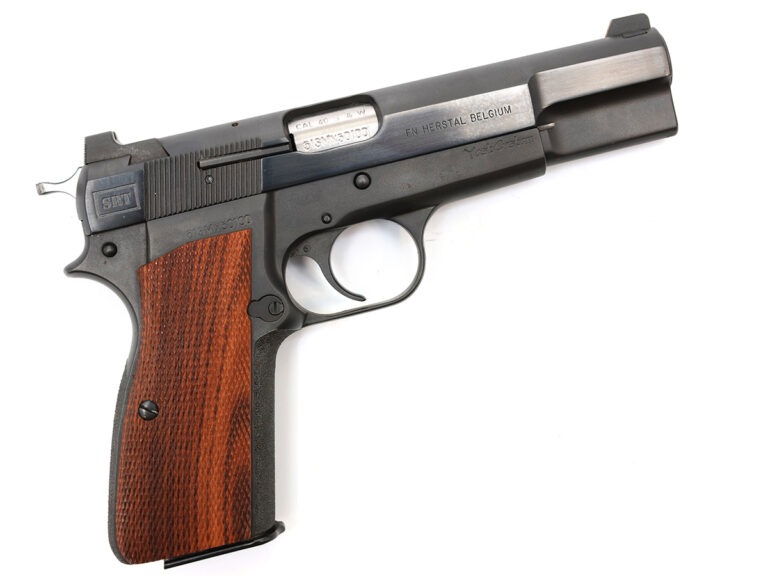
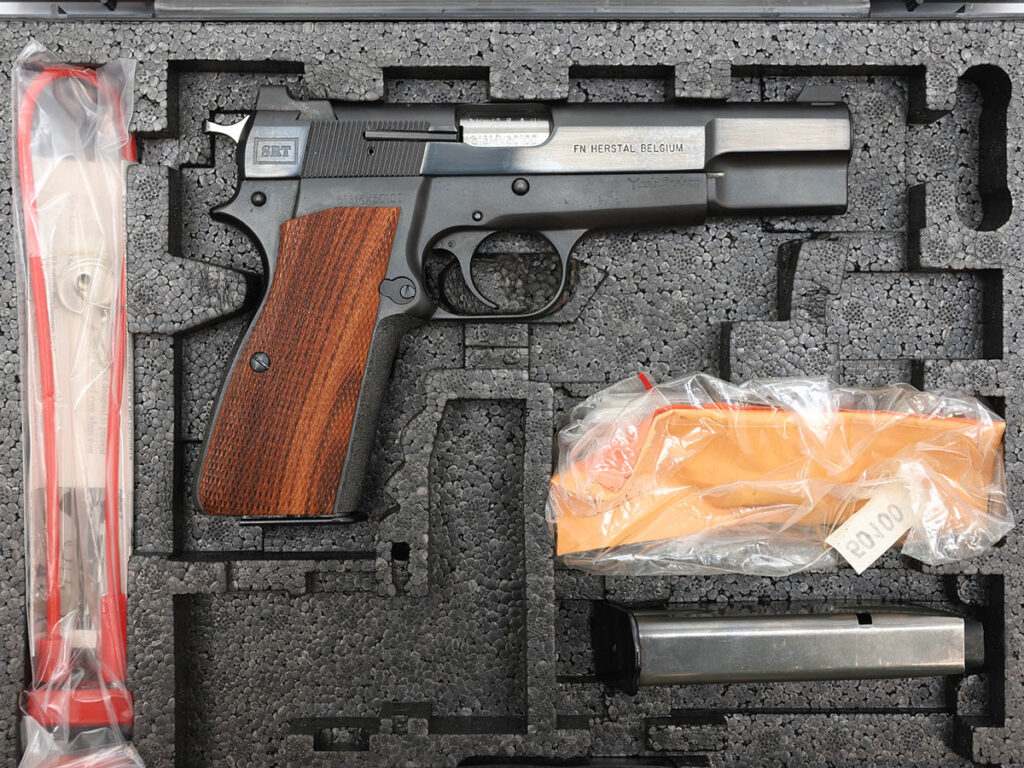
We take a closer look at a very cool Yost Custom Browning Hi-Power SRT model in .40 S&W.
I’ve had a nodding acquaintance with Ted Yost for a bunch of years now. I first met him when I attended one of the Gunsite Alumni Shoots, known in the fraternity as GAS. While there, I took advantage and took photos of Ted and his operation, since he was at that time the resident gunsmith at Gunsite. I also happened to win a GSP as the prize for winning the shoot-off, which GSP Ted had built. (Ted, it has since been modified and isn’t like you built it. Sorry about that.)
That article gave me entrée to editors and led directly to my starting with Gun Digest books. Thanks, Ted.
A few years back, one of the other Gunsite alumni had a firearm in excess of his needs. It was a Browning Hi-Power, in .40S&W, one that Ted had customized. I was deep into a Hi-Power period then—and I had to have it—and the offer was for a very fair (perhaps even bargain) price.
So, I bought it.
The Favored Forty
When the .40 S&W hit the market in 1990, it was an immediate hit. Everyone who built a self-loading pistol had to have something in the lineup in .40 caliber … or risk being left behind. The first iterations of .40-caliber pistols were simply 9mms with a different breechface, barrel chamber and bore, and magazine.
And they were not entirely satisfactory. Well, the 1911-based ones were, but those who favored the 1911 stuck with a .45-caliber, except for the competition shooters, who would sell their souls for one more round in a magazine.
The “9 converted to a 40” models were quickly changed, and changed again and again, until they became properly-built-for-.40 pistols—except for Glock, where Gaston had the good luck to have built a pistol portly enough that changing it to .40 from 9mm wasn’t a big deal.
FN—thorough engineering prowess has always been their strength—did not have the same model evolution. They did that in the workshops and test ranges. What they found was horrifying. OK, the classic BHP, or Hi-Power, is a steel frame where more than 80 percent of the steel is machined away from the forging.
Another gun writer described it once as being made from the “best grade of Velveeta-class steel,” and he wasn’t far off. It didn’t need exotic alloys or high-strength steels; it worked and worked for a lifetime in 9mm.
But chambered in .40, the test guns died a quick and ugly death. Barrels, slides and frames all expired in different ways and at different round-count intervals, but they all died. So, the engineers rolled up their sleeves and got to work.
The .40 BHP differs from the 9mm in three major ways, besides the breechface and bore. First, the .40-caliber barrel has three locking lugs instead of two. This spreads out the case-thrust load over 50 percent more steel. The slide is heavier, even though it’s the same length as the 9mm. This, combined with a heavier recoil spring, reduced slide velocity, which was just killing slides and frames. And, lastly, the frames were made of steel castings.
How does this help? Simple: The raw casting can be just a few thousandths oversized in the areas that need precision fitting. With the machining greatly reduced, FN could cast the 40 frames out of a much stronger alloy—an alloy that didn’t even need heat-treatment to make it strong.
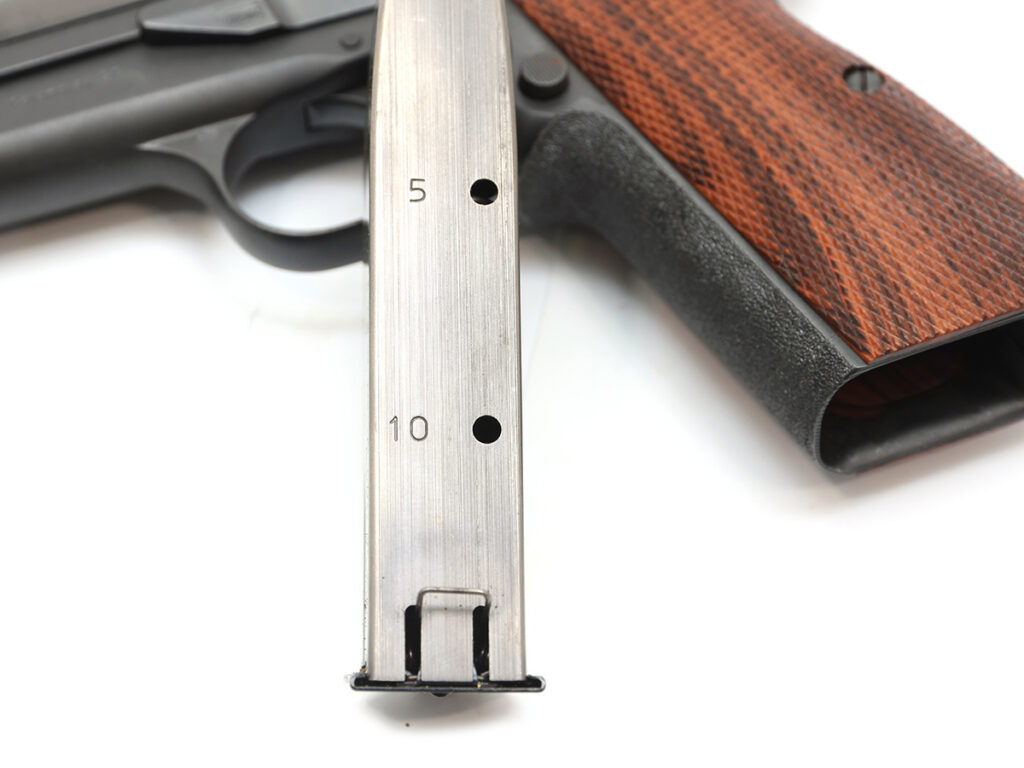
One thing they did was keep the magazine dimensions, so they could use the same un-killable frames in 9mm. This had the unfortunate consequence of reducing the 40 BHP magazine capacity to 10 rounds. What made it not such a big deal was that, at that time, there was a new law—the Assault Weapon Ban of 1994—which prohibited manufacture of new magazines greater than 10 rounds. So, if you liked the Hi-Power but were stuck with only 10 rounds, you’d likely opt for a 40 rather than a 9.
Yost-ing the Hi-Power
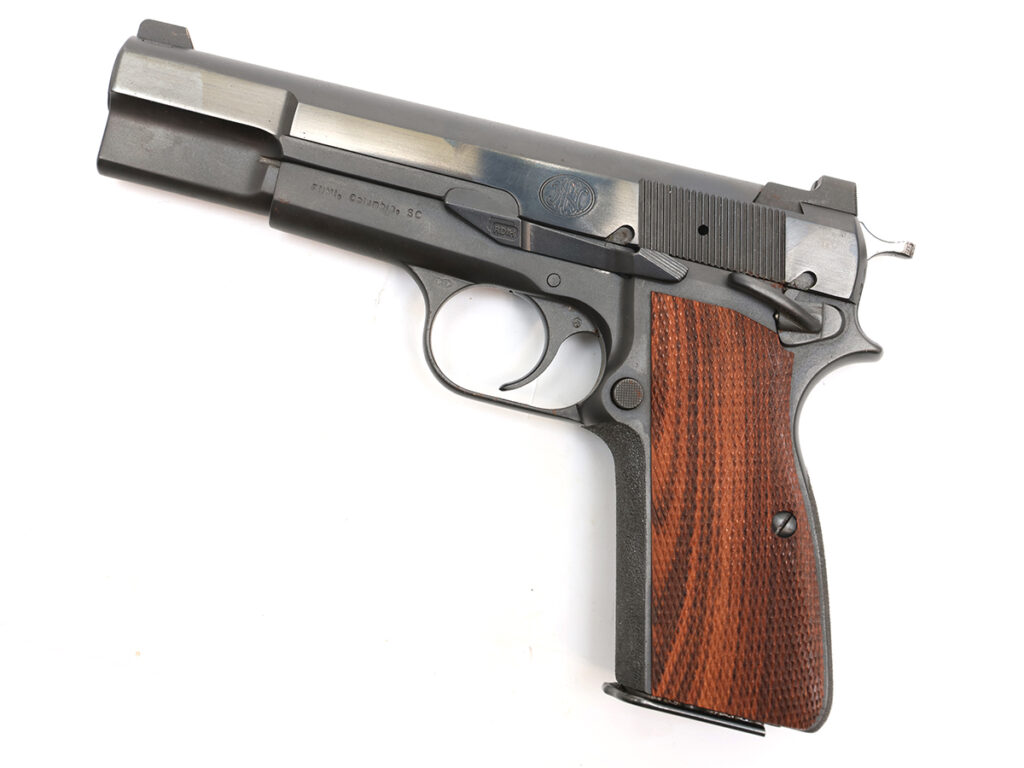
So, this particular 40 made by FN in 1993 (an early 40 then) and imported to the United States, Ted built as an SRT model, and it’s so marked on the slide, and the frame has Yost Custom on the dust cover.
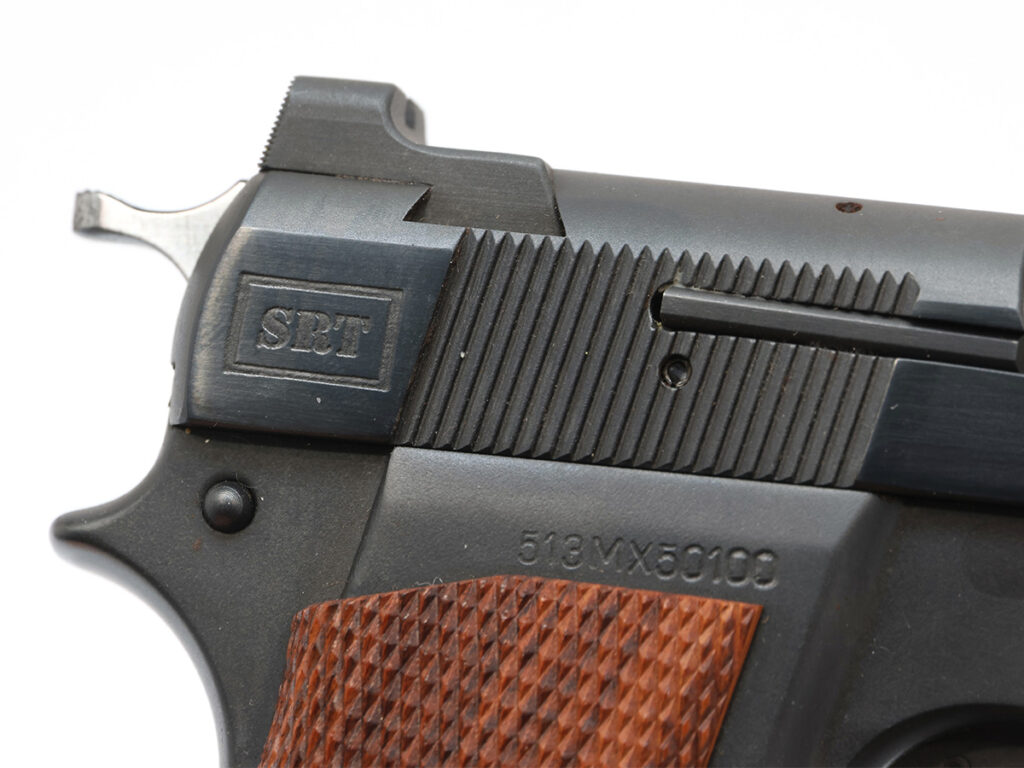
The slide has a Novak-dovetail rear sight, but with the front face of the rear sight cut bluff, so you could use it as a cocking surface if you needed to do one-handed manipulations.
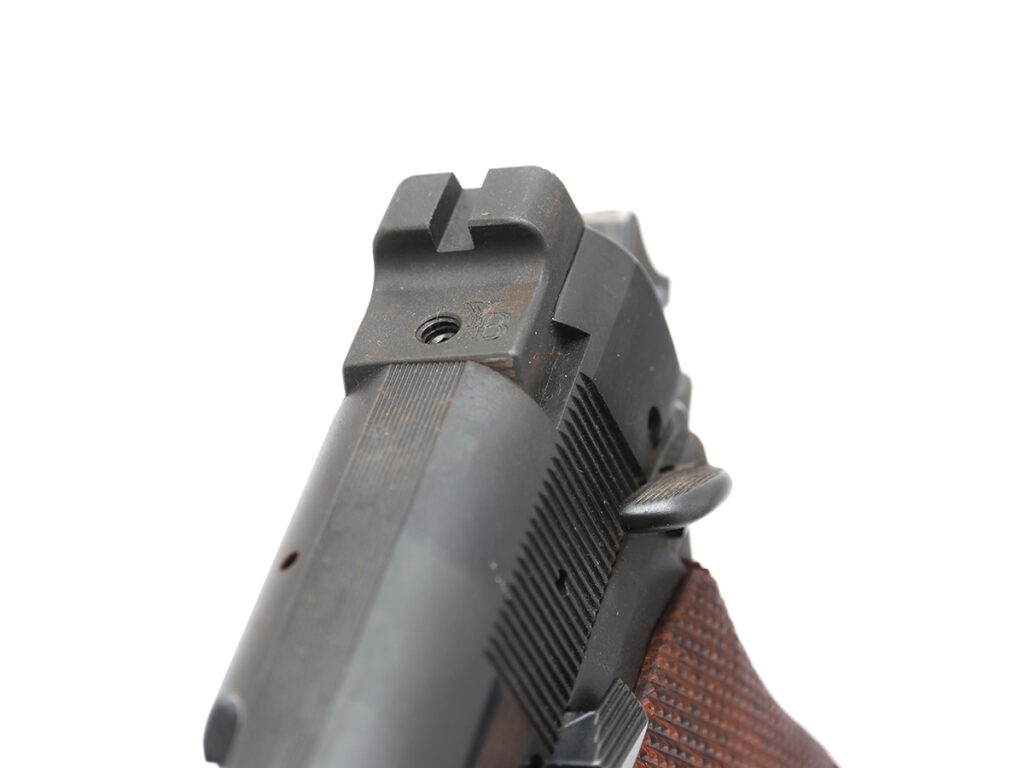
The front blade has, as is Ted’s custom, a gold line up the middle, with the blade and the gold serrated.
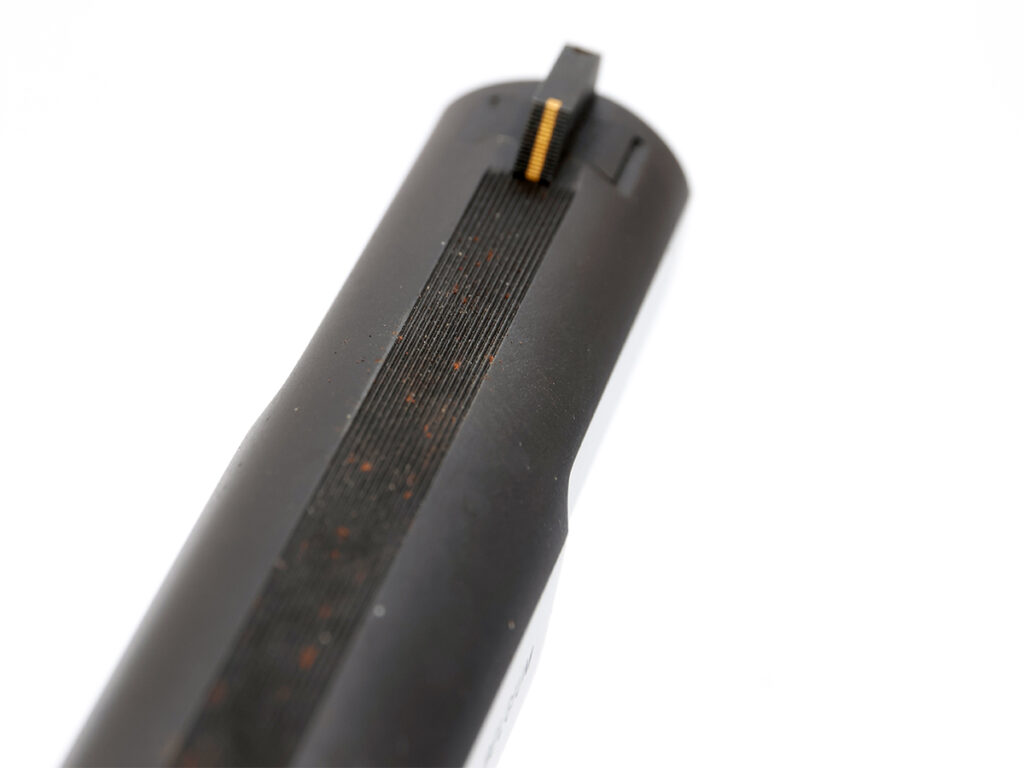
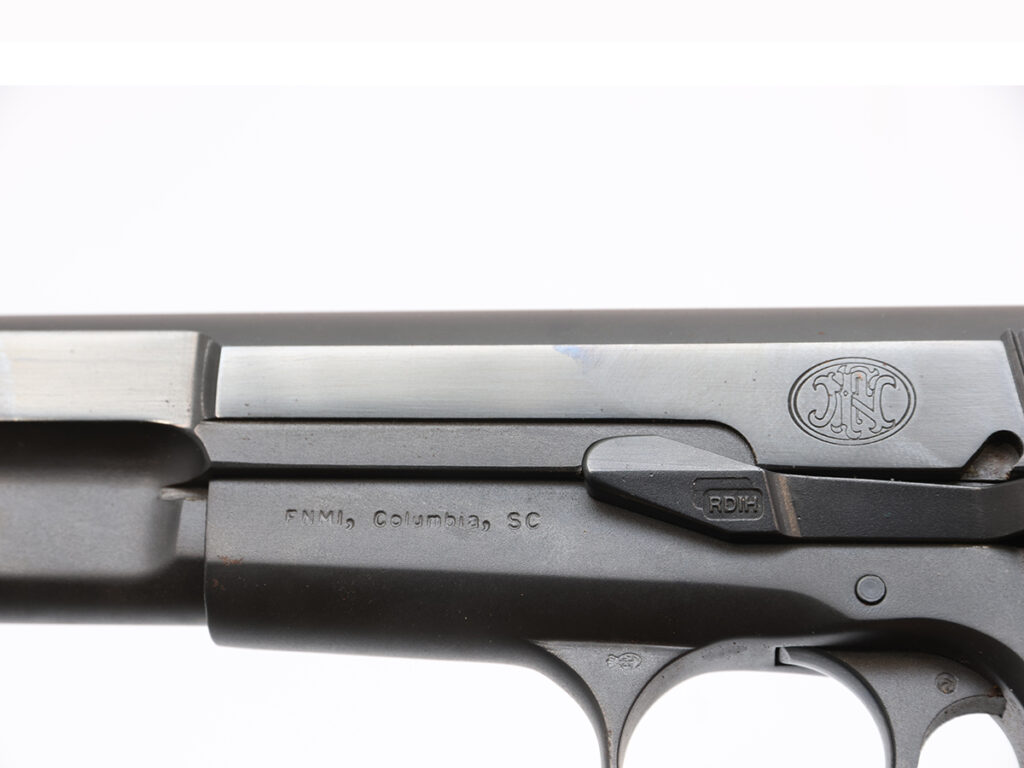
On the length in-between the sights, Ted serrated the slide. Right-hand side of the 40 slides don’t give you a clue as to the added steel, but the left side does. FN kept the slide-stop lever dimensions, and this meant they had to machine a slight recess on the left side for clearance of the slide-stop lever boss. The 40 slide has the same external extractor that FN switched all BHP production to around 1962.
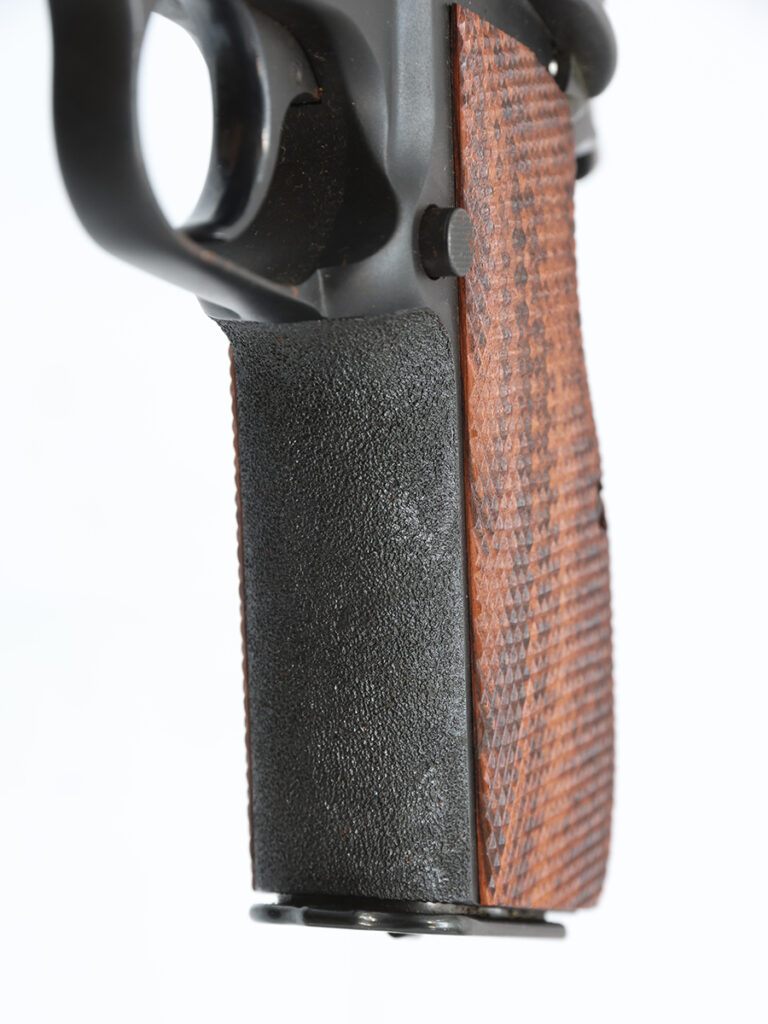
On the frame, Ted went and stippled the frontstrap all the way up to the high-cut trigger guard. On the backstrap, he stippled it slightly lower than that, but plenty high enough to give you a good grip. This he calls his Sharkskin stippling, and it’s an apt description. The grips appear to be Spegels, with the sexy contours and hand-filling checkering that anyone who has ever picked up a properly stocked Hi-Power falls in love with.
The bottom of the frame gives the origin away. The cast frames have the bottom of the frame, at the back of the magazine well, serrated in the direction of the bore axis. Apparently, there were still very few 40s built on forged frames, but only a few. The magwell opening has a small but definite bevel cut by Ted—it aids fast reloads.
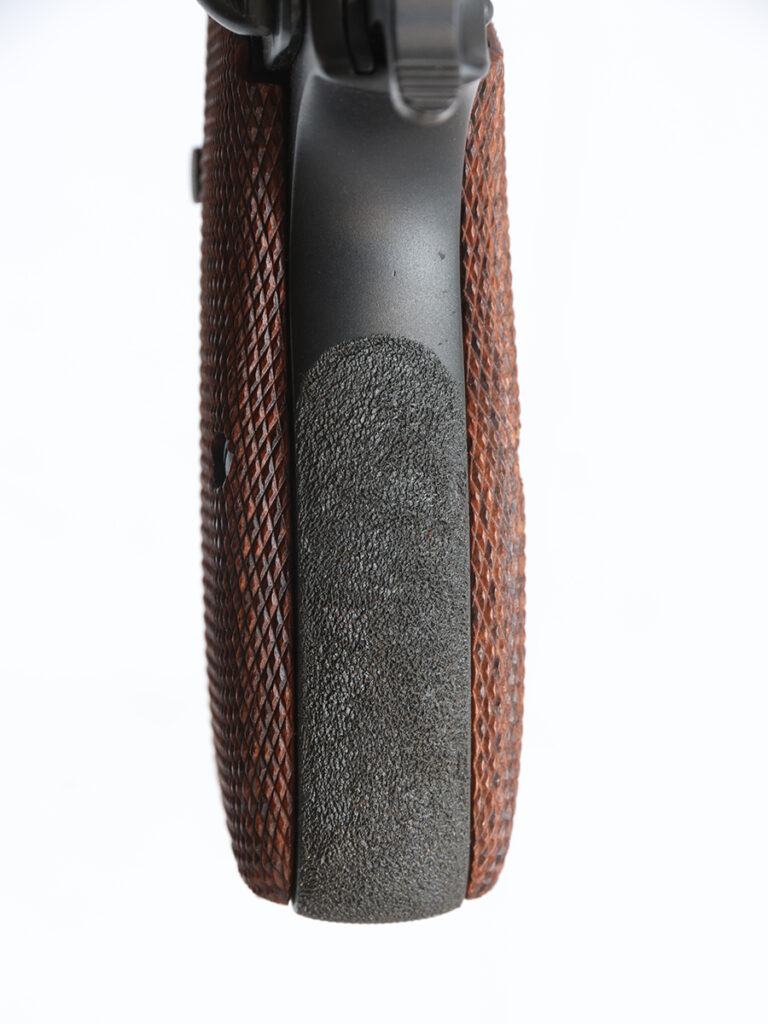
The magazines for the 40s, while the same dimensions as the 9s, only held 10 rounds. So, the 40s gained the addition of a spring-lever to assist magazine ejection when you want the empty gone. This tends to rub the cast-frame serrations, but that’s life.
The BHP is notorious for biting the hand who shoots it. My first experience with a BHP was that of blood freely running down my hand from where the hammer had bit me. Ted sculpted the hammer so it can’t reach your hand, even if the web of your hand rides up over the tang … as mine does. A small thing, but it matters to some of us.
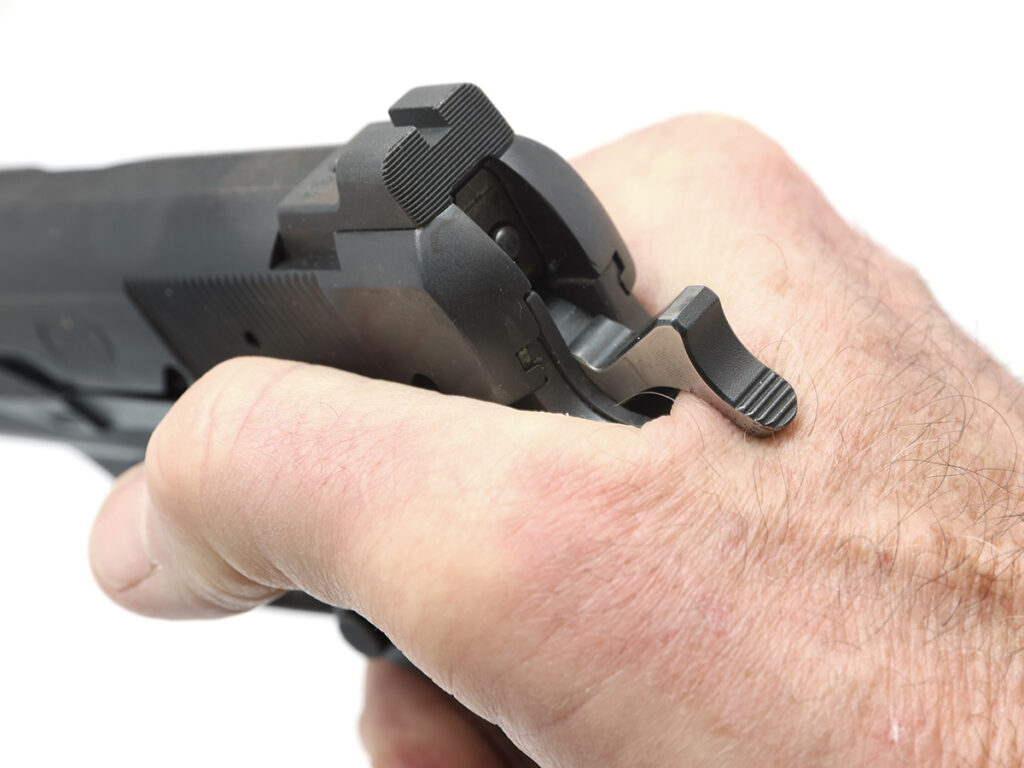
Another thing he did was to upgrade the safety. The original thumb safety was designed at a time when it was common to carry a pistol with the hammer down on an empty chamber. So, the thumb safety was an accessory not a vital implement. Frankly, the originals were and are miserable to try to use in Condition One.
Many have tried to improve the safety, and some came close. Ted is one of the few who made it something you could actually use. If you’re familiar with the 1911, then the Yost BHP safety is a known quantity. And if your only experience with Hi-Powers is the old safety, you will be amazed.
And, lastly, Ted worked on the trigger. The original magazine disconnector? Gone. The new firing pin safety, there since the MKIII, is still there, but you won’t notice it. The trigger is not competition light, and I suspect that the more-violent cycling of the BHP is part of that. But it is clean and crisp, even if it is 4.25 pounds.
You’ll also likely notice that the recoil spring is much stouter than it is on a 9mm. It has to be, as the 40 is stronger, even if it isn’t a .45.
One thing Ted didn’t change is the barrel. It’s the factory original, with the serial number matching the frame, and I suspect that it wasn’t accidental. FN makes good barrels, and this one is no exception.
When I first acquired it, I had this notion of scoring a 9mm conversion barrel from Bar-Sto (yes, they make such a thing, and it works just fine) and swapping the Yost 40 to 9mm. But it was just too good-looking to put buckets of 9mm ammo through it, and besides, I had a box-stock 40 that I could do the same thing to if I ever wanted to. (Which I eventually did, and that is another BHP story.)
And She Shoots!
I did test-fire it and found it to be superbly accurate. And that leads me to the accuracy testing I did in the oddest way.
I was, at the time, regularly assisting teaching LE Patrol Rifle classes. The three-day classes had the last day at a National Guard base, and the five-day armorer’s class spent the last two days of each class at the NG base. Once the students had passed the qual course, we split them up into groups, and they all had a chance to get runs in on the Army computer course, with knock-down targets out to 300 meters.
The head instructor, who had written the course syllabus, made it mandatory for all instructors to shoot the qualifying course for score, on the record, in each class. It didn’t take long before we were all posting perfect scores. Then, we used whatever rifle we thought was interesting to try. AK? Sure. M1A? You bet. FAL? Of course. All passing.
Then, we started shooting the rifle qual course with handguns. That took a while, but we managed to pass.
Someone had the idea of trying them on the 300-meter course. That one is 20 targets rising up to be hit and fall down, from 50 to 300 meters. A passing score in the Army is 12 out of 20. One day, word came back that the lead instructor just shot a passing score. Oh, and did I mention this was not shooting from the foxhole? This was done standing.
Well, I had to give it a try. As it happened, the only suitable pistol I had along that day was the Ted Yost BHP in 40. (Yes, I had shot a passing score on the qual course with it an hour earlier.) So, I stood there and proceeded to shoot a 14. When the lead instructor heard that, he had to stay up until he shot a 15. (Yes, we are a competitive group.)
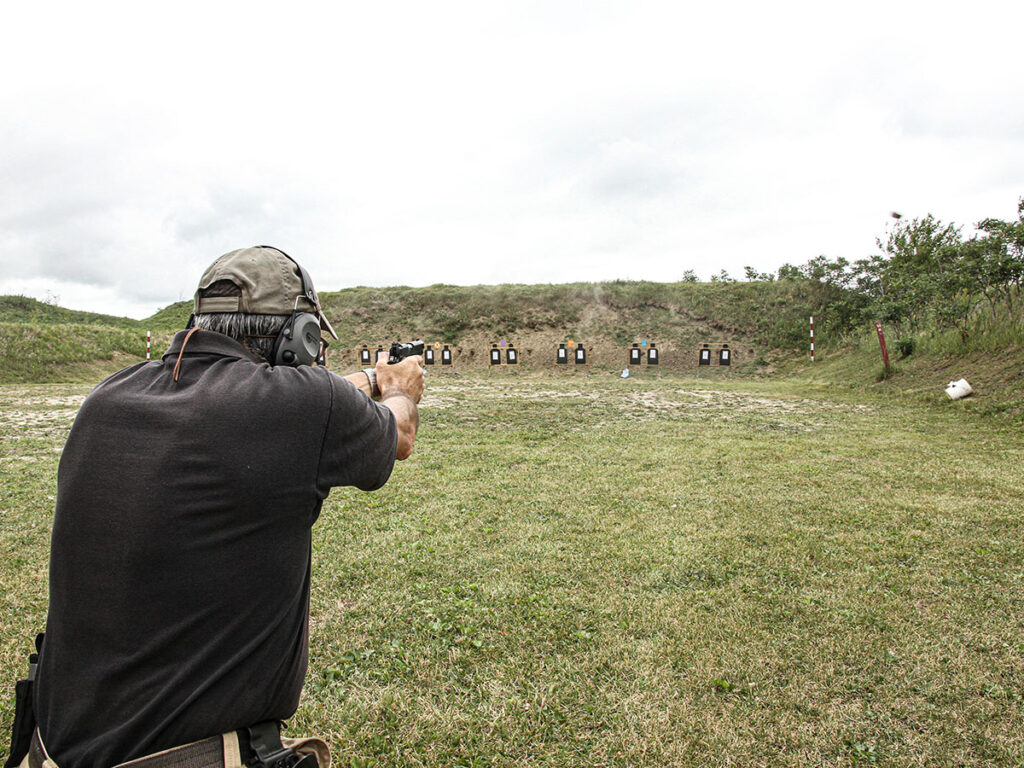
So, there it is: a Ted Yost custom 40 BHP that practically fell into my lap from a fellow Gunsite grad and with which I have shot a passing score on the Army rifle qualification course. Standing. The late Walter Brennan had a role in a TV show called The Guns of Will Sonnet. One line that his character used more than once was: “It’s not bragging if you can do it.”
I’m not bragging … much.
Ammo Notes: .40 S&W
The 40 was going to be the one ring to rule them all, even if it wasn’t going to bring them all in the darkness and bind them. It would be nearly a .45, with nearly the magazine capacity of the 9mm, and it would do your taxes, slice your bread and wash your car.
Well, not all that, but it was going to be epic.
And then reality set in.
First, the 40 was hard on the first pistols made for it. And then, once the pistols were beefed up, we found that it was hard on a lot of shooters. The standard load, a 180-grainer at 950 fps, wasn’t too bad. But in the interests of getting even closer to the .45 in performance, we started seeing 165-grain bullets at almost 1,100 fps.
And the 180-grain bullet moving at 950 fps wasn’t kidding around, either. It turned out that the less-dedicated, the smaller-handed shooters—the people who didn’t really want to be shooting guns anyway—found it really tough to shoot. For police departments, that meant more time and ammo to get them “qualified.”
Basically, the 40 over-promised and under-delivered.
But competition shooters loved it anyway. They could shoot Major and use a magazine that held more rounds than anything in .45 could.
The real-world results were muddy at best. While the math and the physics tell us that the 40 was better than the 9mm, not all users agreed.
The reign of the 40 lasted not quite 35 years. Once word got out that the FBI was going back to the 9mm, departments across the country followed suit. Now, you are hard-pressed to find a new 40 being made, and used ones languish in gun shop display cases, if they make it there at all.
Millions were made, and they will last, and your grandkids will still see .40 ammo in gun shops (assuming there are gun shops then), but it’s being replaced by the 9mm.
And, yes, you can convert your BHP in 40 to 9mm. Just ring up Bar-Sto barrels and they can set you up. Oh, and buy 9mm magazines, too.
Editor’s Note: This article originally appeared in the March 2026 issue of Gun Digest the Magazine.
More On The Hi-Power
- Going Old School: Carrying The Browning Hi-Power
- Hi Power Or High Power: What’s In A Name?
- Upgrading A Surplus Browning Hi-Power
- France, Belgium, Nazis And The FN Hi Power
- Browning Hi-Power Euology And Final Farewell
Next Step: Get your FREE Printable Target Pack
Enhance your shooting precision with our 62 MOA Targets, perfect for rifles and handguns. Crafted in collaboration with Storm Tactical for accuracy and versatility.
Subscribe to the Gun Digest email newsletter and get your downloadable target pack sent straight to your inbox. Stay updated with the latest firearms info in the industry.