SAN FRANCISCO — The City is being sued by gun owners and gun-advocacy groups because of a local law that says firearms have to be locked up or kept disabled.
The lawsuit, filed in federal court Friday afternoon, challenges a local restriction that forces handgun owners to either store their guns in a locked container or disable them with trigger locks. Mayor Gavin Newsom signed the law into effect in August 2007.
National Rifle Association attorney Chuck Michel, who filed the case, said the locking restriction interferes with citizens’ rights to immediately defend their families.
Plaintiffs include a group of San Francisco gun owners, retired police officers and the NRA.
“These are all people who recognize the right to self-defense is a fundamental civil right that needs to be protected as well,” Michel said.
The suit also tackles The City’s ban on the sale of fragmenting bullets, which break apart upon impact, and names Newsom and police Chief Heather Fong.
Newsom spokesman Nathan Ballard said locking up one’s guns is a matter of common sense.
“If even one life can be saved by this sensible law, it’s worth it,” he said. Read more
Officials said 65-year-old Bill Dunbar, who runs a coin and jewelry shop at Marconi and Walnut avenues, opened fire on two burglary suspects shortly after 4 a.m.
One of the burglary suspects was hit and died in the parking lot. The other suspect, identified as 21-year-old Sergio Antonio Arauza, got away but was found nearby and arrested, Curran added.
The deceased was identified as the suspect’s brother, 24-year-old Vincent Arauza Jr.Authorities said the same shop was also burglarized on April 29.
The two burglary suspects may be linked to other recent early morning break-ins, Curran said.Curran said Dunbar was inside the store when he noticed two people wearing black ski masks trying to break in. Read more
The Senate has a chance this week to kill the most offensive nomination of an executive-branch official since President Clinton’s ill-fated selection of radical black racialist Lani Guinier for assistant attorney general in 1993. Yale Law School Dean Harold Koh is unfit to be chief legal counsel at the State Department. Senators should vote him down.
Mr. Koh’s repeatedly stated agenda is contrary to the American tradition of law originating in the “consent of the governed.” In its place, Mr. Koh would apply what he calls a “transnationalist” approach whereby domestic laws and even the Constitution could be brushed aside in favor of international authorities.
From various writings by Mr. Koh, we learn that American courts should “moderate” certain of our rights that create “conflicts,” such as “our exceptional free-speech tradition.” He also has encouraged outside criticism of Americans’ “embrace of the First Amendment.”
The Second Amendment fares no better. In an essay called “A World Drowning in Guns,” Mr. Koh endorsed a “global regulatory” regime to outlaw firearms though “rules negotiated among governments at a horizontal, intergovernmental level and interpreted through the interaction of transnational actors.” Those laws, he wrote, could then be “internalized into the domestic statutes, executive practice and judicial systems of those participating nations.”
What he means is that international gun bans could be imposed on American citizens without a vote of the American people. Read more
Jeff Reh, general counsel for Beretta USA (the American arm of Italy-based gunmaker Beretta International), told CNBC that his firm saw sales climb 66 percent in the first quarter — roughly beginning with the inauguration of Pres. Barack Obama.
“We’re still seeing an unremitted level of increased orders on the handgun side and on the rifle side,” Reh said. Read more
“For far too long elected officials and unelected bureaucrats at the federal level have passively forgotten or actively neglected the Tenth Amendment that guarantees rights not enumerated in the Constitution be left to the individual states,” said Rep. Emmer. “The willful disregard of the Tenth Amendment in relation to a citizen’s right to bear arms isn’t the only constitutional infringement that we should be worried about, but it is one that has been singled out by the new administration.”
The bill would exempt any personal firearm, firearm accessory or ammunition that is manufactured commercially or privately in Minnesota and that remains within the boundaries of the state from federal law or regulation; including registration.
“The federal government shouldn’t be keeping track of citizens that are lawfully exercising their Second Amendment rights,” said Rep. Emmer. “Now, more than ever, citizens need be vigilant when it comes to protecting their individual liberties.” Read more
A bill designed to keep weapons out of the hands of terrorists is drawing fire from gun rights advocates who say it could infringe upon regular citizens’ constitutional right to bear arms.
The Denying Firearms and Explosives to Dangerous Terrorists Act of 2009 would authorize Attorney General Eric Holder to deny the sale or transfer of firearms to known or suspected terrorists — a list that could extend beyond groups such as radical Islamists and other groups connected to international terror organizations.
Critics say the names of suspected terrorists could be drawn from existing government watch lists that cover such broad categories as animal rights extremists, Christian identity extremists, black separatists, anti-abortion extremists, anti-immigration extremists and anti-technology extremists.
“It doesn’t say anything about trials and due process,” said Larry Pratt, executive director of Gun Owners of America. “This is one of the most outrageous pieces of legislation to come along in some time. It’s basically saying, ‘I suspect you, so your rights are toast.'”
Terrorist watch lists came under fire last month after a Department of Homeland Security report warned that right wing extremist groups may be expanding their membership in the midst of current economic upheaval. While the report stated that such groups were not believed to be planning any terrorist attacks, it went on to state they might do so in the name of issues like abortion, immigration and gun control. Read more
NOGALES – Federal agents tap on car windows, opening trunks, looking in vain for contraband.
“We’re sucking up a lot of exhaust out here,” supervisory Customs and Border Protection officer Edith Serrano says, shrugging in her uniform.
This is what the Obama administration’s new commitment to help Mexico fight its drug cartels looks like.
President Obama this spring promised his Mexican counterpart, Felipe Calderón, that the United States would fight two of the biggest contributions U.S. residents make to the drug cartels Calderón has vowed to eradicate: cash and weapons, the latter hard to come by in Mexico.
The Associated Press fanned out to the busiest crossings along the Mexican border – San Diego, Nogales, El Paso and Laredo – to see how effective the inspections are.
The findings? Wads of U.S. currency headed for Mexico, wedged into car doors, stuffed under mattresses, taped onto torsos, were sniffed out by dogs, seized by agents and locked away for possible investigations. No guns were found as the reporters watched; they rarely are. Read more
Some companies, like Sportsman’s Warehouse in Phoenix, have had to post signs letting people know that handgun ammo and other popular rounds are sold out.
On Wednesday, the store started a new policy that customers can only buy two boxes per day.
Manger Mark Russell said no one could have ever expected this level of demand.
Jenni Rigs works the cast register and said she was seeing people buying boxes of ammunition by the cart full.
Rigs thinks they are hoarding or stockpiling ammo. Read more
If you want basic or advanced handgun training, the “Armed Self-Defense” series, over the next two weeks, will provide you guidance on:
Equipment selection and storage;
Basic firearm safety and courses available;
What to do after you take a basic course;
Concealed handgun permits; and
Intermediate and advanced-level training to include tactical considerations, malfunction drills and more.
TOO BASIC FOR YOU? MAYBE NOT
Even if you have owned and shot guns for years, you may find things here you have never thought about: The segment on ABC’s “20/20” a few weeks ago did its best to convince people they don’t stand a chance when using guns for self-defense. While nothing could be further from the truth, the reality is that the more training you get, the better your chances will be – and this applies not only to you, but to your wife, husband or aging parent.
Although I am a defensive handgun instructor with upper level courses under my belt, upcoming segments will feature interviews with Tom Iradi of Eagle Rock Training Systems, whose experience far exceeds my own.
PRACTICAL PISTOL TRAINING
The last segments will cover two actual courses taught at Eagle Rock: “Practical Tactical” Phases I and II. These one-day courses, held back-to-back, are designed to introduce gun owners to the skills and mindset necessary for armed self-defense. This column will feature extensive photographs and coverage as I embarrass myself by honing rusty skills. Read more
The epicenter of the earthquake you may have felt last month originated in Helena, Montana.
Several states have passed so-called Tenth Amendment resolutions in recent years to protest the usurpation of power that the federal government has engaged in. However, most of these resolutions have no teeth.
What Montana has done is to actually interpose itself so as to protect its citizens from the unconstitutional mandates that have been passed at the federal level.
Gary Marbut, a former GOA Board Member and the current head of the Montana Shooting Sports Association, is the intellectual author of this legislation. He says that almost a dozen states are considering — or have already introduced — similar bills. Marbut is expected to talk about the new law on Fox’s Glenn Beck show this Friday (5 pm EST).
This effort is not the first act of interposition on Montana’s part. This is the state that has effectively, by law, decreed that every law-abiding citizen within the state is authorized to carry a firearm within a school zone; the state that nullified the federal requirements of REAL-ID (read: National ID card); and which had even threatened to leave the union if the Supreme Court ruled against Second Amendment rights in the Heller case.
GOA was the driving force behind this amendment and lobbied Senators hard prior to the vote to get the provision passed. The amendment, offered by Senator Tom Coburn (R-OK), passed overwhelmingly by a vote of 67-29. People can see how their Senators voted on the Coburn amendment by Clicking Here
NPS and Wildlife Refuge land is treated differently with regard to gun rights than other federally controlled land. For instance, the Bureau of Land Management (BLM) allows state and local laws to govern firearms possession. However, carrying firearms on NPS land and Wildlife Refuges is prohibited, even if the state in which the land is located allows carrying firearms.
The only way to legally possess a firearm anywhere on National Park land is by having it unloaded and inaccessible, such as locked up in your trunk.
This has created a patchwork of conflicting regulations. For instance, a Virginia resident who is licensed to carry a concealed firearm can legally carry on the Commonwealth’s roadways, but it is illegal to carry on the George Washington Memorial Parkway, a major thoroughfare in Virginia under the jurisdiction of the NPS.
In the waning days of his administration, President Bush partially reversed the ban, but even that half-way measure has been single-handedly negated by an activist judge in Washington, D.C. The Department of Interior has decided not to appeal that ruling, thus leaving the gun ban in place.
The Coburn amendment will treat NPS land and Wildlife Refuges in the same manner as BLM land. The amendment will in no way change or override state, local or federal law, but will simply allow those laws — enacted by legislation, not bureaucrats or judges — to govern firearms possession.
The amendment was attached to a bill, H.R. 627, regulating the credit card industry. The House passed its own version of the bill on April 30 by a vote of 357-70, and the Senate is expected to follow suit this week.
The House bill does not contain the Coburn language, and is substantially different in other respects. Therefore, a House and Senate conference committee will have to iron out the differences between the two bills. President Obama said he wants to sign a bill before Memorial Day.
GOA will alert you once the conferees are appointed, as we need to put the heat on the conference committee to keep the Coburn amendment in the final bill.
BELLEVUE, WA – Monday’s ruling by the U.S. Ninth Circuit Court of Appeals that dismisses a lawsuit against Glock by the victims of a deranged gunman in Grenada Hills, CA was a proper decision under existing statute, the Second Amendment Foundation said today.
In a 2-1 decision, a three- judge panel upheld a lower court’s ruling that the case, Ileto v. Glock, was nullified under the 2005 Protection of Lawful Commerce in Arms Act (PLCAA). That federal statute was passed to prevent junk lawsuits against gun makers, and this specific case was cited during Congressional debate as precisely the kind of lawsuit the law would prohibit.
“We are delighted that the Ninth Circuit panel not only affirmed the lower court ruling,” said SAF founder Alan Gottlieb, “but also that the court upheld the constitutionality of the federal law prohibiting this kind of lawsuit. While we sympathize with the victims, it would be an egregious miscarriage of justice to hold gun manufacturers responsible for the acts of criminals over whom they have no control.”
In August 1999, a deranged man named Buford Furrow opened fire at a Jewish Community Center summer camp in Granada Hills. The Glock pistol he used had once been owned by a police department in Washington State, but had been sold as surplus and passed through several hands before Furrow got it. Furrow wounded three children, a teenager and adult at the Jewish Center and later murdered a postal carrier, Joseph Ileto. Families of the victims, and Ileto’s widow, sued Glock and others in 2001, claiming that gun companies “intentionally produce, market, distribute, and sell more firearms than the legitimate market demands.” Read more
WASHINGTON — The Senate has approved a measure that would allow people to carry loaded guns in national parks and wildlife refuges.
Republican Sen. Tom Coburn of Oklahoma sponsored the amendment, which would restore a Bush administration policy allowing loaded guns in national parks. Read more
Source: Newsmax
“If an American citizen has a right to carry a firearm in their state, it makes no sense to treat them like a criminal if they pass through a national park while in possession of a firearm,” Coburn said.
Twenty-seven Democrats joined 39 Republicans and one independent in supporting the amendment, which was attached to a bill imposing restrictions on credit card companies. The amendment was approved 67-29.
Groups supporting gun control, park rangers and retirees opposed the amendment, which they said went further than a Bush administration policy that briefly allowed loaded handguns in national parks and refuges.
A federal judge blocked the policy in March, two months after it went into effect in the waning days of President George W. Bush’s term. The Obama administration has said it will not appeal the court ruling.
“This amendment is much more radical than the regulation promulgated by the Bush administration,” said Bryan Faehner, associate director of the National Parks Conservation Association, an advocacy group that opposes guns in parks.
If the measure becomes law “it would not only put park visitors and wildlife at risk, it would change the character and the peaceful and safe atmosphere in our parks,” Faehner said.
Faehner’s group sent a letter to senators Tuesday stating that Coburn’s amendment would allow individuals to openly carry rifles, shotguns, and semiautomatic weapons in national parks. “As a result, individuals could attend ranger-led hikes and campfire programs with their rifles at Yellowstone National Park and other national park treasures across the country,” the letter said.
Paul Helmke, president of the Brady Campaign to Prevent Gun Violence, called the Senate vote reckless. Read more
Because of the jump in gun sales nationwide since Barack Obama was elected president — which has amounted to panic buying because of the new anti-gun administration — ammunition sales have also skyrocketed and there now is a national shortage, affecting hunting and the shooting sports.
The National Shooting Sports Foundation (NSSF), the trade organization for the shooting sports, has shed some light on the concern that the supply of ammunition is not able to keep up with the current demand.
NSSF recently interviewed ammunition manufacturers across the U.S. and learned that the shortage of ammunition is real and is caused by several factors. They include: a significant spike in consumer demand; law enforcement demand for training and readiness; Department of Defense demand for training and readiness; and higher prices from commodities.
The high demand for ammunition extends across caliber lines. The increase can be seen in most handgun, rifle and rimfire ammunition and on certain shotshells such as buckshot.
In order to help keep up with demand for ammunition, manufacturers are working at full capacity around the clock.
Recent polls show shrinking support for new gun control measures and strong public sentiment for enforcing existing laws instead. So strong is the shift in public opinion that a proposed assault-weapons ban — once backed by three in four Americans — now rates barely one in two.
Frank Newport, editor in chief of the Gallup Poll, told reporters Tuesday that “every bit of data is showing us that Americans are getting more conservative about gun control.”
A CNN poll conducted in April found that 39 percent of Americans wanted stricter gun control laws, down from 50 percent in 2000. Another 46 percent said the gun laws should stay as they are, while 15 percent said they should be loosened — up from 9 percent in 2000.
Andrew Arulanandam, a spokesman for the National Rifle Association, said the latest polls only confirm what his gun-rights group has been saying all along.
“The NRA has always been on the right side of this issue,” Arulanandam said. “There’s a realization that over 20,000 gun laws that are on the books are meaningless unless they are enforced. We have adequate gun laws on the books to address every situation.”
Even an assault-weapon ban is not the political “sure thing” it once was. An April poll by NBC News and the Wall Street Journal found that support for curbing the sale of assault weapons and semiautomatic rifles has dropped from 75 percent in 1991 to 53 percent today. Read more
The Ithaca 37 Field Grade Featherlight shouldered well and broke plenty of clays at the test range.
The Gun Digest staff took a trio of Ithaca shotguns to the range to put them through their paces and see what we liked and didn’t like. There wasn’t much of the latter to be found. A field grade 12 gauge; a 12-gauge Deerslayer III and a new Grade AAA 28-gauge M37. We weren’t disappointed.
By Dan Shideler and Jim Schlender
Ithaca Deerslayer III Slug Gun
The Ithaca Deerslayer III features a big, heavy fluted barrel, smooth pump action and a very good trigger. Plus, the barrel is locked up with the action for good slug accuracy.
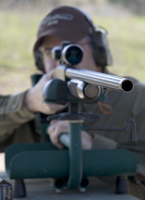
First up was the Deerslayer III. Its 24-inch fluted heavy barrel made it look like a serious purpose-built slug gun, and that’s exactly what it turned out to be. Our sample gun carried a Nikon 3×9 variable scope, and with some new premium Winchester Supreme Elite Sabots, we found that we could shoot sub-two-inch groups at 100 yards as long as our ammunition held out.
But it wasn’t only its accuracy that really impressed us about the Deerslayer III; it was its remarkably crisp, light trigger pull and slick slide that put the smiles on our faces. Several shooters commented that they had never racked a smoother pump gun.
We wished that we had more time to spend with the Deerslayer III, because at around 10 lbs. with scope, it was a pleasure to shoot.
There’s bound to be some debate about what is truly the Rolls-Royce of pump-action slug guns. Some will say it’s the Remington 870-based Tar-Hunt DSG; others will choose the Deerslayer III. Since both guns perform so well, it’s likely to come down to a matter of personal preference; but the Ithaca’s extremely slick slide and snappy trigger pull will undoubtedly appeal to connoisseurs. At a suggested retail of around $1200, it’s not exactly inexpensive, but you get what you pay for.
Ithaca 12-ga. Field Grade Featherlight
We then moved on to the 12-ga. Field Grade Featherlight. This is as close as you can get to the classic M37s of years gone by but, like the Model 87 that briefly preceded it, it has a 3-inch chamber and interchangeable choke tubes. Anyone who’s ever shot a well-built M37 knows how slick their slides are, and the Field Grade was no exception. Clays just didn’t stand a chance with it. Everyone shot it well, from tiny Corrina Peterson up to linebacker-size Tom Nelsen.
The Field Grade Featherlight 12 gauge retails for around $850. That’s on the high side for pump guns, true, but few who shot the gun would maintain that it’s not worth it. When a 5-foot-nothing young lady such as Corrina can pick up an M37 for the first time in her life and outshoot the rest of our staff with it, well, that gun’s got some serious mojo.
Ithaca 28-gauge Grade AAA
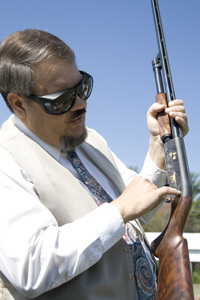
Gun Digest Editor Dan Shideler examines the Ithaca 28 ga. Grade AAA
Next came our chance with the new 28-gauge Grade AAA. It was almost as much fun just to hold this gun, with its slender scaled frame, as it was to shoot it (well, almost). Contributing Editor Jake Edson dusted every bird we threw up with the tiny, pointy little gun. If we had any suggestions for the Grade AAA 28-gauge, it would be to replace the dull black recoil pad with a plain horn or hard rubber buttplate. Who needs a recoil pad on a 28, anyway?
The new 28-gauge Featherlight starts at around $1000 in its Grade A dress; for that you get nice but not super-deluxe wood and a plain roll-engraved receiver. Those who favor the 28 gauge for upland hunting may decide that the Remington 870 Express is all they really need, while others will prefer the very elegant Browning BPS Hunter. We have shot all three and done rather well with them. Still – and perhaps for no other reason than plain old sentimentalism – we rather like the new 28-gauge Ithaca.
Some shooters may have issues with the red-orange Raybar front sights that graced both the 12 and 28 gauges, but to your editor, an Ithaca fan of long standing, they just wouldn’t be M37s without them. Like them or not, you will certainly know they’re there, even on overcast days. On bright, sunshiny days, the Raybar sights glow like a neon sign at midnight.
Your editor’s very first shotgun, purchased back in 1974, was an Ithaca Deluxe Featherlight 20-ga.
Coincidentally, I had just dropped it off at Poly-Choke in Fond du Lac, Wisconsin, for a new rib just before I had a chance to shoot the new Ithacas. As fond as I am of that old 20-gauge, the quality of the new Ithaca M37s is even better. In terms of fit, finish and function, I found nothing to complain about and plenty to praise.
With annual production at around 3,500 M37s of all types, you won’t see as many of them in the fields or on the lines as you would, say, Remington 870s. But if you get a chance to shoot one, I recommend you take it. In my opinion, it’s the smoothest, slickest, sweetest pump gun on the market.
For more information on the new Ithaca 37s, I don’t think the company would mind it one bit if you visited their website at www.IthacaGun.com.
Editor’s Note: article appears in the 2010 Gun Digest Annual book.
Looking to go armed, but are stuck in the weeds as to what to arm yourself with? Here are 20 of the best concealed carry gun options that will keep you on the defensive.