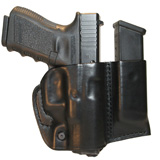
Gun Digest Store now offers thousands of high-quality items from Blackhawk! including this Glock holster with spare mag holder.
Gun Digest is resilient if nothing else, but one thing we’re not is impervious to change. And sometimes change can be a good thing as we’ve now rolled out a massive one to our online store, gundigeststore.com.
In addition to thousands of firearm books, CD/DVDs and downloads, 4,500+ items from Blackhawk! were made available yesterday afternoon. As a result, now you can shop online for everything ranging from holsters to Warrior Wear clothing with secret pockets designed for concealed carry — plus mag pouches, shooting mats and slings.
This Universal SWIFT Sling is an example of the firearm accessories you'll find at gundigeststore.com.
Since 1944, Gun Digest has been recognized as the “World’s Foremost Authority on Guns.” Readers the world over regard us as a trusted source for gun information, and we think you’ll come to trust us as a source for your gun stuff, too.
Bottom line is it just made sense. For instance, consider some of the reasons we launched tacticalgearmag.com, an online social network for civilian self-defense advocates, law enforcement and military personnel. We did that not just to provide the very best online community gathering place of like-minded people. It was because we knew we had top shelf content — Tactical Gear Digital Magazine, articles, blogs, books, experts, online video — all of which would be ultimately useful for people like you.
Well, not only can we provide the best instruction in areas like concealed carry, with our wide selection of books from the industry’s most knowledgeable authors, but we can also provide a convenient way to buy the gear you need to carry concealed … all in one stop.
It’s like Facebook. Or Amazon.com. For gun owners.
Knowledge is power. But you still need the gear. Starting right now, you’ve come to the right place for both.
Carolyn McCarthy had this bill written and sitting on her desk waiting for the “suitable” tragedy that might help get it passed. Now, some idiot gave her the opportunity.
McCarthy wants to ban the manufacture and transfer of ALL magazines that hold more than 10 rounds. No grandfather clause, no cut off date… ban all of them. I’m thinking that could lead to outlawing possession as well and that means confiscation. And if they can confiscate magazines, all it takes is one more tragic event for them to push the next law through.
Write to your congressional representative today and voice your displeasure. Obama is no longer too busy with other problems to ignore gun control.
The fiercest gun-control advocate in Congress released the text of a bill she plans to introduce next week that would outlaw high-capacity magazines like the one a gunman used to shoot 20 people in a matter of seconds in Arizona this weekend.
Rep. Carolyn McCarthy’s (D-N.Y.) bill also goes further than than the assault weapon ban that expired in 2004, outlawing the sale or transfer of clips that hold more than ten rounds, even those obtained before the law takes effect, according to a copy of the bill obtained by POLITICO.
The bill closes a loophole in the expired assault weapon ban that let gun owners buy high-capacity magazines made before the ban took effect in 1994.
The bill carries a penalty of up to 10 years in prison.
“The only purpose for the existence of these devices is to be able to shoot as many people as possible as quickly as possible,” McCarthy wrote in a letter to her colleagues that accompanied the bill. “There is no reason that these devices should be available to the general public.”
The largest GUN SHOW ever held in the Capitol District will be staged January 22-23, 2011 at the Empire State Plaza Convention Center in Albany, NY. Over 400 exhibitors and displays will be provided by our collectors and dealers from all over the northeastern United States and Canada.
Featured will be displays and sales tables of U.S. military arms, Colt Revolvers, high grade double barreled shotguns, Remingtons, muskets, Smith & Wesson, Kentucky rifles, gun parts & accessories, Indian items, Frontier & Western paraphernalia, Sharps, Springfields, Winchesters swords, bowie knives, powder horns, civilian and military weapons from all nations, custom-made and factory knives, military relics and equipment from before the Revolutionary War to present.
Cash or barter. Haggling for the very best deal possible is both expected and accepted. Old and unwanted guns gladly purchased by our collectors.
Admission is only $6.00 per day, children with parents free. $5.00 per day for senior citizens.
For more information contact: Sandy Ackerman Klinger 346 Paul Street Endicott, NY 13760
In January, a federal lawsuit was filed in South Dakota challenging a state law which prohibits non-US citizens from obtaining a concealed carry permit. That law, “was enacted in the wake of the terrorist attacks on Sept. 11, 2001, when states were looking for ways to tighten security and guard against future attacks, Secretary of State Jason Gant said,” according to the Rapid City Journal.
“It had tremendous support at that time to make sure only U.S. citizens were receiving the permits,” Gant said. “It had bipartisan support along with several other agencies.”
“At the time, Attorney General Mark Barnett, the South Dakota Police Chiefs Association, the South Dakota Sheriff’s Association and the South Dakota Shooting Sports Association all supported the change. Gant said the measure passed without opposition or a dissenting vote at any level.”
But in the suit, one Wayne Smith argued, “that he should be allowed to receive a permit as protected by the Fourteenth Amendment’s equal protection clause. Smith, of Sioux Falls, has been a lawful permanent resident since 1979 after moving to the United States from the United Kingdom.”
Gun Digest is the source for firearms news, pricing and guns for sale. Readers benefit from in-depth editorial expert advice, show reviews and practical how-to instructions. With your Subscription, you’ll also learn about threats to your Second Amendment rights. Click here to begin your subscription to Gun Digest.
Inside this issue:
1903-A4 Springfield Sniper
Field Gun Review: S&W 627
FN-49: A post-war semi-auto that saw the world
Gun shows, auctions and classifieds
Not a subscriber? Make sure you don’t miss another issue! Subscribe now
Arizona Rep. Gabrielle Giffords (D) and 19 other people were gunned down at an Arizona Town Hall-style meeting. Now democrats are planning more gun control.
Democratic Rep. Carolyn McCarthy of New York plans to introduce legislation in the coming days that would limit access to the type of weaponry used to gun down Arizona Rep. Gabrielle Giffords (D) and 19 other people.
Giffords remains in critical condition after 22-year-old alleged gunman Jared Loughner open fired at a town hall-style meeting at a Tuscon grocery store on Saturday. Twenty people were shot and six were killed. The shocking incident prompted the House of Representatives to call off this week’s planned business and has spurred some lawmakers to propose some new laws related to the shooting, including McCarthy’s proposals.
McCarthy today will officially announce she is working on a bill targeting the high-capacity ammunition clips the gunman allegedly used in the shooting, as Politico first reported.
“My staff is working on looking at the different legislation fixes that we might be able to do and we might be able to introduce as early as tomorrow,” she told Politico.
The congresswoman plans to discuss the legislation this week with Speaker John Boehner and Minority Leader Nancy Pelosi, her staff confirms to CBSNews.com.
“We need to look at how this is going to work, to protect people, certainly citizens, and we have to look at what I can pass,” McCarthy said. “I don’t want to give the NRA – excuse the pun – the ammunition to come at me either.” Read more
Judging from the industry stats I’ve seen lately, the concealable handgun market is chugging right along. (The sporting rifle and shotgun market are a bit flabby and the AR craze is cooling off, at least temporarily, if you care to know.) I’m not sure what’s driving this surging interest in concealed-carry guns but suspect it’s the spate of pro-gun court rulings that have been issued as well as the growing realization that citizens are primarily responsible for their own well-being. Whatever the reason, we’ve got a lot of first-time “concealed carriers” entering the gun market. That’s a good thing, just on general principles.
It’s been 30 years since I first acquired my carry permit, and guns are a big part of my personal and professional life. But I can still remember when I was a newbie. In those days, there weren’t a lot of how-to guides that explained how to use a self-defense handgun: you had to read a schwad of magazine articles (still a good idea) or enroll in a defensive handgun class (also still a good idea).
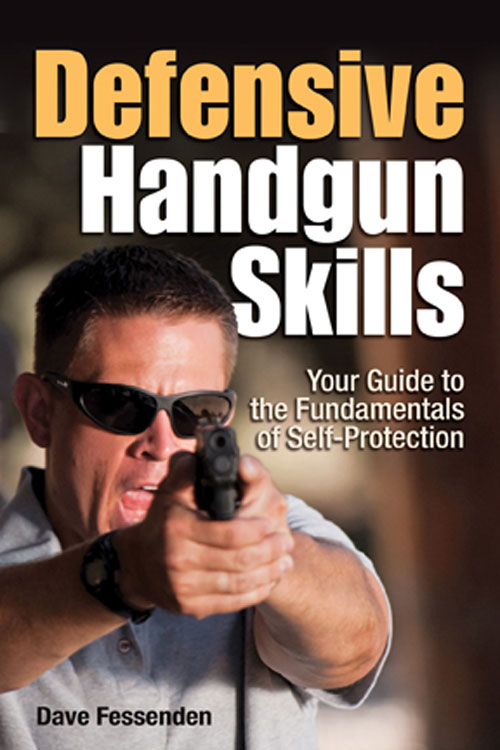
For today’s concealed-carry newbie, however, things are a lot easier. Besides having more options in guns, ammo, holsters and accessories than ever before, we’ve got excellent one-volume guides to concealed carry such as Defensive Handgun Skills by Dave Fessenden. Fessenden, a certified NRA Firearms Instructor, has cleared away all the clutter about concealed-carry handgun techniques and distilled a lifetime of experience into only 128 pages. He’s given us what I think is the best how-to guide to carrying and deploying defensive revolvers and semi-autos — he doesn’t overwhelm you with technical jargon or complex technical issues. For the concealed-carry beginner, it’s a no-sweat introduction to the carry gun — and at only $11.55, it’s about half the price of a large delivered pizza, even a crummy one. Check it out here. And keep shootin’!
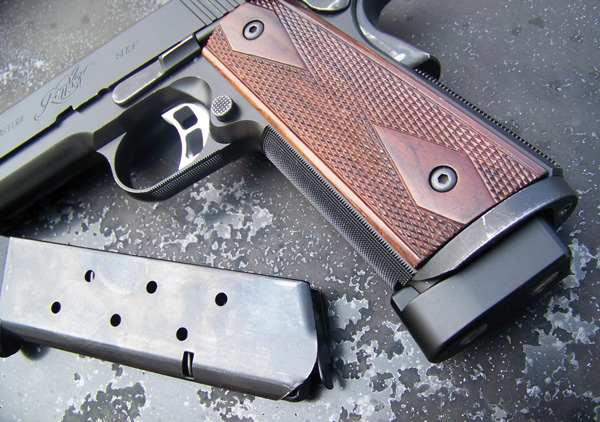
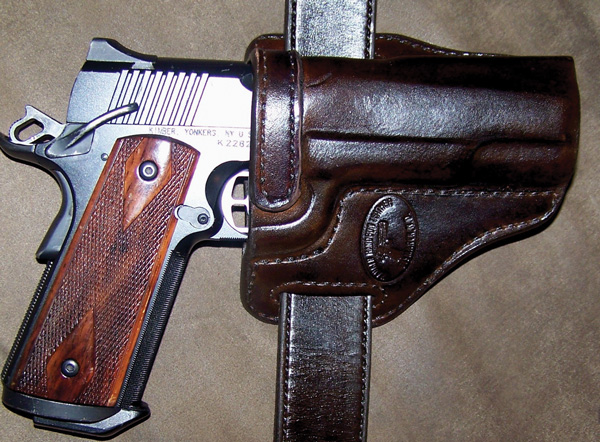
The D & L Sports heavy duty magazine worked well with the Kimber magazine guide.
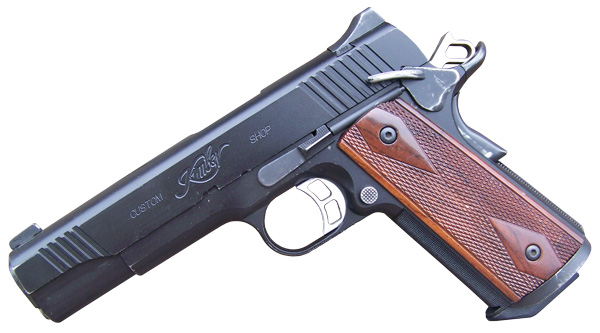
When it comes to the 1911 handgun I have been accused of being as nutty as a dump rodent. But then the mighty oak springs from a nut that held its ground! Thus we look at the Kimber Gold Combat 1911.
For those who do not embrace the 1911 let me task them to simply share the passion with a 1911 man. Go to the range, try a quality 1911, let a few rounds fly. Chances are you will agree that the 1911 is a great design. The first time I held a .45 something in the walnut grip said “friend.” Nothing has diminished that feeling in the intervening 35 years.
The Commander .45 rode with me through several difficulties. The concept is pretty simple when it comes to a good pistol. I do not pick the best until I test them all. I recognize performance. There is no better “go-anywhere, do-anything, anytime-anywhere” handgun than a good 1911.
Will Smith is getting the measure of the .45 in a fast pass at steel plates.
Today I often carry and shoot a thoroughly modern pistol that is among the best 1911 pistols I have ever handled. The Kimber Gold Combat is Kimber’s idea of a first-class combat pistol. The pistol is a consensus of the opinion and demand of a number of shooters- Kimber simply made it happen. I have been around the block with the 1911, built 1911 handguns, disassembled the pistols in detail, and fitted barrels, safety levers and triggers. I don’t mind admitting that I made a few mistakes and learned along the way, but it has been a long time since I made a mistake. I know how a 1911 is supposed to be fitted.
Appearance is one thing. Some feel the 1911 is ugly. But the ones who call her “old ugly” or “old slabslides” often do so with real affection. Someone out of the fold had best keep their derogatory comments to themselves.
The 1911 does best what a fighting pistol does and that is deliver a heavy blow accurately and quickly. The pistol’s balance is ideal. After trying the modern polymer pistols I find them slide heavy. I tend to pull the muzzle low and hit low. The 1911 is well balanced. The pistol is both reliable in action and robust in service. It takes a great amount of abuse to knock a 1911 out of the game. The trigger offers straight-to-the-rear single action compression. The 1911 is often clean and crisp from the factory but with a minimum of effort the trigger may be polished to a high degree of smoothness. My recommendation is to fire the piece until it smoothes up.
Let’s touch a little on longevity. I have seen so many 1911 handguns at the 20,000 round count I have lost count. I own a number myself. I have sources in the military that tell me that they are using World War II era frames and slides with well over 100,000 rounds on them.
These figures are reasonable to low when you consider the training that goes into producing a special team operator. As a young peace officer beginning in 1978 I often fired 500 rounds a month and when I had time to load ammunition, it was not usual to fire 500 rounds in a week. I believed in quantity and I learned to shoot the hard way with little formal instruction. I can not help but wonder if I had used but a single pistol could a 1911 have taken the several hundred thousand rounds I have spread about a battery of pistols? The answer is probably yes.
After years of use and thousands of rounds of ammunition the Kimber .45 is none the worse for wear.
A Modern 1911
Getting back to the Kimber Gold Combat; the controls are properly fitted. The safety locks crisply into the slide with a good indent. The trigger is smooth and breaks at an ideal 5 pounds with no creep or over travel. The grip safety releases the trigger about halfway to full compression. The slide runs smoothly across the frame. The Kimber achieves good fit through tight tolerances. It is not so tight as to present a difficulty in break-in or to produce malfunctions but such tight fit reduces eccentric wear. There is no perceptible play in the slide. Don’t believe that overly tight fitting is required for first-class practical accuracy. The Kimber is tight but not so tight that lint, dirt or other material may cause it to tie up.
Among the first modifications to the 1911 was to modify and lengthen the dust cover in the 1911A1 in order to protect the mechanism from foreign matter. The balance between reliability and accuracy must favor reliability. The pistol is a Gold Combat, remember? For makers who understand the balance compromise is not necessary. If you understand the three-point pedestal method of barrel fit then you know what I mean. It is necessary to pay for care in fit and the Gold Combat costs a bit more than other pistols.
Consistency of construction pays off big dividends in longevity. The barrel returns to the same place after each shot. This limits slop and eccentric wear. The extractor picks up the extractor groove exactly the same for every cartridge. The ejector doesn’t deviate. When you wonder what you are paying for when the price edging close to $1,500 you have to understand some things. When you begin with a false premise you cannot reach an accurate conclusion. Sloppy is sloppy. Precision properly executed means long life for the handgun. In short, you get what you pay for and in this case you are paying for precision and performance.
The Gold Match has all of the features we could ask for but the fit is most important. The pistol features forward cocking serrations. Take them or leave them they are a feature of tactical-grade 1911 handguns. The pistol also features excellent high-visibility sights with Meprolight self-luminous Tritium inserts. These bold clear sights are ideal for all-around use. The pistol features an ambidextrous safety design dissimilar to any other Kimber in my collection. The beavertail safety subtly lowers the bore axis as well as making the pistol more comfortable in firing +P loads. The grips are high quality checkered rosewood. They are reminiscent of the classic double diamond checkered pattern.
There is also a very well done checkered front strap. Formerly found only on top of the line custom handguns, the Kimber custom shop has done a fine job with these serrations. Some feel that a checkered front strap is uncomfortable during a long firing session or a 1,000 round training course. My reply is, “Wear gloves.” The Kimber also features a magazine guide. While we are not likely to be caught in a running gun battle, the magazine guide is a plus during administrative handling and in range practice. The pistol also features a full-length guide rod. While controversial, the FLGR is an aid in certain situations. Just one of these situations is in firing off a barricade. If you bump the slide the FLGR will prevent the pistol from being knocked out of battery.
The proof of a good gun is in the firing. This report comes after many months and thousands of rounds of ammunition. For the majority of range outings and during training I have used the Oregon Trail 230-grain Laser Cast bullet over enough Titegroup powder for 830 fps. In using this load for economy and others for testing, the pistol has never failed to feed, chamber, fire or eject. Practical accuracy off hand has been excellent. The Kimber is a fast pistol on target and it tracks well when engaging multiple targets. There is nothing like a Government Model for this type of work.
The Haugen Handgun Leather crossdraw holster offers excellent fit and finish and good design, all we may ask.
I have also tested a number of personal defense and service loads. A number of new loadings have proven their mettle in the Kimber. Winchester’s new 230-grain Bonded Core load was adopted for service by the FBI and naturally we were all greedily wanting to test this one. The load demonstrates excellent quality control and a good balance of expansion and penetration. Another load has given me pause and a bit of a surprise. Black Hills has introduced a 185-grain +P load using the Barnes all copper TAC bullet. This is a brilliantly accurate loading and one that has proven completely reliable in feeding. There is little excuse for not carrying first rate ammo in your .45 as there is much available.
There are few handguns as consistently accurate as the Kimber Gold Combat. Like all quality handguns, the Gold Combat prefers one load to the other but the results are often very consistent. The only handgun I own as consistently accurate is a target pistol with a stylized Gold Cup on the slide. Enough said on the subject of accuracy. If you would like to own a well made 1911 that will challenge any shooter to perform at his highest level this is the pistol.
Leather
Since I have tested this handgun during the winter months, I adopted a crossdraw holster for under the jacket carry; the Huntington Wedge from Haugen Handgun Leather. Maker, Jerry Evans, has given excellent service for several years. When seated or driving the crossdraw is more accessible than any other and a very versatile design. The Haugen holster is a quality type with much to recommend.
This is a great combination, worthy of protecting all that you hold dear. If you carry a gun for defense, many have said you should always carry the best gun you can afford. The Kimber Gold Combat falls into that category.
This article appeared in the December 6, 2010 issue of Gun Digest the Magazine.
There has been a lot of talk here recently about the proper use of your weapons and your readiness to fight. But there is a flip side to all that: Professional communication. More often than not you will want to use your brains and your verbal skills to defuse a situation. I proclaim often that I would rather talk for 20 minutes than fight for two. And that’s the way it should be.
Good communicators can talk a situation down and bring people back from the edge of violence. Bad communicators can push people over the edge and make things worse. If you have not take a professional police communications class like Verbal Judo or something similar, sign up for one. It can help
But remember, words sometimes fail. And how do you know when you are done talking? Use the acronym police use:
D Danger
O Overriding concern
N No Progress
E Escape
If there is clear danger, move to a position of tactical advantage, retrieve a weapon and get ready for action. Shift your verbalization to giving commands.
Overriding concerns can be just about anything that puts you into a bad situation or makes the situation more dangerous. If the hair on the back of your neck stands up, believe it.
No progress… well, while you are talking you should also be looking for escape routes, other dangers, cover, anything that can give you an advantage. Talking works, right up until it doesn’t. Be aware.
Unless you are on duty and the person you are talking to is wanted, escape is your friend. If you are operating in a civilian capacity and a person decides to flee… let the person go. If you are required by law and believe you can do so safely, well, then use the appropriate level of force to stop the escape and make the lawful arrest.
This site may be about gear… but your best tool is your brain.
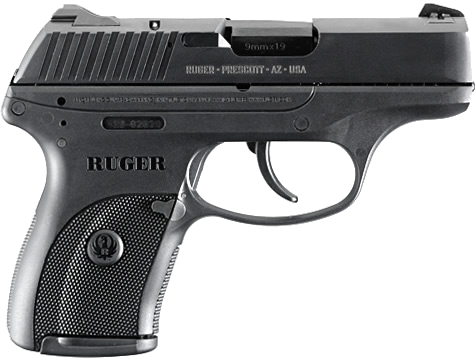
The folks at Ruger have just alerted us to a new polymer pistol called the Ruger LC9, which is similar to the popular Ruger LCP (.380 auto), but offered in 9mm. Ruger says this is the “Next Handgun You Must Own!” so let’s see what all the fuss is about.
This highly requested pistol was developed through Ruger’s Voice of the Customer program and incorporates the features and rugged reliability desired by Ruger customers.
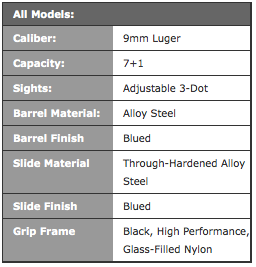
The LC9 has a 3.12” barrel, is 6.0” long and 4.5” tall, making for a very compact 9mm pistol. The LC9 is impressively narrow at a mere .90” wide, and weighs only 17.1 ounces with an empty magazine. Featuring a black polymer (glass-filled nylon) frame and black alloy steel slide and barrel, the lightweight, full-featured Ruger LC9 offers the versatility and capability of the popular 9mm cartridge in a highly compact, reliable, and user-friendly pistol.
“On the heels of the overwhelming and on-going success of the LCP®, customers repeatedly requested a lightweight, compact 9mm pistol. Frankly, they wanted an LCP chambered in 9mm,” said Ruger CEO Michael Fifer. “Delivering an American-made, compact 9mm that provides the same legendary Ruger reliability as the award-winning LCP, LCR® and SR9® became our focus. Meeting customer expectations is our goal and key to Ruger’s continuing success,” Fifer continued.
The LC9 is a double-action-only, hammer-fired, locked-breech pistol with a smooth trigger pull. Control and confident handling of the Ruger LC9 are accomplished through reduced recoil and aggressive frame checkering for a positive grip in all conditions. The Ruger LC9 features smooth “melted” edges for ease of holstering, carrying and drawing.
One seven-round, single-column magazine is provided with each LC9 pistol. The magazine’s standard flat buttplate aids concealability, while the provided finger grip extension buttplate offers an option to shooters who prefer a longer grip surface with more hand-to-pistol contact. Seven-round magazines, holsters and other accessories are available for purchase at ShopRuger.com.
The wider rear aperture of the dovetailed, low-profile, two-dot rear sight aids quick acquisition of the single-dot, dovetailed front sight. This high-visibility, three-dot sight system provides fast, positive sight alignment.
The slide locks open on an empty magazine and the external slide stop is easy to reach and manipulate for positive firearm functioning. A single-sided manual safety and a magazine disconnect are additional features of the Ruger LC9. A California-approved loaded chamber indicator allows for immediate visual and tactile confirmation that the chamber is loaded. A pivoting external extractor provides reliable extraction of the 9mm cases.
For more information on the Ruger LC9, or to learn more about the extensive line of Ruger firearms, visit www.Ruger.com.
The Bureau of Alcohol, Tobacco, Firearms and Explosives has proposed that it be given emergency authority for six months, beginning January 5, to require about 8,500 firearms dealers along the border with Mexico “to alert authorities when they sell within five consecutive business days two or more semiautomatic rifles greater than .22 caliber with detachable magazines.” A Washington Post story reporting on the BATFE proposal described that definition as being applicable to “so-called assault weapons,” but it would also apply to many rifles that have never been labeled with that term.
The reporting requirement will apparently be imposed under the “authority” the BATFE has used in the past to demand reporting of other types of transactions from certain limited groups of dealers over the past 10 years, but the new proposal is far broader than any previous use of this authority. Of course, there’s no law today that prevents dealers from reporting suspicious transactions (or attempted transactions) to the BATFE, and dealers often do so. The BATFE is also free to inspect dealers’ sales records—either for annual compliance inspections or during a criminal investigation.
NRA-ILA’s chief lobbyist, Chris Cox, denounced the attempt to establish a registry of Americans who purchase semi-automatic rifles that gun control supporters ultimately want to see banned. “This administration does not have the guts to build a wall, but they do have the audacity to blame and register gun owners for Mexico’s problems,” Cox told the Post. “NRA supports legitimate efforts to stop criminal activity, but we will not stand idle while our Second Amendment is sacrificed for politics.”
The Post says “The plan by the Bureau of Alcohol, Tobacco, Firearms and Explosives revives a proposal that has languished at the Justice Department and in the Obama administration for several months,” and that the gist of the plan was proposed by Mayors Against Illegal Guns (MAIG) last year. In its August 2009 Blueprint for Federal Action on Guns, MAIG indeed proposed that “ATF should identify the long guns most linked to crime and require dealers to report multiple sales of such guns.”
The idea must have appealed to the BATFE, because in June of this year Congress’ Government Accountability Office released a report noting that BATFE officials had claimed that U.S. efforts to stop the smuggling of firearms to Mexico are hindered by “a lack of required background checks for private firearms sales, and limitations on reporting requirements for multiple sales.”
Curiously, in September, a draft of the Department of Justice’s Inspector General’s Office’s unfavorable review of BATFE’s Project Gunrunner, established to combat the trafficking of firearms to Mexico, didn’t mention multiple sales at all. But the final version of the review, released in November, mentions “multiple sales” 43 times and says “the lack of a reporting requirement for multiple sales of long guns – which have become the cartels’ weapons of choice – hinders ATF’s ability to disrupt the flow of illegal weapons into Mexico.”
Whether BATFE intends its plan as another expansion of its oft-criticized firearm sales record tracing empire, or to lay the groundwork for legislation or regulations restricting “assault weapon” sales, or to fatten the files the agency keeps at its National Tracing Center in West Virginia remains to be seen. And the legality of requiring sales reports on any long guns is also in doubt. When the Congress specifically imposed multiple sales reporting on handguns only, it implicitly stated its intention that the same requirement not apply to sales of long guns.
However, it is crystal clear that some in the Obama Administration agree with those who believe the answer to crime is always more gun control. In September, MAIG blamed crime in states that have “strong” gun laws, on states that don’t have the same laws. And ever since President Obama took office, gun control supporters have been blaming Mexico’s crime problem on America’s gun laws.
The fact that Mexico’s multi-billion dollar drug cartels have machine guns, rocket launchers, grenades, and other potent weaponry you cannot buy in the United States is, to gun control supporters, irrelevant. The fact that most of the cartels’ guns have never been on this side of the U.S. border is, as far as they are concerned, a trifling inconvenience. The fact that the cartels will never have enough “assault weapons” or any other guns from the U.S. to hand out to all the Mexican policemen, soldiers and politicians on their payrolls, is, in their view, an unimportant detail. And the fact that the murder rate in the United States is at a 45-year low, while crime in Mexico is through the roof (the murder rate in Juarez is 115 times higher than in El Paso) is, they would certainly say, a contradiction best ignored.
To read the BATFE’s Federal Register notice about the plan, and for information on how to send your comments, click here (https://edocket.access.gpo.gov/2010/pdf/2010-31761.pdf). Comments about the proposal will be accepted for two months; if you choose to comment, please state your firm but polite opposition to the plan.
Needless to say, the NRA will not only comment, but take whatever other action is appropriate to block this sweeping expansion of federal recordkeeping on gun owners. Stay tuned.
All the details are not yet public, but one thing is true: In an ECQ fight for a weapon, bad things can happen and any bad guy can get lucky against the best officer. This officer died in a struggle for a weapon. Keep that in mind and make sure you do what you need to in order to stay alive.
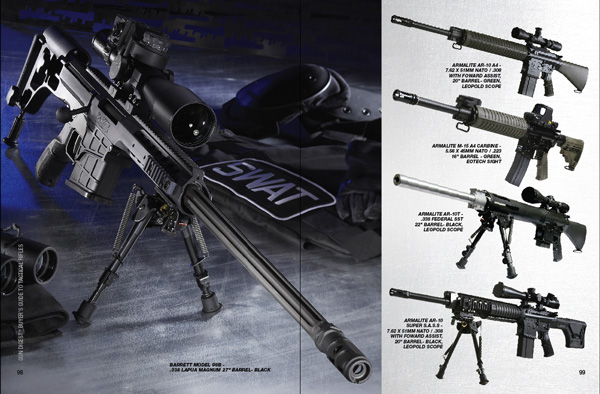
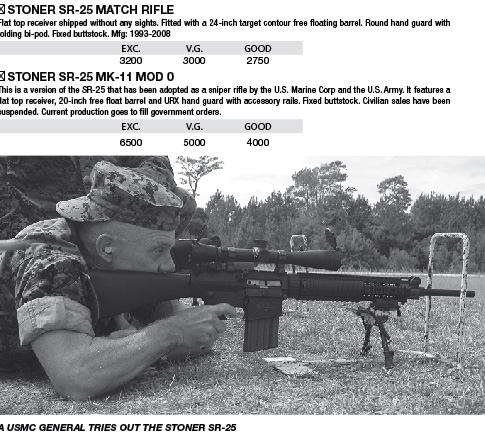
Simply titled the Gun Digest Buyer’s Guide to Tactical Rifles, this new soft cover book offers values, specifications, photos and histories of the more common — and many lesser-known — tactical rifles on the market. The grading scale lists prices in MSRP or NIB (New In Box) and EXC. (Excellent), V.G. (Very Good), and GOOD (Good).
One of the things you immediately notice about the Buyer’s Guide that sets it apart from other pricing or value books on the market is the high quality photography, including a nice full color middle section called the Gallery of Tactical Rifles.
Can you imagine a book about tactical firearms without photos? Let’s face it, while a book of this type is virtually mandatory for anyone seriously looking to buy or sell tactical guns, one containing only pages and pages of listings and numbers wouldn’t be any fun to look at (in fact, it’d be downright painful on the eyes).
Not so with this book. Each page takes you on a delightful little adventure down the yellow brick road (via alphabetical listing by manufacture) of guns from Russia, Europe and America.
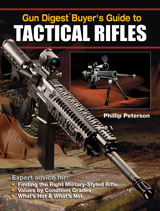
The Gun Digest Buyer's Guide to Tactical Rifles features specifications, current values, hundreds of illustrations, histories and more.
Peterson gives tips on how to get the most use out of the Buyer’s Guide with a detailed explanation of condition ratings. He also explains that, by “tactical rifles,” he means:
For the purposes of this book it is a semi-automatic rifle or pistol that accepts detachable magazines that hold over 20 rounds of ammunition. A few, such as the Barrett M-82 .50 Cal. rifle and the SVD Draganov Sniper rifle, which have 10-round magazines, are included as they certainly need to be in such a guide.
Given how the term “tactical” is slapped onto just about anything these days — including pens and wristwatches — Peterson explains the decision to limit the book’s scope to mostly semi-automatics.
There are some things that carry a tactical label that are not covered in this work. That would include shotguns, bolt action rifles and conventional handguns with rails for attaching lasers or optical sights. Such firearms are certainly “tactical” in nature, but since even some revolvers now have tactical rails built into them, we just had to draw the line somewhere.
But I’m glad to see the editors didn’t hold too rigidly to that doctrine, because in the Gallery of Guns you can lay your eyes on a nice full color image of Armalite’s .50A1, which is indeed a bolt action single shot.
Finally, the book’s intro includes a very concise and useful history on these fascinating arms, with Peterson discussing The Classics, Ban Era Guns, The New Boom, Heavy Iron and Home Gunsmithing.
There’s a lot to consider when buying a tactical rifle. This book will be your guide. Buy it now
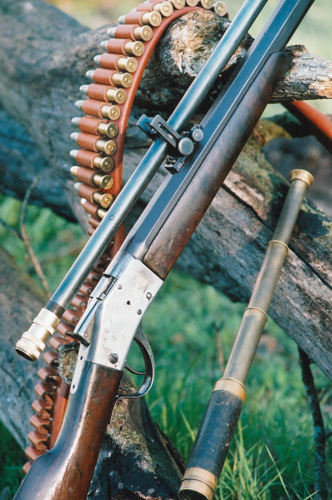
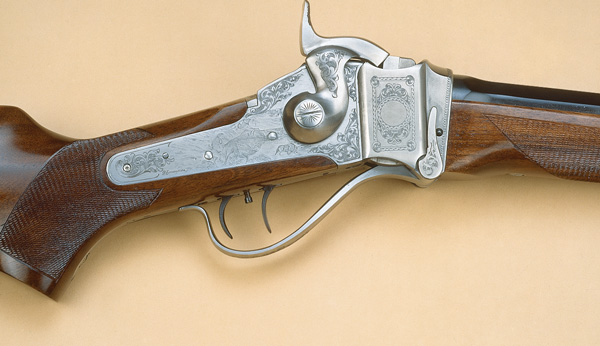
Many Sharps collectors believe that the tooling for the Model 1875 was modified for the later production of the hammerless Model 1878 Sharps Borchardt rifle. Original shown here with a new-made Leatherwood Hi-Lux Optics “Wm. Malcolm” telescopic rifle sight.
Of the half-million or so “breech-loading” rifles and carbines purchased from twenty different arms makers by the U.S. Ordnance Board during the Civil War, nearly 20 percent were produced by the Sharps Rifle Manufacturing Company, of Hartford, Conn. The only other breech-loaded firearms to see greater use were produced by the Spencer Repeating Rifle Company, of Boston, Mass.
Official records of ordnance purchased by the United States government from January 1, 1861 to June 30, 1866 show that a total of 80,512 carbines and 9,141 rifles of Sharps manufacture were delivered. During that same period, Spencer produced a total of 94,196 carbines and 12,471 rifles for the war.
Mounted cavalry troops tended to prefer the 7-shot repeating Spencer lever-action carbines and easier loading self-contained cartridges over the slower loading single-shot percussion breech-loaded Sharps with combustible paper or linen cartridges. On the other hand, the rugged construction and longer-range accuracy of the Sharps made it revered among foot soldiers. And it was the outstanding reliability of Sharps-built rifles or carbines during this period that earned them their well-deserved “Old Reliable” reputation.
Oddly enough, the man whose name became known around the world, thanks to the quality and accuracy associated with Sharps rifles, had very little to do with the company during this period. And he had no involvement with the production of the later big-bore cartridge rifles that were even better known for their long-range large game taking performance.
Christian Sharps learned the gun-making trade during the 1830s while working with the production of the Hall breech-loading Model 1819 flintlock rifle produced at Harpers Ferry Arsenal.
While Hall later developed a percussion version, Sharps had conceived a still better “drop block” design and received his first patent in September of 1848. Only about 200 each of his percussion Model 1849 and Model 1850 drop-block action rifles were produced by Pennsylvania based manufacturer A.S. Nippes. Both were 44-caliber rifles, built with automatic priming systems.
Production of the 52-caliber Model 1851 and Model 1852 rifles was moved to the Robbins & Lawrence plant in Windsor, Vt. The rifles were built for the newly formed Sharps Rifle Manufacturing Company, headquartered in Hartford, Conn. During the production of the Model 1853 and Model 1855 rifles, both the Robbins & Lawrence and Sharps firms suffered significant losses. The Sharps Rifle Manufacturing Company then moved all manufacturing to Hartford.
The Sharps Rifle Manufacturing Company had been established in 1851 by a group of investors. And Christian Sharps’ role in the operation had been relegated to “Technical Advisor.” His only real tie to the company was that the rifles were being produced under his patents, and Sharps received a $1 royalty for every rifle built. In 1853, Sharps left the company that bore his name, moved to Philadelphia, and opened a new arms-making firm known as C. Sharps & Company, specializing in small pocket pistols and derringers.
Other than a small-bore 31- and 38-caliber percussion drop-block rifle built in the late 1850s, the only other “long guns” actually produced by Christian Sharps were the Sharps & Hankins 52 rimfire single-shot carbines and rifles produced from 1861 to 1867. Sharps died March 12, 1874 at age 64.
All of the Sharps rifles produced up through the Model 1855 were of the original “slant breech” design. Shooters of the time who had the opportunity to use the Sharps breechloaders acknowledged that they were the best firearms available. Christian Sharps’ original design was a definite improvement over other early breech-loading single-shot rifle designs, but did experience considerable gas leakage between the rear of the barrel and face of the breechblock.
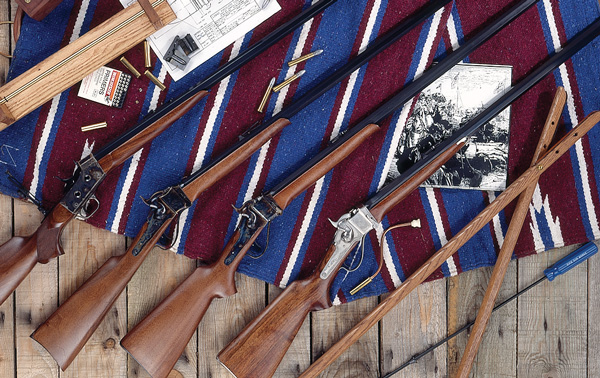
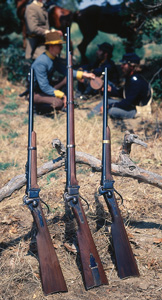
Dixie Gun Work’s line-up of Model 1874 Sharps rifles, by Pedersoli, include (from right) an engraved Silhouette Rifle, a standard version of that rifle, and the Lightweight Target-Hunter rifle. The rifle at far left is a Pedersoli “John Bodine” Remington rolling block rifle.
The “straight breech” block design that first appeared on the New Model 1859 did help alleviate some of the gas leakage. The rifles and carbines built on through the Civil War with New Model 1863 and New Model 1865 markings generally reflect improvements to further reduce the escape of gases from a burning powder charge. Basically, these Sharps guns were all the same design, based on the New Model 1859.
The 115,000 rifles and carbines produced from 1859 to 1866 represented approximately 65 percent of the total number of Sharps breechloaders ever manufactured. No other official military arm of the Civil War went on to remain as popular with civilian shooters and hunters, not even the Remington rolling block rifles. While the latter went on to be produced in far greater numbers, the true rolling block action was not perfected until about 1866.
The Sharps dropping-block action lent itself well to making the transition from percussion ignition to handling the newly developed cartridges that evolved quickly following the end of the war. In fact, in 1867 the U.S. Government decided to convert or have converted a number of percussion military arms into metallic cartridge breechloaders. And the Sharps was one of the designs selected for conversion.
In all, the Sharps Rifle Manufacturing Company converted 31,098 carbines and 1,086 rifles to accept one or the other of the experimental 52-70 rimfire, 52-70 centerfire or 50-70 centerfire cartridges. All were fitted with new breechblocks with firing pins and an extractor. Those converted to the 50-70 cartridge also required soldering a new 50-caliber barrel liner in place. In 1870, Springfield Armory additionally converted about 1,300 more Sharps rifles and carbines to the newly designated 50-70 Government cartridge.
From 1869 to 1871, the Sharps Rifle Manufacturing Company produced their first entirely “new made” cartridge model – the Sharps New Model 1869. What really set this model apart from the converted percussion military models was the much cleaner looking lockplate, which had been trimmed of the pellet priming system that gave the Civil War-era percussion models a “high hump” contour. The lines of the new lockplate were a lot cleaner.
In all, only about 1,000 New Model 1869 carbines and rifles were produced, chambered for early cartridges like the 44-77 Sharps and 50-70 Government. That production also included about 200 sporting rifles that would set the stage for the famous Model 1874 Rifle, which became the favored gun of the professional buffalo hunter.
The rifle that shooters today most recognize as the “Sharps” thanks to recent movies like Quigley Down Under, is the Model 1874, which actually saw its earliest production in 1871. The feature that probably best helps identify an early Model 1874 from the New Model 1869 is the thickness of the lockplate.
The plates of earlier percussion models, built with the pellet priming system, were 3/8-inch thick, as was the plate of the New Model 1869. The thickness of the lockplate found on the newest cartridge model had been thinned to half that thickness. The “Model 1874” markings were not used on the rifle until after several years production. Sharps’ famous “Old Reliable” trademark began to show up on the barrels in 1876, after the company, then known as just Sharps Rifle Company, had moved to Bridgeport, Conn.
The Model 1874 was chambered for a variety of cartridges during the ten years that it was in production, from “small-bore” 40-caliber centerfires to “big-bore” 50-caliber centerfires. Two favorites of the buffalo hunter were the 50-90 Sharps and 45-100 Sharps. The special order 45-120 Sharps and 50-140 Sharps cartridges were basically introduced too late to have been used extensively during the decimation of the American bison, which by 1880 were so scarce that it was no longer feasible to market-hunt the big animals.
Most Sharps collectors and historians tend to recognize the Model 1877 as the most refined and graceful of the side-hammer single-shot rifles. Only about 100 of the rifles were produced, in 45 caliber, in 1877 and 1878. These were built to comply with the “Creedmoor” match competition rules that required a single trigger and a rifle weighing 10 pounds or less. To get the weight down, Sharps Rifle Company built the Model 1877 with a slim and trim back-action lock and much lighter receiver.
The rifle was built with a nicely checkered pistol grip buttstock and Schnable forend. (The company also produced a few Model 1874 Creedmoor rifles chambered for the 44-90 Sharps Bottleneck cartridge.)
The last model ever produced by the Sharps Rifle Company was the Model 1878 Sharps-Borchardt. This was a very modernistic “hammerless” rifle that has only been somewhat duplicated by more recent single-shot designs like the Ruger No. 1. Lighter than the Model 1874, which was still in production, the Borchardt model was most commonly chambered for the easily available 45-70 Government cartridge, as well as other smaller calibers like the 40-50 Sharps.
The vast majority of the different variations available weighed in at less than 10 pounds. Other than the hammerless drop-block action, the one other feature that set this model apart from other Sharps rifles was a sliding safety. The company produced about 8,700 of the rifles before ceasing the manufacture of all Sharps rifles.
Along with the demise of the great buffalo herds of the West also came the demise of Sharps rifle production. Shooters and hunters no longer had a need for a rifle that consumed powder and lead in such great quantities. And Sharps Rifle Company found it increasingly difficult to compete with the new repeating lever-action rifle models produced by Winchester. Thus, manufacturing at the Sharps plant in Bridgeport, Conn. ceased in 1880, with the last assembled rifles shipped in 1881. During the 32 years of Sharps rifle production, only about 160,000 rifles were ever built. However, those rifles solidly established a legacy that few other rifles have ever come close to matching.
The Modern Sharps Reproduction
It may or may not be entirely correct to claim that more rifles of Sharps’ design have been built in the past 32 years than during the entire 32-year run of original Sharps rifle production – but the modern total wouldn’t miss it by much!
In the summer of 1974, two entirely different companies, separated by an ocean, independently set out to make a somewhat faithful modern-manufactured copy of the original Civil War-era percussion Sharps breechloaders. One was a relatively new U.S. firm known as Shiloh Products, Inc., the other a well-established Italian manufacturer of high quality double shotguns known as IAB Arms. And both were successful.
A draftsman and technical illustrator by trade and blackpowder shooter by heart, Len Mule’ was the real mastermind behind what would become known as the Shiloh Sharps. Before making the decision to completely manufacture a “reproduction” of the famous breech-loaded rifles and carbines, he was manufacturing extremely high quality bullet moulds for blackpowder shooters. The four-cavity design of Mule’s moulds earned them a solid reputation for producing a lot of round balls or Minie’ bullets quickly – up to 400 per hour. They were sold as the “Shiloh IV” moulds. The company also offered quality lead furnaces as well, along with a few other bullet casting products.
Through 1973 the 1974, Len Mule’ devoted much of his life to researching Sharps breech-loading rifles and carbines. Not only did he read everything he could find in print, he also visited major museums, including the West Point Museum and the Smithsonian, consulted with leading Sharps experts and collectors in this country, and spent hundreds of hours looking over hundreds of original rifles. One of those experts was Frank M. Sellers, the author of the acclaimed book, Sharps Firearms.
In late summer 1974, Mule’ and his partner, Wolfgang Droege, visited Dixie Gun Works, in Union City, Tennessee. (At that time, the author was working there as an antique arms buyer and Dixie’s catalog editor.) When they left, with them they took a huge selection of original Sharps parts to use for making new tooling. And when these two entrepreneurs showed up at the National Sporting Goods Association Show (predecessor to the SHOT Show) in January 1975, they displayed for the very first time a pair of newly assembled percussion ignition Sharps breechloaders – a “New Model 1863 Rifle” and a “New Model 1863 Carbine.” In that short period of time, this pair had worked with Pinetree Casting (a division of Ruger) to develop the tooling needed to turn out completely modern manufactured duplicates of the original percussion Sharps breechloaders.
The availability of original parts from Dixie Gun Works’ stockpile of Civil War salvage contributed greatly to the authenticity of the early Shiloh reproductions, allowing Shiloh Products Inc. to actually develop tooling based on the dimensions of original parts. Arms authorities immediately praised the percussion rifles and carbines that, at first, slowly trickled out of the Farmingdale, New York plant in early 1976, for their true to the original detail and quality. The only real variation from the originals they copied was that Shiloh elected to make the Lawrence priming system non-functional.
Len Mule’ realized that while the percussion models were being well-received by Civil War re-enactors and Sharps buffs in general, it would be the later cartridge models that would be most appealing to shooters in general. And in mid-1976, he purchased an original Model 1874 Hartford-made Sharps sporting rifle, then began researching and working on the blueprints of the cartridge models Shiloh would put into production. Again, he called upon the expertise of author Frank Sellers, plus turned to well-known gun writer Elmer Keith for input on the Model 1874 metallic cartridge rifle models that went into production in late 1977. The company, then widely known as “The Shiloh Rifle Co.”, became fully engaged in making both the most widely-used and the best known of the original Sharps rifles, and manufactured the early C. Sharps Arms rifles as well.
Ironically, the start of Sharps reproduction manufacturing in Italy actually began with the destruction of two fine original Model 1874 Sharps rifles. In the spring of 1974, SILE Industries had shipped a variety of original sample rifles to IAB Arms, located in Brescia. These were being sent to the respected manufacturer of high-quality double shotguns for the purpose of making the tooling to build both percussion and cartridge model Sharps breechloaders. Two of the rifles happened to be chambered for the 45-70 Government, and at that time Italy imposed a ban on the importation of any arms chambered for military cartridges. Before those two rifles could be delivered to IAB Arms, custom officials had cut the barrels – right through the chambers!
IAB’s first reproduction Sharps rifles and carbines arrived in the U.S. in late 1975, sold by SILE Distributors. Since then, the company has produced nearly 80,000 Sharps reproductions, which have been sold under a variety of “brand” names, including Dixie Gun Works, Taylor’s & Company, Tristar Sporting Arms, Armisport, and E.M.F. & Co. Easily the most authentic copy of the “New Model 1863” percussion Sharps carbine ever shot by the author was imported by a company known as Garrett Arms during the mid-1980s. Built in Italy by IAB Arms, even the Lawrence pellet priming system was functional on this Sharps copy.
This early custom Shiloh Model 1874 Sharps, in 50-70 Government, was known as the company’s “Gemmer Sharps.”
Working in collaboration with Navy Arms, in 1970 the firm of Davide Pedersoli & Co., also of Brescia, Italy, began producing most of a modern Remington Rolling Block copy. Actually, at that time the Italian manufacturer reproduced everything but the barrel, and the parts were all shipped to Navy Arms’ facility in New Jersey, where the actions were fitted with a 45-70 barrel.
Then, in 1983, Pedersoli began to build complete modern copies of the widely used single-shot rolling block-action blackpowder cartridge rifles dating from the late 1800s.
Today, Pedersoli is also recognized as one of the more prolific manufacturers of Sharps rifles and carbines. The company produced its first Sharps, a “Sporting Rifle” model in 45-70 Government, back in January, 1993. Today, the company catalogs the most complete selection of Sharps rifle and carbine models available from a single manufacturer. Many of the rifles offered as other “brands” in this country are actually produced in Italy by Davide Pedersoli & Co.
Armi Chiappa, better known in the U.S. as Armi Sport, is another Italian manufacturer of Sharps rifles and carbines. Altogether, the company offers more than a dozen different models or variations, ranging from a percussion New Model 1859 Rifle and Carbine to an elaborately engraved deluxe copy of a Model 1874 Hartford-built Sporting Rifle.
Again, like IAB Arms and the Pedersoli company, Armi Sport’s Sharps reproductions are offered by a number of importers in the U.S., primarily Cimarron F.A. Co. and Taylor’s & Co.
In the U.S., the heart of Sharps rifle manufacturing today is located in Big Timber, MT. Shiloh Rifle Company, now known as Shiloh Rifle Manufacturing Company, moved from their original manufacturing facility located on Long Island, New York to the C. Sharps Arms facility in the small south-central Montana town in 1983.
C. Sharps Arms was already operating its custom shop and distribution center there, and the move brought these two companies together under one roof, which was a primary reason for Shiloh’s relocation. That relationship ended in 1986, when both companies set out to establish their own Sharps lines. The manufacturing facilities of two companies are still within a block of each other.
When it comes to production Sharps copies, many blackpowder cartridge rifle shooters today continue to consider the rifles produced by Shiloh Rifle Manufacturing Company to be the cream of the crop. The fit and finish of the Model 1863 percussion rifle and carbine, along with the many versions of the Model 1874 metallic cartridge rifles produced by this maker, is superb and in no way second to the quality of any other maker.
Shiloh manufactured the Sharps rifle that Americans are now most familiar with, thanks to the movie featuring actor Tom Selleck – Quigley Down Under. And much like the rifles produced at the original Sharps plants in Hartford and Bridgeport, Connecticut, it’s often hard to recognize one of the Shiloh rifles as one particular version or another due to all of the optional custom features available.
C. Sharps Arms was founded in 1975 by John Schoffstall, and brought its first Sharps New Model 1863 Rifle and Carbine reproductions to market in 1976. At that time, the company relied heavily on the early Shiloh operation in Farmingdale, New York to do their manufacturing. John played an instrumental role in getting Shiloh to make the move to Montana in 1983, where the company continued to produce both Shiloh and C. Sharps Arms rifles. Today, C. Sharps Arms has full manufacturing capability and is noted for the extremely high quality versions of the Model 1874 Hartford- and Bridgeport-produced Sharps originals.
The company also offers a beautiful rendition of the Model 1877 Sharps, also known as “The English Model,” but if this slim and trim back-action lock Sharps reproduction catches your eye, be ready to hang on to your pocket book. With a few optional upgrades, this great-handling beauty could set you back more than $10,000!
The Sharps manufacturers just covered are the primary makers of today’s modern Sharps breech-loading rifles and carbines. Prior to the early reproductions that were successfully brought to market in 1975 by Shiloh Products, Inc., there were several other attempts during the late 1960s and early 1970s, but they simply failed to get off the ground. Those makers featured here are the companies that have worked hard to build and market quality copies of the big and famous drop-block single shots that are so often simply referred to as “Old Reliable.”
This article is an excerpt from the Gun Digest 2009 annual book.
Looking to go armed, but are stuck in the weeds as to what to arm yourself with? Here are 20 of the best concealed carry gun options that will keep you on the defensive.