Pike County Illinois forced to consider Constitutional Carry.
In Pike County, Illinois, Dan Mefford, a chiropractor from Pittsfield, has begun a movement to get a constitutional carry referendum on the election ballot for March of 2012. If successful, such a ballot referendum, “could lead to the state being forced to recognize this right as well, and to expand it to include the rest of Illinois,” Gather, a community-based news website, has reported.
Illinois, of course, is the only state which prohibits any sort of carry, concealed or otherwise, by its citizens.
“What we’re doing is making a statement…we want to put it in front of the people and let people speak,” said Medford. “The time has come to stand up and be counted instead of imploring and begging and pleading with our Chicago Machine Rulers to pass a concealed carry law…”
Time and again, citizens and their representatives from many parts of Illinois have tried to make concealed carry legal in Illinois. Law enforcement has also supported it. All for naught. Whenever the issue has come up in the State Legislature, Democratic politicians from Chicago have invariably killed those efforts.
FORT MYERS — Guns and ammunition no longer would be considered a prohibited “weapon” at Southwest Florida International Airport, if Lee County officials approve a proposed change to a local law.
Lee commissioners are expected Tuesday to decide whether to set a Sept. 27 public hearing to make that change to the airport ordinance and to allow guns and ammunition on airport property.
Under an order Gov. Rick Scott signed in June of this year, Lee commissioners already removed language in local ordinances that had prohibited carrying guns in public parks.
Now, Lee County Attorney Michael Hunt said a change to the airport ordinance is necessary to comply with the new state law, which says no local government can control the carrying of firearms as of Oct. 1.
So although Lee commissioners are over the Lee County Port Authority, which operates Southwest Florida International Airport, they wouldn’t be able to control whether someone can enter the passenger terminal with a permitted firearm.
“After Oct. 1, the state will have to try to figure that out,” Hunt said.
Any official who tries to enact local gun control measures can receive a $5,000 fine and even be removed from office by the governor. Read more
Nevada passes background check exemption legislation, under review by ATF.
Thanks to a letter written by a concerned citizen, Nevada owners of a concealed weapons (CCW) permit may soon be able to purchase more firearms without further background checks and the associated $25 fee.
The Bureau of Alcohol, Tobacco, Firearms and Explosives (BATFE, also commonly referred to as ATF) is reviewing legislation passed this last session to determine if Nevada again qualifies for an exemption from the National Instant Criminal Background Check System (NICS) check. If the legislation meets BATFE requirements, the federal agency will issue an open letter to Nevada federal firearms licensees, or dealers, informing them a CCW permit will now suffice for firearm purchases.
For Nevada gun owners, that means they will forego additional background checks and the associated $25 fee charged by the state, as long as they can produce a valid CCW permit when purchasing a firearm.
A BATFE spokeswoman confirmed that the agency is reviewing the Nevada law, but could not say if or when the exemption would be granted.
“All we’re trying to do is talk to the ATF and make sure they have everything they need,” said Frank Adams, executive director of the Nevada Sheriffs and Chiefs Association (NSCA) in Mesquite. “We’re expecting an answer shortly. I don’t have a crystal ball.”
The NSCA initially said it would contact BATFE via a formal letter, but at its July meeting the group opted to delay action until its September meeting at the request of the sheriffs of Clark and Washoe counties, said Adams.
“They wanted to study the impact because they anticipate a huge influx of new applications,” he said. Read more
If you are a firearms collector or entertain the idea of becoming one, the collecting of Walther manufactured firearms is a very exciting and rewarding venture. With Walthers you have a wide range of firearms that the Walther Company manufactured — or is manufacturing — from which to choose. There are rifles, shotguns, pistols and flare and air guns. All have different models, variations of the models, calibers and gauges. Second, if you become knowledgeable in the field your purchases should increase in value not only allowing you to have the excitement of collecting, but the accumulation of equity in your collection.
The Walther Company, led by its family members, have been manufacturing firearms since 1886 when Carl Walther founded a gun shop in the town of Zella, which was later incorporated into the town of Zella-Mehlis, Germany. At first, Walther produced shotguns and rifles. Later, Fritz Walther, Carl’s oldest son, joined the firm and brought his genius for design to the company and it expanded its production into pistols.
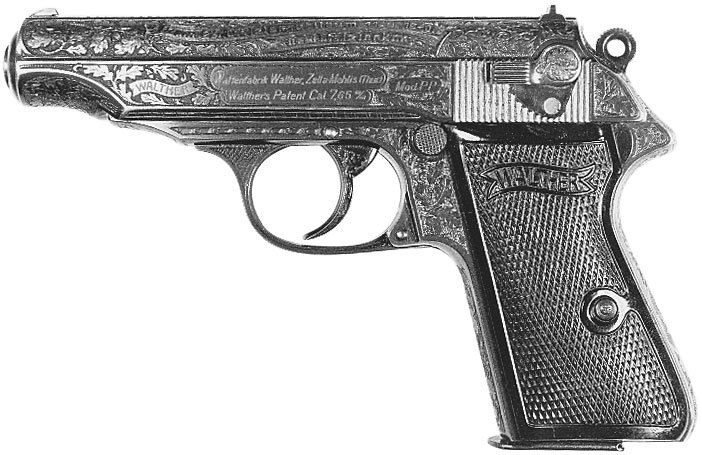
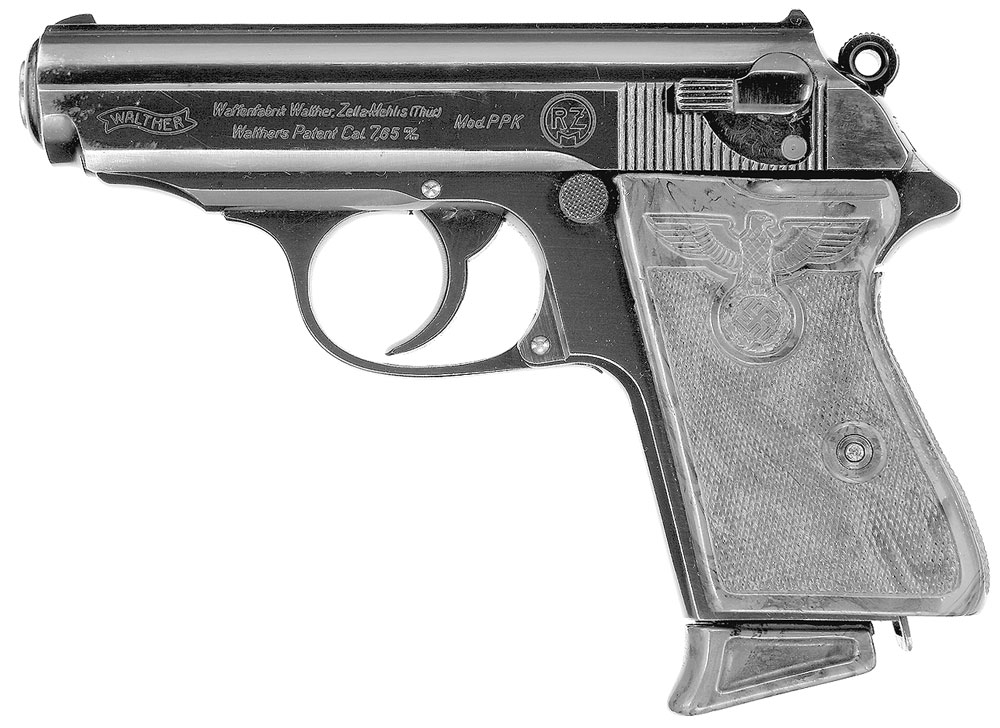
Although the Walther Company has produced many types of pistols from the early 1900s, the Models PP and PPK were latecomers on the automatic pistol scene when compared to such pistol manufacturers such as Mauser, Luger and Colt as they did not make their appearance until 1929. However, shortly thereafter they were being sold in all parts of the world. These beautifully-made guns were the first of the original double-action blowback semi-automatic pistols. They had a successful commercial design with a high polished blue finish that was second to none.
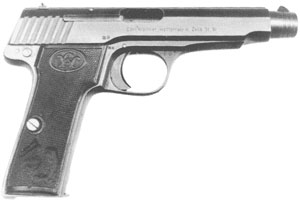
The Walther Model 6.
A few years after the Models PP and PPK appearance on the world’s firearm market, Adolf Hitler and the National Socialist German Workers Party took over the reigns of the German government, the military and the police. It was then that a majority of the Walther production was contracted for by the NSDAP, German army and the national police.
With the emergence of the NSDAP as the power in Germany, the increase in military power was ordered, and the Army High Command-OKH-Heereswaffenamt began placing contracts with the Walther Company for both the Walther Models PP and PPK. Most of the models were contracted in caliber 7.65mm.
There were contracts for a smaller amount of Model PP in caliber 9mm Kurz and even less in the Model PPK in the same caliber. Depending on their serial number range, these pistols showed Crown over N. or Eagle over N. nitro proofing on the right side of the pistol’s slide, barrel and chamber. The military acceptance proofs, Eagle over 359 and Eagle over WaA359 were placed on the left side of the pistol’s slide and frame to the rear of the model designation and to the rear of the trigger on the frame.
The Models PP and PPK with the Waffenamt proofs began with a high polished blue finish on each pistol. But as the years progressed toward the end of World War II and the labor diminished these models showed a milled finish. The following is a short description of the Models PP and PPK bearing the Waffenamt proofs.
The first of the Models PP and PPK with the high polished blue finish had the Eagle over 359 proof on the left side of the slide and frame with an occasional proof on the left rear of the slide at the tang. Grips were black on the Model PP and brown on the Model PPK.
The second series of proofs was the Eagle over WaA359. These too were found on high polished Models PP and PPK except there was no proof on the rear of the slide at the tang. Grips were black and brown respectively.
The third series was the Eagle over WaA359 found on the milled finish models till the end of World War II. On these later pistols the proofs remained in the same location on the pistols with some changes in the pistols themselves. On the Model PP you will find the standard two-piece black grips as well as reddish colored grips.
Walther Model PPK with Party Leader Grips.
Near the end of World War II Walther pressed its wood grips with the Walther Banner. On some of the late PP models there will be an AC proof on the right side of the slide in conjunction with the serial number. Some of the late Waffenamt Model PPs will have no legends or inscriptions on the left side of the slide. These models have flat frames with no step at the trigger guard hinge, and some have no indicator pin. On the Model PPK, the pistol will have the standard brown, one piece wraparound Walther grips and will be found with grayish grips as well as black ones.
The Model PP and PPK in 9mm Kurz are both fairly rare pistols. With Waffenamt proofs they are even rarer. These pistols usually have bottom magazine releases. Their magazines will have the Walther Banner and Cal. 9mm on the left side of the magazine. Many of the 9mm Kurz models had the magazines numbered to the serial number on the pistol. These 9mm Kurz models all had a high polished finish.
There were earlier manufactured Walthers that were used by the military. Walther began to manufacture pistols in 1908 with their production of the Model 1. The Model 4, produced in 1910, was their first really successful pistol. This semiautomatic was the approximate size of the Model PPK that saw use in World War I although there are no records showing that the German military placed a contract with the Walther Company. Most were carried as sidearms by officers of the German Imperial Army. The Model 6 was basically a large Model 4 in caliber 9mm Parabellum.
It was designed for the German Imperial Army in 1915. It was the first pistol that Walther designed and produced for the military and the first Walther in 9mm parabellum. It was produced for a period of two years and there were probably less than 1500 manufactured. After the war, some Model 6s remained at the factory. They were proofed “Made in Germany” and exported, some to the United States. In the United States the Model 6 is quite rare and commands a high price.
The Model 7 was a small version of the Model 6 in 6.35mm. Walther produced these pistols for the military for about six months. They were carried by many German officers. Although in 6.35mm it was the largest 6.35mm pistol produced by Walther at the time.
In 1920 and 1921 Walther produced both the Models 8 and 9 for commercial sales. They were the first of the modern Walthers with many features seen later in the Models PP and PPK. Both these pistols were favorites of German officers in World War II as hide-out pistols. However, the Model 8 was carried by many officers in a holster on their belt.
The military Model PPK is more difficult to find than the Model PP. The high polished pistols in both models are both fairly rare. It will take some time for a collector to put a collection of Waffenamt Models PP and PPK together, but with perseverance one should be quite pleased with his or her collection. One should remember in the collecting of firearms, Walthers or any other maker, condition is everything.
This article appeared in the Standard Catalog of Military Firearms, 6th Edition.
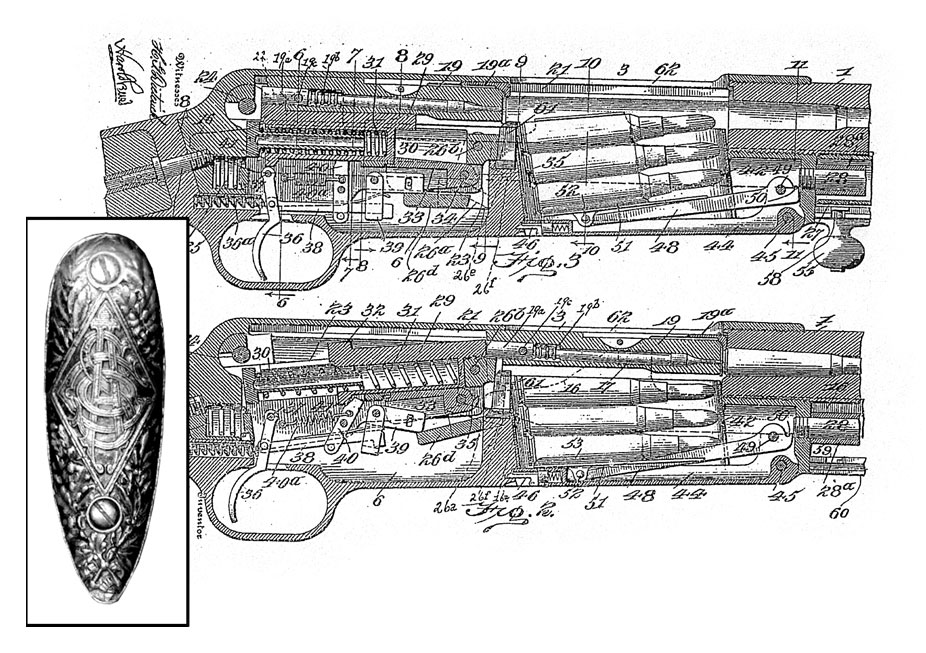
On March 6, 1906, Morris F. Smith of Philadelphia received Patent No. 314,242 for an “automatic gas-operated rifle.” That rifle was the Model G, which had a swell buttplate (left).
The road to progress is not without its occasional pothole. One notable example with firearms is the Cochran Turret Revolver, an early percussion handgun in which the rotating, slab-like cylinder was mounted flat on its side with its chambers pointing outward like the spokes of a wheel. Thus, at any given moment, at least one of the loaded chambers was always pointed backward — toward the shooter. (Oops!)
The Late, Great Model G
Another example is the Standard Model G, America’s first gas-operated semiautomatic sporting rifle. Arguably the most unique American rifle — a combination autoloader and pump repeater — the Model G was a lesson in how even the best concept can go astray. We must pity Morris F. Smith of Philadelphia, Pa., who thought the thing up.
Not much is known of Smith. We know, however, that on March 6, 1906, he was awarded Patent No. 314,242 for an “automatic gas-operated rifle,” illustrated nearby.
Gas-operated arms were nothing new; John Browning had designed a workable gas-operated machine gun, the Colt Potato Digger, nearly a decade earlier. But no one had yet adapted the force of expanding gas to a semiautomatic sporting rifle until Smith did so.
Other types of semiauto sporting rifles were available in 1906. Winchester’s Model 1903 (later the Model 63) .22 Self-Loading Rifle was already a smash hit. Also that year, Browning designed a high-powered semiauto that would still be offered a half-century later: the classic Remington Model 8 (later the M81). Winchester followed the 1903 with the models 1905 and 1907 centerfire semiautos, the latter of which only succumbed to the wheels of progress in 1957. But until the Model G, the only autoloaders that made it into production in America were the Remington and Winchester’s self-loaders.
All those rifles were based on long-recoil (Remington) or straight blowback (Winchester) actions. True, Winchester’s William Mason had begun work on an experimental gas-operated autoloader about 1900, but it never made it past the prototype stage. Nowadays, when almost every centerfire semiauto rifle and shotgun is gas-operated, we should remember that it started with the Standard Model G.
Smith’s patent specification pretty well summed up the idea behind the Model G: “My present invention relates to firearms or guns in which powder-gas pressure developed in firing is utilized for actuating the working parts in reloading after each shot is fired.”
So far, so good. In the next line, however, Mr. Smith entered the realm of fiction: “(The object) is to greatly simplify the mechanism of such a gun and to render it more reliable in action and more durable in use.” “Reliable?” “Durable?” Does the Model G’s “mechanism” in the patent drawing above appear to be simplified to you?
Problems Abound
Nowadays, we can be sure that Smith was the only person who ever used those terms with the Standard Model G. Soon after its introduction in 1910 by the Standard Arms Co. of Wilmington, Del., the Model G acquired a toxic and enduring reputation as a jammer.
All guns jam, of course. It goes with the territory. But the Model G brought a new dimension to the word “jam.” When other guns jam, you spend a few minutes monkeying with a stovepiped shell casing or, at worst, a broken extractor. When a Model G jams, however, your shooting is finished for the day — if not the week.
I’m afraid I speak from experience. I have owned three Model Gs, one in each available chambering (.25, .30 and .35 Remington). Each was a heartbreaking, maddening jammer.
The problem with the Model G was that no steel then in general use could withstanding the ferocious energy of expanding powder gas.
In Smith’s design, the expanding gas bled from the barrel via an adjustable port and traveled backward toward the bolt through a gas tube below the barrel. The gas exited the tube to push against a cup-shaped piston, which was attached with a feeble crosspin to a scissors-like pair of bolt extensions. When all went well, which was too seldom, the piston thrust the bolt extensions backward, initiating the extraction-ejection-reloading cycle.
When all did not go well — usually on the third or fourth shot — the wimpy little crosspin sheared off and locked up the entire works. The shooter was done for the day (unless you count muttered profanity).
It wasn’t supposed to be that way, Standard Arms insisted. The Model G was supposed to be “the neatest looking, handiest to carry, easiest to operate, quickest to reload, best all-round automatic rifle in the world,” according to the Model G owner’s manual sent to me by friend Dan van Vorst of Palominas, Ariz.
True, the Model G had a lot going for it. It incorporated a flush-mounted, bottom-opening integral magazine that permitted the use of pointed bullets. Its gas action mitigated recoil, and its lines were surprisingly modern and businesslike.
But in the guts department, the Model G just wasn’t up to the job.
Perhaps Smith had an inkling of the weakness of his concept because he designed the Model G to function as a manually operated pump rifle, too. By closing the adjustable gas port and pressing in on a small button in the rifle’s forearm, you could rack the action much as you would that of a pump shotgun.
Let’s talk about that forearm. It might be the most beautiful or gaudiest piece of metalwork ever to grace a firearm. Cast of brass alloy, it features a bas-relief moose and assorted Germanic scrollwork. The matching buttplate, shown nearby, is probably the busiest, most intricate of all time.
Still, a pretty forearm and buttplate weren’t enough to save the Model G.
Within several years of the Model G’s introduction, as the skies over America’s hunting grounds turned blue with a chorus of curses directed at the doomed rifle, Standard Arms Co. threw in the towel. They discarded the Model G’s gas system and put their money on the pump-only Model M (as in “manual”), a dumbed-down version of the G. That was to no avail, however. By then, the Remington Model 8 had sold shooters on the virtues of the semiauto. Standard Arms Co. sank from sight without a ripple before 1920.
Attorney General Eric Holder has broken an agreement with Republicans by refusing fully to respond to questions on the growing Fast and Furious scandal, Sen. Charles Grassley alleges in an exclusive Newsmax interview.
Grassley said he allowed the nomination of Deputy Attorney General James Cole to move through the Senate in return for a pledge that questions on the gunrunning scheme would be answered.
But Holder’s Department of Justice has stonewalled since Cole was approved in June, the senior senator from Iowa said.
“We’re getting inadequate answers,” he said. “The inadequacy of the answers is a violation of the agreement that we have with the attorney general that we will get all of our questions and sub-questions answered fully, based upon the deal that we made that I would let the nomination for the deputy attorney general move through the Senate.
“Until they did that, I wasn’t going to let it move and that leveraged them to make this agreement with us and they aren’t even following their own agreement with us.”
Grassley, the ranking Republican on the Senate Judiciary Committee, and his House counterpart, Rep. Darrell Issa of California, led the questions on Fast and Furious, a program which allowed about 1,400 weapons to be bought and taken across the Mexican border. Read more
On October 16, 1991, Hennard drove his 1987 Ford Ranger pickup truck through the front window of a Luby’s Cafeteria at 1705 East Central Texas Expressway in Killeen, yelled “This is what Bell County has done to me!”, then opened fire on the restaurant’s patrons and staff with a Glock 17 pistol and later a Ruger P89. About 80 people were in the restaurant at the time. He stalked, shot, and killed 23 people and wounded another 20 before committing suicide.
During the shooting, he approached Suzanna Gratia Hupp and her parents. Hupp had actually brought a handgun to the Luby’s Cafeteria that day, but had left it in her vehicle due to the laws in force at the time, forbidding citizens from carrying firearms. Both of Hupp’s parents were murdered that day.
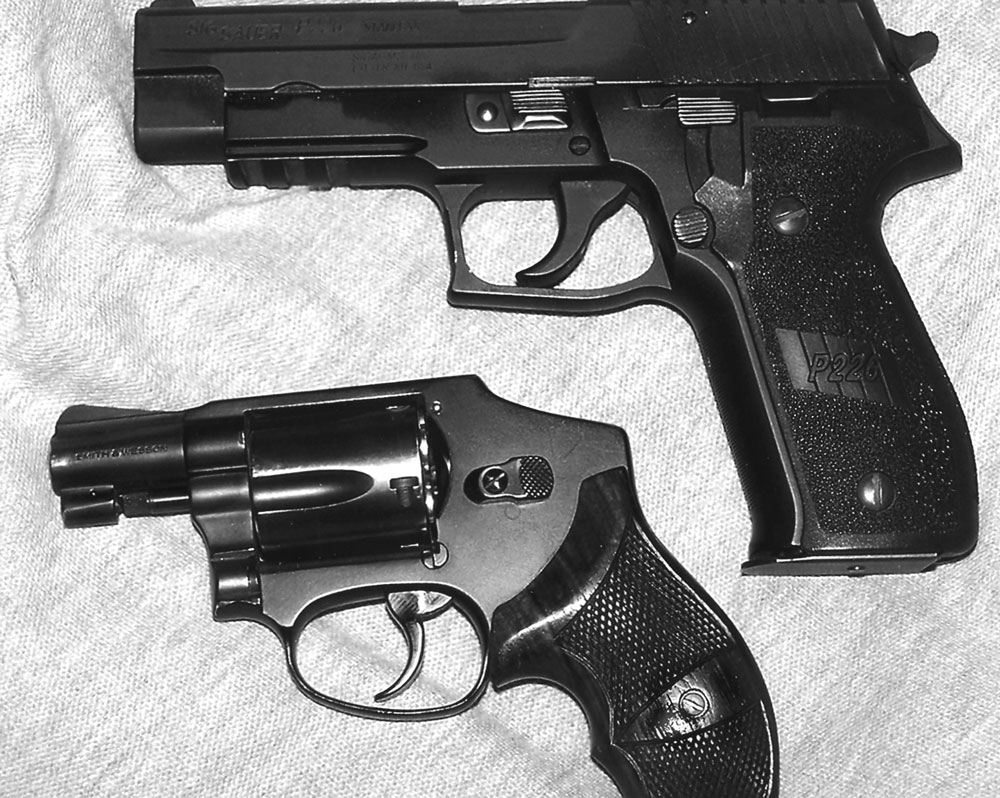
SIG P226R 16-shot 9mm, above, backed up by 5-shot 38 Special S&W Model 442, below.
“Gentlemen, Choose Your Weapons”
There are several different approaches to the selection of backup guns. Predictable danger, wardrobe, training and familiarity already ingrained, and other situational factors will determine what might be the best approach on any given occasion.
On “heavy days” – i.e., high-risk situations – a pair of full-size fighting handguns makes sense. There is lots of historical precedent for this. On the Western Frontier, gun-wise lawmen from Wild Bill Hickok to Wyatt Earp carried a brace of sixguns. That is, a matched pair. Hickok wore twin Navy Colt .36 caliber cap-n’-ball revolvers, and allegedly “freshened” them daily by firing each charge in each chamber every morning in a short practice session, and then reloading with fresh powder, ball, and caps. Earp wore a pair of Colt Single Action Army revolvers, caliber 45 Colt.
Similar practices were seen in more modern times. On the night he and his team took down John Dillinger, FBI Agent Melvin Purvis was said to have been carrying a pair of Smith & Wesson Military & Police 38 Specials. That significantly outgunned the Colt Pocket Model 380 Dillinger was carrying, though it is believed that a 45 ACP bullet from the Colt Government Model of another agent was what actually killed FBI’s “Most Wanted” fugitive that night in Chicago.
Decades later the most famous member of the NYPD Stakeout Squad, Jim Cirillo, went to work each day with essentially the same gear carried by Purvis, though by then that particular Smith & Wesson was known as the Model 10. Each of Jim’s was a four-inch, with a heavy barrel on the strong-side hip and a tapered barrel version worn cross-draw as backup. Jim actually had one more backup gun on each occasion, a Colt Cobra 38 with a hammer shroud and two-inch barrel, carried in a pocket, and usually had a 14-inch barrel Ithaca 12-gauge shotgun handy to start things off.
Because most days aren’t heavy days, a much more common paradigm has long been the full-size, serious-caliber “combat handgun” as primary weapon, with a smaller and sometimes less powerful handgun for backup. Generations of cops have used tiny 25 autos for backup. While they are better than nothing, these guns are infamous for their poor stopping power, and being very tiny, they also tend to be difficult to manipulate under stress. Long before that, it was popular for lawmen to carry a six-shooter as primary, and a two-shot derringer as secondary. The derringer, fortunately, has pretty much passed from the scene.
Today, tiny 32 autos like the Seecamp, the North American Arms Guardian, and the irresistibly slim and light Kel-Tec P32 have found their way into backup position on the bodies of many police officers and armed citizens alike. In common with their predecessors, they are better than nothing, but they are also feeble in terms of the power they can put out. It is significant that when police departments issue backup guns, they normally look for something more powerful.
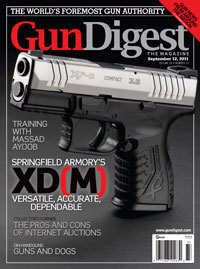
Gun Digest is the source for firearms news, pricing and guns for sale. Readers benefit from in-depth editorial expert advice, show reviews and practical how-to instructions. With your Subscription, you’ll also learn about threats to your Second Amendment rights. Click here to begin your subscription to Gun Digest.
Inside this issue:
Springfield Armory XD(M)
Pros and Cons of Internet Auctions
Guns and Dogs
Training with Massad Ayoob
Gun shows, auctions, classifieds and more!
Not a subscriber? Make sure you don’t miss another issue! Subscribe now
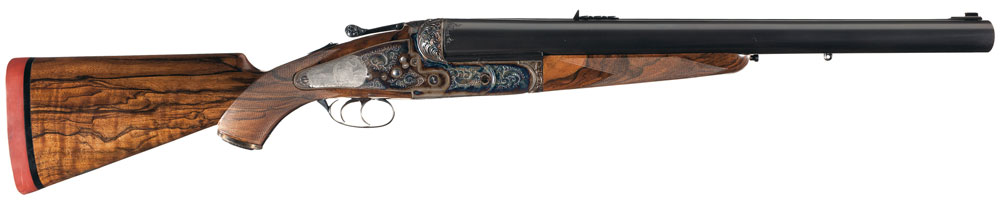
This is just about the largest and most powerful double rifle made any where in the world. Skillfully hand crafted by master gunsmith Ken Owen of Memphis Tennessee in the early 1990's, this is an exceptional and truly rare 4 bore double rifle. Estimated Price: $85,000 - $140,000
Gun Auction Snapshot
Auction Dates: September 9, 10, & 11
Putnam Green Collection: Part II – Outstanding U.S. & German Military
Over 75 Rare, Historical, and High Condition U.S. Martial Arms
Museum Quality Remingtons from the James Tipton Collection
Over 300 pieces of 19th Century American Stoneware – Over 75 pieces of Anna Pottery, the largest and finest collection of Anna Pottery ever offered at auction
Over 130 1911s
Over 350 Lugers
Over 500 Sporting arms
Rock Island Auction Company announces their premiere collector’s firearms auction to be held September 9, 10, & 11 at their new facility Rock Island, IL.
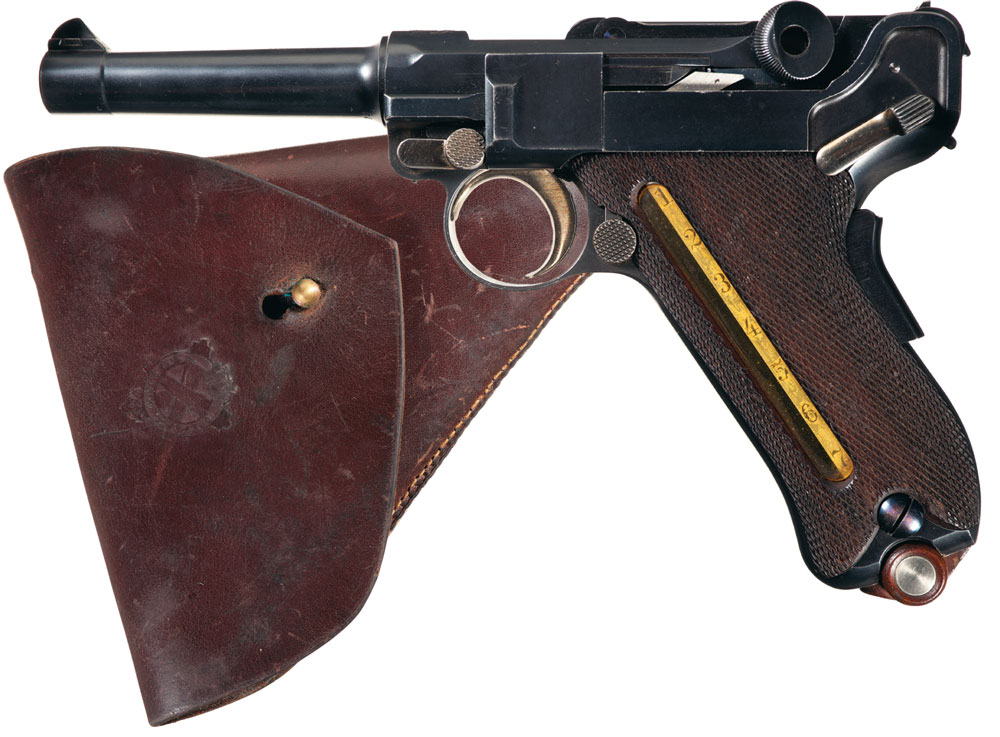
One of only 50 produced, all in the 22401-22450 serial number range, this specimen, is a superb example of an extremely rare 1902 DWM Luger that has been fitted with the unique "Powell Indicating Device", commonly called a "Cartridge Counter" on the left side of the grip. Estimated Price: $50,000 - $90,000
The Putnam Green Collection was the finest U.S. & European Military collection ever offered at auction. This September RIAC is proud to feature The Putnam Green Collection Part II: An outstanding collection of rare, historic, and high condition U.S. & German Military Arms. This collection features over 100 of the most unique firearms, uniforms and holsters. Highlights of this historic collection include: The finest known historical U.S. DWM Model 1902 American Eagle cartridge counter Luger pistol serial number 22430 with holster ($50,000-$90,000 ), a magnificent Mauser Model 1912/14 experimental pistol in 9mm, with matching shoulder stock ($45,000.00-$80,000.00) and a rare early production U.S. Colt Model 1911 semi-automatic pistol serial number 33 ($40,000-$80,000). The quality military arms in this collection also include prototype P-38’s, DWM Model 1900 Test Luger, multiple presentation pistols, exceptional German military longarms and sniper rifles, and the finest known Springfield 1903 with shipping case as well as many posters, uniforms and military memorabilia. This incredible collection is only the beginning of the outstanding military arms being featured this September at RIAC.
In addition to incredible quality, this September auction offers quantity with over 400 U.S. Military arms brought to auction. Over 25 trench shotguns from WWI and WWII, more than 130 1911’s and Part 1 of the finest M1 Carbine Collection, featuring every serial number block for each contractor of M1 Carbines during WWII. Top U.S. Military lots include an excellent WWI production Winchester Model 1897 trench gun ($5,000-$7,500) and a desirable WWII inland M1 carbine with M3 infrared sniper scope and accessories (4,500-$6,500). Also many uniforms and memorabilia identified to historic Generals such as Douglas MacArthur, David McCampbell, and George S. Patton.
The impressive military is not limited to U.S., German military arms are also well represented. Once again RIAC has assembled an astonishing collection of over 350 Lugers with highlights including: an outstanding cased Model 1893 Borchardt pistol rig complete with matching walnut shoulder stock, four matching magazines and accessories ($25,000-$45,000), a WWII Nazi “1943” Dated Krieghoff luger rig with Luftwaffe/Krieghoff proofed holster and matching magazine ($8,500-$13,000), and an excellent DWM Model 1900 American Eagle Luger semi-automatic pistol with rare ideal stock ($4,500-$6,500). Other notable German arms include two WWII Cased J.P. Sauer & Sohns Luftwaffe M30 Survival Drillings, nearly 50 P-38s including prototypes and zero series, and sniper rifles many of which are rare and in high condition.
Going back further into military arms, RIAC is offering some of the rarest and historical Martial arms to ever come to auction. Of the 75+ Martial arms none are more impressive than the extremely rare John Miles 1798 U.S. Philadelphia contract blunderbuss with “Aetolian Waterloo” inscription ($50,000-$150,000) This is one of the few examples of a brass barreled shoulder blunderbuss made by John Miles Sr., circa 1798-1799 in existence. Going back even further is an extremely rare Revolutionary War, Thomas Ewing inspected, Maryland Council of Safety Gunlock Manufactory flintlock pistol ($50,000-$250,000). This pistol is 1 of 2 known to exist, and is in exceptional condition for a Revolutionary War pistol. Over 40 additional martial flintlocks make this a must participate for any early American arms collection.
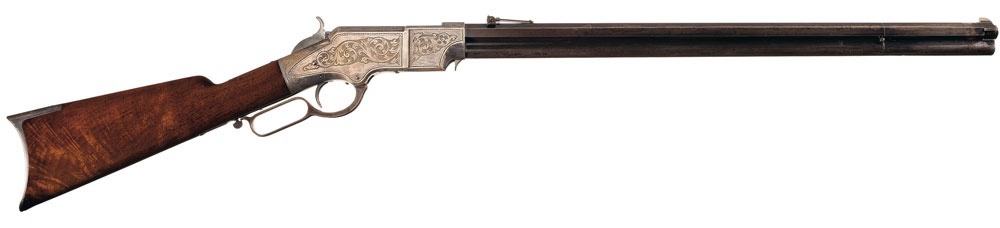
This is an important example of an exhibition quality, factory engraved silver finished Henry rifle that was manufactured by the New Haven Arms company in the months of 1865 and is attributed to factory engraver Samuel Hoggson. Estimated Price: $90,000 - $160,000
Fast forward to the Civil War and take note of three incredible Henry rifles. A magnificent deluxe factory engraved, New Haven Arms Henry lever action rifle with silver plated frame ($90,000-$160,000), a historical presentation Henry Lever Action Rifle, inscribed to Andersonville Prison survivor Frank W. Smith from famed Ohio philanthropist Stillman Witt with extensive documentation ($50,000-$100,000), and a U.S. Contract Henry Rifle ($45,000-80,000). In addition are many rare Civil War handguns and longarms.
The ATF has promoted three key supervisors of a controversial sting operation that allowed firearms to be illegally trafficked across the U.S. border into Mexico.
All three have been heavily criticized for pushing the program forward even as it became apparent that it was out of control. At least 2,000 guns were lost and many turned up at crime scenes in Mexico and two at the killing of a U.S. Border Patrol agent in Arizona.
The three supervisors have been given new management positions at the agency’s headquarters in Washington. They are William G. McMahon, who was the ATF’s deputy director of operations in the West, where the illegal trafficking program was focused, and William D. Newell and David Voth, both field supervisors who oversaw the program out of the agency’s Phoenix office.
McMahon and Newell have acknowledged making serious mistakes in the program, which was dubbed Operation Fast and Furious.
“I share responsibility for mistakes that were made,” McMahon testified to a House committee three weeks ago. “The advantage of hindsight, the benefit of a thorough review of the case, clearly points me to things that I would have done differently.” Read more
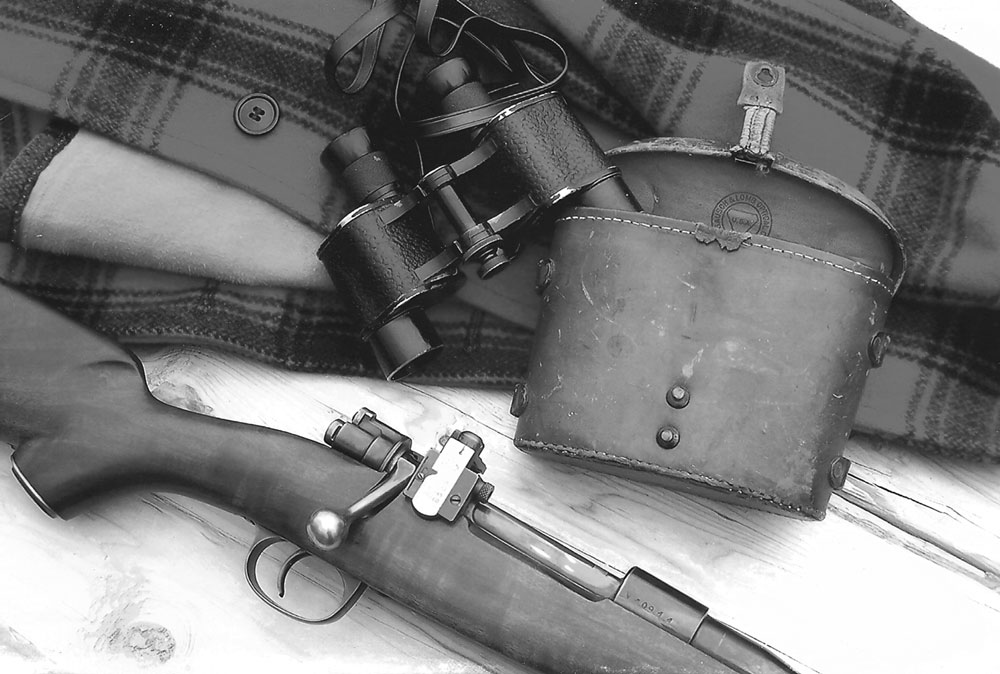
These Bausch & Lomb 6-power (6 X 30mm) binoculars are World War II-vintage, and were issued for use by the U.S. Navy. Later, when sold as war surplus, thousands were purchased for use by hunters. The author purchased these binoculars recently at the Log Cabin Gun Shop in Lodi, Ohio, after completing the work on his 7mm/08 Mauser. They were used on the Wyoming antelope hunt.
I think the idea of sporterizing a military Mauser has been with me since I was in my early twenties. There is no doubt that it was the direct result of reading Jack O’Connor’s books and articles. He, of course, was the shooting editor of Outdoor Life magazine from 1937 until 1973, and, without doubt, was one of the most influential gun writers of that time. Like many others of my generation, I greatly admired O’Connor’s articles during the years when I was beginning to hunt, and could hardly wait for the next monthly issue of that magazine to arrive in the mail. Certainly, he had a lot to do with feeding my early passion for hunting and accelerating my love of fine sporting firearms, particularly the big-game rifles.
One type of rifle that he obviously admired was the custom sporting Mauser. For me, some of the pictures of his Mauser sporters were simply the stuff of a young rifleman’s dreams, and I hoped some day that I could have one of my own. However, I understood that O’Connor’s best Mausers were the products of the fine work of such master craftsmen as Alvin Linden, Al Biesen and W. A. Sukalle, and, as the years advanced, I knew that such custom work was far too costly for my budget. That left only one alternative: I would have to build my own.
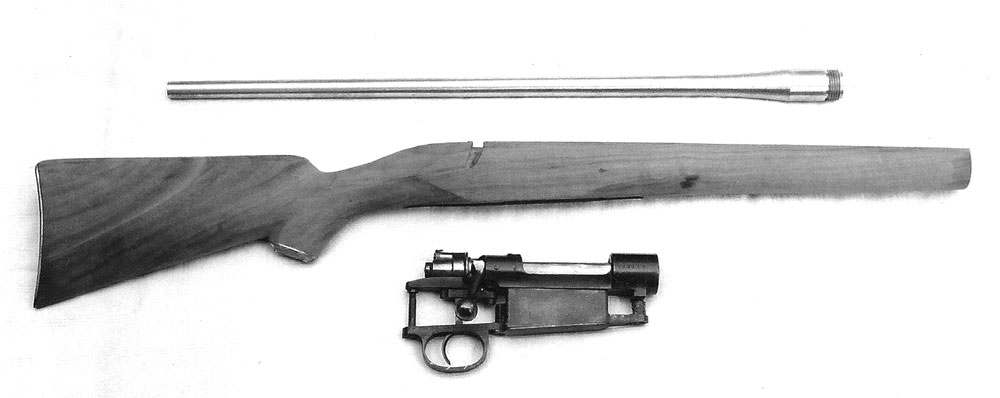
The main ingredients of author’s military-to-sporter conversion were (top to bottom) a 24-inch, 7mm Douglas barrel; a semi-inletted stock blank from Bob’s Custom Gun Shop, of Polson, MT; and the action of a Yugoslav Mauser.
Of course, I had no illusions of my work’s ever comparing to that of some great rifle-maker. After all, I’m no custom gunsmith – just a retired prosecutor who happens to love good rifles, hunting and competitive shooting. But, somehow, it seemed important to me to have a sporterized Mauser with the lines of the classic style of a bolt-actioned hunting rifle of the 1920s, ‘30s or ‘40s. And, if all went well, the fact that I would have built it myself would simply make it more special, to me at least.
Now, tinkering around at home with a surplus military rifle to make it more suitable for use as a sporting rifle – and to make it better fit the needs and taste of its civilian owner – is one of those hobbies that has occupied the time of many a rifleman/hunter. That pursuit probably achieved its greatest popularity in the years following World War II, when tons of U.S. and foreign military rifles were made available to the public. Shooting publications of the late 1940s, ’50s, and early 1960s commonly ran pages of advertisements from companies such as Klein’s, Winfield and Ye Old Hunter that promoted these low-cost, surplus rifles. Money was tight then for most average families, and the better military surplus rifles were seen as less-expensive alternatives for the big-game hunter. All that was needed was a little imagination and some time in the home workshop.
As a matter of fact, my first deer rifle was a Mark IV .303 British Short Model Lee Enfield (SMLE) that my dad bought for me from a discount store. The cost of the rifle was less than $20. Of course, it was my job to convert it into the sporting rifle I wanted.
I worked on that old .303 in our basement, usually at night and on weekends. I cut down the military stock, reshaped the forend, removed some unnecessary metal (such as the clip guide and military peep sight), shortened the barrel to 22 inches, and cold-blued the barrel and action. It was slow work, and painful, too, when a tool would slip at the wrong time. But, I learned a lot about files, rasps, hacksaws and other simple handtools during the process. Of course, I did not feel competent about doing some of the work. On those occasions, I would enlist the help of a local gunsmith, such as the one who added a Williams front-sight ramp and a Williams 5-D receiver sight. (By the way, that 5-D sight actually did cost only five dollars back then; the year was 1960.)
My conversion of that .303 British was very inexpensive. It was also a little crude-looking. But it worked. In November of 1960, I harvested my first deer with that rifle using a 215-gr. .303 British Winchester factory load. Some time later, I got tired of the look of the .303’s converted military stock and bought a semi-inletted, two-piece stock blank from Fajen. I took my time, carefully shaping and finishing the stock and even doing some follow-up metal work. The rifle now looks quite nice and still shoots well, either with 215-gr. jacketed bullets or with the heavier gas-check cast bullets such as Lyman’s No. 308284 or their No. 311299.
After all the time and sweat I had in that old .303 British, perhaps it should seem that the last thing I would want to do much later in life would be to start another such project. But, as I said earlier, O’Connor’s articles and photos had kindled that desire many years before, and now, after my retirement, I really wanted to try another military-to-sporter conversion, this time on a Mauser. And this time the conversion would be a more extensive one.
The basis of my conversion turned out to be a clean Yugoslav Mauser that I bought through my local gun dealer. The Yugo Mauser is a large-ring M98 variation with an intermediate-length action. When I got home, I disassembled it, and everything (including the stock and barrel) was discarded except for the action.
Here the Douglas barrel is being turned in a Smithy lathe to bring it to proper dimensions so that it would properly headspace the 7mm/08 Remington cartridge.
Before committing to a military-to-sporter conversion project, it is crucial to understand the rifle to be converted. There is probably no better source on the various Mausers, and how they work, than The Mauser Bolt Actions – A Shop Manual, by Jerry Kuhnhaussen (published and distributed by Heritage Gun Books). That book is filled with crucial information for the person who undertakes the home conversion of a military Mauser.
Of equal importance, the home gunsmith must understand his own limitations. Otherwise, the converted rifle may wind up in the trash, rather than in the hunting fields or on the target range. As an example, I wanted my converted rifle to have a streamlined bolt handle, rather than its unsightly military version. But, from the onset of this project, I knew I simply did not have the know-how, the experience, or the equipment necessary for that part of the conversion. Therefore, I farmed out that task to Bob Riggs, a nearby gunsmith who has had a lot of experience in such matters. As per my request, Bob cut off the old bolt handle and replaced it with a new handle which I had purchased from Brownells, the gunsmith supply house in Montezuma, Iowa. It was mounted to the Mauser’s bolt at the same angle as used by Winchester on its Model 70 actions.
As to the rifle’s new chambering, I gave some thought to one of O’Connor’s favorites, the 7mm Mauser (7X57) but finally decided on the 7mm/08 Remington instead. Handloaded to their full potential, these rounds are nearly identical ballistically. However, factory loads for the 7mm/08 Remington are loaded to much higher pressures (and velocities) than 7mm Mauser factory loads because the 7mm Mauser is chambered in many older, weaker actions. Further, although I handload almost all of my ammunition, there is always the chance of being on a hunting trip and, in a pinch, for one reason or another, having to rely on factory ammo. Thus, the nod went to the Remington round, which I consider completely suitable for medium big-game and for heavier varmints as well.
Of course, I needed a new barrel, and for that I contacted Douglas Barrels, Inc., of Charleston, West Virginia. That company has been supplying fine quality barrels — at reasonable prices — since just after World War II. And, besides, that business was located just a couple of hours’ drive from my home in Kentucky. A simple phone call to Douglas Barrels assured me that they could supply what I wanted. First, however, they wanted to test the hardness of my Mauser’s action to make sure it was suitable for the conversion I had in mind. I took the action to them, and it passed the test.
Just a few days later I had a new Douglas XX, “air-gauged” premium barrel in hand. I had opted for a medium-weight sporter barrel 24 inches in length. The barrel was delivered in the white, threaded for the Mauser action, and was chambered for the 7mm/08. The rate of twist was one turn in nine inches.
Since I would be barreling the action myself, the folks at Douglas had deliberately cut the 7mm/08 chamber slightly deeper than necessary to allow for proper headspacing. Following the instructions accompanying the barrel, I managed to headspace the barrel and mount it to my action using my small Smithy lathe, depth gauges, headspace gauges, a barrel vise and wrench, and, most importantly, a lot of patience. It turned out just fine.
After the rebarreling process was completed, the metal surfaces of the barrel, action, floorplate and new bolt handle were hand-polished down to a 400-grit finish using emery cloth. Although there was some pitting on the action, it was quite shallow, so the polishing was not quite as tedious as I had feared. I also thinned, contoured and polished the trigger guard, which added remarkably to the rifle’s overall appearance.
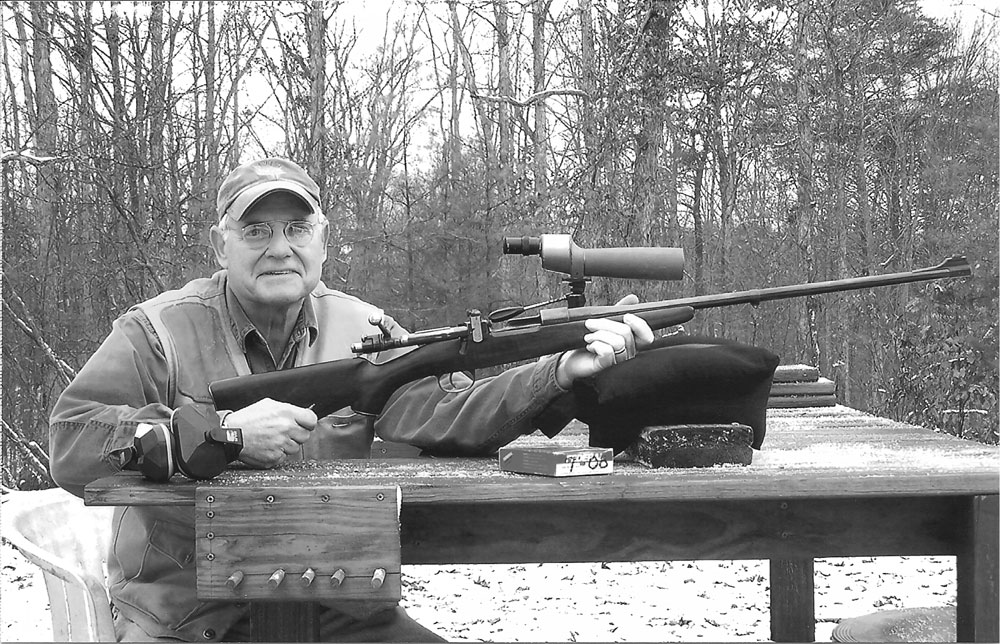
A picture of the author at his 200-yard shooting bench. He was pleased with the appearance, balance and accuracy of his converted Yugo Mauser.
As for sights on my new rifle, I wanted iron sights only. I felt they would better suit the type of rifle that I had in mind. Besides, to me there has always been a certain added degree of satisfaction that comes when hunting with iron sights that is not present when the rifle is equipped with a scope. And I liked some of the early hunting pictures of Jack O’Connor and his wife, Eleanor, armed with scopeless rifles that were equipped with receiver aperture sights. Consequently, I made contact with a Texas dealer who specializes in old, out-of-production iron sights, and was able to locate exactly what I wanted: a Lyman 48M receiver sight, designed specifically for the Mauser 98 action. (The famous Lyman 48 receiver sight was in production continuously from 1911 until 1974. My 48M sight was the third edition of that sight, introduced in 1947.)
Using levels, a small machinist’s clamp and the drill press on my Smithy, I drilled and tapped the Mauser’s receiver for the old Lyman sight. That job was completed without a hitch, and, to me, the sight complements the look of the rifle.
The front sight that I chose to use was the N.E.C.G. “Masterpiece” Banded Front Ramp. This is a ramp sight that attaches to the barrel by means of a barrel band. It is sold in conjunction with several different interchangeable front sight inserts. The insert I chose was a post with a sloping, brass face, reminiscent of the old Redfield “sourdough” front sight.
I found an unfinished, semi-inletted stock blank for my 98 through Bob’s Custom Gun Shop of Polson, Montana. To ensure that the stock’s holes for the guard screws would properly align with my “intermediate” length Yugo action, I shipped the action to them, and they cut the blank using the Yugo action as a guide. Once the action and stock were returned to me, I found the stock’s wood to be a nicely-figured grade of dense, dark walnut. Also, per my request, the folks at Bob’s had fitted a steel grip cap and one of the checkered-steel Neider buttplates to the stock, saving me many hours of labor. But there was still a lot of work to be done on my part before the stock would be completely fitted and finished.
To ensure that the stock would be tightly fitted to the action, I finished inletting for the barrel and action using the old lamp-black method. Simply put, I “smoked” the barrel and action over a kerosene lamp. (Actually, my kerosene “lamp” was a small, glass baby-food jar with a metal lid; I punched a hole in the center of the lid and slid in a round wick. The jar was then filled with kerosene and the wick was lighted and adjusted to a higher-than-normal position to allow it to smoke. This is much smaller and handier around the workbench than a regular kerosene lamp.) The action and barrel were held over the lamp’s wick and, once sufficiently blackened, were then carefully placed in the stock, and tapped lightly with a rawhide hammer so that smudges would be left by the lamp black where the metal came into contact with the wood. The action and barrel would then be lifted from the stock, and a scraping tool was then used to remove the black marks that had been left on the wood. This process was repeated many dozens of times before the inletting was complete, but the result was an inletting job that was as perfect as I felt I could achieve.
I chose to “float” the barrel in the stock rather than have it bedded to contact the stock’s forend. Floated barrels have given the best accuracy in my target and hunting rifles and have proven to give less change in the point of impact of the bullet in differing atmospheric conditions. Consequently, when the inletting was finished, I removed some of the wood of the stock from the flat under the front receiver ring and from the recoil lug recess to a point in the barrel channel about 1-1/2 inches ahead of the action. This allowed room for the bedding compound; I used Brownells’ Acraglas Gel. After the Acraglas bedding process was completed, I then removed just enough wood in the remainder of the barrel channel so that a dollar bill could barely pass between the barrel and its channel in the stock. As a result, the only place the stock’s forend and the barrel made contact was the first one and one-half inches ahead of the receiver ring.
I wanted my rifle to have the look of some of the older American and European bolt-actioned sporting rifles, so I cut the forend of the stock to a shorter length than is commonly seen today. I did not intend to use a “shooting” sling on this rifle; rather, I wanted only a carrying sling. The front swivel for that sling would attach to a stud that would be part of a barrel band that would be mounted about three inches in front of the tip of the forend. I located such a barrel band swivel stud (manufactured by Gentry) in the Brownells’ catalog and ordered it.
When the remainder of the stock-shaping was accomplished, it was sanded to a smooth finish using 200-grit sandpaper and then #00 steel wool. The last stock work prior to applying the finish was to lightly moisten the stock with a damp cloth to raise the grain and sand it smooth again with the steel wool. This last process was repeated 4 or 5 times until the grain of the wood could no longer be raised.
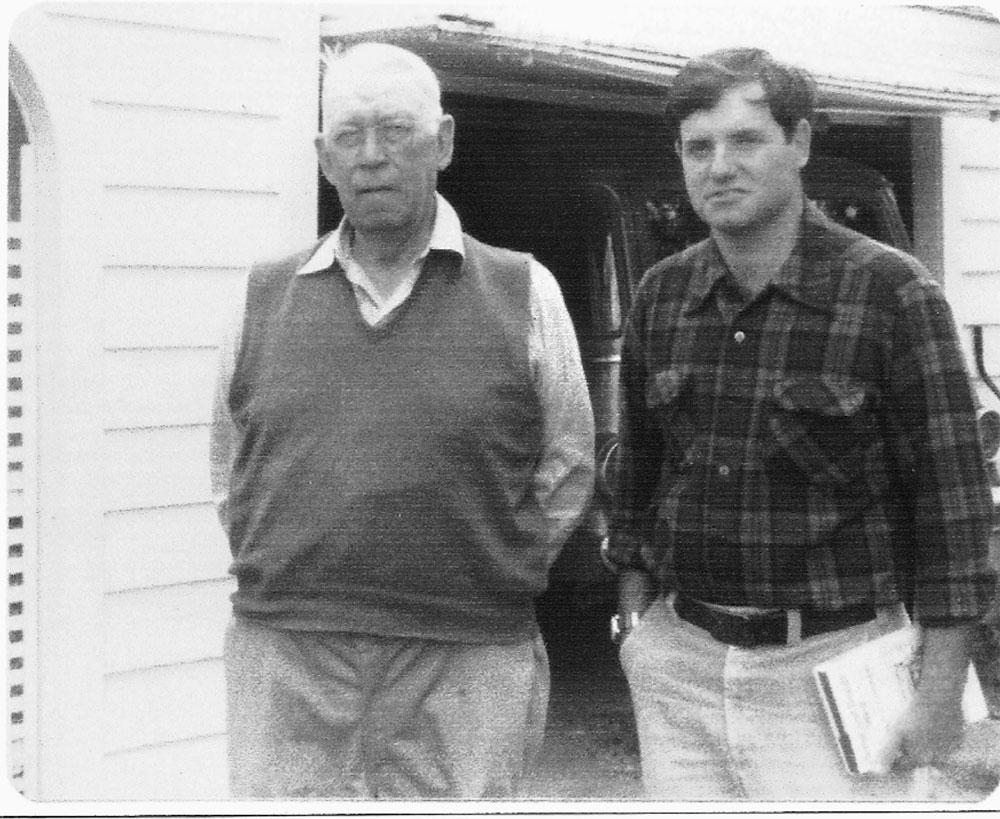
Author credits the writings of Jack O’Connor, the shooting editor for Outdoor Life magazine from 1937 to 1973, with inspiring him to create a sporting rifle using the action of a military Mauser. This photograph of O’Connor (left) and author was taken in 1976 at the end of a visit with Mr. O’Connor at his home in Lewiston, Idaho.
Next, French Red stock filler was rubbed into the stock and allowed to dry overnight. It was rubbed off across the grain after drying completely. Once I was satisfied that the grain had been filled, the stock was ready for its finish. For that, I chose Birchwood Casey’s Tru-Oil. I applied the Tru-Oil using #00 steel wool. I dipped a small “tip” or point of the steel wool into a tiny amount of Tru-Oil and rubbed it into the stock using small, circular motions. Each such application would cover only about a three-inch section of the stock, and, as soon as each application with the steel wool was completed, and while the oil was still wet, the excess oil was rubbed off across the grain using a clean, soft, lint-free cotton cloth. At that point, I began applying Tru-Oil, in the same manner, on the next three-inch section of the stock. Once the entire stock had been covered in this way, the stock was set aside to dry for 24 hours. After that time, another coating was applied in the same manner.
I considered the stock’s finish to be completed after the application of about five coats of oil. The finish obtained by the method I have described is a deep sheen, and, to my eyes, is much more attractive than the glaringly shiny, spray-on, acrylic finishes seen on some commercial gunstocks today. A hand-rubbed oil finish not only has a nice appearance, it is reminiscent of the time when gunmakers took real pride in the quality of their products, rather than placing the emphasis on how quickly rifles could be turned out.
By the way, at the outset of this project, I fully intended to checker the stock myself. However, after much practice on many odd pieces of scrap walnut, I finally came to the conclusion that, like the replacement of the bolt handle—any checkering of the stock should best be left to a professional. It is still possible that I might have checkering added in the future. But, even without checkering, the stock is still very pleasing to me.
Next, all metal parts of the rifle – barrel, action, front sight ramp, front swivel stud, grip cap and buttplate – were blued. I chose to use Belgium Blue for this process, a product which I had used before and had liked. Belgium Blue is wiped on after the part to be blued has been heated in boiling water, so, all the home gunsmith needs in the way of special equipment is a tank large enough to hold the part to be blued and an adequate heating source. After each application of the bluing compound, the part is “carded” (rubbed down) with steel wool to remove the excess bluing solution from the surface of the metal. Once enough successive applications have been made, as per the instructions, a deep, durable, blue finish results.
With the bluing completed, I mounted both the front sight ramp and the front swivel stud to the barrel. Their barrel bands had been ordered with inside diameters slightly smaller than they would need to be, so as to permit a snug fit on the barrel. To bring them to the proper size, I fastened each in a padded vise and used 200-grit emery cloth (wrapped around a dowel rod) to slowly increase their inside diameters to the dimensions needed. Once this had been done, the inside of the barrel band of the swivel stud was given a light coat of Brownells’ Acraglas Gel epoxy and was tapped into place on the barrel. The Acraglas was used, of course, to prevent the stud from moving, and this is much easier than using solder to accomplish the same result. Any excess epoxy was immediately wiped from the barrel with an oily rag. Once the swivel stud was in place, I used the same method to mount the front sight ramp to the barrel.
At this point, my conversion was basically complete. Of course, conversions of military Mausers can be much more extensive than the one I have just described. For instance, I could have changed the trigger from the original two-stage military one to a crisper single-stage trigger. Many brands of replacement triggers are available, but I do not mind two-stage triggers in the least for the deliberate type of shooting that is generally encountered while hunting. Also, I could have opted to replace the military safety, which is a top-swing safety located at the back of the bolt. Such a safety simply cannot be manipulated as intended when the rifle has a telescopic sight mounted in the usual position. But, again, I had no plans of mounting a scope, and the military safety – a three-position safety – suits me just fine. Further, adding such replacement parts can also cost a lot of extra money, and, the person considering the conversion must decide if the advantage offered by the after-market part is really worth the added expense.
With the work of converting the rifle behind me, the shooting could begin. It was time to fire it for accuracy to determine whether any adjustments were needed. For a test load, I decided to try some Hornady 139-gr. spire-point boattail bullets. The load that I settled on for use with that bullet was 48 grains of H-414 powder with a CCI 250 primer. I seated the bullet just short of the rifling, and the overall length of the cartridge was then 2.85″. According to Hornady’s 7th Edition of its Handbook of Cartridge Reloading, this load is actually a little less than maximum for the 7mm/08 Remington cartridge.
Not only did that load prove to be nicely accurate, it was also fast. When chronographed from my 24-inch barrel, the load gave an average velocity reading of 2920 fps. No indications of excessive pressure were encountered. As far as accuracy was concerned, groups at 200 yards were very near minute-of-angle when fired from my bench. (It’s interesting to note that Jack O’Connor’s favorite factory load for his 7mm Mausers was the old Western 139-gr. open-point bullet at a velocity of 2850 fps. Regarding that load, O’Connor said, “I have never seen a hunter who used the 7mm with that load who did not like it.” My load develops slightly more velocity with the same weight bullet.)
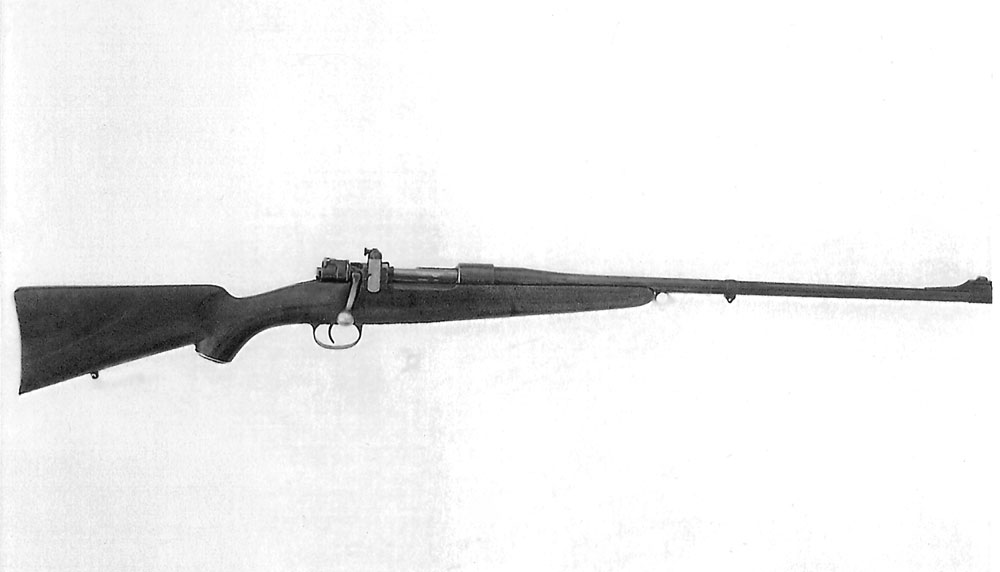
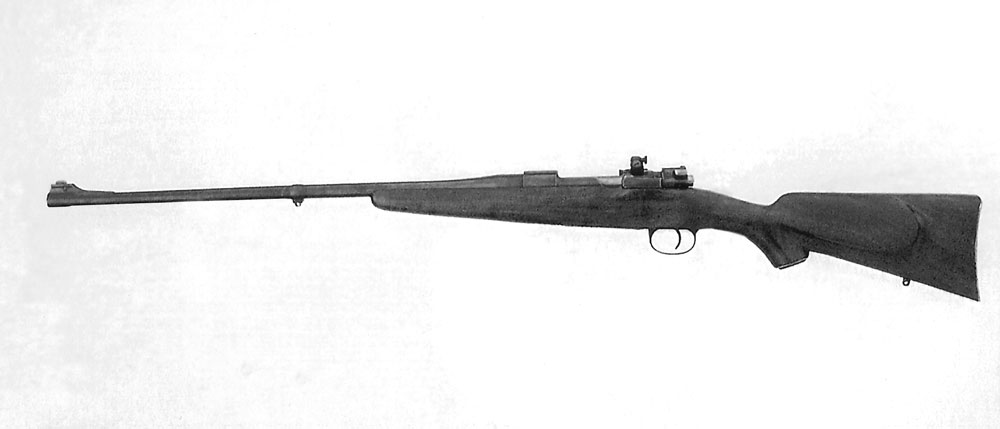
Right-side, full-length view of author’s sporter conversion of his military Mauser. The lines given to the rifle are reminiscent of those of American and European bolt-actioned sporters of the early-to-mid 1900s. It is chambered for the 7mm/08 Remington cartridge.
My goal had been to create a rifle suitable for open-country hunting of medium game such as antelope, sheep, mule deer and caribou. I believed that the 7mm/08 cartridge was fully adequate to handle all such game as long as proper loads were used. Although there are many fine jacketed or monolithic hunting bullets being manufactured today, Hornady’s “Interlock” bullet design had proven reliable on medium-sized game for me in the past – with 270- and 30-caliber bullets – and I expected the same fine results with their .284″ (7mm) bullets. I believed that the load I had assembled would prove an excellent one for most of the hunting I would be doing with this rifle.
Frankly, I was quite surprised with the velocity of my load. The 2920 fps reading was more than I had hoped to achieve especially at less than maximum pressures. I know that in these days when many hunters seem to be focused on “magnum” cartridges of one kind or another, such ballistics may not seem very impressive. But, let’s take a minute to put things in perspective.
The .280 Remington and the .284 Winchester are both hunting cartridges with splendid reputations for effectiveness on game. Being 7mm cartridges, they, naturally, shoot the same bullets as the 7mm/08 Remington. Again, referring to Hornady’s 7th Edition Handbook of Cartridge Reloading, velocities with the same 139-grain Hornady bullet in the .284 Winchester and .280 Remington cartridges top out at 2900 and 3000 fps, respectively. Those velocities were taken in a 24-inch barrel with the .284 and a 22-inch barrel for the .280. Certainly, the velocity of 2920 fps in my 7mm/08 Mauser – with a less-than-maximum load, remember – is quite on a par with those two older, and widely acclaimed, hunting cartridges.
Another comparison that is interesting to make is with the famous and ubiquitous .270 Winchester. That cartridge has earned its place as one of the most outstanding medium-game hunting rounds ever produced. The same Hornady reloading manual lists a maximum velocity for their flat-base, 130-gr. Spire Point from a 24-inch-barreled .270 at 3100 fps. Although Hornady does not manufacture a 130-gr. 7mm bullet, Speer does, and in Speer’s Reloading Manual Number 12, top velocity for their flat-base 130-gr. spitzer from a 7mm/08 with a 24-inch barrel is an almost identical 3065 fps. Further, the ballistic coefficients of those two bullets are nearly identical. Thus, for practical hunting purposes, any difference in the performance of these two cartridges when loaded with the above bullets would have to be imagined, because I honestly don’t believe it could be perceived in the field.
Before leaving the comparison of the .270 and 7mm/08 cartridges, it must also be considered that while the .270’s top bullet weights are 150-160 grains, the 7mm/08 cartridge can be loaded with bullets as heavy as 175 grains. This would seem to give the 7mm/08 an advantage when deeper penetration on heavier game is desired. Such a load that shoots quite well in my rifle is the 175-gr. Hornady with a load of 45 grains of H-414 powder. Although I have not chronographed this load, it should be about 2600 fps, according to the Hornady manual.
In short, on paper, the fitness of the 7mm/08 as a hunting round for medium big game simply cannot be questioned. But, as always, the proof for a hunting cartridge is in the field.
A couple of springs ago, after I finished sporterizing the Mauser, my wife, Linda, and I got to spend a few days on a ranch in Colorado where our friends, Ken and Susan Swick, and their two children, Brandon and Hannah, were working and living. Of course, I had taken the 7mm/08 with me; I had hopes that a coyote might show himself. During that visit, both Ken and Brandon fired some rounds from my newly-finished rifle, and each boosted my ego somewhat when they offered some favorable comments on its balance and appearance.
Left-side, full-length view of Author’s converted Mauser. With its 24-inch Douglas barrel, the completed rifle weighs about 7-3/4 pounds; having only iron sights, it is a delight to carry in the field.
As it turned out, I didn’t see a single coyote during our visit, but Brandon (age 15) and I did spend a couple of hours one day thinning out a colony of rockchucks that were posing some problems on the ranch. (By the way, those rockchucks were fairly large, easily the size of the groundhogs we have back in Kentucky.) Most of my shots were from the standing and sitting positions, without a rest of any kind, and, of course, I was using just the rifle’s iron sights. I was delighted at the way the rifle handled in the field. Its comparatively mild recoil seemed out of place, however, considering the terrific power the 139-gr. Hornady bullets displayed on those rockchucks. That experience certainly made me look forward to using the rifle as it was intended on an open-country hunt for something bigger.
Well, when looking for “open country” and the game that inhabits it, one could not go wrong choosing an antelope hunt in Wyoming. I thought the plains-dwelling pronghorns would offer the perfect hunting challenge for my 7-08. So, in October of 2008, my converted Mauser and I – along with my friend and hunting buddy, Steve Geurin – wound up near Newcastle, Wyoming, for the beginning of antelope season.
On the day before the season was to open, we set up a tent camp on some public land administered by the Bureau of Land Management. After the tent was erected, we relaxed in a couple of lawn chairs and looked over the country around us. Basically, the view revealed a lot of sagebrush and many low-lying, prickly-pear cactus plants, along with a few small hills and some coulees that led toward a small valley with a nearly-dry creek running the length of it. On the far side of the creek was a lone, healthy-looking tree, the only one in sight.
Using our binoculars in the fading light, we could make out a little bunch of antelope milling around. They were on our side of the creek, nearly in line with the tree, and possibly a mile away. Hunting, it seemed, would be interesting here.
The following morning, we left the tent just after dawn and walked toward the area where we had seen the antelope the previous evening. The sun was not yet above the horizon when two doe antelope and one buck appeared just at the edge of a coulee directly in front of me. They ran away from me on a slight downhill grade in the general direction of the little creek in the valley. As they did so, I got in a sitting position and placed the brass post of my front sight on the buck, hoping he would stop within range. When the three antelope had gotten about 150 yards between us, they made a slight left turn and stopped in a rather open area in the sagebrush.
The buck was to the just to the right of the does. He had turned perfectly broadside to me; and, by that time, I had already taken the slack out of the trigger. After making sure that the sights were aligned properly, I put the last bit of pressure on the trigger and the rifle fired. The wide, gold-colored post of my front sight had been easy to see, even in the low light of the early dawn, and I knew instantly that the hold had been a good one. There was an audible “thunk” when the bullet struck. The buck ran in a tight circle and fell, only three or four seconds after being hit. The bullet had struck just above the heart and exited the chest on the far side, leaving a sizeable exit wound.
The buck was a young one, probably two or three years old, but I was a happy hunter. I have enough horns and antlers at home. After all, to me it is the meat that is most important, and a good shot on a smaller buck is better than a risky shot on a larger one. My homemade custom Mauser conversion – a sporting-rifle project that I had planned for over forty years, which finally made it to completion in my basement workshop – had performed its job perfectly. It had provided a quick, clean kill, and, in the process, had helped to put some fine meat on our family table.
In closing, I would like it to be noted that I must not be the only one who thinks my converted Mauser has the looks of a nice old sporter from the first part of the 1900’s. I can say this because of something that happened when I had finished the rifle and took it in to my local gun store to let the fellows look it over. As I handed the rifle to Jeff Furnish, the owner of the store, one of those who happened to be in the store that day, a rifle-lover by the name of Dave Robinson, was standing just a few feet away from Jeff. He looked at my rifle and said, “Hey, what is that—a Westley Richards?”
Well, if my rifle had been in Dave’s hands at the time he spoke, instead of being a few feet away, I’m sure he would have quickly noticed that my rifle fell far short of having the quality and workmanship of a Westley Richards-customized Mauser. But, nevertheless, when Dave asked that question, I’ve got to admit that I couldn’t have been prouder. With that one comment, he had recognized, at least from a distance, that there was a strong similarity between the rifle I had built and those classic bolt-actioned sporters of the first part of the 20th century.
And, after all, that was exactly the goal I had in mind for this project—a project that I had planned for over forty years.
This article appeared in the Gun Digest 2011, 65th edition annual book.
Officials in Pasco County, Florida, are discussing opening a new shooting range. Interestingly, the range is being considered for its potential to draw in a new tourist demographic–shooting enthusiasts with a yen to travel–and thereby boost the local economy.
Recently, Pasco County Commissioner Henry Wilson got approval from his county board, “to continue pursuing the idea of a shooting range for competitive tournaments that could draw visitors and their wallets to the county,” LandO’Lakes Patch reported. “A range could also benefit the sheriff’s office and police departments that have no place in the county for firearm practice.”
Wilson has talked with managers of a local shooting range to get their input on opening and running a range. He’s also conducted a survey of potential range users. His survey, “drew 4,000 responses, with 1,500 coming from outside Pasco showing an interest in traveling to the county for a shooting range. Responses came from nearly half of Florida’s 67 counties and from other states, he said.”
In addition, “The county might snag federal help to develop a shooting range. Wilson said the Department of Homeland Security may pay part of the cost if a place is large enough to accommodate the sheriff and public.”
NSSF’s Ryan Cleckner explains the measurement term “milliradian” (mil) and how to use a mil-dot scope to measure the distance to your target at the range and in the field. Source: NSSF
NSSF’s Ryan Cleckner explains the measurement term “milliradian” (mil) and how to use a mil-dot scope to measure the distance to your target at the range and in the field. Source: NSSF
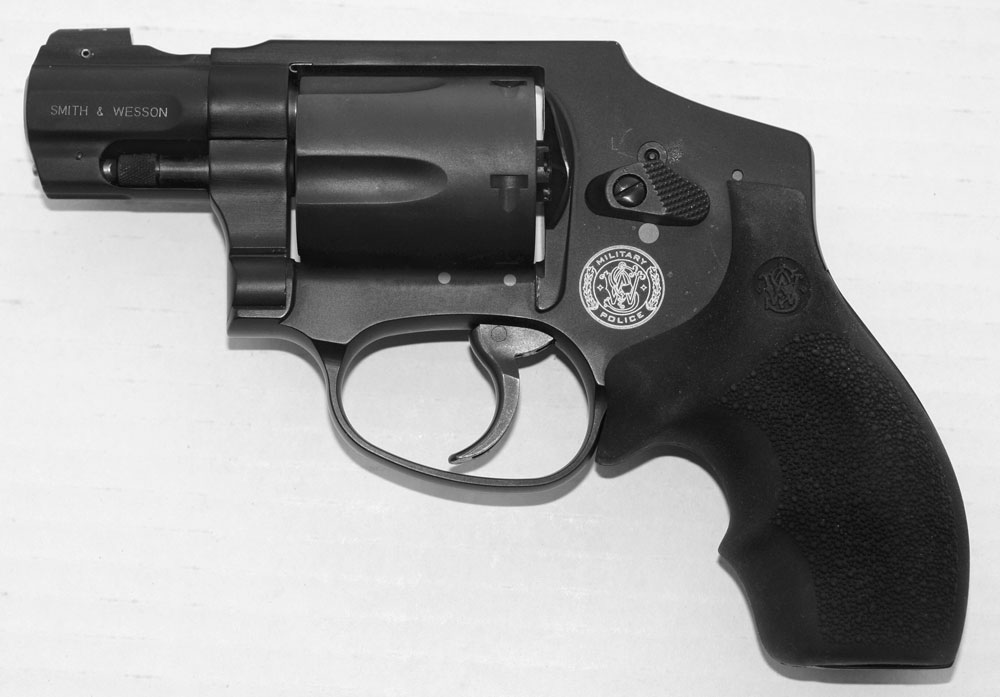
With powerful handguns as small and light as this 13.3-ounce S&W Military & Police Model 340 357, there’s little excuse NOT to carry a backup.Learn more from Mas! Six indispensable resources from Massad Ayoob. Act now, limited availability.
The backup gun is a second handgun, normally carried concealed, used as a supplement to a primary handgun that may be carried openly or concealed, depending on the circumstances. It has a long history among lawfully armed men and women. Originally a law enforcement practice, the carrying of backup has spread to ordinary American men and women who are licensed to carry loaded handguns concealed in public.
One only has to cruise the “gun boards” on the Internet to notice how many private citizens who carry are either considering the wear of a second weapon routinely, or are already committed to the practice. It has been said that in America, private citizens model their sporting rifle purchases based on what the military is using, and their defensive handgun purchases on what their police are using.
The rise of the bolt-action rifle in popularity among hunters and target shooters followed the adoption of the Krag-Jorgensen in the late 19th century and the Springfield in the early 20th…semiautomatic hunting rifles such as the Remington Model 742 and Winchester Model 100 became popular among a generation of Americans who returned from fighting WWII and the Korean conflict with semiautomatic Garands…and today, the single most popular model represented in new rifle sales seems to be the AR-15, the semiautomatic version of the M-16 that has been our nation’s primary military rifle since the Vietnam conflict..
Similarly, the dominance of the revolver among private citizens followed the adoption by the Texas Rangers of the Walker Colt before the middle of the 19th century. For most of the 20th century, the double-action revolver in 38 Special, followed in popularity by the same type of gun in 357 Magnum, was virtually the standard law enforcement weapon and the most popular home defense/concealed carry firearm among “civilians.”
As the police went to semiautomatics, so did the law-abiding public. At this writing, the high tech auto pistol typified by the Glock is the most common type of police duty handgun, and likewise one of the biggest sellers in the commercial handgun market.
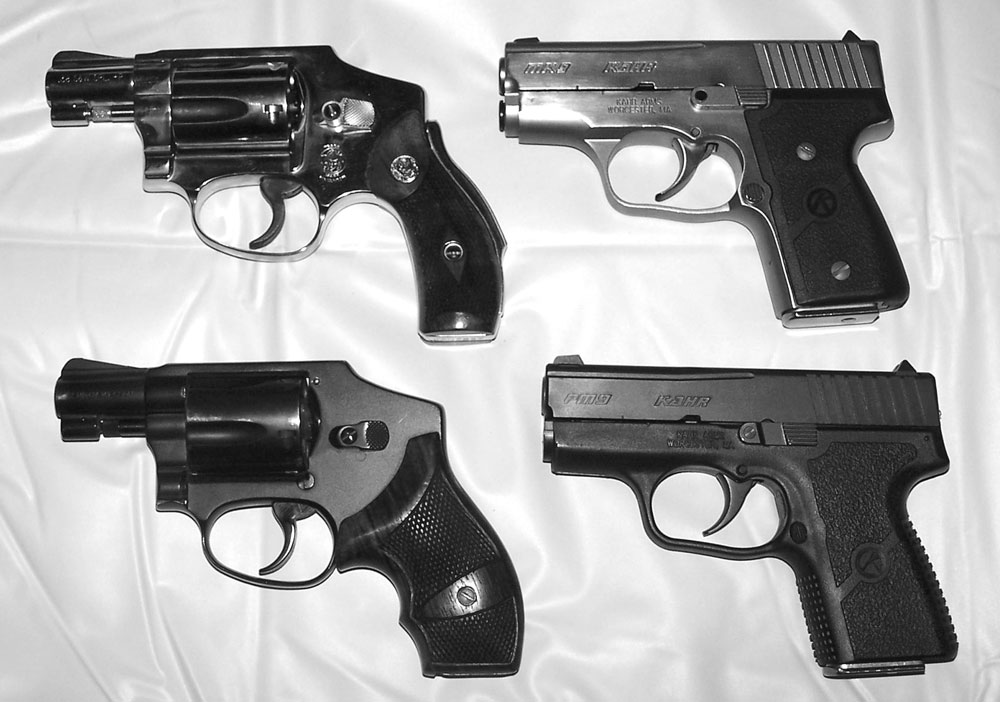
Sometimes it’s easier, and even more efficient, to carry two small handguns of adequate power instead of one large one. Left: 20 ounce Model 640-1 above, 15 ounce Model 442 below, both J-frame 5-shots by Smith & Wesson. Right: 22 ounce all steel Kahr MK9 above, 14 ounce polymer frame MK9 below, both 7-shot 9mms.
This being the case, it is not surprising that the law officers’ taste for a second handgun carried on the person, has been acquired by the armed citizens of the same population.
The Rationale of Backup
There are several good reasons to carry a second handgun for defensive purposes. None are the exclusive province of law enforcement. Let’s examine them in detail.
The primary gun may be taken away. In Kentucky, an armed criminal caught a uniformed policeman off guard and took away his Smith & Wesson 10mm service pistol. The lawman was able to access his concealed Walther PPK 380, a backup gun issued to him by his department, and empty it into his attacker. The criminal died; the officer lived.
The primary gun may be unusable because it is the object of a struggle. In Ohio not long ago, a police officer found himself in a desperate battle for survival as his opponent struggled to take away his department issue Glock 22 pistol.
Fortunately, the department had had the foresight to issue every officer a Glock 27, a subcompact version of the duty pistol, as backup. In the last instant before the suspect gained control of his service weapon, the officer was able to draw his backup G27 and fire a shot into his would-be murderer’s head, killing the assailant and saving his own life.
The primary gun may be empty. Drawing a second, loaded weapon is often faster than reloading the first when it runs dry. In Michigan, a woman and her husband were working in the store they owned and operated together when they were hit by multiple armed robbers.
The felons shot and wounded the husband early in the encounter. The wife drew a double-action revolver and shot back. Her gun ran dry, and she grabbed a second revolver with which she continued to return fire. That sustained fire allowed her to win the gunfight, saving her life and that of her husband, who survived his wounds. Their attackers were not so lucky.
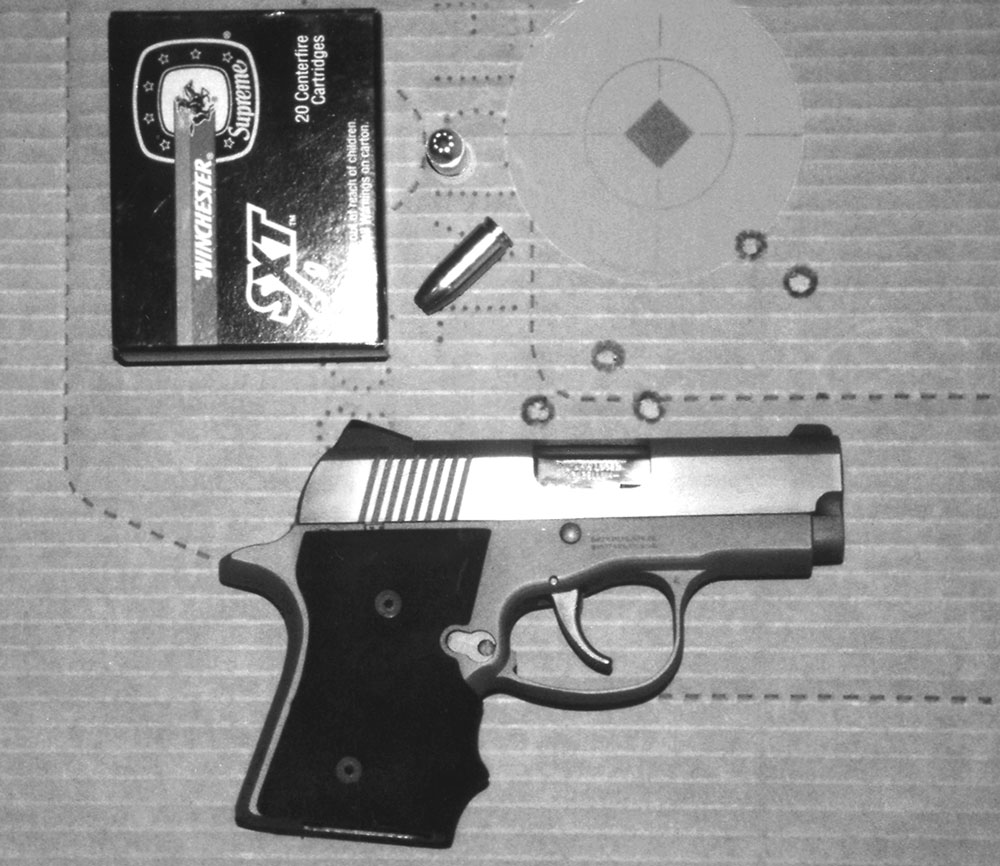
A sweet backup gun! This Colt Pocket Nine is the size of a Walther PPK 380 and considerably lighter, yet it just put five rounds of Winchester SXT full-power 9mm into approximately two inches at 25 yards. Sadly discontinued, it is worth haunting gun shops to find second-hand.
The primary gun may malfunction. In the South recently, a police officer died with a jammed pistol in his hand. Witnesses said he was struggling with his choked semiautomatic when his opponent, a criminal armed with two double action revolvers, shot him to death. The officer’s pistol, a popular brand famous for its reliability, had jammed part way through its 15-round magazine. The quick drawing and firing of a second weapon might have saved the officer’s life.
The primary gun may be struck by an opponent’s bullet and rendered inoperable. This scenario is not so far-fetched as it may sound. Law enforcement training in this country was profoundly affected by a 1986 gun battle on the edge of Miami where two FBI agents were killed and five more wounded by two heavily armed criminals who were ultimately killed at the scene.
Two of the seven agents who returned fire resorted to their backup handguns during that firefight, and the agent who put the final, fatal bullets into the criminals did so with his Smith & Wesson revolver after his Remington shotgun ran out of ammo. (Bad guys also resort to backup guns. One of the two cop-killers in that encounter fired rounds from a stolen Mini-14 Ruger rifle, his own Dan Wesson 357 Magnum revolver, and his partner in crime’s S&W 357 before he was finally killed.)
In that encounter, one agent’s Smith & Wesson 9mm auto pistol was struck by a 223 bullet and rendered inoperable. That particular agent did not carry a backup gun, and was helpless to defend himself when the suspect with the Mini-14 walked up on him and shot him to death. Twenty years later, in April of 2006, the same phenomenon was observed in a Seattle gunfight. A city cop’s Glock 22 service pistol put a 40-caliber bullet into the cylinder face of a criminal’s Colt
Massad Ayoob’s Greatest Handguns of the World contains the world’s best pistols and revolvers. Click here to get your copy.
Officer’s Model Match 38 Special, rendering it inoperable. In that instance, the criminal fortunately did not have a second gun, and was neutralized by police fire.
The primary gun may not be as readily accessible as the backup. In New York some years ago, an off duty cop in winter was carrying his primary handgun under two coats, and his backup Colt Detective Special snub-nose 38 in his overcoat pocket.
Set upon by two armed robbers, he knew he would not be able to dig under his clothing and draw his duty weapon before being shot by the drawn gun held to his head. On the pretext of reaching for a wallet in his overcoat pocket, he got his hand on his backup Colt, then slapped the gunman’s pistol aside with his free hand as he drew and fired. His bullet went through the gunman’s brain, killing him instantly; the accomplice fled, and was later taken into custody. The officer was uninjured, saved by his backup handgun.
In the Carolinas, a man with a hidden weapon approached a parked police car and opened fire at the officer through the driver’s window, wounding him. Seat-belted in place, the officer was unable to reach the service handgun locked in a security holster at his hip, but was able to access the Colt Agent backup gun strapped to his ankle. He drew from the ankle holster and returned fire, neutralizing his assailant.
He survived his wound and returned to full duty, saved by his backup gun.
The primary gun can arm only one good person at a time. With a backup gun, the user can arm a second competent “good guy or gal” who did not bring their own firearm to the emergency. In California, a police officer facing a complex problem involving armed suspects was offered assistance by a private citizen he knew to be trustworthy with firearms, but who was not licensed to be armed. He “deputized” the citizen, arming the man with the Smith & Wesson Chiefs Special snub-nose 38 the officer carried in an ankle holster. The situation came to a satisfactory conclusion.
In New York, two detectives had a reporter along in their unmarked car when they had occasion to go after a particularly dangerous armed robber they had been seeking. Knowing the reporter to be an ex-cop, one detective handed him his backup gun, a Colt Detective Special. When they made the confrontation, the suspect was facing three drawn guns. His own choice of weapons was a sawed-off double barrel shotgun. Few criminals are too stupid to realize that they can’t possibly neutralize three armed good guys with a two-shot weapon without being shot himself. This one chose to surrender without violence or bloodshed, and served a long term in prison.
We’ve just seen no fewer than seven very good reasons why a person who has a need to carry a gun might see a need to carry two of them. Any one of those situations could face an armed citizen or a police officer on any given day.
This article is an excerpt from Massad Ayoob’s Gun Digest Book of Concealed Carry. Click here to get your copy.
Looking to go armed, but are stuck in the weeds as to what to arm yourself with? Here are 20 of the best concealed carry gun options that will keep you on the defensive.