
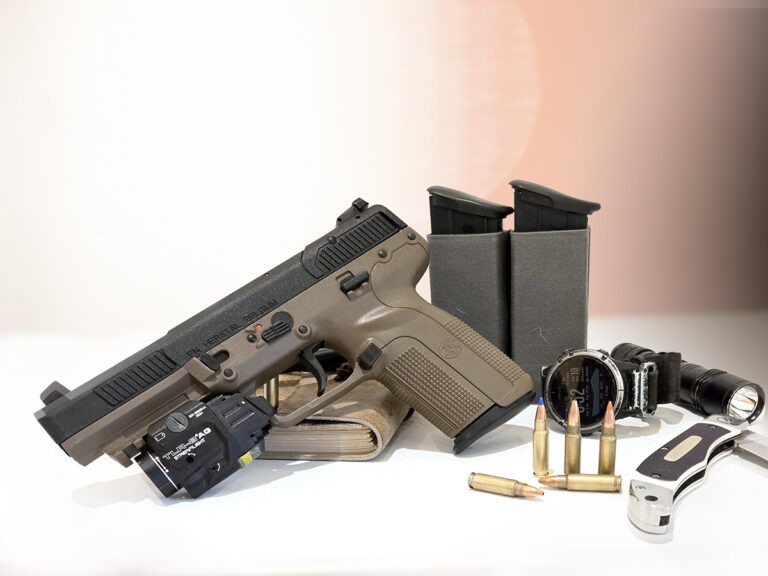
We take a closer look at how the FN Five-seveN pistol and its 5.7x28mm cartridge fare for concealed carry.
Due to recent events, the FN Five-seveN and the 5.7x28mm cartridge have become the center of much discussion. This is why they, and their viability for self-defense, are the subject of this article. Without getting into the weeds of reporting on current unfolding events, this article’s intention is to dispel some myths and misconceptions—and present the facts and experiences gleaned from 10 years spent tinkering with both the Five-seveN and the 5.7x28mm. This will hopefully provide insight into the merits and shortcomings of this unique platform, and how they relate to practical and effective use of this handgun and cartridge combination.
The story starts in the 1990s when FN began developing a cartridge and PDW, which eventually found its way to the PDW trials in 2000 to 2002. The first phase of these trials took place in the United Kingdom at Fort Halstead, and the second phase took place in France. The goal of these trials was to develop a NATO-standardized cartridge for a PDW weapons system. These trials (which notably lacked U.S. involvement) had a requirement to penetrate CRISAT body armor.
Out of that requirement, many myths about the 5.7x28mm and its armor-penetrating abilities were born. That requirement was more to weed out the 9mm Luger as a contender in these trials and to encourage the development of high-velocity, small-caliber cartridges. Notable examples are the 4.6×30 HK round and the 5.7x28mm.
In practical terms, the 5.7x28mm does not display exemplary performance on armor. In fact, the test noted that the 4.6x30mm displayed less dispersion and better penetration than the 5.7x28mm. Suffice it to say that, with most viable self-defense ammunition, the 5.7x28mm will struggle, if not fail entirely, to penetrate a 0.25-inch plate of mild steel when fired from a 4.75-inch barrel (much shorter than the barrels from the NATO test). The test did mention that 5.7x28mm did slightly outperform 4.6x30mm when it came to terminal performance. However, the test also failed to standardize either one of these cartridges and it wasn’t until years later that both received formal standardization from NATO.
5.7x28mm: The Ornery Orphan
Let’s take a closer look at the cartridge itself, as it’s interesting and unique; it has no parent case and was developed from the ground up by FN. It is a bottleneck cartridge that utilizes .22-caliber (0.224 inch) bullets with a 35-degree shoulder angle. Factory ammunition is loaded to approximately 50,000 psi; it’s a small, high-pressure, high-performance cartridge in a small and efficient package.
Taking a closer look at the case itself, one will also find a unique coating on the cartridge case. This is yet another source of myths and legends. I’ve heard folks claim “this coating is required to keep the gun functioning” to “it clings to the chamber walls and prevents the gun from unlocking too soon and blowing up the gun.” As usual, the truth is somewhere in between.
A hint to the truth can be found in the NATO PDW trial document from 2002. During the test in which cartridges were submerged in fuel, the P90 PDW experienced malfunctions with the fuel-soaked cartridges. This is likely due to the coating being removed, causing the rotary magazine that feeds the P90 to bind and jam. In the official report, it was cited that this was likely a weapon system malfunction and not the cartridge itself.
Assessing The Power Of 5.7x28mm
Finally, let’s address the ballistics of the 5.7x28mm cartridge; it’s capable of utilizing a wide range of projectiles thanks to its popular .22 caliber. In fact, many of my handloads utilize bullets that are effective in the .223 Remington. Thanks to its high velocity, it also makes the 5.7x28mm very flat-shooting. When zeroed at 25 yards with a 40-grain Hornady V-MAX and a muzzle velocity of 1,700 fps, the bullet only drops 4.2 inches at 100 yards and 12.4 inches at 150 yards.
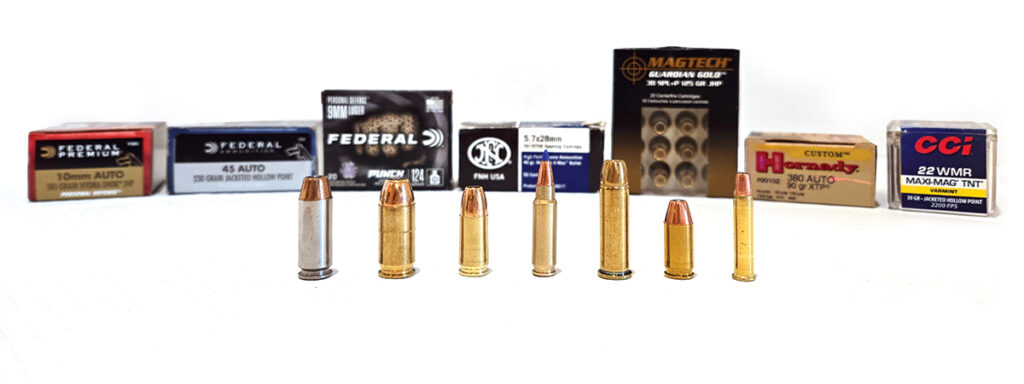
While the velocity is significantly higher than most handgun cartridges, the energy numbers are a little lower than most, and the bullet diameter is also smaller, meaning smaller wound channels in general. When it comes to penetration, it is highly dependent on ammunition and projectile choice.
Most ammunition marketed for self-defense is going to provide the best terminal ballistics in the 5.7x28mm, with noteworthy examples being the 40-grain Speer Gold Dot Personal Protection and 40-grain Hornady FTX Critical Defense. Both meet the FBI standard for gel penetration and both offer reliable expansion, something important when taking the small caliber into consideration. Most bullets will only expand to a diameter of about 0.310 inch, slightly less than .32-caliber projectiles.
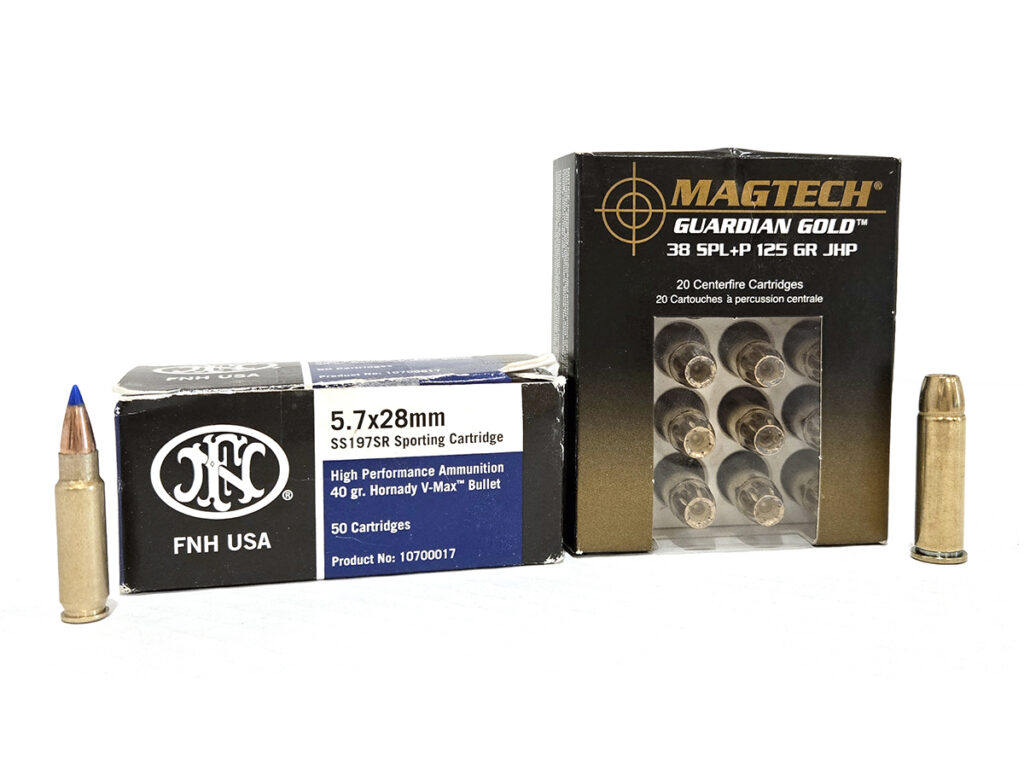
With these notes on ballistics in mind, the 5.7x28mm falls somewhere between .380 Auto and 9mm Luger, with it being much closer in terms of energy to the 9mm Luger than the .380 Auto—and it beats both significantly in terms of velocity. However, velocity is only part of the equation for making a good self-defense cartridge. Expansion is less than 9mm Luger, meaning the permanent wound cavity will also be smaller. The same is true with .380 Auto, as they utilize the same bullet diameter. However, .380 Auto, in my testing, usually fails to meet the FBI minimum for penetration with very few exceptions, especially when fired in the shorter-barreled pocket-sized carry guns commonly chambered in .380 Auto.
That said, one practical advantage the 5.7x28mm does have over other firearms is extremely light recoil. This is largely thanks to the light bullet sent at high velocity and the larger-framed guns 5.7x28mm is usually chambered in. This drastically reduces split times and allows for accurate and fast follow-up shots if needed.
I have heard 5.7x28mm compared ballistically to the .22 Magnum, stating that the .22 Magnum is more powerful; this is simply not an apples-to-apples comparison. I think most of these accusers never looked past the stated velocity printed on the ammunition boxes. They fail to realize most .22 Magnum velocities are measured in a rifle-length barrel, and most 5.7x28mm velocities are measured from a handgun-length barrel.
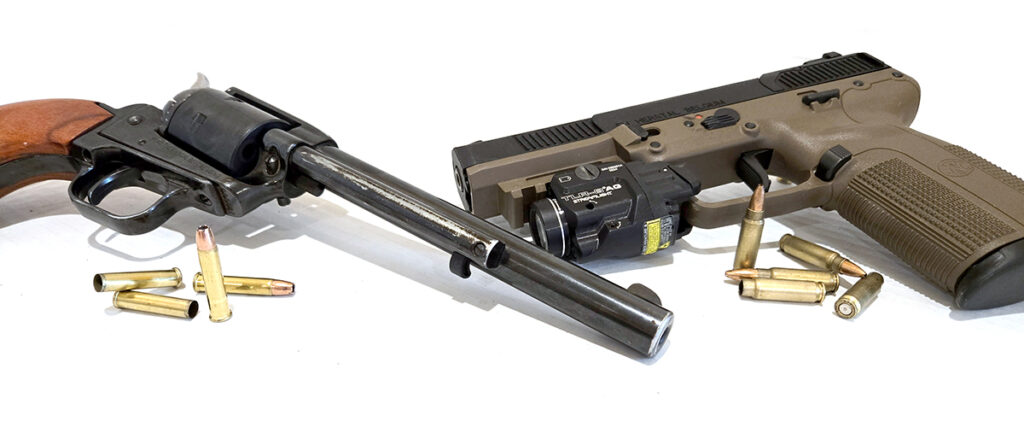
For a brief comparison, I grabbed a box of CCI Maxi Mag TNT 30-grain JHP and sent five rounds over the chronograph; the box velocity stated 2,200 fps. When fired from a 5-inch barreled .22 Magnum, the average velocity was 1,517 fps; that is over 300-fps slower than velocities achieved with Hornady Critical Defense ammunition. Say nothing of the fact that one is a centerfire and more reliable than the rimfire .22 Magnum. Myth busted.
FN Five-SeveN: A Full-Sized Lightweight
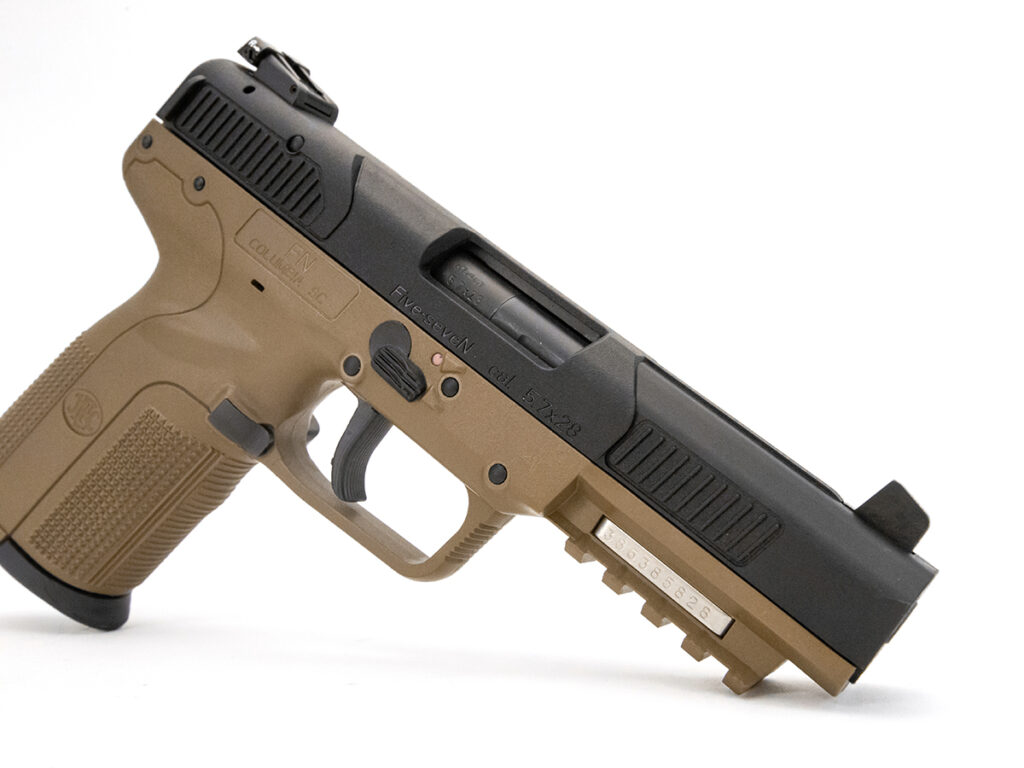
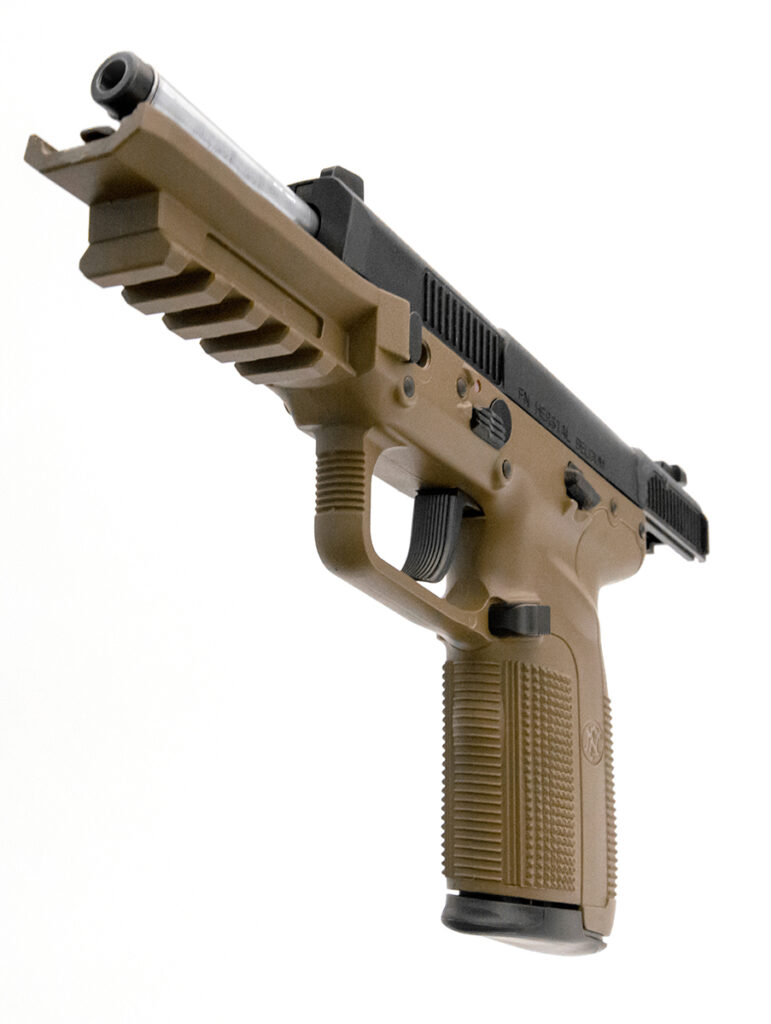
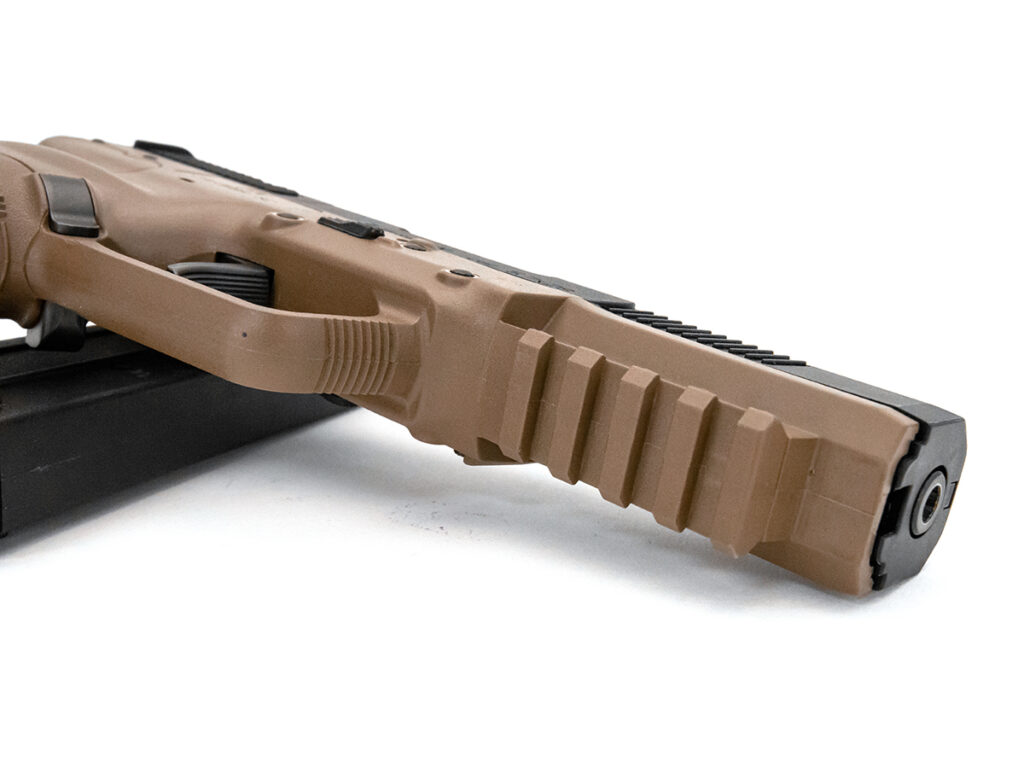
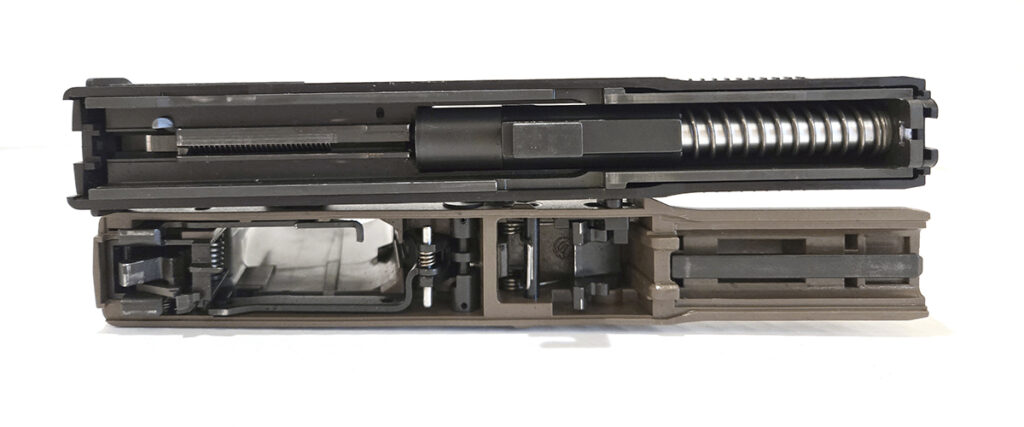
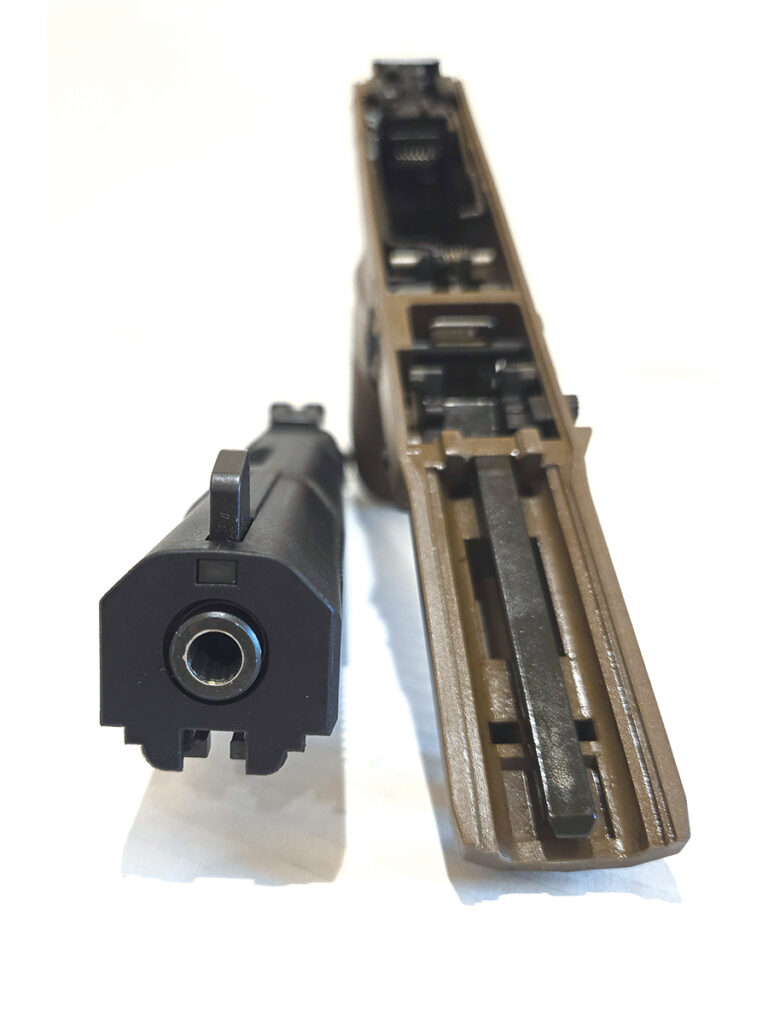
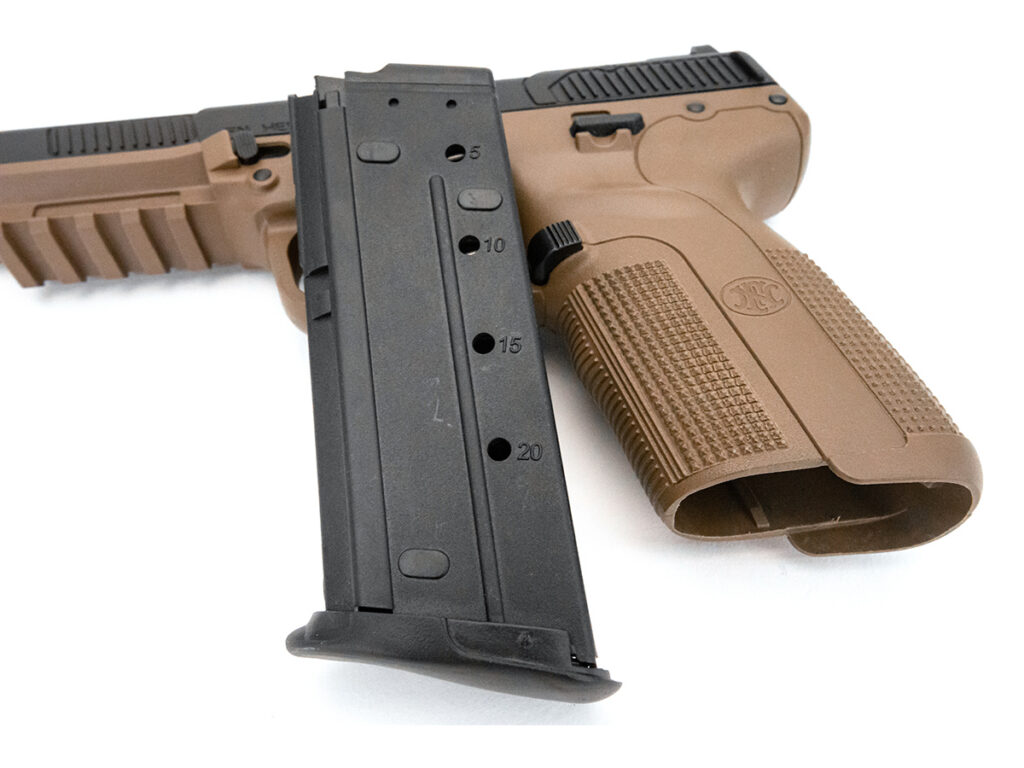
Lastly, let’s take a look at the FN Five-SeveN MK 2 itself; it is a full-size, lightweight (even when fully loaded), futuristic-looking handgun. It has seen a lot of popularity thanks to movies and video games. It boasts of some unique design features. From the rails, the slide reciprocates onto the polymer-shrouded slide. When it was first released, it looked ahead of its time, built with space-age polymers and capable of holding 20 rounds in a single flush-fit magazine.
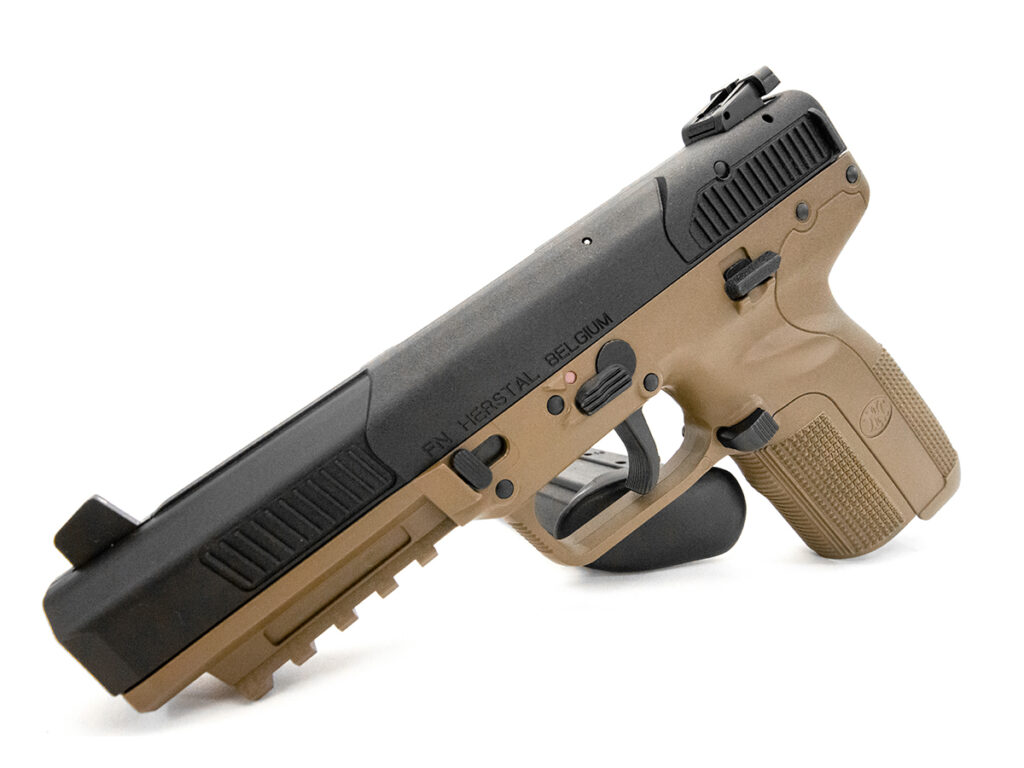
Time has aged the Five-seveN MK 2, but FN has done a good job upgrading it and staying with the times, with the latest MRD having provisions for mounting optics. However, the Five-seveN MK 2 has no such provisions for optic mounting, and it is nearly impossible. This is due to the polymer-encased slide and the fact that the Five-seveN is a delayed-blowback-operated firearm; the weight of an optic and mount can be enough to induce malfunctions. Thus, the standard fully adjustable sights will have to suffice. Having fully adjustable sights is a huge bonus and, in my opinion, mandatory for a carry gun.
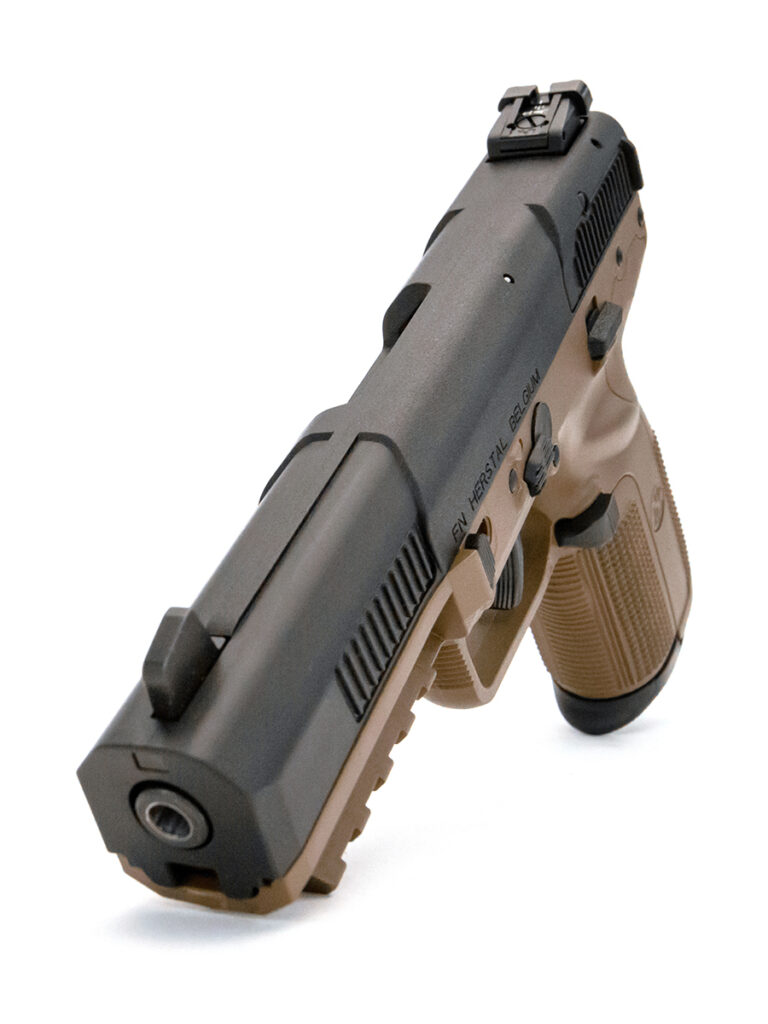
Over the years, they have proven reliable and rugged through years of carry. One feature that nearly disqualifies the Five-seveN in my eyes is the fact that it has a magazine disconnect safety, meaning the gun cannot be fired without the magazine. This is my own personal opinion, but I am not a fan of any magazine disconnect safety system, as it can easily disable the gun when it is needed most.
When it comes to carrying the FN Five-SeveN, it is a full-size gun and can lead to some difficulty concealing it depending on body mechanics and garment options. Holster options are vastly improved these days, with many good options available. Due to the geometry of the gun, most are rather bulky, and that is something to consider if you are going to be using this as a daily carry gun. Most of my experience is from field carry while out hunting or riding on horseback.
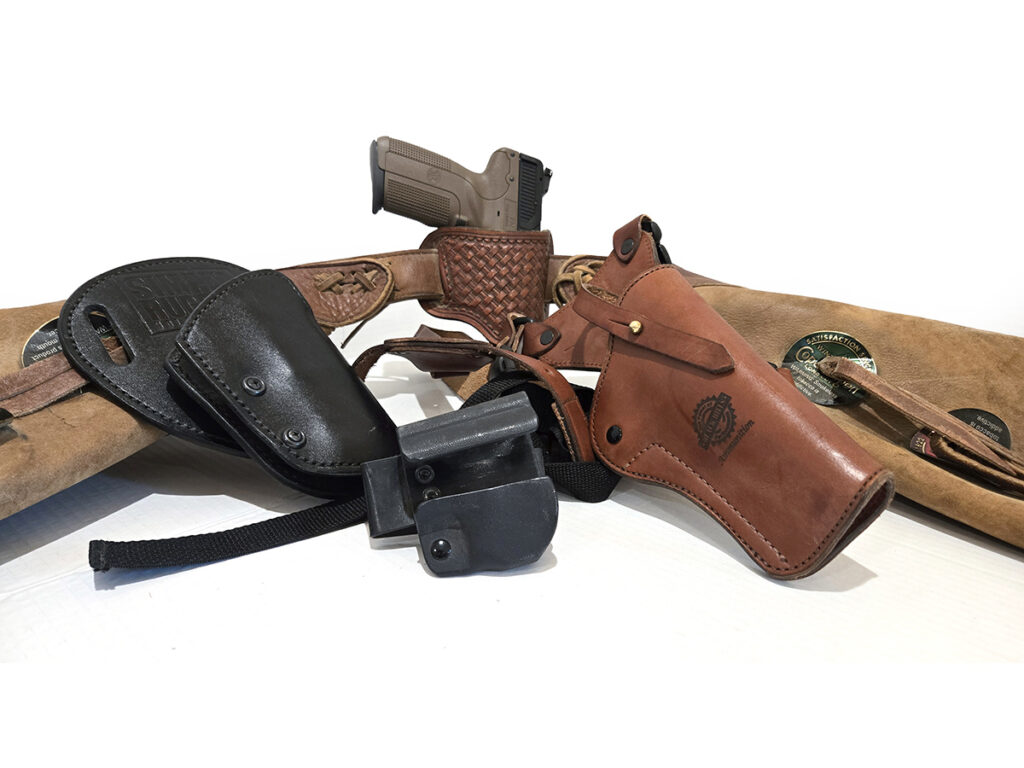
A simple handmade leather holster has carried my Five-seveN many miles with minimal bulk but would be challenging to conceal without the aid of a winter coat. Having a flat-shooting handgun for dispatching cattle, crippling rodents, and calf-killing varmints was a very welcome companion. If the need arose, two-legged varmints could also be dealt with, and carrying only two magazines meant I had 40 rounds at my disposal, which seemed ample to deal with anything encountered in a day’s work.
A Steadfast Companion
The bottom line is I have carried a Five-seveN for many days over many years; it has proven to be rugged and reliable. Another myth that has (thankfully) mostly died off is that polymer pistols can not be durable and/or reliable. It’s a bit antiquated in features today, but at the time of its release, it was certainly ahead of its time. The ballistic performance is decent enough to work well with proper shot placement. It wouldn’t be my first choice, but in a world with many options for self-defense cartridges and loads, it also certainly isn’t my last.
The safety is operated with your trigger finger, which is intuitive but different. The manual of arms doesn’t change drastically, but like all carry guns, proper training should be a top priority.
All in all, though, it is an interesting and unique firearm that does offer ballistics that cannot be found in other self-defense cartridges.
It’s a niche gun with a niche purpose, yet it has enough flexibility to be pushed into a carry gun for self-defense against two-legged threats if needed, with some compromises.
Ammo Notes: Reloading 5.7x28mm
The 5.7x28mm is one of scores of cartridges I handload for; as a result, I have some knowledge and tests that have been conducted on the cases, from stripping the coating completely from the cases to keeping them perfectly maintained.
In both my FN Five-seveN MK 2 and Ruger 5.7, the coating has made no difference in function. This dispels the myth that this cartridge is not reliable enough to be used for self-defense because of the coating, and if it gets damaged, it may induce a jam. My own testing and NATO’s testing seem to disagree. Despite these tests, many FN handguns include a warning not to strip off the coating, which has also fed rumors about its purpose and composition. When it comes to reloading the 5.7x28mm, I prefer to keep the coating intact, and as a result, light cleaning of cases in dry-clean corn cob media is all that is needed to keep cases clean and the coating intact.
It’s a sensitive cartridge to handload for and, as a result, great care should be taken when weighing powder charges.
Editor’s Note: This article originally appeared in the October 2026 issue of Gun Digest the Magazine.
More On 5.7x28mm
- 5.7x28mm For EDC?
- The PSA Rock 5.7 Pistol
- Using 5.7 For Self-Defense
- The Ruger 57
- The Smith & Wesson M&P 5.7

Next Step: Get your FREE Printable Target Pack
Enhance your shooting precision with our 62 MOA Targets, perfect for rifles and handguns. Crafted in collaboration with Storm Tactical for accuracy and versatility.
Subscribe to the Gun Digest email newsletter and get your downloadable target pack sent straight to your inbox. Stay updated with the latest firearms info in the industry.


From your comparison of the .22 mag and 5.7×28, it seems that they are very close. You did dismiss the .22mag due to your chronograph readings, but never stated what the 5.7×28 results were.
Based on what you presented, I believe the .22 mag would be the better choice based on ammo cost alone, if performance is near equal.
Just my 2 cents worth.
It is interesting to me how so many scribes will make comparisons of various cartridges based solely on calculated ballistics. My strong preference would be to judge ‘stopping’ power based on actual field use. Now, I understand that overall actual shootings of people with specific cartridges is for sure not all that popular, but when data exists, use it. In this case, reference the Fort Hood shooting a few years ago. If that is the only ‘field’ data available, I have no reservations carrying the 5.7 except for the size of the firearms! Currently I have the Ruger pistol, and will not carry it just due to the size, not the cartridge.
Just my two cents!!!