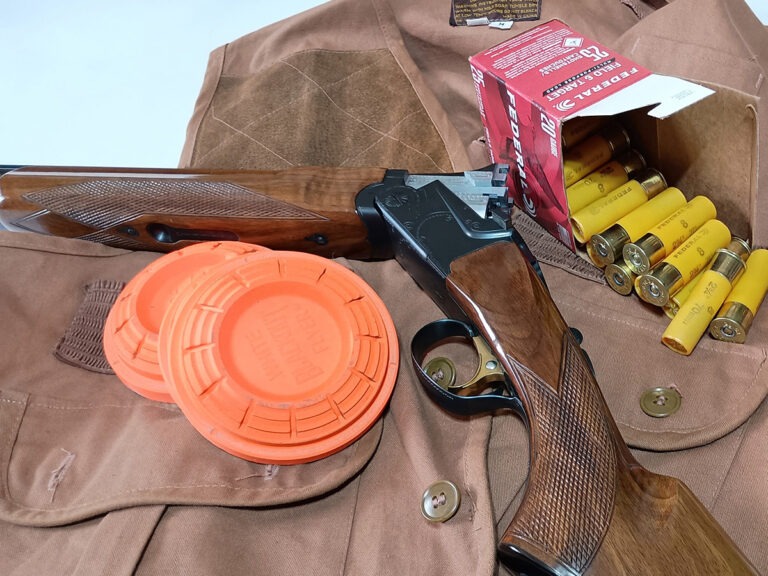
We take a look at the Japanese-made Ithaca 500, a 20-gauge over/under that’s still a top-notch field piece today.
The late 1960s were an odd time for the gun world. Some of the steam from the post-World War II boom had been let off, and industries were beginning to wrestle with a truly global economy. As winds of change often do, these swept the firearms landscape in good and bad ways.
Pressure was applied to American manufacturers as never before, leading some to evaporate. Conversely, the American shooter became flush with more firearms options from more corners of the world than even the most cosmopolitan marksman could have ever imagined.
One of the soft-spoken regions staking a claim to the American market was Japan. A former enemy, then among the United States’ strongest trading partners, stormed into the domestic firearms market—particularly the shotgun market—with its proverbial guns-a-blazing. Yet, savvy gun shoppers didn’t typically realize it.
Namely, this was because these were ghost-written guns—made in Japan but sold through all-American companies. While “Made in Japan” might have dismayed some American shooters, it’s hard to deny there were—and continue to be—stone-cold classic guns born in the Land of the Rising Sun. The Japanese-made Browning Citori and Weatherby Orion are rightfully on this list.
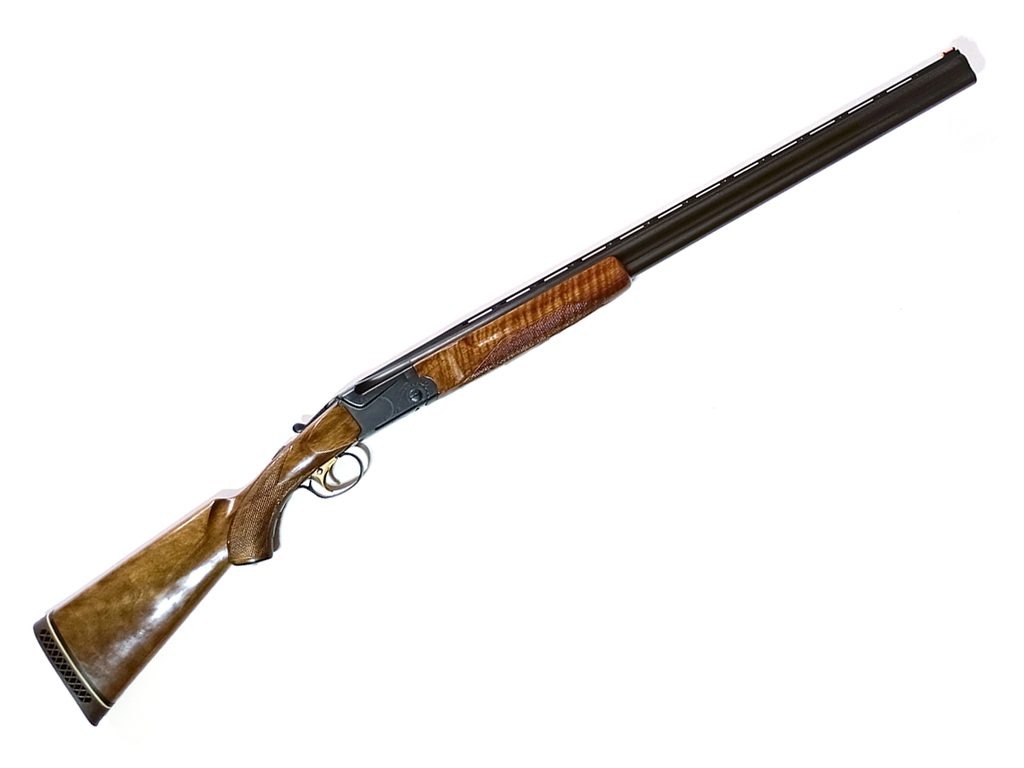
I’d make the case that the Ithaca 500—and its fancier siblings, the 600 and 700—deserve this consideration, as well. While not reaching the popular Yankee heart to the same extent as the previously named scatterguns, the family of over/unders nonetheless performed on par with them.
And if sales numbers are any indication, consumers worldwide gave the guns a vote of confidence with the ballot that means the most—their pocketbooks. Some million-plus models of the series were produced and sold worldwide. One has a special place in my gun safe, the only 20 gauge in a sea of 12s.
The success of the 500—a working-class O/U—isn’t surprising, given the gun’s pedigree. Produced by a concern known as SKB (SaKaBa Arms Company), the now-defunct Japanese manufacturer could trace its roots back further than Winchester.
The company points to a gunsmith in the Mito Clan in northeastern Tokyo named Shigyo Sakaba. Appointed by a feudal lord for the development and production of guns for the clan, Sakaba’s factory became known for its craftsmanship.
Over the decades, the humble cottage industry grew into a thoroughly modern operation, and by the 1960s, the SKB factory began incorporating modern technology with old-world craftsmanship. Its focus: a complete line of premier-grade competition and field shotguns.
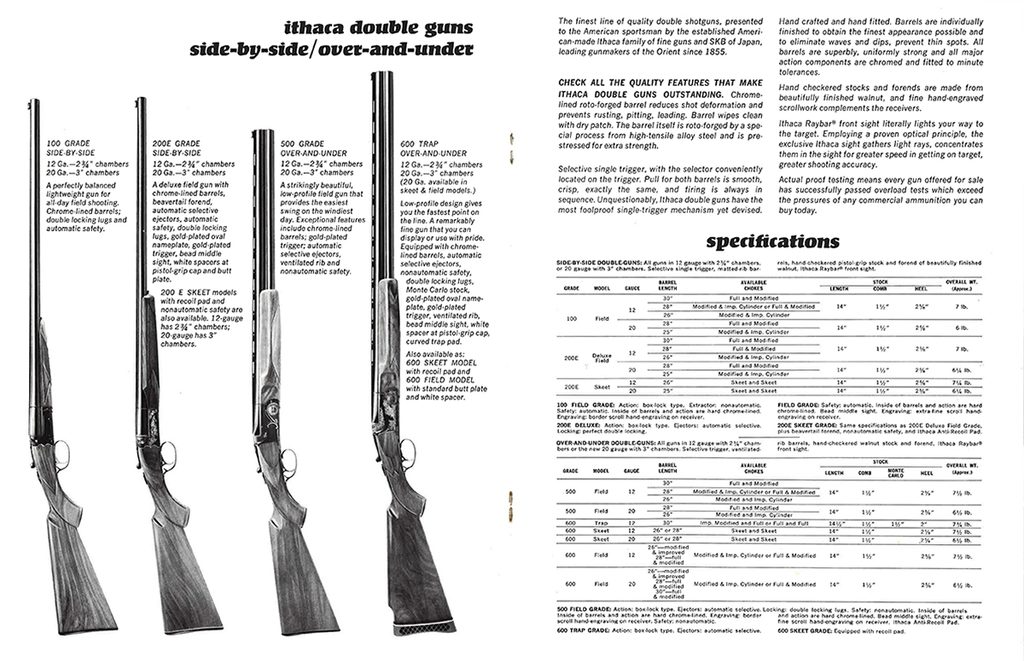
Ithaca became one of the first major importers of Japanese shotguns in the decade, partnering with SKB in 1966. The 500 and 600 were the initial products brought in, along with the SKB side-by-side 100 and 200.
Everything was 12 gauge until 1968, when 20-gauge models appeared. The over/under line was completed—outside of variations on the models—in 1969 with the introduction of the top-shelf 700. Incidentally, the model numbers only denote how much ornamentation a gun has on its receiver. Otherwise, the models are identical mechanically.
Interestingly, Ithaca didn’t shy away from its importing partnership with SKB. The relationship was right out front, with the guns marketed as Ithaca SKB and catalogs at the time proudly boasted the Japanese company’s tagline: “The orient’s leading gunmaker since 1855.”
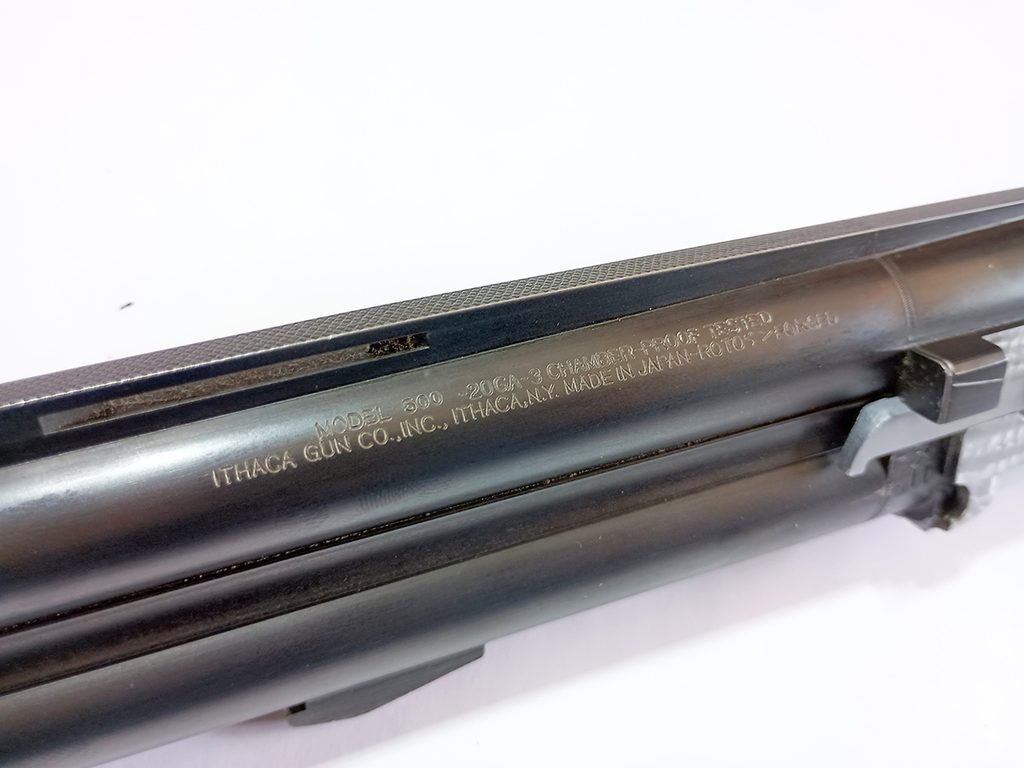
There, SKB and Ithaca had reason to crow. The Japanese arms were every inch an equal to the renowned shotguns originally hailing from New York’s Finger Lakes region. They made dandy additions to the American company’s classics, such as the legendary Deerslayer pump-action and iconic Model 37.
Not necessarily angled as entry-level guns, the series was still a reasonable option for the time. In 1966, the 500 field-grade 12-gauge was listed for $215, roughly $2,000 in 2025 dollars. My 20 gauge likely fetched somewhere between $220 and $300 when it was new on the rack.
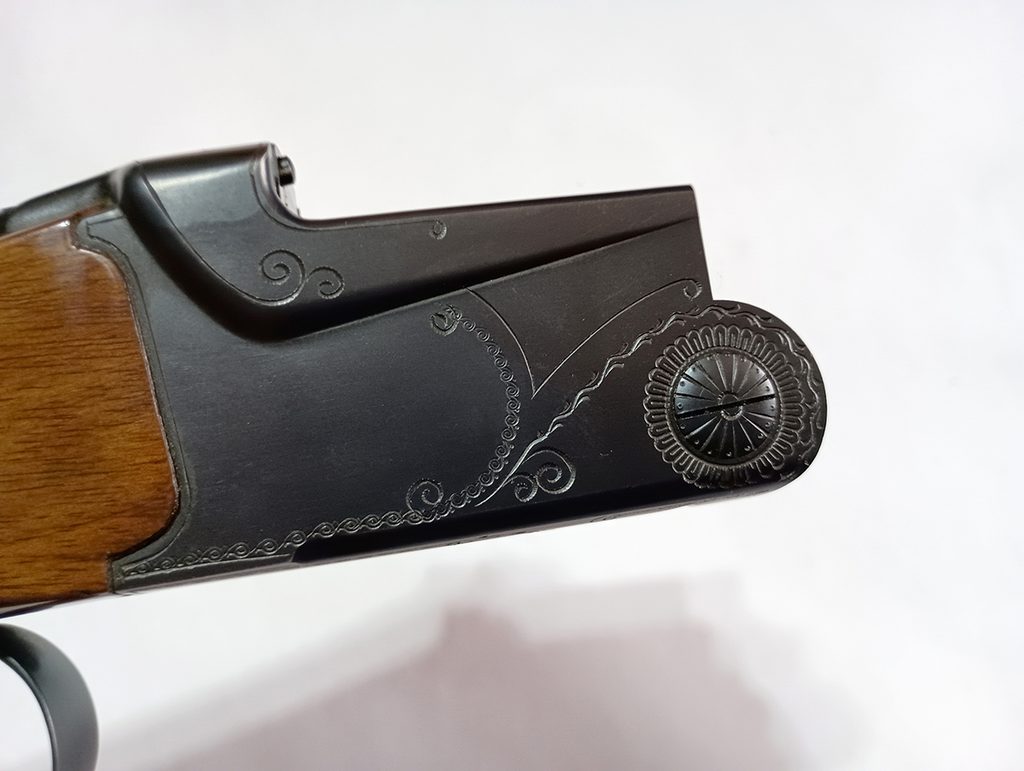
Shooters got a load for the money. If anything catches the modern eye, it’s that the gun was hand everything—fitted, checkered, rubbed and engraved. SKB moved to rolled embellishments by the mid-1970s, but the early models had their scrollwork hand-applied. The 500’s artwork is sparse, but jump to the next tier, the 600, and you get a lot of bling, including a smattering of gold inlay.
That said, all the SKB over/unders were hand-checkered throughout their run with Ithaca, a point proudly touted in every catalog from those final years of the company. Nice as it is—particularly at the height of press checkering—the work on the French walnut is fairly loose at roughly 10 lines per inch. Hey, lines are money, and the models were competing for the more affordable market.
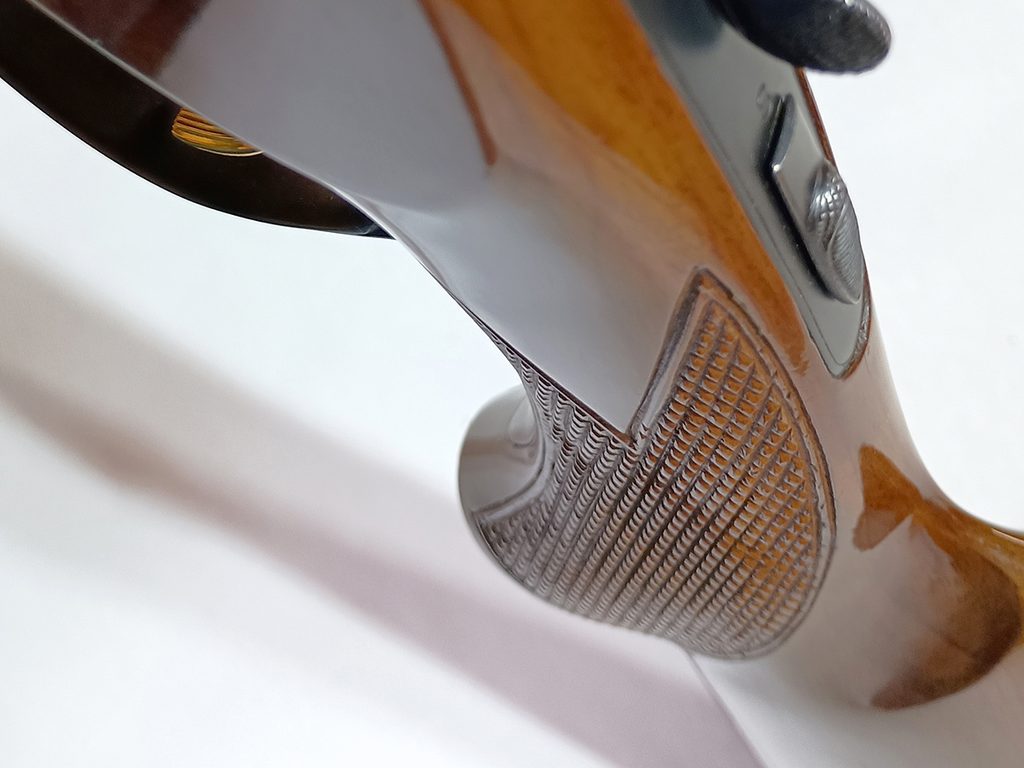
The stock’s finish needs discussion. Very much a gun of its time, it featured a gloss finish. Certainly, matte oil has been the standard since the turn of the 21st century, so the shiny grain of the 500 can offend contemporary sensibilities like a burnt-orange-and-avocado-green kitchen appliance. However, it works, especially mated to some striking metal.
SKB swam against the flow then with its selection of black chrome as the over/under’s coating of choice. Unlike the majority of the shotgun world, bluing wasn’t the order of the day with the Japanese guns; black chrome was, which gives the 500 some interesting attributes. First off, from an aesthetic standpoint, it adds unique depth to the gun. It’s not burnished in appearance, somewhat velvety and dark as coal dust. More markedly, the coating is as hard as coffin nails and impervious to corrosion.
You can see this aspect yourself if you ever shop for a 500 or its sibling models. The stock might be beat to hell, but the barrels most times look like they’ve just rolled off the assembly line. Careful, though: this only pertains to early model SKBs; the company did eventually move to bluing after the Japanese equivalent of the EPA dropped the hammer on its chroming process.
Aside from the 500’s material appearance, the gun was fairly low-profile. A ¼-inch rib rises and stays steady across the length of the barrel, also at roughly ¼-inch high. Then, nearly half the upper barrel nestles into the beavertail forend, giving the gun an overall sleek look in its whole. The design also gives it a high mount, I’ve found, naturally migrating to the upper recess of my shoulder pocket, but not unusually so.
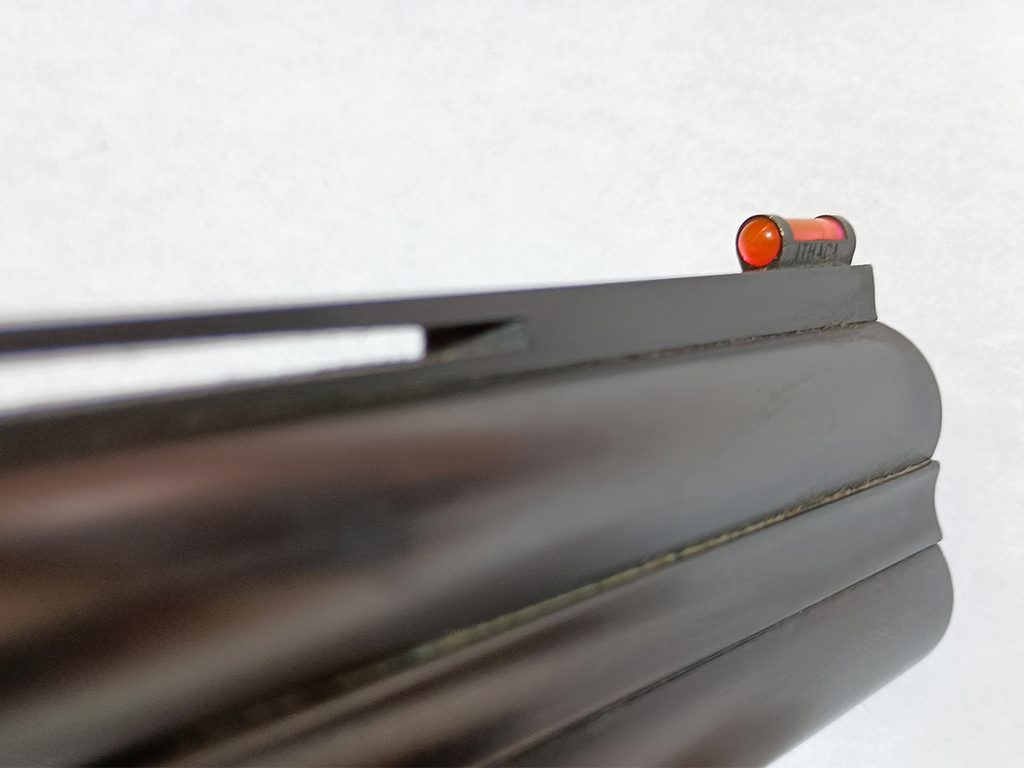
The 500’s bead is worth digging into, if for no other reason than it’s kitschy. The complete line of SKBs was outfitted with the space-age-named Ithaca Raybar. Spoiler, it’s simply fiber-optic piping, but I’d wager more than one shooter was sold with the sales schlock that it “lights your way to the target …” With America’s moon missions in full swing, who wouldn’t want this sort of bead in this era?
Nice as the looks of the gun are, what’s under the boxlock’s hood is what endears the 500. Particularly, its auto-select ejector is a nice touch in the field as it only kicks the hull from the barrel you shot.
One of its more unusual aspects—often misidentified—is the shotgun’s barrel selector. A select trigger, it almost mimics a cross-bolt safety, except it resides on the trigger proper—not the guard. Certainly, this is not a typical configuration, and I have read of negligent discharges due to the confusion. The safety is clearly on the tang—one would hope a close inspection of the firearm and a debriefing would prevent what could be catastrophic. But I digress …
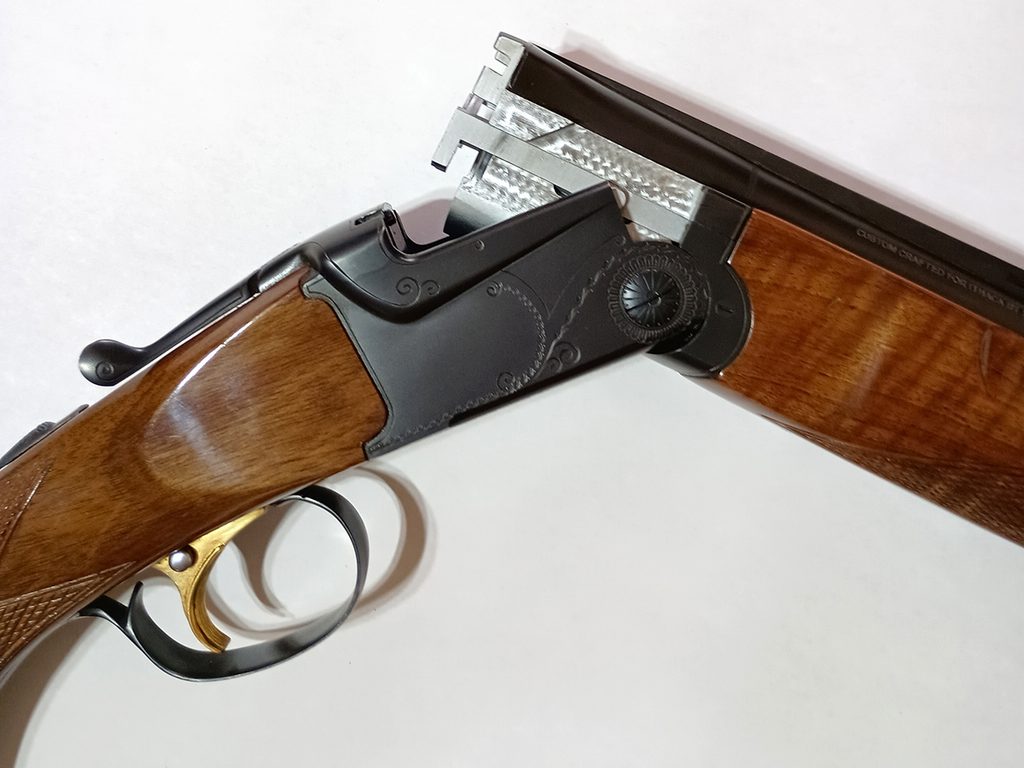
Move the barrel selector to the left to put the upper barrel in play; to the right, the lower barrel is ready to fire. It’s a nifty system, but not one without its faults. Going to the lower barrel is a piece of cake and is executed with a flick of the index finger. The other direction, try as I might, I can’t figure out a way, outside of letting go of the grip, to hit it with my thumb—particularly if the gun is at my shoulder. Resetting after both barrels are spent and the action broken open is no big shake.
The selector is attached to what might be one of the best stock triggers I’ve pulled in this class of guns. It’s as responsive and smooth as you could desire in a working-class gun, and it’s light. According to my Lyman trigger-pull gauge, it breaks at 4.5 pounds. And the gun’s lockup is superb, making doubles come lightning-fast.
The 20 gauge has a full choke on the upper barrel and a modified choke on the lower—Ithaca always ran the tight choke up top. SKB, for whatever reason, tended to make its chokes tighter than the rest of the industry; in turn, the pattern is tight as a jam-jar lid, giving the gun some reach.
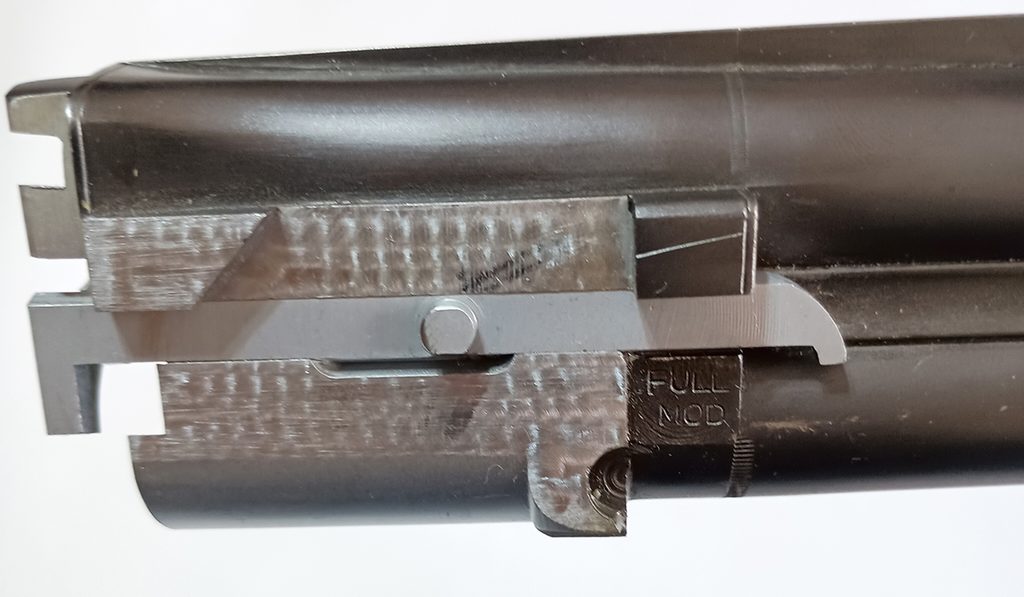
Given the 500’s 3-inch chamber, I would say it’d make a dandy teal gun or one for decoyable mallards. Alas, it’s best left as an upland or clay gun. Its vintage predates the ban on lead shot; thus, the barrels aren’t proofed for steel. If you have a deep pocketbook, Bismuth might be an option, but that’s your call.
Restricted to more terrestrial fowl, I’ve unfortunately been limited in its field use. Canada geese typically scratch my bird-hunting itch. Not that my 500 hangs above the mantle. It’s taken the odd pheasant and is plum dynamite on prairie cottontails and high desert jackrabbits. Every year, I swear it’s the gun I’m going to take when I finally go ptarmigan hunting. More than anything, it’s my go-to for casual clay breaking over those lazy summer months.
I’m far from the only one who appreciated it in this role. Ithaca sold a highly desirable skeet set, with 20-gauge and .410 interchangeable barrels. Find one of those at buyer’s prices and in good shape, jump on it—those are the Ithaca-SKB’s hidden jewels in performance and as a collectible.
Even given some of my regional limitations on game, the 500 remains among my favorite smoothbores, if for no other reason than it was my mother’s. Dr. and Mrs. Shelton were avid trap shooters and pheasant and quail hunters in the heart of Nebraska. I don’t know the full story, but the Ithaca was something my father specifically selected for his wife.
At first blush, it seems an ideal and attractive piece for a lady, given its slender lines. However, she made it one or two rounds of trap and was done with it. Never weighing over 90 pounds a day in her life, the lightweight scattergun was too bucky for her liking. Sure, it might swing like a hanging sign in the spring wind, but at the cost of a much too sore shoulder. Oh well, Dad tried.
When she gave it to me before she passed nearly 17 years ago, it was in such good shape it might as well have been in its original box. “Hope it does better for you,” she said. “It kicked like a mule for me.”
It has—done well, that is—and likely will for a long time.
The original SKB has gone the way of the dodo, but the brand still lives. Post-Ithaca, GU Inc. continued to import the Japanese guns under the SKB banner. When the company finally went under, one member of the stateside concerns, Rob Johansen, bought his partners out and became the sole owner of the brand.
Nowadays, SKB is more familiar with competitive shooters, given that almost all of its Turkish-made stock is tailored to breaking clays. However, Johansen knew the product he had moved all those years, and ensured that 500, 600, and 700 shooters had a place to turn to keep their guns running, within reason.
In buying SKB, Johansen also purchased what remaining components the company had for its legacy doubles: springs, firing pins, and even stocks. The last two are important because the old factory pins are prone to breaking, and there were some bad runs of wood on the fore, which are susceptible to splitting.
“The only thing unreplaceable are the barrels, say if you got mud in them and blew them out,” Johansen advised. “You’d have to find a scrap barrel at that point.”
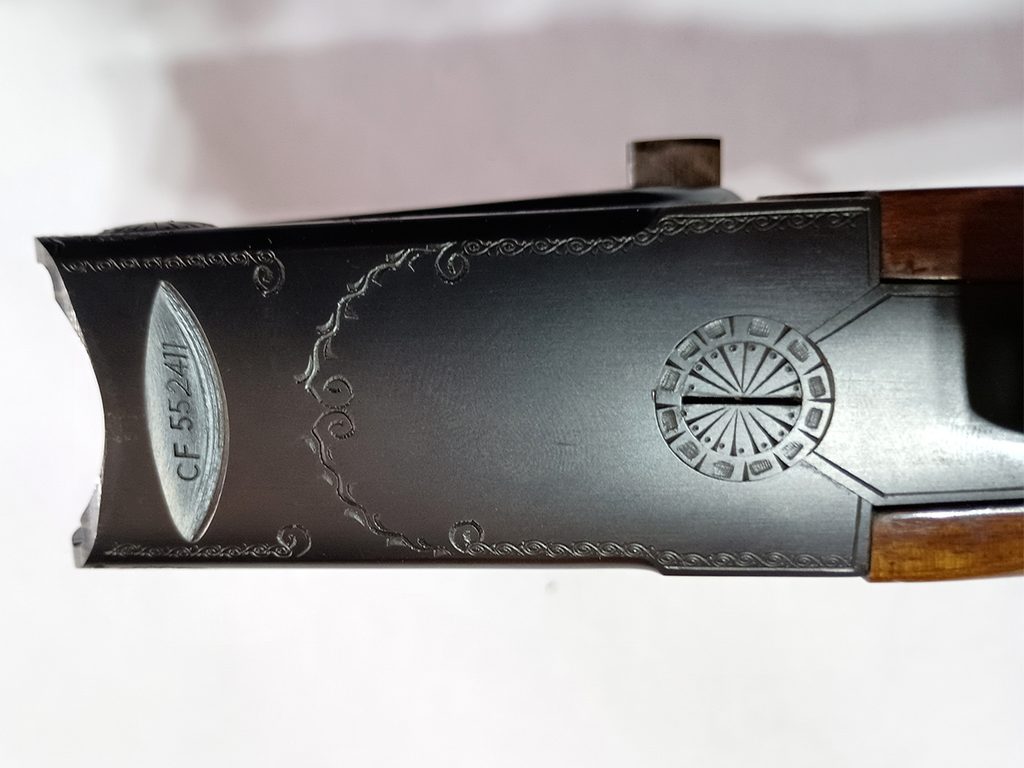
Stocks are a tricky matter. SKB has them, and Johansen is an admitted wood fanatic, but you’ll never get the right match-up. Plus, not only are the barrel and receiver serialized, but the metal on the fore is as well. Also, there are some compatibility issues—screw placement—between early and late Ithaca SKBs.
A prudent plan, if you have an old Ithaca SKB over/under, might be to purchase the replaceable parts the new SKB offers at its website (skbshotguns.com) to have on hand. We’re lucky there are original parts for 50- to 60-year-old guns, but the resource is finite. Another sad state, as Johansen points out, is a crisis in American gunsmithing: there are not enough individuals talented enough to maintain classics and soon-to-be classics.
“There are plenty of armorers, but we’re losing gunsmiths in America. Guys who can make springs or fabricate stocks,” he said. “People don’t appreciate the value of time it takes for these skills and aren’t willing to pay.”
Thankfully, for the time being, SKB offers the odd support to keep the 500 and its kin running.
Certainly, Ithaca’s ghost-written guns aren’t quite the legends of other imports clamoring for American shores at that time. Though, in my humble opinion, it certainly has the stuff to put it in the same rarefied class. I’m sure there’s a ptarmigan with the gun’s name on it. Until then, it’ll remain an enduring part of my collection—even if it took nearly 40 years to find the right Shelton’s shoulder.
Editor’s Note: This article originally appeared in the November 2026 issue of Gun Digest the Magazine.
More On Shotguns
- The Night’s Watch: Choosing The Best Home Defense Shotgun
- Best Semi-Auto Shotgun: Scatterguns For The Field & Defense
- The Pump-Action Shotgun Buyer’s Guide
- The AR-12 Shotgun Buyer’s Guide
- Best Double-Barrel Shotgun: Affordable Edition
- Top Bullpup Shotgun Options For Compact Defense
- The Best Tactical Shotgun Options: Buyer’s Guide
- All About AK Shotguns

Next Step: Get your FREE Printable Target Pack
Enhance your shooting precision with our 62 MOA Targets, perfect for rifles and handguns. Crafted in collaboration with Storm Tactical for accuracy and versatility.
Subscribe to the Gun Digest email newsletter and get your downloadable target pack sent straight to your inbox. Stay updated with the latest firearms info in the industry.