After more than 125 years, the old toggle-top Luger still exerts its pull on some of us.
Addiction takes many forms, and my current addiction is the Luger pistol. This classic handgun goes by several monikers, including P08 (Pistole 08 in German, referring to 1908, when the Imperial German Army formally adopted it), Parabellum (from Latin, “prepare for war”), and, less formally, ‘toggle-top’, a reference to its operating mechanism. However, Luger—named after its Austrian inventor, Georg Luger—is its most common designation.
In all its models and variations, the Luger pistol is arguably the most collected and sought-after handgun in the world. Its nearest competitor is likely the iconic Colt Single Action Army revolver. From the moment I first experienced the feel of a Luger in my hands, I wanted one. Fate being fickle, my dream of ownership wouldn’t be fulfilled for 57 years. That’s one long wait.
As this writer discovered, and as the author of “Valley of the Dolls”, Jacqueline Susann, somewhat notoriously put it, “once is not enough.” In short order, one long-wait Luger became three. Will it end there?
Addiction is not easily cured.
The mystique of the Luger and its addictive qualities are undeniable. A pioneering handgun design introduced in 1898, sleek and ergonomic, German precision, storied combat in two world wars and far beyond, a presence on the silver screen, and the pistol’s many iterations—more than a hundred variations and proofmark configurations over its more than 50-year history. It’s an impressive resume. Not surprisingly, Luger collectors span the globe. Time has only increased its popularity.
As one learns quickly when pursuing the P08, these attributes prove formidable obstacles for those who want to own at least one to shoot without going broke. The pistol’s appeal has driven prices to astronomical levels, with few guarantees of provenance, condition, or shootability. Buying one today isn’t just risky business; it’s often a substantial financial investment and a proverbial shot in the dark.
The Long Journey
My Luger journey began in the fall of 1967 at a gun show in Milwaukee, Wisconsin. My father brought me along to experience the vast array of rifles, handguns, and shotguns on display and to share in his passion for firearms. These were unforgettable experiences for a 14-year-old boy just beginning to learn about guns.
As was his way, Dad took his time at these shows, stopping at almost every booth, chatting with proprietors and acquaintances encountered along the way. Less patient and more focused than my father, I went like a torpedo directly to the displays that sparked my interest. That particular day, a man had several Lugers on his table, along with German military swords, daggers, Iron Crosses, and a couple of World War II Stalhelm helmets. I was familiar with the pistol from Dad’s Gun Digests, other firearms publications, television, comic books, and toy handguns.
The man in the booth saw something in me, and it wasn’t a potential buyer. He took a Luger out of his display case and carefully handed it to me. “What do you think of that, son?” he asked. I can’t remember my answer, but I’m sure he saw the amazement and pleasure in my eyes. I’ve never forgotten that experience, the feel of that pistol, or the desire to own one.
Like today, Lugers were in demand, expensive, and scarce in our city in 1967. Those for sale in firearms periodicals, at gun shows, and in retail stores often cost more than a new Smith & Wesson or Colt revolver. Dad owned a Luger once, a battered World War II battlefield pick-up that someone chromed over to conceal its disfigurement. With use, the chrome began to peel. Soon after, he swapped it for an old Colt New Service 455 Eley revolver.
Dream Diverted
Scarcity, high prices, my father’s bias, and the wide world of other handguns out there diverted my Luger dream for more than five decades. Yet, whenever a P08 appeared in a gun store or show, I had to have a look. By then, I began to realize that most of the Lugers for sale were well-used specimens, many with mismatched parts and severe corrosion, particularly in the bores. It didn’t take an expert to see that most of these P08s were in less-than-prime condition.
Over the years, Dad and I befriended numerous fellow shooters. When the subject of Lugers came up, it was seldom positive. Everyone groused about prices. Then there were complaints about jams and parts breaking. I never heard one owner say the broken part was replaced and the pistol restored to functionality. One of Dad’s coworkers had a smart 1941 BYF-marked Mauser P08 that he hinted might be available for trade, but Dad was unwilling to part with any of his treasures to consummate a deal.
Fast forward five decades. Dad passed away, and I was then 71 years old. The desire to own ol’ toggle-top still burned bright. If there was a time to fulfill the dream, it was now. Of course, prices had risen to astronomical-plus levels, and quality was even more suspect.
I must have examined over a hundred P08s over the past 57 years. Friends advised me to bite the bullet, buy a “shooter,” meaning a vintage, perhaps cosmetically imperfect, and/or perhaps-less-than-100-percent-original pistol, now priced over $1,000, and take my chances that it would function reliably. (Replacement parts and/or refinishing are not synonymous with a poorly functioning pistol. Many refinished Lugers or those containing replacement parts are fine shooters, giving their owners much pleasure.)
Finding Your Luger
When buying a Luger, particularly one to shoot, the novice has to know about models, variations, condition variables, suitability for the range, and how to price them reasonably. Gun stores and shows are a starting point, but, as I discovered, to cover the field, one must venture online. Here, the risks climb. Without a physical examination, one must rely on photos from various angles and place less weight on the owner’s claims regarding originality and condition. It’s a daunting experience. One important consideration is determining the seller’s return conditions early on.
Luger genealogy is a fascinating subject in its own right. In summary, German-made P08s are generally categorized by three eras of production for military and civilian sales worldwide: The Imperial Era under Kaiser Wilhelm, from 1900 to the end of World War I in 1918; The Weimar Republic Era, from 1919 to the early 1930s; and the Nazi Era extending to the end of World War II in 1945.
Seven countries and various police services issued the Luger as their official service pistol, with numerous others using it on a limited or unofficial basis.
Over its approximate half-century production run, manufacturing of the time-consuming, expensive pistol passed among German companies Deutsche Waffen und Munitionsfabriken (DWM), the Royal Erfurt and Spandau Arsenals, Simson Company, Mauser G.m.b.H., and Heinrich Krieghoff & Son. Waffenfabrik Bern produced Swiss-made Parabellums for military and civilian use from around 1918 to approximately 1947.
The Luger story didn’t end there.
While German manufacturing ceased, pistols continued to be assembled for a while from captured parts inventories for sale as war souvenirs. The victorious French applied liberated Mauser production machinery to build a small number of P08s for their forces. Russian occupiers and their East German allies utilized captured pistols and those assembled from parts for police issuance and, in limited numbers, for export to other communist countries.
Parabellum parts had a life of their own. They were also sold and assembled into pistols in the United States and elsewhere. The U.S. seemingly couldn’t get enough Parabellums.
Then, in the late 1960s, Mauser took on the Herculean task of recreating the Luger from almost scratch. It succeeded and produced pistols until about 1986, with inventories lasting until the 1990s. Several other manufacturers gave it a go, with varying degrees of design authenticity, including German 22 LR and 380 ACP versions from Erma Werke and the American-made Stoeger Arms Corporation’s 22 LR and Mitchel Arms stainless steel 9mm pistols. Still, they’re all long out of production. There’s little traction today in producing the Luger, except for a few custom, build-to-order makers, including one offering a 45 ACP Parabellum, whose sticker prices are beyond the financial means of most of us.
The Next Steps
Devotees of the Parabellum fall into three categories, with overlap: collectors, investors, and shooters. We pure shooters appear to be in the minority when competing for available pistols. As the aspiring Luger owner soon learns, opinions on what constitutes a shooting Luger are numerous and occasionally heated. Sometimes it’s a kerfuffle between interested parties regarding rarity, monetary value, and the joy of shooting a classic handgun. Understand that the Luger was built for military and police use, not to rest in a gun safe.
A free, must-visit resource for Parabellum aficionados is Lugerforums.com, an online website dedicated to P08 enthusiasts of all levels of knowledge. It’s a treasure trove of information, opinion, and conjecture par excellence. The forum’s helpful members will answer your questions and provide the information, advice, and encouragement you need on all matters, Luger and beyond.
To authenticate a particular Luger’s provenance, authenticity, and condition, you must have basic knowledge, access to accurate (often expensive) reference materials (Lugerforums helps here), and, in the end, disassemble the pistol to examine individual components, particularly the bore, frame, toggle mechanism, and part serial numbers. Heavily worn, corroded, or cracked parts are trouble. If permitted, a range session is the ultimate test for suitability as a shooter.
Like all semi-automatic pistols, the Luger’s reliability is influenced by its magazine and the ammunition used. Even an otherwise reliable-shooting Luger will malfunction with a worn or damaged magazine, a broken internal part, the wrong ammunition (overall cartridge length is a primary concern), or improper magazine loading. In my experience, most vintage Parabellums on the market are offered with non-original magazines. Not a problem; if needed, excellent replacement P08 mags are available from Mec-Gar USA, Inc.
Facing these obstacles, I took a different route. I recalled the aforementioned Interarms Mauser, an authentic rendition of the Swiss 1929 Luger, in 9mm Parabellum and 7.65 Luger chamberings, with 4- and 6-inch barrel options. While equipped with a grip safety and a straight front gripstrap, compared with the standard German P08’s curved strap and lack of a grip safety on most models, the pistol was manufactured in Obendorf, Germany, not coincidentally the builder of most of Germany’s World War II-era Lugers. While long out of production, an Internet search revealed that these pistols were still plentiful and affordable, and they enjoyed a good reputation in online reviews.
Success at Last
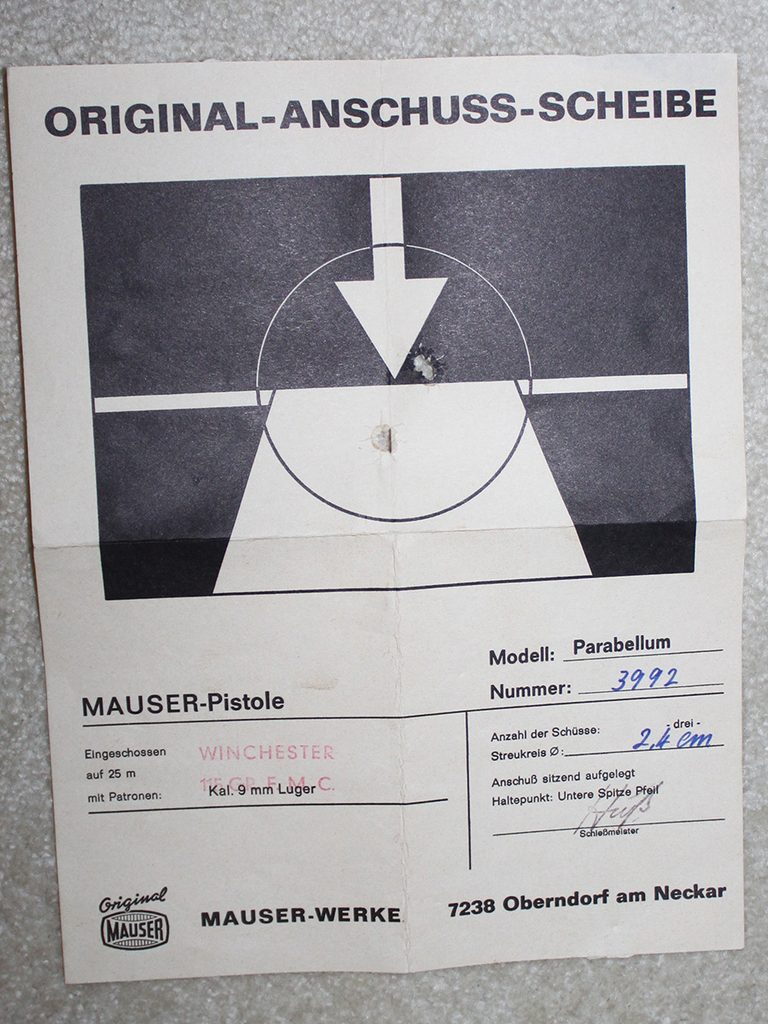
On the web, I located an unfired 9mm specimen with a 4-inch barrel, complete with its original box, extra magazine, loading tool, barrel brush, owner’s manual, and factory test target, priced less than many vintage P08s I encountered. Photos backed up its condition claims. I took the plunge and endured a traumatic delivery process that lasted more than two weeks, due to the confluence of the Christmas mail rush and a massive backlog at the city postal warehouse it traveled through. Its package tracker wasn’t functional, further compounding my anxiety.
When the blessed delivery occurred, I couldn’t have been happier with the results. The Interarms Mauser 29/70, as the pistol is sometimes referred to, is all Luger. Takedown is typical Luger; the parts are nearly identical (though not interchangeable, I’ve read) to those of older pistols, and the look and feel are 100-percent Parabellum, albeit the Swiss 1929 version.
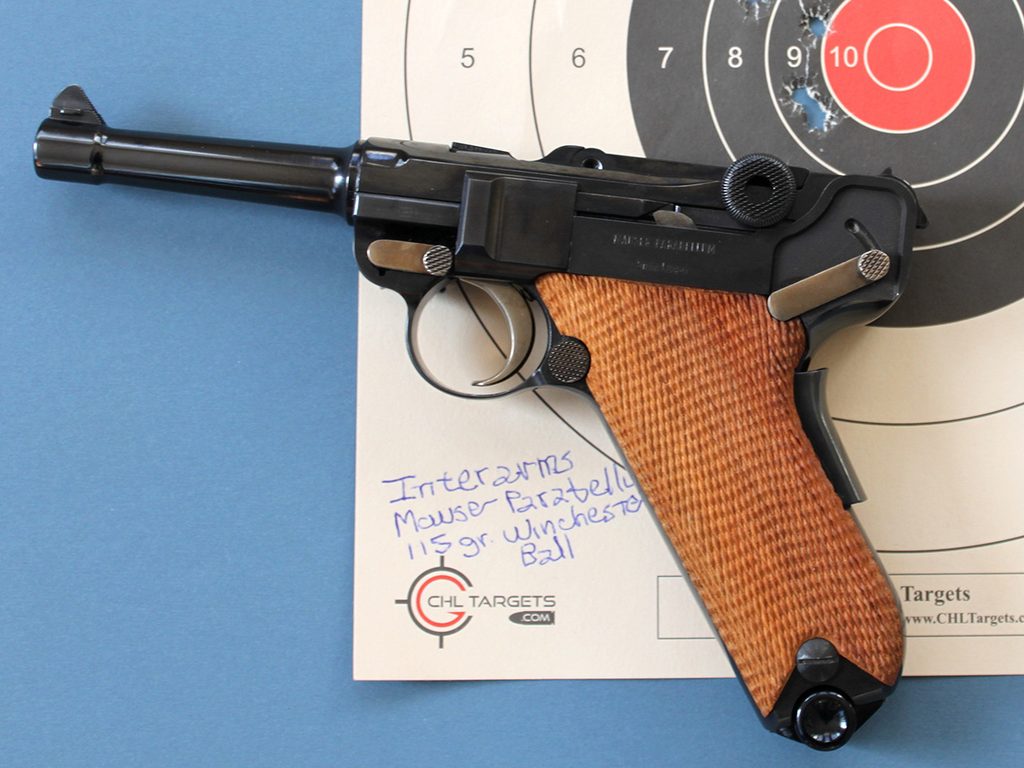
Mauser clearly took great care and expense to authentically replicate the pistol using modern machinery, with help from original Swiss blueprints, parts drawings, work sheets, original production gauges, and surviving production jigs that, most unfortunately for Mauser, were incompatible with its 1960s manufacturing technology. The fit and finish of the Mauser Parabellum are typical German—superb. The bluing on my 29/70 is dark and rich, and the straw colors on the trigger, takedown lever, ejector, magazine release button, and thumb safety are vibrant. An attractive American Eagle stamp rests atop the chamber.
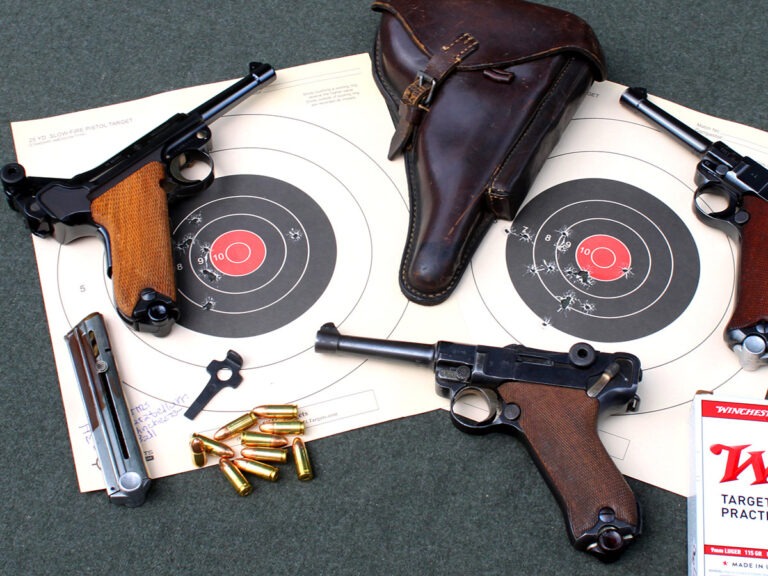
Range sessions revealed performance that equaled the pistol’s appearance. True to its predecessors, the P29/70 features small fixed-V rear/pyramid front sights and a trigger that can best be described as challenging. With the Luger’s complex trigger mechanism, my specimen offers virtually no take-up, an 8-lb. wall, followed by release with scant overtravel. The sights function OK with adequate light, but are useless in low light. These impediments take some getting used to, but once you master them, you’re rewarded with target-pistol accuracy. Fired offhand at 25 yards, on a good day, my Mauser Parabellum groups in the black with surprising ease. This by a bifocaled septuagenarian with a touch of shake.
Lugers have a reputation for being finicky eaters. The three-shot, sub-1-inch factory test target included with my pistol was achieved with Winchester standard velocity 115-grain FMJ target and practice ammunition. Accordingly, that’s what I use in the P29/70, with complete reliability. I see no need to experiment with other loads.
The pistol’s magazine springs are powerful enough to ensure reliable feeding. Using the loading tool makes the process much easier. Still, thumb strength definitely comes in handy. Proper cartridge stacking in the magazine is critical for reliability. The toggle mechanism requires strength to rack. Despite the pistol’s beauty, it’s built to shoot. Although my Luger sat unfired for approximately 52 years, there will be periodic range workouts. Its life as a safe queen is over.
Because of the Luger’s tight tolerances and intricate design, it must be kept reasonably clean and lubricated. Despite claims of fragility, a good number of Parabellums remained in active service for many years, reliably.
What is a Classic Luger?
While very well done, to many purists, the Interarms Mauser Parabellum 29/70 doesn’t qualify as a true classic Luger. As author Aaron Davis put it in The Luger Handbook, using an analogy of the classic 1964 Ford Mustang auto compared with today’s version, “…it’s a flattering likeness, but the original stands apart.”
I’m not sure I agree with that appraisal or if it really matters. Based on my experiences, the P29/70 is one fine Luger to own, shoot, and admire.
Now I had everything Luger I needed, but there were nagging urges. The thought of a World War II-vintage, military-issue P08 lurked restlessly in my mind, despite more than half a century of effort and countless disappointments in pursuit of one. More than ever, Luger hunting is fraught with sky-high prices, a limited supply of suitable pistols, questionable quality, and the occasional intentional misrepresentation. On this journey, one ventures forward at one’s own risk.
A Pleasant Surprise
Then the unexpected occurred. As I struggled with Parabellum addiction, there was a complete relapse. I learned of a relative who had a World War II bringback P08, with its issue holster, that his father had liberated from a German officer during the Battle of the Bulge. The price was reasonable, and I bought it post haste.
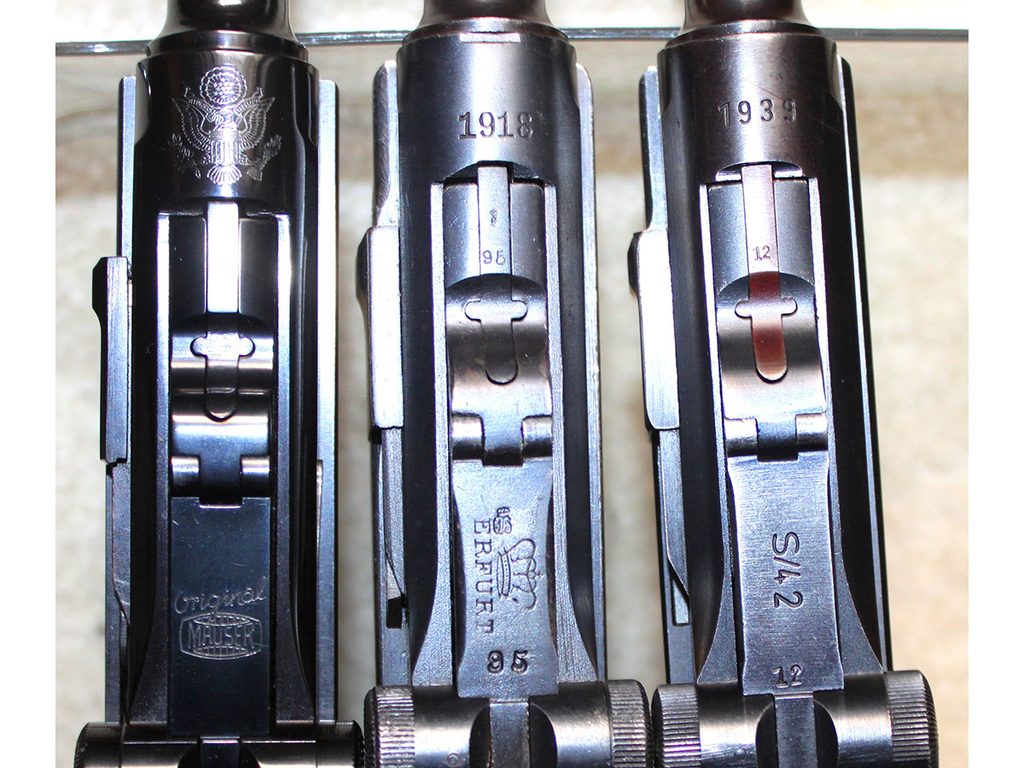
This WWII capture turned out to be a 1918 Erfurt Imperial pistol, all original and matching except for one period wood-base magazine and one 1930s aluminum-base version. The Luger was in excellent condition throughout, as was its brown, 1918-dated Lestelmann of Strassburg holster. Loaded in the spare magazine and fit into the holster were five rounds of Czech 1947 9mm ball ammunition—no story on how they got there.
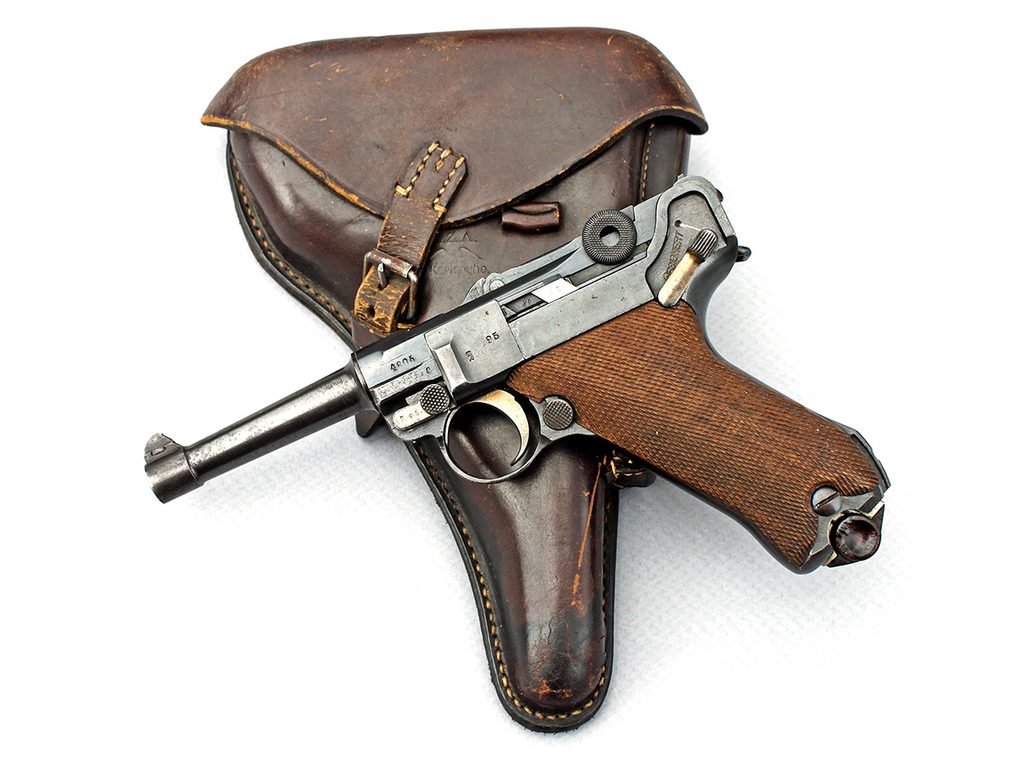
While not my hoped-for World War II-vintage Nazi-era pistol, it’s a beauty. If only old battle pistols could talk. Is it a World War I issue that returned home with its user, then handed over to a son for the new war, or had it been resting in a German arsenal after hostilities ceased, awaiting reissue to Hitler’s Wehrmacht?
After disassembly and a thorough inspection, cleaning, and oiling, the Luger passed its initial range session with flying colors, despite those small sights and an extra-challenging trigger. Based on my relative’s recollection, the pistol hadn’t been fired in over 70 years. I ran a box of Winchester standard-velocity 115-gr. FMJ through it with 100-percent reliability. Accuracy offhand at 25 yards was similar to its 1970s counterpart—outstanding.
Now I was two Lugers rich. Common sense said I had everything needed for a lifetime of Parabellum pleasure. Such was not the case.
Another Luger Appears
Somehow, a collector-grade 1939 Mauser S/42 P08 was offered to me at a collector-grade price. According to its seller, the pistol I’d been seeking for over half a century was in excellent condition, with all matching serial numbers, except for the magazine and grips. Sticker shock held me back for precisely 24 hours, but remember, I was now an addict. I took a deep breath and dropped the cashier’s check in the mailbox.
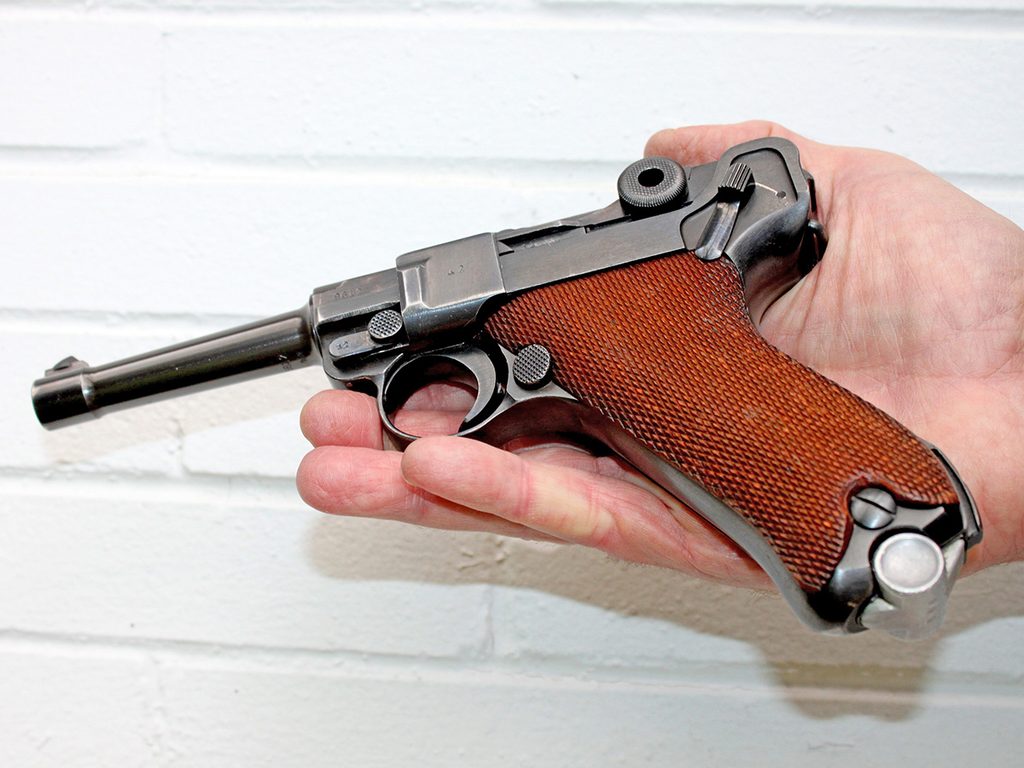
When the Luger arrived, it was everything I’d hoped for and more. This pistol was indeed in prime condition throughout, completely reliable at the range and, thanks to a superb trigger pull (for a Luger), as accurate as any target handgun I’d fired. I asked myself: “Is there anything more in life?”
Not yet, but…
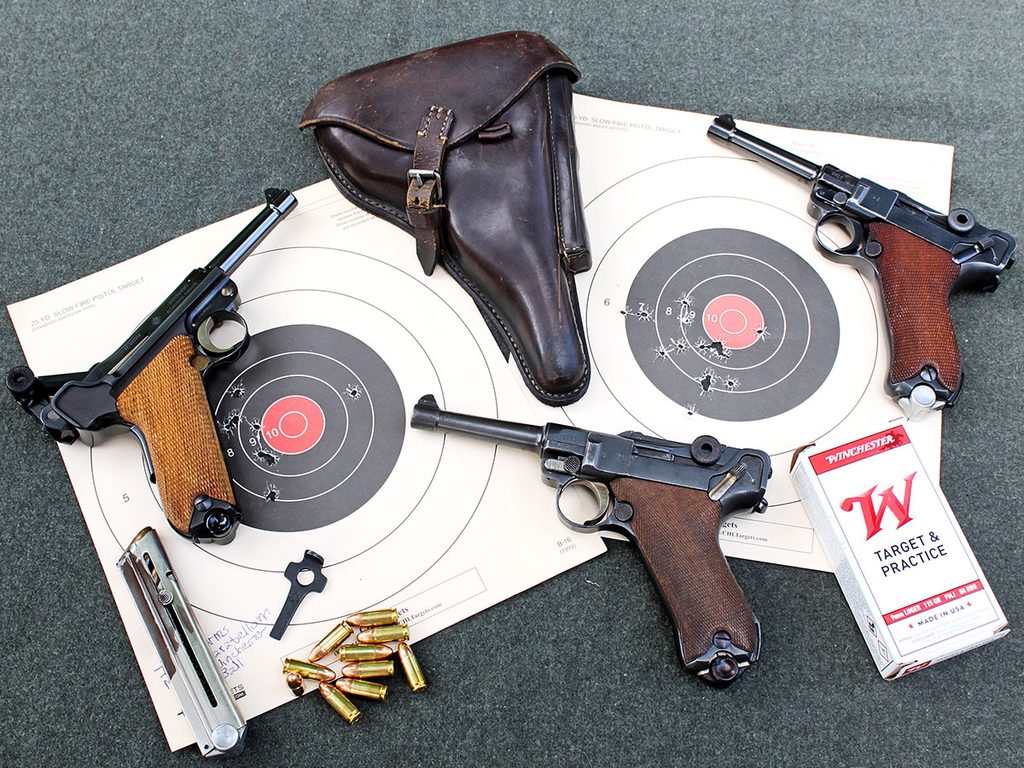
I’ve attempted to rank my trio of Parabellums based on looks, accuracy, and historical significance. I can’t. Each is special in its own right, attractive, accurate beyond my capabilities, and as much pleasure to hold and admire as to shoot. There is no favorite. They all provide extraordinary shooting pleasure.
So, here’s where my Luger addiction stands today: I own three fine Parabellums. Perhaps addiction has finally been sated. Perhaps not. An acquaintance recently showed me a handsome 1920s Weimar-era DWM PO8 in 7.65 caliber, with its Safe and Fire safety designations in English. Is it very nice? Yes. Do I need it? No. Is that the end of the story?
I think not.
Bibliography
- Frank C. Barnes, Cartridges Of The World, Gun Digest Media, 5600 W. Grande Market Drive, Appleton, Wisconsin 54913
- Davis, Aarron, The Luger Handbook, Krause Publications, 700 E. State Street, Iola, Wi 54990
- Dixon, Jim, “The Return Of The Krieghoff Luger,” Gun Digest 2011, Krause Publications, 700 E. State Street, Iola, Wi 54990
- Ezell, Edward, Handguns Of The World, Barnes & Noble Books, New York- New York
- Will Fowler, Anthony North, Charles Stronge, And Patrick Sweeney, The Complete World Encyclopedia Of Guns, Hermes House, 88-89 Blackfriars Road, London, England
- Hogg, Ian V., The New Illustrated Encyclopedia Of Firearms, Wellfleet Press, 110 Enterprise Avenue, Secaucus, New Jersey, 07094
- Roberts, Joseph B. Jr., Firearms Assembly, The Nra Guide To Pistols And Revolvers, National Rifle Association Of America, 11250 Waples Mill Road, Fairfax, Virginia 22030
- Stevenson, Jan, “The Parabellum Story,” July 1969 Gunfacts Magazine, Hazard Publications. Available On The Internet At
- Thompson, Leroy, The Swiss Luger, Military Surplus Collector’s Guide 2014, Harris Publications, Inc., 1115 Broadway, Nyc, New York 10010
Editor’s Note: This article is an excerpt from the Gun Digest 2027, 81st Edition annual book.
More Classic Guns
- Ten Classic Guns You’ve Got To Own
- High Standard .22 Pistols
- Collecting The Colt Single Action Army
- The Colt Model 1903 Pocket Pistol
- A History Of The 1911

Next Step: Get your FREE Printable Target Pack
Enhance your shooting precision with our 62 MOA Targets, perfect for rifles and handguns. Crafted in collaboration with Storm Tactical for accuracy and versatility.
Subscribe to the Gun Digest email newsletter and get your downloadable target pack sent straight to your inbox. Stay updated with the latest firearms info in the industry.