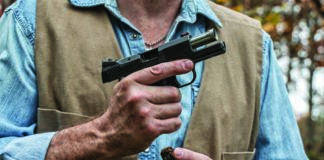
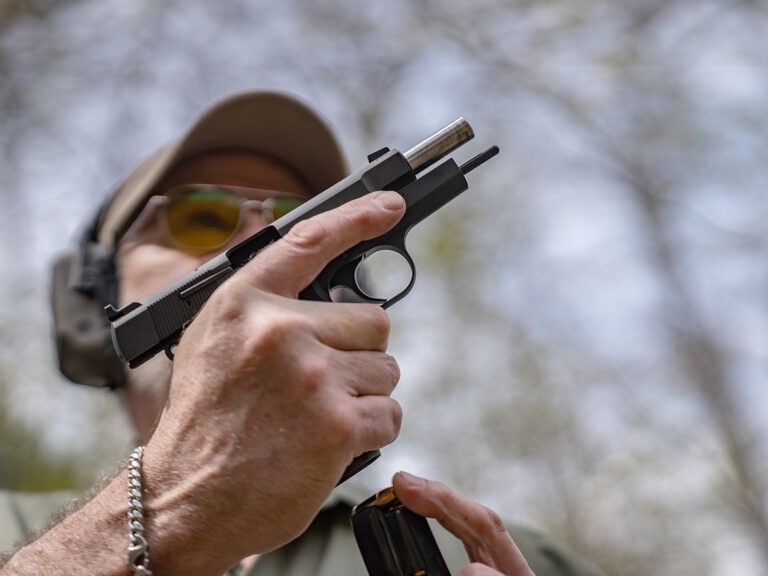
Springfield’s SA-35 4-inch is baby in stature with big boy potential.
I’ve always liked the Hi-Power pistol, partly because it fits my hand better than any other pistol and partly because of its historical allure. It has the unique distinction of being used by opposing forces during World War II. Many refer to it as the “Browning” Hi-Power, primarily because John Browning began the pistol’s initial development, and because Browning imported the pistols from FN Herstal until it was discontinued in 2018. It’s also commonly known as the BAP (Browning Automatic Pistol) or the P-35, which is why when Springfield Armory introduced their version of the Hi-Power in 2021 they called it the “SA-35.”
Springfield Armory’s SA-35 is very similar to the Hi-Power pistols Browning sold for years, and the SA-35 has sold well. It has introduced a lot of new-age shooters to the original “wonder nine” pistol. The Hi-Power’s link-less barrel, pivoting trigger and double-stack magazine is basically the blueprint for every modern 9mm semi-automatic pistol since.
Over the years, the Hi-Power has been frequently customized much like the 1911. For a time, Novak’s even supplied custom Hi-Power pistols to the FBI’s hostage rescue team. One appealing but rare Hi-Power pistol customization has been shortening the pistol to 1911 Commander length.
Factory new or original Hi-Power pistols have a 4.7-inch barrel, which makes them full-size pistols. Some custom pistol smiths would shorten the barrel to around 4 inches and some even shortened the grip and magazine as well. These abbreviated Hi-Powers were often called “Baby Hi-Powers,” the goal to make the pistol easier to conceal.
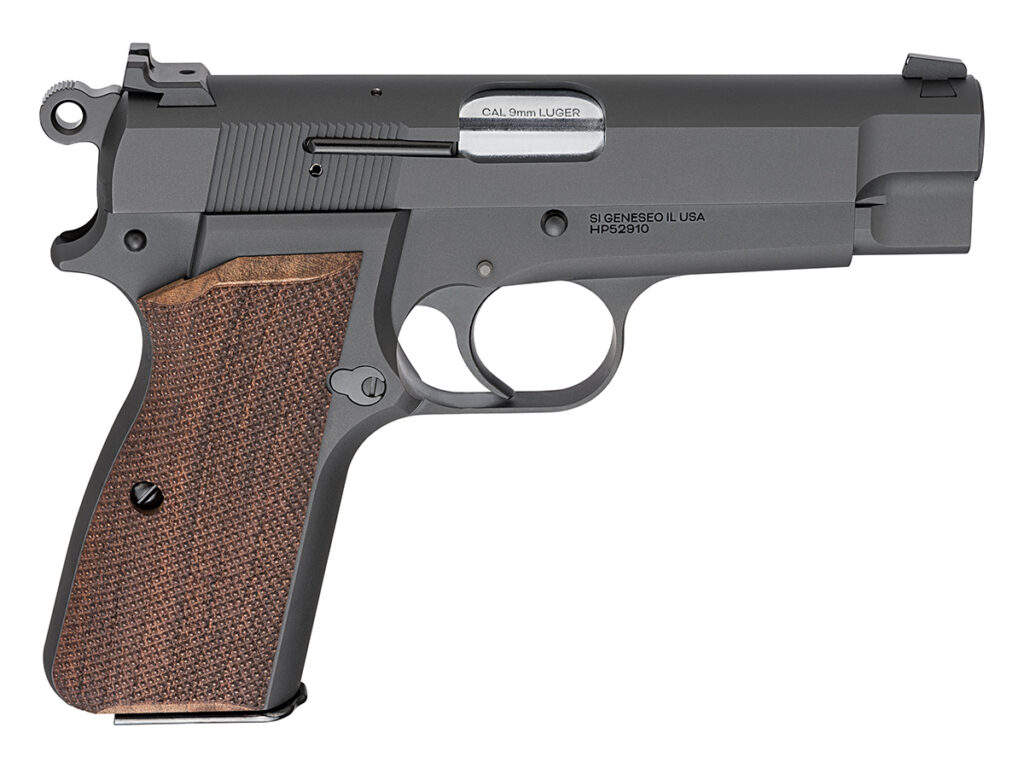
Springfield Armory SA-35 4-Inch Specs
Caliber: 9mm
Action: Hammer-fired, Single Action Only
Capacity: 15+1
Barrel: 4 inches, Cold Hammer Forged, 1:10
Overall Length: 7.1 inches
Height: 4.8 inches
Weight: 29.8 ounces
Finish: Matte blued
Grip: Checkered walnut
Sights: White Dot Front, Serrated Tactical Rack Rear
Safety: Manual thumb, left side only
MSRP: $799
Pros:
- Shoots like a full-size despite being compact
- Good trigger
- Very reliable
Cons:
- A bit more muzzle rise than a standard Hi-Power
With the new 4-inch SA-35, Springfield Armory has birthed a “Baby” that is ¾-inch shorter and 1.7 ounces lighter than their standard SA-35. The weight reduction does not make much difference, but the shorter barrel and slide does. In fact, this new condensed SA-35 looks and feels much smaller than what you’d expect from only a ¾-inch reduction.
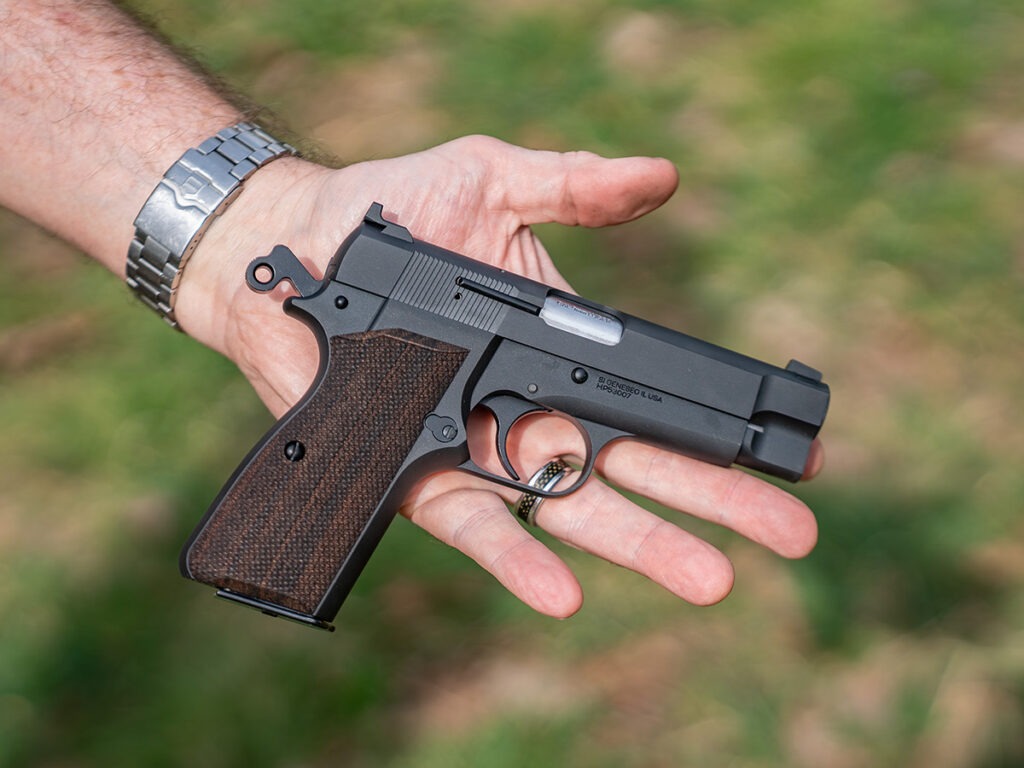
Though a more compact Hi-Power should be appealing for everyday carry, I was never intrigued. Custom creations like them were expensive. I also thought them a bit ugly and assumed that with the reduction in sight separation—barrel length—I would not shoot the pistol as well. However, when Springfield Armory introduced this shortened Hi-Power, I wanted to try it. After all, I really liked their original SA-35, and I own, frequently shoot and sometimes carry one.
Except for the shorter barrel, the 4-inch barreled SA-35 (#HP9204) is exactly like the original SA-35. It’s of course chambered in 9mm Luger, has a forged carbon steel frame and slide, checkered walnut grips, comes with one 15-round magazine, and has a white-dot front sight with a serrated tactical rack rear sight. Also like the original SA-35, there is no magazine safety; most every custom Hi-Power pistol smith removes these safeties on original Hi-Powers because no one wants them, and because they degrade the trigger pull. The trigger on the test pistol broke very cleanly and consistently right at 3.5 pounds.
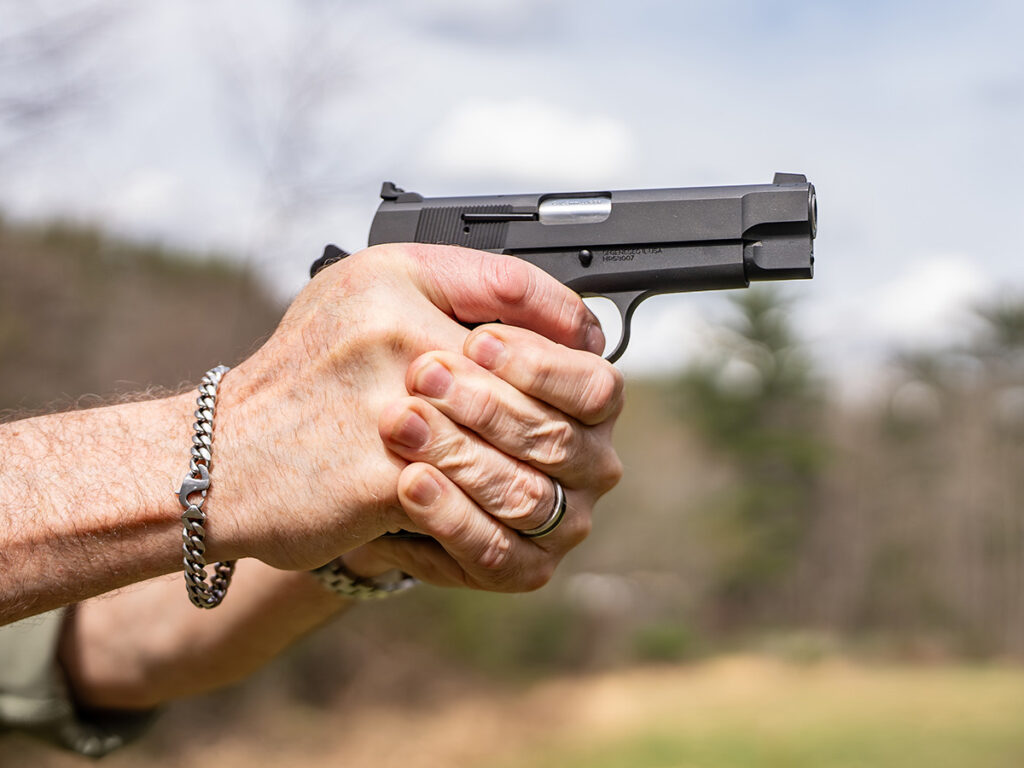
The first thing I did was run a box of ammo through the pistol to see if it would work, and to see how much the shorter barrel enhanced recoil impulse. The pistol ran perfectly, and while I could tell there was a bit more muzzle flip than with a standard Hi-Power, the recoil was in no way objectionable. Next, I put the pistol on the bench to see how well it would shoot at 10 yards.
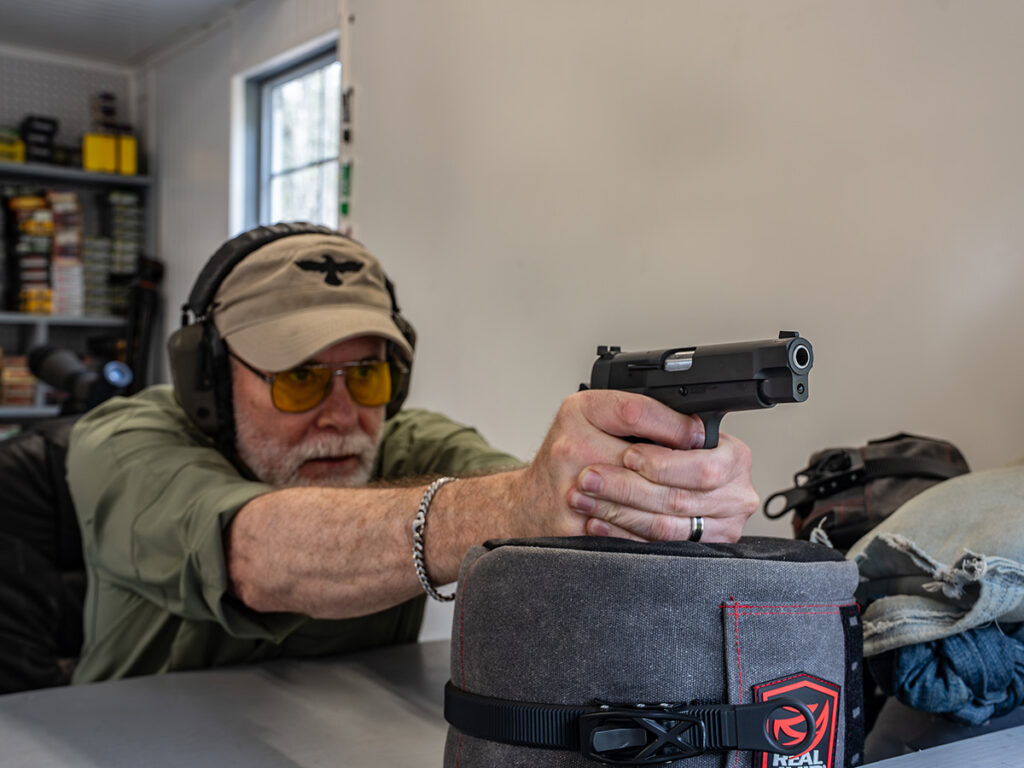
A few years back, I tested two custom and two factory Hi-Power pistols the same way and the average group size for all four pistols was 1.45 inches. In that test, the original full-size SA-35 delivered the largest average of 1.54 inches, and a custom Hi-Power turned in the best average at 1.36 inches.
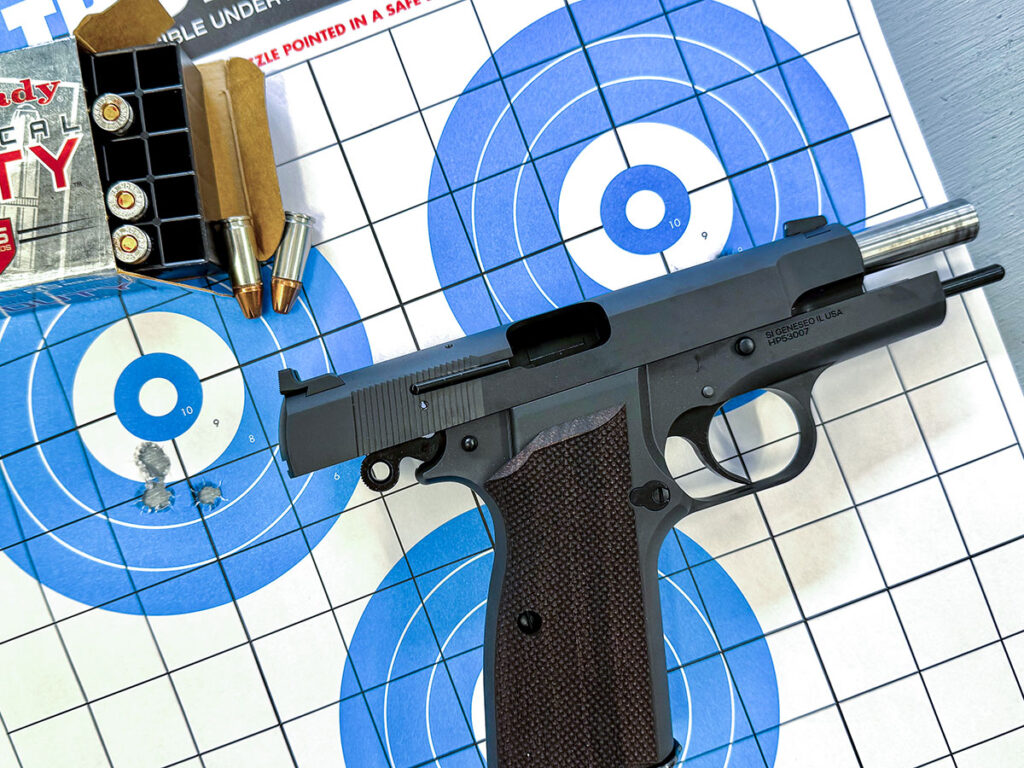
Surprisingly, with the five loads tested, this new 4-inch “Baby Hi-Power” SA-35 turned in an average group size of 1.37 inches. With the Hornady 135-grain Critical Duty load, the five-shot, five-group average was only 0.92 inch. I cannot guarantee a 4-inch SA-35 you might buy will do the same, but by any Hi-Power standard this pistol is a shooter.
Of course, a pistol like this is not intended to be shot from a sandbag rest. This is a carry gun, and where it should really perform is when subjected to practical self-defense drills. In total, I put more than 500 rounds through the 4-inch SA-35 using a variety of training and self-defense loads. There was not a single misfire, failure to feed, failure to extract or failure to eject.
What also surprised me during these drills was that I shot the shorty Hi-Power just as accurately as I shoot full-size Hi-Power pistols. However, the increased muzzle flip added—on average—about 13 percent to the time it took me to run each drill with a full-size Hi-Power. The Hi-Power I most often carry is a rare lightweight Hi-Power that has been fully worked by Novak’s. Unloaded, that pistol weighs only 23 ounces—6.8 ounces less than the 4-inch Hi-Power. My drill performance with the 4-inch SA-35 very nearly mirrored my performance with the custom lightweight Hi-Power.
I liked the 4-inch SA-35 much more than I thought I would. With this pistol, Springfield Armory will introduce even more shooters to the Grande Puissance (French for “great/high power”). You see, FN engineer Dieudonné Saive finished the Hi-Power design for FN, specifically for the French military. The French—bless their hearts—went with another pistol, but the rest of Europe—and the world—saw the greatness of the Hi-Power, and it became the most prolific military pistol in history.
Now you can get a “baby” version of that pistol for only $799.
9mm Pistol FAQ
Yes, and many experts would even argue that a 9mm pistol is the best choice for self-defense. It may not be as powerful as 10mm Auto or .357 Magnum, but cartridges that big are difficult to shoot quickly and accurately as well. For most people, their ability to make good hits with a 9mm will be more effective at stopping a threat than having a bigger bullet. Further, defensive projectile technology has progressed leaps and bounds, so modern 9mm self-defense ammo provides excellent, reliable expansion and penetration.
Yes, for the most part. Sometimes it’s best to start a first-time shooter with a .22 LR, but unless they’re small children, they should quickly be able to graduate to and handle a 9mm pistol. For able-bodied adults looking to get a pistol for defense, sport shooting or plinking, 9mm is the best choice.
Not particularly, but it depends. Somewhat simplifying things, a handgun’s recoil is mainly a factor of the pistol’s weight and the power of the cartridge in question. A very small, light 9mm pistol loaded with a powerful +P will definitely kick hard, but a full-size steel gun loaded with range ammo will not. Generally speaking, 9mm is not considered to be a hard-kicking round.
Editor’s Note: This article originally appeared in the July 2026 issue of Gun Digest the Magazine.
More Hi-Power Stuff
- Going Old School: Carrying The Browning Hi-Power
- Hi Power Or High Power: What’s In A Name?
- Upgrading A Surplus Browning Hi-Power
- France, Belgium, Nazis And The FN Hi Power
- Browning Hi-Power Euology And Final Farewell
Next Step: Get your FREE Printable Target Pack
Enhance your shooting precision with our 62 MOA Targets, perfect for rifles and handguns. Crafted in collaboration with Storm Tactical for accuracy and versatility.
Subscribe to the Gun Digest email newsletter and get your downloadable target pack sent straight to your inbox. Stay updated with the latest firearms info in the industry.