
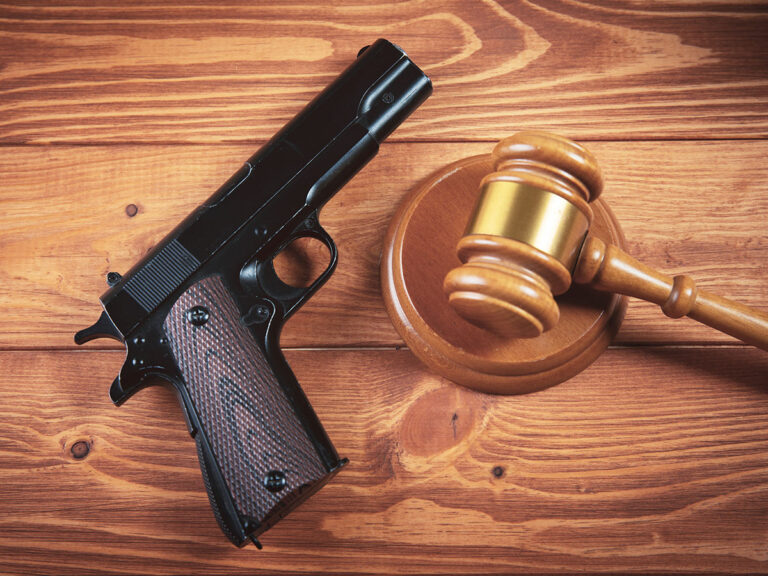
We look at the Bruen Decision and why America’s historical gun culture still matters in modern court cases.
For decades, courts treated the Second Amendment differently from every other constitutional right. Judges weighed individual liberty against government interests, balancing policy preferences rather than examining history.
That era is over, as confirmed in the Bruen opinion.
Today, courts are being asked a simpler, but far more uncomfortable, question: Is a modern gun law consistent with the historical tradition of firearm regulation in the United States?
Answering that question requires confronting a reality many would prefer to ignore: American gun culture is not an accident of modernity. It is deeply rooted in law, practice and expectation.
When History Became Decisive
Modern Second Amendment litigation now turns on historical grounding. Courts increasingly demand evidence that contemporary restrictions resemble those accepted at the time of the founding.
This shift has exposed a serious problem for gun control advocates. Many popular regulatory ideas, like broad public carry bans, categorical disarmament of non-violent citizens and restrictions based on weapon capacity or technology, have little historical precedent.
The record of early America is not one of widespread disarmament. It is one of widespread armament.
What the History Shows
Colonial and early American laws repeatedly assumed that peaceable citizens would be armed. Governments mandated ownership, encouraged carry and punished neglect, not possession.
There is no tradition of banning arms based on their effectiveness. Repeating firearms existed before the Bill of Rights, and no laws restricted their capacity. There is no tradition of prohibiting carry across vast categories of public life. In fact, many public spaces explicitly required arms.
Perhaps most importantly, there is no historical tradition of disarming citizens solely because they were disfavored, unpopular or had committed minor, nonviolent offenses. Disarmament, when it occurred, was temporary and tied to demonstrated dangerousness, not status.
Dangerousness Vs. Disfavor
This distinction now sits at the center of modern legal debates.
Historically, communities acted to restrain individuals who posed credible threats of violence. But those actions were narrow, targeted and rooted in specific conduct. They were not blanket prohibitions applied to broad classes of people, as with, for instance, 18 USC 922 (g)(1), which makes it unlawful for anyone “who has been convicted in any court of, a crime punishable by imprisonment for a term exceeding one year” to possess a firearm or ammunition.
Modern laws often invert this principle, imposing lifetime bans based on labels rather than behavior. Courts are increasingly skeptical of that approach, and history gives them reason to be.
Analogues, Not Excuses
A critical misunderstanding has emerged in the wake of Bruen: the belief that courts must find an exact historical twin for every modern gun regulation. That is not the standard. History does not operate with carbon copies, and the Supreme Court has been clear that what matters are analogues, laws that reflect the same underlying principle, not merely the same outward form.
But this clarification cuts both ways. While governments need not identify a regulation identical in wording or scope, they must still demonstrate a genuine historical tradition that justifies the modern burden imposed on the right. That requirement has proven difficult because many contemporary gun laws are not modest evolutions of historical practices, but categorical innovations.
For example, founding-era regulations aimed at preserving public order were typically narrow and individualized. Surety laws required a specific showing that a particular person posed a credible threat, and even then, they rarely imposed outright disarmament. Instead, they required financial assurances tied to future conduct. Likewise, “going armed” statutes punished the misuse of arms in a threatening manner, not their peaceful possession or carriage.
By contrast, many modern statutes operate in reverse. They presume dangerousness from status alone, impose lifetime prohibitions untethered from conduct, and apply broadly without individualized findings. The historical record provides little support for that approach. Indeed, the absence of sweeping disarmament laws in a far more violent and unstable era speaks volumes.
This is why history has become such a powerful constraint in modern litigation. It does not merely inform constitutional interpretation; it limits it. Legislatures may pursue public safety, but they must do so within the boundaries of traditions that treated arms as normal instruments of lawful citizenship, not privileges to be revoked by default.
The Marketing Myth Fails Under Scrutiny
Claims that American gun culture was manufactured by 19th-century advertising also fare poorly in court. Judges are not persuaded by sociological theories when faced with statutes that required firearms centuries earlier.
History shows demand preceding industry, not the reverse. That matters legally, because rights do not arise from marketing campaigns. They arise from our nature, longstanding practice and recognition.
Why This Matters Beyond the Courtroom
These legal battles are not abstractions. They shape how millions of Americans live, train and defend themselves.
But they also reveal something deeper: the erosion of historical literacy has consequences. When courts and communities forget what early America actually looked like, policy debates drift into fiction.
The renewed emphasis on history is not a threat to liberty. It is its safeguard.
Conclusion: History Has Entered the Record
For years, history was treated as an inconvenience in Second Amendment cases. Today, it is evidence.
And the evidence is clear. American gun culture was neither marginal nor manufactured. It was foundational. Courts are now rediscovering what early Americans already knew: an armed citizenry was not a problem to be solved, but a solution to be preserved.
Editor’s Note: This article originally appeared in the April 2026 issue of Gun Digest the Magazine.
More On Gun Rights
- End Of An Era: The Russian Ammo Ban
- Backdoor Gun Control: The ’94 Norinco Ban
- Rare Breed Triggers And ATF Clash Over The FRT-15
- ATF Classifies Pot Scrubbers As NFA Firearms
- Hunting For The True Meaning Of The Second Amendment

Next Step: Get your FREE Printable Target Pack
Enhance your shooting precision with our 62 MOA Targets, perfect for rifles and handguns. Crafted in collaboration with Storm Tactical for accuracy and versatility.
Subscribe to the Gun Digest email newsletter and get your downloadable target pack sent straight to your inbox. Stay updated with the latest firearms info in the industry.






Very well written and timely article, but there is only one significant problem: no body pays any attention to the Constitution, History or the Citizen’s Rights.
….here WE are as usual, playing the schmucks game of blabbing & twisting things by means of words in courts…..Our 2A Right ia already in words, enough is enough, if People don’t like it, born here or not, then leave it, Our Country with the Constitution Bill of Rights is final, Will not be infringed upon….try it & be charged with treason & punished for it as the criminal you are.
….here WE are as usual, playing the schmucks game of blabbing & twisting things by means of words in courts…..Our 2A Right ia already in words, enough is enough, if People don’t like it, born here or not, then leave it, Our Country with the Constitution Bill of Rights is final, Will not be infringed upon….try it & be charged with treason & punished for it as the criminal you are.
If states don’t honor the ruling, and people will not use the 2A to defend their rights, what is the point of having those rights? Well, none. They win. We forfiet everything.
Bruen was good and bad. Good because it made it harder for courts to justify restriction, but bad because it did eliminate controls all together. It’s like saying only black people born after the civil war can be free or women born after getting the vote can vote.
Scalia slickly added “The Courts have the right to regulate firearms” A slick disingenuous clause that allows the courts to do just about anything when it comes to banning or restricting firearms. Both Republican and Democratic Judges have always regarded 2A as a threat to their absolute power over the people and their absolute power over the Government. That is why there has been a ton of new gun ban laws passed showing which side the Courts are really on.
Interesting article. Wish it were true. It seems States have enacted far reaching gun control laws. Assault rifles, magazine and semi auto bans in place. More anti 2nd amendment laws pass monthly, like the Virginia gun bans just signed into law . Wish your article passed muster.
I think many people see what the truth to gun banning really is, fear that history would repeat itself and the citizens would rise up against the totalitarian rule that a certain political party has planned for the nation!
Alex:
Nice article on the 2A origins, ‘modern’ misconceptions, and the history of narrow (i.e., targeted) restrictions.