
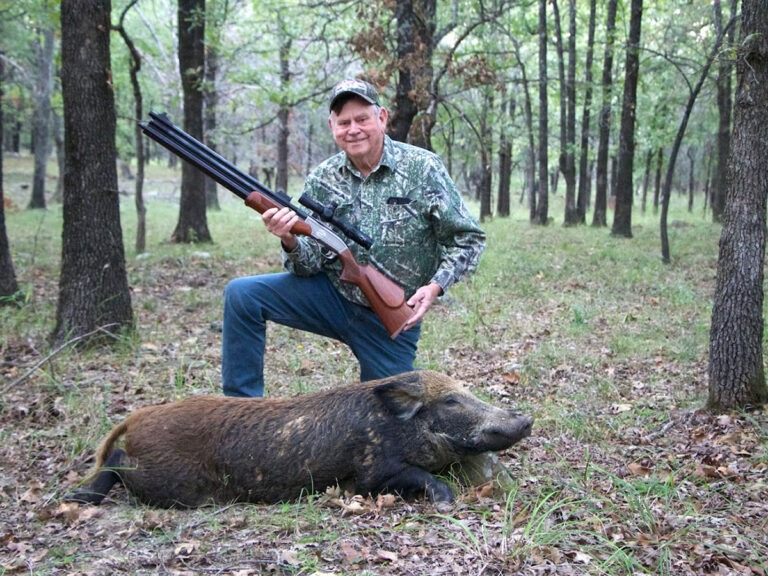
These ain’t your kid’s BB guns. They’re powerful enough to take deer. Here we explore the rising trend of air rifle hunting.
I was first introduced to modern-day PCP (Pre-Charged Pneumatic) air rifles a bit over a decade ago by a good friend who built custom air rifles. My buddy had been shooting and hunting with PCP air rifles for several years and had taken many exotics and wild boar in Texas, usually shooting .45-caliber round balls. Years before he began making custom rifles, he had hunted with airguns from some of the early custom big-bore air-rifle makers, such as the well-known custom builder Dennis Quackenbush.
I was fortunate to have an experienced air rifle expert introduce me to these powerful sporting arms. I’ll never forget the first conversation we had. I was interviewing him over the phone for an article I was writing, and our visit went something like this: “Luke, you need to come out and let me show you one of my .45-caliber PCP rifles. You might even want to sit in a blind late in the afternoon and try it out on one of the big boars we have roaming the ranch.”
At the time, I knew these custom air rifles had plenty of power, but enough to kill a boar? I was a bit dubious! I was also full of questions: How do you pressurize the rifle? How many shots do you get per charge? And how effective would it be on game? With his invitation in hand, I was all in from the get-go. I’ve always enjoyed learning about new ways to pursue my lifelong passion for hunting. I had learned to shoot and hunt with everything from a longbow to a flintlock in past years and was excited to experience the power of air compressed to 3,000 psi.
The next morning found myself at my new friend’s ranch, watching him attach a hose to the fitting on the air chamber of his rifle and crack the valve on an air tank. I watched the gauge slowly climb to 3,000 psi. He explained that the charge would deliver five hard shots. We stepped behind his shop to the range. From a solid rest, I fired a 50-yard three-shot group that almost touched, then watched it slowly drop on the target as the air chamber lost pressure. My learning curve with modern air rifles had begun.
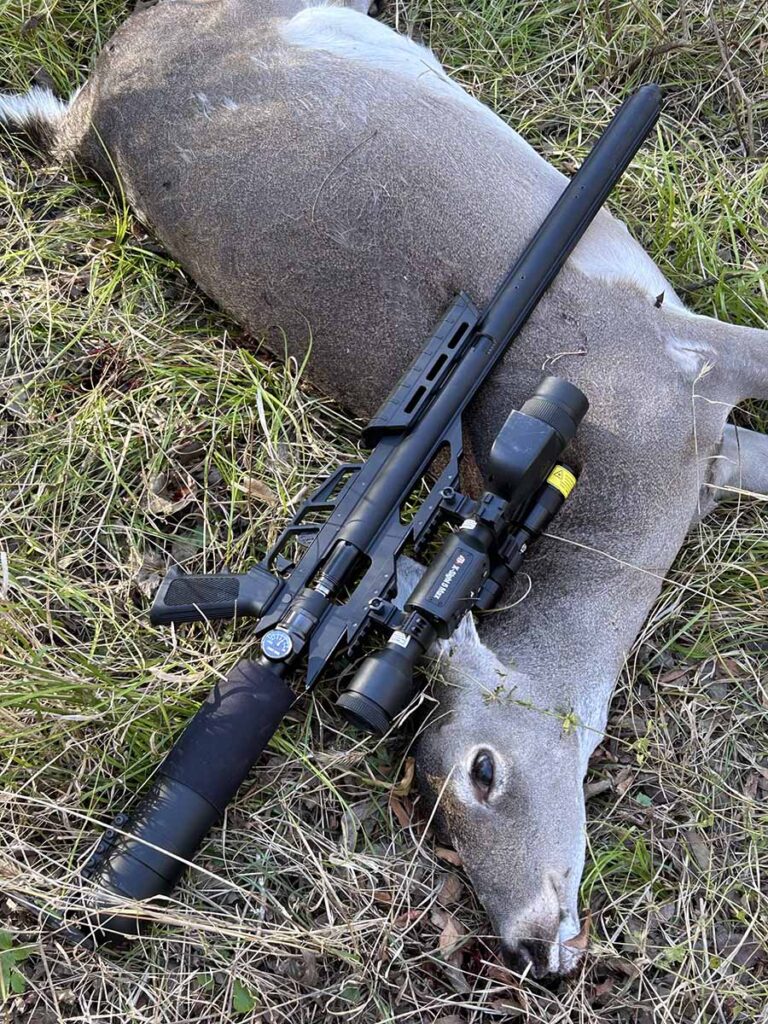
Like most kids back in the day, I had cut my shooting teeth on BB guns first, and when I graduated to a .177-caliber pump air rifle, I thought I was really in the big leagues as a hunter. But with these first few shots from a PCP air rifle, I knew I was shooting a powerful weapon. The rifle’s report wasn’t quite as I had expected. The release of 3,000 psi of pressure pushing a 350-grain chunk of lead down the barrel is anything but quiet!
My education in contemporary air rifles continued while attending an outdoor sports show in Waco, Texas. My friend introduced me to John McCaslin, owner of Airforce Airguns, a Fort Worth-based company that had a powerful .22 air rifle on the market named the Condor. McCaslin had an indoor range set up and invited me to shoot his rifle, which looked to me like something out of a Star Wars episode. The tank was actually the rifle’s stock. I could easily see it was well-constructed, and when I nestled the stock against my shoulder, it fit comfortably.
Space was limited inside the building, and the target was set only about 25 feet from the bench. After the first two shots, I thought I had completely missed the target. There was only one hole, and it was not “ragged.” This little rifle was a shooter, and I added it to my must-have list. Back then, there was no air-rifle squirrel-hunting season in Texas, but I knew one was being discussed. The Condor was also available in .25 caliber, which would be deadly on squirrels and rabbits, and possibly foxes and coyotes, at relatively close range.
John invited me to tour his facility, see how the air rifles are made, and spend some time shooting at the range. I was impressed by the rifle’s performance indoors at the sports show, but after shooting at 40 yards on the outdoor range, I was all in. I left the factory with a brand-new Condor, and my love of shooting PCP air rifles was in full bloom. There was some talk about Airforce Airguns releasing the first production big-bore air rifle at the time. I remember thinking that I was experiencing the very beginnings of something big.
I was not wrong. Soon, the company introduced the Texan, a .45-caliber PCP air rifle with pressures topping 3,000 psi and enough power to kill deer-sized game cleanly. I was fortunate to test one of the first 10 Texans. At the time, air rifle hunting was not allowed for deer in Texas, but I put a lot of fresh pork in the freezer with my Texan and even managed to shoot an aoudad, surely a first with an air rifle.
Texas first amended its game laws in 2018 to allow air rifle hunting for squirrels and, later, for big game such as deer, javelina, and turkey. Lawmakers from across the country were learning that today’s big-bore air rifles provide an ethical means of harvesting game. Back in 2008, Missouri was the first state to allow big game to be taken with air rifles, and, through the years, many other states have come on board with regulations allowing game to be taken with them.
The list continues to grow each year as more lawmakers are introduced to the power of air. Each state has adopted its own regulations for the taking of game with both lead slugs and air-powered arrows. (It’s essential to study regulations regarding caliber and air pressure before choosing a rifle for hunting.)
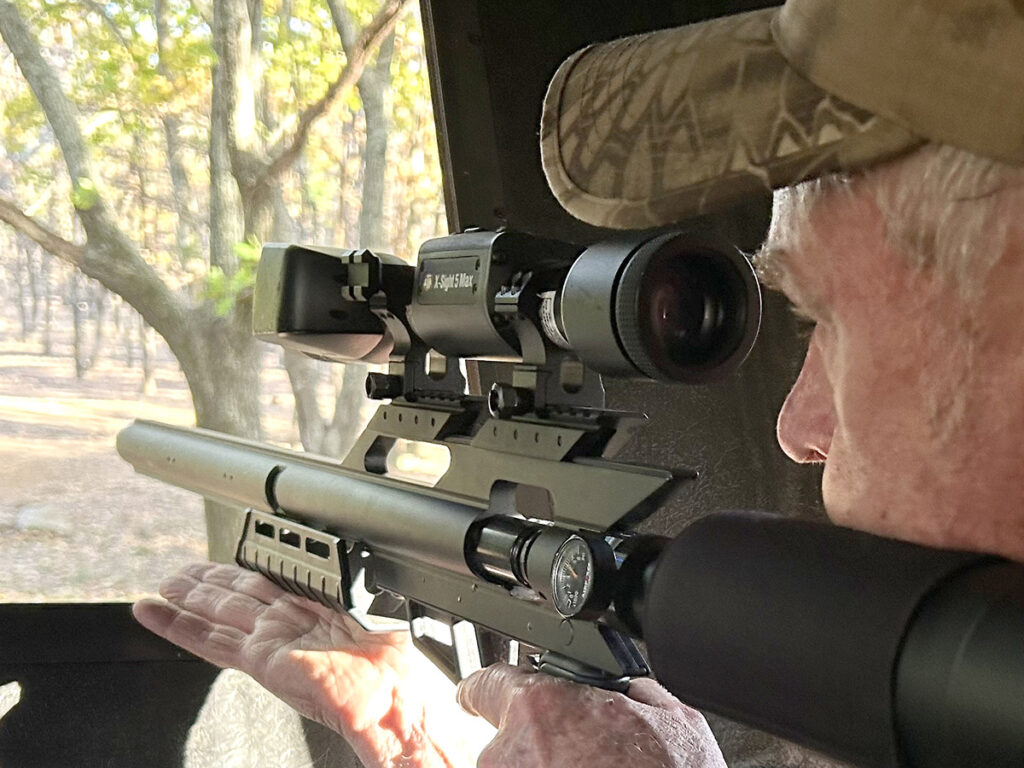
Getting Started
When I was introduced to PCP air rifles, I was full of questions and rightfully so. I knew very little about them other than the fact that they pressured up to what I thought was an astounding level—3,000 psi at the time was the standard maximum fill. But how were the rifles pressurized? What was the maximum distance I could expect them to produce enough energy to kill the game I wished to hunt cleanly? In the 12 or so years I have been shooting and hunting with them, I’ve learned a great deal.
As hunting editor for Airgun Hobbyist, the only national publication devoted to airguns in the country, I’ve been exposed to most of the major brands, both small caliber and the big bores. As a general rule, PCP air rifles are not available at the big box stores, but several companies offer online shopping and quick shipping. For many years, I have ordered all my airgun supplies from Pyramyd Air, an Ohio-based company I consider a one-stop shop for airgunners. With a map that is kept current on each state’s airgun regulations, a ballistic calculator, and a wealth of other helpful information, the Pyramyd Air website (pyramydair.com) is an excellent source for airgunners.
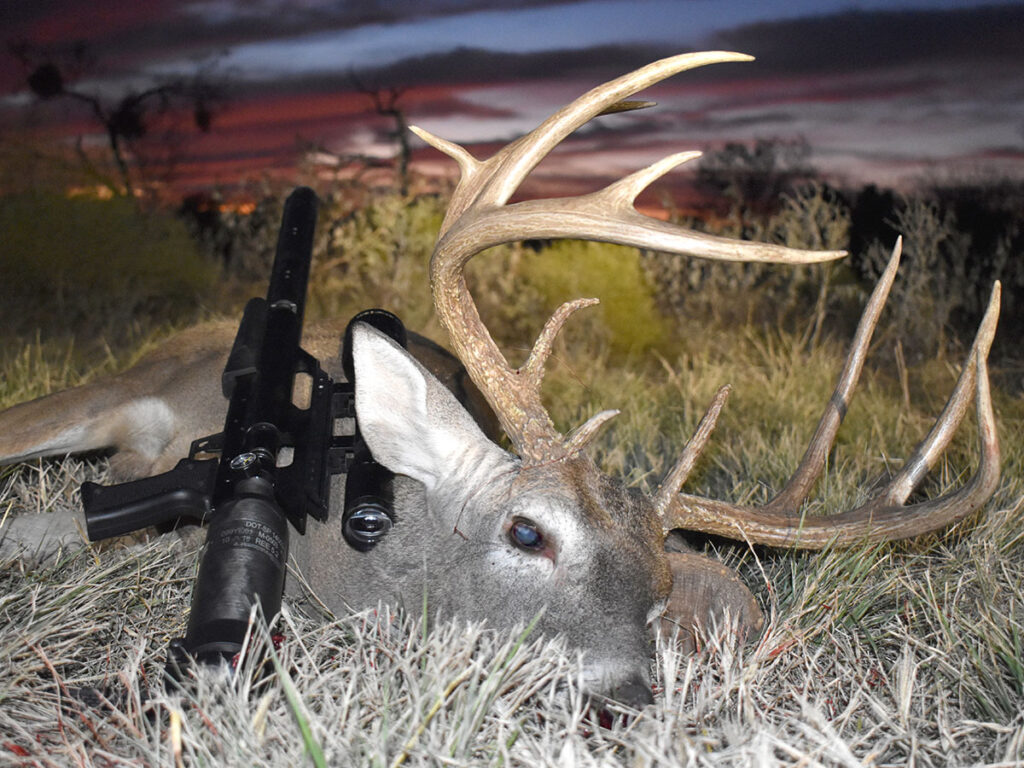
Charging
There are three ways to pressurize PCP airguns: an air tank, a compressor, or a hand pump. Unless you have plenty of time and the desire for a workout that makes Marine Corps boot camp seem like child’s play, I strongly suggest against using the hand pump unless you are young, strong, and wish to get stronger! Many airgunners still use carbon-fiber air tanks, but even with one, a compressor is needed, and it takes a good while to charge a tank with a portable compressor.
A decade ago, compressors were rather costly, and many air rifle shooters went to paintball ranges, local fire departments, and similar places to pressurize their tanks. I remember driving 15 miles to a paintball range to pressurize the one tank I owned. Today, there are plenty of economically priced compressors on the market. I stopped using air tanks several years ago and opted for a portable compressor that runs on both AC and DC. When shooting at a range without electricity, I simply run the compressor off my truck battery or bring a fully charged battery. When hunting, I charge the rifle before the hunt. I seldom need more than two shots on a deer, hog, or exotic game. After a shot or two on a morning hunt, I plug in my compressor back at camp during midday and recharge the rifle before the afternoon hunt.
Small air tanks are available and can be carried in a day pack on a hunt, but I don’t see the need to pack the extra weight. All the big-bore air rifles I hunt with are capable of two or three strong shots on a full charge, and I don’t see the need for more.
Before hunting with a new big bore, I like to measure the drop in pressure with the first four shots. With a charge of 4,000 to 4,500 psi, the bullet drop on the first three shots is minimal; the third shot is always powerful enough to serve as a ‘finishing’ shot on wounded game, but it usually drops 2 to 3 inches. Almost all production big bores today fire that third shot as hard, or harder, as air rifles from a decade or so ago, which were pressured to 3,000 psi.
But looking back through my many years of hunting, how often have I needed a third shot? I don’t recall a single time. Having three or four powerful shots is not only handy for hunting but also when testing for group sizes at the range. It would be a bit inconvenient if the rifle’s air chamber had to be recharged after each shot.
The “Big Guns”
Seneca Dragon Claw II
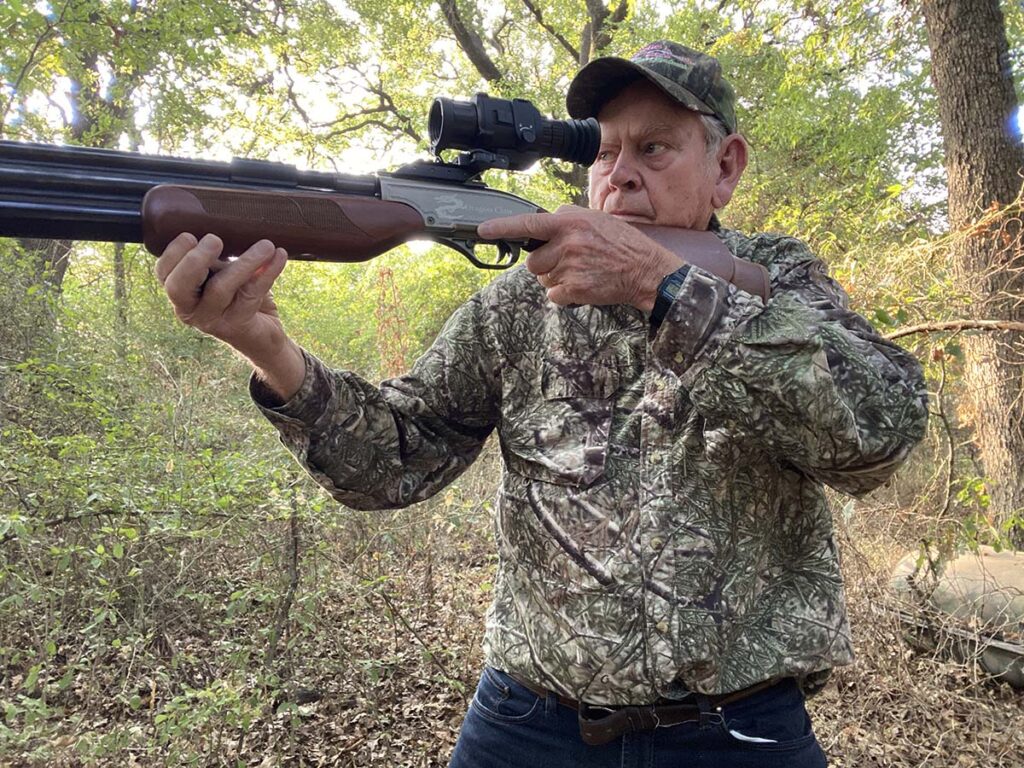
The Seneca Dragon Claw II .50-caliber air rifle is one of the best values on the market. It is an improved version of the original Dragon Claw, which has been around for about 15 years and is available in both standard wood-stock and tactical models. I own both and absolutely love shooting and hunting with them. With a 3,000-psi, 500cc fill pressure in the dual air cylinders, the Dragon Claw air rifle is not the most powerful big-bore on the market, but it packs plenty of power to harvest deer-sized game cleanly. I’ve killed a truckload of wild hogs and exotics with my “Claws” through the years.
As a rule, the trigger pull is a bit heavier than most shooters are accustomed to, but once you learn the pressure to apply, it’s not at all unmanageable. I often put six or more shots in a 2-inch group at 50 yards at the range without having to recharge. From the beginning, the Dragon Claw has been a 3,000-psi rifle, and it remains so even in a market where most big bores are pressurized to over 4,000 psi. The trend today is more pressure, but, in truth, air rifles filled to 3,000 psi have accounted for a significant number of exotics and wild hogs long before many of the states made air rifle hunting legal.
I absolutely love stalking close to wild hogs at night with an air rifle topped with a thermal scope, and the Dragon Claw II is a solid, economical rifle for hunters who keep their shots on game relatively close, inside 50 yards. The Dragon Claw II is a dual-purpose rifle: it shoots both slugs and air bolts. Whether you wish to go after your game with a big, 336-grain chunk of lead or an air bolt tipped with a sharp broadhead, the Dragon Claw II deserves a spot in every airgunner’s gun cabinet.
Tex Rex
This past season, I did a good bit of hunting with the .51-caliber Tex Rex by Airforce Airguns. I found the rifle to be solidly built, just like its predecessor, the Texan model, and very accurate. The carbine model I chose is also very maneuverable when hunting from a blind or stalking game in heavy cover. Shooting the 388-grain hollow-points by Nielsen Specialty Ammo (available through Pyramyd Air, pyramydair.com), this big .51-caliber is high on the list of production big bores that pack a punch big enough to harvest the biggest of North American game cleanly.
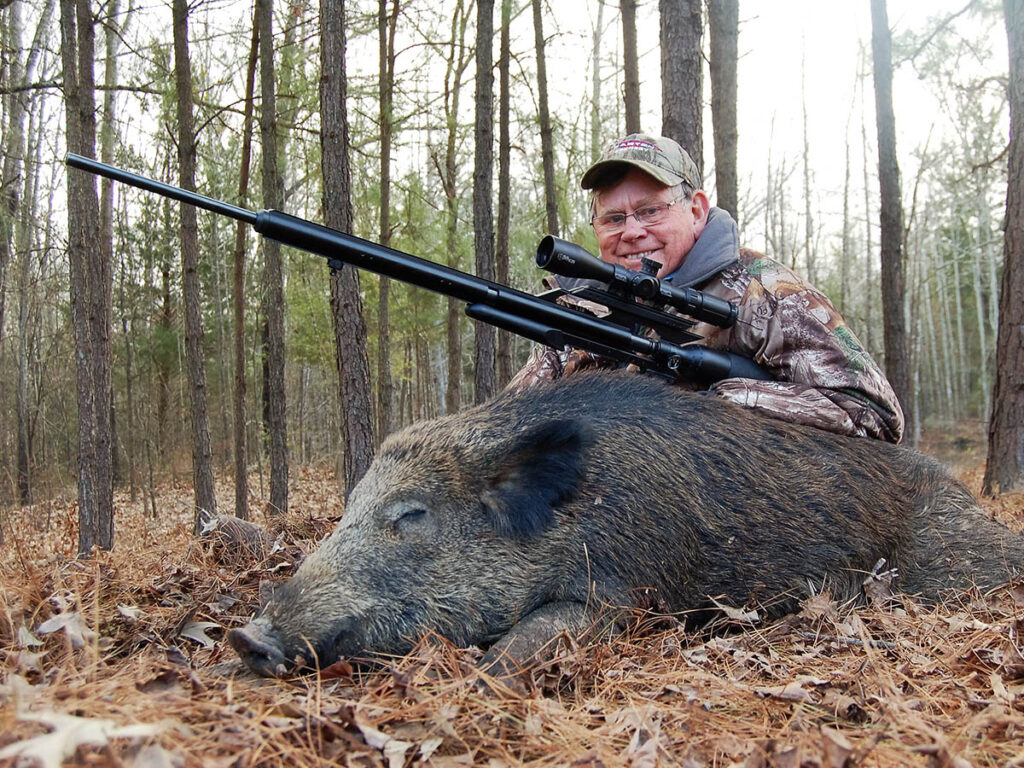
I hunt wild hogs a lot here in Texas, where I live, and usually shoot them in the neck, aiming just behind the jaw. I hit a solid 225-pound boar through the front shoulder, and the bullet penetrated the thick protective shield, went through the shoulder blade and lodged just under the skin on the off side. While bench testing, the Tex Rex consistently delivered four to five shots that produced 730 ft-lb of energy with the big bullets. The Tex Rex is not the cheapest big bore on the market, but hands down, it’s worth every penny.
The Airforce Airguns line is built to last a lifetime. I still hunt with one of the first .457-caliber Texans the company produced a decade ago, and have taken everything from aoudad to turkeys with it.
Umarex Primal 20
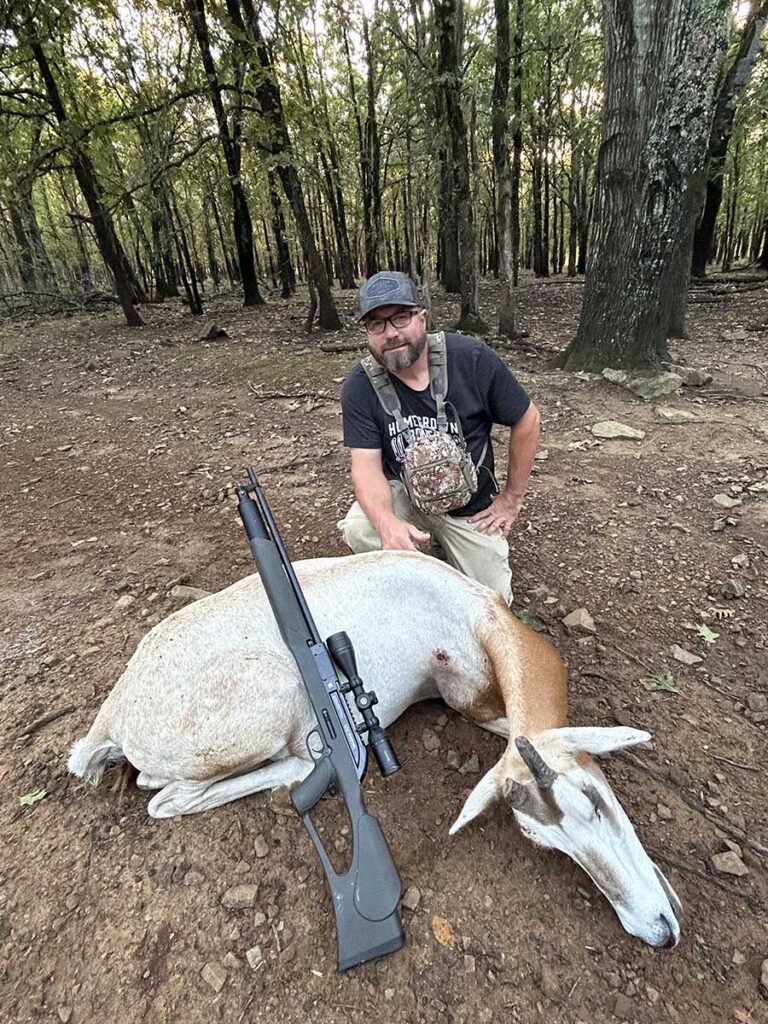
The Primal 20 uses a special 20-gauge slug fitted with a plastic “wad” that seals the barrel. Both the slug and the invector choke installed in the barrel are rifled to ensure excellent accuracy. A 395-grain slug leaving the muzzle at 700 fps generates 430 ft-lbs of energy. The two-shot Primal 20 features a 24-cubic-inch onboard air tank that can be pressurized to 4,000 psi. Filling this tank is easy with the end-mounted Foster Quick disconnect fitting.
Fully ambidextrous, the Primal 20 is an absolute breeze to set up for shooters of either handedness. In an industry first, it offers shooters a true drop safety in addition to the push-through manual safety. I was introduced to the Primal 20 at the Choctaw Hunting Lodge in southeast Oklahoma while hunting with my friend Larry Weishuhn. Larry and lodge manager Dusty Vickrey were on a quest to harvest a broken-horned oryx, a big African antelope weighing about 350 pounds. The bull was running with a herd of about 10 trophy bulls and females, which made the hunt challenging. This was Dusty’s first hunt with an air rifle, and he was unsure of just how much stopping power the big slug would have when pushed with the power of compressed air rather than powder.
Shooting a particular animal out of a herd can be challenging. Each time the targeted bull gave Dusty a clear shot, another oryx was standing directly behind. Finally, the bull broke clear of the herd for an instant, and Dusty eased back on the trigger. The shot was perfect, and Dusty had his first animal on the ground, thanks to his new Primal 20 and the power of 4,000 psi of compressed air.
Air Rifles for Hunting Small Game
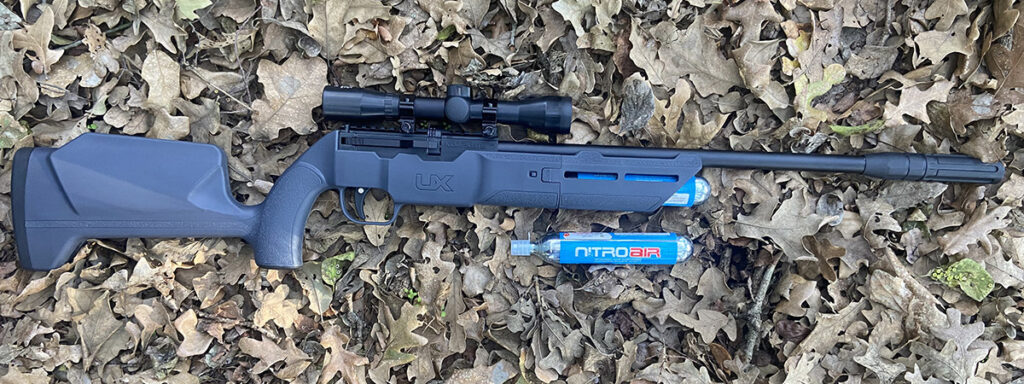
The Umarex Komplete is new on the market and is charged with nitrogen canisters that screw into the valve system, just below the barrel and become part of the forestock. I’ve been hunting squirrels with one of these innovative new rifles for several months and found them to be not only accurate but also pack plenty of punch for cleanly taking small game. The Komplete is excellent for both experienced PCP shooters and newcomers alike. Since the power comes from pre-charged nitrogen canisters, there is no need to spend several hundred dollars on a compressor or large air tank; the compressed nitrogen canisters supply the power, and you can expect upwards of 40 shots per canister.
Air rifles chambered in .177, .22, or .25 caliber are ideal for hunting small game such as rabbits and squirrels. There are many fine small-caliber rifles on the market, and I’ve hunted with a good number of them. Air Venturi offers the Avenger in small-bore calibers up to .25 caliber, making it an economically priced rifle for small game or target shooting. Airforce Airguns offers the Condor and TalonSS, both well-built, accurate rifles of the same quality that have earned the company its reputation. The Umarex Komplete is a relatively new small-bore that is pressurized by small nitrogen bottles. I’ve found these little rifles to be highly accurate and a good choice for beginner airgunners without a compressor. Each nitrogen bottle provides about 45 regulated shots, more than enough for a morning squirrel or rabbit hunt.
The Air Venturi OmniStorm is a break-barrel air rifle available in .177 or .22 caliber. It is a power-adjustable single-shot. Thanks to its OmniPiston gas piston powerplant, you can quickly adjust the pressure within the piston to change the power and cocking effort. This is done with the included OmniTuner pump, allowing kids to use the same rifle as their parents with a simple adjustment. Additionally, the OmniPiston is a set-it-and-forget-it system, meaning once you have the gun performing the way you want, it will remain at that setting.
When it comes to adjustment, the OmniPiston powerplant operates from approximately 205 to around 550 psi. Cocking effort increases with pressure, ranging from 25 lbs. on the low end to about 50 lbs. As pressure and cocking effort are increased, so is the velocity and power capability of the rifle. In .177 caliber, 7-grain lead pellets reach speeds between 500 and 1,100 fps, while 11.9-grain .22-cal. lead pellets travel between 500 and 850 fps. The rifle is built around an all-weather synthetic stock and boasts a pair of adjustable fiber-optic sights and an 11mm dovetail rail for the included 4×32 scope. A two-stage trigger and a 19-inch rifled barrel help land accurate shots while an automatic safety prevents unintended discharges. This gas piston rifle is excellent for hunting small game, pest control, teaching beginner fundamentals, or serving as a survival rifle with its own power source.
Biggest Boar with the Umarex Hammer
Some folks are devout deer hunters; others’ dreams are dominated by trophy-class elk. I have, for many years, been ‘eaten up’ with hog hunting. I hunt hogs with big-bore air rifles and absolutely love stalking them up close at night, using my ATN thermal scope to make a good, close shot. I live in the center of some of the best hog hunting in Texas, here in Kaufman County.
On one such hunt, I was leaving a corn feeder I had been hunting at since about 10 pm, when nary a porker had shown up. I drove out of the ranch near my home, stopped at the gate, and glassed a 50-acre wheat field. There, near the middle of the open field, I spotted a boar that I had seen once before during daylight while still-hunting along a thick creekbed during the summer. This was hands down the most enormous boar I have encountered while hunting, weighing close to 300 pounds, which, regardless of what you might have read, is extremely rare in truly wild hogs. The monster boar was throwing dirt 10 feet in the air with his snout as he rooted up the field. I had already seen the destruction he was causing to the field; that’s why I stopped to scan it with thermal.
When I spotted the boar, adrenaline surged, and I forgot I was armed with an air rifle that would give me only one shot at the very close range I hoped to make. There was a stiff north wind blowing, and I eased within 75 yards, downwind. I wanted to drop this big hog in its tracks and planned to shoot it in the center of the neck, just behind the jaw. I closed the distance to 50 yards, and then 35, and the boar never knew I was in the world. I sat down on the ground, set up my shooting sticks, centered the ATN Thor LTV on the hog’s neck, and began the trigger pull. He must have heard me over the strong wind, but I doubt he smelled me.
A millisecond before I got the slack out of the .50-caliber Umarex Hammer, the hog moved a few inches, and the shot centered his left shoulder and angled toward the middle of his body. No doubt the protective shield was at least an inch thick. I watched the bullet kick up dirt on the other side of the boar; the shot had probably taken out one lung. There I sat in the middle of the field, 35 yards from the most enormous boar I’d ever seen in the wild, with no tree to climb or way to escape a charge. Luckily, he ran for the nearby fenceline and, to my dismay, crossed over to property that was strictly off limits.
A couple of days later, I watched a flock of buzzards landing in a dead tree near where the boar went down. I desperately wanted the big boar for photographs, but that was not in the cards.
Had the big chunk of lead hit the center of the boar’s neck, you would be looking at a photograph of a giant boar and one very “pumped” old hog hunter rather than the video. It’s a good reminder that while today’s air rifles are more powerful and capable than ever before, they also provide a new challenge to hunters who want to expand their skills and get close.
Editor’s Note: This article originally appeared in the May 2026 issue of Gun Digest the Magazine.
More On Air Guns
- Wind Power: Decoding The Air Rifle And Pistol
- Airguns: How Pre-Charged Pneumatics Became A Knockout
- Aspen PCP Pumps Up The Air Rifle
- Gamo Introduces New Hard-Hitting Air Rifle
- Hatsan Introduces Whisper-Quiet Air Rifle
Next Step: Get your FREE Printable Target Pack
Enhance your shooting precision with our 62 MOA Targets, perfect for rifles and handguns. Crafted in collaboration with Storm Tactical for accuracy and versatility.
Subscribe to the Gun Digest email newsletter and get your downloadable target pack sent straight to your inbox. Stay updated with the latest firearms info in the industry.
You need to talk with Dr. Jeff Golini.
He has taken not one, but two American Bison with an air rifle!