
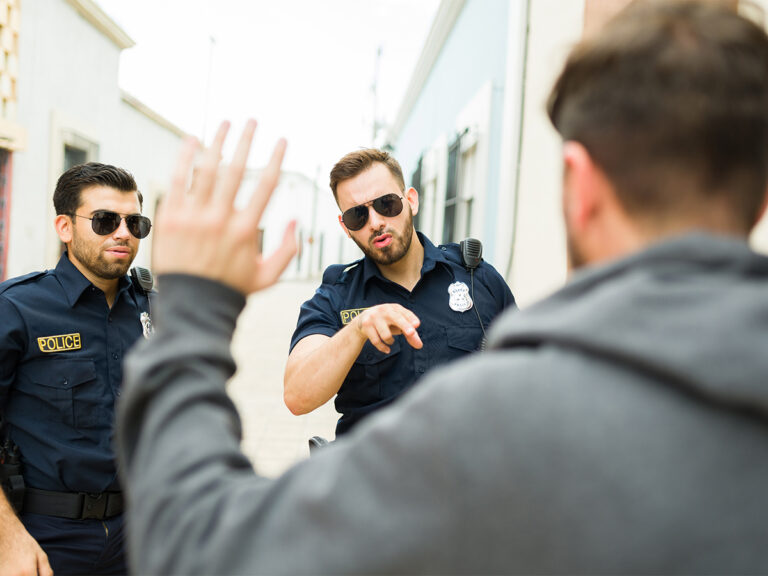
Do the police have the right to stop you just because they saw a pistol printing under your shirt?
Imagine walking down a Baltimore sidewalk on a hot July afternoon. Your legally carried handgun, holstered inside the waistband under a T-shirt, prints slightly. An unmarked police car pulls over. A detective orders you to raise your hands. You immediately and repeatedly tell him you have a valid carry permit and offer to show it. Instead, officers handcuff you, remove the holstered gun, reach into your satchel and pockets, and ultimately recover a second firearm and suspected cocaine.
This real encounter from July 5, 2023, led to Hicks v. State of Maryland. In a June 4, 2026, en banc decision, the Appellate Court of Maryland unanimously held that the stop violated the Fourth Amendment. Writing for the court, Judge Kathryn Graeff explained that after the U.S. Supreme Court’s 2022 ruling in New York State Rifle & Pistol Association v. Bruen, “carrying a handgun publicly for self-defense is presumptively lawful.” Therefore, “mere possession of a concealed firearm, by itself, is not indicative of criminal activity.” The “mere possibility” that someone with a gun might lack a valid license “is not enough to establish reasonable suspicion for a seizure.” Police must have specific facts showing the person “is possessing the gun illegally or otherwise engaged in criminal activity.”
For armed citizens, this is a major development. Lawful public carry now carries meaningful Fourth Amendment protection. Police can still investigate real crimes, but they cannot detain you simply because you are visibly or conceivably armed.
The Hicks Decision: Bruen Reshapes Reasonable Suspicion
Steven Hicks was walking away from a group when Detective Mitchell Ramsey saw the rear handle of a handgun printing through his shirt. Hicks wore a crossbody satchel. Officers exited their vehicle, ordered his hands up and handcuffed him despite his immediate statements that he had a permit. They seized the holstered gun from his waistband, then conducted a more intrusive search that recovered a second gun from the satchel and cocaine from his pocket.
Pre-Bruen, many courts treated handgun possession as presumptively unlawful (especially in may-issue or restrictive states), so seeing a gun often supplied reasonable suspicion for a Terry stop. Bruen changed that foundation. The Second and Fourteenth Amendments protect ordinary, law-abiding citizens’ right to carry handguns publicly for self-defense. When the Constitution’s text covers conduct, that conduct is presumptively protected. The Hicks court applied this directly: Lawful carry cannot be treated as automatic evidence of crime.
The court also addressed officer safety. It rejected the claim that Bruen eliminated protective frisks. “Because a gun is a dangerous weapon, officers may frisk a suspect carrying a gun regardless of whether the suspect is carrying the gun legally or illegally.” However, once the first gun was secured, the officers in Hicks exceeded Terry’s limits by reaching into pockets and the satchel without adequate justification under plain-view or plain-feel doctrines. The evidence was suppressed.
Indiana’s Parallel: Pinner v. State
Indiana reached essentially the same conclusion years earlier. In Pinner v. State (Ind. 2017), Indianapolis officers responded to a cab driver’s report that a Black male in a blue jacket had dropped a handgun while exiting a taxi at Studio Movie Grill and that the driver feared he might be robbed. The driver left before police arrived and made no claim of an actual threat or robbery with the gun.
Officers found Thomas Pinner seated alone on a bench inside the theater lobby. Two uniformed officers approached, told him they had a report of a man with a gun matching his description, and asked if he was armed. Pinner hesitated, denied having a weapon and was ordered to stand with hands visible. An officer then saw the butt of a handgun in his front pocket. He was arrested for carrying without a license (enhanced by a prior felony).
The Indiana Supreme Court held this was an investigatory Terry stop requiring reasonable suspicion of criminal activity. The tip identified a person with a gun but contained no “assertion of illegality.” Mere possession of a firearm, which can be entirely legal, does not, by itself, create reasonable suspicion that “criminal activity may be afoot.” There is no “firearm or weapons exception” to Terry. Nervousness alone (rocking, wringing hands) is of limited significance.
The Court of Appeals put it plainly: “Mere possession of a firearm, which is legal, cannot produce a reasonable suspicion to justify a Terry stop.” That holding remains strong authority in Indiana, especially now that the state has constitutional (permitless) carry for qualified adults since 2022. An officer generally cannot infer illegal possession from open carry, printing or a bare report that someone is armed.
Practical Implications for Carriers, Instructors and Trainers
Hicks and Pinner converge on a clear rule: lawful gun possession or printing, standing alone, is not reasonable suspicion. A “man with a gun” report or visual observation requires additional specific facts like brandishing, threats, a reliable match to a wanted suspect with distinctive details beyond the gun, known prohibited status or furtive/evasive conduct suggesting other criminal activity before police can detain someone.
Terry basics remain unchanged but must be applied correctly.
A Terry stop is a brief detention supported by specific, articulable facts that criminal activity “may be afoot.” A Terry frisk is a limited pat down of outer clothing for weapons when an officer reasonably believes a lawfully detained person is armed and dangerous. The frisk is for officer safety during the encounter. It is not a general search for contraband. Once a stop is independently justified (e.g., traffic violation plus visible gun, or other suspicious facts), officers may frisk an armed person regardless of whether the carry is legal.
For Carriers:
- Stay calm and keep hands visible. Clearly state: “I am lawfully carrying a firearm” (and, where required, “I have a valid permit and will follow your instructions”).
- Ask: “Am I being detained, or am I free to leave?” to clarify the encounter’s nature.
- Record if it is safe and legal in your jurisdiction. Document details afterward.
- Do not reach suddenly for ID, permit or anything else unless directed.
For Instructors & Trainers:
- These cases are excellent teaching tools. Update scenario training to include calm rights assertion, de-escalation and the distinction between consensual contact and detention. Emphasize that responsible carry includes predictable, non-confrontational behavior.
- Law enforcement agencies are updating policies and training to require “additional facts indicating criminal activity beyond mere possession of a gun.” This shift benefits officer safety and citizen rights: Lawful carriers face less unwarranted scrutiny, while genuinely dangerous individuals remain subject to sound investigation.
- These rulings do not create immunity. Gun possession combined with other suspicious circumstances can still justify a stop. The line is drawn by the totality of the circumstances and particularized facts, not by the mere presence of a firearm.
Carry Rights Backed by the Fourth Amendment
From Bruen to Hicks to Pinner, courts are applying a straightforward principle: Exercising your constitutional right to carry a handgun for self-defense cannot, by itself, turn you into a suspect. The Second Amendment protects the right to carry. The Fourth Amendment protects you from being seized simply for exercising it.
Editor’s Note: This article originally appeared in the October 2026 issue of Gun Digest the Magazine.
More Knowledge For The Armed Citizen
- Carry Law: What Is A Righteous Shooting?
- Concealed Carry and the Right to Remain Silent
- Tips For Communicating With Police After Shootings
- Concealed Carry: After the Shooting
- Q&A: Massad Ayoob On Self-Defense In Modern America

Next Step: Get your FREE Printable Target Pack
Enhance your shooting precision with our 62 MOA Targets, perfect for rifles and handguns. Crafted in collaboration with Storm Tactical for accuracy and versatility.
Subscribe to the Gun Digest email newsletter and get your downloadable target pack sent straight to your inbox. Stay updated with the latest firearms info in the industry.


When I see political traitors charged, prosecuted and convicted then my faith in government will be restored. Leave the law abiding alone, go after the flash mobs and the people committing 40% of the nations violent crime overall and about 90% in the large cities. I have to wonder how many unsolved murders there are in our large cities.