
If you’re an armed citizen, tactical first aid is an essential skill that you can’t afford to ignore.
The timeline that opened Greg Ellifritz’s Tactical First Aid course is something none of us will forget: the 2012 Aurora, Colorado, theater shooting. Seventy people were shot. The first trained medical responders didn’t get to the injured for 27 minutes, because police had to clear the scene first. A person with a massive arterial bleed has only 4 to 5 minutes to live without intervention.
In that moment, one reality became painfully clear: Bystanders were the only medics on scene, and their actions determined who lived and who died.
That sobering timeline reinforced a vital truth for every responsibly armed citizen: When disaster strikes, you are your own first responder. Carrying a firearm is only part of protecting yourself and others. Violence or even everyday accidents produce injuries that no firearm can fix. That’s why medical training and, specifically, tactical first aid must be part of the responsible citizen’s skillset.
What Makes Tactical First Aid Different?
Tactical medicine isn’t a standard CPR or Red Cross course. Ellifritz, a 20-year law enforcement officer and self-defense instructor, explained that tactical first aid happens in unstable, dangerous, often chaotic settings, possibly in the middle of an ongoing threat. You may not have ambulances or medics arriving within minutes. You might have one trail bag, two hands and people rapidly bleeding around you.
In a conventional first aid class, the assumption is a safe environment: scene secured, team response and ambulance in transit. Tactical first aid assumes none of that. You might have to treat casualties before the threat is fully neutralized.
The Grim Reality Is This
If the attacker is still alive, stopping the threat comes first, not treating the wounded.
If the scene is unstable, you might have to treat under fire.
You must triage, decide whom you can help and whom, tragically, you might not be able to.
This mindset shift is difficult even for experienced ER doctors. They admitted they knew the medicine but never considered how to apply it when alone, under stress, with minimal supplies and no hospital support. Tactical training pushes medical skills into the real world where perfection is impossible and improvisation is mandatory.
MARCH: A Battlefield-Proven Priority System
Most of us grew up with ABC (Airway, Breathing, Circulation) as the standard sequence for first aid care, but tactical medicine and research from modern combat shows that ABC doesn’t fit real-world traumatic injuries like gunshots and blast trauma.
Ellifritz taught us MARCH, the protocol used in Tactical Combat Casualty Care (TCCC):
- M – Massive bleeding
- A – Airway
- R – Respiration/chest injuries
- C – Circulation/shock prevention
- H – Head injury and hypothermia
Why begin with bleeding? Battlefield data reveals that hemorrhage from extremity wounds causes 60 percent of preventable deaths, far more than airway issues. Blood loss kills faster than almost anything else.
Ellifritz put it plainly: “If I have a heart attack, then follow ABCs. But if I’m bleeding from a gunshot, grab a tourniquet first!”
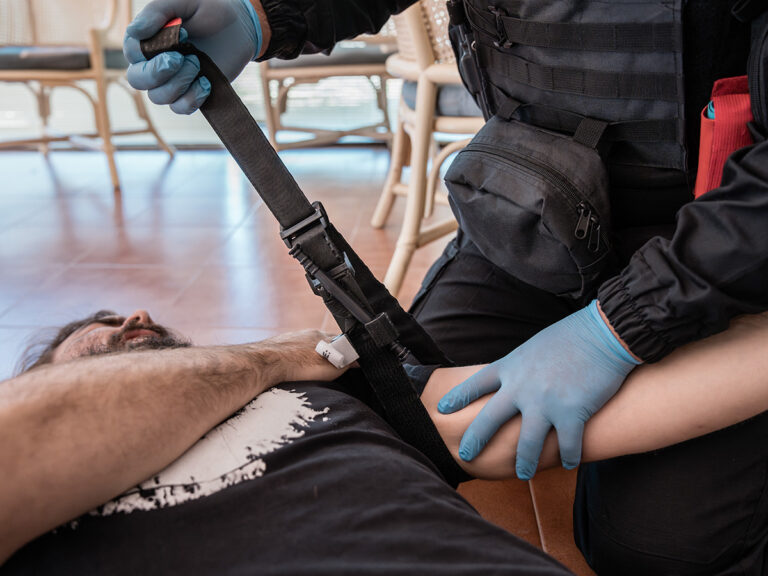
The training made this real. We practiced sustained direct pressure and learned quickly how exhausting it is to press hard enough to stop bleeding for even a few minutes. That is why tourniquets and pressure bandages matter. They aren’t accessories. They are lifelines.
Tools That Save Lives
As we learned the MARCH protocol, it started to become evident what sorts of items should be included in the trauma kit that every armed citizen should carry or at minimum, keep in their vehicle or range bag. The most essential tools include:
- CAT or SOF-T tourniquet
- Israeli/emergency pressure bandage
- Hemostatic gauze (QuikClot or Celox)
- Chest seals for sucking chest wounds
- Trauma shears, gloves and marker
Students paired up and practiced applying tourniquets on each other. The key lesson: They must be tight—really tight. If it doesn’t hurt at least a little, it isn’t tight enough. It has to be tight enough to stop your distal pulse. Modern tourniquets are safe to leave on for two hours—hopefully long enough to keep someone alive until higher care arrives.
The Israeli bandage was another standout. With coaching, we wrapped simulated arm wounds in 20 to 30, freeing up our hands and attention to address other threats or other victims. These tools are easy to carry, easy to store and proven by thousands of deployments in combat. What’s often missing is training and confidence, the ability to use them under stress.
You’ll Need These Skills More Than Your Gun
Not everyone taking this course imagines themselves in an active shooter scenario, and that’s the point. Tactical medical training applies far beyond gunfights. Car crashes, hunting accidents, power-tool mishaps, chainsaw injuries, storm damage, tornadoes, hiking accidents and range accidents are just a few other possibilities.
Statistics are clear: You’re far more likely to use medical skills to save a life than you are to use a firearm in self-defense.
That fact alone reframes what it means to be “responsibly armed.” The protector mindset isn’t limited to stopping threats. It includes preserving life when something goes wrong. Sometimes helping means drawing a firearm. Other times it means putting your hands on a wound to stop the bleeding fast.
Mindset: You Are the Help
The greatest thing this course imparted wasn’t just skill. It is a mindset. Ellifritz blends practicality with urgency. His message is never paranoid. It’s empowering: We live in a world where help may not come quickly. If no one else is coming, then you are the help.
That mindset shift from bystander to responder is the dividing line between helplessness and preparedness. Tactical first aid training takes you across that line.
It’s not about becoming a medic or replacing EMS. It’s about filling the gap when time matters most, the minutes before professionals arrive. When every second counts, preparation isn’t paranoia, it’s responsibility.
The Responsibility to Preserve Life
Gun owners often emphasize the weight of carrying a firearm. But the duty to preserve life does not end when the threat is stopped. It continues with the ability to treat the injured, whether they’re a victim, an innocent bystander, a loved one … or even yourself.
Ellifritz’s course drove that home powerfully. I plan to train medically just as routinely as I train at the range, and I believe every responsibly armed citizen should do the same.
When tragedy strikes, no one has ever regretted having too much knowledge or too much training, but the opposite, the regret for being unprepared, can be a lifelong burden.
Carrying a firearm may help you stop the threat. Carrying medical training may help you save a life. After all, if you can’t avoid the fight, surviving the fight is the next best outcome in any fight.
Editor’s Note: This article originally appeared in the January 2026 issue of Gun Digest the Magazine.
Be Prepared
- Should You Be Carrying A Trauma Kit?
- Emergency Preparedness Checklist: Everyday Carry Gear
- Why You Need A ZipStich In Your Med Kit
- How To Make A TSA-Approved Carry-On Emergency Kit
- EDC Gear: Rescue Knives Save Lives
Next Step: Get your FREE Printable Target Pack
Enhance your shooting precision with our 62 MOA Targets, perfect for rifles and handguns. Crafted in collaboration with Storm Tactical for accuracy and versatility.
Subscribe to the Gun Digest email newsletter and get your downloadable target pack sent straight to your inbox. Stay updated with the latest firearms info in the industry.
People, please learn the definition of the words you use. Paranoid does not mean what you think. Stop using it to mean uneasiness, fear, or belief that something bad may happen.
Paranoia is deep seated mental health condition, often with the belief that the world is against them or “they” are out to get them.
Thank you for taking the time to read and comment.
As the author of this article, I’m actually very familiar with the clinical definition of paranoia. In fact, I regularly consult the the “Diagnostic and Statistical Manual of Mental Disorders” for my work. That’s precisely why I wrote, “Preparation is not paranoia.”
My point was that carrying a tourniquet, learning to pack a wound, or training for worst-case scenarios is rational foresight, not the product of persecutory delusions. The word “paranoid” gets thrown around so loosely these days that real preparedness gets unfairly painted with the same brush as mental illness, and I was pushing back against that misuse.
I appreciate the passion for precise language. We’re on the same side here. Thanks again for keeping the conversation sharp.